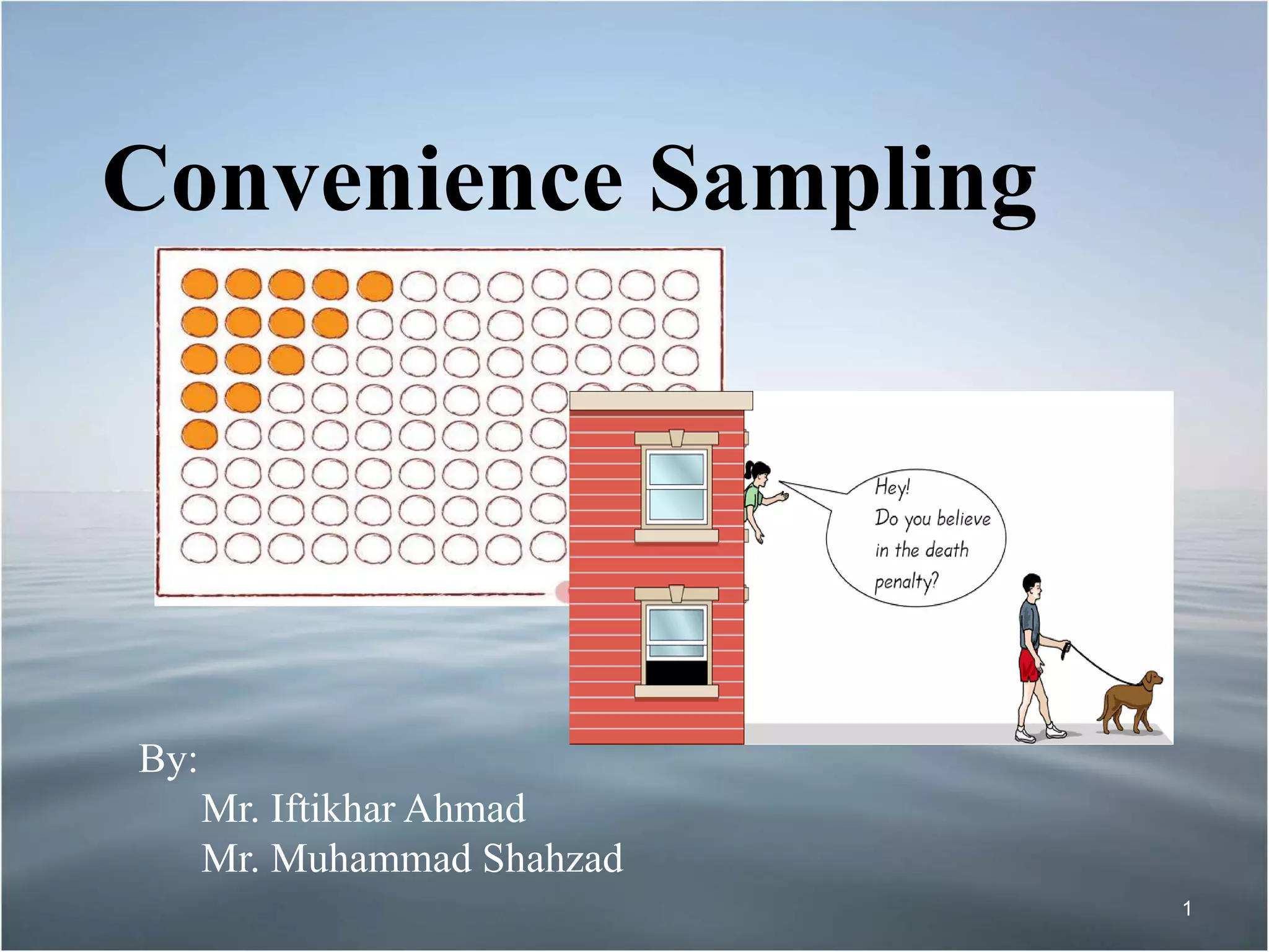
Convenience Sampling
By:
Mr. Iftikhar Ahmad
Mr. Muhammad Shahzad
1
2a
• A sample is “a smaller (but hopefully representative)
collection of units from a population used to
determine truths about that population” (Field, 2005)
• Why sample?
– Resources (time, money) and workload
– Gives results with known accuracy that can be
calculated mathematically
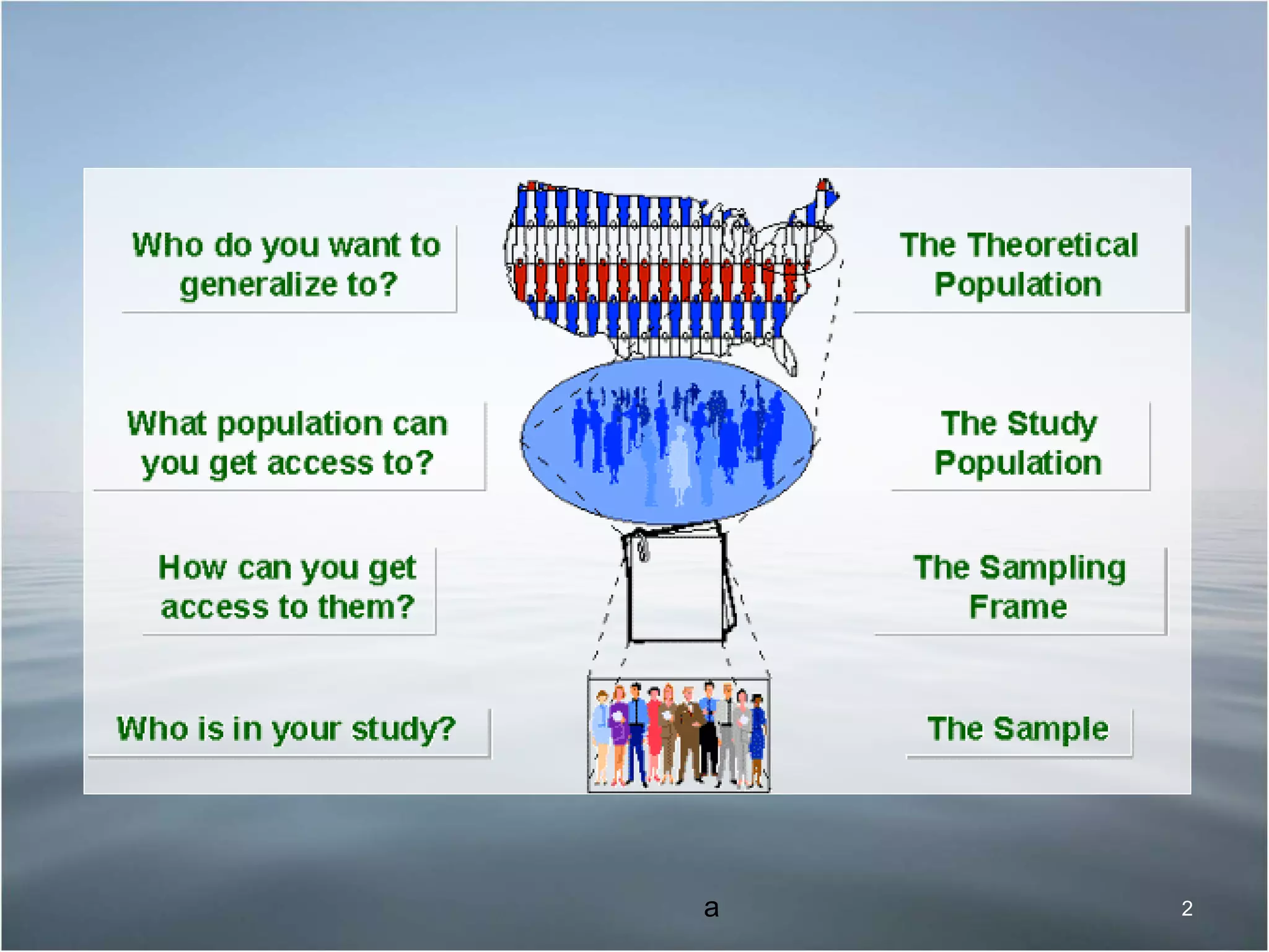
• The sampling frame is the list from which the potential
respondents are drawn
– Registrar’s office
– Class rosters
– Must assess sampling frame errors
Sampling
3
• What is your population of interest?
• To whom do you want to generalize your
results?
–All doctors
–School children
–Muslims
–Women aged 15-45 years
–Other
• Can you sample the entire population?
Sampling …
4
• 3 factors that influence sample representativeness
• Sampling procedure
• Sample size
• Participation (response)
• When might you sample the entire population?
• When your population is very small
• When you have extensive resources
• When you don’t expect a very high response
Sampling …
5
•Rule of thumb: Bigger is better
•As
n  N,
Confidence Interval  0
6
How big should your Sample be?
7
How big should your Sample be?...
8
How big should your Sample be?...
• The degree of precision required between the
sample and population
– Less precision = smaller sample
• Variability/Diversity of the population
– A more homogenous population requires a smaller sample
• Method of sampling
– A stratified sample requires fewer cases for accuracy
• Way in which results will be analyzed
– A smaller sample puts limits on types of analyses possible
(Powell 105-6)
9
Considerations for Choosing
Sample Size
Types of Sampling
• Probability Sampling
• Nonprobability Sampling
10
• A type of nonprobability sampling
• Convenience sampling is choosing a sample based on
availability, time, location, or ease of access. (Ary, Jacobs,
Sorensen & Walker, 2013, p. 431)
• Convenience sampling (also called haphazard or accidental
sampling) refers to sampling by obtaining units or people
who are most conveniently available.
• The subjects are selected just because they are easiest to
recruit for the study and the researcher did not consider
selecting subjects that are representative of the entire
population.
• A sample of convenience is simply a potential source of
participants that is easily accessible to the researcher.
(Marczyk, DeMatteo & Festinger 2005, pp. 83-84)
11
Convenience Sampling
Convenience sampling technique may prove to be
effective during exploration stage of the research area,
and when conducting pilot data collection in order to
identify and address shortcomings associated with
questionnaire design.
12
Convenience Sampling…
• For example, it may be convenient and economical
to sample employees in companies in a nearby area,
sample from a pool of friends and neighbors.
• The person-on-the street interview conducted by
TV programs is another example.
– TV interviewers go on the street with camera and
microphone to talk to few people who are convenient to
interview.
– The people walking past a TV studio in the middle of the
day do not represent everyone (homemakers, people in
the rural areas).
– Likewise, TV interviewers select people who look
"normal" to them and avoid people who are unattractive,
poor, very old, or inarticulate.
13
Convenience Sampling- Examples…
Another example of haphazard sample :
• is that of a newspaper that asks the readers to
clip a questionnaire from the paper and mail it in.
• Not everyone reads the newspaper, has an interest
in the topic, or will take the time to cut out the
questionnaire, and mail it.
• Some will, and the number who do so may seem
large, but the sample cannot be used to generalize
accurately to the population.
14
Convenience Sampling- Examples…
• Imagine that a researcher wants to understand more
about the career goals of students at the University of the
Punjab.
• Lets say that the university has roughly 10,000 students.
• These 10,000 students are our population (N).
• Each of the 10,000 students is known as a unit, a case or
an object.
• In order to select a sample (n) of students from this
population of 10,000 students, we could choose to use a
convenience sample.
• Lets imagine that because we have a small budget and
limited time, we choose a sample size of 100 students.
15
Convenience Sampling- Explained…
• A convenience sample is simply one where the units that are
selected for inclusion in the sample are the easiest to access. This is
in stark contrast to probability sampling techniques, where the
selection of units is made randomly.
• In our example of the 10,000 university students, we were
only interested in achieving a sample size of 100 students
who would take part in our research.
• As such, we would continue to invite students to take part
in the research until our sample size was reached.
• Since the aim of convenience sampling is easy access, we
may simply choose to stand at one of the main entrances
to campus of the University of the Punjab where it would
be easy to invite the many students that pass by to take
part in the research. 16
Convenience Sampling- Explained…
• Simplicity of sampling and the ease of research
• Helpful for pilot studies and for hypothesis generation
• Data collection can be facilitated in short duration of
time
• Cheapest to implement that alternative sampling
methods
• Convenience sampling is very easy to carry out with
few rules governing how the sample should be
collected.
• The convenience sampling may help you gathering
useful data and information that would not have been
possible using probability sampling technique which
requires more formal access to lists of populations.
Convenience Sampling - Advantages
17
Ary, Jacobs, Sorensen & Walker, 2013, (pp. 155-156)
• Convenience sampling, which is regarded as the weakest of all
sampling procedures.
• If you do use convenience sampling, be extremely cautious in
interpreting the findings and know that you cannot generalize
the findings.
• There is no way (except by repeating the study using
probability sampling) of estimating the error introduced by the
convenience sampling procedures.
Convenience Sampling - Disadvantages
18
• Highly vulnerable to selection bias and influences beyond the
control of the researcher.
• High level of sampling error.
• It might be biased by volunteers.
• Because of the short deadline for completing the study,
convenience sampling is used and therefore the study may not
be sufficiently representative of the entire population.
• Studies that use convenience sampling have little credibility
due to reasons above.
Convenience Sampling - Disadvantages
19
Another example
• if the interviewer was to conduct a survey at a
shopping center early in the morning on a given
day.
• the people that he/she could interview would be
limited to those given there at that given time,
which would not represent the views of other
members of society in such an area
• if the survey was to be conducted at different
times of day and several times per week then it
may be possible to get more representative
sample.
Convenience Sampling - Disadvantages
20
• Marczyk, G., DeMatteo, D., & Festinger, D. (2005). Essentials of
research design and methodology. John Wiley & Sons Inc.
• Ary, D., Jacobs, L. C., Sorensen, C. K., & Walker, D. (2013).
Introduction to research in education. Cengage Learning.
• Creswell, J. W. (2012). Educational research: Planning, conducting,
and evaluating quantitative. Pearsons.
• Frankfort-Nachmias, Chava and David Nachmias. Research
Methods in the Social Sciences. 7th ed. New York: Worth
Publishers, 2008.
• Powell, Ronald R. and Lynn Silipigni Connaway. Basic Research
Methods for Librarians. Library and Information Science Text
Series. 4th ed. Westport, Conn.: Libraries Unlimited, 2004.
• Rosenthal, Robert and Ralph L. Rosnow. Essentials of Behavioral
Research : Methods and Data Analysis. 3rd ed. Boston: McGraw-
Hill, 2008.
References
21
Questions
???
22
23

Convenience sampling

  • 1.
    Convenience Sampling By: Mr. IftikharAhmad Mr. Muhammad Shahzad 1
  • 2.
  • 3.
    • A sampleis “a smaller (but hopefully representative) collection of units from a population used to determine truths about that population” (Field, 2005) • Why sample? – Resources (time, money) and workload – Gives results with known accuracy that can be calculated mathematically • The sampling frame is the list from which the potential respondents are drawn – Registrar’s office – Class rosters – Must assess sampling frame errors Sampling 3
  • 4.
    • What isyour population of interest? • To whom do you want to generalize your results? –All doctors –School children –Muslims –Women aged 15-45 years –Other • Can you sample the entire population? Sampling … 4
  • 5.
    • 3 factorsthat influence sample representativeness • Sampling procedure • Sample size • Participation (response) • When might you sample the entire population? • When your population is very small • When you have extensive resources • When you don’t expect a very high response Sampling … 5
  • 6.
    •Rule of thumb:Bigger is better •As n  N, Confidence Interval  0 6 How big should your Sample be?
  • 7.
    7 How big shouldyour Sample be?...
  • 8.
    8 How big shouldyour Sample be?...
  • 9.
    • The degreeof precision required between the sample and population – Less precision = smaller sample • Variability/Diversity of the population – A more homogenous population requires a smaller sample • Method of sampling – A stratified sample requires fewer cases for accuracy • Way in which results will be analyzed – A smaller sample puts limits on types of analyses possible (Powell 105-6) 9 Considerations for Choosing Sample Size
  • 10.
    Types of Sampling •Probability Sampling • Nonprobability Sampling 10
  • 11.
    • A typeof nonprobability sampling • Convenience sampling is choosing a sample based on availability, time, location, or ease of access. (Ary, Jacobs, Sorensen & Walker, 2013, p. 431) • Convenience sampling (also called haphazard or accidental sampling) refers to sampling by obtaining units or people who are most conveniently available. • The subjects are selected just because they are easiest to recruit for the study and the researcher did not consider selecting subjects that are representative of the entire population. • A sample of convenience is simply a potential source of participants that is easily accessible to the researcher. (Marczyk, DeMatteo & Festinger 2005, pp. 83-84) 11 Convenience Sampling
  • 12.
    Convenience sampling techniquemay prove to be effective during exploration stage of the research area, and when conducting pilot data collection in order to identify and address shortcomings associated with questionnaire design. 12 Convenience Sampling…
  • 13.
    • For example,it may be convenient and economical to sample employees in companies in a nearby area, sample from a pool of friends and neighbors. • The person-on-the street interview conducted by TV programs is another example. – TV interviewers go on the street with camera and microphone to talk to few people who are convenient to interview. – The people walking past a TV studio in the middle of the day do not represent everyone (homemakers, people in the rural areas). – Likewise, TV interviewers select people who look "normal" to them and avoid people who are unattractive, poor, very old, or inarticulate. 13 Convenience Sampling- Examples…
  • 14.
    Another example ofhaphazard sample : • is that of a newspaper that asks the readers to clip a questionnaire from the paper and mail it in. • Not everyone reads the newspaper, has an interest in the topic, or will take the time to cut out the questionnaire, and mail it. • Some will, and the number who do so may seem large, but the sample cannot be used to generalize accurately to the population. 14 Convenience Sampling- Examples…
  • 15.
    • Imagine thata researcher wants to understand more about the career goals of students at the University of the Punjab. • Lets say that the university has roughly 10,000 students. • These 10,000 students are our population (N). • Each of the 10,000 students is known as a unit, a case or an object. • In order to select a sample (n) of students from this population of 10,000 students, we could choose to use a convenience sample. • Lets imagine that because we have a small budget and limited time, we choose a sample size of 100 students. 15 Convenience Sampling- Explained…
  • 16.
    • A conveniencesample is simply one where the units that are selected for inclusion in the sample are the easiest to access. This is in stark contrast to probability sampling techniques, where the selection of units is made randomly. • In our example of the 10,000 university students, we were only interested in achieving a sample size of 100 students who would take part in our research. • As such, we would continue to invite students to take part in the research until our sample size was reached. • Since the aim of convenience sampling is easy access, we may simply choose to stand at one of the main entrances to campus of the University of the Punjab where it would be easy to invite the many students that pass by to take part in the research. 16 Convenience Sampling- Explained…
  • 17.
    • Simplicity ofsampling and the ease of research • Helpful for pilot studies and for hypothesis generation • Data collection can be facilitated in short duration of time • Cheapest to implement that alternative sampling methods • Convenience sampling is very easy to carry out with few rules governing how the sample should be collected. • The convenience sampling may help you gathering useful data and information that would not have been possible using probability sampling technique which requires more formal access to lists of populations. Convenience Sampling - Advantages 17
  • 18.
    Ary, Jacobs, Sorensen& Walker, 2013, (pp. 155-156) • Convenience sampling, which is regarded as the weakest of all sampling procedures. • If you do use convenience sampling, be extremely cautious in interpreting the findings and know that you cannot generalize the findings. • There is no way (except by repeating the study using probability sampling) of estimating the error introduced by the convenience sampling procedures. Convenience Sampling - Disadvantages 18
  • 19.
    • Highly vulnerableto selection bias and influences beyond the control of the researcher. • High level of sampling error. • It might be biased by volunteers. • Because of the short deadline for completing the study, convenience sampling is used and therefore the study may not be sufficiently representative of the entire population. • Studies that use convenience sampling have little credibility due to reasons above. Convenience Sampling - Disadvantages 19
  • 20.
    Another example • ifthe interviewer was to conduct a survey at a shopping center early in the morning on a given day. • the people that he/she could interview would be limited to those given there at that given time, which would not represent the views of other members of society in such an area • if the survey was to be conducted at different times of day and several times per week then it may be possible to get more representative sample. Convenience Sampling - Disadvantages 20
  • 21.
    • Marczyk, G.,DeMatteo, D., & Festinger, D. (2005). Essentials of research design and methodology. John Wiley & Sons Inc. • Ary, D., Jacobs, L. C., Sorensen, C. K., & Walker, D. (2013). Introduction to research in education. Cengage Learning. • Creswell, J. W. (2012). Educational research: Planning, conducting, and evaluating quantitative. Pearsons. • Frankfort-Nachmias, Chava and David Nachmias. Research Methods in the Social Sciences. 7th ed. New York: Worth Publishers, 2008. • Powell, Ronald R. and Lynn Silipigni Connaway. Basic Research Methods for Librarians. Library and Information Science Text Series. 4th ed. Westport, Conn.: Libraries Unlimited, 2004. • Rosenthal, Robert and Ralph L. Rosnow. Essentials of Behavioral Research : Methods and Data Analysis. 3rd ed. Boston: McGraw- Hill, 2008. References 21
  • 22.
  • 23.