Hyperventilation
Morgan Card, Brooke Fields, Leanna Payton and Mary White
What is Hyperventilation?
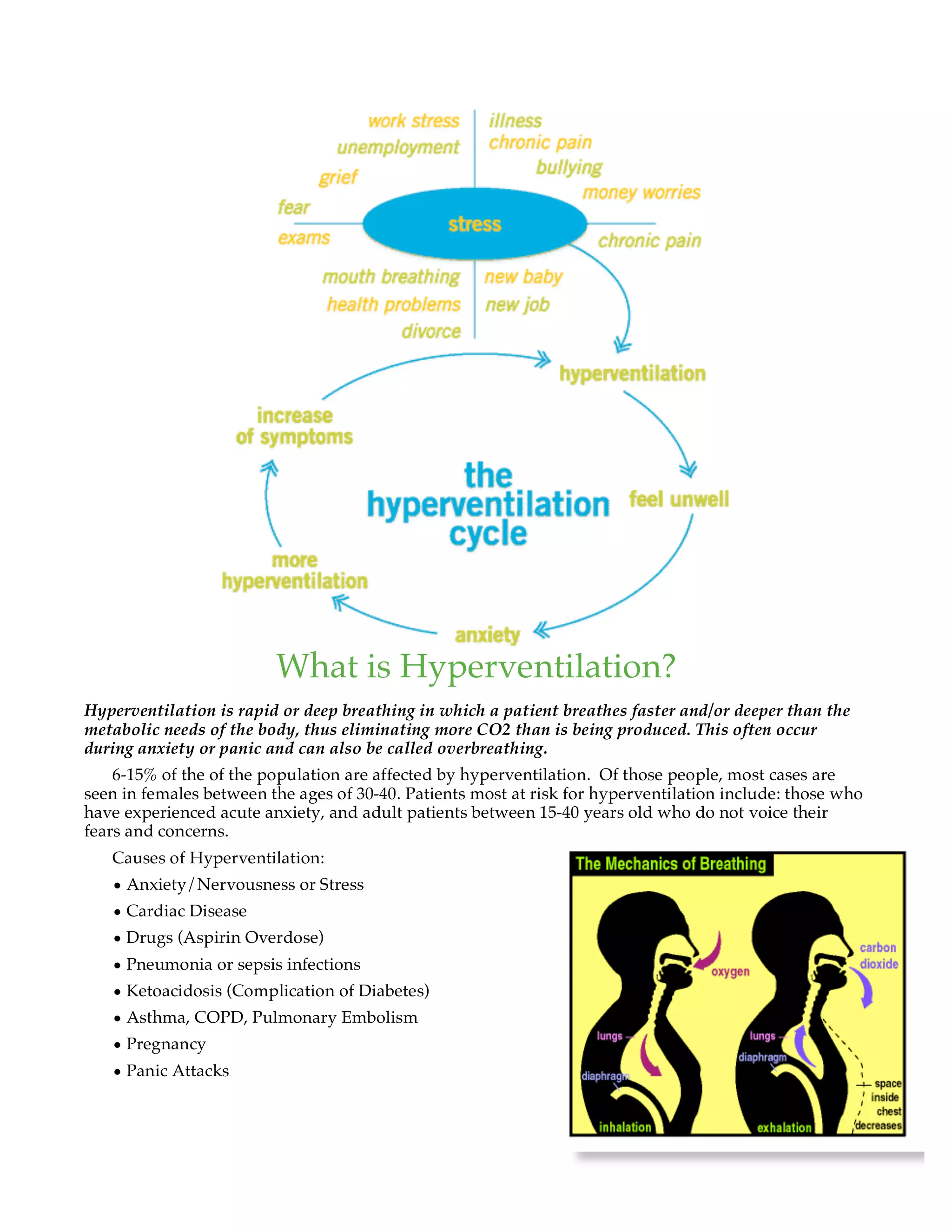
Hyperventilation is rapid or deep breathing in which a patient breathes faster and/or deeper than the
metabolic needs of the body, thus eliminating more CO2 than is being produced. This often occur
during anxiety or panic and can also be called overbreathing.
    6-15% of the of the population are affected by hyperventilation. Of those people, most cases are
seen in females between the ages of 30-40. Patients most at risk for hyperventilation include: those who
have experienced acute anxiety, and adult patients between 15-40 years old who do not voice their
fears and concerns.
   Causes of Hyperventilation:
   • Anxiety/Nervousness or Stress
   • Cardiac Disease
   • Drugs (Aspirin Overdose)
   • Pneumonia or sepsis infections
   • Ketoacidosis (Complication of Diabetes)
   • Asthma, COPD, Pulmonary Embolism
   • Pregnancy
   • Panic Attacks
Signs and Symptoms of Hyperventilation
 1. Elevated BP (systolic usually greater)
 2. High Pulse Rate
 3. Higher Respiration Rate
 4. Cold, Clammy Hands: possible blueish fingernails
 5. Abnormally prolonged rapid and deep respirations: this leads to high blood pH and low CO2.
Decreased CO2 causes vasoconstriction of the arteries and veins throughout the body, most
importantly the heart and the brain.
 6. Dry Mouth
 7. Heart Palpitations: due to vasoconstriction on the heart’s blood vessels and arteries
 8. Chest Pain: associated with vasoconstriction
 9. Tachycardia
 10. Globus Hystericus and Epigastric Pain: lump in the throat feeling; bloating, belching
  11. Impairment of problem-solving abilities (confusion), motor control, balance, perceptual
tasks and vision
 12. Lightheadedness and Dizziness
 13. Seizures
 14. Tetany and Trembling
 15. Numbness in extremities
 16. Chvostek’s sign: abnormal spasm of the face cause by light taps on the facial nerve
 17. Diaphoresis: extreme sweating
 18. Circumoral Parasthesia: numbness or tingling around the mouth
 19. Unconsciousness
Please Note:
    It is important to understand that hyperventilation can mimic many respiratory
                 disorders and conditions such as pulmonary embolism!
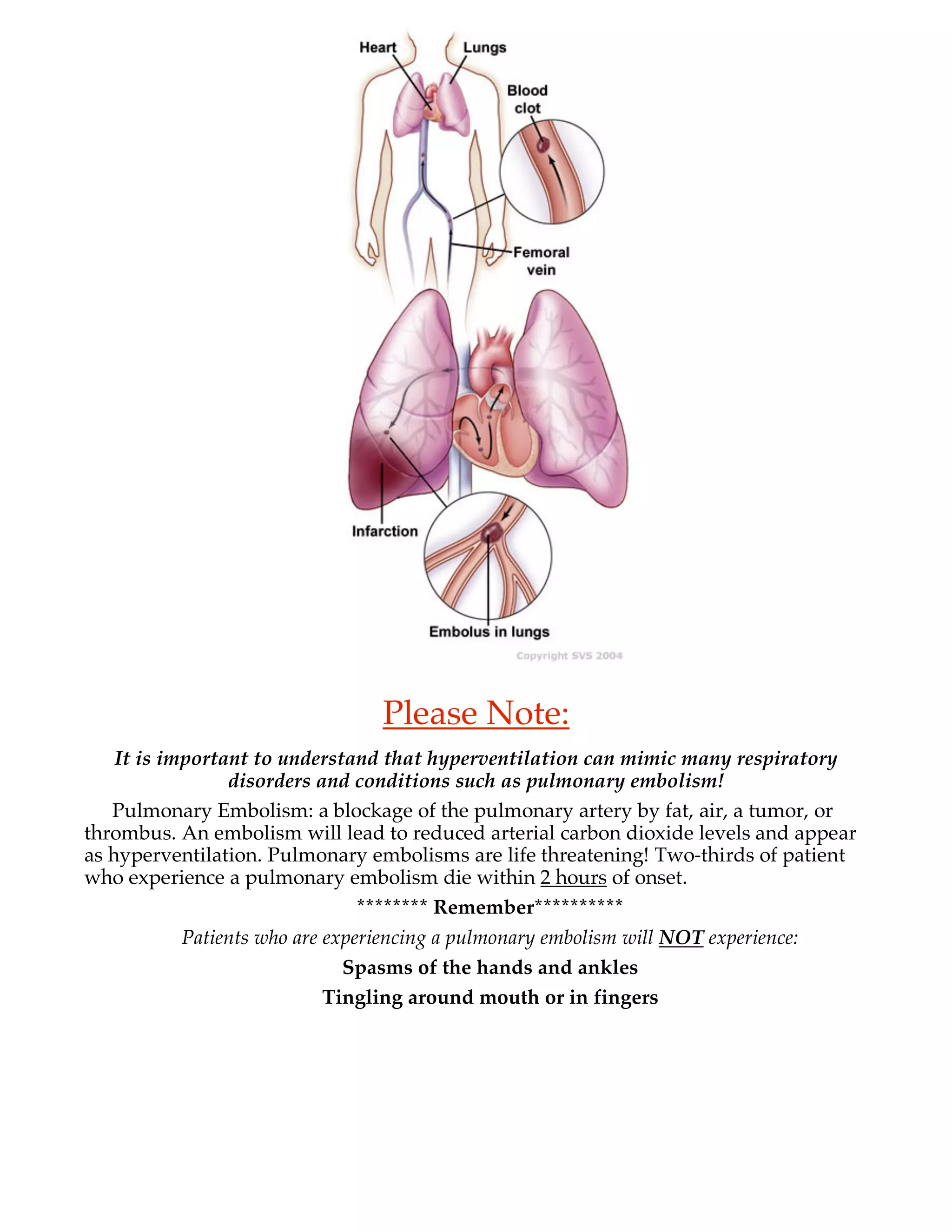
   Pulmonary Embolism: a blockage of the pulmonary artery by fat, air, a tumor, or
thrombus. An embolism will lead to reduced arterial carbon dioxide levels and appear
as hyperventilation. Pulmonary embolisms are life threatening! Two-thirds of patient
who experience a pulmonary embolism die within 2 hours of onset.
                                 ******** Remember**********
            Patients who are experiencing a pulmonary embolism will NOT experience:
                               Spasms of the hands and ankles
                             Tingling around mouth or in fingers

Office Emergency Hyperventilation

  • 1.
    Hyperventilation Morgan Card, BrookeFields, Leanna Payton and Mary White
  • 2.
    What is Hyperventilation? Hyperventilationis rapid or deep breathing in which a patient breathes faster and/or deeper than the metabolic needs of the body, thus eliminating more CO2 than is being produced. This often occur during anxiety or panic and can also be called overbreathing. 6-15% of the of the population are affected by hyperventilation. Of those people, most cases are seen in females between the ages of 30-40. Patients most at risk for hyperventilation include: those who have experienced acute anxiety, and adult patients between 15-40 years old who do not voice their fears and concerns. Causes of Hyperventilation: • Anxiety/Nervousness or Stress • Cardiac Disease • Drugs (Aspirin Overdose) • Pneumonia or sepsis infections • Ketoacidosis (Complication of Diabetes) • Asthma, COPD, Pulmonary Embolism • Pregnancy • Panic Attacks
  • 3.
    Signs and Symptomsof Hyperventilation 1. Elevated BP (systolic usually greater) 2. High Pulse Rate 3. Higher Respiration Rate 4. Cold, Clammy Hands: possible blueish fingernails 5. Abnormally prolonged rapid and deep respirations: this leads to high blood pH and low CO2. Decreased CO2 causes vasoconstriction of the arteries and veins throughout the body, most importantly the heart and the brain. 6. Dry Mouth 7. Heart Palpitations: due to vasoconstriction on the heart’s blood vessels and arteries 8. Chest Pain: associated with vasoconstriction 9. Tachycardia 10. Globus Hystericus and Epigastric Pain: lump in the throat feeling; bloating, belching 11. Impairment of problem-solving abilities (confusion), motor control, balance, perceptual tasks and vision 12. Lightheadedness and Dizziness 13. Seizures 14. Tetany and Trembling 15. Numbness in extremities 16. Chvostek’s sign: abnormal spasm of the face cause by light taps on the facial nerve 17. Diaphoresis: extreme sweating 18. Circumoral Parasthesia: numbness or tingling around the mouth 19. Unconsciousness
  • 4.
    Please Note: It is important to understand that hyperventilation can mimic many respiratory disorders and conditions such as pulmonary embolism! Pulmonary Embolism: a blockage of the pulmonary artery by fat, air, a tumor, or thrombus. An embolism will lead to reduced arterial carbon dioxide levels and appear as hyperventilation. Pulmonary embolisms are life threatening! Two-thirds of patient who experience a pulmonary embolism die within 2 hours of onset. ******** Remember********** Patients who are experiencing a pulmonary embolism will NOT experience: Spasms of the hands and ankles Tingling around mouth or in fingers