Incident Action Planning
Exercises No. 1a & 1b
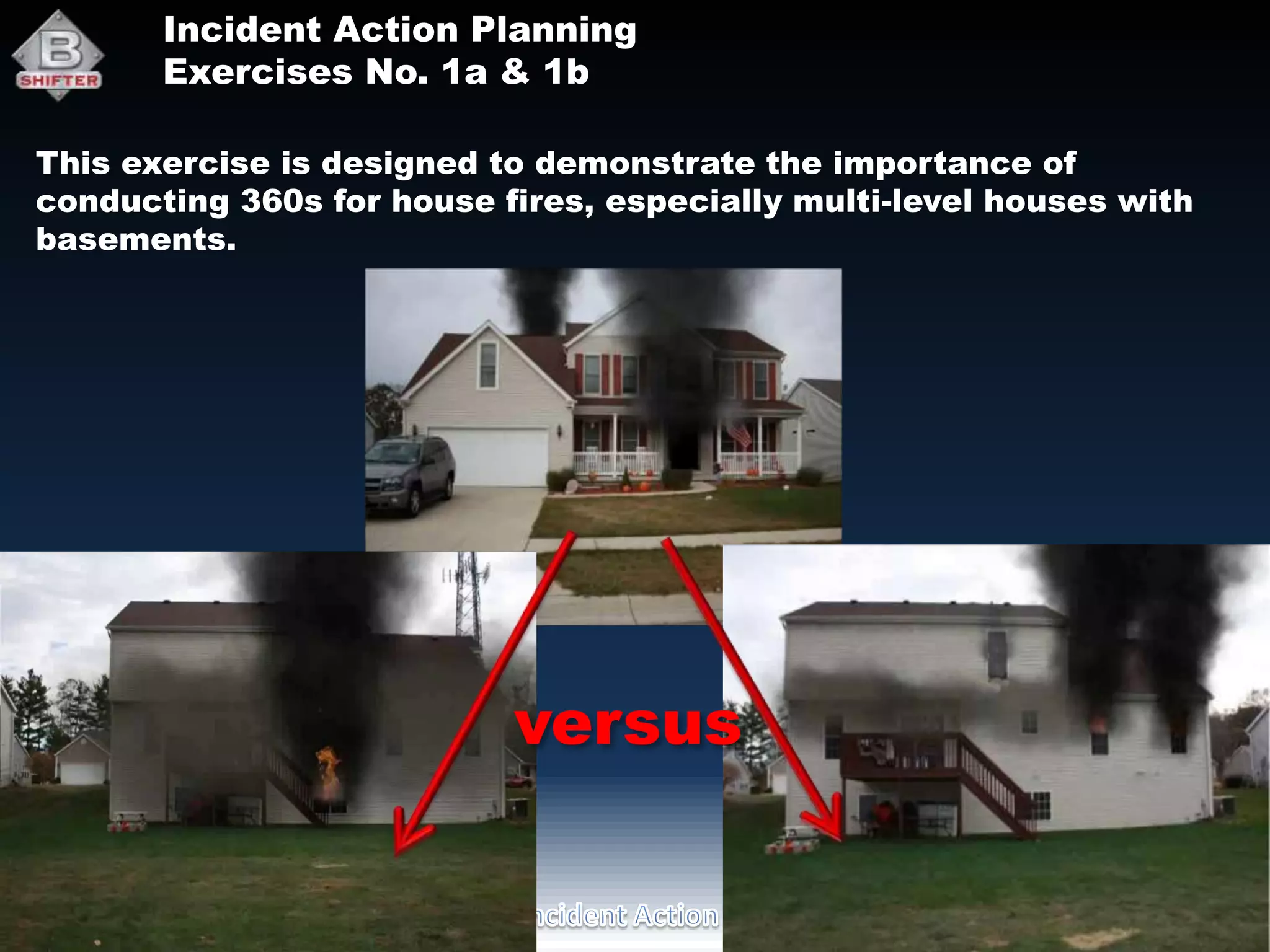
This exercise is designed to demonstrate the importance of
conducting 360s for house fires, especially multi-level houses with
basements.
versus
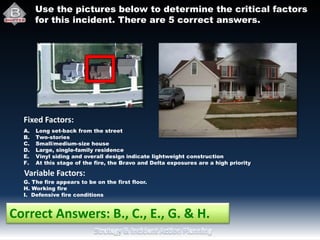
Use the pictures below to determine the critical factors
for this incident. There are 5 correct answers..
A. Long set-back from the street
B. Two-stories
C. Small/medium-size house
D. Large, single-family residence
E. Vinyl siding and overall design indicate lightweight construction
F. At this stage of the fire, the Bravo and Delta exposures are a high priority
G. The fire appears to be on the first floor.
H. Working fire
I. Defensive fire conditions
Fixed Factors:
Variable Factors:
Correct Answers: B., C., E., G. & H.
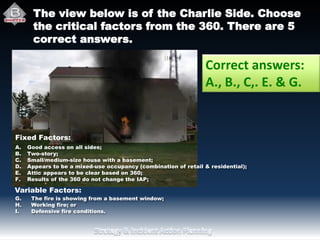
The view below is of the Charlie Side. Choose
the critical factors from the 360. There are 5
correct answers.
Fixed Factors:
A. Good access on all sides;
B. Two-story;
C. Small/medium-size house with a basement;
D. Appears to be a mixed-use occupancy (combination of retail & residential);
E. Attic appears to be clear based on 360;
F. Results of the 360 do not change the IAP;
G. The fire is showing from a basement window;
H. Working fire; or
I. Defensive fire conditions.
Variable Factors:
Correct answers:
A., B., C,. E. & G.
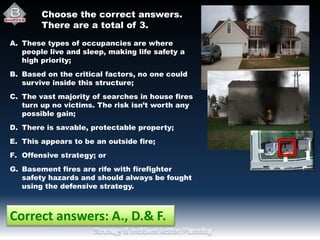
Choose the correct answers.
There are a total of 3..
A. These types of occupancies are where
people live and sleep, making life safety a
high priority;
B. Based on the critical factors, no one could
survive inside this structure;
C. The vast majority of searches in house fires
turn up no victims. The risk isn’t worth any
possible gain;
D. There is savable, protectable property;
E. This appears to be an outside fire;
F. Offensive strategy; or
G. Basement fires are rife with firefighter
safety hazards and should always be fought
using the defensive strategy.
Correct answers: A., D.& F.
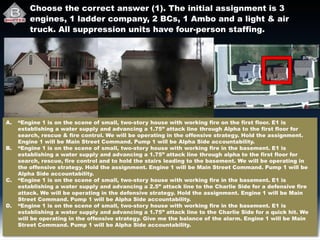
Choose the correct answer (1). The initial assignment is 3
engines, 1 ladder company, 2 BCs, 1 Ambo and a light & air
truck. All suppression units have four-person staffing.
A. “Engine 1 is on the scene of small, two-story house with working fire on the first floor. E1 is
establishing a water supply and advancing a 1.75” attack line through Alpha to the first floor for
search, rescue & fire control. We will be operating in the offensive strategy. Hold the assignment.
Engine 1 will be Main Street Command. Pump 1 will be Alpha Side accountability.
B. “Engine 1 is on the scene of small, two-story house with working fire in the basement. E1 is
establishing a water supply and advancing a 1.75” attack line through alpha to the first floor for
search, rescue, fire control and to hold the stairs leading to the basement. We will be operating in
the offensive strategy. Hold the assignment. Engine 1 will be Main Street Command. Pump 1 will be
Alpha Side accountability.
C. “Engine 1 is on the scene of small, two-story house with working fire in the basement. E1 is
establishing a water supply and advancing a 2.5” attack line to the Charlie Side for a defensive fire
attack. We will be operating in the defensive strategy. Hold the assignment. Engine 1 will be Main
Street Command. Pump 1 will be Alpha Side accountability.
D. “Engine 1 is on the scene of small, two-story house with working fire in the basement. E1 is
establishing a water supply and advancing a 1.75” attack line to the Charlie Side for a quick hit. We
will be operating in the offensive strategy. Give me the balance of the alarm. Engine 1 will be Main
Street Command. Pump 1 will be Alpha Side accountability.
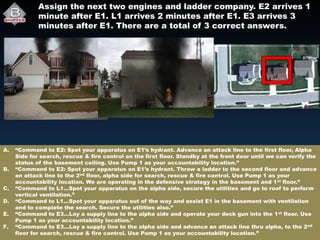
Assign the next two engines and ladder company. E2 arrives 1
minute after E1. L1 arrives 2 minutes after E1. E3 arrives 3
minutes after E1. There are a total of 3 correct answers.
A. “Command to E2: Spot your apparatus on E1’s hydrant. Advance an attack line to the first floor, Alpha
Side for search, rescue & fire control on the first floor. Standby at the front door until we can verify the
status of the basement ceiling. Use Pump 1 as your accountability location.”
B. “Command to E2: Spot your apparatus on E1’s hydrant. Throw a ladder to the second floor and advance
an attack line to the 2nd floor, alpha side for search, rescue & fire control. Use Pump 1 as your
accountability location. We are operating in the defensive strategy in the basement and 1st floor.”
C. “Command to L1…Spot your apparatus on the alpha side, secure the utilities and go to roof to perform
vertical ventilation.”
D. “Command to L1…Spot your apparatus out of the way and assist E1 in the basement with ventilation
and to complete the search. Secure the utilities also.”
E. “Command to E3…Lay a supply line to the alpha side and operate your deck gun into the 1st floor. Use
Pump 1 as your accountability location.”
F. “Command to E3…Lay a supply line to the alpha side and advance an attack line thru alpha, to the 2nd
floor for search, rescue & fire control. Use Pump 1 as your accountability location.”
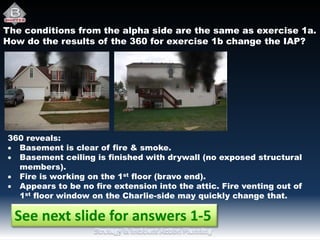
The conditions from the alpha side are the same as exercise 1a.
How do the results of the 360 for exercise 1b change the IAP?
360 reveals:
 Basement is clear of fire & smoke.
 Basement ceiling is finished with drywall (no exposed structural
members).
 Fire is working on the 1st floor (bravo end).
 Appears to be no fire extension into the attic. Fire venting out of
1st floor window on the Charlie-side may quickly change that.
See next slide for answers 1-5
1. As part of your 360 would you perform a “quick hit” from the exterior on the Charlie
side to prevent the fire from extending into the attic space over the bravo end of the
1st floor?
a. No. Only cowards apply water from the outside.
b. Yes. Both NIST and UL fire research demonstrates this is an effective tactic.
c. I don’t know. I’m still on the fence with all this new data.
d. None of the above.
2. After performing the 360 where would you deploy the initial attack line off E1?
a. Quick hit it from Charlie then redeploy line thru to 1st floor, alpha-side.
b. Quick hit it from Charlie, then force entry into basement thru large basement
window.
c. No quick hit. Redeploy line to 1st floor, alpha-side.
d. Based on lightweight construction strategy is defensive and all operations will
be from safe, exterior positions.
3. Prioritization of assignments/positions to cover:
a. Basement, 2nd floor, 1st floor.
b. 2nd floor, 1st floor, basement.
c. Basement, 1st floor, 2nd floor.
d. 1st floor, 2nd floor, basement.
4. Where would you assign Ladder 1?
a. Roof to vent.
b. Basement to search.
c. 2nd floor for fire control.
d. 1st floor to assist with search and ventilate.
5. Did the 360 cause you IAP to change between scenarios 1a & 1b?
a. Yes
b. No
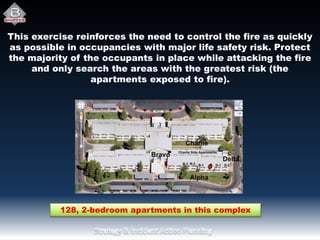
This exercise reinforces the need to control the fire as quickly
as possible in occupancies with major life safety risk. Protect
the majority of the occupants in place while attacking the fire
and only search the areas with the greatest risk (the
apartments exposed to fire).
128, 2-bedroom apartments in this complex
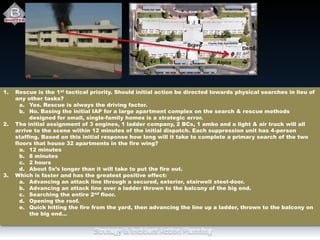
1. Rescue is the 1st tactical priority. Should initial action be directed towards physical searches in lieu of
any other tasks?
a. Yes. Rescue is always the driving factor.
b. No. Basing the initial IAP for a large apartment complex on the search & rescue methods
designed for small, single-family homes is a strategic error.
2. The initial assignment of 3 engines, 1 ladder company, 2 BCs, 1 ambo and a light & air truck will all
arrive to the scene within 12 minutes of the initial dispatch. Each suppression unit has 4-person
staffing. Based on this initial response how long will it take to complete a primary search of the two
floors that house 32 apartments in the fire wing?
a. 12 minutes
b. 8 minutes
c. 2 hours
d. About 5x’s longer than it will take to put the fire out.
3. Which is faster and has the greatest positive effect:
a. Advancing an attack line through a secured, exterior, stairwell steel-door.
b. Advancing an attack line over a ladder thrown to the balcony of the big end.
c. Searching the entire 2nd floor.
d. Opening the roof.
e. Quick hitting the fire from the yard, then advancing the line up a ladder, thrown to the balcony on
the big end…
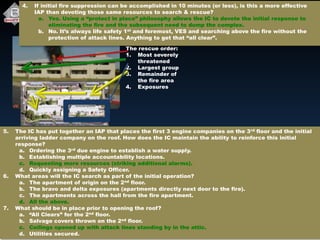
The rescue order:
1. Most severely
threatened
2. Largest group
3. Remainder of
the fire area
4. Exposures
4. If initial fire suppression can be accomplished in 10 minutes (or less), is this a more effective
IAP than devoting those same resources to search & rescue?
a. Yes. Using a “protect in place” philosophy allows the IC to devote the initial response to
eliminating the fire and the subsequent need to dump the complex.
b. No. It’s always life safety 1st and foremost, VES and searching above the fire without the
protection of attack lines. Anything to get that “all clear”.
5. The IC has put together an IAP that places the first 3 engine companies on the 3rd floor and the initial
arriving ladder company on the roof. How does the IC maintain the ability to reinforce this initial
response?
a. Ordering the 3rd due engine to establish a water supply.
b. Establishing multiple accountability locations.
c. Requesting more resources (striking additional alarms).
d. Quickly assigning a Safety Officer.
6. What areas will the IC search as part of the initial operation?
a. The apartment of origin on the 2nd floor.
b. The bravo and delta exposures (apartments directly next door to the fire).
c. The apartments across the hall from the fire apartment.
d. All the above.
7. What should be in place prior to opening the roof?
a. “All Clears” for the 2nd floor.
b. Salvage covers thrown on the 2nd floor.
c. Ceilings opened up with attack lines standing by in the attic.
d. Utilities secured.
8. Choose all that apply to the initial IAP (3 engines, 1 ladder):
a. Establishing a PIO
b. Initial attack position is quickest route to the apartment of origin, 2nd floor.
c. Setting up a rehab.
d. Performing salvage on the 1st floor, directly under the fire unit.
e. Pass command due to life safety issues.
f. Offensive strategy.
g. Search and rescue of the 1st floor.
h. Setting up a treatment area.
i. Establishing water supply for the alpha attack position.
j. Assigning later arriving units to assume on deck positions on the 2nd floor.
k. Assigning the 2nd arriving BC to take over operations on the 2nd floor.
l. Getting PARs on all units prior to placing them back into service.
m. Order a fuel truck based on the projection of a long operation.
n. Hold the assignment to the initial 3 engines and a ladder company.
9. The initial IC is the company officer of E1. What command position will he/she operate in?
a. Strategic command position.
b. Fast attack position.
c. Pass command due to life safety issues.
d. None of the above.
10. Command will be transferred to the initial arriving BC. How does the BC know what the IAP and strategy are?
a. Experience.
b. Cunning.
c. Because the initial IC gave a complete initial radio report and used orders to assign later arriving that included a
task, location and objective.
d. The chief never knows because it’s chaos all the time.
11. How does the strategic positioned IC keep the IAP current?
a. The IAP is always sequential. First we obtain the all clear. After the structure is searched we devote our efforts to
fire control. After the fire is brought under control we perform salvage. The tactical priorities are listed in order of
importance. Incident conditions are secondary to achieving the priorities.
b. Through the combination of the visual factors (what the IC can see from the command post) and CAN reports from
forward operating companies.
c. Updates via the Dispatch Center.
d. Monitoring live news broadcast.
12. The ultimate test that the IC is in “command” is the ability to control the position and function of all personnel working in
the hazard zone. How does the IC manage this when the number of assigned task level units exceeds his/her span of
control?
a. Assigning tactical level responsibility to working company officers.
b. Loading the command post up with more chief officers.
c. Assigning tactical-level, warm zone bosses to active attack positions.
d. Implementing an Ops section.
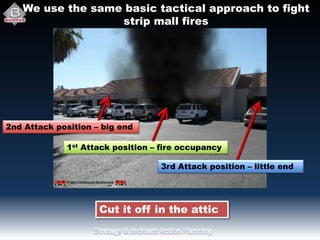
We use the same basic tactical approach to fight
strip mall fires
1st Attack position – fire occupancy
2nd Attack position – big end
3rd Attack position – little end
Cut it off in the attic
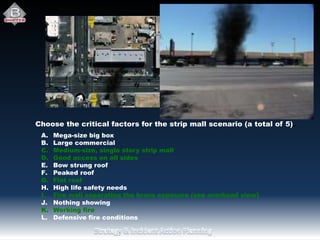
A. Mega-size big box
B. Large commercial
C. Medium-size, single story strip mall
D. Good access on all sides
E. Bow strung roof
F. Peaked roof
G. Flat roof
H. High life safety needs
I. Fire wall separating the bravo exposure (see overhead view)
J. Nothing showing
K. Working fire
L. Defensive fire conditions
Choose the critical factors for the strip mall scenario (a total of 5).
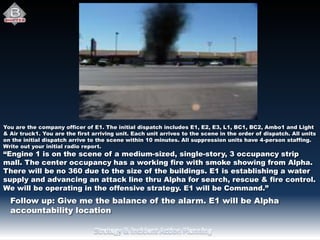
You are the company officer of E1. The initial dispatch includes E1, E2, E3, L1, BC1, BC2, Ambo1 and Light
& Air truck1. You are the first arriving unit. Each unit arrives to the scene in the order of dispatch. All units
on the initial dispatch arrive to the scene within 10 minutes. All suppression units have 4-person staffing.
Write out your initial radio report.
“Engine 1 is on the scene of a medium-sized, single-story, 3 occupancy strip
mall. The center occupancy has a working fire with smoke showing from Alpha.
There will be no 360 due to the size of the buildings. E1 is establishing a water
supply and advancing an attack line thru Alpha for search, rescue & fire control.
We will be operating in the offensive strategy. E1 will be Command.”
Follow up: Give me the balance of the alarm. E1 will be Alpha
accountability location
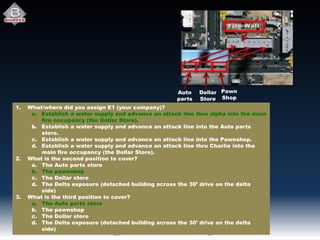
Auto
parts
Store
Dollar
Store
Pawn
Shop
1. What/where did you assign E1 (your company)?
a. Establish a water supply and advance an attack line thru alpha into the main
fire occupancy (the Dollar Store).
b. Establish a water supply and advance an attack line into the Auto parts
store.
c. Establish a water supply and advance an attack line into the Pawnshop.
d. Establish a water supply and advance an attack line thru Charlie into the
main fire occupancy (the Dollar Store).
2. What is the second position to cover?
a. The Auto parts store
b. The pawnshop
c. The Dollar store
d. The Delta exposure (detached building across the 30’ drive on the delta
side)
3. What is the third position to cover?
a. The Auto parts store
b. The pawnshop
c. The Dollar store
d. The Delta exposure (detached building across the 30’ drive on the delta
side)
4. What assignment did you give to the Ladder Company?
a. Go on deck in alpha
b. Go to the roof to report on conditions and prepare to vent
c. Assist in the fire occupancy with fire control, ventilation and opening the ceilings
d. Controlling utilities
5. Did you request more resources as part of your initial/follow up radio report?
a. Yes
b. No
6. How did you address 2-in, 2-out?
a. With the Engineers of E1 & E2
b. Assigned it to Ambo1 (they arrived on scene early).
c. No IRIC. Assigned E3 to assume RIC prior to allowing crews to make entry
d. Answers a & b
7. You are the initial arriving BC and have just transferred command. You conditions are pictured above.
These are your CAN reports:
E1: “We’ve upgraded the assignment and currently have the main body of fire knocked down, have the
ceilings opened and are controlling some fire in the attic. We are operating with E3 and have no needs.”
E3: “We are operating in the delta exposure (a pawn shop). We have an all clear with no fire extension
into the store. We have opened the ceilings adjacent to the fire occupancy and are knocking down fire
extension into attic space. We are making good progress and have no needs.
L1: “A fire wall separates the bravo exposure from the main fire area. We checked the roof of the bravo
exposure and have no fire extension. We do have some minor extension into the attic above the main
fire area with the roof to be stable and clear.
E4 has just staged south. What is your next move?
a. Request emergency traffic to change to the defensive strategy.
b. Clear the Dispatch Center to verify the safety officer and PIO are enroute.
c. Strike a 2nd Alarm
d. Assign E4 to go on deck in alpha
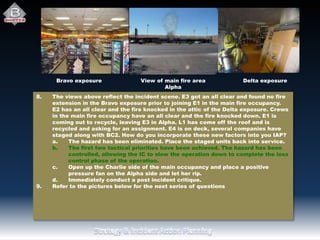
Delta exposureBravo exposure View of main fire area
Alpha
8. The views above reflect the incident scene. E3 got an all clear and found no fire
extension in the Bravo exposure prior to joining E1 in the main fire occupancy.
E2 has an all clear and the fire knocked in the attic of the Delta exposure. Crews
in the main fire occupancy have an all clear and the fire knocked down. E1 is
coming out to recycle, leaving E3 in Alpha. L1 has come off the roof and is
recycled and asking for an assignment. E4 is on deck, several companies have
staged along with BC2. How do you incorporate these new factors into you IAP?
a. The hazard has been eliminated. Place the staged units back into service.
b. The first two tactical priorities have been achieved. The hazard has been
controlled, allowing the IC to slow the operation down to complete the loss
control phase of the operation.
c. Open up the Charlie side of the main occupancy and place a positive
pressure fan on the Alpha side and let her rip.
d. Immediately conduct a post incident critique.
9. Refer to the pictures below for the next series of questions
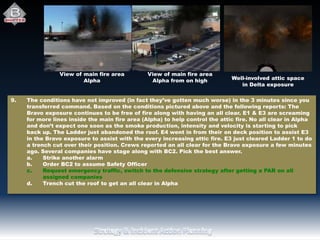
View of main fire area
Alpha
View of main fire area
Alpha from on high Well-involved attic space
in Delta exposure
9. The conditions have not improved (in fact they’ve gotten much worse) in the 3 minutes since you
transferred command. Based on the conditions pictured above and the following reports: The
Bravo exposure continues to be free of fire along with having an all clear. E1 & E3 are screaming
for more lines inside the main fire area (Alpha) to help control the attic fire. No all clear in Alpha
and don’t expect one soon as the smoke production, intensity and velocity is starting to pick
back up. The Ladder just abandoned the roof. E4 went in from their on deck position to assist E3
in the Bravo exposure to assist with the every increasing attic fire. E3 just cleared Ladder 1 to do
a trench cut over their position. Crews reported an all clear for the Bravo exposure a few minutes
ago. Several companies have stage along with BC2. Pick the best answer.
a. Strike another alarm
b. Order BC2 to assume Safety Officer
c. Request emergency traffic, switch to the defensive strategy after getting a PAR on all
assigned companies
d. Trench cut the roof to get an all clear in Alpha
10. Choose all that apply to switching from an offensive IAP to a defensive IAP for this incident
(7 correct answers):
a. PARs on all units prior to switching to defensive master streams.
b. Despite the lethal conditions (for any unprotected humans) in the main fire occupancy an
all clear must be achieved prior to switching to defensive the strategy.
c. Assign BC2 to assume Alpha to provide tactical-level management in managing the
strategic shift.
d. The entire structure must be written off.
e. The Bravo exposure should be protected so long as there is savable property that can be
protected without taking a large, unmanageable risk.
f. Small diameter attack lines that aren’t being used to protect exposures should be broken
and reloaded to prevent “creeping”.
g. The IC must make strategic shifts thru the use of emergency traffic over the tactical radio
channel.
h. The IC must clear any change in the strategy with the Incident Safety Officer.
i. A major firefighter safety item for defensive operations is establishing collapse zones and
enforcing them.
j. The number one goal of defensive water application is protecting savable property
(exposures).
This exercise demonstrates the importance of
building an effective incident organization to manage
active attack positions.
This tactical-level is a requirement for the IC to avoid
task-level overload. When the IC becomes
overwhelmed by too many task level the strategic
level ceases to be effective.
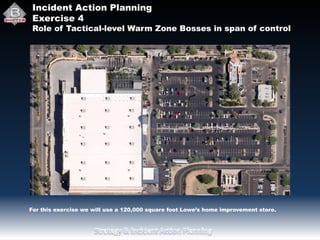
Incident Action Planning
Exercise 4
Role of Tactical-level Warm Zone Bosses in span of control
For this exercise we will use a 120,000 square foot Lowe’s home improvement store.
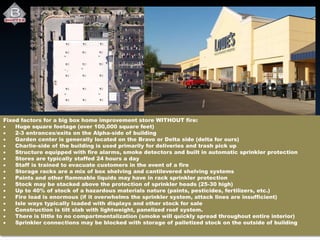
Fixed factors for a big box home improvement store WITHOUT fire:
 Huge square footage (over 100,000 square feet)
 2-3 entrances/exits on the Alpha-side of building
 Garden center is generally located on the Bravo or Delta side (delta for ours)
 Charlie-side of the building is used primarily for deliveries and trash pick up
 Structure equipped with fire alarms, smoke detectors and built in automatic sprinkler protection
 Stores are typically staffed 24 hours a day
 Staff is trained to evacuate customers in the event of a fire
 Storage racks are a mix of box shelving and cantilevered shelving systems
 Paints and other flammable liquids may have in rack sprinkler protection
 Stock may be stacked above the protection of sprinkler heads (25-30 high)
 Up to 40% of stock of a hazardous materials nature (paints, pesticides, fertilizers, etc.)
 Fire load is enormous (if it overwhelms the sprinkler system, attack lines are insufficient)
 Isle ways typically loaded with displays and other stock for sale
 Construction is tilt slab with lightweight, panelized roof system.
 There is little to no compartmentalization (smoke will quickly spread throughout entire interior)
 Sprinkler connections may be blocked with storage of palletized stock on the outside of building
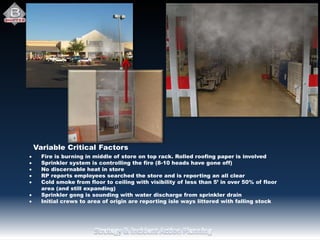
 Fire is burning in middle of store on top rack. Rolled roofing paper is involved
 Sprinkler system is controlling the fire (8-10 heads have gone off)
 No discernable heat in store
 RP reports employees searched the store and is reporting an all clear
 Cold smoke from floor to ceiling with visibility of less than 5’ in over 50% of floor
area (and still expanding)
 Sprinkler gong is sounding with water discharge from sprinkler drain
 Initial crews to area of origin are reporting isle ways littered with falling stock
Variable Critical Factors
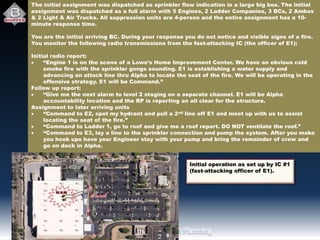
The initial assignment was dispatched as sprinkler flow indication in a large big box. The initial
assignment was dispatched as a full alarm with 5 Engines, 2 Ladder Companies, 3 BCs, 2 Ambos
& 2 Light & Air Trucks. All suppression units are 4-person and the entire assignment has a 10-
minute response time.
You are the initial arriving BC. During your response you do not notice and visible signs of a fire.
You monitor the following radio transmissions from the fast-attacking IC (the officer of E1):
Initial radio report:
 “Engine 1 is on the scene of a Lowe’s Home Improvement Center. We have an obvious cold
smoke fire with the sprinkler gongs sounding. E1 is establishing a water supply and
advancing an attack line thru Alpha to locate the seat of the fire. We will be operating in the
offensive strategy. E1 will be Command.”
Follow up report:
 “Give me the next alarm to level 2 staging on a separate channel. E1 will be Alpha
accountability location and the RP is reporting an all clear for the structure.
Assignment to later arriving units
 “Command to E2, spot my hydrant and pull a 2nd line off E1 and meet up with us to assist
locating the seat of the fire.”
 “Command to Ladder 1, go to roof and give me a roof report. DO NOT ventilate the roof.”
 “Command to E3, lay a line to the sprinkler connection and pump the system. After you make
you hook ups have your Engineer stay with your pump and bring the remainder of crew and
go on deck in Alpha.
Initial operation as set up by IC #1
(fast-attacking officer of E1).
You have just transferred command. Answer the following questions concerning your IAP:
1. Did IC set up in a way where you can build on (and reinforce) his/her initial IAP?
a. Yes
b. No
2. What is your highest priority assignment?
a. Getting a PAR on E1 & E2.
b. Having E3 advance a 2.5” line thru Alpha to support E1 & E2.
c. Assigning multiple RICs
d. Assigning BC2 to assume Alpha (as the warm zone tactical boss).
3. What effect does assigning warm zone, tactical bosses on radio communications
a. It increases radio communications by putting outside bosses between the IC and his/her interior
troops.
b. It only decreases radio traffic when assigning separate radio channels to each tactical-level boss.
c. It has no effect
d. It reduces radio traffic on the tactical channel because the warm-zone boss primarily uses face-
to-face communications with their assigned companies.
4. When the IC assigns BC2 to, “Assume Alpha.” who does E1, E2 & E3 belong to?
a. They will always belong to the IC
b. They are co-shared by the IC and Alpha
c. The Incident Safety Officer is ultimately responsible for all personnel
d. Alpha
5. Do you expect the rack storage systems to begin failing with all the water the stock is absorbing?
a. No. These systems are over engineered to take the extra weight of water in the event of a fire.
b. Yes, but it will take an hour or more for that to begin happening.
c. Yes. These failures will happen at the rate the sprinkler system applies water. Multiple heads
going off will increase collapse hazards (in a shorter time also).
d. Firefighters operating on the interior should be able to deal with the issue.
6. What are the most serious (and likely) firefighter safety hazards?
a. Running out of air
b. Getting lost
c. Becoming trapped or injured by falling stock
d. All the above
7. Choose your major IAP elements.
a. Identify location and status of fire, number of heads going off and potential collapse
area.
b. Conduct primary search in areas with reduced visibility, shut the sprinkler system
down, open roof.
c. Assign Safety Officers to monitor wide-area rope search of entire structure, support
the sprinkler system and keep the building closed up to avoid creating flow paths.
d. Get water to Ladder Companies early in anticipation of requiring elevated master
streams and get all clear for office areas.
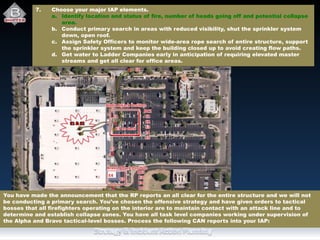
You have made the announcement that the RP reports an all clear for the entire structure and we will not
be conducting a primary search. You’ve chosen the offensive strategy and have given orders to tactical
bosses that all firefighters operating on the interior are to maintain contact with an attack line and to
determine and establish collapse zones. You have all task level companies working under supervision of
the Alpha and Bravo tactical-level bosses. Process the following CAN reports into your IAP:
8. Alpha reports the fire involved the top shelf of a rack on the Delta end of the building. The fire is under
control but will require overhaul to eliminate smoke production. Alpha is requesting the sprinkler
system to be shut down so Class A foam can be flowed from safe locations in a effort to complete
overhaul.
Ladder reports the roof is straight and intact with normal dead loads. All the tilt walls appear to be
straight and true. The roof is also too lightweight to operate on top of.
Bravo reports fair visibility for the area they are operating in. They have accessed the sprinkler control
room and have no needs in Bravo.
a. Switch to a controlled defensive strategy.
b. Have Bravo assign (handcuff) a company to the sprinkler shut off valve and coordinate shutting
the system when Alpha gets the foam operation in place.
c. Have the Ladder open the roof and place positive pressure fans in all the Alpha openings.
d. Continue pumping the sprinkler system until all affected racks collapse, eliminating fall hazards
to firefighters.
9. Who is responsible for managing work cycles of the companies assigned to Alpha?
a. The IC
b. The Rehab Officer
c. The officer of each company
d. The Alpha Tactical-level boss.
10. If the fire overruns the sprinkler system where does that place us in the risk management scale?
a. If the supported sprinkler system cannot contain the fire any savable property moves into the
lost property scale of the risk management plan.
b. If the built in protection, that was engineered, designed and approved to control fires in this high-
yield fuel environment, we should be able to extinguish the fire with 2-3, 1.75” hand lines.
c. We still haven’t conducted a primary search.
d. Offensive operations may be successful if we pull 2.5” lines to the interior
11. How effective is vertical ventilation for cold smoke fires?
a. It is very effective
b. It is marginally effective
c. Not as effective as trenching the roof
d. Making any holes in the roof of a sprinkler controlled is a waste of time

Iap drilldown

  • 1.
    Incident Action Planning ExercisesNo. 1a & 1b This exercise is designed to demonstrate the importance of conducting 360s for house fires, especially multi-level houses with basements. versus
  • 2.
    Use the picturesbelow to determine the critical factors for this incident. There are 5 correct answers.. A. Long set-back from the street B. Two-stories C. Small/medium-size house D. Large, single-family residence E. Vinyl siding and overall design indicate lightweight construction F. At this stage of the fire, the Bravo and Delta exposures are a high priority G. The fire appears to be on the first floor. H. Working fire I. Defensive fire conditions Fixed Factors: Variable Factors: Correct Answers: B., C., E., G. & H.
  • 3.
    The view belowis of the Charlie Side. Choose the critical factors from the 360. There are 5 correct answers. Fixed Factors: A. Good access on all sides; B. Two-story; C. Small/medium-size house with a basement; D. Appears to be a mixed-use occupancy (combination of retail & residential); E. Attic appears to be clear based on 360; F. Results of the 360 do not change the IAP; G. The fire is showing from a basement window; H. Working fire; or I. Defensive fire conditions. Variable Factors: Correct answers: A., B., C,. E. & G.
  • 4.
    Choose the correctanswers. There are a total of 3.. A. These types of occupancies are where people live and sleep, making life safety a high priority; B. Based on the critical factors, no one could survive inside this structure; C. The vast majority of searches in house fires turn up no victims. The risk isn’t worth any possible gain; D. There is savable, protectable property; E. This appears to be an outside fire; F. Offensive strategy; or G. Basement fires are rife with firefighter safety hazards and should always be fought using the defensive strategy. Correct answers: A., D.& F.
  • 5.
    Choose the correctanswer (1). The initial assignment is 3 engines, 1 ladder company, 2 BCs, 1 Ambo and a light & air truck. All suppression units have four-person staffing. A. “Engine 1 is on the scene of small, two-story house with working fire on the first floor. E1 is establishing a water supply and advancing a 1.75” attack line through Alpha to the first floor for search, rescue & fire control. We will be operating in the offensive strategy. Hold the assignment. Engine 1 will be Main Street Command. Pump 1 will be Alpha Side accountability. B. “Engine 1 is on the scene of small, two-story house with working fire in the basement. E1 is establishing a water supply and advancing a 1.75” attack line through alpha to the first floor for search, rescue, fire control and to hold the stairs leading to the basement. We will be operating in the offensive strategy. Hold the assignment. Engine 1 will be Main Street Command. Pump 1 will be Alpha Side accountability. C. “Engine 1 is on the scene of small, two-story house with working fire in the basement. E1 is establishing a water supply and advancing a 2.5” attack line to the Charlie Side for a defensive fire attack. We will be operating in the defensive strategy. Hold the assignment. Engine 1 will be Main Street Command. Pump 1 will be Alpha Side accountability. D. “Engine 1 is on the scene of small, two-story house with working fire in the basement. E1 is establishing a water supply and advancing a 1.75” attack line to the Charlie Side for a quick hit. We will be operating in the offensive strategy. Give me the balance of the alarm. Engine 1 will be Main Street Command. Pump 1 will be Alpha Side accountability.
  • 6.
    Assign the nexttwo engines and ladder company. E2 arrives 1 minute after E1. L1 arrives 2 minutes after E1. E3 arrives 3 minutes after E1. There are a total of 3 correct answers. A. “Command to E2: Spot your apparatus on E1’s hydrant. Advance an attack line to the first floor, Alpha Side for search, rescue & fire control on the first floor. Standby at the front door until we can verify the status of the basement ceiling. Use Pump 1 as your accountability location.” B. “Command to E2: Spot your apparatus on E1’s hydrant. Throw a ladder to the second floor and advance an attack line to the 2nd floor, alpha side for search, rescue & fire control. Use Pump 1 as your accountability location. We are operating in the defensive strategy in the basement and 1st floor.” C. “Command to L1…Spot your apparatus on the alpha side, secure the utilities and go to roof to perform vertical ventilation.” D. “Command to L1…Spot your apparatus out of the way and assist E1 in the basement with ventilation and to complete the search. Secure the utilities also.” E. “Command to E3…Lay a supply line to the alpha side and operate your deck gun into the 1st floor. Use Pump 1 as your accountability location.” F. “Command to E3…Lay a supply line to the alpha side and advance an attack line thru alpha, to the 2nd floor for search, rescue & fire control. Use Pump 1 as your accountability location.”
  • 7.
    The conditions fromthe alpha side are the same as exercise 1a. How do the results of the 360 for exercise 1b change the IAP? 360 reveals:  Basement is clear of fire & smoke.  Basement ceiling is finished with drywall (no exposed structural members).  Fire is working on the 1st floor (bravo end).  Appears to be no fire extension into the attic. Fire venting out of 1st floor window on the Charlie-side may quickly change that. See next slide for answers 1-5
  • 8.
    1. As partof your 360 would you perform a “quick hit” from the exterior on the Charlie side to prevent the fire from extending into the attic space over the bravo end of the 1st floor? a. No. Only cowards apply water from the outside. b. Yes. Both NIST and UL fire research demonstrates this is an effective tactic. c. I don’t know. I’m still on the fence with all this new data. d. None of the above. 2. After performing the 360 where would you deploy the initial attack line off E1? a. Quick hit it from Charlie then redeploy line thru to 1st floor, alpha-side. b. Quick hit it from Charlie, then force entry into basement thru large basement window. c. No quick hit. Redeploy line to 1st floor, alpha-side. d. Based on lightweight construction strategy is defensive and all operations will be from safe, exterior positions. 3. Prioritization of assignments/positions to cover: a. Basement, 2nd floor, 1st floor. b. 2nd floor, 1st floor, basement. c. Basement, 1st floor, 2nd floor. d. 1st floor, 2nd floor, basement. 4. Where would you assign Ladder 1? a. Roof to vent. b. Basement to search. c. 2nd floor for fire control. d. 1st floor to assist with search and ventilate. 5. Did the 360 cause you IAP to change between scenarios 1a & 1b? a. Yes b. No
  • 9.
    This exercise reinforcesthe need to control the fire as quickly as possible in occupancies with major life safety risk. Protect the majority of the occupants in place while attacking the fire and only search the areas with the greatest risk (the apartments exposed to fire). 128, 2-bedroom apartments in this complex
  • 10.
    1. Rescue isthe 1st tactical priority. Should initial action be directed towards physical searches in lieu of any other tasks? a. Yes. Rescue is always the driving factor. b. No. Basing the initial IAP for a large apartment complex on the search & rescue methods designed for small, single-family homes is a strategic error. 2. The initial assignment of 3 engines, 1 ladder company, 2 BCs, 1 ambo and a light & air truck will all arrive to the scene within 12 minutes of the initial dispatch. Each suppression unit has 4-person staffing. Based on this initial response how long will it take to complete a primary search of the two floors that house 32 apartments in the fire wing? a. 12 minutes b. 8 minutes c. 2 hours d. About 5x’s longer than it will take to put the fire out. 3. Which is faster and has the greatest positive effect: a. Advancing an attack line through a secured, exterior, stairwell steel-door. b. Advancing an attack line over a ladder thrown to the balcony of the big end. c. Searching the entire 2nd floor. d. Opening the roof. e. Quick hitting the fire from the yard, then advancing the line up a ladder, thrown to the balcony on the big end…
  • 11.
    The rescue order: 1.Most severely threatened 2. Largest group 3. Remainder of the fire area 4. Exposures 4. If initial fire suppression can be accomplished in 10 minutes (or less), is this a more effective IAP than devoting those same resources to search & rescue? a. Yes. Using a “protect in place” philosophy allows the IC to devote the initial response to eliminating the fire and the subsequent need to dump the complex. b. No. It’s always life safety 1st and foremost, VES and searching above the fire without the protection of attack lines. Anything to get that “all clear”. 5. The IC has put together an IAP that places the first 3 engine companies on the 3rd floor and the initial arriving ladder company on the roof. How does the IC maintain the ability to reinforce this initial response? a. Ordering the 3rd due engine to establish a water supply. b. Establishing multiple accountability locations. c. Requesting more resources (striking additional alarms). d. Quickly assigning a Safety Officer. 6. What areas will the IC search as part of the initial operation? a. The apartment of origin on the 2nd floor. b. The bravo and delta exposures (apartments directly next door to the fire). c. The apartments across the hall from the fire apartment. d. All the above. 7. What should be in place prior to opening the roof? a. “All Clears” for the 2nd floor. b. Salvage covers thrown on the 2nd floor. c. Ceilings opened up with attack lines standing by in the attic. d. Utilities secured.
  • 12.
    8. Choose allthat apply to the initial IAP (3 engines, 1 ladder): a. Establishing a PIO b. Initial attack position is quickest route to the apartment of origin, 2nd floor. c. Setting up a rehab. d. Performing salvage on the 1st floor, directly under the fire unit. e. Pass command due to life safety issues. f. Offensive strategy. g. Search and rescue of the 1st floor. h. Setting up a treatment area. i. Establishing water supply for the alpha attack position. j. Assigning later arriving units to assume on deck positions on the 2nd floor. k. Assigning the 2nd arriving BC to take over operations on the 2nd floor. l. Getting PARs on all units prior to placing them back into service. m. Order a fuel truck based on the projection of a long operation. n. Hold the assignment to the initial 3 engines and a ladder company. 9. The initial IC is the company officer of E1. What command position will he/she operate in? a. Strategic command position. b. Fast attack position. c. Pass command due to life safety issues. d. None of the above. 10. Command will be transferred to the initial arriving BC. How does the BC know what the IAP and strategy are? a. Experience. b. Cunning. c. Because the initial IC gave a complete initial radio report and used orders to assign later arriving that included a task, location and objective. d. The chief never knows because it’s chaos all the time. 11. How does the strategic positioned IC keep the IAP current? a. The IAP is always sequential. First we obtain the all clear. After the structure is searched we devote our efforts to fire control. After the fire is brought under control we perform salvage. The tactical priorities are listed in order of importance. Incident conditions are secondary to achieving the priorities. b. Through the combination of the visual factors (what the IC can see from the command post) and CAN reports from forward operating companies. c. Updates via the Dispatch Center. d. Monitoring live news broadcast. 12. The ultimate test that the IC is in “command” is the ability to control the position and function of all personnel working in the hazard zone. How does the IC manage this when the number of assigned task level units exceeds his/her span of control? a. Assigning tactical level responsibility to working company officers. b. Loading the command post up with more chief officers. c. Assigning tactical-level, warm zone bosses to active attack positions. d. Implementing an Ops section.
  • 13.
    We use thesame basic tactical approach to fight strip mall fires 1st Attack position – fire occupancy 2nd Attack position – big end 3rd Attack position – little end Cut it off in the attic
  • 14.
    A. Mega-size bigbox B. Large commercial C. Medium-size, single story strip mall D. Good access on all sides E. Bow strung roof F. Peaked roof G. Flat roof H. High life safety needs I. Fire wall separating the bravo exposure (see overhead view) J. Nothing showing K. Working fire L. Defensive fire conditions Choose the critical factors for the strip mall scenario (a total of 5).
  • 15.
    You are thecompany officer of E1. The initial dispatch includes E1, E2, E3, L1, BC1, BC2, Ambo1 and Light & Air truck1. You are the first arriving unit. Each unit arrives to the scene in the order of dispatch. All units on the initial dispatch arrive to the scene within 10 minutes. All suppression units have 4-person staffing. Write out your initial radio report. “Engine 1 is on the scene of a medium-sized, single-story, 3 occupancy strip mall. The center occupancy has a working fire with smoke showing from Alpha. There will be no 360 due to the size of the buildings. E1 is establishing a water supply and advancing an attack line thru Alpha for search, rescue & fire control. We will be operating in the offensive strategy. E1 will be Command.” Follow up: Give me the balance of the alarm. E1 will be Alpha accountability location
  • 16.
    Auto parts Store Dollar Store Pawn Shop 1. What/where didyou assign E1 (your company)? a. Establish a water supply and advance an attack line thru alpha into the main fire occupancy (the Dollar Store). b. Establish a water supply and advance an attack line into the Auto parts store. c. Establish a water supply and advance an attack line into the Pawnshop. d. Establish a water supply and advance an attack line thru Charlie into the main fire occupancy (the Dollar Store). 2. What is the second position to cover? a. The Auto parts store b. The pawnshop c. The Dollar store d. The Delta exposure (detached building across the 30’ drive on the delta side) 3. What is the third position to cover? a. The Auto parts store b. The pawnshop c. The Dollar store d. The Delta exposure (detached building across the 30’ drive on the delta side)
  • 17.
    4. What assignmentdid you give to the Ladder Company? a. Go on deck in alpha b. Go to the roof to report on conditions and prepare to vent c. Assist in the fire occupancy with fire control, ventilation and opening the ceilings d. Controlling utilities 5. Did you request more resources as part of your initial/follow up radio report? a. Yes b. No 6. How did you address 2-in, 2-out? a. With the Engineers of E1 & E2 b. Assigned it to Ambo1 (they arrived on scene early). c. No IRIC. Assigned E3 to assume RIC prior to allowing crews to make entry d. Answers a & b 7. You are the initial arriving BC and have just transferred command. You conditions are pictured above. These are your CAN reports: E1: “We’ve upgraded the assignment and currently have the main body of fire knocked down, have the ceilings opened and are controlling some fire in the attic. We are operating with E3 and have no needs.” E3: “We are operating in the delta exposure (a pawn shop). We have an all clear with no fire extension into the store. We have opened the ceilings adjacent to the fire occupancy and are knocking down fire extension into attic space. We are making good progress and have no needs. L1: “A fire wall separates the bravo exposure from the main fire area. We checked the roof of the bravo exposure and have no fire extension. We do have some minor extension into the attic above the main fire area with the roof to be stable and clear. E4 has just staged south. What is your next move? a. Request emergency traffic to change to the defensive strategy. b. Clear the Dispatch Center to verify the safety officer and PIO are enroute. c. Strike a 2nd Alarm d. Assign E4 to go on deck in alpha
  • 18.
    Delta exposureBravo exposureView of main fire area Alpha 8. The views above reflect the incident scene. E3 got an all clear and found no fire extension in the Bravo exposure prior to joining E1 in the main fire occupancy. E2 has an all clear and the fire knocked in the attic of the Delta exposure. Crews in the main fire occupancy have an all clear and the fire knocked down. E1 is coming out to recycle, leaving E3 in Alpha. L1 has come off the roof and is recycled and asking for an assignment. E4 is on deck, several companies have staged along with BC2. How do you incorporate these new factors into you IAP? a. The hazard has been eliminated. Place the staged units back into service. b. The first two tactical priorities have been achieved. The hazard has been controlled, allowing the IC to slow the operation down to complete the loss control phase of the operation. c. Open up the Charlie side of the main occupancy and place a positive pressure fan on the Alpha side and let her rip. d. Immediately conduct a post incident critique. 9. Refer to the pictures below for the next series of questions
  • 19.
    View of mainfire area Alpha View of main fire area Alpha from on high Well-involved attic space in Delta exposure 9. The conditions have not improved (in fact they’ve gotten much worse) in the 3 minutes since you transferred command. Based on the conditions pictured above and the following reports: The Bravo exposure continues to be free of fire along with having an all clear. E1 & E3 are screaming for more lines inside the main fire area (Alpha) to help control the attic fire. No all clear in Alpha and don’t expect one soon as the smoke production, intensity and velocity is starting to pick back up. The Ladder just abandoned the roof. E4 went in from their on deck position to assist E3 in the Bravo exposure to assist with the every increasing attic fire. E3 just cleared Ladder 1 to do a trench cut over their position. Crews reported an all clear for the Bravo exposure a few minutes ago. Several companies have stage along with BC2. Pick the best answer. a. Strike another alarm b. Order BC2 to assume Safety Officer c. Request emergency traffic, switch to the defensive strategy after getting a PAR on all assigned companies d. Trench cut the roof to get an all clear in Alpha
  • 20.
    10. Choose allthat apply to switching from an offensive IAP to a defensive IAP for this incident (7 correct answers): a. PARs on all units prior to switching to defensive master streams. b. Despite the lethal conditions (for any unprotected humans) in the main fire occupancy an all clear must be achieved prior to switching to defensive the strategy. c. Assign BC2 to assume Alpha to provide tactical-level management in managing the strategic shift. d. The entire structure must be written off. e. The Bravo exposure should be protected so long as there is savable property that can be protected without taking a large, unmanageable risk. f. Small diameter attack lines that aren’t being used to protect exposures should be broken and reloaded to prevent “creeping”. g. The IC must make strategic shifts thru the use of emergency traffic over the tactical radio channel. h. The IC must clear any change in the strategy with the Incident Safety Officer. i. A major firefighter safety item for defensive operations is establishing collapse zones and enforcing them. j. The number one goal of defensive water application is protecting savable property (exposures).
  • 21.
    This exercise demonstratesthe importance of building an effective incident organization to manage active attack positions. This tactical-level is a requirement for the IC to avoid task-level overload. When the IC becomes overwhelmed by too many task level the strategic level ceases to be effective.
  • 22.
    Incident Action Planning Exercise4 Role of Tactical-level Warm Zone Bosses in span of control For this exercise we will use a 120,000 square foot Lowe’s home improvement store.
  • 23.
    Fixed factors fora big box home improvement store WITHOUT fire:  Huge square footage (over 100,000 square feet)  2-3 entrances/exits on the Alpha-side of building  Garden center is generally located on the Bravo or Delta side (delta for ours)  Charlie-side of the building is used primarily for deliveries and trash pick up  Structure equipped with fire alarms, smoke detectors and built in automatic sprinkler protection  Stores are typically staffed 24 hours a day  Staff is trained to evacuate customers in the event of a fire  Storage racks are a mix of box shelving and cantilevered shelving systems  Paints and other flammable liquids may have in rack sprinkler protection  Stock may be stacked above the protection of sprinkler heads (25-30 high)  Up to 40% of stock of a hazardous materials nature (paints, pesticides, fertilizers, etc.)  Fire load is enormous (if it overwhelms the sprinkler system, attack lines are insufficient)  Isle ways typically loaded with displays and other stock for sale  Construction is tilt slab with lightweight, panelized roof system.  There is little to no compartmentalization (smoke will quickly spread throughout entire interior)  Sprinkler connections may be blocked with storage of palletized stock on the outside of building
  • 24.
     Fire isburning in middle of store on top rack. Rolled roofing paper is involved  Sprinkler system is controlling the fire (8-10 heads have gone off)  No discernable heat in store  RP reports employees searched the store and is reporting an all clear  Cold smoke from floor to ceiling with visibility of less than 5’ in over 50% of floor area (and still expanding)  Sprinkler gong is sounding with water discharge from sprinkler drain  Initial crews to area of origin are reporting isle ways littered with falling stock Variable Critical Factors
  • 25.
    The initial assignmentwas dispatched as sprinkler flow indication in a large big box. The initial assignment was dispatched as a full alarm with 5 Engines, 2 Ladder Companies, 3 BCs, 2 Ambos & 2 Light & Air Trucks. All suppression units are 4-person and the entire assignment has a 10- minute response time. You are the initial arriving BC. During your response you do not notice and visible signs of a fire. You monitor the following radio transmissions from the fast-attacking IC (the officer of E1): Initial radio report:  “Engine 1 is on the scene of a Lowe’s Home Improvement Center. We have an obvious cold smoke fire with the sprinkler gongs sounding. E1 is establishing a water supply and advancing an attack line thru Alpha to locate the seat of the fire. We will be operating in the offensive strategy. E1 will be Command.” Follow up report:  “Give me the next alarm to level 2 staging on a separate channel. E1 will be Alpha accountability location and the RP is reporting an all clear for the structure. Assignment to later arriving units  “Command to E2, spot my hydrant and pull a 2nd line off E1 and meet up with us to assist locating the seat of the fire.”  “Command to Ladder 1, go to roof and give me a roof report. DO NOT ventilate the roof.”  “Command to E3, lay a line to the sprinkler connection and pump the system. After you make you hook ups have your Engineer stay with your pump and bring the remainder of crew and go on deck in Alpha. Initial operation as set up by IC #1 (fast-attacking officer of E1).
  • 26.
    You have justtransferred command. Answer the following questions concerning your IAP: 1. Did IC set up in a way where you can build on (and reinforce) his/her initial IAP? a. Yes b. No 2. What is your highest priority assignment? a. Getting a PAR on E1 & E2. b. Having E3 advance a 2.5” line thru Alpha to support E1 & E2. c. Assigning multiple RICs d. Assigning BC2 to assume Alpha (as the warm zone tactical boss). 3. What effect does assigning warm zone, tactical bosses on radio communications a. It increases radio communications by putting outside bosses between the IC and his/her interior troops. b. It only decreases radio traffic when assigning separate radio channels to each tactical-level boss. c. It has no effect d. It reduces radio traffic on the tactical channel because the warm-zone boss primarily uses face- to-face communications with their assigned companies. 4. When the IC assigns BC2 to, “Assume Alpha.” who does E1, E2 & E3 belong to? a. They will always belong to the IC b. They are co-shared by the IC and Alpha c. The Incident Safety Officer is ultimately responsible for all personnel d. Alpha 5. Do you expect the rack storage systems to begin failing with all the water the stock is absorbing? a. No. These systems are over engineered to take the extra weight of water in the event of a fire. b. Yes, but it will take an hour or more for that to begin happening. c. Yes. These failures will happen at the rate the sprinkler system applies water. Multiple heads going off will increase collapse hazards (in a shorter time also). d. Firefighters operating on the interior should be able to deal with the issue. 6. What are the most serious (and likely) firefighter safety hazards? a. Running out of air b. Getting lost c. Becoming trapped or injured by falling stock d. All the above
  • 27.
    7. Choose yourmajor IAP elements. a. Identify location and status of fire, number of heads going off and potential collapse area. b. Conduct primary search in areas with reduced visibility, shut the sprinkler system down, open roof. c. Assign Safety Officers to monitor wide-area rope search of entire structure, support the sprinkler system and keep the building closed up to avoid creating flow paths. d. Get water to Ladder Companies early in anticipation of requiring elevated master streams and get all clear for office areas. You have made the announcement that the RP reports an all clear for the entire structure and we will not be conducting a primary search. You’ve chosen the offensive strategy and have given orders to tactical bosses that all firefighters operating on the interior are to maintain contact with an attack line and to determine and establish collapse zones. You have all task level companies working under supervision of the Alpha and Bravo tactical-level bosses. Process the following CAN reports into your IAP:
  • 28.
    8. Alpha reportsthe fire involved the top shelf of a rack on the Delta end of the building. The fire is under control but will require overhaul to eliminate smoke production. Alpha is requesting the sprinkler system to be shut down so Class A foam can be flowed from safe locations in a effort to complete overhaul. Ladder reports the roof is straight and intact with normal dead loads. All the tilt walls appear to be straight and true. The roof is also too lightweight to operate on top of. Bravo reports fair visibility for the area they are operating in. They have accessed the sprinkler control room and have no needs in Bravo. a. Switch to a controlled defensive strategy. b. Have Bravo assign (handcuff) a company to the sprinkler shut off valve and coordinate shutting the system when Alpha gets the foam operation in place. c. Have the Ladder open the roof and place positive pressure fans in all the Alpha openings. d. Continue pumping the sprinkler system until all affected racks collapse, eliminating fall hazards to firefighters. 9. Who is responsible for managing work cycles of the companies assigned to Alpha? a. The IC b. The Rehab Officer c. The officer of each company d. The Alpha Tactical-level boss. 10. If the fire overruns the sprinkler system where does that place us in the risk management scale? a. If the supported sprinkler system cannot contain the fire any savable property moves into the lost property scale of the risk management plan. b. If the built in protection, that was engineered, designed and approved to control fires in this high- yield fuel environment, we should be able to extinguish the fire with 2-3, 1.75” hand lines. c. We still haven’t conducted a primary search. d. Offensive operations may be successful if we pull 2.5” lines to the interior 11. How effective is vertical ventilation for cold smoke fires? a. It is very effective b. It is marginally effective c. Not as effective as trenching the roof d. Making any holes in the roof of a sprinkler controlled is a waste of time