CHAPTER 7
Copyright © 2003 by the McGraw-Hill Companies, Inc.
CHAPTER 7: Power, Authority, and Governance
Copyright © 2003 by the McGraw-Hill Companies, Inc.
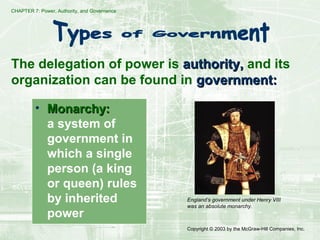
The delegation of power is authority,authority, and its
organization can be found in government:government:
• Monarchy:Monarchy:
a system of
government in
which a single
person (a king
or queen) rules
by inherited
power
England’s government under Henry VIII
was an absolute monarchy.
CHAPTER 7: Power, Authority, and Governance
Copyright © 2003 by the McGraw-Hill Companies, Inc.
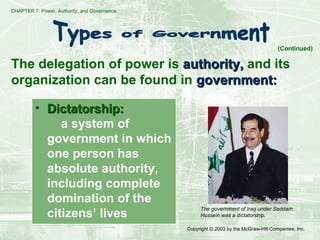
The delegation of power is authority,authority, and its
organization can be found in government:government:
• Dictatorship:Dictatorship:
a system of
government in which
one person has
absolute authority,
including complete
domination of the
citizens’ lives
The government of Iraq under Saddam
Hussein was a dictatorship.
(Continued)
CHAPTER 7: Power, Authority, and Governance
Copyright © 2003 by the McGraw-Hill Companies, Inc.
The delegation of power is authority,authority, and its
organization can be found in government:government:
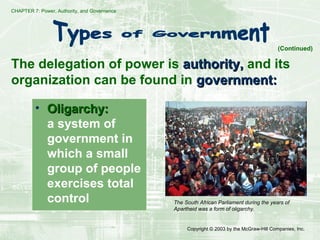
• Oligarchy:Oligarchy:
a system of
government in
which a small
group of people
exercises total
control The South African Parliament during the years of
Apartheid was a form of oligarchy.
(Continued)
CHAPTER 7: Power, Authority, and Governance
Copyright © 2003 by the McGraw-Hill Companies, Inc.
The delegation of power is authority,authority, and its
organization can be found in government:government:
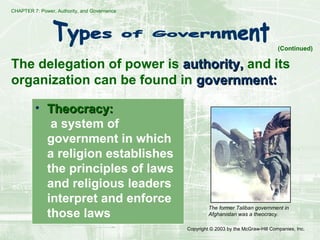
• Theocracy:Theocracy:
a system of
government in which
a religion establishes
the principles of laws
and religious leaders
interpret and enforce
those laws
The former Taliban government in
Afghanistan was a theocracy.
(Continued)
CHAPTER 7: Power, Authority, and Governance
Copyright © 2003 by the McGraw-Hill Companies, Inc.
The delegation of power is authority,authority, and its
organization can be found in government:government:
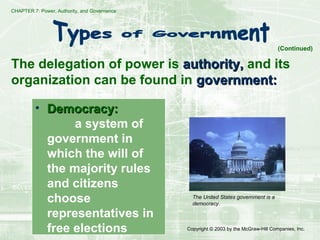
• Democracy:Democracy:
a system of
government in
which the will of
the majority rules
and citizens
choose
representatives in
free elections
The United States government is a
democracy.
(Continued)
CHAPTER 7: Power, Authority, and Governance
Copyright © 2003 by the McGraw-Hill Companies, Inc.
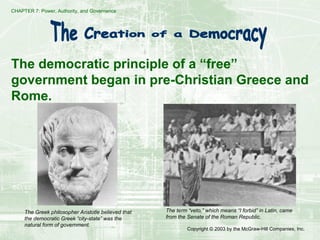
The democratic principle of a “free”
government began in pre-Christian Greece and
Rome.
The Greek philosopher Aristotle believed that
the democratic Greek “city-state” was the
natural form of government.
The term “veto,” which means “I forbid” in Latin, came
from the Senate of the Roman Republic.
CHAPTER 7: Power, Authority, and Governance
Copyright © 2003 by the McGraw-Hill Companies, Inc.
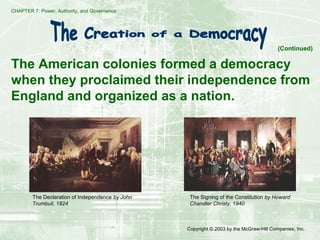
The American colonies formed a democracy
when they proclaimed their independence from
England and organized as a nation.
(Continued)
The Signing of the Constitution by Howard
Chandler Christy, 1940
The Declaration of Independence by John
Trumbull, 1824
CHAPTER 7: Power, Authority, and Governance
Copyright © 2003 by the McGraw-Hill Companies, Inc.
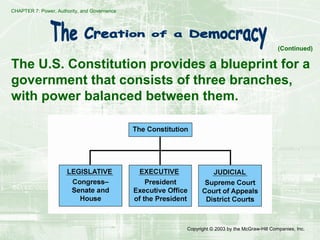
The U.S. Constitution provides a blueprint for a
government that consists of three branches,
with power balanced between them.
(Continued)
CHAPTER 7: Power, Authority, and Governance
Copyright © 2003 by the McGraw-Hill Companies, Inc.
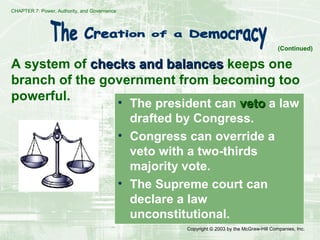
A system of checks and balanceschecks and balances keeps one
branch of the government from becoming too
powerful.
(Continued)
• The president can vetoveto a law
drafted by Congress.
• Congress can override a
veto with a two-thirds
majority vote.
• The Supreme court can
declare a law
unconstitutional.
CHAPTER 7: Power, Authority, and Governance
Copyright © 2003 by the McGraw-Hill Companies, Inc.
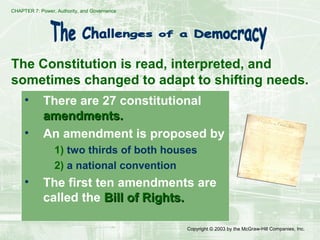
The Constitution is read, interpreted, and
sometimes changed to adapt to shifting needs.
• There are 27 constitutional
amendments.amendments.
• An amendment is proposed by
1) two thirds of both houses
2) a national convention
• The first ten amendments are
called the Bill of Rights.Bill of Rights.
CHAPTER 7: Power, Authority, and Governance
Copyright © 2003 by the McGraw-Hill Companies, Inc.
The U.S. struggles to keep a balance between
individual freedom and general order.
(Continued)
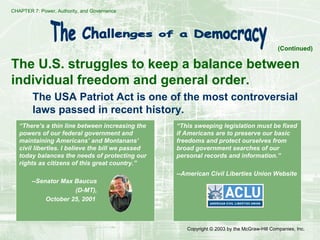
“This sweeping legislation must be fixed
if Americans are to preserve our basic
freedoms and protect ourselves from
broad government searches of our
personal records and information.”
--American Civil Liberties Union Website
“There’s a thin line between increasing the
powers of our federal government and
maintaining Americans’ and Montanans’
civil liberties. I believe the bill we passed
today balances the needs of protecting our
rights as citizens of this great country.”
--Senator Max Baucus
(D-MT),
October 25, 2001
The USA Patriot Act is one of the most controversial
laws passed in recent history.
CHAPTER 7: Power, Authority, and Governance
Copyright © 2003 by the McGraw-Hill Companies, Inc.
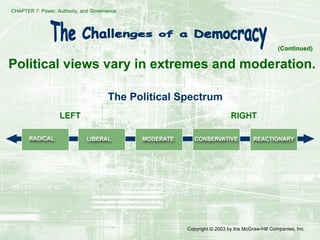
Political views vary in extremes and moderation.
(Continued)
The Political Spectrum
CHAPTER 7: Power, Authority, and Governance
Copyright © 2003 by the McGraw-Hill Companies, Inc.
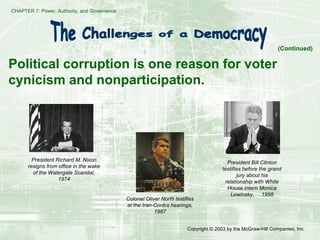
Political corruption is one reason for voter
cynicism and nonparticipation.
(Continued)
President Richard M. Nixon
resigns from office in the wake
of the Watergate Scandal,
1974
Colonel Oliver North testifies
at the Iran-Contra hearings,
1987
President Bill Clinton
testifies before the grand
jury about his
relationship with White
House intern Monica
Lewinsky, 1998
CHAPTER 7: Power, Authority, and Governance
Copyright © 2003 by the McGraw-Hill Companies, Inc.
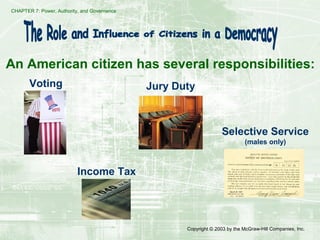
An American citizen has several responsibilities:
Voting
Income Tax
Jury Duty
Selective Service
(males only)
CHAPTER 7: Power, Authority, and Governance
Copyright © 2003 by the McGraw-Hill Companies, Inc.
There are many other ways that citizens can
engage in democracy.
(Continued)
• Attend meetings to gain information, discuss
issues, or lend support.
• Sign a petition.
• Write letters to elected representatives.
• Campaign for a candidate; lobby for laws
• Demonstrate through marches, sit-ins,
boycotts, or other forms of protest.
Copyright © 2003 by the McGraw-Hill Companies, Inc.
THE ENDTHE END
Practice the skills you learned in this chapter by taking
the Chapter Review QuizChapter Review Quiz or the GED Practice QuizGED Practice Quiz.
CHAPTER 7: Power, Authority, and Governance

Chapter 7 power, authority, and governance

  • 1.
    CHAPTER 7 Copyright ©2003 by the McGraw-Hill Companies, Inc.
  • 2.
    CHAPTER 7: Power,Authority, and Governance Copyright © 2003 by the McGraw-Hill Companies, Inc. The delegation of power is authority,authority, and its organization can be found in government:government: • Monarchy:Monarchy: a system of government in which a single person (a king or queen) rules by inherited power England’s government under Henry VIII was an absolute monarchy.
  • 3.
    CHAPTER 7: Power,Authority, and Governance Copyright © 2003 by the McGraw-Hill Companies, Inc. The delegation of power is authority,authority, and its organization can be found in government:government: • Dictatorship:Dictatorship: a system of government in which one person has absolute authority, including complete domination of the citizens’ lives The government of Iraq under Saddam Hussein was a dictatorship. (Continued)
  • 4.
    CHAPTER 7: Power,Authority, and Governance Copyright © 2003 by the McGraw-Hill Companies, Inc. The delegation of power is authority,authority, and its organization can be found in government:government: • Oligarchy:Oligarchy: a system of government in which a small group of people exercises total control The South African Parliament during the years of Apartheid was a form of oligarchy. (Continued)
  • 5.
    CHAPTER 7: Power,Authority, and Governance Copyright © 2003 by the McGraw-Hill Companies, Inc. The delegation of power is authority,authority, and its organization can be found in government:government: • Theocracy:Theocracy: a system of government in which a religion establishes the principles of laws and religious leaders interpret and enforce those laws The former Taliban government in Afghanistan was a theocracy. (Continued)
  • 6.
    CHAPTER 7: Power,Authority, and Governance Copyright © 2003 by the McGraw-Hill Companies, Inc. The delegation of power is authority,authority, and its organization can be found in government:government: • Democracy:Democracy: a system of government in which the will of the majority rules and citizens choose representatives in free elections The United States government is a democracy. (Continued)
  • 7.
    CHAPTER 7: Power,Authority, and Governance Copyright © 2003 by the McGraw-Hill Companies, Inc. The democratic principle of a “free” government began in pre-Christian Greece and Rome. The Greek philosopher Aristotle believed that the democratic Greek “city-state” was the natural form of government. The term “veto,” which means “I forbid” in Latin, came from the Senate of the Roman Republic.
  • 8.
    CHAPTER 7: Power,Authority, and Governance Copyright © 2003 by the McGraw-Hill Companies, Inc. The American colonies formed a democracy when they proclaimed their independence from England and organized as a nation. (Continued) The Signing of the Constitution by Howard Chandler Christy, 1940 The Declaration of Independence by John Trumbull, 1824
  • 9.
    CHAPTER 7: Power,Authority, and Governance Copyright © 2003 by the McGraw-Hill Companies, Inc. The U.S. Constitution provides a blueprint for a government that consists of three branches, with power balanced between them. (Continued)
  • 10.
    CHAPTER 7: Power,Authority, and Governance Copyright © 2003 by the McGraw-Hill Companies, Inc. A system of checks and balanceschecks and balances keeps one branch of the government from becoming too powerful. (Continued) • The president can vetoveto a law drafted by Congress. • Congress can override a veto with a two-thirds majority vote. • The Supreme court can declare a law unconstitutional.
  • 11.
    CHAPTER 7: Power,Authority, and Governance Copyright © 2003 by the McGraw-Hill Companies, Inc. The Constitution is read, interpreted, and sometimes changed to adapt to shifting needs. • There are 27 constitutional amendments.amendments. • An amendment is proposed by 1) two thirds of both houses 2) a national convention • The first ten amendments are called the Bill of Rights.Bill of Rights.
  • 12.
    CHAPTER 7: Power,Authority, and Governance Copyright © 2003 by the McGraw-Hill Companies, Inc. The U.S. struggles to keep a balance between individual freedom and general order. (Continued) “This sweeping legislation must be fixed if Americans are to preserve our basic freedoms and protect ourselves from broad government searches of our personal records and information.” --American Civil Liberties Union Website “There’s a thin line between increasing the powers of our federal government and maintaining Americans’ and Montanans’ civil liberties. I believe the bill we passed today balances the needs of protecting our rights as citizens of this great country.” --Senator Max Baucus (D-MT), October 25, 2001 The USA Patriot Act is one of the most controversial laws passed in recent history.
  • 13.
    CHAPTER 7: Power,Authority, and Governance Copyright © 2003 by the McGraw-Hill Companies, Inc. Political views vary in extremes and moderation. (Continued) The Political Spectrum
  • 14.
    CHAPTER 7: Power,Authority, and Governance Copyright © 2003 by the McGraw-Hill Companies, Inc. Political corruption is one reason for voter cynicism and nonparticipation. (Continued) President Richard M. Nixon resigns from office in the wake of the Watergate Scandal, 1974 Colonel Oliver North testifies at the Iran-Contra hearings, 1987 President Bill Clinton testifies before the grand jury about his relationship with White House intern Monica Lewinsky, 1998
  • 15.
    CHAPTER 7: Power,Authority, and Governance Copyright © 2003 by the McGraw-Hill Companies, Inc. An American citizen has several responsibilities: Voting Income Tax Jury Duty Selective Service (males only)
  • 16.
    CHAPTER 7: Power,Authority, and Governance Copyright © 2003 by the McGraw-Hill Companies, Inc. There are many other ways that citizens can engage in democracy. (Continued) • Attend meetings to gain information, discuss issues, or lend support. • Sign a petition. • Write letters to elected representatives. • Campaign for a candidate; lobby for laws • Demonstrate through marches, sit-ins, boycotts, or other forms of protest.
  • 17.
    Copyright © 2003by the McGraw-Hill Companies, Inc. THE ENDTHE END Practice the skills you learned in this chapter by taking the Chapter Review QuizChapter Review Quiz or the GED Practice QuizGED Practice Quiz. CHAPTER 7: Power, Authority, and Governance

Editor's Notes

  • #14 Reactionary: an extreme conservative; an opponent of progress or liberalism