Presentation Pro


              Magruder’s
          American Government
                          CHAPTER 1
                      Principles of Government


© 2001 by Prentice Hall, Inc.
CHAPTER 1

Principles of Government


    SECTION 1Government and the State

    SECTION 2Forms of Government

    SECTION 3Basic Concepts of Democracy


              Go To
            Section:   1 2 3       Chapter 1
SECTION 1

Government and the State
• How is government defined?
• What are the basic powers that every
  government holds?
• What are the four defining characteristics of
  the state?
• How have we attempted to explain the origin
  of the state?
• What is the purpose of government in the
  United States and other countries?
              Go To
            Section:   1 2 3   Chapter 1, Section 1
What Is Government?


    Government is the
 institution through which a
society makes and enforces
      its public policies.


      Go To
    Section:    1 2 3         Chapter 1 Section 1
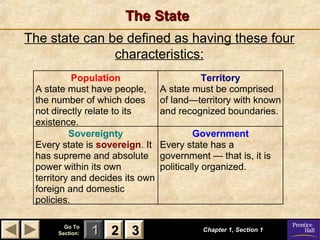
The State
The state can be defined as having these four
               characteristics:
           Population                     Territory
 A state must have people,       A state must be comprised
 the number of which does        of land—territory with known
 not directly relate to its      and recognized boundaries.
 existence.
          Sovereignty                     Government
 Every state is sovereign. It    Every state has a
 has supreme and absolute        government — that is, it is
 power within its own            politically organized.
 territory and decides its own
 foreign and domestic
 policies.

        Go To
      Section:   1 2 3                     Chapter 1, Section 1
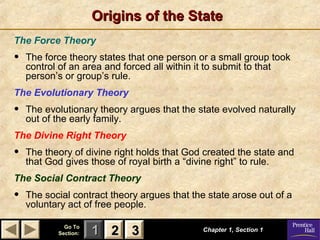
Origins of the State
The Force Theory
•   The force theory states that one person or a small group took
    control of an area and forced all within it to submit to that
    person’s or group’s rule.
The Evolutionary Theory
•   The evolutionary theory argues that the state evolved naturally
    out of the early family.
The Divine Right Theory
•   The theory of divine right holds that God created the state and
    that God gives those of royal birth a “divine right” to rule.
The Social Contract Theory
•   The social contract theory argues that the state arose out of a
    voluntary act of free people.

             Go To
           Section:   1 2 3                  Chapter 1, Section 1
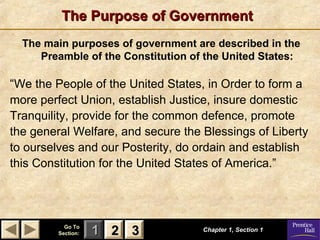
The Purpose of Government
  The main purposes of government are described in the
     Preamble of the Constitution of the United States:

“We the People of the United States, in Order to form a
more perfect Union, establish Justice, insure domestic
Tranquility, provide for the common defence, promote
the general Welfare, and secure the Blessings of Liberty
to ourselves and our Posterity, do ordain and establish
this Constitution for the United States of America.”


           Go To
         Section:   1 2 3           Chapter 1, Section 1
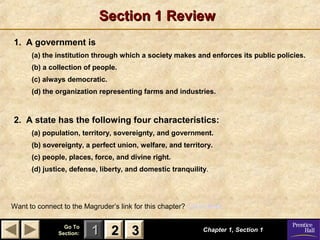
Section 1 Review
1. A government is
      (a) the institution through which a society makes and enforces its public policies.
      (b) a collection of people.
      (c) always democratic.
      (d) the organization representing farms and industries.


2. A state has the following four characteristics:
      (a) population, territory, sovereignty, and government.
      (b) sovereignty, a perfect union, welfare, and territory.
      (c) people, places, force, and divine right.
      (d) justice, defense, liberty, and domestic tranquility.


Want to connect to the Magruder’s link for this chapter? Click Here!

                 Go To
               Section:   1 2 3                              Chapter 1, Section 1
SECTION 2

Forms of Government

• How can we classify governments?
• How are systems of government defined in
  terms of who can participate?

• How is power distributed within a state?
• How are governments defined by the
  relationship between the legislative and
  executive branches?

              Go To
            Section:   1 2 3   Chapter 1, Section 2
Classifying Governments

    Governments can be classified by three
            different standards:
(1) Who can participate in the governing process.
(2) The geographic distribution of the governmental
  power within the state.
(3) The relationship between the legislative
    (lawmaking) and the executive (law-executing)
  branches of the government.


          Go To
        Section:   1 2 3          Chapter 1, Section 2
Classification by Who Can Participate
           Democracy                             Dictatorship
•   In a democracy, supreme           •   A dictatorship exists where
    political authority rests with        those who rule cannot be
    the people.                           held responsible to the will of
                                          the people.
•   A direct democracy exists
    where the will of the people is   •   An autocracy is a
    translated into law directly by       government in which a
    the people themselves.                single person holds unlimited
                                          political power.
•   In an indirect democracy, a
    small group of persons,           •   An oligarchy is a
    chosen by the people to act           government in which the
    as their representatives,             power to rule is held by a
    expresses the popular will.           small, usually self-appointed
                                          elite.
              Go To
            Section:   1 2 3                    Chapter 1, Section 2
Classification by Geographic
              Distribution of Power
     Unitary Government                Confederate Government
•   A unitary government has       •   A confederation is an
    all powers held by a single,       alliance of independent
    central agency.                    states.

                       Federal Government
•   A federal government is one in which the powers of
    government are divided between a central government and
    several local governments.
•   An authority superior to both the central and local
    governments makes this division of power on a
    geographic basis.

             Go To
           Section:   1 2 3                  Chapter 1, Section 2
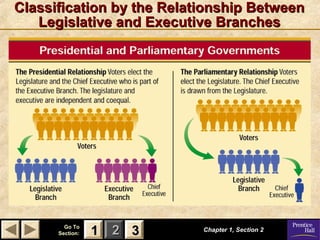
Classification by the Relationship Between
   Legislative and Executive Branches


        Go To
      Section:   1 2 3     Chapter 1, Section 2
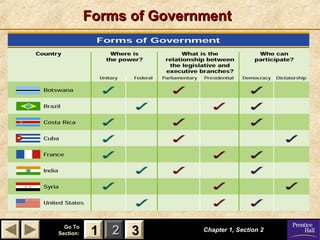
Forms of Government


  Go To
Section:    1 2 3         Chapter 1, Section 2
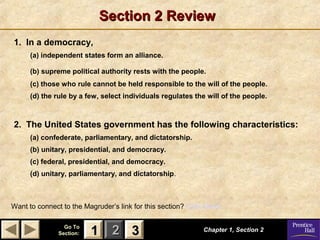
Section 2 Review
1. In a democracy,
      (a) independent states form an alliance.

      (b) supreme political authority rests with the people.
      (c) those who rule cannot be held responsible to the will of the people.
      (d) the rule by a few, select individuals regulates the will of the people.


2. The United States government has the following characteristics:
      (a) confederate, parliamentary, and dictatorship.
      (b) unitary, presidential, and democracy.
      (c) federal, presidential, and democracy.
      (d) unitary, parliamentary, and dictatorship.


Want to connect to the Magruder’s link for this section? Click Here!

                 Go To
               Section:   1 2 3                               Chapter 1, Section 2
SECTION 3

 Basic Concepts of Democracy

• What are the foundations of democracy?
• What are the connections between
  democracy and the free enterprise system?

• How has the Internet affected democracy?


               Go To
             Section:   1 2 3   Chapter 1, Section 3
Foundations

   The American concept of democracy rests on
               these basic notions:
(1) A recognition of the fundamental worth and dignity of every
   person;
(2) A respect for the equality of all persons;
(3) A faith in majority rule and an insistence upon minority
   rights;
(4) An acceptance of the necessity of compromise; and
(5) An insistence upon the widest possible degree of individual
   freedom.
            Go To
          Section:   1 2 3                Chapter 1, Section 3
Democracy and the Free Enterprise System

•   The free enterprise system is an economic system
    characterized by private or corporate ownership of
    capital goods; investments that are determined by
    private decision rather than by state control; and
    determined in a free market.

•   Decisions in a free enterprise system are determined
    by the law of supply and demand.

•   An economy in which private enterprise exists in
    combination with a considerable amount of
    government regulation and promotion is called a
    mixed economy.

            Go To
          Section:   1 2 3            Chapter 1, Section 3
Democracy and the Internet

• Democracy demands that the people be
 widely informed about their government.

• Theoretically, the Internet makes
 knowledgeable participation in democratic
 process easier than ever before.

• However, all data on the World Wide Web is
 not necessarily true, and the long-term
 effects of the Internet on democracy has yet
 to be determined.
         Go To
       Section:   1 2 3       Chapter 1, Section 3
Section 3 Review
1. All of the following are basic notions found in the American
   concept of democracy EXCEPT
       (a) a recognition of of the fundamental worth and dignity of every person.
       (b) a respect for the equality of all persons.
       (c) the rule of government by a single individual.
       (d) an acceptance of the necessity of compromise.


2. In a free enterprise system, the means of capital are owned
       (a) by private and corporate entities.
       (b) by government agencies.
       (c) by only the agricultural sector.
       (d) equally by the collective citizenry.


Want to connect to the Magruder’s link for this section? Click Here!

                 Go To
               Section:   1 2 3                               Chapter 1, Section 3

Government chapter 1 powerpoint con't

  • 1.
    Presentation Pro Magruder’s American Government CHAPTER 1 Principles of Government © 2001 by Prentice Hall, Inc.
  • 2.
    CHAPTER 1 Principles ofGovernment SECTION 1Government and the State SECTION 2Forms of Government SECTION 3Basic Concepts of Democracy Go To Section: 1 2 3 Chapter 1
  • 3.
    SECTION 1 Government andthe State • How is government defined? • What are the basic powers that every government holds? • What are the four defining characteristics of the state? • How have we attempted to explain the origin of the state? • What is the purpose of government in the United States and other countries? Go To Section: 1 2 3 Chapter 1, Section 1
  • 4.
    What Is Government? Government is the institution through which a society makes and enforces its public policies. Go To Section: 1 2 3 Chapter 1 Section 1
  • 5.
    The State The statecan be defined as having these four characteristics: Population Territory A state must have people, A state must be comprised the number of which does of land—territory with known not directly relate to its and recognized boundaries. existence. Sovereignty Government Every state is sovereign. It Every state has a has supreme and absolute government — that is, it is power within its own politically organized. territory and decides its own foreign and domestic policies. Go To Section: 1 2 3 Chapter 1, Section 1
  • 6.
    Origins of theState The Force Theory • The force theory states that one person or a small group took control of an area and forced all within it to submit to that person’s or group’s rule. The Evolutionary Theory • The evolutionary theory argues that the state evolved naturally out of the early family. The Divine Right Theory • The theory of divine right holds that God created the state and that God gives those of royal birth a “divine right” to rule. The Social Contract Theory • The social contract theory argues that the state arose out of a voluntary act of free people. Go To Section: 1 2 3 Chapter 1, Section 1
  • 7.
    The Purpose ofGovernment The main purposes of government are described in the Preamble of the Constitution of the United States: “We the People of the United States, in Order to form a more perfect Union, establish Justice, insure domestic Tranquility, provide for the common defence, promote the general Welfare, and secure the Blessings of Liberty to ourselves and our Posterity, do ordain and establish this Constitution for the United States of America.” Go To Section: 1 2 3 Chapter 1, Section 1
  • 8.
    Section 1 Review 1.A government is (a) the institution through which a society makes and enforces its public policies. (b) a collection of people. (c) always democratic. (d) the organization representing farms and industries. 2. A state has the following four characteristics: (a) population, territory, sovereignty, and government. (b) sovereignty, a perfect union, welfare, and territory. (c) people, places, force, and divine right. (d) justice, defense, liberty, and domestic tranquility. Want to connect to the Magruder’s link for this chapter? Click Here! Go To Section: 1 2 3 Chapter 1, Section 1
  • 9.
    SECTION 2 Forms ofGovernment • How can we classify governments? • How are systems of government defined in terms of who can participate? • How is power distributed within a state? • How are governments defined by the relationship between the legislative and executive branches? Go To Section: 1 2 3 Chapter 1, Section 2
  • 10.
    Classifying Governments Governments can be classified by three different standards: (1) Who can participate in the governing process. (2) The geographic distribution of the governmental power within the state. (3) The relationship between the legislative (lawmaking) and the executive (law-executing) branches of the government. Go To Section: 1 2 3 Chapter 1, Section 2
  • 11.
    Classification by WhoCan Participate Democracy Dictatorship • In a democracy, supreme • A dictatorship exists where political authority rests with those who rule cannot be the people. held responsible to the will of the people. • A direct democracy exists where the will of the people is • An autocracy is a translated into law directly by government in which a the people themselves. single person holds unlimited political power. • In an indirect democracy, a small group of persons, • An oligarchy is a chosen by the people to act government in which the as their representatives, power to rule is held by a expresses the popular will. small, usually self-appointed elite. Go To Section: 1 2 3 Chapter 1, Section 2
  • 12.
    Classification by Geographic Distribution of Power Unitary Government Confederate Government • A unitary government has • A confederation is an all powers held by a single, alliance of independent central agency. states. Federal Government • A federal government is one in which the powers of government are divided between a central government and several local governments. • An authority superior to both the central and local governments makes this division of power on a geographic basis. Go To Section: 1 2 3 Chapter 1, Section 2
  • 13.
    Classification by theRelationship Between Legislative and Executive Branches Go To Section: 1 2 3 Chapter 1, Section 2
  • 14.
    Forms of Government Go To Section: 1 2 3 Chapter 1, Section 2
  • 15.
    Section 2 Review 1.In a democracy, (a) independent states form an alliance. (b) supreme political authority rests with the people. (c) those who rule cannot be held responsible to the will of the people. (d) the rule by a few, select individuals regulates the will of the people. 2. The United States government has the following characteristics: (a) confederate, parliamentary, and dictatorship. (b) unitary, presidential, and democracy. (c) federal, presidential, and democracy. (d) unitary, parliamentary, and dictatorship. Want to connect to the Magruder’s link for this section? Click Here! Go To Section: 1 2 3 Chapter 1, Section 2
  • 16.
    SECTION 3 BasicConcepts of Democracy • What are the foundations of democracy? • What are the connections between democracy and the free enterprise system? • How has the Internet affected democracy? Go To Section: 1 2 3 Chapter 1, Section 3
  • 17.
    Foundations The American concept of democracy rests on these basic notions: (1) A recognition of the fundamental worth and dignity of every person; (2) A respect for the equality of all persons; (3) A faith in majority rule and an insistence upon minority rights; (4) An acceptance of the necessity of compromise; and (5) An insistence upon the widest possible degree of individual freedom. Go To Section: 1 2 3 Chapter 1, Section 3
  • 18.
    Democracy and theFree Enterprise System • The free enterprise system is an economic system characterized by private or corporate ownership of capital goods; investments that are determined by private decision rather than by state control; and determined in a free market. • Decisions in a free enterprise system are determined by the law of supply and demand. • An economy in which private enterprise exists in combination with a considerable amount of government regulation and promotion is called a mixed economy. Go To Section: 1 2 3 Chapter 1, Section 3
  • 19.
    Democracy and theInternet • Democracy demands that the people be widely informed about their government. • Theoretically, the Internet makes knowledgeable participation in democratic process easier than ever before. • However, all data on the World Wide Web is not necessarily true, and the long-term effects of the Internet on democracy has yet to be determined. Go To Section: 1 2 3 Chapter 1, Section 3
  • 20.
    Section 3 Review 1.All of the following are basic notions found in the American concept of democracy EXCEPT (a) a recognition of of the fundamental worth and dignity of every person. (b) a respect for the equality of all persons. (c) the rule of government by a single individual. (d) an acceptance of the necessity of compromise. 2. In a free enterprise system, the means of capital are owned (a) by private and corporate entities. (b) by government agencies. (c) by only the agricultural sector. (d) equally by the collective citizenry. Want to connect to the Magruder’s link for this section? Click Here! Go To Section: 1 2 3 Chapter 1, Section 3