DativesChapter 7
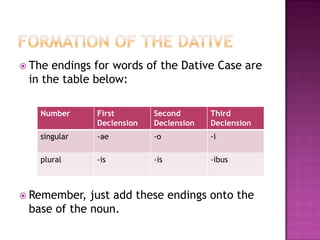
Formation of the dativeThe endings for words of the Dative Case are in the table below:Remember, just add these endings onto the base of the noun.
The dative case is used for Indirect ObjectsIndirect objects are words that tell TO WHOM or FOR WHOM something is given, shown, told, or done.You will ONLY have an indirect object when you have an action verb and a direct object.Not all sentences with direct objects have indirect objects, but all sentences with indirect objects must have a direct object.
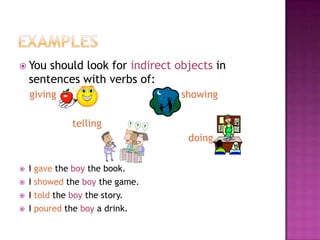
examplesYou should look for indirect objects in sentences with verbs of:givingshowing              tellingdoingI gave the boy the book.  I showed the boy the game.I told the boy the story.I poured the boy a drink.
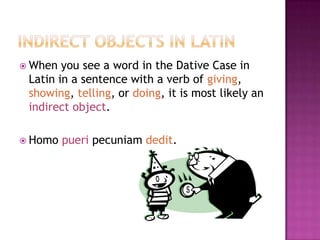
Indirect objects in latinWhen you see a word in the Dative Case in Latin in a sentence with a verb of giving, showing, telling, or doing, it is most likely an indirect object.Homo pueripecuniamdedit.
Translation of the dativeThe easiest way to translate the dative case is to use the English words “to” or “for.”In English this will look like a prepositional phrase, but that’s ok.  It clearly shows a dative in Latin.
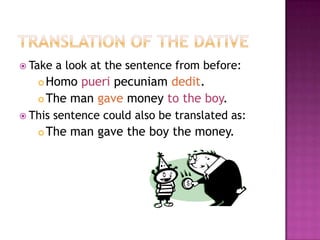
Translation of the dativeTake a look at the sentence from before:Homo pueripecuniamdedit.The man gave money to the boy.This sentence could also be translated as:The man gave the boy the money.
recapWhen the main verb in a sentence is a verb of giving, showing, telling, or doing AND you have a direct object in a sentence, LOOK for and indirect object!

Chapter 7 Datives

  • 1.
  • 2.
    Formation of thedativeThe endings for words of the Dative Case are in the table below:Remember, just add these endings onto the base of the noun.
  • 3.
    The dative caseis used for Indirect ObjectsIndirect objects are words that tell TO WHOM or FOR WHOM something is given, shown, told, or done.You will ONLY have an indirect object when you have an action verb and a direct object.Not all sentences with direct objects have indirect objects, but all sentences with indirect objects must have a direct object.
  • 4.
    examplesYou should lookfor indirect objects in sentences with verbs of:givingshowing tellingdoingI gave the boy the book. I showed the boy the game.I told the boy the story.I poured the boy a drink.
  • 5.
    Indirect objects inlatinWhen you see a word in the Dative Case in Latin in a sentence with a verb of giving, showing, telling, or doing, it is most likely an indirect object.Homo pueripecuniamdedit.
  • 6.
    Translation of thedativeThe easiest way to translate the dative case is to use the English words “to” or “for.”In English this will look like a prepositional phrase, but that’s ok. It clearly shows a dative in Latin.
  • 7.
    Translation of thedativeTake a look at the sentence from before:Homo pueripecuniamdedit.The man gave money to the boy.This sentence could also be translated as:The man gave the boy the money.
  • 8.
    recapWhen the mainverb in a sentence is a verb of giving, showing, telling, or doing AND you have a direct object in a sentence, LOOK for and indirect object!