Lecture 2Reading of the 2nd Lecture: content as follows:
‘GRAMMAR STRUCTURE.’ PRONOUNS. VERBS. ADJECTIVES. ADVERB/DERIVITIVES/PARTICIPLES/CONJUNCTIVE.
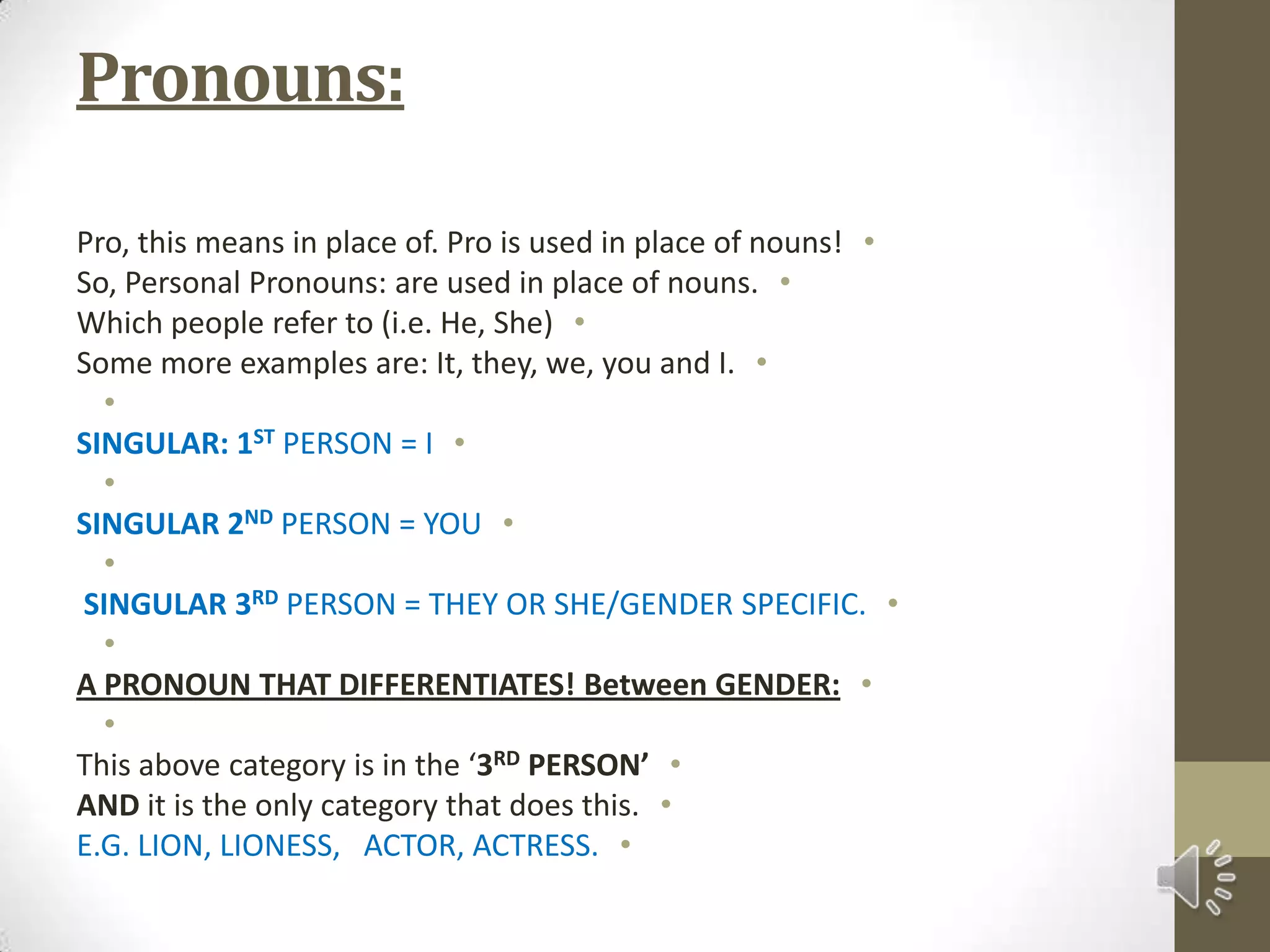
Pronouns:Pro, this means in place of. Pro is used in place of nouns!So, Personal Pronouns: are used in place of nouns.Which people refer to (i.e. He, She)Some more examples are: It, they, we, you and I. SINGULAR: 1ST PERSON = I SINGULAR 2NDPERSON = YOU  SINGULAR 3RDPERSON = THEY OR SHE/GENDER SPECIFIC. A PRONOUN THAT DIFFERENTIATES! Between GENDER: This above category is in the ‘3RD PERSON’AND it is the only category that does this.E.G. LION, LIONESS,   ACTOR, ACTRESS.
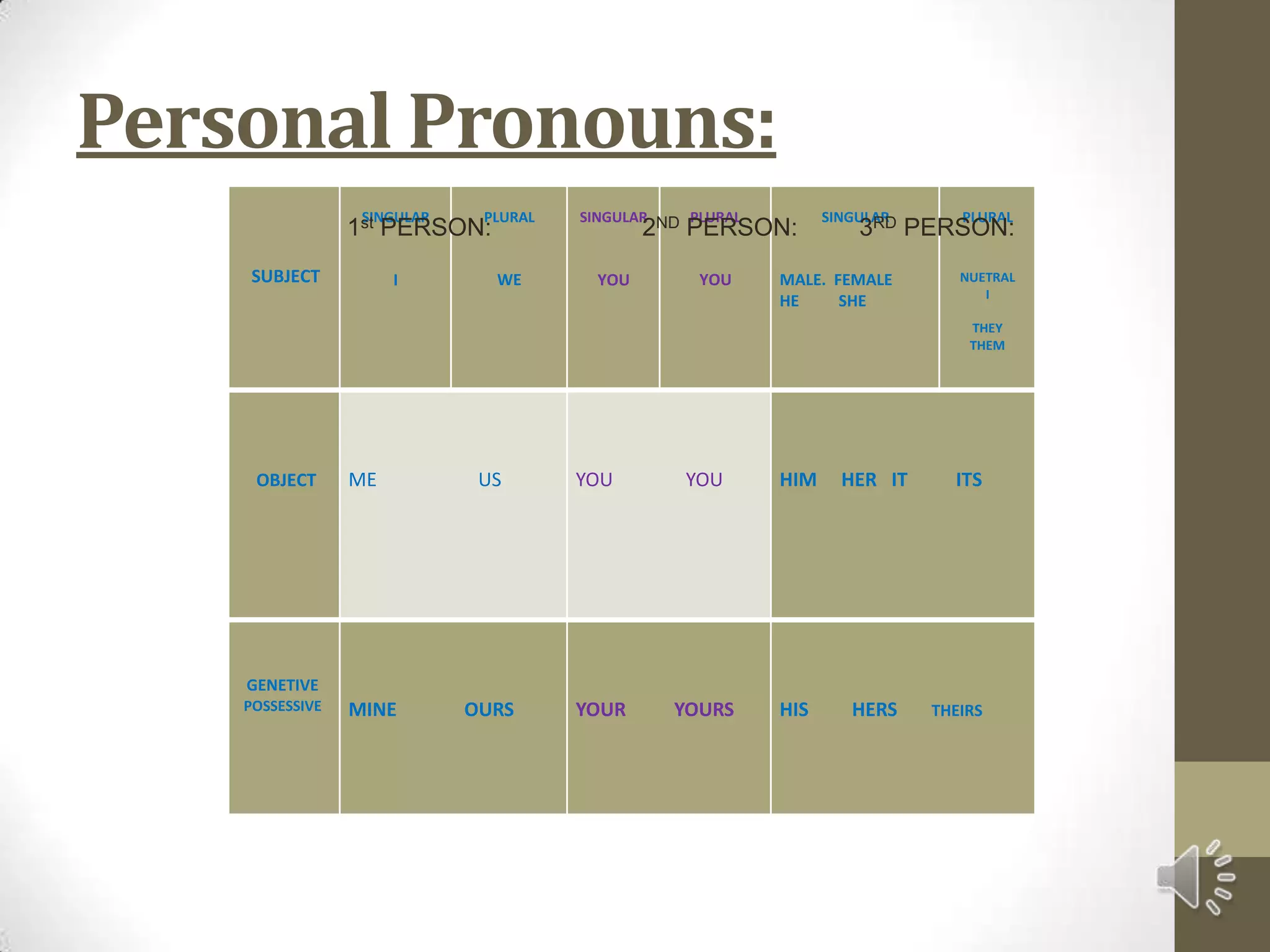
Personal Pronouns:               1st PERSON:                      2ND PERSON:         3RD PERSON:
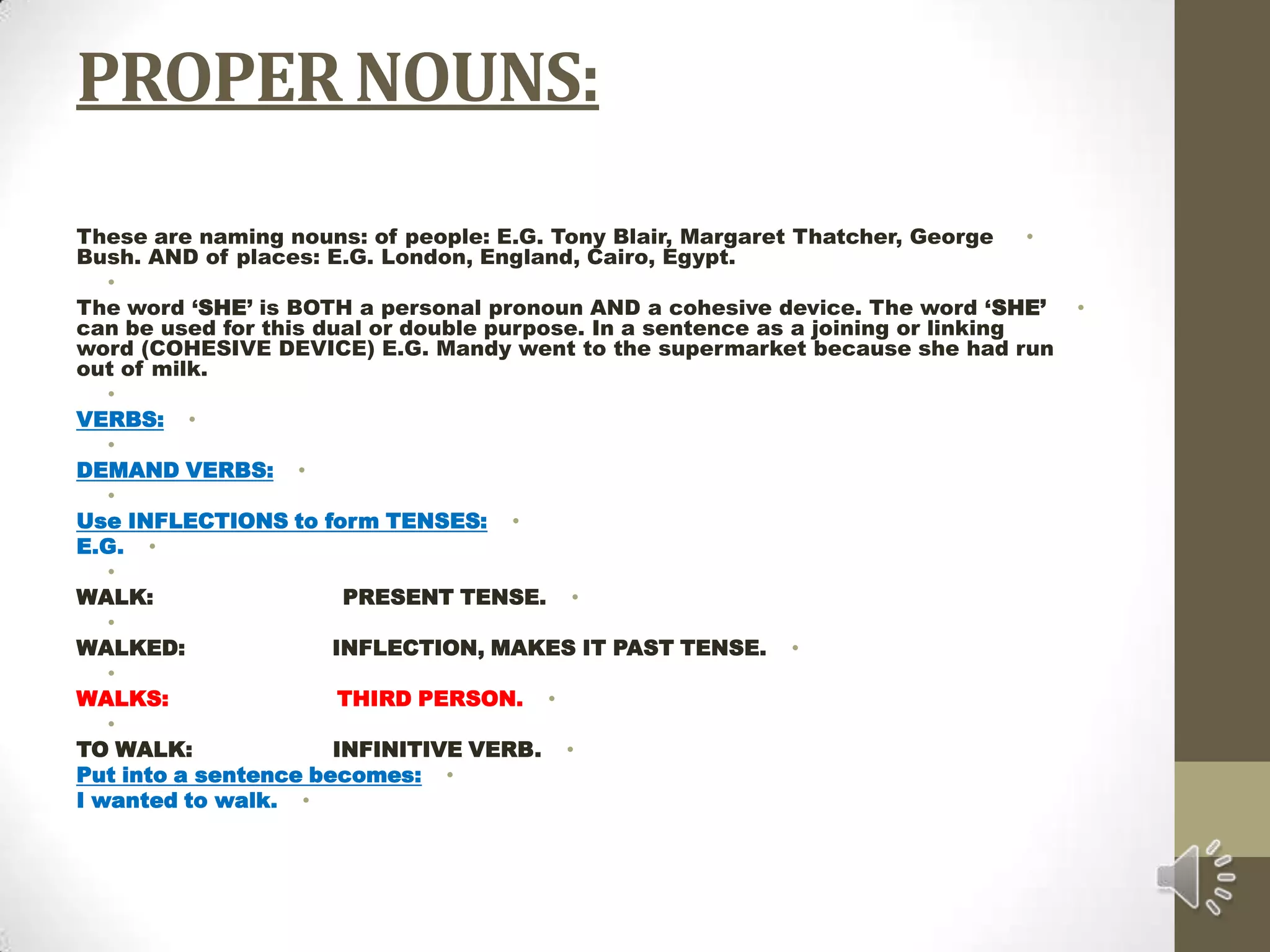
PROPER NOUNS:These are naming nouns: of people: E.G. Tony Blair, Margaret Thatcher, George Bush. AND of places: E.G. London, England, Cairo, Egypt. The word ‘SHE’ is BOTH a personal pronoun AND a cohesive device. The word ‘SHE’ can be used for this dual or double purpose. In a sentence as a joining or linking word (COHESIVE DEVICE) E.G. Mandy went to the supermarket because she had run out of milk. VERBS: DEMAND VERBS: Use INFLECTIONS to form TENSES:E.G. WALK:                           PRESENT TENSE. WALKED:                     INFLECTION, MAKES IT PAST TENSE. WALKS:                        THIRD PERSON. TO WALK:                    INFINITIVE VERB.Put into a sentence becomes:I wanted to walk.
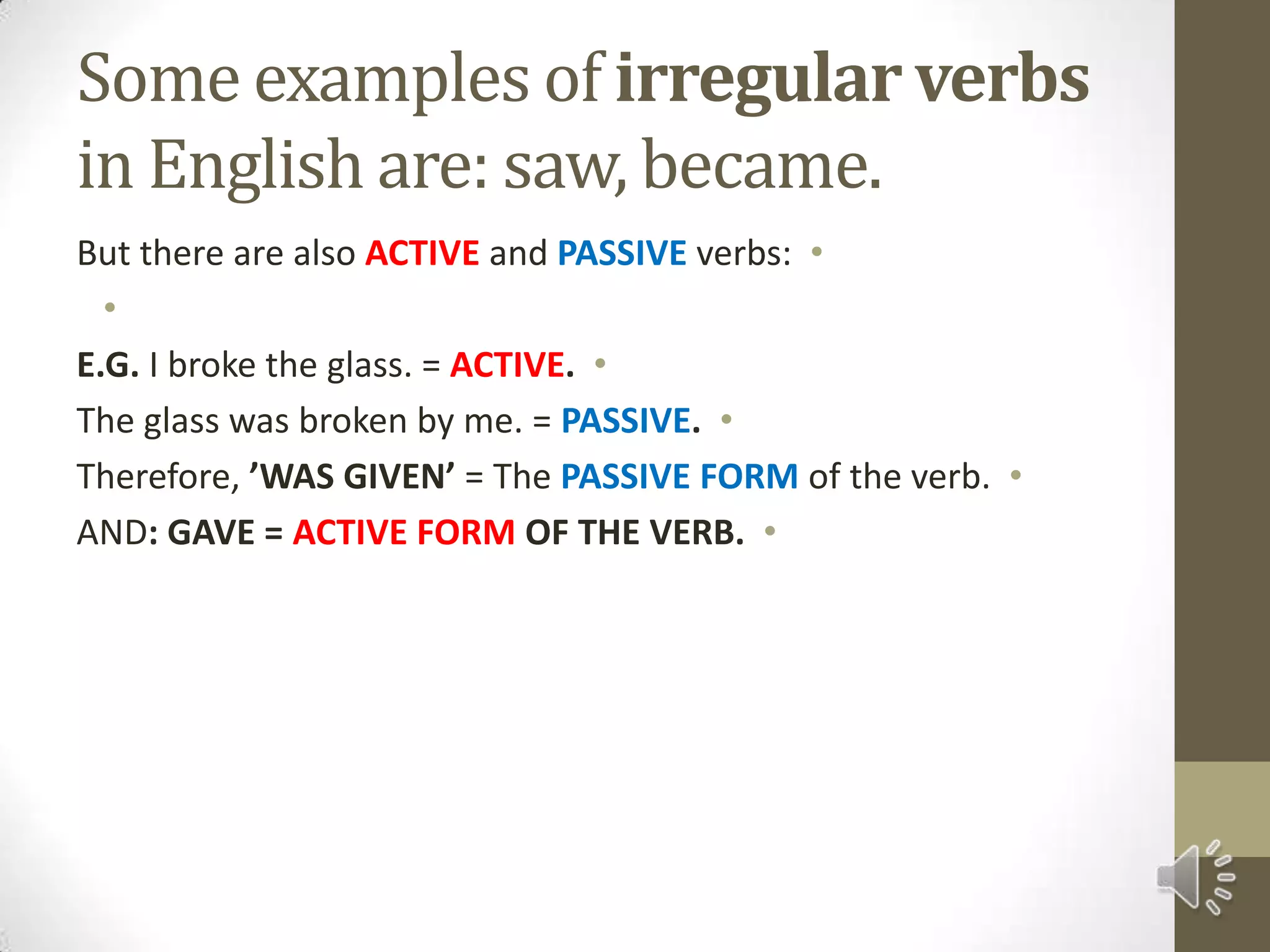
Some examples of irregularverbs in English are: saw, became.But there are also ACTIVEand PASSIVE verbs: E.G. I broke the glass. = ACTIVE.The glass was broken by me. = PASSIVE.Therefore, ’WAS GIVEN’ = The PASSIVE FORMof the verb.AND: GAVE = ACTIVE FORM OF THE VERB.
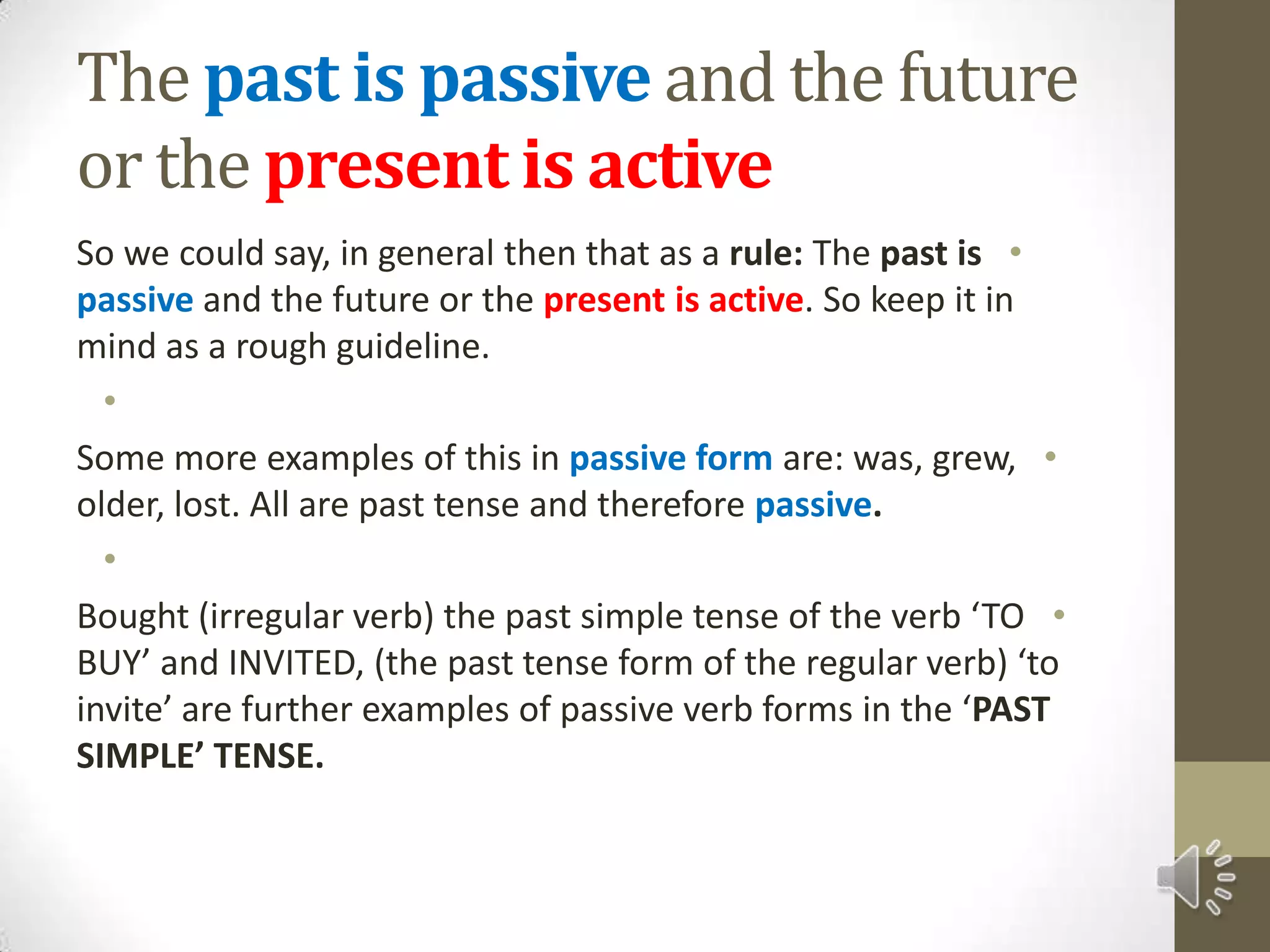
The past is passiveand the future or the present is activeSo we could say, in general then that as a rule: The past is passive and the future or the present is active. So keep it in mind as a rough guideline. Some more examples of this in passive form are: was, grew, older, lost. All are past tense and therefore passive. Bought (irregular verb) the past simple tense of the verb ‘TO BUY’ and INVITED, (the past tense form of the regular verb) ‘to invite’ are further examples of passive verb forms in the ‘PAST SIMPLE’ TENSE.
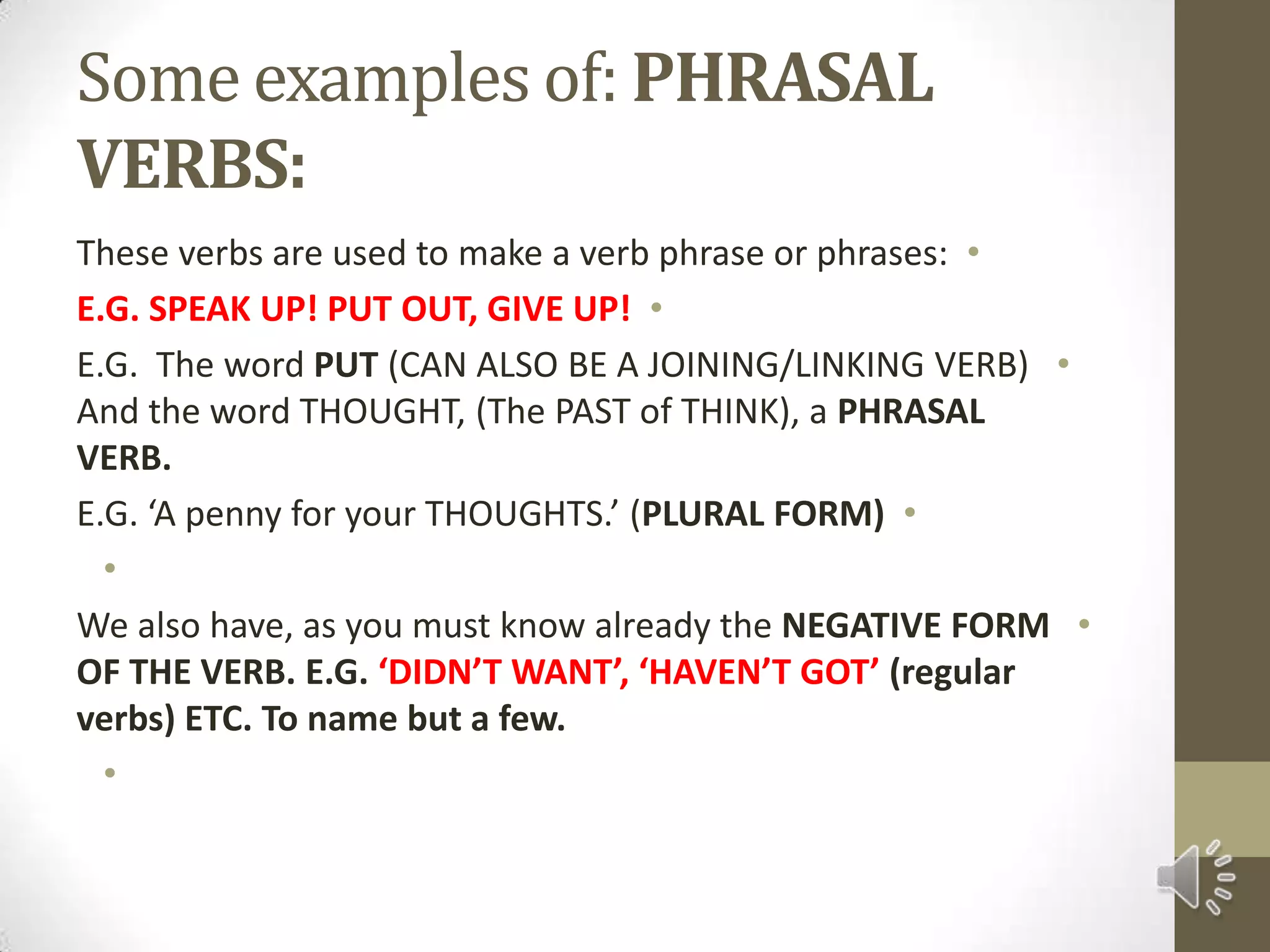
Some examples of: PHRASAL VERBS:These verbs are used to make a verb phrase or phrases:E.G. SPEAK UP! PUT OUT, GIVE UP!E.G.  The word PUT (CAN ALSO BE A JOINING/LINKING VERB) And the word THOUGHT, (The PAST of THINK), a PHRASAL VERB.E.G. ‘A penny for your THOUGHTS.’ (PLURAL FORM) We also have, as you must know already the NEGATIVE FORM OF THE VERB. E.G. ‘DIDN’T WANT’, ‘HAVEN’T GOT’ (regular verbs) ETC. To name but a few. 
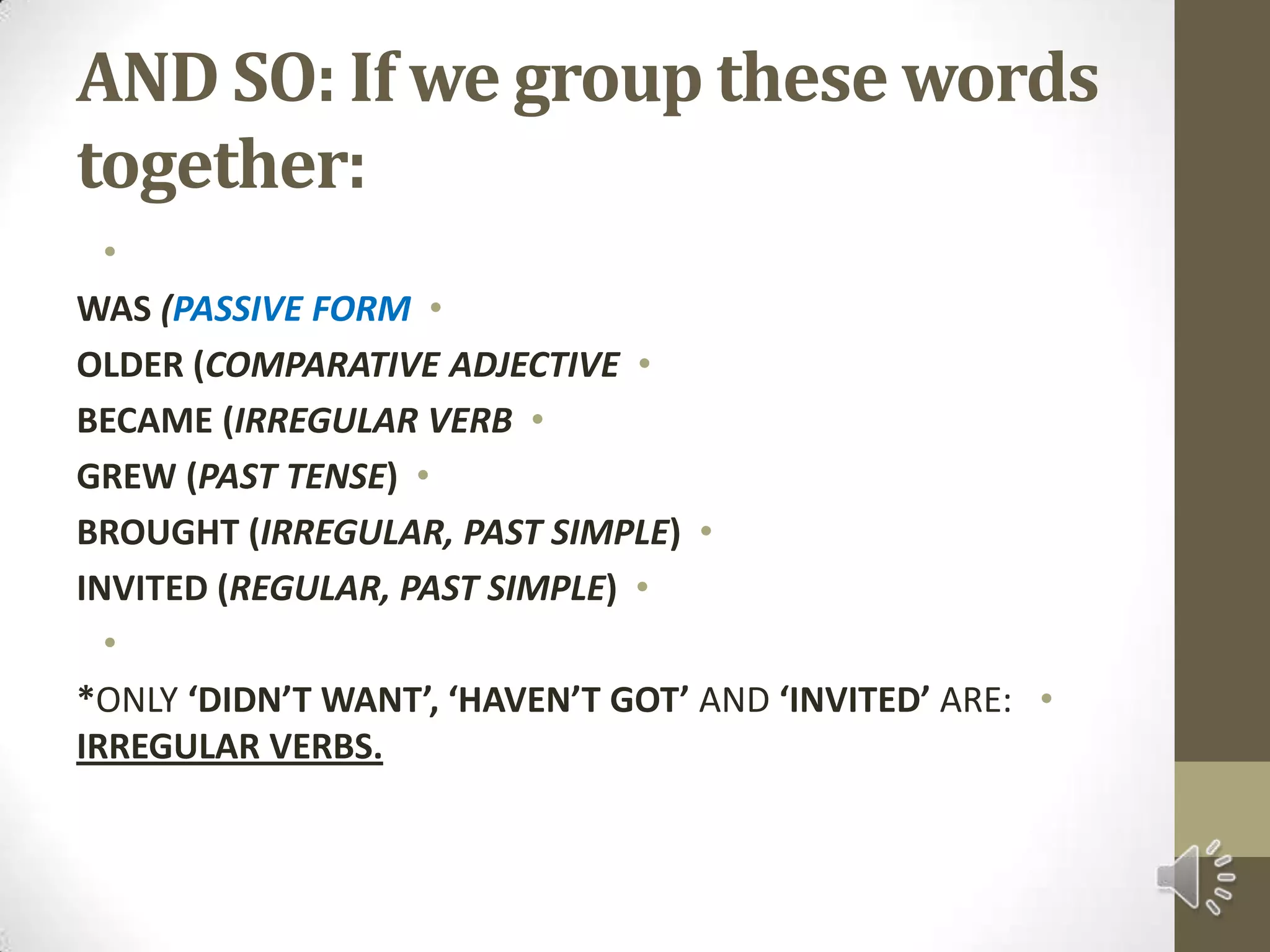
AND SO: If we group these words together: WAS (PASSIVE FORMOLDER (COMPARATIVE ADJECTIVEBECAME (IRREGULAR VERBGREW (PAST TENSE)BROUGHT (IRREGULAR, PAST SIMPLE)INVITED (REGULAR, PAST SIMPLE) *ONLY ‘DIDN’T WANT’, ‘HAVEN’T GOT’ AND ‘INVITED’ ARE: IRREGULAR VERBS.
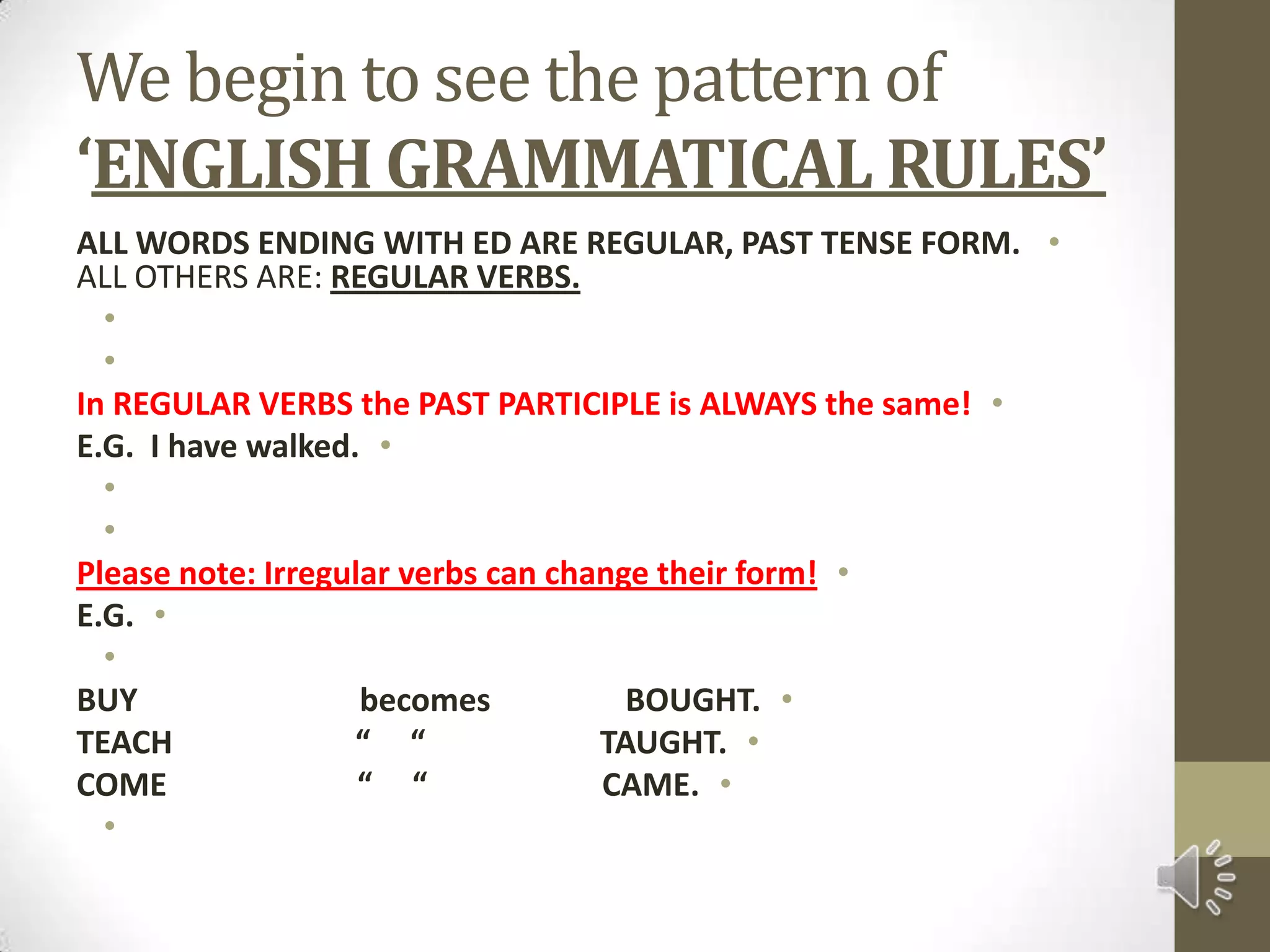
We begin to see the pattern of ‘ENGLISH GRAMMATICAL RULES’ALL WORDS ENDING WITH ED ARE REGULAR, PAST TENSE FORM. ALL OTHERS ARE: REGULAR VERBS.  In REGULAR VERBS the PAST PARTICIPLE is ALWAYS the same!E.G.  I have walked.  Please note: Irregular verbs can change their form!E.G. BUY                            becomes                 BOUGHT.TEACH                       “     “                      TAUGHT.COME                        “     “                      CAME. 
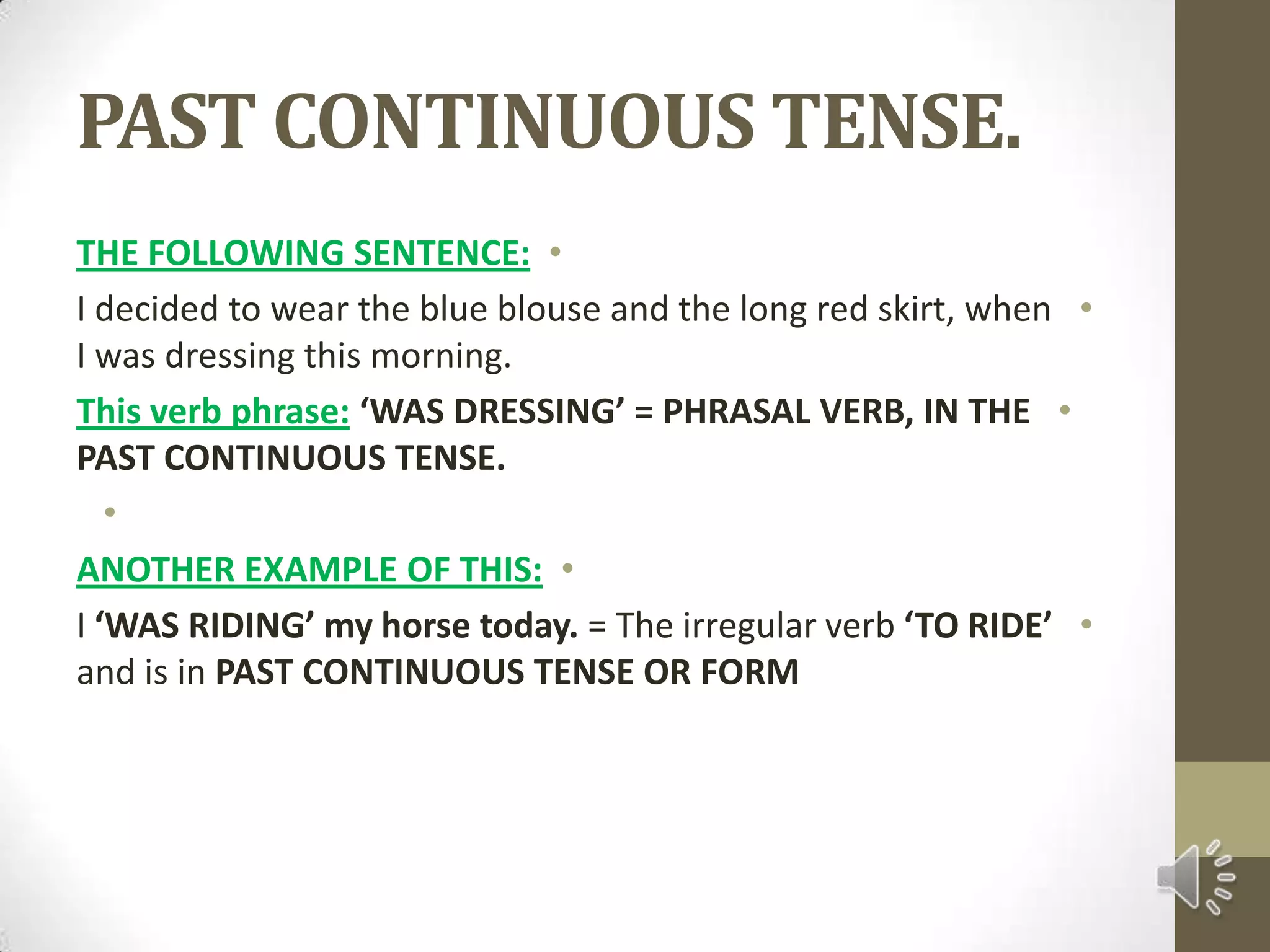
PAST CONTINUOUS TENSE.THE FOLLOWING SENTENCE:I decided to wear the blue blouse and the long red skirt, when I was dressing this morning.This verb phrase:‘WAS DRESSING’ = PHRASAL VERB, IN THE PAST CONTINUOUS TENSE. ANOTHER EXAMPLE OF THIS:I ‘WAS RIDING’ my horse today. = The irregular verb ‘TO RIDE’ and is in PAST CONTINUOUS TENSE OR FORM
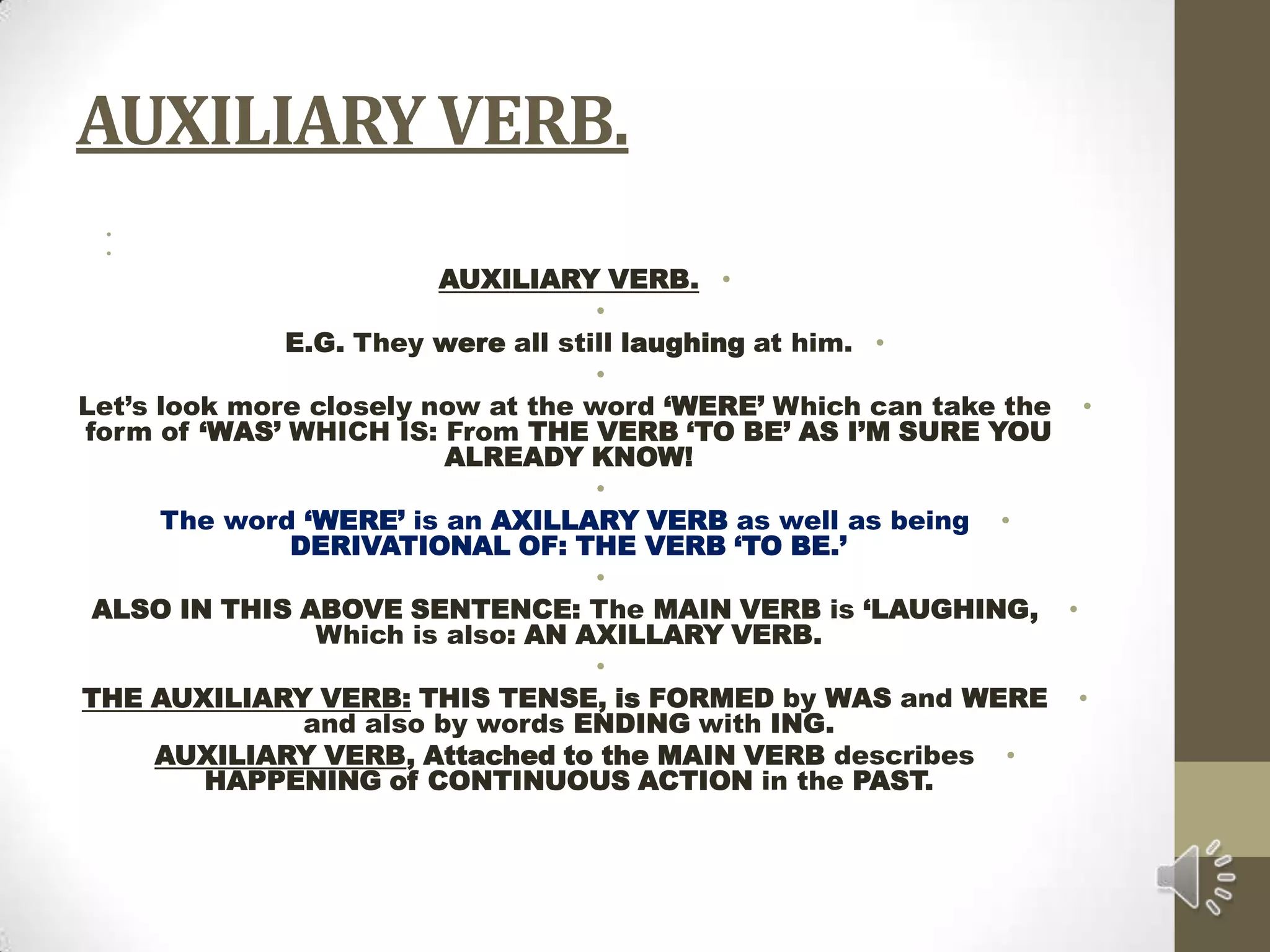
AUXILIARY VERB.  AUXILIARY VERB. E.G. They were all still laughing at him. Let’s look more closely now at the word ‘WERE’ Which can take the form of ‘WAS’ WHICH IS: From THE VERB ‘TO BE’ AS I’M SURE YOU ALREADY KNOW! The word ‘WERE’ is an AXILLARY VERB as well as being DERIVATIONAL OF: THE VERB ‘TO BE.’ ALSO IN THIS ABOVE SENTENCE: The MAIN VERB is ‘LAUGHING, Which is also: AN AXILLARY VERB. THE AUXILIARY VERB: THIS TENSE, is FORMED by WAS and WERE and also by words ENDING with ING.AUXILIARY VERB, Attached to the MAIN VERB describes HAPPENING of CONTINUOUS ACTION in the PAST.
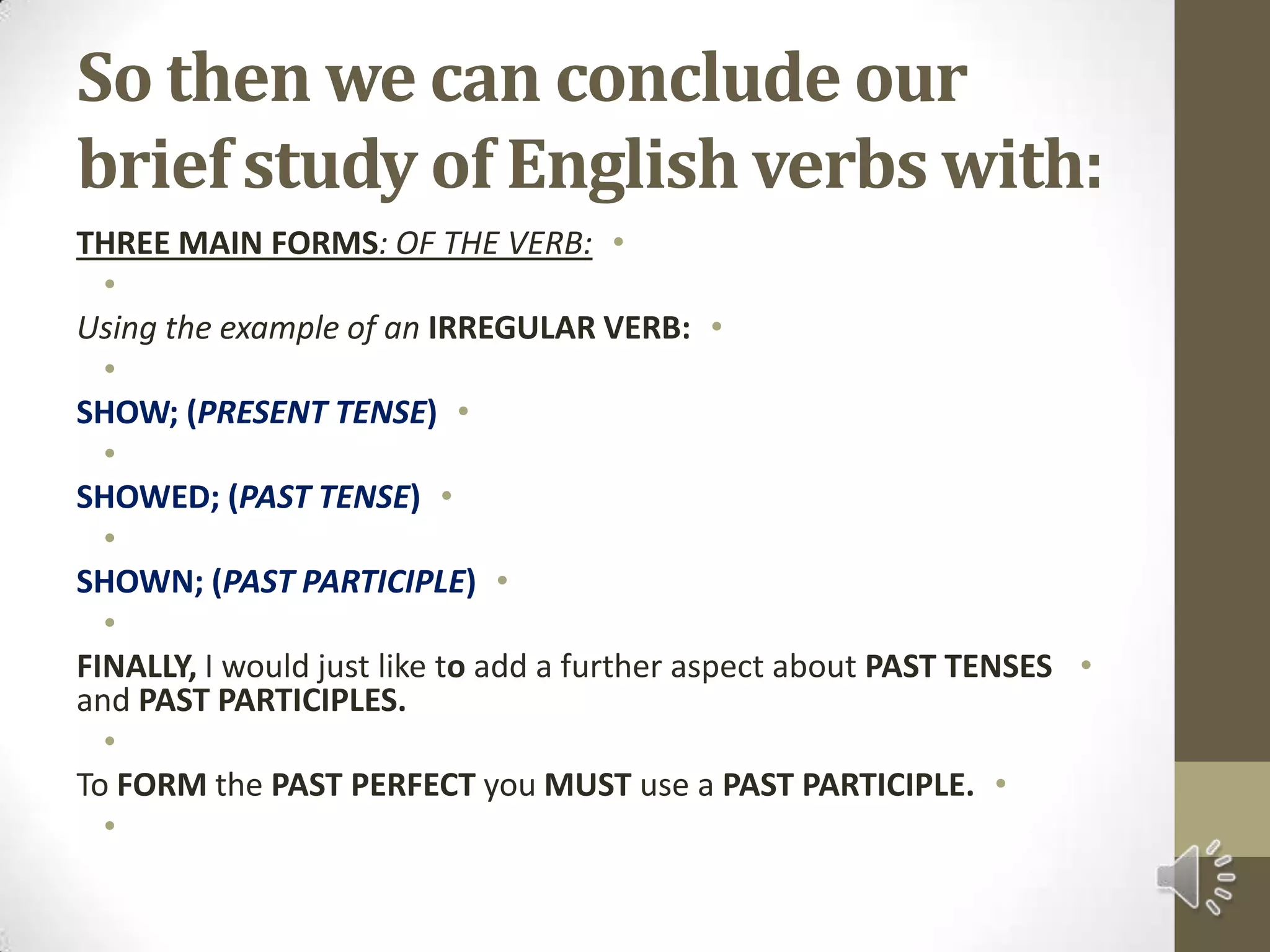
 So then we can conclude our brief study of English verbs with:THREE MAIN FORMS: OF THE VERB: Using the example of an IRREGULAR VERB: SHOW; (PRESENT TENSE) SHOWED; (PAST TENSE) SHOWN; (PAST PARTICIPLE) FINALLY, I would just like to add a further aspect about PAST TENSES and PAST PARTICIPLES. To FORM the PAST PERFECT you MUST use a PAST PARTICIPLE. 
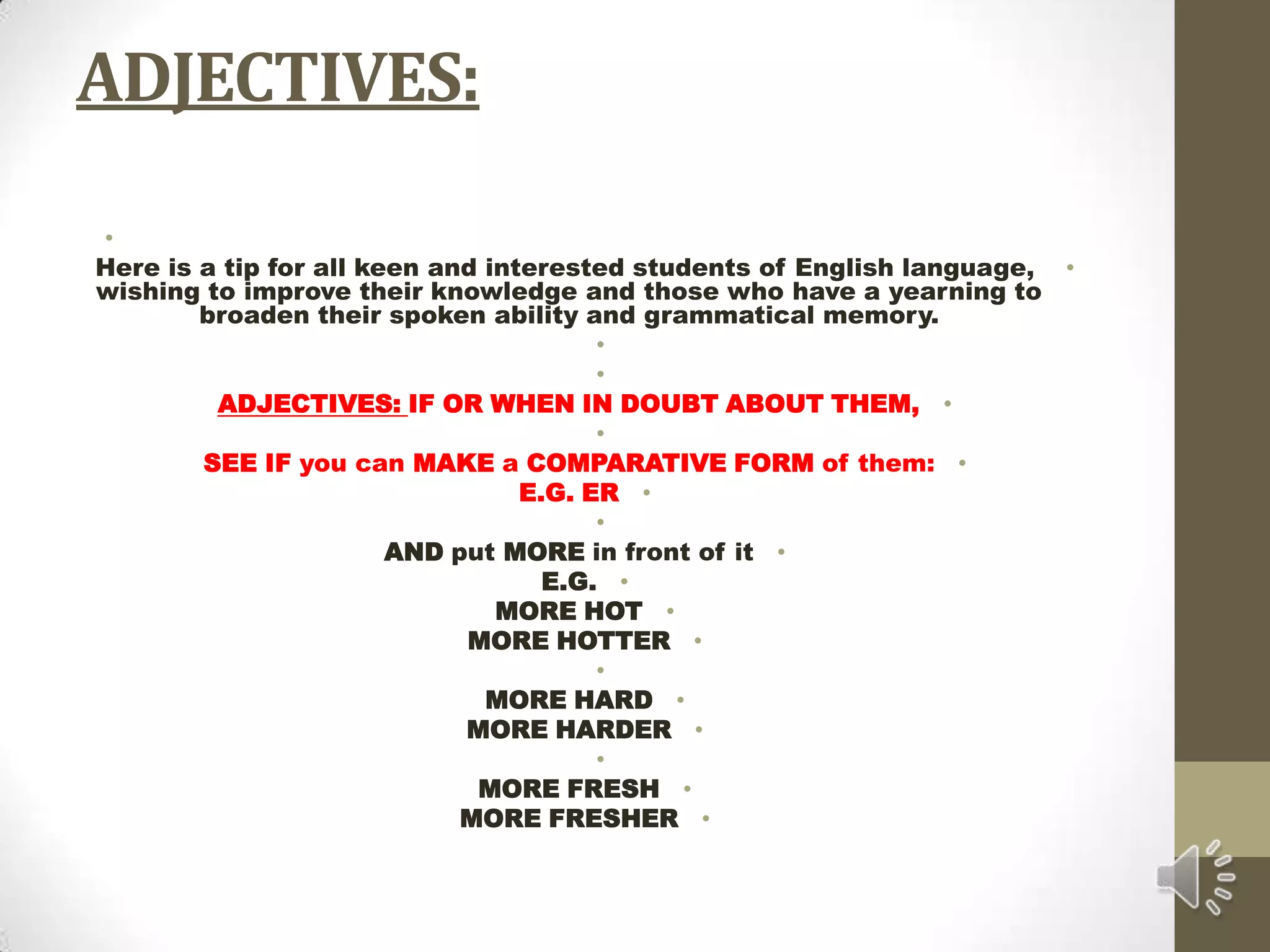
ADJECTIVES: Here is a tip for all keen and interested students of English language, wishing to improve their knowledge and those who have a yearning to broaden their spoken ability and grammatical memory.  ADJECTIVES: IF OR WHEN IN DOUBT ABOUT THEM, SEE IF you can MAKE a COMPARATIVE FORM of them:E.G. ER AND put MORE in front of itE.G.MORE HOTMORE HOTTER MORE HARDMORE HARDER MORE FRESHMORE FRESHER
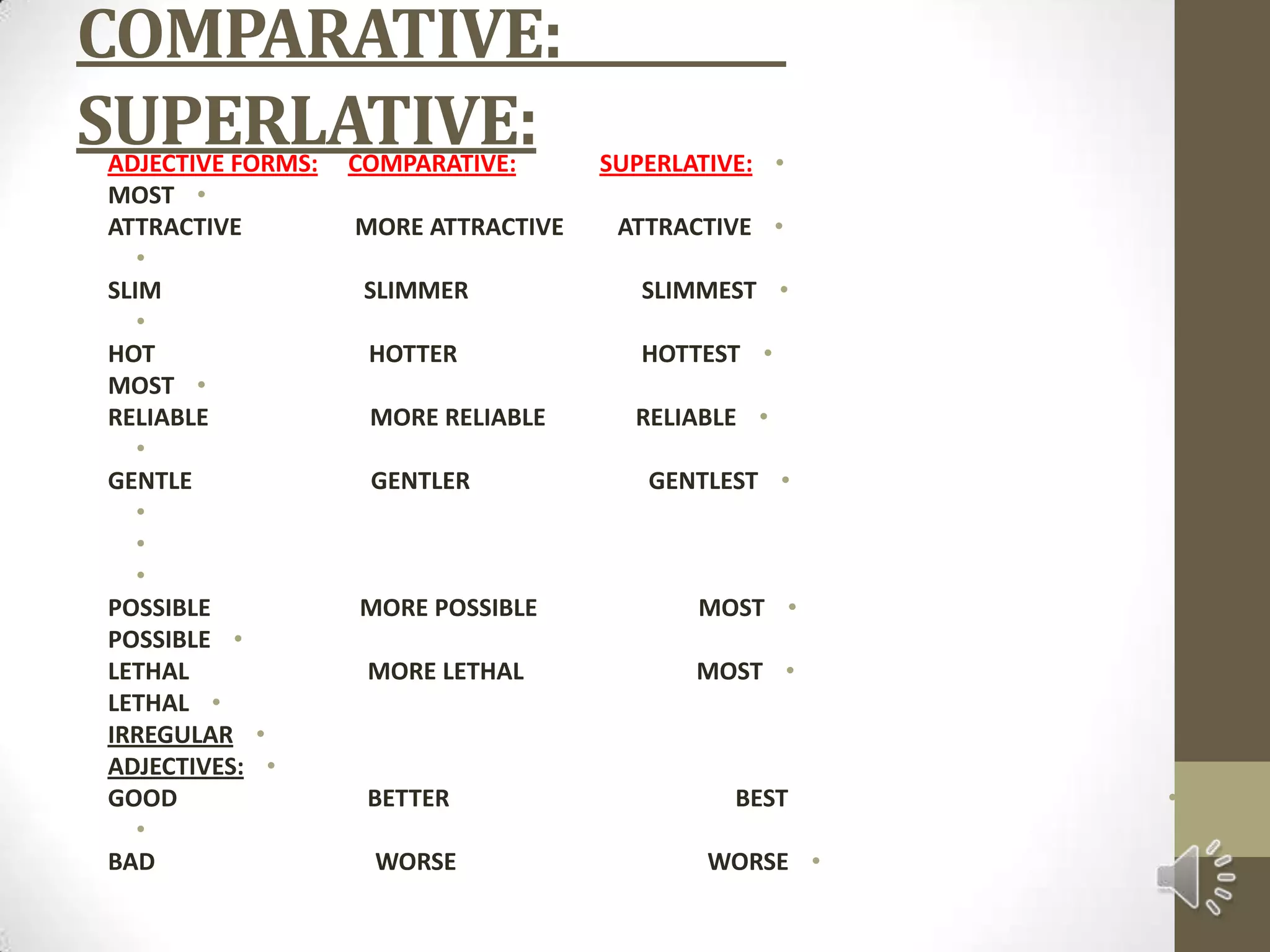
 COMPARATIVE:                SUPERLATIVE:ADJECTIVE FORMS:COMPARATIVE:SUPERLATIVE:MOSTATTRACTIVE                   MORE ATTRACTIVE         ATTRACTIVE SLIM                                  SLIMMER                             SLIMMEST HOT                                    HOTTER                               HOTTESTMOSTRELIABLE                           MORE RELIABLE               RELIABLE GENTLE                           GENTLER                              GENTLEST   POSSIBLE                         MORE POSSIBLE                           MOSTPOSSIBLELETHAL                              MORE LETHAL                             MOSTLETHALIRREGULARADJECTIVES:GOOD                                BETTER                                                BEST                                                             BAD                                     WORSE                                          WORSE
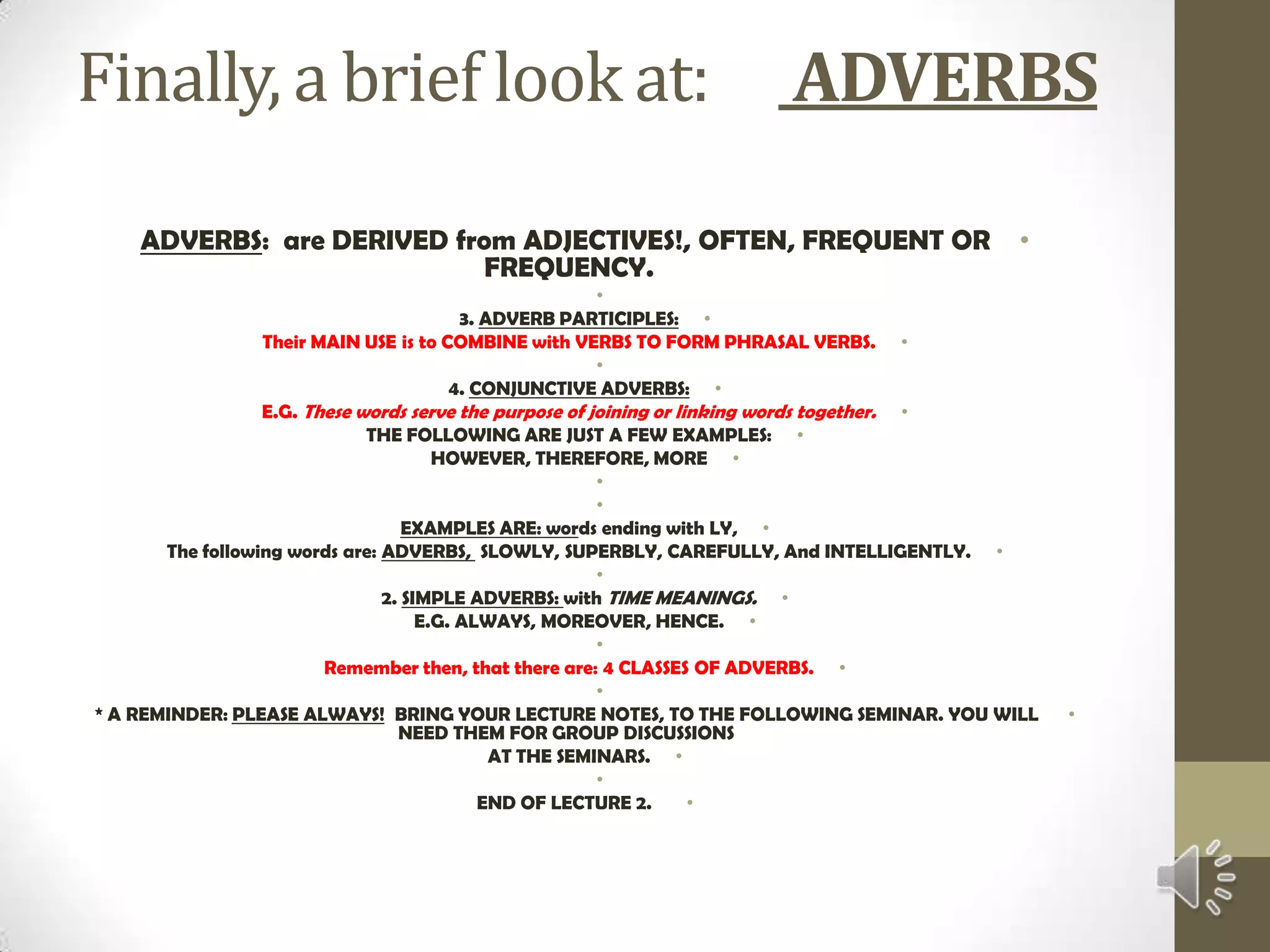
Finally, a brief look at:      ADVERBSADVERBS:  are DERIVED from ADJECTIVES!, OFTEN, FREQUENT OR FREQUENCY. 3. ADVERB PARTICIPLES:Their MAIN USE is to COMBINE with VERBS TO FORM PHRASAL VERBS. 4. CONJUNCTIVE ADVERBS:E.G. These words serve the purpose of joining or linking words together.THE FOLLOWING ARE JUST A FEW EXAMPLES:HOWEVER, THEREFORE, MORE  EXAMPLES ARE: words ending with LY,The following words are: ADVERBS,  SLOWLY, SUPERBLY, CAREFULLY, And INTELLIGENTLY. 2. SIMPLE ADVERBS: with TIME MEANINGS.E.G. ALWAYS, MOREOVER, HENCE. Remember then, that there are: 4 CLASSES OF ADVERBS. * A REMINDER: PLEASE ALWAYS!  BRING YOUR LECTURE NOTES, TO THE FOLLOWING SEMINAR. YOU WILL NEED THEM FOR GROUP DISCUSSIONS AT THE SEMINARS. END OF LECTURE 2.
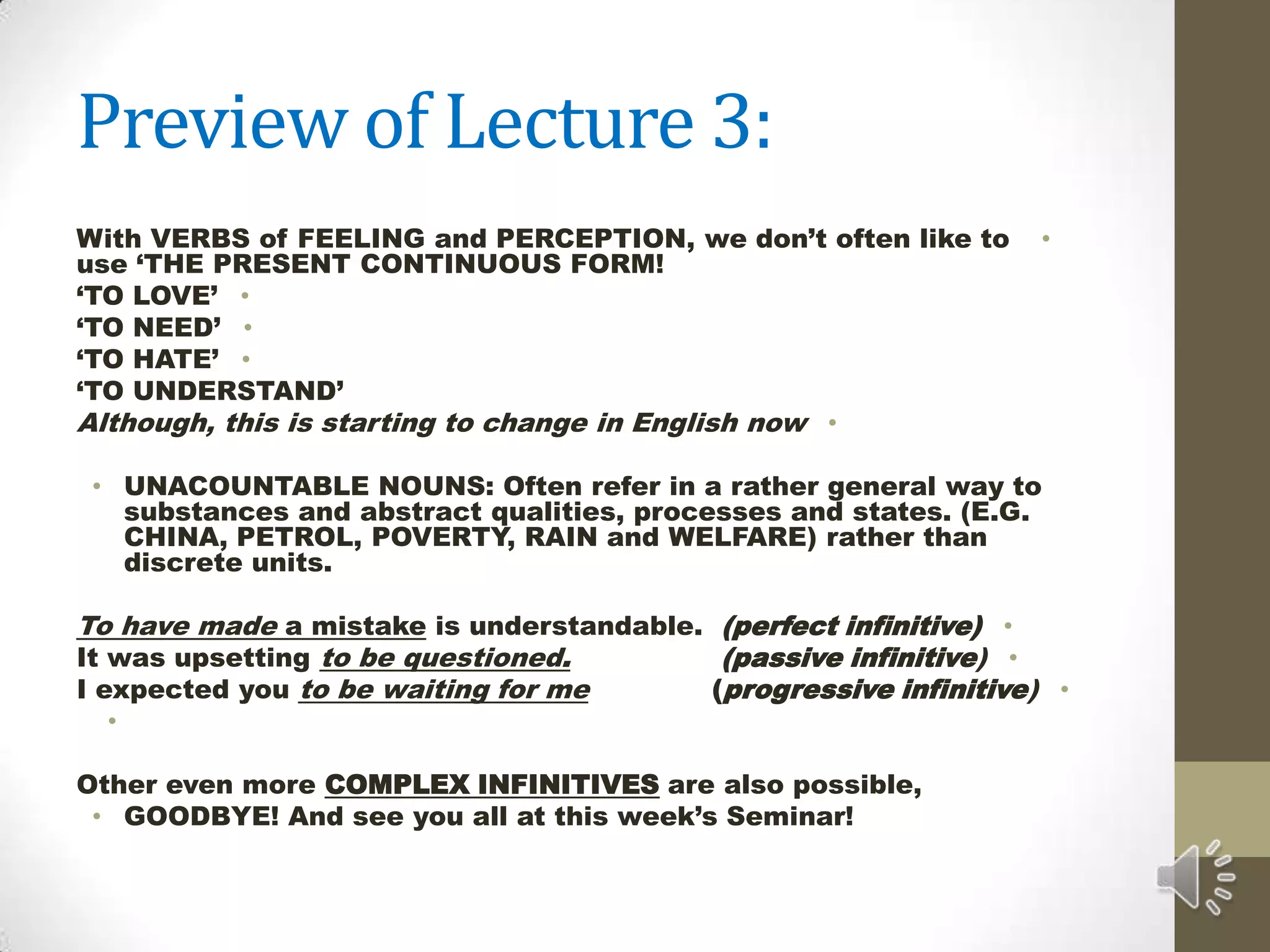
Preview of Lecture 3: With VERBS of FEELING and PERCEPTION, we don’t often like to use ‘THE PRESENT CONTINUOUS FORM!‘TO LOVE’‘TO NEED’‘TO HATE’‘TO UNDERSTAND’Although, this is starting to change in English nowUNACOUNTABLE NOUNS: Often refer in a rather general way to substances and abstract qualities, processes and states. (E.G. CHINA, PETROL, POVERTY, RAIN and WELFARE) rather than discrete units.To have made a mistake is understandable.  (perfect infinitive)It was upsetting to be questioned.                 (passive infinitive)I expected youto be waiting for me(progressive infinitive) Other even more COMPLEX INFINITIVES are also possible,GOODBYE! And see you all at this week’s Seminar!

Lecture 2 Presentation With Sound

  • 1.
    Lecture 2Reading ofthe 2nd Lecture: content as follows:
  • 2.
  • 3.
    Pronouns:Pro, this meansin place of. Pro is used in place of nouns!So, Personal Pronouns: are used in place of nouns.Which people refer to (i.e. He, She)Some more examples are: It, they, we, you and I. SINGULAR: 1ST PERSON = I SINGULAR 2NDPERSON = YOU  SINGULAR 3RDPERSON = THEY OR SHE/GENDER SPECIFIC. A PRONOUN THAT DIFFERENTIATES! Between GENDER: This above category is in the ‘3RD PERSON’AND it is the only category that does this.E.G. LION, LIONESS, ACTOR, ACTRESS.
  • 4.
    Personal Pronouns: 1st PERSON: 2ND PERSON: 3RD PERSON:
  • 5.
    PROPER NOUNS:These arenaming nouns: of people: E.G. Tony Blair, Margaret Thatcher, George Bush. AND of places: E.G. London, England, Cairo, Egypt. The word ‘SHE’ is BOTH a personal pronoun AND a cohesive device. The word ‘SHE’ can be used for this dual or double purpose. In a sentence as a joining or linking word (COHESIVE DEVICE) E.G. Mandy went to the supermarket because she had run out of milk. VERBS: DEMAND VERBS: Use INFLECTIONS to form TENSES:E.G. WALK: PRESENT TENSE. WALKED: INFLECTION, MAKES IT PAST TENSE. WALKS: THIRD PERSON. TO WALK: INFINITIVE VERB.Put into a sentence becomes:I wanted to walk.
  • 6.
    Some examples ofirregularverbs in English are: saw, became.But there are also ACTIVEand PASSIVE verbs: E.G. I broke the glass. = ACTIVE.The glass was broken by me. = PASSIVE.Therefore, ’WAS GIVEN’ = The PASSIVE FORMof the verb.AND: GAVE = ACTIVE FORM OF THE VERB.
  • 7.
    The past ispassiveand the future or the present is activeSo we could say, in general then that as a rule: The past is passive and the future or the present is active. So keep it in mind as a rough guideline. Some more examples of this in passive form are: was, grew, older, lost. All are past tense and therefore passive. Bought (irregular verb) the past simple tense of the verb ‘TO BUY’ and INVITED, (the past tense form of the regular verb) ‘to invite’ are further examples of passive verb forms in the ‘PAST SIMPLE’ TENSE.
  • 8.
    Some examples of:PHRASAL VERBS:These verbs are used to make a verb phrase or phrases:E.G. SPEAK UP! PUT OUT, GIVE UP!E.G. The word PUT (CAN ALSO BE A JOINING/LINKING VERB) And the word THOUGHT, (The PAST of THINK), a PHRASAL VERB.E.G. ‘A penny for your THOUGHTS.’ (PLURAL FORM) We also have, as you must know already the NEGATIVE FORM OF THE VERB. E.G. ‘DIDN’T WANT’, ‘HAVEN’T GOT’ (regular verbs) ETC. To name but a few. 
  • 9.
    AND SO: Ifwe group these words together: WAS (PASSIVE FORMOLDER (COMPARATIVE ADJECTIVEBECAME (IRREGULAR VERBGREW (PAST TENSE)BROUGHT (IRREGULAR, PAST SIMPLE)INVITED (REGULAR, PAST SIMPLE) *ONLY ‘DIDN’T WANT’, ‘HAVEN’T GOT’ AND ‘INVITED’ ARE: IRREGULAR VERBS.
  • 10.
    We begin tosee the pattern of ‘ENGLISH GRAMMATICAL RULES’ALL WORDS ENDING WITH ED ARE REGULAR, PAST TENSE FORM. ALL OTHERS ARE: REGULAR VERBS.  In REGULAR VERBS the PAST PARTICIPLE is ALWAYS the same!E.G. I have walked.  Please note: Irregular verbs can change their form!E.G. BUY becomes BOUGHT.TEACH “ “ TAUGHT.COME “ “ CAME. 
  • 11.
    PAST CONTINUOUS TENSE.THEFOLLOWING SENTENCE:I decided to wear the blue blouse and the long red skirt, when I was dressing this morning.This verb phrase:‘WAS DRESSING’ = PHRASAL VERB, IN THE PAST CONTINUOUS TENSE. ANOTHER EXAMPLE OF THIS:I ‘WAS RIDING’ my horse today. = The irregular verb ‘TO RIDE’ and is in PAST CONTINUOUS TENSE OR FORM
  • 12.
    AUXILIARY VERB.  AUXILIARY VERB. E.G.They were all still laughing at him. Let’s look more closely now at the word ‘WERE’ Which can take the form of ‘WAS’ WHICH IS: From THE VERB ‘TO BE’ AS I’M SURE YOU ALREADY KNOW! The word ‘WERE’ is an AXILLARY VERB as well as being DERIVATIONAL OF: THE VERB ‘TO BE.’ ALSO IN THIS ABOVE SENTENCE: The MAIN VERB is ‘LAUGHING, Which is also: AN AXILLARY VERB. THE AUXILIARY VERB: THIS TENSE, is FORMED by WAS and WERE and also by words ENDING with ING.AUXILIARY VERB, Attached to the MAIN VERB describes HAPPENING of CONTINUOUS ACTION in the PAST.
  • 13.
     So then wecan conclude our brief study of English verbs with:THREE MAIN FORMS: OF THE VERB: Using the example of an IRREGULAR VERB: SHOW; (PRESENT TENSE) SHOWED; (PAST TENSE) SHOWN; (PAST PARTICIPLE) FINALLY, I would just like to add a further aspect about PAST TENSES and PAST PARTICIPLES. To FORM the PAST PERFECT you MUST use a PAST PARTICIPLE. 
  • 14.
    ADJECTIVES: Here is atip for all keen and interested students of English language, wishing to improve their knowledge and those who have a yearning to broaden their spoken ability and grammatical memory.  ADJECTIVES: IF OR WHEN IN DOUBT ABOUT THEM, SEE IF you can MAKE a COMPARATIVE FORM of them:E.G. ER AND put MORE in front of itE.G.MORE HOTMORE HOTTER MORE HARDMORE HARDER MORE FRESHMORE FRESHER
  • 15.
     COMPARATIVE: SUPERLATIVE:ADJECTIVE FORMS:COMPARATIVE:SUPERLATIVE:MOSTATTRACTIVE MORE ATTRACTIVE ATTRACTIVE SLIM SLIMMER SLIMMEST HOT HOTTER HOTTESTMOSTRELIABLE MORE RELIABLE RELIABLE GENTLE GENTLER GENTLEST   POSSIBLE MORE POSSIBLE MOSTPOSSIBLELETHAL MORE LETHAL MOSTLETHALIRREGULARADJECTIVES:GOOD BETTER BEST  BAD WORSE WORSE
  • 16.
    Finally, a brieflook at: ADVERBSADVERBS: are DERIVED from ADJECTIVES!, OFTEN, FREQUENT OR FREQUENCY. 3. ADVERB PARTICIPLES:Their MAIN USE is to COMBINE with VERBS TO FORM PHRASAL VERBS. 4. CONJUNCTIVE ADVERBS:E.G. These words serve the purpose of joining or linking words together.THE FOLLOWING ARE JUST A FEW EXAMPLES:HOWEVER, THEREFORE, MORE  EXAMPLES ARE: words ending with LY,The following words are: ADVERBS, SLOWLY, SUPERBLY, CAREFULLY, And INTELLIGENTLY. 2. SIMPLE ADVERBS: with TIME MEANINGS.E.G. ALWAYS, MOREOVER, HENCE. Remember then, that there are: 4 CLASSES OF ADVERBS. * A REMINDER: PLEASE ALWAYS! BRING YOUR LECTURE NOTES, TO THE FOLLOWING SEMINAR. YOU WILL NEED THEM FOR GROUP DISCUSSIONS AT THE SEMINARS. END OF LECTURE 2.
  • 17.
    Preview of Lecture3: With VERBS of FEELING and PERCEPTION, we don’t often like to use ‘THE PRESENT CONTINUOUS FORM!‘TO LOVE’‘TO NEED’‘TO HATE’‘TO UNDERSTAND’Although, this is starting to change in English nowUNACOUNTABLE NOUNS: Often refer in a rather general way to substances and abstract qualities, processes and states. (E.G. CHINA, PETROL, POVERTY, RAIN and WELFARE) rather than discrete units.To have made a mistake is understandable. (perfect infinitive)It was upsetting to be questioned. (passive infinitive)I expected youto be waiting for me(progressive infinitive) Other even more COMPLEX INFINITIVES are also possible,GOODBYE! And see you all at this week’s Seminar!

Editor's Notes

  • #2 Reading of the 2nd Lecture: content as follows:
  • #4  E.g. I spoke of myself – as in the third person. She was eating cake today. Meaning that I was eating the cake today.
  • #5 Personal Pronouns: Subject, 1, WE YOU, HE AND SHE. Object: ME, US, YOU, HIM, HER, IT AND ITS. Genetive Possessive: MINE, OURS, YOURS AND THEIRS.
  • #6 These are naming nouns: of people: E.G. Tony Blair, Margaret Thatcher, George Bush. AND of places: E.G. London, England, Cairo, Egypt.
  • #8  Verbs: Both active and passive form: I broke the Glass ( Active). Passive: The glass was broken by me.
  • #9 Phasal Verbs: E.G. SPEAK UP! PUT OUT, GIVE UP!
  • #10 WAS (PASSIVE FORMOLDER (COMPARATIVE ADJECTIVEBECAME (IRREGULAR VERBGREW (PAST TENSE)BROUGHT (IRREGULAR, PAST SIMPLE)INVITED (REGULAR, PAST SIMPLE)
  • #11  ALL WORDS ENDING WITH ED ARE REGULAR, PAST TENSE FORM. ALL OTHERS ARE: REGULAR VERBS.
  • #12  PAST CONTINUOUS TENSE: A verb in the past form, coupled with a present participle. PAST PROGRESSIVE = U.S. English.
  • #13  Linguistically, an auxiliary is (also called helping verb, helper verb, auxiliary verb, or verbal auxiliary,
  • #14  THREE MAIN FORMS: OF THE VERB: SHOW; (PRESENT TENSE), SHOWED; (PAST TENSE), SHOWN; (PAST PARTICIPLE),
  • #15 ADJECTIVES: When in doubt, SEE IF you can MAKE a COMPARATIVE FORM of them:E.G. ER
  • #16  IRREGULAR: GOOD, BETTER, BEST, BAD, WORSE AND WORSE SUPERLATIVE.
  • #17 ADVERBS: are DERIVED from ADJECTIVES!
  • #18  PREVIEW OF LECTURE 3: And Goodbye!