3rd Person PronounsChapter 12
Review of Use of PronounsPronouns are used in both Latin and English to replace nouns:The man watches the television show. = He watches it.Will plays Mario Brothers. = He plays it.Grandma and Grandpa watched Anna’s recital.  They watched her recital. = They watched her recital.
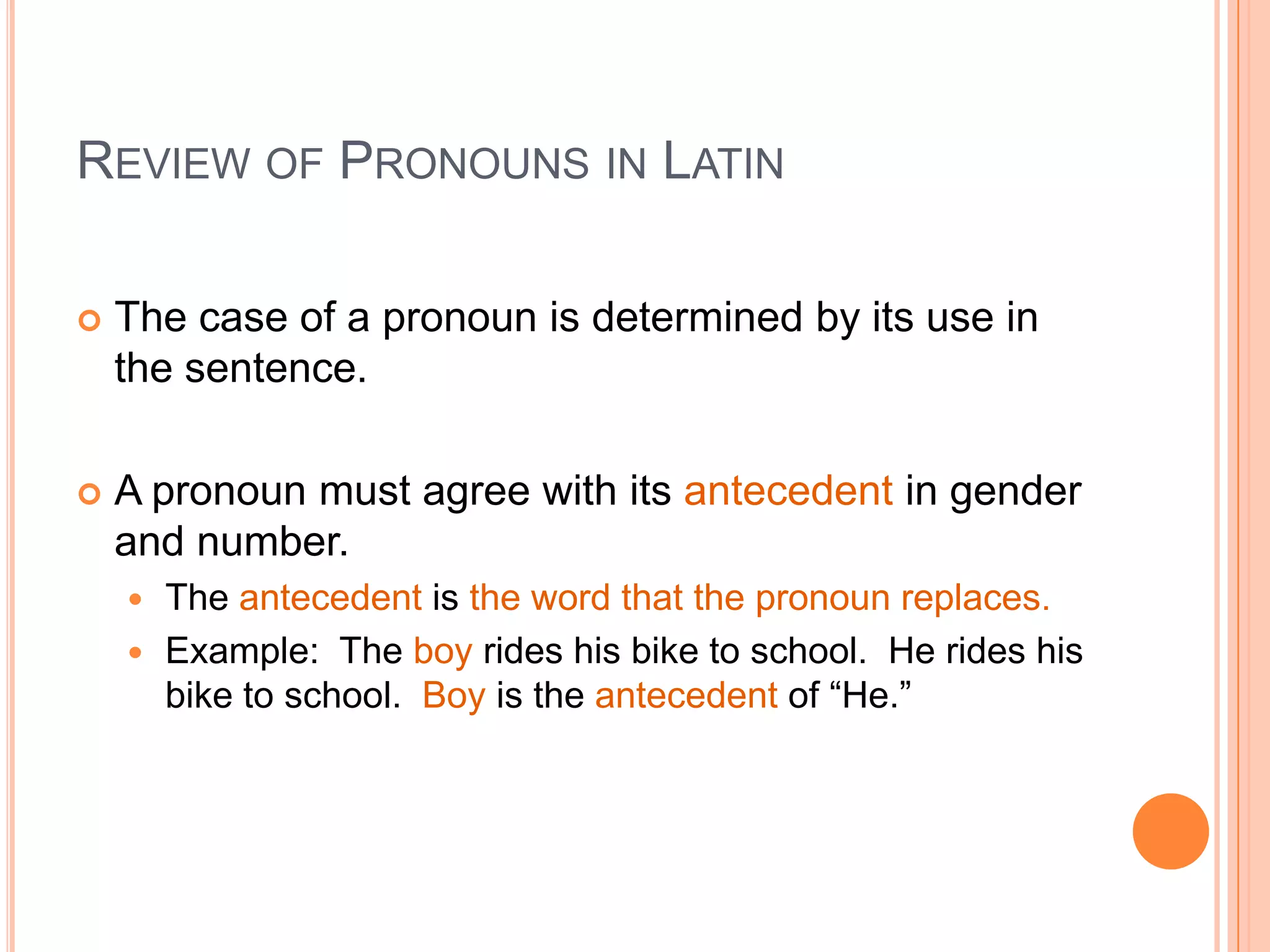
Review of Pronouns in LatinThe case of a pronoun is determined by its use in the sentence.A pronoun must agree with its antecedent in gender and number.The antecedent is the word that the pronoun replaces.Example:  The boy rides his bike to school.  He rides his bike to school.  Boy is the antecedent of “He.”
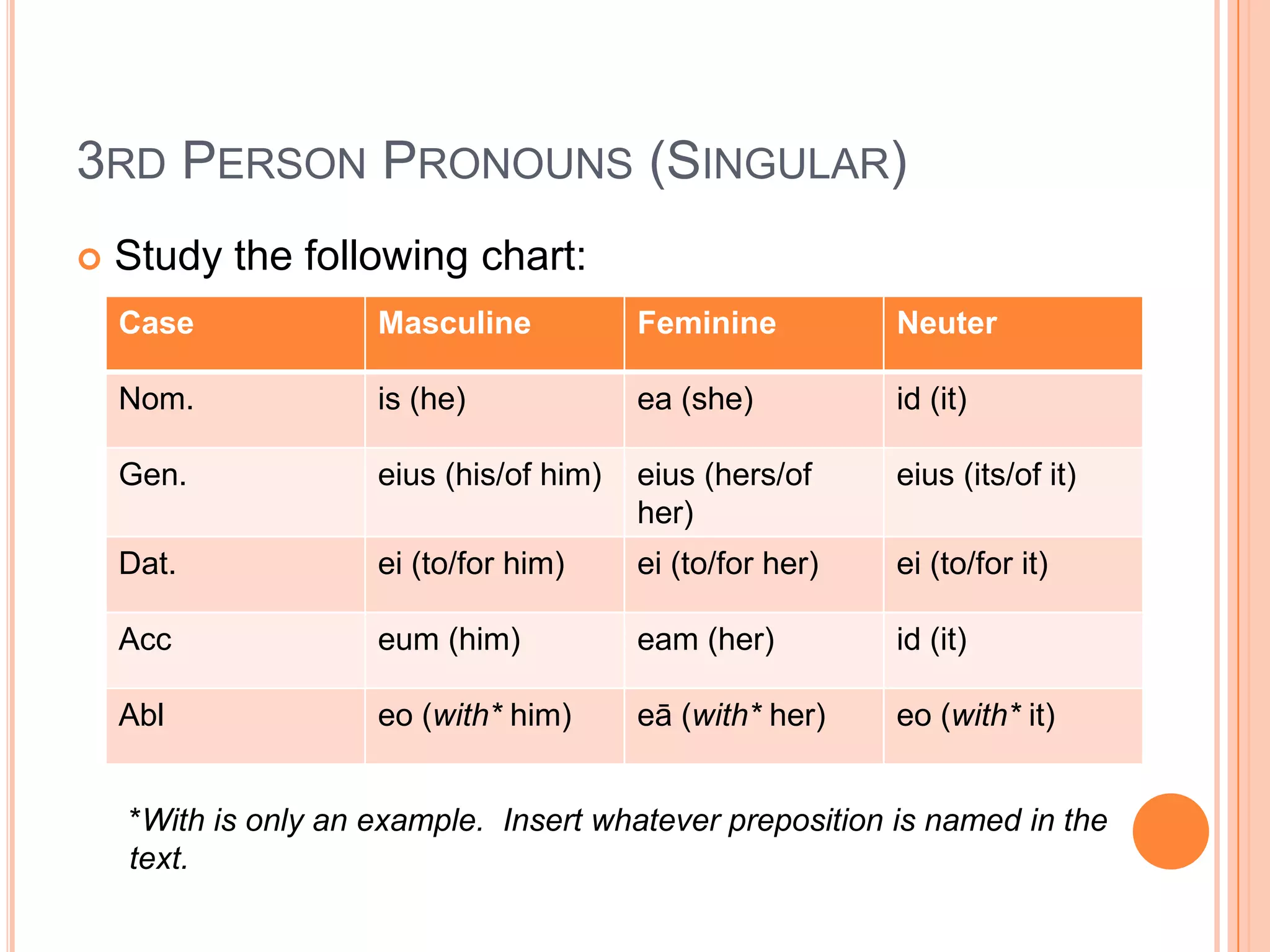
3rd Person Pronouns (Singular)Study the following chart:*With is only an example.  Insert whatever preposition is named in the text.
3rd Person Pronouns PluralStudy the following chart for third person, PLURAL pronouns:
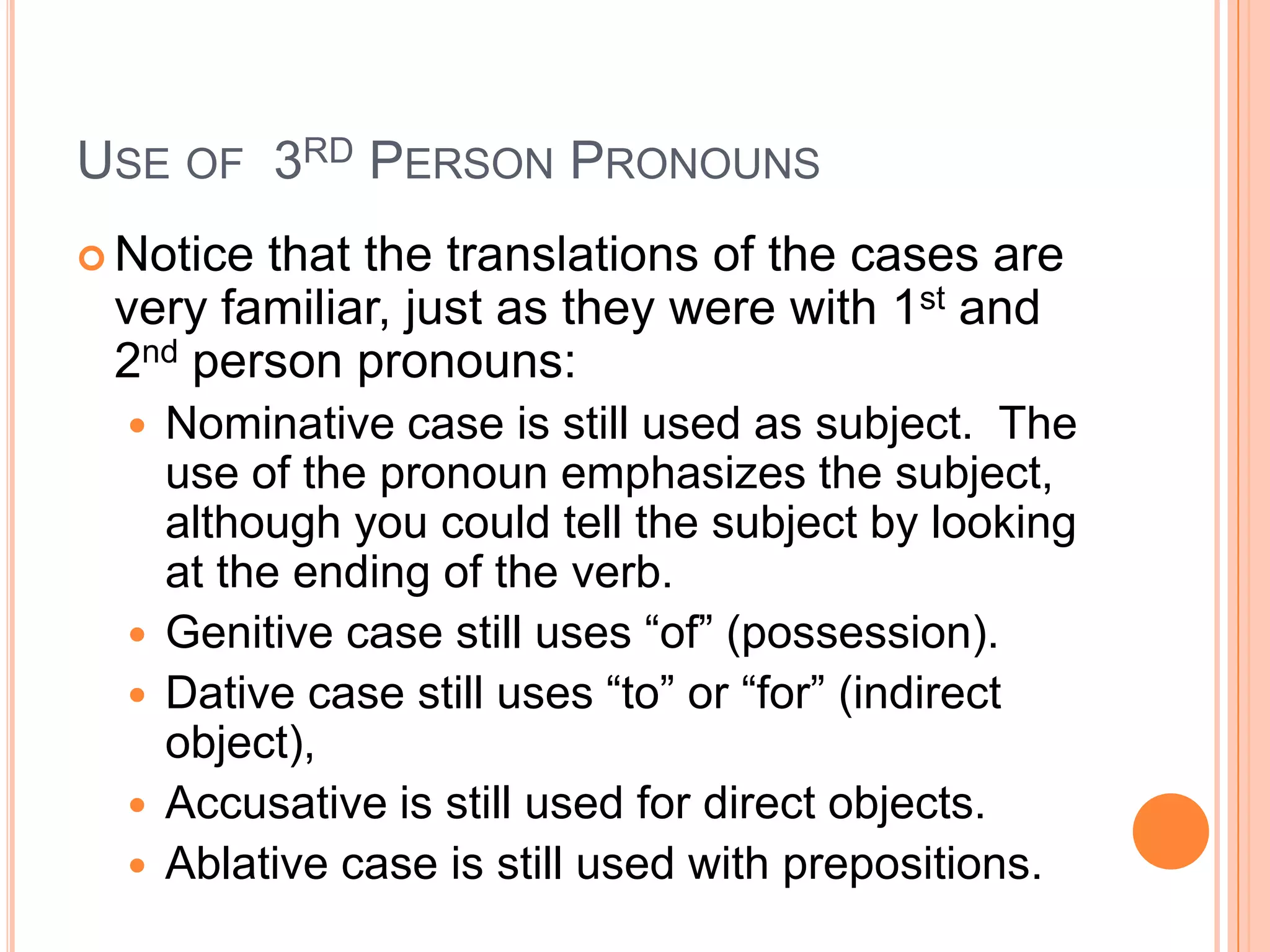
Use of  3rd Person PronounsNotice that the translations of the cases are very familiar, just as they were with 1st and 2nd person pronouns:Nominative case is still used as subject.  The use of the pronoun emphasizes the subject, although you could tell the subject by looking at the ending of the verb.Genitive case still uses “of” (possession).Dative case still uses “to” or “for” (indirect object),Accusative is still used for direct objects.Ablative case is still used with prepositions.
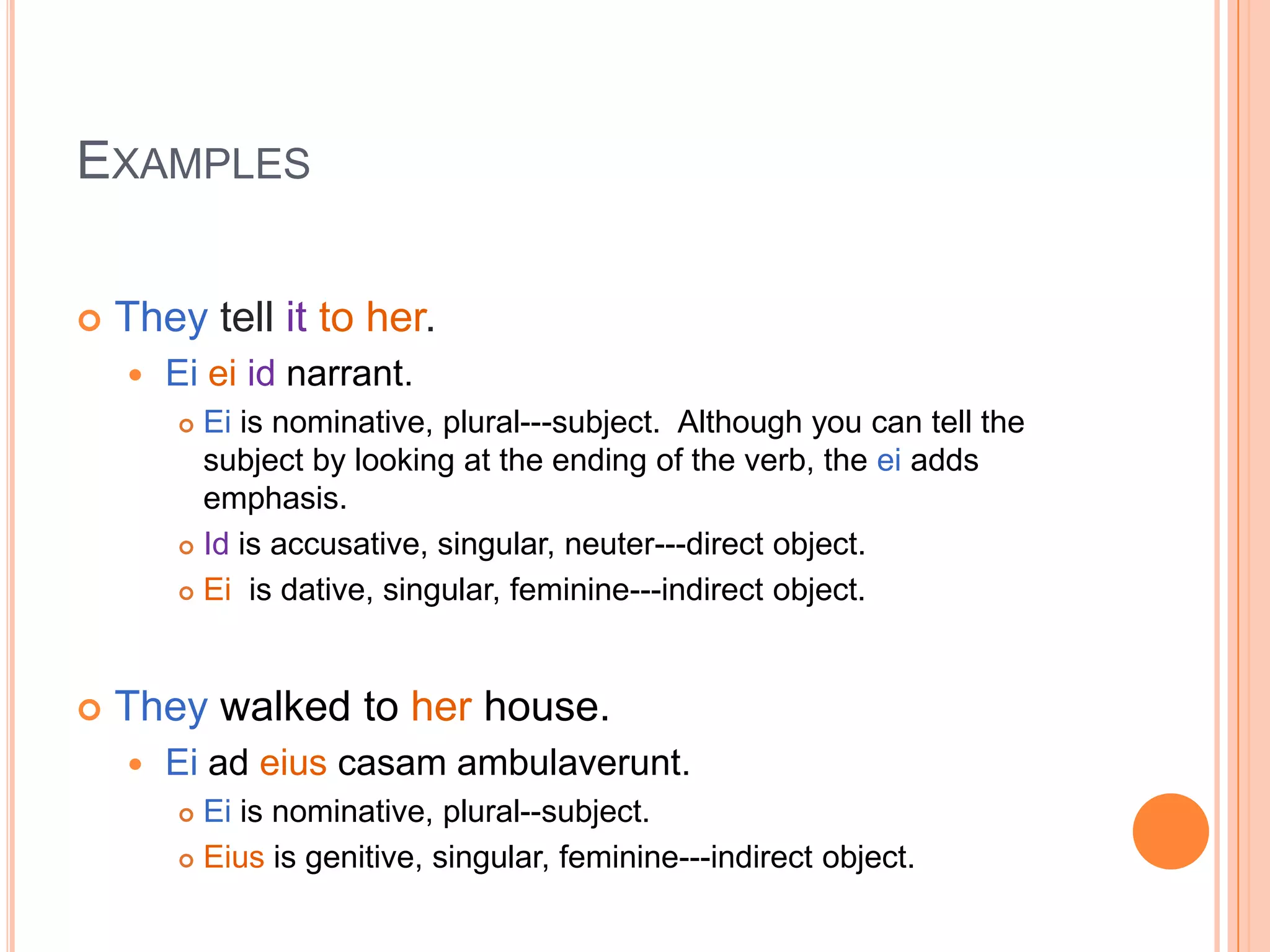
ExamplesThey tell itto her.Eiei id narrant.Eiis nominative, plural---subject.  Although you can tell the subject by looking at the ending of the verb, the eiadds emphasis.Id is accusative, singular, neuter---direct object.  Eiis dative, singular, feminine---indirect object.They walked to herhouse.Ei ad eiuscasamambulaverunt.Eiis nominative, plural--subject.Eiusis genitive, singular, feminine---indirect object.

Chapter 12 3rd Person Pronouns

  • 1.
  • 2.
    Review of Useof PronounsPronouns are used in both Latin and English to replace nouns:The man watches the television show. = He watches it.Will plays Mario Brothers. = He plays it.Grandma and Grandpa watched Anna’s recital. They watched her recital. = They watched her recital.
  • 3.
    Review of Pronounsin LatinThe case of a pronoun is determined by its use in the sentence.A pronoun must agree with its antecedent in gender and number.The antecedent is the word that the pronoun replaces.Example: The boy rides his bike to school. He rides his bike to school. Boy is the antecedent of “He.”
  • 4.
    3rd Person Pronouns(Singular)Study the following chart:*With is only an example. Insert whatever preposition is named in the text.
  • 5.
    3rd Person PronounsPluralStudy the following chart for third person, PLURAL pronouns:
  • 6.
    Use of 3rd Person PronounsNotice that the translations of the cases are very familiar, just as they were with 1st and 2nd person pronouns:Nominative case is still used as subject. The use of the pronoun emphasizes the subject, although you could tell the subject by looking at the ending of the verb.Genitive case still uses “of” (possession).Dative case still uses “to” or “for” (indirect object),Accusative is still used for direct objects.Ablative case is still used with prepositions.
  • 7.
    ExamplesThey tell ittoher.Eiei id narrant.Eiis nominative, plural---subject. Although you can tell the subject by looking at the ending of the verb, the eiadds emphasis.Id is accusative, singular, neuter---direct object. Eiis dative, singular, feminine---indirect object.They walked to herhouse.Ei ad eiuscasamambulaverunt.Eiis nominative, plural--subject.Eiusis genitive, singular, feminine---indirect object.