6.2 Indirect object pronouns
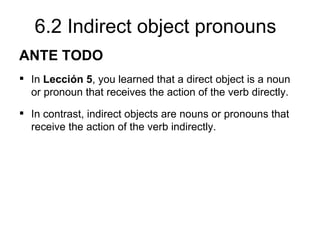
ANTE TODO
 In Lección 5, you learned that a direct object is a noun
  or pronoun that receives the action of the verb directly.
 In contrast, indirect objects are nouns or pronouns that
  receive the action of the verb indirectly.
6.2 Indirect object pronouns
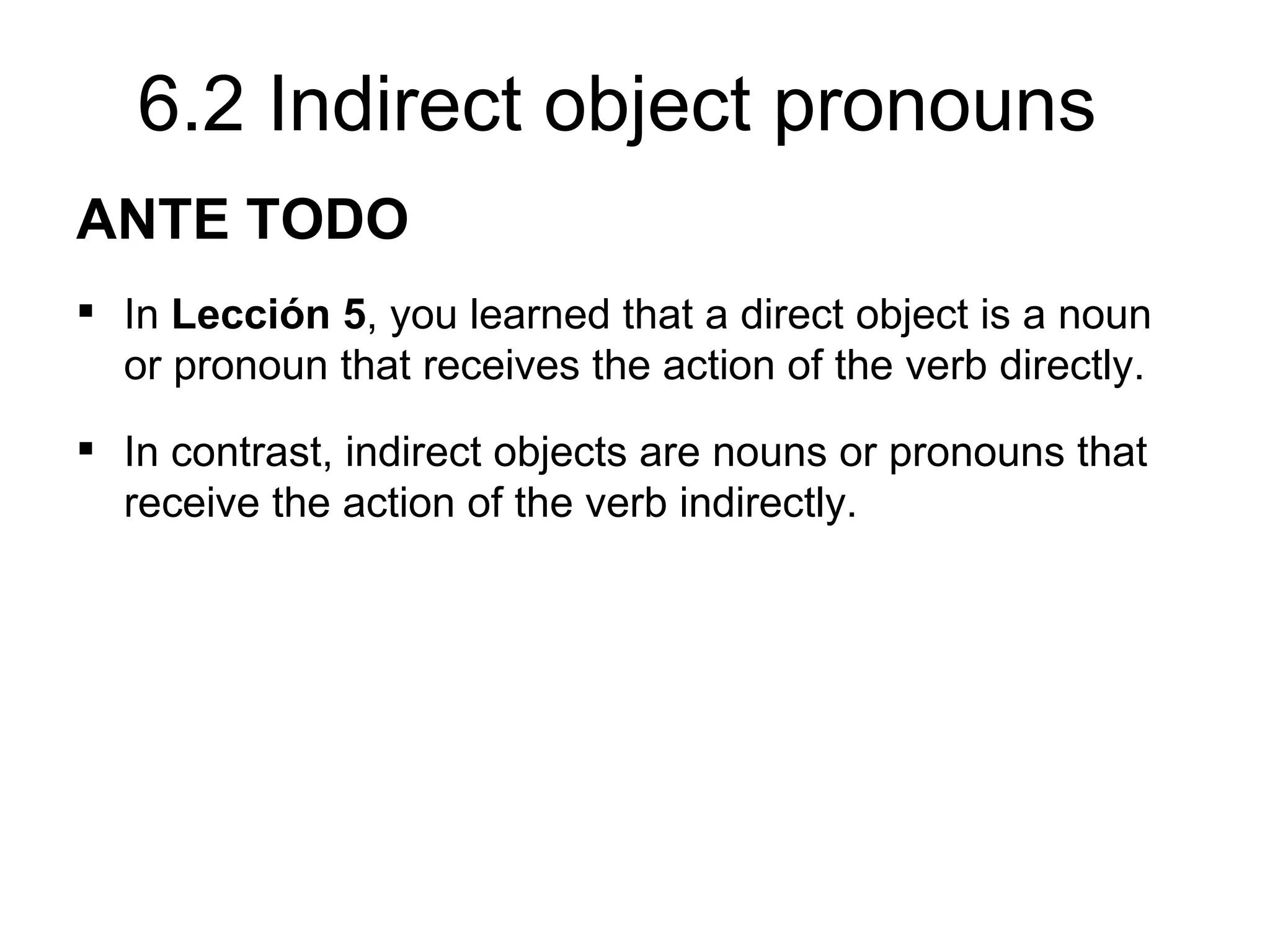
  Note the following example:
SUBJECT   I.O. PRONOUN   VERB     DIRECT OBJECT INDIRECT OBJECT

Roberto        le        presta     cien pesos      a Luisa.

Roberto                   lends     100 pesos       to Luisa.


 An indirect object is a noun or pronoun that answers the
  question to whom or for whom an action is done.
 In the preceding example, the indirect object answers this
  question:
   ¿A quién le presta Roberto cien pesos?
   To whom does Roberto lend 100 pesos?
6.2 Indirect object pronouns
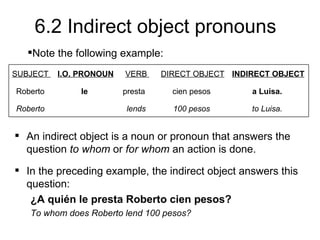
SINGULAR                      PLURAL

me (to, for) me             nos (to, for) us

 te (to, for) you (fam.)     os (to, for) you (fam.)

 le (to, for) you (form.)   les (to, for) you (form.)
     (to, for) him; her           (to, for) them
6.2 Indirect object pronouns
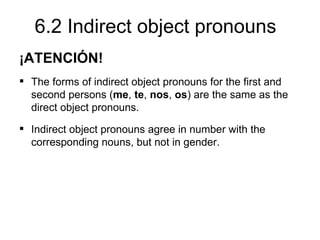
¡ATENCIÓN!
 The forms of indirect object pronouns for the first and
  second persons (me, te, nos, os) are the same as the
  direct object pronouns.
 Indirect object pronouns agree in number with the
  corresponding nouns, but not in gender.
6.2 Indirect object pronouns
        Using indirect object pronouns
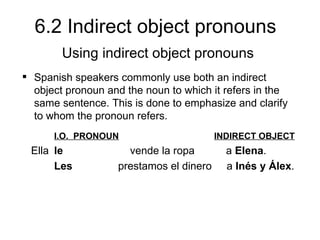
 Spanish speakers commonly use both an indirect
  object pronoun and the noun to which it refers in the
  same sentence. This is done to emphasize and clarify
  to whom the pronoun refers.
      I.O. PRONOUN                       INDIRECT OBJECT
 Ella le             vende la ropa         a Elena.
      Les          prestamos el dinero     a Inés y Álex.
6.2 Indirect object pronouns
         Using indirect object pronouns
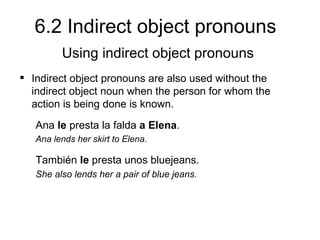
 Indirect object pronouns are also used without the
  indirect object noun when the person for whom the
  action is being done is known.
   Ana le presta la falda a Elena.
   Ana lends her skirt to Elena.

   También le presta unos bluejeans.
   She also lends her a pair of blue jeans.
6.2 Indirect object pronouns
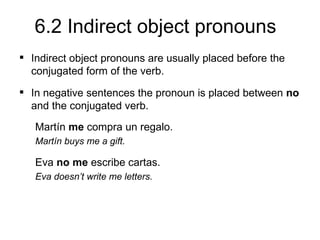
 Indirect object pronouns are usually placed before the
  conjugated form of the verb.
 In negative sentences the pronoun is placed between no
  and the conjugated verb.
   Martín me compra un regalo.
   Martín buys me a gift.

   Eva no me escribe cartas.
   Eva doesn’t write me letters.
6.2 Indirect object pronouns
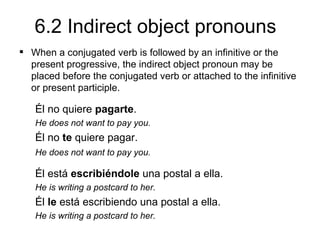
 When a conjugated verb is followed by an infinitive or the
  present progressive, the indirect object pronoun may be
  placed before the conjugated verb or attached to the infinitive
  or present participle.

   Él no quiere pagarte.
   He does not want to pay you.
   Él no te quiere pagar.
   He does not want to pay you.

   Él está escribiéndole una postal a ella.
   He is writing a postcard to her.
   Él le está escribiendo una postal a ella.
   He is writing a postcard to her.
6.2 Indirect object pronouns
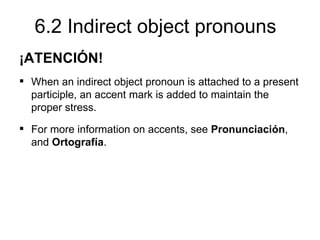
¡ATENCIÓN!
 When an indirect object pronoun is attached to a present
  participle, an accent mark is added to maintain the
  proper stress.
 For more information on accents, see Pronunciación,
  and Ortografía.
6.2 Indirect object pronouns
 Because the indirect object pronouns le and les
  have multiple meanings, Spanish speakers often
  clarify to whom the pronouns refer with the
  preposition a + [pronoun] or a + [noun].
UNCLARIFIED STATEMENTS
Yo le compro un abrigo.
Ella le describe un libro.
Él les vende unos sombreros.
Ellos les hablan muy claro.
CLARIFIED STATEMENTS
Yo le compro un abrigo a él/ella/usted.
Ella le describe un libro a Juan.
Él les vende unos sombreros a ellos/ellas/ustedes.
Ellos les hablan muy claro a los clientes.
6.2 Indirect object pronouns
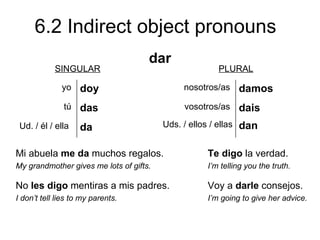
                                     dar
            SINGULAR                                   PLURAL

              yo doy                          nosotros/as damos

               tú das                         vosotros/as dais

 Ud. / él / ella    da                   Uds. / ellos / ellas dan


Mi abuela me da muchos regalos.                     Te digo la verdad.
My grandmother gives me lots of gifts.              I’m telling you the truth.

No les digo mentiras a mis padres.                  Voy a darle consejos.
I don’t tell lies to my parents.                    I’m going to give her advice.
6.2 Indirect object pronouns
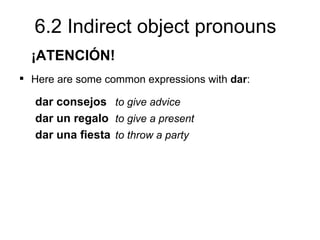
  ¡ATENCIÓN!
 Here are some common expressions with dar:

   dar consejos to give advice
   dar un regalo to give a present
   dar una fiesta to throw a party
6.2 Indirect object pronouns
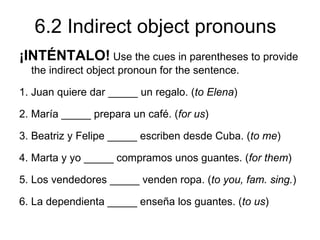
¡INTÉNTALO! Use the cues in parentheses to provide
  the indirect object pronoun for the sentence.

1. Juan quiere dar _____ un regalo. (to Elena)

2. María _____ prepara un café. (for us)

3. Beatriz y Felipe _____ escriben desde Cuba. (to me)

4. Marta y yo _____ compramos unos guantes. (for them)

5. Los vendedores _____ venden ropa. (to you, fam. sing.)

6. La dependienta _____ enseña los guantes. (to us)
6.2 Indirect object pronouns
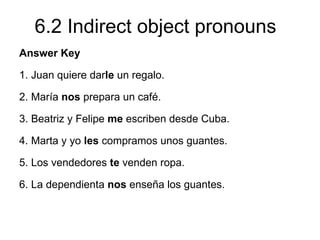
Answer Key

1. Juan quiere darle un regalo.

2. María nos prepara un café.

3. Beatriz y Felipe me escriben desde Cuba.

4. Marta y yo les compramos unos guantes.

5. Los vendedores te venden ropa.

6. La dependienta nos enseña los guantes.

6.2 Indirect object pronouns

  • 1.
    6.2 Indirect objectpronouns ANTE TODO  In Lección 5, you learned that a direct object is a noun or pronoun that receives the action of the verb directly.  In contrast, indirect objects are nouns or pronouns that receive the action of the verb indirectly.
  • 2.
    6.2 Indirect objectpronouns Note the following example: SUBJECT I.O. PRONOUN VERB DIRECT OBJECT INDIRECT OBJECT Roberto le presta cien pesos a Luisa. Roberto lends 100 pesos to Luisa.  An indirect object is a noun or pronoun that answers the question to whom or for whom an action is done.  In the preceding example, the indirect object answers this question: ¿A quién le presta Roberto cien pesos? To whom does Roberto lend 100 pesos?
  • 3.
    6.2 Indirect objectpronouns SINGULAR PLURAL me (to, for) me nos (to, for) us te (to, for) you (fam.) os (to, for) you (fam.) le (to, for) you (form.) les (to, for) you (form.) (to, for) him; her (to, for) them
  • 4.
    6.2 Indirect objectpronouns ¡ATENCIÓN!  The forms of indirect object pronouns for the first and second persons (me, te, nos, os) are the same as the direct object pronouns.  Indirect object pronouns agree in number with the corresponding nouns, but not in gender.
  • 5.
    6.2 Indirect objectpronouns Using indirect object pronouns  Spanish speakers commonly use both an indirect object pronoun and the noun to which it refers in the same sentence. This is done to emphasize and clarify to whom the pronoun refers. I.O. PRONOUN INDIRECT OBJECT Ella le vende la ropa a Elena. Les prestamos el dinero a Inés y Álex.
  • 6.
    6.2 Indirect objectpronouns Using indirect object pronouns  Indirect object pronouns are also used without the indirect object noun when the person for whom the action is being done is known. Ana le presta la falda a Elena. Ana lends her skirt to Elena. También le presta unos bluejeans. She also lends her a pair of blue jeans.
  • 7.
    6.2 Indirect objectpronouns  Indirect object pronouns are usually placed before the conjugated form of the verb.  In negative sentences the pronoun is placed between no and the conjugated verb. Martín me compra un regalo. Martín buys me a gift. Eva no me escribe cartas. Eva doesn’t write me letters.
  • 8.
    6.2 Indirect objectpronouns  When a conjugated verb is followed by an infinitive or the present progressive, the indirect object pronoun may be placed before the conjugated verb or attached to the infinitive or present participle. Él no quiere pagarte. He does not want to pay you. Él no te quiere pagar. He does not want to pay you. Él está escribiéndole una postal a ella. He is writing a postcard to her. Él le está escribiendo una postal a ella. He is writing a postcard to her.
  • 9.
    6.2 Indirect objectpronouns ¡ATENCIÓN!  When an indirect object pronoun is attached to a present participle, an accent mark is added to maintain the proper stress.  For more information on accents, see Pronunciación, and Ortografía.
  • 10.
    6.2 Indirect objectpronouns  Because the indirect object pronouns le and les have multiple meanings, Spanish speakers often clarify to whom the pronouns refer with the preposition a + [pronoun] or a + [noun]. UNCLARIFIED STATEMENTS Yo le compro un abrigo. Ella le describe un libro. Él les vende unos sombreros. Ellos les hablan muy claro. CLARIFIED STATEMENTS Yo le compro un abrigo a él/ella/usted. Ella le describe un libro a Juan. Él les vende unos sombreros a ellos/ellas/ustedes. Ellos les hablan muy claro a los clientes.
  • 11.
    6.2 Indirect objectpronouns dar SINGULAR PLURAL yo doy nosotros/as damos tú das vosotros/as dais Ud. / él / ella da Uds. / ellos / ellas dan Mi abuela me da muchos regalos. Te digo la verdad. My grandmother gives me lots of gifts. I’m telling you the truth. No les digo mentiras a mis padres. Voy a darle consejos. I don’t tell lies to my parents. I’m going to give her advice.
  • 12.
    6.2 Indirect objectpronouns ¡ATENCIÓN!  Here are some common expressions with dar: dar consejos to give advice dar un regalo to give a present dar una fiesta to throw a party
  • 13.
    6.2 Indirect objectpronouns ¡INTÉNTALO! Use the cues in parentheses to provide the indirect object pronoun for the sentence. 1. Juan quiere dar _____ un regalo. (to Elena) 2. María _____ prepara un café. (for us) 3. Beatriz y Felipe _____ escriben desde Cuba. (to me) 4. Marta y yo _____ compramos unos guantes. (for them) 5. Los vendedores _____ venden ropa. (to you, fam. sing.) 6. La dependienta _____ enseña los guantes. (to us)
  • 14.
    6.2 Indirect objectpronouns Answer Key 1. Juan quiere darle un regalo. 2. María nos prepara un café. 3. Beatriz y Felipe me escriben desde Cuba. 4. Marta y yo les compramos unos guantes. 5. Los vendedores te venden ropa. 6. La dependienta nos enseña los guantes.