
Social Class
Sociolinguistics
Sonya Ayu Kumala, M.Hum
Social Class
A measure of social
organisation at the level of the
larger speech community.
A function of the interaction of
a whole lot of different social
attributes.
Why do sociolinguistics’ students need to
comprehend about social class?
1. Language differs by its speaker
2. Language speaker are varied into
various classes (social classes)
Social classes are divided based on
• Occupation
• Income
• Wealth
• Aspirations
• Mobility
• SOCIOECONOMICS
Social Class Theory (1)
• Karl Marx
• Classes are divided into:
a. The one who producing the capital (worker
class)
b. The one who control the production (middle
class)
Social Class Theory (1)
• Max Webbers’ view : classification of men into
such groups is based on their consumption
patterns rather than on their place in the market
or in the process of production.
• Lifestyle and life choice
Class vs Caste
• There is a possibility of
individual mobility.
• The class determines
human positions in larger
social order. But it is not
fixed.
• There is no possibility of
individual mobility.
• The caste determines
human position in larger
social order.
Caste system
• Caste systems Relatively fixed social
groups. A person is usually born into a
particular caste and the possibilities for
movement out of it are limited.
Class?
• Downward
or
• Upward
LINGUISTICS CONSEQUENCES
(Variation)
Status
• A composite of economic wealth, linguistics (and other
social) behaviour, attitude and aspirations.
• Social status : A measure of status which is often based
on occupation, income and wealth, but also can be
measured in terms of aspirations and mobility.
• These factors can then be used to group individuals
scoring similarly on these factors into socioeconomic
classes.
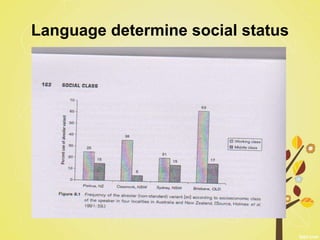
Language determine social status
Cross Over effect
• The cross-over effect emerges at the intersection of style
and class.
• Typically it refers to the breakdown in the most careful
speech styles of clear stratification between speakers of
different social classes.
• For example, when reading word lists, speakers from
the second highest social class will suddenly produce more tokens
of an incoming or prestige form than speakers in the highest social
class do, instead of producing slightly fewer tokens as they do in
their conversation or interview styles
• Hypercorrect.
Social stratification
distinct social levels that can be identified, and can be ranked/evaluated
• 1. Fine stratification
• 2. Board stratification
Fine Stratification
• Small changes in overall frequency differentiate the
averages for the different groups.
• A distribution of variants for example across groups of
speakers in different styles.
• It is showed that
• Refers to small gaps or contrasts between social groups
Broad Stratification
• The frequency with which a given variant occurs in
different social classes is relatively more marked
• Refers to large gaps or contrasts between social groups.
Conscious change vs unconscious
‘from above’ vs ‘from below’
Change from above
• Introduced by the dominant social class (not necessarily
=the highest one!)
• Usually borrowings from higher-prestige Speech
Communities
• First appears in careful speech style
• Inconsistent with the vernacular
• Correlated with changes in other features
• Thus may refuse integration into the vernacular system,
and achieve the status of a ‘coexistent system’
• Example: (R)-fulness (=R-insertion) in NYC; sph- words
in English
Change from below
• Not driven by extra-linguistic (=social) factors:
• Systematic changes that appear first in the vernacular, &
represent the operation of internal, linguistic factors…
• May be introduced by any social class” (Labov 1994:79)
• Local identity and status are primary motivations for this
type of change
• Example : (aw), (ay) centralization in Martha’s
Vineyard (Labov 1963, described in Downes chap. 7)
Example (1)
• Women lead changes that come from above the level of
social awareness, and involve the new prestige forms of
higher-ranked social groups.
• Whereas men initiate changes which spread
from below the level of social awareness, and away from
the accepted norms towards the vernacular.
• In Martha’s Vineyard the change in pronunciation was
taking place below the level of social awareness and
was led by men responding to covert pressure from their
peers.
• In Martha’s Vineyard the change in pronunciation was
taking place below the level of social awareness and
was led by men responding to covert pressure from their
peers
Example (2)
• Women in New York were using a higher degree of
prestige variants imposed from above.
• Working class women may be more exposed to standard
speech at work and have more incentive to modify their
speech than men.
• Women are generally granted less status and power
than men, they attempt to secure or signal their social
status linguistically by using prestige language forms.

Meeting10 social class

  • 1.
  • 2.
    Social Class A measureof social organisation at the level of the larger speech community. A function of the interaction of a whole lot of different social attributes.
  • 3.
    Why do sociolinguistics’students need to comprehend about social class? 1. Language differs by its speaker 2. Language speaker are varied into various classes (social classes)
  • 4.
    Social classes aredivided based on • Occupation • Income • Wealth • Aspirations • Mobility • SOCIOECONOMICS
  • 5.
    Social Class Theory(1) • Karl Marx • Classes are divided into: a. The one who producing the capital (worker class) b. The one who control the production (middle class)
  • 6.
    Social Class Theory(1) • Max Webbers’ view : classification of men into such groups is based on their consumption patterns rather than on their place in the market or in the process of production. • Lifestyle and life choice
  • 7.
    Class vs Caste •There is a possibility of individual mobility. • The class determines human positions in larger social order. But it is not fixed. • There is no possibility of individual mobility. • The caste determines human position in larger social order.
  • 8.
    Caste system • Castesystems Relatively fixed social groups. A person is usually born into a particular caste and the possibilities for movement out of it are limited.
  • 9.
  • 10.
    Status • A compositeof economic wealth, linguistics (and other social) behaviour, attitude and aspirations. • Social status : A measure of status which is often based on occupation, income and wealth, but also can be measured in terms of aspirations and mobility. • These factors can then be used to group individuals scoring similarly on these factors into socioeconomic classes.
  • 11.
  • 12.
    Cross Over effect •The cross-over effect emerges at the intersection of style and class. • Typically it refers to the breakdown in the most careful speech styles of clear stratification between speakers of different social classes.
  • 13.
    • For example,when reading word lists, speakers from the second highest social class will suddenly produce more tokens of an incoming or prestige form than speakers in the highest social class do, instead of producing slightly fewer tokens as they do in their conversation or interview styles • Hypercorrect.
  • 14.
    Social stratification distinct sociallevels that can be identified, and can be ranked/evaluated • 1. Fine stratification • 2. Board stratification
  • 15.
    Fine Stratification • Smallchanges in overall frequency differentiate the averages for the different groups. • A distribution of variants for example across groups of speakers in different styles. • It is showed that • Refers to small gaps or contrasts between social groups
  • 16.
    Broad Stratification • Thefrequency with which a given variant occurs in different social classes is relatively more marked • Refers to large gaps or contrasts between social groups.
  • 17.
    Conscious change vsunconscious ‘from above’ vs ‘from below’
  • 18.
    Change from above •Introduced by the dominant social class (not necessarily =the highest one!) • Usually borrowings from higher-prestige Speech Communities • First appears in careful speech style • Inconsistent with the vernacular • Correlated with changes in other features • Thus may refuse integration into the vernacular system, and achieve the status of a ‘coexistent system’ • Example: (R)-fulness (=R-insertion) in NYC; sph- words in English
  • 19.
    Change from below •Not driven by extra-linguistic (=social) factors: • Systematic changes that appear first in the vernacular, & represent the operation of internal, linguistic factors… • May be introduced by any social class” (Labov 1994:79) • Local identity and status are primary motivations for this type of change • Example : (aw), (ay) centralization in Martha’s Vineyard (Labov 1963, described in Downes chap. 7)
  • 20.
    Example (1) • Womenlead changes that come from above the level of social awareness, and involve the new prestige forms of higher-ranked social groups. • Whereas men initiate changes which spread from below the level of social awareness, and away from the accepted norms towards the vernacular.
  • 21.
    • In Martha’sVineyard the change in pronunciation was taking place below the level of social awareness and was led by men responding to covert pressure from their peers. • In Martha’s Vineyard the change in pronunciation was taking place below the level of social awareness and was led by men responding to covert pressure from their peers
  • 22.
    Example (2) • Womenin New York were using a higher degree of prestige variants imposed from above. • Working class women may be more exposed to standard speech at work and have more incentive to modify their speech than men. • Women are generally granted less status and power than men, they attempt to secure or signal their social status linguistically by using prestige language forms.