
Classroom Management
What is Classroom Management?It’s effective disciplineIt’s being prepared for classIt’s motivating your studentsIt’s providing a safe, comfortable learning environmentIt’s building your students’ self esteemIt’s being creative and imaginative in daily lessonsAnd . . .
. . . It’s different for EVERYONE!!WHY?Teaching StylesPersonality/AttitudesStudent populationNot all management strategies are effective for every teacherTry different strategies to see if they work for you
Why is Classroom Management Important?Satisfaction and enjoyment in teaching are dependent upon leading students to cooperateClassroom management issues are of highest concern for beginning teachers
Principles for successful classroom managementDeal with disruptive behaviors but also manage to minimize off-task, non-disruptive behaviorsTeach students to manage their own behaviorStudents learn to be on-task and engaged in the learning activities you have planned for themIt is more natural to be off-task than on
 Techniques for Better Classroom ControlFocus attention on entire classDon’t talk over student chatterSilence can be effectiveUse softer voice so students really have to listen to what you’re sayingDirect your instruction so that students know what is going to happen
Techniques for Better Classroom  ControlMonitor groups of students to check progressMove around the room so students have to pay attention more readilyGive students non-verbal cuesEngage in low profile intervention of disruptionsMake sure classroom is comfortable and safe
Techniques for Better Classroom ControlOver plan your lessons to ensure you fill the period with learning activitiesCome to class preparedShow confidence in your teachingLearn student names as quickly as possible
Transition vs. Allocated TimeAllocated time: the time periods you intend for your students to be engaged in learning activitiesTransition time: time periods that exist between times allocated for learning activitiesExamplesGetting students assembled and attentiveAssigning reading and directing to beginGetting students’ attention away from reading and preparing for class discussion
Transition vs. Allocated TimeThe Goal:Increase the variety of learning activities but decrease transition time.Student engagement and on-task behaviors are dependent on how smoothly and efficiently teachers move from one learning activity to another
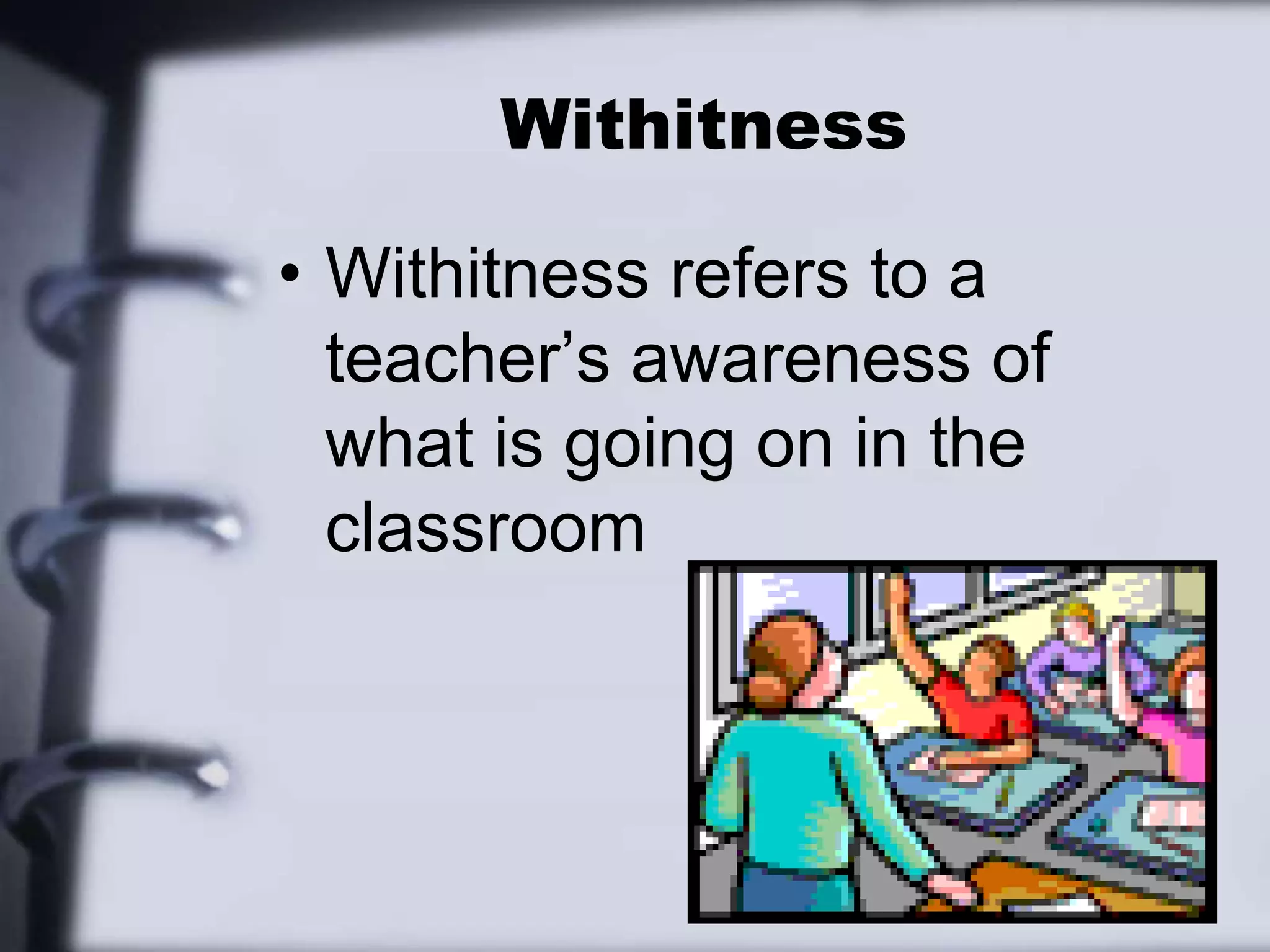
WithitnessWithitness refers to a teacher’s awareness of what is going on in the classroom
A teacher has “withitness” if:When discipline problems occur, the teacher consistently takes action to suppress the misbehavior of exactly those students who instigated the problemWhen two discipline problems arise concurrently, the teacher deals with the most serious firstThe teacher decisively handles instances of off-task behavior before the behaviors either get out of hand or are modeled by others
Withitness (continued)When handling misbehavior – make sure all students learn what is unacceptable about that behaviorGetting angry or stressed does not reduce future misbehaviorDeal with misbehavior without disrupting the learning activity
Jones’ study of off-task behaviors99% of off-task behaviors take one of several formsTalking out of turnClowningDaydreamingMoving about without permissionAntisocial, dangerous behaviors make up a fraction of the time students spend off-task
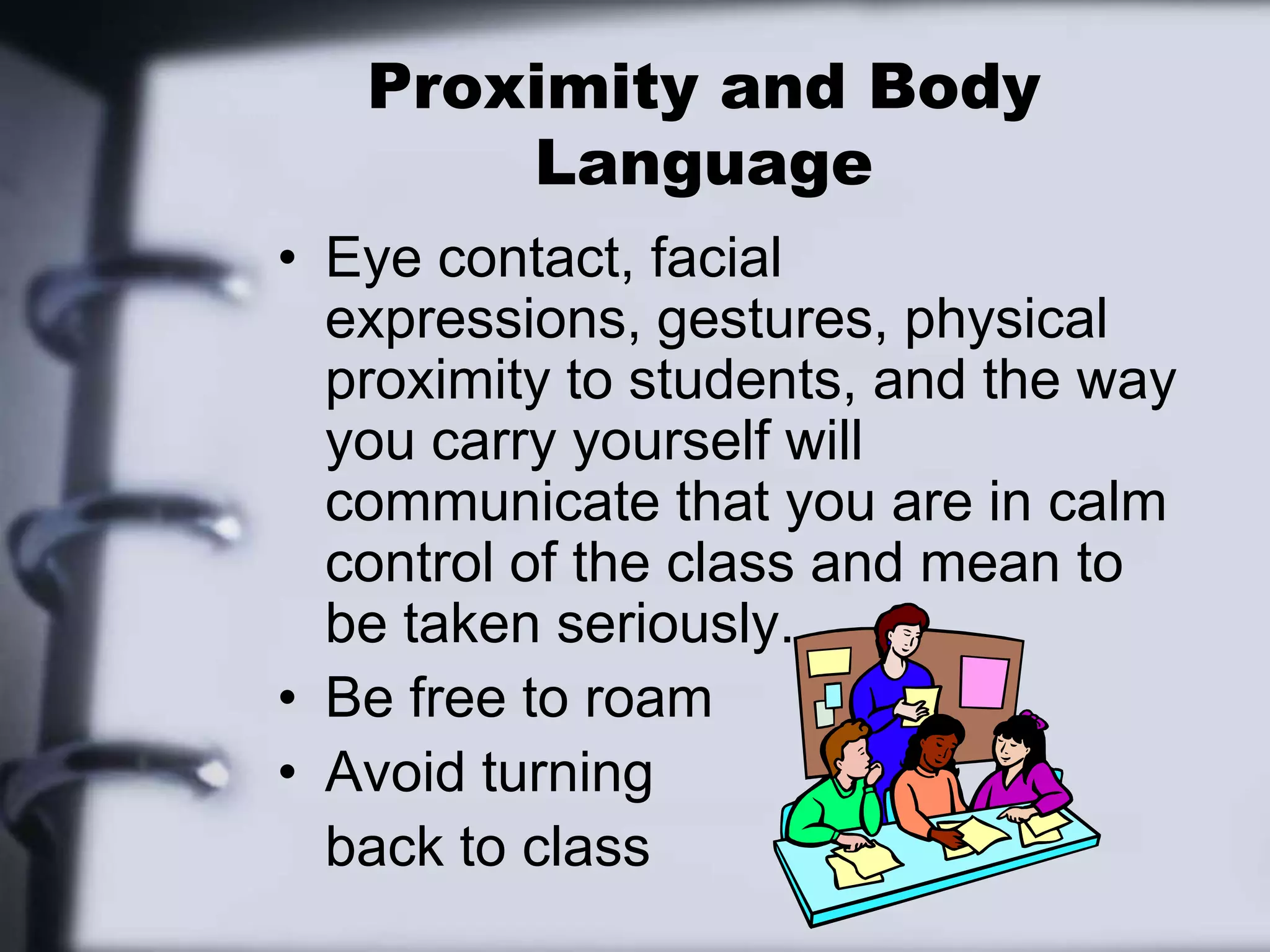
Proximity and Body LanguageEye contact, facial expressions, gestures, physical proximity to students, and the way you carry yourself will communicate that you are in calm control of the class and mean to be taken seriously.Be free to roamAvoid turning 	back to class
Cooperation through communicationVerbalize descriptions of behaviors and never value judgments about individualsVerbalize feelings but remain in controlDO NOT USE SARCASMDo not place labels (good or bad)Do not get students hooked on praise Praise the work and behavior – not the students themselvesSpeak only to people when they are ready to listen
Classroom Rules For ConductFormalized statements that  provide students with general guidelines for the types of behaviors that are required and the types that are prohibitedA few rules are easier to remember than many rulesEach rule in a small set of rules is more important than each rule in a large set of rules
Necessary classroom rules of conductMaximizes on-task behaviors and minimize off-task (esp. disruptive) behaviorsSecures the safety and comfort of the learning environmentPrevents the activities of the class from disturbing other classesMaintains acceptable standards of decorum among students, school personnel, and visitors to the school campus
Establishing a “Businesslike” Atmosphere. . . Or, “Don’t Smile until Christmas”
A Businesslike AtmosphereTake advantage of the first days of classEstablish an environment in which achieving specified learning goals takes priority over other concernsIt is much easier to establish this environment from the beginning rather than later
5 stepsTake advantage of the new school year or term to set the stage for cooperationBe particularly prepared and organizedMinimize transition timeUtilize a communication style that establishing non-threatening, comfortable environmentClearly establish expectations for conduct
Beginning a new yearTake advantage of initial uncertaintyRide your “fences”PLAN for a favorable beginningClassroom/lab organizationOngoing routinesUse learning activities with easy-to-follow, uncomplicated directionsUse a disclosure statement
Disclosure StatementUsed to clearly communicate expectations to students and parentsRefer back to the guidelines throughout the termNot a legally binding document
Components of Disclosure StatementBasic Course OutlineGrading ProceduresInclude procedures for making up missed work, extra credit, homework expected, etc.Attendance Policies (should be consistent with school policy)Other class rules, policies, proceduresSafety considerations as necessaryAccommodation for disabilities statementSignature of student and parent/guardian
Room/lab arrangementMake sure all students can see and hear clearly (and you can see them clearly)Arrangement is determined by learning activity (lecture, class discussion, small group work, etc.)Allow room and easy access for proximity controlThink through class procedures and learning activities and arrange the room in the best possible way
Dealing with misbehavior
Functions of BehaviorEvery behavior has a functionFour primary reasons for  disruptive behavior in the classroomPowerRevengeAttentionWant to be left alone (i.e., disinterest or feelings of inadequacy)
Functions of BehaviorMany misbehaviors exhibited by students are responses to a behavior exhibited by the teacherDo not tolerate undesirable behaviors no matter what the excuseUnderstanding why a person exhibits a behavior is no reason to tolerate it Understanding the function of a behavior will help in knowing how to deal with that behavior
Dealing with off-task behaviorsRemain focused and calm; organize thoughtsEither respond decisively or ignore it all togetherDistinguish between off-task behaviors and off-task behavior patternsControl the time and place for dealing with off-task behaviorProvide students with dignified ways to terminate off-task behaviors
Dealing with off-task behaviorsAvoid playing detectiveUtilize alternative lesson plansUtilize the help of colleaguesUtilize the help of guardiansDO NOT USE CORPORAL PUNISHMENTA form of contrived punishment in which physical pain or discomfort is intentionally inflicted upon an individual for the purpose of trying to get that individual to be sorry he or she displayed a particular behavior
Modifying off-task behavior patternsUse the principle of “Extinction”Whenever the positive rein forcers for a person’s voluntary behavior pattern are removed or cease to exist, the person will begin to discontinue that behaviorSpecify the exact behavior pattern to extinguishIdentify positive reinforcers for the behaviorPlan to eliminate positive reinforcementEstablish a realistic time scheduleImplement the planEvaluate the effectiveness by observing behavior
Modifying off-task behavior patternsUse the principle of “Shaping”Reinforce behaviors that are similar to the behavior to be learnedSubsequent actions that are more like the behavior to be learned than previous actions are reinforcedSubsequent actions that are less like the behavior to be learned than previous actions are not positively reinforced
Attention Seeking BehaviorAttention-seeking students prefer being punished, admonished, or criticized to being ignoredGive attention to this student when he or she is on-task and cooperating“Catch them being good!” – and let them know you caught them
Power Seeking BehaviorPower-seeking students attempt to provoke teachers into a struggle of willsIn most cases, the teacher should direct attention to other members of the class
Behavior:  Rambling -- wandering around and off the subject. Using far-fetched examples or analogies.POSSIBLE RESPONSES: Refocus attention by restating relevant point.
Direct questions to group that is back on the subject
Ask how topic relates to current topic being discussed.
Use visual aids, begin to write on board, turn on overhead projector.
Say: "Would you summarize your main point please?" or "Are you asking...?" Behavior:  Shyness or Silence -- lack of participationPOSSIBLE RESPONSES: Change teaching strategies from group discussion to individual written exercises or a videotape
Give strong positive reinforcement for any contribution.
Involve by directly asking him/her a question.
Make eye contact.
Appoint to be small group leader.Behavior:  Talkativeness -- knowing everything, manipulation, chronic whining.POSSIBLE RESPONSES: Acknowledge comments made.
Give limited time to express viewpoint or feelings, and then move on.
Make eye contact with another participant and move toward that person.
Give the person individual attention during breaks.
Say: "That's an interesting point. Now let's see what other other people think." Behavior:  Sharpshooting -- trying to shoot you down or trip you up.POSSIBLE RESPONSES: Admit that you do not know the answer and redirect the question the group or the individual who asked it.
Acknowledge that this is a joint learning experience.
Ignore the behavior. Behavior:   Heckling/Arguing -- disagreeing with everything you say; making personal attacks. POSSIBLE RESPONSES: 	Redirect question to group or supportive individuals. Recognize participant's feelings and move one.

Classroom Management Strategies

  • 1.
  • 2.
    What is ClassroomManagement?It’s effective disciplineIt’s being prepared for classIt’s motivating your studentsIt’s providing a safe, comfortable learning environmentIt’s building your students’ self esteemIt’s being creative and imaginative in daily lessonsAnd . . .
  • 3.
    . . .It’s different for EVERYONE!!WHY?Teaching StylesPersonality/AttitudesStudent populationNot all management strategies are effective for every teacherTry different strategies to see if they work for you
  • 4.
    Why is ClassroomManagement Important?Satisfaction and enjoyment in teaching are dependent upon leading students to cooperateClassroom management issues are of highest concern for beginning teachers
  • 5.
    Principles for successfulclassroom managementDeal with disruptive behaviors but also manage to minimize off-task, non-disruptive behaviorsTeach students to manage their own behaviorStudents learn to be on-task and engaged in the learning activities you have planned for themIt is more natural to be off-task than on
  • 6.
    Techniques forBetter Classroom ControlFocus attention on entire classDon’t talk over student chatterSilence can be effectiveUse softer voice so students really have to listen to what you’re sayingDirect your instruction so that students know what is going to happen
  • 7.
    Techniques for BetterClassroom ControlMonitor groups of students to check progressMove around the room so students have to pay attention more readilyGive students non-verbal cuesEngage in low profile intervention of disruptionsMake sure classroom is comfortable and safe
  • 8.
    Techniques for BetterClassroom ControlOver plan your lessons to ensure you fill the period with learning activitiesCome to class preparedShow confidence in your teachingLearn student names as quickly as possible
  • 9.
    Transition vs. AllocatedTimeAllocated time: the time periods you intend for your students to be engaged in learning activitiesTransition time: time periods that exist between times allocated for learning activitiesExamplesGetting students assembled and attentiveAssigning reading and directing to beginGetting students’ attention away from reading and preparing for class discussion
  • 10.
    Transition vs. AllocatedTimeThe Goal:Increase the variety of learning activities but decrease transition time.Student engagement and on-task behaviors are dependent on how smoothly and efficiently teachers move from one learning activity to another
  • 11.
    WithitnessWithitness refers toa teacher’s awareness of what is going on in the classroom
  • 12.
    A teacher has“withitness” if:When discipline problems occur, the teacher consistently takes action to suppress the misbehavior of exactly those students who instigated the problemWhen two discipline problems arise concurrently, the teacher deals with the most serious firstThe teacher decisively handles instances of off-task behavior before the behaviors either get out of hand or are modeled by others
  • 13.
    Withitness (continued)When handlingmisbehavior – make sure all students learn what is unacceptable about that behaviorGetting angry or stressed does not reduce future misbehaviorDeal with misbehavior without disrupting the learning activity
  • 14.
    Jones’ study ofoff-task behaviors99% of off-task behaviors take one of several formsTalking out of turnClowningDaydreamingMoving about without permissionAntisocial, dangerous behaviors make up a fraction of the time students spend off-task
  • 15.
    Proximity and BodyLanguageEye contact, facial expressions, gestures, physical proximity to students, and the way you carry yourself will communicate that you are in calm control of the class and mean to be taken seriously.Be free to roamAvoid turning back to class
  • 16.
    Cooperation through communicationVerbalizedescriptions of behaviors and never value judgments about individualsVerbalize feelings but remain in controlDO NOT USE SARCASMDo not place labels (good or bad)Do not get students hooked on praise Praise the work and behavior – not the students themselvesSpeak only to people when they are ready to listen
  • 17.
    Classroom Rules ForConductFormalized statements that provide students with general guidelines for the types of behaviors that are required and the types that are prohibitedA few rules are easier to remember than many rulesEach rule in a small set of rules is more important than each rule in a large set of rules
  • 18.
    Necessary classroom rulesof conductMaximizes on-task behaviors and minimize off-task (esp. disruptive) behaviorsSecures the safety and comfort of the learning environmentPrevents the activities of the class from disturbing other classesMaintains acceptable standards of decorum among students, school personnel, and visitors to the school campus
  • 19.
    Establishing a “Businesslike”Atmosphere. . . Or, “Don’t Smile until Christmas”
  • 20.
    A Businesslike AtmosphereTakeadvantage of the first days of classEstablish an environment in which achieving specified learning goals takes priority over other concernsIt is much easier to establish this environment from the beginning rather than later
  • 21.
    5 stepsTake advantageof the new school year or term to set the stage for cooperationBe particularly prepared and organizedMinimize transition timeUtilize a communication style that establishing non-threatening, comfortable environmentClearly establish expectations for conduct
  • 22.
    Beginning a newyearTake advantage of initial uncertaintyRide your “fences”PLAN for a favorable beginningClassroom/lab organizationOngoing routinesUse learning activities with easy-to-follow, uncomplicated directionsUse a disclosure statement
  • 23.
    Disclosure StatementUsed toclearly communicate expectations to students and parentsRefer back to the guidelines throughout the termNot a legally binding document
  • 24.
    Components of DisclosureStatementBasic Course OutlineGrading ProceduresInclude procedures for making up missed work, extra credit, homework expected, etc.Attendance Policies (should be consistent with school policy)Other class rules, policies, proceduresSafety considerations as necessaryAccommodation for disabilities statementSignature of student and parent/guardian
  • 25.
    Room/lab arrangementMake sureall students can see and hear clearly (and you can see them clearly)Arrangement is determined by learning activity (lecture, class discussion, small group work, etc.)Allow room and easy access for proximity controlThink through class procedures and learning activities and arrange the room in the best possible way
  • 26.
  • 27.
    Functions of BehaviorEverybehavior has a functionFour primary reasons for disruptive behavior in the classroomPowerRevengeAttentionWant to be left alone (i.e., disinterest or feelings of inadequacy)
  • 28.
    Functions of BehaviorManymisbehaviors exhibited by students are responses to a behavior exhibited by the teacherDo not tolerate undesirable behaviors no matter what the excuseUnderstanding why a person exhibits a behavior is no reason to tolerate it Understanding the function of a behavior will help in knowing how to deal with that behavior
  • 29.
    Dealing with off-taskbehaviorsRemain focused and calm; organize thoughtsEither respond decisively or ignore it all togetherDistinguish between off-task behaviors and off-task behavior patternsControl the time and place for dealing with off-task behaviorProvide students with dignified ways to terminate off-task behaviors
  • 30.
    Dealing with off-taskbehaviorsAvoid playing detectiveUtilize alternative lesson plansUtilize the help of colleaguesUtilize the help of guardiansDO NOT USE CORPORAL PUNISHMENTA form of contrived punishment in which physical pain or discomfort is intentionally inflicted upon an individual for the purpose of trying to get that individual to be sorry he or she displayed a particular behavior
  • 31.
    Modifying off-task behaviorpatternsUse the principle of “Extinction”Whenever the positive rein forcers for a person’s voluntary behavior pattern are removed or cease to exist, the person will begin to discontinue that behaviorSpecify the exact behavior pattern to extinguishIdentify positive reinforcers for the behaviorPlan to eliminate positive reinforcementEstablish a realistic time scheduleImplement the planEvaluate the effectiveness by observing behavior
  • 32.
    Modifying off-task behaviorpatternsUse the principle of “Shaping”Reinforce behaviors that are similar to the behavior to be learnedSubsequent actions that are more like the behavior to be learned than previous actions are reinforcedSubsequent actions that are less like the behavior to be learned than previous actions are not positively reinforced
  • 33.
    Attention Seeking BehaviorAttention-seekingstudents prefer being punished, admonished, or criticized to being ignoredGive attention to this student when he or she is on-task and cooperating“Catch them being good!” – and let them know you caught them
  • 34.
    Power Seeking BehaviorPower-seekingstudents attempt to provoke teachers into a struggle of willsIn most cases, the teacher should direct attention to other members of the class
  • 35.
    Behavior: Rambling-- wandering around and off the subject. Using far-fetched examples or analogies.POSSIBLE RESPONSES: Refocus attention by restating relevant point.
  • 36.
    Direct questions togroup that is back on the subject
  • 37.
    Ask how topicrelates to current topic being discussed.
  • 38.
    Use visual aids,begin to write on board, turn on overhead projector.
  • 39.
    Say: "Would yousummarize your main point please?" or "Are you asking...?" Behavior: Shyness or Silence -- lack of participationPOSSIBLE RESPONSES: Change teaching strategies from group discussion to individual written exercises or a videotape
  • 40.
    Give strong positivereinforcement for any contribution.
  • 41.
    Involve by directlyasking him/her a question.
  • 42.
  • 43.
    Appoint to besmall group leader.Behavior: Talkativeness -- knowing everything, manipulation, chronic whining.POSSIBLE RESPONSES: Acknowledge comments made.
  • 44.
    Give limited timeto express viewpoint or feelings, and then move on.
  • 45.
    Make eye contactwith another participant and move toward that person.
  • 46.
    Give the personindividual attention during breaks.
  • 47.
    Say: "That's aninteresting point. Now let's see what other other people think." Behavior: Sharpshooting -- trying to shoot you down or trip you up.POSSIBLE RESPONSES: Admit that you do not know the answer and redirect the question the group or the individual who asked it.
  • 48.
    Acknowledge that thisis a joint learning experience.
  • 49.
    Ignore the behavior.Behavior: Heckling/Arguing -- disagreeing with everything you say; making personal attacks. POSSIBLE RESPONSES: Redirect question to group or supportive individuals. Recognize participant's feelings and move one.
  • 50.
  • 51.
    Say: "I appreciateyour comments, but I'd like to hear from others," or "It looks like we disagree." Behavior: Grandstanding -- getting caught up in one's own agenda or thoughts to the detriment of other learners. POSSIBLE RESPONSES: Say: "You are entitled to your opinion, belief or feelings, but now it's time we moved on to the next subject," or
  • 52.
    "Can you restatethat as a question?" or
  • 53.
    "We'd like tohear more about that if there is time after the presentation." Behavior: Overt Hostility/Resistance -- angry, belligerent, combative behavior.POSSIBLE RESPONSES: Hostility can be a mask for fear. Reframe hostility as fear to depersonalize it.
  • 54.
    Respond to fear,not hostility.
  • 55.
    Remain calm andpolite. Keep your temper in check.
  • 56.
    Don't disagree, butbuild on or around what has been said.
  • 57.
    Move closer tothe hostile person, maintain eye contact.
  • 58.
    Always allow himor her a way to gracefully retreat from the confrontation. Behavior: Overt Hostility/Resistance -- angry, belligerent, combative behavior (continued)POSSIBLE RESPONSES: Say: "You seem really angry. Does anyone else feel this way?" Solicit peer pressure.
  • 59.
    Do not acceptthe premise or underlying assumption, if it is false or prejudicial, e.g., "If by "queer" you mean homosexual..."
  • 60.
    Allow individual tosolve the problem being addressed. He or she may not be able to offer solutions and will sometimes undermine his or her own position.
  • 61.
  • 62.
    Talk to himor her privately during a break.
  • 63.
    As a lastresort, privately ask the individual to leave class for the good of the group. Behavior: Griping -- maybe legitimate complaining. POSSIBLE RESPONSES: Point out that we can't change policy here.
  • 64.
  • 65.
    Indicate you'll discussthe problem with the participant privately.
  • 66.
    Indicate time pressure.Behavior: Side Conversations -- may be related to subject or personal. Distracts group members and you. POSSIBLE RESPONSES: Don't embarrass talkers.
  • 67.
    Ask their opinionon topic being discussed.
  • 68.
    Ask talkers ifthey would like to share their ideas.
  • 69.
    Casually move towardthose talking.
  • 70.
    Make eye contactwith them.
  • 71.
    Standing near thetalkers, ask a near-by participant a question so that the new discussion is near the talkers. As a last resort, stop and wait.
  • 72.
    School PoliciesHow tostay out of trouble
  • 73.
    Be familiar withschool policies from the start!Policies relating directly to students:Attendance/Tardy PolicyAcademic/Grading PoliciesTelephone use (school phones, cell, pagers)Student Dress and Grooming PoliciesSafe School PoliciesWeapons, fighting, intimidation, verbal abuse, etc.Alcohol, Tobacco, and Drug PoliciesSexual Harassment Policy
  • 74.
    Policies you’ll needto be aware of as a teacherInternet/Email use policiesFamily Educational Rights and Privacy Act (FERPA) PoliciesPolicies regarding the reporting of abuse, neglect, suicide threats, etc.Emergency proceduresFire, earthquake, bomb threat, intruder, etc.Field Trip policiesAccident reporting proceduresReporting academic progressPurchasing guidelinesSubstitute teachersRequests for, planning, etc.Use of videos, movies, and instructional materials
  • 75.
    If you advisea student group (CTSO):Be familiar with:Travel policiesFundraising policiesActivity absence policiesStudent organization finance policies
  • 76.
    ReferencesCangelosi, James S.(1988). Classroom Management Strategies: Gaining and Maintaining Students’ Cooperation. New York: Longman.Bear River High School Student HandbookSpanish Fork High School Faculty Handbook