4 Savings and Payment Services
Meeting Daily Money Needs
• Routine spending activities require a cash
management plan
• Payment options: cash, check, credit cards, and
debit cards
Common Mistakes:
– Overspending
– Insufficient liquid assets
– Using savings or borrowing to pay for current expenses
– Failing to put unneeded funds in an interest bearing or
investment account
4-1
Objective 1
Identify Commonly Used Financial
Services
Meeting Daily Money Needs
Sources of Quick Cash:
– Liquidate savings
• Savings account
• CD
• Mutual fund
– Borrow
• Credit card advance
• Personal loan
Both options
reduce net
worth
4-2
Types of Financial Services
• Savings
– Time deposits
– Savings accounts and certificates of deposit
• Payment services
– Checking accounts = demand deposits
– Automatic payments
• Borrowing for the short- or long-term
• Other financial services
– Insurance, investments, real estate purchases,
tax assistance, financial planning, and asset
management (cash management) accounts 4-3
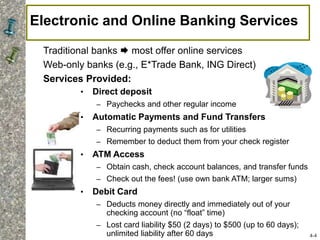
Electronic and Online Banking Services
• Direct deposit
– Paychecks and other regular income
• Automatic Payments and Fund Transfers
– Recurring payments such as for utilities
– Remember to deduct them from your check register
• ATM Access
– Obtain cash, check account balances, and transfer funds
– Check out the fees! (use own bank ATM; larger sums)
• Debit Card
– Deducts money directly and immediately out of your
checking account (no “float” time)
– Lost card liability $50 (2 days) to $500 (up to 60 days);
unlimited liability after 60 days
Traditional banks  most offer online services
Web-only banks (e.g., E*Trade Bank, ING Direct)
Services Provided:
4-4
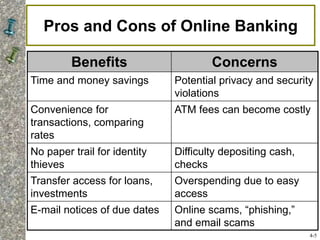
Pros and Cons of Online Banking
Benefits Concerns
Time and money savings Potential privacy and security
violations
Convenience for
transactions, comparing
rates
ATM fees can become costly
No paper trail for identity
thieves
Difficulty depositing cash,
checks
Transfer access for loans,
investments
Overspending due to easy
access
E-mail notices of due dates Online scams, “phishing,”
and email scams
4-5
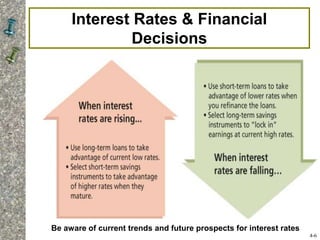
Interest Rates & Financial
Decisions
4-6
Be aware of current trends and future prospects for interest rates
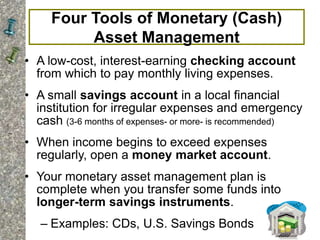
Four Tools of Monetary (Cash)
Asset Management
• A low-cost, interest-earning checking account
from which to pay monthly living expenses.
• A small savings account in a local financial
institution for irregular expenses and emergency
cash (3-6 months of expenses- or more- is recommended)
• When income begins to exceed expenses
regularly, open a money market account.
• Your monetary asset management plan is
complete when you transfer some funds into
longer-term savings instruments.
– Examples: CDs, U.S. Savings Bonds
Objective 2
Compare the Types of Financial
Institutions
Basic questions to ask before
choosing a financial institution:
1. Where can I get the best return on my
savings?
2. How can I minimize costs for financial
services?
3. Will I be able to borrow money if I need it?
• Determine the financial services you need before
choosing a financial institution
• Compare fees and convenience
• Consider the safety (FDIC insurance) and rates for
deposits and loans at different institutions
• Other factors?
4-8
How did YOU choose your bank or credit union?
Comparing Financial Institutions
Deposit Institutions
• Commercial Banks
– Organized as corporations (answer to stockholders)
– Offer a full range of services including
checking, savings, lending and other
services (e.g., trust management)
• Savings and Loan Associations
– Checking accounts, specialized savings
plans, loans, and financial planning and
investment services
4-9
Deposit Institutions
• Mutual Savings Banks
– Specialize in savings accounts and
mortgage loans (mostly in northeastern U.S.)
– Owned by their depositors, with profits
going back to depositors by paying a
higher rate on savings
• Credit Unions
– User-owned, nonprofit and provide
comprehensive financial services
– Lower fees and lower loan rates
Comparing Financial Institutions
4-10
• Life Insurance Companies
• Investment Companies
– Money Market Mutual Fund
• Combination savings & investment; short-term securities
• Not (normally) covered by FDIC (like bank MMDAs)
• Brokerage Firms
– Act as agent for buyers and sellers of financial products
• Credit Card Companies
– Specialize in short term loans
• Finance Companies
– Make short and medium term loans to consumers
– Higher rates than most other lenders (use as a last resort)
• Mortgage Companies
– Provide home mortgage loans
Non-Deposit Financial Institutions
4-11
Problematic Financial Businesses
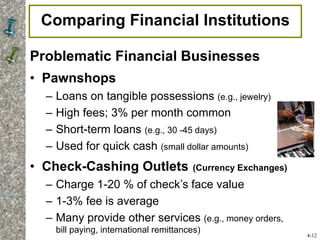
• Pawnshops
– Loans on tangible possessions (e.g., jewelry)
– High fees; 3% per month common
– Short-term loans (e.g., 30 -45 days)
– Used for quick cash (small dollar amounts)
• Check-Cashing Outlets (Currency Exchanges)
– Charge 1-20 % of check’s face value
– 1-3% fee is average
– Many provide other services (e.g., money orders,
bill paying, international remittances)
Comparing Financial Institutions
4-12
More Problematic Financial Businesses
• Payday Loan Companies
– A.k.a., “Cash advances,” “check advance loans,”
“postdated check loans,” “delayed deposit loans”
– Very high interest rates (write $115 check to borrow $100
for 2 weeks; translates into 390% APR!)
• Car Title Loans
– High-cost short term loan secured with car title
• Rent-to-Own Centers
– Lease merchandise at high interest rates to low-
income customers; small weekly payments add up
– Often pay 3 to 4 times the cost of an item
Comparing Financial Institutions
4-13
Objective 3
Assess Various Types of Savings Plans
• Regular Savings Accounts
– A.k.a., Passbook savings and Statement accounts
– Low minimum balance; easy withdrawal
– FDIC Insured; fees and balance requirements vary
– Low rate of return
– Called “share accounts” at credit unions
• Certificates of Deposit (CDs)
– Required minimum deposit; required time on deposit
– Penalties for early withdrawal
– Take care when rolling over (check current interest rates)
– Consider creating a “CD portfolio” (laddering)
4-14
Objective 3
Assess Various Types of Savings Plans
• Interest-Earning Checking Accounts
– Checking accounts paying low interest
• Money Market Accounts and Funds
– Floating interest rate (based on current interest rates)
– Allows limited check writing
– Higher minimum balance than regular savings
– Money market accounts are covered by the FDIC,
but money market funds are not (generally)
4-15
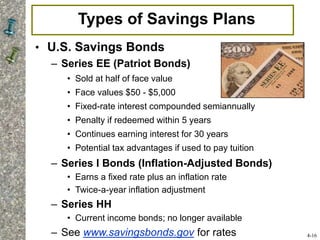
Types of Savings Plans
• U.S. Savings Bonds
– Series EE (Patriot Bonds)
• Sold at half of face value
• Face values $50 - $5,000
• Fixed-rate interest compounded semiannually
• Penalty if redeemed within 5 years
• Continues earning interest for 30 years
• Potential tax advantages if used to pay tuition
– Series I Bonds (Inflation-Adjusted Bonds)
• Earns a fixed rate plus an inflation rate
• Twice-a-year inflation adjustment
– Series HH
• Current income bonds; no longer available
– See www.savingsbonds.gov for rates 4-16
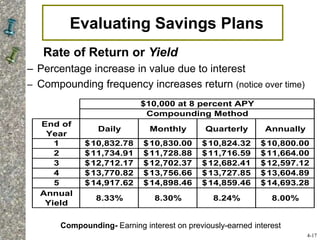
Evaluating Savings Plans
Rate of Return or Yield
– Percentage increase in value due to interest
– Compounding frequency increases return (notice over time)
End of
Year
Daily Monthly Quarterly Annually
1 10,832.78$ 10,830.00$ 10,824.32$ 10,800.00$
2 11,734.91$ 11,728.88$ 11,716.59$ 11,664.00$
3 12,712.17$ 12,702.37$ 12,682.41$ 12,597.12$
4 13,770.82$ 13,756.66$ 13,727.85$ 13,604.89$
5 14,917.62$ 14,898.46$ 14,859.46$ 14,693.28$
Annual
Yield
8.33% 8.30% 8.24% 8.00%
Compounding Method
$10,000 at 8 percent APY
4-17
Compounding- Earning interest on previously-earned interest
“Truth in Savings Act”
Requires disclosure of:
– Fees on deposit accounts; other terms and conditions
– Interest rate paid on savings
– Annual percentage yield (APY)
• APY defined as the “total percent” based on annual interest
and frequency of compounding
• APY = Rate per period X # periods per year
• “Total interest that would be received on a $100 deposit for a
365-day period, given an institution’s annual rate of simple
interest and frequency of compounding”
• APY must be in advertising and disclosures….WHY?
Evaluating Savings Plans
4-18
Objective 4
Evaluate Different Types of Payment
Methods
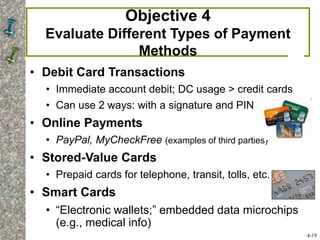
• Debit Card Transactions
• Immediate account debit; DC usage > credit cards
• Can use 2 ways: with a signature and PIN
• Online Payments
• PayPal, MyCheckFree (examples of third parties)
• Stored-Value Cards
• Prepaid cards for telephone, transit, tolls, etc.
• Smart Cards
• “Electronic wallets;” embedded data microchips
(e.g., medical info)
4-19
Payment Methods
Checking Accounts
• Regular Checking Accounts (service charge; minimums)
• Activity Accounts (charge a fee for each check written)
• Interest-Earning Checking Accounts (called
share draft accounts at credit unions)
– Require a minimum balance
• Evaluating checking accounts:
– Restrictions, such as a minimum balance
– Fees, which are increasing, and charges
– Interest rate and computation method
– Special services (e.g., overdraft protection)
– Beware of “package” deals that include unneeded
services; look for “relationship account” deals 4-20
Other Payment Methods
• Certified Check
– Personal check with guaranteed payment
– Shows that account has enough $; fee charged
• Cashier’s Check
– Check of a financial institution (backed by institution’s
assets) you get by paying the face amount plus a fee
• Money Order
– Purchase at financial institution, post office, stores
• Traveler’s Check
– Sign check twice; becoming less common (fraud issues)
– Electronic traveler’s checks - prepaid travel card with
ability to get local currency at an ATM 4-21
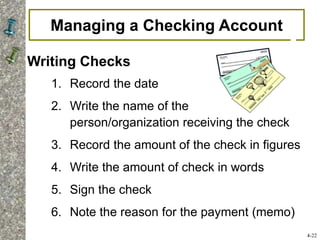
Managing a Checking Account
Writing Checks
1. Record the date
2. Write the name of the
person/organization receiving the check
3. Record the amount of the check in figures
4. Write the amount of check in words
5. Sign the check
6. Note the reason for the payment (memo)
4-22
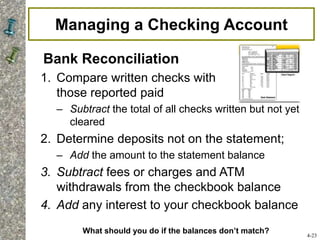
Managing a Checking Account
Bank Reconciliation
1. Compare written checks with
those reported paid
– Subtract the total of all checks written but not yet
cleared
2. Determine deposits not on the statement;
– Add the amount to the statement balance
3. Subtract fees or charges and ATM
withdrawals from the checkbook balance
4. Add any interest to your checkbook balance
4-23
What should you do if the balances don’t match?
Wrap Up
• Chapter Quiz
• Concept Check 4-1- Electronic Banking
• Concept Check 4-2- Descriptions of
Financial Institutions
• Concept Check 4-3- Money Market
Accounts and Funds; Benefits of U.S.
Savings Bonds; Major Influences
• Concept Check 4-4- Suggested
Payment Methods

Chapter 4

  • 1.
    4 Savings andPayment Services Meeting Daily Money Needs • Routine spending activities require a cash management plan • Payment options: cash, check, credit cards, and debit cards Common Mistakes: – Overspending – Insufficient liquid assets – Using savings or borrowing to pay for current expenses – Failing to put unneeded funds in an interest bearing or investment account 4-1
  • 2.
    Objective 1 Identify CommonlyUsed Financial Services Meeting Daily Money Needs Sources of Quick Cash: – Liquidate savings • Savings account • CD • Mutual fund – Borrow • Credit card advance • Personal loan Both options reduce net worth 4-2
  • 3.
    Types of FinancialServices • Savings – Time deposits – Savings accounts and certificates of deposit • Payment services – Checking accounts = demand deposits – Automatic payments • Borrowing for the short- or long-term • Other financial services – Insurance, investments, real estate purchases, tax assistance, financial planning, and asset management (cash management) accounts 4-3
  • 4.
    Electronic and OnlineBanking Services • Direct deposit – Paychecks and other regular income • Automatic Payments and Fund Transfers – Recurring payments such as for utilities – Remember to deduct them from your check register • ATM Access – Obtain cash, check account balances, and transfer funds – Check out the fees! (use own bank ATM; larger sums) • Debit Card – Deducts money directly and immediately out of your checking account (no “float” time) – Lost card liability $50 (2 days) to $500 (up to 60 days); unlimited liability after 60 days Traditional banks  most offer online services Web-only banks (e.g., E*Trade Bank, ING Direct) Services Provided: 4-4
  • 5.
    Pros and Consof Online Banking Benefits Concerns Time and money savings Potential privacy and security violations Convenience for transactions, comparing rates ATM fees can become costly No paper trail for identity thieves Difficulty depositing cash, checks Transfer access for loans, investments Overspending due to easy access E-mail notices of due dates Online scams, “phishing,” and email scams 4-5
  • 6.
    Interest Rates &Financial Decisions 4-6 Be aware of current trends and future prospects for interest rates
  • 7.
    Four Tools ofMonetary (Cash) Asset Management • A low-cost, interest-earning checking account from which to pay monthly living expenses. • A small savings account in a local financial institution for irregular expenses and emergency cash (3-6 months of expenses- or more- is recommended) • When income begins to exceed expenses regularly, open a money market account. • Your monetary asset management plan is complete when you transfer some funds into longer-term savings instruments. – Examples: CDs, U.S. Savings Bonds
  • 8.
    Objective 2 Compare theTypes of Financial Institutions Basic questions to ask before choosing a financial institution: 1. Where can I get the best return on my savings? 2. How can I minimize costs for financial services? 3. Will I be able to borrow money if I need it? • Determine the financial services you need before choosing a financial institution • Compare fees and convenience • Consider the safety (FDIC insurance) and rates for deposits and loans at different institutions • Other factors? 4-8 How did YOU choose your bank or credit union?
  • 9.
    Comparing Financial Institutions DepositInstitutions • Commercial Banks – Organized as corporations (answer to stockholders) – Offer a full range of services including checking, savings, lending and other services (e.g., trust management) • Savings and Loan Associations – Checking accounts, specialized savings plans, loans, and financial planning and investment services 4-9
  • 10.
    Deposit Institutions • MutualSavings Banks – Specialize in savings accounts and mortgage loans (mostly in northeastern U.S.) – Owned by their depositors, with profits going back to depositors by paying a higher rate on savings • Credit Unions – User-owned, nonprofit and provide comprehensive financial services – Lower fees and lower loan rates Comparing Financial Institutions 4-10
  • 11.
    • Life InsuranceCompanies • Investment Companies – Money Market Mutual Fund • Combination savings & investment; short-term securities • Not (normally) covered by FDIC (like bank MMDAs) • Brokerage Firms – Act as agent for buyers and sellers of financial products • Credit Card Companies – Specialize in short term loans • Finance Companies – Make short and medium term loans to consumers – Higher rates than most other lenders (use as a last resort) • Mortgage Companies – Provide home mortgage loans Non-Deposit Financial Institutions 4-11
  • 12.
    Problematic Financial Businesses •Pawnshops – Loans on tangible possessions (e.g., jewelry) – High fees; 3% per month common – Short-term loans (e.g., 30 -45 days) – Used for quick cash (small dollar amounts) • Check-Cashing Outlets (Currency Exchanges) – Charge 1-20 % of check’s face value – 1-3% fee is average – Many provide other services (e.g., money orders, bill paying, international remittances) Comparing Financial Institutions 4-12
  • 13.
    More Problematic FinancialBusinesses • Payday Loan Companies – A.k.a., “Cash advances,” “check advance loans,” “postdated check loans,” “delayed deposit loans” – Very high interest rates (write $115 check to borrow $100 for 2 weeks; translates into 390% APR!) • Car Title Loans – High-cost short term loan secured with car title • Rent-to-Own Centers – Lease merchandise at high interest rates to low- income customers; small weekly payments add up – Often pay 3 to 4 times the cost of an item Comparing Financial Institutions 4-13
  • 14.
    Objective 3 Assess VariousTypes of Savings Plans • Regular Savings Accounts – A.k.a., Passbook savings and Statement accounts – Low minimum balance; easy withdrawal – FDIC Insured; fees and balance requirements vary – Low rate of return – Called “share accounts” at credit unions • Certificates of Deposit (CDs) – Required minimum deposit; required time on deposit – Penalties for early withdrawal – Take care when rolling over (check current interest rates) – Consider creating a “CD portfolio” (laddering) 4-14
  • 15.
    Objective 3 Assess VariousTypes of Savings Plans • Interest-Earning Checking Accounts – Checking accounts paying low interest • Money Market Accounts and Funds – Floating interest rate (based on current interest rates) – Allows limited check writing – Higher minimum balance than regular savings – Money market accounts are covered by the FDIC, but money market funds are not (generally) 4-15
  • 16.
    Types of SavingsPlans • U.S. Savings Bonds – Series EE (Patriot Bonds) • Sold at half of face value • Face values $50 - $5,000 • Fixed-rate interest compounded semiannually • Penalty if redeemed within 5 years • Continues earning interest for 30 years • Potential tax advantages if used to pay tuition – Series I Bonds (Inflation-Adjusted Bonds) • Earns a fixed rate plus an inflation rate • Twice-a-year inflation adjustment – Series HH • Current income bonds; no longer available – See www.savingsbonds.gov for rates 4-16
  • 17.
    Evaluating Savings Plans Rateof Return or Yield – Percentage increase in value due to interest – Compounding frequency increases return (notice over time) End of Year Daily Monthly Quarterly Annually 1 10,832.78$ 10,830.00$ 10,824.32$ 10,800.00$ 2 11,734.91$ 11,728.88$ 11,716.59$ 11,664.00$ 3 12,712.17$ 12,702.37$ 12,682.41$ 12,597.12$ 4 13,770.82$ 13,756.66$ 13,727.85$ 13,604.89$ 5 14,917.62$ 14,898.46$ 14,859.46$ 14,693.28$ Annual Yield 8.33% 8.30% 8.24% 8.00% Compounding Method $10,000 at 8 percent APY 4-17 Compounding- Earning interest on previously-earned interest
  • 18.
    “Truth in SavingsAct” Requires disclosure of: – Fees on deposit accounts; other terms and conditions – Interest rate paid on savings – Annual percentage yield (APY) • APY defined as the “total percent” based on annual interest and frequency of compounding • APY = Rate per period X # periods per year • “Total interest that would be received on a $100 deposit for a 365-day period, given an institution’s annual rate of simple interest and frequency of compounding” • APY must be in advertising and disclosures….WHY? Evaluating Savings Plans 4-18
  • 19.
    Objective 4 Evaluate DifferentTypes of Payment Methods • Debit Card Transactions • Immediate account debit; DC usage > credit cards • Can use 2 ways: with a signature and PIN • Online Payments • PayPal, MyCheckFree (examples of third parties) • Stored-Value Cards • Prepaid cards for telephone, transit, tolls, etc. • Smart Cards • “Electronic wallets;” embedded data microchips (e.g., medical info) 4-19
  • 20.
    Payment Methods Checking Accounts •Regular Checking Accounts (service charge; minimums) • Activity Accounts (charge a fee for each check written) • Interest-Earning Checking Accounts (called share draft accounts at credit unions) – Require a minimum balance • Evaluating checking accounts: – Restrictions, such as a minimum balance – Fees, which are increasing, and charges – Interest rate and computation method – Special services (e.g., overdraft protection) – Beware of “package” deals that include unneeded services; look for “relationship account” deals 4-20
  • 21.
    Other Payment Methods •Certified Check – Personal check with guaranteed payment – Shows that account has enough $; fee charged • Cashier’s Check – Check of a financial institution (backed by institution’s assets) you get by paying the face amount plus a fee • Money Order – Purchase at financial institution, post office, stores • Traveler’s Check – Sign check twice; becoming less common (fraud issues) – Electronic traveler’s checks - prepaid travel card with ability to get local currency at an ATM 4-21
  • 22.
    Managing a CheckingAccount Writing Checks 1. Record the date 2. Write the name of the person/organization receiving the check 3. Record the amount of the check in figures 4. Write the amount of check in words 5. Sign the check 6. Note the reason for the payment (memo) 4-22
  • 23.
    Managing a CheckingAccount Bank Reconciliation 1. Compare written checks with those reported paid – Subtract the total of all checks written but not yet cleared 2. Determine deposits not on the statement; – Add the amount to the statement balance 3. Subtract fees or charges and ATM withdrawals from the checkbook balance 4. Add any interest to your checkbook balance 4-23 What should you do if the balances don’t match?
  • 24.
    Wrap Up • ChapterQuiz • Concept Check 4-1- Electronic Banking • Concept Check 4-2- Descriptions of Financial Institutions • Concept Check 4-3- Money Market Accounts and Funds; Benefits of U.S. Savings Bonds; Major Influences • Concept Check 4-4- Suggested Payment Methods