10 Financial Planning With
Life Insurance
• Primary Purpose of Life Insurance:
– Protect someone who depends on you from
financial loss related to your death
– Reduces financial burdens of survivors
• Life insurance:
– Obtained by purchasing a policy
– The insurance company promises to pay a lump
sum (death benefit) to a named beneficiary at the
time of the policy holder’s death (or sometimes
while they are still alive)
10-1
Objective 1
Define Life Insurance and
Determine Your Life Insurance
Needs
Other reasons to buy life insurance:
– Pay off a mortgage or debts
– Lump-sum endowments for children
– Provide an education or income for children
– Make charitable donations
– Provide retirement income
– Accumulate savings
– Establish a regular income for survivors
– Set up an estate plan (e.g., fund trusts with life insurance)
– Pay estate and gift taxes (e.g., business owners) 10-2
The Principle of Life
Insurance
• Mortality Tables-provide odds on your
dying, based on your age and sex.
• Premium is based on life expectancy
and projections for payouts for persons
who die (called actuarial tables)
– Older people pay more because they will die
sooner
• Face Amount- the dollar value of
protection listed in the policy and
amount used to calculate the premium
(e.g., $100,000)
• Group Term Insurance- issued to
people as members of a group rather
than as individuals
10-3
Do You Need Life Insurance?
• Do you have people you need to protect financially? Will
your death cause them financial hardship?
• Are you single and have a lot of debt?
• Do you have parents, relatives, or a charity that you want
to support?
Avoid being persuaded to buy unnecessary life insurance!
10-4
Estimating Your Life Insurance
Requirements
• The Easy Method
– 70% of your salary for seven years while your family adjusts
– Assumes typical family
• The DINK Method
– Dual income, no kids
– Assumes spouse earnings will continue
– Cover funeral + ½ debts
• The “Nonworking” Spouse Method
– # years until the youngest child reaches 18 X $10,000
• The “Family Need” Method
– More thorough than the first three methods
– Considers employer provided insurance, Social Security benefits,
income and assets
10-5
Objective 2
Distinguish Between the Types of
Life Insurance Companies and
Analyze Various Types of Life
Insurance Policies These
Companies Issue
2 Types of Life Insurance Companies
Type of Company Owned by
Stock life Insurance Shareholders
Mutual life insurance Policyholders
10-6
Stock Life Insurance
Companies
• Owned by the shareholders
• 95% are of this type
• Sell non-participating (non-par) policies
• If you want to pay the same premium
each year  choose a non-participating
policy with guaranteed premiums
• Consider the financial stability of the
insurance company
10-7
Mutual Life Insurance
Companies
• Owned by the policyholders
• 5% of policies are from this type
of company
• Participating policy premiums are higher
than non-participating policies
– Part of the participating premium is refunded
to the policyholders annually in the form of a
policy dividend
10-8
Term Life Insurance
Term Life
– Protection for a specified period of time
– At the end of term (or if you stop paying premiums),
coverage stops
• Many types:
– Renewable Term- can renew; higher premium charged
– Multiyear Level Term- same premium for set period
– Conversion Term- allows change to permanent policy
– Decreasing Term- face value decreases over time
– Return-of-Premium Term- can get premium back
10-9
Whole Life Insurance
Straight-Life or Whole-Life Insurance
– Pay the premium as long as you live
– Amount of premium depends on age when you start
the policy
– Provides death benefits
– Accumulates a cash value you can borrow against or
draw out at retirement
– Look carefully at the rate of return your money earns
Types:
• Limited Payment Policy
– You pay premiums for a stipulated period
– Policy then “paid up” and you remain insured for life
• Variable Life Policy- Fixed premiums; investment accounts
• Adjustable Life Policy- Can change coverage with needs
• Universal Life- Can change premium, time period, benefit
10-10
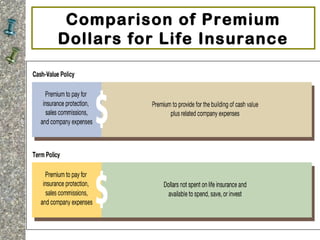
Comparison of Premium
Dollars for Life Insurance
Other Types of Life
Insurance Policies
• Group life insurance
– Term insurance
– Often provided by an employer
– No physical is required
• Credit life insurance
– Debt paid off if you die
• Mortgage, car, furniture
– Also protects lenders
– Expensive protection (usually overpriced)
• Endowment Life Insurance- pays
policyholder a lump sum if still living at end of the
endowment period
10-12
Key Provisions in a Life
Insurance Policy
• Naming your beneficiary and contingent beneficiaries (those
who will receive benefits upon the insured’s death)
• Incontestability clause  after the policy has been in force for
a specified period, the company can’t dispute its validity for any
reason (usually 2 years)
• Length of grace period for late payments
• Reinstatement of a lapsed policy if it has not been turned in for
cash (must qualify again and pay overdue premiums)
• Non-forfeiture clause allows you to keep accrued benefits in a
whole life policy if you drop the policy
• Misstatement of age provision (benefits paid on real age)
• Policy loan provision to borrow against cash value
• Suicide clause during first two years (only get back premiums)
• Policy rider modifies the coverage by adding or excluding
conditions or altering benefits
10-13
Key Provisions in a Life
Insurance Policy
Life Insurance Policy Riders
• Waiver of premium disability benefit
• Accidental death benefit – “double indemnity”
• Guaranteed insurability option (can buy additional insurance at
specified intervals without a medical exam)
• Cost of living protection (helps maintain purchasing power)
• Accelerated benefits, also called living benefits (make
payments to those who are terminally ill before they die)
• Second-to-die option, also called survivorship life (insures two
lives, typically a married couple); benefit paid upon death of
second spouse
10-14
Choosing Settlement Options
Settlement Options = choices of how the
insurance money is paid out
– Lump-Sum Payment = most common method
– Limited Installment Plan
• In equal installments for a specific number of years
after your death (10-year certain)
– Life Income Option
• Payments to the beneficiary for life
– Proceeds Left with the Company
• Pays interest to the beneficiary
10-15
Buying Life Insurance
Consider:
– Present and future sources of income
– Other savings and income protection
– Group life insurance
– Pension benefits
– Social Security benefits
– Financial strength of the
insurance company
10-16
Buying Life Insurance
Determine from whom to buy your policy
– Examine both private and public sources
– Research the company’s rating by major
rating companies:
• A. M. Best
• Standard and Poor’s
• Duff & Phelps
• Moody’s
• Weiss Research
– Talk to friends or colleagues
– Online premium quote services
10-17
Choosing an Insurance Agent
• Ask friends, parents, and neighbors
for recommendations.
• Does the agent belong to
professional groups or is a
Chartered Life Underwriter (CLU)?
• Is the agent willing to take the time
to answer questions and find a
policy that is right for you?
• Does the agent ask about your
financial plan?
• Do you feel pressured?
• Is the agent available when
needed?
10-18
Buying Life Insurance
• Compare policy costs based on:
– Company’s cost of doing business
– Return on company’s investments
– Mortality rate among policyholders
– Policy features
– Competition from other firms
• Interest-adjusted index
– Used to compare policy costs
– Lower index = lower cost policy
– See sites such as www.quotesmith.com
10-19
Obtaining and Examining a
Policy
• First step = apply
• Second step = provide medical history
– Usually no physical for a group policy
• Read every word of the contract
• 10-day “free-look” period to change
your mind
• Give your beneficiaries
and lawyer a photocopy
10-20
Should You Switch Policies?
• Switch if benefits exceed
costs of getting another
physical and paying policy
set-up costs
• The older you are, the higher
the premium
• Are you still insurable?
• Can you get all the provisions
you want?
• Don’t cancel old policy until
new policy is in hand 10-21
Objective 4
Recognize How Annuities Provide
Financial Security
Financial Planning with Annuities
• An annuity = a financial contract written by an
insurance company, providing a regular income
• Can supplement retirement income and shelter
income from taxes (tax-deferred)
• Those who expect to live longer than average
benefit most from annuities
• Fully fund IRAs and 401(k)s/403(b)s BEFORE
considering an annuity (lower costs and tax advantages)
10-22
Why Buy Annuities?
• Provides retirement income for life
• Compounded interest grows tax-free (until money withdrawn)
• No maximum annual contribution (like IRAs)
• Beneficiary guaranteed no less than amount paid in
• Immediate annuity or deferred annuity
Two Types
• Fixed Annuity
– Annuitant receives fixed amount for life
• Variable Annuity
– Amount received depends on investment performance
10-23
Wrap Up
• Chapter Quiz
• Case Study Project Discussion
– Form groups
– Select cases
• Homework: Concept Checks 10-1, 10-2
(True/False Questions)

Chapter 10

  • 1.
    10 Financial PlanningWith Life Insurance • Primary Purpose of Life Insurance: – Protect someone who depends on you from financial loss related to your death – Reduces financial burdens of survivors • Life insurance: – Obtained by purchasing a policy – The insurance company promises to pay a lump sum (death benefit) to a named beneficiary at the time of the policy holder’s death (or sometimes while they are still alive) 10-1
  • 2.
    Objective 1 Define LifeInsurance and Determine Your Life Insurance Needs Other reasons to buy life insurance: – Pay off a mortgage or debts – Lump-sum endowments for children – Provide an education or income for children – Make charitable donations – Provide retirement income – Accumulate savings – Establish a regular income for survivors – Set up an estate plan (e.g., fund trusts with life insurance) – Pay estate and gift taxes (e.g., business owners) 10-2
  • 3.
    The Principle ofLife Insurance • Mortality Tables-provide odds on your dying, based on your age and sex. • Premium is based on life expectancy and projections for payouts for persons who die (called actuarial tables) – Older people pay more because they will die sooner • Face Amount- the dollar value of protection listed in the policy and amount used to calculate the premium (e.g., $100,000) • Group Term Insurance- issued to people as members of a group rather than as individuals 10-3
  • 4.
    Do You NeedLife Insurance? • Do you have people you need to protect financially? Will your death cause them financial hardship? • Are you single and have a lot of debt? • Do you have parents, relatives, or a charity that you want to support? Avoid being persuaded to buy unnecessary life insurance! 10-4
  • 5.
    Estimating Your LifeInsurance Requirements • The Easy Method – 70% of your salary for seven years while your family adjusts – Assumes typical family • The DINK Method – Dual income, no kids – Assumes spouse earnings will continue – Cover funeral + ½ debts • The “Nonworking” Spouse Method – # years until the youngest child reaches 18 X $10,000 • The “Family Need” Method – More thorough than the first three methods – Considers employer provided insurance, Social Security benefits, income and assets 10-5
  • 6.
    Objective 2 Distinguish Betweenthe Types of Life Insurance Companies and Analyze Various Types of Life Insurance Policies These Companies Issue 2 Types of Life Insurance Companies Type of Company Owned by Stock life Insurance Shareholders Mutual life insurance Policyholders 10-6
  • 7.
    Stock Life Insurance Companies •Owned by the shareholders • 95% are of this type • Sell non-participating (non-par) policies • If you want to pay the same premium each year  choose a non-participating policy with guaranteed premiums • Consider the financial stability of the insurance company 10-7
  • 8.
    Mutual Life Insurance Companies •Owned by the policyholders • 5% of policies are from this type of company • Participating policy premiums are higher than non-participating policies – Part of the participating premium is refunded to the policyholders annually in the form of a policy dividend 10-8
  • 9.
    Term Life Insurance TermLife – Protection for a specified period of time – At the end of term (or if you stop paying premiums), coverage stops • Many types: – Renewable Term- can renew; higher premium charged – Multiyear Level Term- same premium for set period – Conversion Term- allows change to permanent policy – Decreasing Term- face value decreases over time – Return-of-Premium Term- can get premium back 10-9
  • 10.
    Whole Life Insurance Straight-Lifeor Whole-Life Insurance – Pay the premium as long as you live – Amount of premium depends on age when you start the policy – Provides death benefits – Accumulates a cash value you can borrow against or draw out at retirement – Look carefully at the rate of return your money earns Types: • Limited Payment Policy – You pay premiums for a stipulated period – Policy then “paid up” and you remain insured for life • Variable Life Policy- Fixed premiums; investment accounts • Adjustable Life Policy- Can change coverage with needs • Universal Life- Can change premium, time period, benefit 10-10
  • 11.
  • 12.
    Other Types ofLife Insurance Policies • Group life insurance – Term insurance – Often provided by an employer – No physical is required • Credit life insurance – Debt paid off if you die • Mortgage, car, furniture – Also protects lenders – Expensive protection (usually overpriced) • Endowment Life Insurance- pays policyholder a lump sum if still living at end of the endowment period 10-12
  • 13.
    Key Provisions ina Life Insurance Policy • Naming your beneficiary and contingent beneficiaries (those who will receive benefits upon the insured’s death) • Incontestability clause  after the policy has been in force for a specified period, the company can’t dispute its validity for any reason (usually 2 years) • Length of grace period for late payments • Reinstatement of a lapsed policy if it has not been turned in for cash (must qualify again and pay overdue premiums) • Non-forfeiture clause allows you to keep accrued benefits in a whole life policy if you drop the policy • Misstatement of age provision (benefits paid on real age) • Policy loan provision to borrow against cash value • Suicide clause during first two years (only get back premiums) • Policy rider modifies the coverage by adding or excluding conditions or altering benefits 10-13
  • 14.
    Key Provisions ina Life Insurance Policy Life Insurance Policy Riders • Waiver of premium disability benefit • Accidental death benefit – “double indemnity” • Guaranteed insurability option (can buy additional insurance at specified intervals without a medical exam) • Cost of living protection (helps maintain purchasing power) • Accelerated benefits, also called living benefits (make payments to those who are terminally ill before they die) • Second-to-die option, also called survivorship life (insures two lives, typically a married couple); benefit paid upon death of second spouse 10-14
  • 15.
    Choosing Settlement Options SettlementOptions = choices of how the insurance money is paid out – Lump-Sum Payment = most common method – Limited Installment Plan • In equal installments for a specific number of years after your death (10-year certain) – Life Income Option • Payments to the beneficiary for life – Proceeds Left with the Company • Pays interest to the beneficiary 10-15
  • 16.
    Buying Life Insurance Consider: –Present and future sources of income – Other savings and income protection – Group life insurance – Pension benefits – Social Security benefits – Financial strength of the insurance company 10-16
  • 17.
    Buying Life Insurance Determinefrom whom to buy your policy – Examine both private and public sources – Research the company’s rating by major rating companies: • A. M. Best • Standard and Poor’s • Duff & Phelps • Moody’s • Weiss Research – Talk to friends or colleagues – Online premium quote services 10-17
  • 18.
    Choosing an InsuranceAgent • Ask friends, parents, and neighbors for recommendations. • Does the agent belong to professional groups or is a Chartered Life Underwriter (CLU)? • Is the agent willing to take the time to answer questions and find a policy that is right for you? • Does the agent ask about your financial plan? • Do you feel pressured? • Is the agent available when needed? 10-18
  • 19.
    Buying Life Insurance •Compare policy costs based on: – Company’s cost of doing business – Return on company’s investments – Mortality rate among policyholders – Policy features – Competition from other firms • Interest-adjusted index – Used to compare policy costs – Lower index = lower cost policy – See sites such as www.quotesmith.com 10-19
  • 20.
    Obtaining and Examininga Policy • First step = apply • Second step = provide medical history – Usually no physical for a group policy • Read every word of the contract • 10-day “free-look” period to change your mind • Give your beneficiaries and lawyer a photocopy 10-20
  • 21.
    Should You SwitchPolicies? • Switch if benefits exceed costs of getting another physical and paying policy set-up costs • The older you are, the higher the premium • Are you still insurable? • Can you get all the provisions you want? • Don’t cancel old policy until new policy is in hand 10-21
  • 22.
    Objective 4 Recognize HowAnnuities Provide Financial Security Financial Planning with Annuities • An annuity = a financial contract written by an insurance company, providing a regular income • Can supplement retirement income and shelter income from taxes (tax-deferred) • Those who expect to live longer than average benefit most from annuities • Fully fund IRAs and 401(k)s/403(b)s BEFORE considering an annuity (lower costs and tax advantages) 10-22
  • 23.
    Why Buy Annuities? •Provides retirement income for life • Compounded interest grows tax-free (until money withdrawn) • No maximum annual contribution (like IRAs) • Beneficiary guaranteed no less than amount paid in • Immediate annuity or deferred annuity Two Types • Fixed Annuity – Annuitant receives fixed amount for life • Variable Annuity – Amount received depends on investment performance 10-23
  • 24.
    Wrap Up • ChapterQuiz • Case Study Project Discussion – Form groups – Select cases • Homework: Concept Checks 10-1, 10-2 (True/False Questions)