Presented By:
Afra
INTERNATIONAL COMPENSATION
Overview:
• Introduction to international compensation
• Meaning and Definition of international
compensation
• Objectives of international compensation
• Forms of international compensation
Introduction
• Compensation is an integral part of human resource management
which helps in motivating the employees and improving organizational
effectiveness.
• Compensation provided to employees can direct in the form of
monetary benefits and/or indirect in the form of non-monetary benefits
known as perks, time off, etc.
• Compensation does not include only salary but it is the sum of all
rewards and allowances provided to the employees in return for their
services.
• Compensation is extrinsic reward for an employee. Extrinsic rewards
include praise from a superior, salary, employee benefits, career
progression etc.
• Almost all the employees accept jobs in MNC’s take-up assignments in
various countries, & take-up the risk, bear inconveniences & discomforts
in foreign assignments mostly based on the compensation package.
Meaning and Definition of International Compensation
• According to R. Wayne Mondy “ compensation Is the
total of all rewards provided to employees in return to
their services. The overall purposes of providing
compensation are to attract, retain, and motivate
employees”.
Objectives of International Compensation:
The most important objective of any pay system is fairness or
equity, generally expressed in three forms:
• Internal equity:
This ensure that more difficult jobs are paid more.
• External equity:
Where jobs are fairly compensated in comparison to similar jobs
in labour market.
• Individual equity:
It ensures equal pay is ensured for equal work
Other objectives of compensation are:
 Attract talent and Retain talent
 Ensure equity
 New and desired behavior
 Control costs
 Comply with legal rules
 Ease of operation
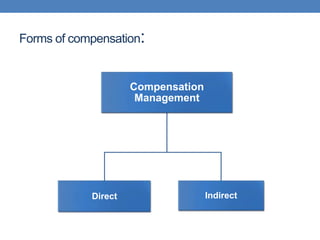
Forms of compensation:
Compensation
Management
Direct Indirect
Direct compensation:
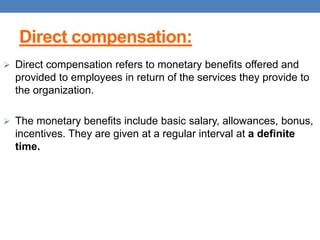
 Direct compensation refers to monetary benefits offered and
provided to employees in return of the services they provide to
the organization.
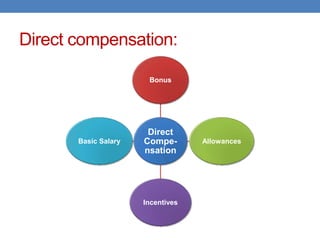
 The monetary benefits include basic salary, allowances, bonus,
incentives. They are given at a regular interval at a definite
time.
Direct compensation:
Direct
Compe-
nsation
Bonus
Allowances
Incentives
Basic Salary
Indirect compensation:
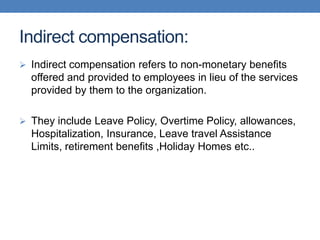
 Indirect compensation refers to non-monetary benefits
offered and provided to employees in lieu of the services
provided by them to the organization.
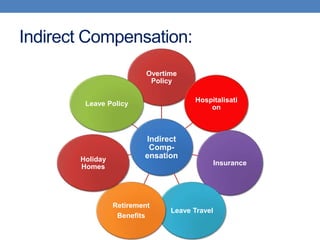
 They include Leave Policy, Overtime Policy, allowances,
Hospitalization, Insurance, Leave travel Assistance
Limits, retirement benefits ,Holiday Homes etc..
Indirect Compensation:
Indirect
Comp-
ensation
Overtime
Policy
Hospitalisati
on
Insurance
Leave Travel
Retirement
Benefits
Holiday
Homes
Leave Policy
International compensation

International compensation

  • 1.
  • 2.
    Overview: • Introduction tointernational compensation • Meaning and Definition of international compensation • Objectives of international compensation • Forms of international compensation
  • 3.
    Introduction • Compensation isan integral part of human resource management which helps in motivating the employees and improving organizational effectiveness. • Compensation provided to employees can direct in the form of monetary benefits and/or indirect in the form of non-monetary benefits known as perks, time off, etc. • Compensation does not include only salary but it is the sum of all rewards and allowances provided to the employees in return for their services. • Compensation is extrinsic reward for an employee. Extrinsic rewards include praise from a superior, salary, employee benefits, career progression etc. • Almost all the employees accept jobs in MNC’s take-up assignments in various countries, & take-up the risk, bear inconveniences & discomforts in foreign assignments mostly based on the compensation package.
  • 4.
    Meaning and Definitionof International Compensation • According to R. Wayne Mondy “ compensation Is the total of all rewards provided to employees in return to their services. The overall purposes of providing compensation are to attract, retain, and motivate employees”.
  • 5.
    Objectives of InternationalCompensation: The most important objective of any pay system is fairness or equity, generally expressed in three forms: • Internal equity: This ensure that more difficult jobs are paid more. • External equity: Where jobs are fairly compensated in comparison to similar jobs in labour market. • Individual equity: It ensures equal pay is ensured for equal work
  • 6.
    Other objectives ofcompensation are:  Attract talent and Retain talent  Ensure equity  New and desired behavior  Control costs  Comply with legal rules  Ease of operation
  • 7.
  • 8.
    Direct compensation:  Directcompensation refers to monetary benefits offered and provided to employees in return of the services they provide to the organization.  The monetary benefits include basic salary, allowances, bonus, incentives. They are given at a regular interval at a definite time.
  • 9.
  • 10.
    Indirect compensation:  Indirectcompensation refers to non-monetary benefits offered and provided to employees in lieu of the services provided by them to the organization.  They include Leave Policy, Overtime Policy, allowances, Hospitalization, Insurance, Leave travel Assistance Limits, retirement benefits ,Holiday Homes etc..
  • 11.