INTERNATIONAL COMPENSATION VARIABLE INFLUVENCING INTERNATIONAL COMPENSATION
International Compensation Defined as the provision of  monetary and non-monetary rewards , including  base salary, benefits, perquisites, long- and short-term incentives , valued by employees in accordance with their relative contributions to MNC performance Its broad HRM  purpose  is to  attract, retain and motivate  those personnel required throughout the MNC currently and in the future From the perspective of employees, in particular,  compensation is one of the most visible aspects  of SIHRM 12/24/10
International Compensation Contingency, and resource-based theories  offer some insight to international compensation Contingency approach  suggests there are variables that impact on compensation policies and practices to make them more or less appropriate and effective – Balance sheet approach and in more recent global models of international compensation to this field where there is a need to consider particular contingencies or situations such as host country preferences, when devising and implementing international compensation Resource-based theory  analyses conditions in which organizations can gain positions of competitive advantage through having human resources which are valuable, rare, and difficult to imitate or replace (such as employees with knowledge gained through specific international experience and organizational experience) 12/24/10
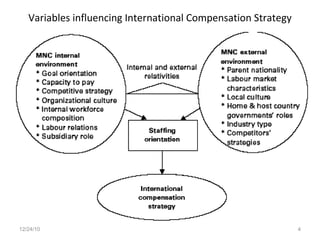
Variables influencing International Compensation Strategy 12/24/10
Internal Variables influencing International Compensation Strategy Goal orientation UK-based foam manufacturer Zotefoam, where equality is a key aspect of HRM in the company’s mission, the only perks that differentiate executives from other workers are private health insurance and a car allowance – MD of the firm sees the internationalizing firm as one with minimal status differences between levels in the org. hierarchy Capacity to pay Cost constraints on the enterprise Competitive strategy If for eg., as part of the MNC competitive strategy, the IHRM strategy is to be a mkt leader in employee compensation in order to compete for the most competent candidates, then the levels of compensation might well be higher than if the competitive strategy is based on, say, the provision of secure employment. 12/24/10
Internal Variables influencing International Compensation Strategy Organization culture It also influences the degree to which employees are compensated on the basis of seniority, in contrast to personal connections or performance Workforce chs. Age, education level, qualifications and experience, along with workforce tastes and preferences, and labour relations factors such as nature of employment relationship (level of TU involvement within MNCs) will result in different international compensation approaches 12/24/10
External Variables influencing International Compensation Strategy Nationality if the parent country In terms of culturally determined values and attitudes towards compensation policy and practices – local culture influences international compensation strategy through the dominant societal values, norms, attitudes and beliefs concerning for eg. bases for compensation differences (performance, family connections, gender), degrees of compensation differences between managerial and non-managerial employees, and the propensity for using particular types of compensation (pay incentives and benefits) Labour mkt chs of supply and demand Education and skill levels, ages and experiences of those in the labour mkt Role of home and host country govts in labour relations  Affect the level of govt. regulation of the labour mkt and employment relationship, including compensation of the workforce 12/24/10
External Variables influencing International Compensation Strategy Industry type Evidence from 2 global industries, scientific measuring and medical instruments suggest that MNCs competing in a global industry may be more likely to allocate rewards based on corporate and regional performance rather than on subsidiary performance, as favoured by MNCs competing in a multidomestic industry Different industry sectors also have different norms and practices for international compensation (eg. service-sector and high technology MNCs have been more likely than manufacturers to incorporate equity-based options in their international compensation strategies Competitors’ strategies Even if the MNC is not seeking to be a mkt leader in international compensation, it generally cannot afford to fall behind mkt rates across its locations, as it will risk losing valuable employees to competitors 12/24/10
THANK U RAJESH.M.R 09MBA29

International compensation

  • 1.
    INTERNATIONAL COMPENSATION VARIABLEINFLUVENCING INTERNATIONAL COMPENSATION
  • 2.
    International Compensation Definedas the provision of monetary and non-monetary rewards , including base salary, benefits, perquisites, long- and short-term incentives , valued by employees in accordance with their relative contributions to MNC performance Its broad HRM purpose is to attract, retain and motivate those personnel required throughout the MNC currently and in the future From the perspective of employees, in particular, compensation is one of the most visible aspects of SIHRM 12/24/10
  • 3.
    International Compensation Contingency,and resource-based theories offer some insight to international compensation Contingency approach suggests there are variables that impact on compensation policies and practices to make them more or less appropriate and effective – Balance sheet approach and in more recent global models of international compensation to this field where there is a need to consider particular contingencies or situations such as host country preferences, when devising and implementing international compensation Resource-based theory analyses conditions in which organizations can gain positions of competitive advantage through having human resources which are valuable, rare, and difficult to imitate or replace (such as employees with knowledge gained through specific international experience and organizational experience) 12/24/10
  • 4.
    Variables influencing InternationalCompensation Strategy 12/24/10
  • 5.
    Internal Variables influencingInternational Compensation Strategy Goal orientation UK-based foam manufacturer Zotefoam, where equality is a key aspect of HRM in the company’s mission, the only perks that differentiate executives from other workers are private health insurance and a car allowance – MD of the firm sees the internationalizing firm as one with minimal status differences between levels in the org. hierarchy Capacity to pay Cost constraints on the enterprise Competitive strategy If for eg., as part of the MNC competitive strategy, the IHRM strategy is to be a mkt leader in employee compensation in order to compete for the most competent candidates, then the levels of compensation might well be higher than if the competitive strategy is based on, say, the provision of secure employment. 12/24/10
  • 6.
    Internal Variables influencingInternational Compensation Strategy Organization culture It also influences the degree to which employees are compensated on the basis of seniority, in contrast to personal connections or performance Workforce chs. Age, education level, qualifications and experience, along with workforce tastes and preferences, and labour relations factors such as nature of employment relationship (level of TU involvement within MNCs) will result in different international compensation approaches 12/24/10
  • 7.
    External Variables influencingInternational Compensation Strategy Nationality if the parent country In terms of culturally determined values and attitudes towards compensation policy and practices – local culture influences international compensation strategy through the dominant societal values, norms, attitudes and beliefs concerning for eg. bases for compensation differences (performance, family connections, gender), degrees of compensation differences between managerial and non-managerial employees, and the propensity for using particular types of compensation (pay incentives and benefits) Labour mkt chs of supply and demand Education and skill levels, ages and experiences of those in the labour mkt Role of home and host country govts in labour relations Affect the level of govt. regulation of the labour mkt and employment relationship, including compensation of the workforce 12/24/10
  • 8.
    External Variables influencingInternational Compensation Strategy Industry type Evidence from 2 global industries, scientific measuring and medical instruments suggest that MNCs competing in a global industry may be more likely to allocate rewards based on corporate and regional performance rather than on subsidiary performance, as favoured by MNCs competing in a multidomestic industry Different industry sectors also have different norms and practices for international compensation (eg. service-sector and high technology MNCs have been more likely than manufacturers to incorporate equity-based options in their international compensation strategies Competitors’ strategies Even if the MNC is not seeking to be a mkt leader in international compensation, it generally cannot afford to fall behind mkt rates across its locations, as it will risk losing valuable employees to competitors 12/24/10
  • 9.