CON 124
Basic Concrete Mix Design Proportioning
Session 4
Proportioning Methods
Methods for Proportioning Concrete
Mixtures
 Water-cement ratio method
 Weight method
 Absolute volume method
 Field experience (statistical data)
 Trial mixtures
Design of Concrete Mixtures
 Establishment of specific concrete
characteristics
 Relative Density (Specific Gravity)
 Absolute volume calculation (27 Cubic Ft)
 Durability Issues
 Selection of proportions of available materials
to produce concrete of required properties,
with the greatest economy
Concrete Mixture Design from
Field Data
 Strength-Test Data
 Standard Deviations show mixture is
acceptable
 Durability aspects must be met
 Statistical data should represent the same
material, proportions, and concreting
conditions
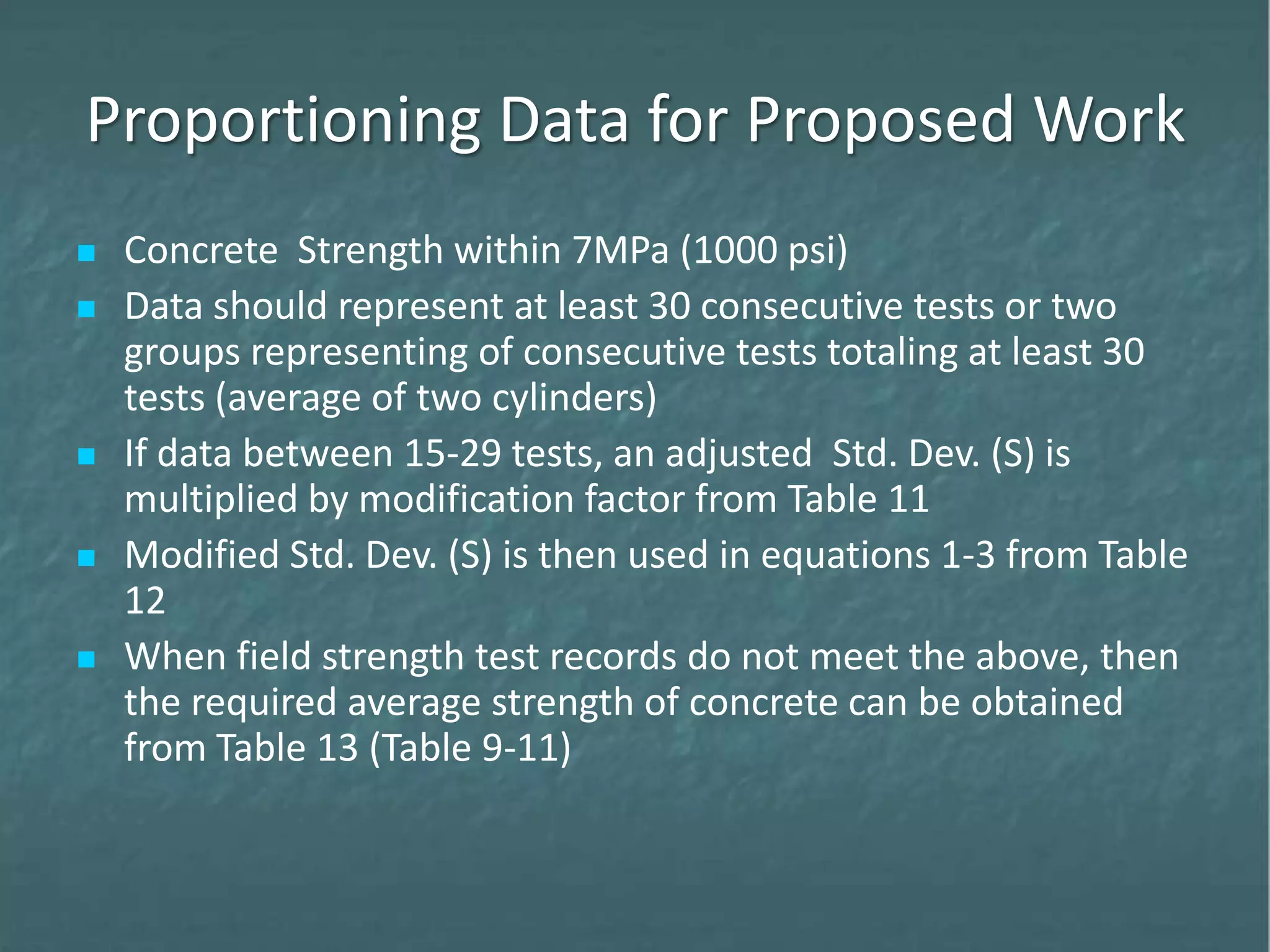
Proportioning Data for Proposed Work
 Concrete Strength within 7MPa (1000 psi)
 Data should represent at least 30 consecutive tests or two
groups representing of consecutive tests totaling at least 30
tests (average of two cylinders)
 If data between 15-29 tests, an adjusted Std. Dev. (S) is
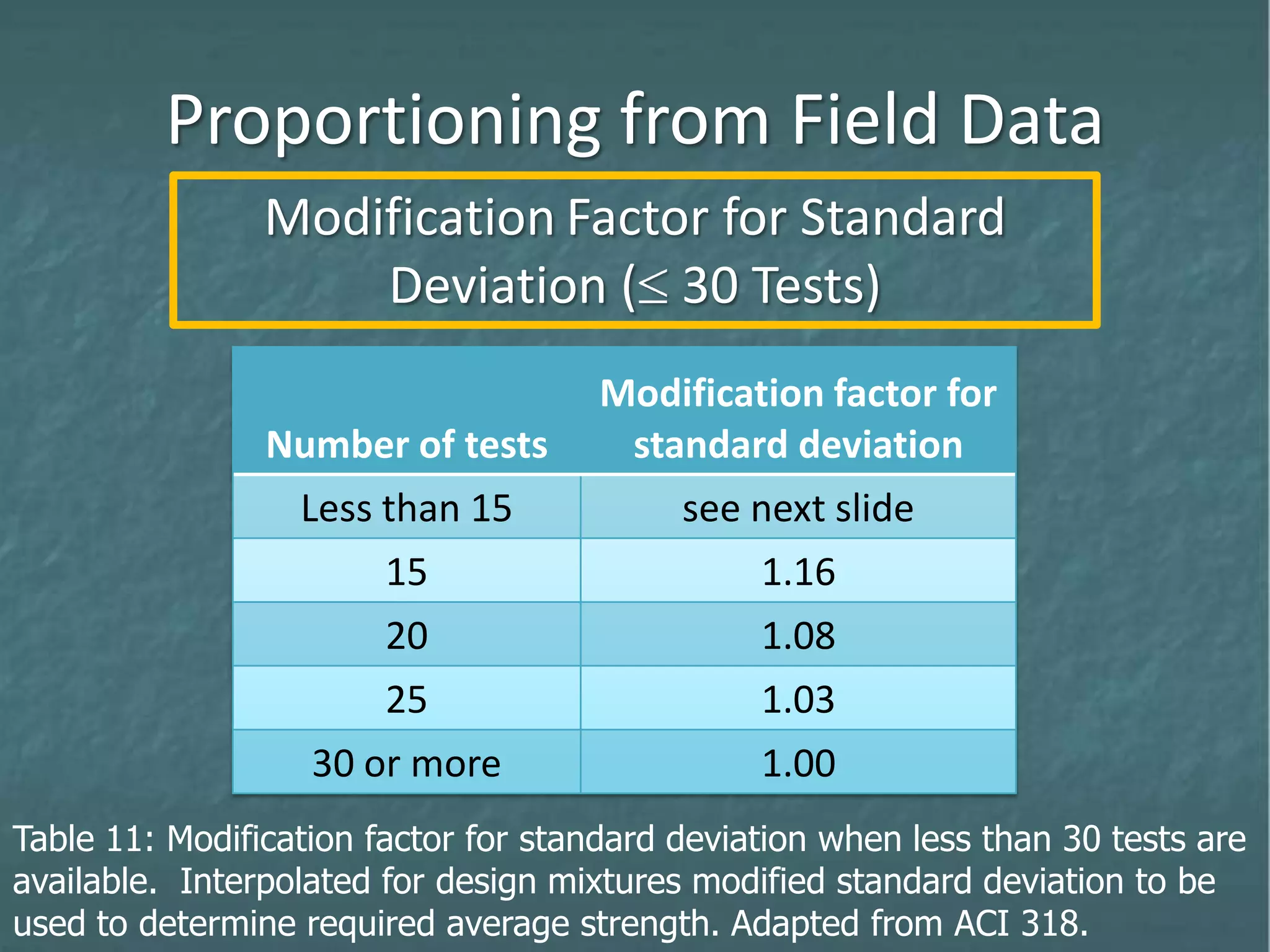
multiplied by modification factor from Table 11
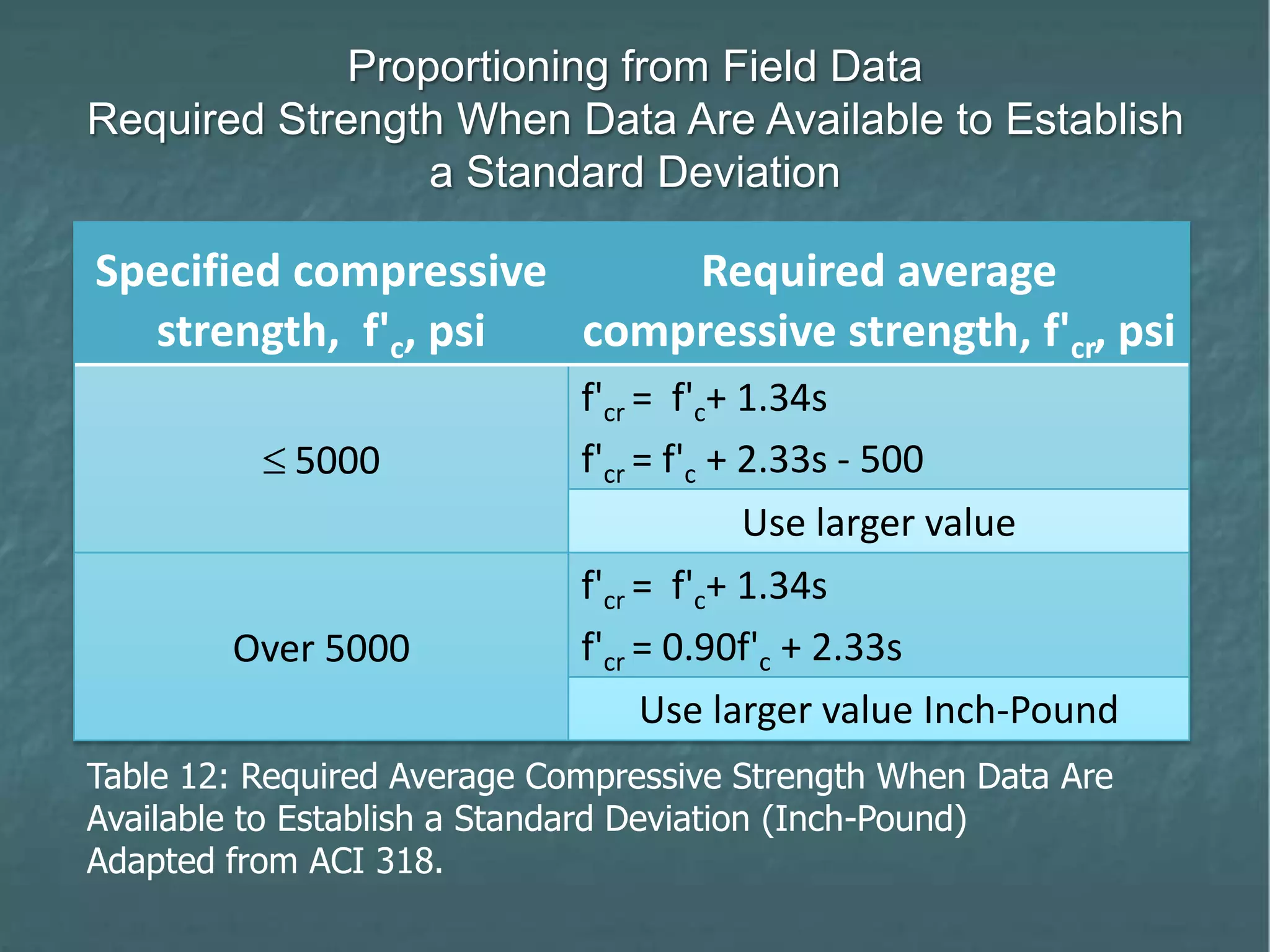
 Modified Std. Dev. (S) is then used in equations 1-3 from Table
12
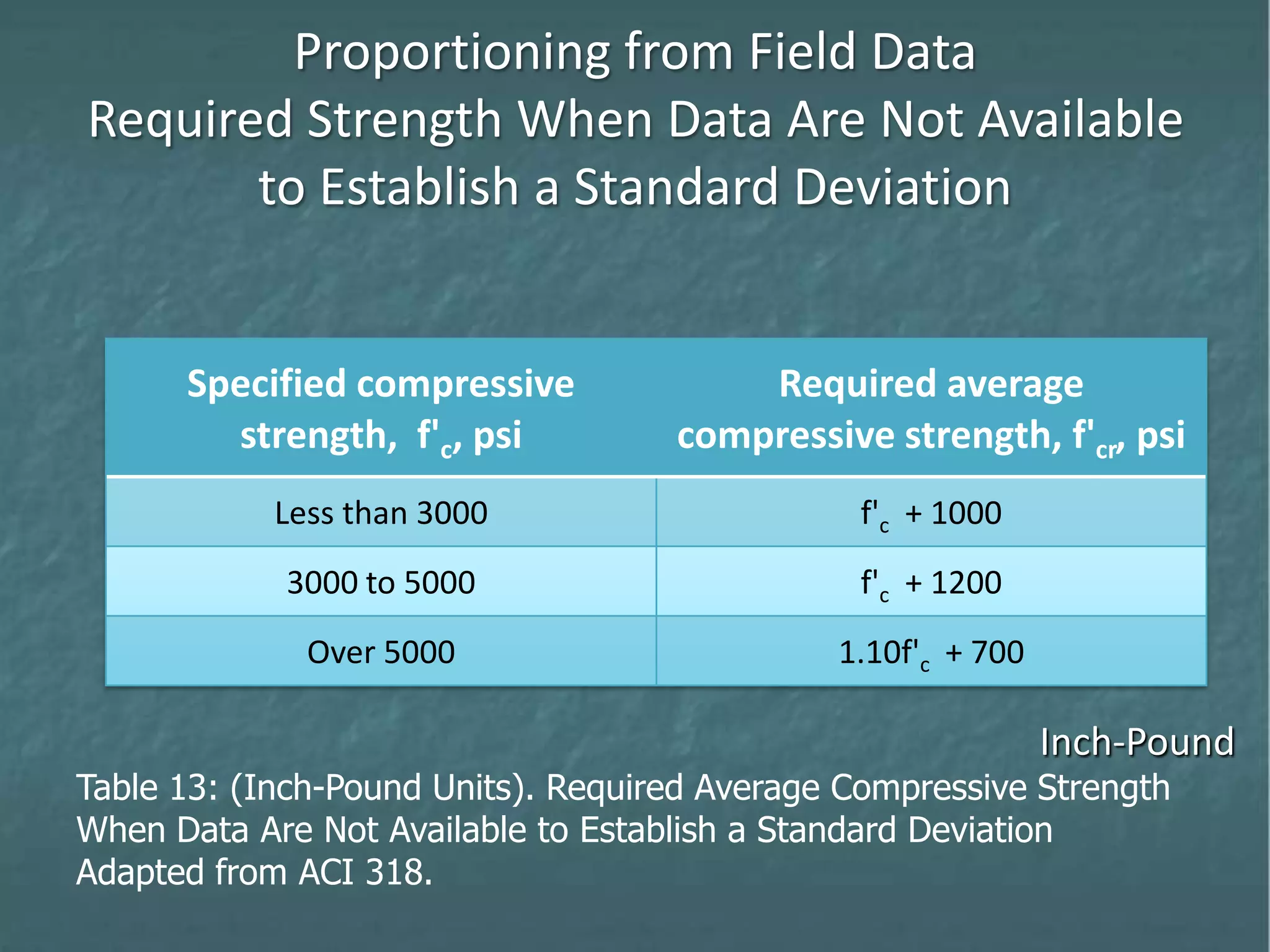
 When field strength test records do not meet the above, then
the required average strength of concrete can be obtained
from Table 13 (Table 9-11)
Proportioning from Field Data
Number of tests
Modification factor for
standard deviation
Less than 15 see next slide
15 1.16
20 1.08
25 1.03
30 or more 1.00
Modification Factor for Standard
Deviation ( 30 Tests)
Table 11: Modification factor for standard deviation when less than 30 tests are
available. Interpolated for design mixtures modified standard deviation to be
used to determine required average strength. Adapted from ACI 318.
Proportioning from Field Data
Required Strength When Data Are Available to Establish
a Standard Deviation
Specified compressive
strength, f'c, psi
Required average
compressive strength, f'cr, psi
5000
f'cr = f'c+ 1.34s
f'cr = f'c + 2.33s - 500
Use larger value
Over 5000
f'cr = f'c+ 1.34s
f'cr = 0.90f'c + 2.33s
Use larger value Inch-Pound
Table 12: Required Average Compressive Strength When Data Are
Available to Establish a Standard Deviation (Inch-Pound)
Adapted from ACI 318.
Proportioning from Field Data
Required Strength When Data Are Not Available
to Establish a Standard Deviation
Specified compressive
strength, f'c, psi
Required average
compressive strength, f'cr, psi
Less than 3000 f'c + 1000
3000 to 5000 f'c + 1200
Over 5000 1.10f'c + 700
Inch-Pound
Table 13: (Inch-Pound Units). Required Average Compressive Strength
When Data Are Not Available to Establish a Standard Deviation
Adapted from ACI 318.
Proportioning by Trial Mixtures
 Trial batching verifies that a concrete mixture meets
design requirements prior to use in construction.
 The trial mixtures should use the same materials
proposed for the work.
 Three mixtures with three different water-cementing
materials ratios or cementing materials contents
should be made.
 The trial mixtures should have a slump and air content
within ±20 mm (±0.75 in.) and ± 0.5%, respectively, of
the maximum permitted.
 Three cylinders for each water-cementing materials
ratio should be tested at 28 days.
Proportioning by Trial Mixtures
 Approved mixture must meet required average
compressive strength
 Three trial mixtures using three different water to
cementing materials ratios
 Slump and Air Content within +/- 20 mm(+/- 0.75 in.) and
+/- 0.5%
 Cylinders cured as per ASTM C192 (AASHTO T126)
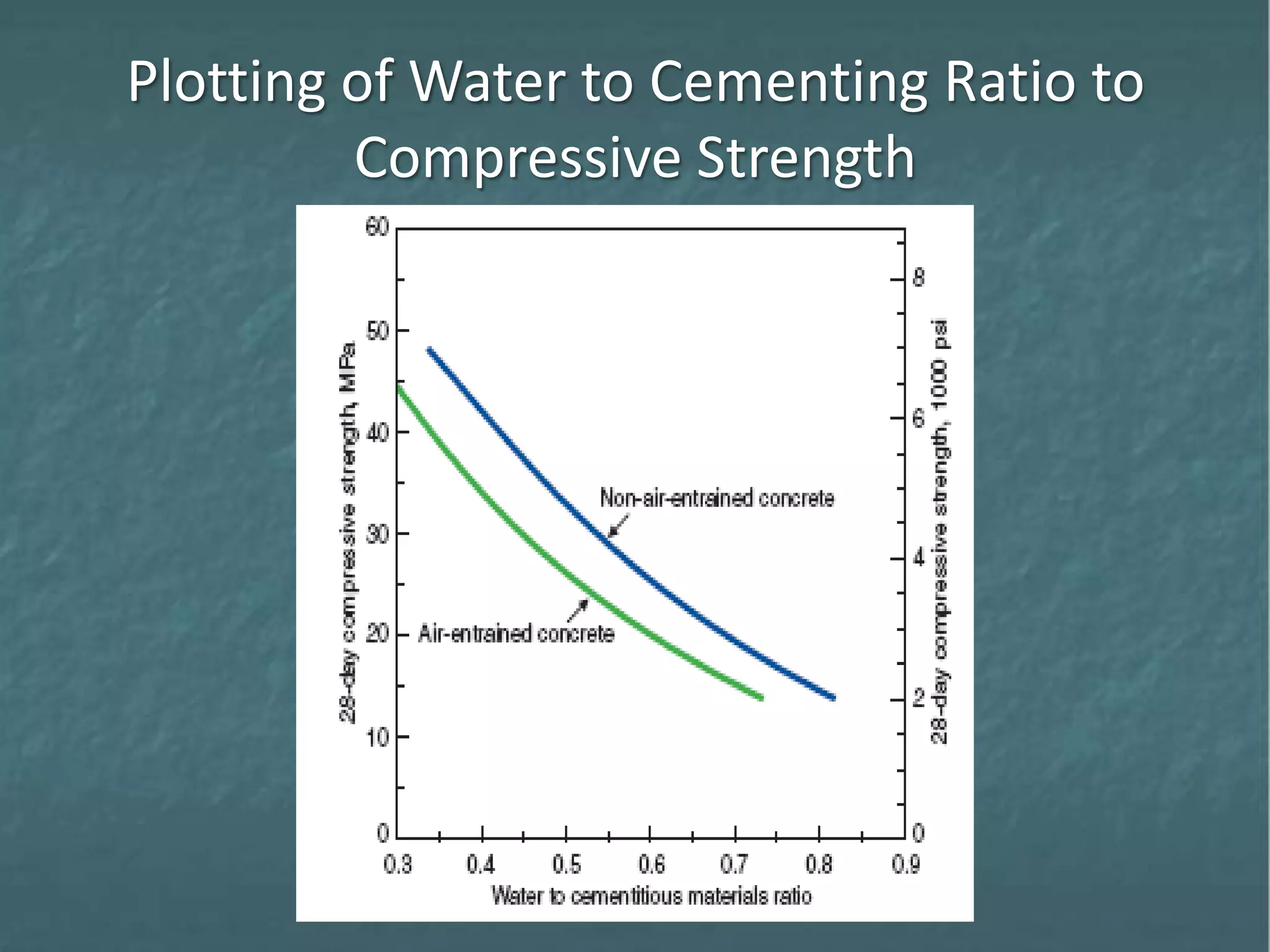
 Plot water to cementing ratio to strength curve
 Test the properties of the newly proportioned
mixture
Proportioning Concrete Ingredients
 Arbitrary assignment (1:2:3), volumetric
 Void Ratio
 Fineness Modulus
 Surface Area of Aggregates
 Cement Content
 Best approach
 Select proportions based on past experience
 Reliable test data established relationship between
strength and water to cementing materials ratio
Plotting of Water to Cementing Ratio to
Compressive Strength
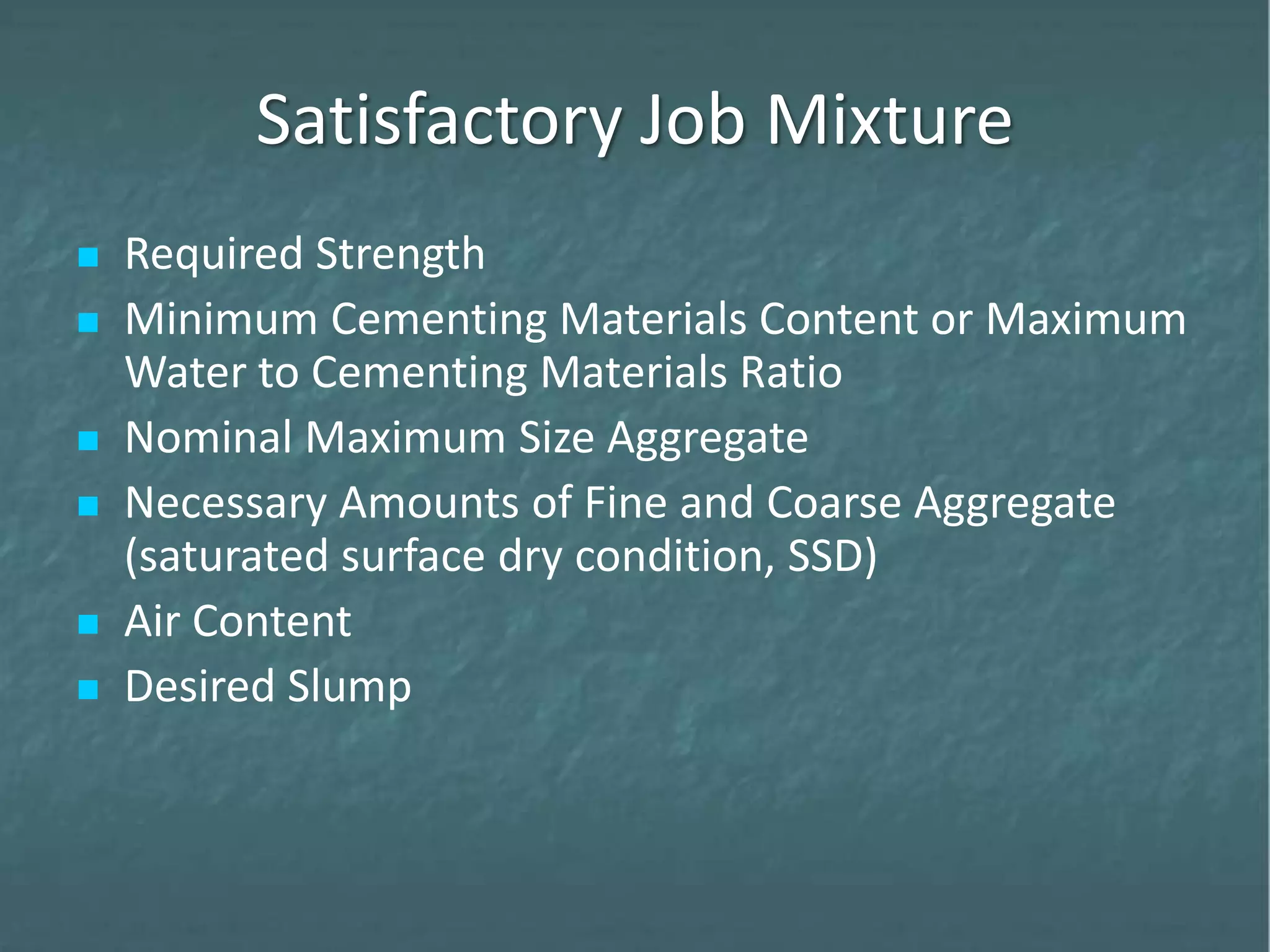
Satisfactory Job Mixture
 Required Strength
 Minimum Cementing Materials Content or Maximum
Water to Cementing Materials Ratio
 Nominal Maximum Size Aggregate
 Necessary Amounts of Fine and Coarse Aggregate
(saturated surface dry condition, SSD)
 Air Content
 Desired Slump
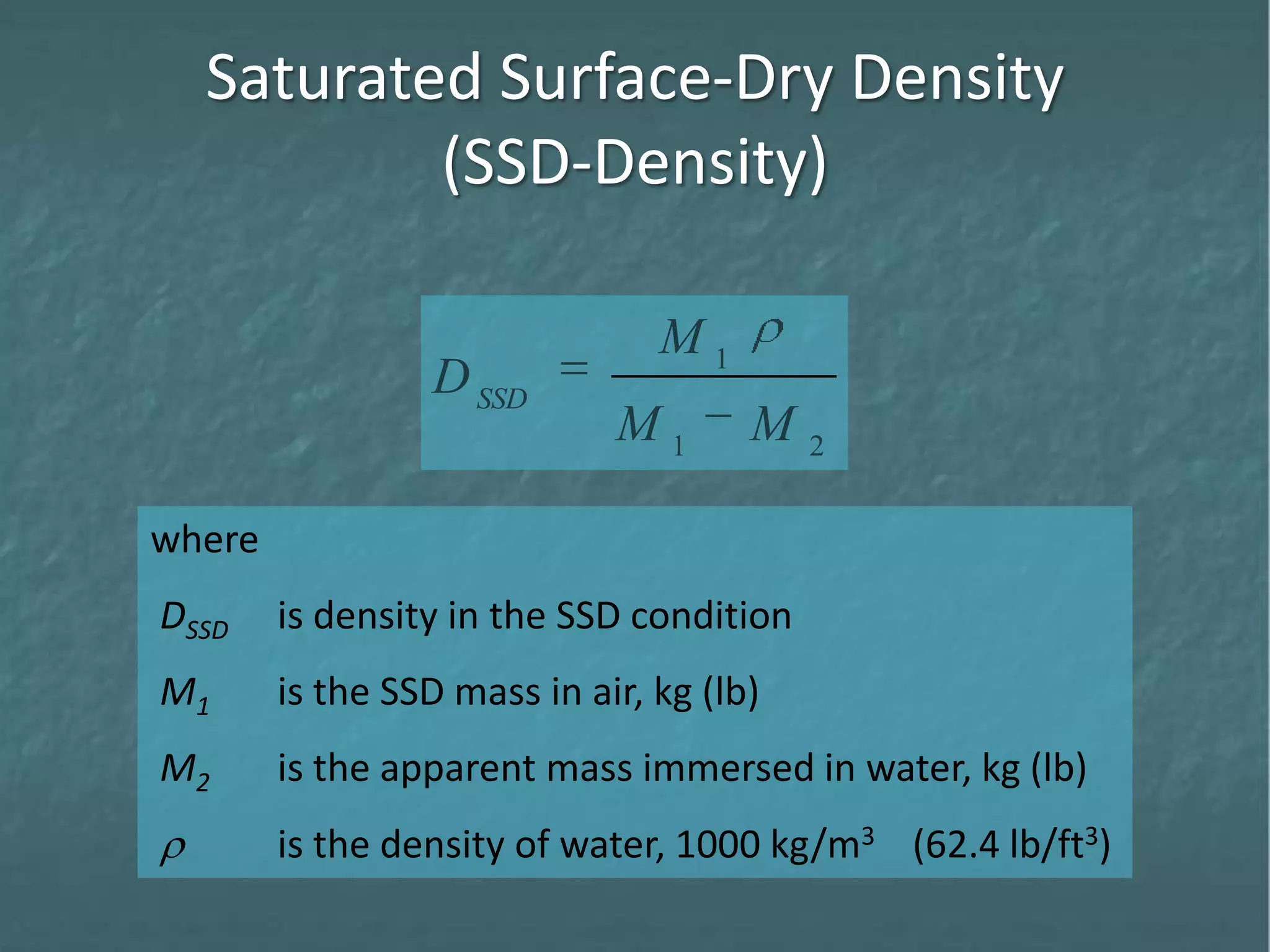
Saturated Surface-Dry Density
(SSD-Density)
where
DSSD is density in the SSD condition
M1 is the SSD mass in air, kg (lb)
M2 is the apparent mass immersed in water, kg (lb)
is the density of water, 1000 kg/m3 (62.4 lb/ft3)
21
1
MM
M
DSSD
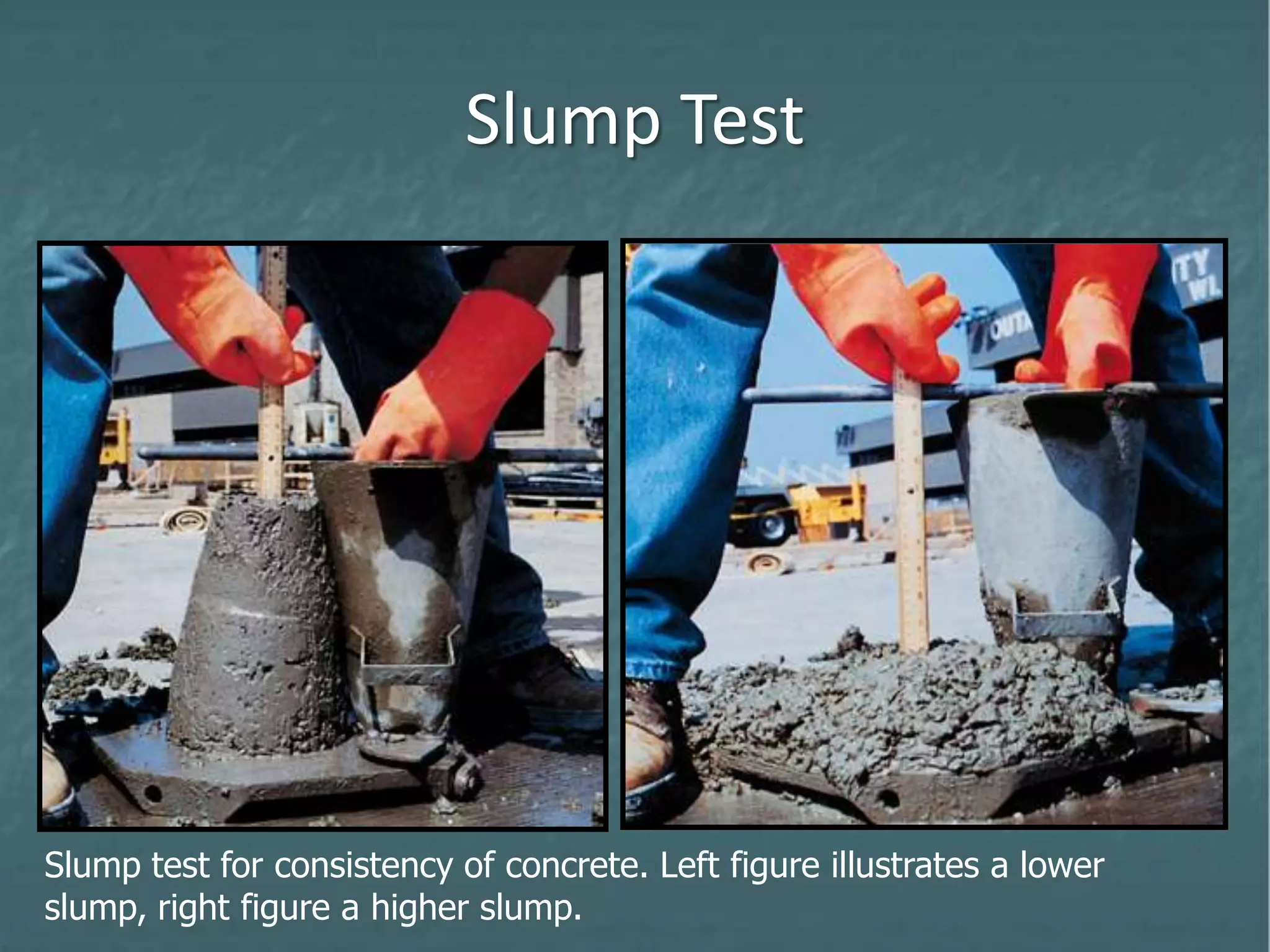
Slump Test
Slump test for consistency of concrete. Left figure illustrates a lower
slump, right figure a higher slump.
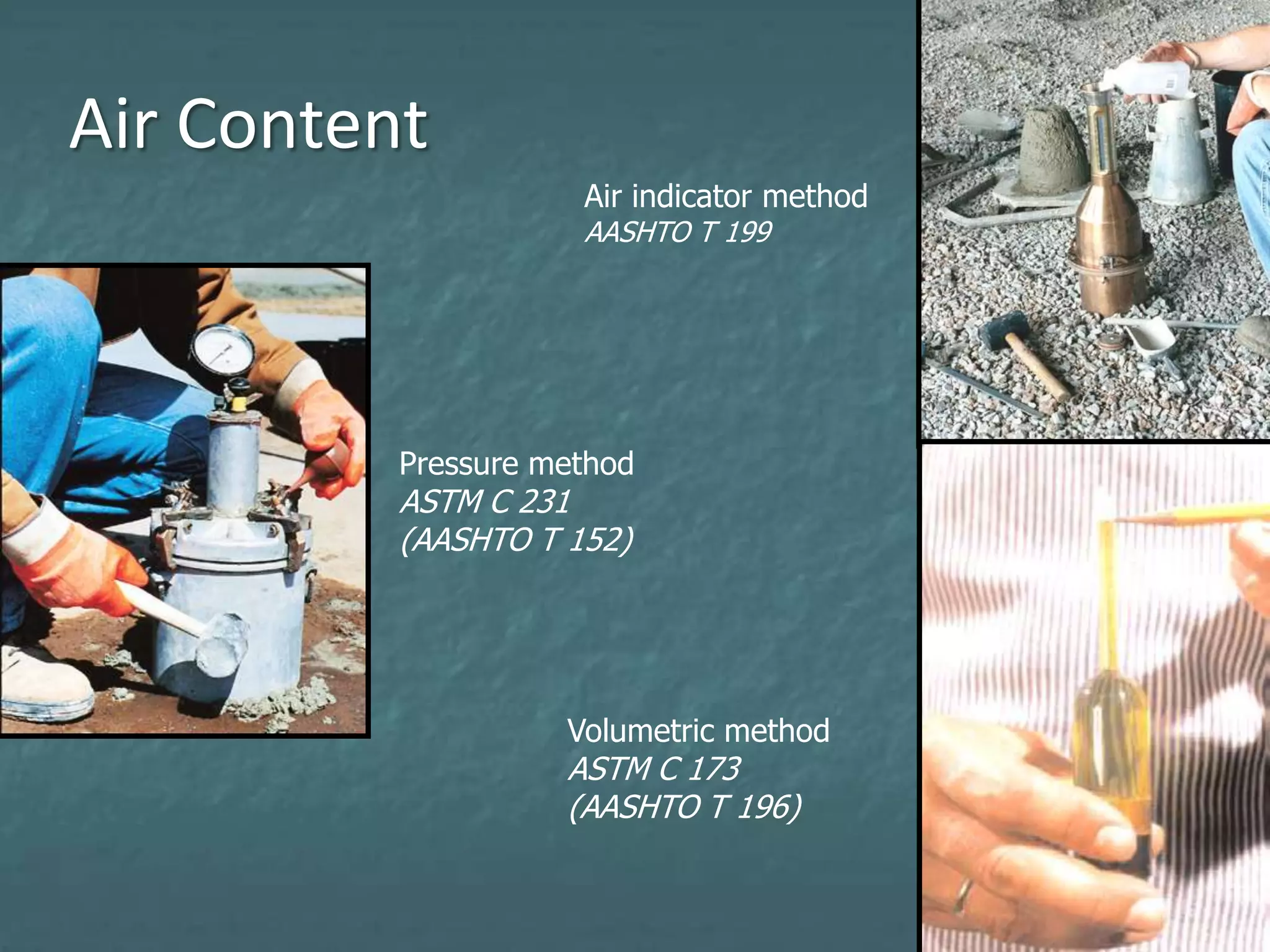
Air Content
Pressure method
ASTM C 231
(AASHTO T 152)
Volumetric method
ASTM C 173
(AASHTO T 196)
Air indicator method
AASHTO T 199
Tests, Measurements,
Calculations
 Tests for slump, air content, and temperature
on trial mixture
 Density (Unit Weight) and Yield
 Absolute Volume
Density (Unit Weight), Yield
 In accordance with ASTM C138
 Density (Unit Weight): Pounds/Cubic ft
 Yield: Cubic Feet
 Calculation, Dividing total mass of materials
batched to density of freshly mixed concrete
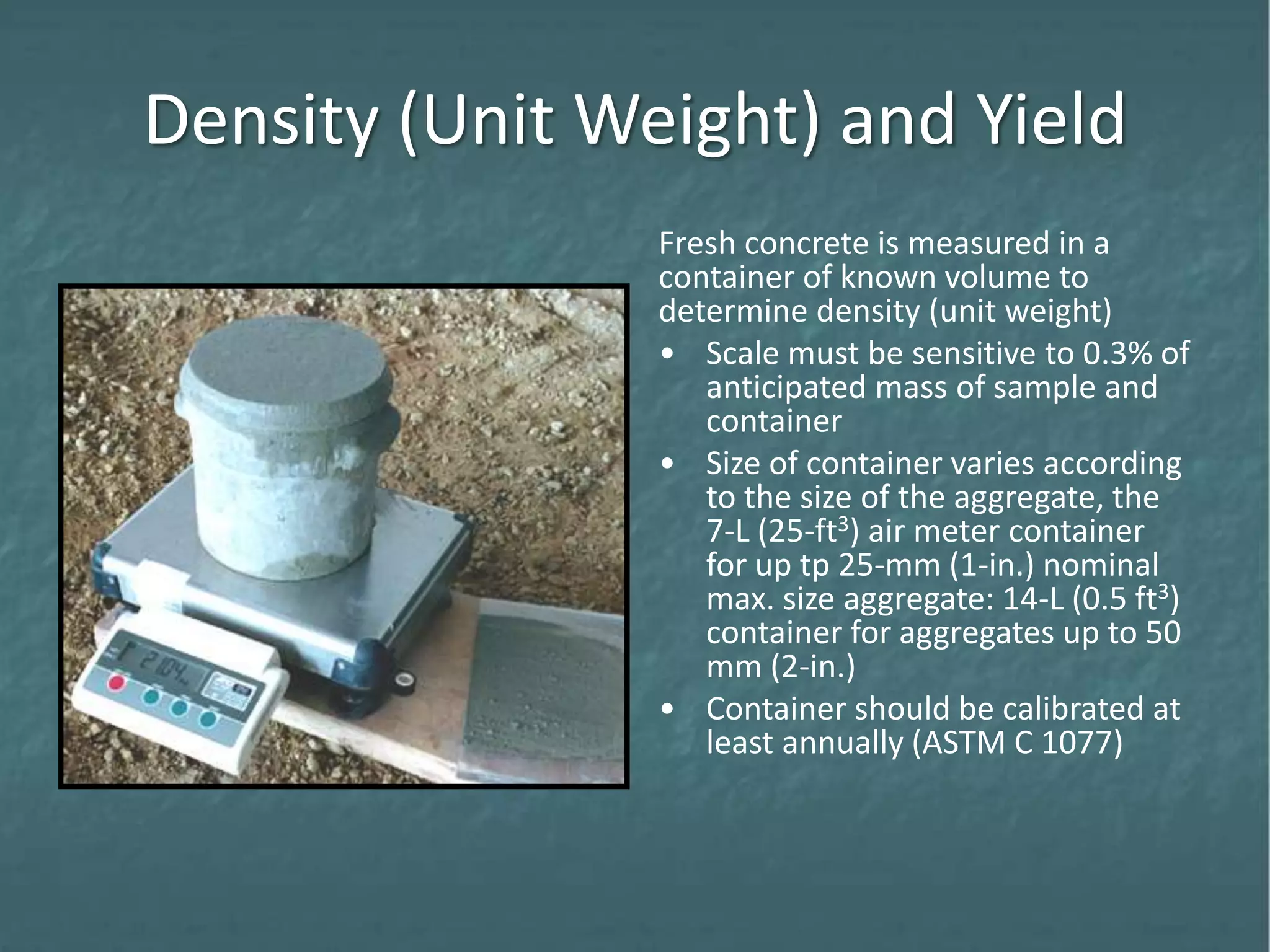
Density (Unit Weight) and Yield
Fresh concrete is measured in a
container of known volume to
determine density (unit weight)
• Scale must be sensitive to 0.3% of
anticipated mass of sample and
container
• Size of container varies according
to the size of the aggregate, the
7-L (25-ft3) air meter container
for up tp 25-mm (1-in.) nominal
max. size aggregate: 14-L (0.5 ft3)
container for aggregates up to 50
mm (2-in.)
• Container should be calibrated at
least annually (ASTM C 1077)
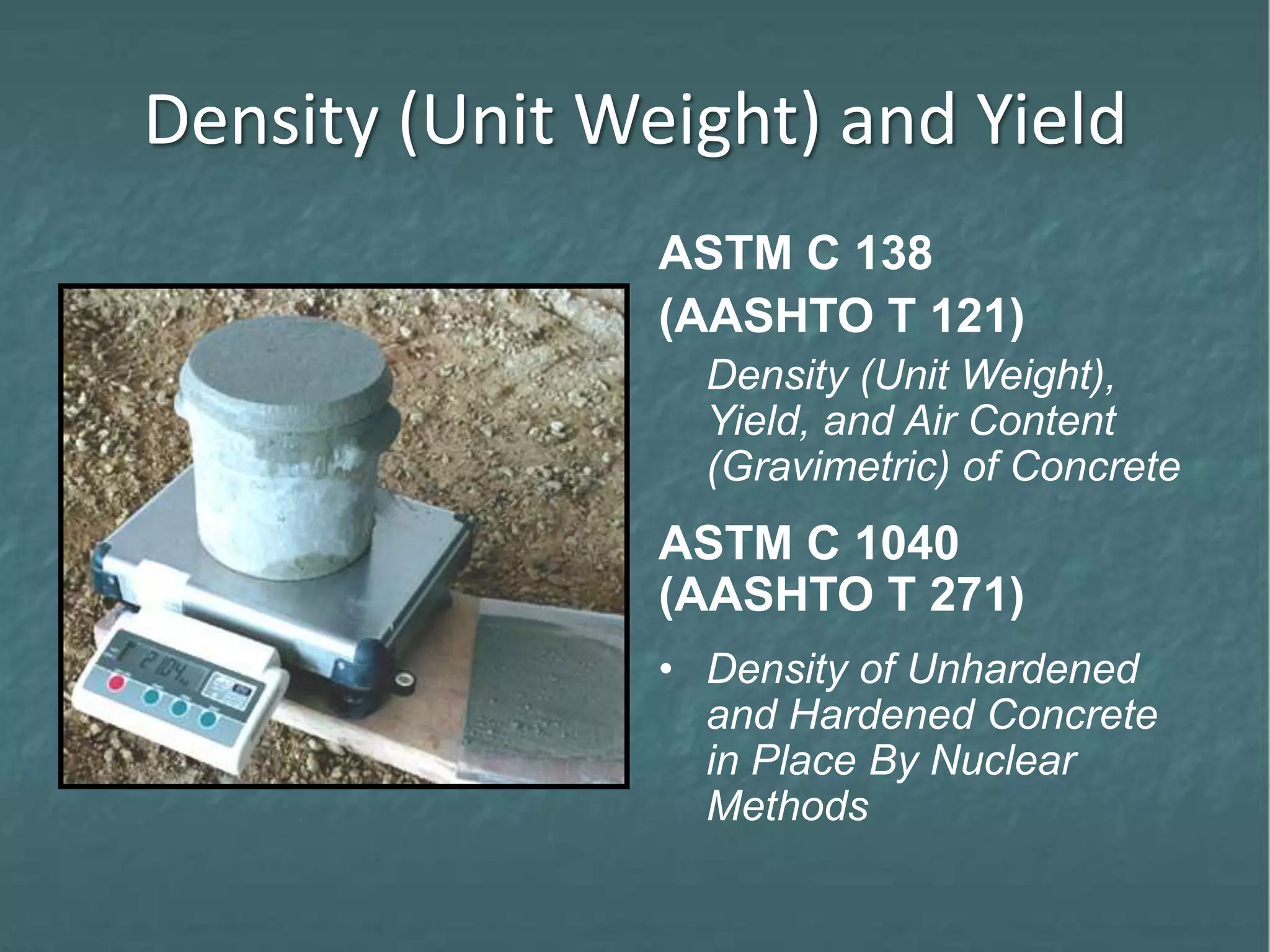
Density (Unit Weight) and Yield
ASTM C 138
(AASHTO T 121)
Density (Unit Weight),
Yield, and Air Content
(Gravimetric) of Concrete
ASTM C 1040
(AASHTO T 271)
• Density of Unhardened
and Hardened Concrete
in Place By Nuclear
Methods
Absolute Volume
 Volume of a granular material is the volume of
the solid matter in the particles without
volume of air spaces
 Yield of freshly mixed concrete is equal to the
sum of the absolute volumes of the concrete
ingredients
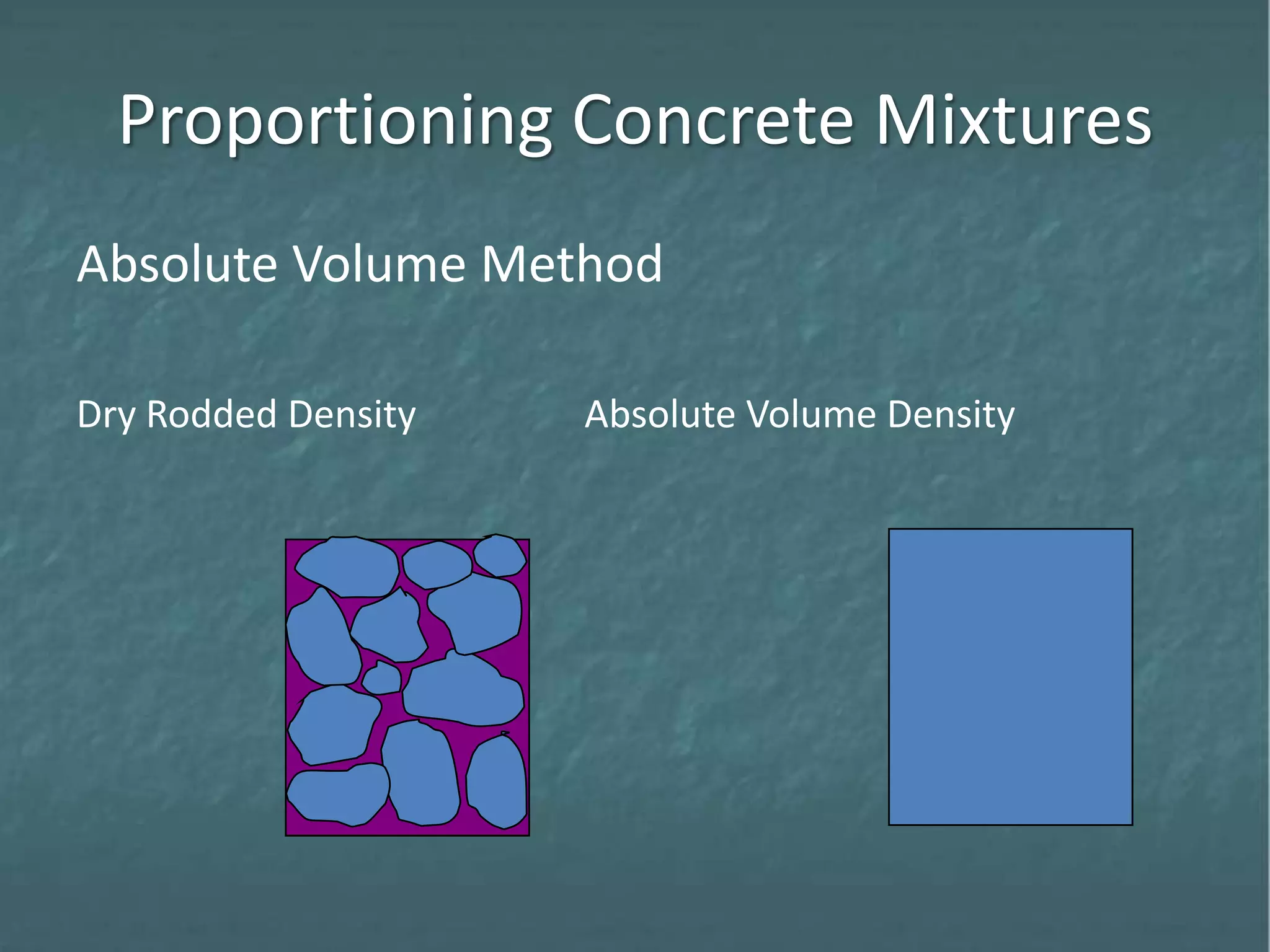
Proportioning Concrete Mixtures
Absolute Volume Method
Dry Rodded Density Absolute Volume Density
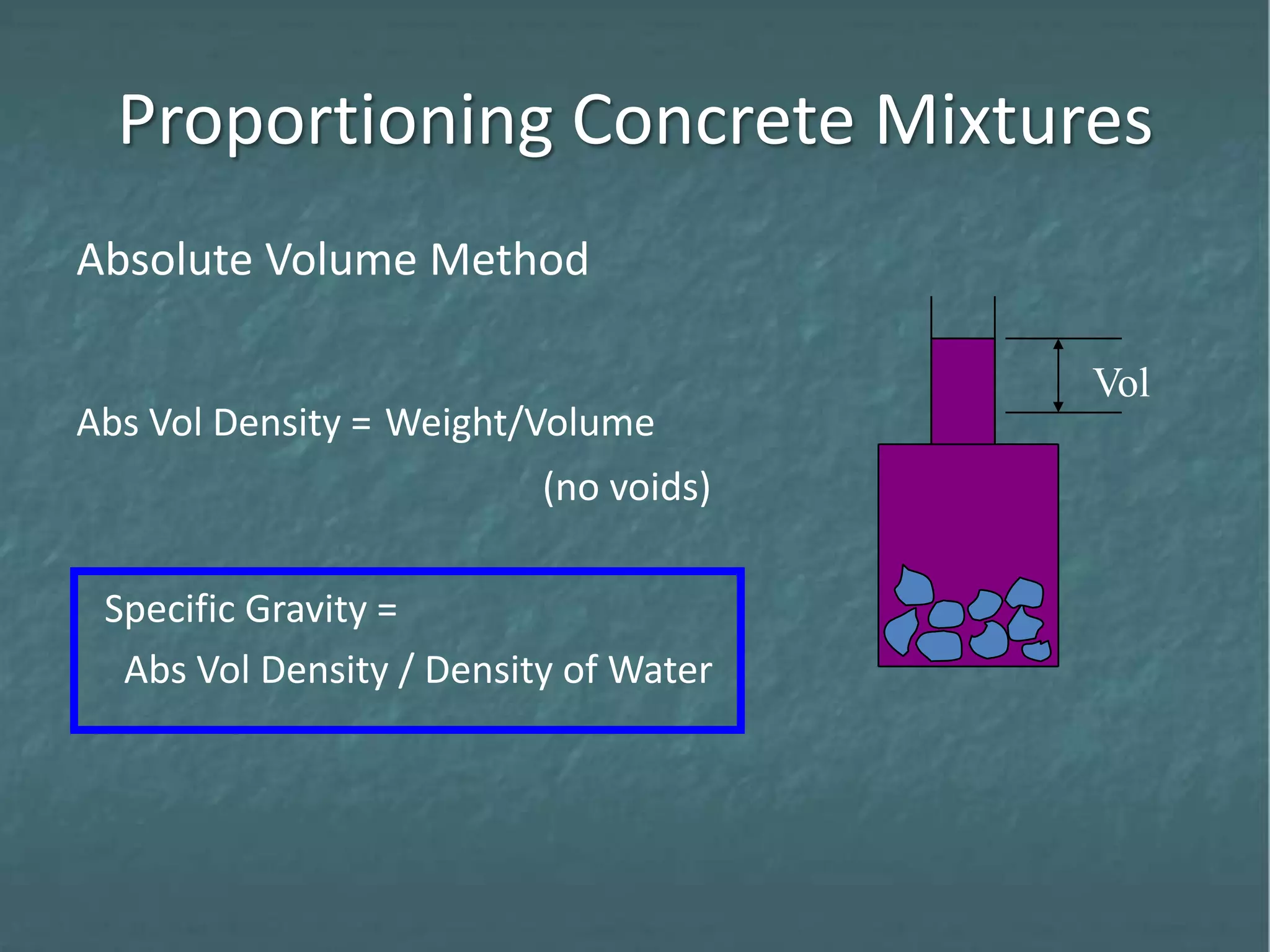
Proportioning Concrete Mixtures
Absolute Volume Method
Abs Vol Density = Weight/Volume
(no voids)
Specific Gravity =
Abs Vol Density / Density of Water
Vol
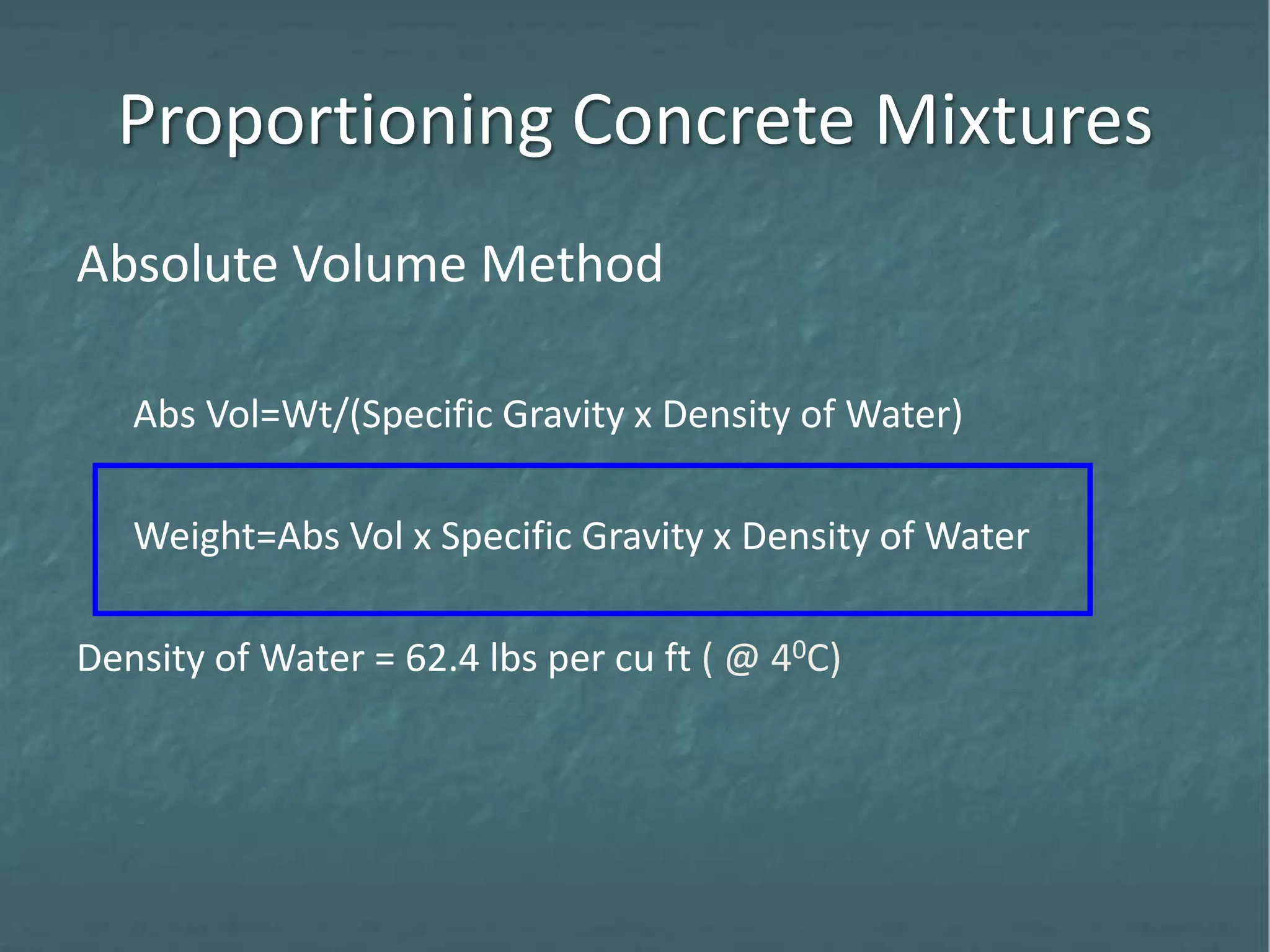
Proportioning Concrete Mixtures
Absolute Volume Method
Abs Vol=Wt/(Specific Gravity x Density of Water)
Weight=Abs Vol x Specific Gravity x Density of Water
Density of Water = 62.4 lbs per cu ft ( @ 40C)
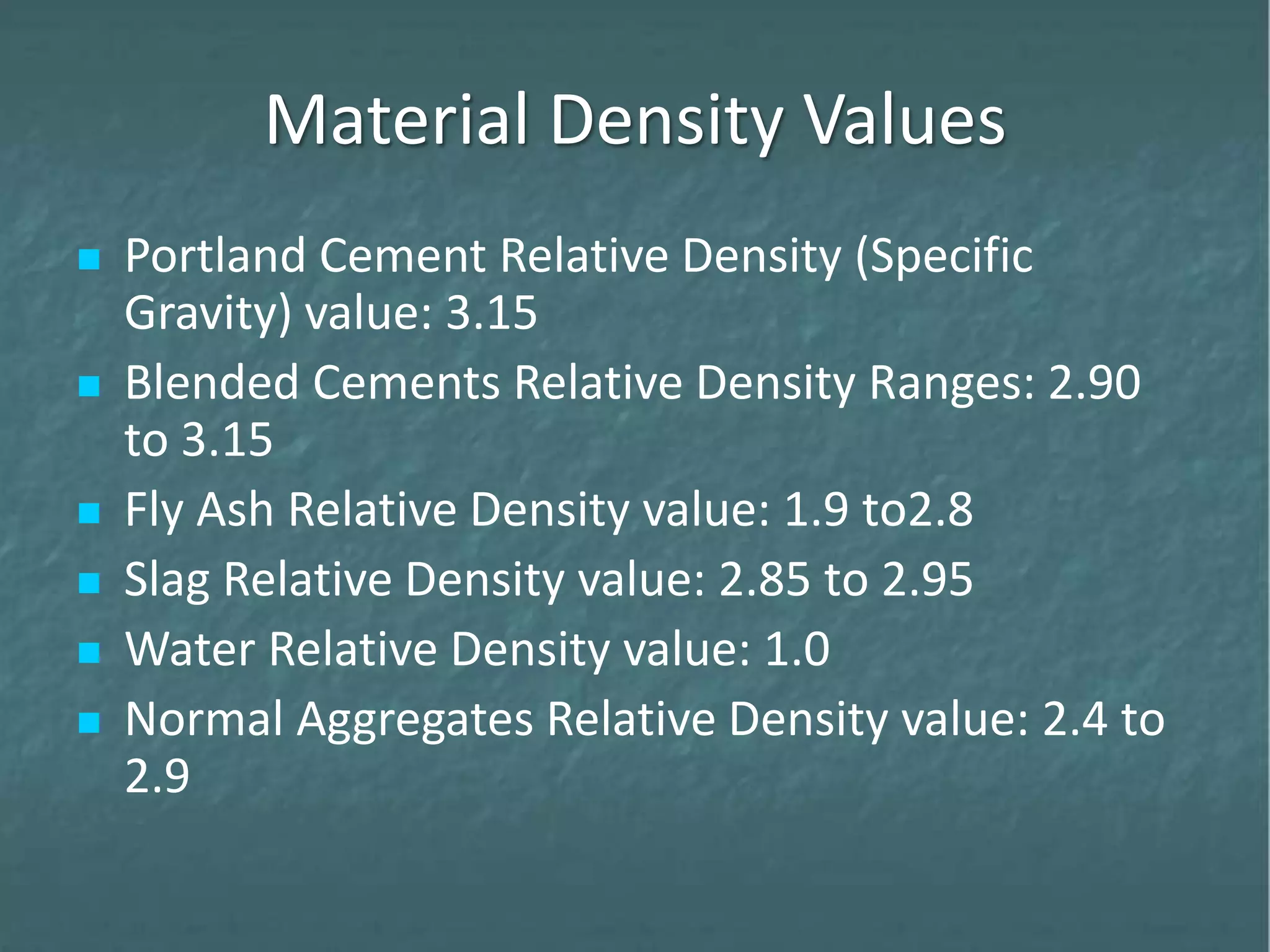
Material Density Values
 Portland Cement Relative Density (Specific
Gravity) value: 3.15
 Blended Cements Relative Density Ranges: 2.90
to 3.15
 Fly Ash Relative Density value: 1.9 to2.8
 Slag Relative Density value: 2.85 to 2.95
 Water Relative Density value: 1.0
 Normal Aggregates Relative Density value: 2.4 to
2.9
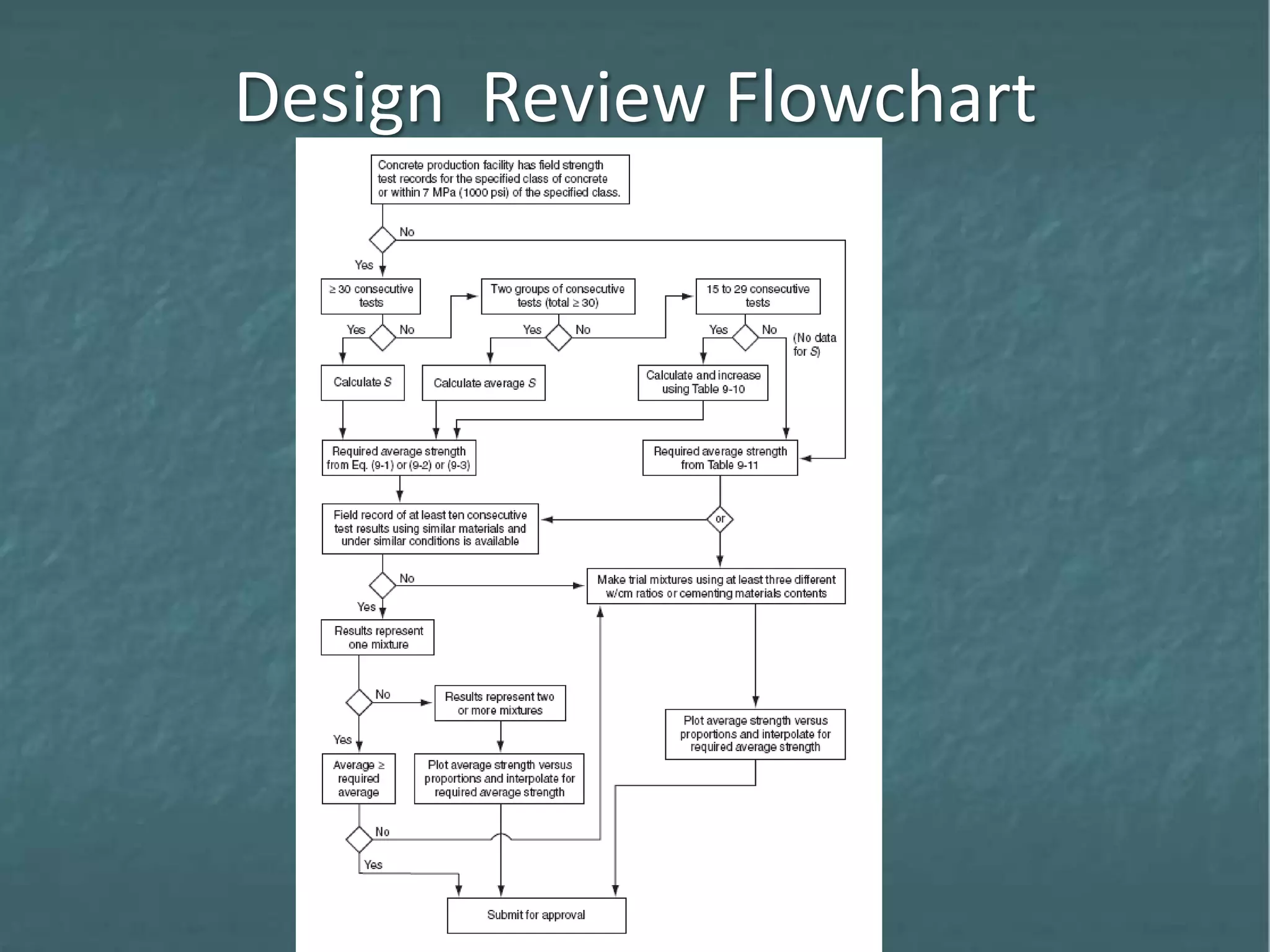
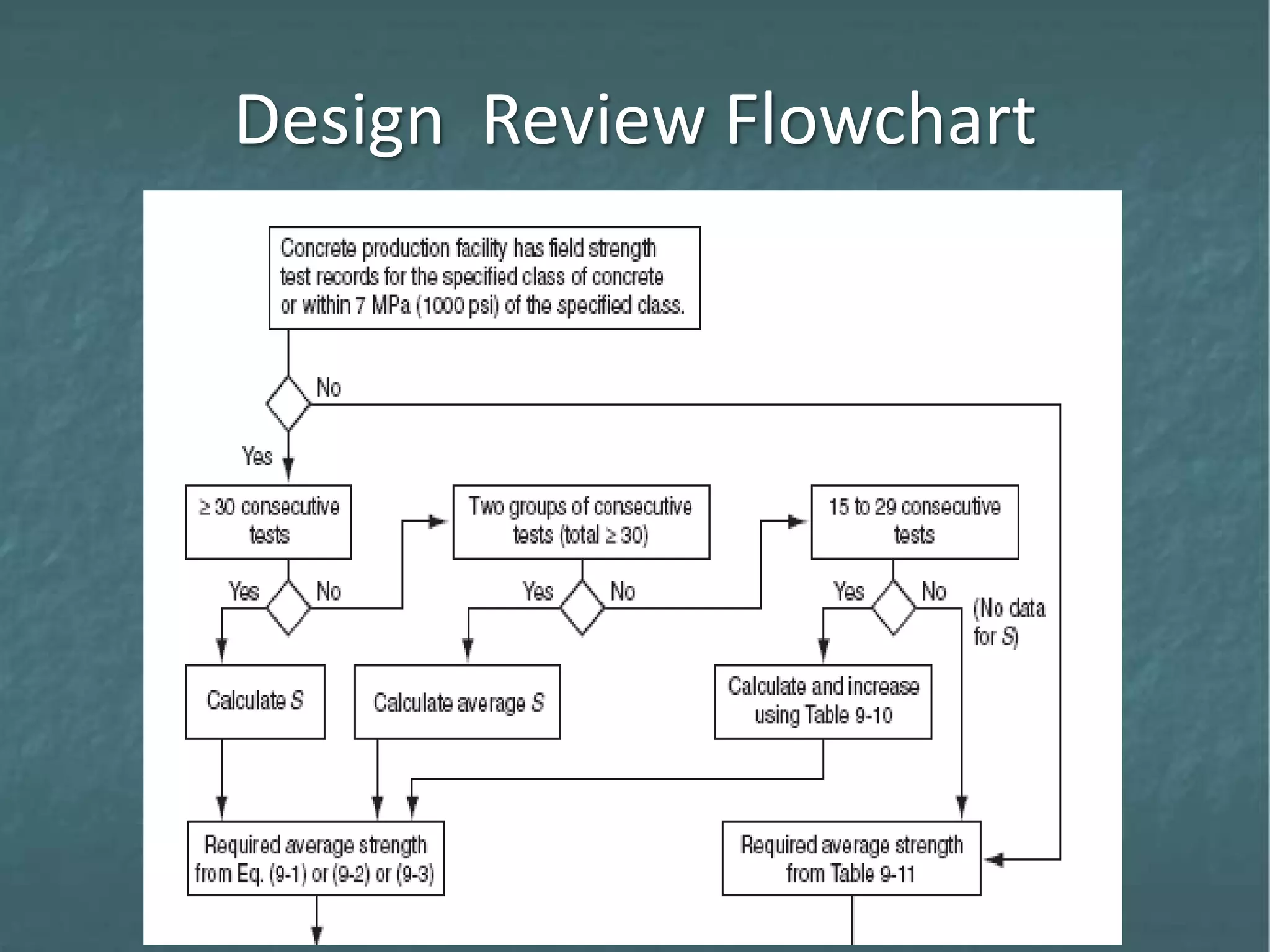
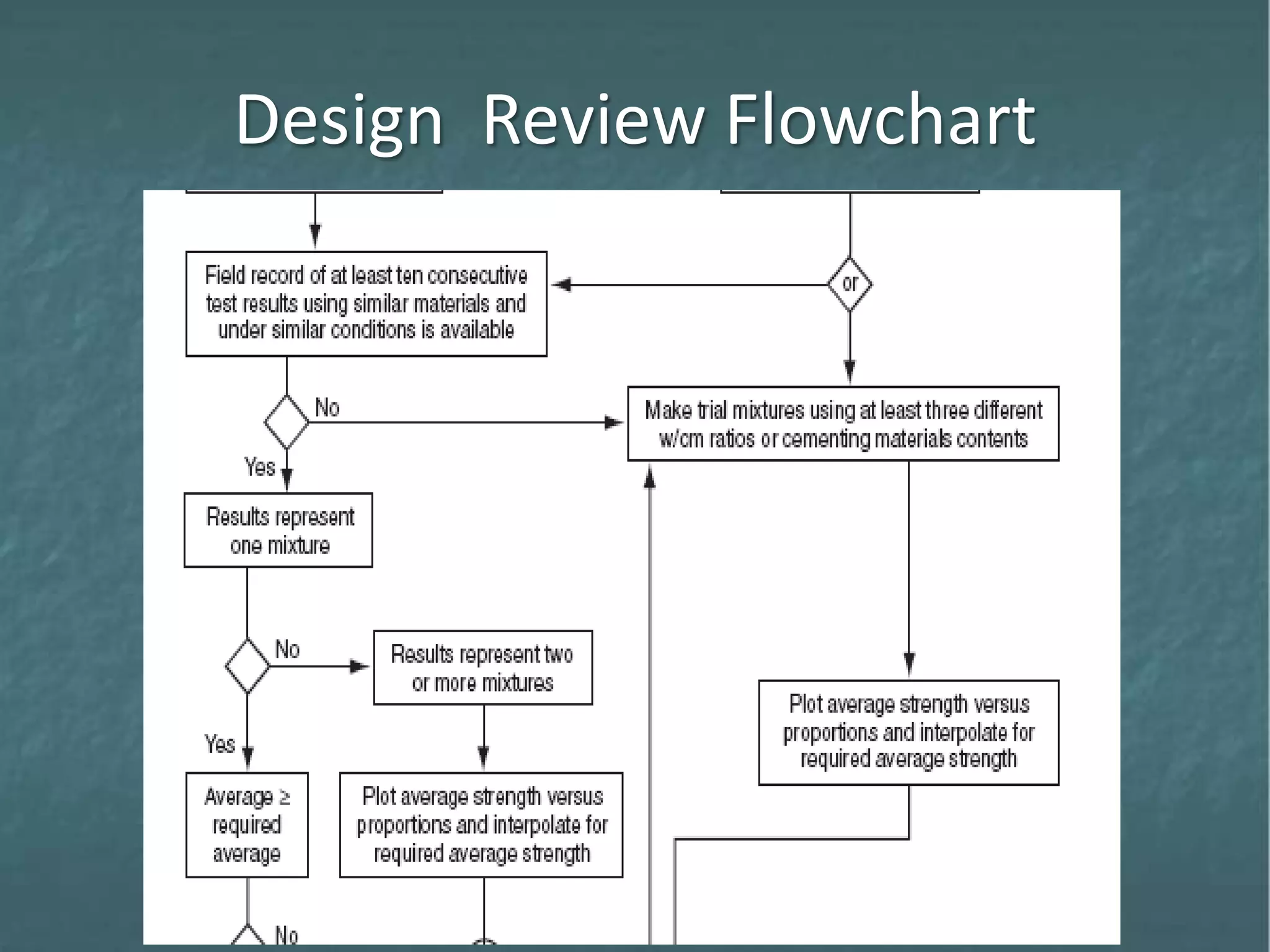
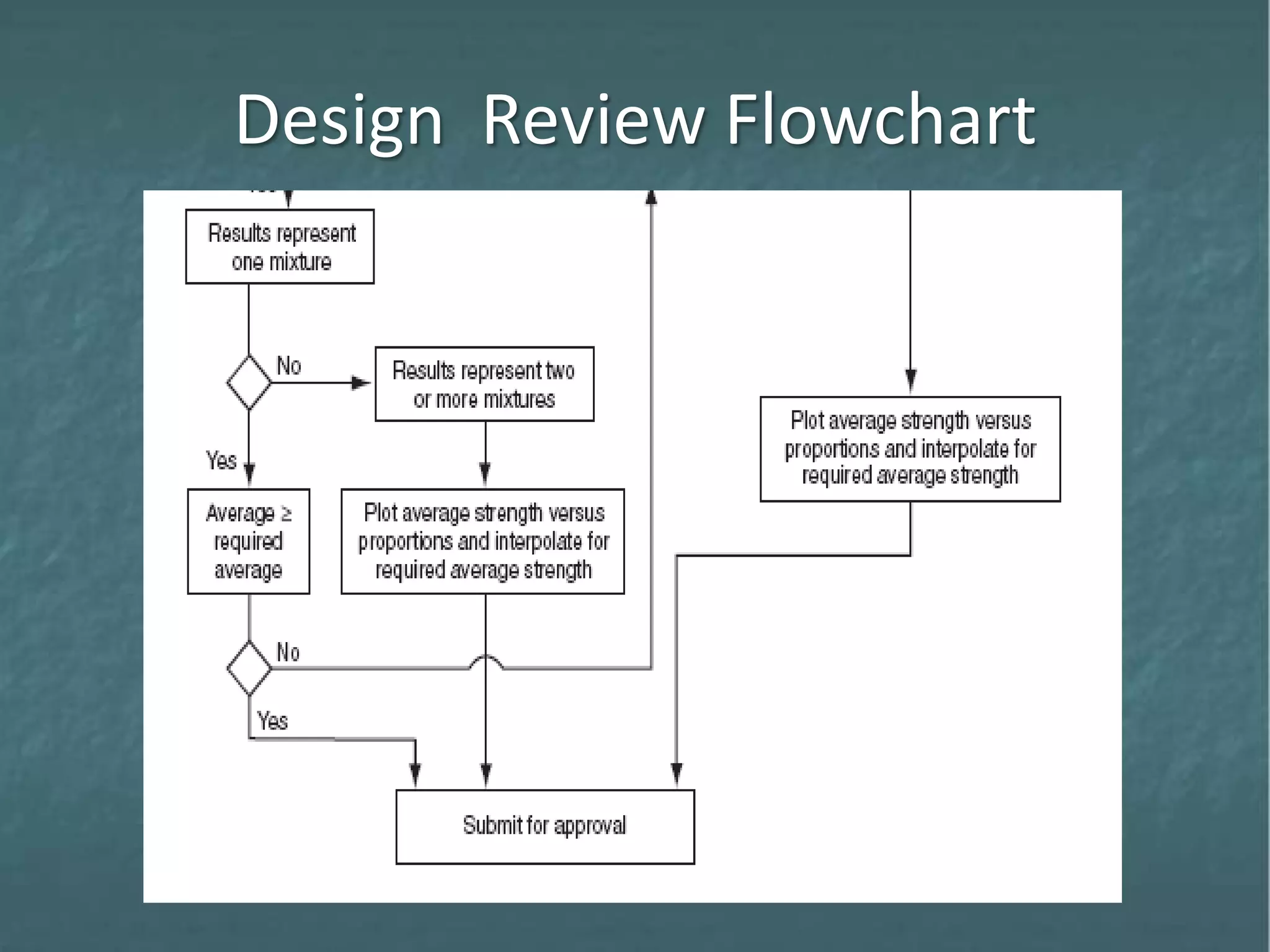
Design Review Flowchart
Questions?
Email cemtek@netzero.net

CON 124 Session 4 - Proportioning Methods

  • 1.
    CON 124 Basic ConcreteMix Design Proportioning Session 4 Proportioning Methods
  • 2.
    Methods for ProportioningConcrete Mixtures  Water-cement ratio method  Weight method  Absolute volume method  Field experience (statistical data)  Trial mixtures
  • 3.
    Design of ConcreteMixtures  Establishment of specific concrete characteristics  Relative Density (Specific Gravity)  Absolute volume calculation (27 Cubic Ft)  Durability Issues  Selection of proportions of available materials to produce concrete of required properties, with the greatest economy
  • 4.
    Concrete Mixture Designfrom Field Data  Strength-Test Data  Standard Deviations show mixture is acceptable  Durability aspects must be met  Statistical data should represent the same material, proportions, and concreting conditions
  • 5.
    Proportioning Data forProposed Work  Concrete Strength within 7MPa (1000 psi)  Data should represent at least 30 consecutive tests or two groups representing of consecutive tests totaling at least 30 tests (average of two cylinders)  If data between 15-29 tests, an adjusted Std. Dev. (S) is multiplied by modification factor from Table 11  Modified Std. Dev. (S) is then used in equations 1-3 from Table 12  When field strength test records do not meet the above, then the required average strength of concrete can be obtained from Table 13 (Table 9-11)
  • 6.
    Proportioning from FieldData Number of tests Modification factor for standard deviation Less than 15 see next slide 15 1.16 20 1.08 25 1.03 30 or more 1.00 Modification Factor for Standard Deviation ( 30 Tests) Table 11: Modification factor for standard deviation when less than 30 tests are available. Interpolated for design mixtures modified standard deviation to be used to determine required average strength. Adapted from ACI 318.
  • 7.
    Proportioning from FieldData Required Strength When Data Are Available to Establish a Standard Deviation Specified compressive strength, f'c, psi Required average compressive strength, f'cr, psi 5000 f'cr = f'c+ 1.34s f'cr = f'c + 2.33s - 500 Use larger value Over 5000 f'cr = f'c+ 1.34s f'cr = 0.90f'c + 2.33s Use larger value Inch-Pound Table 12: Required Average Compressive Strength When Data Are Available to Establish a Standard Deviation (Inch-Pound) Adapted from ACI 318.
  • 8.
    Proportioning from FieldData Required Strength When Data Are Not Available to Establish a Standard Deviation Specified compressive strength, f'c, psi Required average compressive strength, f'cr, psi Less than 3000 f'c + 1000 3000 to 5000 f'c + 1200 Over 5000 1.10f'c + 700 Inch-Pound Table 13: (Inch-Pound Units). Required Average Compressive Strength When Data Are Not Available to Establish a Standard Deviation Adapted from ACI 318.
  • 9.
    Proportioning by TrialMixtures  Trial batching verifies that a concrete mixture meets design requirements prior to use in construction.  The trial mixtures should use the same materials proposed for the work.  Three mixtures with three different water-cementing materials ratios or cementing materials contents should be made.  The trial mixtures should have a slump and air content within ±20 mm (±0.75 in.) and ± 0.5%, respectively, of the maximum permitted.  Three cylinders for each water-cementing materials ratio should be tested at 28 days.
  • 10.
    Proportioning by TrialMixtures  Approved mixture must meet required average compressive strength  Three trial mixtures using three different water to cementing materials ratios  Slump and Air Content within +/- 20 mm(+/- 0.75 in.) and +/- 0.5%  Cylinders cured as per ASTM C192 (AASHTO T126)  Plot water to cementing ratio to strength curve  Test the properties of the newly proportioned mixture
  • 11.
    Proportioning Concrete Ingredients Arbitrary assignment (1:2:3), volumetric  Void Ratio  Fineness Modulus  Surface Area of Aggregates  Cement Content  Best approach  Select proportions based on past experience  Reliable test data established relationship between strength and water to cementing materials ratio
  • 12.
    Plotting of Waterto Cementing Ratio to Compressive Strength
  • 13.
    Satisfactory Job Mixture Required Strength  Minimum Cementing Materials Content or Maximum Water to Cementing Materials Ratio  Nominal Maximum Size Aggregate  Necessary Amounts of Fine and Coarse Aggregate (saturated surface dry condition, SSD)  Air Content  Desired Slump
  • 14.
    Saturated Surface-Dry Density (SSD-Density) where DSSDis density in the SSD condition M1 is the SSD mass in air, kg (lb) M2 is the apparent mass immersed in water, kg (lb) is the density of water, 1000 kg/m3 (62.4 lb/ft3) 21 1 MM M DSSD
  • 15.
    Slump Test Slump testfor consistency of concrete. Left figure illustrates a lower slump, right figure a higher slump.
  • 16.
    Air Content Pressure method ASTMC 231 (AASHTO T 152) Volumetric method ASTM C 173 (AASHTO T 196) Air indicator method AASHTO T 199
  • 17.
    Tests, Measurements, Calculations  Testsfor slump, air content, and temperature on trial mixture  Density (Unit Weight) and Yield  Absolute Volume
  • 18.
    Density (Unit Weight),Yield  In accordance with ASTM C138  Density (Unit Weight): Pounds/Cubic ft  Yield: Cubic Feet  Calculation, Dividing total mass of materials batched to density of freshly mixed concrete
  • 19.
    Density (Unit Weight)and Yield Fresh concrete is measured in a container of known volume to determine density (unit weight) • Scale must be sensitive to 0.3% of anticipated mass of sample and container • Size of container varies according to the size of the aggregate, the 7-L (25-ft3) air meter container for up tp 25-mm (1-in.) nominal max. size aggregate: 14-L (0.5 ft3) container for aggregates up to 50 mm (2-in.) • Container should be calibrated at least annually (ASTM C 1077)
  • 20.
    Density (Unit Weight)and Yield ASTM C 138 (AASHTO T 121) Density (Unit Weight), Yield, and Air Content (Gravimetric) of Concrete ASTM C 1040 (AASHTO T 271) • Density of Unhardened and Hardened Concrete in Place By Nuclear Methods
  • 21.
    Absolute Volume  Volumeof a granular material is the volume of the solid matter in the particles without volume of air spaces  Yield of freshly mixed concrete is equal to the sum of the absolute volumes of the concrete ingredients
  • 22.
    Proportioning Concrete Mixtures AbsoluteVolume Method Dry Rodded Density Absolute Volume Density
  • 23.
    Proportioning Concrete Mixtures AbsoluteVolume Method Abs Vol Density = Weight/Volume (no voids) Specific Gravity = Abs Vol Density / Density of Water Vol
  • 24.
    Proportioning Concrete Mixtures AbsoluteVolume Method Abs Vol=Wt/(Specific Gravity x Density of Water) Weight=Abs Vol x Specific Gravity x Density of Water Density of Water = 62.4 lbs per cu ft ( @ 40C)
  • 25.
    Material Density Values Portland Cement Relative Density (Specific Gravity) value: 3.15  Blended Cements Relative Density Ranges: 2.90 to 3.15  Fly Ash Relative Density value: 1.9 to2.8  Slag Relative Density value: 2.85 to 2.95  Water Relative Density value: 1.0  Normal Aggregates Relative Density value: 2.4 to 2.9
  • 26.
  • 27.
  • 28.
  • 29.
  • 30.