Blueprint for Security
Chapter 6
Begin with the end in mind.
-- Stephen Covey
Principles of Information Security - Chapter 6 Slide 2
Learning Objectives:
Upon completion of this chapter you should be
able to:
– Understand management’s responsibilities and role in the
development, maintenance, and enforcement of information
security policy, standards, practices, procedures, and guidelines
– Understand the differences between the organization’s general
information security policy and the requirements and objectives
of the various issue-specific and system-specific policies.
– Know what an information security blueprint is and what its
major components are.
– Understand how an organization institutionalizes its policies,
standards, and practices using education, training, and
awareness programs.
– Become familiar with what viable information security
architecture is, what it includes, and how it is used.
Principles of Information Security - Chapter 6 Slide 3
Information Security Policy,
Standards, and Practices
♦ Management from all communities of interest
must consider policies as the basis for all
information security efforts
♦ Policies direct how issues should be addressed
and technologies used
♦ Security policies are the least expensive control
to execute, but the most difficult to implement
♦ Shaping policy is difficult because:
– Never conflict with laws
– Stand up in court, if challenged
– Be properly administered
Principles of Information Security - Chapter 6 Slide 4
Definitions
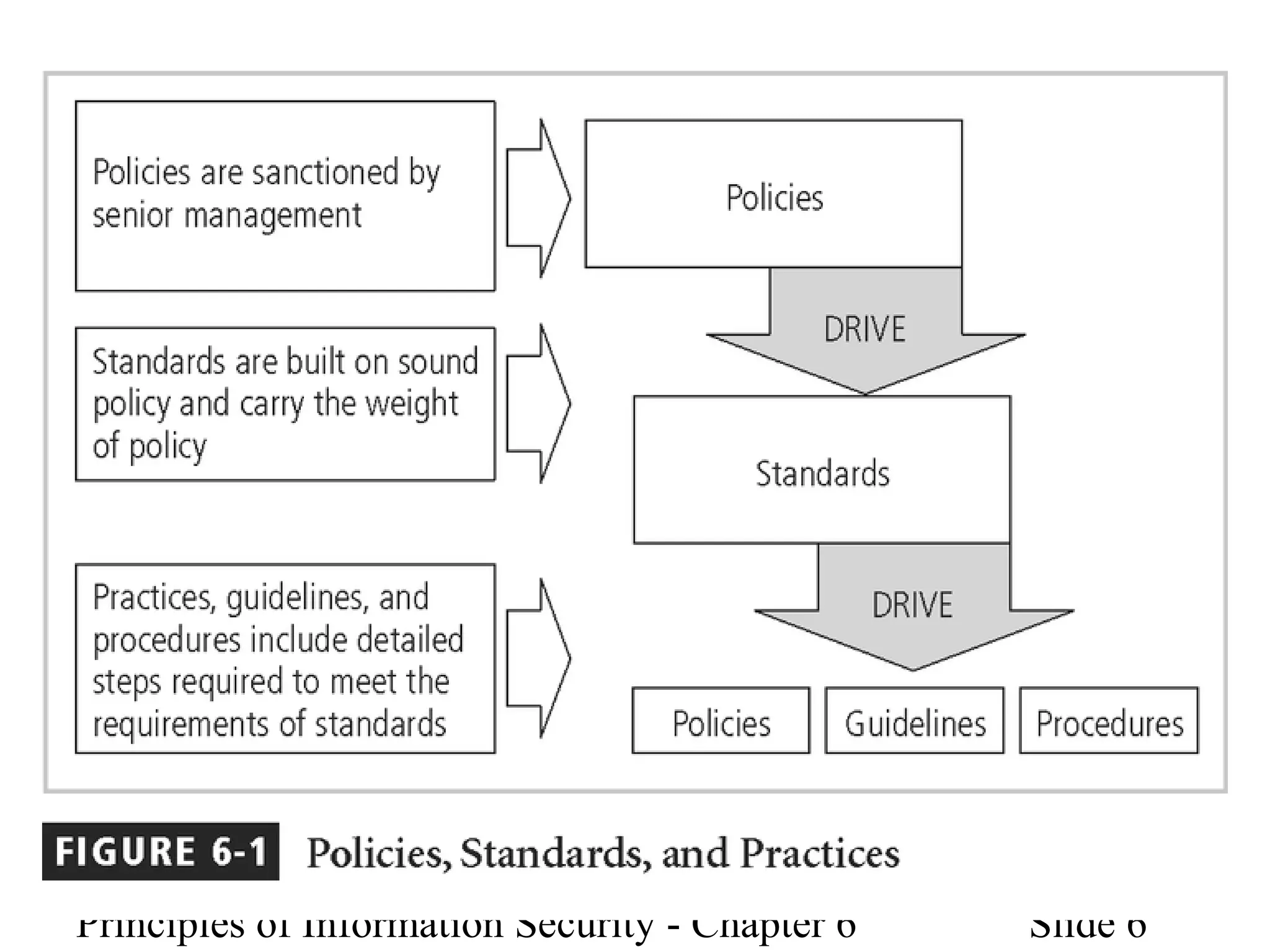
♦ A policy is
A plan or course of action, as of a government,
political party, or business, intended to influence and
determine decisions, actions, and other matters
♦ Policies are organizational laws
♦ Standards, on the other hand, are more detailed
statements of what must be done to comply with policy
♦ Practices, procedures, and guidelines effectively explain
how to comply with policy
♦ For a policy to be effective it must be properly
disseminated, read, understood and agreed to by all
members of the organization
Principles of Information Security - Chapter 6 Slide 5
Types of Policy
Management defines three types of
security policy:
– General or security program policy
– Issue-specific security policies
– Systems-specific security policies
Principles of Information Security - Chapter 6 Slide 6
Figure 6-1 – Policies
Standards & Practices
Principles of Information Security - Chapter 6 Slide 7
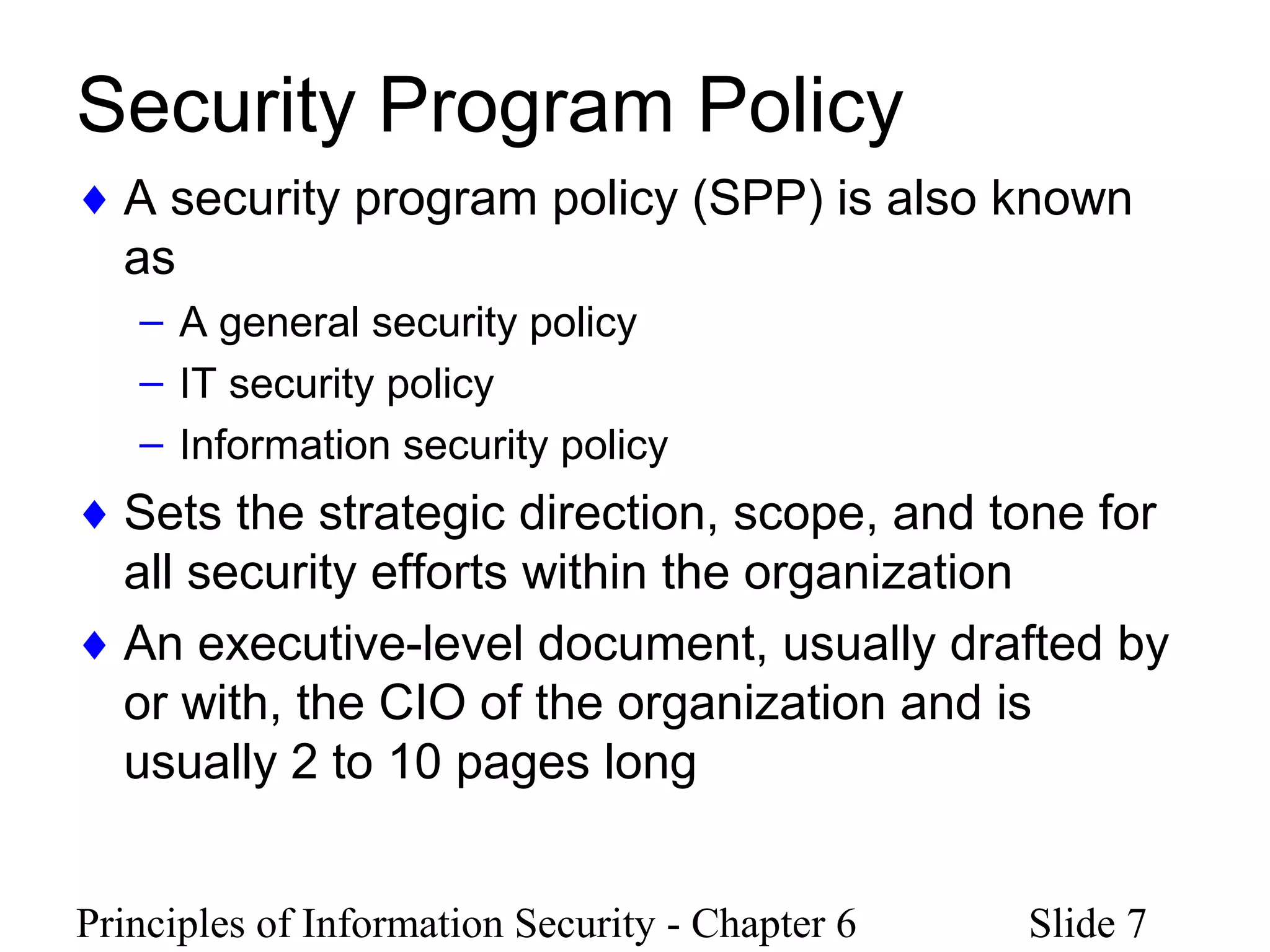
Security Program Policy
♦ A security program policy (SPP) is also known
as
– A general security policy
– IT security policy
– Information security policy
♦ Sets the strategic direction, scope, and tone for
all security efforts within the organization
♦ An executive-level document, usually drafted by
or with, the CIO of the organization and is
usually 2 to 10 pages long
Principles of Information Security - Chapter 6 Slide 8
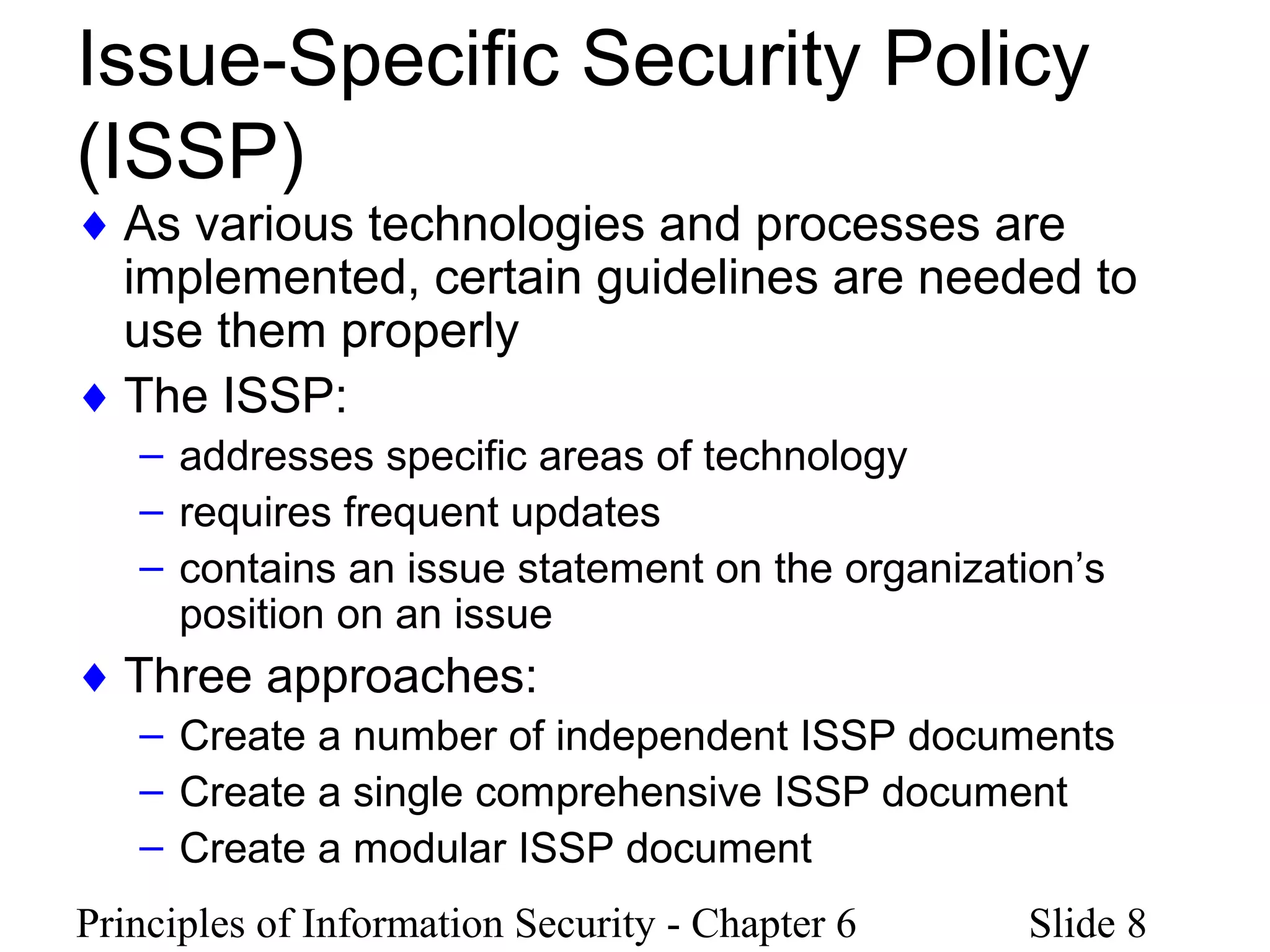
Issue-Specific Security Policy
(ISSP)
♦ As various technologies and processes are
implemented, certain guidelines are needed to
use them properly
♦ The ISSP:
– addresses specific areas of technology
– requires frequent updates
– contains an issue statement on the organization’s
position on an issue
♦ Three approaches:
– Create a number of independent ISSP documents
– Create a single comprehensive ISSP document
– Create a modular ISSP document
Principles of Information Security - Chapter 6 Slide 9
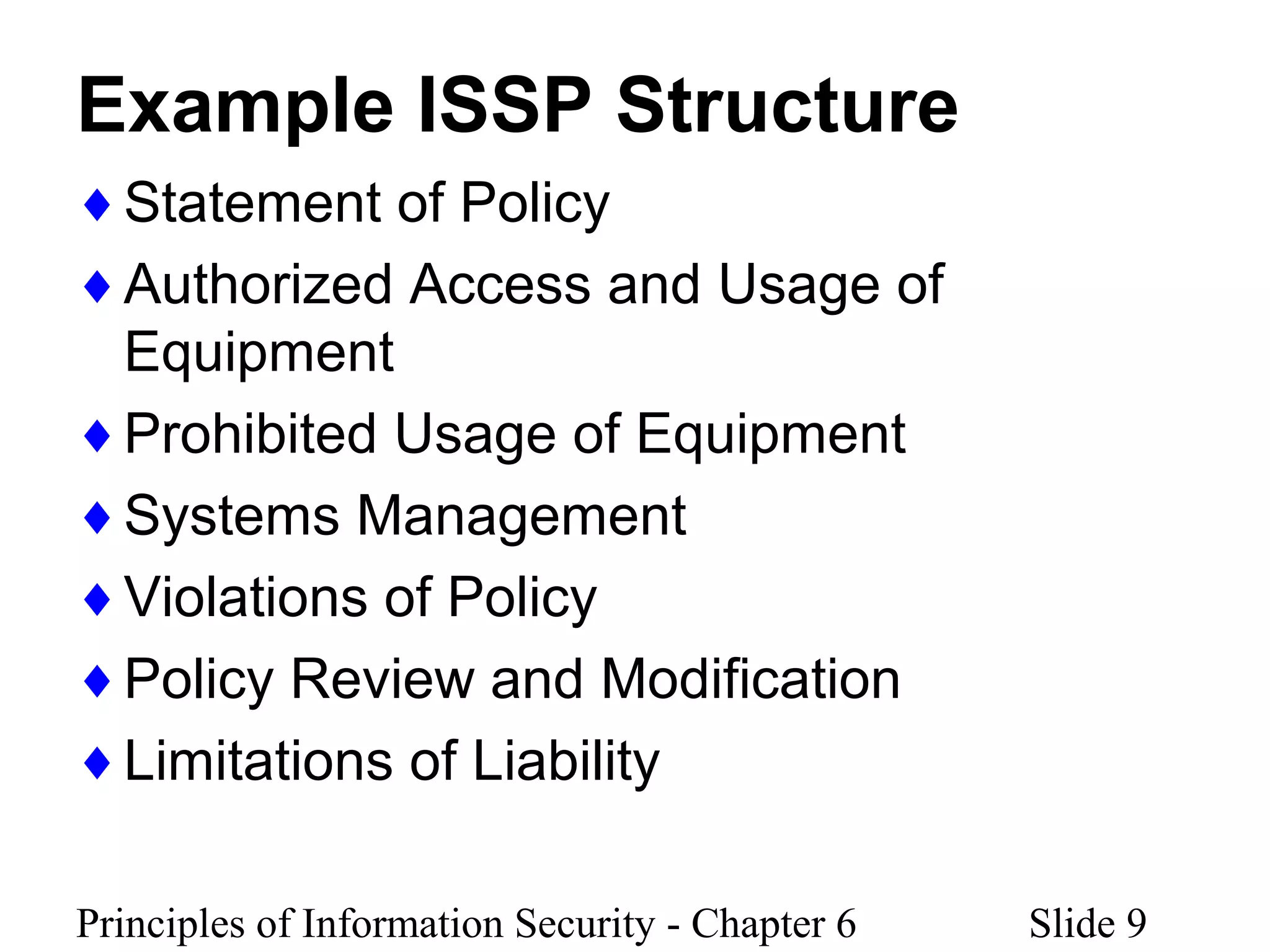
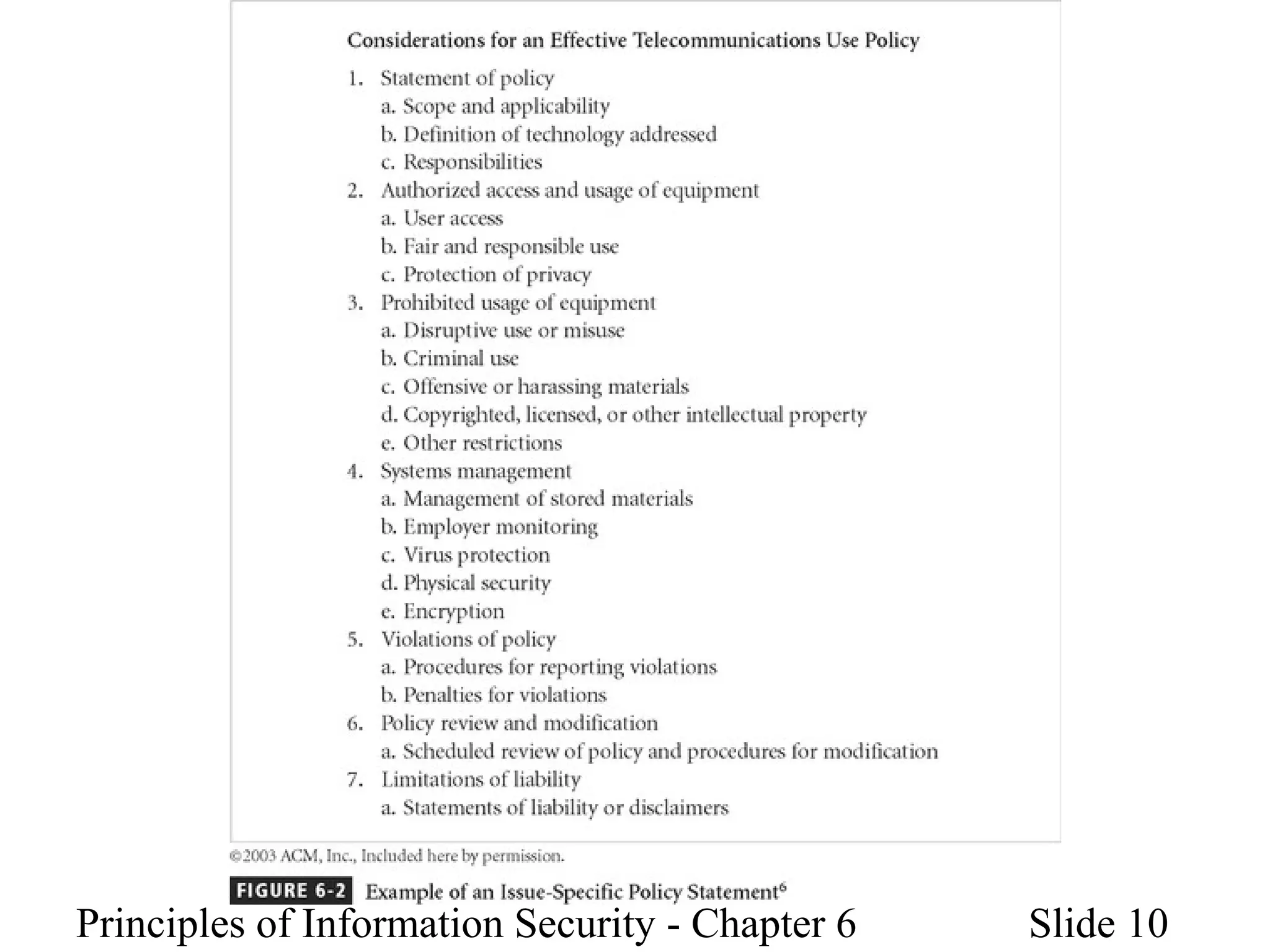
Example ISSP Structure
♦Statement of Policy
♦Authorized Access and Usage of
Equipment
♦Prohibited Usage of Equipment
♦Systems Management
♦Violations of Policy
♦Policy Review and Modification
♦Limitations of Liability
Principles of Information Security - Chapter 6 Slide 10
Principles of Information Security - Chapter 6 Slide 11
Systems-Specific Policy
(SysSP)
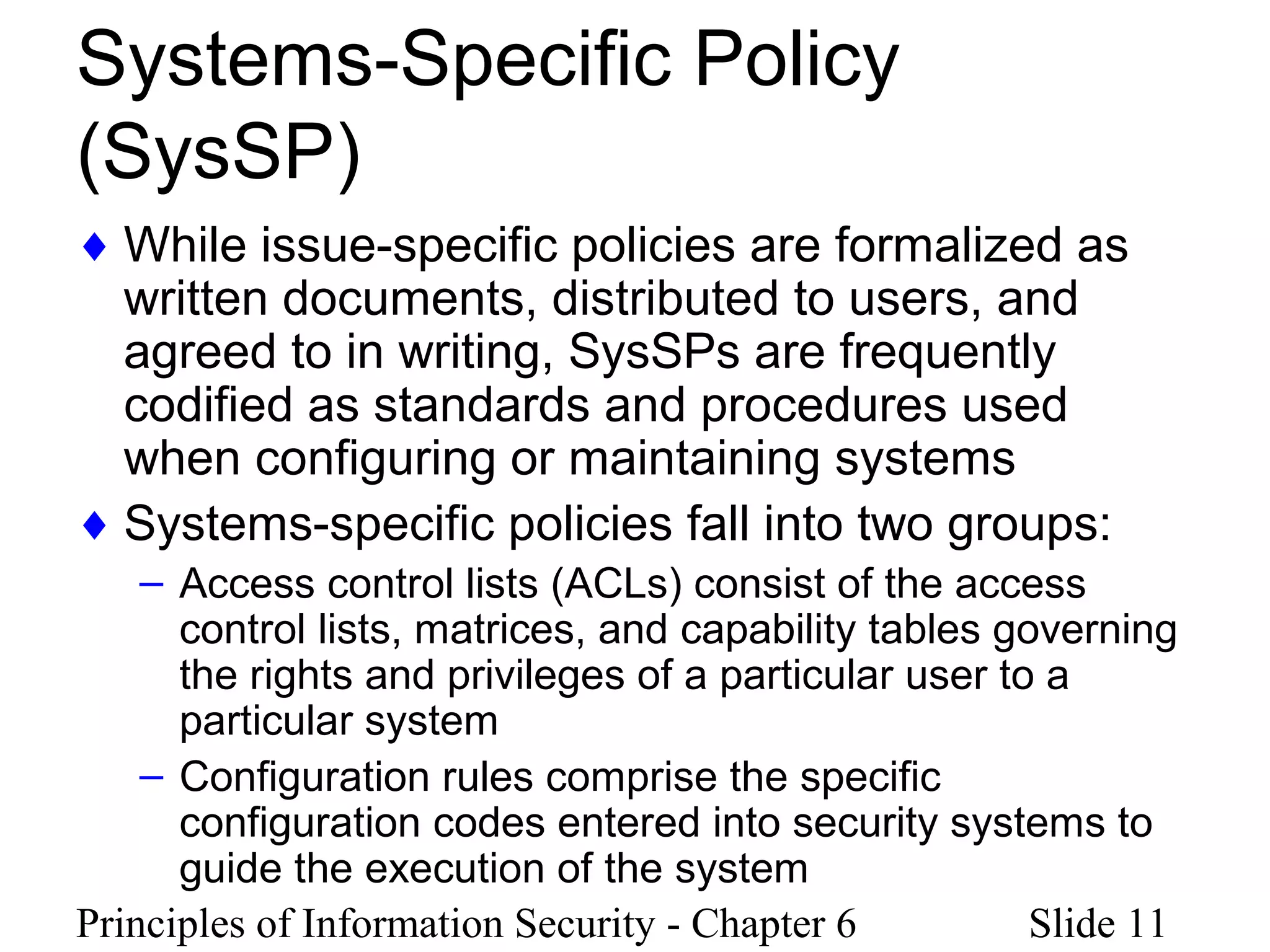
♦ While issue-specific policies are formalized as
written documents, distributed to users, and
agreed to in writing, SysSPs are frequently
codified as standards and procedures used
when configuring or maintaining systems
♦ Systems-specific policies fall into two groups:
– Access control lists (ACLs) consist of the access
control lists, matrices, and capability tables governing
the rights and privileges of a particular user to a
particular system
– Configuration rules comprise the specific
configuration codes entered into security systems to
guide the execution of the system
Principles of Information Security - Chapter 6 Slide 12
ACL Policies
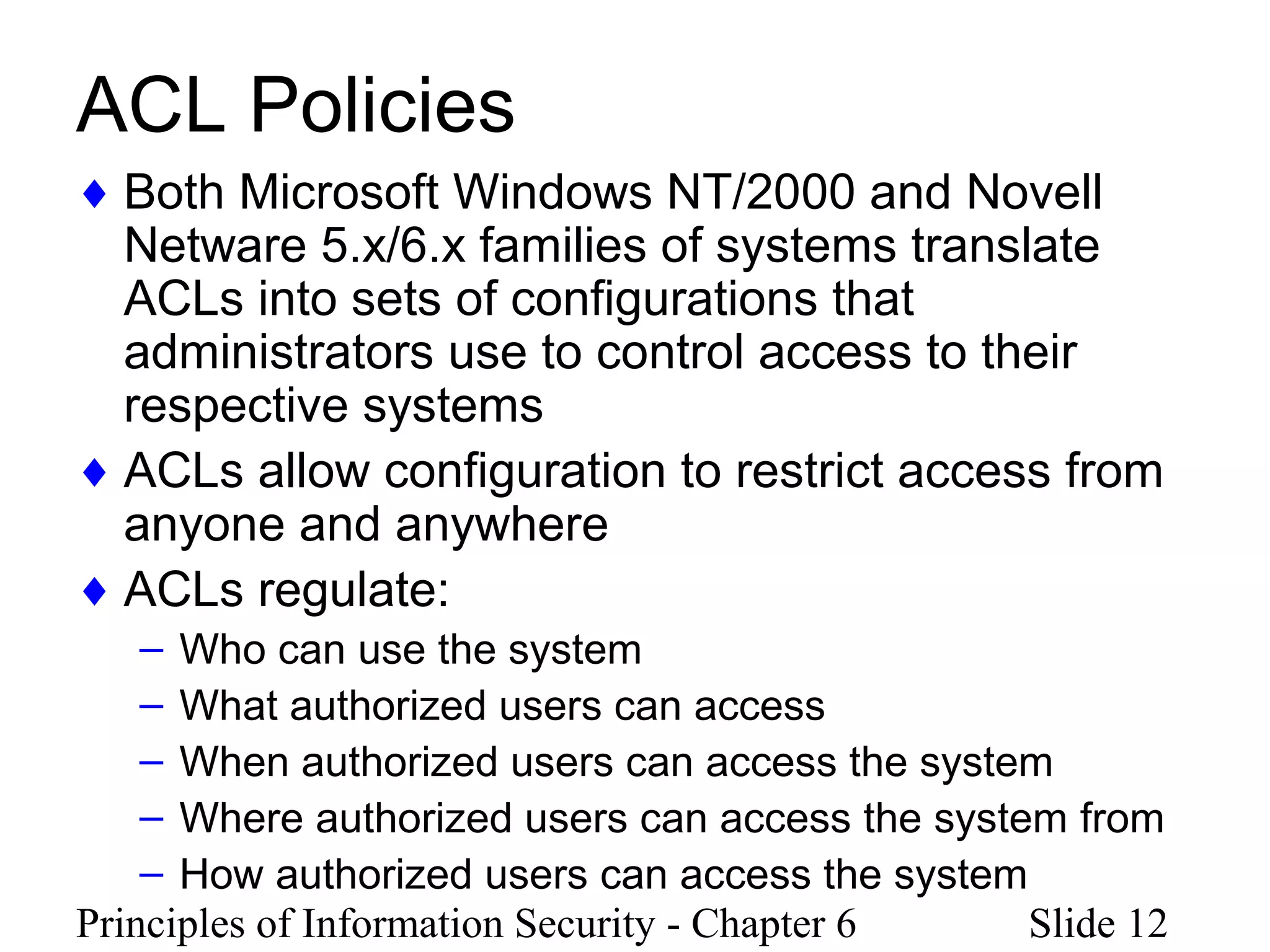
♦ Both Microsoft Windows NT/2000 and Novell
Netware 5.x/6.x families of systems translate
ACLs into sets of configurations that
administrators use to control access to their
respective systems
♦ ACLs allow configuration to restrict access from
anyone and anywhere
♦ ACLs regulate:
– Who can use the system
– What authorized users can access
– When authorized users can access the system
– Where authorized users can access the system from
– How authorized users can access the system
Principles of Information Security - Chapter 6 Slide 13
Rule Policies
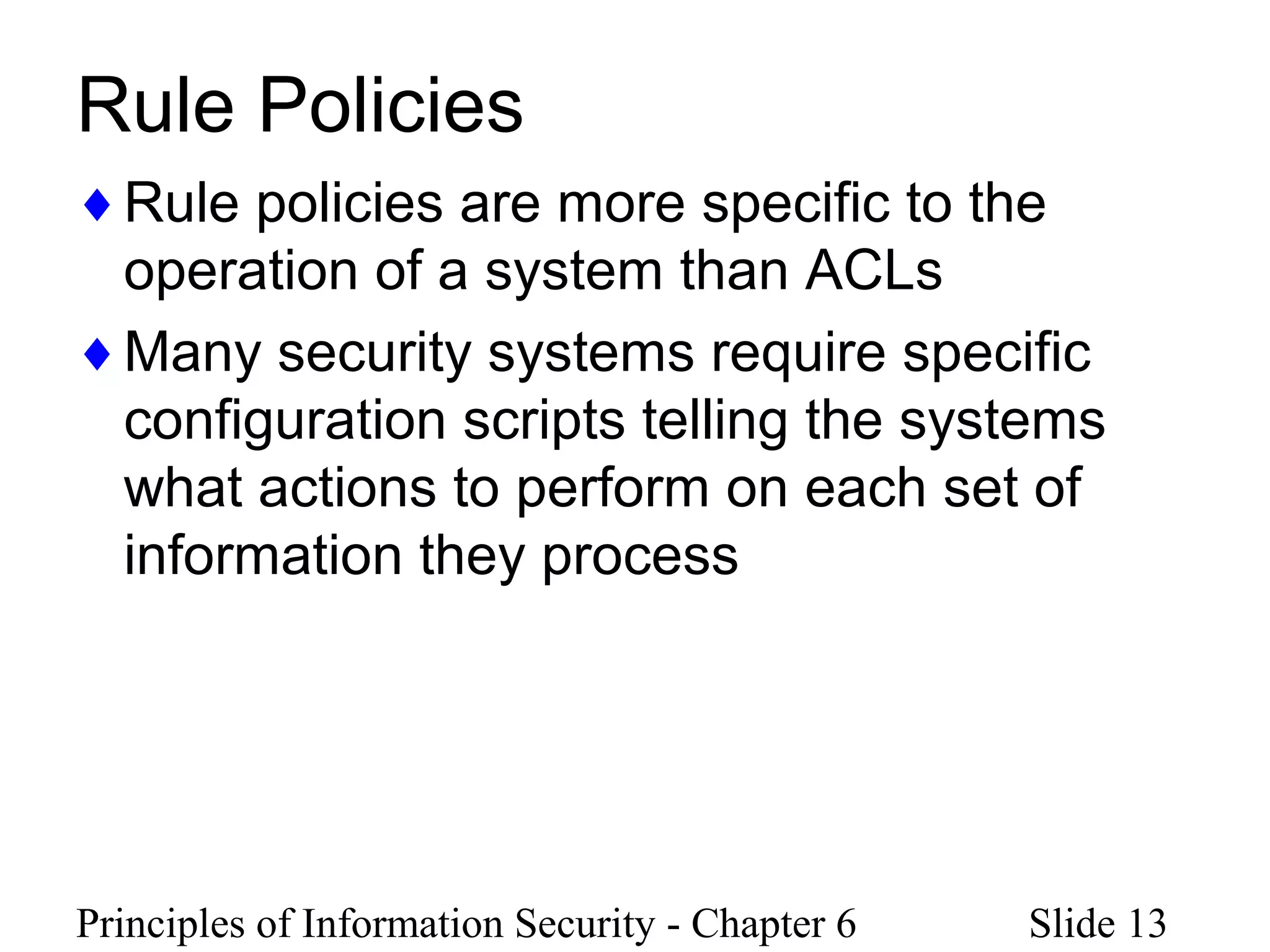
♦Rule policies are more specific to the
operation of a system than ACLs
♦Many security systems require specific
configuration scripts telling the systems
what actions to perform on each set of
information they process
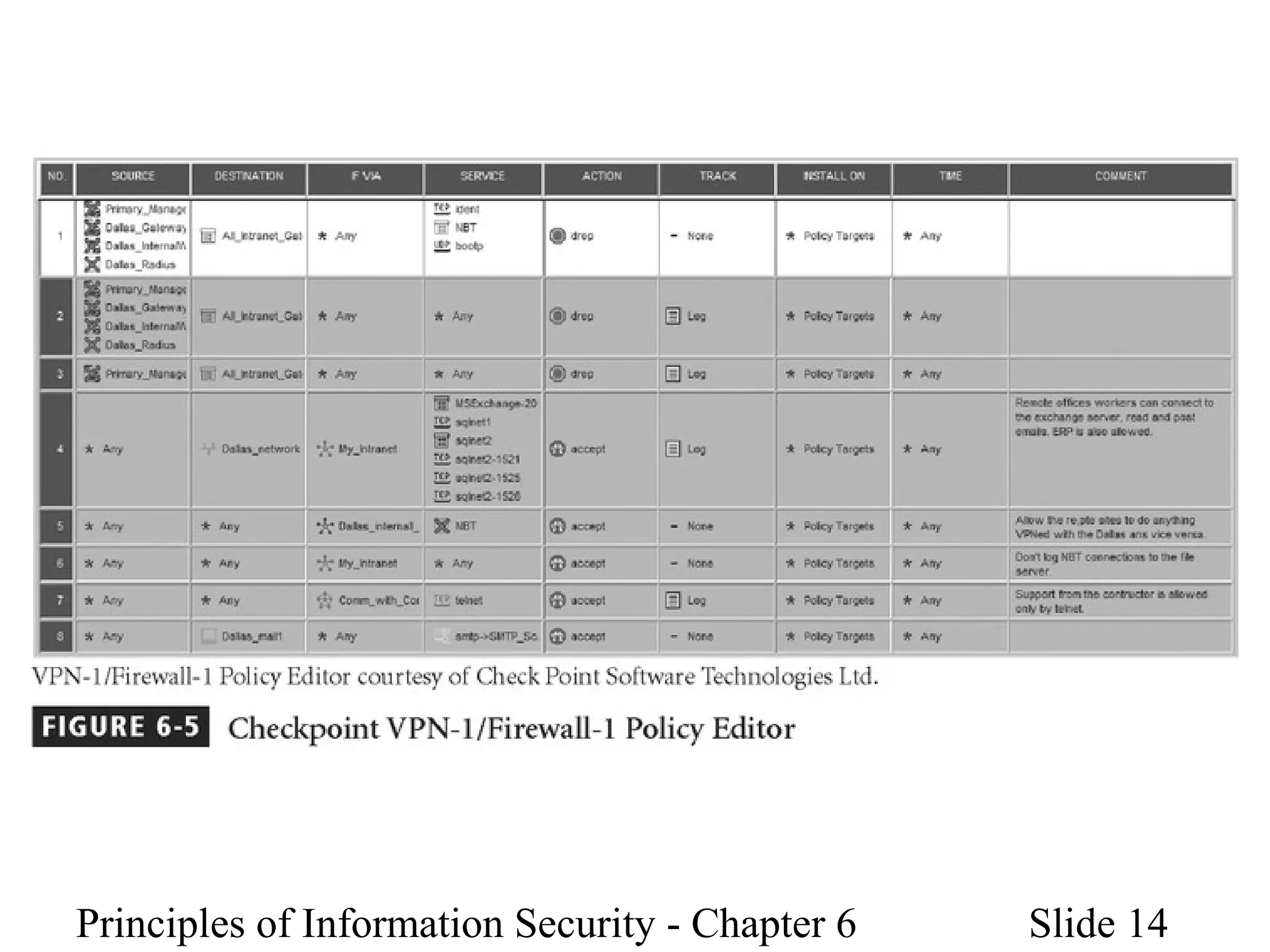
Principles of Information Security - Chapter 6 Slide 14
Principles of Information Security - Chapter 6 Slide 15
Policy Management
♦ Policies are living documents that must be
managed and nurtured, and are constantly
changing and growing
♦ Documents must be properly managed
♦ Special considerations should be made for
organizations undergoing mergers, takeovers,
and partnerships
♦ In order to remain viable, policies must have:
– an individual responsible for reviews
– a schedule of reviews
– a method for making recommendations for reviews
– a specific effective and revision date
Principles of Information Security - Chapter 6 Slide 16
Information Classification
♦ The classification of information is an important
aspect of policy
♦ The same protection scheme created to prevent
production data from accidental release to the
wrong party should be applied to policies in
order to keep them freely available, but only
within the organization
♦ In today’s open office environments, it may be
beneficial to implement a clean desk policy
♦ A clean desk policy stipulates that at the end of
the business day, all classified information must
be properly stored and secured
Principles of Information Security - Chapter 6 Slide 17
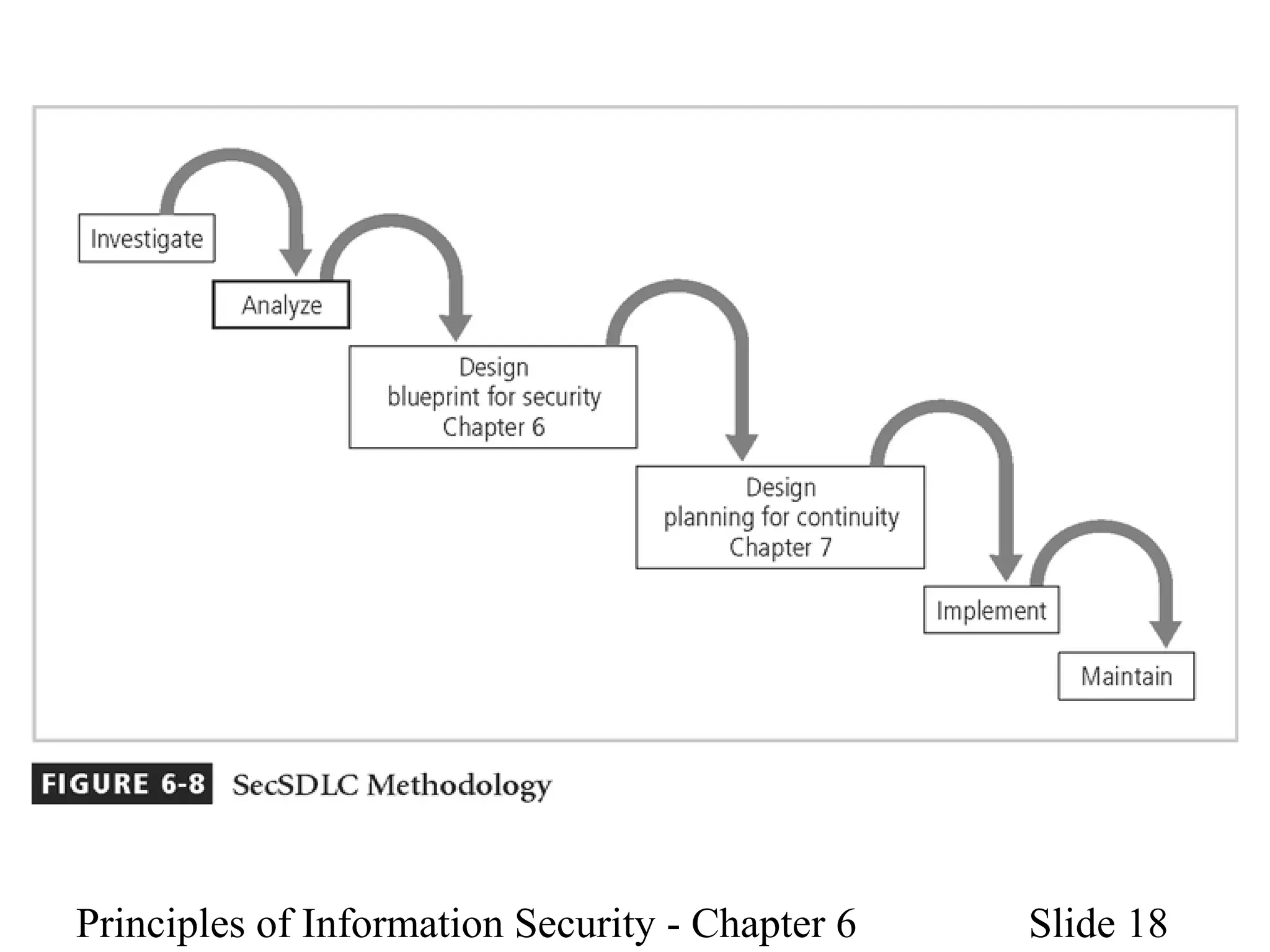
Systems Design
♦ At this point in the Security SDLC, the analysis
phase is complete and the design phase begins –
many work products have been created
♦ Designing a plan for security begins by creating or
validating a security blueprint
♦ Then use the blueprint to plan the tasks to be
accomplished and the order in which to proceed
♦ Setting priorities can follow the recommendations
of published sources, or from published standards
provided by government agencies, or private
consultants
Principles of Information Security - Chapter 6 Slide 18
Principles of Information Security - Chapter 6 Slide 19
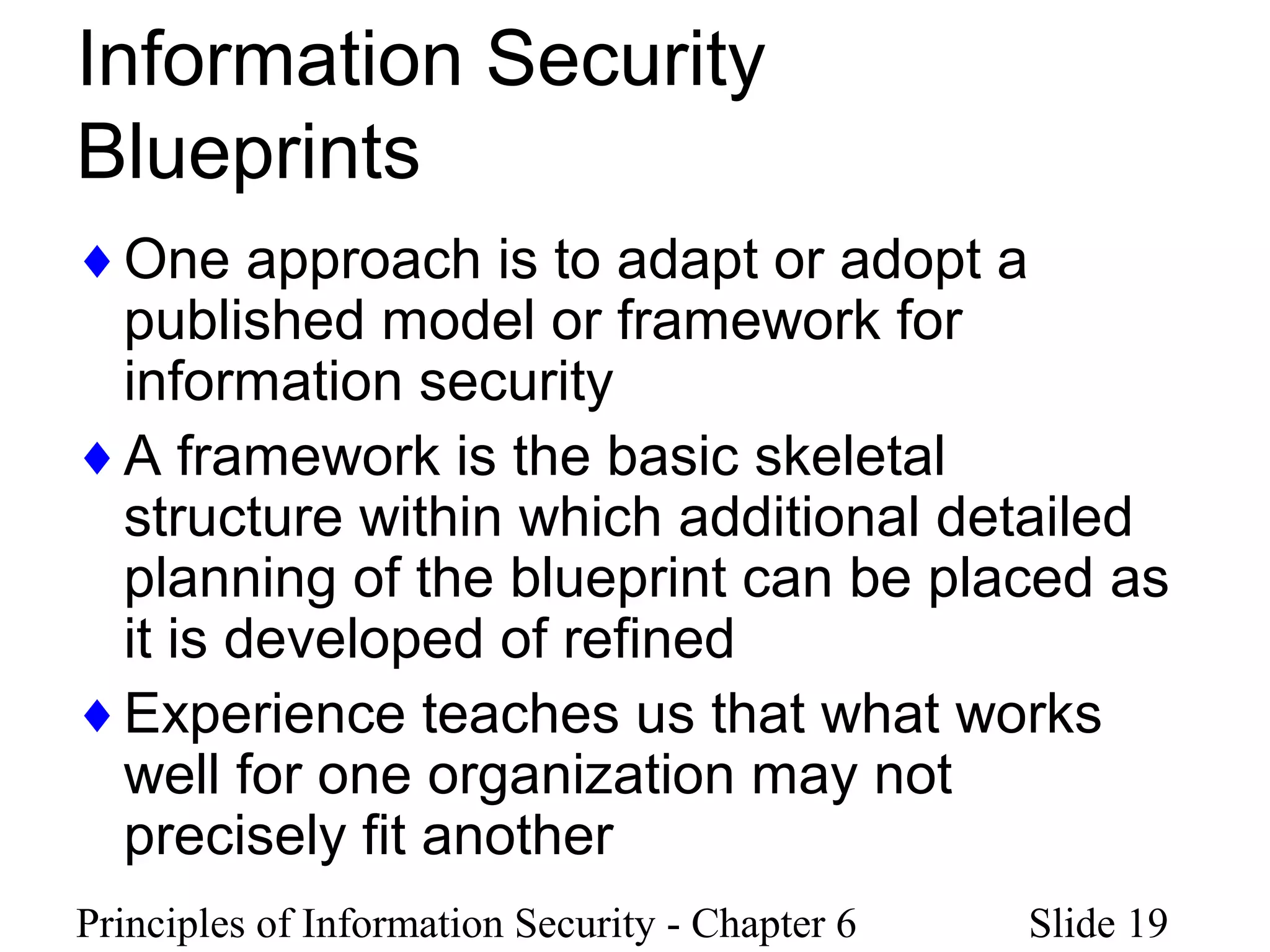
Information Security
Blueprints
♦One approach is to adapt or adopt a
published model or framework for
information security
♦A framework is the basic skeletal
structure within which additional detailed
planning of the blueprint can be placed as
it is developed of refined
♦Experience teaches us that what works
well for one organization may not
precisely fit another
Principles of Information Security - Chapter 6 Slide 20
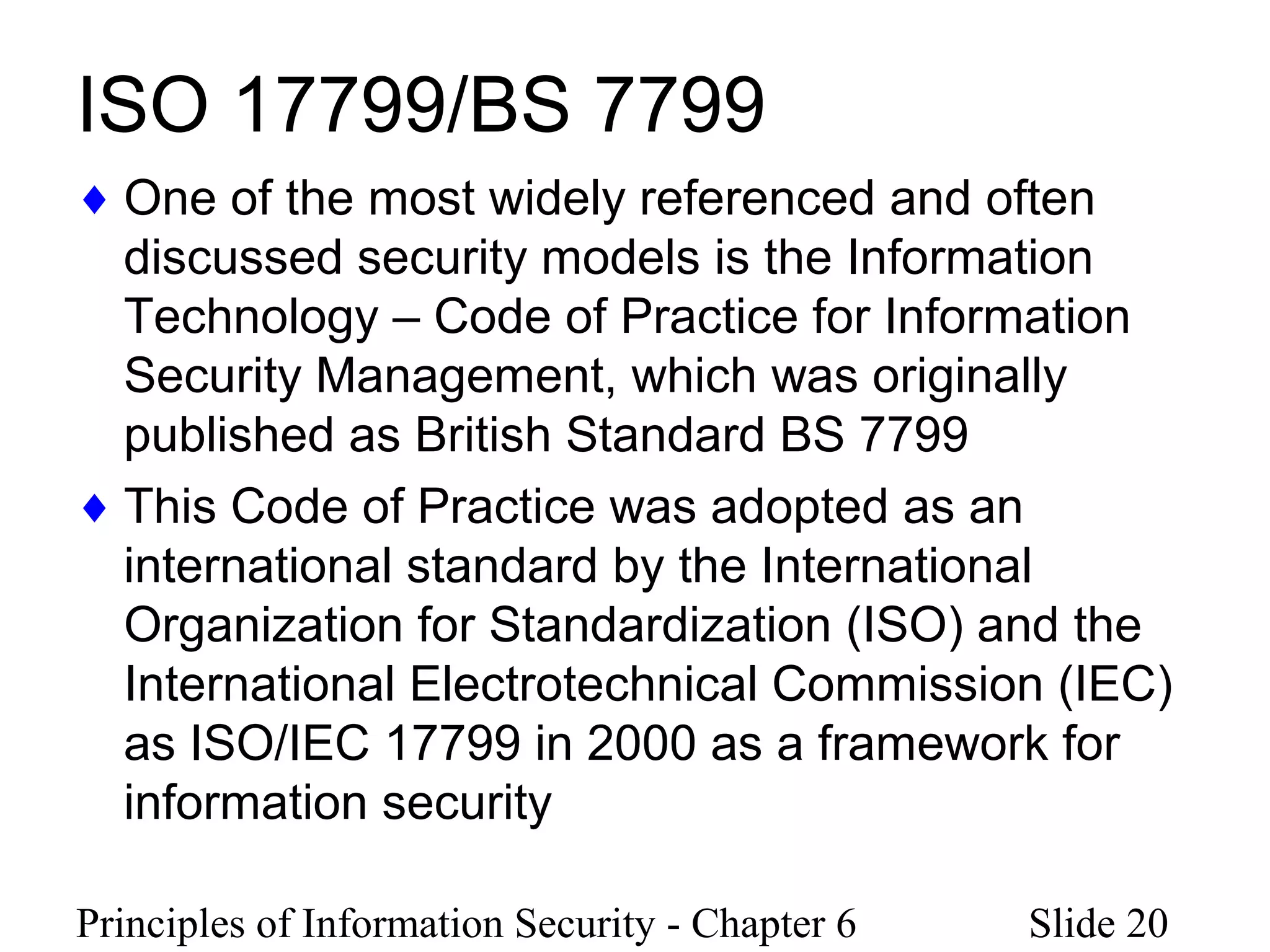
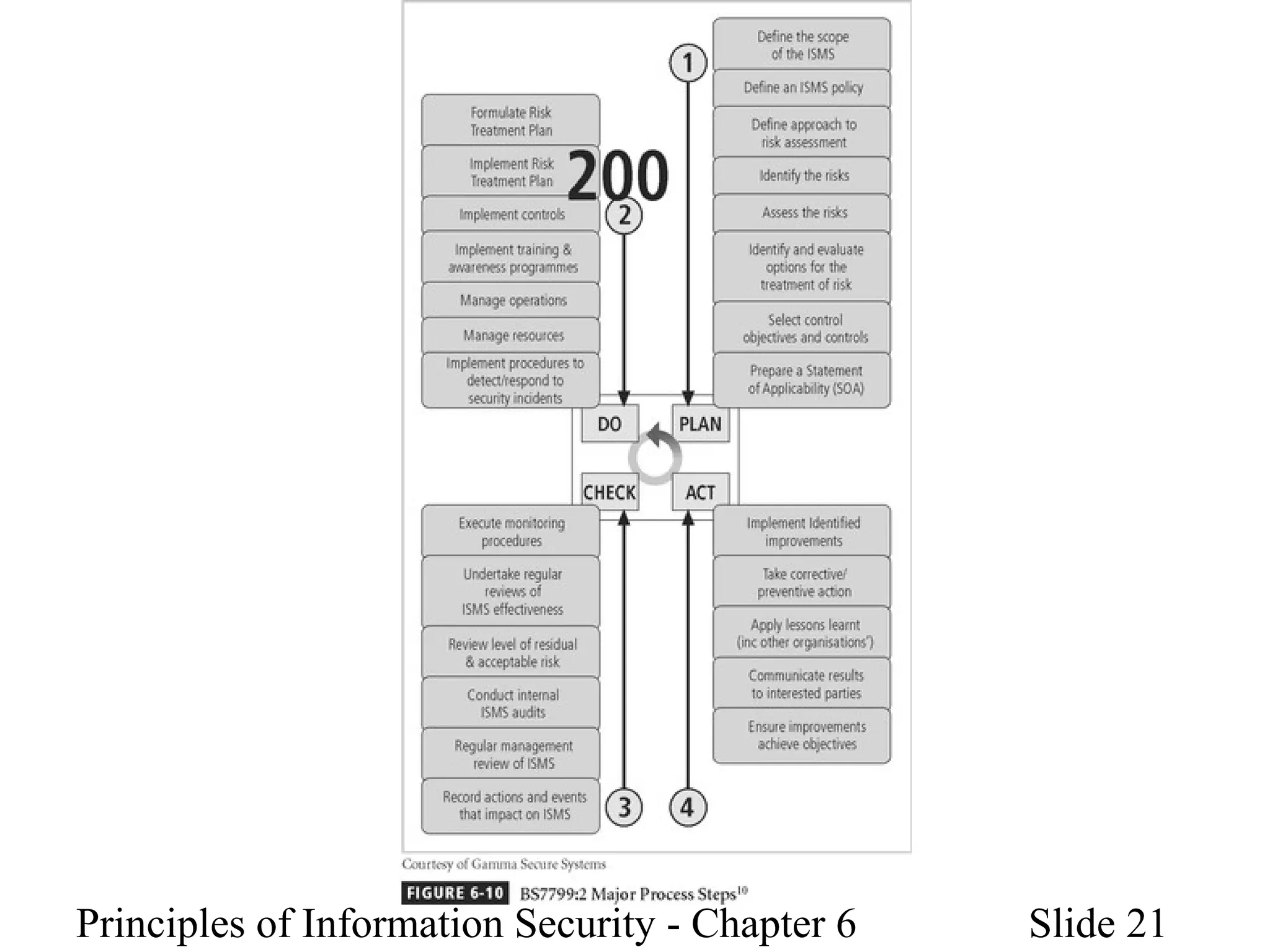
ISO 17799/BS 7799
♦ One of the most widely referenced and often
discussed security models is the Information
Technology – Code of Practice for Information
Security Management, which was originally
published as British Standard BS 7799
♦ This Code of Practice was adopted as an
international standard by the International
Organization for Standardization (ISO) and the
International Electrotechnical Commission (IEC)
as ISO/IEC 17799 in 2000 as a framework for
information security
Principles of Information Security - Chapter 6 Slide 21
Principles of Information Security - Chapter 6 Slide 22
ISO 17799 / BS 7799
♦ Several countries have not adopted 17799
claiming there are fundamental problems:
– The global information security community has not
defined any justification for a code of practice as
identified in the ISO/IEC 17799
– 17799 lacks “the necessary measurement precision
of a technical standard”
– There is no reason to believe that 17799 is more
useful than any other approach currently available
– 17799 is not as complete as other frameworks
available
– 17799 is perceived to have been hurriedly prepared
given the tremendous impact its adoption could have
on industry information security controls
Principles of Information Security - Chapter 6 Slide 23
ISO/IEC 17799
♦ Organizational Security Policy is needed to
provide management direction and support
♦ Objectives:
– Operational Security Policy
– Organizational Security Infrastructure
– Asset Classification and Control
– Personnel Security
– Physical and Environmental Security
– Communications and Operations Management
– System Access Control
– System Development and Maintenance
– Business Continuity Planning
– Compliance
Principles of Information Security - Chapter 6 Slide 24
NIST Security Models
♦ Another approach available is described in the
many documents available from the Computer
Security Resource Center of the National
Institute for Standards and Technology
(csrc.nist.gov) – Including:
– NIST SP 800-12 - The Computer Security Handbook
– NIST SP 800-14 - Generally Accepted Principles and
Practices for Securing IT Systems
– NIST SP 800-18 - The Guide for Developing Security
Plans for IT Systems
Principles of Information Security - Chapter 6 Slide 25
NIST SP 800-14
♦ Security Supports the Mission of the Organization
♦ Security is an Integral Element of Sound Management
♦ Security Should Be Cost-Effective
♦ Systems Owners Have Security Responsibilities Outside
Their Own Organizations
♦ Security Responsibilities and Accountability Should Be
Made Explicit
♦ Security Requires a Comprehensive and Integrated
Approach
♦ Security Should Be Periodically Reassessed
♦ Security is Constrained by Societal Factors
♦ 33 Principles enumerated
Principles of Information Security - Chapter 6 Slide 26
IETF Security Architecture
♦ The Security Area Working Group acts as an
advisory board for the protocols and areas
developed and promoted through the Internet
Society
– No specific architecture is promoted through IETF
♦ RFC 2196: Site Security Handbook provides an
overview of five basic areas of security
♦ Topics include:
– security policies
– security technical architecture
– security services
– security incident handling
Principles of Information Security - Chapter 6 Slide 27
VISA Model
♦ VISA International promotes strong security
measures and has security guidelines
♦ Developed two important documents that
improve and regulate its information systems
– “Security Assessment Process”
– “Agreed Upon Procedures”
♦ Using the two documents, a security team can
develop a sound strategy for the design of good
security architecture
♦ The only down side to this approach is the very
specific focus on systems that can or do
integrate with VISA’s systems
Principles of Information Security - Chapter 6 Slide 28
Baselining and Best Practices
♦ Baselining and best practices are solid methods
for collecting security practices, but they can
have the drawback of providing less detail than
would a complete methodology
♦ It is possible to gain information by baselining
and using best practices and thus work
backwards to an effective design
♦ The Federal Agency Security Practices Site
(fasp.csrc.nist.gov) is designed to provide best
practices for public agencies
Principles of Information Security - Chapter 6 Slide 29
Professional Membership
♦ It may be worth the information security
professional’s time and money to join
professional societies with information on best
practices for its members
♦ Many organizations have seminars and classes
on best practices for implementing security
♦ Finding information on security design is the
easy part, sorting through the collected mass of
information, documents, and publications can
take a substantial investment in time and
human resources
Principles of Information Security - Chapter 6 Slide 30
NIST SP 800-26
Management Controls
– Risk Management
– Review of Security Controls
– Life Cycle Maintenance
– Authorization of Processing (Certification and Accreditation)
– System Security Plan
Operational Controls
– Personnel Security
– Physical Security
– Production, Input/Output Controls
– Contingency Planning
– Hardware and Systems Software
– Data Integrity
– Documentation
– Security Awareness, Training, and Education
– Incident Response Capability
Technical Controls
– Identification and Authentication
– Logical Access Controls
– Audit Trails
Principles of Information Security - Chapter 6 Slide 31
Figure 6-16 – Spheres of
Security
Principles of Information Security - Chapter 6 Slide 32
Sphere of Use
♦ Generally speaking, the concept of the sphere is
to represent the 360 degrees of security
necessary to protect information at all times
♦ The first component is the “sphere of use”
♦ Information, at the core of the sphere, is
available for access by members of the
organization and other computer-based systems:
– To gain access to the computer systems, one must
either directly access the computer systems or go
through a network connection
– To gain access to the network, one must either directly
access the network or go through an Internet
connection
Principles of Information Security - Chapter 6 Slide 33
Sphere of Protection
♦ The “sphere of protection” overlays each of the
levels of the “sphere of use” with a layer of
security, protecting that layer from direct or
indirect use through the next layer
♦ The people must become a layer of security, a
human firewall that protects the information from
unauthorized access and use
♦ Information security is therefore designed and
implemented in three layers
– policies
– people (education, training, and awareness programs)
– technology
Principles of Information Security - Chapter 6 Slide 34
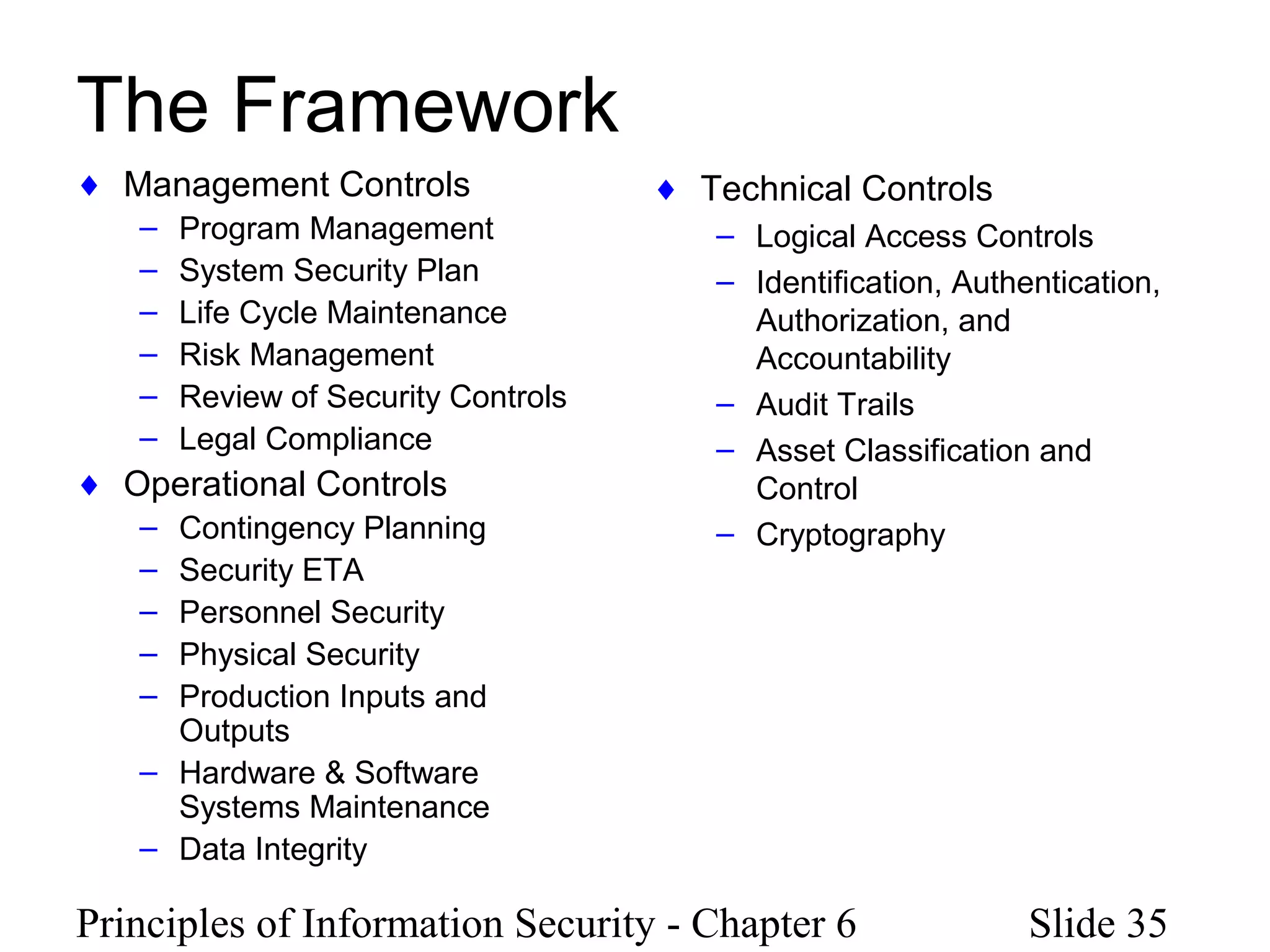
Controls
♦ Management controls cover security processes
that are designed by the strategic planners and
performed by security administration of the
organization
♦ Operational controls deal with the operational
functionality of security in the organization
♦ Operational controls also address personnel
security, physical security, and the protection of
production inputs and outputs
♦ Technical controls address those tactical and
technical issues related to designing and
implementing security in the organization
Principles of Information Security - Chapter 6 Slide 35
The Framework
♦ Management Controls
– Program Management
– System Security Plan
– Life Cycle Maintenance
– Risk Management
– Review of Security Controls
– Legal Compliance
♦ Operational Controls
– Contingency Planning
– Security ETA
– Personnel Security
– Physical Security
– Production Inputs and
Outputs
– Hardware & Software
Systems Maintenance
– Data Integrity
♦ Technical Controls
– Logical Access Controls
– Identification, Authentication,
Authorization, and
Accountability
– Audit Trails
– Asset Classification and
Control
– Cryptography
Principles of Information Security - Chapter 6 Slide 36
SETA
♦ As soon as the policies exist, policies to
implement security education, training, and
awareness (SETA) should follow
♦ SETA is a control measure designed to reduce
accidental security breaches
♦ Supplement the general education and training
programs in place to educate staff on
information security
♦ Security education and training builds on the
general knowledge the employees must
possess to do their jobs, familiarizing them with
the way to do their jobs securely
Principles of Information Security - Chapter 6 Slide 37
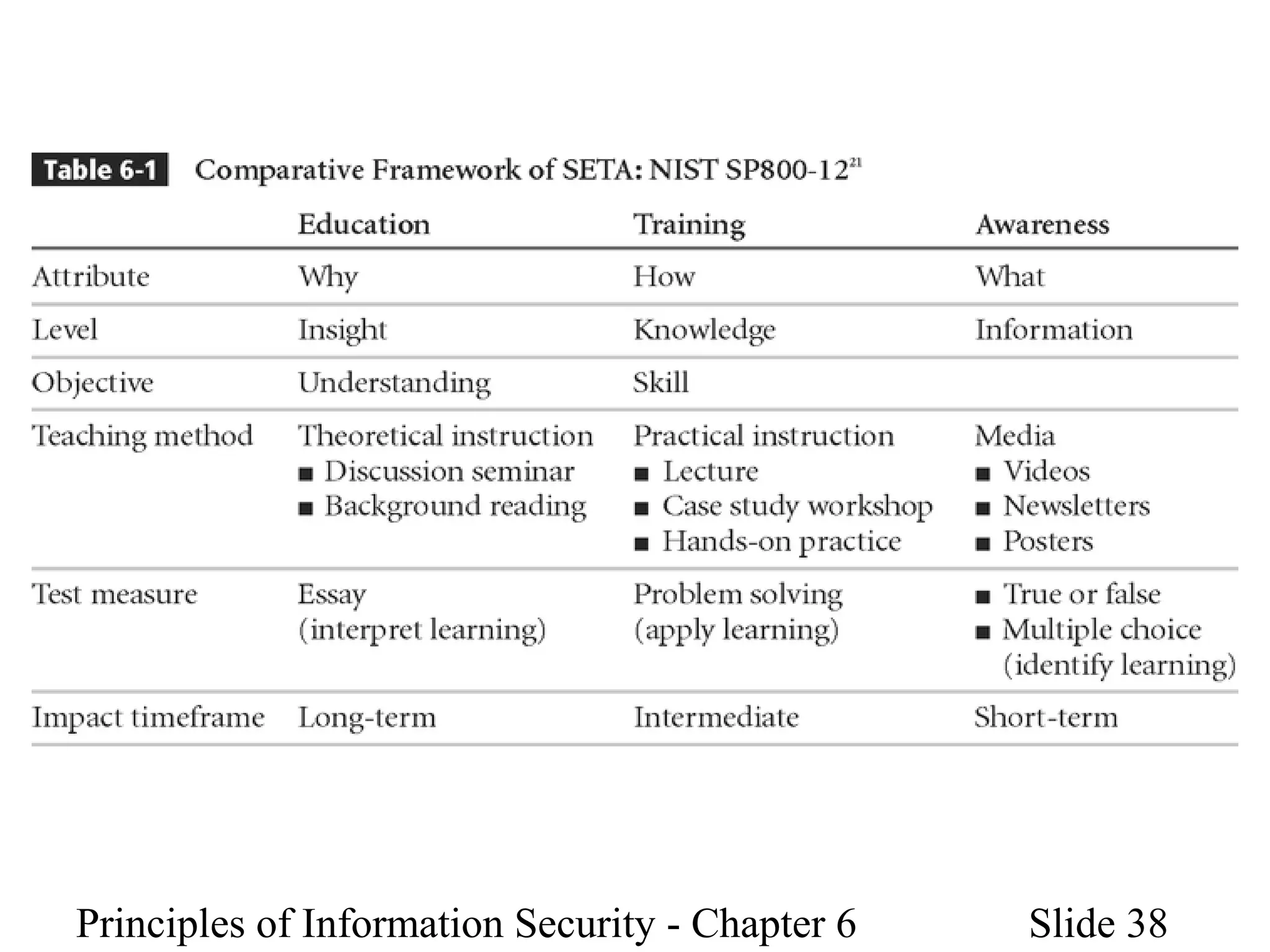
SETA Elements
♦ The SETA program consists of three elements
– security education
– security training
– security awareness
♦ The organization may not be capable or willing
to undertake all three of these elements but may
outsource them
♦ The purpose of SETA is to enhance security by:
– Improving awareness of the need to protect system
resources
– Developing skills and knowledge so computer users
can perform their jobs more securely
– Building in-depth knowledge, as needed, to design,
implement, or operate security programs for
organizations and systems
Principles of Information Security - Chapter 6 Slide 38
Principles of Information Security - Chapter 6 Slide 39
Security Education
♦ Everyone in an organization needs to be trained
and aware of information security, but not every
member of the organization needs a formal
degree or certificate in information security
♦ When formal education for appropriate
individuals in security is needed an employee
can identify curriculum available from local
institutions of higher learning or continuing
education
♦ A number of universities have formal
coursework in information security
(See for example http://infosec.kennesaw.edu)
Principles of Information Security - Chapter 6 Slide 40
Security Training
♦Security training involves providing
members of the organization with detailed
information and hands-on instruction
designed to prepare them to perform their
duties securely
♦Management of information security can
develop customized in-house training or
outsource the training program
Principles of Information Security - Chapter 6 Slide 41
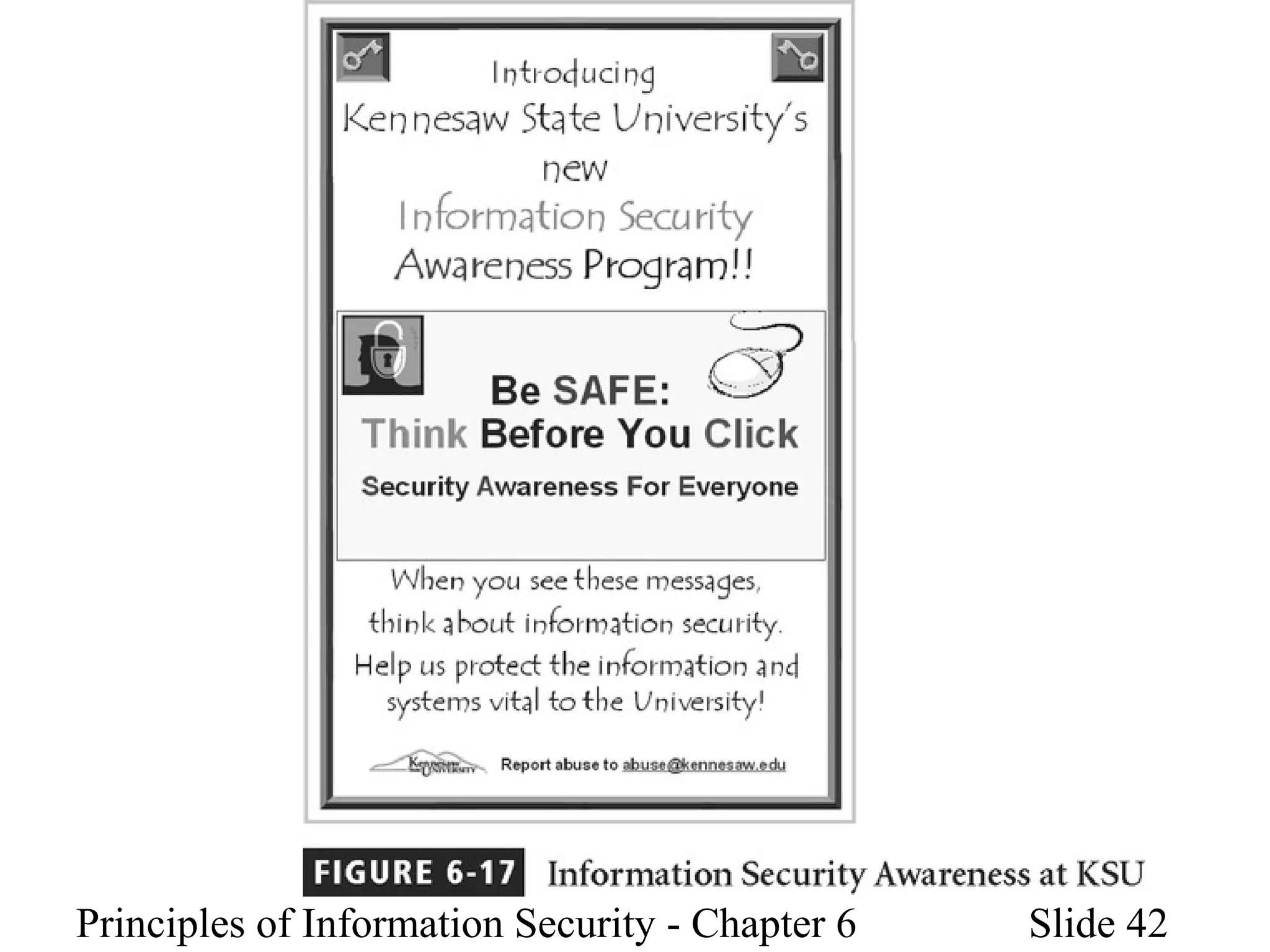
Security Awareness
♦One of the least frequently implemented,
but the most beneficial programs is the
security awareness program
♦Designed to keep information security at
the forefront of the users’ minds
♦Need not be complicated or expensive
♦If the program is not actively
implemented, employees begin to ‘tune
out’, and the risk of employee accidents
and failures increases
Principles of Information Security - Chapter 6 Slide 42
Principles of Information Security - Chapter 6 Slide 43
Comments
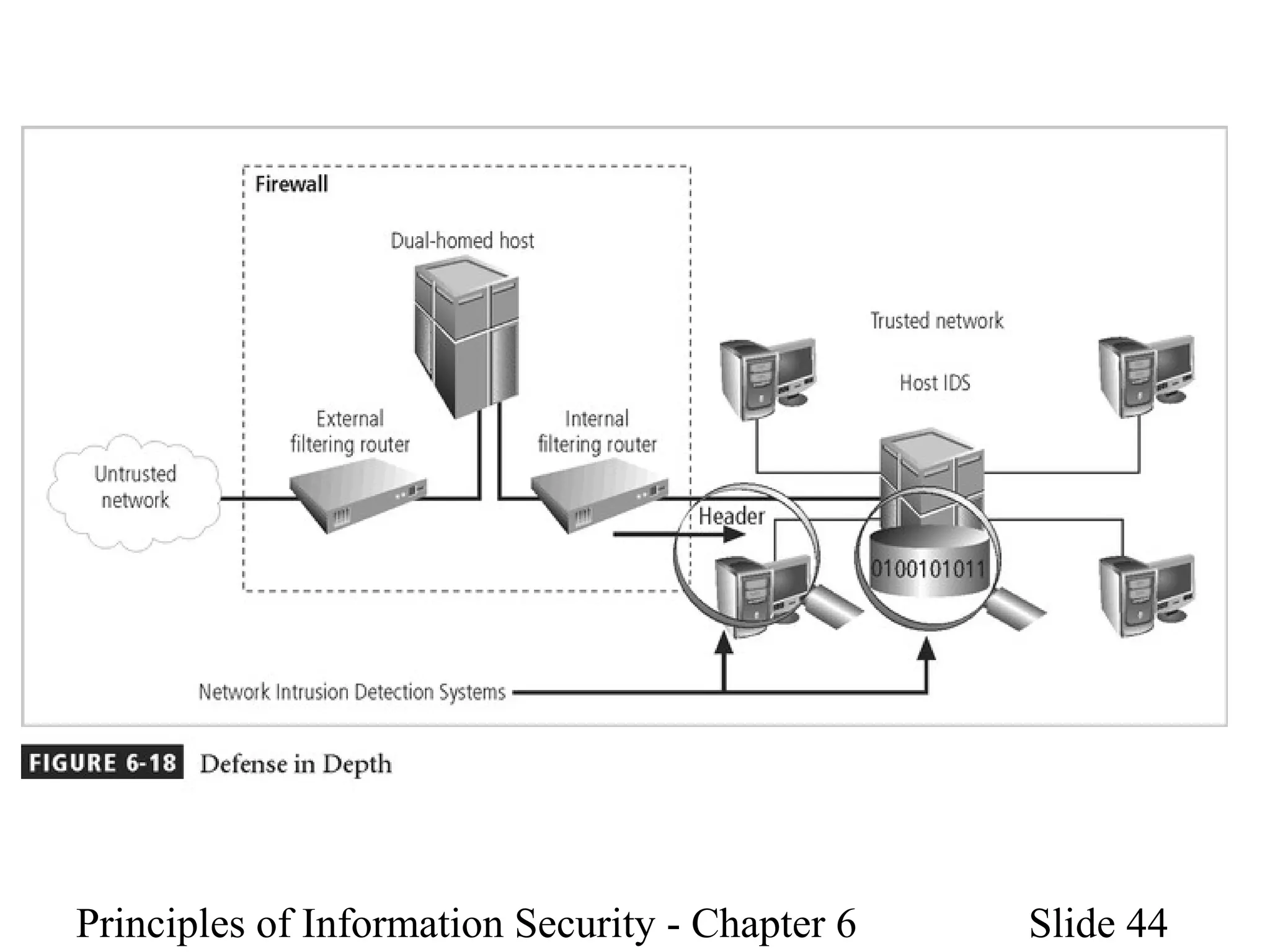
♦ Defense in Depth
– One of the foundations of security architectures is the
requirement to implement security in layers
– Defense in depth requires that the organization
establish sufficient security controls and safeguards,
so that an intruder faces multiple layers of controls
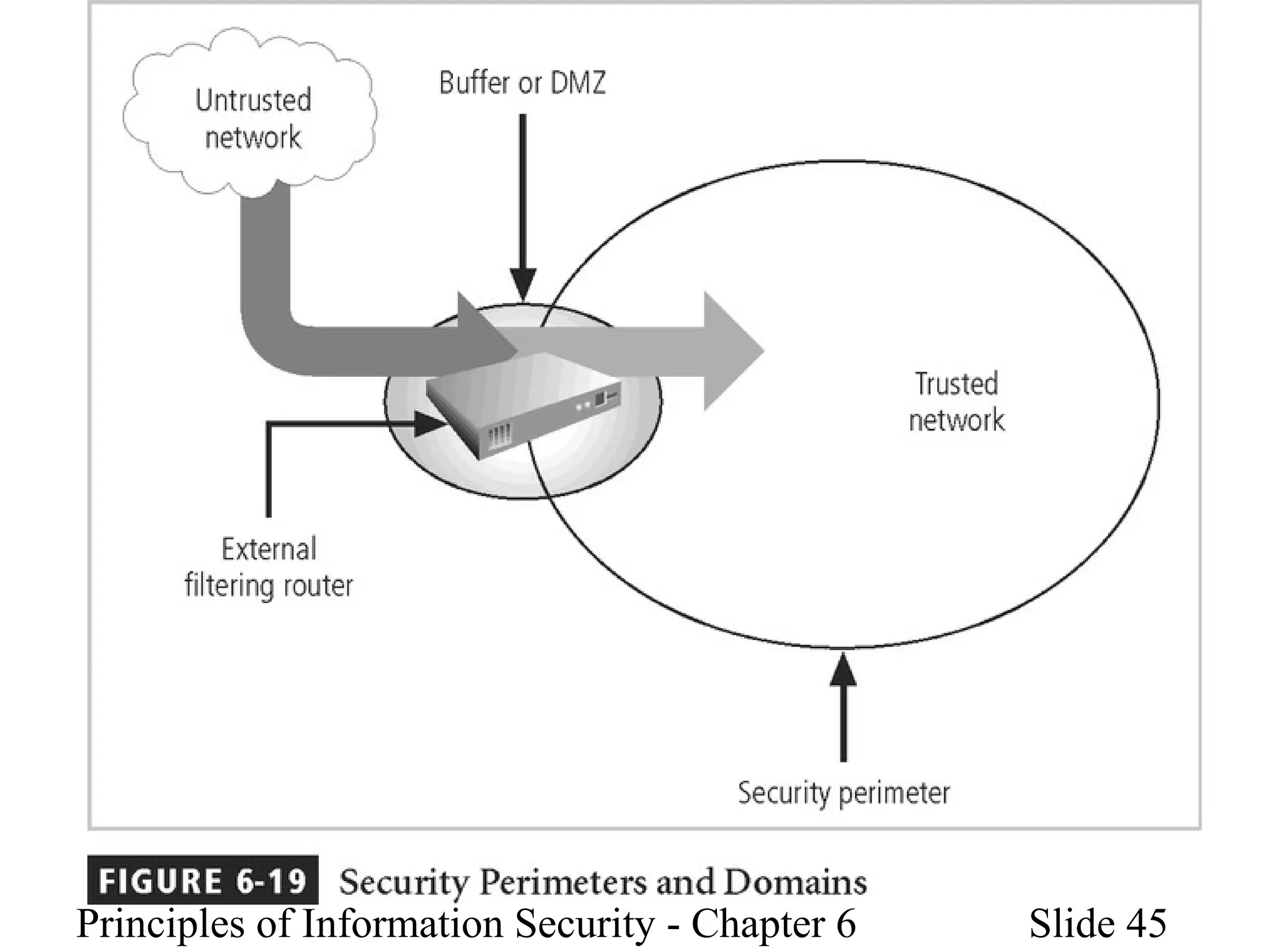
♦ Security Perimeter
– The point at which an organization’s security
protection ends, and the outside world begins
– Referred to as the security perimeter
– Unfortunately the perimeter does not apply to internal
attacks from employee threats, or on-site physical
threats
Principles of Information Security - Chapter 6 Slide 44
Principles of Information Security - Chapter 6 Slide 45
Principles of Information Security - Chapter 6 Slide 46
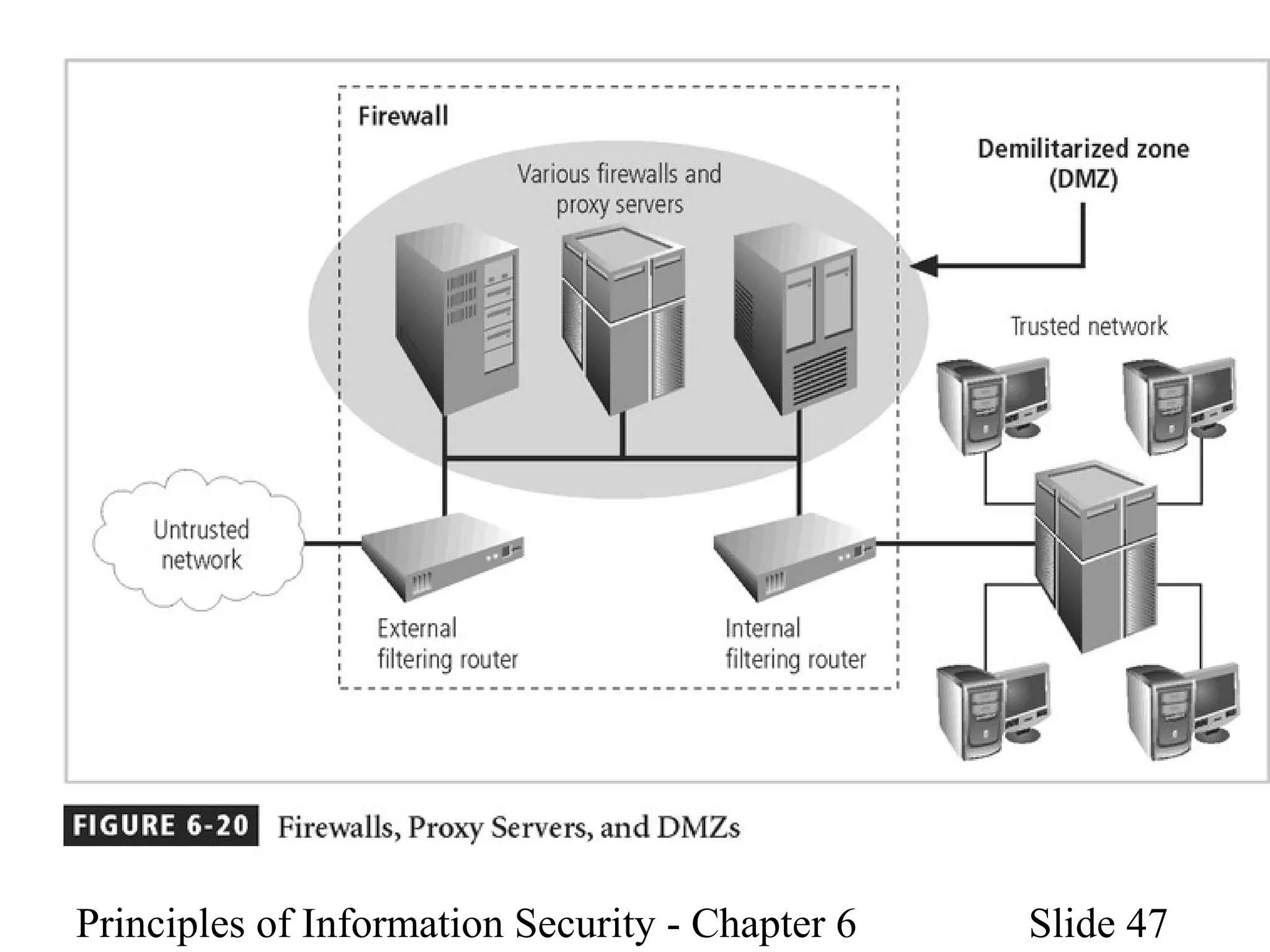
Key Technology Components
♦ Other key technology components
– A firewall is a device that selectively discriminates
against information flowing into or out of the
organization
– The DMZ (demilitarized zone) is a no-man’s land,
between the inside and outside networks, where
some organizations place Web servers
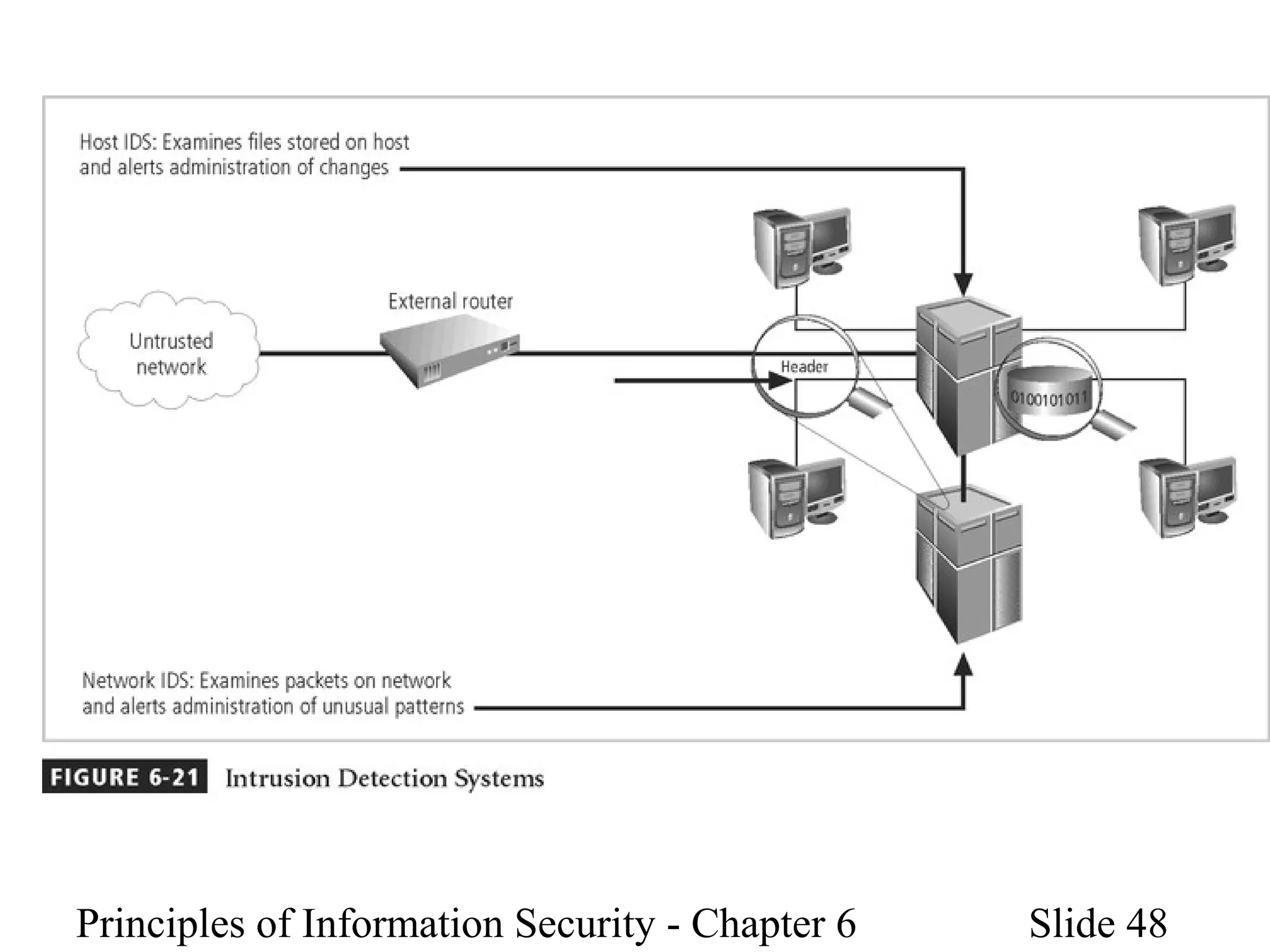
– In an effort to detect unauthorized activity within the
inner network, or on individual machines, an
organization may wish to implement Intrusion
Detection Systems or IDS
Principles of Information Security - Chapter 6 Slide 47
Principles of Information Security - Chapter 6 Slide 48

Chapter 5

  • 1.
    Blueprint for Security Chapter6 Begin with the end in mind. -- Stephen Covey
  • 2.
    Principles of InformationSecurity - Chapter 6 Slide 2 Learning Objectives: Upon completion of this chapter you should be able to: – Understand management’s responsibilities and role in the development, maintenance, and enforcement of information security policy, standards, practices, procedures, and guidelines – Understand the differences between the organization’s general information security policy and the requirements and objectives of the various issue-specific and system-specific policies. – Know what an information security blueprint is and what its major components are. – Understand how an organization institutionalizes its policies, standards, and practices using education, training, and awareness programs. – Become familiar with what viable information security architecture is, what it includes, and how it is used.
  • 3.
    Principles of InformationSecurity - Chapter 6 Slide 3 Information Security Policy, Standards, and Practices ♦ Management from all communities of interest must consider policies as the basis for all information security efforts ♦ Policies direct how issues should be addressed and technologies used ♦ Security policies are the least expensive control to execute, but the most difficult to implement ♦ Shaping policy is difficult because: – Never conflict with laws – Stand up in court, if challenged – Be properly administered
  • 4.
    Principles of InformationSecurity - Chapter 6 Slide 4 Definitions ♦ A policy is A plan or course of action, as of a government, political party, or business, intended to influence and determine decisions, actions, and other matters ♦ Policies are organizational laws ♦ Standards, on the other hand, are more detailed statements of what must be done to comply with policy ♦ Practices, procedures, and guidelines effectively explain how to comply with policy ♦ For a policy to be effective it must be properly disseminated, read, understood and agreed to by all members of the organization
  • 5.
    Principles of InformationSecurity - Chapter 6 Slide 5 Types of Policy Management defines three types of security policy: – General or security program policy – Issue-specific security policies – Systems-specific security policies
  • 6.
    Principles of InformationSecurity - Chapter 6 Slide 6 Figure 6-1 – Policies Standards & Practices
  • 7.
    Principles of InformationSecurity - Chapter 6 Slide 7 Security Program Policy ♦ A security program policy (SPP) is also known as – A general security policy – IT security policy – Information security policy ♦ Sets the strategic direction, scope, and tone for all security efforts within the organization ♦ An executive-level document, usually drafted by or with, the CIO of the organization and is usually 2 to 10 pages long
  • 8.
    Principles of InformationSecurity - Chapter 6 Slide 8 Issue-Specific Security Policy (ISSP) ♦ As various technologies and processes are implemented, certain guidelines are needed to use them properly ♦ The ISSP: – addresses specific areas of technology – requires frequent updates – contains an issue statement on the organization’s position on an issue ♦ Three approaches: – Create a number of independent ISSP documents – Create a single comprehensive ISSP document – Create a modular ISSP document
  • 9.
    Principles of InformationSecurity - Chapter 6 Slide 9 Example ISSP Structure ♦Statement of Policy ♦Authorized Access and Usage of Equipment ♦Prohibited Usage of Equipment ♦Systems Management ♦Violations of Policy ♦Policy Review and Modification ♦Limitations of Liability
  • 10.
    Principles of InformationSecurity - Chapter 6 Slide 10
  • 11.
    Principles of InformationSecurity - Chapter 6 Slide 11 Systems-Specific Policy (SysSP) ♦ While issue-specific policies are formalized as written documents, distributed to users, and agreed to in writing, SysSPs are frequently codified as standards and procedures used when configuring or maintaining systems ♦ Systems-specific policies fall into two groups: – Access control lists (ACLs) consist of the access control lists, matrices, and capability tables governing the rights and privileges of a particular user to a particular system – Configuration rules comprise the specific configuration codes entered into security systems to guide the execution of the system
  • 12.
    Principles of InformationSecurity - Chapter 6 Slide 12 ACL Policies ♦ Both Microsoft Windows NT/2000 and Novell Netware 5.x/6.x families of systems translate ACLs into sets of configurations that administrators use to control access to their respective systems ♦ ACLs allow configuration to restrict access from anyone and anywhere ♦ ACLs regulate: – Who can use the system – What authorized users can access – When authorized users can access the system – Where authorized users can access the system from – How authorized users can access the system
  • 13.
    Principles of InformationSecurity - Chapter 6 Slide 13 Rule Policies ♦Rule policies are more specific to the operation of a system than ACLs ♦Many security systems require specific configuration scripts telling the systems what actions to perform on each set of information they process
  • 14.
    Principles of InformationSecurity - Chapter 6 Slide 14
  • 15.
    Principles of InformationSecurity - Chapter 6 Slide 15 Policy Management ♦ Policies are living documents that must be managed and nurtured, and are constantly changing and growing ♦ Documents must be properly managed ♦ Special considerations should be made for organizations undergoing mergers, takeovers, and partnerships ♦ In order to remain viable, policies must have: – an individual responsible for reviews – a schedule of reviews – a method for making recommendations for reviews – a specific effective and revision date
  • 16.
    Principles of InformationSecurity - Chapter 6 Slide 16 Information Classification ♦ The classification of information is an important aspect of policy ♦ The same protection scheme created to prevent production data from accidental release to the wrong party should be applied to policies in order to keep them freely available, but only within the organization ♦ In today’s open office environments, it may be beneficial to implement a clean desk policy ♦ A clean desk policy stipulates that at the end of the business day, all classified information must be properly stored and secured
  • 17.
    Principles of InformationSecurity - Chapter 6 Slide 17 Systems Design ♦ At this point in the Security SDLC, the analysis phase is complete and the design phase begins – many work products have been created ♦ Designing a plan for security begins by creating or validating a security blueprint ♦ Then use the blueprint to plan the tasks to be accomplished and the order in which to proceed ♦ Setting priorities can follow the recommendations of published sources, or from published standards provided by government agencies, or private consultants
  • 18.
    Principles of InformationSecurity - Chapter 6 Slide 18
  • 19.
    Principles of InformationSecurity - Chapter 6 Slide 19 Information Security Blueprints ♦One approach is to adapt or adopt a published model or framework for information security ♦A framework is the basic skeletal structure within which additional detailed planning of the blueprint can be placed as it is developed of refined ♦Experience teaches us that what works well for one organization may not precisely fit another
  • 20.
    Principles of InformationSecurity - Chapter 6 Slide 20 ISO 17799/BS 7799 ♦ One of the most widely referenced and often discussed security models is the Information Technology – Code of Practice for Information Security Management, which was originally published as British Standard BS 7799 ♦ This Code of Practice was adopted as an international standard by the International Organization for Standardization (ISO) and the International Electrotechnical Commission (IEC) as ISO/IEC 17799 in 2000 as a framework for information security
  • 21.
    Principles of InformationSecurity - Chapter 6 Slide 21
  • 22.
    Principles of InformationSecurity - Chapter 6 Slide 22 ISO 17799 / BS 7799 ♦ Several countries have not adopted 17799 claiming there are fundamental problems: – The global information security community has not defined any justification for a code of practice as identified in the ISO/IEC 17799 – 17799 lacks “the necessary measurement precision of a technical standard” – There is no reason to believe that 17799 is more useful than any other approach currently available – 17799 is not as complete as other frameworks available – 17799 is perceived to have been hurriedly prepared given the tremendous impact its adoption could have on industry information security controls
  • 23.
    Principles of InformationSecurity - Chapter 6 Slide 23 ISO/IEC 17799 ♦ Organizational Security Policy is needed to provide management direction and support ♦ Objectives: – Operational Security Policy – Organizational Security Infrastructure – Asset Classification and Control – Personnel Security – Physical and Environmental Security – Communications and Operations Management – System Access Control – System Development and Maintenance – Business Continuity Planning – Compliance
  • 24.
    Principles of InformationSecurity - Chapter 6 Slide 24 NIST Security Models ♦ Another approach available is described in the many documents available from the Computer Security Resource Center of the National Institute for Standards and Technology (csrc.nist.gov) – Including: – NIST SP 800-12 - The Computer Security Handbook – NIST SP 800-14 - Generally Accepted Principles and Practices for Securing IT Systems – NIST SP 800-18 - The Guide for Developing Security Plans for IT Systems
  • 25.
    Principles of InformationSecurity - Chapter 6 Slide 25 NIST SP 800-14 ♦ Security Supports the Mission of the Organization ♦ Security is an Integral Element of Sound Management ♦ Security Should Be Cost-Effective ♦ Systems Owners Have Security Responsibilities Outside Their Own Organizations ♦ Security Responsibilities and Accountability Should Be Made Explicit ♦ Security Requires a Comprehensive and Integrated Approach ♦ Security Should Be Periodically Reassessed ♦ Security is Constrained by Societal Factors ♦ 33 Principles enumerated
  • 26.
    Principles of InformationSecurity - Chapter 6 Slide 26 IETF Security Architecture ♦ The Security Area Working Group acts as an advisory board for the protocols and areas developed and promoted through the Internet Society – No specific architecture is promoted through IETF ♦ RFC 2196: Site Security Handbook provides an overview of five basic areas of security ♦ Topics include: – security policies – security technical architecture – security services – security incident handling
  • 27.
    Principles of InformationSecurity - Chapter 6 Slide 27 VISA Model ♦ VISA International promotes strong security measures and has security guidelines ♦ Developed two important documents that improve and regulate its information systems – “Security Assessment Process” – “Agreed Upon Procedures” ♦ Using the two documents, a security team can develop a sound strategy for the design of good security architecture ♦ The only down side to this approach is the very specific focus on systems that can or do integrate with VISA’s systems
  • 28.
    Principles of InformationSecurity - Chapter 6 Slide 28 Baselining and Best Practices ♦ Baselining and best practices are solid methods for collecting security practices, but they can have the drawback of providing less detail than would a complete methodology ♦ It is possible to gain information by baselining and using best practices and thus work backwards to an effective design ♦ The Federal Agency Security Practices Site (fasp.csrc.nist.gov) is designed to provide best practices for public agencies
  • 29.
    Principles of InformationSecurity - Chapter 6 Slide 29 Professional Membership ♦ It may be worth the information security professional’s time and money to join professional societies with information on best practices for its members ♦ Many organizations have seminars and classes on best practices for implementing security ♦ Finding information on security design is the easy part, sorting through the collected mass of information, documents, and publications can take a substantial investment in time and human resources
  • 30.
    Principles of InformationSecurity - Chapter 6 Slide 30 NIST SP 800-26 Management Controls – Risk Management – Review of Security Controls – Life Cycle Maintenance – Authorization of Processing (Certification and Accreditation) – System Security Plan Operational Controls – Personnel Security – Physical Security – Production, Input/Output Controls – Contingency Planning – Hardware and Systems Software – Data Integrity – Documentation – Security Awareness, Training, and Education – Incident Response Capability Technical Controls – Identification and Authentication – Logical Access Controls – Audit Trails
  • 31.
    Principles of InformationSecurity - Chapter 6 Slide 31 Figure 6-16 – Spheres of Security
  • 32.
    Principles of InformationSecurity - Chapter 6 Slide 32 Sphere of Use ♦ Generally speaking, the concept of the sphere is to represent the 360 degrees of security necessary to protect information at all times ♦ The first component is the “sphere of use” ♦ Information, at the core of the sphere, is available for access by members of the organization and other computer-based systems: – To gain access to the computer systems, one must either directly access the computer systems or go through a network connection – To gain access to the network, one must either directly access the network or go through an Internet connection
  • 33.
    Principles of InformationSecurity - Chapter 6 Slide 33 Sphere of Protection ♦ The “sphere of protection” overlays each of the levels of the “sphere of use” with a layer of security, protecting that layer from direct or indirect use through the next layer ♦ The people must become a layer of security, a human firewall that protects the information from unauthorized access and use ♦ Information security is therefore designed and implemented in three layers – policies – people (education, training, and awareness programs) – technology
  • 34.
    Principles of InformationSecurity - Chapter 6 Slide 34 Controls ♦ Management controls cover security processes that are designed by the strategic planners and performed by security administration of the organization ♦ Operational controls deal with the operational functionality of security in the organization ♦ Operational controls also address personnel security, physical security, and the protection of production inputs and outputs ♦ Technical controls address those tactical and technical issues related to designing and implementing security in the organization
  • 35.
    Principles of InformationSecurity - Chapter 6 Slide 35 The Framework ♦ Management Controls – Program Management – System Security Plan – Life Cycle Maintenance – Risk Management – Review of Security Controls – Legal Compliance ♦ Operational Controls – Contingency Planning – Security ETA – Personnel Security – Physical Security – Production Inputs and Outputs – Hardware & Software Systems Maintenance – Data Integrity ♦ Technical Controls – Logical Access Controls – Identification, Authentication, Authorization, and Accountability – Audit Trails – Asset Classification and Control – Cryptography
  • 36.
    Principles of InformationSecurity - Chapter 6 Slide 36 SETA ♦ As soon as the policies exist, policies to implement security education, training, and awareness (SETA) should follow ♦ SETA is a control measure designed to reduce accidental security breaches ♦ Supplement the general education and training programs in place to educate staff on information security ♦ Security education and training builds on the general knowledge the employees must possess to do their jobs, familiarizing them with the way to do their jobs securely
  • 37.
    Principles of InformationSecurity - Chapter 6 Slide 37 SETA Elements ♦ The SETA program consists of three elements – security education – security training – security awareness ♦ The organization may not be capable or willing to undertake all three of these elements but may outsource them ♦ The purpose of SETA is to enhance security by: – Improving awareness of the need to protect system resources – Developing skills and knowledge so computer users can perform their jobs more securely – Building in-depth knowledge, as needed, to design, implement, or operate security programs for organizations and systems
  • 38.
    Principles of InformationSecurity - Chapter 6 Slide 38
  • 39.
    Principles of InformationSecurity - Chapter 6 Slide 39 Security Education ♦ Everyone in an organization needs to be trained and aware of information security, but not every member of the organization needs a formal degree or certificate in information security ♦ When formal education for appropriate individuals in security is needed an employee can identify curriculum available from local institutions of higher learning or continuing education ♦ A number of universities have formal coursework in information security (See for example http://infosec.kennesaw.edu)
  • 40.
    Principles of InformationSecurity - Chapter 6 Slide 40 Security Training ♦Security training involves providing members of the organization with detailed information and hands-on instruction designed to prepare them to perform their duties securely ♦Management of information security can develop customized in-house training or outsource the training program
  • 41.
    Principles of InformationSecurity - Chapter 6 Slide 41 Security Awareness ♦One of the least frequently implemented, but the most beneficial programs is the security awareness program ♦Designed to keep information security at the forefront of the users’ minds ♦Need not be complicated or expensive ♦If the program is not actively implemented, employees begin to ‘tune out’, and the risk of employee accidents and failures increases
  • 42.
    Principles of InformationSecurity - Chapter 6 Slide 42
  • 43.
    Principles of InformationSecurity - Chapter 6 Slide 43 Comments ♦ Defense in Depth – One of the foundations of security architectures is the requirement to implement security in layers – Defense in depth requires that the organization establish sufficient security controls and safeguards, so that an intruder faces multiple layers of controls ♦ Security Perimeter – The point at which an organization’s security protection ends, and the outside world begins – Referred to as the security perimeter – Unfortunately the perimeter does not apply to internal attacks from employee threats, or on-site physical threats
  • 44.
    Principles of InformationSecurity - Chapter 6 Slide 44
  • 45.
    Principles of InformationSecurity - Chapter 6 Slide 45
  • 46.
    Principles of InformationSecurity - Chapter 6 Slide 46 Key Technology Components ♦ Other key technology components – A firewall is a device that selectively discriminates against information flowing into or out of the organization – The DMZ (demilitarized zone) is a no-man’s land, between the inside and outside networks, where some organizations place Web servers – In an effort to detect unauthorized activity within the inner network, or on individual machines, an organization may wish to implement Intrusion Detection Systems or IDS
  • 47.
    Principles of InformationSecurity - Chapter 6 Slide 47
  • 48.
    Principles of InformationSecurity - Chapter 6 Slide 48

Editor's Notes

  • #3 Learning Objectives: Upon completion of this material you should be able to: Understand management’s responsibilities and role in the development, maintenance, and enforcement of information security policy, standards, practices, procedures, and guidelines. Understand the differences between the organization’s general information security policy and the needs and objectives of the various issue-specific and system-specific policies the organization will create. Know what an information security blueprint is and what its major components are. Understand how an organization institutionalizes its policies, standards, and practices using education, training and awareness programs. Become familiar with what viable information security architecture is, what it includes, and how it is used.
  • #4 Introduction The creation of an information security program begins with an information security blueprint, and before we can discuss the creation and development of a blueprint, it is important to look at management’s responsibility in shaping policy. It is prudent for information security professionals to know the information security polices and how these policies contribute to the overall objectives of the organization. Information Security Policy, Standards and Practices Management from all communities of interest must consider policies as the basis for all information security planning, design, and deployment. In general, policies direct how issues should be addressed and technologies used, not cover the specifics on the proper operation of equipment or software. Quality security programs begin and end with policy. As information security is primarily a management rather than technical problem, policy guides personnel to function in a manner that will add to the security of its information assets. Security policies are the least expensive control to execute, but the most difficult to implement. Shaping policy is difficult because it must: 1)Never conflict with laws. 2)Stand up in court, if challenged. 3)Be properly administered, including thorough dissemination, and documentation from personnel showing they have read the policies.
  • #5 A policy is A plan or course of action, as of a government, political party, or business, intended to influence and determine decisions, actions, and other matters Policies are organizational laws Policies must contain information on what is right, and what is not; what the penalties are for violating policy, and what the appeal process is Standards, on the other hand, are more detailed statements of what must be done to comply with policy Practices, procedures and guidelines effectively explain how to comply with policy For a policy to be effective it must be properly disseminated, read, understood and agreed to by all members of the organization.
  • #6 Types of Policy Management defines three types of security policy: 1)General or security program policy 2)Issue-specific security policies 3)Systems-specific security policies
  • #8 Security Program Policy A security program policy (SPP) is also known as a general security policy, IT security policy, or information security policy. This policy sets the strategic direction, scope, and tone for all security efforts within the organization. The SPP is an executive-level document, usually drafted by or with, the CIO of the organization and is usually 2 to 10 pages long. When the SPP has been developed, the CISO begins forming the security team and initiates the SecSDLC process.
  • #9 Issue-Specific Security Policy (ISSP) As the organization executes various technologies and processes to support routine operations, certain guidelines are needed to instruct employees to use these technologies and processes properly. In general, the ISSP 1) addresses specific areas of technology 2) requires frequent updates, and 3) contains an issue statement on the organization’s position on an issue. There are a number of approaches toward creating and managing ISSPs within an organization. Three of the most common are: Create a number of independent ISSP documents, each tailored to a specific issue Create a single comprehensive ISSP document attempting to cover all issues Create a modular ISSP document that unifies policy creation and administration, while maintaining each specific issue’s requirements
  • #10 ISSP Structure Statement of Policy The policy should begin with a clear statement of purpose. The introductory section should outline the scope and applicability of the policy. What does this policy address? Who is responsible and accountable for policy implementation? What technologies and issues does the policy document address? Authorized Access and Usage of Equipment This section of the policy statement addresses who can use the technology governed by the policy, and what it can be used for. This section defines “fair and responsible use” of equipment and other organizational assets and should also address key legal issues, such as protection of personal information and privacy. Prohibited Usage of Equipment While the policy section described above detailed what the issue or technology can be used for, this section outlines what it cannot be used for. Unless a particular use is clearly prohibited, the organization cannot penalize its employees. Systems Management There may be some overlap between an ISSP and a systems-specific policy, but this section of the policy statement focuses on the users relationship to systems management. It is important to identify all responsibilities delegated to both users or the systems administrators, to avoid confusion. Violations of Policy Once guidelines on equipment use have been outlined and responsibilities have been assigned, the individuals to whom the policy applies must understand the penalties and repercussions of violating the policy. Violations of policy should carry appropriate penalties. This section should also provide instructions on how individuals in the organization can report observed or suspected violations, either openly or anonymously. Policy Review and Modification Since any document is only as good as its frequency of review, each policy should contain procedures and a timetable for periodic review. Limitations of Liability The final section is a general statement of liability or set of disclaimers. The policy should state that if employees violate a company policy or any law using company technologies, the company will not protect them and the company is not liable for their actions.
  • #12 Systems-Specific Policy (SysSP) While issue-specific policies are formalized as written documents, distributed to users, and agreed to in writing, SysSPs are frequently codified as standards and procedures used when configuring or maintaining systems. Systems-specific policies fall into two groups: 1)Access control lists (ACLs) consists of the access control lists, matrices, and capability tables governing the rights and privileges of a particular user to a particular system. 2)Configuration Rules comprise the specific configuration codes entered into security systems to guide the execution of the system
  • #13 ACL Policies Both Microsoft Windows NT/2000 and Novell Netware 5.x/6.x families of systems translate ACLs into sets of configurations that administrators use to control access to their respective systems. ACLs allow configuration to restrict access from anyone and anywhere. ACLs regulate: Who can use the system. What authorized users can access. When authorized users can access the system. Where authorized users can access the system from. How authorized users can access the system.
  • #14 Rule Policies Rule policies are more specific to the operation of a system than ACLs, and may or may not deal with users directly. Many security systems require specific configuration scripts telling the systems what actions to perform on each set of information they process.
  • #16 Policy Management Policies are living documents that must be managed and nurtured, and are constantly changing and growing. These documents must be properly disseminated and managed. Special considerations should be made for organizations undergoing mergers, takeovers and partnerships. In order to remain viable, these policies must have: an individual responsible for reviews, a schedule of reviews, a method for making recommendations for reviews, and an indication of policy and revision date.
  • #17 Information Classification The classification of information is an important aspect of policy. The same protection scheme created to prevent production data from accidental release to the wrong party should be applied to policies in order to keep them freely available, but only within the organization. In today’s open office environments, it may be beneficial to implement a clean desk policy. A clean desk policy stipulates that at the end of the business day, all classified information must be properly stored and secured.
  • #18 Systems Design At this point in the Security SDLC, the analysis phase is complete and the design phase begins. At the end of the analysis phase, the security team has: created an assessment of the threats to the information and systems and has prioritized those threats developed a prioritized inventory of the organization’s information assets Developed an evaluation of the current asset-threat-vulnerability environment completed risk assessments with either a quantitative or qualitative analysis of the protection of each asset, or has prepared a benchmark comparison of security standards from similarly structured organizations. completed a set of feasibility studies identifying whether or not controls should proceed as planned. Designing a working plan for securing the organization’s information assets begins by creating or validating the security blueprint for the implementation of needed security controls to protect the information assets. The next step is to use the blueprint to plan the tasks to be accomplished and the order in which to proceed. Setting priorities can follow the recommendations of published sources, or from published standards provided by government agencies, or private consultants.
  • #20 Information Security Blueprints One approach to selecting a methodology is to adapt or adopt a published model or framework for information security. A framework is the basic skeletal structure within which additional detailed planning of the blueprint can be placed as it is developed of refined. Experience teaches us that what works well for one organization may not precisely fit another.
  • #21 ISO 17799/BS 7799 One of the most widely referenced and often discussed security models is the Information Technology – Code of Practice for Information Security Management, which was originally published as the British Standard BS 7799. This Code of Practice was adopted as an international standard by the International Organization for Standardization (ISO) and the International Electrotechnical Commission (IEC) as ISO/IEC 17799 in 2000 as a framework for information security.
  • #23 ISO 17799/BS 7799 Several countries including the United States, Germany, and Japan have not adopted 17799. They claim that there are several fundamental problems: 1)The global information security community has not defined any justification for a code of practice as identified in the ISO/IEC 17799. 2)17799 lacks “the necessary measurement precision of a technical standard” . 3)There is no reason to believe that 17799 is more useful than any other approach currently available. 4)17799 is not as complete as other frameworks available. 5)17799 is perceived to have been hurriedly prepared given the tremendous impact its adoption could have on industry information security controls.
  • #24 ISO/IEC 17799 1.Organizational Security Policy is needed to provide management direction and support for information security. 2.Organizational Security Infrastructure objectives: Manage information security within the company Maintain the security of organizational information processing facilities and information assets accessed by third parties Maintain the security of information when the responsibility for information processing has been outsourced to another organization 3.Asset Classification and Control is needed to maintain appropriate protection of corporate assets and to ensure that information assets receive an appropriate level of protection. 4.Personnel Security objectives: Reduce risks of human error, theft, fraud or misuse of facilities Ensure that users are aware of information security threats and concerns, and are equipped to support the corporate security policy in the course of their normal work Minimize the damage from security incidents and malfunctions and learn from such incidents 5.Physical and Environmental Security objectives: Prevent unauthorized access, damage and interference to business premises and information Prevent loss, damage or compromise of assets and interruption to business activities Prevent compromise or theft of information and information processing facilities 6. Communications and Operations Management objectives: Ensure the correct and secure operation of information processing facilities Minimize the risk of systems failures Protect the integrity of software and information Maintain the integrity and availability of information processing and communication Ensure the safeguarding of information in networks and the protection of the supporting infrastructure Prevent damage to assets and interruptions to business activities Prevent loss, modification or misuse of information exchanged between organizations 7.System Access Control objectives in this area include: Control access to information Prevent unauthorized access to information systems Ensure the protection of networked services Prevent unauthorized computer access Detect unauthorized activities Ensure information security when using mobile computing and telecommunication networks 8.System Development and Maintenance objectives: Ensure security is built into operational systems Prevent loss, modification or misuse of user data in application systems Protect the confidentiality, authenticity and integrity of information Ensure IT projects and support activities are conducted in a secure manner Maintain the security of application system software and data 9.Business Continuity Planning to counteract interruptions to business activities and to critical business processes from the effects of major failures or disasters. 10. Compliance objectives: Avoid breaches of any criminal or civil law, statutory, regulatory or contractual obligations and of any security requirements Ensure compliance of systems with organizational security policies and standards Maximize the effectiveness of and minimize interference to/from the system audit process
  • #25 NIST Security Models Another approach available is described in the many documents available from the Computer Security Resource Center of the National Institute for Standards and Technology (csrc.nist.gov). These are among the references cited by the government of the U.S. when deciding not to select the ISO/IEC 17799 standards. NIST SP 800-12 - The Computer Security Handbook is an excellent reference and guide for the security manager or administrator in the routine management of information security. NIST SP 800-14 - Generally Accepted Principles and Practices for Securing IT Systems provides best practices and security principles that can direct the development of a security blueprint. NIST SP 800-18 - The Guide for Developing Security Plans for IT Systems is considered the foundation for a comprehensive security blueprint and framework. It provides detailed methods for assessing, designing, and implementing controls and plans for various sized applications.
  • #26 NIST SP 800-14 Generally Accepted Principles and Practices Security Supports the Mission of the Organization Security is an Integral Element of Sound Mgmt Security Should Be Cost-Effective Systems Owners Have Security Responsibilities Outside Their Own Organizations Security Responsibilities and Accountability Should Be Made Explicit Security Requires a Comprehensive and Integrated Approach Security Should Be Periodically Reassessed Security is Constrained by Societal Factors 1. Establish a sound security policy as the “foundation” for design. 2. Treat security as an integral part of the overall system design. 3. Clearly delineate the physical and logical security boundaries governed by associated security policies. 4. Reduce risk to an acceptable level. 5. Assume that external systems are insecure. 6. Identify potential trade-offs between reducing risk and increased costs and decrease in other aspects of operational effectiveness. 7. Implement layered security (Ensure no single point of vulnerability). 8. Implement tailored system security measures to meet organizational security goals. 9. Strive for simplicity. 10. Design and operate an IT system to limit vulnerability and to be resilient in response. 11. Minimize the system elements to be trusted. 12. Implement security through a combination of measures distributed physically and logically. 13. Provide assurance that the system is, and continues to be, resilient in the face of expected threats. 14. Limit or contain vulnerabilities. 15. Formulate security measures to address multiple overlapping information domains. 16. Isolate public access systems from mission critical resources (e.g., data, processes, etc.). 17. Use boundary mechanisms to separate computing systems and network infrastructures. 18. Where possible, base security on open standards for portability and interoperability. 19. Use common language in developing security requirements. 20. Design and implement audit mechanisms to detect unauthorized use and to support incident investigations. 21. Design security to allow for regular adoption of new technology, including a secure and logical technology upgrade process. 22. Authenticate users and processes to ensure appropriate access control decisions both within and across domains. 23. Use unique identities to ensure accountability. 24. Implement least privilege. 25. Do not implement unnecessary security mechanisms. 26. Protect information while being processed, in transit, and in storage. 27. Strive for operational ease of use. 28. Develop and exercise contingency or disaster recovery procedures to ensure appropriate availability. 29. Consider custom products to achieve adequate security. 30. Ensure proper security in the shutdown or disposal of a system. 31. Protect against all likely classes of “attacks.” 32. Identify and prevent common errors and vulnerabilities. 33. Ensure that developers are trained in how to develop secure software.
  • #27 IETF Security Architecture While no specific architecture is promoted through the Internet Engineering Task Force, the Security Area Working Group acts as an advisory board for the protocols and areas developed and promoted through the Internet Society. RFC 2196: Site Security Handbook provides an overview of five basic areas of security with detailed discussions on development and implementation. There are chapters on such important topics as security policies, security technical architecture, security services, and security incident handling.
  • #28 Visa International® Security Model Visa International, the credit card processing vendor, promotes strong security measures in its business associates, and has established guidelines for the security of its information systems. Visa has developed two important documents that improve and regulate its information systems: “Security Assessment Process” and “Agreed Upon Procedures.” Using the two documents, a security team can develop a sound strategy for the design of good security architecture. The only down side to this approach is the very specific focus on systems that can or do integrate with VISA’s systems with the explicit purpose of carrying the aforementioned cardholder information.
  • #29 Baselining and Best Business Practices Baselining and best practices are solid methods for collecting security practices, but can have the drawback of providing less detail for the design and implementation of all the practices needed by an organization, than would a complete methodology. However, it is possible to gain information by baselining and using best practices, to piece together the desired outcome of the security process, and thus work backwards to an effective design. The Federal Agency Security Practices Site (fasp.csrc.nist.gov) is designed to provide best practices for public agencies, but can be adapted easily to private institutions. The documents found in this site include specific examples of key policies and planning documents, implementation strategies for key technologies, and outlines of hiring documents for key security personnel.
  • #30 Professional Membership It may be worth the information security professional’s time and money to join professional societies with information on best practices for its members. Many organizations have seminars and classes on best practices for implementing security. Finding information on security design is the easy part. Sorting through the collected mass of information, documents, and publications can take a substantial investment in time and human resources.
  • #31 NIST SP 800-26 Security Self-Assessment Guide for IT Systems Management Controls 1. Risk Management 2. Review of Security Controls 3. Life Cycle Maintenance 4. Authorization of Processing (Certification and Accreditation) 5. System Security Plan Operational Controls 6. Personnel Security 7. Physical Security 8. Production, Input/Output Controls 9. Contingency Planning 10. Hardware and Systems Software 11. Data Integrity 12. Documentation 13. Security Awareness, Training, and Education 14. Incident Response Capability Technical Controls 15. Identification and Authentication 16. Logical Access Controls 17. Audit Trails
  • #32 Figure 6-16, showing the sphere of security, is the foundation of the security framework. Generally speaking, the sphere of security represents the fact that information is under attack from a variety of sources. The sphere of use, at the left of the figure, illustrates the ways in which people can directly access information: for example, people read hard copies of documents; they also access information through systems, such as the electronic storage of information. Information, as the most important asset to security, is illustrated at the core of the sphere. Information is always at risk from attacks through the people and computer systems that have direct access to the information. Networks and the Internet represent indirect threats, as exemplified by the fact that a person attempting to access information from the Internet must first go through the local networks and then access systems that contain the information. The sphere of protection, at the right of the figure, illustrates that between each layer of the sphere of use there must exist a layer of protection to prevent access to the inner layer from the outer layer. Each shaded band is a layer of protection and control. For example, the layer labeled “policy education and training” is located between people and the information. Controls are also implemented between systems and the information, between networks and the computer systems, and between the Internet and internal networks. This reinforces the concept of defense in depth. As illustrated in the sphere of protection portion of Figure 6-16, a variety of controls can be used to protect the information. The list in the figure is not intended to be comprehensive but illustrates individual safeguards that protect the various systems that are located closer to the center of the sphere. However, as people can directly access each ring as well as the information at the core of the model, people require unique approaches to security. In fact, the resource of people must become a layer of security, a human firewall that protects the information from unauthorized access and use. The members of the organization must become a safeguard, which is effectively trained, implemented, and maintained, or else they, too, become a threat to the information.
  • #33 Sphere of Use Generally speaking, the concept of the sphere is to represent the 360 degrees of security necessary to protect information at all times. The first component is the “sphere of use.” Information, at the core of the sphere, is available for direct access by members of the organization and other computer-based systems. To gain access to the computer systems, one must either directly access the computer systems or go through a network connection. To gain access to the network, one must either directly access the network or go through an Internet connection.
  • #34 Sphere of Protection The “sphere of protection” overlays each of the levels of the “sphere of use” with a layer of security, protecting that layer from direct use or indirect use through the next layer. The resource of people must become a layer of security, a human firewall that protects the information from unauthorized access and use. Information security is therefore designed and implemented in three layers: Policies, people (education, training and awareness programs) and technology.
  • #35 Controls Management Controls cover security processes that are designed by the strategic planners and performed by security administration of the organization. Management controls address the design and implementation of the security planning process and security program management. Operational Controls deal with the operational functionality of security in the organization. They cover management functions and lower level planning, such as disaster recovery and incident response planning. Operational controls also address personnel security, physical security and the protection of production inputs and outputs. Technical Controls address those tactical and technical issues related to designing and implementing security in the organization. Technical controls cover logical access controls, like identification, authentication, authorization, and accountability.
  • #36 The Principles of Information Security Framework Management Controls Program Management System Security Plan Life Cycle Maintenance Risk Management Review of Security Controls Legal Compliance Operational Controls Contingency Planning Security ETA Personnel Security Physical Security Production Inputs and Outputs Hardware & Software Systems Maintenance Data Integrity Technical Controls Logical Access Controls Identification, Authentication, Authorization and Accountability Audit Trails Asset Classification and Control Cryptography
  • #37 Security Education, Training, And Awareness Program As soon as the policies have been drafted outlining the general security policy, policies to implement security education, training and awareness (SETA) programs in the organization should follow. The SETA program is a control measure designed to reduce the incidences of accidental security breaches by employees. SETA programs are designed to supplement the general education and training programs in place to educate staff on information security. Security education and training is designed to build on the general knowledge the employees must possess to do their jobs, familiarizing them with the way to do their jobs, securely.
  • #38 SETA Elements The SETA program consists of three elements: security education, security training, and security awareness. The organization may not be capable or willing to undertake all three of these elements, but may outsource them. The purpose of SETA is to enhance security by: Improving awareness of the need to protect system resources Developing skills and knowledge so computer users can perform their jobs more securely Building in-depth knowledge, as needed, to design, implement, or operate security programs for organizations and systems.
  • #40 Security Education Everyone in an organization needs to be trained and aware of information security, but not every member of the organization needs a formal degree or certificate in information security. When formal education for appropriate individuals in security is needed, with the support of management, an employee can identify curriculum available from local institutions of higher learning or continuing education. A number of universities have formal coursework in information security. (See for example http://infosec.kennesaw.edu).
  • #41 Security Training Security training involves providing members of the organization with detailed information and hands-on instruction designed to prepare them to perform their duties securely. Management of information security can develop customized in-house training or outsource the training program.
  • #42 Security Awareness One of the least frequently implemented, but the most beneficial programs is the security awareness program. A security awareness program is designed to keep information security at the forefront of the users’ minds at they work day-to-day. These programs don’t have to be complicated or expensive. The goal is to keep the idea of information security in the user’s minds and to stimulate them to care about security. If the program is not actively implemented, employees begin to ‘tune out’, and the risk of employee accidents and failures increases.
  • #44 Comments On The Design Of Security Architecture Defense in Depth – One of the foundations of security architectures is the requirement to implement security in layers. Defense in depth requires that the organization establish sufficient security controls and safeguards, so that an intruder faces multiple layers of controls. Security Perimeter – The point at which an organization’s security protection ends, and the outside world begins, is referred to as the security perimeter. Unfortunately the perimeter does not apply to internal attacks from employee threats, or on-site physical threats.
  • #47 Key Technology Components A few other key technology components that are important to understand during the design phase of a security architecture are the firewall, proxy server, intrusion detection systems, and the DMZ. A firewall is a device that selectively discriminates against information flowing into or out of the organization. A firewall is usually a computing device, or specially configured computer that allows or prevents information from entering or exiting the defined area based on a set of predefined rules. The DMZ (demilitarized zone) is a no-man’s land, between the inside and outside networks, where some organizations place Web servers. These servers provide access to organizational Web pages, without allowing Web requests to enter the interior networks. An alternative approach to this strategy is to use a proxy server or firewall. A proxy server performs actions on behalf of another system. When an outside client requests a particular Web page, the proxy server receives the request then asks for the same information from the true Web server. In an effort to detect unauthorized activity within the inner network, or on individual machines, an organization may wish to implement Intrusion Detection Systems or IDS. Host-based IDS are usually installed on the machine the organization wishes to protect and to safeguard that particular system from unauthorized use by monitoring the status of various files stored on that system. Network-based IDS look at patterns of network traffic and attempt to detect unusual activity based on previous baselines.