Chapter5
Planning for Security
Learning Objectives
• Upon completion of this material, you should be
able to:
– Describe management’s role in the development,
maintenance, and enforcement of information
security policy, standards, practices, procedures,
and guidelines
– Explain what an information security blueprint is,
identify its major components, and explain how it
supports the information security program
2
Learning Objectives (cont’d)
– Discuss how an organization institutionalizes its
policies, standards, and practices using education,
training, and awareness programs
– Describe what contingency planning is and how it
relates to incident response planning, disaster
recovery planning, and business continuity plans
3
Introduction
• Information security program begins with policies,
standards, and practices, which are the foundation
for information security architecture and blueprint.
• Coordinated planning is required to create and
maintain these elements.
• Strategic planning for the management of
allocation of resources
• Contingency planning for the preparation of
uncertain business environment
4
Information Security Planning and
Governance
• Planning levels help translate organization’s strategic
plans into tactical objectives.
• Planning and the CISO
• Information Security Governance
– Governance:
• Set of responsibilities and practices exercised by the
board and executive management
• Goal to provide strategic direction, establishment of
objectives, and measurement of progress toward
objectives
• Also verifies/validates that risk management practices
are appropriate and assets used properly
5
Information Security Planning and
Governance (cont’d)
• Information Security Governance outcomes
– Five goals:
• Strategic alignment
• Risk management
• Resource management
• Performance measures
• Value delivery
6
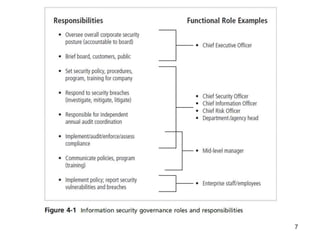
7
Information Security Policy, Standards,
and Practices
• Management from communities of interest must
make policies the basis for all information security
planning, design, and deployment.
• Policies direct how issues should be addressed
and technologies used.
• Policies should never contradict law, must be able
to stand up in court, and must be properly
administered.
• Security policies are the least expensive controls to
execute but most difficult to implement properly.
8
Definitions:
• A policy is a plan or course of action that conveys
instructions from an organization’s senior management
to those who make decisions, take actions, and perform
other duties.
 Policies are put in place to support the mission,
vision, and strategic planning of an organization.
• Standards, are more detailed statements of what must
be done to comply with policy. They have the same
requirements for compliance as policies.
 Standards may be formal, informal, published,
scrutinized and ratified by a group
• Procedures, practices and guidelines effectively explain
how to comply with policy
9
Policy as the Foundation for Planning
• A policy is a plan or course of action that conveys
instructions from an organization’s senior
management to those who make decisions, take
actions, and perform other duties.
 Policy functions as organizational law that dictates
acceptable and unacceptable behavior.
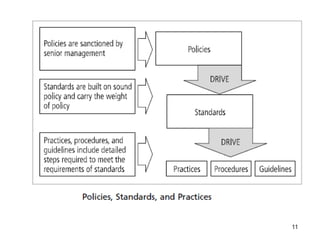
• Standards: more detailed statements of what must be
done to comply with policy
• Practices, procedures, and guidelines effectively explain
how to comply with policy.
• For a policy to be effective, it must be properly
disseminated, read, understood, and agreed to by all
members of the organization, and uniformly enforced.
10
11
12
Management must define three types of security
policy, according to the National Institute of Standards
and Technology’s Special Publication 800-14
1. Enterprise information security policies (EISP)
2. Issue-specific security policies (ISSP)
3. Systems-specific security policies (SysSP)
13
For a policy to be effective and thus legally enforceable, it must
meet the following criteria:
Dissemination (distribution)—The organization must be able
to demonstrate that the policy has been made readily
available for review by the employee.
-- Common dissemination techniques include hard copy
and electronic distribution.
 Review —The organization must be able to demonstrate that
it disseminated the document in an intelligible form, including
versions for illiterate, non-English reading, and reading-
impaired employees.
-- Common techniques include recording the policy
in English and other languages.
 Comprehension (understanding)—The organization must be
able to demonstrate that the employee understood the
requirements and content of the policy.
-- Common techniques include quizzes and other
assessments.
14
 Compliance (agreement)—The organization must be able to
demonstrate that the employee agrees to comply with the
policy, through act or affirmation.
-- Common techniques include logon banners which
require a specific action (mouse click or keystroke)
to acknowledge agreement, or a signed document
clearly indicating the employee has read, understood,
and agreed to comply with the policy.
 Uniform enforcement—The organization must be able to
demonstrate that the policy has been uniformly enforced,
regardless of employee status or assignment.
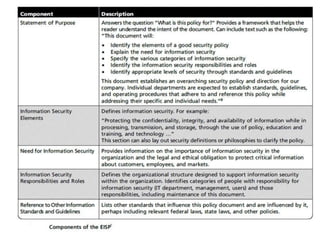
Enterprise Information Security Policy (EISP)
• An enterprise information security policy (EISP) is
also known as a general security policy, organizational
security policy, IT security policy, or information security
policy.
• The EISP is based on and directly supports the mission,
vision, and direction of the organization.
• Sets strategic direction, scope, and tone for all security
efforts within the organization
• Executive-level document, usually drafted by or with
Chief Information Officer (CIO) of the organization
15
Enterprise Information Security Policy (EISP)
• Typically addresses compliance in two areas:
– Ensure meeting of requirements to establish
program and assigning responsibilities therein to
various organizational components
– Use of specified penalties and disciplinary action
• EISP Elements should include:
– Overview of corporate security philosophy
– Information on the structure of the organization and
people in information security roles
– Articulated responsibilities for security shared by all
members of the organization
– Articulated responsibilities for security unique to
each role in the organization
16
17
Issue-Specific Security Policy (ISSP)
• The ISSP:
– Addresses specific areas of technology
– Requires frequent updates
– Contains statement on the organization’s position on
specific issue
• Three common approaches when creating and
managing ISSPs:
– Create a number of independent ISSP documents
– Create a single comprehensive ISSP document
– Create a modular ISSP document
18
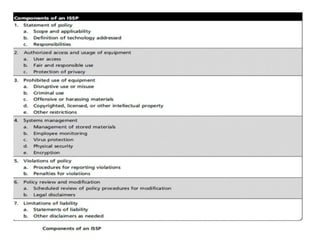
Issue-Specific Security Policy (ISSP)
• Components of the policy:
–Statement of policy
–Authorized access and usage of
equipment
–Prohibited use of equipment
–Systems management
–Violations of policy
–Policy review and modification
–Limitations of liability
19
20
Systems-Specific Policy (SysSP)
• SysSPs often function as standards or procedures
used when configuring or maintaining systems.
• Systems-specific policies fall into two groups:
– Managerial guidance
– Technical specifications
 A managerial guidance - SysSP document is created
by management to guide the implementation and
configuration of technology as well as to address the
behavior of people in the organization in ways that
support the security of information.
– For example, while the method for implementing a
firewall belongs in the technical specifications SysSP, the
firewall’s configuration must follow guidelines established
by management. 21
• Technical Specifications SysSPs - The system
administrator need to create a policy to implement the
managerial policy.
• Each type of equipment requires its own set of policies,
which are used to translate the management intent for the
technical control into an enforceable technical approach.
For example, an ISSP may require that user passwords
be changed quarterly; a systems administrator can
implement a technical control within a specific application
to enforce this policy.
• There are two general methods of implementing technical
controls: access control lists and configuration rules.
22
• Access control lists (ACLs) can restrict access
for a particular user, computer, time, duration—
even a particular file.
• It consist of the user access lists, matrices, and
capability tables that govern the rights and
privileges of users.
• ACLs can control access to file storage systems,
software components, or network communications
devices.
• A capabilities table specifies which subjects and
objects users or groups can access; in some
systems, capabilities tables are called user profiles
or user policies.
23
• Configuration Rule Policies -They are the specific
instructions that govern how a security system reacts
to the data it receives.
• Rule-based policies are more specific to the operation
of a system than ACLs are, and they may or may not
deal with users directly.
• Many security systems, for example firewalls, intrusion
detection and prevention systems (IDPSs), and proxy
servers, use specific configuration scripts that represent
the configuration rule policy to determine how the
system handles each data element they process.
24
• Combination SysSPs combine managerial guidance
and technical specifications.
• System-specific policies can be developed at the
same time as ISSPs, or they can be prepared in
advance of their related ISSPs.
25
Policy Management
• Policies must be managed as they constantly
change.
• All policies, including security policies, undergo
tremendous stress when corporate mergers
and divestitures occur; in such situations,
employees are faced with uncertainty and many
distractions.
26
• To remain viable, security policies must have:
– A responsible manager
– A schedule of reviews
– A method for making recommendations for
reviews
– A policy issuance and revision date
– Automated policy management
27
The Information Security Blueprint
• Basis for design, selection, and implementation of
all security policies, education and training
programs, and technological controls
• Detailed version of security framework (outline of
overall information security strategy for
organization)
• Specifies tasks and order in which they are to be
accomplished
• Should also serve as a scalable, upgradeable, and
comprehensive plan for the current and future
information security needs
28
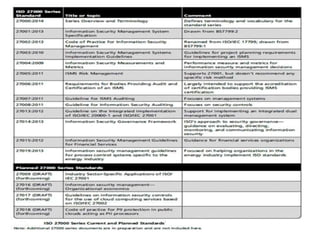
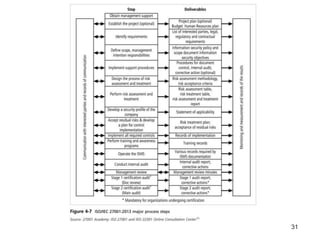
The ISO 27000 Series
• One of the most widely referenced security models
• Standard framework for information security that
states organizational security policy is needed to
provide management direction and support
• Purpose is to give recommendations for
information security management
• Provides a starting point for developing
organizational security
29
30
31
NIST Security Models
• Another possible approach described in the
documents available from Computer Security
Resource Center of NIST
– SP 800-12
– SP 800-14
– SP 800-18 Rev. 1
– SP 800-26
– SP 800-30
32
NIST Special Publication 800-14
• Security supports the mission of the organization
and is an integral element of sound management.
• Security should be cost effective; owners have
security responsibilities outside their own
organizations.
• Security responsibilities and accountability should
be made explicit; security requires a
comprehensive and integrated approach.
• Security should be periodically reassessed;
security is constrained by societal factors.
• Thirty-three principles for securing systems (see
Table 4-5)
33
NIST Cybersecurity Framework
• Consists of three fundamental components:
– Framework core: set of information security activities
an organization is expected to perform and their
desired results
– Framework tiers: help relate the maturity of security
programs and implement corresponding measures
and functions
– Framework profile: used to perform a gap analysis
between the current and a desired state of
information security/risk management
34
NIST Cybersecurity Framework
(cont’d)
• Seven-step approach to implementing/improving
programs:
– Prioritize and scope
– Orient
– Create current profile
– Conduct risk assessment
– Create target profile
– Determine, analyze, prioritize gaps
– Implement action plan
35
Other Sources of Security Frameworks
• Federal Agency Security Practices (FASP)
• Computer Emergency Response Team
Coordination Center (CERT/CC)
• International Association of Professional Security
Consultants
36
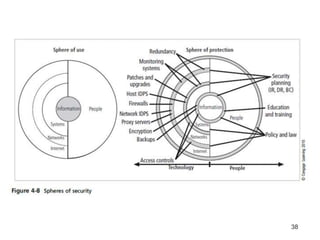
Design of Security Architecture
• Spheres of security: foundation of the security
framework
• Levels of controls:
– Management controls set the direction and scope of
the security processes and provide detailed
instructions for its conduct.
– Operational controls address personnel and physical
security, and the protection of production
inputs/outputs.
– Technical controls are the tactical and technical
implementations related to designing and integrating
security in the organization.
37
38
Design of Security Architecture
(cont’d)
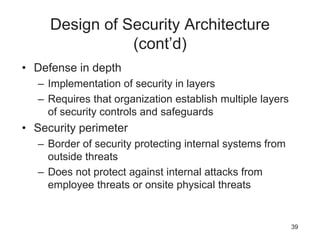
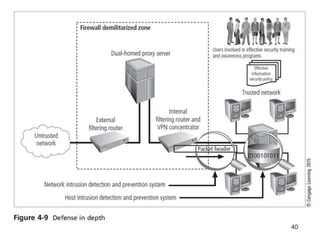
• Defense in depth
– Implementation of security in layers
– Requires that organization establish multiple layers
of security controls and safeguards
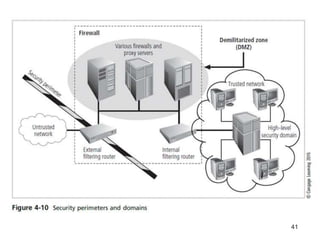
• Security perimeter
– Border of security protecting internal systems from
outside threats
– Does not protect against internal attacks from
employee threats or onsite physical threats
39
40
41
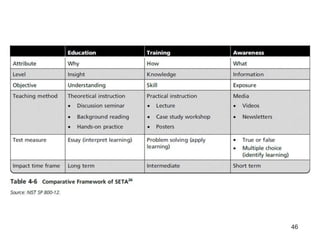
Security Education, Training, and
Awareness Program
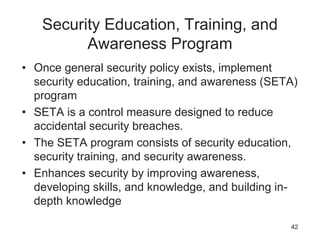
• Once general security policy exists, implement
security education, training, and awareness (SETA)
program
• SETA is a control measure designed to reduce
accidental security breaches.
• The SETA program consists of security education,
security training, and security awareness.
• Enhances security by improving awareness,
developing skills, and knowledge, and building in-
depth knowledge
42
Security Education
• Everyone in an organization needs to be trained
and aware of information security; not every
member needs a formal degree or certificate in
information security.
• When formal education is deemed appropriate, an
employee can investigate courses in continuing
education from local institutions of higher learning.
• A number of universities have formal coursework in
information security.
43
Security Training
• Provides members of the organization with detailed
information and hands-on instruction to prepare
them to perform their duties securely
• Management of information security can develop
customized in-house training or outsource the
training program.
• Alternatives to formal training include conferences
and programs offered through professional
organizations.
44
Security Awareness
• One of the least frequently implemented but most
beneficial programs is the security awareness
program.
• Designed to keep information security at the
forefront of users’ minds
• Need not be complicated or expensive
• If the program is not actively implemented,
employees may begin to neglect security matters,
and risk of employee accidents and failures are
likely to increase.
45
46
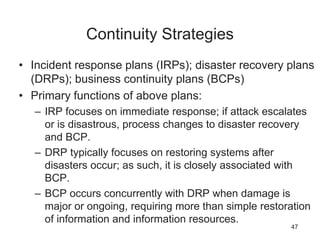
Continuity Strategies
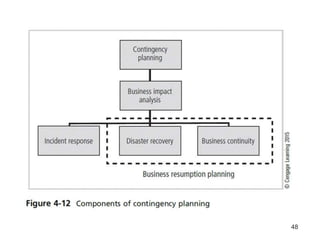
• Incident response plans (IRPs); disaster recovery plans
(DRPs); business continuity plans (BCPs)
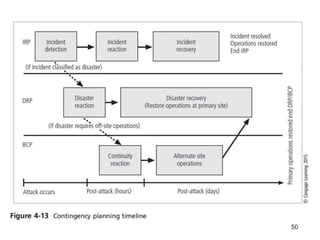
• Primary functions of above plans:
– IRP focuses on immediate response; if attack escalates
or is disastrous, process changes to disaster recovery
and BCP.
– DRP typically focuses on restoring systems after
disasters occur; as such, it is closely associated with
BCP.
– BCP occurs concurrently with DRP when damage is
major or ongoing, requiring more than simple restoration
of information and information resources.
47
48
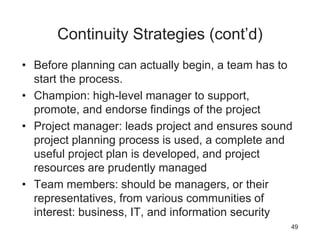
Continuity Strategies (cont’d)
• Before planning can actually begin, a team has to
start the process.
• Champion: high-level manager to support,
promote, and endorse findings of the project
• Project manager: leads project and ensures sound
project planning process is used, a complete and
useful project plan is developed, and project
resources are prudently managed
• Team members: should be managers, or their
representatives, from various communities of
interest: business, IT, and information security
49
50
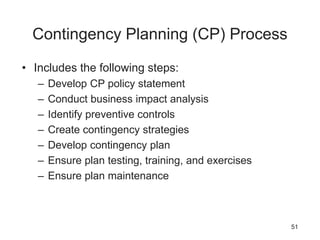
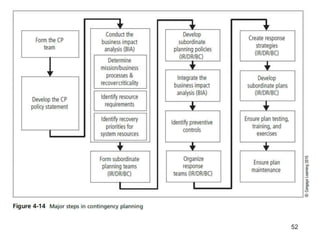
Contingency Planning (CP) Process
• Includes the following steps:
– Develop CP policy statement
– Conduct business impact analysis
– Identify preventive controls
– Create contingency strategies
– Develop contingency plan
– Ensure plan testing, training, and exercises
– Ensure plan maintenance
51
52
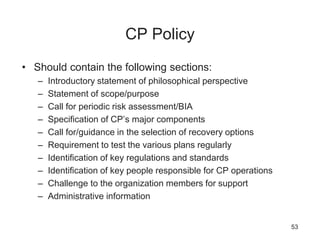
CP Policy
• Should contain the following sections:
– Introductory statement of philosophical perspective
– Statement of scope/purpose
– Call for periodic risk assessment/BIA
– Specification of CP’s major components
– Call for/guidance in the selection of recovery options
– Requirement to test the various plans regularly
– Identification of key regulations and standards
– Identification of key people responsible for CP operations
– Challenge to the organization members for support
– Administrative information
53
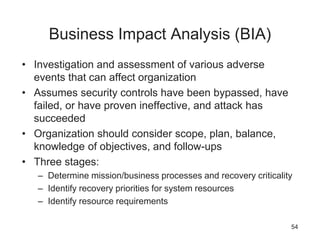
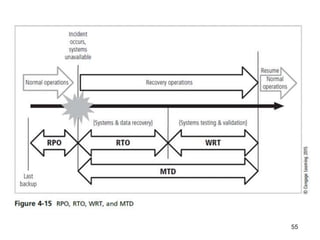
Business Impact Analysis (BIA)
• Investigation and assessment of various adverse
events that can affect organization
• Assumes security controls have been bypassed, have
failed, or have proven ineffective, and attack has
succeeded
• Organization should consider scope, plan, balance,
knowledge of objectives, and follow-ups
• Three stages:
– Determine mission/business processes and recovery criticality
– Identify recovery priorities for system resources
– Identify resource requirements
54
55
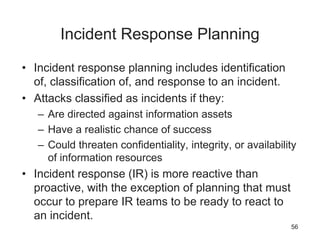
Incident Response Planning
• Incident response planning includes identification
of, classification of, and response to an incident.
• Attacks classified as incidents if they:
– Are directed against information assets
– Have a realistic chance of success
– Could threaten confidentiality, integrity, or availability
of information resources
• Incident response (IR) is more reactive than
proactive, with the exception of planning that must
occur to prepare IR teams to be ready to react to
an incident.
56
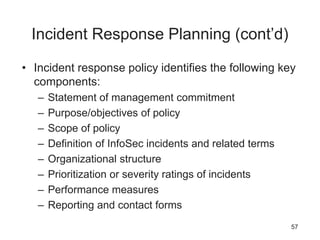
Incident Response Planning (cont’d)
• Incident response policy identifies the following key
components:
– Statement of management commitment
– Purpose/objectives of policy
– Scope of policy
– Definition of InfoSec incidents and related terms
– Organizational structure
– Prioritization or severity ratings of incidents
– Performance measures
– Reporting and contact forms
57
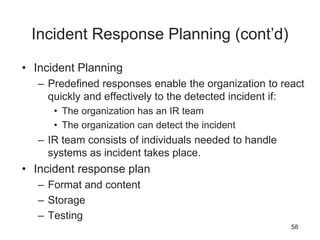
Incident Response Planning (cont’d)
• Incident Planning
– Predefined responses enable the organization to react
quickly and effectively to the detected incident if:
• The organization has an IR team
• The organization can detect the incident
– IR team consists of individuals needed to handle
systems as incident takes place.
• Incident response plan
– Format and content
– Storage
– Testing
58
Incident Response Planning (cont’d)
• Incident detection
– Most common occurrence is complaint about
technology support, often delivered to help desk.
– Careful training is needed to quickly identify and
classify an incident.
– Once incident is properly identified, the organization
can respond.
– Incident indicators vary.
59
Incident Response Planning (cont’d)
• Incident reaction
– Consists of actions that guide the organization to stop incident,
mitigate its impact, and provide information for recovery
– Actions that must occur quickly:
• Notification of key personnel
• Documentation of the incident
• Incident containment strategies
– Containment of incident’s scope or impact as first priority; must
then determine which information systems are affected
– Organization can stop incident and attempt to recover control
through a number or strategies.
60
Incident Response Planning (cont’d)
• Incident recovery
– Once incident has been contained and control of
systems regained, the next stage is recovery.
– The first task is to identify human resources needed
and launch them into action.
– Full extent of the damage must be assessed.
– Organization repairs vulnerabilities, addresses any
shortcomings in safeguards, and restores data and
services of the systems.
61
Incident Response Planning (cont’d)
• Damage assessment
– Several sources of information on damage can be
used, including system logs, intrusion detection logs,
configuration logs and documents, documentation
from incident response, and results of detailed
assessment of systems and data storage.
– Computer evidence must be carefully collected,
documented, and maintained to be usable in formal
or informal proceedings.
– Individuals who assess damage need special
training.
62
Incident Response Planning (cont’d)
• Automated response
– New systems can respond to incident threat
autonomously.
– Downsides of current automated response systems
may outweigh benefits.
• Legal liabilities of a counterattack
• Ethical issues
63
Disaster Recovery Planning
• Disaster recovery planning (DRP) is preparation for
and recovery from a disaster.
• The contingency planning team must decide which
actions constitute disasters and which constitute
incidents.
• When situations are classified as disasters, plans
change as to how to respond; take action to secure
most valuable assets to preserve value for the
longer term.
• DRP strives to reestablish operations at the
primary site.
64
Business Continuity Planning
• Prepares the organization to reestablish or relocate
critical business operations during a disaster that
affects operations at the primary site
• If disaster has rendered the current location
unusable, there must be a plan to allow business to
continue functioning.
• Development of BCP is somewhat simpler than
IRP or DRP.
– Consists primarily of selecting a continuity strategy
and integrating off-site data storage and recovery
functions into this strategy
65
Business Continuity Planning (cont’d)
• Continuity strategies
– There are a number of strategies for planning for
business continuity.
– Determining factor in selecting between options is
usually cost.
– In general, there are three exclusive options: hot
sites, warm sites, and cold sites.
– Three shared functions: time-share, service bureaus,
and mutual agreements
66
Business Continuity Planning (cont’d)
• Off-site disaster data storage
– To get sites up and running quickly, an organization
must have the ability to move data into new site’s
systems.
– Options for getting operations up and running
include:
• Electronic vaulting
• Remote journaling
• Database shadowing
67
Crisis Management
• Actions taken in response to an emergency to
minimize injury/loss of life, preserve organization’s
image/market share, and complement disaster
recovery/business continuity processes
• What may truly distinguish an incident from a
disaster are the actions of the response teams.
• Disaster recovery personnel must know their roles
without any supporting documentation.
– Preparation
– Training
– Rehearsal
68
Crisis Management (cont’d)
• Crisis management team is responsible for
managing the event from an enterprise perspective
and covers:
– Supporting personnel and families during crisis
– Determining impact on normal business operations
and, if necessary, making disaster declaration
– Keeping the public informed
– Communicating with major customers, suppliers,
partners, regulatory agencies, industry
organizations, the media, and other interested
parties
69
Crisis Management (cont’d)
• Key areas of crisis management also include:
– Verifying personnel head count
– Checking alert roster
– Checking emergency information cards
70
The Consolidated Contingency Plan
• Single document set approach combines all
aspects of contingency policy and plan,
incorporating IR, DR, and BC plans.
• Often created and stored electronically, it should be
easily accessible by employees in time of need.
– Small- and medium-sized organizations may also
store hard copies of the document.
71
Law Enforcement Involvement
• When incident at hand constitutes a violation of
law, the organization may determine involving law
enforcement is necessary.
• Questions:
– When should law enforcement get involved?
– What level of law enforcement agency should be
involved (local, state, federal)?
– What happens when law enforcement agency is
involved?
• Some questions are best answered by the legal
department.
72
Benefits and Drawbacks of Law
Enforcement Involvement
• Involving law enforcement agencies has
advantages:
– Agencies may be better equipped at processing
evidence.
– Organization may be less effective in extracting
necessary information to legally convict suspected
criminal.
– Law enforcement agencies are prepared to handle
any necessary warrants and subpoenas.
– Law enforcement is skilled at obtaining witness
statements and other information collection.
73
Benefits and Drawbacks of Law
Enforcement Involvement (cont’d)
• Involving law enforcement agencies has
disadvantages:
– Once a law enforcement agency takes over the
case, the organization cannot control the chain of
events.
– The organization may not hear about the case for
weeks or months.
– Equipment vital to the organization’s business may
be tagged as evidence.
– If the organization detects a criminal act, it is legally
obligated to involve appropriate law enforcement
officials.
74
Summary
• Management has an essential role in the
development, maintenance, and enforcement of
information security policy, standards, practices,
procedures, and guidelines.
• Information security blueprint is planning the
document that is the basis for design, selection,
and implementation of all security policies,
education and training programs, and technological
controls.
75
Summary (cont’d)
• Information security education, training, and
awareness (SETA) is a control measure that
reduces accidental security breaches and
increases organizational resistance to many other
forms of attack.
• Contingency planning (CP) is made up of three
components: incident response planning (IRP),
disaster recovery planning (DRP), and business
continuity planning (BCP).
76

Chapter 5 Planning for Security-students.ppt

  • 1.
  • 2.
    Learning Objectives • Uponcompletion of this material, you should be able to: – Describe management’s role in the development, maintenance, and enforcement of information security policy, standards, practices, procedures, and guidelines – Explain what an information security blueprint is, identify its major components, and explain how it supports the information security program 2
  • 3.
    Learning Objectives (cont’d) –Discuss how an organization institutionalizes its policies, standards, and practices using education, training, and awareness programs – Describe what contingency planning is and how it relates to incident response planning, disaster recovery planning, and business continuity plans 3
  • 4.
    Introduction • Information securityprogram begins with policies, standards, and practices, which are the foundation for information security architecture and blueprint. • Coordinated planning is required to create and maintain these elements. • Strategic planning for the management of allocation of resources • Contingency planning for the preparation of uncertain business environment 4
  • 5.
    Information Security Planningand Governance • Planning levels help translate organization’s strategic plans into tactical objectives. • Planning and the CISO • Information Security Governance – Governance: • Set of responsibilities and practices exercised by the board and executive management • Goal to provide strategic direction, establishment of objectives, and measurement of progress toward objectives • Also verifies/validates that risk management practices are appropriate and assets used properly 5
  • 6.
    Information Security Planningand Governance (cont’d) • Information Security Governance outcomes – Five goals: • Strategic alignment • Risk management • Resource management • Performance measures • Value delivery 6
  • 7.
  • 8.
    Information Security Policy,Standards, and Practices • Management from communities of interest must make policies the basis for all information security planning, design, and deployment. • Policies direct how issues should be addressed and technologies used. • Policies should never contradict law, must be able to stand up in court, and must be properly administered. • Security policies are the least expensive controls to execute but most difficult to implement properly. 8
  • 9.
    Definitions: • A policyis a plan or course of action that conveys instructions from an organization’s senior management to those who make decisions, take actions, and perform other duties.  Policies are put in place to support the mission, vision, and strategic planning of an organization. • Standards, are more detailed statements of what must be done to comply with policy. They have the same requirements for compliance as policies.  Standards may be formal, informal, published, scrutinized and ratified by a group • Procedures, practices and guidelines effectively explain how to comply with policy 9
  • 10.
    Policy as theFoundation for Planning • A policy is a plan or course of action that conveys instructions from an organization’s senior management to those who make decisions, take actions, and perform other duties.  Policy functions as organizational law that dictates acceptable and unacceptable behavior. • Standards: more detailed statements of what must be done to comply with policy • Practices, procedures, and guidelines effectively explain how to comply with policy. • For a policy to be effective, it must be properly disseminated, read, understood, and agreed to by all members of the organization, and uniformly enforced. 10
  • 11.
  • 12.
    12 Management must definethree types of security policy, according to the National Institute of Standards and Technology’s Special Publication 800-14 1. Enterprise information security policies (EISP) 2. Issue-specific security policies (ISSP) 3. Systems-specific security policies (SysSP)
  • 13.
    13 For a policyto be effective and thus legally enforceable, it must meet the following criteria: Dissemination (distribution)—The organization must be able to demonstrate that the policy has been made readily available for review by the employee. -- Common dissemination techniques include hard copy and electronic distribution.  Review —The organization must be able to demonstrate that it disseminated the document in an intelligible form, including versions for illiterate, non-English reading, and reading- impaired employees. -- Common techniques include recording the policy in English and other languages.  Comprehension (understanding)—The organization must be able to demonstrate that the employee understood the requirements and content of the policy. -- Common techniques include quizzes and other assessments.
  • 14.
    14  Compliance (agreement)—Theorganization must be able to demonstrate that the employee agrees to comply with the policy, through act or affirmation. -- Common techniques include logon banners which require a specific action (mouse click or keystroke) to acknowledge agreement, or a signed document clearly indicating the employee has read, understood, and agreed to comply with the policy.  Uniform enforcement—The organization must be able to demonstrate that the policy has been uniformly enforced, regardless of employee status or assignment.
  • 15.
    Enterprise Information SecurityPolicy (EISP) • An enterprise information security policy (EISP) is also known as a general security policy, organizational security policy, IT security policy, or information security policy. • The EISP is based on and directly supports the mission, vision, and direction of the organization. • Sets strategic direction, scope, and tone for all security efforts within the organization • Executive-level document, usually drafted by or with Chief Information Officer (CIO) of the organization 15
  • 16.
    Enterprise Information SecurityPolicy (EISP) • Typically addresses compliance in two areas: – Ensure meeting of requirements to establish program and assigning responsibilities therein to various organizational components – Use of specified penalties and disciplinary action • EISP Elements should include: – Overview of corporate security philosophy – Information on the structure of the organization and people in information security roles – Articulated responsibilities for security shared by all members of the organization – Articulated responsibilities for security unique to each role in the organization 16
  • 17.
  • 18.
    Issue-Specific Security Policy(ISSP) • The ISSP: – Addresses specific areas of technology – Requires frequent updates – Contains statement on the organization’s position on specific issue • Three common approaches when creating and managing ISSPs: – Create a number of independent ISSP documents – Create a single comprehensive ISSP document – Create a modular ISSP document 18
  • 19.
    Issue-Specific Security Policy(ISSP) • Components of the policy: –Statement of policy –Authorized access and usage of equipment –Prohibited use of equipment –Systems management –Violations of policy –Policy review and modification –Limitations of liability 19
  • 20.
  • 21.
    Systems-Specific Policy (SysSP) •SysSPs often function as standards or procedures used when configuring or maintaining systems. • Systems-specific policies fall into two groups: – Managerial guidance – Technical specifications  A managerial guidance - SysSP document is created by management to guide the implementation and configuration of technology as well as to address the behavior of people in the organization in ways that support the security of information. – For example, while the method for implementing a firewall belongs in the technical specifications SysSP, the firewall’s configuration must follow guidelines established by management. 21
  • 22.
    • Technical SpecificationsSysSPs - The system administrator need to create a policy to implement the managerial policy. • Each type of equipment requires its own set of policies, which are used to translate the management intent for the technical control into an enforceable technical approach. For example, an ISSP may require that user passwords be changed quarterly; a systems administrator can implement a technical control within a specific application to enforce this policy. • There are two general methods of implementing technical controls: access control lists and configuration rules. 22
  • 23.
    • Access controllists (ACLs) can restrict access for a particular user, computer, time, duration— even a particular file. • It consist of the user access lists, matrices, and capability tables that govern the rights and privileges of users. • ACLs can control access to file storage systems, software components, or network communications devices. • A capabilities table specifies which subjects and objects users or groups can access; in some systems, capabilities tables are called user profiles or user policies. 23
  • 24.
    • Configuration RulePolicies -They are the specific instructions that govern how a security system reacts to the data it receives. • Rule-based policies are more specific to the operation of a system than ACLs are, and they may or may not deal with users directly. • Many security systems, for example firewalls, intrusion detection and prevention systems (IDPSs), and proxy servers, use specific configuration scripts that represent the configuration rule policy to determine how the system handles each data element they process. 24
  • 25.
    • Combination SysSPscombine managerial guidance and technical specifications. • System-specific policies can be developed at the same time as ISSPs, or they can be prepared in advance of their related ISSPs. 25
  • 26.
    Policy Management • Policiesmust be managed as they constantly change. • All policies, including security policies, undergo tremendous stress when corporate mergers and divestitures occur; in such situations, employees are faced with uncertainty and many distractions. 26
  • 27.
    • To remainviable, security policies must have: – A responsible manager – A schedule of reviews – A method for making recommendations for reviews – A policy issuance and revision date – Automated policy management 27
  • 28.
    The Information SecurityBlueprint • Basis for design, selection, and implementation of all security policies, education and training programs, and technological controls • Detailed version of security framework (outline of overall information security strategy for organization) • Specifies tasks and order in which they are to be accomplished • Should also serve as a scalable, upgradeable, and comprehensive plan for the current and future information security needs 28
  • 29.
    The ISO 27000Series • One of the most widely referenced security models • Standard framework for information security that states organizational security policy is needed to provide management direction and support • Purpose is to give recommendations for information security management • Provides a starting point for developing organizational security 29
  • 30.
  • 31.
  • 32.
    NIST Security Models •Another possible approach described in the documents available from Computer Security Resource Center of NIST – SP 800-12 – SP 800-14 – SP 800-18 Rev. 1 – SP 800-26 – SP 800-30 32
  • 33.
    NIST Special Publication800-14 • Security supports the mission of the organization and is an integral element of sound management. • Security should be cost effective; owners have security responsibilities outside their own organizations. • Security responsibilities and accountability should be made explicit; security requires a comprehensive and integrated approach. • Security should be periodically reassessed; security is constrained by societal factors. • Thirty-three principles for securing systems (see Table 4-5) 33
  • 34.
    NIST Cybersecurity Framework •Consists of three fundamental components: – Framework core: set of information security activities an organization is expected to perform and their desired results – Framework tiers: help relate the maturity of security programs and implement corresponding measures and functions – Framework profile: used to perform a gap analysis between the current and a desired state of information security/risk management 34
  • 35.
    NIST Cybersecurity Framework (cont’d) •Seven-step approach to implementing/improving programs: – Prioritize and scope – Orient – Create current profile – Conduct risk assessment – Create target profile – Determine, analyze, prioritize gaps – Implement action plan 35
  • 36.
    Other Sources ofSecurity Frameworks • Federal Agency Security Practices (FASP) • Computer Emergency Response Team Coordination Center (CERT/CC) • International Association of Professional Security Consultants 36
  • 37.
    Design of SecurityArchitecture • Spheres of security: foundation of the security framework • Levels of controls: – Management controls set the direction and scope of the security processes and provide detailed instructions for its conduct. – Operational controls address personnel and physical security, and the protection of production inputs/outputs. – Technical controls are the tactical and technical implementations related to designing and integrating security in the organization. 37
  • 38.
  • 39.
    Design of SecurityArchitecture (cont’d) • Defense in depth – Implementation of security in layers – Requires that organization establish multiple layers of security controls and safeguards • Security perimeter – Border of security protecting internal systems from outside threats – Does not protect against internal attacks from employee threats or onsite physical threats 39
  • 40.
  • 41.
  • 42.
    Security Education, Training,and Awareness Program • Once general security policy exists, implement security education, training, and awareness (SETA) program • SETA is a control measure designed to reduce accidental security breaches. • The SETA program consists of security education, security training, and security awareness. • Enhances security by improving awareness, developing skills, and knowledge, and building in- depth knowledge 42
  • 43.
    Security Education • Everyonein an organization needs to be trained and aware of information security; not every member needs a formal degree or certificate in information security. • When formal education is deemed appropriate, an employee can investigate courses in continuing education from local institutions of higher learning. • A number of universities have formal coursework in information security. 43
  • 44.
    Security Training • Providesmembers of the organization with detailed information and hands-on instruction to prepare them to perform their duties securely • Management of information security can develop customized in-house training or outsource the training program. • Alternatives to formal training include conferences and programs offered through professional organizations. 44
  • 45.
    Security Awareness • Oneof the least frequently implemented but most beneficial programs is the security awareness program. • Designed to keep information security at the forefront of users’ minds • Need not be complicated or expensive • If the program is not actively implemented, employees may begin to neglect security matters, and risk of employee accidents and failures are likely to increase. 45
  • 46.
  • 47.
    Continuity Strategies • Incidentresponse plans (IRPs); disaster recovery plans (DRPs); business continuity plans (BCPs) • Primary functions of above plans: – IRP focuses on immediate response; if attack escalates or is disastrous, process changes to disaster recovery and BCP. – DRP typically focuses on restoring systems after disasters occur; as such, it is closely associated with BCP. – BCP occurs concurrently with DRP when damage is major or ongoing, requiring more than simple restoration of information and information resources. 47
  • 48.
  • 49.
    Continuity Strategies (cont’d) •Before planning can actually begin, a team has to start the process. • Champion: high-level manager to support, promote, and endorse findings of the project • Project manager: leads project and ensures sound project planning process is used, a complete and useful project plan is developed, and project resources are prudently managed • Team members: should be managers, or their representatives, from various communities of interest: business, IT, and information security 49
  • 50.
  • 51.
    Contingency Planning (CP)Process • Includes the following steps: – Develop CP policy statement – Conduct business impact analysis – Identify preventive controls – Create contingency strategies – Develop contingency plan – Ensure plan testing, training, and exercises – Ensure plan maintenance 51
  • 52.
  • 53.
    CP Policy • Shouldcontain the following sections: – Introductory statement of philosophical perspective – Statement of scope/purpose – Call for periodic risk assessment/BIA – Specification of CP’s major components – Call for/guidance in the selection of recovery options – Requirement to test the various plans regularly – Identification of key regulations and standards – Identification of key people responsible for CP operations – Challenge to the organization members for support – Administrative information 53
  • 54.
    Business Impact Analysis(BIA) • Investigation and assessment of various adverse events that can affect organization • Assumes security controls have been bypassed, have failed, or have proven ineffective, and attack has succeeded • Organization should consider scope, plan, balance, knowledge of objectives, and follow-ups • Three stages: – Determine mission/business processes and recovery criticality – Identify recovery priorities for system resources – Identify resource requirements 54
  • 55.
  • 56.
    Incident Response Planning •Incident response planning includes identification of, classification of, and response to an incident. • Attacks classified as incidents if they: – Are directed against information assets – Have a realistic chance of success – Could threaten confidentiality, integrity, or availability of information resources • Incident response (IR) is more reactive than proactive, with the exception of planning that must occur to prepare IR teams to be ready to react to an incident. 56
  • 57.
    Incident Response Planning(cont’d) • Incident response policy identifies the following key components: – Statement of management commitment – Purpose/objectives of policy – Scope of policy – Definition of InfoSec incidents and related terms – Organizational structure – Prioritization or severity ratings of incidents – Performance measures – Reporting and contact forms 57
  • 58.
    Incident Response Planning(cont’d) • Incident Planning – Predefined responses enable the organization to react quickly and effectively to the detected incident if: • The organization has an IR team • The organization can detect the incident – IR team consists of individuals needed to handle systems as incident takes place. • Incident response plan – Format and content – Storage – Testing 58
  • 59.
    Incident Response Planning(cont’d) • Incident detection – Most common occurrence is complaint about technology support, often delivered to help desk. – Careful training is needed to quickly identify and classify an incident. – Once incident is properly identified, the organization can respond. – Incident indicators vary. 59
  • 60.
    Incident Response Planning(cont’d) • Incident reaction – Consists of actions that guide the organization to stop incident, mitigate its impact, and provide information for recovery – Actions that must occur quickly: • Notification of key personnel • Documentation of the incident • Incident containment strategies – Containment of incident’s scope or impact as first priority; must then determine which information systems are affected – Organization can stop incident and attempt to recover control through a number or strategies. 60
  • 61.
    Incident Response Planning(cont’d) • Incident recovery – Once incident has been contained and control of systems regained, the next stage is recovery. – The first task is to identify human resources needed and launch them into action. – Full extent of the damage must be assessed. – Organization repairs vulnerabilities, addresses any shortcomings in safeguards, and restores data and services of the systems. 61
  • 62.
    Incident Response Planning(cont’d) • Damage assessment – Several sources of information on damage can be used, including system logs, intrusion detection logs, configuration logs and documents, documentation from incident response, and results of detailed assessment of systems and data storage. – Computer evidence must be carefully collected, documented, and maintained to be usable in formal or informal proceedings. – Individuals who assess damage need special training. 62
  • 63.
    Incident Response Planning(cont’d) • Automated response – New systems can respond to incident threat autonomously. – Downsides of current automated response systems may outweigh benefits. • Legal liabilities of a counterattack • Ethical issues 63
  • 64.
    Disaster Recovery Planning •Disaster recovery planning (DRP) is preparation for and recovery from a disaster. • The contingency planning team must decide which actions constitute disasters and which constitute incidents. • When situations are classified as disasters, plans change as to how to respond; take action to secure most valuable assets to preserve value for the longer term. • DRP strives to reestablish operations at the primary site. 64
  • 65.
    Business Continuity Planning •Prepares the organization to reestablish or relocate critical business operations during a disaster that affects operations at the primary site • If disaster has rendered the current location unusable, there must be a plan to allow business to continue functioning. • Development of BCP is somewhat simpler than IRP or DRP. – Consists primarily of selecting a continuity strategy and integrating off-site data storage and recovery functions into this strategy 65
  • 66.
    Business Continuity Planning(cont’d) • Continuity strategies – There are a number of strategies for planning for business continuity. – Determining factor in selecting between options is usually cost. – In general, there are three exclusive options: hot sites, warm sites, and cold sites. – Three shared functions: time-share, service bureaus, and mutual agreements 66
  • 67.
    Business Continuity Planning(cont’d) • Off-site disaster data storage – To get sites up and running quickly, an organization must have the ability to move data into new site’s systems. – Options for getting operations up and running include: • Electronic vaulting • Remote journaling • Database shadowing 67
  • 68.
    Crisis Management • Actionstaken in response to an emergency to minimize injury/loss of life, preserve organization’s image/market share, and complement disaster recovery/business continuity processes • What may truly distinguish an incident from a disaster are the actions of the response teams. • Disaster recovery personnel must know their roles without any supporting documentation. – Preparation – Training – Rehearsal 68
  • 69.
    Crisis Management (cont’d) •Crisis management team is responsible for managing the event from an enterprise perspective and covers: – Supporting personnel and families during crisis – Determining impact on normal business operations and, if necessary, making disaster declaration – Keeping the public informed – Communicating with major customers, suppliers, partners, regulatory agencies, industry organizations, the media, and other interested parties 69
  • 70.
    Crisis Management (cont’d) •Key areas of crisis management also include: – Verifying personnel head count – Checking alert roster – Checking emergency information cards 70
  • 71.
    The Consolidated ContingencyPlan • Single document set approach combines all aspects of contingency policy and plan, incorporating IR, DR, and BC plans. • Often created and stored electronically, it should be easily accessible by employees in time of need. – Small- and medium-sized organizations may also store hard copies of the document. 71
  • 72.
    Law Enforcement Involvement •When incident at hand constitutes a violation of law, the organization may determine involving law enforcement is necessary. • Questions: – When should law enforcement get involved? – What level of law enforcement agency should be involved (local, state, federal)? – What happens when law enforcement agency is involved? • Some questions are best answered by the legal department. 72
  • 73.
    Benefits and Drawbacksof Law Enforcement Involvement • Involving law enforcement agencies has advantages: – Agencies may be better equipped at processing evidence. – Organization may be less effective in extracting necessary information to legally convict suspected criminal. – Law enforcement agencies are prepared to handle any necessary warrants and subpoenas. – Law enforcement is skilled at obtaining witness statements and other information collection. 73
  • 74.
    Benefits and Drawbacksof Law Enforcement Involvement (cont’d) • Involving law enforcement agencies has disadvantages: – Once a law enforcement agency takes over the case, the organization cannot control the chain of events. – The organization may not hear about the case for weeks or months. – Equipment vital to the organization’s business may be tagged as evidence. – If the organization detects a criminal act, it is legally obligated to involve appropriate law enforcement officials. 74
  • 75.
    Summary • Management hasan essential role in the development, maintenance, and enforcement of information security policy, standards, practices, procedures, and guidelines. • Information security blueprint is planning the document that is the basis for design, selection, and implementation of all security policies, education and training programs, and technological controls. 75
  • 76.
    Summary (cont’d) • Informationsecurity education, training, and awareness (SETA) is a control measure that reduces accidental security breaches and increases organizational resistance to many other forms of attack. • Contingency planning (CP) is made up of three components: incident response planning (IRP), disaster recovery planning (DRP), and business continuity planning (BCP). 76