
Network Risks and Vulnerabilities
Network Security Workshop

                            Dedi Dwianto, C|EH, OSCP
      Daftar ISI
2


                                    Contents

     Network Vulnerabilities

     Network Risk Assesment

     Network Risk Mitigation


Network Risks and Vulnerabilities
3


                                                     Vulnerabilities

     Vulnerabilities are software flaws or misconfigurations
            that cause a weakness in the security of a system.

     Vulnerabilities can be exploited by a malicious entity to
            violate policies—for example, to gain greater access or
            permission than is authorized on a computer.


Network Risks and Vulnerabilities
4


                              Security Vulnerability Problem

           Design Flaws

           poor security management,

           incorrect implementation,

           Internet technology vulnerability,

           the nature of intruder activity,

           the difficulty of fixing vulnerable systems,

           the limits of effectiveness of reactive solutions,

           social engineering

Network Risks and Vulnerabilities
5


                                                      Design Flaws

     The two major components of a computer system,
            hardware and software, quite often have design flaws
     Hardware systems are less susceptible to design flaws
            than their software counterparts owing to less
            complexity and the long history of hardware
            engineering.
     But even with all these factors backing up hardware
            engineering, design flaws are still common.
     But the biggest problems in system security vulnerability
            are due to software design flaws

Network Risks and Vulnerabilities
6


                                              Design Flaws

     three major factors contribute a great deal to
            software design flaws:
             human factors,
             software complexity,
             trustworthy software sources


Network Risks and Vulnerabilities
7


        Classification by Software Development
                          LifeCycle (SDLC) Phase
     Taxonomies of this kind attempt to categorize
            vulnerabilities according to when they were
            introduced in the software lifecycle.

     Classically, 6 phases are recognized: feasibility
            study, requirements definition, design,
            implementation, integration and testing, and
            operations and maintenance.


Network Risks and Vulnerabilities
8


    Classification by Location in Object Models

     These classifications attempt to categorize
            vulnerabilities according to which model object or
            “entity” they belong to. Examples are classifying
            vulnerabilities using the ISO Open Systems
            Interconnect (OSI) reference model for networking


Network Risks and Vulnerabilities
9


    Classification by Location in Object Models

     These classifications attempt to categorize
            vulnerabilities according to which model object or
            “entity” they belong to. Examples are classifying
            vulnerabilities using the ISO Open Systems
            Interconnect (OSI) reference model for networking


Network Risks and Vulnerabilities
10


                                                                Viruses

     A virus, a parasitic program that cannot function
            independently, is a program or code fragment that is self-
            propagating. It is called a virus, because like its biological
            counterpart, it requires a "host" to function. In the case of a
            computer virus the host is some other program to which the
            virus attaches itself.

     A virus is usually spread by executing an infected program or
            by sending an infected file to someone else, usually in the
            form of an e-mail attachment.


Network Risks and Vulnerabilities
11


                                    Impersonation/Masquerading

     Impersonation or masquerading is the act of pretending to be
            someone or something you are not gain unauthhorized
            access to a system.
     This usually implies that authentication credentials have
            been stolen.
     Impersonation is often possible through the capture of
            usernames and passwords or of session setip procedures for
            network services.
     Prevent using one-time pads, token and Kerberos


Network Risks and Vulnerabilities
12


                                                               Worm

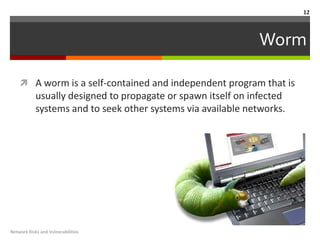
     A worm is a self-contained and independent program that is
            usually designed to propagate or spawn itself on infected
            systems and to seek other systems via available networks.


Network Risks and Vulnerabilities
13


                                                  Port Scanning

     Like a burglar casing a target to plan a break-in, a hacker will
            often case a system to gather information that can later be
            used to attack the system. One of the tools that hackers often
            use for this type of reconnaissance is a port scanner.

     A port scanner is a program that listens to well-known port
            numbers to detect services running on a system that can be
            exploited to break into the system.


Network Risks and Vulnerabilities
14


                Man in the Middle Attack (MITM)

     In a MIM attack, a hacker inserts himself or herself between
            a client program and a server on a network. By doing so the
            hacker can intercept information entered by the client, such
            as credit card numbers, passwords, and account information.

     Under one execution of this scheme, a hacker would place
            himself or herself between a browser and a Web server. The
            MIM attack, which is also sometimes called Web spoofing, is
            usually achieved by DNS or hyperlink spoofing.


Network Risks and Vulnerabilities
15


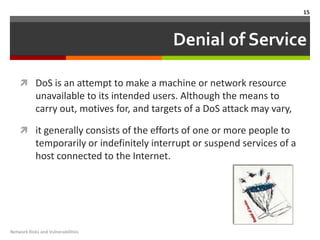
                                            Denial of Service

     DoS is an attempt to make a machine or network resource
            unavailable to its intended users. Although the means to
            carry out, motives for, and targets of a DoS attack may vary,

     it generally consists of the efforts of one or more people to
            temporarily or indefinitely interrupt or suspend services of a
            host connected to the Internet.


Network Risks and Vulnerabilities
16


                                    Network Risk Assesment

     Risk assessment is the first process in the risk management
            methodology.

     To determine the likelihood of a future adverse event, threats
            to an network system must be analyzed in conjunction with
            the potential vulnerabilities and the controls in place for the
            network system.


Network Risks and Vulnerabilities
17


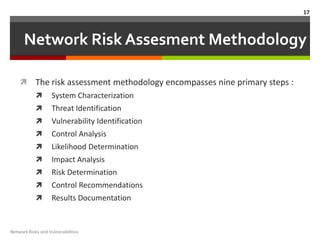
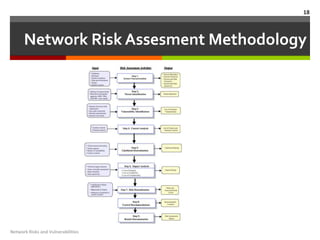
      Network Risk Assesment Methodology

           The risk assessment methodology encompasses nine primary steps :
                  System Characterization
                  Threat Identification
                  Vulnerability Identification
                  Control Analysis
                  Likelihood Determination
                  Impact Analysis
                  Risk Determination
                  Control Recommendations
                  Results Documentation


Network Risks and Vulnerabilities
18


      Network Risk Assesment Methodology


Network Risks and Vulnerabilities
19


                                                  Impact Analysis

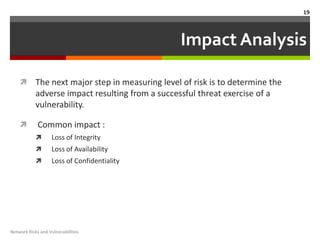
           The next major step in measuring level of risk is to determine the
            adverse impact resulting from a successful threat exercise of a
            vulnerability.

            Common impact :
                  Loss of Integrity
                  Loss of Availability
                  Loss of Confidentiality


Network Risks and Vulnerabilities
20


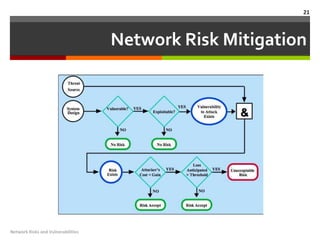
                                    Network Risk Mitigation

           Risk mitigation is a systematic methodology used by senior management
            to reduce mission risk.


Network Risks and Vulnerabilities
21


                                    Network Risk Mitigation


Network Risks and Vulnerabilities

Network Security Risk

  • 1.
     Network Risks andVulnerabilities Network Security Workshop Dedi Dwianto, C|EH, OSCP Daftar ISI
  • 2.
    2 Contents  Network Vulnerabilities  Network Risk Assesment  Network Risk Mitigation Network Risks and Vulnerabilities
  • 3.
    3 Vulnerabilities  Vulnerabilities are software flaws or misconfigurations that cause a weakness in the security of a system.  Vulnerabilities can be exploited by a malicious entity to violate policies—for example, to gain greater access or permission than is authorized on a computer. Network Risks and Vulnerabilities
  • 4.
    4 Security Vulnerability Problem  Design Flaws  poor security management,  incorrect implementation,  Internet technology vulnerability,  the nature of intruder activity,  the difficulty of fixing vulnerable systems,  the limits of effectiveness of reactive solutions,  social engineering Network Risks and Vulnerabilities
  • 5.
    5 Design Flaws  The two major components of a computer system, hardware and software, quite often have design flaws  Hardware systems are less susceptible to design flaws than their software counterparts owing to less complexity and the long history of hardware engineering.  But even with all these factors backing up hardware engineering, design flaws are still common.  But the biggest problems in system security vulnerability are due to software design flaws Network Risks and Vulnerabilities
  • 6.
    6 Design Flaws  three major factors contribute a great deal to software design flaws:  human factors,  software complexity,  trustworthy software sources Network Risks and Vulnerabilities
  • 7.
    7 Classification by Software Development LifeCycle (SDLC) Phase  Taxonomies of this kind attempt to categorize vulnerabilities according to when they were introduced in the software lifecycle.  Classically, 6 phases are recognized: feasibility study, requirements definition, design, implementation, integration and testing, and operations and maintenance. Network Risks and Vulnerabilities
  • 8.
    8 Classification by Location in Object Models  These classifications attempt to categorize vulnerabilities according to which model object or “entity” they belong to. Examples are classifying vulnerabilities using the ISO Open Systems Interconnect (OSI) reference model for networking Network Risks and Vulnerabilities
  • 9.
    9 Classification by Location in Object Models  These classifications attempt to categorize vulnerabilities according to which model object or “entity” they belong to. Examples are classifying vulnerabilities using the ISO Open Systems Interconnect (OSI) reference model for networking Network Risks and Vulnerabilities
  • 10.
    10 Viruses  A virus, a parasitic program that cannot function independently, is a program or code fragment that is self- propagating. It is called a virus, because like its biological counterpart, it requires a "host" to function. In the case of a computer virus the host is some other program to which the virus attaches itself.  A virus is usually spread by executing an infected program or by sending an infected file to someone else, usually in the form of an e-mail attachment. Network Risks and Vulnerabilities
  • 11.
    11 Impersonation/Masquerading  Impersonation or masquerading is the act of pretending to be someone or something you are not gain unauthhorized access to a system.  This usually implies that authentication credentials have been stolen.  Impersonation is often possible through the capture of usernames and passwords or of session setip procedures for network services.  Prevent using one-time pads, token and Kerberos Network Risks and Vulnerabilities
  • 12.
    12 Worm  A worm is a self-contained and independent program that is usually designed to propagate or spawn itself on infected systems and to seek other systems via available networks. Network Risks and Vulnerabilities
  • 13.
    13 Port Scanning  Like a burglar casing a target to plan a break-in, a hacker will often case a system to gather information that can later be used to attack the system. One of the tools that hackers often use for this type of reconnaissance is a port scanner.  A port scanner is a program that listens to well-known port numbers to detect services running on a system that can be exploited to break into the system. Network Risks and Vulnerabilities
  • 14.
    14 Man in the Middle Attack (MITM)  In a MIM attack, a hacker inserts himself or herself between a client program and a server on a network. By doing so the hacker can intercept information entered by the client, such as credit card numbers, passwords, and account information.  Under one execution of this scheme, a hacker would place himself or herself between a browser and a Web server. The MIM attack, which is also sometimes called Web spoofing, is usually achieved by DNS or hyperlink spoofing. Network Risks and Vulnerabilities
  • 15.
    15 Denial of Service  DoS is an attempt to make a machine or network resource unavailable to its intended users. Although the means to carry out, motives for, and targets of a DoS attack may vary,  it generally consists of the efforts of one or more people to temporarily or indefinitely interrupt or suspend services of a host connected to the Internet. Network Risks and Vulnerabilities
  • 16.
    16 Network Risk Assesment  Risk assessment is the first process in the risk management methodology.  To determine the likelihood of a future adverse event, threats to an network system must be analyzed in conjunction with the potential vulnerabilities and the controls in place for the network system. Network Risks and Vulnerabilities
  • 17.
    17 Network Risk Assesment Methodology  The risk assessment methodology encompasses nine primary steps :  System Characterization  Threat Identification  Vulnerability Identification  Control Analysis  Likelihood Determination  Impact Analysis  Risk Determination  Control Recommendations  Results Documentation Network Risks and Vulnerabilities
  • 18.
    18 Network Risk Assesment Methodology Network Risks and Vulnerabilities
  • 19.
    19 Impact Analysis  The next major step in measuring level of risk is to determine the adverse impact resulting from a successful threat exercise of a vulnerability.  Common impact :  Loss of Integrity  Loss of Availability  Loss of Confidentiality Network Risks and Vulnerabilities
  • 20.
    20 Network Risk Mitigation  Risk mitigation is a systematic methodology used by senior management to reduce mission risk. Network Risks and Vulnerabilities
  • 21.
    21 Network Risk Mitigation Network Risks and Vulnerabilities