Introduction to Information
Security
Chapter 1
Do not figure on opponents not
attacking; worry about your own
lack of preparation.
-- Book of the Five Rings
Principles of Information Security - Chapter 1 Slide 2
Learning Objectives:
Upon completion of this chapter you should be
able to:
– Understand what information security is and how it
came to mean what it does today.
– Comprehend the history of computer security and
how it evolved into information security.
– Understand the key terms and critical concepts of
information security as presented in the chapter.
– Outline the phases of the security systems
development life cycle.
– Understand the role professionals involved in
information security in an organizational structure.
Principles of Information Security - Chapter 1 Slide 3
What Is Information Security?
Information security in today’s enterprise
is a “well-informed sense of assurance
that the information risks and controls are
in balance.” –Jim Anderson, Inovant
(2002)
Principles of Information Security - Chapter 1 Slide 4
The History Of Information
Security
 Computer security began immediately after the first
mainframes were developed
 Groups developing code-breaking computations during
World War II created the first modern computers
 Physical controls were needed to limit access to
authorized personnel to sensitive military locations
 Only rudimentary controls were available to defend
against physical theft, espionage, and sabotage
Principles of Information Security - Chapter 1 Slide 5
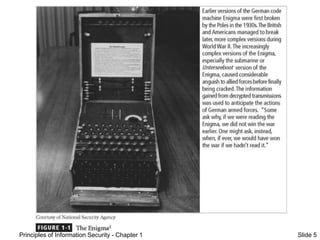
Figure 1-1 – The Enigma
Principles of Information Security - Chapter 1 Slide 6
The 1960s
Department of Defense’s Advanced
Research Project Agency (ARPA) began
examining the feasibility of a redundant
networked communications
Larry Roberts developed the project from
its inception
Principles of Information Security - Chapter 1 Slide 7
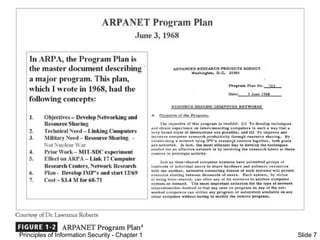
Figure 1-2 - ARPANET
Principles of Information Security - Chapter 1 Slide 8
The 1970s and 80s
 ARPANET grew in popularity as did its potential
for misuse
 Fundamental problems with ARPANET security
were identified
– No safety procedures for dial-up connections to the
ARPANET
– User identification and authorization to the system
were non-existent
 In the late 1970s the microprocessor expanded
computing capabilities and security threats
Principles of Information Security - Chapter 1 Slide 9
R-609 – The Start of the Study of
Computer Security
Information Security began with Rand
Report R-609
The scope of computer security grew from
physical security to include:
– Safety of the data
– Limiting unauthorized access to that data
– Involvement of personnel from multiple levels
of the organization
Principles of Information Security - Chapter 1 Slide 10
The 1990s
Networks of computers became more
common, so too did the need to
interconnect the networks
Resulted in the Internet, the first
manifestation of a global network of
networks
In early Internet deployments, security
was treated as a low priority
Principles of Information Security - Chapter 1 Slide 11
The Present
The Internet has brought millions of
computer networks into communication
with each other – many of them
unsecured
Ability to secure each now influenced by
the security on every computer to which it
is connected
Principles of Information Security - Chapter 1 Slide 12
What Is Security?
 “The quality or state of being secure--to be free
from danger”
 To be protected from adversaries
 A successful organization should have multiple
layers of security in place:
– Physical security
– Personal security
– Operations security
– Communications security
– Network security
Principles of Information Security - Chapter 1 Slide 13
What Is Information Security?
 The protection of information and its critical
elements, including the systems and hardware
that use, store, and transmit that information
 Tools, such as policy, awareness, training,
education, and technology are necessary
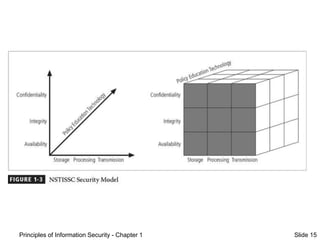
 The C.I.A. triangle was the standard based on
confidentiality, integrity, and availability
 The C.I.A. triangle has expanded into a list of
critical characteristics of information
Principles of Information Security - Chapter 1 Slide 14
Critical Characteristics Of
Information
The value of information comes from the
characteristics it possesses.
– Availability
– Accuracy
– Authenticity
– Confidentiality
– Integrity
– Utility
– Possession
Principles of Information Security - Chapter 1 Slide 15
Figure 1-3 – NSTISSC
Security Model
Principles of Information Security - Chapter 1 Slide 16
Components of an Information
System
 To fully understand the importance of
information security, you need to know the
elements of an information system
 An Information System (IS) is much more than
computer hardware; it is the entire set of
software, hardware, data, people, and
procedures necessary to use information as a
resource in the organization
Principles of Information Security - Chapter 1 Slide 17
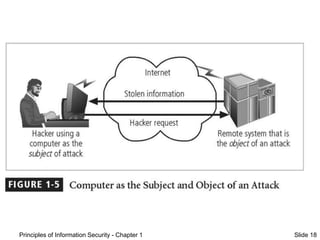
Securing the Components
The computer can be either or both the
subject of an attack and/or the object of
an attack
When a computer is
– the subject of an attack, it is used as an
active tool to conduct the attack
– the object of an attack, it is the entity being
attacked
Principles of Information Security - Chapter 1 Slide 18
Figure 1-5 – Subject and
Object of Attack
Principles of Information Security - Chapter 1 Slide 19
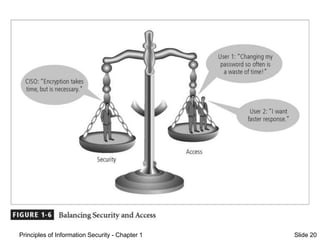
Balancing Security and
Access
It is impossible to obtain perfect security -
it is not an absolute; it is a process
Security should be considered a balance
between protection and availability
To achieve balance, the level of security
must allow reasonable access, yet protect
against threats
Principles of Information Security - Chapter 1 Slide 20
Figure 1-6 – Balancing
Security and Access
Principles of Information Security - Chapter 1 Slide 21
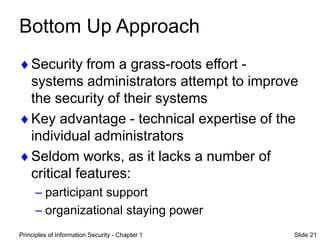
Bottom Up Approach
Security from a grass-roots effort -
systems administrators attempt to improve
the security of their systems
Key advantage - technical expertise of the
individual administrators
Seldom works, as it lacks a number of
critical features:
– participant support
– organizational staying power
Principles of Information Security - Chapter 1 Slide 22
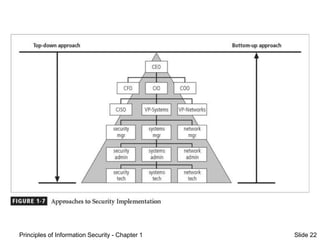
Figure 1-7 – Approaches to
Security Implementation
Principles of Information Security - Chapter 1 Slide 23
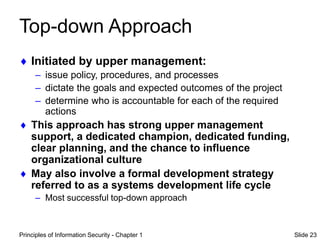
Top-down Approach
 Initiated by upper management:
– issue policy, procedures, and processes
– dictate the goals and expected outcomes of the project
– determine who is accountable for each of the required
actions
 This approach has strong upper management
support, a dedicated champion, dedicated funding,
clear planning, and the chance to influence
organizational culture
 May also involve a formal development strategy
referred to as a systems development life cycle
– Most successful top-down approach
Principles of Information Security - Chapter 1 Slide 24
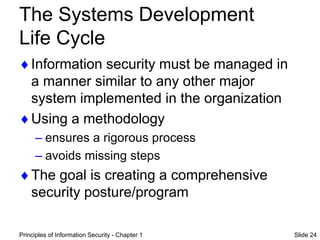
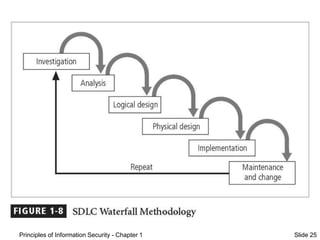
The Systems Development
Life Cycle
Information security must be managed in
a manner similar to any other major
system implemented in the organization
Using a methodology
– ensures a rigorous process
– avoids missing steps
The goal is creating a comprehensive
security posture/program
Principles of Information Security - Chapter 1 Slide 25
Figure 1-8 – SDLC Waterfall
Methodology
Principles of Information Security - Chapter 1 Slide 26
SDLC and the SecSDLC
The SecSDLC may be
– event-driven - started in response to some
occurrence or
– plan-driven - as a result of a carefully
developed implementation strategy
At the end of each phase comes a
structured review
Principles of Information Security - Chapter 1 Slide 27
Investigation
What is the problem the system is being
developed to solve?
– The objectives, constraints, and scope of the
project are specified
– A preliminary cost/benefit analysis is
developed
– A feasibility analysis is performed to assesses
the economic, technical, and behavioral
feasibilities of the process
Principles of Information Security - Chapter 1 Slide 28
Analysis
 Consists primarily of
– assessments of the organization
– the status of current systems
– capability to support the proposed systems
 Analysts begin to determine
– what the new system is expected to do
– how the new system will interact with existing systems
 Ends with the documentation of the findings and
a feasibility analysis update
Principles of Information Security - Chapter 1 Slide 29
Logical Design
 Based on business need, applications are
selected capable of providing needed services
 Based on applications needed, data support
and structures capable of providing the needed
inputs are identified
 Finally, based on all of the above, select specific
ways to implement the physical solution are
chosen
 At the end, another feasibility analysis is
performed
Principles of Information Security - Chapter 1 Slide 30
Physical Design
Specific technologies are selected to
support the alternatives identified and
evaluated in the logical design
Selected components are evaluated
based on a make-or-buy decision
Entire solution is presented to the end-
user representatives for approval
Principles of Information Security - Chapter 1 Slide 31
Implementation
Components are ordered, received,
assembled, and tested
Users are trained and documentation
created
Users are then presented with the system
for a performance review and acceptance
test
Principles of Information Security - Chapter 1 Slide 32
Maintenance and Change
Tasks necessary to support and modify
the system for the remainder of its useful
life
The life cycle continues until the process
begins again from the investigation phase
When the current system can no longer
support the mission of the organization, a
new project is implemented
Principles of Information Security - Chapter 1 Slide 33
Security Systems
Development Life Cycle
The same phases used in the traditional
SDLC adapted to support the specialized
implementation of a security project
Basic process is identification of threats
and controls to counter them
The SecSDLC is a coherent program
rather than a series of random, seemingly
unconnected actions
Principles of Information Security - Chapter 1 Slide 34
Investigation
Identifies process, outcomes and goals of
the project, and constraints
Begins with a statement of program
security policy
Teams are organized, problems analyzed,
and scope defined, including objectives,
and constraints not covered in the
program policy
An organizational feasibility analysis is
performed
Principles of Information Security - Chapter 1 Slide 35
Analysis
Analysis of existing security policies or
programs, along with documented current
threats and associated controls
Includes an analysis of relevant legal
issues that could impact the design of the
security solution
The risk management task (identifying,
assessing, and evaluating the levels of
risk) also begins
Principles of Information Security - Chapter 1 Slide 36
Logical & Physical Design
 Creates blueprints for security
 Critical planning and feasibility analyses to
determine whether or not the project should
continue
 In physical design, security technology is
evaluated, alternatives generated, and final
design selected
 At end of phase, feasibility study determines
readiness so all parties involved have a chance
to approve the project
Principles of Information Security - Chapter 1 Slide 37
Implementation
The security solutions are acquired (made
or bought), tested, and implemented, and
tested again
Personnel issues are evaluated and
specific training and education programs
conducted
Finally, the entire tested package is
presented to upper management for final
approval
Principles of Information Security - Chapter 1 Slide 38
Maintenance and Change
The maintenance and change phase is
perhaps most important, given the high
level of ingenuity in today’s threats
The reparation and restoration of
information is a constant duel with an
often unseen adversary
As new threats emerge and old threats
evolve, the information security profile of
an organization requires constant
adaptation
Principles of Information Security - Chapter 1 Slide 39
Security Professionals and the
Organization
It takes a wide range of professionals to
support a diverse information security
program
To develop and execute specific security
policies and procedures, additional
administrative support and technical
expertise is required
Principles of Information Security - Chapter 1 Slide 40
Senior Management
 Chief Information Officer
– the senior technology officer
– primarily responsible for advising the senior
executive(s) for strategic planning
 Chief Information Security Officer
– responsible for the assessment, management, and
implementation of securing the information in the
organization
– may also be referred to as the Manager for Security,
the Security Administrator, or a similar title
Principles of Information Security - Chapter 1 Slide 41
Security Project Team
A number of individuals who are experienced in
one or multiple requirements of both the
technical and non-technical areas:
– The champion
– The team leader
– Security policy developers
– Risk assessment specialists
– Security professionals
– Systems administrators
– End users
Principles of Information Security - Chapter 1 Slide 42
Data Ownership
Data Owner - responsible for the security
and use of a particular set of information
Data Custodian - responsible for the
storage, maintenance, and protection of
the information
Data Users - the end systems users who
work with the information to perform their
daily jobs supporting the mission of the
organization
Principles of Information Security - Chapter 1 Slide 43
Communities Of Interest
Each organization develops and maintains
its own unique culture and values. Within
that corporate culture, there are
communities of interest:
– Information Security Management and
Professionals
– Information Technology Management and
Professionals
– Organizational Management and
Professionals
Principles of Information Security - Chapter 1 Slide 44
Information Security: Is It an
Art or a Science?
With the level of complexity in today’s
information systems, the implementation
of information security has often been
described as a combination of art and
science
Principles of Information Security - Chapter 1 Slide 45
Security as Art
No hard and fast rules nor are there many
universally accepted complete solutions
No magic user’s manual for the security of
the entire system
Complex levels of interaction between
users, policy, and technology controls
Principles of Information Security - Chapter 1 Slide 46
Security as Science
Dealing with technology designed to
perform at high levels of performance
Specific conditions cause virtually all
actions that occur in computer systems
Almost every fault, security hole, and
systems malfunction is a result of the
interaction of specific hardware and
software
If the developers had sufficient time, they
could resolve and eliminate these faults
Principles of Information Security - Chapter 1 Slide 47
Security as a Social Science
Social science examines the behavior of
individuals interacting with systems
Security begins and ends with the people
that interact with the system
End users may be the weakest link in the
security chain
Security administrators can greatly reduce
the levels of risk caused by end users,
and create more acceptable and
supportable security profiles

Introduction to information security

  • 1.
    Introduction to Information Security Chapter1 Do not figure on opponents not attacking; worry about your own lack of preparation. -- Book of the Five Rings
  • 2.
    Principles of InformationSecurity - Chapter 1 Slide 2 Learning Objectives: Upon completion of this chapter you should be able to: – Understand what information security is and how it came to mean what it does today. – Comprehend the history of computer security and how it evolved into information security. – Understand the key terms and critical concepts of information security as presented in the chapter. – Outline the phases of the security systems development life cycle. – Understand the role professionals involved in information security in an organizational structure.
  • 3.
    Principles of InformationSecurity - Chapter 1 Slide 3 What Is Information Security? Information security in today’s enterprise is a “well-informed sense of assurance that the information risks and controls are in balance.” –Jim Anderson, Inovant (2002)
  • 4.
    Principles of InformationSecurity - Chapter 1 Slide 4 The History Of Information Security  Computer security began immediately after the first mainframes were developed  Groups developing code-breaking computations during World War II created the first modern computers  Physical controls were needed to limit access to authorized personnel to sensitive military locations  Only rudimentary controls were available to defend against physical theft, espionage, and sabotage
  • 5.
    Principles of InformationSecurity - Chapter 1 Slide 5 Figure 1-1 – The Enigma
  • 6.
    Principles of InformationSecurity - Chapter 1 Slide 6 The 1960s Department of Defense’s Advanced Research Project Agency (ARPA) began examining the feasibility of a redundant networked communications Larry Roberts developed the project from its inception
  • 7.
    Principles of InformationSecurity - Chapter 1 Slide 7 Figure 1-2 - ARPANET
  • 8.
    Principles of InformationSecurity - Chapter 1 Slide 8 The 1970s and 80s  ARPANET grew in popularity as did its potential for misuse  Fundamental problems with ARPANET security were identified – No safety procedures for dial-up connections to the ARPANET – User identification and authorization to the system were non-existent  In the late 1970s the microprocessor expanded computing capabilities and security threats
  • 9.
    Principles of InformationSecurity - Chapter 1 Slide 9 R-609 – The Start of the Study of Computer Security Information Security began with Rand Report R-609 The scope of computer security grew from physical security to include: – Safety of the data – Limiting unauthorized access to that data – Involvement of personnel from multiple levels of the organization
  • 10.
    Principles of InformationSecurity - Chapter 1 Slide 10 The 1990s Networks of computers became more common, so too did the need to interconnect the networks Resulted in the Internet, the first manifestation of a global network of networks In early Internet deployments, security was treated as a low priority
  • 11.
    Principles of InformationSecurity - Chapter 1 Slide 11 The Present The Internet has brought millions of computer networks into communication with each other – many of them unsecured Ability to secure each now influenced by the security on every computer to which it is connected
  • 12.
    Principles of InformationSecurity - Chapter 1 Slide 12 What Is Security?  “The quality or state of being secure--to be free from danger”  To be protected from adversaries  A successful organization should have multiple layers of security in place: – Physical security – Personal security – Operations security – Communications security – Network security
  • 13.
    Principles of InformationSecurity - Chapter 1 Slide 13 What Is Information Security?  The protection of information and its critical elements, including the systems and hardware that use, store, and transmit that information  Tools, such as policy, awareness, training, education, and technology are necessary  The C.I.A. triangle was the standard based on confidentiality, integrity, and availability  The C.I.A. triangle has expanded into a list of critical characteristics of information
  • 14.
    Principles of InformationSecurity - Chapter 1 Slide 14 Critical Characteristics Of Information The value of information comes from the characteristics it possesses. – Availability – Accuracy – Authenticity – Confidentiality – Integrity – Utility – Possession
  • 15.
    Principles of InformationSecurity - Chapter 1 Slide 15 Figure 1-3 – NSTISSC Security Model
  • 16.
    Principles of InformationSecurity - Chapter 1 Slide 16 Components of an Information System  To fully understand the importance of information security, you need to know the elements of an information system  An Information System (IS) is much more than computer hardware; it is the entire set of software, hardware, data, people, and procedures necessary to use information as a resource in the organization
  • 17.
    Principles of InformationSecurity - Chapter 1 Slide 17 Securing the Components The computer can be either or both the subject of an attack and/or the object of an attack When a computer is – the subject of an attack, it is used as an active tool to conduct the attack – the object of an attack, it is the entity being attacked
  • 18.
    Principles of InformationSecurity - Chapter 1 Slide 18 Figure 1-5 – Subject and Object of Attack
  • 19.
    Principles of InformationSecurity - Chapter 1 Slide 19 Balancing Security and Access It is impossible to obtain perfect security - it is not an absolute; it is a process Security should be considered a balance between protection and availability To achieve balance, the level of security must allow reasonable access, yet protect against threats
  • 20.
    Principles of InformationSecurity - Chapter 1 Slide 20 Figure 1-6 – Balancing Security and Access
  • 21.
    Principles of InformationSecurity - Chapter 1 Slide 21 Bottom Up Approach Security from a grass-roots effort - systems administrators attempt to improve the security of their systems Key advantage - technical expertise of the individual administrators Seldom works, as it lacks a number of critical features: – participant support – organizational staying power
  • 22.
    Principles of InformationSecurity - Chapter 1 Slide 22 Figure 1-7 – Approaches to Security Implementation
  • 23.
    Principles of InformationSecurity - Chapter 1 Slide 23 Top-down Approach  Initiated by upper management: – issue policy, procedures, and processes – dictate the goals and expected outcomes of the project – determine who is accountable for each of the required actions  This approach has strong upper management support, a dedicated champion, dedicated funding, clear planning, and the chance to influence organizational culture  May also involve a formal development strategy referred to as a systems development life cycle – Most successful top-down approach
  • 24.
    Principles of InformationSecurity - Chapter 1 Slide 24 The Systems Development Life Cycle Information security must be managed in a manner similar to any other major system implemented in the organization Using a methodology – ensures a rigorous process – avoids missing steps The goal is creating a comprehensive security posture/program
  • 25.
    Principles of InformationSecurity - Chapter 1 Slide 25 Figure 1-8 – SDLC Waterfall Methodology
  • 26.
    Principles of InformationSecurity - Chapter 1 Slide 26 SDLC and the SecSDLC The SecSDLC may be – event-driven - started in response to some occurrence or – plan-driven - as a result of a carefully developed implementation strategy At the end of each phase comes a structured review
  • 27.
    Principles of InformationSecurity - Chapter 1 Slide 27 Investigation What is the problem the system is being developed to solve? – The objectives, constraints, and scope of the project are specified – A preliminary cost/benefit analysis is developed – A feasibility analysis is performed to assesses the economic, technical, and behavioral feasibilities of the process
  • 28.
    Principles of InformationSecurity - Chapter 1 Slide 28 Analysis  Consists primarily of – assessments of the organization – the status of current systems – capability to support the proposed systems  Analysts begin to determine – what the new system is expected to do – how the new system will interact with existing systems  Ends with the documentation of the findings and a feasibility analysis update
  • 29.
    Principles of InformationSecurity - Chapter 1 Slide 29 Logical Design  Based on business need, applications are selected capable of providing needed services  Based on applications needed, data support and structures capable of providing the needed inputs are identified  Finally, based on all of the above, select specific ways to implement the physical solution are chosen  At the end, another feasibility analysis is performed
  • 30.
    Principles of InformationSecurity - Chapter 1 Slide 30 Physical Design Specific technologies are selected to support the alternatives identified and evaluated in the logical design Selected components are evaluated based on a make-or-buy decision Entire solution is presented to the end- user representatives for approval
  • 31.
    Principles of InformationSecurity - Chapter 1 Slide 31 Implementation Components are ordered, received, assembled, and tested Users are trained and documentation created Users are then presented with the system for a performance review and acceptance test
  • 32.
    Principles of InformationSecurity - Chapter 1 Slide 32 Maintenance and Change Tasks necessary to support and modify the system for the remainder of its useful life The life cycle continues until the process begins again from the investigation phase When the current system can no longer support the mission of the organization, a new project is implemented
  • 33.
    Principles of InformationSecurity - Chapter 1 Slide 33 Security Systems Development Life Cycle The same phases used in the traditional SDLC adapted to support the specialized implementation of a security project Basic process is identification of threats and controls to counter them The SecSDLC is a coherent program rather than a series of random, seemingly unconnected actions
  • 34.
    Principles of InformationSecurity - Chapter 1 Slide 34 Investigation Identifies process, outcomes and goals of the project, and constraints Begins with a statement of program security policy Teams are organized, problems analyzed, and scope defined, including objectives, and constraints not covered in the program policy An organizational feasibility analysis is performed
  • 35.
    Principles of InformationSecurity - Chapter 1 Slide 35 Analysis Analysis of existing security policies or programs, along with documented current threats and associated controls Includes an analysis of relevant legal issues that could impact the design of the security solution The risk management task (identifying, assessing, and evaluating the levels of risk) also begins
  • 36.
    Principles of InformationSecurity - Chapter 1 Slide 36 Logical & Physical Design  Creates blueprints for security  Critical planning and feasibility analyses to determine whether or not the project should continue  In physical design, security technology is evaluated, alternatives generated, and final design selected  At end of phase, feasibility study determines readiness so all parties involved have a chance to approve the project
  • 37.
    Principles of InformationSecurity - Chapter 1 Slide 37 Implementation The security solutions are acquired (made or bought), tested, and implemented, and tested again Personnel issues are evaluated and specific training and education programs conducted Finally, the entire tested package is presented to upper management for final approval
  • 38.
    Principles of InformationSecurity - Chapter 1 Slide 38 Maintenance and Change The maintenance and change phase is perhaps most important, given the high level of ingenuity in today’s threats The reparation and restoration of information is a constant duel with an often unseen adversary As new threats emerge and old threats evolve, the information security profile of an organization requires constant adaptation
  • 39.
    Principles of InformationSecurity - Chapter 1 Slide 39 Security Professionals and the Organization It takes a wide range of professionals to support a diverse information security program To develop and execute specific security policies and procedures, additional administrative support and technical expertise is required
  • 40.
    Principles of InformationSecurity - Chapter 1 Slide 40 Senior Management  Chief Information Officer – the senior technology officer – primarily responsible for advising the senior executive(s) for strategic planning  Chief Information Security Officer – responsible for the assessment, management, and implementation of securing the information in the organization – may also be referred to as the Manager for Security, the Security Administrator, or a similar title
  • 41.
    Principles of InformationSecurity - Chapter 1 Slide 41 Security Project Team A number of individuals who are experienced in one or multiple requirements of both the technical and non-technical areas: – The champion – The team leader – Security policy developers – Risk assessment specialists – Security professionals – Systems administrators – End users
  • 42.
    Principles of InformationSecurity - Chapter 1 Slide 42 Data Ownership Data Owner - responsible for the security and use of a particular set of information Data Custodian - responsible for the storage, maintenance, and protection of the information Data Users - the end systems users who work with the information to perform their daily jobs supporting the mission of the organization
  • 43.
    Principles of InformationSecurity - Chapter 1 Slide 43 Communities Of Interest Each organization develops and maintains its own unique culture and values. Within that corporate culture, there are communities of interest: – Information Security Management and Professionals – Information Technology Management and Professionals – Organizational Management and Professionals
  • 44.
    Principles of InformationSecurity - Chapter 1 Slide 44 Information Security: Is It an Art or a Science? With the level of complexity in today’s information systems, the implementation of information security has often been described as a combination of art and science
  • 45.
    Principles of InformationSecurity - Chapter 1 Slide 45 Security as Art No hard and fast rules nor are there many universally accepted complete solutions No magic user’s manual for the security of the entire system Complex levels of interaction between users, policy, and technology controls
  • 46.
    Principles of InformationSecurity - Chapter 1 Slide 46 Security as Science Dealing with technology designed to perform at high levels of performance Specific conditions cause virtually all actions that occur in computer systems Almost every fault, security hole, and systems malfunction is a result of the interaction of specific hardware and software If the developers had sufficient time, they could resolve and eliminate these faults
  • 47.
    Principles of InformationSecurity - Chapter 1 Slide 47 Security as a Social Science Social science examines the behavior of individuals interacting with systems Security begins and ends with the people that interact with the system End users may be the weakest link in the security chain Security administrators can greatly reduce the levels of risk caused by end users, and create more acceptable and supportable security profiles