Principles of Information Security,
Fifth Edition
Chapter 4
Planning for Security
Lesson 1 - Information
Security Planning
Learning Objectives
• Upon completion of this material, you should be
able to:
– Describe management’s role in the development,
maintenance, and enforcement of information
security policy, standards, practices, procedures,
and guidelines
– Explain what an information security blueprint is,
identify its major components, and explain how it
supports the information security program
Principles of Information Security, Fifth Edition 2
Learning Objectives (cont’d)
– Discuss how an organization institutionalizes its
policies, standards, and practices using education,
training, and awareness programs
– Describe what contingency planning is and how it
relates to incident response planning, disaster
recovery planning, and business continuity plans
Principles of Information Security, Fifth Edition 3
Introduction
• Information security program begins with policies,
standards, and practices, which are the foundation
for information security architecture and blueprint.
• Coordinated planning is required to create and
maintain these elements.
• Strategic planning for the management of
allocation of resources
• Contingency planning for the preparation of
uncertain business environment
Principles of Information Security, Fifth Edition 4
Information Security Planning and
Governance
• Planning levels help translate organization’s strategic
plans into tactical objectives.
• Planning and the CISO
• Information Security Governance
– Governance:
• Set of responsibilities and practices exercised by the
board and executive management
• Goal to provide strategic direction, establishment of
objectives, and measurement of progress toward
objectives
• Also verifies/validates that risk management practices
are appropriate and assets used properly
Principles of Information Security, Fifth Edition 5
Information Security Planning and
Governance (cont’d)
• Information Security Governance outcomes
– Five goals:
• Strategic alignment
• Risk management
• Resource management
• Performance measures
• Value delivery
Principles of Information Security, Fifth Edition 6
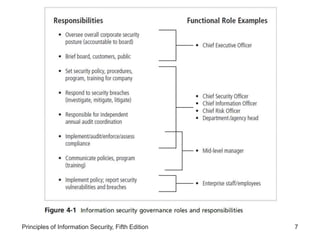
Principles of Information Security, Fifth Edition 7
Information Security Policy, Standards,
and Practices
• Management from communities of interest must
make policies the basis for all information security
planning, design, and deployment.
• Policies direct how issues should be addressed
and technologies used.
• Policies should never contradict law, must be able
to stand up in court, and must be properly
administered.
• Security policies are the least expensive controls to
execute but most difficult to implement properly.
Principles of Information Security, Fifth Edition 8
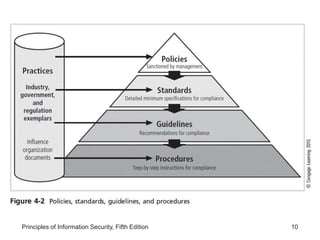
Policy as the Foundation for Planning
• Policy functions as organizational law that dictates
acceptable and unacceptable behavior.
• Standards: more detailed statements of what must
be done to comply with policy
• Practices, procedures, and guidelines effectively
explain how to comply with policy.
• For a policy to be effective, it must be properly
disseminated, read, understood, and agreed to by
all members of the organization, and uniformly
enforced.
Principles of Information Security, Fifth Edition 9
Principles of Information Security, Fifth Edition 10
Enterprise Information Security Policy
(EISP)
• Sets strategic direction, scope, and tone for all
security efforts within the organization
• Executive-level document, usually drafted by or
with Chief Information Officer (CIO) of the
organization
• Typically addresses compliance in two areas:
– Ensure meeting of requirements to establish
program and assigning responsibilities therein to
various organizational components
– Use of specified penalties and disciplinary action
Principles of Information Security, Fifth Edition 11
Enterprise Information Security Policy
(EISP) (cont’d)
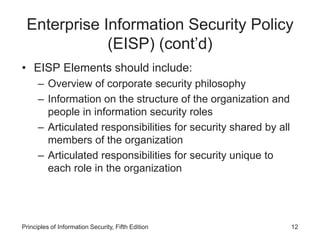
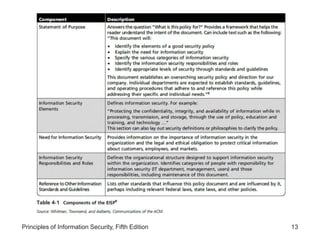
• EISP Elements should include:
– Overview of corporate security philosophy
– Information on the structure of the organization and
people in information security roles
– Articulated responsibilities for security shared by all
members of the organization
– Articulated responsibilities for security unique to
each role in the organization
Principles of Information Security, Fifth Edition 12
Principles of Information Security, Fifth Edition 13
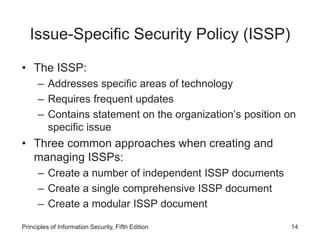
Issue-Specific Security Policy (ISSP)
• The ISSP:
– Addresses specific areas of technology
– Requires frequent updates
– Contains statement on the organization’s position on
specific issue
• Three common approaches when creating and
managing ISSPs:
– Create a number of independent ISSP documents
– Create a single comprehensive ISSP document
– Create a modular ISSP document
Principles of Information Security, Fifth Edition 14
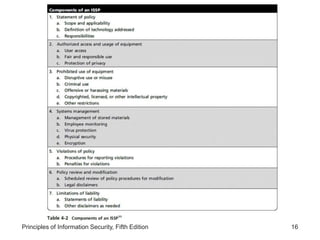
Issue-Specific Security Policy (ISSP)
(cont’d)
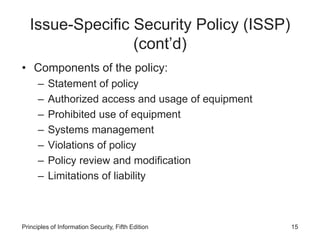
• Components of the policy:
– Statement of policy
– Authorized access and usage of equipment
– Prohibited use of equipment
– Systems management
– Violations of policy
– Policy review and modification
– Limitations of liability
Principles of Information Security, Fifth Edition 15
Principles of Information Security, Fifth Edition 16

Lesson 1

  • 1.
    Principles of InformationSecurity, Fifth Edition Chapter 4 Planning for Security Lesson 1 - Information Security Planning
  • 2.
    Learning Objectives • Uponcompletion of this material, you should be able to: – Describe management’s role in the development, maintenance, and enforcement of information security policy, standards, practices, procedures, and guidelines – Explain what an information security blueprint is, identify its major components, and explain how it supports the information security program Principles of Information Security, Fifth Edition 2
  • 3.
    Learning Objectives (cont’d) –Discuss how an organization institutionalizes its policies, standards, and practices using education, training, and awareness programs – Describe what contingency planning is and how it relates to incident response planning, disaster recovery planning, and business continuity plans Principles of Information Security, Fifth Edition 3
  • 4.
    Introduction • Information securityprogram begins with policies, standards, and practices, which are the foundation for information security architecture and blueprint. • Coordinated planning is required to create and maintain these elements. • Strategic planning for the management of allocation of resources • Contingency planning for the preparation of uncertain business environment Principles of Information Security, Fifth Edition 4
  • 5.
    Information Security Planningand Governance • Planning levels help translate organization’s strategic plans into tactical objectives. • Planning and the CISO • Information Security Governance – Governance: • Set of responsibilities and practices exercised by the board and executive management • Goal to provide strategic direction, establishment of objectives, and measurement of progress toward objectives • Also verifies/validates that risk management practices are appropriate and assets used properly Principles of Information Security, Fifth Edition 5
  • 6.
    Information Security Planningand Governance (cont’d) • Information Security Governance outcomes – Five goals: • Strategic alignment • Risk management • Resource management • Performance measures • Value delivery Principles of Information Security, Fifth Edition 6
  • 7.
    Principles of InformationSecurity, Fifth Edition 7
  • 8.
    Information Security Policy,Standards, and Practices • Management from communities of interest must make policies the basis for all information security planning, design, and deployment. • Policies direct how issues should be addressed and technologies used. • Policies should never contradict law, must be able to stand up in court, and must be properly administered. • Security policies are the least expensive controls to execute but most difficult to implement properly. Principles of Information Security, Fifth Edition 8
  • 9.
    Policy as theFoundation for Planning • Policy functions as organizational law that dictates acceptable and unacceptable behavior. • Standards: more detailed statements of what must be done to comply with policy • Practices, procedures, and guidelines effectively explain how to comply with policy. • For a policy to be effective, it must be properly disseminated, read, understood, and agreed to by all members of the organization, and uniformly enforced. Principles of Information Security, Fifth Edition 9
  • 10.
    Principles of InformationSecurity, Fifth Edition 10
  • 11.
    Enterprise Information SecurityPolicy (EISP) • Sets strategic direction, scope, and tone for all security efforts within the organization • Executive-level document, usually drafted by or with Chief Information Officer (CIO) of the organization • Typically addresses compliance in two areas: – Ensure meeting of requirements to establish program and assigning responsibilities therein to various organizational components – Use of specified penalties and disciplinary action Principles of Information Security, Fifth Edition 11
  • 12.
    Enterprise Information SecurityPolicy (EISP) (cont’d) • EISP Elements should include: – Overview of corporate security philosophy – Information on the structure of the organization and people in information security roles – Articulated responsibilities for security shared by all members of the organization – Articulated responsibilities for security unique to each role in the organization Principles of Information Security, Fifth Edition 12
  • 13.
    Principles of InformationSecurity, Fifth Edition 13
  • 14.
    Issue-Specific Security Policy(ISSP) • The ISSP: – Addresses specific areas of technology – Requires frequent updates – Contains statement on the organization’s position on specific issue • Three common approaches when creating and managing ISSPs: – Create a number of independent ISSP documents – Create a single comprehensive ISSP document – Create a modular ISSP document Principles of Information Security, Fifth Edition 14
  • 15.
    Issue-Specific Security Policy(ISSP) (cont’d) • Components of the policy: – Statement of policy – Authorized access and usage of equipment – Prohibited use of equipment – Systems management – Violations of policy – Policy review and modification – Limitations of liability Principles of Information Security, Fifth Edition 15
  • 16.
    Principles of InformationSecurity, Fifth Edition 16