Chapter 5
Conflict and Conflict
Resolution
5-2
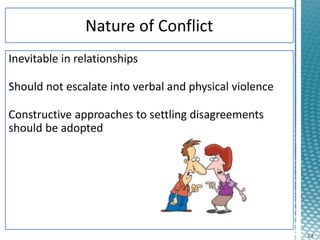
Inevitable in relationships
Should not escalate into verbal and physical violence
Constructive approaches to settling disagreements
should be adopted
5-3
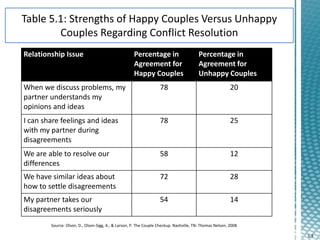
Relationship Issue Percentage in
Agreement for
Happy Couples
Percentage in
Agreement for
Unhappy Couples
When we discuss problems, my
partner understands my
opinions and ideas
78 20
I can share feelings and ideas
with my partner during
disagreements
78 25
We are able to resolve our
differences
58 12
We have similar ideas about
how to settle disagreements
72 28
My partner takes our
disagreements seriously
54 14
Source: Olson, D., Olson-Sigg, A., & Larson, P. The Couple Checkup. Nashville, TN: Thomas Nelson, 2008.
5-4
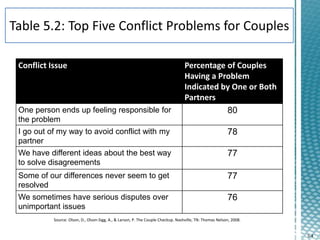
Conflict Issue Percentage of Couples
Having a Problem
Indicated by One or Both
Partners
One person ends up feeling responsible for
the problem
80
I go out of my way to avoid conflict with my
partner
78
We have different ideas about the best way
to solve disagreements
77
Some of our differences never seem to get
resolved
77
We sometimes have serious disputes over
unimportant issues
76
Source: Olson, D., Olson-Sigg, A., & Larson, P. The Couple Checkup. Nashville, TN: Thomas Nelson, 2008.
5-5
5-6
Fear of negative emotions and difficulty in learning how
to deal with them
Suppression of negative emotions leads to:
• Individuals denying their genuine feelings and not being in
touch with their true emotions
• High levels of stress for individuals and their relationships
5-7
Sociological explanation
• Anger viewed as an indicator of relationship problems
• Individuals are socialized in a way that encourages them not
to show anger
Psychological explanation
• Relationship insecurity
• Interdependence
• Couples struggle to find a balance between dependence on
each other and independence from each other
5-8
Anger is caused by others
Best way to deal with anger is to let it all out
Anger is a beneficial emotion
Anger prevents others from taking advantage of you
5-9
Conflict comes with intimacy
• Differences should be resolved constructively
Balance love and anger
• Too much togetherness: Marriage becomes a form of
bondage
• Too much separateness: Relationship dies from lack of
attention
• Anger is a healthy emotion when it helps create an
interdependent relationship
5-10
Harriet Goldhor Lerner’s metaphor to describe how
human beings relate to each other
• Lerner
• Developed a guide to various styles of anger management
• Argued that people have different needs and feelings about
closeness
5-11
Pursuers
Distancers
Underfunctioners
Overfunctioners
Blamers
5-12
Julien, Chartrand, Simard, Bouthillier, and Begin
conducted a study that compared these groups
• Couples were videotaped while completing tasks designed to
generate couple conflict and encourage supportive behavior
• Study found that there was no difference in the level of conflict or
supportive behaviors between the groups
• Positive communication during conflict was particularly important
for couples in all groups
5-13
Foote, Wilkens, and Kosanke’s suggestions for having a
healthy conversation
• Practicing the conversation in advance
• Thinking through what one wants to communicate
• Choosing a time when the significant other is relaxed and
ready to talk
5-14
16 Strategies (DeFrain)
• Focus on the positive aspects of the other person
• Call a time-out when the situation gets out of hand
• Listen carefully to the other person
• Speak clearly and to the point
• Do not expect the other person to know the problem without
explaining it
• Do not humiliate the other person in front of others
• Find a solution to the problem calmly and rationally rather than
nagging or avoiding
5-15
• Avoid giving ultimatums
• Remain calm, and avoid yelling or throwing tantrums
• Avoid attacking the other person
• Be kind when speaking to the other person to keep the
conversation from becoming nasty
• Do not hesitate to talk about problems
• Use “I” statements rather than “you” statements
• Discuss one thing at a time until it is resolved
• Work as a team to find a solution to the issue at hand that is
good for everyone involved
• Solve the conflict, make things better, and create a peaceful
and harmonious relationship
5-16
Canary and Canary, 2013
• Conflicts between parents and children occur
throughout childhood beginning at about two years
• Common issues for young children are behaviors that are
destructive or harmful to other children, such as hitting or
throwing things
• Distracting, negotiating, or reasoning is best for healthy child
development rather than criticising and threatening
• Conflicts between parents and adolescents also affect the
parents’ couple relationships and can effect into the
relationships with other siblings
Chapter 5
Conflict and Conflict
Resolution

CFD 163-Chapter 5-Conflict, Conflict Resolution

  • 1.
    Chapter 5 Conflict andConflict Resolution
  • 2.
    5-2 Inevitable in relationships Shouldnot escalate into verbal and physical violence Constructive approaches to settling disagreements should be adopted
  • 3.
    5-3 Relationship Issue Percentagein Agreement for Happy Couples Percentage in Agreement for Unhappy Couples When we discuss problems, my partner understands my opinions and ideas 78 20 I can share feelings and ideas with my partner during disagreements 78 25 We are able to resolve our differences 58 12 We have similar ideas about how to settle disagreements 72 28 My partner takes our disagreements seriously 54 14 Source: Olson, D., Olson-Sigg, A., & Larson, P. The Couple Checkup. Nashville, TN: Thomas Nelson, 2008.
  • 4.
    5-4 Conflict Issue Percentageof Couples Having a Problem Indicated by One or Both Partners One person ends up feeling responsible for the problem 80 I go out of my way to avoid conflict with my partner 78 We have different ideas about the best way to solve disagreements 77 Some of our differences never seem to get resolved 77 We sometimes have serious disputes over unimportant issues 76 Source: Olson, D., Olson-Sigg, A., & Larson, P. The Couple Checkup. Nashville, TN: Thomas Nelson, 2008.
  • 5.
  • 6.
    5-6 Fear of negativeemotions and difficulty in learning how to deal with them Suppression of negative emotions leads to: • Individuals denying their genuine feelings and not being in touch with their true emotions • High levels of stress for individuals and their relationships
  • 7.
    5-7 Sociological explanation • Angerviewed as an indicator of relationship problems • Individuals are socialized in a way that encourages them not to show anger Psychological explanation • Relationship insecurity • Interdependence • Couples struggle to find a balance between dependence on each other and independence from each other
  • 8.
    5-8 Anger is causedby others Best way to deal with anger is to let it all out Anger is a beneficial emotion Anger prevents others from taking advantage of you
  • 9.
    5-9 Conflict comes withintimacy • Differences should be resolved constructively Balance love and anger • Too much togetherness: Marriage becomes a form of bondage • Too much separateness: Relationship dies from lack of attention • Anger is a healthy emotion when it helps create an interdependent relationship
  • 10.
    5-10 Harriet Goldhor Lerner’smetaphor to describe how human beings relate to each other • Lerner • Developed a guide to various styles of anger management • Argued that people have different needs and feelings about closeness
  • 11.
  • 12.
    5-12 Julien, Chartrand, Simard,Bouthillier, and Begin conducted a study that compared these groups • Couples were videotaped while completing tasks designed to generate couple conflict and encourage supportive behavior • Study found that there was no difference in the level of conflict or supportive behaviors between the groups • Positive communication during conflict was particularly important for couples in all groups
  • 13.
    5-13 Foote, Wilkens, andKosanke’s suggestions for having a healthy conversation • Practicing the conversation in advance • Thinking through what one wants to communicate • Choosing a time when the significant other is relaxed and ready to talk
  • 14.
    5-14 16 Strategies (DeFrain) •Focus on the positive aspects of the other person • Call a time-out when the situation gets out of hand • Listen carefully to the other person • Speak clearly and to the point • Do not expect the other person to know the problem without explaining it • Do not humiliate the other person in front of others • Find a solution to the problem calmly and rationally rather than nagging or avoiding
  • 15.
    5-15 • Avoid givingultimatums • Remain calm, and avoid yelling or throwing tantrums • Avoid attacking the other person • Be kind when speaking to the other person to keep the conversation from becoming nasty • Do not hesitate to talk about problems • Use “I” statements rather than “you” statements • Discuss one thing at a time until it is resolved • Work as a team to find a solution to the issue at hand that is good for everyone involved • Solve the conflict, make things better, and create a peaceful and harmonious relationship
  • 16.
    5-16 Canary and Canary,2013 • Conflicts between parents and children occur throughout childhood beginning at about two years • Common issues for young children are behaviors that are destructive or harmful to other children, such as hitting or throwing things • Distracting, negotiating, or reasoning is best for healthy child development rather than criticising and threatening • Conflicts between parents and adolescents also affect the parents’ couple relationships and can effect into the relationships with other siblings
  • 17.
    Chapter 5 Conflict andConflict Resolution