ANGER AND CONFLICT
Facilitator: Mrs. Celia McGregor
ANGER AND CONFLICT
 Being aware of your anger triggers is an
important step in managing conflict.
 Awareness of somatic cues like increased heart
rate and muscle tension can alert you that your
anger is rising and that it is time for you to start
turning down your anger and avoid conflict
 Trying to suppress your anger only leads to
more intense conflict in the future
ANGER AND CONFLICT
 Reassess the situation that is upsetting
you, and reevaluate whether the situation
is annoying you or angering you.
 Being open and honest with yourself and
with others will help to reduce your
anger
ANGER AND CONFLICT
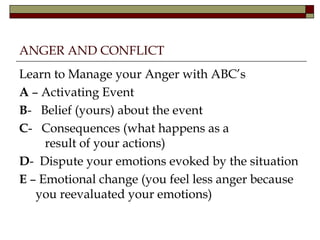
Learn to Manage your Anger with ABC’s
A – Activating Event
B- Belief (yours) about the event
C- Consequences (what happens as a
result of your actions)
D- Dispute your emotions evoked by the situation
E – Emotional change (you feel less anger because
you reevaluated your emotions)
ANGER AND CONFLICT
ANGER AND CONFLICT
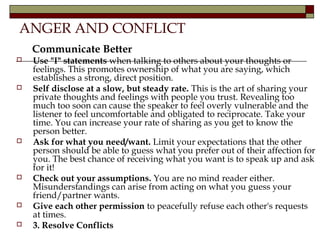
Communicate Better
 Use "I" statements when talking to others about your thoughts or
feelings. This promotes ownership of what you are saying, which
establishes a strong, direct position.
 Self disclose at a slow, but steady rate. This is the art of sharing your
private thoughts and feelings with people you trust. Revealing too
much too soon can cause the speaker to feel overly vulnerable and the
listener to feel uncomfortable and obligated to reciprocate. Take your
time. You can increase your rate of sharing as you get to know the
person better.
 Ask for what you need/want. Limit your expectations that the other
person should be able to guess what you prefer out of their affection for
you. The best chance of receiving what you want is to speak up and ask
for it!
 Check out your assumptions. You are no mind reader either.
Misunderstandings can arise from acting on what you guess your
friend/partner wants.
 Give each other permission to peacefully refuse each other's requests
at times.
 3. Resolve Conflicts
References
Retrieved from Google, February 17, 2013,
http://www.conflictdynamics.org/blog/2011/11/anger-and-conflict/
Retrieved from Google Images February 17, 2013, http://www.google.com/imgres?
q=anger+and+conflict&hl=en&sa=X&tbo=d&rlz=1T4SKPB_enUS367US370&bi
w=1024&bih=528&tbm=isch&tbnid=dNNcOdSoB2D6IM:&imgrefurl=http://ww
w.ellenhartson.com/expressing-anger-to-get-
closer/&docid=igFTy2BPhLc8MM&imgurl=http://www.ellenhartson.com/wp-
content/uploads/2010/08/Anger-
Handling.jpg&w=311&h=292&ei=zYshUYqXA4ja9ASYsYGIDQ&zoom=1&iac
t=hc&vpx=633&vpy=175&dur=172&hovh=218&hovw=232&tx=141&ty=181&s
ig=108683425782594916982&page=1&tbnh=143&tbnw=152&start=0&ndsp=17
&ved=1t:429,r:9,s:0,i:111
http://www.utdallas.edu/counseling/relationships/

Anger and conflict

  • 1.
  • 2.
    ANGER AND CONFLICT Being aware of your anger triggers is an important step in managing conflict.  Awareness of somatic cues like increased heart rate and muscle tension can alert you that your anger is rising and that it is time for you to start turning down your anger and avoid conflict  Trying to suppress your anger only leads to more intense conflict in the future
  • 4.
    ANGER AND CONFLICT Reassess the situation that is upsetting you, and reevaluate whether the situation is annoying you or angering you.  Being open and honest with yourself and with others will help to reduce your anger
  • 5.
    ANGER AND CONFLICT Learnto Manage your Anger with ABC’s A – Activating Event B- Belief (yours) about the event C- Consequences (what happens as a result of your actions) D- Dispute your emotions evoked by the situation E – Emotional change (you feel less anger because you reevaluated your emotions)
  • 6.
  • 7.
    ANGER AND CONFLICT CommunicateBetter  Use "I" statements when talking to others about your thoughts or feelings. This promotes ownership of what you are saying, which establishes a strong, direct position.  Self disclose at a slow, but steady rate. This is the art of sharing your private thoughts and feelings with people you trust. Revealing too much too soon can cause the speaker to feel overly vulnerable and the listener to feel uncomfortable and obligated to reciprocate. Take your time. You can increase your rate of sharing as you get to know the person better.  Ask for what you need/want. Limit your expectations that the other person should be able to guess what you prefer out of their affection for you. The best chance of receiving what you want is to speak up and ask for it!  Check out your assumptions. You are no mind reader either. Misunderstandings can arise from acting on what you guess your friend/partner wants.  Give each other permission to peacefully refuse each other's requests at times.  3. Resolve Conflicts
  • 8.
    References Retrieved from Google,February 17, 2013, http://www.conflictdynamics.org/blog/2011/11/anger-and-conflict/ Retrieved from Google Images February 17, 2013, http://www.google.com/imgres? q=anger+and+conflict&hl=en&sa=X&tbo=d&rlz=1T4SKPB_enUS367US370&bi w=1024&bih=528&tbm=isch&tbnid=dNNcOdSoB2D6IM:&imgrefurl=http://ww w.ellenhartson.com/expressing-anger-to-get- closer/&docid=igFTy2BPhLc8MM&imgurl=http://www.ellenhartson.com/wp- content/uploads/2010/08/Anger- Handling.jpg&w=311&h=292&ei=zYshUYqXA4ja9ASYsYGIDQ&zoom=1&iac t=hc&vpx=633&vpy=175&dur=172&hovh=218&hovw=232&tx=141&ty=181&s ig=108683425782594916982&page=1&tbnh=143&tbnw=152&start=0&ndsp=17 &ved=1t:429,r:9,s:0,i:111 http://www.utdallas.edu/counseling/relationships/