Chapter 4
Probability
4.1
Probability of Simple Events
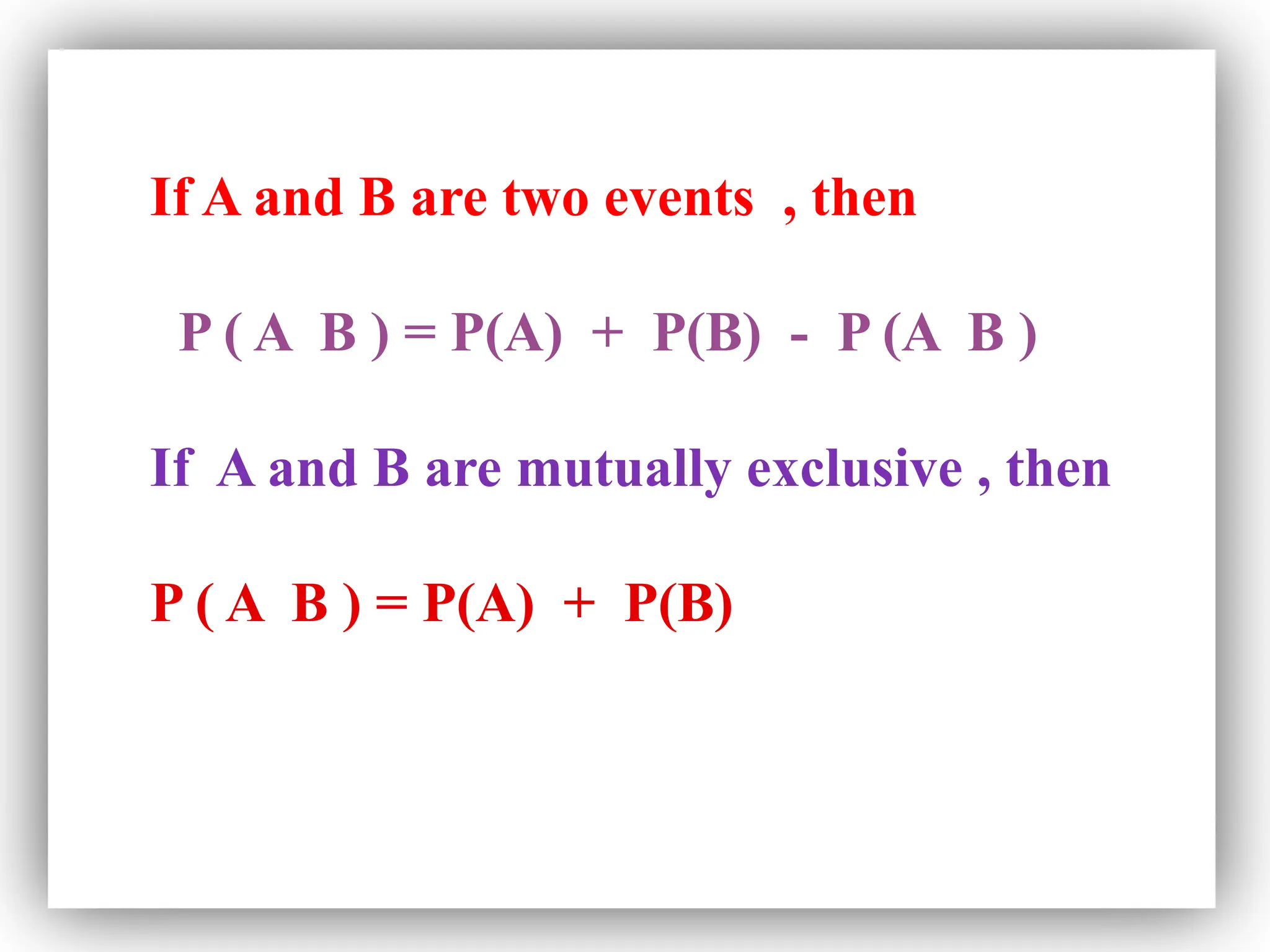
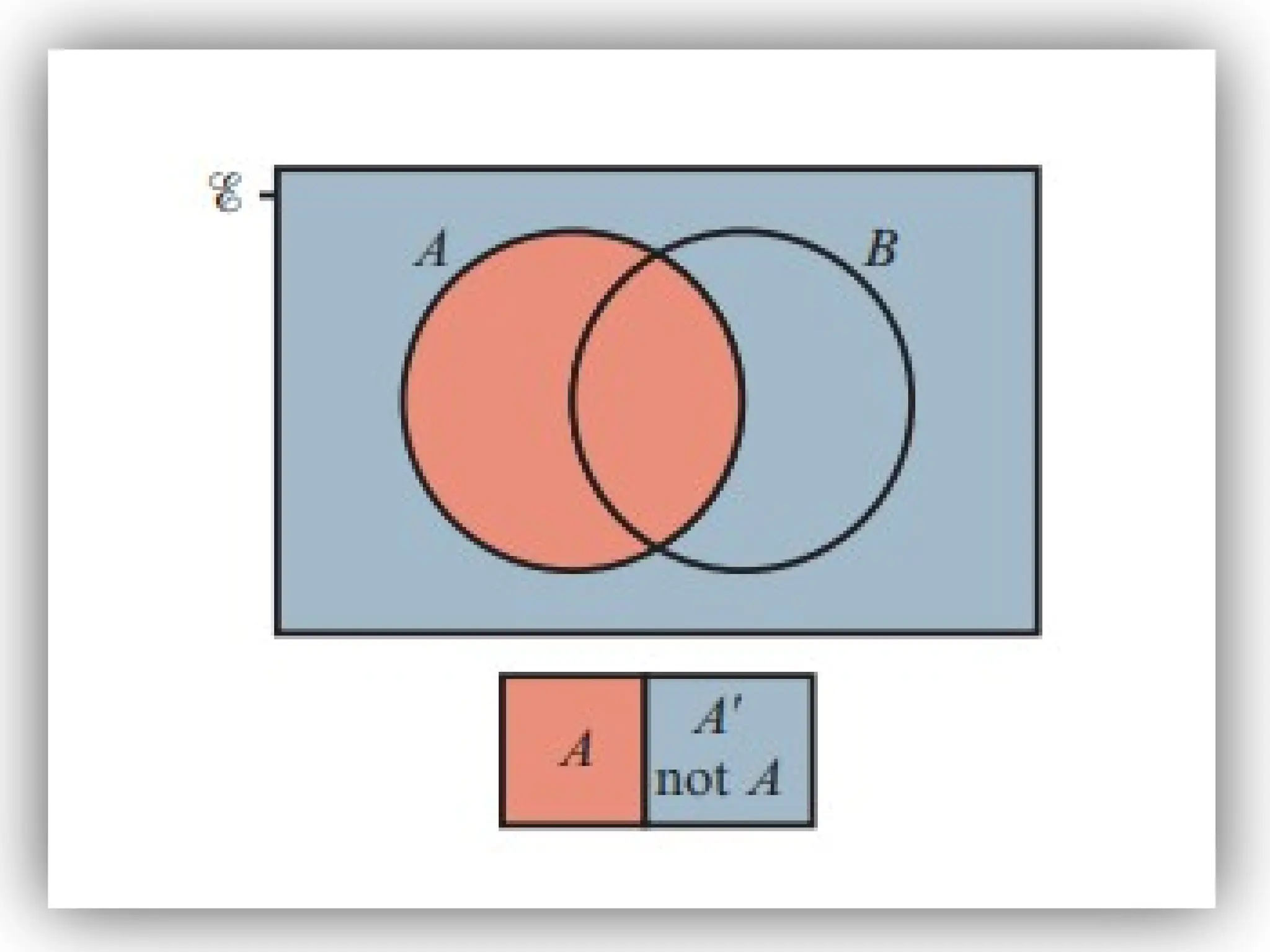
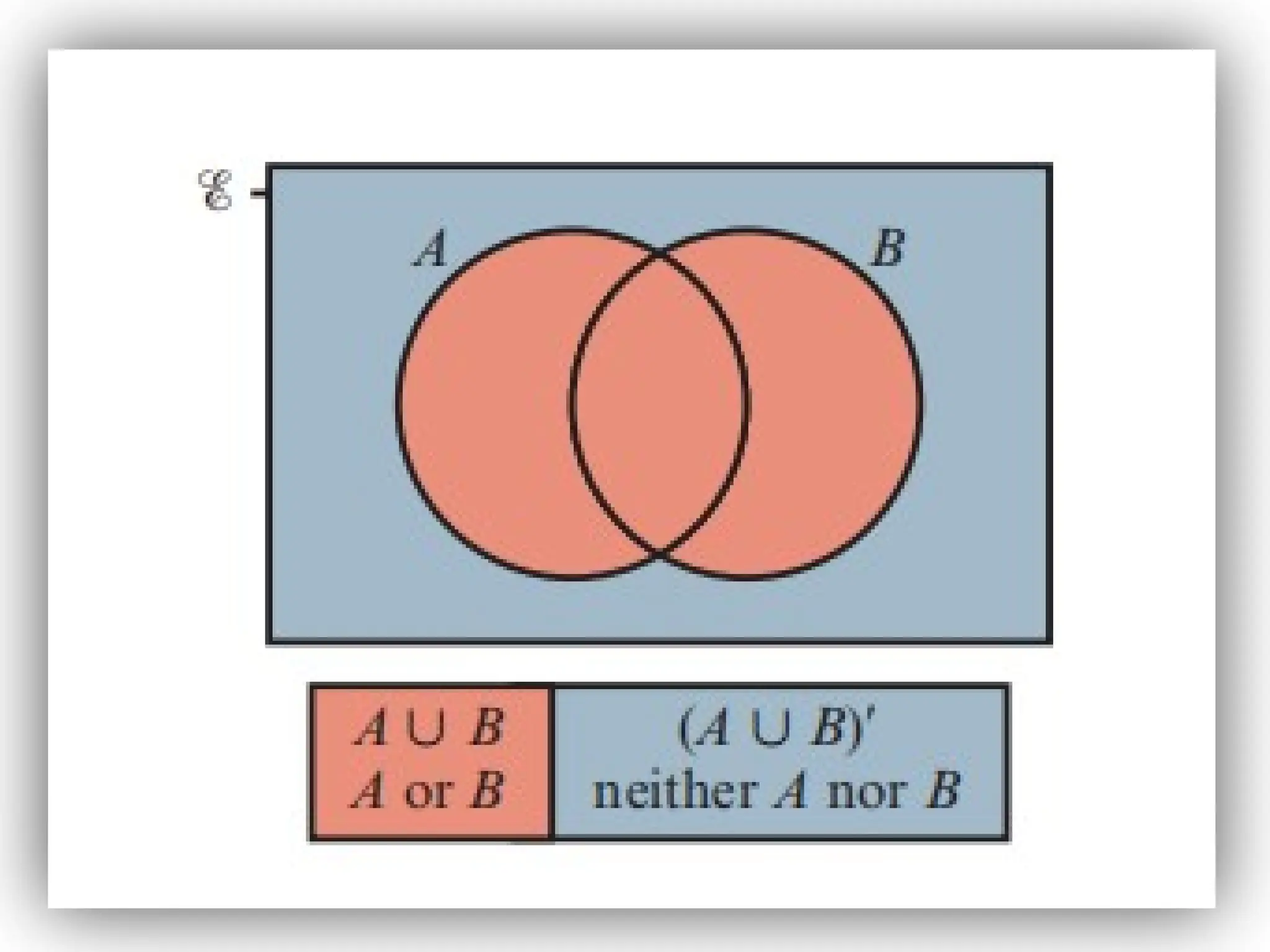
If A and B are two events , then
P ( A B ) = P(A) + P(B) - P (A B )
If A and B are mutually exclusive , then
P ( A B ) = P(A) + P(B)
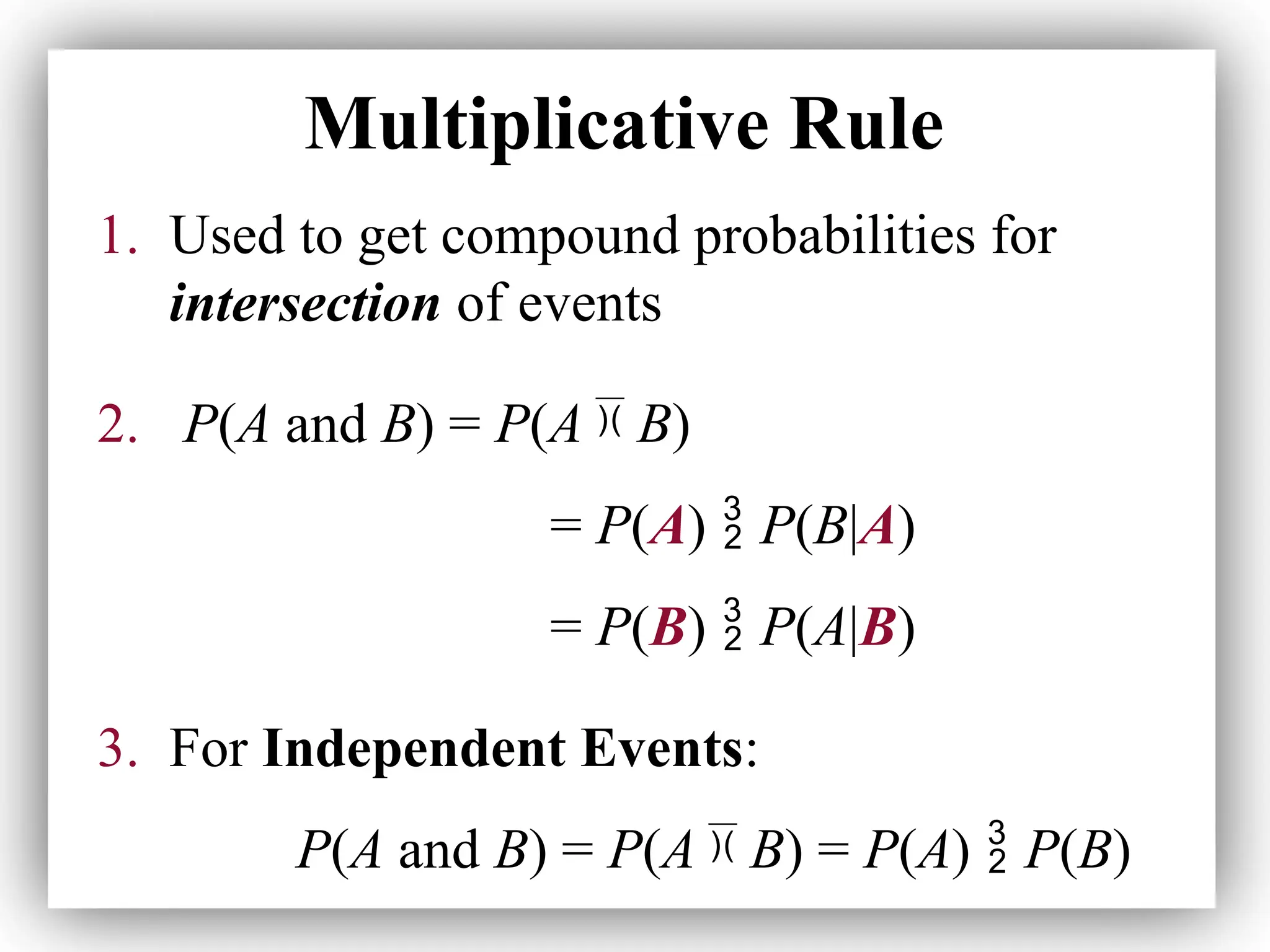
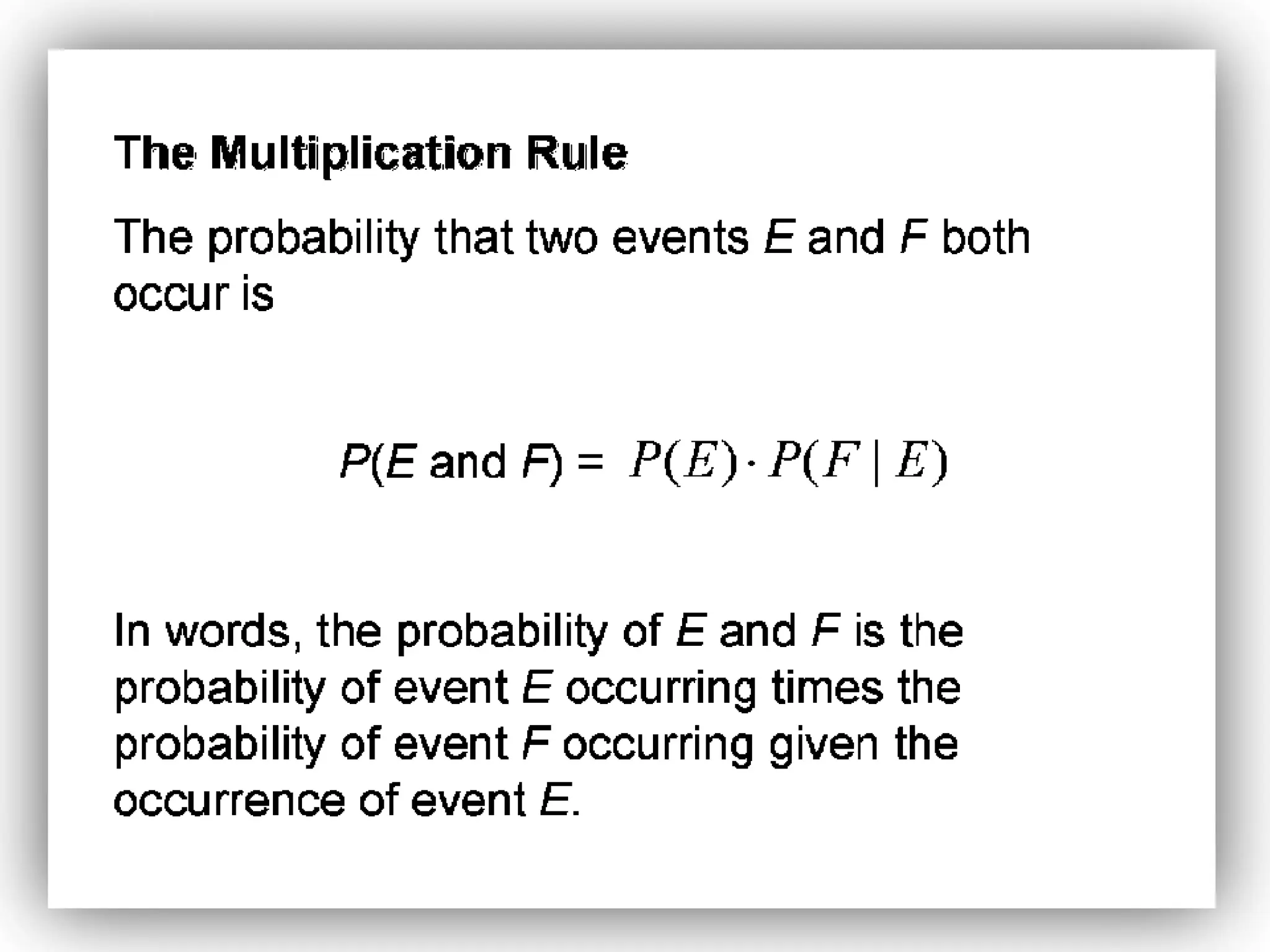
Multiplicative Rule
1. Used to get compound probabilities for
intersection of events
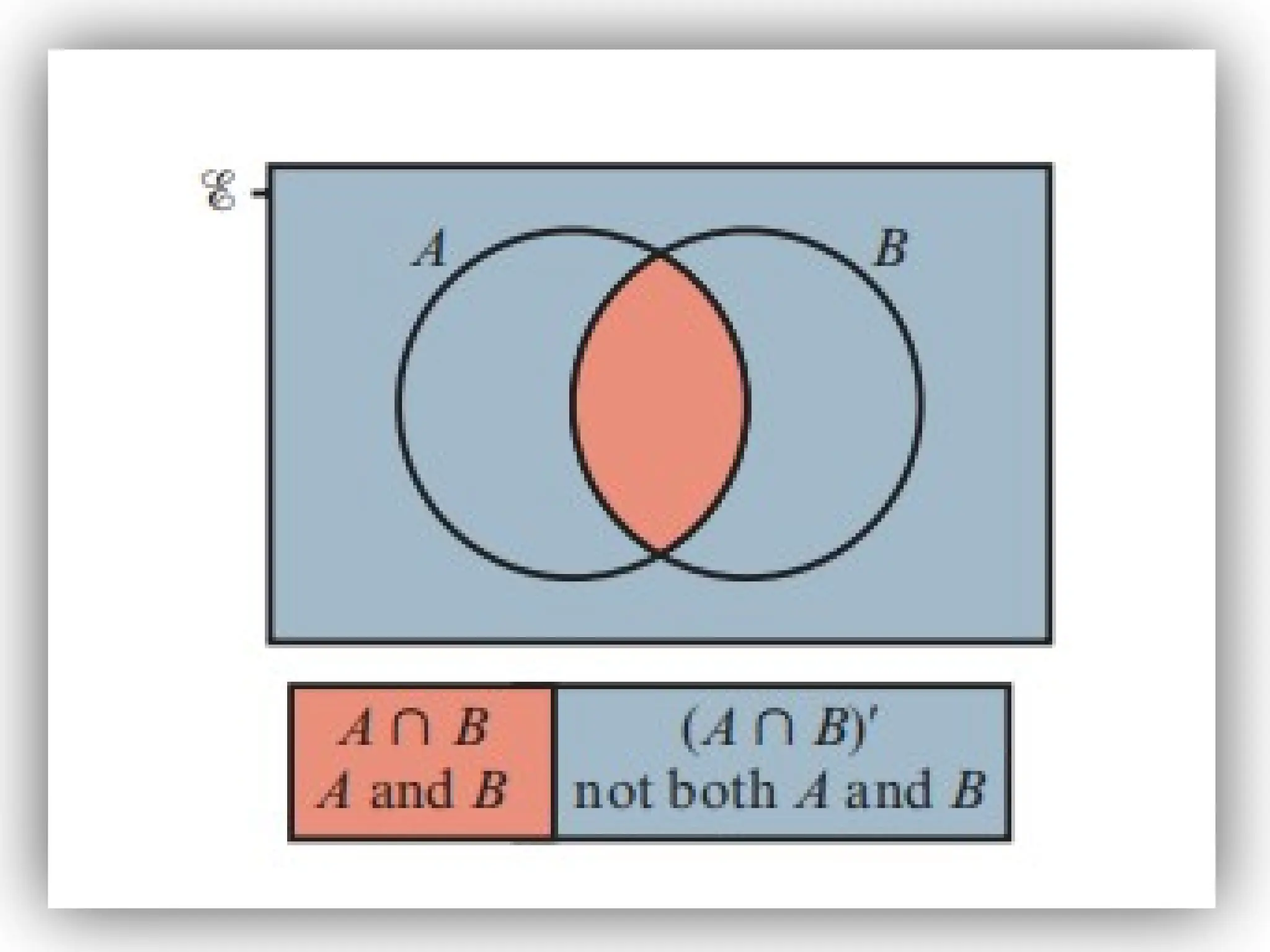
2. P(A and B) = P(A  B)
= P(A)  P(B|A)
= P(B)  P(A|B)
3. For Independent Events:
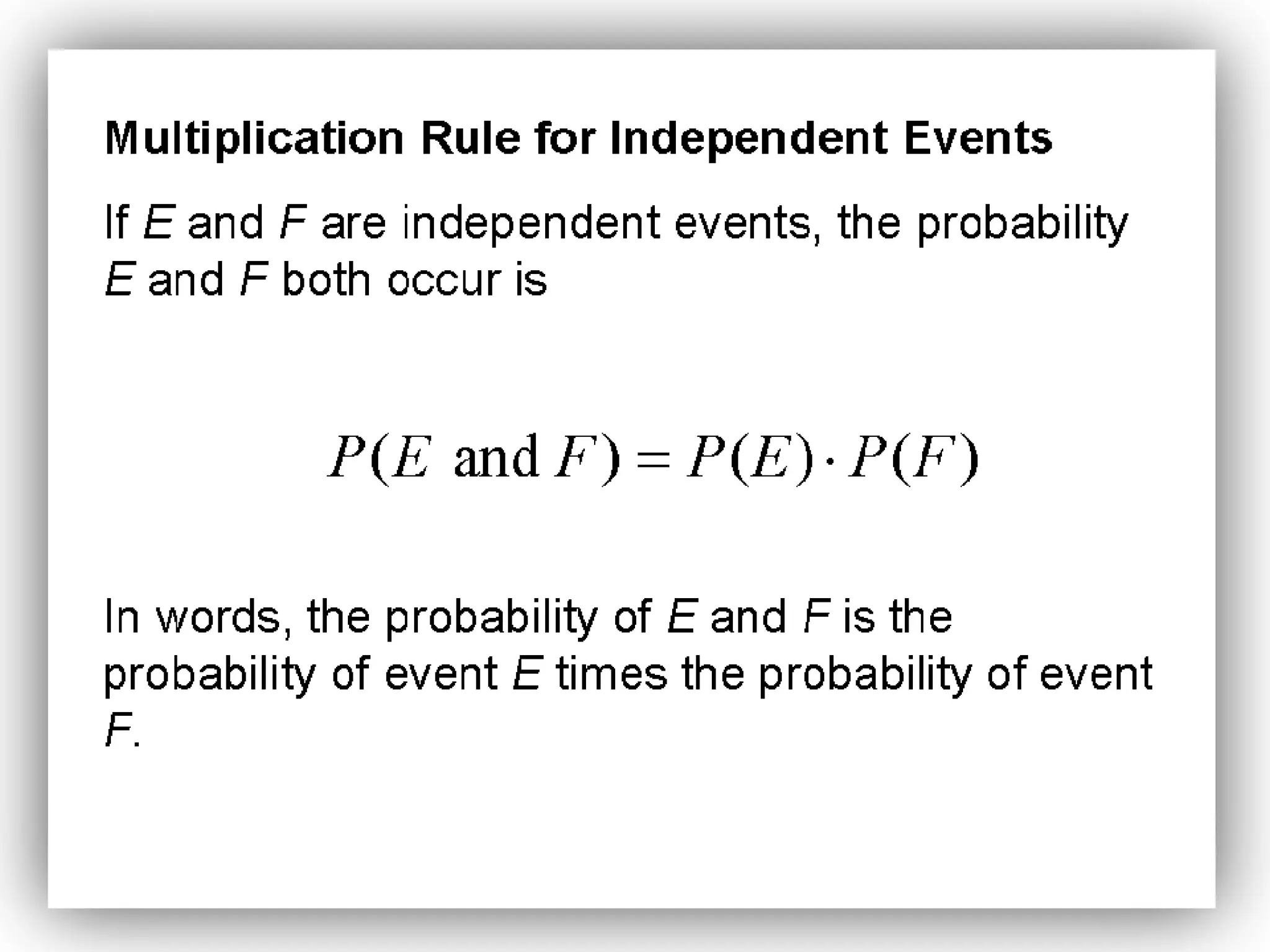
P(A and B) = P(A  B) = P(A)  P(B)
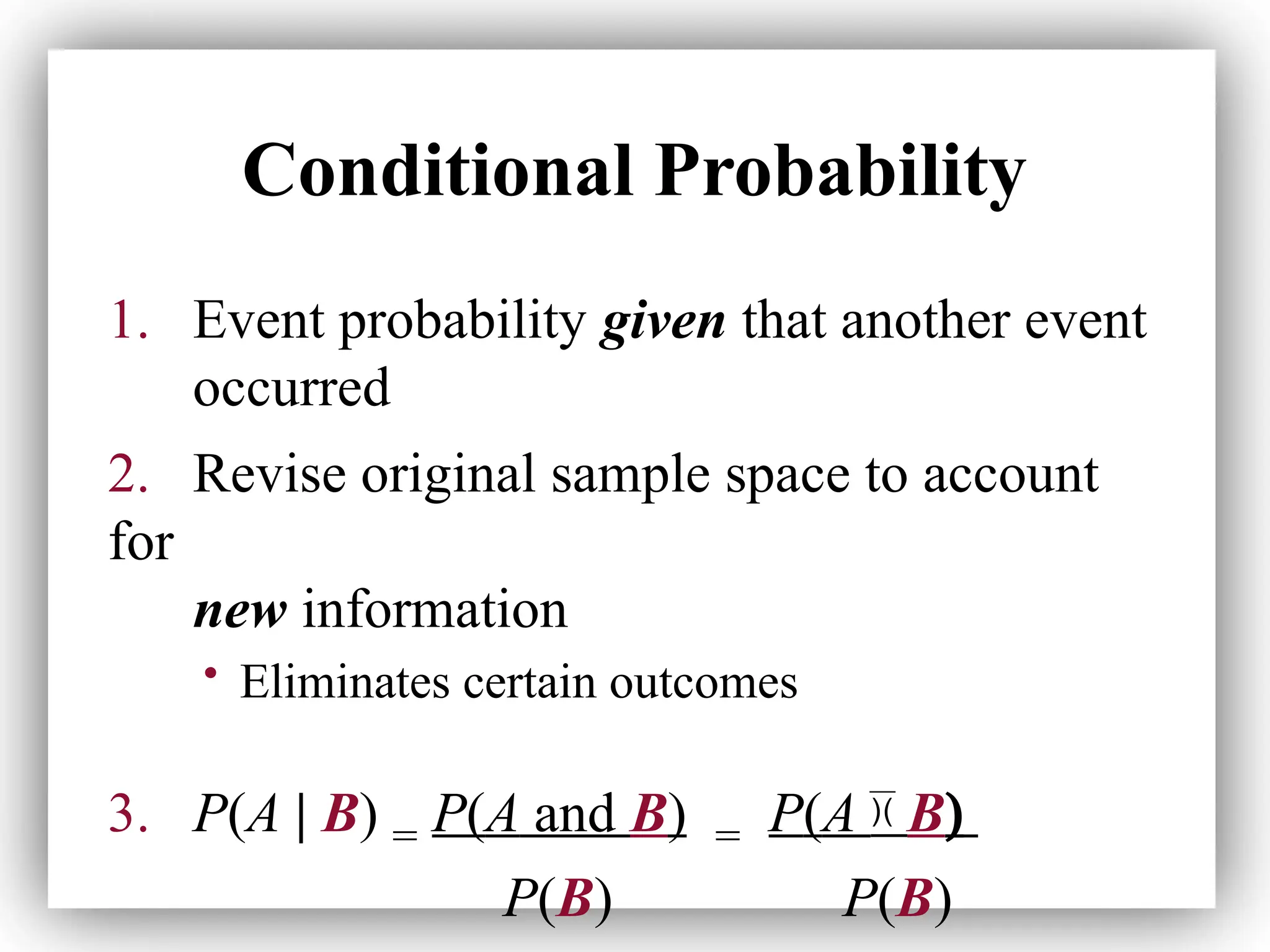
Conditional Probability
1. Event probability given that another event
occurred
2. Revise original sample space to account
for
new information
• Eliminates certain outcomes
3. P(A | B) = P(A and B) = P(A  B)
P(B) P(B)
© 2011 Pearson Education, Inc
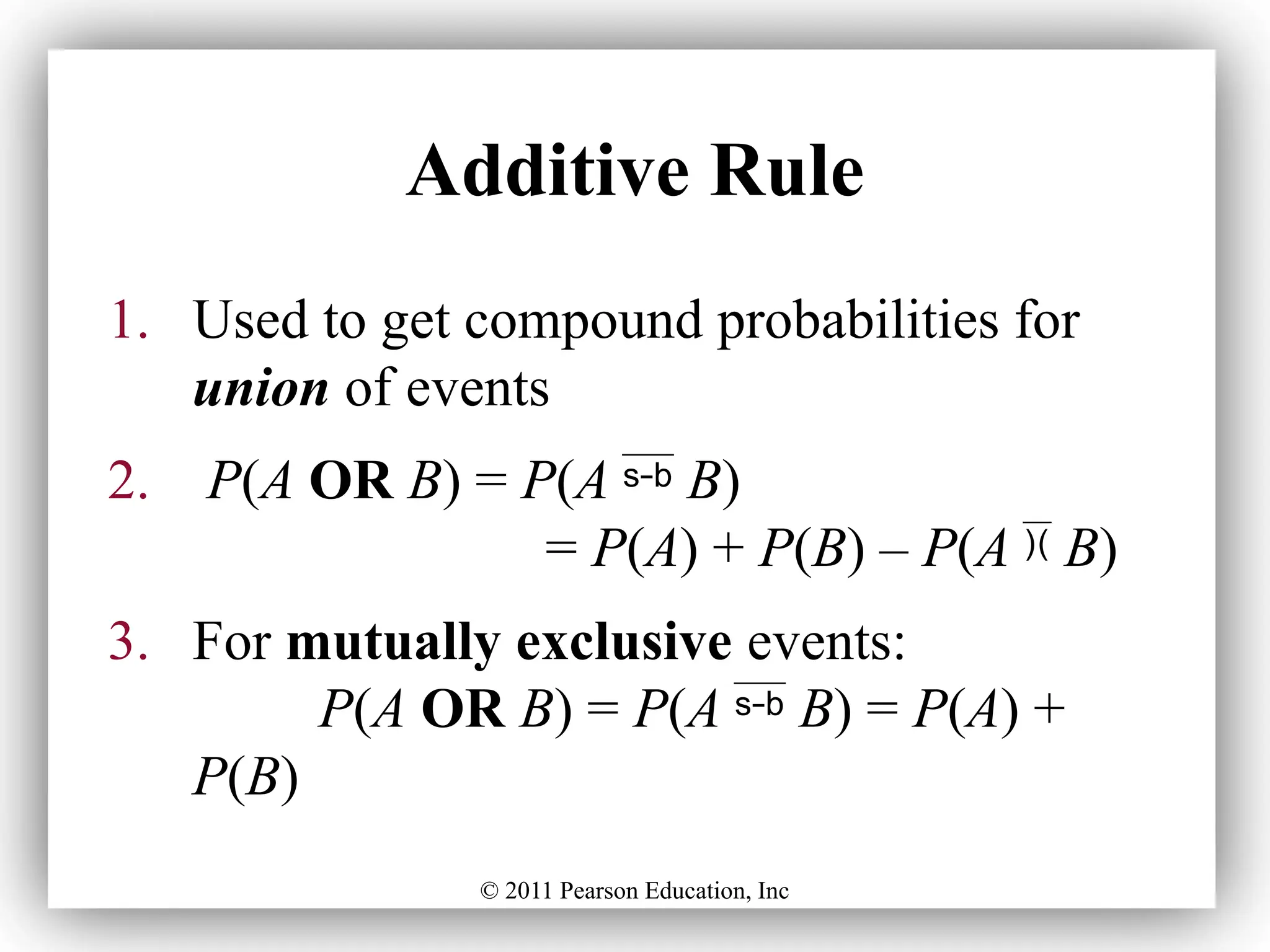
Additive Rule
1. Used to get compound probabilities for
union of events
2. P(A OR B) = P(A  B)
= P(A) + P(B) – P(A  B)
3. For mutually exclusive events:
P(A OR B) = P(A  B) = P(A) +
P(B)
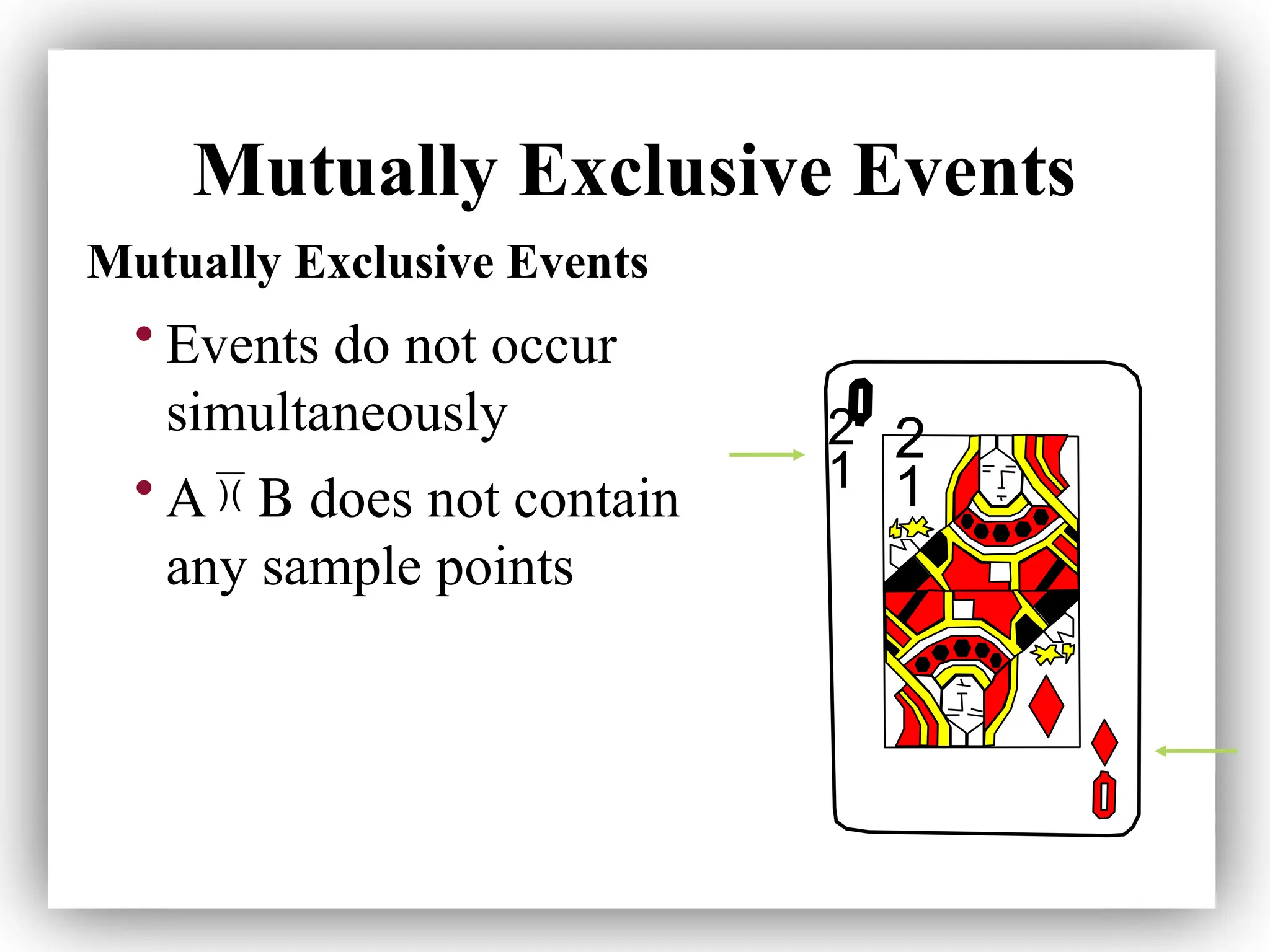
Mutually Exclusive Events
• Events do not occur
simultaneously
• A B
 does not contain
any sample points
 
Mutually Exclusive Events
Probability is a measure of the likelihood of
a random phenomenon or chance behavior.
Probability describes the long-term
proportion with which a certain outcome will
occur in situations with short-term
uncertainty.
EXAMPLE
Simulate flipping a coin 100 times. Plot the
proportion of heads against the number of flips.
Repeat the simulation.
Probability deals with experiments that yield
random short-term results or outcomes, yet
reveal long-term predictability.
The long-term proportion with which a
certain outcome is observed is the
probability of that outcome.
The Law of Large Numbers
As the number of repetitions of a probability
experiment increases, the proportion with which
a certain outcome is observed gets closer to the
probability of the outcome.
In probability, an experiment is any
process that can be repeated in which
the results are uncertain.
A simple event is any single outcome
from a probability experiment. Each
simple event is denoted ei.
The sample space, S, of a
probability experiment is the
collection of all possible simple
events. In other words, the
sample space is a list of all
possible outcomes of a probability
experiment.
An event is any collection of
outcomes from a probability
experiment. An event may consist
of one or more simple events.
Events are denoted using capital
letters such as E.
EXAMPLE Identifying Events and the Sample
Space of a Probability Experiment
Consider the probability experiment of
having two children.
(a) Identify the simple events of the
probability experiment.
(b) Determine the sample space.
(c) Define the event E = “have one boy”.
The probability of an event,
denoted P(E), is the likelihood of
that event occurring.
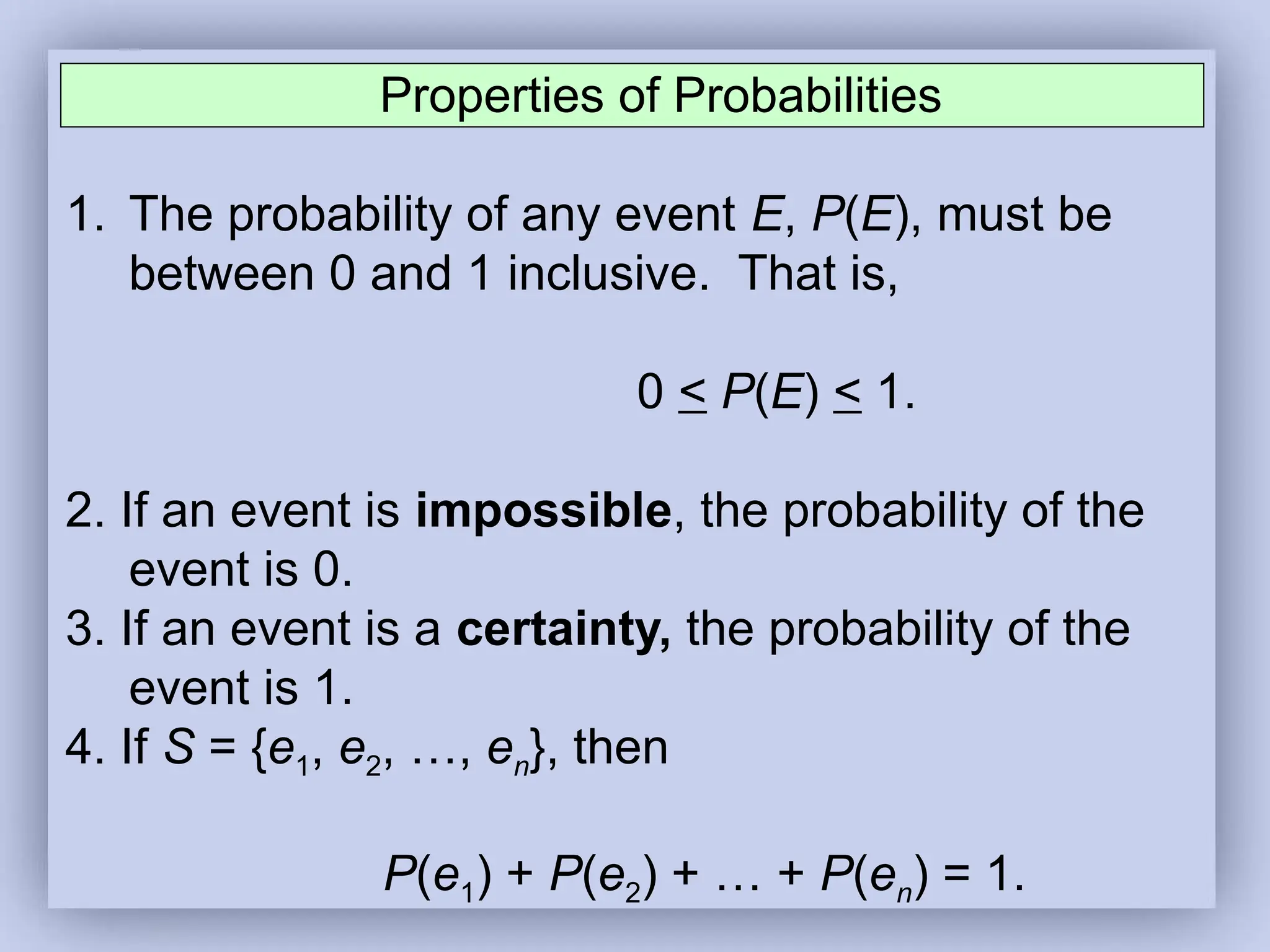
Properties of Probabilities
1. The probability of any event E, P(E), must be
between 0 and 1 inclusive. That is,
0 < P(E) < 1.
2. If an event is impossible, the probability of the
event is 0.
3. If an event is a certainty, the probability of the
event is 1.
4. If S = {e1, e2, …, en}, then
P(e1) + P(e2) + … + P(en) = 1.
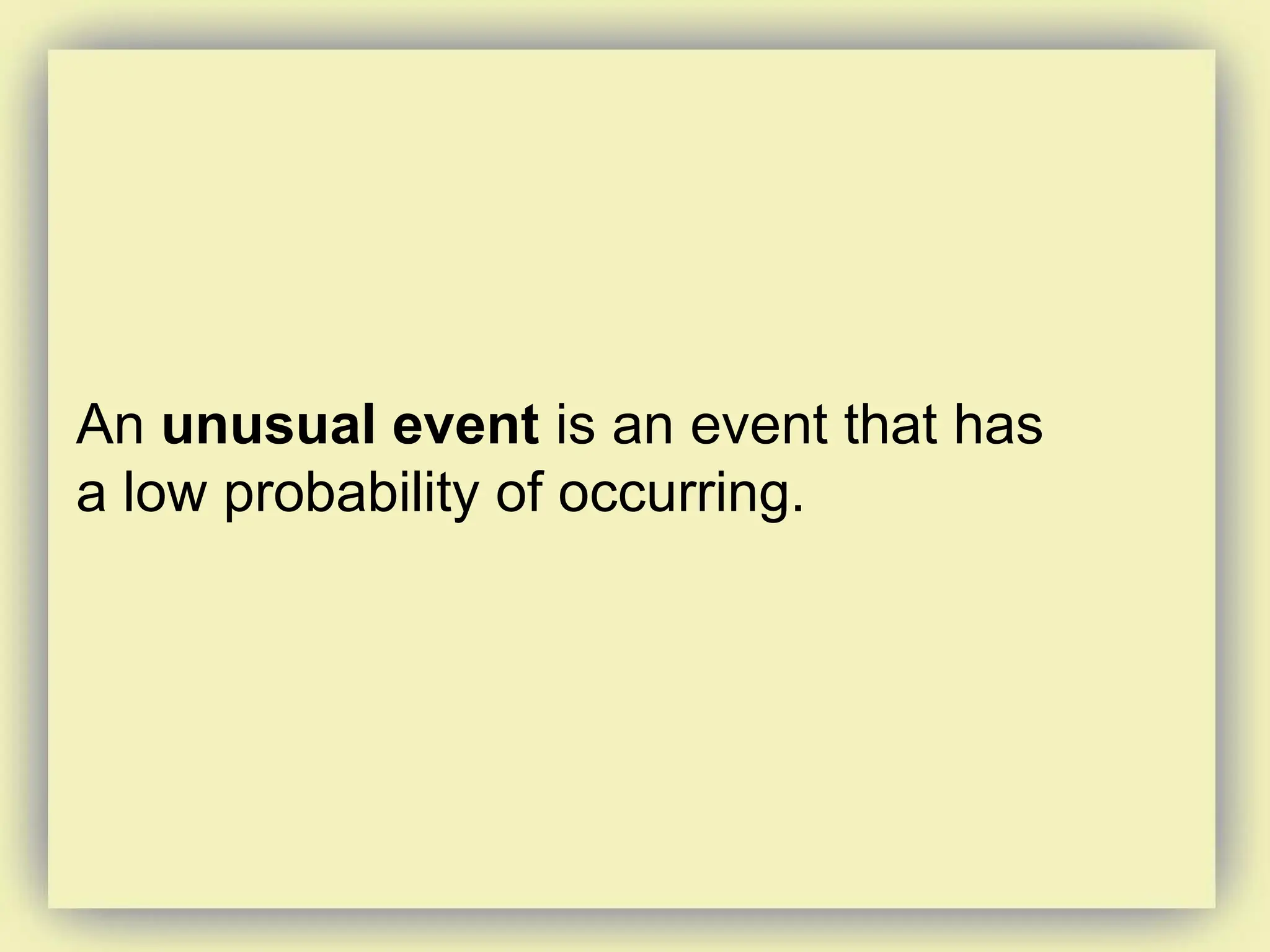
An unusual event is an event that has
a low probability of occurring.
Three methods for determining the
probability of an event:
(1) the classical method
Three methods for determining the
probability of an event:
(1) the classical method
(2) the empirical method
Three methods for determining the
probability of an event:
(1) the classical method
(2) the empirical method
(3) the subjective method
The classical method of computing
probabilities requires equally likely
outcomes.
An experiment is said to have equally
likely outcomes when each simple event
has the same probability of occurring.
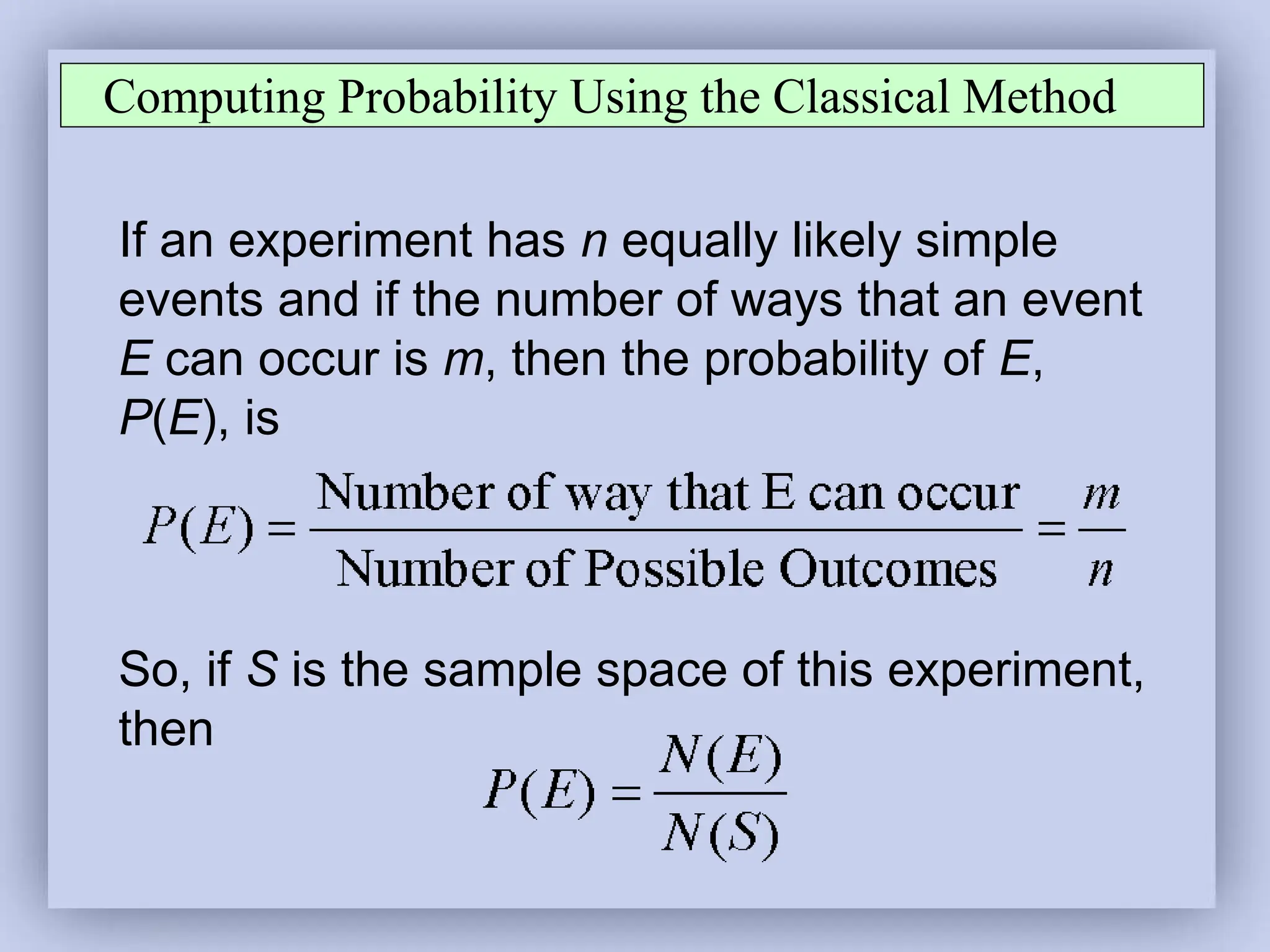
Computing Probability Using the Classical Method
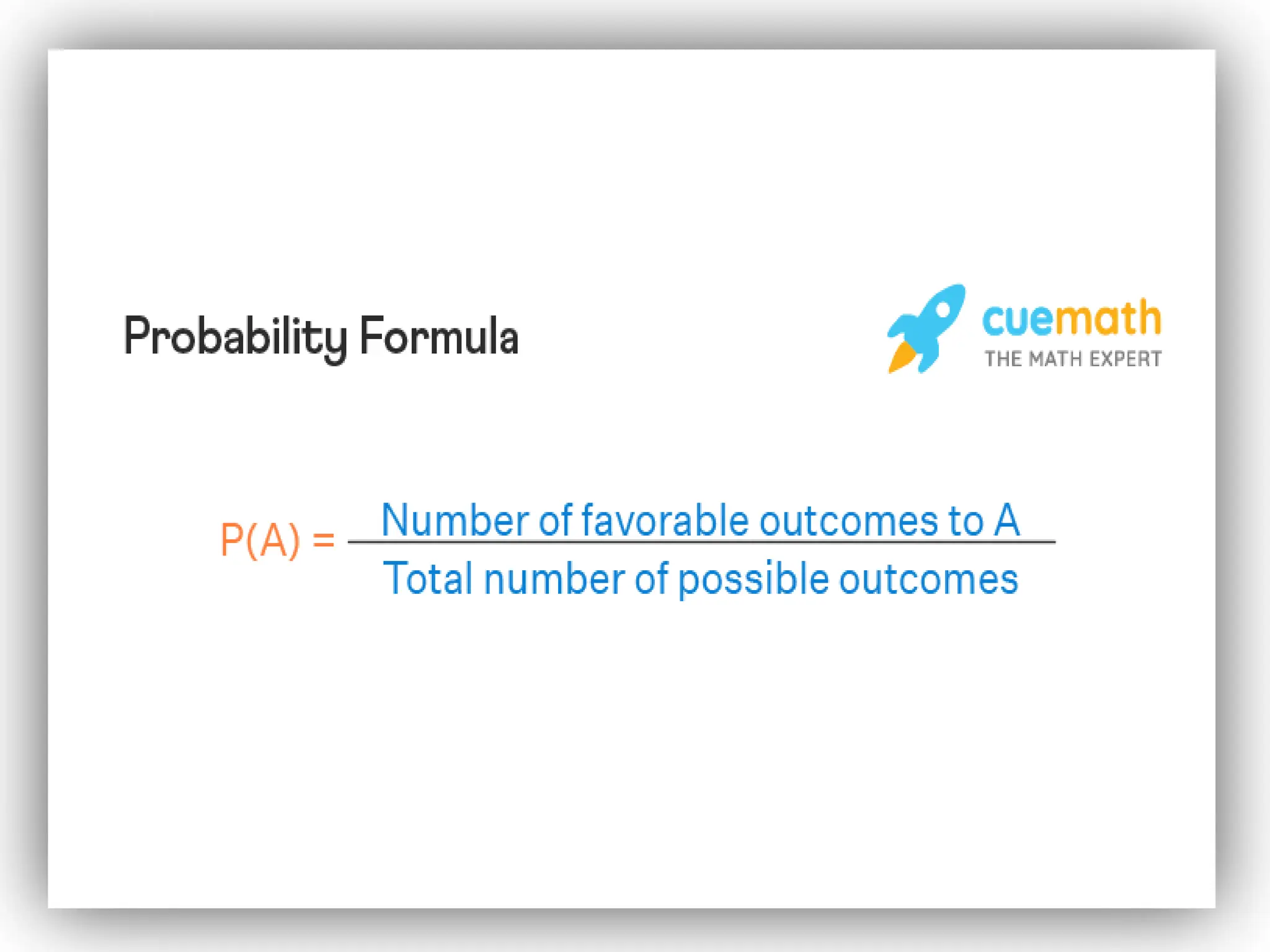
If an experiment has n equally likely simple
events and if the number of ways that an event
E can occur is m, then the probability of E,
P(E), is
So, if S is the sample space of this experiment,
then
EXAMPLE Computing Probabilities Using the
Classical Method
Suppose a “fun size” bag of M&Ms contains 9
brown candies, 6 yellow candies, 7 red
candies, 4 orange candies, 2 blue candies, and
2 green candies. Suppose that a candy is
randomly selected.
(a) What is the probability that it is brown?
(b) What is the probability that it is blue?
(c) Comment on the likelihood of the candy
being brown versus blue.
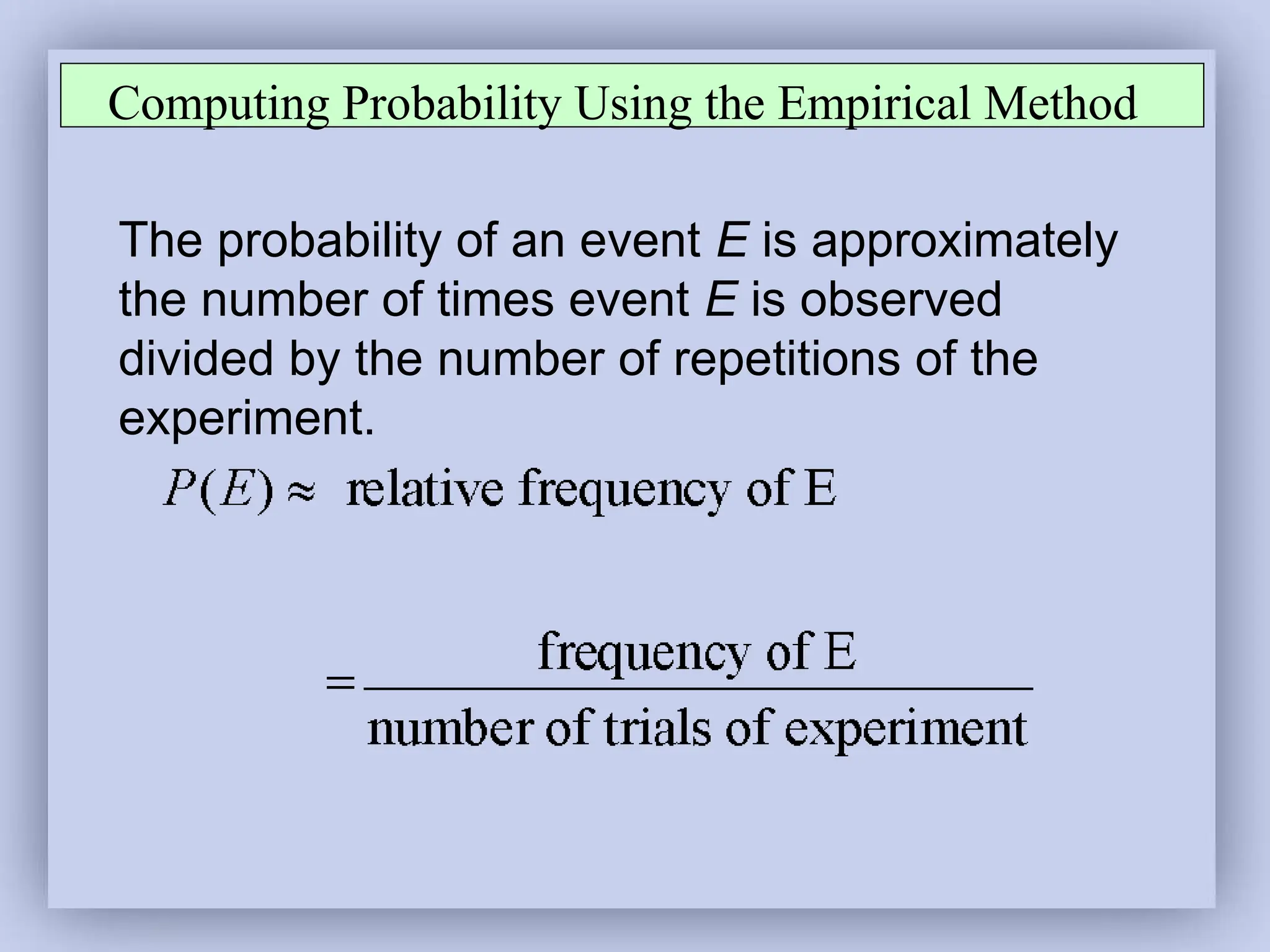
Computing Probability Using the Empirical Method
The probability of an event E is approximately
the number of times event E is observed
divided by the number of repetitions of the
experiment.
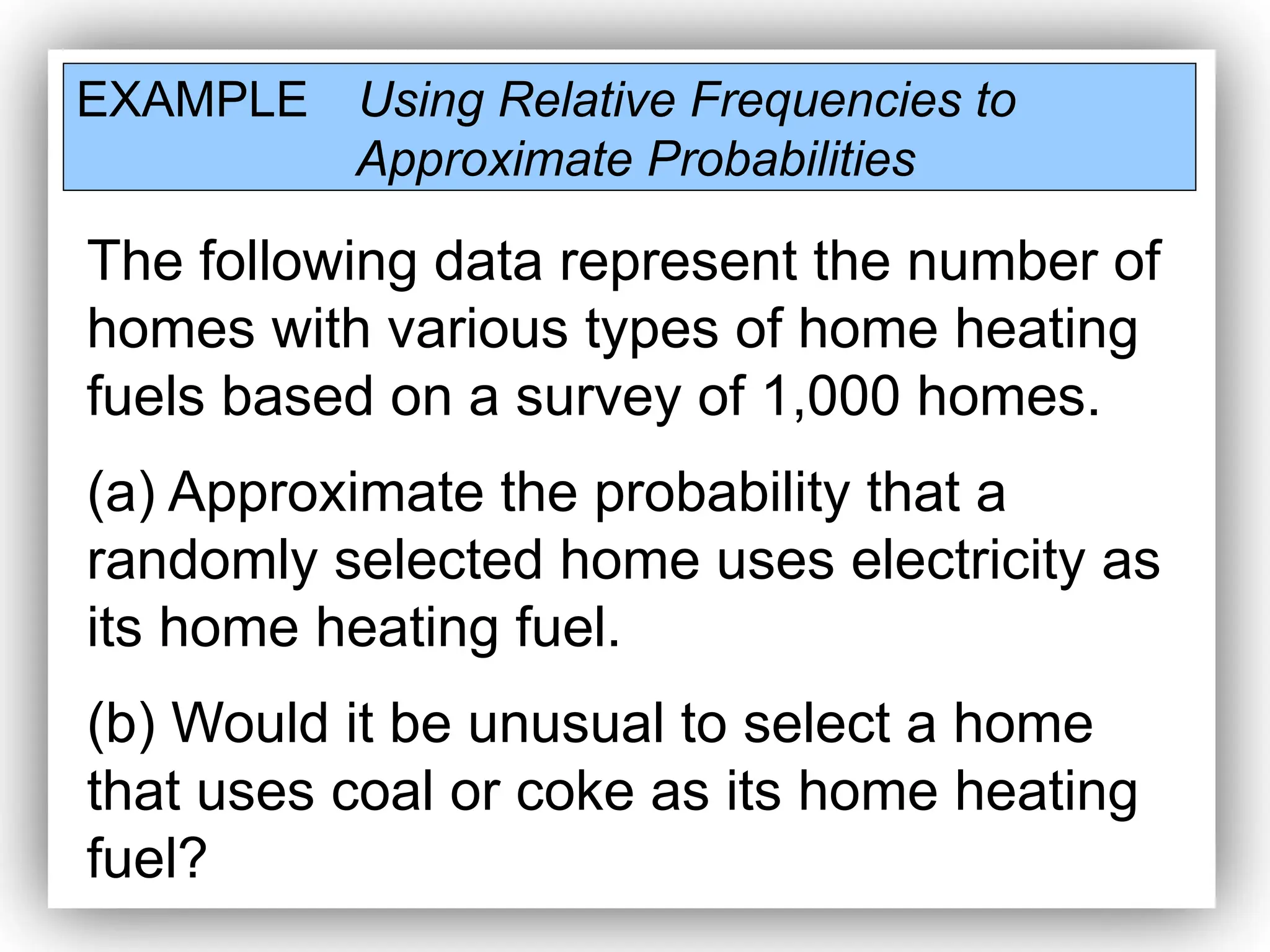
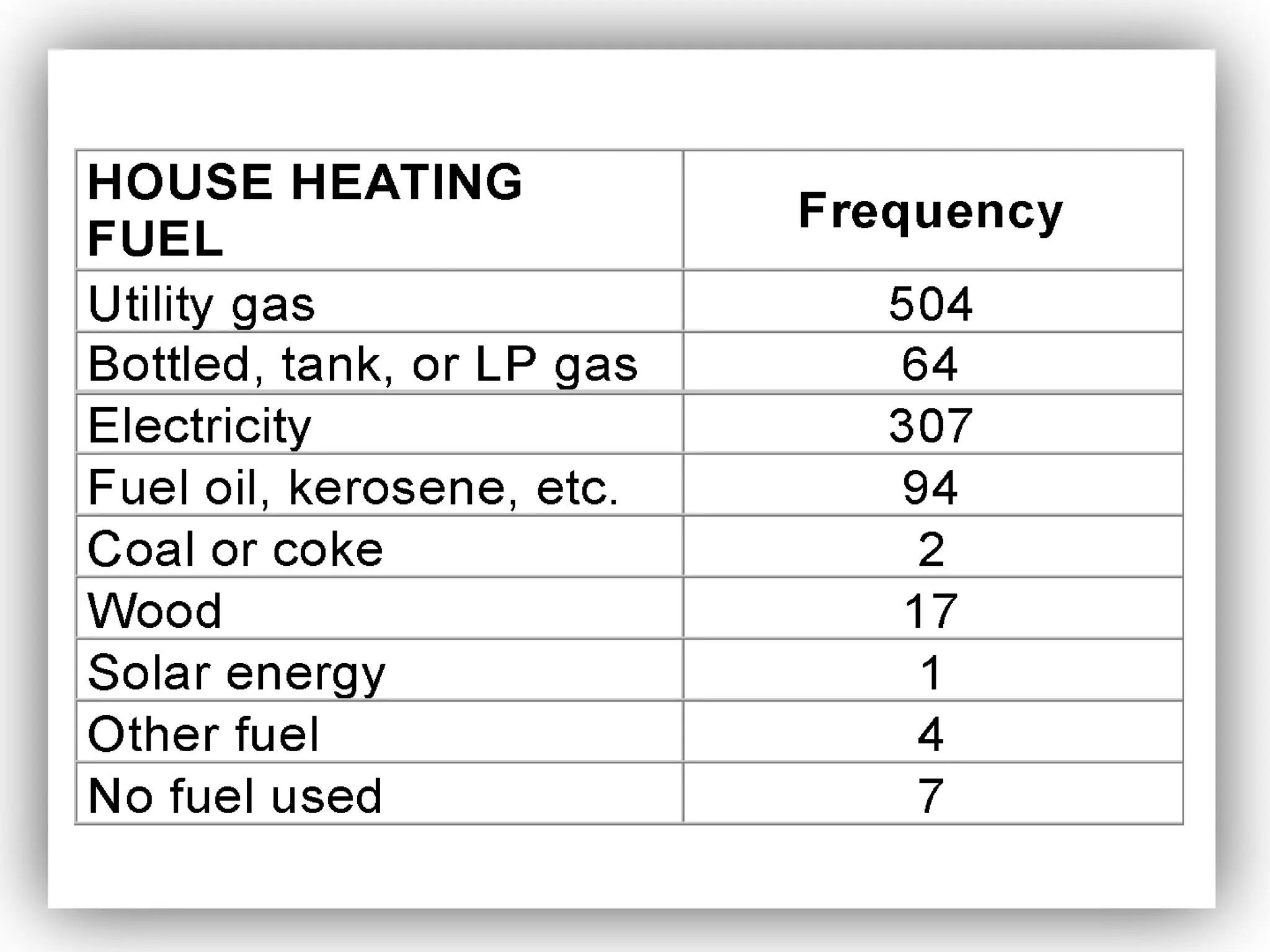
EXAMPLE Using Relative Frequencies to
Approximate Probabilities
The following data represent the number of
homes with various types of home heating
fuels based on a survey of 1,000 homes.
(a) Approximate the probability that a
randomly selected home uses electricity as
its home heating fuel.
(b) Would it be unusual to select a home
that uses coal or coke as its home heating
fuel?
EXAMPLE Using Simulation
Simulate throwing a 6-sided die 100 times.
Approximate the probability of rolling a 4.
How does this compare to the classical
probability?
Subjective probabilities are
probabilities obtained based upon an
educated guess.
For example, there is a 40% chance of
rain tomorrow.
Chapter 5
Probability
5.2
The Addition Rule; Complements
Let E and F be two events.
E and F is the event consisting of simple
events that belong to both E and F.
E or F is the event consisting of simple
events that belong to either E or F or both.
EXAMPLE Illustrating the Addition Rule
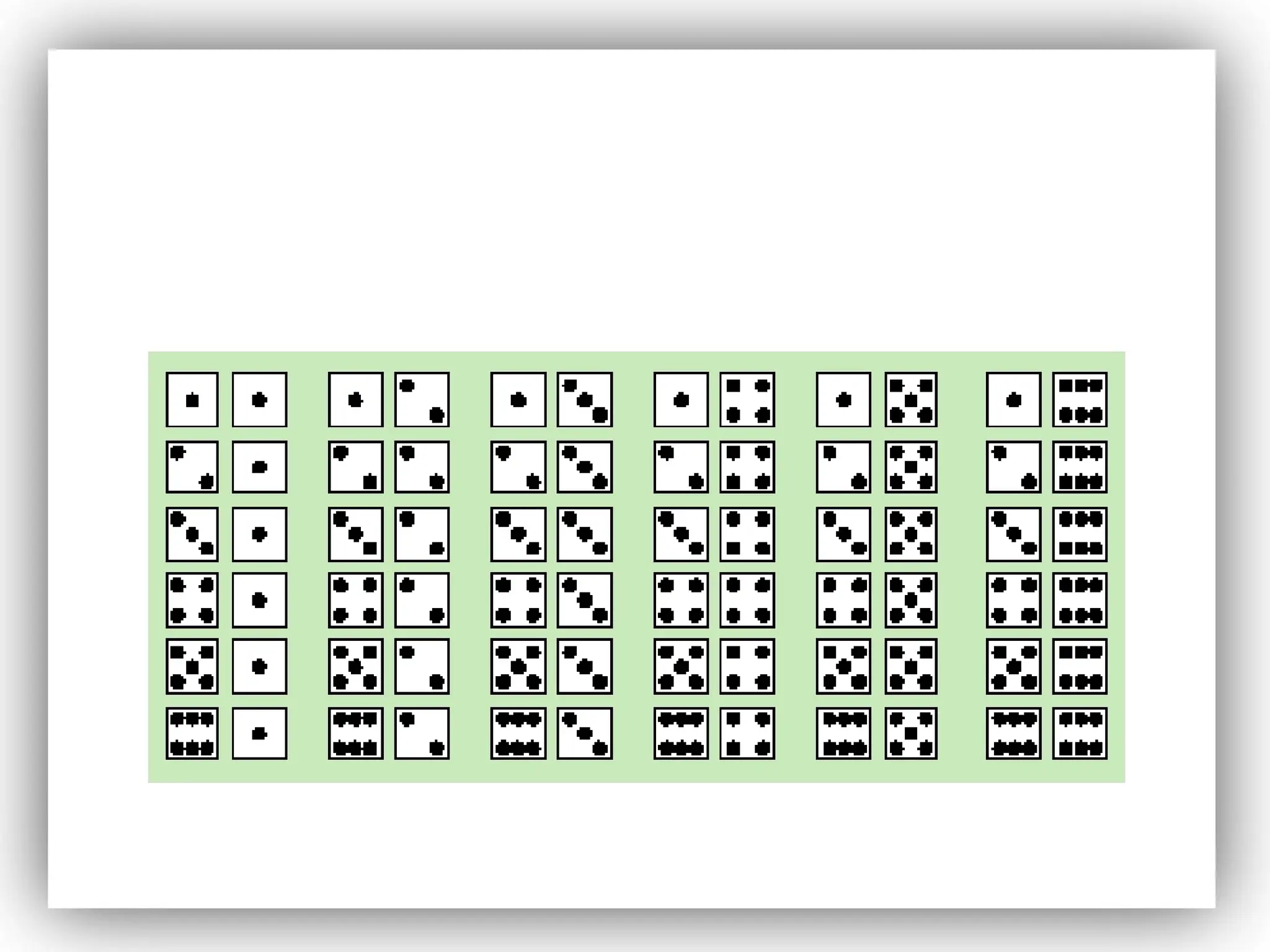
Suppose that a pair of fair dice are thrown.
a) Let E=“rolling a seven”, compute the probability of
rolling a seven, i.e., P(E).
b) Let E=“rolling a two ” (called ‘snake eyes’), compute
the probability of rolling “snake eyes”, i.e., P(E).
c) Let E = “the first die is a two” and let F = “the sum of
the dice is less than or equal to 5”. Find P(E or F)
directly by counting the number of ways E or F could
occur and dividing this result by the number of
possible outcomes.
Addition Rule
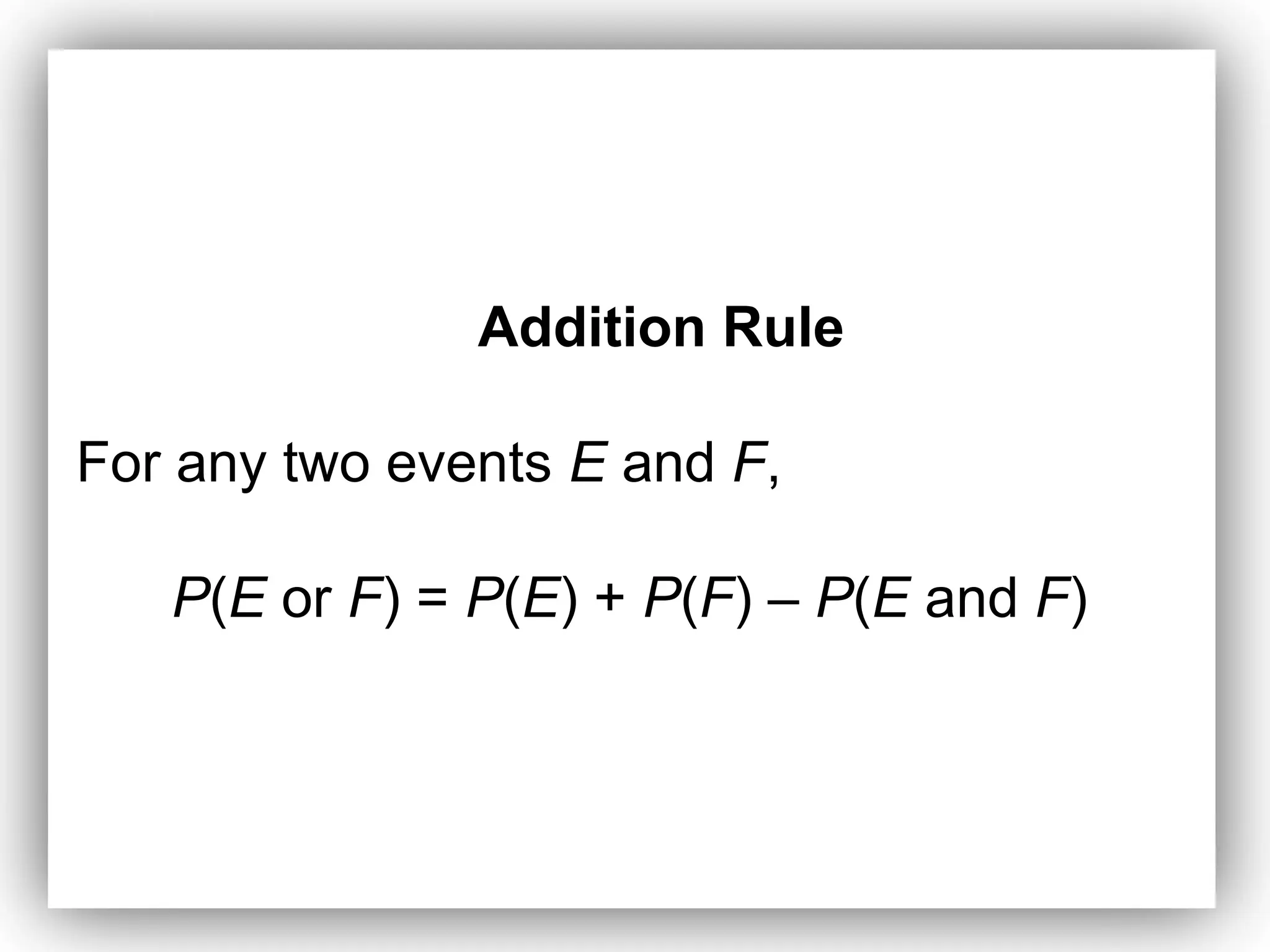
For any two events E and F,
P(E or F) = P(E) + P(F) – P(E and F)
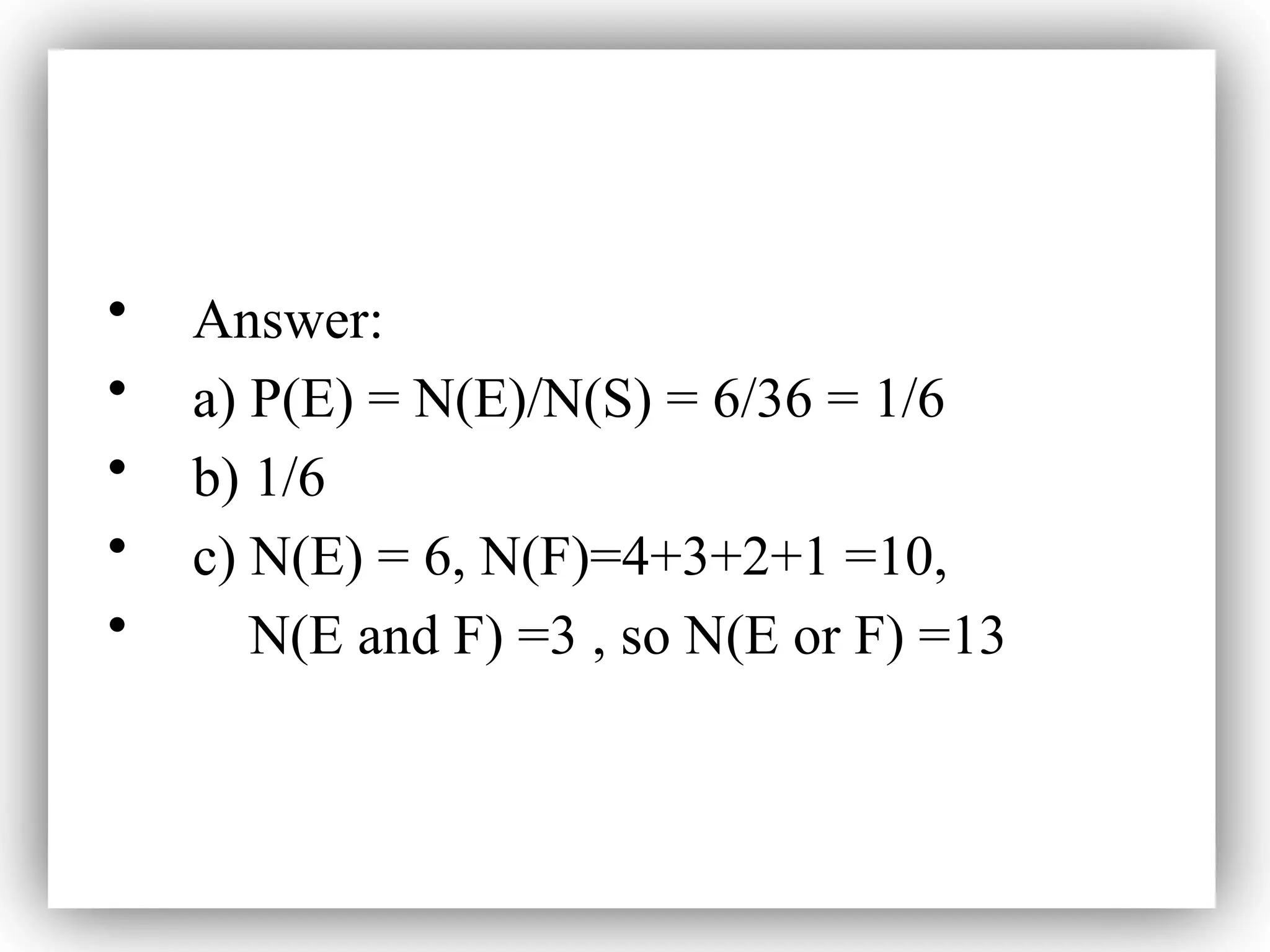
• Answer:
• a) P(E) = N(E)/N(S) = 6/36 = 1/6
• b) 1/6
• c) N(E) = 6, N(F)=4+3+2+1 =10,
• N(E and F) =3 , so N(E or F) =13
EXAMPLE The Addition Rule
Redo the last example using the Addition
Rule.
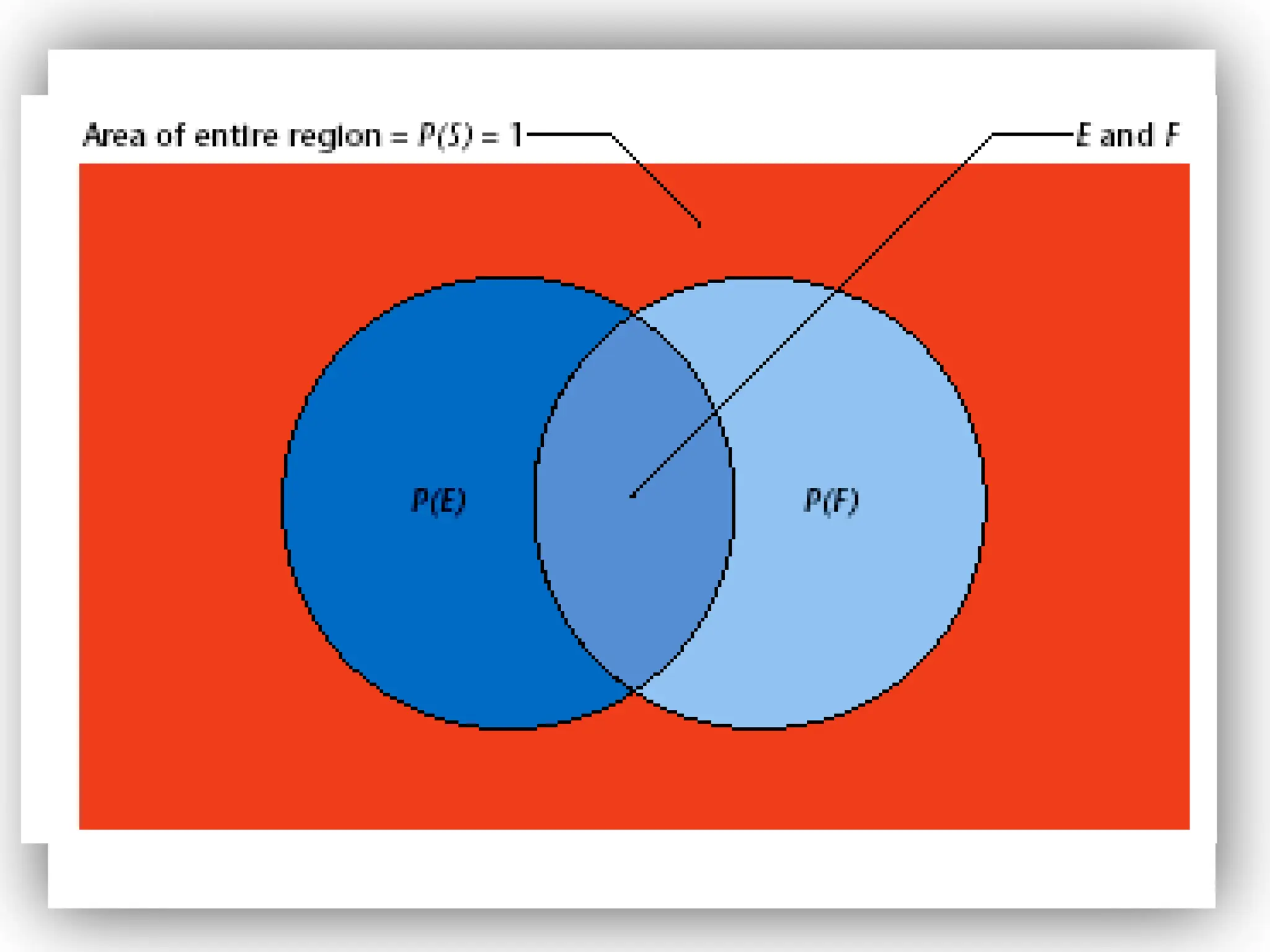
Venn diagrams represent events as circles
enclosed in a rectangle. The rectangle
represents the sample space and each circle
represents an event.
If events E and F have no simple events
in common or cannot occur
simultaneously, they are said to be
disjoint or mutually exclusive.
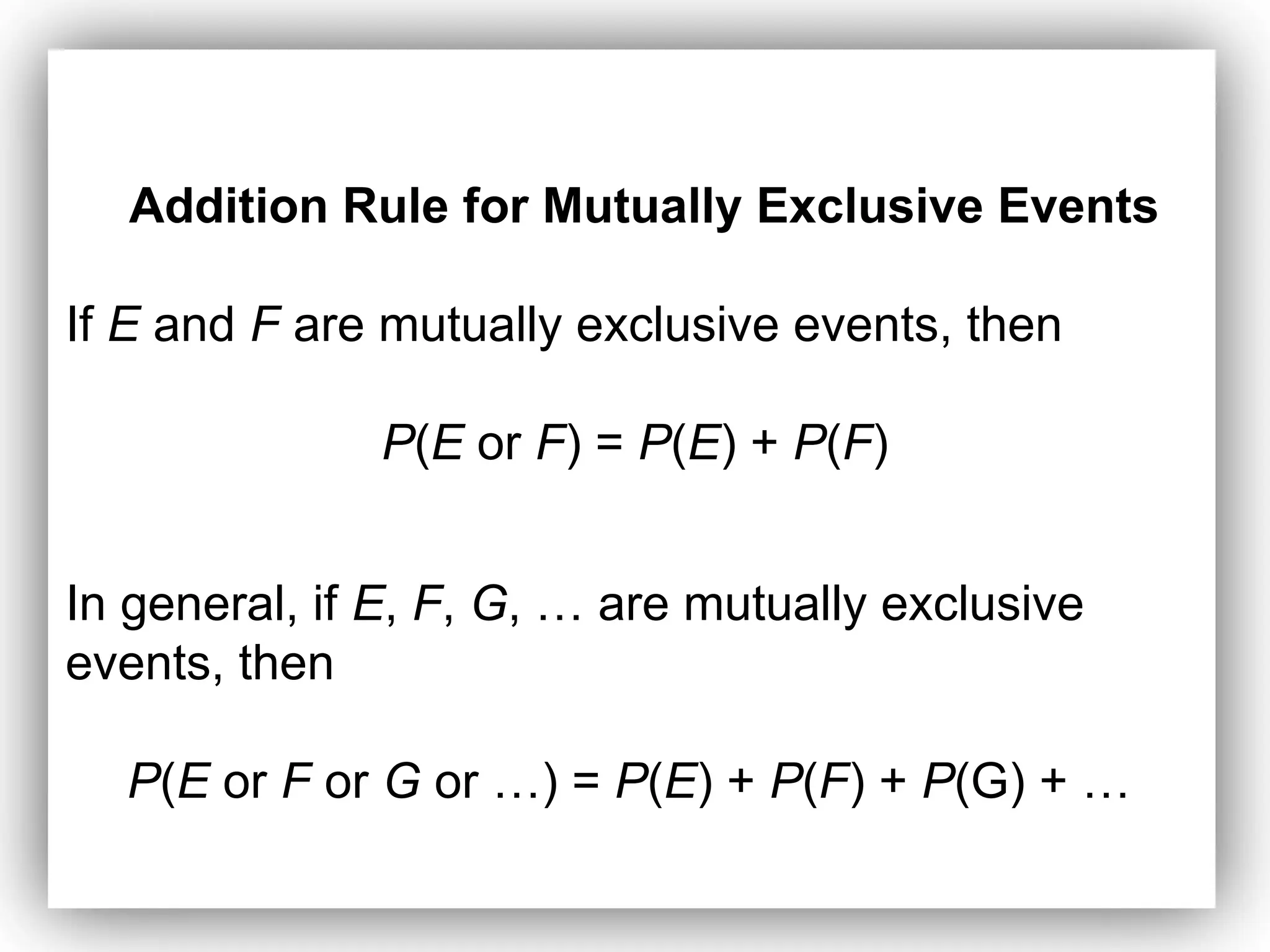
Addition Rule for Mutually Exclusive Events
If E and F are mutually exclusive events, then
P(E or F) = P(E) + P(F)
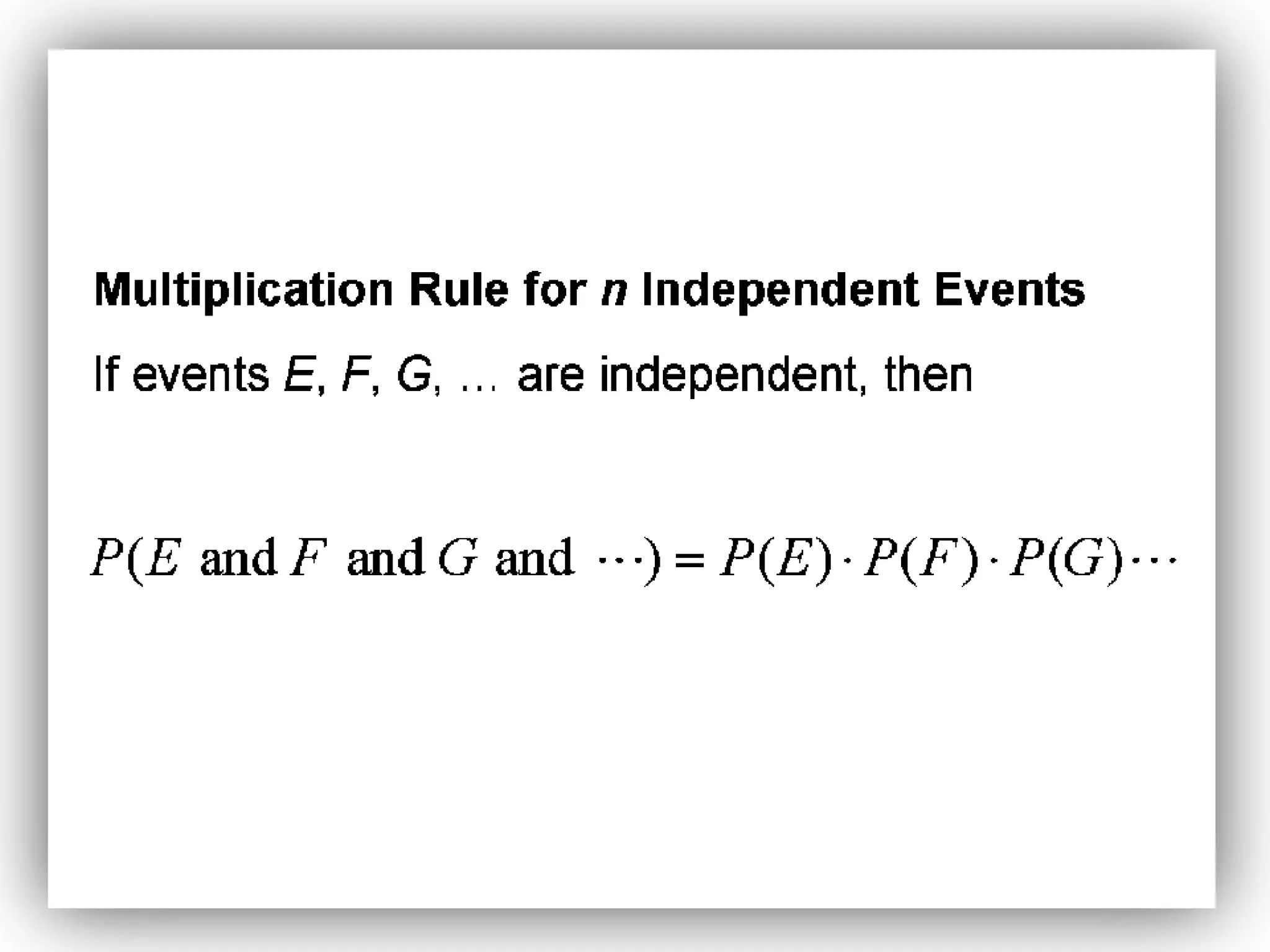
In general, if E, F, G, … are mutually exclusive
events, then
P(E or F or G or …) = P(E) + P(F) + P(G) + …
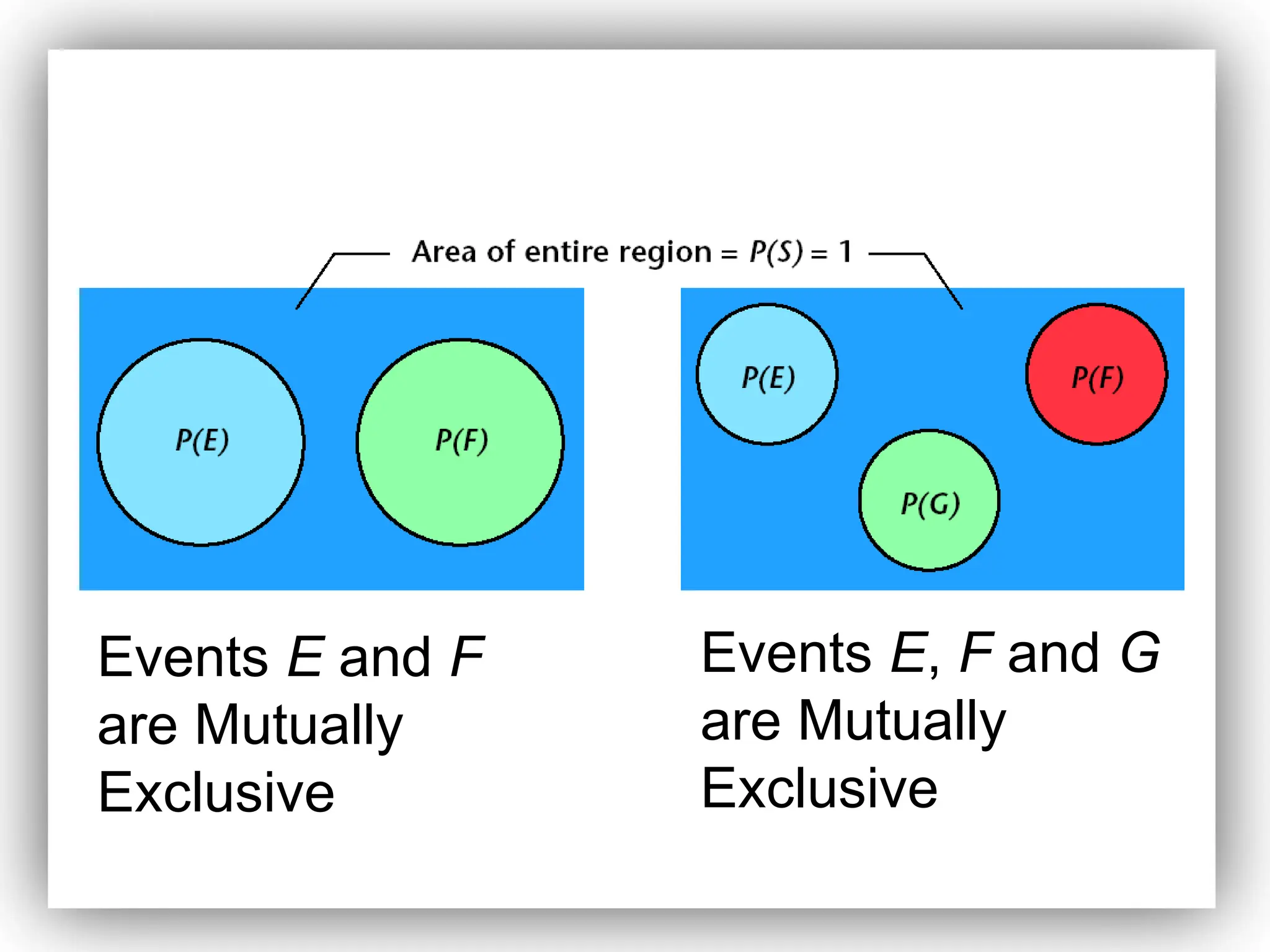
Events E and F
are Mutually
Exclusive
Events E, F and G
are Mutually
Exclusive
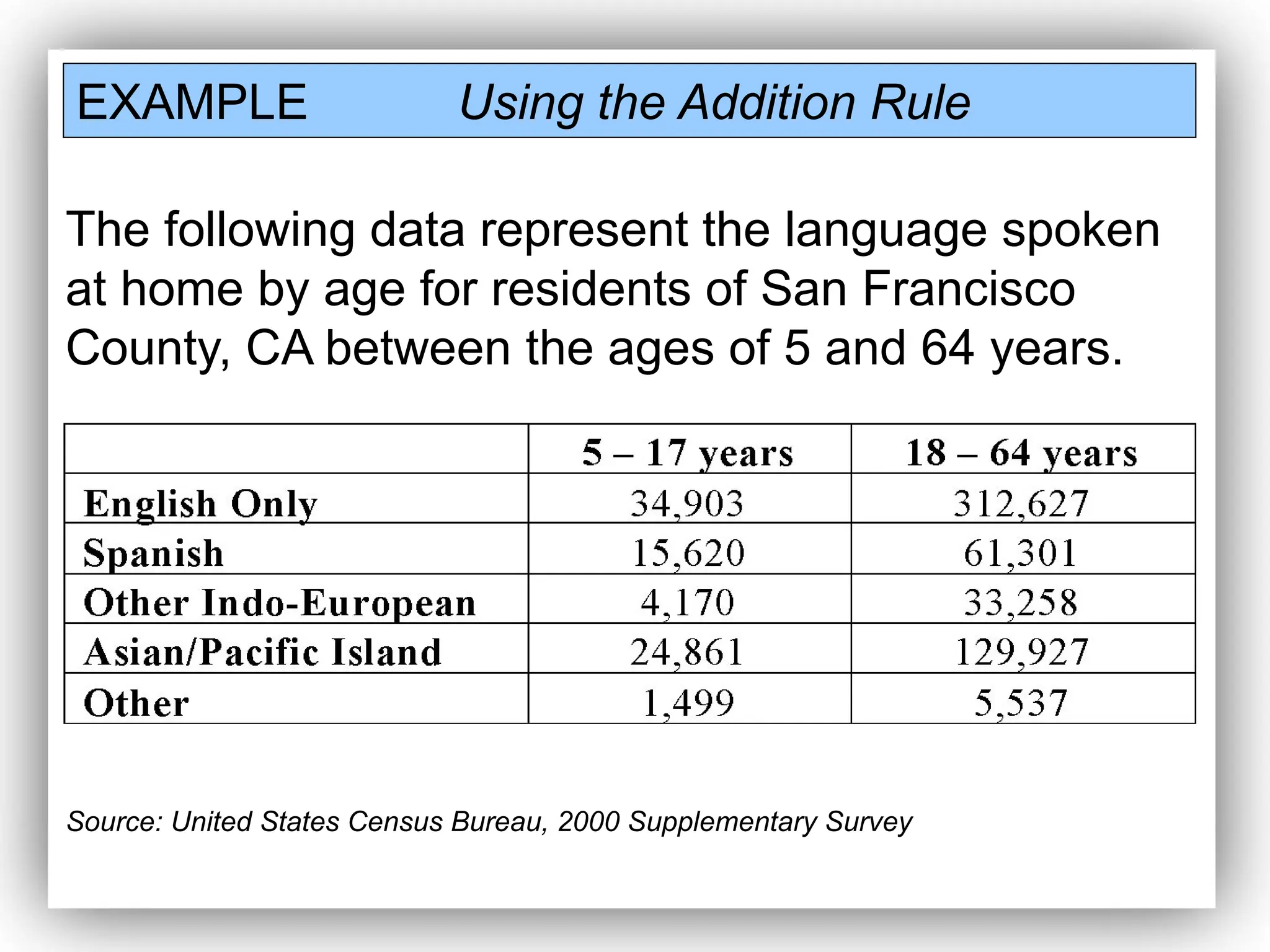
EXAMPLE Using the Addition Rule
The following data represent the language spoken
at home by age for residents of San Francisco
County, CA between the ages of 5 and 64 years.
Source: United States Census Bureau, 2000 Supplementary Survey
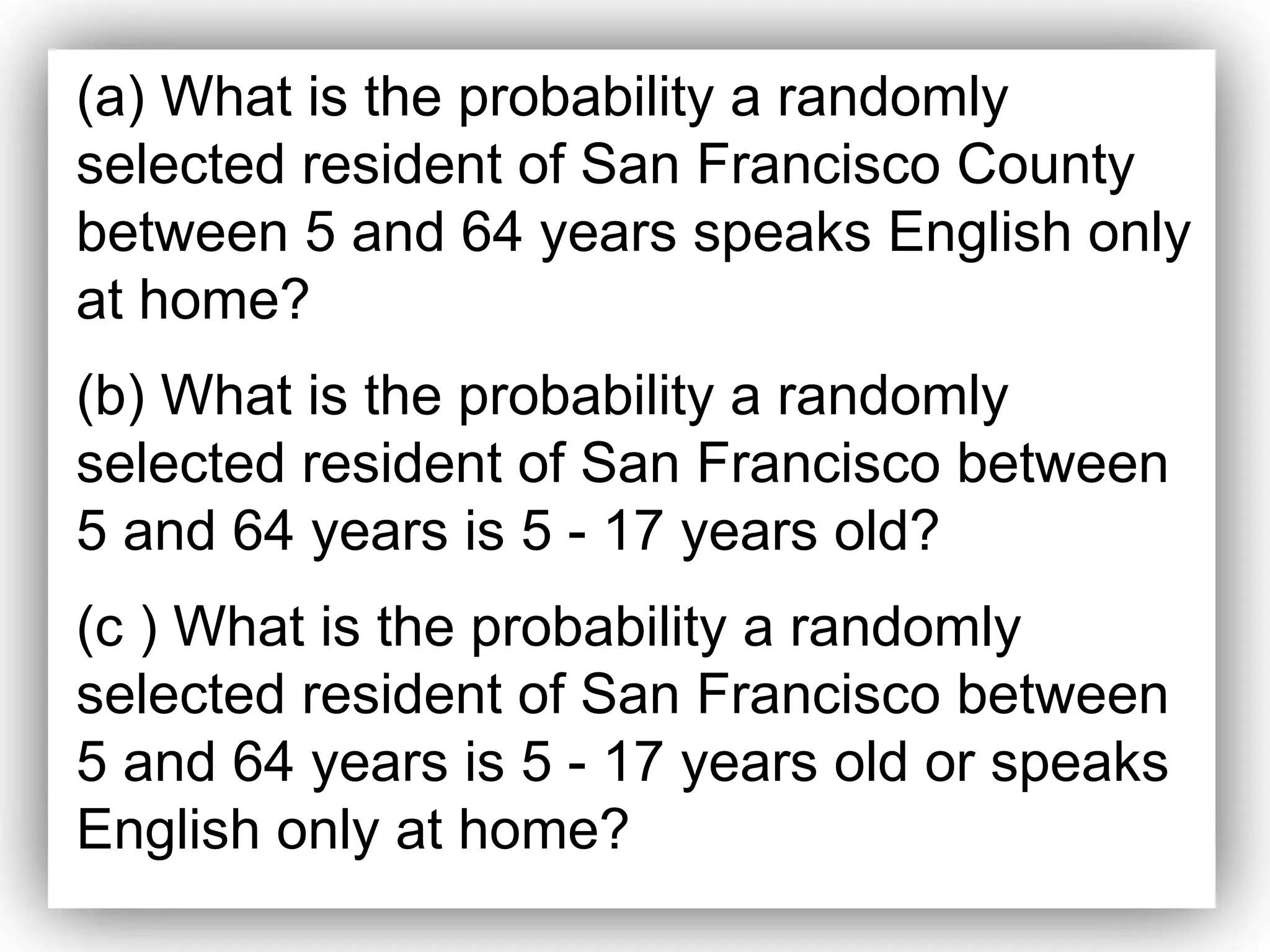
(a) What is the probability a randomly
selected resident of San Francisco County
between 5 and 64 years speaks English only
at home?
(b) What is the probability a randomly
selected resident of San Francisco between
5 and 64 years is 5 - 17 years old?
(c ) What is the probability a randomly
selected resident of San Francisco between
5 and 64 years is 5 - 17 years old or speaks
English only at home?
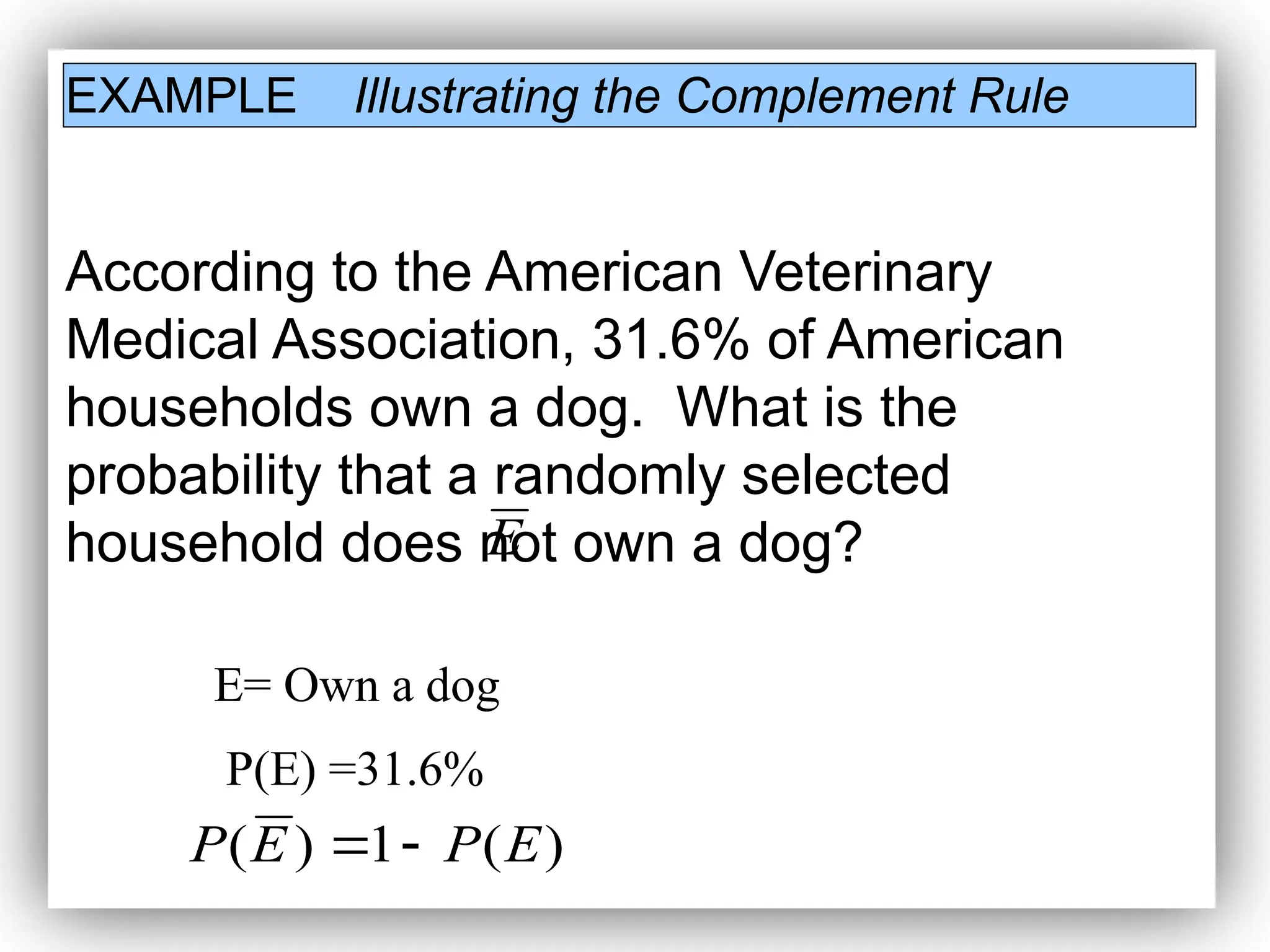
EXAMPLE Illustrating the Complement Rule
According to the American Veterinary
Medical Association, 31.6% of American
households own a dog. What is the
probability that a randomly selected
household does not own a dog?
E= Own a dog
P(E) =31.6%
)
(
1
)
( E
P
E
P 

E
EXAMPLE Illustrating the Complement Rule
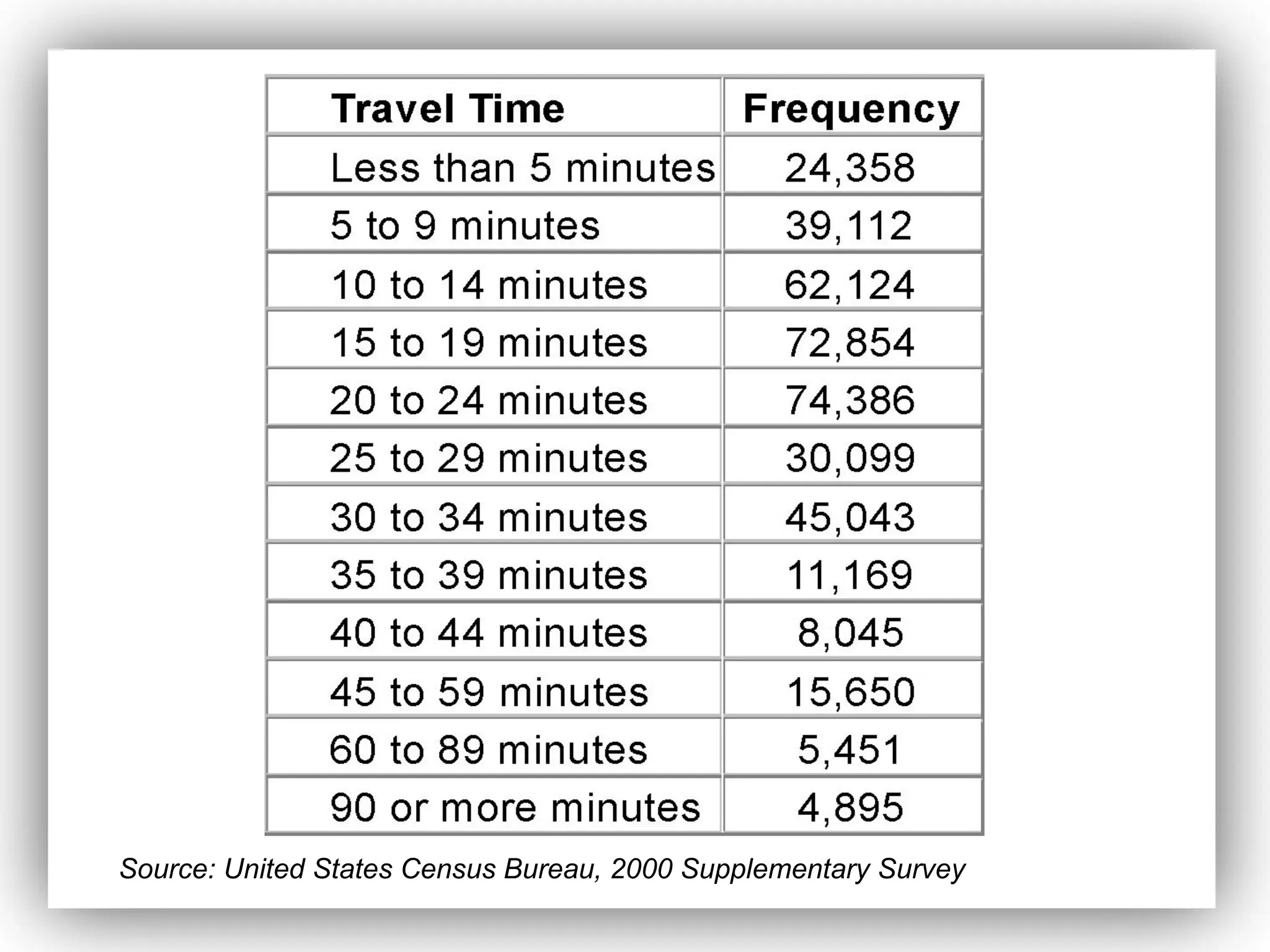
The data on the following page represent
the travel time to work for residents of
Hartford County, CT.
(a) What is the probability a randomly
selected resident has a travel time of 90 or
more minutes?
(b) What is the probability a randomly
selected resident has a travel time less than
90 minutes?
Source: United States Census Bureau, 2000 Supplementary Survey
Chapter 5
Probability
5.3
The Multiplication Rule
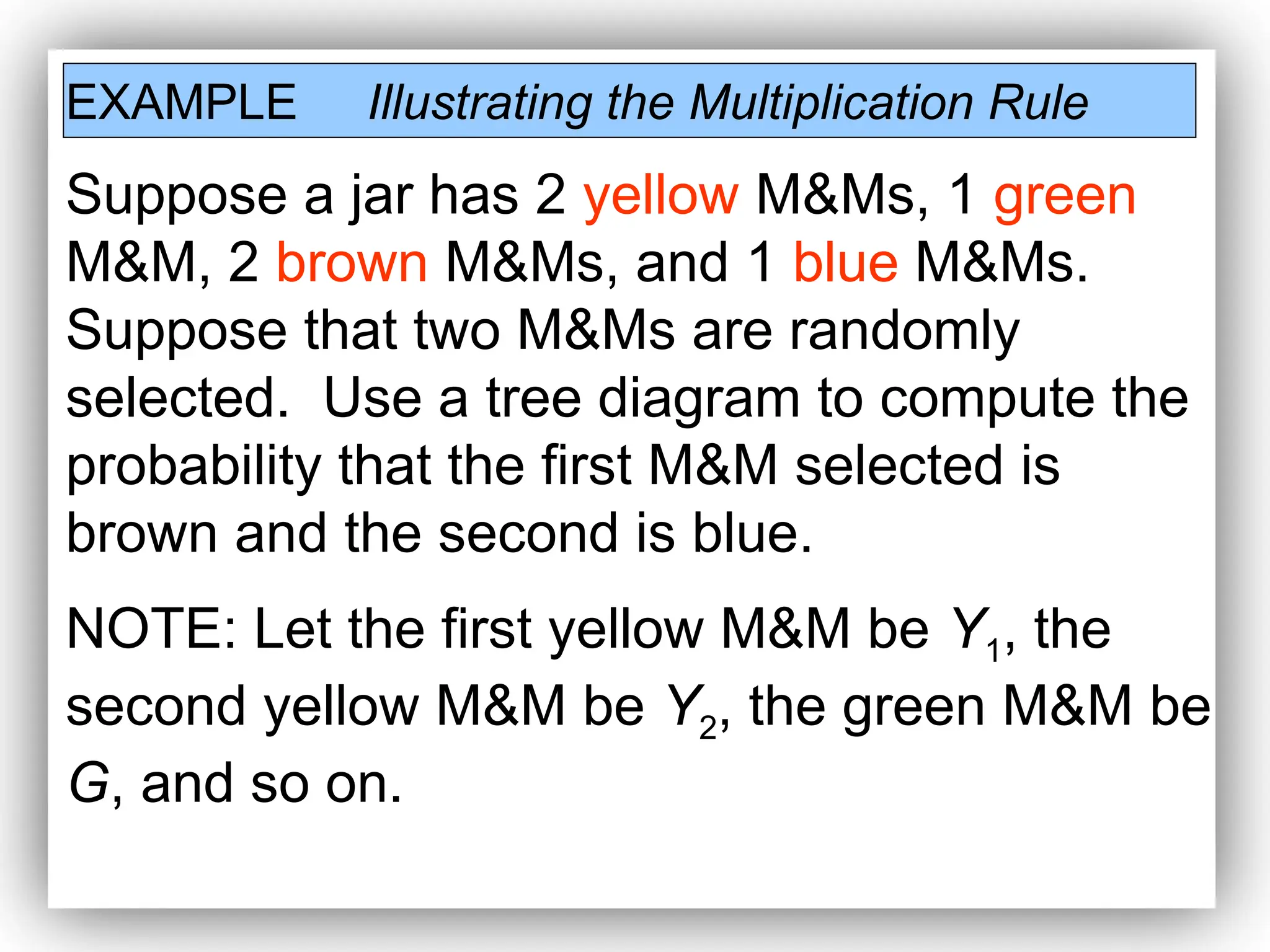
EXAMPLE Illustrating the Multiplication Rule
Suppose a jar has 2 yellow M&Ms, 1 green
M&M, 2 brown M&Ms, and 1 blue M&Ms.
Suppose that two M&Ms are randomly
selected. Use a tree diagram to compute the
probability that the first M&M selected is
brown and the second is blue.
NOTE: Let the first yellow M&M be Y1, the
second yellow M&M be Y2, the green M&M be
G, and so on.
Conditional Probability
The notation P(F | E) is read “the
probability of event F given event E”.
It is the probability of an event F given
the occurrence of the event E.
EXAMPLE Computing Probabilities
Using the Multiplication Rule
Redo the first example using the
Multiplication Rule.
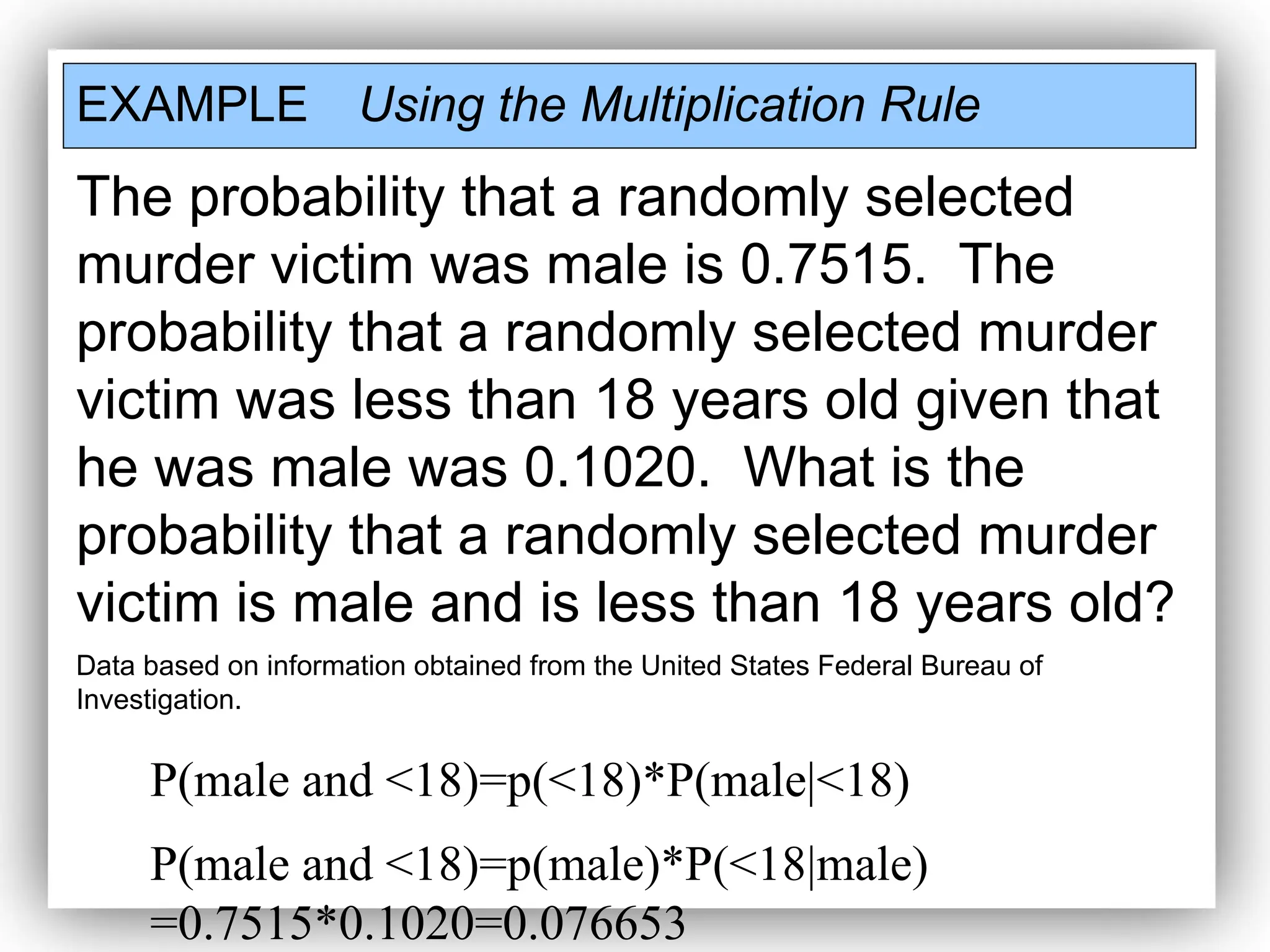
EXAMPLE Using the Multiplication Rule
The probability that a randomly selected
murder victim was male is 0.7515. The
probability that a randomly selected murder
victim was less than 18 years old given that
he was male was 0.1020. What is the
probability that a randomly selected murder
victim is male and is less than 18 years old?
Data based on information obtained from the United States Federal Bureau of
Investigation.
P(male and <18)=p(<18)*P(male|<18)
P(male and <18)=p(male)*P(<18|male)
=0.7515*0.1020=0.076653
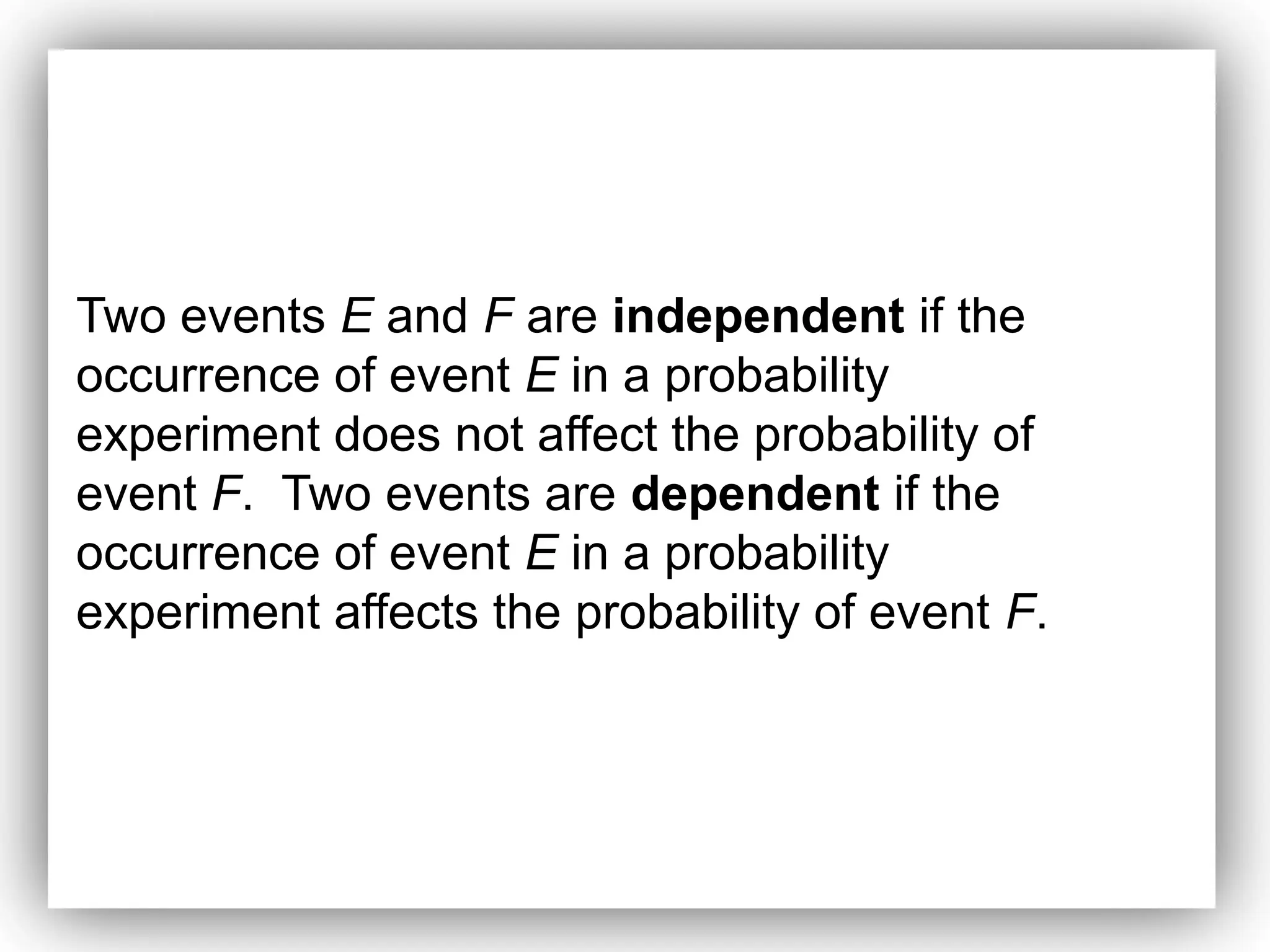
Two events E and F are independent if the
occurrence of event E in a probability
experiment does not affect the probability of
event F. Two events are dependent if the
occurrence of event E in a probability
experiment affects the probability of event F.
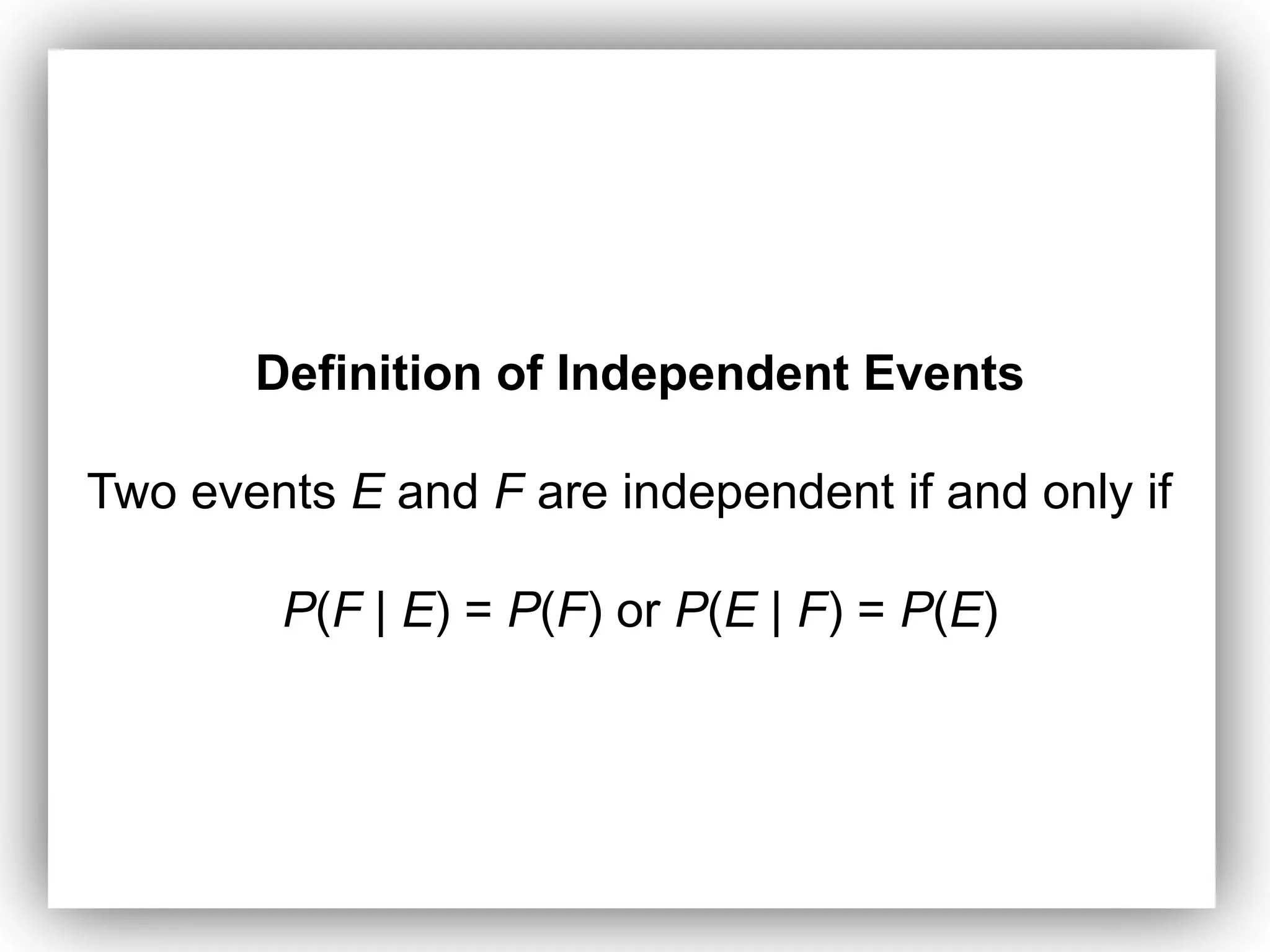
Definition of Independent Events
Two events E and F are independent if and only if
P(F | E) = P(F) or P(E | F) = P(E)
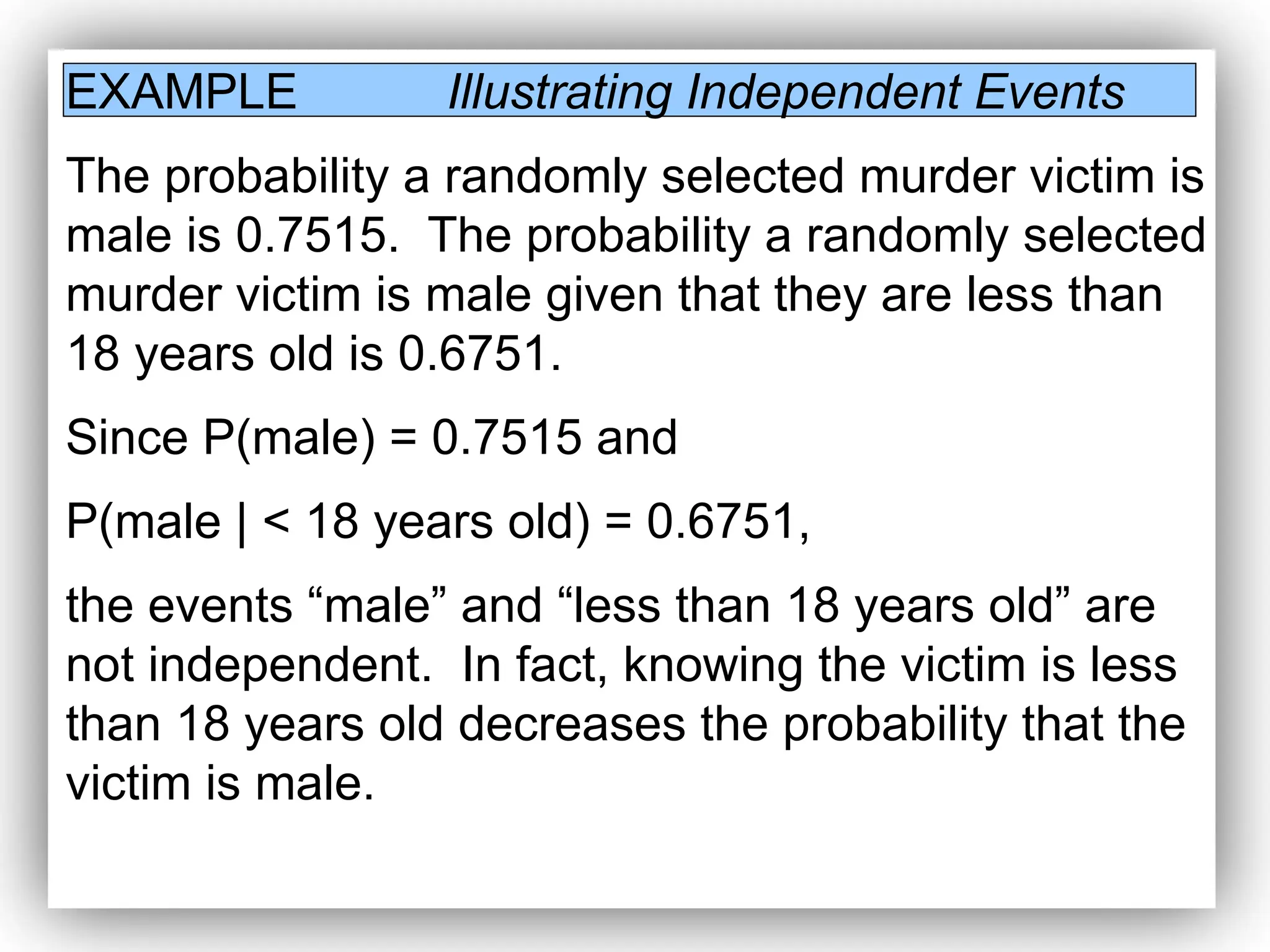
EXAMPLE Illustrating Independent Events
The probability a randomly selected murder victim is
male is 0.7515. The probability a randomly selected
murder victim is male given that they are less than
18 years old is 0.6751.
Since P(male) = 0.7515 and
P(male | < 18 years old) = 0.6751,
the events “male” and “less than 18 years old” are
not independent. In fact, knowing the victim is less
than 18 years old decreases the probability that the
victim is male.
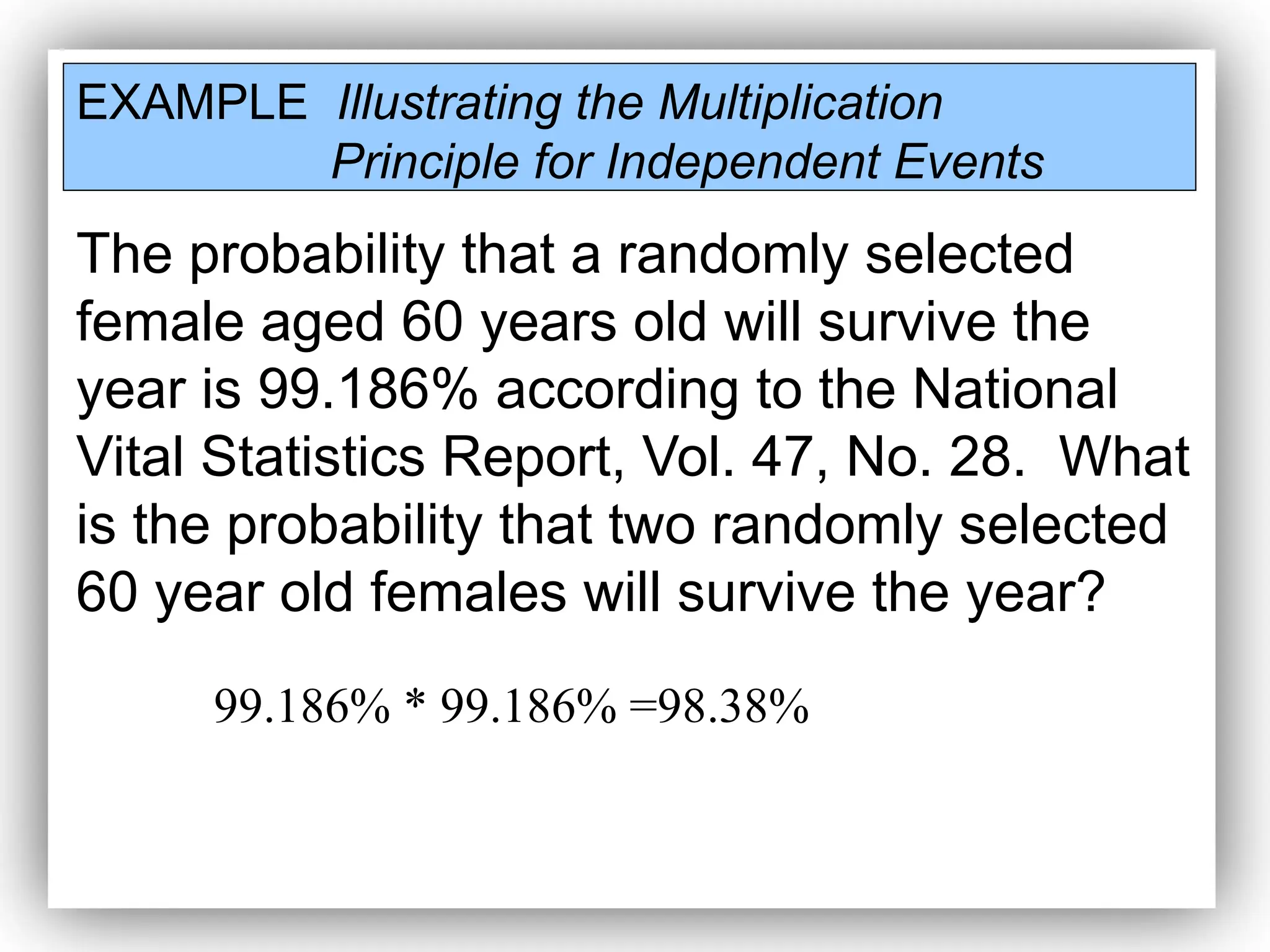
EXAMPLE Illustrating the Multiplication
Principle for Independent Events
The probability that a randomly selected
female aged 60 years old will survive the
year is 99.186% according to the National
Vital Statistics Report, Vol. 47, No. 28. What
is the probability that two randomly selected
60 year old females will survive the year?
99.186% * 99.186% =98.38%
EXAMPLE Illustrating the Multiplication
Principle for Independent Events
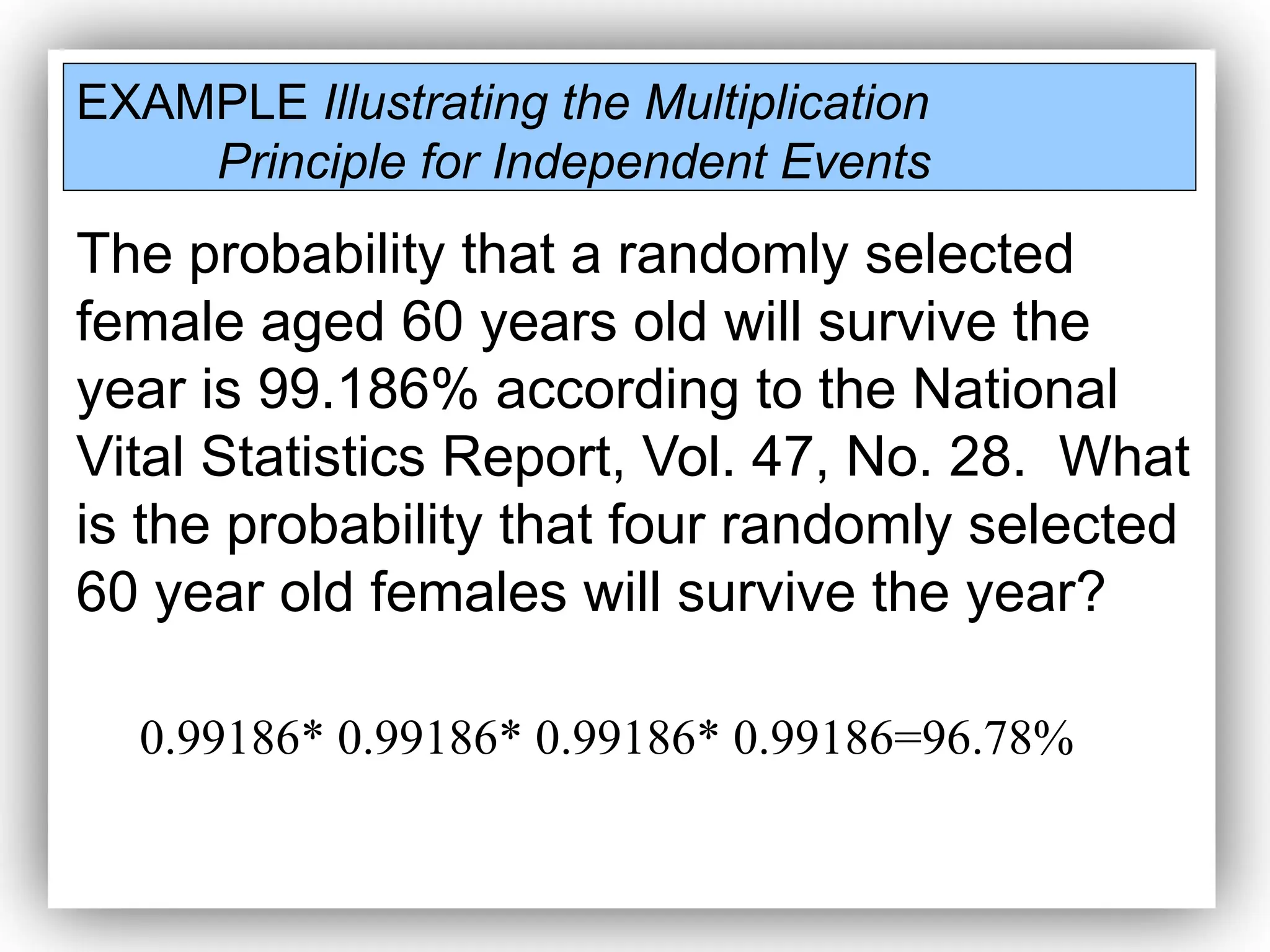
The probability that a randomly selected
female aged 60 years old will survive the
year is 99.186% according to the National
Vital Statistics Report, Vol. 47, No. 28. What
is the probability that four randomly selected
60 year old females will survive the year?
0.99186* 0.99186* 0.99186* 0.99186=96.78%
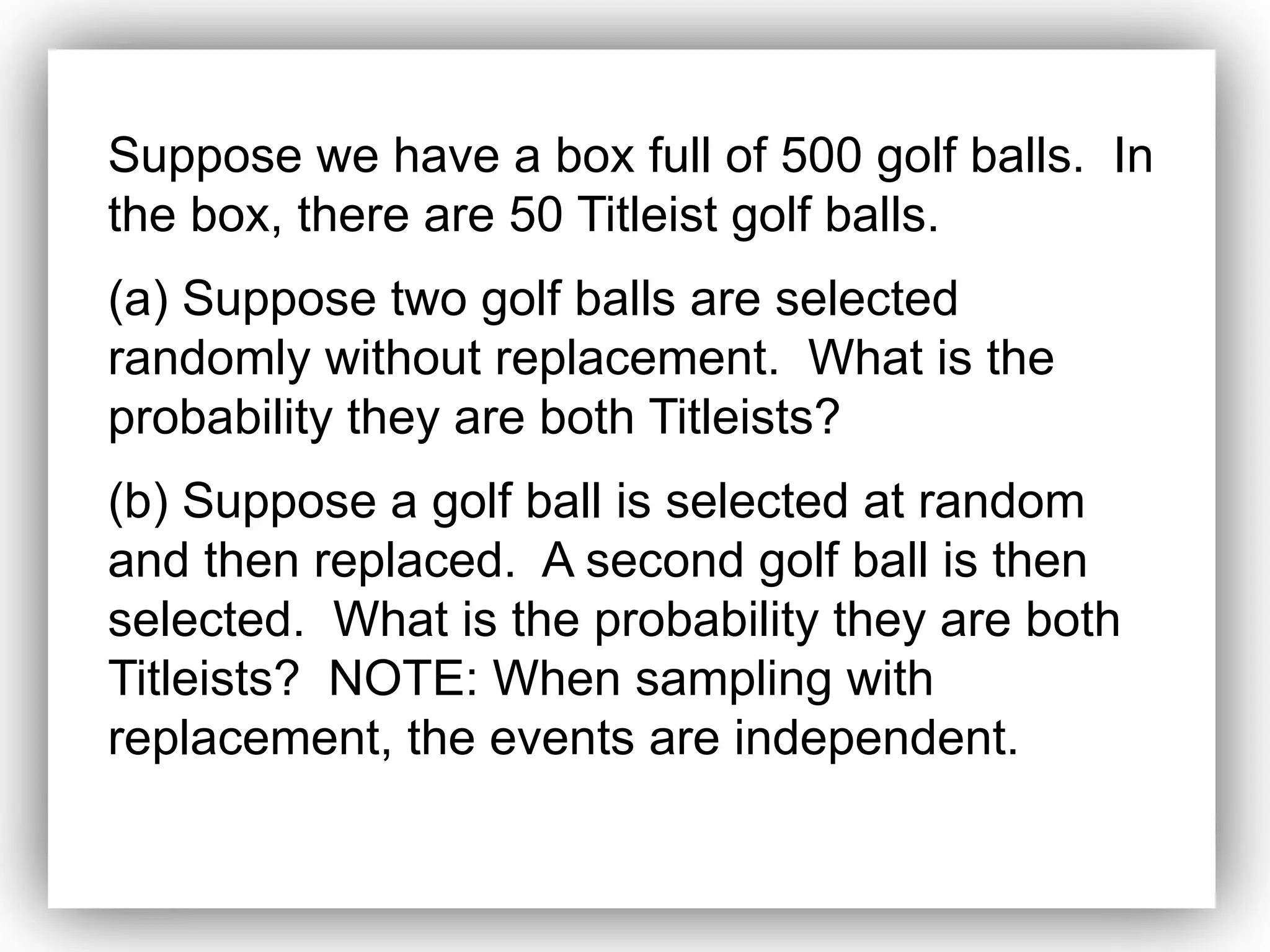
Suppose we have a box full of 500 golf balls. In
the box, there are 50 Titleist golf balls.
(a) Suppose two golf balls are selected
randomly without replacement. What is the
probability they are both Titleists?
(b) Suppose a golf ball is selected at random
and then replaced. A second golf ball is then
selected. What is the probability they are both
Titleists? NOTE: When sampling with
replacement, the events are independent.
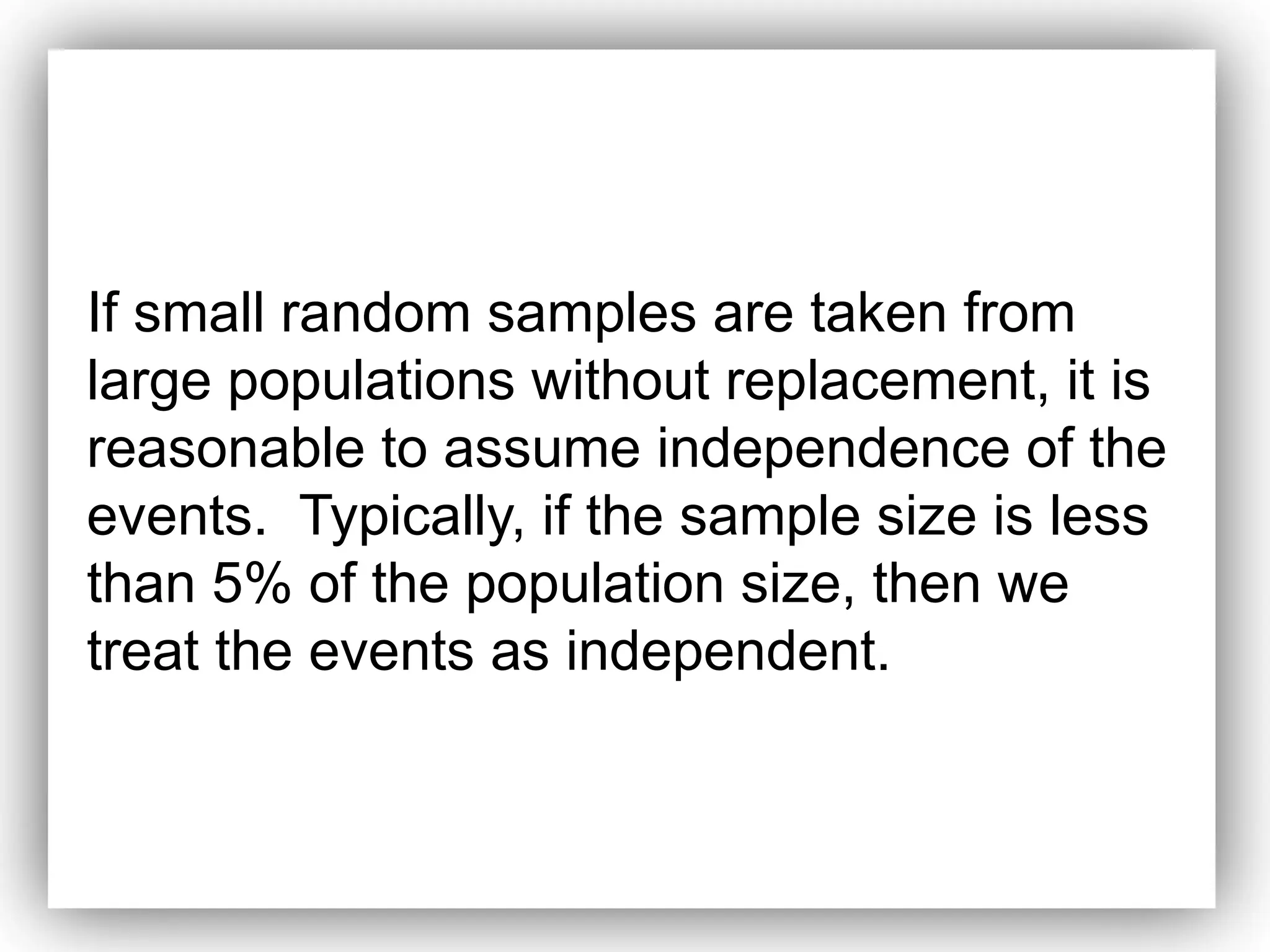
If small random samples are taken from
large populations without replacement, it is
reasonable to assume independence of the
events. Typically, if the sample size is less
than 5% of the population size, then we
treat the events as independent.
EXAMPLE Computing “at least” Probabilities
The probability that a randomly selected
female aged 60 years old will survive the
year is 99.186% according to the National
Vital Statistics Report, Vol. 47, No. 28.
What is the probability that at least one of
500 randomly selected 60 year old females
will die during the course of the year?
1-P(All Survived)=1-0.99186^500=50.4%

Cambridge IGCSE AS level Unit 4 - Probability.pptx

  • 1.
  • 4.
    If A andB are two events , then P ( A B ) = P(A) + P(B) - P (A B ) If A and B are mutually exclusive , then P ( A B ) = P(A) + P(B)
  • 9.
    Multiplicative Rule 1. Usedto get compound probabilities for intersection of events 2. P(A and B) = P(A  B) = P(A)  P(B|A) = P(B)  P(A|B) 3. For Independent Events: P(A and B) = P(A  B) = P(A)  P(B)
  • 10.
    Conditional Probability 1. Eventprobability given that another event occurred 2. Revise original sample space to account for new information • Eliminates certain outcomes 3. P(A | B) = P(A and B) = P(A  B) P(B) P(B)
  • 11.
    © 2011 PearsonEducation, Inc Additive Rule 1. Used to get compound probabilities for union of events 2. P(A OR B) = P(A  B) = P(A) + P(B) – P(A  B) 3. For mutually exclusive events: P(A OR B) = P(A  B) = P(A) + P(B)
  • 12.
    Mutually Exclusive Events •Events do not occur simultaneously • A B  does not contain any sample points   Mutually Exclusive Events
  • 13.
    Probability is ameasure of the likelihood of a random phenomenon or chance behavior. Probability describes the long-term proportion with which a certain outcome will occur in situations with short-term uncertainty. EXAMPLE Simulate flipping a coin 100 times. Plot the proportion of heads against the number of flips. Repeat the simulation.
  • 14.
    Probability deals withexperiments that yield random short-term results or outcomes, yet reveal long-term predictability. The long-term proportion with which a certain outcome is observed is the probability of that outcome.
  • 15.
    The Law ofLarge Numbers As the number of repetitions of a probability experiment increases, the proportion with which a certain outcome is observed gets closer to the probability of the outcome.
  • 16.
    In probability, anexperiment is any process that can be repeated in which the results are uncertain. A simple event is any single outcome from a probability experiment. Each simple event is denoted ei.
  • 17.
    The sample space,S, of a probability experiment is the collection of all possible simple events. In other words, the sample space is a list of all possible outcomes of a probability experiment.
  • 18.
    An event isany collection of outcomes from a probability experiment. An event may consist of one or more simple events. Events are denoted using capital letters such as E.
  • 19.
    EXAMPLE Identifying Eventsand the Sample Space of a Probability Experiment Consider the probability experiment of having two children. (a) Identify the simple events of the probability experiment. (b) Determine the sample space. (c) Define the event E = “have one boy”.
  • 20.
    The probability ofan event, denoted P(E), is the likelihood of that event occurring.
  • 21.
    Properties of Probabilities 1.The probability of any event E, P(E), must be between 0 and 1 inclusive. That is, 0 < P(E) < 1. 2. If an event is impossible, the probability of the event is 0. 3. If an event is a certainty, the probability of the event is 1. 4. If S = {e1, e2, …, en}, then P(e1) + P(e2) + … + P(en) = 1.
  • 22.
    An unusual eventis an event that has a low probability of occurring.
  • 23.
    Three methods fordetermining the probability of an event: (1) the classical method
  • 24.
    Three methods fordetermining the probability of an event: (1) the classical method (2) the empirical method
  • 25.
    Three methods fordetermining the probability of an event: (1) the classical method (2) the empirical method (3) the subjective method
  • 26.
    The classical methodof computing probabilities requires equally likely outcomes. An experiment is said to have equally likely outcomes when each simple event has the same probability of occurring.
  • 27.
    Computing Probability Usingthe Classical Method If an experiment has n equally likely simple events and if the number of ways that an event E can occur is m, then the probability of E, P(E), is So, if S is the sample space of this experiment, then
  • 28.
    EXAMPLE Computing ProbabilitiesUsing the Classical Method Suppose a “fun size” bag of M&Ms contains 9 brown candies, 6 yellow candies, 7 red candies, 4 orange candies, 2 blue candies, and 2 green candies. Suppose that a candy is randomly selected. (a) What is the probability that it is brown? (b) What is the probability that it is blue? (c) Comment on the likelihood of the candy being brown versus blue.
  • 29.
    Computing Probability Usingthe Empirical Method The probability of an event E is approximately the number of times event E is observed divided by the number of repetitions of the experiment.
  • 30.
    EXAMPLE Using RelativeFrequencies to Approximate Probabilities The following data represent the number of homes with various types of home heating fuels based on a survey of 1,000 homes. (a) Approximate the probability that a randomly selected home uses electricity as its home heating fuel. (b) Would it be unusual to select a home that uses coal or coke as its home heating fuel?
  • 32.
    EXAMPLE Using Simulation Simulatethrowing a 6-sided die 100 times. Approximate the probability of rolling a 4. How does this compare to the classical probability?
  • 33.
    Subjective probabilities are probabilitiesobtained based upon an educated guess. For example, there is a 40% chance of rain tomorrow.
  • 34.
  • 35.
    Let E andF be two events. E and F is the event consisting of simple events that belong to both E and F. E or F is the event consisting of simple events that belong to either E or F or both.
  • 36.
    EXAMPLE Illustrating theAddition Rule Suppose that a pair of fair dice are thrown. a) Let E=“rolling a seven”, compute the probability of rolling a seven, i.e., P(E). b) Let E=“rolling a two ” (called ‘snake eyes’), compute the probability of rolling “snake eyes”, i.e., P(E). c) Let E = “the first die is a two” and let F = “the sum of the dice is less than or equal to 5”. Find P(E or F) directly by counting the number of ways E or F could occur and dividing this result by the number of possible outcomes.
  • 38.
    Addition Rule For anytwo events E and F, P(E or F) = P(E) + P(F) – P(E and F)
  • 39.
    • Answer: • a)P(E) = N(E)/N(S) = 6/36 = 1/6 • b) 1/6 • c) N(E) = 6, N(F)=4+3+2+1 =10, • N(E and F) =3 , so N(E or F) =13
  • 40.
    EXAMPLE The AdditionRule Redo the last example using the Addition Rule.
  • 41.
    Venn diagrams representevents as circles enclosed in a rectangle. The rectangle represents the sample space and each circle represents an event.
  • 43.
    If events Eand F have no simple events in common or cannot occur simultaneously, they are said to be disjoint or mutually exclusive.
  • 44.
    Addition Rule forMutually Exclusive Events If E and F are mutually exclusive events, then P(E or F) = P(E) + P(F) In general, if E, F, G, … are mutually exclusive events, then P(E or F or G or …) = P(E) + P(F) + P(G) + …
  • 45.
    Events E andF are Mutually Exclusive Events E, F and G are Mutually Exclusive
  • 46.
    EXAMPLE Using theAddition Rule The following data represent the language spoken at home by age for residents of San Francisco County, CA between the ages of 5 and 64 years. Source: United States Census Bureau, 2000 Supplementary Survey
  • 47.
    (a) What isthe probability a randomly selected resident of San Francisco County between 5 and 64 years speaks English only at home? (b) What is the probability a randomly selected resident of San Francisco between 5 and 64 years is 5 - 17 years old? (c ) What is the probability a randomly selected resident of San Francisco between 5 and 64 years is 5 - 17 years old or speaks English only at home?
  • 50.
    EXAMPLE Illustrating theComplement Rule According to the American Veterinary Medical Association, 31.6% of American households own a dog. What is the probability that a randomly selected household does not own a dog? E= Own a dog P(E) =31.6% ) ( 1 ) ( E P E P   E
  • 51.
    EXAMPLE Illustrating theComplement Rule The data on the following page represent the travel time to work for residents of Hartford County, CT. (a) What is the probability a randomly selected resident has a travel time of 90 or more minutes? (b) What is the probability a randomly selected resident has a travel time less than 90 minutes?
  • 52.
    Source: United StatesCensus Bureau, 2000 Supplementary Survey
  • 53.
  • 54.
    EXAMPLE Illustrating theMultiplication Rule Suppose a jar has 2 yellow M&Ms, 1 green M&M, 2 brown M&Ms, and 1 blue M&Ms. Suppose that two M&Ms are randomly selected. Use a tree diagram to compute the probability that the first M&M selected is brown and the second is blue. NOTE: Let the first yellow M&M be Y1, the second yellow M&M be Y2, the green M&M be G, and so on.
  • 55.
    Conditional Probability The notationP(F | E) is read “the probability of event F given event E”. It is the probability of an event F given the occurrence of the event E.
  • 57.
    EXAMPLE Computing Probabilities Usingthe Multiplication Rule Redo the first example using the Multiplication Rule.
  • 58.
    EXAMPLE Using theMultiplication Rule The probability that a randomly selected murder victim was male is 0.7515. The probability that a randomly selected murder victim was less than 18 years old given that he was male was 0.1020. What is the probability that a randomly selected murder victim is male and is less than 18 years old? Data based on information obtained from the United States Federal Bureau of Investigation. P(male and <18)=p(<18)*P(male|<18) P(male and <18)=p(male)*P(<18|male) =0.7515*0.1020=0.076653
  • 59.
    Two events Eand F are independent if the occurrence of event E in a probability experiment does not affect the probability of event F. Two events are dependent if the occurrence of event E in a probability experiment affects the probability of event F.
  • 60.
    Definition of IndependentEvents Two events E and F are independent if and only if P(F | E) = P(F) or P(E | F) = P(E)
  • 61.
    EXAMPLE Illustrating IndependentEvents The probability a randomly selected murder victim is male is 0.7515. The probability a randomly selected murder victim is male given that they are less than 18 years old is 0.6751. Since P(male) = 0.7515 and P(male | < 18 years old) = 0.6751, the events “male” and “less than 18 years old” are not independent. In fact, knowing the victim is less than 18 years old decreases the probability that the victim is male.
  • 63.
    EXAMPLE Illustrating theMultiplication Principle for Independent Events The probability that a randomly selected female aged 60 years old will survive the year is 99.186% according to the National Vital Statistics Report, Vol. 47, No. 28. What is the probability that two randomly selected 60 year old females will survive the year? 99.186% * 99.186% =98.38%
  • 65.
    EXAMPLE Illustrating theMultiplication Principle for Independent Events The probability that a randomly selected female aged 60 years old will survive the year is 99.186% according to the National Vital Statistics Report, Vol. 47, No. 28. What is the probability that four randomly selected 60 year old females will survive the year? 0.99186* 0.99186* 0.99186* 0.99186=96.78%
  • 66.
    Suppose we havea box full of 500 golf balls. In the box, there are 50 Titleist golf balls. (a) Suppose two golf balls are selected randomly without replacement. What is the probability they are both Titleists? (b) Suppose a golf ball is selected at random and then replaced. A second golf ball is then selected. What is the probability they are both Titleists? NOTE: When sampling with replacement, the events are independent.
  • 67.
    If small randomsamples are taken from large populations without replacement, it is reasonable to assume independence of the events. Typically, if the sample size is less than 5% of the population size, then we treat the events as independent.
  • 68.
    EXAMPLE Computing “atleast” Probabilities The probability that a randomly selected female aged 60 years old will survive the year is 99.186% according to the National Vital Statistics Report, Vol. 47, No. 28. What is the probability that at least one of 500 randomly selected 60 year old females will die during the course of the year? 1-P(All Survived)=1-0.99186^500=50.4%

Editor's Notes

  • #19 Answer: a) (boy, girl), (girl, girl), (boy, boy) b) (boy, girl), (girl, girl), (boy, boy) c) (boy, girl), (boy, boy)
  • #36 P(E) = N(E)/N(S) = 6/36 = 1/6 1/6 P(E or F) = P(E) + P(F) –P(E and F) =