Niran Sabah Jasim et al Int. Journal of Engineering Research and Applications www.ijera.com
ISSN : 2248-9622, Vol. 5, Issue 8( Version 5), August 2015, pp.34-43
www.ijera.com 34 | P a g e
Some Results on the Group of Lower Unitriangular Matrices
L(3,Zp)
Asmaa Abd Aswhad , Niran Sabah Jasim , Ahmed Rasim Hameed
Department of Mathematics, College of Education for pure Science/Ibn-Al-Haitham, University of Baghdad
Abstract
The main objective of this paper is to find the order and its exponent, the general form of all conjugacy classes,
Artin characters table and Artin exponent for the group of lower unitriangular matrices L(3,ℤp), where p is
prime number.
Key Words: Artin character, Artin exponent, cyclic subgroup, group of unitriangular matrices.
I. Introduction
The group of invertible n  n matrices over a field F denoted by GL(n,F). Let G be a finite group, all
characters of G induced from a principal character of cyclic subgroups of G are called Artin characters of G.
Artin induction theorem [1] states that any rational valued character of G is a rational linear combination of the
induced principal character of its cyclic subgroups. Lam [5] proved a sharp form of Artin's theorem, he
determined the least positive integer A(G) such that A(G)  is an integral linear combination of Artin character,
for any rational valued character  of G, and he called A(G) the Artin exponent of G and studied it extensively
for many groups.
In this paper we consider the group of lower unitriangular matrices L(3,ℤp) and we found that the order of
this group is p3 as in theorem (2.2) and its exponent is p in theorem (2.4). Furthermore we found forms of all
conjugace classes in theorem (2.8), the Artin character in theorem (2.12) and finally from the principal character
of its cyclic subgroups we found the Artin exponent of this group and denoted by A(L(3,ℤp)) which is equal to
p2 in theorem (2.13).
§.1 Preliminaries
In this section, we recall some definitions, theorems and proposition which we needed in the next section.
Definition 1.1 : [4]
A rational valued character  of G is a character whose valued are in Z, that is  (x) Z, for all xG.
Definition 1.2 : [2]
Let H be a subgroup of a group G, and  be a class function of H. Then ↑G
, the induced class function on
G, is given by
1
x G
1
(g) (xgx )
H


    
where ˚ is defined by ˚(h) = (h) if h  H and ˚(y) = 0 if y  H.
Observe that ↑G
is a class function on G and ↑G
(1) = [G:H] (1).
Another useful formula for computing ↑G
(g) explicitly is to choose representatives x1, x2, …, xm for the
m classes of H contained in the conjugacy class cg in G which is given by
m
G i
G
i 1 H i
(x )
(g) C (g)
C (x )

   
where it is understood that φ↑G(Cα) = 0 if H  Cl(g)= . This formula is immediate from the definition of
↑G since as x runs over G, xgx – 1 =xi for exactly CG(g)  values of x. If H is a cyclic subgroup then
RESEARCH ARTICLE OPEN ACCESS
Niran Sabah Jasim et al Int. Journal of Engineering Research and Applications www.ijera.com
ISSN : 2248-9622, Vol. 5, Issue 8( Version 5), August 2015, pp.34-43
www.ijera.com 35 | P a g e
m
GG
i
i 1H
C (g)
(g) (x )
C (g) 
    …(1.1)
Definition 1.3: [5]
The character induced from the principal character of a cyclic subgroups of G is called Artin character.
Definition 1.4 : [5]
Let G be a finite group and let  be any rational valued character on G. The smallest positive number n
such that,
c c
c
n a  
where acZ and c is Artin character, is called the Artin exponent of G and denoted by A(G).
Theorem 1.5 : [3]
Let 1 denote the principal character of G and dZ, then d is an Artin exponent of G if there exists
(uniquely) integers akZ such that
q
k k
k 1
d 1 a 

  
where 1, …, k are the Artin characters.
Theorem 1.6 : [3]
For a subgroup H in G, A(H) divides A(G).
Proposition 1.7 : [5]
Let G be an arbitrary finite group, and {H1,H2,..,Hq} be a full set of non-gonjugate cyclic subgroups of G,
then A(G) is the smallest positive integer m such that:
kk
G
G k HH H
m 1 a 1
    …(1.2)
With each akℤ.
§.2 The Order and its Exponent, The Conjugacy Classes, Artin Character and Artin Exponent of L(3,ℤp)
This section concerns on an important class of groups, the group of lower unitriangular matrices L(3,ℤp).
After describing important features of this group and investigating their conjugacy classes we move on to
evaluate its Artin Exponent and constructing the table of its induced characters.
Definition 2.1: [6]
Let
1 0 0
* 1 0
L(n,F)
* * 1
 
 
 
 
 
 
L
L
M M O M
L
be the group of nn lower unit triangular matrices with entries in F under
matrix multiplication, that is L(n,F) consists of matrices such that L(n,F) is a subgroup of GL(n,F).
Theorem 2.2:
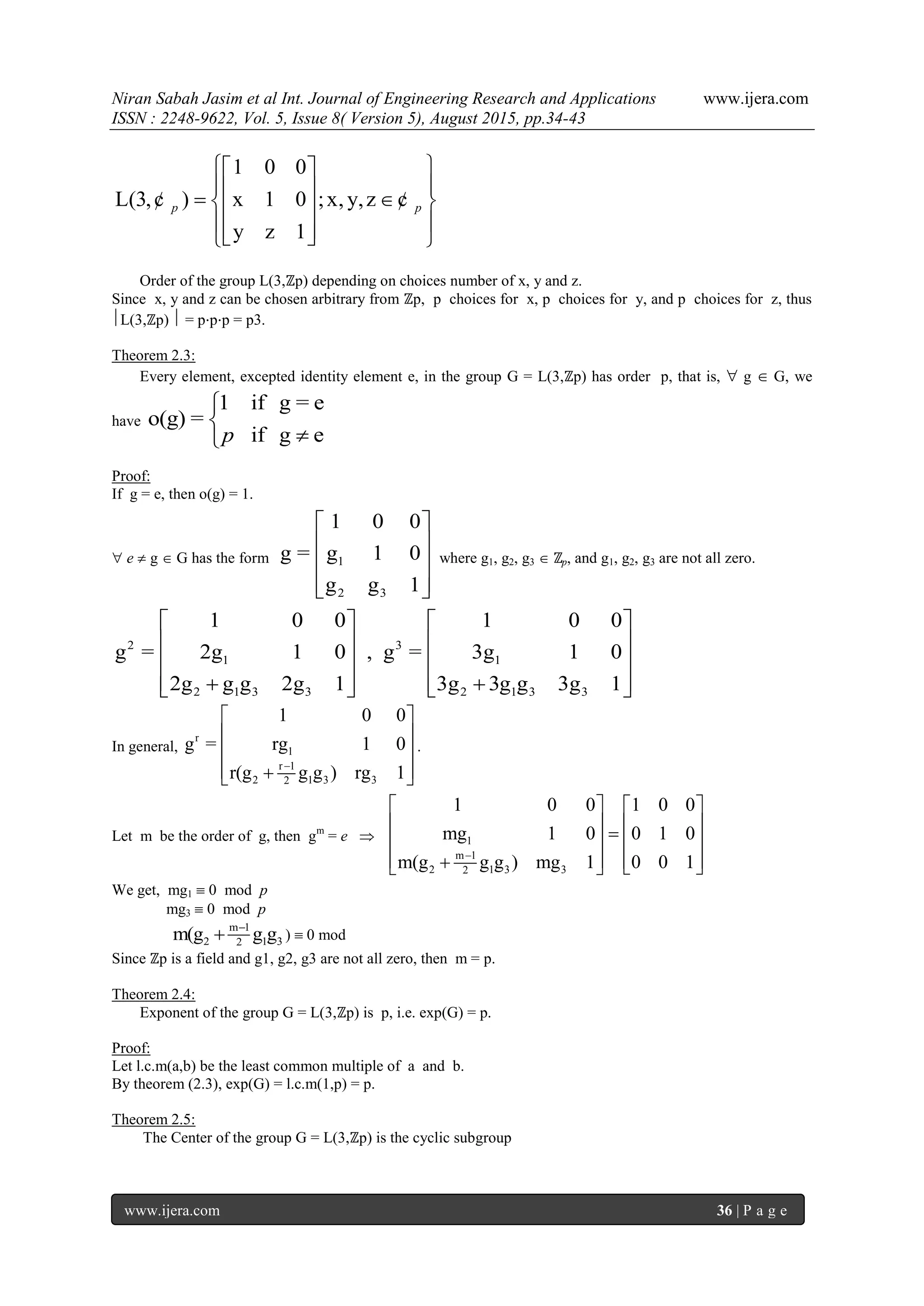
The order of the group L(3,ℤp) is p3.
Proof:
Niran Sabah Jasim et al Int. Journal of Engineering Research and Applications www.ijera.com
ISSN : 2248-9622, Vol. 5, Issue 8( Version 5), August 2015, pp.34-43
www.ijera.com 36 | P a g e
1 0 0
L(3, ) x 1 0 ;x, y,z
y z 1
p p
  
     
    
¢ ¢
Order of the group L(3,ℤp) depending on choices number of x, y and z.
Since x, y and z can be chosen arbitrary from ℤp, p choices for x, p choices for y, and p choices for z, thus
L(3,ℤp)  = ppp = p3.
Theorem 2.3:
Every element, excepted identity element e, in the group G = L(3,ℤp) has order p, that is,  g  G, we
have
1 if g = e
o(g) =
if g ep



Proof:
If g = e, then o(g) = 1.
 e  g  G has the form 1
2 3
1 0 0
g = g 1 0
g g 1
 
 
 
  
where g1, g2, g3  ℤp, and g1, g2, g3 are not all zero.
2 3
1 1
2 1 3 3 2 1 3 3
1 0 0 1 0 0
g = 2g 1 0 , g = 3g 1 0
2g g g 2g 1 3g 3g g 3g 1
   
   
   
       
In general,
r
1
r 1
2 1 3 32
1 0 0
g = rg 1 0
r(g g g ) rg 1
 
 
 
  
.
Let m be the order of g, then gm
= e  1
m 1
2 1 3 32
1 0 0 1 0 0
mg 1 0 0 1 0
m(g g g ) mg 1 0 0 1
   
      
      
We get, mg1  0 mod p
mg3  0 mod p
m 1
2 1 32m(g g g
 )  0 mod
Since ℤp is a field and g1, g2, g3 are not all zero, then m = p.
Theorem 2.4:
Exponent of the group G = L(3,ℤp) is p, i.e. exp(G) = p.
Proof:
Let l.c.m(a,b) be the least common multiple of a and b.
By theorem (2.3), exp(G) = l.c.m(1,p) = p.
Theorem 2.5:
The Center of the group G = L(3,ℤp) is the cyclic subgroup
Niran Sabah Jasim et al Int. Journal of Engineering Research and Applications www.ijera.com
ISSN : 2248-9622, Vol. 5, Issue 8( Version 5), August 2015, pp.34-43
www.ijera.com 37 | P a g e
1 0 0
Z(G) 0 1 0 ,r
r 0 1
p
  
     
    
¢ and Z(G) = p.
Proof:
Let g, h  G, where 1
2 3
1 0 0
g = g 1 0
g g 1
 
 
 
  
and 1
2 3
1 0 0
h = h 1 0
h h 1
 
 
 
  
1 1 1 1
2 2 1 3 3 3 2 2 1 3 3 3
1 0 0 1 0 0
g h = h + g 1 0 , h g = h + g 1 0
h + g g h h + g 1 h + g g h h + g 1
   
       
       
If g1 = g3 = 0, then  h  G, we have gh = hg.
Hence, g  Z(G) and 2
2
1 0 0
Z(G) 0 1 0 ,g
g 0 1
p
  
     
    
¢ .
Since,  g2  ℤp,
2
1 0 0
g 0 1 0
g 0 1
 
   
  
 Z(G) and ℤp = p, then Z(G) = p.
So, any finite group of prime order is cyclic, then Z(G) is cyclic.
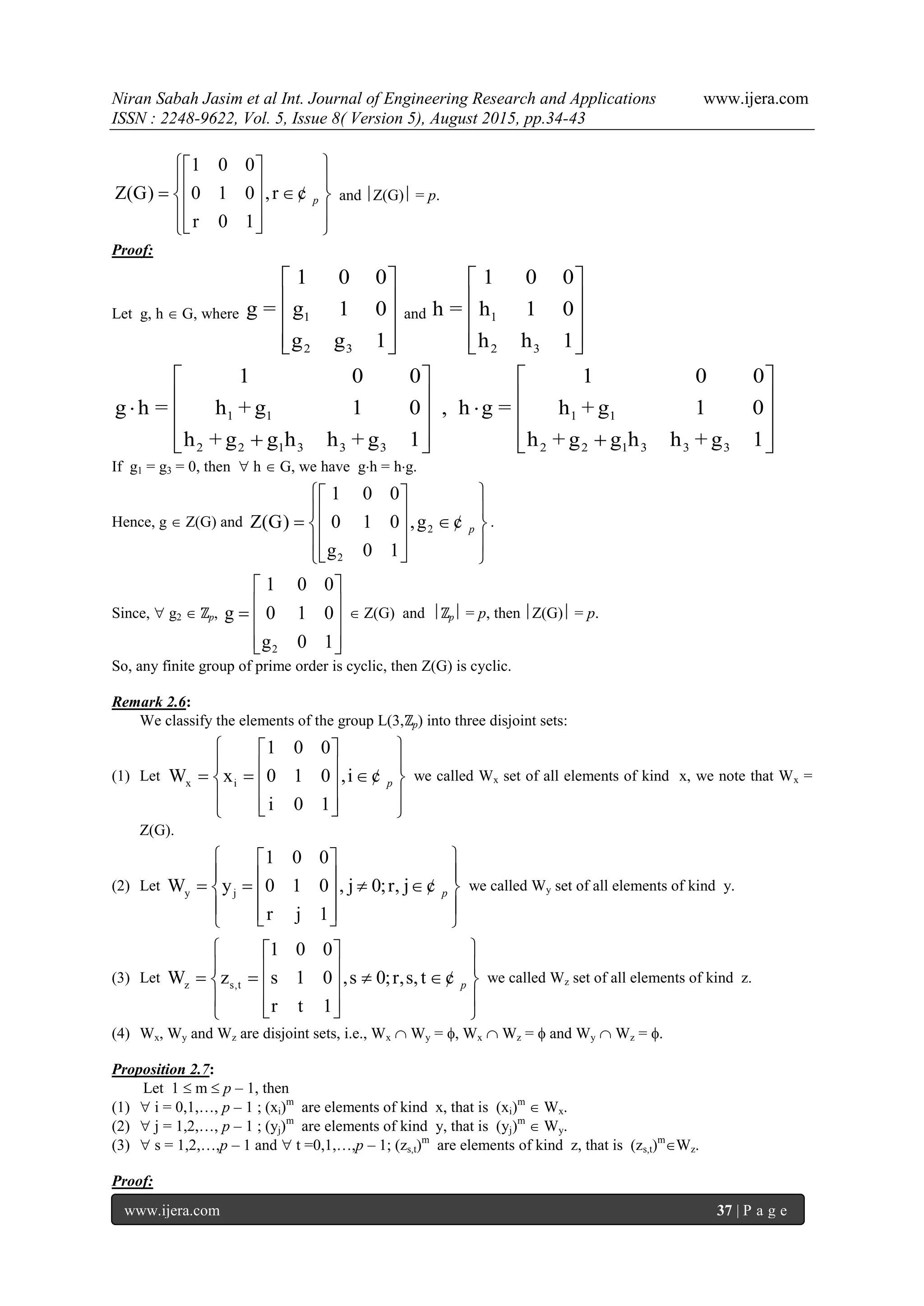
Remark 2.6:
We classify the elements of the group L(3,ℤp) into three disjoint sets:
(1) Let x i
1 0 0
W x 0 1 0 ,i
i 0 1
p
  
      
    
¢ we called Wx set of all elements of kind x, we note that Wx =
Z(G).
(2) Let y j
1 0 0
W y 0 1 0 , j 0;r, j
r j 1
p
  
       
    
¢ we called Wy set of all elements of kind y.
(3) Let z s,t
1 0 0
W z s 1 0 ,s 0;r,s,t
r t 1
p
  
       
    
¢ we called Wz set of all elements of kind z.
(4) Wx, Wy and Wz are disjoint sets, i.e., Wx  Wy = , Wx  Wz =  and Wy  Wz = .
Proposition 2.7:
Let 1  m  p – 1, then
(1)  i = 0,1,…, p – 1 ; (xi)m
are elements of kind x, that is (xi)m
 Wx.
(2)  j = 1,2,…, p – 1 ; (yj)m
are elements of kind y, that is (yj)m
 Wy.
(3)  s = 1,2,…,p – 1 and  t =0,1,…,p – 1; (zs,t)m
are elements of kind z, that is (zs,t)m
Wz.
Proof:
Niran Sabah Jasim et al Int. Journal of Engineering Research and Applications www.ijera.com
ISSN : 2248-9622, Vol. 5, Issue 8( Version 5), August 2015, pp.34-43
www.ijera.com 38 | P a g e
(1) Since, Wx = Z(G) is cyclic, then  xi  Wx.
(2) j
1 0 0
y 0 1 0
r j 1
 
   
  
and
m
m
j
1 0 0 1 0 0
(y ) 0 1 0 0 1 0
r j 1 mr mj 1
   
       
      
, where mr, mj  ℤp.
Since, m  0 and j  0 then mj  0, therefore (yj)m
 Wy.
(3) s,t
1 0 0
z s 1 0
r t 1
 
   
  
and
m
m
s,t
m 1
2
1 0 0 1 0 0
(z ) s 1 0 ms 1 0
r t 1 m(r st) mt 1
  
      
      
.
Since, m  0 and s 0 then ms  0, therefore (zs,t)m
Wz.
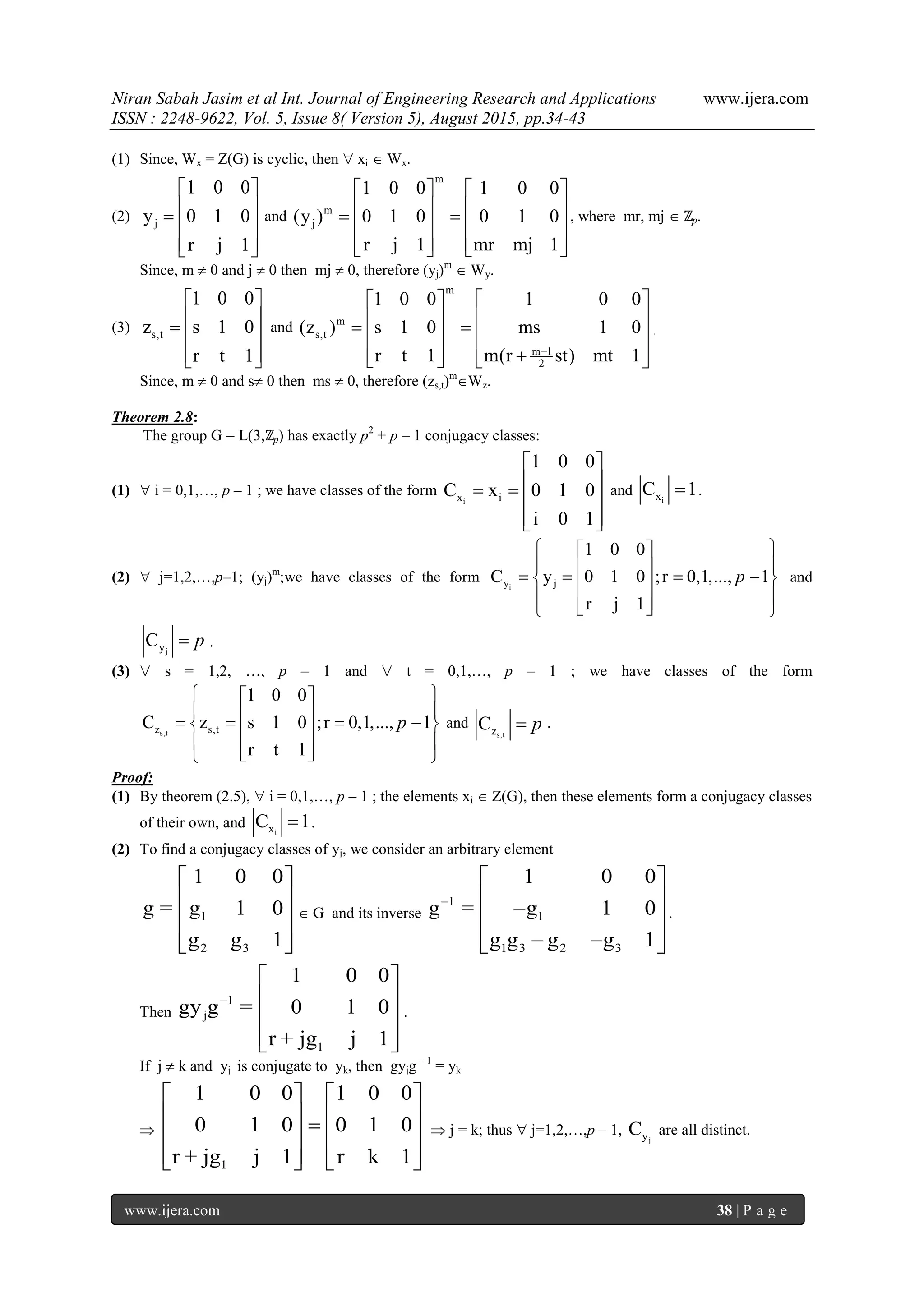
Theorem 2.8:
The group G = L(3,ℤp) has exactly p2
+ p – 1 conjugacy classes:
(1)  i = 0,1,…, p – 1 ; we have classes of the form
ix i
1 0 0
C x 0 1 0
i 0 1
 
    
  
and
ixC 1 .
(2)  j=1,2,…,p–1; (yj)m
;we have classes of the form
iy j
1 0 0
C y 0 1 0 ;r 0,1,..., 1
r j 1
p
  
       
    
and
jyC p .
(3)  s = 1,2, …, p – 1 and  t = 0,1,…, p – 1 ; we have classes of the form
s,tz s,t
1 0 0
C z s 1 0 ;r 0,1,..., 1
r t 1
p
  
       
    
and
s,tzC p .
Proof:
(1) By theorem (2.5),  i = 0,1,…, p – 1 ; the elements xi  Z(G), then these elements form a conjugacy classes
of their own, and
ixC 1 .
(2) To find a conjugacy classes of yj, we consider an arbitrary element
1
2 3
1 0 0
g = g 1 0
g g 1
 
 
 
  
 G and its inverse
1
1
1 3 2 3
1 0 0
g = g 1 0
g g g g 1

 
  
   
.
Then
1
j
1
1 0 0
gy g = 0 1 0
r + jg j 1

 
 
 
  
.
If j  k and yj is conjugate to yk, then gyjg – 1
= yk

1
1 0 0 1 0 0
0 1 0 0 1 0
r + jg j 1 r k 1
   
      
      
 j = k; thus  j=1,2,…,p – 1,
jyC are all distinct.
Niran Sabah Jasim et al Int. Journal of Engineering Research and Applications www.ijera.com
ISSN : 2248-9622, Vol. 5, Issue 8( Version 5), August 2015, pp.34-43
www.ijera.com 39 | P a g e
In
jyC , r = 0,1,…, p – 1 , jyC p .
(3) To find a conjugacy classes of zs,t, we consider an arbitrary element
1
2 3
1 0 0
g = g 1 0
g g 1
 
 
 
  
 G and its inverse
1
1
1 3 2 3
1 0 0
g = g 1 0
g g g g 1

 
  
   
.
Then
1
s,t
1 3
1 0 0
gz g = s 1 0
r + g t g s t 1

 
 
 
  
.
If s1  s2 , t1  t2; and 1 1s ,tz is conjugate to 2 2s ,tz , then g
1 1s ,tz g – 1
= 2 2s ,tz
 1 2
1 1 3 1 1 2
1 0 0 1 0 0
s 1 0 s 1 0
r + g t g s t 1 r t 1
   
      
      
 s1 =s2 and t1 = t2.
Thus  s = 1,2, …, p – 1 and  t = 0,1,…, p – 1 ;
s,tzC are all distinct.
In
s,tzC , r = 0,1,…, p – 1, then s,tzC p .
To show that the conjugacy classes ixC ,
jyC and
s,tzC are distinct:
We have ixC  Wx,
jyC  Wy and
s,tzC  Wz, then ixC 
jyC = , ixC 
s,tzC =  and
jyC 
s,tzC = .
Hence ixC ,
jyC and
s,tzC are distinct.
To find the total number of the conjugacy classes:
Number of conjugacy classes in (1) = p
Number of conjugacy classes in (2) = p – 1
Number of conjugacy classes in (3) = p(p – 1)
Then the total number of the conjugacy classes is p + (p – 1) + p(p – 1) = p2
+ p – 1.
To show that these are all conjugacy classes of the group G = L(3,ℤp), we add up the elements contained in those
conjugacy classes, we get:
P(1) + (p – 1)( (p) + [p (p – 1)] (p) = p3
= G.
Thus, this theorem gives all conjugacy classes of the group L(3,ℤp).
Proposition 2.9:
The order of the centralizers, CG(g) of g in the group G = L(3,ℤp) are:
(1)  i = 0,1,…, p – 1 ; CG(xi) = p3
.
(2)  j=1,2,…,p–1; (yj)m
; CG(yj) = p2
.
(3)  s = 1,2, …, p – 1 and  t = 0,1,…, p – 1 ; CG(zs,t) = p2
.
Proof:
By theorem (2.10), G
g
G
C (g)
C
 and by theorem (2.2), G = p3
.
Niran Sabah Jasim et al Int. Journal of Engineering Research and Applications www.ijera.com
ISSN : 2248-9622, Vol. 5, Issue 8( Version 5), August 2015, pp.34-43
www.ijera.com 40 | P a g e
(1) By theorem (2.8),  i = 0,1,…, p – 1;
ixC 1 , then
i
3
3
G i
x
G
C (x )
1C
p
p   .
(2) By theorem (2.8),  j = 1,2,…, p – 1; jyC p , then
j
3
2
G j
y
G
C (y )
C
p
p
p
   .
(3) By theorem (2.8),  s = 1,2, …, p – 1 and  t = 0,1,…, p – 1; s,tzC p , then
s,t
3
2
G s,t
z
G
C (z )
C
p
p
p
   .
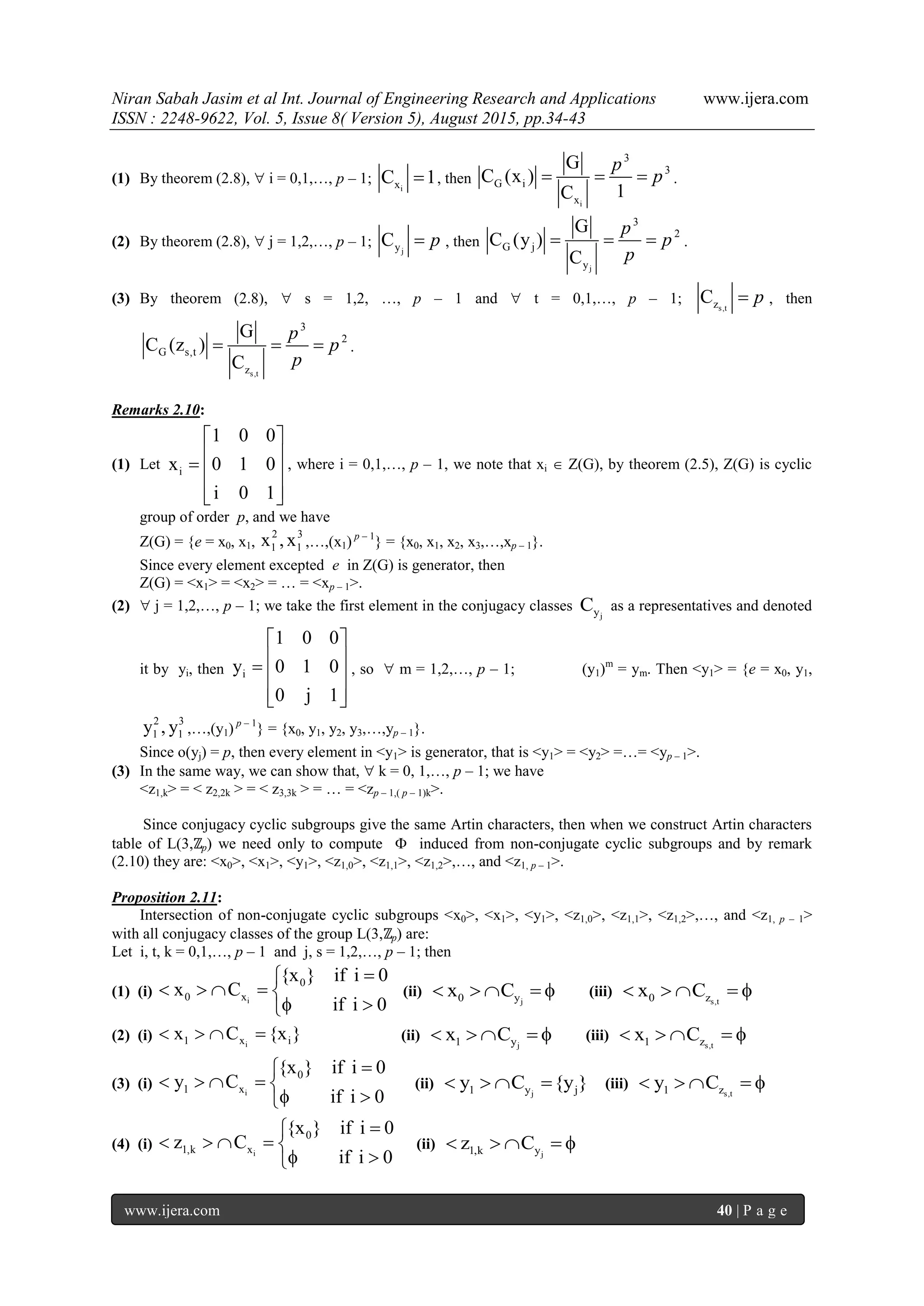
Remarks 2.10:
(1) Let i
1 0 0
x 0 1 0
i 0 1
 
   
  
, where i = 0,1,…, p – 1, we note that xi  Z(G), by theorem (2.5), Z(G) is cyclic
group of order p, and we have
Z(G) = {e = x0, x1,
2 3
1 1x , x ,…,(x1) p – 1
} = {x0, x1, x2, x3,…,xp – 1}.
Since every element excepted e in Z(G) is generator, then
Z(G) = <x1> = <x2> = … = <xp – 1>.
(2)  j = 1,2,…, p – 1; we take the first element in the conjugacy classes
jyC as a representatives and denoted
it by yi, then i
1 0 0
y 0 1 0
0 j 1
 
   
  
, so  m = 1,2,…, p – 1; (y1)m
= ym. Then <y1> = {e = x0, y1,
2 3
1 1y , y ,…,(y1) p – 1
} = {x0, y1, y2, y3,…,yp – 1}.
Since o(yj) = p, then every element in <y1> is generator, that is <y1> = <y2> =…= <yp – 1>.
(3) In the same way, we can show that,  k = 0, 1,…, p – 1; we have
<z1,k> = < z2,2k > = < z3,3k > = … = <zp – 1,( p – 1)k>.
Since conjugacy cyclic subgroups give the same Artin characters, then when we construct Artin characters
table of L(3,ℤp) we need only to compute  induced from non-conjugate cyclic subgroups and by remark
(2.10) they are: <x0>, <x1>, <y1>, <z1,0>, <z1,1>, <z1,2>,…, and <z1, p – 1>.
Proposition 2.11:
Intersection of non-conjugate cyclic subgroups <x0>, <x1>, <y1>, <z1,0>, <z1,1>, <z1,2>,…, and <z1, p – 1>
with all conjugacy classes of the group L(3,ℤp) are:
Let i, t, k = 0,1,…, p – 1 and j, s = 1,2,…, p – 1; then
(1) (i) i
0
0 x
{x } if i 0
x C
if i 0

    
 
(ii)
j0 yx C     (iii)
s,t0 zx C    
(2) (i) i1 x ix C {x }    (ii)
j1 yx C     (iii)
s,t1 zx C    
(3) (i) i
0
1 x
{x } if i 0
y C
if i 0

    
 
(ii)
j1 y jy C {y }    (iii)
s,t1 zy C    
(4) (i) i
0
1,k x
{x } if i 0
z C
if i 0

    
 
(ii)
j1,k yz C    
Niran Sabah Jasim et al Int. Journal of Engineering Research and Applications www.ijera.com
ISSN : 2248-9622, Vol. 5, Issue 8( Version 5), August 2015, pp.34-43
www.ijera.com 41 | P a g e
(iii)
s,t1,k z
{1 element} if t sk
z C
if t sk

    
 
Proof:
Let i, t, k = 0, 1,…, p – 1 and j, s = 1, 2, …, p – 1.
(1) (i) Since <x0> = {x0} and ix iC {x } , then 00 x 0x C {x }    and  i > 0, i0 xx C    .
(ii) Since <x0>  Wx and
jy yC W , then
j0 yx C    .
(iii) Since <x0>  Wx and
s,tz zC W , then
s,t0 zx C    .
(2) (i) Since <x1> = {x0, x1,…, xp – 1}  Wx and ix iC {x } , then i1 x ix C {x }    .
(ii) Since
jy yC W , then
j1 yx C    .
(iii) Since
s,tz zC W , then
s,t1 zx C    .
(3) (i) Since <y1> = {x0, y1, y2, y3,…,yp – 1} then 01 x 0y C {x }    and  i > 0, i1 xy C     .
(ii) From theorem (2.8),
iy i
1 0 0
C y 0 1 0 ;r 0,1,..., 1
r j 1
p
  
       
    
.
Then
1 2 p 11 y 2 y p 1 yy C ,y C ,...,y C    and thus
j1 y jy C {y }    .
(iii) Since <y1> have no elements of kind z, then
s,t1 zy C    .
(4) (i) <z1,k> = {x0,z1,k,(z1,k)2
,(z1,k)3
,…,(z1,k)p – 1
} and by proposition (2.7),(z1,k)m
 Wz.
Then 01,k x 0z C {x }    and  i > 0, i1,k xz C     .
(ii) <z1,k> have no elements of kind y, then
j1,k yz C    .
(iii) From theorem (2.8),
s,tz s,t
1 0 0
C z s 1 0 ;r 0,1,..., 1
r t 1
p
  
       
    
.
And from proposition (2.7),
m,mk
m
s,t z
m 1
2
1 0 0
(z ) m 1 0 C
m(r k) mk 1
 
   
  
.
Then
1,k 2,2k 3,3k 1,( 1)k
2 3 p 1
1,k z 1,k z 1,k z 1,k zz C ,(z ) C ,(z ) C ,...,(z ) C p p 

    .
Therefore,  s = 1,2,…, p – 1 ;
s,sk1,k zz C {1element}    .
Thus s,t1,k z
{1 element} if t sk
z C
if t sk

    
 
.
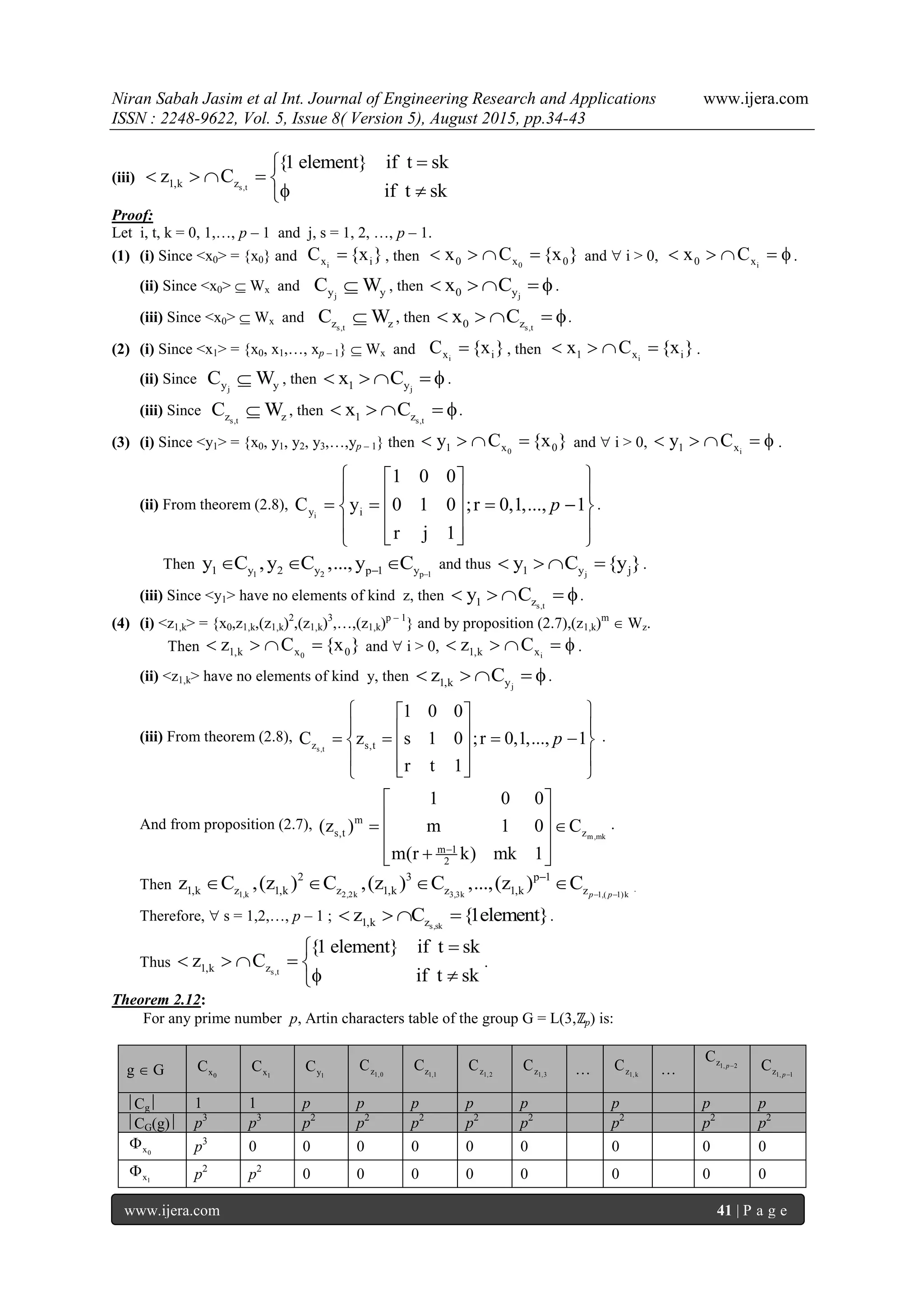
Theorem 2.12:
For any prime number p, Artin characters table of the group G = L(3,ℤp) is:
g  G 0xC 1xC 1yC 1,0zC 1,1zC 1,2zC 1,3zC … 1,kzC … 1, 2zC p
1, 1zC p
Cg 1 1 p p p p p p p p
CG(g) p3
p3
p2
p2
p2
p2
p2
p2
p2
p2
0x p3
0 0 0 0 0 0 0 0 0
1x p2
p2
0 0 0 0 0 0 0 0
Niran Sabah Jasim et al Int. Journal of Engineering Research and Applications www.ijera.com
ISSN : 2248-9622, Vol. 5, Issue 8( Version 5), August 2015, pp.34-43
www.ijera.com 42 | P a g e
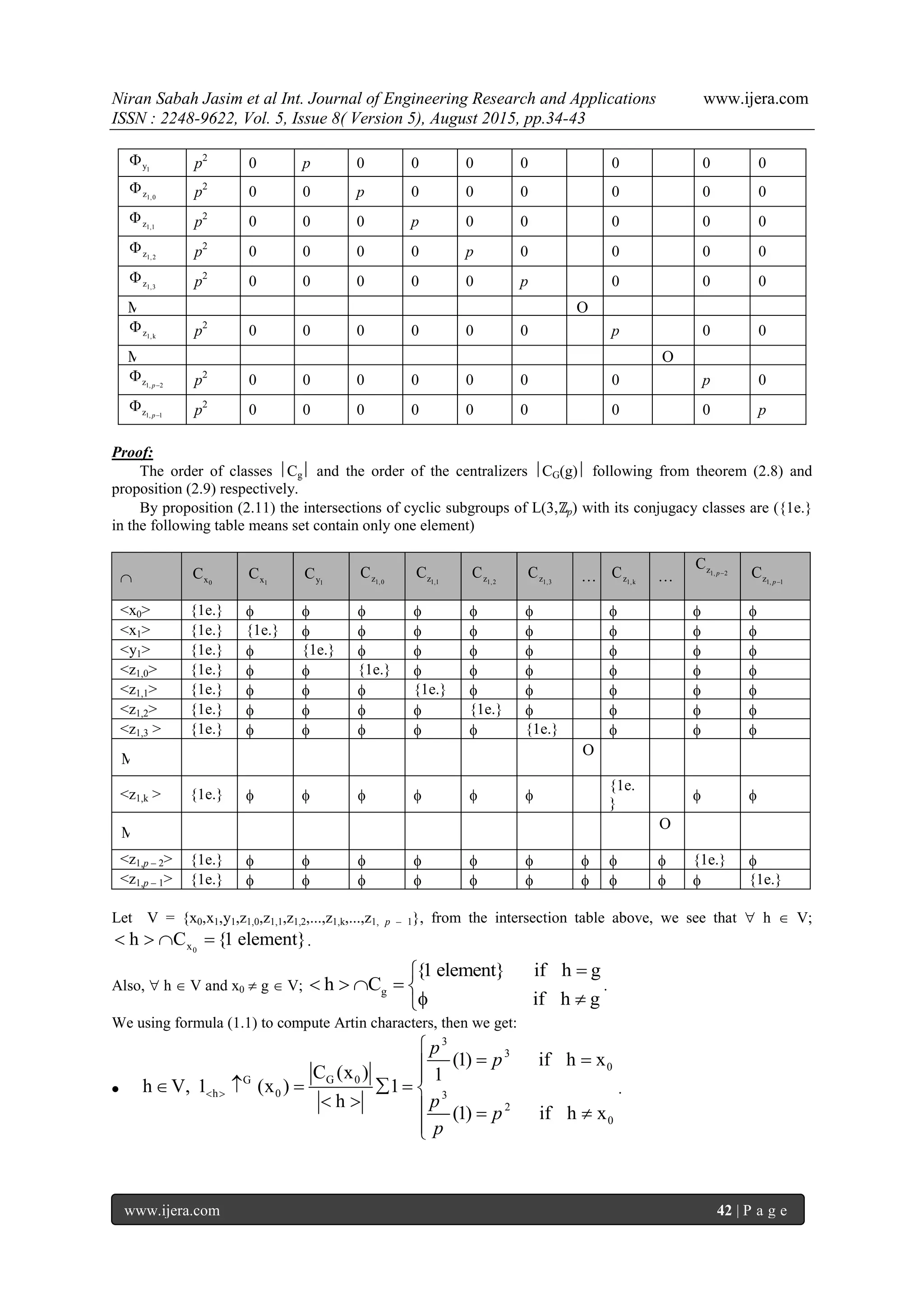
1y p2
0 p 0 0 0 0 0 0 0
1,0z p2
0 0 p 0 0 0 0 0 0
1,1z p2
0 0 0 p 0 0 0 0 0
1,2z p2
0 0 0 0 p 0 0 0 0
1,3z p2
0 0 0 0 0 p 0 0 0
M O
1,kz p2
0 0 0 0 0 0 p 0 0
M O
1, 2z p
 p2
0 0 0 0 0 0 0 p 0
1, 1z p
 p2
0 0 0 0 0 0 0 0 p
Proof:
The order of classes Cg and the order of the centralizers CG(g) following from theorem (2.8) and
proposition (2.9) respectively.
By proposition (2.11) the intersections of cyclic subgroups of L(3,ℤp) with its conjugacy classes are ({1e.}
in the following table means set contain only one element)
 0xC 1xC 1yC 1,0zC 1,1zC 1,2zC 1,3zC … 1,kzC … 1, 2zC p
1, 1zC p
<x0> {1e.}         
<x1> {1e.} {1e.}        
<y1> {1e.}  {1e.}       
<z1,0> {1e.}   {1e.}      
<z1,1> {1e.}    {1e.}     
<z1,2> {1e.}     {1e.}    
<z1,3 > {1e.}      {1e.}   
M
O
<z1,k > {1e.}      
{1e.
}
 
M
O
<z1,p – 2> {1e.}          {1e.} 
<z1,p – 1> {1e.}           {1e.}
Let V = {x0,x1,y1,z1,0,z1,1,z1,2,...,z1,k,...,z1, p – 1}, from the intersection table above, we see that  h  V;
0xh C {1 element}    .
Also,  h  V and x0  g  V; g
{1 element} if h g
h C
if h g

    
 
.
We using formula (1.1) to compute Artin characters, then we get:

3
3
0
G 0G
h 0 3
2
0
(1) if h x
C (x ) 1
h V, 1 (x ) 1
h
(1) if h x
p
p
p
p
p
 

 

     
    

.
Niran Sabah Jasim et al Int. Journal of Engineering Research and Applications www.ijera.com
ISSN : 2248-9622, Vol. 5, Issue 8( Version 5), August 2015, pp.34-43
www.ijera.com 43 | P a g e

3
2
1G 1G
h 1
1
(1) if h xC (x )
h V, 1 (x ) 1
h
0 if h x
p
p
p 

 
     
   
.

2
1G 1G
h 1
1
(1) if h yC (y )
h V, 1 (y ) 1
h
0 if h y
p
p
p 

 
     
   
.
  h  V and  k = 0, 1, …, p – 1;
2
G 1,k 1,kG
h 1,k
1,k
C (z ) (1) if h z
1 (z ) 1
h
0 if h z
p
p
p 

 
    
   
.
Theorem 2.13:
For any prime number p, Artin exponent of the group G = L(3,ℤp) is A(L(3,ℤp)) = p2
.
Proof:
From Artin characters table of the group G = L(3,ℤp) in theorem (2.12), we note that
Then
0 1 1 1,k
2
G x x y z1 ( 1)
p-1
k =0
p p p p          
And by using (1.2) in proposition (1.7), Artin exponent of L(3,ℤp) is A(L(3,ℤp)) = p2
.
References
[1] E.Artin, Die Gruppentheoretisele Strukturder Diskriminaraten Algebraischer Zahlkörper, J.Reine
Anger. Math., 1961, 164, pp.1-11.
[2] I.M.Jsaacs, Characters Theory of Finite Groups, Academic Press, New York, 1976.
[3] L.E.Sigler, Algebra, Springer-Verlage, Berlin, 1976.
[4] M.J.Collins, Representations and Characters of Finite Groups, New York, Published by the Press
Syndicate of the University of Cambridge, 1990.
[5] T.Y.Lam, Artin Exponent of Finite Groups, J. Algebra, New York, Vol.9, pp.94-119, 1968.
[6] V.Nikolai, Linear Groups Over Rings, Copyright © by the McGraw-Hill Companies, 2008.
(–(p+1)/p2
) 0x (–p+1)/p2
) 0 0 0 0 0 0 … 0 … 0 0
(1/p2
) 1x 1 1 0 0 0 0 0 0 0 0
(1/p) 1y p 0 1 0 0 0 0 0 0 0
(1/p) 1,0z p 0 0 1 0 0 0 0 0 0
(1/p) 1,1z p 0 0 0 1 0 0 0 0 0
(1/p) 1,2z p 0 0 0 0 1 0 0 0 0
(1/p) 1,3z p 0 0 0 0 0 1 0 0 0
M O
(1/p) 1,kz p 0 0 0 0 0 0 1 0 0
M O
(1/p) 1, 2z p
 p 0 0 0 0 0 0 0 1 0
(1/p) 1, 1z p
 p 0 0 0 0 0 0 0 0 1
summation 1 1 1 1 1 1 1 … 1 … 1 1

Some Results on the Group of Lower Unitriangular Matrices L(3,Zp)

  • 1.
    Niran Sabah Jasimet al Int. Journal of Engineering Research and Applications www.ijera.com ISSN : 2248-9622, Vol. 5, Issue 8( Version 5), August 2015, pp.34-43 www.ijera.com 34 | P a g e Some Results on the Group of Lower Unitriangular Matrices L(3,Zp) Asmaa Abd Aswhad , Niran Sabah Jasim , Ahmed Rasim Hameed Department of Mathematics, College of Education for pure Science/Ibn-Al-Haitham, University of Baghdad Abstract The main objective of this paper is to find the order and its exponent, the general form of all conjugacy classes, Artin characters table and Artin exponent for the group of lower unitriangular matrices L(3,ℤp), where p is prime number. Key Words: Artin character, Artin exponent, cyclic subgroup, group of unitriangular matrices. I. Introduction The group of invertible n  n matrices over a field F denoted by GL(n,F). Let G be a finite group, all characters of G induced from a principal character of cyclic subgroups of G are called Artin characters of G. Artin induction theorem [1] states that any rational valued character of G is a rational linear combination of the induced principal character of its cyclic subgroups. Lam [5] proved a sharp form of Artin's theorem, he determined the least positive integer A(G) such that A(G)  is an integral linear combination of Artin character, for any rational valued character  of G, and he called A(G) the Artin exponent of G and studied it extensively for many groups. In this paper we consider the group of lower unitriangular matrices L(3,ℤp) and we found that the order of this group is p3 as in theorem (2.2) and its exponent is p in theorem (2.4). Furthermore we found forms of all conjugace classes in theorem (2.8), the Artin character in theorem (2.12) and finally from the principal character of its cyclic subgroups we found the Artin exponent of this group and denoted by A(L(3,ℤp)) which is equal to p2 in theorem (2.13). §.1 Preliminaries In this section, we recall some definitions, theorems and proposition which we needed in the next section. Definition 1.1 : [4] A rational valued character  of G is a character whose valued are in Z, that is  (x) Z, for all xG. Definition 1.2 : [2] Let H be a subgroup of a group G, and  be a class function of H. Then ↑G , the induced class function on G, is given by 1 x G 1 (g) (xgx ) H        where ˚ is defined by ˚(h) = (h) if h  H and ˚(y) = 0 if y  H. Observe that ↑G is a class function on G and ↑G (1) = [G:H] (1). Another useful formula for computing ↑G (g) explicitly is to choose representatives x1, x2, …, xm for the m classes of H contained in the conjugacy class cg in G which is given by m G i G i 1 H i (x ) (g) C (g) C (x )      where it is understood that φ↑G(Cα) = 0 if H  Cl(g)= . This formula is immediate from the definition of ↑G since as x runs over G, xgx – 1 =xi for exactly CG(g)  values of x. If H is a cyclic subgroup then RESEARCH ARTICLE OPEN ACCESS
  • 2.
    Niran Sabah Jasimet al Int. Journal of Engineering Research and Applications www.ijera.com ISSN : 2248-9622, Vol. 5, Issue 8( Version 5), August 2015, pp.34-43 www.ijera.com 35 | P a g e m GG i i 1H C (g) (g) (x ) C (g)      …(1.1) Definition 1.3: [5] The character induced from the principal character of a cyclic subgroups of G is called Artin character. Definition 1.4 : [5] Let G be a finite group and let  be any rational valued character on G. The smallest positive number n such that, c c c n a   where acZ and c is Artin character, is called the Artin exponent of G and denoted by A(G). Theorem 1.5 : [3] Let 1 denote the principal character of G and dZ, then d is an Artin exponent of G if there exists (uniquely) integers akZ such that q k k k 1 d 1 a      where 1, …, k are the Artin characters. Theorem 1.6 : [3] For a subgroup H in G, A(H) divides A(G). Proposition 1.7 : [5] Let G be an arbitrary finite group, and {H1,H2,..,Hq} be a full set of non-gonjugate cyclic subgroups of G, then A(G) is the smallest positive integer m such that: kk G G k HH H m 1 a 1     …(1.2) With each akℤ. §.2 The Order and its Exponent, The Conjugacy Classes, Artin Character and Artin Exponent of L(3,ℤp) This section concerns on an important class of groups, the group of lower unitriangular matrices L(3,ℤp). After describing important features of this group and investigating their conjugacy classes we move on to evaluate its Artin Exponent and constructing the table of its induced characters. Definition 2.1: [6] Let 1 0 0 * 1 0 L(n,F) * * 1             L L M M O M L be the group of nn lower unit triangular matrices with entries in F under matrix multiplication, that is L(n,F) consists of matrices such that L(n,F) is a subgroup of GL(n,F). Theorem 2.2: The order of the group L(3,ℤp) is p3. Proof:
  • 3.
    Niran Sabah Jasimet al Int. Journal of Engineering Research and Applications www.ijera.com ISSN : 2248-9622, Vol. 5, Issue 8( Version 5), August 2015, pp.34-43 www.ijera.com 36 | P a g e 1 0 0 L(3, ) x 1 0 ;x, y,z y z 1 p p               ¢ ¢ Order of the group L(3,ℤp) depending on choices number of x, y and z. Since x, y and z can be chosen arbitrary from ℤp, p choices for x, p choices for y, and p choices for z, thus L(3,ℤp)  = ppp = p3. Theorem 2.3: Every element, excepted identity element e, in the group G = L(3,ℤp) has order p, that is,  g  G, we have 1 if g = e o(g) = if g ep    Proof: If g = e, then o(g) = 1.  e  g  G has the form 1 2 3 1 0 0 g = g 1 0 g g 1          where g1, g2, g3  ℤp, and g1, g2, g3 are not all zero. 2 3 1 1 2 1 3 3 2 1 3 3 1 0 0 1 0 0 g = 2g 1 0 , g = 3g 1 0 2g g g 2g 1 3g 3g g 3g 1                     In general, r 1 r 1 2 1 3 32 1 0 0 g = rg 1 0 r(g g g ) rg 1          . Let m be the order of g, then gm = e  1 m 1 2 1 3 32 1 0 0 1 0 0 mg 1 0 0 1 0 m(g g g ) mg 1 0 0 1                   We get, mg1  0 mod p mg3  0 mod p m 1 2 1 32m(g g g  )  0 mod Since ℤp is a field and g1, g2, g3 are not all zero, then m = p. Theorem 2.4: Exponent of the group G = L(3,ℤp) is p, i.e. exp(G) = p. Proof: Let l.c.m(a,b) be the least common multiple of a and b. By theorem (2.3), exp(G) = l.c.m(1,p) = p. Theorem 2.5: The Center of the group G = L(3,ℤp) is the cyclic subgroup
  • 4.
    Niran Sabah Jasimet al Int. Journal of Engineering Research and Applications www.ijera.com ISSN : 2248-9622, Vol. 5, Issue 8( Version 5), August 2015, pp.34-43 www.ijera.com 37 | P a g e 1 0 0 Z(G) 0 1 0 ,r r 0 1 p               ¢ and Z(G) = p. Proof: Let g, h  G, where 1 2 3 1 0 0 g = g 1 0 g g 1          and 1 2 3 1 0 0 h = h 1 0 h h 1          1 1 1 1 2 2 1 3 3 3 2 2 1 3 3 3 1 0 0 1 0 0 g h = h + g 1 0 , h g = h + g 1 0 h + g g h h + g 1 h + g g h h + g 1                     If g1 = g3 = 0, then  h  G, we have gh = hg. Hence, g  Z(G) and 2 2 1 0 0 Z(G) 0 1 0 ,g g 0 1 p               ¢ . Since,  g2  ℤp, 2 1 0 0 g 0 1 0 g 0 1           Z(G) and ℤp = p, then Z(G) = p. So, any finite group of prime order is cyclic, then Z(G) is cyclic. Remark 2.6: We classify the elements of the group L(3,ℤp) into three disjoint sets: (1) Let x i 1 0 0 W x 0 1 0 ,i i 0 1 p                ¢ we called Wx set of all elements of kind x, we note that Wx = Z(G). (2) Let y j 1 0 0 W y 0 1 0 , j 0;r, j r j 1 p                 ¢ we called Wy set of all elements of kind y. (3) Let z s,t 1 0 0 W z s 1 0 ,s 0;r,s,t r t 1 p                 ¢ we called Wz set of all elements of kind z. (4) Wx, Wy and Wz are disjoint sets, i.e., Wx  Wy = , Wx  Wz =  and Wy  Wz = . Proposition 2.7: Let 1  m  p – 1, then (1)  i = 0,1,…, p – 1 ; (xi)m are elements of kind x, that is (xi)m  Wx. (2)  j = 1,2,…, p – 1 ; (yj)m are elements of kind y, that is (yj)m  Wy. (3)  s = 1,2,…,p – 1 and  t =0,1,…,p – 1; (zs,t)m are elements of kind z, that is (zs,t)m Wz. Proof:
  • 5.
    Niran Sabah Jasimet al Int. Journal of Engineering Research and Applications www.ijera.com ISSN : 2248-9622, Vol. 5, Issue 8( Version 5), August 2015, pp.34-43 www.ijera.com 38 | P a g e (1) Since, Wx = Z(G) is cyclic, then  xi  Wx. (2) j 1 0 0 y 0 1 0 r j 1          and m m j 1 0 0 1 0 0 (y ) 0 1 0 0 1 0 r j 1 mr mj 1                    , where mr, mj  ℤp. Since, m  0 and j  0 then mj  0, therefore (yj)m  Wy. (3) s,t 1 0 0 z s 1 0 r t 1          and m m s,t m 1 2 1 0 0 1 0 0 (z ) s 1 0 ms 1 0 r t 1 m(r st) mt 1                  . Since, m  0 and s 0 then ms  0, therefore (zs,t)m Wz. Theorem 2.8: The group G = L(3,ℤp) has exactly p2 + p – 1 conjugacy classes: (1)  i = 0,1,…, p – 1 ; we have classes of the form ix i 1 0 0 C x 0 1 0 i 0 1           and ixC 1 . (2)  j=1,2,…,p–1; (yj)m ;we have classes of the form iy j 1 0 0 C y 0 1 0 ;r 0,1,..., 1 r j 1 p                 and jyC p . (3)  s = 1,2, …, p – 1 and  t = 0,1,…, p – 1 ; we have classes of the form s,tz s,t 1 0 0 C z s 1 0 ;r 0,1,..., 1 r t 1 p                 and s,tzC p . Proof: (1) By theorem (2.5),  i = 0,1,…, p – 1 ; the elements xi  Z(G), then these elements form a conjugacy classes of their own, and ixC 1 . (2) To find a conjugacy classes of yj, we consider an arbitrary element 1 2 3 1 0 0 g = g 1 0 g g 1           G and its inverse 1 1 1 3 2 3 1 0 0 g = g 1 0 g g g g 1           . Then 1 j 1 1 0 0 gy g = 0 1 0 r + jg j 1           . If j  k and yj is conjugate to yk, then gyjg – 1 = yk  1 1 0 0 1 0 0 0 1 0 0 1 0 r + jg j 1 r k 1                    j = k; thus  j=1,2,…,p – 1, jyC are all distinct.
  • 6.
    Niran Sabah Jasimet al Int. Journal of Engineering Research and Applications www.ijera.com ISSN : 2248-9622, Vol. 5, Issue 8( Version 5), August 2015, pp.34-43 www.ijera.com 39 | P a g e In jyC , r = 0,1,…, p – 1 , jyC p . (3) To find a conjugacy classes of zs,t, we consider an arbitrary element 1 2 3 1 0 0 g = g 1 0 g g 1           G and its inverse 1 1 1 3 2 3 1 0 0 g = g 1 0 g g g g 1           . Then 1 s,t 1 3 1 0 0 gz g = s 1 0 r + g t g s t 1           . If s1  s2 , t1  t2; and 1 1s ,tz is conjugate to 2 2s ,tz , then g 1 1s ,tz g – 1 = 2 2s ,tz  1 2 1 1 3 1 1 2 1 0 0 1 0 0 s 1 0 s 1 0 r + g t g s t 1 r t 1                    s1 =s2 and t1 = t2. Thus  s = 1,2, …, p – 1 and  t = 0,1,…, p – 1 ; s,tzC are all distinct. In s,tzC , r = 0,1,…, p – 1, then s,tzC p . To show that the conjugacy classes ixC , jyC and s,tzC are distinct: We have ixC  Wx, jyC  Wy and s,tzC  Wz, then ixC  jyC = , ixC  s,tzC =  and jyC  s,tzC = . Hence ixC , jyC and s,tzC are distinct. To find the total number of the conjugacy classes: Number of conjugacy classes in (1) = p Number of conjugacy classes in (2) = p – 1 Number of conjugacy classes in (3) = p(p – 1) Then the total number of the conjugacy classes is p + (p – 1) + p(p – 1) = p2 + p – 1. To show that these are all conjugacy classes of the group G = L(3,ℤp), we add up the elements contained in those conjugacy classes, we get: P(1) + (p – 1)( (p) + [p (p – 1)] (p) = p3 = G. Thus, this theorem gives all conjugacy classes of the group L(3,ℤp). Proposition 2.9: The order of the centralizers, CG(g) of g in the group G = L(3,ℤp) are: (1)  i = 0,1,…, p – 1 ; CG(xi) = p3 . (2)  j=1,2,…,p–1; (yj)m ; CG(yj) = p2 . (3)  s = 1,2, …, p – 1 and  t = 0,1,…, p – 1 ; CG(zs,t) = p2 . Proof: By theorem (2.10), G g G C (g) C  and by theorem (2.2), G = p3 .
  • 7.
    Niran Sabah Jasimet al Int. Journal of Engineering Research and Applications www.ijera.com ISSN : 2248-9622, Vol. 5, Issue 8( Version 5), August 2015, pp.34-43 www.ijera.com 40 | P a g e (1) By theorem (2.8),  i = 0,1,…, p – 1; ixC 1 , then i 3 3 G i x G C (x ) 1C p p   . (2) By theorem (2.8),  j = 1,2,…, p – 1; jyC p , then j 3 2 G j y G C (y ) C p p p    . (3) By theorem (2.8),  s = 1,2, …, p – 1 and  t = 0,1,…, p – 1; s,tzC p , then s,t 3 2 G s,t z G C (z ) C p p p    . Remarks 2.10: (1) Let i 1 0 0 x 0 1 0 i 0 1          , where i = 0,1,…, p – 1, we note that xi  Z(G), by theorem (2.5), Z(G) is cyclic group of order p, and we have Z(G) = {e = x0, x1, 2 3 1 1x , x ,…,(x1) p – 1 } = {x0, x1, x2, x3,…,xp – 1}. Since every element excepted e in Z(G) is generator, then Z(G) = <x1> = <x2> = … = <xp – 1>. (2)  j = 1,2,…, p – 1; we take the first element in the conjugacy classes jyC as a representatives and denoted it by yi, then i 1 0 0 y 0 1 0 0 j 1          , so  m = 1,2,…, p – 1; (y1)m = ym. Then <y1> = {e = x0, y1, 2 3 1 1y , y ,…,(y1) p – 1 } = {x0, y1, y2, y3,…,yp – 1}. Since o(yj) = p, then every element in <y1> is generator, that is <y1> = <y2> =…= <yp – 1>. (3) In the same way, we can show that,  k = 0, 1,…, p – 1; we have <z1,k> = < z2,2k > = < z3,3k > = … = <zp – 1,( p – 1)k>. Since conjugacy cyclic subgroups give the same Artin characters, then when we construct Artin characters table of L(3,ℤp) we need only to compute  induced from non-conjugate cyclic subgroups and by remark (2.10) they are: <x0>, <x1>, <y1>, <z1,0>, <z1,1>, <z1,2>,…, and <z1, p – 1>. Proposition 2.11: Intersection of non-conjugate cyclic subgroups <x0>, <x1>, <y1>, <z1,0>, <z1,1>, <z1,2>,…, and <z1, p – 1> with all conjugacy classes of the group L(3,ℤp) are: Let i, t, k = 0,1,…, p – 1 and j, s = 1,2,…, p – 1; then (1) (i) i 0 0 x {x } if i 0 x C if i 0         (ii) j0 yx C     (iii) s,t0 zx C     (2) (i) i1 x ix C {x }    (ii) j1 yx C     (iii) s,t1 zx C     (3) (i) i 0 1 x {x } if i 0 y C if i 0         (ii) j1 y jy C {y }    (iii) s,t1 zy C     (4) (i) i 0 1,k x {x } if i 0 z C if i 0         (ii) j1,k yz C    
  • 8.
    Niran Sabah Jasimet al Int. Journal of Engineering Research and Applications www.ijera.com ISSN : 2248-9622, Vol. 5, Issue 8( Version 5), August 2015, pp.34-43 www.ijera.com 41 | P a g e (iii) s,t1,k z {1 element} if t sk z C if t sk         Proof: Let i, t, k = 0, 1,…, p – 1 and j, s = 1, 2, …, p – 1. (1) (i) Since <x0> = {x0} and ix iC {x } , then 00 x 0x C {x }    and  i > 0, i0 xx C    . (ii) Since <x0>  Wx and jy yC W , then j0 yx C    . (iii) Since <x0>  Wx and s,tz zC W , then s,t0 zx C    . (2) (i) Since <x1> = {x0, x1,…, xp – 1}  Wx and ix iC {x } , then i1 x ix C {x }    . (ii) Since jy yC W , then j1 yx C    . (iii) Since s,tz zC W , then s,t1 zx C    . (3) (i) Since <y1> = {x0, y1, y2, y3,…,yp – 1} then 01 x 0y C {x }    and  i > 0, i1 xy C     . (ii) From theorem (2.8), iy i 1 0 0 C y 0 1 0 ;r 0,1,..., 1 r j 1 p                 . Then 1 2 p 11 y 2 y p 1 yy C ,y C ,...,y C    and thus j1 y jy C {y }    . (iii) Since <y1> have no elements of kind z, then s,t1 zy C    . (4) (i) <z1,k> = {x0,z1,k,(z1,k)2 ,(z1,k)3 ,…,(z1,k)p – 1 } and by proposition (2.7),(z1,k)m  Wz. Then 01,k x 0z C {x }    and  i > 0, i1,k xz C     . (ii) <z1,k> have no elements of kind y, then j1,k yz C    . (iii) From theorem (2.8), s,tz s,t 1 0 0 C z s 1 0 ;r 0,1,..., 1 r t 1 p                 . And from proposition (2.7), m,mk m s,t z m 1 2 1 0 0 (z ) m 1 0 C m(r k) mk 1          . Then 1,k 2,2k 3,3k 1,( 1)k 2 3 p 1 1,k z 1,k z 1,k z 1,k zz C ,(z ) C ,(z ) C ,...,(z ) C p p       . Therefore,  s = 1,2,…, p – 1 ; s,sk1,k zz C {1element}    . Thus s,t1,k z {1 element} if t sk z C if t sk         . Theorem 2.12: For any prime number p, Artin characters table of the group G = L(3,ℤp) is: g  G 0xC 1xC 1yC 1,0zC 1,1zC 1,2zC 1,3zC … 1,kzC … 1, 2zC p 1, 1zC p Cg 1 1 p p p p p p p p CG(g) p3 p3 p2 p2 p2 p2 p2 p2 p2 p2 0x p3 0 0 0 0 0 0 0 0 0 1x p2 p2 0 0 0 0 0 0 0 0
  • 9.
    Niran Sabah Jasimet al Int. Journal of Engineering Research and Applications www.ijera.com ISSN : 2248-9622, Vol. 5, Issue 8( Version 5), August 2015, pp.34-43 www.ijera.com 42 | P a g e 1y p2 0 p 0 0 0 0 0 0 0 1,0z p2 0 0 p 0 0 0 0 0 0 1,1z p2 0 0 0 p 0 0 0 0 0 1,2z p2 0 0 0 0 p 0 0 0 0 1,3z p2 0 0 0 0 0 p 0 0 0 M O 1,kz p2 0 0 0 0 0 0 p 0 0 M O 1, 2z p  p2 0 0 0 0 0 0 0 p 0 1, 1z p  p2 0 0 0 0 0 0 0 0 p Proof: The order of classes Cg and the order of the centralizers CG(g) following from theorem (2.8) and proposition (2.9) respectively. By proposition (2.11) the intersections of cyclic subgroups of L(3,ℤp) with its conjugacy classes are ({1e.} in the following table means set contain only one element)  0xC 1xC 1yC 1,0zC 1,1zC 1,2zC 1,3zC … 1,kzC … 1, 2zC p 1, 1zC p <x0> {1e.}          <x1> {1e.} {1e.}         <y1> {1e.}  {1e.}        <z1,0> {1e.}   {1e.}       <z1,1> {1e.}    {1e.}      <z1,2> {1e.}     {1e.}     <z1,3 > {1e.}      {1e.}    M O <z1,k > {1e.}       {1e. }   M O <z1,p – 2> {1e.}          {1e.}  <z1,p – 1> {1e.}           {1e.} Let V = {x0,x1,y1,z1,0,z1,1,z1,2,...,z1,k,...,z1, p – 1}, from the intersection table above, we see that  h  V; 0xh C {1 element}    . Also,  h  V and x0  g  V; g {1 element} if h g h C if h g         . We using formula (1.1) to compute Artin characters, then we get:  3 3 0 G 0G h 0 3 2 0 (1) if h x C (x ) 1 h V, 1 (x ) 1 h (1) if h x p p p p p                   .
  • 10.
    Niran Sabah Jasimet al Int. Journal of Engineering Research and Applications www.ijera.com ISSN : 2248-9622, Vol. 5, Issue 8( Version 5), August 2015, pp.34-43 www.ijera.com 43 | P a g e  3 2 1G 1G h 1 1 (1) if h xC (x ) h V, 1 (x ) 1 h 0 if h x p p p               .  2 1G 1G h 1 1 (1) if h yC (y ) h V, 1 (y ) 1 h 0 if h y p p p               .   h  V and  k = 0, 1, …, p – 1; 2 G 1,k 1,kG h 1,k 1,k C (z ) (1) if h z 1 (z ) 1 h 0 if h z p p p              . Theorem 2.13: For any prime number p, Artin exponent of the group G = L(3,ℤp) is A(L(3,ℤp)) = p2 . Proof: From Artin characters table of the group G = L(3,ℤp) in theorem (2.12), we note that Then 0 1 1 1,k 2 G x x y z1 ( 1) p-1 k =0 p p p p           And by using (1.2) in proposition (1.7), Artin exponent of L(3,ℤp) is A(L(3,ℤp)) = p2 . References [1] E.Artin, Die Gruppentheoretisele Strukturder Diskriminaraten Algebraischer Zahlkörper, J.Reine Anger. Math., 1961, 164, pp.1-11. [2] I.M.Jsaacs, Characters Theory of Finite Groups, Academic Press, New York, 1976. [3] L.E.Sigler, Algebra, Springer-Verlage, Berlin, 1976. [4] M.J.Collins, Representations and Characters of Finite Groups, New York, Published by the Press Syndicate of the University of Cambridge, 1990. [5] T.Y.Lam, Artin Exponent of Finite Groups, J. Algebra, New York, Vol.9, pp.94-119, 1968. [6] V.Nikolai, Linear Groups Over Rings, Copyright © by the McGraw-Hill Companies, 2008. (–(p+1)/p2 ) 0x (–p+1)/p2 ) 0 0 0 0 0 0 … 0 … 0 0 (1/p2 ) 1x 1 1 0 0 0 0 0 0 0 0 (1/p) 1y p 0 1 0 0 0 0 0 0 0 (1/p) 1,0z p 0 0 1 0 0 0 0 0 0 (1/p) 1,1z p 0 0 0 1 0 0 0 0 0 (1/p) 1,2z p 0 0 0 0 1 0 0 0 0 (1/p) 1,3z p 0 0 0 0 0 1 0 0 0 M O (1/p) 1,kz p 0 0 0 0 0 0 1 0 0 M O (1/p) 1, 2z p  p 0 0 0 0 0 0 0 1 0 (1/p) 1, 1z p  p 0 0 0 0 0 0 0 0 1 summation 1 1 1 1 1 1 1 … 1 … 1 1