Choosing a dissertation topic
A topic is any subject of study, inquiry, or discussion that is addressed
for the sake of an audience. In some cases, students will be asked to
select from a list of suggested topics, in other, they have to decide
themselves.
The most important consideration in choosing the topic, as Jackson,
(1995) indicates, is ‘genuine interest’. It is recommended that a
researcher choose something from his or her experience, something
that he or she can apply to future work, study, or publication.
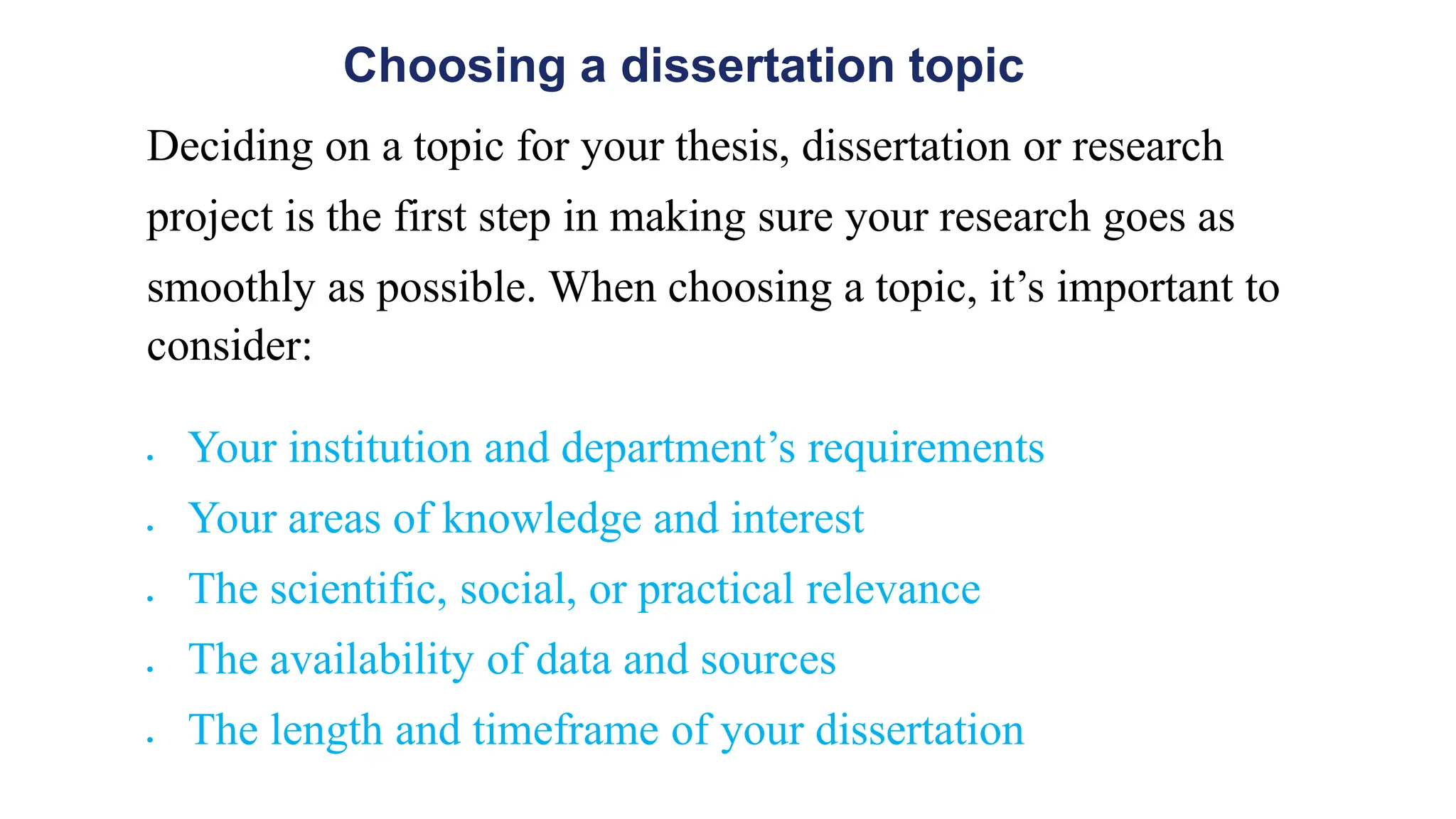
Choosing a dissertation topic
Deciding on a topic for your thesis, dissertation or research
project is the first step in making sure your research goes as
smoothly as possible. When choosing a topic, it’s important to
consider:
 Your institution and department’s requirements
 Your areas of knowledge and interest
 The scientific, social, or practical relevance
 The availability of data and sources
 The length and timeframe of your dissertation
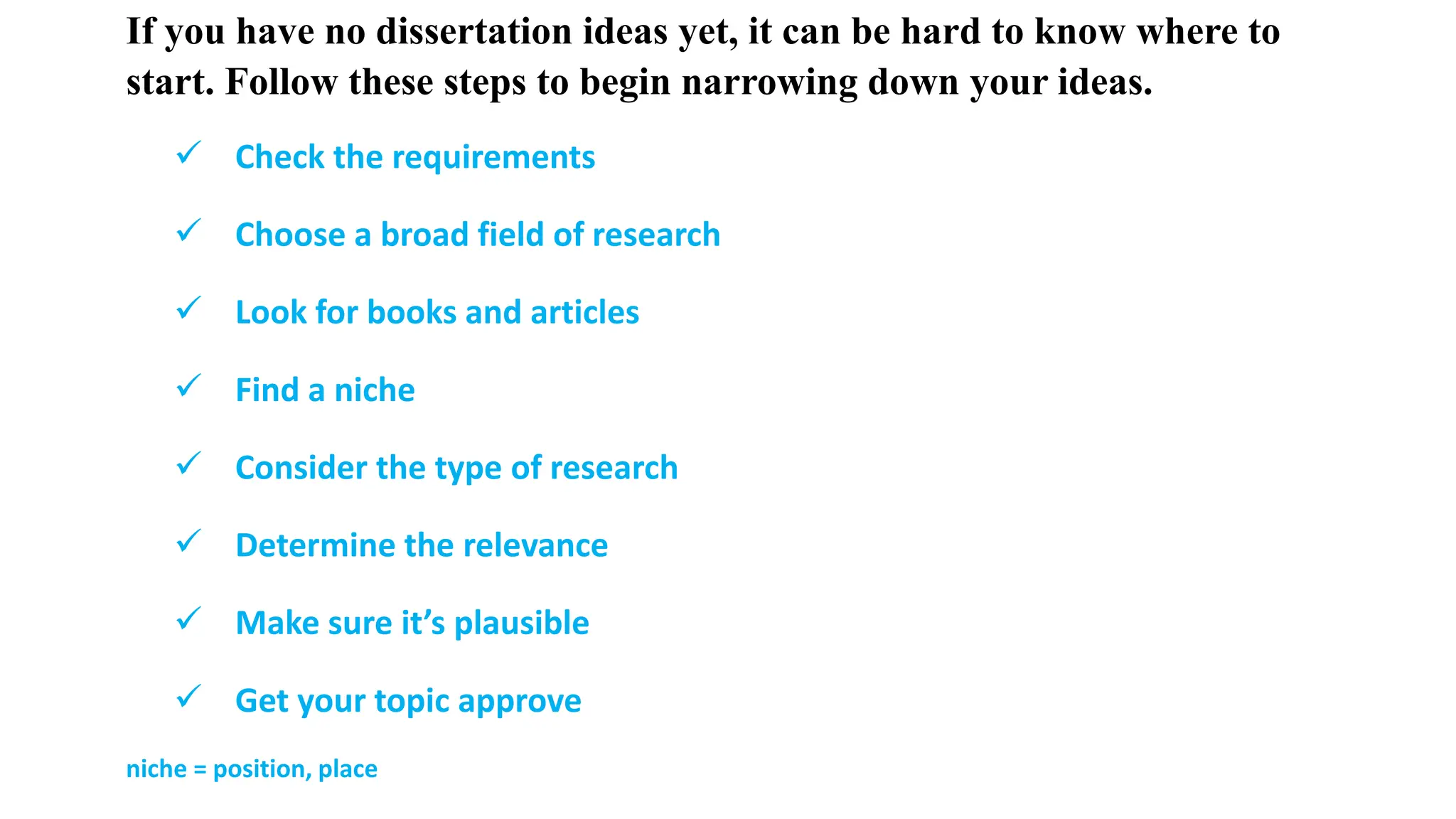
If you have no dissertation ideas yet, it can be hard to know where to
start. Follow these steps to begin narrowing down your ideas.
 Check the requirements
 Choose a broad field of research
 Look for books and articles
 Find a niche
 Consider the type of research
 Determine the relevance
 Make sure it’s plausible
 Get your topic approve
niche = position, place
Step 1: Check the requirements
The very first step is to check the practical requirements of your
educational programme. This determines the scope of what it is
possible for you to research.
 What is the minimum and maximum word count?
 When is the deadline?
 Do you have to choose from a list of topics, or do you have to think of
a topic yourself?
 Should the research have an academic or a professional orientation?
 Are there any methodological conditions (e.g. do you have to conduct
fieldwork or use specific types of source)?
 Are there any other restrictions?
Step 1: Check the requirements
Some programmes will have stricter requirements than
others. You might be given nothing more than a word
count and a deadline, or you might have a restricted list
of topics and approaches to choose from. If in doubt
about what is expected of you, always ask your course
or department coordinator.
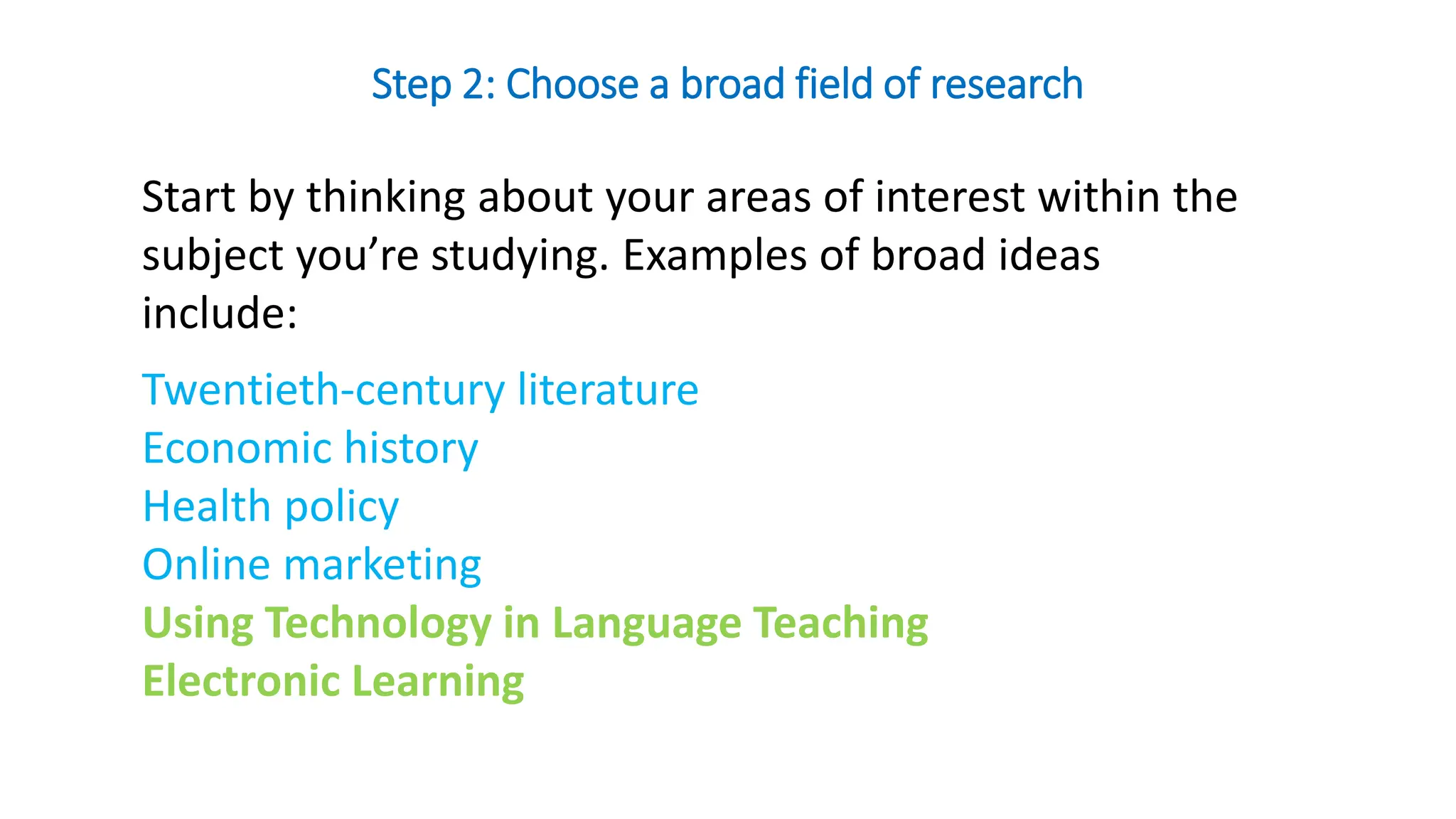
Step 2: Choose a broad field of research
Start by thinking about your areas of interest within the
subject you’re studying. Examples of broad ideas
include:
Twentieth-century literature
Economic history
Health policy
Online marketing
Using Technology in Language Teaching
Electronic Learning
Step 2: Choose a broad field of research
It’s a good idea to pick a field that you already have some
familiarity with, so that you don’t have to start your
research completely from scratch. You don’t have to be an
expert on the topic, but if you’ve already read a few articles,
that gives you a good starting point to find out more.
Step 3 Look for books and articles
Try skimming through a few recent issues of the top
journals in your field, as well as looking at their most-cited
articles. For inspiration, you can also search Google
Scholar, subject-specific databases, and your university
library’s resources.
If you’ve already read some articles in the field, check
their reference lists to find more useful sources. As you read,
note down any specific ideas that interest you and make a
shortlist of possible topics.
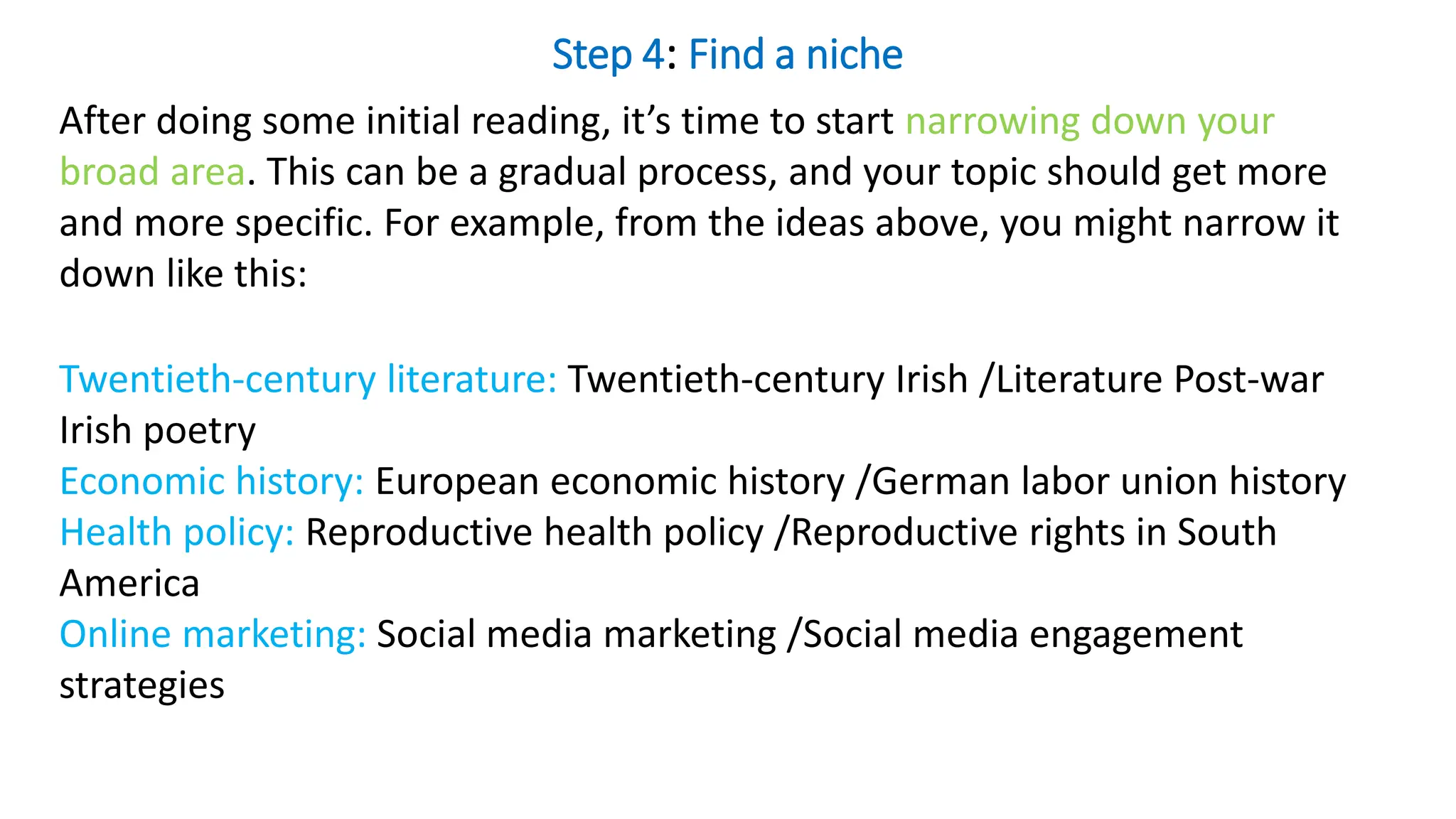
Step 4: Find a niche
After doing some initial reading, it’s time to start narrowing down your
broad area. This can be a gradual process, and your topic should get more
and more specific. For example, from the ideas above, you might narrow it
down like this:
Twentieth-century literature: Twentieth-century Irish /Literature Post-war
Irish poetry
Economic history: European economic history /German labor union history
Health policy: Reproductive health policy /Reproductive rights in South
America
Online marketing: Social media marketing /Social media engagement
strategies
Step 4: Find a niche
NARROWING THE TOPIC
Students may decide to work on topics such as ‘Teaching English in Libya’ or ‘Problems
encountered by Libyan University Students in Learning English’. Such topics are too broad
to deal with in a short research project. Therefore, such topics should be narrowed.
Narrowing a topic means, “limiting it and becoming more specific about what is to be
discussed in the paper, making it manageable length and scope” (Truscott, 1995, p. 26).
For instance, the above-mentioned topics can be narrowed to ‘Teaching English in a
primary or a secondary school’ for the first, and ‘‘Problems encountered by Libyan
University Students in Learning Vocabulary’ for the second.
Step 4: Find a niche
Try to narrow these broad topics
1. Using Technology in Language Teaching
2. Electronic Learning
Step 4: Find a niche
All of these topics are still broad enough that you’ll find a huge amount of
books and articles about them. Try to find a specific niche that not many
people have researched yet (such as a neglected author or time period), a
question that’s still being debated, or a very current practical issue.
If there’s already a lot of research and a strong consensus on your topic, it
will be more difficult to justify the relevance of your work. But you should
make sure there is enough literature on the topic to provide a strong basis
for your own research.
At this stage, make sure you have a few backup ideas — there’s still time
to change your focus. If your topic doesn’t make it through the next few
steps, you can try a different one. Later, you will narrow your focus down even more in
your problem statement and research questions.
Step 5: Consider the type of research
There are many different types of research, so at this stage, it’s a good idea
to start thinking about what kind of approach you’ll take to your topic. Will
you mainly focus on:
1. Collecting original data (e.g. experimental or field research)?
2. Analyzing existing data (e.g. national statistics, public records or
archives)?
3. Interpreting cultural objects (e.g. novels, films or paintings)?
4. Comparing scholarly approaches (e.g. theories, methods or
interpretations)?
Step 6: Determine the relevance
It’s important that your topic is interesting to you, but you’ll also have to make
sure it’s academically, socially or practically relevant.
Academic relevance means that the research can fill a gap in knowledge or
contribute to a scholarly debate in your field.
Social relevance means that the research can advance our understanding of
society and inform social change.
Practical relevance means that the research can be applied to solve concrete
problems or improve real-life processes.
Step 6: Determine the relevance
The easiest way to make sure your research is relevant is
to choose a topic that is clearly connected to current
issues or debates, either in society at large or in your
academic discipline. The relevance must be clearly
stated when you define your research problem.
Step 7: Make sure it’s plausible
Before you make a final decision on your topic, consider again
the length of your dissertation, the timeframe in which you have
to complete it, and the practicalities of conducting the research.
Will you have enough time to read all the most important
academic literature on this topic? If there’s too much
information to tackle, consider narrowing your focus even more.
Step 7: Make sure it’s plausible
Will you be able to find enough sources or gather enough data to
fulfil the requirements of the dissertation? If you think you might
struggle to find information, consider broadening or shifting your
focus.
Do you have to go to a specific location to gather data on the topic?
Make sure that you have enough funding and practical access.
Last but not least, will the topic hold your interest for the length of
the research process? To stay motivated, it’s important to choose
something you’re enthusiastic about!
Plausible = reasonable, acceptable
Step 7: Get your topic approved
Most programmes will require you to submit a brief description of
your topic before you are assigned a supervisor. It’s a good idea to
discuss your ideas with your supervisor before you write a
full research proposal.
Remember, if you discover that your topic is not as strong as you
thought it was, it’s usually acceptable to change your mind and
switch focus early in the dissertation process. Just make sure you
have enough time to start on a new topic, and always check with
your supervisor or department.

Choosing a dissertation topics New.pptx

  • 1.
    Choosing a dissertationtopic A topic is any subject of study, inquiry, or discussion that is addressed for the sake of an audience. In some cases, students will be asked to select from a list of suggested topics, in other, they have to decide themselves. The most important consideration in choosing the topic, as Jackson, (1995) indicates, is ‘genuine interest’. It is recommended that a researcher choose something from his or her experience, something that he or she can apply to future work, study, or publication.
  • 2.
    Choosing a dissertationtopic Deciding on a topic for your thesis, dissertation or research project is the first step in making sure your research goes as smoothly as possible. When choosing a topic, it’s important to consider:  Your institution and department’s requirements  Your areas of knowledge and interest  The scientific, social, or practical relevance  The availability of data and sources  The length and timeframe of your dissertation
  • 3.
    If you haveno dissertation ideas yet, it can be hard to know where to start. Follow these steps to begin narrowing down your ideas.  Check the requirements  Choose a broad field of research  Look for books and articles  Find a niche  Consider the type of research  Determine the relevance  Make sure it’s plausible  Get your topic approve niche = position, place
  • 4.
    Step 1: Checkthe requirements The very first step is to check the practical requirements of your educational programme. This determines the scope of what it is possible for you to research.  What is the minimum and maximum word count?  When is the deadline?  Do you have to choose from a list of topics, or do you have to think of a topic yourself?  Should the research have an academic or a professional orientation?  Are there any methodological conditions (e.g. do you have to conduct fieldwork or use specific types of source)?  Are there any other restrictions?
  • 5.
    Step 1: Checkthe requirements Some programmes will have stricter requirements than others. You might be given nothing more than a word count and a deadline, or you might have a restricted list of topics and approaches to choose from. If in doubt about what is expected of you, always ask your course or department coordinator.
  • 6.
    Step 2: Choosea broad field of research Start by thinking about your areas of interest within the subject you’re studying. Examples of broad ideas include: Twentieth-century literature Economic history Health policy Online marketing Using Technology in Language Teaching Electronic Learning
  • 7.
    Step 2: Choosea broad field of research It’s a good idea to pick a field that you already have some familiarity with, so that you don’t have to start your research completely from scratch. You don’t have to be an expert on the topic, but if you’ve already read a few articles, that gives you a good starting point to find out more.
  • 8.
    Step 3 Lookfor books and articles Try skimming through a few recent issues of the top journals in your field, as well as looking at their most-cited articles. For inspiration, you can also search Google Scholar, subject-specific databases, and your university library’s resources. If you’ve already read some articles in the field, check their reference lists to find more useful sources. As you read, note down any specific ideas that interest you and make a shortlist of possible topics.
  • 9.
    Step 4: Finda niche After doing some initial reading, it’s time to start narrowing down your broad area. This can be a gradual process, and your topic should get more and more specific. For example, from the ideas above, you might narrow it down like this: Twentieth-century literature: Twentieth-century Irish /Literature Post-war Irish poetry Economic history: European economic history /German labor union history Health policy: Reproductive health policy /Reproductive rights in South America Online marketing: Social media marketing /Social media engagement strategies
  • 10.
    Step 4: Finda niche NARROWING THE TOPIC Students may decide to work on topics such as ‘Teaching English in Libya’ or ‘Problems encountered by Libyan University Students in Learning English’. Such topics are too broad to deal with in a short research project. Therefore, such topics should be narrowed. Narrowing a topic means, “limiting it and becoming more specific about what is to be discussed in the paper, making it manageable length and scope” (Truscott, 1995, p. 26). For instance, the above-mentioned topics can be narrowed to ‘Teaching English in a primary or a secondary school’ for the first, and ‘‘Problems encountered by Libyan University Students in Learning Vocabulary’ for the second.
  • 11.
    Step 4: Finda niche Try to narrow these broad topics 1. Using Technology in Language Teaching 2. Electronic Learning
  • 12.
    Step 4: Finda niche All of these topics are still broad enough that you’ll find a huge amount of books and articles about them. Try to find a specific niche that not many people have researched yet (such as a neglected author or time period), a question that’s still being debated, or a very current practical issue. If there’s already a lot of research and a strong consensus on your topic, it will be more difficult to justify the relevance of your work. But you should make sure there is enough literature on the topic to provide a strong basis for your own research. At this stage, make sure you have a few backup ideas — there’s still time to change your focus. If your topic doesn’t make it through the next few steps, you can try a different one. Later, you will narrow your focus down even more in your problem statement and research questions.
  • 13.
    Step 5: Considerthe type of research There are many different types of research, so at this stage, it’s a good idea to start thinking about what kind of approach you’ll take to your topic. Will you mainly focus on: 1. Collecting original data (e.g. experimental or field research)? 2. Analyzing existing data (e.g. national statistics, public records or archives)? 3. Interpreting cultural objects (e.g. novels, films or paintings)? 4. Comparing scholarly approaches (e.g. theories, methods or interpretations)?
  • 14.
    Step 6: Determinethe relevance It’s important that your topic is interesting to you, but you’ll also have to make sure it’s academically, socially or practically relevant. Academic relevance means that the research can fill a gap in knowledge or contribute to a scholarly debate in your field. Social relevance means that the research can advance our understanding of society and inform social change. Practical relevance means that the research can be applied to solve concrete problems or improve real-life processes.
  • 15.
    Step 6: Determinethe relevance The easiest way to make sure your research is relevant is to choose a topic that is clearly connected to current issues or debates, either in society at large or in your academic discipline. The relevance must be clearly stated when you define your research problem.
  • 16.
    Step 7: Makesure it’s plausible Before you make a final decision on your topic, consider again the length of your dissertation, the timeframe in which you have to complete it, and the practicalities of conducting the research. Will you have enough time to read all the most important academic literature on this topic? If there’s too much information to tackle, consider narrowing your focus even more.
  • 17.
    Step 7: Makesure it’s plausible Will you be able to find enough sources or gather enough data to fulfil the requirements of the dissertation? If you think you might struggle to find information, consider broadening or shifting your focus. Do you have to go to a specific location to gather data on the topic? Make sure that you have enough funding and practical access. Last but not least, will the topic hold your interest for the length of the research process? To stay motivated, it’s important to choose something you’re enthusiastic about! Plausible = reasonable, acceptable
  • 18.
    Step 7: Getyour topic approved Most programmes will require you to submit a brief description of your topic before you are assigned a supervisor. It’s a good idea to discuss your ideas with your supervisor before you write a full research proposal. Remember, if you discover that your topic is not as strong as you thought it was, it’s usually acceptable to change your mind and switch focus early in the dissertation process. Just make sure you have enough time to start on a new topic, and always check with your supervisor or department.