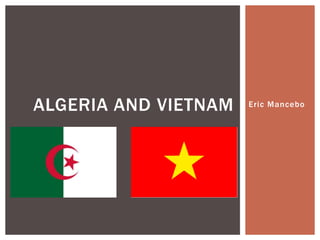
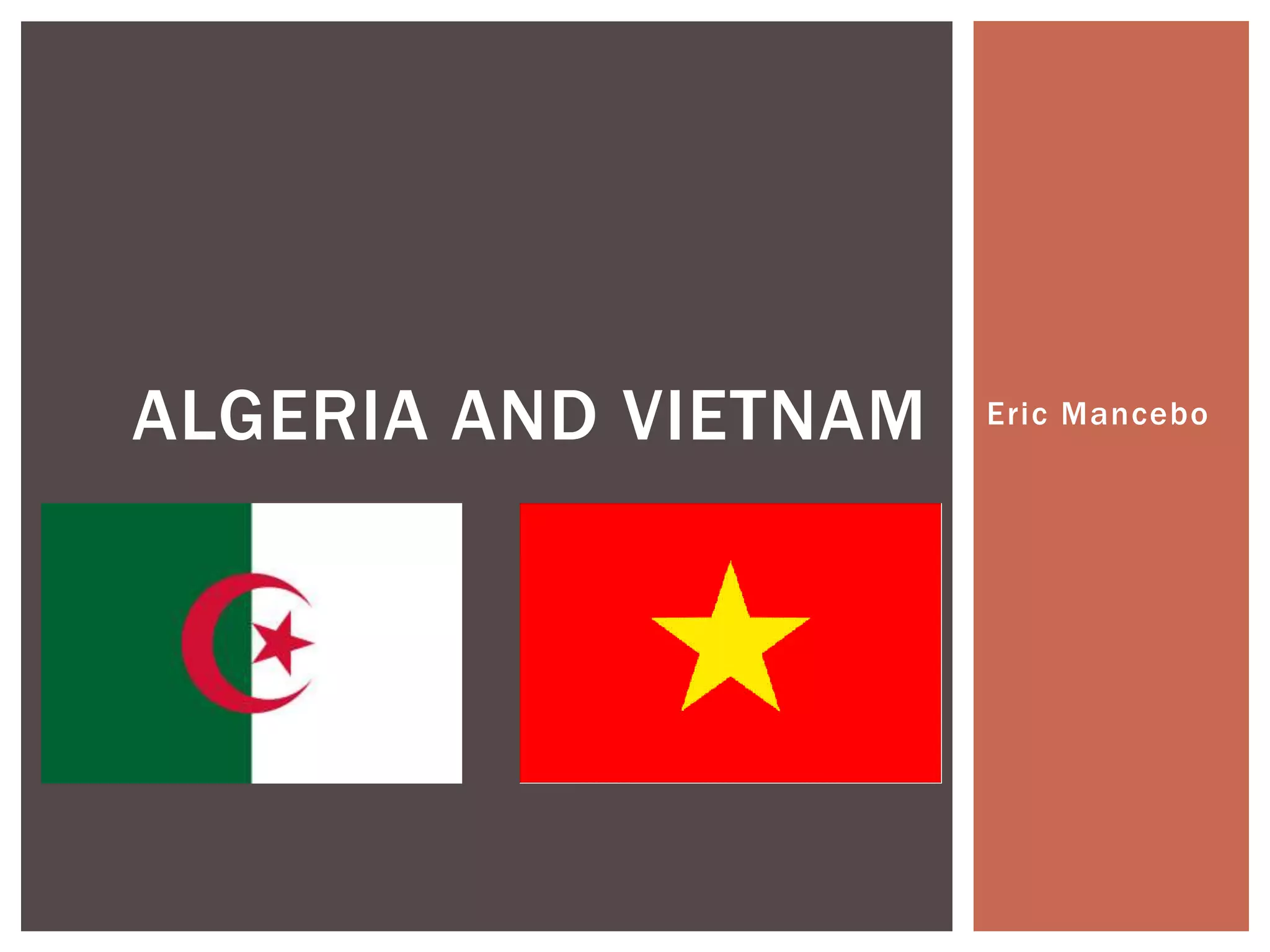
Eric ManceboALGERIA AND VIETNAM
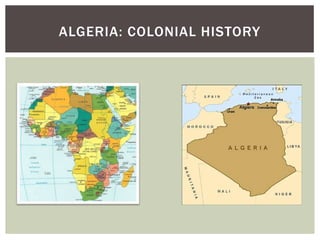
ALGERIA: COLONIAL HISTORY
 Algerian War (“War of Independence”)
 French colony for 130 years (1830-1962), the French invaded in 1830
with the desire to increase trade, spread French culture, and religion.
 1830-1870: Colonization, French populate Algeria
 “Settler Colony”- significant population of European settlers, the
majority were small farmers who grew wheat or produced wine.
 1870-1940: Slow but minimal assimilation
 Berlin Conference (1884-1885)
 Atlantic Slave trade (West and Central Coasts)
 Europe traded guns, textiles and other items for enslaved Africans.
 Europe’s conquest of Africa
 “Scramble of Africa”
 1880 80% of Africa was independent
 1900 All but Ethiopia and Liberia where claimed
ALGERIA: COLONIAL HISTORY
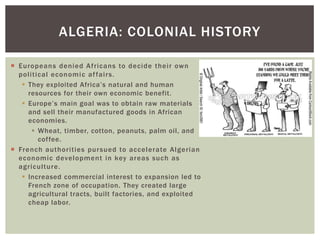
 Europeans denied Africans to decide their own
political economic affairs.
 They exploited Africa’s natural and human
resources for their own economic benefit.
 Europe’s main goal was to obtain raw materials
and sell their manufactured goods in African
economies.
 Wheat, timber, cotton, peanuts, palm oil, and
coffee.
 French authorities pursued to accelerate Algerian
economic development in key areas such as
agriculture.
 Increased commercial interest to expansion led to
French zone of occupation. They created large
agricultural tracts, built factories, and exploited
cheap labor.
ALGERIA: COLONIAL HISTORY
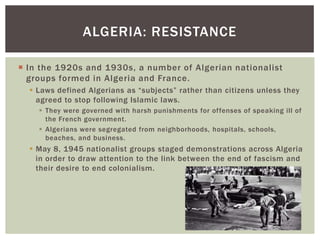
 In the 1920s and 1930s, a number of Algerian nationalist
groups formed in Algeria and France.
 Laws defined Algerians as “subjects” rather than citizens unless they
agreed to stop following Islamic laws.
 They were governed with harsh punishments for offenses of speaking ill of
the French government.
 Algerians were segregated from neighborhoods, hospitals, schools,
beaches, and business.
 May 8, 1945 nationalist groups staged demonstrations across Algeria
in order to draw attention to the link between the end of fascism and
their desire to end colonialism.
ALGERIA: RESISTANCE
 Beginning of Armed Resistance
 November 1, 1954 Libteration Nationale (FLN)
launched.
 War broke out- France vs. Algeria (1954-
1962)
 The war in Algeria was a complex conflict
characterized by guerrilla warfare, maquis
fighting, terrorism, and the use of torture by both
sides.
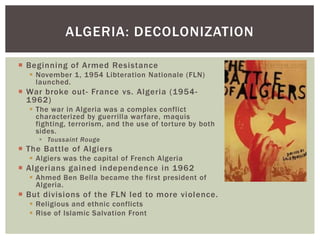
 Toussaint Rouge
 The Battle of Algiers
 Algiers was the capital of French Algeria
 Algerians gained independence in 1962
 Ahmed Ben Bella became the first president of
Algeria.
 But divisions of the FLN led to more violence.
 Religious and ethnic conflicts
 Rise of Islamic Salvation Front
ALGERIA: DECOLONIZATION
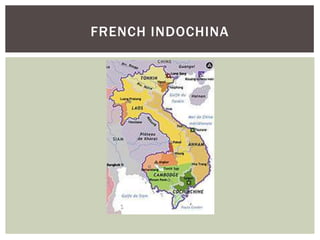
FRENCH INDOCHINA
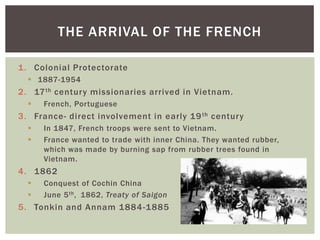
1. Colonial Protectorate
 1887-1954
2. 17th century missionaries arrived in Vietnam.
 French, Portuguese
3. France- direct involvement in early 19th century
 In 1847, French troops were sent to Vietnam.
 France wanted to trade with inner China. They wanted rubber,
which was made by burning sap from rubber trees found in
Vietnam.
4. 1862
 Conquest of Cochin China
 June 5th, 1862, Treaty of Saigon
5. Tonkin and Annam 1884-1885
THE ARRIVAL OF THE FRENCH
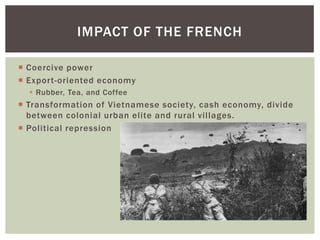
 Coercive power
 Export-oriented economy
 Rubber, Tea, and Coffee
 Transformation of Vietnamese society, cash economy, divide
between colonial urban elite and rural villages.
 Political repression
IMPACT OF THE FRENCH
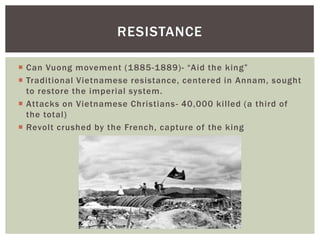
 Can Vuong movement (1885-1889)- “Aid the king”
 Traditional Vietnamese resistance, centered in Annam, sought
to restore the imperial system.
 Attacks on Vietnamese Christians- 40,000 killed (a third of
the total)
 Revolt crushed by the French, capture of the king
RESISTANCE
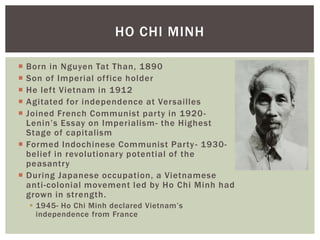
 Born in Nguyen Tat Than, 1890
 Son of Imperial office holder
 He left Vietnam in 1912
 Agitated for independence at Versailles
 Joined French Communist party in 1920-
Lenin’s Essay on Imperialism- the Highest
Stage of capitalism
 Formed Indochinese Communist Party- 1930-
belief in revolutionary potential of the
peasantry
 During Japanese occupation, a Vietnamese
anti-colonial movement led by Ho Chi Minh had
grown in strength.
 1945- Ho Chi Minh declared Vietnam’s
independence from France
HO CHI MINH
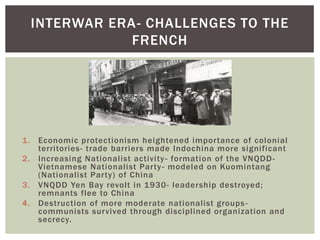
1. Economic protectionism heightened importance of colonial
territories- trade barriers made Indochina more significant
2. Increasing Nationalist activity- formation of the VNQDD-
Vietnamese Nationalist Party- modeled on Kuomintang
(Nationalist Party) of China
3. VNQDD Yen Bay revolt in 1930- leadership destroyed;
remnants flee to China
4. Destruction of more moderate nationalist groups-
communists survived through disciplined organization and
secrecy.
INTERWAR ERA- CHALLENGES TO THE
FRENCH
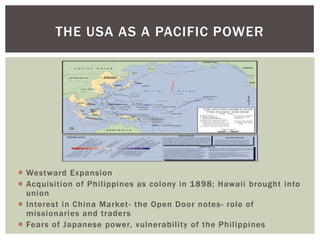
 Westward Expansion
 Acquisition of Philippines as colony in 1898; Hawaii brought into
union
 Interest in China Market- the Open Door notes- role of
missionaries and traders
 Fears of Japanese power, vulnerability of the Philippines
THE USA AS A PACIFIC POWER
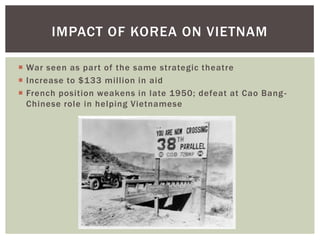
 War seen as part of the same strategic theatre
 Increase to $133 million in aid
 French position weakens in late 1950; defeat at Cao Bang-
Chinese role in helping Vietnamese
IMPACT OF KOREA ON VIETNAM
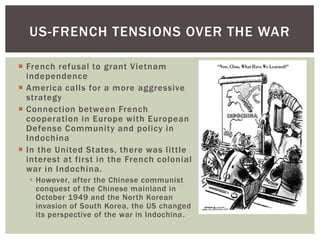
 French refusal to grant Vietnam
independence
 America calls for a more aggressive
strategy
 Connection between French
cooperation in Europe with European
Defense Community and policy in
Indochina
 In the United States, there was little
interest at first in the French colonial
war in Indochina.
 However, after the Chinese communist
conquest of the Chinese mainland in
October 1949 and the North Korean
invasion of South Korea, the US changed
its perspective of the war in Indochina.
US-FRENCH TENSIONS OVER THE WAR
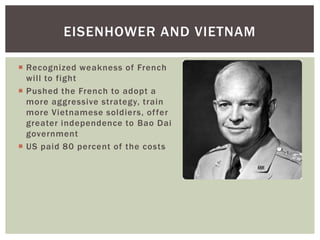
 Recognized weakness of French
will to fight
 Pushed the French to adopt a
more aggressive strategy, train
more Vietnamese soldiers, offer
greater independence to Bao Dai
government
 US paid 80 percent of the costs
EISENHOWER AND VIETNAM
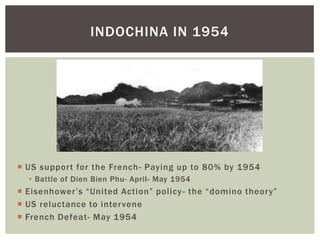
 US support for the French- Paying up to 80% by 1954
 Battle of Dien Bien Phu- April- May 1954
 Eisenhower’s “United Action” policy- the “domino theory”
 US reluctance to intervene
 French Defeat- May 1954
INDOCHINA IN 1954
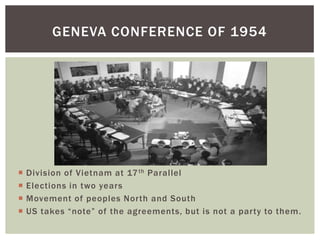
 Division of Vietnam at 17th Parallel
 Elections in two years
 Movement of peoples North and South
 US takes “note” of the agreements, but is not a party to them.
GENEVA CONFERENCE OF 1954
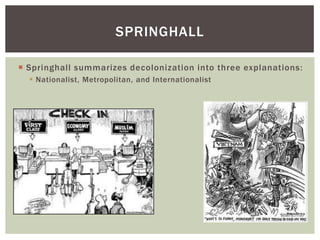
 Springhall summarizes decolonization into three explanations:
 Nationalist, Metropolitan, and Internationalist
SPRINGHALL
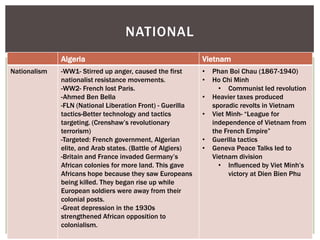
NATIONAL
Algeria Vietnam
Nationalism -WW1- Stirred up anger, caused the first
nationalist resistance movements.
-WW2- French lost Paris.
-Ahmed Ben Bella
-FLN (National Liberation Front) - Guerilla
tactics-Better technology and tactics
targeting. (Crenshaw’s revolutionary
terrorism)
-Targeted: French government, Algerian
elite, and Arab states. (Battle of Algiers)
-Britain and France invaded Germany’s
African colonies for more land. This gave
Africans hope because they saw Europeans
being killed. They began rise up while
European soldiers were away from their
colonial posts.
-Great depression in the 1930s
strengthened African opposition to
colonialism.
• Phan Boi Chau (1867-1940)
• Ho Chi Minh
• Communist led revolution
• Heavier taxes produced
sporadic revolts in Vietnam
• Viet Minh- “League for
independence of Vietnam from
the French Empire”
• Guerilla tactics
• Geneva Peace Talks led to
Vietnam division
• Influenced by Viet Minh’s
victory at Dien Bien Phu
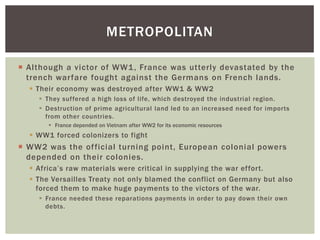
 Although a victor of WW1, France was utterly devastated by the
trench warfare fought against the Germans on French lands.
 Their economy was destroyed after WW1 & WW2
 They suffered a high loss of life, which destroyed the industrial region.
 Destruction of prime agricultural land led to an increased need for imports
from other countries.
 France depended on Vietnam after WW2 for its economic resources
 WW1 forced colonizers to fight
 WW2 was the official turning point, European colonial powers
depended on their colonies.
 Africa’s raw materials were critical in supplying the war effort.
 The Versailles Treaty not only blamed the conflict on Germany but also
forced them to make huge payments to the victors of the war.
 France needed these reparations payments in order to pay down their own
debts.
METROPOLITAN
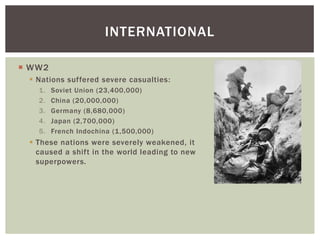
INTERNATIONAL
 WW2
 Nations suffered severe casualties:
1. Soviet Union (23,400,000)
2. China (20,000,000)
3. Germany (8,680,000)
4. Japan (2,700,000)
5. French Indochina (1,500,000)
 These nations were severely weakened, it
caused a shift in the world leading to new
superpowers.
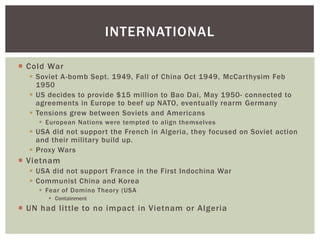
 Cold War
 Soviet A-bomb Sept. 1949, Fall of China Oct 1949, McCarthysim Feb
1950
 US decides to provide $15 million to Bao Dai, May 1950- connected to
agreements in Europe to beef up NATO, eventually rearm Germany
 Tensions grew between Soviets and Americans
 European Nations were tempted to align themselves
 USA did not support the French in Algeria, they focused on Soviet action
and their military build up.
 Proxy Wars
 Vietnam
 USA did not support France in the First Indochina War
 Communist China and Korea
 Fear of Domino Theory (USA
 Containment
 UN had little to no impact in Vietnam or Algeria
INTERNATIONAL
 Spivak argues that “The Subaltern
cannot speak”. However Algeria
and Vietnam prove her theory
wrong.
 Vietnam and Algerian resistance and
nationalist movements were
successful. Therefore, the subaltern
had a voice.
 Ho Chi Minh
 FLN
 Vietcong's
 Civilians successfully mobilized
 Both nations broke ties with France
 Communist Vietnam
 Non-Aligned Algeria
GAYATRI SPIVAK
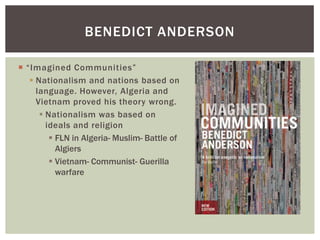
 “Imagined Communities”
 Nationalism and nations based on
language. However, Algeria and
Vietnam proved his theory wrong.
 Nationalism was based on
ideals and religion
 FLN in Algeria- Muslim- Battle of
Algiers
 Vietnam- Communist- Guerilla
warfare
BENEDICT ANDERSON
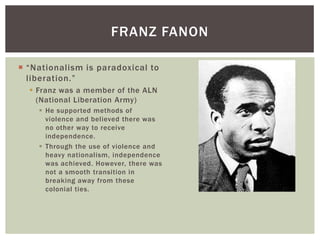
 “Nationalism is paradoxical to
liberation.”
 Franz was a member of the ALN
(National Liberation Army)
 He supported methods of
violence and believed there was
no other way to receive
independence.
 Through the use of violence and
heavy nationalism, independence
was achieved. However, there was
not a smooth transition in
breaking away from these
colonial ties.
FRANZ FANON
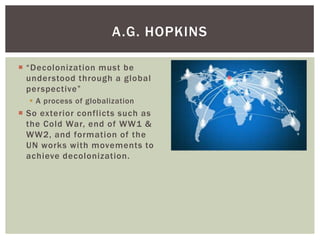
 “Decolonization must be
understood through a global
perspective”
 A process of globalization
 So exterior conflicts such as
the Cold War, end of WW1 &
WW2, and formation of the
UN works with movements to
achieve decolonization.
A.G. HOPKINS
 Steven, argues that nationalism needs to be seen as a
conversation that the present holds with the past…
 The strength of nationalism as a political phenomenon is its ability to
draw on sentiments- language, religion, family, culture- that appear
to be natural and autochthonous.
 After WW2 Vietnam and Algeria saw that the European powers
were weakened and could be defeated.
 Nationalism stirred up after: Gia Dinh Bao (First Vietnamese
newspaper), Japanese Invasion, Ho Chi Minh and his communist
ideals.
STEVEN KEMPER
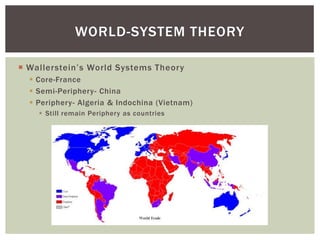
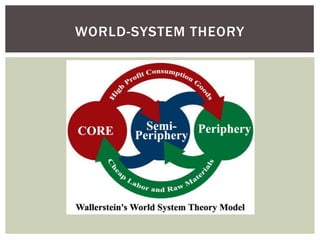
 Wallerstein’s World Systems Theory
 Core-France
 Semi-Periphery- China
 Periphery- Algeria & Indochina (Vietnam)
 Still remain Periphery as countries
WORLD-SYSTEM THEORY
WORLD-SYSTEM THEORY
 Algeria:
 Ahmed Ben Bella is elected president
 Declared that Algeria would follow a neutral course in world politics
 Banned opposition parties
 The war of national liberation disrupted Algeria’s society and economy.
 Many civilians were homeless, unemployed, and suffered from illness.
 Ahmed Ben Bella was exiled, Boumédiènne assumed power.
 Admitted as the 109th member of the United Nations
 Non-Aligned movement (1973)
 Algeria suffered from another violent civil war in the 1990s.
 Vietnam
 Partition
 Second Indochina War (Vietnam War, 1956-1975)
 Soviet Union, China, and North Vietnam vs. South Vietnam and USA
 Vietnam unified under communism in 1976
 Free Market reforms in 1986
POST-COLONIAL IMPACT
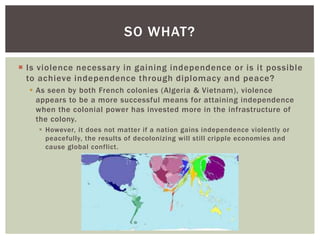
 Is violence necessary in gaining independence or is it possible
to achieve independence through diplomacy and peace?
 As seen by both French colonies (Algeria & Vietnam), violence
appears to be a more successful means for attaining independence
when the colonial power has invested more in the infrastructure of
the colony.
 However, it does not matter if a nation gains independence violently or
peacefully, the results of decolonizing will still cripple economies and
cause global conflict.
SO WHAT?

Vietnam and Algeria

  • 1.
  • 2.
  • 3.
     Algerian War(“War of Independence”)  French colony for 130 years (1830-1962), the French invaded in 1830 with the desire to increase trade, spread French culture, and religion.  1830-1870: Colonization, French populate Algeria  “Settler Colony”- significant population of European settlers, the majority were small farmers who grew wheat or produced wine.  1870-1940: Slow but minimal assimilation  Berlin Conference (1884-1885)  Atlantic Slave trade (West and Central Coasts)  Europe traded guns, textiles and other items for enslaved Africans.  Europe’s conquest of Africa  “Scramble of Africa”  1880 80% of Africa was independent  1900 All but Ethiopia and Liberia where claimed ALGERIA: COLONIAL HISTORY
  • 4.
     Europeans deniedAfricans to decide their own political economic affairs.  They exploited Africa’s natural and human resources for their own economic benefit.  Europe’s main goal was to obtain raw materials and sell their manufactured goods in African economies.  Wheat, timber, cotton, peanuts, palm oil, and coffee.  French authorities pursued to accelerate Algerian economic development in key areas such as agriculture.  Increased commercial interest to expansion led to French zone of occupation. They created large agricultural tracts, built factories, and exploited cheap labor. ALGERIA: COLONIAL HISTORY
  • 5.
     In the1920s and 1930s, a number of Algerian nationalist groups formed in Algeria and France.  Laws defined Algerians as “subjects” rather than citizens unless they agreed to stop following Islamic laws.  They were governed with harsh punishments for offenses of speaking ill of the French government.  Algerians were segregated from neighborhoods, hospitals, schools, beaches, and business.  May 8, 1945 nationalist groups staged demonstrations across Algeria in order to draw attention to the link between the end of fascism and their desire to end colonialism. ALGERIA: RESISTANCE
  • 6.
     Beginning ofArmed Resistance  November 1, 1954 Libteration Nationale (FLN) launched.  War broke out- France vs. Algeria (1954- 1962)  The war in Algeria was a complex conflict characterized by guerrilla warfare, maquis fighting, terrorism, and the use of torture by both sides.  Toussaint Rouge  The Battle of Algiers  Algiers was the capital of French Algeria  Algerians gained independence in 1962  Ahmed Ben Bella became the first president of Algeria.  But divisions of the FLN led to more violence.  Religious and ethnic conflicts  Rise of Islamic Salvation Front ALGERIA: DECOLONIZATION
  • 7.
  • 8.
    1. Colonial Protectorate 1887-1954 2. 17th century missionaries arrived in Vietnam.  French, Portuguese 3. France- direct involvement in early 19th century  In 1847, French troops were sent to Vietnam.  France wanted to trade with inner China. They wanted rubber, which was made by burning sap from rubber trees found in Vietnam. 4. 1862  Conquest of Cochin China  June 5th, 1862, Treaty of Saigon 5. Tonkin and Annam 1884-1885 THE ARRIVAL OF THE FRENCH
  • 9.
     Coercive power Export-oriented economy  Rubber, Tea, and Coffee  Transformation of Vietnamese society, cash economy, divide between colonial urban elite and rural villages.  Political repression IMPACT OF THE FRENCH
  • 10.
     Can Vuongmovement (1885-1889)- “Aid the king”  Traditional Vietnamese resistance, centered in Annam, sought to restore the imperial system.  Attacks on Vietnamese Christians- 40,000 killed (a third of the total)  Revolt crushed by the French, capture of the king RESISTANCE
  • 11.
     Born inNguyen Tat Than, 1890  Son of Imperial office holder  He left Vietnam in 1912  Agitated for independence at Versailles  Joined French Communist party in 1920- Lenin’s Essay on Imperialism- the Highest Stage of capitalism  Formed Indochinese Communist Party- 1930- belief in revolutionary potential of the peasantry  During Japanese occupation, a Vietnamese anti-colonial movement led by Ho Chi Minh had grown in strength.  1945- Ho Chi Minh declared Vietnam’s independence from France HO CHI MINH
  • 12.
    1. Economic protectionismheightened importance of colonial territories- trade barriers made Indochina more significant 2. Increasing Nationalist activity- formation of the VNQDD- Vietnamese Nationalist Party- modeled on Kuomintang (Nationalist Party) of China 3. VNQDD Yen Bay revolt in 1930- leadership destroyed; remnants flee to China 4. Destruction of more moderate nationalist groups- communists survived through disciplined organization and secrecy. INTERWAR ERA- CHALLENGES TO THE FRENCH
  • 13.
     Westward Expansion Acquisition of Philippines as colony in 1898; Hawaii brought into union  Interest in China Market- the Open Door notes- role of missionaries and traders  Fears of Japanese power, vulnerability of the Philippines THE USA AS A PACIFIC POWER
  • 14.
     War seenas part of the same strategic theatre  Increase to $133 million in aid  French position weakens in late 1950; defeat at Cao Bang- Chinese role in helping Vietnamese IMPACT OF KOREA ON VIETNAM
  • 15.
     French refusalto grant Vietnam independence  America calls for a more aggressive strategy  Connection between French cooperation in Europe with European Defense Community and policy in Indochina  In the United States, there was little interest at first in the French colonial war in Indochina.  However, after the Chinese communist conquest of the Chinese mainland in October 1949 and the North Korean invasion of South Korea, the US changed its perspective of the war in Indochina. US-FRENCH TENSIONS OVER THE WAR
  • 16.
     Recognized weaknessof French will to fight  Pushed the French to adopt a more aggressive strategy, train more Vietnamese soldiers, offer greater independence to Bao Dai government  US paid 80 percent of the costs EISENHOWER AND VIETNAM
  • 17.
     US supportfor the French- Paying up to 80% by 1954  Battle of Dien Bien Phu- April- May 1954  Eisenhower’s “United Action” policy- the “domino theory”  US reluctance to intervene  French Defeat- May 1954 INDOCHINA IN 1954
  • 18.
     Division ofVietnam at 17th Parallel  Elections in two years  Movement of peoples North and South  US takes “note” of the agreements, but is not a party to them. GENEVA CONFERENCE OF 1954
  • 19.
     Springhall summarizesdecolonization into three explanations:  Nationalist, Metropolitan, and Internationalist SPRINGHALL
  • 20.
    NATIONAL Algeria Vietnam Nationalism -WW1-Stirred up anger, caused the first nationalist resistance movements. -WW2- French lost Paris. -Ahmed Ben Bella -FLN (National Liberation Front) - Guerilla tactics-Better technology and tactics targeting. (Crenshaw’s revolutionary terrorism) -Targeted: French government, Algerian elite, and Arab states. (Battle of Algiers) -Britain and France invaded Germany’s African colonies for more land. This gave Africans hope because they saw Europeans being killed. They began rise up while European soldiers were away from their colonial posts. -Great depression in the 1930s strengthened African opposition to colonialism. • Phan Boi Chau (1867-1940) • Ho Chi Minh • Communist led revolution • Heavier taxes produced sporadic revolts in Vietnam • Viet Minh- “League for independence of Vietnam from the French Empire” • Guerilla tactics • Geneva Peace Talks led to Vietnam division • Influenced by Viet Minh’s victory at Dien Bien Phu
  • 21.
     Although avictor of WW1, France was utterly devastated by the trench warfare fought against the Germans on French lands.  Their economy was destroyed after WW1 & WW2  They suffered a high loss of life, which destroyed the industrial region.  Destruction of prime agricultural land led to an increased need for imports from other countries.  France depended on Vietnam after WW2 for its economic resources  WW1 forced colonizers to fight  WW2 was the official turning point, European colonial powers depended on their colonies.  Africa’s raw materials were critical in supplying the war effort.  The Versailles Treaty not only blamed the conflict on Germany but also forced them to make huge payments to the victors of the war.  France needed these reparations payments in order to pay down their own debts. METROPOLITAN
  • 22.
    INTERNATIONAL  WW2  Nationssuffered severe casualties: 1. Soviet Union (23,400,000) 2. China (20,000,000) 3. Germany (8,680,000) 4. Japan (2,700,000) 5. French Indochina (1,500,000)  These nations were severely weakened, it caused a shift in the world leading to new superpowers.
  • 23.
     Cold War Soviet A-bomb Sept. 1949, Fall of China Oct 1949, McCarthysim Feb 1950  US decides to provide $15 million to Bao Dai, May 1950- connected to agreements in Europe to beef up NATO, eventually rearm Germany  Tensions grew between Soviets and Americans  European Nations were tempted to align themselves  USA did not support the French in Algeria, they focused on Soviet action and their military build up.  Proxy Wars  Vietnam  USA did not support France in the First Indochina War  Communist China and Korea  Fear of Domino Theory (USA  Containment  UN had little to no impact in Vietnam or Algeria INTERNATIONAL
  • 24.
     Spivak arguesthat “The Subaltern cannot speak”. However Algeria and Vietnam prove her theory wrong.  Vietnam and Algerian resistance and nationalist movements were successful. Therefore, the subaltern had a voice.  Ho Chi Minh  FLN  Vietcong's  Civilians successfully mobilized  Both nations broke ties with France  Communist Vietnam  Non-Aligned Algeria GAYATRI SPIVAK
  • 25.
     “Imagined Communities” Nationalism and nations based on language. However, Algeria and Vietnam proved his theory wrong.  Nationalism was based on ideals and religion  FLN in Algeria- Muslim- Battle of Algiers  Vietnam- Communist- Guerilla warfare BENEDICT ANDERSON
  • 26.
     “Nationalism isparadoxical to liberation.”  Franz was a member of the ALN (National Liberation Army)  He supported methods of violence and believed there was no other way to receive independence.  Through the use of violence and heavy nationalism, independence was achieved. However, there was not a smooth transition in breaking away from these colonial ties. FRANZ FANON
  • 27.
     “Decolonization mustbe understood through a global perspective”  A process of globalization  So exterior conflicts such as the Cold War, end of WW1 & WW2, and formation of the UN works with movements to achieve decolonization. A.G. HOPKINS
  • 28.
     Steven, arguesthat nationalism needs to be seen as a conversation that the present holds with the past…  The strength of nationalism as a political phenomenon is its ability to draw on sentiments- language, religion, family, culture- that appear to be natural and autochthonous.  After WW2 Vietnam and Algeria saw that the European powers were weakened and could be defeated.  Nationalism stirred up after: Gia Dinh Bao (First Vietnamese newspaper), Japanese Invasion, Ho Chi Minh and his communist ideals. STEVEN KEMPER
  • 29.
     Wallerstein’s WorldSystems Theory  Core-France  Semi-Periphery- China  Periphery- Algeria & Indochina (Vietnam)  Still remain Periphery as countries WORLD-SYSTEM THEORY
  • 30.
  • 31.
     Algeria:  AhmedBen Bella is elected president  Declared that Algeria would follow a neutral course in world politics  Banned opposition parties  The war of national liberation disrupted Algeria’s society and economy.  Many civilians were homeless, unemployed, and suffered from illness.  Ahmed Ben Bella was exiled, Boumédiènne assumed power.  Admitted as the 109th member of the United Nations  Non-Aligned movement (1973)  Algeria suffered from another violent civil war in the 1990s.  Vietnam  Partition  Second Indochina War (Vietnam War, 1956-1975)  Soviet Union, China, and North Vietnam vs. South Vietnam and USA  Vietnam unified under communism in 1976  Free Market reforms in 1986 POST-COLONIAL IMPACT
  • 32.
     Is violencenecessary in gaining independence or is it possible to achieve independence through diplomacy and peace?  As seen by both French colonies (Algeria & Vietnam), violence appears to be a more successful means for attaining independence when the colonial power has invested more in the infrastructure of the colony.  However, it does not matter if a nation gains independence violently or peacefully, the results of decolonizing will still cripple economies and cause global conflict. SO WHAT?