ELECTIVE-II
URBAN DESIGN
LECTURE-6
Ar. Ananta Gautam
PUBLIC OPEN SPACES
Department of Architecture
Pokhara Engineering College
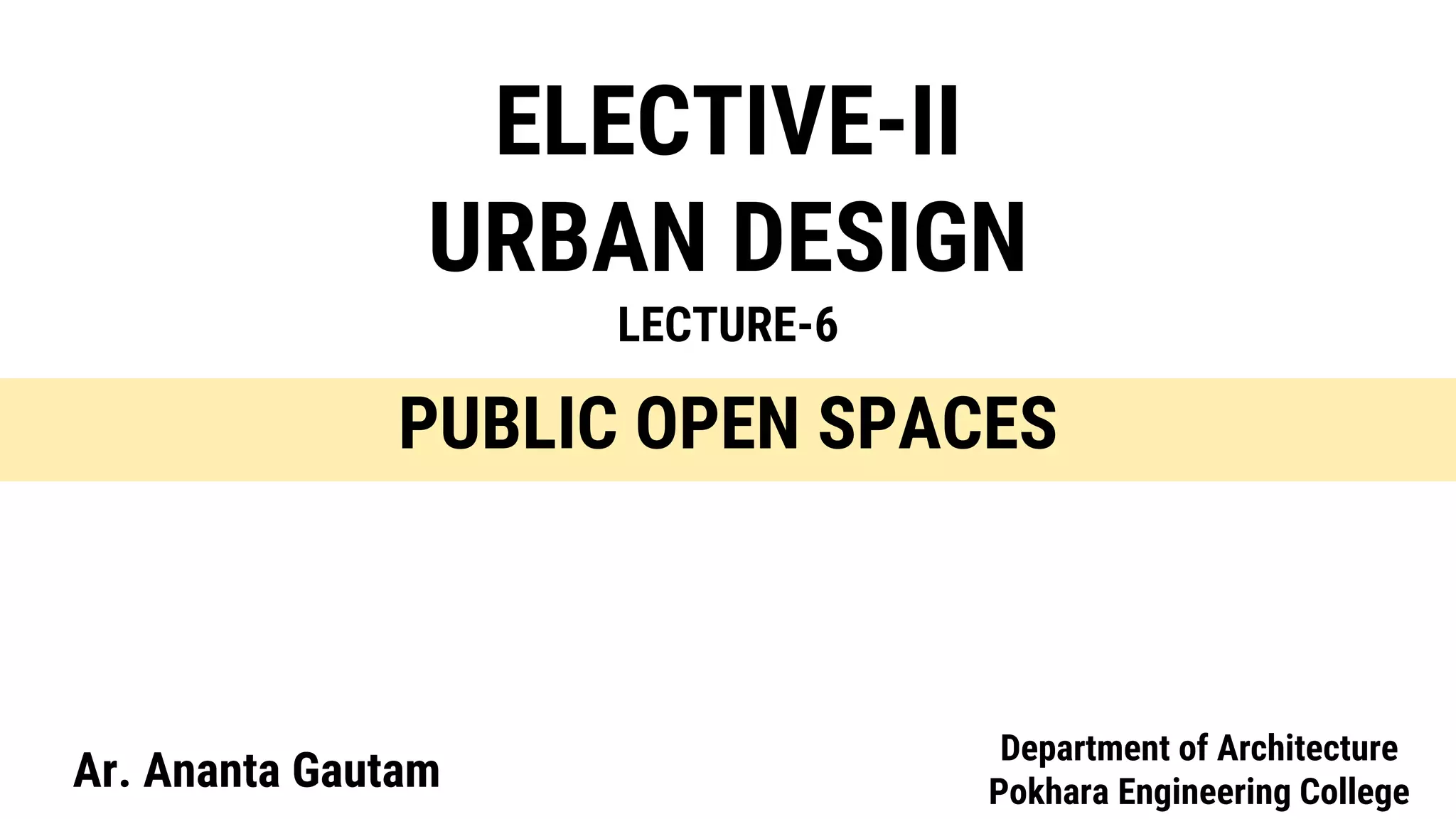
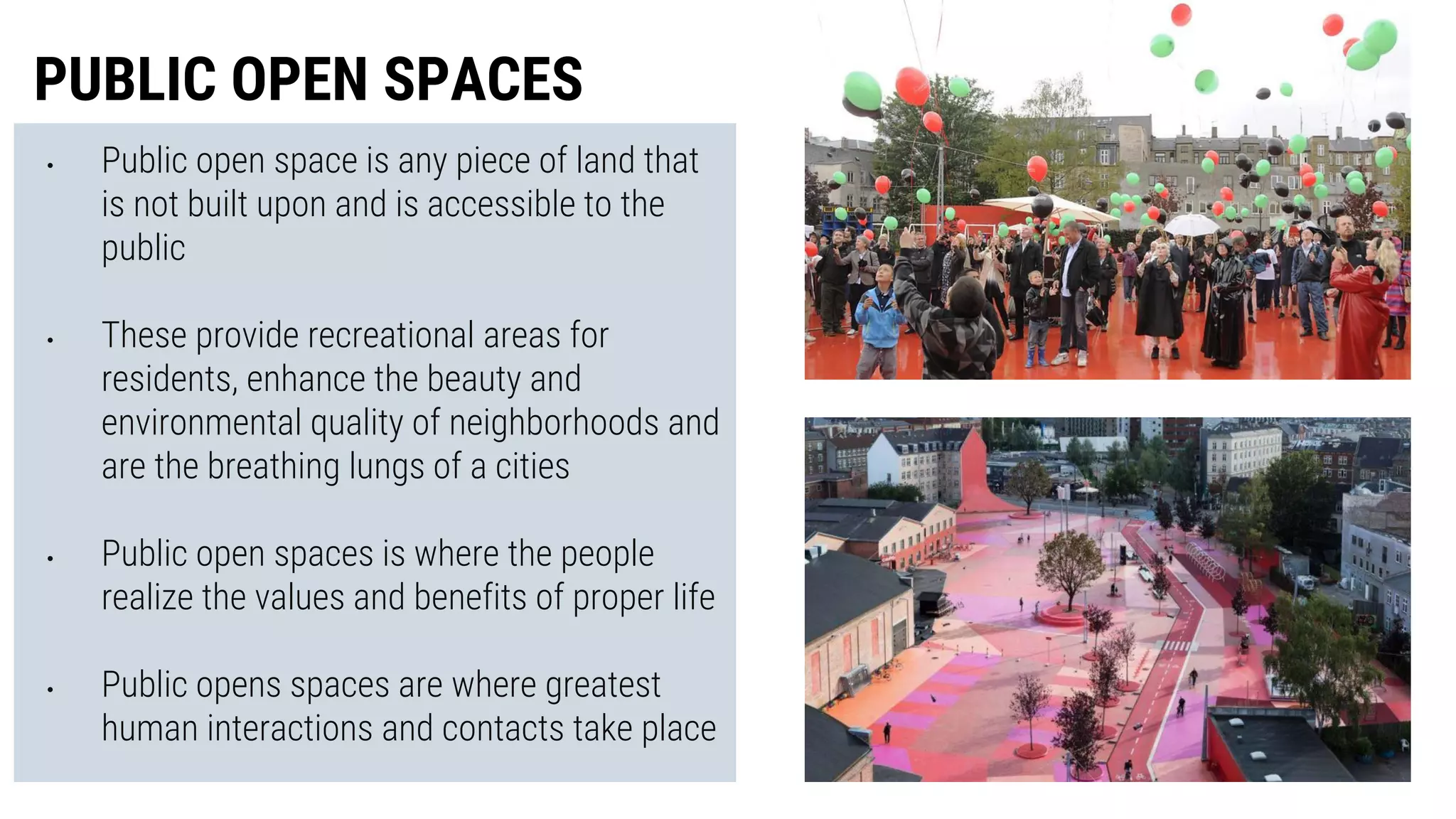
• Public open space is any piece of land that
is not built upon and is accessible to the
public
• These provide recreational areas for
residents, enhance the beauty and
environmental quality of neighborhoods and
are the breathing lungs of a cities
• Public open spaces is where the people
realize the values and benefits of proper life
• Public opens spaces are where greatest
human interactions and contacts take place
PUBLIC OPEN SPACES
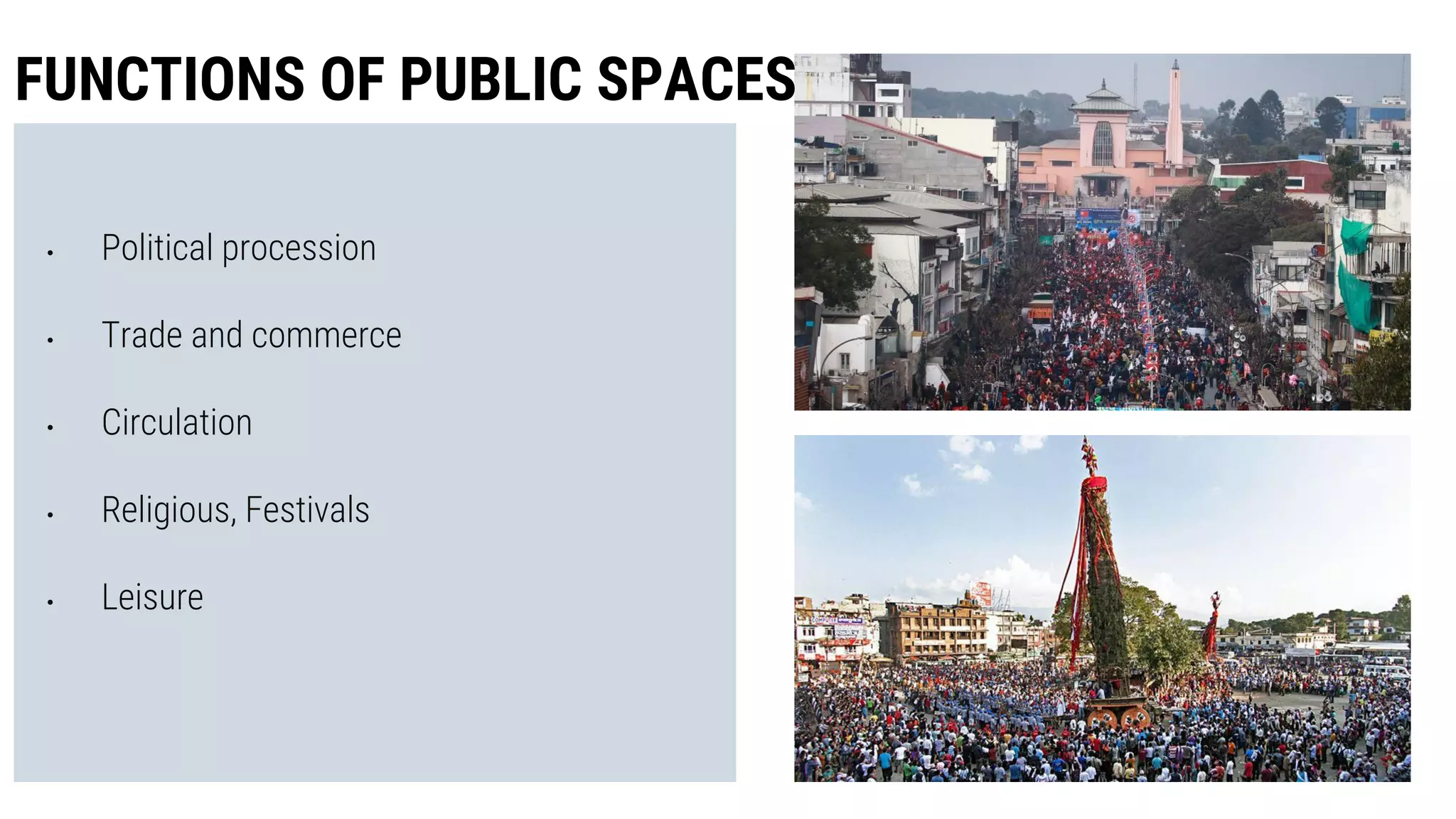
• Political procession
• Trade and commerce
• Circulation
• Religious, Festivals
• Leisure
FUNCTIONS OF PUBLIC SPACES
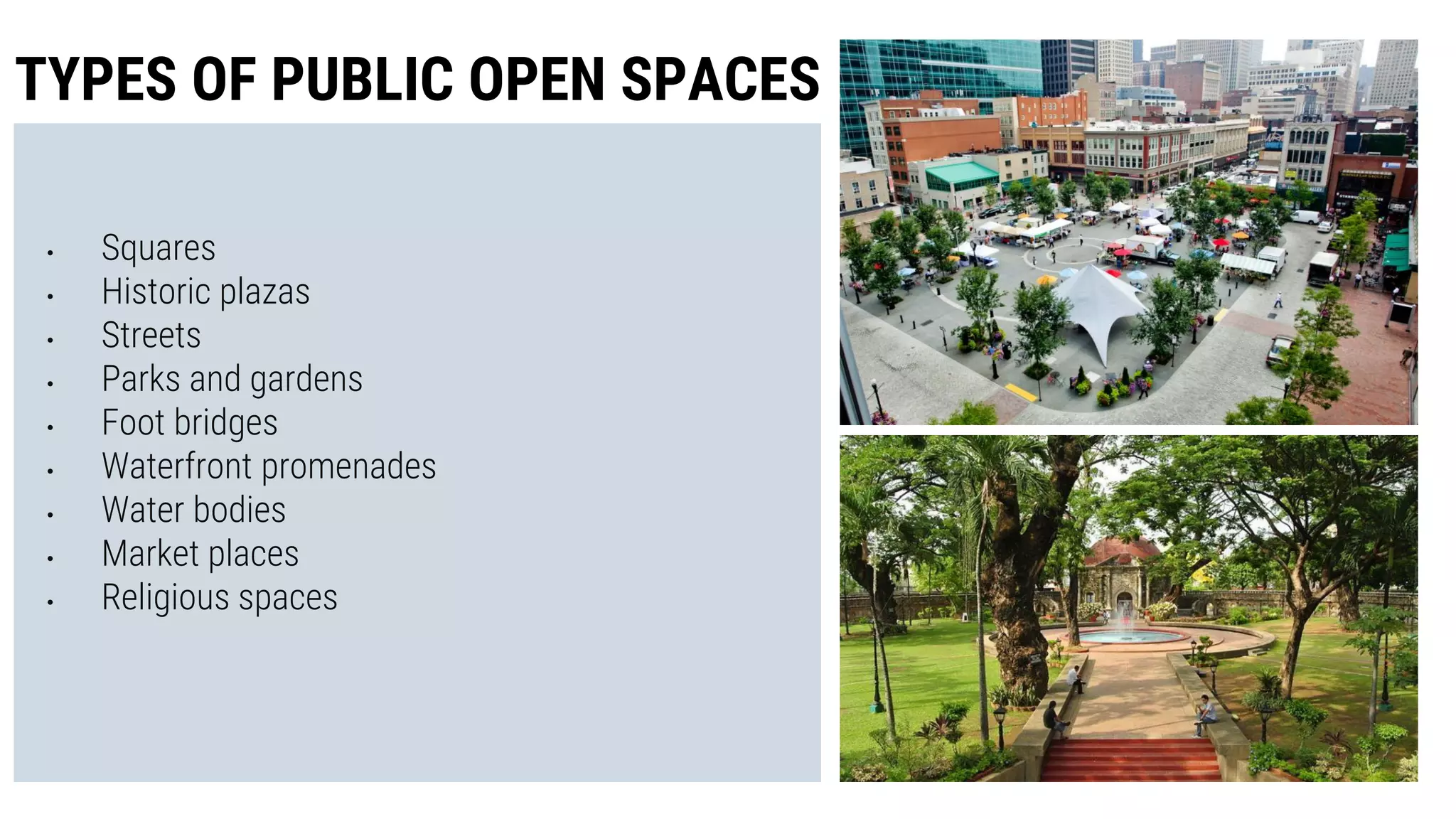
• Squares
• Historic plazas
• Streets
• Parks and gardens
• Foot bridges
• Waterfront promenades
• Water bodies
• Market places
• Religious spaces
TYPES OF PUBLIC OPEN SPACES
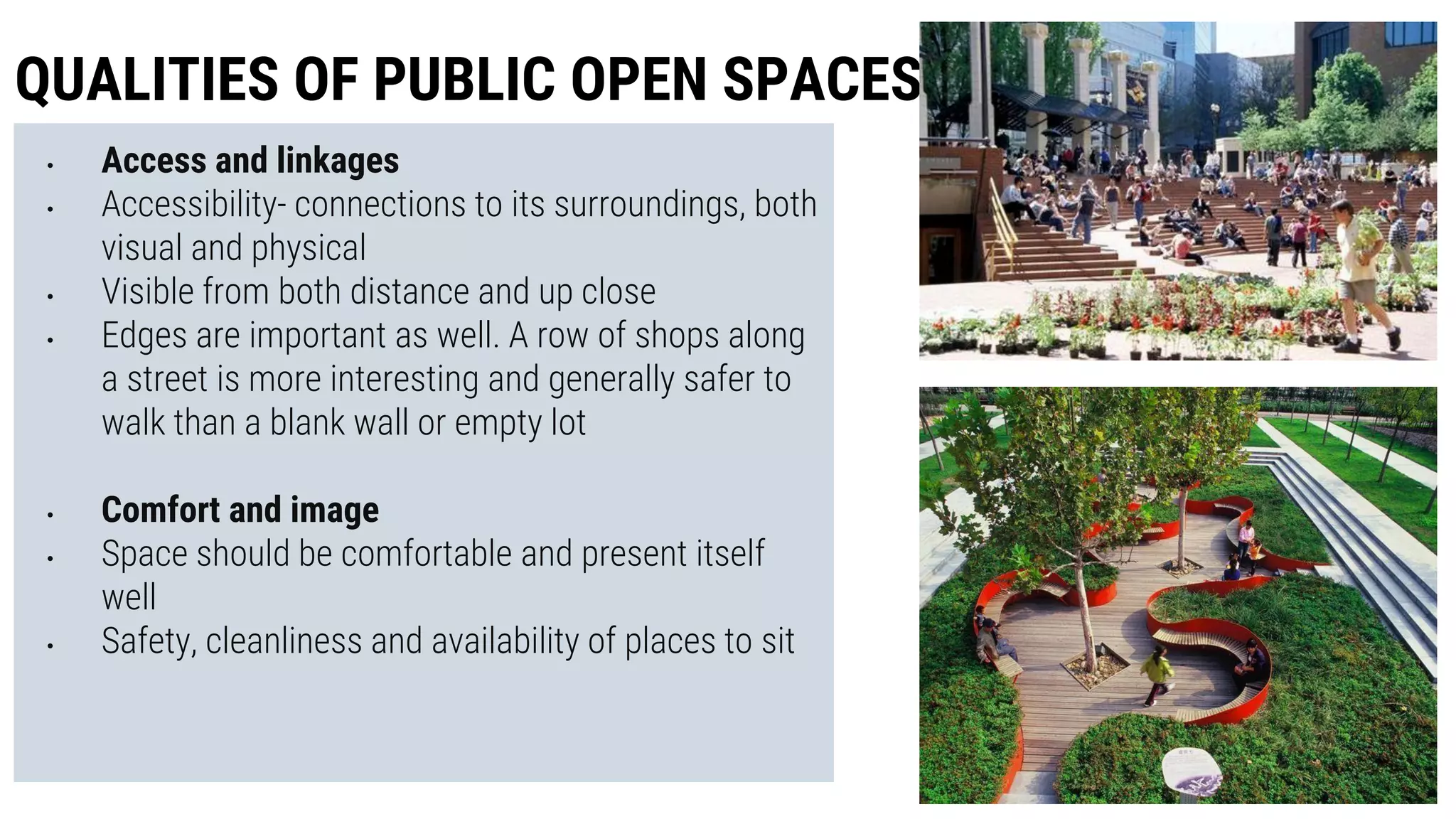
• Access and linkages
• Accessibility- connections to its surroundings, both
visual and physical
• Visible from both distance and up close
• Edges are important as well. A row of shops along
a street is more interesting and generally safer to
walk than a blank wall or empty lot
• Comfort and image
• Space should be comfortable and present itself
well
• Safety, cleanliness and availability of places to sit
QUALITIES OF PUBLIC OPEN SPACES
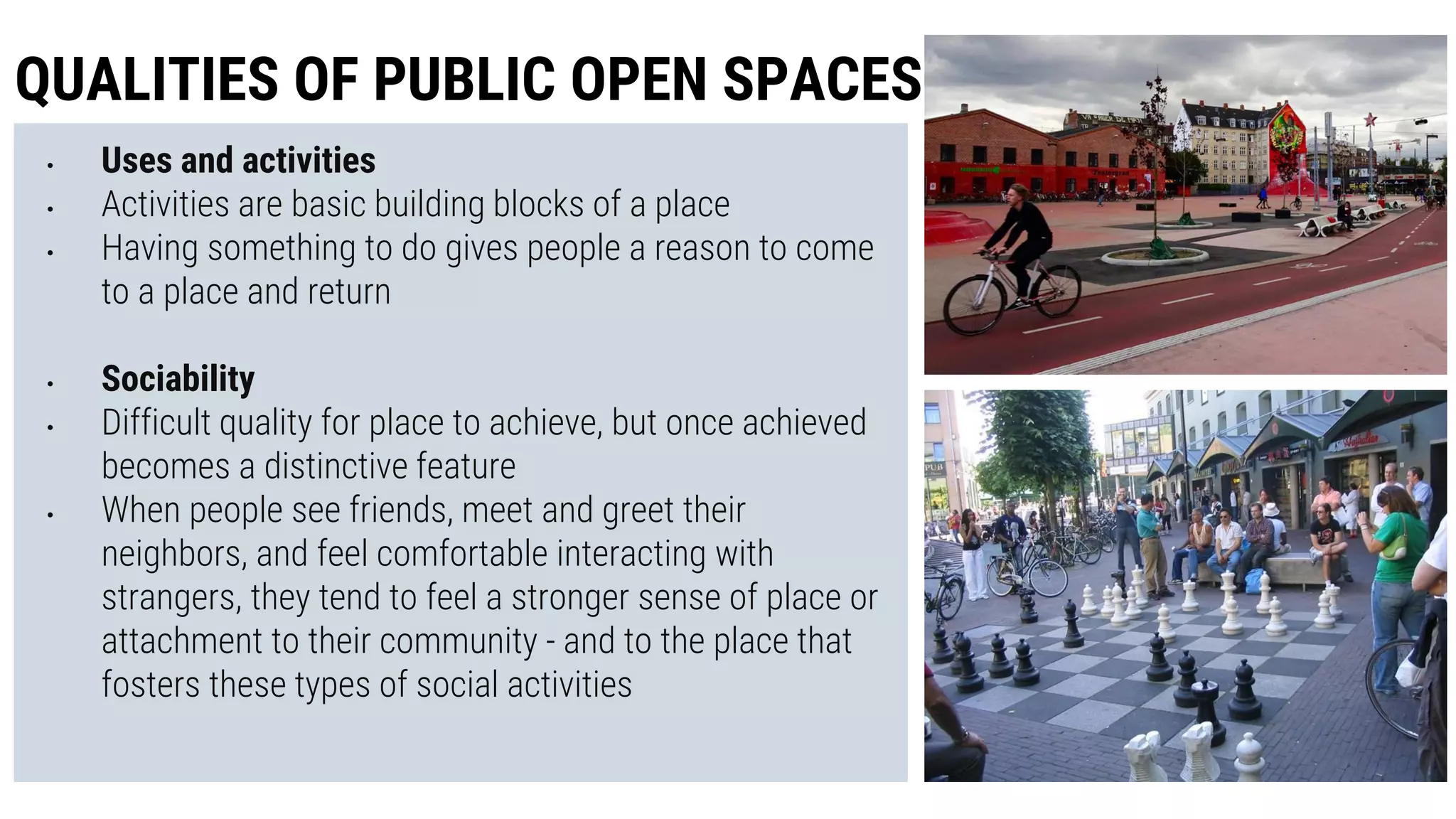
• Uses and activities
• Activities are basic building blocks of a place
• Having something to do gives people a reason to come
to a place and return
• Sociability
• Difficult quality for place to achieve, but once achieved
becomes a distinctive feature
• When people see friends, meet and greet their
neighbors, and feel comfortable interacting with
strangers, they tend to feel a stronger sense of place or
attachment to their community - and to the place that
fosters these types of social activities
QUALITIES OF PUBLIC OPEN SPACES
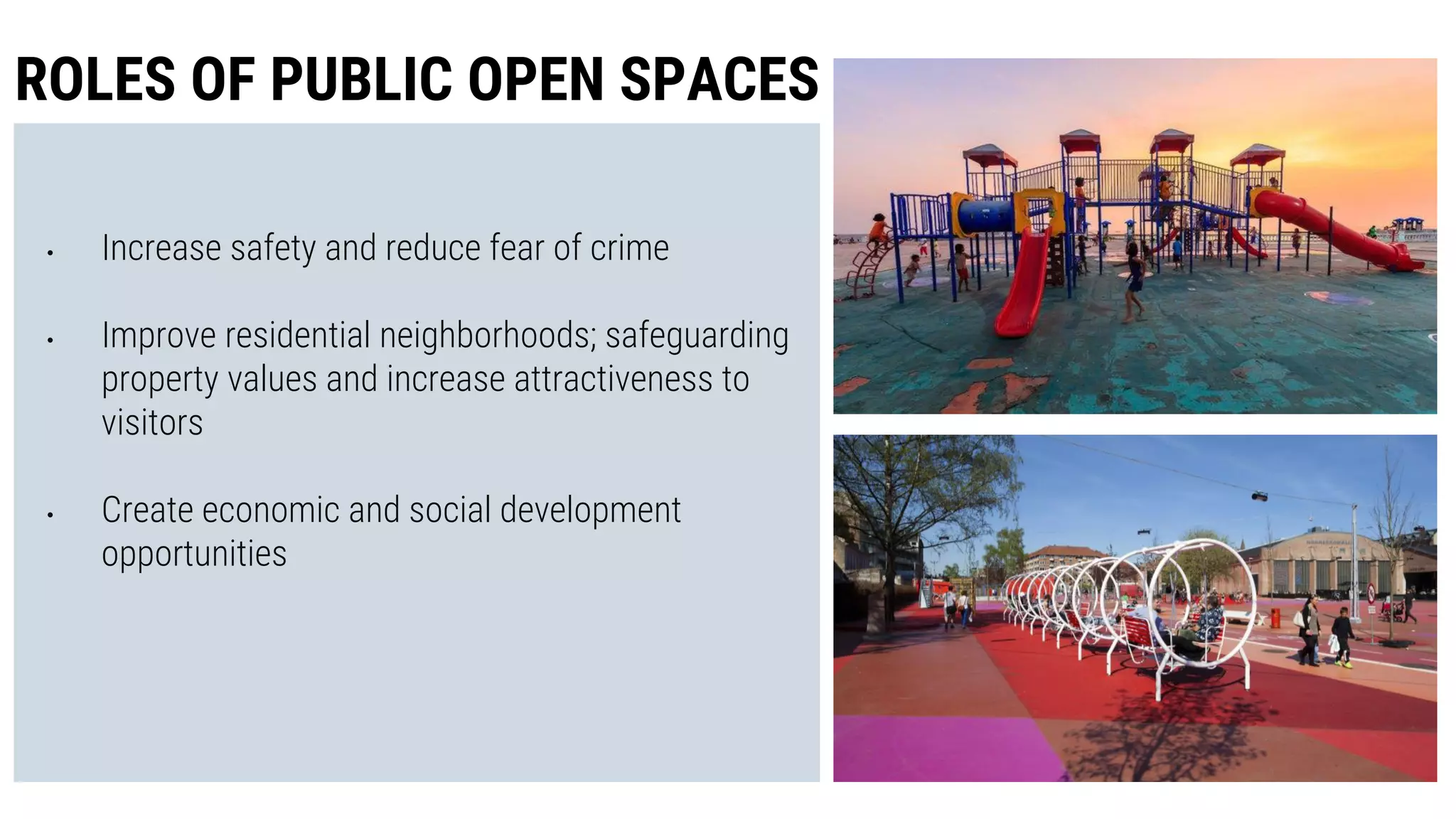
• Increase safety and reduce fear of crime
• Improve residential neighborhoods; safeguarding
property values and increase attractiveness to
visitors
• Create economic and social development
opportunities
ROLES OF PUBLIC OPEN SPACES
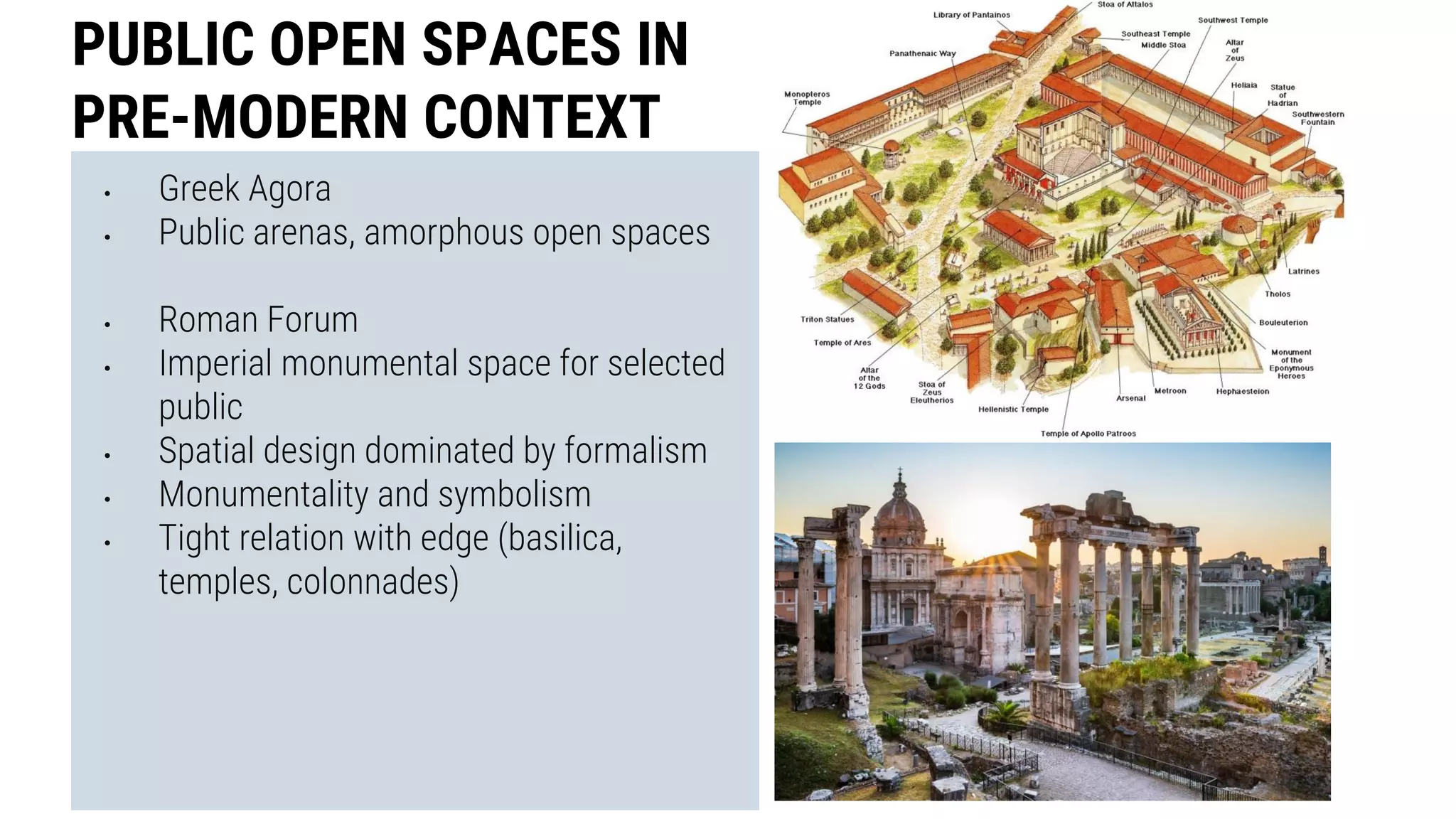
• Greek Agora
• Public arenas, amorphous open spaces
• Roman Forum
• Imperial monumental space for selected
public
• Spatial design dominated by formalism
• Monumentality and symbolism
• Tight relation with edge (basilica,
temples, colonnades)
PUBLIC OPEN SPACES IN
PRE-MODERN CONTEXT
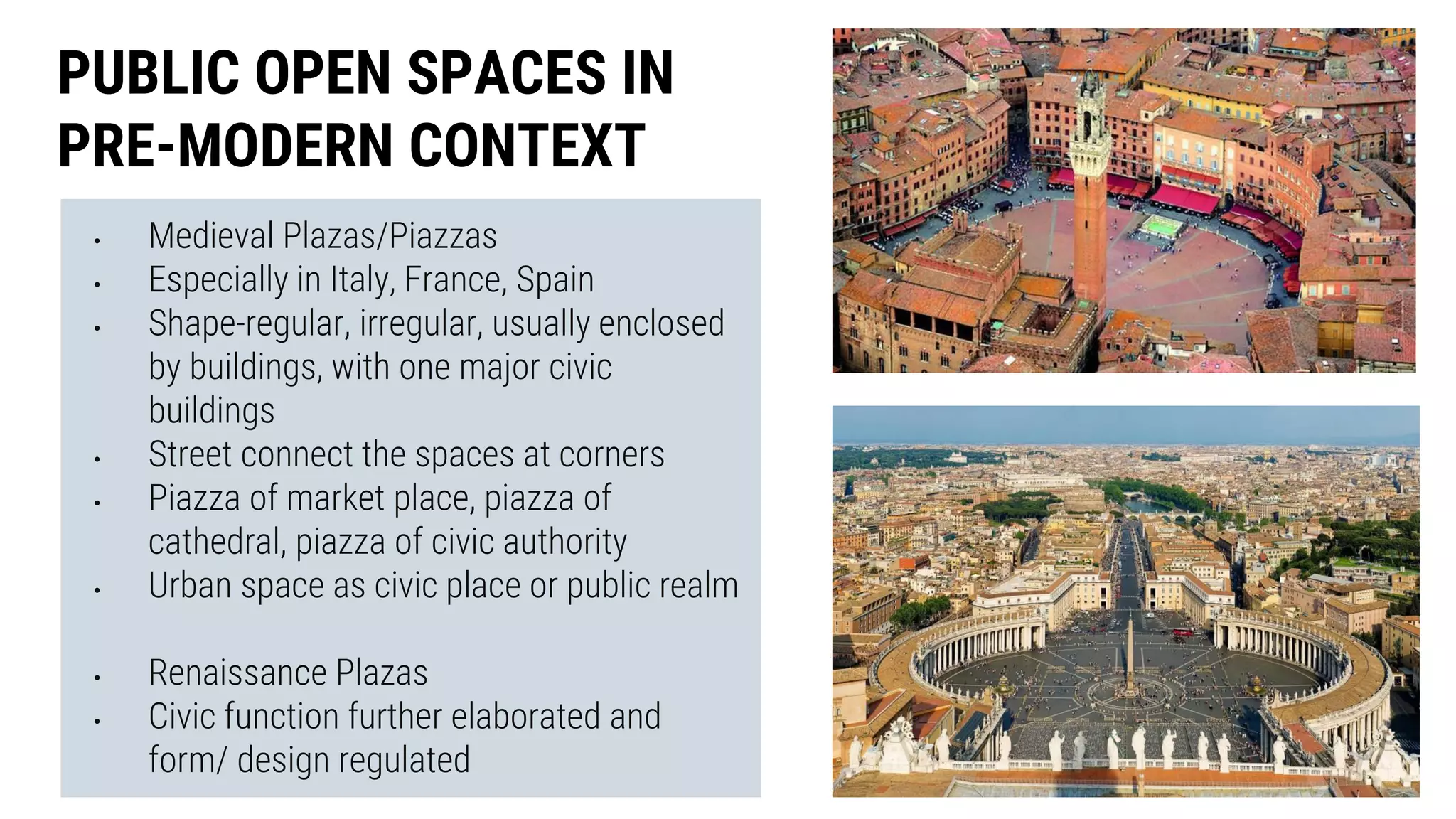
• Medieval Plazas/Piazzas
• Especially in Italy, France, Spain
• Shape-regular, irregular, usually enclosed
by buildings, with one major civic
buildings
• Street connect the spaces at corners
• Piazza of market place, piazza of
cathedral, piazza of civic authority
• Urban space as civic place or public realm
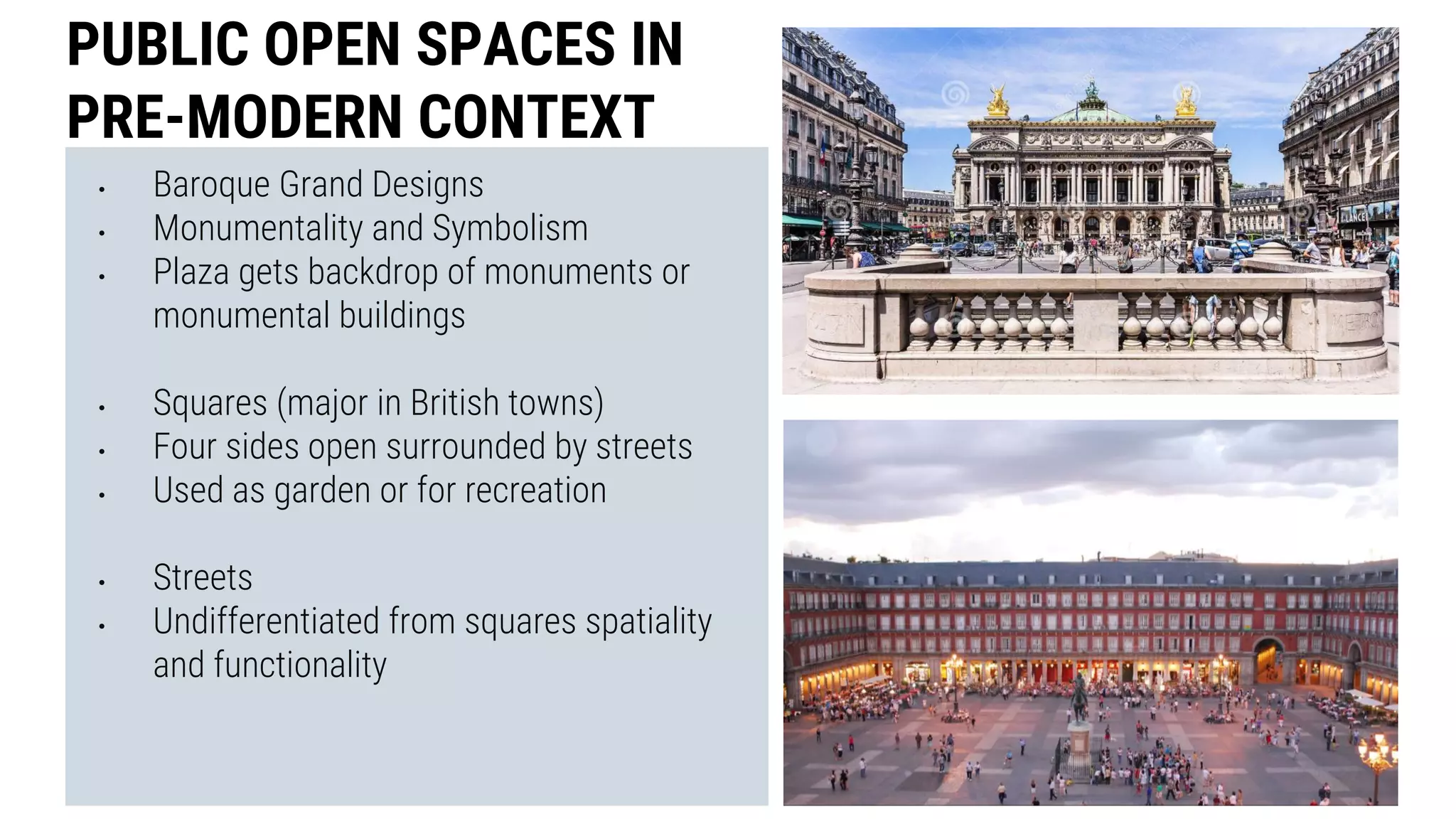
• Renaissance Plazas
• Civic function further elaborated and
form/ design regulated
PUBLIC OPEN SPACES IN
PRE-MODERN CONTEXT
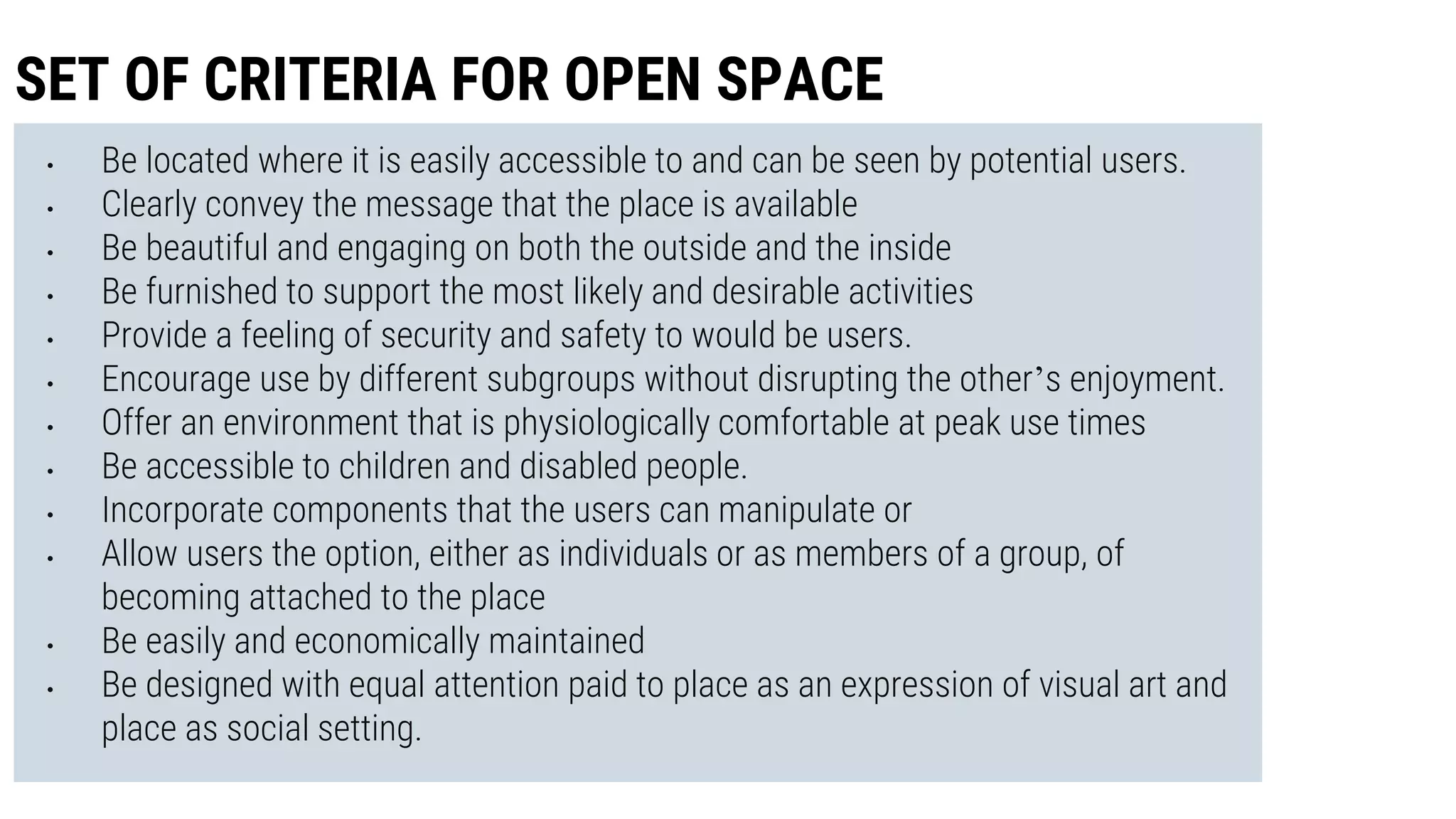
• Baroque Grand Designs
• Monumentality and Symbolism
• Plaza gets backdrop of monuments or
monumental buildings
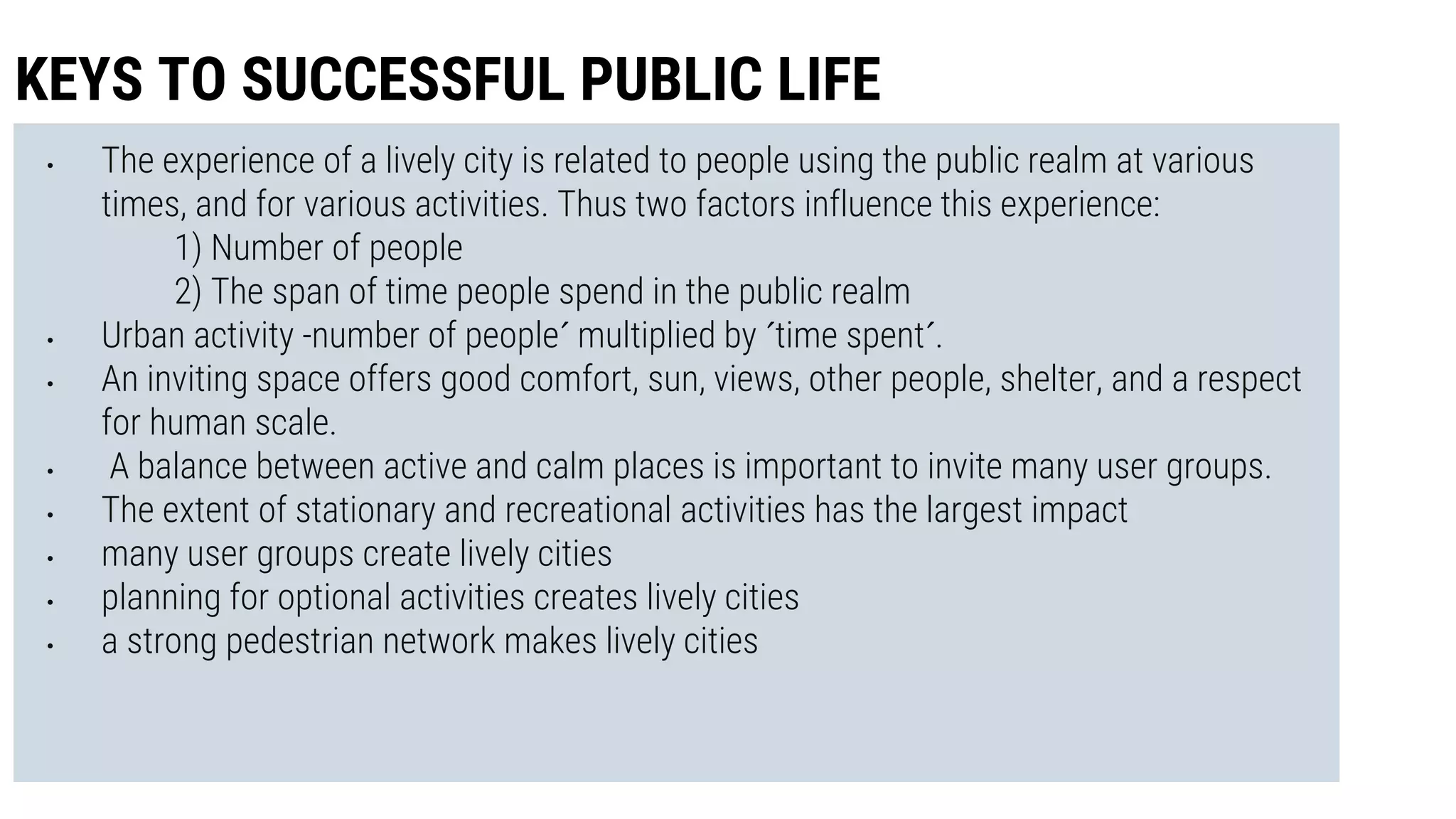
• Squares (major in British towns)
• Four sides open surrounded by streets
• Used as garden or for recreation
• Streets
• Undifferentiated from squares spatiality
and functionality
PUBLIC OPEN SPACES IN
PRE-MODERN CONTEXT
• Be located where it is easily accessible to and can be seen by potential users.
• Clearly convey the message that the place is available
• Be beautiful and engaging on both the outside and the inside
• Be furnished to support the most likely and desirable activities
• Provide a feeling of security and safety to would be users.
• Encourage use by different subgroups without disrupting the other’s enjoyment.
• Offer an environment that is physiologically comfortable at peak use times
• Be accessible to children and disabled people.
• Incorporate components that the users can manipulate or
• Allow users the option, either as individuals or as members of a group, of
becoming attached to the place
• Be easily and economically maintained
• Be designed with equal attention paid to place as an expression of visual art and
place as social setting.
SET OF CRITERIA FOR OPEN SPACE
• The experience of a lively city is related to people using the public realm at various
times, and for various activities. Thus two factors influence this experience:
1) Number of people
2) The span of time people spend in the public realm
• Urban activity -number of people´ multiplied by ´time spent´.
• An inviting space offers good comfort, sun, views, other people, shelter, and a respect
for human scale.
• A balance between active and calm places is important to invite many user groups.
• The extent of stationary and recreational activities has the largest impact
• many user groups create lively cities
• planning for optional activities creates lively cities
• a strong pedestrian network makes lively cities
KEYS TO SUCCESSFUL PUBLIC LIFE
THANK
YOU!

URBAN DESIGN-lecture-6.pdf

  • 1.
    ELECTIVE-II URBAN DESIGN LECTURE-6 Ar. AnantaGautam PUBLIC OPEN SPACES Department of Architecture Pokhara Engineering College
  • 2.
    • Public openspace is any piece of land that is not built upon and is accessible to the public • These provide recreational areas for residents, enhance the beauty and environmental quality of neighborhoods and are the breathing lungs of a cities • Public open spaces is where the people realize the values and benefits of proper life • Public opens spaces are where greatest human interactions and contacts take place PUBLIC OPEN SPACES
  • 3.
    • Political procession •Trade and commerce • Circulation • Religious, Festivals • Leisure FUNCTIONS OF PUBLIC SPACES
  • 4.
    • Squares • Historicplazas • Streets • Parks and gardens • Foot bridges • Waterfront promenades • Water bodies • Market places • Religious spaces TYPES OF PUBLIC OPEN SPACES
  • 5.
    • Access andlinkages • Accessibility- connections to its surroundings, both visual and physical • Visible from both distance and up close • Edges are important as well. A row of shops along a street is more interesting and generally safer to walk than a blank wall or empty lot • Comfort and image • Space should be comfortable and present itself well • Safety, cleanliness and availability of places to sit QUALITIES OF PUBLIC OPEN SPACES
  • 6.
    • Uses andactivities • Activities are basic building blocks of a place • Having something to do gives people a reason to come to a place and return • Sociability • Difficult quality for place to achieve, but once achieved becomes a distinctive feature • When people see friends, meet and greet their neighbors, and feel comfortable interacting with strangers, they tend to feel a stronger sense of place or attachment to their community - and to the place that fosters these types of social activities QUALITIES OF PUBLIC OPEN SPACES
  • 7.
    • Increase safetyand reduce fear of crime • Improve residential neighborhoods; safeguarding property values and increase attractiveness to visitors • Create economic and social development opportunities ROLES OF PUBLIC OPEN SPACES
  • 8.
    • Greek Agora •Public arenas, amorphous open spaces • Roman Forum • Imperial monumental space for selected public • Spatial design dominated by formalism • Monumentality and symbolism • Tight relation with edge (basilica, temples, colonnades) PUBLIC OPEN SPACES IN PRE-MODERN CONTEXT
  • 9.
    • Medieval Plazas/Piazzas •Especially in Italy, France, Spain • Shape-regular, irregular, usually enclosed by buildings, with one major civic buildings • Street connect the spaces at corners • Piazza of market place, piazza of cathedral, piazza of civic authority • Urban space as civic place or public realm • Renaissance Plazas • Civic function further elaborated and form/ design regulated PUBLIC OPEN SPACES IN PRE-MODERN CONTEXT
  • 10.
    • Baroque GrandDesigns • Monumentality and Symbolism • Plaza gets backdrop of monuments or monumental buildings • Squares (major in British towns) • Four sides open surrounded by streets • Used as garden or for recreation • Streets • Undifferentiated from squares spatiality and functionality PUBLIC OPEN SPACES IN PRE-MODERN CONTEXT
  • 11.
    • Be locatedwhere it is easily accessible to and can be seen by potential users. • Clearly convey the message that the place is available • Be beautiful and engaging on both the outside and the inside • Be furnished to support the most likely and desirable activities • Provide a feeling of security and safety to would be users. • Encourage use by different subgroups without disrupting the other’s enjoyment. • Offer an environment that is physiologically comfortable at peak use times • Be accessible to children and disabled people. • Incorporate components that the users can manipulate or • Allow users the option, either as individuals or as members of a group, of becoming attached to the place • Be easily and economically maintained • Be designed with equal attention paid to place as an expression of visual art and place as social setting. SET OF CRITERIA FOR OPEN SPACE
  • 12.
    • The experienceof a lively city is related to people using the public realm at various times, and for various activities. Thus two factors influence this experience: 1) Number of people 2) The span of time people spend in the public realm • Urban activity -number of people´ multiplied by ´time spent´. • An inviting space offers good comfort, sun, views, other people, shelter, and a respect for human scale. • A balance between active and calm places is important to invite many user groups. • The extent of stationary and recreational activities has the largest impact • many user groups create lively cities • planning for optional activities creates lively cities • a strong pedestrian network makes lively cities KEYS TO SUCCESSFUL PUBLIC LIFE
  • 13.