PLAGIARISM!!
 Prepared and presented for the CMU School of Public Policy by William P.
Kittredge, PhD October 2019 revised July 2020
To “plagiarize”
 to steal and pass off the ideas or words of
another as one's own
 to use another's work without crediting the
source
 to commit literary or intellectual property theft
(p.org, n.d.)
To “plagiarize”
 to present as new and original an idea or
product derived from an existing source
 In other words, plagiarism is an act of fraud.
It involves both stealing someone else's
work and lying about it afterward. (p.org, n.d.)
Plagiarism Includes
 turning in someone else's work as your own
 copying words or ideas from someone else without
giving credit
 failing to put a quotation in quotation marks
 giving incorrect information about the source of a
quotation (p.org, n.d.)
Plagiarism Includes
 changing words but copying the sentence structure of
a source without giving credit
 copying so many words or ideas from a source that it
makes up the majority of your work, whether you give
credit or not (p.org, n.d.)
 Claiming credit for the research of others, implicitly or
explicitly
Need to Attribute
 When using or referring to someone else’s work
or ideas from:
 Magazines, Books, & Newspapers
 Songs
 T.V. Programs, plays, or other dramatic productions
 Letters
 Websites & social media
 Graphics, pictures, logos
 Advertisements, or any other media (OWL, n.d.)
Need to Attribute
 When you use information gained through
interviewing another person
 When you copy the exact words or a “unique
phrase” from somewhere
 When you reprint any diagrams, illustrations, charts
and pictures
 When you use ideas that others have given you in
conversations or over e-mail (OWL, n.d.)
Do Not Need to Attribute
When you are writing about your own:
 Experiences
 Observations
 Insights
 Thoughts
 Conclusions about a subject (OWL, n.d.)
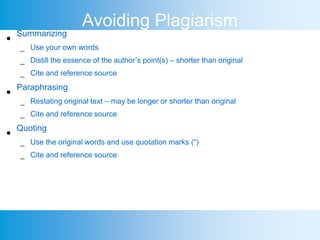
Avoiding Plagiarism

Summarizing
 Use your own words
 Distill the essence of the author’s point(s) – shorter than original
 Cite and reference source

Paraphrasing
 Restating original text – may be longer or shorter than original
 Cite and reference source

Quoting
 Use the original words and use quotation marks (“)
 Cite and reference source
Summarizing – Original Text

“America has changed dramatically during recent years. Not only has the
number of graduates in traditional engineering disciplines such as
mechanical, civil, electrical, chemical, and aeronautical engineering declined,
but in most of the premier American universities engineering curricula now
concentrate on and encourage largely the study of engineering science. As a
result, there are declining offerings in engineering subjects dealing with
infrastructure, the environment, and related issues, and greater concentration
on high technology subjects, largely supporting increasingly complex scientific
developments. While the latter is important, it should not be at the expense of
more traditional engineering.
Summarizing – Original Text, cont’d
Rapidly developing economies such as China and India, as well as other
industrial countries in Europe and Asia, continue to encourage and advance
the teaching of engineering. Both China and India, respectively, graduate six
and eight times as many traditional engineers as does the United States.
Other industrial countries at minimum maintain their output, while America
suffers an increasingly serious decline in the number of engineering
graduates and a lack of well-educated engineers.” (169 words)

(Source: Excerpted from Frankel, E.G. (2008, May/June) Change in
education: The cost of sacrificing fundamentals. MIT Faculty Newsletter, XX,
5, 13.)
(MIT, 2019)
Summarizing
 In a 2008 Faculty Newsletter article, “Change in
Education: The cost of sacrificing fundamentals,”
MIT Professor Emeritus Ernst G. Frankel expresses
his concerns regarding the current state of
American engineering education. He notes that the
number of students focusing on traditional areas of
engineering has decreased while the number
interested in the high-technology end of the field
has increased. Frankel points out that other
industrial nations produce far more traditionally-
trained engineers than we do, and believes we
have fallen seriously behind. (81 words)
 (MIT, 2019)
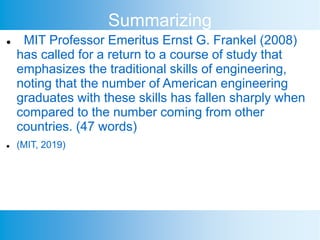
Summarizing
 MIT Professor Emeritus Ernst G. Frankel (2008)
has called for a return to a course of study that
emphasizes the traditional skills of engineering,
noting that the number of American engineering
graduates with these skills has fallen sharply when
compared to the number coming from other
countries. (47 words)
 (MIT, 2019)
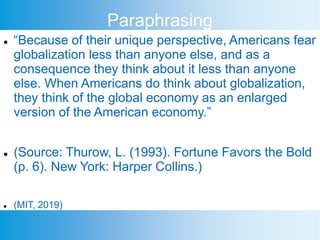
Paraphrasing
 “Because of their unique perspective, Americans fear
globalization less than anyone else, and as a
consequence they think about it less than anyone
else. When Americans do think about globalization,
they think of the global economy as an enlarged
version of the American economy.”
 (Source: Thurow, L. (1993). Fortune Favors the Bold
(p. 6). New York: Harper Collins.)
 (MIT, 2019)
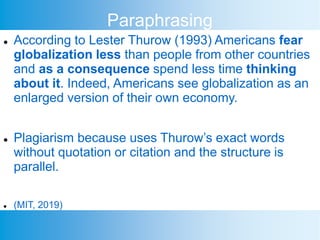
Paraphrasing
 According to Lester Thurow (1993) Americans fear
globalization less than people from other countries
and as a consequence spend less time thinking
about it. Indeed, Americans see globalization as an
enlarged version of their own economy.
 Plagiarism because uses Thurow’s exact words
without quotation or citation and the structure is
parallel.
 (MIT, 2019)
Paraphrasing
 Lester Thurow (1993) maintains that because
Americans see globalization simply as a bigger form
of their own economy, they are less concerned about
it than is the rest of the world.
 OK, retains meaning without using the author’s own
words or structure
 (MIT, 2019)
Plagiarism Penalties
 SPP level discipline
 Grade of ‘0’ (zero) on the assignment
 Course failure
 University level discipline, including but not limited
to:
 Expulsion
 Notation on permanent record
 Advisory notices to employers, scholarship providers
and other interested parties who may request
references or information about your SPP experience
Resources
 Turnitin – use as a check prior to submission of
your assignment
 Purdue Online Writing Lab (OWL)
 MIT Integrity Handbook Online
Purdue University Online Writing Lab
 APA sample
 https://owl.purdue.edu/owl/research_and_citation/
apa_style/apa_formatting_and_style_guide/apa_s
ample_paper.html
 APA style and format
https://owl.purdue.edu/owl/research_and_citation/a
pa_style/apa_formatting_and_style_guide/general
_format.html
Purdue University Online Writing Lab
 Avoiding
Plagiarismhttps://owl.purdue.edu/owl/teacher_a
nd_tutor_resources/preventing_plagiarism/avoi
ding_plagiarism/summarizing_paraphrasing_an
d_quoting.html
 In-text Citations
https://owl.purdue.edu/owl/teacher_and_tutor_res
ources/preventing_plagiarism/avoiding_plagiari
sm/handout_using_in_text_citations.html
References
 MIT Integrity Handbook, 2019
https://integrity.mit.edu/handbook/academic-writing/summarizing
accessed: 1 July 2020
 p.org https://www.plagiarism.org/article/what-is-plagiarism
accessed 5 October 2019
 Purdue Online Writing Lab (OWL)
https://owl.purdue.edu/owl/purdue_owl.html accessed 5 October
2019

Plagiarism lecture 2020

  • 1.
    PLAGIARISM!!  Prepared andpresented for the CMU School of Public Policy by William P. Kittredge, PhD October 2019 revised July 2020
  • 2.
    To “plagiarize”  tosteal and pass off the ideas or words of another as one's own  to use another's work without crediting the source  to commit literary or intellectual property theft (p.org, n.d.)
  • 3.
    To “plagiarize”  topresent as new and original an idea or product derived from an existing source  In other words, plagiarism is an act of fraud. It involves both stealing someone else's work and lying about it afterward. (p.org, n.d.)
  • 4.
    Plagiarism Includes  turningin someone else's work as your own  copying words or ideas from someone else without giving credit  failing to put a quotation in quotation marks  giving incorrect information about the source of a quotation (p.org, n.d.)
  • 5.
    Plagiarism Includes  changingwords but copying the sentence structure of a source without giving credit  copying so many words or ideas from a source that it makes up the majority of your work, whether you give credit or not (p.org, n.d.)  Claiming credit for the research of others, implicitly or explicitly
  • 6.
    Need to Attribute When using or referring to someone else’s work or ideas from:  Magazines, Books, & Newspapers  Songs  T.V. Programs, plays, or other dramatic productions  Letters  Websites & social media  Graphics, pictures, logos  Advertisements, or any other media (OWL, n.d.)
  • 7.
    Need to Attribute When you use information gained through interviewing another person  When you copy the exact words or a “unique phrase” from somewhere  When you reprint any diagrams, illustrations, charts and pictures  When you use ideas that others have given you in conversations or over e-mail (OWL, n.d.)
  • 8.
    Do Not Needto Attribute When you are writing about your own:  Experiences  Observations  Insights  Thoughts  Conclusions about a subject (OWL, n.d.)
  • 9.
    Avoiding Plagiarism  Summarizing  Useyour own words  Distill the essence of the author’s point(s) – shorter than original  Cite and reference source  Paraphrasing  Restating original text – may be longer or shorter than original  Cite and reference source  Quoting  Use the original words and use quotation marks (“)  Cite and reference source
  • 10.
    Summarizing – OriginalText  “America has changed dramatically during recent years. Not only has the number of graduates in traditional engineering disciplines such as mechanical, civil, electrical, chemical, and aeronautical engineering declined, but in most of the premier American universities engineering curricula now concentrate on and encourage largely the study of engineering science. As a result, there are declining offerings in engineering subjects dealing with infrastructure, the environment, and related issues, and greater concentration on high technology subjects, largely supporting increasingly complex scientific developments. While the latter is important, it should not be at the expense of more traditional engineering.
  • 11.
    Summarizing – OriginalText, cont’d Rapidly developing economies such as China and India, as well as other industrial countries in Europe and Asia, continue to encourage and advance the teaching of engineering. Both China and India, respectively, graduate six and eight times as many traditional engineers as does the United States. Other industrial countries at minimum maintain their output, while America suffers an increasingly serious decline in the number of engineering graduates and a lack of well-educated engineers.” (169 words)  (Source: Excerpted from Frankel, E.G. (2008, May/June) Change in education: The cost of sacrificing fundamentals. MIT Faculty Newsletter, XX, 5, 13.) (MIT, 2019)
  • 12.
    Summarizing  In a2008 Faculty Newsletter article, “Change in Education: The cost of sacrificing fundamentals,” MIT Professor Emeritus Ernst G. Frankel expresses his concerns regarding the current state of American engineering education. He notes that the number of students focusing on traditional areas of engineering has decreased while the number interested in the high-technology end of the field has increased. Frankel points out that other industrial nations produce far more traditionally- trained engineers than we do, and believes we have fallen seriously behind. (81 words)  (MIT, 2019)
  • 13.
    Summarizing  MIT ProfessorEmeritus Ernst G. Frankel (2008) has called for a return to a course of study that emphasizes the traditional skills of engineering, noting that the number of American engineering graduates with these skills has fallen sharply when compared to the number coming from other countries. (47 words)  (MIT, 2019)
  • 14.
    Paraphrasing  “Because oftheir unique perspective, Americans fear globalization less than anyone else, and as a consequence they think about it less than anyone else. When Americans do think about globalization, they think of the global economy as an enlarged version of the American economy.”  (Source: Thurow, L. (1993). Fortune Favors the Bold (p. 6). New York: Harper Collins.)  (MIT, 2019)
  • 15.
    Paraphrasing  According toLester Thurow (1993) Americans fear globalization less than people from other countries and as a consequence spend less time thinking about it. Indeed, Americans see globalization as an enlarged version of their own economy.  Plagiarism because uses Thurow’s exact words without quotation or citation and the structure is parallel.  (MIT, 2019)
  • 16.
    Paraphrasing  Lester Thurow(1993) maintains that because Americans see globalization simply as a bigger form of their own economy, they are less concerned about it than is the rest of the world.  OK, retains meaning without using the author’s own words or structure  (MIT, 2019)
  • 17.
  • 18.
    Plagiarism Penalties  SPPlevel discipline  Grade of ‘0’ (zero) on the assignment  Course failure  University level discipline, including but not limited to:  Expulsion  Notation on permanent record  Advisory notices to employers, scholarship providers and other interested parties who may request references or information about your SPP experience
  • 19.
    Resources  Turnitin –use as a check prior to submission of your assignment  Purdue Online Writing Lab (OWL)  MIT Integrity Handbook Online
  • 20.
    Purdue University OnlineWriting Lab  APA sample  https://owl.purdue.edu/owl/research_and_citation/ apa_style/apa_formatting_and_style_guide/apa_s ample_paper.html  APA style and format https://owl.purdue.edu/owl/research_and_citation/a pa_style/apa_formatting_and_style_guide/general _format.html
  • 21.
    Purdue University OnlineWriting Lab  Avoiding Plagiarismhttps://owl.purdue.edu/owl/teacher_a nd_tutor_resources/preventing_plagiarism/avoi ding_plagiarism/summarizing_paraphrasing_an d_quoting.html  In-text Citations https://owl.purdue.edu/owl/teacher_and_tutor_res ources/preventing_plagiarism/avoiding_plagiari sm/handout_using_in_text_citations.html
  • 22.
    References  MIT IntegrityHandbook, 2019 https://integrity.mit.edu/handbook/academic-writing/summarizing accessed: 1 July 2020  p.org https://www.plagiarism.org/article/what-is-plagiarism accessed 5 October 2019  Purdue Online Writing Lab (OWL) https://owl.purdue.edu/owl/purdue_owl.html accessed 5 October 2019