Chapter 4
DECISION-MAKING
Public Policy and Governance
(950701)
INTRODUCTION
▪ DEFINITION
▪ ACTORS IN DECISION-MAKING
▪ DECISION-MAKING MODELS
▪ THE DECISION-MAKING PROCESS
▪ CHALLENGES IN DECISION-MAKING
▪ STRATEGIES FOR EFFECTIVE DECISION-MAKING
▪ CONCLUSION
Definition
• It involves selecting from among a range
of possible policy options, including
simply maintaining the status quo.
• In many cases decision are “negative” and
involve allowing existing arrangements to
stand either unaltered or in only slightly
modified form (Howlett 2007).
• Positive decisions may involve major
overhauls of existing arrangements,
institutions, rules, and laws or may affect
these only at the margins or
“incrementally” (Lindblom 1959.
Add a footer 3
FRActors in Decision-Making
Add a footer 4
▪ Elite members
▪ Public managers
▪ Professional analysts
▪ Issue-specific experts
▪ Consultant
▪ Lobbyists.
FR
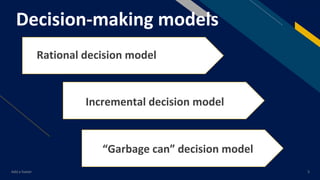
Decision-making models
Add a footer 5
Rational decision model
Incremental decision model
“Garbage can” decision model
FRThe Decision-making process
Add a footer 6
1. Analysis for decision-making
1. Aim of identifying a
maximizing choice
2. Standardized
decision aid techniques
3. Provide various
options
(alternative)
4. Reports &
recommendation from
policy managers at the
highest level
5. Decision points
must accurate
and appropriately
summarized
FR
Add a footer 7
1. Groupthink : a process in which groups pressures for conformity
undermine systematic consideration of alternatives and disconfirming
evidence;
2. a bias toward
criteria for which
quantitative measures
are available.
3. a bias toward
positive impacts
4. a bias toward the study
of impacts along a
particular dimension that
is closely associated with
the identity of the
organizations conducting
the assessment.
Potential bias that can affect decision-making
FR
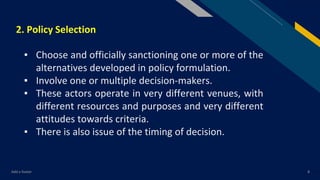
2. Policy Selection
Add a footer 8
▪ Choose and officially sanctioning one or more of the
alternatives developed in policy formulation.
▪ Involve one or multiple decision-makers.
▪ These actors operate in very different venues, with
different resources and purposes and very different
attitudes towards criteria.
▪ There is also issue of the timing of decision.
FR
Add a footer 9
Challenges in
decision-making
Short time
horizons
Lack of reliable
information
Lack of expertise in
policy analysis
FR
Add a footer 10
Strategies for effective decision-making
Integrating
political, technical,
and organizational
considerations
Basing decisions
on systematic
analysis
Assessing
economic, social,
and environmental
impacts of policy
options
Strengthen
analytical
capacity
Improving intra-
agency and
interagency linkage
in decision-making
conclusion
• Better decision help improve implementation and
outcomes.
• Policy decisions cap the “front-end” process of policy-
making.
• Rise to the challenges if public policies are not to falter
at the “back-end” stage of policy implementation.
Thank you

Chapter 4 decision making

  • 1.
  • 2.
    INTRODUCTION ▪ DEFINITION ▪ ACTORSIN DECISION-MAKING ▪ DECISION-MAKING MODELS ▪ THE DECISION-MAKING PROCESS ▪ CHALLENGES IN DECISION-MAKING ▪ STRATEGIES FOR EFFECTIVE DECISION-MAKING ▪ CONCLUSION
  • 3.
    Definition • It involvesselecting from among a range of possible policy options, including simply maintaining the status quo. • In many cases decision are “negative” and involve allowing existing arrangements to stand either unaltered or in only slightly modified form (Howlett 2007). • Positive decisions may involve major overhauls of existing arrangements, institutions, rules, and laws or may affect these only at the margins or “incrementally” (Lindblom 1959. Add a footer 3
  • 4.
    FRActors in Decision-Making Adda footer 4 ▪ Elite members ▪ Public managers ▪ Professional analysts ▪ Issue-specific experts ▪ Consultant ▪ Lobbyists.
  • 5.
    FR Decision-making models Add afooter 5 Rational decision model Incremental decision model “Garbage can” decision model
  • 6.
    FRThe Decision-making process Adda footer 6 1. Analysis for decision-making 1. Aim of identifying a maximizing choice 2. Standardized decision aid techniques 3. Provide various options (alternative) 4. Reports & recommendation from policy managers at the highest level 5. Decision points must accurate and appropriately summarized
  • 7.
    FR Add a footer7 1. Groupthink : a process in which groups pressures for conformity undermine systematic consideration of alternatives and disconfirming evidence; 2. a bias toward criteria for which quantitative measures are available. 3. a bias toward positive impacts 4. a bias toward the study of impacts along a particular dimension that is closely associated with the identity of the organizations conducting the assessment. Potential bias that can affect decision-making
  • 8.
    FR 2. Policy Selection Adda footer 8 ▪ Choose and officially sanctioning one or more of the alternatives developed in policy formulation. ▪ Involve one or multiple decision-makers. ▪ These actors operate in very different venues, with different resources and purposes and very different attitudes towards criteria. ▪ There is also issue of the timing of decision.
  • 9.
    FR Add a footer9 Challenges in decision-making Short time horizons Lack of reliable information Lack of expertise in policy analysis
  • 10.
    FR Add a footer10 Strategies for effective decision-making Integrating political, technical, and organizational considerations Basing decisions on systematic analysis Assessing economic, social, and environmental impacts of policy options Strengthen analytical capacity Improving intra- agency and interagency linkage in decision-making
  • 11.
    conclusion • Better decisionhelp improve implementation and outcomes. • Policy decisions cap the “front-end” process of policy- making. • Rise to the challenges if public policies are not to falter at the “back-end” stage of policy implementation.
  • 12.