Supply & Demand in the Policy Context
Developed & presented by William P. Kittredge, PhD - 2023
08/16/2023 2
Goals for Today and Process
●
Review & discuss economic theory around Supply & Demand
●
Develop policy appropriate applications
●
Discuss current policy challenges in light of the policy applications
08/16/2023 3
Reminders
●
All economic theories are analytical simplifications designed to
focus on a particular activities.
●
These theories assume:
●
ceteris paribus = All else equal
●
economically ‘rational’ behavior
●
market transparency
08/16/2023 4
Markets
●
A market facilitates the interaction of a buyer and a seller as they
complete a transaction
●
Buyers, as a group, determine the demand
●
Sellers, as a group, determine the supply
08/16/2023 5
Market Characteristics - Assumptions
●
Identical goods or services
●
Enough buyers and sellers so that no participant can influence the
market price – everyone is a price taker
08/16/2023 6
Demand
●
‘Law’ of demand – increased price reduces demand
●
Quantity demanded
●
Demand schedule
●
Demand curve
●
Determinants of demand
08/16/2023 7
Demand Determinants
●
Income
●
Price of related goods
●
Complements
●
Substitutes
●
Tastes or preferences
●
Expectations
●
Number of buyers
08/16/2023 8
Supply
●
‘Law’ of supply
●
Quantity supplied
●
Supply schedule
●
Supply curve
●
Determinants of supply
08/16/2023 9
Supply Determinants
●
Input prices
●
Technology
●
Expectations
●
Number of sellers
08/16/2023 10
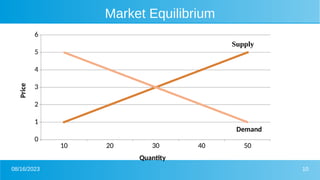
Market Equilibrium
10 20 30 40 50
0
1
2
3
4
5
6
Quantity
Price
Supply
Demand
08/16/2023 11
Price Elasticity Factors - Demand
●
Measures the responsiveness of quantity demanded to a change
in price
●
Determinants
●
Availability of close substitutes
●
Necessities versus luxuries
●
Definition of the market (food vs. ice cream vs. chocolate ice
cream)
●
Time horizon
08/16/2023 12
Elasticity of Demand and Total Revenue
●
If demand for a good is elastic, price increases lead to lower total
revenue
●
If demand for a good is inelastic, price increases lead to higher
total revenue
08/16/2023 13
Price Elasticity of Supply
●
Measures the responsiveness of quantity supplied to a change in
price
●
Determinants
●
Availability of inputs
●
Time
08/16/2023 14
Critiques of Supply & Demand Theory
●
1. Simplistic representation
●
2. Ceteris paribus assumption
●
3. No consideration of external factors
●
4. Long-term analysis
●
5. Market power and monopolies
●
6. Inelastic demand or supply
●
7. Behavioral factors
●
8. Market failures
08/16/2023 15
Critiques of Supply & Demand Theory
●
9. Complex products and services: The model may not fully
address markets with intricate products or services that cannot be
easily standardized or homogenized.
●
10. Time lags: The supply and demand model may not account for
time lags in market adjustments, leading to temporary imbalances
and price fluctuations.
Demand - Water
●
The global demand for water is projected to grow by 55% by 2050
●
Growing demand from manufacturing (+400%),
●
Thermal electricity generation (+140%)
●
Domestic use (+130%).
●
“In the face of these competing demands, there will be little scope for
expanding irrigation water use under this scenario. The main increases
in water demand will be in the emerging economies and developing
countries.”
●
This sharp increase is disproportionately driven by regions that
experience high rates of urbanization and economic growth, many of
which can be already classified as water scarce today.
(OECD 2012)
08/16/2023 17
Supply - Water
●
Many aquifers contain fossil water, meaning they may millions of years
old and do not recharge.
●
Others recharge slowly. Main aquifers in the northern People’s
Republic of China, India or the Middle East is extracted at 5-20 times
the sustainable rate.
●
The Ogallala Aquifer provides irrigation water in South Dakota,
Nebraska, Wyoming, Colorado, Kansas, Oklahoma, New Mexico, and
Texas. At the current rates, the aquifer would be "dry" within twenty
years (Cullen, 2020)
(OECD 2012)
08/16/2023 18
Demand - Electricity
●
Global demand is expected to grow by 3.3% per year into the next
decade.
●
However, China's electricity demand is expected to increase by 5.3% in
2023 and 5.1% in 2024, slightly below its 2015-2019 average of 5.4%.
●
India is set to have an average annual growth rate of 6.5% over the
outlook period, surpassing its 2015-2019 average of 5.2%.
●
Demand shrinks in the EU and North America as conservation and
efficiency increase.
●
Renewable generation in global electricity supply will exceed one-third
for the first time in 2024.
IEA (2023)
08/16/2023 19
Electric - Supply
●
By 2024, the share of renewable generation in global electricity
supply will exceed one-third for the first time.
●
Hydropower resources are strained due to climate change (reduced
water flows) and other demands (e.g. irrigation). The capacity factor
of global hydropower has been in decline for more than 10 years.
●
The gap that is customarily bridged with fossil-fired generation (e.g.
Germany since Russian supplies cut by Ukraine war.
●
As climate change continues supplies are further threatened by
increased demand for cooling.
IEA (2023)
08/16/2023 20
Water and Electricity Meet
●
Adelaide Desalination Plant – 50% of water supply
●
The plant uses 3.47 to 3.70 kilowatt-hours of electricity per kilolitre of water
produced = VERY high water bills
●
Brine returned to sheltered bay
●
Smallest of 6 in Australia
●
Approximately 16,000 operational desalination plants worldwide (IDA,2022)
●
Bonneville Power Administration (BPA) operates dams on the
Columbia River System for several purposes, some conflictual
●
Hydroelectric generation
●
Anadromous fish
●
Navigation and recreation
08/16/2023 21
Farming, Food Security, & Air Quality
●
Consider the case of Thailand’s ‘smoke season’
●
How do the different interests interact
●
What incentives might ameliorate the situation?
08/16/2023 22
Healthcare Supply & Demand
●
Having researched the cases prior to class, we’ll discuss the issues
involved from a policy perspective.
●
From your readings what are the supply & demand aspects of this
case?
●
Given the demand, as evidenced by the large number of otherwise
unaddressed eye surgeries completed by the Hospital, why did the
supply system fail?
08/16/2023 23
Potable Water: Supply & Demand
●
Why didn’t the supply & demand system function as theory predicts?
●
Why didn’t government intervene effectively, or at all?
●
Based on your research, why does 1001 Fountains exist and what was
it formed to accomplish?
●
How is it similar and different from the Aravind Eye Hospital model?
08/16/2023 24
References
●
Cullen, A. (August 17, 2020). "Extreme weather just devastated
10m acres in the midwest. Expect more of this". The Guardian.
●
International Desalination Association (IDA) 2022
https://idadesal.org
●
IEA (2023), Electricity Market Report – Update 2023, IEA, Paris
https://www.iea.org/reports/electricity-market-report-update-2023,
License: CC BY 4.0
●
OECD (2012) Environmental Outlook to 2050: The Consequences
of Inaction https://www.oecd.org/env/indicators-modelling-
outlooks/oecdenvironmentaloutlookto2050theconsequencesofinac
tion-keyfactsandfigures.htm accessed 27 July 2023

Supply & Demand in the Policy Context

  • 1.
    Supply & Demandin the Policy Context Developed & presented by William P. Kittredge, PhD - 2023
  • 2.
    08/16/2023 2 Goals forToday and Process ● Review & discuss economic theory around Supply & Demand ● Develop policy appropriate applications ● Discuss current policy challenges in light of the policy applications
  • 3.
    08/16/2023 3 Reminders ● All economictheories are analytical simplifications designed to focus on a particular activities. ● These theories assume: ● ceteris paribus = All else equal ● economically ‘rational’ behavior ● market transparency
  • 4.
    08/16/2023 4 Markets ● A marketfacilitates the interaction of a buyer and a seller as they complete a transaction ● Buyers, as a group, determine the demand ● Sellers, as a group, determine the supply
  • 5.
    08/16/2023 5 Market Characteristics- Assumptions ● Identical goods or services ● Enough buyers and sellers so that no participant can influence the market price – everyone is a price taker
  • 6.
    08/16/2023 6 Demand ● ‘Law’ ofdemand – increased price reduces demand ● Quantity demanded ● Demand schedule ● Demand curve ● Determinants of demand
  • 7.
    08/16/2023 7 Demand Determinants ● Income ● Priceof related goods ● Complements ● Substitutes ● Tastes or preferences ● Expectations ● Number of buyers
  • 8.
    08/16/2023 8 Supply ● ‘Law’ ofsupply ● Quantity supplied ● Supply schedule ● Supply curve ● Determinants of supply
  • 9.
    08/16/2023 9 Supply Determinants ● Inputprices ● Technology ● Expectations ● Number of sellers
  • 10.
    08/16/2023 10 Market Equilibrium 1020 30 40 50 0 1 2 3 4 5 6 Quantity Price Supply Demand
  • 11.
    08/16/2023 11 Price ElasticityFactors - Demand ● Measures the responsiveness of quantity demanded to a change in price ● Determinants ● Availability of close substitutes ● Necessities versus luxuries ● Definition of the market (food vs. ice cream vs. chocolate ice cream) ● Time horizon
  • 12.
    08/16/2023 12 Elasticity ofDemand and Total Revenue ● If demand for a good is elastic, price increases lead to lower total revenue ● If demand for a good is inelastic, price increases lead to higher total revenue
  • 13.
    08/16/2023 13 Price Elasticityof Supply ● Measures the responsiveness of quantity supplied to a change in price ● Determinants ● Availability of inputs ● Time
  • 14.
    08/16/2023 14 Critiques ofSupply & Demand Theory ● 1. Simplistic representation ● 2. Ceteris paribus assumption ● 3. No consideration of external factors ● 4. Long-term analysis ● 5. Market power and monopolies ● 6. Inelastic demand or supply ● 7. Behavioral factors ● 8. Market failures
  • 15.
    08/16/2023 15 Critiques ofSupply & Demand Theory ● 9. Complex products and services: The model may not fully address markets with intricate products or services that cannot be easily standardized or homogenized. ● 10. Time lags: The supply and demand model may not account for time lags in market adjustments, leading to temporary imbalances and price fluctuations.
  • 16.
    Demand - Water ● Theglobal demand for water is projected to grow by 55% by 2050 ● Growing demand from manufacturing (+400%), ● Thermal electricity generation (+140%) ● Domestic use (+130%). ● “In the face of these competing demands, there will be little scope for expanding irrigation water use under this scenario. The main increases in water demand will be in the emerging economies and developing countries.” ● This sharp increase is disproportionately driven by regions that experience high rates of urbanization and economic growth, many of which can be already classified as water scarce today. (OECD 2012)
  • 17.
    08/16/2023 17 Supply -Water ● Many aquifers contain fossil water, meaning they may millions of years old and do not recharge. ● Others recharge slowly. Main aquifers in the northern People’s Republic of China, India or the Middle East is extracted at 5-20 times the sustainable rate. ● The Ogallala Aquifer provides irrigation water in South Dakota, Nebraska, Wyoming, Colorado, Kansas, Oklahoma, New Mexico, and Texas. At the current rates, the aquifer would be "dry" within twenty years (Cullen, 2020) (OECD 2012)
  • 18.
    08/16/2023 18 Demand -Electricity ● Global demand is expected to grow by 3.3% per year into the next decade. ● However, China's electricity demand is expected to increase by 5.3% in 2023 and 5.1% in 2024, slightly below its 2015-2019 average of 5.4%. ● India is set to have an average annual growth rate of 6.5% over the outlook period, surpassing its 2015-2019 average of 5.2%. ● Demand shrinks in the EU and North America as conservation and efficiency increase. ● Renewable generation in global electricity supply will exceed one-third for the first time in 2024. IEA (2023)
  • 19.
    08/16/2023 19 Electric -Supply ● By 2024, the share of renewable generation in global electricity supply will exceed one-third for the first time. ● Hydropower resources are strained due to climate change (reduced water flows) and other demands (e.g. irrigation). The capacity factor of global hydropower has been in decline for more than 10 years. ● The gap that is customarily bridged with fossil-fired generation (e.g. Germany since Russian supplies cut by Ukraine war. ● As climate change continues supplies are further threatened by increased demand for cooling. IEA (2023)
  • 20.
    08/16/2023 20 Water andElectricity Meet ● Adelaide Desalination Plant – 50% of water supply ● The plant uses 3.47 to 3.70 kilowatt-hours of electricity per kilolitre of water produced = VERY high water bills ● Brine returned to sheltered bay ● Smallest of 6 in Australia ● Approximately 16,000 operational desalination plants worldwide (IDA,2022) ● Bonneville Power Administration (BPA) operates dams on the Columbia River System for several purposes, some conflictual ● Hydroelectric generation ● Anadromous fish ● Navigation and recreation
  • 21.
    08/16/2023 21 Farming, FoodSecurity, & Air Quality ● Consider the case of Thailand’s ‘smoke season’ ● How do the different interests interact ● What incentives might ameliorate the situation?
  • 22.
    08/16/2023 22 Healthcare Supply& Demand ● Having researched the cases prior to class, we’ll discuss the issues involved from a policy perspective. ● From your readings what are the supply & demand aspects of this case? ● Given the demand, as evidenced by the large number of otherwise unaddressed eye surgeries completed by the Hospital, why did the supply system fail?
  • 23.
    08/16/2023 23 Potable Water:Supply & Demand ● Why didn’t the supply & demand system function as theory predicts? ● Why didn’t government intervene effectively, or at all? ● Based on your research, why does 1001 Fountains exist and what was it formed to accomplish? ● How is it similar and different from the Aravind Eye Hospital model?
  • 24.
    08/16/2023 24 References ● Cullen, A.(August 17, 2020). "Extreme weather just devastated 10m acres in the midwest. Expect more of this". The Guardian. ● International Desalination Association (IDA) 2022 https://idadesal.org ● IEA (2023), Electricity Market Report – Update 2023, IEA, Paris https://www.iea.org/reports/electricity-market-report-update-2023, License: CC BY 4.0 ● OECD (2012) Environmental Outlook to 2050: The Consequences of Inaction https://www.oecd.org/env/indicators-modelling- outlooks/oecdenvironmentaloutlookto2050theconsequencesofinac tion-keyfactsandfigures.htm accessed 27 July 2023