PART 1
2017 EDITION
~ INSTITUTE OFINTEGRATED ELECTRICAL ENGINEERS OF THE PHILIPPINES, INC.
PHILIPPINE
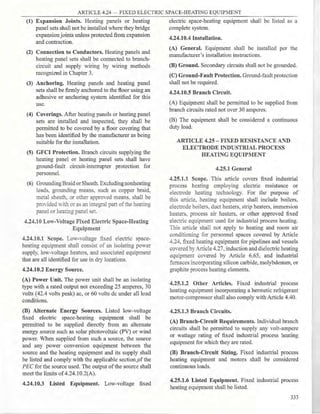
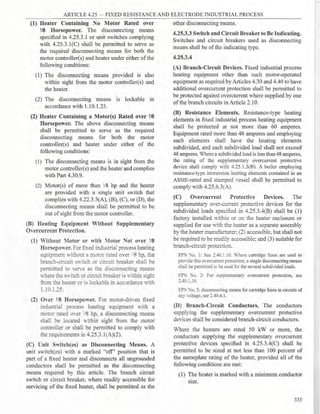
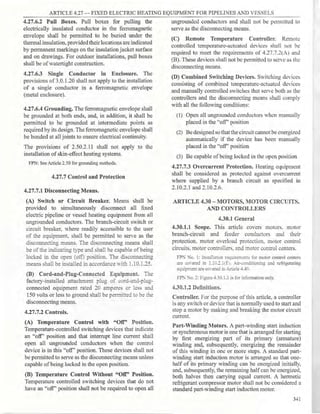
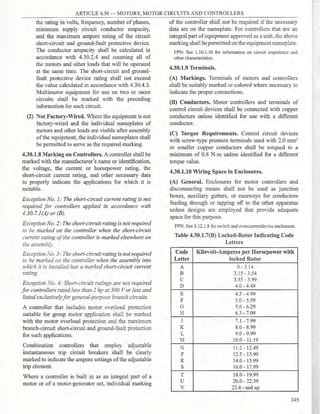
ELECTRICAL CODE
PARTl
2017
Philippine Copyright 2017
by
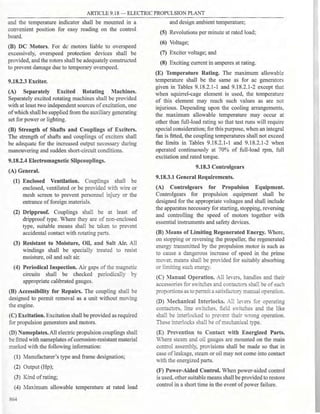
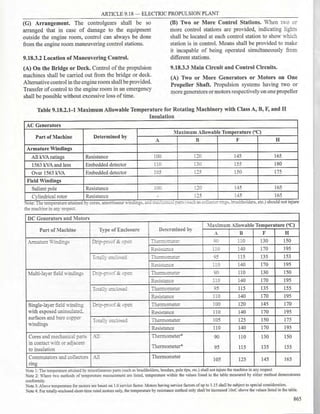
Institute of Integrated Electrical Engineers
of the Philippines, Incorporated (HEE)
!IEE Bldg., #41 Monte de Piedad St., Cubao, Quezon City
All rights in this book are reserved. Permission is granted to republish in full the material herein in laws, ordinances,
regulations, administrative orders or similar documents issued by public authorities. Others desiring permission to
reproduce this material in whole or in part shall consult the Institute oflntegrated Electrical Engineers ofthe Philippines,
Incorporated.
First Printing, December 2017
Printed by:
MG Reprographics Supply & Services, Inc.
II
PREFACE
This 2017 edition ofthe Philippine Electrical Code, Part 1 (PECl 2017) is a major revision to the 2009 edition. The
planning of the new Code started with a kickoff meeting chaired by Engr. Francis V. Mapile, Chairman of the Board
ofElectrical Engineering (BEE) of the Professional Regulation Commission (PRC). He provided the guidelines on the
format ofthe new Code and its contents.
PEC1 2017 is now in letter page format consisting of two columns in a page. There is only one volume including
a Chapter 9 - Watercraft, which used to form Volume 2 of the previous editions of the Code. Because of this, Chapter
9 - Tables before is now Chapter 10. The appendices complete the Code.
The preparation ofPEC1 2017 started in 2016 and completed in 2017, a more than one-year effort. It started with
NEC 2014 as the basis, but in the end, adopted NEC 2017 which became available September 2016. As in the past, PECl
2017 took into consideration the Philippine environment and practices, specially in Chapters 1 to 4, and particularly, in
requirements concerning utility services. The major changes in edition 2017 ofthe Code are:
Chapter 1 : New definitions have been included, notably Office of the Building Official/EE (OBO/EE), National
Electrical EngineeringLawandService ProtectiveDyvice. The OBO/EErefers to the licensed electrical
practitioner employed with the Office ofthe Building Official. He/she replaced the Authority Having
Jurisdiction (AHJ) in the Code's various provisions. The second new definition expounds references
to Republic Act 7920 (RA 7920) which is the current national electrical engineering law. This way,
the national electrical engineering law remains relevant should Republic Act 7920 be superseded.
Service Protective Device defines the new equipment addition to Code provisions related to service
equipment.
Also, three important new sections have been added: (1) Section 1.0.1.10 Apprenticeship, (2) Section
1.10.1.24 Available Fault Current (which require markings of such on the service equipment and
would necessarily need short circuit calculations complimenting Section l.3.2.l(F)(4), and, (3)
Section 1.10.1.25 Lockable Disconnecting Means. Arc-Flash Hazard Analysis has been added to the
requirements under Section 1.3.2.l(F) Design Analysis as l.3.2.l(F)(5).
Chapter 2 : Important revisions include: (1) Deletion ofrequirements for arc-fault circuit-interrupter due to non-
availability for Philippine specifications, (2) In addition to Code requirements on multi-occupancy
buildings, their application to site developments - where group(s) of single detached buildings
are constructed - have been included, (3) Clarified and expanded provisions on Service Protective
Device when installed ahead of Service Equipment and (4) Clarified the provisions on grouping of
Disconnecting Means.
Chapter 3 : Rationalized ampacity tables of conductors (i.e. slight modifications in amperes) - copper and
aluminum - for three conductors in raceway and in free air up to 2000 volts, Tables 3.10.2.6(B)(16)
and 3.10.2.6(B)(l7), respectively. Ampacities are based on current densities of the cross-sectional
areas of the conductors. Article 3.10 has been expanded with two new Parts. Four new articles have
also been added: (1) Article 3.55 - Reinforced Thermosetting Resin Conduit: Type RTRC, (2) Article
3.70 ~ Cablebus, (3) Article 3.93 - Low-Voltage Suspended Ceiling Power Distribution Systems and
(4) Article 3.99 - Outdoor Overhead Conductors over 1000 Volts.
Chapter 4 : Previous editions of PECl, at one time or another, permitted a specific number (i.e. 42 or 48) of
overcurrent protective devices in a panelboard enclosure. This limitation has been removed from
PECl 2017 and is required only (maximum of48) ifthe panelboard is protected on its supply side by
two sets ofcircuit breakers or two sets offuses (Section 4.8.3.7 Exception No.2). Article 4.24 - Fixed
Electric Space-Heating Equipment has been expanded while a new Article 4.25 - Fixed Resistance
and Electrode Industrial Process Heating Equipment has also been added.
Chapter 5 Article 5.16 - Spray Application, Dipping, Coating and Printing Processes Using Flammable or
Combustible Materials has been expanded while adding a new Article 5.22 - Control Systems for
Permanent Amusement Attractions.
111
Chapter 6 : Article 6.25 - Electric Vehicle Charging System has been expanded with new Parts and four new
articles have been added: (1) Article 6.26 - Electrified Truck Parking Spaces, (2) Article 6.46 -
Modular Data Centers, (3) Article 6.91 - Large-Scale Photovoltaic (PV) Electric Power Production
Facility and (4) Article 6.94 - Wind Electric Systems.
Chapter 7 : Article 7.5 - Interconnected Electric Power Production Sources and Article 7.70 - Optical Fiber
Cables have been expanded while five new articles have been added: (1) Article 7.6 - Energy Storage
Systems, (2) Article 7.8 - Critical Operations Power Systems (COPS), (3) Article 7.10 - Stand-Alone
Systems, (4) Article 7.12 - Direct Current Microgrids andArticle 7.28 - Fire-Resistive Cable Systems.
Chapter 8 : Added a new Article 8.40 - Premises-Powered Broadband Communications Systems.
Chapter 10 : A new Table 10.1.1.10 has been added.
Aside from the chapters discussed, the rest of the Code has minimal changes. Harmonizing the PEC1 with IEC and
other recognized standards is an ever-continuing effort.
The 2017 Philippine Electrical Code Part 1 has been crafted in order to clarify ambiguities and to facilitate easy use
and understanding so that the electrical practitioners will be properly guided.
This Code has been patterned after the National Electrical Code 2017 version as it was found to be most appropriate
and applicable to Philippine Setting.
NEC 2017 and relevant IEC and other standards were used in one way or another as reference materials which are
and could have been included in PECl 2017; and for this reason, IIEE and the Committee wish to acknowledge their
contributions in the preparation of PECl 2017.
After coordination meetings and discussions with the Board of Electrical Engineering's (BEE) Chairman, the
Honorable Engr. Francis V Mapile, the IIEE submitted the final draft of the PEC1 2017 to the BEE for endorsement
to the Professional Regulation Commission (PRC) for its review and approval, which has since been received on
November 10, 2017. PECl 2017 supersedes all previous editions ofthe Code dated 1962, 1969, 1973, 1980, 1985, 1992,
2000 and 2009.
Comments on PECl 2017 regarding omissions and errors, as well as, conflicts with accepted international standards
are most welcome and will be highly appreciated. All suggestions will be studied and considered for inclusion in the
Code's next edition. Suggestions can be addressed to:
iv
THE CHAIRMAN, PECl COMMITTEE
Institute of Integrated Electrical Engineers
ofthe Philippines, Inc.
IIEE Bldg., #41 Monte de Piedad Street
Cubao, Quezon City 1111, Metro Manila
ACKNOWLEDGEMENT
The Institute of Integrated Electrical Engineers of the Philippines, Inc. (IIEE) acknowledges the fine work of the
members of the Philippine Electrical Code, Part 1 Committee in the preparation and expeditious completion of the
Philippine Electrical Code, Part 1(PEC12017). The preparation ofthe 2017 edition ofthe Code is by no means an easy
task, considering that the previous edition was done in 2009. It is, therefore, with great appreciation to acknowledge the
efforts and sacrifices ofeach member ofthe PEC1 Committee:
Engr. William W. Yang Chairman
Engr. Gregorio Y. Guevarra Vice Chairman
Engr. Lucio R. Alejo, Jr. Member
Engr. Aileen A. Alejo Member
Engr. Roy Reynaldo G. Gonzalez Member
Engr. Edwin V. Pangilinan Member
Engr. Marites R. Pangilinan Member
Engr. Reynaldo R. Santiago Member
Engr. Eduardo H. Tan Member
Engr. Gem J. Tan Member
Mr. Ramon P. Ayaton Adviser
Chapters 5, 9, 10 &Appendices
Chapter 1
Chapter 6
Chapter 6
Chapter 6
Chapter 8
Chapter 2 & Appendix D - Examples
Chapter 3
Chapter 7
Chapter 4
Editorial and Publication
Engr. Kenneth A. Jorigue
Dr. Angel V. De Vera, Jr.
Code Committee Secretariat
Overseer
The success ofthe PECl Committee's work is made possible with the support ofthe 2016 IIEE Board of Governors
under the leadership ofNational President, Engr. Larry C. Cruz and the 2017 IIEE Board of Governors; Engr. Joebe
B. Panhilason (National President), Engr. Noel T. Fernandez (VP - Internal Affairs), Engr. Florigo C. Varona (VP -
External Affairs), Engr. Angel V. De Vera Jr. (VP - Technical Affairs), Engr. Cirilo C. Calibjo (National Secretary),
Engr. Florencio D. Berenguel (National Treasurer), Engr. Eugenio F. Araullo (National Auditor). Regional Governors:
Engr. Feliciano F. Padua III (Northern Luzon), Engr. Gerrylyn S. Santos (Central Luzon), Engr. Rodrigo T. Pecolera
(Metro Manila), Engr. Allan Anthony P. Alvarez (Southern Luzon), Engr. Jigger F. Bugtong (Bicol), Engr. Al B. Bunda
(Western Visayas), Engr. Teodoro E. Arnaiz (Eastern/Central Visayas), Engr. Gino B. Macapayag (Northern Mindanao),
Engr. Dick S. Arellano (Southern Mindanao), Engr. Samuel D. Julio (Western Mindanao) and Engr. Robert U. Mabulay
(Middle East (Gulf)). The contributions ofthe VP-Technical (2017) - Engr. Angel V. de Vera, Jr. is greatly appreciated.
Thanks also goes to the Chairman of the Board of Electrical Engineering of the Professional Regulation Commission,
Engr. Francis V. Mapile, who provided guidance in the format and contents of the Code as well as helpful statutory
and technical inputs. Last but not the least, acknowledgement is given to the IIEE staff, particularly Engr. Kenneth A.
Jorigue, Ms. Maria Khatrina D. Magno and Ms. Gelyn 0. Lee, for their untiring assistance in providing the needed
administrative and logistical support.
The IIEE, together with the PEC1 Committee, acknowledges the adoption of the National Electrical Code 2017
edition (NEC 2017) of the National Fire Protection Association (NFPA) as the basis for the PECl 2017. Similarly,
acknowledgment is given to the International Electrotechnical Commission (IEC) and its standards.
V
Yl
3R.epublic of tbt *3bilippines
.t)rofessional 3R.egulation <!I:ommission
fflanila
PROFESSIONAL REGULATORY BOARD OF ELECTRICAL ENGINERING
RESOLUTION NO. 18
Series of 2017
ADOPTION OF THE 9t11 EDITION OF THE 2017 REVISED PHILIPPINE ELECTRICAL CODE
(PEC) PART I AS PART OF THE RULES AND REGULATIONS GOVERNING THE
PRACTICE OF ELECTRICAL ENGINEERING ANO AS A REFERRAL CODE IN
ACCORDANCE WITH THE NATIONAL BUILDING CODE
WHEREAS, Republic Act (RA) No. 7920, otherwise known as the New Electrical Engineering
Law vests upon the Professional Regulatory Board of Electrical Engineering (Board) the
mandate to look into the conditions affecting the practice of the electrical engineering
profession, adopt measures for the enhancement of the profession, and the maintenance of
high professional, technical and ethical standards;
WHEREAS, Section 211 of PD No. 1096, also known as the National Building Code, provides,
to wit: ''In the implementation of the provisions of this Code, the Secretary of the Department of
Public Works and Highways (DPWH) shall formulate necessary rules and regulations and adopt
design and construction standards and criteria for building and other structures";
WHEREAS, Engr. Joebe 8 . Panhilason, National President, and Engr. William W . Yang,
Chairman of the Code Committee for the Review and Revision of the Philippine Electrical Code
(PEG) Part 1 of the Institute of Integrated Electrical Engineers of the Philippine, Inc. (IIEE),
submitted a copy of the draft revised PEC Part 1 for the adoption by the Board and the
Professional Regulation Commission (Commission);
WHERl:AS, the draft of the revised PEC Part 1 was likewise submitted to the DPWH Secretary
for adoption as a referral code to the National Building Code;
WHEREAS, in the "Preface" embod1
ed in the draft document, the Chairman of the Code
Committee, pointed out, among others, the significant and salient changes in the proposed gth
Edition of the 2017 Revised PEC Part 1, as follows;
• Chapter 1: New definitions have been included, notably Office of the Building
Official/EE (080.EE), National Electrical Engineering Law and Service Protective
Device. The OBO/EE refers to the licensed electrical practitioner employed with the
Office of the Building Official. He/she replaced the Authority Having Jurisdiction
(AHJ) in the Code's various pFO)lisions. The second new definition expounds
references to Republic Act 7920 (RA 7920) which is the current national electrical
engineering law. This way, the national electrical engineering law remains relevant
should Republic Act 7920 be superseded. Service Protective Device defines the new
equipment addition to Code provisions related to service equipment.
AOOPTION OF THE 9th EDITION OF THE 2017 REVISED PHILIPPINE ELECTRICAL
CODE (PEC) ?ART I AS PART OF THE RULES AND REGULATIONS CONCERNING
THEPRACTICE OF ELECTRICAL ENGINEERING AND AS A
REFERRAL CODE IN ACCORDANCE WITH THE NATIONALSUILDING CODE
Also, three important new sections have been added: (1) Section 1.0.1.1O
Apprenticeship, (2) Section 1.10.1.24 Available Fault Current (which require
markings of such on the service equipment and would necessarily need short circuit
calculations complimenting Section 1.3.2.1(F)(4), and, (3) Section 1.10.1.25
Lockable Disconnecting Means. Arc-Flash Hazard Analysis has been added to the
requirements under Section 1.3.2.1 (F) Design Analysis as 1.3.2.1(F)(5).
• Chapter 2: Important revisions include: (1) Deletion of requirements for arc-fault
circuit-interrupter due to non-availability for Philippine specifications, (2) In addition to
Code requirements on multi-occupancy buildings, their application to site
developments - where group(s) of single detached buildings are constructed - have
been included, (3) Clarified and expanded provisions on Service Protective Device
when installed ahead of Service Equipment and (4) Clarified the provisions on
grouping of Disconnecting Means.
• Chapter 3 ; Rationalized ampacity tables of conductors (i.e. slight modifications in
amperes) - copper and aluminum - for three conductors in raceway and in free air
up to 2000 volts, Tables 3,10.2.6(8)(16) and 3.10.2.6(8)(17), respectively.
Ampacities are based on current densities of the cross-sectional areas of the
conductors. Article 3.10 has been expanded with two new Parts. Four new articles
have also been added: (1) Article 3.55 - Reinforced Thermosetting Resin Conduit:
Type RTRC, (2) Article 3.70 - Cablebus, (3) Article 3.93 - Low-Voltage Suspended
Ceiling Power Distribution Systems and (4) Article 3.99 -Outdoor Overhead
Conductors over 1000 Volts.
• Chapter 4: Previous editions of PEC1, at one time or another permitted a specific
number (i.e. 42 or 48) of over current protective devices in a panel board enclosure.
This limitation has been removed from PEC1 2017 and is required only (maximum
of 48) if the panel board is protected on its supply side by two sets of circuit
breakers or two sets of fuses (Section 4.8.3.7 Exception No.2). Article 4.24 - Fixed
Electric Space-Heating Equipment has been expanded while a new Article 4,25 -
Fixed Resistance and Electrode Industrial Process Heating Equipment has also
been added.
• Chapter 5: Article 5.16 - Spray Application, Dipping, Coating and Printing
Processes Using Flammable or Combustible Materials has been expanded while
adding a new Article 5.22 '"'Control Systems for Permanent Amusement Attractions.
• Chapter 6: Article 6.25 - Electric Vehicle Charging System has been expanded with
new Parts and four new articles have been added: (1) Article 6.26 - Electrified
Truck Parking Spaces, (2) Article 6.46 - Modular Data Centers, (3) Article 6.91 -
Large-Scale Photovoltaic {PV) Electric Power Production Facility and (4) Article
6.94 - Wind Electric Systems.
• Chapter 7: Article 7.5 - lnterconri'ected Electric Power Production Sources and
Article 7.70 - Optical Fiber Cables have been expanded while five new articles have
been added: (1) Article 7.6 - Energy Storage Systems, (2) Article 7.8 -Critical
Operations Power Systems (COPS), (3) Article 7.10 - Stand-Alone Systems, (4)
Article 7.12 - Direct Current Microgrids and Article 7.28 - Fire-Resistive Cable
Systems.
Vll
viii
ADOPTION OF THE 9th EDITION OF THE 2017 REVISED PHILIPPINE ELECTRICAL
CODE (PEC) PART I JS PART OF THE RULES AND REGULATIONS CONCERNING
THE PRACTICEOF ELECTRICAL ENGINEERING AND AS A
REFERRAL CODE IN ACCORDANCE WITH THE NATIONAL BUILDING CODE
• Chapter 8: Added a new Article 8.40 - Premises-Powered Broadband
Communications Systems.
• Chapter 10: A new Table 10.1 .1.10 has been added.
WHEREAS, the Board and the llEE conducted a consultative meeting last September 14, 2017
at the Philippine International Convention Center (PICC), Philippines to present and discuss the
draft 9th Edition of the 2017 Revised PEC Part 1;
WHEREAS, the Board, after a review of the changes introduced by the Code Committee, finds
that the same are not only well-taken but also innovative as they would, among others, enhance
the safety of electrical installations.
NOW, THEREFORE, the Board RESOLVES, as it is hereby RESOLVED, to adopt the
endorsed 9th EDITION OF THE 2017 REVISED PHILIPPINE ELECTRICAL CODE (PEC)
PART I as part of the rules and regulations governing the practice of electrical engineering. A
copy of which is hereto appended as Annex A of this Resolution.
RESOLVED FURTHER, that the 9th EDITION OF THE 2017 REVISED PHILIPPINE
ELECTRICAL CODE (PEC) PART I be officially endorsed by the Board and the Commission to
the DPWH Secretary for adoption as referral code to the National Building Code.
This Resolution and Annex shall take effect after fifteen (15) days following their full and
complete publication in the Official Gazette. Let copies hereof be furnished the U. P. Law
Center, the DPWH and the IIEE.
10th November
Done in the City of Manila, this ____ day of _____ ___ 2017.
----:
;;==-
'!J>,".-CL___.--
FRANCIS V. MAPILE
Chairman
VACANT
Member
AOOPTION OF THE 9th EDrTION OF THE 2017 REVISED PHIUPPINE ELECTRICAL
GODE (PECJ PART I AS PART OF THE RULES AND REGULATIONS CONCERNING
THE PRACTICE OF ELECTRICAL ENGINEERING AN D AS A
REFERRAL CODE IN ACCORDANCE WITH THE NATIONAL BUILDING CODE
ATTESTED:
~ ./. ,l.;q_,
LOVELIKA T. BAUTISTA
Officer-In-Charge
Secretariat to the Professional Regulatory Boards
APPROVED:
~/'~,(
TEOFILO S. PILANDO, JR.
0-CH/O·~f
y
~~~~UPRB-EE/D-LGUD-SPRB
TSP/YORI~ ,.LTBidettef r
Chairman
~
JOS~ CUETO, JR.
Commissioner
OATE m: P ~ ~lON IN . H I:
OF r- t CIAL ~ AZE Tr~ : ...., --1
·'~TE OF El=l=F.<:T IVI T 'r: 'v"{,..,J
4
ix
PIDLIPPINE ELECTRICAL CODE 1 COMMITTEE
INSTITUTE OF INTEGRATED ELECTRICAL ENGINEERS OF THE PHILS., INC. (IIEE)
41 Monte de Piedad St., Cubao, Quezon City
FORM FOR PEC REVISION PROPOSALS
Date: ~------
Name : Tel No.
- -- - -- - -- - -~ - - - - - - - -
Address:
- - --- - --- ------------
Representing (Please indicate organization, company or self)
I. Reference:
1. PEC Part No. , Year
~ - - -~-
2. Article/Part/Section
------------
II. Proposal Recommends: (Check One)
n new text
fJ revised text
C deleted text
Ill. Proposal (Include proposed new or revised wording, or identification ofwording to be deleted):
[Use separate pages if space is inadequate]
IV. Statement ofProblem and Substantiation for Proposal:
V.
D This Proposal is original material.
D This proposal is not original material; its sources (ifknown) is as follows ___ ___ ___
I agree to give IIEE all and full rights, including rights of copyright, in this Proposal and I understand that
I acquire no rights in any publication of IIEE in which in this Proposal in this or another similar or analogous form is
used.
Signature
PLEASE USE SEPARATE FORM FOR EACH PROPOSAL
X
1.0
1.1
1.1.l
1.1.2
1.2
1.2.1
1.2.2
1.2.3
1.3
1.3. l
1.3.2
1.3.3
1.10
1.10.1
1.10.2
1.10.3
1.10.4
1.10.5
2.0
2.10
2.10.1
2.10.2
2.10.3
2.15
2.20
2.20.1
2.20.2
2.20.3
2.20.4
2.20.5
2.25
2.25.l
2.25.2
2.25.3
2.30
2.30.1
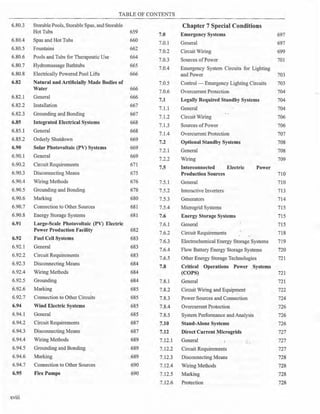
TABLE OF CONTENTS
Table of Contents
Chapter 1 General
Introduction
Definitions
General
Over 1000 Volts, Nominal
Permits and Inspection Certificates
Electrical Pennits
Electrical Inspection
Special
Electrical Plans and Specifications
General
Plans and Specifications
Substation Plans and Specifications
Requirements forElectricallnstallations
General
1000 Volts, Nominal or Less
Over 1000 Volts, Nominal
Tunnel Installions Over 1000 Volts,
Nominal
Manholes and Other Electrical Enclosures
Intended for Personnel Entry
Chapter 2 Wiring and Protection
Use and Identification of Grounded
Conductors
Branch Circuits
General Provisions
Branch-Circuit Ratings
Required Outlets
Feeders
Branch~Circuit, Feeder, and Servi<;e
Load Calculations
General
Branch-Circuit Load Calculations
Feeder and Service L?ad Calculations
Optional Feeder and Service Load
Calculations
Farm Load Calculations
Outside Branch Circuits and Feeders
General
Buildings or Other Structures Supplied by
a Feeder(s) or Branch Circuit(s)
Over 1000 Volts
Services
General
3
3
14
15
15
16
16
16
16
16
19
20
20
24
27
31
32
35
37
37
42
46
50
53
53
54
56
· 59
62
63
63
66
69
70
70
2.30.2
2.30.3
2.30.4
2.30.5
2.30.6
2.30.7
2.30.8
2.40
2.40.1
2.40.2
2.40.3
2.40.4
2.40.5
2.40.6
2.40.7
2.40.8
2.40.9
2.50
2.50.1
2.50.2
2.50.3
2.50.4
2.50.5
2.50.6
2.50.7
2.50.8
2.50.9
2.50.10
2.80
2.80.1
2.80.2
2.80.3
2.85
2.85.1
2.85.2
2,85.3
Overhead Service Conductors
Unde~&round Service Conductors
Service-Entrance Conductors
Service Equipment - General
Service Equipment - Disconnecting
Means
Service Equipment
Protection
Overcurrent
Services Exceeding 1000 Volts, Nominal
Overcurrent Protecton
General
Location
Enclosures
Disconnecting and Guarding
Plug Fuses, Fuseholders, and Adapters
Cartridge Fuses and Fuseholders
Circuit Breakers
Supervised Industrial Installations
Overcurrent Protection over 1000 Volts,
Nominal
Grounding and Bonding
General
System Grounding
Grounding Electrode System and
Grounding Electrode Conductor
Enclosure, Raceway, and Service Cable
Connections
Bonding
Equipment Grounding and Equipment
Grounding Conductors
Methods of Equipment Grounding
Direct-Current Systems
Instruments, Meters, and Relays
Grounding ofSystems and Circuits ofover
1000 Volts
Surge Arresters, Over 1000 Volts
General
Installation
Connecting Surge Arresters
Surge-Protective Devices (SPDs), 1000
Volts or Less
General
Installation
Connecting SPDs
72
73
74
77
77
80
81
82
82
87
90
91
91
92
92
94
96
96
96
100
108
114
115
120
125
128
129
130
134
134
134
134
135
135
135
136
Xl
TABLE OF CONTENTS
2.90 Protection Against Lightning 136
136
136
2.90.1 Introduction.
2.90.2 Tenns and Definitions
2.90.3
2.90.4
Protection for Ordinary Buildings 139
Protection for Miscellaneous Structures
and Special Occupancies 147
2.90.5 Protection for Heavy-Duty Stachs 148
2.90.6 Protection for Structure Containing
Flammable Liquids and Gases 159
Chapter 3 Wiring Methods and Materials
3.0 General Requirements for Wiring
3.0.1
3.0.2
3.10
3.10.1
3.10.2
3.10.3
3.12
3.12.1
3.12.2
3.14
3.14.1
3.14.2
Methods and Materials 153
General Requirements 153
Requirements for over 1000 Volts,
Nominal 164
Conductors for General Wiring 166
General 166
Installation 166
Construction Specifications 173
Cabinets, Cutout Boxes, and Meter
Socket Enclosures 178
Scope and Installation 178
Construction Specifications 193
Outlet, Device, Pull, and Junction
Boxes; Conduit Bodies; Fittings; and
Handhole Enclosures 195
Scope and General 195
Installation 196
3.14.3 Construction Specifications 204
3.14.4 Pull and Junction Boxes, Conduit Bodies,
and Handhole Enclosures for Use on
Systems over 1000 Volts, Nominal 204
3.20 Armored Cable: Type AC 205
3.20.1
3.20.2
3.20.3
3.22
3.22.1
3.22.2
3.22.3
3.24
3.24.1
3.24.2
3.24.3
3.26
3.26.1
XU
General 205
Installation 205
Construction Specifications 207
Flat Cable Assemblies: Type FC 207
General 207
Installation 207
Construction Specifications 208
Flat Conductor Cable: Type FCC 208
General 208
Installation 209
Construction Specifications 210
Integrated Gas Spacer Cable: Type IGS 210
General 210
3.26.2
3.26.3
3.28
3.28.1
3.28.2
3.28.3
3.30
3.30.1
3.30.2
3.30.3
3.32
3.32.1
3.32.2
3.32.3
3.34
3.34.1
3.34.2
3.34.3
3.36
3.36.1
3.36.2
3.36.3
3.38
3.38.1
3.38.2
3.38.3
3.40
3.40.1
3.40.2
3.40.3
3.42
3.42.1
3.42.2
3.42.3
3.44
3.44.1
3.44.2
3.44.3
3.48
3.48.1
Installation
Construction Specifications
Medium Voltage Cable: Type MV
210
211
211
General 211
Instlllation 212
Construction Specifications 212
Metal-Clad Cable: Type MC 212
General 212
Installation 212
Construction Specifications 214
Mineral-Insulated, Metal-Sheathed
Cable: Type MI 215
General 215
Installation 215
Construction Specifications 216
Nonmetallic-Sheathed Cable: Types
NM,NMC,andNMS 216
General 216
Installation 216
Construction Specifications 218
Power and Control Tray Cable: Type
TC 219
General 219
Installation 219
Construction Specifications 220
Service-Entrance Cable: Types SE and
USE 220
General 220
Installation 221
Construction Specifications 222
Underground Feeder and Branch-
Circuit Cable: Type UF 222
General 222
Installation 222
Construction Specifications 223
Intermediate Metal Conduit: Type IMC 223
General 223
Installation 223
Construction Specifications 224
Rigid Metal Conduit: Type RMC 224
General 224
Installation 225
Construction Specifications 226
Flexible Metal Conduit: Type FMC 227
General 227
3.48.2
3.50
3.50.1
3.50.2
3.50.3
3.52
3.52.1
3.52.2
3.52.3
3.53
3.53.1
3.53.2
3.53.3
3.54
3.54.1
3.54.2
3.54.3
3.55
3.55.1
3.55.2
3.55.3
3.56
3.56.1
3.56.2
3.56.3
3.58
3.58.1
3.58.2
3.58.3
3.60
3.60.1
3.60.2
3.60.3
3.62
3.62.1
3.62.2
3.62.3
3.66
TABLE OF CONTENTS
Installation
Liquidtight Flexible Metal Conduit:
TypeLFMC
General
Installation
Construction Specifications
Rigid Polyvinyl Chloride Conduit: Type
PVC
General
Installation
Construction Specifications
High Density Polyethylene Conduit:
Type HDPE Conduit
General
Installation
Construction Specifications
Nonmetallic Underground Conduit with
Conductors: Type NUCC
General
Installation
Construction Specifications
Reinforced Thermosetting Resin
Conduit: Type RTRC
General
Installation
Construction Specifications
Liquidtight Flexible Nonmetallic
Conduit: Type LFNC
General
Installation
Construction Specifications
Electrical Met~llic Tubing: Type EMT
General
Installation
Construction Spec;ifications
Flexible Metallic Tubing: Type FMT
General
Installation
Construction Specifications
Electrical Nonmetallic Tubing: Type
ENT
General
Installation
Construction Specifications
AuxUiary Gutters
227
228
228
228
230
230
230
230
231
232
232
232
233
233
233
234
235
235
235
235
237
237
237
238
239
239
239
239
240
241
241
241
242
242
242
242
244
244
3.66.1
3.66.2
3.66.3
3.68
3.68.1
3.68.2
3.68.3
3.68.4
3.70
3.70.1
3.70.2
3.70.3
3.72
3.72.1
3.72.2
3.74
3.74.l
3.74.2
. 3.74.3
3.76
3.76.1
3.76.2
3.76.3
3.78
3.78.1
3.78.2
3.78.3
3.80
3.80.1
3.80.2
3.82
3.82.1
3.82.2
3.82.3
3.84
3.84.1
3.84.2
3.84.3
3.86
3.86.1
3.86.2
3.86.3
General
Installation
Construction Specifications
Busways
General Requirements
Installation
Construction
Requirements for Over 1000 Volts,
Nominal
Cablebus
General
Installation
Construction Specifications
Cellular Concrete Floor Raceways
General
Installation
Cellular Metal Floor Raceways
General
Installation
Construction Specifications
Metal Wireways
General
Installation
Construction Specifications
Nonmetallic Wireways
General
Installation
Construction Specifications
Multioutlet Assembly
General
Installation
Nonmetallic Extensions
General
Installation
Construction Specifications (Concealable
Nonmetallic Extensions Only)
Strut-Type Channel Raceway
General
Installation
Construction Specifications
Surface Metal Raceways
General
Installation
Construction Specifications
244
244
246
246
246
246
248
248
249
249
249
250
250
250
250
251
251
251
252
252
252
252
254
254
254
254
255
255
255
255
256
256
256
257
258
258
258
259
259
259
259
260
Xlll
TABLE OF CONTENTS
3.88
3.88.1
3.88.2
3.88.3
3.90
3.92
3.92.1
3.92.2
3.92.3
3.93
3.93.1
3.93.2
3.93.3
3.94
3.94.1
Surface Nonmetallic Raceways
General
Installation
Construction Specifications
Underfloor Raceways
Cable Trays
General
Installation
Construction Specifications
Low-Voltage Suspended Ceiling Power
Distribution Systems
General
Installation
Construction Specifications
Concealed Knob-and-Tube Wiring
General
3.94.2 Installation
3.94.3 Construction Specifications
3.96 Messenger-Supported Wiring
3.96.1 General
3.96.2 Installation
3.98 Open Wiring on Insulators
3.98.1 General
3.98.2 Installation
3.98.3
3.99
Construction Specifications
Outdoor Overhead Conductors over
1000 Volts
Chapter 4 Equipment for General Use
Flexible Cords and Flexible Cables
General
260
260
261
261
261
263
263
263
270
271
271
271
273
273
273
273
274
274
274
275
275
275
276
277
277
279
279
4.0
4.0.1
4.0.2
4.0.3
4.2
4.4
4.4.1
4.4.2
4.6
Construction Specifications 287
4.8
4.8.1
4.8.2
4.8.3
4.8.4
4.9
xiv
Portable Cables Over 600 Volts, Nominal 288
Fixture Wires 288
Switches 289
Installation 289
Construction Specifications 294
Receptacles, Cord Connectors, and At-
tachment Plugs (Caps) 295
Switchboards,
Panelboards
General
Switchgear,
Switchboards and Switchgear
Panelboards
Construction Specifications
Industrial Control Panels
and
300
300
302
302
303
305
4.9.1
4.9.2
4.9.3
4.10
4.10.l
4.10.2
4.10.3
4.10.4
4.10.5
4.10.6
4.10.7
4.10.8
4.10.9
4.10.10
General
Installalion
Construction Specifications
Luminaires, Lampholders, and Lamps
General
Luminaire Locations
Provisions at Luminaire Outlet Boxes,
Canopies, and Pans
Luminaire Supports
Grounding
Wiring ofLuminaires
Construction ofLuminaires
Installation of Lampholders
Lamps and Auxiliary Equipment
Special Provisions for Flush and Recessed
Luminaires
4.10.11 Construction of Flush and Recessed
Luminaires
4.10.12 Special Provisions for Electric-Discharge
305
305
306
307
307
307
309
309
310
310
312
313
313
313
314
Lighting Systems of 1000 Volts or Less 314
4.10.13 · Special Provisions for Electric-Discharge
Lighting Systems ofMore Than 1000Volts 315
4.10.14 Lighting Track 316
4.10.15 Decorative Lighting and Similar
Accessories 317
4.11
4.22
4.22.1
4.22.2
Low-Voltage Lighting
Appliances
General
Installation
4.22.3 Disconnecting Means
4.22.4 Construction
· 4.22.5 Marking
4.24 Fixed Electric
Equipment
4.24.1 General
4.24.2 Installation
Space-Heating
4.24.3 Control and Protection of Fixed Electric
317
318
318
318
321
322
323
324
324
324
Space Heating Equipment 324
4.24.4 Marking ofHeating Equipment 326
4.24.5 Electric Space-Heating Cables
4.24.6 Duct Heaters
326
328
4.24.7 Resistance-Type Boilers 329
4.24.8 Electrode-Type Boilers 330
4.24.9 Electric Radiant Heating Panels and
Heating Panel Sets 331
TABLE OF CONTENTS
4.24.10 Low-Voltage Fixed Electric . Space-
4.25
4.25.1
4.25.2
4.25.3
4.25.4
4.25.5
4.25.6
4.25.7
4.27
4.27.1
4.27.2
4.27.3
4.27.4
4.27.5
4.27.6
4.27.7
4.30
4.30.1
4.30.2
4.30.3
4.30.4
4.30.5
4.30.6
4.30.7
4.30.8
4.30.9
4.30.10
4.30.11
4.30.12
4.30.13
4.30.14
Heating Equipment 333
Fixed Resistance and Electrode
Industrial Process Heating Equipment 333
General 333
~nstallation 334
Control and Protection ofFixed Industrial
Process Heating Equipment 334
Marking of Heating Equipment 336
Fixed Industrial Process Duct Heaters 336
Fixed Industrial Process Resistance-Type
Boilers 336
Fixed Industrial Process Electrode-Type
Boilers 337
Fixed Electric Heating Equipment for
Pipelines and Vessels 338
General 338
Installation 339
Resistance Heating Elements 339
Impedance Heating 340
Induction Heating 340
Skin-Effect Heating 340
Control and Protection 341
Motors, Motor Circuits, and Controllers 341
General 341
Motor Circuit Conductors 347
Motor and Branch-Circuit Overload
Protection
Motor Branch-Circuit Short-Circuit and
Ground-Fault Protection
Motor Feeder Short-Circuit and Ground-
Fault Protection
Motor Control Circuits
Motor Controllers
Motor Control Centers
Disconnecting Means
Adjustable-Speed Drive Systems
Over 1000 Volts, Nominal
Protection ofLive Parts - All Voltages
Grounding - All Voltages
Tables
350
354
358
358
360
362
363
366
368
368
369
370
4.40 Air-Conditioning and Refrigerating
Equipment 373
4.40.1 General 373
4.40.2 Disconnecting Means 376
4.40.3 Branch-Circuit Short-Circuit and Ground-
4.40.4
4.40.5
4.40.6
4.40.7
4.45
4.50
4.50.1
4.50.2
Fault Protection 377
Branch-Circuit Conductors 378
Controllers for Motor-Compressors 379
Motor-Compressor and Branch-Circuit
Overload Protection 379
Provisions for Room Air Conditioners 380
Generators 381
Transformers and Transformer Vaults
(Including Secondary Ties) 383
General Provisions 383
Specific ProvisionsApplicable to Different
Types ofTransformers 388
4.50.3 Transformer Vaults 390
4.55
4.55.1
4.55.2
4.60
4.60.l
-4.60.2
4.70
4.70.1
4.70.2
4.80
4.90
4.90.1
4.90.2
4.90.3
4.90.4
4.90.5
5.0
5.1
5.1.1
5.1.2
5.1.3
5.2
5.2.1
5.2.2
5.2.3
5.3
5.3.1
5.3.2
Phase Converters 391
General 391
Specific Provisions Applicable to Different
Types ofPhase Converters 392
Capacitors 393
1000 Volts, Nominal, and Under 393
Over 1000 Volts, Nominal 394
Resistors and Reactors 394
1000 Volts, Nominal, and Under 394
Over 1000 Volts, Nominal 395
Storage Batteries 395
Equipment Over 1000 Volts, Nominal 397
General
Equipment - Specific Provisions
Equipment - Switchgear and Industrial
Control Assemblies
Mobile and Portable Equipment
Electrode-Type Boilers
Chapter 5 Special Occupancies
Hazardous (Classified) Locations,
Classes I, II, and III, Divisions 1 and 2
Class I Locations
General
Wiring
Equipment
Class II Locations
General
Wiring
Equipment
Class III Locations
General
Wiring
397
398
401
403
404
405
413
413
413
420
425
425
425
428
432
432
432
xv
TABLE OF CONTENTS
5.3.3
5.4
5.5
5.6
5.10
5.11
5.13
5.14
5.15
5.16
5.16.1
5.16.2
5.16.3
5.16.4
5.16.5
5.17
5.17.1
5.17.2
5.17.3
5.17.4
5.17.5
5.17.6
5.17.7
5.18
5.20
5.20.1
5.20.2
5.20.3
5.20.4
5.20.5
Equipment 433
Intrinsically Safe Systems 435
Zone 0, 1, and 2 Locations 438
Zone 20, 21, and 22 Locations for Com-
bustible Dusts or Ignitible Fibers/Fly-
ings 454
Hazardous (Classified) Locations -
Specific 462
Commercial Garages, Repair and Stor-
age 462
Aircraft Hangars 465
Motor Fuel Dispensing Facilities 468
Bulk Storage Plants 474
Spray Application, Dipping, Coating,
and Printing Processes Using
Flammable or Combustible Materials 475
General
Open Containers
Spray Application Processes
Spray Application Operations
Membrane Enclosures
m
475
478
478
487
Printing, Dipping, and Coating Processes 487
Health Care Facilities 488
General 489
Wiring and Protection 494
Essential Electrical System 498
Inhalation Anesthetizing Locations 507
X-Ray Installations 510
Communications, Signaling Systems,
Data Systems, Fire Alarm Systems, and
Systems Less Than 120 Volts, Nominal 511
Isolated Power Systems 511
Assembly Occupancies 513
Theaters, Audience Areas of Motion
Picture and Television Studios,
Performance Areas, and Similar
Locations 514
General 514
Fixed Stage Switchboards 516
Fixed Stage Equipment Other Than
Switchboards 517
Portable Switchboards on Stage 519
Portable Stage Equipment Other Than
Switchboards 522
5.20.6 Dressing Rooms, Dressing Areas, and
Makeup Areas 523
5.20.7 Grounding 524
xvi
5.22
5.22.1
5.22.2
5.22.3
5.25
5.25.1
5.25.2
5.25.3
5.25.4
5.30
5.30.1
5.30.2
5.30.3
5.30.4
5.30.5
5.30.6
5.40
5.40.1
5.40.2
5.40.3
5.40.4
5.45
5.47
5.50
5.50.1
5.50.2
5.50.3
5.51
5.51.1
5.51.2
Control Systems for Permanent
Amusement Attractions 524
General 524
Control Circuits 524
Control Circuit Wiring Methods 525
Carnivals, Circuses, Fairs, and Similar
Events 526
General Requirements 526
Power Sources 526
Wiring Methods 527
Grounding and Bonding 528
Motion Picture and Television Studios
and Similar Locations 528
General 528
Stage or Set 529
Dressing Rooms
Viewing, Cutting, and Patching Tables
Cellulose Nitrate Film Storage Vaults
Substations
Motion Picture Projection Rooms
531
531
531
532
532
General 532
Equipment and Projectors of the
Professional Type 532
Nonprofessional Projectors 533
Audio Signal Processing, Amplification,
and Reproduction Equipment 533
Manufactured Buildings 533
Agricultural Buildings 534
Mobile Homes, Manufactured Homes,
and Mobile Home Parks 537
General 537
Mobile and Manufactured Homes 538
Services and Feeders 546
Recreational Vehicles and Recreational
Vehicle Parks 548
General 548
Combination Electrical Systems 549
5.51.3 Other Power Sources 549
5.51.4 Nominal 120-Volt or 120/240-Volt
Systems 550
5.51.5 Factory Tests 559
5.51.6 Recreational Vehicle Parks 559
5.52 Park Trailers 562
5.52.1 General
5.52.2 Low-Voltage Systems
5.52.3 Combination Electrical Systems
562
562
564
TABLE OF CONTENTS
5.52.4
5.52.5
5.53
5.53.1
5.53.2
5.53.3
5.55
5.90
Nominal 120-Volt or 120/240-Volt
Systems 564
Factory Tests 573
Floating Buildings 573
General 573
Services and Feeders 573
Grounding 574
Marinas, Boatyards, and Commercial
and Noncommercial Docking Facilities 574
Temporary Installations 578
Chapter 6 Special Equipment
6.0 Electric Signs and Outline Lighting 581
6.0.1 General 581
6.0.2 Field-Installed Skeleton Tubing, Outline
Lighting, and Secondary Wiring 586
6.4 Manufactured Wiring Systems 589
6.5 Office Furnishings 590
6.10 Cranes and Hoists 591
6.10.1 General 591
6.10.2 Wiring 592
6.10.3 Contact Conductors 594
6.10.4 Disconnecting Means 595
6.10.5 Overcurrent Protection 595
6.10.6 Control 596
6.10.7
6.20
6.20.1
6.20.2
6.20.3
6.20.4
6.20.5
6.20.6
6.20.7
6.20.8
6.20.9
6.20.10
6.25
Grounding 597
Elevators, Dumbwaiters, Escalators,
Moving Walks, Platform Lifts, and
Stairway Chairlifts 597
General 597
Conductors 599
Wiring 600
Installation of Conductors 603
Traveling Cables
Disconnecting Means and Control
Overcurrent Protection
Machine Rooms, Control Rooms,
Machinery Spaces, and Control Spaces
Grounding
Emergency and Standby Power Systems
Electric Vehicle Charging System
604
605
607
6.25.1 General
607
608
608
608
608
610
611
613
614
6.25.2 Equipment Construction
6.25.3 Installation
6.25.4 Wireless Power Transfer Equipment
6.26 Electrified Truck Parking Spaces
6.26.1
6.26.2
6.26.3
6.26.4
6.30
6.30.1
6.30.2
6.30.3
General 614
Electrified Truck Parking Space Electrical
Wiring Systems 615
Electrified Truck Parking Space Supply
Equipment 615
Transport Refrigerated Units (TRUs) 617
Electric Welders 618
General 618
Arc Welders 618
Resistance Welders 620
6.30.4 Welding Cable 621
6.40 Audio Signal Processing, Amplification,
and Reproduction Equipment 621
6.40.1 General 621
6.40.2 Permanent Audio System Installations 624
6.40.3 Portable and Temporary Audio System
Installations 625
6.45 Information Technology Equipment 626
6.46 Modular Data Centers 630
6.46.1 General 630
6.46.2 Equipment 634
6.46.3 Lighting 634
6.46.4 Workspace 634
6.47 Sensitive Electronic Equipment 635
6.50
6.60
6.60.l
6.60.2
6.60.3
6.60.4
6.65
6.65.1
6.65.2
6.68
6.69
6.70
6.75
6.75.1
6.75.2
6.80
6.80.1
6.80.2
Pipe Organs 637
X-Ray Equipment 638
General 638
Control 639
Transformers and Capacitors 639
Guarding and Grounding 639
Induction and Dielectric Heating
Equipment 640
General
Guarding, Grounding, and Labeling
Electrolytic Cells
Electroplating
Industrial Machinery
Electrically Driven or Controlled
Irrigation Machines
General
640
640
641
644
645
646
646
Center Pivot Irrigation Machines 648
Swimming Pools, Fountains, and
Similar Installations 648
General 648
Permanently Installed Pools 651
xvii
TABLE OF CONTENTS
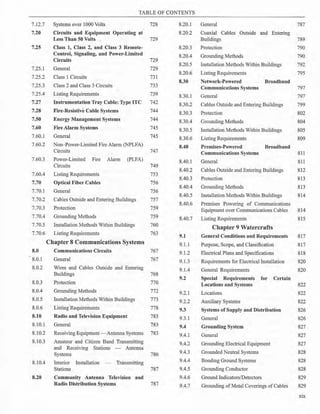
6.80.3 Storable Pools, Storable Spas, and Storable Chapter 7 Special Conditions
Hot Tubs 659
7.0 Emergency Systems 697
6.80.4 Spas and Hot Tubs 660
7.0.1 General 697
6.80.5 Fountains 662
7.0.2 Circuit Wiring 699
6.80.6 Pools and Tubs for Therapeutic Use 664
7.0.3 Sources ofPower 701
6.80.7 Hydromassage Bathtubs 665
7.0.4 Emergency System Circuits for Lighting
6.80.8 Electrically Powered Pool Lifts 666 and Power 703
6.82 Natural and Artificially Made Bodies of 7.0.5 Control - Emergency Lighting Circuits 703
Water 666
7.0.6 Overcurrent Protection 704
6.82.1 General 666
7.1 Legally Required Standby Syster_ns 704
6.82.2 Installation 667
7.1.1 General 704
6.82.3 Grounding and Bonding 667
7.1.2 Circuit Wiring 706
6.85 Integrated Electrical Systems 668
7.1.3 Sources ofPower 706
6.85.1 General 668
7.1.4 Overcurrent Protection 707
6.85.2 Orderly Shutdown 669
7.2 Optional Standby Systems 708
6.90 Solar Photovoltaic (PV) Systems 669
7.2.l General 708
6.90.1 General 669
7.2.2 Wiring 709
6.90.2 Circuit Requirements 671
7.5 Interconnected Electric Power
6.90.3 Disconnecting Means 675 Production Sources 710
6.90.4 Wiring Methods 676 7.5.1 General 710
6.90.5 Grounding and Bonding 678 7.5.2 Interactive Inverters 713
6.90.6 Marking 680 7.5.3 Generators 714
6.90.7 Connection to Other Sources 681 7.5.4 Microgrid Systems 715
6.90.8 Energy Storage Systems 681 7.6 Energy Storage Systems 715
6.91 Large-Scale Photovoltaic (PV) Electric 7.6.1 General 715
Power Production Facility 682
7.6.2 Circuit Requirements 718
6.92 Fuel Cell Systems 683
7.6.3 Electrochemical Energy Storage Systems 719
6.92.1 General 683
7.6.4 Flow Battery Energy Storage Systems 720
6.92.2 Circuit Requirements 683
7.6.5 Other Energy Storage Technologies 721
6.92.3 Disconnecting Means 684
7.8 Critical Operations Power Systems
6.92.4 Wiring Methods 684 (COPS) 721
6.92.5 Grounding 684 7.8.1 General 721
6.92.6 Marking 685 7.8.2 Circuit Wiring and Equipment 722
6.92.7 Connection to Other Circuits 685 7.8.3 Power Sources and Connection 724
6.94 Wind Electric Systems 685 7.8.4 Overcurrent Protection 726
6.94.l General 685 7.8.5 System Performance and Analysis 726
6.94.2 Circuit Requirements 687 7.10 Stand-Alone Systems 726
6.94.3 Disconnecting Means 687 7.12 Direct Current Microgrids 727
6.94.4 Wiring Methods 689 7.12.1 General 727
6.94.5 Grounding and Bonding 689 7.12.2 Circuit Requirements 727
6.94.6 Marking 689 7.12.3 Disconnecting Means 728
6.94.7 Connection to Other Sources 690 7.12.4 Wiring Methods 728
6.95 Fire Pumps 690 7.12.5 Marking 728
7.12.6 Protection 728
XVlll
7.12.7
7.20
7.25
7.25.1
7.25.2
7..25.3
7.25.4
7.27
7.28
7.50
7.60
7.60.1
7.60.2
7.60.3
7.60.4
7.70
7.70.1
7.70.2
7.70.3
7.70.4
7.70.5
7.70.6
8.0
8.0.1
8.0.2
8.0.3
8.0.4
8.0.5
8.0.6
8.10
8.10.1
8.10.2
8.10.3
8.10.4
8.20
TABLE OF CONTENTS
Systems over 1000 Volts
Circuits and Equipment Operating at
Less Than50 Volts
Class 1, Class 2, and Class 3 Remote-
Control, Signaling, and Power-Limited
Circuits
General
Class l Circuits
Class 2 and Class 3 Circuits
Listing Requirements
Instrumentation Tray Cable: Type ITC
Fire-Resistive Cable Systems
Energy Management System,s
Fire Alarm Systems
General
Non- Power-Limited Fire Alarm (NPLFA)
Circuits
Power-Limited Fire Alarm (PLFA)
Circuits
Listing Requirements
Optical Fiber Cables
General
Cables Outside and Entering Buildings
Protection
Grounding Methods
Installation Methods Within Buildings
Listing Requirements
Chapter 8 Communications Systems
Communications Circuits
General
Wires and Cables Outside and ·Entering
728
729
729
729
731
733
739
742
744
744
745
745
747
749
753
756
756
757
759
759
760
763
767
767
Buildings 768
Protection 770
Grounding Methods 772
Installation Methods Within Buildings 773
Listing Requirements 778
Radio and Television Equipment 783
General 783
Receiving Equipment - Antenna Systems 783
Amateur and Citizen Band Transmitting
and Receiving Stations - Antenna
Systems 786
Interior Installation - Transmitting
Stations 787
Community Antenna Television and
Radio Distribution Systems 787
8.20.1
8.20.2
8.20.3
8.20.4
8.20.5
8.20.6
8.30
8.30.1
8.30.2
8.30.3
8.30.4
8.30.5
8.30.6
8.40
8.40.1
8.40.2
8.40.3
8.40.4
8.40.5
8.40.6
8.40.7
9.1
9.1.1
9.1.2
9.1.3
9.1.4
9.2
9.2.1
9.2.2
9.3
9.3.1
9.4
9.4.l
9.4.2
9.4.3
9.4.4
9.4.5
9.4.6
9.4.7
General
Coaxial Cables Outside and Entering
Buildings
Protection
Grounding Methods
Installation Methods Within Buildings
Listing Requirements
Network-Powered
Communications Systems
General
Broadband
Cables Outside and Entering Buildings
Protection
Grounding Methods
Installation Methods Within Buildings
Listing Requirements
Premises-Powered Broadband
Communications Systems
General
Cables Outside and Entering Buildings
Protection
Grounding Methods
Installation Methods Within Buildings
Premises Powering of Communications
Equipment over Communications Cables
Listing Requirements
Chapter 9 Watercrafts
General Conditions and Requirements
Purpose, Scope, and Classification
Electrical Plans and Specifications
Requirements for Electrical Installation
787
789
790
790
792
795
797
797
799
802
804
805
809
811
811
812
813
813
814
814
815
817
817
818
820
General Requirements 820
Special Requirements for Certain
Locations and Systems 822
Locations
Auxiliary Systems
Systems of Supply and Distribution
General
Grounding System
General
Grounding Electrical Equipment
Grounded Neutral Systems
Bonding Ground Systems
Grounding Conductor
Ground Indicators/Detectors
Grounding ofMetal Coverings ofCables
822
822
826
826
827
827
827
828
828
828
829
829
XlX
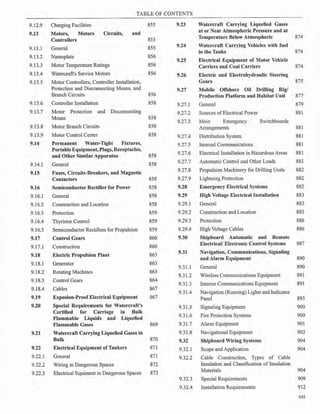
TABLE OF CONTENTS
9.4.8
9.4.9
9.4.10
9.4.11
9.5
9.5.l
9.6
9.6.1
9.6.2
9.6.3
9.6.4
9.6.5
9.6.6
9.6.7
9.6.8
9.6.9
9.6.10
9.6.11
9.6.12
9.6.13
9.6.14
9.6.15
9.6.16
9.6.17
9.6.18
9.6.19
9.6.20
9.6.21
9.6.22
9.6.23
9.6.24
9.6.25
9.6.26
9.6.27
Ground Continuity 829
Grounding ofMetal Conduit System 829
Grounding Pole for Receptacle Outlets
and Attachment Plugs 829
Grounding of Instrument Transformers 829
Lightning Protection System 829
General 829
Distribution System Protection 830
General 830
Diversity Factor 831
Through-Feed Arrangements 831
Lighting Circuits 831
Unbalanced Loads 832
Branch Circuits 832
Motor Circuits 832
Essential Services 832
Circuits in Vicinity ofMagnetic Compass 833
Watercraft's Service Power Circuits 833
Distribution Circuits for Passenger Service 833
Ventilating Systems 833
Steering Gear 834
Shore Connection 834
Emergency Systems 834
Navigation Light 834
Lighting Feeders 835
Branch Lighting Circuits 836
Pilot Ladders 836
Call Bell Circuits 836
Oil Pump Rooms and Spaces Adjoining
Oil Tanks 836
Motor of 0.25 Hp or More and Apparatus
ofMore Than 660 Volt-Amperes 836
Receptacle Outlets 836
Lighting Fixtures 836
Grounding ofLighting Equipment 837
Final Subcircuits 837
Circuit Protection 838
9.6.28 Protection of Watercraft's Service
9.6.29
9.6.30
9.6.31
9.6.32
9.6.33
9.6.34
xx
Generators 838
Three-Wire Dual-Voltage DC System
Steering-Gear Circuits
AC Propulsion Circuits
DC Propulsion Circuits
Propulsion Excitation
AC Three-Phase System
839
839
840
840
840
840
9.6.35
9.7
9.7.1
9.7.2
9.7.3
9.7.4
9.7.5
9.8
9.8.1
9.8.2
9.8.3
9.8.4
9.8.5
9.8.6
9.8.7
9.8.8
9.8.9
9.8.10
9.8.11
9.9
9.9.1
9.10
9.10.1
9.10.2
9.10.3
9.10.4
9.11
9.11.1
9.11.2
9.11.3
9.11.4
9.12
9.12.1
9.12.2
9.12.3
9.12.4
9.12.5
9.12.6
9.12.7
9.12.8
Electric Depth-Sounding Devices and
Impressed Current Cathodic Protection 840
Lighting Fittings, Heating Appliances
and Wiring Accessories 841
General 841
Lighting Fixtures 841
Heating Appliances 841
Wiring Accessories 841
Luminaires 842
Switchboards, Section and Distribution
Boards 842
General 842
Switchboard Construction 843
Switchboard Busbars and Contacts 844
Equalizer for DC Generator 844
Measuring Instrument for Switchboards 845
Switchboard Equipment Requirements 845
Instrument Scales 846
Ground Indication 846
Switchboard Wiring 846
Protective Devices 846
Section Board and Distribution Board 848
Sources of Electrical Power 849
Generator 849
Generators 850
General 850
Generator Construction 851
Voltage Regulation 852
Parallel Operations 852
Transformers 852
General 852
Temperature Rise 853
Main Transformers 853
Voltage Regulation 853
Storage Batteries, Battery Rooms and
Associated Equipment 853
General 853
Arrangement and Installation
Battery Trays and Types
853
854
Ventillation 854
Electrical Installation m Battery
Compartment 854
Battery Cables 854
Overload and Reverse-Current Protection 855
Protection Against Corrosion 855
TABLE OF CONTENTS
9.12.9 Charging Facilities 855
9.13 Motors, Motors
Controllers
Circuits, and
855
9.13.1
9.13.2
9.13.3
9.13.4
9.13.5
9.13.6
General 855
Nameplate 856
Motor Temperature Ratings 856
Watercraft's Service Motors 856
Motor Controllers, Controller Installation,
Protection and Disconnecting Means, and
Branch Circuits 856
Controller Installation 858
9.13.7 Motor Protection and Disconnecting
Means 858
858
858
9.13.8 Motor Branch Circuits
9.13.9 Motor Control Center
9.14
9.14.1
9.15
9.16
9.16.1
9.16.2
9.16.3
9.16.4
9.16.5
9.17
9.17.1
9.18
9.18.1
9.18.2
9.18.3
9.18.4
9.19
9.20
9.21
9.22
9.22.1
9.22.2
9.22.3
Permanent Water-Tight Fixtures,
PortableEquipment, Plugs, Receptacles,
and Other Similar Apparatus 858
General 858
Fuses, Circuits-Breakers, and Magnetic
Contactors 858
Semiconductor Rectifier for Power 858
General 858
Construction and Location 858
Protection 859
Thyristor Control 859
Semiconductor Rectifiers for Propulsion 859
Control Gears 860
Construction 860
Electric Propulsion Plant 863
Generator 863
Rotating Machines 863
Control Gears 864
Cables 867
Exposion-Proof Electrical Equipment 867
Special Requirements for Watercraft's
Certified for Carriage in Bulk
Flammable Liquids and Liquefied
Flammable Gases 869
Watercraft Carrying Liquefied Gases in
Bulk 870
Electrical Equipment ofTankers 871
General 871
Wiring in Dangerous Spaces 872
Electrical Equiment in Dangerous Spaces 873
9.23
9.24
9.25
9.26
9.27
9.27.1
9.27.2
9.27.3
9.27.4
9.27.5
9.27.6
9.27.7
9.27.8
9.27.9
9.28
9.29
9.29.1
9.29.2
9.29.3
9.29.4
9.30
9.31
9.31.1
9.31.2
9.31.3
9.31.4
9.31.5
9.31.6
9.31.7
9.31.8
9.32
9.32.1
9.32.2
Watercraft Carrying Liquefied Gases
at or Near Atmospheric Pressure and at
Temperature Below Atmospheric 874
Watercraft Carrying Vehicles with fuel
in the Tanks 874
Electrical Equipment of Motor Vehicle
Carriers and Coal Carriers 874
Electric and Electrohydraulic Steering
Gears 875
Mobile Offshore Oil Drilling Rig/
Production Platform and Habitat Unit 877
General 879
Sources of Electrical Power
Main Emergency
Arrangements
Distribution System
Switchboards
881
881
881
Internal Communications 881
Electrical Installation in Hazardous Areas 881
Automatic Control and Other Loads 881
Propulsion Machinery for Drilling Units 882
Lightning Protection 882
Emergency Electrical Systems 882
High Voltage Electrical Installation 883
General 883
Construction and Location 883
Protection 886
High Voltage Cables 886
Shipboard Automatic and Remote
Electrical/ Electronic Control Systems 887
Navigation, Communications, Signaling
and Alarm Equipment 890
General 890
Wireless Communications Equipment 891
Interior Communications Equipment 891
Navigation (Running) Lights and Indicator
Panel 893
Signaling Equipment 900
Fire Protection Systems 900
Alarm Equipment 901
Navigational Equipment 902
Shipboard Wiring Systems 904
Scope and Application 904
Cable Construction, Types of Cable
Insulation and Classification of Insulation
Materials 904
9.32.3 Special Requirements 909
912
9.32.4 Installation Requirements
XXl
TABLE OF CONTENTS
9.32.5 Current Rating 919
9.32.6 Ambient Temperature 920
9.32.7 Intermittent Service 920
9.33 Additional Requirements forWatercraft
Carrying Hazardous Cargoes 920
9.33.1 Watercraft of the Bulk-Oil-Carrier Type
and Watercraft Carrying Oil Having a
Flash Point of 60°C or Less 920
9.34 Additional Requirement for RO/RO
Watercraft 922
9.35 Tables 923
Chapter 10 Tables
l0.1.1.l Percent of Cross Section of Conduit and 932
Tubing for Conductors and Cables
10.1.1.2
10.1.1.4
10.1.1.5
10. l.l.5(A)
10.l.1.8
10.l.l.9
xxii
Radius of Conduit and Tubing Bends
Dimensions and PercentArea ofConduit
and Tubing (Areas ofConduit or Tubing
for the Combinations ofWires Permitted
in Table 10.1.1. 1, Chapter 10)
Dimensions ofInsulated Conductors and
Fixture Wires
Compact Copper and Aluminum
Building Wire Nominal Dimensions*
and Areas
Conductor Properties
933
933
936
940
941
Alternating-Current Resistance and 942
Reactance for 600-Volt Cables, 3-Phase,
60 Hz, 75°C- Three Single Conductors
in Conduit
10.1.1.10 Conductor Stranding 942
10.l.J. ll(A) Class 2 and Class 3 Alternating-Current 943
Power Source Limitations
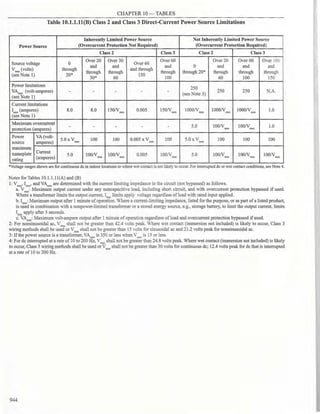
10.1.l.ll(B) Class 2 and Class 3 Direct-Current 944
Power Source Limitations
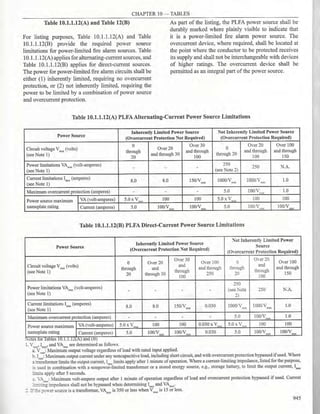
10. l.l.l2(A) PLFAAlternating-Current Power Source 945
Limitations
10.l.l.l2(B) PLFA Direct-Current Power Source 945
Appendix A
Appendix B
Appendix C
Appendix D
Appendix£
Appendix F
Appendix G
Appendix H
Limitations
Appendices
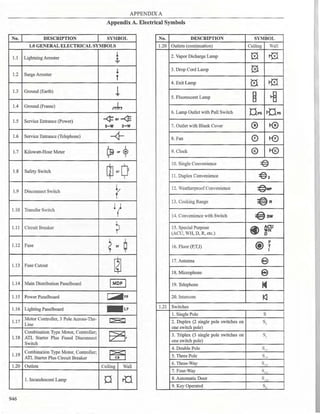
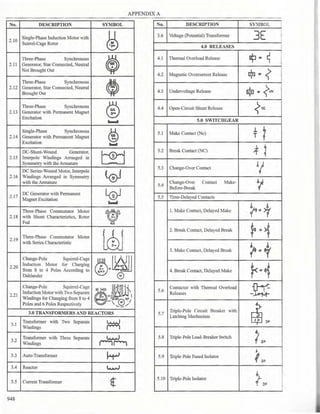
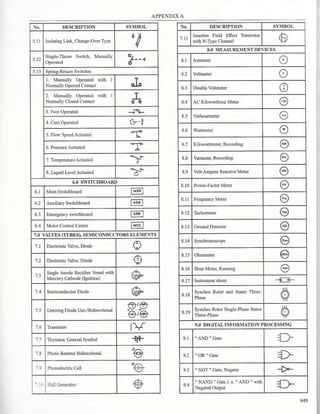
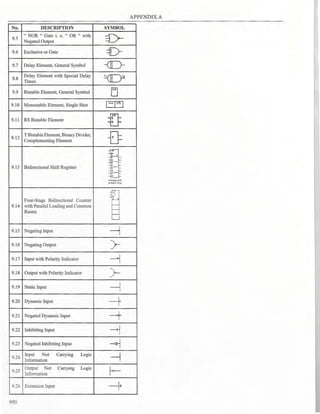
Electrical Symbols 946
Application Information for Ampacity 951
Calculation
Conduit and Tubing Fill Tables for 966
Conductors and Fixture Wires of the
Same Size
Wiring Design Examples
Examples ofElectrical Forms
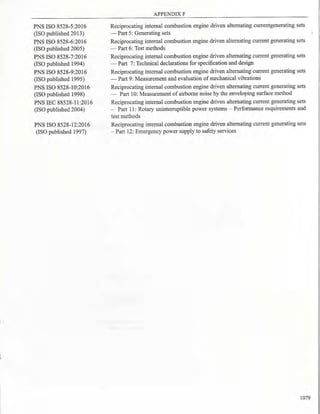
PNS for Electrical Products
Arc-Flash Hazard Warning Label
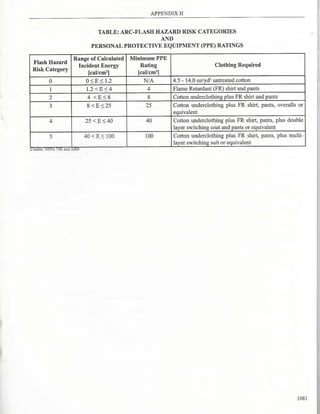
Table: Arc-Flash Hazard Risk Categories
and Personal Protective Equipment
(PPE) Ratings
Indexes
Index for Watercraft
1045
1062
1069
1080
1081
1082
1139
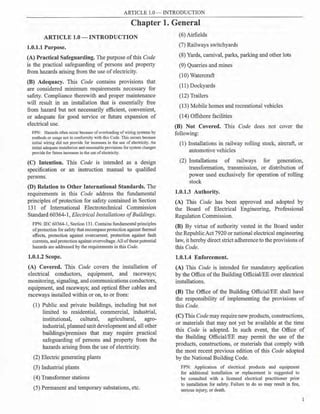
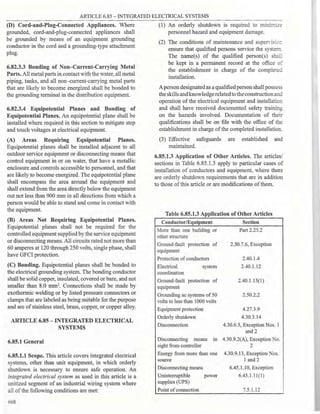
ARTICLE 1.0 - INTRODUCTION
Chapter 1. General
ARTICLE 1.0 - INTRODUCTION
1.0.1.1 Purpose.
(A) Practical Safeguarding. The purpose ofthis Code
is the practical safeguarding of persons and property
from hazards arising from the use ofelectricity.
(B) Adequacy. This Code contains provisions that
are considered minimum requirements necessary for
safety. Compliance therewith and proper maintenance
will result in an installation that is essentially free
from hazard but not necessarily efficient, convenient,
or adequate for good service or future expansion of
electrical use.
FPN: Hazards often occur because of overloading ofwiring systems by
methods or usage not in conformity with this Code. Thjs occurs because
initial wiring did not provide for increases in the use of electricity. An
initial adequate installation and reasonable provisions for system changes
provide for future increases in the use of electricity.
(C) Intention. This Code is intended as a design
specification or an instruction manual to qualified
persons.
(D) Relation to Other International Standards. The
requirements in this Code address the fundamental
principles of protection for safety contained in Section
131 of International Electrotechnical Commission
Standard 60364-1, Electrical Installations ofBuildings.
FPN: IEC 60364-1, Section 131. Contains fundamental principles
ofprotection for safety that encompass protection against thermal
effects, protection against overcurrent, protection against fault
currents, and protection against overvoltage. All ofthese potential
hazards are addressed by the requirements in this Code.
1.0.1.2 Scope.
(A) Covered. This Code covers the installation of
electrical conductors, equipment, and raceways;
monitoring, signaling, and communications conductors,
equipment, and raceways; and optical fiber cables and
raceways installed within or on, to or from:
(1) Public and private buildings, including but not
limited to residential, commercial, industrial,
institutional, cultural, agricultural, agro-
industrial, planned unit development and all other
buildings/premises that may require practical
safeguarding of persons and property from the
hazards arising from the use ofelectricity.
(2) Electric generating plants
(3) Industrial plants
(4) Transformer stations
(5) Permanent and temporary substations, etc.
(6) Airfields
(7) Railways switchyards
(8) Yards, carnival, parks, parking and other lots
(9) Quarries and mines
(I0) Watercraft
(11) Dockyards
(12) Trailers
(13) Mobile homes and recreational vehicles
(14) Offshore facilities
(B) Not Covered. This Code does not cover the
following:
(1) Installations in railway rolling stock, aircraft, or
automotive vehicles
(2) Installations of railways for generation,
transformation, transmission, or distribution of
power used exclusively for operation of rolling
stock
1.0.1.3 Authority.
(A) This Code has been approved and adopted by
the Board of Electrical Engineering, Professional
Regulation Commission.
(B) By virtue of authority vested in the Board under
the Republic Act 7920 or national electrical engineering
law, it hereby direct strict adherence to the provisions of
this Code.
1.0.1.4 Enforcement.
(A) This Code is intended for mandatory application
by the Office ofthe Building Official/EE over electrical
installations.
(B) The Office of the Building Official/EE shall have
the responsibility of implementing the provisions of
this Code.
(C) This Code may require new products, constructions,
or materials that may not yet be available at the time
this Code is adopted. In such event, the Office of
the Building Official/EE may permit the use of the
products, constructions, or materials that comply with
the most recent previous edition of this Code adopted
by the National Building Code.
FPN: Application of electrical products and equipment
for additional installation or replacement is suggested to
be consulted with a licensed electrical practitioner prior
to installation for safety. Failure to do so may result in fire,
serious injury, or death.
ARTICLE 1.0 - INTRODUCTION
1.0.1.5 Mandatory Rules, Permissive Rules,
Explanatory Material, and Appendices.
(A) Mandatory Rules. Mandatory rules of this Code
are those that identify actions that are specifically
required or prohibited and are characterized by the use
of the terms shall or shall not.
(B) Permissive Rules. Permissive rules of this Code
are those that identify actions that are allowed but
not required, are normally used to describe options or
alternative methods, and are characterized by the use
of the terms shall be permitted or shall not be required.
(C) Explanatory Material. Explanatory material, such
as references to other standards, references to related
sections of this Code, or information related to a Code
rnle, is included in this Code in the form of fine print
notes (FPN). Fine print notes are informational only
and are not enforceable as requirements ofthis Code.
Brackets containing section references to another NFPA
document are for informational purposes only and
are provided as a guide to indicate the source of the
extracted text. These bracketed references immediately
follow the extracted text.
(D) Appendices. Nonmandatory information relative
to the use of the PECJ is provided in appendices.
Appendices are not part ofthe erforceable requirements
of the PECJ, but are included for information purposes
only.
1.0.1.6 Interpretation. Interpretation of this Code
shall be by licensed electrical practitioners. In case of
conflicting interpretations, these may be referred to
the Philippine Electrical Code Part 1 Committee for
interpretation. Should disagreement remain, thereafter,
the Committee's interpretation shall be referred to the
Board of Electrical Engineering who shall render the
final decision.
1.0.1.7 Examination of Equipment for Safety. For
specific items of equipment and materials referred
to in this Code, examinations for safety made under
standard conditions will provide a basis for approval
where the record is made generally available through
promulgation by organizations properly equipped and
qualified for experimental testing, inspections ofthe run
of goods at factories, and service-value determination
through field inspections. This avoids the necessity
for repetition of examinations by different examiners,
frequently with inadequate facilities for such work, and
the confusion that would result from conflicting reports
as to the suitability of devices and materials examined
for a given purpose.
2
It is the intent ofthis Code that factory-installed internal
wiring or the construction of equipment need not be
inspected at the time of installation of the equipment,
except to detect alterations or damage, if the equipment
has been listedbya qualified electricaltesting laboratory
that is recognized as having the facilities described in
the preceding paragraph and that requires suitability for
installation in accordance with this Code.
FPN No. 1: See requirements in Section 1.10.1.3.
FPN No. 2: Listed is defined in Article 1.1
FPN No. 3: Appendix F contains an informative list ofproduct
safety standards for electrical equipment.
FPN No. 4: Application of electrical equipment and devices
shall always be consulted with a licensed electricalpractitioner.
Failure to do so may result in fire, serious injury, or death.
1.0.1.8 Wiring Planning.
(A) Future Expansion and Convenience. Plans and
specifications that provide ample space in raceways,
spare raceways, and additional spaces allow for future
increases in electric power and communication circuits.
Distribution centers located in readily accessible
locations provide convenience and safety ofoperation.
(B) Number of Circuits in Enclosures. It is elsewhere
provided in this Code that the number of wires and
circuits confined in a single enclosure be varyingly
restricted. Limiting the number of circuits in a single
enclosure will minimizes the effects from a short circuit
or ground fault.
1.0.1.9 Units of Measurement.
(A) Measurement Systems of Preference. For the
purpose of this Code, metric units of measurement
are in accordance with the modernized metric system
known as the International System of Units (SI).
(B) Trade Sizes. Where the actual measured size of a
product is not the same as the nominal size, trade size
designators shall be used rather than dimensions. Trade
practices shall be followed in all cases.
(C) Extracted Material. Where material is extracted
from another standard, the context of the original
material shall not be compromised or violated. Any
editing of the extracted text shall be confined to making
the style consistent with that of the PEC 1.
FPN: SI conversions are based on IEEE/ASTM SI 10-1997, Standard
for the Use of the International System of Units (SI): The Modem
:vfetric System.
1.0.1.10 Apprenticeship.
(A) Republic Act 7920 or the national electrical
engineering law requires apprenticeship as one of
ARTICLE 1.1 - DEFINITIONS
the qualifications to the registration and licensure
examinations for Registered Master Electrician
(RME), in order to practice electrical engineering in
the Philippines. Knowledge and understanding of the
Philippine Electrical Code, Parts 1 and 2 (PECl and
PEC2) form part ofthe examinations given.
(B) An apprentice shall undergo training under a
person holding a valid certificate of registration and a
valid professional license for the practice of electrical
engineering under Republic Act 7920 or the national
electrical engineering Jaw.
1.0.1.11 Services of Licensed Electrical Practitioner.
For decisions and actions involving a knowledge
of electrical engineering and/or training in electrical
installations and practices, the services of a licensed
electrical practitioner is required.
ARTICLE 1.1 - DEFINITIONS
1.1.1.1 Scope. This article contains only those
definitions essential to the application ofthis Code. It is
not intended to include commonly defined general terms
or commonly defined technical terms from related codes
and standards. In general, only those terms that are used
in two or more articles are defined in Article 1.1. Other
definitions are included in the article in which they are
used but may be referenced in Article 1.1.
Part 1.1.1 of this article contains definitions intended
to apply wherever the tem1s are used throughout this
Code. Part 1.1.2 contains definitions applicable to the
installations and equipment operating at over 1000
volts, nominal.
1.1.1 General
Accessible (as applied to equipment). Admitting close
approach; not guarded by locked doors, elevation, or
other effective means.
Accessible (as applied to wiring methods). Capable
of being removed or exposed without damaging the
building structure or finish or not permanently closed in
by the structure or finish ofthe building.
Accessible, Readily (Readily Accessible). Capable
of being reached quickly for operation, renewal, or
inspections without requiring those to whom ready
access is requisite to take actions such as to use tools
(other than keys), to climb over or under, to remove
obstacles or to resort to portable ladders, and so forth.
FPN: Use of keys is a common practice under controlled or
supervised conditions and a common alternative to the ready
access requirements under such supervised conditions as provided
elsewhere in the NEC
Adjustable Speed Drive. Power conversion equipment
that provides a means of adjusting the speed of an
electric motor.
FPN: A variable frequency drive is one type of electronic adjustable
speed drive that controls the rotational speed of an ac electric motor by
controlling the frequency and voltage of the electrical power supplied to
the motor.
Ampacity. The current, in amperes, that a conductor
can carry continuously under the conditions of use
without exceeding its temperature rating.
Appliance. Utilization equipment, generally other than
industrial, that is normally built in standardized sizes or
types and is installed or connected as a unit to perform
one or more functions such as clothes washing, air
conditioning, food mixing, deep frying, and so forth.
Approved. Equipment and materials; and installation,
testing and commissioning methods, recognized as
acceptable by local and international standards-setting
organizations - properly equipped and qualified for
testing, inspections of the run ofgoods at factories, and
service-value determination through field inspections
- and/or as permitted by relevant and applicable
government regulatory codes.
FPN: An example of government regulatory codes are the
Philippine Electrical Code, Part I and Part 2.
Askarel. A generic term for a group of nonflammable
synthetic chlorinated hydrocarbons used as electrical
insulating media.
FPN: Askarels of various compositional types are used. Under arcing
conditions, the gases produced, while consisting predominantly of
noncombustible hydrogen chloride, can include varying amounts of
combustible gases, depending on the askarel type.
Associated Apparatus [as applied to Hazardous
(Classified) Locations]. Apparatus in which the circuits
are not necessarily intrinsically safe themselves but that
affects the energy in the intrinsically safe circuits and is
relied on to maintain intrinsic safety. Such apparatus is
one of the following:
(1) Electrical apparatus that has an alternative type
ofprotection for use in the appropriate hazardous
(classified) location
(2) Electrical apparatus not so protected that shall not
be used within a hazardous (classified) location
FPN No. 1: Associated apparatus has identified intrinsically safe
connections for intrinsically safe apparatus and also may have
connections for nonintrinsically safe apparatus.
FPN No. 2: An example of associated apparatus is an intrinsic
safety barrier, which is a network designed to limit the energy
(voltage and current) available to the protected circuit in the
hazardous (classified) location, under specified fault conditions.
3
ARTICLE 1.1 - DEFINITIONS
Associated Nonincendive Field Wiring Apparatus
[as applied to Hazardous (Classified) Locations].
Apparatus in which the circuits are not necessarily
nonincendive themselves but that affect the energy in
nonincendive field wiring circuits and are relied upon
to maintain nonincendive energy levels. Such apparatus
are one of the following:
(1) Electrical apparatus that has an alternative type
ofprotection for use in the appropriate hazardous
(classified) location
(2) Electrical apparatus not so protected that shall not
be used in a hazardous (classified) location
FPN: Associated nonincendive field wiring apparatus has
designated associated nonincendive field wiring apparatus
connections for nonincendive field wiring apparatus and may also
have connections for other electrical apparatus.
Attachment Plug (Plug Cap) (Plug). A device that,
by insertion in a receptacle, establishes a connection
between the conductors ofthe attached flexible cord and
the conductors connected permanently to the receptacle.
Automatic. Performing a function without the necessity
ofhuman intervention.
Bathroom. An area including a basin with one or more
of the following: a toilet, a tub, or a shower.
Battery System. Interconnected battery subsystems
consisting of one or more storage batteries and battery
chargers, and can include inverters, converters, and
associated electrical equipment.
Bonded (Bonding). Connected to establish electrical
continuity and conductivity.
Bonding Conductor or Jumper. A reliable conductor
to ensure the required electrical conductivity between
metal parts required to be electrically connected.
Bonding Jumper, Equipment. The connection
between two or more portions of the equipment
grounding conductor.
Bonding Jumper, Main. The connection between
the grounded circuit conductor and the equipment
grounding conductor at the service.
Bonding Jumper, System. The connection between
the grounded circuit conductor and the equipment
grounding conductor at a separately derived system.
Branch Circuit. The circuit conductors between the
final overcurrent device protecting the circuit and the
outlet(s).
Branch Circuit, Appliance. A branch circuit that
supplies energy to one or more outlets to which
appliances are to be connected and that has no
permanently connected luminaires that are not a part of
an appliance.
4
Branch Circuit, General-Purpose. A branch circuit
that supplies two or more receptacles or outlets for
lighting and appliances.
Branch Circuit, Individual. A branch circuit that
supplies only one utilization equipment.
Branch Circuit, Multiwire. A branch circuit that
consists of two or more ungrounded conductors that
have a voltage between them, and a grounded conductor
that has equal voltage between it and each ungrounded
conductor of the circuit and that is
Building. A structure that stands alone or that is
separated from adjoining structures by fire walls.
Building Official. The government official appointed
by the Secretary of the Department of Public Works
and who is responsible for enforcing the provisions of
the National Building Code of the Philippines (NBC)
created under Presidential Decree 1096 (PD 1096) and
its Implementing Rules and Regulations; and charged
with the duties of issuing building permits, notices and
certificates.
Building Official, Office of the. The place of business
of the Building Official where processing of permits,
notices, certificates and other related documents are
undertaken. Also referred to as OBO in this Code.
Building Official/EE, Office of the. A licensed
electrical practitioner employed in the Office of the
Building Official responsible for overseeing electrical
installations and equipmentfor complianceto provisions
of the Philippine Electrical Code, Part 1 (PECl), and
for the approval of electrical permits and certificates
issuances. Also referred to as OBO/EE in this Code.
FPN: A licensed electrical practitioner is a Registered Master
Electrician (RME), Registered Electrical Engineer (REE) or
Professional Electrical Engineer (PEE) under Republic Act
7920 or national electrical engineering law with their respective
duties and responsibilities. See definition of Licensed Electrical
Practitioner.
Cabinet. An enclosure that is designed for either
surface mounting or flush mounting and is provided
with a frame, mat, or trim in which a swinging door or
doors are or can be hung.
CableRoutingAssembly.Asinglechannelorconnected
multiple channels, as well as associatedfittings, forming
a structural system that is used to support and route
communications wires and cables, optical fiber cables,
data cables associated with information technology and
communications equipment, Class 2, Class 3, and Type
PLTC cables, and power-limited fire alarm cables in
plenum, riser, and general-purpose applications.
ARTICLE 1.1 - DEFINITIONS
Charge Controller. Equipment that controls de voltage
or de current, or both, and that is used to charge a battery
or other energy storage device.
Circuit Breaker. A device designed to open and close
a circuit by nonautomatic means and to open the circuit
automatically on a predetermined overcurrent without
damage to itselfwhen properly applied within its rating.
FPN: The automatic opening means can be integral, direct
acting with the circuit breaker, or remote from the circuit
breaker when properly applied within its rating.
Adjustable (as applied to circuit breakers). A
qualifying term indicating that the circuit breaker
can be set to trip at various values ofcurrent, time, or
both, within a predetermined range.
Instantaneous Trip (as applied to circuit breakers).
Aqualifying term indicating that no delay is purposely
introduced in the tripping action ofthe circuit breaker.
Inverse Time (as applied to circuit breakers). A
qualifying term indicating that there is purposely
introduced a delay in the tripping action ofthe circuit
breaker, which delay decreases as the magnitude of
the current increases.
Nonadjustable (as applied to circuit breakers). A
qualifying term indicating that the circuit breaker
does not have any adjustment to alter the value of
current at which it will trip or the time required for
its operation.
Setting (of circuit breakers). The value of current,
time, or both, at which an adjustable circuit breaker
is set to trip.
Clothes Closet. A nonhabitable room or space intended
primarily for storage ofgarments and apparel
Coaxial Cable. A cylindrical assembly composed of
a conductor centered inside a metallic tube or shield,
separated by a dielectric material, and usually covered
by an insulating jacket.
Combustible Dust [as applied to Hazardous
(Classified) Locations]. Dust particles that are 500
microns or smaller (i.e., material passing a U.S. No.
35 Standard Sieve as defined in ASTM Ell-2015,
Standard Specification for Woven Wire Test SieveCloth
and Test Sieves), and present a fire or explosion hazard
when dispersed and ignited in air.
FPN: See ASTM El226-2012a, Standard Test Method for
Explosibility of Dust Clouds, or ISO 6184-l, Explosion
protection systems - Part 1: Determination ofexplosion indices
of combustible dusts in air, for procedures for determining the
explosibility ofdusts.
Combustible Gas Detection System [as applied to
Hazardous (Classified) Locations]. A protection
technique utilizing stationary gas detectors in industrial
establishments.
Communications Equipment. The electronic
equipment that performs the telecommunications
operations for the transmission of audio, video, and
data, and includes power equipment (e.g., de converters,
inverters, and batteries), technical support equipment
(e.g., computers), and conductors dedicated solely to
the operation ofthe equipment.
FPN: As the telecommunications network transitions to a more
data-centric network, computers, routers, servers, and their
powering equipment, are becoming essential to the transmission
ofaudio, video, and data and are finding increasing application in
communications equipment installations.
Composite Optical Fiber Cable. A cable containing
optical fibers and current-carrying electrical conductors.
Concealed. Rendered inaccessible by the structure or
finish of the building. Wires in concealed raceways are
considered concealed, even though they may become
accessible by withdrawing them.
Conductive Optical Fiber Cable. A factory assembly
ofone or more optical fibers having an overall covering
and containing non- current-carrying conductive
member(s) such as metallic strength member(s),
metallic vapor barrier(s), metallic armor or metallic
sheath.
Conductor, Bare. A conductor having no covering or
electrical insulation whatsoever.
Conductor, Covered. A conductor encased within
material of composition or thickness that is not
recognized by this Code as electrical insulation.
Conductor, Insulated. A conductor encased within
material ofcomposition and thickness that is recognized
by this Code as electrical insulation.
Conduit Body. A separate portion of a conduit or
tubing system that provides access through a removable
cover(s) to the interior ofthe system at ajunction oftwo
or more sections of the system or at a terminal point of
the system.
Boxes such as FS and FD or larger cast or sheet metal
boxes are not classified as conduit bodies.
Connector, Pressure (Solderless). A device that
establishes a connection between two or more
conductors or between one or more conductors and a
terminal by means of mechanical pressure and without
the use ofsolder.
Continuous Load. A load where the maximum current
is expected to continue for 3 hours or more.
5
ARTICLE 1.1 - DEFINITIONS
Control Circuit. The circuit of a control apparatus
or system that carries the electric signals directing the
performance of the controller but does not carry the
main power current.
Control Drawing [as applied to Hazardous
(Classified) Locations]. A drawing or other document
provided by the manufacturer ofthe intrinsically safe or
associatedapparatus, or ofthe nonincendive field wiring
apparatus or associated nonincendive field wiring
apparatus, that details the allowed interconnections
between the intrinsically safe and associated apparatus
or between the nonincendive field wiring apparatus or
associated nonincendive field wiring apparatus.
Controller. A device or group of devices that serves
to govern, in some predetermined manner, the electric
powerdelivered to the apparatus to which itis connected.
Cooking Unit, Counter-Mounted. A cooking
appliance designed for mounting in or on a counter and
consisting of one or more heating elements, internal
wiring, and built-in or mountable controls.
Coordination, Selective (Selective Coordination).
Localization of an overcunent condition to restrict
outages to the circuit or equipment affected,
accomplished by the selection and installation of
overcurrent protective devices and their ratings or
settings for the full range of available overcurrents,
from overload to the maximum available fault current,
and for the full range of overcurrent protective device
opening times associated with those overcurrent.
Copper-Clad Aluminum Conductors. Conductors
drawn from a copper-clad aluminum rod with the
copper metallurgically bonded to an aluminum core,
where copper fmms a minimum of IO percent of the
cross-sectional area of a solid conductor or each strand
of a stranded conductor.
CordConnector [as applied to Hazardous (Classified)
Locations]. A fitting intended to terminate a cord to a
box or similar device and reduce the strain at points of
termination and may include an explosionproof, a dust-
ignitionproof, or a flameproof seal.
Cutout Box. An enclosure designed for surface
mounting that has swinging doors or covers secured
directly to and telescoping with the walls of the
enclosure.
Dead Front. Without live parts exposed to a person on
the operating side of the equipment.
Demand Factor. The ratio of the maximum demand of
a system, or part ofa system, to the total connected load
ofa system or the partofthe system under consideration.
6
Device. A unit of an electrical system, other than a
conductor, that is intended to carry or control but not
utilize electric energy.
Disconnecting Means. A device, or group of devices,
or other means by which the conductors ofa circuit can
be disconnected from their source of supply.
Dust-Ignitionproof [as applied to Hazardous
(Classified) Locations]. Equipment enclosed in a
manner that excludes dusts and does not permit arcs,
sparks, or heat otherwise generated orliberated inside of
the enclosure to cause ignition ofexterior accumulations
or atmospheric suspensions of a specified dust on or in
the vicinity ofthe enclosure.
FPN: For further information on dust-ignitionproof enclosures,
see ANSI/UL 1202-2013, Enclosures for Electrical Equipment,
andANSI/UL 1203-2013, ExplosionproofandDust-Jgnitionproof
Electrical Equipment/or Hazardous (Classified) Locations.
Dusttight. Enclosures constructed so that dust will not
enter the enclosing case under specified test conditions.
FPN No. 1: Enclosure Types 3, 3S, 3SX, 4, 4X, 5, 6, 6P, 12, 12K,
and 13, per ANSI/NEMA 250-2014, Enclosures for Electrical
Equipment, are considered dusttight and suitable for use in
unclassified locations and in Class II, Division 2; Class III; and
Zone 22 hazardous (classified) locations.
FPN No. 2: For further information, see ANSV ISA-12.12.01-
2013, Nonincendive Electrical Equipment for Use in Class I
and IL Division 2, and Class III, Divisions 1 and 2 Hazardous
(Classified) Locations.
Duty, Continuous. Operation at a substantially constant
load for an indefinitely long time.
Duty, Intermittent. Operation for alternate intervals of
(1) load and no load; or (2) load and rest; or (3) load, no
load, and rest.
Duty, Periodic. Intermittent operation in which the
load conditions are regularly recurrent.
Duty, Short-Time. Operation at a substantially constant
load for a short and definite, specified time.
Duty, Varying. Operation at loads, and for intervals of
time, both ofwhich may be subject to wide variation.
Dwelling Unit. A single unit, providing complete and
independent living facilities for one or more persons,
including permanent provisions for living, sleeping,
cooking, and sanitation.
Dwelling, One-Family. A building that consists
solely ofone dwelling unit.
Dwelling, Two-Family. A building that consists
solely of two dwelling units.
Dwelling, Multifamily. A building that contains three
or more dwelling units.
ARTICLE 1.1 - DEFINITIONS
Effective Ground-Fault Current Path. An
intentionally constructed, low-impedance electrically
conductive path designed and intended to carry current
underground-fault conditions from the point of a guard
fault on a wiring system to the electrical supply source
and that facilitates the operation of the overcurrent
protective device or groundOfault detectors.
Effective Power Production and Distribution
Network.Powerproduction,distribution,andutilization
equipment and facilities, such as electric utility systems
that deliver electric power to the connected loads, that
are external to and not controlled by an interactive
system.
Electric Sign. A fixed, stationary, or portable self-
contained, electrically operated and/or electrically
illuminatedutilizationequipmentwith words orsymbols
designed to convey information or attract attention.
Electric Discharged Lighting. Systems ofillumination
utilizing fluorescent lamps, high-intensity discharge
(HID) lamps, or neon tubing
Electrical Practitioner, Licensed.A Registered Master
Electrician (RME), Registered Electrical Engineer
(REE) or Professional Electrical Engineer (PEE)
who has a knowledge of electrical engineering and/
or training in electrical installations and practices, and
has complied with the requirements ofthe Republic Act
7920 or national electrical engineering law.
Electronically Actuated Fuse. An overcurrent
protective device that generally consists of a control
module that provides current-sensing, electronically
derived time-current characteristics, energy to initiate
tripping, and an interrupting module that interrupts
current when an overcurrent occurs. Such fuses may or
may not operate ina current-limiting fashion, depending
on the type ofcontrol selected.
Enclosed. Surrounded by a case, housing, fence,
or wall(s) that prevents persons from accidentally
contacting energized parts.
Enclosure. The case or housing of apparatus, or the
fence or walls surrounding an installation to prevent
personnel from accidentally contacting energized parts
or to protect the equipment from physical damage.
FPN: See Table 4.30.7.11 for examples of enclosure types.
Energized. Electrically connected to a source of
voltage.
Equipment. A general term including material, fittings,
devices, appliances, luminaires, apparatus, and the like
used as a part of, or in connection with, an electrical
installation.
Explosionproof Equipment. Equipment enclosed
in a case that is capable of withstanding an explosion
of a specified gas or vapor that may occur within it
and of preventing the ignition of a specified gas or
vapor suiTounding the enclosure by sparks, flashes, or
explosion of the gas or vapor within, and that operates
at such an external temperature that a surrounding
flammable atmosphere will not be ignited thereby.
FPN: For further information, see ANSI/UL 1203-2009,
Explosion-Proofand Dust-Ignition-ProofElectrical Equipment
for Use in Hazardous (Classified) Locations.
Exposed (as applied to live parts). Capable of being
inadvertently touched or approached nearer than a safe
distance by a person. It is applied to parts that are not
suitably guarded, isolated, or insulated.
Exposed (as applied to wiring methods). On or
attached to the surface or behind panels designed to
allow access.
Externally Operable. Capable of being operated
without exposing the operator to contact with live parts.
Feeder. All circuit conductors between the service
equipment, the source ofa separately derived system, or
other power supply source and the final branch-circuit
overcurrent device.
Festoon Lighting. A string of outdoor lights that is
suspended between two points.
Fitting. An accessory such as a locknut, bushing, or
otherpart ofa wiring system that is intended primarilyto
perform a mechanical rather than an electrical function.
Garage. A building or portion of a building in which
one or more self-propelled vehicles can be kept for use,
sale, storage, rental, repair, exhibition, or demonstration
purposes.
FPN: For commercial garages, repair and storage, see Article
5.11.
Ground. The earth.
Grounded (Grounding). Connected (connecting) to
earth or to some conducting body that serves in place
of the earth.
Grounded, Solidly. Connected to ground without
inserting any resistor or impedance device.
Grounded Conductor. A system or circuit conductor
that is intentionally grounded.
Ground-Fault Circuit Interrupter (GFCI). A device
intended for the protection of personnel that functions
to de-energize a circuit or po1iion thereof within an
established period of time when a current to ground
exceeds the values established for a Class A device.
FPN: Class A ground-fault circuit interrupters trip when the
current to ground has a value in the range of4 mA to 6 mA.. For
7
ARTICLE 1.1 - DEFINITIONS
further information, see UL 943, Standard for Ground-Fault
Circuit Interrupters.
Ground-Fault Current Path. An electrically
conductive path from the point of a ground fault on a
wiring system through normally non-current-carrying
conductors, equipment, or the earth to electrical supply
source.
FPN: Examples of ground-fault current paths are any
combination of equipment grounding conductors, metallic
raceways, metallic cable sheaths, electrical equipment, and
any other electrically conductive material such as metal, water,
and gas piping; stucco mesh; metal ducting; reinforcing steel;
shields ofcommunications cables; and the earth itself.
Ground-Fault Protection of Equipment. A system
intended to provide protection of equipment from
damaging line-to-ground fault currents by operating to
cause a disconnecting means to open all ungrounded
conductors of the faulted circuit. This protection is
provided at current levels less than those required to
protect conductors from damage through the operation
ofa supply circuit overcurrent device.
Grounding Conductor, Equipment (EGC). The
conductive path(s) that provides a ground-fault current
path and connects normally non-current-carrying metal
parts ofequipment together and to the system grounded
conductor or to the grounding electrode conductor, or
both.
FPN No. 1: It is recognized that the equipment grounding
conductor also performs bonding.
FPN No. 2: See 2.50.6.9 for the list of acceptable equipment
grounding conductors.
Grounding Electrode. A device that establishes an
electrical connection to the earth.
Grounding Electrode Conductor. The conductor used
to connect the grounding electrode(s) to the equipment
grounding conductor, to the grounded conductor, or to
both, at the service, at each building or structure where
supplied by a feeder(s) or branch circuit(s), or at the
source of a separately derived system.
Guarded. Covered, shielded, fenced, enclosed, or
otherwise protected by means of suitable covers,
casings, barriers, rails, screens, mats, or platforms to
remove the likelihood ofapproach or contact by persons
or objects to a point ofdanger.
Guest Room. An accommodation combining living,
sleeping, sanitary, and storage facilities within a
compartment.
Guest Suite. An accommodation with two or more
contiguous rooms comprising a compartment, with or
without doors between such rooms, that provides living,
sleeping, sanitary, and storage facilities.
8
Handhole Enclosure.An enclosure identified for use in
underground systems, provided with an open or closed
bottom, and sized to allow personnel to reach into, but
not enter, for the purpose of installing, operating, or
maintaining equipment or wiring or both.
Hermatic Refrigerant Motor-Compressor. A
combination consisting of a compressor and motor,
both ofwhich are enclosed in the same housing, with no
external shaft or shaft seals, with the motor operating in
the refrigerant.
Hermetically Sealed [as applied to Hazardous
(Classified) Locations]. Equipment sealed against the
entrance of an exter- nal atmosphere where the seal
is made by fusion, for example, soldering, brazing,
welding, or the fusion of glass to metal.
FPN: For further information, see Al"l'SI/ ISA-12.12.01-2013,
Nonincendive Electrical Equipment for Use in Class I and
II, Division 2, and Class Ill, Divisions 1 and 2 Hazardous
(Classified) Locations.
Hoistway. Any shaftway, hatchway, well hole, or
other vertical opening or space in which an elevator or
dumbwaiter is designed to operate.
Hybrid System. A system comprised of multiple
power sources. These power sources could include
photovoltaic, wind, micro-hydro generators, engine-
driven generators, and others, but do not include electric
power production and distribution network systems.
Energy storage systems such as batteries, :flywheels,
or superconducting magnetic storage equipment do
not constitute a power source for the purpose of this
definition. The energy regenerated by an overhauling
(descending) elevator does not constitute a power
source for the purpose ofthis definition.
Identified (as applied to equipment). Recognizable
as suitable for the specific purpose, function, use,
environment, application, and so forth, where described
in a particular Code requirement.
FPN: Some examples of ways to determine suitability of
equipment for a specific purpose, environment, or application
include investigations by a qualified testing laboratory (listing
and labeling), an inspection agency, or other organizations
concerned with product evaluation.
In Sight From (Within Sight From, Within Sight).
Where this Code specifies that one equipment shall
be "in sight from," "within sight from," or "within
sight," and so forth, ofanother equipment, the specified
equipment is to be visible and not more than 15 m
distant from the other.
Industrial Control Panel. An assembly of two or
more components consisting of one of the following:
(1) power circuit components only, such as motor
controllers, overload relays, fused disconnect switches,
ARTICLE 1.1 - DEFINITIONS
and circuit breakers; (2) control circuit components
only, suchas push buttons,pilot lights, selector switches,
timers, switches, and control relays; (3) a combination
of power and control circuit components. These
components, with associated wiring and terminals,
are mounted on, or contained within, an enclosure or
mounted on a subpanel.
The industrial control panel does not include the
controlled equipment.
InformationTechnologyEquipment(ITE).Equipment
and systems rated 1000 volts or less, normally found
in offices or other business establishments and similar
environments classified as ordinary locations, that
are used for creation and manipulation of data, voice,
video, and similar signals that are not communications
equipment as defined in Part 1.0.1 and do not process
communications circuits as defined in 8.0.1.2.
FPN: For informationonlisting requirements for both information
technology equipment and communications equipment, see UL
60950-1-2014, Information Technology Equipment - Safety -
Part 1: General Requirements or UL 62368-1-2014, Audio/Video
Infonnation and Communication Technology Equipment Part 1:
Safety Requirements.
Innerduct. A nonmetallic raceway placed within a
larger raceway.
Interactive Inverter. An inverter intended for use in
parallel with an electric utility to supply common loads
that may deliver power to the utility.
Interactive System. An electric power production
system that is operating in parallel with and capable of
delivering energy to an electric primary source supply
system.
Interrupting Rating. The highest current at rated
voltage that a device is intended to interrupt under
standard test conditions.
FPN: Equipment intended to interrupt current at other than
fault levels may have its interrupting rating implied in other
ratings, such as horsepower or locked rotor current.
Intersystem Bonding Termination. A device that
provides a means for connecting intersystem bonding
conductors for communications systems to the
grounding electrode system.
Intrinsically Safe Apparatus. Apparatus in which all
the circuits are intrinsically safe.
Intrinsically Safe System [as applied to Hazardous
(Classified) Locations].An assembly ofinterconnected
intrinsically safe apparatus, associated apparatus, and
interconnecting cables, in that those parts ofthe system
that may be used in hazardous (classified) locations are
intrinsically safe circuits.
FPN: An intrinsically safe system may include more than one
intrinsically safe circuit.
Isolated (as applied to location).Not readily accessible
to persons unless special means for access are used.
Kitchen. An area with a sink and permanent provisions
for food preparation and cooking.
Labeled. Equipment or materials to which has been
attached a label, symbol, or other identifying mark ofan
organization that is concerned with product evaluation,
that maintains periodic inspection of production of
labeled equipment or materials, and by whose labeling
the manufacturer indicates compliance with appropriate
standards or performance in a specified manner.
Lighting Outlet. An outlet intended for the direct
connection of a lampholder, a luminaire (lighting
fixture), or a pendant cord terminating in a lampholder.
Lighting Track (Track Lighting). A manufactured
assembly designed to support and energize luminaires
that are capable of being readily repositioned on
the track. Its length can be altered by the addition or
subtraction of sections of track.
Listed. Equipment, materials, or services included in
<1:. list published by an organization that is concerned
with evaluation of products or services, that maintains
periodic inspection ofproduction oflisted equipment or
materials or periodic evaluation ofservices, and whose
listing states that the equipment, material, or services
either meets appropriate designated standards or has
been tested and found suitable for a specified purpose.
FPN: The means for identifying listed equipment may vary
for each organization concerned with product evaluation,
some of which do not recognize equipment as listed unless
it is also labeled. Use of the system employed by the listing
organization allows the Office of the Building Official/EE to
identify a listed product.
Live Parts. Energized conductive components.
FPN: Examples of such locations include partially protected
locations under canopies, marquees, roofed open porches, and
like locations, and interior locations subject to moderate degrees
ofmoisture, such as some basements, somebarns, and some cold-
storage warehouses.
Location, Damp. Locations protected from weather
and not subject to saturation with water or other liquids
but subject to moderate degrees ofmoisture.
FPN: Examples of such locations include partially protected
locations under canopies, marquees, roofed open porches, and
like locations, and interior locations subject to moderate degrees
ofmoisture, such as some basements, somebarns, andsome cold-
storage warehouses.
Location, Dry. A location not normally subject to
dampness or wetness. A location classified as dry may
be temporarily subject to dampness or wetness, as in the
case ofa building under construction.
9
ARTICLE 1.1 - DEFINITIONS
Location, Wet. Installations underground or in
concrete slabs or masonry in direct contact with the
earth; in locations subject to saturation with water or
other liquids, such as vehicle washing areas; and in
unprotected locations exposed to weather.
Luminaire. A complete lighting unit consisting of
a lamp or lamps together with the parts designed to
distribute the light, to position and protect the lamps
and ballast (where applicable), and to connect the lamps
to the power supply.
Mobile Equipment. Equipment with electrical
components suitable to be moved only with mechanical
aids or is provided with wheels for movement by
person(s) or powered devices.
Motor Control Center. An assembly of one or more
enclosed sections having a common power bus and
principally containing motor control units.
Multioutlet Assembly. A type of surface, flush, or
freestanding raceway designed to hold conductors and
receptacles, assembled in the field or at the factory.
National Electrical Engineering Law. A law enacted
by Congress providing for a more responsive and
comprehensive regulation for the practice, licensing
and registration of electrical engineers and electricians
otherwise referred to as Republic Act 7920 (RA 7920)
or a future law that supersedes it.
Neutral Conductor. The conductor connected to the
neutral point ofa system that is intended to carry current
under normal conditions.
Neutral Point. The common point on a wye-connection
in a polyphase system or midpoint on a single-phase,
3-wire system, or midpoint of a single-phase portion
of a 3-phase delta system, or a midpoint of a 3-wire,
direct-current system.
FPN: At the neutral point ofthe system, the vectorial sum
of the nominal voltages from all other phases within the
system that utilize the neutral, with respect to the neutral
point, is zero potential.
Nonautomatic. Requiring human intervention to
perform a function.
Nonconductive Optical Fiber Cable. A factory
assembly ofone or more optical fibers having an overall
covering and containing no electrically conductive
materials.
Nonincendive Circuit [as applied to Hazardous
{Classified) Locations]. A circuit, other than field
wiring, in which any arc or thermal effect produced
underintended operating conditionsofthe equipment, is
not capable, under specified test conditions, of igniting
10
the flammable gas- air, vapor-air, or dust- air mixture.
FPN: Conditions are described in ANSI/ ISA-12.12.01-2013,
Nonincendive Electrical Equipment for Use in Class I and
II, Division 2, and Class 111, Divisions I and 2 Hazardous
(Classified) Locations.
Nonincendive Component [as applied to Hazardous
(Classified) Locations]. A component having
contacts for making or breaking an incendive circuit
and the contacting mechanism is constructed so that
the component is incapable of igniting the specified
flammable gas- air or vapor- air mixture. The housing
ofa nonincendive component is not intended to exclude
the flammable atmosphere or contain an explosion.
FPN: For further information, see ANSI/ ISA-12.12.01-2013,
Nonincendive Electrical Equipment for Use in Class I and
II, Division 2, and Class 111, Divisions I and 2 Hazardous
(Classified) Locations.
Nonincendive Equipment [as applied to Hazardous
(Classified) Locations]. Equipment having electrical/
electronic circuitry that is incapable, under normal
operating conditions, of causing ignition of a specified
flammable gas-air, vapor- air, or dust-air mixture due
to arcing or thermal means.
FPN: For further information, see ANSI/ ISA-12.12.01-2013,
Nonincendive Electrical Equipment for Use in Class I and
II, Division 2, and Class Ill, Divisions I and 2 Hazardous
(Classified) Locations.
Nonincendive Field Wiring [as applied to Hazardous
(Classified) Locations]. Wiring that enters or leaves
an equipment enclosure and, under normal operating
conditions of the equipment, is not capable, due to
arcing or thermal effects, ofigniting the flammable gas-
air, vapor- air, or dust-air mixture. Normal operation
includes opening,shorting, or grounding the field wiring.
Nonincendive Field Wiring Apparatus [as applied
to Hazardous {Classified) Locations]. Apparatus
intended to be connected to nonincendive field wiring.
FPN: For further information, see ANSI/ ISA-12.12.01-2013,
Nonincendive Electrical Equipment for Use in Class I and
11, Division 2, and Class III, Divisions I and 2 Hazardous
(Classified) Locations.
Nonlinear Load. A load where the wave shape of the
steady-state current does not follow the wave shape of
the applied voltage.
FPN: Electronic equipment, electronic/electric-discharge
lighting, adjustable-speed drive systems, andsimilarequipment
may be nonlinear loads.
Oil Immersion [as applied to Hazardous (Classified)
Locations]. Electrical equipment immersed in a
protective liquid in such a way that an explosive
atmosphere that may be above the liquid or outside the
enclosure cannot be ignited.
ARTICLE 1.1 - DEFINITIONS
Optical Fiber Cable. A factory assembly or field
assembly ofone or more optical fibers having an overall
covering.
FPN: A field-assembled optical fiber cable is an assembly ofone
or more optical fibers within a jacket. The jacket, without optical
fibers, is installed in a manner similar to conduit or raceway.
Once the jacket is installed, the optical fibers are inserted into the
jacket, completing the cable assembly.
Outlet. A point on the wiring system at which current is
taken to supply utilization equipment.
Outline Lighting. An arrangement of incandescent
lamps, electric discharge lighting, or other electrically
powered light sources to outline or call attention to
certain features such as the shape of a building or the
decoration ofa window.
Overcurrent. Any current in excess ofthe rated current
of equipment or the ampacity of a conductor. It may
result from overload, short circuit, or ground fault.
FPN: A current in excess ofrating may be accommodated by
certain equipment and conductors for a given set ofconditions.
Therefore, the rules for overcurrent protection are specific for
particular situations.
Overcurrent Protective Device, Branch-Circuit.
A device capable of providing protection for service,
feeder, and branch circuits and equipment over the full
range of overcurrents between its rated current and its
interrupting rating. Such devices are provided with
interrupting ratings appropriate for the intended use but
no less than 5000 amperes.
Overcurrent Protective Device, Supplementary.
A device intended to provide limited overcurrent
protection for specific applications and utilization
equipment such as lurninaires and appliances. This
limited protection is in addition to the protection
provided in the required branch circuit by the branch-
circuit overcurrent protective device.
Overload. Operation ofequipment in excess ofnormal,
full-load rating, or of a conductor in excess of rated
ampacity that, when it persists for a sufficient length of
time, would cause damage or dangerous overheating.
A fault, such as a short circuit or ground fault, is not an
overload.
Panelboard. A single panel or group of panel units
designed for assembly in the form of a single panel,
including buses and automatic overcurrent devices,
and equipped with or without switches for the control
of light, heat, or power circuits; designed to be placed
in a cabinet or cutout box placed in or against a wall,
partition, or other support; and accessible only from the
front.
Photovoltaic (PV) System. The total components and
subsystem that, in combination, convert solar energy
into electric energy suitable for connection to a
utilization load.
Plenum. A compartment or chamber to which one or
more air ducts are connected and that forms part of the
air distribution system.
Portable Equipment. Equipment with electrical
components suitable to be moved by a single person
without mechanical aids.
Power Outlet. An enclosed assembly that may include
receptacles, circuit breakers, fuseholders, fused
switches, buses, and watt-hour meter mounting means;
intended to supply and control power to mobile homes,
recreational vehicles, park trailers, or boats or to serve
as a means for distributing power required to operate
mobile or temporarily installed equipment.
Premises Wiring (System). That interior and exterior
wiring, including power, lighting, control, and signal
circuit wiring together with all their associated
hardware, fittings, and wiring devices, both permanently
and temporarily installed, that extends from the service
point or source of power, such as a battery, a solar
photovoltaic system, or a generator, transformer, or
converter windings, to the outlet(s).
Such wiring does not include wiring internal to
appliances, lurninaires (fixtures), motors, controllers,
motor control centers, and similar equipment.
FPN: Power sources include, but are not limited to,
interconnected or stand-alone batteries, solar photovoltaic
systems, other distributed generation systems, or generators.
Pressurized [as applied to Hazardous (Classified)
Locations]. The process of supplying an enclosure
with a protective gas with or without continuous
flow, at sufficient pressure to prevent the entrance of
combustible dust or ignitible fibers/ flyings.
Process Seal [as applied to Hazardous (Classified)
Locations]. A seal between electrical systems and
flammable or combustible process fluids where a failure
could allow the migration of process fluids into the
premises' wiring system.
Purged and Pressurized [as applied to Hazardous
(Classified) Locations]. The process of (1) purging,
supplying an enclosure with a protective gas at a
sufficient flow and positive pressure to reduce the
concentration of any flammable gas or vapor initially
present to an acceptable level; and (2) pressurization,
supplying an enclosure with a protective gas with or
without continuous flow at sufficient pressure to prevent
the entrance ofa flammable gas or vapor, a combustible
dust, or an ignitible fiber.
11
ARTICLE 1.1 - DEFINITIONS
Qualified Person. One who has qualifications, skills
and knowledge related to the construction and operation
of the electrical equipment and installations and has
received safety training to recognize and avoid the
hazards involved.
FPN. Qualifications can include those included in the Republic
Act 7920 or national electrical engineering law.
Raceway. An enclosed channel of metallic or
nonmetallic materials designed expressly for holding
wires, cables, or busbars, with additional functions as
permitted in this Code.
FPN: A raceway is identified within specific article definitions.
Rainproof. Constructed, protected, or treated so as
to prevent rain from interfering with the successful
operation of the apparatus under specified test
conditions.
Raintight. Constructed or protected so that exposure to
a beating rain will not result in the entrance of water
under specified test conditions.
Receptacle. A contact device installed at the outlet for
the connection of an attachment plug, or for the direct
connection ofelectrical utilization equipment designed
to mate with the corresponding contact device. A single
receptacle is a single contact device with no other
contact device on the same yoke. A multiple receptacle
is two or more contact devices on the same yoke.
Receptacle Outlet. An outlet where one or more
receptacles are installed.
Remote-Control Circuit. Any electric circuit
that controls any other circuit through a relay or an
equivalent device.
Retrofit Kit.Ageneral term for acomplete subassembly
of parts and devices for field conversion ofutilization
equipment.
Sealable Equipment. Equipment enclosed in a case
or cabinet that is provided with a means of sealing or
locking so that live parts cannot be made accessible
without opening the enclosure. The equipment may or
may not be operable without opening the enclosure.
FPN: The equipment may or may not be operable without
opening the enclosure.
Separately Derived System. An electrical source,
other than a service, having no direct connection(s)
to circuit conductors of any other electrical source
other than those established by grounding and
bonding connections.
Service. The conductors and equipment for delivering
electric energy from the serving utility to the wiring
system ofthe premises served.
12
Service Cable. Service conductors made up in the
form ofa cable.
Service Conductors. The conductors from the service
point to the service disconnecting means.
Service Conductors, Overhead. The overhead
conductors between the service point and the first point
ofconnection to the service-entrance conductors at the
building or other structure.
Service Conductors, Underground. The underground
conductors between the service point and the first
point of connection to the service-entrance conductors
in a terminal box, meter, or other enclosure, inside or
outside the building wall.
FPN: Where there is no terminal box, meter, or other enclosure,
the point ofconnection is considered to be the point of entrance
ofthe service conductors into the building.
Service Drop. The overhead conductors between the
utility electric supply system and the service point.
Service-Entrance Conductors, Overhead System.
The service conductors between the terminals of the
service equipment and a point usually outside the
building, clear of building walls, where joined by
tap or splice to the service drop or overhead service
conductors.
Service-Entrance Conductors, Underground
System. The service conductors between the terminals
ofthe service equipment and the point ofconnection to
the service lateral or underground service conductors.
FPN: Where service equipment is located outside the building
walls, there may be no service-entrance conductors or they
may be entirely outside the building.
Service Equipment. The necessary equipment, usually
consisting of a circuit breaker(s) or switch(es) and
fuse(s) and their accessories, connected to the load end
ofservice conductors to a building or other structure, or
an otherwise designated area, and intended to constitute
the main control and cutoff ofthe supply.
Service Lateral. The underground conductors between
the utility electric supply system and the service point.
Service Point. The point of connection between the
facilities ofthe serving utility and the premises wiring.
FPN: The service point can be described as the point of
demarcation between where the serving utility ends and the
premises wiring begins. The serving utility generally specifies
the location of the service point based on the conditions of
service.
Service Protective Device. Enclosed fusible switch or
circuitbreaker installed ahead ofthe service equipment,
nearest the service point (usually, immediately after the
metering equipment), intended to provide short circuit
fault protection for service-entrance conductors.
ARTICLE 1.1 - DEFINITIONS
Short-Circuit Current Rating. The prospective
symmetrical fault current at a nominal voltage to which
an apparatus or system is able to be connected without
sustaining damage exceeding defined acceptance
criteria.
Show Window. Any window used or designed to be
used for the display of goods or advertising material,
whether it is fully or partly enclosed or entirely open
at the rear and whether or not it has a platform raised
higher than the street floor level.
Signaling Circuit. Any electric circuit that energizes
signaling equipment.
Simple Apparatus [as applied to Hazardous
(Classified) Locations]. An electrical component or
combination of components of simple construction
with well-defined electrical parameters that does not
generate more than 1.5 volts, 100 mA, and 25 mW, or
a passive component that does not dissipate more than
1.3 watts and is compatible with the intrinsic safety of
the circuit in which it is used.
FPN: The following apparatus are examples of simple apparatus:
(1) Passive components; for example, switches,junction boxes,
resistance temperature devices, and simple semiconductor
devices such as LEDs
(2) Sources ofstored energy consisting ofsingle components in
simple circuits with well-defined parameters; for example,
capacitors or inductors, whose values are considered when
determining the overall safety ofthe system
(3) Sources of generated energy; for example, thermocouples
and photocells, that do not generate more than 1.5 volts, 100
mA,and25mW
Stand-Alone System. A system that supplies power
independently of an electrical production and
distribution network.
Structure. That which is built or constructed, other
than equipment.
Surge Arrester. A protective device for limiting surge
voltages by discharging or bypassing surge current; it
also prevents continued flow of follow current while
remaining capable of repeating these functions.
Surge-Protective Device (SPD). A protective device
for limiting transient voltages by diverting or limiting
surge current; it also prevents continued flow of follow
current while remaining capable of repeating these
functions and is designated as follows:
Type 1: Permanently connected SPDs intended for
installation between the secondary of the service
transformer and the line side ofthe service disconnect
overcurrent device.
Type 2: Permanently connected SPDs intended for
installation on the load side of the service disconnect
overcurrent device, including SPDs located at the
branch panel.
Type 3: Point ofutilization SPDs.
Type 4: Component SPDs, including discrete
components, as well as assemblies.
FPN: For further informationonType 1, Type 2, Type 3, and Type
4 SPDs, see UL 1449, Standard for Surge Protective Devices.
Switch, Bypass Isolation. A manually operated device
used in conjunction with a transfer switch to provide
a means of directly connecting load conductors to a
power source and of disconnecting the transfer switch.
Switch, General-Use. A switch intended for use in
general distribution and branch circuits. It is rated
in amperes, and it is capable of interrupting its rated
current at its rated voltage.
Switch, General-Use Snap. A form of general-use
switch constructed so that it can be installed in device
boxes or on box covers, or otherwiseused in conjunction
with wiring systems recognized by this Code.
Switch, Isolating. A switch intended for isolating
an electric circuit from the source of power. It has no
interrupting rating, and it is intended to be operated
only after the circuit has been opened by some other
means.
Switch, Motor-Circuit. A switch rated in horsepower
that is capable of interrupting the maximum operating
overload current of a motor of the same horsepower
rating as the switch at the rated voltage.
Switch, Transfer.An automatic or nonautomatic device
for transferring one or more load conductor connections
from one power source to another.
Switchboard. A large single panel, frame, or assembly
of panels on which are mounted on the face, back,
or both, switches, overcurrent and other protective
devices, buses, and usually instruments. Switchboards
are generally accessible from the rear as well as from
the front and are not intended to be installed in cabinets.
Switchgear. An assembly completely enclosed on all
sides and top with sheet metal (except for ventilating
openings and inspection windows) and containing
primary power circuit switching, interrupting devices,
or both, with buses and connections. The assembly
may include control and auxiliary devices. Access to
the interior of the enclosure is provided by doors,
removable covers, or both.
13
ARTICLE 1.1 - DEFINITIONS
FPN: All switchgear subject to PEC 1 requirements is metal
enclosed. Switchgear rated below 1000 V or less may be
identified as "low-voltage power circuit breaker switchgear."
Switchgear rated over 1000 V may be identified as "metal-
enclosed switchgear" or "metal-clad switchgear." Switchgear
is available in non-arc-resistant or arc-resistant constructions.
Thermal Protector (as applied to motors). A
protective device for assembly as an integral part of a
motor ormotor-compressor that,whenproperly applied,
protects the motor against dangerous overheating due to
overload and failure to start.
FPN: The thermal protectormayconsist ofone or more sensing
elements integral with the motor or motor-compressor and an
external control device.
Thermally Protected (as applied to motors). The
words Thermally Protected appearing on the nameplate
ofa motor or motor-compressor indicate that the motor
is provided with a thermal protector.
Unclassified Locations [as applied to Hazardous
(Classified) Locations]. Locations determined to be
neither Class I, Divi- sion 1; Class I, Division 2; Class
I, Zone O; Class I, Zone 1; Class I, Zone 2; Class II,
Division 1; Class II, Division 2; Class III, Division l;
Class III, Division 2; Zone 20; Zone 21; Zone 22; nor
any combination thereof.
Ungrounded. Not connected to ground or to a
conductive body that extends the ground connection.
Uninterruptible Power Supply. A power supply used
to provide alternating current power to a load for some
period oftime in the event ofa power failure.
FPN: In addition, it may provide a more constant voltage and
frequency supply to the load, reducing the effects ofvoltage and
frequency variations.
Utilization Equipment. Equipment that utilizes
electric energy for electronic, electromechanical,
chemical, heating, lighting, or similar purposes.
Ventilated. Providedwith a means to permitcirculation
of air sufficient to remove an excess of heat, fumes, or
vapors.
Volatile Flammable Liquid. A flammable liquid
having a flash point below 38°C, or a flammable liquid
whose temperature is above its flash point, or a Class
II combustible liquid that has a vapor pressure not
exceeding 276 kPa at 38°C and whose temperature is
above its flash point.
Voltage (of a circuit). The greatest root-mean-square
(rms) (effective) difference of potential between any
two conductors ofthe circuit concerned.
FPN: Some systems, such as 3-phase 4-wire, single-phase 3-wire,
and 3-wire direct current, may have various circuits of various
voltages.
14
Voltage, Nominal. Anominal value assigned to a circuit
or system for the purpose of conveniently designating
its voltage class (e.g., 230, 230/115, 460, 460Y/265,
400Y/230, 216Y/125). The actual voltage at which a
circuit operates can vary from the nominal within a
range that permits satisfactory operation ofequipment.
FPN No. 1: SeeANSI C84.l-l995,Voltage Ratings for Electric
Power Systems and Equipment (60 Hz).
FPN No. 2: Certain battery units may be consid- ered to be
rated at nominal 48 volts de, but may have a charging float
voltage up to 58 volts. In de applications, 60 volts is used to
cover the entire range offloat voltages.
Voltage to Ground. For grounded circuits, the voltage
between the given conductor and thatpoint or conductor
of the circuit that is grounded; for ungrounded circuits,
the greatest voltage between the given conductor and
any other conductor ofthe circuit.
Watertight. Constructed so that moisture will not enter
the enclosure under specified test conditions.
Weatherproof. Constructed or protected so that
exposureto theweatherwill notinterfere with successful
operation.
FPN: Rainproof, raintight, or watertight equipment can fulfill
the requirements for weatherproof where varying weather
conditions other than wetness, such dust, or temperature
extremes, are not a factor.
1.1.2 Over 1000 Volts, Nominal
Electronically Actuated Fuse. An overcurrent
protective device that generally consists of a control
module that provides current sensing, electronically
derived time- current characteristics, energy to initiate
tripping, and an interrupting module that interrupts
current when an overcurrent occurs. Electronically
actuated fuses may or may not operate in a current-
limiting fashion, depending on the type of control
selected.
Fuse. An overcurrent protective device with a circuit-
opening fusible part that is heated and severed by the
passage ofovercurrent through it.
FPN: A fuse comprises all the parts that form a unit capable
of performing the prescribed functions. It may or may not be
the complete device necessary to connect it into an electrical
circuit.
Controlled VentedPowerFuse. A fuse with provision
for controlling discharge circuit interruption such
that no solid material may be exhausted into the
surrounding atmosphere.
FPN: The fuse is designed so that discharged gases will not
ignite or damage insulation in the path of the discharge or
propagate a flashover to or between grounded members or
conduction members in the path of the discharge where the
distance between the vent and such insulation or conduction
members conforms to manufacturer's recommendations.
ARTICLE 1.2 - PERMITS AND INSPECTION CERTIFICATES
Expulsion Fuse Unit (Expulsion Fuse). A vented
fuse unit in which the expulsion effect of gases
produced by the arc and lining of the fuseholder,
either alone or aided by a spring, extinguishes the arc.
Nonvented Power Fuse. A fuse without intentional
provision for the escape of arc gases, liquids, or solid
particles to the atmosphere during circuit interruption.
Power Fuse Unit A vented, nonvented, or controlled
vented fuse unit in which the arc is extinguished by
being drawn through solid material, granular material,
or liquid, either alone or aided by a spring.
Vented Power Fuse. A fuse with provision for the
escape of arc gases, liquids, or solid particles to the
surrounding atmosphere during circuit intenuption.
Multiple Fuse. An assembly oftwo or more single-pole
fuses.
Substation. An assemblage of equipment (e.g.,
switches, interrupting devices, circuit breakers, buses,
and transformers) through which electric energy is
passed for the purpose of distribution, switching, or
modifying its characteristics.
Switching Device. A device designed to close, open, or
both, one or more electric circuits.
Circuit Breaker. A switching device capable of
making, carrying, and interrupting cunents under
normal circuit conditions, and also of making,
carrying for a specified time, and interrupting currents
under specified abnormal circuit conditions, such as
those of short circuit.
Cutout. An assembly of a fuse support with either a
fuseholder, fuse canier, or disconnecting blade. The
fuseholder or fuse canier may include a conducting
element (fuse link) or may act as the disconnecting
blade by the inclusion of a nonfusible member.
Disconnecting (or Isolating) Switch (Disconnector,
Isolator). A mechanical switching device used for
isolating a circuit or equipment from a source of
power.
Disconnecting Means. A device, group of devices, or
other means whereby the conductors of a circuit can
be disconnected from their source ofsupply.
Interrupter Switch. A switch capable of making,
carrying, and interrupting specified cunents.
Oil Cutout (Oil-Filled Cutout). A cutout in which
all or part of the fuse support and its fuse link or
disconnecting blade is mounted in oil with complete
immersion of the contacts and the fusible portion
of the conducting element (fuse link) so that arc
interruption by severing ofthe fuse link or by opening
ofthe contacts will occur under oil.
Oil Switch. A switch having contacts that operate
under oil (or askarel or other suitable liquid).
Regulator Bypass Switch. A specific device or
combination ofdevices designed to bypass a regulator.
ARTICLE 1.2 - PERMITS AND INSPECTION
CERTIFICATES
1.2.1 Electrical Permits
1.2.1.1 Electrical Permit Needed Before Work
is Started. Before starting any installation work,
alternation, repair or extension on any electrical system,
the owners, lessors, operators, occupants, or licensed
electrical practitioners shall obtain Electrical Permit
for buildings, trailers, mobile homes, or other premises
from the Office of the Building Official (OBO), and for
watercrafts from the authority for maritime concerns. In
securing the electrical permit, the services of a licensed
electrical practitioner is required under the Republic
Act 7920 or national electrical engineering law.
1.2.1.2 Requirement for Electrical Permit:
Signatures and submittals.
(A) The Electrical Permit shall include the following
minimum information:
1. Applicant.
2.Professional Electrical Engineer who signed
and sealed electrical plans and specifications, with
photocopy ofvalid Professional Tax Receipt (PTR)
and valid Professional Regulation Commission
(PRC) License.
3. Licensed Electrical Practitioner who is in-charge
of electrical works, with photocopy of valid PTR
and valid PRC License.
4. Building Owner.
5. Lot Owner.
6. Building Official
FPN: Refer to Appendix E.
(B) Five (5) sets of complete electrical plans and
specifications signed and sealed by Professional
Electrical Engineer.
1.2.1.3 Electrical Permit to Be Issued Immediately.
(A) The application, upon receipt, shall be checked
immediately by the electrical engineer of the local
building office orhis representatives for compliance with
15
ARTICLE 1.3 - ELECTRICAL PLANS AND SPECIFICATIONS
the requirements. If complying, the Electrical Permits
shall be issued upon payment of the corresponding
electrical fees.
(B) If the project is extensive and requires more time
for checking of the routinary fiscal and ministerial
requirements, the issuance of the Electrical Permit
need not be issued immediately. The delay shall not be
longer than five (5) working days, after which time, the
application together with the accompanying plans shall
be considered as complying with all the requirements
and the electrical permit shall be issued immediately
thereafter.
1.2.1.4 Posting of Electrical Permit. A copy of the
Electrical Permit, upon issuance, shall be posted at a
conspicuous location at the job site and shall not be
removed until final inspection and approval ofthe work
shall have been made.
Licensed Electrical Practitioner in-charge ofthe design,
and the licensed electrical practitioner in-charge of
the installation shall post a copy of their respective
valid Professional Regulation Commission (PRC)
identification card together with the electrical permit at
all times.
1.2.2 Electrical Inspection
1.2.2.1 Application for Inspection. An application for
inspection shall be filed with the Office of the Building
Official (OBO) before a preliminary and/or final
inspection is done.
1.2.2.2 Certificate of Inspection. No electrical
installation, alteration, and/or addition shall be
connected or reconnected to any power supply or any
other source ofelectrical energy without a Certificate of
Final Electrical Inspection/Completion obtained from
the Office ofthe Building Official (OBO) signed by the
Office ofthe Building Official/EE (OBO/EE).
Exception: A temporary Certificate ofInspection may be
signed by the Office ofthe Building Official/EE (OBO/
EE) for the purpose of testing and commissioning the
installed equipment within the premises. Validity date
shall be indicated in such certificate.
1.2.3 Special
1.2.3.1 Temporary Installation. For temporary
electrical installation, the same procedure as stated
above shall be followed. At the end of the period
covered by the certificate of inspection, the temporary
installation shall be removed. Extended use of the
temporary installation shall require an extension or
renewal of the electrical permit from the Office of the
Building Official (OBO) signed by the Office of the
Building Official/EE (OBO/EE).
16
1.2.3.4 Reconnection of Disconnected Services. In
cases where service has been cut off for more than one
(1) year, a new certificate of final electrical inspection
shall be required before reconnection.
ARTICLE 1.3 - ELECTRICAL PLANS AND
SPECIFICATIONS
1.3.1 General
1.3.1.1 Drawing Sheet Sizes.
(A) Electrical plans and drawings shall be drawn on
drawing sheets ofthe following standard sizes:
760mm
600mm
500mm
X
X
X
1000 mm
900 mm
760 mm
(B) In cases such as projects of large magnitude,
exemption in the use ofthe standard drawing sheets may
be granted by the office of the local building official.
(C) For a dwelling unit having a floor area ofnot more
than 50 square meters with a total load not exceeding
3680 VA, a drawing sheet of size 297 mm x 420 mm
(A3 size) is permitted.
1.3.1.2 Drawing Scale. Appropriate metric drawing
scales shall be used.
1.3.1.3. Graphic Scale. Since the size of the drawing
sheet can be changed photographically, graphic scale
shall be shown on each drawing sheet.
FPN: Graphic scale denotes nominal or average plan scale and
remains true when plans are photographically reduced.
1.3.2 Plans and Specifications
1.3.2.1 Plan Requirements.
(A) Location and Site Plans. Location and site plans,
with proposed structure and owner's land drawn to
appropriate metric scale shall show:
(1) Bordering areas showing public or well-known
streets, landmarks and/or structures which need not
be drawn to scale unless they extend into the area
concerned;
(2) Location of service drop, service equipment and
nearest pole ofthe utility company furnishing electrical
energy; location of the meter as well as sizes ofservice
entrance wires, conduits and service equipment; and
(3) Clearance of the path or run of service drops and
entrance wires to adjacent existing and/or proposed
structures.
ARTICLE 1.3 - ELECTRICAL PLANS AND SPECIFICATIONS
(B) Legend or Symbols. Refer to Appendix A -
Electrical Symbols
(C) General Notes and/or Specifications. General
Notes and/or Specifications, written on the plans or
submitted on separate standard size sheets shall show:
(1) Nature of electrical service, including number of
phases, number ofwires, voltage and frequency;
(2) Type of wiring;
a. Service entrance
b. Feeders, sub-feeders and branch circuit wires
for lighting and/or power load
c. Fire alarm system, ifrequired by law
d. Signaling and communication
(3) Special equipment to be installed, indicating
ratings and classification of service or duty cycle
of;
a. Rectifiers
b. Heaters
c. X-ray apparatus
d. Electric welding equipment
e. Others
(4) System or method ofgrounding;
(5) Type and rating of main disconnecting means,
overcurrent protection (OCP) and branch circuit
wmng;
(6) Clearances of service drop, burial depth for
service lateral, mounting height and clearance
for service equipment, mounting height and
clearance for kWh meter.
(D) Electrical Layout. Floor plan showing location
of equipment and devices, and their interconnection
wmng.
(1) Plan for Power. Layout and wmng plans for
power on the floor plans drawn to scale, shall
show:
a. Sizes and location of service entrance
conductors, raceways, metering equipment,
main switchboard, layout of feeders and
distribution panels or switches and their sizes,
types and ratings;
b. Complete circuits ofmotors and other electrical
equipment, their controlling devices, their
locations and ratings;
c. Complete wiring of emergency power system,
ifany;
d. Nature of processes/activities carried out in
each room or area
FPN: In residences, apartment houses and small commercial
establishments, layout of equipment and motors of one
horsepower or less may be incorporated in the layout for General
Lighting and Receptacle Outlets. In general, layout ofmotors and
power outlets not exceeding a total often, may be included in the
lighting layout provided such inclusion will not make reading,
interpretation and/or checking of said plan difficult.
(2) Plan for Lighting and Receptacle Outlets.
Layout and wiring plans for general lighting and
receptacle outlets on floor plans drawn to scale,
shall show:
a. Location, type and rating of lighting fixtures,
indicating illumination in lux in each room or
area. In residences, hotels, apartment houses,
and churches, the illumination level in each
room or area need not be shown nor computed;
b. Location of switches for each fixtures or group
offixtures;
c. Location ofreceptacle outlets and appliances to
be served and their ratings;
d. Complete circuits ofthe lighting and receptacle
outlets;
e. Complete wiring ofemergency lighting system,
if any;
f. Aseparatedrawing showinglayoutofreceptacle
outlets may be made at the discretion of the
design engineer.
(3) Plan for Fire Alarm Circuits. Layout and
wiring plans offire alarm station, fire alarm bell,
fire alarm control panel, and other shall be drawn
to scale and show:
a. Locationofoutlets, equipment and/or apparatus
and controls;
b. Complete circuit showing no. and size of
raceway and wire;
(E) Schedule of Loads. Schedule of load in tabulated
form shall indicate:
(1) Motor Loads;
a. Motors as numbered or identified m power
layout
b. Type ofmotor
c. Horsepower/kilowatt/kilovolt ampere rating
d. Voltage rating
e. Full-load current rating
f. Frequency rating other than 60 hertz
17
ARTICLE 1.3 - ELECTRICAL PLANS AND SPECIFICATIONS
g. Number of phases
h. Type and size ofwiring
i. Protective device rating
(2) Lighting and Receptacle Loads;
a. Panel as numbered in the feeder diagram
b. Circuit designation number
c. Number oflighting outlets in each circuit
d. Number ofswitches in each circuit
e. Number of receptacles outlets (convenience
outlets)
f. Voltage ofcircuit
g. Type and size ofwiring
h. Protective device rating
(3) Other Loads.
a. Designation number on plan
b. Description of load
c. Classification of service duty, if required
d. Rating ofkilovolt-ampere or kilowatt
e. Phase loading indicating full load line current
f. Voltage rating
g. Type and size ofwiring
h. Protective device rating
(F) Design Analysis. Design analysis shall be included
on the drawings or shall be submitted on separate sheets
ofstandard size, and shall show:
(1) Branch circuits, sub-feeders, feeders, busways,
and service entrance;
(2) Types, ratings, and trip settings of overload
protective devices;
(3) Calculation ofvoltage drops.
(4) Calculationofshortcircuitcurrentfor determining
the interrupting capacity of overurrent protective
device for residential, commercial, and industrial
establishment;
(5) Protection coordination of overcurrent protective
devices;
(6) Arc-Flash Hazard Analysis to determine the
required personal protective equipment (PPE) in
other than dwelling place - (see Appendix H for
PPE)
FPN No. I: This analysis is not required for dwelling units but
required for service equipment and other electrical equipment not
part ofthe individual dwelling units ofresidential condominiums
and individual detached dwelling units.
18
FPN No. 2: Arc-flash hazard analysis required is intended
for concerned parties to be informed and made aware of the
importance of personal protective equipment (PPE) and its type
for the flash hazard risk category determined by the analysis.
Further overcurrent protective devices coordination coupledwith
flash hazard analysis can reduce the severity ofPPE needed but is
not required under this arc-flash hazard analysis.
FPN No. 3: IEEE Std 1584-2002, Guide for Performing Arc-
Flash Hazard Calculations provides guidelines for arc-flash
hazard analysis.
(G) One Line Diagram. One line diagram shall
indicate:
(1) Lighting and Receptacle Outlet Loads;
a. Single line or schematics diagram of lighting
and receptacles panelboards showing mains
and branch circuit rating;
b. Size of conductors for feeders.
(2) Motor Loads;
a. Rating m kilowatts/horsepower/kilovolt
ampere
b. Full load current
c. Locked rotor current
d. Phase connection for 1-phase motor on a
3-phase system
e. Rated voltage
f. Type and size of wiring, indicating load in
amperes
g. Electricmotors shallbenumberedconsecutively
to correspond to their numbers in the layout
(3) Feeders and Subfeeders;
a. Identification and/or labeling of feeders and
subfeeders
b. Size and type of wires and raceway
c. Protective devices and controls
d. The allowable ampacity of the conductor over
the designed load current in amperes expressed
as a ratio and indicated along side the conductor
(4) Load Center.
a. Identification and/or labeling of load center
showing type and rating of transformer,
switches, circuit breaker and other related
devices
b. Incoming and outgoing feeders, type, size and
voltage
c. Equipment grounding
ARTICLE 1.3 - ELECTRICAL PLANS AND SPECIFICATIONS
1.3.2.2 Title Block. Title block or nameplate of plans
and drawing shall be a standard strip of 40 mm high at
the bottom ofthe sheet.
It shall contain the following:
(A) Name and location ofinstallation or project;
(B) Name, signature and address of owner/manager/
operator;
(C) Title ofsheet;
(D) Name, signature and seal ofProfessional Electrical
Engineer together with Professional Regulation
Commission professional license number and validity,
ProfessionalTax ReceiptNumber, andTaxIdentification
Number;
(E) Scale used, date drawn; and
(F) Sheet number.
1.3.2.3 Other Details.
(A) Exposed conductors shall show:
(1) Means ofsupport and types of insulators; and
(2) Spacings and clearances.
(B) Auxiliary gutters, wireways, busways, cabinets,
boxes, metallic raceways, underground installations,
other than specified in the Code shall show:
(1) Installation details;
(2) Conductor supports, separators, and attachments
where required by this Code; and
(3) Dimensions and description or specifications.
(C) Private pole installations shall show:
(1) Construction and installation details and
dimensions;
(2) Pole top wiring details including line hardware;
and
(3) Guying details.
(D) Low energy power and low voltage power
installation shall show:
(1) Details ofbattery installation and/or other source
of low voltage or low energy power;
(2) Equipment, wiring, actuating mechanism and
protective devices; and
(3) Ventilation details whenever necessary.
1.3.3 Substation Plans and Specifications
1.3.3.1 Indoor Substation. Indoor substation plans
shall show:
(A) Location and dimensions of;
(1) Substation in building plan drawn to scale,
(2) Building with respect to entire compound or
property,
(3) Incoming and outgoing lines, and
(4) Windows, doors, and other openings.
(B) Substation structural requirements;
(1) Materials and construction of walls, floors, roof,
windows, enclosures, doors, and their dimensions,
and
(2) Ventilation and drainage systems and other
safeguards.
(C) Substation electrical requirements such as;
(1) Plan view showing location and sizes of
equipment installed,
(2) Clearances and spacings between exposed
current-carrying and noncurrent-carrying
portions and grounding equipment, and
(3) Grounding system.
(D) Cross sectional views showing;
(1) Horizontal and vertical clearances between
exposed parts and adjacent surfaces,
(2) Horizontal and vertical clearances of exposed
parts from floor/ceiling,
(3) Finished floor level and ground level.
(E) Miscellaneous;
(1) Specification ofequipment,
(2) Wiring oflighting and remote control systems,
(3) One-line diagram(s) of entire installation with
voltage indicated,
(4) Computations on size of wires, busbar,
transformer, fuses, switches and breaker, and
(5) Class ofinsulation or insulators.
1.3.3.2 Outdoor Substation. Outdoor substation plans
shall show same items as indoor substation except that
in lieu ofwalls and roof, details offence and supporting
steel structure shall be shown in accordance with the
latest edition ofthe Philippine Electrical Code, Part 2.
19
ARTICLE 1.10 - REQUIREMENTS FOR ELECTRICAL INSTALLATIONS
ARTICLE 1.10 - REQUIREMENTS FOR in accordance with applicable product standards
ELECTRICAL INSTALLATIONS recognized as achieving equivalent and effective safety
1.10.1 General
1.10.1.1 Scope. This article covers general requirements
for the examination and approval, installation and use,
access to and spaces about electrical conductors and
equipment; enclosures intended for personnel entry;
and tunnel installations.
1.10.1.2 Approval. The conductors and equipment
required or permitted by this Code shall be acceptable
only ifapproved.
FPN: See 1.0.1.7, Examination ofEquipment for Safety, and 1.10.1.3,
Examination, Identification, Installation, and Use of Equipment. See
definitions ofApproved, Identified, Labeled, and Listed.
1.10.1.3 Examination, Identification, Installation,
Use, and Listing (Product Certification) of
Equipment.
(A) Examination. Injudgingequipment, considerations
such as the following shall be evaluated:
(1) Suitability for installation and use in conformity
with the provisions of this Code
FPN No. 1: Equipmentmay be new, reconditioned, refurbished,
or remanufactured.
FPN No. 2: Suitability of equipment use may be identified
by a description marked on or provided with a product to
identify the suitability of the product for a specific purpose,
environment, or application. Suitability of equipment may be
evidenced by listing or labeling.
(2) Mechanical strength and durability, including,
for parts designed to enclose and protect other
equipment, the adequacy of the protection thus
provided
(3) Wire-bending and connection space
(4) Electrical insulation
(5) Heating effects under normal conditions of use
and also under abnormal conditions likely to arise
in service
(6) Arcing effects
(7) Classification by type, size, voltage, current
capacity, and specific use
(8) Other factors that contribute to the practical
safeguarding of persons using or likely to come
in contact with the equipment
(B) Installation and Use. Listed or labeled equipment
shall be installed and used in accordance with any
instructions included in the listing or labeling.
(C) Listing. Product testing, evaluation, and listing
(product certification) shall be performed by recognized
qualified electrical testing laboratories and shall be
20
for equipment installed to comply with this Code.
FPN: The Occupational Safety and Health Administration
(OSHA) recognizes qualified electrical testing laboratories that
perform evaluations, testing, and certification of certain products
to ensure that they meet the requirements ofboth the construction
and general industry OSHA electrical standards. If the listing
(product certification) is done under a qualified electrical testing
laboratory program, this listing mark signifies that the tested and
certified product complies with the requirements of one or more
appropriate product safety test standards.
1.10.1.4 Voltages. Throughout this Code, the voltage
considered shall be that at which the circuit operates.
The voltage rating of electrical equipment shall not be
less than the nominal voltage of a circuit to which it is
connected.
1.10.1.5 Conductors. Conductors normally used to
carry current shall be of copper or aluminum unless
otherwise provided in this Code. Where the conductor
material is not specified, the sizes given in this Code
shall apply to copper conductors. Where other materials
are used, the size shall be changed accordingly.
FPN: For copper-clad aluminum conductors, see 3.10.1.15.
1.10.1.6 Conductor Sizes. Conductor sizes are
expressed in metric system (SI).
1.10.1.7 Wiring Integrity. Completed wmng
installations shall be free from short circuits and from
grounds other than as required or permitted in Article
2.50.
1.10.1.8 Wiring Methods. Only wiring methods
recognized as suitable are included in this Code. The
recognized methods of wiring shall be permitted to be
installed in any type ofbuilding or occupancy, except as
otherwise provided in this Code.
1.10.1.9 Interrupting Rating. Equipment intended to
interrupt cunent at fault levels shall have an interrupting
rating sufficient for the nominal circuit voltage at least
equal to the current that is available at the line terminals
ofthe equipment.
Equipment intended to interrupt current at other than
fault levels shall have an interrupting rating at nominal
circuit voltage at least equal to the current that must be
interrupted.
1.10.1.10 Circuit Impedance, Short-Circuit Current
Ratings, and Other Characteristics. The overcunent
protective devices, the total impedance, the equipment
short-circuit current ratings, and other characteristics
of the circuit to be protected shall be selected and
coordinated to permit the circuit protective devi-,ces
used to clear a fault to do so without extensive damage
ARTICLE 1.10 - REQUIREMENTS FOR ELECTRICAL INSTALLATIONS
to the electrical equipment ofthe circuit. This fault shall
be assumed to be either between two or more of the
circuit conductors or between any circuit conductor and
the equip-,ment grounding conductor(s) permitted in
2.50.6.9. Listed equipment applied in accordance with
their listing shall be consideredto meet the requirements
ofthis section.
1.10.1.11 Deteriorating Agents. Unless identified for
use in the operating environment, no conductors or
equipment shall be located in damp or wet locations;
where exposed to gases, fumes, vapors, liquids, or
other agents that have a deteriorating effect on the
conductors orequipment; or where exposedto excessive
temperatures.
FPN No. 1: See 3.0.1.6 for protection against corrosion.
FPN No. 2: Some cleaning and lubricating compounds can
cause severe deterioration of many plastic materials used for
insulating and structural applications in equipment.
Equipment identified only as "dry locations," "Type
l ," or "indoor use only" shall be protected against
permanent damage from the weather during building
construction.
FPN No. 3: See Table 1.10.2.3 for appropriate enclosure-type
designations.
FPNNo. 4: Minimumflood provisionsare providedinNFPAS000-
2015 Building Construction and Safety Code, the International
Building Code (IBC), and the International Residential Codefor
One- and Two-Family Dwellings (IRC).
1.10.1.12 Listed and Labeled When Not Required.
Electrical equipment, materials and services shall not
be required to be Listed and/or Labeled when local
or international product and services standards do not
require listing and/or labeling
1.10.1.13 Mechanical Execution of Work. Electrical
equipment shall be installed in a neat and workmanlike
manner.
FPN: Accepted industry practices are described in ANSI/
NECA 1-2015, Standard for Good Workmanship in Electrical
Contracting, and other ANSI-approved installation standards.
(A) Unused Openings. Unused openings, other than
those intended for the operation of equipment, those
intended for mounting purposes, or those permitted as
part ofthe design for listed equipment, shall be closed
to afford protection substantially equivalent to the
wall of the equipment. Where metallic plugs or plates
are used with nonmetallic enclosures, they shall be
recessed at least 6 mm from the outer surface of the
enclosure.
(B) Integrity of Electrical Equipment and
Connections. Internal parts of electrical equipment,
including busbars, wiring terminals, insulators, and
other surfaces, shall not be damaged or contaminated
by foreign materials such as paint, plaster, cleaners,
abrasives, or corrosive residues. There shall be no
damaged parts that may adversely affect safe operation
or mechanical strength of the equipment such as parts
that are broken; bent; cut; or deteriorated by corrosion,
chemical action, or overheating.
1.10.1.14 Mounting and Cooling ofEquipment.
(A) Mounting. Electrical equipment shall be firmly
secured to the surface on which it is mounted. Wooden
plugs driven into holes in masonry, concrete, plaster, or
similar materials shall not be used.
(B) Cooling. Electrical equipment that depends on the
natural circulation of air and convection principles for
cooling of exposed surfaces shall be installed so that
room airflow over such surfaces is not prevented by
walls or by adjacent installed equipment. For equipment
designed for floor mounting, clearance between top
surfaces and adjacent surfaces shall be provided to
dissipate rising warm air.
Electrical equipmentprovided with ventilatingopenings
shall be installed so that walls or other obstructions
do not prevent the free circulation of air through the
equipment.
1.10.1.15 Electrical Connections. Because ofdifferent
characteristics of dissimilar metals, devices such as
pressure terminal or pressure splicing connectors and
soldering lugs shall be identified for the material of
the conductor and shall be properly installed and used.
Conductors ofdissimilar metals shall not be intermixed
inaterminalorsplicingconnectorwherephysicalcontact
occurs between dissimilar conductors (such as copper
and aluminum, copper and copper-clad aluminum,
or aluminum and copper-clad aluminum), unless the
device is identified for the purpose and conditions of
use. Materials such as solder, fluxes, inhibitors, and
compounds, where employed, shall be suitable for the
use and shall be of a type that will not adversely affect
the conductors, installation, or equipment.
Connectors and terminals for conductors more finely
stranded than Class B and Class C stranding as shown
in Chapter 10, Table 10.1.1.10, shall be identified for
the specific conductor class or classes.
(A) Terminals. Connection of conductors to terminal
parts shall ensure a thoroughly good connectionwithout
damaging the conductors and shall be made by means
of pressure connectors (including set-screw type),
solder lugs, or splices to flexible leads. Connection by
means of wire-binding screws or studs and nuts that
have upturned lugs or the equivalent shall be permitted
for 5.5 mm2 (2.6 mm dia.) or smaller conductors.
21
ARTICLE 1.10 - REQUIREMENTS FOR ELECTRICAL INSTALLATIONS
Terminals for more than one conductor and terminals 1. Conductors rated 75°C
used to connect aluminum shall be so identified.
(B) Splices. Conductors shall be spliced or joined with
splicing devices identified for the use or by brazing,
welding, or soldering with a fusible metal or alloy.
Soldered splices shall first be spliced or joined so as to
be mechanically and electrically secure without solder
and then be soldered. All splices and joints and the free
ends of conductors shall be covered with an insulation
equivalent to that ofthe conductors or with an identified
insulating device.
Wire connectors or splicing means installed on
conductors for direct burial shall be listed for such use.
(C) Temperature Limitations. The temperature rating
associated with the ampacity of a conductor shall be
selected and coordinated so as not to exceed the lowest
temperature rating of any connected termination,
conductor, or device. Conductors with temperature
ratings higher than specified for terminations shall
be permitted to be used for ampacity adjustment,
correction, or both.
(1) Equipment Provisions. The determination of
termination provisions of equipment shall be
based on 1.10.1.14(C)(l)a or (C)(l)b. Unless
the equipment is listed and marked otherwise,
conductor ampacities used in determining
equipment termination provisions shall be based
on Table 3.10.2.6 as appropriately modified by
3.10.2.6(B)(6).
22
a. Termination provisions of equipment for circuits
rated 100 amperes or less, or marked for 2.0 mm2
(1.6 mm dia.) through 38 mm2
conductors, shall be
used only for one of the following:
1. Conductors rated 60°C
2. Conductors with higher temperature ratings,
provided the ampacity of such conductors is
determined based on the 60°C ampacity of the
conductor size used.
3. Conductors with higher temperature ratings if
the equipment is listed and identified for use with
such conductors.
4. For motors marked with design letters B, C, or
D, conductors having an insulation rating of75°C
or higher shall be permitted to be used, provided
the ampacity ofsuch conductors does not exceed
the 75°C ampacity.
b. Termination provisions ofequipment for circuits
rated over 100 amperes, or marked for conductors
larger than 38 mm2
, shall be used only for one of
the following:
2. Conductors with higher temperature ratings,
providedthe ampacityofsuch conductors does not
exceed the 75°C ampacity of the conductor size
used, or up to their ampacity if the equipment is
listed and identified for use with such conductors
(2) Separate Connector Provisions. Separately
installed pressure connectors shall be used with
conductors at the ampacities not exceeding the
ampacity at the listed and identified temperature
rating ofthe connector.
FPN: With respect to l.10.l.14{C)(l) and (C)(2), equipment
markings or listing information may additionally restrict the
sizing and temperature ratings ofconnected conductors.
(D) Installation. Where a tightening torque is indicated
as a numeric value on equipment or in installation
instructions provided by the manufacturer, a calibrated
torque tool shall be used to achieve the indicated torque
value, unless the equipment manufacturer has provided
installation instructions for an alternative method of
achieving the required torque.
1.10.1.16 High-Leg Marking. On a 4-wire, delta-
connected system where the midpoint of one phase
winding is grounded, only the conductor or busbar
having the higher phase voltage to ground shall be
durably and permanently marked by an outer finish that
is orange in color or by other effective means. Such
identification shall be placed at each point on the system
where a connection is made if the grounded conductor
is also present.
1.10.1.17 Arc-Flash Hazard Warning.
(A) General. Electrical equipment, such as
switchboards, switchgear, panelboards, industrial
control panels, meter socket enclosures, and motor
control centers, that is in other than dwelling units, is
likely to require examination, adjustment, servicing,
or maintenance while energized, shall be field or
factory marked to warn qualified persons of potential
electric arc fl.ash hazards. The marking shall meet
the requirements in 1.10.l.21(B) and shall be located
so as to be clearly visible to qualified persons before
examination, adjustment, servicing, or maintenance of
the equipment.
(B) Service Equipment. In other than dwelling units,
in addition to the requirements in (A), a permanent label
shall be field or factory applied to service equipment
rated 1200 amps or more. The label shall meet the
requirements of 1.10.l.21(B) and contain the following
information:
(1) Nominal system voltage
ARTICLE 1.10-REQUIREMENTS FOR ELECTRICAL INSTALLATIONS
(2) Available fault current at the service overcurrent
protective devices
(3) The clearing timeofserviceovercurrentprotective
devices based on the available fault current at the
service equipment
(4) The date the label was applied
Exception: Service equipment labeling shall not be
required ifan arc flash label is applied in accordance
with acceptable industry practice.
FPN No. 1: NFPA 70E -2015, Standard for Electrical Safety in
the Workplace, provides guidance, such as determining severity
of potential exposure, planning safe work practices, arc flash
labeling, and selecting personal protective equipment.
FPN No. 2: ANSI 2535.4-2011, Product Safety Signs andLabels,
provides guidelines for the design of safety signs and labels for
application to products.
FPN No. 3: Acceptable industry practices for equipment labeling
are described in NFPA 70E -2015 Standardfor Electrical Safety
in the Workplace. This standard provides specific criteria for
developing arc-flash labels for equipment that provides nominal
system voltage, incident energy levels, arc-flash boundaries,
minimum required levels of personal protective equipment, and
so forth.
1.10.1.18 Arcing Parts. Parts ofelectric equipment that
in ordinary operation produce arcs, sparks, flames, or
molten metal shall be enclosed or separated and isolated
from all combustible material.
FPN: For hazardous (classified) locations, see Articles 5.0
through 5.17. For motors, see 4.30.1.14.
1.10.1.19 Light and Powerfrom Railway Conductors.
Circuits for lighting and power shall not be connected
to any system that contains trolley wires with a ground
return.
Exception: Such circuit connections shall be permitted
in car houses, power houses, or passenger andfreight
stations operated in connection with electric railways.
1.10.1.21 Marking.
(A) Equipment Markings.
(1) General. The manufacturer's name, trademark,
or other descriptive marking by which the
organization responsible for the product can
be identified shall be placed on all electrical
equipment. Other markings that indicate voltage,
current, wattage, or other ratings shall be
provided as specified elsewhere in this Code. The
marking or label shall be of sufficient durability
to withstand the environment involved.
(2) Reconditioned Equipment. Reconditioned
equipment shall be marked with the name,
trademark, or other descriptive marking by which
the organization responsible for reconditioning
the electrical equipment can be identified, along
with the date ofthe reconditioning.
Reconditioned equipment shall be identified as
"reconditioned" and approval of the reconditioned
equipmentshall notbe based solelyon the equipment's
original listing.
Exception: In industrial occupancies, where conditions
of maintenance and supervision ensure that only
qualified persons service the equipment, the markings
indicated in 1.10.1.21(A)(2) shall not be required.
FPN: Industry standards are available for application of
reconditioned and refurbished equipment. Normal servicing of
equipment that remains within a facility should not be considered
reconditioning or refurbishing.
(B) Field-Applied Hazard Markings. Where caution,
warning, or danger signs or labels are required
by this Code, the labels shall meet the following
requirements:
(1) The marking shall warn of the hazards
using effective words, colors, symbols or any
combination thereof.
FPN: ANSI 2535.4-2011, Product Safety Signs and Labels,
·· provides guidelines for suitable font sizes,words, colors, symbols,
and location requirements for labels.
(2) The label shall be permanently affixed to the
equipment or wiring method and shall not be
hand written.
Exception to (2): Portions of labels or markings that
are variable, or that could be subject to changes, shall
be permitted to be hand written and shall be legible.
(3) The label shall be of sufficient durability to
withstand the environment involved.
FPN: ANSI 2535.4-2011, Product Safety Signs and Labels, provides
guidelines for the design and durability of safety signs and labels
for application to electrical equipment.
1.10.1.22 Identification of Disconnecting Means.
(A) General. Each disconnecting means shall be legibly
marked to indicate its purpose unless located and
arranged so the purpose is evident. The marking shall
be of sufficient durability to withstand the environment
involved.
(B) Engineered Series Combination Systems.
Equipment enclosures for circuit breakers or fuses
applied in compliance with series combination ratings
selected under engineering supervision in accordance
with 2.40.7.7(A) shall be legibly marked in the field
as directed by the engineer to indicate the equipment
has been applied with a series combination rating. The
marking shall meet the requirements in 1.10.1.21(B)
and shall be readily visible and state the following:
23
ARTICLE 1.10 - REQUIREMENTS FOR ELECTRICAL INSTALLATIONS
CAUTION
SERIES COMBINATION SYSTEM RATED
AMPERES IDENTIFIED REPLACEMENT
COMPONENTS REQUIRED
(C) Tested Series Combination Systems. Equipment
enclosures for circuit breakers or fuses applied in
compliance with the series combination ratings marked
on the equipment by the manufacturer in accordance
with 2.40.7.7(B) shall be legibly marked in the field
to indicate the equipment has been applied with a
series combination rating. The marking shall meet
the requirements in 1.10.l.21(B) and shall be readily
visible and state the following:
CAUTION - SERIES COMBINATION SYSTEM
RATED AMPERES. IDENTIFIED REPLACEMENT
COMPONENTS REQUIRED.
FPN: See IEEE 3004.5-2014 Recommended Practice for the
Application of Low-Voltage Circuit Breakers in Industrial and
Commercial Power Systems, for further information on series
tested systems.
1.10.1.23 Current Transformers. Unused current
transformers associated with potentially energized
circuits shall be short-circuited.
1.10.1.24 Available Fault Current.
(A) Field Marking. Service equipment at other than
dwellingunitsshallbelegibly markedinthefieldwiththe
maximum available fault current. The field marking(s)
shall include the date the fault-current calculation was
performed and be of sufficient durability to withstand
the environment involved. The calculation shall be
documented and made available to those authorized to
design, install, inspect, maintain, or operate the system.
FPN: The available fault-current marking(s) addressed in
1.10.1.24 is related to required short-circuit current ratings
ofequipment. NFPA ?O
E-2015, Standard for Electrical Safety in
the Workplace, provides assistance in determining the severity
ofpotential exposure, planning safe work practices, and selecting
personal protective equipment.
(B) Modifications. When modifications to the electrical
installation occur that affect the maximum available
fault current at the service, the maximum available fault
current shall be verified or recalculated as necessary to
ensure the service equipment ratings are sufficient for
the maximum available fault current at the line terminals
of the equipment. The required field marking(s) in
1.1O
.l .24(A) shall be adjusted to reflect the new level
ofmaximum available fault current.
Exception: The field marking requirements in
1.I0.1.24(A) and I.IO.J.24(B) shall not be required in
industrial installations where conditions ofmaintenance
and supervision ensure that only qualified persons
service the equipment.
24
1.10.1.25 Lockable Disconnecting Means. If a
disconnecting means is required to be lockable open
elsewhere in this Code, it shall be capable of being
locked in the open position. The provisions for
locking shall remain in place w~th or without the
lock installed.
Exception: Locking provisions for a cord-and-plug
connection shall not be required to remain in place
without the lock installed.
1.10.2 1000 Volts, Nominal, or Less
1.10.2.1 Spaces About Electrical Equipment.
Sufficient access and working space shall be provided
and maintained about all electric equipment to permit
ready and safe operation and maintenance of such
equipment.
(A) Working Space. Working space for equipment
operating at 1000 volts, nominal, or less to ground and
likely to require examination, adjustment, servicing,
or maintenance while energized shall comply with the
dimensions of 1.10.2.1(A)(l), (A)(2), and (A)(3) or as
required or permitted elsewhere in this Code.
(1) Depth of Working Space. The depth of the
working space in the direction of live parts shall
not be less than that specified inTable 1.10.2.1(A)
(1) unless the requirements of 1.10.2.l(A)(l)a,
(A)(l)b, or (A)(l)c are met. Distances shall be
measured from the exposed live parts or from the
(3) Height of Working Space. The work space
shall be clear and extend from the grade, floor,
or platform to the height required by 1.10.2.1(E).
Within the height requirements of this section,
other equipment that is associated with the
electrical installation and is located above or
below the electrical equipment shall be permitted
to extend not more than 150 mm beyond the front
ofthe electrical equipment.
a. Dead-Front Assemblies. Working space shall
notberequired in thebackorsidesofassemblies,
such as dead-front switchboards, switchgear, or
motor control centers, where all connections
and all renewable or adjustable parts, such as
fuses or switches, are accessible from locations
other than the back or sides. Where rear access
is required to work on nonelectrical parts on
the back of enclosed equipment, a minimum
horizontal working space of 750 mm shall be
provided.
b. Low Voltage. Smaller working spaces shall be
permitted where all exposed live parts operate
at not greater than 30 volts rms, 42 volts peak,
or 60 volts de.
ARTICLE 1.10 - REQUIREMENTS FOR ELECTRICAL INSTALLATIONS
c. Existing Buildings. In existing buildings
where electrical equipment is being replaced,
Condition 2 working clearance shall be
permitted between dead-front switchboards,
switchgear, panelboards, or motor control
centers located across the aisle from each
other where conditions of maintenance and
supervision ensure that written procedures
have been adopted to prohibit equipment on
both sides of the aisle from being open at the
same time and licensed electrical practitioner
or qualified person under the supervision
of a licensed electrical practitioner who are
authorized will service the installation.
(2) Width of Working Space. The width of the
working space in front ofthe electric equipment shall
be the width ofthe equipment or 750 mm, whichever
is greater. In all cases, the work space shall permit
at least a 90 degree opening of equipment doors or
hinged panels.
(3) Height of Working Space. The work space shall
be clear and extend from the grade, floor, or platform
to the height required by 1.10.2. l(E). Within the
height requirements of this section, other equipment
that is associated with the electrical installation and is
located above or below the electrical equipment shall
be permitted to extend not more than 150 mm beyond
the front ofthe electrical equipment.
Exception No. I: In existing dwelling units, service
equipment or pane/boards that do not exceed 200
amperes shall be permitted in spaces where the height
ofthe working space is less than 2000 mm.
Exception No. 2: Meters that are installed in meter
sockets shall be permitted to extend beyond the other
equipment. The meter socket shall be required tofollow
the rules ofthis section.
Exception No. 3: On battery systems mounted on open
racks, the top clearanceshall comply with 4.80.1.JO(D).
Table 1.10.2.l(A)(l) Working Spaces
Nominal Minimum Clear Distance (mm)
Voltage to Condition Condition Condition
Ground 1 2 3
0 - 150 900 900 900
151 - 600 900 1000 1200
601- 1000 900 1200 1500
Note: Where the conditions are as follows:
Condition 1 - Exposed live parts on one side of the working space
and no live orgrounded parts on the other side of the working space,
or exposed live parts on both sides of the working space that are
effectively guarded by insulating materials.
Condition 2 - Exposed live parts on one side of the working space
and grounded partson the otherside ofthe workingspace. Concrete,
brick, or tile walls shall be considered as grounded.
Condition 3 - Exposed live parts on both sides ofthe working space.
(4) Limited Access. Where equipment operating at
1000 volts, nominal, or less to ground and likely
to require examination, adjustment, servicing,
or maintenance while energized is required by
installation instructions or function to be located
in a space with limited access, all ofthe following
shall apply:
{a) Where equipment is installed above a lay-in
ceiling, there shall be an opening not smaller
than 559 mm x 559 mm, or in a crawl space,
there shall be an accessible opening not smaller
than 559 mm x 762 mm.
{b) The width of the working space shall be the
width ofthe equipmentenclosure ora minimum
of762 mm, whichever is greater.
{c) sAll enclosure doors or hinged panels shall be
capable ofopening a minimum of 90 degrees.
(d) The space in front of the enclosure shall
comply with the depth requirements of Table
1.10.2.l(A)(l ). The maximum height of the
working space shall be the height necessary
to install the equipment in the limited space. A
horizontal ceiling structural member or access
panel shall be permitted in this space.
(5) Separation from High-Voltage Equipment.
Where switches, cutouts, or other equipment
operating at 1000 volts, nominal, or less are
installed in a vault, room, or enclosure where
there are exposed live parts or exposed wiring
operating over 1000 volts, nominal, the high-
voltage equipment shall be effectively separated
from the space occupied by the low-voltage
equipment by a suitable partition, fence, orscreen.
(B) Clear Spaces. Working space required by this
section shall not be used for storage. When normally
enclosed live paits are exposed for inspection or
servicing, the working space, if in a passageway or
general open space, shall be suitably guarded.
(C) Entrance to Working Space.
(1) Minimum Required. At least one entrance of
sufficient area shall be provided to give access to
working space about electrical equipment.
(2) Large Equipment. For equipment rated 1200
amperes or more that contains overcurrent
devices, switching devices, or control devices,
there shall be one entrance to the required
working space not less than 600 mm wide and
2000 mm high at each end of the working space.
Where the entrance has a personnel door(s), the
25
ARTICLE 1.10 - REQUIREMENTS FOR ELECTRICAL INSTALLATIONS
door(s) shall open in the direction of egress and
be equipped with panic bars, pressure plates, or
other devices that are normally latched but open
under simple pressure.
A single entrance to the required working space
shall be permitted where either of the conditions in
l.10.2.l(C)(2)a or (C)(2)b is met.
a. Unobstructed Exit. Where the location permits
a continuous and unobstructed way of exit
travel, a single entrance to the working space
shall be permitted.
b. Extra Working Space. Where the depth of
the working space is twice that required by
1.10.2.1(A)(1), a single entrance shall be
permitted. It shall be located so that the distance
from the equipment to the nearest edge of the
entrance is not less than the minimum clear
distance specified in Table 1.10.2. 1(A)(l) for
equipment operating at that voltage and in that
condition.
(3) Personnel Doors. Where equipment rated 800
A or more that contains overcurrent devices,
switching devices, or control devices is installed
and there is a personnel door(s) intended for
entrance to and egress from the working space
less than 7600 mm from the nearest edge of
the working space, the door(s) shall open in the
direction of egress and be equipped with listed
panic hardware.
(D) Illumination. Illumination shall be provided for all
working spaces about service equipment, switchboards,
switchgears, panelboards, or motor control centers
installed indoors. Additional lighting outlets shall not
be required where the work space is illuminated by an
adjacent light source or as permitted by 2.10.3.2l(A)
(1), Exception No. 1, for switched receptacles.
(E) Dedicated Equipment Space. All switchboards,
switchgear, panelboards, distribution boards, and motor
control centers shall be located in dedicated spaces and
protected from damage.
Exception: Control equipment that by its very nature
or because ofother rules ofthe Code must be a4Jacent
to or within sight of its operating machinery shall be
permitted in those locations.
(1) Indoor. Indoor installations shall comply with
1.10.2.l(F)(l)a through (F)(l)d.
26
a. Dedicated Electrical Space. The space equal
to the width and depth of the equipment and
extending from the floor to a height of 1800
mm above the equipment or to the structural
ceiling, whichever is lower, shall be dedicated
to the electrical installation. No piping, ducts,
leak protection apparatus, or other equipment
foreign to the electrical installation shall be
located in this zone.
Exception: Suspended ceilings with removable panels
shall be permitted within the 1 800 mm zone.
b. Foreign Systems. The area above the dedicated
space required by 1.10.2.l(f)(l)a shall be
permitted to contain foreign systems, provided
protection is installed to avoid damage to the
electrical equipment from condensation, leaks,
or breaks in such foreign systems.
c. Sprinkler Protection. Sprinkler protection shall
be permitted for the dedicated space where the
piping complies with this section.
d. Suspended Ceilings. A dropped, suspended,
or similar ceiling that does not add strength to
the building structure shall not be considered a
structural ceiling.
(2) Outdoor. Outdoor installation shall comply with
l.10.l.26(E)(2)(a) and (b).
a. Installation Requirements. Outdoor electrical
equipment shall be the following:
(1) Installed in identified enclosures
(2) Protected from accidental contact by
unauthorized personnel or by vehicular traffic
(3) Protected from accidental spillage or leakage
from piping systems.
b. Work Space. The working clearance space shall
include the zone described in 1.10.2.1(A). No
architectural appurtenance or other equipment
shall be located in this zone.
Exception: Structural overhangs or roof extensions
shall be permitted in this zone.
c. Dedicated Equipment Space. The space equal
to the width and depth of the equipment, and
extending from grade to a height of 1800
mm above the equipment, shall be dedicated
to the electrical installation. No piping
or other equipment foreign to the electrical
installation shall be located in this zone.
(F) Locked Electrical Equipment Rooms or
Enclosures. Electrical equipment rooms or enclosures
housing electrical apparatus that are controlled by
a lock(s) shall be considered accessible to qualified
persons.
ARTICLE 1.10 - REQUIREMENTS FOR ELECTRICAL INSTALLATIONS
1.10.2.2 Guarding ofLive Parts.
(A) Live Parts Guarded Against Accidental Contact.
Except as elsewhere required or permitted by this Code,
live parts of electrical equipment operating at 50 volts
or more shall be guarded against accidental contact by
approved enclosures or by any ofthe following means:
(1) By location in a room, vault, or similar enclosure
that is accessible only to licensed electrical
practitioner or qualified person under the
supervision ofa licensed electrical practitioner.
(2) By permanent, substantial paititions or screens
arranged so that only licensed electrical
practitioner or qualified person under the
supervision of a licensed electrical practitioner
have access to the space within reach of the live
parts. Any openings in such partitions or screens
shall be sized and located so that persons are
not likely to come into accidental contact with
the live parts or to bring conducting objects into
contact with them.
(3) By location on a balcony, gallery, or platform
elevatedand arranged so as to exclude unqualified
persons.
(4) By elevation above the floor or other working
surface as shown in l.10.2.2(A)(4)(a) or (b)
below:
a. A minimum of 2500 mm for 50 volts to 300
volts between ungrounded conductors
b. A minimum of 2600 mm for 301 volts to 600
volts between ungrounded conductors.
c. A minimum of 2620 mm for 601 volts to 1000
volts between ungrounded conductors.
(B) Prevent Physical Damage. In locations where
electric equipment is likely to be exposed to physical
damage, enclosures or guards shall be so arranged and
ofsuch strength as to prevent such damage.
(C) Warning Signs. Entrances to rooms and other
guarded locations that contain exposed live parts shall
be marked with conspicuous warning signs forbidding
unqualified persons to enter. The marking shall meet the
requirements in 1.10.1 .21(B)
FPN: For motors, see 4.30.12.2 and 4.30.12.3. For over 1000
volts, see 1.10.3.5.
1.10.2.3 Enclosure Types. Enclosures (other than
surrounding fences or walls covered in 1.10.3.2) of
switchboards, switchgear, panelboards, industrial
control panels, motor control centers, meter sockets,
enclosed switches, transfer switches, power outlets,
circuit breakers, adjustable-speed drive systems,
pullout switches,portable powerdistributionequipment,
termination boxes, general-purpose transformers,
fire pump controllers, fire pump motors, and motor
controllers, rated not over 1000 volts nominal and
intended for such locations, shall be marked with an
enclosure-type number as shown in Table 1.10.2.3.
Table 1.10.2.3 shall be used for selecting these
enclosures for use in specific locations other than
hazardous (classified) locations. The enclosures are
not intended to protect against conditions such as
condensation, icing, corrosion, or contamination that
may occur within the enclosure or enter via the conduit
or unsealed openings
1.10.3 Over 1000 Volts, Nominal
1.10.3.1 General. Conductors and equipment used on
circuits over 1000 volts, nominal, shall comply with
Part 1.10.1 and with 1.10.3.1 through 1.10.3.12, which
supplement or modify Part 1.10.1. In no case shall the
provisions ofthis part apply to equipment on the supply
side ofthe service point.
1.10.3.2 Enclosure for Electrical Installations.
Eiectrical installations in a vault, room, or closet or in
an area surrounded by a wall, screen, or fence, access
to which is controlled by a lock(s) or other approved
means, shall be considered to be accessible to licensed
electrical practitioner or qualified person under the
supervision of a licensed electrical practitioner only.
The type of enclosure used in a given case shall be
designed and constructed according to the nature and
degree ofthe hazard(s) associated with the installation.
For installations other than equipment as described in
l.10.3.2(D), a wall, screen, or fence shall be used to
enclose an outdoor electrical installation to deter access
by persons who are not qualified. A fence shall not be
less than 2100 mm in height or a combination of 1800
mm or more of fence fabric and a 300 mm or more
extension utilizing three or more strands ofbarbed wire
or equivalent. The distance from the fence to live parts
shall be not less than given in Table 1.10.3.2.
FPN: See Article 4.50 for construction requirements for transformer
vaults.
(A) Electrical Vaults. Where an electrical
vault is required or specified for conductors and
equipment 1.I0.3.2(A)(l) to (A)(5) shall apply.
(1) Walls and Roof. The walls and roof shall be
constructed of materials that have adequate
structural strength for the conditions, with a
minimum fire rating of 3 hours. For the purpose
of this section, studs and wallboard construction
shall not be permitted.
(2) Floors. The floors of vaults in contact with the
27
ARTICLE 1.10 - REQUIREMENTS FOR ELECTRICAL INSTALLATIONS
earth shall be ofconcrete that is not less than 100
mm thick, but where the vault is constructed with
a vacant space or other stories below it, the floor
shall have adequate structural strength for the
load imposed on it and a minimum fire resistance
of 3 hours.
(3) Doors. Each doorway leading into a vault from
the building interior shall be provided with a
tight-fitting door that has a minimum fire rating of
3 hours. It shall be permitted to have such a door
for an exterior wall opening where conditions
warrant.
Exception to (]), (2), and (3): Where the vault is
protectedwith automatic sprinkler, water spray, carbon
dioxide, or halon, construction with a ]-hour rating
shall be permitted.
Table 1.10.3.2 Minimum Distance from Fence to
Live Parts
Nominal Voltage
Minimum Distance to
Live Parts (m)
1001 - 13,799 3.05
13,800 - 230,000 4.57
Over 230,000 5.49
Note: For clearances ofconductors for specific system voltages and
typical BIL ratings, see ANSI/IEEE C2-2012, National Electrical
Safety Code.
(4) Locks. Doors shall be equipped with locks, and
doors shall be kept locked, with access allowed
only to qualified persons. Personnel doors shall
swing out and be equipped with panic bars,
pressure plates, or other devices that are normally
latched but that open under simple pressure.
Table 1.10.2.3 Enclosure Selection
For Outdoor Use
Provides a Degree of Protection Against the
Enlosure Type Number
following Environmental Conditions
3 3R 3S 3X 3RX 3SX 4 4X 6 6P
Incidental contact with the enclosed equipment X X X X X X X X X X
Rain X X X X X X X X X X
Windblown dust X - X X - X X X X X
Hosedown - - - - - - X X X X
Corrosive agents - - - X X X - X - X
Temporary submersion - - - - - - - - X X
Prolonged submersion - - - - - - - - - X
For Indoor Use
Provides a Degree of Protection Against the fol-
Enlosure Type Number
lowing Environmental Conditions
2 4 4X 5 6 6P 12 12K 13
1
Incidental contact with the enclosed equipment X X X X X X X X X X
Falling dirt X X X X X X X X X X
Falling liquids and light splashing - X X X X X X X X X
Circulating dust, lint, fibers, and flyings - - X X - X X X X X
Settling airborne dust, lint, fibers, and flyings - - X X X X X X X X
Hosedown amd splashing water - - X X - X X - - -
Oil and coolant seepage - - - - - - - X X X
Oil and coolant spraying and splashing - - - - - - - - - X
Corrosive agents - - - X - - X - - -
Temporary submersion - - - - - X X - - -
Prolonged submersion - - - - - - X - - -
FPN No. l: The term rainti ht is icall used in con·unction with Enclosure T es 3, 3S, 3SX, 3X, 4, 4X, 6, and 6P. The term rainproof is
g typ y J yp
typically used in conjunction with Enclosure Types 3R and 3RX. The term watertight is typically used in conjunction with Enclosure Types 4, 4X,
6, and 6P. The term driptight is typically used in conjunction with Enclosure Types 2, 5, 12, 12K, and 13. The term dusttight is typically used in
conjunction with Enclosure Types 3, 3S, 3SX, 3X, 5, 12, 12K, and 13.
FPN No. 2: Ingress protection (IP) ratings may be found in ANSI/IEC 60529, Degrees ofProtection Provided by Enclosures. IP ratings are not a
substitute for Enclosure Type ratings.
28
ARTICLE 1.10 - REQUIREMENTS FOR ELECTRICAL INSTALLATIONS
(5) Transformers. Where a transformer is installed
in a vault as required by Article 4.50, the vault
shall be constructed in accordance with the
requirements of Part 4.50.3.
FPN No. 1: For additional information, see ANSI/ASTM Ell9-
2015a, Method for Fire Tests of Building Construction and
Materials, and NFPA 80-2016, Standard for Fire Doors and Other
Opening Protectives.
FPN No. 2: A typical 3-hour construction is 150 mm thick
reinforced concrete.
(B) Indoor Installations.
(1) In Places Accessible to Unqualified Persons.
Indoor electrical installations that are accessible
to unqualified persons shall be made with metal-
enclosed equipment. Switchgear, transformers,
pull boxes, connection boxes, and other similar
associated equipment shall be marked with
appropriate caution signs. Openings in ventilated
dry-type transformers or similar openings in
other equipment shall be designed so that foreign
objects inserted through these openings are
deflected from energized parts.
(2) In Places Accessible to Licensed Electrical
Practitioner or Qualified Person Under
the Supervision of a Licensed Electrical
Practitioner Only. Indoor electrical installations
considered accessible only to licensed electrical
practitioner or qualified person under the
supervision of a licensed electrical practitioner
in accordance with this section shall comply with
1.10.3.5, 1.10.3.7, and 4.90.2.4.
(C) Outdoor Installations.
(1) In Places Accessible to Unqualified Persons.
Outdoor electrical installations that are open
to unqualified persons shall comply with Parts
2.25.1, 2.25.2, and 2.25.3.
FPN: For clearances ofconductors for system voltages over 600 volts,
nominal, see ANSI C2-2002, National Electrical Safety Code, or the
Philippine Electrical Code Part 2, 2008.
(2) In Places Accessible to Licensed electrical
practitioner or qualified person under the
supervision ofa licensed electrical practitioner
Only. Outdoor electrical installations that have
exposed live parts shall be accessible to licensed
electrical practitioner or qualified person under
the supervision ofa licensed electrical practitioner
only in accordance with the first paragraph ofthis
section and shall comply with 1.10.3.5, 1.10.3.7,
and 4.90.2.4.
(D) Enclosed Equipment Accessible to Unqualified
Persons. Ventilating or similar openings in equipment
shall be designed such that foreign objects inserted
through these openings are deflected from energized
parts. Where exposedtophysical damage from vehicular
traffic, suitable guards shall be provided. Equipment
located outdoors and accessible unqualified persons
shall be designed such that exposed nuts or bolts cannot
be readily removed, permitting access to live parts.
Where equipment is accessible to unqualified persons
and the bottom of the enclosure is less than 2 400 mm
above the floor or grade level, the enclosure door or
hinged cover shall be kept locked. Doors and covers of
enclosures used solely as pull boxes, splice boxes, or
junction boxes shall be locked, bolted, or screwed on.
Underground box covers that weigh over 45.4 kg shall
be considered as meeting this requirement.
1.10.3.3 Work Space About Equipment. Sufficient
space shall be provided and maintained about electric
equipment to permit ready and safe operation and
maintenance of such equipment. Where energized parts
are exposed, the minimum clear work space shall not be
less than 2000 mm high (measured vertically from the
floor or platform) or less than 900 mm wide (measured
parallel to the equipment). The depth shall be as required
in l.10.3.5(a). In all cases, the work space shall permit
at least a 90 degree opening of doors or hinged panels.
1.10.3.4 Entrance and Access to Work Space.
(A) Entrance. At least one entrance not less than 600
mm wide and 2000 mm high shall be provided to give
access to the working space about electric equipment.
Where the entrance has a personnel door(s), the door(s)
shall open in the direction of egress and be equipped
with panic bars, pressure plates, or other devices that
are normally latched but open under simple pressure.
(1) Large Equipment. On switchgear and control
panels exceeding 1800 mm in width, there shall
be one entrance at each end of the equipment.
A single entrance to the required working space
shall be permitted where either of the conditions
in l.10.3.4(A)(l)a or (A)(l)b is met.
a. Unobstrncted Exit. Where the location permits
a continuous and unobstructed way of exit
travel, a single entrance to the working space
shall be permitted.
b. Extra Working Space. Where the depth of
the working space is twice that required
by 1.10.3.5(A), a single entrance shall be
permitted. It shall be located so that the
distance from the equipment to the nearest
29
ARTICLE 1.10 - REQUIREMENTS FOR ELECTRICAL INSTALLATIONS
edge of the entrance is not less than the
minimum clear distance specified in Table
1.10.3.S(A) for equipment operating at that
voltage and in that condition.
(2) Guarding. Where bare energized parts at any
voltage or insulated energized parts above 1000
volts, nominal, are located adjacent to such
entrance, they shall be suitably guarded.
(3) Personnel Doors. Where there is a personnel
door(s) intended for entrance to and egress from
the working space less than 7600 mm from the
nearest edge of the working space, the door(s)
shall open in the direction of egress and be
equipped with listed panic hardware.
(B) Access. Permanent ladders or stairways shall be
provided to give safe access to the working space around
electric equipment installed on platforms, balconies, or
mezzanine floors or in attic or roof rooms or spaces.
1.10.3.5 Work Space and Guarding.
(A) Working Space. Except as elsewhere required or
permitted in this Code, the minimum clear working
space in the direction ofaccess to live parts ofelectrical
equipment shall not be less than specified in Table
1.10.3.5(A). Distances shall be measured from the live
parts, if such are exposed, or from the enclosure front or
opening if such are enclosed.
Exception: Working space shall not be required in back
ofequipment such as switchgear or control assemblies
where there are no renewable or adjustable parts
(such as fuses or switches) on the back and where all
connections are accessible from locations other than
the back. Where rear access is required to work on de-
energized parts on the back of enclosed equipment, a
minimum working space of750 mm horizontally shall
be provided.
(B) Separation from Low-Voltage Equipment. Where
switches, cutouts, or other equipment operating at 1000
volts, nominal, or less are installed in a vault, room, or
enclosure where there are exposed live parts or exposed
wiring operating at over 1000 volts, nominal, the high-
voltage equipment shall be effectively separated from
the space occupied by the low-voltage equipment by a
suitable partition, fence, or screen.
Exception: Switches or other equipment operating at
1000 volts, nominal, or less andserving only equipment
within the high-voltage vault, room, or enclosure
shall be permitted to be installed in the high-voltage
vault, room or enclosure without a partition, fence, or
screen if accessible to licensed electrical practitioner
30
or qualifiedperson under the supervision ofa licensed
electrical practitioner only.
(C) Locked Rooms or Enclosures. The entrance to
all buildings, vaults, rooms, or enclosures containing
exposed live parts or exposed conductors operating at
over 1000 volts, nominal, shall be kept locked unless
such entrances are under the observation of a licensed
electrical practitioner or qualified person under the
supervision of a licensed electrical practitioner at all
times.
Where the voltage exceeds 1000 volts, nominal,
permanent and conspicuous warning signs shall be
provided, reading as follows:
DANGER - HIGH VOLTAGE- KEEP OUT
(D) Illumination. Illumination shall be provided for all
working spaces about electrical equipment. Control by
automatic means only shall be permitted. The lighting
outlets shall be arranged so that persons changing
lamps or making repairs on the lighting system are not
endangered by live parts or other equipment.
The points of control shall be located so that persons
are not likely to come in contact with any live part or
moving part of the equipment while turning on the
lights.
(E) Elevation of Unguarded Live Parts. Unguarded
live parts above working space shall be maintained at
elevations not less than required by Table l.10.3.5(E).
Table 1.10.3.S(A) Minimum Depth of Clear
Working Space at Electrical Equipment
Nominal Minimum Clear Distance (mm)
Voltage to Condition Condition Condition
Ground 1 2 3
1001 -
900 1200 1500
2500V
2501 -
1200 1500 1800
9000V
9001 -
1500 1800 2800
25000 V
25001V -
1800 2500 3000
75kV
Above 75
2500 3000 3700
kV
Note: Where the conditions are as follows:
1. Condition 1 - Exposed live parts on one side of the working
space and no live or grounded parts on the other side of the
working space, or exposed live parts on both sides ofthe work-
ing space that are effectively guarded by insulating materials.
2. Condition 2 - Exposed live parts on one side ofthe working
spaceandgrounded partsonthe othersideofthe workingspace.
Concrete, brick, or tile walls shall be considered as grounded.
3. Condition3- Exposedlivepartsonbothsidesoftheworkingspace.
ARTICLE 1.10 - REQUIREMENTS FOR ELECTRICAL INSTALLATIONS
(F) Protection ofService Equipment, Switchgear, and
Industrial Control Assemblies. Pipes or ducts foreign
to the electrical installation and requiring periodic
maintenance or whose malfunction would endanger the
operation of the electrical system shall not be located
in the vicinity ofthe service equipment, metal-enclosed
power switchgear, or industrial control assemblies.
Protection shall be provided where necessary to avoid
damage from condensation leaks and breaks in such
foreign systems. Piping and other facilities shall not be
considered foreign if provided for fire protection of the
electrical installation.
1.10.3.7 Circuit Conductors. Circuit conductors shall
be permitted to be installed in raceways; in cable trays;
as metal-clad cable, as bare wire, cable, and busbars; or
as Type MV cables or conductors as provided in 3.0.2.7,
3.0.2.9, 3.0.2.10, and 3.0.2.20. Bare live conductors
shall conform with 4.90.2.4.
Insulators, together with their mounting and conductor
attachments, where used as supports for wires, single-
conductor cables, or busbars, shall be capable ofsafely
withstanding the maximum magnetic forces that would
prevail when two or more conductors of a circuit were
subjected to short-circuit current.
Exposed runs of insulated wires and cables that have
a bare lead sheath or a braided outer covering shall be
supported in a manner designed to prevent physical
damage to the braid or sheath. Supports for lead-
covered cables shall be designed to prevent electrolysis
ofthe sheath.
1.10.3.11 Temperature Limitations at Terminations.
Conductors shall be permitted to be terminated based
on the 90°C temperature rating and ampacity as given
in Table 3.10.2.50(C)(67) through Table 3.I0.2.50(C)
(86), unless otherwise identified.
1.10.3.12 Inspections and Tests
(A) Pre-energization and Operating Tests. Where
required elsewhere in this Code, the complete electrical
system design, including settings for protective,
switching, and control circuits, shall be prepared in
advance and made available on request to the Office of
the Building Official/EE (OBO/EE) and shall be tested
when first installed on-site.
Table 1.10.3.S(E) Elevation of Unguarded Live
Parts Above Working Space
Nominal Voltage Between
Elevation (m)
Phases
1001 - 7500 V 3.05
7501 - 35000 V 4.57
Over 35 kV
Add 9.5 mm per kV
above 35 kV
(B) Test Report. A test report covering the results of
the tests required in 1.10.3.I2(A) shall be available to
the Office of the Building Official/EE (OBO/EE) prior
to energization and made available to those authorized
to install, operate, test, and maintain the system.
1.10.4 Tunnel Installations over 1000 Volts, Nominal
1.10.4.1 General.
(A) Covered.Theprovisionsofthispartshallapplyto the
installation and use of high-voltage power distribution
and utilization equipment that is portable, mobile, or
both, such as substations, trailers, cars, mobile shovels,
draglines, hoists, drills, dredges, compressors, pumps,
conveyors, underground excavators, and the like.
(B) Other Articles. The requirements of this part shall
be additional to, or amendatory of, those prescribed in
Articles 1.0 through 4.90 ofthis Code. Special attention
shall be paid to Article 2.50.
(C) Protection Against Physical Damage. Conductors
and cables in tunnels shall be located above the tunnel
floor and so placed or guarded to protect them from
physical damage.
1.10.4.2 Overcurrent Protection. Motor-operated
equipment shall be protected from overcurrent in
accordance with Parts 4.30.3, 4.30.4, and 4.30.5.
Transformers shall be protected from overcurrent in
accordance with 4.50.1.3.
1.10.4.3 Conductors. High-voltage conductors in
tunnels shall be installed in metal conduit or other
metal raceway, Type MC cable, or other approved
multiconductor cable. Multiconductor portable cable
shall be permitted to supply mobile equipment.
1.10.4.4 Bonding and Equipment Grounding
Conductors.
(A) Grounded and Bonded. All non- current-carrying
metal parts ofelectric equipment and all metal raceways
and cable sheaths shall be effectively grounded and
bonded to all metal pipes and rails at the portal and at
intervals not exceeding 300 m throughout the tunnel.
(B) Equipment Grounding Conductors. An
equipment grounding conductor shall be run with
circuit conductors inside the metal raceway or inside the
multiconductor cable jacket. The equipment grounding
conductor shall be permitted to be insulated or bare.
1.10.4.5 Transformers, Switches, and Electrical
Equipment. All transformers, switches, motor
controllers, motors, rectifiers, and other equipment
installed below ground shall be protected from physical
damage by location or guarding.
31
ARTICLE 1.10 - REQUIREMENTS FOR ELECTRICAL INSTALLATIONS
1.10.4.6 Energized Parts.
transformers, switches, motor
equipment shall be enclosed
contact with energized parts.
Bare terminals of
controllers, and other
to prevent accidental
1.10.4.7 Ventilation System Controls. Electrical
controls for the ventilation system shall be arranged so
that the airflow can be reversed.
1.10.4.8 Disconnecting Means. A switch or circuit
breaker that simultaneously opens all ungrounded
conductors of the circuit shall be installed within sight
ofeach transformer or motor location for disconnecting
the transformer or motor. The switch or circuit breaker
for a transformer shall have an ampere rating not less
than the ampacity ofthe transformer supply conductors.
The switch or circuit breaker for a motor shall comply
with the applicable requirements ofArticle 4.30.
1.10.4.9 Enclosures. Enclosures for use in tunnels shall
be dripproof, weatherproof, or submersible as required
by the environmental conditions. Switch or contactor
enclosures shall not be used as junction boxes or as
raceways for conductors feeding through or tapping off
to other switches, unless the enclosures comply with
3.12.1.8.
1.10.5 Manholes and Other Electric Enclosures
Intended for Personnel Entry
1.10.5.1 General. Electric enclosures intended for
personnel entry and specifically fabricated for this
purpose shall be of sufficient size to provide safe work
space about electric equipment with live parts that is
likely to require examination, adjustment, servicing,
or maintenance while energized. Such enclosures
shall have sufficient size to permit ready installation
or withdrawal of the conductors employed without
damage to the conductors or to their insulation. They
shall comply with the provisions ofthis part.
Exception: Where electric enclosures coveredby 1.10.5
are part ofan industrial wiring system operating under
conditions ofmaintenance and supervision that ensure
that only licensed electrical practitioner or qualified
person under the supervision of a licensed electrical
practitioner monitor and supervise the system, they
shall be permitted to be designed and installed in
accordance with appropriate engineering practice.
If required by the Office of the Building Official/EE,
design documentation shall be provided.
1.10.5.2 Strength. Manholes, vaults, and their means
of access shall be designed under qualified engineering
supervision and shall withstand all loads likely to be
imposed on the structures.
32
FPN: See ANSI C2-2007, National Electrical Safety Code,
or the Philippine Electrical Code Part 2, 2008 for additional
infonnation on the loading that can be expected to bear on
underground enclosures.
1.10.5.3 Cabling Work Space. A clear work space
not less than 900 mm wide shall be provided where
cables are located on both sides, and not less than 750
mm where cables are only on one side. The vertical
headroom shall not be less than 1800 mm unless the
opening is within 300 mm, measured horizontally, of
the adjacent interior side wall of the enclosure.
Exception: A manhole containing only one or more
ofthe following shall be permitted to have one ofthe
horizontal work space dimensions reduced to 600 mm
where the otherhorizontal clear workspace is increased
so the sum ofthe two dimensions is not less than 1800
mm:
(1) Opticalfiber cables as covered in Article 7. 70
(2) Power-limited fire alarm circuits supplied zn
accordance with 7.60.3.1(A)
(3) Class 2 or Class 3 remote-control and signaling
circuits, or both, supplied in accordance with
7.25.3.1.
1.10.5.4 Equipment Work Space. Where electric
equipment with live parts that is likely to require
examination, adjustment, servicing, or maintenance
while energized is installed in a manhole, vault, or other
enclosure designed for personnel access, the work space
and associated requirements in 1.10.2.1 shall be met
for installations operating at 1000 volts or less. Where
the installation is over 1000 volts, the work space and
associated requirements in 1.10.3.5 shall be met. A
manhole access cover that weighs over 45 kg shall be
considered as meeting the requirements of 1.10.3.5(C).
1.10.5.5 Bending Space for Conductors. Bending
space for conductors operating at 600 volts or below
shall be provided in accordance with the requirements
of 3.14.2.14. Conductors operating over 1000 volts
shall be provided with bending space in accordance
with 3.14.4.2(A) and 3.14.4.2(B), as applicable. All
conductors shall be cabled, racked up, or arranged in an
approved manner that provides ready and safe access
for persons to enter for installation and maintenance.
Exception: Where 3.14.4.2(B) applies, each row or
column ofducts on one wall of the enclosure shall be
calculated individually, and the single row or column
thatprovides the maximum distance shall be used.
ARTICLE 1.10 - REQUIREMENTS FOR ELECTRICAL INSTALLATIONS
1.10.5.6 Access to Manholes.
(A) Dimensions. Rectangular access openings shall not
be less than 650 mm x 550 mm. Round access openings
in a manhole shall not be less than 650 mm in diameter.
Exception: A manhole that has afixed ladder that does
not obstruct the opening or that contains only one or
more ofthe following shall be permitted to reduce the
minimum cover diameter to 600 mm:
(I) Opticalfiber cables as covered in Article 7. 70
(2) Power-limited fire alarm circuits supplied in
accordance with 7.60.3.1
(3) Class 2 or Class 3 remote-control and signaling
circuits, or both, supplied in accordance with
7.25.3.1
(B) Obstructions. Manhole openings shall be free of
protrusions that could injure personnel or prevent ready
egress.
(C) Location. Manhole openings for personnel shall
be located where they are not directly above electric
equipment or conductors in the enclosure. Where this
is not practicable, either a protective barrier or a fixed
ladder shall be provided.
(D) Covers. Covers shall be over 45 kg or otherwise
designed to require the use oftools to open. They shall
be designed or restrained so they cannot fall into the
manhole or protrude sufficiently to contact electrical
conductors or equipment within the manhole.
(E) Marking. Manhole covers shall have an identifying
mark or logo that prominently indicates their function,
such as "electric."
1.10.5.7 Access to Vaults and Tunnels.
(A) Location. Access openings for personnel shall
be located where they are not directly above electric
equipment or conductors in the enclosure. Other
openings shall be permitted over equipment to facilitate
installation, maintenance, or replacement ofequipment.
(B) Locks. In addition to compliance with the
requirements of 1.10.3.5, ifapplicable, access openings
for personnel shall be arranged such that a person on the
inside can exit when the access door is locked from the
outside, or in the case of normally locking by padlock,
the locking arrangement shall be such that the padlock
can be closed on the locking system to prevent locking
from the outside.
1.10.5.8 Ventilation. Where manholes, tunnels, and
vaults have communicating openings into enclosed
areas used by the public, ventilation to open air shall be
provided wherever practicable.
1.i0.5.9 Guarding. Where conductors or equipment,
or both, could be contacted by objects falling or being
pushed through a ventilating grating, both conductors
and live parts shall be protected in accordance with
the requirements of 1.10.2.2(A)(2) or 1.10.3.2(B)(l),
depending on the voltage.
1.10.5.10 Fixed Ladders. Fixed ladders shall be
corrosion resistant.
33
This page is intentionally left blank
34
ARTICLE 2.0 USE AND IDENTIFICATION OF GROUNDED CONDUCTORS
Chapter 2. Wiring and Protection
ARTICLE 2.0 - USE AND IDENTIFICATION OF
GROUNDED CONDUCTORS
2.0.1.1 Scope. This article provides requirements for
the following:
(1) Identification ofterminals
(2) Grounded conductors in premises wiring systems
(3) Identification ofgrounded conductors
FPN: See Article 1.1 for definitions of Grounded Conductor,
Equipment Grounding Conductor, and Grounding Electrode
Conductor.
2.0.1.2 General. Grounded conductors shall comply
with 2.0.1.2(A) and (B).
(A)Insulation. The grounded conductor, if insulated,
shall have insulation that is (1) suitable, other than color,
for any ungrounded conductor of the same circuit for
systems of 1000 volts or less, or impedance grounded
neutral systems of over 1000 volts, or (2) rated not less
than 600 volts for solidly grounded neutral systems of
over 1000 volts as described in 2.50.10.5(A).
(B) Continuity. The continuity of a grounded conductor
shall not depend on a connection to a metallic enclosure,
raceway, or cable armor.
FPN: See 3.0.l.13(B) for the continuity of grounded conductors
used in multiwire branch circuits.
2.0.1.3 Connection to Grounded System. Premises
wiring shall not be electrically connected to a supply
system unless the latter contains, for any grounded
conductor of the interior system, a corresponding
conductor that is grounded. For the purpose of this
section, electrically connected shall mean connected so
as to be capable of carrying current, as distinguished
from connection through electromagnetic induction.
Exception: Listed utility-interactive inverters identified
for use in distributed resource generation systems such
as photovoltaic and fuel cell power systems shall be
permitted to be connected to premises wiring without
a grounded conductor where the connected premises
wiring or utility system includes a grounded conductor.
2.0.1.4 Neutral Conductors. Neutral conductors shall
be installed in accordance with 2.0. l .4(A) and (B).
(A) Installation. Neutral conductors shall not be
used for more than one branch circuit, for more than
one multiwire branch circuit, or for more than one set
of ungrounded feeder conductors unless specifically
permitted elsewhere in this Code.
(B) Multiple Circuits. Where more than one neutral
conductor associated with different circuits is in an
enclosure, grounded circuit conductors of each circuit
shall be identified or grouped to correspond with the
ungrounded circuit conductor(s) by wire markers, cable
ties, or similar means in at least one location within the
enclosure.
Exception No. I: The requirement for grouping or
identifying shall not apply ifthe branch-circuit orfeeder
conductors enterfrom a cable or a raceway unique to
the circuit that makes the grouping obvious.
Exception No. 2: The requirement for grouping or
identifying shall not apply where branch-circuit
conductors pass though a box or conduit body without
a loop as described in 3. I4.2.2(B)(I) or without a splice
or termination.
2.0.1.6 Means of Identifying Grounded Conductors.
(A) Sizes 14 mm2
or Smaller. An insulated grounded
conductor of 14 mm2
or smaller shall be identified by
one ofthe following means:
(1) A continuous white outer finish.
(2) A continuous gray outer finish.
(3) Three continuous white or gray stripes along the
conductor's entire length on other than green
insulation.
(4) Wires that have their outer covering finished
to show a white or gray color but have colored
tracer threads in the braid identifying the source
of manufacture shall be considered as meeting
the provisions ofthis section.
(5) The grounded conductor of a mineral-insulated,
metal-sheathed cable (Type MI) shall be identified
at the time of installation by distinctive marking
at its terminations.
(6) A single-conductor, sunlight-resistant, outdoor­
rated cable used as a grounded conductor in
photovoltaic power systems, as permitted
by 6.90.4.1, shall be identified at the time of
installation by distinctive white marking at all
terminations.
(7) Fixture wire shall comply with the requirements
for grounded conductor identification as specified
in 4.2.1.8.
(8) For aerial cable, the identification shall be as
above, or by means of a ridge located on the
exterior of the cable so as to identify it.
35
ARTICLE 2.0 USE AND IDENTIFICATION OF GROUNDED CONDUCTORS
(B) Sizes 22 mm2
or Larger. An insulated grounded
conductor 22 mm2
or larger shall be identified by one of
the following means:
(1) A continuous white outer finish.
(2) A continuous gray outer finish.
(3) Three continuous white or gray stripes along the
conductor's entire length on other than green
insulation.
(4) At the time of installation, by a distinctive white
or gray marking at its terminations. This marking
shall encircle the conductor or insulation.
(C) Flexible Cords. An insulated conductor that
is intended for use as a grounded conductor, where
contained within a flexible cord, shall be identified by
a white or gray outer finish or by methods permitted by
4.0.2.3.
(D) Grounded Conductors of Different Systems.
Where grounded conductors of different systems are
installed in the same raceway, cable, box, auxiliary
gutter, or other type of enclosure, each grounded
conductor shall be identified by system. Identification
that distinguishes each system grounded conductor
shall be permitted by one of the following means:
(1) One system grounded conductor shall have an
outer covering conforming to 2.0.l.6(A) or (B).
(2) The grounded conductor(s) ofother systems shall
have a different outer covering conforming to
2.0.1.6(A) or 2.0.l.6(B) or by an outer covering
of white or gray with a readily distinguishable
colored stripe other than green running along the
insulation.
(3) Other and different means of identification
allowed by 2.0.1.6(A) or (B) shall distinguish
each system grounded conductor.
The means of identification shall be documented in a
manner that is readily available or shall be permanently
posted where the conductors of different systems
originate.
(E) Grounded ConductorsofMulticonductorCables.
The insulated grounded conductors in a multiconductor
cable shall be identified by a continuous white or gray
outer finish or by three continuous white or gray stripes
on other than green insulation along its entire length.
Multiconductor fl.at cable 22 mm2
or larger shall be
permitted to employ an external ridge on the grounded
conductor.
Exception No. 1: Where the conditions ofmaintenance
and supervision ensure that only qualified persons
36
service the installation, grounded conductors in
multiconductor cables shall be permitted to be
permanently identified at their terminations at the time
of installation by a distinctive white marking or other
equally effective means.
Exception No. 2: The grounded conductor of a
multiconductor varnished-cloth-insulated cable shall
be permitted to be identified at its terminations at the
time of installation by a distinctive white marking or
other equally effective means.
FPN: The color gray may have been used in the past as an
ungrounded conductor. Care should be taken when working on
existing systems.
2.0.1.7 Use oflnsulation ofa White or Gray Color or
with Three Continuous White or Gray Stripes.
(A) General. The following shall be used only for the
grounded circuit conductor, unless otherwise permitted
in 2.0. l.7(B) and (C):
(1) A conductor with continuous white or gray
covering
(2) A conductor with three continuous white or gray
stripes on other than green insulation
(3) Amarking ofwhite or gray color at the termination
(B) Circuits ofLess Than 50 Volts. A conductor with
white or gray color insulation or three continuous white
stripes or having a marking of white or gray at the
termination for circuits of less than 50 volts shall be
requiredto be grounded only as required by2.50.2.l(A).
(C) Circuits of50 Volts or More. The use ofinsulation
that is white or gray or that has three continuous white
or gray stripes for other than a grounded conductor for
circuits of 50 volts or more shall be permitted only as
in (1) and (2).
(1) Ifpart ofa cable assembly that has the insulation
permanently reidentified to indicate its use as an
ungrounded conductor by marking tape, painting,
or other effective means at its termination and
at each location where the conductor is visible
and accessible. Identification shall encircle the
insulation and shall be a color other than white,
gray, or green. If used for single-pole, 3-way or
4-way switch loops, the reidentified conductor
with white or gray insulation or three continuous
white or gray stripes shall be used only for the
supply to the switch, but not as a return conductor
from the switch to the outlet.
(2) A flexible cord having one conductor identified
by a white or gray outer finish or three continuous
white or gray stripes, or by any other means
ARTICLE 2.10 - BRANCH CIRCUITS
permitted by 4.0.2.3, that is used for connecting
an appliance or equipment permitted by 400.7.
This shall apply to flexible cords connected to
outlets whether or not the outlet is supplied by a
circuit that has a grounded conductor.
FPN: The color gray may have been used in the past as an
ungrounded conductor. Care should be taken when working on
existing systems.
2.0.1.9 Means of Identification of Terminals. The
identification of terminals to which a grounded
conductor is to be connected shall be substantially white
in color. The identification ofother terminals shall be of
a readily distinguishable different color.
Exception: Where the conditions of maintenance and
supervision ensure that only qualified persons service
the installations, terminals for grounded conductors
shall be permitted to be permanently identified at the
time of installation by a distinctive white marking or
other equally effective means.
2.0.1.10 Identification of Terminals.
(A) Device Terminals. All devices, excluding
panelboards, provided with terminals for the
attachment of conductors and intended for connection
to more than one side ofthe circuit shall have terminals
properly marked for identification, unless the electrical
connection of the terminal intended to be connected to
the grounded conductor is clearly evident.
Exception: Terminal identification shall not be required
for devices that have a normal current rating of over
30 amperes, other than polarized attachment plugs and
polarized receptacles for attachment plugs as required
in 2.0.1.JO(B).
(B) Receptacles, Plugs, and Connectors. Receptacles,
polarized attachment plugs, and cord connectors for
plugs and polarized plugs shall have the terminal
intended for connection to the grounded conductor
identified as follows:
(1) Identification shall be by a metal or metal coating
that is substantially white in color or by the word
white or the letter W located adjacent to the
identified terminal.
(2) If the terminal is not visible, the conductor
entrance hole for the connection shall be colored
white or marked with the word white or the letter
W.
FPN: See 2.50.6.17 for identification ofwiring device equipment
grounding conductor terminals.
(C) Screw Shells. For devices with screw shells, the
terminal for the grounded conductor shall be the one
connected to the screw shell.
(D) Screw Shell Devices with Leads. For screw shell
devices with attached leads, the conductor attached to
the screw shell shall have a white or gray finish. The
outer finish of the other conductor shall be of a solid
color that will not be confused with the white or gray
finish used to identify the grounded conductor.
FPN: The color gray may have been used in the past as an
ungrounded conductor. Care should be taken when working on
existing systems.
(E) Appliances. Appliances that have a single-pole
switch or a single-pole overcurrent device in the line
or any line-connected screw shell lampholders, and that
are to be connected by (1) a permanent wiring method
or (2) field-installed attachment plugs and cords with
three or more wires (including the equipment grounding
conductor), shall have means to identify the terminal
for the grounded circuit conductor (ifany).
2.0.1.11 Polarity of Connections. No grounded
conductor shall be attached to any terminal or lead so as
to reverse the designated polarity.
ARTICLE 2.10 - BRANCH CIRCUITS
2.10.1 General Provisions
2.10.1.1 Scope. This article provides the general
requirements for branch circuits.
2.10.1.3 Other Articles for Specific-Purpose Branch
Circuits. Table 2.10.1.3 lists references for specific
equipment and applications not located in Chapters 5,
6, and 7 that amend or supplement the provisions of
this article.
Table 2.10.1.3 Specific-Purpose Branch Circuit
Equipment Article Section
Air-conditioning and refrigerating
4.40.1.6,
4.40.4.1,
equipment
4.40.4.2
Busways 3.68.2.8
Central heating equipment other
than fixed electric space-heating 4.22.2.3
equipment
Fixed electric heating equipment for
4.27.1.4
pipelines and vessels
Fixed electric space-heating
4.24.1.3
equipment
Infrared lamp industrial heating 4.22.4.9,
equipment 4.24.1.3
Motors, motor circuits, and
4.30
controllers
Switchboards and panelboards 4.8.4.3
37
ARTICLE 2.10 - BRA CH CIRCUITS
2.10.1.4 Multiwire Branch Circuits.
(A) General. Branch circuits recognized by this article
shall be permitted as multiwire circuits. A multiwire
circuit shall be permitted to be considered as multiple
circuits. All conductors of a multiwire branch circuit
shall originate from the same panelboard or similar
distribution equipment.
FPN No. 1: A 3-phase, 4-wire, wyeconnected power system used
to supplypowerto nonlinear loads may necessitate that the power
system design allow for the possibility ofhigh harmonic currents
on the neutral conductor.
FPN No. 2: See 3.0.l.l 3(B) for continuity of grounded conductors
on multiwire circuits.
(B) Disconnecting Means. Each multiwire branch
circuit shall be provided with a means that will
simultaneously disconnect all ungrounded conductors
at the point where the branch circuit originates.
FPN: See 2.40.1.lS(B) for information on the use of single-pole
circuit breakers as the disconnecting means.
(C) Line-to-Neutral Loads. Multiwire branch circuits
shall supply only line-to-neutral loads.
Exception No. 1: A multiwire branch circuit that
supplies only one utilization equipment.
Exception No. 2: Where all ungrounded conductors of
the multiwire branch circuit are opened simultaneously
by the branch-circuit overcurrent device.
(D) Grouping. The ungrounded and grounded circuit
conductors of each multiwire branch circuit shall be
grouped in accordance with 2.0.1.4(B).
2.10.1.5 Identification for Branch Circuits.
(A) Grounded Conductor. The grounded conductor of
a branch circuit shall be identified in accordance with
2.0.1.6.
(B) Equipment GroundingConductor.Theequipment
grounding conductor shall be identified in accordance
with 2.50.6.10.
(C) Identification of Ungrounded Conductors.
Ungroundedconductors shallbeidentifiedinaccordance
with 2.10.1.5(C)(l) or (2), as applicable.
(1) Branch Circuits Supplied from More Than One
Nominal Voltage System. Where the premises
wiring system has branch circuits supplied from
more than one nominal voltage system, each
ungrounded conductor of a branch circuit shall
be identified by phase or line and system at all
termination, connection, and splice points in
compliance with 2.10.1.5(C)(l)(a) and (b).
38
(a) Means of Identification. The means of
identification shall be permitted to be by
separate color coding, marking tape, tagging,
or other approved means.
(b) Posting of Identification Means. The method
utilized for conductors originating within
each branch-circuit panelboard or similar
branch-circuit distribution equipment shall
be documented in a manner that is readily
available or shall be permanently posted at each
branch-circuit panel-board or similar branch­
circuit distribution equipment. The label
shall be of sufficient durability to withstand
the environment involved and shall not be
handwritten.
Exception: In existing installations where a voltage
system(s) already exists and a different voltage system
is being added, it shall be permissible to mark only the
new system voltage. Existing unidentified systems shall
not be required to be identified at each termination,
connection, and splice point in compliance with
2.10.1.5(C)(l)(a) and (b). Labeling shall be required at
each voltage system distribution equipment to identify
that only one voltage system has been marked for a
new system(s). The new system label(s) shall include
the words "other unidentified systems exist on the
premises. "
(2) Branch Circuits Supplied From Direct­
Current Systems. Where a branch circuit is
supplied from a de system operating at more
than60 volts, each ungrounded conductor of 22
mm2
or larger shall be identified by polarity at
all termination, connection, and splice points by
marking tape, tagging, or other approved means;
each ungrounded conductor of14 mm2
or smaller
shall be identified by polarity at all termination,
connection, and splice points in compliance with
2.10.1.5(C)(2)(a) and (b). The identification
methods utilized for conductors originating
within each branch circuit panelboard or similar
branch-circuit distribution equipment shall be
documented in a manner that is readily available
or shall be permanently posted at each branch
circuit panelboard or similar branch-circuit
distribution equipment.
(a) Positive Polarity, Sizes 14 mm2
or Smaller.
Where the positive polarity of a de system
does not serve as the connection point for the
grounded conductor, each positive ungrounded
conductor shall be identified by one of the
following means:
N
ARTICLE 2.10 - BRANCH CIRCUITS
(1) A continuous red outer finish
(2) Acontinuous red stripe durably marked along
the conductor's entire length on insulation of
a color other than green, white, gray, or black
(3) Imprinted plus signs (+) or the word
POSITIVE or POS durably marked on
insulation ofa color other than green, white,
gray, or black, and repeated at intervals
not exceeding 610 mm in accordance with
3.10.3.17(B)
(4) An approved permanent marking means such
as sleeving or shrink-tubing that is suitable
for the conductor size, at all termination,
connection, and splice points, with imprinted
plus signs (+) or the word POSITIVE or POS
durably marked on insulation ofa color other
than green, white, gray, or black
(b) Negative Polarity, Sizes 14 mm2
or Smaller.
Where the negative polarity of a de system
does not serve as the connection point for the
grounded conductor, each negative ungrounded
conductor shall be identified by one of the
following means:
(1) A continuous black outer finish
(2) A continuous black stripe durably marked
along the conductor's entire length on
insulation ofa color other than green, white,
gray, or red
(3) Imprinted minus signs (-) or the word
NEGATIVE or NEG durably marked on
insulation ofa color other than green, white,
gray, or red, and repeated at intervals not
exceeding 610 mm in accordance with
3.10.3.17(B)
(4) An approved permanent marking means such
as sleeving or shrink-tubing that is suitable
for the conductor size, at all termination,
connection, and splice points, with imprinted
plus signs (-) or the word NEGATIVE or
NEG durably marked on insulation ofa color
other than green, white, gray, or black
2.10.1.6 Branch-Circuit Voltage Limitations. The
nominal voltage ofbranch circuits shall not exceed the
values permitted by 2.1O.l.6(A) through (E).
(A) OccupancyLimitation. In dwellingunits and guest
rooms or guest suites of hotels, motels, and similar
occupancies, the voltage shall not exceed 230 volts,
nominal, between conductors that supply the terminals
ofthe following:
(1) Luminaires
(2) Cord-and-plug-connected loads 2760 volt-
amperes, nominal, or less or less than 1/2 hp
(B) 230 Volts Between Conductors. Circuits not
exceeding 230 volts, nominal, between conductors shall
be permitted to supply the following:
(1) The terminals oflampholders applied within their
voltage ratings
(2) Auxiliary equipment ofelectric-discharge lamps
FPN: See 4.10.12.8 for auxiliary equipment limitations.
(3) Cord-and-plug-connected or permanently
connected utilization equipment
(C) 265 Volts to Ground. Circuits exceeding 115 volts,
nominal, between conductors and not exceeding 265
volts, nominal, to ground shall be permitted to supply
the following:
(1) Listed electric-discharge or listed light-emitting
diode-type luminaires
(2) Listed incandescent luminaires, where supplied
at 230 volts or less from the output ofa stepdown
autotransformer that is an integral component
of the luminaire and the outer shell terminal is
electrically connected to a grounded conductor of
the branch circuit
(3) Luminaires equipped with mogul-base screw
shell lamp-holders
(4) Lampholders, other than the screw shell type,
applied within their voltage ratings
(5) Auxiliary equipment ofelectric-discharge lamps
Informational Note: See 410.137 for auxiliary
equipment limitations
(6) Cord-and-plug-connected or permanently
connected utilization equipment
(D) 600Volts Between Conductors. Circuits exceeding
265 volts, nominal, to ground and not exceeding 600
volts, nominal, between conductors shall be permitted
to supply the following:
(1) The auxiliary equipment of electric-discharge
lamps mounted in permanently installed
luminaires where the luminaires are mounted in
accordance with one ofthe following:
a. Not less than a height of 6 700 mm on poles
or similar structures for the illumination of
outdoor areas such as highways, roads, bridges,
athletic fields, or parking lots
39
ARTICLE 2.10- BRANCH CIRCUITS
b. Not less than a height of 5500 mm on other
structures such as tunnels
FPN: See 4.10.12.8 for auxiliary equipment limitations.
(2) Cord-and-plug-connected or permanently
connected utilization equipment other than
luminaires
(3) Luminaires powered from direct-current systems
where either ofthe following apply:
a. The luminaire contains a listed, de-rated ballast
that provides isolation between the de power
source and the lamp circuit and protection from
electric shock when changing lamps.
b. The luminaire contains a listed, de-rated ballast
and has no provision for changing lamps.
Exception No. 1 to (B), (C), and (D): For lampholders
ofinfrared industrial heating appliances as provided in
4.22.2.7.
Exception No. 2 to (B), (C), and (D): For railway
properties as described in 1.10.1.19.
(E) Over 600 Volts Between Conductors. Circuits
exceeding 600 volts, nominal, between conductors
shall be permitted to supply utilization equipment in
installations where conditions of maintenance and
supervision ensure that only qualified persons service
the installation.
2.10.1.7 Multiple Branch Circuits. Where two or more
branchcircuitssupplydevices orequipment on the same
yoke or mounting strap, a means to simultaneously
disconnect the ungrounded supply conductors shall
be provided at the point at which the branch circuits
originate.
2.10.1.8 Ground-Fault Circuit-Interrupter
Protection for Personnel. Ground-fault circuit­
interrupter protection for personnel shall be provided as
required in 2.10.1.8(A) through (E). The ground-fault
circuit-interrupter shall be installed integrated with the
receptacle (GFCI receptacle):
In lieu of the GFCI receptacle(s), a branch circuit
supplying 15- and 20- ampere receptacles shall be
permitted to be protected by a ground-fault circuit
breaker.
FPN No. 1: See 2.15.1.9 for ground-fault circuit-interrupter
protection for personnel on feeders.
FPN No. 2: See4.22.l.5(A) for GFCI requirements for appliances.
For the purposes of this section, when determining
distance fromreceptacles thedistanceshall be measured
as the shortest path the cord ofan appliance connected
40
to the receptacle would follow without piercing a floor,
wall, ceiling, or fixed barrier, or passing through a door,
doorway, or window.
(A) Dwelling Units. All 250 and 125-volt, single­
phase, 15- and 20-ampere receptacles installed in the
locations specified in 2.1O.l.8(A)(l) through (10) shall
have ground-fault circuit-interrupter protection for
personnel.
(1) Bathrooms
(2) Garages, and also accessory buildings that have a
floor located at or below grade level not intended
as habitable rooms and limited to storage areas,
work areas, and areas ofsimilar use
(3) Outdoors
Exception to (3): Receptacles that are not readily
accessible and are supplied by a branch circuit
dedicated to pipeline and vessel heating equipment
shall be permitted to be installed in accordance with
4.27.3.9, as applicable.
(4) Crawl spaces - at or below grade level
(5) Unfinished portions ofareas ofthe basement not
intended as habitable rooms.
Exception to (5): A receptacle supplying only a
permanently installed fire alarm or burglar alarm
system shall not be required to have ground-fault
circuit-interrupter protection.
FPN: See 7.60.2.l(B) and 7.60.3.l(B) for power supply
requirements for fire alarm systems.
Receptacles installed under the exception to
2.10.l.8(A)(5) shall not be considered as meeting
the requirements of2.10.3.3(G)
(6) Kitchens -where the receptacles are installed to
serve the countertop surfaces
(7) Sinks - where receptacles are installed within
1800 mm from the inside edge ofthe bowl ofthe
sink
(8) Boathouses
(9) Bathtubs or shower stalls - where receptacles
are installed within 1800 mm ofthe outside edge
ofthe bathtub or shower stall
(10) Laundry areas
(B) Other Than Dwelling Units. All single-phase
receptacles rated 250 volts to ground or less, 50
amperes or less and three-phase receptacles rated 250
volts to ground or less, 100 amperes or less installed in
the following locations shall have ground-fault circuit-
ARTICLE 2.10 - BRANCH CIRCUITS
interrupter protection for personnel.
(1) Bathrooms
(2) Kitchens
(3) Rooftops
Exception:Receptacleson rooftops shall not be required
to be readily accessible other thanfrom the rooftop.
(4) Outdoors
Exception to (4): In industrial establishments only,
where the conditions of maintenance and supervision
ensure that only qualified personnel are involved, an
assured equipment grounding conductor program as
specified in 5.90.1.6(B)(2) shall be permitted for only
those receptacle outlets used to supply equipment that
would create a greater hazard if power is interrupted
or having a design that is not compatible with GFCI
protection.
(5) Sinks - where receptacles are installed within
1800 mm from the inside edge of the bowl of the
sink
Exception No. 1 to (5): In industrial laboratories,
receptacles used to supply equipment where removal
of power would introduce a greater hazard shall be
permitted to be installed without GFCI protection.
Exception No. 2 to (5): For receptacles located in
patient bed locations of general care (Category 2) or
critical care (Category 1)spaces ofhealth carefacilities
other than those covered under 2.JO.J.8(B)(J), GFCI
protection shall not be required.
(6) Indoor wet locations
(7) Locker rooms with associated showeringfacilities
(8) Garages, service bays, and similar areas other
than vehicle exhibition halls and showrooms
(9) Crawl spaces - at or below grade level
(10) Unfinished portions or areas of the basement
not intended as habitable rooms
(C) Boat Hoists. GFCI protection shall be provided for
outlets not exceeding 230 or 115 volts that supply boat
hoists installed in dwelling unit locations.
(D) Kitchen Dishwasher Branch Circuit.
GFCI protection shall be provided for outlets
that supply dishwashers installed in dwelling
unit locations.
(E) Crawl Space Lighting Outlets. GFCI protection
shall be provided for lighting outlets not exceeding 230
or 115 volts installed in crawl spaces.
2.10.1.9 Circuits Derived from Autotransformers.
Branchcircuitsshallnotbederivedfromautotransformers
unless the circuit supplied has a grounded conductor
that is electrically connected to a grounded conductor
of the system supplying the autotransformer.
Exception No. I: An autotransformer shall be permitted
without the connection to a grounded conductor where
transforming from a nominal 208 volts to a nominal
240-volt supply or similarlyfrom 240 volts to 208 volts.
Exception No. 2: In industrial occupancies, where
conditions of maintenance and supervision ensure
that only qualified persons service the installation,
autotransformers shall be permitted to supply nominal
600-volt loads from nominal 460-volt systems, and 460-
volt loads from nominal 600-volt sysrems, without the
connection to a similar grounded conductor.
2.10.1.10 Ungrounded Conductors Tapped from
Grounded Systems. Two-wire de circuits and ac
circuits of two or more ungrounded conductors shall be
permitted to be tapped from the ungrounded conductors
of circuits that have a grounded neutral conductor.
S:Vitching devices in each tapped circuit shall have
a pole in each ungrounded conductor. All poles of
multipole switching devices shall manually switch
together where such switching devices also serve as a
disconnecting means as required by the following:
(1) 4.10.8.4 for double-pole switched lampholders
(2) 4.10.9.2(B) for electric-dis<:harge lamp auxiliary
equipment switching devices
(3) 4.22.3.2(B) for an appliance
(4) 4.24.3.2 for a fixed electric space-heating unit
(5) 4.30.7.5 for a motor controller
(6) 4.30.9.3 for a motor
2.10.1.11 Branch Circuits Required. Branch circuits
for lighting and for appliances, including motor­
operated appliances, shall be provided to supply
the loads calculated in accordance with 2.20.2.1. In
addition, branch circuits shall be provided for specific
loads not covered by 2.20.2.1 where required elsewhere
in this Code and for dwelling unit loads as specified in
2.10.1.ll(C).
(A) Number of Branch Circuits. The minimum
number of branch circuits shall be determined from the
total calculated load and the size or rating of the circuits
used. In all installations, the number of circuits shall be
sufficient to supply the load served. In no case shall the
load on any circuit exceed the maximum specified by
2.20.2.9.
41
ARTICLE 2.10- BRANCH CIRCUITS
(B) Load Evenly Proportioned Among Branch
Circuits. Where the load is calculated on the basis of
volt-amperes per square meter, the wiring system up to
and including the branch-circuit panelboard(s) shall be
provided to serve not less than the calculated load. This
load shall be evenly proportioned among multioutlet
branch circuits within the panelboard(s). Branch-circuit
overcurrent devices and circuits shall be required to be
installed only to serve the connected load.
(C) Dwelling Units.
(1) Small-Appliance Branch Circuits. In addition
to the number of branch circuits required by
other parts ofthis section, one or more 20-ampere
small-appliance branch circuits shall be provided
for all receptacle outlets specified by 2.10.3.3(B).
(2) Laundry Branch Circuits. In addition to the
number of branch circuits required by other
parts of this section, at least one additional
20-ampere branch circuit shall be provided to
supply the laundry receptacle outlet(s) required
by 2.10.3.3(F). This circuit shall have no other
outlets.
(3) Bathroom Branch Circuits. In addition to the
number ofbranch circuits required by other parts
of this section, at least one 230-volt, 20-ampere
branch circuit shall be provided to supply a
bathroom receptacle outlet(s). Such circuits shall
have no other outlets.
Exception: Where the 20-ampere circuit supplies a
single bathroom, outlets for other equipment within
the same bathroom shall be permitted to be supplied in
accordance with 2.J0.2.6(A)(J) and (A)(2).
(4) Garage Branch Circuits. In addition to the
number of branch circuits required by other
parts of this section, at least one 230- or 115-
volt, 20-ampere branch circuit shall be installed
to supply receptacle outlets in attached garages
and in detached garages with electric power. This
circuit shall have no other outlets.
Exception: This circuit shall be permitted to supply
readily accessible outdoor receptacle outlets.
(5) Single Branch Circuit. For dwelling unit having
a floor area not more than 50 m2
it shall be
permitted to have single 20-ampere 2-wire
branch-circuit provided that the total load shall
not exceed 3680 volt-amperes.
FPN: See Example D1 in Appendix D.
42
2.10.1.13 Ground-Fault Protection of Equipment.
Each branch-circuit disconnect rated 1000 A or more
and installed on solidly grounded wye electrical systems
of more than 150 volts to ground, but not exceeding
600 volts phase-tophase, shall be provided with ground­
fault protection of equipment in accordance with the
provisions of2.30.7.6.
FPN: For buildings that contain health care occupancies, see the
requirements of5.17.2.8.
Exception No. I: The provisions of this section shall
not apply to a disconnecting means for a continuous
industrial process where a nonorderly shutdown will
introduce additional or increased hazards.
Exception No. 2: The provisions of this section shall
not apply if ground-fault protection of equipment is
provided on the supply side of the branch circuit and on
the load side ofany transformer supplying the branch
circuit.
2.10.1.17 Guest Rooms and Guest Suites. Guest
rooms and guest suites that are provided with permanent
provisions for cooking shall have branch circuits
installed to meet the rules for dwelling units.
2.10.2 Branch-Circuit Ratings
2.10.2.1 Rating. Branch circuits recognized by this
article shall be rated in accordance with the maximum
permitted ampere rating or setting of the overcurrent
device. The rating for other than individual branch
circuits shall be 15, 20, 30, 40, and 50 amperes. Where
conductors ofhigher ampacity are used for any reason,
the ampere rating or setting ofthe specified over-current
device shall determine the circuit rating.
Exception: Multioutlet branch circuits greater than
50 amperes shall be permitted to supply nonlighting
outlet loads on industrial premises where conditions of
maintenance and supervision ensure that only qualified
persons service the equipment.
2.10.2.2 Conductors - Minimum Ampacity and
Size.
(A) Branch Circuits Not More Than 600 Volts.
FPN No. 1: See 3.10.2.6 for ampacity ratings of conductors.
FPN No. 2: See Part 4.30.2 for minimum rating of motor branch­
circuit conductors.
FPN No. 3: See 3.10.2.6(A)(3) for temperature limitation of
conductors.
FPNNo.4: Conductors for branchcircuitsas defined inArticle1.1,
sized to prevent a voltage drop exceeding 3 percent at the farthest
outlet of power, heating, and lighting loads, or combinations of
such loads, and where the maximum total voltage drop on both
feeders and branch circuits to the farthest outlet does not exceed 5
percent, provide reasonable efficiency of operation. See FPN No.
2 of 2.15.l.2(A)(l) for voltage drop on feeder conductors.
ARTICLE 2.10 - BRANCH CIRCUITS
(1) General. Branch-circuit conductors shall have an
ampacity not less than the maximum load to be
served. Conductors shall be sized to carry not less
than the larger of2.10.2.2(A)(l)(a) or (b).
(a) Where a branch circuit supplies continuous
loads or any combination of continuous and
noncontinuous loads, the minimum branch­
circuit conductor size shall have an allowable
ampacity not less than the noncontinuous load
plus 125 percent ofthe continuous load.
(b) The minimum branch-circuit conductor size
shall have an allowable ampacity not less
than the maximum load to be served after the
application of any adjustment or correction
factors.
Exception: If the assembly, including the overcurrent
devices protecting the branch circuit(s), is listed for
operation at 100 percent of its rating, the allowable
ampacity of the branch-circuit conductors shall be
permitted to be not less than the sum of the continuous
load plus the noncontinuous load.
(2) Branch Circuits with More than One
Receptacle. Conductors of branch circuits
supplying more than one receptacle for cord­
and-plug-connected portable loads shall have an
ampacity ofnot less than the rating ofthe branch
circuit.
(3) Household Ranges and Cooking Appliances.
Branch-circuit conductors supplying household
ranges, wall-mounted ovens, counter-mounted
cooking w1its, and other household cooking
appliances shall have an ampacity not less than
the rating ofthe branch circuit and not less than
the maximum load to be served. For ranges of
83
/4 kW or more rating, the minimum branch­
circuit rating shall be 40 amperes.
Exception No. 1: Conductors tappedfrom a 50-ampere
branch circuit supplying electric ranges, wall-mounted
electric ovens, and counter-mounted electric cooking
units shall have an ampacity of not less than 20 amperes
and shall be sufficient for the load to be served. These
tap conductors include any conductors that are a part
of the leads supplied with the appliance that are smaller
than the branch-circuit conductors. The taps shall not
be longer than necessary for servicing the appliance.
Exception No. 2: The neutral conductor of a 3-wire
branch circuit supplying a household electric range, a
wall-mounted oven, or a counter-mounted cooking unit
shall be permitted to be smaller than the ungrounded
conductors where the maximum demand of a range of
83/4-kW or more rating has been calculated according
to Column C of Table 2.20.3.16, but such conductor
shall have an ampacity of not less than 70 percent of
the branch-circuit rating and shall not be smaller than
5.5 mm2
(2.6 mm dia.).
(4) Other Loads. Branch-circuit conductors that
supply loads other than those specified in 2.10.1.3
and other than cooking appliances as covered in
2.10.2.2(A)(3) shall have an ampacity sufficient
for the loads served and shall not be smaller than
2.0 mm2
(1.6 mm dia.).
ExceptionNo. 1: Tap conductors shall have anampacity
sufficient for the load served. In addition, they shall
have an ampacity ofnot less than 15 for circuits rated
less than 40 amperes and not less than 20 for circuits
rated at 40 or 50 amperes and only where these tap
conductors supply any of the following loads:
(a) Individual lampholders or luminaires with taps
extending not longer than 450 mm beyond any
portion of the lampholder or luminaire.
(b) A luminaire having tap conductors as provided
in 4.10.10.8.
(c) Individual outlets, other than receptacle outlets,
with taps not over 450 mm long.
(d) Infrared lamp industrial heating appliances.
Exception No. 2: Fixture wires and.flexible cords shall
be permitted to be smaller than 2.0 mm2
(1.6 mm dia.}
as permitted by 2.40.1.5.
(B) Branch Circuits Over 600 Volts. The ampacity
ofconductors shall be in accordance with 3.10.2.6 and
3.10.2.51, as applicable. Branch-circuit conductors over
600 volts shall be sized in accordance with 2.10.2.2(B)
(1) or (B)(2).
(1) General. The ampacity of branch-circuit
conductors shall not be less than 125 percent
of the designed potential load of utilization
equipment that will be operated simultaneously.
(2) Supervised Installations. For supervised
installations, branch-circuit conductor sizing
shall be permitted to be determined by qualified
persons under engineering superv1s1on.
Supervised installations are defined as those
portions ofa facility where both ofthe following
conditions are met:
(1) Conditions of design and installation are
provided under engineering supervision.
(2) Qualified persons withdocumentedtraining and
experience in over 600-volt systems provide
maintenance, monitoring, and servicing ofthe
system.
43
ARTICLE 2.10- BRANCH CIRCUITS
2.10.2.3 Overcurrent Protection. Branch-circuit
conductors and equipment shall be protected by
overcmTent protective devices that have a rating or
setting that complies with 2.10.2.3(A) through (D).
(A) Continuous and Noncontinuous Loads. Where
a branch circuit supplies continuous loads or any
combination of continuous and noncontinuous loads,
the rating of the overcurrent device shall not be less
than the noncontinuous load plus 125 percent of the
continuous load.
Exception: Where the assembly, including the
overcurrent devices protecting the branch circuit(s),
is listed for operation at 100 percent of its rating,
the ampere rating of the overcurrent device shall be
permitted to be not less than the sum of the continuous
load plus the noncontinuous load.
(B) Conductor Protection. Conductors shall be
protected in accordance with 2.40.1.4. Flexible cords
and fixture wires shall be protected in accordance with
2.40.1.5.
(C) Equipment. The rating or setting ofthe overcurrent
protective device shall not exceed that specified in the
applicable articles referenced in Table 2.40.1.3 for
equipment.
(D) Outlet Devices. The rating or setting shall not
exceed that specified in 2.10.2.4 for outlet devices.
2.10.2.4 Outlet Devices. Outlet devices shall have an
ampere rating that is not less than the load to be served
and shall comply with 2.10.2.4(A) and (B).
(A) Lampholders. Where connected to a branch circuit
having a rating in excess of 20 amperes, lampholders
shall be of the heavy-duty type. A heavy-duty
lampholder shall have a rating ofnot less than 660 watts
if ofthe admedium type, or not less than 750 watts if of
any other type.
(B) Receptacles.
(1) Single Receptacle on an Individual Branch
Circuit. A single receptacle installed on an
individual branch circuit shall have an ampere
rating not less than that ofthe branch circuit.
Exception No. 1: A receptacle installed in accordance
with 4.30.7.l(B).
Exception No. 2: A receptacle installed exclusively
for the use of a cord-and-plug-connected arc welder
shall be permitted to have an ampere rating not less
than the minimum branch-circuit conductor ampacity
determined by 6.30.2.1(A) for arc welders.
FPN: See the definition ofreceptacle inArticle I.I.
44
(2) Total Cord-and-Plug-Connected Load. Where
connected to a branch circuit supplying two or
more receptacles or outlets, a receptacle shall
not supply a total cordand-plug-connected load
in excess of the maximum specified in Table
2.10.2.4(B)(2).
(3) Receptacle Ratings. Where connected to a
branch circuit supplying two or more receptacles
or outlets, receptacle ratings shall conform to the
values listed in Table 2.10.2.4(B)(3), or, where
rated higher than 50 amperes, the receptacle
rating shall not be less than the branch-circuit
rating.
Exception No. 1: Receptacles installed exclusively for
the use of one or more cord-and plug-connected arc
welders shall be permitted to have ampere ratings
not less than the minimum branch-circuit conductor
ampacity determined by 6.30.2.J(A) or (BJ for arc
welders.
Exception No. 2: The ampere rating of a receptacle
installed for electric discharge lighting shall be
permitte_d to be based on 4.10.6.l5(C).
(4) Range Receptacle Rating. The ampere rating of
a range receptacle shall be permitted to be based
on a single range demand load as specified in
Table 2.20.3.16.
2.10.2.5 Permissible Loads, Individual Branch
Circuits. An individual branch circuit shall be permitted
to supply any load for which it is rated, but in no case
shall the load exceed the branch-circuit ampere rating.
Table 2.10.2.4(B)(2) Maximum Cord-and-Plug-
Connected Load to Receptacle
Circuit Rating
Receptacle Maximum
(Amperes)
Rating Load
(Amperes) (Amperes)
15 or 20 15 12
20 20 16
30 30 24
Table 2.10.2.4(B)(3) Receptacle Ratings for Various
Size Circuits
Circuit Rating (Amperes)
Receptacle Rating
(Amperes)
15 Not over 15
20 15 or 20
30 30
40 40 or 50
50 50
ARTICLE2.10 -BRANCHCIRCUITS
2.10.2.6 Permissible Loads, Multiple-OutletBranch
Circuits. In no case shall the load exceed the branch­
circuit ampere rating. A branch circuit supplying two or
more outlets or receptacles shall supply only the loads
specified according to its size as specified in2.10.2.6(A)
through (D) and as summarized in 2.10.2.7 and Table
2.10.2.7.
(A) 15- and 20-Ampere Branch Circuits. A 15- or
2
0-ampere branch circuit shall be permitted to supply
lighting units or other utilization equipment, or a
combination ofboth, and shall comply with2.10.2.6(A)
(I) and (A)(2).
Exception: The small-appliance branch circuits,
laundry branch circuits, and bathroom branch circuits
required in a dwelling unit(s) by 2.10.1.ll(C)(l), (CJ
(2), and (C)(3) shall supply only the receptacle outlets
specified in that section.
(1) Cord- and-Plug-Connected Equipment Not
Fastened in Place. The rating of any one cord­
and-plug-connected utilization equipment not
fastened in place shall not exceed 80 percent of
the branch-circuit ampere rating.
(2) Utilization Equipment Fastened in Place. The
total rating of utilization equipment fastened in
place, other than luminaires, shall not exceed
50 percent of the branch-circuit ampere rating
where lighting units, cord-and-plug connected
utilization equipment not fastened in place, or
both, are also supplied.
(B) 30-AmpereBranchCircuits. A 30-ampere branch
circuit shall be permitted to supply fixed lighting units
with heavy-duty lampholders in other than a dwelling
unit( s) or utilization equipment in any occupancy. A
rating of any one cord-and-plug-connected utilization
equipment shall not exceed 80 percent of the branch­
circuit ampere rating.
(C) 40- and SO-Ampere Branch Circuits. A 40- or
50-ampere branch circuit shall be permitted to supply
cooking appliances that are fastened in place in any
occupancy. In other than dwelling units, such circuits
shall be permitted to supply fixed lighting units with
heavy-duty lampholders, infrared heating units, or other
utilization equipment.
(D) Branch Circuits Larger Than 50 Amperes.
Branch circuits larger than 50 amperes shall supply
only nonlighting outlet loads.
2.10.2.7Branch-Circuit Requirements - Summary.
The requirements for circuits that have two or more
outlets or receptacles, other than the receptacle circuits
of2.10.1 .11 (C)(l ), (C)(2), and (C)(3), are summarized
in Table2.10.2.7. This table provides only a summary
of minimum requirements. See 2.10.2.2, 2.10.2.3,
and2.10.2.4 for the specific requirements applying to
branch circuits.
2.10.2.8 Branch Circuits in Buildings and Site
Development with More Than One Occupancy.
(A) Dwelling Unit Branch Circuits. Branch circuits
in each dwelling unit shall supply only loads within
that dwelling unit or loads associated only with that
dwelling unit.
(B) CommonArea Branch Circuits. Branch circuits
installed for the purpose of lighting, central alarm,
signal, communications, or other purposes for public or
common areas of a two-family dwelling, a multifamily
dwelling, or a multi-occupancy building or a site
development with group of single detached buildings
shall not be supplied from equipment that supplies an
Table2.10.2.7 Summary ofBranch-Circuit Requirements
Circuit Rating 15A 20A 30A 40A 50A
Conductors ( min. size):
Circuit Wires1 2.0 (1.6) 3.5 (2.0) 5 .5 (2.6) 8.0 (3.2) 14
Taps1 2.0 (1 .6) 2.0 (1 .6) 2.0 (1 .6) 3.5 (2.0) 3.5 (2.0)
Fixture wires and cords - see2.40.1 .5
Overcurrent Protection ISA 20A 30A 40A SOA
Outlet devices:
Lampholders permitted Any type Any type Heavy duty Heavy duty Heavy duty
Receptacle rating2 15 max.A 15 or20A 30A 40 or 50A 50A
Maximum Load ISA 20A 30A 40A SOA
Permissible load See2.10.2.6(A) See2.10.2.6(A) See2.10.2.6(B) See2.10.2.6(C) See2.10.2.6(C)
1These wires sizes are for 60 °C insulated copper conductors - mm2
(mm dia.).
2For receptacle rating ofcord-connected electric-discharge luminaires, see 4.10.6.15
45
ARTICLE 2.10 - BRANCH CIRCUITS
individual dwelling unit or tenant space. This branch
circuit shall be permitted only owned and managed by
one person or entity or under single management.
2.10.3 Required Outlets
2.10.3.1 General. Receptacle outlets shall be installed
as specified in 2.10.3.3 through 2.10 .3.15.
(A) Cord Pendants. A cord connector that is supplied
by a permanently connected cord pendant shall be
considered a receptacle outlet.
(B) Cord Connections. A receptacle outlet shall be
installed wherever flexible cords with attachment plugs
are used. Vhere flexible cords are permitted to be
permanently connected, receptacles shall be permitted
to be omitted for such cords.
(C) Appliance Receptacle Outlets. Appliance
receptacle outlets installed in a dwelling unit for
specific appliances, such as laundry equipment, shall be
installed within 1800 mm of the intended location of
the appliance.
2.10.3.3 Dwelling Unit Receptacle Outlets. This
section provides requirements for 250- and 125-volt,
15- and 20-ampere receptacle outlets. The receptacles
required by this section shall be in addition to any
receptacle that is:
(1) Part ofa luminaire or appliance, or
(2) Controlled by a wall switch in accordance with
2.10.3.2 l(A)(l), Exception No. 1, or
(3) Located within cabinets or cupboards, or
(4) Located more than 1700 mm above the floor
Permanently installed electric baseboard heaters
equipped with factory-installed receptacle outlets
or outlets provided as a separate assembly by the
manufacturer shall be permitted as the required outlet or
outlets for the wall space utilized by such permanently
installed heaters. Such receptacle outlets shall not be
connected to the heater circuits.
FPN: Listed baseboard heaters include instructions that may not
permit their installation below receptacle outlets.
(A) General Provisions. In every kitchen, family room,
dining room, living room, parlor, library, den, sunroom,
bedroom, recreation room, or similar room or area of
dwelling units, receptacle outlets shall be installed in
accordance with the general provisions specified in
2.10.3.3(A)(l) through (A)(4).
(1) Spacing. Receptacles shall be installed such that
no point measured horizontally along the floor
line of any wall space is more than 1800 mm
46
from a receptacle outlet.
(2) Wall Space. As used in this section, a wall space
shall include the following:
(1) Any space 600 mm or more in width (including
space measured around corners) and unbroken
along the floor line by doorways and similar
openings, fireplaces, and fixed cabinets that do
not have countertops or similar work surfaces
(2) The space occupied by fixed panels in exterior
walls, excluding sliding panels
(3) The space afforded by fixed room dividers, such
as freestanding bar-type counters or railings
(3) Floor Receptacles. Receptacle outlets in or on
floors shall not be counted as part ofthe required
number ofreceptacle outlets unless located within
450 mm ofthe wall.
(4) Countertop and Similar Work Surface
Receptacle Outlets. Receptacles installed for
countertop and similar work surfaces as specified
in 2.I0.3.3(C) shall not be considered as the
receptacle outlets required by 2.10.3.3(A).
(B) Small Appliances.
(1) Receptacle Outlets Served. In the kitchen,
pantry, breakfast room, dining room, or similar
area ofa dwelling unit, the one or more 20-ampere
small-appliance branch circuits required by
2.10.1.ll(C)(l) shall serve all wall and floor
receptacle outlets covered by 2.I0.3.3(A), all
countertop outlets covered by 2.10.3.3(C), and
receptacle outlets for refrigeration equipment.
Exception No. 1: In addition to the required receptacles
specified by 2.10.3.3, switched receptacles supplied
from a general-purpose branch circuit as defined in
2.10.3.2l(A)(J), Exception No. 1, shall be permitted.
Exception No. 2: In addition to the receptacles specified
by 2.10.3.3, a receptacle outlet to serve a specific
appliance shall be permitted to be supplied from an
individual branch circuit rated 15 amperes or greater.
(2) No Other Outlets. The one or more small­
appliance branch circuits specified in2.10.3.3(B)
(1) shall have no other outlets.
Exception No. 1: A receptacle installed solely for the
electrical supply to and support of an electric clock in
any of the rooms specified in 2.10.3.3(B}(l).
Exception No. 2: Receptacles installed to provide power
for supplemental equipment and lighting on gas-fired
ranges, ovens, or counter-mounted cooking units.
ARTICLE 2.10- BRANCH CIRCUITS
(3) Kitchen Receptacle Requirements. Receptacles
installed in a kitchen to serve countertop surfaces
shall be supplied by at least one small-appliance
branch circuits, which shall also be permitted
to supply receptacle outlets in the same kitchen
and in other rooms specified in 2.10.3.3(B)(l).
Additional small-appliance branch circuits shall
be pennitted to supply receptacle outlets in the
kitchen and other rooms specified in 2.10.3.3(B)
(1). No small-appliance branch circuit shall serve
more than one kitchen.
(C) Countertops and Work Surfaces. In kitchens,
pantries, breakfast rooms, dining rooms, and similar
areas ofdwelling units, receptacle outlets for countertop
and work surface shall be installed in accordance with
2.10.3.3(C)(l) through (C)(5).
(1) Wall Countertop and Work Surface. A
receptacle outlet shall be installed at each wall
countertop and work surface that is 300 mm or
wider. Receptacle outlets shall be installed so that
no point along the wall line is more than 600 mm
measured horizontally from a receptacle outlet in
that space.
Exception: Receptacle outlets shall not be required on a
wall directly behind a range, counter-mounted cooking
unit, or sink in the installation described in Figure
2.10.3.3(C)(l).
(2) Island Countertop Spaces. At least one
receptacle shall be installed at each island
countertop space with a long dimension of 600
mm or greater and a short dimension of 300 mm
or greater.
(3) Peninsular Countertop Spaces. At least one
receptacle outlet shall be installed at each
peninsular countertop long dimension space with
a long dimension of600 mm or greater and a short
dimension of 300 mm or greater. A peninsular
countertop is measured from the connected
perpendicular wall.
(4) Separate Spaces. Countertop spaces separated
by rangetops, refrigerators, or sinks shall be
considered as separate counte1iop spaces in
applying the requirements of 2.10.3.3(C)(l). If
a range, counter-mounted cooking unit, or sink
is installed in an island or peninsular countertop
and the depth ofthe countertop behind the range,
counter-mounted cooking unit, or sink is less than
300 mm, the range, counter-mounted cooking
unit, or sink shall be considered to divide the
countertop space into two separate countertop
rOutlet within�
Space exempt from wall
� Outlet within
�
600mm line if X < 300mm 600mm
i
i
Range, counter-mounted cooking unit extending from face of counter
Space exempt from wall
line if X < 450mm
i
Outlet within
600mm
Outlet within 600mm -
Range, counter-mounted cooking unit mounted in corner
Figure 2.10.3.3(C)(l) Determination ofArea Behind
a Range, Counter-Mounted Cooking Unit, or Sink
spaces. Each separate countertop space shall
comply with the applicable requirements in
2.10.3.3(C).
(5) Receptacle Outlet Location. Receptacle outlets
shall be located on or above, but not more than
500 mm above, the countertop or work surface.
Receptacle outlet assemblies listed for use in
countertops or work surfaces shall be permitted
to be installed in countertops or work surfaces.
Receptacle outlets rendered not readily accessible
byappliancesfastenedinplace, appliancegarages,
sinks, or rangetops as covered in 2.10.3.3(C)(l),
Exception, or appliances occupying dedicated
space shall not be considered as these required
outlets.
FPN: See 4.6.l.5(E) and 4.6.l.5(G) for requirements for
installation of receptacles in countertops and 4.6.l.5(F) and
4.6.l .5(G) for requirements for installation ofreceptacles in work
surfaces.
Exception to (5): Tocomplywiththefollowing conditions
(1) and (2), receptacle outlets shall be permitted to be
mounted not more than300 mm below the countertop or
work surface. Receptacles mounted below a countertop
47
~X
ARTICLE 2.10- BRANCH CIRCUITS
or work surface in accordance with this exception shall
not be located where the countertop or work surface
extends more than 150 mm beyond its support base.
(I) Construction for the physically impaired
(2) On island and peninsular countertops where the
countertop is fiat across its entire surface (no
backsplashes, dividers, etc.) and there are no
means to mount a receptaclewithin500mm above
the countertop, such as an overhead cabinet
(D) Bathrooms. At least one receptacle outlet shall be
installed in bathrooms within 900 mm of the outside
edge ofeach basin. The receptacleoutlet shall be located
on a wall or partition that is adjacent to the basin or
basin countertop, located on the countertop, or installed
on the side or face ofthe basin cabinet. In no case shall
the receptacle be located more than 300 mm below
the top of the basin or basin countertop. Receptacle
outlet assemblies listed for use in countertops shall be
permitted to be installed in the countertop.
FPN: See 4.6J.5(E) and 4.6.1.S(G) for requirements for
installation ofreceptacles in countertops.
(E) Outdoor Outlets. Outdoor receptacle outlets shall
be installed in accordance with 2.10.3.3(E)(l) through
(E)(3).
FPN: See 2.IO. l.8(A)(3).
(1) One-Family and Two-Family Dwellings. For
a one-family dwelling and each unit of a two­
family dwelling that is at grade level, at least one
receptacle outlet readily accessible from grade
and not more than 2000 mm above grade level
shall be installed at the front and back of the dwelling.
(2) Multifamily Dwellings. For each dwelling unit
of a multifamily dwelling where the dwelling
unit is located at grade level and provided with
individual exterior entran ce/egress, at least one
receptacle outlet readily accessible from grade
and not more than 2000 mm above grade level
shall be installed.
(3) Balconies, Decks, and Porches.Balconies, decks,
and porches that are attached to the dwelling unit
and are accessible from inside the dwelling unit
shall have at least one receptacle outlet accessible
from the balcony, deck, or porch. The receptacle
outlet shall not be located more than 2000 mm
above the balcony, deck, or porch walking
surface.
(F) Laundry Areas. In dwelling units, at least one
receptacle outlet shall be installed in areas designated
for the installation oflaundry equipment.
48
Exception No. 1: A receptacle for laundry equipment
shall not be required in a dwelling unit ofa multifamily
building where laundry facilities are provided on the
premises for use by all building occupants.
Exception No. 2: A receptacle for laundry equipment
shall not be required in other than one-family dwellings
where laundry facilities are not to be installed or
permitted.
(G) Basements, Garages, and Accessory Buildings.
For one- and two- family dwelling, at least one
receptacle outlet shall be installed in the areas specified
in 2.10.3.3(0)(1) through (3).
These receptacles shall be in addition to receptacles
required for specific equipment.
(1) Garages. In each attached garage and in each
detached garage with electric power. The branch
circuit supplying this receptacle(s) shall not
supply outlets outside of the garage. At least one
receptacle outlet shall be installed in each vehicle
bay and not more than 1700 mm above the floor.
(2) A_ccessory Buildings. In each accessory building
with electric power.
(3) Basements. In each separate unfinished portion
ofa basement.
(H) Hallways. In dwelling units, hallways of 3000
mm or more in length shall have at least one receptacle
outlet.
As used in this subsection, the hallway length shall
be considered the length along the centerline of the
hallway without passing through a doorway.
(I) Foyers. Foyers that are not part of a hallway in
accordance with 2.10.3.3(H) and that have an area that
is greater than 5.6 m2
shall have a receptacle(s) located
in each wall space 900 mm or more in width. Doorways,
door-side windows that extend to the floor, and similar
openings shall not be considered wall space.
2.10.3.11 Guest Rooms, Guest Suites, Dormitories,
and Similar Occupancies.
(A) General. Guest rooms or guest suites in hotels,
motels, sleeping rooms in dormitories, and similar
occupancies shall have receptacle outlets installed in
accordance with 2.10.3.3(A) and (D). Guest rooms
or guest suites provided with permanent provisions
for cooking shall have receptacle outlets installed in
accordance with all ofthe applicable rules in 2.10.3.3.
(B) Receptacle Placement. In applying the provisions
of 2.10.3.3(A), the total number of receptacle outlets
shall not be less than the minimum number that would
ARTICLE 2.10 - BRANCH CIRCUITS
comply with the provisions of that section. These
receptacle outlets shall be permitted to be located
conveniently for permanent furniture layout. At least
two receptacle outlets shall be readily accessible. Where
receptacles are installed behind the bed, the receptacle
shall be located to prevent the bed from contacting any
attachment plug that may be installed or the receptacle
shall be provided with a suitable guard.
2.10.3.13 Show Windows. At least one 250 or 125-volt,
single-phase, 15- or 20-ampere-rated receptacle outlet
shall be installed within 450 mm of the top of a show
window for each 3700 linear mm or major fraction
thereof of show window area measured horizontally at
its maximum width.
2.10.3.14 Heating, Air-Conditioning, and
Refrigeration Equipment Outlet. A 250- or 125-
volt, single-phase, 15- or 20-ampere-rated receptacle
outlet shall be installed at an accessible location
for the servicing of heating, air-conditioning, and
refrigeration equipment. The receptacle shall be located
on the same level and within 7500 mm of the heating,
air-conditioning, and refrigeration equipment. The
receptacle outlet shall not be connected to the load side
ofthe equipment disconnecting means.
FPN: See 2.10.1.8 for ground-fault circuit-interrupter
requirements.
Exception: A receptacle outlet shall not be required
at one- and two- family dwellings for the service of
evaporative coolers.
2.10.3.15 Electrical Service Areas. At least one 250-
or 125-volt, single-phase, 15- or 20-ampere-rated
receptacle outlet shall be installed in an accessible
location within 7500 mm of the indoor within 15 m of
the electrical service equipment. The required receptacle
outlet shall be located within the same room or area as
the service equipment.
Exception No. 1: The receptacle outlet shall not be
required to beinstalled inone-and two-family dwellings.
Exception No. 2: Where the service voltage is greater
than 115 volts to ground, a receptacle outlet shall not be
requiredfor services dedicated to equipment covered in
Articles 6.75 and 6.82.
2.10.3.21 Lighting Outlets Required. Lighting outlets
shall be installed where specified in 2.10.3.21(A), (B),
and (C).
(A) Dwelling Units. In dwelling units, lighting outlets
shall be installed in accordance with 2.10.3.21(A)(l),
(A)(2), and (A)(3).
(1) Habitable Rooms. At least one wall switch­
controlled lighting outlet shall be installed in
every habitable room, kitchen and bathroom.
Exception No. 1: In other than kitchens and bathrooms,
one or more receptacles controlled by a wall switch
shall be permitted in lieu of lighting outlets.
Exception No. 2: Lighting outlets shall be permitted
to be controlled by occupancy sensors that are (1) in
addition to wall switches or (2) located at a customary
wall switch location and equipped with a manual
override that will allow the sensor tofunction as a wall
switch.
(2) Additional Locations. Additional lighting
outlets shall be installed in accordance with the
following.
(a) At least one wall switch-controlled lighting
outlet shall be installed in hallways, stairways,
attached garages, and detached garages with
electric power.
(b) For dwelling units, attached garages, and
detached garages with electric power, at least
one wall switch- controlled lighting outlet
shall be installed to provide illumination on the
exterior side of outdoor entrances or exits with
grade level access. A vehicle door in a garage
shall not be considered as an outdoor entrance
or exit.
(c) Where one or more lighting outlet(s) are
installed for interior stairways, there shall be
a wall switch at each floor level, and landing
level that includes an entryway, to control the
lighting outlet(s) where the stairway between
floor levels has six risers or more.
Exception to (A)(2)(a), (A)(2)(b), and (A)(2)(c): In
hallways, in stairways, and at outdoor entrances,
remote, central, or automatic control oflighting shall
be permitted.
(d) Lighting outlets controlled in accordance with
2.10.3.21(A)(2)(c) shall not be controlled by
use ofdimmer switches unless they provide the
full range ofdimming control at each location.
(3) Storage or Equipment Spaces. For attics,
underfloor spaces, utility rooms, and basements,
at least one lighting outlet containing a switch
or controlled by a wall switch shall be installed
where these spaces are used for storage or contain
equipment requiring servicing. At least one point
of control shall be at the usual point of entry to
thesespaces.The lighting outletshall be provided
at or near the equipment requiring servicing.
49
ARTICLE 2.15-FEEDERS
(B) Guest Rooms or Guest Suites. In hotels, motels,
or similar occupancies, guest rooms or guest suites shall
have at least one wall switch-controlled lighting outlet
installed in every habitable room and bathroom.
ExceptionNo. 1: In other than bathrooms and kitchens
where provided, one or more receptacles controlled by a
wall switch shall be permitted in lieu of lighting outlets.
Exception No. 2: Lighting outlets shall be permitted
to be controlled by occupancy sensors that are (1) in
addition to wall switches or (2) located at a customary
wall switch location and equipped with a manual
override that allows the sensor to function as a wall
switch.
(C) All Occupancies. For attics and underfloor spaces,
utility rooms, and basements, at least one lighting outlet
containing a switch or controlled by a wall switch shall
be installed where these spaces are used for storage or
contain equipment requiring servicing. At least one
point of control shall be at the usual point of entry to
these spaces. The lighting outlet shall be provided at or
near the equipment requiring servicing.
2.10.3.22 Meeting Rooms.
(A) General. Each meeting room of not more than 93
m2
in other than dwelling units shall have outlets for
nonlocking-type, 250 or 125-volt, 15- or 20-ampere
receptacles. The outlets shall be installed in accordance
with 2.10.3.22(B). Where a room or space is provided
with movable partition(s), each room size shall be
determined with the partition in the position that results
in the smallest size meeting room.
FPN No. 1: For the purposes of this section, meeting rooms
are typically designed or intended for the gathering of seated
occupants for such purposes as conferences, deliberations, or
similar purposes, where portable electronic equipment such as
computers, projectors, or similar equipment is likely to be used.
FPN No. 2: Examples of rooms that are not meeting rooms
include auditoriums, schoolrooms, and coffee shops.
(B) Receptacle Outlets Required. The total number of
receptacle outlets, including floor outlets and receptacle
outlets in fixed furniture, shall not be less than as
determined in (1) and (2). These receptacle outlets shall
be permitted to be located as determined by the designer
or building owner.
(1) Receptacle Outlets in Fixed Walls. Receptacle
outlets shall be installed in accordance with
2.10.3.3(A)(l ) through (A)(4).
(2) Floor Receptacle Outlets. A meeting room that
is at least 3700 mm wide and that has a floor area
of at least 20 m2
shall have at least one receptacle
outlet located in the floor at a distance not less
50
than 1800 mm from any fixed wall for each 20 m2
or major portion of floor space.
FPN No. 1: See Section 3.14.2.13(B) for floor boxes used for
receptacles located in the floor.
FPN No. 2: See Article 5.18 for assembly occupancies designed
for 100 or more persons.
ARTICLE 2.15 - FEEDERS
2.15.1.1 Scope. This article covers the installation
requirements, overcurrent protection requirements,
minimum size, and ampacity of conductors for feeders.
Exception: Feeders for electrolytic cells as covered in
6.68.1.3(C)(J) and (C)(4).
2.15.1.2 Minimum Rating and Size.
(A) Feeders Not More Than 600 Volts.
(1) General. Feeder conductors shall have an
ampacity not less than required to supply the load
as calculated in Parts 2.20.3, 2.20.4, and 2.20.5.
Conductors shall be sized to carry not less than
the larger of 2.15.l.2(A)(l)(a) or (b).
(a) Where a feeder supplies continuous loads or any
·combination of continuous and noncontinuous
loads, the minimum feeder conductor size shall
have an allowable ampacity not less than the
noncontinuous load plus 125 percent of the
continuous load.
Exception No. I: If the assembly, including the
overcurrent devices protecting the feeder(s), is listed
for operation at I00 percent ofits rating, the allowable
ampacity of the feeder conductors shall be permitted to
be not less than the sum of the continuous load plus the
noncontinuous load.
ExceptionNo. 2: Whereaportionofafeeder isconnected
at both its supply and load ends to separately installed
pressure connections as covered in 1.10.1.14(C)(2),
it shall be permitted to have an allowable ampacity
not less than the sum of the continuous load plus the
noncontinuous load. No portion of a feeder installed
under the provisions of this exception shall extend into
an enclosure containing either the feeder supply or the
feeder load terminations, as covered in 1.JO.l.14(C)(J).
Exception No. 3: Grounded conductors that are not
connected to an overcurrent device shall be permitted
to be sized at I00 percent of the continuous and
noncontinuous load.
(b) The minimum feeder conductor size shall
have an allowable ampacity not less than the
maximum load to be servedafter the application
of any adjustment or correction factors.
ARTICLE 2.15-FEEDERS
FPN No. 1: See Examples D7, D8, and D10 in Appendix D.
FPN No. 2: Conductors for feeders, as defined in Article 1.1,
sized to prevent a voltage drop exceeding 3 percent at the farthest
outlet of power, heating, and lighting loads, or combinations of
such loads, and where the maximum total voltage drop on both
feeders and branch circuits to the farthest outlet does not exceed 5
percent, will provide reasonable efficiency ofoperation.
FPN No. 3: See 2.10.2.2(A), FPN No. 4, for voltage drop for
branch circuits.
(2) Grounded Conductor. The size of the feeder
circuit grounded conductor shall not be smaller
than that required by 2.50.6.13, except that
2.50.6.13(F) shall not apply where grounded
conductors are run in parallel.
Additional minimum sizes shall be as specified in
2.15.l.2(A)(3) under the conditions stipulated.
(3) Ampacity Relative to Service Conductors.
The feeder conductor ampacity shall not be less
than that of the service conductors where the
feeder conductors carry the total load supplied
by service conductors with an ampacity of 55
amperes or less.
(B) Feeders over 600 Volts. The ampacity of
conductors shall be in accordance with 3.10.2.6 and
3.10.2.51 as applicable. Where installed, the size of the
feeder-circuit grounded conductor shall not be smaller
than that required by 2.50.6.13, except that 2.50.6.13(F)
shall not apply where grounded conductors are run in
parallel. Feeder conductors over 600 volts shall be sized
in accordance with 2.15.1.2(B)(l), (B)(2), or (B)(3).
(1) Feeders Supplying Transformers. The ampacity
of feeder conductors shall not be less than the
sum of the nameplate ratings of the transformers
supplied when only transformers are supplied.
(2) Feeders Supplying Transformers and
Utilization Equipment. The ampacity of feeders
supplying a combination of transformers and
utilization equipment shall not be less than the
sum of the nameplate ratings of the transformers
and 125 percent of the designed potential load of
the utilization equipment that will be operated
simultaneously.
(3) Supervised Installations. For supervised
installations, feeder conductor sizing shall be
permitted to be determined by qualified persons
under engineering superv1s10n. Supervised
installations are defined as those portions of a
facility where all of the following conditions are
met:
(1) Conditions of design and installation are
provided under engineering supervision.
(2) Qualified persons with documented trainingand
experience in over 600-volt systems provide
maintenance, monitoring, and servicing of the
system.
2.15.1.3 Overcurrent Protection. Feeders shall be
protected against overcurrent in accordance with the
provisions of Part 2.40.1. Where a feeder supplies
continuous loads or any combination of continuous
and noncontinuous loads, the rating of the overcurrent
device shall not be less than the noncontinuous load
plus 125 percent of the continuous load.
Exception No. 1: Where the assembly, including the
over-current devices protecting the feeder(s), is listed
for operation at 100 percent of its rating, the ampere
rating of the overcurrent device shall be permitted to
be not less than the sum of the continuous load plus the
noncontinuous load.
Exception No. 2: Overcurrent protection for feeders
between 600 to 1000volts shallcomplywithParts2.40.1
through 2.40. 7. Feeders over 1000 volts, nominal, shall
comply with Part 2.40.9.
2.15.1.4 Feeders with Common Neutral Conductor.
(A) Feeders with Common Neutral. Up to three sets
of 3-wire feeders or two sets of 4-wire or 5-wire feeders
shall be permitted to utilize a common neutral.
(B) InMetalRaceway orEnclosure.Where installed in
a metal raceway or other metal enclosure, all conductors
of all feeders using a common neutral conductor shall
be enclosed within the same raceway or other enclosure
as required in 3.0.1.20.
2.15.1.5 Diagrams of Feeders. If required by the
Office of the Building Official/EE, a diagram showing
feeder details shall be provided prior to the installation
of the feeders. Such a diagram shall show the area in
square meter of the building or other structure supplied
by each feeder, the total calculated load before applying
demand factors, the demand factors used, the calculated
load after applying demand factors, and the size and
type of conductors to be used.
2.15.1.6 Feeder Equipment Grounding Conductor.
Where a feeder supplies branch circuits in which
equipment grounding conductors are required, the
feeder shall include or provide an equipment grounding
conductor in accordance with the provisions of
2.50.7.5, to which the equipment grounding conductors
of the branch circuits shall be connected. Where the
feeder supplies a separate building or structure, the
requirements of 2.50.2.l3(B) shall apply.
51
ARTICLE 2.15 - FEEDERS
2.15.1.7 Ungrounded Conductors Tapped from
Grounded Systems. Two-wire de circuits and ac
circuits of two or more ungrounded conductors shall be
permitted to be tapped from the ungrounded conductors
of circuits having a grounded neutral conductor.
Switching devices in each tapped circuit shall have a
pole in each ungrounded conductor.
2.15.1.9 Ground-Fault Circuit-Interrupter
Protection for Personnel. Feeders supplying 15- and
20-ampere receptacle branch circuits shall be permitted
to be protected by a ground-fault circuit interrupter
installed in a readily accessible location in lieu of the
provisions for such interrupters as specified in 2.10.1.8
and 5.90.l.6(A).
2.15.1.10 Ground-Fault Protection of Equipment.
Each feeder disconnect rated 1000 amperes or more and
installed on solidly grounded wye electrical systems of
more than 150 volts to ground, but not exceeding 600
volts phase-to-phase, shall be provided with ground­
fault protection of equipment in accordance with the
provisions of 2.30.7.6.
FPN: For buildings that contain health care occupancies, see the
requirements of5.17.2.8.
Exception No. 1: The provisions of this section shall
not apply to a disconnecting means for a continuous
industrial process where a nonorderly shutdown will
introduce additional or increased hazards.
Exception No. 2: The provisions of this section shall
not app(y if ground-fault protection of equipment is
provided on the supply side of the feeder and on the
load side of any transformer supplying the feeder.
2.15.1.11 Circuits Derived from Autotransformers.
Feeders shall not be derived from autotransformers
unless the system supplied has a grounded conductor
that is electrically connected to a grounded conductor
of the system supplying the autotransformer.
Exception No. 1: An autotransformer shall be permitted
without the connection to a grounded conductor where
transforming from a nominal 208 volts to a nominal
240-volt supply or similarlyfrom 240 volts to 208 volts.
Exception No. 2: In industrial occupancies, where
conditions of maintenance and supervision ensure
that only qualified persons service the installation,
autotransformers shall be permitted to supply nominal
600-volt loadsfrom nominal 460-volt systems, and 460-
volt loads from nominal 600-volt systems, without the
connection to a similar grounded conductor.
52
2.15.1.12 Identification for Feeders.
(A) Grounded Conductor. The grounded conductor of
a feeder, if insulated, shall be identified in accordance
with 2.0.1.6.
(B) Equipment Grounding Conductor.The equipment
grounding conductor shall be identified in accordance
with 2.50.6.10.
(C) Identification of Ungrounded Conductors.
Ungroundedconductorsshall beidentifiedinaccordance
with 2.l5.1.12(C)(l) or (C)(2), as applicable.
(1) Feeders Supplied from More Than One
Nominal Voltage System. Where the premises
wiringsystemhasfeeders suppliedfrom more than
one nominal voltage system, each ungrounded
conductor of a feeder shall be identified by phase
or line and system at all termination, connection,
and splice points in compliance with 2.l5.1.12(C)
(l)(a) and (b).
(a) Means of Identification. The means of
identification shall be permitted to be by
separate color coding, marking tape, tagging,
or other approved means.
(b) Posting of Identification Means. The method
utilized for conductors originating within
each feeder panel-board or similar feeder
distribution equipment shall be documented in
a manner that is readily available or shall be
permanently posted at each feeder panelboard
or similar feeder distribution equipment.
(2) Feeders Supplied from Direct-Current
Systems. Where a feeder is supplied from a de
system operating at more than 60 volts, each
ungrounded conductor of 22 mm2
or larger
shall be identified by polarity at all termination,
connection, and splice points by marking
tape, tagging, or other approved means; each
ungrounded conductor of 14 mm2
or smaller
shall be identified by polarity at all termination,
connection, and splice points in compliance with
2.15.l.12(C)(2)(a) and (b). The identification
methods utilized for conductors originating
within each feeder panelboard or similar feeder
distribution equipment shall be documented in
a manner that is readily available or shall be
permanently posted at each feeder panelboard
or similar feeder distribution equipment.
(a) Positive Polarity, Sizes 14 mm2
or Smaller.
Where the positive polarity of a de system
does not serve as the connection for the
ARTICLE 2.20 - BRANCH-CIRCUIT, FEEDER AND SERVICE CALCULATIONS
grounded conductor, each positive ungrounded ARTICLE 2.20 - BRANCH-CIRCUIT, FEEDER,
conductor shall be identified by one of the AND SERVICE CALCULATIONS
following means:
(1) A continuous red outer finish
(2) Acontinuous red stripe durably marked along
the conductor's entire length on insulation of
a color other than green, white, gray, or black
(3) Imprinted plus signs (+) or the word
POSITIVE or POS durably marked on
insulation of a color other than green, white,
gray, or black, and repeated at intervals
not exceeding 610 mm in accordance with
3.10.3.17(B)
(4) An approved permanent marking means such
as sleeving or shrink-tubing that is suitable
for the conductor size, at all termination,
connection, and splice points, with imprinted
plus signs(+) or the word POSITIVE or POS
durably marked on insulation of a color other
than green, white, gray, or black
(b) Negative Polarity, Sizes 14 mm2
or Smaller.
Where the negative polarity of a de system
does not serve as the connection for the
grounded conductor, each negative ungrounded
conductor shall be identified by one of the
following means:
(1) A continuous black outer finish
(2) A continuous black stripe durably marked
along the conductor's entire length on
insulation of a color other than green, white,
gray, or red
(3) Imprinted minus signs (-) or the word
NEGATIVE or NEG durably marked
on insulation of a color other than green,
white, gray, or red, and repeated at intervals
not exceeding 610 mm in accordance with
3.10.3.17(B)
(4) An approved permanent marking means such
as sleeving or shrink-tubing that is suitable
for the conductor size, at all termination,
connection, and splice points, with imprinted
minus signs(-) or the word NEGATIVE or
NEG durably marked on insulation of a color
other than green, white, gray, or red
2.20.1 General
2.20.1.1 Scope. This article provides requirements for
calculating branch-circuit, feeder, and serviceloads. Part
2.20.1 provides general requirements for calculation
methods. Part 2.20.2 provides calculation methods for
branch-circuit loads. Parts 2.20.3 and 2.20.4 provide
calculation methods for feeder and service loads. Part
2.20.5 provides calculation methods for farm loads.
FPN No. 1: See examples in Appendix D.
FPNNo.2: SeeFigure2.20.1.1 forinformationon theorganization
ofArticle 2.20.
2.20.1.3 Other Articles for Specific-Purpose
Calculations. Table 2.20.1.3 shall provide references
for specific-purpose calculation requirements not
located in Chapters 5, 6, or 7 that amend or supplement
the requirements of this article.
2.20.1.5 Calculations.
(A) Voltages. Unless other voltages are specified, for
pµrposes of calculating branch-circuit and feeder loads,
nominal system voltages of 115, 115/230, 208Y/120,
230, 380, 400Y/230, 460Y/265, 460, 660Y/380, and
660 volts shall be used.
(B) Fractions of an Ampere. Calculations shall be
permitted to be rounded to the nearest whole ampere,
with decimal fractions smaller than 0.5 dropped.
Part 2.20.1 General
Part 2.20.2 Branch circuit load calculations
Part 2.20.3
Feeder and
service load
calculations
Farm dwellings
only
2.20.3.22
Neutral
J..oads
Part 2.20.4
Optional
feeder and
service load
calculations
Farm dwellings
only
Part 2.20.5 Farm load calculations
Figure 2.20.1.1 Branch-Circuit, Feeder, and Service
LoadCalculation Methods.
53
I I
I
I I
I I
- ~
' I
I : I I : I
I I
I I
I I
I . .
I
ARTICLE 2.20 - BRANCH-CIRCUIT, FEEDER AND SERVICE CALCULATIONS
Table 2.20.1.3 Specific-Purpose Calculation
References
Calculation Article
Section
(or Part)
Air-Conditioning and Refrigerating
Equipment, Branch-Circuit Conductor 4.4 4.40.4
Sizing
Fixed Electric Heating Equipment for
Pipelines and Vessels, Branch-Circuit 4.27 4.27.1.4
Sizing
Fixed Electric Space Heating Equip-
4.24 4.24.1.3
ment, Branch-Circuit Sizing
Motors, Multimotor and Combination-
4.30 4.30.2.5
Load Equipment
Motors, Several Motors or a Motor(s)
4.30 4.30.2.4
and Other Load(s)
Over 600 Volt Branch Circuit Calcula-
2.10 2.10.2.2
tions
Over 600 Volt Feeder Calculations 2.15 2.15.1.2
Phase Converters, Conductors 4.55 4.55.1.6
Storage-Type Water Heaters 4.22 4.22.2.2
2.20.2 Branch-Circuit Load Calculations
2.20.2.1 General. Branch-circuit loads shall be
calculated as shown in 2.20.2.3, 2.20.2.5, and 2.20.2.7.
2.20.2.3 Lighting Load for Specified Occupancies. A
unit load ofnot less than that specified in Table 2.20.2.3
for occupancies specified shall constitute the minimum
lighting load. The floor area for each floor shall be
calculated from the outside dimensions ofthe building,
dwelling unit, or other area involved. For dwelling
units, the calculated floor area shall not include open
porches, garages, or unused or unfinished spaces not
adaptable for future use.
FPN: The unit values are based on minimum load conditions and
100 percent power factor and may not provide sufficient capacity
for the installation contemplated.
Exception: Where the building is designed and
constructed to comply with an energy code adopted by
the local authority the lighting load shall be permitted
to be calculated at the values specified in the energy
code where thefollowing conditions are met.
(1) A power monitoring system is installed that will
provide continuous information regarding the
total general lighting load of the building.
(2) The power monitoring system will be set with
alarm values to alert the building owner or
manager ifthe lighting load exceeds the values
set by the energy code.
(3) The demand factors specified in 2.20.3.3 are not
applied to the general lighting load.
54
Exception No. 2: Where a building is designed and
constructed to comply with an energy code adopted by
the local authority and specifying an overall lighting
density of less than 13.5 volt-amperes/13.5 m2
, the unit
lighting loads in Table2.20.2.3for office and bank areas
within the building shall be permitted to be reduced by
11 volt-amperes/JI m2
.
2.20.2.5 Other Loads - All Occupancies. In all
occupancies, the minimum load for each outlet for
general-use receptacles and outlets not used for general
illumination shall not be less than that calculated in
2.20.2.5(A) through (L), the loads shown being based
on nominal branch-circuit voltages.
Exception: The loads of outlets serving switchboards
and switchingframes in telephone exchanges shall be
waivedfrom the calculations.
Table 2.20.2.3 General Lighting Loads by
Occupancy
UnitLoad
Type of Occuppancy Volt-
amperes/
m2
Armories and auditoriums 8
Banks 28b
Barber shops and beauty parlors 24
Churches 8
Clubs 16
Courtrooms 16
Dwelling units' 24
Garages - commercial (storage) 4
Hospitals 16
Hotels and motels, including apartment houses
16
without provision for cooking by tenants•
Industrial commercial (loft) buildings 16
Lodge rooms 12
Office buildings 28b
Restaurants 16
Schools 24
Stores 24
Warehouses (storage) 2
In any of the preceding occupancies except one-
family dwellings and individual dwelling units of
two-family and multifamily dwellings:
Assembly halls and auditoriums 8
Halls, corridors, closets, stairways 4
Storage spaces 2
a::iee 2..
.W.2.5(J).
bSee 2.20.2.5(K).
ARTICLE 2.20 - BRANCH-CIRCUIT, FEEDER AND SERVICE CALCULATIONS
(A) Specific Appliances or Loads. An outlet for
a specific appliance or other load not covered in
2.20.2.5(B) through (L) shall be calculated based on the
ampere rating ofthe appliance or load served.
(B) Electric Dryers and Electric Cooking Appliances
in Dwellings and Household Cooking Appliances
Used in Instructional Programs. Load calculations
shall be permitted as specified in 2.20.3.15 for electric
dryers and in 2.20.3.16 for electric ranges and other
cooking appliances.
(C) Motor Outlets. Loads for motor outlets shall be
calculated in accordance with the requirements in
4.30.2.2, 4.30.2.4, and 4.40.1.6.
(D) Luminaires. An outlet supplying luminaire(s) shall
be calculated based on the maximum volt-ampere rating
of the equipment and lamps for which the luminaire(s)
is rated.
(E) Heavy-Duty Lampholders. Outlets for heavy-duty
lampholders shall be calculated at a minimum of 600
volt-amperes.
(F) Sign and Outline Lighting. Sign and outline
lighting outlets shall be calculated at a minimum of
1200 volt-amperes for each required branch circuit
specified in 6.0.1.5(A).
(G) ShowWindows. Show windowsshall be calculated
in accordance with either ofthe following:
(1) The unit load per outlet as required in other
provisions ofthis section
(2) At 200 volt-amperes per linear 300 mm of show
window
(H) Fixed Multioutlet Assemblies. Fixed multioutlet
assemblies used in other than dwelling units or the
guest rooms or guest suites of hotels or motels shall
be calculated in accordance with (H)(l) or (H)(2).
For the purposes of this section, the calculation shall
be permitted to be based on the portion that contains
receptacle outlets.
(1) Where appliances are unlikely to be used
simultaneously, each 1500 mm or fraction thereof
of each separate and continuous length shall be
considered as one outlet ofnot less than 180 volt­
amperes.
(2) Where appliances are likely to be used
simultaneously, each 300 mm or fraction thereof
shall be considered as an outlet of not less than
180 volt-amperes.
(I) Receptacle Outlets. Except as covered in 2.20.2.5(J)
and (K), receptacle outlets shall be calculated at not
less than 180 volt-amperes for each single or for each
multiple receptacle on one yoke. A single piece of
equipment consistingofa multiple receptaclecomprised
of four or more receptacles shall be calculated at not
less than 90 volt-amperes per receptacle. This provision
shall not be applicable to the receptacle outlets specified
in 2.10.1.ll(C)(l) and (C)(2).
(J) Dwelling Occupancies. In one-family, two-family,
and multifamily dwellings and in guest rooms or guest
suites of hotels and motels, the outlets specified in (J)
(1), (J)(2), and (J)(3) are included in the general lighting
load calculations of 2.20.2.3. No additional load
calculations shall be required for such outlets.
(1) All general-use receptacle outlets of 20-ampere
rating or less, including receptacles connected to
the circuits in 2.10.1.11(C)(3)
(2) The receptacle outlets specified in 2.10.3.3(E)
and (G)
(3) The lighting outlets specified in 2.10.3.21(A) and
(B)
(K) Banks and Office Buildings. In banks or office
buildings, the receptacle loads shall be calculated to be
the larger of (1) or (2):
(1) The calculated load from 2.20.2.5(I)
(2) 11 volt-amperes/m2
(L) Other Outlets. Other outlets not covered in
2.20.2.5(A) through (K) shall be calculated based on
180 volt-amperes per outlet.
2.20.2.7 Loads forAdditions to Existing Installations.
(A) Dwelling Units. Loads addedto anexisting dwelling
unit(s) shall comply with the following as applicable:
(1) Loads for structural additions to an existing
dwelling unit or for a previously unwired portion
of an existing dwelling unit, either of which
exceeds46.5 m2
, shall becalculatedin accordance
with 2.20.2.3 and 2.20.2.5.
(2) Loads for new circuits or extended circuits
in previously wired dwelling units shall be
calculated in accordance with either 2.20.2.3 or
2.20.2.5, as applicable.
(B) Other Than Dwelling Units. Loads for new
circuits or extended circuits in other than dwelling units
shall be calculated in accordance with either 2.20.2.3 or
2.20.2.5, as applicable.
2.20.2.9 Maximum Loads. The total load shall not
exceed the rating of the branch circuit, and it shall not
exceed the maximum loads specified in 2.20.2.9(A)
through (C) under the conditions specified therein.
55
ARTICLE 2.20 - BRANCH-CIRCUIT, FEEDER AND SERVICE CALCULATIONS
(A) Motor-Operated and Combination Loads.
Where a circuit supplies only motor-operated loads,
Article 4.30 shall apply. Where a circuit supplies only
air-conditioning equipment, refrigerating equipment,
or both, Article 4.40 shall apply. For circuits supplying
loadsconsistingofmotor-operatedutilizationequipment
that is fastened in place and has a motor larger than 1;8
hp in combination with other loads, the total calculated
load shall be based on 125 percent of the largest motor
load plus the sum of the other loads.
(B) Inductive and LED Lighting Loads. For circuits
supplying lighting units that have ballasts, transformers,
autotransformers, or LED drivers, the calculated load
shall be based on the total ampere ratings of such units
and not on the total watts of the lamps.
(C) Range Loads. It shall be permissible to apply
demand factors for range loads in accordance with
Table 2.20.3.16, including Note 4.
2.20.3 Feeder and Service Load Calculations
2.20.3.1 General. The calculated load of a feeder or
service shall not be less than the sum of the loads on the
branch circuits supplied, as determined by Part 2.20.2,
after any applicable demand factors permitted by Part
2.20.3 or 2.20.4 or required by Part 2.20.5 have been
applied.
FPN: See Examples D l to DlO in Appendix D. See 2.20.2.9(B)
for the maximum load in amperes permitted for lighting units
operating at less than 100 percent power factor.
2.20.3.3 General Lighting. The demand factors
specified in Table 2.20.3.3 shall apply to that portion
of the total branch-circuit load calculated for general
illumination. They shall not be applied in determining
the number of branch circuits for general illumination.
2.20.3.4 Show-Window and Track Lighting.
(A) Show Windows. For show-window lighting, a load
of not less than 660 volt-amperes/linear meter shall be
included for a show window, measured horizontally
along its base.
FPN: See 2.20.2.5(G) for branch circuits supplying show
windows.
(B) Track Lighting. For track lighting in other than
dwelling units or guest rooms or guest suites of hotels or
motels, an additional load of 150 volt-amperes shall be
included for every 600 mm of lighting track or fraction
thereof. Where multicircuit track is installed, the load
shall be considered to be divided equally between the
track circuits.
56
Table 2.20.3.3 Lighting Load Demand Factors
Portion of
Lighting Load to Demand
Type of Occupancy Which Demand Factor
Factor Applies (Percent)
(Volt-Amperes)
First 3,000 at 100
From 3,001 to
35
Dwelling units 120,000 at
Remainder over
25
120,000 at
First 50,000 or less at 40
Hospitals* Remainder over
20
50,000 at
First 20,000 or less at 50
Hotels and motels,
From 20,001 to
including apartment 40
houses without provision
100,000 at
for cooking by tenants* Remainder over
30
100,000 at
First 12,500 or less at 100
Warehouses (storage) Remainder over
50
12,500 at
All others Total volt-amperes 100
*rne demand tactors of this table shall not a ,J to the calculated
pp y
load offeeders or services supplying areas in hospitals, hotels and
motels where the entire lighting is likely to be used at one time, as
in operating rooms, ballrooms, or dining rooms.
Exception: If the track lighting is supplied through a
device that limits the current to the track, the load shall
be permitted to be calculated based on the rating ofthe
device used to limit the current.
2.20.3.5 Receptacle Loads - Other Than Dwelling
Units. Receptacle loads calculated in accordance with
2.20.2.S(H) and (I) shall be permitted to be made subject
to the demand factors given in Table 2.20.3.3 or Table
2.20.3.5.
2.20.3.11 Motors. Motor loads shall be calculated in
accordance with 4.30.2.4, 4.30.2.5, and with 4.40.1.6
for hermetic refrigerant motor compressors.
2.20.3.12 Fixed Electric Space Heating. Fixed electric
space-heating loads shall be calculated at 100 percent
of the total connected load. However, in no case shall
a feeder or service load current rating be less than the
rating of the largest branch circuit supplied.
Table 2.20.3.5 Demand Factors for Non-Dwelling
Receptacle Loads
Portion of Receptacle Load
to Which Demand Factor Demand Factor(%)
Applies(Volt-Amperes)
First 10 kVA or less at 100
Remainder over 10 kVA at 50
ARTICLE 2.20 - BRANCH-CIRCUIT, FEEDER AND SERVICE CALCULATIONS
Exception: Where reduced loading of the conductors
resultsfromunits operatingonduty-cycle, intermittently,
orfrom all units not operating at the same time can be
supported by load computations, thefeeder and service
conductors are permitted to have an ampacity less than
I00 percent, provided the conductors have an ampacity
for the load so determined.
2.20.3.13 Small-Appliance and Laundry Loads -
Dwelling Unit.
(A) Small-Appliance Circuit Load. In each dwelling
unit, the load shallbe calculated at1500 volt-amperes for
each2-wiresmall-appliancebranch circuitas coveredby
2.10.1.11(C)(l). Where the load is subdivided through
two or more feeders, the calculated load for each shall
include not less than 1500 volt-amperes for each 2-wire
small-appliance branch circuit. These loads shall be
permitted to be included with the general lighting load
and subjected to the demand factors provided in Table
2.20.3.3.
Exception: The individual branch circuit permitted by
2.I0.3.3(B)(I), Exception No. 2, shall be permitted to
be excludedfrom the calculation required by 2.20.3.13.
(B) Laundry Circuit Load. Aload of not less than 1500
volt-amperes shall be included for each 2-wire laundry
branch circuit installed as covered by 2.10.1. ll(C)
(2). This load shall be permitted to be included with
the general lighting load and subjected to the demand
factors provided in Table 2.20.3.3.
2.20.3.14 Appliance Load-Dwelling Unit(s). It shall
be permissible to apply a demand factor of 75 percent
to the nameplate rating load of four or more appliances
fastened in place, other than electric ranges, clothes
dryers, space-heating equipment, or air-conditioning
equipment, that are served by the same feeder or service
in a one-family, two-family, or multifamily dwelling.
2.20.3.15 Electric Clothes Dryers - Dwelling
Unit(s). The load for household electric clothes dryers
in a dwelling unit(s) shall be either 5000 watts (volt­
amperes) or the nameplate rating, whichever is larger,
for each dryer served. The use of the demand factors in
Table 2.20.3.15 shall be permitted. Where two or more
single-phase dryers are supplied by a 3-phase, 4-wire
feeder or service, the total load shall be calculated on
the basis of twice the maximum number connected
between any two phases. Kilovolt-amperes (kVA) shall
be considered equivalent to kilowatts (kW) for loads
calculated in this section.
Table 2.20.3.15 Demand Factors for Household
Electric Clothes Dryers
Number of
Demand Factor (%)
Dryers
1-4 100
5 85
6 75
7 65
8 60
9 55
10 50
11 47
12-23 % = 47 - (number ofdryers - 11)
24-42 % = 35 - [0.5 x (number of dryers - 23)]
43 and over 75%
2.20.3.16 Electric Cooking Appliances in Dwelling
Units and Household Cooking Appliances Used
in Instructional Programs. The load for household
electric ranges, wall-mounted ovens, counter-mounted
cooking units, and other household cooking appliances
individually rated in excess of 13
/4 kW shall be
permitted to be calculated in accordance with Table
2.20.3.16. Kilovolt-amperes (kVA) shall be considered
equivalent to kilowatts (kW) for loads calculated under
this section.
Where two or more single-phase ranges are supplied
by a 3-phase, 4-wire feeder or service, the total load
shall be calculated on the basis of twice the maximum
number connected between any two phases.
FPN No. 1: See the examples in Appendix D.
FPN No. 2: See Table 2.20.3.17 for commercial cooking
equipment.
2.20.3.17 Kitchen Equipment - Other Than
Dwelling Unit(s). It shall be permissible to calculate
the load for commercial electric cooking equipment,
dishwasher booster heaters, water heaters, and other
kitchen equipment in accordance with Table 2.20.3.17.
These demand factors shall be applied to all equipment
that has either thermostatic control or intermittent use
as kitchen equipment. These demand factors shall not
apply to space-heating, ventilating, or air-conditioning
equipment.
However, in no case shall the feeder or service
calculated load be less than the sum of the largest two
kitchen equipment loads.
2.20.3.21 Noncoincident Loads. Where it is unlikely
that two or more noncoincident loads will be in use
simultaneously, it shall be permissible to use only
the largest load(s) that will be used at one time for
calculating the total load of a feeder or service.
57
ARTICLE 2.20 - BRANCH-CIRCUIT, FEEDER AND SERVICE CALCULATIONS
Table 2.20.3.16 Demand Factors and Loads for Household Electric Ranges, Wall-Mounted Ovens, Counter-Mounted
Cooking Units, and Other Household Cooking Appliances over 1:Y4 kW Rating (Column C to be used in all cases except
as otherwise permitted in Note 3.)
Demand Factor(%) (See Notes) Column C Maximum Demand (kW)
NumberofAppliances Column A(Less than 3 Column B (3 1/2 kW (See Notes)
1/2 kW Rating) through 8 3/4 Rating) (Not over12 kW Rating)
I 80 80 8
2 75 65 II
3 70 55 14
4 66 50 17
5 62 45 20
6 59 43 21
7 56 40 22
8 53 36 23
9 51 35 24
10 49 34 25
11 47 32 26
12 45 32 27
13 43 32 28
14 41 32 29
15 40 32 30
16 39 28 31
17 38 28 32
18 37 28 33
19 36 28 34
20 35 28 35
21 34 26 36
22 33 26 37
23 32 26 38
24 31 26 39
25 30 26 40
26 - 30 30 24
15 kW+ I kW for each range
31 - 40 30 22
41 - 50 30 20
SI - 60 30 18 25 kW+ 3/4 kW foreachrange
61 and over 30 16
Notes:
I.Over 12 kW through 27 kW ranges all of same rating. For ranges individually rated more than 12 kW but not more than 27 kW, the maximum demand
in Column C shall be increased 5 percent for each additional kilowatt ofrating or major fraction thereof by which the rating of individual ranges exceeds
12 kW.
2.0ver 8314 kW through 27 kW ranges ofunequal ratings. For ranges individually rated more than 8 314 kW and ofdifferent ratings, but none exceeding
27 kW, an average value of rating shall be calculated by adding together the ratings ofall ranges to obtain the total connected load (using 12 kW for any
range rated less than 12 kW) and dividing by the total number ofranges. Then the maximum demand in Column C shall be increased 5 percent for each
kilowatt or major fraction thereofby which this average value exceeds 12 kW.
3.0ver 1314 kW through 8314 kW. In lieu ofthe method provided in Column C, it shall be permissible to addthe nameplate ratings ofall household cooking
appliances rated more than 1314 kW but not more than 8314 kW and multiply the sum by the demand factors specified in Column A or Column B for the
given number ofappliances. Where the rating of cooking appliances falls under both Column A and Column B, the demand factors for each column shall
be applied to the appliances for that column, and the results added together.
4.Branch-Circuit Load. It shall be permissible to calculate the branch-circuit load for one range in accordance with Table 2.20.3.16. The branch-circuit
load for one wall-mounted oven or one counter-mounted cooking unit shall be the nameplate rating of the appliance. The branch-circuit load for a count­
er-mounted cooking unit and not more than two wall-mounted ovens, all supplied from a single branch circuit and located in the same room, shall be
calculated by adding the nameplate rating ofthe individual appliances and treating this total as equivalent to one range.
5.This table shall also apply to household cooking appliances rated over 1314 kW and used in instructional programs.
58
I
ARTICLE 2.20 - BRANCH-CIRCUIT, FEEDER AND SERVICE CALCULATIONS
Table 2.20.3.17 Demand Factors for Kitchen
Equipment - Other than Dwelling Units
Numberof Units of Equipment
2
3
4
5
6 and over
Demand Factor(%)
100
100
90
80
70
65
2.20.3.22 Feeder or Service Neutral Load.
(A) BasicCalculation.Thefeeder or serviceneutralload
shall be the maximum unbalance of the load determined
by this article. The maximum unbalanced load shall be
the maximum net calculated load between the neutral
conductor and any one ungrounded conductor.
Exception: For 3-wire, 2-phase or 5-wire, 2-phase
systems, the maximum unbalanced load shall be the
maximum net calculated load between the neutral
conductor and any one ungrounded conductor
multiplied by 140 percent.
(B) Permitted Reductions. A service or feeder
supplying the following loads shall be permitted to have
an additional demand factor of 70 percent applied to
the amount in 2.20.3.22(B)(l) or portion of the amount
in 2.20.3.22(B)(2) determined by the following basic
calculations:
(1) A feeder or service supplying household electric
ranges, wall-mounted ovens, counter-mounted
cooking units, and electric dryers, where the
maximum unbalanced load has been determined
in accordance with Table 2.20.3.16 for ranges and
Table 2.20.3.15 for dryers
(2) That portion of the unbalanced load in excess
of 200 amperes where the feeder or service is
supplied from a 3-wire de or single-phase ac
system; or a 4-wire, 3-phase system; or a 3-wire,
2-phase system; or a 5-wire, 2-phase system
FPN: See Examples D6 to D8 in Appendix D.
(C) Prohibited Reductions. There shall be no reduction
of the neutral or grounded conductor capacity applied to
the amount in 2.20.3.22(C)(l), or portion of the amount
in (C)(2), from that determined by the basic calculation:
(1) Any portion of a 3-wire circuit consisting of 2
ungrounded conductors and the neutral conductor
of a 4-wire, 3-phase, wye-connected system
(2) That portion consisting of nonlinear loads
supplied from a 4-wire, wye-connected, 3-phase
system
FPN: A 3-phase, 4-wire, wye-connected power system used to
supply power to nonlinear loads may necessitate that the power
system design allow for the possibility of high harmonic neutral
conductor currents.
2.20.3.23 Dwelling Unit-More than 150 Square
Metres Floor Area. For a dwelling unit having a floor
area more than 150 square metres, the feeder and service
loads shall be computed with 100 percent demand
factor on the airconditioning load and the lighting load.
The cooking load shall be computed in accordance with
Section 2.20.3.16. Other load shall be permitted to be
computed with 40 percent demand factor.
2.20.4 Optional Feeder and Service Load
Calculations
2.20.4.1 General. Optional feeder and service load
calculations shall be permitted in accordance with Part
2.20.4.
2.20.4.3 Dwelling Unit.
(A) Feeder and Service Load. This section applies to
a dwelling unit having the total connected load served
by a single 230-volt set of 2-wire service, or 115/230-
volt or 208Y/120-volt set of 3-wire service or feeder
conductors with an ampacity of 100 or greater. It shall
be permissible to calculate the feeder and service loads
in accordance with this section instead of the method
specified in Part III of this article. The calculated load
shall be the result of adding the loads from 2.20.4.3(B)
and (C). Feeder and service-entrance conductors
whose calculated load is determined by this optional
calculation shall be permitted to have the neutral load
determined by 2.20.3.22.
(B) General Loads. The general calculated load shall
be not less than 100 percent of the first 10 kVA plus 40
percent of the remainder of the following loads:
(1) 24 volt-amperes/m2
for general lighting and
general-use receptacles. The floor area for
each floor shall be calculated from the outside
dimensions of the dwelling unit. The calculated
floor area shall not include open porches, garages,
or unused or unfinished spaces not adaptable for
future use.
(2) 1500 volt-amperes for each 2-wire, 20-ampere
small-appliance branch circuit and each laundry
branch circuit covered in 2.10.1.ll(C)(l) and (C)
(2).
(3) The nameplate rating of the following:
a. All appliances that are fastened in place,
permanently connected, or located to be on a
specific circuit
59
ARTICLE 2.20 - BRANCH-CIRCUIT, FEEDER AND SERVICE CALCULATIONS
b. Ranges, wall-mounted ovens, counter-mounted
cooking units
c. Clothes dryers that are not connected to the
laundry branch circuit specified in item (2)
d. Water heaters
(4) The nameplate ampere or kVA rating of all
permanently connected motors not included in
item (3).
(C) Heating and Air-Conditioning Load. The largest
of the following six selections (load in kVA) shall be
included:
(1) 100 percent of the nameplate rating(s) of the air
conditioning and cooling.
(2) 100 percent ofthe nameplate rating(s) of the heat
pump when the heat pump is used without any
supplemental electric heating.
(3) 100 percent of the nameplate rating(s) of
the heat pump compressor and 65 percent of
the supplemental electric heating for central
electric space-heating systems. If the heat pump
compressor is prevented from operating at the
same time as the supplementary heat, it does not
need to be added to the supplementary heat for
the total central space heating load.
(4) 65 percent of the nameplate rating(s) of electric
space heating if less than four separately
controlled units.
(5) 40 percent of the nameplate rating(s) of electric
space heating iffour or more separately controlled
units.
(6) I00 percent of the nameplate ratings of electric
thermal storage and other heating systems where
the usual load is expected to be continuous at the
full nameplate value. Systems qualifying under
this selection shall not be calculated under any
other selection in 2.20.4.3(C).
2.20.4.4 Existing Dwelling Unit. This section shall be
permitted to be used to determine ifthe existing service
or feeder is of sufficient capacity to serve additional
loads. Where the dwelling unit is served by a 230-volt,
2-wire service, or 115/230-volt or 208Y/l20-volt, 3-wire
service, it shall be permissible to calculate the total load
in accordance with 2.20.4.4(A) or (B).
(A) Where Additional Air-Conditioning Equipment
or Electric Space-Heating Equipment Is Not to Be
Installed. The following percentages shall be used for
existing and additional new loads.
Load (kVA) Percent of Load
First 8 kVA ofload at 100
Remainder of load at 40
Load calculations shall include the following:
60
(1) General lighting and general-use receptacles at
24 voltamperes/m2
as determined by 2.20.2.3
(2) 1500 volt-amperes for each 2-wire, 20-ampere
small-appliance branch circuit and each laundry
branch circuit covered in 2.10.1.11(C)(l) and (C)
(2)
(3) The nameplate rating ofthe following:
a. All appliances that are fastened in place,
permanently connected, or located to be on a
specific circuit
b. Ranges, wall-mounted ovens, counter-mounted
cooking units
c. Clothes dryers that are not connected to the
laundry branch circuit specified in item (2)
d. Water heaters
(B) Where Additional Air-Conditioning Equipment
or Electric Space-Heating Equipment Is to Be
Installed. The following percentages shall be used for
existing and additional new loads.The larger connected
load of air-conditioning or space-heating, but not both,
shall be used.
Load % of Load
Air-conditioning equipment 100
Central electric space heating 100
Less than four separately controlled
100
space-heating units
First 8 kVA ofall other loads 100
Remainder ofall other loads 40
Other loads shall include the following:
(1) General lighting and general-use receptacles at
24 voltamperes/m2
as determined by 2.20.2.3
(2) 1500 volt-amperes for each 2-wire, 20-ampere
small-appliance branch circuit and each laundry
branch circuit covered in 2.10.1.11(C)(1) and (C)
(2)
(3) The nameplate rating of the following:
a. All appliances that are fastened in place,
permanently connected, or located to be on a
specific circuit
b. Ranges, wall-mounted ovens, counter-mounted
cooking units
c. Clothes dryers that are not connected to the
laundry branch circuit specified in item (2)
d. Water heaters
ARTICLE 2.20 - BRANCH-CIRCUIT, FEEDER AND SERVICE CALCULATIONS
2.20.4.5 Multifamily Dwelling.
(A) Feeder or Service Load. It shall be permissible to
calculate the load of a feeder or service that supplies
three or more dwelling units of a multifamily dwelling
in accordance with Table 2.20.4.5 instead of Part 2.20.3
if all the following conditions are met:
(1) No dwelling unit is supplied by more than one
feeder.
(2) Each dwelling unit is equipped with electric
cooking equipment.
Exception: When the calculated load for multifamily
dwellings without electric cooking in Part 2.20.3
exceeds that calculated under Part 2.20.4 for the
identical load plus electric cooking (based on 8 kWper
unit), the lesser of the two loads shall be permitted to
be used.
(3) Each dwelling unit is equipped with either electric
space heating or air conditioning, or both. Feeders
and service conductors whose calculated load is
determined by this optional calculation shall be
permitted to have the neutral load determined by
2.20.3.22.
(B) House Loads. House loads shall be calculated in
accordance with Part 2.20.3 of this article and shall
be in addition to the dwelling unit loads calculated in
accordance with Table 2.20.4.5.
(C) Calculated Loads. The calculated load to which
the demand factors of Table 2.20.4.5 apply shall include
the following:
(1) 24 volt-amperes/m2
for general lighting and
general-use receptacles
(2) 1500 volt-amperes for each 2-wire, 20-ampere
small-appliance branch circuit and each laundry
branch circuit covered in 2.10.1.11(C)(l) and (C)
(2)
(3) The nameplate rating of the following:
a. All appliances that are fastened in place,
permanently connected, or located to be on a
specific circuit
b. Ranges, wall-mounted ovens, counter-mounted
cooking units
c. Clothes dryers that are not connected to the
laundry branch circuit specified in item (2)
d. Water heaters
(4) The nameplate ampere or kVA rating of all
permanently connected motors not included in
item (3)
(5) The larger of the air-conditioning load or the
fixed electric space-heating load
2.20.4.6 Two Dwelling Units. Where two dwelling
units are supplied by a single feeder and the calculated
load under Part III of this article exceeds that for three
identical units calculated under 2.20.4.5, the lesser of
the two loads shall be permitted to be used.
2.20.4.7 Schools. The calculation of a feeder or service
load for schools shall be permitted in accordance with
Table 2.20.4.7 in lieu of Part 2.20.3 where equipped
with electric space heating, air conditioning, or both.
The connected load to which the demand factors of
Table 220.86 apply shall include all of the interior and
exterior lighting, power, water heating, cooking, other
loads, and the larger of the air-conditioning load or
space-heating load within the building or structure.
Feeders and service conductors whose calculated
load is determined by this optional calculation shall
be permitted to have the neutral load determined
by 2.20.3.22. Where the building or structure load is
calculated by this optional method, feeders within the
-Table 2.20.4.5 Optional Calculations - Demand
Factors for Three or More Multifamily Dwelling
Units
Number ofDwelling Units Demand Factor (%)
3- 5 45
6-7 44
8- 10 43
11 42
12- 13 41
14- 15 40
16- 17 39
18- 20 38
21 37
22-23 36
24-25 35
26- 27 34
28- 30 33
31 32
32- 33 31
34- 36 30
37- 38 29
39- 42 28
43- 45 27
46- 50 26
51 - 55 25
56- 61 24
62 and over 23
61
ARTICLE 2.20 - BRANCH-CIRCUIT, FEEDER AND SERVICE CALCULATIONS
building or structure shall have ampacity as permitted
in Part 2.20.3; however, the ampacity of an individual
feeder shall not be required to be larger than the
ampacity for the entire building.
This section shall not apply to portable classroom
buildings.
Table 2.20.4.7 Optional Method-Demand Factors
for Feeders and Service Conductors for Schools
Connected Load Demand Factor (%)
First 24 VA/m2
Plus, 100
Over 24 through 180 VA/
75
m2
Plus
Remainder over180 VA/m2
25
2.20.4.8 Determining Existing Loads. The calculation
of a feeder or service load for existing installations
shall be permitted to use actual maximum demand to
determine the existing load under all of the following
conditions:
(1) The maximum demand data is available for a
I-year period.
Exception: Ifthe maximum demand data for a I-year
period is not available, the calculated load shall be
permitted to be based on the maximum demand (the
highest average kilowatts reached and maintained
for a 15-minute interval) continuously recorded over
a minimum 30-day period using a recording ammeter
or power meter connected to the highest loaded phase
of the feeder or service, based on the initial loading at
the start of the recording. The recording shall reflect
the maximum demand ofthe feeder or service by being
taken when the building or space is occupied and shall
include by measurement or calculation the larger ofthe
heating or cooling equipment load, and other loads that
may be periodic in nature due to seasonal or similar
conditions.
(2) The maximum demand at 125 percent plus the
new load does not exceed the ampacity of the
feeder or rating of the service.
(3) The feeder has overcurrent protection in
accordance with 2.40.1.4, and the service has
overload protection in accordance with 2.30.7.1.
2.20.4.9 New Restaurants. Calculation of a service or
feeder load, where the feeder serves the total load, for
a new restaurant shall be permitted in accordance with
Table 2.20.4.9 in lieu of Part 2.20.3.
The overload protection of the service conductors shall
be in accordance with 2.30.7.1 and 2.40.1.4.
Feeder conductors shall not be required to be of greater
ampacity than the service conductors.
Service or feeder conductors whose calculated load
is determined by this optional calculation shall be
permitted to have the neutral load determined by
2.20.3.22.
2.20.5 Farm Load Calculations
2.20.5.1 General. Farm loads shall be calculated in
accordance with Part 2.20.5.
2.20.5.3- Farm Loads - Buildings and Other Loads.
(A) Dwelling Unit. The feeder or service load of a farm
dwelling unit shall be calculated in accordance with
the provisions for dwellings in Part 2.20.3 or 2.20.4.
Where the dwelling has electric heat and the farm has
electric grain-drying systems, Part 2.20.4 of this article
shall not be used to calculate the dwelling load where
the dwelling and farm loads are supplied by a common
service.
(B) Other Than Dwelling Unit. Where a feeder or
service supplies a farm building or other load having
two or more separate branch circuits, the load for
feeders, service conductors, and service equipment
shall be calculated in accordance with demand factors
not less than indicated in Table 2.20.5.3.
2.20.5.4 Farm Loads - Total. Where supplied by a
common service, the total load of the farm for service
conductors and service equipment shall be calculated
Table 2.20.4.9 Optional Method - Permitted Load Calculations for Service and Feeder Conductors for New
Restaurants
62
Total Connected Load
(kVA)
0 - 200
201 - 325
326 - 800
Over 800
All Electric Restaurant Calculated
Loads (kVA)
80%
10% (amount over 200) + 160
50% (amount over 325) + 172.5
50% (amount over 800) + 410
Not all Electric Restaurant Calculated Loads
(kVA)
100%
50% (amount over 200) + 200
45% (amount over 325) + 262.5
30% (amount over 800) + 476.3
coo mg oa s. e ect t e one eman actor t at app 1es trom t e ta e, t en mu tip y
t
ARTICLE 2.25 - OUTSIDE BRANCH CIRCUITS AND FEEDERS
in accordance with the farm dwelling unit load and
demand factors specified in Table 2.20.5.4. Where there
is equipment in two or more farm equipment buildings
or for loads having the same function, such loads shall
be calculated in accordance with Table 2.20.5.3 and
shall be permitted to be combined as a single load in
Table 2.20.5.3 for calculating the total load.
Table 2.20.5.3 Method for Calculating Farm Loads
for Other Than Dwelling Unit
Ampere Load at 230 Volts Demand Factor
Maximum (Percent)
Loads expected to operate 100
simultaneously, but not less than
125 percent full-load current ofthe
largest motor and not less than the
first 60 amperes ofload
Next 60 amperes ofall other loads 50
Remainder of other load 25
Table 2.20.5.4 Method for CalculatingTotal Farm
Load
Individual Loads Calculated in
Accordance with Table 2.20.5.3
Largest load
Second largest load
Third largest load
Demand Factor
(Percent)
100
75
65
50
ARTICLE 2.25 - OUTSIDE BRANCH CIRCUITS
AND FEEDERS
2.25.1 General
2.25.1.1 Scope. This article covers requirements for
outside branch circuits and feeders run on or between
buildings, structures, or poles on the premises; and
electrical equipment and wiring for the supply of
utilization equipment that is located on or attached to
the outside of buildings, structures, or poles.
FPN: For additional information on wiring over 1 000 volts, see
ANSI/IEEE C2-2012, National Electrical Safety Code.
2.25.1.3 Other Articles. Application of other articles,
including additional requirements to specific cases of
equipment and conductors, is shown in Table 2.25.1.3.
2.25.1.4 Conductor Covering. Where within 3 000 mm
of any building or structure other than supporting poles
or towers, open individual (aerial) overhead conductors
shall be insulated for the nominal voltage. The insulation
of conductors in cables or raceways, except Type MI
cable, shall be of thermoset or thermoplastic type and,
in wet locations, shall comply with 3.10.2.l(C). The
insulation of conductors for festoon lighting shall be of
the rubber-covered or thermoplastic type.
Exception: Equipment grounding conductors and
grounded circuit conductors shall be permitted to be
bare or covered as specifically permitted elsewhere in
this Code.
2.25.1.5 Size of Conductors 600 Volts, Nominal,
or Less. The ampacity of outdoor branch-circuit and
feeder conductors shall be in accordance with 3.10.2.6
based on loads as determined under 2.20.2.1 and Part
2.20.3.
Table 2.25.1.3 OtherArticles
Equipment/Conductors Article
Branch circuits 2.10
Class 1, Class 2, and Class 3 remote-
control, signaling, and power-limited 7.25
circuits
Communications circuits 8.0
Community antenna television and radio
8.20
distribution systems
Conductors for general wiring 3.10
Electrically driven or controlled irrigation
6.75
machines
Electric signs and outline lighting 6.0
Feeders 2.15
Fire alarm systems 7.60
Floating buildings 5.53
Grounding 2.50
Hazardous (classified) locations 5.0
Hazardous(classified) locations- specific 5.10
Marinas and boatyards 5.55
Messenger supported wiring 3.96
Mobile homes, manufactured homes, and
5.50
mobile home parks
Open wiring on insulators 3.98
Over 1000 volts, general 4.90
Overcurrent protection 2.40
Radio and television equipment 8.10
Services 2.30
Solar photovoltaic systems 6.90
Swimming pools, fountains, and similar
6.80
installations
Use and identification of grounded
2.0
conductors
63
Remaining loads
Note: To t 1s tota oa , a t e oa o t 1e arm we mg umt
calculated in accordance with Parts 2.20.3 or 2.20.4.
ARTICLE 2.25 - OUTSIDE BRANCH CIRCUITS AND FEEDERS
2.25.1.6 Conductor Size and Support.
(A) Overhead Spans. Open individual conductors shall
not be smaller than the following:
(1) For 1 000 volts, nominal, or less, 5.5 mm2
(2.6 mm
dia.) copper or 8.0 mm2
(3.2 mm dia.) aluminum for
spans up to 15 m in length, and 8.0 mm2
(3.2 mm dia.)
copper or 14 mm2
aluminum for a longer span unless
supported by a messenger wire (2) For over 1 000 volts,
nominal, 14 mm2
copper or 22 mm2
aluminum where
open individual conductors, and 8.0 mm2
(3.2 mm dia.)
copper or 14 mm2
aluminum where in cable
(B) Festoon Lighting.Overhead conductors for festoon
lighting shall not be smaller than 3.5 mm2
(2.0 mm
dia.) unless the conductors are supported by messenger
wires. In all spans exceeding 12 m, the conductors shall
be suppo1ted by messenger wire. The messenger wire
shall be supported by strain insulators. Conductors or
messenger wires shall not be attached to any fire escape,
downspout, or plumbing equipment.
2.25.1.7 Lighting Equipment Installed Outdoors.
(A) General. For the supply of lighting equipment
installed outdoors, the branch circuits shall comply with
Article 2.10 and 2.25.1.7(B) through (D).
(B) Common Neutral. The ampacity of the neutral
conductor shall not be less than the maximum net
calculated load current between the neutral conductor
and all ungrounded conductors connected to any one
phase of the circuit.
(C) 265 Volts to Ground. Circuits exceeding 115 volts,
nominal, between conductors and not exceeding 265
volts, nominal, to ground shall be permitted to supply
luminairesfor illumination of outdoor areas of industrial
establishments, office buildings, schools, stores, and
other commercial or public buildings.
(D) 1000 Volts Between Conductors. Circuits
exceeding 265 volts, nominal, to ground and not
exceeding 1000 volts, nominal, between conductors
shall be permitted to supply the auxiliary equipment of
electric-discharge lamps in accordance with 2.10.1.6(D)
(1).
2.25.1.8 Calculation of Loads 1000 Volts, Nominal,
or Less.
(A) Branch Circuits. The load on outdoor branch
circuits shall be as determined by 2.20.2.1.
(B) Feeders. The load on outdoor feeders shall be as
determined by Part 2.20.3.
2.25.1.10 Wiring on Buildings (or Other Structures).
The installation of outside wiring on surfaces of
64
buildings (or other structures) shall be permitted for
circuits not over 1000 volts, nominal, as the following:
(1) Auxiliary gutters
(2) Busways
(3) Cable trays
(4) Cablebus
(5) Electrical metallic tubing (EMT)
(6) Flexible metal conduit (FMC)
(7) Intermediate metal conduit (IMC)
(8) Liquidtight flexible metal conduit (LFMC)
(9) Liquidtight flexible nonmetallic conduit (LFNC)
(10) Messenger-supported wiring
(11) Multiconductor cable
(12) Open wiring on insulators
(13) Reinforced thermosetting resin conduit (RTRC)
(14) Rigid metal conduit (RMC)
(15) Rigid polyvinyl chloride conduit (PVC)
(16) Type MC cable
(17) Type MI cable
(18) Type UF cable
(19) Wireways
2.25.1.11 Feeder and Branch-Circuit Conductors
Entering, Exiting, or Attached to Buildings or
Structures. Feeder and branch-circuit conductors
entering or exiting buildings or structures shall be
in installed in accordance with the requirements
of 2.30.4.13. Overhead branch circuits and feeders
attached to buildings or structures shall be installed in
accordance with the requirements of 2.30.4.15.
2.25.1.12 Open-Conductor Supports. Open
conductors shall be supported on knobs, racks, brackets,
or strain insulators, that are made of glass, porcelain, or
other approved materials.
2.25.1.14 Open-Conductor Spacings.
(A) 1000 Volts, Nominal, or Less. Conductors of 1000
volts, nominal, or less, shall comply with the spacings
provided in Table 2.30.4.12(C).
(B) Over 1000 Volts, Nominal. Conductors of over
1000 volts, nominal, shall comply with the spacings
provided in 1.10.3.7 and 4.90.2.4.
ARTICLE 2.25 - OUTSIDE BRANCH CIRCUITS AND FEEDERS
(C) Separation from OtherCircuits. Open conductors
shall be separated from open conductors of othercircuits
or systems by not less than 100 mm.
(D) Conductors on Poles. Conductors on poles shall
have a separation of not less than 300 mm where not
placed on racks or brackets. Conductors supported on
poles shall provide a horizontal climbing space not less
than the following:
(1) Power conductors below communications
conductors- 750 mm
(2) Power conductorsaloneorabovecommunications
conductors:
a. 300 volts or less - 600 mm
b. Over 300 volts - 750 mm
(3) Communications conductors below power
conductors- same as power conductors
(4) Communications conductors alone - no
requirement
2.25.1.15 Supports over Buildings. Supports over a
building shall be in accordance with 2.30.2.8.
2.25.1.16 Attachment to Buildings.
(A) Point of Attachment. The point of attachment to a
building shall be in accordance with 2.30.2.5.
(B) Means of Attachment. The means of attachment to
a building shall be in accordance with 2.30.2.6.
2.25.1.17 Masts as Supports. Only feeder or branch­
circuit conductors specified within this section shall be
permitted to be attached to the feeder and/or branch­
circuit mast. Masts used for the support of final spans
of feeders or branch circuits shall be installed in
accordance with 2.25.1.17(A) and (B).
(A) Strength. The mast shall have adequate strength
or be supported by braces or guys to safely withstand
the strain imposed by the overhead feeder or branch­
circuit conductors. Hubs intended for use with a conduit
serving as a mast for support of fceder or branch-circuit
conductors shall be identified for use with a mast.
(B) Attachment. Feeder and/or branch-circuit
conductors shall not be attached to a mast where the
connection is between a weatherhead or the end of the
conduit and a coupling where the coupling is located
above the last point of securement to the building or
other structure, or where the coupling is located above
the building or other structure.
2.25.1.18 Clearance for Overhead Conductors and
Cables. Overhead spans of open conductors and open
multiconductor cables of not over 1000 volts, nominal,
shall have a clearance of not less than the following:
(1) 3000 mm - above finished grade, sidewalks,
or from any platform or projection that will
permit personal contact where the voltage does
not exceed 150 volts to ground and accessible to
pedestrians only
(2) 3700 mm - over residential property and
driveways, and those commercial areas not
subject to truck traffic where the voltage does not
exceed 300 volts to ground
(3) 4500 mm - for those areas listed in the 3 700
mm classification where the voltage exceeds 300
volts to ground
(4) 5500 mm - over public streets, alleys, roads,
parking areas subject to truck traffic, driveways
on other than residential property, and other land
traversed by vehicles, such as cultivated, grazing,
forest, and orchard
(5) 7500 mm- over track rails of railroads
2.25.1.19 Clearances from Buildings for Conductors
of Not over 1 000 Volts, Nominal.
(A) Above Roofs. Overhead spans of open conductors
and open multiconductor cables shall have a vertical
clearance of not less than 2700 mm above the roof
surface. The vertical clearance above the roof level
shall be maintained for a distance not less than 900 mm
in all directions from the edge of the roof.
Exception No. 1: The area above a roof surface subject
to pedestrian or vehicular traffic shall have a vertical
clearance from the roof surface in accordance with the
clearance requirements of 2.25.1.18.
ExceptionNo. 2: Where the voltage between conductors
does not exceed 300, and the roofhas a slope of 100 mm
in 300 mm or greater, a reduction in clearance to 900
mm shall be permitted.
ExceptionNo. 3: Where the voltage between conductors
does not exceed 300, a reduction in clearance above
only the overhanging portion of the roof to not less
than 450 mm shall be permitted if (1) not more than
1800 mm ofthe conductors, 1200 mm horizontally, pass
above the roof overhang and (2) they are terminated at
a through-theroof raceway or approved support.
Exception No. 4: The requirement for maintaining the
vertical clearance 900 mm from the edge of the roof
shall not apply to thefinal conductor span where the
conductors are attached to the side of a building.
65
ARTICLE 2.25 - OUTSIDE BRANCH CIRCUITS AND FEEDERS
(B) From Nonbuilding or Nonbridge Structures.
From signs, chimneys, radio and television antennas,
tanks, and other nonbuilding or nonbridge structures,
clearances - vettical, diagonal, and horizontal - shall
not be less than 900 mm.
(C) Horizontal Clearances. Clearances shall not be
less than 900 mm.
(D) Final Spans. Final spans of feeders or branch
circuits shall comply with 2.25.l.19(D)(l), (D)(2), and
(D)(3).
(1) Clearance from Windows. Final spans to the
building they supply, or from which they are fed,
shall be permitted to be attached to the building,
but they shall be kept not less than 900 mm from
windows that are designed to be opened, and
from doors, porches, balconies, ladders, stairs,
fire escapes, or similar locations.
Exception: Conductors run above the top level of a
window shall be permitted to be less than the 900-mm
requirement.
(2) Vertical Clearance. The vertical clearance of
final spans above or within 900 mm measured
horizontally of platforms, projections, or
surfaces that will permit personal contact shall
be maintained in accordance with 2.25.1.18.
(3) Building Openings. The overhead branch-circuit
and feeder conductors shall not be installed
beneath openings through which materials
may be moved, such as openings in farm and
commercial buildings, and shall not be installed
where they obstruct entrance to these openings.
(E) Zone for Fire Ladders. Where buildings exceed
three stories or 15 m in height, overhead lines shall be
arranged, where practicable, so that a clear space (or
zone) at least 1800 m wide will be left either adjacent
to the buildings or beginning not over 2500 mm from
them to facilitate the raising of ladders when necessary
for fire fighting.
2.25.1.20 Protection Against Physical Damage.
Conductors installed on buildings, structures, or poles
shall be protected against physical damage as provided
for services in 2.30.4.11.
2.25.1.21 Multiconductor Cables on Exterior
Surfaces of Buildings (or Other Structures).
Supports for multiconductor cables on exterior surfaces
of buildings (or other structures) shall be as provided in
2.30.4.12.
2.25.1.22 Raceways on Exterior Surfaces of
Buildings or Other Structures. Raceways on exteriors
of buildings or other structures shall be arranged to
drain and shall be suitable for use in wet locations.
66
2.25.1.24 Outdoor Lampholders. Where outdoor
lampholders are attached as pendants, the connections
to the circuit wires shall be staggered. Where such
lampholders have terminals of a type that puncture the
insulation and make contact with the conductors, they
shall be attached only to conductors of the stranded
type.
2.25.1.25 Location of Outdoor Lamps. Locations of
lamps for outdoor lighting shall be below all energized
conductors, transformers, or other electric utilization
equipment, unless either of the following apply:
(1) Clearances or other safeguards are provided for
relamping operations.
(2) Equipment is controlled by a disconnecting
means that is lockable in accordance with
1.10.1.25.
2.25.1.26 Vegetation as Support. Vegetation such as
trees shall not be used for support of overheadconductor
spans.
2.25.1.27 Raceway Seal. Where a raceway enters a
building or structure from outside, it shall be sealed.
Spare or unused raceways shall also be sealed. Sealants
shall be identified for use with cable insulation,
conductor insulation, bare conductor, shield, or other
components.
2.25.2 Buildings or Other Structures Supplied by a
Feeder(s) or Branch Circuit(s)
2.25.2.1 Number of Supplies. A building or other
structure that is served by a branch circuit or feeder on
the load side of a service disconnecting means shall be
supplied by only one feeder or branch circuit unless
permitted in 2.25.2.l(A) through (E). For the purpose
of this section, a multiwire branch circuit shall be
considered a single circuit.
Where a branch circuit or feeder originates in these
additional buildings or other structures, only one feeder
or branch circuit shall bepermitted to supply powerback
to the original building or structure, unless permitted in
2.25.2.l(A) through (E).
(A) Special Conditions. Additional feeders or branch
circuits shall be permitted to supply the following:
(1) Fire pumps
(2) Emergency systems
(3) Legally required standby systems
(4) Optional standby systems
(5) Parallel power production systems
ARTICLE 2.25 - OUTSIDE BRANCH CIRCUITS AND FEEDERS
(6) Systems designed for connection to multiple
sources of supply for the purpose of enhanced
reliability
(7) Electric vehicle charging systems listed, labeled,
and identified for more than a single branch
circuit or feeder
(B) Special Occupancies. Additional feeders or branch
circuits shall be permitted for either of the following:
(1) Multiple-occupancy buildings or site
developments with group of single detached
buildings where there is no space available for
supply equipment accessible to all occupants
(2) A single building or other structure sufficiently
large to make two or more supplies necessary
(C) Capacity Requirements. Additional feeders or
branch circuits shall be permitted where the capacity
requirements are in excess of2000 amperes at a supply
voltage of 1000 volts or less.
(D) Different Characteristics. Additional feeders or
branch circuits shall be permitted for different voltages,
frequencies, or phases or for different uses, such as
control of outside lighting from multiple locations.
(E) Documented Switching Procedures. Additional
feeders or branch circuits shall be permitted to
supply installations under single management where
documented safe switching procedures are established
and maintained for disconnection.
2.25.2.2 Disconnecting Means. Means shall be
provided for disconnecting all ungrounded conductors
that supply or pass through the building or structure.
2.25.2.3 Location. The disconnecting means shall
be installed either inside or outside of the building or
structure served or where the conductors pass through
the building or structure. The disconnecting means shall
be at a readily accessible location nearest the point of
entrance of the conductors. For the purposes of this
section, the requirements in 2.30.1.6 shall be utilized.
Exception No. 1: For installations under single
management, where documented safe switching
procedures are established and maintained for
disconnection, and where the installation is monitored
by qualified individuals, the disconnecting means shall
be permitted to be located elsewhere on the premises.
Exception No. 2: For buildings or other structures
qualifying under the provisions of Article 6.85, the
disconnecting means shall be permitted to be located
elsewhere on the premises.
Exception No. 3: For towers or poles used as lighting
standards, the disconnecting means shall be permitted
to be located elsewhere on the premises.
Exception No. 4: For poles or similar structures used
only for support of signs installed in accordance with
Article 6.0, the disconnecting means shall be permitted
to be located elsewhere on the premises.
2.25.2.4 Maximum Number of Disconnects.
(A) General. The disconnecting means for each supply
permitted by 2.25.2.1 shall consist of not more than
six switches or six circuit breakers mounted in a single
enclosure, in a group of separate enclosures adjacent
to each other, or in or on a switchboard or switchgear.
There shall be no more than six disconnects per supply
grouped in any one location.
Exception: For the purposes of this section,
disconnecting means used solely for the control circuit
of the ground-fault protection system, or the control
circuit of the power-operated supply disconnecting
means, installed as part of the listed equipment, shall
not be considered a supply disconnecting means.
(B) Single-PoleUnits.Twoorthreesingle-poleswitches
or breakers capable of individual operation shall be
permitted on multiwire circuits, one pole for each
ungrounded conductor, as one multipole disconnect,
provided they are equipped with identified handle
ties or a master handle to disconnect all ungrounded
conductors with no more than six operations of the
hand.
2.25.2.5 Grouping ofDisconnects.
(A) General. The two to six disconnects as permitted in
2.25.2.4 shall be grouped adjacent to each other. Each
disconnect shall be marked to indicate the load served.
Exception: One of the two to six disconnecting means
permitted in 2.25.2.4, where used only for a water
pump also intended to provide fire protection, shall
be permitted to be located remote from the other
disconnecting means.
(B) Additional Disconnecting Means. The one or
more additional disconnecting means for fire pumps
or for emergency, legally required standby or optional
standby system permitted by 2.25.2.1 shall be installed
sufficiently remote from the one to six disconnecting
means for normal supply to minimize the possibility of
simultaneous interruption of supply.
2.25.2.6 Access to Occupants. In a multiple-occupancy
building, each occupant shall have access to the
occupant's supply disconnecting means.
67
ARTICLE 2.25 - OUTSIDE BRANCH CIRCUITS AND FEEDERS
Exception: In a multiple-occupancy building where
electric supply and electrical maintenance are provided
by the building management and where these are
under continuous building management supervision,
the supply disconnecting means supplying more than
one occupancy shall be permitted to be accessible to
authorized management personnel only.
2.25.2.7 Type of Disconnecting Means. The
disconnecting means specified in 2.25.2.2 shall be
comprised of a circuit breaker, molded case switch,
general-use switch, snap switch, or other approved
means. Where applied in accordance with 2.50.2.B(B),
Exception No. l, the disconnecting means shall be
suitable for use as service equipment.
2.25.2.8 Identification. Where a building or structure
has any combination of feeders, branch circuits, or
services passing through it or supplying it, a permanent
plaque or directory shall be installed at each feeder and
branch-circuit disconnect location denoting all other
services, feeders, or branch circuits supplying that
building or structure or passing through that building or
structure and the area served by each.
Exception No. I: A plaque or directory shall not be
required for large-capacity multibuilding industrial
installations under single management, where it is
ensured th,.at disconnection can be accomplished by
establishingand maintainingsafe switchingprocedures.
Exception No. 2: This identification shall not be
requiredfor branch circuits installedfrom a dwelling
unit to a second building or structure.
2.25.2.9 Disconnect Construction. Disconnecting
means shall meet the requirements of 2.25.2.9(A)
through (D).
(A) Manually or Power Operable. The disconnecting
means shall consist of either (1) a manually operable
switch or a circuit breaker equipped with a handle or
other suitable operating means or (2) a power-operable
switch or circuit breaker, provided the switch or circuit
breaker can be opened by hand in the event of a power
failure.
(B) Simultaneous Opening of Poles. Each building
or structure disconnecting means shall simultaneously
disconnect all ungrounded supply conductors that it
controls from the building or structure wiring system.
(C) Disconnection of Grounded Conductor. Where
the building or structure disconnecting means does not
disconnect the grounded conductor from the grounded
conductors in the building or structure wiring, other
means shall be provided for this purpose at the location
68
of the disconnecting means. A terminal or bus to which
all grounded conductors can be attached by means of
pressure connectors shall be permitted for this purpose.
In a multisection switchboard orswitchgear, disconnects
for the grounded conductor shall be permitted to be in
any section of the switchboard or switchgear, if the
switchboard section or switchgear section is marked to
indicate a grounded conductor disconnect is contained
within the equipment.
(D) Indicating. The building or structure disconnecting
means shall plainly indicate whether it is in the open or
closed position.
2.25.2.10 Rating of Disconnect. The feeder or branch­
circuit disconnecting means shall have a rating of not
less than the calculated load to be supplied, determined
in accordance with Parts 2.20.1 and 2.20.2 for branch
circuits, Part 2.20.3 and 2.20.4 for feeders, or Part
2.20.5 for farm loads. Where the branch circuit or feeder
disconnecting means consists of more than one switch
or circuit breaker, as permitted by 2.25.2.4, combining
the ratings of all the switches or circuit breakers for
determjning the rating of the disconnecting means shall
be permitted. In no case shall the rating be lower than
specified in 2.25.2.lO(A), (B), (C), or (E).
(A) One-Circuit Installation. For installations to
supply only limited loads of a single branch circuit, the
branch circuit disconnecting means shall have a rating
of not less than 15 amperes.
(B) One-Circuit Installation - Dwelling Unit. For a
dwelling unit with a single branch circuit as permitted
in Section 2.10.1.11(C)(5), the branch circuit disconnect
means shall have a rating of not less than 20 amperes.
(C) Two-Circuit Installations. For installations
consisting of not more than two 2-wire branch circuits,
the feeder or branch-circuit disconnecting means shall
have a rating of not less than 30 amperes.
(D) One-Family Dwelling. For a one-family dwelling,
the feeder disconnecting means shall have a rating of
not less than 60 amperes, 3-wire.
(E) All Others. For all other installations, the feeder or
branch-circuit disconnecting means shall have a rating
of not less than 60 amperes.
2.25.2.11 Access to Overcurrent Protective Devices.
Where a feeder overcurrent device is not readily
accessible, branch-circuit overcurrent devices shall be
installed on the load side, shall be mounted in a readily
accessible location, and shall be of a lower ampere
rating than the feeder over-current device.
ARTICLE 2.25 - OUTSIDE BRANCH CIRCUITS AND FEEDERS
2.25.3 Over 1000 Volts.
2.25.3.1SizingofConductors. Thesizingofconductors
over 1000 volts shall be in accordance with 2.10.2.2(B)
for branch circuits and 2.15.l.2(B) for feeders.
2.25.3.2 Isolating Switches. Where oil switches or
air, oil, vacuum, or sulfur hexafluoride circuit breakers
constitute a building disconnecting means, an isolating
switch with visible break contacts and meeting the
requirements of 230.204(B), (C), and (D) shall be
installed on the supply side of the disconnecting means
and all associated equipment.
Exception: The isolating switch shall not be required
where the disconnecting means is mounted on
removable truck panels or switchgear units that cannot
be opened unless the circuit is disconnected and that,
when removed from the normal operating position,
automatically disconnect the circuit breaker or switch
from all energized parts.
2.25.3.3 Disconnecting Means.
(A) Location. A building or structure disconnecting
means shall be located in accordance with 2.25.3.3,
or, if not readily accessible, it shall be operable by
mechanical linkage from a readily accessible point.
For multibuilding industrial installations under single
management, it shall be electrically operated by a
readily accessible, remote-control device in a separate
building or structure.
(B) Type. Each building or structure disconnect shall
simultaneously disconnect all ungrounded supply
conductors it controls and shall have a fault-closing
rating not less than the maximum available short-circuit
current available at its supply terminals.
Exception: Where the individual disconnecting
means consists of fused cutouts, the simultaneous
disconnection of all ungrounded supply conductors
shall not be required ifthere is a means to disconnect
the load before opening the cutouts. A permanent legible
sign shall be installed adjacent to the fused cutouts and
shall read DISCONNECTLOAD BEFORE OPENING
CUTOUTS.
Where fused switches or separately mounted fuses are
installed, the fuse characteristics shall be permitted to
contribute to the fault closing ratingof the disconnecting
means.
(C) Locking. Disconnecting means shall be lockable in
accordance with 1.10.1.25.
Exception: Where an individual disconnecting means
consists offused cutouts, a suitable enclosure capable
of being locked and sized to contain all cutout fuse
holders shall be installed at a convenient location to
the fused cutouts.
(D) Indicating. Disconnecting means shall clearly
indicate whether they are in the open "off' or closed
"on" position.
(E) Uniform Position. Where disconnecting means
handles are operated vertically, the "up" position of the
handle shall be the "on" position.
Exception: A switching device having more than one
"on" position, such as a double throw switch, shall not
be required to comply with this requirement.
(F) Identification. Where a building or structure
has any combination of feeders, branch circuits, or
services passing through or supplying it, a permanent
plaque or directory shall be installed at each feeder
and branch-circuit disconnect location that denotes all
other services, feeders, or branch circuits supplying that
building or structure or passing through that building or
structure and the area served by each.
2.25.3.7 Inspections and Tests.
(A) Pre-Energization and Operating Tests. The
complete electrical system design, including settings
for protective, switching, and control circuits, shall
be prepared in advance and made available on request
to the Office of the Building Official/EE and shall be
performance tested when first installed on-site. Each
protective, switching, and control circuit shall be
adjusted in accordance with the system design and
tested by actual operation using current injection or
equivalent methods as necessary to ensure that each and
every such circuit operates correctly.
(1) Instrument Transformers. All instrument
transformers shall be tested to verify correct
polarity and burden.
(2) Protective Relays. Each protective relay shall
be demonstrated to operate by injecting current
or voltage, or both, at the associated instrument
transformer output terminal and observing that
the associated switching and signaling functions
occur correctly and in proper time and sequence
to accomplish the protective function intended.
(3) Switching Circuits. Each switching circuit shall
be observed to operate the associated equipment
being switched.
(4) Control and Signal Circuits. Each control or
signal circuit shall be observed to perform its
proper control function or produce a correct
signal output.
69
ARTICLE 2.30 - SERVICES
(5) Metering Circuits. All metering circuits shall
be verified to operate correctly from voltage and
current sources in a similar manner to protective
relay circuits.
(6) Acceptance Tests. Complete acceptance tests
shallbeperfonned, afterthesubstationinstallation
is completed, on all assemblies, equipment,
conductors, and control and protective systems,
as applicable, to verify the integrity of all the
systems.
(7) Relays and Metering Utilizing Phase
Differences. All relays and metering that use
phase differences foroperationshallbeverifiedby
measuring phase angles at the relay under actual
load conditions after operation commences.
(B) Test Report. Atest report covering the results of the
tests required in 2.25.3.7(A) shall be delivered to the
Office of the Building Official/EE prior to energization.
FPN: For an example of acceptance specifications, see ANSI/
NETAATS-2013, Acceptance Testing Specificationsfor Electrical
Power Distribution Equipment and Systems, published by the
InterNational Electrical TestingAssociation.
2.25.3.11 Clearances over Roadways, Walkways,
Rail, Water, and Open Land.
(A) 22 kV, Nominal, to Ground orLess. The clearances
over roadways, walkways, rail, water, and open land
for conductors and live parts up to 22 kV, nominal, to
ground or less shall be not less than the values shown in
Table 2.25.3.11.
(B) Over 22 kV Nominal to Ground. Clearances
for the categories shown in Table 2.25.3.11 shall be
increased by 10 mm per kV above 22 000 volts.
(C) Special Cases. For special cases, such as where
crossings will be made over lakes, rivers, or areas
using large vehicles such as mining operations, specific
designs shall be engineered considering the special
circumstances.
FPN: For additional information, see ANSI/IEEE C2-2012,
National Electrical Safety Code.
2.25.3.12 Clearances over Buildings and Other
Structures.
(A) 22 kV Nominal to Ground or Less. The clearances
over buildings and other structures for conductors and
live parts up to 22 kV, nominal, to ground or less shall
be not less than the values shown in Table 2.25.3.12.
(B) Over 22 kV Nominal to Ground. Clearances
for the categories shown in Table 2.25.3.12 shall be
increased by 10 mm per kV above 22,000 volts.
FPN: For additional information, see ANSI/IEEE C2-2012,
National Electrical Safety Code.
70
Table 2.25.3.11 Clearances over Roadways,
Walkways, Rail, Water, and Open Land
Location Clearance (m)
Open land subject to vehicles, cultivation,
or grazing
Roadways, driveways, parking lots, and
alleys
Walkways
Rails
Spaces and ways for pedestrians and
restricted traffic
Water areas not suitable for boating
5.6
5.6
4.1
8.1
4.4
5.2
Table 2.25.3.12 Clearances over Buildings and
Other Structures
Clearance from Conductors or Horizontal Vertical
Live Parts from (m) (m)
Building walls, projections, and
2.3
windows
Balconies, catwalks, and similar
2.3 4.1
areas accessible to people
Over or under roofs or projections
3.8
not readily accessible to people
Over roofs accessible to vehicles
but not trucks
4.1
Over roofs accessible to trucks 5.6
Other structures 2.3
ARTICLE 2.30 - SERVICES
2.30.1 Generals
2.30.1.1 Scope. This article covers service conductors
and equipment for control and protection of services
and their installation requirements.
FPN: See Figure 2.30.1.1.
2.30.1.2 Number of Services. A building or other
structure or a site development with group of single
detached buildings served shall be supplied by only
one service unless permitted in 2.30.l.2(A) through
(D). For the purpose of 2.30.4.1, Exception No. 2 only,
underground sets of conductors, 50 mm2 and larger,
running to the same location and connected together at
their supply end but not connected together at their load
end shall be considered to be supplying one service.
(A) Special Conditions. Additional services shall be
permitted to supply the following:
(1) Fire pumps
(2) Emergency systems
(3) Legally required standby systems
(4) Optional standby systems
(5) Parallel power production systems
ARTICLE 2.30 - SERVICES
General
Overhead Service-Drop Conductors
Underg
round Service-Lateral Conductors
Service-Entrance Conductors
Service-Equipment - General
Service-Equipment - Disconnecting Means
Service-Equipment - Overcurrent Protection
Services Exceeding 600 Volts, Nominal
UTILITY COMPANYOVERHEAD
D1S1RIBUTION SYSTEM
UTILITY COMPANY
SERVICE POLE
SERVICE DROP CONDUCTORS
SERVICE PCINT
UTILITY COMPANY
METERING EQUIPMENT
SERVICE PROTECTIVE DEVICE
(WHEN REQUIRED)
[SECTION2.30.6.13 (7)]
SERVICE-ENTRANCE CONDUCTORS
(PART2.30.4]
SERVICE EQUIPMENT r 1
DISCONNECTINGMEANS I I
(PART2.30.6) L J
SERVICE EQUIPMENT
OVERCURRENT PROTECTION
(PART 230.7]
GROUNDINGAND BONDING
[ARTICLE2.50)
BRANCH CIRCUIT
CONDUCTORS ANDFEEDERS
Part 2.30.1
Part 2.30.2
Part 2.30.3
Part 2.30.4
Part 2.30.5
Part 2.30.6
Part 2.30.7
Part 2.30.8
UTILIY COMPANY UNDERGROUND
DISTRIBUTION SYSTEM
UTIUY COMPANY
SERVICE MANHOLE
SERVICE LATERAL
SERVICE POINT
UTILITYCOMPANY
METERING EQUIPMENT
SERVICE PROTECTIVE DEVICE
(WHEN REQUIRED)
(SECTION2 30.613 (7)}
SERVICE-ENTRANCE CONDUCTORS
(PART2.30.4]
SERVICE EQUIPMENT
DISCONNECTING MEANS
[PART2.306]
SERVICE EQUIPMENT
OVERCURRENT PROTECTION
[PART2.307]
GROUNDING AND BONDING
[PART2.50]
BRANCH CIRCUIT
CONDUCTORS��DFEEDERS
Figure 2.30.1.1 Services.
(6) Systems designed for connection to multiple
sources of supply for the purpose of enhanced
reliability
(B) Special Occupancies. Additional services shall be
permitted for either of the following:
(1) Multiple-occupancy buildings or site
developments with group of single detached
buildings where there is no available space for
service equipment accessible to all occupants
(2) A single building or other structure or a site
development with group of single detached
buildings sufficiently large to make two or more
services necessary
(C) Capacity Requirements. Additional services shall
be permitted under any of the following:
(1) Where the capacity requirements are in excess of
2000 amperes at a supply voltage of 1000 volts
or less
(2) Where the load requirements of a single-phase
installation are greater than the serving agency
normally supplies through one service
(D) Different Characteristics. Additional services
shall be permitted for different voltages, frequencies, or
phases, or for different uses, such as for different rate
schedules.
(E) Identification. Where a building or structure is
supplied by more than one service, or any combination
of branch circuits, feeders, and services, a permanent
plaque or directory shall be installed at each service
disconnect location denoting all other services, feeders,
and branch circuits supplying that building or structure
and the area served by each. See 2.25.2.8.
2.30.1.3 One Building or Other Structure Not to
Be Supplied Through Another. Service conductors
supplying a building or other structure shall not pass
through the interior of another building or other
structure.
2.30.1.6 Conductors Considered Outside the
Building. Conductors shall be considered outside of a
building or other structure under any of the following
conditions:
(1) Where installed under not less than 50 mm of
concrete beneath a building or other structure
(2) Where installed within a building or other
structure in a raceway that is encased in concrete
or brick not less than 50 mm thick
(3) Where installed in any vault that meets the
construction requirements of Part 4.50.3.
(4) Where installed in conduit and under not less
than 450 mm of earth beneath a building or other
structure
(5) Where installed within rigid metal conduit (Type
RMC) or intermediate metal conduit (Type IMC)
used to accommodate the clearance requirements
in 2.30.2.3 and routed directly through an eave
but not a wall of a building.
2.30.1.7 Other Conductors in Raceway or Cable.
Conductors other than service conductors shall not be
installed in the same service raceway or service cable in
which the service conductors are installed.
Exception No. 1: Grounding electrode conductors or
supply side bonding jumpers or conductors shall be
permitted within service raceways.
Exception No. 2: Load management control conductors
having overcurrent protection.
71
T
ARTICLE 2.30 - SERVICES
2.30.1.8 Raceway Seal. Where a service raceway enters
a building or structure from an underground distribution
system, it shall be sealed in accordance with 3.0.1.S(G).
Spare or unused raceways shall also be sealed. Sealants
shall be identified for use with the cable insulation,
shield, or other components.
2.30.1.9 Clearances on Buildings. Service conductors
and final spans shall comply with 2.30.1.9(A), (B), and
(C).
(A) Clearances. Service conductors installed as open
conductors or multiconductor cable without an overall
outer jacket shall have a clearance of not less than 900
mm from windows that are designed to be opened,
doors, porches, balconies, ladders, stairs, fire escapes,
or similar locations.
Exception: Conductors run above the top level of a
window shall be permitted to be less than the 900-mm
requirement.
(B) Vertical Clearance. The vertical clearance of final
spans above, or within 900 mm measured horizontally
of, platforms, projections, or surfaces that will permit
personal contact shall be maintained in accordance with
2.30.2.3(B).
(C) Building Openings. Overhead service conductors
shall not be installed beneath openings through which
materials may be moved, such as openings in farm and
commercial buildings, and shall not be installed where
they obstruct entrance to these building openings.
2.30.1.10 Vegetation as Support. Vegetation such as
trees shall not be used for support of overhead service
conductors.
2.30.2 Overhead Service Conductors
2.30.2.1 Insulation or Covering. Individual conductors
shall be insulated or covered.
Exception: The grounded conductor of a multiconductor
cable shall be permitted to be bare.
2.30.2.2 Size and Rating.
(A) General. Conductors shall have sufficient ampacity
to carry the current for the load as calculated in
accordance with Article 2.20 and shall have adequate
mechanical strength.
(B) Minimum Size. The conductors shall not be
smaller than 8.0 mm2
(3.2 mm dia.) copper or 14 mm2
aluminum or copper-clad aluminum.
Exception: Conductors supplying only limited loads
of a single branch circuit - such as small polyphase
power, controlled water heaters, and similar loads -
72
shall not be smaller than 3.5 mm2
(2.0 mm dia.)hard­
drawn copper or equivalent.
(C) Grounded Conductors. The grounded conductor
shall not be less than the minimum size as required by
2.50.2.S(C).
2.30.2.3 Clearances. Overhead service conductors
shall not be readily accessible and shall comply with
2.30.2.3(A) through (E) for services not over 1000
volts, nominal.
(A) Above Roofs. Conductors shall have a vertical
clearance of not less than 2500 mm above the roof
surface. The vertical clearance above the roof level
shall be maintained for a distance of not less than 900
mm in all directions from the edge ofthe roof.
Exception No. I: The area above a roof surface subject
to pedestrian or vehicular traffic shall have a vertical
clearance from the roof surface in accordance with the
clearance requirements of2.30.2.3(B).
ExceptionNo. 2: Where the voltage between conductors
does not exceed 300 and the roof has a slope of 100 mm
in 300 mm or greater, a reduction in clearance to 900
mm shall be permitted.
ExceptionNo.3: Where the voltage between conductors
does not exceed 300, a reduction in clearance above
only the overhanging portion of the roof to not less
than 450 mm shall be permitted if (I) not more than
1800 mm of overhead service conductors, 1200 mm
horizontally, pass above the roof overhang, and (2)
they are terminated at a through-the-roof raceway or
approved support.
FPN: See 2.30.2.7 for mast supports.
Exception No. 4: The requirement for maintaining the
vertical clearance 900 mm from the edge of the roof
shall not apply to the final conductor span where
the service drop or overhead service conductors are
attached to the side of a building.
ExceptionNo. 5: Where the voltage between conductors
does not exceed 300 and the roof area is guarded or
isolated, a reduction in clearance to 900 mm shall be
permitted.
(B) Vertical Clearance for Overhead Service
Conductors. Overhead service conductors, where not
in excess of600 volts, nominal, shall have the following
minimum clearance from final grade:
(1) 3000 mm - at the electrical service entrance to
buildings, also at the lowest point ofthe drip loop
of the building electrical entrance, and above
areas or sidewalks accessible only to pedestrians,
measured from final grade or other accessible
ARTICLE 2.30 - SERVICES
surface only for overhead service conductors
supported on and cabled together with a grounded
bare messenger where the voltage does not exceed
150 volts to ground
(2) 3700 mm - over residential property and
driveways, and those commercial areas not
subject to truck traffic where the voltage does not
exceed 300 volts to ground
(3) 4500 mm - for those areas listed in the 3700-
rnrn classification where the voltage exceeds 300
volts to ground
(4) 5500 mm - over public streets, alleys, roads,
parking areas subject to truck traffic, driveways
on other than residential property, and other land
such as cultivated, grazing, forest, and orchard
(5) 7500 mm over tracks ofrailroads
(C) Clearance from Building Openings. See 2.30.1.9.
(D) Clearance from Swimming Pools. See 6.80.1.8.
(E) Clearance from Communication Wires and
Cables. Clearance from communication wires and
cables shall be in accordance with 8.0.2.1(A)(4).
2.30.2.5 Point ofAttachment. The point ofattachment
of the overhead service conductors to a building or
other structure shall provide the minimum clearances
as specified in 2.30.1.9 and 2.30.2.3. In no case shall
this point ofattachment be less than 3000 mm above
finished grade.
2.30.2.6 Means ofAttachment. Multiconductor cables
used for overhead service conductors shall be attached
to buildings or other structures by fittings identified
for use with service conductors. Open conductors
shall be attached to fittings identified for use with
service conductors or to noncombustible, nonabsorbent
insulators securely attached to the building or other
structure.
2.30.2.7 Service Masts as Supports. Only power
service-drop or overhead service conductors shall be
permitted to be attached to a service mast. Service
masts used for the support ofservice-drop or overhead
service conductors shall be installed in accordance with
2.30.2.7(A) and (B).
(A) Strength. The service mast shall be of adequate
strength or be supported by braces or guys to withstand
safely the strain imposed by the service-drop or
overhead service conductors. Hubs intended for use
with a conduit that serves as a service mast shall be
identified for use with service-entrance equipment.
(B) Attachment. Service-drop or overhead service
conductors shall not be attached to a service mast
between a weatherhead or the end ofthe conduit and a
coupling, where the coupling is located above the last
point ofsecurement to the building or other structure or
is located above the building or other structure.
2.30.2.8 Supports over Buildings. Service conductors
passing over a roof shall be securely supported by
substantial structures. For a grounded system, where
the substantial structure is metal, it shall be bonded
by means of a bonding jumper and listed connector
to the grounded overhead service conductor. Where
practicable, such supports shall be independent ofthe
building.
2.30.3 Underground Service Conductors
2.30.3.1 Installation.
(A) Insulation. Underground service conductors shall
be insulated for the applied voltage.
Exception: A grounded conductor shall be permitted to
be uninsulated as follows:
(]) Bare copper used in a raceway
(2) Bare copper for direct burial where bare copper
is approved for the soil conditions
(3) Bare copper for direct burial without regard to
soil conditions where part of a cable assembly
identifiedfor underground use
(4) Aluminum or copper-clad aluminum without
individual insulation or covering where part of a
cable assembly identifiedfor underground use in
a raceway orfor direct burial
(B) Wiring Methods. Underground service conductors
shall be installed in accordance with the applicable
requirements ofthis Code covering the type ofwiring
method used and shall be limited to the following
methods:
(1) Type RMC conduit
(2) Type IMC conduit
(3) Type NUCC conduit
(4) Type HDPE conduit
(5) Type PVC conduit
(6) Type RTRC conduit
(7) Type IGS cable
(8) Type USE conductors or cables
(9) Type MV or Type MC cableidentified for direct
burial applications
73
ARTICLE 2.30 - SERVICES
(10) Type MI cable, where suitably protected against
physical damage and corrosive conditions
2.30.3.2 Size and Rating.
(A) General. Underground service conductors shall
have sufficient ampacity to carry the current for the load
as calculated in accordance with Article 2.20 and shall
have adequate mechanical strength.
(B) Minimum Size. The conductors shall not be
smaller than 8.0 mrn2
(3.2 mm dia.) copper or 14 mm2
aluminum or copper-clad aluminum.
Exception: Conductors supplying only limited loads of a
single branch circuit - such as small polyphase power,
controlled water heaters, and similar loads - shall not
be smaller than 3.5 mm2
(2.0 mm dia.)copper or 5.5
mm2
(2.6 mm dia.) aluminum or copper-clad aluminum.
(C) Grounded Conductors. The grounded conductor
shall not be less than the minimum size required by
2.50.2.3(C).
2.30.3.3 Protection Against Damage. Underground
service conductors shall be protected against damage
in accordance with 3.0.1.5. Service conductors entering
a building or other structure shall be installed in
accordance with 2.30.1.6 or protected by a raceway
wiring method identified in 2.30.4.4.
2.30.3.4 Spliced Conductors. Service conductors shall
be permitted to be spliced or tapped in accordance with
1.10.1.14, 3.0.1.5(E), 3.0.1.13, and 3.0.1.15.
2.30.4 Service-Entrance Conductors
2.30.4.1 Number of Service-Entrance Conductor
Sets. Each service drop, set of overhead service
conductors, set of underground service conductors,
or service lateral shall supply only one set of service­
entrance conductors.
Exception No. 1: A building with more than one
occupancy or a site development with group of single
detached buildings shall be permitted to have one set
of service-entrance conductors for each service, as
defined in 2.30.1.2, run to each occupancy or each
group ofoccupancies. Service-entrance sets serving a
group of occupancies shall be permitted only ifowned
and managed by one person or entity or under single
management. If the number of service disconnect
locations for any given classification of service
does not exceed six, the requirements of 2.30.l.2(E)
shall apply at each location. Ifthe number of service
disconnect locations exceeds six for any given supply
classification, all service disconnect locations for all
supply characteristics, together with any branch circuit
or feeder supply sources, ifapplicable, shall be clearly
74
described using suitable graphics or text, or both, on
one or more plaques located in a readily accessible
location(s) on the building or structure served and
as near as practicable to the point(s) of attachment
or entry(ies) for each service drop or service lateral,
and for each set of overhead or underground service
conductors.
FPN: There may be more than one location of service
disconnecting means grouping in multiple-occupancy buildings
or a site development with group ofsingle detached buildings.
ExceptionNo. 2: Where two to six service disconnecting
means in separate enclosures are grouped adjacent
to each other at one location and supply separate
loads from one service drop, set of overhead service
conductors, set ofunderground service conductors, or
service lateral, one set of service-entrance conductors
shall be permitted to supply each or several such service
equipment enclosures.
Exception No. 3: A one-family dwelling unit and its
accessory structures shall be permitted to have one set
of service-entrance conductors run to each from a single
service drop, set of overhead service conductors, set of
underground service conductors, or service lateral.
Exception No. 4: Two-family dwellings, multifamily
dwellings, multiple occupancy buildings and a site
development with group of single detached buildings
shall be permitted to have one set of service-entrance
conductors installed to supply the circuits covered in
2.10.2.8.
ExceptionNo. 5: One set of service-entrance conductors
connected to the supply side of the normal service
disconnecting means shall be permitted to supply
each or several systems covered by 2.30.3.13(5) or
2.30.6.13(6).
2.30.4.2 Insulation of Service-Entrance Conductors.
Service-entrance conductors entering or on the exterior
of buildings or other structures shall be insulated.
Exception: A grounded conductor shall be permitted to
be uninsulated as follows:
(1) Bare copper usedin a raceway or part of a service
cable assembly
(2) Bare copper for direct burial where bare copper
is approved for the soil conditions
(3) Bare copper for direct burial without regard to
soil conditions where part of a cable assembly
identified for underground use
(4) Aluminum or copper-clad aluminum without
individual insulation or covering where part of a
ARTICLE 2.30 - SERVICES
cable assembly or identified for underground use
in a raceway, or for direct burial
(5) Bare conductors used in an auxiliary gutter
2.30.4.3 Minimum Size and Rating.
(A) General. Service-entrance conductors shall have
an ampacity of not less than the maximum load to be
served. Conductors shall be sized to carry not less than
the largest of 2.30.4.3(A)(l) or (A)(2). Loads shall be
determined in accordance with Part 2.20.3, 2.20.4, or
2.20.5, as applicable. Ampacity shall be determined
from 3.10.2.6. The maximum allowable current of
busways shall be that value for which the busway has
been listed or labeled.
(1) Where the service-entrance conductors supply
continuous loads or any combination of
noncontinuous and continuous loads, the
minimum service-entrance conductor size shall
have an allowable ampacity not less than sum
of the noncontinuous loads plus 125 percent of
continuous loads
Exception No.I: Grounded conductors that are not
connected to an overcurrent device shall be permitted
to be sized at 100 percent of the sum of the continuous
and noncontinuous load.
Exception No. 2: The sum of the noncontinuous
load and the continuous load if the service-entrance
conductors terminate in an overcurrent device where
both the overcurrent device and its assembly are listed
for operation at 100 percent of their rating shall be
permitted.
(2) The minimum service-entrance conductor
size shall have an ampacity not less than the
maximum load to be served after the application
of any adjustment or correction factors.
(B) Specific Installations. In addition to the
requirements of 2.30.4.3(A), the minimum ampacity for
ungrounded conductors for specific installations shall
not be less than the rating of the service disconnecting
means specified in 2.30.6.1O(A) through (D).
(C) Grounded Conductors. The grounded conductor
shall not be smaller than the minimum size as required
by 2.50.2.5(C).
2.30.4.4 Wiring Methods for 1000 Volts, Nominal,
or Less. Service-entrance conductors shall be installed
in accordance with the applicable requirements of this
Code covering the type of wiring method used and shall
be limited to the following methods:
(1) Open wiring on insulators
(2) Type IGS cable
(3) Rigid metal conduit (RMC)
(4) Intermediate metal conduit (IMC)
(5) Electrical metallic tubing (EMT)
(6) Electrical nonmetallic tubing
(7) Service-entrance cables
(8) Wireways
(9) Busways
(10) Auxiliary gutters
(11) Rigid polyvinyl chloride conduit (PVC)
(12) Cablebus
(13) Type MC cable
(14) Mineral-insulated, metal-sheathed cable, Type
MI
(15) Flexible metal conduit (FMC) not over 1 800
mm long or liquidtight flexible metal conduit
(LFMC) not over I 800 mm long between a
raceway, or between a raceway and service
equipment, with a supply-side bonding jumper
routed with the flexible metal conduit (FMC) or
the liquidtight flexible metal conduit (LFMC)
according to the provisions of 2.50.5.13(A),
(B), (C), and (E)
(16) Liquidtight flexible nonmetallic conduit
(LFNC)
(17) High density polyethylene conduit (HDPE)
(18) Nonmetallic underground conduit with
conductors (NUCC)
(19) Reinforced thermosetting resin conduit (RTRC)
2.30.4.5 Cable Trays. Cable tray systems shall be
permitted to support service-entrance conductors. Cable
trays used to support service-entrance conductors shall
contain only service-entrance conductors and shall be
limited to the following methods:
(1) Type SE cable
(2) Type MC cable
(3) Type MI cable
(4) Type IGS cable
(5) Single conductors 50 mm2
and larger that are
listed for use in cable tray
Such cable trays shall be identified with permanently
affixed labels with the wording "Service-Entrance
Conductors." The labels shall be located so as to be
75
ARTICLE 2.30 - SERVICES
visible after installation with a spacing not to exceed
3000 mm so that the service-entrance conductors are
able to be readily traced through the entire length ofthe
cable tray.
Exception: Conductors, other than service-entrance
conductors, shall be permitted to be installed in a
cable tray with service-entrance conductors, provided
a solidfixed barrier ofa material compatible with the
cable tray is installed to separate the service-entrance
conductorsfrom other conductors installed in the cable
tray.
2.30.4.7 Spliced Conductors. Service-entrance
conductors shall be permitted to be spliced or tapped
in accordance with 1.10.1.14, 3.0.1.5(E), 3.0.1.13, and
3.0.1.15.
2.30.4.11 Protection Against Physical Damage.
(A) Underground Service-Entrance Conductors.
Underground service-entrance conductors shall be
protected against physical damage in accordance with
3.0.1.5.
(B)All Other Service-Entrance Conductors. All other
service-entrance conductors, other than underground
service entrance conductors, shall be protected against
physical damage as specified in 2.30.4.11(B)(l) or (B)
(2).
(1) Service-Entrance Cables. Service-entrance
cables, where subject to physical damage, shall
be protected by any ofthe following:
(1) Rigid metal conduit (RMC)
(2) Intermediate metal conduit (IMC)
(3) Schedule 80 PVC conduit
(4) Electrical metallic tubing (EMT)
(5) Reinforced thermosetting resin conduit (RTRC)
(6) Other approved means
(2) Other Than Service-Entrance Cables.
Individual open conductors and cables, other than
service-entrance cables, shall not be installed
within 3000 mm ofgrade level or where exposed
to physical damage.
Exception: Type Ml and Type MC cable shall be
permitted within 3000 mm of grade level where not
exposed to physical damage or where protected in
accordance with 3.0.1.5(D).
2.30.4.12 Mounting Supports. Service-entrance cables
or individual open service-entrance conductors shall be
supported as specified in 2.30.4.12(A), (B), or (C).
76
(A) Service-Entrance Cables. Service-entrance cables
shall be supported by straps or other approved means
within 300 mm of every service head, gooseneck, or
connection to a raceway or enclosure and at intervals
not exceeding 750 mm.
(B) Other Cables. Cables that are not approved for
mounting in contact with a building or other structure
shall be mounted on insulating supports installed at
intervals not exceeding 4 500 mm and in a manner that
maintains a clearance of not less than 50 mm from the
surface over which they pass.
(C) Individual Open Conductors. Individual open
conductors shall be installed in accordance with
Table 2.30.4.12(C). Where exposed to the weather,
the conductors shall be mounted on insulators or on
insulating supports attached to racks, brackets, or other
approved means. Where not exposed to the weather,
the conductors shall be mounted on glass or porcelain
knobs.
2.30.4.13 Individual Conductors Entering Buildings
or Other Structures. Where individual open
conductors enter a building or other structure, they
shall enter through roof bushings or through the wall
in an upward slant through individual, noncombustible,
nonabsorbent insulating tubes. Drip loops shall be
formed on the conductors before they enter the tubes.
2.30.4.14 Raceways to Drain. Where exposed to
the weather, raceways enclosing service-entrance
conductors shall be listed or approved for use in wet
locations and arranged to drain. Where embedded in
masonry, raceways shall be arranged to drain.
2.30.4.15 Overhead Service Locations.
(A) Service Head. Service raceways shall be equipped
with a service head at the point ofconnection to service­
drop or overhead service conductors. The service head
shall be listed for use in wet locations.
(B) Service-Entrance Cables Equipped with Service
Head or Gooseneck. Service-entrance cables shall be
Table 2.30.4.12(C) Supports
Maximum Minimum Clearance
Maximum
Distance
Volts
Between Between From
Supports Conductors Surface
(m) (mm) (mm)
1000 2.7 150 50
1000 4.5 300 50
300 1.4 75 50
'1000* 1.4* 65* 25*
*Where not exposed to weather.
ARTICLE 2.30 - SERVICES
equipped with a service head. The service head shall be
listed for use in wet locations.
Exception: Type SE cable shall be permitted to be
formed in a gooseneck and taped with a self-sealing
weather-resistant thermoplastic.
(C) Service Heads and Goosenecks Above Service­
Drop or Overhead ServiceAttachment. Service heads
on raceways or service-entrance cables and goosenecks
in service-entrance cables shall be located above the
point of attachment of the service-drop or overhead
service conductors to the building or other structure.
Exception: Whereitisimpracticable to locatetheservice
head or gooseneck above the point of attachment, the
service head or gooseneck location shall be permitted
not farther than 600 mmfrom the point of attachment.
(D) Secured. Service-entrance cables shall be held
securely in place.
(E) Separately Bushed Openings. Service heads
shall have conductors of different potential brought out
through separately bushed openings.
Exception: For jacketed multiconductor service­
entrance cable without splice.
(F)Drip Loops. Driploopsshallbeformedonindividual
conductors.Toprevent theentranceofmoisture, service­
entrance conductors shall be connected to the service­
drop or overhead service conductors either (1) below
the level ofthe service head or (2) below the level ofthe
termination ofthe service-entrance cable sheath.
(G) Arranged That Water Will Not Enter Service
Raceway or Equipment. Service-entrance and
overhead service conductors shall be arranged so that
water will not enter service raceway or equipment.
2.30.4.17 Service Conductor with the Higher Voltage
to Ground. On a 4-wire, delta-connected service where
the midpoint of one phase winding is grounded, the
service conductor having the higher phase voltage to
ground shall be durably and permanently marked by an
outer finish that is orange in color, or by other effective
means, at each termination orjunction point.
2.30.5 Service Equipment - General
2.30.5.1 Service Equipment- Enclosed or Guarded.
Energized parts ofservice equipment shall be enclosed
as specified in 2.30.5.l(A) or guarded as specified in
2.30.5.1(B).
(A) Enclosed. Energized parts shall be enclosed so that
they will not be exposed to accidental contact or shall
be guarded as in 2.30.5.l(B).
(B) Guarded. Energized parts that are not enclosed
shall be installed on a switchboard, panelboard, or
control board and guarded in accordance with 1.10.1.18
and 1.10.2.2. Where energized parts are guarded as
provided in 1.10.2.2(A)(l) and (A)(2), a means for
locking or sealing doors providing access to energized
parts shall be provided.
2.30.5.5 Marking. Service equipment rated at 1000
volts or less shall be marked to identify it as being
suitable for use as service equipment. All service
equipment shall be listed or field labeled. Individual
meter socket enclosures shall not be considered service
equipment but shall be listed and rated for the voltage
and ampacity ofthe service.
Exception: Meter sockets supplied by and under the
exclusive control of an electric utility shall not be
required to be listed.
2.30.6 Service Equipment - Disconnecting Means
2.30.6.1General.Meansshallbeprovidedto disconnect
all conductors in a building or other structure from the
service-entrance conductors.
(A) Location. The service disconnecting means shall
be installed in accordance with 2.30.6.l(A)(l), (A)(2),
and (A)(3).
(1) Readily Accessible Location. The service
disconnecting means shall be installed at a readily
accessible location either outside ofa building or
structure or inside nearest the point ofentrance of
the service conductors.
(2) Bathrooms. Service disconnecting means shall
not be installed in bathrooms.
(3) Remote Control. Where a remote control
device(s) is used to actuate the service
disconnecting means, the service disconnecting
means shall be located in accordance with
2.30.6.1(A)(l).
(B) Marking. Each service disconnect shall be
permanently marked to identify it as a service
disconnect.
(C) Suitable for Use. Each service disconnecting
means shall be suitable for the prevailing conditions.
Service equipment installed in hazardous (classified)
locations shall comply with the requirements ofArticles
5.0 through 5.17.
2.30.6.2 Maximum Number ofDisconnects.
(A) General. The service disconnecting meaRs for each
service permitted by 2.30.1.2, or for each set ofservice­
entrance conductors permitted by 2.30.4.1, Exception
77
ARTICLE 2.30 - SERVICES
Nos. 1, 3, 4, or 5, shall consist of not more than six
switches or sets ofcircuit breakers, or a combination of
not more than six switches and sets of circuit breakers,
mounted in a single enclosure, in a group of separate
enclosures grouped adjacent to each other, or in or on a
switchboard or in switchgear. There shall be not more
than six sets of disconnects per service grouped in any
one location.
FPN No. 1: There may be more than one location of service
disconnecting means grouping in multiple-occupancy buildings
or a site development with group of single detached buildings.
FPNNo. 2: See Section 2.40.2.l(B)(l) and(B)(2) on requirements
for feeder taps.
For the purpose of this section, disconnecting means
installed as part of listed equipment and used solely
for the following shall not be considered a service
disconnecting means:
(1) Power monitoring equipment
(2) Surge-protective device(s)
(3) Control circuit of the ground-fault protection
system
(4) Power-operable service disconnecting means
For multiple-occupancy buildings or a site development
with group of single detached buildings, for service­
entrance sets that servetwoor more occupancies, a main
service disconnecting means is permitted to be provided
from which feeders to individual occupants are tapped.
Any combinations ofmain service disconnecting means
and service disconnecting means shall not exceed six
when grouped adjacent to each other in one location.
The number ofhand operations ofservice disconnecting
means to disconnect power to all occupancies' premises
wiring shall be limited to a maximum ofsix. All service
disconnecting means shallbe clearly labeled "SERVICE
DISCONNECT FOR POWER SUPPLY CUTOFF".
(B) Single-PoleUnits.Twoorthreesingle-poleswitches
or breakers, capable of individual operation, shall
be permitted on multiwire circuits, one pole for each
ungrounded conductor, as one multipole disconnect,
provided they are equipped with identified handle ties
or a master handle to disconnect all conductors of the
service with no more than six operations ofthe hand.
FPN: See 4.8.3.7, Exception No. 1 and Exception No. 3, for
service equipment in certain panelboards, and see 4.30.8.4 for
service equipment in motor control centers.
2.30.6.3 Grouping of Disconnects.
(A) General. The two to six disconnects as permitted in
2.30.6.2 shall be grouped adjacent to each other in one
location. Each disconnect shall be marked to indicate
78
the load served.
Exception: One of the two to six service disconnecting
means permitted in 2.30.6.2, where used only for a
water pump also intended to provide fire protection,
shall be permitted to be located remote from the
other disconnecting means. If remotely installed in
accordance with this exception, a plaque shall be posted
at the location of the remaining grouped disconnects
denoting its location.
(B)Additional Service Disconnecting Means. The one
or more additional service disconnecting means for fire
pumps, emergency systems, legally required standby,
or optional standby services permitted by 2.30.1.2
shall be installed remote from the one to six service
disconnecting means for normal service to minimize
the possibility ofsimultaneous interruption of supply.
(C) Access to Occupants. In a multiple-occupancy
building, each occupant shall have access to the
occupant's service disconnecting means.
Exception: In a multiple-occupancy building where
electric service and electrical maintenance are provided
by the building management and where these are
under continuous building management supervision,
the service disconnecting means supplying more than
one occupancy shall be permitted to be accessible to
authorized management personnel only.
2.30.6.5 Simultaneous Opening of Poles. Each
service disconnect shall simultaneously disconnect all
ungrounded service conductors that it controls from the
premises wiring system.
2.30.6.6 Disconnection of Grounded Conductor.
Where the service disconnecting means does not
disconnect the grounded conductor from the premises
wiring, other means shall be provided for this purpose
in the service equipment. A terminal or bus to which
all grounded conductors can be attached by means of
pressure connectors shall be permitted for this purpose.
Ina multisection switchboardorswitchgear,disconnects
for the grounded conductor shall be permitted to be in
any section of the switchboard or switchgear, if the
switchboard or switchgear section is marked to indicate
a grounded conductor disconnect is located within.
2.30.6.7 Manually or Power Operable. The service
disconnecting meansfor ungrounded serviceconductors
shall consist ofone ofthe following:
(1) A manually operable switch or circuit breaker
equipped with a handle or other suitable operating
means
(2) A power-operated switch or circuit breaker,
ARTICLE 2.30 - SERVICES
provided the switch or circuit breaker can be
opened by hand in the event of a power supply
failure
2.30.6.8 Indicating. The service disconnecting means
shall plainly indicate whether it is in the open (oft) or
closed (on) position.
2.30.6.10 Rating of Service Disconnecting Means.
The service disconnecting means shall have a rating not
less than the calculated load to be carried, determined
in accordance with Part III, IV, or V ofArticle 2.20,
as applicable. In no case shall the rating be lower than
specified in 2.30.6.1O(A), (B), (C), (D), or (E).
(A) One-Circuit Installations. For installations to
supply only limited loads ofa single branch circuit, the
service disconnecting means shall have a rating of not
less than 15 amperes.
(B) One-Circuit Installation - Dwelling Unit. For a
dwelling unit with a single branch circuit as permitted
in Section 2.10.1.1l(C)(5), the branch circuit disconnect
means shall have a rating ofnot less than 20 amperes.
(C) Two-Circuit Installations. For installations
consisting ofnot more than two 2-wire branch circuits,
the service disconnecting means shall have a rating of
not less than 30 amperes.
(D) One-Family Dwellings. For a one-family dwelling,
the service disconnecting means shall have a rating of
not less than 60 amperes, 3-wire.
(E) All Others. For all other installations, the service
disconnecting means shall have a rating ofnot less than
60 amperes.
2.30.6.11 Combined Rating of Disconnects. Where
the service disconnecting means consists ofmore than
one switch or circuit breaker, as permitted by 2.30.6.2,
the combined ratings of all the switches or circuit
breakers used shall not be less than the rating required
by 2.30.6.10.
2.30.6.12 Connection to Terminals. The service
conductors shall be connected to the service
disconnecting means by pressure connectors, clamps,
or other approved means. Connections that depend on
solder shall not be used.
2.30.6.13 Equipment Connected to the Supply Side
of Service Disconnect. Only the following equipment
shall be permitted to be connected to the supply side of
the service disconnecting means:
(1) Cable limiters or other current-limiting devices.
(2) Meters and meter sockets nominally rated not
in excess of 1000 volts, provided that all metal
housings and service enclosures are grounded
in accordance with Part 2.50.7 and bonded in
accordance with Part 2.50.5.
(3) Meter disconnect switches nominally rated not in
excess of1000 V that have a short-circuit current
rating equal to or greater than the available
short-circuit current, provided that all metal
housings and service enclosures are grounded
in accordance with Part 2.50.7 and bonded in
accordance with Part 2.50.5. A meter disconnect
switch shall be capable of interrupting the load
served. A meter disconnect shall be legibly field
marked on its exterior in a manner suitable for the
environment as follows:
METER DISCONNECT NOT SERVICE
EQUIPMENT
(4) Instrument transformers (current and voltage),
impedance shunts, load management devices,
surge arresters, and Type 1 surge-protective
devices.
(5) Taps used only to supply load management
devices, circuits for standby power systems, fire
pump equipment, and fire and sprinkler alarms,
ifprovided with service equipment and installed
in accordance with requirements for service­
entrance conductors.
(6) Solar photovoltaic systems, fuel cell systems,
wind electric systems, energy storage systems, or
interconnected electric power production sources.
(7) Control circuits for power-operable service
disconnecting means, if suitable overcurrent
protection and disconnecting means are provided.
(8) Ground-fault protection systems or Type 2 surge­
protective devices, where installed as part oflisted
equipment, ifsuitable overcurrent protection and
disconnecting means are provided.
(9) Connections used only to supply listed
communications equipment under the exclusive
control of the serving electric utility, if suitable
overcurrent protection and disconnecting means
are provided. For installations of equipment by
the serving electric utility, a disconnecting means
is not required if the supply is installed as part
of a meter socket, such that access can only be
gained with the meter removed.
(10) Service Protective device (fusible switches
or circuit breakers), where required, shall be
permitted to be installed. This device shall not
be considered as the service equipment of the
79
ARTICLE 2.30 - SERVICES
premises served. This device shall be considered
as an additional protection for service-entrance
conductors, while the disconnecting means
mentioned in 2.30.6.l(A)(l) shall still be
considered as the service equipment. Service
protective device shall be fully enclosed and
secured and accessible to authorized personnel
only.
2.30.7 Service Equipment- Overcurrent
Protection
2.30.7.1 Where Required. Each ungrounded service
conductor shall have overload protection.
(A) Ungrounded Conductor. Such protection shall
be provided by an overcurrent device in series with
each ungrounded service conductor that has a rating or
setting not higher than the allowable ampacity of the
conductor. A set of fuses shall be considered all the
fuses required to protect all the ungrounded conductors
of a circuit. Single-pole circuit breakers, grouped in
accordance with 2.30.6.2(B), shall be considered as one
protective device.
Exception No. 1: For motor-starting currents, ratings
that comply with 4.30.4.2, 4.30.5.2, and 4.30.5.3 shall
be permitted.
Exception No. 2: Fuses and circuit breakers with a
rating or setting that complies with 2.40.l.4(B) or (C)
and 2.40.1.6 shall be permitted.
Exception No. 3: Two to six circuit breakers or sets of
fuses shall be permitted as the overcurrent device to
provide the overload protection. The sum of the ratings
of the circuit breakers or fuses shall be permitted to
exceed the ampacity of the service conductors, provided
the calculated load does not exceed the ampacity ofthe
service conductors.
Exception No. 4: Overload protection for fire pump
supply conductors shall comply with 6.95.l.4(B)(2)(a).
Exception No. 5: Overload protection for 115/230-
volt, 3-wire, single-phase dwelling services shall be
permitted in accordance with the requirements of
3.10.2.6(B)(7).
(B) Not in Grounded Conductor. No overcurrent
device shall be inserted in a grounded service conductor
except a circuit breaker that simultaneously opens all
conductors ofthe circuit.
2.30.7.2 Location. The service overcurrent device
shall be an integral part of the service disconnecting
means or shall be located immediately adjacent thereto.
Where fuses are used as the service overcurrent device,
80
the disconnecting means shall be located ahead of the
supply side ofthe fuses.
2.30.7.3 Locked Service Overcurrent Devices. Where
the service overcurrent devices are locked or sealed
or are not readily accessible to the occupant, branch­
circuit or feeder overcurrent devices shall be installed
on the load side, shall be mounted in a readily accessible
location, and shall be of lower ampere rating than the
service overcurrent device.
2.30.7.4 Protection of Specific Circuits. Where
necessary to prevent tampering, an automatic
overcurrent device that protects service conductors
supplying only a specific load, such as a water heater,
shall be permitted to be locked or sealed where located
so as to be accessible.
2.30.7.5 Relative Location of Overcurrent Device
and Other Service Equipment. The overcurrent
device shall protect all circuits and devices.
Exception No. 1: The service switch shall be permitted
on the supply side.
Exception No. 2: High-impedance shunt circuits, surge
arresters, Type 1 surge-protective devices, surge­
protective capacitors, and instrument transformers
(current and voltage) shall be permitted to be
connected and installed on the supply side of the service
disconnecting means as permitted by 2.30.6.13.
Exception No. 3: Circuits for load management devices
shall be permitted to be connected on the supply side
of the service overcurrent device where separately
provided with overcurrent protection.
Exception No. 4: Circuits used only for the operation
of.fire alarm, other protective signaling systems, or the
supply tofire pump equipment shall be permitted to be
connected on the supply side of the service overcurrent
device where separately provided with overcurrent
protection.
Exception No. 5: Meters nominally rated not in excess
of 600 volts shall be permitted, provided all metal
housings and service enclosures are grounded.
Exception No. 6: Where service equipment is power
operable, the control circuit shall be permitted to be
connected ahead of the service equipment if suitable
overcurrent protection and disconnecting means are
provided.
2.30.7.6 Ground-Fault Protection of Equipment.
Ground-fault protection ofequipment shall be provided
for solidly grounded wye electric services of more
than 150 volts to ground but not exceeding 1000 volts
phase-to-phase for each service disconnect rated 1000
amperes or more. The grounded conductor for the
ARTICLE 2.30 - SERVICES
solidly groundedwye system shall be connected directly
to ground through a grounding electrode system, as
specified in 2.50.3.1, without inserting any resistor or
impedance device.
The rating ofthe service disconnect shall be considered
to be the rating ofthe largest fuse that can be installed or
the highest continuous current trip setting for which the
actual overcurrent device installed in a circuit breaker is
rated or can be adjusted.
Exception: The ground-fault protection provisions of
this section shall not apply to a service disconnect for
a continuous industrial process where a nonorderly
shutdown will introduce additional or increased
hazards.
(A) Setting. The ground-fault protection system shall
operate to cause the service disconnect to open all
ungrounded conductors of the faulted circuit. The
maximum setting of the ground-fault protection shall
be 1200 amperes, and the maximum time delay shall be
one second for ground-fault currents equal to or greater
than 3000 amperes.
(B) Fuses. If a switch and fuse combination is used,
the fuses employed shall be capable of interrupting
any current higher than the interrupting capacity ofthe
switch during a time that the ground-fault protective
system will not cause the switch to open.
(C) Performance Testing. The ground-fault protection
system shall be performance tested when first installed
on site. This testing shall be conducted by a qualified
person(s) using a test process of primary current
injection, in accordance with instructions that shall be
provided with the equipment. A written record of this
testing shall be made and shall be available to the Office
ofthe Building Official/EE.
FPN No. l: Ground-fault protection that functions to open the
service disconnect affords no protection from faults on the line
side of the protective element. It serves only to limit damage to
conductors and equipment on the load side in the event of an
arcing ground fault on the load side ofthe protective element.
FPN No. 2: This added protective equipment at the service
equipment may make it necessary to review the overall wiring
system for proper selective over-current protection coordination.
Additional installations of ground-fault protective equipment
may be needed on feeders and branch circuits where maximum
continuity of electric service is necessary.
FPN No. 3: Where ground-fault protection is provided for the
service disconnect and interconnection is made with another
supply system by a transfer device, means or devices may be
needed to ensure proper ground-fault sensing by the ground-fault
protection equipment.
FPN No. 4: See 5. l7.2.8(A) for information on where an
additional step ofground-fault protection is required for hospitals
and other buildings with critical areas or life support equipment.
2.30.8 Services Exceeding 1000 Volts, Nominal
2.30.8.1 General. Service conductors and equipment
used on circuits exceeding 1000 volts, nominal, shall
comply with all the applicable provisions of the
preceding sections ofthis article and with the following
sections that supplement or modify the preceding
sections. In no case shall the provisions of Part 2.30.8
apply to equipment on the supply side of the service
point.
FPN: For clearances of conductors of over 1000 volts, nominal,
see ANSVIEEE C2-2012,NationalElectricalSafety Code.
2.30.8.3 Service-Entrance Conductors. Service­
entrance conductors to buildings or enclosures shall be
installed to conform to 2.30.8.3(A) and (B).
(A) Conductor Size. Service-entrance conductors shall
not be smaller than 14 mm2
unless in multiconductor
cable. Multiconductor cable shall not be smaller than
8.0 mm2
(3.2 mm dia.).
(B) Wiring Methods. Service-entrance conductors
shall be installed by one ofthe wiring methods covered
in 3.0.2.7 and 3.0.2.20.
2.30.8.5 Isolating Switches.
(A) Where Required. Where oil switches or air,
oil, vacuum, or sulfur hexafluoride circuit breakers
constitute the service disconnecting means, an isolating
switch with visible break contacts shall be installed
on the supply side of the disconnecting means and all
associated service equipment.
Exception: An isolating switch shall not be required
where the circuit breaker or switch is mounted on
removable truck panels or switchgear units where both
of the following conditions apply:
(I) Cannot be opened unless the circuit is
disconnected
(2) Where all energized parts are automatically
disconnected when the circuit breaker or switch
is removedfrom the normal operating position
(B) Fuses as Isolating Switch. Where fuses are of the
type that can be operated as a disconnecting switch,
a set of such fuses shall be permitted as the isolating
switch.
(C) Accessible to Qualified Persons Only. The
isolating switch shall be accessible to qualified persons
only.
(D) Connection to Ground. Isolating switches shall
be provided with a means for readily connecting the
load side conductors to a grounding electrode system,
equipment ground busbar, or grounded steel structure
when disconnected from the source ofsupply.
A means for grounding the load side conductors to a
81
ARTICLE 2.30 - SERVICES
grounding electrode system, equipment grounding
busbar, or grounded structural steel shall not be
required for any duplicate isolating switch installed and
maintained by the electric supply company.
2.30.8.6 Disconnecting Means.
(A) Location. The service disconnecting means shall
be located in accordance with 2.30.6.1.
For either overhead or underground primary distribution
systems on private property, the service disconnect shall
be permitted to be located in a location that is not readily
accessible, if the disconnecting means can be operated
by mechanical linkage from a readily accessible point,
or electronically in accordance with 2.30.8.6(C), where
applicable.
(B) Type. Each service disconnect shall simultaneously
disconnect all ungrounded service conductors that it
controls and shall have a fault-closing rating that is not
less than the maximum short-circuit current available at
its supply terminals.
Where fused switches or separately mounted fuses are
installed, the fuse characteristics shall be permitted to
contributetothe fault-closingratingofthedisconnecting
means.
(C) Remote Control. For multibuilding, industrial
installations under single management, the service
disconnecting means shall be permitted to be located
at a separate building or structure. In such cases, the
service disconnecting means shall be permitted to be
electrically operated by a readily accessible, remote­
control device.
2.30.8.7 Overcurrent Devices as Disconnecting
Means. Where the circuit breaker or alternative for it,
as specified in 2.30.8.9 for service overcurrent devices,
meets the requirements specified in 2.30.8.6, they shall
constitute the service disconnecting means.
2.30.8.9 Protection Requirements. A short-circuit
protective device shall be provided on the load side
of, or as an integral part of, the service disconnect, and
shall protect all ungrounded conductors that it supplies.
The protective device shall be capable ofdetecting and
interrupting all values of current, in excess of its trip
setting or melting point, that can occur at its location.
A fuse rated in continuous amperes not to exceed
three times the ampacity of the conductor, or a circuit
breaker with a trip ssetting of not more than six times
the ampacity of the conductors, shall be considered as
providing the required short-circuit protection.
FPN: See Table 3.I0.2.5l(C)(67) through
Table 3.10.2.5l(C)(86) for ampacities of conductors rated 2001
volts and above.
82
Overcurrent devices shall conform to 2.30.8.9(A) and (B).
(A) Equipment Type. Equipment used to protect
service-entrance conductors shall meetthe requirements
ofPart 4.90.2.
(B) Enclosed Overcurrent Devices. The restriction
to 80 percent of the rating for an enclosed overcurrent
device for continuous loads shall not apply to
overcurrent devices installed in systems operating at
over 1 000 volts.
2.30.8.10 Surge Arresters. Surge arresters installed in
accordance with the requirements of Article 2.80 shall
be permitted on each ungrounded overhead service
conductor.
FPN: Surge arresters may be referred to as lightning arresters in
older documents.
2.30.8.11 Service Equipment - General Provisions.
Service equipment, including instrument transformers,
shall conform to Part 4.90.1.
2.30.8.12 Switchgear. Switchgear shall consist of a
substantial metal structure and a sheet metal enclosure.
Where. installed over a combustible floor, suitable
protection thereto shall be provided.
2.30.8.13 Over 35000 Volts.Where the voltage exceeds
35000 volts between conductors that enter a building,
they shall terminate in a switchgear compartment or
a vault conforming to the requirements of 4.50.3.1
through 4.50.3.8.
ARTICLE 2.40 - OVERCURRENT
PROTECTION
2.40.1 General
2.40.1.1 Scope. Parts 2.40.1 through 2.40.7 of this
article provide the general requirements for overcurrent
protection and over-current protective devices not more
than 1000 volts, nominal. Part 2.40.8 covers overcurrent
protection for those portions of supervised industrial
installations operating at voltages of not more than
1000 volts, nominal. Part 2.40.9 covers overcurrent
protection over 1000 volts, nominal.
FPN: Overcurrent protection for conductors and equipment is
provided to open the circuit if the current reaches a value that
will cause an excessive or dangerous temperature in conductors
or conductor insulation. See also 1.10.1.9 for requirements for
interrupting ratings and 1.10.1.10 for requirements for protection
against fault currents.
2.40.1.2 Definitions.
Current-Limiting Overcurrent Protective Device. A
device that, when interrupting currents in its current­
limiting range, reduces the current flowing in the
faulted circuit to a magnitude substantially less than
ARTICLE 2.40 - OVERCURRENT PROTECTION
that obtainable in the same circuit if the device were
replaced with a solid conductor having comparable
impedance.
Supervised Industrial Installation. For the purposes
ofPart 2.40.8, the industrial portions ofa facility where
all ofthe following conditions are met:
(1) Conditions of maintenance and engineering
supervision ensure that only qualified persons
monitor and service the system.
(2) The premises wiring system has 2 500 kVA or
greater of load used in industrial process(es),
manufacturing activities, or both, as calculated in
accordance with Article 2.20.
(3) The premises has at least one service or feeder
that is more than 150 volts to ground and more
than 300 volts phase-to-phase.
This definition excludes installations in buildings
used by the industrial facility for offices, warehouses,
garages, machine shops, and recreational facilities that
are not an integral part oftheindustrial plant, substation,
or control center.
Tap Conductor. A conductor, other than a service
conductor, that has overcurrent protection ahead of
its point of supply that exceeds the value permitted
for similar conductors that are protected as described
elsewhere in 2.40.1.4.
2.40.1.3 Other Articles. Equipment shall be protected
against overcurrent in accordance with the article in
this Code that covers the type of equipment specified
in Table 2.40.1.3.
2.40.1.4 Protection of Conductors. Conductors, other
than flexible cords, flexible cables, and fixture wires,
shall be protected against overcurrent in accordance
with their ampacities specified in 3.10.2.6, unless
otherwise permitted or required in 2.40.l .4(A) through
(G).
FPN: See ICEA P-32-382-2007 for information on allowable
short-circuit currents for insulated copper and aluminum
conductors.
(A) Power Loss Hazard. Conductor overload
protection shall not be required where the interruption
of the circuit would create a hazard, such as in a
material-handling magnet circuit or fire pump circuit.
Short-circuit protection shall be provided.
FPN: See NFPA 20-2013, Standard for the Installation of
Stationary Pumps for Fire Protection.
(B) Overcurrent Devices Rated 800 Amperes or
Less. The next higher standard overcurrent device
rating (above the ampacity of the conductors being
protected) shall be permitted to be used, provided all of
the following conditions are met:
(1) The conductors being protected are not part of a
branch circuit supplying more than one receptacle
for cordand-plug-connected portable loads.
(2) The ampacity of the conductors does not
correspond with the standard ampere rating of
Table 2.40.1.3 Other Articles
Equipment
Air-conditioning and refrigerating equipment
Appliances
Assembly occupancies
Audio signal processing, amplification, and
reproduction equipment
Branch circuits
Busways
Capacitors
Class 1, Class 2, and Class 3 remote-control,
signaling, and power-limited circuits
Cranes and hoists
Electric signs and outline lighting
Electric welders
Electrolytic cells
Elevators, dumbwaiters, escalators, moving walks,
wheelchair lifts, and stairway chair lifts
Emergency systems
Fire alarm systems
Fire pumps
Fixed electric heating equipment for pipelines and
vessels
Fixed electric space-heating equipment
Generators
Health care facilities
Induction and dielectric heating equipment
Industrial machinery
Luminaires, lampholders, and lamps
Motion picture and television studios and similar
locations
Phase converters
Pipe organs
Receptacles
Services
Solar photovoltaic systems
Switchboards and panelboards
Theaters, audience areas of motion picture and
television studios, and similar locations
Transformers and transformer vaults
X-ray equipment
Article
4.40
4.22
5.18
6.40
2.10
3.68
4.60
7.25
6.10
6.0
6.30
6.68
6.20
7.0
7.60
6.95
4.27
4.24
4.45
5.17
6.65
6.70
4.10
5.30
4.55
6.50
4.6
2.30
6.90
4.8
5.20
4.50
6.60
83
ARTICLE 2.40 - OVERCURRENT PROTECTION
a fuse or a circuit breaker without overload trip
adjustments above its rating (but that shall be
permitted to have other trip orrating adjustments).
(3) The next higher standard rating selected does not
exceed 800 amperes.
(C) Overcurrent Devices Rated over 800 Amperes.
Where the overcurrent device is rated over 800 amperes,
the ampacity of the conductors it protects shall be equal
to or greater than the rating of the overcurrent device
defined in 2.40.1.6.
(D) Small Conductors. Unless specifically permitted
in 2.40.1.4(E) or (G), the overcurrent protection shall
not exceed that required by (D)(l) through (D)(7) after
any correction factors for ambient temperature and
number of conductors have been applied.
FPN: Other internationally accepted standards can have different
ratings from the above and can be considered. (e.g., 16 amperes
against 15 amperes and 32 amperes against 30 amperes.)
(1) 0.75 mm2
(1.0 mm dia.) Copper. 7 amperes,
provided all the following conditions are met:
(1) Continuous loads do not exceed 5.6 amperes.
(2) Overcurrent protection is provided by one of
the following:
a. Branch-circuit-rated circuit breakers listed
and marked for use with 0.75 mm2
(1.0 mm
dia.) copper wire
b. Branch-circuit-rated fuses listed and marked
for use with 0.75 mm2
(1.0 mm dia.) copper
wrre
c. Class CC, Class J, or Class T fuses
(2) 1.25 mm2
(1.2 mm dia.) Copper. 10 amperes,
provided all the following conditions are met:
(1) Continuous loads do not exceed 8 amperes.
(2) Overcurrent protection is provided by one of the
following:
a. Branch-circuit-rated circuit breakers listed
and marked for use with 1.25 rnm2
(1.2 mm
dia.) copper wire
b. Branch-circuit-rated fuses listed and marked
for use with 1.25 rnm2
(1.2 mm dia.) copper
wire
c. Class CC, Class J, or Class T fuses
(3) 2.0 mm2
(1.6 mm dia.) Copper. 15 amperes
(4) 3.5 mm2
(2.0 mm dia.) Aluminum and Copper­
Clad Aluminum. 15 amperes
84
(5) 3.5 mm2
(2.0 mm dia.) Copper. 20 amperes
(6) 5.5 mm2
(2.6 mm dia.) Aluminum and Copper­
Clad Aluminum. 25 amperes
(7) 5.5 mm2
(2.6 mm dia.) Copper. 30 amperes
(E) Tap Conductors. Tap conductors shall be permitted
to be protected against overcurrent in accordance with
the following:
(1) 2.10.2.2(A)(3) and (A)(4), Household Ranges
and Cooking Appliances and Other Loads
(2) 2.40.l.5(B)(2), Fixture Wire
(3) 2.40.2.1, Location in Circuit
(4) 3.68.2.8(B), Reduction in Ampacity Size of
Busway
(5) 3.68.2.8(C), Feeder or Branch Circuits (busway
taps)
(6) 4.30.4.3(0), Single Motor Taps
(F) Transformer Secondary Conductors. Single­
phase (other than 2-wire) and multiphase (other than
delta-delta, 3-wire) transformer secondary conductors
shall not be considered to be protected by the primary
overcurrent protective device. Conductors supplied
by the secondary side of a single-phase transformer
having a 2-wire (single-voltage) secondary, or a three­
phase, delta-delta connected transformer having a
3-wire (single-voltage) secondary, shall be permitted
to be protected by overcurrent protection provided on
the primary (supply) side of the transformer, provided
this protection is in accordance with 4.50.1.3 and does
not exceed the value determined by multiplying the
secondary conductor ampacity by the secondary-to­
primary transformer voltage ratio.
(G) Overcurrent Protection for Specific Conductor
Applications. Overcurrent protection for the specific
conductors shall be permitted to be provided as
referenced in Table 2.40.1.4(G).
2.40.1.5 Protection of Flexible Cords, Flexible
Cables, and Fixture Wires. Flexible cord and flexible
cable, including tinsel cord and extension cords, and
fixture wires shall be protected against overcurrent by
either 2.40.1.5(A) or (B).
(A) Ampacities. Flexible cord and flexible cable shall
be protected by an overcurrent device in accordance
with their ampacity as specified in Table 4.0.1.5(A)(l)
and Table 4.0.1.5(A)(2). Fixture wire shall be protected
against over-current in accordance with its ampacity as
specified in Table 4.2.1.5. Supplementary overcurrent
protection, as covered in 2.40.1.10, shall be permitted
to be an acceptable means for providing this protection.
ARTICLE 2.40 - OVERCURRENT PROTECTION
Table 2.40.1.4(G) Specific Conductor Applications
Conductor Article Section
Air-conditioning and
4.40.3and
refgeration equipment circuit
4.40.6
conductors
Capacitor circuit conductors 4.60
4.60.l.8(B)
and 4.60.2.2
Control and instrumentation
7.27 7.27.1.9
circuit conductors (Type ITC)
Electric welder circuit 6.30.2.2and
conductors 6.30 6.30.3.2
7.60.2.3,
7.60.2.5,
Fire alarm system circuit
7.60.3.1,
7.60 and Tables
conductors
I0.l .l.12(A)
and
10.l.l.12(B)
Motor-operated appliance
4.22.2
circuit conductors
4.30.2, 4.30.3,
Motor and motor-control circuit 4.30.4, 4.30.5,
conductors 4.30.6, and
4.30.7
Phase converter supply
4.55
4.55.1.7
conductors
7.25.2.3,
7.25.2.5,
Remote-control signaling, 7.25.3.1,
and power-limited circuit 7.25 and Tables
conductors 10.1.1.l l (A)
and
10.1.1.ll(B)
Secondary tie conductors 4.50 4.50.1.6
(B) Branch-Circuit Overcurrent Device. Flexible
cord shall be protected, where supplied by a branch
circuit, in accordance with one ofthe methods described
in 2.40.l.5(B)(l), (B)(3), or (B)(4). Fixture wire shall
be protected, where supplied by a branch circuit, in
accordance with 2.40.1.5(B)(2).
(1) Supply CordofListedAppliance orLuminaire.
Where flexible cord or tinsel cord is approved
for and used with a specific listed appliance or
luminaire, it shall be considered to be protected
when applied within the appliance or luminaire
listing requirements. For the purposes of this
section, a luminaire may be either portable or
permanent.
(2) Fixture Wire. Fixture wire shall be permitted to
be tapped to the branch-circuit conductor of a
branch circuit in accordance with the following:
(1) 20-ampere circuits - 0.75 mm2
(1.0 mm dia.),
up to 15 m ofrun length
(2) 20-ampere circuits - 1.25 mm2
(1.2 mm dia.),
up to 30 m ofrun length
(3) 20-ampere circuits - 2.0 mm2
(1.6 mm dia.)
and larger
(4) 30-ampere circuits - 2.0 mm2
(1.6 mm dia.)
and larger
(5) 40-ampere circuits - 3.5 mm2
(2.0 mm dia.)
and larger
(6) SO-ampere circuits - 3.5 mm2
(2.0 mm dia.)
and larger
(3) Extension Cord Sets. Flexible cord used in
listed extension cord sets shall be considered to
be protected when applied within the extension
cord listing requirements.
(4) Field Assembled Extension Cord Sets. Flexible
cord used inextensioncords made with separately
listed and installed components shall be permitted
to be supplied by a branch circuit in accordance
with the following:
20-ampere circuits - 1.25 mm2
(1.2 mm dia.)
and larger
2.40.1.6 Standard Ampere Ratings.
(A) Fuses and Fixed-Trip Circuit Breakers. The
standard ampere ratings for fuses and inverse time
circuit breakers shall be considered as shown in Table
2.40.1.6. Additional standard ampere ratings for fuses
shall be 1, 3, 6, 10, and 601. The use of fuses and
inverse time circuit breakers with nonstandard ampere
ratings shall be permitted.
(B) Adjustable-Trip Circuit Breakers. The rating of
adjustable-trip circuit breakers having external means
for adjusting the current setting (long-time pickup
setting), not meeting the requirements of 2.40.l.6(C),
shall be the maximum setting possible.
(C) Restricted Access Adjustable-Trip Circuit
Breakers. A circuit breaker(s) that has restricted access
to the adjusting means shall be permitted to have an
ampere rating(s) that is equal to the adjusted current
setting (long-time pickup setting). Restricted access
shall be defined as located behind one ofthe following:
(1) Removable and sealable covers over the adjusting
means
(2) Bolted equipment enclosure doors
(3) Locked doors accessible only to qualified
personnel
85
ARTICLE 2.40 - OVERCURRENT PROTECTION
Table 2.40.1.6(A) Standard Ampere Ratings for
Fuses and Inverse Time Circuit Breakers
Standard Ampere Ratings
15 20 25 30 35
40 45 50 60 70
80 90 100 110 125
150 175 200 225 250
300 350 400 450 500
600 700 800 1000 1200
1600 2000 2500 3000 4000
5000 6000 - - -
FPN: Other internationally accepted standards can have different
ratings from the above and can be considered. (e.g., 16 amperes
against 15 amperes and 32 amperes against 30 amperes.)
2.40.1.8 Fuses or Circuit Breakers in Parallel. Fuses
and circuit breakers shall be permitted to be connected
in parallel where they are factory assembled in parallel
and listed as a unit. Individual fuses, circuit breakers, or
combinations thereofshall not otherwise be connected
in parallel.
2.40.1.9 Thermal Devices. Thermal relays and other
devices not designed to open short circuits or ground
faults shall not be used for the protection ofconductors
against over-current due to short circuits or ground
faults, but the use ofsuch devices shall be permitted to
protect motor branch-circuit conductors from overload
ifprotected in accordance with 4.30.3.10.
2.40.1.10 Supplementary Overcurrent Protection.
Where supplementary overcurrent protection is used
for lurninaires, appliances, and other equipment or for
internal circuits and components ofequipment, it shall
not be used as a substitute for required branch-circuit
overcurrent devices or in place ofthe required branch­
circuit protection. Supplementary overcurrent devices
shall not be required to be readily accessible.
2.40.1.12 Electrical System Coordination. Where an
orderly shutdown is required to minimize the hazard(s)
to personnel and equipment, a system ofcoordination
based on the following two conditions shall be
permitted:
(1) Coordinated short-circuit protection
(2) Overload indication based on monitoring systems
or devices
FPN: The monitoring system may cause the condition to go
to alarm, allowing corrective action or an orderly shutdown,
thereby minimizing personnel hazard and equipment damage.
2.40.1.13 Ground-Fault Protection of Equipment.
Ground-fault protection ofequipment shall be provided
86
in accordance with the provisions of2.30.7.6 for solidly
grounded wye electrical systems ofmore than 150 volts
to ground but not exceeding 1000 volts phase-to-phase
for each individual device used as a building or structure
main disconnecting means rated 1000 amperes or more.
The provisions of this section shall not apply to the
disconnecting means for the following:
(1) Continuous industrial processes where a
nonorderly shutdown will introduce additional or
increased hazards
(2) Installations where ground-fault protection 1s
provided by other requirements for services or
feeders
(3) Fire pumps
2.40.1.15 Ungrounded Conductors.
(A) Overcurrent Device Required. A fuse or an
overcurrent trip unit of a circuit breaker shall be
connected in series with each ungrounded conductor. A
combination of a current transformer and overcurrent
relay shall be considered equivalent to an overcurrent
trip unit.
FPN: For motor circuits, see Parts 4.30.3, 4.30.4, 4.30.5, and
4.30.11.
(B) Circuit Breaker as Overcurrent Device. Circuit
breakers shall open all ungrounded conductors of
the circuit both manually and automatically unless
otherwise permitted in 2.40.l.15(B)(l), (B)(2), (B)(3),
and (B)(4).
(1) Multiwire Branch Circuits. Individual single­
pole circuit breakers, with identified handle ties,
shall be permitted as the protection for each
ungrounded conductor of multi-wire branch
circuits that serve only single-phase line-toneutral
loads.
(2) Grounded Single-Phase Alternating-Current
Circuits. In grounded systems, individual single­
pole circuit breakers rated 115/230 volts ac, with
identified handle ties, shall be permitted as the
protection for each ungrounded conductor for
115/230 volts, single-phase, 3-wire circuits.
(3) 3-Phase and 2-Phase Systems. For line-to­
line loads in 4-wire, 3-phase systems or 5-wire,
2-phase systems, individual single-pole circuit
breakers rated 115/230 volts ac with identified
handle ties shall be permitted as the protection for
each ungrounded conductor, ifthe systems have a
grounded neutral point and the voltage to ground
does not exceed 115 volts.
ARTICLE 2.40 - OVERCURRENT PROTECTION
(4) 3-Wire Direct-Current Circuits. Individual
single-pole circuit breakers rated 125/250 volts
de with identified handle ties shall be permitted
as the protection for each ungrounded conductor
for line-to-line connected loads for 3-wire, direct­
current circuits supplied from a system with a
grounded neutral where the voltage to ground
does not exceed 125 volts.s
2.40.2. Location
2.40.2.1 Location in Circuit. Overcurrent protection
shall be provided in each ungrounded circuit conductor
and shall be located at the point where the conductors
receive their supply except as specified in 2.40.2.l(A)
through (H). Conductors supplied under the provisions
of 2.40.2.l(A) through (H) shall not supply another
conductor except through an overcurrent protective
device meeting the requirements of 2.40.1.4.
(A) Branch-Circuit Conductors. Branch-circuit
tap conductors meeting the requirements specified
in 2.10.2.2 shall be permitted to have overcurrent
protection as specified in 2.10.2.3.
(B) Feeder Taps. Conductors shall be permitted to be
tapped, without overcurrent protection at the tap, to a
feeder as specified in 2.40.2.l(B)(l ) through (B)(5).
The provisions of 2.40.1.4(B) shall not be permitted for
tap conductors.
(1) Taps Not over 3000 mm Long. If the length of the
tap conductors does not exceed 3000 mm and the
tap conductors comply with all of the following:
(1) The ampacity of the tap conductors is
a. Not less than the combined calculated loads
on the circuits supplied by the tap conductors,
and
b. Not less than the rating of the equipment
containing an overcurrent device(s) supplied
by the tap conductors or not less than the
rating of the overcurrent protective device at
the termination of the tap conductors.
Exception to b: Where listed equipment, such as a surge
protective device(s) [SPD(s)], is provided with specific
instructions on minimum conductor sizing, the ampacity
ofthe tap conductors supplying that equipment shall be
permitted to be determined based on the manufacturers
instructions.
(2) The tap conductors do not extend beyond
the switchboard, switchgear, panelboard,
disconnecting means, or control devices they
supply.
(3) Except at the point of connection to the feeder,
the tap conductors are enclosed in a raceway,
which extends from the tap to the enclosure
of an enclosed switchboard, switchgear, a
panelboard, or control devices, or to the back
of an open switchboard.
(4) For field installations, ifthetap conductors leave
the enclosure or vault in which the tap is made,
the ampacity of the tap conductors is not less
than one-tenth of the rating of the overcurrent
device protecting the feeder conductors.
FPN: For overcurrent protection requirements for panelboards,
see 4.8.3.7.
(2) Taps Not over 7500 mm Long. Where the length
of the tap conductors does not exceed 7500
mm and the tap conductors comply with all the
following:
(1) The ampacity of the tap conductors is not less
than one-third of the rating of the overcurrent
device protecting the feeder conductors.
(2) The tap conductors terminate in a single circuit
breaker or a single set of fuses that limit the
load to the ampacity of the tap conductors. This
device shall be permitted to supply any number
of additional overcurrent devices on its load
side.
(3) The tap conductors are protected from physical
damage by being enclosed in an approved
raceway or by other approved means.
(3) Taps Supplying a Transformer [Primary Plus
Secondary Not over 7500 mm Long]. Where the
tap conductors supply a transformer and comply
with all the following conditions:
(1) The conductors supplying the primary of a
transformer have an ampacity at least one-third
the rating of the overcurrent device protecting
the feeder conductors.
(2) Theconductors supplied by thesecondary ofthe
transformer shall have an ampacity that is not
less than the value of the primary-to-secondary
voltage ratio multiplied by one-third of the
rating of the overcurrent device protecting the
feeder conductors.
(3) The total length of one primary plus one
secondary conductor, excluding any portion of
the primary conductor that is protected at its
ampacity, is not over 7500 mm.
(4) The primary and secondary conductors are
protected from physical damage by being
87
ARTICLE 2.40 - OVERCURRE T PROTECTION
enclosed in an approved raceway or by other
approved means.
(5) The secondary conductors terminate in a single
circuit breaker or set offuses that limit the load
current to not more than the conductor ampacity
that is permitted by 3.10.2.6.
(4) Taps over 7500 mm Long. Where the feeder is
in a high bay manufacturing building over 11 m high
at walls and the installation complies with all the
following conditions:
(1) Conditions of maintenance and superv1S1on
ensure that only qualified persons service the
systems.
(2) The tap conductors are not over 7500 mm long
horizontally and not over 30 m total length.
(3) The ampacity of the tap conductors is not less
than one-third the rating ofthe overcurrent device
protecting the feeder conductors.
(4) The tap conductors terminate at a single circuit
breaker or a single set of fuses that limit the load
to the ampacity ofthe tap conductors. This single
overcurrent device shall be permitted to supply
any number of additional overcurrent devices on
its load side.
(5) The tap conductors are protected from physical
damage by being enclosed in an approved
raceway or by other approved means.
(6) The tap conductors are continuous from end-to­
end and contain no splices.
(7) The tap conductors are sized 14 mm2
copper or
22 mm2
aluminum or larger.
(8) The tap conductors do not penetrate walls, floors,
or ceilings.
(9) The tap is made no less than 9000 mm from the
floor.
(5) Outside Taps of Unlimited Length. Where the
conductors are located outside of a building or
structure, except at the point of load termination,
and comply with all ofthe following conditions:
88
(1) The tap conductors are protected from physical
damage in an approved manner.
(2) The tap conductors terminate at a single circuit
breaker or a single set of fuses that limits the
load to the ampacity ofthe tap conductors. This
single overcurrent device shall be permitted to
supply any number of additional overcurrent
devices on its load side.
(3) The overcurrent device for the tap conductors
is an integral part of a disconnecting means or
shall be located immediately adjacent thereto.
(4) The disconnecting means for the tap conductors
is installed at a readily accessible location
complying with one ofthe following:
a. Outside ofa building or structure
a. Inside, nearest the point ofentrance ofthe tap
conductors
b. Where installed in accordance with 2.30.1.6,
nearest the point of entrance of the tap
conductors
(C) Transformer Secondary Conductors. A set
of conductors feeding a single load, or each set of
conductors feeding separate loads, shall be permitted
to be connected to a transformer secondary, without
overcurrent protection at the secondary, as specified
in 2.40.2.l(C)(l) through (C)(6). The provisions of
2.40.1.4(B) shall not be permitted for transformer
secondary conductors.
FPN: For overcurrent protection requirements for transformers,
see 4.50.1.3.
(1) Protection by Primary Overcurrent Device.
Conductors supplied by the secondary side of a
single-phase transformer having a 2-wire (single­
voltage) secondary, or a three-phase, delta-delta
connected transformer having a 3-wire (single­
voltage) secondary, shall be permitted to be
protected by overcurrent protection provided
on the primary (supply) side of the transformer,
provided this protection is in accordance with
4.50.1.3 and does not exceed the value determined
by multiplying the secondary conductor ampacity
by the secondary-to-primary transformer voltage
ratio.
Single-phase (other than 2-wire) and multiphase
(other than delta-delta, 3-wire) transformer
secondary conductors are not considered to be
protected by the primary overcurrent protective
device.
(2) Transformer Secondary Conductors Not over
3000 mm Long. If the length of secondary
conductordoes not exceed 3000 mm and complies
with all ofthe following:
(1) The ampacity ofthe secondary conductors is
a. Not less than the combined calculated loads
on the circuits supplied by the secondary
conductors, and
ARTICLE 2.40 - OVERCURRENT PROTECTION
a. Not less than the rating of the equipment
containing an overcurrent device(s) supplied
by the secondary conductors or not less than
the rating of the over-current protective
device at the termination of the secondary
conductors.
Exception: Where listed equipment, such as a surge
protective device(s) [SPD(s)J, is provided with specific
instructions on minimum conductor sizing, the ampacity
of the tap conductors supplying that equipment shall be
permitted to be determined based on the manufacturers
instructions.
(2) The secondaryconductors do not extend beyond
the switchboard, switchgear, panelboard,
disconnecting means, or control devices they
supply.
(3) The secondary conductors are enclosed
in a raceway, which shall extend from the
transformer to the enclosure of an enclosed
switchboard, switchgear, a panel-board, or
control devices or to the back of an open
switchboard.
(4) For field installations where the secondary
conductors leave the enclosure or vault in which
the supply connection is made, the rating ofthe
overcurrent device protecting the primary of
the transformer, multiplied by the primary to
secondary transformer voltage ratio, shall not
exceed 10 times the ampacity ofthe secondary
conductor.
FPN: For overcurrent protection requirements for panelboards,
see 4.8.3.7.
(3) Industrial Installation Secondary Conductors
Not over 7500 mm Long. For the supply
of switchgear or switchboards in industrial
installations only, where the length of the
secondary conductors does not exceed 7500 mm
and complies with all ofthe following:
(1) Conditions of maintenance and supervision
ensure that only qualified persons service the
systems.
(2) The ampacity of the secondary conductors is
not less than the secondary current rating of
the transformer, and the sum of the ratings of
the overcurrent devices does not exceed the
ampacity ofthe secondary conductors.
(3) All overcurrent devices are grouped.
(4) The secondary conductors are protected from
physical damage by being enclosed in an
approved raceway or by other approved means.
(4) Outside Secondary Conductors. Where the
conductors are located outside of a building or
structure, except at the point ofload termination,
and comply with all ofthe following conditions:
(1) The conductors are protected from physical
damage in an approved manner.
(2) The conductors terminate at a single circuit
breaker or a single set of fuses that limit the
load to the ampacity of the conductors. This
single overcurrent device shall be permitted to
supply any number of additional over-current
devices on its load side.
(3) The overcurrent device for the conductors is an
integral part of a disconnecting means or shall
be located immediately adjacent thereto.
(4) The disconnecting means for the conductors
is installed at a readily accessible location
complying with one ofthe following:
a. Outside ofa building or structure
b. Inside, nearest the point of entrance of the
conductors
c. Where installed in accordance with 2.30.1.6,
nearest thepoint ofentrance ofthe conductors
(5) Secondary Conductors from a Feeder Tapped
Transformer. Transformer secondary conductors
installed in accordance with 2.40.2.1(B)(3) shall
be permitted to have overcurrent protection as
specified in that section.
(6) Secondary Conductors Not over 7500 mm
Long. Where the length of secondary conductor
does not exceed 7 500 mm and complies with all
ofthe following:
(1) The secondary conductors shall have an
ampacity that is not less than the value of the
primary-to-secondary voltage ratio multiplied
by one-third of the rating of the over-current
deviceprotectingtheprimaryofthe transformer.
(2) The secondary conductors terminate in a single
circuit breaker or set offuses that limit the load
current to not more than the conductor ampacity
that is permitted by 3.10.2.6.
(3) The secondary conductors are protected from
physical damage by being enclosed in an
approved raceway or by other approved means.
(D) Service Conductors. Service conductors shall be
permitted to be protected by overcurrent devices m
accordance with 2.30.7.2.
89
ARTICLE 2.40 - OVERCURRENT PROTECTION
(E) Busway Taps. Busways and busway taps shall
be permitted to be protected against overcurrent in
accordance with 3.68.2.8.
(F) Motor Circuit Taps. Motor-feeder and branch­
circuit conductors shall be permitted to be protected
against over-current in accordance with 4.30.2.8 and
4.30.4.3, respectively.
(G) Conductors from Generator Terminals.
Conductors from generator terminals that meet the
size requirement in 4.45.1.13 shall be permitted to be
protected against overload by the generat9r overload
protective device(s) required by 4.45.1.12.
(H) Battery Conductors. Overcurrent protection shall
be permitted to be installed as close as practicable to
the storage battery terminals in an unclassified location.
Installation of the overcurrent protection within a
hazardous (classified) location shall also be permitted.
2.40.2.2 Grounded Conductor. No overcurrent device
shall be connected in series with any conductor that is
intentionally grounded, unless one of the following two
conditions is met:
(1) The overcurrent device opens all conductors of
the circuit, including the grounded conductor,
and is designed so that no pole can operate
independently.
(2) Where required by 4.30.3.6 or 4.30.3.7 for motor
overload protection.
2.40.2.3 Change in Size of Grounded Conductor.
Where a change occurs in the size of the ungrounded
conductor, a similar change shall be permitted to be
made in the size of the grounded conductor.
2.40.2.4 Location in or on Premises.
(A) Accessibility. Switches containing fuses and circuit
breakers shall be readily accessible and installed so
that the center of the grip of the operating handle of the
switch or circuit breaker, when in its highest position,
is not more than 2 000 mm above the floor or working
platform, unless one of the following applies:
(1) For busways, as provided in 3.68.2.8(C).
(2) For supplementary overcurrent protection, as
described in 2.40.1.10.
(3) For overcurrent devices, as described in 2.25.2.11
and 2.30.7.3.
(4) For overcurrent devices adjacent to utilization
equipment that they supply, access shall be
permitted to be by portable means.
Exception: The use ofa tool shall be permitted to access
90
overcurrent devices located within listed industrial
control panels or similar enclosures.
(B) Occupancy. Each occupant shall have ready access
to all overcurrent devices protecting the conductors
supplying that occupancy, unless otherwise permitted
in 2.40.2.4(B)(l) and (B)(2).
(1) Service and Feeder Overcurrent Devices.
Where electric service and electrical maintenance
are provided by the building management and
where these are under continuous building
managementsupervision, the service over-current
devices and feeder overcurrent devices supplying
more than one occupancy shall be permitted to
be accessible only to authorized management
personnel in the following:
(1) Multiple-occupancy buildings
(2) Guest rooms or guest suites
(2) Branch-Circuit Overcurrent Devices. Where
electric service and electrical maintenance are
provided by the building management and where
these are under continuous building management
superv1s10n, the branch-circuit overcurrent
devices supplying any guest rooms or guest suites
without permanent provisions for cooking shall
be permitted to be accessible only to authorized
management personnel.
(C) Not Exposed to Physical Damage. Overcurrent
devices shall be located where they will not be exposed
to physical damage.
FPN: See 1.10.1.11, Deteriorating Agents.
(D) Not in Vicinity of Easily lgnitible Material.
Overcurrent devices shall not be located in the vicinity
of easily ignitible material, such as in clothes closets.
(E) Not Located in Bathrooms. In dwelling units,
dormitories, and guest rooms orguest suites, overcurrent
devices, other than supplementary overcurrent
protection, shall not be located in bathrooms.
(F) Not Located over Steps. Overcurrent devices shall
not be located over steps of a stairway.
2.40.3 Enclosures
2.40.3.1 General.
(A) Protection from Physical Damage. Overcurrent
devices shall be protected from physical damage by one
of the following:
(1) Installation in enclosures, cabinets, cutout boxes,
or equipment assemblies
ARTICLE 2.40 - OVERCURRENT PROTECTION
(2) Mounting on open-type switchboards,
panelboards, or control boards that are in rooms
or enclosures free from dampness and easily
ignitible material and are accessible only to
qualified personnel
(B) Operating Handle. The operating handle of a
circuit breaker shall be permitted to be accessible
without opening a door or cover.
2.40.3.3 Damp or Wet Locations. Enclosures for
overcurrent devices in damp or wet locations shall
comply with 3.12.1.2.
2.40.3.4 Vertical Position. Enclosures for overcurrent
devicesshallbemountedinavertical position unless that
is shown to be impracticable. Circuit breaker enclosures
shall be permitted to be installed horizontally where the
circuit breaker is installed in accordance with 2.40.7.2.
Listed busway plug-in units shall be permitted to be
mounted in orientations corresponding to the busway
mounting position.
2.40.4 Disconnecting and Guarding
2.40.4.1 Disconnecting Means for Fuses. Cartridge
fuses in circuits ofany voltage where accessible to other
than qualified persons, and all fuses in circuits over 150
volts to ground, shall be provided with a disconnecting
means on their supplyside so that each circuit containing
fuses can be independently disconnected from the
source of power. A current-limiting device without a
disconnecting means shall be permitted on the supply
side of the service disconnecting means as permitted
by 2.30.6.13. A single disconnecting means shall be
permitted on the supply side of more than one set of
fuses as permitted by 4.30.9.12, Exception, for group
operation of motors and 4.24.3.4(C) for fixed electric
space-heating equipment.
2.40.4.2 Arcing or Suddenly Moving Parts. Arcing or
suddenly moving parts shall comply with 2.40.4.2(A)
and (B).
(A) Location. Fuses and circuit breakers shall be
located or shielded so that persons will not be burnedor
otherwise injured by their operation.
(B) Suddenly Moving Parts. Handles or levers of
circuit breakers, and similar parts that may move
suddenly in such a way that persons in the vicinity are
likely to be injured by being struck by them, shall be
guarded or isolated.
2.40.5 Plug Fuses, Fuseholders, and Adapters
2.40.5.1 General.
(A) Maximum Voltage. Plug fuses shall be permitted
to be used in the following circuits:
(1) Circuits not exceeding 125 volts between
conductors
(2) Circuits supplied by a system having a grounded
neutral point where the line-to-neutral voltage
does not exceed 150 volts
(B) Marking. Each fuse, fuseholder, and adapter shall
be marked with its ampere rating.
(C) Hexagonal Configuration.Plugfuses of15-arnpere
and lower rating shall be identified by a hexagonal
configuration of the window, cap, or other prominent
part to distinguish them from fuses of higher ampere
ratings.
(D) No Energized Parts. Plug fuses, fuseholders, and
adapters shall have no exposed energized parts after
fuses or fuses and adapters have been installed.
(E) Screw Shell. The screw shell of a plug-type
fuseholder shall be connected to the load side of the
circuit.
2.40.5.2 Edison-Base Fuses.
(A) Classification. Plug fuses of the Edison-base type
shall be classified at not over 125 volts and 30 amperes
and below.
(B) Replacement Only. Plug fuses of the Edison-base
type shall be used only for replacements in existing
installations where there is no evidence of overfusing
or tampering.
2.40.5.3 Edison-Base Fuseholders. Fuseholders ofthe
Edison-base type shall be installed only where they are
made to accept Type S fuses by the use ofadapters.
2.40.5.4 Type S Fuses. Type S fuses shall be ofthe plug
type and shall comply with 2.40.5.4(A) and (B).
(A) Classification. Type S fuses shall be classified
at not over 125 volts and O to 15 amperes, 16 to 20
amperes, and 21 to 30 amperes.
(B) Noninterchangeable. Type S fuses of an ampere
classification as specified in 2.40.5.4(A) shall not be
interchangeable with a lower ampere classification.
They shall be designed so that they cannot be used
in any fuseholder other than a Type S fuseholder or a
fuseholder with a Type S adapter inserted.
91
1'
ARTICLE 2.40 - OVERCURRENT PROTECTION
2.40.5.5 Type S Fuses, Adapters, and Fuseholders.
(A) To Fit Edison-Base Fuseholders. Type S adapters
shall fit Edison-base fuseholders.
(B) To Fit Type S Fuses Only. Type S fuseholders and
adapters shall be designed so that either the fuseholder
itself or the fuseholder with a Type S adapter inserted
cannot be used for any fuse other than a Type S fuse.
(C) Nonremovable. Type S adapters shall be designed
so that once inserted in a fuseholder, they cannot be
removed.
(D) Nontamperable. Type S fuses, fuseholders, and
adapters shall be designed so that tampering or shunting
(bridging) would be difficult.
(E) Interchangeability. Dimensions of Type S fuses,
fuse-holders, andadapters shallbe standardized topermit
interchangeability regardless ofthe manufacturer.
2.40.6 Cartridge Fuses and Fuseholders
2.40.6.1 General.
(A) Maximum Voltage - 300-Volt Type. Cartridge
fuses and fuseholders of the 300-volt type shall be
permitted to be used in the following circuits:
(1) Circuits not exceeding 300 volts between
conductors
(2) Single-phase line-to-neutral circuits supplied
from a 3-phase, 4-wire, solidly grounded neutral
source where the line-to-neutral voltage does not
exceed 300 volts
(B) Noninterchangeable 0--6000-Ampere
Cartridge Fuseholders. Fuseholders shall be designed
so that it will be difficult to put a fuse ofany given class
into a fuseholder that is designed for a current lower, or
voltage higher, than that of the class to which the fuse
belongs. Fuseholders for current-limiting fuses shall not
permit insertion of fuses that are not current-limiting.
(C) Marking. Fuses shall be plainly marked, either by
printing on the fuse barrel or by a label attached to the
barrel showing the following:
(1) Ampere rating
(2) Voltage rating
(3) Interrupting rating where other than 10000
amperes
(4) Current limiting where applicable
(5) The name or trademark ofthe manufacturer
�e :...111errupting rating shall not be required to be
=-.;.:�ion fuses used for supplementary protection.
(D) Renewable Fuses. Class H cartridge fuses of the
renewable type shall be permitted to be used only for
replacement in existing installations where there is no
evidence of overfusing or tampering.
2.40.6.2 Classification. Cartridge fuses and fuseholders
shall be classified according to voltage and amperage
ranges. Fuses rated 1000 volts, nominal, or less shall
be permitted to be used for voltages at or below their
ratings.
2.40.6.8 Arc Energy Reduction. Where fuses rated
1200A or higher are installed, 2.40.6.8(A) and (B) shall
apply. This requirement shall become effective January
1, 2020.
(A) Documentation. Documentation shall be available
to those authorized to design, install, operate, or inspect
the installation as to the location ofthe fuses.
(B) Method to Reduce Clearing Time. A fuse shall
have a clearing time of 0.07 seconds or less at the
available arcing current, or one of the following shall
be provided:
( 1) Differential relaying
(2) Energy-reducing maintenance switching with
local status indicator
(3) Energy-reducing active arc flash mitigation
system
(4) An approved equivalent means
FP� No. 1: An energy-reducing maintenance switch allows
a ·orker to set a disconnect switch to reduce the clearing time
while the worker is working within an arc-flash boundary as
defined in NFPA 70E -2015, Standardfor Electrical Safety in the
Workplace, and then to set the disconnect switch back to a normal
setting after the potentially hazardous work is complete.
FPN No. 2: An energy-reducing active arc flash mitigation system
helps in reducing arcing duration in the elec- trical distribution
system. No change in the disconnect switch or the settings of
other devices is required during maintenance when a worker is
working within an arc flash boundary as defined in NFPA 70£
-2015, Standardfor Electrical Safety in the Workplace.
FPN No. 3: IEEE 1584, IEEE Guidefor Performing Arc Flash
Hazard Calculations, is one of the available methods that
provides guidance in determining arcing current.
2.40.7 Circuit Breakers
2.40.7.1 Method of Operation. Circuit breakers shall
be trip free and capable of being closed and opened by
manual operation. Their normal method of operation
by other than manual means, such as electrical or
pneumatic, shall be permitted if means for manual
operation are also provided.
ARTICLE 2.40 - OVERCURRENT PROTECTION
2.40.7.2 Indicating. Circuit breakers shall clearly
indicate whether they are in the open "off'' or closed
"on" position.
Where circuit breaker handles are operated vertically
rather than rotationally or horizontally, the "up" position
ofthe handle shall be the "on" position.
2.40.7.3 Nontamperable. A circuit breaker shall
be of such design that any alteration of its trip point
(calibration) or the time required for its operation
requires dismantling ofthe device or breaking ofa seal
for other than intended adjustments.
2.40.7.4 Marking.
(A) Durable and Visible. Circuit breakers shall be
marked with their ampere rating in a manner that will
be durable and visible after installation. Such marking
shall be permitted to be made visible by removal of a
trim or cover.
(B) Location. Circuit breakers rated at 100 amperes or
less and 1000 volts or less shall have the ampere rating
molded, stamped, etched, or similarly marked into their
handles or escutcheon areas.
(C) Interrupting Rating. Every circuit breaker
having an interrupting rating other than 5 000 amperes
shall have its interrupting rating shown on the circuit
breaker. The interrupting rating shall not be required to
be marked on circuit breakers used for supplementary
protection.
(D) Used as Switches. Circuit breakers used as
switches in 115-volt and 265-volt fluorescent lighting
circuits shall be listed and shall be marked SWD or
HID. Circuit breakers used as switches in high-intensity
discharge lighting circuits shall be listed and shall be
marked as HID.
(E) Voltage Marking. Circuit breakers shall be marked
with a voltage rating not less than the nominal system
voltage that is indicative oftheir capability to interrupt
fault currents between phases or phase to ground.
2.40.7.6 Applications. A circuit breaker with a straight
voltage rating, such as 230V or 460V, shall be permitted
to be applied in a circuit in which the nominal voltage
between any two conductors does not exceed the circuit
breaker's voltage rating. Atwo-pole circuit breaker shall
not be used for protecting a 3-phase, comer-grounded
delta circuit unless the circuit breaker is marked 16-36
to indicate such suitability.
A circuit breaker with a slash rating, such as l15/230V
or 460Y/265V, shall be permitted to be applied in a
solidly grounded circuit where the nominal voltage of
any conductor to ground does not exceed the lower of
the two values of the circuit breaker's voltage rating
and the nominal voltage between any two conductors
does not exceed the higher value ofthe circuit breaker's
voltage rating.
FPN: Proper application of molded case circuit breakers on
3-phase systems, other than solidly grounded wye, particularly
on comer grounded delta systems, considers the circuit breakers'
individual pole-interrupting capability.
2.40.7.7 Series Ratings. Where a circuit breaker is used
on a circuit having an available fault current higher than
the marked interrupting rating by being connected on
the load side of an acceptable overcurrent protective
device having a higher rating, the circuit breaker shall
meet the requirements specified in (A) or (B), and (C).
(A) Selected Under Engineering Supervision in
Existing Installations. The series rated combination
devices shall be selected by a licensed electrical
practitioner engaged primarily in the design or
maintenance of electrical installations. The selection
shall be documented and stamped by the professional
electricalengineer.Thisdocumentationshallbeavailable
to those authorized to design, install, inspect, maintain,
and operate the system. This series combination rating,
including identification ofthe upstream device, shall be
field marked on the end use equipment.
For calculated applications, the engineer shall ensure
that the downstream circuit breaker(s) that are part
of the series combination remain passive during the
interruption period of the line side fully rated, current­
limiting device.
(B) Tested Combinations. The combination of line­
side overcurrent device and load-side circuit breaker(s)
is tested and marked on the end use equipment, such as
switchboards and panelboards.
FPN to (A) and (B): See 1.10.1.22 for marking of series
combination systems.
(C) Motor Contribution. Series ratings shall not be
used where
(1) Motors are connected on the load side of the
higher-rated overcurrent device and on the line
side ofthe lower-rated overcurrent device, and
(2) The sum of the motor full-load currents exceeds
1 percent of the interrupting rating of the lower­
rated circuit breaker.
2.40.7.8 Arc Energy Reduction. Where the highest
continuous current trip setting for which the actual
overcurrent device installed in a circuit breaker is rated
or can be adjusted is 1200 A or higher, 2.40.7.8(A) and
(B) shall apply.
93
ARTICLE 2.40 - OVERCURRENT PROTECTION
(A) Documentation. Documentation shall be available
to those authorized to design, install, operate, or inspect
the installation as to thelocation of thecircuit breaker(s).
(B) Method to Reduce Clearing Time. One of the
following means shall be provided:
(1) Zone-selective interlocking
(2) Differential relaying
(3) Energy-reducing maintenance switching with
local status indicator
(4) Energy-reducing active arc flash mitigation
system
(5) An instantaneous trip setting that is less than the
available arcing current
(6) An instantaneous override that is less than the
available arcing current
(7) An approved equivalent means
FP No. l: An energy-reducing maintenance switch allows a
worker to set a circuit breaker trip unit to "no intentional delay"
to reduce the clearing time while the worker is working within an
arc-flash boundary as defined in NFPA 70E-2015, Standard for
Electrical Safety in the Workplace, and then to set the trip unit
back to a normal setting after the potentially hazardous work is
complete.
FPN No. 2: An energy-reducing active arc flash mitigation system
helps in reducing arcing duration in the electrical distribution
system. No change in the circuit breaker or the settings of other
devices is required during maintenance when a worker is working
within an arc flash boundary as defined in NFPA 70E-2015,
Standardfor Electrical Safety in the Workplace.
FPN No. 3: An instantaneous trip is a function that causes a circuit
breaker to trip with no intentional delay when currents exceed the
instantaneous trip setting or current level. If arcing currents are
above the instantaneous trip level, the circuit breaker will trip in
the minimum possible time.
FPN No. 4: IEEE 1584-2002, IEEE Guidefor Performing Arc
Flash Hazard Calculations, is one of the available methods that
provide guidance in detennining arcing current.
2.40.8 Supervised Industrial Installations
2.40.8.1 General. Overcurrent protection in areas of
supervised industrial installations shall comply with all
of the other applicable provisions of this article, except
as provided in Part 2.40.8.The provisions of Part 2.40.8
shall be permitted only to apply to those portions of the
electrical system in the supervised industrial installation
used exclusively for manufacturing or process control
activities.
2.40.8.2 Protection of Conductors. Conductors
shall be protected in accordance with 2.40.8.2(A) or
2.40.8.2(B).
94
(A) General. Conductors shall be protected in
accordance with 2.40.1.4.
(B) Devices Rated Over 800Amperes. Where the over­
current device is rated over 800 amperes, the ampacity
of the conductors it protects shall be equal to or greater
than 95 percent of the rating of the overcurrent device
specified in 2.40.1.6 in accordance with (B)(l) and (2).
(1) The conductors are protected within recognized
time vs. current limits for short-circuit currents
(2) All equipment in which the conductors terminate
is listed and marked for the application
2.40.8.3 Location in Circuit. An o,·ercurrent deYice
shall be connected in each ungrounded circuit conductor
as required in 2.40.8.3(A) through (E).
(A) Feeder and Branch-Circuit Conductors. Feeder
and branch-circuit conductors shall be p:-orec,ed at the
point the conductors receive their upp.y as permined
in 2.40.2.1 or as otherwise permined in __40_ .3(B),
(C), (D), or (E).
(B) Feeder Taps. For feeder taps spec::ied in
2.40.2.1(B)(2), (B)(3), and (B)(4). the :ap �o=ductors
shall be permitted to be sized in accorciance w:m Table
2.40.8.3(B).
(C) Transformer Secondary
Conductors of
Separately Derived Systems. Co::ic±uc:o:::-=- shall be
permitted to be connected to a tra:15:o::::e:- econdary
of a separately deriYed sy tern. ,1.-::bo:.:: owrcurrem
protection at the connection. where ±e conditions of
2.40.8.3(C)(l), (C)(2). and (C)(3 a:-e ::::1et.
(1) Short-Circuit and Ground-Fault Protection.
The conductors shall be p�mec:ed fro::1 short­
circuit and ground-fault concfaions by complying
with one of the following conditions:
(1) The length of the secondary conductors does
not exceed 30 m and the transformer primary
overcurrent deYice has a rating or setting
that does not exceed 150 percent of the value
determined by multiplying the secondary
conductorampacity by the econdary-toprimary
transformer voltage ratio.
(2) The conductors are protected by a differential
relay with a trip setting equal to or less than the
conductor ampacity.
FPN: Adifferential relay is connected to be sensitive only to short­
circuit or fault currents within the protected zone and is normally
set much lower than the conductor ampacity. The differential
relay is connected to trip protective devices that de-energize the
protected conductors ifa short-circuit condition occurs.
N
...
ARTICLE 2.40 - OVERCURRENT PROTECTION
Table 2.40.8.3(B) Tap Conductor Short-Circuit
Current Ratings.
Tap conductors are considered to be protected under short-circuit
conditions when their short-circuit temperature limit is not
exceeded. Conductor heating under short-circuit conditions is
determined by (1) or (2):
(1) Short-CircuitFormulafor Copper Conductors
(12
/A 2
)t = 0.0297 log10 [(T2 + 234)/(T 1 + 234)]
(2) Short-Circuit Formula/or Aluminum Conductors
(12
/A 2)t = 0.0125 log10
[(T2
+ 228)/(T 1
+ 228)]
where:
I= short-circuit current in amperes A = conductor area in circular
mils. (Note: 1 circular mil= 5.067 x 104 mm2
)
t= time ofshort circuit in seconds (for times less than or equal to
10 seconds)
T 1
= initial conductor temperature in degrees Celsius
T2
=final conductor temperature in degrees Celsius
Copper conductor with paper, rubber, varnished cloth insulation,
Copper conductor with thermoplastic insulation, T2
= 150 Copper
conductor with cross-linked polyethylene insulation,
T,=250
Copper conductor with ethylene propylene rubber insulation,
T, = 250
Aluminum conductor with paper, rubber, varnished cloth insula­
tion. T, = 200
X:.ccinun:: conductor ;th thermoplastic insulation. T 2
= 150
..!�::= cor:cuc�L� ;th cross-linked polyethylene insulation,
X=:::= co::c::c:o�v.:::: e:::i� '.e::ep�opyler:erubber insulation.
(3 l T:::e conciuc:ors sha[ be considered tO
be pro.:ec:ed :: cac�atio:is. made unde:­
engine-ering supenision. dererm::ne iliar the
�--:em OYercmrem deices "-ill protec� the
conductors ithin recognized rime -S. current
limits for all short-circuit and ground-fault
conditions.
(2) 0Yerload Protection. The conductors shall
be protected against overload conditions by
complying with one of the following:
(1) Theconductors terminate in asingleovercurrent
device that will limit the load to the conductor
ampacity.
(2) The sum of the overcurrent devices at the
conductor termination limits the load to the
conductor ampacity. The overcurrent devices
shall consist of not more than six circuit
breakers or sets of fuses mounted in a single
enclosure, in a group of separate enclosures,
or in or on a switchboard or switchgear. There
shall be no more than six overcurrent devices
grouped in any one location.
(3) Overcurrent relaying is connected [with a
current transformer(s), if needed] to sense all
of the secondary conductor current and limit
the load to the conductor ampacity by opening
upstream or downstream devices.
(4) Conductors shall be considered to be protected
if calculations, made under engineering
superv1s1on, determine that the system
overcurrent devices will protect the conductors
from overload conditions.
(3) Physical Protection. The secondary conductors
are protected from physical damage by being
enclosed in an approYed raceway or by other
approved means.
(D) Outside Feeder Taps. Outside conductors shall be
permitted to be tapped to a feeder or to be connected at
a transformer secondary. without oYercurrentprotection
at the tap or connection, Yhere all the following
conditions are met:
( 1) The conductors are protected from physical
damage in an approYed manner.
(2) The sum of the overcurrent devices at the
conductor termination limits the load to the
conductor ampacity. The overcurrent devices
shall consist ofnot more than six circuit breakers
or sets of fuses mounted in a single enclosure,
in a group of separate enclosures, or in or on a
switchboard or switchgear. There shall be no
more than six overcurrent devices grouped in any
one location.
(3) The tap conductors are installed outdoors of a
building or structure except at the point of load
termination.
(4) The overcurrent device for the conductors is an
integral part ofa disconnecting means or shall be
located immediately adjacent thereto.
(5) The disconnecting means for the conductors
are installed at a readily accessible location
complying with one ofthe following:
a. Outside ofa building or structure
b. Inside, nearest the point of entrance of the
conductors
95
T. =.::-0
T. = 250
ARTICLE 2.50 - GROUNDING AND BONDING
c. Where installed in accordance with 2.30.1.6,
nearest the point of entrance of the conductors
(E) Protection by Primary Overcurrent Device.
Conductors supplied by the secondary side of a
transformer shall be permitted to be protected by
overcurrent protection provided on the primary (supply)
side of the transformer, provided the primary device
time-current protection characteristic, multiplied by the
maximum effective primary-tosecondary transformer
voltage ratio, effectively protects the secondary
conductors.
2.40.9 Overcurrent Protection over 1000 Volts,
Nominal
2.40.9.1 Feeders and Branch Circuits.
(A) Location and Type of Protection. Feeder and
branch-circuit conductors shall have overcurrent
protection in each ungrounded conductor located at the
point where the conductor receives its supply or at an
alternative location in the circuit when designed under
engineering supervision that includes but is not limited
to considering the appropriate fault studies and time­
current coordination analysis of the protectiYe de,ices
and the conductor damage curves. The overcurrent
protection shall be permitted to be provided by either
2.40.9.l(A)(l) or (A)(2).
(1) OvercurrentRelaysandCurrentTransformers.
Circuit breakers used for OYercurrem protection
of 3-phase circuits shall haYe a minimum of three
overcurrent relay elements operated from three
current transformers. The separate oYercurrent
relay elements (or protectiYe functions) shall
be permitted to be part of a single electronic
protective relay unit.
On 3-phase, 3-wire circuits, an overcurrent relay
element in the residual circuit of the current
transformers shall be permitted to replace one of
the phase relay elements.
An overcurrent relay element, operated from
a current transformer that links all phases of a
3-phase, 3-wire circuit, shall be permitted to
replace the residual relay element and one of the
phase-conductor current transformers.
Where the neutral conductor is not regrounded
on the load side of the circuit as permitted in
2.50.10.5(B), the current transformer shall be
permitted to link all 3-phase conductors and the
grounded circuit conductor (neutral).
(2) Fuses. A fuse shall be connected in series with
each ungrounded conductor.
96
(B) Protective Devices. The protective device(s) shall
be capable of detecting and interrupting all values of
current that can occur at their location in excess of their
trip-setting or melting point.
(C) Conductor Protection. The operating time of the
protective device, the available short-circuit current,
and the conductor used shall be coordinated to prevent
damaging or dangerous temperatures in conductors or
conductor insulation under short-circuit conditions.
2.40.9.2 Additional Requirements for Feeders.
(A) Rating or Setting of Overcurrent Protective
Devices. The continuous ampere rating of a fuse shall
not exceed three times the ampacity of the conductors.
The long-time trip element setting of a breaker or the
minimum trip setting of an electronically actuated fuse
shall not exceed six times the ampacity of the conductor.
For fire pumps, conductors shall be permitted to be
protected for overcurrent in accordance with 6.95.1.4(B)
(2).
(B) Feeder Taps. Conductors tapped to a feeder shall
be permitted to be protected by the feeder overcurrent
de,ice where that overcurrent device also protects the
tap conductor.
ARTICLE 2.50 - GROUNDING AND BONDING
2.50.1 General
2.50.1.1 Scope. This article covers general requirements
for grounding and bonding of electrical installations,
and the specific requirements in (1) through (6).
(1) Systems. circuits, and equipment required,
permitted. or not permitted to be grounded
(2) Circuit conductor to be grounded on grounded
system
(3) Location of grounding connections
(4) Types and sizes of grounding and bonding
conductors and electrodes
(5) Methods of grounding and bonding
(6) Conditions under which guards, isolation, or
insulation may be substituted for grounding
FPN: See Figure 2.50.1.1 for information on the organization of
Article 2.50 covering grounding and bonding requirements.
2.50.1.2 Definition.
Bonding Jumper, Supply-Side. A conductor installed
on the supply side of a service or within a service
equipment enclosure(s), or for a separately derived
system, that ensures the required electrical conductivity
between metal parts required to be electrically
connected.
s
ARTICLE 2.50 � GROUNDING AND BONDING
2.50.1.3 Application of Other Articles. For other
articles applying to particular cases of installation of
conductors and equipment, grounding and bonding
requirements are identified in Table 2.50.1.3 that are in
addition to, or modifications of, those of this article.
2.50.1.4 General Requirements for Grounding and
Bonding. The following general requirements identify
what grounding and bonding of electrical systems
are required to accomplish. The prescriptive methods
contained in Article 2.50 shall be followed to comply
with the performance requirements of this section.
(A) Grounded Systems.
(1) ElectricalSystemGrounding.Electricalsystems
that are grounded shall be connected to earth in
a manner that will limit the voltage imposed by
lightning, line surges, or unintentional contact
with higher-voltage lines and that will stabilize
the voltage to earth during normal operation.
FPN No. 1: An important consideration for limiting the imposed
voltage is the routing of bonding and grounding electrode
conductors so that they are not any longer than necessary to
complete the connection without disturbing the permanent parts
of the installation and so that unnecessary bends and loops are
avoided.
FPN No. 2: See NFPA 780-2014, Standardfor the Installation of
Lightning Protection Systems, for information on installation of
grounding and bonding for lightning protection systems.
(2) Grounding of Electrical Equipment. ;Ormally
non-current-carrying conductfre materials
enclosing electrical conductors or equipment,
or forming part of such equipment, shall be
connected to earth so as to limit the ·oltage to
ground on these materials.
2.50.1 General
2.50.2 System
grounding
2.50.8 Direct-current
systems.
2.50.10Grounding of
systems and circuits of
1 kV and over(high voltage)
2.50.3 Grqunding electrode
system and grounding ,..___
__,
electrode conductbr
2.50.4 Enclosure,
raceway, and service
cable grounding
2.50.6 Equipment
grounding and e·quipment
grounding conductors
2,50.7 Methods of
equipment grounding
2.50.5 Bonding
2.50.9 Instruments,
meters. and relays
Figure 2.50.1.1 Grounding and Bonding.
(3) Bonding of Electrical Equipment. Normally
non-current-carrying conductive materials
enclosing electrical conductors or equipment,
or forming part of such equipment, shall be
connected together and to the electrical supply
source in a manner that establishes an effective
ground-fault current path.
(4) Bonding of Electrically Conductive Materials
and Other Equipment. Normally non-current­
carrying electrically conductive materials that are
likely to become energized shall be connected
together and to the electrical supply source in a
manner that establishes an effective ground-fault
current path.
(5) Effective Ground-Fault Current Path.
Electrical equipment and wiring and other
electrically conductive material likely to become
energized shall be installed in a manner that
creates a low-impedance circuit facilitating the
operation of the overcurrent device or ground
detector forhigh-impedance grounded systems. It
shall be capable of safely carrying the maximum
ground-fault current likely to be imposed on
it from any point on the wiring system where a
ground fault may occur to the electrical supply
source. The earth shall not be considered as an
effective ground-fault current path.
(B) Ungrounded Systems.
(1) Grounding Electrical Equipment. Non­
currentcarrying conductive materials enclosing
electrical conductors or equipment, or fonning
part of such equipment, shall be connected
to earth in a manner that will limit the voltage
imposed by lightning or unintentional contact
with higher-voltage lines and limit the voltage to
ground on these materials.
FPN: See NFPA 780-2014, Standard for the Installation of
Lightning Protection Systems, for information on installation of
grounding and bonding for lightning protection systems.
(2) Bonding ofElectricalEquipment.Non-current­
carrying conductive materials enclosing electrical
conductors or equipment, or forming part of such
equipment, shall be connected together and to the
supply system grounded equipment in a manner
that creates a low-impedance path for ground­
fault current that is capable of carrying the
maximum fault current likely to be imposed on it.
(3) Bonding of Electrically Conductive Materials
and Other Equipment. Electrically conductive
materials that are likely to become energized shall
be connected together and to the supply system
grounded equipment in a manner that creates a
low-impedance path for ground-fault current that
is capable of carrying the maximum fault current
likely to be imposed on it.
97
ARTICLE 2.50 - GROUNDING AND BONDING
Table 2.50.1.3 Additional Grounding and Bonding Requirements
Conductor/Equipment Article Section
Agricultural buildings 5.47.l.9 and 5.47.1.10
Audio signal processing, amplification, and reproduction equipment 6.40.1.7
Branch circuits 2.10.1.5, 2.10.1.6, 4.6.1.3
Cablebus 3.70.2.51
Cable trays 3.92 3.92.2.51
Capacitors 4.60.1.10, 4.60.2.4
Circuits and equipment operating at less than 50 volts 7.20
Communications circuits 8.0
Community antenna television and radio distribution systems 8.20.3.1, 8.20.4.1, 8.20.4.4, 8.20.4.7
Conductors for general wiring 3.10
Cranes and hoists 6.10
Electrically driven or controlled irrigation machines 6.75.1 l(C), 6.75.1.12, 6.75.1.13,
6.75.1.14 6.75.I.15
Electric signs and outline lighting 6.0
Electrolytic cells 6.68
Elevators, dumbwaiters, escalators, moving walks, wheelchair lifts, and stairway chair
lifts 6.20
Fixed electric heating equipment for pipelines and vessels 4.2-.4.5. 4.27.6.4
Flexible cords and cables 4.0.2.3. 4.0.2.4
Floating buildings 5.�3.3.:. 5.53.3.3. 5.53.3.4
Grounding-type receptacles, adapters, cord connecrors. and anacbment plugs 4.6.l.9
Hazardous (classified) locations 5.0- 5.:-
Health care facilities sr
Induction and dielectric hearing equipment 6.65
Industrial machinery 6.70
Information technology equipment 6.45.1.15
Intrinsically safe systems 5.4.1.50
Luminaires and lighting equipment 4.10.5.1, 4.10.5.3, 4.10.5.7,
4.10.14.S(B)
Lurninaires, lampholders, and lamps 4.10
Marinas and boatyards 5.55.I.15
Mobile homes and mobile home park 5.50
Motion picture and television studios and similar locations 5.30.2.10, 5.30.6.4
Motors, motor circuits, and controllers 4.30
Natural and artificially made bodies ofwater 6.82 6.82.3.1 - 6.82.3.4
Network powered broadband communications circuits 8.30.3.4, 8.30.4.1, 8.30.4.7
Optical fiber cables 7.70.4.1
Outlet, device, pull, andjunction boxes; conduit bodies; and fittings 3.14.l.4, 3.14.2.11
Over 600 volts, nominal, underground wiring methods 3.0.2.20(C)
continues
98
I
•
ARTICLE 2.50 - GROUNDING AND BONDING
Table 2.50.1.3 (Continued)
Conductor/Equipment Article Section
Panelboards 4.8.3.11
Pipe organs 6.50
Radio and television equipment 8.10
Receptacles and cord connectors 4.6.1.3
Recreational vehicles and recreational vehicle parks 5.51
Services 2.30
Solar photovoltaic systems 6.90.5.1 - 6.90.5.5, 6.90.5.7
Swimming pools, fountains, and similar installations 6.80
Switchboards and panelboards 4.8.1.3
Switches 4.4.1.12
Theaters, audience areas ofmotion picture and television studios, and similar locations 5.20.7.1
Transformers and transformer vaults
Use and identification ofgrounded conductors
X-ray equipment
(4) Path for Fault Current. Electrical equipment,
wiring, and other electrically conductive material
likely to become energized shall be installed in
a manner that creates a low-impedance circuit
from any point on the wiring system to the
electrical supply source to facilitate the operation
of overcurrent devices should a second ground
fault from a different phase occur on the wiring
system. The earth shall not be considered as an
effective fault-current path.
2.50.1.6 Objectionable Current.
(A) Arrangement to Prevent Objectionable
Current. The grounding of electrical systems, circuit
conductors, surge arresters, surge-protective devices,
and conductive normally non-current-carrying metal
parts of equipment shall be installed and arranged in a
manner that will prevent objectionable current.
(B) Alterations to Stop Objectionable Current.
If the use of multiple grounding connections results
in objectionable current and the requirements of
2.50.l.4(A)(5) or (8)(4) are met, one or more of the
following alterations shall be permitted:
(1) Discontinue one or more but not all of such
grounding connections.
(2) Change the locations of the grounding
connections.
(3) Interrupt the continuity of the conductor or
conductive path causing the objectionable current.
(4) Take other suitable remedial and approved action.
4.50.1.10
2.0
6.60 5.17.5.8
(C) Temporary Currents Not Classified as
Objectionable Currents. Temporary currents resulting
from abnormal conditions, such as ground faults,
shall not be classified as objectionable current for the
purposes specified in 2.50.l.6(A) and (B).
(D) Limitations to Permissible Alterations. The
provisions of this section shall not be considered as
permitting electronic equipment from being operated
on ac systems or branch circuits that are not connected
to an equipment grounding conductor as required by
this article. Currents that introduce noise or data errors
in electronic equipment shall not be considered the
objectionable currents addressed in this section.
(E) Isolation of Objectionable Direct-Current
Ground Currents. Where isolation of objectionable
de ground currents from cathodic protection systems is
required, a listed ac coupling/de isolating device shall
be permitted in the equipment grounding conductor
path to provide an effective return path for ac ground­
fault current while blocking de current.
2.50.1.8 Connection of Grounding and Bonding
Equipment.
(A) Permitted Methods. Equipment grounding
conductors, grounding electrode conductors, and
bonding jumpers shall be connected by one or more of
the following means:
(I) Listed pressure connectors
(2) Terminal bars
(3) Pressure connectors listed as grounding and
bonding equipment
99
L
ARTICLE 2.50 - GROUNDING AND BONDING
(4) Exothermic welding process
(5) Machine screw-type fasteners that engage not
less than two threads or are secured with a nut
(6) Thread-forming machine screws that engage not
less than two threads in the enclosure
(7) Connections that are part ofa listed assembly
(8) Other listed means
(B) Methods Not Permitted. Connection devices or
fittings that depend solely on solder shall not be used.
2.50.1.10 Protection of Ground Clamps and Fittings.
Ground clamps or other fittings exposed to physical
damage shall be enclosed in metal, wood, or equivalent
protective covering.
2.50.1.12 Clean Surfaces. Nonconductive coatings
(such as paint, lacquer, and enamel) on equipment to
be grounded shall be removed from threads and other
contact surfaces to ensure good electrical continuity
or be connected by means of fittings designed so as to
make such removal unnecessary.
2.50.2 System Grounding
2.50.2.1 Alternating-Current Systems to Be
Grounded. Alternating-current systems shall be
grounded as provided for in 2.50.2.1(A), (B), (C), or
(D). Other systems shall be permitted to be grounded. If
such systems are grounded, they shall comply with the
applicable provisions ofthis article.
FPN: An example of a system permitted to be grounded is a
corner-grounded delta transformer connection. See 2.50.2.7(4)
for conductor to be grounded.
(A) Alternating-Current Systems of Less Than 50
Volts. Alternating-current systems ofless than 50 volts
shall be grounded under anyofthe following conditions:
(1) Wheresuppliedbytransformers, ifthetransformer
supply system exceeds 150 volts to ground
(2) Wheresuppliedbytransformers, ifthetransformer
supply system is ungrounded
(3) Where installed outside as overhead conductors
(B) Alternating-Current Systems of 50 Volts to 1000
Volts. Alternating-current systems of 50 volts to 1000
volts that supply premises wiring and premises wiring
systems shall be grounded under any of the following
conditions:
(1) Where the system can be grounded so that the
maximum voltage to ground on the ungrounded
conductors does not exceed 150 volts
(2) Where the system is 3-phase, 4-wire, wye
connected in which the neutral conductor is used
as a circuit conductor
100
(3) Where the system is 3-phase, 4-wire, delta
connected in which the midpoint of one phase
winding is used as a circuit conductor
(C) Alternating-Current Systems of over 1000
Volts. Alternating-current systems supplying mobile
or portable equipment shall be grounded as specified
in 2.50.10.9. Where supplying other than mobile or
portable equipment, such systems shall be permitted to
be grounded.
(D) Impedance Grounded Neutral Systems.
Impedance grounded neutral systems shall be grounded
in accordance with 2.50.2.17 or 2.50.10.8.
2.50.2.2 Alternating-Current Systems of 50 Volts to
1000 Volts Not Required to Be Grounded.
(A) General. The following ac systems of 50 volts to
1000 volts shall be permitted to be grounded but shall
not be required to be grounded:
(1) Electrical systems used exclusively to supply
industrial electric furnaces for melting, refining,
tempering, and the like
(2) Separately derived systems used exclusively
for rectifiers that supply only adjustable-speed
industrial drives
(3) Separately derived systems supplied by
transformers that have a primary voltage rating of
1000 volts or less, provided that all the following
conditions are met:
a. The system is used exclusively for control
circuits.
b. The conditions ofmaintenance and supervision
ensure that only qualified persons service the
installation.
c. Continuity of control power is required.
(4) Other systems that are not required to be
grounded in accordance with the requirements of
2.50.2.l(B)
(B) Ground Detectors. Ground detectors shall be
installed in accordance with 2.50.2.2(B)(l) and (B)(2).
(1) Ungrounded ac systems as permitted in
2.50.2.2(A)(l) through (A)(4) operating at not
less than 115 volts and at 1000 volts or less shall
have ground detectors installed on the system.
(2) The ground detection sensing equipment shall be
connected as close as practicable to where the
system receives its supply.
ARTICLE 2.50 - GROUNDING AND BONDING
(C) Marking. Ungrounded systems shall be legibly
marked "Caution: Ungrounded System Operating -
Volts Between Conductors" at the source or first
disconnecting means ofthe system. The marking shall
be ofsufficient durability to withstand the environment
involved.
2.50.2.3 Circuits Not to Be Grounded. The following
circuits shall not be grounded:
(1) Circuits for electric cranes operating over
combustible fibers in Class III locations, as
provided in 5.3.3.56
(2) Circuits in health care facilities as provided in
5.17.4.2 and 5.17.7.1
(3) Circuits for equipment within electrolytic cell
working zone as provided in Article 6.68
(4) Secondarycircuits oflighting systemsas provided
in 4.1 l.l.6(A)
(5) Secondarycircuits oflighting systemsas provided
in 6.80.2.7(A)(2).
(6) Class 2 load side circuits for suspended ceiling
low-voltage power grid distribution systems as
provided in 3.93.2.51 (B)
2.50.2.5 Grounding Service-Supplied Alternating­
Current Systems.
(A) System Grounding Connections. A premises
wiring system supplied by a grounded ac service shall
have a grounding electrode conductor connected to
the grounded service conductor, at each service, in
accordance with 2.50.2.5(A)(l) through (A)(5).
(1) General. The grounding electrode conductor
connection shall be made at any accessible
point from the load end of the overhead service
conductors, service drop, underground service
conductors, or service lateral to, including
the terminal or bus to which the grounded
service conductor is connected at the service
disconnecting means.
FPN: See definitions of Service Conductors, Overhead; Service
Conductors, Underground; Service Drop; and Service Lateral in
Article 1.1.
(2) Outdoor Transformer. Where the transformer
supplying the service is located outside the
building, at least one additional grounding
connection shall be made from the grounded
service conductor to a grounding electrode,
either at the transformer or elsewhere outside the
building.
Exception: The additional grounding electrode
conductor connection shall not be made on high­
impedance grounded neutral systems. The system shall
meet the requirements o/2.50.2.17.
(1) Dual-Fed Services. For services that are dual
fed (double ended) in a common enclosure or
grouped together in separate enclosures and
employing a secondary tie, a single grounding
electrode conductor connection to the tie point
of the grounded conductor(s) from each power
source shall be permitted.
(2) Main Bonding Jumper as Wire or Busbar.
Where the main bonding jumper specified in
2.50.2.9 is a wire or bus-bar and is installed from
the grounded conductor terminal bar or bus to
the equipment grounding terminal bar or bus in
the service equipment, the grounding electrode
conductor shall be permitted to be connected to
the equipment grounding terminal, bar, or bus to
which the main bonding jumper is connected.
(3) Load-Side Grounding Connections.Agrounded
conductor shall not be connected to normally
non-currentcarrying metal parts of equipment,
to equipment grounding conductor(s), or be
reconnected to ground on the load side of the
service disconnecting means except as otherwise
permitted in this article.
FPN: See 250.30 for separately derived systems, 2.50.2.13 for
connections at separate buildings or structures, and 2.50.7.13 for
use of the grounded circuit conductor for grounding equipment.
(B) Main Bonding Jumper. For a grounded system, an
unspliced main bondingjumper shall be used to connect
the equipment grounding conductor(s) and the service­
disconnect enclosure to the grounded conductor within
the enclosure for each service disconnect in accordance
with 2.50.2.9.
Exception No. 1: Where more than one service
disconnecting means is located in an assembly listedfor
use as service equipment, an unspliced main bonding
jumper shall bond the grounded conductor(s) to the
assembly enclosure.
Exception No. 2: Impedance grounded neutral systems
shall be permitted to be connected as provided in
2.50.2.17 and 2.50.10.8.
(C) Grounded Conductor Brought to Service
Equipment. Where an ac system operating at 1 000
volts or less is grounded at any point, the grounded
conductor(s) shall be routed with the ungrounded
conductors to each service disconnecting means
and shall be connected to each disconnecting means
101
ARTICLE 2.50 � GROUNDING AND BONDING
grounded conductor(s) terminal or bus. A main bonding
jumper shall connect the grounded conductor(s) to each
service disconnecting means enclosure. The grounded
conductor(s) shall be installed in accordance with
2.50.2.5(C)(l) through (C)(4).
Exception: Where two or more service disconnecting
means are located in a single assembly listed for use
as service equipment, it shall be permitted to connect
the grounded conductor(s) to the assembly common
grounded conductor(s) terminal or bus. The assembly
shall include a main bonding jumper for connecting
the grounded conductor(s) to the assembly enclosure.
(1) Sizing for a Single Raceway. The grounded
conductor shall not be smaller than specified in
Table 2.50.5.13(C)(l).
(2) Parallel Conductors in Two or More Raceways.
If the ungrounded service-entrance conductors
are installed in parallel in two or more raceways
or cables, the grounded conductor shall also be
installed in parallel. The size of the grounded
conductor in each raceway or cable shall be based
on the total cross-sectional area of the parallel
ungrounded conductors in the raceway or cable,
as indicated in 2.50.2.5(C)(l), but not smaller
than 50 mm2
•
FPN: See 3.10.2.1(H) for grounded conductors connected in
parallel.
(3) Delta-Connected Service. The grounded
conductor of a 3-phase, 3-wire delta service
shall have an ampacity not less than that of the
ungrounded conductors.
(4) High Impedance. The grounded conductor on a
high-impedance grounded neutral system shall be
grounded in accordance with 2.50.2.17.
(D) Grounding Electrode Conductor. A grounding
electrode conductor shall be used to connect the
equipment grounding conductors, the service­
equipment enclosures, and, where the system is
grounded, the grounded service conductor to the
grounding electrode(s) required by Part 2.50.3. This
conductor shall be sized in accordance with 2.50.3.17.
High-impedance grounded neutral system connections
shall be made as covered in 2.50.2.17.
(E) Ungrounded System Grounding Connections.
A premises wiring system that is supplied by an ac
service that is ungrounded shall have, at each service,
a grounding electrode conductor connected to the
grounding electrode(s) required by Part 2.50.3. The
grounding electrode conductor shall be connected
102
to a metal enclosure of the service conductors at any
accessible point from the load end of the overhead
service conductors, service drop, underground
service conductors, or service lateral to the service
disconnecting means.
2.50.2.7 Conductor to Be Grounded - Alternating­
Current Systems. For ac premises wiring systems, the
conductor to be grounded shall be as specified in the
following:
(1) Single-phase, 2-wire - one conductor
(2) Single-phase, 3-wire - the neutral conductor
(3) Multiphase systems having one wire common to
all phases - the neutral conductor
(1) Multiphase systems where one phase is grounded
- one phase conductor
(2) Multiphase systems in which one phase is used as
in (2) - the neutral conductor
2.50.2.9 Main Bonding Jumper and System Bonding
Jumper. For a grounded system, main bondingjumpers
and system bonding jumpers shall be installed as
follows:
(A) Material. Main bonding jumpers and system
bonding jumpers shall be of copper or other corrosion­
resistant material. A main bonding jumper and a system
bonding jumper shall be a wire, bus, screw, or similar
suitable conductor.
(B) Construction. Where a main bonding jumper or a
system bonding jumper is a screw only, the screw shall
be identified with a green finish that shall be visible
with the screw installed.
(C) Attachment. Main bonding jumpers and system
bonding jumpers shall be connected in the manner
specified by the applicable provisions of 2.50.1.8.
(D) Size. Main bonding jumpers and system bonding
jumpers shall be sized in accordance with 2.50.2.9(D)
(1) through (D)(3).
(1) General. Main bonding jumpers and system
bonding jumpers shall not be smaller than
specified in Table 2.50.5.13(C)(l).
(2) Main Bonding Jumper for Service with More
Than One Enclosure. Where a service consists
of more than a single enclosure as permitted in
2.30.6.2(A), the main bonding jumper for each
enclosure shall be sized in accordance with
2.50.2.9(D)(l) based on the largest ungrounded
service conductor serving that enclosure.
ARTICLE 2.50 - GROUNDING AND BONDING
(3) Separately Derived System with More Than
One Enclosure. Where a separately derived
system supplies more than a single enclosure,
the system bonding jumper for each enclosure
shall be sized in accordance with 2.50.2.9(D)(l)
based on the largest ungrounded feeder conductor
serving that enclosure, or a single system bonding
jumper shall be installed at the source and sized
in accordance with 2.50.2.9(D)(l) based on the
equivalent size of the largest supply conductor
determined by the largest sum of the areas of the
corresponding conductors of each set.
2.50.2.11 Grounding SeparatelyDerivedAlternating­
Current Systems. In addition to complying with
2.50.2 .l l(A) for grounded systems, or as provided
in 2.50.2.ll(B) for ungrounded systems, separately
derived systems shall comply with 2.50.2.1, 2.50.2.2,
2.50.2.3, or 2.50.2.7, as applicable.Multiple separately
derived systems that are connected in parallel shall be
installed in accordance with 2.50.2.11.
FPN No. 1: An alternate ac power source, such as an on-site
generator, is not a separately derived system if the grounded
conductor is solidly interconnected to a service-supplied system
grounded conductor. An example of such a situation is where
alternate source transfer equipment does not include a switching
action in the grounded conductor and allows it to remain solidly
connected to the service-supplied grounded conductor when the
alternate source is operational and supplying the load served.
FPN No. 2: See 4.45.1.13 for the minimum size of conductors
that carry fault current.
(A) Grounded Systems. A separately derived ac system
that is grounded shall comply with 2.50.2.ll(A)(l)
through (A)(8). Except as otherwise permitted in this
article, a grounded conductor shall not be connected
to normally non-current-carrying metal parts of
equipment, be connected to equipment grounding
conductors, or be reconnected to ground on the load
side of the system bondingjumper.
FPN: See 2.50.2.13 for connections at separate buildings or
structures and 2.50.7.13 for use ofthe grounded circuit conductor
for grounding equipment.
Exception: Impedance grounded neutral system
grounding connections shall be made as specified in
2.50.2.17 or 2.50.10.8, as applicable.
(1) System Bonding Jumper. An unspliced system
bonding jumper shall comply with 2.50.2.9(A)
through (D). This connection shall be made at
any single point on the separately derived system
from the source to the first system disconnecting
means or overcurrent device, or it shall be made at
the source of a separately derived system that has
no disconnecting means or overcurrent devices,
in accordance with 2.50.2.ll(A)(l)(a) or (b).
The system bonding jumper shall remain within
the enclosure where it originates. If the source is
located outside the building or structure supplied,
a system bonding jumper shall be installed at the
grounding electrode connection in compliance
with 2.50.2.11(C).
Exception No. 1: For systems installed in accordance
with 45.0.1.6, a single system bonding jumper
connection to the tie point of the grounded circuit
conductors from each power source shall be permitted.
Exception No. 2: Ifa building or structure is supplied
by a feederfrom an outdoor separately derived system,
a system bondingjumper at both the source and the.first
disconnecting means shall be permitted ifdoing so does
not establish a parallel path for the grounded conductor.
Ifa grounded conductor is used in this manner, it shall
not be smaller than the size specified for the system
bondingjumper but shall not be required to be larger
than the ungrounded conductor(s). For the purposes of
this exception, connection through the earth shall not
be considered as providing a parallel path.
Exception No. 3: The size of the system bondingjumper
for a system that supplies a Class 1, Class 2, or Class
3 circuit, and is derived from a transformer rated not
more than 1000 volt-amperes, shall not be smaller than
the derived ungrounded conductors and shall not be
smaller than 2.0 mm1
(1.6 mm dia.) copper or 3.5 mm2
(2.0 mm dia.) aluminum.
(a) Installed at the Source. The system bonding
jumper shall connect the grounded conductor
to the supply-side bonding jumper and the
normallynon-current-carrying metalenclosure.
(b) Installed at the First Disconnecting Means.
The system bonding jumper shall connect the
grounded conductor to the supply-side bonding
jumper, the disconnecting means enclosure,
and the equipment grounding conductor(s).
(2) Supply-Side Bonding Jumper. If the source
of a separately derived system and the first
disconnecting means are located in separate
enclosures, a supply-side bonding jumper shall
be installed with the circuit conductors from the
source enclosure to the first disconnecting means.
A supply-side bonding jumper shall not be
required to be larger than the derived ungrounded
conductors.The supply-side bondingjumper shall
be permitted to be of non:flexible metal raceway
type or of the wire or bus type as follows:
103
ARTICLE 2.50 - GROUNDING AND BONDING
(a) A supply-side bonding jumper ofthe wire type
shall comply with 2.50.5.13(C), based on the
size ofthe derived ungrounded conductors.
(b) A supply-side bonding jumper of the bus type
shall have a cross-sectional area not smaller
than a supply-side bonding jumper of the wire
type as determined in 2.50.5.13(Cj.-
Exception: A supply-side bondingjumper shall not be
required between enclosures for installations made in
compliance with 2.50.2.11(A)(]), Exception No. 2.
(3) Grounded Conductor. If a grounded conductor
is installed and the system bonding jumper
connection is not located at the source,
2.50.2.11(A)(3)(a) through (A)(3)(d) shall apply.
(a) Sizing for a Single Raceway. The grounded
conductor shall not be smaller than specified in
Table 2.50.5.13(C)(l) .
(b) Parallel Conductors in Two or More Raceways.
If the ungrounded conductors are installed in
parallel in two or more raceways, the grounded
conductor shall also be installed in parallel. The
size ofthe grounded conductor in each raceway
shall be based on the total area in square
millimeter of the parallel derived ungrounded
conductors in the raceway as indicated in
2.50.2.ll(A)(3)(a), but not smaller than 50
mrn2
.
FPN: See 3.10.2.l(H) for grounded conductors connected in
parallel.
(c) Delta-Connected System. The grounded
conductor of a 3-phase, 3-wire delta system
shall have an ampacity not less than that of the
ungrounded conductors.
(d) Impedance Grounded System. The grounded
conductor of an impedance grounded neutral
system shall be installed in accordance with
2.50.2.17 or 2.50.10.8, as applicable.
(4) Grounding Electrode. The building or structure
grounding electrode system shall be used as the
grounding electrode for the separately derived
system. If located outdoors, the grounding
electrode shall beinaccordancewith 2.50.2.11(C).
Exception: Ifa separately derived system originates in
equipment that is listed and identified as suitable for
use as service equipment, the grounding electrode used
for the service or feeder equipment shall be permitted
to be used as the grounding electrode for the separately
derived system.
104
FPN No. 1: See 2.50.5.15(D) for bonding requirements for
interior metal water piping in the area served by separately
derived systems.
FPN No. 2: See 2.50.3.1 and 2.50.3.9 for requirements for
bonding all electrodes together iflocated at the same building or
structure.
(5) Grounding Electrode Conductor, Single
Separately Derived System. A grounding
electrode conductor for a single separately
derived system shall be sized in accordance with
2.50.3.17 for the derived ungrounded conductors.
It shall be used to connect the grounded
conductor ofthe derived system to the grounding
electrode in accordance with 2.50.2.11(A)(4),
or as permitted in 2.50.3.19(C)(l) and (2). This
connection shall be made at the same point on
the separately derived system where the system
bonding jumper is connected.
Exception No. I: Ifthe system bondingjumper specified
in 2.50.2.ll(A)(I) is a wire or busbar, it shall be
permitted to connect the grounding electrode conductor
to the equipment grounding terminal, bar, or bus if
the equipment grounding terminal, bar, or bus is of
sufficient size for the separately derived system.
Exception No. 2: Ifthe source of a separately derived
system is located within equipment listed and identified
as suitable for use as service equipment, the grounding
electrode conductor from the service or feeder
equipment to the grounding electrode shall be permitted
as the grounding electrode conductor for the separately
derived system, provided that the grounding electrode
conductor is of sufficient size for the separately derived
system. Ifthe equipment grounding bus internal to the
equipment is not smaller than the required grounding
electrode conductor for the separately derived system,
the grounding electrode connection for the separately
derived system shall be permitted to be made to the bus.
Exception No. 3: A grounding electrode conductor
shall not be required for a system that supplies a Class
I, Class 2, or Class 3 circuit and is derived from a
transformer rated not more than I000 volt-amperes,
provided the grounded conductor is bonded to the
transformer frame or enclosure by a jumper sized in
accordance with 2.50.2.ll(A)(I), Exception No. 3, and
the transformer frame or enclosure is grounded by one
of the means specified in 2.50. 7.5.
(6) Grounding Electrode Conductor, Multiple
Separately Derived Systems. A common
grounding electrode conductor for multiple
separately derived systems shall be permitted.
If installed, the common grounding electrode
ARTICLE 2.50 - GROUNDING AND BONDING
conductor shall be used to connect the grounded
conductor ofthe separately derived systems to the
grounding electrode as specified in 2.50.2.l l(A)
(4).Agroundingelectrode conductortap shallthen
be installed from each separately derived system
to the common grounding electrode conductor.
Each tap conductor shall connect the grounded
conductor of the separately derived system to
the common grounding electrode conductor. This
connection shall be made at the same point on
the separately derived system where the system
bondingjumper is connected.
Exception No. 1: Ifthe system bondingjumper specified
in 2.50.2.11(A)(]) is a wire or busbar, it shall be
permitted to connect the grounding electrode conductor
tap to the equipment grounding terminal, bar, or bus,
provided the equipment grounding terminal, bar, or bus
is of sufficient sizefor the separately derived system.
Exception No. 2: A grounding electrode conductor
shall not be requiredfor a system that supplies a Class
1, Class 2, or Class 3 circuit and is derived from a
transformer rated not more than 1 000 volt-amperes,
provided the system grounded conductor is bonded to
the transformerframe or enclosure by ajumper sized in
accordance with 2.50.2.ll(A)(l), Exception No. 3, and
the transformer frame or enclosure is grounded by one
of the means specified in 2.50. 7.5.
(a) Common Grounding Electrode Conductor. The
common grounding electrode conductor shall
be permitted to be one of the following:
(1) A conductor ofthe wire type not smaller than
80 mm2
copper or 125 mm2
aluminum
(2) A metal water pipe that complies with
2.50.3.19(C)(l )
(3) The metal structural frame of the building or
structure that complies with 2.50.3.l9(A)(2)
or is connected to the grounding electrode
system by a conductor that not smaller than
80 mm2
copper or 125 mm2
aluminum
(b) Tap Conductor Size. Each tap conductor shall
be sized in accordance with 2.50.3.17 based
on the derived ungrounded conductors of the
separately derived system it serves.
Exception: If the source of a separately derived
system is located within equipment listed and
identified as suitable for use as service equipment,
the grounding electrode conductor from the service
or feeder equipment to the grounding electrode shall
be permitted as the grounding electrode conductor
for the separately derived system, provided that the
grounding electrode conductor is of sufficient size
for the separately derived system. If the equipment
grounding bus internal to the equipment is not smaller
than the required grounding electrode conductor for
the separately derived system, the grounding electrode
connection for the separately derived system shall be
permitted to be made to the bus.
(c) Connections. All tap connections to the
common grounding electrode conductor shall
be made at an accessible location by one of the
following methods:
(1) A connector listed as grounding and bonding
equipment.
(2) Listed connections to aluminum or copper
busbars not smaller than 6 mm thick x 50 mm
wide and ofsufficient length to accommodate
the number of terminations necessary for
the installation. If aluminum busbars are
used, the installation shall also comply with
2.50.3.l S(A).
(3) The exothermic welding process.
Tapconductors shall be connected to the common
grounding electrode conductor in such a manner
that the common grounding electrode conductor
remains without a splice or joint.
(7) Installation. The installation of all grounding
electrode conductors shall comply with
2.50.3.15(A), (B), (C), and (E).
(8) Bonding. Structural steel and metal piping shall
be connected to the grounded conductor of a
separately derived system in accordance with
2.50.5.15(D).
(B) Ungrounded Systems. The equipment of an
ungrounded separately derived system shall be
grounded and bonded as specified in 2.50.2.ll(B)(l)
through (B)(3).
(1) Grounding Electrode Conductor. A grounding
electrode conductor, sized in accordance with
2.50.3.17 for the largest derived ungrounded
conductor (s) or set of derived ungrounded
conductors, shall be used to connect the metal
enclosures ofthe derived system to the grounding
electrode as specified in 2.50.2.1l(A)(5) or (6), as
applicable. This connection shall be made at any
point on the separately derived system from the
source to the first system disconnecting means.
If the source is located outside the building
or structure supplied, a grounding electrode
105
ARTICLE 2.50 - GROUNDING AND BONDING
connection shall be made in compliance with
2.50.2.l l(C).
(2) Grounding Electrode. Except as permitted
by 2.50.2.15 for portable and vehicle-mounted
generators, the grounding electrode shall comply
with 2.50.2.1l(A)(4).
(3) Bonding Path and Conductor. A supply-side
bonding jumper shall be installed from the
source of a separately derived system to the
first disconnecting means in compliance with
2.50.2.l l(A)(2).
(C) Outdoor Source. If the source of the separately
derivedsystemislocatedoutsidethe buildingorstructure
supplied, a grounding electrode connection shall be
made at the source location to one or more grounding
electrodes in compliance with 2.50.3.1. In addition,
the installation shall comply with 2.50.2.1l(A) for
grounded systems or with 2.50.2.11(B) for ungrounded
systems.
Exception: The grounding electrode conductor
connection for impedance grounded neutral systems
shall comply with 2.50.2.17 or 2.50.10.8, as applicable.
2.50.2.13 Buildings or Structures Supplied by a
Feeder(s) or Branch Circuit(s).
(A) Grounding Electrode. Building(s) or structure(s)
supplied by feeder(s) or branch circuit(s) shall have a
grounding electrode or grounding electrode system
installed in accordance with Part 2.50.3. The grounding
electrode conductor(s) shall be connected in accordance
with 2.50.2.13(B) or (C). Where there is no existing
grounding electrode, the grounding electrode(s)
required in 2.50.3.1 shall be installed.
Exception: A grounding electrode shall not be
required where only a single branch circuit, including
a multiwire branch circuit, supplies the building or
structure and the branch circuit includes an equipment
grounding conductor for grounding the normally non­
current-carrying metal parts of equipment.
(B) Grounded Systems.
(1) Supplied by a Feeder or Branch Circuit. An
equipment grounding conductor, as described in
2.50.6.9, shall be run with the supply conductors
and be connected to the building or structure
disconnecting means and to the grounding
electrode(s). The equipment grounding conductor
shall be used for grounding or bonding of
equipment, structures, or frames required to be
grounded or bonded. T4e equipment grounding
conductor shall be sized in accordance with
106
2.50.6.13.Any installed grounded conductor shall
not be connected to the equipment grounding
conductor or to the grounding electrode(s).
Exception No. 1: For installations made in compliance
with previous editions of this Code that permitted such
connection, the grounded conductor run with the supply
to the building or structure shall be permitted to serve
as the ground-fault return path if all of the following
requirements continue to be met:
(1) An equipment grounding conductor is not run
with the supply to the building or structure.
(2) There are no continuous metallic paths bonded
to the grounding system in each building or
structure involved
(3) Ground-fault protection of equipment has not
been installed on the supply side of the feeder(s).
If the grounded conductor is used for grounding in
accordance with the provision ofthis exception, the
size of the grounded conductor shall not be smaller
than the larger of either of the following:
(1) That required by 2.20.3.22
(2) That required by 2.50.6.13
ExceptionNo. 2: Ifsystem bondingjumpers are installed
in accordance with 2.50.2.ll(A)(l), Exception No. 2,
the feeder grounded circuit conductor at the building
or structure served shall be connected to the equipment
grounding conductors, grounding electrode conductor,
and the enclosure for thefirst disconnecting means.
(2) Supplied by Separately Derived System.
(a) With Overcurrent Protection. If overcurrent
protection is provided where the conductors
originate, the installation shall comply with
2.50.2.13(B)(l ).
(b) Without Overcurrent Protection. If overcurrent
protection is not provided where the conductors
originate, the installation shall comply with
2.50.2.11(A). If installed, the supply-side
bonding jumper shall be connected to the
building or structure disconnecting means and
to the grounding electrode(s).
(C) Ungrounded Systems.
(1) Supplied by a Feeder or Branch Circuit. An
equipment grounding conductor, as described
in 2.50.6.9, shall be installed with the supply
conductors and be connected to the building
or structure disconnecting means and to
the grounding electrode(s). The grounding
ARTICLE 2.50 - GROUNDING AND BONDING
electrode(s) shall also be connected to the
building or structure disconnecting means.
(2) Supplied by a Separately Derived System.
(a) With Overcurrent Protection. If overcurrent
protection is provided where the conductors
originate, the installation shall comply with (C)
(1).
(b) Without Overcurrent Protection. If overcurrent
protection is not provided where the conductors
originate, the installation shall comply with
2.50.2.11(B). If installed, the supply-side
bonding jumper shall be connected to the
building or structure disconnecting means and
to the grounding electrode(s).
(D) Disconnecting Means Located in Separate
Building or Structure on the Same Premises. Where
one or more disconnecting means supply one or
more additional buildings or structures under single
management, and where these disconnecting means
are located remote from those buildings or structures in
accordance with the provisions of 2.25.2.3, Exception
No. 1 and No. 2, 7.0.3.l(B)(6), 7.l.3.l (B)(5), or 7.2.3.1,
all ofthe following conditions shall be met:
(1) The connection of the grounded conductor to the
grounding electrode, to normally non-current­
carrying metal parts of equipment, or to the
equipment grounding conductor at a separate
building or structure shall not be made.
(2) An equipment groundingconductor forgrounding
and bonding any normally non-current-carrying
metal parts of equipment, interior metal piping
systems, and building or structural metal frames
is run with the circuit conductors to a separate
building or structure and connected to existing
grounding electrode(s) required in Part 2.50.3,
or, where there are no existing electrodes, the
grounding electrode(s) required in Part 2.50.3
shall be installed where a separate building or
structure is supplied by more than one branch
circuit.
(3) Theconnection between theequipment grounding
conductor and the grounding electrode at a
separate building or structure shall be made in a
junction box, panel-board, or similar enclosure
located immediately inside or outside the separate
building or structure.
(E) Grounding Electrode Conductor. The size of
the grounding electrode conductor to the grounding
electrode(s) shall not be smaller than given in 2.50.3.17,
based on the largest ungrounded supply conductor. The
installation shall comply with Part 2.50.3.
2.50.2.15 PortableandVehicle-MountedGenerators.
(A) Portable Generators. The frame of a portable
generator shall not be required to be connected to
a grounding electrode as defined in 2.50.3.3 for a
system supplied by the generator under the following
conditions:
(1) The generator supplies only equipment mounted
on the generator, cord-and-plug-connected
equipment through receptacles mounted on the
generator, or both, and
(2) The normally non-current-carrying metal parts
of equipment and the equipment grounding
conductor terminals of the receptacles are
connected to the generator frame.
(B) Vehicle-Mounted Generators. The frame of
a vehicle shall not be required to be connected to a
grounding electrode as defined in 2.50.3.3 for a system
supplied by a generator located on this vehicle under
the following conditions:
(1) The frame of the generator is bonded to the
vehicle frame, and
(2) The generator supplies only equipment located
on the vehicle or cord-and-plug-connected
equipment through receptacles mounted on the
vehicle, or both equipment located on the vehicle
and cord-and-plug-connected equipment through
receptacles mounted on the vehicle or on the
generator, and
(3) The normally non-current-carrying metal parts
of equipment and the equipment grounding
conductor terminals of the receptacles are
connected to the generator frame.
(C) Grounded Conductor Bonding. A system
conductor that is required to be grounded by 2.50.2.7
shall be connected to the generator frame where the
generator is a component ofa separately derived system.
FPN: For grounding portable generators supplying fixed wiring
systems, see 2.50.2.11.
2.50.2.16 Permanently Installed Generators. A
conductor that provides an effective ground-fault
current pathshall be installed with the supply conductors
from a permanently installed generator(s) to the first
disconnecting mean(s) in accordance with (A) or (B).
(A) Separately Derived System. If the generator is
installedas aseparately derived system,therequirements
in 2.50.2.11 shall apply.
107
ARTICLE 2.50 - GROUNDING AND BONDING
(B) Nonseparately Derived System. If the generator
is installed as a nonseparately derived system, and
overcurrent protection is not integral with the generator
assembly, a supply-side bonding jumper shall be
installed between the generator equipment grounding
terminal and the equipment grounding terminal, bar, or
bus of the disconnecting mean(s). It shall be sized in
accordance with 2.50.5.13(C) based on the size of the
conductors supplied by the generator.
2.50.2.17 High-Impedance Grounded Neutral
Systems. High-impedance grounded neutral systems
in which a grounding impedance, usually a resistor,
limits the ground-fault current to a low value shall be
permitted for 3-phase ac systems of 460 volts to 1000
volts if all the following conditions are met:
(1) The conditions of maintenance and supervision
ensure that only qualified persons service the
installation.
(2) Ground detectors are installed on the system.
(3) Line-to-neutral loads are not served.
High-impedance grounded neutral systems shall
comply with the provisions of 2.50.2.17(A) through
(G).
(A) Location. The grounding impedance shall be
installed between the grounding electrode conductor
and the system neutral point. If a neutral point is not
available, the grounding impedance shall be installed
between the grounding electrode conductor and the
neutral point derived from a grounding transformer.
(B) Conductor Insulation and Ampacity. The
grounded system conductor from the neutral point of
the transformer or generator to its connection point to
the grounding impedance shall be fully insulated.
The grounded system conductor shall have an ampacity
of not less than the maximum current rating of the
grounding impedance but in no case shall the grounded
system conductor be smaller than 8.0 mm2 (3.2 mm dia.)
copper or 14 mm2 aluminum or copper-clad aluminum.
(C) System Grounding Connection. The system
shall not be connected to ground except through the
grounding impedance.
FPN: The impedance is normally selected to limit the ground-fault
current to a value slightly greater than or equal to the capacitive
charging current ofthe system. This value ofimpedance will also
limit transient overvoltages to safe values. For guidance, refer to
criteria for limiting transient overvoltages in ANSVIEEE 142-
2007, Recommended Practice for Grounding of Industrial and
Commercial Power Systems.
108
(D) Conductor Routing. The conductor connecting
the neutral point of the transformer or generator to the
grounding impedance shall be permitted to be installed
in a separate raceway from the ungrounded conductors.
It shall not be required to run this conductor with the
phase conductors to the first system disconnecting
means or overcurrent device.
(E) Equipment Bonding Jumper. The equipment
bondingjumper (the connection between the equipment
grounding conductors and the grounding impedance)
shall be an unspliced conductor run from the first
system disconnecting means or overcurrent device to
the grounded side ofthe grounding impedance.
(F) Grounding Electrode Conductor Connection
Location. For services or separately derived systems,
the grounding electrode conductor shall be connected
at any point from the grounded side of the grounding
impedance to the equipment grounding connection at
the service equipment or the first system disconnecting
means ofa separately derived system.
(G) Equipment Bonding Jumper Size. The equipment
bondingjumper shall be sized in accordance with (I) or
(2) as follows:
(1) Ifthe groundingelectrodeconductor connectionis
made at the grounding impedance, the equipment
bonding jumper shall be sized in accordance
with 2.50.3.17, based on the size of the service
entrance conductors for a service or the derived
phase conductors for a separately derived system.
(2) Ifthe grounding electrode conductor is connected
at the first system disconnecting means or
overcurrent device, the equipment bonding
jumper shall be sized the same as the neutral
conductor in 2.50.2.l7(B).
2.50.3 Grounding Electrode System and Grounding
Electrode Conductor
2.50.3.1 Grounding Electrode System. All grounding
electrodes as described in 2.50.3.3(A)(l) through (A)
(7) that are present at each building or structure served
shall be bondedtogetherto formthegroundingelectrode
system. Where none of these grounding electrodes
exist, one or more ofthe grounding electrodes specified
in 2.50.3.3(A)(4) through (A)(8) shall be installed and
used.
Exception: Concrete-encased electrodes of existing
buildings or structures shall not be required to be
part ofthe grounding electrode system where the steel
reinforcing bars or rods are not accessible for use
without disturbing the concrete.
ARTICLE 2.50 - GROUNDING AND BONDING
2.50.3.3 Grounding Electrodes.
(A) Electrodes Permitted for Grounding.
(1) Metal Underground Water Pipe. A metal
underground water pipe in direct contact with the
earth for 3000 mm or more (including any metal
well casing bonded to the pipe) and electrically
continuous (or made electrically continuous by
bonding around insulating joints or insulating
pipe) to the points of connection of the grounding
electrode conductor and the bonding conductor(s)
or jwnper(s), if installed.
(2) Metal In-ground Support Structure(s). One
or more metal in-ground support structure(s)
in direct contact with the earth vertically for
3000 mm or more, with or without concrete
encasement. If multiple metal in-ground support
structures are present at a building or a structure,
it shall be permissible to bond only one into the
grounding electrode system.
FPN: Metal in-ground support structures include, but are not
limited to, pilings, casings, and other structural metal.
(3) Concrete-Encased Electrode. A concrete­
encased electrode shall consist of at least 6000
mm of either (1) or (2):
(1) One or more bare or zinc galvanized or other
electrically conductive coated steel reinforcing
bars or rods of not less than 13 mm in diameter,
installed in one continuous 6000 mm length,
or if in multiple pieces connected together by
the usual steel tie wires, exothermic welding,
welding, or other effective means to create a
6000 mm or greater length; or
(2) Bare copper conductor not smaller than 22 mm2
Metallic components shall be encased by at least 50
mm of concrete and shall be located horizontally
within that portion of a concrete foundation or footing
that is in direct contact with the earth or within vertical
foundations or structural components or members
that are in direct contact with the earth. If multiple
concrete-encased electrodes are present at a building
or structure, it shall be permissible to bond only one
into the grounding electrode system.
FPN: Concrete installed with insulation, vapor barriers, films
or similar items separating the concrete from the earth is not
considered to be in "direct contact" with the earth.
(4) Ground Ring. A ground ring encircling the
building or structure, in direct contact with tl;l'e
earth, consisting of at least 6000 mm of bare
copper conductor not smaller than 30 mm2
•
(5) Rodand Pipe Electrodes. Rodand pipe electrodes
shall not be less than 2400 mm in length and shall
consist of the following materials.
(a) Electrodes of pipe or conduit shall not be
smaller than 20 mm raceway size and, where
of iron or steel, shall have the outer surface
galvanized or otherwise metal-coated for
corrosion protection.
(b) Rod-type grounding electrodes of rods of iron
or steel shall be at least 16 mm in diameter,
unless listed.
(6) Other Listed Electrodes. Other listed grounding
electrodes shall be permitted.
(7) Plate Electrodes. Each plate electrode shall
expose not less than 0.186 m2
of surface to
exterior soil. Electrodes of bare or electrically
conductively coated iron or steel plates shall
be at least 6 mm in thickness. Solid, uncoated
electrodes of nonferrous metal shall be at least
1.5 mm in thickness.
(8) Other Local Metal Underground Systems
or Structures. Other local metal underground
systems or structures such as piping systems,
underground tanks, and underground metal well
casings that are not bonded to a metal water pipe.
(B) Not Permitted for Use as Grounding Electrodes.
The following systems and materials shall not be used
as grounding electrodes:
(1) Metal underground gas piping systems
(2) Aluminum
(3) The structures and structural reinforcing steel
described in 6.80.2.7(B)(l) and (B)(2)
FPN: See 2.50.5.1 S(B) for bonding requirements ofgas piping.
2.50.3.4 Grounding Electrode System Installation.
(A) Rod, Pipe, and Plate Electrodes. Rod, pipe,
and plate electrodes shall meet the requirements of
2.50.3.4(A)(l) through (A)(3).
(1) Below Permanent Moisture Level. If
practicable, rod, pipe, and plate electrodes shall
be embedded below permanent moisture level.
Rod, pipe, and plate electrodes shall be free from
nonconductive coatings such as paint or enamel.
(2) Supplemental ElectrodeRequired. Asingle rod,
pipe, or plate electrode shall be supplemented
by an additional electrode of a type specified in
2.50.3.3(A)(2) through (A)(8). The supplemental
electrode shall be permitted to be bonded to one
of the following:
109
ARTICLE 2.50 - GROUNDING AND BONDING
(1) Rod, pipe, or plate electrode (5) As provided by 2.50.2.13(B)
(2) Grounding electrode conductor
(3) Grounded service-entrance conductor
(4) Nonflexible grounded service raceway
(5) Any grounded service enclosure
Exception: If a single rod, pipe, or plate grounding
electrode has a resistance to earth of25 ohms or less,
the supplemental electrode shall not be required.
(3) Supplemental Electrode. If multiple rod, pipe,
or plate electrodes are installed to meet the
requirements of this section, they shall not be less
than 1800 mm apart.
FPN: The paralleling efficiency of rods is increased by spacing
them twice the length ofthe longest rod.
(B) Electrode Spacing. Where more than one of the
electrodes of the type specified in 2.50.3.3(A)(5) or (A)
(7) are used, each electrode of one grounding system
(including that used for strike termination devices) shall
not be less than 1800 mm from any other electrode of
another grounding system. Two or more grounding
electrodes that are bonded together shall be considered
a single grounding electrode system.
(C) Bonding Jumper. The bonding jumper(s) used
to connect the grounding electrodes together to form
the grounding electrode system shall be installed in
accordance with 2.50.3.15(A), (B), and (E), shall
be sized in accordance with 2.50.3.17, and shall be
connected in the manner specified in 2.50.3.21.
(D) Metal Underground Water Pipe. If used as a
grounding electrode, metal underground water pipe
shall meet the requirements of 2.50.3.4(D)(l) and (D)
(2).
(1) Continuity. Continuity of the grounding path or
the bonding connection to interior piping shall
not rely on water meters or filtering devices and
similar equipment.
(2) Supplemental Electrode Required. A metal
underground water pipe shall be supplemented
by an additional electrode of a type specified in
2.50.3.3(A)(2)through (A)(8). If thesupplemental
electrode is of the rod, pipe, or plate type, it shall
comply with 2.50.3.4(A). The supplemental
electrode shall be bonded to one of the following:
110
(1) Grounding electrode conductor
(2) Grounded service-entrance conductor
(3) Nonflexible grounded service raceway
(4) Any grounded service enclosure
Exception: The supplemental electrode shall be
permittedto bebondedto the interior metalwater piping
at any convenient point as specified in 2.50.3.19(C)(I),
Exception.
(E) Supplemental Electrode Bonding Connection
Size. Where the supplemental electrode is a rod, pipe, or
plate electrode, that portion of the bonding jumper that
is the sole connection to the supplemental grounding
electrode shall not be required to be larger than 14 mm2
copper wire or 22 mm2
aluminum wire.
(F) Ground Ring. The ground ring shall be installed
less than 750 mm below the surface of the earth.
(G) Rod and Pipe Electrodes. The electrode shall
be installed such that at least 2400 mm of length is in
contact with the soil. It shall be driven to a depth of not
less than 2400 mm except that, where rock bottom is
encountered, the electrode shall be driven at an oblique
angle not to exceed 45 degrees from the vertical or,
where rock bottom is encountered at an angle up to 45
degrees, the electrode shall be permitted to be buried
in a trench that is at least 750 mm deep. The upper end
of the electrode shall be flush with or below ground
level unless the aboveground end and the grounding
electrode conductor attachment are protected against
physical damage as specified in 2.50.1.10.
(H) Plate Electrode. Plate electrodes shall be installed
not less than 750 mm below the surface of the earth.
2.50.3.5 Auxiliary Grounding Electrodes. One or
more grounding electrodes shall be permitted to be
connected to the equipment grounding conductors
specified in 2.50.6.9 and shall not be required to
comply with the electrode bonding requirements of
2.50.3.1 or 2.50.3.4(C) or the resistance requirements
of 2.50.3.4(A)(2) Exception, but the earth shall not
be used as an effective ground-fault current path as
specified in 2.50.1.4(A)(5) and 2.50.1.4(B)(4).
2.50.3.9 Common Grounding Electrode. Where an ac
system is connected to a grounding electrode in or at a
building or structure, the same electrode shall be used
to ground conductor enclosures and equipment in or
on that building or structure. Where separate services,
feeders, or branch circuits supply a building and are
required to be connected to a grounding electrode(s),
the same grounding electrode(s) shall be used.
Two or more grounding electrodes that are bonded
together shall be considered as a single grounding
electrode system in this sense.
ARTICLE 2.50 - GROUNDING AND BONDING
2.50.3.11 Use of Strike Termination Devices.
Conductors and driven pipes, rods, or plate electrodes
used for grounding strike termination devices shall not
be used in lieu of the grounding electrodes required by
2.50.3.1 for grounding wiring systems and equipment.
This provision shall not prohibit the required bonding
together of grounding electrodes of different systems.
FPN No. 1: See 2.50.5.17 for the bonding requirement of the
lightning protection system components to the building or
structure grounding electrode system.
FPN No. 2: Bonding together ofall separate grounding electrodes
will limit voltage differences between them and between their
associated wiring systems.
2.50.3.13 Grounding Electrode Conductor Material.
The grounding electrode conductor shall be of copper,
aluminum, copper-clad aluminum, or the items as
permitted in 2.50.3.19(C). The material selected shall
be resistant to any corrosive condition existing at the
installation or shall be protected against corrosion.
Conductors of the wire type shall be solid or stranded,
insulated, covered, or bare.
2.50.3.15 Grounding Electrode Conductor
Installation. Grounding electrode conductors at the
service, at each building or structure where supplied by
a feeder(s) or branch circuit(s), or at a separately derived
system shall be installed as specified in 2.50.3.15(A)
through (F).
(A) Aluminum or Copper-Clad Aluminum
Conductors. Bare aluminum or copper-clad aluminum
grounding electrode conductors shall not be used
where in direct contact with masonry or the earth or
where subject to corrosive conditions. Where used
outside, aluminum or copper-clad aluminum grounding
electrode conductors shall not be terminated within 450
mm ofthe earth.
(B) Securing and Protection Against Physical
Damage. Where exposed, a grounding electrode
conductor or its enclosure shall be securely fastened to
the surface on which it is carried. Grounding electrode
conductors shall be permitted to be installed on or
through framing members.
(1) Not Exposed to Physical Damage. A 14 mm2
or
larger copper or aluminum grounding electrode
conductor not exposed to physical damage shall
be permitted to be run along the surface of the
building construction without metal covering or
protection.
(2) Exposed to Physical Damage. A 14 mm2
or
larger copper or aluminum grounding electrode
conductor exposed to physical damage shall
be protected in rigid metal conduit (RMC),
intermediate metal conduit (IMC), rigid polyvinyl
chloride conduit (PVC), reinforced thermosetting
resin conduit Type XW (RTRC-XW), electrical
metallic tubing (EMT), or cable armor.
(3) Smaller Than 14 mm2
• Grounding electrode
conductors smaller than 6AWG shall be protected
in RMC, IMC, PVC, RTRC-XW, EMT, or cable
armor.
(4) In Contact with the Earth. Grounding electrode
conductors and grounding electrode bonding
jumpers in contact with the earth shall not be
required to comply with 300.5, but shall be buried
or otherwise protected if subject to physical
damage.
(C) Continuous. Except as provided in 2.50.2.ll(A)
(5) and (A)(6), 2.50.2.1 l(B)(l), and 2.50.3.19(C),
grounding electrode conductor(s) shall be installed
in one continuous length without a splice or joint. If
necessary, splices or connections shall be made as
permitted in (1) through (4):
(I) Splicing of the wire-type grounding electrode
conductor shall be permitted only by irreversible
compression-type connectors listed as grounding
and bonding equipment or by the exothermic
welding process.
(2) Sections of busbars shall be permitted to be
connected together to form a grounding electrode
conductor.
(3) Bolted, riveted, or welded connections of
structural metal frames ofbuildings or structures.
(4) Threaded, welded, brazed, soldered or bolted-
flange connections ofmetal water piping.
(D) Building or Structure with Multiple
Disconnecting Means in Separate Enclosures. If
a building or structure is supplied by a service feeder
with two or more disconnecting means in separate
enclosures, the grounding electrode connections shall
be made in accordance with 2.50.3.15(D)(l), (D)(2), or
(D)(3).
(1) Common Grounding Electrode Conductor and
Taps. A common grounding electrode conductor
and grounding electrode conductor taps shall
be installed. The common grounding electrode
conductor shall be sized in accordance with
2.50.3.17, based on the sum ofthe cross-sectional
areaofthelargestungroundedconductor(s)ofeach
set of conductors that supplies the disconnecting
means. Ifthe service-entrance conductors connect
directly to the overhead service conductors,
111
ARTICLE 2.50 - GROUNDING AND BONDING
service drop, underground service conductors, or
service lateral, the common grounding electrode
conductor shall be sized in accordance with Table
2.50.3.17, note 1.
A grounding electrode conductor tap shall extend to
the inside of each disconnecting means enclosure.
'the grounding electrode conductor taps shall be sized
in accordance with 2.50.3.17 for the largest service­
entrance or feeder conductor serving the individual
enclosure. The tap conductors shall be connected to
the common grounding electrode conductor by one
of the following methods in such a manner that the
common grounding electrode conductor remains
without a splice orjoint:
(1) Exothermic welding.
(2) Connectors listed as grounding and bonding
equipment.
(3) Connections to an aluminum or copper busbar
not less than 6 mm thick x 50 mm wide and of
sufficient length to accommodate the number of
terminations necessary for the installation. The
busbar shall be securely fastened and shall be
installed in an accessible location. Connections
shall be made by a listed connector or by the
exothermic welding process. If aluminum
busbars are used, the installation shall comply
with 2.50.3.15(A).
(2) Individual Grounding Electrode Conductors. A
grounding electrode conductor shall be connected
between the grounding electrode system and one
or more of the following, as applicable:
(1) Grounded conductor in each service
equipment disconnecting means enclosure
(2) Equipment grounding conductor installed
with the feeder
(3) Supply-side bonding jumper
Each grounding electrode conductor shall be sized
in accordance with 2.50.3.17 based on the service­
entrance or feeder conductor(s) supplying the
individual disconnecting means.
(3) Common Location. A grounding electrode
conductor shall be connected in a wireway or
other accessible enclosure on the supply side of
the disconnecting means to one or more of the
following, as applicable:
112
(1) Grounded service conductor(s)
(2) Equipment grounding conductor installed with
the feeder
(3) Supply-side bondingjumper
The connection shall be made with exothermic
welding or a connector listed as grounding and
bonding equipment. The grounding electrode
conductor shall be sized in accordance with 250.66
based onthe service-entranceor feeder conductor(s)
at the common location where the connection is
made.
(E) Raceways and Enclosures for Grounding
Electrode Conductors.
(1) General. Ferrous metal raceways and enclosures
for grounding electrode conductors shall
be electrically continuous from the point of
attachment to cabinets or equipment to the
grounding electrode and shall be securely
fastened to the ground clamp or fitting. Ferrous
metal raceways and enclosures shall be bonded
at each end of the raceway or enclosure to the
grounding electrode or grounding electrode
conductor to create an electrically parallel path.
Nonferrous metal raceways and enclosures shall
not be required to be electrically continuous.
(2) Methods. Bonding shall be in compliance with
2.50.5.3(B) and ensured by one of the methods in
2.50.5.3(B)(2) through (B)(4).
(3) Size. The bonding jumper for a grounding
electrode conductor raceway or cable armor shall
be the same size as, or larger than, the enclosed
grounding electrode conductor.
(3) Wiring Methods. If a raceway is used as
protection for a grounding electrode conductor,
theinstallation shall comply with the requirements
of the appropriate raceway article.
(F) Installation to Electrode(s). Grounding electrode
conductor(s) and bonding jumpers interconnecting
grounding electrodes shall be installed in accordance
with (1), (2), or (3). The grounding electrode conductor
shall be sized for the largest grounding electrode
conductor required among all the electrodes connected
to it.
(1) The grounding electrode conductor shall be
permitted to be run to any convenient grounding
electrode available in the grounding electrode
system where the other electrode(s), if any, is
connected by bonding jumpers that are installed
in accordance with 2.50.3.4(C).
(2) Grounding electrode conductor(s) shall be
permitted to be run to one or more grounding
electrode(s) individually.
ARTICLE 2.50 - GROUNDING AND BONDING
(3) Bonding jumper(s) from grounding electrode(s)
shall be permitted to be connected to an aluminum
or copper busbar not less than 6 mm thick x 50
mmwide and of sufficient length to accommodate
the number of terminations necessary for the
installation. The busbar shall be securely fastened
and shall be installed in an accessible location.
Connections shall be made by a listed connector
or by the exothermic welding process. The
grounding electrode conductor shall be permitted
to be run to the busbar. Where aluminum busbars
are used, the installation shall comply with
2.50.3.15(A).
2.50.3.17 Size of Alternating-Current Grounding
Electrode Conductor. The size of the grounding
electrode conductor at the service, at each building
or structure where supplied by a feeder(s) or branch
circuit(s), or at a separately derived system of a
grounded or ungrounded ac system shall not be less
than given in Table 2.50.3.17, except as permitted in
2.50.3.17(A) through (C).
(A) Connections to a Rod, Pipe, or Plate Electrode(s).
If the grounding electrode conductor or bondingjumper
connected to a single or multiple rod, pipe, or plate
electrode(s), or any combination thereof, as described
in 2.50.3.3(A)(5) or (A)(7), does not extend on to
other types of electrodes that require a larger size of
conductor, the grounding electrode conductor shall not
be required to be larger than 14 mm2
copper wire or 22
mm2
aluminum wire.
(B) Connections to Concrete-Encased Electrodes. If
the grounding electrode conductor or bonding jumper
connected to a single or multiple concrete-encased
electrode(s) as permitted in 2.50.3.3(A)(3), does not
extend on to other types of electrodes that require
a larger size of conductor, the grounding electrode
conductor shall not be required to be larger than 22 mm2
copper wire.
(C) Connections to Ground Rings. If the grounding
electrode conductor or bonding jumper connected
to a ground ring as permitted in 2.50.3.3(A)(4), does
not extend on to other types of electrodes that require
a larger size of conductor, the grounding electrode
conductor shall not be required to be larger than the
conductor used for the ground ring.
2.50.3.19 Grounding Electrode Conductor and
Bonding Jumper Connection to Grounding
Electrodes. The connection of a grounding electrode
conductor at the service, at each building or structure
where supplied by a feeder(s) or branch circuit(s), or
at a separately derived system and associated bonding
jumper(s) shall be made as specified 2.50.3.19(A)
through (C).
(A) Accessibility. All mechanical elements used to
terminate a grounding electrode conductor or bonding
jumper to a grounding electrode shall be accessible.
Exception No. I: An encased or buried connection
to a concrete-encased, driven, or buried grounding
electrode shall not be required to be accessible.
ExceptionNo. 2:Exothermicor irreversiblecompression
connections used at terminations, together with the
mechanical means used to attach such terminations
to fireproofed structural metal whether or not the
mechanical means is reversible, shall not be required
to be accessible.
(B) Effective Grounding Path. The connection of a
grounding electrode conductor or bonding jumper to a
grounding electrode shall be made in a manner that will
ensure an effective grounding path. Where necessary
to ensure the grounding path for a metal piping system
usedas a grounding electrode, bondingshall be provided
around insulatedjoints and around any equipment likely
to be disconnected for repairs or replacement. Bonding
jumpers shall be of sufficient length to permit removal
of such equipment while retaining the integrity of the
grnunding path.
(C) Grounding Electrode Conductor Connections.
Grounding electrode conductors and bonding jumpers
shall be permitted to be connected at the following
locations and used to extend the connection to an
electrode(s):
Table 2.50.3.17 Grounding Electrode Conductor for
Alternating-Current Systems
Size of Largest
Ungrounded Service-
Entrance Conductor
or Equivalent Area for
Size of Grounding
Parallel Conductors•
Electrode Conductor
mm2
mm2
Aluminum or Aluminum or
Copper-Clad Copper-Clad
Copper Aluminum Copper Aluminumb
30 orsmaller 50 orsmaller 8.0(3.2) 14
38 or50 60 or80 14 22
60 or80 100 or 125 22 30
Over80 Over 125 30 50
through 175 through 250
Over 175 Over250 50 80
through 325 through 400
Over325 Over400 60 100
through 500 through 850
Over500 Over850 80 125
113
ARTICLE 2.50 - GROUNDING AND BONDING
(1) Interior metal water piping located not more
than 1500 mm from the point of entrance to
the building shall be permitted to extend the
connection to an electrode(s). Interior metal
piping located more than 1500 mm from the
point ofentrance to the building shall not be used
as a conductor to interconnect electrodes of the
grounding electrode system.
Exception: In industrial, commercial, and institutional
buildings or structures, ifconditionsof maintenance and
supervision ensure that only qualified persons service
the installation, interior metal water piping located
more than 1500 mmfrom the point ofentrance to the
building shall be permitted as a bonding conductor to
interconnect electrodes that are part of the grounding
electrode system, or asagrounding electrode conductor,
if the entire length, other than short sections passing
perpendicularly through walls, floors, or ceilings, of
the interior metal water pipe that is being used for the
conductor is exposed.
(2) The metal structural frame of a building shall be
permitted to be used as a conductor to interconnect
electrodes that are part ofthe grounding electrode
system, or as a grounding electrode conductor.
Hold-down bolts securing the structural steel
column that are connected to a concrete-encased
electrode that complies with 2.50.3.3(A)(3) and is
located in the support footing or foundation shall
be permitted to connect the metal structuralframe
of a building or structure to the concrete encased
grounding electrode. The hold-down bolts shall
be connected to the concrete-encased electrode
by welding, exothermic welding, the usual steel
tie wires, or other approved means.
(3) A rebar-type concrete-encased electrode installed
in accordance with 2.50.3.3(A)(3) with an
additional rebar section extended from its location
within the concrete to an accessible location that
is not subject to corrosion shall be permitted for
connection of grounding electrode conductors
and bonding jumpers. The rebar extension shall
not be exposed to contact with the earth without
corrosion protection.
2.50.3.21 Methods of Grounding and Bonding
Conductor Connection to Electrodes. The grounding
or bonding conductor shall be connected to the
grounding electrode by exothermic welding, listed
lugs, listed pressure connectors, listed clamps, or other
listed means. Connections depending on solder shall
not be used. Ground clamps shall be listed for the
materials ofthe grounding electrode and the grounding
electrode conductor and, where used on pipe, rod, or
114
other buried electrodes, shall also be listed for direct
soil burial or concrete encasement. Not more than one
conductor shall be connected to the grounding electrode
by a single clamp or fitting unless the clamp or fitting
is listed for multiple conductors. One of the following
methods shall be used:
(1) A pipe fitting, pipe plug, or other approved device
screwed into a pipe or pipe fitting
(2) A listed bolted clamp of cast bronze or brass, or
plain or malleable iron
(3) For indoor communications purposes only, a
listed sheet metal strap-type ground clamp having
a rigid metal base that seats on the electrode and
having a strap of such material and dimensions
that it is not likely to stretch during or after
installation
(4) An equally substantial approved means
2.50.4 Enclosure, Raceway, and Service Cable
Connections
2.50.4.1 Service Raceways and Enclosures. Metal
enclosu_res and raceways for service conductors and
equipment shall be connected to the grounded system
conductor if the electrical system is grounded or to the
grounding electrode conductor for electrical systems
that are not grounded.
Exception: Metal components that are installed in a
run of underground nonmetallic raceway(s) and are
isolatedfrom possible contact by a minimum cover of
450 mm to all parts ofthe metal components shall not
be required to be connected to the grounded system
conductor, supply side bonding jumper, or grounding
electrode conductor.
2.50.4.5 Underground Service Cable or Raceway.
(A) Underground Service Cable. The sheath or
armor of a continuous underground metal-sheathed or
armored service cable system that is connected to the
grounded system conductor on the supply side shall
not be required to be connected to the grounded system
conductor at the building or structure. The sheath
or armor shall be permitted to be insulated from the
interior metal raceway or piping.
(B) Underground Service Raceway Containing
Cable. An underground metal service raceway that
contains a metal-sheathed or armored cable connected
to the grounded system conductor shall not be required
to be connected to the grounded system conductor at
the building or structure. The sheath or armor shall
be permitted to be insulated from the interior metal
raceway or piping.
ARTICLE 2.50 - GROUNDING AND BONDING
2.50.4.7 Other Conductor Enclosures and Raceways.
Except as permitted by 2.50.6.3(I), metal enclosures
and raceways for other than service conductors shall be
connected to the equipment grounding conductor.
Exception No. 1: Metal enclosures and raceways for
conductors added to existing installations ofopen wire,
knoband-tube wiring, and nonmetallic-sheathed cable
shall not be required to be connected to the equipment
grounding conductor where these enclosures or wiring
methods comply with (]) through (4) asfollows:
(1) Do notprovide an equipment ground
(2) Are in runs ofless than 7500 mm
(3) Are free from probable contact with ground,
grounded metal, metal lath, or other conductive
material
(4) Are guarded against contact by persons
Exception No. 2: Short sections ofmetal enclosures or
raceways usedto provide support orprotection ofcable
assemblies from physical damage shall not be required
to be connected to the equipment grounding conductor.
Exception No. 3: Metal components shall not be
required to be connected to the equipment grounding
conductor or supply-side bondingjumper where either
ofthefollowing conditions exist:
(]) The metal components are installed in a run
of nonmetallic raceway(s) and isolated from
possible contact by a minimum cover of450 mm
to any part ofthe metal components.
(2) The metal components are part ofan installation
of nonmetallic raceway(s) and are isolated
from possible contact to any part of the metal
components by being encased in not less than 50
mm ofconcrete.
2.50.5 Bonding
2.50.5.1 General. Bonding shall be provided where
necessary to ensure electrical continuity and the
capacity to conduct safely any fault current likely to be
imposed.
2.50.5.3 Services.
(A) Bonding ofEquipment for Services. The normally
non- current-carrying metal parts ofequipmentindicated
in 2.50.5.3(A)(l) and (A)(2) shall be bonded together.
(1) All raceways, cable trays, cablebus framework,
auxiliary gutters, or service cable armor or
sheath that enclose, contain, or support service
conductors, except as permitted in 2.50.4.1
(2) All enclosures containing service conductors,
including meter fittings, boxes, or the like,
interposed in the service raceway or armor
(B) Method of Bonding at the Service. Bonding
jumpers meeting the requirements of this article
shall be used around impaired connections, such as
reducing washers or oversized, concentric, or eccentric
knockouts. Standard locknuts or bushings shall not
be the only means for the bonding required by this
section but shall be permitted to be installed to make a
mechanical connection ofthe raceway(s).
Electrical continuity at service equipment, service
raceways, and service conductor enclosures shall be
ensured by one ofthe following methods:
(1) Bonding equipment to the grounded service
conductor in a manner provided in 2.50.1.8
(2) Connections utilizing threaded couplings
or threaded hubs on enclosures if made up
wrenchtight
(3) Threadless couplings and connectors if made up
tight for metal raceways and metal-clad cables
(4) Other listed devices, such as bonding-type
locknuts, bushings, or bushings with bonding
jumpers
2.50.5.5 Bonding for Communication Systems.
Communications system bonding terminations shall be
connected in accordance with (A) or (B).
(A) TheIntersystem BondingTerminationDevice.An
intersystem bonding termination (IBT)for connecting
intersystem bonding conductors shall be provided
external to enclosures at the service equipment or
metering equipment enclosure and at the disconnecting
means for any additional buildings or structures. If an
IBT is used, it shall comply with the following:
(1) Be accessible for connection and inspection.
(2) Consist of a set of terminals with the capacity
for connection of not less than three intersystem
bonding conductors.
(3) Not interfere with opening the enclosure for
a service, building or structure disconnecting
means, or metering equipment.
(4) At the service equipment, be securely mounted
and electrically connected to an enclosure for the
service equipment, to the meter enclosure, or to
an exposed nonflexible metallic service raceway,
or be mounted at one of these enclosures and be
connected to the enclosure or to the grounding
electrode conductor with a minimum 14 mm2
copper conductor
115
ARTICLE 2.50 - GROUNDING AND BONDING
(5) At the disconnecting means for a building or
structure, be securely mounted and electrically
connected to the metallic enclosure for the
building or structure disconnecting means, or
be mounted at the disconnecting means and be
connected to the metallic enclosure or to the
grounding electrode conductor with a minimum
14 mm2
copper conductor.
(6) The te1minals shall be listed as grounding and
bonding equipment.
Exception: In existing buildings or structures where
any of the intersystem bonding and grounding electrode
conductors required by 770.JOO(B)(2), 8.0.4.l(B)(2),
8.10.2.ll(F)(2), 8.20.4.l(B)(2), and 8.30.4.l(B)(2)
exist, installationofthe intersystem bonding termination
is not required. An accessible means external to
enclosures for connecting intersystem bonding and
grounding electrode conductors shall be permitted at
the service equipment and at the disconnecting means
for any additional buildings or structures by at least
one of thefollowing means:
(1) Exposed non.flexible metallic raceways
(2) An exposed grounding electrode conductor
(3) Approved means for the external connection of a
copper or other corrosion-resistant bonding or
grounding electrode conductor to the grounded
raceway or equipment
FPN No. l: A 14 mm2
copper conductor with one end bonded to
the grounded nonflexible metallic raceway or equipment and with
150 mm or more ofthe other end made accessible on the outside
wall is an example of the approved means covered in 2.50.5.5,
Exception item (3).
FPN No. 2: See 7.70.4.l, 8.0.4.l, 8.10.2.11, 8.20.4.1, and
8.30.4.l for intersystem bonding and grounding requirements for
conductive optical fiber cables, communications circuits, radio
and television equipment, CATV circuits and network-powered
broadband communications systems, respectively.
(B) Other Means. Connections to an aluminum or
copper busbar not less than 6 mm thick x 50 mm wide
and of sufficient length to accommodate at least three
terminations for communication systems in addition
to other connections. The busbar shall be securely
fastened and shall be installed in an accessible location.
Connections shall be made by a listed connector. If
aluminum busbars are used, the installation· shall also
comply with 2.50.3.15(A).
Exception to (A) and (BJ: Means for connecting
intersystem bonding conductors are not required where
communications systems are not likely to be used.
FPN: The use of an IBT can reduce electrical noise on
communication systems.
116
2.50.5.7 Bonding Other Enclosures.
(A) General. Metal raceways, cable trays, cable
armor, cable sheath, enclosures, frames, fittings, and
other metal non-current-carrying parts that are to
serve as equipment grounding conductors, with or
without the use ofsupplementary equipment grounding
conductors, shall be bonded where necessary to ensure
electrical continuity and the capacity to conduct safely
any fault current likely to be imposed on them. Any
nonconductive paint, enamel, or similar coating shall be
removed at threads, contact points, and contact surfaces
or be connected by means of fittings designed so as to
make such removal unnecessary.
(B) Isolated Grounding Circuits. Where installed
for the reduction of electrical noise (electromagnetic
interference) on the grounding circuit, an equipment
enclosure supplied by a branch circuit shall be permitted
to be isolated from a raceway containing circuits
supplying only that equipment by one or more listed
nonmetallic raceway fittings located at the point of
attachment of the raceway to the equipment enclosure.
The metal raceway shall comply with provisions of
this article and shall be supplemented by an internal
insulated equipment grounding conductor installed in
accordance with 2.50.7.17(D) to ground the equipment
enclosure.
FPN: Use ofan isolated equipment grounding conductor does not
relieve the requirement for grounding the raceway system.
2.50.5.8 Bonding for Over 250 Volts. For circuits
of over 250 volts to ground, the electrical continuity
of metal raceways and cables with metal sheaths that
contain any conductor other than service conductors
shall be ensured by one or more ofthe methods specified
for services in 2.50.5.3(B), except for (B)(l).
Exception: Where oversized, concentric, or eccentric
knockouts are not encountered, or where a box or
enclosure with concentric or eccentric knockouts is
listed to provide a reliable bonding connection, the
following methods shall be permitted:
(1) Threadless couplings and connectors for cables
with metal sheaths
(2) Two locknuts, on rigid metal conduit or
intermediate metal conduit, one inside and one
outside of boxes and cabinets
(3) Fittings with shoulders that seat.firmly against the
box or cabinet, such as electrical metallic tubing
connectors, flexible metal conduit connectors,
and cable connectors, with one locknut on the
inside ofboxes and cabinets
(4) Listedfittings
ARTICLE 2.50 - GROUNDING AND BONDING
2.50.5.9 Bonding Loosely Jointed Metal Raceways.
Expansion fittings and telescoping sections of metal
raceways shall be made electrically continuous by
equipmentbondingjumpers or other means.
2.50.5.11 Bonding in Hazardous (Classified)
Locations. Regardless of the voltage of the electrical
system, the electrical continuity of non-current­
carrying metal parts of equipment, raceways, and other
enclosures in any hazardous (classified) location, as
defined in 5.0.1.5, 5.5.1.5, and 5.6.1.5, shall be ensured
by any ofthe bonding methods specified in 2.50.5.3(B)
(2) through (B)(4). One or more of these bonding
methods shall be used whether or not equipment
grounding conductors ofthe wire type are installed.
FPN: See 5.1.2.21, 5.2.2.21, 5.3.2.21, 5.5.1.25, or 5.6.1.25 for
specific bonding requirements.
2.50.5.13 Grounded Conductor, Bonding
Conductors, and Jumpers.
(A) Material. Bonding jumpers shall be of copper,
aluminum, copper-clad aluminum, or other corrosion­
resistant material. A bonding jumper shall be a wire,
bus, screw, or similar suitable conductor.
(B) Attachment. Bonding jumpers shall be attached
in the manner specified by the applicable provisions of
2.50.1.8 for circuits and equipment and by 2.50.3.21 for
grounding electrodes.
(C) Size- Supply-Side Bonding Jumper.
(1) Size for Supply Conductors in a Single
Raceway or Cable. The supply-side bonding
jumper shall not be smaller than specified m
Table 2.50.5.13(C)(l).
(2) Size for Parallel Conductor Installations in
Two or More Raceways or Cables. Where the
ungrounded supply conductors are paralleled
in two or more raceways or cables, and an
individual supply-side bonding jumper is used
for bonding these raceways or cables, the size of
the supply-side bondingjumper for each raceway
or cable shall be selected from Table 2.50.5.13(C)
(1) based on the size of the ungrounded supply
conductors in each raceway or cable. A single
supply-side bondingjumper installed for bonding
two or more raceways or cables shall be sized in
accordance with 2.50.5.13(C)(l).
FPN No. 1: The term supply conductors includes ungrounded
conductors that do not have overcurrent protection on their supply
side and terminate at service equipment or the first disconnecting
means ofa separately derived system.
FPN No. 2: See Table 10.1.1.8, for the cross-sectional area of
conductors 0.75 mm2
(1.0 mm dia.) through 100 mm2
•
Table 2.50.5.13(C)(l) Grounded Conductor, Main
Bonding Jumper, System Bonding Jumper, and
Supply-Side Bonding Jumper for Alternating­
Current Systems
Size of Largest
Ungrounded Conductor
Size of Grounding
or Equivalent Area for
Conductor or
Parallel Conductors•
Bonding Jumper*
mm2
mm2
Aluminum or Aluminum or
Copper-Clad Copper-Clad
Copper Aluminum Copper Aluminumb
30 or smaller 50 or smaller 8.0(3.2) 14
38 or 50 60 or 80 14 22
60 or 80 100 or 125 22 30
Over 80 Over 125 30 50
through 175 through 250
Over 175 Over 250 50 80
through 325 through 400
Over 325 Over 400 60 100
through 500 through 850
Over 500 Over 850 See Notes 1 and 2.
Note:
I.If the ungrounded supply conductors are larger than 500 mm' copper or
850 mm' aluminum, the grounded conductor or bonding jumper shall have
an area not less than 12 l/2 percent of the area of the largest ungrounded
supply conductor or equivalent area for parallel supply conductors. The
grounded conductor or bondingjumper shall not be required to be larger than
the largest ungrounded conductor or set ofungrounded conductors.
2. If the ungrounded supply conductors are larger than 500 mm' copper
or 850 mm' aluminum and if the ungrounded supply conductors and the
bondingjumper are ofdifferent materials (copper, aluminum, or copper0
clad
aluminum), the minimum size ofthe grounded conductor or bondingjumper
shall be based on the assumed use ofungrounded supply conductors of the
same material as the grounded conductor or bondingjumper and will have an
ampacity equivalent to that ofthe installed ungrounded supply conductors.
3. If multiple sets of service-entrance conductors are used as permitted
in 2.30.4.1, Exception No. 2, or if multiple sets of ungrounded supply
conductors are installed for a separately derived system, the equivalent size
of the largest ungrounded supply conductor(s) shall be determined by the
largest sum of the areas ofthe corresponding conductors of each set.
4. If there are no service-entrance conductors, the supply conductor size
shall be determined by the equivalent size of the largest service-entrance
conductor required for the load to be served.
*For the purposes of applying this table and its notes, the term bonding
jumper refers to main bonding jumpers, system bonding jumpers, and
supply-side bondingjumpers.
(D) Size - Equipment Bonding Jumper on Load
Side of an Overcurrent Device. The equipment
bonding jumper on the load side of an overcurrent
device(s) shall be sized in accordance with 2.50.6.13.
FPN: See Table 10.1.1.8, forthe cross-sectional area ofconductors
0.75 mm2
through 100 mm2
•
A single common continuous equipment bonding
jumper shall be permitted to connect two or more
raceways or cables if the bonding jumper is sized in
accordance with 2.50.6.13 for the largest overcurrent
device supplying circuits therein.
117
ARTICLE 2.50 - GROUNDING AND BONDING
(E) Installation. Bonding jumpers or conductors and
equipment bonding jumpers shall be permitted to be
installed inside or outside ofa raceway or an enclosure.
(1) Inside a Raceway or an Enclosure. Ifinstalled
inside a raceway, equipment bonding jumpers
and bondingjumpers or conductors shall comply
with the requirements of2.50.6.10 and 2.50.7.19.
(2) Outside a Raceway or an Enclosure. Ifinstalled
on the outside, the length ofthe bondingjumper
or conductor or equipment bondingjumper shall
not exceed ls800 mm and shall be routed with the
raceway or enclosure.
Exception: An equipment bonding jumper or supply­
side bonding jumper longer than 1800 mm shall be
permitted at outside pole locations for the purpose
of bonding or grounding isolated sections of metal
raceways or elbows installed in exposed risers of
metal conduit or other metal raceway, and for bonding
grounding electrodes, and shall not be required to be
routed with a raceway or enclosure.
(3) Protection. Bonding jumpers or conductors and
equipment bondingjumpers shall be installed in
accordance with 2.50.3.15(A) and (B).
2.50.5.15 Bonding of Piping Systems and Exposed
Structural Metal.
(A) Metal Water Piping. The metal water piping
system shall be bonded as required in (A)(l), (A)(2), or
(A)(3) ofthis section.
(1) General. Metal water piping system(s) installed
in or attached to a building or structure shall be
bonded to any ofthe following:
(1) Service equipment enclosure
(2) Grounded conductor at the service
(3) Grounding electrode conductor ifofsufficient
size
(4) One or more grounding electrodes used, if
the grounding electrode conductor or bonding
jumper to the grounding electrode is of
sufficient size
The bondingjumper(s) shall be installed in accordance
with 2.50.3.15(A), 2.50.3.15(B), and 2.50.3.15(E). The
points of attachment of the bonding jumper(s) shall
be accessible. The bonding jumper(s) shall be sized
in accordance with Table 2.50.5.13(C)(l) except as
permitted in 2.50.5.15(A)(2) and 2.50.5.15(A)(3).
(2) Buildings of Multiple Occupancy. In buildings
of multiple occupancy where the metal water
118
piping system(s) installed in or attached to
a building or structure for the individual
occupancies is metallically isolated from all
other occupancies by use of nonmetallic water
piping, the metal water piping system(s) for each
occupancy shall be pe1mitted to be bonded to the
equipment grounding terminal ofthe switchgear,
switchboard, or panelboard enclosure (other than
service equipment) supplying that occupancy.
The bondingjumper shall be sized in accordance
with Table 2.50.5.13(D).
(3) Multiple Buildings or Structures Supplied by
a Feeder(s) or Branch Circuit(s). The metal
water piping system(s) installed in or attached to
a building or structure shall be bonded to any of
the following:
(1) Building or structure disconnecting means
enclosure where located at the building or
structure
(2) Equipment grounding conductor run with the
supply conductors
(3) One or more grounding electrodes used
The bondingjumper(s) shall be sized in accordance with
Table 2.50.5.13(C)(l), based on the size ofthe feeder
or branch-circuit conductors that supply the building or
structure. The bonding jumper shall not be required to
be larger than the largest ungrounded feeder or branch­
circuit conductor supplying the building or structure.
(B) Other Metal Piping. If installed in, or attached
to, a building or structure, a metal piping system(s),
including gas piping, that is likely to become energized
shall be bonded to any ofthe following:
(1) Equipment grounding conductor for the circuit
that is likely to energize the piping system
(2) Service equipment enclosure
(3) Grounded conductor at the service
(4) Grounding electrode conductor, if of sufficient
size
(5) One or more grounding electrodes used, if the
grounding electrode conductor or bondingjumper
to the grounding electrode is ofsufficient size
The bonding conductor(s) or jumper(s) shall be sized
in accordance with Table 2.50.6.13, and equipment
grounding conductors shall be sized in accordance with
Table 2.50.6.13 using the rating of the circuit that is
likely to energize the piping system(s). The points of
attachment ofthe bondingjumper(s) shallbe accessible.
FPN No. 1: Bonding all piping and metal air ducts within the
premises will provide additional safety.
ARTICLE 2.50 - GROUNDING AND BONDING
FPN No. 2: Additional information for gas piping systems can
be found in Section 7.13 ofNFPA 54- 2015, National Fuel Gas
Code.
(C) Structural Metal. Exposed structural metal that
is interconnected to form a metal building frame and
is not intentionally grounded or bonded and is likely
to become energized shall be bonded to any of the
following:
(1) Service equipment enclosure
(2) Grounded conductor at the service
(3) Disconnecting means for buildings or structures
supplied by a feeder or branch circuit
(0) Grounding electrode conductor, if of sufficient
size
(4) One or more grounding electrodes used, if
the grounding electrode conductor or bonding
jumper to the grounding electrode is ofsufficient
size
The bonding conductor(s) or jumper(s) shall be sized
in accordance with Table 2.50.5.13(C)(l) and installed
in accordance with 2.50.3.15(A), 2.50.3.15(B), and
2.50.3.l5(E). The points of attachment of the bonding
jumper(s) shall be accessible unless installed in
compliance with 2.50.3.19(A) Exception No. 2.
(D) Separately Derived Systems. Metal water piping
systems and structural metal that is interconnected to
form a building frame shall be bonded to separately
derived systems in accordance with 2.50.5.15(D)(l)
through 2.50.5.15 (D)(3).
(1) Metal Water Piping System(s). The grounded
conductor ofeach separately derived system shall
be bonded to the nearest available point of the
metal water pipingsystem(s) in the area served by
each separately derived system. This connection
shall be made at the same point on the separately
derived system where the grounding electrode
conductor is connected. Each bonding jumper
shall be sized in accordance with Table 2.50.5.13
based on the largest ungrounded conductor ofthe
separately derived system.
Exception No. 1: A separate bonding jumper to the
metal water piping system shall not be required ifthe
metal water piping system is used as the grounding
electrode for the separately derived system and the
water piping system is in the area served.
Exception No. 2: A separate water piping bonding
jumper shall not be required where the metalframe of a
building or structure is used as the grounding electrode
for a separately derived system and is bonded to the
metal water piping in the area served by the separately
derived system.
(2) Structural Metal. Where exposed structural
metal that is interconnected to form the building
frame exists in the area served by the separately
derived system, it shall be bonded to the grounded
conductor ofeach seearately derived system. This
connection shall be made at the same point on the
separately derived system where the grounding
electrode conductor is connected. Each bonding
jumper shall be sized in accordance with Table
2.50.5.13 based on the largest ungrounded
conductor of the separately derived system.
Exception No. I: A separate bonding jumper to the
building structural metal shall not be required where
the metal frame of a building or structure is used as the
grounding electrode for the separately derived system.
Exception No. 2: A separate bonding jumper to the
building structural metal shall not be required where
the water piping of a building or structure is used as
the grounding electrode for a separately derived system
and is bonded to the building structural metal in the
area served by the separately derived system.
(3) Common Grounding Electrode Conductor.
If a common grounding electrode conductor is
installed for multiple separately derived systems
as permitted by 2.50.2.ll(A)(6), and exposed
structural metal that is interconnected to form the
building frame or interior metal piping exists in
the area served by the separately derived system,
the metal piping and the structural metal member
shall be bonded to the common grounding
electrode conductor in the area served by the
separately derived system.
Exception: A separate bonding jumper from each
derived system to metal water piping and to structural
metal members shall not be required where the metal
water piping and the structural metal members in
the area served by the separately derived system are
bonded to the common grounding electrode conductor.
2.50.5.17 Lightning Protection Systems. The lightning
protection system ground terminals shall be bonded to
the building or structure grounding electrode system.
FPN No. 1: See 2.50.3.11 for use ofstrike termination devices.
For further information, see NFPA 780- 2014, Standard for the
Installation of Lightning Protection Systems, which contains
detailed information on grounding, bonding, and sideflash
distance from lightning protection systems.
FPN No. 2: Metal raceways, enclosures, frames, and other non­
current-carrying metal parts ofelectrical equipment installed on a
building equipped with a lightning protection system may require
bonding or spacing from the lightning protection conductors in
accordance with NFPA 780-2014, Standard for the Installation of
Lightning Protection Systems.
119
ARTICLE 2.50 - GROUNDING AND BONDING
2.50.6 Equipment Grounding and Equipment
Grounding Conductors
2.50.6.1 Equipment Fastened in Place (Fixed) or
Connected by Permanent Wiring Methods. Exposed,
normally non-current-carrying metal parts of fixed
equipment supplied by or enclosing conductors or
components that are likely to become energized shall be
connected to an equipment grounding conductor under
any ofthe following conditions:
(1) Where within 2500 mm vertically or 1500 mm
horizontally ofground or grounded metal objects
and subject to contact by persons
(2) Where located in a wet or damp location and not
isolated
(3) Where in electrical contact with metal
(4) Where in a hazardous (classified) location as
covered by Articles 5.0 through 5.17
(5) Where supplied by a wiring method that provides
an equipment grounding conductor, except as
permitted by 2.50.4.7 Exception No. 2 for short
sections of metal enclosures
(6) Where equipment operates with any terminal at
over 150 volts to ground
Exception No. I: The metal frame of electrically heated
appliances that have the frame permanently and
effectively insulated from ground shall not be required
to be grounded.
Exception No. 2: Distribution apparatus, such as
transformer and capacitor cases, mounted on wooden
poles at a height exceeding 2500 mm above ground or
grade level shall not be required to be grounded.
Exception No. 3: Listed equipment protected by a
system of double insulation, or its equivalent, shall not
be required to be connected to the equipment grounding
conductor. Where such a system is employed, the
equipment shall be distinctively marked.
2.50.6.3 Specific Equipment Fastened in Place
(Fixed) or Connected by Permanent Wiring
Methods. Except as permitted in 2.50.6.3(F) and (I),
exposed, normally non- current-carrying metal parts
of equipment described in 2.50.6.3(A) through (K),
and normally non-current-carrying metal parts of
equipment and enclosures described in 2.50.6.3(L) and
(M), shall be connected to an equipment grounding
conductor, regardless of voltage.
(A) Switchgear and Switchboard Frames and
Structures. Switchgear or switchboard frames and
structures supporting switching equipment, except
120
frames of 2-wire de switchgear or switchboards where
effectively insulated from ground.
(B) Pipe Organs. Generator and motor frames in an
electrically operated pipe organ, unless effectively
insulated from ground and the motor driving it.
(C) Motor Frames. Motor frames, as provided by
4.30.13.2.
(D) Enclosures for Motor Controllers. Enclosures
for motor controllers unless attached to ungrounded
portable equipment.
(E) Elevators and Cranes. Electrical equipment for
elevators and cranes.
(F) Garages, Theaters, and Motion Picture Studios.
Electrical equipment in commercial garages, theaters,
and motion picture studios, except pendant lampholders
supplied by circuits not over 150 volts to ground.
(G) Electric Signs. Electric signs, outline lighting, and
associated equipment as provided in 6.0.1.7.
(H) Motion Picture Projection Equipment. Motion
picture projection equipment.
(I) Remote-Control, Signaling, and Fire Alarm
Circuits. Equipment supplied by Class 1 circuits shall
be grounded unless operating at less than 50 volts.
Equipment supplied by Class 1 power-limited circuits,
by Class 2 and Class 3 remote-control and signaling
circuits, and by fire alarm circuits shall be grounded
where system grounding is required by Part 2.50.2 or
Part 2.50.8.
(J) Luminaires. Luminaires as provided in Part 4.10.5.
(K) Skid-Mounted Equipment. Permanently mounted
electrical equipment and skids shall be connected to the
equipment grounding conductor sized as required by
2.50.6.13.
(L) Motor-Operated Water Pumps. Motor-operated
water pumps, including the submersible type.
(M) Metal Well Casings. Where a submersible pump
is used in a metal well casing, the well casing shall be
connected to the pump circuit equipment grounding
conductor.
2.50.6.5 Equipment Connected by Cord and Plug.
Under any of the conditions described in 2.50.6.15(1)
through (4), exposed, normally non-current-carrying
metal parts ofcord-and-plug-connected equipment shall
be connected to the equipment grounding conductor.
Exception: Listed tools, listed appliances, and listed
equipment covered in 2.50.6.15(2) through (4) shall
not be required to be connected to an equipment
ARTICLE 2.50 - GROUNDING AND BONDING
grounding conductor where protected by a system of
double insulation or its equivalent. Double insulated
equipment shall be distinctively marked.
(1) In hazardous (classified) locations (see Articles
5.0 through 5.17)
(2) Where operated at over 150 volts to ground
Exception No. 1: Motors, where guarded, shall not be
required to be connected to an equipment grounding
conductor.
Exception No. 2: Metal frames of electrically heated
appliances shall not be required to be connected to
an equipment grounding conductor, in which case the
frames shall be permanently and effectivezr insulated
from ground.
(3) In residential occupancies:
a. Refrigerators, freezers, and air conditioners
b. Clothes-washing, clothes-drying. dish-washing
machines; ranges; kitchen waste disposers:
information technology equipment: sump
pumps and electrical aquarium equipment
c. Hand-held motor-operated rools, stationary and
fixed motor-operated tools, and light industrial
motor-operated tools
d. Motor-operated appliances of the fo!lo,,·ing
types: hedge clippers, lawn mmvers, and ,x.•et
scrubbers
e. Portable handlamps
(4) In other than residential occupancies:
a. Refrigerators, freezers, and air conditioners
b. Clothes-washing, clothes-drying, dish-washing
machines; information technology equipment;
sump pumps and electricalaquarium equipment
c. Hand-held motor-operated tools, stationary and
fixed motor-operated tools, and light industrial
motor-operated tools
d. Motor-operated appliances of the following
types: hedge clippers, lawn mowers, and wet
scrubbers
e. Portable handlamps
f. Cord-and-plug-connected appliances used in
damp or wet locations or by persons standing
on the ground or on metal floors or working
inside of metal tanks or boilers
g. Tools likely to be used in wet or conductive
locations
Exception: Tools and portable hand/amps likely to be
used in wet or conductive locations shall not be required
to be connected to an equipment grounding conductor
where supplied through an isolating transformer with
an ungrounded secondary of not over 50 volts.
2.50.6.7 Nonelectrical Equipment. The metal parts of
the following nonelectrical equipment described in this
section shall be connected to the equipment grounding
conductor:
(1) Frames and tracks of electrically operated cranes
and hoists
(2) Frames of nonelectrically driven elevator cars to
which electrical conductors are attached
(3) Hand-operated metal shifting ropes or cables of
electric elevators
FPN: Where extensive metal in or on buildings or structures may
become energized and is subject to personal contact, adequate
bonding and grounding will provide additional safety.
2.50.6.9 Types ofEquipment Grounding Conductors.
The equipment grounding conductor run with or
enclosing the circuit conductors shall be one or more or
a combination of the following:
(1) A copper, aluminum, or copper-clad aluminum
conductor. This conductor shall be solid or
stranded; insulated, covered, or bare; and in the
form of a wire or a busbar of any shape.
(2) Rigid metal conduit.
(3) Intermediate metal conduit.
(4) Electrical metallic tubing.
(5) Listed flexible metal conduit meeting all the
following conditions:
a. The conduit is terminated in listed fittings.
b. The circuit conductors contained in the conduit
are protected by overcurrent devices rated at 20
amperes or less.
c. The size of the conduit does not exceed metric
designator 35 (trade size 1V4).
d. The combined length of flexible metal conduit
and flexible metallic tubing and liquidtight
flexible metal conduit in the same ground-fault
current path does not exceed 1800 mm.
e. If used to connect equipment where flexibility
is necessary to minimize the transmission
of vibration from equipment or to provide
flexibility for equipment that reqmres
movement after installation, an equipment
grounding conductor shall be installed.
121
ARTICLE 2.50 - GROUNDING AND BONDING
(6) Listed liquidtight flexible metal conduit meeting
all the following conditions:
a. The conduit is terminated in listed fittings.
b. For metric designators 12 through 16 (trade
sizes W through 1;2), the circuit conductors
contained in the conduit are protected by
overcurrent devices rated at 20 amperes or less.
c. For metric designators 21 through 35 (trade
sizes Y4 through IY4), the circuit conductors
contained in the conduit are protected by
overcurrent devices rated not more than 60
amperes and there is no flexible metal conduit,
flexible metallic tubing, or liquidtight flexible
metal conduit in trade sizes metric designators
12 through 16 (trade sizesW through Y.2) in the
ground-fault current path.
d. The combined length of flexible metal conduit
and flexible metallic tubing and liquidtight
flexible metal conduit in the same ground-fault
current path does not exceed 1.8 m (6 ft).
e. If used to connect equipment where flexibility
is necessary to minimize the transmission
of vibration from equipment or to provide
flexibility for equipment that reqmres
movement after installation, an equipment
grounding conductor shall be installed.
(7) Flexible metallic tubing where the tubing is
terminated in listed fittings and meeting the
following conditions:
a. The circuit conductors contained in the tubing
are protected by overcurrent devices rated at 20
amperes or less.
b. The combined length of flexible metal conduit
and flexible metallic tubing and liquidtight
flexible metal conduit in the same ground-fault
current path does not exceed 1 800 mm.
(8) Armor ofType AC cable as provided in 3.20.3.9.
(9) The copper sheath of mineral-insulated, metal­
sheathed cable Type Ml.
(10) Type MC cable that provides an effective ground­
fault current path in accordance with one or
more ofthe following:
122
a. It contains an insulated or uninsulated
equipment grounding conductor in compliance
with 2.50.6.9(1)
b. The combined metallic sheath and uninsulated
equipment grounding/bonding conductor of
interlocked metal tape-type MC cable that is
listed and identified as an equipment grounding
conductor
c. The metallic sheath or the combined metallic
sheath and equipment grounding conductors of
the smooth or corrugated tube-type MC cable
that is listed and identified as an equipment
grounding conductor
(11) Cable trays as permitted in 3.92.2.1 and 3.92.2.51.
(12) Cablebusframework as permitted in 3.70.2.51(1).
(13) Other listed electrically continuous metal
raceways and listed auxiliary gutters.
(14) Surface metal raceways listed for grounding.
FPN: For a definition of Effective Ground-Fault Current Path,
see Article 1.1.
2.50.6.10 Identification of Equipment Grounding
Conductors. Unless required elsewhere in this Code,
equipment grounding conductors shall be permitted to
be bare, covered, or insulated. Individually covered or
insulated equipment grounding conductors shall have
a continuous outer finish that is either green or green
with one or more yellow stripes except as permitted in
this section. Conductors with insulation or individual
covering that is green, green with one or more yellow
stripes, or otherwise identified as permitted by this
section shall not be used for ungrounded or grounded
circuit conductors.
ExceptionNo. I:Power-limited Class2or Class3cables,
power-limited fire alarm cables, or communications
cables containing only circuits operating at less than
50 volts where connected to equipment not required to
be grounded in accordance with 2.50.6.3(1) shall be
permitted to use a conductor with green insulation or
green with one or more yellow stripes for other than
equipment grounding purposes.
Exception No. 2: Flexible cords having an integral
insulation andjacket without an equipment grounding
conductor shall be permitted to have a continuous outer
finish that is green.
FPN: Anexample ofa flexible cord with integral-type insulation
is Type SPT-2, 2 conductor.
ExceptionNo. 3: Conductors with green insulation shall
be permitted to be used asungrounded signal conductors
where installed between the output terminations of
traffic signal control and traffic signal indicating
heads. Signaling circuits installed in accordance with
this exception shall include an equipment grounding
conductor in accordance with 2.50.6.9. Wire-type
equipment grounding conductors shall be bare or have
ARTICLE 2.50 - GROUNDING AND BONDING
insulation or covering that is green with one or more
yellow stripes.
(A) Conductors 22 mm2
and Larger. Equipment
grounding conductors 22mm2
and larger shall comply
with 2.50.6.1O(A)(l) and (A)(2).
(1) An insulated or covered conductor 22 mm2
and larger shall be permitted, at the time of
installation, to be permanently identified as an
equipment grounding conductor at each end and
at every point where the conductor is accessible.
Exception: Conductors 22 mm2
and larger shall not be
required to be marked in conduit bodies that contain no
splices or unused hubs.
(2) Identification shall encircle the conductor and
shall be accomplished by one ofthe following:
a. Stripping the insulation or covering from the
entire exposed length
b. Coloring the insulation or covering green at the
termination
c. :1a:ki!lg :he i51:la.ion or cm·ering with green
:z;>c o:- green acihesin� labels ar :..'fie termination
(B) )Inlricondnctor Cable. llere Ihe conditions of
::::::z.:::1e2a:1ce and superY
ision ensure that only qualified
:::,e-::,0::15 senice the installation. one or more insulated
co::1dL'Ctors in a mulriconductor cable, at the time of
51.a.Uarion. shall be permitted to be permanently
:de:itified as equipment grounding conductors at
each end and at eYery point where the conductors are
accessible by one ofthe following means:
(l) Stripping the insulation from the entire exposed
length
(2) Coloring the exposed insulation green
(3) Marking the exposed insulation with green tape
or green adhesive labels. Identification shall
encircle the conductor.
(C) Flexible Cord. Equipment grounding conductor
in flexible cords shall be insulated and shall have a
continuous outer finish that is either green or green with
one or more yellow stripes.
2.50.6.11 Equipment Grounding Conductor
Installation. An equipment grounding conductor shall
be installed in accordance with 2.50.6.11(A), (B), and
(C).
(A) Raceway, Cable Trays, Cable Armor, Cablebus,
or Cable Sheaths. Where it consists of a raceway,
cable tray, cable armor, cablebus framework, or cable
sheath or where it is a wire within a raceway or cable,
it shall be installed in accordance with the applicable
provisions in this Code using fittings for joints and
terminations approved for use with the type raceway or
cable used. All connections, joints, and fittings shall be
made tight using suitable tools.
FPN: See the UL guide information on FHIT systems for
equipment grounding conductors installed in a raceway that are
part ofan electrical circuit protective system or a fire-rated cable
listed to maintain circuit integrity.
(B) Aluminum and Copper-Clad Aluminum
Conductors. Equipment grounding conductors ofbare
or insulated aluminum or copper-clad aluminum shall
be permitted. Bare conductors shall not come in direct
contact with masonry or the eaith or where subject
to corrosive conditions. Aluminum or copper-clad
aluminum conductors shall not be terminated within
450 mm ofthe earth.
(C) Equipment Grounding Conductors Smaller
Than 14 mm2
• Where not routed with circuit conductors
as permitted in 2.50.7.l(C) and 2.50.7.5(B) Exception
�o. 2. equipment grounding conductors smaller than
1-+ mm=
shall be protected from physical damage by an
identified raceway or cable armor unless installed within
hollow spaces of the framing members of buildings or
structures and where not subject to physical damage.
2.50.6.12 L"se of Equipment Grounding Conductors.
An equipment grounding conductor shall not be used as
a grounding electrode conductor.
Exception: A wire-t;pe equipment grounding conductor
installed in compliance with 2.50.J.6(A) and the
applicable requirements for both the equipment
grounding conductor and the grounding electrode
conductor in Parts 2.50.2, 2.50.3, and 2.50.6 shall be
permitted to serve as both an equipment grounding
conductor and a grounding electrode conductor.
2.50.6.13 Size ofEquipment Grounding Conductors.
(A) General. Copper, aluminum, or copper-clad
aluminum equipment grounding conductors ofthe wire
type shall not be smaller than shown in Table 2.50.6.13,
but in no case shall they be required to be larger than
the circuit conductors supplying the equipment. Where
a cable tray, a raceway, or a cable armor or sheath
is used as the equipment grounding conductor, as
provided in 2.50.6.9 and 2.50.7.5(A), it shall comply
with 2.50.l.4(A)(5) or (B)(4).
Equipment grounding conductors shall be pe1mitted to
be sectioned within a multiconductor cable, provided
the combined cross-sectional area complies with Table
2.50.6.13.
123
ARTICLE 2.50 - GROUNDING AND BONDING
(B) Increased in Size. Where ungrounded conductors
are increased in size from the minimum size that has
sufficient ampacity for the intended installation, wire­
type equipment grounding conductors, where installed,
shall be increased in size proportionately according to
the cross-sectional area ofthe ungrounded conductors.
(C) Multiple Circuits. Where a single equipment
grounding conductor is run with multiple circuits in the
same raceway, cable, or cable tray, it shall be sized for
the largest overcurrent device protecting conductors in
the raceway, cable, or cable tray. Equipment grounding
conductors installed in cable trays shall meet the
minimum requirements of3.92.2.l(B)(l)(c).
(D) Motor Circuits. Equipment grounding conductors
for motor circuits shall be sized in accordance with(D)
(1) or(D)(2).
(1) General. The equipment grounding conductor
size shall not be smaller than determined by
2.50.6.13(A) based on the rating of the branch­
circuit short-circuit and ground-fault protective
device.
(2) Instantaneous-Trip Circuit Breaker and Motor
Short-Circuit Protector. Where the overcurrent
device is an instantaneous-trip circuit breaker or
a motor short-circuit protector, the equipment
grounding conductor shall be sized not smaller
than that given by 2.50.6.13(A) using the
maximum permitted rating of a dual element
time-delay fuse selected for branch-circuit short­
circuit and ground-fault protection in accordance
with 4.30.4.2(C)(l), Exception No. 1.
(E) Flexible Cord and Fixture Wire. The equipment
grounding conductor in a flexible cord with the largest
circuit conductor 5.5 mm2
(2.6 mm dia.) or smaller, and
the equipment grounding conductor used with fixture
wires ofany size in accordance with 2.40.1.5, shall not
be smaller than 0.75 mm2
(1.0 mm dia.) copper and
shall not be smaller than the circuit conductors. The
equipment grounding conductor in a flexible cord with
a circuit conductor larger than 5.5 mm2
(2.6 mm dia.)
shall be sized in accordance with Table 2.50.6.13 .
(F) Conductors in Parallel. For circuits of parallel
conductors as permitted in 310.1O(H) , the equipment
grounding conductor shall be installed in accordance
with(1) or(2).
(1) Conductor Installations in Raceways,
124
Auxiliary Gutters, or Cable Trays.
(a) Single Raceway or Cable Tray. If conductors
are installed in parallel in the same raceway
or cable tray, a single wire-type conducm:­
shall be permitted as the equipment grounding
conductor. The wire-type equipment grounding
conductor shall be sized in accordance wirh
2.50.6.13, based on the overcun-ent protecti,·e
device for the feeder or branch circuit. Wire­
type equipment grounding conductors installed
in cable trays shall meet the minimum
requirements of 3.92.2.l(B)(l)(c). Metal
raceways or auxiliary gutters in accordance
with 2.50.6.9 or cable trays complying
with 3.92.2.51(B) shall be permitted as the
equipment grounding conductor.
Table 2.50.6.13 Minimum Size Equipment
Grounding Conductors for Grounding Raceway
and Equipment
Rating or Setting of
Automatic Overcurrent Size mm2
(mm dia.)
Device in Circuit Ahead Copper
of Equipment, Conduit,
Aluminum or
etc., Not Exceeding Copper-Clad
(Amperes) Copper Aluminum*
15 2.0(1.6) 3.5(2.0)
20 3.5(2.0) 5.5(2.6)
30 5.5(2.6) 8.0(3.2)
40 5.5(2.6) 8.0(3.2)
60 5.5(2.6) 8.0(3.2)
100 8.0(3.2) 14
200 14 22
300 22 30
400 30 38
500 30 50
600 38 60
800 50 80
1000 60 100
1200 80 125
1600 100 175
2000 125 200
2500 175 325
3000 200 325
4000 250 375
5000 375 600
6000 400 600
Note: Where necessary to comply with 2.50.l.4(A)(5) or (8)(4).
the equipment grounding conductor shall be sized larger than gi,·�::
in this table.
*See installation restrictions in 2.50.6.11.
ARTICLE 2.50 - GROUNDING AND BONDING
(b) Multiple Raceways. If conductors are installed
in parallel in multiple raceways, wire-type
equipment grounding conductors, where used,
shall be installed in parallel in each raceway.
The equipment grounding conductor installed
in each raceway shall be sized in compliance
with 2.50.6.13 based on the overcurrent
protective device for the feeder or branch
circuit. Metal raceways or auxiliary gutters
in accordance with 2.50.6.9 or cable trays
complying with3.92.2.51(B) shall be permitted
as the equipment grounding conductor.
(2) Multiconductor Cables.
(a) If multiconductor cables are installed in
parallel, the equipmentgrounding conductor(s)
in each cable shall be connected in parallel.
(b) If multiconductor cables are installed in parallel
in the same raceway, auxiliary gutter. or cable
tray, a single equipment grounding conductor
that is sized in accordance with ::!.:0.6.13
shall be permitted in combination ith the
equipment grounding conductor- proYided
within the multiconductor cables and -ball all
be connected together.
(c) Equipment grounding conductors in talled
in cable trays shall meet the minimum
requirements of 3.92.2.1(B)(l)(c). Cable tray
complying with 3.92.2.51(B), metal raceways
in accordance with 2.50.6.9, or auxiliary gutters
shall be permitted as the equipment grounding
conductor.
(d) Except as provided in 2.50.6.13(F)(2)
(b) for raceway or cable tray installations.
the equipment grounding conductor in
each multiconductor cable shall be sized
in accordance with 2.50.6.13 based on the
overcurrent protective device for the feeder or
branch circuit.
(G) Feeder Taps. Equipment grounding conductors
run with feeder taps shall not be smaller than shown in
Table 2.50.6.13 based on the rating of the overcurrent
device ahead of the feeder but shall not be required to
be larger than the tap conductors.
2.50.6.15 Equipment Grounding Conductor
Continuity.
(A) Separable Connections. Separable connections
such as those provided in drawout equipment or
attachment plugs and mating connectors and receptacles
shall provide for first-make, last-break of the equipment
grounding conductor. First-make, last-break shall
not be required where interlocked equipment, plugs,
receptacles, and connectors preclude energization
without grounding continuity.
(B) Switches. No automatic cutout or switch shall
be placed in the equipment grounding conductor of a
premises ,viring system unless the opening of the cutout
or switch disconnects all sources of energy.
2.50.6.17 Identification of Wiring Device Terminals.
The terminal for the connection of the equipment
grounding conductor shall be identified by one of the
following:
(1) A green, not readily removable terminal screw
with a hexagonal head.
(2) A green, hexagonal, not readily removable
terminal nut.
(3) A green pressure wire connector. If the terminal
for the equipment grow1ding conductor is not
Yi ible. the conductor entrance hole shall be
marked with the word green or ground, the letters
G or GR. a grounding symbol, or otherwise
identified by a distinctive green color. If the
terminal for the equipment grounding conductor
is readily removable, the area adjacent to the
terminal shall be similarly marked.
FP;-;: See FP.'s! Figure 2.50.6.17.
FP:" Figure 2.50.6.17 One Example of a Symbol
used to Identify the Grounding Termination Point
for an Equipment Grounding Conductor.
2.50.7 Methods of Equipment Grounding
2.50.7.1 Equipment Grounding Conductor
Connections. Equipment grounding conductor
connections at the source of separately derived systems
shall be made in accordance with 2.50.2.ll(A)(l).
Equipment grounding conductor connections at service
equipment shall be made as indicated in 2.50.7.l(A)
or (B). For replacement of non- grounding-type
receptacles with grounding-type receptacles and for
branch-circuit extensions only in existing installations
that do not have an equipment grounding conductor in
the branch circuit, connections shall be permitted as
indicated in 2.50.7.l(C).
(A) For Grounded Systems. The connection shall be
made by bonding the equipment grounding conductor
to the grounded service conductor and the gr0tmding
electrode conductor.
125
ARTICLE 2.50 - GROUNDING AND BONDING
(B) For Ungrounded Systems. The connection shall be
made by bonding the equipment grounding conductor
to the grounding electrode conductor.
(C) Nongrounding Receptacle Replacement or
Branch Circuit Extensions. The equipment grounding
conductor of a grounding-type receptacle or a branch­
circuit extension shall be permitted to be connected to
any ofthe following:
(1) Any accessible point on the grounding electrode
system as described in 2.50.3.1
(2) Any accessible point on the grounding electrode
conductor
(3) The equipment grounding terminal bar within
the enclosure where the branch circuit for the
receptacle or branch circuit originates
(4) An equipment grounding conductor that is part
of an other branch circuit that originates from
the enclosure where the branch circuit for the
receptacle or branch circuit originates
(5) For grounded systems. the grounded service
conductor within the serY
ice equipment enclosure
(6) For ungrounded systems, the grounding terminal
bar within the service equipment enclosure
FPN: See 4.6.l.4(D) for the use of a ground-fault circuit­
interrupting type ofreceptacle.
2.50.7.3 Short Sections of Raceway. Isolated sections
of metal raceway or cable armor, where required ro be
grounded, shall be connected to an equipment grounding
conductor in accordance with 2.50.7.5.
2.50.7.5 Equipment Fastened in Place or Connected
by Permanent Wiring Methods (Fixed)
Grounding. Unless grounded by connection to the
grounded circuit conductor as permitted by 2.50.2.13,
2.50.7.11, and 2.50.7.13, non-currentcarrying metal
parts of equipment, raceways, and other enclosures,
if grounded, shall be connected to an equipment
grounding conductor by one ofthe methods specified in
2.50.7.5(A) or (B).
(A) Equipment Grounding Conductor Types.
By connecting to any of the equipment grounding
conductors permitted by 2.50.6.9.
(B) With Circuit Conductors. By connecting to an
equipment grounding conductor contained within the
same raceway, cable, or otherwise run with the circuit
conductors.
Exception No. 1: As provided in 2.50.7.l(C), the
equipment grounding conductor shall be permitted to
be run separately from the circuit conductors.
126
Exception No. 2: For de circuits, the equipment
grounding conductor shall be permitted to be run
separatelyfrom the circuit conductors.
FPN No. 1: See 2.50.5.13 and 2.50.8.9 for equipment bonding
jumper requirements.
FPN No. 2: See 4.0.1.10 for use ofcords for fixed equipment.
2.50.7.7 Equipment Considered Grounded. Under
the conditions specified in 2.50.7.7(A) and (B), the
normally non-current-carrying metal parts of the
equipment shall be considered grounded.
(A) Equipment Secured to Grounded Metal
Supports. Electrical equipment secured to and in
electrical contact with a metal rack or structure provided
for its support and connected to an equipment grounding
conductor by one of the means indicated in 2.50.7.5.
The structural metal frame of a building shall not be
used as the required equipment grounding conductor
for ac equipment.
(B) Metal Car Frames. Metal car frames supported
by metal hoisting cables attached to or running oYer
metal sheaves or drums of elevator machines that are
connected to an equipment grounding conductor by one
ofthe methods indicated in 2.50.7.5.
2.50.7.9 Cord-and-Plug-Connected Equipment.
Non- current-carrying metal parts of cord-and-plug­
connected equipment. if grounded. shall be connected
to an equipment grounding conductor by one of the
methods in 2.50.7.9(A) or (B).
(A) By :leans of an Equipment Grounding
Conductor. By means of an equipment grounding
conductor run with the power supply conductors in a
cable assembly or flexible cord properly terminated
in a grounding-type attachment plug with one fixed
grounding contact.
Exception: The grounding contacting pole of grounding­
type plug-in ground-fault circuit interrupters shall be
permitted to be of the movable, self-restoring type on
circuits operating at not over 150 volts between any two
conductors or over 150 volts between any conductor
and ground.
(B) By Means of a Separate Flexible Wire or
Strap. By means of a separate flexible wire or strap,
insulated or bare, connected to an equipment grounding
conductor, and protected as well as practicable against
physical damage, where part ofequipment.
2.50.7.11 Frames of Ranges and Clothes Dryers.
Frames of electric ranges, wall-mounted ovens,
counter-mounted cooking units, clothes dryers, and
outlet or junction boxes that are part of the circuit for
ARTICLE 2.50 - GROUNDING AND BONDING
these appliances shall be connected to the equipment
grounding conductor in the manner specified by
2.50.7.5 or 2.50.7.9.
Exception: For existing branch-circuit installations
only where an equipment grounding conductor is not
present in the outlet or junction box, the frames of
electric ranges, wall-mounted ovens, counter-mounted
cooking units, clothes dryers, and outlet or junction
boxes that are part of the circuit for these appliances
shall be permitted to be connected to the grounded
circuit conductor ifall thefollowing conditions are met.
(1) The supply circuit is 115/230-volt, single-phase,
3-wire; or 208Y
/120-volt derivedfrom a 3-phase,
4-wire, ,rye connected system.
(2) The grounded conductor is not smaller than 5.5
mm2
(2.6 mm dia.) copper or 8.0 mm2
(3.2 mm
dia.) aluminum.
(3) The grounded conductor is insulated, or the
grounded conductor is uninsulated and part ofa
Type SE service-entrance cable and the branch
circuit originates at the service equipment.
(4) Grounding contacts of receptacles furnished
as part of the equipment are bonded to the
equipment.
2.50.7.13 Use of Grounded Circuit Conductor for
Grounding Equipment.
(A) Supply-Side Equipment. A grounded circuit
conductor shall be permitted to ground non- current-
carrying metal parts of equipment, raceways, and other
enclosures at any of the following locations:
(1) On the supply side or within the enclosure of the
ac service-disconnecting means
(2) On the supply side or within the enclosure of the
main disconnecting means for separate buildings
as provided in 2.50.2.13(B)
(3) On the supply side or within the enclosure ofthe
main disconnecting means or overcurrent devices
of a separately derived system where permitted
by 2.50.2.ll(A)(l)
(B) Load-Side Equipment. Except as permitted in
2.50.2.11(A)(l) and 2.50.2.13(B)Exception, a grounded
circuit conductor shall not be used for grounding non-
currentcarrying metal parts of equipment on the load
side of the service disconnecting means or on the load
side ofa separately derived system disconnecting means
or the overcurrent devices for a separately derived
system not having a main disconnecting means.
Exception No. I: The frames ofranges, wall-mounted
ovens, counter-mounted cooking units, and clothes
dryers under the conditions permitted for existing
installations by 2.50. 7.11 shall be permitted to be
connected to the grounded circuit conductor.
Exception No. 2: It shall be permissible to ground
meter enclosures by connection to the grounded circuit
conductor on the load side of the service disconnect
where all ofthefollowing conditions apply:
(1) No service ground-faultprotection is installed.
(2) All meter enclosures are located immediately
adjacent to the service disconnecting means.
(3) The size ofthe grounded circuit conductor is not
smaller than the size specified in Table 2.50.6.13
for equipment grounding conductors.
Exception No. 3: Direct-current systems shall be
permitted to be grounded on the load side of the
disconnecting means or overcurrent device in
accordance with 2.50.8.5.
Exception No. 4: Electrode-type boilers operating
at_ over 1000 volts shall be grounded as required in
4.90.5.J(E)(J) and 4.90.5.5.
2.50.7.15 Multiple Circuit Connections. Where
equipment is grounded and is supplied by separate
connection to more than one circuit or grounded
premises wiring system, an equipment grounding
conductor termination shall be provided for each such
connection as specified in 2.50.7.5 and 2.50.7.9.
2.50.7.17 Connecting Receptacle Grounding
Terminal to Box. An equipment bonding jumper
shall be used to connect the grounding terminal of a
grounding-type receptacle to a grounded box unless
grounded as in2.50.7.17(A) through (D). Theequipment
bondingjumper shall be sized in accordance with Table
2.50.6.13 based on the rating of the overcurrent device
protecting the circuit conductors.
(A) Surface-Mounted Box. Where the box is mounted
on the surface, direct metal-to-metal contact between
the device yoke and the box or a contact yoke or device
that complies with 2.50.7.17(B) shall be permitted to
ground the receptacle to the box. At least one of the
insulating washers shall be removed from receptacles
that do not have a contact yoke or device that complies
with 2.50.7.l 7(B) to ensure direct metal-to-metal
contact. This provision shall not applyto cover-mounted
receptacles unless the box and cover combination
are listed as providing satisfactory ground continuity
between the box and the receptacle. A listed exposed
work cover shall be permitted to be the grounding and
bonding means when (1) the device is attached to the
127
ARTICLE 2.50 - GROUNDING AND BONDING
cover with at least two fasteners that are permanent
(such as a rivet) or have a thread locking or screw or nut
locking means and (2) when the cover mounting holes
are located on a flat non-raised portion of the cover.
(B) Contact Devices or Yokes. Contact devices or
yokes designed and listed as self-grounding shall be
permitted in conjunction with the supporting screws to
establish equipment bonding between the device yoke
and flush-type boxes.
(C) Floor Boxes. Floor boxes designed for and listed
as providing satisfactory ground continuity between the
box and the device shall be permitted.
(D) Isolated Ground Receptacles. Where installed
for the reduction of electrical noise (electromagnetic
interference) on the grounding circuit, a receptacle in
which the grounding terminal is purposely insulated
from the receptacle mounting means shall be permitted.
The receptacle grounding terminal shall be connected
to an insulated equipment grounding conductor nm
with the circuit conductors. This equipment grounding
conductor shall be permitted to pass through one
or more panelboards without a connection to the
panelboard grounding tenninal bar as permitted in
4.8.3.11, Exception, so as to terminate within the
same building or structure directly at an equipment
grounding conductor terminal of the applicable derived
system or service. Where installed in accordance with
the provisions of this section, this equipment grounding
conductor shall also be permitted to pass through boxes,
wireways, or other enclosures without being connected
to such enclosures.
FPN: Use ofan isolated equipment grounding conductor does not
relieve the requirement for grounding the raceway system and
outlet box.
2.50.7.19 Continuity and Attachment of Equipment
Grounding Conductors to Boxes. If circuit conductors
are spliced within a box, or terminated on equipment
within or supported by a box, all equipment grounding
conductor(s) associated with any of those circuit
conductors shall be connected within the box or to the
box with devices suitable for the use in accordance with
2.50.1.8 and 2.50.7.19(A) through (E).
Exception: The equipment grounding conductor
permitted in 2.50.7.17(D) shall not be required to be
connected to the other equipment grounding conductors
or to the box.
(A) Connections. Connections and splices shall be
made in accordance with 1.10.l.14(B) except that
insulation shall not be required.
128
(B) Grounding Continuity. The arrangement
of grounding connections shall be such that the
disconnection or the removal of a receptacle, luminaire.
or other device fed from the box does not interfere with
or interrupt the grounding continuity.
(C) Metal Boxes. A connection shall be made between
the one or more equipment grounding conductors and
a metal box by means of a grounding screw that shall
be used for no other purpose, equipment listed for
grounding, or a listed grounding device.
(D) Nonmetallic Boxes. One or more equipment
grounding conductors brought into a nonmetallic
outlet box shall be arranged such that a connection can
be made to any fitting or device in that box requiring
grounding.
(E) Solder. Connections depending solely on solder
shall not be used.
2.50.8 Direct-Current Systems
2.50.8.1 General. Direct-current systems shall comply
with Part 2.50.8 and other sections of Article 2.50 not
specifically intended for ac systems.
2.50.8.3 Direct-Current Circuits and Systems to Be
Grounded. Direct-current circuits and systems shall be
grounded as provided for in 2.50.8.3(A) and (B).
(A) Two-Wire, Direct-Current Systems. A 2-wire,
de system supplying premises wiring and operating at
greater than 60 volts but not greater than 300 volts shall
be grounded.
Exception No. I: A system equipped with a ground
detector and supp(ving only industrial equipment in
limited areas shall not be required to be grounded
where installed acijacent to or integral with the source
ofsupply.
Exception No. 2: A rectifier-derived de system supplied
from an ac system complying with 2.50.2.1 shall not be
required to be grounded.
Exception No. 3: Direct-current fire alarm circuits
having a maximum current of0.030 ampere as specified
in Part 7.60.3, shall not be required to be grounded.
(B) Three-Wire, Direct-Current Systems. The neutral
conductor of all 3-wire, de systems supplying premises
wiring shall be grounded.
2.50.8.5 Point of Connection for Direct-Current
Systems.
(A) Off-Premises Source. Direct-current systems to
be grounded and supplied from an off-premises source
shall have the grounding connection made at one or
ARTICLE 2.50 - GROUNDING AND BONDING
more supply stations. A grounding connection shall not
be made at individual services or at any point on the
premises wiring.
(B) On-Premises Source. Where the de system source
is located on the premises, a grounding connection shall
be made at one ofthe following:
(1) The source
(2) The first system disconnection means or
overcurrent device
(3) By other means that accomplish equivalent
system protection and that utilize equipment
listed and identified for the use
2.50.8.7 Size of the Direct-Current Grounding
Electrode Conductor. The size of the grounding
electrode conductor for a de system shall be as
specified in 2.50.8.7(A) and (B), except as permitted
by 2.50.8.7(C) through (E). The grounding electrode
conductor for a de system shall meet the sizing
requirements in this section but shall not be required to
be larger than 80 mm2
copper or 125 mm2
aluminum.
(A) Not Smaller Than the :'eutral Conductor.
Where the de system consists of a 3-wire balancer
set or a balancer winding ,,ith OYercurrent protection
as provided in 4.45.1.12(D), the grounding electrode
conductor shall not be smaller thantheneutralconductor
and not smaller than 8.0 mm2
(3.2 mm dia.) copper or
14 mm2
aluminum.
(B) Not Smaller Than the Largest Conductor. Where
the de system is other than as in 2.50.8.7(A), the
grounding electrode conductor shall not be smaller than
the largest conductor supplied by the system, and not
smaller than 8.0 mm2
(3.2 mm dia.) copper or 14 mm2
aluminum.
(C) Connected to Rod, Pipe, or Plate Electrodes.
Where connected to rod, pipe, or plate electrodes as in
2.50.3.3(A)(5) or (A)(7), that portion of the grounding
electrode conductor that is the sole connection to the
grounding electrode shall not be required to be larger
than 14 mm2
copper wire or 22 mm2
aluminum wire.
(D) Connected to a Concrete-Encased Electrode.
Where connected to a concrete-encased electrode as in
2.50.3.3(A)(3), that portion of the grounding electrode
conductor that is the sole connection to the grounding
electrode shall not be required to be larger than 22 mm2
copper wire.
(E) Connected to a Ground Ring. Where connected
to a ground ring as in 2.50.3.3(A)(4), that portion of
the grounding electrode conductor that is the sole
connection to the grounding electrode shall not be
required to be larger than the conductor used for the
ground ring.
2.50.8.8 Direct-Current Ground-Fault Detection.
(A) Ungrounded Systems. Ground-fault detection
systems shall be required for ungrounded systems.
(B) Grounded Systems. Ground-fault detection shall
be permitted for grounded systems.
(C) Marking. Direct-current systems shall be legibly
marked to indicate the grounding type at the de source
or the first disconnecting means of the system. The
marking shall be ofsufficientdurability to withstand the
environment involved.
FPN: NFPA 70E-2015 identifies four de grounding types in detail.
2.50.8.9 Direct-Current System Bonding Jumper.
For direct-current systems that are to be grounded, an
unspliced bonding jumper shall be used to connect the
equipment grounding conductor(s) to the grounded
conductor at the source or the first system disconnecting
means where the system is grounded. The size of the
bonding jumper shall not be smaller than the system
grounding electrode conductor specified in 2.50.8.7 and
shall comply with the provisions of 2.50.2.9(A), (B),
and (C).
2.50.8.10 Ungrounded Direct-Current Separately
Derived Systems. Except as otherwise permitted in
2.50.2.15 for portable and vehicle-mounted generators,
an ungrounded de separately derived system supplied
from a stand-alone power source (such as an engine­
generatorset) shallhaveagroundingelectrodeconductor
connected to an electrode that complies with Part 2.50.3
to provide for grounding ofmetal enclosures, raceways,
cables, and exposed non--current-carrying metal parts
of equipment. The grounding electrode conductor
connection shall be to the metal enclosure at any point
on the separately derived system from the source to the
first system disconnecting means or overcurrent device,
or it shall be made at the source of a separately derived
system that has no disconnecting means or overcurrent
devices.
The size of the grounding electrode conductor shall be
in accordance with 2.50.8.7.
2.50.9 Instruments, Meters, and Relays
2.50.9.1 Instrument Transformer Circuits. Secondary
circuits ofcurrent and potential instrument transformers
shall be grounded where the primary windings are
connected to circuits of 300 volts or more to ground
and, where installed on or in switchgear and on
switchboards, shall be grounded irrespective ofvoltage.
129
ARTICLE 2.50 - GROUNDING AND BONDING
Exception No. 1: Circuits where the primary windings
are connected to circuits of 1000 volts or less with no
live parts or wiring exposed or accessible to other than
qualified persons.
Exception No. 2: Current transformer secondaries
connected in a three-phase delta configuration shall not
be required to be grounded.
2.50.9.3 Instrument Transformer Cases. Cases or
frames ofinstrument transformers shall be connected to
the equipment grounding conductor whereaccessible to
other than qualified persons.
Exception: Cases orframes of current transformers, the
primaries of which are not over 150 volts to ground and
that are used exclusively to supply current to meters.
2.50.9.5 Cases of Instruments, Meters, and Relays
Operating at 1000 Volts or Less. Instruments, meters,
and relays operating with windings or working parts at
1000 volts or less shall be connected to the equipment
grounding conductor as specified in 2.50.9.5(A), (B),
or (C).
(A) Not on Switchgear or Switchboards. Instruments,
meters, and relays not located on switchgear or
switchboards operating with windings or working
parts at 300 volts or more to ground, and accessible to
other than qualified persons, shall have the cases and
other exposed metal parts connected to the equipment
grounding conductor.
(B) On Switchgear or Dead-Front Switchboards.
Instruments, meters, and relays (whether operated from
current and potential transformers or connected directly
in the circuit) on switchgear or switchboards having no
live parts on the front ofthe panels shall have the cases
connected to the equipment grounding conductor.
(C) On Live-Front Switchboards. Instruments,
meters, and relays (whether operated from current
and potential transformers or connected directly in
the circuit) on switchboards having exposed live
parts on the front of panels shall not have their cases
connected to the equipment grounding conductor. Mats
of insulating rubber or other suitable floor insulation
shall be provided for the operator where the voltage to
ground exceeds 150.
2.50.9.7 Cases oflnstruments, Meters, and Relays­
Operating at 1000Volts and Over. Where instruments,
meters, and relays have current-carrying parts of 1000
volts and over to ground, they shall be isolated by
elevation or protected by suitable barriers, grounded
metal, or insulating covers or guards. Their cases shall
not be connected to the equipment grounding conductor.
Exception: Cases of electrostatic ground detectors
where the internal ground segments of the instrument
are connected to the instrument case and grounded and
the ground detector is isolated by elevation.
2.50.9.9 Instrument Equipment Grounding
Conductor. The equipment grounding conductor for
secondary circuits of instrument transformers and for
instrument cases shall not be smaller than 3.5 mm2
(2.0
mm dia.) copper or 5.5 mm2
(2.6 mm dia.) aluminum.
Cases of instrument transformers, instruments, meters,
and relays that are mounted directly on grounded
metal surfaces of enclosures or grounded metal of
switchgear or switchboard panels shall be considered
to be grounded, and no additional equipment grounding
conductor shall be required.
2.50.10 Grounding ofSystems and Circuits ofover
1000 Volts
2.50.10.1 General. Where systems over 1000 volts
are grounded, they shall comply with all applicable
provisions of the preceding sections of this article and
with 2.50.10.3 through 2.50.10.15, which supplement
and modify the preceding sections.
2.50.10.3 Derived Neutral Systems. A system neutral
point derived from a grounding transformer shall be
permitted to be used for grounding systems over 1 kV
2.50.10.5 Solidly Grounded Neutral Systems. Solidly
grounded neutral systems shall be permitted to be either
single point grounded or multigrounded neutral.
(A) �eutral Conductor.
(1) Insulation Level. The rrummum insulation
leYel for neutral conductors of solidly grounded
systems shall be 600 ·olts.
Exception No. 1: Bare copper conductors shall be
permitted to be used for the neutral conductor of the
following:
(1) Service-entrance conductors
(2) Service laterals or underground service
conductors
(3) Direct-buried portions of feeders
Exception No. 2: Bare conductors shall be permitted
for the neutral conductor of overhead portions installed
outdoors.
Exception No. 3: The grounded neutral conductor shall
be permitted to be a bare conductor if isolated from
phase conductors and protectedfrom physical damage.
FPN: See 2.25.1.4 for conductor covering where within 3000 mm
ofany building or other structure.
ARTICLE 2.50 � GROUNDING AND BONDING
(2) Ampacity. The neutral conductor shall be of
sufficient ampacity for the load imposed on the
conductor but not less than 331/3 percent of the
ampacity ofthe phase conductors.
Exception: In industrial and commercial premises
under engineering supervision, it shall be permissible
to size the ampacity ofthe neutral conductor to not less
than 20 percent of the ampacity of the phase conductor.
(B) Single-Point Grounded Neutral System. Where
a single-point grounded neutral system is used, the
following shall apply:
(1) A single-point grounded neutral system shall be
permitted to be supplied from (a) or (b):
a. A separately derived system
b. A multigrounded neutral system with an
equipment grounding conductor connected
to the multigrounded neutral conductor at the
source of the single-point grounded neutral
system
(2) A grounding electrode shall be provided for the
system.
(3) A grounding electrode conductor shall connect
the grounding electrode to the system neutral
conductor.
(4) A bonding jumper shall connect the equipment
grounding conductor to the grounding electrode
conductor.
(5) An equipment grounding conductor shall
be provided to each building, structure, and
equipment enclosure.
(6) A neutral conductor shall only be required where
phase-to-neutral loads are supplied.
(7) The neutral conductor, where provided, shall be
insulated and isolated from earth except at one
location.
(8) An equipment grounding conductor shall be run
with the phase conductors and shall comply with
(a), (b), and (c):
a. Shall not carry continuous load
b. May be bare or insulated
c. Shall have sufficient ampacity for fault current
duty
(C) Multigrounded Neutral Systems. Where a multi­
grounded neutral system is used, the following shall
apply:
(1)The neutralconductorofa solidlygroundedneutral
system shall be permitted to be grounded at more
than one point. Grounding shall be permitted at
one or more ofthe following locations:
a. Transformers supplying conductors to a
building or other structure
b. Underground circuits where the neutral
conductor is exposed
c. Overhead circuits installed outdoors
(2) The multigrounded neutral conductor shall
be grounded at each transformer and at other
additional locations by connection to a grounding
electrode.
(3) At least one grounding electrode shall be installed
and connected to the multigrounded neutral
conductor every 400 m.
(4) The maximum distance between any two adjacent
electrodes shall not be more than 400 m.
(5) In a multigrounded shielded cable system, the
shielding shall be grounded at each cable joint
that is exposed to personnel contact.
2.50.10.7 Grounding Service-Supplied Alternating­
Current Systems.
(A) Systems with a Grounded Conductor at the
Service Point. Where an ac system is grounded at any
point and is provided with a grounded conductor at the
service point, a groundedconductor(s) shall be installed
and routed with the ungrounded conductors to each
service disconnecting means and shall be connected
to each disconnecting means grounded conductor(s)
terminal or bus. A main bonding jumper shall connect
the groundedconductor(s) to each service disconnecting
means enclosure. The grounded conductor(s) shall be
installed in accordance with 2.50.10.7(A)(l) through
(A)(4). The size of the solidly grounded circuit
conductor(s) shall be the larger of that determined by
2.50.10.5 or 2.50.10.7(A)(l) or (A)(2).
Exception: Where two or more service disconnecting
means are located in a single assembly listed for use
as service equipment, it shall be permitted to connect
the grounded conductor(s) to the assembly common
grounded conductor(s) terminal or bus. The assembly
shall include a main bondingjumper for connecting the
grounded conductor(s) to the assembly enclosure.
(1) Sizing for a Single Raceway or Overhead
Conductor. The grounded conductor shall not
be smaller than the required grounding electrode
conductor specified in Table 2.50.5.13(C)(l) but
131
ARTICLE 2.50 - GROUNDING AND BONDING
shall not be required to be larger than the largest
ungrounded service-entrance conductor(s).
(2) Parallel Conductors in Two or More Raceways
or Overhead Conductors. If the ungrounded
service-entrance conductors are installed in
parallel in two or more raceways or as overhead
parallel conductors, the grounded conductors
shall also be installed in parallel. The size of the
grounded conductor in each raceway or overhead
shall be based on the total cross-sectional area
of the parallel un-grounded conductors in the
raceway or overhead, as indicated in 2.50.10.7(A)
(1), but not smaller than 50 mm]
.
FPN: See 3.10.2.l(H) for grounded conductors connected in
parallel.
(3) Delta-Connected Service. The grounded
conductor of a 3-phase, 3-wire delta service
shall have an ampacity not less than that of the
ungrounded conductors.
(4) Impedance Grounded :"eutral Systems.
Impedance grounded neuual systems shall be
installed in accordance with 2.50.10.8.
(B) Systems Without a Grounded Conductor at the
Service Point. Where an ac system is grounded at any
point and is not provided with a grounded conductor at
the service point, a supply-side bonding jumper shall
be installed and routed with the ungrounded conductors
to each service disconnecting means and shall be
connected to each disconnecting means equipment
grounding conductor terminal or bus. The supply-side
bonding jumper shall be installed in accordance with
2.50.10.7(B)(l) through (B)(3).
Exception: Where two or more service disconnecting
means are located in a single assemb�v listedfor use as
service equipment, it shall be permitted to connect the
supply-side bonding jumper to the assembly common
equipment grounding terminal or bus.
(1) Sizing for a Single Raceway or Overhead
Conductor. The supply-side bonding jumper
shall not be smaller than the required grounding
electrode conductor specified in Table
2.50.5.13(C)(l) but shall not be required to
be larger than the largest ungrounded service­
entrance conductor(s).
(2) Parallel Conductors in Two or More Raceways
or Overhead Conductors. If the ungrounded
service-entrance conductors are installed in
parallel in two or more raceways or overhead
conductors, the supply-side bondingjumper shall
also be installed in parallel. The size ofthe supply-
132
side bondingjumper in each raceway or overhead
shall be based on the total cross-sectional area of
theparallelungrounded conductors inthe raceway
or overhead, as indicated in 2.50.10.7(A)(l), but
not smaller than 50 mm2
•
(3) Impedance Grounded Neutral Systems.
Impedance grounded neutral systems shall be
installed in accordance with 2.50.10.8.
2.50.10.8 Impedance Grounded Neutral Systems.
Impedance grounded neutral systems in which a
grounding impedance, usually a resistor, limits the
ground-fa�lt current shall be permitted where all of the
following conditions are met:
(1) The conditions of maintenance and supervision
ensure that only qualified persons service the
installation.
(2) Ground detectors are installed on the system.
(3) Line-to-neutral loads are not served.
Impedance grounded neutral systems shall comply
with the provisions of2.50.10.8(A) through (D).
(A) Location. The grounding impedance shall comply
with both ofthe following:
(1) The neutral conductor shall be identified.
(2) The neutral conductor shall be insulated for the
maximum neutral voltage.
FPN: The maximum neutral voltage in a three-phase wye system
is 57.7 percent of the phase-to-phase voltage.
(B) Identified and Insulated. The neutral conductor
of an impedance grounded neutral system shall be
identified, as well as fully insulated with the same
insulation as the phase conductors.
(C) System Neutral Conductor Connection. The
system neutral conductor shall not be connected
to ground, except through the neutral grounding
impedance.
(D) Equipment Grounding Conductors. Equipment
grounding conductors shall be permitted to be bare and
shall be electrically connected to the ground bus and
grounding electrode conductor.
2.50.10.9 Grounding of Systems Supplying Portable
or Mobile Equipment. Systems supplying portable
or mobile equipment over 1000 volts, other than
substations installed on a temporary basis, shall comply
with 2.50.10.9(A) through (F).
(A) Portable or Mobile Equipment. Portable or
mobile equipment over 1000 volts shall be supplied
from a system having its neutral conductor grounded
ARTICLE 2.50 - GROUNDING AND BONDING
through an impedance. Where a delta-connected system
over 1000 volts is used to supply portable or mobile
equipment, a system neutral point and associated
neutral conductor shall be derived.
(B) Exposed Non-Current-Carrying Metal Parts.
Exposednon-current-carrying metal parts of portableor
mobile equipment shall be connected by an equipment
grounding conductor to the point at which the system
neutral impedance is grounded.
(C) Ground-Fault Current. The voltage developed
between the portable or mobile equipment frame and
ground by the flow of maximum ground-fault current
shall not exceed 100 volts.
(D) Ground-Fault Detection and Relaying. Ground­
fault detection and relaying shall be provided to
automatically de-energize any component of a system
over 1000 volts that has developed a ground fault. The
continuity of the equipment grounding conductor shall
be continuously monitored so as to automatically de­
energize the circuit of the system over 1000 rnlts to the
portable or mobile equipment upon loss of continuity of
the equipment grounding conductor.
(E) Isolation. The grounding electrode to which the
portable or mobile equipment system neutral impedance
is connected shall be isolated from and separated in the
ground by at least 6000 mm from any other system or
equipment grounding electrode, and there shall be no
direct connection between the grounding electrodes,
such as buried pipe and fence, and so forth.
(F) Trailing Cable and Couplers. Trailing cable and
couplers of systems over 1000 volts for interconnection
of portable or mobile equipment shall meet the
requirements of Part 4.0.3 for cables and 4.90.4.5 for
couplers.
2.50.10.11 Grounding of Equipment.
(A) Equipment Grounding. All non-current-carrying
metal parts of fixed, portable, and mobile equipment and
associated fences, housings, enclosures, and supporting
structures shall be grounded.
Exception: Where isolatedfromground andlocatedsuch
that anyperson in contact with ground cannot contact
such metal parts when the equipment is energized, the
metal parts shall not be required to be grounded.
FPN: See2.50.6.1, ExceptionNo. 2, for pole-mounted distribution
apparatus.
(B) Grounding Electrode Conductor. If a grounding
electrode conductor connects non-current-carrying
metal parts to ground, thegrounding electrode conductor
shall be sized in accordance with Table 2.50.3.17, based
on the size of the largest ungrounded service, feeder,
or branch-circuit conductors supplying the equipment.
The grounding electrode conductor shall not be smaller
than 14 mm2
copper or 22 mm2
aluminum.
(C) Equipment Grounding Conductor. Equipment
grounding conductors shall comply with 2.50.10.11(C)
(1) through (C)(3).
(1) General. Equipment grounding conductors that
are not an integral part of a cable assembly shall
not be smaller than 14 mm2
copper or 22 mm2
aluminum.
(2) Shielded Cables. The metallic insulation shield
encircling the current carrying conductors shall be
permitted to be used as an equipment grounding
conductor, if it is rated for clearing time of ground
fault current protective device operation without
damaging the metallic shield. The metallic tape
insulation shield and drain wire insulation shield
shall not be used as an equipment grounding
conductor for solidly grounded systems.
(3) Sizing. Equipment grounding conductors shall be
sized in accordance with Table 2.50.6.13 based
on the current rating of the fuse or the overcurrent
setting of the protective relay.
FPN: The overcurrent rating for a circuit breaker is the
combination of the current transformer ratio and the current
pickup setting of the protective relay.
2.50.10.12Grounding SystematAlternating-Current
Substations. For ac substations, the grounding system
shall be in accordance with Part 2.50.3.
FPN: For further informationon outdoor ac substation grounding,
seeANSI/IEEE 80-2000, IEEE Guide for Safety inACSubstation
Grounding.
2.50.10.15 Grounding and Bonding of Fences and
Other Metal Structures. Metallic fences enclosing,
andother metal structures inor surrounding, a substation
with exposed electrical conductors and equipment
shall be grounded and bonded to limit step, touch, and
transfer voltages.
(A) Metal Fences. Where metal fences are located
within 5000 mm of the exposed electrical conductors or
equipment, the fence shall be bonded to the grounding
electrode system with wire-type bonding jumpers as
follows:
(1) Bonding jumpers shall be installed at each fence
comer and at maximum 50 m intervals along the
fence.
(2) Where bare overhead conductors cross the fence,
bonding jumpers shall be installed on each side
of the crossing.
133
ARTICLE 2.80 - SURGE ARRESTERS, OVER 1000 VOLTS
(3) Gates shall be bonded to the gate support post,
and each gate support post shall be bonded to the
grounding electrode system.
(4) Any gate or other opening in the fence shall be
bonded across the opening by a buried bonding
Jumper.
(5) The grounding grid or grounding electrode
systems shall be extended to cover the swing of
all gates.
(6) The barbed wire strands above the fence shall
be bonded to the grounding electrode system.
Alternate designs performed under engineering
supervision shall be permitted for grounding or
bonding of metal fences.
FPN No. 1: A nonconducting fence or section may provide
isolation for transfer of voltage to other areas.
FPN No. 2: See IEEE 80-2013, IEEE Guide for Safety In AC
Substation Grounding, for design and installation of fence
grounding.
(B) Metal Structures. All exposed conductive
metal structures, including guy wires within 2500
mm vertically or 5000 mm horizontally of exposed
conductors or equipment and subject to contact by
persons, shall be bonded to the grounding electrode
systems in the area.
ARTICLE 2.80 - SURGE ARRESTERS, OVER
lOOOVOLTS
2.80.1 General
2.80.1.1Scope.Thisarticlecoversgeneralrequirements,
installation requirements, and connection requirements
for surge arresters installed on premises wiring systems
over 1000 volts.
2.80.1.3 Number Required. Where used at a point on
a circuit, a surge arrester shall be connected to each
ungrounded conductor. A single installation of such
surge arresters shall be permitted to protect a number
of interconnected circuits, provided that no circuit is
exposed to surges while disconnected from the surge
arresters.
2.80.1.4 Surge Arrester Selection. The surge arresters
shall comply with 2.80.1.4(A) and (B).
(A) Rating. The rating of a surge arrester shall be equal
to or greater than the maximum continuous operating
voltage available at the point of application.
(1) Solidly Grounded Systems. The maximum
continuous operating voltage shall be the phase­
to-ground voltage of the system.
134
(2) Impedance or Ungrounded System. The
maximum continuous operating voltage shall be
the phase-to-phase voltage of the system.
(B) Silicon Carbide Types. The rating of a silicon
carbide-type surge arrester shall be not less than 125
percent of the rating specified in 2.80.l.4(A).
FPN No. I: For further information on surge arresters, see IEEE
C62.ll-2012, Standard for Metal-Oxide Surge Arresters for
Alternating-Current Power Circuits(>I kV); and IEEE C62.22-
2009, Guide for the Application of Metal-Oxide Surge Arresters
forAlternating-Current Systems.
FPN No. 2: The selection ofa properly rated metal oxide arrester
is based on considerations of maximum continuous operating
voltage and the magnitude and duration of overvoltages at the
arrester location as affected by phase-to-ground faults, system
grounding techniques, switching surges, and other causes. See
the manufacturer's application rules for selection of the specific
arrester to be used at a particular location.
2.80.2 Installation
2.80.2.1 Location. Surge arresters shall be permitted to
be located indoors or outdoors. Surge arresters shall be
made inaccessible to unqualified persons, unless listed
for installation in accessible locations.
2.80.2.2 Uses Not Permitted. A surge arrester shall
not be installed where the rating of the surge arrester
is less than the maximum continuous phase-to-ground
voltage at the power frequency available at the point of
application.
2.80.2.4 Routing of Surge Arrester Grounding
Conductors. The conductor used to connect the surge
arrester to line, bus, or equipment and to a grounding
conductor connection point as provided in 2.80.3.1
shall not be any longer than necessary and shall avoid
unnecessary bends.
2.80.3 Connecting Surge Arresters
2.80.3.1 Connection. The arrester shall be connected to
one of the following:
(1) Grounded service conductor
(2) Grounding electrode conductor
(3) Grounding electrode for the service
(4) Equipment grounding terminal in the service
equipment
2.80.3.3 Surge-Arrester Conductors. The conductor
between the surge arrester and the line and the surge
arrester and the grounding connection shall not be
smaller than 14 mm2
copper or aluminum.
2.80.3.4 Interconnections. The surge arrester
protecting a transformer that supplies a secondary
distribution system shall be interconnected as specified
in 2.80.3.4(A), or (B).
ARTICLE 2.85 - SURGE-PROTECTIVE DEVICES (SPDS), 1000 VOLTS OR LESS
(A) Metal Interconnections. A metal interconnection
shall be made to the secondary grounded circuit
conductor or the secondary circuit grounding electrode
conductor, if, in addition to the direct grounding
connection at the surge arrester, the following occurs:
(1) Additional Grounding Connection. The
grounded conductor of the secondary has
elsewhere a groundingconnection to acontinuous
metal underground water piping system. In urban
water-pipe areas where there are at least four
water-pipe connections on the neutral conductor
and not fewer than four such connections in
each mile of neutral conductor, the metallic
interconnection shall be permitted to be made to
the secondary neutral conductor with omission
of the direct grounding connection at the surge
arrester.
(2) Multigrounded Neutral System Connection.
The grounded conductor ofthe secondary system
isa part ofamultigroundedneutralsystem orstatic
wire of which the primary neutral conductor or
static wire has at least four grounding connections
in each mile of line in addition to a grounding
connection at each service.
(B) Through Spark Gap or Device. Where the surge
arrester grounding electrode conductor is not connected
as in 2.80.3.4(A), or where the secondary is not
grounded as in 2.80.3.4(A) but is otherwise grounded
as in 250.52, an interconnection shall be made through
a spark gap or listed device as required by 2.80.3.4(B)
(1) or (B)(2).
(1) Ungrounded or Unigrounded Primary System.
For ungrounded or unigrounded primary systems,
the spark gap or listed device shall have a 60-Hz
breakdown voltage of at least twice the primary
circuit voltage but not necessarily more than 10
kV, and there shall be at least one other ground
on the grounded conductor of the secondary that
is not less than 6000 mm distant from the surge­
arrester grounding electrode.
(2) Multigrounded Neutral Primary System. For
multi-grounded neutral primary systems, the
spark gap or listed device shall have a 60-Hz
breakdown ofnot more than 3 kV, and there shall
be at least one other ground on the grounded
conductor of the secondary that is not less
than 6000 mm distant from the surge-arrester
grounding electrode.
2.80.3.5 Grounding Electrode Conductor
Connections and Enclosures. Except as indicated in
this article, surge-arrestergroundingelectrodeconductor
connections shall be made as specified in Parts 2.50.3
and 2.50.10. Grounding electrode conductors installed
in metal enclosures shall comply with 2.50.3.15(E).
ARTICLE 2.85 - SURGE-PROTECTIVE
DEVICES (SPDS), 1000 VOLTS OR LESS
2.85.1 General
2.85.1.1Scope.Thisarticlecoversgeneralrequirements,
installation requirements, and connection requirements
for surge-protective devices (SPDs) permanently
installed on premises Viring systems of 1000 volts or
less.
FP}:: Surge arresters I 000 volts or less are also known as Type
1 SPDs.
2.85.1.3 L"ses Not Permitted. An SPD device shall not
be installed in the following:
(1) Circuits over 1000 volts
(2) On ungrounded systems, impedance grounded
systems, or comer grounded delta systems unless
listed specifically for use on these systems
(3) 'here the rating of the SPD is less than the
maximum continuous phase-to-ground voltage
at the poYer frequency available at the point of
application
2.85.1.4 :."umber Required. Where used at a point on a
circuit, the SPD shall be connected to each ungrounded
conductor.
2.85.1.6 Listing. An SPD shall be a listed device.
2.85.1.7 Short-Circuit Current Rating. The SPD
shall be marked with a short-circuit current rating and
shall not be installed at a point on the system where the
available fault current is in excess of that rating. This
marking requirement shall not apply to receptacles.
2.85.2 Installation
2.85.2.1Location. SPDs shall be permitted to belocated
indoors or outdoors and shall be made inaccessible to
unqualified persons, unless listed for installation in
accessible locations.
2.85.2.2 Routing ofConnections. The conductors used
to connect the SPD to the line or bus and to ground
shall not be any longer than necessary and shall avoid
unnecessary bends.
2.85.2.3 Type 4 and Other Component Type SPDs.
Type 4 component assemblies and other component
type SPDs shall only be installed by the equipment
manufacturer.
135
r,
ARTICLE 2.85 - SURGE-PROTECTIVE DEVICES (SPDS), 1000 VOLTS OR LESS
2.85.3 Connecting SPDs
2.85.3.1 Connection. Where an SPD device is installed,
it shall comply with 2.85.3.3 through 2.85.3.8.
2.85.3.3 Type 1 SPDs. Type 1 SPDs shall be installed in
accordance with 285.23(A) and (B).
(A) Installation. Type 1 SPDs shall be installed as
follows:
(1) Type 1 SPDs shall be permitted to be connected
to the supply side of the service disconnect as
permitted in 2.30.6.13(4), or
(2) Type 1 SPDs shall be permitted to be connected
as specified in 2.85.3.4.
(B) At the Service. When installed at services, Type 1
SPDs shall be connected to one of the following:
(1) Grounded service conductor
(2) Grounding electrode conductor
(3) Grounding electrode for the service
(1) Equipment grounding terminal in the service
equipment
2.85.3.4 Type 2 SPDs. Type 2 SPDs shall be installed in
accordance with 2.85.3.4(A) through (C).
(A) Service-Supplied Building or Structure. Type
2 SPDs shall be connected anywhere on the load side
of a service disconnect overcurrent device required in
230.91, unless installedinaccordancewith 2.30.6.13(8).
(B) Feeder-Supplied Building or Structure. Type 2
SPDs shall be connected at the building or structure
anywhere on the load side of the first overcurrent device
at the building or structure.
(C) Separately Derived System. The SPD shall be
connected on the load side of the first overcurrent
device in a separately derived system.
2.85.3.5 Type 3 SPDs. Type 3 SPDs shall be permitted
to be installed on the load side of branch-circuit
overcurrent protection up to the equipment served. If
included in the manufacturer's instructions, the Type
3 SPD connection shall be a minimum 10 000 mm
of conductor distance from the service or separately
derived system disconnect.
2.85.3.6 Conductor Size. Line and grounding
conductors shall not be smaller than 2.0 mm2
(1.6 mm
dia.) copper or 3.5 mm2
(2.0 mm dia.) aluminum.
2.85.3.7 Connection Between Conductors. An
SPD shall be permitted to be connected between
136
any two conductors - ungrounded conductor(s),
grounded conductor, equipment grounding conductor.
or grounding electrode conductor. The grounded
conductor and the equipment grounding conductor shall
be interconnected only by the normal operation of the
SPD during a surge.
2.85.3.8 Grounding Electrode Conductor
Connections and Enclosures. Except as indicated
in this article, SPD grounding connections shall be
made as specified in Part 2.50.3. Grounding electrode
conductors installed in metal enclosures shall comply
with 2.50.3.15(E).
ARTICLE 2.90 - PROTECTION AGAll�ST
LIGHTNING
2.90.1 Introduction
2.90.1.1 Scope. This article covers lightning protection
requirements for ordinary buildings, miscellaneous
structures and special occupancies, heavy-duty stacks,
and structures containing flammable liquids and gases.
It does not however cover requirements for explosives
manufacturing buildings and magazines or electric
generating, transmission, and distribution systems. It
also does not include new types of air terminals and
conductors which are now widely used. Their use shall
be decided upon by the licensed electrical practitioner.
2.90.1.2 Purpose. The purpose of this article is the
practical safeguarding of persons and property from
hazards arising from exposure to lightning.
2.90.1.3 Listed, Labeled or Approved Components.
Where fittings, devices or other components required
by this Code are available as Listed or Labeled, such
components shall be used.
2.90.2 Terms and Definitions
2.90.2.1 General Terms. General terms commonly
used in describing lightning protection methods and
devices are defined or redefined to conform to recent
trends.
Lightning Protection System. This term refers to
system as described and detailed in this Code. A
lightning protection system is a complete system of air
terminals,conductors,groundterminals,interconnecting
conductors, arresters, and other connectors or fittings
required to complete the system.
Rods and Points. For purposes of this Code, rods
and points are simply generic terms for component
parts. The correct term for the uppermost portion of
a lightning protection system is air terminal, which
is composed of a point and a base as described in the
following definitions.
ARTICLE 2.90 - PROTECTION AGAINST LIGHTNING
2.90.2.2 Definitions.
Air Terminal. A device capable to drawing lightning
discharge to it in preference to vulnerable parts of
the protected area. It may consist of a pointed, solid,
or tubular rod or one with special design and material
provided with a mounting base having a proper
conductor connection. [See Figure 2.90.2.2(A).J
Bonding. Connectionbetweenaconductiveorinductive
metal object and an element of a lightning protection
system to accomplish electrical continuity between the
two. [SeeFigure 2.90.2.2(B).]
Point
Base
AirTerminal
Figure 2.90.2.2(A)
Bonding
Figure 2.90.2.2(B)
Cable. A conductor formed of a number of wires
tranded together. [See Figure 2.90.2.2(C).j
Chimney. Small concrete, masonry or metal vent
protruding through the roof or attached to the side of
a building used typically in heating or venting, subject
to protection under Class I requirements. [See Figure
2.90.2.2(D).]
Class I Materials. All conductors, fittings, and fixture
necessary to protect ordinary buildings and structures
not exceeding 23 m in height. [See Figure2.90.2.2(E).J
Class II Materials. All conductors, fittings and fixture
necessary to protect ordinary buildings and structure
exceeding 23 m in height; or one which has a structural
steel frame, of any height, whose steel framing may be
substituted for lightning down conductors; or heavy­
duty stacks. [See Figure 2.90.2.2(E).j
-
Chimney
Secondary Conductor
Figure 2.90.2.2(C)
Main Conductor
Heavy Duty Stack
(/:.·.�.
•;
Figure 2.90.2.2(D)
Conductors. The portion of a lightning protection
system designed to carry the lightning discharge
between air terminals and ground. (a) Main conductors
interconnect air terminals and serve as downleads
to ground. (b) Secondary conductors are used to
accomplish various bonding and other connections as
specified in this article.
137
ARTICLE 2.90 - PROTECTION AGAINST LIGHTNING
Copper-Clad Steel. Steel with a coating of copper to
bonded it.
Counterpoise (ground). A conductor encircling a
building and interconnecting all ground terminals. [See
Figure 2.90.2.2(F).J
Fastener. An attachment to secure the conductor to the
structure.
Flame Protection. Self-closing gage hatches, vapor
seals, pressure-vacuum breather valves, flame arresters,
or other reasonably effective means to minimize the
possibility offlame entering the vapor space ofa tank.
Flammable Air-Vapor Mixtures. When flammable
vapors are mixed with air in certain proportions, the
mixture will bum rapidly when ignited. The combustion
range for ordinary petroleum products, such asgasoline,
is from about 1.5 to 7.5 percent ofvapor by volume, the
remainder being air.
Flammable Vapors. The vapors given from a
flammable liquid at or above its flash point.
Flash Point. Flash point of a liquid shall mean the
minimum temperature at which it gives off vapor in
sufficient concentration to form an ignitable mixture
with air near the surface ofthe liquid within the vessel
as specified by appropriate test procedure and apparatus.
Gastight. Structures so constructed that gas or air can
neither enter nor leaYe the structure except through
vents or piping provided for the purpose.
T
Under23m
Class I
138
T
Over23m
Class II
Heavy Duty Stack
Over23m
Clas.sll
Modified
Figure 2.90.2.2(E)
f
Figure 2.90.2.2(F)
Ground Terminal. That portion of a lightning
protection system extending into the earth, such as a
ground rod, ground plate or the conductor itself, serving
to bring the lightning protection system into electrical
contact with the earth. [Seefigure2.90.2.2.(G).J
High-Rise Building. For purpose oflighting protection,
a building over 23 m in height.
Metal Body ofConductance. Metal objects at or above
the eave or flat roof level that are subject to a direct
lighting stroke.
Metal Body of Inductance. Metal objects located
within 2000 mm of a conductor subject to buildup of
potential.
Metal-Clad Building. A building with either sides or
roofmade ofor covered with sheet metal.
Metal-Framed Building. A building with electrically
continuous framing of sufficient size and conductivity
to be utilized as part ofthe lightning protection system.
Sideflash. A spark occurring between nearby metallic
objects or from such objects to the lightning protection
system or to ground. [See Figure2.90.2.2(H).J
Spark Gap. As used in this Code, the term spark gap
means any short air space between two conductors
electrically insulated from or remotely electrically
connected to each other.
Stack, Heavy-Duty. A smoke or vent stack is classified
as heavy-duty if the cross-sectional area of the flue is
greater than 0.32 m2
and the height is greater than 23 m.
Grounding Devices
Figure 2.90.2.2(G)
Counterpoise
ARTICLE 2.90 - PROTECTION AGAINST LIGHTNING
Figure 2.90.2.2(H)
Vapor Openings. These are opening through a tank
shell or roofabove the surface ofthe stored liquid. Such
openings may be provided for tank breathing, tank
gaging, fire fighting, or other operating purposes.
Zone of Protection. The zone of protection provided
by a grounded air terminal or mast or oYerhead ground
wire is that adjacent space "hich is substantially
immune to direct strokes oflightning.
2.90.3 Protection for Ordinary Buildings
2.90.3.1 Oassifications. An ordinary building is one
of common or conventional design and construction
used for ordinary purposes, whether commercial, farm,
industrial, institutional, or residential.A Class I ordinary
building is one which is less than 23 m in height.A Class
II ordinary building is one more than 23 m in height, or
one which has a structural steel frame, of any height,
whose steel framing may be substituted for lightning
down conductors. The distinction in terms of lightning
protection is that air terminals, conductors, and ground
rods of Class II structures are of larger dimensions
and higher conductance than minimum allowances for
Class I buildings.
(A) RoofTypes and Pitch. For the purpose ofthis Code,
rooftypes and pitches are shown in Figures 2.90.3. l(A)
(1) and 2.90.3.l(A)(2).
2.90.3.2 Materials. The materials of which protection
systems are made shall be resistant to corrosion or
shall be acceptably protected against corrosion. No
combination of materials shall be used that forms an
electrolytic couple of such nature that in the presence
ofmoisture corrosion is accelerated.One or more ofthe
following materials shall be used:
(A) Copper. Where copper is used it shall be of the
grade ordinarily required for commercial electrical
work, generally designated as being of 98 percent
conductivity when annealed.
(B) Copper Alloys. Where alloys of copper are used
they shall be substantially as resistant to corrosion as
copper under similar conditions.
(C) Aluminum. Where aluminum is used, care shall be
taken not to use it in contact with the earth or elsewhere
where it will rapidly deteriorate. Conductors shall be of
electrical grade aluminum.
2.90.3.3 Configuration. Material forms used in
lightning protection shall be those which allow for
best workmanship and are in addition suited for the
particular function. Air tenninals shall be made of
solid or tubular rods. Main and secondary conductors
shall be constructed of metal strands, solid strip, solid
wire, or tubular bars of equal cross-sectional area and
conductivity. Ground terminals shall be solid wire or
rod, solid plate, or stranded cable.
... --....
' ---· _,,_
Gable
[J
.Flat
/
I b
Hip Broken Gable
•
88
Mansard Gambrel
Note: Shed Roof: Apply gable method
Figure 2.90.3.l(A)(l)
Full Pitch
i 3/4 Pitch
i
1/2 Pitch
3 600 mm Rlse
_!1_2_7_00.!
f�_m_:m
y_
m_J_
r
-�1/4�P;itc�h=======�_l--===::::::��1
Pitch:
Rise
Run
3600mm -,- Run-,
-----Span •
Figure 2.90.3.l(A)(2)
139
r
_.. -- I
900mm
ARTICLE 2.90 - PROTECTION AGAINST LIGHTNING
2.90.3.4 Materials, Class I. Table 2.90.3.4 gives
minimum sizes and weights for air terminals, and
main and secondary conductors for Class I structures.
Secondary conductors used for bonding and
interconnecting metallic bodies to the main conductor,
and which will not be required to carry the main
lightning current, may be reduced in size but shall not
be less than 14 mm2
copper or equivalent. Conductors
for interconnection to metal water systems, steam or hot
water heating systems, or other metallic masses having
a low resistance to ground shall be main conductor size.
2.90.3.5 Materials, Class II. Table 2.90.3.5 gives
minimum sizes for air terminals, and main and
secondary conductors for Class II structures. Systems
on these structures shall be installed in accordance with
requirements of Class I and, in addition, shall comply
with the following requirements: If part of a structure
is over 23 m in height (as a steeple) and the balance
of the structure is under 23 m in height, the following
requirements for air terminals and conductors shall
apply only to the sections over 23 m in height. Class II
conductors installed on parts of a structure exceeding
23 m in height shall be coursed to ground and also
interconnected with the rest of the system. Only metal
splicers and connectors welded or secured with bolts
are acceptable for use on Class II structures.
2.90.3.6 Preventions of Deterioration. Precautions
shall be taken to provide against any tendency towards
deterioration due to local conditions. Where any part
of a copper protective system is exposed to the direct
action of chimney gases or other corrosive gases, it
shall be protected by a continuous hot dip coating of
lead. Such a coating shall extend at least 600 mm below
the top ofthe chimney.
2.90.3.7 Mechanical Injury. Where any part of a
protection system is exposed to mechanical injury
it shall be protected by covering it with molding or
tubing. Ifferrous metal pipe or tubing is used around the
conductor, the conductor shall be electrically connected
to the pipe or tubing at both ends.
2.90.3.8 Use of Aluminum. Aluminum systems shall
be installed in accordance with other applicable sections
and with the following:
(A) Aluminum lightning protection equipment shall not
be installed on copper roofing materials or other copper
surfaces.
(B) Aluminum materials shall not be used for direct
grounding of lightning protection systems. Fittings
connecting aluminum down conductors to copper
or copper-clad grounding equipment shall be of the
bimetallic type.
140
Table 2.90.3.4 Class I Material Requirements
Type of Conductor Copper Aluminum
AirTerminal, Solid Min. Diameter 9.5 mm 12.7 mm
Air Ter minal, Tubular M in .Dia meter 15.9mm 15 .9mm
Min.Wall 0.8mm 1.6 mm
Thickn ess
Main Conductor, Ca bl e M in. Size ea. I.I mm l.6mmdia.
Strand dia.
Wt.
per Length 278
g/m 141
g/m
Cross Sect.Area 2 9mm2
50 mm'
Main Conductor Solid Thickness 1.2 mm 1.6 mmdia .
Strip dia.
Width 25.4 mm 25.4 mm
Se condary Conductor, Wire Size 0.9mm2
2.0mm2
Cable Number ofWires 14 IO
Secondary Conductor Thickn ess 1.2mm 1.6 mmdia.
Solid Strip dia .
Width 12.7mm 12.7mm
Table 2.90.3.5 Class II Material Requirements
Type of Conductor Copper Aluminum
AirTerminal, Solid Min .Dia meter 1 2
.7mm 15.9mm
'.1ain Conductor, Cable Min.Size ea. 1.2mm 1.8mmdia.
Strand dia.
Wt.per Length 5 58g/m 283 g/m
Cross Sect .Ar ea 58mm' 97mm'
Secondary Conductor, Wire Size 0.9mm2
2.0mm2
Ca ble
umber ofWires 14 10
Secondary Conductor Thickn ess 1.2mm 1.6mmdia.
Solid Strip dia.
Width 12.7mm 12.7mm
(C) Connectors shall be suitable for the material of
the conductor. Conductors of dissimilar metals shall
not be intermixed in a connector unless the connector
is suitable for the purpose and conditions of use.
Bimetallic connections shall be installed at a point not
less than 300 mm above grade level. Where downleads
are concealed, the connection shall be at least 300 mm
above the lowest slab.
(D) An aluminum conductor shall not be attached to a
surface coated with alkaline-base paint, embedded in
concrete or masonry, or installed in a location subject to
excessive moisture.
(E) Aluminum clamps and connectors, including
bimetal types, shall conform in dimensions and strength
to the requirements already specified for installations
using copper.
2.90.3.9 Air Terminals. Unless otherwise permitted in
this Code, air terminals shall be provided for all parts of
a structure that are likely to be damaged by lightning.
ARTICLE 2.90 - PROTECTION AGAINST LIGHTNING
2.90.3.10 Air Terminal Design and Support.
(A) Height. The height ofairterminals shallbe such as to
bring the tip not less than 254 mm above the object to be
protected for 6000 mm maximum intervals and not less
than 600 mm above the object to be protected for 7600
mm maximum intervals. [See Figure 2.90.3.JO(A).]
(B) Supports. Air terminals shall be secured against
overturning either by attachment to the object to
be protected or by means of braces which shall be
permanently and rigidly attached to the building. Air
terminalsexceeding 600 mm inheightshallbe supported
at a point not less than one-half its height. On masonry
or brick work, holes shall be made with proper tools.
(C) Ornaments. An ornament or decoration on a free
standing, unbraced air terminal shall not present, in
any plane, a wind-resistance area in excess of 100 cm2
.
This permits the use of an ornamental ball 127 mm in
diameter. [See Figure 2.90.3.JO(C).J
2.90.3.11 Terminals on Roofs. Air terminals shall be
placed on ridges of roofs and around the perimeter
of flat or gently sloping roofs intervals not exceeding
6000 mm except that air terminals 600 mm or higher
may be placed at intervals not exceeding 7600 mm.
Air terminals shall be placed at or within 600 mm of
the ends of ridges or edges and corners of roofs. (See
Figure 2.90.3.11.)
(A) Flat or Gently Sloping Roofs. Flat or gently
sloping roofs which exceed 15 m in width or span shall
have additional air terminals at intervals not exceeding
15 m on the flat or gently sloping areas. Gently sloping
roofs are roofs having a span of 12 m or less and a pitch
of one eighth or less, or roofs having a span exceeding
12 m and a pitch of one fourth or less. [See Figures
2.90.3.ll(A)(l) and 2.90.3.ll(A)(2).]
(B) Lower Roofs. Buildings which exceed 15 m above
grade are considered to protect lower roof portions in
a one-to-one zone of protection as shown in Figure
2.90.3.l l(B)( l).Note that the distance protected on the
lower roof shall be a maximum of 15 m, regardless of
the height of the upper roof. Buildings which do not
exceed 15 m above grade are considered to protect
lower roof portions in a one-to-two zone of protection
as shown in Figure2.90.3.l l(B)(2).
(C) Dormers. Prominent dormers are those as high or
higher than the main roof and shall be protected with
air terminals, cable, down conductors and grounds as
normally specified. Dormers and projections below the
main ridge require protection on all areas extending
outside a one-to-two zone of protection as shown in
Figure 2.90.3.l l(C).
Figure 2.90.3.lO(A)
Fteerotating{ixtuxes donot
count in uea calculation
I
II
Additionalsupport required if
No additionalsupport required ornament exceeds I00 en? in
if C10S1 Jection area Jess than l00 cm2 crousection area
Figure 2.90.3.lO(C)
(D) Roofs With Intermediate Ridges. Roofs with a
series of parallel ridges shall have air terminals along
the end ridges at intervals not exceeding 7600 mm. The
141
A:
B:
C:
Ail terminals shall extend not less than 254 mm above tl!e object protected
for 6 000 mm maximum intervals and not less than 600 mm above the
object protected for 7 600 mm maximum intervals.
Air terminals over 600 mm high shall be supported.
Air terminal supports shall be at not less than one·halI the height of the air
~-·~1
,( I
I 8
l
,1
I
ARTICLE 2.90 - PROTECTIONAGAINST LIGHTNING
intermediate area between ridges shall be protected
according to the requirements for flat roofs. If any
intermediate ridge is higher, it shall be protected in a
manner similar to the end ridges. An air terminal shall
be placed within 600 mm of the end of each intermediate
ridge.
(E) Irregular Roof Lines. The edge of the roof shall be
considered continuous and air terminals shall be located
within 600 mm of the outermost projections of the roof
edge. [See Figure 2.90.3.ll(E).J
(F) Open Areas in Flat Roofs. The perimeter of open
areas, such as light or mechanical wells, which are
located in large flat roofed structures shall be protected
if their perimeter exceeds 92 m provided either
rectangular dimension exceeds 15 m.
(G) Domed or Curved Structures. On curved or
domed structures, an air terminal shall be located at the
apex of the curve or dome with additional air terminals
as required to provide a one-to-two zone of protection.
(H) Chimneys. Air terminals shall be placed on all
chimneys, including pre-fabricated metal chimneys
and vents with metal less than 4.8 mm thick when such
chimneys or vents are not within a one-to-two zone
A!
8:
of protection of an air terminal. If the metal is more
than 4.8 mm thick, only bonding and grounding are
required. Chimney air tenninals shall be attached to
the chimney so that no outside comer of the chimney
is more than 600 mm from an air terminal. [See Figure
2.90.3.11(H).j
2.90.3.12 Conductors. Conductors shall interconnect
all air terminals and shall form a two-way path from each
air terminal horizontally or downward to connections
with ground terminals.
2.90.3.13 Metal Contacts. Copper lightning protection
materials shall not be installed on aluminum roofing
or siding or other aluminum surfaces. Aluminum
lightning protection materials shall not be installed on
copper surfaces. Metal roofing and siding, eave troughs,
downspouts, ladders, chutes or other such metal parts
shall not be substituted for the main conductor. A
lightning protection system shall be applied to the metal
roof and to the metal siding of a metal-clad building
in like manner as on buildings without such metal
covenngs.
2.90.3.14 Preventing Pockets. Conductors shall
maintain a horizontal or downward course, free from
"U" or "V" (down and up) pockets. Such pockets, often
formed at low-positioned chimneys, dormers, or other
elevations on the slope of a roof and at coping walls,
shall be provided with a down conductor from the base
of the pocket to ground, or to a convenient down lead of
the main conductor. (See Figure 2.90.3.14.)
A: 15 m maximum spacing
B: If cable runs like this exceed 46 m l
they shaU be connected to the main
perimeter or do'Mllead cable at 46 m
C: 6 000 mm or 7 600 mm lll2Ximum sracing
Air terninal ahall be Fi!rnre 2.90.3.ll(A)(l)
in thisuea
=
Figure 2.90.3.11
A: 15 m maximum spacing
B: 6 000 mm .or 7 600 mm
maximum spacing
B).
r:
Figure 2.90.3.ll(A)(2)
ARTICLE 2.90 - PROTECTION AGAINST LIGHTNING
D > 15m
D
Figure 2.90.3.ll(B)(l)
11/
D � 15 m
D
Figure 2.90.3.ll(B)(2)
Airterm.inal required No airterminal required
D
Figure 2.90.3.ll(C)
I,.; >it 11:mil,&il sllallbo willlul 600 IIUII
ol QllmJ!lool projO<:Clon of
=-.
Figure 2.90.3.ll(E)
A: 600 mm maximum
Figure 2.90.3.ll(H)
"U" and "V" pockets
Figure 2.90.3.14
2.90.3.15 Gradual Bends. No bend of a conductor
shall form an included angle of less than 90 degrees
nor shall have a radius of bend less than 203 mm. (See
Figure 2.90.3.15.)
2.90.3.16 Supports. Conductors may be coursed
through air without support for a distance of 900 mm
or less. With a 16 mm rod or its equivalent as a support,
securely fastened at each end, a conductor may be
coursed through air for a distance not to exceed 1800
mm.
2.90.3.17 Roof Conductors. Roof conductors shall be
coursed along ridges or gable, gambrel and hip roofs,
around the perimeter of flat roofs, behind or on top of
parapets and across flat roof areas. Conductors shall
be coursed through or around obstructions (such as
cupolas, ventilators, etc.) in a horizontal plane with the
main conductor. On fl.at and gently sloping roofs the
conductor shall form a closed loop.
t--P
t
not le.&a than 203 mm.
Radiua of bend: 
�­
'
Theangle or any bend shall no� I
be less than 90°
'
�
Figure 2.90.3.15
143
2
R
ARTICLE 2.90 - PROTECTION AGAINST LIGHTNING
(A) Roof Cross Runs. Conductors shall interconnect
the air terminals on flat or gently sloping roofs that
exceed 15 m in width. For example, roofs from 15 m
to 30 m in width require one cross run; roofs 30 m to
46 m in width require two cross runs, etc. These cross­
run conductors shall be connected to the main perimeter
cable at intervals not exceeding 46 m.
2.90.3.18 Two-Way Path Exceptions. Roof conductors
shall interconnect all air terminals and provide a two­
way path to ground horizontally or downward from the
base of each terminal except as required in (A) and (B)
below.
(A) One-Way Drops. Conductor drops from a higher
to a lower roof level are permitted without an extra
downlead provided the lower roof conductor run does
not exceed 12 m.
(B) Dead Ends. Air tenninals may be "dead ended"
with only one path to a main conductor on roofs below
the main ridge level provided the conductor run from
the air te1minal to a main conductor is not more than
4900 mm in total length. /See Figure 2.90.3.18(B).J
A: Permissible dead end - total conductor
length not over 4 900 mm
Figure 2.90.3.18(B)
2.90.3.19 Down Conductors. At least two down
conductors shall be provided on any kind of structu
re,
including steeples. Location depends on placement of
air terminals, size of structure, most direct coursing,
security against displacement and location of metallic
bodies, water pipes, and ground conditions. Down
conductors shall be as widely separated as practicable.
Structures over 76 m in perimeter shall have an
additional down conductor for each additional 30 m of
perimeter or fraction thereof.
(A) Number of Down Conductors. The average
distance between down conductors shall not exceed
30 m. Irregularly shaped structures may require extra
down conductors to provide a two-way path to ground
from air terminals on main ridges or on side wings. To
144
detennine the required number of dO,·n co:1c:::::::-,,_
measure only the "protected" perimeter: that is. :::.:,,:-=
roof areas requiring protection, and exclude low :-003
and projections not requiring protection. On pi:c�e.:.
roof structures the protected perimeter shall be t�e=
as comparable to the eave line or its equivalent. /See
Figure 2.90.3.19(A).J
(B) Protecting Down Conductors. Down conductors
located in runways, driveways, school playgrounds.
cattle yards, public walks, or other similar locations
shall be guarded to prevent physical damage or
displacement. If the conductor is run through ferrous
metal tubing, the conductor shall be bonded to the top
and bottom of the tubing. The down conductor shall be
protected for a minimum distance of 1800 mm above
grade level.
2.90.3.20 Grounding. Each down conductor shall
terminate at a ground terminal.
(A) Ground Terminals (Rods). Ground terminals
(rods) shall be not less than 12.7 mm in diameter and
2400 mm long. Rods shall be copper-clad steel, solid
copper or stainless steel.
(B) Ground Rod Clamps. Clamps shall make contact
with the ground rod for a distance of 38 mm, measured
parallel to the axis of the ground rod and with the cable
itself for a distance of at least 38 mm. Clamps shall be
secured with at least two bolts or cap screws.
2.90.3.21 Variations Due to Soil Conditions. The
nearest ground terminal shall be not less than 600 mm
from the foundation wall. Design, size, depth, form and
amount of ground terminals used shall comply with
(A), (B), (C), and (D) below.
(A) Deep Moist Clay Soil. The lightning conductor
or ground terminal shall extend vertically not less than
Spacingt:
l-l-40m
2-3-26m
3-4-l6m
4-S-l6m
S-l-26m
Total petimetet: 144 m
Rcquiled grounda: S
Figure 2.90.3.19(A)
4
•
ARTICLE 2.90 - PROTECTION AGAINST LIGHTNING
3000 mm into the earth. The earth shall be compacted
and made tight against the full length of the conductor
or ground terminal. /See Figure 2.90.3.2l(A).J
(B) Sandy or Gravelly Soil. In sand or gravel, two
or more ground terminals, at not less than 3000 mm
spacings, shall be driven vertically to a minimum depth
of3000 mm below grade. [See Figure 2.90.3.2l(B).J
(C) Shallow Top Soil. Where bedrock is near the
surface, the conductor shall be laid in trenches extending
away from the building at each down conductor. These
trenches shall be not less than 3700 mm in length and
from 300 to 600 mm in depth in clay soil. In sandy or
gravelly soil, the trench shall be not less than 7300 mm
in length and 600 mm in depth. If these methods should
prove impracticable, an acceptable alternative would be
to carry the lightning protection cable in trenches, of a
depth specified above, or if this is impossible, directly
on the bedrock a minimum distance of 600 mm from
the foundation or exterior footing and terminate by
attachment to a buried copper ground plate at least 0.80
mm thick and having a minimum surface area of 0.18
m2
.
(D) Soil Less than 300 Millimeters Deep. If the
soil is less than 300 mm in depth. the structure
shall be surrounded with a main-size conductor (a
Grounding in moist clay type soil
Figure 2.90.3.2l(A)
Grounding in sandy or gravelly soi.ls
C
B
1
3 000mm
l Alternate configurations
Figure 2.90.3.2l(B)
counterpoise) lain in a trench or in rock crevices. From
this counterpoise, a conductor shall be run to pits or
hollows where added metal shall be deposited. This
shall be accomplished by depositing approximately
0.84 m2
of0.8 mm thick copper plate, or an equivalent,
in corrosion-resistant metal, connected to the lateral
conductors and covered with loose earth for moisture
(rain) absorption. [See Figure 2.90.3.21(D).J
2.90.3.22 Common Grounds. All grounding mediums
shall be bonded together. This shall include electric,
telephone, and antenna system grounds and other
underground metallic piping systems which enter the
structure. Such piping systems include water service,
well casings within 7600 mm ofthe protected structure,
gas piping, underground conduits, underground
liquefied petroleum-gas piping systems, etc.
(A) Common Ground Bondings. Ifelectric service and
telephone service are grounded through the water pipe
system, interconnection with the water pipe is all that is
required, provided the water pipe system is electrically
continuous between all systems. If it is not electrically
continuous, due to use of plastic water pipe sections or
for other reasons, the gaps shall be bridged with main
size conductors, or direct connections shall be made.
The common ground connections shall be made using
main size conductors and connectors.
2.90.3.23 Bonding of Metal Masses. Certain metal
bodies of conductance or inductance contribute to
lightning hazards outside or inside a building and shall
be bonded to the conductor system.
145
3000mm
ARTICLE 2.90 - PROTECTION AGAINST LIGHTNING
2.90.3.24 Metal Bodies. Metal bodies of conductance
shall be protected if not within the zone of protection of
an air terminal. All metal bodies of conductance having
an area of 0.26 m2
or greater or a volume of 0.016 m3
or greater shall be bonded to the lightning protection
system. (See Figure 2.90.3.24.)
(A) Bonding Requirements for Metal Bodies of
Conductance. Metal bodies of conductance shall be
bonded to the system using main size conductors and
a bonding plate having a surface contact area of not
less than 0.0019 m2
• Provisions shall be made to guard
against the corrosive effect introduced by dissimilar
metals at points of bonding.
(B) Bonding Requirements for Metal Bodies of
Inductance. Metal bodiesof inductance shall be bonded
at their closest point to the system using secondary
bonding conductors and fittings. It is possible that
some metal bodies may be bodies of both inductance
and conductance. In such cases, the requirements (as
to size of conductor) covering bodies of conductance
shall apply.
Connections to metal bodies of inductance are required
ifsuch bodies fallwithin 1800mm of themainconductor
or other bonded metal body.
G10unclin3in 1oil less tmn 300 mm deep
Figure 2.90.3.21(D)
Wood or
non-conductive cupola
Figure 2.90.3.24
Metal vent
2.90.3.25 Water Pipe Bond. If a metal water pipe
system is present and the lightning conductor has
been bonded to the water pipe, then the metal bodies
described in Section 2.90.3.24 shall be connected either
to the metal water pipe system, the nearest lightning
146
conductor, or to another metal body already connected
to the system. Where other metal bodies are bonded
through their structural connection to the metal water
pipe system no additional bonding is required.
2.90.3.26 Antennas. Radio and television masts of
metal, located on a protected building, shall be bonded
to the lightning protection system with a main-size
conductor and fittings.
2.90.3.27 Lightning Arresters, Protectors, and
Antenna Discharge Units. Lightning arresters,
protectors, or antenna discharge units shall be installed
on electric and telephone service entrances and on radio
and television antenna lead-ins.
2.90.3.28 Fasteners. Conductors shall be securely
attached to the building or other object upon which they
are placed. Fasteners shall not be subject to breakage
and shall be, with the nails, screws, bolts, by which
they are fixed, of the same material as the conductor
or of such nature that there will be no serious tendency
towards electrolytic corrosion in the presence of
moisture because of contact between the different parts.
Fasteners shall be spaced not more than 900 mm apart
on all conductors.
(A) Anchors. Masonry anchors shall have a diameter of
not less than 6.4 mm and shall be set with care. Holes
to receive the shank of the fastener or fitting shall be
of correct size, made with proper tools, and preferably
made in the brick or stone rather than in the mortar
joints. When set, the fit shall be tight against moisture
and the effect of frost and capable of ,·ithstanding a pull
test of 445 Newtons.
2.90.3.29 Splicers and Clamps. Connector fittings
shall be used on all lightning conductors at "end-to-end"
"tee" or "Y" splices. They shall be attached so as to
withstand a pull test of 890 N. Fittings for connection to
metal tracks, gutters, downspouts, ventilators, chimney
extensions, or other metal parts about the structure shall
be made tight to the object by compression under bolt
heads. Both crimp type and bolted clamps and splicers
of stamped or cast metal are acceptable under Class I
requirements. Crimp type clamps and splicers shall not
be used in Class II installations.
2.90.3.30 Disconnectors. Where future testing of a
system may be required, disconnectors may be installed
on all but one ground terminal of the system.
2.90.3.31 Concealed Systems. All requirements
covering exposed systems apply to concealed
installations. Conductors are coursed the same except
that they may be coursed under the roofing material,
under the roof framing, behind the exterior wall facing,
ARTICLE 2.90 - PROTECTION AGAINST LIGHTNING
between the studding of partitions or outside walls, in
concealed or embedded conduit, or embedded directly
in concrete.
(A) Chimneys. Chimney air terminals and chimney
conductors may be built into the masonry of a chimney,
or may be attached to the outside of a chimney and
carriedthrough theroof to themain concealedconductor.
(B) Concealment in Concrete. In a concealed
installation where conductors are embedded in concrete,
the reinforcing steel shall be bonded to the cable with a
main size conductor. Reinforcing steel shall be bonded
at the top and bottom of each embedded downlead. If
roof conductors are similarly embedded, connections
to reinforcing steel shall be made at intervals not
exceeding 30 m.
(C) Grounding. Grounding may be placed in the
basement, below the basement floor level or may be
carried out from a wall at grade level and made as
required for exposed systems. If a ground is driven
from the basement floor level, it shall be in contact with
earth for a distance of 3000 mm.
2.90.3.32 Structural Steel Framing. The structural
steel framework of a building may be utilized as the
main conductor of a lightning protection system if it is
electrically continuous or is made so.
(A) Air Terminals. Air terminals shall be bonded
directly to the steel framework or by conductor leading
through the ridge, roof, or coping walls, or connected
together with a conductor on the exterior of the building
thatis bonded tothe steel framework. Ifsuchaconductor
is employed, it shall be bonded to the steel framework
at intervals of not more than 18 m.
(B) Connections. Connectionsshallbemadeon cleaned
areas of the steel framework by use of bonding plates
with bolt pressure cable connectors having a surface
contact area of not less than 0.005 m2
, bolted, welded or
brazed securely to the steel so as to maintain electrical
continuity.
(C) Grounding. Ground connections shall be made
at approximately every other steel column around the
perimeter, and shall not average over 18 m apart. Ground
terminals shall be attached to such steel columns, at the
lowest available point, with bonding plates having a
surface contact area of not less than 0.005 m2
, bolted or
welded securely to cleaned areas of the structural steel.
[See Figure 2.90.3.32(C).J
(D) Interconnections. Where metal bodies are required
to be bonded elsewhere in this Code, they need not be
separately bonded if they are electrically continuous
with the lightning protection system through the steel
framework.
Minimum contact area
52 cm2
3 000 mm min.
Figure 2.90.3.32(C)
2.90.4 Protection for Miscellaneous Structures and
Special Occupancies
2.90.4.1 Special consideration shall be given to the
miscellaneous structures and special occupancies
covered in this part of article. All requirements of Part
2.90.3 shall apply except as modified.
2.90.4.2 Masts, Spires, Flag Poles. These slender
structures require one air terminal, down conductor,
and ground terminal. Electrically continuous metal
structures do not require air terminals or down
conductors but do require ground terminals.
2.90.4.3 Grain Coal, and Coke Handling and
Processing Structures. On wood frame elevators,
provision shall be made to allow for the settling and
rising of the structure as grain is loaded and unloaded.
For protection from hazards of possible ignition of
combustible dust or mixtures, refer to Standard for
Grain Elevators and Bulk Grain Handling Facilities,
NFPA No. 6lB and Standard for the Prevention of Dust
Explosions in Coal Preparation Plants, NFPA No. 653
2.90.4.4 Metal Towers and Tanks. Metal towers and
tanks constructed so as to receive a stroke of lightning
without damage need only bonding to ground terminals
147
ARTICLE 2.90 - PROTECTION AGAINST LIGHTNING
as required in Part 2.90.3, except as provided in part
2.90.6.
2.90.4.5Air-Inflated Structures.Air-inflatedstructures
shall be protected with a mast type or overhead ground
wire type system in accordance with Part 2.90.6 or with
a lightning protection system in accordance with Part
2.90.3.
2.90.5 Protection for Heavy-Duty Stacks
2.90.5.1 General. A smoke or vent stack is classified
as heavy-duty if the cross-sectional area of the flue is
greater than 0.32 m2
and the height is greater than 23 m.
Air 1enni111I:
ICC material,
sizc1ad
mounting
n,quiremcnis
Lead covered
on upper
7oOOmm
Straiaht
splicer as
required
Bue cable
holdu-
ste material
•nd spocing
requ,rcmenis
Ground guard to
protect
downlead
from '
=�·'"' � ,____,.._..�
Collllect to water -··..J··-·······--·�
service if within
7600mm
Note: conned downluds
to approved ground system
Figure 2.90.5.1
2 400mm maximum
spacing of airtmninah
!°:.:
topand
botlom
oreach
dowotcad
Bond to
laddern,
4
hoists, CIC.,
at upper
and lower
ends; bond
:�::r
togt1ber
Croes COllllect
dowoleads at
30 m iaterval!
onaU stacks
excuding 61 m
in height
�,Bondto
l"bn:oching
2.90.5.2 Materials. Materials shall be Class II as shown
in Table 2.90.3.5 except as described and modified in
this part.
(A) Corrosion Protection. Copper andbronzematerials
used on the upper 7600 mm of a stack shall have a
continuous covering of lead having minimum thickness
of 1.6 mm to resist con-osion by flue gases. Such
materials include conductors, air terminals, connectors,
splicers, and cable holders. Stacks that extend through a
�00fless than 7600 mm shall have a lead covering only
on those materials above the roof level.
2.90.5.3 Air Terminals. Air terminals shall be made
of solid copper, copper alloy, stainless steel, or monel
metal. They shall be unifonnly distributed around the
top of cylindrical stacks at intervals not exceeding 2 400
mm. On square or rectangular stacks, air terminals shall
be located not more than 600 mm from the comers and
shall be spaced not more than 2400 mm apart around
the perimeter.
(A) Air Terminal Heights. The height of air terminals
above the stacks shall be not less than 460 mm nor more
than 760 mm. They shall be at least 15 mm in diameter,
exclusive of the con-osion protection. Top-mounted air
te1minals shall not extend more than 460 mm above the
top ofthe stack.
(B) Mountings. The air terminals shall be secured to the
stack and shall be connected together at their lower end
with a lead-covered copper conductor forming a closed
loop around the stack. Side-mounted air te1minals shall
be secured to the stack at not less than two locations.
The anchored base shall be considered as one fastening.
2.90.5.4 Conductors. Conductors shall be copper,
weighing not less than 558 grams per meter without the
lead covering. The size of any wire in the conductor
shall be not less than 1.5 mm2
.
(A) Down Conductors. Not less than two down
conductors shall be provided. They shall be located on
opposite sides of the stack, and lead from the encircling
conductor at the top to ground tenninals. Down
conductorsshallbeinterconnectedat thebaseofthestack
unless individually connected to a common water pipe
or metal breeching that will assure the interconnection.
Conductors shall also be interconnected at interv
als of
30 m on all stacks exceeding 60 m in height. Down
conductors shall be protected from physical damage or
displacement for a distance of not less than 2400 mm
above grade.
2.90.5.5 Fasteners. Fasteners shall be of copper or
copper-bronze alloy. They shall be anchored firmly to
the stack by masonry anchors or lay-in attachments.
Vertical conductors shall be fastened at intervals not
exceeding 900 mm and horizontal conductor at intervals
not exceeding 600 mm.
2.90.5.6 Splices. Splices in conductors shall be as few
as practicable and shall be attached so as to withstand
a pull test of 890 N. All connectors and splicers shall
be bolt tension type, and shall make contact with the
conductor for a distance not less than 38 mm, measured
parallel to the axis of the conductor.
r,
ARTICLE 2.90 - PROTECTION AGAINST LIGHTNING
2.90.5.7 Bonding. All extended metal parts located
within 1800 mm of the lightning protection system
shall be bonded thereto. Such parts include caps, spark
arresters, platforms, bands, ladders, breechings, steam
pipes, and water pipes. Metal linings and metal ladders
shall be bonded to the system at both their upper and
lower ends. Bonding plates and connectors shall provide
a surface contact are ofnot less than 0.0019 m2
•
2.90.5.8 Grounding. An acceptable ground tenninal
shall be provided for each down conductor and shall
be suitable for the soil conditions encountered. Ground
terminals shall be in the fonn of driven rods, copper
plates, or conductors laid in trenches. If driven ground
rods are used, they shall be the equivalent of a copper­
clad rod having a diameter of 16 mm and shall be least
3000 mm in length.
2.90.5.9 Water Pipe Connections. If a metal water
pipe system is within 7 600 mm of the stack or metal
breeching, a connection shall be made thereto, using a
full-size conductor. A connection to a metal breeching
that has an inherent or separate connection to the water
supply system may be utilized as the required water
pipe bond.
2.90.5.10 Reinforced Concrete Stacks. In addition to
the requirements of this part of article, the reinforcing
steel shall be electrically continuous and bonded to the
lightning protection system at its upper and lower ends
at down-lead locations. Tying or clipping ofreinforcing
bars shall be an acceptable means of ensuring
continuity. Clamps shall be used for the top and bottom
connections.
2.90.5.11 Metal Stacks. Metal stacks do not require air
terminals or down conductors. They shall be grounded
directly by means of at least two ground terminals,
located on opposite sides of the stack. If the stack is an
adjunct ofa building or located within 1 800 mm it shall
also be connected to the lightning protection system on
the building. If the stack is set within the perimeter ofa
building, two connections shall be made to the nearest
main conductors.
(A) Metal Guy Wires and Cables. Metal guy wires
and cables shall be grounded at their lower ends if
they are set in concrete or attached to building or other
nonconductive supports.
2.90.6 Protection for Structures Containing
Flammable Liquids and Gases
2.90.6.1 Reduction of Damage.
(A) This part of article applies to the protection of
structure containing flammable liquids and gases. For
the purpose of this part of article, the te1rn "structure··
shall apply to the vessel, tank, or other container in
which such flammable liquids and gases are contained.
It thus applies particularly to structures (e.g., storage
tanks) containing alcohol, benzol, crude oil, petroleum
products, turpentine, and other liquids which produc�
flammable air-vapor mixtures at atmospheric
temperatures, normally having flash points below 38°
(.
(B) Certain types of structures used for the storage
of flammable liquids and gases are essentially self­
protecting against damage due to lightning strokes.
Protection of other such structures may be achieved to
a considerable degree by the use ofair terminals, masts,
overhead ground wires and other types of protective
devices.
(C) Parts 2.90.3 through 2.90.5 of this Cade give
requirements for the protection of buildings and
miscellaneous property against lightning damage.
Because of the nature of the contents of the structures
considered in this part of article, extra precautions
shall be taken. In these structures, a spark that would
otherwise cause little or no damage might ignite the
flammable contents and results in a fire or explosion.
2.90.6.2 Fundamental Principles of Protection.
(A) Protection of these structures and their contents
from lightning damage requires adherence to the
following principles:
(1) Flammable liquids shall be stored in essentially
gastight structures.
(2) Openings where flammable concentrations of
vapor or gas can escape to atmosphere shall be
closed or otherw
ise protected against the entrance
offlame.
(3) Structures and containers shall be maintained in
good condition.
(4) Flammable air-vapor mixtures shall be prevented
to the greatest possible extent, from accumulating
outside such structures.
(5) Potential spark gaps between metallic conductors
shall be avoided at points where flammable
vapors may escape or accumulate.
2.90.6.3 Protective Measures.
(A) Materials and Installation. Conductors, air
terminals and grounding com1ections shall be selected
and installed in accordance with requirements of Part
2.90.3.
149
ARTICLE 2.90 - PROTECTION AGAINST LIGHTNING
(B) Sheet Steel. Sheet steel less than 4.8 mm in
thickness may be punctured by severe strokes and shall
not be relied upon as protection from direct lightning
strokes.
(C) Rods, Masts, and Overhead Ground Wires.
(1) The zone ofprotection of an air terminal or mast
ofconducting material is conventionally taken as
the space enclosed by a cone, which has its apex
at the highest point ofthe rod or mast and a radius
at the base which bears a relation to the height.
This relation depends upon the striking distance
of the lightning stroke (the distance over which
final breakdown ofthe initial stroke to ground or
to a grounded objectoccurs) relative to the height
of the rod or mast. For a mast not exceeding
15 m in height, the zone defined by a radius of
base H equal to the height of the rod or mast has
been found to be substantially immune to direct
strokes of lightning. No part of the structure to
be protected shall extend outside of the zone of
protection. [See Figure 2.90.6.3(C)(J).}
(2) For mast heights in excess of 15 m, the zone of
protection is based on the striking distance ofthe
lightning stroke. Since the lightning stroke may
strike any grounded object within the striking
distance ofthe point from which final breakdown
to ground occurs, the zone of protection is
defined by a circular arc concave upward [See
Figure 2.90.6.3(C)(2).} The radius of the arc is
the striking distance, and the arc passes through
the tip of the mast and is tangent to the ground.
Where more than one mast is used, the arc passes
through the tips ofadjacent masts.
The striking distance is related to the peak stroke
current and thus to the severity of the liohtnino
"' "'
stroke; the greater the severity of the stroke, the
greater the striking distance. In the vast majority
of cases, the striking distance exceeds 30 m.
Accordingly, the zone bases on a strikino distance
"'
of30 m is considered to be adequately protected.
The zone of protection afforded by any
configuration of masts or other elevated
conductive grounded objects can readily b;
determined graphically. Increasing the height ofa
mast above the striking distance will not increase
zone ofprotection.
(3) Masts separate from the structure to be protected
shallbeaminimum of1800mmfromtheprotected
structure, and the clearance shall be increased by
300 mm for every 3000 mm of structure height
150
above 15 m to prevent side flashes. The masts
shall be grounded and connected at ground level
to the grounding system of the structure to be
protected. The grounding requirements of Part
2.90.3 shall apply.
(4) The zone of protection of an overhead !lround
. . . "'
wire 1s conventionally taken as a triangular prism
or wedge. For a ground wire not more than 15
m above ground, one-half the base of the wedge
(H) equal to the height of the lowest point of the
overhead ground wire is considered to provide
protection. [See Figure 2.90.6.3(C)(I).] For
a ground wire more than 15 m above ground,
the zone of protection is based on a striking
distance of 30 m. [See Figure 2.90.6.3(C)(2).}
The supporting masts shall have a clearance
from the protected structure as under Section
2.90.6.3(C)(3). The ground wire material shall
be noncorrosive for the conditions existing at the
side and shall not be smaller in cross-sectional
area than 14 mm2
•
(5) The minimum clearance between the overhead
ground wires and the highest projection on the
protected structure shall be 1800 mm. For each
3000 mm of lead between a point on the ground
wire midway between the supporting masts and
ground in excess of 18 m, the clearance shall be
increased by 300 mm. The ground wire(s) shall be
grounded and interconnected with the !lroundino
"' "'
system ofthe structure to be protected.
(6) Masts of wood used either separately or with
ground wires, shall haYe an air terminal securely
mounted to the top of the pole [See Figure
2.90.6.3(C){6)] and connected to the grounding
system. As an alternative. an o·erhead ground
wire or a down conductor, extending above or
across the top ofthe pole, maybeused as a suitable
air terminal. In case of an overhead ground-wire
system, the pole guy wire may be used as the
down conductor [See Figure 2.90.6.3(C)(6)].
For metallic masts, the air terminal and the down
conductor shall not be required.
2.90.6.4 Protection ofAboveground Tank Containing
Flammable Liquids at Atmosphere Pressure.
(A) The contents of metallic tanks with steel roofs of
riveted, bolted, or welded construction, with or without
supporting members, used for the storage offlammable
liquids at atmospheric pressure are considered to be
protected against lightning (inherently self-protecting)
ifthe following requirements are met:
ARTICLE 2.90 - PROTECTION AGAINST LIGHTNING
Additional overhead
ground wi.re


.... 
', 
//  ', 
/  Overheadground wire , 
<...._'--... .//i Supportingnwt ',:
G,o,md,ud��
......1._: ,////
-�,  /
H''-v/
(b) �
Overhead Ground Wires
Zone of protection defined by ground wire(s)
and dashed lines
Figure 2.90.6.3(C)(l) Zone of Protection for Mast Height "H" Not Exceeding 15 Meters
/
..<.... t- ti..... ' l '
-'���z__{:g
-:
·,1· ��: H { I
/ ,__.... ,, - -.:!_..,>' -l 1-......_
I I  ' I --
' /H   ...... I
f / J.  kround surfac_..,-> � , H
 / ' I
''1
 / ' I
' / ' /
' '>-
...... _ _....
....... _____ _ (b)

(a)
Single Mast
Overhead Ground Wiles
Zone of protection defined by dashed lines
Zone of protection defined by ground wire(s)
and dashed lines
Figure 2.90.6.3(C)(2) Zone of Protection for Mast Height "H" Not Exceeding 15 Meters
(1) All joints between metallic plates shall be riveted,
bolted, or welded.
(4) The metal roof shall have a minimum thickness
of4.8 mm.
(2) All pipes entering the tank shall be metallically
connected to the tank at the point of entrance.
(3) All vapor or gas openings shall be closed or
provided with flame protection, when the stored
stock may produce a flammable air-vapor mixture
under storage conditions.
(5) The roof shall be welded, bolted, or riveted to the
shell.
(B) Floating Roof Tanks.
(1) General. Fires have occurred when lightning
has struck the rims of open-top floating-roof
tanks when the roofs were quite high and the
151
Ma.st
,,,,.
,,, I
/ --
/ - I
/ I
/ I
' '
_,
_,
tt  ~
l  "
J  
I I
t /
I
 I
 I  I
'~ _1_" ..,4--
.... .,.,.
- --
........ __....
(a)
Single Mast
Zone of protection defined by dashed lines
I
L
1
' '
Overhead ground wirer
'
ARTICLE 2.90 - PROTECTION AGAINST LIGHTNING
contents volatile. Similar above-the-seal fires
have occurred when direct lightning strokes
to the rims of floating-roof tanks have ignited
flammable vapors within the open shells. These
have occurredwhenroofswerelow. The resulting
seal fires have been at small leakage points in the
seal. An effective defense against ignition by a
direct stroke is a tight seal.
Fires have also occurred in the seal space of open­
top floating-roof tanks as a result of lightning­
caused discharge. These have occurred most
frequently in tanks having floating-roofs and seals
with vapor spaces below the flexible membranes.
Ignition can be from a direct stroke or from
sudden discharge of an induced (bound) charge
on the floating-roof, released when the charge on
a cloud discharges to ground or to another cloud.
(2) Protection. Where floating-roofs utilize hangers
located within a vapor space, the roof shall
be electrically bonded to the shoes of the seal
through the most direct electrical path at intervals
not greater than 3000 mm on the circumference
AirTerminal AirTerminal
I I
Protected Structure Protected Structure
Grounding System Interconnection
Figure 2.90.6.3(C)(6) Alternate Grounding Method
for Overhead Ground Wire Protection
152
of the tank. These shunts shall consist of flexible
Type 302, 0.4 mm x 51 mm wide stainless steel
straps, or the equivalent in current-carrying
capacity and corrosion resistance. The metallic
shoe shall be maintained in contact with the shell
and without openings (such as corrosion holes)
through the shoe. Tanks without a vapor space at
the seal do not require shunts at the seal. Where
metallic weather shields cover the seal, they shall
maintain contact with the shell.
(C) Metallic Tanks with Nonmetallic Roofs. Metallic
tanks with wooden or other nonmetallic roofs are not
considered to be self-protecting, even if the roof is
essentially gastight and sheathed with thin metal and
with all gas openings provided with flame protection.
Such tanks shall be provided with air terminals. Such air
terminals shall be bonded to each other, to the metallic
sheathing, if any, and to the tank shell. Isolated metal
parts shall be bonded as provided in Section 2.90.3.23.
In lieu of air terminals, any of the following may be
used: conducting masts, overhead ground wires, or a
combination of masts and overhead ground wires.
(D) Grounding Tanks. Tanks shall be grounded to
conduct away the current of direct strokes and avoid
building up potential that may cause sparks to ground.
Metallic tanks resting on the ground, or metallic tanks
connected without insulated joints to grounded metallic
piping systems, shall be considered grounded.
2.90.6.5 Protection of Earthen Containers. Earthen
containers, line or unlined, having combustible roofs,
shall be protected by air terminals, separate masts,
overhead ground wires, or a combination of these
devices,
2.90.6.6ProtectionofNonmetallicTanks.Nonmetallic
tanks shall be treated as miscellaneous structures as
described in Part 2.90.4.
ARTICLE 3.0 - GENERAL REQUIREMENTS FOR WIRING METHODS AND MATERIALS
Chapter 3. Wiring Methods and Materials
ARTICLE 3.0 - GENERAL REQUIREMENTS
FOR WIRING METHODS AND MATERIALS
3.0.1 General Requirements
3.0.1.1 Scope.
(A) All Wiring Installations. This article covers
general requirements for wiring methods and materials
for all wiring installations unless modified by other
articles in Chapter 3.
(B) Integral Parts of Equipment. The provisions of
this article are not intended to apply to the conductors
that form an integral part ofequipment, such as motors,
controllers, motor control centers, or factory assembled
control equipment or listed utilization equipment.
(C) Metric Designators and Trade Sizes. Metric
designators and trade sizes for conduit, tubing, and
associated fittings and accessories shall be as designated
in Table 3.0.1.l (C).
Table 3.0.1.l(C) Metric Designators and Trade
Sizes
Metric Designator Trade Size
12 3/8
16 1/2
21 3/4
27 1
35 1 1/4
41 1 1/2
53 2
63 2 1/2
78 3
91 3 1/2
103 4
129 5
155 6
3.0.1.2 Limitations.
(A) Yoltage. -uing methods specified in Chapter 3
shall be used for 1000 YOlts. nominal, or less where not
specifically limited in some section of Chapter 3. They
shall be permitted for owr 1000 Yolts, nominal, ·where
specifically permitted elsewhere in this Code.
(B) Temperature. Temperature limitation ofconductors
shall be in accordance with 3.10.2.6(A)(3).
3.0.1.3 Conductors.
(A) Single Conductors. Single conductors specified in
Table 3.10.3.l(A) shall only be installed where part ofa
recognized wiring method of Chapter 3.
Exception: Individual conductors shall be permitted
where installed as separate overhead conductors in
accordance with 2.25.1.6.
(B) Conductors of the Same Circuit. All conductors
of the same circuit and, where used, the grounded
conductor and all equipment grounding conductors and
bonding conductors shall be contained within the same
raceway, auxiliary gutter, cable tray, cablebus assembly,
trench, cable, or cord, unless otherwise permitted in
accordance with 3.0.1.3(B)(l) through (B)(4).
(1) Paralleled Installations. Conductors shall be
permitted to be run in parallel in accordance with
the provisions of 3.10.2.1(H). The requirement
to run all circuit conductors within the same
raceway, auxiliary gutter, cable tray, trench, cable,
or cord shall apply separately to each portion of
the paralleled installation, and the equipment
grounding conductors shall comply with the
provisions of2.50.6.13. Parallel runs in cable tray
shall comply with the provisions of3.92.2.11(C).
Exception: Conductors installed in nonmetallic
raceways run underground shall be permitted to be
arranged as isolated phase, neutrals and grounded
conductor installations. The raceways shall be installed
in close proximity, and the isolated phase, neutral, and
grounded conductors shall comply with the provisions
of3.0.l.20(B).
(2) Grounding and Bonding Conductors.
Equipment grounding conductors shall be
permitted to be installed outside a raceway or
cable assembly where in accordance ·ith the
provisions of 2.50.7.l(C) for certain existing
installations or in accordance with 2.50.7.5(B),
Exception Io. 2, for de circuits. Equipment
bonding conductors shall be permitted to be
installed on the outside ofraceways in accordance
with 2.50.5.l 3(E).
(3) �onferrous Wiring ,1ethods. Conductors in
·iring methods ,,·ith a nonmetallic or other
nonmagnetic sheath, where run in different
raceways, auxiliary gutters, cable trays, trenches,
cables, or cords, shall comply with the provisions
of 3.0.1.20(B). Conductors in single-conductor
Type MI cable with a nonmagnetic sheath
153
?.
ARTICLE 3.0 - GENERAL REQUIREMENTS FOR WIRING METHODS AND MATERIALS
shall comply with the provisions of 3.32.2.22.
Conductors of single-conductor Type MC' cable
with a nonmagnetic sheath shall comply with
the provisions of 3.30.2.22, 3.30.3.13, and
3.0.1.20(B).
(4) Column-Width Panelboard Enclosures.
Where an auxiliary gutter runs between a
column-width panelboard and a pull box, and
the pull box includes neutral terminations, the
neutral conductors of circuits supplied from the
panclboard shall be permitted to originate in the
pull box.
(C) Conductors of Different Systems.
(1) 1000 Volts, Nominal, or Less. Conductors of
ac and de circuits, rated 1000 volts, nominal,
or less, shall be permitted to occupy the same
equipment wiring enclosure, cable, or raceway.
All conductors shall have an insulation rating
equal to at least the maximum circuit voltage
applied to any conductor within the enclosure.
cable, or raceway.
Secondary wiring to electric.-discharge lamps of
1000 volts or less, if insulated for the secondary
voltage involved, shall be permitted to occupy
the same luminaire, sign. or outline lighting
enclosure as the branch-circuit conductors
FPN No. 1: See 7.25.3.16(A) for Class 2 and Class 3 cireliit
conductors.
FPN No. 2: See 6.90.1.4(8) for phorornlt.aic Sc'U!"C~ and ou:put
circuits.
(2) Over 1000  olts, ~ominal. Conductors ofcircuits
rated oYer 1000 Yolts. nominal. shall not occupy
the same equipment wiring enclosure. cable. or
race,vay with conductors of circuits rared 1 000
volts, nominal. or less unless olhernise permitted
in 3.0.l.3(C)(2)(a) through (C)(2)(d).
154
a) Primary leads of electric-discharge lamp
ballasts insulated for the primary rnltage ofthe
ballast. where contained within the individual
wiring enclosure, shall be permined to occupy
the same luminaire, sign, or outline lighting
enclosure as the branch-circuit conductors.
b) Excitation, control, relay, and ammeter
conductors used in connection with any
individual motor or starter shall be permitted to
occupy the same enclosure as the motor-circuit
switchgear, switchboards, conductors.
c) In motors, transformers, control assemblies,
and similar equipment, conductors of different
voltage ratings shall be pcnnitted.
d) In manholes, if the conductors of each system
are permanently and effectively separated
from the conductors of the other systems and
securely fastened to racks, insulators, or other
approved supp011s, conductors of diffcrent
voltage ratings shall be pem1itted.
Conductors having nonshielded insulation and
operating at different voltage levels shall not occupy
the same enclosure, cable, or raceway.
3.0.1.4 Protection Against Physical Damage. Where
subject to physical damage, conductors, raceways, and
cables shall be protected.
FPN: Minor damage to a raceway, cable armor, or cable insulation
does not necessarily violate the integrity of either the contained
conductors or the conductors' insulation.
(A) Cables and Raceways Through Wood Members.
(1) Bored Holes. In both exposed and concealed
locations, where a cable- or raceway-type wiring
method is installed through bored holes in joists,
rafters, or wood members. holes shall be bored so
that the edge of the hole is not less than 32 mm
from the nearest edge ofthe mod member. Where
this distance cannot be maimained. the cable or
raceway shall be protected from penetration by
screws or nails by a steel plate(s) or bushing( s), at
least 1.6 mm thick. and of appropriate length and
width installed to coyer the area of the wiring.
Exception ."o. I: Sreel plates shall not be required to
protect rigidmetal conduit, intermediate metal conduit,
rigid nonmetallic conduit, or electrical metallic tubing.
Exception No. 2: A listed and marked steel plate
less than 1.6 mm thick that provides equal or better
protection against nail or screw penetration shall be
permitted.
(2) Notches in Wood. Where there is no objection
because of weakening the building structure, in
both exposed and concealed locations, cables or
raceways shall be permitted to be laid in notches
in wood studs, joists, rafters, or other wood
members where the cable or raceway at those
points is protected against nails or screws by a
steel plate at least 1.6 mm thick, and ofappropriate
length and width, installed to cover the area ofthe
wiring. The steel plate shall be installed before
the building finish is applied.
Exception No. I: Steel plates shall not be required to
protect rigid metal conduit, intermediate metal conduit,
rigid nonmetallic conduit, or electrical metallic tubing.
ARTICLE 3.0- GENERAL REQUIREMENTS FOR WIRING METHODS AND MATERIALS
Exception No. 2: A listed and marked steel plate
less than 1.6 mm thick that provides equal or better
protection against nail or screw penetration shall be
permitted.
(B) Nonmetallic-Sheathed Cables and Electrical
Nonmetallic Tubing Through Metal Framing
Members.
(1) Nonmetallic-Sheathed Cable. In both exposed
and concealed locations where nonmetallic-
sheathed cables pass through either factory- or
field-punched, cut, or drilled slots or holes in
metal members, the cable shall be protected by
listed bushings or listed grommets covering all
metal edges that are securely fastened in the
opening prior to installation of the cable.
(2) Nonmetallic-Sheathed Cable and Electrical
Nonmetallic Tubing. Where nails or screws are
likely to penetrate nonmetallic-sheathed cable
or electrical nonmetallic tubing, a steel sleeve,
steel plate. or steel clip not less than 1.6 mm in
thickness shall be used to protect the cable or
tubing.
Exception: A listed and marked steel plate less than
1.6 mm thick that provides equal or better protection
against nail or screw penetration shall be permitted.
(C) Cables Through Spaces Behind Panels Designed
to Allow Access. Cables or raceway-type wiring
methods, installed behind panels designed to allow
access, shall be supported according to their applicable
articles.
(D) Cables and Raceways Parallel to Framing
Members and Furring Strips. In both exposed and
concealed locations, where a cable- or raceway-type
wiring method is installed parallel to framing members,
such as joists, rafters, or studs, or is installed parallel
to furring strips, the cable or raceway shall be installed
and supported so that the nearest outside surface of
the cable or raceway is not less than 32 mm from the
nearest edge of the framing member or furring strips
where nails or screws are likely to penetrate. Where this
distance cannot be maintained, the cable or raceway
shall be protected from penetration by nails or screws
by a steel plate, sleeve, or equivalent at least 1.6 mm
thick.
Exception No. ]: Steel plates, sleeves, or the equivalent
shall not be required to protect rigid metal conduit,
intermediate metal conduit, rigid nonmetallic conduit,
or electrical metallic tubing.
Exception No. 2: For concealed work in finished
buildings, orfinishedpanelsfor prefabricatedbuildings
where such supporting is impracticable, it shall be
permissible to fish the cables between access points.
Exception No. 3: A listed and marked steel plate
less than 1.6 mm thick that provides equal or better
protection against nail or screw penetration shall be
permitted.
(E) Cables, Raceways, or Boxes Installed in or Under
Roof Decking. A cable, raceway, or box, installed in
exposed or concealed locations under metal-corrugated
sheet roof decking, shall be installed and supported so
there is not less than 38 mm measured from the lowest
surface of the roof decking to the top of the cable,
raceway, or box. A cable, raceway, or box shall not be
installed in concealed locations in metal-corrugated,
sheet decking-type roof.
FPi: Roof decking material is often repaired or replaced after
the initial raceway or cabling and roofing installation and may be
penerrated by the screws or other mechanical devices designed
to pro,·ide "hold down" strength of the waterproof membrane or
roof insulating material.
Exception: Rigid metal conduit and intermediate metal
conduit shall not be required to comply ·with 3.0.1.4(E).
(F) Cables and Raceways Installed in Shallow
Grooves. Cable- or raceway-type wiring methods
installed in a groove, to be covered by wallboard, siding,
paneling, carpeting, or similar finish, shall be protected
by 1.6 mm thick steel plate, sleeve, or equivalent or by
not less than 32-mm free space for the full length ofthe
groove in which the cable or raceway is installed.
Exception No. 1: Steel plates, sleeves, or the equivalent
shall not be required to protect rigid metal conduit,
intermediate metal conduit, rigid nonmetallic conduit,
or electrical metallic tubing.
Exception No. 2: A listed and marked steel plate
less than I. 6 mm thick that provides equal or better
protection against nail or screw penetration shall be
permitted.
(G) Insulated Fittings. Where raceways contain
22 mm2 or larger insulated circuit conductors, and
these conductors enter a cabinet, a box, an enclosure,
or a raceway, the conductors shall be protected by
an identified fitting providing a smoothly rounded
insulating surface, unless the conductors are separated
from the fitting or raceway by identified insulating
material that is securely fastened in place.
Exception: Where threaded hubs or bosses that are
an integral part of a cabinet, box, enclosure, or
raceway provide a smooth(v rounded or.flared entry.for
conductors.
155
ARTICLE 3.0 - GENERAL REQUIREMENTS FOR WIRI G METHODS AND MATERIALS
Conduit bushings constructed wholly of insulating (3) Service Conductors. Underground sef"ice
material shall not be used to secure a fitting or raceway. conductors that are not encased in concrete and
The insulating fitting or insulating material shall that are buried 450 mm or more below grade shall
have a temperature rating not less than the insulation have their location identified by a warning ribbon
temperature rating of the installed conductors. that is placed in the trench at least 300 mm abo"c
(H) Structural Joints. A listed expansion/deflection
fitting or other approved means shall be used where
a raceway crosses a structural joint intended for
expansion, contraction or deflection, used in buildings,
bridges, parking garages, or other structures.
3.0.1.5 Underground Installations.
(A) Minimum Cover Requirements. Direct-buried
cable or conduit or other raceways shall be installed to
meet the minimum cover requirements ofTable 3.0.1.5.
(B) Wet Locations. The interior of enclosures or
raceways installed underground shall be considered
to be a wet location. Insulated conductors and cables
installed in these enclosures or raceways in underground
installations shall comply with 3.10.2.1 (C).
(C) Underground Cables and Conductors Under
Buildings. Underground cable and conductors installed
under a building shall be in a raceway.
Exception No. 1: Type MI cable shall be permitted
under a building without installation in a race1my
where embedded in concrete, fill, or other masonr; in
accordance .vith 3.32.2.1(6) or in underground runs
where suitab(v protected against physical damage and
corrosive conditions in accordance with 3.32.2.1(10).
Exception No. 2: Type MC cable listedfor direct burial
or concrete encasement shall he permitted under a
building without installation in a raceway in accordance
with 3.30.2.l(A)(5) and in wet locations in accordance
with 3.30.2. l(A}(ll).
(D) Protection from Damage. Direct-buried
conductors and cables shall be protected from damage
in accordance with 3.0.1.S(D)(l) through (0)(4).
(I) Emerging from Grade. Direct-buried
conductors and cables emerging from grade and
specified in columns 1 and 4 ofTable 3.0.1.5 shall
be protected by enclosures or raceways extending
from the minimum cover distance below grade
required by 3.0.1.S(A) to a point at least 2 500
mm above finished grade. In no case shall the
protection be required to exceed 450 mm below
finished grade.
(2) Conductors Entering Buildings. Conductors
entering a building shall be protected to the point
of enh·ance.
156
(4)
the underground installation.
Enclosure or Raceway Damage. Where the
enclosure or raceway is subject to physical
damage, the conductors shall be installed in rigid
metal conduit, intermediate metal conduit, RTRC-
XW, Schedule 80 PVC conduit, or equivalent.
(E) Splices and Taps. Direct-buried conductors or
cables shall be pcnnitted to be spliced or tapped without
the use ofsplice boxes. The splices or taps shall be made
in accordance with 1.10.l.14(B).
(F) Backfill. Backfill that contains large rocks,
paYing materials, cinders, large or sharply angular
substances, or corrosive material shall not be placed in
an excavation where materials may damage raceways,
cables. conductors, or other substructures or prevent
adequate compaction of fill or contribute to corrosion
of raceways, cables, or other substructures.
, here necessary to prevent physical damage to the
raceway. cable. or conductor, protection shall be
pro,·ided in the fonn of granular or selected material,
suitable running boards, suitable sleeves, or other
approYed means.
(G) Raceway Seals. Conduits or raceways through
 hich moisture may contact live parts shall be sealed or
plugged at either or both ends. Spare or unused raceways
shall also be sealed. Sealants shall be identified for use
,.vith the cable insulation, conductor insulation, bare
conductor. shield, or other components.
FPN: Presence ofhazardous gases or vapors may also necessitate
sealing of underground conduits or raceways entering buildings.
(H) Bushing. A bushing, or terminal fitting, with an
integral bushed opening shall be used at the end of a
conduit or other raceway that terminates underground
where the conductors or cables emerge as a direct
burial wiring method. A seal incorporating the physical
protection characteristics ofa bushing shall be pem1itted
to be used in lieu of a bushing.
(1) Conductors of the Same Circuit. All conductors
of the same circuit and, where used, the grounded
conductor and all equipment grounding conductors
shall be installed in the same raceway or cable or sha•.
be installed in close proximity in the same trench.
Exception No. 1: Conductors shall he pennine.i ~.
be installed in parallel in racew,~vs, multicom:i:,~ :.· -
cables, or direct-buried single conductor cablt?,. E,.;_ ::
ARTICLE 3.0 - GENERAL REQUIREMENTS FOR WIRING METHODS AND MATERIALS
Tab]e 3.0.1.5 Minimum Cover Requirements, 0 to 1000 Volts, Nomina], Burial in Millimeters
Type ofWiring Method or Circuit
Column3
Nonmetallic
Column4
Column 5
Raceways
Residential Branch
Circuits for Control
Listed for
Circuits Rated 230
of Irrigation and
Direct Burial
Volts or Less with
Landscape Lighting
Column 2 Without
GFCI Protection and
Limited to Not More
Column 1 Rigid Metal Concrete
Maximum Overcurrent
Than 30 Volts and
Direct Burial Conduit or Encasement
Protection of 20 Amperes
Installed with Type UF
Cables or Intermediate or Other or in Other Identified
Conductors Metal Conduit Approved
(mm)
('able or Raceway
Location ofWiring Method or Circuit (mm) (mm) Raceways (mm) (mm)
All locations not specified below 600 150 450 300 150"·b
In trench below 50 mm thick concrete or 450 150 300 150 150
equivalent
Under a building 0 (in raceway 0 0 0 (in raceway or Type MC 0 (in raceway or Type
or Type ~1( or or Type MI cable identi- MC or Type MI cable
Type MI cable fled for d.irect burial) identified for direct
identified for burial)
direct burialJ
Under minimum of 100 mm thick concrete --l-50 100 100 150 (direet burial} 150 (direct burial)
exterior slab with no ,-ehicular traffic and the
100 (in raceway) l00 (in raceway)
slab extending not less than 150 = beyond
the underground installa1ion
Cnder ,rree1s. highways, roads. alleys_ dri,-e- 600 600 600 600 600
wa~;- and park-ng !ms
One- and two-family dwellrng drieways 450 -l5U 450 300 450
and omdoor parking areas, and used only for
d"-elling-related purposes
In or under airport runways, including 450 450 450 450 450
adjacent areas where trespassing prohibited
'A lesser cte th shall be errmttect where s ec1llec rn the mstallat1on mstructJoris ot a 1stect L
ow-voltaoe 110:htrn s stern.
p p p "'"' gy
hA depth of 150 mm shall be permitted for pool, spa, and fountain lighting, installed in a nonmetallic raceway, limited to not more than
30 volts where part ofa listed low-voltage lighting system.
Notes:
I. Cover is defined as the shortest distance in millimeters measured between a point on the top surface ofany direct-buried conductor, cable, conduit, or other
raceway and the top surface offinished grade, concrete, or similar cover.
2. Raceways approved for burial only where concrete encased shall require concrete envelope not less than 50 mm thick.
3_Lesser depths shall be permitted where cables and conductors rise for terminations or splices or where access is otherwise required.
4. Where one ofthe wiring method types listed in Columns 1- 3 is used for one ofthe circuit types in Columns 4 and 5, the shallowest depth oflmrial shall be
permitted.
5. Where solid rock prevents compliance with the cover depths specified in this table, the wiring shall be installed in metal or nonmetallic raceway permitted for
direct buriaL The raceways shall be covered by a minimum of50 mm ofconcrete extending down to rock.
raceway or multiconductor cable shall contain all or cables shall be arranged so as to prevent damage to
conductors of the same circuit, including equipment the enclosed conductors or to equipment connected to
grounding conductors. Each direct-buried single the raceways.
conductor cahle shall be located in close proximity in
the trench to the other single conductor cables in the
same parallel set ofconductors in the circuit, including
equipment grounding conductors.
Exception No. 2: Isolated phase, polarity, grounded
conductor, and equipment grounding and bonding
conductor installationsshallbepermittedin nonmetallic
raceways or cables with a nonmetallic covering
or nonmagnetic sheath in close proximity where
conductors are paralleled as p ermitted in 3.10.2.1(H),
and where the conditions of3.0.l.20(B) are met.
(J) Earth Movement. Where direct-buried conductors,
raceways, or cables are subject to movement by
settlement or frost, direct-buried conductors, raceways,
FPN: This section recognizes "S" loops in underground direct
burial cables and conductors to raceway transitions, expansion
fittings in raceway risers to fixed equipment, and, generally,
the provision of flexible connections to equipment subject to
settlement or frost heaves.
(K) Directional Boring. Cables or raceways installed
using directional boring equipment shall be approved
for the purpose.
3.0.1.6 Protection Against Corrosion and
Deterioration. Raceways, cable trays, cablebus,
auxiliary gutters, cable armor, boxes, cable sheathing,
cabinets, elbows, couplings, fittings, supports, and
support hardware shall be of materials suitable for the
environment in which they are to be installed.
157
ARTICLE 3.0 - GENERAL REQUIREMENTS FOR WIRING METHODS AND MATERIALS
(A) Ferrous Metal Equipment. Ferrous metal
raceways, cable trays, cablebus, auxiliary gutters,
cable armor, boxes, cable sheathing, cabinets, metal
elbows, couplings, nipples, fittings, supports, and
support hardware shall be suitably protected against
corrosion inside and outside (except threads at joints)
by a coating of approved corrosion-resistant material.
Where corrosion protection is necessary and the conduit
is threaded in the field, the threads shall be coated with
an approved electrically conductive, corrosion-resistant
compound.
FPN: Field-cut threads are those threads that are cut in conduit,
elbows, or nipples anywhere other than at the factory where the
product is listed.
Exception: Stainless steel shall not be required to have
protective coatings.
(1) Protected from Corrosion Solely by Enamel.
Where protected from corrosion solelyby enamel.
ferrous metal raceways, cable trays, cablebus.
auxiliary gutters, cable armor, boxes, cable
sheathing, cabinets, metal elbows. couplings.
nipples, fittings, supports, and support hardware
shall not be used outdoors or in wet locations as
described in 3.0. l .6(D).
(2) Organic Coatings on Boxes or Cabinets. "here
boxes or cabinets have an approYed system of
organic coatings and are marked --RaintigbL..
"Rainproof," or ''Outdoor Type:· they shall be
permitted outdoors.
(3) In Concrete or in Direct Contact,,ith the Earth.
Ferrous metal raceways, cable armor, boxes.
cable sheathing, cabinets, elbows, couplings.
nipples, fittings, supports, and support hardware
shall be permitted to be installed in concrete or in
direct contact with the earth, or in areas subject
to severe corrosive influences where made of
material approved for the condition, or where
provided with corrosion protection approved for
the condition.
(B) Aluminum Metal Equipment. Aluminum
raceways, cable trays, cablebus, auxiliary gutters,
cable armor, boxes, cable sheathing, cabinets, elbows,
couplings, nipples, fittings, supports, and support
hardware embedded or encased in concrete or in
direct contact with the earth shall be provided with
supplementary corrosion protection.
(C) Nonmetallic Equipment. Nonmetallic raceways,
cable trays, cablebus, auxiliary gutters, boxes, cables
with a nonmetallic outerjacket and internal metal armor
or jacket, cable sheathing, cabinets, elbows, couplings,
158
nipples, fittings, supports, and support hardware shall
be made of material approved for the condition and
shall comply with (C)(l) and (C)(2) as applicable to the
specific installation.
(1) Exposed to Sunlight. Where exposed to sunlight,
the materials shall be listed as sunlight resistant
or shall be identified as sunlight resistant.
(2) Chemical Exposure. Where subject to exposure
to chemical solvents, vapors, splashing, or
immersion. materials or coatings shall either be
inherently resistant to chemjcals based on their
listing or be identified for the specific chemical
reagent.
(D) Indoor ,.et Locations. In portions of dairy
processing facilities, laundries, canneries, and other
indoor Yet locations, and in locations where walls
are frequently washed or where there are, surfaces of
absorbent materials, such as damp paper or wood,
the entire wiring system, where installed exposed,
including all boxes, fittings, raceways, and cable used
thereYith. shall be mounted so that there is at least a
6-mm airspace between it and the wall or supporting
surface.
Exception: J onmetallic race.vays, boxes, and fittings
shall be pemzitted to be installed 1i·ithout the airspace
on a concrete, masonry, tile, or similar swface.
f P:': I:! general. areas ,;,·here acids and alkali chemical, are
:::i...-:c..ied ~'ld stored may present such corrnsiw conditions.
r:m:icularly ,,hen wet or damp. SeYere corrosiw conditit1ns may
;tlso be present in portions ofmearpacking plants. tanneries. glue
i:o;:s..
--s. ~d s,:m:e 5..:i!Jks: i:i in~:alla,ions i=ediaul:- adjacent
t0 z s~a...,ho:~ a::C ~,·irn.m.ing pool ::rre.1s: in 2.reas ,,·her;;: ch~miral
dei~ers are used..: 3I:d m storage i:~llars or roorns tOr hides. ~asings_
3.0.1.7 Raceways Exposed to Different Temperatures.
(.-.) Sealing. nere portions of a raceway or sleeve are
knOvn to be subjected to different temperatures, and
·here condensation is known to be a problem, as in
cold storage areas of buildings or where passing from
the interior to the exterior of a building, the raceway
or sleeve shall be filled with an approved material to
prevent the circulation of warm air to a colder section
of the raceway or sleeve. An explosionproof seal shall
not be required for this purpose.
(B) Expansion, Expansion-Deflection, and
Deflection Fittings. Raceways shall be provided with
expansion, expansion-deflection, deflection fittings
where necessary to compensate for thermal expansion,
deflection and contraction.
FPN: Table 3.52.2.35 and Table 3.55.2.35 provide the expansion
information for polyvinyl chloride (PVC) and for reinforced
ARTICLE 3.0 - GENERAL REQUIREMENTS FOR WIRING METHODS AND MATERIALS
thermosetting resin conduit (RTRC), respectively. A nominal
number for steel conduit can be determined by multiplying the
expansion length in Table 3.52.2.35 by 0.20. The coefficient of
expansion for steel electrical metallic tubing, intermediate metal
conduit, and rigid metal conduit is 1.170 X 1o-s (0.0000117 mm
per mm of conduit for each °C in temperature change).
A nominal number for aluminum conduit and aluminum electrical
metallic tubing can be determined by multiplying the expansion
length in Table 3.52.2.35 by 0.40. The coefficient of expansion
for aluminum electrical metallic tubing and aluminum rigid metal
conduit is 2.3-1- X IO 5 /0.0000234 mm per mm of conduit for each
0
c in temperature changel.
3.0.1.8 Installation of Conductors with Other
Systems. Racev.-ays or cable trays containing electrical
conductors shall not contain any pipe, tube, or equal
for steam. water, air, gas, drainage, or any service other
than electrical.
3.0.1.9 Raceways in Wet Locations Abovegrade.
'here raceways are installed in wet locations
abo-,,-egrade, the interior of these raceways shall be
considered to be a wet location. Insulated conductors
and cables installed in raceways in wet locations
abovegrade shall comply with 3.10.2.l(C).
3.0.1.10 Electrical Continuity ofMetal Raceways and
Enclosures. Metal raceways, cable annor, and other
metal enclosures for conductors shall be metallically
joined together into a continuous electrical conductor
and shall be connected to all boxes, fittings, and cabinets
so as to provide effective electrical continuity. Unless
specifically permitted elsewhere in this Code, raceways
and cable assemblies shall be mechanically secured to
boxes, fittings, cabinets, and other enclosures.
Exception No. 1: Short sections of raceways used to
provide support or protection ofcable assemblies.from
physical damage shall not be required to be made
electrically continuous.
Exception No. 2: Equipment enclosures to be isolated,
as permitted by 2.50.5. 7(B), shall not be required to be
metallicallyjoined to the metal raceway.
3.0.1.11 Securing and Supporting.
(A) Secured in Place. Raceways, cable assemblies,
boxes, cabinets, and fittings shall be securely fastened
in place.
(B) Wiring Systems Installed Above Suspended
Ceilings. Support wires that do not provide secure
support shall not be permitted as the sole support.
Support wires and associated fittings that provide
secure support and that are installed in addition to the
ceiling grid support wires shall be permitted as the sole
support. Where independent support wires are used,
they shall be secured at both ends. Cables and raceways
shall not be supported by ceiling grids.
(1) Fire-Rated Assemblies. Wiring located within
the cavity of a fire-rated floor--cciling or roof-
ceiling assembly shall not be secured to, or
supported by, the ceiling assembly, including
the ceiling support wires. An independent means
of secure support shall be provided and shall be
permitted to be attached to the assembly. Where
independent support wires are used, they shall
be distinguishable by color, tagging, or other
effective means from those that are part of the
fire-rated design.
Exception: The ceilingsupportsystem shallbepermitted
to support wiring and equipment that have been tested
as part ofthefire-rated assembly.
FPN: One method of determining fire rating is testing in accordance
with ANSI/ASTM E119-2015, Method for Fire Tests of Building
Construction and Materials.
(2) Non-Fire-Rated Assemblies. Wiring located
within the cavity of a non--
fire-rated floor-ceiling
or roof- ceiling assembly shall not be secured to,
or supported by, the ceiling assembly, including
the ceiling support wires. An independent means
of secure support shall be provided and shall be
permitted to be attached to the assembly. Where
independent support wires are used, they shall
be distinguishable by color, tagging, or other
effective means.
Exception: The ceilingsupportsystem shall bepermitted
to support branch-circuit wiring and associated
equipment where installed in accordance with the
ceiling system manufacturers instn;,ctions.
(C) Raceways Used as Means of Support. Raceways
shall be used only as a means of support for other
raceways, cables, or nonelectrieal equipment under any
of the following conditions:
(1) Where the raceway or means ofsupport is identified as
a means of support
(2) Where the raceway contains power supply conductors
for electrically controlled equipment and is used to
support Class 2 circuit conductors or cables that are
solely for the purpose of connection to the equipment
control circuits
(3) Where the raceway is used to support boxes or
conduit bodies in accordance with 3.14.2.9 or to
support luminaires in accordance with 4.10.4.7(E)
(D) Cables Not Used a.s Means of Support. Cable
wiring methods shall not be used as a means of support
for other cables, raceways, or nonelectrical equipment.
159
ARTICLE 3.0 - GENERAL REQUIREMENTS FOR WIRING METHODS AND MATERIALS
3.0.1.12 Mechanical Continuity - Raceways and
Cables. Raceways, cable armors, and cable sheaths
shall be continuous between cabinets, boxes, fittings, or
other enclosures or outlets.
Exception No. 1: Short sections of raceways used to
provide support or protection of cable assemblies
from physical damage shall not be required to be
mechanically continuous.
Exception No. 2: Raceways and cables installed
into the bottom of open bottom equipment, such as
switchboards, motor control centers, andfloor or pad-
mounted transformers, shall not be required to be
mechanicalZv secured to the equipment.
3.0.1.13 Mechanical and Electrical Continuity -
Conductors.
(A) General. Conductors in raceways shall be
continuous between outlets, boxes, devices, and so
fmth. There shall be no splice or tap within a raceway
unless permitted by 3.0.1.15; 3.68.2.47(A); 3.76.2.47;
3.78.2.47; 3.84.2.47; 3.86.2.47; 3.88.2.47; or 3.90.1.7.
(B) Device Removal. In multiwire branch circuits, the
continuity ofa grounded conductor shall not depend on
device connections such as lampholders, receptacles,
and so forth, where the removal of such devices would
interrupt the continuity.
3.0.1.14 Length of Free Conductors at Outlets,
Junctions, and Switch Points. At least 150 mm offree
conductor, measured from the point in the box where
it emerges from its raceway or cable sheath, shall be
left at each outlet, junction, and switch point for splices
or the connection of luminaires or devices. Where the
opening to an outlet, junction, or switch point is less
than 200 mm in any dimension, each conductor shall
be long enough to extend at least 75 mm outside the
openmg.
Exception: Conductors that are not spliced or
terminated at the outlet, junction, or switch point shall
not be required to comply with 3.0.1.14.
3.0.1.15 Boxes, Conduit Bodies, or Fittings - Where
Required. A box shall be installed at each outlet and
switch point for concealed knob-and-tube wiring.
Fittings and connectors shall be used only with the
specific wiring methods for which they are designed
and listed.
Where the wiring method is conduit, tubing, Type AC
cable, Type MC cable, Type MI cable, nonmetallic-
sheathed cable, or other cables, a box or conduit body
shall be installed at each conductor splice point, outlet
point, switch point, junction point, termination point,
160
or pull point, unless otherwise permitted in 3.0.1. 151..:..
through (L).
(A) Wiring Methods with Interior Access. A box
or conduit body shall not be required for each splic.;;.
junction, switch, pull, termination, or outlet points
in wiring methods with removable covers, such as
wireways, multioutlet assemblies, auxiliary gutters, and
surface raceways. The covers shall be accessible after
installation.
(B) Equipment. An integral junction box or wiring
compartment as part of approved equipment shall be
permitted in lieu ofa box.
(C) Protection. A box or conduit body shall not be
required where cables enter or exit from conduit or
tubing that is used to provide cable support or protection
against physical damage. A fitting shall be provided on
the end(s) of the conduit or tubing to protect the cable
from abrasion.
(D) Type MI Cable. A box or conduit body shall not be
required where accessible fittings are used for straight-
through splices in mineral-insulated metal-sheathed
cable.
(E) Integral Enclosure. A wiring device with integral
enclosure identified for the use, having brackets
that securely fasten the device to walls or ceilings of
conventional on-site frame construction, for use with
nonmetallic-sheathed cable, shall be permitted in lieu
of a box or conduit body.
FPN: See 3.34.2.2l(C); 5.45.1.10; 5.50.2.6(I); 5.51.4.12(E),
Exception No. l; and 5.52.4.9(E), Exception No. 1.
(F) Fitting. A fitting identified for the use shall be
permitted in lieu of a box or conduit body where
conductors are not spliced or tem1inatcd within the
fitting. The fitting shall be accessible after installation.
(G) Direct-Buried Conductors. As pennitted in
3.0.1.5(E), a box or conduit body shall not be required
for splices and taps in direct-buried conductors and
cables.
(H) Insulated Devices. As permitted in 334.40(B), a
box or conduit body shall not be required for insulated
devices supplied by nonmetallic-sheathed cable.
(I) Enclosures. A box or conduit body shall not be required
where a splice, switch, terminal, or pull point is in a cabinet
or cutout box, in an enclosure for a switch or over-current
device as permitted in 3.12.1.8, in a motor controller as
pennitted in 4.30.1.1O(A), or in a motor coutrol center.
(J) Luminaires. A box or conduit body shall not be
required where a luminaire is used as a raceway as
permitted in 4.10.6.17.
ARTICLE 3.0 - GENERAL REQUIREMENTS FOR WIRING METHODS AND MATERIALS
(K) Embedded. A box or conduit body shall not be
required for splices where conductors are embedded as
permitted in 4.24.5.7, 4.24.5.8(D), and 4.27.3.6(A).
(L) Manholes and Handhole Enclosures. A box
or conduit body shall not be required for conductors
in manholes or handhole enclosures, except where
connecting to electrical equipment. The installation
shall comply with the provisions of Part 1.10.5 for
manholes, and 3.14.2.16 for handhole enclosures.
3.0.1.16 Raceway or Cable to Open or Concealed
Viring.
(A) Box, Conduit Body, or Fitting. A box, conduit
body, or terminal fitting having a separately bushed hole
for each conductor shall be used wherever a change is
made from conduit, electrical metallic tubing, electrical
nonmetallic tubing, nonmetallic-sheathed cable, Type
AC cable, Type MC cable, or mineral-insulated, metal-
sheathed cable and surface raceway wiring to open
wiring or to concealed knob-and-tube wiring. A fitting
used for this purpose shall contain no taps or splices and
shall not be used at luminaire outlets. A conduit body
used for this purpose shall contain no taps or splices,
unless it complies with 3.14.2.2(C)(2).
(B) Bushing. A bushing shall be permitted in lieu of
a box or terminal where the conductors emerge from
a raceway and enter or terminate at equipment, such
as open switchboards, unenclosed control equipment,
or similar equipment. The bushing shall be of the
insulating type for other than lead-sheathed conductors.
3.0.1.17 Number and Size ofConductors in Raceway.
The number and size ofconductors in any raceway shall
not be more than will pem1it dissipation of the heat
and ready installation or withdrawal of the conductors
without damage to the conductors or to their insulation.
FPN: See the following sections of this Code: intermediate metal
conduit, 3.42.2.13; rigid metal conduit, 3.44.2.13; flexible metal
conduit, 3.48.2.13; liquidtight flexible metal conduit, 3.50.2.13;
PVC conduit, 3.52.2.13; HDPE conduit, 3.53.2.13; RTRC,
3.55.2.13; liquidtight nonmetallic flexible conduit, 3.56.2.13;
electrical metallic tubing, 3.58.2.13; flexible metallic tubing,
3.60.2.13; electrical nonmetallic tubing, 3.62.2.13; cellular
concrete floor raceways, 3.72.2.11; cellular metal floor raceways,
3.74.2.11; metal "-ire-ways. 3.76.2.13; nonmetallic wireways,
3.78.2.13; surface metal raceways, 3.86.2.13; surface nonmetallic
raceways, 3.88.2.13; underfloor raceways, 3.90.1.6; fixture wire,
4.2.1.7; theaters, 5.20.1.6; signs, 6.0.2.2(C); elevators, 6.20.4.2;
audio signal processing, amplification, and reproduction
equipment, 6.40.2.3(A) and 6.40.2.4; Class 1, Class 2, and Class
3 circuits, Article 7.25; fire alarm circuits, Article 7.60; and
optical fiber cables and raceways, Article 7.70.
3.0.1.18 Raceway Installations.
(A) Complete Runs. Raceways, other than busways
or exposed raceways having hinged or remoYable
covers, shall be installed complete between outle-.
junction, or splicing points prior to the installation of
conductors. Where required to facilitate the installation
ofutilization equipment, the raceway shall be permitted
to be initially installed without a terminating connection
at the equipment. Prewired raceway assemblies shall
be permitted only where specifically permitted in this
Code for the applicable wiring method.
Exception: Short sections ofraceways used to contain.
conductors or cable assemblies for protection from
physical damage shall not be required to be installed
complete betvveen outlet, junction, or splicing points.
(B) Welding. Metal raceways shall not be supported,
terminated, or connected by welding to the raceway
unless specifically designed to be or otherwise
specifically permitted to be in this Code.
3.0.1.19 Supporting Conductors in Vertical
Raceways.
(A) Spacing Intervals - Maximum. Conductors in
vertical raceways shall be supported if the vertical rise
exceeds the values in Table 3.0.l.19(A). At least one
support method shall be provided for each conductor
at the top of the vertical raceway or as close to the top
as practical. Intermediate supports shall be provided as
necessary to limit supported conductor lengths to not
greater than those values specified in Table 3.0.l .19(A).
Exception: Steel wire armor cable shall be supported
at the top ofthe riser with a cable support that clamps
the steel wire armor. A safety device shall be permitted
at the lower end of the riser to hold the cable in the
event there is slippage ofthe cable in the wire-armored
cable support. Additional wedge-type supports shall
be permitted to relieve the strain on the equipment
terminals caused by expansion ofthe cahle under load.
(B) Fire-Rated Cables and Conductors. Support
methods and spacing intervals for fire-rated cables and
conductors shall comply with any restrictions provided
in the listing of the electrical circuit protective system
used and in no case shall exceed the values in Table
3.0.1.19(A).
(C) Support Methods. One of the following methods
of support shall be used:
(1) By clamping devices constructed ofor employing
insulating wedges inserted in the ends of the
raceways. Where clamping of insulation does not
adequately support the cable, the conductor also
shall be clamped.
161
ARTICLE 3.0 - GENERAL REQUIREMENTS FOR WIRING METHODS AND MATERIALS
Table 3.0.1.19(A) Spacings for Conductor Supports
Conductors
Support of
Aluminum or Copper-
Conductors
Size ofWire
in Vertical
Clad Aluminum Copper
mm2(mm dia.) Raceways (m) (m)
0.75(1.0) through 8.0(3.2) Not greater than 30 30
14 through 50 Not greater than 60 30
60 through 100 Not greater than 55 25
Over 100 through 175 Not greater than 40 18
Over 175 through 250 Not greater than
-,-
_1J. i5
Over 250 through 400 Not greater than 30 12
Over 400 Not greater than
(2) By inserting boxes at the required intervals
in which insulating supports are installed and
secured in a satisfactory manner to withstand the
weight of the conductors attached thereto, the
boxes being provided with covers.
(3) Injunction boxes, by deflecting the cables not less
than 90 degrees and carrying them horizontally to
a distance not less than twice the diameter of the
cable, the cables being carried on two or more
insulating supports and additionally secured
thereto by tie wires ifdesired. Where this method
is used, cables shall be supported at intervals not
greater than 20 percent ofthose mentioned in the
preceding tabulation.
(4) By other approved means.
3.0.1.20 Induced Currents in Ferrous Metal
Enclosures or Ferrous Metal Raceways.
(A) Conductors Grouped Together. Where conductors
carrying alternating current are installed in ferrous
metal enclosures or ferrous metal raceways, they shall
be arranged so as to avoid heating the surrounding
ferrous metal by induction. To accomplish this, all
phase conductors and, where used, the grounded
conductor and all equipment grounding conductors
shall be grouped together.
Exception No. 1: Equipment grounding conductors for
certain existing installations shall bepermittedto be installed
separatefrom their associated circuit conductors where run
in accordance with the provisions of2.50.7.1(CJ.
Exception No. 2: A single conductor shall be pennitted to
be installed in a ferromagnetic enclosure and usedfor skin-
effect heating in accordance with theprovisions of4.27.6.3.
162
25 11
(B) Individual Conductors. Where a single conductor
carrying alternating current passes through metal with
magnetic properties, the inductive effect shall be minimized
by (1) cutting slots in the metal between the individual holes
through which the individual conductors pass or (2) passing
all the conductors in the circuit through an insulating wall
sufficiently large for all ofthe conductors ofthe circuit.
Exception: In the case ofcircuits supplying vacuum or
electric-discharge lighting systems or signs or X-ray
apparatus, the currents carried by the conductors are
so small that the inductive heating effect can be ignored
where these conductors are placed in metal enclosures
or pass through metal.
FPN: Because aluminum is not a magnetic metal, there will be
no heating due to hysteresis; however, induced currents will
be present. They will not be of sufficient magnitude to require
grouping ofconductors or special treatment in passing conductors
through aluminum wall sections.
3.0.1.21 Spread of Fire or Products of Combustion.
Electrical installations in hollow spaces, vertical shafts,
and ventilation or air-handling ducts shall be made so that
the possible spread of fire or products of combustion will
not be substantially increased. Openings around electrical
penetrations into or through fire-resistant-rated walls,
partitions, floors, or ceilings shall be :firestopped using
approved methods to maintain the fire resistance rating.
FPN: Directories of electrical construction materials published
by qualified testing laboratories contain many listing installation
restrictions necessary to maintain the fire-resistive rating of
assemblies where penetrations or openings are made. Building
codes also contain restrictions on membrane penetrations on
opposite sides of a fire resistance-rated wall assembly. An
example is the 600-mm minimum horizontal separation that
usually applies between boxes installed on opposite sides of
the wall. Assistance in complying with 3.0.1.21 can be found in
building codes, fire resistance directories, and product listings.
ARTICLE 3.0 - GENERAL REQUIREMENTS FOR WIRING METHODS AND MATERIALS
3.0.1.22 Wiring in Ducts Not Used for Air Handling,
Fabricated Ducts for Environmental Air, and Other
Spaces for Environmental Air (Plenums). The
provisions of this section shall apply to the installation
and uses of electrical wiring and equipment in ducts
used for dust, loose stock, or vapor removal; ducts
specifically fabricated for environmental air; and other
spaces used for environmental air (plenums).
FPN: See Part 4.24.6 for duct heaters.
(A) Ducts for Dust, Loose Stock, or Vapor Removal.
No wiring systems of any type shall be installed in
ducts used to transport dust, loose stock, or flammable
vapors. No wiring system of any type shall be installed
in any duct, or shaft containing only such ducts, used
for vapor removal or for ventilation ofcommercial-type
cooking equipment.
(B) Ducts Specifically Fabricated for Environmental
Air. Equipment, devices, and the wiring methods
specified in this section shall be permitted within such
ducts only if necessary for the direct action upon, or
sensing of, the contained air. Where equipment or
devices are installed and illumination is necessary to
facilitate maintenance and repair, enclosed gasketed-
type luminaires shall be permitted.
Only wiring methods consisting of Type MI cable
without an overall nonmetallic covering, Type MC
cable employing a smooth or corrugated impervious
metal sheath without an overall nonmetallic covering,
electrical metallic tubing, flexible metallic tubing,
intermediate metal conduit, or rigid metal conduit
without an overall nonmetallic covering shall be
installed in ducts specifically fabricated to transport
environmental air. Flexible metal conduit shall be
permitted, in lengths not to exceed 1.2 m (4 ft), to
connect physically adjustable equipment and devices
permitted to be in these fabricated ducts. The connectors
used with flexible metal conduit shall effectively close
any openings in the connection.
Exception: Wiring methods and cabling systems, listed
for use in other spaces used for environmental air
(plenums), shall be permitted to be installed in ducts
specifically fabricated for environmental air-handling
purposes under thefollowing conditions:
(I) The wiring methods or cabling systems shall
be permitted on!; if necessary to connect to
equipment or devices associated with the direct
action upon or sensing ofthe contained air, and
(2) The total length ofsuch wiring methods or cabling
systems shall not exceed 1200 mm.
(C) Other Spaces Used for Environmental Air
(Plenums). This section shall apply to spaces not
specifically fabricated for environmental air-handling
purposes but used for air-handling purposes as a
plenum. This section shall not apply to habitable rooms
or areas ofbuildings, the prime purpose of which is not
air handling.
FPN No. 1: The space over a hung ceiling used for environmental
air-handling purposes is an example ofthe type of other space to
which this section applies.
FPN No. 2: The phrase "Other Spaces Used for Environmental
Air (Plenum)" as used in this section correlates with the use ofthe
term "plenum" in NFPA90A2012, Standardfor the Installation of
Air-Conditioning and Ventilating Systems, and other mechanical
codes where the plenum is used for return air purposes, as well as
some other air-handling spaces.
Exception: This section shall not app(v to the joist
or stud spaces of dwelling units where the wiring
passes through such spaces perpendicular to the long
dimension ofsuch spaces.
(1) Wiring Methods. The wiring methods for such
other space shall be limited to totally enclosed,
nonventilated, insulated busway having no
provisions for plug-in connections, Type MI
cable without an overall nonmetallic covering,
Type MC cable without an overall nonmetallic
covering, Type AC cable, or other factory-
assembled multiconductor control or power
cable that is specifically listed for use within an
air-handling space, or listed prefabricated cable
assemblies of metallic manufactured wiring
systems without nonmetallic sheath. Other types
of cables, conductors, and raceways shall be
permitted to be installed in electrical metallic
tubing, flexible metallic tubing, intermediate
metal conduit, rigid metal conduit without an
overall nonmetallic covering, flexible metal
conduit, or, where accessible, surface metal
raceway or metal wireway with metal covers.
_T
onmetallic cable ties and other nonmetallic cable
accessories used to secure and support cables shall be
listed as having low smoke and heat release properties.
FPN: One method to determine low smoke and heat release
properties is that the nonmetallic cable ties peak optical density of
0.50 or less, an average optical density of0.15 or less, and a peak
heat release rate of I00 kW or less when tested in accordance
with ANSI/UL 2043-2008, Fire Testfor Heat and Visible Smoke
Releasefor Discrete Productsand Their Accessories Installed in
Air-Handling Spaces.
(2) Cable Tray Systems. The provisions in (a) or (b)
shall apply to the use of metallic cable tray systems
in other spaces used for environmental air (plenums),
where accessible, as follows:
163
ARTICLE 3.0 - GENERAL REQUIREMENTS FOR WIRING METHODS AND MATERIALS
(a) Metal Cable Tray Systems. Metal cable tray
systems shall be permitted to support the wiring
methods in 3.0.l.22(C)(l).
(b) SolidSide andBottom Metal Cable Tray Systems.
Solid side and bottom metal cable tray systems
with solid metal covers shall be permitted to
enclose wiring methods and cables, not already
covered in 3.0.l.22(C)(l), in accordance with
3.92.2.l(A) and (B).
(3) Equipment. Electrical equipment with a metal
enclosure, or electrical equipment with a
nonmetallic enclosure listed for use within an air-
handling space and having adequate low smoke
and heat release properties, and associated wiring
material suitable for the ambient temperature
shall be permitted to be installed in such other
space unless prohibited elsewhere in this Code.
FPN: One method to determine low smoke and heat release
properties is that the equipment exhibits a maximum peak optical
density of 0.50 or less, an average optical density of 0.15 or
less, and a peak heat release rate of lOOkW or less when tested
in accordance with ANSVUL 2043-2013, Fire Test for Heat
and Visible Smoke Release for Discrete Products and Their
Accessories Installed in Air-Handli11g Spaces.
Exception: Integral fan systems shall be permitted
where specifically ident[fied for use within an air-
handling space.
(D) Information Technology Equipment. Electrical
wiring in air-handling areas beneath raised floors for
information technology equipment shall be permitted
in accordance with Article 6.45.
3.0.1.23 Panels Designed to Allow Access. Cables,
raceways, and equipment installed behind panels
designed to allow access, including suspended ceiling
panels, shall be arranged and secured so as to allow the
removal ofpanels and access to the equipment.
3.0.2 Requirements for over 1 000 Volts, Nominal
3.0.2.1 Covers Required. Suitable covers shall be
installed on all boxes, fittings, and similar enclosures
to prevent accidental contact with energized parts or
physical damage to parts or insulation.
3.0.2.2 Conductors of Different Systems. See
3.O. l.3(C)(2).
3.0.2.4 Conductor Bending Radius. The conductor
shall not be bent to a radius less than 8 times the
overall diameter for nonshielded conductors or
12 times the overall diameter for shielded or lead-
covered conductors during or after installation. For
multiconductor or multiplexed single-conductor
cables having individually shielded conductors, the
164
minimum bending radius is 12 times the diameter ofthe
individually shielded conductors or 7 times the overall
diameter, whichever is greater.
3.0.2.5 Protection Against Induction Heating.
Metallic raceways and associated conductors shall
be arranged so as to amid heating of the raceway in
accordance with the applicable provisions of 3.0.1.20.
3.0.2.7 Aboveground Wiring Methods. Aboveground
conductors shall be installed in rigid metal conduit,
in intennediate metal conduit, in electrical metallic
tubing, in RTRC and PVC conduit, in cable trays, in
auxiliary gutters. as busways, as cablebus, in other
identified race a) s, or as exposed runs of metal-clad
cable suitable for the use and purpose. In locations
accessible to qualified persons only, exposed runs of
Type MV cables. bare conductors, and bare busbars
shall also be permiued. Busbars shall be permitted to be
either copper or aluminum.
Exception: Ai,field lighting cable used in series
circuits that are pm·ered by regulators and installed in
restricted airport lighting rnults shall be pennitted as
exposed cable inswllarions.
FPN: FAA L-824 cables installed as exposed runs within a
restricted vault area are common applications.
3.0.2.8 Race·ways in Wet Locations Above Grade.
Where raceways are installed in wet locations above
grade, the interior ofthese raceways shall be considered
to be a wet location. Insulated conductors and cables
installed in raceways in wet locations above grade shall
comply ith 3.10.2.l(C).
3.0.1.9 Braid-Covered Insulated Conductors -
Exposed Installation. Exposed runs of braid-covered
insulated conductors shall have a flame-retardant braid.
If the conductors used do not have this protection, a
flame-retardant saturant shall be applied to the braid
coYering after installation. This treated braid covering
shall be stripped back a safe distance at conductor
terminals, according to the operating voltage. Where
practicable, this distance shall not be less than 25 mm
for each kilovolt of the conductor-to-ground voltage of
the circuit.
3.0.2.10 Insulation Shielding. Metallic and
semiconducting insulation shielding components
of shielded cables shall be removed for a distance
dependent on the circuit voltage and insulation. Stress
reduction means shall be provided at all terminations of
factory-applied shielding.
Metallic shielding components such as tapes, wires. or br.!ics_
or combinations thereof, shall be connected to a grour..c:=;
conductor, grounding busbar, or a grounding elecrrode.
ARTICLE 3.0 - GENERAL REQUIREMENTS FOR WIRING METHODS AND MATERIALS
3.0.2.12 Moisture or Mechanical Protection for
Metal-Sheathed Cables. Where cable conductors
emerge from a metal sheath and where protection
against moisture or physical damage is necessary, the
insulation of the conductors shall be protected by a
cable sheath terminating device.
3.0.2.15 Warning Signs. Warning signs shall be
conspicuously posted at points of access to conductors
in all conduit systems and eable systems. The warning
sign(s) shall be legible and permanent and shall carry
the following wording:
DANGER-HIGH VOLTAGE-KEEP OUT
3.0.2.20 Underground Installations.
(A) General. Underground conductors shall be
identified for the voltage and conditions unSSder
which they are installed. Direct-burial cables
shall comply with the provisions of 3.10.2.l(F).
Underground cables shall be installed in accordance
with 3.0.2.20(A)(1 ), (A)(2), or (A.)(3), and the
installation shall meet the depth requirements of
Table 3.0.2.20.
(1) Shielded Cables and Nonshielded Cables
in Metal-Sheathed Cable Assemblies.
Underground cables, including nonshielded,
Type MC and moisture-impervious metal sheath
cables, shall have those sheaths grounded
through an effective grounding path meeting the
requirements of 2.50.l.4(A)(5) or (B)(4). They
shall be direct buried or installed in raceways
identified for the use.
(2) Industrial Establishments. In industrial
establishments, where conditions of maintenance
and supervision ensure that only qualified
persons service installed cable, nonshielded
single-conductor cables with insulation types up
to 2000 volts that are listed for direet burial shall
be permitted to be directly buried.
(3) Other Nonshielded Cables. Other nonshielded
cables not covered in 3.0.2.20(A)(l) or (A)
(2) shall be installed in rigid metal conduit,
intermediate metal conduit, or rigid nonmetallic
conduit encased in not less than 75 mm of
concrete.
(B) Vet Locations. The interior of enelosures or
raceways installed underground shall be consiqered
to be a wet location. Insulated conductors and cables
installed in these enclosures orraceways in underground
installations shall be listed for use in wet locations and
shall comply with 3.10.2.l(C). Any connections or
splices in an underground installation shall be approved
for wet locations.
(C) Protection from Damage. Conductors emerging
from the ground shall be enclosed in listed raceways.
Raceways installed on poles shall be of rigid metal
conduit, intermediate metal conduit, RTRC-XW,
Schedule 80 PVC conduit, or equivalent, extending
from the minimum cover depth specified in Table
3.0.2.20 to a point 2 500 mm above finished grade.
Conductors entering a building shall be protected by
an approved enclosure or raceway from the minimum
cover depth to the point of entrance. Where direct-
buried conductors, raceways, or cables are subject to
movement by settlement or frost, they shall be installed
to prevent damage to the enclosed conductors or to
the equipment connected to the racev,rays. Metallic
enclosures shall be grounded.
(D) Splices. Direct burial cables shall be permitted to
be spliced or tapped without the use of splice boxes,
provided they are installed using materials suitable for
the application. The taps and splices shall be watertight
and protected from mechanical damage. Where cables
are shielded, the shielding shall be continuous across
the splice or tap.
Exception: At splices ofan engineered cabling system,
metallic shields of direct-buried single-conductor
cables with maintained spacing benveen phases shall
be permitted to be interrupted and overlapped. Where
shields are interrupted and overlapped, each shield
section shall be grounded at one point.
(E) Backfill. Backfill containing large rocks, paving
materials, cinders, large or sharply angular substances,
or corrosive materials shall not be placed in an
excavation where materials can damage or contribute to
the corrosion ofraceways, cables, or other substructures
or where it may prevent adequate compaction of fill.
Protection in the form of granular or selected material
or suitable sleeves shall be provided to prevent physical
damage to the raceway or cable.
(F) Raceway Seal. Where a raceway enters from an
underground system, the end within the building shall
be sealed with an identified compound so as to prevent
the entrance of moisture or gases, or it shall be so
arranged to prevent moisture from contacting live parts.
165
ARTICLE 3.10- CONDUCTORS FOR GENERAL WIRING
Table 3.0.2.20 Minimum Covera Requirements
General Conditions (not otherwise specified) Special Conditions (use if applicable)
(4)
Raceways
(5)
under Cables in
(6)
(3)
buildings airport Areas subject
(2)
or exterior runways to vehicular
Rigid Metal concrete or adjacent traffic, such as
(1)
Rigid Conduit and slabs, 100mm areas where thoroughfares
Direct-Buried Nonmetallic Intermediate minimum trespass is and commercial
Cablesb Conduit' Metal Conduit thicknessd prohibited parking areas
Circuit Voltage (mm) (mm) (mm) (mm) (mm) (mm)
Over 600 V through 760 460 150 100 450 600
22kV
Over 22 kV through 900 600 150 100 450 600
40kV
Over40 kV 1000 760 150 100 450 600
General Notes:
1. Lesser depths shall be permitted where cables and conductors rise for terminations or splices or where access is otherwise required.
2. Where solid rock prevents compliance with the cover depths specified in this table, the wiring shall be installed in a metal or nonmetallic raceway permitted for
direct burial. The raceways shall be covered by a minimum of 50 mm of concrete extending down to rock.
3. In industrial establishments, where conditions of maintenance and supervision ensure that qualified persons will service the installation, the minimum cover
requirements, for other than rigid metal conduit and intermediate metal conduit, shall be permitted to he reduced 150 mm for each 50 mm ofconcrete or equivalent
placed entirely within the trench over the underground installation.
Specific Footnotes:
'Cover is defined as the shortest distance in millimeters measured between a point on the top surface ofany direct-buried conductor, cable, conduit, or other raceway
and the top surface offinished grade, concrete, or similar cover.
bUnderground direct-buried cables that are not encased or protected by concrete and are buried 750 mm or more beiow grade shail have their location identified by
a warning ribbon that is placed in the trench at least 300 mm above the cables.
'Listed by a qualified testing agency as suitable for direct burial without encasement. All other no=etallic systems shall require 50 mm('.?. in.) of concrete or
equivalent above conduit in addition to the table depth.
dToe slab shall extend a minimnm of 150 mm beyond the underground installation, and a warning ribbon or other errecti"e means suicablc for the conditions shall
be placed above the underground installation.
ARTICLE 3.10 - CONDUCTORS FOR GENERAL
WIRING
3.10.1 General
3.10.1.1 Scope. This article covers general requirements
for conductors and their type designations, insulations,
markings, mechanical strengths, ampacity ratings, and
uses. These requirements do not apply to conductors
that form an integral part of equipment, such as
motors, motor controllers, and similar equipment, or to
conductors specifically provided for elsewhere in this
Code.
FPN: For flexible cords and cables, see Article 4.0. For fixture
wires, see Article 4.2.
3.10.1.2 Definitions.
Electrical Ducts. Electrical conduits, or other raceways
round in cross section, that are suitable for use
underground or embedded in concrete.
Thermal Resistivity. As used in this Code, the heat
transfer capability through a substance by conduction.
FPN: Thermal resistivity is the reciprocal of thermal
conductivity and is designated Rho, which is expressed in the
units °C-cm/W.
166
3.10.2 Installation
3.10.2.1 Uses Permitted. The conductors described in
3.10.3.1 shall be permitted for use in any of the wiring
methods covered in Chapter 3 and as specified in their
respective tables or as permitted elsewhere in this Code.
(A) Dry Locations. Insulated conductors and cables
used in dry locations shall be any ofthe types identified
in this Code.
(B) Dry and Damp Locations. Insulated conductors
and cables used in dry and damp locations shall be
Types FEP, FEPB, MTW, PFA, RHH, RHW, RHW-2,
SA, THHN, THW, THW-2, THHW, THWN, THWN-2,
TW, XHH, XHHW, XHHW-2, Z, or ZW.
(C) Wet Locations. Insulated conductors and cables
used in wet locations shall comply with one of the
following:
(1) Be moisture-impervious metal-sheathed
(2) Be types MTW, RHW, RHW-2, TW, THW, THW-
2, THHW, THWN, THWN-2, XHHW, XHHW-2,
zw
(3) Be ofa type listed for use in wet locations
r
I
ARTICLE 3.10-CONDUCTORS FOR GENERAL WIRING
(D) Locations Exposed to Direct Sunlight. Insulated
conductors or cables used where exposed to direct rays
ofthe sun shall comply with (D)(l) or (D)(2):
(1) Conductors and cables shall be listed, or listed
and marked, as being sunlight resistant
(2) Conductors and cables shall be covered with
insulating material, such as tape or sleeving, that
is listed, or listed and marked, as being sunlight
resistant
(E) Shielding. Nonshielded, ozone-resistant insulated
conductors with a maximum phase-to-phase voltage
of 5000 volts shall be permitted in Type MC cables
in industrial establishments where the conditions of
maintenance and supervision ensure that only qualified
personsservicetheinstallation.Forotherestablishments,
solid dielectric insulated conductors operated above 2
000 volts in permanent installations shall have ozone-
resistant insulation and shall be shielded. All metallic
insulation shields shall be connected to a grounding
electrode conductor, a grounding busbar, an equipment
grounding conductor, or a grounding electrode.
FPN: The primary purposes ofshielding are to confine the voltage
stresses to the insulation, dissipate insulation leakage current,
drain off the capacitive charging current, and carry ground-fault
current TO facilitate operation of ground-fault protective devices
in ihe event of an electrical cable fault.
Exception So. 1: S onshielded insulated conductors
lis1ed by a qual{fied testing laboratory·shall bepermitted
for use up 10 ~ 400 rnlis under thefollowing conditions:
(a; Condu.crors sha: hm·e insulation resistant to
e!ecrr.c disd·.arge ar.d surface trad...-ing. or the
:r.su:c::ed condu.:::ror1s, sf.a:: !-.:> co;:ered ~~·frh a
ar.dswfac.:> rr;xking.
(bJ Wnen use.J ;r; wer locarions. rhe ir.s~1·ared
comiuctoris, sha:. lur;e an OYerall nor.merallic
jacker or a continuous merallic sheath.
(c) Insuimion ar.d jacket thickne...,ses shall be m
accordance with Table 3.10.3.l(DJ.
Exception So_ 2_· S onshielded insulated conductors
listed by a qualifiedtesting laboratory·shall bepermitted
for use up to 5 000 ,;olts to replace existing nonshielded
conductors, on existing equipment in industrial
establishments on(v, under thefollo.ving conditions:
(a) Where the condition of maintenance and
supervision ensures that only qualified personnel
install and service the installation.
(b) Conductors shall have insulation resistant to
electric discharge and suiface tracking, or the
insulated conductor(s) shall be covered with a
material resistant to ozone, electric discharge,
and.surface tracking.
(c) Where used in wet locations, the insulated
conductor(s) shall have an overall nonmetallic
jacket or a continuous metallic sheath.
(d) Insulation and jacket thicknesses shall be in
accordance with Table 3.10.3.J(D).
FPN: Relocation or replacement of equipment may not comply
with the tenn existing as related to this exception.
Exception No. 3: Where permitted in 3.10.2.l(F),
Exception No. 2.
(F) Direct-Burial Conductors. Conductors used for
direct-burial applications shall be of a type identified
for such use. Cables rated above 2 000 volts shall be
shielded.
Exception No. 1: Nonshielded multiconductor cables
rated 2001 - 2400 volts shall be permitted ifthe cable
has an overall metallic sheath or armm:
The metallic shield, sheath, or armor shall be connected
to a grounding electrode conductor, grounding busbar,
or a grounding electrode.
Exception No. 2: Airfield lighting cable used in series
circuits that are rated up to 5 000 volts and arepowered
by regulators shall be pennitted to be nonshielded.
FPN to Exception No. 2: Federal A...-iation Administration (FAA)
Adi sory Circulars (ACs) proYide additional practices and
methods for airpon lighring.
FP:'. :'.o. 1: See 3.0. .5 for installation requirements for
~c::.d.1.:~:crs rared 1 000 Yolts or iess_
FP~ :'.o. 2: s~ 3.0.2.20 for installation requirements for
...-c=C::i.:rcrs rared o;·er 1 000 volts.
(G) Corrosh:e Conditions. Conductors exposed
ro oils, greases, vapors, gases, fumes, liquids, or
other substances having a deleterious effect on the
conductor or insulation shall be of a type suitable for
the application.
(H) Conductors in Parallel.
(1) General. Aluminum, copper-clad aluminum,
or copper conductors, for each phase, polarity,
neutral, or grounded circuit shall be permitted
to be connected in parallel (electrically joined
at both ends) only in sizes 50 mm2 and larger
where installed in accordance with 3.10.2.l(H)
(2) through (H)(6).
Exception No. 1: Conductors in sizes smaller than 50
mm2 shall be permitted to be nm in parallel to supply
control power to indicating instruments, contactors,
167
ARTICLE 3.10 ~ CONDUCTORS FOR GENERAL WIRING
relays, solenoids, and similar control devices, or for
frequencies of 360 Hz and higher, provided all of the
following apply:
(a) They are contained within the same raceway or
cable.
(b) The ampacity of each individual conductor is
sufficient to carry the entire load current shared
by the parallel conductors.
(c) The overcurrent protection is such that the
ampacity ofeach individual conductor will not be
exceededifone or more oftheparallel conductors
become inadvertently disconnected.
Exception No. 2: Under engineering supervision, 30
mm2 and 38 mm2 grounded neutral conductors shall
be permitted to be installed in parallel for existing
installations.
FPN to Exception No. 2: Exception No. 2 can be used to alleviate
overheating of neutral conductors in existing installations due to
high content oftriplen harmonic currents.
(2) Conductor and Installation Characteristics.
The paralleled conductors in each phase, polarity,
neutral, grounded circuit conductor, equipment
grounding conductor, or equipment bonding
jumper shall comply with all ofthe following:
(1) Be the same length.
(2) Consist of the same conductor material.
(3) Be the same size in square millimeter area.
(4) Have the same insulation type.
(5) Be terminated in the same manner.
(3) Separate Cables or Raceways. Where run
in separate cables or raceways, the cables
or raceways with conductors shall have the
same number of conductors and shall have the
same electrical characteristics. Conductors of
one phase, polarity, neutral, grounded circuit
conductor, or equipment grounding conductor
shall not be required to have the same physical
characteristics as those ofanother phase, polarity,
neutral, grounded circuit conductor, or equipment
grounding conductor.
(4) Ampacity Adjustment. Conductors installed
in parallel shall comply with the provisions of
3.10.2.6(B)(3)(a).
(5) Equipment Grounding Conductors. Where
parallel equipment grounding conductors are
used, they shall be sized in accordance with
2.50.6.13. Sectioned equipment grounding
168
conductors smallerthan 50 mm2 shall be permitted
in multiconductor cables, ifthe combined square
millimeter area of the sectioned equipmem
bonding conductors in each cable complies with
2.50.6.13.
(6) Bonding Jumpers. Where parallel equipmen,
bondingjumpers or supply-side bonding jumpers
are installed in raceways, they shall be sized and
installed in accordance with 2.50.5.13.
3.10.2.6 Ampacities for Conductors Rated O- 2000
Volts.
(A) General.
(1) Tables or Engineering Supervision. Ampacitics
for conductors shall be permitted to be
determined by tables as provided in 3.10.2.6(B)
or under engineering supervision, as provided in
3. I0.2.6(C).
FPN No. 1: Ampacities provided by this section do not take
voltage drop into consideration. See 2.10.2.2(A), FPN No. 4, for
branch circuits and 2. l5.l.2(A), FPN No. 2, for feeders.
FP ' No. 2: For the allowable ampacities ofType MTW wire, see
Table 13.5.1 in NFPA 79-2012, Electrical Standardfor Industrial
lv[achinery.
(2) Selection of Ampacity. Where more than one
ampacity applies for a given circuit length, the
lowest value shall be used.
Exception: Where different ampacities app(v to portions
ofa circuit, the higher ampacity shall be permitted to be
used ifthe total portion(s) ofthe circuit with the lower
ampacity does not exceed the lesser of3 000 mm or 10
percent ofthe total circuit.
FPN: See 1.10.I .14(C) for conductor temperature limitations due
to termination provisions.
(3) Temperature Limitation of Conductors. No
conductor shall be used in such a manner that its
operating temperature exceeds that designated for the
type of insulated conductor involved. In no case shall
conductors be associated together in such a way, with
respect to type ofcircuit, the wiring method employed,
or the number of conductors, that the limiting
temperature of any conductor is exceeded.
FPN No. 1: The temperature rating of a conductor [see Table
3.10.3.l(A) and Table 3.10.3.l(C)] is the maximum temperature,
at any location along its length, that the conductor can withstand
over a prolonged time period without serious degradation. The
allowable ampacity tables, the ampacity tables of Article 3.10
and the ampacity tables ofAppendix B, the ambient temperature
correction factors in 3.10.2.6(8)(2), and the notes to the tables
provide guidance for coordinating conductor si:zes, types.
allowable ampacities, ampacities, ambient temperatures, and
number of associated conductors. The principal determinants of
operating temperature are as follows:
ARTICLE 3.10 - CONDUCTORS FOR GENERAL WIRING
(I) Ambient temperature - ambient temperature may vary
along the conductor length as well as from time to time.
(2) Heat generated internally in the conductor as the result
ofload current flow, including fundamental and harmonic
currents.
(3) The rate at which generated heat dissipates into the
ambient medium. Thermal insulation that covers or
surrounds conductors affects the rate ofheat dissipation.
(4) Adjacent load-carrying conductors-· adjacent conductors
have the dual effect of raising the ambient temperature
and impeding heat dissipation.
FPN No. 2: Refer to l.10.l.14(C) for the temperature limitation
ofterminations.
(B) Tables. Ampacities for conductors rated Oto 2000
volts shall be as specified in the Allowable Ampacity
Table 3.10.2.6(B)(16) through Table 3.10.2.6(B)
(19), and Ampacity Table 3.10.2.6(B)(20) and Table
3.I0.2.6(B)(21) as modified by 3.I0.2.6(B)(l) through
(B)(7).
The temperature correction and adjustment factors
shall be permitted to be applied to the ampacity for the
temperature rating ofthe conductor, ifthe corrected and
adjusted ampacity does not exceed the ampacity for
the temperature rating ofthe termination in accordance
with the provisions of l.10.1.I4(C).
FPN: Table 3.10.2.6(B)(16) through Table 3.10.2.6{B)( l9) are
application tables for use in determining conductor sizes on loads
calculated in accordance with Article 2.20. Allowable ampacities
result from consideration of one or more of the following:
(1) Temperature compatibility with connected equipment,
especially the connection points.
(2) Coordination with circuit and system overcurrent
protection.
(3) Compliance with the requirements of product listings or
certifications. See l.10.l.3{B).
(4) Preservation of the safety benefits of established industry
practices and standardized procedures.
(1) General. For explanation of type letters used
in tables and for recognized sizes of conductors
for the various conductor insulations. see
Table 3.10.3.l(A) and Table 3.10.3.l(B). For
installation requirements, see 3.10.1.1 through
3.I0.2.6(A)(3) and the various articles of this
Code. For :flexible cords, see Table 4.0.1.4, Table
4.0.1.5(A)(l), and Table 4.0.1.5(A)(2).
(2) Ambient Temperature Correction Factors.
Ampacities for ambient temperatures other than
those shov.rn in the ampacity tables shall be
corrected in accordance with Table 3.I0.2.6(B)
(2)(a) or Table 3.I0.2.6(B)(2)(b), or shall be
permitted to be calculated using the following
equation:
I'= ...J((T;.-T')/(7:-T))
where:
I'= ampacity corrected for ambient temperature
I = ampacity shown in the tables
T;_. = temperature rating of conductor (0 C)
r;, '= new ambient temperature (0 C)
T,, = ambient temperature used in the table (0 C)
(3) Adjustment Factors.
(a) More than Three Current-Carrying Conductors.
Where the number ofcurrent-carrying conductors
in a raceway or cable exceeds three, or where
single conductors or multiconductor cables
are installed without maintaining spacing for a
continuous length longer than 600 mm and are
not installed in raceways, the allowable ampacity
of each conductor shall be reduced as shown in
Table 3.I0.2.6(B)(3)(a). Each current-carrying
conductor of a paralleled set of conductors shall
be counted as a current-carrying conductor.
Where conductors ofdifferent systems, as provided
in 3.0.1.3, are installed in a conunon raceway
or cable, the adjustment factors shown in Table
3. I0.2.6(B)(3)(a) shall apply only to the number of
pov,·er and lighting conductors (Articles 2.10, 2.15,
2.20. and 2.30).
FP~ ~o. I: See Appendix B for adjustment factors for more than
three current-carrying conductors in a raceway or cable with load
diYersity.
FP~ ~o. 2: See 3.66.2.!4(A) for adjustment factors for conductor
and ampacity for bare copper and aluminum bars in sheet metal
allxiliary gutters and 3.76.2.B(B) for adjustment factors for
conductors in metal wire.ways.
(1) Where conductors are installed in cable trays,
the provisions of 3.92.2.71 shall apply.
(2) Adjustment factors shall not apply to
conductors in raceways having a length not
exceeding 600 mm.
(3) Adjustment factors shall not apply to
underground conductors entering or leaving
an outdoor trench if those conductors have
physical protection in the form of rigid
metal conduit, intermediate metal conduit,
rigid polyvinyl chloride conduit (PVC),
or reinforced thermosetting resin conduit
(RTRC) having a length not exceeding 3 000
mm, and if the number of conductors does
not exceed four.
169
ARTICLE 3.10 ·- CONDUCTORS FOR GENERAL WIRING
(4) Adjustment factors shall not apply to Type
AC cable or to Type MC cable under the
following conditions:
a. The cables do not have an overall outer
jacket.
b. Each cable has not more than three current-
carrying conductors.
c. The conductors are 3.5 mm2 (2.0 mm dia.)
copper.
d. Not more than 20 current-carrying
conductors are installed without
maintammg spacing, are stacked, or are
supported on "bridle rings."
Exception to (4): If cables meeting the requirements
in 3.J0.2.6(B)(3)(4)a through c with more than 20
current-carrying conductors are installed longer than
600 mm without maintaining spacing, are stacked, or
are supported on bridle rings, a 60 percent adjustment
factor shall be applied.
(b) Raceway Spacing. Spacing between raceways
shall be maintained.
(c) Raceways and Cables Exposed to Sunlight on
Rooftops. Whereraceways orcables are exposed
Table 3.10.2.6(B)(2)(a) Ambient Temperature
Correction Factors Based on 30°C
For ambient temperatures other than 30°C, multiply the
allowable ampacities specified in the ampacity tables by the
appropriate correction factor shown below.
Temperature Rating of
Ambient Temperature
Conductor
(OC) 60°C 1s0 c 90°c
10 or less 1.29 1.2 1.15
11 - 15 1.22 1.15 1.12
16 - 20 1.15 1.1I 1.08
21 - 25 1.08 1.05 1.04
26 - 30 1 1 1
31 - 35 0.91 0.94 0.96
36 - 40 0.82 0.88 0.91
41 - 45 0.71 0.82 0.87
46 - 50 0.58 0.75 0.82
51 - 55 0.41 0.67 0.76
56 - 60 - 0.58 0.71
61 - 65 - 0.47 0.65
66 - 70 - 0.33 0.58
71 - 75 - - 0.5
76 - 80 - - 0.41
81 - 85 - - 0.29
170
to direct sunlighton orabove rooftops,raceways
or cables shall be installed a minimum distance
above the roof to the bottom of the raceway or
cable of 23 mm. Where the distance above the
roofto the bottom ofthe raceway is less than 23
mm, a temperature adder of33°Cshall be added
to the outdoor temperature to determine the
applicable ambient temperature for application
ofthe correction factors in Table 3.10.2.6(B)(2)
(a) or Table 3.10.2.6(B)(2)(b).
Exception: Type XHHW-2 insulated conductors shall
not be subject to this ampacity adjustment.
FPN: One source for the ambient temperatures in various
locations is the ASHR.AE Handbook- Fundamentals.
(4) Bare or Covered Conductors. Where bare or
covered conductors are installed with insulated
conductors, the temperature rating of the bare or
covered conductor shall be equal to the lmvest
temperature rating ofthe insulated conductors for
the purpose of determining ampacity.
(5) Neutral Conductor.
(a) A neutral conductor that carries only the
unbalanced current from other conductors
of the same circuit shall not be required to
be counted when applying the provisions of
3.10.2.6(B)(3)(a).
(b) In a 3-wire circuit consisting of two phase
conductors and the neutral conductor of a
4-wire, 3-phase, wye connected system, a
common conductor carries approximately the
same current as the line-to-neutral load currents
of the other conductors and shall be counted
when applying the provisions of3.10.2.6(B)(3)(a).
(c) On a 4-wire, 3-phase wye circuit where the
major portion of the load consists of nonlinear
loads, harmonic currents are present in the
neutral conductor; the neutral conductor shall
therefore be considered a current-carrying
conductor.
(6) Grounding orBonding Conductor. A grounding
or bonding conductor shall not be counted when
applying the provisions of 3.10.2.6(B)(3)(a).
(7) Single-Phase Dwelling Services and Feeders.
For one-family dwellings and the individual
dwelling units of two-family and multifamily
dwellings, service and feeder conductors suppliei
by a single-phase, 115/230-volt system shall be
permitted be sized in accordance with 3.10.2.61 B1
(7)(1) through (4).
ARTICLE 3.10 - CONDUCTORS FOR GENERAL WIRING
For one-family dwellings and the individual dwelling
units oftwo-family and multifamily dwellings, single-
phase feeder conductors consisting of 2 ungrounded
conductors and the neutral conductor from a
208Y/120 volt system shall be permit- ted to be sized
in accordance with 3.10.2.6(B)(7)(1) through (3).
(1) For a service rated 100 through 400 amperes,
the service conductors supplying the entire load
associated with a one-family dwelling, or the
service conductors supplying the entire load
associated with an individual dwelling unit in
a two-family or multifamily dwelling, shall be
permitted to have an ampacity not less than 83
percent ofthe service rating.
(2) For a feeder rated 100 through 400 amperes,
the feeder conductors supplying the entire load
associated with a one- family dwelling, or the
feeder conductors supplying the entire load
associated with an individual dwelling, unit in
a t:vo-family or multifamily dwelling, shall be
per mitted to have an ampacity not less than 83
percent ofthe feeder rating.
(3) In no case shall a feeder for an individual
dwelling unit be required to have an ampacity
greater than that specified in 3.10.2.6(B)(7)(1)
or (2).
(4) Grounded conductors shall be permitted to be
sized smaller than the ungrounded conductors,
if the requirements of 2.20.3.22 and 2.30.4.3
for service conductors or the requirements of
2.15.1.2 and 2.20.3.22 for feeder conductors
are met.
Where correction or adjustment factors are required
by 3.10.2.6(B)(2) or (3), they shall be permitted
to be applied to the ampacity associated with the
temperature rating of the conductor.
FPN: The service or feeder ratings addressed by this section are
based on the standard arnpacity ratings from 2.40.1.6(A).
(C) Engineering Supervision. Under engineering
supervision, conductor ampacities shall be permitted
to be calculated by means of the following general
equation:
I'= .J((~-T)l(Ra/l+Y)R)) X 103 amperes
,·here:
~ = .::onductor temperature in degrees Celsius (0
C)
~ = ambient temperature in degrees Celsius (0 C)
R__ =.:c:-:=Sis 51nce of300 mmofconductor in microohms
J.: :e:::-x:-ar...:re.. T
Ye = component ac resistance resulting from skin effect
and proximity effect
R = effective thermal resistance between conductor
ca
and surrounding ambient
3.10.2.51 Conductors Rated 2001 to 35000 Volts.
(A) Ampacities of Conductors Rated 2001 to
35000 Volts. Ampacities for solid dielectric-insulated
conductors shall be permitted to be determined by
tables or under engineering supervision, as provided in
3.10.2.Sl(B) and (C).
(1) Selection of Ampacity. Where more than one
calculated or tabulated ampacity could apply for
a given circuit length, the lowest value shall be
used.
Exception: Where two different ampacities app(v to
acijacentportions ofa circuit, the higher ampacity shall
be permitted to be used beyond the point oftransition, a
distance equal to 3. 0 m (10ft) or 10percent ofthe circuit
length calculated at the higher ampacity~ whichever is
less.
FPN: See 1.10.3.11 for conductor temperature limitations due to
termination provisions.
(B) Engineering Supervision. Under engineering
supervision, conductor ampacities shall be permitted to be
calculated by using the following general equation:
I= v'((Tc·(T.-b.Td))/(Rct/1 +Ye) R0.)) X 103 amperes
where:
T = conductor temperature (0 C)
C
r;, = ambient temperature (0
C)
D..Td = dielectric loss temperature rise
Rdc = de resistance of conductor at temperature ~
Y, = component ac resistance resulting from skin effect
and proximity effect
R = effective thermal resistance between conductor
ca
and surrounding ambient
FPN: The dielectric loss temperature rise (.6.T) is negligible
for single circuit extruded dielectric cables rated below 46 kV.
(C) Tables. Ampacities for conductors rated 2 001 to 35 000
volts shall be as specified in Table 3.10.2.5l(C)(67) through
Table 3.10.2.51(C)(86). Ampacities for ambient temperatures
other than those specified in the ampacity tables shall be
corrected in accordance with 3.10.2.5l(B)(4).
FPN No.. 1: For ampacities calculated in accordance with
3.10.2.5 l(A), reference IEEE 835-1994, Standard Power Cable
Ampacity Tables, and the references therein for availability of all
factors and constants.
171
ARTICLE 3.10- CONDUCTORS FOR GENERAL WIRING
Table 3.10.2.6(B)(2)(b) Ambient Temperature Correction Factors Based on 40°C
For ambient temperatures other than 40°C, multiply the
allowable ampacities specified in the ampacity tables by the
appropriate correction factor shown below.
Ambient Temperature (0 C) 60°C
10 or less 1.58
11 - 15 1.5
16 - 20 1.41
21 - 25 1.32
26 -30 1.22
31 - 35 1.12
36 - 40 1
41 - 45 0.87
46 - 50 0.71
51 - 55 0.5
56 - 60 -
61 - 65 -
66- 70 -
71 - 75 -
76 - 80 -
81 - 90 -
91 - 100 -
101 - 110 -
111-120 -
121 - 130 -
131-140 -
141 - 160 -
161 - 180 -
181 - 200 -
201 - 225 -
FPN No. 2: Ampacities provided by this section do not take
voltage drop into consideration. See 2.10.2.2(A), FP"N No. 4, for
branch circuits and 2.15.l.2(A), FPN No. 2, for feeders.
(1) Grounded Shields. Ampacities shown in Table
3.10.2.51(C)(69), Table 3.10.2.5l(C)(70), Table
3.10.2.51(C)(81), and Table 3.10.2.5l(C)(82) shall
apply for cables with shields grounded at one point
only. Where shields for these cables are grounded
at more than one point, ampacities shall be adjusted
to take into consideration the heating due to shield
currents.
FPN: Tables other than those listed contain the ampacity of cables
with shields grounded at multiple points.
(2) Burial Depth ofUnderground Circuits. Where
the burial depth of direct burial or electrical duct
bank circuits is modified from the value·s shown in a
figure or table, ampacities shall be permitted to be
modified as indicated in (C)(2)(a) and (C)(2)(b).
172
Temperature Rating of Conductor
1s0 c
1.36
1.31
1.25
1.2
1.13
1.07
1
0.93
0.85
0.76
0.65
0.53
0.38
-
-
-
-
-
-
-
-
-
-
-
-
90°c 150°C 200°c 250°C
1.26 1.13 1.09 1.07
1.22 1.11 1.08 1.06
1.18 1.09 1.06 1.05
1.14 1.07 1.05 1.04
1.1 1.04 1.03 1.02
1.05 1.02 1.02 1.01
1 1 1 1
0.95 0.98 0.98 0.99
0.89 0.95 0.97 0.98
0.84 0.93 0.95 0.96
0.77 0.9 0.94 0.95
0.71 0.88 0.92 0.94
0.63 0.85 0.9 0.93
0.55 0.83 0.88 0.91
0.45 0.8 0.87 0.9
- 0.74 0.83 0.87
- 0.67 0.79 0.85
- 0.6 0.75 0.82
- 0.52 0.71 0.79
- 0.43 0.66 0.76
- 0.3 0.61 0.72
- - 0.5 0.65
- - 0.35 0.58
- - - 0.49
- - - 0.35
Table 3.10.2.6(B)(3)(a) Adjustment Factors for
More Than Three Current-Carrying Conductors
Percent of Values in Table
3.10.2.6(B)(l6) Through
Table 3.10.2.6(B)(l9) as
Number of Adjusted for Ambient
Conductors1 Temperature if Necessary
4-6 80
7-9 70
10 - 20 50
21 - 30 45
31 - 40 40
41 and above 35
ARTICLE 3.10 - CONDUCTORS FOR GENERAL WIRING
(a) Where burial depths are increased in part(s) of
an electrical duct run, no decrease in ampacity
of the conductors shall not be required,
provided the total length ofparts ofthe duct run
increased in depth is less than 25 percent of the
total run length.
(b) Where burial depths are deeper than shown in a
specific underground ampacity table or figure,
an ampacity derating factor of 6 percent per
300-mm increase in depth for all values of rho
shall be permitted.
No ampacity adjustments shall be required
where the burial depth is decreased.
(3) Electrical Ducts in Figure 3.10.2.51(C)(3). At
locations where electrical ducts enter equipment
enclosures from underground, spacing between
such ducts, as shown in Figure 3.10.2.51(C)(3),
shall be permitted to be reduced without requiring
the ampacity of conductors therein to be reduced.
(4) Ambient Temperature Correction. Ampacities
for ambient temperatures other than those
specified in the ampacity tables shall be corrected
in accordance with Table 3.10.2.51(C)(4) or shall
be permitted to be calculated using the following
equation:
I'= .J((Z-1',,')l(T,,-T))
where:
I'=ampacity corrected for ambient temperature
I= ampacity shown in the table for T,, and I,,
T,, = temperature rating of conductor (0 C)
I;,'= new ambient temperature (0 C)
I;,= ambient temperature used in the table (0
C)
3.10.3 Construction Specifications
3.10.3.1 Conductor Constructions and Applications.
Insulated conductors shall comply with the applicable
provisions of Table 3.10.3.l(A) through Table
3.10.3.l(E).
FPN: Thermoplastic insulation may stiffen at temperatures lower
than - 10°C. Thermoplastic insulation may also be deformed
at normal temperatures where subjected to pressure, such as at
points of support.
3.10.3.3 Conductors.
(A) Minimum Size of Conductors. The minimum size
of conductors shall be as shown in Table 3.10.3.3(A),
except as permitted elsewhere in this Code.
(B) Conductor Material. Conductors in this article
shall be ofaluminum, copper-clad aluminum, or copper
unless otherwise specified.
Solid aluminum conductors 8.0 mrn2 (3.2 mm dia.),
5.5 mm2 (2.6 mm dia.), and 3.5 mm2 (2.0 mm dia.)
shall be made of an AA-8000 series electrical grade
aluminum alloy conductor material. Stranded aluminum
conductors 8 AWG through 500 mm2 marked as Type
RHH, RHW, XHHW, THW, THHW, THWN, THHN,
service-entrance Type SE Style U and SE Style R
shall be made of an AA-8000 series electrical grade
aluminum alloy conductor material.
(C) Stranded Conductors. Where installed in
raceways, conductors 8.0 mrn2 (3.2 mm dia.) and larger,
not specifically permitted or required elsewhere in this
Code to be solid, shall be stranded.
(D) Insulated. Conductors, not specifically permitted
elsewhere in this Code to be covered or bare, shall be
insulated.
FPN: See 2.50.10.5 for insulation of neutral conductors of a
solidly gTOunded high-voltage system.
3.10.3.7 Conductor Identification.
(A) Grounded Conductors. Insulated or covered
grounded conductors shall be identified in accordance
with 2.0.1.6.
(B) Equipment Grounding Conductors. Equipment
grounding conductors shall be in accordance with
2.50.6.10.
(C) Ungrounded Conductors. Conductors that are
intended for use as ungrounded conductors, whether
used as a single conductor or in multiconductor cables,
shall be finished to be clearly distinguishable from
grounded and grounding conductors. Distinguishing
markings shall not conflict in any manner with the
surface markings required by 3.10.3.17(B)(l). Branch-
circuit ungrounded conductors shall be identified in
accordance with 2.10.1.5(C). Fecders shall be identified
in accordance with 2.15.1.12.
Exception: Conductor identification shall be permitted
in accordance with 2.0.1.7.
3.10.3.17 Marking.
(A) Required Information. All conductors and cables
shall be marked to indicate the following information,
using the applicable method described in 3.10.3.17(B):
(1) The maximum rated voltage.
(2) The proper type letter or letters for the type of
wire or cable as specified elsewhere in this Code.
173
ARTICLE 3.10 - CONDUCTORS FOR GENERAL WIRING
(3) The manufacturer's name, trademark, or other
distinctive marking by which the organization
responsible for the product can be readily
identified.
(4) The square millimeter size or area.
FPN: See Conductor Properties, Table 10.1.l.8, for conductor
area expressed in SI units for conductor sizes specified in square
millimeter size or area.
(5) Cable assemblies where the neutral conductor is
smaller than the ungrounded conductors shall be
so marked.
(B) Method of Marking.
(1) Surface Marking. The following conductors
and cables shall be durably marked on the
surface. The square millimeter size or area shall
be repeated at intervals not exceeding 600 mm.
All other markings shall be repeated at intervals
not exceeding 1000 mm.
(1) Single-conductor and multiconductor rubber-
and thermoplastic-insulated wire and cable
(2) Nonmetallic-sheathed cable
Table 3.10.2.6(B)(16) Allowable Ampacities oflnsulated Conductors Rated Up to and Including 2000 Volts,
60°C Through 90°C, Not More Than Three Current-Carrying Conductors in Raceway, Cable, or Earth
(Directly Buried), Based on Ambient Temperature of 30°C*
Temperature Rating of Conductor [See Table 3.10.3.l(A)]
60°C 1s0 c 90°c 60°C 15°c 90°c
Types Types
RHW, Types TBS, SA, SIS, RHW,
THHW, FEP, FEPB, Ml, RHH, THHW, Types TBS, SA, SIS, RHH,
THW, RH'W-2, THHN, THHW, THW. RHW-2, THHN, THHW,
THWN, THW-2, THWN-2, TH~, THV-2, THWN-2, USE-2,
Types XHHW, USE-2, XHH, XHHW, Types X.HHW, XHH, XHHW, XHHW-2,
Conductor TW,UF USE, ZW XHHW-2, ZW-2 TW,L'F rsE ZW-2
Size mmi COPPER ALCII:T>I OR COPPER-CLAD ALUUNUM
2.0(1.6)* 15 20 ..., -
_:, - - -
3.5(2.0)* 20 ') -
_:, 30 ''- ~o 25
5.5(2.6)* 30 35 40 "" ~o 35
--
8.0(3.2) 40 50 55 30 40 45
14 55 65 75 40 50 65
22 70 85 95 55 65 80
30 85 100 115 65 80 90
38 100 115 130 75 90 105
50 115 140 150 90 110 125
60 130 155 170 100 120 135
80 155 190 205 120 145 165
100 185 220 240 140 170 190
125 210 255 285 165 200 225
150 240 285 320 190 230 255
175 260 305 345 205 245 275
200 275 325 360 220 265 300
250 315 375 425 255 305 345
325 370 435 490 300 355 405
375 395 470 530 315 380 430
400 400 480 535 320 385 440
500 445 530 595 365 435 485
*Refer to 3.10.2.6(B)(2)(a) for the ampacity correction factors where the ambient temperature is other than 30°C. Refer to 3.10.2.6(B)(3)(a) for
more than three current-carrying conductors.
**Refer to 2.40.l .4(D) for conductor overcurrent protection limitations.
174
' t
ARTICLE 3.10 - CONDUCTORS FOR GENERAL WIRING
(3) Service-entrance cable
(4) Underground feeder and branch-circuit cable
(5) Tray cable
(6) Irrigation cable
(7) Power-limited tray cable
(8) Instrumentation tray cable
(2) Marker Tape. Metal-covered multiconductor
cables shall employ a marker tape located within
the cable and running for its complete length.
Exception No. 1: Type Ml cable.
Exception No. 2: Type AC cable.
Exception No. 3: The information required in
3.10.3.17(A) shall be permitted to be durably marked
on the outer nonmetallic covering of Type MC, Type
ITC, or Type PLTC cables at inten,als not exceeding
1000mm.
Exception No. 4: The information required in
3.10.3.l 7(A) shall bepermitted to be durably markedon
a nonmetallic covering under the metallic sheath ofType ITC
or Type PLTC cable at intervals not exceeding 1000 mm.
Table 3.10.2.6(B)(l7) Allowable Ampacities of Single-Insulated Conductors Rated Up to and Including
2000 Volts in Free Air, Based on Ambient Temperature of 30°C*
Temperature Rating of Conductor [See Table 3.10.3.l(A)]
60°C 1s0 c 90°c 60°C 1s0 c 90°c
Types
RHV,
THHW, Types TBS, SA, SIS,
TH,", FEP, FEPB, :'11, RHH, Types RHW, Types TBS, SA, SIS, RHH,
TRW;', RHW-2, THHN, THHW, THHW, RHW-2, THHN, THHW,
>...'HH"~ THW-2, THW~-2 l"SE- THW, THW-2, THWN-2, USE-2,
Types LSE. 2, XHH, XHHW, XHHW- Types THW;li, XHH, XHHW, XHHW-2,
Conductor
T.-. l -F zw 2, ZW-2 TW,l"F XHHY, LSE ZW-2
Size mm? COPPER ALCIL"C1 OR COPPER-CLAD ALUMINUM
2.0(1.6)* ..,.::
30 35 - - -
--
3.5(2.0)* 30 35 ~o 25 30 35
5.5(2.6t* ~ 5:1 :;;.;;; 3~ 40 40
- -
.OC-- ) ...... 65 -.;; ;5 50 55
- -
1~ 80 100 110 65 80 85
T"l
105 130 ... -:--~ 85 105 115
--
30 1-5 150 65 95 115 130
38 I45 175 195 115 135 155
50 180 210 235 135 165 185
60 200 235 265 155 185 210
80 245 290 325 185 225 255
100 285 340 380 220 265 295
125 335 400 445 260 310 350
150 375 445 505 295 355 400
175 410 495 560 325 390 440
200 440 530 590 345 410 465
250 510 620 685 405 485 545
325 600 720 800 475 560 640
375 645 775 875 510 615 690
400 660 795 890 520 630 705
500 755 905 1020 605 730 820
*Refer to 3.10-2.6(B)(2)(a) for the ampacity correction factors where the ambient temperature is other than 30°C.
**Refer to 2.40.l.4(D) for conductor overcurrent protection limitations_
175
ARTICLE 3.10 - CONDUCTORS FOR GENERAL WIRING
Table 3.10.2.6(B)(18) Allowable Ampacities of Insulated Conductors Rated Up to and Including 2000 Volts,
150°C Through 250°C. Not More Than Three Current-Carrying Conductors in Raceway or Cable, Based on
Ambient Air Temperature of 40°C'~
Temperature Rating of Conductor [See Tab)e 3.10.3.l(A)J
150°C 200 °C 250°C 1so0 c
Types
FEP, Types TBS, SA, SIS, RHH, RHW-2. THH;'..
FEPB, THHW, THW-2. THW:"-2. rsE-2. XHH.
Types Z PFA, SA Types PFAH, TFE XHITTY. XHHW-2. ZY-2
Conductor
COPPER
NICKEL OR NICKEL-COATED ALU'.11":T,1 OR COPPER-CLAD
Size mm2 COPPER ALCI[T,1
2.0() .6)* 32 34 37 -
3.5(2.0)* 45 47 57 31
5.5(2.6)* 57 62 76 ~5
8.0(3.2) 71 78 88 ::'." ...'
14 101 116 123 ;~
22 124 129 153 g-
- J
30 138 147 165 107
38 162 172 188 127
50 194 206 220 152
60 222 230 241 175
80 267 275 286 210
100 312 325 339 244
*Refer to 3. l0.2.6(B)(2)(b) for the ampacity correction facto ·he the aa:biem temperarure is other than 40°C. Refer to 3.10.2.6(B)(3)(a) for
more than three current-carrying conductors.
Table 3.10.2.6(B)(l9) Allowable Ampacities of Single-Insulated Conductors, Rated Up to and Including 2000
Volts, 150°C Through 250°C. in Free Air. Based on Ambient Air Temperature of 40°C*
Temperature Rating of Conductor [See Table 3.10.3.l(A)]
150°C 200 °C 2so0 c 150°C
Types
FEP Types TBS, SA, SIS, RHH, RHW-2, THHN,
FEPB, THHW, THW-2, THWN-2, USE-2, XHH,
Types Z PFA, SA Types PFAH, TFE XHHW, XHHW-2, ZW-2
Conductor :"ICKEL OR NICKEL-COATED ALUMINUM OR COPPER-CLAD
Size mm2 COPPER COPPER ALUMINUM
2.0(1.6)* 43 51 56 -
3.5(2.0)* 63 72 82 49
5.5(2.6)* 83 94 111 65
8.0(3.2) 100 117 134 78
14 164 174 217 118
22 197 228 289 153
30 220 253 329 171
38 256 301 385 199
50 306 360 480 237
60 345 413 523 270
80 418 507 657 325
100 497 592 781 386
*Refer to 3.10.2.6(B)(2)(b) for the ampacity conection factors where the ambient temperature is other than 40°C.
176
ARTICLE 3.10--CONDUCTORS FOR GENERAL WIRING
FPN: Included in the group of metal-covered cables are Type ( 1) Type MC cable
AC cable (Article 3.20), Type MC cable (Article 3.30), and lead-
sheathed cable. (2) Tray cable
(3) Tag Marking. The following conductors and
cables shall be marked by means of a printed tag
attached to the coil, reel, or carton:
(1) Type MI cable
(2) Switchboard wires
(3) Metal-covered, single-conductor cables
(4) Type AC cable
(4) Optional Marking of Wire Size. The
infom1ation required in 3.10.3.l7(A)(4) shall
be permitted to be marked on the surface of the
individual insulated conductors for the following
multiconductor cables:
(3) Irrigation cable
(4) Power-limited tray cable
(5) Power-limited fire alarm cable
(6) Instrumentation tray cable
(C) Suffixes to Designate Number of Conductors.
A type letter or letters used alone shall indicate a
single insulated conductor. The letter suffixes shall be
indicated as follows:
(I) D - For two insulated conductors laid parallel
within an outer nonmetallic covering
(2) M -- For an assembly of two or more insulated
conductors twisted spirally within an outer
nonmetallic covering
Table 3.10.2.6(B)(20) Ampacities of Not More Than Three Single Insulated Conductors, Rated Up to and
Including 2000 Volts, Supported on a Messenger, Based on Ambient Air Temperature of40°C*
Temperature Rating of Conductor [See Table 3.10.3.l(A)]
1s0 c 90 °C 75°c 90 °C
Types
Types RH, RHV,
Type THHN, THHW, THY-2, THHW, Type
RH, RHW, THHW, THWN-2, RHH, RWH- THW, THHN, THHW, RHH, XHHW, RHW-
THW,THWN, 2, USE-2, XHHY-2, THWN, 2, XHHW-2, THW-2, THWN-2, USE-
Conductor XHH,ZW ZW-2 ZHHW 2,ZW-2
Size mm2 COPPER ALUMINUM OR COPPER-CLAD ALUMINUM
8.0(3.2) 53 62 41 48
14 I 80 9-1- 62 73
'1'1
105 121 81 94
--
30 116 136 91 106
38 138 162 107 126
50 165 193 129 150
60 187 218 146 170
80 227 266 178 208
100 270 315 210 246
I"' -
_:) 316 369 248 288
150 363 423 285 331
175 390 460 310 360
200 416 486 327 382
250 496 581 392 458
325 576 674 458 535
375 630 740 505 590
400 659 771 529 617
500 741 870 606 709
*Refer to 3.10.2.6(B)(2)(b) for the ampacity correction factors where the ambient temperature is other than 40°C. Refer to 3.10.2.6(B)(3)(a) for
more than three current-carrying conduetors.
177
ARTICLE 3.10 - CONDUCTORS FOR GENERAL WIRING
(D) Optional Markings. All conductors and cables
contained in Chapter 3 shall be permitted to be surface
marked to indicate special characteristics of the cable
materials. These markings include, but are not limited
to, markings for limited smoke, sunlight resistant, and
so forth.
ARTICLE 3.12 - CABINETS, CUTOUT BOXES,
AND METER SOCKET ENCLOSURES
3.12.1 Scope and Installation
3.12.1.1 Scope. This article coYers the installation
and construction specifications of cabinets. cutout
boxes, and meter socket enclosures. It does not apply
to equipment operating at o-ver 1000 -olts. except as
specifically referenced elsewhere in the Code.
3.12.1.2 Damp and "et Locations. In damp or wet
locations, surface-type enclosures within the scope of
this article shall be placed or equipped so as to prevent
moisture or water from entering and accumulating
within the cabinet or cutout box, and shall be mounted
so there is at least 6-rnm airspace between the enclosure
and the wall or other supporting surface. Enclosures
installed in "et locations shall be weatherproof. For
enclosures in wet locations_ raceways or cables entering
above the level ofuninsulatedlive parts shall use fittings
listed for Vet locations.
Exception: Nonmetallic enclosures shall be permitted
to be installed without the airspace on a concrete,
masonry, tile, or similar swface.
FPN: For protection against corrosion, see 3.0.1.6.
3.12.1.3 Position in Wall. In walls of concrete, tile,
or other noncombustible material, cabinets shall be
installed so that the front edge of the cabinet is not set
back of the finished surtace more than 6 mm. In walls
constructed of wood or other combustible material,
cabinets shall be flush with the finished surface or
project therefrom.
3.12.1.4 Repairing ~oncombustible Surfaces.
Noncombustible surfaces that are broken or incomplete
shall be repaired so there will be no gaps or open spaces
greater than 3 mm at the edge of the cabinet or cutout
box employing a flush-type cover.
3.12.1.5 Cabinets, Cutout Boxes, and Meter Socket
Enclosures. Conductors entering enclosures within the
scope of this article shall be protected from abrasion
and shall comply with 3.12.l.5(A) through (C).
(A) Openings to Be Closed. Openings through which
conductors enter shall be closed in an approved manner.
Table 3.10.2.6(B)(21) Ampacities of Bare or Covered Conductors in Free Air, Based on 40°C Ambient, 80°C
Total Conductor Temperature, 610 mm/sec Wind Velocity
Copper Conductors AAC Aluminum Conductors
mm2 Bare Covered mm1 Bare Covered
(mm (mm
dia.) Amperes Amperes dia.) Amperes Amperes
8.0(3.2) 92 97 8.0(3.2) 71 75
14 131 137 14 101 106
22 161 169 22 125 132
30 180 189 30 141 147
50 254 268 50 198 208
60 291 304 60 225 237
80 354 372 80 275 289
100 417 438 100 325 342
125 488 512 125 398 418
150 562 590 150 473 497
250 774 813 200 505 530
400 1033 1084 250 651 683
500 1181 1241 325 738 775
400 846 888
500 911 -
178
Ootalll
ARTICLE 3.10 - CONDUCTORS FOR GENERAL TIRING
Table 3.10.2.51(C)(4) Ambient Temperature
Correction Factors
For ambient temperatures other than 40°C. multiply the
290 mrn >: 290 mm
Electrical duct bank
O!"!e e:octrical duct
190mm
Oetail2
475 mm x 475 mm
Electrical duct bank
To,ee ele:etrical due.ti.
allowable ampacities specified in the ampacity tables by the
•
or
!·.~~~.~~<.;)~ I
~
190mm 190mm
675 mm '< 290 mm
Electncai duct bank:
Three elec!JicaJ dt.icts
1•
Oe!a,16
&.'rie<!3
CO!"IO'.JC:Cf'
ca::les
DetaJIT
Suried triplexetl
cabJ9r; (1 circuit)
,somm
Oetoll3
47S mm x675 mm
Electocal duct bank
Six etec!r1cal ducts
or
190mm 190mm
675mmx475mm
Electrical duct bank
Six electrical ducts
~--~~..--:
... A
Detail&
Bvriorj h1plexed
cables (2 clrGuits)
1S0rrm 1!iCr!'.N1
~~
190nn 190mm 500mn, 190nm 190 mm
. =
1 ~1=·.,..___
1 ------=-' -- ·r--11
Detaj!10
• • •
Debril 9
&......:!~or
~(10,--,i:J
Buried sir.~Je-conduclor
~bies (2 circuits)
Nc:a. M:n:mt.im buraJ oeptrts to lop electricaJ ducts or eabtes. shall be
tl'i 3cCC.-dance ¥oith Seajen 3.0.2.20.Maximum depu, 10 th81op
cf e!edl".eal d'<Jei banks sha.!I be 7.50 mm and maximum depth to
the tcp of direci buried cables shall be 900 mm.
Legend
~ Backfiif (eartn or concrtit&)
Q Electrical duct
• Cable or cables.
Figure 3.10.2.51(C)(3) Cable Installation
Dimensions for Use with Table 3.10.2.51(C)(77)
Through Table 3.10.2.51(C)(86).
appropriate correction factor shown below.
Temperature Rating of
Conductor
Ambient Temperature (0 C) 90°C I05°C
10 or less 1.26 1.21
11 - 15 1 ..,..,
1.18
J.---
16 - 20 l.l S 1.1-l
21 - 25 '
.. 1.11
.:. .1 ~
26 - 30 ;.1 1.07
31 - 35 1.0~ 1.04
36 -40 1 1
41 - 45 0.'15 0.96
46- 50 O.S9 0.92
51 - 5:5 0.~4 0.88
56- 60 o::·- 0.83
61 - 65 o.-: 0.78
66 - 70 0.63 0.73
71 - 75 U.::'~ 0.68
76 - 80 o..;~ 0.62
81 - 85 o.:.::::: 0.55
86 - 90 - 0.48
91 - 95 - 0.39
96 - 100 - 0.28
Table 3.10.2.51(C)(67) Ampacities of Insulated Single Copper Conductor Cables Triplexed in Air Based on
Conductor Temperatures of 90°C and 105°C and Ambient Air Temperature of 40°C
Temperature Rating of Conductor [See Table 3.10.3.l(C).]
2001 - 5000 Volts 5001 - 35000 Volts 2001 - 5000 "olts 5001 - 35000 Volts
Ampacity Ampacity Ampacity Ampacity
Conductor 90°c 1os0 c 90°c 105°C Conductor 90°c 10s0 c 90°C 105°C
Size [mm2 Type TypeMV- Type Type Size [mm2 Type Type Type Type
(mm dia.)] MV-90 105 MV-90 MV-105 (mm dia.)] MV-90 :IY-105 .<IV-90 MV-105
8.0(3.2) 65 74 - - 80 290 320 300 340
14 90 99 100 110 100 335 375 345 390
22 120 130 130 140 125 375 415 380 430
30 160 175 170 195 175 465 515 470 525
38 185 205 195 225 250 580 645 580 650
50 215 240 225 255 375 750 835 730 820
60 250 275 260 295 500 880 980 850 950
*Refer to 3.10.2.51 (C)(4) for the ampacity correction factors where the ambient air temperature is other than 40°C.
179
ARTICLE 3.10 - CONDUCTORS FOR GENERAL WIRING
Table 3.10.2.51(C)(68) Ampacities of Insulated Single Aluminum Conductor Cables Triplexed in Air Based on
Conductor Temperatures of 90°C and 105°C and Ambient Air Temperature of 40°C'''
Temperature Rating of Conductor (See Table 3.10.3.l(C).J
2001 - 5000 Volts 5001 - 35000 Volts 2001 - 5000 Volts 5001 - 35000 Volts
Ampacity Ampacity Ampacity Ampacity
Conductor 90°C 105°C 90°C 105°C Conductor 90°C 105°C 90°C 105°C
Size [mm2 Type TypeMV- Type Type Size [mm2 Type Type Type Type
(mm dia.)] MV-90 105 MY-90 MV-105 (mm dia.)) :MV-90 MV-105 MV-90 MV-105
8.0(3.2) 50 57 - - 80 225 250 230 265
14 70 77 75 84 100 265 290 270 305
22 90 100 100 110 125 295 325 300 335
30 125 135 130 150 175 365 405 370 415
38 145 160 150 175 250 460 510 460 515
50 170 185 175 200 375 600 665 590 660
60 195 215 200 230 500 715 800 700 780
*Refer to 3.10.2.51(C)(4) for the ampacity correction factors where the ambient air temperature is other than 40°C.
Table 3.10.2.51(C)(69) Ampacities of Insulated
Single Copper Conductor Isolated In Air Based On
Conductor Temperatures of 90°C and 105°C and
Ambient Air Temperature of 40°C
Temperature Rating of Conductor [See Table 3.10.3.l(C).)
2001 - 5000 Volts 5001 - 15000 15001 - 35000
Ampacity Volts Ampacity YoltsAmpacity
90°c 105°C 90°c 105°C 90°c 105°C
Conductor Type Type Type Type Type Type
Size (mm' MV- MV- lIV- I- :IY- '.IY-
(mm dia.)] 90 105 90 105 90 105
8.0(3.2) 83 93 - - - -
14 !JO 120 110 125 - -
22 145 160 ISO 165 - -
30 190 215 195 215 - -
38 225 250 225 250 225 250
50 260 290 260 290 260 290
60 300 330 300 335 300 330
80 345 385 345 385 345 380
100 400 445 400 445 395 -l-+5
125 445 495 445 495 440 490
175 550 615 550 610 545 605
250 695 775 685 765 680 755
375 900 1000 885 990 870 970
500 1075 1200 1060 1185 1040 1160
*Refer to 3.10.2.5l (C)(4) for the ampac1ty correct10n factors where
the ambient air temperature is other than 40°C.
180
Table 3.10.2.51(C)(70) Ampacities of Insulated
Single Aluminum Conductor Isolated in Air Based
on Conductor Temperatures of 90°C and 105°C
and Ambient Air Temperature of 40°C*
Temperature Rating of Conductor [See Table 3.10.3.l(C).J
2001 - 5000 Yolts 5001 - 15000 15001 - 35000
..mpacity Yolts Ampacity VoltsAmpacity
90cc 105°c 90°c 105°C 90°c 105°C
Conductor Type T:·pe T:ype Type Type Type
Size [mm' .IY- .I-- ~I'- MV- MV- M:V-
(mm clia.)J 90 105 90 105 90 105
8.0(3.2) 64 7! - - - -
14 85 95 87 97 - -
22 ]15 125 115 130 - -
30 150 165 150 170 - -
38 175 195 175 195 175 195
50 200 225 200 225 200 225
60 230 260 235 260 230 260
80 270 300 270 300 270 300
100 310 350 310 350 310 345
125 345 385 345 385 345 380
175 430 480 430 480 430 475
250 545 605 535 600 530 590
375 710 790 700 780 685 765
500 855 950 840 940 825 920
*Refer to 3.10.25l(C)(4) for the ampacity correction factors where
the ambient air temperature is other than 40°C.
ARTICLE 3.10 - CONDUCTORS FOR GENERAL WIRING
Table 3.10.2.51(C)(71) Ampacities of an Insulated
Three-Conductor Copper Cable Isolated in Air Based
on Conductor Temperatures of 90°C and 105°C and
Ambient Air Temperature of 40°C1'
Temperature Rating of Conductor [See Table 3.10.3.l(C).J
2001 - 5000 Volts 5001 - 35000 Volts
Ampacity Ampacity
Conductor 90°c 90°c
Size [mm' TypeMV- 105°CType Type lfV- 105°C Type
(mm dia.)) 90 MV-105 90 MV-105
8.0(3.2) 59 66 - -
14 79 88 93 105
22 105 115 120 135
30 140 154 165 IS5
38 160 180 185 210
50 185 205 215 240
60 215 240 2-1-5 ~':"5
80 250 280 285 315
100 285 320 325 360
125 320 355 360 400
175 395 4-H) ~35 ..;.90
250 485 ~~- 535 600
:) 5 615 6S5 6-o -.:;;;:-
500 705 :-90 :-:-o S60
"'Reterto .). l J.~.- l(L l{4l or tlle a..upa.:iry co!T".....:;til)n tacrors ·here
the ambient air remperarure is orber than ..J.() •C.
Table 3.I0.2.51(C)(73) Ampacities of an Insulated
Triplexed or Three Single-Conductor Copper Cables
in Isolated Conduit in Air Based on Conductor
Temperatures of 90°C and 105~C and Ambient Air
Temperature of40~c
Temperature Rating of Conductor (See Table 3.10.3.l(C).J
2001 - 5000 Volts 5001 - 35000 Yolts
Ampacity Ampacity
Conductor 90°c 90°C
Size [mm2 TypeMV- I05°C Type T~pe :'>ff- 105°C Type
(mm dia.)] 90 MV-105 90 :IY-105
8.0(3.2) 55 61 - -
14 75 84 S3 93
22 97 110 110 120
30 130 145 !5ll lb5
38 155 175 170 190
50 180 200 195 215
60 205 225 2.25 255
80 240 270 160 290
100 280 305 .295 330
125 315 355 330 365
175 385 430 395 440
250 475 530 480 535
375 600 665 585 655
500 690 770 675 755
"'Reter to 3.1 J.2.5 ltL.Jt4) tor the ampac1
ty correction tactors where
the ambient air temperature is other than 40°C.
Table 3.10.2.51(C)(72) Ampacities of an Insulated
Three-Conductor Aluminum Cable Isolated in Air Based
on Conductor Temperatures of 90°C and 105°C and
Ambient Air Temperature of 40°C*
Temperature Rating of Conductor [See Table 3.10.3.l(C).]
2001 - 5000 Volts 5001 - 35000 Volts
Ampacity Ampacity
Conductor 90°C 90°c
Size [mm2 Type MV- 105°CType TypeMV- 105°C Type
(mm dia.)) 90 MV-105 90 MV-105
8.0(3.2) 46 51 - -
14 61 68 72 80
22 81 90 95 105
30 110 120 125 145
38 125 140 145 165
50 145 160 170 185
60 170 185 190 215
80 195 215 220 245
100 225 250 255 285
12.5 250 280 280 315
17.5 310 345 345 385
250 385 430 425 475
375 495 550 540 600
500 585 650 635 705
"'Reter to J . l J.2.5 l (L (4) tor the am ac1ty correction tactors where
p
the ambient air temperature is other than 40°C.
Table 3.10.2.51(C)(74) A.mpacities of an Insulated
Triplexed or Three Single-ConductorAluminum
Cables in Isolated Conduit in Air Based on Conductor
Temperatures of 90°C aud 105°C and Ambient Air
Temperature of 40°C
Temperature Rating of Conductor [See Table 3.10.3.l(C).]
2001 - 5000 Volts 5001 - 35000 Volts
Ampacity Ampacity
Conductor 90°c 90°c
Size [mm' TypeMV- 105°C Type TypeMV- I05°C Type
(mm dia.)] 90 MV-105 90 MV-105
8.0(3.2) 43 48 - -
14 58 65 65 72
22 76 85 84 94
30 100 115 115 130
38 120 135 130 150
50 140 155 150 170
60 160 175 175 200
80 190 210 200 225
100 215 240 230 260
125 250 280 255 290
175 305 340 310 350
250 380 425 385 430
375 490 545 485 540
500 580 645 565 640
"Keter to J. l J.2.51 (C)(4) or the ampacity correct10n tactors where
the ambient air temperature is other than 40°C.
181
ARTICLE 3.10 - CONDUCTORS FOR GENERAL WIRING
Table 3.I0.2.51(C)(75) Ampacities of an Insulated Three-
Conductor Copper Cable in Isolated Conduit in Air
Based on Conductor Temperatures of 90°C and I05°C
and Ambient Air Temperature of 40°C
Temperature Rating of Conductor (See Table 3.10.3.l(C).)
2001 - 5000 Volts 5001 - 35000 Volts
Ampacity Ampacity
Conductor 90°c 90°c
Size [mm~ Type'.l-- IOS°CType Type '.1'- 105°C Type
(mm dia.)J 90 iff-105 90 MV-105
8.0(3.2) .... 58 - -
:,h
14 69 T7 83 92
22 91 100 105 120
30 125 l ~" 145 165
38 140 155 165 185
50 165 185 195 215
oU 190 210 220 245
80 220 245 250 280
100 255 285 290 3:!0
125 280 315 315 350
175 350 390 3~5 -130
250 425 4 7.;; 470 ::25
375 525 585 5-0 e,35
500 590 660 650 -~~
'"Reter to .,.1u.L.'.'lllGJl'I) or the ampac1ty correcnon tactor:· when:
the ambient air temperature is other thaa 40°C.
Table 3.I0.2.51(C)(76) Ampacities of an Insulated Three-
Conductor Aluminum Cable in Isolated Conduit in Air
Based on Conductor Temperatures of 90°C and I05°C
and Ambient Air Temperature of 40°C
Temperature Rating of Conductor [See Table 3.10.3.l(C).]
2001 - 5000  olts 5001 - 35000 , ·01rs
Ampacity Arnpacity
Conductor 90°c 90°c
Size Imm' Type MV- 105°C Type Type '.IV- 105°C Type
(mm dia.)) 90 MV-105 90 '.J"-105
8.0(3.2) 41 46 - .
14 53 59 64 71
22 71 79 84 lJ4
30 % 105 115 125
38 110 125 130 145
50 130 145 150 170
60 150 165 170 190
80 170 190 !<JS 220
100 200 225 225 255
125 220 245 250 280
175 275 305 305 3-10
250 340 380 380 -125
375 430 480 470 520
500 505 560 550 615
*Refer to 3.10.2.51 (C)(4) for the ampacity correction factors where
the ambient air temperature is other than 40°C.
182
Table 3.I0.2.5l(C)(77) Ampacities ofThree Single-
Insulated Copper Conductors in Underground Electrica.l
Ducts (Three Conductors per Electrical Duct) Based
on Ambient Earth Temperature of 20°C, Electrical
Duct Arrangement per Figure 3.10.2.Sl(C)(3), 100
Percent Load Factor, Thermal Resistance (RHO) of 90,
Couductor Temperatures of 90°C and 105°C
Temperature Rating of Conductor ISec Table 3.10.3.J(C).J
Conductor
2001 - 5000 Volts Ampacity 5001 - 35000 Volts Ampacity
Size [mm' 90°(' I l05°C Type 90°C Il05°C Type
(mmdia.)J Type MV-90 MV-105 Type MV-90 MV-105
One Circuit[Sce Figure 3.10.2.Sl(C)(J), Detail J.J
8.0(3.2) 64 69 - -
14 85 92 90 97
22 110 120 115 125
30 145 155 155 165
38 170 180 175 185
50 195 210 200 215
60 220 235 230 245
80 250 270 260 275
JOO 290 310 295 315
125 320 345 325 345
1-:"5 385 4 15 390 415
250 470 505 465 500
375 585 630 565 610
500 670 720 640 690
Three Circuits1See Figure 3.I0.2.5l(C)(3), Detail 2.)
8.0(3.2) 56 60 - -
14 73 79 77 83
22 95 100 99 105
30 125 130 130 135
38 140 150 145 155
50 160 175 165 175
60 185 195 185 200
80 210 225 210 225
100 235 255 240 255
125 260 280 :'.60 280
175 315 335 310 330
250 375 405 370 395
375 460 495 440 47S
500 525 565 495 535
Six Circuits[See Figure 3.10.2.Sl(C)(3), Detail 3.J
8.0(3.2) 48 52 - -
14 62 67 64 68
22 80 86 82 88
30 105 110 105 115
38 ll 5 125 120 125
50 135 145 135 145
t,O 150 160 150 I 5
80 170 185 170 185
100 195 2!0 190 205
125 210 225 210 225
175 250 270 245 265
250 300 325 290 310
375 365 395 350 375
500 410 445 390 415
ARTICLE 3.10 - CONDUCTORS FOR GENERAL WIRING
Table 3.10.2.Sl(C)(78) Ampacities ofThree Single-
Insulated Aluminum Conductors in Underground
Electrical Ducts (Three Conductors per Electrical
Duct) Based on Ambient Earth Temperatnre of 20°C,
Electrical Duct Arrangement per Figure 3.10.2.51, 100
Percent Load Factor, Thermal Resistance (RHO) of 90,
Conductor Temperatures of 90°C and 105°C
Temperature Rating of Conductor [Sec Table 3.10.3.l(C).J
Conductor
2001 - 5000 Volts Ampacity 5001 - 35000 Volts Ampacity
Size [mm' 90°C I105°C Type 90°C I105°CType
(mm dia.)J TypeMV-90 :MV-105 TypeMV-90 M:V-105
One Circuit[See Figure 3.10.2.Sl{C)(3), Detail 1.)
8.0(3.2) 50 54 - -
14 66 71 70 75
22 86 93 91 98
30 115 125 120 130
38 130 140 135 145
50 150 160 155 165
60 170 185 175 190
80 195 210 200 215
100 225 245 230 245
125 250 270 250 270
175 305 325 305 330
250 370 400 370 400
375 470 505 455 490
500 545 590 525 565
Three Circuits[See Figure 3.I0.2.Sl{C)(3), Detail 2.)
8.0(3.2) 44 47 - -
14 57 61 60 75
22 74 80 77 98
30 96 105 100 130
38 llO 120 110 145
50 125 135 125 165
60 145 155 145 190
80 160 175 165 215
!00 185 200 185 245
~ .....::
:u5 ~20 :oo 270
---
1""5 2.;5 : 65 :-+5 330
:~1 :~s 3_:{.1 :~) -IOO
:--5 :-;: 3q::= --- ~%
5;.11. ~:.." .:.6i: ~~
:= =-~~
CirroltsJSttF.igure 3.102-5 (Clwl- Da:ill :3.J
8 0:3 ~t 3~ -- - -
" ..!S ,- 5:J ~.!
,~ -- -
,- 6.::'. b- ~ 6'.
30 so 56 50 8-5
38 91 9S 90 ~
50 105 HO 105' HO
60 115 1~5 :15 .25
80 135 145 i30 1-15
100 150 165 150 160
125 165 180 165 175
175 195 210 195 210
250 240 2,, 230 250
375 290 315 280 305
500 335 360 320 345
Table 3.10.2.51(C)(79) Ampacities ofThree Insulated
Copcer Condnctors Cabled Within an Overall Covering
(T ree-Conductor Cable) in Underground Electrical
Ducts (One Cable per Electrical Duct) Based on
Ambient Earth Temperature of 20°C, Electrical Duct
Arrangement per Figure 3.10.2.51, 100 Percent Load
Factor, Thermal Resistance (RHO) of 90, Conductor
Temperatures of90°C and 105°C
Temperature Rating of Conductor [See Table 3.10.3.l{C).]
Conductor
2001 - 5000 Volts Ampacity 5001 -35000 Volts Ampacity
Size[mm' 90°C I105°(' Type 90°C I 105°C Type
(mmdia.)] TypeMV-90 MV-105 TypeM.V-90 MV-105
One Circuit[See Figure 3.10.2.5I(C){3), Detail I.]
8.0(3.2) 59 64
14 78 84 8S 95
22 100 110 115 115
30 135 145 150 160
38 155 165 1:-0 185
50 175 190 ]1/5 ~10
60 200 220 ~20 235
80 230 ~50 250 ::o
100 265 285 285 305
125 290 315 3lU 335
175 355 38() 375 .rno
250 430 460 450 485
375 530 570 54:=; 585
500 600 645 bl5 660
Three Circuits[See Figure 3.10.2.51{C)(3), Detail 2.)
8.0(3.2) 53 5~
14 69 ~.. -5 81
22 89 9h 9-;- 105
30 115 :~5 1:5 135
38 135 1.;5 :.;o 15.5
50 150 ~ h:' :eo 175
60 PO :~: :s5 195
80 195 .::c 2r::- 220
100 "''1.:: _ -:4.... :30 250
:25 _:.;5 :_,-.~ :55 270
1-5 =~5 ~~: 5 3~~ 3:!5
:~'J 3-~~ 3~·:; 360 385
3-5 ~3;_ ...;;,~ ~}C -!65
500 ..;.~~ 5:r· 4~5 515
SiI Ci:rcsru!Se<e Fignre 3.10.2..5I(C)(3), Detail 3.l
SOI::: . ..;..~ SD
- 60 h5 63 68
S3 81 87
3fi % 105 105 llO
3S 110 !20 115 125
50 1~5 135 130 145
60 145 155 150 160
80 165 175 170 180
100 185 200 190 200
125 200 220 205 220
175 240 270 245 275
250 290 310 290 305
375 350 375 340 365
500 390 420 380 405
183
~b-
i
ARTICLE 3.10 - CONDUCTORS FOR GENERAL WIRING
Table 3.10.2.Sl(C)(SO) Ampacities ofThree Insulated
Aluminum Conductors Cabled Within an Overall
Coverino (Three-Conductor Cable) in Underground
Electrical'nucts (One Cable per Electrical Duct) Based
on Ambient Earth Temperature of 20°C, Electrical Duct
Arrangement per Fi~ure 3.10.2.51, 100 Percent Load
Factor, Thermal Resistance (RI-10) of 90, Conductor
Temperatures of 90°C and 105°C
Temperature Rating of Conductor (Sec Table 3.10.3.l(C).J
Conductor
2001 - 5000 Volts Ampacity SOOJ • 35000 Volts Ampacity
Size [mm' 90°C I105°C Type 90°C I105°C Type
(mmdia.)} Type MV-90 '11V-I05 TypeMV-90 !'vf1-105
One Circuit(See Figure 3.10.2.Sl(C)(3), Detail l.j
8.0(3.2) 46 50 -
14 bl 66 t,9 74
22 80 86 89 %
30 105 11() !IS 125
38 120 130 135 145
50 140 150 [50 105
60 160 170 170 185
80 180 195 195 ~IO
100 205 220 220 240
1::!5 230 245 ~45 26~
175 280 310 295 315
250 340 365 355 3~5
375 425 460 440 ..r:-~
500 495 535 510 54~
Three Circuits[Sce F igure 3.10.2.Sl(C)(3), Detail 2.J
8.0(3.2) 41 44 . .
14 54 58 59 N
22 70 75 75 ill
30 90 97 100 105
38 105 110 110 1~0
50 120 125 1:!5 135
60 135 145 140 155
80 155 165 160 175
100 175 185 180 195
125 190 205 200 :215
175 230 250 240 255
250 280 300 285 305
375 345 375 350 375
500 .ioo 430 400 .t30
Six Circuits[See Figure 3.I0.2.5l(C)(3), Detail 3.J
8.0{3.2) 36 39 . -
14 46 50 49 53
22 60 (,5 63 68
30 77 83 80 86
38 87 94 90 98
50 99 105 105 110
60 110 120 115 125
80 130 140 130 140
100 145 155 150 160
125 160 170 160 170
175 190 205 190 205
250 230 245 230 245
375 280 305 275 295
500 320 345 315 335
184
I
Table 3.10.2.51(C)(81) Ampacities of Single Insulated
Copper Conductors Directly Buried in Earth Based on
Ambient Earth Temperature of 20°C, Arrangement per
Figure 3.10.2.51, l 00 Percent Load Factor, Thermal
Resistance (RHO) of 90, Conductor Temperatures of
90°C and 105°C
Temperature Rating of Conductor [Sec Table 3.10.3.l(C).J
200l - 5000 Volts 5001 - 35000 Volts
Ampacity Ampacil)'
Conductor 90°c 90°C
Size (mm' Type l1V- l05°C Type Type lJ'- IOS°CType
(mm dia.)] 90 MV-105 90 MV-105
One Circuit, Three Conductors
[See Figure 3.I0.2.5l(C)(3), Detail 9.J
8.0(3.2) 110 115 - .
14 140 150 l30 140
~2 180 195 170 180
30 230 250 210 225
38 260 280 240 260
50 295 320 275 295
60 335 365 310 335
80 385 415 355 380
JOO 435 465 405 435
l::!5 470 510 440 475
1-:5 570 615 535 575
250 /ill() 745 650 700
3-5 X-l5 910 805 865
500 98() 1055 930 1005
T,o Circuits. Sb: Conductor~
l ee Figure 3.10.2.51(C)(3). Detail 10.!
S.03.2, !OU 110 - -
'.
!- 130 140 l::!O 130
~~
:65 180 160 170
--
30 :'.:15 230 195 210
3~ 2-l() ::!60 225 240
50 275 295 255 275
60 310 335 290 315
80 355 380 330 355
iUU 400 430 375 405
125 435 470 4!0 440
I75 520 560 495 530
:::so 630 680 600 645
}j5 775 835 740 795
500 890 960 855 920
ARTICLE 3.10 - CONDUCTORS FOR GENERAL WIRING
Table 3.10.2.51(C)(82) Ampacities of Single Insulated
Aluminum Conductors Directly Buried in Earth Based
on Ambient Earth Temperature of 20°C, Arrangement
per Figure 3.10.2.51, 100 Percent Load Factor, Thermal
Resistance (RHO) of 90, Conductor Temperatures of
90°C and 105°C
Temperature Rating of Conductor [See Table 3.10.3.l(C).J
2001 - 5000 Volts 5001 - 35000 Volts
Ampacity Ampacity
Conductor 90°c 90°c
Size [mm' TypeMV- 105°C Type Type MV- 105°C Type
(mm dia.)] 90 MV-105 90 MV-105
One Circuit, Three Conductors
[See Figure 3.10.2.5l(C)(3), Detail 9.J
8.0(3.2) 85 90 - -
14 110 115 JOO 110
22 140 150 130 140
30 180 195 165 175
38 205 220 185 200
50 230 250 215 230
60 265 285 245 260
80 300 320 275 295
100 340 365 315 340
125 370 395 345 370
l"", 445 480 415 450
250 :540 580 510 545
3-5 665 720 635 680
500 780 S40 740 •95
Two Circuits, Six Cooducton
[See Figure 3.I0.2.51(C){3~ Detail 10.]
S.0(3.2) so S5 - -
14 JOO 110 'l5 100
.22 130 140 11~ 130
30 165 180 155 165
38 190 200 175 190
50 215 230 200 215
60 245 260 225 245
80 275 295 255 275
100 310 335 290 315
125 340 365 320 345
175 410 440 385 415
250 495 530 470 505
375 610 655 580 625
500 710 765 680 730
Table 3.10.2.51(C)(83} Ampa.cities of Three Insulated
Copper Conductors Cabled Within an Overall
Covering (Three-Conductor Cable), Directly Buried in
Earth Based on Ambient Earth Temperature of 20°C,
Arrangement per Figure 3.10.2.51, 100 Percent Load
Factor, Thermal Resistance (RHO} of 90, Conductor
T f90°C d 105°C
emperatures o an
Temperature Rating of Conductor [See Table 3.10.3.l(C).J
2001 - 5000 Volts 5001 - 35000 Volts
Ampacity Ampacity
Conductor 90°c 90°c
Size [mm' TypeMV- 105°C Type TypeMV- 105°C Type
(mm dia.)) 90 MV-105 90 MV-105
One Circuit
[See Figure 3.10.2.Sl(C)(3), Detail 5.]
8.0(3.2) 85 89 - -
14 105 115 115 120
22 135 150 145 155
30 180 190 185 200
38 200 215 210 225
50 230 245 240 255
60 260 280 270 290
80 295 320 305 330
100 335 360 350 375
125 365 395 380 4[0
175 440 475 460 495
250 530 570 550 590
375 650 700 66:5 720
500 730 785 750 810
Two Circuits
[See Figure 3.10.2.5l(C)(3), Detail 6.]
S.Ol3.2) 80 84 - ..
14 100 105 105 115
·n 130 140 135 145
--
30 165 180 170 185
38 185 200 195 210
50 215 230 220 235
60 240 260 250 270
80 275 295 280 305
JOO 310 335 320 345
125 340 365 350 375
175 410 440 420 450
250 490 525 500 535
375 595 640 605 650
500 665 715 675 730
185
ARTICLE 3.10 - CONDUCTORS FOR GENERAL WIRING
Table 3.10.2.51(C)(84) Aropacities of Three Insulated
Aluminum Conductors Cabled Within an Overall
Covering (Three-Conductor Cable), Directly Buried in
Earth Based on Ambient Earth Temperature of 20°C,
Arrangement per Figure 3.10.2.51, 100 Percent Load
Factor, Thermal Resistance (RHO) of 90, Conductor
~ t f 90°C d 10 C
emnera ures o an 50
Temperature Rating of Conductor [See Table 3.10.3.l(C).J
2001 - 5000 Volts 5001 - 35000 Volts
Ampacity Ampacity
Conductor 90°c 90°c
Size [mm' TypeMV- 105°CType TypeMV- 105°C Type
(mmdia.)] 90 MV-105 90 MV-105
One Circuit
[See Figure 3.10.2.Sl(C)(3), Detail 5.J
8.0(3.2) 65 70 - -
14 80 88 90 95
22 105 115 115 125
30 140 150 145 155
38 155 170 165 175
50 180 190 185 200
60 205 220 210 225
80 230 250 240 260
100 260 280 270 295
125 285 310 300 320
175 345 375 360 390
250 420 450 435 470
375 520 560 540 580
500 600 650 620 665
Two Circuits
[See Figure 3.10.2.Sl(C)(3), Detail 6.J
8.0(3.2) 60 66 - -
14 75 83 80 95
22 100 IIO 105 Jl:5
30 130 140 135 145
38 145 155 150 165
50 165 180 170 185
60 190 205 195 210
80 21§. 230 220 240
100 245 260 250 270
125 265 285 275 295
175 320 345 330 355
250 385 415 395 425
375 480 515 485 525
500 550 590 560 600
186
Table 3.10.2.51(C)(85) Ampacities of Three Triplexed
Single Insulated Copper Conductors Directly Buried in
Earth Based on Ambient Earth Temperature of 20°C,
Arrangemeut per Figure 3.10.2.51, 100 Percent Load
Factor, Thermal Resistance (RHO) of 90, Conductor
Temperatures 90°C and 105°C
Temperature Rating of Conductor [See Table 3.10.3.l(C).J
2001 - 5000 Yolts 5001 - 35000 Volts
Ampacity Ampacity
Conductor 90°C 90°c
Size [mm' TypeMV- I05°C Type Type MY- 105°C Type
(mm dia.)) 90 !'lff-105 90 MV-105
One Circuit, Three Conductors
(See Figure 3.10.2.51(C)(3), Detail 7.]
8.0(3.2) 90 95 - -
14 110 ]30 115 120
22 150 165 150 160
30 ,95 205 190 205
38 ......,,.;:;
].40 215 230
50 ..,," 2-0 245 260
---
60 29(1 3i0 275 295
so ~~(1 360 315 340
100 :-~ 40~ 360 385
125 ..i: O 445 390 410
1-5 _;9{1 5Si., 4-0 505
:so 5~(l 6.35 565 605
~ :)
.....," -so 685 740
--
5C,'(1 s:5 885 ~.o 830
T"Wo Circuits, Six Conductors
{See Figure 3.10.2.Sl(C)(3), Detail 8.]
S.013..2, 85 90 - -
1-+ llO 115 105 115
_,
140 150 140 150
--
30 180 195 175 190
38 205 220 200 215
50 235 250 225 240
60 265 285 255 275
80 300 320 290 315
100 340 365 325 350
125 370 395 355 380
175 445 480 425 455
250 535 575 510 545
375 650 700 615 660
500 740 795 690 745
ARTICLE 3.10- CONDUCTORS FOR GENERAL WIRING
Table 3.10.2.51(C)(86) Ampacities of Three Triplexed Single Insulated Aluminum Conductors Directly Buried in Earth
Based on Ambient Earth Temperature of20°C, Arrangement per Figure 3.10.2.51, 100 Percent Load Factor, Thermal
Resistance (RHO) of 90, Conductor Temperatures 90°C and 105°C
Temperature Rating ofConductor [See Table 3.10.3.l(C).J
2001 - 5000 Volts Ampacity 5001 - 35000 Volts Ampacity 2001 - 5000 Volts Ampacity 5001 - 35000 Volts Ampacity
Conductor Conductor 90°c 90°c
Size [mm' 90°c 105°C Type 90°c 105°C Type Size [mm2 TypeMV- 105°C Type Type MV- 105°C Type
(mmdia.)] TypeMV-90 MV-105 Type MV-90 MV-105 (mm dia.)] 90 MV-105 90 MV-105
One Circuit, Three Conductors (See Figure 3.10.2.5l(C)(3), De.tail 7.] Two Circuits, Six Conductors (See Figure 3.10.2.5l(q(3), Detail 8.]
8.0(3.2) 70 75 - - 8.0(3.2) 65 70 - -
14 90 100 90 95 14 85 95 85 90
22 120 130 115 125 22 110 120 105 115
30 155 165 145 155 30 140 150 135 145
38 175 190 165 175 38 160 170 155 170
50 200 210 190 205 50 180 195 175 190
60 225 240 215 230 60 205 220 200 215
80 255 275 245 265 80 235 250 225 245
100 290 310 280 305 100 265 285 255 275
125 320 350 305 325 125 290 310 280 300
175 385 420 370 400 175 350 375 335 360
250 465 500 445 480 250 420 455 405 435
375 580 625 550 590 375 520 560 485 525
500 670 / _5 6" -
_-.:, 680 500 600 645 565 605
Table 3.103.l(A) Conductor Applications and Insulations Rated 600 Volts1
:larimum Thickness of
Operating Insulation
Trade:'ame Type Letter Temperature Application Pro,isions Insulation mm2 mm Outer Covering2
Fluorinated FEP 90=c Dry ani dam;, IOC2rians F uor',nared eiliylene 2.0 - 5.5 0.50 None
ehylene
or
propylene 8.0 - 30 0.80
propylene
FEPB ::oo=c Dry loc.ati0"...5. special F".uori.na.red ethylene 2.0 - 8.0 0.40 Glass braid
ap-p!.i=iol!S' propylene
14 - 30 0.40 Glass or other suitable
braid material
Mineral insu- MI 9o=c Dry 2.nj -.,;-~ :ocarions ~fagnesium oxide 0.75 - 1.25' 0.58 Copper or alloy
lation (metal
1.25 - 5.5 0.9 steal
sheathed)
2so0 c Fors~ applications3 5.6- 22 1.3
23 - 250 1.4
Moisture-, MTW 60°c Machine mol 1.-iring in wet Flame-retardant, (A) (B) (A) None
heat-, and iocations moisture-, heat-,
oil-resistant and oil-resistant 0.65 -3.5 0.80 0.40
thermoplastic thermoplastic
5.5 0.80 0.50
8 1.20 0.80
90°c Machine tool wiring in dry 14 1.60 0.80 (B) Nylon jacket or
locations
22-30 1.60 1.0
equivalent
38- 100 2.0 1.30
FPN: See NFPA 79 101 - 250 2.40 1.60
251 - 500 2.80 1.80
Paper 85°c For underground service Paper Lead sheath
conductors
(Continues)
187
ARTICLE 3.10-CONDUCTORS FOR GENERAL WIRING
Table 3.10.3.l(A) Continued
Maximum Thickness of lnsulation
Operating Outer
Trade Name Type Letter Temperature Application Provisions Insulation mm2 mm Covering'
Perfluoro-alkoxy PFA 90°c Dry and damp locations Perfluoro-alkoxy 2.0 ··5.5 0.50 None
200°c Dry locations - special 8.0-30 0.80
applications3
38 -- 100 1.20
Perfluoro-alkoxy PFAH 250°C Dry locations only. Only for Perfl:uoro-alkoxy 2.0 - 5.5 0.50 Noni:
leads within apparatus or
8.0 - 30 0.80
within raceways connceted
to apparatus (nickel or 38 - 100 1.20
nickel-coated copper onJy)
Therrnoset RHH 90°c Dry and damp locations 2.0 -· 5.5 1.20 Moisture-
8.0 - 30 J.60
resistant,
flame-retardani,
38-100 2.00 nonmettallic
101 ·- 250 2.40 covering2
251 - 500 2.80
501 - 1 000 3.20
Moisture-resistant RHW ?s0 c Dry and wet locations Flame-retardant, 2.0- 5.5 1.20 Moisture-
therrnoset moisture-resistant 8.0-30 1.60
resistant,
thermoset flame-retardant,
38-100 2.00 nonmettallic
RHW-2 90°c 101 .. 250 2.40 covering
251- 500 2.80
501 - I 000 3.20
Silicone SA 90°c Dry and damp locations Silicone rubber 2.0 -- 5.5 1.20 Glass or other
8.0-30 l.60
suitable braid
material
38 -JOO 2.00
200°C For special applications' 101 -- 250 2.40
251 - 500 2.80
501 - 1 000 3.20
Therrnoset SIS 90°c Switchboard and Switchgear Flame retardant 2.0- 5.5 0.80 None
wiring onJy tberrnoset
8.0- 30 1.20
38-100 2.40
Thermoplastic and TBS 90°c Switchboard and Switchgear Thermoplastic 2.0 - 5.5 0.80 Flame-
fibrous outer braid wiring onJy 8.0 1.20 retardant,
nonmetallic
14-30 1.60 covering
38-100 2.00
Extended polyteratra- TFE 90°c Dry locations only. Only for Extruded 2.0 ·- 5.5 0.50 None
fluoro-etbylene leads within apparatus or polyteratra-fiuoro-
8.0 - 30 0.80
within raceways connceted ethylene
to apparatus (nickel or 38 - 100 1.20
nickel-coated copper only)
Heat-resistant THHN 90°c Dry and damp locations Flame-retardant, 2.0-3.5 0.40 Nylon jacket or
thermoplastic heat-resistant
55 0.50 equivalent
thermoplastic
8.0-14.0 0.80
22--30 1.00
38 - 100 1.30
101-250 1.60
251 -· 500 1.80
1C-0r.iim~e.;
188
ARTICLE 3.10- CONDUCTORS FOR GENERAL WIRING
Table 3.10.3.l(A) Continued
Maximum Thickness of Insulation
Type Operating Application Outer
Trade Name Letter Temperature Provisions Insulation mm2 mm Covering2
Moisture- and heat- THHW 75°C Wet locations Flame-retardant, 2.0 --- 5.5 0.80 None
resistant thermoplastic moisture- and
heat-resistant
8.0 1.20
thermoplastic 14-30 1.60
90°c Dry locations 38 -100 2.00
101 -250 2.40
251 - 500 2.80
501 - 1 000 3.20
Moisture- and heat- THW 75°C Dry and wet locations Flame-retardant, 2.0-5.5 0.80 None
resistant thermoplastic 90°C Special applications
moisture- and
8.0 1.20
within electric discharge
heat-resistant
thermoplastic 14-30 1.60
lighting equipment.
Limited to 1000 open- 38-100 2.00
circuit 'Otts or less. (
101 -· 250 2.40
Size 2.0 - 8.0 only as
permitted to 4.10.6.21.) 251 - 500 2.80
THW-2 90°C Dry and wet locations 501 - l 000 3.20
Moisture- and heat- THWN 75°C Dry and wet locations Flame-retardant, 2.0 - 3.5 0.40 Nylon jacket or
resistant thermoplastic moisture- and
5.5 0.50
equivalent
heat-resistant
thermoplastic 8.0 -14.0 0.80
THVN- 90°C 22 -- 30 1.00
2 38 - 100 1.30
lQl - 250 1.60
251--500 l.80
Moisture- resistant TW 60°C Dry and wet locations Flame-retardant, 2.0- 5.5 0.80 None
thermoplastic moisture- resistant
8.0 1.20
thermoplastic
14--30 1.60
38 - 100 2.00
101 -- 250 2.40
251 - 500 2.80
501 - l 000 3.20
Underground feeder UF 60°C See Article 3.40 Moisrure-resistant 2.0-5.5 1.60 Integral with
and branch-circuit insulation
cable - single condnctor
8.0 - 30 2.00
(for Type UF cable 1s0 c ' Moisture- and heat- 38 - 100 2.40
employing more than one resistant
conductor, see Article
3.40).
Underground service - USE 75°C 5 See Article 3.38 Heat- and moisture- 2.0-5.5 1.20 Moisture-
entrance cable - single resistant
8.0 - 30 1.60
resistant
conductor (for Type USE nonmetallic
cable employing more USE-2 90°C Dry and wet locations 38 - 100 2.00 covering (See
than one conductor, see
101 - 250
3.38.1.2.)
Article 3.38.) 2.40
251 - 500 2.80
501 - 1000 3.20
Thermoset XHH 90°c Dry and damp locations Flame-retardant 2.0- 5.5 0.80 None
thermoset
8.0 - 30 1.20
38 - 100 1.40
101- 250 1.70
251 - 500 2.00
501 - l 000 2.40
501 - l 000 2.40
(Continues)
189
ARTICLE 3.10 - CONDUCTORS FOR GENERAL WIRING
Table 3.10.3.l(A) Continued
Maximum
Type Operating
Trade Name Letter Temperature
Thermoset XHHN 90°c
Moisture-resistant XHHW 90°c
thennoset
Moisture-resistant XHHW-2 90°c
thermoset
Moisture-resistant XHVN 1s0 c
thermoset
XHWN-2 90°c
Modified echylene z 90°c
tetrafluoro-ethylene
150°C
Modified ethylene zw 75°c
tetrafluoro-ethylene 90°c
1so0 c
ZW-2 90°C
Conductors can be rated up to 1000 V iflisted and marked.
'Some insulations do not require an outer covering.
Application
Provisions
Dry and damp
locations
Dry and damp
locations
Wet locations
Dry and wet locations
Dry and damp
locations
Dry locations -
special applications3
Wet locations
Dry and damp
locations
Dry locations -
special applications3
Dry and wet locations
'Where design conditions require maximum conductor operating temperatures above 90°C.
'For signaling circwts permitting 300-volt insulation.
lfor ampacity limitation, see 3.40.2.71.
6lncludes integral jacket.
Thickness of Insulation
Insulation mm2 mm
Flame-retardant 2.0 - 3.5 0.40
thermoset 5.5 0.50
8.0 - 14.0 0.80
22 - 30 1.00
38 - 100 1.30
IOI -· 250 1.60
251 - 500 1.80
Flame-retardant, 2.0 - 5.5 0.80
moisture-resistant
therrnoset
8.0 - 30 l.20
38 - 100 I.40
IOI - 250 1.70
251--500 2.00
501 - 1000 2.40
Flame-retardant, 2.0- 5.5 0.80
moisture-resistant
8.0 • 30 l.20
therrnoset
38 - 100 1.40
101 - 250 1.70
251 ·- 500 2.00
501 - I 000 2.40
Flame-retardant, 2.0 - 3.5 0.40
moisture-resistant
therrnoset
5.5 0.50
8.0 - 14.0 0.80
22-30 1.00
38- 100 1.30
101 - 250 1.60
251-500 1.80
Modified ethylene 2.0 - 3.5 0.40
tetrafluoro-ethylene 5.5 0.50
8.0 • 22 0.70
26 - 38 0.90
50 - 100 1.20
Modified ethylene 2.0-5.5 0.80
tetrafluoro-ethyJene 8.0 • 30
1.20
Outer Covering2
Nylon jacket or
equivalent
None
None
Nylon jacket or
equivalent
None
None
' Insulation thickness shall be pennitted to be 1.03 rnrn for listed Type USE conductors that have been subjected to special investigations. The nonmetallic covering over individual
rubber-covered conduc10l'li ofalwninum-sheathed cable and oflead-sheathed or multiconductor cable shall not be required to be flame retardant. For Type MC cable, see 3.30.3.1. For
nonmetallic-sheathed cable, see Part 3.34.3. For Type UF cable, see Part 3.40.3.
190
ARTICLE 3.10 - CONDUCTORS FOR GENERAL WIRING
Table 3.10.3.l(B) Thickness of Insulation for Nonshielded Types RHH and RHW Solid Dielectric Insulated
Conductors Rated 2 000 Volts
Conductor Size ColumnA1 Column B2
Conductor Size Column A1 Column B2
[mm2 (mm dia.)] mm mm [mm2 (mm dia.)] mm mm
2.0(1.6) - 5.5(2.6) 2 1.6 80 - 100 2.8 2.3
8.0(3.2) 2 1.8 101 - 250 3.2 2.7
14-30 2.4 1.8 251-500 3.6 3
38-60 2.8 2.3
'Column A msulations are !muted to natural, SBR, and butyl rubbers.
2Column B insulations are materials such as cross-linked polyethylene, ethylene propylene rubber, and composites thereof.
Table 3.10.3.l(C) Conductor Application and Insulation Rated 2 001 Volts and Higher
Type Maximum Operating Application
Trade Name Letter Temperature Provision Insulation Outer Covering
Medium voltage MV-90 90°c Dry or wet Thermoplastic or Jacket, sheath, or
solid dielectric MV-105* 1os0 c locations thermosetting armor-
*Where design conditions require maximum conductor temperatures above 90°C.
Table 3.10.3.I(D) Thickness of Insulation and Jacket for Nonshielded Solid Dielectric Insulated Conductors
Rated 2001 to 5000 Volts
Dry Locations, Single Conductor ,vet or Dry Locations
Without Jacket With Jacket Single Conductor Multiconductor
Conductor Size Insulation (mm) Insulation Jacket Insulation Jacket Insulation"-· (mm)
[mm2 (mm dia.)] (mm) (mm) (mm) (mm)
8.0(3.2) 2.80 2.30 0.80 3.20 2.00 2.30
14 2.80 2.30 0.80 3.20 2.00 2.30
22 - 30 2.80 2.30 1.20 3.20 2.00 2.30
38-60 2.80 2.30 1.20 3.20 2.00 2.30
80 - 100 2.80 2.30 1.70 3.20 2.40 2.30
101 - 250 3.00 2.30 1.70 3.60 2.80 2.30
151 - -+00 3.30 2.30 1.70 3.90 3.20 2.30
401 - 500 3.30 2.30 1.70 3.90 3.20 2.30
t...nd:er a common o,·e:-au ::ovenn!'. su~l:l as :i ·2rke1.. sbemh. or armor.
Table 3.10.3.l(E) Thickness of Insulation for Shieldt•d Solid Dielectric Insulated Conductors Rated 2001 to
35000 Volts
:?001-5000
Yolts 5001 - 8000 Volts 8001 - 15000 Volts
100 Percent 100 Percent 133 Percent 173 Percent 100 Percent 133 Percent 173 Percent
Conductor Size Insulation Insulation Insulation Insulation lusulation Insulation Insulation
[mm" (mm dia.)] Level1 (mm) Level1(mm) Level1(mm) LeveP(mm) Level1(mm) LeveP(mm) Le,·eP (mm)
8.0(3.2) 2.30 - - - - - -
14 - 22 2.30 2.9 3.6 4.5 - - -
30 2.30 2.9 3.6 4.5 4.5 5.5 6.6
38 2.30 2.9 3.6 4.5 4.5 5.5 6.6
50-1000 2.30 2.9 3.6 4.5 4.5 5.5 6.6
(Continues)
191
ARTICLE 3.12 - CABINETS, CUTOUT BOXES AND METER SOCKET ENCLOSC RES
Table 3.10.3.l(E) Continued
5001 - 8000 Volts 8001 - 15000 Volts 8001 - 15000 Volts
100 133 173 100 133 173 100 133 173
Percent Percent Percent Percent Percent Percent Percent Percent Percent
Insulation Insulation Insulation Insulation Insulation Insulation Insulation Insulation Insulation
Conductor Size Level' LeveF LeveP Level1 Level2 LeveP Level' Level2 Level'
[mm2 (mm dia.)] (mm) (mm) (mm) (mm) (mm) (mm) (mm) (mm) (mm)
38 6.6 8.8 10.7 7.1 8.8 lU . - -
50 1000 6.6 8.8 10.7 7.1 8.8 11.3 8.8 10.7 14.8
'i'otes:
1100 Percent Insulation Le~·el. Cables in this category shall be pennitted to be applied where the system is provided with relay protection such that ground faults
will be cleared as rapidly as possible but, in any case, within 1 minute. While these cables are applicable to the great majority of cable installations that are on
grounded systems, they shall be permitted to be used also on other systems for which the application ofcables i acceptable. provided the above clearing require-
ments are met in completely de-energizing the faulted section.
2133 Percent Insulation Level. This insulation level corresponds to that formerly designated for ungrounded systems. Cables in mis category shall be pe1mitted
to be applied in situations where the clearing time requirements of the l 00 percent level category cannot be met and yet there is adequate assurance that the faulted
section will be de-energized in a time not exceeding 1 hour. Also, they shall be permitted to be used in l00 percent insulation level applications where additional
insulation is desirable.
'173 Percent Insulation Level. Cables in this category shall be pcm1itted to be applied under all ofthe following conditions:
(1) In industrial establishments where the conditions of maintenance and supen-ision ensure that only licensed electrical practitioner or non licensed electrical
practitioner under the supervision of a licensed electrical practitioner service the installation
(2) 'here the fault clearing time requiremeni. ofthe 133 percent level category cannot be met
(3) Where an orderly shutdown is essential to protect equipment and personnel
(4) There is adequate assurance that the faulted section will be de-energized in an orderly shutdown
Also, cables with this insulation thickness shall be permitted to he u ed in 100 or 133 percent insulation level applications where additional insulation strength is
desirable.
Table 3.10.3.3(A) Minimum Size of Conductors (a) Each cable is fastened within 300 mm. measured
Minimum Conductor Size
mm2(mm dia.)
Conductor
Copper Aluminum or
Voltage Rating
Copper-Clad
(Volts) Aluminum
0-2 000 2.0(1.6) 3.5(2.0)
2 001- 8 000 8.0(3.2) 8.0(3.2)
8 001 - 15 000 30 30
15 001- 28 000 38 38
28 001- 35 000 50 50
(B) Metal Cabinets, Cutout Boxes, and Meter Socket
Enclosures. Where metal enclosures within the scope
of this article are installed with messenger-supported
wiring, open wiring on insulators, or concealed knob-
and-tube wiring, conductors shall enter through
insulating bushings or, in dry locations through flexible
tubing extending from the last insulating support and
firmly secured to the enclosure.
(C) Cables. Where cable is used, each cable shall be
secured to the cabinet, cutout box, or meter socket
enclosure.
Exception: Cables with entireZv nonmetallic sheaths
shall be permitted to enter the top ofa surface-mounted
enclosure through one or more nonfiexible raceways
not less than 450 mm and not more than 3000 mm in
length, providedall ofthefollowing conditions are met:
192
along the sheath, ofthe outer end ofthe raceway.
(b) The raceway extends direct~v above the enclosure
and does not penetrate a structural ceiling.
(c) Afitting is providedon each endofthe raceway to
protect the cable(s)from abrasion and the.fittings
remain accessible after installation.
(d) The raceway is sealedorpluggedat the outer end
using approved means so as to prevent access to
the enclosure through the raceway.
(e) The cable sheath is continuous through the
raceway and extends into the enclosure beyond
rhefitting not less than 6 mm.
(0 The race1-vay is fastened at its outer end and at
other points in accordance with the applicable
article.
(g) Where installed as conduit or tubing, rlze cable
fill does not exceed the amount that would be
permittedjar complete conduit or tubing systems
by Table 10.1.1.1 andall applicable notes thereto.
Note 2 to the tables in Chapter 10 does not app(v
to this condition.
FPN: See Table 10.l.1.l, including Note 9, for allowable cable fi.11
in circular raceways. See 3.10.2.6(B)(3)(a) for required ampacity
reductions for multiple cables installed in a common raceway.
3.12.1.6 Deflection of Cond.uctors. Conductors at
terminals or conductors entering or leaving cabinets or cutout
boxes and the like shall comply with 3.12.l .6(A) through (C).
ARTICLE 3.12 - CABINETS, CUTOUT BOXES AND METER SOCKET ENCLOSURES
Exception: Wire-bending space in enclosures for motor
controllers with provisions for one or two wires per
terminal shall comply with 4.30.1.JO(B).
(A) Width of Wiring Gutters. Conductors shall not be
deflected within a cabinet or cutout box unless a gutter
having a width in accordance with Table 3.12. l.6(A)
is provided. Conductors in parallel in accordance with
3.10.2.l(H) shall be judged on the basis of the number
ofconductors in parallel.
(B) Wire-Bending Space at Terminals. Wire-bending
space at each terminal shall be provided in accordance
with 3.12.l.6(B)(l) or (B)(2).
(1) Conductors Not Entering or Leaving Opposite
Wall. Table 3.12.1.6(A) shall apply where the
conductor does not enter or leave the enclosure
through the wall opposite its terminal.
(2) Conductors Entering or Leaving Opposite
Wall. Table 3.12. l.6(B) shall apply where the
conductor does enter or leave the enclosure
through the wall opposite its terminal.
Exception No. I: Where the distance betv,een the
wall and its terminal is in accordance with Table
3.12.l.6(A), a conductor shall be permitted to enter
or leave an enclosure through the wall opposite its
terminal, provided the conductor enters or leaves the
enclosure where the gutterjoins an adjacent gutter that
has a width that conforms to Table 3.12.J.6(B) for the
conductor.
Exception No. 2: A conductor not larger than 175
mm2 shall be permitted to enter or leave an enclosure
containing only a meter socket(s) through the wall
opposite its terminal, provided the distance between
the terminal and the opposite wall is not less than that
specified in Table 3.12.l.6(A) and the terminal is a lay-
in type, where the terminal is either ofthefollowing:
(a) Directed toward the opening in the enclosure and
within a 45 degree angle of directly facing the
enclosure wall
(b) Directly facing the enclosure wall and offset not
greater than 50 percent of the bending space
specified in Table 3.12.l.6(A)
FPN: Offset is the distance measured along the enclosure wall
from the axis of the centerline of the terminal to a line passing
through the center ofthe opening in the enclosure.
(C) Conductors 22 mm2 or Larger. Installation shall
comply with 3.0.1.4(G).
3.12.1.7 Space in Enclosures. Cabinets and cutout
boxes shall have approved space to accommodate all
conductors installed in them without crowding.
3.12.1.8 Switch and Overcurrent Device Enclosures.
The wiring space within enclosures for switches and
overcurrent devices shall be permitted for other wiring
and equipment subject to limitations for specific
equipment as provided in (A) and (B).
(A) Splices, Taps, and Feed-Through Conductors.
The wiring space of enclosures for switches or
overcurrent devices shall be permitted for conductors
feeding through, spliced, or tapping off to other
enclosures, switches, or overcurrent devices where all
ofthe following conditions are met:
(1) The total of all conductors installed at any cross
section of the wiring space does not exceed 40
percent of the cross-sectional area of that space.
(2) The total area of all conductors, splices, and taps
installed at any cross section of the wiring space
does not exceed 75 percent of the cross-sectional
area ofthat space.
(3) A warning label complying with 1.10.l.2l(B
) is applied to the enclosure that identifies the
closest disconnecting means for any feed-through
conductors.
(B) Power Monitoring Equipment. The wiring space
of enclosures for switches or overcurrent devices shall
be permitted to contain power monitoring equipment
where all ofthe following conditions are met:
(1) The power monitoring equipment is identified
as a field installable accessory as part of the
listed equipment, or is a listed kit evaluated for
field installation in switch or overcurrent device
enclosures.
(2) The total area of all conductors, splices, taps,
and equipment at any cross section of the wiring
spaee does not exceed 75 percent of the cross-
sectional area ofthat space.
3.12.1.9 Side or Back Wiring Spaces or Gutters.
Cabinets and cutout boxes shall be provided with back-
wiring spaces, gutters, or wiring compartments as
required by 3.12.2.2(C) and (D).
3.12.2 Construction Specifications
3.12.2.1 Material. Cabinets, cutout boxes, and meter
socket enclosures shall comply with 3.12.2.l(A)
through (C).
(A) Metal Cabinets and Cutout Boxes. Metal
enclosures within the scope of this article shall be
protected both inside and outside against corrosion.
193
ARTICLE 3.12- CABINETS, CUTOUT BOXES AND METER SOCKET ENCLOSURES
Table 3.12.1.6(A) Minimum Wire-Bending Space at Terminals and Minimum Width of Wiring Gutters
Wire Size lmm2(mm dia..)J Wires per Terminal
All Other Conductors Compact Stranded AA-8000 Aluminum Alloy Conductors I 2 3 4 5
(see Note 2) (mm) (mm) (mm) (mm) {mm)
2.0( 1.6) - S.5(2.6) 3.5 {2.0) - 8.0 (3.2) Not specified - - -
8.0(3.2)- 14 14- 22 40 - - -· -
22 30 - 38 50 - - -
30 50 65 - -- --
38 60 75 - - - -
50 - 60 80- 100 QO 125 175 - -
80 -- 100 125 - ISO 100 150 200 -
125 175 115 150 200 250 -
150-175 200 - 250 125 200 250 300 -
200 .. 250 300 - 375 150 200 250 300 350
325 -375 400 - 500 200 250 300 350 400
400 - 100 300 350 400 450
500 - 600 - 250 - - - -
725 - 1000 - 300 - - - -
Notes:
I. Bending space at terminals shall be measured in a straight line from the end of the lug or wire connector (in the direction that the wire leaves the tenninal) to the wall, barrier, or
obstruction.
2. This column shall be permitted to be used to determine the minimum wire-bending space for compact stranded aluminum conductors in izes up to 500 mm' and manufactured using
AA-8000 series electrical grade aluminum alloy conductor material in accordance with 3. 10.3.3(B). The minimum width of the wire gutter space shall be determined using the all other
conductors value in this table.
Table 3.12.1.6(B) Minimum Wire-Bending Space at Terminals
Wire Size lmm2(mm dia.)] Vires per Terminal
All Other Conductors Compact Stranded AA-8000 Aluminum Alloy Conductors 1 2 3
(see Note 2) (mm) (mm) (mm)
2.0( 1.6) - 5.5(2.6) 3.5 (2.0) • 8.0 (3.2) Not specified - -
8.0(3.2) 14 -10 - -
14 22 50 - -
22 30 - 38 75 - -
30 50 90 - -
38 60 115 - -
50 80 1-10 140 180
60 100 150 150 190
80 125 165' 165' 200
100 ISO 180' 190' 215'
125 175 215' 215' 230'
150 200 250' 250' 280'
175 250 305' 305' 330<
200 300 330' 330' 350'
250 350 - 375 350' 350' 380'
300 400 -450 380' 400' 455'
350 500 405' 460' 510'
]75 - 430c 480' 560'
500 - 510 - --
600 - 560 - -
725 - 610
850 - 610 - -
1000 - 610 - -
Notes
1. Bending space at terminals shall be measured in a straight line from the end ofthe lug or wire connector in a direction perpendicular to the enclosure wall.
2. For removable and lay-in wire terminals intended for only one wire, bending space shall be permitted to be reduced by the following number of millimeters:
' 13 mm ' 25 mm ' 40mm • 50 mm '75 mm
4 or More
(mm)
-
-
-
-
-
-
-
-
-
-
250
300
350'
380'
400'
480'
560'
610'
-
- -
-
-
-
2. This column shall be permitted to be used to determine the minimum wire-bending space for compact stranded aluminum conductors in sizes up to 500 mm' and manufactured using
AA-8000 series electrical grade aluminum alloy conductor material in accordance with 3. 10.3.3(B). The minimum width of the wire gutter space shall be determined using the all other
conductors value in this table.
194
ARTICLE 3.14 - OUTLET, DEVICE, PULL, AND JUNCTION BOXES; CONDUIT BODIES; FITTINGS; AND HANDHOLE
(B) Strength. The design and construction ofenclosures
within the scope ofthis article shall be such as to secure
ample strength and rigidity. If constructed of sheet
steel, the metal thickness shall not be less than 1.35 mm
uncoated.
(C) Nonmetallic Cabinets. Nonmetallic cabinets shall
be listed, or they shall be submitted for approval prior
to installation.
3.12.2.2 Spacing. The spacing within cabinets and
cutout boxes shall comply with 3.12.2.2(A) through
(D).
(A) General. Spacing within cabinets and cutout boxes
shall provide approved spacing for the distribution of
wires and cables placed in them and for a separation
between metal parts of devices and apparatus mounted
within them in accordance with 3.12.2.2(A)(l), (A)(2).
and (A)(3).
(1) Base. Other than at points of support, there shall
be an airspace of at least 1.59 mm between the
base of the device and the wall of any metal
cabinet or cutout box in which the device is
mounted.
(2) Doors. There shall be an airspace of at least 25.4
mm between any live metal part, including live
metal parts of enclosed fuses, and the door.
Exception: Where the door is lined with an approved
insulating material or is ofa thickness ofmetal not less
than 2.36 mm uncoated, the airspace shall not he less
than 12. 7 mm.
(3) Live Parts. There shall be an airspace of at least
12.7 mm between the walls, back, gutter partition,
if of metal, or door of any cabinet or cutout box
and the nearest exposed current-carrying part of
devices mounted within the cabinet where the
voltage does not exceed 250. This spacing shall
be increased to at least 25.4 mm for voltages of
251 to 1 000, nominal.
Exception: Where the conditions in 3.12.2.2(A)(2),
Exception, are met, the airspace for nominal voltages
from 251 to 600 shall be permitted to be not less than
12.7mm.
(B) Switch Clearance. Cabinets and cutout boxes shall
be deep enough to allow the closing of the doors when
30- ampere branch-circuit panelboard switches are in
any position, when combination cutout switches are in
any position, or when other single-throw switches are
opened as far as their construction permits.
(C) Wiring Space. Cabinets and cutout boxes that
contain devices or apparatus connected within the
cabinet or box to more than eight conductors, including
those of branch circuits, meter loops, feeder circuits,
power circuits, and similar circuits, but not including
the supply circuit or a continuation thereof, shall have
back-wiring spaces or one or more side-wiring spaces,
side gutters, or wiring compartments.
(D) Wiring Space - Enclosure. Side-wiring spaces,
side gutters, or side-wiring compartments of cabinets
and cutout boxes shall be made tight enclosures by
means of covers, barriers, or partitions extending from
the bases of the devices contained in the cabinet, to the
door, frame, or sides of the cabinet.
Exception: Side-wiring spaces, side gutters, and side-
wiring compartments ofcabinets shall not be required
to be made tight enclosures where those side spaces
contain on(v conductors that enter the cabinet directly
opposite to the devices where they terminate.
Partially enclosed back-wiring spaces shall be provided
with covers to complete the enclosure. 'iring spaces
that are required by 3.12.2.2(C) and are exposed
when doors are open shall be provided with covers to
complete the enclosure. Where space is provided for
feed-through conductors and for splices as required in
3.12.1.8, additional barriers shall not be required.
A.RTICLE 3.14 - OUTLET, DEVICE, PULL,
Al"'ID JUNCTIO~ BOXES; CONDUIT BODIES;
FITTINGS; Ac
'"D HA.NDHOLE ENCLOSURES
3.14.1 Scope and General
3.14.1.1 Scope. This article covers the installation
and use of all boxes and conduit bodies used as
outlet, device, junction, or pull boxes, depending on
their use, and handhole enclosures. Cast, sheet metal,
nonmetallic, and other boxes such as FS, FD, and larger
boxes are not classified as conduit bodies. This article
also includes installation requirements for fittings used
to join raceways and to connect race,vays and cables to
boxes and conduit bodies.
3.14.1.2 Round Boxes. Round boxes shall not be used
where conduits or connectors requiring the use of
locknuts or bushings are to be connected to the side of
the box.
3.14.1.3 Nonmetallic Boxes. Nonmetallic boxes shall
be permitted only with open wiring on insulators,
concealed knoband-tube wiring, cabled wiring methods
with entirely nonmetallic sheaths, flexible cords, and
nonmetallic raceways.
195
ARTICLE 3.14 - OUTLET, DEVICE, PULL, AND JUNCTION BOXES; CONDUIT BODIES; FITTINGS; AND HANDHOLE
Exception No. 1: Where internal bonding means are
provided between all entries, nonmetallic boxes shall
be permitted to be used with metal raceways or metal-
armored cables.
Exception No. 2: Where integral bonding means with a
provision for attaching an equipment bondingjumper
inside the box areprovided between all threadedentries
in nonmetallic boxes listedfor thepurpose, nonmetallic
boxes shall bepermitted to be usedwith metal raceways
or metal-armored cables.
3.14.1.4 Metal Boxes. Metal boxes shall be grounded
and bonded in accordance with Parts 2.50.1, 2.50.4,
2.50.5, 2.50.6, 2.50.7, and 2.50.10 as applicable, except
as permitted in 2.50.6.3(1).
3.14.2 Installation
3.14.2.1 Damp or Wet Locations. In damp or wet
locations, boxes, conduit bodies, outlet box hoods, and
fittings shall be placed or equipped so as to prevent
moisture from entering or accumulating within the box,
conduit body, or :fitting. Boxes, conduit bodies, outlet
box hoods, and :fittings installed in wet locations shall
be listed for use in wet locations. Approved drainage
openings not smaller than 3 mm and not larger than 6
mm in diameter shall be permitted to be installed in the
:field in boxes or conduit bodies listed for use in damp
or wet locations. For installation oflisted drain :fittings,
larger openings are permitted to be installed in the field
in accordance with manufacturer's instructions.
FPN No. l:For boxes in floors, see 3.14.2.13(B).
FPN No. 2: For protection against corrosion, see 3.0.1.6.
3.14.2.2 Number of Conductors in Outlet, Device,
and Junction Boxes, and Conduit Bodies. Boxes and
conduit bodies shall be of an approved size to provide
free space for all enclosed conductors. In no case shall
the volume of the box, as calculated in 3.14.2.2(A), be
less than the :fill calculation as calculated in 3.l4.2.2(B).
The minimum volume for conduit bodies shall be as
calculated in 3.14.2.2(C).
The provisions ofthis section shall not apply to terminal
housings supplied with motors or generators.
FPN: For volume requirements of motor or generator terminal
housings, see 4.30.1.12.
Boxes and conduit bodies enclosing conductors 22
mm2 or larger shall also comply with the provisions of
3.14.2.14.
(A) Box Volume Calculations. The volume ofa wiring
enclosure(box) shallbethe totalvolumeoftheassembled
sections and, where used, the space provided by plaster
196
rings, domed covers, extension rings, and so forth, that
are marked with their volume or are made from boxes
the dimensions ofwhich are listed in Table 3.14.2.2(A).
Where a box is provided with one or more securely
installed barriers, the volume shall be apportioned to
each ofthe resulting spaces. Each barrier, ifnot marked
with its volume, shall be considered to take up 8.2 cm3
ifmetal, and 16.4 cm3 ifnonmetallic.
(1) Standard Boxes. The volumes ofstandard boxes
that are not marked with their volume shall be as
given in Table 3.14.2.2(A).
(2) Other Boxes. Boxes 1650 cm3 or less, other
than those described in Table 3.l4.2.2(A), and
nonmetallic boxes shall be durably and legibly
marked by the manufacturer with their volume.
Boxes described in Table 3.14.2.2(A) that have
a volume larger than is designated in the table
shall be permitted to have their volume marked
as required by this section.
(B) Box Fill Calculations. The volumes in paragraphs
3.14.2.2(B)(l) through (B)(5), as applicable, shall be
added together. No allowance shall be required for
small fittings such as locknuts and bushings. Each space
·within a box installed wit a barrier shall be calculated
separately.
(1) Conductor Fill. Each conductor that originates
outside the box and.terminates or is spliced within
the box shall be counted once, and each conductor
that passes through the box without splice or
termination shall be counted once. Each loop or
coil of unbroken conductor not less than twice
the minimum length required for free conductors
in 300.14 shall be counted twice. The conductor
fill shall be calculated using Table 3.l4.2.2(B). A
conductor, no part ofwhich leaves the box, shall
not be counted.
Exception: An equipment grounding conductor or
conductors or not overfour fixture wires smaller than
2.0 mm2 (1.6 mm dia.), or both, shall be permitted to
be omitted from the calculations where they enter a
box from a domed luminaire or similar canopy and
terminate within that box.
(2) Clamp Fill. Where one or more internal cable
clamps, whether factory or :field supplied, are
present in the box, a single volume allowance in
accordance with Table 3.14.2.2(B) shall be made
based on the largest conductor present in the
box. No allowance shall be required for a cable
connector with its clamping mechanism outside
the box.
_-RTICLE 3.14 - OUTLET, DEVICE, PULL, AND JUNCTION BOXES; CONDUIT BODIES; FITTINGS; AND HANDHOLE
A clamp assembly that incorporates a cable
termination for the cable conductors shall be listed
and marked for use with specific nonmetallic
boxes. Conductors that originate within the
clamp assembly shall be included in conductor
fill calculations covered in 3.14.2.2(B)(l) as
though they entered from outside the box. The
clamp assembly shall not require a fill allowance,
but the volume of the portion of the assembly
that remains within the box after installation shall
be excluded from the box volume as marked in
3.14.2.2(A)(2).
(3) Support Fittings Fill. Where one or more
luminaire studs or hickeys are present in the box,
a single volume allowance in accordance with
Table 3.14.2.2(B) shall be made for each type of
fitting based on the largest conductor present in
the box.
(4) Device or Equipment Fill. For each yoke or strap
containing one or more devices or equipment, a
double volume allowance in accordance with
Table 3.14.2.2(B) shall be made for each yoke or
strap based on the largest conductor connected to
a device(s) or equipment supported by that yoke
or strap. A device or utilization equipment wider
than a single 50 mm device box as described
in Table 3.14.2.2(A) shall have double volume
allowances provided for each gang required for
mounting.
(5) Equipment Grounding Conductor Fill. Vhere
one or more equipment grounding conductors or
equipment bonding jumpers enter a box, a single
volume allowance in accordance with Table
3.14.2.2(B) shall be made based on the largest
equipment grounding conductor or equipment
bonding jumper present in the box. Where an
additional set ofequipment grounding conductors,
Table 3.14.2.2(A) Metal Boxes
Minimum Maximum Number of Conductors"''
Box Trade Size Volume 0.75 1.25
mm cm3 (1.0) (1.2) 2.0 (1.6) 3.5 (2.0) 5.5 (2.6) 8.0 (3.2) 14
100 x 32 round/octagonal 205 8 7 6 5 5 5 2
100 x 38 round/octagonal 254 10 8 7 6 6 5 3
100 x 54 round/octagonal 353 14 12 10 9 8 7 4
100 x 32 square 295 12 10 9 8 7 6 3
100 x 38 square 344 14 12 10 9 8 7 4
I00 x 54 square 497 20 17 15 13 12 10 6
120 x 32 square 418 17 14 12 11 10 8 5
120 x 38 square 484 19 16 14 13 11 9 5
120 x 54 square 689 28 24 21 18 16 14 8
75 x 50 x 38 device 123 5 4 3 3 3 2 1
.
75 x 50 x 50 device 164 6 5 5 4 4 3 2
75 x 5() x 57 device 172 7 6 5 4 4 3 2
75 x 50 x 65 device 205 8 7 6 5 5 4 2
75 x 50 x 70 device 230 9 8 7 6 5 4 2
75 x 50 x 90 device 295 12 10 9 8 7 6 3
100 x 54 x 38 device 169 6 5 5 4 4 3 2
100 x 54 x 48 device 213 8 7 6 5 5 4 2
100 x 54 x 54 device 238 9 8 7 6 5 4 2
95 x 50 x 65 masonry box 230 9 8 7 6 5 4 2
95 x 50 x 90 masonry box 344 14 12 10 9 8 7 4
min. 44.5 depth FS - single cover 221 9 7 6 6 5 4 2
min. 60.3 depth FD - single cover 295 12 10 9 8 7 6 3
min. 44.5 depth FS - multiple cover 295 12 10 9 8 7 6 3
min. 60.3 depth FD - multiple cover 395 16 13 12 10 9 8 4
*Where no volume allowances are required by 3. l4.2.2(B)(2) through (B)(5).
197
ARTICLE 3.14 - OUTLET, DEVICE, PULL, AND JUNCTION BOXES; CONDUIT BODIES; FITTINGS; AND HANDHOLE
as permitted by 2.50.7. l7(D), is present in the
box, an additional volume allowance shall be
made based on the largest equipment grounding
conductor in the additional set.
(C) Conduit Bodies.
(1) General. Conduit bodies enclosing 14 mm2
conductors or smaller, other than short-radius
conduit bodies as described in 3.14.2.2(C)(3),
shall have a cross-sectional area not less than
twice the cross-sectional area of the largest
conduit or tubing to which they can be attached.
The maximum number of conductors permitted
shall be the maximum number permitted by Table
10.1.1.1 for the conduit or tubing to 'hich it is
attached.
(2) With Splices, Taps, or DeYices. Only those
conduit bodies that are durably and legibly
marked by the manufacturer with their ·olume
shall be permitted to contain splices. taps. or
devices. The maximum number of conductors
shall be calculated in accordance with 3. i-l-.2.2(B ).
Conduit bodies shall be supported in a rigid and
secure manner.
(3) Short Radius Conduit Bodies. Conduit bodie::;
such as capped elbO'S and serYice-emrance
elbows that enclose eonductors 1-+ mm= or smaller.
and are only intended to enable rhe installation of
the raceway and the contained conductors. shall
not contain splices. taps. or deYices and shall be
of an appro·ed size to pro·ide free space for all
conductors enclosed in the conduit body.
3.14.2.3 Conductors Entering Boxes, Conduit Bodies,
or Fittings. Conductors entering boxes, conduit bodies,
or :fittings shall be protected from abrasion and shall
comply with 3.14.2.3(A) through (D).
Table. 3.14.2.2(B) Volume Ailowance Required per
Conductor
Free Space Within Box for
Size of Conductor Each Conductor
mm2(mm dia.) cm3
0.75(1.0) 24
1.25(1.2) 28
2.0(1.6) 32
3.5(2.0) 36
5.5(2.6) 40
8.0(3.2) 50
14 82
198
(A) Openings to Be Closed. Openings through which
conductors enter shall be closed in an approved manner.
(B) Metal Boxes and Conduit Bodies. Where metal
boxes or conduit bodies are installed with messenger-
supported wiring, open wiring on insulators, or
concealed knob-andtube wiring, conductors shall enter
through insulating bushings or, in dry locations, through
flexible tubing extending from the last insulating
support to not less than 6 mm inside the box and beyond
any cable clamps. v here nomnetallic-shcathcd cable or
multiconductor Type UF cable is used, the sheath shall
extend not less than 6 mm inside the box and beyond
any eable clamp. Except as provided in 3.0.1.lS(C),
the wiring shall be firmly secured to the box or conduit
body. Where raceYay or cable is installed with metal
boxes or conduit bodies, the raceway or cable shall be
secured to such boxes and conduit bodies.
(C) :onmetallic Boxes and Conduit Bodies.
·onmetallic boxes and conduit bodies shall be suitable
for the lowest temperature-rated conductor entering the
box. nere nonmetallic boxes and conduit bodies are
used with messenger-supported wiring, open wiring
on insulators. or conceakd knob-and-lube wiring, the
conductors sha 1enter the box through individual holes.
Where flexible tubing is used to enclose the conductors,
the tubing shall extend from the last insulating support
m not less than 6 mm inside the box and beyond any
cabie clamp. "here nonmetallic-sheathed cable or
multieonductor Type CF cable is used, the sheath shall
extend not less than 6 mm inside the box and beyond
any cable clamp. In all instances, all pemli.tted wiring
methods shall be secured to the boxes.
Exception: Where nonmetallic-sheathed cable or multi-
conductor T_1pe UF cahle is used with single gang
boxes not larger than a nominal size 57 mm x I00 mm
mounted in walls or cei./ings, and where the cahle is
fastened within 200 mm ofthe box measured along the
sheath and where the sheath extends through a cable
knockout not less than 6 mm, securing the cable to the
box shall not be required Multiple cable entries shall
be permitted in a single cable knockout opening.
(D) Conductors 22 mm2 or Larger. Installation shall
comply with 3.0.1.4(G).
FP~: See l.10.l.l2(A) for requirements on closing unused cable
and raceway knockout openings.
3.14.2.5 Boxes Enclosing Flush Devices. Boxes used
to enclose flush devices shall be of such design that the
devices will be completely enclosed on back and sides
and substantial support for the devices will be provided.
Screws for supp011ing the box shall not be used in
attachment of the device contained therein.
ARTICLE 3.14 - OUTLET, DEVICE, PULL, AND JUNCTION BOXES; CONDUIT BODIES; FITTINGS; AND HANDHOLE
3.14.2.6 Flush-Mounted Installations. Installations
within or behind a surface of concrete, tile, gypsum,
plaster, or other noncombustible material, boxes
employing a flush-type cover or faceplate shall be made
so that the front edge ofthe box, plaster ring, extension
ring, or listed extender will not be set back of the
finished surface more than 6 mm.
Installations within a surface of wood or other
combustible surface material, boxes, plaster rings,
extension rings, or listed extenders shall extend to the
finished surface or project therefrom.
3.14.2.7 Repairing Noncombustible Surfaces.
Noncombustible surfaces that are broken or incomplete
around boxes employing a flush-type cover or faceplate
shall be repaired so there will be no gaps or open spaces
greater than 3 mm at the edge ofthe box.
3.14.2.8 Surface Extensions. Surface extensions shall
be made by mounting and mechanically securing an
extension ring over the box. Equipment grounding shall
be in accordance with Part 2.50.6.
Exception: A surface extension shall be pennitted to
be made from the cover of a box "
W
here the corer is
designed so it is z
mlikezy to fall off or be remoi-ed if
its securing means becomes loose. The wiring method
shall be flexible for an approved length that permits
removal of the cover and provides access to the box
interior and shall be arranged so that any grounding
continuity is independenr oflfze comzection bent·een rhe
box and coi-er.
3.14.2.9 Supports. Enclosures vithin the scope of this
article shall be supported in accordance with one or
more of the proYisions in 3.14.2.9tA) through (H).
(A) Surface Mounting. A.n enclosure mounted on a
building or other surface shall be rigidly and securely
fastened in place. If the surface does not pro·ide rigid
and secure support, additional support in accordance
with other provisions ofthis section shall be provided.
(B) Structural Mounting. An enclosure supported
from a structural member or from grade shall be rigidly
supported either directly or by using a metal, polymeric,
or wood brace.
(1) Nails and Screws. Nails and screws, where used
as a fastening means, shall secure boxes by using
brackets on the outside of the enclosure, or by
using mounting holes in the back or in a single
side of the enclosure, or they shall pass through
the interior within 6 mm of the back or ends of
the enclosure. Screws shall not be permitted to
pass through the box unless exposed threads in
the box are protected using approved means to
avoid abrasion ofconductor insulation. Mounting
holes made in the field shall not be permitted.
(2) Braces. Metal braces shall be protected against
corrosion and formed from metal that is not less
than 0.51 mm thick uncoated. Wood braces shall
have a cross section not less than nominal 25 mm
x 50 mm. Wood braces in wet locations shall be
treated for the conditions. Polymeric braces shall
be identified as being suitable for the use.
(C) Mounting in Finished Surfaces. An enclosure
mounted in a finished surface shall be rigidly secured
thereto by clamps, anchors, or fittings identified for the
application.
(D) Suspended Ceilings. An enclosure mounted to
structural or supporting elements ofa suspended ceiling
shall be not more than 1650 cm3 in size and shall be
securely fastened in place in accordance with either
3.14.2.9(D)(l) or (D)(2).
(1) Framing Members. An enclosure shall be
fastened to the framing members by mechanical
means such as bolts, screws, or rivets, or by the
use ofclips or other securing means identified for
use with the type of ceiling framing member(s)
and enclosure(s) employed. The framing
members shall be supported in an approved
manner and securely fastened to each other and
to the building structure.
(2) Support Wires. The installation shall comply
with the provisions of3.0.1.11(A). The enclosure
shall be secured, using identified methods, to
ceiling support wire(s), including any additional
support Vire(s) installed for ceiling support.
Support wire(s) used for enclosure support shall
be fastened at each end so as to be taut within the
ceiling cavity.
(E) Raceway-Supported Enclosure, Without
Devices, Luminaires, or Lampholders. An enclosure
that does not contain a device(s), other than splicing
devices, or supports a luminaire(s), a lampholder, or
other equipment and is supported by entering raceways
shall not exceed 1650 cm3 in size. It shall have threaded
entries or identified hubs. It shall be supported by two or
more conduits threaded wrenchtight into the enclosure
or hubs. Each conduit shall be secured within 900 mm
of the enclosure, or within 450 mm of the enclosure if
all conduit entries are on the same side.
Exception: The following wiring methods shall be
permitted to support a conduit body of any size,
including a conduit body constructed with only one
199
ARTICLE 3.14 - OUTLET, DEVICE, PULL, AND JUNCTION BOXES; CONDUIT BODIES; FITTINGS; AND HANDHOLE
conduit entry, providedthat the trade size ofthe conduit (e) The weight supported by any single conduit does
body is not larger than the largest trade size of the not exceed 9 kg.
conduit or tubing:
(I) Intermediate metal conduit, ijpe IMC
(2) Rigidmetal conduit, Type RMC
(OJ Rigidpolyvinyl chloride conduit, Type PVC
(1) Reinforced thermosetting resin conduit, Type
RTRC
(2) Electrical metallic tubing, T;pe EMF
(F) Raceway-Supported Enclosures, with Devices,
Luminaires, or Lampholders. An enclosure that
contains a device(s), other than splicing devices,
or supports a luminaire(s), a lampholder, or other
equipment and is supported by entering raceways shall
not exceed 1650 cm3 in size. It shall have threaded entries or
identified hubs. It shall be supportedby two or more conduits
threaded wrenchtight into the enclosure or hubs. Each conduit
shall be secured within 450 mm ofthe enclosure.
Exception No. I: Rigid metal or intermediate metal
conduit shall be permitted to support a conduit body
ofany size, including a conduit body constructed with
only one conduit entry, provided the trade size of the
conduit body is not larger than the largest trade size of
the conduit.
Exception No. 2: An unbroken length(s) of rigid or
intermediate metal conduitshall bepermitted to support
a box usedfor luminaire or lampholder support, or to
support a wiring enclosure that is an integral part ofa
luminaire and used in lieu ofa box in accordance with
3.0.J.15(B), where all of the following conditions are
met:
(a) The conduit is securely fastened at a point so
that the length ofconduit beyond the last point of
conduit support does not exceed 900 mm.
{b) The unbroken conduit length before the lastpoint
ofconduit support is 300 mm or greater, and that
portion ofthe conduit is securelyfastened at some
point not less than 300 mmfi'om its last point of
support.
(c) Where accessible to unqualified persons, the
luminaire or lampholder, measured to its lowest
point, is atleast 2500 mm above grade orstanding
area and at least 900 mm measured horizontally
to the 2500 mm elevation from windows, doors,
porches,fire escapes, or similar locations.
(d) A luminaire supported by a single conduit does
not exceed 300 mm in any direction from the
point ofconduit entry.
200
(I) At the luminaire or lampholder end, the conduit(s)
is threaded wrenchtight into the box, conduit
body, integral wiring enclosure, or identified
hubs. Where a box or conduit body is used for
support, the luminaire shall be secured directly
to the box or conduit body, or through a threaded
conduit nipple not over 75 mm Long.
(G) Enclosures in Concrete or Masonry. An enclosure
supported by embedment shall be identified as suitably
protected from corrosion and securely embedded in
concrete or masonry.
(H) Pendant Boxes. An enclosure supported by a
pendant shall comply with 3.14.2.9(H)(l) or (H)(2).
(1) Flexible Cord. A box shall be supported from
a multiconductor cord or cable in an approved
manner that protects the conductors against
strain, such as a strain-relief connector threaded
into a box with a hub.
(2) Conduit. A box supporting lampholders
or luminaires, or wiring enclosures within
luminaires used in lieu of boxes in accordance
with 3.0.l.15(B). shall be supported by rigid
or intermediate metal conduit stems. For stems
longer than 450 mm. the stems shall be connected
to the wiring system .Yith flexible fittings suitable
for the location. At the luminaire end, the
conduit(s) shall be threaded wrenchtight into the
box, wiring enclosure, or identified hubs.
Where supported by only a single conduit, the
threaded joints shall be prevented from loosening
by the use of setscrews or other effective means,
or the luminaire, at any point, shall be at least
2.5 m above grade or standing area and at least
900 mm measured horizontally to the 2 500
mm elevation from windows, doors, porches,
fire escapes, or similar locations. A luminaire
supported by a single conduit shall not exceed
300 mm in any horizontal direction from the
point of conduit entry.
3.14.2.10 Depth ofBoxes. Outlet and device boxes shall
have an approved depth to allow equipment installed
within them to be mounted properly and without
likelihood of damage to conductors within the box.
(A) Outlet Boxes Without Enclosed Devices or
Utilization Equipment. Outlet boxes that do not
enclose devices or utilization equipment shall have a
minimum internal depth of 12.7 mm.
ARTICLE 3.14 - OUTLET, DEVICE, PULL, AND JUNCTION BOXES; CONDUIT BODIES; FITTINGS; AND HANDHOLE
(B) Outlet and Device Boxes with Enclosed Devices
or Utilization Equipment. Outlet and device boxes
that enclose devices or utilization equipment shall
have a minimum internal depth that accommodates the
rearward projection of the equipment and the size of
the conductors that supply the equipment. The internal
depth shall include, where used, that of any extension
boxes, plaster rings, or raised covers. The internal
depth shall comply with all applicable provisions of
3.14.2. lO(B)(l) through (B)(5).
(1) Large Equipment. Boxes that enclose devices or
utilization equipment that projects more than -+8
mm rearward from the mounting plane ofthe box
shall have a depth that is not less than the depth
of the equipment plus 6 mm.
(2) Conductors Larger Than 22 mm". Boxes that
enclose devices or utilization equipment supplied
by conductors larger than .2.2 min~ sha.': be
identified for their specific function.
Exception to C!): Derices or utili:::ation equfpmem
supplied by conducwrs larger rii.:ln ~~ m11i sl:.:::i fie
pennittedto be mountedon or injunction an.ipu:i fioxes
larger than 1650 cm-' (( ;he spacing ,T lire .ennir..:i:Ts
meets the requiremems of3.J::.l.6.
(3) Conductors 8. 14. or.:?.! mm:. Boxes that e::..;:ose
devices or milizatiD::1 e<fllipme:it supplied by 8.
14, or 22 mm2 condu.:::0::-s sha[ b.:r,·e an in-ernal
depth that is no: less:. ~ ~.2...;. ··-···
(4) Conductors 3.5 or 3.5 mm=. Boxes that endose
devices or utilizatim eqc1:rtllem supplied by 3.S
or 5.5 mm2 condu.:::ors sha.l ha..-e an internal
depth that is not iess ::::i.ar: 30.2 mm. Where the
equipment projects rearward from the mounting
plane of the box by more than 25 mm. the
box shall ha'e a depth not less than that of the
equipment plus 6 mm.
(5) Conductors 2.0 mm~ (1.6 mm dia.) and
Smaller. Boxes that enclose de,·ices or utilization
equipment supplied by 2.0 mm2 ( 1.6 mm dia.) or
smaller conductors shall ha·e a depth that is not
less than 23.8 mm.
Exception to (IJ through (5): Devices or utilization
equipment that is listed to be installed with specified
boxes shall be permitted.
3.14.2.11 Covers and Canopies. In completed
installations, each box shall have a cover, faceplate,
lampholder, or luminaire canopy, except where the
installation complies with 4.10.3.5(B). Screws used for
the purpose of attaching covers, or other equipment, to
the box shall be either machine screws matching the
thread gauge or size that is integral to the box or shall
be in accordance with the manufacturer's instructions.
(A) Nonmetallic or Metal Covers and Plates.
T
onmetallic or metal covers and plates shall be
permitted. Where metal covers or plates are used,
they shall comply with the grounding requirements of
2.50.6.1.
FPK: For additional grounding requirements, see 4.10.5.3 for
metal luminaire canopies, and 4.4.1.12 and 4.6.l.6(B) for metal
faceplates.
(B) Exposed Combustible Wall or Ceiling Finish.
Yhere a luminaire canopy or pan is used, any
combustible wall or ceiling finish exposed between the
edge of the canopy or pan and the outlet box shall be
cO·ered with noncombustible material if required by
-l-.10.3.4.
(C) Flexible Cord Pendants. Covers of outlet boxes
and conduit bodies having holes through ,vhieh flexible
cord pendants pass shall be provided with identified
bushings or shall have smooth, well-rounded surfaces
on ·hich the cords may bear. So-called hard rubber or
composition bushings shall not be used.
3.1-4.2.13 Outlet Boxes.
(A) Boxes at Luminaire or Lampholder Outlets.
Outlet boxes or fittings designed for the support of
iuminaires and lampholders, and installed as required
by 3.14.2.9, shall be permitted to support a luminaire
or lampholder.
(1)  ·erticalSurface Outlets. Boxesusedat luminaire
or lampholder outlets in or on a vertical surface
shall be identified and marked on the interior of
the box to indicate the maximum weight of the
luminaire that is permitted to be supported by the
box if other than 23 kg.
Exception: A vertically mounted luminaire or
lampholder weighing not more than 3 kg shall be
permitted to be supported on other boxes or plaster
rings that are secured to other boxes, provided that the
luminaire or its supporting yoke, or the lampholde1;
is secured to the box with no fewer than nvo No. 6 or
larger screws.
(2) Ceiling Outlets. At every outlet used exclusively
for lighting, the box shall be designed or
installed so that a luminaire or lampholder may
be attached. Boxes shall be required to suppon:
a luminaire weighing a minimum of 23 kg. A
luminaire that weighs more than 23 kg shall :ie
supported independently ofthe outlet box, un.ess
ARTICLE 3.14 - OUTLET, DEVICE, PULL, AND JUNCTION BOXES; CONDUIT BODIES; FITTINGS; AND HANDHOLE
the outlet box is listed for not less than the weight
to be supported. The interior of the box shall
be marked by the manufacturer to indicate the
maximum weight the box shall be permitted to
support.
(B) Floor Boxes. Boxes listed specifically for this
application shall be used for receptacles located in the
floor.
Exception: Boxes located in elevated ff.oars of show
windows and similar locations shall be pennitted
to be other than those listed for floor applications.
Receptacles and covers shall be listed as an assembly
for this type oflocation.
(C) Boxes at Ceiling-Susp_
ended (Paddle) Fan
Outlets. Outlet boxes or outlet box systems used as
the sole support of a ceiling-suspended (paddle) fan
shall be listed shall be marked by their manufacturer
as suitable for this purpose. and shall not support
ceiling-suspended (paddle) fans that weigh more than
32 kg. For outlet boxes or outlet box systems designed
to support ceiling-suspended (paddle) fans that weigh
more than 16 kg. the required marking shall include the
maximum ,Yeight to be supported.
Where spare, separately switched. ungrounded
conductors are provided to a ceiling-mounted outlet
box, in a location acceptable for a ceiling-suspended
(paddle) fan in one-family. tvo-famil1. or multifamily
dwellings, the outlet box or outlet box system shall be
listed for sole supportofa ceiling-suspended (paddle) fan.
(D) Utilization Equipment. Boxes used for the
suppon of utilization equipment other than ceiling-
suspended (paddle) fans shall meet the requirements of
3.14.2.13(A) for the support of a lurninaire that is the
same size and weight.
Exception: Utilization equipment ·weighing not more
than 3 kg shall be permitted to be supponed on other
boxes or plaster rings that are secured to other boxes.
providedthe equipmentor its supportingyoke is secured
to the box with nofewer than tlrn No. 6 or largerscrews.
(E) Separable Attachment Fittings. Outlet boxes
required in 3.14.2.13 shall be permitted to suppon
listed locking support and mounting receptacles used
in combination with compatible attachment fittings.
The combination shall be identified for the support of
equipment within the weight and mounting orientation
limits of the listing. Where the supporting receptacle
is installed within a box, it shall be included in the fill
calculation covered in 3.14.2.2(B)(4).
202
3.14.2.14 Pull and Junction Boxes and Conduit
Bodies. Boxes and conduit bodies used as pull or
junction boxes shall comply with 3.14.2.14(A) through
(E).
Exception: Terminal housings supplied with motors
shall comply with the provisions of4.30.1.12.
(A) Minimum Size. For raceways contammg
conductors of 22 mm2 or larger that are required to
be insulated, and for cables containing conductors of
22 mm2 or larger, the minimum dimensions of pull or
junction boxes installed in a raceway or cable run shall
comply with 3.14.2.14(A)(l) through (A)(3). Where an
enclosure dimension is to be calculated based on the
diameter ofentering raceways, the diameter shall be the
metric designator (trade size) expressed in the units of
measurement employed.
(1) Straight Pulls. In straight pulls, the length ofthe
box or conduit body shall not be less than eight
times the metric designator (trade size) of the
largest raceway.
(2) Angle or U Pulls, or Splices. Where splices or
where angle or U pulls are made, the distance
between each raceway entry inside the box or
conduit body and the opposite wall of the box
or conduit body shall not be less than six times
the metric designator (trade size) of the largest
raceway in a row. This distance shall be increased
for additional entries by the amount ofthe sum of
the diameters of all other raceway entries in the
same row on the same wall ofthe box. Each row
shall be calculated individually, and the single
row that provides the maximum distance shall be
used.
Exception: Where a raceway or cable entry is in the
ivall of a box or conduit body opposite a removable
cover, the distance from that wall to the cover shall be
permitted to comply with the distance requiredfor one
wire per terminal in Table 312.6(A).
The distance between raceway entries enclosing
the same conductor shall not be less than six
times the metric designator (trade size) of the
larger raceway.
When transposing cable size into raceway size in
3.14.2.14(A)(l) and (A)(2), the minimum metric
designator (trade size) raceway required for the
number and size of conductors in the cable shall
be used.
(3) Smaller Dimensions. Listed boxes or listed
conduit bodies of dimensions less than those
ARTICLE 3.14- OUTLET, DEVICE, PULL, AND JUNCTION BOXES; CONDUIT BODIES; FITTINGS; AND HANDHOLE
required in 3.14.2.14(A)(l) and (A)(2) shall (2) Size. In addition to the overall size requirement
be permitted for installations of combinations in the first sentence of3. l4.2.14(A)(2), the power
of conductors that are less than the maximum distribution block shall be installed in a box with
conduit or tubing fill (of conduits or tubing being dimensions not smallerthanspecified in the installation
used) permitted by Table 10.1.1.1. instructions ofthe power distribution block.
Listed conduit bodies of dimensions less than
those required in 3.14.2.14(A)(2), and having
a radius of the curve to the centerline not less
than that indicated in Table 10.1.1.2 for one-
shot and full-shoe benders, shall be per mitted
for installations of combinations of conductors
permitted by Table 10.1 .1.1. These conduit bodies
shall be marked to show they have been specifically
evaluated in accordance with this provision.
7here the permitted combinations of conductors
for which the box or conduit body has been
listed are less than the maximum conduit or
tubing fill permitted by Table 10.1.1.1, the box
or conduit body shall be permanently marked
with the maximum number and maximum size of
conductors permitted. For other conductor sizes
and combinations, the total cross-sectional area
ofthe fill shall not exceed the cross-sectional area
ofthe conductors specified in the marking, based
on the type of conductor identified as part of the
product listing.
FPN: Unless otherwise specified,the applicable product standards
evaluate the fill markings covered here based on conductors with
Type XHHW insulation.
(B) Conductors in Pull or Junction Boxes. In pull
boxes or junction boxes having any dimension over 1
800 mm, all conductors shall be cabled or racked up in
an approved manner.
(C) Covers. All pull boxes, junction boxes, and conduit
bodies shall be provided with covers compatible with
the box or conduit body construction and suitable for
the conditions of use. Where used, metal covers shall
comply with the grounding requirements of 2.50.6.1 .
(D) Permanent Barriers. Where permanent barriers
are installed in a box, each section shall be considered
as a separate box.
(E) Power Distribution Blocks. Power distribution
blocks shall be permitted in pull and junction boxes
o,;er 1650 cm3 for connections of conductors where
installed in boxes and where the installation complies
with (1) through (5).
Exception: Equipment grounding terminal bars shall be
permitted in smaller enclosures.
(1) Installation. Pov er distribution blocks installed
in boxes shall be listed.
(3) Wire Bending Space. Wire bending space at
the terminals of power distribution blocks shall
comply with 3.12.1.6.
(4) Live Parts. Power distribution blocks shall not
have uninsulated live parts exposed within a box,
whether or not the box co·er is installed.
(5) Through Conductors. nere the pull or
junction boxes are used for conductors that do not
terminate on the pO·er d:stribution biock(s), the
through conductors shall be arranged so the power
distribution block term:nab a-e unobstructed
following installation.
3.14.2.15 Boxes, Conduit Bodies, and Handhole
Enclosures to Be Accessible. Boxes. conduit bodies,
and hand-hole enclosures shal · e i1stalled so that the
wiring contained in them can be rendered accessible
without removing any pan of the :_uilding or structure or,
in underground circuits. s'.ithom excarnting sidewalks,
paving, eanh. or other substance that is to be used to
establish th.e finished grade.
Exception: Listed boxes and lwndhole enclosures shall
be pennitted where corered by gra,;el, light aggregate,
or non-cohesii·e granulmt!d soil [f their location is
effectively identffied and accessiblefor excavation.
3.14.2.16 Handbole Enclosures. Handhole enclosures
shall be designed and installed to v,-ithstand all loads
likely to be imposed on them. They shall be identified
for use in underground systems.
FPN: See ANSI/SCTE 77-2002, Spec{/u:ationfor Underground
Enclosure Integrity, for additional information on deliberate
and nondeliberate traffic loading that can be expected to bear
on underground enclosures.
(A) Size. Handhole enclosures shall be sized in
accordance with 3.14.2.14(A) for conductors operating
at 1 000 volts or below, and in accordance with
3.14.4.2 for conductors operating at over 1000 volts.
For handhole enclosures without bottoms where the
provisions of3 .14.2.14(A)(2), Exception, or3.14.4.2(B)
(1), Exception No. 1, apply, the measurement to the
removable cover shall be taken from the end of the
conduit or cable assembly.
(B) Wiring Entries. Underground raceways and cable
assemblies entering a handhole enclosure shall extend
into the enclosure, but they shall not be required to be
mechanically connected to the enclosure.
203
ARTICLE 3.14 - OUTLET, DEVICE, PULL, AND JUNCTION BOXES; CONDUIT BODIES; FITTINGS; AND HANDHOLE
(C) Enclosed Wiring. All enclosed conductors and
any splices or terminations, if present, shall be listed as
suitable for wet locations.
(D) Covers. Handhole enclosure covers shall have an
identifying mark or logo that prominently identifies the
function of the enclosure, such as "electric." Handholc
enclosure covers shall require the use of tools to open,
or they shall weigh over 45 kg. Metal covers and
other exposed conductive surfaces shall be bonded
in accordance with 2.50.5.3 if the conductors in the
handhole are service conductors, or in accordance with
2.50.5.7(A) if the conductors in the handhole are feeder
or branch-circuit conductors.
3.14.3 Construction Specifications
3.14.3.l Metal Boxes, Conduit Bodies, and Fittings.
(A) Corrosion Resistant. Metal boxes. conduit bodies.
and fittings shall be corrosion resistant or shall be well-
galvanized, enameled, or otherwise properly coated
inside and out to prevent corrosion.
FPN: See 3.0.1.6 for limitation in the use of boxes a;id
fittings protected from corrosion solely by enamel.
(B) Thickness of Metal. Sheet steel boxes not OYer
1650 cm3 in size shall be made from steel not ie:e.s tb.a..'1
1.59 mm thick. The wall of a malleable iron box or
conduit body and a die-cast or permanent-mo.d ..:as:
aluminum, brass, bronze, or zinc box or conduit body
shall not be less than 2.38 mm thick. Other cast m~:zl
boxes or conduit bodies shall ha·e a ,,-all thick,'less no.
less than 3.1 7 mm.
Exception No. I: Listedboxes andconduir bodies shmrn
to have equivalent strength and characteristics shall be
permitted to be made of thinner or other metals.
Exception No. 2: The walls of listedshort radius conduit
bodies, as covered in 3. J4.2.2(C)(2), shall be pennitted
to be made ofthinner metal.
(C) Metal Boxes Oyer 1650 cm3. Metal boxes over
1650 cm3 in size shall be constructed so as to be of
ample strength and rigidity. If of sheet steel, the metal
thickness shall not be less than 1.35 mm uncoated.
(D) Grounding Provisions. A means shall be provided
in each metal box for the connection of an equipment
grounding conductor. The means shall be permitted to
be a tapped hole or equivalent.
3.14.3.2 Covers. Metal covers shall be of the same
material as the box or conduit body with which they
are used, or they shall be lined with finnly attached
insulating material that is not less than 0.79 mm thick,
or they shall be listed for the purpose. Metal covers
204
shall be the same thickness as the boxes or conduit
body for which they are used, or they shall be listed
for the purpose. Covers of porcelain or other approved
insulating materials shall be permitted if of such form
and thickness as to afford the required protection and
strength.
3.14.3.3 Bushings. Covers of outlet boxes and conduit
bodies having holes through Vhich flexible cord
pendants may pass shall be pro·ided with approved
bushings or shall haw smooth. well-rounded surfaces on
which the cord may bear. -her.: indi,-idual conductors
pass through a metal LO"er. a separate hole equipped
with a bushing of suitab·e insu:aring material shall be
pro,-ided for e2ch conduct0:. Su..:h separate ho1es shall
be co::i..--:ected by 2. slo: as re-=1~:re~ by .3.0.1.20.
3.14.3A :"onmetallic Boxes. P::i:.ffisions for supports or
othe:: :r;.o::.::::i:.g c.~s for nonmetallic boxes shall be
o:::sic.e of :2e box. or the box shall be constructed so
2.S w ;:,::.e-. e::::: ..::on-act bem·een t.._11.e conductors in the box
a..."":d =~s:.:;,po~ing scre-s.
3.l -L3.5 :'larking. All boxes and conduit bodies,
co·.-:::-s.. extension rings, plaster rings, and the like shall
~e d.:.:....-2,~y and legibly marked with the manufacturer 's
=2r::.e 2:- :!ademark.
3.1-L4 Pull and Junction Boxes, Conduit Bodies,
and Handhole Enclosures for Use on Systems over
1000 Volts, Nominal
3.l-L4.l General.
(A) Pull and Junction Boxes. Where pull and junction
boxes are used on systems over 1000 volts, the
insml a~ion shall comply ,vith the provisions of Part
3.1-1-.-+ and with the following general provisions of this
anicle:
(1) Part 3.1-1-.1. 3.14.1.:?.: 3.14.1.3: and 3.1 4.1.4
(2) Part 3.1-1-.2. 3.14.2.L 3.14.2.3; 3.14.2.6;
3.14.2.9(A). (B). or (G); 3.14.2.14(B); and
3.14.2.15
(3) Part 3. 14.3, 3.14.3.l (A) and (C); and 3.14.3.2
(B) Conduit Bodies. Where conduit bodies are used on
systems over 1 000 volts, the installation shall comply
with the provisions ofPart 3.14.4 and with the following
general provisions of this article:
(1) Part 3.14.1, 3.14.1.4
(2) Part 3.14.2, 3.14.2.1; 3.14.2.3; 3.14.2.9(A), (E),
or (G); 3.14.2.14(A)(3); and 3.14.2.15
(3) Part 3.14.3, 3.14.3.l(A), and 3.14.3.2
ARTICLE 3.20 -- ARMORED CABLE: TYPE AC
(C) Handhole Enclosures. Where handhole enclosures
are used on systems over 1 000 volts, the installation
shall comply with the provisions ofPart 3.14.4 and with
the following general provisions of this article:
(1) Part 3.14.1, 3.14.1.3, and 3.14.1.4
(2) Part 3.14.2, 3.14.2.1; 3.14.2.3; 3.14.2.9(G);
3.14.2.14(B); 3.14.2.15; and 3.14.2.16
3.14.4.2 Size of Pull and Junction Boxes, Conduit
Bodies, and Handhole Enclosures. Pull and junction
boxes and handhole enclosures shall provide approved
space and dimensions for the installation ofconductors,
and they shall comply with the specific requirements of
this section. Conduit bodies shall be pennitted if they
meet the dimensional requirements for boxes.
(A) For Straight Pulls. The length ofthe box shall not
be less than 48 times the outside diameter, over sheath,
of the largest shielded or lead-covered conductor or
cable entering the box. The length shall not be less than
32 times the outside diameter ofthe largest nonshielded
conductor or cable.
(B) For Angle or U Pulls.
(1) Distance to Opposite Wall. The distance
between each cable or conductor entry inside the
box and the opposite wall ofthe box shall not be less
than 36 times the outside diameter, over sheath, of
the largest cable or conductor. This distance shall be
increased for additional entries by the amount of the
sum ofthe outside diameters, over sheath, of all other
cables or conductor entries through the same wall of
the box.
Exception No. I: Where a conductor or cable entry is
in the wall of a box opposite a removable cover, the
distance from that wall to the cover shall be permitted
to he not less than the bending radiusfor the conductors
as provided in 3.0.2.4.
Exception No. 2: Where cables are nonshielded and
not lead covered, the distance of 36 times the outside
diameter shall be permitted to be reduced to 24 times
the outside diameter.
(2) Distance Between Entry and Exit. The
distance between a cable or conductor entry and
its exit from the box shall not be less than 36 times
the outside diameter, over sheath, of that cable or
conductor.
Erception: Where cables are nonshielded and not lead
covered, the distance of 36 times the outside diameter
shall be permitted to be reduced to 24 times the outside
diamete,:
(C) Removable Sides. One or more sides of any pull
box shall be removable.
3.14.4.3 Construction andInstallation Requirements.
(A) Corrosion Protection. Boxes shall be made of
material inherently resistant to corrosion or shall be
suitably protected, both internally and externally, by
enameling, galvanizing, plating, or other means.
(B) Passing Through Partitions. Suitable bushings,
shields, or :fittings having smooth, rounded edges shall
be provided where conductors or cables pass through
partitions and at other locations where necessary.
(C) Complete Enclosure. Boxes shall provide a
complete enclosure for the contained conductors or
cables.
(D) Wiring Is Accessible. Boxes and conduit bodies
shall be installed so that the conductors are accessible
without removing any fixed part of the building or
structure. Working space shall beprovided in accordance
with 1.10.3.5.
(E) Suitable Covers. Boxes shall be closed by suitable
covers securely fastened in place. Underground box
covers that weigh over 45 kg shall be considered
meeting this requirement. Covers for boxes shall be
permanently marked "DANGER - HIGH VOLTAGE
- KEEP OUT." The marking shall be on the outside of
the box cover and shall be readily visible. Letters shall
be block type and at least 13 mm in height.
(F) Suitable for Expected Handling. Boxes and their
covers shall be capable of withstanding the handling to
which they are likely to be subjected.
ARTICLE 3.20-ARMORED CABLE: TYPE AC
3.20.1 General
3.20.1.1 Scope. This article covers the use, installation,
and construction specifications for armored cable, Type
AC.
3.20.1.2 Definition.
Armored Cable, Type AC. A fabricated assembly of
insulated conductors in a flexible interlocked metallic
armor. See 3.20.3.1.
3.20.1.6 Listing Requirements. Type AC cable and
associated :fittings shall be listed.
3.20.2 Installation
3.20.2.1 Uses Permitted. Type AC cable shall be
pennitted as follows:
205
ARTICLE 3.20-ARMORED CABLE: TYPE AC
(1) For feeders and branch circuits in both exposed
and concealed installations
(2) In cable trays
(3) In dry locations
(4) Embedded in plaster finish on brick or other
masonry, except in damp or wet locations
(5) To be run or fished in the air voids of masonry
block or tile walls where such walls are not exposed
or subject to excessive moisture or dampness
FPN: The "Uses Permitted" is not an all-inclusive list.
3.20.2.3 Uses Not Permitted. Type AC cable shaU not
be used as follows:
(1) Where subject to physical damage
(2) In damp or wet locations
(3) In air voids of masonry block or tile walls where
such walls are exposed or subject to excessive
moisture or dampness
(4) Where exposed to corrosive conditions
(5) Embedded in plaster finish on brick or other
masonry in damp or wet locations
3.20.2.6 Exposed Work. Exposed runs ofcable, except
as provided in 3.0.1. 11(A), shall closely follow the
surface of the building finish or of running boards.
Exposed runs shall also be permitted to be installed on
the underside ofjoists  here supported at each joist and
located so as not to be subject to physical damage.
3.20.2.8 Through or Parallel to Framing ::!embers.
Type AC cable shall be protected in accordance with
3.0. l .4(A), (C), and (D) where installed through or
parallel to framing members.
3.20.2.14 In Accessible Attics. Type AC cables in
accessible attics or roof spaces shall be installed as
specified in 3.20.2.l 4(A) and (B).
(A) Cables Run Across the Top ofFloor Joists. Where
run across the top of floor joists, or within 2100 mm
of the floor or floor joists across the face of rafters or
studding, the cable shall be protected by guard strips
that are at least as high as the cable. Where this space is
not accessible by permanent stairs or ladders, protection
shall only be required within 1800 mm of the nearest
edge of the scuttle hole or attic entrance.
(B) Cable Installed Parallel to Framing Members.
Where the cable is installed parallel to the sides of
rafters, studs, or ceiling or floor joists, neither guard
strips nor running boards shall be required, and the
installation shall also comply with 3.0.1.4(0).
206
3.20.2.15 Bending Radius. Bends in Type AC cab"e
shall be made such that the cable is not damaged. Th.:
radius of the curve of the inner edge of any bend shall
not be less than five times the diameter of the Type AC
cable.
3.20.2.21 Securing and Supporting.
(A) General. Type AC cable shall be supported and
secured by staples, cable ties listed and identified for
securement and support; straps, hangers, or similar
fittings; or other approved means designed and installed
so as not to damage the cable.
(B) Securing. Unless otherwise permitted, Type AC
cable shall be secured within 300 mm of every outlet
box, junction box, cabinet, or fitting and at intervals
not exceeding 1400 mm where installed on or across
framing members.
(C) Supporting. Unless otherwise permitted, Type AC
cable shall be supported at intervals not exceeding 1400
mm.
Horizontal runs of Type AC cable installed in wooden
or metal framing members or similar supporting means
shall be considered supported where such support does
not exceed 1400-mm intervals.
(D) Unsupported Cables. Type AC cable shall be
permitted to be unsupported and unsecured where the
cable complies with any of the following:
(1) Is fished between access points through concealed
spaces in :finished buildings or structures and
supporting is impracticable
(2) Is not more than 600 mm in length at terminals
where flexibility is necessary
(3) Is not more than 1800 mm in length from the last
point of cable support to the point of connection
to a luminaire(s) or other electrical equipment
and the cable and point of connection are within
an accessible ceiling. For the purposes of this
section, Type AC cable fittings shall be permitted
as a means of cable support.
3.20.2.31 Boxes and Fittings. At all points where the
armor ofAC cable terminates, a fitting shall be provided
to protect wires from abrasion, unless the design of the
outlet boxes or :fittings is such as to afford equivalent
protection, and, in addition, an insulating bushing or
its equivalent protection shall be provided between the
conductors and the annor. The connector or clamp by
which the Type AC cable is fastened to boxes or cabinets
shall be of such design that the insulating bushing or its
equivalent will be visible for inspection. Where change
ARTICLE 3.22 - FLAT CABLE ASSEMBLIES: TYPE FC
is made from Type AC cable to other cable or raceway
wiring methods, a box, fitting, or conduit body shall be
installed at junction points as required in 3.0.1.15.
3.20.2.71 Ampacity. The ampacity shall be determined
in accordance with 3.10.2.6.
(A) Thermal Insulation. Armored cable installed in
thermal insulation shall have conductors rated at 90°C.
The ampacity of cable installed in these applications
shall not exceed that of a 60°C rated conductor. The
90°C rating shall be permitted to be used for ampacity
adjustment and correction calculations; however, the
ampacity shall not exceed that ofa 60°C rated conductor.
(B) Cable Tray. The ampacity of Type AC cable
installed in cable tray shall be determined in accordance
with 3.92.2.7l(A).
3.20.3 Construction Specifications
3.20.3.1 Construction. Type AC cable shall have an
armor of :flexible metal tape and shall baYe an internal
bonding strip ofcopper or aluminum in intimate contact
with the armor for its emire length.
3.20.3.5 Conductors. Insulated conductors shall be of
a type listed in Table 3.10.3.l(A) or those identified for
use in this cable. In addition, the conductors shall have
an overall moisture-resistant and fire-retardant fibrous
covering. For Type ACT, a moisture-resistant fibrous
covering shall be required only on the individual
conductors.
3.20.3.9 Equipment Grounding Conductor. Type AC
cable shall provide an adequate path for fault current
as required by 2.50.1.4(A)(5) or (B)(4) to act as an
equipment grounding conductor.
3.20.3.21 Marking. The cable shall be marked in
accordance with 3.10.3.17, except that Type AC
shall have ready identification of the manufacturer
by distinctive external markings on the cable armor
throughout its entire length.
ARTICLE 3.22 - FLAT CABLE ASSEMBLIES:
TYPEFC
3.22.1 General
3.22.1.1 Scope. This article covers the use, installation,
and construction specifications for flat cable assemblies,
TypeFC.
3.22.1.2 Definition.
Flat Cable Assembly, Type FC. An assembly of
parallel conductors formed integrally with an insulating
material web specifically designed for field installation
in surface metal racevvay.
3.22.1.6 ListingRequirements. Type FC and associated
fittings shall be listed.
3.22.2 Installation
3.22.2.1 Uses Permitted. Flat cable assemblies shall be
permitted only as follows:
(1) As branch circuits to supply suitable tap devices
for lighting, small appliances, or small power
loads. The rating of the branch circuit shall not
exceed 30 amperes.
(2) Where installed for exposed work.
(3) In locations where they will not be subjected to
physical damage. Where a flat cable assembly is
installed less than 2 500 mm abo·e the floor or
fixed working platform, it shall be protected by a
cover identified for the use.
(4) In surface metal raceways identified for the use.
The channel portion ofthe surface metal raceway
systems shall be installed as complete systems
before the flat cable assemblies are pulled into
3.22.2.3 LSes :'.ot Permitted. Fla. ~able assemblies
shall not be used as follo,,-s:
(1) Vhere exposed to corrosi-e conditions. unless
suitable for the application
(2) In hoistways or on clerntors or escalators
(3) In any hazardous (classified) location, except as
specifically permitted by other anicles in this
Code
(4) Outdoors or in wet or damp locations unless
identified for the use
3.22.2.21 Securing and Supporting. The flat cable
assemblies shall be supported by means oftheir special
design features, within the surface metal raceways.
The surface metal raceways shall be supported as
required for the specific raceway to be installed.
3.22.2.31 Boxes and Fittings.
(A) Dead Ends. Each flat cable assembly dead end
shall be tenninated in an end-cap device identified for
the use. The dead-end fitting for the enclosing surface
metal raceway shall be identified for the use.
207
ARTICLE 3.24 - FLAT CONDUCTOR CABLE: TYPE FCC
lB) Luminaire Hangers. Luminaire hangers installed
with the flat cable assemblies shall be identified for the
use.
(C) Fittings. Fittings to be installed with fiat cable
assemblies shall be designed and installed to prevent
physical damage to the cable assemblies.
(D) Extensions. All extensions from flat cable
assemblies shall be made by approved wiring methods,
within the junction boxes, installed at either end of the
flat cable assembly runs.
3.22.2.47 Splices and Taps.
(A) Splices. Splices shall be made in listed junction
boxes.
(B) Taps. Taps shall be made between any phase
conductor and the grounded conductor or any other
phase conductor by means of devices and fittings
identified for the use. Tap devices shall be rated at
not less than 15 amperes, or more than 300 volts to
ground, and shall be color-coded in accordance with the
requirements of 3.22.3.2 1(C).
3.22.3 Construction Specifications
3.22.3.l Construction. Flat cable assemblies shall
consist of two, three, four, or five conductors.
3.22.3.5 Conductors. Flat cable assemblies shall have
conductors of 5.5 mm2 (2.6 mm dia.) special stranded
copper wires.
3.22.3.13 Insulation. The entire flat cable assembly
shall be fonned to provide a suitable insulation covering
all the conductors and using one of the materials
recognized in Table 3.10.3.l(A) for general branch-
circuit wiring.
3.22.3.21 Marking.
(A) Temperature Rating. In addition to the provisions
of 3.10.3.17, Type FC cable shall have the temperature
rating durably marked on the surface at intervals not
exceeding 600 mm.
{B) Identification of Grounded Conductor. The
grounded conductor shall be identified throughout its
length by means of a distinctive and durable white or
gray marking.
FPN: The color gray may have been used in the past as an
ungrounded conductor. Care should be taken when working on
existing systems.
(C) Terminal Block Identification. Terminal blocks
identified for the use shall have distinctive and durable
markings for color or word coding. The grounded
208
conductor section shall have a white marking or othc:-
suitable designation. The next adjacent section of the
terminal block shall have a black marking or other
suitable designation. The next section shall have a rec.
marking or other suitable designation. The final or outer
section, opposite the grounded conductor section of
the terminal block, shall have a blue marking or other
suitable designation.
ARTICLE 3.24 - FLAT CONDUCTOR CABLE:
TYPE FCC
3.24.1 General
3.24.1.l Scope. This article covers a field-installed
wiring system for branch circuits incorporating Type
FCC cable and associated accessories as defined by the
article. The wiring system is designed for installation
under carpet squares.
3.24.l.2 Definitions.
Bottom Shield. A protective layer that is installed
between the floor and Type FCC flat conductor cable
to protect the cable from physical damage and may or
may not be incorporated as an integral part ofthe cable.
Cable Connector. A connector designed to join Type
FCC cables without using a junction box.
FCC System. A complete wiring system for branch
circuits that is designed for installation under carpet
squares.
FP': The FCC system includes Type FCC cable and associated
shielding, connectors, terminators, adapters, boxes, and
receptacles.
Insulating End. An insulator designed to electrically
insulate the end of a Type FCC cable.
Metal Shield Connections. Means of connection
designed to electrically and mechanically connect a
metal shield to another metal shield, to a receptacle
housing or self-contained device, or to a transition
assembly.
Top Shield. A grounded metal shield covering under-
carpet components of the FCC system for the purposes
of providing protection against physical damage.
Transition Assembly. An assembly to facilitate
connection of the FCC system to other wiring systems.
incorporating (1) a means of electrical interconnection
and (2) a suitable box or covering for providing electrical
safety and protection against physical damage.
Type FCC Cable. Three or more flat copper conduct1..,:-:o
placed edge-to-edge and separated and enclosed ·wifr.i=
an insulating assembly.
ARTICLE 3.24 - FLAT CONDUCTOR CABLE: TYPE FCC
3.24.1.6 Listing Requirements. Type FCC cable and
associated fittings shall be listed.
3.24.2 Installation
3.24.2.1 Uses Permitted.
(A) Branch Circuits. Use of FCC systems shall be
permitted both for general-purpose and appliance
branch circuits and for individual branch circuits.
(B) Branch-Circuit Ratings.
(1) Voltage. Voltage between ungrounded conductors
shall not exceed 300 volts. Voltage between
ungrounded conductors and the grounded
conductor shall not exceed 150 volts.
(2) Current. General-purpose and appliance branch
circuits shall have ratings not exceeding 20
amperes. Individual branch circuits shall have
ratings not exceeding 30 amperes.
(C) Floors. Use of FCC systems shall be permitted on
hard, sound, smooth, continuous floor surfaces made of
concrete, ceramic, or composition flooring, wood, and
similar materials.
(D) Walls. Use of FCC systems shall be permitted on
wall surfaces in surface metal raceways.
(E) Damp Locations. Use of FCC systems in damp
locations shall be permitted.
(F) Heated Floors. Materials used for floors heated in
excess of 30°C shall be identified as suitable for use at
these temperatures.
(G) System Height. A.ny portion of an FCC system
with a height abo"e floor leYel exceeding 2.3 mm shall
be tapered or feathered at the edges to floor lewl.
3.24.2.3 l:-ses :'.'lot Pernritted. FCC s;-stems shall not be
used in the following locations:
(1) Outdoors or in v,-et locations
(2) "here subject to corrosiYe ..-apors
(3) In any hazardous (classified) location
(4) In residential buildings
(5) In school and hospital buildings, other than
administrative office areas
3.24.2.9 Crossings. Crossings of more than two Type
FCC cable runs shall not be permitted at any one point.
Crossings of a Type FCC cable over or under a flat
communications or signal cable shall be permitted. In
each case, a grounded layer of metal shielding shall
separate the two cables, and crossings ofmore than two
flat cables shall not be permitted at any one point.
3.24.2.21 Securing and Supporting. All FCC system
components shall be firmly anchored to the floor or
wall using an adhesive or mechanical anchoring system
identified for this use. Floors shall be prepared to ensure
adherence ofthe FCC system to the floor until the carpet
squares are placed.
3.24.2.31 Boxes and Fittings.
(A) Cable Connections and Insulating Ends. All
Type FCC cable connections shall use connectors
identified for their use, installed such that electrical
continuity, insulation, and sealing against dampness
and liquid spillage are provided. All bare cable ends
shall be insulated and sealed against dampness and
liquid spillage using listed insulating ends.
(B) Polarization of Connections. All receptacles and
connections shall be constructed and installed so as to
maintain proper polarization ofthe system.
(C) Shields.
(1) Top Shield. A metal top shield shall be installed
over all floor-mounted Type FCC cable,
connectors, and insulating ends. The top shield
shall completely cover all cable runs, corners,
connectors, and ends.
(2) Bottom Shield. Abottom shield shall be installed
beneath all Type FCC cable, connectors, and
insulating ends.
(D) Connection to Other Systems. Power feed,
grounding connection, and shield system connection
between the FCC system and other wiring systems shall
be accomplished in a transition assembly identified for
mis use.
(E) Metal-Shield Connectors. Metal shields shall
be connected to each other and to boxes, receptacle
housings, self-contained devices, and transition
assemblies using metal-shield connectors.
3.24.2.32 Floor Coverings. Floor-mounted Type FCC
cable, cable connectors, and insulating ends shall
be covered with carpet squares not larger than 1.0 m
square. Carpet squares that are adhered to the floor shall
be attached with release-type adhesives.
3.24.2.33 Devices.
(A) Receptacles. All receptacles, receptacle housings,
and self-contained devices used with the FCC system
shall be identified for this use and shall be connected to
the Type FCC cable and metal shields. Connection from
any grounding conductor of the Type FCC cable shall
be made to the shield system at each receptacle.
209
ARTICLE 3.26 - INTEGRATED GAS SPACER CABLE: TYPE IGS
(B) Receptacles and Housings. Receptacle housings
and self-contained devices designed either for floor
mounting or for in-wall or on-wall mounting shall be
permitted for use with the FCC system. Receptacle
housings and self-contained devices shall incorporate
means for facilitating entry and tennination of Type
FCC cable and for electrically connecting the housing
or device with the metal shield. Receptacles and self-
contained devices shall comply with 4.6.1.4. Power
and communications outlets installed together in
common housing shall be permitted in accordance with
8.0.5.24(A)(l)(d), Exception No. 2.
3.24.2.47 Splices and Taps.
(A) FCC Systems Alterations. Alterations to FCC
systems shall be permitted. New cable connectors shall
be used at new connection points to make alterations.
It shall be permitted to leave unused cable runs and
associated cable connectors in place and energized. All
cable ends shall be covered with insulating ends.
(B) Transition Assemblies. All transition assemblies
shall be identified for their use. Each assembly shall
incorporate means for facilitating entry of the Type
FCC cable into the assembly, for connecting the Type
FCC cable to grounded conductors, and for electrically
connecting the assembly to the metal cable shields and
to equipment grounding conductors.
3.24.2.51 Grounding. All metal shields, boxes
receptacle housings, and self-contained devices shall
be electrically continuous to the equipment grounding
conductor of the supplying branch circuit. All such
electrical connections shall be made with connectors
identified for this use. The electrical resistivity of
such shield system shall not be more than that of one
conductor ofthe Type FCC cable used in the installation.
3.24.3 Construction Specifications
3.24.3.1 Construction.
(A) Type FCC Cable. Type FCC cable shall be listed
for use with the FCC system and shall consist of three,
four, or five flat copper conductors, one of which shall
be an equipment grounding conductor.
(B) Shields.
(1) Materials and Dimensions. All top and bottom
shields shall be of designs and materials
identified for their use. Top shields shall be metal.
Both metallic and nonmetallic materials shall be
pennitted for bottom shields.
210
(2) Resistivity. Metal shields shall have cros::;-
sectional areas that provide for electrical
resistivity ofnot more than that of one conductar
ofthe Type FCC cable used in the installation.
3.24.3.2 Corrosion Resistance. Metal components of
the system shall be either corrosion resistant, coated
with corrosion-resistant materials, or insulated from
contact with corrosive substances.
3.24.3.13 Insulation. The insulating material of the
cable shall be moisture resistant and flame retardant.
All insulating materials in the FCC systems shall be
identified for their use.
3.24.3.21 Markings.
(A) Cable Marking. Type FCC cable shall be clearly
and durably marked on both sides at intervals of not
more than 610 mm with the information required
by 3.10.3.17(A) and Vith the following additional
information:
(1) Material of conductors
(2) Maximum temperature rating
(3) Ampacity
(B) Conductor Identification. Conductors shall be
clearly and durably identified on both sides throughout
their length as specified in 3.10.3.7.
ARTICLE 3.26 - INTEGRATED GAS SPACER
CABLE:TYPEIGS
3.26.1 General
3.26.1.1 Scope. This article covers the use, installation,
and construction specifications for integrated gas spacer
cable, Type IGS.
3.26.1.2 Definition.
Integrated Gas Spacer Cable, Type IGS. A factory
assembly of one or more conductors, each individually
insulated and enclosed in a loose fit, nonmetallic
flexible conduit as an integrated gas spacer cable rated
0 through 600 volts.
3.26.2 Installation
3.26.2.1 Uses Permitted. Type IGS cable shall be
permitted for use underground, including direct burial
in the earth, as the following:
(1) Service-entrance conductors
(2) Feeder or branch-circuit conductors
(3) Service conductors, underground
ARTICLE 3.28 - MEDIUM VOLTAGE CABLE: TYPE MV
3.26.2.3 Uses Not Permitted. Type IGS cable shall not
be used as interior wiring or be exposed in contact with
buildings.
3.26.2.15 Bending Radius. Where the coilable
nonmetallic conduit and cable are bent for installation
purposes or is flexed or bent during shipment or
installation, the radius of the curve ofthe inner edge of
bends measured to the inside of the bend shall not be
less than specified in Table 3.26.2.15.
Table 3.26.2.15 Minimum Radii of Bends
Conduit Size Minimum Radii
Metric
Designator Trade Size mm
53 2 600
78 3 900
103 4 1150
3.26.2.17 Bends. A run ofType IGS cable between pull
boxes or terminations shall not contain more than the
equivalent of four quarter bends (360 degrees total)
including those bends located immediately at the pull
box or terminations.
3.26.2.31 Fittings. Terminations and splices for Type
IGS cable shall be idemified as a type that is suitable
for maintaining Ihe gas pressure ,Yithin the conduit. A
YalYe and cap shall be provided for each length of the
cable and conduit to check the gas pressure or to inject
gas imo the conduit.
3.26.2.il Ampadty. The ampacity of Type IGS cable
shall not exceed the Ya!ues shown in Table 3.26.2.71.
3.263 Construction Specifications
3.26.3.1 Conductors. The conductors shall be solid
aluminu...'11 rods. laid parallel, consisting of one to
nine-e.:n 12.7 mm diameter rods. The minimum
conducmr size shall be 125 mm2, and the maximum size
shall be _375 mm~.
Table 3.26.2.71 Ampacity of Type IGS Cable
Size (mm2) Amperes Size (kcmil) Amperes
125 119 1250 376
250 168 1500 412
400 206 1625 429
500 238 1750 445
600 266 1875 461
725 292 2000 476
850 344 2125 491
1000 336 2250 505
1125 357 2375 519
3.26.3.9 Insulation. The insulation shall be dry kraft
paper tapes and a pressurized sulfur hexafluoride gas
(SF6), both approved for electrical use. The nominal
gas pressure shall be 138 kPa gauge. The thickness of
the paper spacer shall be as specified in Table 3.26.3.9.
Table 3.26.3.9 Paper Spacer Thickness
Size (mm2)
125 - 500
600 - 2375
Thickness
mm
1.02
1.52
3.26.3.13 Conduit. The conduit shall be a medium
density polyethylene identified as suitable for use with
natural gas rated pipe in metric designator 53, 78, or
103. The percent fill dimensions for the conduit are
shown in Table 3.26.3.13.
The size of the conduit permitted for each conductor
size shall be calculated for a percent fill not to exceed
those found in Table 10.1.1.1.
Table 3.26.3.13 Conduit Dimensions
Actual Actual
Outside Inside
Conduit Size Diameter Diameter
Metric Trade mm mm
Designator Size
53 2 60 49.46
78 3 89 73.30
103 4 114 94.23
3.26.3.17 Marking. The cable shall be marked in
accordance with 3.10.3.17(A), 3.10.3.17(B)(l), and
3.10.3.17(D).
ARTICLE 3.28 - MEDIUM VOLTAGE CABLE:
TYPEMV
3.28.1 General
3.28.1.1 Scope. This article covers the use, installation,
and construction specifications for medium voltage
cable, Type MV.
3.28.1.2 Definition.
Medium Voltage Cable, Type MV. A single or
multiconductor solid dielectric insulated cable rated
2001 volts or higher.
3.28.1.6 Listing Requirements. Type MV cables and
associated fittings shall be listed.
211
ARTICLE 3.30 - METAL-CLAD CABLE: TYPE MC
3.28.2 Installation
3.2-
8.2.1 Uses Permitted. Type MV cable shall be
permitted for use on power systems rated up to and
including 35 000 volts, nominal, as follows:
(1) In wet or dry locations.
(2) In raceways.
(3) In cable trays, where identified for the use, in
accordance with 3.92.2.1, 3.92.2.ll(B), (C), and
(D), 3.92.2.13(C), 3.92.2.2l(B)(l), 3.92.2.37,
3.92.2.47, and 3.92.2.51. Type MV cable that
has an overall metallic sheath or armor, complies
with the requirements for Type MC cable, and
is identified as "MV or MC" shall be permitted
to be installed in cable trays in accordance with
3.92.2.l(B)(2).
(4) Direct buried in accordance with 3.0.2.20.
(5) In messenger-supported wiring in accordance
with Part 3.96.2.
(6) As exposed runs in accordance with 3.0.2.7. Type
MV cable that has an overall metallic sheath or
armor, complies with the requirements for Type
MC cable, and is identified as "MV or MC" shall
be permitted to be installed as exposed runs of
metal-clad cable in accordance with 3.0.2.7.
FPN: The "Uses Permitted" is not an all-inclusive list.
3.28.2.3 Uses Not Permitted. Type MV cable shall
not be used where exposed to direct sunlight, unless
identified for the use.
3.28.2.5 Installation. Type MV cable shall be installed,
terminated, and tested by qualified persons.
FPN: Information about accepted industry practices and
installation procedures for medium-voltage cable are descri~d
in ANSL'NECA./NCSCB 600-2014, Standard for Installing and
Maintaining Medium-Voltage Cable and in IEEE 576-2000,
RecommendedPracticefor Installation, Termination, and Testing
ofInsulated Power Cables as Used in Industrial and Commercial
Applications, includes installation information and testing criteria
for MV cable.
3.28.2.21 Support. Type MV cable terminated in
equipment or installed in pull boxes or vaults shall
be secured and supported by metallic or nonmetallic
supports suitable to withstand the weight by cable ties
listed and identified for securement and support, or
other approved means, at intervals not exceeding 1500
mm from tenninations or a maximum of 1800 mm
between supports.
212
3.28.2.71 Ampacity. The ampacity of Type MV cable
shall be determined in accordance with 3.10.2.51. The
ampacity ofType MV cable installed in cable tray shall
be determined in accordance with 3.92.2.7I(B).
3.28.3 Construction Specifications
3.28.3.1 Construction. Type MV cables shall have
copper, aluminum, or copper-clad aluminum conductors
and shall comply with Table 3.10.3. l(C) and Table
3.10.3.1(D) or Table 3.10.3.l(E).
3.28.3.21 Marking. Medium voltage cable shall be
marked as required by 3.10.3.17.
ARTICLE 3.30 - METAL-CLAD CABLE: TYPE
MC
3.30.1 General
3.30.1.1 Scope. This article covers the use, installation,
and construction specifications of metal-clad cable,
Type :IC.
3-30.1.2 Definition.
:letal Clad Cable. Type :IC. A factory assembly
of one or more insulated circuit conductors with or
"'·ithout optical fiber members enclosed in an armor
of interlocking metai rape. or a smooth or corrugated
metallic sheath.
3.30.1.6 Listing Requirements. Type MC cable shall
be listed. Finings used for connecting Type MC cable to
boxes, cabinets, or other equipment shall be listed and
identified for such use.
3.30.2 Installation
3.30.2.1 Uses Permitted.
(A) General Uses. Type MC cable shall be permitted
as follows:
(1) For services, feeders, and branch circuits.
(2) For power, lighting, control, and signal circuits.
(3) Indoors or outdoors.
(4) Exposed or concealed.
(5) To be direct buried where identified for such use.
(6) In cable tray where identified for such use.
(7) In any raceway.
(8) As aerial cable on a messenger.
ARTICLE 3.30 - METAL-CLAD CABLE: TYPE MC
(9) In hazardous (classified) locations where
specifically permitted by other articles in this
Code.
(10) In dry locations and embedded in plaster finish
on brick or other masonry except in damp or
wet locations.
(11) In wet locations where a corrosion-resistant
jacket is provided over the metallic covering
and any ofthe following conditions are met:
a. The metallic covering is impervious to
moisture.
b. Ajacket resistant to moisture is provided under
the metal covering.
e. The insulated conductors under the metallic
covering are listed for use in wet locations.
(12) Where single-conductor cables are used,
all phase eonductors and. where used, the
grounded conductor shall be grouped together
to minimize induced voltage on the sheath.
(B) Specific Uses. Type MC cable shall be permitted to
be installed in compliance with Parts 7.25.2 and 7.25.3
and 7.70.5.4 as applicable and in accordance with
3.30.2.l(B)(l) through (B)(4).
(1) Cable Tray. Type MC cable installed in cable
tray shall comply with 3.92.2.1, 3.92.2.3, 392.18,
3.92.22.11, 3.92.2.13, 3.92.2.21, 3.92.2.37,
3.92.2.47, 3.92.2.5l(C), and 3.92.2.71.
(2) Direct Buried. Direct-buried cable shall comply
with 3.0.1.5 or 3.0.2.20, as appropriate.
(3) Installed as Service-Entrance Cable. Type MC
cable installed as service-entrance cable shall be
permitted in accordance with 2.30.4.4.
(4) Installed Outside of Buildings or Structures or
as Aerial Cable. Type MC eable installed outside
of buildings or structures or as aerial cable shall
comply with 2.25.1.10, 3.96.2.1, and 3.96.2.3.
FPN: The "Uses Pennitted" is not an all-inclusive list.
3.30.2.3 Uses Not Permitted. Type MC cable shall not
be used under either ofthe following conditions:
(1) Where subject to physical damage
(2) Where exposed to any ofthe destructive corrosive
eonditions in (a) or (b), unless the metallic sheath
or armor is resistant to the conditions or is
protected by material resistant to the conditions:
a. Direct buried in the earth or embedded in
concrete unless identified for direct burial
b. Exposed to cinder fills, strong chlorides, caustic
alkalis, or vapors ofchlorine or ofhydrochloric
acids
3.30.2.6 Exposed Work. Exposed runs ofcable, except
as provided in 3.0.1.1 l(A), shall closely follow the
surface of the building finish or of running boards.
Exposed runs shall also be permitted to be installed on
the underside ofjoists where supported at each joist and
located so as not to be subject to physical damage.
3.30.2.8 Through or Parallel to Framing Members.
Type MC cable shall be protected in accordance with
3.0.1.4(A), (C), and (D) where installed through or
parallel to framing members.
3.30.2.14 In Accessible Attics. The installation ofType
MC cable in accessible attics or roof spaces shall also
eomply with 3.20.2.14.
3.30.2.15 Bending Radius. Bends in Type MC cable
shall be so made that the cable will not be damaged.
The radius of the curve of the inner edge of any bend
shall not be less than required in 3.30.2.15(A) through
(C).
(A) Smooth Sheath.
(1) Ten times the external diameter of the metallic
sheath for cable not more than 19 mm in external
diameter
(2) Twelve times the external diameter ofthe metallic
sheath for eable more than 19 mm but not more
than 38 mm in external diameter
(3) Fifteen times the external diameter ofthe metallic
sheath for cable more than 38 mm in external
diameter
(B) Iuterlocked-Type Armor or Corrugated Sheath.
Seven times the external diameter ofthe metallic sheath.
(C) Shielded Conductors. Twelve times the overall
diameter of one of the individual conductors or seven
times the overall diameter of the multiconduetor cable,
whichever is greater.
3.30.2.21 Securing and Supporting.
(A) General. Type MC cable shall be supported and
secured by staples, cable ties listed and identified for
securement and support; straps, hangers, or similar
:fittings; or other approved means designed and installed
so as not to damage the cable.
213
ARTICLE 3.30 - METAL-CLAD CABLE: TYPE MC
(B) Securing. Unless otherwise provided, cables shall
be secured at intervals not exceeding 1 800 mm. Cables
containing four or fewer conductors sized no larger than
5.5 mm2 (2.6 mm dia.) shall be secured within 300 mm
ofevery box, cabinet, fitting, or other cable termination.
In vertical installations, listed cables with ungrounded
conductors 125 mm2 and larger shall be pennitted to be
secured at intervals not exceeding 3000 mm.
(C) Supporting. Unless otherwise provided, cables
shall be supported at intervals not exceeding 1800 mm.
Horizontal runs of Type MC cable installed in wooden
or metal framing members or similar supporting means
shall be considered supported and secured where such
support does not exceed 1 800-mm intervals.
(D) Unsupported Cables. Type MC cable shall be
permitted to be unsupported and unsecured where the
cable complies with any ofthe follOving:
(1) Is fished between access points through concealed
spaces in finished buildings or structures and
supporting is impractical.
(2) Is not more than 1 800 mm in length from the last
point of cable support to the point of connection
to luminaires or other electrical equipment and
the cable and point of connection are within an
accessible ceiling. For the purpose ofthis section,
(3) Is Type MC of the interlocked armor type in
lengths not exceeding 900 mm from the last
point where it is securely fastened and is used to
connect equipment where flexibility is necessary
to minimize the transmission of Yibration from
equipment or to provide flexibility for equipment
that requires movement after installation.
Type MC cable fittings shall be permitted as a means
ofcable support.
3.30.2.22 Single Conductors. Where single-conductor
cables with a nonferrous armor or sheath are used, the
installation shall comply with 3.0.1.20.
3.30.2.71 Ampacity. The ampacity of Type MC cable
shall be determined in accordance with 3.10.2.6
or 3.10.2.51 for 2.0 mm2 (1.6 mm dia.) and larger
conductors and in accordance with Table 4.2.1.5 for
0.75 mm2 (1.0 mm dia.) and 1.25 mm2 (1.2 mm dia.)
conductors. The installation shall not exceed the
temperature ratings ofterminations and equipment.
(A) Type MC Cable Installed in Cable Tray. The
ampacities for Type MC cable installed in cable tray
shall be determined in accordance with 3.92.2.71.
214
(B) Single Type MC Conductors Grouped Together.
Where single Type MC conductors are grouped togeth-:~
in a triangular or square configuration and installed on
a messenger or exposed with a maintained free airspace
ofnot less than 2.15 times one conductor diameter (2.1 :5
x O.D.) of the largest conductor contained within the
configuration and adjacent conductor configurations or
cables, the ampacity ofthe conductors shall not exceed
the allowable ampacities in the following tables:
(1) Table 3.10.2.6(B)(20) for conductors rated 0
through 2 000 volts
(2) Table 3.10.2.5l(C)(67) and Table 3.10.2.51((')
(68) for conductors rated over 2 000 volts
3.30.3 Construction Specifications
3.30.3.1 Conductors. Conductors shall be of copper,
aluminum, copper-clad aluminum, nickel or nickel-
coated copper, solid or stranded. The minimum
conductor size shall be 0.75 mm2 (1.0 mm dia.) copper,
nickel or nickel-coated copper, or 3.5 mm2 (2.0 mm
dia.) aluminum or copper-clad aluminum.
3.30.3.5 Equipment Grounding Conductor. Where
Type MC cable is used to provide an equipment
grounding conductor, it shall comply with 2.50.6.9(10)
and 2.50.6.13.
3.30.3.9 Insulation. Insulated conductors shall comply
with 3.30.3.9(A) or (B).
(A) 1 000 Volts or Less. Insulated conductors in sizes
18 AWG and 1.25 mm2 (1.2 mm dia.) shall be of a
type listed in Table 4.2.1.3, with a maximum operating
temperature not less than 90°C and as pennitted by
7.25.2.9. Conductors larger than 1.25 mm2 (1.2 mm
dia.) shall be ofa type listed in Table 3.10.3.l(A) or of
a type identified for use in Type MC cable.
(B) Over 1 000 Volts. Insulated conductors shall be of
a type listed in Table 3.10.3.l(B) and Table 3.10.3.l(C).
3.30.3.13 Sheath. Metallic covering shall be one ofthe
following types: smooth metallic sheath, corrugated
metallic sheath, interlocking metal tape annor. The
metallic sheath shall be continuous and close fitting. A
nonmagnetic sheath or armor shall be used on single
conductor Type MC. Supplemental protection of an
outer covering of corrosion-resistant material shall be
permitted and shall be required where such protection
is needed. The sheath shall not be used as a current-
carrying conductor.
FPN: See 3.0.1.6 for protection against corrosion.
ARTICLE 3.32 -- MINERAL-INSULTED, METAL-SHEATHED CABLE: TYPE MI
ARTICLE 3.32 - MINERAL-INSULATED, (2) Where exposed to conditions that are destructive
METAL-SHEATHED CABLE: TYPE MI and corrosive to the metallic sheath, unless
additional protection is provided
3.32.1 General
3.32.1.1 Scope. This article covers the use, installation,
and construction specifications for mineral-insulated,
metal-sheathed cable, Type MI.
3.32.1.2 Definition.
Mineral-Insulated, Metal-Sheathed Cable, Type MI.
A factory assembly ofone or more conductors insulated
with a highly compressed refractory mineral insulation
and enclosed in a liquidtight and gastight continuous
copper or alloy steel sheath.
3.32.1.6 Listing Requirements. Type MI cable and
associated fittings shall be listed.
3.32.2 Installation
3.32.2.1 Uses Permitted. Type MI cable shall be
permitted as follows:
(1) For services, feeders, and branch circuits
(2) For power, lighting. conrrol. and signal circuits
(3) In dry, wet. or continuously moist locations
(4) Indoors or outdoors
(5) Where exposed or concealed
(6) Where embedded in plaster, concrete. fill. or other
masonry, whether above or below grade
(7) In hazardous (classified) locations where
specifically permitted by other articles in this
Code
(8) Where exposed to oil and gasoline
(9) Where exposed to corrosive conditions not
deteriorating to its sheath
(10) In underground runs where suitably protected
against physical damage and corrosive
conditions
(11) In or attached to cable tray
FPN: The "Uses Permitted" is not an all-inclusive list.
3.32.2.3 Uses Not Permitted. Type MI cable shall
not be used under the following conditions or in the
following locations:
( 1) In underground runs unless protected from
physical damage, where necessary
3.32.2.8 Through or Parallel to Framing Members.
Type MI cable shall be protected in accordance with
3.0.1.4 where installed through or parallel to framing
members.
3.32.2.15 Bending Radius. Bends in Type MI cable
shall be so made that the cable will not be damaged.
The radius of the inner edge of any bend shall not be
less than required as follows:
(1) Five times the external diameter of the metallic
sheath for cable not more than 19 mm in external
diameter
(2) Ten times the external diameter of the metallic
sheath for cable greater than 19 mm but not more
than 25 mm in external diameter
3.32.2.21 Securing and Supporting. Type MI cable
shall be supported and secured by staples, straps,
hangers, or similar fittings, designed and installed so as
not to damage the cable, at intervals not exceeding 1800
mm.
(A) Horizontal Runs Through Holes and Notches. In
other than Yertical runs. cables installed in accordance
with 3.0.1.4 shall be considered supported and secured
where such support does not exceed 1 800 mm intervals.
(B) rnsupported Cable. Type MI cable shall be
permitted to be unsupported where the cable is fished
between access points through concealed spaces in
finished buildings or structures and supporting is
impracticable.
(C) Cable Trays. All MI cable installed in cable trays
shall comply with 3.92.2.2l(A).
3.32.2.22 Single Conductors. Where single-conductor
cables are used, all phase conductors and, where used,
the neutral conductor shall be grouped together to
minimize induced voltage on the sheath.
3.32.2.31 Boxes and Fittings.
(A) Fittings. Fittings used for connecting Type MI
cable to boxes, cabinets, or other equipment shall be
identified for such use.
(B) Terminal Seals. Where Type MI cable tern1inates,
an end seal fitting shall be installed immediately after
stripping to prevent the entrance of moisture into the
insulation. The conductors extending beyond the
sheath shall be individually provided with an insulating
material.
215
ARTICLE 3.34 - NONMETALLIC-SHEATHED CABLE: TYPES NM, NMC AND NMS
3.32.2.71 Ampacity. The ampacity of Type MI cable
shall be determined in accordance with 3.10.2.6. The
conductor temperature at the end seal fitting shall
not exceed the temperature rating of the listed end
seal fitting, and the installation shall not exceed the
temperature ratings ofterminations or equipment.
(A) Type MI Cable Installed in Cable Tray. The
ampacities for Type MI cable installed in cable tray
shall be determined in accordance with 3.92.2.7l(A).
(B) Single Type lH Conductors Grouped Together.
Where single Type MI conductors are grouped together
in a triangular or square configuration, as required by
3.32.2.22, and installed on a messenger or exposed
with a maintained free air space of not less than 2.15
times one conductor diameter (2.15 x O.D.) of the
largest conductor contained within the configuration
and adjacent conductor configurations or cables,
the ampacity of the conductors shall not exceed the
allowable ampacities ofTable 3.10.2.6(B)(17).
3.32.3 Construction Specifications
3.32.3.1 Conductors. Type MI cable conductors shall
be of solid copper, nickel, or nickel-coated copper with
a resistance corresponding to standard AWG and kcmil
sizes.
3.32.3.5 Equipment Grounding Conductor. Where
the outer sheath is made of copper, it shall provide
an adequate path to serve as an equipment grounding
conductor. Where the outer sheath is made of steel,
a separate equipment grounding conductor shall be
provided.
3.32.3.9 Insulation. The conductor insulation in Type
Ml cable shall be a highly compressed refractory
mineral that provides proper spacing for all conductors.
3.32.3.13 Sheath. The outer sheath shall be of a
continuous construction to provide mechanical
protection and moisture seal.
ARTICLE 3.34 - NONMETALLIC-SHEATHED
CABLE: TYPES NM, NMC, AND NMS
3.34.1 General
3.34.1.1 Scope. This article covers the use, installation,
and construction specifications of nonmetallic-sheathed
cable.
3.34.1.2 Definitions.
Nonmetallic-Sheathed Cable. A factory assembly of
two or more insulated conductors enclosed within an
overall nonmetallic jacket.
216
Type NM. Insulated conductors enclosed within an
overall nonmetallic jacket.
Type NMC. Insulated conductors enclosed within an
overall, corrosion resistant, nonmetallic jacket.
Type NMS. Insulated power or control conductors with
signaling, data, and communications conductors within
an overall nonmetallic jacket.
3.34.1.6 Listing Requirements. Type NM, Type NMC,
and Type NMS cables and associated fittings shall be
listed.
3.34.2 InstalJation
3.34.2.1 Uses Permitted. Type NM, Type NMC, and
Type NMS cables shall be permitted to be used in the
following, except as prohibited in 3.34.2.3:
(l) One- and two-family dwellings and their attaehed
or detached garages, and their storage buildings.
(2) Multi-family dwellings permitted to be of Types
III, IV, and V construction.
(3) Other structures permitted to be of Types III, lV,
and V construction. Cables shall be concealed
within ,,alls, floors, or ceilings that provide
a thermal barrier of material that has at least a
15-minute finish rating as identified in listings of
fire-rated assemblies.
FPN: Types ofbuilding construction and occupancyclassifications
are defined in NFPA 220- 2012, Standard on Types ofBuilding
Constroction, or the applicable building code, or both.
(4) Cable trays in structures permitted to be Types
III, IV, or V where the cables are identifie.d for
the use.
FPN: See 3.I0.2.6(A)(3) for temperature limitation ofconductors.
(5) Types I and II construction where installed within
raceways pe.rmitted to be installed in Types I and
II construction.
(A) Type NM. Type NM cable shall be permitted as
follows:
(1) For both exposed and concealed work in normally
dty locations except as prohibited in 3.34.2.1 (3)
(2) To be installed or fished in air voids in masonry
block or tile walls
(B) Type NMC. Type NMC cable shall be permitted as
follows:
(1) For both exposed and concealed work in dty,
moist, damp, or corrosive locations, except as
prohibited by 3.34.2.1(3)
ARTICLE 3.34 - NONMETALLIC-SHEATHED CABLE: TYPES NM, NMC AND NMS
(2) In outside and inside walls of masonry block or
tile
(3) In a shallow chase in masonry, concrete, or adobe
protected against nails or screws by a steel plate
at least 1.59 mm thick and covered with plaster,
adobe, or similar finish
(C) Type NMS. Type NMS cable shall be permitted as
follows:
(1) For both exposed and concealed work in normally
dry locations except as prohibited by 3.34.2.1(3)
(2) To be installed or fished in air voids in masonry
block or tile walls
3.34.2.3 Uses Not Permitted.
(A) Types NM, NMC, and NMS. Types NM, NMC,
and NMS cables shall not be permitted as follows:
(1)In any dwelling or structure not specifically
permitted in 3.34.2.1(1), (2), (3), and (5)
(2) Exposed within a dropped or suspended ceiling
cavity in other than one- and two-family and
multifamily dwellings
(3),ss service-entrance cable
(4) In commercial garages having hazardous
(classified) locations as defined in 5.11.1.3
(5)In theaters and similar locations, except where
permitted in 5.18.l.-4(B)
(6) fa motion p:.:rure srudios
(7) In storage banery rooms
(8) In hoisn,;ays or on ele·ators or escalators
(9) Embedded in poured cement, concrete, or
aggrega e
(10) In hazardous (classified) locations, except
where specifically permitted by other articles in
this Code.
(B) Types -:'::1 and ='i"MS. Types NM and 1TMS cables
shall not be used under the following conditions or in
the following locations:
(1) 'here exposed to corrosive fumes or vapors
(2) Where embedded in masonry, concrete, adobe,
fill, or plaster
(3) In a shallow chase in masonry, concrete, or adobe
and covered with plaster, adobe, or similar finish
(4) In wet or damp locations
3.34.2.6 Exposed Work. In exposed work, except as
provided in 3.0.1.ll(A), cable shall be installed as
specified in 3.34.2.6(A) through (C).
(A) To Follow Surface. Cable shall closely follow the
surface ofthe building finish or of running boards.
(B) Protection from Physical Damage. Cable shall
be protected from physical damage where necessary
by rigid metal conduit, intermediate metal conduit,
electrical metallic tubing, Schedule 80 PVC conduit,
Type RTRC marked with the suffix -XW, or other
approved means. Where passing through a floor,
the cable shall be enclosed in rigid metal conduit,
intermediate metal conduit, electrical metallic tubing,
Schedule 80 PVC conduit, Type RTRC marked with the
suffix -XW, or other approved means extending at least
150 mm above the floor.
Type NMC cable installed in shallow chases or grooves
in masonry, concrete, or adobe shall be protected in
accordance with the requirements in 3.0.1.4(F) and
covered with plaster, adobe, or similar finish.
(C) In Unfinished Basements and Crawl Spaces.
Where cable is run at angles with joists in unfinished
basements and crav,;l spaces, it shall be permissible to
secure cables not smaller than two 14 mm2 or three 8.0
rnm2 (3.2 mm dia.) conductors directly to the lower
edges of the j oists. Smaller cables shall be run either
through bored holes in joists or on running boards.
1 onmetallic-sheathed cable installed on the wall of an
unfinished basement shall be permitted to be installed
in a listed conduit or tubing or shall be protected in
accordance with 300.4. Conduit or tubing shall be
provided with a suitable insulating bushing or adapter
at the point the cable enters the raceway. The sheath
of the nonmetallic-sheathed cable shall extend through
the conduit or tubing and into the outlet or device box
not less than 6 mm. The cable shall be secured within
300 mm ofthe point where the cable enters the conduit
or tubing. Metal conduit, tubing, and metal outlet
boxes shall be connected to an equipment grounding
conductor complying with the provisions of 2.50.4.7
and 2.50.7.19.
3.34.2.8 Through or Parallel to Framing Members.
Types NM, NMC, or NMS cable shall be protected
in accordance with 3.0.1.4 where installed through
or parallel to framing members. Grommets used as
required in 3.0.l.4(B)(l) shall remain in place and be
listed for the purpose of cable protection.
3.34.2.14 ln Accessible Attics. The installation ofcable
in accessible attics or roof spaces shall also comply
with 3.20.2.14.
217
ARTICLE 3.34 - NONMETALLIC-SHEATHED CABLE: TYPES NM, NMC AND NMS
3.34.2.15 Bending Radius. Bends in Types NM, NMC,
and NMS cable shall be so made that the cable will not
be damaged. The radius of the curve of the inner edge
of any bend during or after installation shall not be less
than five times the diameter ofthe cable.
3.34.2.21 Securing and Supporting. Nonmetallic-
sheathed cable shall be supported and secured by
staples; cable ties listed and identified for securement
and support; or straps, hangers, or similar fittings
designed and installed so as not to damage the cable,
at intervals not exceeding 1 400 mm and within 300
mm of every cable entry into enclosures such as outlet
boxes, junction boxes, cabinets, or fittings. Flat cables
shall not be stapled on edge.
Sections of cable protected from physical damage by
raceway shall not be required to be secured within the
raceway.
(A) Horizontal Runs Through Holes and Notches. In
other than vertical runs, cables installed in accordance
with 3.0.1.4 shall be considered to be supported and
secured where such support does not exceed 1 400-
mm intervals and the nonmetallic-sheathed cable is
securely fastened in place by an approved means within
300 mm of each box, cabinet, conduit body, or other
nonmetallic-sheathed cable termination.
FPN: See 3.14.2.3(C) for support where nonmetallic boxes are
used.
(B) Unsupported Cables. Nonmetallic-sheathed cable
shall be permitted to be unsupported where the cable:
(1) Is fished between access points through concealed
spaces in finished buildings or structures and
supporting is impracticable.
(2) Is not more than I 400 mm from the last point
of cable support to the point of connection to a
luminaire or other piece of electrical equipment
and the cable and point of connection are within
an accessible ceiling.
(C) Wiring Device Without a Separate Outlet Box. A
wiring device identified for the use, without a separate
outlet box, and incorporating an integral cable clamp
shall be permitted where the cable is secured in plaee at
intervals not exceeding 1 400 mm and within 300 mm
from the wiring device wall opening, and there shall be
at least a 300 mm loop ofunbroken cable or 150 mm of
a cable end available on the interior side ofthe finished
wall to permit replacement.
3.34.2.31 Boxes and Fitti.µgs.
(A) Boxes of Insulating Material. Nonmetallic outlet
boxes shall be permitted as provided by 3.14.1.3.
218
(B) Devices of Insulating Material. Self-contaic1e::
switches, self-contained receptacles, and nonrnetaLi.:-
sheathed cable interconnector devices of insulali::;
material that are listed shall be permitted to be us~c.
without boxes in exposed cable wiring and for repa·r
wiringin existingbuildings wherethe cable is concealed.
Openings in such devices shall form a close fit around
the outer covering of the cable, and the device shali
fully enclose the part of the cable from which any pan
of the covering has been removed. Where connections
to conductors are by binding-screw terminals, there
shall be available as many terminals as conductors.
(C) Devices with Integral Enclosures. Wiring devices
with integral enclosures identified for such use shall be
permitted as provided by 3.0.l.15(E).
3.34.2.71 Ampacity. The ampacity of Types NM,
NMC, and NMS cable shall be determined in
accordance with 3.I0.2.6. The allowable ampacity
shall not exceed that of a 60°C rated conductor. The
90°( rating shall be permitted to be used for ampacity
adjustment and correction calculations, provided the
final calculated ampaeity does not exceed that ofa 60°C
rated conductor. The an1pacity ofTypes NM, NMC, and
NMS cable installed in cable trays shall be determined
in aceordance with 3.92.2.71(A).
Where more than two NM cables containing two or
more current-carrying conductors are installed, without
maintaining spacing between the cables, through the
same opening in wood framing that is to be sealed
with thermal insulation, caulk, or sealing foam, the
allowable ampacity ofeach conductor shall be adjusted
in accordance with Table 3.10.2.6(B)(3)(a) and the
provisions of3.I0.2.6(A)(2), Exception, shall not apply.
Where more than two NM cables containing two or
more current-carrying conductors are installed in
contact with thermal insulation without maintaining
spacing between cables, the allowable ampacity ofeach
conductor shall be adjusted in accordance with Table
3.10.2.6(B)(3)(a).
3.34.3 Construction Specifications
3.34.3.1 Construction. The outer cable sheath of
nonmetallic-sheathed cable shall be a nonmetallic
material.
3.34.3.5 Conductors. The 600-voltinsulatedconductors
shall be sizes 2.0 mm2 (1.6 mm dia.) through 30 mm=
copper conductors or sizes 2.0 mm2 (2.0 mm dia. I
through 30 mm2 aluminum or copper-clad alumu u..
-r.
conductors. The communications conductors sh::.~~
comply with Part 8.0.5.
ARTICLE 3.36 - POWERAND CONTROL TRAY CABLE: TYPE TC
3.34.3.9 Equipment Grounding Conductor. In
addition to the insulated conductors, the cable shall have
an insulated, covered, or bare equipment grounding
conductor.
3.34.3.13 Insulation. The insulated power conductors
shall be one of the types listed in Table 3.10.3.l(A)
that are suitable for branch-circuit wiring or one that is
identified for use in these cables. Conductor insulation
shall be rated at 90°C.
FPN: Types NM, NMC, and NMS cable identified bythe markings
NM-B, NMC-B, and NMS-B meet this requirement.
3.34.3.17 Sheath. The outer sheath of nonmetallic-
sheathed cable shall comply with 3.34.3.l7(A), (B),
and (C).
(A) Type NM. The overall covering shall be flame
retardant and moisture resistant.
(B) Type NMC. The overall covering shall be flame
retardant, moisture resistant, fungus resistant, and
corrosion resistant.
(C) Type :':IS. The oYcrall coYering shall be flame
retardant and moisture resistant. The sheath shall be
applied so as to separa!e me pmYer conductors from the
communications conductors.
ARTICLE 3.36-POWER.-...
"'l) CO:'TROL TR.Y
C.IBLE: TYPE TC
3.36.1 General
3.36.1.1 Scope. This ankle o·.-ers the use, installation,
and construction specifications for power and control
tray cable. Type TC.
3.36.1.2 Definition.
Power and Control Tray Cable, Type TC. A factory
assembly of m·o or more insulated conductors, with
or without associated bare or covered grounding
conductors. under a nonmetallic jacket.
3.36.1.6 Listing Requirements. Type TC cables and
associated fittings shall be listed.
3.36.2 Installation
3.36.2.1 Uses Permitted. Type TC cable shall be
permitted to be used as follows:
(1) For power, lighting, control, and signal circuits.
(2) In cable trays, including those with mechanically
discontinuous segments up to 300 mm.
(3) In raceways.
(4) In outdoor locations supported by a messenger
wire.
(5) For Class 1 circuits as pennitted in Parts 7.25.2
and 7.25.3.
(6) For non-power-limited fire alarm circuits if
conductors comply with the requirements of
7.60.2.9.
(7) Betweena cable tray and the utilization equipment
or device(s), provided all of the following apply:
(a) The cable is Type TC-ER
(b) The cable is installed m industrial
establishments where the conditions
of maintenance and supervision ensure
that only qualified persons service the
installation.
(c) The cable is continuously supported and
protected against physical damage using
mechanical protection such as struts,
angles, or channels.
(d) The cable that complies with the crush
and impact requirements of Type MC
cable and is identified with the marking
'TC-ER."
(e) The cable is secured at intervals not
exceeding 1 800 mm.
(f) Equipment grounding for the utilization
equipment is provided by an equipment
grounding conductor within the cable.
In cables containing conductors sized 14
mm2 or smaller, the equipment grounding
conductor must be provided within the
cable or, at the time of installation, one
or more insulated conductors must be
permanently identified as an equipment
grounding conductor in accordance with
2.50.6.1O(B).
Exception to (7): Where not subject tophysicaldamage,
Type TC-ER shall be permitted to transition between
cable trays and between cable trays and utilization
equipment or devices for a distance not to exceed
1800 mm without continuous support. The cable shall
be mechanically supported where exiting the cable
tray to ensure that the minimum bending radius is not
exceeded.
(8) Where installed in wet locations, Type TC cable
shall also be resistant to moisture and corrosive
agents.
219
ARTICLE 3.38 - SERVICE-ENTRANCE CABLE: TYPES SE AND USE
(9) In one- and two-family dwelling units, Type
TC-ER cable containing both power and control
conductors that is identified for pulling through
structural members shall be permitted. Type TC-
ER cable used as interior wiring shall be installed
per the requirements of Part 3.34.2.
Exception: Where used to connect a generator and
associated equipment having terminals rated 75°C or
higher, the cable shall not be limited in ampacity by
3.34.2.71 or3.40.2.71.
FPN No. 1: TC-ER cable that is suitable for pulling through
structural members is marked "JP."
FPN No. 2: See 7.25.3.16 for limitations on Class 2 or 3 circuits
contained within the same cable with conductors ofelectric light,
power, or Class I circuits.
(10) Direct buried, where identified for such use
FPN: See 3.10.2.6(A)(3) for temperature limitation ofconductors.
3.36.2.3 Uses Not Permitted. Type TC tray cable shall
not be installed or used as follows:
(1) Installed where it will be exposed to physical
damage
(2) Installed outside a raceway or eable tray system.
except as permitted in 3.36.2.1(4) and 3.36.2.1(7)
(3) Used where exposed to direct rays of the sun.
unless identified as sunlight resistant
3.36.2.15 Bending Radius. Bends in Type TC cable
shall be made so as not to damage the cable. For Type
TC cable without metal shielding. the minimum bending
radius shall be as follows:
(1) Four times the O'- erall diameter for cables 25 mm
or less in diameter
(2) Five times the overall diameter for cables larger
than 25 mm but not more than 50 mm in diameter
(3) Six tin1es the overall diameter for cables larger
than 50 mm in diameter
Type TC cables with metallic shielding shall have a
minimum bending radius of not less than 12 times the
cable overall diameter.
3.36.2.71 Ampacity. The ampacity ofTypeTC tray cable
shall be determined in accordance with 3.92.2.7l(A)
for 2.0 mm2 (1.6 mm dia.) and larger conductors, in
accordance with 4.2.1.5 for 0.75 mm2 (1.0 mm dia.)
through 1.25 mm2 (1.2 mm dia.) conductors where
installed in cable tray, and in accordance with 3.10.2.6
where installed in a raceway or as messenger-supported
wmng.
220
3.36.3 Construction Specifications
3.36.3.1 Construction. A metallic sheath or armor as
defined in 3.30.3.17 shall not be permitted either under
or over the nonmetallic jacket. Metallic shield(s) shall
be permitted over groups ofconductors, under the outer
jacket, or both.
3.36.3.5 Conductors. The insulated conductors ofTypc
TC cables shall be in sizes 0.75 mm2 (1.0 mm dia.) to
500 mm2 copper, nickel, or nickel-coated copper, and
sizes 3.5 mm2 (2.0 mm dia.) through 500 mm2 aluminum
or copper-clad aluminum. Insulated conductors of sizes
2.0 mm2 (1.6 mm dia.), and larger copper, nickel, or
nickel-coated copper, and sizes 3.5 mm2 (2.0 mm dia.)
through 500 mm2 aluminum or copper-clad aluminum
shall be one of the types listed in Table 3.10.3.l(A) or
Table 3.10.3.l(B) that is suitable for branch circuit and
feeder circuits or one that is identified for such use.
(A) Fire Alarm Systems. Where used for fire alarm
systems, conductors shall also be in accordance with
7.60.2.9.
(B) Thermocouple Circuits. Conductors in Type TC
cable used for thermocouple circuits in accordance
with Part ..25.3 shall also be permitted to be any of the
materials used for thermocouple extension wire.
(C) Class 1 Circuit Conductors. Insulated conductors
ofo.-.5 mm=(1.0 rr1In dia.) and 1.25 mm= (1.2 mm dia.)
copper shall also be in accordance with 7.25.2.9.
3.36.3.17 Jacket. The o;,iter jacket shall be a flame-
retardant. nonmetallic material.
3.36.3.21 :larking. There shail be no Yoltage marking
on a Type TC cable employing thermocouple extension
'tre.
ARTICLE 3.38 - SERVICE-ENTRANCE CABLE:
TYPES SE AND USE
3.38.1 General
3.38.1.1 Scope. This article covers the use, installation,
and construction specifications of service-entrance
cable.
3.38.1.2 Definitions.
Service-Entrance Cable. A single conductor or
multiconductor assembly provided with or without an
overall covering, primarily used for services, and ofthe
following types:
ARTICLE 3.38 - SERVICE-ENTRANCE CABLE: TYPES SE AND USE
Type SE. Service-entrance cable having a flame-
retardant, moisture-resistant covering.
Type USE. Service-entrance cable, identified for
underground use, having a moisture-resistant covering,
but not required to have a flame-retardant covering.
3.38.1.6 Listing Requirements. Type SE and USE
cables and associated fittings shall be listed.
3.38.2 Installation
3.38.2.1 Uses Permitted.
(A) Service-Entrance Conductors. Service-entrance
cable shall be permitted to be used as service-entrance
conductors and shall be installed in accordance with
2.30.1.6, 2.30.1.7, and Parts 2.30.2, 2.30.3, and 2.30.4.
(B) Branch Circuits or Feeders.
(1) Grounded Conductor Insulated. Type SE
service-entrance cables shall be permitted in
wiring systems where all ofthe circuit conductors
of the cable are ofthe thermoset or the1111oplastic
type.
(2) Use of Uninsulated Conductor. Type SE
service-entrance cable shall be permitted for
use where the insulated conductors are used for
circuit wiring and the uninsulated conductor is
used only for equipment grounding purposes.
Er:ception: In existing installations, uninsulated
conducrors shall be pemzitted as a grounded conducwr
in accordance wiih ::.50.2.13 and 2.50. -:'.11, where the
zminsulaled grounded conducwr ofthe cable originares
in sen-ice equipment. and ,i"irh .::.:5.:.1 il1rough
2.25.2.ll.
(3) Temperature Limitations. Type SE serY
iee-
enrrance cable used to supply appliances shall
nm be subject IO conductor temperatures in
excess of the temperature specified for the type
of insulation inrnli:ed.
(4) Installation Methods for Branch Circuits and
Feeders.
(a) Interior Installations. In addition to the
provisions of this article, Type SE service-
entrance cable used for interior wiring shall
comply with the installation requirements of
Part 3.34.2, excluding 3.34.2.71.
For Type SE cable with ungrounded conductor
sizes of 5.5 mm2 (2.6 mm dia.) and smaller,
where installed in thermal insulation the
ampacity shall be in accordance with the 60°C
conductor temperature rating. The maximum
conductor temperature rating shall be
pe1mitted to be used for ampacity adjustment
and correction purposes, if the final derated
ampacity does not exceed that for a 60°C rated
conductor.
FPN No. 1: See 3.10.2.6(A)(3) for temperamre limitation of
conductors.
FPN No. 2: For the installation of main power feeder conductors
in dwelling units refer to 3.10.2.6(B)(7).
(b) Exterior Installations. In addition to the
provisions of this article, service-entrance
cable used for feeders or branch circuits, where
installed as exterior wiring, shall be installed in
accordance with Part 2.25.1 . The cable shall be
supported in accordance with 3.34.2.21. Type
USE cable installed as underground feeder and
branch circuit cable shall comply with Part
3.40.2.
Exception: Single-conductor Type USE and multi-rated
USE conductors shall not be subject to the ampacity
limitations ofPart 3.40.2.
3.38.2.3 Uses Not Permitted.
(A) Service-Entrance Cable. Service-entrance cable
(SE) shall not be used under the following conditions or
in the following locations:
( 1) "here subject to physical damage unless
proteeted in accordance with 2.30.4.11 (B)
(2) Underground with or without a raceway
(3)Forexteriorbranchcireuits andfeederwiringunless
the installation complies with the provisions of
Part 2.25. I and is supported in accordance with
3.34.2.21 or is used as messenger-supported
wiring as permitted in Part 3.96.2
(B) Underground Service-Entrance Cable.
Underground service-entrance cable (USE) shall not be
used under the following conditions or in the following
locations:
(I) For interior wiring
(2) For aboveground installations except where USE
cable emerges from the ground and is terminated
in an enclosure at an outdoor location and the
cable is protected in accordance with 3.0.1.5(0)
(3) As aerial cable unless it is a multiconductor cable
identified for use aboveground and installed as
messenger-supported wiring in accordance with
2.25.1.10 and Part 3.96.2
221
ARTICLE 3.40 - UNDERGROUND FEEDER AND BRANCH-CIRCUIT CABLE: TYPE UF
3.38.2.15 Bending Radius. Bends in Types USE and
SE cable shall be so made that the cable will not be
damaged. The radius of the curve of the inner edge of
any bend, during or after installation, shall not be less
than five times the diameter of the cable.
3.38.3 Construction Specifications
3.38.3.1 Construction. Cabled, single-conductor, Type
USE constructions recognized for underground use shall
be permitted to have a bare copper conductor cabled
with the assembly. Type USE single, parallel, or cabled
conductor assemblies recognized for underground use
shall be permitted to have a bare copper concentric
conductor applied. These constructions shall not require
an outer overall covering.
FPN: See 2.30.4.2, Exception, item (2), for directly buried,
uninsulated service-entrance conductors.
Type SE or USE cable containing two or more
conductors shall be permitted to have one conductor
uninsulated.
3.38.3.21 Marking. Service-entrance cable shall be
marked as required in 3.10.3.17. Cable with the neutral
conductor smaller than the ungrounded conductors
shall be so marked.
ARTICLE 3.40 - UNDERGROUND FEEDER
AND BRANCH-CIRCUIT CABLE: TYPE UF
3.40.1 General
3.40.1.1 Scope. This article covers the use, installation,
and construction specifications for underground feeder
and branch-circuit cable, Type UF.
3.40.1.2 Definition.
Underground Feeder and Branch-Circuit Cable,
Type UF. A factory assembly of one or more insulated
conductors with an integral or an overall covering of
nonmetallic material suitable for direct burial in the
earth.
3.40.1.6 Listing Requirements. Type UF cable shall
be listed.
3.40.2 Installation
3.40.2.1 Uses Permitted. Type UF cable shall be
permitted as follows:
(1) For use underground_
, including direct burial in
the earth. For underground requirements, see
3.0.1.5.
222
(2) As single-conductor cables. Where installed as
single-conductor cables, all conductors of the
feeder grounded conductor or branch circuiL
including the grounded conductor and equipment
grounding conductor, if any, shall be installed in
accordance with 3.0.1.3.
(3) For wiring in wet, dry, or corrosive locations
under the recognized wiring methods of this
Code.
(4) Installed as nonmetallic-sheathed cable. Where
so installed, the installation and conductor
requirements shall comply with Parts 3.34.2 and
3.34.3 and shall be ofthe multiconductor type.
(5) For solar photovoltaic systems in accordance
with 6.90.4.1 .
(6) As single-conductor cables as the nonheating
leads for heating cables as provided in 4.24.5.10.
(7) Supportedby cabletrays. TypeUF cablesupported
by cable trays shall be ofthe multiconductor type.
FP. : See 3.I0.2.6(A)(3) for temperature limitation of conductors.
3.40.2.3 Uses Not Permitted. Type UF cable shall not
be used as follows:
(1) As service-entrance cable
(2) In commercial garages
(3) In theaters and similar locations
(4) In motion picture studios
(5) In storage battery rooms
(6) In hoistways or on elevators or escalators
(7) In hazardous (classified) locations, except as
specifically permitted by other articles in this
Code
(8) Embedded in poured cement, concrete, or
aggregate, except where embedded in plaster as
nonheating leads where permitted in 4.24.5.10
(9) Where exposed to direct rays of the sun, unless
identified as sunlight resistant
(10) Where subject to physical damage
(11) As overhead cable, except where installed as
messenger-supported wiring in accordance
with Part 3.96.2
3.40.2.15 Bending Radius. Bends in Type UF cab·e
shall be so made that the cable is not damaged. T.'::.e
radius of the curve of the inner edge of any bend s~::==
not be less than five times the diameter of the ca~=-=-
ARTICLE 3.42- INTERMEDIATE METAL CONDUIT: TYPE IMC
3.40.2.71 Ampacity. The ampacity of Type UF cable
shall be that of 60°C conductors in accordance with
3.10.2.6.
3.40.3 Construction Specifications
3.40.3.1 Conductors. The conductors shall be sizes 2.0
mm2 (1.6 mm dia.) copper or 3.5 mm2 (2.0 mm dia.)
aluminum or copper-clad aluminum through 100 mm2.
3.40.3.5 Equipment Grounding Conductor. In
addition to the insulated conductors, the cable shall
be permitted to have an insulated or bare equipment
grounding conductor.
3.40.3.9 Insulation. The conductors of Type UF shall
be one of the moisture-resistant types listed in Table
3.10.3.l(A) that is suitable for branch-circuit wiring or
one that is identified for such use. Where installed as a
substitute wiring method for NM cable, the conductor
insulation shall be rated 90°C.
3.40.3.13 Sheath. The overall covering shall be flame
retardant; moisture, fungus, and corrosion resistant; and
suitable for direct burial in the earth.
ARTICLE 3.42 - INTER1VIEDJATE METAL
CONDUIT: TYPE IMC
3.42.1 General
3.42.1.1 Scope. This article covers the use. installation.
and construction specifications for intermediate metal
conduit (IMC) and associated :fittings.
3.42.1.2 Definition.
Intermediate 1·1etal Conduit (!:IC). .- sted
threadable racewa1 of circular cross section designed
for the physical protection and routing of conductors
and cables and for use as an equipment grounding
conductor when installed with its integral or associated
coupling and appropriate fittings.
3.42.1.6 Listing Requirements. IMC factory elbows
and couplings, and associated fittings shall be listed.
3.42.2 Installation
3.42.2.1 Uses Permitted.
(A) All Atmospheric Conditions and Occupancies.
Use of IMC shall be permitted under all atmospheric
conditions and occupancies.
(B) Corrosion Environments. IMC, elbows,
couplings, and fittings shall be permitted to be installed
in concrete, in direct contact with the earth, or in areas
subject to severe corrosive influences where protected
by corrosion protection approved for the condition.
(C) Cinder Fill. IMC shall be permitted to be installed
in or under cinder fill where subject to permanent
moisture where protected on all sides by a layer of
noncinder concrete not less than 50 mm thick; where
the conduit is not less than 450 mm under the fill; or
where protected by corrosion protection approved for
the condition.
(D) Wet Locations. All supports, bolts, straps, screws,
and so forth, shall be of corrosion-resistant materials
or protected against corrosion by corrosion-resistant
materials.
FPN: See 3.0. 1.6 for protection against corrosion.
3.42.2.5 Dissimilar Metals. Where practicable,
dissimilar metals in contact anywhere in the system
shall be avoided to eliminate the possibility of galvanic
action.
Aluminum fittings and enclosures shall be permitted to
be used with gah-anized steel IMC where not subject to
severe corrosiw influences. Stainless steel IMC shall
only be used Yith stainless steel fittings and approved
accessories, outlet boxes. and enclosures.
3.42.2.11 Size.
(A) Iinimum. I:--.IC smaller than metric designator 16
Itrade size :2) shall not be used.
(B) laximum. I:--.IC larger than metric designator 103
Itrade size -1-) shall nor be used.
FP~: s~e 3_0.i.ltCJ for the metric designators and trade sizes.
rnese are for identification purposes only and do not relate to
ac~! dimension~-
3.42.2.13 :'umber of Conductors. The number of
conductors shall not exceed that permitted by the
percentage fill specified in Table 10.1.1.1.
Cables shall be permitted to be installed where such
use is not prohibited by the respective cable articles.
The number of cables shall not exceed the allowable
percentage fill specified in Table I0.1.1.1.
3.42.2.15 Bends - How Made. Bends ofIMC shall be
so made that the conduit will not be damaged and the
internal diameter of the conduit will not be effectively
reduced. The radius ofthe curve ofany field bend to the
centerline ofthe conduit shall not be less than indicated
in Table 10.1.1.2.
223
ARTICLE 3.44 - RIGID METAL CONDUIT: TYPE RMC
3.42.2.17 Bends - Number in One Run. There shall
not be more than the equivalent of four quarter bends
(360 degrees total) between pull points, for example,
conduit bodies and boxes.
3.42.2. Reaming and Threading. All cut ends shall be
reamed or otherwise finished to remove rough edges.
Where conduit is threaded in the field, a standard
cutting die with a taper of 1 in 16 (3/4 in. taper per foot)
shall be used.
FPN: See ANSI/ASME B.l.20.1-1983, Standard for Pipe
Threads, General Pwpose (Inch).
3.42.2.21 Securing and Supporting. IMC shall be
installed as a complete system in accordance with
3.0.1.18 and shall be securely fastened in place and
supported in accordance with 3.42.2.2l(A) and (B).
(A) Securely Fastened. IMC shall be secured in
accordance with one of the following:
(1) IMC shall be securely fastened within 900 mm of
each outlet box, junction box, device box, cabinet,
conduit body, or other conduit termination.
(2) Where structural members do not readily permit
fastening within 900 mm, fastening shall be
permitted to be increased to a distance of 1 500
mm.
(3) Where approved, conduit shall not be required to
be securely fastened within 900 mm ofthe service
head for above-the-roof termination of a mast.
(B) Supports. IMC shall be supported in accordance
with one of the following:
(1) Conduit shall be supported at intervals not
exceeding 3 000 mm.
(2) The distance between supports for straight runs
of conduit shall be permitted in accordance with
Table 3.44.2.21 (B)(2), provided the conduit is
made up with threaded couplings and such supports
prevent transmission of stresses to termination where
conduit is deflected between supports.
(3) Exposed vertical risers from industrial machinery
or fixed equipment shall be permitted to be
supported at intervals not exceeding 6 000 mm if
the conduit is made up with threaded couplings,
the conduit is supported and securely fastened at
the top and bottom ofthe riser, and no other means
of intermediate support is readily available.
(4) Horizontal runs of IMC supported by openings
through framing members at intervals not
exceeding 3000 mm and securely fastened within
900 mm of termination points shall be permitted.
224
3.42.2.33 Couplings and Connectors.
(A) Threadless. Threadless couplings and connectors
used with conduit shall be made tight. Where buried
in masonry or concrete, they shall be the concretetight
type. Where installed in wet locations, they shall comply
with 3.14.2.1. Threadless couplings and connectors
shall not be used on threaded conduit ends unless listed
for the purpose.
(B) Running Threads. Running threads shall not be
used on conduit for connection at couplings.
3.42.2.37 Bushings. Where a conduit enters a box,
fitting, or other enclosure, a bushing shall be provided
to protect the wires from abrasion unless the box, fitting,
or enclosure is designed to provide such protection.
FPN: See 3.0.1.4(G) for the protection ofconductors 22 mm2 and
larger at bushings.
3.42.2.47 Splices and Taps. Splices and taps shall be
made in accordance with 3.0.1.15.
3.42.2.51 Grounding. IMC shall be permitted as an
equipment grounding conductor.
3.42.2.91 Construction. IMC shall be made of one of
the follo,ving:
( 1) Steel. ""·ith protecti'e coatings
(2) Stainless steel
3.42.3 Construction Specifications
3.42.3.I Marking. Each length shall be clearly and
durably marked at least e·ery 1 500 mm with the
letters IMC. Each length shall be marked as required
in 1.10.1.21.
3.42.3.11 Standard Lengths. The standard length
of IMC shall be 3 000 mm, including an attached
coupling, and each end shall be threaded. Longer or
shorter lengths with or without coupling and threaded
or unthreaded shall be permitted.
ARTICLE 3.44 - RIGID METAL CONDUIT:
'fYPERMC
3.44.I General
3.44.1.1 Scope. This article covers the use, installation,
and construction specifications for rigid metal conduit
(RMC) and associated fittings.
ARTICLE 3.44 - RIGID METAL CONDUIT: TYPE RMC
3.44.1.2 Definition.
Rigid Metal Conduit (RMC). A threadable raceway
of circular cross section designed for the physical
protection and routing of conductors and cables and
for use as an equipment grounding conductor when
installed with its integral or associated coupling and
appropriate fittings.
3.44.1.6 Listing Requirements. RMC, factory elbows
and couplings, and associated fittings shall be listed.
3.44.2 Installation
3.44.2.1 Uses Permitted.
(A) Atmospheric Conditions and Occupancies.
(1) Galvanized Steel and Stainless Steel RMC.
Galvanized steel and stainless steel RMC shall be
permitted under all atmospheric conditions and
occupancies.
(2) Red Brass RMC. Red brass RMC shall be
permitted to be installed for direct burial and
swimming pool applications.
(3) Aluminum R1'1C. Aluminum RMC shall be
permitted to be installed where approved for the
environment. Rigid aluminum conduit encased
in concrete or in direct contact with the earth
shall be provided with approved supplementary
corrosion protection.
(4) Ferrous Raceways and Fittings. Ferrous
raceways and fittings protected from corrosion
solely by enamel shall be permitted only indoors
and in occupancies not subject to severe corrosive
influences.
(B) Corrosive Environments.
(1) Galvanized Steel, Stainless Steel, and Red
Brass .Rl'IC, Elbows, Couplings, and Fittings.
Galvanized steel, stainless steel, and red brass
RMC elbows, couplings, and fittings shall be
permitted to be installed in concrete, in direct
contact with the earth, or in areas subject to
severe corrosive influences where protected by
corrosion protection approved for the condition.
(2) Supplementary Protection of Aluminum
RMC. Aluminum RMC shall be provided with
approved supplementary corrosion protection
Yhere encased in concrete or in direct contact
',,ith the earth.
1C1 Cinder Fill. Galvanized steel, stainless steel, and
::-e6. crass ~ IC shall be permitted to be installed in or
:=.:ie:- ..::·nder fill where subject to permanent moisture
where protected on all sides by a layer of noncinder
concrete not less than 50 mm thick; where the conduit is
not less than 450 mm under the fill; or where protected
by corrosion protection and judged suitable for the
condition.
(D) Wet Locations. All supports, bolts, straps, screws,
and so forth, shall be of corrosion-resistant materials
or protected against corrosion by corrosion-resistant
materials.
FPN: See 3.0.1.6 for protection against corrosion.
3.44.2.5 Dissimilar Metals. Where practicable,
dissimilar metals in contact anywhere in the system
shall be avoided to eliminate the possibility of galvanic
action. Aluminum fittings and enclosures shall be
permitted to be used with galvanized steel RMC,
and galvanized steel fittings and enclosures shall be
permitted to be used with aluminum RMC Vhere not
subject to severe corrosive influences. Stainless steel
RMC shall only be used with stainless steel fittings and
approved accessories, outlet boxes, and enclosures.
3.44.2.11 Size.
(A) Minimum. RMC smaller than metric designator 16
(trade size 1/2) shall not be used.
Exception: For enclosing the leads of motors as
permitted in 4.30.13.5(B).
(B) Maximum. RMC larger than metric designator 155
(trade size 6) shall not be used.
FPN: See 3.0.1.l(C) for the metric designators and trade sizes.
These are for identification pmposes only and do not relate to
actual dimensions.
3.44.2.13 Number of Conductors. The number of
conductors shall not exceed that permitted by the
percentage fill specified in Table 10.1.1.1.
Cables shall be permitted to be installed where such
use is not prohibited by the respective cable articles.
The number of cables shall not exceed the allowable
percentage fill specified in Table 10.1.1.1.
3.44.2.15 Bends - How Made. Bends of RMC shall
be so made that the conduit will not be damaged and
so that the internal diameter of the conduit ,,vill not be
effectively reduced. The radius ofthe curve ofany field
bend to the centerline of the conduit shall not be less
than indicated in Table 10.1.1.2.
3.44.2.17 Bends - Number in One Run. There shall
not be more than the equivalent of four quarter bends
(360 degrees total) between pull points, for example,
conduit bodies and boxes.
225
ARTICLE 3.44 - RIGID METAL CONDUIT: TYPE RMC
3.44.2.19 Reaming and Threading. All cut ends shall
be reamed or otherwise finished to remove rough edges.
Where conduit is threaded in the field, a standard cutting
die with a 1 in I6 taper (3/4 in. taper per foot) shall be
used.
FPN: See ANSI/ASME B.1.20.1-1983, Standard for Pipe
Threads. General Purpose (Inch).
3.44.2.21 Securing and Supporting. RMC shall be
installed as a complete system in accordance with
3.0.1.18 and shall be securely fastened in place and
supported in accordance with 3.44.2.21(A) and (B).
(A) Securely Fastened. RMC shall be secured in
accordance with one of the following:
(1) RMC shall be securely fastened within 900 mm of
each outlet box, junction box, device box, cabinet,
conduit body, or other conduit termination.
(2) Fastening shall be pennitted to be increased to a
distance of 1500 mm where structural members
do not readily permit fastening within 900 mm.
(3) Where approved, conduit shall not be required to
be securely fastened within 900 mm ofthe seIYice
head for above-the-roof termination of a mast.
(B) Supports. RMC shall be supported in accordance
with one of the following:
(1) Conduit shall be supported at intervals not
exceeding 3000 mm.
(2) The distance between supports for straight runs
of conduit shall be permitted in accordance with
Table 3.44.2.21(B)(2), provided the conduit is
made up with threaded couplings and supports that
prevent transmission of stresses to termination
where conduit is deflected between supports.
(3) Exposed vertical risers from industrial machinery
or fixed equipment shall be permitted to be
Table 3.44.2.21(B)(2) Supports for Rigid Metal
Conduit
Conduit Size Maximum Distance
Between Rigid Metal
Conduit Supports
Metric
Designator Trade Size (mm)
16-21 1/2 - 3/4 3 000
27 1 3 600
35 - 41 1 1/4 - 1 1/2 4 200
53 - 63 2 - 2 1/2 4 800
78 and larger 3 and larger 6 000
226
supported at intervals not exceeding 6000 mm if
the conduit is made up with threaded couplings,
the conduit is supported and securely fastened at
the top and bottom ofthe riser, and no other means
of intermediate support is readily a, ailable.
(4) Horizontal runs of R>.1C supported by openings
through framing members at inter,als not
exceeding 3000 mm and securely fastened within
900 mm of termination points ~hall be permitted.
3.44.2.33 Couplings and Connectors.
(A) Threadless. Thre2.diess ..::01:pli::gs a..-:c. .:,,::::1e.:::0rs
used Vith conduit shall be m2..ie ::ghr. l,-::e:-e b::ried in
masonry or concrete. they :-ha;: be :_.:.._e .;._:::.::::-e:e ::g'.1:
type.Where installed in we: :-:-.::2.::0::s. ~ey s:::2.:: i:.--:~p:y
with 3.14.2.1. Threadless coupii::1gs :.=.r:.:: ;:. r-.=e.:::,J::-s
shall not be used on threadeu condu:: e:::.::s c..'..ess ::s:e.::
for the purpose.
(B) Running Threads. Running :ri..re:::ds s:::2.:: :::(': :-e
used on conduit for connection at col!pli,-,gs.
3.44.2.37 Bushings. Where a condui~ e:1:ers :: b0x_
fitting, or other enclosure, a bushing s~: ':)e ;,::-0,-i.:e.:
to protect the wires from abrasion unless Ibe box.. :r:r:::::g.
or enclosure is designed to prO-ide such prote.::::0:1.
FPN: See 3.0.1.4(G) for the protection of c0nc::.::0:-s s:..ze, : :
mm2 and larger at bushings.
3.44.2.47 Splices and Taps. Splices and i:3.p~ sha.: :,e
made in accordance with 3.0.1.15.
3.44.2.51 Grounding. RMC shall be permitted as an
equipment grounding conductor.
3.44.3 Construction Specifications
3.44.3.1 Construction. RMC shall be made of one of
the following:
(1) Steel with protective coatings
(2) Aluminum
(3) Red brass
(4) Stainless Steel
3.44.3.21 Marking. Each length shall be clearly and
durably identified in every 3000 mm as required in
the first sentence of 1.10.l.2l(A). Nonferrous conduit
of corrosion-resistant material shall have suitable
markings.
3.44.3.31 Standard Lengths. The standard length
of RMC shall be 3000 mm, including an attached
coupling, and each end shall be threaded. Longer or
shorter lengths with or without coupling and threaded
or unthreaded shall be permitted.
ARTICLE 3.48 ~ FLEXIBLE METAL CONDUIT: TYPE FMC
ARTICLE 3.48 - FLEXIBLE METAL CONDUIT: 3.48.2.11 Size.
TYPE FMC
3.48.1 General
3.48.1.1 Scope. This article covers the use, installation,
and construction specifications for flexible metal
conduit (FMC) and associated fittings.
3.48.1.2 Definition.
Flexible Metal Conduit (FMC). A raceway of circular
cross section made of helically wound, formed,
in~erlocked metal strip.
3.48.1.6 Listing Requirements. FMC and associated
fittings shall be listed.
3.48.2 Installation
3.48.2.1 Uses Permitted. FMC shall be permitted to be
used in exposed and concealed locations.
3.48.2.3 Uses Not Permitted. FMC shall not be used in
the following:
(1) In wet locations
(2) In hoistways, other than as permirted m
6.20.3.l(A)(l)
(3) In storage battery rooms
(4) In any hazardous (classified. loca:.on excey: as
permined by other anic es i:J. Ihis Code
(5) Where exposedto mater12:s :J.a'<ing a de~criorating
effec on the in.srarec concuctors. s::ch as oil or
gasoline
(6) L"nderground or embeu ~ eJ ir:. poured c ncrete or
aggrega-e
(7) Where subject .o physical damage
(A) Minimum. FMC less than metric designator 16
mm (trade size 1/2) shall not be used unless permitted
in 3.48.2.2l(A)(l) through (A)(5) for metric designator
12 mm (trade size 3/8).
(1) For enclosing the leads of motors as permitted in
4.30. l 3.5(B)
(2) In lengths not in excess of 1800 mm for any ofthe
following uses:
a. For utilization equipment
b. As part of a listed assembly
c. For tap connections to luminaires as permitted
in -U 0.10.8(C)
(3) For manufactured wiring systems as permitted in
6.-U.lOO(A)
(-+) In hoisrn·ays as permitted in 6.20.3 .1 (A)(l)
(:51 As pan of a listed assembly to connect wired
luminaire se"tions as permitted in 4.10.12.8(C)
(B) :Iaximum. F1C larger than metrie designator 103
mm (trade size 3.8) shall not be used.
FP::s;-: s~ 3.0.1.l(C) for the metric designators and trade sizes.
Tcese are for identificarion purposes only and do not relate to
acn:al <liinensions.
3.48.2.13 ~umber of Conductors. The number
of conductors shall not exceed that permitted by
the percentage fill specified in Table 10.1.1.1, or as
permitted in Table 3.48.2.13, or for metric designator
12 (trade size 3/8).
Cables shall be permitted to be installed where such
use is not prohibited by the respective cable articles.
The number of cables shall not exceed the allowable
percentage fill specified in Table 10.1.1.1.
Table 3.48.2.13 :Ia:x.in::mm ~umber of Insulated Conductors in Metric Designator 12 (Trade Size 'lS) Flexible
Metal Conduit (FMC)
Types TF, XHHW, Types TFN, Types FEP, FEBP,
Types RFH-2, SF-2 TW THHN, THWN PF, PGF
Fittings Fittings Fittings Fittings Fittings Fittings Fittings Fittings
Inside Outside Inside Outside Inside Outside Inside Outside
Size [ mm2 (mm dia.)] Conduit Conduit Conduit Conduit Conduit Conduit Conduit Conduit
0.75(1.0) 2 3 3 5 5 8 5 8
1.25(1.2) 1 2 " 4 4 6 4 6
:)
2.0(1.6) 1 2 2 3 3 4 3 4
3.5(2.0) - - I 2 2 3 2 3
5.5(2.6) - - 1 1 1 I 1 2
'
*In add1t1on, one covered or bare eqmpment groundmg conductor of the same size shall be permitted.
227
ARTICLE 3.50 - LIQUIDTIGHT FLEXIBLE METAL CONDUIT: TYPE LFMC
3.48.2.15 Bends - How Made. Bends in conduit 3.48.2.33 Couplings and Connectors.
shall be made so that the conduit is not damaged and connectors shall not be concealed.
the internal diameter of the conduit is not effectively
reduced. Bends shall be permitted to be made manually
without auxiliary equipment. The radius of the curve to
the centerline of any bend shall not be less than shown
in Table 10.1.1.2 using the column "Other Bends."
3.48.2.17 Bends - Number in One Run. There shall
not be more than the equivalent of four quarter bends
(360 degrees total) between pull points. for example,
conduit bodies and boxes.
3.48.2.19 Trimming. All cut ends shall be trimmed
or otherwise finished to remove rough edges, except
where fittings that thread into the convolutions are used.
3.48.2.21 Securing and Supporting. Ftv1C shall be
securely fastened in place and supported in accordance
with 3.48.2.21(A) and (B).
(A) Securely Fastened. FMC shall be securely fastened
in place by an approved means Vithin 300 mm of each
box, cabinet, conduit body, or other conduit termination
and shall be supported and secured at inten-als not to
exceed 1 400 mm. Where used, cable ties shall be listed
and be identified for securcment and support.
Exception No. 1: Where FMC is fished het1t·een access
points through concealed spaces in finished buildings
or structures and supporting is impracticable.
Exception No. 2: Where flexibility is necessary after
installation, lengths from rhe last point where the raceway is
securelyfastened shall not exceed thefollowing:
(1) 900 mm for metric designators 16 through 35
(trade sizes 1,/2 through J1!4)
(2) 1200 mm for metric designators 41 through 53
(trade sizes ]1,/2 through 2)
(3) 1500 mm for metric designators 63 (trade si::e
21
/2) and larger
Exception No. 3: Lengths not exceeding 1 800 mm.from
a luminaire terminal connection for tap connections to
luminaires as permitted in 4.10. I0.8(C).
Exception No. 4: Lengths not exceeding 1 800 mm.from
the last point where the raceway is secure(v fastened
for connections within an accessible ceilin~ to a
luminaire(s) or other equipment. For the purposes of
this exception, listed.flexible metal conduit.fittings shall
be permitted as a means ofsecurement and support.
(B) Supports. Horizontal runs of FMC supported by
openings through framing members at intervals not
greater than 1400 mm and securely fastened within 300
mm of termination points shall be pennitted.
228
3.48.2.47 Splices and Taps. Splices and taps shall be
made in accordance with 3.0.1.15.
3.48.2.51 Grounding and Bonding. If used to connect
equipment where flexibility is necessary to minimize the
transmission of vibration from equipment or to pro'ide
flexibility for equipment that requires movement after
installation, an equipment grounding conductor shall be
installed.
Where flexibility is not required after installation,
FMC shall be permitted to be used as an equipment
grounding conductor when installed in accordance with
2.50.6.9(5).
Where required or installed, equipment grounding
conductors shall be installed in accordance with
2.50.7.5(8).
Where required or installed, equipment bonding
jumpers shall be installed in accordance with 2.50.5.13.
ARTICLE 3.50 - LIQUIDTIGHT FLEXIBLE
METAL CONDUIT: TYPE LFMC
3.50.1 General
3.50.1.1 Scope. This article covers the use, installation,
and construction specifications for liquidtight flexible
metal conduit (LFMC) and associated fittings.
3.50.1.2 Definition.
Liquidtight Flexible Metal Conduit (LFMC). A
raceway of circular cross section having an outer
liquidtight, nonmetallic, sunlight-resistant jacket over
an inner flexible metal core with associated couplings,
connectors, and fittings for the installation of electric
conductors.
3.50.1.6 Listing Requirements. LFMC and associated
fittings shall be listed.
3.50.2 Installation
3.50.2.1 Uses Permitted. LFMC shall be permitted to
be used in exposed or concealed locations as follows:
(1) Where conditions of installation, operation. or
maintenance require flexibility or protection from
liquids, vapors, or solids
(2) In hazardous (classified) locations where
specifically permitted by Chapter 5.
(3) For direct burial where listed and marked for,!::.;:
purpose
ARTICLE 3.50 -- LIQUIDTIGHT FLEXIBLE METAL CONDUIT: TYPE LFMC
3.50.2.1 Uses Not Permitted. LFMC shall not be used
as follows:
(1) Where subject to physical damage
(2) Where any combination ofambient and conductor
temperature produces an operating temperature in
excess of that for which the material is approved
3.50.2.ll Size.
(A) Minimum. LFMC smaller than metric designator
16 (trade size 12) shall not be used.
Exception: LFMC of metric designator 12 (trade si::e
-Y8) shall be pemzitted as covered in 3.48.2.11(A).
(B) :fax:imum. The maximum size of LFMC shall be
m~tric designator 103 (trade size 4).
FP};": See 3.0.l.l(Cl for the metric designators and trade sizes.
These are for identification purposes only and do not relate to
acrual dimensions.
3.50.2.13 Number of Conductors or Cables.
(A) Metric Designators 16 through 103 (Trade Sizes
'l2 through 4). The number of conductors shall not
exceed that pem1itted by the percentage fill specified in
Table 10.1.1.1.
Cables shall be pe1mitted to be installed where such
use is not prohibited by the respective cable articles.
The number of cables shall not exceed the allowable
percentage fill specified in Table 10.1.1.1.
(B) Metric Designator 12 (Trade Size 18). The number
of conductors shall not exceed that permitted in Table
3.48.2.13, "Fittings Outside Conduit" columns.
3.50.2.15 Bends - How Made. Bends in conduit shall
be so made that the conduit will not be damaged and the
internal diameter of the conduit will not be effectively
reduced. Bends shall be permitted to be made manually
without auxiliary equipment. The radius ofthe curve to
the centerline ofany bend shall not be less than required
in Table 10.1.1.2 using the colunm "Other Bends."
3.50.2.17 Bends - Number in One Run. There shall
not be more than the equivalent of four quarter bends
(360 degrees total) between pull points, for example,
conduit bodies and boxes.
3.50.2.19 Trimming. All cut ends of conduit shall be
:rimmed inside and outside to remove rough edges.
3.50.2.21 Securing and Supporting. LFMC shall be
~curely fastened in place and supported in accordance
i!h 3.50.2.2l(A) and (B).
(A) Securely Fastened. LFMC shall be securely
fastened in place by an approved means within 300 mm
of each box, cabinet, conduit body, or other conduit
tern1ination and shall he supported and secured at
intervals not to exceed l 400 mm. Where used, cable
ties shall be listed and be identified for sccuremcnt and
support.
Exception No. 1: Where LFlWC isfished between access
points through concealed spaces in finished huildings
or structures and supporting is impractical.
Exception No. 2: Where flexibility is necessmy after
installation, lengths from the last point where the raceway
is sernre(rfastened shall not exceed thefollo-wing:
(1) 900 mm for metric designators 16 through 35
(trade .stes '12 through Jl/4)
(2) 1]00 mm for metric designators 41 through 53
(trade si::es 1:/:! through 2)
(3) 1500 mrn for metric designators 63 (trade size
2112) and larger
Exception No. 3.- Lengths not exceeding 1800 mm.from
a luminaire terminal connection for tap conductors to
lwninaires, as pennitted in 4.10.10.8(C).
Exception No. 4: Lengths not exceeding 1 800 mm.from
the lastpoint where the raceway is secureZrfastenedfor
connections within an accessihle ceiling to lwninaire(.<;)
or other equipment. For the purposes of 3.50.2.21,
listed LFMC fittings shall be pennitted as a means of
securement and support.
(B) Supports. Horizontal runs of LFMC supported by
openings through framing members at intervals not
greater than 1400 mm and securely fastened within 300
mm oftermination points shall be permitted.
3.50.2.33 Couplings and Connectors. Only fittings
listed for use with LFMC shall be used. Angle connectors
shall not be concealed. Straight LFMC fittings shall be
permitted for direct burial where marked.
3.50.2.47 Splices and Taps. Splices and taps shall be
made in accordance with 3.0.1.15.
3.50.2.51 Grounding and Bonding. Ifused to connect
equipment where flexibility is necessary to minimize the
transmission of vibration from equipment or to provide
flexibility for equipment that requires movement after
installation. an equipment grounding conductor shall be
installed.
Where flexibility is not required after installation,
LFMC shall be permitted to be used as an equipment
grounding conductor when installed in accordance with
2.50.6.9(6).
229
ARTICLE 3.52 - RIGID POLYVINYL CHLORIDE CONDUIT: TYPE PVC
Where required or installed, equipment grounding
conductors shall be installed in accordance with
2.50.7.5(B).
Where required or installed, equipment bonding
jumpers shall be installed in accordance with 2.50.5.13.
FPN: See 5.1.2.2l(B), 5.2.2.21(8), 5.3.2.21(B). 5.5.1.25(8). and
5.6.l.25(B) for types ofequipment grounding conductors.
3.50.3 Construction Specifications
3.50.3.1 Marking. LFMC shall be marked according to
1.10.1.21. The trade size and other information required
by the listing shall also be marked on the conduit.
Conduit suitable for direct burial shall be so marked.
ARTICLE 3.52-RIGID POLYI'.YL
CHLORIDE CO'NDliIT: TYPE PYC
3.52.1 General
3.52.1.1 Scope. This article covers the use. insmllation.
and construction specifications for rigid pol:,;inyl
chloride conduit (PVC) and associated fittings.
FPN: Refer toArticle 3.53 for High Density Polyethyler.e C.:mduit:
Type HDPE, and Article 3.55 for Reinfor.::ed Tnermoseuing
Resin Conduit: Type RTRC.
3.52.2 lnstalJation
3.52.2.1 Uses Permitted. The use ofPT conduit shall
be permitted in accordance with 3.52.2.l(A) through
(I).
FPN: Extreme cold may cause some nonmetallic conduirs to
become brittle and, therefore, more susceptible to cbmage from
physical contact.
(A) Concealed. PVC conduit shall be permitted in
walls, floors, and ceilings.
(B) Corrosive Influences. PVC conduit shall be
permitted in locations subject to severe corrosive
influences as covered in 3.0.1.6 and where subject
to chemicals for which the materials are specifically
approved.
(C) Cinders. PVC conduit shall be permitted in cinder
fill.
(D) Wet Locations. PVC conduit shall be permitted in
portions of dairies, laundries, canneries, or other ,vet
locations, and in locations where walls are frequently
washed, the entire conduit system, including boxes and
fittings used therewith, shall be installed and equipped
so as to prevent water from entering the conduit. All
supports, bolts, straps, screws, and so f011h, shall be
230
of corrosion-resistant materials or be protected against
conosion by appro,·ed conosion-resistant materials.
(E) Dry and Damp Locations. P C conduit shall
be permitted for use in dry and damp locations not
prohibited by 3.52.2.3.
(F) Exposed. PVC conduit shall be permitted for
exposed work. PVC conduit used exposed in areas of
physical damage shall be identified for the use.
Informational Note: PVC Conduit. Type Schedule 80. is
identified for areas of physical damage.
(G) Underground Installations. For underground
installations, PVC shall be permitted for direct burial
and underground encased in concrete. See 3.0.1.5 and
3.0.2.20.
(H) Support of Conduit Bodies. PVC conduit shall
be permitted to support nonmetallic conduit bodies not
larger than the largest trade size of an entering raceway.
These conduit bodies shall not support luminaires or
other equipment and shall not contain devices other
than splicing devices as permitted by 1.10.1. l4(B) and
3. l 4.2.2(C)(2).
(I) Insulation T-cmperature Limitations. Conductors
or eables rated at a temperature higher than the listed
temperature rating ofPVC conduit shall be permitted to
be installed in PVC conduit, provided the conductors or
cables are not operated at a temperature higher than the
listed temperature rating of the PVC conduit.
3.52.2.3 Uses Not Permitted. PVC conduit shall not
be used under the conditions specified in 3.52.2.3(A)
through (E).
(A) Hazardous (Classified) Locations. In any
hazardous (classified) location, except as pennitted by
other articles of this Code.
(B) Support of Luminaires. For the support of
luminaires or other equipment not described m
3.52.2.l(H).
(C) Physical Damage. Where subject to physical
damage unless identified for such use.
(D) Ambient Temperatures. Where subject to ambient
temperatures in excess of 50°C unless listed otherwise.
(E) Theaters and Similar Locations. In theaters and
similar locations, except as provided in 5.18.1.4 and
5.20.1.5.
3.52.2.11 Size.
(A) Minimum. PVC conduit smaller than metric
designator 16 (trade size 12) shall not be used.
I
L
ARTICLE 3.52 - RIGID POLYVINYL CHLORIDE CONDUIT: TYPE PVC
(B) Maximum. PVC conduit larger than metric
designator 155 (trade size 6) shall not be used.
FPN: The trade sizes and metric designators are for identification
purposes only and do not relate to actual dimensions. See
3.0.1.l(C).
3.52.2.13 Number of Conductors. The number of
conductors shall not exceed that permitted by the
percentage fill specified in Table 10.1.1.1.
Cables shall be permitted to be installed where such
use is not prohibited by the respective cable articles.
The number of cables shall not exceed the allowable
percentage fill specified in Table 10.1.1.1.
3.52.2.15 Bends -How Made. Bends shall be so made
that the conduit will not be damaged and the internal
diameter of the conduit will not be effectively reduced.
Field bends shall be made only with identified bending
equipment. The radius of the curve to the centerline
of such bends shall not be less than shown in Table
10.1.1.2.
3.52.2.17 Bends - Number in One Run. There shall
not be more than the equivalent of four quarter bends
(360 degrees total) between pull points, for example,
conduit bodies and boxes.
3.52.2.19 Trimming. All cut ends shall be trimmed
inside and outside to remove rough edges.
3.52.2.21 Securing and Supporting. PVC conduit
shall be installed as a complete system as provided in
3.0.1.18 and shall be fastened so that movement from
thermal expansion or contraction is permitted. PVC
conduit shall be securely fastened and supported in
accordance with 3.52.2.21(A) and (B).
{A) Securely Fastened. PVC conduit shall be securely
fastened Yithin 900 mm of each outlet box, junction
box. deYice box, conduit body, or other conduit
:eIT.1inarion. Conduit listed for securing at other than
900 mm shail be permitted to be installed in accordance
,,·it.
11. ~11.e is1ing.
Table 3.52.2.21 Support of Rigid Polyvinyl Chloride
Conduit (PVC)
Conduit Size
I
Maximum Spacing
Between Supports
~Ietric
I I
Designator Trade Size (mm)
16-2-:- 1 2 - 1 900
35 - 53 1 1 4- 2 1500
63-78 22 1,2 - 3 1800
91 -129 3 li2 - 5 2100
155 6 2400
(B) Supports. PVC conduit shall be supported as
required in Table 3.52.2.21. Conduit listed for support at
spacings other than as shown in Table 3.52.2.21 shall be
permitted to be installed in accordance vith the listing.
Horizontal runs of PVC conduit supported by openings
through framing members at intervals not exceeding
those in Table 3.52.2.21 and securely fastened within
900 mm oftermination points shall be permitted.
3.52.2.35 Expansion Fittings. Expansion fittings
for PVC conduit shall be provided to compensate for
thermal expansion and contraction where the length
change, in accordance with Table 3.52.2.35, is expected
to be 6 mm (V4 in.) or greater in a straight run between
securely mounted items such as boxes, cabinets elbows
' '
or other conduit terminations.
.
3.52.2.37 Bushings. Where a conduit enters a box,
fitting, or other enclosure, a bushing or adapter shall be
provided to protect the wire from abrasion unless the
box, fitting, or enclosure design provides equivalent
protection.
FPN: See 3.0. l.4(G) for the protection ofconductors 22 mm2 and
larger at bushings.
3.52.2.39 Joints. All joints between lengths of conduit,
and between conduit and couplings, fittings, and boxes,
shall be made by an approved method.
3.52.2.47 Splices and Taps. Splices and taps shall be
made in accordance with 3.0.1.15.
3.52.2.51 Grounding. Where equipment grounding is
required, a separate equipment grounding conductor
shall be installed in the conduit.
Exception No. 1: Aspermitted in 2.50.7.5(B), Exception
No. 2, for de circuits and 2.50.7.5(B), Exception No. I,
for separately run equipment grounding conductors.
Exception No. 2: Where the grounded conductor is used
to ground equipment as permitted in 2.50.7.13.
3.52.3 Construction Specifications
3.52.3.1 Construction. PVC conduit shall be made
of rigid (nonplasticized) polyvinyl chloride (PVC).
PVC conduit and fittings shall be composed of suitable
nonmetallic material that is resistant to moisture and
chemical atmospheres. For use aboveground, it shall
also be flame retardant, resistant to impact and crushing,
resistant to distortion from heat under conditions likely
to be encountered in service, and resistant to low
temperature and sunlight effects. For use underground,
the material shall be acceptably resistant to moisture
and corrosive agents and shall be of sufficient strength
to withstand abuse, such as by impact and crushing,
in handling and during installation. Where intended
231
ARTICLE 3.53 - HIGH DENSITY POLYETHYLENE CONDUIT: TYPE HOPE COND ~IT
for direct burial, without encasement in concrete,
the material shall also be capable of withstanding
continued loading that is likely to be encountered after
installation.
Table 3.52.2.35 Expansion Characteristics of PVC
Rigid Nonmetallic Conduit Coefficient of Thermal
Expansion =6.084x 10⁻⁵ mm/mm/°C
Temperature Length Change of PVC
Change (0 C) Conduit (mm/m)
2.5 0.15
5 0.30
7.5 0.46
10 0.61
12.5 0.76
15 0.91
17.5 1.06
20 1.22
22.5 1.37
25 1.52
27.5 1.67
30 1.83
32.5 1.98
35 2.13
37.5 2.28
40 2.43
42.5 2.59
45 2.74
47.5 2.89
50 3.04
52.5 3.19
55 3.35
57.5 3.5
60 3.65
62.5 3.8
65 3.95
67.5 4.11
70 4.26
72.5 4.41
75 4.56
77.5 4.72
80 4.87
82.5 5.02
85 5.17
87.5 5.32
90 5.48
92.5 5.p3
95 5.78
97.5 5.93
100 6.08
,~,
-.J~
3.52.3.21 Marking. Each length of PVC conduit shaL
be clearly and durably marked at least every 3000 mm as
required in the first sentence of l.10.1.2l(A). The type
of material shall also be included in the marking unless
it is visually identifiable. For conduit recognized for use
aboveground, these markings shall be pennanent. For
conduit limited to underground use only, these markings
shall be sufficiently durable to remain legible until the
material is installed. Conduit shall be pem1itted to be
surface marked to indicate special characteristics of the
material.
FPN: Examples of these markings include but are not limited to
''limited smoke" and "sunlight resistant."
ARTICLE 3.53 - HIGH DENSITY
POLYETHYLENE CONDUIT: TYPE HOPE
CONDUIT
3.53.1 General
3.53.1.1 Scope. This article covers the use, installation,
and construction specifications for high density
polyethylene (HDPE) conduit and associated fittings.
FPX Refer to Article 3.52 for Rigid Polyvinyl Chloride Conduit:
Type PT and Article 3.55 for Reinforced Thennosetting Resin
Conduit: Type RTRC.
3.53.1.2 Definition.
High Density Polyethylene (HOPE) Conduit. A
nonmetallic raceway of circular cross section, with
associated couplings, connectors, and fittings for the
installation of electrical conductors.
3.53.1.6 Listing Requirements. HDPE conduit and
associated fittings shall be listed.
3.53.2 Installation
3.53.2.1 Uses Permitted. The use of HDPE conduit
shall be permitted under the following conditions:
(1) In discrete lengths or in continuous lengths from
a reel
(2) In locations subject to severe corrosive influences
as covered in 3.0.1.6 and where subject to
chemicals for which the conduit is listed
(3) In cinder fill
(4) In direct burial installations in eaith or concrete
FPN to (4): Refer to 3.0. l.5 and 3.0.2.20 for underground
installations.
(5) Above ground, except as prohibited in 3.53.2.3,
where encased in not less than 50 mm ofconcrete.
ARTICLE 3.54 - NONMETALLIC UNDERGROUND CONDUIT WITH CONDUCTORS: TYPE NUCC
(6) Conductors or cables rated at a temperature
higher than the listed temperature rating ofHDPE
conduit shall be permitted to be installed in
HDPE conduit, provided the conductors or cables
are not operated at a temperature higher than the
listed temperature rating of the HDPE conduit.
3.53.2.3 Uses Not Permitted. HDPE conduit shall not
be used under the following conditions:
(1) Where exposed
(2) Within a building
(3) In any hazardous (classified) location, except as
permitted by other articles in this Code
(4) Where subject to ambient temperatures in excess
of 50°C unless listed otherwise
3.53.2.11 Size.
(A) ::Vlinimum. HDPE conduit smaller than metric
designator 16 (trade size 12) shall not be used.
(B) Maximum. HDPE conduit larger than metric
designator 155 (trade size 6) shall not be used.
FPN: The trade sizes and metric designators are for identification
purposes only and do not relate to actual dimensions. See
3.0.1.l(C).
3.53.2.13 Number of Conductors. The number of
conductors shall not exceed that permitted by the
percentage fill specified in Table I0.1.1 .1.
Cables shall be permitted to be installed where such
use is not prohibited by the respective cable articles.
The number of cables shall not exceed the allowable
percentage fill speeified in Table 10.1.1.1.
3.53.2.15 Bends - How Made. Bends shall be so made
that the conduit will not be damaged and the internal
diameter of the eonduit will not be effectively reduced.
Bends shall be permitted to be made manually without
auxiliary equipment, and the radius of the curve to the
centerline of such bends shall not be less than shown
in Table 3.54.2.15. For conduits of metric designators
129 and 155 (trade sizes 5 and 6) the allowable radii
of bends shall be in accordance with specifications
provided by the manufacturer.
3.53.2.17 Bends - Number in One Run. There shall
not be more than the equivalent of four quarter bends
(360 degrees total) between pull points, for example,
conduit bodies and boxes.
3.53.2.19 Trimming. All cut ends shall be trimmed
inside and outside to remove rough edges.
3.53.2.37 Bushings. Where a conduit enters a box,
fitting, or other enclosure, a bushing or adapter shall be
provided to protect the wire from abrasion unless the
box, fitting, or enclosure design provides equivalent
protection.
FPN: See 3.0.1.4(G) for the protection of conductors 22 mm2
and larger at bushings.
3.53.2.39 Joints. All joints between lengths of conduit,
and between conduit and couplings, fittings, and boxes,
shall be made by an approved method.
FPN: HDPE conduit can be joined using either heat fusion,
electrofusion, or mechanical fittings.
3.53.2.47 Splices and Taps. Splices and taps shall be
made in accordance with 3.0.1.15.
3.53.2.51 Grounding. Where equipment grounding is
required, a separate equipment grounding conductor
shall be installed in the conduit.
Exception No. 1: The equipment grounding conductor
shall be permitted to be run separatelyfrom the conduit
where used for grounding de circuits as ·permitted in
2.50. 7.5, Exception No. 2.
Exception No. 2: The equipment grounding conductor
shall not be required where the grounded conductor is
used to ground equipment as permitted in 2.50. 7.13.
3.53.3 Construction Specifications
3.53.3.1 Construction. HDPE conduit shall be
composed of high density polyethylene that is resistant
to moisture and chemical atmospheres. The material
shall be resistant to moisture and corrosive agents and
shall be of sufficient strength to withstand abuse, such
as by impaet and crushing, in handling and during
installation. Where intended for direct burial, without
encasement in concrete, the material shall also be
capable ofwithstanding continued loading that is likely
to be encountered after installation.
3.53.3.21 Marking. Each length of HDPE shall be
clearly and durably marked at least every 3 000 mm as
required in 1.10.1.21. The type ofmaterial shall also be
included in the marking.
ARTICLE 3.54 - NONMETALLIC
UNDERGROUND CONDUIT WITH
CONDUCTORS: TYPE NUCC
3.54.1 General
3.54.1.1 Scope. This article covers the use, installation,
and construction specifications for nonmetallic
underground conduit with conductors (NUCC).
233
ARTICLE 3.54 - NONMETALLIC UNDERGROUND CONDUIT WITH CONDUCTORS: TYPE NUCC
3.54.1.2 Definition.
Nonmetallic Underground Conduit with Conductors
(NUCC). A factory assembly of conductors or cables
inside a nonmetallic, smooth wall raceway with a
circular cross section.
3.54.1.6 Listing Requirements. NUCC and associated
fittings shall be listed.
3.54.2 Installation
3.54.2.1 Uses Permitted. The use ofNUCC and fittings
shall be permitted in the following:
(1) For direct burial underground installation (For
minimum cover requirements, see Table 3.0.1.5
and Table 3.0.2.20 under Rigid Nonmetallic
Conduit.)
(2) Encased or embedded in concrete
(3) In cinder fill
(4) In underground locations subject to severe
corrosive influences as covered in 300.6 and
where subject to chemicals for which the
assembly is specifically approved
(5) Aboveground, except as prohibited in 3.54.2.3,
where encased in not less than 50 mm of concrete
3.54.2.3 Uses Not Permitted. NUCC shall not be used
in the following:
(1) In exposed locations
(2) Inside buildings
Exception: The conductor or the cable portion of
the assembly, where suitable, shall be permitted to
extend within the buildingfor termination purposes in
accordance with 3.0.1.3.
(3) In any hazardous (classified) location, except as
permitted by other articles of this Code
3.54.2.11 Size.
(A) Minimum. NUCC smaller than metric designator
16 (trade size Y.2) shall not be used.
(B) Maximum. NUCC larger than metric designator
103 (trade size 4) shall not be used.
FPN: See 3.0.1.l(C) for the metric designators and trade sizes.
These are for identification purposes only and do not relate to
actual dimensions.
3.54.2.13 Number of Conductors. The number of
conductors or cables shall not exceed that permitted by
the percentage fill in Table 10.1.1.1.
234
3.54.2.15 Bends - How Made. Bends shall be
manually made so that the conduit will not be damaged
and the internal diameter of the conduit will not be
effectively reduced. The radius of the curve of the
centerline of such bends shall not be less than shown in
Table 3.54.2.15.
Table 3.54.2.15 Minimum Bending Radius
for Nonmetallic Underground Conduit with
Conductors (NUCC)
Conduit Size Minimum Bending Radius
Metric Trade Size (mm)
Designators
16 1/2 250
21 3/4 300
27 l 350
35 I J. 4 450
,.
~ 1 I 1,2 500
53 2 650
b3 ::: 1 2 900
-g - 1200
:u::: I
~
1500
3.54.2.17 Bends - :"umber in One Run. There shall
not be more than the equi·alent of four quarter bends
(360 degrees wral l between tem1ination points.
3.54.2.19 Trimming. For tem1ination, the conduit shall
be trimmed away from the conductors or cables using
an approYed method that will not damage the conductor
or cable insulation or jacket. All conduit ends shall be
trimmed inside and out to remove rough edges.
3.54.2.37 Bushings. Where the NUCC enters a box,
fitting, or other enclosure, a bushing or adapter shall be
provided to protect the conductor or cable from abrasion
unless the design of the box, fitting, or enclosure
provides equivalent protection.
FPN: See 3.0. l .4(G) for the protection ofconductors size 22 mm~
or larger.
3.54.2.39 Joints. All joints between conduit, :fittings,
and boxes shall be made by an approved method.
3.54.2.41 Conductor Terminations. All terminations
between the conductors or cables and equipment
shall be made by an approved method for that type of
conductor or cable.
3.54.2.47 Splices and Taps. Splices and taps shall be
made in junction boxes or other enclosures.
3.54.2.51 Grounding. Where equipment grounding is
required, an assembly containing a separate equipment
grounding conductor shall be used.
ARTICLE 3.55 - REINFORCED HERMOSETTING RESIN CONDUIT: TYPE RTRC
3.54.3 Construction Specifications
3.54.3.1 Construction.
(A} General. NUCC is an assembly that is provided in
continuous lengths shipped in a coil, reel, or carton.
(B) Nonmetallic Underground Conduit. The
nonmetallic underground conduit shall be listed and
composed of a material that is resistant to moisture
and con-osive agents. It shall also be capable of being
supplied on reels without damage or distortion and shall
be of sufficient strength to withstand abuse, such as
impact or crushing, in handling and during installation
without damage to conduit or conductors.
(C) Conductors and Cables. Conductors and cables
used in NUCC shall be listed and shall comply with
3.10.2.l(C).
(D} Conductor Fill. The maximum number of
conductors or cables in NUCC shall not exceed that
permitted by the percentage fill in Table 10.1.1.1.
3.54.3.21 Marking. NUCC shall be clearly and
durably marked at least every 3 000 mm as required
by 1.10.1.21. The type of conduit material shall also be
included in the marking.
Identification of conductors or cables used in the
assembly shall be provided on a tag attached to each
end of the assembly or to the side of a reel. Enclosed
conductors or cables shall be marked in accordance
with 3.10.3.17.
ARTICLE 3.55 - REINFORCED
HERMOSETTING RESIN CONDUIT: TYPE
RTRC
3.55.1 General
3.55.1.1 Scope. This article covers the use, installation,
and construction specification for reinforced
thermosetting resin conduit (RTRC) and associated
fittings.
FPN: Refer to Article 3.52 for Rigid Polyvinyl Chloride Conduit:
Type PVC, and Article 3.53 for High Density Polyethylene
Conduit: Type HDPE.
3.55.1.2 Definition.
Reinforced Thermosetting Resin Conduit (RTRC).
A rigid nonmetallic raceway of circular cross section,
with integral or associated couplings, connectors, and
fittings for the installation of electrical conductors and
cables.
3.55.1.6 Listing Requirements. RTRC, factory elbows,
and associated fittings shall be listed.
3.55.2 Installation
3.55.2.1 Uses Permitted. The use of RTRC shall be
permitted in accordance with 3.55.2.l(A) through (I).
(A) Concealed. RTRC shall be permitted in walls,
floors, and ceilings.
(B) Corrosive Influences. RTRC shall be pennitted
in locations subject to severe corrosive influences as
covered in 3.0.1.6 and where subject to chemicals for
which the materials are specifically approved.
(C) Cinders. RTRC shall be permitted in cinder fill.
(D) Wet Locations. RTRC shall be permitted in portions
of dairies, laundries, canneries, or other wet locations,
and in locations where walls are frequently washed,
the entire conduit system, including boxes and fittings
used therewith, shall be installed and equipped so as to
prevent water from entering the conduit. All supports,
bolts, straps, screws, and so forth, shall be ofcorrosion-
resistant materials or be protected against corrosion by
approved corrosion-resistant materials.
(E) Dry and Damp Locations. RTRC shall be pennitted
for use in dry and damp locations not prohibited by
3.55.2.3.
(F) Exposed. RTRC shall be permitted for exposed
work if identified for such use.
Informational Note: RTRC, Type XV, is identified for
areas ofphysical damage.
(G) Underground Installations. For underground
installations, see 3.0.1.5 and 3.0.2.20.
(H) Support of Conduit Bodies. RTRC shall be
permitted to support nonmetallic conduit bodies not
larger than the largest trade size of an entering raceway.
These conduit bodies shall not support luminaires or
other equipment and shall not contain devices other
than splicing devices as pennitted by 1.10.1.14(B) and
3.14.2.2(C)(2).
(I} Insulation Temperature Limitations. Conductors
or cables rated at a temperature higher than the listed
temperature rating of RTRC conduit shall be permitted
to be installed in RTRC conduit if the conductors or
cables are not operated at a temperature higher than the
listed temperature rating ofthe RTRC conduit.
3.55.2.3 Uses Not Permitted. RTRC shall not be used
under the following conditions.
(A) Hazardous (Classified) Locations.
(1) In any hazardous (classified) location, except as
permitted by other articles in this Code
235
ARTICLE 3.55 - REINFORCED HERMOSETTING RESIN CONDUIT: TYPE RTRC
(2) In Class I, Division 2 locations, except as
permitted in 5.1.2.l(B)(3)
(B) Support of Luminaires. For the support of
luminaires or other equipment not described m
3.55.2.1(H).
(C) Physical Damage. Where subject to physical
damage unless identified for such use.
(D) Ambient Temperatures. Where subject to ambient
temperatures in excess of 50°C unless listed otherwise.
(E) Theaters and Similar Locations. In theaters and
similarlocations, except as provided in 5.18.1.4 and 5.20.1.5.
3.55.2.11 Size.
(A) Minimum. RTRC smaller than metric designator
16 (trade size 1/2) shall not be used.
(B) Maximum. RTRC larger than metric designator
155 mm (trade size 6) shall not be used.
FPN: Raceway sizes are for identification purposes only and do
not relate to actual dimensions.
3.55.2.13 Number of Conductors. The number of
conductors shall not exceed that permitted by the
percentage fill specified in Table I0.1.1.1. Cables
shall be permitted to be installed where such use is not
prohibited by the respective cable articles. The number
of cables shall not exceed the allowable percentage fill
specified in Table 10.1.1.1.
3.55.2.15 Bends- How Made. Bends shall be so made
that the conduit will not be damaged and the internal
diameter ofthe conduit will not be effectively reduced.
Field bends shall be made only with identified bending
equipment. The radius of the curve to the centerline
of such bends shall not be less than shown in Table
10.1.1.2.
3.55.2.17 Bends -Number in One Run. There shall
not be more than the equivalent of four quarter bends
(360 degrees total) between pull points, for example,
conduit bodies and boxes.
3.55.2.19 Trimming. All cut ends shall be trimmed
inside and outside to remove rough edges.
3.55.2.21 Securing and Supporting. RTRC shall
be installed as a complete system in accordance with
3.0.1.18 and shall be securely fastened in place and
supported in accordance with 3.55.2.21(A) and (B).
(A) Securely Fastened. RTRC shall be securely fastened
within 900 mm of each outlet box, junction box, device box,
conduit body, or other conduit termination. Conduit listed
for securing at other than 900 mm shall be permitted to be
installed in accordance with the listing.
236
Table 3.55.2.21 Support of Reinforced
Thermosetting Resin Conduit (RTRC)
Conduit Size Maximum Spacing
Between Supports
Metric
Designator Trade Size (mm)
16-27 1r2 - I I 900
35 - 53 1 I '4 - 2 "500
I
63 -78
' 2212-3 iSOO
91-129 3 I 2 - 5
I
2100
155 6 2400
(B) Supports. RTRC shall be supported as required in
Table 3.55.2.21. Conduit listed for support at spacing
otherthan as shown in Table 3.55.2.21 shall be permitted
to be installed in accordance with the listing. Horizontal
runs of RTRC supported by openings through framing
members at intervals not exceeding those in Table
3.55.2.21 and securely fastened within 900 mm of
termination points shall be permitted.
3.55.2.35 Expansion Fittings. Expansion fittings for
RTRC shall be provided to compensate for thermal
expansion and contraction where the length change,
in accordance with Table 3.55.2.35, is expected to be
6 mm or greater in a straight run between securely
mounted items such as boxes, cabinets, elbows, or other
conduit terminations.
3.55.2.37 Bushings. Where a conduit enters a box,
fitting, or other enclosure, a bushing or adapter shall be
provided to protect the wire from abrasion unless the
box, fitting, or enclosure design provides equivalent
protection.
FPN: See 3.0.1.4(0) for the protection ofconductors 22 mm2 and
larger at bushings.
3.55.2.39 Joints. All joints between lengths of conduit,
and between conduit and couplings, fitting, and boxes,
shall be made by an approved method.
3.55.2.47 Splices and Taps. Splices and taps shall be
made in accordance with 3.0.1.15.
3.55.2.51 Grounding. Where equipment grounding is
required, a separate equipment grounding conductor
shall be installed in the conduit.
Exception No. I: As permitted in 2.50. 7.5(B), Exception
No. 2, for de circuits and 2.50. 7.5(BJ, Exception No. 1,
for separately run equipment grounding conductors.
Exception No. 2: Where the grounded conductor is usec.·
to ground equipment as permitted in 2. 50. 7.13.
ARTICLE 3.56 - LIQUIDTIGHT FLEXIBLE NONMETALLIC CONDUIT: TYPE LFNC
3.55.3 Construction Specifications
3.55.3.1 Construction. RTRC and fittings shall be
composed of suitable nonmetallic material that is
resistant to moisture and chemical atmospheres. For
use aboveground, it shall also be flame retardant,
resistant to impact and crushing, resistant to distortion
from heat under conditions likely to be encountered in
service, and resistant to low temperature and sunlight
effects. For use underground, the material shall be
acceptably resistant to moisture and corrosive agents
and shall be of sufficient strength to withstand abuse,
such as by impact and crushing, in handling and during
installation. Where intended for direct burial, without
encasement in concrete, the material shall also be
capable ofwithstanding continued loading that is likely
to be encountered after installation.
3.55.3.21 Marking. Each length of RTRC shall be
clearly and durably marked at least every 3 000 mm as
required in the first sentence of l.10.1.2l(A). The type
ofmaterial shall also be included in the marking unless
it is visually identifiable. For conduit recognized for use
aboveground, these markings shall be permanent. For
conduit limited to underground use only, these markings
shall be sufficiently durable to remain legible until the
material is installed. Conduit shall be pennitted to be
surface marked to indicate special characteristics ofthe
material.
FPN: Examples of these markings include but are not limited to
"limited smoke" and "sunlight resistant."
ARTICLE 3.56 - LIQUIDTIGHT FLEXIBLE
NONMETALLIC CONDUIT: TYPE LFNC
3.56.1 General
3.56.1.1 Scope. This article covers the use, installation,
and construction specifications for liquidtight flexible
nonmetallic conduit (LFNC) and associated fittings.
3.56.1.2 Definition.
Liquidtight Flexible Nonmetallic Conduit (LFNC).
A raceway of circular cross section of various types as
follows:
(1) A smooth seamless inner core and cover bonded
together and having one or more reinforcement
layers between the core and covers, designated as
Type LFNC-A
(2) Asmoothinnersurfacewithintegralreinforcement
within the raceway wall, designated as Type
LFNC-B
Table 3.55.2.35 Expansion Characteristics of
Reinforced Thermosetting Resin Conduit (RTRC)
Coefficient of Thermal Expansion =2.7 x 10-s mm/
mm/°C
Temperature
Change (0 C)
2.5
5
7.5
10
12.5
15
17.5
20
22.5
25
27.5
30
32.5
35
37.5
40
1'1 -
..,.__
)
45
47.5
50
52.5
55
:S?.5
60
62.5
65
6..5
.0
T2.5
75
77.5
80
82.5
85
87.5
90
92.5
95
97.5
100
Length Change of PVC
Conduit (mm/m)
0.06
0.14
0.20
0.27
0.34
0.41
0.47
0.54
0.61
0.68
0.74
0.81
0.88
0.95
1.01
1.08
1.15
1.22
1.28
1.35
1.42
1.49
1.55
1.62
1.69
1.76
1.82
1.89
1.96
2.03
2.09
2.16
2.23
2.30
2.36
2.43
2.50
2.57
2.63
2.70
(3) A corrugated internal and external surface without
integral reinforcement within the raceway wall,
designated as LFNC-C
FPN: FNMC is an alternative designation for LFNC.
237
r
I
ARTICLE 3.56 LIQUIDTIGHT FLEXIBLE NONMETALLIC CONDUIT: TYPE LFNC
3.56.l.6 Listing Requirements. LFNC and associated
fittings shall be listed.
3.56.2 Installation
3.56.2.1 Uses Permitted. LFNC shall be permitted
to be used in exposed or concealed locations for the
following purposes:
FPN: Extreme coldmay cause some types ofnonmetallic conduits
to become brittle and therefore more susceptible to damage from
physical contact.
(1) Where flexibility is required for installation,
operation, or maintenance.
(2) Where protection of the contained conductors is
required from vapors. liquids. or solids.
(3) For outdoor locations 'here listed and marked as
suitable for the purpose.
(4) For direct burial ·here listed and marked for the
purpose.
(5) Type LFNC-B shall be permitted to be installed
in lengths longer than 1 800 mm where secured in
accordance with 3.56.2.21.
(6) Type LFNC-B as a listed manufactured prewired
assembly, metric designator 16 through 27 (trade
size 1
/2 through 1) conduh.
(7) For encasement in concrete where listed for direct
burial and installed in compliance with 3.56.2.33.
3.56.2.3 Uses Not Permitted. LFNC shall not be used
as follows:
(1) Where subject to physical damage
(2) Where any combination ofambient and conductor
temperatures is in excess of that for which the
LFNC is approved
(3) In lengths longer than 1 800 mm, except as
permitted by 3.56.2.1(5) or where a longer length
is approved as essential for a required degree of
flexibility
(0) In any hazardous (classified) location, except as
permitted by other articles in this Code
3.56.2.11 Size.
(A) Minimum. LFNC smaller than metric designator
16 (trade size 1/2) shall not be used unless permitted
in 3.56.2.ll(A)(l) or (A)(2) for metric designator 12
(trade size 3/8).
(1) For enclosing the leads of motors as permitted in
4.30.13.5(B)
238
(2) In lengths not exceeding 1800 mm as part of a
listed assembly for tap connections to luminaircs
as required in 4.10.10.8(C), or for utilization
equipment
(B) Maximum. LFNC larger than metric designator
I03 (trade size 4) shall not be used.
FPN: See 3.0.l.l{C) for the metric designators and trade sizes.
These are for identification pUl1)0Ses only and do not relate to
actual dimensions.
3.56.2.13 Number of Conduct.ors. The number of
conductors shall not exceed that permitted by the
percentage fill specified in Table 10.1.1. l.
Cables shall be permitted to be installed where such
use is not prohibited by the respective cable articles.
The number of cables shall not exceed the allowable
percentage fill specified in Table 10.1.1.1.
3.56.2.15 Bends - How Made. Bends in conduit
shall be so made that the conduit is not damaged and
the internal diameter of the conduit is not effectively
reduced. Bends shall be permitted to be made manually
,vithout auxiliary equipment. The radius ofthe curve to
the centerline of any bend shall not be less than shown
in Table 10.1.1.2 using the column ..Other Bends."
3.56.2.17 Bends - Number in One Run. There shall
not be more than the equi, alent of four quarter bends
(360 degrees total) between pull points, for example.
conduit bodies and boxes.
3.56.2.19 Trimming. All cut ends of conduit shall be
trimmed inside and outside to remove rough edges.
3.56.2.21 Securing and Supporting. Type LFNC shall
be securely fastened and supported in accordance with
one of the following:
(1) Where installed in lengths exceeding 1800 mm,
the conduit shall be securely fastened at intervals
not exceeding 900 mm and within 300 mm on
each side of every outlet box, junction box,
cabinet, or fitting. Where used, cable ties shall
be listed as suitable for the application and for
securing and supporting.
(2) Securing or supporting ofthe conduit shall not be
required where it is fished, installed in lengths not
exceeding 900 mm at terminals where flexibility
is required, or installed in lengths not exceeding
1800 mm from a luminaire terminal connection
for tap conductors to luminaires permitted in
4.10.10.8(C).
(3) Horizontal runs of LFNC supported by openings
through framing members at intervals not
exceeding 900 mm and securely fastened within
ARTICLE 3.58 - ELECTRICAL METALLIC TUBING: TYPE EMT
300 mm oftennination points shall be permitted.
(4) Securing or supporting of LFNC shall not be
required where installed in lengths not exceeding
1 800 mm from the last point where the raceway
is securely fastened for connections vithin an
accessible ceiling to a luminaire(s) or other
equipment. For the purpose of 3.56.2.21, listed
liquidtight flexible nonmetallic conduit fittings
shall be permitted as a means of support.
3.56.2.33 Couplings and Connectors. Only fittings
listed for use with LFNC shall be used. Angle connectors
shall not be used for concealed raceway installations.
Straight LFNC fittings are permitted for direct burial or
encasement in concrete.
3.56.2.47 Splices and Taps. Splices and taps shall be
made in accordance with 3.0.1.15.
3.56.2.51 Grounding. Where equipment grounding is
required, a separate equipment grounding conductor
shall be installed in the conduit.
Exception No. ]: As permitted in 2.50. 7.5(B), Exception
No. 2, for de circuits and 2.50. 7.5(B), Exception No.
J,for separateZv run equipment grounding conductors.
Exception No. 2: Where the grounded conductor is used
to ground equipment as permitted in 2.50. 7. J3.
3.56.3 Construction Specifications
3.56.3.1 Construction. lf:'C-B as a prewired
manufacrured assembly sha:I be pro1.-ided in continuous
lengths capable o!'bcing shippedin a coil reel. or carton
,,-ithout damage~
3.56.3.21 :larking. LFC shall be marked at least
eYery 600 ::-11B in a::cordance with 1.10.1.21. The
marking shall i::.:i rde a Iype designation in accordance
with 356..2 and -he rrade size. Conduit that is intended
for outdoor se or direct burial shall be marked.
The type_ size. and quantity of conductors used in
prewired manufactured assemblies shall be identified
by means of a printed rag or label attached to each end
of the manufactured assembly and either the carton,
coil. or reel. Tue enclosed conductors shall be marked
in accordance ,·ith 3.10.3.17.
ARTICLE 3.58 - ELECTRICAL METALLIC
TUBI~G: TYPE EMT
3.58.1 General
3.58.1.1 Scope. This article covers the use, installation,
and construction specifications for electrical metallic
tubing (EMT) and associated fittings.
3.58.1.2 Definition.
Electrical Metallic Tubing (EMT). An unthreaded
thin-wall raceway of circular cross section designed
for the physical protection and routing of conductors
and cables and for use as an equipment grounding
conductor when installed utilizing appropriate fittings.
EMT is generally made ofsteel (ferrous) Vith protective
coatings or aluminum (nonferrous).
3.58.1.6 Listing Requirements. EMT, factory elbows,
and associated fittings shall be listed.
3.58.2 Installation
3.58.2.1 Uses Permitted.
(A) Exposed and Concealed. The use of EMT shall be
permitted for both exposed and concealed work for the
following:
(1) In concrete, in direct contact with the earth or in
areas subject to severe corrosive influences where
installed in accordance with 3.58.2.l(B)
(2) In dry, damp, and wet locations
(3) In any hazardous (c.lassified) location as permitted
by other articles in this Code
(B) Corrosiw EnYironments.
(1) GalYanized Steel and Stainless Steel EMT,
Elbows. and Fittings. Galvanized steel and
stainless steel EfT. elbows, and fittings shall
be permitted to be installed in concrete, in direct
contact with the earth, or in areas subject to
severe corrosive influences where protected by
corrosion protection and approved as suitable for
the condition.
(2) Supplementary Protection ofAluminum EMT.
Aluminum EMT shall be provided with approved
supplementary corrosion protection where
encased in concrete or in direct contact with the
earth.
(C) Cinder Fill. Galvanized steel and stainless steel
EMT shall be permitted to be installed in cinder concrete
or cinder fill where subject to permanent moisture when
protected on all sides by a layer of noncinder concrete
at least 50 mm thick or when the tubing is installed at
least 450 mm under the fill.
(D) Wet Locations. All supports, bolts, straps, screws,
and so forth shall be of corrosion-resistant materials
or protected against corrosion by corrosion-resistant
materials.
FPN: See 3.0.1.6 for protection against corrosion.
239
ARTICLE 3.58 - ELECTRICAL METALLlC TUBING: TYPE EMT
3.58.2.3 Uses Not Permitted. EMT shall not be used
under the following conditions:
(1) Where subject to severe physical damage
(2) Where protected from corrosion solely by enamel
3.58.2.5 Dissimilar Metals. Where practicable,
dissimilar metals in contact anywhere in the system
shall be avoided to eliminate the possibility of galvanic
action. Aluminum fittings and enclosures shall be
permitted to be used with galvanized steel EMT,
and galvanized steel fittings and enclosures shall be
permitted to be used with aluminum EMT where not
subject to severe corrosive influences. Stainless steel
EMT shall only be used with stainless steel fittings and
approved accessories, outlet boxes, and enclosures.
3.58.2.11 Size.
(A) Minimum. EMT smaller than metric designator 16
(trade size 12) shall not be used.
Exception: For enclosing the leads of motors as
permitted in 4.30.13.5(B).
(B) Maximum. The maximum size of EMT shall be
metric designator 103 (trade size 4).
FPN: See 3.0.1.l(C) for the metric designators and rrade sizes.
These are for identification purposes only and do not relate to
actual dimensions.
3.58.2.13 Number of Conductors. The number of
conductors shall not exceed that permitted by the
percentage fill specified in Table 10.1.1.1.
Cables shall be permitted to be installed where such
use is not prohibited by the respective cable articles.
The number of cables shall not exceed the allowable
percentage fill specified in Table 10.1.1.1.
3.58.2.15 Bends - How Made. Bends shall be made
so that the tubing is not damaged and the internal
diameter of the tubing is not effectively reduced. The
radius ofthe curve of any field bend to the centerline of
the tubing shall not be less than shown in Table 10.1. l.2
for one-shot and full shoe benders.
3.58.2.17 Bends - Number in One Run. There shall
not be more than the equivalent of four quarter bends
(360 degrees total) between pull points, for example,
conduit bodies and boxes.
3.58.2.19 Reaming and Threading.
(A) Reaming. All cut ends of EMT shall be reamed
or otherwise finished to remove rough edges.
(B) Threading. EMT shall not be threaded.
240
Exception: Ej,fT with factory threaded integr.:::
couplings complying with 3.58.3.l.
3.58.2.21 Securing and Supporting. EMT shall b.:
installed as a complete system in accordance wi:~
3.0.1.18 and shall be securely fastened in place anc
supported in accordance with 3.58.2.2l(A) and (B).
(A) Securely Fasteued. EMT shall be securely fasteneci
in place at intervals not exceed 3000 mm. In addition,
each EMT run between termination points shall be
securely fastened within 900 mm of each outlet box,
junction box, device box, cabinet, conduit body, or
other tubing termination.
Exception No. 1: Fastening of unbroken lengths shall
be permitted to be increased to a distance of 1 500
mm where structural members do not readiZ,v permit
fastening within 900 mm.
Exception No. 2: For concealed work in finished
buildings or pre.finished wall panels where such
securing is impracticable, unbroken lengths (without
coupling) ofEMF shall bepermitted to befished.
(B) Supports. Horizontal runs of EMT supported by
openings through framing members at intervals not
greater than 3 000 mm and securely fastened within 900
mm of termination points shall be permitted.
3.58.2.33 Couplings and Connectors. Couplings and
connectors used with EMT shall be made up tight.
Vhere buried in masonry or concrete, they shall be
concretetight type. Where installed in wet locations,
they shall comply with 3.14.2.1.
3.58.2.47 Splices and Taps. Splices and taps shall be
made in accordance with 3.0.1.15.
3.58.2.51 Grounding. EMT shall be permitted as an
equipment grounding conductor.
3.58.3 Construction Specifications
3.58.3.1 Construction. EMT shall be made of one of
the following:
(1) Steel with protective coatings
(2) Aluminum
(3) Stainless steel
3.58.3.21 Marking. EMT shall be clearly and durably
marked at least every 3 000 mm as required in the firsr
sentence of I.10.l.2I(A).
ARTICLE 3.60 - FLEXIBLE METALLIC TUBING: TYPE FMT
ARTICLE 3.60 - FLEXIBLE METALLIC (B) Maximum. The maximum size of FMT shall be
TUBING: TYPE FMT metric designator 21 mm (trade size 3/4).
3.60.1 General
3.60.1.1 Scope. This article covers the use, installation,
and construction specifications for flexible metallic
tubing (FMT) and associated fittings.
3.60.1.2 Definition.
Flexible Metallic Tubing (FMT). A metal raceway
that is circular in cross section, flexible and liquidtight
without a nonmetallic jacket.
3.60.1.6 Listing Requirements. FMT and associated
fittings shall be listed.
3.60.2 Installation
3.60.2.1 Uses Permitted. FMT shall be permitted to be
used for branch circuits as follows:
(I) In dry locations
(2) Where concealed
(3) In accessible locations
(4) For system voltages of 1 000 volts maximum
3.60.2.3 Uses Not Permitted. FMT shall not be used
as follows:
(I) In hoistways
(2) In storage battery rooms
(3) In hazardous (classified) locations unless
otherwise permitted under other a1ticles in this
Code
(4) Cnderground for direct earth burial, or embedded
in poured concrete or aggregate
(5) Where subject to physical damage
(6) In lengths over 1 800 mm
3.60.2.11 Size.
(A} Minimum. F1v1T smaller than metric designator 16
(trade size 318) shall not be used.
Exception No. 1: FMT ofmetric designator 12 (trade
size 3/8) shall bepermittedto be installed in accordance
with 3.0.1.22(B) and (C).
Exception No. 2: FMI' of 12 (trade size 3/8) shall be
permitted in lengths not in excess of1800 mm as part
ofa listed assembly orfor luminaires. See 4.10.10.B(C).
FPN:See 3.0.1.l(C) for the metric designators and trade sizes.
These are for identification purposes only and do not relate to
actual dimensions.
3.60.2.13 Number of Conductors.
(A} FMT - Metric Designator 16 and 21(Trade
Size 1/2 and 3/4). The number of conductors in metric
designator 16 (trade size 1/2) and 21 (trade size 3/4)
shall not exceed that permitted by the percentage fill
specified in Table 10.1.1.1.
Cables shall be permitted to be installed where such
use is not prohibited by the respective cable articles.
The number of cables shall not exceed the allowable
percentage fill specified in Table 10.1.1.1.
(B) FMT - Metric Designator 12(Trade size 3/8).
The number of conductors in metric designator 12
(trade size 3/8) shall not exceed that permitted in Table
3.48.2.13.
3.60.2.15 Bends.
(A} Infrequent Flexing Use. When FMT is infrequently
flexed in service after installation, the radii of bends
measured to the inside ofthe bend shall not be less than
specified in Table 3.60.2.15(A).
(B) Fixed Bends. Where FMT is bent for installation
purposes and is not flexed or bent as required by use
after installation, the radii of bends measured to the
inside of the bend shall not be less than specified in
Table 3.60.2.15(B).
Table 3.60.2.lS(A) Minimum Radii for Flexing Use
Minimum Radii for
Metric Trade
Flexing Use
Designator Size (mm}
12mm 3/8 250
16mm 1/2 310
21 mm 3/4 440
Table 3.60.2.lS(B) lVlinimum Radii for Fixed Bends
Minimum Radii for
Metric Trade
Flexing Use
Designator Size (mm)
12mm 3/8 90
16mm 1/2 100
21 mm 3/4 125
241
ARTICLE 3.62 - ELECTRICAL NONMETALLIC TUBING: TYPE ENT
3.60.2.47 Splices and Taps. Splices and taps shall be
made in accordance with 3.0.1.15.
3.60.2.51 Grounding. FMT shall be permitted as an
equipment grounding conductor where installed in
accordance with 2.50.6.9(7).
3.60.3 Construction Specifications
3.60.3.1 Marking. FMT shall be marked according to
1.10.1.21.
ARTICLE 3.62 - ELECTRICAL NONMETALLIC
TUBING: TYPE ENT
3.62.1 General
3.62.1.1 Scope. This article covers the use, installation,
and construction specifications for electrical nonmetallic
tubing (ENT) and associated fittings.
3.62.1.2 Definition.
Electrical Nonmetallic Tubing (E:'."T). A nonmetallic.
pliable, corrugated raceway of circular cross section
with integral or associated couplings. connectors, and
fittings for the installation ofelectrical conductors. E).1
is composed of a material that is resistant to moisrure
and chemical atmospheres and is flame retardant.
A pliable raceway is a raceway that can be bem by hand
with a reasonable force but without other assistance.
3.62.1.6 Listing Requirements. ENT and associated
fittings shall be listed.
3.62.2 Installation
3.62.2.1 Uses Permitted. For the purpose ofthis article,
the first floor ofa building shall be that floor that has 50
percent or more of the exterior wall surface area level
with or above finished grade. One additional level that
is the first level and not designed for human habitation
and used only for vehicle parking, storage, or similar
use shall be permitted. The use ofENT and fittings shall
be permitted in the following:
(1) In any building not exceeding three floors above
grade as follows:
a. For exposed work, where not prohibited by
3.62.2.3
b. Concealed within walls, floors, and ceilings
(2) In anybuilding exceeding threefloors above grade,
ENT shall be concealed within walls, floors, and
242
ceilings where the walls, floors, and ceilings
provide a thermal barrier of material that has at
least a 15-minute finish rating as identified in
listings of fire-rated assemblies. The 15-minute-
finish-rated thermal barrier shall be permitted to
be used for combustible or noncombustible walls,
floors, and ceilings.
Exception to (2): Where a fire sprinkler system(s) is
installed in accordance with NFPA 13-2013, Standard
for the Installation ofSprinkler Systems, on allfloors,
ENTshall be permitted to be used within walls, floors,
and ceilings, exposed or concealed, in buildings
exceeding threefloors abovegrade.
FPN: A finish rating is established for assemblies containing
combustible (wood) supports. The finish rating is defined as the
time at which the wood stud or wood joist reaches an average
temperature rise of 121°C or an individual temperature of 163°C
as measured on the plane of the wood nearest the fire. A finish
rating is not intended to represent a rating for a membrane ceiling.
(3) In locations subjectto severe corrosive influences
as covered in 300.6 and where subject to
chemicals for which the materials are specifically
appro·ed.
(4) In concealed. dry, and damp locations not
prohibited by 3.62.2.3.
(5) AboYe suspended ceilings where the suspended
ceilings proYide a thermal barrier ofmaterial that
has at least a 15-minute finish rating as identified
in listings of fire-rated assemblies, except as
permitted in 3.62.2.1( I)(a).
Exception to (5): ENT shall be permitted to be used
above suspended ceilings in buildings exceeding three
floors abm:e grade ,<.-•here the building is protected
throughout by a fire sprinkler system installed in
accordance with NFPA 13-2013, Standard for the
Installation ofSprinkler Systems.
(6) Encased in poured concrete, or embedded in
a concrete slab on grade where ENT is placed
on sand or approved screenings, provided
fittings identified for this purpose are used for
connections.
(7) For wet locations indoors as permitted in this
section or in a concrete slab on or belowgrade,
with fittings listed for the purpose.
(8) Metric designator 16 through 27 (trade size
'l2 through 1) as listed manufactured prewired
assembly.
FPN:Extreme coldmay cause some types ofnomnetallieconduits
to become brittle and therefore more susceptible to damage from
physical contact.
ARTICLE 3.62 - ELECTRICAL NONMETALLIC TUBING: TYPE ENT
(9) Conductors or cables rated at atemperature higher
than the listed temperature rating ofENT shall be
permitted to be installed in ENT, ifthe conductors
or cables are not operated at a temperature higher
than the listed temperature rating ofthe ENT.
3.62.2.3 Uses Not Permitted. ENT shall not be used in
the following:
(1) In any hazardous (classified) location, except as
permitted by other articles in this Code
(2) For the support ofluminaires and other equipment
(3) Where subject to ambient temperatures in excess
of 50°C unless listed otherwise
(4) For direct earth burial
(5) Vhere the voltage is over 600 volts
(6) In exposed locations, exeept as permitted by
3.62.2.1(1), 3.62.2.1(5), and 3.62.2.1(7)
(7) In theaters and similar locations, except as
provided in 5.18.1.4 and 5.20.1.5
(8) Where exposed to the direct rays of the sun,
unless identified as sunlight resistant
(9) Where subject to physical damage
3.62.2.11 Size.
(A) Minimum. ENT smaller than metric designator 16
(trade size 12) shall not be used.
(B) Maximum. ENT larger than metric designator 53
(trade size 2) shall not be used.
FPN: See 3.0.1.l(C) for the metric designators and trade sizes.
These are for identification purposes only and do not relate to
actual dimensions.
362.22 Number of Conductors. The number of
conductors shall not exceed that permitted by the
percentage fill in Table 10.1.1.1.
Cables shall be permitted to be installed ·here such
use is not prohibited by the respectiYe cable articles.
The number of cables shall not exceed the allowable
percentage fill specified in Table 10.1.1.1.
3.62.2.15 Bends-How Made. Bends shall be so made
that the tubing will not be damaged and the internal
diameter of the tubing will not be effectively reduced.
Bends shall be permitted to be made manually without
auxiliary equipment, and the radius of the curv
Philllipine electrical code 2017 PART 1.pdf

Philllipine electrical code 2017 PART 1.pdf

  • 1.
    PART 1 2017 EDITION ~INSTITUTE OFINTEGRATED ELECTRICAL ENGINEERS OF THE PHILIPPINES, INC.
  • 2.
  • 3.
    Philippine Copyright 2017 by Instituteof Integrated Electrical Engineers of the Philippines, Incorporated (HEE) !IEE Bldg., #41 Monte de Piedad St., Cubao, Quezon City All rights in this book are reserved. Permission is granted to republish in full the material herein in laws, ordinances, regulations, administrative orders or similar documents issued by public authorities. Others desiring permission to reproduce this material in whole or in part shall consult the Institute oflntegrated Electrical Engineers ofthe Philippines, Incorporated. First Printing, December 2017 Printed by: MG Reprographics Supply & Services, Inc. II
  • 4.
    PREFACE This 2017 editionofthe Philippine Electrical Code, Part 1 (PECl 2017) is a major revision to the 2009 edition. The planning of the new Code started with a kickoff meeting chaired by Engr. Francis V. Mapile, Chairman of the Board ofElectrical Engineering (BEE) of the Professional Regulation Commission (PRC). He provided the guidelines on the format ofthe new Code and its contents. PEC1 2017 is now in letter page format consisting of two columns in a page. There is only one volume including a Chapter 9 - Watercraft, which used to form Volume 2 of the previous editions of the Code. Because of this, Chapter 9 - Tables before is now Chapter 10. The appendices complete the Code. The preparation ofPEC1 2017 started in 2016 and completed in 2017, a more than one-year effort. It started with NEC 2014 as the basis, but in the end, adopted NEC 2017 which became available September 2016. As in the past, PECl 2017 took into consideration the Philippine environment and practices, specially in Chapters 1 to 4, and particularly, in requirements concerning utility services. The major changes in edition 2017 ofthe Code are: Chapter 1 : New definitions have been included, notably Office of the Building Official/EE (OBO/EE), National Electrical EngineeringLawandService ProtectiveDyvice. The OBO/EErefers to the licensed electrical practitioner employed with the Office ofthe Building Official. He/she replaced the Authority Having Jurisdiction (AHJ) in the Code's various provisions. The second new definition expounds references to Republic Act 7920 (RA 7920) which is the current national electrical engineering law. This way, the national electrical engineering law remains relevant should Republic Act 7920 be superseded. Service Protective Device defines the new equipment addition to Code provisions related to service equipment. Also, three important new sections have been added: (1) Section 1.0.1.10 Apprenticeship, (2) Section 1.10.1.24 Available Fault Current (which require markings of such on the service equipment and would necessarily need short circuit calculations complimenting Section l.3.2.l(F)(4), and, (3) Section 1.10.1.25 Lockable Disconnecting Means. Arc-Flash Hazard Analysis has been added to the requirements under Section 1.3.2.l(F) Design Analysis as l.3.2.l(F)(5). Chapter 2 : Important revisions include: (1) Deletion ofrequirements for arc-fault circuit-interrupter due to non- availability for Philippine specifications, (2) In addition to Code requirements on multi-occupancy buildings, their application to site developments - where group(s) of single detached buildings are constructed - have been included, (3) Clarified and expanded provisions on Service Protective Device when installed ahead of Service Equipment and (4) Clarified the provisions on grouping of Disconnecting Means. Chapter 3 : Rationalized ampacity tables of conductors (i.e. slight modifications in amperes) - copper and aluminum - for three conductors in raceway and in free air up to 2000 volts, Tables 3.10.2.6(B)(16) and 3.10.2.6(B)(l7), respectively. Ampacities are based on current densities of the cross-sectional areas of the conductors. Article 3.10 has been expanded with two new Parts. Four new articles have also been added: (1) Article 3.55 - Reinforced Thermosetting Resin Conduit: Type RTRC, (2) Article 3.70 ~ Cablebus, (3) Article 3.93 - Low-Voltage Suspended Ceiling Power Distribution Systems and (4) Article 3.99 - Outdoor Overhead Conductors over 1000 Volts. Chapter 4 : Previous editions of PECl, at one time or another, permitted a specific number (i.e. 42 or 48) of overcurrent protective devices in a panelboard enclosure. This limitation has been removed from PECl 2017 and is required only (maximum of48) ifthe panelboard is protected on its supply side by two sets ofcircuit breakers or two sets offuses (Section 4.8.3.7 Exception No.2). Article 4.24 - Fixed Electric Space-Heating Equipment has been expanded while a new Article 4.25 - Fixed Resistance and Electrode Industrial Process Heating Equipment has also been added. Chapter 5 Article 5.16 - Spray Application, Dipping, Coating and Printing Processes Using Flammable or Combustible Materials has been expanded while adding a new Article 5.22 - Control Systems for Permanent Amusement Attractions. 111
  • 5.
    Chapter 6 :Article 6.25 - Electric Vehicle Charging System has been expanded with new Parts and four new articles have been added: (1) Article 6.26 - Electrified Truck Parking Spaces, (2) Article 6.46 - Modular Data Centers, (3) Article 6.91 - Large-Scale Photovoltaic (PV) Electric Power Production Facility and (4) Article 6.94 - Wind Electric Systems. Chapter 7 : Article 7.5 - Interconnected Electric Power Production Sources and Article 7.70 - Optical Fiber Cables have been expanded while five new articles have been added: (1) Article 7.6 - Energy Storage Systems, (2) Article 7.8 - Critical Operations Power Systems (COPS), (3) Article 7.10 - Stand-Alone Systems, (4) Article 7.12 - Direct Current Microgrids andArticle 7.28 - Fire-Resistive Cable Systems. Chapter 8 : Added a new Article 8.40 - Premises-Powered Broadband Communications Systems. Chapter 10 : A new Table 10.1.1.10 has been added. Aside from the chapters discussed, the rest of the Code has minimal changes. Harmonizing the PEC1 with IEC and other recognized standards is an ever-continuing effort. The 2017 Philippine Electrical Code Part 1 has been crafted in order to clarify ambiguities and to facilitate easy use and understanding so that the electrical practitioners will be properly guided. This Code has been patterned after the National Electrical Code 2017 version as it was found to be most appropriate and applicable to Philippine Setting. NEC 2017 and relevant IEC and other standards were used in one way or another as reference materials which are and could have been included in PECl 2017; and for this reason, IIEE and the Committee wish to acknowledge their contributions in the preparation of PECl 2017. After coordination meetings and discussions with the Board of Electrical Engineering's (BEE) Chairman, the Honorable Engr. Francis V Mapile, the IIEE submitted the final draft of the PEC1 2017 to the BEE for endorsement to the Professional Regulation Commission (PRC) for its review and approval, which has since been received on November 10, 2017. PECl 2017 supersedes all previous editions ofthe Code dated 1962, 1969, 1973, 1980, 1985, 1992, 2000 and 2009. Comments on PECl 2017 regarding omissions and errors, as well as, conflicts with accepted international standards are most welcome and will be highly appreciated. All suggestions will be studied and considered for inclusion in the Code's next edition. Suggestions can be addressed to: iv THE CHAIRMAN, PECl COMMITTEE Institute of Integrated Electrical Engineers ofthe Philippines, Inc. IIEE Bldg., #41 Monte de Piedad Street Cubao, Quezon City 1111, Metro Manila
  • 6.
    ACKNOWLEDGEMENT The Institute ofIntegrated Electrical Engineers of the Philippines, Inc. (IIEE) acknowledges the fine work of the members of the Philippine Electrical Code, Part 1 Committee in the preparation and expeditious completion of the Philippine Electrical Code, Part 1(PEC12017). The preparation ofthe 2017 edition ofthe Code is by no means an easy task, considering that the previous edition was done in 2009. It is, therefore, with great appreciation to acknowledge the efforts and sacrifices ofeach member ofthe PEC1 Committee: Engr. William W. Yang Chairman Engr. Gregorio Y. Guevarra Vice Chairman Engr. Lucio R. Alejo, Jr. Member Engr. Aileen A. Alejo Member Engr. Roy Reynaldo G. Gonzalez Member Engr. Edwin V. Pangilinan Member Engr. Marites R. Pangilinan Member Engr. Reynaldo R. Santiago Member Engr. Eduardo H. Tan Member Engr. Gem J. Tan Member Mr. Ramon P. Ayaton Adviser Chapters 5, 9, 10 &Appendices Chapter 1 Chapter 6 Chapter 6 Chapter 6 Chapter 8 Chapter 2 & Appendix D - Examples Chapter 3 Chapter 7 Chapter 4 Editorial and Publication Engr. Kenneth A. Jorigue Dr. Angel V. De Vera, Jr. Code Committee Secretariat Overseer The success ofthe PECl Committee's work is made possible with the support ofthe 2016 IIEE Board of Governors under the leadership ofNational President, Engr. Larry C. Cruz and the 2017 IIEE Board of Governors; Engr. Joebe B. Panhilason (National President), Engr. Noel T. Fernandez (VP - Internal Affairs), Engr. Florigo C. Varona (VP - External Affairs), Engr. Angel V. De Vera Jr. (VP - Technical Affairs), Engr. Cirilo C. Calibjo (National Secretary), Engr. Florencio D. Berenguel (National Treasurer), Engr. Eugenio F. Araullo (National Auditor). Regional Governors: Engr. Feliciano F. Padua III (Northern Luzon), Engr. Gerrylyn S. Santos (Central Luzon), Engr. Rodrigo T. Pecolera (Metro Manila), Engr. Allan Anthony P. Alvarez (Southern Luzon), Engr. Jigger F. Bugtong (Bicol), Engr. Al B. Bunda (Western Visayas), Engr. Teodoro E. Arnaiz (Eastern/Central Visayas), Engr. Gino B. Macapayag (Northern Mindanao), Engr. Dick S. Arellano (Southern Mindanao), Engr. Samuel D. Julio (Western Mindanao) and Engr. Robert U. Mabulay (Middle East (Gulf)). The contributions ofthe VP-Technical (2017) - Engr. Angel V. de Vera, Jr. is greatly appreciated. Thanks also goes to the Chairman of the Board of Electrical Engineering of the Professional Regulation Commission, Engr. Francis V. Mapile, who provided guidance in the format and contents of the Code as well as helpful statutory and technical inputs. Last but not the least, acknowledgement is given to the IIEE staff, particularly Engr. Kenneth A. Jorigue, Ms. Maria Khatrina D. Magno and Ms. Gelyn 0. Lee, for their untiring assistance in providing the needed administrative and logistical support. The IIEE, together with the PEC1 Committee, acknowledges the adoption of the National Electrical Code 2017 edition (NEC 2017) of the National Fire Protection Association (NFPA) as the basis for the PECl 2017. Similarly, acknowledgment is given to the International Electrotechnical Commission (IEC) and its standards. V
  • 7.
    Yl 3R.epublic of tbt*3bilippines .t)rofessional 3R.egulation <!I:ommission fflanila PROFESSIONAL REGULATORY BOARD OF ELECTRICAL ENGINERING RESOLUTION NO. 18 Series of 2017 ADOPTION OF THE 9t11 EDITION OF THE 2017 REVISED PHILIPPINE ELECTRICAL CODE (PEC) PART I AS PART OF THE RULES AND REGULATIONS GOVERNING THE PRACTICE OF ELECTRICAL ENGINEERING ANO AS A REFERRAL CODE IN ACCORDANCE WITH THE NATIONAL BUILDING CODE WHEREAS, Republic Act (RA) No. 7920, otherwise known as the New Electrical Engineering Law vests upon the Professional Regulatory Board of Electrical Engineering (Board) the mandate to look into the conditions affecting the practice of the electrical engineering profession, adopt measures for the enhancement of the profession, and the maintenance of high professional, technical and ethical standards; WHEREAS, Section 211 of PD No. 1096, also known as the National Building Code, provides, to wit: ''In the implementation of the provisions of this Code, the Secretary of the Department of Public Works and Highways (DPWH) shall formulate necessary rules and regulations and adopt design and construction standards and criteria for building and other structures"; WHEREAS, Engr. Joebe 8 . Panhilason, National President, and Engr. William W . Yang, Chairman of the Code Committee for the Review and Revision of the Philippine Electrical Code (PEG) Part 1 of the Institute of Integrated Electrical Engineers of the Philippine, Inc. (IIEE), submitted a copy of the draft revised PEC Part 1 for the adoption by the Board and the Professional Regulation Commission (Commission); WHERl:AS, the draft of the revised PEC Part 1 was likewise submitted to the DPWH Secretary for adoption as a referral code to the National Building Code; WHEREAS, in the "Preface" embod1 ed in the draft document, the Chairman of the Code Committee, pointed out, among others, the significant and salient changes in the proposed gth Edition of the 2017 Revised PEC Part 1, as follows; • Chapter 1: New definitions have been included, notably Office of the Building Official/EE (080.EE), National Electrical Engineering Law and Service Protective Device. The OBO/EE refers to the licensed electrical practitioner employed with the Office of the Building Official. He/she replaced the Authority Having Jurisdiction (AHJ) in the Code's various pFO)lisions. The second new definition expounds references to Republic Act 7920 (RA 7920) which is the current national electrical engineering law. This way, the national electrical engineering law remains relevant should Republic Act 7920 be superseded. Service Protective Device defines the new equipment addition to Code provisions related to service equipment.
  • 8.
    AOOPTION OF THE9th EDITION OF THE 2017 REVISED PHILIPPINE ELECTRICAL CODE (PEC) ?ART I AS PART OF THE RULES AND REGULATIONS CONCERNING THEPRACTICE OF ELECTRICAL ENGINEERING AND AS A REFERRAL CODE IN ACCORDANCE WITH THE NATIONALSUILDING CODE Also, three important new sections have been added: (1) Section 1.0.1.1O Apprenticeship, (2) Section 1.10.1.24 Available Fault Current (which require markings of such on the service equipment and would necessarily need short circuit calculations complimenting Section 1.3.2.1(F)(4), and, (3) Section 1.10.1.25 Lockable Disconnecting Means. Arc-Flash Hazard Analysis has been added to the requirements under Section 1.3.2.1 (F) Design Analysis as 1.3.2.1(F)(5). • Chapter 2: Important revisions include: (1) Deletion of requirements for arc-fault circuit-interrupter due to non-availability for Philippine specifications, (2) In addition to Code requirements on multi-occupancy buildings, their application to site developments - where group(s) of single detached buildings are constructed - have been included, (3) Clarified and expanded provisions on Service Protective Device when installed ahead of Service Equipment and (4) Clarified the provisions on grouping of Disconnecting Means. • Chapter 3 ; Rationalized ampacity tables of conductors (i.e. slight modifications in amperes) - copper and aluminum - for three conductors in raceway and in free air up to 2000 volts, Tables 3,10.2.6(8)(16) and 3.10.2.6(8)(17), respectively. Ampacities are based on current densities of the cross-sectional areas of the conductors. Article 3.10 has been expanded with two new Parts. Four new articles have also been added: (1) Article 3.55 - Reinforced Thermosetting Resin Conduit: Type RTRC, (2) Article 3.70 - Cablebus, (3) Article 3.93 - Low-Voltage Suspended Ceiling Power Distribution Systems and (4) Article 3.99 -Outdoor Overhead Conductors over 1000 Volts. • Chapter 4: Previous editions of PEC1, at one time or another permitted a specific number (i.e. 42 or 48) of over current protective devices in a panel board enclosure. This limitation has been removed from PEC1 2017 and is required only (maximum of 48) if the panel board is protected on its supply side by two sets of circuit breakers or two sets of fuses (Section 4.8.3.7 Exception No.2). Article 4.24 - Fixed Electric Space-Heating Equipment has been expanded while a new Article 4,25 - Fixed Resistance and Electrode Industrial Process Heating Equipment has also been added. • Chapter 5: Article 5.16 - Spray Application, Dipping, Coating and Printing Processes Using Flammable or Combustible Materials has been expanded while adding a new Article 5.22 '"'Control Systems for Permanent Amusement Attractions. • Chapter 6: Article 6.25 - Electric Vehicle Charging System has been expanded with new Parts and four new articles have been added: (1) Article 6.26 - Electrified Truck Parking Spaces, (2) Article 6.46 - Modular Data Centers, (3) Article 6.91 - Large-Scale Photovoltaic {PV) Electric Power Production Facility and (4) Article 6.94 - Wind Electric Systems. • Chapter 7: Article 7.5 - lnterconri'ected Electric Power Production Sources and Article 7.70 - Optical Fiber Cables have been expanded while five new articles have been added: (1) Article 7.6 - Energy Storage Systems, (2) Article 7.8 -Critical Operations Power Systems (COPS), (3) Article 7.10 - Stand-Alone Systems, (4) Article 7.12 - Direct Current Microgrids and Article 7.28 - Fire-Resistive Cable Systems. Vll
  • 9.
    viii ADOPTION OF THE9th EDITION OF THE 2017 REVISED PHILIPPINE ELECTRICAL CODE (PEC) PART I JS PART OF THE RULES AND REGULATIONS CONCERNING THE PRACTICEOF ELECTRICAL ENGINEERING AND AS A REFERRAL CODE IN ACCORDANCE WITH THE NATIONAL BUILDING CODE • Chapter 8: Added a new Article 8.40 - Premises-Powered Broadband Communications Systems. • Chapter 10: A new Table 10.1 .1.10 has been added. WHEREAS, the Board and the llEE conducted a consultative meeting last September 14, 2017 at the Philippine International Convention Center (PICC), Philippines to present and discuss the draft 9th Edition of the 2017 Revised PEC Part 1; WHEREAS, the Board, after a review of the changes introduced by the Code Committee, finds that the same are not only well-taken but also innovative as they would, among others, enhance the safety of electrical installations. NOW, THEREFORE, the Board RESOLVES, as it is hereby RESOLVED, to adopt the endorsed 9th EDITION OF THE 2017 REVISED PHILIPPINE ELECTRICAL CODE (PEC) PART I as part of the rules and regulations governing the practice of electrical engineering. A copy of which is hereto appended as Annex A of this Resolution. RESOLVED FURTHER, that the 9th EDITION OF THE 2017 REVISED PHILIPPINE ELECTRICAL CODE (PEC) PART I be officially endorsed by the Board and the Commission to the DPWH Secretary for adoption as referral code to the National Building Code. This Resolution and Annex shall take effect after fifteen (15) days following their full and complete publication in the Official Gazette. Let copies hereof be furnished the U. P. Law Center, the DPWH and the IIEE. 10th November Done in the City of Manila, this ____ day of _____ ___ 2017. ----: ;;==- '!J>,".-CL___.-- FRANCIS V. MAPILE Chairman VACANT Member
  • 10.
    AOOPTION OF THE9th EDrTION OF THE 2017 REVISED PHIUPPINE ELECTRICAL GODE (PECJ PART I AS PART OF THE RULES AND REGULATIONS CONCERNING THE PRACTICE OF ELECTRICAL ENGINEERING AN D AS A REFERRAL CODE IN ACCORDANCE WITH THE NATIONAL BUILDING CODE ATTESTED: ~ ./. ,l.;q_, LOVELIKA T. BAUTISTA Officer-In-Charge Secretariat to the Professional Regulatory Boards APPROVED: ~/'~,( TEOFILO S. PILANDO, JR. 0-CH/O·~f y ~~~~UPRB-EE/D-LGUD-SPRB TSP/YORI~ ,.LTBidettef r Chairman ~ JOS~ CUETO, JR. Commissioner OATE m: P ~ ~lON IN . H I: OF r- t CIAL ~ AZE Tr~ : ...., --1 ·'~TE OF El=l=F.<:T IVI T 'r: 'v"{,..,J 4 ix
  • 11.
    PIDLIPPINE ELECTRICAL CODE1 COMMITTEE INSTITUTE OF INTEGRATED ELECTRICAL ENGINEERS OF THE PHILS., INC. (IIEE) 41 Monte de Piedad St., Cubao, Quezon City FORM FOR PEC REVISION PROPOSALS Date: ~------ Name : Tel No. - -- - -- - -- - -~ - - - - - - - - Address: - - --- - --- ------------ Representing (Please indicate organization, company or self) I. Reference: 1. PEC Part No. , Year ~ - - -~- 2. Article/Part/Section ------------ II. Proposal Recommends: (Check One) n new text fJ revised text C deleted text Ill. Proposal (Include proposed new or revised wording, or identification ofwording to be deleted): [Use separate pages if space is inadequate] IV. Statement ofProblem and Substantiation for Proposal: V. D This Proposal is original material. D This proposal is not original material; its sources (ifknown) is as follows ___ ___ ___ I agree to give IIEE all and full rights, including rights of copyright, in this Proposal and I understand that I acquire no rights in any publication of IIEE in which in this Proposal in this or another similar or analogous form is used. Signature PLEASE USE SEPARATE FORM FOR EACH PROPOSAL X
  • 12.
    1.0 1.1 1.1.l 1.1.2 1.2 1.2.1 1.2.2 1.2.3 1.3 1.3. l 1.3.2 1.3.3 1.10 1.10.1 1.10.2 1.10.3 1.10.4 1.10.5 2.0 2.10 2.10.1 2.10.2 2.10.3 2.15 2.20 2.20.1 2.20.2 2.20.3 2.20.4 2.20.5 2.25 2.25.l 2.25.2 2.25.3 2.30 2.30.1 TABLE OFCONTENTS Table of Contents Chapter 1 General Introduction Definitions General Over 1000 Volts, Nominal Permits and Inspection Certificates Electrical Pennits Electrical Inspection Special Electrical Plans and Specifications General Plans and Specifications Substation Plans and Specifications Requirements forElectricallnstallations General 1000 Volts, Nominal or Less Over 1000 Volts, Nominal Tunnel Installions Over 1000 Volts, Nominal Manholes and Other Electrical Enclosures Intended for Personnel Entry Chapter 2 Wiring and Protection Use and Identification of Grounded Conductors Branch Circuits General Provisions Branch-Circuit Ratings Required Outlets Feeders Branch~Circuit, Feeder, and Servi<;e Load Calculations General Branch-Circuit Load Calculations Feeder and Service L?ad Calculations Optional Feeder and Service Load Calculations Farm Load Calculations Outside Branch Circuits and Feeders General Buildings or Other Structures Supplied by a Feeder(s) or Branch Circuit(s) Over 1000 Volts Services General 3 3 14 15 15 16 16 16 16 16 19 20 20 24 27 31 32 35 37 37 42 46 50 53 53 54 56 · 59 62 63 63 66 69 70 70 2.30.2 2.30.3 2.30.4 2.30.5 2.30.6 2.30.7 2.30.8 2.40 2.40.1 2.40.2 2.40.3 2.40.4 2.40.5 2.40.6 2.40.7 2.40.8 2.40.9 2.50 2.50.1 2.50.2 2.50.3 2.50.4 2.50.5 2.50.6 2.50.7 2.50.8 2.50.9 2.50.10 2.80 2.80.1 2.80.2 2.80.3 2.85 2.85.1 2.85.2 2,85.3 Overhead Service Conductors Unde~&round Service Conductors Service-Entrance Conductors Service Equipment - General Service Equipment - Disconnecting Means Service Equipment Protection Overcurrent Services Exceeding 1000 Volts, Nominal Overcurrent Protecton General Location Enclosures Disconnecting and Guarding Plug Fuses, Fuseholders, and Adapters Cartridge Fuses and Fuseholders Circuit Breakers Supervised Industrial Installations Overcurrent Protection over 1000 Volts, Nominal Grounding and Bonding General System Grounding Grounding Electrode System and Grounding Electrode Conductor Enclosure, Raceway, and Service Cable Connections Bonding Equipment Grounding and Equipment Grounding Conductors Methods of Equipment Grounding Direct-Current Systems Instruments, Meters, and Relays Grounding ofSystems and Circuits ofover 1000 Volts Surge Arresters, Over 1000 Volts General Installation Connecting Surge Arresters Surge-Protective Devices (SPDs), 1000 Volts or Less General Installation Connecting SPDs 72 73 74 77 77 80 81 82 82 87 90 91 91 92 92 94 96 96 96 100 108 114 115 120 125 128 129 130 134 134 134 134 135 135 135 136 Xl
  • 13.
    TABLE OF CONTENTS 2.90Protection Against Lightning 136 136 136 2.90.1 Introduction. 2.90.2 Tenns and Definitions 2.90.3 2.90.4 Protection for Ordinary Buildings 139 Protection for Miscellaneous Structures and Special Occupancies 147 2.90.5 Protection for Heavy-Duty Stachs 148 2.90.6 Protection for Structure Containing Flammable Liquids and Gases 159 Chapter 3 Wiring Methods and Materials 3.0 General Requirements for Wiring 3.0.1 3.0.2 3.10 3.10.1 3.10.2 3.10.3 3.12 3.12.1 3.12.2 3.14 3.14.1 3.14.2 Methods and Materials 153 General Requirements 153 Requirements for over 1000 Volts, Nominal 164 Conductors for General Wiring 166 General 166 Installation 166 Construction Specifications 173 Cabinets, Cutout Boxes, and Meter Socket Enclosures 178 Scope and Installation 178 Construction Specifications 193 Outlet, Device, Pull, and Junction Boxes; Conduit Bodies; Fittings; and Handhole Enclosures 195 Scope and General 195 Installation 196 3.14.3 Construction Specifications 204 3.14.4 Pull and Junction Boxes, Conduit Bodies, and Handhole Enclosures for Use on Systems over 1000 Volts, Nominal 204 3.20 Armored Cable: Type AC 205 3.20.1 3.20.2 3.20.3 3.22 3.22.1 3.22.2 3.22.3 3.24 3.24.1 3.24.2 3.24.3 3.26 3.26.1 XU General 205 Installation 205 Construction Specifications 207 Flat Cable Assemblies: Type FC 207 General 207 Installation 207 Construction Specifications 208 Flat Conductor Cable: Type FCC 208 General 208 Installation 209 Construction Specifications 210 Integrated Gas Spacer Cable: Type IGS 210 General 210 3.26.2 3.26.3 3.28 3.28.1 3.28.2 3.28.3 3.30 3.30.1 3.30.2 3.30.3 3.32 3.32.1 3.32.2 3.32.3 3.34 3.34.1 3.34.2 3.34.3 3.36 3.36.1 3.36.2 3.36.3 3.38 3.38.1 3.38.2 3.38.3 3.40 3.40.1 3.40.2 3.40.3 3.42 3.42.1 3.42.2 3.42.3 3.44 3.44.1 3.44.2 3.44.3 3.48 3.48.1 Installation Construction Specifications Medium Voltage Cable: Type MV 210 211 211 General 211 Instlllation 212 Construction Specifications 212 Metal-Clad Cable: Type MC 212 General 212 Installation 212 Construction Specifications 214 Mineral-Insulated, Metal-Sheathed Cable: Type MI 215 General 215 Installation 215 Construction Specifications 216 Nonmetallic-Sheathed Cable: Types NM,NMC,andNMS 216 General 216 Installation 216 Construction Specifications 218 Power and Control Tray Cable: Type TC 219 General 219 Installation 219 Construction Specifications 220 Service-Entrance Cable: Types SE and USE 220 General 220 Installation 221 Construction Specifications 222 Underground Feeder and Branch- Circuit Cable: Type UF 222 General 222 Installation 222 Construction Specifications 223 Intermediate Metal Conduit: Type IMC 223 General 223 Installation 223 Construction Specifications 224 Rigid Metal Conduit: Type RMC 224 General 224 Installation 225 Construction Specifications 226 Flexible Metal Conduit: Type FMC 227 General 227
  • 14.
    3.48.2 3.50 3.50.1 3.50.2 3.50.3 3.52 3.52.1 3.52.2 3.52.3 3.53 3.53.1 3.53.2 3.53.3 3.54 3.54.1 3.54.2 3.54.3 3.55 3.55.1 3.55.2 3.55.3 3.56 3.56.1 3.56.2 3.56.3 3.58 3.58.1 3.58.2 3.58.3 3.60 3.60.1 3.60.2 3.60.3 3.62 3.62.1 3.62.2 3.62.3 3.66 TABLE OF CONTENTS Installation LiquidtightFlexible Metal Conduit: TypeLFMC General Installation Construction Specifications Rigid Polyvinyl Chloride Conduit: Type PVC General Installation Construction Specifications High Density Polyethylene Conduit: Type HDPE Conduit General Installation Construction Specifications Nonmetallic Underground Conduit with Conductors: Type NUCC General Installation Construction Specifications Reinforced Thermosetting Resin Conduit: Type RTRC General Installation Construction Specifications Liquidtight Flexible Nonmetallic Conduit: Type LFNC General Installation Construction Specifications Electrical Met~llic Tubing: Type EMT General Installation Construction Spec;ifications Flexible Metallic Tubing: Type FMT General Installation Construction Specifications Electrical Nonmetallic Tubing: Type ENT General Installation Construction Specifications AuxUiary Gutters 227 228 228 228 230 230 230 230 231 232 232 232 233 233 233 234 235 235 235 235 237 237 237 238 239 239 239 239 240 241 241 241 242 242 242 242 244 244 3.66.1 3.66.2 3.66.3 3.68 3.68.1 3.68.2 3.68.3 3.68.4 3.70 3.70.1 3.70.2 3.70.3 3.72 3.72.1 3.72.2 3.74 3.74.l 3.74.2 . 3.74.3 3.76 3.76.1 3.76.2 3.76.3 3.78 3.78.1 3.78.2 3.78.3 3.80 3.80.1 3.80.2 3.82 3.82.1 3.82.2 3.82.3 3.84 3.84.1 3.84.2 3.84.3 3.86 3.86.1 3.86.2 3.86.3 General Installation Construction Specifications Busways General Requirements Installation Construction Requirements for Over 1000 Volts, Nominal Cablebus General Installation Construction Specifications Cellular Concrete Floor Raceways General Installation Cellular Metal Floor Raceways General Installation Construction Specifications Metal Wireways General Installation Construction Specifications Nonmetallic Wireways General Installation Construction Specifications Multioutlet Assembly General Installation Nonmetallic Extensions General Installation Construction Specifications (Concealable Nonmetallic Extensions Only) Strut-Type Channel Raceway General Installation Construction Specifications Surface Metal Raceways General Installation Construction Specifications 244 244 246 246 246 246 248 248 249 249 249 250 250 250 250 251 251 251 252 252 252 252 254 254 254 254 255 255 255 255 256 256 256 257 258 258 258 259 259 259 259 260 Xlll
  • 15.
    TABLE OF CONTENTS 3.88 3.88.1 3.88.2 3.88.3 3.90 3.92 3.92.1 3.92.2 3.92.3 3.93 3.93.1 3.93.2 3.93.3 3.94 3.94.1 SurfaceNonmetallic Raceways General Installation Construction Specifications Underfloor Raceways Cable Trays General Installation Construction Specifications Low-Voltage Suspended Ceiling Power Distribution Systems General Installation Construction Specifications Concealed Knob-and-Tube Wiring General 3.94.2 Installation 3.94.3 Construction Specifications 3.96 Messenger-Supported Wiring 3.96.1 General 3.96.2 Installation 3.98 Open Wiring on Insulators 3.98.1 General 3.98.2 Installation 3.98.3 3.99 Construction Specifications Outdoor Overhead Conductors over 1000 Volts Chapter 4 Equipment for General Use Flexible Cords and Flexible Cables General 260 260 261 261 261 263 263 263 270 271 271 271 273 273 273 273 274 274 274 275 275 275 276 277 277 279 279 4.0 4.0.1 4.0.2 4.0.3 4.2 4.4 4.4.1 4.4.2 4.6 Construction Specifications 287 4.8 4.8.1 4.8.2 4.8.3 4.8.4 4.9 xiv Portable Cables Over 600 Volts, Nominal 288 Fixture Wires 288 Switches 289 Installation 289 Construction Specifications 294 Receptacles, Cord Connectors, and At- tachment Plugs (Caps) 295 Switchboards, Panelboards General Switchgear, Switchboards and Switchgear Panelboards Construction Specifications Industrial Control Panels and 300 300 302 302 303 305 4.9.1 4.9.2 4.9.3 4.10 4.10.l 4.10.2 4.10.3 4.10.4 4.10.5 4.10.6 4.10.7 4.10.8 4.10.9 4.10.10 General Installalion Construction Specifications Luminaires, Lampholders, and Lamps General Luminaire Locations Provisions at Luminaire Outlet Boxes, Canopies, and Pans Luminaire Supports Grounding Wiring ofLuminaires Construction ofLuminaires Installation of Lampholders Lamps and Auxiliary Equipment Special Provisions for Flush and Recessed Luminaires 4.10.11 Construction of Flush and Recessed Luminaires 4.10.12 Special Provisions for Electric-Discharge 305 305 306 307 307 307 309 309 310 310 312 313 313 313 314 Lighting Systems of 1000 Volts or Less 314 4.10.13 · Special Provisions for Electric-Discharge Lighting Systems ofMore Than 1000Volts 315 4.10.14 Lighting Track 316 4.10.15 Decorative Lighting and Similar Accessories 317 4.11 4.22 4.22.1 4.22.2 Low-Voltage Lighting Appliances General Installation 4.22.3 Disconnecting Means 4.22.4 Construction · 4.22.5 Marking 4.24 Fixed Electric Equipment 4.24.1 General 4.24.2 Installation Space-Heating 4.24.3 Control and Protection of Fixed Electric 317 318 318 318 321 322 323 324 324 324 Space Heating Equipment 324 4.24.4 Marking ofHeating Equipment 326 4.24.5 Electric Space-Heating Cables 4.24.6 Duct Heaters 326 328 4.24.7 Resistance-Type Boilers 329 4.24.8 Electrode-Type Boilers 330 4.24.9 Electric Radiant Heating Panels and Heating Panel Sets 331
  • 16.
    TABLE OF CONTENTS 4.24.10Low-Voltage Fixed Electric . Space- 4.25 4.25.1 4.25.2 4.25.3 4.25.4 4.25.5 4.25.6 4.25.7 4.27 4.27.1 4.27.2 4.27.3 4.27.4 4.27.5 4.27.6 4.27.7 4.30 4.30.1 4.30.2 4.30.3 4.30.4 4.30.5 4.30.6 4.30.7 4.30.8 4.30.9 4.30.10 4.30.11 4.30.12 4.30.13 4.30.14 Heating Equipment 333 Fixed Resistance and Electrode Industrial Process Heating Equipment 333 General 333 ~nstallation 334 Control and Protection ofFixed Industrial Process Heating Equipment 334 Marking of Heating Equipment 336 Fixed Industrial Process Duct Heaters 336 Fixed Industrial Process Resistance-Type Boilers 336 Fixed Industrial Process Electrode-Type Boilers 337 Fixed Electric Heating Equipment for Pipelines and Vessels 338 General 338 Installation 339 Resistance Heating Elements 339 Impedance Heating 340 Induction Heating 340 Skin-Effect Heating 340 Control and Protection 341 Motors, Motor Circuits, and Controllers 341 General 341 Motor Circuit Conductors 347 Motor and Branch-Circuit Overload Protection Motor Branch-Circuit Short-Circuit and Ground-Fault Protection Motor Feeder Short-Circuit and Ground- Fault Protection Motor Control Circuits Motor Controllers Motor Control Centers Disconnecting Means Adjustable-Speed Drive Systems Over 1000 Volts, Nominal Protection ofLive Parts - All Voltages Grounding - All Voltages Tables 350 354 358 358 360 362 363 366 368 368 369 370 4.40 Air-Conditioning and Refrigerating Equipment 373 4.40.1 General 373 4.40.2 Disconnecting Means 376 4.40.3 Branch-Circuit Short-Circuit and Ground- 4.40.4 4.40.5 4.40.6 4.40.7 4.45 4.50 4.50.1 4.50.2 Fault Protection 377 Branch-Circuit Conductors 378 Controllers for Motor-Compressors 379 Motor-Compressor and Branch-Circuit Overload Protection 379 Provisions for Room Air Conditioners 380 Generators 381 Transformers and Transformer Vaults (Including Secondary Ties) 383 General Provisions 383 Specific ProvisionsApplicable to Different Types ofTransformers 388 4.50.3 Transformer Vaults 390 4.55 4.55.1 4.55.2 4.60 4.60.l -4.60.2 4.70 4.70.1 4.70.2 4.80 4.90 4.90.1 4.90.2 4.90.3 4.90.4 4.90.5 5.0 5.1 5.1.1 5.1.2 5.1.3 5.2 5.2.1 5.2.2 5.2.3 5.3 5.3.1 5.3.2 Phase Converters 391 General 391 Specific Provisions Applicable to Different Types ofPhase Converters 392 Capacitors 393 1000 Volts, Nominal, and Under 393 Over 1000 Volts, Nominal 394 Resistors and Reactors 394 1000 Volts, Nominal, and Under 394 Over 1000 Volts, Nominal 395 Storage Batteries 395 Equipment Over 1000 Volts, Nominal 397 General Equipment - Specific Provisions Equipment - Switchgear and Industrial Control Assemblies Mobile and Portable Equipment Electrode-Type Boilers Chapter 5 Special Occupancies Hazardous (Classified) Locations, Classes I, II, and III, Divisions 1 and 2 Class I Locations General Wiring Equipment Class II Locations General Wiring Equipment Class III Locations General Wiring 397 398 401 403 404 405 413 413 413 420 425 425 425 428 432 432 432 xv
  • 17.
    TABLE OF CONTENTS 5.3.3 5.4 5.5 5.6 5.10 5.11 5.13 5.14 5.15 5.16 5.16.1 5.16.2 5.16.3 5.16.4 5.16.5 5.17 5.17.1 5.17.2 5.17.3 5.17.4 5.17.5 5.17.6 5.17.7 5.18 5.20 5.20.1 5.20.2 5.20.3 5.20.4 5.20.5 Equipment433 Intrinsically Safe Systems 435 Zone 0, 1, and 2 Locations 438 Zone 20, 21, and 22 Locations for Com- bustible Dusts or Ignitible Fibers/Fly- ings 454 Hazardous (Classified) Locations - Specific 462 Commercial Garages, Repair and Stor- age 462 Aircraft Hangars 465 Motor Fuel Dispensing Facilities 468 Bulk Storage Plants 474 Spray Application, Dipping, Coating, and Printing Processes Using Flammable or Combustible Materials 475 General Open Containers Spray Application Processes Spray Application Operations Membrane Enclosures m 475 478 478 487 Printing, Dipping, and Coating Processes 487 Health Care Facilities 488 General 489 Wiring and Protection 494 Essential Electrical System 498 Inhalation Anesthetizing Locations 507 X-Ray Installations 510 Communications, Signaling Systems, Data Systems, Fire Alarm Systems, and Systems Less Than 120 Volts, Nominal 511 Isolated Power Systems 511 Assembly Occupancies 513 Theaters, Audience Areas of Motion Picture and Television Studios, Performance Areas, and Similar Locations 514 General 514 Fixed Stage Switchboards 516 Fixed Stage Equipment Other Than Switchboards 517 Portable Switchboards on Stage 519 Portable Stage Equipment Other Than Switchboards 522 5.20.6 Dressing Rooms, Dressing Areas, and Makeup Areas 523 5.20.7 Grounding 524 xvi 5.22 5.22.1 5.22.2 5.22.3 5.25 5.25.1 5.25.2 5.25.3 5.25.4 5.30 5.30.1 5.30.2 5.30.3 5.30.4 5.30.5 5.30.6 5.40 5.40.1 5.40.2 5.40.3 5.40.4 5.45 5.47 5.50 5.50.1 5.50.2 5.50.3 5.51 5.51.1 5.51.2 Control Systems for Permanent Amusement Attractions 524 General 524 Control Circuits 524 Control Circuit Wiring Methods 525 Carnivals, Circuses, Fairs, and Similar Events 526 General Requirements 526 Power Sources 526 Wiring Methods 527 Grounding and Bonding 528 Motion Picture and Television Studios and Similar Locations 528 General 528 Stage or Set 529 Dressing Rooms Viewing, Cutting, and Patching Tables Cellulose Nitrate Film Storage Vaults Substations Motion Picture Projection Rooms 531 531 531 532 532 General 532 Equipment and Projectors of the Professional Type 532 Nonprofessional Projectors 533 Audio Signal Processing, Amplification, and Reproduction Equipment 533 Manufactured Buildings 533 Agricultural Buildings 534 Mobile Homes, Manufactured Homes, and Mobile Home Parks 537 General 537 Mobile and Manufactured Homes 538 Services and Feeders 546 Recreational Vehicles and Recreational Vehicle Parks 548 General 548 Combination Electrical Systems 549 5.51.3 Other Power Sources 549 5.51.4 Nominal 120-Volt or 120/240-Volt Systems 550 5.51.5 Factory Tests 559 5.51.6 Recreational Vehicle Parks 559 5.52 Park Trailers 562 5.52.1 General 5.52.2 Low-Voltage Systems 5.52.3 Combination Electrical Systems 562 562 564
  • 18.
    TABLE OF CONTENTS 5.52.4 5.52.5 5.53 5.53.1 5.53.2 5.53.3 5.55 5.90 Nominal120-Volt or 120/240-Volt Systems 564 Factory Tests 573 Floating Buildings 573 General 573 Services and Feeders 573 Grounding 574 Marinas, Boatyards, and Commercial and Noncommercial Docking Facilities 574 Temporary Installations 578 Chapter 6 Special Equipment 6.0 Electric Signs and Outline Lighting 581 6.0.1 General 581 6.0.2 Field-Installed Skeleton Tubing, Outline Lighting, and Secondary Wiring 586 6.4 Manufactured Wiring Systems 589 6.5 Office Furnishings 590 6.10 Cranes and Hoists 591 6.10.1 General 591 6.10.2 Wiring 592 6.10.3 Contact Conductors 594 6.10.4 Disconnecting Means 595 6.10.5 Overcurrent Protection 595 6.10.6 Control 596 6.10.7 6.20 6.20.1 6.20.2 6.20.3 6.20.4 6.20.5 6.20.6 6.20.7 6.20.8 6.20.9 6.20.10 6.25 Grounding 597 Elevators, Dumbwaiters, Escalators, Moving Walks, Platform Lifts, and Stairway Chairlifts 597 General 597 Conductors 599 Wiring 600 Installation of Conductors 603 Traveling Cables Disconnecting Means and Control Overcurrent Protection Machine Rooms, Control Rooms, Machinery Spaces, and Control Spaces Grounding Emergency and Standby Power Systems Electric Vehicle Charging System 604 605 607 6.25.1 General 607 608 608 608 608 610 611 613 614 6.25.2 Equipment Construction 6.25.3 Installation 6.25.4 Wireless Power Transfer Equipment 6.26 Electrified Truck Parking Spaces 6.26.1 6.26.2 6.26.3 6.26.4 6.30 6.30.1 6.30.2 6.30.3 General 614 Electrified Truck Parking Space Electrical Wiring Systems 615 Electrified Truck Parking Space Supply Equipment 615 Transport Refrigerated Units (TRUs) 617 Electric Welders 618 General 618 Arc Welders 618 Resistance Welders 620 6.30.4 Welding Cable 621 6.40 Audio Signal Processing, Amplification, and Reproduction Equipment 621 6.40.1 General 621 6.40.2 Permanent Audio System Installations 624 6.40.3 Portable and Temporary Audio System Installations 625 6.45 Information Technology Equipment 626 6.46 Modular Data Centers 630 6.46.1 General 630 6.46.2 Equipment 634 6.46.3 Lighting 634 6.46.4 Workspace 634 6.47 Sensitive Electronic Equipment 635 6.50 6.60 6.60.l 6.60.2 6.60.3 6.60.4 6.65 6.65.1 6.65.2 6.68 6.69 6.70 6.75 6.75.1 6.75.2 6.80 6.80.1 6.80.2 Pipe Organs 637 X-Ray Equipment 638 General 638 Control 639 Transformers and Capacitors 639 Guarding and Grounding 639 Induction and Dielectric Heating Equipment 640 General Guarding, Grounding, and Labeling Electrolytic Cells Electroplating Industrial Machinery Electrically Driven or Controlled Irrigation Machines General 640 640 641 644 645 646 646 Center Pivot Irrigation Machines 648 Swimming Pools, Fountains, and Similar Installations 648 General 648 Permanently Installed Pools 651 xvii
  • 19.
    TABLE OF CONTENTS 6.80.3Storable Pools, Storable Spas, and Storable Chapter 7 Special Conditions Hot Tubs 659 7.0 Emergency Systems 697 6.80.4 Spas and Hot Tubs 660 7.0.1 General 697 6.80.5 Fountains 662 7.0.2 Circuit Wiring 699 6.80.6 Pools and Tubs for Therapeutic Use 664 7.0.3 Sources ofPower 701 6.80.7 Hydromassage Bathtubs 665 7.0.4 Emergency System Circuits for Lighting 6.80.8 Electrically Powered Pool Lifts 666 and Power 703 6.82 Natural and Artificially Made Bodies of 7.0.5 Control - Emergency Lighting Circuits 703 Water 666 7.0.6 Overcurrent Protection 704 6.82.1 General 666 7.1 Legally Required Standby Syster_ns 704 6.82.2 Installation 667 7.1.1 General 704 6.82.3 Grounding and Bonding 667 7.1.2 Circuit Wiring 706 6.85 Integrated Electrical Systems 668 7.1.3 Sources ofPower 706 6.85.1 General 668 7.1.4 Overcurrent Protection 707 6.85.2 Orderly Shutdown 669 7.2 Optional Standby Systems 708 6.90 Solar Photovoltaic (PV) Systems 669 7.2.l General 708 6.90.1 General 669 7.2.2 Wiring 709 6.90.2 Circuit Requirements 671 7.5 Interconnected Electric Power 6.90.3 Disconnecting Means 675 Production Sources 710 6.90.4 Wiring Methods 676 7.5.1 General 710 6.90.5 Grounding and Bonding 678 7.5.2 Interactive Inverters 713 6.90.6 Marking 680 7.5.3 Generators 714 6.90.7 Connection to Other Sources 681 7.5.4 Microgrid Systems 715 6.90.8 Energy Storage Systems 681 7.6 Energy Storage Systems 715 6.91 Large-Scale Photovoltaic (PV) Electric 7.6.1 General 715 Power Production Facility 682 7.6.2 Circuit Requirements 718 6.92 Fuel Cell Systems 683 7.6.3 Electrochemical Energy Storage Systems 719 6.92.1 General 683 7.6.4 Flow Battery Energy Storage Systems 720 6.92.2 Circuit Requirements 683 7.6.5 Other Energy Storage Technologies 721 6.92.3 Disconnecting Means 684 7.8 Critical Operations Power Systems 6.92.4 Wiring Methods 684 (COPS) 721 6.92.5 Grounding 684 7.8.1 General 721 6.92.6 Marking 685 7.8.2 Circuit Wiring and Equipment 722 6.92.7 Connection to Other Circuits 685 7.8.3 Power Sources and Connection 724 6.94 Wind Electric Systems 685 7.8.4 Overcurrent Protection 726 6.94.l General 685 7.8.5 System Performance and Analysis 726 6.94.2 Circuit Requirements 687 7.10 Stand-Alone Systems 726 6.94.3 Disconnecting Means 687 7.12 Direct Current Microgrids 727 6.94.4 Wiring Methods 689 7.12.1 General 727 6.94.5 Grounding and Bonding 689 7.12.2 Circuit Requirements 727 6.94.6 Marking 689 7.12.3 Disconnecting Means 728 6.94.7 Connection to Other Sources 690 7.12.4 Wiring Methods 728 6.95 Fire Pumps 690 7.12.5 Marking 728 7.12.6 Protection 728 XVlll
  • 20.
    7.12.7 7.20 7.25 7.25.1 7.25.2 7..25.3 7.25.4 7.27 7.28 7.50 7.60 7.60.1 7.60.2 7.60.3 7.60.4 7.70 7.70.1 7.70.2 7.70.3 7.70.4 7.70.5 7.70.6 8.0 8.0.1 8.0.2 8.0.3 8.0.4 8.0.5 8.0.6 8.10 8.10.1 8.10.2 8.10.3 8.10.4 8.20 TABLE OF CONTENTS Systemsover 1000 Volts Circuits and Equipment Operating at Less Than50 Volts Class 1, Class 2, and Class 3 Remote- Control, Signaling, and Power-Limited Circuits General Class l Circuits Class 2 and Class 3 Circuits Listing Requirements Instrumentation Tray Cable: Type ITC Fire-Resistive Cable Systems Energy Management System,s Fire Alarm Systems General Non- Power-Limited Fire Alarm (NPLFA) Circuits Power-Limited Fire Alarm (PLFA) Circuits Listing Requirements Optical Fiber Cables General Cables Outside and Entering Buildings Protection Grounding Methods Installation Methods Within Buildings Listing Requirements Chapter 8 Communications Systems Communications Circuits General Wires and Cables Outside and ·Entering 728 729 729 729 731 733 739 742 744 744 745 745 747 749 753 756 756 757 759 759 760 763 767 767 Buildings 768 Protection 770 Grounding Methods 772 Installation Methods Within Buildings 773 Listing Requirements 778 Radio and Television Equipment 783 General 783 Receiving Equipment - Antenna Systems 783 Amateur and Citizen Band Transmitting and Receiving Stations - Antenna Systems 786 Interior Installation - Transmitting Stations 787 Community Antenna Television and Radio Distribution Systems 787 8.20.1 8.20.2 8.20.3 8.20.4 8.20.5 8.20.6 8.30 8.30.1 8.30.2 8.30.3 8.30.4 8.30.5 8.30.6 8.40 8.40.1 8.40.2 8.40.3 8.40.4 8.40.5 8.40.6 8.40.7 9.1 9.1.1 9.1.2 9.1.3 9.1.4 9.2 9.2.1 9.2.2 9.3 9.3.1 9.4 9.4.l 9.4.2 9.4.3 9.4.4 9.4.5 9.4.6 9.4.7 General Coaxial Cables Outside and Entering Buildings Protection Grounding Methods Installation Methods Within Buildings Listing Requirements Network-Powered Communications Systems General Broadband Cables Outside and Entering Buildings Protection Grounding Methods Installation Methods Within Buildings Listing Requirements Premises-Powered Broadband Communications Systems General Cables Outside and Entering Buildings Protection Grounding Methods Installation Methods Within Buildings Premises Powering of Communications Equipment over Communications Cables Listing Requirements Chapter 9 Watercrafts General Conditions and Requirements Purpose, Scope, and Classification Electrical Plans and Specifications Requirements for Electrical Installation 787 789 790 790 792 795 797 797 799 802 804 805 809 811 811 812 813 813 814 814 815 817 817 818 820 General Requirements 820 Special Requirements for Certain Locations and Systems 822 Locations Auxiliary Systems Systems of Supply and Distribution General Grounding System General Grounding Electrical Equipment Grounded Neutral Systems Bonding Ground Systems Grounding Conductor Ground Indicators/Detectors Grounding ofMetal Coverings ofCables 822 822 826 826 827 827 827 828 828 828 829 829 XlX
  • 21.
    TABLE OF CONTENTS 9.4.8 9.4.9 9.4.10 9.4.11 9.5 9.5.l 9.6 9.6.1 9.6.2 9.6.3 9.6.4 9.6.5 9.6.6 9.6.7 9.6.8 9.6.9 9.6.10 9.6.11 9.6.12 9.6.13 9.6.14 9.6.15 9.6.16 9.6.17 9.6.18 9.6.19 9.6.20 9.6.21 9.6.22 9.6.23 9.6.24 9.6.25 9.6.26 9.6.27 GroundContinuity 829 Grounding ofMetal Conduit System 829 Grounding Pole for Receptacle Outlets and Attachment Plugs 829 Grounding of Instrument Transformers 829 Lightning Protection System 829 General 829 Distribution System Protection 830 General 830 Diversity Factor 831 Through-Feed Arrangements 831 Lighting Circuits 831 Unbalanced Loads 832 Branch Circuits 832 Motor Circuits 832 Essential Services 832 Circuits in Vicinity ofMagnetic Compass 833 Watercraft's Service Power Circuits 833 Distribution Circuits for Passenger Service 833 Ventilating Systems 833 Steering Gear 834 Shore Connection 834 Emergency Systems 834 Navigation Light 834 Lighting Feeders 835 Branch Lighting Circuits 836 Pilot Ladders 836 Call Bell Circuits 836 Oil Pump Rooms and Spaces Adjoining Oil Tanks 836 Motor of 0.25 Hp or More and Apparatus ofMore Than 660 Volt-Amperes 836 Receptacle Outlets 836 Lighting Fixtures 836 Grounding ofLighting Equipment 837 Final Subcircuits 837 Circuit Protection 838 9.6.28 Protection of Watercraft's Service 9.6.29 9.6.30 9.6.31 9.6.32 9.6.33 9.6.34 xx Generators 838 Three-Wire Dual-Voltage DC System Steering-Gear Circuits AC Propulsion Circuits DC Propulsion Circuits Propulsion Excitation AC Three-Phase System 839 839 840 840 840 840 9.6.35 9.7 9.7.1 9.7.2 9.7.3 9.7.4 9.7.5 9.8 9.8.1 9.8.2 9.8.3 9.8.4 9.8.5 9.8.6 9.8.7 9.8.8 9.8.9 9.8.10 9.8.11 9.9 9.9.1 9.10 9.10.1 9.10.2 9.10.3 9.10.4 9.11 9.11.1 9.11.2 9.11.3 9.11.4 9.12 9.12.1 9.12.2 9.12.3 9.12.4 9.12.5 9.12.6 9.12.7 9.12.8 Electric Depth-Sounding Devices and Impressed Current Cathodic Protection 840 Lighting Fittings, Heating Appliances and Wiring Accessories 841 General 841 Lighting Fixtures 841 Heating Appliances 841 Wiring Accessories 841 Luminaires 842 Switchboards, Section and Distribution Boards 842 General 842 Switchboard Construction 843 Switchboard Busbars and Contacts 844 Equalizer for DC Generator 844 Measuring Instrument for Switchboards 845 Switchboard Equipment Requirements 845 Instrument Scales 846 Ground Indication 846 Switchboard Wiring 846 Protective Devices 846 Section Board and Distribution Board 848 Sources of Electrical Power 849 Generator 849 Generators 850 General 850 Generator Construction 851 Voltage Regulation 852 Parallel Operations 852 Transformers 852 General 852 Temperature Rise 853 Main Transformers 853 Voltage Regulation 853 Storage Batteries, Battery Rooms and Associated Equipment 853 General 853 Arrangement and Installation Battery Trays and Types 853 854 Ventillation 854 Electrical Installation m Battery Compartment 854 Battery Cables 854 Overload and Reverse-Current Protection 855 Protection Against Corrosion 855
  • 22.
    TABLE OF CONTENTS 9.12.9Charging Facilities 855 9.13 Motors, Motors Controllers Circuits, and 855 9.13.1 9.13.2 9.13.3 9.13.4 9.13.5 9.13.6 General 855 Nameplate 856 Motor Temperature Ratings 856 Watercraft's Service Motors 856 Motor Controllers, Controller Installation, Protection and Disconnecting Means, and Branch Circuits 856 Controller Installation 858 9.13.7 Motor Protection and Disconnecting Means 858 858 858 9.13.8 Motor Branch Circuits 9.13.9 Motor Control Center 9.14 9.14.1 9.15 9.16 9.16.1 9.16.2 9.16.3 9.16.4 9.16.5 9.17 9.17.1 9.18 9.18.1 9.18.2 9.18.3 9.18.4 9.19 9.20 9.21 9.22 9.22.1 9.22.2 9.22.3 Permanent Water-Tight Fixtures, PortableEquipment, Plugs, Receptacles, and Other Similar Apparatus 858 General 858 Fuses, Circuits-Breakers, and Magnetic Contactors 858 Semiconductor Rectifier for Power 858 General 858 Construction and Location 858 Protection 859 Thyristor Control 859 Semiconductor Rectifiers for Propulsion 859 Control Gears 860 Construction 860 Electric Propulsion Plant 863 Generator 863 Rotating Machines 863 Control Gears 864 Cables 867 Exposion-Proof Electrical Equipment 867 Special Requirements for Watercraft's Certified for Carriage in Bulk Flammable Liquids and Liquefied Flammable Gases 869 Watercraft Carrying Liquefied Gases in Bulk 870 Electrical Equipment ofTankers 871 General 871 Wiring in Dangerous Spaces 872 Electrical Equiment in Dangerous Spaces 873 9.23 9.24 9.25 9.26 9.27 9.27.1 9.27.2 9.27.3 9.27.4 9.27.5 9.27.6 9.27.7 9.27.8 9.27.9 9.28 9.29 9.29.1 9.29.2 9.29.3 9.29.4 9.30 9.31 9.31.1 9.31.2 9.31.3 9.31.4 9.31.5 9.31.6 9.31.7 9.31.8 9.32 9.32.1 9.32.2 Watercraft Carrying Liquefied Gases at or Near Atmospheric Pressure and at Temperature Below Atmospheric 874 Watercraft Carrying Vehicles with fuel in the Tanks 874 Electrical Equipment of Motor Vehicle Carriers and Coal Carriers 874 Electric and Electrohydraulic Steering Gears 875 Mobile Offshore Oil Drilling Rig/ Production Platform and Habitat Unit 877 General 879 Sources of Electrical Power Main Emergency Arrangements Distribution System Switchboards 881 881 881 Internal Communications 881 Electrical Installation in Hazardous Areas 881 Automatic Control and Other Loads 881 Propulsion Machinery for Drilling Units 882 Lightning Protection 882 Emergency Electrical Systems 882 High Voltage Electrical Installation 883 General 883 Construction and Location 883 Protection 886 High Voltage Cables 886 Shipboard Automatic and Remote Electrical/ Electronic Control Systems 887 Navigation, Communications, Signaling and Alarm Equipment 890 General 890 Wireless Communications Equipment 891 Interior Communications Equipment 891 Navigation (Running) Lights and Indicator Panel 893 Signaling Equipment 900 Fire Protection Systems 900 Alarm Equipment 901 Navigational Equipment 902 Shipboard Wiring Systems 904 Scope and Application 904 Cable Construction, Types of Cable Insulation and Classification of Insulation Materials 904 9.32.3 Special Requirements 909 912 9.32.4 Installation Requirements XXl
  • 23.
    TABLE OF CONTENTS 9.32.5Current Rating 919 9.32.6 Ambient Temperature 920 9.32.7 Intermittent Service 920 9.33 Additional Requirements forWatercraft Carrying Hazardous Cargoes 920 9.33.1 Watercraft of the Bulk-Oil-Carrier Type and Watercraft Carrying Oil Having a Flash Point of 60°C or Less 920 9.34 Additional Requirement for RO/RO Watercraft 922 9.35 Tables 923 Chapter 10 Tables l0.1.1.l Percent of Cross Section of Conduit and 932 Tubing for Conductors and Cables 10.1.1.2 10.1.1.4 10.1.1.5 10. l.l.5(A) 10.l.1.8 10.l.l.9 xxii Radius of Conduit and Tubing Bends Dimensions and PercentArea ofConduit and Tubing (Areas ofConduit or Tubing for the Combinations ofWires Permitted in Table 10.1.1. 1, Chapter 10) Dimensions ofInsulated Conductors and Fixture Wires Compact Copper and Aluminum Building Wire Nominal Dimensions* and Areas Conductor Properties 933 933 936 940 941 Alternating-Current Resistance and 942 Reactance for 600-Volt Cables, 3-Phase, 60 Hz, 75°C- Three Single Conductors in Conduit 10.1.1.10 Conductor Stranding 942 10.l.J. ll(A) Class 2 and Class 3 Alternating-Current 943 Power Source Limitations 10.1.l.ll(B) Class 2 and Class 3 Direct-Current 944 Power Source Limitations 10. l.l.l2(A) PLFAAlternating-Current Power Source 945 Limitations 10.l.l.l2(B) PLFA Direct-Current Power Source 945 Appendix A Appendix B Appendix C Appendix D Appendix£ Appendix F Appendix G Appendix H Limitations Appendices Electrical Symbols 946 Application Information for Ampacity 951 Calculation Conduit and Tubing Fill Tables for 966 Conductors and Fixture Wires of the Same Size Wiring Design Examples Examples ofElectrical Forms PNS for Electrical Products Arc-Flash Hazard Warning Label Table: Arc-Flash Hazard Risk Categories and Personal Protective Equipment (PPE) Ratings Indexes Index for Watercraft 1045 1062 1069 1080 1081 1082 1139
  • 24.
    ARTICLE 1.0 -INTRODUCTION Chapter 1. General ARTICLE 1.0 - INTRODUCTION 1.0.1.1 Purpose. (A) Practical Safeguarding. The purpose ofthis Code is the practical safeguarding of persons and property from hazards arising from the use ofelectricity. (B) Adequacy. This Code contains provisions that are considered minimum requirements necessary for safety. Compliance therewith and proper maintenance will result in an installation that is essentially free from hazard but not necessarily efficient, convenient, or adequate for good service or future expansion of electrical use. FPN: Hazards often occur because of overloading ofwiring systems by methods or usage not in conformity with this Code. Thjs occurs because initial wiring did not provide for increases in the use of electricity. An initial adequate installation and reasonable provisions for system changes provide for future increases in the use of electricity. (C) Intention. This Code is intended as a design specification or an instruction manual to qualified persons. (D) Relation to Other International Standards. The requirements in this Code address the fundamental principles of protection for safety contained in Section 131 of International Electrotechnical Commission Standard 60364-1, Electrical Installations ofBuildings. FPN: IEC 60364-1, Section 131. Contains fundamental principles ofprotection for safety that encompass protection against thermal effects, protection against overcurrent, protection against fault currents, and protection against overvoltage. All ofthese potential hazards are addressed by the requirements in this Code. 1.0.1.2 Scope. (A) Covered. This Code covers the installation of electrical conductors, equipment, and raceways; monitoring, signaling, and communications conductors, equipment, and raceways; and optical fiber cables and raceways installed within or on, to or from: (1) Public and private buildings, including but not limited to residential, commercial, industrial, institutional, cultural, agricultural, agro- industrial, planned unit development and all other buildings/premises that may require practical safeguarding of persons and property from the hazards arising from the use ofelectricity. (2) Electric generating plants (3) Industrial plants (4) Transformer stations (5) Permanent and temporary substations, etc. (6) Airfields (7) Railways switchyards (8) Yards, carnival, parks, parking and other lots (9) Quarries and mines (I0) Watercraft (11) Dockyards (12) Trailers (13) Mobile homes and recreational vehicles (14) Offshore facilities (B) Not Covered. This Code does not cover the following: (1) Installations in railway rolling stock, aircraft, or automotive vehicles (2) Installations of railways for generation, transformation, transmission, or distribution of power used exclusively for operation of rolling stock 1.0.1.3 Authority. (A) This Code has been approved and adopted by the Board of Electrical Engineering, Professional Regulation Commission. (B) By virtue of authority vested in the Board under the Republic Act 7920 or national electrical engineering law, it hereby direct strict adherence to the provisions of this Code. 1.0.1.4 Enforcement. (A) This Code is intended for mandatory application by the Office ofthe Building Official/EE over electrical installations. (B) The Office of the Building Official/EE shall have the responsibility of implementing the provisions of this Code. (C) This Code may require new products, constructions, or materials that may not yet be available at the time this Code is adopted. In such event, the Office of the Building Official/EE may permit the use of the products, constructions, or materials that comply with the most recent previous edition of this Code adopted by the National Building Code. FPN: Application of electrical products and equipment for additional installation or replacement is suggested to be consulted with a licensed electrical practitioner prior to installation for safety. Failure to do so may result in fire, serious injury, or death.
  • 25.
    ARTICLE 1.0 -INTRODUCTION 1.0.1.5 Mandatory Rules, Permissive Rules, Explanatory Material, and Appendices. (A) Mandatory Rules. Mandatory rules of this Code are those that identify actions that are specifically required or prohibited and are characterized by the use of the terms shall or shall not. (B) Permissive Rules. Permissive rules of this Code are those that identify actions that are allowed but not required, are normally used to describe options or alternative methods, and are characterized by the use of the terms shall be permitted or shall not be required. (C) Explanatory Material. Explanatory material, such as references to other standards, references to related sections of this Code, or information related to a Code rnle, is included in this Code in the form of fine print notes (FPN). Fine print notes are informational only and are not enforceable as requirements ofthis Code. Brackets containing section references to another NFPA document are for informational purposes only and are provided as a guide to indicate the source of the extracted text. These bracketed references immediately follow the extracted text. (D) Appendices. Nonmandatory information relative to the use of the PECJ is provided in appendices. Appendices are not part ofthe erforceable requirements of the PECJ, but are included for information purposes only. 1.0.1.6 Interpretation. Interpretation of this Code shall be by licensed electrical practitioners. In case of conflicting interpretations, these may be referred to the Philippine Electrical Code Part 1 Committee for interpretation. Should disagreement remain, thereafter, the Committee's interpretation shall be referred to the Board of Electrical Engineering who shall render the final decision. 1.0.1.7 Examination of Equipment for Safety. For specific items of equipment and materials referred to in this Code, examinations for safety made under standard conditions will provide a basis for approval where the record is made generally available through promulgation by organizations properly equipped and qualified for experimental testing, inspections ofthe run of goods at factories, and service-value determination through field inspections. This avoids the necessity for repetition of examinations by different examiners, frequently with inadequate facilities for such work, and the confusion that would result from conflicting reports as to the suitability of devices and materials examined for a given purpose. 2 It is the intent ofthis Code that factory-installed internal wiring or the construction of equipment need not be inspected at the time of installation of the equipment, except to detect alterations or damage, if the equipment has been listedbya qualified electricaltesting laboratory that is recognized as having the facilities described in the preceding paragraph and that requires suitability for installation in accordance with this Code. FPN No. 1: See requirements in Section 1.10.1.3. FPN No. 2: Listed is defined in Article 1.1 FPN No. 3: Appendix F contains an informative list ofproduct safety standards for electrical equipment. FPN No. 4: Application of electrical equipment and devices shall always be consulted with a licensed electricalpractitioner. Failure to do so may result in fire, serious injury, or death. 1.0.1.8 Wiring Planning. (A) Future Expansion and Convenience. Plans and specifications that provide ample space in raceways, spare raceways, and additional spaces allow for future increases in electric power and communication circuits. Distribution centers located in readily accessible locations provide convenience and safety ofoperation. (B) Number of Circuits in Enclosures. It is elsewhere provided in this Code that the number of wires and circuits confined in a single enclosure be varyingly restricted. Limiting the number of circuits in a single enclosure will minimizes the effects from a short circuit or ground fault. 1.0.1.9 Units of Measurement. (A) Measurement Systems of Preference. For the purpose of this Code, metric units of measurement are in accordance with the modernized metric system known as the International System of Units (SI). (B) Trade Sizes. Where the actual measured size of a product is not the same as the nominal size, trade size designators shall be used rather than dimensions. Trade practices shall be followed in all cases. (C) Extracted Material. Where material is extracted from another standard, the context of the original material shall not be compromised or violated. Any editing of the extracted text shall be confined to making the style consistent with that of the PEC 1. FPN: SI conversions are based on IEEE/ASTM SI 10-1997, Standard for the Use of the International System of Units (SI): The Modem :vfetric System. 1.0.1.10 Apprenticeship. (A) Republic Act 7920 or the national electrical engineering law requires apprenticeship as one of
  • 26.
    ARTICLE 1.1 -DEFINITIONS the qualifications to the registration and licensure examinations for Registered Master Electrician (RME), in order to practice electrical engineering in the Philippines. Knowledge and understanding of the Philippine Electrical Code, Parts 1 and 2 (PECl and PEC2) form part ofthe examinations given. (B) An apprentice shall undergo training under a person holding a valid certificate of registration and a valid professional license for the practice of electrical engineering under Republic Act 7920 or the national electrical engineering Jaw. 1.0.1.11 Services of Licensed Electrical Practitioner. For decisions and actions involving a knowledge of electrical engineering and/or training in electrical installations and practices, the services of a licensed electrical practitioner is required. ARTICLE 1.1 - DEFINITIONS 1.1.1.1 Scope. This article contains only those definitions essential to the application ofthis Code. It is not intended to include commonly defined general terms or commonly defined technical terms from related codes and standards. In general, only those terms that are used in two or more articles are defined in Article 1.1. Other definitions are included in the article in which they are used but may be referenced in Article 1.1. Part 1.1.1 of this article contains definitions intended to apply wherever the tem1s are used throughout this Code. Part 1.1.2 contains definitions applicable to the installations and equipment operating at over 1000 volts, nominal. 1.1.1 General Accessible (as applied to equipment). Admitting close approach; not guarded by locked doors, elevation, or other effective means. Accessible (as applied to wiring methods). Capable of being removed or exposed without damaging the building structure or finish or not permanently closed in by the structure or finish ofthe building. Accessible, Readily (Readily Accessible). Capable of being reached quickly for operation, renewal, or inspections without requiring those to whom ready access is requisite to take actions such as to use tools (other than keys), to climb over or under, to remove obstacles or to resort to portable ladders, and so forth. FPN: Use of keys is a common practice under controlled or supervised conditions and a common alternative to the ready access requirements under such supervised conditions as provided elsewhere in the NEC Adjustable Speed Drive. Power conversion equipment that provides a means of adjusting the speed of an electric motor. FPN: A variable frequency drive is one type of electronic adjustable speed drive that controls the rotational speed of an ac electric motor by controlling the frequency and voltage of the electrical power supplied to the motor. Ampacity. The current, in amperes, that a conductor can carry continuously under the conditions of use without exceeding its temperature rating. Appliance. Utilization equipment, generally other than industrial, that is normally built in standardized sizes or types and is installed or connected as a unit to perform one or more functions such as clothes washing, air conditioning, food mixing, deep frying, and so forth. Approved. Equipment and materials; and installation, testing and commissioning methods, recognized as acceptable by local and international standards-setting organizations - properly equipped and qualified for testing, inspections of the run ofgoods at factories, and service-value determination through field inspections - and/or as permitted by relevant and applicable government regulatory codes. FPN: An example of government regulatory codes are the Philippine Electrical Code, Part I and Part 2. Askarel. A generic term for a group of nonflammable synthetic chlorinated hydrocarbons used as electrical insulating media. FPN: Askarels of various compositional types are used. Under arcing conditions, the gases produced, while consisting predominantly of noncombustible hydrogen chloride, can include varying amounts of combustible gases, depending on the askarel type. Associated Apparatus [as applied to Hazardous (Classified) Locations]. Apparatus in which the circuits are not necessarily intrinsically safe themselves but that affects the energy in the intrinsically safe circuits and is relied on to maintain intrinsic safety. Such apparatus is one of the following: (1) Electrical apparatus that has an alternative type ofprotection for use in the appropriate hazardous (classified) location (2) Electrical apparatus not so protected that shall not be used within a hazardous (classified) location FPN No. 1: Associated apparatus has identified intrinsically safe connections for intrinsically safe apparatus and also may have connections for nonintrinsically safe apparatus. FPN No. 2: An example of associated apparatus is an intrinsic safety barrier, which is a network designed to limit the energy (voltage and current) available to the protected circuit in the hazardous (classified) location, under specified fault conditions. 3
  • 27.
    ARTICLE 1.1 -DEFINITIONS Associated Nonincendive Field Wiring Apparatus [as applied to Hazardous (Classified) Locations]. Apparatus in which the circuits are not necessarily nonincendive themselves but that affect the energy in nonincendive field wiring circuits and are relied upon to maintain nonincendive energy levels. Such apparatus are one of the following: (1) Electrical apparatus that has an alternative type ofprotection for use in the appropriate hazardous (classified) location (2) Electrical apparatus not so protected that shall not be used in a hazardous (classified) location FPN: Associated nonincendive field wiring apparatus has designated associated nonincendive field wiring apparatus connections for nonincendive field wiring apparatus and may also have connections for other electrical apparatus. Attachment Plug (Plug Cap) (Plug). A device that, by insertion in a receptacle, establishes a connection between the conductors ofthe attached flexible cord and the conductors connected permanently to the receptacle. Automatic. Performing a function without the necessity ofhuman intervention. Bathroom. An area including a basin with one or more of the following: a toilet, a tub, or a shower. Battery System. Interconnected battery subsystems consisting of one or more storage batteries and battery chargers, and can include inverters, converters, and associated electrical equipment. Bonded (Bonding). Connected to establish electrical continuity and conductivity. Bonding Conductor or Jumper. A reliable conductor to ensure the required electrical conductivity between metal parts required to be electrically connected. Bonding Jumper, Equipment. The connection between two or more portions of the equipment grounding conductor. Bonding Jumper, Main. The connection between the grounded circuit conductor and the equipment grounding conductor at the service. Bonding Jumper, System. The connection between the grounded circuit conductor and the equipment grounding conductor at a separately derived system. Branch Circuit. The circuit conductors between the final overcurrent device protecting the circuit and the outlet(s). Branch Circuit, Appliance. A branch circuit that supplies energy to one or more outlets to which appliances are to be connected and that has no permanently connected luminaires that are not a part of an appliance. 4 Branch Circuit, General-Purpose. A branch circuit that supplies two or more receptacles or outlets for lighting and appliances. Branch Circuit, Individual. A branch circuit that supplies only one utilization equipment. Branch Circuit, Multiwire. A branch circuit that consists of two or more ungrounded conductors that have a voltage between them, and a grounded conductor that has equal voltage between it and each ungrounded conductor of the circuit and that is Building. A structure that stands alone or that is separated from adjoining structures by fire walls. Building Official. The government official appointed by the Secretary of the Department of Public Works and who is responsible for enforcing the provisions of the National Building Code of the Philippines (NBC) created under Presidential Decree 1096 (PD 1096) and its Implementing Rules and Regulations; and charged with the duties of issuing building permits, notices and certificates. Building Official, Office of the. The place of business of the Building Official where processing of permits, notices, certificates and other related documents are undertaken. Also referred to as OBO in this Code. Building Official/EE, Office of the. A licensed electrical practitioner employed in the Office of the Building Official responsible for overseeing electrical installations and equipmentfor complianceto provisions of the Philippine Electrical Code, Part 1 (PECl), and for the approval of electrical permits and certificates issuances. Also referred to as OBO/EE in this Code. FPN: A licensed electrical practitioner is a Registered Master Electrician (RME), Registered Electrical Engineer (REE) or Professional Electrical Engineer (PEE) under Republic Act 7920 or national electrical engineering law with their respective duties and responsibilities. See definition of Licensed Electrical Practitioner. Cabinet. An enclosure that is designed for either surface mounting or flush mounting and is provided with a frame, mat, or trim in which a swinging door or doors are or can be hung. CableRoutingAssembly.Asinglechannelorconnected multiple channels, as well as associatedfittings, forming a structural system that is used to support and route communications wires and cables, optical fiber cables, data cables associated with information technology and communications equipment, Class 2, Class 3, and Type PLTC cables, and power-limited fire alarm cables in plenum, riser, and general-purpose applications.
  • 28.
    ARTICLE 1.1 -DEFINITIONS Charge Controller. Equipment that controls de voltage or de current, or both, and that is used to charge a battery or other energy storage device. Circuit Breaker. A device designed to open and close a circuit by nonautomatic means and to open the circuit automatically on a predetermined overcurrent without damage to itselfwhen properly applied within its rating. FPN: The automatic opening means can be integral, direct acting with the circuit breaker, or remote from the circuit breaker when properly applied within its rating. Adjustable (as applied to circuit breakers). A qualifying term indicating that the circuit breaker can be set to trip at various values ofcurrent, time, or both, within a predetermined range. Instantaneous Trip (as applied to circuit breakers). Aqualifying term indicating that no delay is purposely introduced in the tripping action ofthe circuit breaker. Inverse Time (as applied to circuit breakers). A qualifying term indicating that there is purposely introduced a delay in the tripping action ofthe circuit breaker, which delay decreases as the magnitude of the current increases. Nonadjustable (as applied to circuit breakers). A qualifying term indicating that the circuit breaker does not have any adjustment to alter the value of current at which it will trip or the time required for its operation. Setting (of circuit breakers). The value of current, time, or both, at which an adjustable circuit breaker is set to trip. Clothes Closet. A nonhabitable room or space intended primarily for storage ofgarments and apparel Coaxial Cable. A cylindrical assembly composed of a conductor centered inside a metallic tube or shield, separated by a dielectric material, and usually covered by an insulating jacket. Combustible Dust [as applied to Hazardous (Classified) Locations]. Dust particles that are 500 microns or smaller (i.e., material passing a U.S. No. 35 Standard Sieve as defined in ASTM Ell-2015, Standard Specification for Woven Wire Test SieveCloth and Test Sieves), and present a fire or explosion hazard when dispersed and ignited in air. FPN: See ASTM El226-2012a, Standard Test Method for Explosibility of Dust Clouds, or ISO 6184-l, Explosion protection systems - Part 1: Determination ofexplosion indices of combustible dusts in air, for procedures for determining the explosibility ofdusts. Combustible Gas Detection System [as applied to Hazardous (Classified) Locations]. A protection technique utilizing stationary gas detectors in industrial establishments. Communications Equipment. The electronic equipment that performs the telecommunications operations for the transmission of audio, video, and data, and includes power equipment (e.g., de converters, inverters, and batteries), technical support equipment (e.g., computers), and conductors dedicated solely to the operation ofthe equipment. FPN: As the telecommunications network transitions to a more data-centric network, computers, routers, servers, and their powering equipment, are becoming essential to the transmission ofaudio, video, and data and are finding increasing application in communications equipment installations. Composite Optical Fiber Cable. A cable containing optical fibers and current-carrying electrical conductors. Concealed. Rendered inaccessible by the structure or finish of the building. Wires in concealed raceways are considered concealed, even though they may become accessible by withdrawing them. Conductive Optical Fiber Cable. A factory assembly ofone or more optical fibers having an overall covering and containing non- current-carrying conductive member(s) such as metallic strength member(s), metallic vapor barrier(s), metallic armor or metallic sheath. Conductor, Bare. A conductor having no covering or electrical insulation whatsoever. Conductor, Covered. A conductor encased within material of composition or thickness that is not recognized by this Code as electrical insulation. Conductor, Insulated. A conductor encased within material ofcomposition and thickness that is recognized by this Code as electrical insulation. Conduit Body. A separate portion of a conduit or tubing system that provides access through a removable cover(s) to the interior ofthe system at ajunction oftwo or more sections of the system or at a terminal point of the system. Boxes such as FS and FD or larger cast or sheet metal boxes are not classified as conduit bodies. Connector, Pressure (Solderless). A device that establishes a connection between two or more conductors or between one or more conductors and a terminal by means of mechanical pressure and without the use ofsolder. Continuous Load. A load where the maximum current is expected to continue for 3 hours or more. 5
  • 29.
    ARTICLE 1.1 -DEFINITIONS Control Circuit. The circuit of a control apparatus or system that carries the electric signals directing the performance of the controller but does not carry the main power current. Control Drawing [as applied to Hazardous (Classified) Locations]. A drawing or other document provided by the manufacturer ofthe intrinsically safe or associatedapparatus, or ofthe nonincendive field wiring apparatus or associated nonincendive field wiring apparatus, that details the allowed interconnections between the intrinsically safe and associated apparatus or between the nonincendive field wiring apparatus or associated nonincendive field wiring apparatus. Controller. A device or group of devices that serves to govern, in some predetermined manner, the electric powerdelivered to the apparatus to which itis connected. Cooking Unit, Counter-Mounted. A cooking appliance designed for mounting in or on a counter and consisting of one or more heating elements, internal wiring, and built-in or mountable controls. Coordination, Selective (Selective Coordination). Localization of an overcunent condition to restrict outages to the circuit or equipment affected, accomplished by the selection and installation of overcurrent protective devices and their ratings or settings for the full range of available overcurrents, from overload to the maximum available fault current, and for the full range of overcurrent protective device opening times associated with those overcurrent. Copper-Clad Aluminum Conductors. Conductors drawn from a copper-clad aluminum rod with the copper metallurgically bonded to an aluminum core, where copper fmms a minimum of IO percent of the cross-sectional area of a solid conductor or each strand of a stranded conductor. CordConnector [as applied to Hazardous (Classified) Locations]. A fitting intended to terminate a cord to a box or similar device and reduce the strain at points of termination and may include an explosionproof, a dust- ignitionproof, or a flameproof seal. Cutout Box. An enclosure designed for surface mounting that has swinging doors or covers secured directly to and telescoping with the walls of the enclosure. Dead Front. Without live parts exposed to a person on the operating side of the equipment. Demand Factor. The ratio of the maximum demand of a system, or part ofa system, to the total connected load ofa system or the partofthe system under consideration. 6 Device. A unit of an electrical system, other than a conductor, that is intended to carry or control but not utilize electric energy. Disconnecting Means. A device, or group of devices, or other means by which the conductors ofa circuit can be disconnected from their source of supply. Dust-Ignitionproof [as applied to Hazardous (Classified) Locations]. Equipment enclosed in a manner that excludes dusts and does not permit arcs, sparks, or heat otherwise generated orliberated inside of the enclosure to cause ignition ofexterior accumulations or atmospheric suspensions of a specified dust on or in the vicinity ofthe enclosure. FPN: For further information on dust-ignitionproof enclosures, see ANSI/UL 1202-2013, Enclosures for Electrical Equipment, andANSI/UL 1203-2013, ExplosionproofandDust-Jgnitionproof Electrical Equipment/or Hazardous (Classified) Locations. Dusttight. Enclosures constructed so that dust will not enter the enclosing case under specified test conditions. FPN No. 1: Enclosure Types 3, 3S, 3SX, 4, 4X, 5, 6, 6P, 12, 12K, and 13, per ANSI/NEMA 250-2014, Enclosures for Electrical Equipment, are considered dusttight and suitable for use in unclassified locations and in Class II, Division 2; Class III; and Zone 22 hazardous (classified) locations. FPN No. 2: For further information, see ANSV ISA-12.12.01- 2013, Nonincendive Electrical Equipment for Use in Class I and IL Division 2, and Class III, Divisions 1 and 2 Hazardous (Classified) Locations. Duty, Continuous. Operation at a substantially constant load for an indefinitely long time. Duty, Intermittent. Operation for alternate intervals of (1) load and no load; or (2) load and rest; or (3) load, no load, and rest. Duty, Periodic. Intermittent operation in which the load conditions are regularly recurrent. Duty, Short-Time. Operation at a substantially constant load for a short and definite, specified time. Duty, Varying. Operation at loads, and for intervals of time, both ofwhich may be subject to wide variation. Dwelling Unit. A single unit, providing complete and independent living facilities for one or more persons, including permanent provisions for living, sleeping, cooking, and sanitation. Dwelling, One-Family. A building that consists solely ofone dwelling unit. Dwelling, Two-Family. A building that consists solely of two dwelling units. Dwelling, Multifamily. A building that contains three or more dwelling units.
  • 30.
    ARTICLE 1.1 -DEFINITIONS Effective Ground-Fault Current Path. An intentionally constructed, low-impedance electrically conductive path designed and intended to carry current underground-fault conditions from the point of a guard fault on a wiring system to the electrical supply source and that facilitates the operation of the overcurrent protective device or groundOfault detectors. Effective Power Production and Distribution Network.Powerproduction,distribution,andutilization equipment and facilities, such as electric utility systems that deliver electric power to the connected loads, that are external to and not controlled by an interactive system. Electric Sign. A fixed, stationary, or portable self- contained, electrically operated and/or electrically illuminatedutilizationequipmentwith words orsymbols designed to convey information or attract attention. Electric Discharged Lighting. Systems ofillumination utilizing fluorescent lamps, high-intensity discharge (HID) lamps, or neon tubing Electrical Practitioner, Licensed.A Registered Master Electrician (RME), Registered Electrical Engineer (REE) or Professional Electrical Engineer (PEE) who has a knowledge of electrical engineering and/ or training in electrical installations and practices, and has complied with the requirements ofthe Republic Act 7920 or national electrical engineering law. Electronically Actuated Fuse. An overcurrent protective device that generally consists of a control module that provides current-sensing, electronically derived time-current characteristics, energy to initiate tripping, and an interrupting module that interrupts current when an overcurrent occurs. Such fuses may or may not operate ina current-limiting fashion, depending on the type ofcontrol selected. Enclosed. Surrounded by a case, housing, fence, or wall(s) that prevents persons from accidentally contacting energized parts. Enclosure. The case or housing of apparatus, or the fence or walls surrounding an installation to prevent personnel from accidentally contacting energized parts or to protect the equipment from physical damage. FPN: See Table 4.30.7.11 for examples of enclosure types. Energized. Electrically connected to a source of voltage. Equipment. A general term including material, fittings, devices, appliances, luminaires, apparatus, and the like used as a part of, or in connection with, an electrical installation. Explosionproof Equipment. Equipment enclosed in a case that is capable of withstanding an explosion of a specified gas or vapor that may occur within it and of preventing the ignition of a specified gas or vapor suiTounding the enclosure by sparks, flashes, or explosion of the gas or vapor within, and that operates at such an external temperature that a surrounding flammable atmosphere will not be ignited thereby. FPN: For further information, see ANSI/UL 1203-2009, Explosion-Proofand Dust-Ignition-ProofElectrical Equipment for Use in Hazardous (Classified) Locations. Exposed (as applied to live parts). Capable of being inadvertently touched or approached nearer than a safe distance by a person. It is applied to parts that are not suitably guarded, isolated, or insulated. Exposed (as applied to wiring methods). On or attached to the surface or behind panels designed to allow access. Externally Operable. Capable of being operated without exposing the operator to contact with live parts. Feeder. All circuit conductors between the service equipment, the source ofa separately derived system, or other power supply source and the final branch-circuit overcurrent device. Festoon Lighting. A string of outdoor lights that is suspended between two points. Fitting. An accessory such as a locknut, bushing, or otherpart ofa wiring system that is intended primarilyto perform a mechanical rather than an electrical function. Garage. A building or portion of a building in which one or more self-propelled vehicles can be kept for use, sale, storage, rental, repair, exhibition, or demonstration purposes. FPN: For commercial garages, repair and storage, see Article 5.11. Ground. The earth. Grounded (Grounding). Connected (connecting) to earth or to some conducting body that serves in place of the earth. Grounded, Solidly. Connected to ground without inserting any resistor or impedance device. Grounded Conductor. A system or circuit conductor that is intentionally grounded. Ground-Fault Circuit Interrupter (GFCI). A device intended for the protection of personnel that functions to de-energize a circuit or po1iion thereof within an established period of time when a current to ground exceeds the values established for a Class A device. FPN: Class A ground-fault circuit interrupters trip when the current to ground has a value in the range of4 mA to 6 mA.. For 7
  • 31.
    ARTICLE 1.1 -DEFINITIONS further information, see UL 943, Standard for Ground-Fault Circuit Interrupters. Ground-Fault Current Path. An electrically conductive path from the point of a ground fault on a wiring system through normally non-current-carrying conductors, equipment, or the earth to electrical supply source. FPN: Examples of ground-fault current paths are any combination of equipment grounding conductors, metallic raceways, metallic cable sheaths, electrical equipment, and any other electrically conductive material such as metal, water, and gas piping; stucco mesh; metal ducting; reinforcing steel; shields ofcommunications cables; and the earth itself. Ground-Fault Protection of Equipment. A system intended to provide protection of equipment from damaging line-to-ground fault currents by operating to cause a disconnecting means to open all ungrounded conductors of the faulted circuit. This protection is provided at current levels less than those required to protect conductors from damage through the operation ofa supply circuit overcurrent device. Grounding Conductor, Equipment (EGC). The conductive path(s) that provides a ground-fault current path and connects normally non-current-carrying metal parts ofequipment together and to the system grounded conductor or to the grounding electrode conductor, or both. FPN No. 1: It is recognized that the equipment grounding conductor also performs bonding. FPN No. 2: See 2.50.6.9 for the list of acceptable equipment grounding conductors. Grounding Electrode. A device that establishes an electrical connection to the earth. Grounding Electrode Conductor. The conductor used to connect the grounding electrode(s) to the equipment grounding conductor, to the grounded conductor, or to both, at the service, at each building or structure where supplied by a feeder(s) or branch circuit(s), or at the source of a separately derived system. Guarded. Covered, shielded, fenced, enclosed, or otherwise protected by means of suitable covers, casings, barriers, rails, screens, mats, or platforms to remove the likelihood ofapproach or contact by persons or objects to a point ofdanger. Guest Room. An accommodation combining living, sleeping, sanitary, and storage facilities within a compartment. Guest Suite. An accommodation with two or more contiguous rooms comprising a compartment, with or without doors between such rooms, that provides living, sleeping, sanitary, and storage facilities. 8 Handhole Enclosure.An enclosure identified for use in underground systems, provided with an open or closed bottom, and sized to allow personnel to reach into, but not enter, for the purpose of installing, operating, or maintaining equipment or wiring or both. Hermatic Refrigerant Motor-Compressor. A combination consisting of a compressor and motor, both ofwhich are enclosed in the same housing, with no external shaft or shaft seals, with the motor operating in the refrigerant. Hermetically Sealed [as applied to Hazardous (Classified) Locations]. Equipment sealed against the entrance of an exter- nal atmosphere where the seal is made by fusion, for example, soldering, brazing, welding, or the fusion of glass to metal. FPN: For further information, see Al"l'SI/ ISA-12.12.01-2013, Nonincendive Electrical Equipment for Use in Class I and II, Division 2, and Class Ill, Divisions 1 and 2 Hazardous (Classified) Locations. Hoistway. Any shaftway, hatchway, well hole, or other vertical opening or space in which an elevator or dumbwaiter is designed to operate. Hybrid System. A system comprised of multiple power sources. These power sources could include photovoltaic, wind, micro-hydro generators, engine- driven generators, and others, but do not include electric power production and distribution network systems. Energy storage systems such as batteries, :flywheels, or superconducting magnetic storage equipment do not constitute a power source for the purpose of this definition. The energy regenerated by an overhauling (descending) elevator does not constitute a power source for the purpose ofthis definition. Identified (as applied to equipment). Recognizable as suitable for the specific purpose, function, use, environment, application, and so forth, where described in a particular Code requirement. FPN: Some examples of ways to determine suitability of equipment for a specific purpose, environment, or application include investigations by a qualified testing laboratory (listing and labeling), an inspection agency, or other organizations concerned with product evaluation. In Sight From (Within Sight From, Within Sight). Where this Code specifies that one equipment shall be "in sight from," "within sight from," or "within sight," and so forth, ofanother equipment, the specified equipment is to be visible and not more than 15 m distant from the other. Industrial Control Panel. An assembly of two or more components consisting of one of the following: (1) power circuit components only, such as motor controllers, overload relays, fused disconnect switches,
  • 32.
    ARTICLE 1.1 -DEFINITIONS and circuit breakers; (2) control circuit components only, suchas push buttons,pilot lights, selector switches, timers, switches, and control relays; (3) a combination of power and control circuit components. These components, with associated wiring and terminals, are mounted on, or contained within, an enclosure or mounted on a subpanel. The industrial control panel does not include the controlled equipment. InformationTechnologyEquipment(ITE).Equipment and systems rated 1000 volts or less, normally found in offices or other business establishments and similar environments classified as ordinary locations, that are used for creation and manipulation of data, voice, video, and similar signals that are not communications equipment as defined in Part 1.0.1 and do not process communications circuits as defined in 8.0.1.2. FPN: For informationonlisting requirements for both information technology equipment and communications equipment, see UL 60950-1-2014, Information Technology Equipment - Safety - Part 1: General Requirements or UL 62368-1-2014, Audio/Video Infonnation and Communication Technology Equipment Part 1: Safety Requirements. Innerduct. A nonmetallic raceway placed within a larger raceway. Interactive Inverter. An inverter intended for use in parallel with an electric utility to supply common loads that may deliver power to the utility. Interactive System. An electric power production system that is operating in parallel with and capable of delivering energy to an electric primary source supply system. Interrupting Rating. The highest current at rated voltage that a device is intended to interrupt under standard test conditions. FPN: Equipment intended to interrupt current at other than fault levels may have its interrupting rating implied in other ratings, such as horsepower or locked rotor current. Intersystem Bonding Termination. A device that provides a means for connecting intersystem bonding conductors for communications systems to the grounding electrode system. Intrinsically Safe Apparatus. Apparatus in which all the circuits are intrinsically safe. Intrinsically Safe System [as applied to Hazardous (Classified) Locations].An assembly ofinterconnected intrinsically safe apparatus, associated apparatus, and interconnecting cables, in that those parts ofthe system that may be used in hazardous (classified) locations are intrinsically safe circuits. FPN: An intrinsically safe system may include more than one intrinsically safe circuit. Isolated (as applied to location).Not readily accessible to persons unless special means for access are used. Kitchen. An area with a sink and permanent provisions for food preparation and cooking. Labeled. Equipment or materials to which has been attached a label, symbol, or other identifying mark ofan organization that is concerned with product evaluation, that maintains periodic inspection of production of labeled equipment or materials, and by whose labeling the manufacturer indicates compliance with appropriate standards or performance in a specified manner. Lighting Outlet. An outlet intended for the direct connection of a lampholder, a luminaire (lighting fixture), or a pendant cord terminating in a lampholder. Lighting Track (Track Lighting). A manufactured assembly designed to support and energize luminaires that are capable of being readily repositioned on the track. Its length can be altered by the addition or subtraction of sections of track. Listed. Equipment, materials, or services included in <1:. list published by an organization that is concerned with evaluation of products or services, that maintains periodic inspection ofproduction oflisted equipment or materials or periodic evaluation ofservices, and whose listing states that the equipment, material, or services either meets appropriate designated standards or has been tested and found suitable for a specified purpose. FPN: The means for identifying listed equipment may vary for each organization concerned with product evaluation, some of which do not recognize equipment as listed unless it is also labeled. Use of the system employed by the listing organization allows the Office of the Building Official/EE to identify a listed product. Live Parts. Energized conductive components. FPN: Examples of such locations include partially protected locations under canopies, marquees, roofed open porches, and like locations, and interior locations subject to moderate degrees ofmoisture, such as some basements, somebarns, and some cold- storage warehouses. Location, Damp. Locations protected from weather and not subject to saturation with water or other liquids but subject to moderate degrees ofmoisture. FPN: Examples of such locations include partially protected locations under canopies, marquees, roofed open porches, and like locations, and interior locations subject to moderate degrees ofmoisture, such as some basements, somebarns, andsome cold- storage warehouses. Location, Dry. A location not normally subject to dampness or wetness. A location classified as dry may be temporarily subject to dampness or wetness, as in the case ofa building under construction. 9
  • 33.
    ARTICLE 1.1 -DEFINITIONS Location, Wet. Installations underground or in concrete slabs or masonry in direct contact with the earth; in locations subject to saturation with water or other liquids, such as vehicle washing areas; and in unprotected locations exposed to weather. Luminaire. A complete lighting unit consisting of a lamp or lamps together with the parts designed to distribute the light, to position and protect the lamps and ballast (where applicable), and to connect the lamps to the power supply. Mobile Equipment. Equipment with electrical components suitable to be moved only with mechanical aids or is provided with wheels for movement by person(s) or powered devices. Motor Control Center. An assembly of one or more enclosed sections having a common power bus and principally containing motor control units. Multioutlet Assembly. A type of surface, flush, or freestanding raceway designed to hold conductors and receptacles, assembled in the field or at the factory. National Electrical Engineering Law. A law enacted by Congress providing for a more responsive and comprehensive regulation for the practice, licensing and registration of electrical engineers and electricians otherwise referred to as Republic Act 7920 (RA 7920) or a future law that supersedes it. Neutral Conductor. The conductor connected to the neutral point ofa system that is intended to carry current under normal conditions. Neutral Point. The common point on a wye-connection in a polyphase system or midpoint on a single-phase, 3-wire system, or midpoint of a single-phase portion of a 3-phase delta system, or a midpoint of a 3-wire, direct-current system. FPN: At the neutral point ofthe system, the vectorial sum of the nominal voltages from all other phases within the system that utilize the neutral, with respect to the neutral point, is zero potential. Nonautomatic. Requiring human intervention to perform a function. Nonconductive Optical Fiber Cable. A factory assembly ofone or more optical fibers having an overall covering and containing no electrically conductive materials. Nonincendive Circuit [as applied to Hazardous {Classified) Locations]. A circuit, other than field wiring, in which any arc or thermal effect produced underintended operating conditionsofthe equipment, is not capable, under specified test conditions, of igniting 10 the flammable gas- air, vapor-air, or dust- air mixture. FPN: Conditions are described in ANSI/ ISA-12.12.01-2013, Nonincendive Electrical Equipment for Use in Class I and II, Division 2, and Class 111, Divisions I and 2 Hazardous (Classified) Locations. Nonincendive Component [as applied to Hazardous (Classified) Locations]. A component having contacts for making or breaking an incendive circuit and the contacting mechanism is constructed so that the component is incapable of igniting the specified flammable gas- air or vapor- air mixture. The housing ofa nonincendive component is not intended to exclude the flammable atmosphere or contain an explosion. FPN: For further information, see ANSI/ ISA-12.12.01-2013, Nonincendive Electrical Equipment for Use in Class I and II, Division 2, and Class 111, Divisions I and 2 Hazardous (Classified) Locations. Nonincendive Equipment [as applied to Hazardous (Classified) Locations]. Equipment having electrical/ electronic circuitry that is incapable, under normal operating conditions, of causing ignition of a specified flammable gas-air, vapor- air, or dust-air mixture due to arcing or thermal means. FPN: For further information, see ANSI/ ISA-12.12.01-2013, Nonincendive Electrical Equipment for Use in Class I and II, Division 2, and Class Ill, Divisions I and 2 Hazardous (Classified) Locations. Nonincendive Field Wiring [as applied to Hazardous (Classified) Locations]. Wiring that enters or leaves an equipment enclosure and, under normal operating conditions of the equipment, is not capable, due to arcing or thermal effects, ofigniting the flammable gas- air, vapor- air, or dust-air mixture. Normal operation includes opening,shorting, or grounding the field wiring. Nonincendive Field Wiring Apparatus [as applied to Hazardous {Classified) Locations]. Apparatus intended to be connected to nonincendive field wiring. FPN: For further information, see ANSI/ ISA-12.12.01-2013, Nonincendive Electrical Equipment for Use in Class I and 11, Division 2, and Class III, Divisions I and 2 Hazardous (Classified) Locations. Nonlinear Load. A load where the wave shape of the steady-state current does not follow the wave shape of the applied voltage. FPN: Electronic equipment, electronic/electric-discharge lighting, adjustable-speed drive systems, andsimilarequipment may be nonlinear loads. Oil Immersion [as applied to Hazardous (Classified) Locations]. Electrical equipment immersed in a protective liquid in such a way that an explosive atmosphere that may be above the liquid or outside the enclosure cannot be ignited.
  • 34.
    ARTICLE 1.1 -DEFINITIONS Optical Fiber Cable. A factory assembly or field assembly ofone or more optical fibers having an overall covering. FPN: A field-assembled optical fiber cable is an assembly ofone or more optical fibers within a jacket. The jacket, without optical fibers, is installed in a manner similar to conduit or raceway. Once the jacket is installed, the optical fibers are inserted into the jacket, completing the cable assembly. Outlet. A point on the wiring system at which current is taken to supply utilization equipment. Outline Lighting. An arrangement of incandescent lamps, electric discharge lighting, or other electrically powered light sources to outline or call attention to certain features such as the shape of a building or the decoration ofa window. Overcurrent. Any current in excess ofthe rated current of equipment or the ampacity of a conductor. It may result from overload, short circuit, or ground fault. FPN: A current in excess ofrating may be accommodated by certain equipment and conductors for a given set ofconditions. Therefore, the rules for overcurrent protection are specific for particular situations. Overcurrent Protective Device, Branch-Circuit. A device capable of providing protection for service, feeder, and branch circuits and equipment over the full range of overcurrents between its rated current and its interrupting rating. Such devices are provided with interrupting ratings appropriate for the intended use but no less than 5000 amperes. Overcurrent Protective Device, Supplementary. A device intended to provide limited overcurrent protection for specific applications and utilization equipment such as lurninaires and appliances. This limited protection is in addition to the protection provided in the required branch circuit by the branch- circuit overcurrent protective device. Overload. Operation ofequipment in excess ofnormal, full-load rating, or of a conductor in excess of rated ampacity that, when it persists for a sufficient length of time, would cause damage or dangerous overheating. A fault, such as a short circuit or ground fault, is not an overload. Panelboard. A single panel or group of panel units designed for assembly in the form of a single panel, including buses and automatic overcurrent devices, and equipped with or without switches for the control of light, heat, or power circuits; designed to be placed in a cabinet or cutout box placed in or against a wall, partition, or other support; and accessible only from the front. Photovoltaic (PV) System. The total components and subsystem that, in combination, convert solar energy into electric energy suitable for connection to a utilization load. Plenum. A compartment or chamber to which one or more air ducts are connected and that forms part of the air distribution system. Portable Equipment. Equipment with electrical components suitable to be moved by a single person without mechanical aids. Power Outlet. An enclosed assembly that may include receptacles, circuit breakers, fuseholders, fused switches, buses, and watt-hour meter mounting means; intended to supply and control power to mobile homes, recreational vehicles, park trailers, or boats or to serve as a means for distributing power required to operate mobile or temporarily installed equipment. Premises Wiring (System). That interior and exterior wiring, including power, lighting, control, and signal circuit wiring together with all their associated hardware, fittings, and wiring devices, both permanently and temporarily installed, that extends from the service point or source of power, such as a battery, a solar photovoltaic system, or a generator, transformer, or converter windings, to the outlet(s). Such wiring does not include wiring internal to appliances, lurninaires (fixtures), motors, controllers, motor control centers, and similar equipment. FPN: Power sources include, but are not limited to, interconnected or stand-alone batteries, solar photovoltaic systems, other distributed generation systems, or generators. Pressurized [as applied to Hazardous (Classified) Locations]. The process of supplying an enclosure with a protective gas with or without continuous flow, at sufficient pressure to prevent the entrance of combustible dust or ignitible fibers/ flyings. Process Seal [as applied to Hazardous (Classified) Locations]. A seal between electrical systems and flammable or combustible process fluids where a failure could allow the migration of process fluids into the premises' wiring system. Purged and Pressurized [as applied to Hazardous (Classified) Locations]. The process of (1) purging, supplying an enclosure with a protective gas at a sufficient flow and positive pressure to reduce the concentration of any flammable gas or vapor initially present to an acceptable level; and (2) pressurization, supplying an enclosure with a protective gas with or without continuous flow at sufficient pressure to prevent the entrance ofa flammable gas or vapor, a combustible dust, or an ignitible fiber. 11
  • 35.
    ARTICLE 1.1 -DEFINITIONS Qualified Person. One who has qualifications, skills and knowledge related to the construction and operation of the electrical equipment and installations and has received safety training to recognize and avoid the hazards involved. FPN. Qualifications can include those included in the Republic Act 7920 or national electrical engineering law. Raceway. An enclosed channel of metallic or nonmetallic materials designed expressly for holding wires, cables, or busbars, with additional functions as permitted in this Code. FPN: A raceway is identified within specific article definitions. Rainproof. Constructed, protected, or treated so as to prevent rain from interfering with the successful operation of the apparatus under specified test conditions. Raintight. Constructed or protected so that exposure to a beating rain will not result in the entrance of water under specified test conditions. Receptacle. A contact device installed at the outlet for the connection of an attachment plug, or for the direct connection ofelectrical utilization equipment designed to mate with the corresponding contact device. A single receptacle is a single contact device with no other contact device on the same yoke. A multiple receptacle is two or more contact devices on the same yoke. Receptacle Outlet. An outlet where one or more receptacles are installed. Remote-Control Circuit. Any electric circuit that controls any other circuit through a relay or an equivalent device. Retrofit Kit.Ageneral term for acomplete subassembly of parts and devices for field conversion ofutilization equipment. Sealable Equipment. Equipment enclosed in a case or cabinet that is provided with a means of sealing or locking so that live parts cannot be made accessible without opening the enclosure. The equipment may or may not be operable without opening the enclosure. FPN: The equipment may or may not be operable without opening the enclosure. Separately Derived System. An electrical source, other than a service, having no direct connection(s) to circuit conductors of any other electrical source other than those established by grounding and bonding connections. Service. The conductors and equipment for delivering electric energy from the serving utility to the wiring system ofthe premises served. 12 Service Cable. Service conductors made up in the form ofa cable. Service Conductors. The conductors from the service point to the service disconnecting means. Service Conductors, Overhead. The overhead conductors between the service point and the first point ofconnection to the service-entrance conductors at the building or other structure. Service Conductors, Underground. The underground conductors between the service point and the first point of connection to the service-entrance conductors in a terminal box, meter, or other enclosure, inside or outside the building wall. FPN: Where there is no terminal box, meter, or other enclosure, the point ofconnection is considered to be the point of entrance ofthe service conductors into the building. Service Drop. The overhead conductors between the utility electric supply system and the service point. Service-Entrance Conductors, Overhead System. The service conductors between the terminals of the service equipment and a point usually outside the building, clear of building walls, where joined by tap or splice to the service drop or overhead service conductors. Service-Entrance Conductors, Underground System. The service conductors between the terminals ofthe service equipment and the point ofconnection to the service lateral or underground service conductors. FPN: Where service equipment is located outside the building walls, there may be no service-entrance conductors or they may be entirely outside the building. Service Equipment. The necessary equipment, usually consisting of a circuit breaker(s) or switch(es) and fuse(s) and their accessories, connected to the load end ofservice conductors to a building or other structure, or an otherwise designated area, and intended to constitute the main control and cutoff ofthe supply. Service Lateral. The underground conductors between the utility electric supply system and the service point. Service Point. The point of connection between the facilities ofthe serving utility and the premises wiring. FPN: The service point can be described as the point of demarcation between where the serving utility ends and the premises wiring begins. The serving utility generally specifies the location of the service point based on the conditions of service. Service Protective Device. Enclosed fusible switch or circuitbreaker installed ahead ofthe service equipment, nearest the service point (usually, immediately after the metering equipment), intended to provide short circuit fault protection for service-entrance conductors.
  • 36.
    ARTICLE 1.1 -DEFINITIONS Short-Circuit Current Rating. The prospective symmetrical fault current at a nominal voltage to which an apparatus or system is able to be connected without sustaining damage exceeding defined acceptance criteria. Show Window. Any window used or designed to be used for the display of goods or advertising material, whether it is fully or partly enclosed or entirely open at the rear and whether or not it has a platform raised higher than the street floor level. Signaling Circuit. Any electric circuit that energizes signaling equipment. Simple Apparatus [as applied to Hazardous (Classified) Locations]. An electrical component or combination of components of simple construction with well-defined electrical parameters that does not generate more than 1.5 volts, 100 mA, and 25 mW, or a passive component that does not dissipate more than 1.3 watts and is compatible with the intrinsic safety of the circuit in which it is used. FPN: The following apparatus are examples of simple apparatus: (1) Passive components; for example, switches,junction boxes, resistance temperature devices, and simple semiconductor devices such as LEDs (2) Sources ofstored energy consisting ofsingle components in simple circuits with well-defined parameters; for example, capacitors or inductors, whose values are considered when determining the overall safety ofthe system (3) Sources of generated energy; for example, thermocouples and photocells, that do not generate more than 1.5 volts, 100 mA,and25mW Stand-Alone System. A system that supplies power independently of an electrical production and distribution network. Structure. That which is built or constructed, other than equipment. Surge Arrester. A protective device for limiting surge voltages by discharging or bypassing surge current; it also prevents continued flow of follow current while remaining capable of repeating these functions. Surge-Protective Device (SPD). A protective device for limiting transient voltages by diverting or limiting surge current; it also prevents continued flow of follow current while remaining capable of repeating these functions and is designated as follows: Type 1: Permanently connected SPDs intended for installation between the secondary of the service transformer and the line side ofthe service disconnect overcurrent device. Type 2: Permanently connected SPDs intended for installation on the load side of the service disconnect overcurrent device, including SPDs located at the branch panel. Type 3: Point ofutilization SPDs. Type 4: Component SPDs, including discrete components, as well as assemblies. FPN: For further informationonType 1, Type 2, Type 3, and Type 4 SPDs, see UL 1449, Standard for Surge Protective Devices. Switch, Bypass Isolation. A manually operated device used in conjunction with a transfer switch to provide a means of directly connecting load conductors to a power source and of disconnecting the transfer switch. Switch, General-Use. A switch intended for use in general distribution and branch circuits. It is rated in amperes, and it is capable of interrupting its rated current at its rated voltage. Switch, General-Use Snap. A form of general-use switch constructed so that it can be installed in device boxes or on box covers, or otherwiseused in conjunction with wiring systems recognized by this Code. Switch, Isolating. A switch intended for isolating an electric circuit from the source of power. It has no interrupting rating, and it is intended to be operated only after the circuit has been opened by some other means. Switch, Motor-Circuit. A switch rated in horsepower that is capable of interrupting the maximum operating overload current of a motor of the same horsepower rating as the switch at the rated voltage. Switch, Transfer.An automatic or nonautomatic device for transferring one or more load conductor connections from one power source to another. Switchboard. A large single panel, frame, or assembly of panels on which are mounted on the face, back, or both, switches, overcurrent and other protective devices, buses, and usually instruments. Switchboards are generally accessible from the rear as well as from the front and are not intended to be installed in cabinets. Switchgear. An assembly completely enclosed on all sides and top with sheet metal (except for ventilating openings and inspection windows) and containing primary power circuit switching, interrupting devices, or both, with buses and connections. The assembly may include control and auxiliary devices. Access to the interior of the enclosure is provided by doors, removable covers, or both. 13
  • 37.
    ARTICLE 1.1 -DEFINITIONS FPN: All switchgear subject to PEC 1 requirements is metal enclosed. Switchgear rated below 1000 V or less may be identified as "low-voltage power circuit breaker switchgear." Switchgear rated over 1000 V may be identified as "metal- enclosed switchgear" or "metal-clad switchgear." Switchgear is available in non-arc-resistant or arc-resistant constructions. Thermal Protector (as applied to motors). A protective device for assembly as an integral part of a motor ormotor-compressor that,whenproperly applied, protects the motor against dangerous overheating due to overload and failure to start. FPN: The thermal protectormayconsist ofone or more sensing elements integral with the motor or motor-compressor and an external control device. Thermally Protected (as applied to motors). The words Thermally Protected appearing on the nameplate ofa motor or motor-compressor indicate that the motor is provided with a thermal protector. Unclassified Locations [as applied to Hazardous (Classified) Locations]. Locations determined to be neither Class I, Divi- sion 1; Class I, Division 2; Class I, Zone O; Class I, Zone 1; Class I, Zone 2; Class II, Division 1; Class II, Division 2; Class III, Division l; Class III, Division 2; Zone 20; Zone 21; Zone 22; nor any combination thereof. Ungrounded. Not connected to ground or to a conductive body that extends the ground connection. Uninterruptible Power Supply. A power supply used to provide alternating current power to a load for some period oftime in the event ofa power failure. FPN: In addition, it may provide a more constant voltage and frequency supply to the load, reducing the effects ofvoltage and frequency variations. Utilization Equipment. Equipment that utilizes electric energy for electronic, electromechanical, chemical, heating, lighting, or similar purposes. Ventilated. Providedwith a means to permitcirculation of air sufficient to remove an excess of heat, fumes, or vapors. Volatile Flammable Liquid. A flammable liquid having a flash point below 38°C, or a flammable liquid whose temperature is above its flash point, or a Class II combustible liquid that has a vapor pressure not exceeding 276 kPa at 38°C and whose temperature is above its flash point. Voltage (of a circuit). The greatest root-mean-square (rms) (effective) difference of potential between any two conductors ofthe circuit concerned. FPN: Some systems, such as 3-phase 4-wire, single-phase 3-wire, and 3-wire direct current, may have various circuits of various voltages. 14 Voltage, Nominal. Anominal value assigned to a circuit or system for the purpose of conveniently designating its voltage class (e.g., 230, 230/115, 460, 460Y/265, 400Y/230, 216Y/125). The actual voltage at which a circuit operates can vary from the nominal within a range that permits satisfactory operation ofequipment. FPN No. 1: SeeANSI C84.l-l995,Voltage Ratings for Electric Power Systems and Equipment (60 Hz). FPN No. 2: Certain battery units may be consid- ered to be rated at nominal 48 volts de, but may have a charging float voltage up to 58 volts. In de applications, 60 volts is used to cover the entire range offloat voltages. Voltage to Ground. For grounded circuits, the voltage between the given conductor and thatpoint or conductor of the circuit that is grounded; for ungrounded circuits, the greatest voltage between the given conductor and any other conductor ofthe circuit. Watertight. Constructed so that moisture will not enter the enclosure under specified test conditions. Weatherproof. Constructed or protected so that exposureto theweatherwill notinterfere with successful operation. FPN: Rainproof, raintight, or watertight equipment can fulfill the requirements for weatherproof where varying weather conditions other than wetness, such dust, or temperature extremes, are not a factor. 1.1.2 Over 1000 Volts, Nominal Electronically Actuated Fuse. An overcurrent protective device that generally consists of a control module that provides current sensing, electronically derived time- current characteristics, energy to initiate tripping, and an interrupting module that interrupts current when an overcurrent occurs. Electronically actuated fuses may or may not operate in a current- limiting fashion, depending on the type of control selected. Fuse. An overcurrent protective device with a circuit- opening fusible part that is heated and severed by the passage ofovercurrent through it. FPN: A fuse comprises all the parts that form a unit capable of performing the prescribed functions. It may or may not be the complete device necessary to connect it into an electrical circuit. Controlled VentedPowerFuse. A fuse with provision for controlling discharge circuit interruption such that no solid material may be exhausted into the surrounding atmosphere. FPN: The fuse is designed so that discharged gases will not ignite or damage insulation in the path of the discharge or propagate a flashover to or between grounded members or conduction members in the path of the discharge where the distance between the vent and such insulation or conduction members conforms to manufacturer's recommendations.
  • 38.
    ARTICLE 1.2 -PERMITS AND INSPECTION CERTIFICATES Expulsion Fuse Unit (Expulsion Fuse). A vented fuse unit in which the expulsion effect of gases produced by the arc and lining of the fuseholder, either alone or aided by a spring, extinguishes the arc. Nonvented Power Fuse. A fuse without intentional provision for the escape of arc gases, liquids, or solid particles to the atmosphere during circuit interruption. Power Fuse Unit A vented, nonvented, or controlled vented fuse unit in which the arc is extinguished by being drawn through solid material, granular material, or liquid, either alone or aided by a spring. Vented Power Fuse. A fuse with provision for the escape of arc gases, liquids, or solid particles to the surrounding atmosphere during circuit intenuption. Multiple Fuse. An assembly oftwo or more single-pole fuses. Substation. An assemblage of equipment (e.g., switches, interrupting devices, circuit breakers, buses, and transformers) through which electric energy is passed for the purpose of distribution, switching, or modifying its characteristics. Switching Device. A device designed to close, open, or both, one or more electric circuits. Circuit Breaker. A switching device capable of making, carrying, and interrupting cunents under normal circuit conditions, and also of making, carrying for a specified time, and interrupting currents under specified abnormal circuit conditions, such as those of short circuit. Cutout. An assembly of a fuse support with either a fuseholder, fuse canier, or disconnecting blade. The fuseholder or fuse canier may include a conducting element (fuse link) or may act as the disconnecting blade by the inclusion of a nonfusible member. Disconnecting (or Isolating) Switch (Disconnector, Isolator). A mechanical switching device used for isolating a circuit or equipment from a source of power. Disconnecting Means. A device, group of devices, or other means whereby the conductors of a circuit can be disconnected from their source ofsupply. Interrupter Switch. A switch capable of making, carrying, and interrupting specified cunents. Oil Cutout (Oil-Filled Cutout). A cutout in which all or part of the fuse support and its fuse link or disconnecting blade is mounted in oil with complete immersion of the contacts and the fusible portion of the conducting element (fuse link) so that arc interruption by severing ofthe fuse link or by opening ofthe contacts will occur under oil. Oil Switch. A switch having contacts that operate under oil (or askarel or other suitable liquid). Regulator Bypass Switch. A specific device or combination ofdevices designed to bypass a regulator. ARTICLE 1.2 - PERMITS AND INSPECTION CERTIFICATES 1.2.1 Electrical Permits 1.2.1.1 Electrical Permit Needed Before Work is Started. Before starting any installation work, alternation, repair or extension on any electrical system, the owners, lessors, operators, occupants, or licensed electrical practitioners shall obtain Electrical Permit for buildings, trailers, mobile homes, or other premises from the Office of the Building Official (OBO), and for watercrafts from the authority for maritime concerns. In securing the electrical permit, the services of a licensed electrical practitioner is required under the Republic Act 7920 or national electrical engineering law. 1.2.1.2 Requirement for Electrical Permit: Signatures and submittals. (A) The Electrical Permit shall include the following minimum information: 1. Applicant. 2.Professional Electrical Engineer who signed and sealed electrical plans and specifications, with photocopy ofvalid Professional Tax Receipt (PTR) and valid Professional Regulation Commission (PRC) License. 3. Licensed Electrical Practitioner who is in-charge of electrical works, with photocopy of valid PTR and valid PRC License. 4. Building Owner. 5. Lot Owner. 6. Building Official FPN: Refer to Appendix E. (B) Five (5) sets of complete electrical plans and specifications signed and sealed by Professional Electrical Engineer. 1.2.1.3 Electrical Permit to Be Issued Immediately. (A) The application, upon receipt, shall be checked immediately by the electrical engineer of the local building office orhis representatives for compliance with 15
  • 39.
    ARTICLE 1.3 -ELECTRICAL PLANS AND SPECIFICATIONS the requirements. If complying, the Electrical Permits shall be issued upon payment of the corresponding electrical fees. (B) If the project is extensive and requires more time for checking of the routinary fiscal and ministerial requirements, the issuance of the Electrical Permit need not be issued immediately. The delay shall not be longer than five (5) working days, after which time, the application together with the accompanying plans shall be considered as complying with all the requirements and the electrical permit shall be issued immediately thereafter. 1.2.1.4 Posting of Electrical Permit. A copy of the Electrical Permit, upon issuance, shall be posted at a conspicuous location at the job site and shall not be removed until final inspection and approval ofthe work shall have been made. Licensed Electrical Practitioner in-charge ofthe design, and the licensed electrical practitioner in-charge of the installation shall post a copy of their respective valid Professional Regulation Commission (PRC) identification card together with the electrical permit at all times. 1.2.2 Electrical Inspection 1.2.2.1 Application for Inspection. An application for inspection shall be filed with the Office of the Building Official (OBO) before a preliminary and/or final inspection is done. 1.2.2.2 Certificate of Inspection. No electrical installation, alteration, and/or addition shall be connected or reconnected to any power supply or any other source ofelectrical energy without a Certificate of Final Electrical Inspection/Completion obtained from the Office ofthe Building Official (OBO) signed by the Office ofthe Building Official/EE (OBO/EE). Exception: A temporary Certificate ofInspection may be signed by the Office ofthe Building Official/EE (OBO/ EE) for the purpose of testing and commissioning the installed equipment within the premises. Validity date shall be indicated in such certificate. 1.2.3 Special 1.2.3.1 Temporary Installation. For temporary electrical installation, the same procedure as stated above shall be followed. At the end of the period covered by the certificate of inspection, the temporary installation shall be removed. Extended use of the temporary installation shall require an extension or renewal of the electrical permit from the Office of the Building Official (OBO) signed by the Office of the Building Official/EE (OBO/EE). 16 1.2.3.4 Reconnection of Disconnected Services. In cases where service has been cut off for more than one (1) year, a new certificate of final electrical inspection shall be required before reconnection. ARTICLE 1.3 - ELECTRICAL PLANS AND SPECIFICATIONS 1.3.1 General 1.3.1.1 Drawing Sheet Sizes. (A) Electrical plans and drawings shall be drawn on drawing sheets ofthe following standard sizes: 760mm 600mm 500mm X X X 1000 mm 900 mm 760 mm (B) In cases such as projects of large magnitude, exemption in the use ofthe standard drawing sheets may be granted by the office of the local building official. (C) For a dwelling unit having a floor area ofnot more than 50 square meters with a total load not exceeding 3680 VA, a drawing sheet of size 297 mm x 420 mm (A3 size) is permitted. 1.3.1.2 Drawing Scale. Appropriate metric drawing scales shall be used. 1.3.1.3. Graphic Scale. Since the size of the drawing sheet can be changed photographically, graphic scale shall be shown on each drawing sheet. FPN: Graphic scale denotes nominal or average plan scale and remains true when plans are photographically reduced. 1.3.2 Plans and Specifications 1.3.2.1 Plan Requirements. (A) Location and Site Plans. Location and site plans, with proposed structure and owner's land drawn to appropriate metric scale shall show: (1) Bordering areas showing public or well-known streets, landmarks and/or structures which need not be drawn to scale unless they extend into the area concerned; (2) Location of service drop, service equipment and nearest pole ofthe utility company furnishing electrical energy; location of the meter as well as sizes ofservice entrance wires, conduits and service equipment; and (3) Clearance of the path or run of service drops and entrance wires to adjacent existing and/or proposed structures.
  • 40.
    ARTICLE 1.3 -ELECTRICAL PLANS AND SPECIFICATIONS (B) Legend or Symbols. Refer to Appendix A - Electrical Symbols (C) General Notes and/or Specifications. General Notes and/or Specifications, written on the plans or submitted on separate standard size sheets shall show: (1) Nature of electrical service, including number of phases, number ofwires, voltage and frequency; (2) Type of wiring; a. Service entrance b. Feeders, sub-feeders and branch circuit wires for lighting and/or power load c. Fire alarm system, ifrequired by law d. Signaling and communication (3) Special equipment to be installed, indicating ratings and classification of service or duty cycle of; a. Rectifiers b. Heaters c. X-ray apparatus d. Electric welding equipment e. Others (4) System or method ofgrounding; (5) Type and rating of main disconnecting means, overcurrent protection (OCP) and branch circuit wmng; (6) Clearances of service drop, burial depth for service lateral, mounting height and clearance for service equipment, mounting height and clearance for kWh meter. (D) Electrical Layout. Floor plan showing location of equipment and devices, and their interconnection wmng. (1) Plan for Power. Layout and wmng plans for power on the floor plans drawn to scale, shall show: a. Sizes and location of service entrance conductors, raceways, metering equipment, main switchboard, layout of feeders and distribution panels or switches and their sizes, types and ratings; b. Complete circuits ofmotors and other electrical equipment, their controlling devices, their locations and ratings; c. Complete wiring of emergency power system, ifany; d. Nature of processes/activities carried out in each room or area FPN: In residences, apartment houses and small commercial establishments, layout of equipment and motors of one horsepower or less may be incorporated in the layout for General Lighting and Receptacle Outlets. In general, layout ofmotors and power outlets not exceeding a total often, may be included in the lighting layout provided such inclusion will not make reading, interpretation and/or checking of said plan difficult. (2) Plan for Lighting and Receptacle Outlets. Layout and wiring plans for general lighting and receptacle outlets on floor plans drawn to scale, shall show: a. Location, type and rating of lighting fixtures, indicating illumination in lux in each room or area. In residences, hotels, apartment houses, and churches, the illumination level in each room or area need not be shown nor computed; b. Location of switches for each fixtures or group offixtures; c. Location ofreceptacle outlets and appliances to be served and their ratings; d. Complete circuits ofthe lighting and receptacle outlets; e. Complete wiring ofemergency lighting system, if any; f. Aseparatedrawing showinglayoutofreceptacle outlets may be made at the discretion of the design engineer. (3) Plan for Fire Alarm Circuits. Layout and wiring plans offire alarm station, fire alarm bell, fire alarm control panel, and other shall be drawn to scale and show: a. Locationofoutlets, equipment and/or apparatus and controls; b. Complete circuit showing no. and size of raceway and wire; (E) Schedule of Loads. Schedule of load in tabulated form shall indicate: (1) Motor Loads; a. Motors as numbered or identified m power layout b. Type ofmotor c. Horsepower/kilowatt/kilovolt ampere rating d. Voltage rating e. Full-load current rating f. Frequency rating other than 60 hertz 17
  • 41.
    ARTICLE 1.3 -ELECTRICAL PLANS AND SPECIFICATIONS g. Number of phases h. Type and size ofwiring i. Protective device rating (2) Lighting and Receptacle Loads; a. Panel as numbered in the feeder diagram b. Circuit designation number c. Number oflighting outlets in each circuit d. Number ofswitches in each circuit e. Number of receptacles outlets (convenience outlets) f. Voltage ofcircuit g. Type and size ofwiring h. Protective device rating (3) Other Loads. a. Designation number on plan b. Description of load c. Classification of service duty, if required d. Rating ofkilovolt-ampere or kilowatt e. Phase loading indicating full load line current f. Voltage rating g. Type and size ofwiring h. Protective device rating (F) Design Analysis. Design analysis shall be included on the drawings or shall be submitted on separate sheets ofstandard size, and shall show: (1) Branch circuits, sub-feeders, feeders, busways, and service entrance; (2) Types, ratings, and trip settings of overload protective devices; (3) Calculation ofvoltage drops. (4) Calculationofshortcircuitcurrentfor determining the interrupting capacity of overurrent protective device for residential, commercial, and industrial establishment; (5) Protection coordination of overcurrent protective devices; (6) Arc-Flash Hazard Analysis to determine the required personal protective equipment (PPE) in other than dwelling place - (see Appendix H for PPE) FPN No. I: This analysis is not required for dwelling units but required for service equipment and other electrical equipment not part ofthe individual dwelling units ofresidential condominiums and individual detached dwelling units. 18 FPN No. 2: Arc-flash hazard analysis required is intended for concerned parties to be informed and made aware of the importance of personal protective equipment (PPE) and its type for the flash hazard risk category determined by the analysis. Further overcurrent protective devices coordination coupledwith flash hazard analysis can reduce the severity ofPPE needed but is not required under this arc-flash hazard analysis. FPN No. 3: IEEE Std 1584-2002, Guide for Performing Arc- Flash Hazard Calculations provides guidelines for arc-flash hazard analysis. (G) One Line Diagram. One line diagram shall indicate: (1) Lighting and Receptacle Outlet Loads; a. Single line or schematics diagram of lighting and receptacles panelboards showing mains and branch circuit rating; b. Size of conductors for feeders. (2) Motor Loads; a. Rating m kilowatts/horsepower/kilovolt ampere b. Full load current c. Locked rotor current d. Phase connection for 1-phase motor on a 3-phase system e. Rated voltage f. Type and size of wiring, indicating load in amperes g. Electricmotors shallbenumberedconsecutively to correspond to their numbers in the layout (3) Feeders and Subfeeders; a. Identification and/or labeling of feeders and subfeeders b. Size and type of wires and raceway c. Protective devices and controls d. The allowable ampacity of the conductor over the designed load current in amperes expressed as a ratio and indicated along side the conductor (4) Load Center. a. Identification and/or labeling of load center showing type and rating of transformer, switches, circuit breaker and other related devices b. Incoming and outgoing feeders, type, size and voltage c. Equipment grounding
  • 42.
    ARTICLE 1.3 -ELECTRICAL PLANS AND SPECIFICATIONS 1.3.2.2 Title Block. Title block or nameplate of plans and drawing shall be a standard strip of 40 mm high at the bottom ofthe sheet. It shall contain the following: (A) Name and location ofinstallation or project; (B) Name, signature and address of owner/manager/ operator; (C) Title ofsheet; (D) Name, signature and seal ofProfessional Electrical Engineer together with Professional Regulation Commission professional license number and validity, ProfessionalTax ReceiptNumber, andTaxIdentification Number; (E) Scale used, date drawn; and (F) Sheet number. 1.3.2.3 Other Details. (A) Exposed conductors shall show: (1) Means ofsupport and types of insulators; and (2) Spacings and clearances. (B) Auxiliary gutters, wireways, busways, cabinets, boxes, metallic raceways, underground installations, other than specified in the Code shall show: (1) Installation details; (2) Conductor supports, separators, and attachments where required by this Code; and (3) Dimensions and description or specifications. (C) Private pole installations shall show: (1) Construction and installation details and dimensions; (2) Pole top wiring details including line hardware; and (3) Guying details. (D) Low energy power and low voltage power installation shall show: (1) Details ofbattery installation and/or other source of low voltage or low energy power; (2) Equipment, wiring, actuating mechanism and protective devices; and (3) Ventilation details whenever necessary. 1.3.3 Substation Plans and Specifications 1.3.3.1 Indoor Substation. Indoor substation plans shall show: (A) Location and dimensions of; (1) Substation in building plan drawn to scale, (2) Building with respect to entire compound or property, (3) Incoming and outgoing lines, and (4) Windows, doors, and other openings. (B) Substation structural requirements; (1) Materials and construction of walls, floors, roof, windows, enclosures, doors, and their dimensions, and (2) Ventilation and drainage systems and other safeguards. (C) Substation electrical requirements such as; (1) Plan view showing location and sizes of equipment installed, (2) Clearances and spacings between exposed current-carrying and noncurrent-carrying portions and grounding equipment, and (3) Grounding system. (D) Cross sectional views showing; (1) Horizontal and vertical clearances between exposed parts and adjacent surfaces, (2) Horizontal and vertical clearances of exposed parts from floor/ceiling, (3) Finished floor level and ground level. (E) Miscellaneous; (1) Specification ofequipment, (2) Wiring oflighting and remote control systems, (3) One-line diagram(s) of entire installation with voltage indicated, (4) Computations on size of wires, busbar, transformer, fuses, switches and breaker, and (5) Class ofinsulation or insulators. 1.3.3.2 Outdoor Substation. Outdoor substation plans shall show same items as indoor substation except that in lieu ofwalls and roof, details offence and supporting steel structure shall be shown in accordance with the latest edition ofthe Philippine Electrical Code, Part 2. 19
  • 43.
    ARTICLE 1.10 -REQUIREMENTS FOR ELECTRICAL INSTALLATIONS ARTICLE 1.10 - REQUIREMENTS FOR in accordance with applicable product standards ELECTRICAL INSTALLATIONS recognized as achieving equivalent and effective safety 1.10.1 General 1.10.1.1 Scope. This article covers general requirements for the examination and approval, installation and use, access to and spaces about electrical conductors and equipment; enclosures intended for personnel entry; and tunnel installations. 1.10.1.2 Approval. The conductors and equipment required or permitted by this Code shall be acceptable only ifapproved. FPN: See 1.0.1.7, Examination ofEquipment for Safety, and 1.10.1.3, Examination, Identification, Installation, and Use of Equipment. See definitions ofApproved, Identified, Labeled, and Listed. 1.10.1.3 Examination, Identification, Installation, Use, and Listing (Product Certification) of Equipment. (A) Examination. Injudgingequipment, considerations such as the following shall be evaluated: (1) Suitability for installation and use in conformity with the provisions of this Code FPN No. 1: Equipmentmay be new, reconditioned, refurbished, or remanufactured. FPN No. 2: Suitability of equipment use may be identified by a description marked on or provided with a product to identify the suitability of the product for a specific purpose, environment, or application. Suitability of equipment may be evidenced by listing or labeling. (2) Mechanical strength and durability, including, for parts designed to enclose and protect other equipment, the adequacy of the protection thus provided (3) Wire-bending and connection space (4) Electrical insulation (5) Heating effects under normal conditions of use and also under abnormal conditions likely to arise in service (6) Arcing effects (7) Classification by type, size, voltage, current capacity, and specific use (8) Other factors that contribute to the practical safeguarding of persons using or likely to come in contact with the equipment (B) Installation and Use. Listed or labeled equipment shall be installed and used in accordance with any instructions included in the listing or labeling. (C) Listing. Product testing, evaluation, and listing (product certification) shall be performed by recognized qualified electrical testing laboratories and shall be 20 for equipment installed to comply with this Code. FPN: The Occupational Safety and Health Administration (OSHA) recognizes qualified electrical testing laboratories that perform evaluations, testing, and certification of certain products to ensure that they meet the requirements ofboth the construction and general industry OSHA electrical standards. If the listing (product certification) is done under a qualified electrical testing laboratory program, this listing mark signifies that the tested and certified product complies with the requirements of one or more appropriate product safety test standards. 1.10.1.4 Voltages. Throughout this Code, the voltage considered shall be that at which the circuit operates. The voltage rating of electrical equipment shall not be less than the nominal voltage of a circuit to which it is connected. 1.10.1.5 Conductors. Conductors normally used to carry current shall be of copper or aluminum unless otherwise provided in this Code. Where the conductor material is not specified, the sizes given in this Code shall apply to copper conductors. Where other materials are used, the size shall be changed accordingly. FPN: For copper-clad aluminum conductors, see 3.10.1.15. 1.10.1.6 Conductor Sizes. Conductor sizes are expressed in metric system (SI). 1.10.1.7 Wiring Integrity. Completed wmng installations shall be free from short circuits and from grounds other than as required or permitted in Article 2.50. 1.10.1.8 Wiring Methods. Only wiring methods recognized as suitable are included in this Code. The recognized methods of wiring shall be permitted to be installed in any type ofbuilding or occupancy, except as otherwise provided in this Code. 1.10.1.9 Interrupting Rating. Equipment intended to interrupt cunent at fault levels shall have an interrupting rating sufficient for the nominal circuit voltage at least equal to the current that is available at the line terminals ofthe equipment. Equipment intended to interrupt current at other than fault levels shall have an interrupting rating at nominal circuit voltage at least equal to the current that must be interrupted. 1.10.1.10 Circuit Impedance, Short-Circuit Current Ratings, and Other Characteristics. The overcunent protective devices, the total impedance, the equipment short-circuit current ratings, and other characteristics of the circuit to be protected shall be selected and coordinated to permit the circuit protective devi-,ces used to clear a fault to do so without extensive damage
  • 44.
    ARTICLE 1.10 -REQUIREMENTS FOR ELECTRICAL INSTALLATIONS to the electrical equipment ofthe circuit. This fault shall be assumed to be either between two or more of the circuit conductors or between any circuit conductor and the equip-,ment grounding conductor(s) permitted in 2.50.6.9. Listed equipment applied in accordance with their listing shall be consideredto meet the requirements ofthis section. 1.10.1.11 Deteriorating Agents. Unless identified for use in the operating environment, no conductors or equipment shall be located in damp or wet locations; where exposed to gases, fumes, vapors, liquids, or other agents that have a deteriorating effect on the conductors orequipment; or where exposedto excessive temperatures. FPN No. 1: See 3.0.1.6 for protection against corrosion. FPN No. 2: Some cleaning and lubricating compounds can cause severe deterioration of many plastic materials used for insulating and structural applications in equipment. Equipment identified only as "dry locations," "Type l ," or "indoor use only" shall be protected against permanent damage from the weather during building construction. FPN No. 3: See Table 1.10.2.3 for appropriate enclosure-type designations. FPNNo. 4: Minimumflood provisionsare providedinNFPAS000- 2015 Building Construction and Safety Code, the International Building Code (IBC), and the International Residential Codefor One- and Two-Family Dwellings (IRC). 1.10.1.12 Listed and Labeled When Not Required. Electrical equipment, materials and services shall not be required to be Listed and/or Labeled when local or international product and services standards do not require listing and/or labeling 1.10.1.13 Mechanical Execution of Work. Electrical equipment shall be installed in a neat and workmanlike manner. FPN: Accepted industry practices are described in ANSI/ NECA 1-2015, Standard for Good Workmanship in Electrical Contracting, and other ANSI-approved installation standards. (A) Unused Openings. Unused openings, other than those intended for the operation of equipment, those intended for mounting purposes, or those permitted as part ofthe design for listed equipment, shall be closed to afford protection substantially equivalent to the wall of the equipment. Where metallic plugs or plates are used with nonmetallic enclosures, they shall be recessed at least 6 mm from the outer surface of the enclosure. (B) Integrity of Electrical Equipment and Connections. Internal parts of electrical equipment, including busbars, wiring terminals, insulators, and other surfaces, shall not be damaged or contaminated by foreign materials such as paint, plaster, cleaners, abrasives, or corrosive residues. There shall be no damaged parts that may adversely affect safe operation or mechanical strength of the equipment such as parts that are broken; bent; cut; or deteriorated by corrosion, chemical action, or overheating. 1.10.1.14 Mounting and Cooling ofEquipment. (A) Mounting. Electrical equipment shall be firmly secured to the surface on which it is mounted. Wooden plugs driven into holes in masonry, concrete, plaster, or similar materials shall not be used. (B) Cooling. Electrical equipment that depends on the natural circulation of air and convection principles for cooling of exposed surfaces shall be installed so that room airflow over such surfaces is not prevented by walls or by adjacent installed equipment. For equipment designed for floor mounting, clearance between top surfaces and adjacent surfaces shall be provided to dissipate rising warm air. Electrical equipmentprovided with ventilatingopenings shall be installed so that walls or other obstructions do not prevent the free circulation of air through the equipment. 1.10.1.15 Electrical Connections. Because ofdifferent characteristics of dissimilar metals, devices such as pressure terminal or pressure splicing connectors and soldering lugs shall be identified for the material of the conductor and shall be properly installed and used. Conductors ofdissimilar metals shall not be intermixed inaterminalorsplicingconnectorwherephysicalcontact occurs between dissimilar conductors (such as copper and aluminum, copper and copper-clad aluminum, or aluminum and copper-clad aluminum), unless the device is identified for the purpose and conditions of use. Materials such as solder, fluxes, inhibitors, and compounds, where employed, shall be suitable for the use and shall be of a type that will not adversely affect the conductors, installation, or equipment. Connectors and terminals for conductors more finely stranded than Class B and Class C stranding as shown in Chapter 10, Table 10.1.1.10, shall be identified for the specific conductor class or classes. (A) Terminals. Connection of conductors to terminal parts shall ensure a thoroughly good connectionwithout damaging the conductors and shall be made by means of pressure connectors (including set-screw type), solder lugs, or splices to flexible leads. Connection by means of wire-binding screws or studs and nuts that have upturned lugs or the equivalent shall be permitted for 5.5 mm2 (2.6 mm dia.) or smaller conductors. 21
  • 45.
    ARTICLE 1.10 -REQUIREMENTS FOR ELECTRICAL INSTALLATIONS Terminals for more than one conductor and terminals 1. Conductors rated 75°C used to connect aluminum shall be so identified. (B) Splices. Conductors shall be spliced or joined with splicing devices identified for the use or by brazing, welding, or soldering with a fusible metal or alloy. Soldered splices shall first be spliced or joined so as to be mechanically and electrically secure without solder and then be soldered. All splices and joints and the free ends of conductors shall be covered with an insulation equivalent to that ofthe conductors or with an identified insulating device. Wire connectors or splicing means installed on conductors for direct burial shall be listed for such use. (C) Temperature Limitations. The temperature rating associated with the ampacity of a conductor shall be selected and coordinated so as not to exceed the lowest temperature rating of any connected termination, conductor, or device. Conductors with temperature ratings higher than specified for terminations shall be permitted to be used for ampacity adjustment, correction, or both. (1) Equipment Provisions. The determination of termination provisions of equipment shall be based on 1.10.1.14(C)(l)a or (C)(l)b. Unless the equipment is listed and marked otherwise, conductor ampacities used in determining equipment termination provisions shall be based on Table 3.10.2.6 as appropriately modified by 3.10.2.6(B)(6). 22 a. Termination provisions of equipment for circuits rated 100 amperes or less, or marked for 2.0 mm2 (1.6 mm dia.) through 38 mm2 conductors, shall be used only for one of the following: 1. Conductors rated 60°C 2. Conductors with higher temperature ratings, provided the ampacity of such conductors is determined based on the 60°C ampacity of the conductor size used. 3. Conductors with higher temperature ratings if the equipment is listed and identified for use with such conductors. 4. For motors marked with design letters B, C, or D, conductors having an insulation rating of75°C or higher shall be permitted to be used, provided the ampacity ofsuch conductors does not exceed the 75°C ampacity. b. Termination provisions ofequipment for circuits rated over 100 amperes, or marked for conductors larger than 38 mm2 , shall be used only for one of the following: 2. Conductors with higher temperature ratings, providedthe ampacityofsuch conductors does not exceed the 75°C ampacity of the conductor size used, or up to their ampacity if the equipment is listed and identified for use with such conductors (2) Separate Connector Provisions. Separately installed pressure connectors shall be used with conductors at the ampacities not exceeding the ampacity at the listed and identified temperature rating ofthe connector. FPN: With respect to l.10.l.14{C)(l) and (C)(2), equipment markings or listing information may additionally restrict the sizing and temperature ratings ofconnected conductors. (D) Installation. Where a tightening torque is indicated as a numeric value on equipment or in installation instructions provided by the manufacturer, a calibrated torque tool shall be used to achieve the indicated torque value, unless the equipment manufacturer has provided installation instructions for an alternative method of achieving the required torque. 1.10.1.16 High-Leg Marking. On a 4-wire, delta- connected system where the midpoint of one phase winding is grounded, only the conductor or busbar having the higher phase voltage to ground shall be durably and permanently marked by an outer finish that is orange in color or by other effective means. Such identification shall be placed at each point on the system where a connection is made if the grounded conductor is also present. 1.10.1.17 Arc-Flash Hazard Warning. (A) General. Electrical equipment, such as switchboards, switchgear, panelboards, industrial control panels, meter socket enclosures, and motor control centers, that is in other than dwelling units, is likely to require examination, adjustment, servicing, or maintenance while energized, shall be field or factory marked to warn qualified persons of potential electric arc fl.ash hazards. The marking shall meet the requirements in 1.10.l.21(B) and shall be located so as to be clearly visible to qualified persons before examination, adjustment, servicing, or maintenance of the equipment. (B) Service Equipment. In other than dwelling units, in addition to the requirements in (A), a permanent label shall be field or factory applied to service equipment rated 1200 amps or more. The label shall meet the requirements of 1.10.l.21(B) and contain the following information: (1) Nominal system voltage
  • 46.
    ARTICLE 1.10-REQUIREMENTS FORELECTRICAL INSTALLATIONS (2) Available fault current at the service overcurrent protective devices (3) The clearing timeofserviceovercurrentprotective devices based on the available fault current at the service equipment (4) The date the label was applied Exception: Service equipment labeling shall not be required ifan arc flash label is applied in accordance with acceptable industry practice. FPN No. 1: NFPA 70E -2015, Standard for Electrical Safety in the Workplace, provides guidance, such as determining severity of potential exposure, planning safe work practices, arc flash labeling, and selecting personal protective equipment. FPN No. 2: ANSI 2535.4-2011, Product Safety Signs andLabels, provides guidelines for the design of safety signs and labels for application to products. FPN No. 3: Acceptable industry practices for equipment labeling are described in NFPA 70E -2015 Standardfor Electrical Safety in the Workplace. This standard provides specific criteria for developing arc-flash labels for equipment that provides nominal system voltage, incident energy levels, arc-flash boundaries, minimum required levels of personal protective equipment, and so forth. 1.10.1.18 Arcing Parts. Parts ofelectric equipment that in ordinary operation produce arcs, sparks, flames, or molten metal shall be enclosed or separated and isolated from all combustible material. FPN: For hazardous (classified) locations, see Articles 5.0 through 5.17. For motors, see 4.30.1.14. 1.10.1.19 Light and Powerfrom Railway Conductors. Circuits for lighting and power shall not be connected to any system that contains trolley wires with a ground return. Exception: Such circuit connections shall be permitted in car houses, power houses, or passenger andfreight stations operated in connection with electric railways. 1.10.1.21 Marking. (A) Equipment Markings. (1) General. The manufacturer's name, trademark, or other descriptive marking by which the organization responsible for the product can be identified shall be placed on all electrical equipment. Other markings that indicate voltage, current, wattage, or other ratings shall be provided as specified elsewhere in this Code. The marking or label shall be of sufficient durability to withstand the environment involved. (2) Reconditioned Equipment. Reconditioned equipment shall be marked with the name, trademark, or other descriptive marking by which the organization responsible for reconditioning the electrical equipment can be identified, along with the date ofthe reconditioning. Reconditioned equipment shall be identified as "reconditioned" and approval of the reconditioned equipmentshall notbe based solelyon the equipment's original listing. Exception: In industrial occupancies, where conditions of maintenance and supervision ensure that only qualified persons service the equipment, the markings indicated in 1.10.1.21(A)(2) shall not be required. FPN: Industry standards are available for application of reconditioned and refurbished equipment. Normal servicing of equipment that remains within a facility should not be considered reconditioning or refurbishing. (B) Field-Applied Hazard Markings. Where caution, warning, or danger signs or labels are required by this Code, the labels shall meet the following requirements: (1) The marking shall warn of the hazards using effective words, colors, symbols or any combination thereof. FPN: ANSI 2535.4-2011, Product Safety Signs and Labels, ·· provides guidelines for suitable font sizes,words, colors, symbols, and location requirements for labels. (2) The label shall be permanently affixed to the equipment or wiring method and shall not be hand written. Exception to (2): Portions of labels or markings that are variable, or that could be subject to changes, shall be permitted to be hand written and shall be legible. (3) The label shall be of sufficient durability to withstand the environment involved. FPN: ANSI 2535.4-2011, Product Safety Signs and Labels, provides guidelines for the design and durability of safety signs and labels for application to electrical equipment. 1.10.1.22 Identification of Disconnecting Means. (A) General. Each disconnecting means shall be legibly marked to indicate its purpose unless located and arranged so the purpose is evident. The marking shall be of sufficient durability to withstand the environment involved. (B) Engineered Series Combination Systems. Equipment enclosures for circuit breakers or fuses applied in compliance with series combination ratings selected under engineering supervision in accordance with 2.40.7.7(A) shall be legibly marked in the field as directed by the engineer to indicate the equipment has been applied with a series combination rating. The marking shall meet the requirements in 1.10.1.21(B) and shall be readily visible and state the following: 23
  • 47.
    ARTICLE 1.10 -REQUIREMENTS FOR ELECTRICAL INSTALLATIONS CAUTION SERIES COMBINATION SYSTEM RATED AMPERES IDENTIFIED REPLACEMENT COMPONENTS REQUIRED (C) Tested Series Combination Systems. Equipment enclosures for circuit breakers or fuses applied in compliance with the series combination ratings marked on the equipment by the manufacturer in accordance with 2.40.7.7(B) shall be legibly marked in the field to indicate the equipment has been applied with a series combination rating. The marking shall meet the requirements in 1.10.l.21(B) and shall be readily visible and state the following: CAUTION - SERIES COMBINATION SYSTEM RATED AMPERES. IDENTIFIED REPLACEMENT COMPONENTS REQUIRED. FPN: See IEEE 3004.5-2014 Recommended Practice for the Application of Low-Voltage Circuit Breakers in Industrial and Commercial Power Systems, for further information on series tested systems. 1.10.1.23 Current Transformers. Unused current transformers associated with potentially energized circuits shall be short-circuited. 1.10.1.24 Available Fault Current. (A) Field Marking. Service equipment at other than dwellingunitsshallbelegibly markedinthefieldwiththe maximum available fault current. The field marking(s) shall include the date the fault-current calculation was performed and be of sufficient durability to withstand the environment involved. The calculation shall be documented and made available to those authorized to design, install, inspect, maintain, or operate the system. FPN: The available fault-current marking(s) addressed in 1.10.1.24 is related to required short-circuit current ratings ofequipment. NFPA ?O E-2015, Standard for Electrical Safety in the Workplace, provides assistance in determining the severity ofpotential exposure, planning safe work practices, and selecting personal protective equipment. (B) Modifications. When modifications to the electrical installation occur that affect the maximum available fault current at the service, the maximum available fault current shall be verified or recalculated as necessary to ensure the service equipment ratings are sufficient for the maximum available fault current at the line terminals of the equipment. The required field marking(s) in 1.1O .l .24(A) shall be adjusted to reflect the new level ofmaximum available fault current. Exception: The field marking requirements in 1.I0.1.24(A) and I.IO.J.24(B) shall not be required in industrial installations where conditions ofmaintenance and supervision ensure that only qualified persons service the equipment. 24 1.10.1.25 Lockable Disconnecting Means. If a disconnecting means is required to be lockable open elsewhere in this Code, it shall be capable of being locked in the open position. The provisions for locking shall remain in place w~th or without the lock installed. Exception: Locking provisions for a cord-and-plug connection shall not be required to remain in place without the lock installed. 1.10.2 1000 Volts, Nominal, or Less 1.10.2.1 Spaces About Electrical Equipment. Sufficient access and working space shall be provided and maintained about all electric equipment to permit ready and safe operation and maintenance of such equipment. (A) Working Space. Working space for equipment operating at 1000 volts, nominal, or less to ground and likely to require examination, adjustment, servicing, or maintenance while energized shall comply with the dimensions of 1.10.2.1(A)(l), (A)(2), and (A)(3) or as required or permitted elsewhere in this Code. (1) Depth of Working Space. The depth of the working space in the direction of live parts shall not be less than that specified inTable 1.10.2.1(A) (1) unless the requirements of 1.10.2.l(A)(l)a, (A)(l)b, or (A)(l)c are met. Distances shall be measured from the exposed live parts or from the (3) Height of Working Space. The work space shall be clear and extend from the grade, floor, or platform to the height required by 1.10.2.1(E). Within the height requirements of this section, other equipment that is associated with the electrical installation and is located above or below the electrical equipment shall be permitted to extend not more than 150 mm beyond the front ofthe electrical equipment. a. Dead-Front Assemblies. Working space shall notberequired in thebackorsidesofassemblies, such as dead-front switchboards, switchgear, or motor control centers, where all connections and all renewable or adjustable parts, such as fuses or switches, are accessible from locations other than the back or sides. Where rear access is required to work on nonelectrical parts on the back of enclosed equipment, a minimum horizontal working space of 750 mm shall be provided. b. Low Voltage. Smaller working spaces shall be permitted where all exposed live parts operate at not greater than 30 volts rms, 42 volts peak, or 60 volts de.
  • 48.
    ARTICLE 1.10 -REQUIREMENTS FOR ELECTRICAL INSTALLATIONS c. Existing Buildings. In existing buildings where electrical equipment is being replaced, Condition 2 working clearance shall be permitted between dead-front switchboards, switchgear, panelboards, or motor control centers located across the aisle from each other where conditions of maintenance and supervision ensure that written procedures have been adopted to prohibit equipment on both sides of the aisle from being open at the same time and licensed electrical practitioner or qualified person under the supervision of a licensed electrical practitioner who are authorized will service the installation. (2) Width of Working Space. The width of the working space in front ofthe electric equipment shall be the width ofthe equipment or 750 mm, whichever is greater. In all cases, the work space shall permit at least a 90 degree opening of equipment doors or hinged panels. (3) Height of Working Space. The work space shall be clear and extend from the grade, floor, or platform to the height required by 1.10.2. l(E). Within the height requirements of this section, other equipment that is associated with the electrical installation and is located above or below the electrical equipment shall be permitted to extend not more than 150 mm beyond the front ofthe electrical equipment. Exception No. I: In existing dwelling units, service equipment or pane/boards that do not exceed 200 amperes shall be permitted in spaces where the height ofthe working space is less than 2000 mm. Exception No. 2: Meters that are installed in meter sockets shall be permitted to extend beyond the other equipment. The meter socket shall be required tofollow the rules ofthis section. Exception No. 3: On battery systems mounted on open racks, the top clearanceshall comply with 4.80.1.JO(D). Table 1.10.2.l(A)(l) Working Spaces Nominal Minimum Clear Distance (mm) Voltage to Condition Condition Condition Ground 1 2 3 0 - 150 900 900 900 151 - 600 900 1000 1200 601- 1000 900 1200 1500 Note: Where the conditions are as follows: Condition 1 - Exposed live parts on one side of the working space and no live orgrounded parts on the other side of the working space, or exposed live parts on both sides of the working space that are effectively guarded by insulating materials. Condition 2 - Exposed live parts on one side of the working space and grounded partson the otherside ofthe workingspace. Concrete, brick, or tile walls shall be considered as grounded. Condition 3 - Exposed live parts on both sides ofthe working space. (4) Limited Access. Where equipment operating at 1000 volts, nominal, or less to ground and likely to require examination, adjustment, servicing, or maintenance while energized is required by installation instructions or function to be located in a space with limited access, all ofthe following shall apply: {a) Where equipment is installed above a lay-in ceiling, there shall be an opening not smaller than 559 mm x 559 mm, or in a crawl space, there shall be an accessible opening not smaller than 559 mm x 762 mm. {b) The width of the working space shall be the width ofthe equipmentenclosure ora minimum of762 mm, whichever is greater. {c) sAll enclosure doors or hinged panels shall be capable ofopening a minimum of 90 degrees. (d) The space in front of the enclosure shall comply with the depth requirements of Table 1.10.2.l(A)(l ). The maximum height of the working space shall be the height necessary to install the equipment in the limited space. A horizontal ceiling structural member or access panel shall be permitted in this space. (5) Separation from High-Voltage Equipment. Where switches, cutouts, or other equipment operating at 1000 volts, nominal, or less are installed in a vault, room, or enclosure where there are exposed live parts or exposed wiring operating over 1000 volts, nominal, the high- voltage equipment shall be effectively separated from the space occupied by the low-voltage equipment by a suitable partition, fence, orscreen. (B) Clear Spaces. Working space required by this section shall not be used for storage. When normally enclosed live paits are exposed for inspection or servicing, the working space, if in a passageway or general open space, shall be suitably guarded. (C) Entrance to Working Space. (1) Minimum Required. At least one entrance of sufficient area shall be provided to give access to working space about electrical equipment. (2) Large Equipment. For equipment rated 1200 amperes or more that contains overcurrent devices, switching devices, or control devices, there shall be one entrance to the required working space not less than 600 mm wide and 2000 mm high at each end of the working space. Where the entrance has a personnel door(s), the 25
  • 49.
    ARTICLE 1.10 -REQUIREMENTS FOR ELECTRICAL INSTALLATIONS door(s) shall open in the direction of egress and be equipped with panic bars, pressure plates, or other devices that are normally latched but open under simple pressure. A single entrance to the required working space shall be permitted where either of the conditions in l.10.2.l(C)(2)a or (C)(2)b is met. a. Unobstructed Exit. Where the location permits a continuous and unobstructed way of exit travel, a single entrance to the working space shall be permitted. b. Extra Working Space. Where the depth of the working space is twice that required by 1.10.2.1(A)(1), a single entrance shall be permitted. It shall be located so that the distance from the equipment to the nearest edge of the entrance is not less than the minimum clear distance specified in Table 1.10.2. 1(A)(l) for equipment operating at that voltage and in that condition. (3) Personnel Doors. Where equipment rated 800 A or more that contains overcurrent devices, switching devices, or control devices is installed and there is a personnel door(s) intended for entrance to and egress from the working space less than 7600 mm from the nearest edge of the working space, the door(s) shall open in the direction of egress and be equipped with listed panic hardware. (D) Illumination. Illumination shall be provided for all working spaces about service equipment, switchboards, switchgears, panelboards, or motor control centers installed indoors. Additional lighting outlets shall not be required where the work space is illuminated by an adjacent light source or as permitted by 2.10.3.2l(A) (1), Exception No. 1, for switched receptacles. (E) Dedicated Equipment Space. All switchboards, switchgear, panelboards, distribution boards, and motor control centers shall be located in dedicated spaces and protected from damage. Exception: Control equipment that by its very nature or because ofother rules ofthe Code must be a4Jacent to or within sight of its operating machinery shall be permitted in those locations. (1) Indoor. Indoor installations shall comply with 1.10.2.l(F)(l)a through (F)(l)d. 26 a. Dedicated Electrical Space. The space equal to the width and depth of the equipment and extending from the floor to a height of 1800 mm above the equipment or to the structural ceiling, whichever is lower, shall be dedicated to the electrical installation. No piping, ducts, leak protection apparatus, or other equipment foreign to the electrical installation shall be located in this zone. Exception: Suspended ceilings with removable panels shall be permitted within the 1 800 mm zone. b. Foreign Systems. The area above the dedicated space required by 1.10.2.l(f)(l)a shall be permitted to contain foreign systems, provided protection is installed to avoid damage to the electrical equipment from condensation, leaks, or breaks in such foreign systems. c. Sprinkler Protection. Sprinkler protection shall be permitted for the dedicated space where the piping complies with this section. d. Suspended Ceilings. A dropped, suspended, or similar ceiling that does not add strength to the building structure shall not be considered a structural ceiling. (2) Outdoor. Outdoor installation shall comply with l.10.l.26(E)(2)(a) and (b). a. Installation Requirements. Outdoor electrical equipment shall be the following: (1) Installed in identified enclosures (2) Protected from accidental contact by unauthorized personnel or by vehicular traffic (3) Protected from accidental spillage or leakage from piping systems. b. Work Space. The working clearance space shall include the zone described in 1.10.2.1(A). No architectural appurtenance or other equipment shall be located in this zone. Exception: Structural overhangs or roof extensions shall be permitted in this zone. c. Dedicated Equipment Space. The space equal to the width and depth of the equipment, and extending from grade to a height of 1800 mm above the equipment, shall be dedicated to the electrical installation. No piping or other equipment foreign to the electrical installation shall be located in this zone. (F) Locked Electrical Equipment Rooms or Enclosures. Electrical equipment rooms or enclosures housing electrical apparatus that are controlled by a lock(s) shall be considered accessible to qualified persons.
  • 50.
    ARTICLE 1.10 -REQUIREMENTS FOR ELECTRICAL INSTALLATIONS 1.10.2.2 Guarding ofLive Parts. (A) Live Parts Guarded Against Accidental Contact. Except as elsewhere required or permitted by this Code, live parts of electrical equipment operating at 50 volts or more shall be guarded against accidental contact by approved enclosures or by any ofthe following means: (1) By location in a room, vault, or similar enclosure that is accessible only to licensed electrical practitioner or qualified person under the supervision ofa licensed electrical practitioner. (2) By permanent, substantial paititions or screens arranged so that only licensed electrical practitioner or qualified person under the supervision of a licensed electrical practitioner have access to the space within reach of the live parts. Any openings in such partitions or screens shall be sized and located so that persons are not likely to come into accidental contact with the live parts or to bring conducting objects into contact with them. (3) By location on a balcony, gallery, or platform elevatedand arranged so as to exclude unqualified persons. (4) By elevation above the floor or other working surface as shown in l.10.2.2(A)(4)(a) or (b) below: a. A minimum of 2500 mm for 50 volts to 300 volts between ungrounded conductors b. A minimum of 2600 mm for 301 volts to 600 volts between ungrounded conductors. c. A minimum of 2620 mm for 601 volts to 1000 volts between ungrounded conductors. (B) Prevent Physical Damage. In locations where electric equipment is likely to be exposed to physical damage, enclosures or guards shall be so arranged and ofsuch strength as to prevent such damage. (C) Warning Signs. Entrances to rooms and other guarded locations that contain exposed live parts shall be marked with conspicuous warning signs forbidding unqualified persons to enter. The marking shall meet the requirements in 1.10.1 .21(B) FPN: For motors, see 4.30.12.2 and 4.30.12.3. For over 1000 volts, see 1.10.3.5. 1.10.2.3 Enclosure Types. Enclosures (other than surrounding fences or walls covered in 1.10.3.2) of switchboards, switchgear, panelboards, industrial control panels, motor control centers, meter sockets, enclosed switches, transfer switches, power outlets, circuit breakers, adjustable-speed drive systems, pullout switches,portable powerdistributionequipment, termination boxes, general-purpose transformers, fire pump controllers, fire pump motors, and motor controllers, rated not over 1000 volts nominal and intended for such locations, shall be marked with an enclosure-type number as shown in Table 1.10.2.3. Table 1.10.2.3 shall be used for selecting these enclosures for use in specific locations other than hazardous (classified) locations. The enclosures are not intended to protect against conditions such as condensation, icing, corrosion, or contamination that may occur within the enclosure or enter via the conduit or unsealed openings 1.10.3 Over 1000 Volts, Nominal 1.10.3.1 General. Conductors and equipment used on circuits over 1000 volts, nominal, shall comply with Part 1.10.1 and with 1.10.3.1 through 1.10.3.12, which supplement or modify Part 1.10.1. In no case shall the provisions ofthis part apply to equipment on the supply side ofthe service point. 1.10.3.2 Enclosure for Electrical Installations. Eiectrical installations in a vault, room, or closet or in an area surrounded by a wall, screen, or fence, access to which is controlled by a lock(s) or other approved means, shall be considered to be accessible to licensed electrical practitioner or qualified person under the supervision of a licensed electrical practitioner only. The type of enclosure used in a given case shall be designed and constructed according to the nature and degree ofthe hazard(s) associated with the installation. For installations other than equipment as described in l.10.3.2(D), a wall, screen, or fence shall be used to enclose an outdoor electrical installation to deter access by persons who are not qualified. A fence shall not be less than 2100 mm in height or a combination of 1800 mm or more of fence fabric and a 300 mm or more extension utilizing three or more strands ofbarbed wire or equivalent. The distance from the fence to live parts shall be not less than given in Table 1.10.3.2. FPN: See Article 4.50 for construction requirements for transformer vaults. (A) Electrical Vaults. Where an electrical vault is required or specified for conductors and equipment 1.I0.3.2(A)(l) to (A)(5) shall apply. (1) Walls and Roof. The walls and roof shall be constructed of materials that have adequate structural strength for the conditions, with a minimum fire rating of 3 hours. For the purpose of this section, studs and wallboard construction shall not be permitted. (2) Floors. The floors of vaults in contact with the 27
  • 51.
    ARTICLE 1.10 -REQUIREMENTS FOR ELECTRICAL INSTALLATIONS earth shall be ofconcrete that is not less than 100 mm thick, but where the vault is constructed with a vacant space or other stories below it, the floor shall have adequate structural strength for the load imposed on it and a minimum fire resistance of 3 hours. (3) Doors. Each doorway leading into a vault from the building interior shall be provided with a tight-fitting door that has a minimum fire rating of 3 hours. It shall be permitted to have such a door for an exterior wall opening where conditions warrant. Exception to (]), (2), and (3): Where the vault is protectedwith automatic sprinkler, water spray, carbon dioxide, or halon, construction with a ]-hour rating shall be permitted. Table 1.10.3.2 Minimum Distance from Fence to Live Parts Nominal Voltage Minimum Distance to Live Parts (m) 1001 - 13,799 3.05 13,800 - 230,000 4.57 Over 230,000 5.49 Note: For clearances ofconductors for specific system voltages and typical BIL ratings, see ANSI/IEEE C2-2012, National Electrical Safety Code. (4) Locks. Doors shall be equipped with locks, and doors shall be kept locked, with access allowed only to qualified persons. Personnel doors shall swing out and be equipped with panic bars, pressure plates, or other devices that are normally latched but that open under simple pressure. Table 1.10.2.3 Enclosure Selection For Outdoor Use Provides a Degree of Protection Against the Enlosure Type Number following Environmental Conditions 3 3R 3S 3X 3RX 3SX 4 4X 6 6P Incidental contact with the enclosed equipment X X X X X X X X X X Rain X X X X X X X X X X Windblown dust X - X X - X X X X X Hosedown - - - - - - X X X X Corrosive agents - - - X X X - X - X Temporary submersion - - - - - - - - X X Prolonged submersion - - - - - - - - - X For Indoor Use Provides a Degree of Protection Against the fol- Enlosure Type Number lowing Environmental Conditions 2 4 4X 5 6 6P 12 12K 13 1 Incidental contact with the enclosed equipment X X X X X X X X X X Falling dirt X X X X X X X X X X Falling liquids and light splashing - X X X X X X X X X Circulating dust, lint, fibers, and flyings - - X X - X X X X X Settling airborne dust, lint, fibers, and flyings - - X X X X X X X X Hosedown amd splashing water - - X X - X X - - - Oil and coolant seepage - - - - - - - X X X Oil and coolant spraying and splashing - - - - - - - - - X Corrosive agents - - - X - - X - - - Temporary submersion - - - - - X X - - - Prolonged submersion - - - - - - X - - - FPN No. l: The term rainti ht is icall used in con·unction with Enclosure T es 3, 3S, 3SX, 3X, 4, 4X, 6, and 6P. The term rainproof is g typ y J yp typically used in conjunction with Enclosure Types 3R and 3RX. The term watertight is typically used in conjunction with Enclosure Types 4, 4X, 6, and 6P. The term driptight is typically used in conjunction with Enclosure Types 2, 5, 12, 12K, and 13. The term dusttight is typically used in conjunction with Enclosure Types 3, 3S, 3SX, 3X, 5, 12, 12K, and 13. FPN No. 2: Ingress protection (IP) ratings may be found in ANSI/IEC 60529, Degrees ofProtection Provided by Enclosures. IP ratings are not a substitute for Enclosure Type ratings. 28
  • 52.
    ARTICLE 1.10 -REQUIREMENTS FOR ELECTRICAL INSTALLATIONS (5) Transformers. Where a transformer is installed in a vault as required by Article 4.50, the vault shall be constructed in accordance with the requirements of Part 4.50.3. FPN No. 1: For additional information, see ANSI/ASTM Ell9- 2015a, Method for Fire Tests of Building Construction and Materials, and NFPA 80-2016, Standard for Fire Doors and Other Opening Protectives. FPN No. 2: A typical 3-hour construction is 150 mm thick reinforced concrete. (B) Indoor Installations. (1) In Places Accessible to Unqualified Persons. Indoor electrical installations that are accessible to unqualified persons shall be made with metal- enclosed equipment. Switchgear, transformers, pull boxes, connection boxes, and other similar associated equipment shall be marked with appropriate caution signs. Openings in ventilated dry-type transformers or similar openings in other equipment shall be designed so that foreign objects inserted through these openings are deflected from energized parts. (2) In Places Accessible to Licensed Electrical Practitioner or Qualified Person Under the Supervision of a Licensed Electrical Practitioner Only. Indoor electrical installations considered accessible only to licensed electrical practitioner or qualified person under the supervision of a licensed electrical practitioner in accordance with this section shall comply with 1.10.3.5, 1.10.3.7, and 4.90.2.4. (C) Outdoor Installations. (1) In Places Accessible to Unqualified Persons. Outdoor electrical installations that are open to unqualified persons shall comply with Parts 2.25.1, 2.25.2, and 2.25.3. FPN: For clearances ofconductors for system voltages over 600 volts, nominal, see ANSI C2-2002, National Electrical Safety Code, or the Philippine Electrical Code Part 2, 2008. (2) In Places Accessible to Licensed electrical practitioner or qualified person under the supervision ofa licensed electrical practitioner Only. Outdoor electrical installations that have exposed live parts shall be accessible to licensed electrical practitioner or qualified person under the supervision ofa licensed electrical practitioner only in accordance with the first paragraph ofthis section and shall comply with 1.10.3.5, 1.10.3.7, and 4.90.2.4. (D) Enclosed Equipment Accessible to Unqualified Persons. Ventilating or similar openings in equipment shall be designed such that foreign objects inserted through these openings are deflected from energized parts. Where exposedtophysical damage from vehicular traffic, suitable guards shall be provided. Equipment located outdoors and accessible unqualified persons shall be designed such that exposed nuts or bolts cannot be readily removed, permitting access to live parts. Where equipment is accessible to unqualified persons and the bottom of the enclosure is less than 2 400 mm above the floor or grade level, the enclosure door or hinged cover shall be kept locked. Doors and covers of enclosures used solely as pull boxes, splice boxes, or junction boxes shall be locked, bolted, or screwed on. Underground box covers that weigh over 45.4 kg shall be considered as meeting this requirement. 1.10.3.3 Work Space About Equipment. Sufficient space shall be provided and maintained about electric equipment to permit ready and safe operation and maintenance of such equipment. Where energized parts are exposed, the minimum clear work space shall not be less than 2000 mm high (measured vertically from the floor or platform) or less than 900 mm wide (measured parallel to the equipment). The depth shall be as required in l.10.3.5(a). In all cases, the work space shall permit at least a 90 degree opening of doors or hinged panels. 1.10.3.4 Entrance and Access to Work Space. (A) Entrance. At least one entrance not less than 600 mm wide and 2000 mm high shall be provided to give access to the working space about electric equipment. Where the entrance has a personnel door(s), the door(s) shall open in the direction of egress and be equipped with panic bars, pressure plates, or other devices that are normally latched but open under simple pressure. (1) Large Equipment. On switchgear and control panels exceeding 1800 mm in width, there shall be one entrance at each end of the equipment. A single entrance to the required working space shall be permitted where either of the conditions in l.10.3.4(A)(l)a or (A)(l)b is met. a. Unobstrncted Exit. Where the location permits a continuous and unobstructed way of exit travel, a single entrance to the working space shall be permitted. b. Extra Working Space. Where the depth of the working space is twice that required by 1.10.3.5(A), a single entrance shall be permitted. It shall be located so that the distance from the equipment to the nearest 29
  • 53.
    ARTICLE 1.10 -REQUIREMENTS FOR ELECTRICAL INSTALLATIONS edge of the entrance is not less than the minimum clear distance specified in Table 1.10.3.S(A) for equipment operating at that voltage and in that condition. (2) Guarding. Where bare energized parts at any voltage or insulated energized parts above 1000 volts, nominal, are located adjacent to such entrance, they shall be suitably guarded. (3) Personnel Doors. Where there is a personnel door(s) intended for entrance to and egress from the working space less than 7600 mm from the nearest edge of the working space, the door(s) shall open in the direction of egress and be equipped with listed panic hardware. (B) Access. Permanent ladders or stairways shall be provided to give safe access to the working space around electric equipment installed on platforms, balconies, or mezzanine floors or in attic or roof rooms or spaces. 1.10.3.5 Work Space and Guarding. (A) Working Space. Except as elsewhere required or permitted in this Code, the minimum clear working space in the direction ofaccess to live parts ofelectrical equipment shall not be less than specified in Table 1.10.3.5(A). Distances shall be measured from the live parts, if such are exposed, or from the enclosure front or opening if such are enclosed. Exception: Working space shall not be required in back ofequipment such as switchgear or control assemblies where there are no renewable or adjustable parts (such as fuses or switches) on the back and where all connections are accessible from locations other than the back. Where rear access is required to work on de- energized parts on the back of enclosed equipment, a minimum working space of750 mm horizontally shall be provided. (B) Separation from Low-Voltage Equipment. Where switches, cutouts, or other equipment operating at 1000 volts, nominal, or less are installed in a vault, room, or enclosure where there are exposed live parts or exposed wiring operating at over 1000 volts, nominal, the high- voltage equipment shall be effectively separated from the space occupied by the low-voltage equipment by a suitable partition, fence, or screen. Exception: Switches or other equipment operating at 1000 volts, nominal, or less andserving only equipment within the high-voltage vault, room, or enclosure shall be permitted to be installed in the high-voltage vault, room or enclosure without a partition, fence, or screen if accessible to licensed electrical practitioner 30 or qualifiedperson under the supervision ofa licensed electrical practitioner only. (C) Locked Rooms or Enclosures. The entrance to all buildings, vaults, rooms, or enclosures containing exposed live parts or exposed conductors operating at over 1000 volts, nominal, shall be kept locked unless such entrances are under the observation of a licensed electrical practitioner or qualified person under the supervision of a licensed electrical practitioner at all times. Where the voltage exceeds 1000 volts, nominal, permanent and conspicuous warning signs shall be provided, reading as follows: DANGER - HIGH VOLTAGE- KEEP OUT (D) Illumination. Illumination shall be provided for all working spaces about electrical equipment. Control by automatic means only shall be permitted. The lighting outlets shall be arranged so that persons changing lamps or making repairs on the lighting system are not endangered by live parts or other equipment. The points of control shall be located so that persons are not likely to come in contact with any live part or moving part of the equipment while turning on the lights. (E) Elevation of Unguarded Live Parts. Unguarded live parts above working space shall be maintained at elevations not less than required by Table l.10.3.5(E). Table 1.10.3.S(A) Minimum Depth of Clear Working Space at Electrical Equipment Nominal Minimum Clear Distance (mm) Voltage to Condition Condition Condition Ground 1 2 3 1001 - 900 1200 1500 2500V 2501 - 1200 1500 1800 9000V 9001 - 1500 1800 2800 25000 V 25001V - 1800 2500 3000 75kV Above 75 2500 3000 3700 kV Note: Where the conditions are as follows: 1. Condition 1 - Exposed live parts on one side of the working space and no live or grounded parts on the other side of the working space, or exposed live parts on both sides ofthe work- ing space that are effectively guarded by insulating materials. 2. Condition 2 - Exposed live parts on one side ofthe working spaceandgrounded partsonthe othersideofthe workingspace. Concrete, brick, or tile walls shall be considered as grounded. 3. Condition3- Exposedlivepartsonbothsidesoftheworkingspace.
  • 54.
    ARTICLE 1.10 -REQUIREMENTS FOR ELECTRICAL INSTALLATIONS (F) Protection ofService Equipment, Switchgear, and Industrial Control Assemblies. Pipes or ducts foreign to the electrical installation and requiring periodic maintenance or whose malfunction would endanger the operation of the electrical system shall not be located in the vicinity ofthe service equipment, metal-enclosed power switchgear, or industrial control assemblies. Protection shall be provided where necessary to avoid damage from condensation leaks and breaks in such foreign systems. Piping and other facilities shall not be considered foreign if provided for fire protection of the electrical installation. 1.10.3.7 Circuit Conductors. Circuit conductors shall be permitted to be installed in raceways; in cable trays; as metal-clad cable, as bare wire, cable, and busbars; or as Type MV cables or conductors as provided in 3.0.2.7, 3.0.2.9, 3.0.2.10, and 3.0.2.20. Bare live conductors shall conform with 4.90.2.4. Insulators, together with their mounting and conductor attachments, where used as supports for wires, single- conductor cables, or busbars, shall be capable ofsafely withstanding the maximum magnetic forces that would prevail when two or more conductors of a circuit were subjected to short-circuit current. Exposed runs of insulated wires and cables that have a bare lead sheath or a braided outer covering shall be supported in a manner designed to prevent physical damage to the braid or sheath. Supports for lead- covered cables shall be designed to prevent electrolysis ofthe sheath. 1.10.3.11 Temperature Limitations at Terminations. Conductors shall be permitted to be terminated based on the 90°C temperature rating and ampacity as given in Table 3.10.2.50(C)(67) through Table 3.I0.2.50(C) (86), unless otherwise identified. 1.10.3.12 Inspections and Tests (A) Pre-energization and Operating Tests. Where required elsewhere in this Code, the complete electrical system design, including settings for protective, switching, and control circuits, shall be prepared in advance and made available on request to the Office of the Building Official/EE (OBO/EE) and shall be tested when first installed on-site. Table 1.10.3.S(E) Elevation of Unguarded Live Parts Above Working Space Nominal Voltage Between Elevation (m) Phases 1001 - 7500 V 3.05 7501 - 35000 V 4.57 Over 35 kV Add 9.5 mm per kV above 35 kV (B) Test Report. A test report covering the results of the tests required in 1.10.3.I2(A) shall be available to the Office of the Building Official/EE (OBO/EE) prior to energization and made available to those authorized to install, operate, test, and maintain the system. 1.10.4 Tunnel Installations over 1000 Volts, Nominal 1.10.4.1 General. (A) Covered.Theprovisionsofthispartshallapplyto the installation and use of high-voltage power distribution and utilization equipment that is portable, mobile, or both, such as substations, trailers, cars, mobile shovels, draglines, hoists, drills, dredges, compressors, pumps, conveyors, underground excavators, and the like. (B) Other Articles. The requirements of this part shall be additional to, or amendatory of, those prescribed in Articles 1.0 through 4.90 ofthis Code. Special attention shall be paid to Article 2.50. (C) Protection Against Physical Damage. Conductors and cables in tunnels shall be located above the tunnel floor and so placed or guarded to protect them from physical damage. 1.10.4.2 Overcurrent Protection. Motor-operated equipment shall be protected from overcurrent in accordance with Parts 4.30.3, 4.30.4, and 4.30.5. Transformers shall be protected from overcurrent in accordance with 4.50.1.3. 1.10.4.3 Conductors. High-voltage conductors in tunnels shall be installed in metal conduit or other metal raceway, Type MC cable, or other approved multiconductor cable. Multiconductor portable cable shall be permitted to supply mobile equipment. 1.10.4.4 Bonding and Equipment Grounding Conductors. (A) Grounded and Bonded. All non- current-carrying metal parts ofelectric equipment and all metal raceways and cable sheaths shall be effectively grounded and bonded to all metal pipes and rails at the portal and at intervals not exceeding 300 m throughout the tunnel. (B) Equipment Grounding Conductors. An equipment grounding conductor shall be run with circuit conductors inside the metal raceway or inside the multiconductor cable jacket. The equipment grounding conductor shall be permitted to be insulated or bare. 1.10.4.5 Transformers, Switches, and Electrical Equipment. All transformers, switches, motor controllers, motors, rectifiers, and other equipment installed below ground shall be protected from physical damage by location or guarding. 31
  • 55.
    ARTICLE 1.10 -REQUIREMENTS FOR ELECTRICAL INSTALLATIONS 1.10.4.6 Energized Parts. transformers, switches, motor equipment shall be enclosed contact with energized parts. Bare terminals of controllers, and other to prevent accidental 1.10.4.7 Ventilation System Controls. Electrical controls for the ventilation system shall be arranged so that the airflow can be reversed. 1.10.4.8 Disconnecting Means. A switch or circuit breaker that simultaneously opens all ungrounded conductors of the circuit shall be installed within sight ofeach transformer or motor location for disconnecting the transformer or motor. The switch or circuit breaker for a transformer shall have an ampere rating not less than the ampacity ofthe transformer supply conductors. The switch or circuit breaker for a motor shall comply with the applicable requirements ofArticle 4.30. 1.10.4.9 Enclosures. Enclosures for use in tunnels shall be dripproof, weatherproof, or submersible as required by the environmental conditions. Switch or contactor enclosures shall not be used as junction boxes or as raceways for conductors feeding through or tapping off to other switches, unless the enclosures comply with 3.12.1.8. 1.10.5 Manholes and Other Electric Enclosures Intended for Personnel Entry 1.10.5.1 General. Electric enclosures intended for personnel entry and specifically fabricated for this purpose shall be of sufficient size to provide safe work space about electric equipment with live parts that is likely to require examination, adjustment, servicing, or maintenance while energized. Such enclosures shall have sufficient size to permit ready installation or withdrawal of the conductors employed without damage to the conductors or to their insulation. They shall comply with the provisions ofthis part. Exception: Where electric enclosures coveredby 1.10.5 are part ofan industrial wiring system operating under conditions ofmaintenance and supervision that ensure that only licensed electrical practitioner or qualified person under the supervision of a licensed electrical practitioner monitor and supervise the system, they shall be permitted to be designed and installed in accordance with appropriate engineering practice. If required by the Office of the Building Official/EE, design documentation shall be provided. 1.10.5.2 Strength. Manholes, vaults, and their means of access shall be designed under qualified engineering supervision and shall withstand all loads likely to be imposed on the structures. 32 FPN: See ANSI C2-2007, National Electrical Safety Code, or the Philippine Electrical Code Part 2, 2008 for additional infonnation on the loading that can be expected to bear on underground enclosures. 1.10.5.3 Cabling Work Space. A clear work space not less than 900 mm wide shall be provided where cables are located on both sides, and not less than 750 mm where cables are only on one side. The vertical headroom shall not be less than 1800 mm unless the opening is within 300 mm, measured horizontally, of the adjacent interior side wall of the enclosure. Exception: A manhole containing only one or more ofthe following shall be permitted to have one ofthe horizontal work space dimensions reduced to 600 mm where the otherhorizontal clear workspace is increased so the sum ofthe two dimensions is not less than 1800 mm: (1) Opticalfiber cables as covered in Article 7. 70 (2) Power-limited fire alarm circuits supplied zn accordance with 7.60.3.1(A) (3) Class 2 or Class 3 remote-control and signaling circuits, or both, supplied in accordance with 7.25.3.1. 1.10.5.4 Equipment Work Space. Where electric equipment with live parts that is likely to require examination, adjustment, servicing, or maintenance while energized is installed in a manhole, vault, or other enclosure designed for personnel access, the work space and associated requirements in 1.10.2.1 shall be met for installations operating at 1000 volts or less. Where the installation is over 1000 volts, the work space and associated requirements in 1.10.3.5 shall be met. A manhole access cover that weighs over 45 kg shall be considered as meeting the requirements of 1.10.3.5(C). 1.10.5.5 Bending Space for Conductors. Bending space for conductors operating at 600 volts or below shall be provided in accordance with the requirements of 3.14.2.14. Conductors operating over 1000 volts shall be provided with bending space in accordance with 3.14.4.2(A) and 3.14.4.2(B), as applicable. All conductors shall be cabled, racked up, or arranged in an approved manner that provides ready and safe access for persons to enter for installation and maintenance. Exception: Where 3.14.4.2(B) applies, each row or column ofducts on one wall of the enclosure shall be calculated individually, and the single row or column thatprovides the maximum distance shall be used.
  • 56.
    ARTICLE 1.10 -REQUIREMENTS FOR ELECTRICAL INSTALLATIONS 1.10.5.6 Access to Manholes. (A) Dimensions. Rectangular access openings shall not be less than 650 mm x 550 mm. Round access openings in a manhole shall not be less than 650 mm in diameter. Exception: A manhole that has afixed ladder that does not obstruct the opening or that contains only one or more ofthe following shall be permitted to reduce the minimum cover diameter to 600 mm: (I) Opticalfiber cables as covered in Article 7. 70 (2) Power-limited fire alarm circuits supplied in accordance with 7.60.3.1 (3) Class 2 or Class 3 remote-control and signaling circuits, or both, supplied in accordance with 7.25.3.1 (B) Obstructions. Manhole openings shall be free of protrusions that could injure personnel or prevent ready egress. (C) Location. Manhole openings for personnel shall be located where they are not directly above electric equipment or conductors in the enclosure. Where this is not practicable, either a protective barrier or a fixed ladder shall be provided. (D) Covers. Covers shall be over 45 kg or otherwise designed to require the use oftools to open. They shall be designed or restrained so they cannot fall into the manhole or protrude sufficiently to contact electrical conductors or equipment within the manhole. (E) Marking. Manhole covers shall have an identifying mark or logo that prominently indicates their function, such as "electric." 1.10.5.7 Access to Vaults and Tunnels. (A) Location. Access openings for personnel shall be located where they are not directly above electric equipment or conductors in the enclosure. Other openings shall be permitted over equipment to facilitate installation, maintenance, or replacement ofequipment. (B) Locks. In addition to compliance with the requirements of 1.10.3.5, ifapplicable, access openings for personnel shall be arranged such that a person on the inside can exit when the access door is locked from the outside, or in the case of normally locking by padlock, the locking arrangement shall be such that the padlock can be closed on the locking system to prevent locking from the outside. 1.10.5.8 Ventilation. Where manholes, tunnels, and vaults have communicating openings into enclosed areas used by the public, ventilation to open air shall be provided wherever practicable. 1.i0.5.9 Guarding. Where conductors or equipment, or both, could be contacted by objects falling or being pushed through a ventilating grating, both conductors and live parts shall be protected in accordance with the requirements of 1.10.2.2(A)(2) or 1.10.3.2(B)(l), depending on the voltage. 1.10.5.10 Fixed Ladders. Fixed ladders shall be corrosion resistant. 33
  • 57.
    This page isintentionally left blank 34
  • 58.
    ARTICLE 2.0 USEAND IDENTIFICATION OF GROUNDED CONDUCTORS Chapter 2. Wiring and Protection ARTICLE 2.0 - USE AND IDENTIFICATION OF GROUNDED CONDUCTORS 2.0.1.1 Scope. This article provides requirements for the following: (1) Identification ofterminals (2) Grounded conductors in premises wiring systems (3) Identification ofgrounded conductors FPN: See Article 1.1 for definitions of Grounded Conductor, Equipment Grounding Conductor, and Grounding Electrode Conductor. 2.0.1.2 General. Grounded conductors shall comply with 2.0.1.2(A) and (B). (A)Insulation. The grounded conductor, if insulated, shall have insulation that is (1) suitable, other than color, for any ungrounded conductor of the same circuit for systems of 1000 volts or less, or impedance grounded neutral systems of over 1000 volts, or (2) rated not less than 600 volts for solidly grounded neutral systems of over 1000 volts as described in 2.50.10.5(A). (B) Continuity. The continuity of a grounded conductor shall not depend on a connection to a metallic enclosure, raceway, or cable armor. FPN: See 3.0.l.13(B) for the continuity of grounded conductors used in multiwire branch circuits. 2.0.1.3 Connection to Grounded System. Premises wiring shall not be electrically connected to a supply system unless the latter contains, for any grounded conductor of the interior system, a corresponding conductor that is grounded. For the purpose of this section, electrically connected shall mean connected so as to be capable of carrying current, as distinguished from connection through electromagnetic induction. Exception: Listed utility-interactive inverters identified for use in distributed resource generation systems such as photovoltaic and fuel cell power systems shall be permitted to be connected to premises wiring without a grounded conductor where the connected premises wiring or utility system includes a grounded conductor. 2.0.1.4 Neutral Conductors. Neutral conductors shall be installed in accordance with 2.0. l .4(A) and (B). (A) Installation. Neutral conductors shall not be used for more than one branch circuit, for more than one multiwire branch circuit, or for more than one set of ungrounded feeder conductors unless specifically permitted elsewhere in this Code. (B) Multiple Circuits. Where more than one neutral conductor associated with different circuits is in an enclosure, grounded circuit conductors of each circuit shall be identified or grouped to correspond with the ungrounded circuit conductor(s) by wire markers, cable ties, or similar means in at least one location within the enclosure. Exception No. I: The requirement for grouping or identifying shall not apply ifthe branch-circuit orfeeder conductors enterfrom a cable or a raceway unique to the circuit that makes the grouping obvious. Exception No. 2: The requirement for grouping or identifying shall not apply where branch-circuit conductors pass though a box or conduit body without a loop as described in 3. I4.2.2(B)(I) or without a splice or termination. 2.0.1.6 Means of Identifying Grounded Conductors. (A) Sizes 14 mm2 or Smaller. An insulated grounded conductor of 14 mm2 or smaller shall be identified by one ofthe following means: (1) A continuous white outer finish. (2) A continuous gray outer finish. (3) Three continuous white or gray stripes along the conductor's entire length on other than green insulation. (4) Wires that have their outer covering finished to show a white or gray color but have colored tracer threads in the braid identifying the source of manufacture shall be considered as meeting the provisions ofthis section. (5) The grounded conductor of a mineral-insulated, metal-sheathed cable (Type MI) shall be identified at the time of installation by distinctive marking at its terminations. (6) A single-conductor, sunlight-resistant, outdoor­ rated cable used as a grounded conductor in photovoltaic power systems, as permitted by 6.90.4.1, shall be identified at the time of installation by distinctive white marking at all terminations. (7) Fixture wire shall comply with the requirements for grounded conductor identification as specified in 4.2.1.8. (8) For aerial cable, the identification shall be as above, or by means of a ridge located on the exterior of the cable so as to identify it. 35
  • 59.
    ARTICLE 2.0 USEAND IDENTIFICATION OF GROUNDED CONDUCTORS (B) Sizes 22 mm2 or Larger. An insulated grounded conductor 22 mm2 or larger shall be identified by one of the following means: (1) A continuous white outer finish. (2) A continuous gray outer finish. (3) Three continuous white or gray stripes along the conductor's entire length on other than green insulation. (4) At the time of installation, by a distinctive white or gray marking at its terminations. This marking shall encircle the conductor or insulation. (C) Flexible Cords. An insulated conductor that is intended for use as a grounded conductor, where contained within a flexible cord, shall be identified by a white or gray outer finish or by methods permitted by 4.0.2.3. (D) Grounded Conductors of Different Systems. Where grounded conductors of different systems are installed in the same raceway, cable, box, auxiliary gutter, or other type of enclosure, each grounded conductor shall be identified by system. Identification that distinguishes each system grounded conductor shall be permitted by one of the following means: (1) One system grounded conductor shall have an outer covering conforming to 2.0.l.6(A) or (B). (2) The grounded conductor(s) ofother systems shall have a different outer covering conforming to 2.0.1.6(A) or 2.0.l.6(B) or by an outer covering of white or gray with a readily distinguishable colored stripe other than green running along the insulation. (3) Other and different means of identification allowed by 2.0.1.6(A) or (B) shall distinguish each system grounded conductor. The means of identification shall be documented in a manner that is readily available or shall be permanently posted where the conductors of different systems originate. (E) Grounded ConductorsofMulticonductorCables. The insulated grounded conductors in a multiconductor cable shall be identified by a continuous white or gray outer finish or by three continuous white or gray stripes on other than green insulation along its entire length. Multiconductor fl.at cable 22 mm2 or larger shall be permitted to employ an external ridge on the grounded conductor. Exception No. 1: Where the conditions ofmaintenance and supervision ensure that only qualified persons 36 service the installation, grounded conductors in multiconductor cables shall be permitted to be permanently identified at their terminations at the time of installation by a distinctive white marking or other equally effective means. Exception No. 2: The grounded conductor of a multiconductor varnished-cloth-insulated cable shall be permitted to be identified at its terminations at the time of installation by a distinctive white marking or other equally effective means. FPN: The color gray may have been used in the past as an ungrounded conductor. Care should be taken when working on existing systems. 2.0.1.7 Use oflnsulation ofa White or Gray Color or with Three Continuous White or Gray Stripes. (A) General. The following shall be used only for the grounded circuit conductor, unless otherwise permitted in 2.0. l.7(B) and (C): (1) A conductor with continuous white or gray covering (2) A conductor with three continuous white or gray stripes on other than green insulation (3) Amarking ofwhite or gray color at the termination (B) Circuits ofLess Than 50 Volts. A conductor with white or gray color insulation or three continuous white stripes or having a marking of white or gray at the termination for circuits of less than 50 volts shall be requiredto be grounded only as required by2.50.2.l(A). (C) Circuits of50 Volts or More. The use ofinsulation that is white or gray or that has three continuous white or gray stripes for other than a grounded conductor for circuits of 50 volts or more shall be permitted only as in (1) and (2). (1) Ifpart ofa cable assembly that has the insulation permanently reidentified to indicate its use as an ungrounded conductor by marking tape, painting, or other effective means at its termination and at each location where the conductor is visible and accessible. Identification shall encircle the insulation and shall be a color other than white, gray, or green. If used for single-pole, 3-way or 4-way switch loops, the reidentified conductor with white or gray insulation or three continuous white or gray stripes shall be used only for the supply to the switch, but not as a return conductor from the switch to the outlet. (2) A flexible cord having one conductor identified by a white or gray outer finish or three continuous white or gray stripes, or by any other means
  • 60.
    ARTICLE 2.10 -BRANCH CIRCUITS permitted by 4.0.2.3, that is used for connecting an appliance or equipment permitted by 400.7. This shall apply to flexible cords connected to outlets whether or not the outlet is supplied by a circuit that has a grounded conductor. FPN: The color gray may have been used in the past as an ungrounded conductor. Care should be taken when working on existing systems. 2.0.1.9 Means of Identification of Terminals. The identification of terminals to which a grounded conductor is to be connected shall be substantially white in color. The identification ofother terminals shall be of a readily distinguishable different color. Exception: Where the conditions of maintenance and supervision ensure that only qualified persons service the installations, terminals for grounded conductors shall be permitted to be permanently identified at the time of installation by a distinctive white marking or other equally effective means. 2.0.1.10 Identification of Terminals. (A) Device Terminals. All devices, excluding panelboards, provided with terminals for the attachment of conductors and intended for connection to more than one side ofthe circuit shall have terminals properly marked for identification, unless the electrical connection of the terminal intended to be connected to the grounded conductor is clearly evident. Exception: Terminal identification shall not be required for devices that have a normal current rating of over 30 amperes, other than polarized attachment plugs and polarized receptacles for attachment plugs as required in 2.0.1.JO(B). (B) Receptacles, Plugs, and Connectors. Receptacles, polarized attachment plugs, and cord connectors for plugs and polarized plugs shall have the terminal intended for connection to the grounded conductor identified as follows: (1) Identification shall be by a metal or metal coating that is substantially white in color or by the word white or the letter W located adjacent to the identified terminal. (2) If the terminal is not visible, the conductor entrance hole for the connection shall be colored white or marked with the word white or the letter W. FPN: See 2.50.6.17 for identification ofwiring device equipment grounding conductor terminals. (C) Screw Shells. For devices with screw shells, the terminal for the grounded conductor shall be the one connected to the screw shell. (D) Screw Shell Devices with Leads. For screw shell devices with attached leads, the conductor attached to the screw shell shall have a white or gray finish. The outer finish of the other conductor shall be of a solid color that will not be confused with the white or gray finish used to identify the grounded conductor. FPN: The color gray may have been used in the past as an ungrounded conductor. Care should be taken when working on existing systems. (E) Appliances. Appliances that have a single-pole switch or a single-pole overcurrent device in the line or any line-connected screw shell lampholders, and that are to be connected by (1) a permanent wiring method or (2) field-installed attachment plugs and cords with three or more wires (including the equipment grounding conductor), shall have means to identify the terminal for the grounded circuit conductor (ifany). 2.0.1.11 Polarity of Connections. No grounded conductor shall be attached to any terminal or lead so as to reverse the designated polarity. ARTICLE 2.10 - BRANCH CIRCUITS 2.10.1 General Provisions 2.10.1.1 Scope. This article provides the general requirements for branch circuits. 2.10.1.3 Other Articles for Specific-Purpose Branch Circuits. Table 2.10.1.3 lists references for specific equipment and applications not located in Chapters 5, 6, and 7 that amend or supplement the provisions of this article. Table 2.10.1.3 Specific-Purpose Branch Circuit Equipment Article Section Air-conditioning and refrigerating 4.40.1.6, 4.40.4.1, equipment 4.40.4.2 Busways 3.68.2.8 Central heating equipment other than fixed electric space-heating 4.22.2.3 equipment Fixed electric heating equipment for 4.27.1.4 pipelines and vessels Fixed electric space-heating 4.24.1.3 equipment Infrared lamp industrial heating 4.22.4.9, equipment 4.24.1.3 Motors, motor circuits, and 4.30 controllers Switchboards and panelboards 4.8.4.3 37
  • 61.
    ARTICLE 2.10 -BRA CH CIRCUITS 2.10.1.4 Multiwire Branch Circuits. (A) General. Branch circuits recognized by this article shall be permitted as multiwire circuits. A multiwire circuit shall be permitted to be considered as multiple circuits. All conductors of a multiwire branch circuit shall originate from the same panelboard or similar distribution equipment. FPN No. 1: A 3-phase, 4-wire, wyeconnected power system used to supplypowerto nonlinear loads may necessitate that the power system design allow for the possibility ofhigh harmonic currents on the neutral conductor. FPN No. 2: See 3.0.l.l 3(B) for continuity of grounded conductors on multiwire circuits. (B) Disconnecting Means. Each multiwire branch circuit shall be provided with a means that will simultaneously disconnect all ungrounded conductors at the point where the branch circuit originates. FPN: See 2.40.1.lS(B) for information on the use of single-pole circuit breakers as the disconnecting means. (C) Line-to-Neutral Loads. Multiwire branch circuits shall supply only line-to-neutral loads. Exception No. 1: A multiwire branch circuit that supplies only one utilization equipment. Exception No. 2: Where all ungrounded conductors of the multiwire branch circuit are opened simultaneously by the branch-circuit overcurrent device. (D) Grouping. The ungrounded and grounded circuit conductors of each multiwire branch circuit shall be grouped in accordance with 2.0.1.4(B). 2.10.1.5 Identification for Branch Circuits. (A) Grounded Conductor. The grounded conductor of a branch circuit shall be identified in accordance with 2.0.1.6. (B) Equipment GroundingConductor.Theequipment grounding conductor shall be identified in accordance with 2.50.6.10. (C) Identification of Ungrounded Conductors. Ungroundedconductors shallbeidentifiedinaccordance with 2.10.1.5(C)(l) or (2), as applicable. (1) Branch Circuits Supplied from More Than One Nominal Voltage System. Where the premises wiring system has branch circuits supplied from more than one nominal voltage system, each ungrounded conductor of a branch circuit shall be identified by phase or line and system at all termination, connection, and splice points in compliance with 2.10.1.5(C)(l)(a) and (b). 38 (a) Means of Identification. The means of identification shall be permitted to be by separate color coding, marking tape, tagging, or other approved means. (b) Posting of Identification Means. The method utilized for conductors originating within each branch-circuit panelboard or similar branch-circuit distribution equipment shall be documented in a manner that is readily available or shall be permanently posted at each branch-circuit panel-board or similar branch­ circuit distribution equipment. The label shall be of sufficient durability to withstand the environment involved and shall not be handwritten. Exception: In existing installations where a voltage system(s) already exists and a different voltage system is being added, it shall be permissible to mark only the new system voltage. Existing unidentified systems shall not be required to be identified at each termination, connection, and splice point in compliance with 2.10.1.5(C)(l)(a) and (b). Labeling shall be required at each voltage system distribution equipment to identify that only one voltage system has been marked for a new system(s). The new system label(s) shall include the words "other unidentified systems exist on the premises. " (2) Branch Circuits Supplied From Direct­ Current Systems. Where a branch circuit is supplied from a de system operating at more than60 volts, each ungrounded conductor of 22 mm2 or larger shall be identified by polarity at all termination, connection, and splice points by marking tape, tagging, or other approved means; each ungrounded conductor of14 mm2 or smaller shall be identified by polarity at all termination, connection, and splice points in compliance with 2.10.1.5(C)(2)(a) and (b). The identification methods utilized for conductors originating within each branch circuit panelboard or similar branch-circuit distribution equipment shall be documented in a manner that is readily available or shall be permanently posted at each branch circuit panelboard or similar branch-circuit distribution equipment. (a) Positive Polarity, Sizes 14 mm2 or Smaller. Where the positive polarity of a de system does not serve as the connection point for the grounded conductor, each positive ungrounded conductor shall be identified by one of the following means: N
  • 62.
    ARTICLE 2.10 -BRANCH CIRCUITS (1) A continuous red outer finish (2) Acontinuous red stripe durably marked along the conductor's entire length on insulation of a color other than green, white, gray, or black (3) Imprinted plus signs (+) or the word POSITIVE or POS durably marked on insulation ofa color other than green, white, gray, or black, and repeated at intervals not exceeding 610 mm in accordance with 3.10.3.17(B) (4) An approved permanent marking means such as sleeving or shrink-tubing that is suitable for the conductor size, at all termination, connection, and splice points, with imprinted plus signs (+) or the word POSITIVE or POS durably marked on insulation ofa color other than green, white, gray, or black (b) Negative Polarity, Sizes 14 mm2 or Smaller. Where the negative polarity of a de system does not serve as the connection point for the grounded conductor, each negative ungrounded conductor shall be identified by one of the following means: (1) A continuous black outer finish (2) A continuous black stripe durably marked along the conductor's entire length on insulation ofa color other than green, white, gray, or red (3) Imprinted minus signs (-) or the word NEGATIVE or NEG durably marked on insulation ofa color other than green, white, gray, or red, and repeated at intervals not exceeding 610 mm in accordance with 3.10.3.17(B) (4) An approved permanent marking means such as sleeving or shrink-tubing that is suitable for the conductor size, at all termination, connection, and splice points, with imprinted plus signs (-) or the word NEGATIVE or NEG durably marked on insulation ofa color other than green, white, gray, or black 2.10.1.6 Branch-Circuit Voltage Limitations. The nominal voltage ofbranch circuits shall not exceed the values permitted by 2.1O.l.6(A) through (E). (A) OccupancyLimitation. In dwellingunits and guest rooms or guest suites of hotels, motels, and similar occupancies, the voltage shall not exceed 230 volts, nominal, between conductors that supply the terminals ofthe following: (1) Luminaires (2) Cord-and-plug-connected loads 2760 volt- amperes, nominal, or less or less than 1/2 hp (B) 230 Volts Between Conductors. Circuits not exceeding 230 volts, nominal, between conductors shall be permitted to supply the following: (1) The terminals oflampholders applied within their voltage ratings (2) Auxiliary equipment ofelectric-discharge lamps FPN: See 4.10.12.8 for auxiliary equipment limitations. (3) Cord-and-plug-connected or permanently connected utilization equipment (C) 265 Volts to Ground. Circuits exceeding 115 volts, nominal, between conductors and not exceeding 265 volts, nominal, to ground shall be permitted to supply the following: (1) Listed electric-discharge or listed light-emitting diode-type luminaires (2) Listed incandescent luminaires, where supplied at 230 volts or less from the output ofa stepdown autotransformer that is an integral component of the luminaire and the outer shell terminal is electrically connected to a grounded conductor of the branch circuit (3) Luminaires equipped with mogul-base screw shell lamp-holders (4) Lampholders, other than the screw shell type, applied within their voltage ratings (5) Auxiliary equipment ofelectric-discharge lamps Informational Note: See 410.137 for auxiliary equipment limitations (6) Cord-and-plug-connected or permanently connected utilization equipment (D) 600Volts Between Conductors. Circuits exceeding 265 volts, nominal, to ground and not exceeding 600 volts, nominal, between conductors shall be permitted to supply the following: (1) The auxiliary equipment of electric-discharge lamps mounted in permanently installed luminaires where the luminaires are mounted in accordance with one ofthe following: a. Not less than a height of 6 700 mm on poles or similar structures for the illumination of outdoor areas such as highways, roads, bridges, athletic fields, or parking lots 39
  • 63.
    ARTICLE 2.10- BRANCHCIRCUITS b. Not less than a height of 5500 mm on other structures such as tunnels FPN: See 4.10.12.8 for auxiliary equipment limitations. (2) Cord-and-plug-connected or permanently connected utilization equipment other than luminaires (3) Luminaires powered from direct-current systems where either ofthe following apply: a. The luminaire contains a listed, de-rated ballast that provides isolation between the de power source and the lamp circuit and protection from electric shock when changing lamps. b. The luminaire contains a listed, de-rated ballast and has no provision for changing lamps. Exception No. 1 to (B), (C), and (D): For lampholders ofinfrared industrial heating appliances as provided in 4.22.2.7. Exception No. 2 to (B), (C), and (D): For railway properties as described in 1.10.1.19. (E) Over 600 Volts Between Conductors. Circuits exceeding 600 volts, nominal, between conductors shall be permitted to supply utilization equipment in installations where conditions of maintenance and supervision ensure that only qualified persons service the installation. 2.10.1.7 Multiple Branch Circuits. Where two or more branchcircuitssupplydevices orequipment on the same yoke or mounting strap, a means to simultaneously disconnect the ungrounded supply conductors shall be provided at the point at which the branch circuits originate. 2.10.1.8 Ground-Fault Circuit-Interrupter Protection for Personnel. Ground-fault circuit­ interrupter protection for personnel shall be provided as required in 2.10.1.8(A) through (E). The ground-fault circuit-interrupter shall be installed integrated with the receptacle (GFCI receptacle): In lieu of the GFCI receptacle(s), a branch circuit supplying 15- and 20- ampere receptacles shall be permitted to be protected by a ground-fault circuit breaker. FPN No. 1: See 2.15.1.9 for ground-fault circuit-interrupter protection for personnel on feeders. FPN No. 2: See4.22.l.5(A) for GFCI requirements for appliances. For the purposes of this section, when determining distance fromreceptacles thedistanceshall be measured as the shortest path the cord ofan appliance connected 40 to the receptacle would follow without piercing a floor, wall, ceiling, or fixed barrier, or passing through a door, doorway, or window. (A) Dwelling Units. All 250 and 125-volt, single­ phase, 15- and 20-ampere receptacles installed in the locations specified in 2.1O.l.8(A)(l) through (10) shall have ground-fault circuit-interrupter protection for personnel. (1) Bathrooms (2) Garages, and also accessory buildings that have a floor located at or below grade level not intended as habitable rooms and limited to storage areas, work areas, and areas ofsimilar use (3) Outdoors Exception to (3): Receptacles that are not readily accessible and are supplied by a branch circuit dedicated to pipeline and vessel heating equipment shall be permitted to be installed in accordance with 4.27.3.9, as applicable. (4) Crawl spaces - at or below grade level (5) Unfinished portions ofareas ofthe basement not intended as habitable rooms. Exception to (5): A receptacle supplying only a permanently installed fire alarm or burglar alarm system shall not be required to have ground-fault circuit-interrupter protection. FPN: See 7.60.2.l(B) and 7.60.3.l(B) for power supply requirements for fire alarm systems. Receptacles installed under the exception to 2.10.l.8(A)(5) shall not be considered as meeting the requirements of2.10.3.3(G) (6) Kitchens -where the receptacles are installed to serve the countertop surfaces (7) Sinks - where receptacles are installed within 1800 mm from the inside edge ofthe bowl ofthe sink (8) Boathouses (9) Bathtubs or shower stalls - where receptacles are installed within 1800 mm ofthe outside edge ofthe bathtub or shower stall (10) Laundry areas (B) Other Than Dwelling Units. All single-phase receptacles rated 250 volts to ground or less, 50 amperes or less and three-phase receptacles rated 250 volts to ground or less, 100 amperes or less installed in the following locations shall have ground-fault circuit-
  • 64.
    ARTICLE 2.10 -BRANCH CIRCUITS interrupter protection for personnel. (1) Bathrooms (2) Kitchens (3) Rooftops Exception:Receptacleson rooftops shall not be required to be readily accessible other thanfrom the rooftop. (4) Outdoors Exception to (4): In industrial establishments only, where the conditions of maintenance and supervision ensure that only qualified personnel are involved, an assured equipment grounding conductor program as specified in 5.90.1.6(B)(2) shall be permitted for only those receptacle outlets used to supply equipment that would create a greater hazard if power is interrupted or having a design that is not compatible with GFCI protection. (5) Sinks - where receptacles are installed within 1800 mm from the inside edge of the bowl of the sink Exception No. 1 to (5): In industrial laboratories, receptacles used to supply equipment where removal of power would introduce a greater hazard shall be permitted to be installed without GFCI protection. Exception No. 2 to (5): For receptacles located in patient bed locations of general care (Category 2) or critical care (Category 1)spaces ofhealth carefacilities other than those covered under 2.JO.J.8(B)(J), GFCI protection shall not be required. (6) Indoor wet locations (7) Locker rooms with associated showeringfacilities (8) Garages, service bays, and similar areas other than vehicle exhibition halls and showrooms (9) Crawl spaces - at or below grade level (10) Unfinished portions or areas of the basement not intended as habitable rooms (C) Boat Hoists. GFCI protection shall be provided for outlets not exceeding 230 or 115 volts that supply boat hoists installed in dwelling unit locations. (D) Kitchen Dishwasher Branch Circuit. GFCI protection shall be provided for outlets that supply dishwashers installed in dwelling unit locations. (E) Crawl Space Lighting Outlets. GFCI protection shall be provided for lighting outlets not exceeding 230 or 115 volts installed in crawl spaces. 2.10.1.9 Circuits Derived from Autotransformers. Branchcircuitsshallnotbederivedfromautotransformers unless the circuit supplied has a grounded conductor that is electrically connected to a grounded conductor of the system supplying the autotransformer. Exception No. I: An autotransformer shall be permitted without the connection to a grounded conductor where transforming from a nominal 208 volts to a nominal 240-volt supply or similarlyfrom 240 volts to 208 volts. Exception No. 2: In industrial occupancies, where conditions of maintenance and supervision ensure that only qualified persons service the installation, autotransformers shall be permitted to supply nominal 600-volt loads from nominal 460-volt systems, and 460- volt loads from nominal 600-volt sysrems, without the connection to a similar grounded conductor. 2.10.1.10 Ungrounded Conductors Tapped from Grounded Systems. Two-wire de circuits and ac circuits of two or more ungrounded conductors shall be permitted to be tapped from the ungrounded conductors of circuits that have a grounded neutral conductor. S:Vitching devices in each tapped circuit shall have a pole in each ungrounded conductor. All poles of multipole switching devices shall manually switch together where such switching devices also serve as a disconnecting means as required by the following: (1) 4.10.8.4 for double-pole switched lampholders (2) 4.10.9.2(B) for electric-dis<:harge lamp auxiliary equipment switching devices (3) 4.22.3.2(B) for an appliance (4) 4.24.3.2 for a fixed electric space-heating unit (5) 4.30.7.5 for a motor controller (6) 4.30.9.3 for a motor 2.10.1.11 Branch Circuits Required. Branch circuits for lighting and for appliances, including motor­ operated appliances, shall be provided to supply the loads calculated in accordance with 2.20.2.1. In addition, branch circuits shall be provided for specific loads not covered by 2.20.2.1 where required elsewhere in this Code and for dwelling unit loads as specified in 2.10.1.ll(C). (A) Number of Branch Circuits. The minimum number of branch circuits shall be determined from the total calculated load and the size or rating of the circuits used. In all installations, the number of circuits shall be sufficient to supply the load served. In no case shall the load on any circuit exceed the maximum specified by 2.20.2.9. 41
  • 65.
    ARTICLE 2.10- BRANCHCIRCUITS (B) Load Evenly Proportioned Among Branch Circuits. Where the load is calculated on the basis of volt-amperes per square meter, the wiring system up to and including the branch-circuit panelboard(s) shall be provided to serve not less than the calculated load. This load shall be evenly proportioned among multioutlet branch circuits within the panelboard(s). Branch-circuit overcurrent devices and circuits shall be required to be installed only to serve the connected load. (C) Dwelling Units. (1) Small-Appliance Branch Circuits. In addition to the number of branch circuits required by other parts ofthis section, one or more 20-ampere small-appliance branch circuits shall be provided for all receptacle outlets specified by 2.10.3.3(B). (2) Laundry Branch Circuits. In addition to the number of branch circuits required by other parts of this section, at least one additional 20-ampere branch circuit shall be provided to supply the laundry receptacle outlet(s) required by 2.10.3.3(F). This circuit shall have no other outlets. (3) Bathroom Branch Circuits. In addition to the number ofbranch circuits required by other parts of this section, at least one 230-volt, 20-ampere branch circuit shall be provided to supply a bathroom receptacle outlet(s). Such circuits shall have no other outlets. Exception: Where the 20-ampere circuit supplies a single bathroom, outlets for other equipment within the same bathroom shall be permitted to be supplied in accordance with 2.J0.2.6(A)(J) and (A)(2). (4) Garage Branch Circuits. In addition to the number of branch circuits required by other parts of this section, at least one 230- or 115- volt, 20-ampere branch circuit shall be installed to supply receptacle outlets in attached garages and in detached garages with electric power. This circuit shall have no other outlets. Exception: This circuit shall be permitted to supply readily accessible outdoor receptacle outlets. (5) Single Branch Circuit. For dwelling unit having a floor area not more than 50 m2 it shall be permitted to have single 20-ampere 2-wire branch-circuit provided that the total load shall not exceed 3680 volt-amperes. FPN: See Example D1 in Appendix D. 42 2.10.1.13 Ground-Fault Protection of Equipment. Each branch-circuit disconnect rated 1000 A or more and installed on solidly grounded wye electrical systems of more than 150 volts to ground, but not exceeding 600 volts phase-tophase, shall be provided with ground­ fault protection of equipment in accordance with the provisions of2.30.7.6. FPN: For buildings that contain health care occupancies, see the requirements of5.17.2.8. Exception No. I: The provisions of this section shall not apply to a disconnecting means for a continuous industrial process where a nonorderly shutdown will introduce additional or increased hazards. Exception No. 2: The provisions of this section shall not apply if ground-fault protection of equipment is provided on the supply side of the branch circuit and on the load side ofany transformer supplying the branch circuit. 2.10.1.17 Guest Rooms and Guest Suites. Guest rooms and guest suites that are provided with permanent provisions for cooking shall have branch circuits installed to meet the rules for dwelling units. 2.10.2 Branch-Circuit Ratings 2.10.2.1 Rating. Branch circuits recognized by this article shall be rated in accordance with the maximum permitted ampere rating or setting of the overcurrent device. The rating for other than individual branch circuits shall be 15, 20, 30, 40, and 50 amperes. Where conductors ofhigher ampacity are used for any reason, the ampere rating or setting ofthe specified over-current device shall determine the circuit rating. Exception: Multioutlet branch circuits greater than 50 amperes shall be permitted to supply nonlighting outlet loads on industrial premises where conditions of maintenance and supervision ensure that only qualified persons service the equipment. 2.10.2.2 Conductors - Minimum Ampacity and Size. (A) Branch Circuits Not More Than 600 Volts. FPN No. 1: See 3.10.2.6 for ampacity ratings of conductors. FPN No. 2: See Part 4.30.2 for minimum rating of motor branch­ circuit conductors. FPN No. 3: See 3.10.2.6(A)(3) for temperature limitation of conductors. FPNNo.4: Conductors for branchcircuitsas defined inArticle1.1, sized to prevent a voltage drop exceeding 3 percent at the farthest outlet of power, heating, and lighting loads, or combinations of such loads, and where the maximum total voltage drop on both feeders and branch circuits to the farthest outlet does not exceed 5 percent, provide reasonable efficiency of operation. See FPN No. 2 of 2.15.l.2(A)(l) for voltage drop on feeder conductors.
  • 66.
    ARTICLE 2.10 -BRANCH CIRCUITS (1) General. Branch-circuit conductors shall have an ampacity not less than the maximum load to be served. Conductors shall be sized to carry not less than the larger of2.10.2.2(A)(l)(a) or (b). (a) Where a branch circuit supplies continuous loads or any combination of continuous and noncontinuous loads, the minimum branch­ circuit conductor size shall have an allowable ampacity not less than the noncontinuous load plus 125 percent ofthe continuous load. (b) The minimum branch-circuit conductor size shall have an allowable ampacity not less than the maximum load to be served after the application of any adjustment or correction factors. Exception: If the assembly, including the overcurrent devices protecting the branch circuit(s), is listed for operation at 100 percent of its rating, the allowable ampacity of the branch-circuit conductors shall be permitted to be not less than the sum of the continuous load plus the noncontinuous load. (2) Branch Circuits with More than One Receptacle. Conductors of branch circuits supplying more than one receptacle for cord­ and-plug-connected portable loads shall have an ampacity ofnot less than the rating ofthe branch circuit. (3) Household Ranges and Cooking Appliances. Branch-circuit conductors supplying household ranges, wall-mounted ovens, counter-mounted cooking w1its, and other household cooking appliances shall have an ampacity not less than the rating ofthe branch circuit and not less than the maximum load to be served. For ranges of 83 /4 kW or more rating, the minimum branch­ circuit rating shall be 40 amperes. Exception No. 1: Conductors tappedfrom a 50-ampere branch circuit supplying electric ranges, wall-mounted electric ovens, and counter-mounted electric cooking units shall have an ampacity of not less than 20 amperes and shall be sufficient for the load to be served. These tap conductors include any conductors that are a part of the leads supplied with the appliance that are smaller than the branch-circuit conductors. The taps shall not be longer than necessary for servicing the appliance. Exception No. 2: The neutral conductor of a 3-wire branch circuit supplying a household electric range, a wall-mounted oven, or a counter-mounted cooking unit shall be permitted to be smaller than the ungrounded conductors where the maximum demand of a range of 83/4-kW or more rating has been calculated according to Column C of Table 2.20.3.16, but such conductor shall have an ampacity of not less than 70 percent of the branch-circuit rating and shall not be smaller than 5.5 mm2 (2.6 mm dia.). (4) Other Loads. Branch-circuit conductors that supply loads other than those specified in 2.10.1.3 and other than cooking appliances as covered in 2.10.2.2(A)(3) shall have an ampacity sufficient for the loads served and shall not be smaller than 2.0 mm2 (1.6 mm dia.). ExceptionNo. 1: Tap conductors shall have anampacity sufficient for the load served. In addition, they shall have an ampacity ofnot less than 15 for circuits rated less than 40 amperes and not less than 20 for circuits rated at 40 or 50 amperes and only where these tap conductors supply any of the following loads: (a) Individual lampholders or luminaires with taps extending not longer than 450 mm beyond any portion of the lampholder or luminaire. (b) A luminaire having tap conductors as provided in 4.10.10.8. (c) Individual outlets, other than receptacle outlets, with taps not over 450 mm long. (d) Infrared lamp industrial heating appliances. Exception No. 2: Fixture wires and.flexible cords shall be permitted to be smaller than 2.0 mm2 (1.6 mm dia.} as permitted by 2.40.1.5. (B) Branch Circuits Over 600 Volts. The ampacity ofconductors shall be in accordance with 3.10.2.6 and 3.10.2.51, as applicable. Branch-circuit conductors over 600 volts shall be sized in accordance with 2.10.2.2(B) (1) or (B)(2). (1) General. The ampacity of branch-circuit conductors shall not be less than 125 percent of the designed potential load of utilization equipment that will be operated simultaneously. (2) Supervised Installations. For supervised installations, branch-circuit conductor sizing shall be permitted to be determined by qualified persons under engineering superv1s1on. Supervised installations are defined as those portions ofa facility where both ofthe following conditions are met: (1) Conditions of design and installation are provided under engineering supervision. (2) Qualified persons withdocumentedtraining and experience in over 600-volt systems provide maintenance, monitoring, and servicing ofthe system. 43
  • 67.
    ARTICLE 2.10- BRANCHCIRCUITS 2.10.2.3 Overcurrent Protection. Branch-circuit conductors and equipment shall be protected by overcmTent protective devices that have a rating or setting that complies with 2.10.2.3(A) through (D). (A) Continuous and Noncontinuous Loads. Where a branch circuit supplies continuous loads or any combination of continuous and noncontinuous loads, the rating of the overcurrent device shall not be less than the noncontinuous load plus 125 percent of the continuous load. Exception: Where the assembly, including the overcurrent devices protecting the branch circuit(s), is listed for operation at 100 percent of its rating, the ampere rating of the overcurrent device shall be permitted to be not less than the sum of the continuous load plus the noncontinuous load. (B) Conductor Protection. Conductors shall be protected in accordance with 2.40.1.4. Flexible cords and fixture wires shall be protected in accordance with 2.40.1.5. (C) Equipment. The rating or setting ofthe overcurrent protective device shall not exceed that specified in the applicable articles referenced in Table 2.40.1.3 for equipment. (D) Outlet Devices. The rating or setting shall not exceed that specified in 2.10.2.4 for outlet devices. 2.10.2.4 Outlet Devices. Outlet devices shall have an ampere rating that is not less than the load to be served and shall comply with 2.10.2.4(A) and (B). (A) Lampholders. Where connected to a branch circuit having a rating in excess of 20 amperes, lampholders shall be of the heavy-duty type. A heavy-duty lampholder shall have a rating ofnot less than 660 watts if ofthe admedium type, or not less than 750 watts if of any other type. (B) Receptacles. (1) Single Receptacle on an Individual Branch Circuit. A single receptacle installed on an individual branch circuit shall have an ampere rating not less than that ofthe branch circuit. Exception No. 1: A receptacle installed in accordance with 4.30.7.l(B). Exception No. 2: A receptacle installed exclusively for the use of a cord-and-plug-connected arc welder shall be permitted to have an ampere rating not less than the minimum branch-circuit conductor ampacity determined by 6.30.2.1(A) for arc welders. FPN: See the definition ofreceptacle inArticle I.I. 44 (2) Total Cord-and-Plug-Connected Load. Where connected to a branch circuit supplying two or more receptacles or outlets, a receptacle shall not supply a total cordand-plug-connected load in excess of the maximum specified in Table 2.10.2.4(B)(2). (3) Receptacle Ratings. Where connected to a branch circuit supplying two or more receptacles or outlets, receptacle ratings shall conform to the values listed in Table 2.10.2.4(B)(3), or, where rated higher than 50 amperes, the receptacle rating shall not be less than the branch-circuit rating. Exception No. 1: Receptacles installed exclusively for the use of one or more cord-and plug-connected arc welders shall be permitted to have ampere ratings not less than the minimum branch-circuit conductor ampacity determined by 6.30.2.J(A) or (BJ for arc welders. Exception No. 2: The ampere rating of a receptacle installed for electric discharge lighting shall be permitte_d to be based on 4.10.6.l5(C). (4) Range Receptacle Rating. The ampere rating of a range receptacle shall be permitted to be based on a single range demand load as specified in Table 2.20.3.16. 2.10.2.5 Permissible Loads, Individual Branch Circuits. An individual branch circuit shall be permitted to supply any load for which it is rated, but in no case shall the load exceed the branch-circuit ampere rating. Table 2.10.2.4(B)(2) Maximum Cord-and-Plug- Connected Load to Receptacle Circuit Rating Receptacle Maximum (Amperes) Rating Load (Amperes) (Amperes) 15 or 20 15 12 20 20 16 30 30 24 Table 2.10.2.4(B)(3) Receptacle Ratings for Various Size Circuits Circuit Rating (Amperes) Receptacle Rating (Amperes) 15 Not over 15 20 15 or 20 30 30 40 40 or 50 50 50
  • 68.
    ARTICLE2.10 -BRANCHCIRCUITS 2.10.2.6 PermissibleLoads, Multiple-OutletBranch Circuits. In no case shall the load exceed the branch­ circuit ampere rating. A branch circuit supplying two or more outlets or receptacles shall supply only the loads specified according to its size as specified in2.10.2.6(A) through (D) and as summarized in 2.10.2.7 and Table 2.10.2.7. (A) 15- and 20-Ampere Branch Circuits. A 15- or 2 0-ampere branch circuit shall be permitted to supply lighting units or other utilization equipment, or a combination ofboth, and shall comply with2.10.2.6(A) (I) and (A)(2). Exception: The small-appliance branch circuits, laundry branch circuits, and bathroom branch circuits required in a dwelling unit(s) by 2.10.1.ll(C)(l), (CJ (2), and (C)(3) shall supply only the receptacle outlets specified in that section. (1) Cord- and-Plug-Connected Equipment Not Fastened in Place. The rating of any one cord­ and-plug-connected utilization equipment not fastened in place shall not exceed 80 percent of the branch-circuit ampere rating. (2) Utilization Equipment Fastened in Place. The total rating of utilization equipment fastened in place, other than luminaires, shall not exceed 50 percent of the branch-circuit ampere rating where lighting units, cord-and-plug connected utilization equipment not fastened in place, or both, are also supplied. (B) 30-AmpereBranchCircuits. A 30-ampere branch circuit shall be permitted to supply fixed lighting units with heavy-duty lampholders in other than a dwelling unit( s) or utilization equipment in any occupancy. A rating of any one cord-and-plug-connected utilization equipment shall not exceed 80 percent of the branch­ circuit ampere rating. (C) 40- and SO-Ampere Branch Circuits. A 40- or 50-ampere branch circuit shall be permitted to supply cooking appliances that are fastened in place in any occupancy. In other than dwelling units, such circuits shall be permitted to supply fixed lighting units with heavy-duty lampholders, infrared heating units, or other utilization equipment. (D) Branch Circuits Larger Than 50 Amperes. Branch circuits larger than 50 amperes shall supply only nonlighting outlet loads. 2.10.2.7Branch-Circuit Requirements - Summary. The requirements for circuits that have two or more outlets or receptacles, other than the receptacle circuits of2.10.1 .11 (C)(l ), (C)(2), and (C)(3), are summarized in Table2.10.2.7. This table provides only a summary of minimum requirements. See 2.10.2.2, 2.10.2.3, and2.10.2.4 for the specific requirements applying to branch circuits. 2.10.2.8 Branch Circuits in Buildings and Site Development with More Than One Occupancy. (A) Dwelling Unit Branch Circuits. Branch circuits in each dwelling unit shall supply only loads within that dwelling unit or loads associated only with that dwelling unit. (B) CommonArea Branch Circuits. Branch circuits installed for the purpose of lighting, central alarm, signal, communications, or other purposes for public or common areas of a two-family dwelling, a multifamily dwelling, or a multi-occupancy building or a site development with group of single detached buildings shall not be supplied from equipment that supplies an Table2.10.2.7 Summary ofBranch-Circuit Requirements Circuit Rating 15A 20A 30A 40A 50A Conductors ( min. size): Circuit Wires1 2.0 (1.6) 3.5 (2.0) 5 .5 (2.6) 8.0 (3.2) 14 Taps1 2.0 (1 .6) 2.0 (1 .6) 2.0 (1 .6) 3.5 (2.0) 3.5 (2.0) Fixture wires and cords - see2.40.1 .5 Overcurrent Protection ISA 20A 30A 40A SOA Outlet devices: Lampholders permitted Any type Any type Heavy duty Heavy duty Heavy duty Receptacle rating2 15 max.A 15 or20A 30A 40 or 50A 50A Maximum Load ISA 20A 30A 40A SOA Permissible load See2.10.2.6(A) See2.10.2.6(A) See2.10.2.6(B) See2.10.2.6(C) See2.10.2.6(C) 1These wires sizes are for 60 °C insulated copper conductors - mm2 (mm dia.). 2For receptacle rating ofcord-connected electric-discharge luminaires, see 4.10.6.15 45
  • 69.
    ARTICLE 2.10 -BRANCH CIRCUITS individual dwelling unit or tenant space. This branch circuit shall be permitted only owned and managed by one person or entity or under single management. 2.10.3 Required Outlets 2.10.3.1 General. Receptacle outlets shall be installed as specified in 2.10.3.3 through 2.10 .3.15. (A) Cord Pendants. A cord connector that is supplied by a permanently connected cord pendant shall be considered a receptacle outlet. (B) Cord Connections. A receptacle outlet shall be installed wherever flexible cords with attachment plugs are used. Vhere flexible cords are permitted to be permanently connected, receptacles shall be permitted to be omitted for such cords. (C) Appliance Receptacle Outlets. Appliance receptacle outlets installed in a dwelling unit for specific appliances, such as laundry equipment, shall be installed within 1800 mm of the intended location of the appliance. 2.10.3.3 Dwelling Unit Receptacle Outlets. This section provides requirements for 250- and 125-volt, 15- and 20-ampere receptacle outlets. The receptacles required by this section shall be in addition to any receptacle that is: (1) Part ofa luminaire or appliance, or (2) Controlled by a wall switch in accordance with 2.10.3.2 l(A)(l), Exception No. 1, or (3) Located within cabinets or cupboards, or (4) Located more than 1700 mm above the floor Permanently installed electric baseboard heaters equipped with factory-installed receptacle outlets or outlets provided as a separate assembly by the manufacturer shall be permitted as the required outlet or outlets for the wall space utilized by such permanently installed heaters. Such receptacle outlets shall not be connected to the heater circuits. FPN: Listed baseboard heaters include instructions that may not permit their installation below receptacle outlets. (A) General Provisions. In every kitchen, family room, dining room, living room, parlor, library, den, sunroom, bedroom, recreation room, or similar room or area of dwelling units, receptacle outlets shall be installed in accordance with the general provisions specified in 2.10.3.3(A)(l) through (A)(4). (1) Spacing. Receptacles shall be installed such that no point measured horizontally along the floor line of any wall space is more than 1800 mm 46 from a receptacle outlet. (2) Wall Space. As used in this section, a wall space shall include the following: (1) Any space 600 mm or more in width (including space measured around corners) and unbroken along the floor line by doorways and similar openings, fireplaces, and fixed cabinets that do not have countertops or similar work surfaces (2) The space occupied by fixed panels in exterior walls, excluding sliding panels (3) The space afforded by fixed room dividers, such as freestanding bar-type counters or railings (3) Floor Receptacles. Receptacle outlets in or on floors shall not be counted as part ofthe required number ofreceptacle outlets unless located within 450 mm ofthe wall. (4) Countertop and Similar Work Surface Receptacle Outlets. Receptacles installed for countertop and similar work surfaces as specified in 2.I0.3.3(C) shall not be considered as the receptacle outlets required by 2.10.3.3(A). (B) Small Appliances. (1) Receptacle Outlets Served. In the kitchen, pantry, breakfast room, dining room, or similar area ofa dwelling unit, the one or more 20-ampere small-appliance branch circuits required by 2.10.1.ll(C)(l) shall serve all wall and floor receptacle outlets covered by 2.I0.3.3(A), all countertop outlets covered by 2.10.3.3(C), and receptacle outlets for refrigeration equipment. Exception No. 1: In addition to the required receptacles specified by 2.10.3.3, switched receptacles supplied from a general-purpose branch circuit as defined in 2.10.3.2l(A)(J), Exception No. 1, shall be permitted. Exception No. 2: In addition to the receptacles specified by 2.10.3.3, a receptacle outlet to serve a specific appliance shall be permitted to be supplied from an individual branch circuit rated 15 amperes or greater. (2) No Other Outlets. The one or more small­ appliance branch circuits specified in2.10.3.3(B) (1) shall have no other outlets. Exception No. 1: A receptacle installed solely for the electrical supply to and support of an electric clock in any of the rooms specified in 2.10.3.3(B}(l). Exception No. 2: Receptacles installed to provide power for supplemental equipment and lighting on gas-fired ranges, ovens, or counter-mounted cooking units.
  • 70.
    ARTICLE 2.10- BRANCHCIRCUITS (3) Kitchen Receptacle Requirements. Receptacles installed in a kitchen to serve countertop surfaces shall be supplied by at least one small-appliance branch circuits, which shall also be permitted to supply receptacle outlets in the same kitchen and in other rooms specified in 2.10.3.3(B)(l). Additional small-appliance branch circuits shall be pennitted to supply receptacle outlets in the kitchen and other rooms specified in 2.10.3.3(B) (1). No small-appliance branch circuit shall serve more than one kitchen. (C) Countertops and Work Surfaces. In kitchens, pantries, breakfast rooms, dining rooms, and similar areas ofdwelling units, receptacle outlets for countertop and work surface shall be installed in accordance with 2.10.3.3(C)(l) through (C)(5). (1) Wall Countertop and Work Surface. A receptacle outlet shall be installed at each wall countertop and work surface that is 300 mm or wider. Receptacle outlets shall be installed so that no point along the wall line is more than 600 mm measured horizontally from a receptacle outlet in that space. Exception: Receptacle outlets shall not be required on a wall directly behind a range, counter-mounted cooking unit, or sink in the installation described in Figure 2.10.3.3(C)(l). (2) Island Countertop Spaces. At least one receptacle shall be installed at each island countertop space with a long dimension of 600 mm or greater and a short dimension of 300 mm or greater. (3) Peninsular Countertop Spaces. At least one receptacle outlet shall be installed at each peninsular countertop long dimension space with a long dimension of600 mm or greater and a short dimension of 300 mm or greater. A peninsular countertop is measured from the connected perpendicular wall. (4) Separate Spaces. Countertop spaces separated by rangetops, refrigerators, or sinks shall be considered as separate counte1iop spaces in applying the requirements of 2.10.3.3(C)(l). If a range, counter-mounted cooking unit, or sink is installed in an island or peninsular countertop and the depth ofthe countertop behind the range, counter-mounted cooking unit, or sink is less than 300 mm, the range, counter-mounted cooking unit, or sink shall be considered to divide the countertop space into two separate countertop rOutlet within� Space exempt from wall � Outlet within � 600mm line if X < 300mm 600mm i i Range, counter-mounted cooking unit extending from face of counter Space exempt from wall line if X < 450mm i Outlet within 600mm Outlet within 600mm - Range, counter-mounted cooking unit mounted in corner Figure 2.10.3.3(C)(l) Determination ofArea Behind a Range, Counter-Mounted Cooking Unit, or Sink spaces. Each separate countertop space shall comply with the applicable requirements in 2.10.3.3(C). (5) Receptacle Outlet Location. Receptacle outlets shall be located on or above, but not more than 500 mm above, the countertop or work surface. Receptacle outlet assemblies listed for use in countertops or work surfaces shall be permitted to be installed in countertops or work surfaces. Receptacle outlets rendered not readily accessible byappliancesfastenedinplace, appliancegarages, sinks, or rangetops as covered in 2.10.3.3(C)(l), Exception, or appliances occupying dedicated space shall not be considered as these required outlets. FPN: See 4.6.l.5(E) and 4.6.l.5(G) for requirements for installation of receptacles in countertops and 4.6.l.5(F) and 4.6.l .5(G) for requirements for installation ofreceptacles in work surfaces. Exception to (5): Tocomplywiththefollowing conditions (1) and (2), receptacle outlets shall be permitted to be mounted not more than300 mm below the countertop or work surface. Receptacles mounted below a countertop 47 ~X
  • 71.
    ARTICLE 2.10- BRANCHCIRCUITS or work surface in accordance with this exception shall not be located where the countertop or work surface extends more than 150 mm beyond its support base. (I) Construction for the physically impaired (2) On island and peninsular countertops where the countertop is fiat across its entire surface (no backsplashes, dividers, etc.) and there are no means to mount a receptaclewithin500mm above the countertop, such as an overhead cabinet (D) Bathrooms. At least one receptacle outlet shall be installed in bathrooms within 900 mm of the outside edge ofeach basin. The receptacleoutlet shall be located on a wall or partition that is adjacent to the basin or basin countertop, located on the countertop, or installed on the side or face ofthe basin cabinet. In no case shall the receptacle be located more than 300 mm below the top of the basin or basin countertop. Receptacle outlet assemblies listed for use in countertops shall be permitted to be installed in the countertop. FPN: See 4.6J.5(E) and 4.6.1.S(G) for requirements for installation ofreceptacles in countertops. (E) Outdoor Outlets. Outdoor receptacle outlets shall be installed in accordance with 2.10.3.3(E)(l) through (E)(3). FPN: See 2.IO. l.8(A)(3). (1) One-Family and Two-Family Dwellings. For a one-family dwelling and each unit of a two­ family dwelling that is at grade level, at least one receptacle outlet readily accessible from grade and not more than 2000 mm above grade level shall be installed at the front and back of the dwelling. (2) Multifamily Dwellings. For each dwelling unit of a multifamily dwelling where the dwelling unit is located at grade level and provided with individual exterior entran ce/egress, at least one receptacle outlet readily accessible from grade and not more than 2000 mm above grade level shall be installed. (3) Balconies, Decks, and Porches.Balconies, decks, and porches that are attached to the dwelling unit and are accessible from inside the dwelling unit shall have at least one receptacle outlet accessible from the balcony, deck, or porch. The receptacle outlet shall not be located more than 2000 mm above the balcony, deck, or porch walking surface. (F) Laundry Areas. In dwelling units, at least one receptacle outlet shall be installed in areas designated for the installation oflaundry equipment. 48 Exception No. 1: A receptacle for laundry equipment shall not be required in a dwelling unit ofa multifamily building where laundry facilities are provided on the premises for use by all building occupants. Exception No. 2: A receptacle for laundry equipment shall not be required in other than one-family dwellings where laundry facilities are not to be installed or permitted. (G) Basements, Garages, and Accessory Buildings. For one- and two- family dwelling, at least one receptacle outlet shall be installed in the areas specified in 2.10.3.3(0)(1) through (3). These receptacles shall be in addition to receptacles required for specific equipment. (1) Garages. In each attached garage and in each detached garage with electric power. The branch circuit supplying this receptacle(s) shall not supply outlets outside of the garage. At least one receptacle outlet shall be installed in each vehicle bay and not more than 1700 mm above the floor. (2) A_ccessory Buildings. In each accessory building with electric power. (3) Basements. In each separate unfinished portion ofa basement. (H) Hallways. In dwelling units, hallways of 3000 mm or more in length shall have at least one receptacle outlet. As used in this subsection, the hallway length shall be considered the length along the centerline of the hallway without passing through a doorway. (I) Foyers. Foyers that are not part of a hallway in accordance with 2.10.3.3(H) and that have an area that is greater than 5.6 m2 shall have a receptacle(s) located in each wall space 900 mm or more in width. Doorways, door-side windows that extend to the floor, and similar openings shall not be considered wall space. 2.10.3.11 Guest Rooms, Guest Suites, Dormitories, and Similar Occupancies. (A) General. Guest rooms or guest suites in hotels, motels, sleeping rooms in dormitories, and similar occupancies shall have receptacle outlets installed in accordance with 2.10.3.3(A) and (D). Guest rooms or guest suites provided with permanent provisions for cooking shall have receptacle outlets installed in accordance with all ofthe applicable rules in 2.10.3.3. (B) Receptacle Placement. In applying the provisions of 2.10.3.3(A), the total number of receptacle outlets shall not be less than the minimum number that would
  • 72.
    ARTICLE 2.10 -BRANCH CIRCUITS comply with the provisions of that section. These receptacle outlets shall be permitted to be located conveniently for permanent furniture layout. At least two receptacle outlets shall be readily accessible. Where receptacles are installed behind the bed, the receptacle shall be located to prevent the bed from contacting any attachment plug that may be installed or the receptacle shall be provided with a suitable guard. 2.10.3.13 Show Windows. At least one 250 or 125-volt, single-phase, 15- or 20-ampere-rated receptacle outlet shall be installed within 450 mm of the top of a show window for each 3700 linear mm or major fraction thereof of show window area measured horizontally at its maximum width. 2.10.3.14 Heating, Air-Conditioning, and Refrigeration Equipment Outlet. A 250- or 125- volt, single-phase, 15- or 20-ampere-rated receptacle outlet shall be installed at an accessible location for the servicing of heating, air-conditioning, and refrigeration equipment. The receptacle shall be located on the same level and within 7500 mm of the heating, air-conditioning, and refrigeration equipment. The receptacle outlet shall not be connected to the load side ofthe equipment disconnecting means. FPN: See 2.10.1.8 for ground-fault circuit-interrupter requirements. Exception: A receptacle outlet shall not be required at one- and two- family dwellings for the service of evaporative coolers. 2.10.3.15 Electrical Service Areas. At least one 250- or 125-volt, single-phase, 15- or 20-ampere-rated receptacle outlet shall be installed in an accessible location within 7500 mm of the indoor within 15 m of the electrical service equipment. The required receptacle outlet shall be located within the same room or area as the service equipment. Exception No. 1: The receptacle outlet shall not be required to beinstalled inone-and two-family dwellings. Exception No. 2: Where the service voltage is greater than 115 volts to ground, a receptacle outlet shall not be requiredfor services dedicated to equipment covered in Articles 6.75 and 6.82. 2.10.3.21 Lighting Outlets Required. Lighting outlets shall be installed where specified in 2.10.3.21(A), (B), and (C). (A) Dwelling Units. In dwelling units, lighting outlets shall be installed in accordance with 2.10.3.21(A)(l), (A)(2), and (A)(3). (1) Habitable Rooms. At least one wall switch­ controlled lighting outlet shall be installed in every habitable room, kitchen and bathroom. Exception No. 1: In other than kitchens and bathrooms, one or more receptacles controlled by a wall switch shall be permitted in lieu of lighting outlets. Exception No. 2: Lighting outlets shall be permitted to be controlled by occupancy sensors that are (1) in addition to wall switches or (2) located at a customary wall switch location and equipped with a manual override that will allow the sensor tofunction as a wall switch. (2) Additional Locations. Additional lighting outlets shall be installed in accordance with the following. (a) At least one wall switch-controlled lighting outlet shall be installed in hallways, stairways, attached garages, and detached garages with electric power. (b) For dwelling units, attached garages, and detached garages with electric power, at least one wall switch- controlled lighting outlet shall be installed to provide illumination on the exterior side of outdoor entrances or exits with grade level access. A vehicle door in a garage shall not be considered as an outdoor entrance or exit. (c) Where one or more lighting outlet(s) are installed for interior stairways, there shall be a wall switch at each floor level, and landing level that includes an entryway, to control the lighting outlet(s) where the stairway between floor levels has six risers or more. Exception to (A)(2)(a), (A)(2)(b), and (A)(2)(c): In hallways, in stairways, and at outdoor entrances, remote, central, or automatic control oflighting shall be permitted. (d) Lighting outlets controlled in accordance with 2.10.3.21(A)(2)(c) shall not be controlled by use ofdimmer switches unless they provide the full range ofdimming control at each location. (3) Storage or Equipment Spaces. For attics, underfloor spaces, utility rooms, and basements, at least one lighting outlet containing a switch or controlled by a wall switch shall be installed where these spaces are used for storage or contain equipment requiring servicing. At least one point of control shall be at the usual point of entry to thesespaces.The lighting outletshall be provided at or near the equipment requiring servicing. 49
  • 73.
    ARTICLE 2.15-FEEDERS (B) GuestRooms or Guest Suites. In hotels, motels, or similar occupancies, guest rooms or guest suites shall have at least one wall switch-controlled lighting outlet installed in every habitable room and bathroom. ExceptionNo. 1: In other than bathrooms and kitchens where provided, one or more receptacles controlled by a wall switch shall be permitted in lieu of lighting outlets. Exception No. 2: Lighting outlets shall be permitted to be controlled by occupancy sensors that are (1) in addition to wall switches or (2) located at a customary wall switch location and equipped with a manual override that allows the sensor to function as a wall switch. (C) All Occupancies. For attics and underfloor spaces, utility rooms, and basements, at least one lighting outlet containing a switch or controlled by a wall switch shall be installed where these spaces are used for storage or contain equipment requiring servicing. At least one point of control shall be at the usual point of entry to these spaces. The lighting outlet shall be provided at or near the equipment requiring servicing. 2.10.3.22 Meeting Rooms. (A) General. Each meeting room of not more than 93 m2 in other than dwelling units shall have outlets for nonlocking-type, 250 or 125-volt, 15- or 20-ampere receptacles. The outlets shall be installed in accordance with 2.10.3.22(B). Where a room or space is provided with movable partition(s), each room size shall be determined with the partition in the position that results in the smallest size meeting room. FPN No. 1: For the purposes of this section, meeting rooms are typically designed or intended for the gathering of seated occupants for such purposes as conferences, deliberations, or similar purposes, where portable electronic equipment such as computers, projectors, or similar equipment is likely to be used. FPN No. 2: Examples of rooms that are not meeting rooms include auditoriums, schoolrooms, and coffee shops. (B) Receptacle Outlets Required. The total number of receptacle outlets, including floor outlets and receptacle outlets in fixed furniture, shall not be less than as determined in (1) and (2). These receptacle outlets shall be permitted to be located as determined by the designer or building owner. (1) Receptacle Outlets in Fixed Walls. Receptacle outlets shall be installed in accordance with 2.10.3.3(A)(l ) through (A)(4). (2) Floor Receptacle Outlets. A meeting room that is at least 3700 mm wide and that has a floor area of at least 20 m2 shall have at least one receptacle outlet located in the floor at a distance not less 50 than 1800 mm from any fixed wall for each 20 m2 or major portion of floor space. FPN No. 1: See Section 3.14.2.13(B) for floor boxes used for receptacles located in the floor. FPN No. 2: See Article 5.18 for assembly occupancies designed for 100 or more persons. ARTICLE 2.15 - FEEDERS 2.15.1.1 Scope. This article covers the installation requirements, overcurrent protection requirements, minimum size, and ampacity of conductors for feeders. Exception: Feeders for electrolytic cells as covered in 6.68.1.3(C)(J) and (C)(4). 2.15.1.2 Minimum Rating and Size. (A) Feeders Not More Than 600 Volts. (1) General. Feeder conductors shall have an ampacity not less than required to supply the load as calculated in Parts 2.20.3, 2.20.4, and 2.20.5. Conductors shall be sized to carry not less than the larger of 2.15.l.2(A)(l)(a) or (b). (a) Where a feeder supplies continuous loads or any ·combination of continuous and noncontinuous loads, the minimum feeder conductor size shall have an allowable ampacity not less than the noncontinuous load plus 125 percent of the continuous load. Exception No. I: If the assembly, including the overcurrent devices protecting the feeder(s), is listed for operation at I00 percent ofits rating, the allowable ampacity of the feeder conductors shall be permitted to be not less than the sum of the continuous load plus the noncontinuous load. ExceptionNo. 2: Whereaportionofafeeder isconnected at both its supply and load ends to separately installed pressure connections as covered in 1.10.1.14(C)(2), it shall be permitted to have an allowable ampacity not less than the sum of the continuous load plus the noncontinuous load. No portion of a feeder installed under the provisions of this exception shall extend into an enclosure containing either the feeder supply or the feeder load terminations, as covered in 1.JO.l.14(C)(J). Exception No. 3: Grounded conductors that are not connected to an overcurrent device shall be permitted to be sized at I00 percent of the continuous and noncontinuous load. (b) The minimum feeder conductor size shall have an allowable ampacity not less than the maximum load to be servedafter the application of any adjustment or correction factors.
  • 74.
    ARTICLE 2.15-FEEDERS FPN No.1: See Examples D7, D8, and D10 in Appendix D. FPN No. 2: Conductors for feeders, as defined in Article 1.1, sized to prevent a voltage drop exceeding 3 percent at the farthest outlet of power, heating, and lighting loads, or combinations of such loads, and where the maximum total voltage drop on both feeders and branch circuits to the farthest outlet does not exceed 5 percent, will provide reasonable efficiency ofoperation. FPN No. 3: See 2.10.2.2(A), FPN No. 4, for voltage drop for branch circuits. (2) Grounded Conductor. The size of the feeder circuit grounded conductor shall not be smaller than that required by 2.50.6.13, except that 2.50.6.13(F) shall not apply where grounded conductors are run in parallel. Additional minimum sizes shall be as specified in 2.15.l.2(A)(3) under the conditions stipulated. (3) Ampacity Relative to Service Conductors. The feeder conductor ampacity shall not be less than that of the service conductors where the feeder conductors carry the total load supplied by service conductors with an ampacity of 55 amperes or less. (B) Feeders over 600 Volts. The ampacity of conductors shall be in accordance with 3.10.2.6 and 3.10.2.51 as applicable. Where installed, the size of the feeder-circuit grounded conductor shall not be smaller than that required by 2.50.6.13, except that 2.50.6.13(F) shall not apply where grounded conductors are run in parallel. Feeder conductors over 600 volts shall be sized in accordance with 2.15.1.2(B)(l), (B)(2), or (B)(3). (1) Feeders Supplying Transformers. The ampacity of feeder conductors shall not be less than the sum of the nameplate ratings of the transformers supplied when only transformers are supplied. (2) Feeders Supplying Transformers and Utilization Equipment. The ampacity of feeders supplying a combination of transformers and utilization equipment shall not be less than the sum of the nameplate ratings of the transformers and 125 percent of the designed potential load of the utilization equipment that will be operated simultaneously. (3) Supervised Installations. For supervised installations, feeder conductor sizing shall be permitted to be determined by qualified persons under engineering superv1s10n. Supervised installations are defined as those portions of a facility where all of the following conditions are met: (1) Conditions of design and installation are provided under engineering supervision. (2) Qualified persons with documented trainingand experience in over 600-volt systems provide maintenance, monitoring, and servicing of the system. 2.15.1.3 Overcurrent Protection. Feeders shall be protected against overcurrent in accordance with the provisions of Part 2.40.1. Where a feeder supplies continuous loads or any combination of continuous and noncontinuous loads, the rating of the overcurrent device shall not be less than the noncontinuous load plus 125 percent of the continuous load. Exception No. 1: Where the assembly, including the over-current devices protecting the feeder(s), is listed for operation at 100 percent of its rating, the ampere rating of the overcurrent device shall be permitted to be not less than the sum of the continuous load plus the noncontinuous load. Exception No. 2: Overcurrent protection for feeders between 600 to 1000volts shallcomplywithParts2.40.1 through 2.40. 7. Feeders over 1000 volts, nominal, shall comply with Part 2.40.9. 2.15.1.4 Feeders with Common Neutral Conductor. (A) Feeders with Common Neutral. Up to three sets of 3-wire feeders or two sets of 4-wire or 5-wire feeders shall be permitted to utilize a common neutral. (B) InMetalRaceway orEnclosure.Where installed in a metal raceway or other metal enclosure, all conductors of all feeders using a common neutral conductor shall be enclosed within the same raceway or other enclosure as required in 3.0.1.20. 2.15.1.5 Diagrams of Feeders. If required by the Office of the Building Official/EE, a diagram showing feeder details shall be provided prior to the installation of the feeders. Such a diagram shall show the area in square meter of the building or other structure supplied by each feeder, the total calculated load before applying demand factors, the demand factors used, the calculated load after applying demand factors, and the size and type of conductors to be used. 2.15.1.6 Feeder Equipment Grounding Conductor. Where a feeder supplies branch circuits in which equipment grounding conductors are required, the feeder shall include or provide an equipment grounding conductor in accordance with the provisions of 2.50.7.5, to which the equipment grounding conductors of the branch circuits shall be connected. Where the feeder supplies a separate building or structure, the requirements of 2.50.2.l3(B) shall apply. 51
  • 75.
    ARTICLE 2.15 -FEEDERS 2.15.1.7 Ungrounded Conductors Tapped from Grounded Systems. Two-wire de circuits and ac circuits of two or more ungrounded conductors shall be permitted to be tapped from the ungrounded conductors of circuits having a grounded neutral conductor. Switching devices in each tapped circuit shall have a pole in each ungrounded conductor. 2.15.1.9 Ground-Fault Circuit-Interrupter Protection for Personnel. Feeders supplying 15- and 20-ampere receptacle branch circuits shall be permitted to be protected by a ground-fault circuit interrupter installed in a readily accessible location in lieu of the provisions for such interrupters as specified in 2.10.1.8 and 5.90.l.6(A). 2.15.1.10 Ground-Fault Protection of Equipment. Each feeder disconnect rated 1000 amperes or more and installed on solidly grounded wye electrical systems of more than 150 volts to ground, but not exceeding 600 volts phase-to-phase, shall be provided with ground­ fault protection of equipment in accordance with the provisions of 2.30.7.6. FPN: For buildings that contain health care occupancies, see the requirements of5.17.2.8. Exception No. 1: The provisions of this section shall not apply to a disconnecting means for a continuous industrial process where a nonorderly shutdown will introduce additional or increased hazards. Exception No. 2: The provisions of this section shall not app(y if ground-fault protection of equipment is provided on the supply side of the feeder and on the load side of any transformer supplying the feeder. 2.15.1.11 Circuits Derived from Autotransformers. Feeders shall not be derived from autotransformers unless the system supplied has a grounded conductor that is electrically connected to a grounded conductor of the system supplying the autotransformer. Exception No. 1: An autotransformer shall be permitted without the connection to a grounded conductor where transforming from a nominal 208 volts to a nominal 240-volt supply or similarlyfrom 240 volts to 208 volts. Exception No. 2: In industrial occupancies, where conditions of maintenance and supervision ensure that only qualified persons service the installation, autotransformers shall be permitted to supply nominal 600-volt loadsfrom nominal 460-volt systems, and 460- volt loads from nominal 600-volt systems, without the connection to a similar grounded conductor. 52 2.15.1.12 Identification for Feeders. (A) Grounded Conductor. The grounded conductor of a feeder, if insulated, shall be identified in accordance with 2.0.1.6. (B) Equipment Grounding Conductor.The equipment grounding conductor shall be identified in accordance with 2.50.6.10. (C) Identification of Ungrounded Conductors. Ungroundedconductorsshall beidentifiedinaccordance with 2.l5.1.12(C)(l) or (C)(2), as applicable. (1) Feeders Supplied from More Than One Nominal Voltage System. Where the premises wiringsystemhasfeeders suppliedfrom more than one nominal voltage system, each ungrounded conductor of a feeder shall be identified by phase or line and system at all termination, connection, and splice points in compliance with 2.l5.1.12(C) (l)(a) and (b). (a) Means of Identification. The means of identification shall be permitted to be by separate color coding, marking tape, tagging, or other approved means. (b) Posting of Identification Means. The method utilized for conductors originating within each feeder panel-board or similar feeder distribution equipment shall be documented in a manner that is readily available or shall be permanently posted at each feeder panelboard or similar feeder distribution equipment. (2) Feeders Supplied from Direct-Current Systems. Where a feeder is supplied from a de system operating at more than 60 volts, each ungrounded conductor of 22 mm2 or larger shall be identified by polarity at all termination, connection, and splice points by marking tape, tagging, or other approved means; each ungrounded conductor of 14 mm2 or smaller shall be identified by polarity at all termination, connection, and splice points in compliance with 2.15.l.12(C)(2)(a) and (b). The identification methods utilized for conductors originating within each feeder panelboard or similar feeder distribution equipment shall be documented in a manner that is readily available or shall be permanently posted at each feeder panelboard or similar feeder distribution equipment. (a) Positive Polarity, Sizes 14 mm2 or Smaller. Where the positive polarity of a de system does not serve as the connection for the
  • 76.
    ARTICLE 2.20 -BRANCH-CIRCUIT, FEEDER AND SERVICE CALCULATIONS grounded conductor, each positive ungrounded ARTICLE 2.20 - BRANCH-CIRCUIT, FEEDER, conductor shall be identified by one of the AND SERVICE CALCULATIONS following means: (1) A continuous red outer finish (2) Acontinuous red stripe durably marked along the conductor's entire length on insulation of a color other than green, white, gray, or black (3) Imprinted plus signs (+) or the word POSITIVE or POS durably marked on insulation of a color other than green, white, gray, or black, and repeated at intervals not exceeding 610 mm in accordance with 3.10.3.17(B) (4) An approved permanent marking means such as sleeving or shrink-tubing that is suitable for the conductor size, at all termination, connection, and splice points, with imprinted plus signs(+) or the word POSITIVE or POS durably marked on insulation of a color other than green, white, gray, or black (b) Negative Polarity, Sizes 14 mm2 or Smaller. Where the negative polarity of a de system does not serve as the connection for the grounded conductor, each negative ungrounded conductor shall be identified by one of the following means: (1) A continuous black outer finish (2) A continuous black stripe durably marked along the conductor's entire length on insulation of a color other than green, white, gray, or red (3) Imprinted minus signs (-) or the word NEGATIVE or NEG durably marked on insulation of a color other than green, white, gray, or red, and repeated at intervals not exceeding 610 mm in accordance with 3.10.3.17(B) (4) An approved permanent marking means such as sleeving or shrink-tubing that is suitable for the conductor size, at all termination, connection, and splice points, with imprinted minus signs(-) or the word NEGATIVE or NEG durably marked on insulation of a color other than green, white, gray, or red 2.20.1 General 2.20.1.1 Scope. This article provides requirements for calculating branch-circuit, feeder, and serviceloads. Part 2.20.1 provides general requirements for calculation methods. Part 2.20.2 provides calculation methods for branch-circuit loads. Parts 2.20.3 and 2.20.4 provide calculation methods for feeder and service loads. Part 2.20.5 provides calculation methods for farm loads. FPN No. 1: See examples in Appendix D. FPNNo.2: SeeFigure2.20.1.1 forinformationon theorganization ofArticle 2.20. 2.20.1.3 Other Articles for Specific-Purpose Calculations. Table 2.20.1.3 shall provide references for specific-purpose calculation requirements not located in Chapters 5, 6, or 7 that amend or supplement the requirements of this article. 2.20.1.5 Calculations. (A) Voltages. Unless other voltages are specified, for pµrposes of calculating branch-circuit and feeder loads, nominal system voltages of 115, 115/230, 208Y/120, 230, 380, 400Y/230, 460Y/265, 460, 660Y/380, and 660 volts shall be used. (B) Fractions of an Ampere. Calculations shall be permitted to be rounded to the nearest whole ampere, with decimal fractions smaller than 0.5 dropped. Part 2.20.1 General Part 2.20.2 Branch circuit load calculations Part 2.20.3 Feeder and service load calculations Farm dwellings only 2.20.3.22 Neutral J..oads Part 2.20.4 Optional feeder and service load calculations Farm dwellings only Part 2.20.5 Farm load calculations Figure 2.20.1.1 Branch-Circuit, Feeder, and Service LoadCalculation Methods. 53 I I I I I I I - ~ ' I I : I I : I I I I I I I I . . I
  • 77.
    ARTICLE 2.20 -BRANCH-CIRCUIT, FEEDER AND SERVICE CALCULATIONS Table 2.20.1.3 Specific-Purpose Calculation References Calculation Article Section (or Part) Air-Conditioning and Refrigerating Equipment, Branch-Circuit Conductor 4.4 4.40.4 Sizing Fixed Electric Heating Equipment for Pipelines and Vessels, Branch-Circuit 4.27 4.27.1.4 Sizing Fixed Electric Space Heating Equip- 4.24 4.24.1.3 ment, Branch-Circuit Sizing Motors, Multimotor and Combination- 4.30 4.30.2.5 Load Equipment Motors, Several Motors or a Motor(s) 4.30 4.30.2.4 and Other Load(s) Over 600 Volt Branch Circuit Calcula- 2.10 2.10.2.2 tions Over 600 Volt Feeder Calculations 2.15 2.15.1.2 Phase Converters, Conductors 4.55 4.55.1.6 Storage-Type Water Heaters 4.22 4.22.2.2 2.20.2 Branch-Circuit Load Calculations 2.20.2.1 General. Branch-circuit loads shall be calculated as shown in 2.20.2.3, 2.20.2.5, and 2.20.2.7. 2.20.2.3 Lighting Load for Specified Occupancies. A unit load ofnot less than that specified in Table 2.20.2.3 for occupancies specified shall constitute the minimum lighting load. The floor area for each floor shall be calculated from the outside dimensions ofthe building, dwelling unit, or other area involved. For dwelling units, the calculated floor area shall not include open porches, garages, or unused or unfinished spaces not adaptable for future use. FPN: The unit values are based on minimum load conditions and 100 percent power factor and may not provide sufficient capacity for the installation contemplated. Exception: Where the building is designed and constructed to comply with an energy code adopted by the local authority the lighting load shall be permitted to be calculated at the values specified in the energy code where thefollowing conditions are met. (1) A power monitoring system is installed that will provide continuous information regarding the total general lighting load of the building. (2) The power monitoring system will be set with alarm values to alert the building owner or manager ifthe lighting load exceeds the values set by the energy code. (3) The demand factors specified in 2.20.3.3 are not applied to the general lighting load. 54 Exception No. 2: Where a building is designed and constructed to comply with an energy code adopted by the local authority and specifying an overall lighting density of less than 13.5 volt-amperes/13.5 m2 , the unit lighting loads in Table2.20.2.3for office and bank areas within the building shall be permitted to be reduced by 11 volt-amperes/JI m2 . 2.20.2.5 Other Loads - All Occupancies. In all occupancies, the minimum load for each outlet for general-use receptacles and outlets not used for general illumination shall not be less than that calculated in 2.20.2.5(A) through (L), the loads shown being based on nominal branch-circuit voltages. Exception: The loads of outlets serving switchboards and switchingframes in telephone exchanges shall be waivedfrom the calculations. Table 2.20.2.3 General Lighting Loads by Occupancy UnitLoad Type of Occuppancy Volt- amperes/ m2 Armories and auditoriums 8 Banks 28b Barber shops and beauty parlors 24 Churches 8 Clubs 16 Courtrooms 16 Dwelling units' 24 Garages - commercial (storage) 4 Hospitals 16 Hotels and motels, including apartment houses 16 without provision for cooking by tenants• Industrial commercial (loft) buildings 16 Lodge rooms 12 Office buildings 28b Restaurants 16 Schools 24 Stores 24 Warehouses (storage) 2 In any of the preceding occupancies except one- family dwellings and individual dwelling units of two-family and multifamily dwellings: Assembly halls and auditoriums 8 Halls, corridors, closets, stairways 4 Storage spaces 2 a::iee 2.. .W.2.5(J). bSee 2.20.2.5(K).
  • 78.
    ARTICLE 2.20 -BRANCH-CIRCUIT, FEEDER AND SERVICE CALCULATIONS (A) Specific Appliances or Loads. An outlet for a specific appliance or other load not covered in 2.20.2.5(B) through (L) shall be calculated based on the ampere rating ofthe appliance or load served. (B) Electric Dryers and Electric Cooking Appliances in Dwellings and Household Cooking Appliances Used in Instructional Programs. Load calculations shall be permitted as specified in 2.20.3.15 for electric dryers and in 2.20.3.16 for electric ranges and other cooking appliances. (C) Motor Outlets. Loads for motor outlets shall be calculated in accordance with the requirements in 4.30.2.2, 4.30.2.4, and 4.40.1.6. (D) Luminaires. An outlet supplying luminaire(s) shall be calculated based on the maximum volt-ampere rating of the equipment and lamps for which the luminaire(s) is rated. (E) Heavy-Duty Lampholders. Outlets for heavy-duty lampholders shall be calculated at a minimum of 600 volt-amperes. (F) Sign and Outline Lighting. Sign and outline lighting outlets shall be calculated at a minimum of 1200 volt-amperes for each required branch circuit specified in 6.0.1.5(A). (G) ShowWindows. Show windowsshall be calculated in accordance with either ofthe following: (1) The unit load per outlet as required in other provisions ofthis section (2) At 200 volt-amperes per linear 300 mm of show window (H) Fixed Multioutlet Assemblies. Fixed multioutlet assemblies used in other than dwelling units or the guest rooms or guest suites of hotels or motels shall be calculated in accordance with (H)(l) or (H)(2). For the purposes of this section, the calculation shall be permitted to be based on the portion that contains receptacle outlets. (1) Where appliances are unlikely to be used simultaneously, each 1500 mm or fraction thereof of each separate and continuous length shall be considered as one outlet ofnot less than 180 volt­ amperes. (2) Where appliances are likely to be used simultaneously, each 300 mm or fraction thereof shall be considered as an outlet of not less than 180 volt-amperes. (I) Receptacle Outlets. Except as covered in 2.20.2.5(J) and (K), receptacle outlets shall be calculated at not less than 180 volt-amperes for each single or for each multiple receptacle on one yoke. A single piece of equipment consistingofa multiple receptaclecomprised of four or more receptacles shall be calculated at not less than 90 volt-amperes per receptacle. This provision shall not be applicable to the receptacle outlets specified in 2.10.1.ll(C)(l) and (C)(2). (J) Dwelling Occupancies. In one-family, two-family, and multifamily dwellings and in guest rooms or guest suites of hotels and motels, the outlets specified in (J) (1), (J)(2), and (J)(3) are included in the general lighting load calculations of 2.20.2.3. No additional load calculations shall be required for such outlets. (1) All general-use receptacle outlets of 20-ampere rating or less, including receptacles connected to the circuits in 2.10.1.11(C)(3) (2) The receptacle outlets specified in 2.10.3.3(E) and (G) (3) The lighting outlets specified in 2.10.3.21(A) and (B) (K) Banks and Office Buildings. In banks or office buildings, the receptacle loads shall be calculated to be the larger of (1) or (2): (1) The calculated load from 2.20.2.5(I) (2) 11 volt-amperes/m2 (L) Other Outlets. Other outlets not covered in 2.20.2.5(A) through (K) shall be calculated based on 180 volt-amperes per outlet. 2.20.2.7 Loads forAdditions to Existing Installations. (A) Dwelling Units. Loads addedto anexisting dwelling unit(s) shall comply with the following as applicable: (1) Loads for structural additions to an existing dwelling unit or for a previously unwired portion of an existing dwelling unit, either of which exceeds46.5 m2 , shall becalculatedin accordance with 2.20.2.3 and 2.20.2.5. (2) Loads for new circuits or extended circuits in previously wired dwelling units shall be calculated in accordance with either 2.20.2.3 or 2.20.2.5, as applicable. (B) Other Than Dwelling Units. Loads for new circuits or extended circuits in other than dwelling units shall be calculated in accordance with either 2.20.2.3 or 2.20.2.5, as applicable. 2.20.2.9 Maximum Loads. The total load shall not exceed the rating of the branch circuit, and it shall not exceed the maximum loads specified in 2.20.2.9(A) through (C) under the conditions specified therein. 55
  • 79.
    ARTICLE 2.20 -BRANCH-CIRCUIT, FEEDER AND SERVICE CALCULATIONS (A) Motor-Operated and Combination Loads. Where a circuit supplies only motor-operated loads, Article 4.30 shall apply. Where a circuit supplies only air-conditioning equipment, refrigerating equipment, or both, Article 4.40 shall apply. For circuits supplying loadsconsistingofmotor-operatedutilizationequipment that is fastened in place and has a motor larger than 1;8 hp in combination with other loads, the total calculated load shall be based on 125 percent of the largest motor load plus the sum of the other loads. (B) Inductive and LED Lighting Loads. For circuits supplying lighting units that have ballasts, transformers, autotransformers, or LED drivers, the calculated load shall be based on the total ampere ratings of such units and not on the total watts of the lamps. (C) Range Loads. It shall be permissible to apply demand factors for range loads in accordance with Table 2.20.3.16, including Note 4. 2.20.3 Feeder and Service Load Calculations 2.20.3.1 General. The calculated load of a feeder or service shall not be less than the sum of the loads on the branch circuits supplied, as determined by Part 2.20.2, after any applicable demand factors permitted by Part 2.20.3 or 2.20.4 or required by Part 2.20.5 have been applied. FPN: See Examples D l to DlO in Appendix D. See 2.20.2.9(B) for the maximum load in amperes permitted for lighting units operating at less than 100 percent power factor. 2.20.3.3 General Lighting. The demand factors specified in Table 2.20.3.3 shall apply to that portion of the total branch-circuit load calculated for general illumination. They shall not be applied in determining the number of branch circuits for general illumination. 2.20.3.4 Show-Window and Track Lighting. (A) Show Windows. For show-window lighting, a load of not less than 660 volt-amperes/linear meter shall be included for a show window, measured horizontally along its base. FPN: See 2.20.2.5(G) for branch circuits supplying show windows. (B) Track Lighting. For track lighting in other than dwelling units or guest rooms or guest suites of hotels or motels, an additional load of 150 volt-amperes shall be included for every 600 mm of lighting track or fraction thereof. Where multicircuit track is installed, the load shall be considered to be divided equally between the track circuits. 56 Table 2.20.3.3 Lighting Load Demand Factors Portion of Lighting Load to Demand Type of Occupancy Which Demand Factor Factor Applies (Percent) (Volt-Amperes) First 3,000 at 100 From 3,001 to 35 Dwelling units 120,000 at Remainder over 25 120,000 at First 50,000 or less at 40 Hospitals* Remainder over 20 50,000 at First 20,000 or less at 50 Hotels and motels, From 20,001 to including apartment 40 houses without provision 100,000 at for cooking by tenants* Remainder over 30 100,000 at First 12,500 or less at 100 Warehouses (storage) Remainder over 50 12,500 at All others Total volt-amperes 100 *rne demand tactors of this table shall not a ,J to the calculated pp y load offeeders or services supplying areas in hospitals, hotels and motels where the entire lighting is likely to be used at one time, as in operating rooms, ballrooms, or dining rooms. Exception: If the track lighting is supplied through a device that limits the current to the track, the load shall be permitted to be calculated based on the rating ofthe device used to limit the current. 2.20.3.5 Receptacle Loads - Other Than Dwelling Units. Receptacle loads calculated in accordance with 2.20.2.S(H) and (I) shall be permitted to be made subject to the demand factors given in Table 2.20.3.3 or Table 2.20.3.5. 2.20.3.11 Motors. Motor loads shall be calculated in accordance with 4.30.2.4, 4.30.2.5, and with 4.40.1.6 for hermetic refrigerant motor compressors. 2.20.3.12 Fixed Electric Space Heating. Fixed electric space-heating loads shall be calculated at 100 percent of the total connected load. However, in no case shall a feeder or service load current rating be less than the rating of the largest branch circuit supplied. Table 2.20.3.5 Demand Factors for Non-Dwelling Receptacle Loads Portion of Receptacle Load to Which Demand Factor Demand Factor(%) Applies(Volt-Amperes) First 10 kVA or less at 100 Remainder over 10 kVA at 50
  • 80.
    ARTICLE 2.20 -BRANCH-CIRCUIT, FEEDER AND SERVICE CALCULATIONS Exception: Where reduced loading of the conductors resultsfromunits operatingonduty-cycle, intermittently, orfrom all units not operating at the same time can be supported by load computations, thefeeder and service conductors are permitted to have an ampacity less than I00 percent, provided the conductors have an ampacity for the load so determined. 2.20.3.13 Small-Appliance and Laundry Loads - Dwelling Unit. (A) Small-Appliance Circuit Load. In each dwelling unit, the load shallbe calculated at1500 volt-amperes for each2-wiresmall-appliancebranch circuitas coveredby 2.10.1.11(C)(l). Where the load is subdivided through two or more feeders, the calculated load for each shall include not less than 1500 volt-amperes for each 2-wire small-appliance branch circuit. These loads shall be permitted to be included with the general lighting load and subjected to the demand factors provided in Table 2.20.3.3. Exception: The individual branch circuit permitted by 2.I0.3.3(B)(I), Exception No. 2, shall be permitted to be excludedfrom the calculation required by 2.20.3.13. (B) Laundry Circuit Load. Aload of not less than 1500 volt-amperes shall be included for each 2-wire laundry branch circuit installed as covered by 2.10.1. ll(C) (2). This load shall be permitted to be included with the general lighting load and subjected to the demand factors provided in Table 2.20.3.3. 2.20.3.14 Appliance Load-Dwelling Unit(s). It shall be permissible to apply a demand factor of 75 percent to the nameplate rating load of four or more appliances fastened in place, other than electric ranges, clothes dryers, space-heating equipment, or air-conditioning equipment, that are served by the same feeder or service in a one-family, two-family, or multifamily dwelling. 2.20.3.15 Electric Clothes Dryers - Dwelling Unit(s). The load for household electric clothes dryers in a dwelling unit(s) shall be either 5000 watts (volt­ amperes) or the nameplate rating, whichever is larger, for each dryer served. The use of the demand factors in Table 2.20.3.15 shall be permitted. Where two or more single-phase dryers are supplied by a 3-phase, 4-wire feeder or service, the total load shall be calculated on the basis of twice the maximum number connected between any two phases. Kilovolt-amperes (kVA) shall be considered equivalent to kilowatts (kW) for loads calculated in this section. Table 2.20.3.15 Demand Factors for Household Electric Clothes Dryers Number of Demand Factor (%) Dryers 1-4 100 5 85 6 75 7 65 8 60 9 55 10 50 11 47 12-23 % = 47 - (number ofdryers - 11) 24-42 % = 35 - [0.5 x (number of dryers - 23)] 43 and over 75% 2.20.3.16 Electric Cooking Appliances in Dwelling Units and Household Cooking Appliances Used in Instructional Programs. The load for household electric ranges, wall-mounted ovens, counter-mounted cooking units, and other household cooking appliances individually rated in excess of 13 /4 kW shall be permitted to be calculated in accordance with Table 2.20.3.16. Kilovolt-amperes (kVA) shall be considered equivalent to kilowatts (kW) for loads calculated under this section. Where two or more single-phase ranges are supplied by a 3-phase, 4-wire feeder or service, the total load shall be calculated on the basis of twice the maximum number connected between any two phases. FPN No. 1: See the examples in Appendix D. FPN No. 2: See Table 2.20.3.17 for commercial cooking equipment. 2.20.3.17 Kitchen Equipment - Other Than Dwelling Unit(s). It shall be permissible to calculate the load for commercial electric cooking equipment, dishwasher booster heaters, water heaters, and other kitchen equipment in accordance with Table 2.20.3.17. These demand factors shall be applied to all equipment that has either thermostatic control or intermittent use as kitchen equipment. These demand factors shall not apply to space-heating, ventilating, or air-conditioning equipment. However, in no case shall the feeder or service calculated load be less than the sum of the largest two kitchen equipment loads. 2.20.3.21 Noncoincident Loads. Where it is unlikely that two or more noncoincident loads will be in use simultaneously, it shall be permissible to use only the largest load(s) that will be used at one time for calculating the total load of a feeder or service. 57
  • 81.
    ARTICLE 2.20 -BRANCH-CIRCUIT, FEEDER AND SERVICE CALCULATIONS Table 2.20.3.16 Demand Factors and Loads for Household Electric Ranges, Wall-Mounted Ovens, Counter-Mounted Cooking Units, and Other Household Cooking Appliances over 1:Y4 kW Rating (Column C to be used in all cases except as otherwise permitted in Note 3.) Demand Factor(%) (See Notes) Column C Maximum Demand (kW) NumberofAppliances Column A(Less than 3 Column B (3 1/2 kW (See Notes) 1/2 kW Rating) through 8 3/4 Rating) (Not over12 kW Rating) I 80 80 8 2 75 65 II 3 70 55 14 4 66 50 17 5 62 45 20 6 59 43 21 7 56 40 22 8 53 36 23 9 51 35 24 10 49 34 25 11 47 32 26 12 45 32 27 13 43 32 28 14 41 32 29 15 40 32 30 16 39 28 31 17 38 28 32 18 37 28 33 19 36 28 34 20 35 28 35 21 34 26 36 22 33 26 37 23 32 26 38 24 31 26 39 25 30 26 40 26 - 30 30 24 15 kW+ I kW for each range 31 - 40 30 22 41 - 50 30 20 SI - 60 30 18 25 kW+ 3/4 kW foreachrange 61 and over 30 16 Notes: I.Over 12 kW through 27 kW ranges all of same rating. For ranges individually rated more than 12 kW but not more than 27 kW, the maximum demand in Column C shall be increased 5 percent for each additional kilowatt ofrating or major fraction thereof by which the rating of individual ranges exceeds 12 kW. 2.0ver 8314 kW through 27 kW ranges ofunequal ratings. For ranges individually rated more than 8 314 kW and ofdifferent ratings, but none exceeding 27 kW, an average value of rating shall be calculated by adding together the ratings ofall ranges to obtain the total connected load (using 12 kW for any range rated less than 12 kW) and dividing by the total number ofranges. Then the maximum demand in Column C shall be increased 5 percent for each kilowatt or major fraction thereofby which this average value exceeds 12 kW. 3.0ver 1314 kW through 8314 kW. In lieu ofthe method provided in Column C, it shall be permissible to addthe nameplate ratings ofall household cooking appliances rated more than 1314 kW but not more than 8314 kW and multiply the sum by the demand factors specified in Column A or Column B for the given number ofappliances. Where the rating of cooking appliances falls under both Column A and Column B, the demand factors for each column shall be applied to the appliances for that column, and the results added together. 4.Branch-Circuit Load. It shall be permissible to calculate the branch-circuit load for one range in accordance with Table 2.20.3.16. The branch-circuit load for one wall-mounted oven or one counter-mounted cooking unit shall be the nameplate rating of the appliance. The branch-circuit load for a count­ er-mounted cooking unit and not more than two wall-mounted ovens, all supplied from a single branch circuit and located in the same room, shall be calculated by adding the nameplate rating ofthe individual appliances and treating this total as equivalent to one range. 5.This table shall also apply to household cooking appliances rated over 1314 kW and used in instructional programs. 58 I
  • 82.
    ARTICLE 2.20 -BRANCH-CIRCUIT, FEEDER AND SERVICE CALCULATIONS Table 2.20.3.17 Demand Factors for Kitchen Equipment - Other than Dwelling Units Numberof Units of Equipment 2 3 4 5 6 and over Demand Factor(%) 100 100 90 80 70 65 2.20.3.22 Feeder or Service Neutral Load. (A) BasicCalculation.Thefeeder or serviceneutralload shall be the maximum unbalance of the load determined by this article. The maximum unbalanced load shall be the maximum net calculated load between the neutral conductor and any one ungrounded conductor. Exception: For 3-wire, 2-phase or 5-wire, 2-phase systems, the maximum unbalanced load shall be the maximum net calculated load between the neutral conductor and any one ungrounded conductor multiplied by 140 percent. (B) Permitted Reductions. A service or feeder supplying the following loads shall be permitted to have an additional demand factor of 70 percent applied to the amount in 2.20.3.22(B)(l) or portion of the amount in 2.20.3.22(B)(2) determined by the following basic calculations: (1) A feeder or service supplying household electric ranges, wall-mounted ovens, counter-mounted cooking units, and electric dryers, where the maximum unbalanced load has been determined in accordance with Table 2.20.3.16 for ranges and Table 2.20.3.15 for dryers (2) That portion of the unbalanced load in excess of 200 amperes where the feeder or service is supplied from a 3-wire de or single-phase ac system; or a 4-wire, 3-phase system; or a 3-wire, 2-phase system; or a 5-wire, 2-phase system FPN: See Examples D6 to D8 in Appendix D. (C) Prohibited Reductions. There shall be no reduction of the neutral or grounded conductor capacity applied to the amount in 2.20.3.22(C)(l), or portion of the amount in (C)(2), from that determined by the basic calculation: (1) Any portion of a 3-wire circuit consisting of 2 ungrounded conductors and the neutral conductor of a 4-wire, 3-phase, wye-connected system (2) That portion consisting of nonlinear loads supplied from a 4-wire, wye-connected, 3-phase system FPN: A 3-phase, 4-wire, wye-connected power system used to supply power to nonlinear loads may necessitate that the power system design allow for the possibility of high harmonic neutral conductor currents. 2.20.3.23 Dwelling Unit-More than 150 Square Metres Floor Area. For a dwelling unit having a floor area more than 150 square metres, the feeder and service loads shall be computed with 100 percent demand factor on the airconditioning load and the lighting load. The cooking load shall be computed in accordance with Section 2.20.3.16. Other load shall be permitted to be computed with 40 percent demand factor. 2.20.4 Optional Feeder and Service Load Calculations 2.20.4.1 General. Optional feeder and service load calculations shall be permitted in accordance with Part 2.20.4. 2.20.4.3 Dwelling Unit. (A) Feeder and Service Load. This section applies to a dwelling unit having the total connected load served by a single 230-volt set of 2-wire service, or 115/230- volt or 208Y/120-volt set of 3-wire service or feeder conductors with an ampacity of 100 or greater. It shall be permissible to calculate the feeder and service loads in accordance with this section instead of the method specified in Part III of this article. The calculated load shall be the result of adding the loads from 2.20.4.3(B) and (C). Feeder and service-entrance conductors whose calculated load is determined by this optional calculation shall be permitted to have the neutral load determined by 2.20.3.22. (B) General Loads. The general calculated load shall be not less than 100 percent of the first 10 kVA plus 40 percent of the remainder of the following loads: (1) 24 volt-amperes/m2 for general lighting and general-use receptacles. The floor area for each floor shall be calculated from the outside dimensions of the dwelling unit. The calculated floor area shall not include open porches, garages, or unused or unfinished spaces not adaptable for future use. (2) 1500 volt-amperes for each 2-wire, 20-ampere small-appliance branch circuit and each laundry branch circuit covered in 2.10.1.ll(C)(l) and (C) (2). (3) The nameplate rating of the following: a. All appliances that are fastened in place, permanently connected, or located to be on a specific circuit 59
  • 83.
    ARTICLE 2.20 -BRANCH-CIRCUIT, FEEDER AND SERVICE CALCULATIONS b. Ranges, wall-mounted ovens, counter-mounted cooking units c. Clothes dryers that are not connected to the laundry branch circuit specified in item (2) d. Water heaters (4) The nameplate ampere or kVA rating of all permanently connected motors not included in item (3). (C) Heating and Air-Conditioning Load. The largest of the following six selections (load in kVA) shall be included: (1) 100 percent of the nameplate rating(s) of the air conditioning and cooling. (2) 100 percent ofthe nameplate rating(s) of the heat pump when the heat pump is used without any supplemental electric heating. (3) 100 percent of the nameplate rating(s) of the heat pump compressor and 65 percent of the supplemental electric heating for central electric space-heating systems. If the heat pump compressor is prevented from operating at the same time as the supplementary heat, it does not need to be added to the supplementary heat for the total central space heating load. (4) 65 percent of the nameplate rating(s) of electric space heating if less than four separately controlled units. (5) 40 percent of the nameplate rating(s) of electric space heating iffour or more separately controlled units. (6) I00 percent of the nameplate ratings of electric thermal storage and other heating systems where the usual load is expected to be continuous at the full nameplate value. Systems qualifying under this selection shall not be calculated under any other selection in 2.20.4.3(C). 2.20.4.4 Existing Dwelling Unit. This section shall be permitted to be used to determine ifthe existing service or feeder is of sufficient capacity to serve additional loads. Where the dwelling unit is served by a 230-volt, 2-wire service, or 115/230-volt or 208Y/l20-volt, 3-wire service, it shall be permissible to calculate the total load in accordance with 2.20.4.4(A) or (B). (A) Where Additional Air-Conditioning Equipment or Electric Space-Heating Equipment Is Not to Be Installed. The following percentages shall be used for existing and additional new loads. Load (kVA) Percent of Load First 8 kVA ofload at 100 Remainder of load at 40 Load calculations shall include the following: 60 (1) General lighting and general-use receptacles at 24 voltamperes/m2 as determined by 2.20.2.3 (2) 1500 volt-amperes for each 2-wire, 20-ampere small-appliance branch circuit and each laundry branch circuit covered in 2.10.1.11(C)(l) and (C) (2) (3) The nameplate rating ofthe following: a. All appliances that are fastened in place, permanently connected, or located to be on a specific circuit b. Ranges, wall-mounted ovens, counter-mounted cooking units c. Clothes dryers that are not connected to the laundry branch circuit specified in item (2) d. Water heaters (B) Where Additional Air-Conditioning Equipment or Electric Space-Heating Equipment Is to Be Installed. The following percentages shall be used for existing and additional new loads.The larger connected load of air-conditioning or space-heating, but not both, shall be used. Load % of Load Air-conditioning equipment 100 Central electric space heating 100 Less than four separately controlled 100 space-heating units First 8 kVA ofall other loads 100 Remainder ofall other loads 40 Other loads shall include the following: (1) General lighting and general-use receptacles at 24 voltamperes/m2 as determined by 2.20.2.3 (2) 1500 volt-amperes for each 2-wire, 20-ampere small-appliance branch circuit and each laundry branch circuit covered in 2.10.1.11(C)(1) and (C) (2) (3) The nameplate rating of the following: a. All appliances that are fastened in place, permanently connected, or located to be on a specific circuit b. Ranges, wall-mounted ovens, counter-mounted cooking units c. Clothes dryers that are not connected to the laundry branch circuit specified in item (2) d. Water heaters
  • 84.
    ARTICLE 2.20 -BRANCH-CIRCUIT, FEEDER AND SERVICE CALCULATIONS 2.20.4.5 Multifamily Dwelling. (A) Feeder or Service Load. It shall be permissible to calculate the load of a feeder or service that supplies three or more dwelling units of a multifamily dwelling in accordance with Table 2.20.4.5 instead of Part 2.20.3 if all the following conditions are met: (1) No dwelling unit is supplied by more than one feeder. (2) Each dwelling unit is equipped with electric cooking equipment. Exception: When the calculated load for multifamily dwellings without electric cooking in Part 2.20.3 exceeds that calculated under Part 2.20.4 for the identical load plus electric cooking (based on 8 kWper unit), the lesser of the two loads shall be permitted to be used. (3) Each dwelling unit is equipped with either electric space heating or air conditioning, or both. Feeders and service conductors whose calculated load is determined by this optional calculation shall be permitted to have the neutral load determined by 2.20.3.22. (B) House Loads. House loads shall be calculated in accordance with Part 2.20.3 of this article and shall be in addition to the dwelling unit loads calculated in accordance with Table 2.20.4.5. (C) Calculated Loads. The calculated load to which the demand factors of Table 2.20.4.5 apply shall include the following: (1) 24 volt-amperes/m2 for general lighting and general-use receptacles (2) 1500 volt-amperes for each 2-wire, 20-ampere small-appliance branch circuit and each laundry branch circuit covered in 2.10.1.11(C)(l) and (C) (2) (3) The nameplate rating of the following: a. All appliances that are fastened in place, permanently connected, or located to be on a specific circuit b. Ranges, wall-mounted ovens, counter-mounted cooking units c. Clothes dryers that are not connected to the laundry branch circuit specified in item (2) d. Water heaters (4) The nameplate ampere or kVA rating of all permanently connected motors not included in item (3) (5) The larger of the air-conditioning load or the fixed electric space-heating load 2.20.4.6 Two Dwelling Units. Where two dwelling units are supplied by a single feeder and the calculated load under Part III of this article exceeds that for three identical units calculated under 2.20.4.5, the lesser of the two loads shall be permitted to be used. 2.20.4.7 Schools. The calculation of a feeder or service load for schools shall be permitted in accordance with Table 2.20.4.7 in lieu of Part 2.20.3 where equipped with electric space heating, air conditioning, or both. The connected load to which the demand factors of Table 220.86 apply shall include all of the interior and exterior lighting, power, water heating, cooking, other loads, and the larger of the air-conditioning load or space-heating load within the building or structure. Feeders and service conductors whose calculated load is determined by this optional calculation shall be permitted to have the neutral load determined by 2.20.3.22. Where the building or structure load is calculated by this optional method, feeders within the -Table 2.20.4.5 Optional Calculations - Demand Factors for Three or More Multifamily Dwelling Units Number ofDwelling Units Demand Factor (%) 3- 5 45 6-7 44 8- 10 43 11 42 12- 13 41 14- 15 40 16- 17 39 18- 20 38 21 37 22-23 36 24-25 35 26- 27 34 28- 30 33 31 32 32- 33 31 34- 36 30 37- 38 29 39- 42 28 43- 45 27 46- 50 26 51 - 55 25 56- 61 24 62 and over 23 61
  • 85.
    ARTICLE 2.20 -BRANCH-CIRCUIT, FEEDER AND SERVICE CALCULATIONS building or structure shall have ampacity as permitted in Part 2.20.3; however, the ampacity of an individual feeder shall not be required to be larger than the ampacity for the entire building. This section shall not apply to portable classroom buildings. Table 2.20.4.7 Optional Method-Demand Factors for Feeders and Service Conductors for Schools Connected Load Demand Factor (%) First 24 VA/m2 Plus, 100 Over 24 through 180 VA/ 75 m2 Plus Remainder over180 VA/m2 25 2.20.4.8 Determining Existing Loads. The calculation of a feeder or service load for existing installations shall be permitted to use actual maximum demand to determine the existing load under all of the following conditions: (1) The maximum demand data is available for a I-year period. Exception: Ifthe maximum demand data for a I-year period is not available, the calculated load shall be permitted to be based on the maximum demand (the highest average kilowatts reached and maintained for a 15-minute interval) continuously recorded over a minimum 30-day period using a recording ammeter or power meter connected to the highest loaded phase of the feeder or service, based on the initial loading at the start of the recording. The recording shall reflect the maximum demand ofthe feeder or service by being taken when the building or space is occupied and shall include by measurement or calculation the larger ofthe heating or cooling equipment load, and other loads that may be periodic in nature due to seasonal or similar conditions. (2) The maximum demand at 125 percent plus the new load does not exceed the ampacity of the feeder or rating of the service. (3) The feeder has overcurrent protection in accordance with 2.40.1.4, and the service has overload protection in accordance with 2.30.7.1. 2.20.4.9 New Restaurants. Calculation of a service or feeder load, where the feeder serves the total load, for a new restaurant shall be permitted in accordance with Table 2.20.4.9 in lieu of Part 2.20.3. The overload protection of the service conductors shall be in accordance with 2.30.7.1 and 2.40.1.4. Feeder conductors shall not be required to be of greater ampacity than the service conductors. Service or feeder conductors whose calculated load is determined by this optional calculation shall be permitted to have the neutral load determined by 2.20.3.22. 2.20.5 Farm Load Calculations 2.20.5.1 General. Farm loads shall be calculated in accordance with Part 2.20.5. 2.20.5.3- Farm Loads - Buildings and Other Loads. (A) Dwelling Unit. The feeder or service load of a farm dwelling unit shall be calculated in accordance with the provisions for dwellings in Part 2.20.3 or 2.20.4. Where the dwelling has electric heat and the farm has electric grain-drying systems, Part 2.20.4 of this article shall not be used to calculate the dwelling load where the dwelling and farm loads are supplied by a common service. (B) Other Than Dwelling Unit. Where a feeder or service supplies a farm building or other load having two or more separate branch circuits, the load for feeders, service conductors, and service equipment shall be calculated in accordance with demand factors not less than indicated in Table 2.20.5.3. 2.20.5.4 Farm Loads - Total. Where supplied by a common service, the total load of the farm for service conductors and service equipment shall be calculated Table 2.20.4.9 Optional Method - Permitted Load Calculations for Service and Feeder Conductors for New Restaurants 62 Total Connected Load (kVA) 0 - 200 201 - 325 326 - 800 Over 800 All Electric Restaurant Calculated Loads (kVA) 80% 10% (amount over 200) + 160 50% (amount over 325) + 172.5 50% (amount over 800) + 410 Not all Electric Restaurant Calculated Loads (kVA) 100% 50% (amount over 200) + 200 45% (amount over 325) + 262.5 30% (amount over 800) + 476.3 coo mg oa s. e ect t e one eman actor t at app 1es trom t e ta e, t en mu tip y t
  • 86.
    ARTICLE 2.25 -OUTSIDE BRANCH CIRCUITS AND FEEDERS in accordance with the farm dwelling unit load and demand factors specified in Table 2.20.5.4. Where there is equipment in two or more farm equipment buildings or for loads having the same function, such loads shall be calculated in accordance with Table 2.20.5.3 and shall be permitted to be combined as a single load in Table 2.20.5.3 for calculating the total load. Table 2.20.5.3 Method for Calculating Farm Loads for Other Than Dwelling Unit Ampere Load at 230 Volts Demand Factor Maximum (Percent) Loads expected to operate 100 simultaneously, but not less than 125 percent full-load current ofthe largest motor and not less than the first 60 amperes ofload Next 60 amperes ofall other loads 50 Remainder of other load 25 Table 2.20.5.4 Method for CalculatingTotal Farm Load Individual Loads Calculated in Accordance with Table 2.20.5.3 Largest load Second largest load Third largest load Demand Factor (Percent) 100 75 65 50 ARTICLE 2.25 - OUTSIDE BRANCH CIRCUITS AND FEEDERS 2.25.1 General 2.25.1.1 Scope. This article covers requirements for outside branch circuits and feeders run on or between buildings, structures, or poles on the premises; and electrical equipment and wiring for the supply of utilization equipment that is located on or attached to the outside of buildings, structures, or poles. FPN: For additional information on wiring over 1 000 volts, see ANSI/IEEE C2-2012, National Electrical Safety Code. 2.25.1.3 Other Articles. Application of other articles, including additional requirements to specific cases of equipment and conductors, is shown in Table 2.25.1.3. 2.25.1.4 Conductor Covering. Where within 3 000 mm of any building or structure other than supporting poles or towers, open individual (aerial) overhead conductors shall be insulated for the nominal voltage. The insulation of conductors in cables or raceways, except Type MI cable, shall be of thermoset or thermoplastic type and, in wet locations, shall comply with 3.10.2.l(C). The insulation of conductors for festoon lighting shall be of the rubber-covered or thermoplastic type. Exception: Equipment grounding conductors and grounded circuit conductors shall be permitted to be bare or covered as specifically permitted elsewhere in this Code. 2.25.1.5 Size of Conductors 600 Volts, Nominal, or Less. The ampacity of outdoor branch-circuit and feeder conductors shall be in accordance with 3.10.2.6 based on loads as determined under 2.20.2.1 and Part 2.20.3. Table 2.25.1.3 OtherArticles Equipment/Conductors Article Branch circuits 2.10 Class 1, Class 2, and Class 3 remote- control, signaling, and power-limited 7.25 circuits Communications circuits 8.0 Community antenna television and radio 8.20 distribution systems Conductors for general wiring 3.10 Electrically driven or controlled irrigation 6.75 machines Electric signs and outline lighting 6.0 Feeders 2.15 Fire alarm systems 7.60 Floating buildings 5.53 Grounding 2.50 Hazardous (classified) locations 5.0 Hazardous(classified) locations- specific 5.10 Marinas and boatyards 5.55 Messenger supported wiring 3.96 Mobile homes, manufactured homes, and 5.50 mobile home parks Open wiring on insulators 3.98 Over 1000 volts, general 4.90 Overcurrent protection 2.40 Radio and television equipment 8.10 Services 2.30 Solar photovoltaic systems 6.90 Swimming pools, fountains, and similar 6.80 installations Use and identification of grounded 2.0 conductors 63 Remaining loads Note: To t 1s tota oa , a t e oa o t 1e arm we mg umt calculated in accordance with Parts 2.20.3 or 2.20.4.
  • 87.
    ARTICLE 2.25 -OUTSIDE BRANCH CIRCUITS AND FEEDERS 2.25.1.6 Conductor Size and Support. (A) Overhead Spans. Open individual conductors shall not be smaller than the following: (1) For 1 000 volts, nominal, or less, 5.5 mm2 (2.6 mm dia.) copper or 8.0 mm2 (3.2 mm dia.) aluminum for spans up to 15 m in length, and 8.0 mm2 (3.2 mm dia.) copper or 14 mm2 aluminum for a longer span unless supported by a messenger wire (2) For over 1 000 volts, nominal, 14 mm2 copper or 22 mm2 aluminum where open individual conductors, and 8.0 mm2 (3.2 mm dia.) copper or 14 mm2 aluminum where in cable (B) Festoon Lighting.Overhead conductors for festoon lighting shall not be smaller than 3.5 mm2 (2.0 mm dia.) unless the conductors are supported by messenger wires. In all spans exceeding 12 m, the conductors shall be suppo1ted by messenger wire. The messenger wire shall be supported by strain insulators. Conductors or messenger wires shall not be attached to any fire escape, downspout, or plumbing equipment. 2.25.1.7 Lighting Equipment Installed Outdoors. (A) General. For the supply of lighting equipment installed outdoors, the branch circuits shall comply with Article 2.10 and 2.25.1.7(B) through (D). (B) Common Neutral. The ampacity of the neutral conductor shall not be less than the maximum net calculated load current between the neutral conductor and all ungrounded conductors connected to any one phase of the circuit. (C) 265 Volts to Ground. Circuits exceeding 115 volts, nominal, between conductors and not exceeding 265 volts, nominal, to ground shall be permitted to supply luminairesfor illumination of outdoor areas of industrial establishments, office buildings, schools, stores, and other commercial or public buildings. (D) 1000 Volts Between Conductors. Circuits exceeding 265 volts, nominal, to ground and not exceeding 1000 volts, nominal, between conductors shall be permitted to supply the auxiliary equipment of electric-discharge lamps in accordance with 2.10.1.6(D) (1). 2.25.1.8 Calculation of Loads 1000 Volts, Nominal, or Less. (A) Branch Circuits. The load on outdoor branch circuits shall be as determined by 2.20.2.1. (B) Feeders. The load on outdoor feeders shall be as determined by Part 2.20.3. 2.25.1.10 Wiring on Buildings (or Other Structures). The installation of outside wiring on surfaces of 64 buildings (or other structures) shall be permitted for circuits not over 1000 volts, nominal, as the following: (1) Auxiliary gutters (2) Busways (3) Cable trays (4) Cablebus (5) Electrical metallic tubing (EMT) (6) Flexible metal conduit (FMC) (7) Intermediate metal conduit (IMC) (8) Liquidtight flexible metal conduit (LFMC) (9) Liquidtight flexible nonmetallic conduit (LFNC) (10) Messenger-supported wiring (11) Multiconductor cable (12) Open wiring on insulators (13) Reinforced thermosetting resin conduit (RTRC) (14) Rigid metal conduit (RMC) (15) Rigid polyvinyl chloride conduit (PVC) (16) Type MC cable (17) Type MI cable (18) Type UF cable (19) Wireways 2.25.1.11 Feeder and Branch-Circuit Conductors Entering, Exiting, or Attached to Buildings or Structures. Feeder and branch-circuit conductors entering or exiting buildings or structures shall be in installed in accordance with the requirements of 2.30.4.13. Overhead branch circuits and feeders attached to buildings or structures shall be installed in accordance with the requirements of 2.30.4.15. 2.25.1.12 Open-Conductor Supports. Open conductors shall be supported on knobs, racks, brackets, or strain insulators, that are made of glass, porcelain, or other approved materials. 2.25.1.14 Open-Conductor Spacings. (A) 1000 Volts, Nominal, or Less. Conductors of 1000 volts, nominal, or less, shall comply with the spacings provided in Table 2.30.4.12(C). (B) Over 1000 Volts, Nominal. Conductors of over 1000 volts, nominal, shall comply with the spacings provided in 1.10.3.7 and 4.90.2.4.
  • 88.
    ARTICLE 2.25 -OUTSIDE BRANCH CIRCUITS AND FEEDERS (C) Separation from OtherCircuits. Open conductors shall be separated from open conductors of othercircuits or systems by not less than 100 mm. (D) Conductors on Poles. Conductors on poles shall have a separation of not less than 300 mm where not placed on racks or brackets. Conductors supported on poles shall provide a horizontal climbing space not less than the following: (1) Power conductors below communications conductors- 750 mm (2) Power conductorsaloneorabovecommunications conductors: a. 300 volts or less - 600 mm b. Over 300 volts - 750 mm (3) Communications conductors below power conductors- same as power conductors (4) Communications conductors alone - no requirement 2.25.1.15 Supports over Buildings. Supports over a building shall be in accordance with 2.30.2.8. 2.25.1.16 Attachment to Buildings. (A) Point of Attachment. The point of attachment to a building shall be in accordance with 2.30.2.5. (B) Means of Attachment. The means of attachment to a building shall be in accordance with 2.30.2.6. 2.25.1.17 Masts as Supports. Only feeder or branch­ circuit conductors specified within this section shall be permitted to be attached to the feeder and/or branch­ circuit mast. Masts used for the support of final spans of feeders or branch circuits shall be installed in accordance with 2.25.1.17(A) and (B). (A) Strength. The mast shall have adequate strength or be supported by braces or guys to safely withstand the strain imposed by the overhead feeder or branch­ circuit conductors. Hubs intended for use with a conduit serving as a mast for support of fceder or branch-circuit conductors shall be identified for use with a mast. (B) Attachment. Feeder and/or branch-circuit conductors shall not be attached to a mast where the connection is between a weatherhead or the end of the conduit and a coupling where the coupling is located above the last point of securement to the building or other structure, or where the coupling is located above the building or other structure. 2.25.1.18 Clearance for Overhead Conductors and Cables. Overhead spans of open conductors and open multiconductor cables of not over 1000 volts, nominal, shall have a clearance of not less than the following: (1) 3000 mm - above finished grade, sidewalks, or from any platform or projection that will permit personal contact where the voltage does not exceed 150 volts to ground and accessible to pedestrians only (2) 3700 mm - over residential property and driveways, and those commercial areas not subject to truck traffic where the voltage does not exceed 300 volts to ground (3) 4500 mm - for those areas listed in the 3 700 mm classification where the voltage exceeds 300 volts to ground (4) 5500 mm - over public streets, alleys, roads, parking areas subject to truck traffic, driveways on other than residential property, and other land traversed by vehicles, such as cultivated, grazing, forest, and orchard (5) 7500 mm- over track rails of railroads 2.25.1.19 Clearances from Buildings for Conductors of Not over 1 000 Volts, Nominal. (A) Above Roofs. Overhead spans of open conductors and open multiconductor cables shall have a vertical clearance of not less than 2700 mm above the roof surface. The vertical clearance above the roof level shall be maintained for a distance not less than 900 mm in all directions from the edge of the roof. Exception No. 1: The area above a roof surface subject to pedestrian or vehicular traffic shall have a vertical clearance from the roof surface in accordance with the clearance requirements of 2.25.1.18. ExceptionNo. 2: Where the voltage between conductors does not exceed 300, and the roofhas a slope of 100 mm in 300 mm or greater, a reduction in clearance to 900 mm shall be permitted. ExceptionNo. 3: Where the voltage between conductors does not exceed 300, a reduction in clearance above only the overhanging portion of the roof to not less than 450 mm shall be permitted if (1) not more than 1800 mm ofthe conductors, 1200 mm horizontally, pass above the roof overhang and (2) they are terminated at a through-theroof raceway or approved support. Exception No. 4: The requirement for maintaining the vertical clearance 900 mm from the edge of the roof shall not apply to thefinal conductor span where the conductors are attached to the side of a building. 65
  • 89.
    ARTICLE 2.25 -OUTSIDE BRANCH CIRCUITS AND FEEDERS (B) From Nonbuilding or Nonbridge Structures. From signs, chimneys, radio and television antennas, tanks, and other nonbuilding or nonbridge structures, clearances - vettical, diagonal, and horizontal - shall not be less than 900 mm. (C) Horizontal Clearances. Clearances shall not be less than 900 mm. (D) Final Spans. Final spans of feeders or branch circuits shall comply with 2.25.l.19(D)(l), (D)(2), and (D)(3). (1) Clearance from Windows. Final spans to the building they supply, or from which they are fed, shall be permitted to be attached to the building, but they shall be kept not less than 900 mm from windows that are designed to be opened, and from doors, porches, balconies, ladders, stairs, fire escapes, or similar locations. Exception: Conductors run above the top level of a window shall be permitted to be less than the 900-mm requirement. (2) Vertical Clearance. The vertical clearance of final spans above or within 900 mm measured horizontally of platforms, projections, or surfaces that will permit personal contact shall be maintained in accordance with 2.25.1.18. (3) Building Openings. The overhead branch-circuit and feeder conductors shall not be installed beneath openings through which materials may be moved, such as openings in farm and commercial buildings, and shall not be installed where they obstruct entrance to these openings. (E) Zone for Fire Ladders. Where buildings exceed three stories or 15 m in height, overhead lines shall be arranged, where practicable, so that a clear space (or zone) at least 1800 m wide will be left either adjacent to the buildings or beginning not over 2500 mm from them to facilitate the raising of ladders when necessary for fire fighting. 2.25.1.20 Protection Against Physical Damage. Conductors installed on buildings, structures, or poles shall be protected against physical damage as provided for services in 2.30.4.11. 2.25.1.21 Multiconductor Cables on Exterior Surfaces of Buildings (or Other Structures). Supports for multiconductor cables on exterior surfaces of buildings (or other structures) shall be as provided in 2.30.4.12. 2.25.1.22 Raceways on Exterior Surfaces of Buildings or Other Structures. Raceways on exteriors of buildings or other structures shall be arranged to drain and shall be suitable for use in wet locations. 66 2.25.1.24 Outdoor Lampholders. Where outdoor lampholders are attached as pendants, the connections to the circuit wires shall be staggered. Where such lampholders have terminals of a type that puncture the insulation and make contact with the conductors, they shall be attached only to conductors of the stranded type. 2.25.1.25 Location of Outdoor Lamps. Locations of lamps for outdoor lighting shall be below all energized conductors, transformers, or other electric utilization equipment, unless either of the following apply: (1) Clearances or other safeguards are provided for relamping operations. (2) Equipment is controlled by a disconnecting means that is lockable in accordance with 1.10.1.25. 2.25.1.26 Vegetation as Support. Vegetation such as trees shall not be used for support of overheadconductor spans. 2.25.1.27 Raceway Seal. Where a raceway enters a building or structure from outside, it shall be sealed. Spare or unused raceways shall also be sealed. Sealants shall be identified for use with cable insulation, conductor insulation, bare conductor, shield, or other components. 2.25.2 Buildings or Other Structures Supplied by a Feeder(s) or Branch Circuit(s) 2.25.2.1 Number of Supplies. A building or other structure that is served by a branch circuit or feeder on the load side of a service disconnecting means shall be supplied by only one feeder or branch circuit unless permitted in 2.25.2.l(A) through (E). For the purpose of this section, a multiwire branch circuit shall be considered a single circuit. Where a branch circuit or feeder originates in these additional buildings or other structures, only one feeder or branch circuit shall bepermitted to supply powerback to the original building or structure, unless permitted in 2.25.2.l(A) through (E). (A) Special Conditions. Additional feeders or branch circuits shall be permitted to supply the following: (1) Fire pumps (2) Emergency systems (3) Legally required standby systems (4) Optional standby systems (5) Parallel power production systems
  • 90.
    ARTICLE 2.25 -OUTSIDE BRANCH CIRCUITS AND FEEDERS (6) Systems designed for connection to multiple sources of supply for the purpose of enhanced reliability (7) Electric vehicle charging systems listed, labeled, and identified for more than a single branch circuit or feeder (B) Special Occupancies. Additional feeders or branch circuits shall be permitted for either of the following: (1) Multiple-occupancy buildings or site developments with group of single detached buildings where there is no space available for supply equipment accessible to all occupants (2) A single building or other structure sufficiently large to make two or more supplies necessary (C) Capacity Requirements. Additional feeders or branch circuits shall be permitted where the capacity requirements are in excess of2000 amperes at a supply voltage of 1000 volts or less. (D) Different Characteristics. Additional feeders or branch circuits shall be permitted for different voltages, frequencies, or phases or for different uses, such as control of outside lighting from multiple locations. (E) Documented Switching Procedures. Additional feeders or branch circuits shall be permitted to supply installations under single management where documented safe switching procedures are established and maintained for disconnection. 2.25.2.2 Disconnecting Means. Means shall be provided for disconnecting all ungrounded conductors that supply or pass through the building or structure. 2.25.2.3 Location. The disconnecting means shall be installed either inside or outside of the building or structure served or where the conductors pass through the building or structure. The disconnecting means shall be at a readily accessible location nearest the point of entrance of the conductors. For the purposes of this section, the requirements in 2.30.1.6 shall be utilized. Exception No. 1: For installations under single management, where documented safe switching procedures are established and maintained for disconnection, and where the installation is monitored by qualified individuals, the disconnecting means shall be permitted to be located elsewhere on the premises. Exception No. 2: For buildings or other structures qualifying under the provisions of Article 6.85, the disconnecting means shall be permitted to be located elsewhere on the premises. Exception No. 3: For towers or poles used as lighting standards, the disconnecting means shall be permitted to be located elsewhere on the premises. Exception No. 4: For poles or similar structures used only for support of signs installed in accordance with Article 6.0, the disconnecting means shall be permitted to be located elsewhere on the premises. 2.25.2.4 Maximum Number of Disconnects. (A) General. The disconnecting means for each supply permitted by 2.25.2.1 shall consist of not more than six switches or six circuit breakers mounted in a single enclosure, in a group of separate enclosures adjacent to each other, or in or on a switchboard or switchgear. There shall be no more than six disconnects per supply grouped in any one location. Exception: For the purposes of this section, disconnecting means used solely for the control circuit of the ground-fault protection system, or the control circuit of the power-operated supply disconnecting means, installed as part of the listed equipment, shall not be considered a supply disconnecting means. (B) Single-PoleUnits.Twoorthreesingle-poleswitches or breakers capable of individual operation shall be permitted on multiwire circuits, one pole for each ungrounded conductor, as one multipole disconnect, provided they are equipped with identified handle ties or a master handle to disconnect all ungrounded conductors with no more than six operations of the hand. 2.25.2.5 Grouping ofDisconnects. (A) General. The two to six disconnects as permitted in 2.25.2.4 shall be grouped adjacent to each other. Each disconnect shall be marked to indicate the load served. Exception: One of the two to six disconnecting means permitted in 2.25.2.4, where used only for a water pump also intended to provide fire protection, shall be permitted to be located remote from the other disconnecting means. (B) Additional Disconnecting Means. The one or more additional disconnecting means for fire pumps or for emergency, legally required standby or optional standby system permitted by 2.25.2.1 shall be installed sufficiently remote from the one to six disconnecting means for normal supply to minimize the possibility of simultaneous interruption of supply. 2.25.2.6 Access to Occupants. In a multiple-occupancy building, each occupant shall have access to the occupant's supply disconnecting means. 67
  • 91.
    ARTICLE 2.25 -OUTSIDE BRANCH CIRCUITS AND FEEDERS Exception: In a multiple-occupancy building where electric supply and electrical maintenance are provided by the building management and where these are under continuous building management supervision, the supply disconnecting means supplying more than one occupancy shall be permitted to be accessible to authorized management personnel only. 2.25.2.7 Type of Disconnecting Means. The disconnecting means specified in 2.25.2.2 shall be comprised of a circuit breaker, molded case switch, general-use switch, snap switch, or other approved means. Where applied in accordance with 2.50.2.B(B), Exception No. l, the disconnecting means shall be suitable for use as service equipment. 2.25.2.8 Identification. Where a building or structure has any combination of feeders, branch circuits, or services passing through it or supplying it, a permanent plaque or directory shall be installed at each feeder and branch-circuit disconnect location denoting all other services, feeders, or branch circuits supplying that building or structure or passing through that building or structure and the area served by each. Exception No. I: A plaque or directory shall not be required for large-capacity multibuilding industrial installations under single management, where it is ensured th,.at disconnection can be accomplished by establishingand maintainingsafe switchingprocedures. Exception No. 2: This identification shall not be requiredfor branch circuits installedfrom a dwelling unit to a second building or structure. 2.25.2.9 Disconnect Construction. Disconnecting means shall meet the requirements of 2.25.2.9(A) through (D). (A) Manually or Power Operable. The disconnecting means shall consist of either (1) a manually operable switch or a circuit breaker equipped with a handle or other suitable operating means or (2) a power-operable switch or circuit breaker, provided the switch or circuit breaker can be opened by hand in the event of a power failure. (B) Simultaneous Opening of Poles. Each building or structure disconnecting means shall simultaneously disconnect all ungrounded supply conductors that it controls from the building or structure wiring system. (C) Disconnection of Grounded Conductor. Where the building or structure disconnecting means does not disconnect the grounded conductor from the grounded conductors in the building or structure wiring, other means shall be provided for this purpose at the location 68 of the disconnecting means. A terminal or bus to which all grounded conductors can be attached by means of pressure connectors shall be permitted for this purpose. In a multisection switchboard orswitchgear, disconnects for the grounded conductor shall be permitted to be in any section of the switchboard or switchgear, if the switchboard section or switchgear section is marked to indicate a grounded conductor disconnect is contained within the equipment. (D) Indicating. The building or structure disconnecting means shall plainly indicate whether it is in the open or closed position. 2.25.2.10 Rating of Disconnect. The feeder or branch­ circuit disconnecting means shall have a rating of not less than the calculated load to be supplied, determined in accordance with Parts 2.20.1 and 2.20.2 for branch circuits, Part 2.20.3 and 2.20.4 for feeders, or Part 2.20.5 for farm loads. Where the branch circuit or feeder disconnecting means consists of more than one switch or circuit breaker, as permitted by 2.25.2.4, combining the ratings of all the switches or circuit breakers for determjning the rating of the disconnecting means shall be permitted. In no case shall the rating be lower than specified in 2.25.2.lO(A), (B), (C), or (E). (A) One-Circuit Installation. For installations to supply only limited loads of a single branch circuit, the branch circuit disconnecting means shall have a rating of not less than 15 amperes. (B) One-Circuit Installation - Dwelling Unit. For a dwelling unit with a single branch circuit as permitted in Section 2.10.1.11(C)(5), the branch circuit disconnect means shall have a rating of not less than 20 amperes. (C) Two-Circuit Installations. For installations consisting of not more than two 2-wire branch circuits, the feeder or branch-circuit disconnecting means shall have a rating of not less than 30 amperes. (D) One-Family Dwelling. For a one-family dwelling, the feeder disconnecting means shall have a rating of not less than 60 amperes, 3-wire. (E) All Others. For all other installations, the feeder or branch-circuit disconnecting means shall have a rating of not less than 60 amperes. 2.25.2.11 Access to Overcurrent Protective Devices. Where a feeder overcurrent device is not readily accessible, branch-circuit overcurrent devices shall be installed on the load side, shall be mounted in a readily accessible location, and shall be of a lower ampere rating than the feeder over-current device.
  • 92.
    ARTICLE 2.25 -OUTSIDE BRANCH CIRCUITS AND FEEDERS 2.25.3 Over 1000 Volts. 2.25.3.1SizingofConductors. Thesizingofconductors over 1000 volts shall be in accordance with 2.10.2.2(B) for branch circuits and 2.15.l.2(B) for feeders. 2.25.3.2 Isolating Switches. Where oil switches or air, oil, vacuum, or sulfur hexafluoride circuit breakers constitute a building disconnecting means, an isolating switch with visible break contacts and meeting the requirements of 230.204(B), (C), and (D) shall be installed on the supply side of the disconnecting means and all associated equipment. Exception: The isolating switch shall not be required where the disconnecting means is mounted on removable truck panels or switchgear units that cannot be opened unless the circuit is disconnected and that, when removed from the normal operating position, automatically disconnect the circuit breaker or switch from all energized parts. 2.25.3.3 Disconnecting Means. (A) Location. A building or structure disconnecting means shall be located in accordance with 2.25.3.3, or, if not readily accessible, it shall be operable by mechanical linkage from a readily accessible point. For multibuilding industrial installations under single management, it shall be electrically operated by a readily accessible, remote-control device in a separate building or structure. (B) Type. Each building or structure disconnect shall simultaneously disconnect all ungrounded supply conductors it controls and shall have a fault-closing rating not less than the maximum available short-circuit current available at its supply terminals. Exception: Where the individual disconnecting means consists of fused cutouts, the simultaneous disconnection of all ungrounded supply conductors shall not be required ifthere is a means to disconnect the load before opening the cutouts. A permanent legible sign shall be installed adjacent to the fused cutouts and shall read DISCONNECTLOAD BEFORE OPENING CUTOUTS. Where fused switches or separately mounted fuses are installed, the fuse characteristics shall be permitted to contribute to the fault closing ratingof the disconnecting means. (C) Locking. Disconnecting means shall be lockable in accordance with 1.10.1.25. Exception: Where an individual disconnecting means consists offused cutouts, a suitable enclosure capable of being locked and sized to contain all cutout fuse holders shall be installed at a convenient location to the fused cutouts. (D) Indicating. Disconnecting means shall clearly indicate whether they are in the open "off' or closed "on" position. (E) Uniform Position. Where disconnecting means handles are operated vertically, the "up" position of the handle shall be the "on" position. Exception: A switching device having more than one "on" position, such as a double throw switch, shall not be required to comply with this requirement. (F) Identification. Where a building or structure has any combination of feeders, branch circuits, or services passing through or supplying it, a permanent plaque or directory shall be installed at each feeder and branch-circuit disconnect location that denotes all other services, feeders, or branch circuits supplying that building or structure or passing through that building or structure and the area served by each. 2.25.3.7 Inspections and Tests. (A) Pre-Energization and Operating Tests. The complete electrical system design, including settings for protective, switching, and control circuits, shall be prepared in advance and made available on request to the Office of the Building Official/EE and shall be performance tested when first installed on-site. Each protective, switching, and control circuit shall be adjusted in accordance with the system design and tested by actual operation using current injection or equivalent methods as necessary to ensure that each and every such circuit operates correctly. (1) Instrument Transformers. All instrument transformers shall be tested to verify correct polarity and burden. (2) Protective Relays. Each protective relay shall be demonstrated to operate by injecting current or voltage, or both, at the associated instrument transformer output terminal and observing that the associated switching and signaling functions occur correctly and in proper time and sequence to accomplish the protective function intended. (3) Switching Circuits. Each switching circuit shall be observed to operate the associated equipment being switched. (4) Control and Signal Circuits. Each control or signal circuit shall be observed to perform its proper control function or produce a correct signal output. 69
  • 93.
    ARTICLE 2.30 -SERVICES (5) Metering Circuits. All metering circuits shall be verified to operate correctly from voltage and current sources in a similar manner to protective relay circuits. (6) Acceptance Tests. Complete acceptance tests shallbeperfonned, afterthesubstationinstallation is completed, on all assemblies, equipment, conductors, and control and protective systems, as applicable, to verify the integrity of all the systems. (7) Relays and Metering Utilizing Phase Differences. All relays and metering that use phase differences foroperationshallbeverifiedby measuring phase angles at the relay under actual load conditions after operation commences. (B) Test Report. Atest report covering the results of the tests required in 2.25.3.7(A) shall be delivered to the Office of the Building Official/EE prior to energization. FPN: For an example of acceptance specifications, see ANSI/ NETAATS-2013, Acceptance Testing Specificationsfor Electrical Power Distribution Equipment and Systems, published by the InterNational Electrical TestingAssociation. 2.25.3.11 Clearances over Roadways, Walkways, Rail, Water, and Open Land. (A) 22 kV, Nominal, to Ground orLess. The clearances over roadways, walkways, rail, water, and open land for conductors and live parts up to 22 kV, nominal, to ground or less shall be not less than the values shown in Table 2.25.3.11. (B) Over 22 kV Nominal to Ground. Clearances for the categories shown in Table 2.25.3.11 shall be increased by 10 mm per kV above 22 000 volts. (C) Special Cases. For special cases, such as where crossings will be made over lakes, rivers, or areas using large vehicles such as mining operations, specific designs shall be engineered considering the special circumstances. FPN: For additional information, see ANSI/IEEE C2-2012, National Electrical Safety Code. 2.25.3.12 Clearances over Buildings and Other Structures. (A) 22 kV Nominal to Ground or Less. The clearances over buildings and other structures for conductors and live parts up to 22 kV, nominal, to ground or less shall be not less than the values shown in Table 2.25.3.12. (B) Over 22 kV Nominal to Ground. Clearances for the categories shown in Table 2.25.3.12 shall be increased by 10 mm per kV above 22,000 volts. FPN: For additional information, see ANSI/IEEE C2-2012, National Electrical Safety Code. 70 Table 2.25.3.11 Clearances over Roadways, Walkways, Rail, Water, and Open Land Location Clearance (m) Open land subject to vehicles, cultivation, or grazing Roadways, driveways, parking lots, and alleys Walkways Rails Spaces and ways for pedestrians and restricted traffic Water areas not suitable for boating 5.6 5.6 4.1 8.1 4.4 5.2 Table 2.25.3.12 Clearances over Buildings and Other Structures Clearance from Conductors or Horizontal Vertical Live Parts from (m) (m) Building walls, projections, and 2.3 windows Balconies, catwalks, and similar 2.3 4.1 areas accessible to people Over or under roofs or projections 3.8 not readily accessible to people Over roofs accessible to vehicles but not trucks 4.1 Over roofs accessible to trucks 5.6 Other structures 2.3 ARTICLE 2.30 - SERVICES 2.30.1 Generals 2.30.1.1 Scope. This article covers service conductors and equipment for control and protection of services and their installation requirements. FPN: See Figure 2.30.1.1. 2.30.1.2 Number of Services. A building or other structure or a site development with group of single detached buildings served shall be supplied by only one service unless permitted in 2.30.l.2(A) through (D). For the purpose of 2.30.4.1, Exception No. 2 only, underground sets of conductors, 50 mm2 and larger, running to the same location and connected together at their supply end but not connected together at their load end shall be considered to be supplying one service. (A) Special Conditions. Additional services shall be permitted to supply the following: (1) Fire pumps (2) Emergency systems (3) Legally required standby systems (4) Optional standby systems (5) Parallel power production systems
  • 94.
    ARTICLE 2.30 -SERVICES General Overhead Service-Drop Conductors Underg round Service-Lateral Conductors Service-Entrance Conductors Service-Equipment - General Service-Equipment - Disconnecting Means Service-Equipment - Overcurrent Protection Services Exceeding 600 Volts, Nominal UTILITY COMPANYOVERHEAD D1S1RIBUTION SYSTEM UTILITY COMPANY SERVICE POLE SERVICE DROP CONDUCTORS SERVICE PCINT UTILITY COMPANY METERING EQUIPMENT SERVICE PROTECTIVE DEVICE (WHEN REQUIRED) [SECTION2.30.6.13 (7)] SERVICE-ENTRANCE CONDUCTORS (PART2.30.4] SERVICE EQUIPMENT r 1 DISCONNECTINGMEANS I I (PART2.30.6) L J SERVICE EQUIPMENT OVERCURRENT PROTECTION (PART 230.7] GROUNDINGAND BONDING [ARTICLE2.50) BRANCH CIRCUIT CONDUCTORS ANDFEEDERS Part 2.30.1 Part 2.30.2 Part 2.30.3 Part 2.30.4 Part 2.30.5 Part 2.30.6 Part 2.30.7 Part 2.30.8 UTILIY COMPANY UNDERGROUND DISTRIBUTION SYSTEM UTIUY COMPANY SERVICE MANHOLE SERVICE LATERAL SERVICE POINT UTILITYCOMPANY METERING EQUIPMENT SERVICE PROTECTIVE DEVICE (WHEN REQUIRED) (SECTION2 30.613 (7)} SERVICE-ENTRANCE CONDUCTORS (PART2.30.4] SERVICE EQUIPMENT DISCONNECTING MEANS [PART2.306] SERVICE EQUIPMENT OVERCURRENT PROTECTION [PART2.307] GROUNDING AND BONDING [PART2.50] BRANCH CIRCUIT CONDUCTORS��DFEEDERS Figure 2.30.1.1 Services. (6) Systems designed for connection to multiple sources of supply for the purpose of enhanced reliability (B) Special Occupancies. Additional services shall be permitted for either of the following: (1) Multiple-occupancy buildings or site developments with group of single detached buildings where there is no available space for service equipment accessible to all occupants (2) A single building or other structure or a site development with group of single detached buildings sufficiently large to make two or more services necessary (C) Capacity Requirements. Additional services shall be permitted under any of the following: (1) Where the capacity requirements are in excess of 2000 amperes at a supply voltage of 1000 volts or less (2) Where the load requirements of a single-phase installation are greater than the serving agency normally supplies through one service (D) Different Characteristics. Additional services shall be permitted for different voltages, frequencies, or phases, or for different uses, such as for different rate schedules. (E) Identification. Where a building or structure is supplied by more than one service, or any combination of branch circuits, feeders, and services, a permanent plaque or directory shall be installed at each service disconnect location denoting all other services, feeders, and branch circuits supplying that building or structure and the area served by each. See 2.25.2.8. 2.30.1.3 One Building or Other Structure Not to Be Supplied Through Another. Service conductors supplying a building or other structure shall not pass through the interior of another building or other structure. 2.30.1.6 Conductors Considered Outside the Building. Conductors shall be considered outside of a building or other structure under any of the following conditions: (1) Where installed under not less than 50 mm of concrete beneath a building or other structure (2) Where installed within a building or other structure in a raceway that is encased in concrete or brick not less than 50 mm thick (3) Where installed in any vault that meets the construction requirements of Part 4.50.3. (4) Where installed in conduit and under not less than 450 mm of earth beneath a building or other structure (5) Where installed within rigid metal conduit (Type RMC) or intermediate metal conduit (Type IMC) used to accommodate the clearance requirements in 2.30.2.3 and routed directly through an eave but not a wall of a building. 2.30.1.7 Other Conductors in Raceway or Cable. Conductors other than service conductors shall not be installed in the same service raceway or service cable in which the service conductors are installed. Exception No. 1: Grounding electrode conductors or supply side bonding jumpers or conductors shall be permitted within service raceways. Exception No. 2: Load management control conductors having overcurrent protection. 71 T
  • 95.
    ARTICLE 2.30 -SERVICES 2.30.1.8 Raceway Seal. Where a service raceway enters a building or structure from an underground distribution system, it shall be sealed in accordance with 3.0.1.S(G). Spare or unused raceways shall also be sealed. Sealants shall be identified for use with the cable insulation, shield, or other components. 2.30.1.9 Clearances on Buildings. Service conductors and final spans shall comply with 2.30.1.9(A), (B), and (C). (A) Clearances. Service conductors installed as open conductors or multiconductor cable without an overall outer jacket shall have a clearance of not less than 900 mm from windows that are designed to be opened, doors, porches, balconies, ladders, stairs, fire escapes, or similar locations. Exception: Conductors run above the top level of a window shall be permitted to be less than the 900-mm requirement. (B) Vertical Clearance. The vertical clearance of final spans above, or within 900 mm measured horizontally of, platforms, projections, or surfaces that will permit personal contact shall be maintained in accordance with 2.30.2.3(B). (C) Building Openings. Overhead service conductors shall not be installed beneath openings through which materials may be moved, such as openings in farm and commercial buildings, and shall not be installed where they obstruct entrance to these building openings. 2.30.1.10 Vegetation as Support. Vegetation such as trees shall not be used for support of overhead service conductors. 2.30.2 Overhead Service Conductors 2.30.2.1 Insulation or Covering. Individual conductors shall be insulated or covered. Exception: The grounded conductor of a multiconductor cable shall be permitted to be bare. 2.30.2.2 Size and Rating. (A) General. Conductors shall have sufficient ampacity to carry the current for the load as calculated in accordance with Article 2.20 and shall have adequate mechanical strength. (B) Minimum Size. The conductors shall not be smaller than 8.0 mm2 (3.2 mm dia.) copper or 14 mm2 aluminum or copper-clad aluminum. Exception: Conductors supplying only limited loads of a single branch circuit - such as small polyphase power, controlled water heaters, and similar loads - 72 shall not be smaller than 3.5 mm2 (2.0 mm dia.)hard­ drawn copper or equivalent. (C) Grounded Conductors. The grounded conductor shall not be less than the minimum size as required by 2.50.2.S(C). 2.30.2.3 Clearances. Overhead service conductors shall not be readily accessible and shall comply with 2.30.2.3(A) through (E) for services not over 1000 volts, nominal. (A) Above Roofs. Conductors shall have a vertical clearance of not less than 2500 mm above the roof surface. The vertical clearance above the roof level shall be maintained for a distance of not less than 900 mm in all directions from the edge ofthe roof. Exception No. I: The area above a roof surface subject to pedestrian or vehicular traffic shall have a vertical clearance from the roof surface in accordance with the clearance requirements of2.30.2.3(B). ExceptionNo. 2: Where the voltage between conductors does not exceed 300 and the roof has a slope of 100 mm in 300 mm or greater, a reduction in clearance to 900 mm shall be permitted. ExceptionNo.3: Where the voltage between conductors does not exceed 300, a reduction in clearance above only the overhanging portion of the roof to not less than 450 mm shall be permitted if (I) not more than 1800 mm of overhead service conductors, 1200 mm horizontally, pass above the roof overhang, and (2) they are terminated at a through-the-roof raceway or approved support. FPN: See 2.30.2.7 for mast supports. Exception No. 4: The requirement for maintaining the vertical clearance 900 mm from the edge of the roof shall not apply to the final conductor span where the service drop or overhead service conductors are attached to the side of a building. ExceptionNo. 5: Where the voltage between conductors does not exceed 300 and the roof area is guarded or isolated, a reduction in clearance to 900 mm shall be permitted. (B) Vertical Clearance for Overhead Service Conductors. Overhead service conductors, where not in excess of600 volts, nominal, shall have the following minimum clearance from final grade: (1) 3000 mm - at the electrical service entrance to buildings, also at the lowest point ofthe drip loop of the building electrical entrance, and above areas or sidewalks accessible only to pedestrians, measured from final grade or other accessible
  • 96.
    ARTICLE 2.30 -SERVICES surface only for overhead service conductors supported on and cabled together with a grounded bare messenger where the voltage does not exceed 150 volts to ground (2) 3700 mm - over residential property and driveways, and those commercial areas not subject to truck traffic where the voltage does not exceed 300 volts to ground (3) 4500 mm - for those areas listed in the 3700- rnrn classification where the voltage exceeds 300 volts to ground (4) 5500 mm - over public streets, alleys, roads, parking areas subject to truck traffic, driveways on other than residential property, and other land such as cultivated, grazing, forest, and orchard (5) 7500 mm over tracks ofrailroads (C) Clearance from Building Openings. See 2.30.1.9. (D) Clearance from Swimming Pools. See 6.80.1.8. (E) Clearance from Communication Wires and Cables. Clearance from communication wires and cables shall be in accordance with 8.0.2.1(A)(4). 2.30.2.5 Point ofAttachment. The point ofattachment of the overhead service conductors to a building or other structure shall provide the minimum clearances as specified in 2.30.1.9 and 2.30.2.3. In no case shall this point ofattachment be less than 3000 mm above finished grade. 2.30.2.6 Means ofAttachment. Multiconductor cables used for overhead service conductors shall be attached to buildings or other structures by fittings identified for use with service conductors. Open conductors shall be attached to fittings identified for use with service conductors or to noncombustible, nonabsorbent insulators securely attached to the building or other structure. 2.30.2.7 Service Masts as Supports. Only power service-drop or overhead service conductors shall be permitted to be attached to a service mast. Service masts used for the support ofservice-drop or overhead service conductors shall be installed in accordance with 2.30.2.7(A) and (B). (A) Strength. The service mast shall be of adequate strength or be supported by braces or guys to withstand safely the strain imposed by the service-drop or overhead service conductors. Hubs intended for use with a conduit that serves as a service mast shall be identified for use with service-entrance equipment. (B) Attachment. Service-drop or overhead service conductors shall not be attached to a service mast between a weatherhead or the end ofthe conduit and a coupling, where the coupling is located above the last point ofsecurement to the building or other structure or is located above the building or other structure. 2.30.2.8 Supports over Buildings. Service conductors passing over a roof shall be securely supported by substantial structures. For a grounded system, where the substantial structure is metal, it shall be bonded by means of a bonding jumper and listed connector to the grounded overhead service conductor. Where practicable, such supports shall be independent ofthe building. 2.30.3 Underground Service Conductors 2.30.3.1 Installation. (A) Insulation. Underground service conductors shall be insulated for the applied voltage. Exception: A grounded conductor shall be permitted to be uninsulated as follows: (]) Bare copper used in a raceway (2) Bare copper for direct burial where bare copper is approved for the soil conditions (3) Bare copper for direct burial without regard to soil conditions where part of a cable assembly identifiedfor underground use (4) Aluminum or copper-clad aluminum without individual insulation or covering where part of a cable assembly identifiedfor underground use in a raceway orfor direct burial (B) Wiring Methods. Underground service conductors shall be installed in accordance with the applicable requirements ofthis Code covering the type ofwiring method used and shall be limited to the following methods: (1) Type RMC conduit (2) Type IMC conduit (3) Type NUCC conduit (4) Type HDPE conduit (5) Type PVC conduit (6) Type RTRC conduit (7) Type IGS cable (8) Type USE conductors or cables (9) Type MV or Type MC cableidentified for direct burial applications 73
  • 97.
    ARTICLE 2.30 -SERVICES (10) Type MI cable, where suitably protected against physical damage and corrosive conditions 2.30.3.2 Size and Rating. (A) General. Underground service conductors shall have sufficient ampacity to carry the current for the load as calculated in accordance with Article 2.20 and shall have adequate mechanical strength. (B) Minimum Size. The conductors shall not be smaller than 8.0 mrn2 (3.2 mm dia.) copper or 14 mm2 aluminum or copper-clad aluminum. Exception: Conductors supplying only limited loads of a single branch circuit - such as small polyphase power, controlled water heaters, and similar loads - shall not be smaller than 3.5 mm2 (2.0 mm dia.)copper or 5.5 mm2 (2.6 mm dia.) aluminum or copper-clad aluminum. (C) Grounded Conductors. The grounded conductor shall not be less than the minimum size required by 2.50.2.3(C). 2.30.3.3 Protection Against Damage. Underground service conductors shall be protected against damage in accordance with 3.0.1.5. Service conductors entering a building or other structure shall be installed in accordance with 2.30.1.6 or protected by a raceway wiring method identified in 2.30.4.4. 2.30.3.4 Spliced Conductors. Service conductors shall be permitted to be spliced or tapped in accordance with 1.10.1.14, 3.0.1.5(E), 3.0.1.13, and 3.0.1.15. 2.30.4 Service-Entrance Conductors 2.30.4.1 Number of Service-Entrance Conductor Sets. Each service drop, set of overhead service conductors, set of underground service conductors, or service lateral shall supply only one set of service­ entrance conductors. Exception No. 1: A building with more than one occupancy or a site development with group of single detached buildings shall be permitted to have one set of service-entrance conductors for each service, as defined in 2.30.1.2, run to each occupancy or each group ofoccupancies. Service-entrance sets serving a group of occupancies shall be permitted only ifowned and managed by one person or entity or under single management. If the number of service disconnect locations for any given classification of service does not exceed six, the requirements of 2.30.l.2(E) shall apply at each location. Ifthe number of service disconnect locations exceeds six for any given supply classification, all service disconnect locations for all supply characteristics, together with any branch circuit or feeder supply sources, ifapplicable, shall be clearly 74 described using suitable graphics or text, or both, on one or more plaques located in a readily accessible location(s) on the building or structure served and as near as practicable to the point(s) of attachment or entry(ies) for each service drop or service lateral, and for each set of overhead or underground service conductors. FPN: There may be more than one location of service disconnecting means grouping in multiple-occupancy buildings or a site development with group ofsingle detached buildings. ExceptionNo. 2: Where two to six service disconnecting means in separate enclosures are grouped adjacent to each other at one location and supply separate loads from one service drop, set of overhead service conductors, set ofunderground service conductors, or service lateral, one set of service-entrance conductors shall be permitted to supply each or several such service equipment enclosures. Exception No. 3: A one-family dwelling unit and its accessory structures shall be permitted to have one set of service-entrance conductors run to each from a single service drop, set of overhead service conductors, set of underground service conductors, or service lateral. Exception No. 4: Two-family dwellings, multifamily dwellings, multiple occupancy buildings and a site development with group of single detached buildings shall be permitted to have one set of service-entrance conductors installed to supply the circuits covered in 2.10.2.8. ExceptionNo. 5: One set of service-entrance conductors connected to the supply side of the normal service disconnecting means shall be permitted to supply each or several systems covered by 2.30.3.13(5) or 2.30.6.13(6). 2.30.4.2 Insulation of Service-Entrance Conductors. Service-entrance conductors entering or on the exterior of buildings or other structures shall be insulated. Exception: A grounded conductor shall be permitted to be uninsulated as follows: (1) Bare copper usedin a raceway or part of a service cable assembly (2) Bare copper for direct burial where bare copper is approved for the soil conditions (3) Bare copper for direct burial without regard to soil conditions where part of a cable assembly identified for underground use (4) Aluminum or copper-clad aluminum without individual insulation or covering where part of a
  • 98.
    ARTICLE 2.30 -SERVICES cable assembly or identified for underground use in a raceway, or for direct burial (5) Bare conductors used in an auxiliary gutter 2.30.4.3 Minimum Size and Rating. (A) General. Service-entrance conductors shall have an ampacity of not less than the maximum load to be served. Conductors shall be sized to carry not less than the largest of 2.30.4.3(A)(l) or (A)(2). Loads shall be determined in accordance with Part 2.20.3, 2.20.4, or 2.20.5, as applicable. Ampacity shall be determined from 3.10.2.6. The maximum allowable current of busways shall be that value for which the busway has been listed or labeled. (1) Where the service-entrance conductors supply continuous loads or any combination of noncontinuous and continuous loads, the minimum service-entrance conductor size shall have an allowable ampacity not less than sum of the noncontinuous loads plus 125 percent of continuous loads Exception No.I: Grounded conductors that are not connected to an overcurrent device shall be permitted to be sized at 100 percent of the sum of the continuous and noncontinuous load. Exception No. 2: The sum of the noncontinuous load and the continuous load if the service-entrance conductors terminate in an overcurrent device where both the overcurrent device and its assembly are listed for operation at 100 percent of their rating shall be permitted. (2) The minimum service-entrance conductor size shall have an ampacity not less than the maximum load to be served after the application of any adjustment or correction factors. (B) Specific Installations. In addition to the requirements of 2.30.4.3(A), the minimum ampacity for ungrounded conductors for specific installations shall not be less than the rating of the service disconnecting means specified in 2.30.6.1O(A) through (D). (C) Grounded Conductors. The grounded conductor shall not be smaller than the minimum size as required by 2.50.2.5(C). 2.30.4.4 Wiring Methods for 1000 Volts, Nominal, or Less. Service-entrance conductors shall be installed in accordance with the applicable requirements of this Code covering the type of wiring method used and shall be limited to the following methods: (1) Open wiring on insulators (2) Type IGS cable (3) Rigid metal conduit (RMC) (4) Intermediate metal conduit (IMC) (5) Electrical metallic tubing (EMT) (6) Electrical nonmetallic tubing (7) Service-entrance cables (8) Wireways (9) Busways (10) Auxiliary gutters (11) Rigid polyvinyl chloride conduit (PVC) (12) Cablebus (13) Type MC cable (14) Mineral-insulated, metal-sheathed cable, Type MI (15) Flexible metal conduit (FMC) not over 1 800 mm long or liquidtight flexible metal conduit (LFMC) not over I 800 mm long between a raceway, or between a raceway and service equipment, with a supply-side bonding jumper routed with the flexible metal conduit (FMC) or the liquidtight flexible metal conduit (LFMC) according to the provisions of 2.50.5.13(A), (B), (C), and (E) (16) Liquidtight flexible nonmetallic conduit (LFNC) (17) High density polyethylene conduit (HDPE) (18) Nonmetallic underground conduit with conductors (NUCC) (19) Reinforced thermosetting resin conduit (RTRC) 2.30.4.5 Cable Trays. Cable tray systems shall be permitted to support service-entrance conductors. Cable trays used to support service-entrance conductors shall contain only service-entrance conductors and shall be limited to the following methods: (1) Type SE cable (2) Type MC cable (3) Type MI cable (4) Type IGS cable (5) Single conductors 50 mm2 and larger that are listed for use in cable tray Such cable trays shall be identified with permanently affixed labels with the wording "Service-Entrance Conductors." The labels shall be located so as to be 75
  • 99.
    ARTICLE 2.30 -SERVICES visible after installation with a spacing not to exceed 3000 mm so that the service-entrance conductors are able to be readily traced through the entire length ofthe cable tray. Exception: Conductors, other than service-entrance conductors, shall be permitted to be installed in a cable tray with service-entrance conductors, provided a solidfixed barrier ofa material compatible with the cable tray is installed to separate the service-entrance conductorsfrom other conductors installed in the cable tray. 2.30.4.7 Spliced Conductors. Service-entrance conductors shall be permitted to be spliced or tapped in accordance with 1.10.1.14, 3.0.1.5(E), 3.0.1.13, and 3.0.1.15. 2.30.4.11 Protection Against Physical Damage. (A) Underground Service-Entrance Conductors. Underground service-entrance conductors shall be protected against physical damage in accordance with 3.0.1.5. (B)All Other Service-Entrance Conductors. All other service-entrance conductors, other than underground service entrance conductors, shall be protected against physical damage as specified in 2.30.4.11(B)(l) or (B) (2). (1) Service-Entrance Cables. Service-entrance cables, where subject to physical damage, shall be protected by any ofthe following: (1) Rigid metal conduit (RMC) (2) Intermediate metal conduit (IMC) (3) Schedule 80 PVC conduit (4) Electrical metallic tubing (EMT) (5) Reinforced thermosetting resin conduit (RTRC) (6) Other approved means (2) Other Than Service-Entrance Cables. Individual open conductors and cables, other than service-entrance cables, shall not be installed within 3000 mm ofgrade level or where exposed to physical damage. Exception: Type Ml and Type MC cable shall be permitted within 3000 mm of grade level where not exposed to physical damage or where protected in accordance with 3.0.1.5(D). 2.30.4.12 Mounting Supports. Service-entrance cables or individual open service-entrance conductors shall be supported as specified in 2.30.4.12(A), (B), or (C). 76 (A) Service-Entrance Cables. Service-entrance cables shall be supported by straps or other approved means within 300 mm of every service head, gooseneck, or connection to a raceway or enclosure and at intervals not exceeding 750 mm. (B) Other Cables. Cables that are not approved for mounting in contact with a building or other structure shall be mounted on insulating supports installed at intervals not exceeding 4 500 mm and in a manner that maintains a clearance of not less than 50 mm from the surface over which they pass. (C) Individual Open Conductors. Individual open conductors shall be installed in accordance with Table 2.30.4.12(C). Where exposed to the weather, the conductors shall be mounted on insulators or on insulating supports attached to racks, brackets, or other approved means. Where not exposed to the weather, the conductors shall be mounted on glass or porcelain knobs. 2.30.4.13 Individual Conductors Entering Buildings or Other Structures. Where individual open conductors enter a building or other structure, they shall enter through roof bushings or through the wall in an upward slant through individual, noncombustible, nonabsorbent insulating tubes. Drip loops shall be formed on the conductors before they enter the tubes. 2.30.4.14 Raceways to Drain. Where exposed to the weather, raceways enclosing service-entrance conductors shall be listed or approved for use in wet locations and arranged to drain. Where embedded in masonry, raceways shall be arranged to drain. 2.30.4.15 Overhead Service Locations. (A) Service Head. Service raceways shall be equipped with a service head at the point ofconnection to service­ drop or overhead service conductors. The service head shall be listed for use in wet locations. (B) Service-Entrance Cables Equipped with Service Head or Gooseneck. Service-entrance cables shall be Table 2.30.4.12(C) Supports Maximum Minimum Clearance Maximum Distance Volts Between Between From Supports Conductors Surface (m) (mm) (mm) 1000 2.7 150 50 1000 4.5 300 50 300 1.4 75 50 '1000* 1.4* 65* 25* *Where not exposed to weather.
  • 100.
    ARTICLE 2.30 -SERVICES equipped with a service head. The service head shall be listed for use in wet locations. Exception: Type SE cable shall be permitted to be formed in a gooseneck and taped with a self-sealing weather-resistant thermoplastic. (C) Service Heads and Goosenecks Above Service­ Drop or Overhead ServiceAttachment. Service heads on raceways or service-entrance cables and goosenecks in service-entrance cables shall be located above the point of attachment of the service-drop or overhead service conductors to the building or other structure. Exception: Whereitisimpracticable to locatetheservice head or gooseneck above the point of attachment, the service head or gooseneck location shall be permitted not farther than 600 mmfrom the point of attachment. (D) Secured. Service-entrance cables shall be held securely in place. (E) Separately Bushed Openings. Service heads shall have conductors of different potential brought out through separately bushed openings. Exception: For jacketed multiconductor service­ entrance cable without splice. (F)Drip Loops. Driploopsshallbeformedonindividual conductors.Toprevent theentranceofmoisture, service­ entrance conductors shall be connected to the service­ drop or overhead service conductors either (1) below the level ofthe service head or (2) below the level ofthe termination ofthe service-entrance cable sheath. (G) Arranged That Water Will Not Enter Service Raceway or Equipment. Service-entrance and overhead service conductors shall be arranged so that water will not enter service raceway or equipment. 2.30.4.17 Service Conductor with the Higher Voltage to Ground. On a 4-wire, delta-connected service where the midpoint of one phase winding is grounded, the service conductor having the higher phase voltage to ground shall be durably and permanently marked by an outer finish that is orange in color, or by other effective means, at each termination orjunction point. 2.30.5 Service Equipment - General 2.30.5.1 Service Equipment- Enclosed or Guarded. Energized parts ofservice equipment shall be enclosed as specified in 2.30.5.l(A) or guarded as specified in 2.30.5.1(B). (A) Enclosed. Energized parts shall be enclosed so that they will not be exposed to accidental contact or shall be guarded as in 2.30.5.l(B). (B) Guarded. Energized parts that are not enclosed shall be installed on a switchboard, panelboard, or control board and guarded in accordance with 1.10.1.18 and 1.10.2.2. Where energized parts are guarded as provided in 1.10.2.2(A)(l) and (A)(2), a means for locking or sealing doors providing access to energized parts shall be provided. 2.30.5.5 Marking. Service equipment rated at 1000 volts or less shall be marked to identify it as being suitable for use as service equipment. All service equipment shall be listed or field labeled. Individual meter socket enclosures shall not be considered service equipment but shall be listed and rated for the voltage and ampacity ofthe service. Exception: Meter sockets supplied by and under the exclusive control of an electric utility shall not be required to be listed. 2.30.6 Service Equipment - Disconnecting Means 2.30.6.1General.Meansshallbeprovidedto disconnect all conductors in a building or other structure from the service-entrance conductors. (A) Location. The service disconnecting means shall be installed in accordance with 2.30.6.l(A)(l), (A)(2), and (A)(3). (1) Readily Accessible Location. The service disconnecting means shall be installed at a readily accessible location either outside ofa building or structure or inside nearest the point ofentrance of the service conductors. (2) Bathrooms. Service disconnecting means shall not be installed in bathrooms. (3) Remote Control. Where a remote control device(s) is used to actuate the service disconnecting means, the service disconnecting means shall be located in accordance with 2.30.6.1(A)(l). (B) Marking. Each service disconnect shall be permanently marked to identify it as a service disconnect. (C) Suitable for Use. Each service disconnecting means shall be suitable for the prevailing conditions. Service equipment installed in hazardous (classified) locations shall comply with the requirements ofArticles 5.0 through 5.17. 2.30.6.2 Maximum Number ofDisconnects. (A) General. The service disconnecting meaRs for each service permitted by 2.30.1.2, or for each set ofservice­ entrance conductors permitted by 2.30.4.1, Exception 77
  • 101.
    ARTICLE 2.30 -SERVICES Nos. 1, 3, 4, or 5, shall consist of not more than six switches or sets ofcircuit breakers, or a combination of not more than six switches and sets of circuit breakers, mounted in a single enclosure, in a group of separate enclosures grouped adjacent to each other, or in or on a switchboard or in switchgear. There shall be not more than six sets of disconnects per service grouped in any one location. FPN No. 1: There may be more than one location of service disconnecting means grouping in multiple-occupancy buildings or a site development with group of single detached buildings. FPNNo. 2: See Section 2.40.2.l(B)(l) and(B)(2) on requirements for feeder taps. For the purpose of this section, disconnecting means installed as part of listed equipment and used solely for the following shall not be considered a service disconnecting means: (1) Power monitoring equipment (2) Surge-protective device(s) (3) Control circuit of the ground-fault protection system (4) Power-operable service disconnecting means For multiple-occupancy buildings or a site development with group of single detached buildings, for service­ entrance sets that servetwoor more occupancies, a main service disconnecting means is permitted to be provided from which feeders to individual occupants are tapped. Any combinations ofmain service disconnecting means and service disconnecting means shall not exceed six when grouped adjacent to each other in one location. The number ofhand operations ofservice disconnecting means to disconnect power to all occupancies' premises wiring shall be limited to a maximum ofsix. All service disconnecting means shallbe clearly labeled "SERVICE DISCONNECT FOR POWER SUPPLY CUTOFF". (B) Single-PoleUnits.Twoorthreesingle-poleswitches or breakers, capable of individual operation, shall be permitted on multiwire circuits, one pole for each ungrounded conductor, as one multipole disconnect, provided they are equipped with identified handle ties or a master handle to disconnect all conductors of the service with no more than six operations ofthe hand. FPN: See 4.8.3.7, Exception No. 1 and Exception No. 3, for service equipment in certain panelboards, and see 4.30.8.4 for service equipment in motor control centers. 2.30.6.3 Grouping of Disconnects. (A) General. The two to six disconnects as permitted in 2.30.6.2 shall be grouped adjacent to each other in one location. Each disconnect shall be marked to indicate 78 the load served. Exception: One of the two to six service disconnecting means permitted in 2.30.6.2, where used only for a water pump also intended to provide fire protection, shall be permitted to be located remote from the other disconnecting means. If remotely installed in accordance with this exception, a plaque shall be posted at the location of the remaining grouped disconnects denoting its location. (B)Additional Service Disconnecting Means. The one or more additional service disconnecting means for fire pumps, emergency systems, legally required standby, or optional standby services permitted by 2.30.1.2 shall be installed remote from the one to six service disconnecting means for normal service to minimize the possibility ofsimultaneous interruption of supply. (C) Access to Occupants. In a multiple-occupancy building, each occupant shall have access to the occupant's service disconnecting means. Exception: In a multiple-occupancy building where electric service and electrical maintenance are provided by the building management and where these are under continuous building management supervision, the service disconnecting means supplying more than one occupancy shall be permitted to be accessible to authorized management personnel only. 2.30.6.5 Simultaneous Opening of Poles. Each service disconnect shall simultaneously disconnect all ungrounded service conductors that it controls from the premises wiring system. 2.30.6.6 Disconnection of Grounded Conductor. Where the service disconnecting means does not disconnect the grounded conductor from the premises wiring, other means shall be provided for this purpose in the service equipment. A terminal or bus to which all grounded conductors can be attached by means of pressure connectors shall be permitted for this purpose. Ina multisection switchboardorswitchgear,disconnects for the grounded conductor shall be permitted to be in any section of the switchboard or switchgear, if the switchboard or switchgear section is marked to indicate a grounded conductor disconnect is located within. 2.30.6.7 Manually or Power Operable. The service disconnecting meansfor ungrounded serviceconductors shall consist ofone ofthe following: (1) A manually operable switch or circuit breaker equipped with a handle or other suitable operating means (2) A power-operated switch or circuit breaker,
  • 102.
    ARTICLE 2.30 -SERVICES provided the switch or circuit breaker can be opened by hand in the event of a power supply failure 2.30.6.8 Indicating. The service disconnecting means shall plainly indicate whether it is in the open (oft) or closed (on) position. 2.30.6.10 Rating of Service Disconnecting Means. The service disconnecting means shall have a rating not less than the calculated load to be carried, determined in accordance with Part III, IV, or V ofArticle 2.20, as applicable. In no case shall the rating be lower than specified in 2.30.6.1O(A), (B), (C), (D), or (E). (A) One-Circuit Installations. For installations to supply only limited loads ofa single branch circuit, the service disconnecting means shall have a rating of not less than 15 amperes. (B) One-Circuit Installation - Dwelling Unit. For a dwelling unit with a single branch circuit as permitted in Section 2.10.1.1l(C)(5), the branch circuit disconnect means shall have a rating ofnot less than 20 amperes. (C) Two-Circuit Installations. For installations consisting ofnot more than two 2-wire branch circuits, the service disconnecting means shall have a rating of not less than 30 amperes. (D) One-Family Dwellings. For a one-family dwelling, the service disconnecting means shall have a rating of not less than 60 amperes, 3-wire. (E) All Others. For all other installations, the service disconnecting means shall have a rating ofnot less than 60 amperes. 2.30.6.11 Combined Rating of Disconnects. Where the service disconnecting means consists ofmore than one switch or circuit breaker, as permitted by 2.30.6.2, the combined ratings of all the switches or circuit breakers used shall not be less than the rating required by 2.30.6.10. 2.30.6.12 Connection to Terminals. The service conductors shall be connected to the service disconnecting means by pressure connectors, clamps, or other approved means. Connections that depend on solder shall not be used. 2.30.6.13 Equipment Connected to the Supply Side of Service Disconnect. Only the following equipment shall be permitted to be connected to the supply side of the service disconnecting means: (1) Cable limiters or other current-limiting devices. (2) Meters and meter sockets nominally rated not in excess of 1000 volts, provided that all metal housings and service enclosures are grounded in accordance with Part 2.50.7 and bonded in accordance with Part 2.50.5. (3) Meter disconnect switches nominally rated not in excess of1000 V that have a short-circuit current rating equal to or greater than the available short-circuit current, provided that all metal housings and service enclosures are grounded in accordance with Part 2.50.7 and bonded in accordance with Part 2.50.5. A meter disconnect switch shall be capable of interrupting the load served. A meter disconnect shall be legibly field marked on its exterior in a manner suitable for the environment as follows: METER DISCONNECT NOT SERVICE EQUIPMENT (4) Instrument transformers (current and voltage), impedance shunts, load management devices, surge arresters, and Type 1 surge-protective devices. (5) Taps used only to supply load management devices, circuits for standby power systems, fire pump equipment, and fire and sprinkler alarms, ifprovided with service equipment and installed in accordance with requirements for service­ entrance conductors. (6) Solar photovoltaic systems, fuel cell systems, wind electric systems, energy storage systems, or interconnected electric power production sources. (7) Control circuits for power-operable service disconnecting means, if suitable overcurrent protection and disconnecting means are provided. (8) Ground-fault protection systems or Type 2 surge­ protective devices, where installed as part oflisted equipment, ifsuitable overcurrent protection and disconnecting means are provided. (9) Connections used only to supply listed communications equipment under the exclusive control of the serving electric utility, if suitable overcurrent protection and disconnecting means are provided. For installations of equipment by the serving electric utility, a disconnecting means is not required if the supply is installed as part of a meter socket, such that access can only be gained with the meter removed. (10) Service Protective device (fusible switches or circuit breakers), where required, shall be permitted to be installed. This device shall not be considered as the service equipment of the 79
  • 103.
    ARTICLE 2.30 -SERVICES premises served. This device shall be considered as an additional protection for service-entrance conductors, while the disconnecting means mentioned in 2.30.6.l(A)(l) shall still be considered as the service equipment. Service protective device shall be fully enclosed and secured and accessible to authorized personnel only. 2.30.7 Service Equipment- Overcurrent Protection 2.30.7.1 Where Required. Each ungrounded service conductor shall have overload protection. (A) Ungrounded Conductor. Such protection shall be provided by an overcurrent device in series with each ungrounded service conductor that has a rating or setting not higher than the allowable ampacity of the conductor. A set of fuses shall be considered all the fuses required to protect all the ungrounded conductors of a circuit. Single-pole circuit breakers, grouped in accordance with 2.30.6.2(B), shall be considered as one protective device. Exception No. 1: For motor-starting currents, ratings that comply with 4.30.4.2, 4.30.5.2, and 4.30.5.3 shall be permitted. Exception No. 2: Fuses and circuit breakers with a rating or setting that complies with 2.40.l.4(B) or (C) and 2.40.1.6 shall be permitted. Exception No. 3: Two to six circuit breakers or sets of fuses shall be permitted as the overcurrent device to provide the overload protection. The sum of the ratings of the circuit breakers or fuses shall be permitted to exceed the ampacity of the service conductors, provided the calculated load does not exceed the ampacity ofthe service conductors. Exception No. 4: Overload protection for fire pump supply conductors shall comply with 6.95.l.4(B)(2)(a). Exception No. 5: Overload protection for 115/230- volt, 3-wire, single-phase dwelling services shall be permitted in accordance with the requirements of 3.10.2.6(B)(7). (B) Not in Grounded Conductor. No overcurrent device shall be inserted in a grounded service conductor except a circuit breaker that simultaneously opens all conductors ofthe circuit. 2.30.7.2 Location. The service overcurrent device shall be an integral part of the service disconnecting means or shall be located immediately adjacent thereto. Where fuses are used as the service overcurrent device, 80 the disconnecting means shall be located ahead of the supply side ofthe fuses. 2.30.7.3 Locked Service Overcurrent Devices. Where the service overcurrent devices are locked or sealed or are not readily accessible to the occupant, branch­ circuit or feeder overcurrent devices shall be installed on the load side, shall be mounted in a readily accessible location, and shall be of lower ampere rating than the service overcurrent device. 2.30.7.4 Protection of Specific Circuits. Where necessary to prevent tampering, an automatic overcurrent device that protects service conductors supplying only a specific load, such as a water heater, shall be permitted to be locked or sealed where located so as to be accessible. 2.30.7.5 Relative Location of Overcurrent Device and Other Service Equipment. The overcurrent device shall protect all circuits and devices. Exception No. 1: The service switch shall be permitted on the supply side. Exception No. 2: High-impedance shunt circuits, surge arresters, Type 1 surge-protective devices, surge­ protective capacitors, and instrument transformers (current and voltage) shall be permitted to be connected and installed on the supply side of the service disconnecting means as permitted by 2.30.6.13. Exception No. 3: Circuits for load management devices shall be permitted to be connected on the supply side of the service overcurrent device where separately provided with overcurrent protection. Exception No. 4: Circuits used only for the operation of.fire alarm, other protective signaling systems, or the supply tofire pump equipment shall be permitted to be connected on the supply side of the service overcurrent device where separately provided with overcurrent protection. Exception No. 5: Meters nominally rated not in excess of 600 volts shall be permitted, provided all metal housings and service enclosures are grounded. Exception No. 6: Where service equipment is power operable, the control circuit shall be permitted to be connected ahead of the service equipment if suitable overcurrent protection and disconnecting means are provided. 2.30.7.6 Ground-Fault Protection of Equipment. Ground-fault protection ofequipment shall be provided for solidly grounded wye electric services of more than 150 volts to ground but not exceeding 1000 volts phase-to-phase for each service disconnect rated 1000 amperes or more. The grounded conductor for the
  • 104.
    ARTICLE 2.30 -SERVICES solidly groundedwye system shall be connected directly to ground through a grounding electrode system, as specified in 2.50.3.1, without inserting any resistor or impedance device. The rating ofthe service disconnect shall be considered to be the rating ofthe largest fuse that can be installed or the highest continuous current trip setting for which the actual overcurrent device installed in a circuit breaker is rated or can be adjusted. Exception: The ground-fault protection provisions of this section shall not apply to a service disconnect for a continuous industrial process where a nonorderly shutdown will introduce additional or increased hazards. (A) Setting. The ground-fault protection system shall operate to cause the service disconnect to open all ungrounded conductors of the faulted circuit. The maximum setting of the ground-fault protection shall be 1200 amperes, and the maximum time delay shall be one second for ground-fault currents equal to or greater than 3000 amperes. (B) Fuses. If a switch and fuse combination is used, the fuses employed shall be capable of interrupting any current higher than the interrupting capacity ofthe switch during a time that the ground-fault protective system will not cause the switch to open. (C) Performance Testing. The ground-fault protection system shall be performance tested when first installed on site. This testing shall be conducted by a qualified person(s) using a test process of primary current injection, in accordance with instructions that shall be provided with the equipment. A written record of this testing shall be made and shall be available to the Office ofthe Building Official/EE. FPN No. l: Ground-fault protection that functions to open the service disconnect affords no protection from faults on the line side of the protective element. It serves only to limit damage to conductors and equipment on the load side in the event of an arcing ground fault on the load side ofthe protective element. FPN No. 2: This added protective equipment at the service equipment may make it necessary to review the overall wiring system for proper selective over-current protection coordination. Additional installations of ground-fault protective equipment may be needed on feeders and branch circuits where maximum continuity of electric service is necessary. FPN No. 3: Where ground-fault protection is provided for the service disconnect and interconnection is made with another supply system by a transfer device, means or devices may be needed to ensure proper ground-fault sensing by the ground-fault protection equipment. FPN No. 4: See 5. l7.2.8(A) for information on where an additional step ofground-fault protection is required for hospitals and other buildings with critical areas or life support equipment. 2.30.8 Services Exceeding 1000 Volts, Nominal 2.30.8.1 General. Service conductors and equipment used on circuits exceeding 1000 volts, nominal, shall comply with all the applicable provisions of the preceding sections ofthis article and with the following sections that supplement or modify the preceding sections. In no case shall the provisions of Part 2.30.8 apply to equipment on the supply side of the service point. FPN: For clearances of conductors of over 1000 volts, nominal, see ANSVIEEE C2-2012,NationalElectricalSafety Code. 2.30.8.3 Service-Entrance Conductors. Service­ entrance conductors to buildings or enclosures shall be installed to conform to 2.30.8.3(A) and (B). (A) Conductor Size. Service-entrance conductors shall not be smaller than 14 mm2 unless in multiconductor cable. Multiconductor cable shall not be smaller than 8.0 mm2 (3.2 mm dia.). (B) Wiring Methods. Service-entrance conductors shall be installed by one ofthe wiring methods covered in 3.0.2.7 and 3.0.2.20. 2.30.8.5 Isolating Switches. (A) Where Required. Where oil switches or air, oil, vacuum, or sulfur hexafluoride circuit breakers constitute the service disconnecting means, an isolating switch with visible break contacts shall be installed on the supply side of the disconnecting means and all associated service equipment. Exception: An isolating switch shall not be required where the circuit breaker or switch is mounted on removable truck panels or switchgear units where both of the following conditions apply: (I) Cannot be opened unless the circuit is disconnected (2) Where all energized parts are automatically disconnected when the circuit breaker or switch is removedfrom the normal operating position (B) Fuses as Isolating Switch. Where fuses are of the type that can be operated as a disconnecting switch, a set of such fuses shall be permitted as the isolating switch. (C) Accessible to Qualified Persons Only. The isolating switch shall be accessible to qualified persons only. (D) Connection to Ground. Isolating switches shall be provided with a means for readily connecting the load side conductors to a grounding electrode system, equipment ground busbar, or grounded steel structure when disconnected from the source ofsupply. A means for grounding the load side conductors to a 81
  • 105.
    ARTICLE 2.30 -SERVICES grounding electrode system, equipment grounding busbar, or grounded structural steel shall not be required for any duplicate isolating switch installed and maintained by the electric supply company. 2.30.8.6 Disconnecting Means. (A) Location. The service disconnecting means shall be located in accordance with 2.30.6.1. For either overhead or underground primary distribution systems on private property, the service disconnect shall be permitted to be located in a location that is not readily accessible, if the disconnecting means can be operated by mechanical linkage from a readily accessible point, or electronically in accordance with 2.30.8.6(C), where applicable. (B) Type. Each service disconnect shall simultaneously disconnect all ungrounded service conductors that it controls and shall have a fault-closing rating that is not less than the maximum short-circuit current available at its supply terminals. Where fused switches or separately mounted fuses are installed, the fuse characteristics shall be permitted to contributetothe fault-closingratingofthedisconnecting means. (C) Remote Control. For multibuilding, industrial installations under single management, the service disconnecting means shall be permitted to be located at a separate building or structure. In such cases, the service disconnecting means shall be permitted to be electrically operated by a readily accessible, remote­ control device. 2.30.8.7 Overcurrent Devices as Disconnecting Means. Where the circuit breaker or alternative for it, as specified in 2.30.8.9 for service overcurrent devices, meets the requirements specified in 2.30.8.6, they shall constitute the service disconnecting means. 2.30.8.9 Protection Requirements. A short-circuit protective device shall be provided on the load side of, or as an integral part of, the service disconnect, and shall protect all ungrounded conductors that it supplies. The protective device shall be capable ofdetecting and interrupting all values of current, in excess of its trip setting or melting point, that can occur at its location. A fuse rated in continuous amperes not to exceed three times the ampacity of the conductor, or a circuit breaker with a trip ssetting of not more than six times the ampacity of the conductors, shall be considered as providing the required short-circuit protection. FPN: See Table 3.I0.2.5l(C)(67) through Table 3.10.2.5l(C)(86) for ampacities of conductors rated 2001 volts and above. 82 Overcurrent devices shall conform to 2.30.8.9(A) and (B). (A) Equipment Type. Equipment used to protect service-entrance conductors shall meetthe requirements ofPart 4.90.2. (B) Enclosed Overcurrent Devices. The restriction to 80 percent of the rating for an enclosed overcurrent device for continuous loads shall not apply to overcurrent devices installed in systems operating at over 1 000 volts. 2.30.8.10 Surge Arresters. Surge arresters installed in accordance with the requirements of Article 2.80 shall be permitted on each ungrounded overhead service conductor. FPN: Surge arresters may be referred to as lightning arresters in older documents. 2.30.8.11 Service Equipment - General Provisions. Service equipment, including instrument transformers, shall conform to Part 4.90.1. 2.30.8.12 Switchgear. Switchgear shall consist of a substantial metal structure and a sheet metal enclosure. Where. installed over a combustible floor, suitable protection thereto shall be provided. 2.30.8.13 Over 35000 Volts.Where the voltage exceeds 35000 volts between conductors that enter a building, they shall terminate in a switchgear compartment or a vault conforming to the requirements of 4.50.3.1 through 4.50.3.8. ARTICLE 2.40 - OVERCURRENT PROTECTION 2.40.1 General 2.40.1.1 Scope. Parts 2.40.1 through 2.40.7 of this article provide the general requirements for overcurrent protection and over-current protective devices not more than 1000 volts, nominal. Part 2.40.8 covers overcurrent protection for those portions of supervised industrial installations operating at voltages of not more than 1000 volts, nominal. Part 2.40.9 covers overcurrent protection over 1000 volts, nominal. FPN: Overcurrent protection for conductors and equipment is provided to open the circuit if the current reaches a value that will cause an excessive or dangerous temperature in conductors or conductor insulation. See also 1.10.1.9 for requirements for interrupting ratings and 1.10.1.10 for requirements for protection against fault currents. 2.40.1.2 Definitions. Current-Limiting Overcurrent Protective Device. A device that, when interrupting currents in its current­ limiting range, reduces the current flowing in the faulted circuit to a magnitude substantially less than
  • 106.
    ARTICLE 2.40 -OVERCURRENT PROTECTION that obtainable in the same circuit if the device were replaced with a solid conductor having comparable impedance. Supervised Industrial Installation. For the purposes ofPart 2.40.8, the industrial portions ofa facility where all ofthe following conditions are met: (1) Conditions of maintenance and engineering supervision ensure that only qualified persons monitor and service the system. (2) The premises wiring system has 2 500 kVA or greater of load used in industrial process(es), manufacturing activities, or both, as calculated in accordance with Article 2.20. (3) The premises has at least one service or feeder that is more than 150 volts to ground and more than 300 volts phase-to-phase. This definition excludes installations in buildings used by the industrial facility for offices, warehouses, garages, machine shops, and recreational facilities that are not an integral part oftheindustrial plant, substation, or control center. Tap Conductor. A conductor, other than a service conductor, that has overcurrent protection ahead of its point of supply that exceeds the value permitted for similar conductors that are protected as described elsewhere in 2.40.1.4. 2.40.1.3 Other Articles. Equipment shall be protected against overcurrent in accordance with the article in this Code that covers the type of equipment specified in Table 2.40.1.3. 2.40.1.4 Protection of Conductors. Conductors, other than flexible cords, flexible cables, and fixture wires, shall be protected against overcurrent in accordance with their ampacities specified in 3.10.2.6, unless otherwise permitted or required in 2.40.l .4(A) through (G). FPN: See ICEA P-32-382-2007 for information on allowable short-circuit currents for insulated copper and aluminum conductors. (A) Power Loss Hazard. Conductor overload protection shall not be required where the interruption of the circuit would create a hazard, such as in a material-handling magnet circuit or fire pump circuit. Short-circuit protection shall be provided. FPN: See NFPA 20-2013, Standard for the Installation of Stationary Pumps for Fire Protection. (B) Overcurrent Devices Rated 800 Amperes or Less. The next higher standard overcurrent device rating (above the ampacity of the conductors being protected) shall be permitted to be used, provided all of the following conditions are met: (1) The conductors being protected are not part of a branch circuit supplying more than one receptacle for cordand-plug-connected portable loads. (2) The ampacity of the conductors does not correspond with the standard ampere rating of Table 2.40.1.3 Other Articles Equipment Air-conditioning and refrigerating equipment Appliances Assembly occupancies Audio signal processing, amplification, and reproduction equipment Branch circuits Busways Capacitors Class 1, Class 2, and Class 3 remote-control, signaling, and power-limited circuits Cranes and hoists Electric signs and outline lighting Electric welders Electrolytic cells Elevators, dumbwaiters, escalators, moving walks, wheelchair lifts, and stairway chair lifts Emergency systems Fire alarm systems Fire pumps Fixed electric heating equipment for pipelines and vessels Fixed electric space-heating equipment Generators Health care facilities Induction and dielectric heating equipment Industrial machinery Luminaires, lampholders, and lamps Motion picture and television studios and similar locations Phase converters Pipe organs Receptacles Services Solar photovoltaic systems Switchboards and panelboards Theaters, audience areas of motion picture and television studios, and similar locations Transformers and transformer vaults X-ray equipment Article 4.40 4.22 5.18 6.40 2.10 3.68 4.60 7.25 6.10 6.0 6.30 6.68 6.20 7.0 7.60 6.95 4.27 4.24 4.45 5.17 6.65 6.70 4.10 5.30 4.55 6.50 4.6 2.30 6.90 4.8 5.20 4.50 6.60 83
  • 107.
    ARTICLE 2.40 -OVERCURRENT PROTECTION a fuse or a circuit breaker without overload trip adjustments above its rating (but that shall be permitted to have other trip orrating adjustments). (3) The next higher standard rating selected does not exceed 800 amperes. (C) Overcurrent Devices Rated over 800 Amperes. Where the overcurrent device is rated over 800 amperes, the ampacity of the conductors it protects shall be equal to or greater than the rating of the overcurrent device defined in 2.40.1.6. (D) Small Conductors. Unless specifically permitted in 2.40.1.4(E) or (G), the overcurrent protection shall not exceed that required by (D)(l) through (D)(7) after any correction factors for ambient temperature and number of conductors have been applied. FPN: Other internationally accepted standards can have different ratings from the above and can be considered. (e.g., 16 amperes against 15 amperes and 32 amperes against 30 amperes.) (1) 0.75 mm2 (1.0 mm dia.) Copper. 7 amperes, provided all the following conditions are met: (1) Continuous loads do not exceed 5.6 amperes. (2) Overcurrent protection is provided by one of the following: a. Branch-circuit-rated circuit breakers listed and marked for use with 0.75 mm2 (1.0 mm dia.) copper wire b. Branch-circuit-rated fuses listed and marked for use with 0.75 mm2 (1.0 mm dia.) copper wrre c. Class CC, Class J, or Class T fuses (2) 1.25 mm2 (1.2 mm dia.) Copper. 10 amperes, provided all the following conditions are met: (1) Continuous loads do not exceed 8 amperes. (2) Overcurrent protection is provided by one of the following: a. Branch-circuit-rated circuit breakers listed and marked for use with 1.25 rnm2 (1.2 mm dia.) copper wire b. Branch-circuit-rated fuses listed and marked for use with 1.25 rnm2 (1.2 mm dia.) copper wire c. Class CC, Class J, or Class T fuses (3) 2.0 mm2 (1.6 mm dia.) Copper. 15 amperes (4) 3.5 mm2 (2.0 mm dia.) Aluminum and Copper­ Clad Aluminum. 15 amperes 84 (5) 3.5 mm2 (2.0 mm dia.) Copper. 20 amperes (6) 5.5 mm2 (2.6 mm dia.) Aluminum and Copper­ Clad Aluminum. 25 amperes (7) 5.5 mm2 (2.6 mm dia.) Copper. 30 amperes (E) Tap Conductors. Tap conductors shall be permitted to be protected against overcurrent in accordance with the following: (1) 2.10.2.2(A)(3) and (A)(4), Household Ranges and Cooking Appliances and Other Loads (2) 2.40.l.5(B)(2), Fixture Wire (3) 2.40.2.1, Location in Circuit (4) 3.68.2.8(B), Reduction in Ampacity Size of Busway (5) 3.68.2.8(C), Feeder or Branch Circuits (busway taps) (6) 4.30.4.3(0), Single Motor Taps (F) Transformer Secondary Conductors. Single­ phase (other than 2-wire) and multiphase (other than delta-delta, 3-wire) transformer secondary conductors shall not be considered to be protected by the primary overcurrent protective device. Conductors supplied by the secondary side of a single-phase transformer having a 2-wire (single-voltage) secondary, or a three­ phase, delta-delta connected transformer having a 3-wire (single-voltage) secondary, shall be permitted to be protected by overcurrent protection provided on the primary (supply) side of the transformer, provided this protection is in accordance with 4.50.1.3 and does not exceed the value determined by multiplying the secondary conductor ampacity by the secondary-to­ primary transformer voltage ratio. (G) Overcurrent Protection for Specific Conductor Applications. Overcurrent protection for the specific conductors shall be permitted to be provided as referenced in Table 2.40.1.4(G). 2.40.1.5 Protection of Flexible Cords, Flexible Cables, and Fixture Wires. Flexible cord and flexible cable, including tinsel cord and extension cords, and fixture wires shall be protected against overcurrent by either 2.40.1.5(A) or (B). (A) Ampacities. Flexible cord and flexible cable shall be protected by an overcurrent device in accordance with their ampacity as specified in Table 4.0.1.5(A)(l) and Table 4.0.1.5(A)(2). Fixture wire shall be protected against over-current in accordance with its ampacity as specified in Table 4.2.1.5. Supplementary overcurrent protection, as covered in 2.40.1.10, shall be permitted to be an acceptable means for providing this protection.
  • 108.
    ARTICLE 2.40 -OVERCURRENT PROTECTION Table 2.40.1.4(G) Specific Conductor Applications Conductor Article Section Air-conditioning and 4.40.3and refgeration equipment circuit 4.40.6 conductors Capacitor circuit conductors 4.60 4.60.l.8(B) and 4.60.2.2 Control and instrumentation 7.27 7.27.1.9 circuit conductors (Type ITC) Electric welder circuit 6.30.2.2and conductors 6.30 6.30.3.2 7.60.2.3, 7.60.2.5, Fire alarm system circuit 7.60.3.1, 7.60 and Tables conductors I0.l .l.12(A) and 10.l.l.12(B) Motor-operated appliance 4.22.2 circuit conductors 4.30.2, 4.30.3, Motor and motor-control circuit 4.30.4, 4.30.5, conductors 4.30.6, and 4.30.7 Phase converter supply 4.55 4.55.1.7 conductors 7.25.2.3, 7.25.2.5, Remote-control signaling, 7.25.3.1, and power-limited circuit 7.25 and Tables conductors 10.1.1.l l (A) and 10.1.1.ll(B) Secondary tie conductors 4.50 4.50.1.6 (B) Branch-Circuit Overcurrent Device. Flexible cord shall be protected, where supplied by a branch circuit, in accordance with one ofthe methods described in 2.40.l.5(B)(l), (B)(3), or (B)(4). Fixture wire shall be protected, where supplied by a branch circuit, in accordance with 2.40.1.5(B)(2). (1) Supply CordofListedAppliance orLuminaire. Where flexible cord or tinsel cord is approved for and used with a specific listed appliance or luminaire, it shall be considered to be protected when applied within the appliance or luminaire listing requirements. For the purposes of this section, a luminaire may be either portable or permanent. (2) Fixture Wire. Fixture wire shall be permitted to be tapped to the branch-circuit conductor of a branch circuit in accordance with the following: (1) 20-ampere circuits - 0.75 mm2 (1.0 mm dia.), up to 15 m ofrun length (2) 20-ampere circuits - 1.25 mm2 (1.2 mm dia.), up to 30 m ofrun length (3) 20-ampere circuits - 2.0 mm2 (1.6 mm dia.) and larger (4) 30-ampere circuits - 2.0 mm2 (1.6 mm dia.) and larger (5) 40-ampere circuits - 3.5 mm2 (2.0 mm dia.) and larger (6) SO-ampere circuits - 3.5 mm2 (2.0 mm dia.) and larger (3) Extension Cord Sets. Flexible cord used in listed extension cord sets shall be considered to be protected when applied within the extension cord listing requirements. (4) Field Assembled Extension Cord Sets. Flexible cord used inextensioncords made with separately listed and installed components shall be permitted to be supplied by a branch circuit in accordance with the following: 20-ampere circuits - 1.25 mm2 (1.2 mm dia.) and larger 2.40.1.6 Standard Ampere Ratings. (A) Fuses and Fixed-Trip Circuit Breakers. The standard ampere ratings for fuses and inverse time circuit breakers shall be considered as shown in Table 2.40.1.6. Additional standard ampere ratings for fuses shall be 1, 3, 6, 10, and 601. The use of fuses and inverse time circuit breakers with nonstandard ampere ratings shall be permitted. (B) Adjustable-Trip Circuit Breakers. The rating of adjustable-trip circuit breakers having external means for adjusting the current setting (long-time pickup setting), not meeting the requirements of 2.40.l.6(C), shall be the maximum setting possible. (C) Restricted Access Adjustable-Trip Circuit Breakers. A circuit breaker(s) that has restricted access to the adjusting means shall be permitted to have an ampere rating(s) that is equal to the adjusted current setting (long-time pickup setting). Restricted access shall be defined as located behind one ofthe following: (1) Removable and sealable covers over the adjusting means (2) Bolted equipment enclosure doors (3) Locked doors accessible only to qualified personnel 85
  • 109.
    ARTICLE 2.40 -OVERCURRENT PROTECTION Table 2.40.1.6(A) Standard Ampere Ratings for Fuses and Inverse Time Circuit Breakers Standard Ampere Ratings 15 20 25 30 35 40 45 50 60 70 80 90 100 110 125 150 175 200 225 250 300 350 400 450 500 600 700 800 1000 1200 1600 2000 2500 3000 4000 5000 6000 - - - FPN: Other internationally accepted standards can have different ratings from the above and can be considered. (e.g., 16 amperes against 15 amperes and 32 amperes against 30 amperes.) 2.40.1.8 Fuses or Circuit Breakers in Parallel. Fuses and circuit breakers shall be permitted to be connected in parallel where they are factory assembled in parallel and listed as a unit. Individual fuses, circuit breakers, or combinations thereofshall not otherwise be connected in parallel. 2.40.1.9 Thermal Devices. Thermal relays and other devices not designed to open short circuits or ground faults shall not be used for the protection ofconductors against over-current due to short circuits or ground faults, but the use ofsuch devices shall be permitted to protect motor branch-circuit conductors from overload ifprotected in accordance with 4.30.3.10. 2.40.1.10 Supplementary Overcurrent Protection. Where supplementary overcurrent protection is used for lurninaires, appliances, and other equipment or for internal circuits and components ofequipment, it shall not be used as a substitute for required branch-circuit overcurrent devices or in place ofthe required branch­ circuit protection. Supplementary overcurrent devices shall not be required to be readily accessible. 2.40.1.12 Electrical System Coordination. Where an orderly shutdown is required to minimize the hazard(s) to personnel and equipment, a system ofcoordination based on the following two conditions shall be permitted: (1) Coordinated short-circuit protection (2) Overload indication based on monitoring systems or devices FPN: The monitoring system may cause the condition to go to alarm, allowing corrective action or an orderly shutdown, thereby minimizing personnel hazard and equipment damage. 2.40.1.13 Ground-Fault Protection of Equipment. Ground-fault protection ofequipment shall be provided 86 in accordance with the provisions of2.30.7.6 for solidly grounded wye electrical systems ofmore than 150 volts to ground but not exceeding 1000 volts phase-to-phase for each individual device used as a building or structure main disconnecting means rated 1000 amperes or more. The provisions of this section shall not apply to the disconnecting means for the following: (1) Continuous industrial processes where a nonorderly shutdown will introduce additional or increased hazards (2) Installations where ground-fault protection 1s provided by other requirements for services or feeders (3) Fire pumps 2.40.1.15 Ungrounded Conductors. (A) Overcurrent Device Required. A fuse or an overcurrent trip unit of a circuit breaker shall be connected in series with each ungrounded conductor. A combination of a current transformer and overcurrent relay shall be considered equivalent to an overcurrent trip unit. FPN: For motor circuits, see Parts 4.30.3, 4.30.4, 4.30.5, and 4.30.11. (B) Circuit Breaker as Overcurrent Device. Circuit breakers shall open all ungrounded conductors of the circuit both manually and automatically unless otherwise permitted in 2.40.l.15(B)(l), (B)(2), (B)(3), and (B)(4). (1) Multiwire Branch Circuits. Individual single­ pole circuit breakers, with identified handle ties, shall be permitted as the protection for each ungrounded conductor of multi-wire branch circuits that serve only single-phase line-toneutral loads. (2) Grounded Single-Phase Alternating-Current Circuits. In grounded systems, individual single­ pole circuit breakers rated 115/230 volts ac, with identified handle ties, shall be permitted as the protection for each ungrounded conductor for 115/230 volts, single-phase, 3-wire circuits. (3) 3-Phase and 2-Phase Systems. For line-to­ line loads in 4-wire, 3-phase systems or 5-wire, 2-phase systems, individual single-pole circuit breakers rated 115/230 volts ac with identified handle ties shall be permitted as the protection for each ungrounded conductor, ifthe systems have a grounded neutral point and the voltage to ground does not exceed 115 volts.
  • 110.
    ARTICLE 2.40 -OVERCURRENT PROTECTION (4) 3-Wire Direct-Current Circuits. Individual single-pole circuit breakers rated 125/250 volts de with identified handle ties shall be permitted as the protection for each ungrounded conductor for line-to-line connected loads for 3-wire, direct­ current circuits supplied from a system with a grounded neutral where the voltage to ground does not exceed 125 volts.s 2.40.2. Location 2.40.2.1 Location in Circuit. Overcurrent protection shall be provided in each ungrounded circuit conductor and shall be located at the point where the conductors receive their supply except as specified in 2.40.2.l(A) through (H). Conductors supplied under the provisions of 2.40.2.l(A) through (H) shall not supply another conductor except through an overcurrent protective device meeting the requirements of 2.40.1.4. (A) Branch-Circuit Conductors. Branch-circuit tap conductors meeting the requirements specified in 2.10.2.2 shall be permitted to have overcurrent protection as specified in 2.10.2.3. (B) Feeder Taps. Conductors shall be permitted to be tapped, without overcurrent protection at the tap, to a feeder as specified in 2.40.2.l(B)(l ) through (B)(5). The provisions of 2.40.1.4(B) shall not be permitted for tap conductors. (1) Taps Not over 3000 mm Long. If the length of the tap conductors does not exceed 3000 mm and the tap conductors comply with all of the following: (1) The ampacity of the tap conductors is a. Not less than the combined calculated loads on the circuits supplied by the tap conductors, and b. Not less than the rating of the equipment containing an overcurrent device(s) supplied by the tap conductors or not less than the rating of the overcurrent protective device at the termination of the tap conductors. Exception to b: Where listed equipment, such as a surge protective device(s) [SPD(s)], is provided with specific instructions on minimum conductor sizing, the ampacity ofthe tap conductors supplying that equipment shall be permitted to be determined based on the manufacturers instructions. (2) The tap conductors do not extend beyond the switchboard, switchgear, panelboard, disconnecting means, or control devices they supply. (3) Except at the point of connection to the feeder, the tap conductors are enclosed in a raceway, which extends from the tap to the enclosure of an enclosed switchboard, switchgear, a panelboard, or control devices, or to the back of an open switchboard. (4) For field installations, ifthetap conductors leave the enclosure or vault in which the tap is made, the ampacity of the tap conductors is not less than one-tenth of the rating of the overcurrent device protecting the feeder conductors. FPN: For overcurrent protection requirements for panelboards, see 4.8.3.7. (2) Taps Not over 7500 mm Long. Where the length of the tap conductors does not exceed 7500 mm and the tap conductors comply with all the following: (1) The ampacity of the tap conductors is not less than one-third of the rating of the overcurrent device protecting the feeder conductors. (2) The tap conductors terminate in a single circuit breaker or a single set of fuses that limit the load to the ampacity of the tap conductors. This device shall be permitted to supply any number of additional overcurrent devices on its load side. (3) The tap conductors are protected from physical damage by being enclosed in an approved raceway or by other approved means. (3) Taps Supplying a Transformer [Primary Plus Secondary Not over 7500 mm Long]. Where the tap conductors supply a transformer and comply with all the following conditions: (1) The conductors supplying the primary of a transformer have an ampacity at least one-third the rating of the overcurrent device protecting the feeder conductors. (2) Theconductors supplied by thesecondary ofthe transformer shall have an ampacity that is not less than the value of the primary-to-secondary voltage ratio multiplied by one-third of the rating of the overcurrent device protecting the feeder conductors. (3) The total length of one primary plus one secondary conductor, excluding any portion of the primary conductor that is protected at its ampacity, is not over 7500 mm. (4) The primary and secondary conductors are protected from physical damage by being 87
  • 111.
    ARTICLE 2.40 -OVERCURRE T PROTECTION enclosed in an approved raceway or by other approved means. (5) The secondary conductors terminate in a single circuit breaker or set offuses that limit the load current to not more than the conductor ampacity that is permitted by 3.10.2.6. (4) Taps over 7500 mm Long. Where the feeder is in a high bay manufacturing building over 11 m high at walls and the installation complies with all the following conditions: (1) Conditions of maintenance and superv1S1on ensure that only qualified persons service the systems. (2) The tap conductors are not over 7500 mm long horizontally and not over 30 m total length. (3) The ampacity of the tap conductors is not less than one-third the rating ofthe overcurrent device protecting the feeder conductors. (4) The tap conductors terminate at a single circuit breaker or a single set of fuses that limit the load to the ampacity ofthe tap conductors. This single overcurrent device shall be permitted to supply any number of additional overcurrent devices on its load side. (5) The tap conductors are protected from physical damage by being enclosed in an approved raceway or by other approved means. (6) The tap conductors are continuous from end-to­ end and contain no splices. (7) The tap conductors are sized 14 mm2 copper or 22 mm2 aluminum or larger. (8) The tap conductors do not penetrate walls, floors, or ceilings. (9) The tap is made no less than 9000 mm from the floor. (5) Outside Taps of Unlimited Length. Where the conductors are located outside of a building or structure, except at the point of load termination, and comply with all ofthe following conditions: 88 (1) The tap conductors are protected from physical damage in an approved manner. (2) The tap conductors terminate at a single circuit breaker or a single set of fuses that limits the load to the ampacity ofthe tap conductors. This single overcurrent device shall be permitted to supply any number of additional overcurrent devices on its load side. (3) The overcurrent device for the tap conductors is an integral part of a disconnecting means or shall be located immediately adjacent thereto. (4) The disconnecting means for the tap conductors is installed at a readily accessible location complying with one ofthe following: a. Outside ofa building or structure a. Inside, nearest the point ofentrance ofthe tap conductors b. Where installed in accordance with 2.30.1.6, nearest the point of entrance of the tap conductors (C) Transformer Secondary Conductors. A set of conductors feeding a single load, or each set of conductors feeding separate loads, shall be permitted to be connected to a transformer secondary, without overcurrent protection at the secondary, as specified in 2.40.2.l(C)(l) through (C)(6). The provisions of 2.40.1.4(B) shall not be permitted for transformer secondary conductors. FPN: For overcurrent protection requirements for transformers, see 4.50.1.3. (1) Protection by Primary Overcurrent Device. Conductors supplied by the secondary side of a single-phase transformer having a 2-wire (single­ voltage) secondary, or a three-phase, delta-delta connected transformer having a 3-wire (single­ voltage) secondary, shall be permitted to be protected by overcurrent protection provided on the primary (supply) side of the transformer, provided this protection is in accordance with 4.50.1.3 and does not exceed the value determined by multiplying the secondary conductor ampacity by the secondary-to-primary transformer voltage ratio. Single-phase (other than 2-wire) and multiphase (other than delta-delta, 3-wire) transformer secondary conductors are not considered to be protected by the primary overcurrent protective device. (2) Transformer Secondary Conductors Not over 3000 mm Long. If the length of secondary conductordoes not exceed 3000 mm and complies with all ofthe following: (1) The ampacity ofthe secondary conductors is a. Not less than the combined calculated loads on the circuits supplied by the secondary conductors, and
  • 112.
    ARTICLE 2.40 -OVERCURRENT PROTECTION a. Not less than the rating of the equipment containing an overcurrent device(s) supplied by the secondary conductors or not less than the rating of the over-current protective device at the termination of the secondary conductors. Exception: Where listed equipment, such as a surge protective device(s) [SPD(s)J, is provided with specific instructions on minimum conductor sizing, the ampacity of the tap conductors supplying that equipment shall be permitted to be determined based on the manufacturers instructions. (2) The secondaryconductors do not extend beyond the switchboard, switchgear, panelboard, disconnecting means, or control devices they supply. (3) The secondary conductors are enclosed in a raceway, which shall extend from the transformer to the enclosure of an enclosed switchboard, switchgear, a panel-board, or control devices or to the back of an open switchboard. (4) For field installations where the secondary conductors leave the enclosure or vault in which the supply connection is made, the rating ofthe overcurrent device protecting the primary of the transformer, multiplied by the primary to secondary transformer voltage ratio, shall not exceed 10 times the ampacity ofthe secondary conductor. FPN: For overcurrent protection requirements for panelboards, see 4.8.3.7. (3) Industrial Installation Secondary Conductors Not over 7500 mm Long. For the supply of switchgear or switchboards in industrial installations only, where the length of the secondary conductors does not exceed 7500 mm and complies with all ofthe following: (1) Conditions of maintenance and supervision ensure that only qualified persons service the systems. (2) The ampacity of the secondary conductors is not less than the secondary current rating of the transformer, and the sum of the ratings of the overcurrent devices does not exceed the ampacity ofthe secondary conductors. (3) All overcurrent devices are grouped. (4) The secondary conductors are protected from physical damage by being enclosed in an approved raceway or by other approved means. (4) Outside Secondary Conductors. Where the conductors are located outside of a building or structure, except at the point ofload termination, and comply with all ofthe following conditions: (1) The conductors are protected from physical damage in an approved manner. (2) The conductors terminate at a single circuit breaker or a single set of fuses that limit the load to the ampacity of the conductors. This single overcurrent device shall be permitted to supply any number of additional over-current devices on its load side. (3) The overcurrent device for the conductors is an integral part of a disconnecting means or shall be located immediately adjacent thereto. (4) The disconnecting means for the conductors is installed at a readily accessible location complying with one ofthe following: a. Outside ofa building or structure b. Inside, nearest the point of entrance of the conductors c. Where installed in accordance with 2.30.1.6, nearest thepoint ofentrance ofthe conductors (5) Secondary Conductors from a Feeder Tapped Transformer. Transformer secondary conductors installed in accordance with 2.40.2.1(B)(3) shall be permitted to have overcurrent protection as specified in that section. (6) Secondary Conductors Not over 7500 mm Long. Where the length of secondary conductor does not exceed 7 500 mm and complies with all ofthe following: (1) The secondary conductors shall have an ampacity that is not less than the value of the primary-to-secondary voltage ratio multiplied by one-third of the rating of the over-current deviceprotectingtheprimaryofthe transformer. (2) The secondary conductors terminate in a single circuit breaker or set offuses that limit the load current to not more than the conductor ampacity that is permitted by 3.10.2.6. (3) The secondary conductors are protected from physical damage by being enclosed in an approved raceway or by other approved means. (D) Service Conductors. Service conductors shall be permitted to be protected by overcurrent devices m accordance with 2.30.7.2. 89
  • 113.
    ARTICLE 2.40 -OVERCURRENT PROTECTION (E) Busway Taps. Busways and busway taps shall be permitted to be protected against overcurrent in accordance with 3.68.2.8. (F) Motor Circuit Taps. Motor-feeder and branch­ circuit conductors shall be permitted to be protected against over-current in accordance with 4.30.2.8 and 4.30.4.3, respectively. (G) Conductors from Generator Terminals. Conductors from generator terminals that meet the size requirement in 4.45.1.13 shall be permitted to be protected against overload by the generat9r overload protective device(s) required by 4.45.1.12. (H) Battery Conductors. Overcurrent protection shall be permitted to be installed as close as practicable to the storage battery terminals in an unclassified location. Installation of the overcurrent protection within a hazardous (classified) location shall also be permitted. 2.40.2.2 Grounded Conductor. No overcurrent device shall be connected in series with any conductor that is intentionally grounded, unless one of the following two conditions is met: (1) The overcurrent device opens all conductors of the circuit, including the grounded conductor, and is designed so that no pole can operate independently. (2) Where required by 4.30.3.6 or 4.30.3.7 for motor overload protection. 2.40.2.3 Change in Size of Grounded Conductor. Where a change occurs in the size of the ungrounded conductor, a similar change shall be permitted to be made in the size of the grounded conductor. 2.40.2.4 Location in or on Premises. (A) Accessibility. Switches containing fuses and circuit breakers shall be readily accessible and installed so that the center of the grip of the operating handle of the switch or circuit breaker, when in its highest position, is not more than 2 000 mm above the floor or working platform, unless one of the following applies: (1) For busways, as provided in 3.68.2.8(C). (2) For supplementary overcurrent protection, as described in 2.40.1.10. (3) For overcurrent devices, as described in 2.25.2.11 and 2.30.7.3. (4) For overcurrent devices adjacent to utilization equipment that they supply, access shall be permitted to be by portable means. Exception: The use ofa tool shall be permitted to access 90 overcurrent devices located within listed industrial control panels or similar enclosures. (B) Occupancy. Each occupant shall have ready access to all overcurrent devices protecting the conductors supplying that occupancy, unless otherwise permitted in 2.40.2.4(B)(l) and (B)(2). (1) Service and Feeder Overcurrent Devices. Where electric service and electrical maintenance are provided by the building management and where these are under continuous building managementsupervision, the service over-current devices and feeder overcurrent devices supplying more than one occupancy shall be permitted to be accessible only to authorized management personnel in the following: (1) Multiple-occupancy buildings (2) Guest rooms or guest suites (2) Branch-Circuit Overcurrent Devices. Where electric service and electrical maintenance are provided by the building management and where these are under continuous building management superv1s10n, the branch-circuit overcurrent devices supplying any guest rooms or guest suites without permanent provisions for cooking shall be permitted to be accessible only to authorized management personnel. (C) Not Exposed to Physical Damage. Overcurrent devices shall be located where they will not be exposed to physical damage. FPN: See 1.10.1.11, Deteriorating Agents. (D) Not in Vicinity of Easily lgnitible Material. Overcurrent devices shall not be located in the vicinity of easily ignitible material, such as in clothes closets. (E) Not Located in Bathrooms. In dwelling units, dormitories, and guest rooms orguest suites, overcurrent devices, other than supplementary overcurrent protection, shall not be located in bathrooms. (F) Not Located over Steps. Overcurrent devices shall not be located over steps of a stairway. 2.40.3 Enclosures 2.40.3.1 General. (A) Protection from Physical Damage. Overcurrent devices shall be protected from physical damage by one of the following: (1) Installation in enclosures, cabinets, cutout boxes, or equipment assemblies
  • 114.
    ARTICLE 2.40 -OVERCURRENT PROTECTION (2) Mounting on open-type switchboards, panelboards, or control boards that are in rooms or enclosures free from dampness and easily ignitible material and are accessible only to qualified personnel (B) Operating Handle. The operating handle of a circuit breaker shall be permitted to be accessible without opening a door or cover. 2.40.3.3 Damp or Wet Locations. Enclosures for overcurrent devices in damp or wet locations shall comply with 3.12.1.2. 2.40.3.4 Vertical Position. Enclosures for overcurrent devicesshallbemountedinavertical position unless that is shown to be impracticable. Circuit breaker enclosures shall be permitted to be installed horizontally where the circuit breaker is installed in accordance with 2.40.7.2. Listed busway plug-in units shall be permitted to be mounted in orientations corresponding to the busway mounting position. 2.40.4 Disconnecting and Guarding 2.40.4.1 Disconnecting Means for Fuses. Cartridge fuses in circuits ofany voltage where accessible to other than qualified persons, and all fuses in circuits over 150 volts to ground, shall be provided with a disconnecting means on their supplyside so that each circuit containing fuses can be independently disconnected from the source of power. A current-limiting device without a disconnecting means shall be permitted on the supply side of the service disconnecting means as permitted by 2.30.6.13. A single disconnecting means shall be permitted on the supply side of more than one set of fuses as permitted by 4.30.9.12, Exception, for group operation of motors and 4.24.3.4(C) for fixed electric space-heating equipment. 2.40.4.2 Arcing or Suddenly Moving Parts. Arcing or suddenly moving parts shall comply with 2.40.4.2(A) and (B). (A) Location. Fuses and circuit breakers shall be located or shielded so that persons will not be burnedor otherwise injured by their operation. (B) Suddenly Moving Parts. Handles or levers of circuit breakers, and similar parts that may move suddenly in such a way that persons in the vicinity are likely to be injured by being struck by them, shall be guarded or isolated. 2.40.5 Plug Fuses, Fuseholders, and Adapters 2.40.5.1 General. (A) Maximum Voltage. Plug fuses shall be permitted to be used in the following circuits: (1) Circuits not exceeding 125 volts between conductors (2) Circuits supplied by a system having a grounded neutral point where the line-to-neutral voltage does not exceed 150 volts (B) Marking. Each fuse, fuseholder, and adapter shall be marked with its ampere rating. (C) Hexagonal Configuration.Plugfuses of15-arnpere and lower rating shall be identified by a hexagonal configuration of the window, cap, or other prominent part to distinguish them from fuses of higher ampere ratings. (D) No Energized Parts. Plug fuses, fuseholders, and adapters shall have no exposed energized parts after fuses or fuses and adapters have been installed. (E) Screw Shell. The screw shell of a plug-type fuseholder shall be connected to the load side of the circuit. 2.40.5.2 Edison-Base Fuses. (A) Classification. Plug fuses of the Edison-base type shall be classified at not over 125 volts and 30 amperes and below. (B) Replacement Only. Plug fuses of the Edison-base type shall be used only for replacements in existing installations where there is no evidence of overfusing or tampering. 2.40.5.3 Edison-Base Fuseholders. Fuseholders ofthe Edison-base type shall be installed only where they are made to accept Type S fuses by the use ofadapters. 2.40.5.4 Type S Fuses. Type S fuses shall be ofthe plug type and shall comply with 2.40.5.4(A) and (B). (A) Classification. Type S fuses shall be classified at not over 125 volts and O to 15 amperes, 16 to 20 amperes, and 21 to 30 amperes. (B) Noninterchangeable. Type S fuses of an ampere classification as specified in 2.40.5.4(A) shall not be interchangeable with a lower ampere classification. They shall be designed so that they cannot be used in any fuseholder other than a Type S fuseholder or a fuseholder with a Type S adapter inserted. 91 1'
  • 115.
    ARTICLE 2.40 -OVERCURRENT PROTECTION 2.40.5.5 Type S Fuses, Adapters, and Fuseholders. (A) To Fit Edison-Base Fuseholders. Type S adapters shall fit Edison-base fuseholders. (B) To Fit Type S Fuses Only. Type S fuseholders and adapters shall be designed so that either the fuseholder itself or the fuseholder with a Type S adapter inserted cannot be used for any fuse other than a Type S fuse. (C) Nonremovable. Type S adapters shall be designed so that once inserted in a fuseholder, they cannot be removed. (D) Nontamperable. Type S fuses, fuseholders, and adapters shall be designed so that tampering or shunting (bridging) would be difficult. (E) Interchangeability. Dimensions of Type S fuses, fuse-holders, andadapters shallbe standardized topermit interchangeability regardless ofthe manufacturer. 2.40.6 Cartridge Fuses and Fuseholders 2.40.6.1 General. (A) Maximum Voltage - 300-Volt Type. Cartridge fuses and fuseholders of the 300-volt type shall be permitted to be used in the following circuits: (1) Circuits not exceeding 300 volts between conductors (2) Single-phase line-to-neutral circuits supplied from a 3-phase, 4-wire, solidly grounded neutral source where the line-to-neutral voltage does not exceed 300 volts (B) Noninterchangeable 0--6000-Ampere Cartridge Fuseholders. Fuseholders shall be designed so that it will be difficult to put a fuse ofany given class into a fuseholder that is designed for a current lower, or voltage higher, than that of the class to which the fuse belongs. Fuseholders for current-limiting fuses shall not permit insertion of fuses that are not current-limiting. (C) Marking. Fuses shall be plainly marked, either by printing on the fuse barrel or by a label attached to the barrel showing the following: (1) Ampere rating (2) Voltage rating (3) Interrupting rating where other than 10000 amperes (4) Current limiting where applicable (5) The name or trademark ofthe manufacturer �e :...111errupting rating shall not be required to be =-.;.:�ion fuses used for supplementary protection. (D) Renewable Fuses. Class H cartridge fuses of the renewable type shall be permitted to be used only for replacement in existing installations where there is no evidence of overfusing or tampering. 2.40.6.2 Classification. Cartridge fuses and fuseholders shall be classified according to voltage and amperage ranges. Fuses rated 1000 volts, nominal, or less shall be permitted to be used for voltages at or below their ratings. 2.40.6.8 Arc Energy Reduction. Where fuses rated 1200A or higher are installed, 2.40.6.8(A) and (B) shall apply. This requirement shall become effective January 1, 2020. (A) Documentation. Documentation shall be available to those authorized to design, install, operate, or inspect the installation as to the location ofthe fuses. (B) Method to Reduce Clearing Time. A fuse shall have a clearing time of 0.07 seconds or less at the available arcing current, or one of the following shall be provided: ( 1) Differential relaying (2) Energy-reducing maintenance switching with local status indicator (3) Energy-reducing active arc flash mitigation system (4) An approved equivalent means FP� No. 1: An energy-reducing maintenance switch allows a ·orker to set a disconnect switch to reduce the clearing time while the worker is working within an arc-flash boundary as defined in NFPA 70E -2015, Standardfor Electrical Safety in the Workplace, and then to set the disconnect switch back to a normal setting after the potentially hazardous work is complete. FPN No. 2: An energy-reducing active arc flash mitigation system helps in reducing arcing duration in the elec- trical distribution system. No change in the disconnect switch or the settings of other devices is required during maintenance when a worker is working within an arc flash boundary as defined in NFPA 70£ -2015, Standardfor Electrical Safety in the Workplace. FPN No. 3: IEEE 1584, IEEE Guidefor Performing Arc Flash Hazard Calculations, is one of the available methods that provides guidance in determining arcing current. 2.40.7 Circuit Breakers 2.40.7.1 Method of Operation. Circuit breakers shall be trip free and capable of being closed and opened by manual operation. Their normal method of operation by other than manual means, such as electrical or pneumatic, shall be permitted if means for manual operation are also provided.
  • 116.
    ARTICLE 2.40 -OVERCURRENT PROTECTION 2.40.7.2 Indicating. Circuit breakers shall clearly indicate whether they are in the open "off'' or closed "on" position. Where circuit breaker handles are operated vertically rather than rotationally or horizontally, the "up" position ofthe handle shall be the "on" position. 2.40.7.3 Nontamperable. A circuit breaker shall be of such design that any alteration of its trip point (calibration) or the time required for its operation requires dismantling ofthe device or breaking ofa seal for other than intended adjustments. 2.40.7.4 Marking. (A) Durable and Visible. Circuit breakers shall be marked with their ampere rating in a manner that will be durable and visible after installation. Such marking shall be permitted to be made visible by removal of a trim or cover. (B) Location. Circuit breakers rated at 100 amperes or less and 1000 volts or less shall have the ampere rating molded, stamped, etched, or similarly marked into their handles or escutcheon areas. (C) Interrupting Rating. Every circuit breaker having an interrupting rating other than 5 000 amperes shall have its interrupting rating shown on the circuit breaker. The interrupting rating shall not be required to be marked on circuit breakers used for supplementary protection. (D) Used as Switches. Circuit breakers used as switches in 115-volt and 265-volt fluorescent lighting circuits shall be listed and shall be marked SWD or HID. Circuit breakers used as switches in high-intensity discharge lighting circuits shall be listed and shall be marked as HID. (E) Voltage Marking. Circuit breakers shall be marked with a voltage rating not less than the nominal system voltage that is indicative oftheir capability to interrupt fault currents between phases or phase to ground. 2.40.7.6 Applications. A circuit breaker with a straight voltage rating, such as 230V or 460V, shall be permitted to be applied in a circuit in which the nominal voltage between any two conductors does not exceed the circuit breaker's voltage rating. Atwo-pole circuit breaker shall not be used for protecting a 3-phase, comer-grounded delta circuit unless the circuit breaker is marked 16-36 to indicate such suitability. A circuit breaker with a slash rating, such as l15/230V or 460Y/265V, shall be permitted to be applied in a solidly grounded circuit where the nominal voltage of any conductor to ground does not exceed the lower of the two values of the circuit breaker's voltage rating and the nominal voltage between any two conductors does not exceed the higher value ofthe circuit breaker's voltage rating. FPN: Proper application of molded case circuit breakers on 3-phase systems, other than solidly grounded wye, particularly on comer grounded delta systems, considers the circuit breakers' individual pole-interrupting capability. 2.40.7.7 Series Ratings. Where a circuit breaker is used on a circuit having an available fault current higher than the marked interrupting rating by being connected on the load side of an acceptable overcurrent protective device having a higher rating, the circuit breaker shall meet the requirements specified in (A) or (B), and (C). (A) Selected Under Engineering Supervision in Existing Installations. The series rated combination devices shall be selected by a licensed electrical practitioner engaged primarily in the design or maintenance of electrical installations. The selection shall be documented and stamped by the professional electricalengineer.Thisdocumentationshallbeavailable to those authorized to design, install, inspect, maintain, and operate the system. This series combination rating, including identification ofthe upstream device, shall be field marked on the end use equipment. For calculated applications, the engineer shall ensure that the downstream circuit breaker(s) that are part of the series combination remain passive during the interruption period of the line side fully rated, current­ limiting device. (B) Tested Combinations. The combination of line­ side overcurrent device and load-side circuit breaker(s) is tested and marked on the end use equipment, such as switchboards and panelboards. FPN to (A) and (B): See 1.10.1.22 for marking of series combination systems. (C) Motor Contribution. Series ratings shall not be used where (1) Motors are connected on the load side of the higher-rated overcurrent device and on the line side ofthe lower-rated overcurrent device, and (2) The sum of the motor full-load currents exceeds 1 percent of the interrupting rating of the lower­ rated circuit breaker. 2.40.7.8 Arc Energy Reduction. Where the highest continuous current trip setting for which the actual overcurrent device installed in a circuit breaker is rated or can be adjusted is 1200 A or higher, 2.40.7.8(A) and (B) shall apply. 93
  • 117.
    ARTICLE 2.40 -OVERCURRENT PROTECTION (A) Documentation. Documentation shall be available to those authorized to design, install, operate, or inspect the installation as to thelocation of thecircuit breaker(s). (B) Method to Reduce Clearing Time. One of the following means shall be provided: (1) Zone-selective interlocking (2) Differential relaying (3) Energy-reducing maintenance switching with local status indicator (4) Energy-reducing active arc flash mitigation system (5) An instantaneous trip setting that is less than the available arcing current (6) An instantaneous override that is less than the available arcing current (7) An approved equivalent means FP No. l: An energy-reducing maintenance switch allows a worker to set a circuit breaker trip unit to "no intentional delay" to reduce the clearing time while the worker is working within an arc-flash boundary as defined in NFPA 70E-2015, Standard for Electrical Safety in the Workplace, and then to set the trip unit back to a normal setting after the potentially hazardous work is complete. FPN No. 2: An energy-reducing active arc flash mitigation system helps in reducing arcing duration in the electrical distribution system. No change in the circuit breaker or the settings of other devices is required during maintenance when a worker is working within an arc flash boundary as defined in NFPA 70E-2015, Standardfor Electrical Safety in the Workplace. FPN No. 3: An instantaneous trip is a function that causes a circuit breaker to trip with no intentional delay when currents exceed the instantaneous trip setting or current level. If arcing currents are above the instantaneous trip level, the circuit breaker will trip in the minimum possible time. FPN No. 4: IEEE 1584-2002, IEEE Guidefor Performing Arc Flash Hazard Calculations, is one of the available methods that provide guidance in detennining arcing current. 2.40.8 Supervised Industrial Installations 2.40.8.1 General. Overcurrent protection in areas of supervised industrial installations shall comply with all of the other applicable provisions of this article, except as provided in Part 2.40.8.The provisions of Part 2.40.8 shall be permitted only to apply to those portions of the electrical system in the supervised industrial installation used exclusively for manufacturing or process control activities. 2.40.8.2 Protection of Conductors. Conductors shall be protected in accordance with 2.40.8.2(A) or 2.40.8.2(B). 94 (A) General. Conductors shall be protected in accordance with 2.40.1.4. (B) Devices Rated Over 800Amperes. Where the over­ current device is rated over 800 amperes, the ampacity of the conductors it protects shall be equal to or greater than 95 percent of the rating of the overcurrent device specified in 2.40.1.6 in accordance with (B)(l) and (2). (1) The conductors are protected within recognized time vs. current limits for short-circuit currents (2) All equipment in which the conductors terminate is listed and marked for the application 2.40.8.3 Location in Circuit. An o,·ercurrent deYice shall be connected in each ungrounded circuit conductor as required in 2.40.8.3(A) through (E). (A) Feeder and Branch-Circuit Conductors. Feeder and branch-circuit conductors shall be p:-orec,ed at the point the conductors receive their upp.y as permined in 2.40.2.1 or as otherwise permined in __40_ .3(B), (C), (D), or (E). (B) Feeder Taps. For feeder taps spec::ied in 2.40.2.1(B)(2), (B)(3), and (B)(4). the :ap �o=ductors shall be permitted to be sized in accorciance w:m Table 2.40.8.3(B). (C) Transformer Secondary Conductors of Separately Derived Systems. Co::ic±uc:o:::-=- shall be permitted to be connected to a tra:15:o::::e:- econdary of a separately deriYed sy tern. ,1.-::bo:.:: owrcurrem protection at the connection. where ±e conditions of 2.40.8.3(C)(l), (C)(2). and (C)(3 a:-e ::::1et. (1) Short-Circuit and Ground-Fault Protection. The conductors shall be p�mec:ed fro::1 short­ circuit and ground-fault concfaions by complying with one of the following conditions: (1) The length of the secondary conductors does not exceed 30 m and the transformer primary overcurrent deYice has a rating or setting that does not exceed 150 percent of the value determined by multiplying the secondary conductorampacity by the econdary-toprimary transformer voltage ratio. (2) The conductors are protected by a differential relay with a trip setting equal to or less than the conductor ampacity. FPN: Adifferential relay is connected to be sensitive only to short­ circuit or fault currents within the protected zone and is normally set much lower than the conductor ampacity. The differential relay is connected to trip protective devices that de-energize the protected conductors ifa short-circuit condition occurs. N ...
  • 118.
    ARTICLE 2.40 -OVERCURRENT PROTECTION Table 2.40.8.3(B) Tap Conductor Short-Circuit Current Ratings. Tap conductors are considered to be protected under short-circuit conditions when their short-circuit temperature limit is not exceeded. Conductor heating under short-circuit conditions is determined by (1) or (2): (1) Short-CircuitFormulafor Copper Conductors (12 /A 2 )t = 0.0297 log10 [(T2 + 234)/(T 1 + 234)] (2) Short-Circuit Formula/or Aluminum Conductors (12 /A 2)t = 0.0125 log10 [(T2 + 228)/(T 1 + 228)] where: I= short-circuit current in amperes A = conductor area in circular mils. (Note: 1 circular mil= 5.067 x 104 mm2 ) t= time ofshort circuit in seconds (for times less than or equal to 10 seconds) T 1 = initial conductor temperature in degrees Celsius T2 =final conductor temperature in degrees Celsius Copper conductor with paper, rubber, varnished cloth insulation, Copper conductor with thermoplastic insulation, T2 = 150 Copper conductor with cross-linked polyethylene insulation, T,=250 Copper conductor with ethylene propylene rubber insulation, T, = 250 Aluminum conductor with paper, rubber, varnished cloth insula­ tion. T, = 200 X:.ccinun:: conductor ;th thermoplastic insulation. T 2 = 150 ..!�::= cor:cuc�L� ;th cross-linked polyethylene insulation, X=:::= co::c::c:o�v.:::: e:::i� '.e::ep�opyler:erubber insulation. (3 l T:::e conciuc:ors sha[ be considered tO be pro.:ec:ed :: cac�atio:is. made unde:­ engine-ering supenision. dererm::ne iliar the �--:em OYercmrem deices "-ill protec� the conductors ithin recognized rime -S. current limits for all short-circuit and ground-fault conditions. (2) 0Yerload Protection. The conductors shall be protected against overload conditions by complying with one of the following: (1) Theconductors terminate in asingleovercurrent device that will limit the load to the conductor ampacity. (2) The sum of the overcurrent devices at the conductor termination limits the load to the conductor ampacity. The overcurrent devices shall consist of not more than six circuit breakers or sets of fuses mounted in a single enclosure, in a group of separate enclosures, or in or on a switchboard or switchgear. There shall be no more than six overcurrent devices grouped in any one location. (3) Overcurrent relaying is connected [with a current transformer(s), if needed] to sense all of the secondary conductor current and limit the load to the conductor ampacity by opening upstream or downstream devices. (4) Conductors shall be considered to be protected if calculations, made under engineering superv1s1on, determine that the system overcurrent devices will protect the conductors from overload conditions. (3) Physical Protection. The secondary conductors are protected from physical damage by being enclosed in an approYed raceway or by other approved means. (D) Outside Feeder Taps. Outside conductors shall be permitted to be tapped to a feeder or to be connected at a transformer secondary. without oYercurrentprotection at the tap or connection, Yhere all the following conditions are met: ( 1) The conductors are protected from physical damage in an approYed manner. (2) The sum of the overcurrent devices at the conductor termination limits the load to the conductor ampacity. The overcurrent devices shall consist ofnot more than six circuit breakers or sets of fuses mounted in a single enclosure, in a group of separate enclosures, or in or on a switchboard or switchgear. There shall be no more than six overcurrent devices grouped in any one location. (3) The tap conductors are installed outdoors of a building or structure except at the point of load termination. (4) The overcurrent device for the conductors is an integral part ofa disconnecting means or shall be located immediately adjacent thereto. (5) The disconnecting means for the conductors are installed at a readily accessible location complying with one ofthe following: a. Outside ofa building or structure b. Inside, nearest the point of entrance of the conductors 95 T. =.::-0 T. = 250
  • 119.
    ARTICLE 2.50 -GROUNDING AND BONDING c. Where installed in accordance with 2.30.1.6, nearest the point of entrance of the conductors (E) Protection by Primary Overcurrent Device. Conductors supplied by the secondary side of a transformer shall be permitted to be protected by overcurrent protection provided on the primary (supply) side of the transformer, provided the primary device time-current protection characteristic, multiplied by the maximum effective primary-tosecondary transformer voltage ratio, effectively protects the secondary conductors. 2.40.9 Overcurrent Protection over 1000 Volts, Nominal 2.40.9.1 Feeders and Branch Circuits. (A) Location and Type of Protection. Feeder and branch-circuit conductors shall have overcurrent protection in each ungrounded conductor located at the point where the conductor receives its supply or at an alternative location in the circuit when designed under engineering supervision that includes but is not limited to considering the appropriate fault studies and time­ current coordination analysis of the protectiYe de,ices and the conductor damage curves. The overcurrent protection shall be permitted to be provided by either 2.40.9.l(A)(l) or (A)(2). (1) OvercurrentRelaysandCurrentTransformers. Circuit breakers used for OYercurrem protection of 3-phase circuits shall haYe a minimum of three overcurrent relay elements operated from three current transformers. The separate oYercurrent relay elements (or protectiYe functions) shall be permitted to be part of a single electronic protective relay unit. On 3-phase, 3-wire circuits, an overcurrent relay element in the residual circuit of the current transformers shall be permitted to replace one of the phase relay elements. An overcurrent relay element, operated from a current transformer that links all phases of a 3-phase, 3-wire circuit, shall be permitted to replace the residual relay element and one of the phase-conductor current transformers. Where the neutral conductor is not regrounded on the load side of the circuit as permitted in 2.50.10.5(B), the current transformer shall be permitted to link all 3-phase conductors and the grounded circuit conductor (neutral). (2) Fuses. A fuse shall be connected in series with each ungrounded conductor. 96 (B) Protective Devices. The protective device(s) shall be capable of detecting and interrupting all values of current that can occur at their location in excess of their trip-setting or melting point. (C) Conductor Protection. The operating time of the protective device, the available short-circuit current, and the conductor used shall be coordinated to prevent damaging or dangerous temperatures in conductors or conductor insulation under short-circuit conditions. 2.40.9.2 Additional Requirements for Feeders. (A) Rating or Setting of Overcurrent Protective Devices. The continuous ampere rating of a fuse shall not exceed three times the ampacity of the conductors. The long-time trip element setting of a breaker or the minimum trip setting of an electronically actuated fuse shall not exceed six times the ampacity of the conductor. For fire pumps, conductors shall be permitted to be protected for overcurrent in accordance with 6.95.1.4(B) (2). (B) Feeder Taps. Conductors tapped to a feeder shall be permitted to be protected by the feeder overcurrent de,ice where that overcurrent device also protects the tap conductor. ARTICLE 2.50 - GROUNDING AND BONDING 2.50.1 General 2.50.1.1 Scope. This article covers general requirements for grounding and bonding of electrical installations, and the specific requirements in (1) through (6). (1) Systems. circuits, and equipment required, permitted. or not permitted to be grounded (2) Circuit conductor to be grounded on grounded system (3) Location of grounding connections (4) Types and sizes of grounding and bonding conductors and electrodes (5) Methods of grounding and bonding (6) Conditions under which guards, isolation, or insulation may be substituted for grounding FPN: See Figure 2.50.1.1 for information on the organization of Article 2.50 covering grounding and bonding requirements. 2.50.1.2 Definition. Bonding Jumper, Supply-Side. A conductor installed on the supply side of a service or within a service equipment enclosure(s), or for a separately derived system, that ensures the required electrical conductivity between metal parts required to be electrically connected. s
  • 120.
    ARTICLE 2.50 �GROUNDING AND BONDING 2.50.1.3 Application of Other Articles. For other articles applying to particular cases of installation of conductors and equipment, grounding and bonding requirements are identified in Table 2.50.1.3 that are in addition to, or modifications of, those of this article. 2.50.1.4 General Requirements for Grounding and Bonding. The following general requirements identify what grounding and bonding of electrical systems are required to accomplish. The prescriptive methods contained in Article 2.50 shall be followed to comply with the performance requirements of this section. (A) Grounded Systems. (1) ElectricalSystemGrounding.Electricalsystems that are grounded shall be connected to earth in a manner that will limit the voltage imposed by lightning, line surges, or unintentional contact with higher-voltage lines and that will stabilize the voltage to earth during normal operation. FPN No. 1: An important consideration for limiting the imposed voltage is the routing of bonding and grounding electrode conductors so that they are not any longer than necessary to complete the connection without disturbing the permanent parts of the installation and so that unnecessary bends and loops are avoided. FPN No. 2: See NFPA 780-2014, Standardfor the Installation of Lightning Protection Systems, for information on installation of grounding and bonding for lightning protection systems. (2) Grounding of Electrical Equipment. ;Ormally non-current-carrying conductfre materials enclosing electrical conductors or equipment, or forming part of such equipment, shall be connected to earth so as to limit the ·oltage to ground on these materials. 2.50.1 General 2.50.2 System grounding 2.50.8 Direct-current systems. 2.50.10Grounding of systems and circuits of 1 kV and over(high voltage) 2.50.3 Grqunding electrode system and grounding ,..___ __, electrode conductbr 2.50.4 Enclosure, raceway, and service cable grounding 2.50.6 Equipment grounding and e·quipment grounding conductors 2,50.7 Methods of equipment grounding 2.50.5 Bonding 2.50.9 Instruments, meters. and relays Figure 2.50.1.1 Grounding and Bonding. (3) Bonding of Electrical Equipment. Normally non-current-carrying conductive materials enclosing electrical conductors or equipment, or forming part of such equipment, shall be connected together and to the electrical supply source in a manner that establishes an effective ground-fault current path. (4) Bonding of Electrically Conductive Materials and Other Equipment. Normally non-current­ carrying electrically conductive materials that are likely to become energized shall be connected together and to the electrical supply source in a manner that establishes an effective ground-fault current path. (5) Effective Ground-Fault Current Path. Electrical equipment and wiring and other electrically conductive material likely to become energized shall be installed in a manner that creates a low-impedance circuit facilitating the operation of the overcurrent device or ground detector forhigh-impedance grounded systems. It shall be capable of safely carrying the maximum ground-fault current likely to be imposed on it from any point on the wiring system where a ground fault may occur to the electrical supply source. The earth shall not be considered as an effective ground-fault current path. (B) Ungrounded Systems. (1) Grounding Electrical Equipment. Non­ currentcarrying conductive materials enclosing electrical conductors or equipment, or fonning part of such equipment, shall be connected to earth in a manner that will limit the voltage imposed by lightning or unintentional contact with higher-voltage lines and limit the voltage to ground on these materials. FPN: See NFPA 780-2014, Standard for the Installation of Lightning Protection Systems, for information on installation of grounding and bonding for lightning protection systems. (2) Bonding ofElectricalEquipment.Non-current­ carrying conductive materials enclosing electrical conductors or equipment, or forming part of such equipment, shall be connected together and to the supply system grounded equipment in a manner that creates a low-impedance path for ground­ fault current that is capable of carrying the maximum fault current likely to be imposed on it. (3) Bonding of Electrically Conductive Materials and Other Equipment. Electrically conductive materials that are likely to become energized shall be connected together and to the supply system grounded equipment in a manner that creates a low-impedance path for ground-fault current that is capable of carrying the maximum fault current likely to be imposed on it. 97
  • 121.
    ARTICLE 2.50 -GROUNDING AND BONDING Table 2.50.1.3 Additional Grounding and Bonding Requirements Conductor/Equipment Article Section Agricultural buildings 5.47.l.9 and 5.47.1.10 Audio signal processing, amplification, and reproduction equipment 6.40.1.7 Branch circuits 2.10.1.5, 2.10.1.6, 4.6.1.3 Cablebus 3.70.2.51 Cable trays 3.92 3.92.2.51 Capacitors 4.60.1.10, 4.60.2.4 Circuits and equipment operating at less than 50 volts 7.20 Communications circuits 8.0 Community antenna television and radio distribution systems 8.20.3.1, 8.20.4.1, 8.20.4.4, 8.20.4.7 Conductors for general wiring 3.10 Cranes and hoists 6.10 Electrically driven or controlled irrigation machines 6.75.1 l(C), 6.75.1.12, 6.75.1.13, 6.75.1.14 6.75.I.15 Electric signs and outline lighting 6.0 Electrolytic cells 6.68 Elevators, dumbwaiters, escalators, moving walks, wheelchair lifts, and stairway chair lifts 6.20 Fixed electric heating equipment for pipelines and vessels 4.2-.4.5. 4.27.6.4 Flexible cords and cables 4.0.2.3. 4.0.2.4 Floating buildings 5.�3.3.:. 5.53.3.3. 5.53.3.4 Grounding-type receptacles, adapters, cord connecrors. and anacbment plugs 4.6.l.9 Hazardous (classified) locations 5.0- 5.:- Health care facilities sr Induction and dielectric hearing equipment 6.65 Industrial machinery 6.70 Information technology equipment 6.45.1.15 Intrinsically safe systems 5.4.1.50 Luminaires and lighting equipment 4.10.5.1, 4.10.5.3, 4.10.5.7, 4.10.14.S(B) Lurninaires, lampholders, and lamps 4.10 Marinas and boatyards 5.55.I.15 Mobile homes and mobile home park 5.50 Motion picture and television studios and similar locations 5.30.2.10, 5.30.6.4 Motors, motor circuits, and controllers 4.30 Natural and artificially made bodies ofwater 6.82 6.82.3.1 - 6.82.3.4 Network powered broadband communications circuits 8.30.3.4, 8.30.4.1, 8.30.4.7 Optical fiber cables 7.70.4.1 Outlet, device, pull, andjunction boxes; conduit bodies; and fittings 3.14.l.4, 3.14.2.11 Over 600 volts, nominal, underground wiring methods 3.0.2.20(C) continues 98 I •
  • 122.
    ARTICLE 2.50 -GROUNDING AND BONDING Table 2.50.1.3 (Continued) Conductor/Equipment Article Section Panelboards 4.8.3.11 Pipe organs 6.50 Radio and television equipment 8.10 Receptacles and cord connectors 4.6.1.3 Recreational vehicles and recreational vehicle parks 5.51 Services 2.30 Solar photovoltaic systems 6.90.5.1 - 6.90.5.5, 6.90.5.7 Swimming pools, fountains, and similar installations 6.80 Switchboards and panelboards 4.8.1.3 Switches 4.4.1.12 Theaters, audience areas ofmotion picture and television studios, and similar locations 5.20.7.1 Transformers and transformer vaults Use and identification ofgrounded conductors X-ray equipment (4) Path for Fault Current. Electrical equipment, wiring, and other electrically conductive material likely to become energized shall be installed in a manner that creates a low-impedance circuit from any point on the wiring system to the electrical supply source to facilitate the operation of overcurrent devices should a second ground fault from a different phase occur on the wiring system. The earth shall not be considered as an effective fault-current path. 2.50.1.6 Objectionable Current. (A) Arrangement to Prevent Objectionable Current. The grounding of electrical systems, circuit conductors, surge arresters, surge-protective devices, and conductive normally non-current-carrying metal parts of equipment shall be installed and arranged in a manner that will prevent objectionable current. (B) Alterations to Stop Objectionable Current. If the use of multiple grounding connections results in objectionable current and the requirements of 2.50.l.4(A)(5) or (8)(4) are met, one or more of the following alterations shall be permitted: (1) Discontinue one or more but not all of such grounding connections. (2) Change the locations of the grounding connections. (3) Interrupt the continuity of the conductor or conductive path causing the objectionable current. (4) Take other suitable remedial and approved action. 4.50.1.10 2.0 6.60 5.17.5.8 (C) Temporary Currents Not Classified as Objectionable Currents. Temporary currents resulting from abnormal conditions, such as ground faults, shall not be classified as objectionable current for the purposes specified in 2.50.l.6(A) and (B). (D) Limitations to Permissible Alterations. The provisions of this section shall not be considered as permitting electronic equipment from being operated on ac systems or branch circuits that are not connected to an equipment grounding conductor as required by this article. Currents that introduce noise or data errors in electronic equipment shall not be considered the objectionable currents addressed in this section. (E) Isolation of Objectionable Direct-Current Ground Currents. Where isolation of objectionable de ground currents from cathodic protection systems is required, a listed ac coupling/de isolating device shall be permitted in the equipment grounding conductor path to provide an effective return path for ac ground­ fault current while blocking de current. 2.50.1.8 Connection of Grounding and Bonding Equipment. (A) Permitted Methods. Equipment grounding conductors, grounding electrode conductors, and bonding jumpers shall be connected by one or more of the following means: (I) Listed pressure connectors (2) Terminal bars (3) Pressure connectors listed as grounding and bonding equipment 99 L
  • 123.
    ARTICLE 2.50 -GROUNDING AND BONDING (4) Exothermic welding process (5) Machine screw-type fasteners that engage not less than two threads or are secured with a nut (6) Thread-forming machine screws that engage not less than two threads in the enclosure (7) Connections that are part ofa listed assembly (8) Other listed means (B) Methods Not Permitted. Connection devices or fittings that depend solely on solder shall not be used. 2.50.1.10 Protection of Ground Clamps and Fittings. Ground clamps or other fittings exposed to physical damage shall be enclosed in metal, wood, or equivalent protective covering. 2.50.1.12 Clean Surfaces. Nonconductive coatings (such as paint, lacquer, and enamel) on equipment to be grounded shall be removed from threads and other contact surfaces to ensure good electrical continuity or be connected by means of fittings designed so as to make such removal unnecessary. 2.50.2 System Grounding 2.50.2.1 Alternating-Current Systems to Be Grounded. Alternating-current systems shall be grounded as provided for in 2.50.2.1(A), (B), (C), or (D). Other systems shall be permitted to be grounded. If such systems are grounded, they shall comply with the applicable provisions ofthis article. FPN: An example of a system permitted to be grounded is a corner-grounded delta transformer connection. See 2.50.2.7(4) for conductor to be grounded. (A) Alternating-Current Systems of Less Than 50 Volts. Alternating-current systems ofless than 50 volts shall be grounded under anyofthe following conditions: (1) Wheresuppliedbytransformers, ifthetransformer supply system exceeds 150 volts to ground (2) Wheresuppliedbytransformers, ifthetransformer supply system is ungrounded (3) Where installed outside as overhead conductors (B) Alternating-Current Systems of 50 Volts to 1000 Volts. Alternating-current systems of 50 volts to 1000 volts that supply premises wiring and premises wiring systems shall be grounded under any of the following conditions: (1) Where the system can be grounded so that the maximum voltage to ground on the ungrounded conductors does not exceed 150 volts (2) Where the system is 3-phase, 4-wire, wye connected in which the neutral conductor is used as a circuit conductor 100 (3) Where the system is 3-phase, 4-wire, delta connected in which the midpoint of one phase winding is used as a circuit conductor (C) Alternating-Current Systems of over 1000 Volts. Alternating-current systems supplying mobile or portable equipment shall be grounded as specified in 2.50.10.9. Where supplying other than mobile or portable equipment, such systems shall be permitted to be grounded. (D) Impedance Grounded Neutral Systems. Impedance grounded neutral systems shall be grounded in accordance with 2.50.2.17 or 2.50.10.8. 2.50.2.2 Alternating-Current Systems of 50 Volts to 1000 Volts Not Required to Be Grounded. (A) General. The following ac systems of 50 volts to 1000 volts shall be permitted to be grounded but shall not be required to be grounded: (1) Electrical systems used exclusively to supply industrial electric furnaces for melting, refining, tempering, and the like (2) Separately derived systems used exclusively for rectifiers that supply only adjustable-speed industrial drives (3) Separately derived systems supplied by transformers that have a primary voltage rating of 1000 volts or less, provided that all the following conditions are met: a. The system is used exclusively for control circuits. b. The conditions ofmaintenance and supervision ensure that only qualified persons service the installation. c. Continuity of control power is required. (4) Other systems that are not required to be grounded in accordance with the requirements of 2.50.2.l(B) (B) Ground Detectors. Ground detectors shall be installed in accordance with 2.50.2.2(B)(l) and (B)(2). (1) Ungrounded ac systems as permitted in 2.50.2.2(A)(l) through (A)(4) operating at not less than 115 volts and at 1000 volts or less shall have ground detectors installed on the system. (2) The ground detection sensing equipment shall be connected as close as practicable to where the system receives its supply.
  • 124.
    ARTICLE 2.50 -GROUNDING AND BONDING (C) Marking. Ungrounded systems shall be legibly marked "Caution: Ungrounded System Operating - Volts Between Conductors" at the source or first disconnecting means ofthe system. The marking shall be ofsufficient durability to withstand the environment involved. 2.50.2.3 Circuits Not to Be Grounded. The following circuits shall not be grounded: (1) Circuits for electric cranes operating over combustible fibers in Class III locations, as provided in 5.3.3.56 (2) Circuits in health care facilities as provided in 5.17.4.2 and 5.17.7.1 (3) Circuits for equipment within electrolytic cell working zone as provided in Article 6.68 (4) Secondarycircuits oflighting systemsas provided in 4.1 l.l.6(A) (5) Secondarycircuits oflighting systemsas provided in 6.80.2.7(A)(2). (6) Class 2 load side circuits for suspended ceiling low-voltage power grid distribution systems as provided in 3.93.2.51 (B) 2.50.2.5 Grounding Service-Supplied Alternating­ Current Systems. (A) System Grounding Connections. A premises wiring system supplied by a grounded ac service shall have a grounding electrode conductor connected to the grounded service conductor, at each service, in accordance with 2.50.2.5(A)(l) through (A)(5). (1) General. The grounding electrode conductor connection shall be made at any accessible point from the load end of the overhead service conductors, service drop, underground service conductors, or service lateral to, including the terminal or bus to which the grounded service conductor is connected at the service disconnecting means. FPN: See definitions of Service Conductors, Overhead; Service Conductors, Underground; Service Drop; and Service Lateral in Article 1.1. (2) Outdoor Transformer. Where the transformer supplying the service is located outside the building, at least one additional grounding connection shall be made from the grounded service conductor to a grounding electrode, either at the transformer or elsewhere outside the building. Exception: The additional grounding electrode conductor connection shall not be made on high­ impedance grounded neutral systems. The system shall meet the requirements o/2.50.2.17. (1) Dual-Fed Services. For services that are dual fed (double ended) in a common enclosure or grouped together in separate enclosures and employing a secondary tie, a single grounding electrode conductor connection to the tie point of the grounded conductor(s) from each power source shall be permitted. (2) Main Bonding Jumper as Wire or Busbar. Where the main bonding jumper specified in 2.50.2.9 is a wire or bus-bar and is installed from the grounded conductor terminal bar or bus to the equipment grounding terminal bar or bus in the service equipment, the grounding electrode conductor shall be permitted to be connected to the equipment grounding terminal, bar, or bus to which the main bonding jumper is connected. (3) Load-Side Grounding Connections.Agrounded conductor shall not be connected to normally non-currentcarrying metal parts of equipment, to equipment grounding conductor(s), or be reconnected to ground on the load side of the service disconnecting means except as otherwise permitted in this article. FPN: See 250.30 for separately derived systems, 2.50.2.13 for connections at separate buildings or structures, and 2.50.7.13 for use of the grounded circuit conductor for grounding equipment. (B) Main Bonding Jumper. For a grounded system, an unspliced main bondingjumper shall be used to connect the equipment grounding conductor(s) and the service­ disconnect enclosure to the grounded conductor within the enclosure for each service disconnect in accordance with 2.50.2.9. Exception No. 1: Where more than one service disconnecting means is located in an assembly listedfor use as service equipment, an unspliced main bonding jumper shall bond the grounded conductor(s) to the assembly enclosure. Exception No. 2: Impedance grounded neutral systems shall be permitted to be connected as provided in 2.50.2.17 and 2.50.10.8. (C) Grounded Conductor Brought to Service Equipment. Where an ac system operating at 1 000 volts or less is grounded at any point, the grounded conductor(s) shall be routed with the ungrounded conductors to each service disconnecting means and shall be connected to each disconnecting means 101
  • 125.
    ARTICLE 2.50 �GROUNDING AND BONDING grounded conductor(s) terminal or bus. A main bonding jumper shall connect the grounded conductor(s) to each service disconnecting means enclosure. The grounded conductor(s) shall be installed in accordance with 2.50.2.5(C)(l) through (C)(4). Exception: Where two or more service disconnecting means are located in a single assembly listed for use as service equipment, it shall be permitted to connect the grounded conductor(s) to the assembly common grounded conductor(s) terminal or bus. The assembly shall include a main bonding jumper for connecting the grounded conductor(s) to the assembly enclosure. (1) Sizing for a Single Raceway. The grounded conductor shall not be smaller than specified in Table 2.50.5.13(C)(l). (2) Parallel Conductors in Two or More Raceways. If the ungrounded service-entrance conductors are installed in parallel in two or more raceways or cables, the grounded conductor shall also be installed in parallel. The size of the grounded conductor in each raceway or cable shall be based on the total cross-sectional area of the parallel ungrounded conductors in the raceway or cable, as indicated in 2.50.2.5(C)(l), but not smaller than 50 mm2 • FPN: See 3.10.2.1(H) for grounded conductors connected in parallel. (3) Delta-Connected Service. The grounded conductor of a 3-phase, 3-wire delta service shall have an ampacity not less than that of the ungrounded conductors. (4) High Impedance. The grounded conductor on a high-impedance grounded neutral system shall be grounded in accordance with 2.50.2.17. (D) Grounding Electrode Conductor. A grounding electrode conductor shall be used to connect the equipment grounding conductors, the service­ equipment enclosures, and, where the system is grounded, the grounded service conductor to the grounding electrode(s) required by Part 2.50.3. This conductor shall be sized in accordance with 2.50.3.17. High-impedance grounded neutral system connections shall be made as covered in 2.50.2.17. (E) Ungrounded System Grounding Connections. A premises wiring system that is supplied by an ac service that is ungrounded shall have, at each service, a grounding electrode conductor connected to the grounding electrode(s) required by Part 2.50.3. The grounding electrode conductor shall be connected 102 to a metal enclosure of the service conductors at any accessible point from the load end of the overhead service conductors, service drop, underground service conductors, or service lateral to the service disconnecting means. 2.50.2.7 Conductor to Be Grounded - Alternating­ Current Systems. For ac premises wiring systems, the conductor to be grounded shall be as specified in the following: (1) Single-phase, 2-wire - one conductor (2) Single-phase, 3-wire - the neutral conductor (3) Multiphase systems having one wire common to all phases - the neutral conductor (1) Multiphase systems where one phase is grounded - one phase conductor (2) Multiphase systems in which one phase is used as in (2) - the neutral conductor 2.50.2.9 Main Bonding Jumper and System Bonding Jumper. For a grounded system, main bondingjumpers and system bonding jumpers shall be installed as follows: (A) Material. Main bonding jumpers and system bonding jumpers shall be of copper or other corrosion­ resistant material. A main bonding jumper and a system bonding jumper shall be a wire, bus, screw, or similar suitable conductor. (B) Construction. Where a main bonding jumper or a system bonding jumper is a screw only, the screw shall be identified with a green finish that shall be visible with the screw installed. (C) Attachment. Main bonding jumpers and system bonding jumpers shall be connected in the manner specified by the applicable provisions of 2.50.1.8. (D) Size. Main bonding jumpers and system bonding jumpers shall be sized in accordance with 2.50.2.9(D) (1) through (D)(3). (1) General. Main bonding jumpers and system bonding jumpers shall not be smaller than specified in Table 2.50.5.13(C)(l). (2) Main Bonding Jumper for Service with More Than One Enclosure. Where a service consists of more than a single enclosure as permitted in 2.30.6.2(A), the main bonding jumper for each enclosure shall be sized in accordance with 2.50.2.9(D)(l) based on the largest ungrounded service conductor serving that enclosure.
  • 126.
    ARTICLE 2.50 -GROUNDING AND BONDING (3) Separately Derived System with More Than One Enclosure. Where a separately derived system supplies more than a single enclosure, the system bonding jumper for each enclosure shall be sized in accordance with 2.50.2.9(D)(l) based on the largest ungrounded feeder conductor serving that enclosure, or a single system bonding jumper shall be installed at the source and sized in accordance with 2.50.2.9(D)(l) based on the equivalent size of the largest supply conductor determined by the largest sum of the areas of the corresponding conductors of each set. 2.50.2.11 Grounding SeparatelyDerivedAlternating­ Current Systems. In addition to complying with 2.50.2 .l l(A) for grounded systems, or as provided in 2.50.2.ll(B) for ungrounded systems, separately derived systems shall comply with 2.50.2.1, 2.50.2.2, 2.50.2.3, or 2.50.2.7, as applicable.Multiple separately derived systems that are connected in parallel shall be installed in accordance with 2.50.2.11. FPN No. 1: An alternate ac power source, such as an on-site generator, is not a separately derived system if the grounded conductor is solidly interconnected to a service-supplied system grounded conductor. An example of such a situation is where alternate source transfer equipment does not include a switching action in the grounded conductor and allows it to remain solidly connected to the service-supplied grounded conductor when the alternate source is operational and supplying the load served. FPN No. 2: See 4.45.1.13 for the minimum size of conductors that carry fault current. (A) Grounded Systems. A separately derived ac system that is grounded shall comply with 2.50.2.ll(A)(l) through (A)(8). Except as otherwise permitted in this article, a grounded conductor shall not be connected to normally non-current-carrying metal parts of equipment, be connected to equipment grounding conductors, or be reconnected to ground on the load side of the system bondingjumper. FPN: See 2.50.2.13 for connections at separate buildings or structures and 2.50.7.13 for use ofthe grounded circuit conductor for grounding equipment. Exception: Impedance grounded neutral system grounding connections shall be made as specified in 2.50.2.17 or 2.50.10.8, as applicable. (1) System Bonding Jumper. An unspliced system bonding jumper shall comply with 2.50.2.9(A) through (D). This connection shall be made at any single point on the separately derived system from the source to the first system disconnecting means or overcurrent device, or it shall be made at the source of a separately derived system that has no disconnecting means or overcurrent devices, in accordance with 2.50.2.ll(A)(l)(a) or (b). The system bonding jumper shall remain within the enclosure where it originates. If the source is located outside the building or structure supplied, a system bonding jumper shall be installed at the grounding electrode connection in compliance with 2.50.2.11(C). Exception No. 1: For systems installed in accordance with 45.0.1.6, a single system bonding jumper connection to the tie point of the grounded circuit conductors from each power source shall be permitted. Exception No. 2: Ifa building or structure is supplied by a feederfrom an outdoor separately derived system, a system bondingjumper at both the source and the.first disconnecting means shall be permitted ifdoing so does not establish a parallel path for the grounded conductor. Ifa grounded conductor is used in this manner, it shall not be smaller than the size specified for the system bondingjumper but shall not be required to be larger than the ungrounded conductor(s). For the purposes of this exception, connection through the earth shall not be considered as providing a parallel path. Exception No. 3: The size of the system bondingjumper for a system that supplies a Class 1, Class 2, or Class 3 circuit, and is derived from a transformer rated not more than 1000 volt-amperes, shall not be smaller than the derived ungrounded conductors and shall not be smaller than 2.0 mm1 (1.6 mm dia.) copper or 3.5 mm2 (2.0 mm dia.) aluminum. (a) Installed at the Source. The system bonding jumper shall connect the grounded conductor to the supply-side bonding jumper and the normallynon-current-carrying metalenclosure. (b) Installed at the First Disconnecting Means. The system bonding jumper shall connect the grounded conductor to the supply-side bonding jumper, the disconnecting means enclosure, and the equipment grounding conductor(s). (2) Supply-Side Bonding Jumper. If the source of a separately derived system and the first disconnecting means are located in separate enclosures, a supply-side bonding jumper shall be installed with the circuit conductors from the source enclosure to the first disconnecting means. A supply-side bonding jumper shall not be required to be larger than the derived ungrounded conductors.The supply-side bondingjumper shall be permitted to be of non:flexible metal raceway type or of the wire or bus type as follows: 103
  • 127.
    ARTICLE 2.50 -GROUNDING AND BONDING (a) A supply-side bonding jumper ofthe wire type shall comply with 2.50.5.13(C), based on the size ofthe derived ungrounded conductors. (b) A supply-side bonding jumper of the bus type shall have a cross-sectional area not smaller than a supply-side bonding jumper of the wire type as determined in 2.50.5.13(Cj.- Exception: A supply-side bondingjumper shall not be required between enclosures for installations made in compliance with 2.50.2.11(A)(]), Exception No. 2. (3) Grounded Conductor. If a grounded conductor is installed and the system bonding jumper connection is not located at the source, 2.50.2.11(A)(3)(a) through (A)(3)(d) shall apply. (a) Sizing for a Single Raceway. The grounded conductor shall not be smaller than specified in Table 2.50.5.13(C)(l) . (b) Parallel Conductors in Two or More Raceways. If the ungrounded conductors are installed in parallel in two or more raceways, the grounded conductor shall also be installed in parallel. The size ofthe grounded conductor in each raceway shall be based on the total area in square millimeter of the parallel derived ungrounded conductors in the raceway as indicated in 2.50.2.ll(A)(3)(a), but not smaller than 50 mrn2 . FPN: See 3.10.2.l(H) for grounded conductors connected in parallel. (c) Delta-Connected System. The grounded conductor of a 3-phase, 3-wire delta system shall have an ampacity not less than that of the ungrounded conductors. (d) Impedance Grounded System. The grounded conductor of an impedance grounded neutral system shall be installed in accordance with 2.50.2.17 or 2.50.10.8, as applicable. (4) Grounding Electrode. The building or structure grounding electrode system shall be used as the grounding electrode for the separately derived system. If located outdoors, the grounding electrode shall beinaccordancewith 2.50.2.11(C). Exception: Ifa separately derived system originates in equipment that is listed and identified as suitable for use as service equipment, the grounding electrode used for the service or feeder equipment shall be permitted to be used as the grounding electrode for the separately derived system. 104 FPN No. 1: See 2.50.5.15(D) for bonding requirements for interior metal water piping in the area served by separately derived systems. FPN No. 2: See 2.50.3.1 and 2.50.3.9 for requirements for bonding all electrodes together iflocated at the same building or structure. (5) Grounding Electrode Conductor, Single Separately Derived System. A grounding electrode conductor for a single separately derived system shall be sized in accordance with 2.50.3.17 for the derived ungrounded conductors. It shall be used to connect the grounded conductor ofthe derived system to the grounding electrode in accordance with 2.50.2.11(A)(4), or as permitted in 2.50.3.19(C)(l) and (2). This connection shall be made at the same point on the separately derived system where the system bonding jumper is connected. Exception No. I: Ifthe system bondingjumper specified in 2.50.2.ll(A)(I) is a wire or busbar, it shall be permitted to connect the grounding electrode conductor to the equipment grounding terminal, bar, or bus if the equipment grounding terminal, bar, or bus is of sufficient size for the separately derived system. Exception No. 2: Ifthe source of a separately derived system is located within equipment listed and identified as suitable for use as service equipment, the grounding electrode conductor from the service or feeder equipment to the grounding electrode shall be permitted as the grounding electrode conductor for the separately derived system, provided that the grounding electrode conductor is of sufficient size for the separately derived system. Ifthe equipment grounding bus internal to the equipment is not smaller than the required grounding electrode conductor for the separately derived system, the grounding electrode connection for the separately derived system shall be permitted to be made to the bus. Exception No. 3: A grounding electrode conductor shall not be required for a system that supplies a Class I, Class 2, or Class 3 circuit and is derived from a transformer rated not more than I000 volt-amperes, provided the grounded conductor is bonded to the transformer frame or enclosure by a jumper sized in accordance with 2.50.2.ll(A)(I), Exception No. 3, and the transformer frame or enclosure is grounded by one of the means specified in 2.50. 7.5. (6) Grounding Electrode Conductor, Multiple Separately Derived Systems. A common grounding electrode conductor for multiple separately derived systems shall be permitted. If installed, the common grounding electrode
  • 128.
    ARTICLE 2.50 -GROUNDING AND BONDING conductor shall be used to connect the grounded conductor ofthe separately derived systems to the grounding electrode as specified in 2.50.2.l l(A) (4).Agroundingelectrode conductortap shallthen be installed from each separately derived system to the common grounding electrode conductor. Each tap conductor shall connect the grounded conductor of the separately derived system to the common grounding electrode conductor. This connection shall be made at the same point on the separately derived system where the system bondingjumper is connected. Exception No. 1: Ifthe system bondingjumper specified in 2.50.2.11(A)(]) is a wire or busbar, it shall be permitted to connect the grounding electrode conductor tap to the equipment grounding terminal, bar, or bus, provided the equipment grounding terminal, bar, or bus is of sufficient sizefor the separately derived system. Exception No. 2: A grounding electrode conductor shall not be requiredfor a system that supplies a Class 1, Class 2, or Class 3 circuit and is derived from a transformer rated not more than 1 000 volt-amperes, provided the system grounded conductor is bonded to the transformerframe or enclosure by ajumper sized in accordance with 2.50.2.ll(A)(l), Exception No. 3, and the transformer frame or enclosure is grounded by one of the means specified in 2.50. 7.5. (a) Common Grounding Electrode Conductor. The common grounding electrode conductor shall be permitted to be one of the following: (1) A conductor ofthe wire type not smaller than 80 mm2 copper or 125 mm2 aluminum (2) A metal water pipe that complies with 2.50.3.19(C)(l ) (3) The metal structural frame of the building or structure that complies with 2.50.3.l9(A)(2) or is connected to the grounding electrode system by a conductor that not smaller than 80 mm2 copper or 125 mm2 aluminum (b) Tap Conductor Size. Each tap conductor shall be sized in accordance with 2.50.3.17 based on the derived ungrounded conductors of the separately derived system it serves. Exception: If the source of a separately derived system is located within equipment listed and identified as suitable for use as service equipment, the grounding electrode conductor from the service or feeder equipment to the grounding electrode shall be permitted as the grounding electrode conductor for the separately derived system, provided that the grounding electrode conductor is of sufficient size for the separately derived system. If the equipment grounding bus internal to the equipment is not smaller than the required grounding electrode conductor for the separately derived system, the grounding electrode connection for the separately derived system shall be permitted to be made to the bus. (c) Connections. All tap connections to the common grounding electrode conductor shall be made at an accessible location by one of the following methods: (1) A connector listed as grounding and bonding equipment. (2) Listed connections to aluminum or copper busbars not smaller than 6 mm thick x 50 mm wide and ofsufficient length to accommodate the number of terminations necessary for the installation. If aluminum busbars are used, the installation shall also comply with 2.50.3.l S(A). (3) The exothermic welding process. Tapconductors shall be connected to the common grounding electrode conductor in such a manner that the common grounding electrode conductor remains without a splice or joint. (7) Installation. The installation of all grounding electrode conductors shall comply with 2.50.3.15(A), (B), (C), and (E). (8) Bonding. Structural steel and metal piping shall be connected to the grounded conductor of a separately derived system in accordance with 2.50.5.15(D). (B) Ungrounded Systems. The equipment of an ungrounded separately derived system shall be grounded and bonded as specified in 2.50.2.ll(B)(l) through (B)(3). (1) Grounding Electrode Conductor. A grounding electrode conductor, sized in accordance with 2.50.3.17 for the largest derived ungrounded conductor (s) or set of derived ungrounded conductors, shall be used to connect the metal enclosures ofthe derived system to the grounding electrode as specified in 2.50.2.1l(A)(5) or (6), as applicable. This connection shall be made at any point on the separately derived system from the source to the first system disconnecting means. If the source is located outside the building or structure supplied, a grounding electrode 105
  • 129.
    ARTICLE 2.50 -GROUNDING AND BONDING connection shall be made in compliance with 2.50.2.l l(C). (2) Grounding Electrode. Except as permitted by 2.50.2.15 for portable and vehicle-mounted generators, the grounding electrode shall comply with 2.50.2.1l(A)(4). (3) Bonding Path and Conductor. A supply-side bonding jumper shall be installed from the source of a separately derived system to the first disconnecting means in compliance with 2.50.2.l l(A)(2). (C) Outdoor Source. If the source of the separately derivedsystemislocatedoutsidethe buildingorstructure supplied, a grounding electrode connection shall be made at the source location to one or more grounding electrodes in compliance with 2.50.3.1. In addition, the installation shall comply with 2.50.2.1l(A) for grounded systems or with 2.50.2.11(B) for ungrounded systems. Exception: The grounding electrode conductor connection for impedance grounded neutral systems shall comply with 2.50.2.17 or 2.50.10.8, as applicable. 2.50.2.13 Buildings or Structures Supplied by a Feeder(s) or Branch Circuit(s). (A) Grounding Electrode. Building(s) or structure(s) supplied by feeder(s) or branch circuit(s) shall have a grounding electrode or grounding electrode system installed in accordance with Part 2.50.3. The grounding electrode conductor(s) shall be connected in accordance with 2.50.2.13(B) or (C). Where there is no existing grounding electrode, the grounding electrode(s) required in 2.50.3.1 shall be installed. Exception: A grounding electrode shall not be required where only a single branch circuit, including a multiwire branch circuit, supplies the building or structure and the branch circuit includes an equipment grounding conductor for grounding the normally non­ current-carrying metal parts of equipment. (B) Grounded Systems. (1) Supplied by a Feeder or Branch Circuit. An equipment grounding conductor, as described in 2.50.6.9, shall be run with the supply conductors and be connected to the building or structure disconnecting means and to the grounding electrode(s). The equipment grounding conductor shall be used for grounding or bonding of equipment, structures, or frames required to be grounded or bonded. T4e equipment grounding conductor shall be sized in accordance with 106 2.50.6.13.Any installed grounded conductor shall not be connected to the equipment grounding conductor or to the grounding electrode(s). Exception No. 1: For installations made in compliance with previous editions of this Code that permitted such connection, the grounded conductor run with the supply to the building or structure shall be permitted to serve as the ground-fault return path if all of the following requirements continue to be met: (1) An equipment grounding conductor is not run with the supply to the building or structure. (2) There are no continuous metallic paths bonded to the grounding system in each building or structure involved (3) Ground-fault protection of equipment has not been installed on the supply side of the feeder(s). If the grounded conductor is used for grounding in accordance with the provision ofthis exception, the size of the grounded conductor shall not be smaller than the larger of either of the following: (1) That required by 2.20.3.22 (2) That required by 2.50.6.13 ExceptionNo. 2: Ifsystem bondingjumpers are installed in accordance with 2.50.2.ll(A)(l), Exception No. 2, the feeder grounded circuit conductor at the building or structure served shall be connected to the equipment grounding conductors, grounding electrode conductor, and the enclosure for thefirst disconnecting means. (2) Supplied by Separately Derived System. (a) With Overcurrent Protection. If overcurrent protection is provided where the conductors originate, the installation shall comply with 2.50.2.13(B)(l ). (b) Without Overcurrent Protection. If overcurrent protection is not provided where the conductors originate, the installation shall comply with 2.50.2.11(A). If installed, the supply-side bonding jumper shall be connected to the building or structure disconnecting means and to the grounding electrode(s). (C) Ungrounded Systems. (1) Supplied by a Feeder or Branch Circuit. An equipment grounding conductor, as described in 2.50.6.9, shall be installed with the supply conductors and be connected to the building or structure disconnecting means and to the grounding electrode(s). The grounding
  • 130.
    ARTICLE 2.50 -GROUNDING AND BONDING electrode(s) shall also be connected to the building or structure disconnecting means. (2) Supplied by a Separately Derived System. (a) With Overcurrent Protection. If overcurrent protection is provided where the conductors originate, the installation shall comply with (C) (1). (b) Without Overcurrent Protection. If overcurrent protection is not provided where the conductors originate, the installation shall comply with 2.50.2.11(B). If installed, the supply-side bonding jumper shall be connected to the building or structure disconnecting means and to the grounding electrode(s). (D) Disconnecting Means Located in Separate Building or Structure on the Same Premises. Where one or more disconnecting means supply one or more additional buildings or structures under single management, and where these disconnecting means are located remote from those buildings or structures in accordance with the provisions of 2.25.2.3, Exception No. 1 and No. 2, 7.0.3.l(B)(6), 7.l.3.l (B)(5), or 7.2.3.1, all ofthe following conditions shall be met: (1) The connection of the grounded conductor to the grounding electrode, to normally non-current­ carrying metal parts of equipment, or to the equipment grounding conductor at a separate building or structure shall not be made. (2) An equipment groundingconductor forgrounding and bonding any normally non-current-carrying metal parts of equipment, interior metal piping systems, and building or structural metal frames is run with the circuit conductors to a separate building or structure and connected to existing grounding electrode(s) required in Part 2.50.3, or, where there are no existing electrodes, the grounding electrode(s) required in Part 2.50.3 shall be installed where a separate building or structure is supplied by more than one branch circuit. (3) Theconnection between theequipment grounding conductor and the grounding electrode at a separate building or structure shall be made in a junction box, panel-board, or similar enclosure located immediately inside or outside the separate building or structure. (E) Grounding Electrode Conductor. The size of the grounding electrode conductor to the grounding electrode(s) shall not be smaller than given in 2.50.3.17, based on the largest ungrounded supply conductor. The installation shall comply with Part 2.50.3. 2.50.2.15 PortableandVehicle-MountedGenerators. (A) Portable Generators. The frame of a portable generator shall not be required to be connected to a grounding electrode as defined in 2.50.3.3 for a system supplied by the generator under the following conditions: (1) The generator supplies only equipment mounted on the generator, cord-and-plug-connected equipment through receptacles mounted on the generator, or both, and (2) The normally non-current-carrying metal parts of equipment and the equipment grounding conductor terminals of the receptacles are connected to the generator frame. (B) Vehicle-Mounted Generators. The frame of a vehicle shall not be required to be connected to a grounding electrode as defined in 2.50.3.3 for a system supplied by a generator located on this vehicle under the following conditions: (1) The frame of the generator is bonded to the vehicle frame, and (2) The generator supplies only equipment located on the vehicle or cord-and-plug-connected equipment through receptacles mounted on the vehicle, or both equipment located on the vehicle and cord-and-plug-connected equipment through receptacles mounted on the vehicle or on the generator, and (3) The normally non-current-carrying metal parts of equipment and the equipment grounding conductor terminals of the receptacles are connected to the generator frame. (C) Grounded Conductor Bonding. A system conductor that is required to be grounded by 2.50.2.7 shall be connected to the generator frame where the generator is a component ofa separately derived system. FPN: For grounding portable generators supplying fixed wiring systems, see 2.50.2.11. 2.50.2.16 Permanently Installed Generators. A conductor that provides an effective ground-fault current pathshall be installed with the supply conductors from a permanently installed generator(s) to the first disconnecting mean(s) in accordance with (A) or (B). (A) Separately Derived System. If the generator is installedas aseparately derived system,therequirements in 2.50.2.11 shall apply. 107
  • 131.
    ARTICLE 2.50 -GROUNDING AND BONDING (B) Nonseparately Derived System. If the generator is installed as a nonseparately derived system, and overcurrent protection is not integral with the generator assembly, a supply-side bonding jumper shall be installed between the generator equipment grounding terminal and the equipment grounding terminal, bar, or bus of the disconnecting mean(s). It shall be sized in accordance with 2.50.5.13(C) based on the size of the conductors supplied by the generator. 2.50.2.17 High-Impedance Grounded Neutral Systems. High-impedance grounded neutral systems in which a grounding impedance, usually a resistor, limits the ground-fault current to a low value shall be permitted for 3-phase ac systems of 460 volts to 1000 volts if all the following conditions are met: (1) The conditions of maintenance and supervision ensure that only qualified persons service the installation. (2) Ground detectors are installed on the system. (3) Line-to-neutral loads are not served. High-impedance grounded neutral systems shall comply with the provisions of 2.50.2.17(A) through (G). (A) Location. The grounding impedance shall be installed between the grounding electrode conductor and the system neutral point. If a neutral point is not available, the grounding impedance shall be installed between the grounding electrode conductor and the neutral point derived from a grounding transformer. (B) Conductor Insulation and Ampacity. The grounded system conductor from the neutral point of the transformer or generator to its connection point to the grounding impedance shall be fully insulated. The grounded system conductor shall have an ampacity of not less than the maximum current rating of the grounding impedance but in no case shall the grounded system conductor be smaller than 8.0 mm2 (3.2 mm dia.) copper or 14 mm2 aluminum or copper-clad aluminum. (C) System Grounding Connection. The system shall not be connected to ground except through the grounding impedance. FPN: The impedance is normally selected to limit the ground-fault current to a value slightly greater than or equal to the capacitive charging current ofthe system. This value ofimpedance will also limit transient overvoltages to safe values. For guidance, refer to criteria for limiting transient overvoltages in ANSVIEEE 142- 2007, Recommended Practice for Grounding of Industrial and Commercial Power Systems. 108 (D) Conductor Routing. The conductor connecting the neutral point of the transformer or generator to the grounding impedance shall be permitted to be installed in a separate raceway from the ungrounded conductors. It shall not be required to run this conductor with the phase conductors to the first system disconnecting means or overcurrent device. (E) Equipment Bonding Jumper. The equipment bondingjumper (the connection between the equipment grounding conductors and the grounding impedance) shall be an unspliced conductor run from the first system disconnecting means or overcurrent device to the grounded side ofthe grounding impedance. (F) Grounding Electrode Conductor Connection Location. For services or separately derived systems, the grounding electrode conductor shall be connected at any point from the grounded side of the grounding impedance to the equipment grounding connection at the service equipment or the first system disconnecting means ofa separately derived system. (G) Equipment Bonding Jumper Size. The equipment bondingjumper shall be sized in accordance with (I) or (2) as follows: (1) Ifthe groundingelectrodeconductor connectionis made at the grounding impedance, the equipment bonding jumper shall be sized in accordance with 2.50.3.17, based on the size of the service entrance conductors for a service or the derived phase conductors for a separately derived system. (2) Ifthe grounding electrode conductor is connected at the first system disconnecting means or overcurrent device, the equipment bonding jumper shall be sized the same as the neutral conductor in 2.50.2.l7(B). 2.50.3 Grounding Electrode System and Grounding Electrode Conductor 2.50.3.1 Grounding Electrode System. All grounding electrodes as described in 2.50.3.3(A)(l) through (A) (7) that are present at each building or structure served shall be bondedtogetherto formthegroundingelectrode system. Where none of these grounding electrodes exist, one or more ofthe grounding electrodes specified in 2.50.3.3(A)(4) through (A)(8) shall be installed and used. Exception: Concrete-encased electrodes of existing buildings or structures shall not be required to be part ofthe grounding electrode system where the steel reinforcing bars or rods are not accessible for use without disturbing the concrete.
  • 132.
    ARTICLE 2.50 -GROUNDING AND BONDING 2.50.3.3 Grounding Electrodes. (A) Electrodes Permitted for Grounding. (1) Metal Underground Water Pipe. A metal underground water pipe in direct contact with the earth for 3000 mm or more (including any metal well casing bonded to the pipe) and electrically continuous (or made electrically continuous by bonding around insulating joints or insulating pipe) to the points of connection of the grounding electrode conductor and the bonding conductor(s) or jwnper(s), if installed. (2) Metal In-ground Support Structure(s). One or more metal in-ground support structure(s) in direct contact with the earth vertically for 3000 mm or more, with or without concrete encasement. If multiple metal in-ground support structures are present at a building or a structure, it shall be permissible to bond only one into the grounding electrode system. FPN: Metal in-ground support structures include, but are not limited to, pilings, casings, and other structural metal. (3) Concrete-Encased Electrode. A concrete­ encased electrode shall consist of at least 6000 mm of either (1) or (2): (1) One or more bare or zinc galvanized or other electrically conductive coated steel reinforcing bars or rods of not less than 13 mm in diameter, installed in one continuous 6000 mm length, or if in multiple pieces connected together by the usual steel tie wires, exothermic welding, welding, or other effective means to create a 6000 mm or greater length; or (2) Bare copper conductor not smaller than 22 mm2 Metallic components shall be encased by at least 50 mm of concrete and shall be located horizontally within that portion of a concrete foundation or footing that is in direct contact with the earth or within vertical foundations or structural components or members that are in direct contact with the earth. If multiple concrete-encased electrodes are present at a building or structure, it shall be permissible to bond only one into the grounding electrode system. FPN: Concrete installed with insulation, vapor barriers, films or similar items separating the concrete from the earth is not considered to be in "direct contact" with the earth. (4) Ground Ring. A ground ring encircling the building or structure, in direct contact with tl;l'e earth, consisting of at least 6000 mm of bare copper conductor not smaller than 30 mm2 • (5) Rodand Pipe Electrodes. Rodand pipe electrodes shall not be less than 2400 mm in length and shall consist of the following materials. (a) Electrodes of pipe or conduit shall not be smaller than 20 mm raceway size and, where of iron or steel, shall have the outer surface galvanized or otherwise metal-coated for corrosion protection. (b) Rod-type grounding electrodes of rods of iron or steel shall be at least 16 mm in diameter, unless listed. (6) Other Listed Electrodes. Other listed grounding electrodes shall be permitted. (7) Plate Electrodes. Each plate electrode shall expose not less than 0.186 m2 of surface to exterior soil. Electrodes of bare or electrically conductively coated iron or steel plates shall be at least 6 mm in thickness. Solid, uncoated electrodes of nonferrous metal shall be at least 1.5 mm in thickness. (8) Other Local Metal Underground Systems or Structures. Other local metal underground systems or structures such as piping systems, underground tanks, and underground metal well casings that are not bonded to a metal water pipe. (B) Not Permitted for Use as Grounding Electrodes. The following systems and materials shall not be used as grounding electrodes: (1) Metal underground gas piping systems (2) Aluminum (3) The structures and structural reinforcing steel described in 6.80.2.7(B)(l) and (B)(2) FPN: See 2.50.5.1 S(B) for bonding requirements ofgas piping. 2.50.3.4 Grounding Electrode System Installation. (A) Rod, Pipe, and Plate Electrodes. Rod, pipe, and plate electrodes shall meet the requirements of 2.50.3.4(A)(l) through (A)(3). (1) Below Permanent Moisture Level. If practicable, rod, pipe, and plate electrodes shall be embedded below permanent moisture level. Rod, pipe, and plate electrodes shall be free from nonconductive coatings such as paint or enamel. (2) Supplemental ElectrodeRequired. Asingle rod, pipe, or plate electrode shall be supplemented by an additional electrode of a type specified in 2.50.3.3(A)(2) through (A)(8). The supplemental electrode shall be permitted to be bonded to one of the following: 109
  • 133.
    ARTICLE 2.50 -GROUNDING AND BONDING (1) Rod, pipe, or plate electrode (5) As provided by 2.50.2.13(B) (2) Grounding electrode conductor (3) Grounded service-entrance conductor (4) Nonflexible grounded service raceway (5) Any grounded service enclosure Exception: If a single rod, pipe, or plate grounding electrode has a resistance to earth of25 ohms or less, the supplemental electrode shall not be required. (3) Supplemental Electrode. If multiple rod, pipe, or plate electrodes are installed to meet the requirements of this section, they shall not be less than 1800 mm apart. FPN: The paralleling efficiency of rods is increased by spacing them twice the length ofthe longest rod. (B) Electrode Spacing. Where more than one of the electrodes of the type specified in 2.50.3.3(A)(5) or (A) (7) are used, each electrode of one grounding system (including that used for strike termination devices) shall not be less than 1800 mm from any other electrode of another grounding system. Two or more grounding electrodes that are bonded together shall be considered a single grounding electrode system. (C) Bonding Jumper. The bonding jumper(s) used to connect the grounding electrodes together to form the grounding electrode system shall be installed in accordance with 2.50.3.15(A), (B), and (E), shall be sized in accordance with 2.50.3.17, and shall be connected in the manner specified in 2.50.3.21. (D) Metal Underground Water Pipe. If used as a grounding electrode, metal underground water pipe shall meet the requirements of 2.50.3.4(D)(l) and (D) (2). (1) Continuity. Continuity of the grounding path or the bonding connection to interior piping shall not rely on water meters or filtering devices and similar equipment. (2) Supplemental Electrode Required. A metal underground water pipe shall be supplemented by an additional electrode of a type specified in 2.50.3.3(A)(2)through (A)(8). If thesupplemental electrode is of the rod, pipe, or plate type, it shall comply with 2.50.3.4(A). The supplemental electrode shall be bonded to one of the following: 110 (1) Grounding electrode conductor (2) Grounded service-entrance conductor (3) Nonflexible grounded service raceway (4) Any grounded service enclosure Exception: The supplemental electrode shall be permittedto bebondedto the interior metalwater piping at any convenient point as specified in 2.50.3.19(C)(I), Exception. (E) Supplemental Electrode Bonding Connection Size. Where the supplemental electrode is a rod, pipe, or plate electrode, that portion of the bonding jumper that is the sole connection to the supplemental grounding electrode shall not be required to be larger than 14 mm2 copper wire or 22 mm2 aluminum wire. (F) Ground Ring. The ground ring shall be installed less than 750 mm below the surface of the earth. (G) Rod and Pipe Electrodes. The electrode shall be installed such that at least 2400 mm of length is in contact with the soil. It shall be driven to a depth of not less than 2400 mm except that, where rock bottom is encountered, the electrode shall be driven at an oblique angle not to exceed 45 degrees from the vertical or, where rock bottom is encountered at an angle up to 45 degrees, the electrode shall be permitted to be buried in a trench that is at least 750 mm deep. The upper end of the electrode shall be flush with or below ground level unless the aboveground end and the grounding electrode conductor attachment are protected against physical damage as specified in 2.50.1.10. (H) Plate Electrode. Plate electrodes shall be installed not less than 750 mm below the surface of the earth. 2.50.3.5 Auxiliary Grounding Electrodes. One or more grounding electrodes shall be permitted to be connected to the equipment grounding conductors specified in 2.50.6.9 and shall not be required to comply with the electrode bonding requirements of 2.50.3.1 or 2.50.3.4(C) or the resistance requirements of 2.50.3.4(A)(2) Exception, but the earth shall not be used as an effective ground-fault current path as specified in 2.50.1.4(A)(5) and 2.50.1.4(B)(4). 2.50.3.9 Common Grounding Electrode. Where an ac system is connected to a grounding electrode in or at a building or structure, the same electrode shall be used to ground conductor enclosures and equipment in or on that building or structure. Where separate services, feeders, or branch circuits supply a building and are required to be connected to a grounding electrode(s), the same grounding electrode(s) shall be used. Two or more grounding electrodes that are bonded together shall be considered as a single grounding electrode system in this sense.
  • 134.
    ARTICLE 2.50 -GROUNDING AND BONDING 2.50.3.11 Use of Strike Termination Devices. Conductors and driven pipes, rods, or plate electrodes used for grounding strike termination devices shall not be used in lieu of the grounding electrodes required by 2.50.3.1 for grounding wiring systems and equipment. This provision shall not prohibit the required bonding together of grounding electrodes of different systems. FPN No. 1: See 2.50.5.17 for the bonding requirement of the lightning protection system components to the building or structure grounding electrode system. FPN No. 2: Bonding together ofall separate grounding electrodes will limit voltage differences between them and between their associated wiring systems. 2.50.3.13 Grounding Electrode Conductor Material. The grounding electrode conductor shall be of copper, aluminum, copper-clad aluminum, or the items as permitted in 2.50.3.19(C). The material selected shall be resistant to any corrosive condition existing at the installation or shall be protected against corrosion. Conductors of the wire type shall be solid or stranded, insulated, covered, or bare. 2.50.3.15 Grounding Electrode Conductor Installation. Grounding electrode conductors at the service, at each building or structure where supplied by a feeder(s) or branch circuit(s), or at a separately derived system shall be installed as specified in 2.50.3.15(A) through (F). (A) Aluminum or Copper-Clad Aluminum Conductors. Bare aluminum or copper-clad aluminum grounding electrode conductors shall not be used where in direct contact with masonry or the earth or where subject to corrosive conditions. Where used outside, aluminum or copper-clad aluminum grounding electrode conductors shall not be terminated within 450 mm ofthe earth. (B) Securing and Protection Against Physical Damage. Where exposed, a grounding electrode conductor or its enclosure shall be securely fastened to the surface on which it is carried. Grounding electrode conductors shall be permitted to be installed on or through framing members. (1) Not Exposed to Physical Damage. A 14 mm2 or larger copper or aluminum grounding electrode conductor not exposed to physical damage shall be permitted to be run along the surface of the building construction without metal covering or protection. (2) Exposed to Physical Damage. A 14 mm2 or larger copper or aluminum grounding electrode conductor exposed to physical damage shall be protected in rigid metal conduit (RMC), intermediate metal conduit (IMC), rigid polyvinyl chloride conduit (PVC), reinforced thermosetting resin conduit Type XW (RTRC-XW), electrical metallic tubing (EMT), or cable armor. (3) Smaller Than 14 mm2 • Grounding electrode conductors smaller than 6AWG shall be protected in RMC, IMC, PVC, RTRC-XW, EMT, or cable armor. (4) In Contact with the Earth. Grounding electrode conductors and grounding electrode bonding jumpers in contact with the earth shall not be required to comply with 300.5, but shall be buried or otherwise protected if subject to physical damage. (C) Continuous. Except as provided in 2.50.2.ll(A) (5) and (A)(6), 2.50.2.1 l(B)(l), and 2.50.3.19(C), grounding electrode conductor(s) shall be installed in one continuous length without a splice or joint. If necessary, splices or connections shall be made as permitted in (1) through (4): (I) Splicing of the wire-type grounding electrode conductor shall be permitted only by irreversible compression-type connectors listed as grounding and bonding equipment or by the exothermic welding process. (2) Sections of busbars shall be permitted to be connected together to form a grounding electrode conductor. (3) Bolted, riveted, or welded connections of structural metal frames ofbuildings or structures. (4) Threaded, welded, brazed, soldered or bolted- flange connections ofmetal water piping. (D) Building or Structure with Multiple Disconnecting Means in Separate Enclosures. If a building or structure is supplied by a service feeder with two or more disconnecting means in separate enclosures, the grounding electrode connections shall be made in accordance with 2.50.3.15(D)(l), (D)(2), or (D)(3). (1) Common Grounding Electrode Conductor and Taps. A common grounding electrode conductor and grounding electrode conductor taps shall be installed. The common grounding electrode conductor shall be sized in accordance with 2.50.3.17, based on the sum ofthe cross-sectional areaofthelargestungroundedconductor(s)ofeach set of conductors that supplies the disconnecting means. Ifthe service-entrance conductors connect directly to the overhead service conductors, 111
  • 135.
    ARTICLE 2.50 -GROUNDING AND BONDING service drop, underground service conductors, or service lateral, the common grounding electrode conductor shall be sized in accordance with Table 2.50.3.17, note 1. A grounding electrode conductor tap shall extend to the inside of each disconnecting means enclosure. 'the grounding electrode conductor taps shall be sized in accordance with 2.50.3.17 for the largest service­ entrance or feeder conductor serving the individual enclosure. The tap conductors shall be connected to the common grounding electrode conductor by one of the following methods in such a manner that the common grounding electrode conductor remains without a splice orjoint: (1) Exothermic welding. (2) Connectors listed as grounding and bonding equipment. (3) Connections to an aluminum or copper busbar not less than 6 mm thick x 50 mm wide and of sufficient length to accommodate the number of terminations necessary for the installation. The busbar shall be securely fastened and shall be installed in an accessible location. Connections shall be made by a listed connector or by the exothermic welding process. If aluminum busbars are used, the installation shall comply with 2.50.3.15(A). (2) Individual Grounding Electrode Conductors. A grounding electrode conductor shall be connected between the grounding electrode system and one or more of the following, as applicable: (1) Grounded conductor in each service equipment disconnecting means enclosure (2) Equipment grounding conductor installed with the feeder (3) Supply-side bonding jumper Each grounding electrode conductor shall be sized in accordance with 2.50.3.17 based on the service­ entrance or feeder conductor(s) supplying the individual disconnecting means. (3) Common Location. A grounding electrode conductor shall be connected in a wireway or other accessible enclosure on the supply side of the disconnecting means to one or more of the following, as applicable: 112 (1) Grounded service conductor(s) (2) Equipment grounding conductor installed with the feeder (3) Supply-side bondingjumper The connection shall be made with exothermic welding or a connector listed as grounding and bonding equipment. The grounding electrode conductor shall be sized in accordance with 250.66 based onthe service-entranceor feeder conductor(s) at the common location where the connection is made. (E) Raceways and Enclosures for Grounding Electrode Conductors. (1) General. Ferrous metal raceways and enclosures for grounding electrode conductors shall be electrically continuous from the point of attachment to cabinets or equipment to the grounding electrode and shall be securely fastened to the ground clamp or fitting. Ferrous metal raceways and enclosures shall be bonded at each end of the raceway or enclosure to the grounding electrode or grounding electrode conductor to create an electrically parallel path. Nonferrous metal raceways and enclosures shall not be required to be electrically continuous. (2) Methods. Bonding shall be in compliance with 2.50.5.3(B) and ensured by one of the methods in 2.50.5.3(B)(2) through (B)(4). (3) Size. The bonding jumper for a grounding electrode conductor raceway or cable armor shall be the same size as, or larger than, the enclosed grounding electrode conductor. (3) Wiring Methods. If a raceway is used as protection for a grounding electrode conductor, theinstallation shall comply with the requirements of the appropriate raceway article. (F) Installation to Electrode(s). Grounding electrode conductor(s) and bonding jumpers interconnecting grounding electrodes shall be installed in accordance with (1), (2), or (3). The grounding electrode conductor shall be sized for the largest grounding electrode conductor required among all the electrodes connected to it. (1) The grounding electrode conductor shall be permitted to be run to any convenient grounding electrode available in the grounding electrode system where the other electrode(s), if any, is connected by bonding jumpers that are installed in accordance with 2.50.3.4(C). (2) Grounding electrode conductor(s) shall be permitted to be run to one or more grounding electrode(s) individually.
  • 136.
    ARTICLE 2.50 -GROUNDING AND BONDING (3) Bonding jumper(s) from grounding electrode(s) shall be permitted to be connected to an aluminum or copper busbar not less than 6 mm thick x 50 mmwide and of sufficient length to accommodate the number of terminations necessary for the installation. The busbar shall be securely fastened and shall be installed in an accessible location. Connections shall be made by a listed connector or by the exothermic welding process. The grounding electrode conductor shall be permitted to be run to the busbar. Where aluminum busbars are used, the installation shall comply with 2.50.3.15(A). 2.50.3.17 Size of Alternating-Current Grounding Electrode Conductor. The size of the grounding electrode conductor at the service, at each building or structure where supplied by a feeder(s) or branch circuit(s), or at a separately derived system of a grounded or ungrounded ac system shall not be less than given in Table 2.50.3.17, except as permitted in 2.50.3.17(A) through (C). (A) Connections to a Rod, Pipe, or Plate Electrode(s). If the grounding electrode conductor or bondingjumper connected to a single or multiple rod, pipe, or plate electrode(s), or any combination thereof, as described in 2.50.3.3(A)(5) or (A)(7), does not extend on to other types of electrodes that require a larger size of conductor, the grounding electrode conductor shall not be required to be larger than 14 mm2 copper wire or 22 mm2 aluminum wire. (B) Connections to Concrete-Encased Electrodes. If the grounding electrode conductor or bonding jumper connected to a single or multiple concrete-encased electrode(s) as permitted in 2.50.3.3(A)(3), does not extend on to other types of electrodes that require a larger size of conductor, the grounding electrode conductor shall not be required to be larger than 22 mm2 copper wire. (C) Connections to Ground Rings. If the grounding electrode conductor or bonding jumper connected to a ground ring as permitted in 2.50.3.3(A)(4), does not extend on to other types of electrodes that require a larger size of conductor, the grounding electrode conductor shall not be required to be larger than the conductor used for the ground ring. 2.50.3.19 Grounding Electrode Conductor and Bonding Jumper Connection to Grounding Electrodes. The connection of a grounding electrode conductor at the service, at each building or structure where supplied by a feeder(s) or branch circuit(s), or at a separately derived system and associated bonding jumper(s) shall be made as specified 2.50.3.19(A) through (C). (A) Accessibility. All mechanical elements used to terminate a grounding electrode conductor or bonding jumper to a grounding electrode shall be accessible. Exception No. I: An encased or buried connection to a concrete-encased, driven, or buried grounding electrode shall not be required to be accessible. ExceptionNo. 2:Exothermicor irreversiblecompression connections used at terminations, together with the mechanical means used to attach such terminations to fireproofed structural metal whether or not the mechanical means is reversible, shall not be required to be accessible. (B) Effective Grounding Path. The connection of a grounding electrode conductor or bonding jumper to a grounding electrode shall be made in a manner that will ensure an effective grounding path. Where necessary to ensure the grounding path for a metal piping system usedas a grounding electrode, bondingshall be provided around insulatedjoints and around any equipment likely to be disconnected for repairs or replacement. Bonding jumpers shall be of sufficient length to permit removal of such equipment while retaining the integrity of the grnunding path. (C) Grounding Electrode Conductor Connections. Grounding electrode conductors and bonding jumpers shall be permitted to be connected at the following locations and used to extend the connection to an electrode(s): Table 2.50.3.17 Grounding Electrode Conductor for Alternating-Current Systems Size of Largest Ungrounded Service- Entrance Conductor or Equivalent Area for Size of Grounding Parallel Conductors• Electrode Conductor mm2 mm2 Aluminum or Aluminum or Copper-Clad Copper-Clad Copper Aluminum Copper Aluminumb 30 orsmaller 50 orsmaller 8.0(3.2) 14 38 or50 60 or80 14 22 60 or80 100 or 125 22 30 Over80 Over 125 30 50 through 175 through 250 Over 175 Over250 50 80 through 325 through 400 Over325 Over400 60 100 through 500 through 850 Over500 Over850 80 125 113
  • 137.
    ARTICLE 2.50 -GROUNDING AND BONDING (1) Interior metal water piping located not more than 1500 mm from the point of entrance to the building shall be permitted to extend the connection to an electrode(s). Interior metal piping located more than 1500 mm from the point ofentrance to the building shall not be used as a conductor to interconnect electrodes of the grounding electrode system. Exception: In industrial, commercial, and institutional buildings or structures, ifconditionsof maintenance and supervision ensure that only qualified persons service the installation, interior metal water piping located more than 1500 mmfrom the point ofentrance to the building shall be permitted as a bonding conductor to interconnect electrodes that are part of the grounding electrode system, or asagrounding electrode conductor, if the entire length, other than short sections passing perpendicularly through walls, floors, or ceilings, of the interior metal water pipe that is being used for the conductor is exposed. (2) The metal structural frame of a building shall be permitted to be used as a conductor to interconnect electrodes that are part ofthe grounding electrode system, or as a grounding electrode conductor. Hold-down bolts securing the structural steel column that are connected to a concrete-encased electrode that complies with 2.50.3.3(A)(3) and is located in the support footing or foundation shall be permitted to connect the metal structuralframe of a building or structure to the concrete encased grounding electrode. The hold-down bolts shall be connected to the concrete-encased electrode by welding, exothermic welding, the usual steel tie wires, or other approved means. (3) A rebar-type concrete-encased electrode installed in accordance with 2.50.3.3(A)(3) with an additional rebar section extended from its location within the concrete to an accessible location that is not subject to corrosion shall be permitted for connection of grounding electrode conductors and bonding jumpers. The rebar extension shall not be exposed to contact with the earth without corrosion protection. 2.50.3.21 Methods of Grounding and Bonding Conductor Connection to Electrodes. The grounding or bonding conductor shall be connected to the grounding electrode by exothermic welding, listed lugs, listed pressure connectors, listed clamps, or other listed means. Connections depending on solder shall not be used. Ground clamps shall be listed for the materials ofthe grounding electrode and the grounding electrode conductor and, where used on pipe, rod, or 114 other buried electrodes, shall also be listed for direct soil burial or concrete encasement. Not more than one conductor shall be connected to the grounding electrode by a single clamp or fitting unless the clamp or fitting is listed for multiple conductors. One of the following methods shall be used: (1) A pipe fitting, pipe plug, or other approved device screwed into a pipe or pipe fitting (2) A listed bolted clamp of cast bronze or brass, or plain or malleable iron (3) For indoor communications purposes only, a listed sheet metal strap-type ground clamp having a rigid metal base that seats on the electrode and having a strap of such material and dimensions that it is not likely to stretch during or after installation (4) An equally substantial approved means 2.50.4 Enclosure, Raceway, and Service Cable Connections 2.50.4.1 Service Raceways and Enclosures. Metal enclosu_res and raceways for service conductors and equipment shall be connected to the grounded system conductor if the electrical system is grounded or to the grounding electrode conductor for electrical systems that are not grounded. Exception: Metal components that are installed in a run of underground nonmetallic raceway(s) and are isolatedfrom possible contact by a minimum cover of 450 mm to all parts ofthe metal components shall not be required to be connected to the grounded system conductor, supply side bonding jumper, or grounding electrode conductor. 2.50.4.5 Underground Service Cable or Raceway. (A) Underground Service Cable. The sheath or armor of a continuous underground metal-sheathed or armored service cable system that is connected to the grounded system conductor on the supply side shall not be required to be connected to the grounded system conductor at the building or structure. The sheath or armor shall be permitted to be insulated from the interior metal raceway or piping. (B) Underground Service Raceway Containing Cable. An underground metal service raceway that contains a metal-sheathed or armored cable connected to the grounded system conductor shall not be required to be connected to the grounded system conductor at the building or structure. The sheath or armor shall be permitted to be insulated from the interior metal raceway or piping.
  • 138.
    ARTICLE 2.50 -GROUNDING AND BONDING 2.50.4.7 Other Conductor Enclosures and Raceways. Except as permitted by 2.50.6.3(I), metal enclosures and raceways for other than service conductors shall be connected to the equipment grounding conductor. Exception No. 1: Metal enclosures and raceways for conductors added to existing installations ofopen wire, knoband-tube wiring, and nonmetallic-sheathed cable shall not be required to be connected to the equipment grounding conductor where these enclosures or wiring methods comply with (]) through (4) asfollows: (1) Do notprovide an equipment ground (2) Are in runs ofless than 7500 mm (3) Are free from probable contact with ground, grounded metal, metal lath, or other conductive material (4) Are guarded against contact by persons Exception No. 2: Short sections ofmetal enclosures or raceways usedto provide support orprotection ofcable assemblies from physical damage shall not be required to be connected to the equipment grounding conductor. Exception No. 3: Metal components shall not be required to be connected to the equipment grounding conductor or supply-side bondingjumper where either ofthefollowing conditions exist: (]) The metal components are installed in a run of nonmetallic raceway(s) and isolated from possible contact by a minimum cover of450 mm to any part ofthe metal components. (2) The metal components are part ofan installation of nonmetallic raceway(s) and are isolated from possible contact to any part of the metal components by being encased in not less than 50 mm ofconcrete. 2.50.5 Bonding 2.50.5.1 General. Bonding shall be provided where necessary to ensure electrical continuity and the capacity to conduct safely any fault current likely to be imposed. 2.50.5.3 Services. (A) Bonding ofEquipment for Services. The normally non- current-carrying metal parts ofequipmentindicated in 2.50.5.3(A)(l) and (A)(2) shall be bonded together. (1) All raceways, cable trays, cablebus framework, auxiliary gutters, or service cable armor or sheath that enclose, contain, or support service conductors, except as permitted in 2.50.4.1 (2) All enclosures containing service conductors, including meter fittings, boxes, or the like, interposed in the service raceway or armor (B) Method of Bonding at the Service. Bonding jumpers meeting the requirements of this article shall be used around impaired connections, such as reducing washers or oversized, concentric, or eccentric knockouts. Standard locknuts or bushings shall not be the only means for the bonding required by this section but shall be permitted to be installed to make a mechanical connection ofthe raceway(s). Electrical continuity at service equipment, service raceways, and service conductor enclosures shall be ensured by one ofthe following methods: (1) Bonding equipment to the grounded service conductor in a manner provided in 2.50.1.8 (2) Connections utilizing threaded couplings or threaded hubs on enclosures if made up wrenchtight (3) Threadless couplings and connectors if made up tight for metal raceways and metal-clad cables (4) Other listed devices, such as bonding-type locknuts, bushings, or bushings with bonding jumpers 2.50.5.5 Bonding for Communication Systems. Communications system bonding terminations shall be connected in accordance with (A) or (B). (A) TheIntersystem BondingTerminationDevice.An intersystem bonding termination (IBT)for connecting intersystem bonding conductors shall be provided external to enclosures at the service equipment or metering equipment enclosure and at the disconnecting means for any additional buildings or structures. If an IBT is used, it shall comply with the following: (1) Be accessible for connection and inspection. (2) Consist of a set of terminals with the capacity for connection of not less than three intersystem bonding conductors. (3) Not interfere with opening the enclosure for a service, building or structure disconnecting means, or metering equipment. (4) At the service equipment, be securely mounted and electrically connected to an enclosure for the service equipment, to the meter enclosure, or to an exposed nonflexible metallic service raceway, or be mounted at one of these enclosures and be connected to the enclosure or to the grounding electrode conductor with a minimum 14 mm2 copper conductor 115
  • 139.
    ARTICLE 2.50 -GROUNDING AND BONDING (5) At the disconnecting means for a building or structure, be securely mounted and electrically connected to the metallic enclosure for the building or structure disconnecting means, or be mounted at the disconnecting means and be connected to the metallic enclosure or to the grounding electrode conductor with a minimum 14 mm2 copper conductor. (6) The te1minals shall be listed as grounding and bonding equipment. Exception: In existing buildings or structures where any of the intersystem bonding and grounding electrode conductors required by 770.JOO(B)(2), 8.0.4.l(B)(2), 8.10.2.ll(F)(2), 8.20.4.l(B)(2), and 8.30.4.l(B)(2) exist, installationofthe intersystem bonding termination is not required. An accessible means external to enclosures for connecting intersystem bonding and grounding electrode conductors shall be permitted at the service equipment and at the disconnecting means for any additional buildings or structures by at least one of thefollowing means: (1) Exposed non.flexible metallic raceways (2) An exposed grounding electrode conductor (3) Approved means for the external connection of a copper or other corrosion-resistant bonding or grounding electrode conductor to the grounded raceway or equipment FPN No. l: A 14 mm2 copper conductor with one end bonded to the grounded nonflexible metallic raceway or equipment and with 150 mm or more ofthe other end made accessible on the outside wall is an example of the approved means covered in 2.50.5.5, Exception item (3). FPN No. 2: See 7.70.4.l, 8.0.4.l, 8.10.2.11, 8.20.4.1, and 8.30.4.l for intersystem bonding and grounding requirements for conductive optical fiber cables, communications circuits, radio and television equipment, CATV circuits and network-powered broadband communications systems, respectively. (B) Other Means. Connections to an aluminum or copper busbar not less than 6 mm thick x 50 mm wide and of sufficient length to accommodate at least three terminations for communication systems in addition to other connections. The busbar shall be securely fastened and shall be installed in an accessible location. Connections shall be made by a listed connector. If aluminum busbars are used, the installation· shall also comply with 2.50.3.15(A). Exception to (A) and (BJ: Means for connecting intersystem bonding conductors are not required where communications systems are not likely to be used. FPN: The use of an IBT can reduce electrical noise on communication systems. 116 2.50.5.7 Bonding Other Enclosures. (A) General. Metal raceways, cable trays, cable armor, cable sheath, enclosures, frames, fittings, and other metal non-current-carrying parts that are to serve as equipment grounding conductors, with or without the use ofsupplementary equipment grounding conductors, shall be bonded where necessary to ensure electrical continuity and the capacity to conduct safely any fault current likely to be imposed on them. Any nonconductive paint, enamel, or similar coating shall be removed at threads, contact points, and contact surfaces or be connected by means of fittings designed so as to make such removal unnecessary. (B) Isolated Grounding Circuits. Where installed for the reduction of electrical noise (electromagnetic interference) on the grounding circuit, an equipment enclosure supplied by a branch circuit shall be permitted to be isolated from a raceway containing circuits supplying only that equipment by one or more listed nonmetallic raceway fittings located at the point of attachment of the raceway to the equipment enclosure. The metal raceway shall comply with provisions of this article and shall be supplemented by an internal insulated equipment grounding conductor installed in accordance with 2.50.7.17(D) to ground the equipment enclosure. FPN: Use ofan isolated equipment grounding conductor does not relieve the requirement for grounding the raceway system. 2.50.5.8 Bonding for Over 250 Volts. For circuits of over 250 volts to ground, the electrical continuity of metal raceways and cables with metal sheaths that contain any conductor other than service conductors shall be ensured by one or more ofthe methods specified for services in 2.50.5.3(B), except for (B)(l). Exception: Where oversized, concentric, or eccentric knockouts are not encountered, or where a box or enclosure with concentric or eccentric knockouts is listed to provide a reliable bonding connection, the following methods shall be permitted: (1) Threadless couplings and connectors for cables with metal sheaths (2) Two locknuts, on rigid metal conduit or intermediate metal conduit, one inside and one outside of boxes and cabinets (3) Fittings with shoulders that seat.firmly against the box or cabinet, such as electrical metallic tubing connectors, flexible metal conduit connectors, and cable connectors, with one locknut on the inside ofboxes and cabinets (4) Listedfittings
  • 140.
    ARTICLE 2.50 -GROUNDING AND BONDING 2.50.5.9 Bonding Loosely Jointed Metal Raceways. Expansion fittings and telescoping sections of metal raceways shall be made electrically continuous by equipmentbondingjumpers or other means. 2.50.5.11 Bonding in Hazardous (Classified) Locations. Regardless of the voltage of the electrical system, the electrical continuity of non-current­ carrying metal parts of equipment, raceways, and other enclosures in any hazardous (classified) location, as defined in 5.0.1.5, 5.5.1.5, and 5.6.1.5, shall be ensured by any ofthe bonding methods specified in 2.50.5.3(B) (2) through (B)(4). One or more of these bonding methods shall be used whether or not equipment grounding conductors ofthe wire type are installed. FPN: See 5.1.2.21, 5.2.2.21, 5.3.2.21, 5.5.1.25, or 5.6.1.25 for specific bonding requirements. 2.50.5.13 Grounded Conductor, Bonding Conductors, and Jumpers. (A) Material. Bonding jumpers shall be of copper, aluminum, copper-clad aluminum, or other corrosion­ resistant material. A bonding jumper shall be a wire, bus, screw, or similar suitable conductor. (B) Attachment. Bonding jumpers shall be attached in the manner specified by the applicable provisions of 2.50.1.8 for circuits and equipment and by 2.50.3.21 for grounding electrodes. (C) Size- Supply-Side Bonding Jumper. (1) Size for Supply Conductors in a Single Raceway or Cable. The supply-side bonding jumper shall not be smaller than specified m Table 2.50.5.13(C)(l). (2) Size for Parallel Conductor Installations in Two or More Raceways or Cables. Where the ungrounded supply conductors are paralleled in two or more raceways or cables, and an individual supply-side bonding jumper is used for bonding these raceways or cables, the size of the supply-side bondingjumper for each raceway or cable shall be selected from Table 2.50.5.13(C) (1) based on the size of the ungrounded supply conductors in each raceway or cable. A single supply-side bondingjumper installed for bonding two or more raceways or cables shall be sized in accordance with 2.50.5.13(C)(l). FPN No. 1: The term supply conductors includes ungrounded conductors that do not have overcurrent protection on their supply side and terminate at service equipment or the first disconnecting means ofa separately derived system. FPN No. 2: See Table 10.1.1.8, for the cross-sectional area of conductors 0.75 mm2 (1.0 mm dia.) through 100 mm2 • Table 2.50.5.13(C)(l) Grounded Conductor, Main Bonding Jumper, System Bonding Jumper, and Supply-Side Bonding Jumper for Alternating­ Current Systems Size of Largest Ungrounded Conductor Size of Grounding or Equivalent Area for Conductor or Parallel Conductors• Bonding Jumper* mm2 mm2 Aluminum or Aluminum or Copper-Clad Copper-Clad Copper Aluminum Copper Aluminumb 30 or smaller 50 or smaller 8.0(3.2) 14 38 or 50 60 or 80 14 22 60 or 80 100 or 125 22 30 Over 80 Over 125 30 50 through 175 through 250 Over 175 Over 250 50 80 through 325 through 400 Over 325 Over 400 60 100 through 500 through 850 Over 500 Over 850 See Notes 1 and 2. Note: I.If the ungrounded supply conductors are larger than 500 mm' copper or 850 mm' aluminum, the grounded conductor or bonding jumper shall have an area not less than 12 l/2 percent of the area of the largest ungrounded supply conductor or equivalent area for parallel supply conductors. The grounded conductor or bondingjumper shall not be required to be larger than the largest ungrounded conductor or set ofungrounded conductors. 2. If the ungrounded supply conductors are larger than 500 mm' copper or 850 mm' aluminum and if the ungrounded supply conductors and the bondingjumper are ofdifferent materials (copper, aluminum, or copper0 clad aluminum), the minimum size ofthe grounded conductor or bondingjumper shall be based on the assumed use ofungrounded supply conductors of the same material as the grounded conductor or bondingjumper and will have an ampacity equivalent to that ofthe installed ungrounded supply conductors. 3. If multiple sets of service-entrance conductors are used as permitted in 2.30.4.1, Exception No. 2, or if multiple sets of ungrounded supply conductors are installed for a separately derived system, the equivalent size of the largest ungrounded supply conductor(s) shall be determined by the largest sum of the areas ofthe corresponding conductors of each set. 4. If there are no service-entrance conductors, the supply conductor size shall be determined by the equivalent size of the largest service-entrance conductor required for the load to be served. *For the purposes of applying this table and its notes, the term bonding jumper refers to main bonding jumpers, system bonding jumpers, and supply-side bondingjumpers. (D) Size - Equipment Bonding Jumper on Load Side of an Overcurrent Device. The equipment bonding jumper on the load side of an overcurrent device(s) shall be sized in accordance with 2.50.6.13. FPN: See Table 10.1.1.8, forthe cross-sectional area ofconductors 0.75 mm2 through 100 mm2 • A single common continuous equipment bonding jumper shall be permitted to connect two or more raceways or cables if the bonding jumper is sized in accordance with 2.50.6.13 for the largest overcurrent device supplying circuits therein. 117
  • 141.
    ARTICLE 2.50 -GROUNDING AND BONDING (E) Installation. Bonding jumpers or conductors and equipment bonding jumpers shall be permitted to be installed inside or outside ofa raceway or an enclosure. (1) Inside a Raceway or an Enclosure. Ifinstalled inside a raceway, equipment bonding jumpers and bondingjumpers or conductors shall comply with the requirements of2.50.6.10 and 2.50.7.19. (2) Outside a Raceway or an Enclosure. Ifinstalled on the outside, the length ofthe bondingjumper or conductor or equipment bondingjumper shall not exceed ls800 mm and shall be routed with the raceway or enclosure. Exception: An equipment bonding jumper or supply­ side bonding jumper longer than 1800 mm shall be permitted at outside pole locations for the purpose of bonding or grounding isolated sections of metal raceways or elbows installed in exposed risers of metal conduit or other metal raceway, and for bonding grounding electrodes, and shall not be required to be routed with a raceway or enclosure. (3) Protection. Bonding jumpers or conductors and equipment bondingjumpers shall be installed in accordance with 2.50.3.15(A) and (B). 2.50.5.15 Bonding of Piping Systems and Exposed Structural Metal. (A) Metal Water Piping. The metal water piping system shall be bonded as required in (A)(l), (A)(2), or (A)(3) ofthis section. (1) General. Metal water piping system(s) installed in or attached to a building or structure shall be bonded to any ofthe following: (1) Service equipment enclosure (2) Grounded conductor at the service (3) Grounding electrode conductor ifofsufficient size (4) One or more grounding electrodes used, if the grounding electrode conductor or bonding jumper to the grounding electrode is of sufficient size The bondingjumper(s) shall be installed in accordance with 2.50.3.15(A), 2.50.3.15(B), and 2.50.3.15(E). The points of attachment of the bonding jumper(s) shall be accessible. The bonding jumper(s) shall be sized in accordance with Table 2.50.5.13(C)(l) except as permitted in 2.50.5.15(A)(2) and 2.50.5.15(A)(3). (2) Buildings of Multiple Occupancy. In buildings of multiple occupancy where the metal water 118 piping system(s) installed in or attached to a building or structure for the individual occupancies is metallically isolated from all other occupancies by use of nonmetallic water piping, the metal water piping system(s) for each occupancy shall be pe1mitted to be bonded to the equipment grounding terminal ofthe switchgear, switchboard, or panelboard enclosure (other than service equipment) supplying that occupancy. The bondingjumper shall be sized in accordance with Table 2.50.5.13(D). (3) Multiple Buildings or Structures Supplied by a Feeder(s) or Branch Circuit(s). The metal water piping system(s) installed in or attached to a building or structure shall be bonded to any of the following: (1) Building or structure disconnecting means enclosure where located at the building or structure (2) Equipment grounding conductor run with the supply conductors (3) One or more grounding electrodes used The bondingjumper(s) shall be sized in accordance with Table 2.50.5.13(C)(l), based on the size ofthe feeder or branch-circuit conductors that supply the building or structure. The bonding jumper shall not be required to be larger than the largest ungrounded feeder or branch­ circuit conductor supplying the building or structure. (B) Other Metal Piping. If installed in, or attached to, a building or structure, a metal piping system(s), including gas piping, that is likely to become energized shall be bonded to any ofthe following: (1) Equipment grounding conductor for the circuit that is likely to energize the piping system (2) Service equipment enclosure (3) Grounded conductor at the service (4) Grounding electrode conductor, if of sufficient size (5) One or more grounding electrodes used, if the grounding electrode conductor or bondingjumper to the grounding electrode is ofsufficient size The bonding conductor(s) or jumper(s) shall be sized in accordance with Table 2.50.6.13, and equipment grounding conductors shall be sized in accordance with Table 2.50.6.13 using the rating of the circuit that is likely to energize the piping system(s). The points of attachment ofthe bondingjumper(s) shallbe accessible. FPN No. 1: Bonding all piping and metal air ducts within the premises will provide additional safety.
  • 142.
    ARTICLE 2.50 -GROUNDING AND BONDING FPN No. 2: Additional information for gas piping systems can be found in Section 7.13 ofNFPA 54- 2015, National Fuel Gas Code. (C) Structural Metal. Exposed structural metal that is interconnected to form a metal building frame and is not intentionally grounded or bonded and is likely to become energized shall be bonded to any of the following: (1) Service equipment enclosure (2) Grounded conductor at the service (3) Disconnecting means for buildings or structures supplied by a feeder or branch circuit (0) Grounding electrode conductor, if of sufficient size (4) One or more grounding electrodes used, if the grounding electrode conductor or bonding jumper to the grounding electrode is ofsufficient size The bonding conductor(s) or jumper(s) shall be sized in accordance with Table 2.50.5.13(C)(l) and installed in accordance with 2.50.3.15(A), 2.50.3.15(B), and 2.50.3.l5(E). The points of attachment of the bonding jumper(s) shall be accessible unless installed in compliance with 2.50.3.19(A) Exception No. 2. (D) Separately Derived Systems. Metal water piping systems and structural metal that is interconnected to form a building frame shall be bonded to separately derived systems in accordance with 2.50.5.15(D)(l) through 2.50.5.15 (D)(3). (1) Metal Water Piping System(s). The grounded conductor ofeach separately derived system shall be bonded to the nearest available point of the metal water pipingsystem(s) in the area served by each separately derived system. This connection shall be made at the same point on the separately derived system where the grounding electrode conductor is connected. Each bonding jumper shall be sized in accordance with Table 2.50.5.13 based on the largest ungrounded conductor ofthe separately derived system. Exception No. 1: A separate bonding jumper to the metal water piping system shall not be required ifthe metal water piping system is used as the grounding electrode for the separately derived system and the water piping system is in the area served. Exception No. 2: A separate water piping bonding jumper shall not be required where the metalframe of a building or structure is used as the grounding electrode for a separately derived system and is bonded to the metal water piping in the area served by the separately derived system. (2) Structural Metal. Where exposed structural metal that is interconnected to form the building frame exists in the area served by the separately derived system, it shall be bonded to the grounded conductor ofeach seearately derived system. This connection shall be made at the same point on the separately derived system where the grounding electrode conductor is connected. Each bonding jumper shall be sized in accordance with Table 2.50.5.13 based on the largest ungrounded conductor of the separately derived system. Exception No. I: A separate bonding jumper to the building structural metal shall not be required where the metal frame of a building or structure is used as the grounding electrode for the separately derived system. Exception No. 2: A separate bonding jumper to the building structural metal shall not be required where the water piping of a building or structure is used as the grounding electrode for a separately derived system and is bonded to the building structural metal in the area served by the separately derived system. (3) Common Grounding Electrode Conductor. If a common grounding electrode conductor is installed for multiple separately derived systems as permitted by 2.50.2.ll(A)(6), and exposed structural metal that is interconnected to form the building frame or interior metal piping exists in the area served by the separately derived system, the metal piping and the structural metal member shall be bonded to the common grounding electrode conductor in the area served by the separately derived system. Exception: A separate bonding jumper from each derived system to metal water piping and to structural metal members shall not be required where the metal water piping and the structural metal members in the area served by the separately derived system are bonded to the common grounding electrode conductor. 2.50.5.17 Lightning Protection Systems. The lightning protection system ground terminals shall be bonded to the building or structure grounding electrode system. FPN No. 1: See 2.50.3.11 for use ofstrike termination devices. For further information, see NFPA 780- 2014, Standard for the Installation of Lightning Protection Systems, which contains detailed information on grounding, bonding, and sideflash distance from lightning protection systems. FPN No. 2: Metal raceways, enclosures, frames, and other non­ current-carrying metal parts ofelectrical equipment installed on a building equipped with a lightning protection system may require bonding or spacing from the lightning protection conductors in accordance with NFPA 780-2014, Standard for the Installation of Lightning Protection Systems. 119
  • 143.
    ARTICLE 2.50 -GROUNDING AND BONDING 2.50.6 Equipment Grounding and Equipment Grounding Conductors 2.50.6.1 Equipment Fastened in Place (Fixed) or Connected by Permanent Wiring Methods. Exposed, normally non-current-carrying metal parts of fixed equipment supplied by or enclosing conductors or components that are likely to become energized shall be connected to an equipment grounding conductor under any ofthe following conditions: (1) Where within 2500 mm vertically or 1500 mm horizontally ofground or grounded metal objects and subject to contact by persons (2) Where located in a wet or damp location and not isolated (3) Where in electrical contact with metal (4) Where in a hazardous (classified) location as covered by Articles 5.0 through 5.17 (5) Where supplied by a wiring method that provides an equipment grounding conductor, except as permitted by 2.50.4.7 Exception No. 2 for short sections of metal enclosures (6) Where equipment operates with any terminal at over 150 volts to ground Exception No. I: The metal frame of electrically heated appliances that have the frame permanently and effectively insulated from ground shall not be required to be grounded. Exception No. 2: Distribution apparatus, such as transformer and capacitor cases, mounted on wooden poles at a height exceeding 2500 mm above ground or grade level shall not be required to be grounded. Exception No. 3: Listed equipment protected by a system of double insulation, or its equivalent, shall not be required to be connected to the equipment grounding conductor. Where such a system is employed, the equipment shall be distinctively marked. 2.50.6.3 Specific Equipment Fastened in Place (Fixed) or Connected by Permanent Wiring Methods. Except as permitted in 2.50.6.3(F) and (I), exposed, normally non- current-carrying metal parts of equipment described in 2.50.6.3(A) through (K), and normally non-current-carrying metal parts of equipment and enclosures described in 2.50.6.3(L) and (M), shall be connected to an equipment grounding conductor, regardless of voltage. (A) Switchgear and Switchboard Frames and Structures. Switchgear or switchboard frames and structures supporting switching equipment, except 120 frames of 2-wire de switchgear or switchboards where effectively insulated from ground. (B) Pipe Organs. Generator and motor frames in an electrically operated pipe organ, unless effectively insulated from ground and the motor driving it. (C) Motor Frames. Motor frames, as provided by 4.30.13.2. (D) Enclosures for Motor Controllers. Enclosures for motor controllers unless attached to ungrounded portable equipment. (E) Elevators and Cranes. Electrical equipment for elevators and cranes. (F) Garages, Theaters, and Motion Picture Studios. Electrical equipment in commercial garages, theaters, and motion picture studios, except pendant lampholders supplied by circuits not over 150 volts to ground. (G) Electric Signs. Electric signs, outline lighting, and associated equipment as provided in 6.0.1.7. (H) Motion Picture Projection Equipment. Motion picture projection equipment. (I) Remote-Control, Signaling, and Fire Alarm Circuits. Equipment supplied by Class 1 circuits shall be grounded unless operating at less than 50 volts. Equipment supplied by Class 1 power-limited circuits, by Class 2 and Class 3 remote-control and signaling circuits, and by fire alarm circuits shall be grounded where system grounding is required by Part 2.50.2 or Part 2.50.8. (J) Luminaires. Luminaires as provided in Part 4.10.5. (K) Skid-Mounted Equipment. Permanently mounted electrical equipment and skids shall be connected to the equipment grounding conductor sized as required by 2.50.6.13. (L) Motor-Operated Water Pumps. Motor-operated water pumps, including the submersible type. (M) Metal Well Casings. Where a submersible pump is used in a metal well casing, the well casing shall be connected to the pump circuit equipment grounding conductor. 2.50.6.5 Equipment Connected by Cord and Plug. Under any of the conditions described in 2.50.6.15(1) through (4), exposed, normally non-current-carrying metal parts ofcord-and-plug-connected equipment shall be connected to the equipment grounding conductor. Exception: Listed tools, listed appliances, and listed equipment covered in 2.50.6.15(2) through (4) shall not be required to be connected to an equipment
  • 144.
    ARTICLE 2.50 -GROUNDING AND BONDING grounding conductor where protected by a system of double insulation or its equivalent. Double insulated equipment shall be distinctively marked. (1) In hazardous (classified) locations (see Articles 5.0 through 5.17) (2) Where operated at over 150 volts to ground Exception No. 1: Motors, where guarded, shall not be required to be connected to an equipment grounding conductor. Exception No. 2: Metal frames of electrically heated appliances shall not be required to be connected to an equipment grounding conductor, in which case the frames shall be permanently and effectivezr insulated from ground. (3) In residential occupancies: a. Refrigerators, freezers, and air conditioners b. Clothes-washing, clothes-drying. dish-washing machines; ranges; kitchen waste disposers: information technology equipment: sump pumps and electrical aquarium equipment c. Hand-held motor-operated rools, stationary and fixed motor-operated tools, and light industrial motor-operated tools d. Motor-operated appliances of the fo!lo,,·ing types: hedge clippers, lawn mmvers, and ,x.•et scrubbers e. Portable handlamps (4) In other than residential occupancies: a. Refrigerators, freezers, and air conditioners b. Clothes-washing, clothes-drying, dish-washing machines; information technology equipment; sump pumps and electricalaquarium equipment c. Hand-held motor-operated tools, stationary and fixed motor-operated tools, and light industrial motor-operated tools d. Motor-operated appliances of the following types: hedge clippers, lawn mowers, and wet scrubbers e. Portable handlamps f. Cord-and-plug-connected appliances used in damp or wet locations or by persons standing on the ground or on metal floors or working inside of metal tanks or boilers g. Tools likely to be used in wet or conductive locations Exception: Tools and portable hand/amps likely to be used in wet or conductive locations shall not be required to be connected to an equipment grounding conductor where supplied through an isolating transformer with an ungrounded secondary of not over 50 volts. 2.50.6.7 Nonelectrical Equipment. The metal parts of the following nonelectrical equipment described in this section shall be connected to the equipment grounding conductor: (1) Frames and tracks of electrically operated cranes and hoists (2) Frames of nonelectrically driven elevator cars to which electrical conductors are attached (3) Hand-operated metal shifting ropes or cables of electric elevators FPN: Where extensive metal in or on buildings or structures may become energized and is subject to personal contact, adequate bonding and grounding will provide additional safety. 2.50.6.9 Types ofEquipment Grounding Conductors. The equipment grounding conductor run with or enclosing the circuit conductors shall be one or more or a combination of the following: (1) A copper, aluminum, or copper-clad aluminum conductor. This conductor shall be solid or stranded; insulated, covered, or bare; and in the form of a wire or a busbar of any shape. (2) Rigid metal conduit. (3) Intermediate metal conduit. (4) Electrical metallic tubing. (5) Listed flexible metal conduit meeting all the following conditions: a. The conduit is terminated in listed fittings. b. The circuit conductors contained in the conduit are protected by overcurrent devices rated at 20 amperes or less. c. The size of the conduit does not exceed metric designator 35 (trade size 1V4). d. The combined length of flexible metal conduit and flexible metallic tubing and liquidtight flexible metal conduit in the same ground-fault current path does not exceed 1800 mm. e. If used to connect equipment where flexibility is necessary to minimize the transmission of vibration from equipment or to provide flexibility for equipment that reqmres movement after installation, an equipment grounding conductor shall be installed. 121
  • 145.
    ARTICLE 2.50 -GROUNDING AND BONDING (6) Listed liquidtight flexible metal conduit meeting all the following conditions: a. The conduit is terminated in listed fittings. b. For metric designators 12 through 16 (trade sizes W through 1;2), the circuit conductors contained in the conduit are protected by overcurrent devices rated at 20 amperes or less. c. For metric designators 21 through 35 (trade sizes Y4 through IY4), the circuit conductors contained in the conduit are protected by overcurrent devices rated not more than 60 amperes and there is no flexible metal conduit, flexible metallic tubing, or liquidtight flexible metal conduit in trade sizes metric designators 12 through 16 (trade sizesW through Y.2) in the ground-fault current path. d. The combined length of flexible metal conduit and flexible metallic tubing and liquidtight flexible metal conduit in the same ground-fault current path does not exceed 1.8 m (6 ft). e. If used to connect equipment where flexibility is necessary to minimize the transmission of vibration from equipment or to provide flexibility for equipment that reqmres movement after installation, an equipment grounding conductor shall be installed. (7) Flexible metallic tubing where the tubing is terminated in listed fittings and meeting the following conditions: a. The circuit conductors contained in the tubing are protected by overcurrent devices rated at 20 amperes or less. b. The combined length of flexible metal conduit and flexible metallic tubing and liquidtight flexible metal conduit in the same ground-fault current path does not exceed 1 800 mm. (8) Armor ofType AC cable as provided in 3.20.3.9. (9) The copper sheath of mineral-insulated, metal­ sheathed cable Type Ml. (10) Type MC cable that provides an effective ground­ fault current path in accordance with one or more ofthe following: 122 a. It contains an insulated or uninsulated equipment grounding conductor in compliance with 2.50.6.9(1) b. The combined metallic sheath and uninsulated equipment grounding/bonding conductor of interlocked metal tape-type MC cable that is listed and identified as an equipment grounding conductor c. The metallic sheath or the combined metallic sheath and equipment grounding conductors of the smooth or corrugated tube-type MC cable that is listed and identified as an equipment grounding conductor (11) Cable trays as permitted in 3.92.2.1 and 3.92.2.51. (12) Cablebusframework as permitted in 3.70.2.51(1). (13) Other listed electrically continuous metal raceways and listed auxiliary gutters. (14) Surface metal raceways listed for grounding. FPN: For a definition of Effective Ground-Fault Current Path, see Article 1.1. 2.50.6.10 Identification of Equipment Grounding Conductors. Unless required elsewhere in this Code, equipment grounding conductors shall be permitted to be bare, covered, or insulated. Individually covered or insulated equipment grounding conductors shall have a continuous outer finish that is either green or green with one or more yellow stripes except as permitted in this section. Conductors with insulation or individual covering that is green, green with one or more yellow stripes, or otherwise identified as permitted by this section shall not be used for ungrounded or grounded circuit conductors. ExceptionNo. I:Power-limited Class2or Class3cables, power-limited fire alarm cables, or communications cables containing only circuits operating at less than 50 volts where connected to equipment not required to be grounded in accordance with 2.50.6.3(1) shall be permitted to use a conductor with green insulation or green with one or more yellow stripes for other than equipment grounding purposes. Exception No. 2: Flexible cords having an integral insulation andjacket without an equipment grounding conductor shall be permitted to have a continuous outer finish that is green. FPN: Anexample ofa flexible cord with integral-type insulation is Type SPT-2, 2 conductor. ExceptionNo. 3: Conductors with green insulation shall be permitted to be used asungrounded signal conductors where installed between the output terminations of traffic signal control and traffic signal indicating heads. Signaling circuits installed in accordance with this exception shall include an equipment grounding conductor in accordance with 2.50.6.9. Wire-type equipment grounding conductors shall be bare or have
  • 146.
    ARTICLE 2.50 -GROUNDING AND BONDING insulation or covering that is green with one or more yellow stripes. (A) Conductors 22 mm2 and Larger. Equipment grounding conductors 22mm2 and larger shall comply with 2.50.6.1O(A)(l) and (A)(2). (1) An insulated or covered conductor 22 mm2 and larger shall be permitted, at the time of installation, to be permanently identified as an equipment grounding conductor at each end and at every point where the conductor is accessible. Exception: Conductors 22 mm2 and larger shall not be required to be marked in conduit bodies that contain no splices or unused hubs. (2) Identification shall encircle the conductor and shall be accomplished by one ofthe following: a. Stripping the insulation or covering from the entire exposed length b. Coloring the insulation or covering green at the termination c. :1a:ki!lg :he i51:la.ion or cm·ering with green :z;>c o:- green acihesin� labels ar :..'fie termination (B) )Inlricondnctor Cable. llere Ihe conditions of ::::::z.:::1e2a:1ce and superY ision ensure that only qualified :::,e-::,0::15 senice the installation. one or more insulated co::1dL'Ctors in a mulriconductor cable, at the time of 51.a.Uarion. shall be permitted to be permanently :de:itified as equipment grounding conductors at each end and at eYery point where the conductors are accessible by one ofthe following means: (l) Stripping the insulation from the entire exposed length (2) Coloring the exposed insulation green (3) Marking the exposed insulation with green tape or green adhesive labels. Identification shall encircle the conductor. (C) Flexible Cord. Equipment grounding conductor in flexible cords shall be insulated and shall have a continuous outer finish that is either green or green with one or more yellow stripes. 2.50.6.11 Equipment Grounding Conductor Installation. An equipment grounding conductor shall be installed in accordance with 2.50.6.11(A), (B), and (C). (A) Raceway, Cable Trays, Cable Armor, Cablebus, or Cable Sheaths. Where it consists of a raceway, cable tray, cable armor, cablebus framework, or cable sheath or where it is a wire within a raceway or cable, it shall be installed in accordance with the applicable provisions in this Code using fittings for joints and terminations approved for use with the type raceway or cable used. All connections, joints, and fittings shall be made tight using suitable tools. FPN: See the UL guide information on FHIT systems for equipment grounding conductors installed in a raceway that are part ofan electrical circuit protective system or a fire-rated cable listed to maintain circuit integrity. (B) Aluminum and Copper-Clad Aluminum Conductors. Equipment grounding conductors ofbare or insulated aluminum or copper-clad aluminum shall be permitted. Bare conductors shall not come in direct contact with masonry or the eaith or where subject to corrosive conditions. Aluminum or copper-clad aluminum conductors shall not be terminated within 450 mm ofthe earth. (C) Equipment Grounding Conductors Smaller Than 14 mm2 • Where not routed with circuit conductors as permitted in 2.50.7.l(C) and 2.50.7.5(B) Exception �o. 2. equipment grounding conductors smaller than 1-+ mm= shall be protected from physical damage by an identified raceway or cable armor unless installed within hollow spaces of the framing members of buildings or structures and where not subject to physical damage. 2.50.6.12 L"se of Equipment Grounding Conductors. An equipment grounding conductor shall not be used as a grounding electrode conductor. Exception: A wire-t;pe equipment grounding conductor installed in compliance with 2.50.J.6(A) and the applicable requirements for both the equipment grounding conductor and the grounding electrode conductor in Parts 2.50.2, 2.50.3, and 2.50.6 shall be permitted to serve as both an equipment grounding conductor and a grounding electrode conductor. 2.50.6.13 Size ofEquipment Grounding Conductors. (A) General. Copper, aluminum, or copper-clad aluminum equipment grounding conductors ofthe wire type shall not be smaller than shown in Table 2.50.6.13, but in no case shall they be required to be larger than the circuit conductors supplying the equipment. Where a cable tray, a raceway, or a cable armor or sheath is used as the equipment grounding conductor, as provided in 2.50.6.9 and 2.50.7.5(A), it shall comply with 2.50.l.4(A)(5) or (B)(4). Equipment grounding conductors shall be pe1mitted to be sectioned within a multiconductor cable, provided the combined cross-sectional area complies with Table 2.50.6.13. 123
  • 147.
    ARTICLE 2.50 -GROUNDING AND BONDING (B) Increased in Size. Where ungrounded conductors are increased in size from the minimum size that has sufficient ampacity for the intended installation, wire­ type equipment grounding conductors, where installed, shall be increased in size proportionately according to the cross-sectional area ofthe ungrounded conductors. (C) Multiple Circuits. Where a single equipment grounding conductor is run with multiple circuits in the same raceway, cable, or cable tray, it shall be sized for the largest overcurrent device protecting conductors in the raceway, cable, or cable tray. Equipment grounding conductors installed in cable trays shall meet the minimum requirements of3.92.2.l(B)(l)(c). (D) Motor Circuits. Equipment grounding conductors for motor circuits shall be sized in accordance with(D) (1) or(D)(2). (1) General. The equipment grounding conductor size shall not be smaller than determined by 2.50.6.13(A) based on the rating of the branch­ circuit short-circuit and ground-fault protective device. (2) Instantaneous-Trip Circuit Breaker and Motor Short-Circuit Protector. Where the overcurrent device is an instantaneous-trip circuit breaker or a motor short-circuit protector, the equipment grounding conductor shall be sized not smaller than that given by 2.50.6.13(A) using the maximum permitted rating of a dual element time-delay fuse selected for branch-circuit short­ circuit and ground-fault protection in accordance with 4.30.4.2(C)(l), Exception No. 1. (E) Flexible Cord and Fixture Wire. The equipment grounding conductor in a flexible cord with the largest circuit conductor 5.5 mm2 (2.6 mm dia.) or smaller, and the equipment grounding conductor used with fixture wires ofany size in accordance with 2.40.1.5, shall not be smaller than 0.75 mm2 (1.0 mm dia.) copper and shall not be smaller than the circuit conductors. The equipment grounding conductor in a flexible cord with a circuit conductor larger than 5.5 mm2 (2.6 mm dia.) shall be sized in accordance with Table 2.50.6.13 . (F) Conductors in Parallel. For circuits of parallel conductors as permitted in 310.1O(H) , the equipment grounding conductor shall be installed in accordance with(1) or(2). (1) Conductor Installations in Raceways, 124 Auxiliary Gutters, or Cable Trays. (a) Single Raceway or Cable Tray. If conductors are installed in parallel in the same raceway or cable tray, a single wire-type conducm:­ shall be permitted as the equipment grounding conductor. The wire-type equipment grounding conductor shall be sized in accordance wirh 2.50.6.13, based on the overcun-ent protecti,·e device for the feeder or branch circuit. Wire­ type equipment grounding conductors installed in cable trays shall meet the minimum requirements of 3.92.2.l(B)(l)(c). Metal raceways or auxiliary gutters in accordance with 2.50.6.9 or cable trays complying with 3.92.2.51(B) shall be permitted as the equipment grounding conductor. Table 2.50.6.13 Minimum Size Equipment Grounding Conductors for Grounding Raceway and Equipment Rating or Setting of Automatic Overcurrent Size mm2 (mm dia.) Device in Circuit Ahead Copper of Equipment, Conduit, Aluminum or etc., Not Exceeding Copper-Clad (Amperes) Copper Aluminum* 15 2.0(1.6) 3.5(2.0) 20 3.5(2.0) 5.5(2.6) 30 5.5(2.6) 8.0(3.2) 40 5.5(2.6) 8.0(3.2) 60 5.5(2.6) 8.0(3.2) 100 8.0(3.2) 14 200 14 22 300 22 30 400 30 38 500 30 50 600 38 60 800 50 80 1000 60 100 1200 80 125 1600 100 175 2000 125 200 2500 175 325 3000 200 325 4000 250 375 5000 375 600 6000 400 600 Note: Where necessary to comply with 2.50.l.4(A)(5) or (8)(4). the equipment grounding conductor shall be sized larger than gi,·�:: in this table. *See installation restrictions in 2.50.6.11.
  • 148.
    ARTICLE 2.50 -GROUNDING AND BONDING (b) Multiple Raceways. If conductors are installed in parallel in multiple raceways, wire-type equipment grounding conductors, where used, shall be installed in parallel in each raceway. The equipment grounding conductor installed in each raceway shall be sized in compliance with 2.50.6.13 based on the overcurrent protective device for the feeder or branch circuit. Metal raceways or auxiliary gutters in accordance with 2.50.6.9 or cable trays complying with3.92.2.51(B) shall be permitted as the equipment grounding conductor. (2) Multiconductor Cables. (a) If multiconductor cables are installed in parallel, the equipmentgrounding conductor(s) in each cable shall be connected in parallel. (b) If multiconductor cables are installed in parallel in the same raceway, auxiliary gutter. or cable tray, a single equipment grounding conductor that is sized in accordance with ::!.:0.6.13 shall be permitted in combination ith the equipment grounding conductor- proYided within the multiconductor cables and -ball all be connected together. (c) Equipment grounding conductors in talled in cable trays shall meet the minimum requirements of 3.92.2.1(B)(l)(c). Cable tray complying with 3.92.2.51(B), metal raceways in accordance with 2.50.6.9, or auxiliary gutters shall be permitted as the equipment grounding conductor. (d) Except as provided in 2.50.6.13(F)(2) (b) for raceway or cable tray installations. the equipment grounding conductor in each multiconductor cable shall be sized in accordance with 2.50.6.13 based on the overcurrent protective device for the feeder or branch circuit. (G) Feeder Taps. Equipment grounding conductors run with feeder taps shall not be smaller than shown in Table 2.50.6.13 based on the rating of the overcurrent device ahead of the feeder but shall not be required to be larger than the tap conductors. 2.50.6.15 Equipment Grounding Conductor Continuity. (A) Separable Connections. Separable connections such as those provided in drawout equipment or attachment plugs and mating connectors and receptacles shall provide for first-make, last-break of the equipment grounding conductor. First-make, last-break shall not be required where interlocked equipment, plugs, receptacles, and connectors preclude energization without grounding continuity. (B) Switches. No automatic cutout or switch shall be placed in the equipment grounding conductor of a premises ,viring system unless the opening of the cutout or switch disconnects all sources of energy. 2.50.6.17 Identification of Wiring Device Terminals. The terminal for the connection of the equipment grounding conductor shall be identified by one of the following: (1) A green, not readily removable terminal screw with a hexagonal head. (2) A green, hexagonal, not readily removable terminal nut. (3) A green pressure wire connector. If the terminal for the equipment grow1ding conductor is not Yi ible. the conductor entrance hole shall be marked with the word green or ground, the letters G or GR. a grounding symbol, or otherwise identified by a distinctive green color. If the terminal for the equipment grounding conductor is readily removable, the area adjacent to the terminal shall be similarly marked. FP;-;: See FP.'s! Figure 2.50.6.17. FP:" Figure 2.50.6.17 One Example of a Symbol used to Identify the Grounding Termination Point for an Equipment Grounding Conductor. 2.50.7 Methods of Equipment Grounding 2.50.7.1 Equipment Grounding Conductor Connections. Equipment grounding conductor connections at the source of separately derived systems shall be made in accordance with 2.50.2.ll(A)(l). Equipment grounding conductor connections at service equipment shall be made as indicated in 2.50.7.l(A) or (B). For replacement of non- grounding-type receptacles with grounding-type receptacles and for branch-circuit extensions only in existing installations that do not have an equipment grounding conductor in the branch circuit, connections shall be permitted as indicated in 2.50.7.l(C). (A) For Grounded Systems. The connection shall be made by bonding the equipment grounding conductor to the grounded service conductor and the gr0tmding electrode conductor. 125
  • 149.
    ARTICLE 2.50 -GROUNDING AND BONDING (B) For Ungrounded Systems. The connection shall be made by bonding the equipment grounding conductor to the grounding electrode conductor. (C) Nongrounding Receptacle Replacement or Branch Circuit Extensions. The equipment grounding conductor of a grounding-type receptacle or a branch­ circuit extension shall be permitted to be connected to any ofthe following: (1) Any accessible point on the grounding electrode system as described in 2.50.3.1 (2) Any accessible point on the grounding electrode conductor (3) The equipment grounding terminal bar within the enclosure where the branch circuit for the receptacle or branch circuit originates (4) An equipment grounding conductor that is part of an other branch circuit that originates from the enclosure where the branch circuit for the receptacle or branch circuit originates (5) For grounded systems. the grounded service conductor within the serY ice equipment enclosure (6) For ungrounded systems, the grounding terminal bar within the service equipment enclosure FPN: See 4.6.l.4(D) for the use of a ground-fault circuit­ interrupting type ofreceptacle. 2.50.7.3 Short Sections of Raceway. Isolated sections of metal raceway or cable armor, where required ro be grounded, shall be connected to an equipment grounding conductor in accordance with 2.50.7.5. 2.50.7.5 Equipment Fastened in Place or Connected by Permanent Wiring Methods (Fixed) Grounding. Unless grounded by connection to the grounded circuit conductor as permitted by 2.50.2.13, 2.50.7.11, and 2.50.7.13, non-currentcarrying metal parts of equipment, raceways, and other enclosures, if grounded, shall be connected to an equipment grounding conductor by one ofthe methods specified in 2.50.7.5(A) or (B). (A) Equipment Grounding Conductor Types. By connecting to any of the equipment grounding conductors permitted by 2.50.6.9. (B) With Circuit Conductors. By connecting to an equipment grounding conductor contained within the same raceway, cable, or otherwise run with the circuit conductors. Exception No. 1: As provided in 2.50.7.l(C), the equipment grounding conductor shall be permitted to be run separately from the circuit conductors. 126 Exception No. 2: For de circuits, the equipment grounding conductor shall be permitted to be run separatelyfrom the circuit conductors. FPN No. 1: See 2.50.5.13 and 2.50.8.9 for equipment bonding jumper requirements. FPN No. 2: See 4.0.1.10 for use ofcords for fixed equipment. 2.50.7.7 Equipment Considered Grounded. Under the conditions specified in 2.50.7.7(A) and (B), the normally non-current-carrying metal parts of the equipment shall be considered grounded. (A) Equipment Secured to Grounded Metal Supports. Electrical equipment secured to and in electrical contact with a metal rack or structure provided for its support and connected to an equipment grounding conductor by one of the means indicated in 2.50.7.5. The structural metal frame of a building shall not be used as the required equipment grounding conductor for ac equipment. (B) Metal Car Frames. Metal car frames supported by metal hoisting cables attached to or running oYer metal sheaves or drums of elevator machines that are connected to an equipment grounding conductor by one ofthe methods indicated in 2.50.7.5. 2.50.7.9 Cord-and-Plug-Connected Equipment. Non- current-carrying metal parts of cord-and-plug­ connected equipment. if grounded. shall be connected to an equipment grounding conductor by one of the methods in 2.50.7.9(A) or (B). (A) By :leans of an Equipment Grounding Conductor. By means of an equipment grounding conductor run with the power supply conductors in a cable assembly or flexible cord properly terminated in a grounding-type attachment plug with one fixed grounding contact. Exception: The grounding contacting pole of grounding­ type plug-in ground-fault circuit interrupters shall be permitted to be of the movable, self-restoring type on circuits operating at not over 150 volts between any two conductors or over 150 volts between any conductor and ground. (B) By Means of a Separate Flexible Wire or Strap. By means of a separate flexible wire or strap, insulated or bare, connected to an equipment grounding conductor, and protected as well as practicable against physical damage, where part ofequipment. 2.50.7.11 Frames of Ranges and Clothes Dryers. Frames of electric ranges, wall-mounted ovens, counter-mounted cooking units, clothes dryers, and outlet or junction boxes that are part of the circuit for
  • 150.
    ARTICLE 2.50 -GROUNDING AND BONDING these appliances shall be connected to the equipment grounding conductor in the manner specified by 2.50.7.5 or 2.50.7.9. Exception: For existing branch-circuit installations only where an equipment grounding conductor is not present in the outlet or junction box, the frames of electric ranges, wall-mounted ovens, counter-mounted cooking units, clothes dryers, and outlet or junction boxes that are part of the circuit for these appliances shall be permitted to be connected to the grounded circuit conductor ifall thefollowing conditions are met. (1) The supply circuit is 115/230-volt, single-phase, 3-wire; or 208Y /120-volt derivedfrom a 3-phase, 4-wire, ,rye connected system. (2) The grounded conductor is not smaller than 5.5 mm2 (2.6 mm dia.) copper or 8.0 mm2 (3.2 mm dia.) aluminum. (3) The grounded conductor is insulated, or the grounded conductor is uninsulated and part ofa Type SE service-entrance cable and the branch circuit originates at the service equipment. (4) Grounding contacts of receptacles furnished as part of the equipment are bonded to the equipment. 2.50.7.13 Use of Grounded Circuit Conductor for Grounding Equipment. (A) Supply-Side Equipment. A grounded circuit conductor shall be permitted to ground non- current- carrying metal parts of equipment, raceways, and other enclosures at any of the following locations: (1) On the supply side or within the enclosure of the ac service-disconnecting means (2) On the supply side or within the enclosure of the main disconnecting means for separate buildings as provided in 2.50.2.13(B) (3) On the supply side or within the enclosure ofthe main disconnecting means or overcurrent devices of a separately derived system where permitted by 2.50.2.ll(A)(l) (B) Load-Side Equipment. Except as permitted in 2.50.2.11(A)(l) and 2.50.2.13(B)Exception, a grounded circuit conductor shall not be used for grounding non- currentcarrying metal parts of equipment on the load side of the service disconnecting means or on the load side ofa separately derived system disconnecting means or the overcurrent devices for a separately derived system not having a main disconnecting means. Exception No. I: The frames ofranges, wall-mounted ovens, counter-mounted cooking units, and clothes dryers under the conditions permitted for existing installations by 2.50. 7.11 shall be permitted to be connected to the grounded circuit conductor. Exception No. 2: It shall be permissible to ground meter enclosures by connection to the grounded circuit conductor on the load side of the service disconnect where all ofthefollowing conditions apply: (1) No service ground-faultprotection is installed. (2) All meter enclosures are located immediately adjacent to the service disconnecting means. (3) The size ofthe grounded circuit conductor is not smaller than the size specified in Table 2.50.6.13 for equipment grounding conductors. Exception No. 3: Direct-current systems shall be permitted to be grounded on the load side of the disconnecting means or overcurrent device in accordance with 2.50.8.5. Exception No. 4: Electrode-type boilers operating at_ over 1000 volts shall be grounded as required in 4.90.5.J(E)(J) and 4.90.5.5. 2.50.7.15 Multiple Circuit Connections. Where equipment is grounded and is supplied by separate connection to more than one circuit or grounded premises wiring system, an equipment grounding conductor termination shall be provided for each such connection as specified in 2.50.7.5 and 2.50.7.9. 2.50.7.17 Connecting Receptacle Grounding Terminal to Box. An equipment bonding jumper shall be used to connect the grounding terminal of a grounding-type receptacle to a grounded box unless grounded as in2.50.7.17(A) through (D). Theequipment bondingjumper shall be sized in accordance with Table 2.50.6.13 based on the rating of the overcurrent device protecting the circuit conductors. (A) Surface-Mounted Box. Where the box is mounted on the surface, direct metal-to-metal contact between the device yoke and the box or a contact yoke or device that complies with 2.50.7.17(B) shall be permitted to ground the receptacle to the box. At least one of the insulating washers shall be removed from receptacles that do not have a contact yoke or device that complies with 2.50.7.l 7(B) to ensure direct metal-to-metal contact. This provision shall not applyto cover-mounted receptacles unless the box and cover combination are listed as providing satisfactory ground continuity between the box and the receptacle. A listed exposed work cover shall be permitted to be the grounding and bonding means when (1) the device is attached to the 127
  • 151.
    ARTICLE 2.50 -GROUNDING AND BONDING cover with at least two fasteners that are permanent (such as a rivet) or have a thread locking or screw or nut locking means and (2) when the cover mounting holes are located on a flat non-raised portion of the cover. (B) Contact Devices or Yokes. Contact devices or yokes designed and listed as self-grounding shall be permitted in conjunction with the supporting screws to establish equipment bonding between the device yoke and flush-type boxes. (C) Floor Boxes. Floor boxes designed for and listed as providing satisfactory ground continuity between the box and the device shall be permitted. (D) Isolated Ground Receptacles. Where installed for the reduction of electrical noise (electromagnetic interference) on the grounding circuit, a receptacle in which the grounding terminal is purposely insulated from the receptacle mounting means shall be permitted. The receptacle grounding terminal shall be connected to an insulated equipment grounding conductor nm with the circuit conductors. This equipment grounding conductor shall be permitted to pass through one or more panelboards without a connection to the panelboard grounding tenninal bar as permitted in 4.8.3.11, Exception, so as to terminate within the same building or structure directly at an equipment grounding conductor terminal of the applicable derived system or service. Where installed in accordance with the provisions of this section, this equipment grounding conductor shall also be permitted to pass through boxes, wireways, or other enclosures without being connected to such enclosures. FPN: Use ofan isolated equipment grounding conductor does not relieve the requirement for grounding the raceway system and outlet box. 2.50.7.19 Continuity and Attachment of Equipment Grounding Conductors to Boxes. If circuit conductors are spliced within a box, or terminated on equipment within or supported by a box, all equipment grounding conductor(s) associated with any of those circuit conductors shall be connected within the box or to the box with devices suitable for the use in accordance with 2.50.1.8 and 2.50.7.19(A) through (E). Exception: The equipment grounding conductor permitted in 2.50.7.17(D) shall not be required to be connected to the other equipment grounding conductors or to the box. (A) Connections. Connections and splices shall be made in accordance with 1.10.l.14(B) except that insulation shall not be required. 128 (B) Grounding Continuity. The arrangement of grounding connections shall be such that the disconnection or the removal of a receptacle, luminaire. or other device fed from the box does not interfere with or interrupt the grounding continuity. (C) Metal Boxes. A connection shall be made between the one or more equipment grounding conductors and a metal box by means of a grounding screw that shall be used for no other purpose, equipment listed for grounding, or a listed grounding device. (D) Nonmetallic Boxes. One or more equipment grounding conductors brought into a nonmetallic outlet box shall be arranged such that a connection can be made to any fitting or device in that box requiring grounding. (E) Solder. Connections depending solely on solder shall not be used. 2.50.8 Direct-Current Systems 2.50.8.1 General. Direct-current systems shall comply with Part 2.50.8 and other sections of Article 2.50 not specifically intended for ac systems. 2.50.8.3 Direct-Current Circuits and Systems to Be Grounded. Direct-current circuits and systems shall be grounded as provided for in 2.50.8.3(A) and (B). (A) Two-Wire, Direct-Current Systems. A 2-wire, de system supplying premises wiring and operating at greater than 60 volts but not greater than 300 volts shall be grounded. Exception No. I: A system equipped with a ground detector and supp(ving only industrial equipment in limited areas shall not be required to be grounded where installed acijacent to or integral with the source ofsupply. Exception No. 2: A rectifier-derived de system supplied from an ac system complying with 2.50.2.1 shall not be required to be grounded. Exception No. 3: Direct-current fire alarm circuits having a maximum current of0.030 ampere as specified in Part 7.60.3, shall not be required to be grounded. (B) Three-Wire, Direct-Current Systems. The neutral conductor of all 3-wire, de systems supplying premises wiring shall be grounded. 2.50.8.5 Point of Connection for Direct-Current Systems. (A) Off-Premises Source. Direct-current systems to be grounded and supplied from an off-premises source shall have the grounding connection made at one or
  • 152.
    ARTICLE 2.50 -GROUNDING AND BONDING more supply stations. A grounding connection shall not be made at individual services or at any point on the premises wiring. (B) On-Premises Source. Where the de system source is located on the premises, a grounding connection shall be made at one ofthe following: (1) The source (2) The first system disconnection means or overcurrent device (3) By other means that accomplish equivalent system protection and that utilize equipment listed and identified for the use 2.50.8.7 Size of the Direct-Current Grounding Electrode Conductor. The size of the grounding electrode conductor for a de system shall be as specified in 2.50.8.7(A) and (B), except as permitted by 2.50.8.7(C) through (E). The grounding electrode conductor for a de system shall meet the sizing requirements in this section but shall not be required to be larger than 80 mm2 copper or 125 mm2 aluminum. (A) Not Smaller Than the :'eutral Conductor. Where the de system consists of a 3-wire balancer set or a balancer winding ,,ith OYercurrent protection as provided in 4.45.1.12(D), the grounding electrode conductor shall not be smaller thantheneutralconductor and not smaller than 8.0 mm2 (3.2 mm dia.) copper or 14 mm2 aluminum. (B) Not Smaller Than the Largest Conductor. Where the de system is other than as in 2.50.8.7(A), the grounding electrode conductor shall not be smaller than the largest conductor supplied by the system, and not smaller than 8.0 mm2 (3.2 mm dia.) copper or 14 mm2 aluminum. (C) Connected to Rod, Pipe, or Plate Electrodes. Where connected to rod, pipe, or plate electrodes as in 2.50.3.3(A)(5) or (A)(7), that portion of the grounding electrode conductor that is the sole connection to the grounding electrode shall not be required to be larger than 14 mm2 copper wire or 22 mm2 aluminum wire. (D) Connected to a Concrete-Encased Electrode. Where connected to a concrete-encased electrode as in 2.50.3.3(A)(3), that portion of the grounding electrode conductor that is the sole connection to the grounding electrode shall not be required to be larger than 22 mm2 copper wire. (E) Connected to a Ground Ring. Where connected to a ground ring as in 2.50.3.3(A)(4), that portion of the grounding electrode conductor that is the sole connection to the grounding electrode shall not be required to be larger than the conductor used for the ground ring. 2.50.8.8 Direct-Current Ground-Fault Detection. (A) Ungrounded Systems. Ground-fault detection systems shall be required for ungrounded systems. (B) Grounded Systems. Ground-fault detection shall be permitted for grounded systems. (C) Marking. Direct-current systems shall be legibly marked to indicate the grounding type at the de source or the first disconnecting means of the system. The marking shall be ofsufficientdurability to withstand the environment involved. FPN: NFPA 70E-2015 identifies four de grounding types in detail. 2.50.8.9 Direct-Current System Bonding Jumper. For direct-current systems that are to be grounded, an unspliced bonding jumper shall be used to connect the equipment grounding conductor(s) to the grounded conductor at the source or the first system disconnecting means where the system is grounded. The size of the bonding jumper shall not be smaller than the system grounding electrode conductor specified in 2.50.8.7 and shall comply with the provisions of 2.50.2.9(A), (B), and (C). 2.50.8.10 Ungrounded Direct-Current Separately Derived Systems. Except as otherwise permitted in 2.50.2.15 for portable and vehicle-mounted generators, an ungrounded de separately derived system supplied from a stand-alone power source (such as an engine­ generatorset) shallhaveagroundingelectrodeconductor connected to an electrode that complies with Part 2.50.3 to provide for grounding ofmetal enclosures, raceways, cables, and exposed non--current-carrying metal parts of equipment. The grounding electrode conductor connection shall be to the metal enclosure at any point on the separately derived system from the source to the first system disconnecting means or overcurrent device, or it shall be made at the source of a separately derived system that has no disconnecting means or overcurrent devices. The size of the grounding electrode conductor shall be in accordance with 2.50.8.7. 2.50.9 Instruments, Meters, and Relays 2.50.9.1 Instrument Transformer Circuits. Secondary circuits ofcurrent and potential instrument transformers shall be grounded where the primary windings are connected to circuits of 300 volts or more to ground and, where installed on or in switchgear and on switchboards, shall be grounded irrespective ofvoltage. 129
  • 153.
    ARTICLE 2.50 -GROUNDING AND BONDING Exception No. 1: Circuits where the primary windings are connected to circuits of 1000 volts or less with no live parts or wiring exposed or accessible to other than qualified persons. Exception No. 2: Current transformer secondaries connected in a three-phase delta configuration shall not be required to be grounded. 2.50.9.3 Instrument Transformer Cases. Cases or frames ofinstrument transformers shall be connected to the equipment grounding conductor whereaccessible to other than qualified persons. Exception: Cases orframes of current transformers, the primaries of which are not over 150 volts to ground and that are used exclusively to supply current to meters. 2.50.9.5 Cases of Instruments, Meters, and Relays Operating at 1000 Volts or Less. Instruments, meters, and relays operating with windings or working parts at 1000 volts or less shall be connected to the equipment grounding conductor as specified in 2.50.9.5(A), (B), or (C). (A) Not on Switchgear or Switchboards. Instruments, meters, and relays not located on switchgear or switchboards operating with windings or working parts at 300 volts or more to ground, and accessible to other than qualified persons, shall have the cases and other exposed metal parts connected to the equipment grounding conductor. (B) On Switchgear or Dead-Front Switchboards. Instruments, meters, and relays (whether operated from current and potential transformers or connected directly in the circuit) on switchgear or switchboards having no live parts on the front ofthe panels shall have the cases connected to the equipment grounding conductor. (C) On Live-Front Switchboards. Instruments, meters, and relays (whether operated from current and potential transformers or connected directly in the circuit) on switchboards having exposed live parts on the front of panels shall not have their cases connected to the equipment grounding conductor. Mats of insulating rubber or other suitable floor insulation shall be provided for the operator where the voltage to ground exceeds 150. 2.50.9.7 Cases oflnstruments, Meters, and Relays­ Operating at 1000Volts and Over. Where instruments, meters, and relays have current-carrying parts of 1000 volts and over to ground, they shall be isolated by elevation or protected by suitable barriers, grounded metal, or insulating covers or guards. Their cases shall not be connected to the equipment grounding conductor. Exception: Cases of electrostatic ground detectors where the internal ground segments of the instrument are connected to the instrument case and grounded and the ground detector is isolated by elevation. 2.50.9.9 Instrument Equipment Grounding Conductor. The equipment grounding conductor for secondary circuits of instrument transformers and for instrument cases shall not be smaller than 3.5 mm2 (2.0 mm dia.) copper or 5.5 mm2 (2.6 mm dia.) aluminum. Cases of instrument transformers, instruments, meters, and relays that are mounted directly on grounded metal surfaces of enclosures or grounded metal of switchgear or switchboard panels shall be considered to be grounded, and no additional equipment grounding conductor shall be required. 2.50.10 Grounding ofSystems and Circuits ofover 1000 Volts 2.50.10.1 General. Where systems over 1000 volts are grounded, they shall comply with all applicable provisions of the preceding sections of this article and with 2.50.10.3 through 2.50.10.15, which supplement and modify the preceding sections. 2.50.10.3 Derived Neutral Systems. A system neutral point derived from a grounding transformer shall be permitted to be used for grounding systems over 1 kV 2.50.10.5 Solidly Grounded Neutral Systems. Solidly grounded neutral systems shall be permitted to be either single point grounded or multigrounded neutral. (A) �eutral Conductor. (1) Insulation Level. The rrummum insulation leYel for neutral conductors of solidly grounded systems shall be 600 ·olts. Exception No. 1: Bare copper conductors shall be permitted to be used for the neutral conductor of the following: (1) Service-entrance conductors (2) Service laterals or underground service conductors (3) Direct-buried portions of feeders Exception No. 2: Bare conductors shall be permitted for the neutral conductor of overhead portions installed outdoors. Exception No. 3: The grounded neutral conductor shall be permitted to be a bare conductor if isolated from phase conductors and protectedfrom physical damage. FPN: See 2.25.1.4 for conductor covering where within 3000 mm ofany building or other structure.
  • 154.
    ARTICLE 2.50 �GROUNDING AND BONDING (2) Ampacity. The neutral conductor shall be of sufficient ampacity for the load imposed on the conductor but not less than 331/3 percent of the ampacity ofthe phase conductors. Exception: In industrial and commercial premises under engineering supervision, it shall be permissible to size the ampacity ofthe neutral conductor to not less than 20 percent of the ampacity of the phase conductor. (B) Single-Point Grounded Neutral System. Where a single-point grounded neutral system is used, the following shall apply: (1) A single-point grounded neutral system shall be permitted to be supplied from (a) or (b): a. A separately derived system b. A multigrounded neutral system with an equipment grounding conductor connected to the multigrounded neutral conductor at the source of the single-point grounded neutral system (2) A grounding electrode shall be provided for the system. (3) A grounding electrode conductor shall connect the grounding electrode to the system neutral conductor. (4) A bonding jumper shall connect the equipment grounding conductor to the grounding electrode conductor. (5) An equipment grounding conductor shall be provided to each building, structure, and equipment enclosure. (6) A neutral conductor shall only be required where phase-to-neutral loads are supplied. (7) The neutral conductor, where provided, shall be insulated and isolated from earth except at one location. (8) An equipment grounding conductor shall be run with the phase conductors and shall comply with (a), (b), and (c): a. Shall not carry continuous load b. May be bare or insulated c. Shall have sufficient ampacity for fault current duty (C) Multigrounded Neutral Systems. Where a multi­ grounded neutral system is used, the following shall apply: (1)The neutralconductorofa solidlygroundedneutral system shall be permitted to be grounded at more than one point. Grounding shall be permitted at one or more ofthe following locations: a. Transformers supplying conductors to a building or other structure b. Underground circuits where the neutral conductor is exposed c. Overhead circuits installed outdoors (2) The multigrounded neutral conductor shall be grounded at each transformer and at other additional locations by connection to a grounding electrode. (3) At least one grounding electrode shall be installed and connected to the multigrounded neutral conductor every 400 m. (4) The maximum distance between any two adjacent electrodes shall not be more than 400 m. (5) In a multigrounded shielded cable system, the shielding shall be grounded at each cable joint that is exposed to personnel contact. 2.50.10.7 Grounding Service-Supplied Alternating­ Current Systems. (A) Systems with a Grounded Conductor at the Service Point. Where an ac system is grounded at any point and is provided with a grounded conductor at the service point, a groundedconductor(s) shall be installed and routed with the ungrounded conductors to each service disconnecting means and shall be connected to each disconnecting means grounded conductor(s) terminal or bus. A main bonding jumper shall connect the groundedconductor(s) to each service disconnecting means enclosure. The grounded conductor(s) shall be installed in accordance with 2.50.10.7(A)(l) through (A)(4). The size of the solidly grounded circuit conductor(s) shall be the larger of that determined by 2.50.10.5 or 2.50.10.7(A)(l) or (A)(2). Exception: Where two or more service disconnecting means are located in a single assembly listed for use as service equipment, it shall be permitted to connect the grounded conductor(s) to the assembly common grounded conductor(s) terminal or bus. The assembly shall include a main bondingjumper for connecting the grounded conductor(s) to the assembly enclosure. (1) Sizing for a Single Raceway or Overhead Conductor. The grounded conductor shall not be smaller than the required grounding electrode conductor specified in Table 2.50.5.13(C)(l) but 131
  • 155.
    ARTICLE 2.50 -GROUNDING AND BONDING shall not be required to be larger than the largest ungrounded service-entrance conductor(s). (2) Parallel Conductors in Two or More Raceways or Overhead Conductors. If the ungrounded service-entrance conductors are installed in parallel in two or more raceways or as overhead parallel conductors, the grounded conductors shall also be installed in parallel. The size of the grounded conductor in each raceway or overhead shall be based on the total cross-sectional area of the parallel un-grounded conductors in the raceway or overhead, as indicated in 2.50.10.7(A) (1), but not smaller than 50 mm] . FPN: See 3.10.2.l(H) for grounded conductors connected in parallel. (3) Delta-Connected Service. The grounded conductor of a 3-phase, 3-wire delta service shall have an ampacity not less than that of the ungrounded conductors. (4) Impedance Grounded :"eutral Systems. Impedance grounded neuual systems shall be installed in accordance with 2.50.10.8. (B) Systems Without a Grounded Conductor at the Service Point. Where an ac system is grounded at any point and is not provided with a grounded conductor at the service point, a supply-side bonding jumper shall be installed and routed with the ungrounded conductors to each service disconnecting means and shall be connected to each disconnecting means equipment grounding conductor terminal or bus. The supply-side bonding jumper shall be installed in accordance with 2.50.10.7(B)(l) through (B)(3). Exception: Where two or more service disconnecting means are located in a single assemb�v listedfor use as service equipment, it shall be permitted to connect the supply-side bonding jumper to the assembly common equipment grounding terminal or bus. (1) Sizing for a Single Raceway or Overhead Conductor. The supply-side bonding jumper shall not be smaller than the required grounding electrode conductor specified in Table 2.50.5.13(C)(l) but shall not be required to be larger than the largest ungrounded service­ entrance conductor(s). (2) Parallel Conductors in Two or More Raceways or Overhead Conductors. If the ungrounded service-entrance conductors are installed in parallel in two or more raceways or overhead conductors, the supply-side bondingjumper shall also be installed in parallel. The size ofthe supply- 132 side bondingjumper in each raceway or overhead shall be based on the total cross-sectional area of theparallelungrounded conductors inthe raceway or overhead, as indicated in 2.50.10.7(A)(l), but not smaller than 50 mm2 • (3) Impedance Grounded Neutral Systems. Impedance grounded neutral systems shall be installed in accordance with 2.50.10.8. 2.50.10.8 Impedance Grounded Neutral Systems. Impedance grounded neutral systems in which a grounding impedance, usually a resistor, limits the ground-fa�lt current shall be permitted where all of the following conditions are met: (1) The conditions of maintenance and supervision ensure that only qualified persons service the installation. (2) Ground detectors are installed on the system. (3) Line-to-neutral loads are not served. Impedance grounded neutral systems shall comply with the provisions of2.50.10.8(A) through (D). (A) Location. The grounding impedance shall comply with both ofthe following: (1) The neutral conductor shall be identified. (2) The neutral conductor shall be insulated for the maximum neutral voltage. FPN: The maximum neutral voltage in a three-phase wye system is 57.7 percent of the phase-to-phase voltage. (B) Identified and Insulated. The neutral conductor of an impedance grounded neutral system shall be identified, as well as fully insulated with the same insulation as the phase conductors. (C) System Neutral Conductor Connection. The system neutral conductor shall not be connected to ground, except through the neutral grounding impedance. (D) Equipment Grounding Conductors. Equipment grounding conductors shall be permitted to be bare and shall be electrically connected to the ground bus and grounding electrode conductor. 2.50.10.9 Grounding of Systems Supplying Portable or Mobile Equipment. Systems supplying portable or mobile equipment over 1000 volts, other than substations installed on a temporary basis, shall comply with 2.50.10.9(A) through (F). (A) Portable or Mobile Equipment. Portable or mobile equipment over 1000 volts shall be supplied from a system having its neutral conductor grounded
  • 156.
    ARTICLE 2.50 -GROUNDING AND BONDING through an impedance. Where a delta-connected system over 1000 volts is used to supply portable or mobile equipment, a system neutral point and associated neutral conductor shall be derived. (B) Exposed Non-Current-Carrying Metal Parts. Exposednon-current-carrying metal parts of portableor mobile equipment shall be connected by an equipment grounding conductor to the point at which the system neutral impedance is grounded. (C) Ground-Fault Current. The voltage developed between the portable or mobile equipment frame and ground by the flow of maximum ground-fault current shall not exceed 100 volts. (D) Ground-Fault Detection and Relaying. Ground­ fault detection and relaying shall be provided to automatically de-energize any component of a system over 1000 volts that has developed a ground fault. The continuity of the equipment grounding conductor shall be continuously monitored so as to automatically de­ energize the circuit of the system over 1000 rnlts to the portable or mobile equipment upon loss of continuity of the equipment grounding conductor. (E) Isolation. The grounding electrode to which the portable or mobile equipment system neutral impedance is connected shall be isolated from and separated in the ground by at least 6000 mm from any other system or equipment grounding electrode, and there shall be no direct connection between the grounding electrodes, such as buried pipe and fence, and so forth. (F) Trailing Cable and Couplers. Trailing cable and couplers of systems over 1000 volts for interconnection of portable or mobile equipment shall meet the requirements of Part 4.0.3 for cables and 4.90.4.5 for couplers. 2.50.10.11 Grounding of Equipment. (A) Equipment Grounding. All non-current-carrying metal parts of fixed, portable, and mobile equipment and associated fences, housings, enclosures, and supporting structures shall be grounded. Exception: Where isolatedfromground andlocatedsuch that anyperson in contact with ground cannot contact such metal parts when the equipment is energized, the metal parts shall not be required to be grounded. FPN: See2.50.6.1, ExceptionNo. 2, for pole-mounted distribution apparatus. (B) Grounding Electrode Conductor. If a grounding electrode conductor connects non-current-carrying metal parts to ground, thegrounding electrode conductor shall be sized in accordance with Table 2.50.3.17, based on the size of the largest ungrounded service, feeder, or branch-circuit conductors supplying the equipment. The grounding electrode conductor shall not be smaller than 14 mm2 copper or 22 mm2 aluminum. (C) Equipment Grounding Conductor. Equipment grounding conductors shall comply with 2.50.10.11(C) (1) through (C)(3). (1) General. Equipment grounding conductors that are not an integral part of a cable assembly shall not be smaller than 14 mm2 copper or 22 mm2 aluminum. (2) Shielded Cables. The metallic insulation shield encircling the current carrying conductors shall be permitted to be used as an equipment grounding conductor, if it is rated for clearing time of ground fault current protective device operation without damaging the metallic shield. The metallic tape insulation shield and drain wire insulation shield shall not be used as an equipment grounding conductor for solidly grounded systems. (3) Sizing. Equipment grounding conductors shall be sized in accordance with Table 2.50.6.13 based on the current rating of the fuse or the overcurrent setting of the protective relay. FPN: The overcurrent rating for a circuit breaker is the combination of the current transformer ratio and the current pickup setting of the protective relay. 2.50.10.12Grounding SystematAlternating-Current Substations. For ac substations, the grounding system shall be in accordance with Part 2.50.3. FPN: For further informationon outdoor ac substation grounding, seeANSI/IEEE 80-2000, IEEE Guide for Safety inACSubstation Grounding. 2.50.10.15 Grounding and Bonding of Fences and Other Metal Structures. Metallic fences enclosing, andother metal structures inor surrounding, a substation with exposed electrical conductors and equipment shall be grounded and bonded to limit step, touch, and transfer voltages. (A) Metal Fences. Where metal fences are located within 5000 mm of the exposed electrical conductors or equipment, the fence shall be bonded to the grounding electrode system with wire-type bonding jumpers as follows: (1) Bonding jumpers shall be installed at each fence comer and at maximum 50 m intervals along the fence. (2) Where bare overhead conductors cross the fence, bonding jumpers shall be installed on each side of the crossing. 133
  • 157.
    ARTICLE 2.80 -SURGE ARRESTERS, OVER 1000 VOLTS (3) Gates shall be bonded to the gate support post, and each gate support post shall be bonded to the grounding electrode system. (4) Any gate or other opening in the fence shall be bonded across the opening by a buried bonding Jumper. (5) The grounding grid or grounding electrode systems shall be extended to cover the swing of all gates. (6) The barbed wire strands above the fence shall be bonded to the grounding electrode system. Alternate designs performed under engineering supervision shall be permitted for grounding or bonding of metal fences. FPN No. 1: A nonconducting fence or section may provide isolation for transfer of voltage to other areas. FPN No. 2: See IEEE 80-2013, IEEE Guide for Safety In AC Substation Grounding, for design and installation of fence grounding. (B) Metal Structures. All exposed conductive metal structures, including guy wires within 2500 mm vertically or 5000 mm horizontally of exposed conductors or equipment and subject to contact by persons, shall be bonded to the grounding electrode systems in the area. ARTICLE 2.80 - SURGE ARRESTERS, OVER lOOOVOLTS 2.80.1 General 2.80.1.1Scope.Thisarticlecoversgeneralrequirements, installation requirements, and connection requirements for surge arresters installed on premises wiring systems over 1000 volts. 2.80.1.3 Number Required. Where used at a point on a circuit, a surge arrester shall be connected to each ungrounded conductor. A single installation of such surge arresters shall be permitted to protect a number of interconnected circuits, provided that no circuit is exposed to surges while disconnected from the surge arresters. 2.80.1.4 Surge Arrester Selection. The surge arresters shall comply with 2.80.1.4(A) and (B). (A) Rating. The rating of a surge arrester shall be equal to or greater than the maximum continuous operating voltage available at the point of application. (1) Solidly Grounded Systems. The maximum continuous operating voltage shall be the phase­ to-ground voltage of the system. 134 (2) Impedance or Ungrounded System. The maximum continuous operating voltage shall be the phase-to-phase voltage of the system. (B) Silicon Carbide Types. The rating of a silicon carbide-type surge arrester shall be not less than 125 percent of the rating specified in 2.80.l.4(A). FPN No. I: For further information on surge arresters, see IEEE C62.ll-2012, Standard for Metal-Oxide Surge Arresters for Alternating-Current Power Circuits(>I kV); and IEEE C62.22- 2009, Guide for the Application of Metal-Oxide Surge Arresters forAlternating-Current Systems. FPN No. 2: The selection ofa properly rated metal oxide arrester is based on considerations of maximum continuous operating voltage and the magnitude and duration of overvoltages at the arrester location as affected by phase-to-ground faults, system grounding techniques, switching surges, and other causes. See the manufacturer's application rules for selection of the specific arrester to be used at a particular location. 2.80.2 Installation 2.80.2.1 Location. Surge arresters shall be permitted to be located indoors or outdoors. Surge arresters shall be made inaccessible to unqualified persons, unless listed for installation in accessible locations. 2.80.2.2 Uses Not Permitted. A surge arrester shall not be installed where the rating of the surge arrester is less than the maximum continuous phase-to-ground voltage at the power frequency available at the point of application. 2.80.2.4 Routing of Surge Arrester Grounding Conductors. The conductor used to connect the surge arrester to line, bus, or equipment and to a grounding conductor connection point as provided in 2.80.3.1 shall not be any longer than necessary and shall avoid unnecessary bends. 2.80.3 Connecting Surge Arresters 2.80.3.1 Connection. The arrester shall be connected to one of the following: (1) Grounded service conductor (2) Grounding electrode conductor (3) Grounding electrode for the service (4) Equipment grounding terminal in the service equipment 2.80.3.3 Surge-Arrester Conductors. The conductor between the surge arrester and the line and the surge arrester and the grounding connection shall not be smaller than 14 mm2 copper or aluminum. 2.80.3.4 Interconnections. The surge arrester protecting a transformer that supplies a secondary distribution system shall be interconnected as specified in 2.80.3.4(A), or (B).
  • 158.
    ARTICLE 2.85 -SURGE-PROTECTIVE DEVICES (SPDS), 1000 VOLTS OR LESS (A) Metal Interconnections. A metal interconnection shall be made to the secondary grounded circuit conductor or the secondary circuit grounding electrode conductor, if, in addition to the direct grounding connection at the surge arrester, the following occurs: (1) Additional Grounding Connection. The grounded conductor of the secondary has elsewhere a groundingconnection to acontinuous metal underground water piping system. In urban water-pipe areas where there are at least four water-pipe connections on the neutral conductor and not fewer than four such connections in each mile of neutral conductor, the metallic interconnection shall be permitted to be made to the secondary neutral conductor with omission of the direct grounding connection at the surge arrester. (2) Multigrounded Neutral System Connection. The grounded conductor ofthe secondary system isa part ofamultigroundedneutralsystem orstatic wire of which the primary neutral conductor or static wire has at least four grounding connections in each mile of line in addition to a grounding connection at each service. (B) Through Spark Gap or Device. Where the surge arrester grounding electrode conductor is not connected as in 2.80.3.4(A), or where the secondary is not grounded as in 2.80.3.4(A) but is otherwise grounded as in 250.52, an interconnection shall be made through a spark gap or listed device as required by 2.80.3.4(B) (1) or (B)(2). (1) Ungrounded or Unigrounded Primary System. For ungrounded or unigrounded primary systems, the spark gap or listed device shall have a 60-Hz breakdown voltage of at least twice the primary circuit voltage but not necessarily more than 10 kV, and there shall be at least one other ground on the grounded conductor of the secondary that is not less than 6000 mm distant from the surge­ arrester grounding electrode. (2) Multigrounded Neutral Primary System. For multi-grounded neutral primary systems, the spark gap or listed device shall have a 60-Hz breakdown ofnot more than 3 kV, and there shall be at least one other ground on the grounded conductor of the secondary that is not less than 6000 mm distant from the surge-arrester grounding electrode. 2.80.3.5 Grounding Electrode Conductor Connections and Enclosures. Except as indicated in this article, surge-arrestergroundingelectrodeconductor connections shall be made as specified in Parts 2.50.3 and 2.50.10. Grounding electrode conductors installed in metal enclosures shall comply with 2.50.3.15(E). ARTICLE 2.85 - SURGE-PROTECTIVE DEVICES (SPDS), 1000 VOLTS OR LESS 2.85.1 General 2.85.1.1Scope.Thisarticlecoversgeneralrequirements, installation requirements, and connection requirements for surge-protective devices (SPDs) permanently installed on premises Viring systems of 1000 volts or less. FP}:: Surge arresters I 000 volts or less are also known as Type 1 SPDs. 2.85.1.3 L"ses Not Permitted. An SPD device shall not be installed in the following: (1) Circuits over 1000 volts (2) On ungrounded systems, impedance grounded systems, or comer grounded delta systems unless listed specifically for use on these systems (3) 'here the rating of the SPD is less than the maximum continuous phase-to-ground voltage at the poYer frequency available at the point of application 2.85.1.4 :."umber Required. Where used at a point on a circuit, the SPD shall be connected to each ungrounded conductor. 2.85.1.6 Listing. An SPD shall be a listed device. 2.85.1.7 Short-Circuit Current Rating. The SPD shall be marked with a short-circuit current rating and shall not be installed at a point on the system where the available fault current is in excess of that rating. This marking requirement shall not apply to receptacles. 2.85.2 Installation 2.85.2.1Location. SPDs shall be permitted to belocated indoors or outdoors and shall be made inaccessible to unqualified persons, unless listed for installation in accessible locations. 2.85.2.2 Routing ofConnections. The conductors used to connect the SPD to the line or bus and to ground shall not be any longer than necessary and shall avoid unnecessary bends. 2.85.2.3 Type 4 and Other Component Type SPDs. Type 4 component assemblies and other component type SPDs shall only be installed by the equipment manufacturer. 135 r,
  • 159.
    ARTICLE 2.85 -SURGE-PROTECTIVE DEVICES (SPDS), 1000 VOLTS OR LESS 2.85.3 Connecting SPDs 2.85.3.1 Connection. Where an SPD device is installed, it shall comply with 2.85.3.3 through 2.85.3.8. 2.85.3.3 Type 1 SPDs. Type 1 SPDs shall be installed in accordance with 285.23(A) and (B). (A) Installation. Type 1 SPDs shall be installed as follows: (1) Type 1 SPDs shall be permitted to be connected to the supply side of the service disconnect as permitted in 2.30.6.13(4), or (2) Type 1 SPDs shall be permitted to be connected as specified in 2.85.3.4. (B) At the Service. When installed at services, Type 1 SPDs shall be connected to one of the following: (1) Grounded service conductor (2) Grounding electrode conductor (3) Grounding electrode for the service (1) Equipment grounding terminal in the service equipment 2.85.3.4 Type 2 SPDs. Type 2 SPDs shall be installed in accordance with 2.85.3.4(A) through (C). (A) Service-Supplied Building or Structure. Type 2 SPDs shall be connected anywhere on the load side of a service disconnect overcurrent device required in 230.91, unless installedinaccordancewith 2.30.6.13(8). (B) Feeder-Supplied Building or Structure. Type 2 SPDs shall be connected at the building or structure anywhere on the load side of the first overcurrent device at the building or structure. (C) Separately Derived System. The SPD shall be connected on the load side of the first overcurrent device in a separately derived system. 2.85.3.5 Type 3 SPDs. Type 3 SPDs shall be permitted to be installed on the load side of branch-circuit overcurrent protection up to the equipment served. If included in the manufacturer's instructions, the Type 3 SPD connection shall be a minimum 10 000 mm of conductor distance from the service or separately derived system disconnect. 2.85.3.6 Conductor Size. Line and grounding conductors shall not be smaller than 2.0 mm2 (1.6 mm dia.) copper or 3.5 mm2 (2.0 mm dia.) aluminum. 2.85.3.7 Connection Between Conductors. An SPD shall be permitted to be connected between 136 any two conductors - ungrounded conductor(s), grounded conductor, equipment grounding conductor. or grounding electrode conductor. The grounded conductor and the equipment grounding conductor shall be interconnected only by the normal operation of the SPD during a surge. 2.85.3.8 Grounding Electrode Conductor Connections and Enclosures. Except as indicated in this article, SPD grounding connections shall be made as specified in Part 2.50.3. Grounding electrode conductors installed in metal enclosures shall comply with 2.50.3.15(E). ARTICLE 2.90 - PROTECTION AGAll�ST LIGHTNING 2.90.1 Introduction 2.90.1.1 Scope. This article covers lightning protection requirements for ordinary buildings, miscellaneous structures and special occupancies, heavy-duty stacks, and structures containing flammable liquids and gases. It does not however cover requirements for explosives manufacturing buildings and magazines or electric generating, transmission, and distribution systems. It also does not include new types of air terminals and conductors which are now widely used. Their use shall be decided upon by the licensed electrical practitioner. 2.90.1.2 Purpose. The purpose of this article is the practical safeguarding of persons and property from hazards arising from exposure to lightning. 2.90.1.3 Listed, Labeled or Approved Components. Where fittings, devices or other components required by this Code are available as Listed or Labeled, such components shall be used. 2.90.2 Terms and Definitions 2.90.2.1 General Terms. General terms commonly used in describing lightning protection methods and devices are defined or redefined to conform to recent trends. Lightning Protection System. This term refers to system as described and detailed in this Code. A lightning protection system is a complete system of air terminals,conductors,groundterminals,interconnecting conductors, arresters, and other connectors or fittings required to complete the system. Rods and Points. For purposes of this Code, rods and points are simply generic terms for component parts. The correct term for the uppermost portion of a lightning protection system is air terminal, which is composed of a point and a base as described in the following definitions.
  • 160.
    ARTICLE 2.90 -PROTECTION AGAINST LIGHTNING 2.90.2.2 Definitions. Air Terminal. A device capable to drawing lightning discharge to it in preference to vulnerable parts of the protected area. It may consist of a pointed, solid, or tubular rod or one with special design and material provided with a mounting base having a proper conductor connection. [See Figure 2.90.2.2(A).J Bonding. Connectionbetweenaconductiveorinductive metal object and an element of a lightning protection system to accomplish electrical continuity between the two. [SeeFigure 2.90.2.2(B).] Point Base AirTerminal Figure 2.90.2.2(A) Bonding Figure 2.90.2.2(B) Cable. A conductor formed of a number of wires tranded together. [See Figure 2.90.2.2(C).j Chimney. Small concrete, masonry or metal vent protruding through the roof or attached to the side of a building used typically in heating or venting, subject to protection under Class I requirements. [See Figure 2.90.2.2(D).] Class I Materials. All conductors, fittings, and fixture necessary to protect ordinary buildings and structures not exceeding 23 m in height. [See Figure2.90.2.2(E).J Class II Materials. All conductors, fittings and fixture necessary to protect ordinary buildings and structure exceeding 23 m in height; or one which has a structural steel frame, of any height, whose steel framing may be substituted for lightning down conductors; or heavy­ duty stacks. [See Figure 2.90.2.2(E).j - Chimney Secondary Conductor Figure 2.90.2.2(C) Main Conductor Heavy Duty Stack (/:.·.�. •; Figure 2.90.2.2(D) Conductors. The portion of a lightning protection system designed to carry the lightning discharge between air terminals and ground. (a) Main conductors interconnect air terminals and serve as downleads to ground. (b) Secondary conductors are used to accomplish various bonding and other connections as specified in this article. 137
  • 161.
    ARTICLE 2.90 -PROTECTION AGAINST LIGHTNING Copper-Clad Steel. Steel with a coating of copper to bonded it. Counterpoise (ground). A conductor encircling a building and interconnecting all ground terminals. [See Figure 2.90.2.2(F).J Fastener. An attachment to secure the conductor to the structure. Flame Protection. Self-closing gage hatches, vapor seals, pressure-vacuum breather valves, flame arresters, or other reasonably effective means to minimize the possibility offlame entering the vapor space ofa tank. Flammable Air-Vapor Mixtures. When flammable vapors are mixed with air in certain proportions, the mixture will bum rapidly when ignited. The combustion range for ordinary petroleum products, such asgasoline, is from about 1.5 to 7.5 percent ofvapor by volume, the remainder being air. Flammable Vapors. The vapors given from a flammable liquid at or above its flash point. Flash Point. Flash point of a liquid shall mean the minimum temperature at which it gives off vapor in sufficient concentration to form an ignitable mixture with air near the surface ofthe liquid within the vessel as specified by appropriate test procedure and apparatus. Gastight. Structures so constructed that gas or air can neither enter nor leaYe the structure except through vents or piping provided for the purpose. T Under23m Class I 138 T Over23m Class II Heavy Duty Stack Over23m Clas.sll Modified Figure 2.90.2.2(E) f Figure 2.90.2.2(F) Ground Terminal. That portion of a lightning protection system extending into the earth, such as a ground rod, ground plate or the conductor itself, serving to bring the lightning protection system into electrical contact with the earth. [Seefigure2.90.2.2.(G).J High-Rise Building. For purpose oflighting protection, a building over 23 m in height. Metal Body ofConductance. Metal objects at or above the eave or flat roof level that are subject to a direct lighting stroke. Metal Body of Inductance. Metal objects located within 2000 mm of a conductor subject to buildup of potential. Metal-Clad Building. A building with either sides or roofmade ofor covered with sheet metal. Metal-Framed Building. A building with electrically continuous framing of sufficient size and conductivity to be utilized as part ofthe lightning protection system. Sideflash. A spark occurring between nearby metallic objects or from such objects to the lightning protection system or to ground. [See Figure2.90.2.2(H).J Spark Gap. As used in this Code, the term spark gap means any short air space between two conductors electrically insulated from or remotely electrically connected to each other. Stack, Heavy-Duty. A smoke or vent stack is classified as heavy-duty if the cross-sectional area of the flue is greater than 0.32 m2 and the height is greater than 23 m. Grounding Devices Figure 2.90.2.2(G) Counterpoise
  • 162.
    ARTICLE 2.90 -PROTECTION AGAINST LIGHTNING Figure 2.90.2.2(H) Vapor Openings. These are opening through a tank shell or roofabove the surface ofthe stored liquid. Such openings may be provided for tank breathing, tank gaging, fire fighting, or other operating purposes. Zone of Protection. The zone of protection provided by a grounded air terminal or mast or oYerhead ground wire is that adjacent space "hich is substantially immune to direct strokes oflightning. 2.90.3 Protection for Ordinary Buildings 2.90.3.1 Oassifications. An ordinary building is one of common or conventional design and construction used for ordinary purposes, whether commercial, farm, industrial, institutional, or residential.A Class I ordinary building is one which is less than 23 m in height.A Class II ordinary building is one more than 23 m in height, or one which has a structural steel frame, of any height, whose steel framing may be substituted for lightning down conductors. The distinction in terms of lightning protection is that air terminals, conductors, and ground rods of Class II structures are of larger dimensions and higher conductance than minimum allowances for Class I buildings. (A) RoofTypes and Pitch. For the purpose ofthis Code, rooftypes and pitches are shown in Figures 2.90.3. l(A) (1) and 2.90.3.l(A)(2). 2.90.3.2 Materials. The materials of which protection systems are made shall be resistant to corrosion or shall be acceptably protected against corrosion. No combination of materials shall be used that forms an electrolytic couple of such nature that in the presence ofmoisture corrosion is accelerated.One or more ofthe following materials shall be used: (A) Copper. Where copper is used it shall be of the grade ordinarily required for commercial electrical work, generally designated as being of 98 percent conductivity when annealed. (B) Copper Alloys. Where alloys of copper are used they shall be substantially as resistant to corrosion as copper under similar conditions. (C) Aluminum. Where aluminum is used, care shall be taken not to use it in contact with the earth or elsewhere where it will rapidly deteriorate. Conductors shall be of electrical grade aluminum. 2.90.3.3 Configuration. Material forms used in lightning protection shall be those which allow for best workmanship and are in addition suited for the particular function. Air tenninals shall be made of solid or tubular rods. Main and secondary conductors shall be constructed of metal strands, solid strip, solid wire, or tubular bars of equal cross-sectional area and conductivity. Ground terminals shall be solid wire or rod, solid plate, or stranded cable. ... --.... ' ---· _,,_ Gable [J .Flat / I b Hip Broken Gable • 88 Mansard Gambrel Note: Shed Roof: Apply gable method Figure 2.90.3.l(A)(l) Full Pitch i 3/4 Pitch i 1/2 Pitch 3 600 mm Rlse _!1_2_7_00.! f�_m_:m y_ m_J_ r -�1/4�P;itc�h=======�_l--===::::::��1 Pitch: Rise Run 3600mm -,- Run-, -----Span • Figure 2.90.3.l(A)(2) 139 r _.. -- I 900mm
  • 163.
    ARTICLE 2.90 -PROTECTION AGAINST LIGHTNING 2.90.3.4 Materials, Class I. Table 2.90.3.4 gives minimum sizes and weights for air terminals, and main and secondary conductors for Class I structures. Secondary conductors used for bonding and interconnecting metallic bodies to the main conductor, and which will not be required to carry the main lightning current, may be reduced in size but shall not be less than 14 mm2 copper or equivalent. Conductors for interconnection to metal water systems, steam or hot water heating systems, or other metallic masses having a low resistance to ground shall be main conductor size. 2.90.3.5 Materials, Class II. Table 2.90.3.5 gives minimum sizes for air terminals, and main and secondary conductors for Class II structures. Systems on these structures shall be installed in accordance with requirements of Class I and, in addition, shall comply with the following requirements: If part of a structure is over 23 m in height (as a steeple) and the balance of the structure is under 23 m in height, the following requirements for air terminals and conductors shall apply only to the sections over 23 m in height. Class II conductors installed on parts of a structure exceeding 23 m in height shall be coursed to ground and also interconnected with the rest of the system. Only metal splicers and connectors welded or secured with bolts are acceptable for use on Class II structures. 2.90.3.6 Preventions of Deterioration. Precautions shall be taken to provide against any tendency towards deterioration due to local conditions. Where any part of a copper protective system is exposed to the direct action of chimney gases or other corrosive gases, it shall be protected by a continuous hot dip coating of lead. Such a coating shall extend at least 600 mm below the top ofthe chimney. 2.90.3.7 Mechanical Injury. Where any part of a protection system is exposed to mechanical injury it shall be protected by covering it with molding or tubing. Ifferrous metal pipe or tubing is used around the conductor, the conductor shall be electrically connected to the pipe or tubing at both ends. 2.90.3.8 Use of Aluminum. Aluminum systems shall be installed in accordance with other applicable sections and with the following: (A) Aluminum lightning protection equipment shall not be installed on copper roofing materials or other copper surfaces. (B) Aluminum materials shall not be used for direct grounding of lightning protection systems. Fittings connecting aluminum down conductors to copper or copper-clad grounding equipment shall be of the bimetallic type. 140 Table 2.90.3.4 Class I Material Requirements Type of Conductor Copper Aluminum AirTerminal, Solid Min. Diameter 9.5 mm 12.7 mm Air Ter minal, Tubular M in .Dia meter 15.9mm 15 .9mm Min.Wall 0.8mm 1.6 mm Thickn ess Main Conductor, Ca bl e M in. Size ea. I.I mm l.6mmdia. Strand dia. Wt. per Length 278 g/m 141 g/m Cross Sect.Area 2 9mm2 50 mm' Main Conductor Solid Thickness 1.2 mm 1.6 mmdia . Strip dia. Width 25.4 mm 25.4 mm Se condary Conductor, Wire Size 0.9mm2 2.0mm2 Cable Number ofWires 14 IO Secondary Conductor Thickn ess 1.2mm 1.6 mmdia. Solid Strip dia . Width 12.7mm 12.7mm Table 2.90.3.5 Class II Material Requirements Type of Conductor Copper Aluminum AirTerminal, Solid Min .Dia meter 1 2 .7mm 15.9mm '.1ain Conductor, Cable Min.Size ea. 1.2mm 1.8mmdia. Strand dia. Wt.per Length 5 58g/m 283 g/m Cross Sect .Ar ea 58mm' 97mm' Secondary Conductor, Wire Size 0.9mm2 2.0mm2 Ca ble umber ofWires 14 10 Secondary Conductor Thickn ess 1.2mm 1.6mmdia. Solid Strip dia. Width 12.7mm 12.7mm (C) Connectors shall be suitable for the material of the conductor. Conductors of dissimilar metals shall not be intermixed in a connector unless the connector is suitable for the purpose and conditions of use. Bimetallic connections shall be installed at a point not less than 300 mm above grade level. Where downleads are concealed, the connection shall be at least 300 mm above the lowest slab. (D) An aluminum conductor shall not be attached to a surface coated with alkaline-base paint, embedded in concrete or masonry, or installed in a location subject to excessive moisture. (E) Aluminum clamps and connectors, including bimetal types, shall conform in dimensions and strength to the requirements already specified for installations using copper. 2.90.3.9 Air Terminals. Unless otherwise permitted in this Code, air terminals shall be provided for all parts of a structure that are likely to be damaged by lightning.
  • 164.
    ARTICLE 2.90 -PROTECTION AGAINST LIGHTNING 2.90.3.10 Air Terminal Design and Support. (A) Height. The height ofairterminals shallbe such as to bring the tip not less than 254 mm above the object to be protected for 6000 mm maximum intervals and not less than 600 mm above the object to be protected for 7600 mm maximum intervals. [See Figure 2.90.3.JO(A).] (B) Supports. Air terminals shall be secured against overturning either by attachment to the object to be protected or by means of braces which shall be permanently and rigidly attached to the building. Air terminalsexceeding 600 mm inheightshallbe supported at a point not less than one-half its height. On masonry or brick work, holes shall be made with proper tools. (C) Ornaments. An ornament or decoration on a free standing, unbraced air terminal shall not present, in any plane, a wind-resistance area in excess of 100 cm2 . This permits the use of an ornamental ball 127 mm in diameter. [See Figure 2.90.3.JO(C).J 2.90.3.11 Terminals on Roofs. Air terminals shall be placed on ridges of roofs and around the perimeter of flat or gently sloping roofs intervals not exceeding 6000 mm except that air terminals 600 mm or higher may be placed at intervals not exceeding 7600 mm. Air terminals shall be placed at or within 600 mm of the ends of ridges or edges and corners of roofs. (See Figure 2.90.3.11.) (A) Flat or Gently Sloping Roofs. Flat or gently sloping roofs which exceed 15 m in width or span shall have additional air terminals at intervals not exceeding 15 m on the flat or gently sloping areas. Gently sloping roofs are roofs having a span of 12 m or less and a pitch of one eighth or less, or roofs having a span exceeding 12 m and a pitch of one fourth or less. [See Figures 2.90.3.ll(A)(l) and 2.90.3.ll(A)(2).] (B) Lower Roofs. Buildings which exceed 15 m above grade are considered to protect lower roof portions in a one-to-one zone of protection as shown in Figure 2.90.3.l l(B)( l).Note that the distance protected on the lower roof shall be a maximum of 15 m, regardless of the height of the upper roof. Buildings which do not exceed 15 m above grade are considered to protect lower roof portions in a one-to-two zone of protection as shown in Figure2.90.3.l l(B)(2). (C) Dormers. Prominent dormers are those as high or higher than the main roof and shall be protected with air terminals, cable, down conductors and grounds as normally specified. Dormers and projections below the main ridge require protection on all areas extending outside a one-to-two zone of protection as shown in Figure 2.90.3.l l(C). Figure 2.90.3.lO(A) Fteerotating{ixtuxes donot count in uea calculation I II Additionalsupport required if No additionalsupport required ornament exceeds I00 en? in if C10S1 Jection area Jess than l00 cm2 crousection area Figure 2.90.3.lO(C) (D) Roofs With Intermediate Ridges. Roofs with a series of parallel ridges shall have air terminals along the end ridges at intervals not exceeding 7600 mm. The 141 A: B: C: Ail terminals shall extend not less than 254 mm above tl!e object protected for 6 000 mm maximum intervals and not less than 600 mm above the object protected for 7 600 mm maximum intervals. Air terminals over 600 mm high shall be supported. Air terminal supports shall be at not less than one·halI the height of the air ~-·~1 ,( I I 8 l ,1 I
  • 165.
    ARTICLE 2.90 -PROTECTIONAGAINST LIGHTNING intermediate area between ridges shall be protected according to the requirements for flat roofs. If any intermediate ridge is higher, it shall be protected in a manner similar to the end ridges. An air terminal shall be placed within 600 mm of the end of each intermediate ridge. (E) Irregular Roof Lines. The edge of the roof shall be considered continuous and air terminals shall be located within 600 mm of the outermost projections of the roof edge. [See Figure 2.90.3.ll(E).J (F) Open Areas in Flat Roofs. The perimeter of open areas, such as light or mechanical wells, which are located in large flat roofed structures shall be protected if their perimeter exceeds 92 m provided either rectangular dimension exceeds 15 m. (G) Domed or Curved Structures. On curved or domed structures, an air terminal shall be located at the apex of the curve or dome with additional air terminals as required to provide a one-to-two zone of protection. (H) Chimneys. Air terminals shall be placed on all chimneys, including pre-fabricated metal chimneys and vents with metal less than 4.8 mm thick when such chimneys or vents are not within a one-to-two zone A! 8: of protection of an air terminal. If the metal is more than 4.8 mm thick, only bonding and grounding are required. Chimney air tenninals shall be attached to the chimney so that no outside comer of the chimney is more than 600 mm from an air terminal. [See Figure 2.90.3.11(H).j 2.90.3.12 Conductors. Conductors shall interconnect all air terminals and shall form a two-way path from each air terminal horizontally or downward to connections with ground terminals. 2.90.3.13 Metal Contacts. Copper lightning protection materials shall not be installed on aluminum roofing or siding or other aluminum surfaces. Aluminum lightning protection materials shall not be installed on copper surfaces. Metal roofing and siding, eave troughs, downspouts, ladders, chutes or other such metal parts shall not be substituted for the main conductor. A lightning protection system shall be applied to the metal roof and to the metal siding of a metal-clad building in like manner as on buildings without such metal covenngs. 2.90.3.14 Preventing Pockets. Conductors shall maintain a horizontal or downward course, free from "U" or "V" (down and up) pockets. Such pockets, often formed at low-positioned chimneys, dormers, or other elevations on the slope of a roof and at coping walls, shall be provided with a down conductor from the base of the pocket to ground, or to a convenient down lead of the main conductor. (See Figure 2.90.3.14.) A: 15 m maximum spacing B: If cable runs like this exceed 46 m l they shaU be connected to the main perimeter or do'Mllead cable at 46 m C: 6 000 mm or 7 600 mm lll2Ximum sracing Air terninal ahall be Fi!rnre 2.90.3.ll(A)(l) in thisuea = Figure 2.90.3.11 A: 15 m maximum spacing B: 6 000 mm .or 7 600 mm maximum spacing B). r: Figure 2.90.3.ll(A)(2)
  • 166.
    ARTICLE 2.90 -PROTECTION AGAINST LIGHTNING D > 15m D Figure 2.90.3.ll(B)(l) 11/ D � 15 m D Figure 2.90.3.ll(B)(2) Airterm.inal required No airterminal required D Figure 2.90.3.ll(C) I,.; >it 11:mil,&il sllallbo willlul 600 IIUII ol QllmJ!lool projO<:Clon of =-. Figure 2.90.3.ll(E) A: 600 mm maximum Figure 2.90.3.ll(H) "U" and "V" pockets Figure 2.90.3.14 2.90.3.15 Gradual Bends. No bend of a conductor shall form an included angle of less than 90 degrees nor shall have a radius of bend less than 203 mm. (See Figure 2.90.3.15.) 2.90.3.16 Supports. Conductors may be coursed through air without support for a distance of 900 mm or less. With a 16 mm rod or its equivalent as a support, securely fastened at each end, a conductor may be coursed through air for a distance not to exceed 1800 mm. 2.90.3.17 Roof Conductors. Roof conductors shall be coursed along ridges or gable, gambrel and hip roofs, around the perimeter of flat roofs, behind or on top of parapets and across flat roof areas. Conductors shall be coursed through or around obstructions (such as cupolas, ventilators, etc.) in a horizontal plane with the main conductor. On fl.at and gently sloping roofs the conductor shall form a closed loop. t--P t not le.&a than 203 mm. Radiua of bend: �­ ' Theangle or any bend shall no� I be less than 90° ' � Figure 2.90.3.15 143 2 R
  • 167.
    ARTICLE 2.90 -PROTECTION AGAINST LIGHTNING (A) Roof Cross Runs. Conductors shall interconnect the air terminals on flat or gently sloping roofs that exceed 15 m in width. For example, roofs from 15 m to 30 m in width require one cross run; roofs 30 m to 46 m in width require two cross runs, etc. These cross­ run conductors shall be connected to the main perimeter cable at intervals not exceeding 46 m. 2.90.3.18 Two-Way Path Exceptions. Roof conductors shall interconnect all air terminals and provide a two­ way path to ground horizontally or downward from the base of each terminal except as required in (A) and (B) below. (A) One-Way Drops. Conductor drops from a higher to a lower roof level are permitted without an extra downlead provided the lower roof conductor run does not exceed 12 m. (B) Dead Ends. Air tenninals may be "dead ended" with only one path to a main conductor on roofs below the main ridge level provided the conductor run from the air te1minal to a main conductor is not more than 4900 mm in total length. /See Figure 2.90.3.18(B).J A: Permissible dead end - total conductor length not over 4 900 mm Figure 2.90.3.18(B) 2.90.3.19 Down Conductors. At least two down conductors shall be provided on any kind of structu re, including steeples. Location depends on placement of air terminals, size of structure, most direct coursing, security against displacement and location of metallic bodies, water pipes, and ground conditions. Down conductors shall be as widely separated as practicable. Structures over 76 m in perimeter shall have an additional down conductor for each additional 30 m of perimeter or fraction thereof. (A) Number of Down Conductors. The average distance between down conductors shall not exceed 30 m. Irregularly shaped structures may require extra down conductors to provide a two-way path to ground from air terminals on main ridges or on side wings. To 144 detennine the required number of dO,·n co:1c:::::::-,,_ measure only the "protected" perimeter: that is. :::.:,,:-= roof areas requiring protection, and exclude low :-003 and projections not requiring protection. On pi:c�e.:. roof structures the protected perimeter shall be t�e= as comparable to the eave line or its equivalent. /See Figure 2.90.3.19(A).J (B) Protecting Down Conductors. Down conductors located in runways, driveways, school playgrounds. cattle yards, public walks, or other similar locations shall be guarded to prevent physical damage or displacement. If the conductor is run through ferrous metal tubing, the conductor shall be bonded to the top and bottom of the tubing. The down conductor shall be protected for a minimum distance of 1800 mm above grade level. 2.90.3.20 Grounding. Each down conductor shall terminate at a ground terminal. (A) Ground Terminals (Rods). Ground terminals (rods) shall be not less than 12.7 mm in diameter and 2400 mm long. Rods shall be copper-clad steel, solid copper or stainless steel. (B) Ground Rod Clamps. Clamps shall make contact with the ground rod for a distance of 38 mm, measured parallel to the axis of the ground rod and with the cable itself for a distance of at least 38 mm. Clamps shall be secured with at least two bolts or cap screws. 2.90.3.21 Variations Due to Soil Conditions. The nearest ground terminal shall be not less than 600 mm from the foundation wall. Design, size, depth, form and amount of ground terminals used shall comply with (A), (B), (C), and (D) below. (A) Deep Moist Clay Soil. The lightning conductor or ground terminal shall extend vertically not less than Spacingt: l-l-40m 2-3-26m 3-4-l6m 4-S-l6m S-l-26m Total petimetet: 144 m Rcquiled grounda: S Figure 2.90.3.19(A) 4 •
  • 168.
    ARTICLE 2.90 -PROTECTION AGAINST LIGHTNING 3000 mm into the earth. The earth shall be compacted and made tight against the full length of the conductor or ground terminal. /See Figure 2.90.3.2l(A).J (B) Sandy or Gravelly Soil. In sand or gravel, two or more ground terminals, at not less than 3000 mm spacings, shall be driven vertically to a minimum depth of3000 mm below grade. [See Figure 2.90.3.2l(B).J (C) Shallow Top Soil. Where bedrock is near the surface, the conductor shall be laid in trenches extending away from the building at each down conductor. These trenches shall be not less than 3700 mm in length and from 300 to 600 mm in depth in clay soil. In sandy or gravelly soil, the trench shall be not less than 7300 mm in length and 600 mm in depth. If these methods should prove impracticable, an acceptable alternative would be to carry the lightning protection cable in trenches, of a depth specified above, or if this is impossible, directly on the bedrock a minimum distance of 600 mm from the foundation or exterior footing and terminate by attachment to a buried copper ground plate at least 0.80 mm thick and having a minimum surface area of 0.18 m2 . (D) Soil Less than 300 Millimeters Deep. If the soil is less than 300 mm in depth. the structure shall be surrounded with a main-size conductor (a Grounding in moist clay type soil Figure 2.90.3.2l(A) Grounding in sandy or gravelly soi.ls C B 1 3 000mm l Alternate configurations Figure 2.90.3.2l(B) counterpoise) lain in a trench or in rock crevices. From this counterpoise, a conductor shall be run to pits or hollows where added metal shall be deposited. This shall be accomplished by depositing approximately 0.84 m2 of0.8 mm thick copper plate, or an equivalent, in corrosion-resistant metal, connected to the lateral conductors and covered with loose earth for moisture (rain) absorption. [See Figure 2.90.3.21(D).J 2.90.3.22 Common Grounds. All grounding mediums shall be bonded together. This shall include electric, telephone, and antenna system grounds and other underground metallic piping systems which enter the structure. Such piping systems include water service, well casings within 7600 mm ofthe protected structure, gas piping, underground conduits, underground liquefied petroleum-gas piping systems, etc. (A) Common Ground Bondings. Ifelectric service and telephone service are grounded through the water pipe system, interconnection with the water pipe is all that is required, provided the water pipe system is electrically continuous between all systems. If it is not electrically continuous, due to use of plastic water pipe sections or for other reasons, the gaps shall be bridged with main size conductors, or direct connections shall be made. The common ground connections shall be made using main size conductors and connectors. 2.90.3.23 Bonding of Metal Masses. Certain metal bodies of conductance or inductance contribute to lightning hazards outside or inside a building and shall be bonded to the conductor system. 145 3000mm
  • 169.
    ARTICLE 2.90 -PROTECTION AGAINST LIGHTNING 2.90.3.24 Metal Bodies. Metal bodies of conductance shall be protected if not within the zone of protection of an air terminal. All metal bodies of conductance having an area of 0.26 m2 or greater or a volume of 0.016 m3 or greater shall be bonded to the lightning protection system. (See Figure 2.90.3.24.) (A) Bonding Requirements for Metal Bodies of Conductance. Metal bodies of conductance shall be bonded to the system using main size conductors and a bonding plate having a surface contact area of not less than 0.0019 m2 • Provisions shall be made to guard against the corrosive effect introduced by dissimilar metals at points of bonding. (B) Bonding Requirements for Metal Bodies of Inductance. Metal bodiesof inductance shall be bonded at their closest point to the system using secondary bonding conductors and fittings. It is possible that some metal bodies may be bodies of both inductance and conductance. In such cases, the requirements (as to size of conductor) covering bodies of conductance shall apply. Connections to metal bodies of inductance are required ifsuch bodies fallwithin 1800mm of themainconductor or other bonded metal body. G10unclin3in 1oil less tmn 300 mm deep Figure 2.90.3.21(D) Wood or non-conductive cupola Figure 2.90.3.24 Metal vent 2.90.3.25 Water Pipe Bond. If a metal water pipe system is present and the lightning conductor has been bonded to the water pipe, then the metal bodies described in Section 2.90.3.24 shall be connected either to the metal water pipe system, the nearest lightning 146 conductor, or to another metal body already connected to the system. Where other metal bodies are bonded through their structural connection to the metal water pipe system no additional bonding is required. 2.90.3.26 Antennas. Radio and television masts of metal, located on a protected building, shall be bonded to the lightning protection system with a main-size conductor and fittings. 2.90.3.27 Lightning Arresters, Protectors, and Antenna Discharge Units. Lightning arresters, protectors, or antenna discharge units shall be installed on electric and telephone service entrances and on radio and television antenna lead-ins. 2.90.3.28 Fasteners. Conductors shall be securely attached to the building or other object upon which they are placed. Fasteners shall not be subject to breakage and shall be, with the nails, screws, bolts, by which they are fixed, of the same material as the conductor or of such nature that there will be no serious tendency towards electrolytic corrosion in the presence of moisture because of contact between the different parts. Fasteners shall be spaced not more than 900 mm apart on all conductors. (A) Anchors. Masonry anchors shall have a diameter of not less than 6.4 mm and shall be set with care. Holes to receive the shank of the fastener or fitting shall be of correct size, made with proper tools, and preferably made in the brick or stone rather than in the mortar joints. When set, the fit shall be tight against moisture and the effect of frost and capable of ,·ithstanding a pull test of 445 Newtons. 2.90.3.29 Splicers and Clamps. Connector fittings shall be used on all lightning conductors at "end-to-end" "tee" or "Y" splices. They shall be attached so as to withstand a pull test of 890 N. Fittings for connection to metal tracks, gutters, downspouts, ventilators, chimney extensions, or other metal parts about the structure shall be made tight to the object by compression under bolt heads. Both crimp type and bolted clamps and splicers of stamped or cast metal are acceptable under Class I requirements. Crimp type clamps and splicers shall not be used in Class II installations. 2.90.3.30 Disconnectors. Where future testing of a system may be required, disconnectors may be installed on all but one ground terminal of the system. 2.90.3.31 Concealed Systems. All requirements covering exposed systems apply to concealed installations. Conductors are coursed the same except that they may be coursed under the roofing material, under the roof framing, behind the exterior wall facing,
  • 170.
    ARTICLE 2.90 -PROTECTION AGAINST LIGHTNING between the studding of partitions or outside walls, in concealed or embedded conduit, or embedded directly in concrete. (A) Chimneys. Chimney air terminals and chimney conductors may be built into the masonry of a chimney, or may be attached to the outside of a chimney and carriedthrough theroof to themain concealedconductor. (B) Concealment in Concrete. In a concealed installation where conductors are embedded in concrete, the reinforcing steel shall be bonded to the cable with a main size conductor. Reinforcing steel shall be bonded at the top and bottom of each embedded downlead. If roof conductors are similarly embedded, connections to reinforcing steel shall be made at intervals not exceeding 30 m. (C) Grounding. Grounding may be placed in the basement, below the basement floor level or may be carried out from a wall at grade level and made as required for exposed systems. If a ground is driven from the basement floor level, it shall be in contact with earth for a distance of 3000 mm. 2.90.3.32 Structural Steel Framing. The structural steel framework of a building may be utilized as the main conductor of a lightning protection system if it is electrically continuous or is made so. (A) Air Terminals. Air terminals shall be bonded directly to the steel framework or by conductor leading through the ridge, roof, or coping walls, or connected together with a conductor on the exterior of the building thatis bonded tothe steel framework. Ifsuchaconductor is employed, it shall be bonded to the steel framework at intervals of not more than 18 m. (B) Connections. Connectionsshallbemadeon cleaned areas of the steel framework by use of bonding plates with bolt pressure cable connectors having a surface contact area of not less than 0.005 m2 , bolted, welded or brazed securely to the steel so as to maintain electrical continuity. (C) Grounding. Ground connections shall be made at approximately every other steel column around the perimeter, and shall not average over 18 m apart. Ground terminals shall be attached to such steel columns, at the lowest available point, with bonding plates having a surface contact area of not less than 0.005 m2 , bolted or welded securely to cleaned areas of the structural steel. [See Figure 2.90.3.32(C).J (D) Interconnections. Where metal bodies are required to be bonded elsewhere in this Code, they need not be separately bonded if they are electrically continuous with the lightning protection system through the steel framework. Minimum contact area 52 cm2 3 000 mm min. Figure 2.90.3.32(C) 2.90.4 Protection for Miscellaneous Structures and Special Occupancies 2.90.4.1 Special consideration shall be given to the miscellaneous structures and special occupancies covered in this part of article. All requirements of Part 2.90.3 shall apply except as modified. 2.90.4.2 Masts, Spires, Flag Poles. These slender structures require one air terminal, down conductor, and ground terminal. Electrically continuous metal structures do not require air terminals or down conductors but do require ground terminals. 2.90.4.3 Grain Coal, and Coke Handling and Processing Structures. On wood frame elevators, provision shall be made to allow for the settling and rising of the structure as grain is loaded and unloaded. For protection from hazards of possible ignition of combustible dust or mixtures, refer to Standard for Grain Elevators and Bulk Grain Handling Facilities, NFPA No. 6lB and Standard for the Prevention of Dust Explosions in Coal Preparation Plants, NFPA No. 653 2.90.4.4 Metal Towers and Tanks. Metal towers and tanks constructed so as to receive a stroke of lightning without damage need only bonding to ground terminals 147
  • 171.
    ARTICLE 2.90 -PROTECTION AGAINST LIGHTNING as required in Part 2.90.3, except as provided in part 2.90.6. 2.90.4.5Air-Inflated Structures.Air-inflatedstructures shall be protected with a mast type or overhead ground wire type system in accordance with Part 2.90.6 or with a lightning protection system in accordance with Part 2.90.3. 2.90.5 Protection for Heavy-Duty Stacks 2.90.5.1 General. A smoke or vent stack is classified as heavy-duty if the cross-sectional area of the flue is greater than 0.32 m2 and the height is greater than 23 m. Air 1enni111I: ICC material, sizc1ad mounting n,quiremcnis Lead covered on upper 7oOOmm Straiaht splicer as required Bue cable holdu- ste material •nd spocing requ,rcmenis Ground guard to protect downlead from ' =�·'"' � ,____,.._..� Collllect to water -··..J··-·······--·� service if within 7600mm Note: conned downluds to approved ground system Figure 2.90.5.1 2 400mm maximum spacing of airtmninah !°:.: topand botlom oreach dowotcad Bond to laddern, 4 hoists, CIC., at upper and lower ends; bond :�::r togt1ber Croes COllllect dowoleads at 30 m iaterval! onaU stacks excuding 61 m in height �,Bondto l"bn:oching 2.90.5.2 Materials. Materials shall be Class II as shown in Table 2.90.3.5 except as described and modified in this part. (A) Corrosion Protection. Copper andbronzematerials used on the upper 7600 mm of a stack shall have a continuous covering of lead having minimum thickness of 1.6 mm to resist con-osion by flue gases. Such materials include conductors, air terminals, connectors, splicers, and cable holders. Stacks that extend through a �00fless than 7600 mm shall have a lead covering only on those materials above the roof level. 2.90.5.3 Air Terminals. Air terminals shall be made of solid copper, copper alloy, stainless steel, or monel metal. They shall be unifonnly distributed around the top of cylindrical stacks at intervals not exceeding 2 400 mm. On square or rectangular stacks, air terminals shall be located not more than 600 mm from the comers and shall be spaced not more than 2400 mm apart around the perimeter. (A) Air Terminal Heights. The height of air terminals above the stacks shall be not less than 460 mm nor more than 760 mm. They shall be at least 15 mm in diameter, exclusive of the con-osion protection. Top-mounted air te1minals shall not extend more than 460 mm above the top ofthe stack. (B) Mountings. The air terminals shall be secured to the stack and shall be connected together at their lower end with a lead-covered copper conductor forming a closed loop around the stack. Side-mounted air te1minals shall be secured to the stack at not less than two locations. The anchored base shall be considered as one fastening. 2.90.5.4 Conductors. Conductors shall be copper, weighing not less than 558 grams per meter without the lead covering. The size of any wire in the conductor shall be not less than 1.5 mm2 . (A) Down Conductors. Not less than two down conductors shall be provided. They shall be located on opposite sides of the stack, and lead from the encircling conductor at the top to ground tenninals. Down conductorsshallbeinterconnectedat thebaseofthestack unless individually connected to a common water pipe or metal breeching that will assure the interconnection. Conductors shall also be interconnected at interv als of 30 m on all stacks exceeding 60 m in height. Down conductors shall be protected from physical damage or displacement for a distance of not less than 2400 mm above grade. 2.90.5.5 Fasteners. Fasteners shall be of copper or copper-bronze alloy. They shall be anchored firmly to the stack by masonry anchors or lay-in attachments. Vertical conductors shall be fastened at intervals not exceeding 900 mm and horizontal conductor at intervals not exceeding 600 mm. 2.90.5.6 Splices. Splices in conductors shall be as few as practicable and shall be attached so as to withstand a pull test of 890 N. All connectors and splicers shall be bolt tension type, and shall make contact with the conductor for a distance not less than 38 mm, measured parallel to the axis of the conductor. r,
  • 172.
    ARTICLE 2.90 -PROTECTION AGAINST LIGHTNING 2.90.5.7 Bonding. All extended metal parts located within 1800 mm of the lightning protection system shall be bonded thereto. Such parts include caps, spark arresters, platforms, bands, ladders, breechings, steam pipes, and water pipes. Metal linings and metal ladders shall be bonded to the system at both their upper and lower ends. Bonding plates and connectors shall provide a surface contact are ofnot less than 0.0019 m2 • 2.90.5.8 Grounding. An acceptable ground tenninal shall be provided for each down conductor and shall be suitable for the soil conditions encountered. Ground terminals shall be in the fonn of driven rods, copper plates, or conductors laid in trenches. If driven ground rods are used, they shall be the equivalent of a copper­ clad rod having a diameter of 16 mm and shall be least 3000 mm in length. 2.90.5.9 Water Pipe Connections. If a metal water pipe system is within 7 600 mm of the stack or metal breeching, a connection shall be made thereto, using a full-size conductor. A connection to a metal breeching that has an inherent or separate connection to the water supply system may be utilized as the required water pipe bond. 2.90.5.10 Reinforced Concrete Stacks. In addition to the requirements of this part of article, the reinforcing steel shall be electrically continuous and bonded to the lightning protection system at its upper and lower ends at down-lead locations. Tying or clipping ofreinforcing bars shall be an acceptable means of ensuring continuity. Clamps shall be used for the top and bottom connections. 2.90.5.11 Metal Stacks. Metal stacks do not require air terminals or down conductors. They shall be grounded directly by means of at least two ground terminals, located on opposite sides of the stack. If the stack is an adjunct ofa building or located within 1 800 mm it shall also be connected to the lightning protection system on the building. If the stack is set within the perimeter ofa building, two connections shall be made to the nearest main conductors. (A) Metal Guy Wires and Cables. Metal guy wires and cables shall be grounded at their lower ends if they are set in concrete or attached to building or other nonconductive supports. 2.90.6 Protection for Structures Containing Flammable Liquids and Gases 2.90.6.1 Reduction of Damage. (A) This part of article applies to the protection of structure containing flammable liquids and gases. For the purpose of this part of article, the te1rn "structure·· shall apply to the vessel, tank, or other container in which such flammable liquids and gases are contained. It thus applies particularly to structures (e.g., storage tanks) containing alcohol, benzol, crude oil, petroleum products, turpentine, and other liquids which produc� flammable air-vapor mixtures at atmospheric temperatures, normally having flash points below 38° (. (B) Certain types of structures used for the storage of flammable liquids and gases are essentially self­ protecting against damage due to lightning strokes. Protection of other such structures may be achieved to a considerable degree by the use ofair terminals, masts, overhead ground wires and other types of protective devices. (C) Parts 2.90.3 through 2.90.5 of this Cade give requirements for the protection of buildings and miscellaneous property against lightning damage. Because of the nature of the contents of the structures considered in this part of article, extra precautions shall be taken. In these structures, a spark that would otherwise cause little or no damage might ignite the flammable contents and results in a fire or explosion. 2.90.6.2 Fundamental Principles of Protection. (A) Protection of these structures and their contents from lightning damage requires adherence to the following principles: (1) Flammable liquids shall be stored in essentially gastight structures. (2) Openings where flammable concentrations of vapor or gas can escape to atmosphere shall be closed or otherw ise protected against the entrance offlame. (3) Structures and containers shall be maintained in good condition. (4) Flammable air-vapor mixtures shall be prevented to the greatest possible extent, from accumulating outside such structures. (5) Potential spark gaps between metallic conductors shall be avoided at points where flammable vapors may escape or accumulate. 2.90.6.3 Protective Measures. (A) Materials and Installation. Conductors, air terminals and grounding com1ections shall be selected and installed in accordance with requirements of Part 2.90.3. 149
  • 173.
    ARTICLE 2.90 -PROTECTION AGAINST LIGHTNING (B) Sheet Steel. Sheet steel less than 4.8 mm in thickness may be punctured by severe strokes and shall not be relied upon as protection from direct lightning strokes. (C) Rods, Masts, and Overhead Ground Wires. (1) The zone ofprotection of an air terminal or mast ofconducting material is conventionally taken as the space enclosed by a cone, which has its apex at the highest point ofthe rod or mast and a radius at the base which bears a relation to the height. This relation depends upon the striking distance of the lightning stroke (the distance over which final breakdown ofthe initial stroke to ground or to a grounded objectoccurs) relative to the height of the rod or mast. For a mast not exceeding 15 m in height, the zone defined by a radius of base H equal to the height of the rod or mast has been found to be substantially immune to direct strokes of lightning. No part of the structure to be protected shall extend outside of the zone of protection. [See Figure 2.90.6.3(C)(J).} (2) For mast heights in excess of 15 m, the zone of protection is based on the striking distance ofthe lightning stroke. Since the lightning stroke may strike any grounded object within the striking distance ofthe point from which final breakdown to ground occurs, the zone of protection is defined by a circular arc concave upward [See Figure 2.90.6.3(C)(2).} The radius of the arc is the striking distance, and the arc passes through the tip of the mast and is tangent to the ground. Where more than one mast is used, the arc passes through the tips ofadjacent masts. The striking distance is related to the peak stroke current and thus to the severity of the liohtnino "' "' stroke; the greater the severity of the stroke, the greater the striking distance. In the vast majority of cases, the striking distance exceeds 30 m. Accordingly, the zone bases on a strikino distance "' of30 m is considered to be adequately protected. The zone of protection afforded by any configuration of masts or other elevated conductive grounded objects can readily b; determined graphically. Increasing the height ofa mast above the striking distance will not increase zone ofprotection. (3) Masts separate from the structure to be protected shallbeaminimum of1800mmfromtheprotected structure, and the clearance shall be increased by 300 mm for every 3000 mm of structure height 150 above 15 m to prevent side flashes. The masts shall be grounded and connected at ground level to the grounding system of the structure to be protected. The grounding requirements of Part 2.90.3 shall apply. (4) The zone of protection of an overhead !lround . . . "' wire 1s conventionally taken as a triangular prism or wedge. For a ground wire not more than 15 m above ground, one-half the base of the wedge (H) equal to the height of the lowest point of the overhead ground wire is considered to provide protection. [See Figure 2.90.6.3(C)(I).] For a ground wire more than 15 m above ground, the zone of protection is based on a striking distance of 30 m. [See Figure 2.90.6.3(C)(2).} The supporting masts shall have a clearance from the protected structure as under Section 2.90.6.3(C)(3). The ground wire material shall be noncorrosive for the conditions existing at the side and shall not be smaller in cross-sectional area than 14 mm2 • (5) The minimum clearance between the overhead ground wires and the highest projection on the protected structure shall be 1800 mm. For each 3000 mm of lead between a point on the ground wire midway between the supporting masts and ground in excess of 18 m, the clearance shall be increased by 300 mm. The ground wire(s) shall be grounded and interconnected with the !lroundino "' "' system ofthe structure to be protected. (6) Masts of wood used either separately or with ground wires, shall haYe an air terminal securely mounted to the top of the pole [See Figure 2.90.6.3(C){6)] and connected to the grounding system. As an alternative. an o·erhead ground wire or a down conductor, extending above or across the top ofthe pole, maybeused as a suitable air terminal. In case of an overhead ground-wire system, the pole guy wire may be used as the down conductor [See Figure 2.90.6.3(C)(6)]. For metallic masts, the air terminal and the down conductor shall not be required. 2.90.6.4 Protection ofAboveground Tank Containing Flammable Liquids at Atmosphere Pressure. (A) The contents of metallic tanks with steel roofs of riveted, bolted, or welded construction, with or without supporting members, used for the storage offlammable liquids at atmospheric pressure are considered to be protected against lightning (inherently self-protecting) ifthe following requirements are met:
  • 174.
    ARTICLE 2.90 -PROTECTION AGAINST LIGHTNING Additional overhead ground wi.re .... ', // ', / Overheadground wire , <...._'--... .//i Supportingnwt ',: G,o,md,ud�� ......1._: ,//// -�, / H''-v/ (b) � Overhead Ground Wires Zone of protection defined by ground wire(s) and dashed lines Figure 2.90.6.3(C)(l) Zone of Protection for Mast Height "H" Not Exceeding 15 Meters / ..<.... t- ti..... ' l ' -'���z__{:g -: ·,1· ��: H { I / ,__.... ,, - -.:!_..,>' -l 1-......_ I I ' I -- ' /H ...... I f / J. kround surfac_..,-> � , H / ' I ''1 / ' I ' / ' / ' '>- ...... _ _.... ....... _____ _ (b) (a) Single Mast Overhead Ground Wiles Zone of protection defined by dashed lines Zone of protection defined by ground wire(s) and dashed lines Figure 2.90.6.3(C)(2) Zone of Protection for Mast Height "H" Not Exceeding 15 Meters (1) All joints between metallic plates shall be riveted, bolted, or welded. (4) The metal roof shall have a minimum thickness of4.8 mm. (2) All pipes entering the tank shall be metallically connected to the tank at the point of entrance. (3) All vapor or gas openings shall be closed or provided with flame protection, when the stored stock may produce a flammable air-vapor mixture under storage conditions. (5) The roof shall be welded, bolted, or riveted to the shell. (B) Floating Roof Tanks. (1) General. Fires have occurred when lightning has struck the rims of open-top floating-roof tanks when the roofs were quite high and the 151 Ma.st ,,,,. ,,, I / -- / - I / I / I ' ' _, _, tt ~ l " J I I t / I I I I '~ _1_" ..,4-- .... .,.,. - -- ........ __.... (a) Single Mast Zone of protection defined by dashed lines I L 1 ' ' Overhead ground wirer '
  • 175.
    ARTICLE 2.90 -PROTECTION AGAINST LIGHTNING contents volatile. Similar above-the-seal fires have occurred when direct lightning strokes to the rims of floating-roof tanks have ignited flammable vapors within the open shells. These have occurredwhenroofswerelow. The resulting seal fires have been at small leakage points in the seal. An effective defense against ignition by a direct stroke is a tight seal. Fires have also occurred in the seal space of open­ top floating-roof tanks as a result of lightning­ caused discharge. These have occurred most frequently in tanks having floating-roofs and seals with vapor spaces below the flexible membranes. Ignition can be from a direct stroke or from sudden discharge of an induced (bound) charge on the floating-roof, released when the charge on a cloud discharges to ground or to another cloud. (2) Protection. Where floating-roofs utilize hangers located within a vapor space, the roof shall be electrically bonded to the shoes of the seal through the most direct electrical path at intervals not greater than 3000 mm on the circumference AirTerminal AirTerminal I I Protected Structure Protected Structure Grounding System Interconnection Figure 2.90.6.3(C)(6) Alternate Grounding Method for Overhead Ground Wire Protection 152 of the tank. These shunts shall consist of flexible Type 302, 0.4 mm x 51 mm wide stainless steel straps, or the equivalent in current-carrying capacity and corrosion resistance. The metallic shoe shall be maintained in contact with the shell and without openings (such as corrosion holes) through the shoe. Tanks without a vapor space at the seal do not require shunts at the seal. Where metallic weather shields cover the seal, they shall maintain contact with the shell. (C) Metallic Tanks with Nonmetallic Roofs. Metallic tanks with wooden or other nonmetallic roofs are not considered to be self-protecting, even if the roof is essentially gastight and sheathed with thin metal and with all gas openings provided with flame protection. Such tanks shall be provided with air terminals. Such air terminals shall be bonded to each other, to the metallic sheathing, if any, and to the tank shell. Isolated metal parts shall be bonded as provided in Section 2.90.3.23. In lieu of air terminals, any of the following may be used: conducting masts, overhead ground wires, or a combination of masts and overhead ground wires. (D) Grounding Tanks. Tanks shall be grounded to conduct away the current of direct strokes and avoid building up potential that may cause sparks to ground. Metallic tanks resting on the ground, or metallic tanks connected without insulated joints to grounded metallic piping systems, shall be considered grounded. 2.90.6.5 Protection of Earthen Containers. Earthen containers, line or unlined, having combustible roofs, shall be protected by air terminals, separate masts, overhead ground wires, or a combination of these devices, 2.90.6.6ProtectionofNonmetallicTanks.Nonmetallic tanks shall be treated as miscellaneous structures as described in Part 2.90.4.
  • 176.
    ARTICLE 3.0 -GENERAL REQUIREMENTS FOR WIRING METHODS AND MATERIALS Chapter 3. Wiring Methods and Materials ARTICLE 3.0 - GENERAL REQUIREMENTS FOR WIRING METHODS AND MATERIALS 3.0.1 General Requirements 3.0.1.1 Scope. (A) All Wiring Installations. This article covers general requirements for wiring methods and materials for all wiring installations unless modified by other articles in Chapter 3. (B) Integral Parts of Equipment. The provisions of this article are not intended to apply to the conductors that form an integral part ofequipment, such as motors, controllers, motor control centers, or factory assembled control equipment or listed utilization equipment. (C) Metric Designators and Trade Sizes. Metric designators and trade sizes for conduit, tubing, and associated fittings and accessories shall be as designated in Table 3.0.1.l (C). Table 3.0.1.l(C) Metric Designators and Trade Sizes Metric Designator Trade Size 12 3/8 16 1/2 21 3/4 27 1 35 1 1/4 41 1 1/2 53 2 63 2 1/2 78 3 91 3 1/2 103 4 129 5 155 6 3.0.1.2 Limitations. (A) Yoltage. -uing methods specified in Chapter 3 shall be used for 1000 YOlts. nominal, or less where not specifically limited in some section of Chapter 3. They shall be permitted for owr 1000 Yolts, nominal, ·where specifically permitted elsewhere in this Code. (B) Temperature. Temperature limitation ofconductors shall be in accordance with 3.10.2.6(A)(3). 3.0.1.3 Conductors. (A) Single Conductors. Single conductors specified in Table 3.10.3.l(A) shall only be installed where part ofa recognized wiring method of Chapter 3. Exception: Individual conductors shall be permitted where installed as separate overhead conductors in accordance with 2.25.1.6. (B) Conductors of the Same Circuit. All conductors of the same circuit and, where used, the grounded conductor and all equipment grounding conductors and bonding conductors shall be contained within the same raceway, auxiliary gutter, cable tray, cablebus assembly, trench, cable, or cord, unless otherwise permitted in accordance with 3.0.1.3(B)(l) through (B)(4). (1) Paralleled Installations. Conductors shall be permitted to be run in parallel in accordance with the provisions of 3.10.2.1(H). The requirement to run all circuit conductors within the same raceway, auxiliary gutter, cable tray, trench, cable, or cord shall apply separately to each portion of the paralleled installation, and the equipment grounding conductors shall comply with the provisions of2.50.6.13. Parallel runs in cable tray shall comply with the provisions of3.92.2.11(C). Exception: Conductors installed in nonmetallic raceways run underground shall be permitted to be arranged as isolated phase, neutrals and grounded conductor installations. The raceways shall be installed in close proximity, and the isolated phase, neutral, and grounded conductors shall comply with the provisions of3.0.l.20(B). (2) Grounding and Bonding Conductors. Equipment grounding conductors shall be permitted to be installed outside a raceway or cable assembly where in accordance ·ith the provisions of 2.50.7.l(C) for certain existing installations or in accordance with 2.50.7.5(B), Exception Io. 2, for de circuits. Equipment bonding conductors shall be permitted to be installed on the outside ofraceways in accordance with 2.50.5.l 3(E). (3) �onferrous Wiring ,1ethods. Conductors in ·iring methods ,,·ith a nonmetallic or other nonmagnetic sheath, where run in different raceways, auxiliary gutters, cable trays, trenches, cables, or cords, shall comply with the provisions of 3.0.1.20(B). Conductors in single-conductor Type MI cable with a nonmagnetic sheath 153 ?.
  • 177.
    ARTICLE 3.0 -GENERAL REQUIREMENTS FOR WIRING METHODS AND MATERIALS shall comply with the provisions of 3.32.2.22. Conductors of single-conductor Type MC' cable with a nonmagnetic sheath shall comply with the provisions of 3.30.2.22, 3.30.3.13, and 3.0.1.20(B). (4) Column-Width Panelboard Enclosures. Where an auxiliary gutter runs between a column-width panelboard and a pull box, and the pull box includes neutral terminations, the neutral conductors of circuits supplied from the panclboard shall be permitted to originate in the pull box. (C) Conductors of Different Systems. (1) 1000 Volts, Nominal, or Less. Conductors of ac and de circuits, rated 1000 volts, nominal, or less, shall be permitted to occupy the same equipment wiring enclosure, cable, or raceway. All conductors shall have an insulation rating equal to at least the maximum circuit voltage applied to any conductor within the enclosure. cable, or raceway. Secondary wiring to electric.-discharge lamps of 1000 volts or less, if insulated for the secondary voltage involved, shall be permitted to occupy the same luminaire, sign. or outline lighting enclosure as the branch-circuit conductors FPN No. 1: See 7.25.3.16(A) for Class 2 and Class 3 cireliit conductors. FPN No. 2: See 6.90.1.4(8) for phorornlt.aic Sc'U!"C~ and ou:put circuits. (2) Over 1000 olts, ~ominal. Conductors ofcircuits rated oYer 1000 Yolts. nominal. shall not occupy the same equipment wiring enclosure. cable. or race,vay with conductors of circuits rared 1 000 volts, nominal. or less unless olhernise permitted in 3.0.l.3(C)(2)(a) through (C)(2)(d). 154 a) Primary leads of electric-discharge lamp ballasts insulated for the primary rnltage ofthe ballast. where contained within the individual wiring enclosure, shall be permined to occupy the same luminaire, sign, or outline lighting enclosure as the branch-circuit conductors. b) Excitation, control, relay, and ammeter conductors used in connection with any individual motor or starter shall be permitted to occupy the same enclosure as the motor-circuit switchgear, switchboards, conductors. c) In motors, transformers, control assemblies, and similar equipment, conductors of different voltage ratings shall be pcnnitted. d) In manholes, if the conductors of each system are permanently and effectively separated from the conductors of the other systems and securely fastened to racks, insulators, or other approved supp011s, conductors of diffcrent voltage ratings shall be pem1itted. Conductors having nonshielded insulation and operating at different voltage levels shall not occupy the same enclosure, cable, or raceway. 3.0.1.4 Protection Against Physical Damage. Where subject to physical damage, conductors, raceways, and cables shall be protected. FPN: Minor damage to a raceway, cable armor, or cable insulation does not necessarily violate the integrity of either the contained conductors or the conductors' insulation. (A) Cables and Raceways Through Wood Members. (1) Bored Holes. In both exposed and concealed locations, where a cable- or raceway-type wiring method is installed through bored holes in joists, rafters, or wood members. holes shall be bored so that the edge of the hole is not less than 32 mm from the nearest edge ofthe mod member. Where this distance cannot be maimained. the cable or raceway shall be protected from penetration by screws or nails by a steel plate(s) or bushing( s), at least 1.6 mm thick. and of appropriate length and width installed to coyer the area of the wiring. Exception ."o. I: Sreel plates shall not be required to protect rigidmetal conduit, intermediate metal conduit, rigid nonmetallic conduit, or electrical metallic tubing. Exception No. 2: A listed and marked steel plate less than 1.6 mm thick that provides equal or better protection against nail or screw penetration shall be permitted. (2) Notches in Wood. Where there is no objection because of weakening the building structure, in both exposed and concealed locations, cables or raceways shall be permitted to be laid in notches in wood studs, joists, rafters, or other wood members where the cable or raceway at those points is protected against nails or screws by a steel plate at least 1.6 mm thick, and ofappropriate length and width, installed to cover the area ofthe wiring. The steel plate shall be installed before the building finish is applied. Exception No. I: Steel plates shall not be required to protect rigid metal conduit, intermediate metal conduit, rigid nonmetallic conduit, or electrical metallic tubing.
  • 178.
    ARTICLE 3.0- GENERALREQUIREMENTS FOR WIRING METHODS AND MATERIALS Exception No. 2: A listed and marked steel plate less than 1.6 mm thick that provides equal or better protection against nail or screw penetration shall be permitted. (B) Nonmetallic-Sheathed Cables and Electrical Nonmetallic Tubing Through Metal Framing Members. (1) Nonmetallic-Sheathed Cable. In both exposed and concealed locations where nonmetallic- sheathed cables pass through either factory- or field-punched, cut, or drilled slots or holes in metal members, the cable shall be protected by listed bushings or listed grommets covering all metal edges that are securely fastened in the opening prior to installation of the cable. (2) Nonmetallic-Sheathed Cable and Electrical Nonmetallic Tubing. Where nails or screws are likely to penetrate nonmetallic-sheathed cable or electrical nonmetallic tubing, a steel sleeve, steel plate. or steel clip not less than 1.6 mm in thickness shall be used to protect the cable or tubing. Exception: A listed and marked steel plate less than 1.6 mm thick that provides equal or better protection against nail or screw penetration shall be permitted. (C) Cables Through Spaces Behind Panels Designed to Allow Access. Cables or raceway-type wiring methods, installed behind panels designed to allow access, shall be supported according to their applicable articles. (D) Cables and Raceways Parallel to Framing Members and Furring Strips. In both exposed and concealed locations, where a cable- or raceway-type wiring method is installed parallel to framing members, such as joists, rafters, or studs, or is installed parallel to furring strips, the cable or raceway shall be installed and supported so that the nearest outside surface of the cable or raceway is not less than 32 mm from the nearest edge of the framing member or furring strips where nails or screws are likely to penetrate. Where this distance cannot be maintained, the cable or raceway shall be protected from penetration by nails or screws by a steel plate, sleeve, or equivalent at least 1.6 mm thick. Exception No. ]: Steel plates, sleeves, or the equivalent shall not be required to protect rigid metal conduit, intermediate metal conduit, rigid nonmetallic conduit, or electrical metallic tubing. Exception No. 2: For concealed work in finished buildings, orfinishedpanelsfor prefabricatedbuildings where such supporting is impracticable, it shall be permissible to fish the cables between access points. Exception No. 3: A listed and marked steel plate less than 1.6 mm thick that provides equal or better protection against nail or screw penetration shall be permitted. (E) Cables, Raceways, or Boxes Installed in or Under Roof Decking. A cable, raceway, or box, installed in exposed or concealed locations under metal-corrugated sheet roof decking, shall be installed and supported so there is not less than 38 mm measured from the lowest surface of the roof decking to the top of the cable, raceway, or box. A cable, raceway, or box shall not be installed in concealed locations in metal-corrugated, sheet decking-type roof. FPi: Roof decking material is often repaired or replaced after the initial raceway or cabling and roofing installation and may be penerrated by the screws or other mechanical devices designed to pro,·ide "hold down" strength of the waterproof membrane or roof insulating material. Exception: Rigid metal conduit and intermediate metal conduit shall not be required to comply ·with 3.0.1.4(E). (F) Cables and Raceways Installed in Shallow Grooves. Cable- or raceway-type wiring methods installed in a groove, to be covered by wallboard, siding, paneling, carpeting, or similar finish, shall be protected by 1.6 mm thick steel plate, sleeve, or equivalent or by not less than 32-mm free space for the full length ofthe groove in which the cable or raceway is installed. Exception No. 1: Steel plates, sleeves, or the equivalent shall not be required to protect rigid metal conduit, intermediate metal conduit, rigid nonmetallic conduit, or electrical metallic tubing. Exception No. 2: A listed and marked steel plate less than I. 6 mm thick that provides equal or better protection against nail or screw penetration shall be permitted. (G) Insulated Fittings. Where raceways contain 22 mm2 or larger insulated circuit conductors, and these conductors enter a cabinet, a box, an enclosure, or a raceway, the conductors shall be protected by an identified fitting providing a smoothly rounded insulating surface, unless the conductors are separated from the fitting or raceway by identified insulating material that is securely fastened in place. Exception: Where threaded hubs or bosses that are an integral part of a cabinet, box, enclosure, or raceway provide a smooth(v rounded or.flared entry.for conductors. 155
  • 179.
    ARTICLE 3.0 -GENERAL REQUIREMENTS FOR WIRI G METHODS AND MATERIALS Conduit bushings constructed wholly of insulating (3) Service Conductors. Underground sef"ice material shall not be used to secure a fitting or raceway. conductors that are not encased in concrete and The insulating fitting or insulating material shall that are buried 450 mm or more below grade shall have a temperature rating not less than the insulation have their location identified by a warning ribbon temperature rating of the installed conductors. that is placed in the trench at least 300 mm abo"c (H) Structural Joints. A listed expansion/deflection fitting or other approved means shall be used where a raceway crosses a structural joint intended for expansion, contraction or deflection, used in buildings, bridges, parking garages, or other structures. 3.0.1.5 Underground Installations. (A) Minimum Cover Requirements. Direct-buried cable or conduit or other raceways shall be installed to meet the minimum cover requirements ofTable 3.0.1.5. (B) Wet Locations. The interior of enclosures or raceways installed underground shall be considered to be a wet location. Insulated conductors and cables installed in these enclosures or raceways in underground installations shall comply with 3.10.2.1 (C). (C) Underground Cables and Conductors Under Buildings. Underground cable and conductors installed under a building shall be in a raceway. Exception No. 1: Type MI cable shall be permitted under a building without installation in a race1my where embedded in concrete, fill, or other masonr; in accordance .vith 3.32.2.1(6) or in underground runs where suitab(v protected against physical damage and corrosive conditions in accordance with 3.32.2.1(10). Exception No. 2: Type MC cable listedfor direct burial or concrete encasement shall he permitted under a building without installation in a raceway in accordance with 3.30.2.l(A)(5) and in wet locations in accordance with 3.30.2. l(A}(ll). (D) Protection from Damage. Direct-buried conductors and cables shall be protected from damage in accordance with 3.0.1.S(D)(l) through (0)(4). (I) Emerging from Grade. Direct-buried conductors and cables emerging from grade and specified in columns 1 and 4 ofTable 3.0.1.5 shall be protected by enclosures or raceways extending from the minimum cover distance below grade required by 3.0.1.S(A) to a point at least 2 500 mm above finished grade. In no case shall the protection be required to exceed 450 mm below finished grade. (2) Conductors Entering Buildings. Conductors entering a building shall be protected to the point of enh·ance. 156 (4) the underground installation. Enclosure or Raceway Damage. Where the enclosure or raceway is subject to physical damage, the conductors shall be installed in rigid metal conduit, intermediate metal conduit, RTRC- XW, Schedule 80 PVC conduit, or equivalent. (E) Splices and Taps. Direct-buried conductors or cables shall be pcnnitted to be spliced or tapped without the use ofsplice boxes. The splices or taps shall be made in accordance with 1.10.l.14(B). (F) Backfill. Backfill that contains large rocks, paYing materials, cinders, large or sharply angular substances, or corrosive material shall not be placed in an excavation where materials may damage raceways, cables. conductors, or other substructures or prevent adequate compaction of fill or contribute to corrosion of raceways, cables, or other substructures. , here necessary to prevent physical damage to the raceway. cable. or conductor, protection shall be pro,·ided in the fonn of granular or selected material, suitable running boards, suitable sleeves, or other approYed means. (G) Raceway Seals. Conduits or raceways through hich moisture may contact live parts shall be sealed or plugged at either or both ends. Spare or unused raceways shall also be sealed. Sealants shall be identified for use ,.vith the cable insulation, conductor insulation, bare conductor. shield, or other components. FPN: Presence ofhazardous gases or vapors may also necessitate sealing of underground conduits or raceways entering buildings. (H) Bushing. A bushing, or terminal fitting, with an integral bushed opening shall be used at the end of a conduit or other raceway that terminates underground where the conductors or cables emerge as a direct burial wiring method. A seal incorporating the physical protection characteristics ofa bushing shall be pem1itted to be used in lieu of a bushing. (1) Conductors of the Same Circuit. All conductors of the same circuit and, where used, the grounded conductor and all equipment grounding conductors shall be installed in the same raceway or cable or sha•. be installed in close proximity in the same trench. Exception No. 1: Conductors shall he pennine.i ~. be installed in parallel in racew,~vs, multicom:i:,~ :.· - cables, or direct-buried single conductor cablt?,. E,.;_ ::
  • 180.
    ARTICLE 3.0 -GENERAL REQUIREMENTS FOR WIRING METHODS AND MATERIALS Tab]e 3.0.1.5 Minimum Cover Requirements, 0 to 1000 Volts, Nomina], Burial in Millimeters Type ofWiring Method or Circuit Column3 Nonmetallic Column4 Column 5 Raceways Residential Branch Circuits for Control Listed for Circuits Rated 230 of Irrigation and Direct Burial Volts or Less with Landscape Lighting Column 2 Without GFCI Protection and Limited to Not More Column 1 Rigid Metal Concrete Maximum Overcurrent Than 30 Volts and Direct Burial Conduit or Encasement Protection of 20 Amperes Installed with Type UF Cables or Intermediate or Other or in Other Identified Conductors Metal Conduit Approved (mm) ('able or Raceway Location ofWiring Method or Circuit (mm) (mm) Raceways (mm) (mm) All locations not specified below 600 150 450 300 150"·b In trench below 50 mm thick concrete or 450 150 300 150 150 equivalent Under a building 0 (in raceway 0 0 0 (in raceway or Type MC 0 (in raceway or Type or Type ~1( or or Type MI cable identi- MC or Type MI cable Type MI cable fled for d.irect burial) identified for direct identified for burial) direct burialJ Under minimum of 100 mm thick concrete --l-50 100 100 150 (direet burial} 150 (direct burial) exterior slab with no ,-ehicular traffic and the 100 (in raceway) l00 (in raceway) slab extending not less than 150 = beyond the underground installa1ion Cnder ,rree1s. highways, roads. alleys_ dri,-e- 600 600 600 600 600 wa~;- and park-ng !ms One- and two-family dwellrng drieways 450 -l5U 450 300 450 and omdoor parking areas, and used only for d"-elling-related purposes In or under airport runways, including 450 450 450 450 450 adjacent areas where trespassing prohibited 'A lesser cte th shall be errmttect where s ec1llec rn the mstallat1on mstructJoris ot a 1stect L ow-voltaoe 110:htrn s stern. p p p "'"' gy hA depth of 150 mm shall be permitted for pool, spa, and fountain lighting, installed in a nonmetallic raceway, limited to not more than 30 volts where part ofa listed low-voltage lighting system. Notes: I. Cover is defined as the shortest distance in millimeters measured between a point on the top surface ofany direct-buried conductor, cable, conduit, or other raceway and the top surface offinished grade, concrete, or similar cover. 2. Raceways approved for burial only where concrete encased shall require concrete envelope not less than 50 mm thick. 3_Lesser depths shall be permitted where cables and conductors rise for terminations or splices or where access is otherwise required. 4. Where one ofthe wiring method types listed in Columns 1- 3 is used for one ofthe circuit types in Columns 4 and 5, the shallowest depth oflmrial shall be permitted. 5. Where solid rock prevents compliance with the cover depths specified in this table, the wiring shall be installed in metal or nonmetallic raceway permitted for direct buriaL The raceways shall be covered by a minimum of50 mm ofconcrete extending down to rock. raceway or multiconductor cable shall contain all or cables shall be arranged so as to prevent damage to conductors of the same circuit, including equipment the enclosed conductors or to equipment connected to grounding conductors. Each direct-buried single the raceways. conductor cahle shall be located in close proximity in the trench to the other single conductor cables in the same parallel set ofconductors in the circuit, including equipment grounding conductors. Exception No. 2: Isolated phase, polarity, grounded conductor, and equipment grounding and bonding conductor installationsshallbepermittedin nonmetallic raceways or cables with a nonmetallic covering or nonmagnetic sheath in close proximity where conductors are paralleled as p ermitted in 3.10.2.1(H), and where the conditions of3.0.l.20(B) are met. (J) Earth Movement. Where direct-buried conductors, raceways, or cables are subject to movement by settlement or frost, direct-buried conductors, raceways, FPN: This section recognizes "S" loops in underground direct burial cables and conductors to raceway transitions, expansion fittings in raceway risers to fixed equipment, and, generally, the provision of flexible connections to equipment subject to settlement or frost heaves. (K) Directional Boring. Cables or raceways installed using directional boring equipment shall be approved for the purpose. 3.0.1.6 Protection Against Corrosion and Deterioration. Raceways, cable trays, cablebus, auxiliary gutters, cable armor, boxes, cable sheathing, cabinets, elbows, couplings, fittings, supports, and support hardware shall be of materials suitable for the environment in which they are to be installed. 157
  • 181.
    ARTICLE 3.0 -GENERAL REQUIREMENTS FOR WIRING METHODS AND MATERIALS (A) Ferrous Metal Equipment. Ferrous metal raceways, cable trays, cablebus, auxiliary gutters, cable armor, boxes, cable sheathing, cabinets, metal elbows, couplings, nipples, fittings, supports, and support hardware shall be suitably protected against corrosion inside and outside (except threads at joints) by a coating of approved corrosion-resistant material. Where corrosion protection is necessary and the conduit is threaded in the field, the threads shall be coated with an approved electrically conductive, corrosion-resistant compound. FPN: Field-cut threads are those threads that are cut in conduit, elbows, or nipples anywhere other than at the factory where the product is listed. Exception: Stainless steel shall not be required to have protective coatings. (1) Protected from Corrosion Solely by Enamel. Where protected from corrosion solelyby enamel. ferrous metal raceways, cable trays, cablebus. auxiliary gutters, cable armor, boxes, cable sheathing, cabinets, metal elbows. couplings. nipples, fittings, supports, and support hardware shall not be used outdoors or in wet locations as described in 3.0. l .6(D). (2) Organic Coatings on Boxes or Cabinets. "here boxes or cabinets have an approYed system of organic coatings and are marked --RaintigbL.. "Rainproof," or ''Outdoor Type:· they shall be permitted outdoors. (3) In Concrete or in Direct Contact,,ith the Earth. Ferrous metal raceways, cable armor, boxes. cable sheathing, cabinets, elbows, couplings. nipples, fittings, supports, and support hardware shall be permitted to be installed in concrete or in direct contact with the earth, or in areas subject to severe corrosive influences where made of material approved for the condition, or where provided with corrosion protection approved for the condition. (B) Aluminum Metal Equipment. Aluminum raceways, cable trays, cablebus, auxiliary gutters, cable armor, boxes, cable sheathing, cabinets, elbows, couplings, nipples, fittings, supports, and support hardware embedded or encased in concrete or in direct contact with the earth shall be provided with supplementary corrosion protection. (C) Nonmetallic Equipment. Nonmetallic raceways, cable trays, cablebus, auxiliary gutters, boxes, cables with a nonmetallic outerjacket and internal metal armor or jacket, cable sheathing, cabinets, elbows, couplings, 158 nipples, fittings, supports, and support hardware shall be made of material approved for the condition and shall comply with (C)(l) and (C)(2) as applicable to the specific installation. (1) Exposed to Sunlight. Where exposed to sunlight, the materials shall be listed as sunlight resistant or shall be identified as sunlight resistant. (2) Chemical Exposure. Where subject to exposure to chemical solvents, vapors, splashing, or immersion. materials or coatings shall either be inherently resistant to chemjcals based on their listing or be identified for the specific chemical reagent. (D) Indoor ,.et Locations. In portions of dairy processing facilities, laundries, canneries, and other indoor Yet locations, and in locations where walls are frequently washed or where there are, surfaces of absorbent materials, such as damp paper or wood, the entire wiring system, where installed exposed, including all boxes, fittings, raceways, and cable used thereYith. shall be mounted so that there is at least a 6-mm airspace between it and the wall or supporting surface. Exception: J onmetallic race.vays, boxes, and fittings shall be pemzitted to be installed 1i·ithout the airspace on a concrete, masonry, tile, or similar swface. f P:': I:! general. areas ,;,·here acids and alkali chemical, are :::i...-:c..ied ~'ld stored may present such corrnsiw conditions. r:m:icularly ,,hen wet or damp. SeYere corrosiw conditit1ns may ;tlso be present in portions ofmearpacking plants. tanneries. glue i:o;:s.. --s. ~d s,:m:e 5..:i!Jks: i:i in~:alla,ions i=ediaul:- adjacent t0 z s~a...,ho:~ a::C ~,·irn.m.ing pool ::rre.1s: in 2.reas ,,·her;;: ch~miral dei~ers are used..: 3I:d m storage i:~llars or roorns tOr hides. ~asings_ 3.0.1.7 Raceways Exposed to Different Temperatures. (.-.) Sealing. nere portions of a raceway or sleeve are knOvn to be subjected to different temperatures, and ·here condensation is known to be a problem, as in cold storage areas of buildings or where passing from the interior to the exterior of a building, the raceway or sleeve shall be filled with an approved material to prevent the circulation of warm air to a colder section of the raceway or sleeve. An explosionproof seal shall not be required for this purpose. (B) Expansion, Expansion-Deflection, and Deflection Fittings. Raceways shall be provided with expansion, expansion-deflection, deflection fittings where necessary to compensate for thermal expansion, deflection and contraction. FPN: Table 3.52.2.35 and Table 3.55.2.35 provide the expansion information for polyvinyl chloride (PVC) and for reinforced
  • 182.
    ARTICLE 3.0 -GENERAL REQUIREMENTS FOR WIRING METHODS AND MATERIALS thermosetting resin conduit (RTRC), respectively. A nominal number for steel conduit can be determined by multiplying the expansion length in Table 3.52.2.35 by 0.20. The coefficient of expansion for steel electrical metallic tubing, intermediate metal conduit, and rigid metal conduit is 1.170 X 1o-s (0.0000117 mm per mm of conduit for each °C in temperature change). A nominal number for aluminum conduit and aluminum electrical metallic tubing can be determined by multiplying the expansion length in Table 3.52.2.35 by 0.40. The coefficient of expansion for aluminum electrical metallic tubing and aluminum rigid metal conduit is 2.3-1- X IO 5 /0.0000234 mm per mm of conduit for each 0 c in temperature changel. 3.0.1.8 Installation of Conductors with Other Systems. Racev.-ays or cable trays containing electrical conductors shall not contain any pipe, tube, or equal for steam. water, air, gas, drainage, or any service other than electrical. 3.0.1.9 Raceways in Wet Locations Abovegrade. 'here raceways are installed in wet locations abo-,,-egrade, the interior of these raceways shall be considered to be a wet location. Insulated conductors and cables installed in raceways in wet locations abovegrade shall comply with 3.10.2.l(C). 3.0.1.10 Electrical Continuity ofMetal Raceways and Enclosures. Metal raceways, cable annor, and other metal enclosures for conductors shall be metallically joined together into a continuous electrical conductor and shall be connected to all boxes, fittings, and cabinets so as to provide effective electrical continuity. Unless specifically permitted elsewhere in this Code, raceways and cable assemblies shall be mechanically secured to boxes, fittings, cabinets, and other enclosures. Exception No. 1: Short sections of raceways used to provide support or protection ofcable assemblies.from physical damage shall not be required to be made electrically continuous. Exception No. 2: Equipment enclosures to be isolated, as permitted by 2.50.5. 7(B), shall not be required to be metallicallyjoined to the metal raceway. 3.0.1.11 Securing and Supporting. (A) Secured in Place. Raceways, cable assemblies, boxes, cabinets, and fittings shall be securely fastened in place. (B) Wiring Systems Installed Above Suspended Ceilings. Support wires that do not provide secure support shall not be permitted as the sole support. Support wires and associated fittings that provide secure support and that are installed in addition to the ceiling grid support wires shall be permitted as the sole support. Where independent support wires are used, they shall be secured at both ends. Cables and raceways shall not be supported by ceiling grids. (1) Fire-Rated Assemblies. Wiring located within the cavity of a fire-rated floor--cciling or roof- ceiling assembly shall not be secured to, or supported by, the ceiling assembly, including the ceiling support wires. An independent means of secure support shall be provided and shall be permitted to be attached to the assembly. Where independent support wires are used, they shall be distinguishable by color, tagging, or other effective means from those that are part of the fire-rated design. Exception: The ceilingsupportsystem shallbepermitted to support wiring and equipment that have been tested as part ofthefire-rated assembly. FPN: One method of determining fire rating is testing in accordance with ANSI/ASTM E119-2015, Method for Fire Tests of Building Construction and Materials. (2) Non-Fire-Rated Assemblies. Wiring located within the cavity of a non-- fire-rated floor-ceiling or roof- ceiling assembly shall not be secured to, or supported by, the ceiling assembly, including the ceiling support wires. An independent means of secure support shall be provided and shall be permitted to be attached to the assembly. Where independent support wires are used, they shall be distinguishable by color, tagging, or other effective means. Exception: The ceilingsupportsystem shall bepermitted to support branch-circuit wiring and associated equipment where installed in accordance with the ceiling system manufacturers instn;,ctions. (C) Raceways Used as Means of Support. Raceways shall be used only as a means of support for other raceways, cables, or nonelectrieal equipment under any of the following conditions: (1) Where the raceway or means ofsupport is identified as a means of support (2) Where the raceway contains power supply conductors for electrically controlled equipment and is used to support Class 2 circuit conductors or cables that are solely for the purpose of connection to the equipment control circuits (3) Where the raceway is used to support boxes or conduit bodies in accordance with 3.14.2.9 or to support luminaires in accordance with 4.10.4.7(E) (D) Cables Not Used a.s Means of Support. Cable wiring methods shall not be used as a means of support for other cables, raceways, or nonelectrical equipment. 159
  • 183.
    ARTICLE 3.0 -GENERAL REQUIREMENTS FOR WIRING METHODS AND MATERIALS 3.0.1.12 Mechanical Continuity - Raceways and Cables. Raceways, cable armors, and cable sheaths shall be continuous between cabinets, boxes, fittings, or other enclosures or outlets. Exception No. 1: Short sections of raceways used to provide support or protection of cable assemblies from physical damage shall not be required to be mechanically continuous. Exception No. 2: Raceways and cables installed into the bottom of open bottom equipment, such as switchboards, motor control centers, andfloor or pad- mounted transformers, shall not be required to be mechanicalZv secured to the equipment. 3.0.1.13 Mechanical and Electrical Continuity - Conductors. (A) General. Conductors in raceways shall be continuous between outlets, boxes, devices, and so fmth. There shall be no splice or tap within a raceway unless permitted by 3.0.1.15; 3.68.2.47(A); 3.76.2.47; 3.78.2.47; 3.84.2.47; 3.86.2.47; 3.88.2.47; or 3.90.1.7. (B) Device Removal. In multiwire branch circuits, the continuity ofa grounded conductor shall not depend on device connections such as lampholders, receptacles, and so forth, where the removal of such devices would interrupt the continuity. 3.0.1.14 Length of Free Conductors at Outlets, Junctions, and Switch Points. At least 150 mm offree conductor, measured from the point in the box where it emerges from its raceway or cable sheath, shall be left at each outlet, junction, and switch point for splices or the connection of luminaires or devices. Where the opening to an outlet, junction, or switch point is less than 200 mm in any dimension, each conductor shall be long enough to extend at least 75 mm outside the openmg. Exception: Conductors that are not spliced or terminated at the outlet, junction, or switch point shall not be required to comply with 3.0.1.14. 3.0.1.15 Boxes, Conduit Bodies, or Fittings - Where Required. A box shall be installed at each outlet and switch point for concealed knob-and-tube wiring. Fittings and connectors shall be used only with the specific wiring methods for which they are designed and listed. Where the wiring method is conduit, tubing, Type AC cable, Type MC cable, Type MI cable, nonmetallic- sheathed cable, or other cables, a box or conduit body shall be installed at each conductor splice point, outlet point, switch point, junction point, termination point, 160 or pull point, unless otherwise permitted in 3.0.1. 151..:.. through (L). (A) Wiring Methods with Interior Access. A box or conduit body shall not be required for each splic.;;. junction, switch, pull, termination, or outlet points in wiring methods with removable covers, such as wireways, multioutlet assemblies, auxiliary gutters, and surface raceways. The covers shall be accessible after installation. (B) Equipment. An integral junction box or wiring compartment as part of approved equipment shall be permitted in lieu ofa box. (C) Protection. A box or conduit body shall not be required where cables enter or exit from conduit or tubing that is used to provide cable support or protection against physical damage. A fitting shall be provided on the end(s) of the conduit or tubing to protect the cable from abrasion. (D) Type MI Cable. A box or conduit body shall not be required where accessible fittings are used for straight- through splices in mineral-insulated metal-sheathed cable. (E) Integral Enclosure. A wiring device with integral enclosure identified for the use, having brackets that securely fasten the device to walls or ceilings of conventional on-site frame construction, for use with nonmetallic-sheathed cable, shall be permitted in lieu of a box or conduit body. FPN: See 3.34.2.2l(C); 5.45.1.10; 5.50.2.6(I); 5.51.4.12(E), Exception No. l; and 5.52.4.9(E), Exception No. 1. (F) Fitting. A fitting identified for the use shall be permitted in lieu of a box or conduit body where conductors are not spliced or tem1inatcd within the fitting. The fitting shall be accessible after installation. (G) Direct-Buried Conductors. As pennitted in 3.0.1.5(E), a box or conduit body shall not be required for splices and taps in direct-buried conductors and cables. (H) Insulated Devices. As permitted in 334.40(B), a box or conduit body shall not be required for insulated devices supplied by nonmetallic-sheathed cable. (I) Enclosures. A box or conduit body shall not be required where a splice, switch, terminal, or pull point is in a cabinet or cutout box, in an enclosure for a switch or over-current device as permitted in 3.12.1.8, in a motor controller as pennitted in 4.30.1.1O(A), or in a motor coutrol center. (J) Luminaires. A box or conduit body shall not be required where a luminaire is used as a raceway as permitted in 4.10.6.17.
  • 184.
    ARTICLE 3.0 -GENERAL REQUIREMENTS FOR WIRING METHODS AND MATERIALS (K) Embedded. A box or conduit body shall not be required for splices where conductors are embedded as permitted in 4.24.5.7, 4.24.5.8(D), and 4.27.3.6(A). (L) Manholes and Handhole Enclosures. A box or conduit body shall not be required for conductors in manholes or handhole enclosures, except where connecting to electrical equipment. The installation shall comply with the provisions of Part 1.10.5 for manholes, and 3.14.2.16 for handhole enclosures. 3.0.1.16 Raceway or Cable to Open or Concealed Viring. (A) Box, Conduit Body, or Fitting. A box, conduit body, or terminal fitting having a separately bushed hole for each conductor shall be used wherever a change is made from conduit, electrical metallic tubing, electrical nonmetallic tubing, nonmetallic-sheathed cable, Type AC cable, Type MC cable, or mineral-insulated, metal- sheathed cable and surface raceway wiring to open wiring or to concealed knob-and-tube wiring. A fitting used for this purpose shall contain no taps or splices and shall not be used at luminaire outlets. A conduit body used for this purpose shall contain no taps or splices, unless it complies with 3.14.2.2(C)(2). (B) Bushing. A bushing shall be permitted in lieu of a box or terminal where the conductors emerge from a raceway and enter or terminate at equipment, such as open switchboards, unenclosed control equipment, or similar equipment. The bushing shall be of the insulating type for other than lead-sheathed conductors. 3.0.1.17 Number and Size ofConductors in Raceway. The number and size ofconductors in any raceway shall not be more than will pem1it dissipation of the heat and ready installation or withdrawal of the conductors without damage to the conductors or to their insulation. FPN: See the following sections of this Code: intermediate metal conduit, 3.42.2.13; rigid metal conduit, 3.44.2.13; flexible metal conduit, 3.48.2.13; liquidtight flexible metal conduit, 3.50.2.13; PVC conduit, 3.52.2.13; HDPE conduit, 3.53.2.13; RTRC, 3.55.2.13; liquidtight nonmetallic flexible conduit, 3.56.2.13; electrical metallic tubing, 3.58.2.13; flexible metallic tubing, 3.60.2.13; electrical nonmetallic tubing, 3.62.2.13; cellular concrete floor raceways, 3.72.2.11; cellular metal floor raceways, 3.74.2.11; metal "-ire-ways. 3.76.2.13; nonmetallic wireways, 3.78.2.13; surface metal raceways, 3.86.2.13; surface nonmetallic raceways, 3.88.2.13; underfloor raceways, 3.90.1.6; fixture wire, 4.2.1.7; theaters, 5.20.1.6; signs, 6.0.2.2(C); elevators, 6.20.4.2; audio signal processing, amplification, and reproduction equipment, 6.40.2.3(A) and 6.40.2.4; Class 1, Class 2, and Class 3 circuits, Article 7.25; fire alarm circuits, Article 7.60; and optical fiber cables and raceways, Article 7.70. 3.0.1.18 Raceway Installations. (A) Complete Runs. Raceways, other than busways or exposed raceways having hinged or remoYable covers, shall be installed complete between outle-. junction, or splicing points prior to the installation of conductors. Where required to facilitate the installation ofutilization equipment, the raceway shall be permitted to be initially installed without a terminating connection at the equipment. Prewired raceway assemblies shall be permitted only where specifically permitted in this Code for the applicable wiring method. Exception: Short sections ofraceways used to contain. conductors or cable assemblies for protection from physical damage shall not be required to be installed complete betvveen outlet, junction, or splicing points. (B) Welding. Metal raceways shall not be supported, terminated, or connected by welding to the raceway unless specifically designed to be or otherwise specifically permitted to be in this Code. 3.0.1.19 Supporting Conductors in Vertical Raceways. (A) Spacing Intervals - Maximum. Conductors in vertical raceways shall be supported if the vertical rise exceeds the values in Table 3.0.l.19(A). At least one support method shall be provided for each conductor at the top of the vertical raceway or as close to the top as practical. Intermediate supports shall be provided as necessary to limit supported conductor lengths to not greater than those values specified in Table 3.0.l .19(A). Exception: Steel wire armor cable shall be supported at the top ofthe riser with a cable support that clamps the steel wire armor. A safety device shall be permitted at the lower end of the riser to hold the cable in the event there is slippage ofthe cable in the wire-armored cable support. Additional wedge-type supports shall be permitted to relieve the strain on the equipment terminals caused by expansion ofthe cahle under load. (B) Fire-Rated Cables and Conductors. Support methods and spacing intervals for fire-rated cables and conductors shall comply with any restrictions provided in the listing of the electrical circuit protective system used and in no case shall exceed the values in Table 3.0.1.19(A). (C) Support Methods. One of the following methods of support shall be used: (1) By clamping devices constructed ofor employing insulating wedges inserted in the ends of the raceways. Where clamping of insulation does not adequately support the cable, the conductor also shall be clamped. 161
  • 185.
    ARTICLE 3.0 -GENERAL REQUIREMENTS FOR WIRING METHODS AND MATERIALS Table 3.0.1.19(A) Spacings for Conductor Supports Conductors Support of Aluminum or Copper- Conductors Size ofWire in Vertical Clad Aluminum Copper mm2(mm dia.) Raceways (m) (m) 0.75(1.0) through 8.0(3.2) Not greater than 30 30 14 through 50 Not greater than 60 30 60 through 100 Not greater than 55 25 Over 100 through 175 Not greater than 40 18 Over 175 through 250 Not greater than -,- _1J. i5 Over 250 through 400 Not greater than 30 12 Over 400 Not greater than (2) By inserting boxes at the required intervals in which insulating supports are installed and secured in a satisfactory manner to withstand the weight of the conductors attached thereto, the boxes being provided with covers. (3) Injunction boxes, by deflecting the cables not less than 90 degrees and carrying them horizontally to a distance not less than twice the diameter of the cable, the cables being carried on two or more insulating supports and additionally secured thereto by tie wires ifdesired. Where this method is used, cables shall be supported at intervals not greater than 20 percent ofthose mentioned in the preceding tabulation. (4) By other approved means. 3.0.1.20 Induced Currents in Ferrous Metal Enclosures or Ferrous Metal Raceways. (A) Conductors Grouped Together. Where conductors carrying alternating current are installed in ferrous metal enclosures or ferrous metal raceways, they shall be arranged so as to avoid heating the surrounding ferrous metal by induction. To accomplish this, all phase conductors and, where used, the grounded conductor and all equipment grounding conductors shall be grouped together. Exception No. 1: Equipment grounding conductors for certain existing installations shall bepermittedto be installed separatefrom their associated circuit conductors where run in accordance with the provisions of2.50.7.1(CJ. Exception No. 2: A single conductor shall be pennitted to be installed in a ferromagnetic enclosure and usedfor skin- effect heating in accordance with theprovisions of4.27.6.3. 162 25 11 (B) Individual Conductors. Where a single conductor carrying alternating current passes through metal with magnetic properties, the inductive effect shall be minimized by (1) cutting slots in the metal between the individual holes through which the individual conductors pass or (2) passing all the conductors in the circuit through an insulating wall sufficiently large for all ofthe conductors ofthe circuit. Exception: In the case ofcircuits supplying vacuum or electric-discharge lighting systems or signs or X-ray apparatus, the currents carried by the conductors are so small that the inductive heating effect can be ignored where these conductors are placed in metal enclosures or pass through metal. FPN: Because aluminum is not a magnetic metal, there will be no heating due to hysteresis; however, induced currents will be present. They will not be of sufficient magnitude to require grouping ofconductors or special treatment in passing conductors through aluminum wall sections. 3.0.1.21 Spread of Fire or Products of Combustion. Electrical installations in hollow spaces, vertical shafts, and ventilation or air-handling ducts shall be made so that the possible spread of fire or products of combustion will not be substantially increased. Openings around electrical penetrations into or through fire-resistant-rated walls, partitions, floors, or ceilings shall be :firestopped using approved methods to maintain the fire resistance rating. FPN: Directories of electrical construction materials published by qualified testing laboratories contain many listing installation restrictions necessary to maintain the fire-resistive rating of assemblies where penetrations or openings are made. Building codes also contain restrictions on membrane penetrations on opposite sides of a fire resistance-rated wall assembly. An example is the 600-mm minimum horizontal separation that usually applies between boxes installed on opposite sides of the wall. Assistance in complying with 3.0.1.21 can be found in building codes, fire resistance directories, and product listings.
  • 186.
    ARTICLE 3.0 -GENERAL REQUIREMENTS FOR WIRING METHODS AND MATERIALS 3.0.1.22 Wiring in Ducts Not Used for Air Handling, Fabricated Ducts for Environmental Air, and Other Spaces for Environmental Air (Plenums). The provisions of this section shall apply to the installation and uses of electrical wiring and equipment in ducts used for dust, loose stock, or vapor removal; ducts specifically fabricated for environmental air; and other spaces used for environmental air (plenums). FPN: See Part 4.24.6 for duct heaters. (A) Ducts for Dust, Loose Stock, or Vapor Removal. No wiring systems of any type shall be installed in ducts used to transport dust, loose stock, or flammable vapors. No wiring system of any type shall be installed in any duct, or shaft containing only such ducts, used for vapor removal or for ventilation ofcommercial-type cooking equipment. (B) Ducts Specifically Fabricated for Environmental Air. Equipment, devices, and the wiring methods specified in this section shall be permitted within such ducts only if necessary for the direct action upon, or sensing of, the contained air. Where equipment or devices are installed and illumination is necessary to facilitate maintenance and repair, enclosed gasketed- type luminaires shall be permitted. Only wiring methods consisting of Type MI cable without an overall nonmetallic covering, Type MC cable employing a smooth or corrugated impervious metal sheath without an overall nonmetallic covering, electrical metallic tubing, flexible metallic tubing, intermediate metal conduit, or rigid metal conduit without an overall nonmetallic covering shall be installed in ducts specifically fabricated to transport environmental air. Flexible metal conduit shall be permitted, in lengths not to exceed 1.2 m (4 ft), to connect physically adjustable equipment and devices permitted to be in these fabricated ducts. The connectors used with flexible metal conduit shall effectively close any openings in the connection. Exception: Wiring methods and cabling systems, listed for use in other spaces used for environmental air (plenums), shall be permitted to be installed in ducts specifically fabricated for environmental air-handling purposes under thefollowing conditions: (I) The wiring methods or cabling systems shall be permitted on!; if necessary to connect to equipment or devices associated with the direct action upon or sensing ofthe contained air, and (2) The total length ofsuch wiring methods or cabling systems shall not exceed 1200 mm. (C) Other Spaces Used for Environmental Air (Plenums). This section shall apply to spaces not specifically fabricated for environmental air-handling purposes but used for air-handling purposes as a plenum. This section shall not apply to habitable rooms or areas ofbuildings, the prime purpose of which is not air handling. FPN No. 1: The space over a hung ceiling used for environmental air-handling purposes is an example ofthe type of other space to which this section applies. FPN No. 2: The phrase "Other Spaces Used for Environmental Air (Plenum)" as used in this section correlates with the use ofthe term "plenum" in NFPA90A2012, Standardfor the Installation of Air-Conditioning and Ventilating Systems, and other mechanical codes where the plenum is used for return air purposes, as well as some other air-handling spaces. Exception: This section shall not app(v to the joist or stud spaces of dwelling units where the wiring passes through such spaces perpendicular to the long dimension ofsuch spaces. (1) Wiring Methods. The wiring methods for such other space shall be limited to totally enclosed, nonventilated, insulated busway having no provisions for plug-in connections, Type MI cable without an overall nonmetallic covering, Type MC cable without an overall nonmetallic covering, Type AC cable, or other factory- assembled multiconductor control or power cable that is specifically listed for use within an air-handling space, or listed prefabricated cable assemblies of metallic manufactured wiring systems without nonmetallic sheath. Other types of cables, conductors, and raceways shall be permitted to be installed in electrical metallic tubing, flexible metallic tubing, intermediate metal conduit, rigid metal conduit without an overall nonmetallic covering, flexible metal conduit, or, where accessible, surface metal raceway or metal wireway with metal covers. _T onmetallic cable ties and other nonmetallic cable accessories used to secure and support cables shall be listed as having low smoke and heat release properties. FPN: One method to determine low smoke and heat release properties is that the nonmetallic cable ties peak optical density of 0.50 or less, an average optical density of0.15 or less, and a peak heat release rate of I00 kW or less when tested in accordance with ANSI/UL 2043-2008, Fire Testfor Heat and Visible Smoke Releasefor Discrete Productsand Their Accessories Installed in Air-Handling Spaces. (2) Cable Tray Systems. The provisions in (a) or (b) shall apply to the use of metallic cable tray systems in other spaces used for environmental air (plenums), where accessible, as follows: 163
  • 187.
    ARTICLE 3.0 -GENERAL REQUIREMENTS FOR WIRING METHODS AND MATERIALS (a) Metal Cable Tray Systems. Metal cable tray systems shall be permitted to support the wiring methods in 3.0.l.22(C)(l). (b) SolidSide andBottom Metal Cable Tray Systems. Solid side and bottom metal cable tray systems with solid metal covers shall be permitted to enclose wiring methods and cables, not already covered in 3.0.l.22(C)(l), in accordance with 3.92.2.l(A) and (B). (3) Equipment. Electrical equipment with a metal enclosure, or electrical equipment with a nonmetallic enclosure listed for use within an air- handling space and having adequate low smoke and heat release properties, and associated wiring material suitable for the ambient temperature shall be permitted to be installed in such other space unless prohibited elsewhere in this Code. FPN: One method to determine low smoke and heat release properties is that the equipment exhibits a maximum peak optical density of 0.50 or less, an average optical density of 0.15 or less, and a peak heat release rate of lOOkW or less when tested in accordance with ANSVUL 2043-2013, Fire Test for Heat and Visible Smoke Release for Discrete Products and Their Accessories Installed in Air-Handli11g Spaces. Exception: Integral fan systems shall be permitted where specifically ident[fied for use within an air- handling space. (D) Information Technology Equipment. Electrical wiring in air-handling areas beneath raised floors for information technology equipment shall be permitted in accordance with Article 6.45. 3.0.1.23 Panels Designed to Allow Access. Cables, raceways, and equipment installed behind panels designed to allow access, including suspended ceiling panels, shall be arranged and secured so as to allow the removal ofpanels and access to the equipment. 3.0.2 Requirements for over 1 000 Volts, Nominal 3.0.2.1 Covers Required. Suitable covers shall be installed on all boxes, fittings, and similar enclosures to prevent accidental contact with energized parts or physical damage to parts or insulation. 3.0.2.2 Conductors of Different Systems. See 3.O. l.3(C)(2). 3.0.2.4 Conductor Bending Radius. The conductor shall not be bent to a radius less than 8 times the overall diameter for nonshielded conductors or 12 times the overall diameter for shielded or lead- covered conductors during or after installation. For multiconductor or multiplexed single-conductor cables having individually shielded conductors, the 164 minimum bending radius is 12 times the diameter ofthe individually shielded conductors or 7 times the overall diameter, whichever is greater. 3.0.2.5 Protection Against Induction Heating. Metallic raceways and associated conductors shall be arranged so as to amid heating of the raceway in accordance with the applicable provisions of 3.0.1.20. 3.0.2.7 Aboveground Wiring Methods. Aboveground conductors shall be installed in rigid metal conduit, in intennediate metal conduit, in electrical metallic tubing, in RTRC and PVC conduit, in cable trays, in auxiliary gutters. as busways, as cablebus, in other identified race a) s, or as exposed runs of metal-clad cable suitable for the use and purpose. In locations accessible to qualified persons only, exposed runs of Type MV cables. bare conductors, and bare busbars shall also be permiued. Busbars shall be permitted to be either copper or aluminum. Exception: Ai,field lighting cable used in series circuits that are pm·ered by regulators and installed in restricted airport lighting rnults shall be pennitted as exposed cable inswllarions. FPN: FAA L-824 cables installed as exposed runs within a restricted vault area are common applications. 3.0.2.8 Race·ways in Wet Locations Above Grade. Where raceways are installed in wet locations above grade, the interior ofthese raceways shall be considered to be a wet location. Insulated conductors and cables installed in raceways in wet locations above grade shall comply ith 3.10.2.l(C). 3.0.1.9 Braid-Covered Insulated Conductors - Exposed Installation. Exposed runs of braid-covered insulated conductors shall have a flame-retardant braid. If the conductors used do not have this protection, a flame-retardant saturant shall be applied to the braid coYering after installation. This treated braid covering shall be stripped back a safe distance at conductor terminals, according to the operating voltage. Where practicable, this distance shall not be less than 25 mm for each kilovolt of the conductor-to-ground voltage of the circuit. 3.0.2.10 Insulation Shielding. Metallic and semiconducting insulation shielding components of shielded cables shall be removed for a distance dependent on the circuit voltage and insulation. Stress reduction means shall be provided at all terminations of factory-applied shielding. Metallic shielding components such as tapes, wires. or br.!ics_ or combinations thereof, shall be connected to a grour..c:=; conductor, grounding busbar, or a grounding elecrrode.
  • 188.
    ARTICLE 3.0 -GENERAL REQUIREMENTS FOR WIRING METHODS AND MATERIALS 3.0.2.12 Moisture or Mechanical Protection for Metal-Sheathed Cables. Where cable conductors emerge from a metal sheath and where protection against moisture or physical damage is necessary, the insulation of the conductors shall be protected by a cable sheath terminating device. 3.0.2.15 Warning Signs. Warning signs shall be conspicuously posted at points of access to conductors in all conduit systems and eable systems. The warning sign(s) shall be legible and permanent and shall carry the following wording: DANGER-HIGH VOLTAGE-KEEP OUT 3.0.2.20 Underground Installations. (A) General. Underground conductors shall be identified for the voltage and conditions unSSder which they are installed. Direct-burial cables shall comply with the provisions of 3.10.2.l(F). Underground cables shall be installed in accordance with 3.0.2.20(A)(1 ), (A)(2), or (A.)(3), and the installation shall meet the depth requirements of Table 3.0.2.20. (1) Shielded Cables and Nonshielded Cables in Metal-Sheathed Cable Assemblies. Underground cables, including nonshielded, Type MC and moisture-impervious metal sheath cables, shall have those sheaths grounded through an effective grounding path meeting the requirements of 2.50.l.4(A)(5) or (B)(4). They shall be direct buried or installed in raceways identified for the use. (2) Industrial Establishments. In industrial establishments, where conditions of maintenance and supervision ensure that only qualified persons service installed cable, nonshielded single-conductor cables with insulation types up to 2000 volts that are listed for direet burial shall be permitted to be directly buried. (3) Other Nonshielded Cables. Other nonshielded cables not covered in 3.0.2.20(A)(l) or (A) (2) shall be installed in rigid metal conduit, intermediate metal conduit, or rigid nonmetallic conduit encased in not less than 75 mm of concrete. (B) Vet Locations. The interior of enelosures or raceways installed underground shall be consiqered to be a wet location. Insulated conductors and cables installed in these enclosures orraceways in underground installations shall be listed for use in wet locations and shall comply with 3.10.2.l(C). Any connections or splices in an underground installation shall be approved for wet locations. (C) Protection from Damage. Conductors emerging from the ground shall be enclosed in listed raceways. Raceways installed on poles shall be of rigid metal conduit, intermediate metal conduit, RTRC-XW, Schedule 80 PVC conduit, or equivalent, extending from the minimum cover depth specified in Table 3.0.2.20 to a point 2 500 mm above finished grade. Conductors entering a building shall be protected by an approved enclosure or raceway from the minimum cover depth to the point of entrance. Where direct- buried conductors, raceways, or cables are subject to movement by settlement or frost, they shall be installed to prevent damage to the enclosed conductors or to the equipment connected to the racev,rays. Metallic enclosures shall be grounded. (D) Splices. Direct burial cables shall be permitted to be spliced or tapped without the use of splice boxes, provided they are installed using materials suitable for the application. The taps and splices shall be watertight and protected from mechanical damage. Where cables are shielded, the shielding shall be continuous across the splice or tap. Exception: At splices ofan engineered cabling system, metallic shields of direct-buried single-conductor cables with maintained spacing benveen phases shall be permitted to be interrupted and overlapped. Where shields are interrupted and overlapped, each shield section shall be grounded at one point. (E) Backfill. Backfill containing large rocks, paving materials, cinders, large or sharply angular substances, or corrosive materials shall not be placed in an excavation where materials can damage or contribute to the corrosion ofraceways, cables, or other substructures or where it may prevent adequate compaction of fill. Protection in the form of granular or selected material or suitable sleeves shall be provided to prevent physical damage to the raceway or cable. (F) Raceway Seal. Where a raceway enters from an underground system, the end within the building shall be sealed with an identified compound so as to prevent the entrance of moisture or gases, or it shall be so arranged to prevent moisture from contacting live parts. 165
  • 189.
    ARTICLE 3.10- CONDUCTORSFOR GENERAL WIRING Table 3.0.2.20 Minimum Covera Requirements General Conditions (not otherwise specified) Special Conditions (use if applicable) (4) Raceways (5) under Cables in (6) (3) buildings airport Areas subject (2) or exterior runways to vehicular Rigid Metal concrete or adjacent traffic, such as (1) Rigid Conduit and slabs, 100mm areas where thoroughfares Direct-Buried Nonmetallic Intermediate minimum trespass is and commercial Cablesb Conduit' Metal Conduit thicknessd prohibited parking areas Circuit Voltage (mm) (mm) (mm) (mm) (mm) (mm) Over 600 V through 760 460 150 100 450 600 22kV Over 22 kV through 900 600 150 100 450 600 40kV Over40 kV 1000 760 150 100 450 600 General Notes: 1. Lesser depths shall be permitted where cables and conductors rise for terminations or splices or where access is otherwise required. 2. Where solid rock prevents compliance with the cover depths specified in this table, the wiring shall be installed in a metal or nonmetallic raceway permitted for direct burial. The raceways shall be covered by a minimum of 50 mm of concrete extending down to rock. 3. In industrial establishments, where conditions of maintenance and supervision ensure that qualified persons will service the installation, the minimum cover requirements, for other than rigid metal conduit and intermediate metal conduit, shall be permitted to he reduced 150 mm for each 50 mm ofconcrete or equivalent placed entirely within the trench over the underground installation. Specific Footnotes: 'Cover is defined as the shortest distance in millimeters measured between a point on the top surface ofany direct-buried conductor, cable, conduit, or other raceway and the top surface offinished grade, concrete, or similar cover. bUnderground direct-buried cables that are not encased or protected by concrete and are buried 750 mm or more beiow grade shail have their location identified by a warning ribbon that is placed in the trench at least 300 mm above the cables. 'Listed by a qualified testing agency as suitable for direct burial without encasement. All other no=etallic systems shall require 50 mm('.?. in.) of concrete or equivalent above conduit in addition to the table depth. dToe slab shall extend a minimnm of 150 mm beyond the underground installation, and a warning ribbon or other errecti"e means suicablc for the conditions shall be placed above the underground installation. ARTICLE 3.10 - CONDUCTORS FOR GENERAL WIRING 3.10.1 General 3.10.1.1 Scope. This article covers general requirements for conductors and their type designations, insulations, markings, mechanical strengths, ampacity ratings, and uses. These requirements do not apply to conductors that form an integral part of equipment, such as motors, motor controllers, and similar equipment, or to conductors specifically provided for elsewhere in this Code. FPN: For flexible cords and cables, see Article 4.0. For fixture wires, see Article 4.2. 3.10.1.2 Definitions. Electrical Ducts. Electrical conduits, or other raceways round in cross section, that are suitable for use underground or embedded in concrete. Thermal Resistivity. As used in this Code, the heat transfer capability through a substance by conduction. FPN: Thermal resistivity is the reciprocal of thermal conductivity and is designated Rho, which is expressed in the units °C-cm/W. 166 3.10.2 Installation 3.10.2.1 Uses Permitted. The conductors described in 3.10.3.1 shall be permitted for use in any of the wiring methods covered in Chapter 3 and as specified in their respective tables or as permitted elsewhere in this Code. (A) Dry Locations. Insulated conductors and cables used in dry locations shall be any ofthe types identified in this Code. (B) Dry and Damp Locations. Insulated conductors and cables used in dry and damp locations shall be Types FEP, FEPB, MTW, PFA, RHH, RHW, RHW-2, SA, THHN, THW, THW-2, THHW, THWN, THWN-2, TW, XHH, XHHW, XHHW-2, Z, or ZW. (C) Wet Locations. Insulated conductors and cables used in wet locations shall comply with one of the following: (1) Be moisture-impervious metal-sheathed (2) Be types MTW, RHW, RHW-2, TW, THW, THW- 2, THHW, THWN, THWN-2, XHHW, XHHW-2, zw (3) Be ofa type listed for use in wet locations r I
  • 190.
    ARTICLE 3.10-CONDUCTORS FORGENERAL WIRING (D) Locations Exposed to Direct Sunlight. Insulated conductors or cables used where exposed to direct rays ofthe sun shall comply with (D)(l) or (D)(2): (1) Conductors and cables shall be listed, or listed and marked, as being sunlight resistant (2) Conductors and cables shall be covered with insulating material, such as tape or sleeving, that is listed, or listed and marked, as being sunlight resistant (E) Shielding. Nonshielded, ozone-resistant insulated conductors with a maximum phase-to-phase voltage of 5000 volts shall be permitted in Type MC cables in industrial establishments where the conditions of maintenance and supervision ensure that only qualified personsservicetheinstallation.Forotherestablishments, solid dielectric insulated conductors operated above 2 000 volts in permanent installations shall have ozone- resistant insulation and shall be shielded. All metallic insulation shields shall be connected to a grounding electrode conductor, a grounding busbar, an equipment grounding conductor, or a grounding electrode. FPN: The primary purposes ofshielding are to confine the voltage stresses to the insulation, dissipate insulation leakage current, drain off the capacitive charging current, and carry ground-fault current TO facilitate operation of ground-fault protective devices in ihe event of an electrical cable fault. Exception So. 1: S onshielded insulated conductors lis1ed by a qual{fied testing laboratory·shall bepermitted for use up 10 ~ 400 rnlis under thefollowing conditions: (a; Condu.crors sha: hm·e insulation resistant to e!ecrr.c disd·.arge ar.d surface trad...-ing. or the :r.su:c::ed condu.:::ror1s, sf.a:: !-.:> co;:ered ~~·frh a ar.dswfac.:> rr;xking. (bJ Wnen use.J ;r; wer locarions. rhe ir.s~1·ared comiuctoris, sha:. lur;e an OYerall nor.merallic jacker or a continuous merallic sheath. (c) Insuimion ar.d jacket thickne...,ses shall be m accordance with Table 3.10.3.l(DJ. Exception So_ 2_· S onshielded insulated conductors listed by a qualifiedtesting laboratory·shall bepermitted for use up to 5 000 ,;olts to replace existing nonshielded conductors, on existing equipment in industrial establishments on(v, under thefollo.ving conditions: (a) Where the condition of maintenance and supervision ensures that only qualified personnel install and service the installation. (b) Conductors shall have insulation resistant to electric discharge and suiface tracking, or the insulated conductor(s) shall be covered with a material resistant to ozone, electric discharge, and.surface tracking. (c) Where used in wet locations, the insulated conductor(s) shall have an overall nonmetallic jacket or a continuous metallic sheath. (d) Insulation and jacket thicknesses shall be in accordance with Table 3.10.3.J(D). FPN: Relocation or replacement of equipment may not comply with the tenn existing as related to this exception. Exception No. 3: Where permitted in 3.10.2.l(F), Exception No. 2. (F) Direct-Burial Conductors. Conductors used for direct-burial applications shall be of a type identified for such use. Cables rated above 2 000 volts shall be shielded. Exception No. 1: Nonshielded multiconductor cables rated 2001 - 2400 volts shall be permitted ifthe cable has an overall metallic sheath or armm: The metallic shield, sheath, or armor shall be connected to a grounding electrode conductor, grounding busbar, or a grounding electrode. Exception No. 2: Airfield lighting cable used in series circuits that are rated up to 5 000 volts and arepowered by regulators shall be pennitted to be nonshielded. FPN to Exception No. 2: Federal A...-iation Administration (FAA) Adi sory Circulars (ACs) proYide additional practices and methods for airpon lighring. FP:'. :'.o. 1: See 3.0. .5 for installation requirements for ~c::.d.1.:~:crs rared 1 000 Yolts or iess_ FP~ :'.o. 2: s~ 3.0.2.20 for installation requirements for ...-c=C::i.:rcrs rared o;·er 1 000 volts. (G) Corrosh:e Conditions. Conductors exposed ro oils, greases, vapors, gases, fumes, liquids, or other substances having a deleterious effect on the conductor or insulation shall be of a type suitable for the application. (H) Conductors in Parallel. (1) General. Aluminum, copper-clad aluminum, or copper conductors, for each phase, polarity, neutral, or grounded circuit shall be permitted to be connected in parallel (electrically joined at both ends) only in sizes 50 mm2 and larger where installed in accordance with 3.10.2.l(H) (2) through (H)(6). Exception No. 1: Conductors in sizes smaller than 50 mm2 shall be permitted to be nm in parallel to supply control power to indicating instruments, contactors, 167
  • 191.
    ARTICLE 3.10 ~CONDUCTORS FOR GENERAL WIRING relays, solenoids, and similar control devices, or for frequencies of 360 Hz and higher, provided all of the following apply: (a) They are contained within the same raceway or cable. (b) The ampacity of each individual conductor is sufficient to carry the entire load current shared by the parallel conductors. (c) The overcurrent protection is such that the ampacity ofeach individual conductor will not be exceededifone or more oftheparallel conductors become inadvertently disconnected. Exception No. 2: Under engineering supervision, 30 mm2 and 38 mm2 grounded neutral conductors shall be permitted to be installed in parallel for existing installations. FPN to Exception No. 2: Exception No. 2 can be used to alleviate overheating of neutral conductors in existing installations due to high content oftriplen harmonic currents. (2) Conductor and Installation Characteristics. The paralleled conductors in each phase, polarity, neutral, grounded circuit conductor, equipment grounding conductor, or equipment bonding jumper shall comply with all ofthe following: (1) Be the same length. (2) Consist of the same conductor material. (3) Be the same size in square millimeter area. (4) Have the same insulation type. (5) Be terminated in the same manner. (3) Separate Cables or Raceways. Where run in separate cables or raceways, the cables or raceways with conductors shall have the same number of conductors and shall have the same electrical characteristics. Conductors of one phase, polarity, neutral, grounded circuit conductor, or equipment grounding conductor shall not be required to have the same physical characteristics as those ofanother phase, polarity, neutral, grounded circuit conductor, or equipment grounding conductor. (4) Ampacity Adjustment. Conductors installed in parallel shall comply with the provisions of 3.10.2.6(B)(3)(a). (5) Equipment Grounding Conductors. Where parallel equipment grounding conductors are used, they shall be sized in accordance with 2.50.6.13. Sectioned equipment grounding 168 conductors smallerthan 50 mm2 shall be permitted in multiconductor cables, ifthe combined square millimeter area of the sectioned equipmem bonding conductors in each cable complies with 2.50.6.13. (6) Bonding Jumpers. Where parallel equipmen, bondingjumpers or supply-side bonding jumpers are installed in raceways, they shall be sized and installed in accordance with 2.50.5.13. 3.10.2.6 Ampacities for Conductors Rated O- 2000 Volts. (A) General. (1) Tables or Engineering Supervision. Ampacitics for conductors shall be permitted to be determined by tables as provided in 3.10.2.6(B) or under engineering supervision, as provided in 3. I0.2.6(C). FPN No. 1: Ampacities provided by this section do not take voltage drop into consideration. See 2.10.2.2(A), FPN No. 4, for branch circuits and 2. l5.l.2(A), FPN No. 2, for feeders. FP ' No. 2: For the allowable ampacities ofType MTW wire, see Table 13.5.1 in NFPA 79-2012, Electrical Standardfor Industrial lv[achinery. (2) Selection of Ampacity. Where more than one ampacity applies for a given circuit length, the lowest value shall be used. Exception: Where different ampacities app(v to portions ofa circuit, the higher ampacity shall be permitted to be used ifthe total portion(s) ofthe circuit with the lower ampacity does not exceed the lesser of3 000 mm or 10 percent ofthe total circuit. FPN: See 1.10.I .14(C) for conductor temperature limitations due to termination provisions. (3) Temperature Limitation of Conductors. No conductor shall be used in such a manner that its operating temperature exceeds that designated for the type of insulated conductor involved. In no case shall conductors be associated together in such a way, with respect to type ofcircuit, the wiring method employed, or the number of conductors, that the limiting temperature of any conductor is exceeded. FPN No. 1: The temperature rating of a conductor [see Table 3.10.3.l(A) and Table 3.10.3.l(C)] is the maximum temperature, at any location along its length, that the conductor can withstand over a prolonged time period without serious degradation. The allowable ampacity tables, the ampacity tables of Article 3.10 and the ampacity tables ofAppendix B, the ambient temperature correction factors in 3.10.2.6(8)(2), and the notes to the tables provide guidance for coordinating conductor si:zes, types. allowable ampacities, ampacities, ambient temperatures, and number of associated conductors. The principal determinants of operating temperature are as follows:
  • 192.
    ARTICLE 3.10 -CONDUCTORS FOR GENERAL WIRING (I) Ambient temperature - ambient temperature may vary along the conductor length as well as from time to time. (2) Heat generated internally in the conductor as the result ofload current flow, including fundamental and harmonic currents. (3) The rate at which generated heat dissipates into the ambient medium. Thermal insulation that covers or surrounds conductors affects the rate ofheat dissipation. (4) Adjacent load-carrying conductors-· adjacent conductors have the dual effect of raising the ambient temperature and impeding heat dissipation. FPN No. 2: Refer to l.10.l.14(C) for the temperature limitation ofterminations. (B) Tables. Ampacities for conductors rated Oto 2000 volts shall be as specified in the Allowable Ampacity Table 3.10.2.6(B)(16) through Table 3.10.2.6(B) (19), and Ampacity Table 3.10.2.6(B)(20) and Table 3.I0.2.6(B)(21) as modified by 3.I0.2.6(B)(l) through (B)(7). The temperature correction and adjustment factors shall be permitted to be applied to the ampacity for the temperature rating ofthe conductor, ifthe corrected and adjusted ampacity does not exceed the ampacity for the temperature rating ofthe termination in accordance with the provisions of l.10.1.I4(C). FPN: Table 3.10.2.6(B)(16) through Table 3.10.2.6{B)( l9) are application tables for use in determining conductor sizes on loads calculated in accordance with Article 2.20. Allowable ampacities result from consideration of one or more of the following: (1) Temperature compatibility with connected equipment, especially the connection points. (2) Coordination with circuit and system overcurrent protection. (3) Compliance with the requirements of product listings or certifications. See l.10.l.3{B). (4) Preservation of the safety benefits of established industry practices and standardized procedures. (1) General. For explanation of type letters used in tables and for recognized sizes of conductors for the various conductor insulations. see Table 3.10.3.l(A) and Table 3.10.3.l(B). For installation requirements, see 3.10.1.1 through 3.I0.2.6(A)(3) and the various articles of this Code. For :flexible cords, see Table 4.0.1.4, Table 4.0.1.5(A)(l), and Table 4.0.1.5(A)(2). (2) Ambient Temperature Correction Factors. Ampacities for ambient temperatures other than those shov.rn in the ampacity tables shall be corrected in accordance with Table 3.I0.2.6(B) (2)(a) or Table 3.I0.2.6(B)(2)(b), or shall be permitted to be calculated using the following equation: I'= ...J((T;.-T')/(7:-T)) where: I'= ampacity corrected for ambient temperature I = ampacity shown in the tables T;_. = temperature rating of conductor (0 C) r;, '= new ambient temperature (0 C) T,, = ambient temperature used in the table (0 C) (3) Adjustment Factors. (a) More than Three Current-Carrying Conductors. Where the number ofcurrent-carrying conductors in a raceway or cable exceeds three, or where single conductors or multiconductor cables are installed without maintaining spacing for a continuous length longer than 600 mm and are not installed in raceways, the allowable ampacity of each conductor shall be reduced as shown in Table 3.I0.2.6(B)(3)(a). Each current-carrying conductor of a paralleled set of conductors shall be counted as a current-carrying conductor. Where conductors ofdifferent systems, as provided in 3.0.1.3, are installed in a conunon raceway or cable, the adjustment factors shown in Table 3. I0.2.6(B)(3)(a) shall apply only to the number of pov,·er and lighting conductors (Articles 2.10, 2.15, 2.20. and 2.30). FP~ ~o. I: See Appendix B for adjustment factors for more than three current-carrying conductors in a raceway or cable with load diYersity. FP~ ~o. 2: See 3.66.2.!4(A) for adjustment factors for conductor and ampacity for bare copper and aluminum bars in sheet metal allxiliary gutters and 3.76.2.B(B) for adjustment factors for conductors in metal wire.ways. (1) Where conductors are installed in cable trays, the provisions of 3.92.2.71 shall apply. (2) Adjustment factors shall not apply to conductors in raceways having a length not exceeding 600 mm. (3) Adjustment factors shall not apply to underground conductors entering or leaving an outdoor trench if those conductors have physical protection in the form of rigid metal conduit, intermediate metal conduit, rigid polyvinyl chloride conduit (PVC), or reinforced thermosetting resin conduit (RTRC) having a length not exceeding 3 000 mm, and if the number of conductors does not exceed four. 169
  • 193.
    ARTICLE 3.10 ·-CONDUCTORS FOR GENERAL WIRING (4) Adjustment factors shall not apply to Type AC cable or to Type MC cable under the following conditions: a. The cables do not have an overall outer jacket. b. Each cable has not more than three current- carrying conductors. c. The conductors are 3.5 mm2 (2.0 mm dia.) copper. d. Not more than 20 current-carrying conductors are installed without maintammg spacing, are stacked, or are supported on "bridle rings." Exception to (4): If cables meeting the requirements in 3.J0.2.6(B)(3)(4)a through c with more than 20 current-carrying conductors are installed longer than 600 mm without maintaining spacing, are stacked, or are supported on bridle rings, a 60 percent adjustment factor shall be applied. (b) Raceway Spacing. Spacing between raceways shall be maintained. (c) Raceways and Cables Exposed to Sunlight on Rooftops. Whereraceways orcables are exposed Table 3.10.2.6(B)(2)(a) Ambient Temperature Correction Factors Based on 30°C For ambient temperatures other than 30°C, multiply the allowable ampacities specified in the ampacity tables by the appropriate correction factor shown below. Temperature Rating of Ambient Temperature Conductor (OC) 60°C 1s0 c 90°c 10 or less 1.29 1.2 1.15 11 - 15 1.22 1.15 1.12 16 - 20 1.15 1.1I 1.08 21 - 25 1.08 1.05 1.04 26 - 30 1 1 1 31 - 35 0.91 0.94 0.96 36 - 40 0.82 0.88 0.91 41 - 45 0.71 0.82 0.87 46 - 50 0.58 0.75 0.82 51 - 55 0.41 0.67 0.76 56 - 60 - 0.58 0.71 61 - 65 - 0.47 0.65 66 - 70 - 0.33 0.58 71 - 75 - - 0.5 76 - 80 - - 0.41 81 - 85 - - 0.29 170 to direct sunlighton orabove rooftops,raceways or cables shall be installed a minimum distance above the roof to the bottom of the raceway or cable of 23 mm. Where the distance above the roofto the bottom ofthe raceway is less than 23 mm, a temperature adder of33°Cshall be added to the outdoor temperature to determine the applicable ambient temperature for application ofthe correction factors in Table 3.10.2.6(B)(2) (a) or Table 3.10.2.6(B)(2)(b). Exception: Type XHHW-2 insulated conductors shall not be subject to this ampacity adjustment. FPN: One source for the ambient temperatures in various locations is the ASHR.AE Handbook- Fundamentals. (4) Bare or Covered Conductors. Where bare or covered conductors are installed with insulated conductors, the temperature rating of the bare or covered conductor shall be equal to the lmvest temperature rating ofthe insulated conductors for the purpose of determining ampacity. (5) Neutral Conductor. (a) A neutral conductor that carries only the unbalanced current from other conductors of the same circuit shall not be required to be counted when applying the provisions of 3.10.2.6(B)(3)(a). (b) In a 3-wire circuit consisting of two phase conductors and the neutral conductor of a 4-wire, 3-phase, wye connected system, a common conductor carries approximately the same current as the line-to-neutral load currents of the other conductors and shall be counted when applying the provisions of3.10.2.6(B)(3)(a). (c) On a 4-wire, 3-phase wye circuit where the major portion of the load consists of nonlinear loads, harmonic currents are present in the neutral conductor; the neutral conductor shall therefore be considered a current-carrying conductor. (6) Grounding orBonding Conductor. A grounding or bonding conductor shall not be counted when applying the provisions of 3.10.2.6(B)(3)(a). (7) Single-Phase Dwelling Services and Feeders. For one-family dwellings and the individual dwelling units of two-family and multifamily dwellings, service and feeder conductors suppliei by a single-phase, 115/230-volt system shall be permitted be sized in accordance with 3.10.2.61 B1 (7)(1) through (4).
  • 194.
    ARTICLE 3.10 -CONDUCTORS FOR GENERAL WIRING For one-family dwellings and the individual dwelling units oftwo-family and multifamily dwellings, single- phase feeder conductors consisting of 2 ungrounded conductors and the neutral conductor from a 208Y/120 volt system shall be permit- ted to be sized in accordance with 3.10.2.6(B)(7)(1) through (3). (1) For a service rated 100 through 400 amperes, the service conductors supplying the entire load associated with a one-family dwelling, or the service conductors supplying the entire load associated with an individual dwelling unit in a two-family or multifamily dwelling, shall be permitted to have an ampacity not less than 83 percent ofthe service rating. (2) For a feeder rated 100 through 400 amperes, the feeder conductors supplying the entire load associated with a one- family dwelling, or the feeder conductors supplying the entire load associated with an individual dwelling, unit in a t:vo-family or multifamily dwelling, shall be per mitted to have an ampacity not less than 83 percent ofthe feeder rating. (3) In no case shall a feeder for an individual dwelling unit be required to have an ampacity greater than that specified in 3.10.2.6(B)(7)(1) or (2). (4) Grounded conductors shall be permitted to be sized smaller than the ungrounded conductors, if the requirements of 2.20.3.22 and 2.30.4.3 for service conductors or the requirements of 2.15.1.2 and 2.20.3.22 for feeder conductors are met. Where correction or adjustment factors are required by 3.10.2.6(B)(2) or (3), they shall be permitted to be applied to the ampacity associated with the temperature rating of the conductor. FPN: The service or feeder ratings addressed by this section are based on the standard arnpacity ratings from 2.40.1.6(A). (C) Engineering Supervision. Under engineering supervision, conductor ampacities shall be permitted to be calculated by means of the following general equation: I'= .J((~-T)l(Ra/l+Y)R)) X 103 amperes ,·here: ~ = .::onductor temperature in degrees Celsius (0 C) ~ = ambient temperature in degrees Celsius (0 C) R__ =.:c:-:=Sis 51nce of300 mmofconductor in microohms J.: :e:::-x:-ar...:re.. T Ye = component ac resistance resulting from skin effect and proximity effect R = effective thermal resistance between conductor ca and surrounding ambient 3.10.2.51 Conductors Rated 2001 to 35000 Volts. (A) Ampacities of Conductors Rated 2001 to 35000 Volts. Ampacities for solid dielectric-insulated conductors shall be permitted to be determined by tables or under engineering supervision, as provided in 3.10.2.Sl(B) and (C). (1) Selection of Ampacity. Where more than one calculated or tabulated ampacity could apply for a given circuit length, the lowest value shall be used. Exception: Where two different ampacities app(v to acijacentportions ofa circuit, the higher ampacity shall be permitted to be used beyond the point oftransition, a distance equal to 3. 0 m (10ft) or 10percent ofthe circuit length calculated at the higher ampacity~ whichever is less. FPN: See 1.10.3.11 for conductor temperature limitations due to termination provisions. (B) Engineering Supervision. Under engineering supervision, conductor ampacities shall be permitted to be calculated by using the following general equation: I= v'((Tc·(T.-b.Td))/(Rct/1 +Ye) R0.)) X 103 amperes where: T = conductor temperature (0 C) C r;, = ambient temperature (0 C) D..Td = dielectric loss temperature rise Rdc = de resistance of conductor at temperature ~ Y, = component ac resistance resulting from skin effect and proximity effect R = effective thermal resistance between conductor ca and surrounding ambient FPN: The dielectric loss temperature rise (.6.T) is negligible for single circuit extruded dielectric cables rated below 46 kV. (C) Tables. Ampacities for conductors rated 2 001 to 35 000 volts shall be as specified in Table 3.10.2.5l(C)(67) through Table 3.10.2.51(C)(86). Ampacities for ambient temperatures other than those specified in the ampacity tables shall be corrected in accordance with 3.10.2.5l(B)(4). FPN No.. 1: For ampacities calculated in accordance with 3.10.2.5 l(A), reference IEEE 835-1994, Standard Power Cable Ampacity Tables, and the references therein for availability of all factors and constants. 171
  • 195.
    ARTICLE 3.10- CONDUCTORSFOR GENERAL WIRING Table 3.10.2.6(B)(2)(b) Ambient Temperature Correction Factors Based on 40°C For ambient temperatures other than 40°C, multiply the allowable ampacities specified in the ampacity tables by the appropriate correction factor shown below. Ambient Temperature (0 C) 60°C 10 or less 1.58 11 - 15 1.5 16 - 20 1.41 21 - 25 1.32 26 -30 1.22 31 - 35 1.12 36 - 40 1 41 - 45 0.87 46 - 50 0.71 51 - 55 0.5 56 - 60 - 61 - 65 - 66- 70 - 71 - 75 - 76 - 80 - 81 - 90 - 91 - 100 - 101 - 110 - 111-120 - 121 - 130 - 131-140 - 141 - 160 - 161 - 180 - 181 - 200 - 201 - 225 - FPN No. 2: Ampacities provided by this section do not take voltage drop into consideration. See 2.10.2.2(A), FP"N No. 4, for branch circuits and 2.15.l.2(A), FPN No. 2, for feeders. (1) Grounded Shields. Ampacities shown in Table 3.10.2.51(C)(69), Table 3.10.2.5l(C)(70), Table 3.10.2.51(C)(81), and Table 3.10.2.5l(C)(82) shall apply for cables with shields grounded at one point only. Where shields for these cables are grounded at more than one point, ampacities shall be adjusted to take into consideration the heating due to shield currents. FPN: Tables other than those listed contain the ampacity of cables with shields grounded at multiple points. (2) Burial Depth ofUnderground Circuits. Where the burial depth of direct burial or electrical duct bank circuits is modified from the value·s shown in a figure or table, ampacities shall be permitted to be modified as indicated in (C)(2)(a) and (C)(2)(b). 172 Temperature Rating of Conductor 1s0 c 1.36 1.31 1.25 1.2 1.13 1.07 1 0.93 0.85 0.76 0.65 0.53 0.38 - - - - - - - - - - - - 90°c 150°C 200°c 250°C 1.26 1.13 1.09 1.07 1.22 1.11 1.08 1.06 1.18 1.09 1.06 1.05 1.14 1.07 1.05 1.04 1.1 1.04 1.03 1.02 1.05 1.02 1.02 1.01 1 1 1 1 0.95 0.98 0.98 0.99 0.89 0.95 0.97 0.98 0.84 0.93 0.95 0.96 0.77 0.9 0.94 0.95 0.71 0.88 0.92 0.94 0.63 0.85 0.9 0.93 0.55 0.83 0.88 0.91 0.45 0.8 0.87 0.9 - 0.74 0.83 0.87 - 0.67 0.79 0.85 - 0.6 0.75 0.82 - 0.52 0.71 0.79 - 0.43 0.66 0.76 - 0.3 0.61 0.72 - - 0.5 0.65 - - 0.35 0.58 - - - 0.49 - - - 0.35 Table 3.10.2.6(B)(3)(a) Adjustment Factors for More Than Three Current-Carrying Conductors Percent of Values in Table 3.10.2.6(B)(l6) Through Table 3.10.2.6(B)(l9) as Number of Adjusted for Ambient Conductors1 Temperature if Necessary 4-6 80 7-9 70 10 - 20 50 21 - 30 45 31 - 40 40 41 and above 35
  • 196.
    ARTICLE 3.10 -CONDUCTORS FOR GENERAL WIRING (a) Where burial depths are increased in part(s) of an electrical duct run, no decrease in ampacity of the conductors shall not be required, provided the total length ofparts ofthe duct run increased in depth is less than 25 percent of the total run length. (b) Where burial depths are deeper than shown in a specific underground ampacity table or figure, an ampacity derating factor of 6 percent per 300-mm increase in depth for all values of rho shall be permitted. No ampacity adjustments shall be required where the burial depth is decreased. (3) Electrical Ducts in Figure 3.10.2.51(C)(3). At locations where electrical ducts enter equipment enclosures from underground, spacing between such ducts, as shown in Figure 3.10.2.51(C)(3), shall be permitted to be reduced without requiring the ampacity of conductors therein to be reduced. (4) Ambient Temperature Correction. Ampacities for ambient temperatures other than those specified in the ampacity tables shall be corrected in accordance with Table 3.10.2.51(C)(4) or shall be permitted to be calculated using the following equation: I'= .J((Z-1',,')l(T,,-T)) where: I'=ampacity corrected for ambient temperature I= ampacity shown in the table for T,, and I,, T,, = temperature rating of conductor (0 C) I;,'= new ambient temperature (0 C) I;,= ambient temperature used in the table (0 C) 3.10.3 Construction Specifications 3.10.3.1 Conductor Constructions and Applications. Insulated conductors shall comply with the applicable provisions of Table 3.10.3.l(A) through Table 3.10.3.l(E). FPN: Thermoplastic insulation may stiffen at temperatures lower than - 10°C. Thermoplastic insulation may also be deformed at normal temperatures where subjected to pressure, such as at points of support. 3.10.3.3 Conductors. (A) Minimum Size of Conductors. The minimum size of conductors shall be as shown in Table 3.10.3.3(A), except as permitted elsewhere in this Code. (B) Conductor Material. Conductors in this article shall be ofaluminum, copper-clad aluminum, or copper unless otherwise specified. Solid aluminum conductors 8.0 mrn2 (3.2 mm dia.), 5.5 mm2 (2.6 mm dia.), and 3.5 mm2 (2.0 mm dia.) shall be made of an AA-8000 series electrical grade aluminum alloy conductor material. Stranded aluminum conductors 8 AWG through 500 mm2 marked as Type RHH, RHW, XHHW, THW, THHW, THWN, THHN, service-entrance Type SE Style U and SE Style R shall be made of an AA-8000 series electrical grade aluminum alloy conductor material. (C) Stranded Conductors. Where installed in raceways, conductors 8.0 mrn2 (3.2 mm dia.) and larger, not specifically permitted or required elsewhere in this Code to be solid, shall be stranded. (D) Insulated. Conductors, not specifically permitted elsewhere in this Code to be covered or bare, shall be insulated. FPN: See 2.50.10.5 for insulation of neutral conductors of a solidly gTOunded high-voltage system. 3.10.3.7 Conductor Identification. (A) Grounded Conductors. Insulated or covered grounded conductors shall be identified in accordance with 2.0.1.6. (B) Equipment Grounding Conductors. Equipment grounding conductors shall be in accordance with 2.50.6.10. (C) Ungrounded Conductors. Conductors that are intended for use as ungrounded conductors, whether used as a single conductor or in multiconductor cables, shall be finished to be clearly distinguishable from grounded and grounding conductors. Distinguishing markings shall not conflict in any manner with the surface markings required by 3.10.3.17(B)(l). Branch- circuit ungrounded conductors shall be identified in accordance with 2.10.1.5(C). Fecders shall be identified in accordance with 2.15.1.12. Exception: Conductor identification shall be permitted in accordance with 2.0.1.7. 3.10.3.17 Marking. (A) Required Information. All conductors and cables shall be marked to indicate the following information, using the applicable method described in 3.10.3.17(B): (1) The maximum rated voltage. (2) The proper type letter or letters for the type of wire or cable as specified elsewhere in this Code. 173
  • 197.
    ARTICLE 3.10 -CONDUCTORS FOR GENERAL WIRING (3) The manufacturer's name, trademark, or other distinctive marking by which the organization responsible for the product can be readily identified. (4) The square millimeter size or area. FPN: See Conductor Properties, Table 10.1.l.8, for conductor area expressed in SI units for conductor sizes specified in square millimeter size or area. (5) Cable assemblies where the neutral conductor is smaller than the ungrounded conductors shall be so marked. (B) Method of Marking. (1) Surface Marking. The following conductors and cables shall be durably marked on the surface. The square millimeter size or area shall be repeated at intervals not exceeding 600 mm. All other markings shall be repeated at intervals not exceeding 1000 mm. (1) Single-conductor and multiconductor rubber- and thermoplastic-insulated wire and cable (2) Nonmetallic-sheathed cable Table 3.10.2.6(B)(16) Allowable Ampacities oflnsulated Conductors Rated Up to and Including 2000 Volts, 60°C Through 90°C, Not More Than Three Current-Carrying Conductors in Raceway, Cable, or Earth (Directly Buried), Based on Ambient Temperature of 30°C* Temperature Rating of Conductor [See Table 3.10.3.l(A)] 60°C 1s0 c 90°c 60°C 15°c 90°c Types Types RHW, Types TBS, SA, SIS, RHW, THHW, FEP, FEPB, Ml, RHH, THHW, Types TBS, SA, SIS, RHH, THW, RH'W-2, THHN, THHW, THW. RHW-2, THHN, THHW, THWN, THW-2, THWN-2, TH~, THV-2, THWN-2, USE-2, Types XHHW, USE-2, XHH, XHHW, Types X.HHW, XHH, XHHW, XHHW-2, Conductor TW,UF USE, ZW XHHW-2, ZW-2 TW,L'F rsE ZW-2 Size mmi COPPER ALCII:T>I OR COPPER-CLAD ALUUNUM 2.0(1.6)* 15 20 ..., - _:, - - - 3.5(2.0)* 20 ') - _:, 30 ''- ~o 25 5.5(2.6)* 30 35 40 "" ~o 35 -- 8.0(3.2) 40 50 55 30 40 45 14 55 65 75 40 50 65 22 70 85 95 55 65 80 30 85 100 115 65 80 90 38 100 115 130 75 90 105 50 115 140 150 90 110 125 60 130 155 170 100 120 135 80 155 190 205 120 145 165 100 185 220 240 140 170 190 125 210 255 285 165 200 225 150 240 285 320 190 230 255 175 260 305 345 205 245 275 200 275 325 360 220 265 300 250 315 375 425 255 305 345 325 370 435 490 300 355 405 375 395 470 530 315 380 430 400 400 480 535 320 385 440 500 445 530 595 365 435 485 *Refer to 3.10.2.6(B)(2)(a) for the ampacity correction factors where the ambient temperature is other than 30°C. Refer to 3.10.2.6(B)(3)(a) for more than three current-carrying conductors. **Refer to 2.40.l .4(D) for conductor overcurrent protection limitations. 174 ' t
  • 198.
    ARTICLE 3.10 -CONDUCTORS FOR GENERAL WIRING (3) Service-entrance cable (4) Underground feeder and branch-circuit cable (5) Tray cable (6) Irrigation cable (7) Power-limited tray cable (8) Instrumentation tray cable (2) Marker Tape. Metal-covered multiconductor cables shall employ a marker tape located within the cable and running for its complete length. Exception No. 1: Type Ml cable. Exception No. 2: Type AC cable. Exception No. 3: The information required in 3.10.3.17(A) shall be permitted to be durably marked on the outer nonmetallic covering of Type MC, Type ITC, or Type PLTC cables at inten,als not exceeding 1000mm. Exception No. 4: The information required in 3.10.3.l 7(A) shall bepermitted to be durably markedon a nonmetallic covering under the metallic sheath ofType ITC or Type PLTC cable at intervals not exceeding 1000 mm. Table 3.10.2.6(B)(l7) Allowable Ampacities of Single-Insulated Conductors Rated Up to and Including 2000 Volts in Free Air, Based on Ambient Temperature of 30°C* Temperature Rating of Conductor [See Table 3.10.3.l(A)] 60°C 1s0 c 90°c 60°C 1s0 c 90°c Types RHV, THHW, Types TBS, SA, SIS, TH,", FEP, FEPB, :'11, RHH, Types RHW, Types TBS, SA, SIS, RHH, TRW;', RHW-2, THHN, THHW, THHW, RHW-2, THHN, THHW, >...'HH"~ THW-2, THW~-2 l"SE- THW, THW-2, THWN-2, USE-2, Types LSE. 2, XHH, XHHW, XHHW- Types THW;li, XHH, XHHW, XHHW-2, Conductor T.-. l -F zw 2, ZW-2 TW,l"F XHHY, LSE ZW-2 Size mm? COPPER ALCIL"C1 OR COPPER-CLAD ALUMINUM 2.0(1.6)* ..,.:: 30 35 - - - -- 3.5(2.0)* 30 35 ~o 25 30 35 5.5(2.6t* ~ 5:1 :;;.;;; 3~ 40 40 - - .OC-- ) ...... 65 -.;; ;5 50 55 - - 1~ 80 100 110 65 80 85 T"l 105 130 ... -:--~ 85 105 115 -- 30 1-5 150 65 95 115 130 38 I45 175 195 115 135 155 50 180 210 235 135 165 185 60 200 235 265 155 185 210 80 245 290 325 185 225 255 100 285 340 380 220 265 295 125 335 400 445 260 310 350 150 375 445 505 295 355 400 175 410 495 560 325 390 440 200 440 530 590 345 410 465 250 510 620 685 405 485 545 325 600 720 800 475 560 640 375 645 775 875 510 615 690 400 660 795 890 520 630 705 500 755 905 1020 605 730 820 *Refer to 3.10-2.6(B)(2)(a) for the ampacity correction factors where the ambient temperature is other than 30°C. **Refer to 2.40.l.4(D) for conductor overcurrent protection limitations_ 175
  • 199.
    ARTICLE 3.10 -CONDUCTORS FOR GENERAL WIRING Table 3.10.2.6(B)(18) Allowable Ampacities of Insulated Conductors Rated Up to and Including 2000 Volts, 150°C Through 250°C. Not More Than Three Current-Carrying Conductors in Raceway or Cable, Based on Ambient Air Temperature of 40°C'~ Temperature Rating of Conductor [See Tab)e 3.10.3.l(A)J 150°C 200 °C 250°C 1so0 c Types FEP, Types TBS, SA, SIS, RHH, RHW-2. THH;'.. FEPB, THHW, THW-2. THW:"-2. rsE-2. XHH. Types Z PFA, SA Types PFAH, TFE XHITTY. XHHW-2. ZY-2 Conductor COPPER NICKEL OR NICKEL-COATED ALU'.11":T,1 OR COPPER-CLAD Size mm2 COPPER ALCI[T,1 2.0() .6)* 32 34 37 - 3.5(2.0)* 45 47 57 31 5.5(2.6)* 57 62 76 ~5 8.0(3.2) 71 78 88 ::'." ...' 14 101 116 123 ;~ 22 124 129 153 g- - J 30 138 147 165 107 38 162 172 188 127 50 194 206 220 152 60 222 230 241 175 80 267 275 286 210 100 312 325 339 244 *Refer to 3. l0.2.6(B)(2)(b) for the ampacity correction facto ·he the aa:biem temperarure is other than 40°C. Refer to 3.10.2.6(B)(3)(a) for more than three current-carrying conductors. Table 3.10.2.6(B)(l9) Allowable Ampacities of Single-Insulated Conductors, Rated Up to and Including 2000 Volts, 150°C Through 250°C. in Free Air. Based on Ambient Air Temperature of 40°C* Temperature Rating of Conductor [See Table 3.10.3.l(A)] 150°C 200 °C 2so0 c 150°C Types FEP Types TBS, SA, SIS, RHH, RHW-2, THHN, FEPB, THHW, THW-2, THWN-2, USE-2, XHH, Types Z PFA, SA Types PFAH, TFE XHHW, XHHW-2, ZW-2 Conductor :"ICKEL OR NICKEL-COATED ALUMINUM OR COPPER-CLAD Size mm2 COPPER COPPER ALUMINUM 2.0(1.6)* 43 51 56 - 3.5(2.0)* 63 72 82 49 5.5(2.6)* 83 94 111 65 8.0(3.2) 100 117 134 78 14 164 174 217 118 22 197 228 289 153 30 220 253 329 171 38 256 301 385 199 50 306 360 480 237 60 345 413 523 270 80 418 507 657 325 100 497 592 781 386 *Refer to 3.10.2.6(B)(2)(b) for the ampacity conection factors where the ambient temperature is other than 40°C. 176
  • 200.
    ARTICLE 3.10--CONDUCTORS FORGENERAL WIRING FPN: Included in the group of metal-covered cables are Type ( 1) Type MC cable AC cable (Article 3.20), Type MC cable (Article 3.30), and lead- sheathed cable. (2) Tray cable (3) Tag Marking. The following conductors and cables shall be marked by means of a printed tag attached to the coil, reel, or carton: (1) Type MI cable (2) Switchboard wires (3) Metal-covered, single-conductor cables (4) Type AC cable (4) Optional Marking of Wire Size. The infom1ation required in 3.10.3.l7(A)(4) shall be permitted to be marked on the surface of the individual insulated conductors for the following multiconductor cables: (3) Irrigation cable (4) Power-limited tray cable (5) Power-limited fire alarm cable (6) Instrumentation tray cable (C) Suffixes to Designate Number of Conductors. A type letter or letters used alone shall indicate a single insulated conductor. The letter suffixes shall be indicated as follows: (I) D - For two insulated conductors laid parallel within an outer nonmetallic covering (2) M -- For an assembly of two or more insulated conductors twisted spirally within an outer nonmetallic covering Table 3.10.2.6(B)(20) Ampacities of Not More Than Three Single Insulated Conductors, Rated Up to and Including 2000 Volts, Supported on a Messenger, Based on Ambient Air Temperature of40°C* Temperature Rating of Conductor [See Table 3.10.3.l(A)] 1s0 c 90 °C 75°c 90 °C Types Types RH, RHV, Type THHN, THHW, THY-2, THHW, Type RH, RHW, THHW, THWN-2, RHH, RWH- THW, THHN, THHW, RHH, XHHW, RHW- THW,THWN, 2, USE-2, XHHY-2, THWN, 2, XHHW-2, THW-2, THWN-2, USE- Conductor XHH,ZW ZW-2 ZHHW 2,ZW-2 Size mm2 COPPER ALUMINUM OR COPPER-CLAD ALUMINUM 8.0(3.2) 53 62 41 48 14 I 80 9-1- 62 73 '1'1 105 121 81 94 -- 30 116 136 91 106 38 138 162 107 126 50 165 193 129 150 60 187 218 146 170 80 227 266 178 208 100 270 315 210 246 I"' - _:) 316 369 248 288 150 363 423 285 331 175 390 460 310 360 200 416 486 327 382 250 496 581 392 458 325 576 674 458 535 375 630 740 505 590 400 659 771 529 617 500 741 870 606 709 *Refer to 3.10.2.6(B)(2)(b) for the ampacity correction factors where the ambient temperature is other than 40°C. Refer to 3.10.2.6(B)(3)(a) for more than three current-carrying conduetors. 177
  • 201.
    ARTICLE 3.10 -CONDUCTORS FOR GENERAL WIRING (D) Optional Markings. All conductors and cables contained in Chapter 3 shall be permitted to be surface marked to indicate special characteristics of the cable materials. These markings include, but are not limited to, markings for limited smoke, sunlight resistant, and so forth. ARTICLE 3.12 - CABINETS, CUTOUT BOXES, AND METER SOCKET ENCLOSURES 3.12.1 Scope and Installation 3.12.1.1 Scope. This article coYers the installation and construction specifications of cabinets. cutout boxes, and meter socket enclosures. It does not apply to equipment operating at o-ver 1000 -olts. except as specifically referenced elsewhere in the Code. 3.12.1.2 Damp and "et Locations. In damp or wet locations, surface-type enclosures within the scope of this article shall be placed or equipped so as to prevent moisture or water from entering and accumulating within the cabinet or cutout box, and shall be mounted so there is at least 6-rnm airspace between the enclosure and the wall or other supporting surface. Enclosures installed in "et locations shall be weatherproof. For enclosures in wet locations_ raceways or cables entering above the level ofuninsulatedlive parts shall use fittings listed for Vet locations. Exception: Nonmetallic enclosures shall be permitted to be installed without the airspace on a concrete, masonry, tile, or similar swface. FPN: For protection against corrosion, see 3.0.1.6. 3.12.1.3 Position in Wall. In walls of concrete, tile, or other noncombustible material, cabinets shall be installed so that the front edge of the cabinet is not set back of the finished surtace more than 6 mm. In walls constructed of wood or other combustible material, cabinets shall be flush with the finished surface or project therefrom. 3.12.1.4 Repairing ~oncombustible Surfaces. Noncombustible surfaces that are broken or incomplete shall be repaired so there will be no gaps or open spaces greater than 3 mm at the edge of the cabinet or cutout box employing a flush-type cover. 3.12.1.5 Cabinets, Cutout Boxes, and Meter Socket Enclosures. Conductors entering enclosures within the scope of this article shall be protected from abrasion and shall comply with 3.12.l.5(A) through (C). (A) Openings to Be Closed. Openings through which conductors enter shall be closed in an approved manner. Table 3.10.2.6(B)(21) Ampacities of Bare or Covered Conductors in Free Air, Based on 40°C Ambient, 80°C Total Conductor Temperature, 610 mm/sec Wind Velocity Copper Conductors AAC Aluminum Conductors mm2 Bare Covered mm1 Bare Covered (mm (mm dia.) Amperes Amperes dia.) Amperes Amperes 8.0(3.2) 92 97 8.0(3.2) 71 75 14 131 137 14 101 106 22 161 169 22 125 132 30 180 189 30 141 147 50 254 268 50 198 208 60 291 304 60 225 237 80 354 372 80 275 289 100 417 438 100 325 342 125 488 512 125 398 418 150 562 590 150 473 497 250 774 813 200 505 530 400 1033 1084 250 651 683 500 1181 1241 325 738 775 400 846 888 500 911 - 178
  • 202.
    Ootalll ARTICLE 3.10 -CONDUCTORS FOR GENERAL TIRING Table 3.10.2.51(C)(4) Ambient Temperature Correction Factors For ambient temperatures other than 40°C. multiply the 290 mrn >: 290 mm Electrical duct bank O!"!e e:octrical duct 190mm Oetail2 475 mm x 475 mm Electrical duct bank To,ee ele:etrical due.ti. allowable ampacities specified in the ampacity tables by the • or !·.~~~.~~<.;)~ I ~ 190mm 190mm 675 mm '< 290 mm Electncai duct bank: Three elec!JicaJ dt.icts 1• Oe!a,16 &.'rie<!3 CO!"IO'.JC:Cf' ca::les DetaJIT Suried triplexetl cabJ9r; (1 circuit) ,somm Oetoll3 47S mm x675 mm Electocal duct bank Six etec!r1cal ducts or 190mm 190mm 675mmx475mm Electrical duct bank Six electrical ducts ~--~~..--: ... A Detail& Bvriorj h1plexed cables (2 clrGuits) 1S0rrm 1!iCr!'.N1 ~~ 190nn 190mm 500mn, 190nm 190 mm . = 1 ~1=·.,..___ 1 ------=-' -- ·r--11 Detaj!10 • • • Debril 9 &......:!~or ~(10,--,i:J Buried sir.~Je-conduclor ~bies (2 circuits) Nc:a. M:n:mt.im buraJ oeptrts to lop electricaJ ducts or eabtes. shall be tl'i 3cCC.-dance ¥oith Seajen 3.0.2.20.Maximum depu, 10 th81op cf e!edl".eal d'<Jei banks sha.!I be 7.50 mm and maximum depth to the tcp of direci buried cables shall be 900 mm. Legend ~ Backfiif (eartn or concrtit&) Q Electrical duct • Cable or cables. Figure 3.10.2.51(C)(3) Cable Installation Dimensions for Use with Table 3.10.2.51(C)(77) Through Table 3.10.2.51(C)(86). appropriate correction factor shown below. Temperature Rating of Conductor Ambient Temperature (0 C) 90°C I05°C 10 or less 1.26 1.21 11 - 15 1 ..,.., 1.18 J.--- 16 - 20 l.l S 1.1-l 21 - 25 ' .. 1.11 .:. .1 ~ 26 - 30 ;.1 1.07 31 - 35 1.0~ 1.04 36 -40 1 1 41 - 45 0.'15 0.96 46- 50 O.S9 0.92 51 - 5:5 0.~4 0.88 56- 60 o::·- 0.83 61 - 65 o.-: 0.78 66 - 70 0.63 0.73 71 - 75 U.::'~ 0.68 76 - 80 o..;~ 0.62 81 - 85 o.:.::::: 0.55 86 - 90 - 0.48 91 - 95 - 0.39 96 - 100 - 0.28 Table 3.10.2.51(C)(67) Ampacities of Insulated Single Copper Conductor Cables Triplexed in Air Based on Conductor Temperatures of 90°C and 105°C and Ambient Air Temperature of 40°C Temperature Rating of Conductor [See Table 3.10.3.l(C).] 2001 - 5000 Volts 5001 - 35000 Volts 2001 - 5000 "olts 5001 - 35000 Volts Ampacity Ampacity Ampacity Ampacity Conductor 90°c 1os0 c 90°c 105°C Conductor 90°c 10s0 c 90°C 105°C Size [mm2 Type TypeMV- Type Type Size [mm2 Type Type Type Type (mm dia.)] MV-90 105 MV-90 MV-105 (mm dia.)] MV-90 :IY-105 .<IV-90 MV-105 8.0(3.2) 65 74 - - 80 290 320 300 340 14 90 99 100 110 100 335 375 345 390 22 120 130 130 140 125 375 415 380 430 30 160 175 170 195 175 465 515 470 525 38 185 205 195 225 250 580 645 580 650 50 215 240 225 255 375 750 835 730 820 60 250 275 260 295 500 880 980 850 950 *Refer to 3.10.2.51 (C)(4) for the ampacity correction factors where the ambient air temperature is other than 40°C. 179
  • 203.
    ARTICLE 3.10 -CONDUCTORS FOR GENERAL WIRING Table 3.10.2.51(C)(68) Ampacities of Insulated Single Aluminum Conductor Cables Triplexed in Air Based on Conductor Temperatures of 90°C and 105°C and Ambient Air Temperature of 40°C''' Temperature Rating of Conductor (See Table 3.10.3.l(C).J 2001 - 5000 Volts 5001 - 35000 Volts 2001 - 5000 Volts 5001 - 35000 Volts Ampacity Ampacity Ampacity Ampacity Conductor 90°C 105°C 90°C 105°C Conductor 90°C 105°C 90°C 105°C Size [mm2 Type TypeMV- Type Type Size [mm2 Type Type Type Type (mm dia.)] MV-90 105 MY-90 MV-105 (mm dia.)) :MV-90 MV-105 MV-90 MV-105 8.0(3.2) 50 57 - - 80 225 250 230 265 14 70 77 75 84 100 265 290 270 305 22 90 100 100 110 125 295 325 300 335 30 125 135 130 150 175 365 405 370 415 38 145 160 150 175 250 460 510 460 515 50 170 185 175 200 375 600 665 590 660 60 195 215 200 230 500 715 800 700 780 *Refer to 3.10.2.51(C)(4) for the ampacity correction factors where the ambient air temperature is other than 40°C. Table 3.10.2.51(C)(69) Ampacities of Insulated Single Copper Conductor Isolated In Air Based On Conductor Temperatures of 90°C and 105°C and Ambient Air Temperature of 40°C Temperature Rating of Conductor [See Table 3.10.3.l(C).) 2001 - 5000 Volts 5001 - 15000 15001 - 35000 Ampacity Volts Ampacity YoltsAmpacity 90°c 105°C 90°c 105°C 90°c 105°C Conductor Type Type Type Type Type Type Size (mm' MV- MV- lIV- I- :IY- '.IY- (mm dia.)] 90 105 90 105 90 105 8.0(3.2) 83 93 - - - - 14 !JO 120 110 125 - - 22 145 160 ISO 165 - - 30 190 215 195 215 - - 38 225 250 225 250 225 250 50 260 290 260 290 260 290 60 300 330 300 335 300 330 80 345 385 345 385 345 380 100 400 445 400 445 395 -l-+5 125 445 495 445 495 440 490 175 550 615 550 610 545 605 250 695 775 685 765 680 755 375 900 1000 885 990 870 970 500 1075 1200 1060 1185 1040 1160 *Refer to 3.10.2.5l (C)(4) for the ampac1ty correct10n factors where the ambient air temperature is other than 40°C. 180 Table 3.10.2.51(C)(70) Ampacities of Insulated Single Aluminum Conductor Isolated in Air Based on Conductor Temperatures of 90°C and 105°C and Ambient Air Temperature of 40°C* Temperature Rating of Conductor [See Table 3.10.3.l(C).J 2001 - 5000 Yolts 5001 - 15000 15001 - 35000 ..mpacity Yolts Ampacity VoltsAmpacity 90cc 105°c 90°c 105°C 90°c 105°C Conductor Type T:·pe T:ype Type Type Type Size [mm' .IY- .I-- ~I'- MV- MV- M:V- (mm clia.)J 90 105 90 105 90 105 8.0(3.2) 64 7! - - - - 14 85 95 87 97 - - 22 ]15 125 115 130 - - 30 150 165 150 170 - - 38 175 195 175 195 175 195 50 200 225 200 225 200 225 60 230 260 235 260 230 260 80 270 300 270 300 270 300 100 310 350 310 350 310 345 125 345 385 345 385 345 380 175 430 480 430 480 430 475 250 545 605 535 600 530 590 375 710 790 700 780 685 765 500 855 950 840 940 825 920 *Refer to 3.10.25l(C)(4) for the ampacity correction factors where the ambient air temperature is other than 40°C.
  • 204.
    ARTICLE 3.10 -CONDUCTORS FOR GENERAL WIRING Table 3.10.2.51(C)(71) Ampacities of an Insulated Three-Conductor Copper Cable Isolated in Air Based on Conductor Temperatures of 90°C and 105°C and Ambient Air Temperature of 40°C1' Temperature Rating of Conductor [See Table 3.10.3.l(C).J 2001 - 5000 Volts 5001 - 35000 Volts Ampacity Ampacity Conductor 90°c 90°c Size [mm' TypeMV- 105°CType Type lfV- 105°C Type (mm dia.)) 90 MV-105 90 MV-105 8.0(3.2) 59 66 - - 14 79 88 93 105 22 105 115 120 135 30 140 154 165 IS5 38 160 180 185 210 50 185 205 215 240 60 215 240 2-1-5 ~':"5 80 250 280 285 315 100 285 320 325 360 125 320 355 360 400 175 395 4-H) ~35 ..;.90 250 485 ~~- 535 600 :) 5 615 6S5 6-o -.:;;;:- 500 705 :-90 :-:-o S60 "'Reterto .). l J.~.- l(L l{4l or tlle a..upa.:iry co!T".....:;til)n tacrors ·here the ambient air remperarure is orber than ..J.() •C. Table 3.I0.2.51(C)(73) Ampacities of an Insulated Triplexed or Three Single-Conductor Copper Cables in Isolated Conduit in Air Based on Conductor Temperatures of 90°C and 105~C and Ambient Air Temperature of40~c Temperature Rating of Conductor (See Table 3.10.3.l(C).J 2001 - 5000 Volts 5001 - 35000 Yolts Ampacity Ampacity Conductor 90°c 90°C Size [mm2 TypeMV- I05°C Type T~pe :'>ff- 105°C Type (mm dia.)] 90 MV-105 90 :IY-105 8.0(3.2) 55 61 - - 14 75 84 S3 93 22 97 110 110 120 30 130 145 !5ll lb5 38 155 175 170 190 50 180 200 195 215 60 205 225 2.25 255 80 240 270 160 290 100 280 305 .295 330 125 315 355 330 365 175 385 430 395 440 250 475 530 480 535 375 600 665 585 655 500 690 770 675 755 "'Reter to 3.1 J.2.5 ltL.Jt4) tor the ampac1 ty correction tactors where the ambient air temperature is other than 40°C. Table 3.10.2.51(C)(72) Ampacities of an Insulated Three-Conductor Aluminum Cable Isolated in Air Based on Conductor Temperatures of 90°C and 105°C and Ambient Air Temperature of 40°C* Temperature Rating of Conductor [See Table 3.10.3.l(C).] 2001 - 5000 Volts 5001 - 35000 Volts Ampacity Ampacity Conductor 90°C 90°c Size [mm2 Type MV- 105°CType TypeMV- 105°C Type (mm dia.)) 90 MV-105 90 MV-105 8.0(3.2) 46 51 - - 14 61 68 72 80 22 81 90 95 105 30 110 120 125 145 38 125 140 145 165 50 145 160 170 185 60 170 185 190 215 80 195 215 220 245 100 225 250 255 285 12.5 250 280 280 315 17.5 310 345 345 385 250 385 430 425 475 375 495 550 540 600 500 585 650 635 705 "'Reter to J . l J.2.5 l (L (4) tor the am ac1ty correction tactors where p the ambient air temperature is other than 40°C. Table 3.10.2.51(C)(74) A.mpacities of an Insulated Triplexed or Three Single-ConductorAluminum Cables in Isolated Conduit in Air Based on Conductor Temperatures of 90°C aud 105°C and Ambient Air Temperature of 40°C Temperature Rating of Conductor [See Table 3.10.3.l(C).] 2001 - 5000 Volts 5001 - 35000 Volts Ampacity Ampacity Conductor 90°c 90°c Size [mm' TypeMV- 105°C Type TypeMV- I05°C Type (mm dia.)] 90 MV-105 90 MV-105 8.0(3.2) 43 48 - - 14 58 65 65 72 22 76 85 84 94 30 100 115 115 130 38 120 135 130 150 50 140 155 150 170 60 160 175 175 200 80 190 210 200 225 100 215 240 230 260 125 250 280 255 290 175 305 340 310 350 250 380 425 385 430 375 490 545 485 540 500 580 645 565 640 "Keter to J. l J.2.51 (C)(4) or the ampacity correct10n tactors where the ambient air temperature is other than 40°C. 181
  • 205.
    ARTICLE 3.10 -CONDUCTORS FOR GENERAL WIRING Table 3.I0.2.51(C)(75) Ampacities of an Insulated Three- Conductor Copper Cable in Isolated Conduit in Air Based on Conductor Temperatures of 90°C and I05°C and Ambient Air Temperature of 40°C Temperature Rating of Conductor (See Table 3.10.3.l(C).) 2001 - 5000 Volts 5001 - 35000 Volts Ampacity Ampacity Conductor 90°c 90°c Size [mm~ Type'.l-- IOS°CType Type '.1'- 105°C Type (mm dia.)J 90 iff-105 90 MV-105 8.0(3.2) .... 58 - - :,h 14 69 T7 83 92 22 91 100 105 120 30 125 l ~" 145 165 38 140 155 165 185 50 165 185 195 215 oU 190 210 220 245 80 220 245 250 280 100 255 285 290 3:!0 125 280 315 315 350 175 350 390 3~5 -130 250 425 4 7.;; 470 ::25 375 525 585 5-0 e,35 500 590 660 650 -~~ '"Reter to .,.1u.L.'.'lllGJl'I) or the ampac1ty correcnon tactor:· when: the ambient air temperature is other thaa 40°C. Table 3.I0.2.51(C)(76) Ampacities of an Insulated Three- Conductor Aluminum Cable in Isolated Conduit in Air Based on Conductor Temperatures of 90°C and I05°C and Ambient Air Temperature of 40°C Temperature Rating of Conductor [See Table 3.10.3.l(C).] 2001 - 5000 olts 5001 - 35000 , ·01rs Ampacity Arnpacity Conductor 90°c 90°c Size Imm' Type MV- 105°C Type Type '.IV- 105°C Type (mm dia.)) 90 MV-105 90 '.J"-105 8.0(3.2) 41 46 - . 14 53 59 64 71 22 71 79 84 lJ4 30 % 105 115 125 38 110 125 130 145 50 130 145 150 170 60 150 165 170 190 80 170 190 !<JS 220 100 200 225 225 255 125 220 245 250 280 175 275 305 305 3-10 250 340 380 380 -125 375 430 480 470 520 500 505 560 550 615 *Refer to 3.10.2.51 (C)(4) for the ampacity correction factors where the ambient air temperature is other than 40°C. 182 Table 3.I0.2.5l(C)(77) Ampacities ofThree Single- Insulated Copper Conductors in Underground Electrica.l Ducts (Three Conductors per Electrical Duct) Based on Ambient Earth Temperature of 20°C, Electrical Duct Arrangement per Figure 3.10.2.Sl(C)(3), 100 Percent Load Factor, Thermal Resistance (RHO) of 90, Couductor Temperatures of 90°C and 105°C Temperature Rating of Conductor ISec Table 3.10.3.J(C).J Conductor 2001 - 5000 Volts Ampacity 5001 - 35000 Volts Ampacity Size [mm' 90°(' I l05°C Type 90°C Il05°C Type (mmdia.)J Type MV-90 MV-105 Type MV-90 MV-105 One Circuit[Sce Figure 3.10.2.Sl(C)(J), Detail J.J 8.0(3.2) 64 69 - - 14 85 92 90 97 22 110 120 115 125 30 145 155 155 165 38 170 180 175 185 50 195 210 200 215 60 220 235 230 245 80 250 270 260 275 JOO 290 310 295 315 125 320 345 325 345 1-:"5 385 4 15 390 415 250 470 505 465 500 375 585 630 565 610 500 670 720 640 690 Three Circuits1See Figure 3.I0.2.5l(C)(3), Detail 2.) 8.0(3.2) 56 60 - - 14 73 79 77 83 22 95 100 99 105 30 125 130 130 135 38 140 150 145 155 50 160 175 165 175 60 185 195 185 200 80 210 225 210 225 100 235 255 240 255 125 260 280 :'.60 280 175 315 335 310 330 250 375 405 370 395 375 460 495 440 47S 500 525 565 495 535 Six Circuits[See Figure 3.10.2.Sl(C)(3), Detail 3.J 8.0(3.2) 48 52 - - 14 62 67 64 68 22 80 86 82 88 30 105 110 105 115 38 ll 5 125 120 125 50 135 145 135 145 t,O 150 160 150 I 5 80 170 185 170 185 100 195 2!0 190 205 125 210 225 210 225 175 250 270 245 265 250 300 325 290 310 375 365 395 350 375 500 410 445 390 415
  • 206.
    ARTICLE 3.10 -CONDUCTORS FOR GENERAL WIRING Table 3.10.2.Sl(C)(78) Ampacities ofThree Single- Insulated Aluminum Conductors in Underground Electrical Ducts (Three Conductors per Electrical Duct) Based on Ambient Earth Temperatnre of 20°C, Electrical Duct Arrangement per Figure 3.10.2.51, 100 Percent Load Factor, Thermal Resistance (RHO) of 90, Conductor Temperatures of 90°C and 105°C Temperature Rating of Conductor [Sec Table 3.10.3.l(C).J Conductor 2001 - 5000 Volts Ampacity 5001 - 35000 Volts Ampacity Size [mm' 90°C I105°C Type 90°C I105°CType (mm dia.)J TypeMV-90 :MV-105 TypeMV-90 M:V-105 One Circuit[See Figure 3.10.2.Sl{C)(3), Detail 1.) 8.0(3.2) 50 54 - - 14 66 71 70 75 22 86 93 91 98 30 115 125 120 130 38 130 140 135 145 50 150 160 155 165 60 170 185 175 190 80 195 210 200 215 100 225 245 230 245 125 250 270 250 270 175 305 325 305 330 250 370 400 370 400 375 470 505 455 490 500 545 590 525 565 Three Circuits[See Figure 3.I0.2.Sl{C)(3), Detail 2.) 8.0(3.2) 44 47 - - 14 57 61 60 75 22 74 80 77 98 30 96 105 100 130 38 llO 120 110 145 50 125 135 125 165 60 145 155 145 190 80 160 175 165 215 !00 185 200 185 245 ~ .....:: :u5 ~20 :oo 270 --- 1""5 2.;5 : 65 :-+5 330 :~1 :~s 3_:{.1 :~) -IOO :--5 :-;: 3q::= --- ~% 5;.11. ~:.." .:.6i: ~~ := =-~~ CirroltsJSttF.igure 3.102-5 (Clwl- Da:ill :3.J 8 0:3 ~t 3~ -- - - " ..!S ,- 5:J ~.! ,~ -- - ,- 6.::'. b- ~ 6'. 30 so 56 50 8-5 38 91 9S 90 ~ 50 105 HO 105' HO 60 115 1~5 :15 .25 80 135 145 i30 1-15 100 150 165 150 160 125 165 180 165 175 175 195 210 195 210 250 240 2,, 230 250 375 290 315 280 305 500 335 360 320 345 Table 3.10.2.51(C)(79) Ampacities ofThree Insulated Copcer Condnctors Cabled Within an Overall Covering (T ree-Conductor Cable) in Underground Electrical Ducts (One Cable per Electrical Duct) Based on Ambient Earth Temperature of 20°C, Electrical Duct Arrangement per Figure 3.10.2.51, 100 Percent Load Factor, Thermal Resistance (RHO) of 90, Conductor Temperatures of90°C and 105°C Temperature Rating of Conductor [See Table 3.10.3.l{C).] Conductor 2001 - 5000 Volts Ampacity 5001 -35000 Volts Ampacity Size[mm' 90°C I105°(' Type 90°C I 105°C Type (mmdia.)] TypeMV-90 MV-105 TypeM.V-90 MV-105 One Circuit[See Figure 3.10.2.5I(C){3), Detail I.] 8.0(3.2) 59 64 14 78 84 8S 95 22 100 110 115 115 30 135 145 150 160 38 155 165 1:-0 185 50 175 190 ]1/5 ~10 60 200 220 ~20 235 80 230 ~50 250 ::o 100 265 285 285 305 125 290 315 3lU 335 175 355 38() 375 .rno 250 430 460 450 485 375 530 570 54:=; 585 500 600 645 bl5 660 Three Circuits[See Figure 3.10.2.51{C)(3), Detail 2.) 8.0(3.2) 53 5~ 14 69 ~.. -5 81 22 89 9h 9-;- 105 30 115 :~5 1:5 135 38 135 1.;5 :.;o 15.5 50 150 ~ h:' :eo 175 60 PO :~: :s5 195 80 195 .::c 2r::- 220 100 "''1.:: _ -:4.... :30 250 :25 _:.;5 :_,-.~ :55 270 1-5 =~5 ~~: 5 3~~ 3:!5 :~'J 3-~~ 3~·:; 360 385 3-5 ~3;_ ...;;,~ ~}C -!65 500 ..;.~~ 5:r· 4~5 515 SiI Ci:rcsru!Se<e Fignre 3.10.2..5I(C)(3), Detail 3.l SOI::: . ..;..~ SD - 60 h5 63 68 S3 81 87 3fi % 105 105 llO 3S 110 !20 115 125 50 1~5 135 130 145 60 145 155 150 160 80 165 175 170 180 100 185 200 190 200 125 200 220 205 220 175 240 270 245 275 250 290 310 290 305 375 350 375 340 365 500 390 420 380 405 183 ~b- i
  • 207.
    ARTICLE 3.10 -CONDUCTORS FOR GENERAL WIRING Table 3.10.2.Sl(C)(SO) Ampacities ofThree Insulated Aluminum Conductors Cabled Within an Overall Coverino (Three-Conductor Cable) in Underground Electrical'nucts (One Cable per Electrical Duct) Based on Ambient Earth Temperature of 20°C, Electrical Duct Arrangement per Fi~ure 3.10.2.51, 100 Percent Load Factor, Thermal Resistance (RI-10) of 90, Conductor Temperatures of 90°C and 105°C Temperature Rating of Conductor (Sec Table 3.10.3.l(C).J Conductor 2001 - 5000 Volts Ampacity SOOJ • 35000 Volts Ampacity Size [mm' 90°C I105°C Type 90°C I105°C Type (mmdia.)} Type MV-90 '11V-I05 TypeMV-90 !'vf1-105 One Circuit(See Figure 3.10.2.Sl(C)(3), Detail l.j 8.0(3.2) 46 50 - 14 bl 66 t,9 74 22 80 86 89 % 30 105 11() !IS 125 38 120 130 135 145 50 140 150 [50 105 60 160 170 170 185 80 180 195 195 ~IO 100 205 220 220 240 1::!5 230 245 ~45 26~ 175 280 310 295 315 250 340 365 355 3~5 375 425 460 440 ..r:-~ 500 495 535 510 54~ Three Circuits[Sce F igure 3.10.2.Sl(C)(3), Detail 2.J 8.0(3.2) 41 44 . . 14 54 58 59 N 22 70 75 75 ill 30 90 97 100 105 38 105 110 110 1~0 50 120 125 1:!5 135 60 135 145 140 155 80 155 165 160 175 100 175 185 180 195 125 190 205 200 :215 175 230 250 240 255 250 280 300 285 305 375 345 375 350 375 500 .ioo 430 400 .t30 Six Circuits[See Figure 3.I0.2.5l(C)(3), Detail 3.J 8.0{3.2) 36 39 . - 14 46 50 49 53 22 60 (,5 63 68 30 77 83 80 86 38 87 94 90 98 50 99 105 105 110 60 110 120 115 125 80 130 140 130 140 100 145 155 150 160 125 160 170 160 170 175 190 205 190 205 250 230 245 230 245 375 280 305 275 295 500 320 345 315 335 184 I Table 3.10.2.51(C)(81) Ampacities of Single Insulated Copper Conductors Directly Buried in Earth Based on Ambient Earth Temperature of 20°C, Arrangement per Figure 3.10.2.51, l 00 Percent Load Factor, Thermal Resistance (RHO) of 90, Conductor Temperatures of 90°C and 105°C Temperature Rating of Conductor [Sec Table 3.10.3.l(C).J 200l - 5000 Volts 5001 - 35000 Volts Ampacity Ampacil)' Conductor 90°c 90°C Size (mm' Type l1V- l05°C Type Type lJ'- IOS°CType (mm dia.)] 90 MV-105 90 MV-105 One Circuit, Three Conductors [See Figure 3.I0.2.5l(C)(3), Detail 9.J 8.0(3.2) 110 115 - . 14 140 150 l30 140 ~2 180 195 170 180 30 230 250 210 225 38 260 280 240 260 50 295 320 275 295 60 335 365 310 335 80 385 415 355 380 JOO 435 465 405 435 l::!5 470 510 440 475 1-:5 570 615 535 575 250 /ill() 745 650 700 3-5 X-l5 910 805 865 500 98() 1055 930 1005 T,o Circuits. Sb: Conductor~ l ee Figure 3.10.2.51(C)(3). Detail 10.! S.03.2, !OU 110 - - '. !- 130 140 l::!O 130 ~~ :65 180 160 170 -- 30 :'.:15 230 195 210 3~ 2-l() ::!60 225 240 50 275 295 255 275 60 310 335 290 315 80 355 380 330 355 iUU 400 430 375 405 125 435 470 4!0 440 I75 520 560 495 530 :::so 630 680 600 645 }j5 775 835 740 795 500 890 960 855 920
  • 208.
    ARTICLE 3.10 -CONDUCTORS FOR GENERAL WIRING Table 3.10.2.51(C)(82) Ampacities of Single Insulated Aluminum Conductors Directly Buried in Earth Based on Ambient Earth Temperature of 20°C, Arrangement per Figure 3.10.2.51, 100 Percent Load Factor, Thermal Resistance (RHO) of 90, Conductor Temperatures of 90°C and 105°C Temperature Rating of Conductor [See Table 3.10.3.l(C).J 2001 - 5000 Volts 5001 - 35000 Volts Ampacity Ampacity Conductor 90°c 90°c Size [mm' TypeMV- 105°C Type Type MV- 105°C Type (mm dia.)] 90 MV-105 90 MV-105 One Circuit, Three Conductors [See Figure 3.10.2.5l(C)(3), Detail 9.J 8.0(3.2) 85 90 - - 14 110 115 JOO 110 22 140 150 130 140 30 180 195 165 175 38 205 220 185 200 50 230 250 215 230 60 265 285 245 260 80 300 320 275 295 100 340 365 315 340 125 370 395 345 370 l"", 445 480 415 450 250 :540 580 510 545 3-5 665 720 635 680 500 780 S40 740 •95 Two Circuits, Six Cooducton [See Figure 3.I0.2.51(C){3~ Detail 10.] S.0(3.2) so S5 - - 14 JOO 110 'l5 100 .22 130 140 11~ 130 30 165 180 155 165 38 190 200 175 190 50 215 230 200 215 60 245 260 225 245 80 275 295 255 275 100 310 335 290 315 125 340 365 320 345 175 410 440 385 415 250 495 530 470 505 375 610 655 580 625 500 710 765 680 730 Table 3.10.2.51(C)(83} Ampa.cities of Three Insulated Copper Conductors Cabled Within an Overall Covering (Three-Conductor Cable), Directly Buried in Earth Based on Ambient Earth Temperature of 20°C, Arrangement per Figure 3.10.2.51, 100 Percent Load Factor, Thermal Resistance (RHO} of 90, Conductor T f90°C d 105°C emperatures o an Temperature Rating of Conductor [See Table 3.10.3.l(C).J 2001 - 5000 Volts 5001 - 35000 Volts Ampacity Ampacity Conductor 90°c 90°c Size [mm' TypeMV- 105°C Type TypeMV- 105°C Type (mm dia.)) 90 MV-105 90 MV-105 One Circuit [See Figure 3.10.2.Sl(C)(3), Detail 5.] 8.0(3.2) 85 89 - - 14 105 115 115 120 22 135 150 145 155 30 180 190 185 200 38 200 215 210 225 50 230 245 240 255 60 260 280 270 290 80 295 320 305 330 100 335 360 350 375 125 365 395 380 4[0 175 440 475 460 495 250 530 570 550 590 375 650 700 66:5 720 500 730 785 750 810 Two Circuits [See Figure 3.10.2.5l(C)(3), Detail 6.] S.Ol3.2) 80 84 - .. 14 100 105 105 115 ·n 130 140 135 145 -- 30 165 180 170 185 38 185 200 195 210 50 215 230 220 235 60 240 260 250 270 80 275 295 280 305 JOO 310 335 320 345 125 340 365 350 375 175 410 440 420 450 250 490 525 500 535 375 595 640 605 650 500 665 715 675 730 185
  • 209.
    ARTICLE 3.10 -CONDUCTORS FOR GENERAL WIRING Table 3.10.2.51(C)(84) Aropacities of Three Insulated Aluminum Conductors Cabled Within an Overall Covering (Three-Conductor Cable), Directly Buried in Earth Based on Ambient Earth Temperature of 20°C, Arrangement per Figure 3.10.2.51, 100 Percent Load Factor, Thermal Resistance (RHO) of 90, Conductor ~ t f 90°C d 10 C emnera ures o an 50 Temperature Rating of Conductor [See Table 3.10.3.l(C).J 2001 - 5000 Volts 5001 - 35000 Volts Ampacity Ampacity Conductor 90°c 90°c Size [mm' TypeMV- 105°CType TypeMV- 105°C Type (mmdia.)] 90 MV-105 90 MV-105 One Circuit [See Figure 3.10.2.Sl(C)(3), Detail 5.J 8.0(3.2) 65 70 - - 14 80 88 90 95 22 105 115 115 125 30 140 150 145 155 38 155 170 165 175 50 180 190 185 200 60 205 220 210 225 80 230 250 240 260 100 260 280 270 295 125 285 310 300 320 175 345 375 360 390 250 420 450 435 470 375 520 560 540 580 500 600 650 620 665 Two Circuits [See Figure 3.10.2.Sl(C)(3), Detail 6.J 8.0(3.2) 60 66 - - 14 75 83 80 95 22 100 IIO 105 Jl:5 30 130 140 135 145 38 145 155 150 165 50 165 180 170 185 60 190 205 195 210 80 21§. 230 220 240 100 245 260 250 270 125 265 285 275 295 175 320 345 330 355 250 385 415 395 425 375 480 515 485 525 500 550 590 560 600 186 Table 3.10.2.51(C)(85) Ampacities of Three Triplexed Single Insulated Copper Conductors Directly Buried in Earth Based on Ambient Earth Temperature of 20°C, Arrangemeut per Figure 3.10.2.51, 100 Percent Load Factor, Thermal Resistance (RHO) of 90, Conductor Temperatures 90°C and 105°C Temperature Rating of Conductor [See Table 3.10.3.l(C).J 2001 - 5000 Yolts 5001 - 35000 Volts Ampacity Ampacity Conductor 90°C 90°c Size [mm' TypeMV- I05°C Type Type MY- 105°C Type (mm dia.)) 90 !'lff-105 90 MV-105 One Circuit, Three Conductors (See Figure 3.10.2.51(C)(3), Detail 7.] 8.0(3.2) 90 95 - - 14 110 ]30 115 120 22 150 165 150 160 30 ,95 205 190 205 38 ......,,.;:; ].40 215 230 50 ..,," 2-0 245 260 --- 60 29(1 3i0 275 295 so ~~(1 360 315 340 100 :-~ 40~ 360 385 125 ..i: O 445 390 410 1-5 _;9{1 5Si., 4-0 505 :so 5~(l 6.35 565 605 ~ :) .....," -so 685 740 -- 5C,'(1 s:5 885 ~.o 830 T"Wo Circuits, Six Conductors {See Figure 3.10.2.Sl(C)(3), Detail 8.] S.013..2, 85 90 - - 1-+ llO 115 105 115 _, 140 150 140 150 -- 30 180 195 175 190 38 205 220 200 215 50 235 250 225 240 60 265 285 255 275 80 300 320 290 315 100 340 365 325 350 125 370 395 355 380 175 445 480 425 455 250 535 575 510 545 375 650 700 615 660 500 740 795 690 745
  • 210.
    ARTICLE 3.10- CONDUCTORSFOR GENERAL WIRING Table 3.10.2.51(C)(86) Ampacities of Three Triplexed Single Insulated Aluminum Conductors Directly Buried in Earth Based on Ambient Earth Temperature of20°C, Arrangement per Figure 3.10.2.51, 100 Percent Load Factor, Thermal Resistance (RHO) of 90, Conductor Temperatures 90°C and 105°C Temperature Rating ofConductor [See Table 3.10.3.l(C).J 2001 - 5000 Volts Ampacity 5001 - 35000 Volts Ampacity 2001 - 5000 Volts Ampacity 5001 - 35000 Volts Ampacity Conductor Conductor 90°c 90°c Size [mm' 90°c 105°C Type 90°c 105°C Type Size [mm2 TypeMV- 105°C Type Type MV- 105°C Type (mmdia.)] TypeMV-90 MV-105 Type MV-90 MV-105 (mm dia.)] 90 MV-105 90 MV-105 One Circuit, Three Conductors (See Figure 3.10.2.5l(C)(3), De.tail 7.] Two Circuits, Six Conductors (See Figure 3.10.2.5l(q(3), Detail 8.] 8.0(3.2) 70 75 - - 8.0(3.2) 65 70 - - 14 90 100 90 95 14 85 95 85 90 22 120 130 115 125 22 110 120 105 115 30 155 165 145 155 30 140 150 135 145 38 175 190 165 175 38 160 170 155 170 50 200 210 190 205 50 180 195 175 190 60 225 240 215 230 60 205 220 200 215 80 255 275 245 265 80 235 250 225 245 100 290 310 280 305 100 265 285 255 275 125 320 350 305 325 125 290 310 280 300 175 385 420 370 400 175 350 375 335 360 250 465 500 445 480 250 420 455 405 435 375 580 625 550 590 375 520 560 485 525 500 670 / _5 6" - _-.:, 680 500 600 645 565 605 Table 3.103.l(A) Conductor Applications and Insulations Rated 600 Volts1 :larimum Thickness of Operating Insulation Trade:'ame Type Letter Temperature Application Pro,isions Insulation mm2 mm Outer Covering2 Fluorinated FEP 90=c Dry ani dam;, IOC2rians F uor',nared eiliylene 2.0 - 5.5 0.50 None ehylene or propylene 8.0 - 30 0.80 propylene FEPB ::oo=c Dry loc.ati0"...5. special F".uori.na.red ethylene 2.0 - 8.0 0.40 Glass braid ap-p!.i=iol!S' propylene 14 - 30 0.40 Glass or other suitable braid material Mineral insu- MI 9o=c Dry 2.nj -.,;-~ :ocarions ~fagnesium oxide 0.75 - 1.25' 0.58 Copper or alloy lation (metal 1.25 - 5.5 0.9 steal sheathed) 2so0 c Fors~ applications3 5.6- 22 1.3 23 - 250 1.4 Moisture-, MTW 60°c Machine mol 1.-iring in wet Flame-retardant, (A) (B) (A) None heat-, and iocations moisture-, heat-, oil-resistant and oil-resistant 0.65 -3.5 0.80 0.40 thermoplastic thermoplastic 5.5 0.80 0.50 8 1.20 0.80 90°c Machine tool wiring in dry 14 1.60 0.80 (B) Nylon jacket or locations 22-30 1.60 1.0 equivalent 38- 100 2.0 1.30 FPN: See NFPA 79 101 - 250 2.40 1.60 251 - 500 2.80 1.80 Paper 85°c For underground service Paper Lead sheath conductors (Continues) 187
  • 211.
    ARTICLE 3.10-CONDUCTORS FORGENERAL WIRING Table 3.10.3.l(A) Continued Maximum Thickness of lnsulation Operating Outer Trade Name Type Letter Temperature Application Provisions Insulation mm2 mm Covering' Perfluoro-alkoxy PFA 90°c Dry and damp locations Perfluoro-alkoxy 2.0 ··5.5 0.50 None 200°c Dry locations - special 8.0-30 0.80 applications3 38 -- 100 1.20 Perfluoro-alkoxy PFAH 250°C Dry locations only. Only for Perfl:uoro-alkoxy 2.0 - 5.5 0.50 Noni: leads within apparatus or 8.0 - 30 0.80 within raceways connceted to apparatus (nickel or 38 - 100 1.20 nickel-coated copper onJy) Therrnoset RHH 90°c Dry and damp locations 2.0 -· 5.5 1.20 Moisture- 8.0 - 30 J.60 resistant, flame-retardani, 38-100 2.00 nonmettallic 101 ·- 250 2.40 covering2 251 - 500 2.80 501 - 1 000 3.20 Moisture-resistant RHW ?s0 c Dry and wet locations Flame-retardant, 2.0- 5.5 1.20 Moisture- therrnoset moisture-resistant 8.0-30 1.60 resistant, thermoset flame-retardant, 38-100 2.00 nonmettallic RHW-2 90°c 101 .. 250 2.40 covering 251- 500 2.80 501 - I 000 3.20 Silicone SA 90°c Dry and damp locations Silicone rubber 2.0 -- 5.5 1.20 Glass or other 8.0-30 l.60 suitable braid material 38 -JOO 2.00 200°C For special applications' 101 -- 250 2.40 251 - 500 2.80 501 - 1 000 3.20 Therrnoset SIS 90°c Switchboard and Switchgear Flame retardant 2.0- 5.5 0.80 None wiring onJy tberrnoset 8.0- 30 1.20 38-100 2.40 Thermoplastic and TBS 90°c Switchboard and Switchgear Thermoplastic 2.0 - 5.5 0.80 Flame- fibrous outer braid wiring onJy 8.0 1.20 retardant, nonmetallic 14-30 1.60 covering 38-100 2.00 Extended polyteratra- TFE 90°c Dry locations only. Only for Extruded 2.0 ·- 5.5 0.50 None fluoro-etbylene leads within apparatus or polyteratra-fiuoro- 8.0 - 30 0.80 within raceways connceted ethylene to apparatus (nickel or 38 - 100 1.20 nickel-coated copper only) Heat-resistant THHN 90°c Dry and damp locations Flame-retardant, 2.0-3.5 0.40 Nylon jacket or thermoplastic heat-resistant 55 0.50 equivalent thermoplastic 8.0-14.0 0.80 22--30 1.00 38 - 100 1.30 101-250 1.60 251 -· 500 1.80 1C-0r.iim~e.; 188
  • 212.
    ARTICLE 3.10- CONDUCTORSFOR GENERAL WIRING Table 3.10.3.l(A) Continued Maximum Thickness of Insulation Type Operating Application Outer Trade Name Letter Temperature Provisions Insulation mm2 mm Covering2 Moisture- and heat- THHW 75°C Wet locations Flame-retardant, 2.0 --- 5.5 0.80 None resistant thermoplastic moisture- and heat-resistant 8.0 1.20 thermoplastic 14-30 1.60 90°c Dry locations 38 -100 2.00 101 -250 2.40 251 - 500 2.80 501 - 1 000 3.20 Moisture- and heat- THW 75°C Dry and wet locations Flame-retardant, 2.0-5.5 0.80 None resistant thermoplastic 90°C Special applications moisture- and 8.0 1.20 within electric discharge heat-resistant thermoplastic 14-30 1.60 lighting equipment. Limited to 1000 open- 38-100 2.00 circuit 'Otts or less. ( 101 -· 250 2.40 Size 2.0 - 8.0 only as permitted to 4.10.6.21.) 251 - 500 2.80 THW-2 90°C Dry and wet locations 501 - l 000 3.20 Moisture- and heat- THWN 75°C Dry and wet locations Flame-retardant, 2.0 - 3.5 0.40 Nylon jacket or resistant thermoplastic moisture- and 5.5 0.50 equivalent heat-resistant thermoplastic 8.0 -14.0 0.80 THVN- 90°C 22 -- 30 1.00 2 38 - 100 1.30 lQl - 250 1.60 251--500 l.80 Moisture- resistant TW 60°C Dry and wet locations Flame-retardant, 2.0- 5.5 0.80 None thermoplastic moisture- resistant 8.0 1.20 thermoplastic 14--30 1.60 38 - 100 2.00 101 -- 250 2.40 251 - 500 2.80 501 - l 000 3.20 Underground feeder UF 60°C See Article 3.40 Moisrure-resistant 2.0-5.5 1.60 Integral with and branch-circuit insulation cable - single condnctor 8.0 - 30 2.00 (for Type UF cable 1s0 c ' Moisture- and heat- 38 - 100 2.40 employing more than one resistant conductor, see Article 3.40). Underground service - USE 75°C 5 See Article 3.38 Heat- and moisture- 2.0-5.5 1.20 Moisture- entrance cable - single resistant 8.0 - 30 1.60 resistant conductor (for Type USE nonmetallic cable employing more USE-2 90°C Dry and wet locations 38 - 100 2.00 covering (See than one conductor, see 101 - 250 3.38.1.2.) Article 3.38.) 2.40 251 - 500 2.80 501 - 1000 3.20 Thermoset XHH 90°c Dry and damp locations Flame-retardant 2.0- 5.5 0.80 None thermoset 8.0 - 30 1.20 38 - 100 1.40 101- 250 1.70 251 - 500 2.00 501 - l 000 2.40 501 - l 000 2.40 (Continues) 189
  • 213.
    ARTICLE 3.10 -CONDUCTORS FOR GENERAL WIRING Table 3.10.3.l(A) Continued Maximum Type Operating Trade Name Letter Temperature Thermoset XHHN 90°c Moisture-resistant XHHW 90°c thennoset Moisture-resistant XHHW-2 90°c thermoset Moisture-resistant XHVN 1s0 c thermoset XHWN-2 90°c Modified echylene z 90°c tetrafluoro-ethylene 150°C Modified ethylene zw 75°c tetrafluoro-ethylene 90°c 1so0 c ZW-2 90°C Conductors can be rated up to 1000 V iflisted and marked. 'Some insulations do not require an outer covering. Application Provisions Dry and damp locations Dry and damp locations Wet locations Dry and wet locations Dry and wet locations Dry and damp locations Dry locations - special applications3 Wet locations Dry and damp locations Dry locations - special applications3 Dry and wet locations 'Where design conditions require maximum conductor operating temperatures above 90°C. 'For signaling circwts permitting 300-volt insulation. lfor ampacity limitation, see 3.40.2.71. 6lncludes integral jacket. Thickness of Insulation Insulation mm2 mm Flame-retardant 2.0 - 3.5 0.40 thermoset 5.5 0.50 8.0 - 14.0 0.80 22 - 30 1.00 38 - 100 1.30 IOI -· 250 1.60 251 - 500 1.80 Flame-retardant, 2.0 - 5.5 0.80 moisture-resistant therrnoset 8.0 - 30 l.20 38 - 100 I.40 IOI - 250 1.70 251--500 2.00 501 - 1000 2.40 Flame-retardant, 2.0- 5.5 0.80 moisture-resistant 8.0 • 30 l.20 therrnoset 38 - 100 1.40 101 - 250 1.70 251 ·- 500 2.00 501 - I 000 2.40 Flame-retardant, 2.0 - 3.5 0.40 moisture-resistant therrnoset 5.5 0.50 8.0 - 14.0 0.80 22-30 1.00 38- 100 1.30 101 - 250 1.60 251-500 1.80 Modified ethylene 2.0 - 3.5 0.40 tetrafluoro-ethylene 5.5 0.50 8.0 • 22 0.70 26 - 38 0.90 50 - 100 1.20 Modified ethylene 2.0-5.5 0.80 tetrafluoro-ethyJene 8.0 • 30 1.20 Outer Covering2 Nylon jacket or equivalent None None Nylon jacket or equivalent None None ' Insulation thickness shall be pennitted to be 1.03 rnrn for listed Type USE conductors that have been subjected to special investigations. The nonmetallic covering over individual rubber-covered conduc10l'li ofalwninum-sheathed cable and oflead-sheathed or multiconductor cable shall not be required to be flame retardant. For Type MC cable, see 3.30.3.1. For nonmetallic-sheathed cable, see Part 3.34.3. For Type UF cable, see Part 3.40.3. 190
  • 214.
    ARTICLE 3.10 -CONDUCTORS FOR GENERAL WIRING Table 3.10.3.l(B) Thickness of Insulation for Nonshielded Types RHH and RHW Solid Dielectric Insulated Conductors Rated 2 000 Volts Conductor Size ColumnA1 Column B2 Conductor Size Column A1 Column B2 [mm2 (mm dia.)] mm mm [mm2 (mm dia.)] mm mm 2.0(1.6) - 5.5(2.6) 2 1.6 80 - 100 2.8 2.3 8.0(3.2) 2 1.8 101 - 250 3.2 2.7 14-30 2.4 1.8 251-500 3.6 3 38-60 2.8 2.3 'Column A msulations are !muted to natural, SBR, and butyl rubbers. 2Column B insulations are materials such as cross-linked polyethylene, ethylene propylene rubber, and composites thereof. Table 3.10.3.l(C) Conductor Application and Insulation Rated 2 001 Volts and Higher Type Maximum Operating Application Trade Name Letter Temperature Provision Insulation Outer Covering Medium voltage MV-90 90°c Dry or wet Thermoplastic or Jacket, sheath, or solid dielectric MV-105* 1os0 c locations thermosetting armor- *Where design conditions require maximum conductor temperatures above 90°C. Table 3.10.3.I(D) Thickness of Insulation and Jacket for Nonshielded Solid Dielectric Insulated Conductors Rated 2001 to 5000 Volts Dry Locations, Single Conductor ,vet or Dry Locations Without Jacket With Jacket Single Conductor Multiconductor Conductor Size Insulation (mm) Insulation Jacket Insulation Jacket Insulation"-· (mm) [mm2 (mm dia.)] (mm) (mm) (mm) (mm) 8.0(3.2) 2.80 2.30 0.80 3.20 2.00 2.30 14 2.80 2.30 0.80 3.20 2.00 2.30 22 - 30 2.80 2.30 1.20 3.20 2.00 2.30 38-60 2.80 2.30 1.20 3.20 2.00 2.30 80 - 100 2.80 2.30 1.70 3.20 2.40 2.30 101 - 250 3.00 2.30 1.70 3.60 2.80 2.30 151 - -+00 3.30 2.30 1.70 3.90 3.20 2.30 401 - 500 3.30 2.30 1.70 3.90 3.20 2.30 t...nd:er a common o,·e:-au ::ovenn!'. su~l:l as :i ·2rke1.. sbemh. or armor. Table 3.10.3.l(E) Thickness of Insulation for Shieldt•d Solid Dielectric Insulated Conductors Rated 2001 to 35000 Volts :?001-5000 Yolts 5001 - 8000 Volts 8001 - 15000 Volts 100 Percent 100 Percent 133 Percent 173 Percent 100 Percent 133 Percent 173 Percent Conductor Size Insulation Insulation Insulation Insulation lusulation Insulation Insulation [mm" (mm dia.)] Level1 (mm) Level1(mm) Level1(mm) LeveP(mm) Level1(mm) LeveP(mm) Le,·eP (mm) 8.0(3.2) 2.30 - - - - - - 14 - 22 2.30 2.9 3.6 4.5 - - - 30 2.30 2.9 3.6 4.5 4.5 5.5 6.6 38 2.30 2.9 3.6 4.5 4.5 5.5 6.6 50-1000 2.30 2.9 3.6 4.5 4.5 5.5 6.6 (Continues) 191
  • 215.
    ARTICLE 3.12 -CABINETS, CUTOUT BOXES AND METER SOCKET ENCLOSC RES Table 3.10.3.l(E) Continued 5001 - 8000 Volts 8001 - 15000 Volts 8001 - 15000 Volts 100 133 173 100 133 173 100 133 173 Percent Percent Percent Percent Percent Percent Percent Percent Percent Insulation Insulation Insulation Insulation Insulation Insulation Insulation Insulation Insulation Conductor Size Level' LeveF LeveP Level1 Level2 LeveP Level' Level2 Level' [mm2 (mm dia.)] (mm) (mm) (mm) (mm) (mm) (mm) (mm) (mm) (mm) 38 6.6 8.8 10.7 7.1 8.8 lU . - - 50 1000 6.6 8.8 10.7 7.1 8.8 11.3 8.8 10.7 14.8 'i'otes: 1100 Percent Insulation Le~·el. Cables in this category shall be pennitted to be applied where the system is provided with relay protection such that ground faults will be cleared as rapidly as possible but, in any case, within 1 minute. While these cables are applicable to the great majority of cable installations that are on grounded systems, they shall be permitted to be used also on other systems for which the application ofcables i acceptable. provided the above clearing require- ments are met in completely de-energizing the faulted section. 2133 Percent Insulation Level. This insulation level corresponds to that formerly designated for ungrounded systems. Cables in mis category shall be pe1mitted to be applied in situations where the clearing time requirements of the l 00 percent level category cannot be met and yet there is adequate assurance that the faulted section will be de-energized in a time not exceeding 1 hour. Also, they shall be permitted to be used in l00 percent insulation level applications where additional insulation is desirable. '173 Percent Insulation Level. Cables in this category shall be pcm1itted to be applied under all ofthe following conditions: (1) In industrial establishments where the conditions of maintenance and supen-ision ensure that only licensed electrical practitioner or non licensed electrical practitioner under the supervision of a licensed electrical practitioner service the installation (2) 'here the fault clearing time requiremeni. ofthe 133 percent level category cannot be met (3) Where an orderly shutdown is essential to protect equipment and personnel (4) There is adequate assurance that the faulted section will be de-energized in an orderly shutdown Also, cables with this insulation thickness shall be permitted to he u ed in 100 or 133 percent insulation level applications where additional insulation strength is desirable. Table 3.10.3.3(A) Minimum Size of Conductors (a) Each cable is fastened within 300 mm. measured Minimum Conductor Size mm2(mm dia.) Conductor Copper Aluminum or Voltage Rating Copper-Clad (Volts) Aluminum 0-2 000 2.0(1.6) 3.5(2.0) 2 001- 8 000 8.0(3.2) 8.0(3.2) 8 001 - 15 000 30 30 15 001- 28 000 38 38 28 001- 35 000 50 50 (B) Metal Cabinets, Cutout Boxes, and Meter Socket Enclosures. Where metal enclosures within the scope of this article are installed with messenger-supported wiring, open wiring on insulators, or concealed knob- and-tube wiring, conductors shall enter through insulating bushings or, in dry locations through flexible tubing extending from the last insulating support and firmly secured to the enclosure. (C) Cables. Where cable is used, each cable shall be secured to the cabinet, cutout box, or meter socket enclosure. Exception: Cables with entireZv nonmetallic sheaths shall be permitted to enter the top ofa surface-mounted enclosure through one or more nonfiexible raceways not less than 450 mm and not more than 3000 mm in length, providedall ofthefollowing conditions are met: 192 along the sheath, ofthe outer end ofthe raceway. (b) The raceway extends direct~v above the enclosure and does not penetrate a structural ceiling. (c) Afitting is providedon each endofthe raceway to protect the cable(s)from abrasion and the.fittings remain accessible after installation. (d) The raceway is sealedorpluggedat the outer end using approved means so as to prevent access to the enclosure through the raceway. (e) The cable sheath is continuous through the raceway and extends into the enclosure beyond rhefitting not less than 6 mm. (0 The race1-vay is fastened at its outer end and at other points in accordance with the applicable article. (g) Where installed as conduit or tubing, rlze cable fill does not exceed the amount that would be permittedjar complete conduit or tubing systems by Table 10.1.1.1 andall applicable notes thereto. Note 2 to the tables in Chapter 10 does not app(v to this condition. FPN: See Table 10.l.1.l, including Note 9, for allowable cable fi.11 in circular raceways. See 3.10.2.6(B)(3)(a) for required ampacity reductions for multiple cables installed in a common raceway. 3.12.1.6 Deflection of Cond.uctors. Conductors at terminals or conductors entering or leaving cabinets or cutout boxes and the like shall comply with 3.12.l .6(A) through (C).
  • 216.
    ARTICLE 3.12 -CABINETS, CUTOUT BOXES AND METER SOCKET ENCLOSURES Exception: Wire-bending space in enclosures for motor controllers with provisions for one or two wires per terminal shall comply with 4.30.1.JO(B). (A) Width of Wiring Gutters. Conductors shall not be deflected within a cabinet or cutout box unless a gutter having a width in accordance with Table 3.12. l.6(A) is provided. Conductors in parallel in accordance with 3.10.2.l(H) shall be judged on the basis of the number ofconductors in parallel. (B) Wire-Bending Space at Terminals. Wire-bending space at each terminal shall be provided in accordance with 3.12.l.6(B)(l) or (B)(2). (1) Conductors Not Entering or Leaving Opposite Wall. Table 3.12.1.6(A) shall apply where the conductor does not enter or leave the enclosure through the wall opposite its terminal. (2) Conductors Entering or Leaving Opposite Wall. Table 3.12. l.6(B) shall apply where the conductor does enter or leave the enclosure through the wall opposite its terminal. Exception No. I: Where the distance betv,een the wall and its terminal is in accordance with Table 3.12.l.6(A), a conductor shall be permitted to enter or leave an enclosure through the wall opposite its terminal, provided the conductor enters or leaves the enclosure where the gutterjoins an adjacent gutter that has a width that conforms to Table 3.12.J.6(B) for the conductor. Exception No. 2: A conductor not larger than 175 mm2 shall be permitted to enter or leave an enclosure containing only a meter socket(s) through the wall opposite its terminal, provided the distance between the terminal and the opposite wall is not less than that specified in Table 3.12.l.6(A) and the terminal is a lay- in type, where the terminal is either ofthefollowing: (a) Directed toward the opening in the enclosure and within a 45 degree angle of directly facing the enclosure wall (b) Directly facing the enclosure wall and offset not greater than 50 percent of the bending space specified in Table 3.12.l.6(A) FPN: Offset is the distance measured along the enclosure wall from the axis of the centerline of the terminal to a line passing through the center ofthe opening in the enclosure. (C) Conductors 22 mm2 or Larger. Installation shall comply with 3.0.1.4(G). 3.12.1.7 Space in Enclosures. Cabinets and cutout boxes shall have approved space to accommodate all conductors installed in them without crowding. 3.12.1.8 Switch and Overcurrent Device Enclosures. The wiring space within enclosures for switches and overcurrent devices shall be permitted for other wiring and equipment subject to limitations for specific equipment as provided in (A) and (B). (A) Splices, Taps, and Feed-Through Conductors. The wiring space of enclosures for switches or overcurrent devices shall be permitted for conductors feeding through, spliced, or tapping off to other enclosures, switches, or overcurrent devices where all ofthe following conditions are met: (1) The total of all conductors installed at any cross section of the wiring space does not exceed 40 percent of the cross-sectional area of that space. (2) The total area of all conductors, splices, and taps installed at any cross section of the wiring space does not exceed 75 percent of the cross-sectional area ofthat space. (3) A warning label complying with 1.10.l.2l(B ) is applied to the enclosure that identifies the closest disconnecting means for any feed-through conductors. (B) Power Monitoring Equipment. The wiring space of enclosures for switches or overcurrent devices shall be permitted to contain power monitoring equipment where all ofthe following conditions are met: (1) The power monitoring equipment is identified as a field installable accessory as part of the listed equipment, or is a listed kit evaluated for field installation in switch or overcurrent device enclosures. (2) The total area of all conductors, splices, taps, and equipment at any cross section of the wiring spaee does not exceed 75 percent of the cross- sectional area ofthat space. 3.12.1.9 Side or Back Wiring Spaces or Gutters. Cabinets and cutout boxes shall be provided with back- wiring spaces, gutters, or wiring compartments as required by 3.12.2.2(C) and (D). 3.12.2 Construction Specifications 3.12.2.1 Material. Cabinets, cutout boxes, and meter socket enclosures shall comply with 3.12.2.l(A) through (C). (A) Metal Cabinets and Cutout Boxes. Metal enclosures within the scope of this article shall be protected both inside and outside against corrosion. 193
  • 217.
    ARTICLE 3.12- CABINETS,CUTOUT BOXES AND METER SOCKET ENCLOSURES Table 3.12.1.6(A) Minimum Wire-Bending Space at Terminals and Minimum Width of Wiring Gutters Wire Size lmm2(mm dia..)J Wires per Terminal All Other Conductors Compact Stranded AA-8000 Aluminum Alloy Conductors I 2 3 4 5 (see Note 2) (mm) (mm) (mm) (mm) {mm) 2.0( 1.6) - S.5(2.6) 3.5 {2.0) - 8.0 (3.2) Not specified - - - 8.0(3.2)- 14 14- 22 40 - - -· - 22 30 - 38 50 - - - 30 50 65 - -- -- 38 60 75 - - - - 50 - 60 80- 100 QO 125 175 - - 80 -- 100 125 - ISO 100 150 200 - 125 175 115 150 200 250 - 150-175 200 - 250 125 200 250 300 - 200 .. 250 300 - 375 150 200 250 300 350 325 -375 400 - 500 200 250 300 350 400 400 - 100 300 350 400 450 500 - 600 - 250 - - - - 725 - 1000 - 300 - - - - Notes: I. Bending space at terminals shall be measured in a straight line from the end of the lug or wire connector (in the direction that the wire leaves the tenninal) to the wall, barrier, or obstruction. 2. This column shall be permitted to be used to determine the minimum wire-bending space for compact stranded aluminum conductors in izes up to 500 mm' and manufactured using AA-8000 series electrical grade aluminum alloy conductor material in accordance with 3. 10.3.3(B). The minimum width of the wire gutter space shall be determined using the all other conductors value in this table. Table 3.12.1.6(B) Minimum Wire-Bending Space at Terminals Wire Size lmm2(mm dia.)] Vires per Terminal All Other Conductors Compact Stranded AA-8000 Aluminum Alloy Conductors 1 2 3 (see Note 2) (mm) (mm) (mm) 2.0( 1.6) - 5.5(2.6) 3.5 (2.0) • 8.0 (3.2) Not specified - - 8.0(3.2) 14 -10 - - 14 22 50 - - 22 30 - 38 75 - - 30 50 90 - - 38 60 115 - - 50 80 1-10 140 180 60 100 150 150 190 80 125 165' 165' 200 100 ISO 180' 190' 215' 125 175 215' 215' 230' 150 200 250' 250' 280' 175 250 305' 305' 330< 200 300 330' 330' 350' 250 350 - 375 350' 350' 380' 300 400 -450 380' 400' 455' 350 500 405' 460' 510' ]75 - 430c 480' 560' 500 - 510 - -- 600 - 560 - - 725 - 610 850 - 610 - - 1000 - 610 - - Notes 1. Bending space at terminals shall be measured in a straight line from the end ofthe lug or wire connector in a direction perpendicular to the enclosure wall. 2. For removable and lay-in wire terminals intended for only one wire, bending space shall be permitted to be reduced by the following number of millimeters: ' 13 mm ' 25 mm ' 40mm • 50 mm '75 mm 4 or More (mm) - - - - - - - - - - 250 300 350' 380' 400' 480' 560' 610' - - - - - - 2. This column shall be permitted to be used to determine the minimum wire-bending space for compact stranded aluminum conductors in sizes up to 500 mm' and manufactured using AA-8000 series electrical grade aluminum alloy conductor material in accordance with 3. 10.3.3(B). The minimum width of the wire gutter space shall be determined using the all other conductors value in this table. 194
  • 218.
    ARTICLE 3.14 -OUTLET, DEVICE, PULL, AND JUNCTION BOXES; CONDUIT BODIES; FITTINGS; AND HANDHOLE (B) Strength. The design and construction ofenclosures within the scope ofthis article shall be such as to secure ample strength and rigidity. If constructed of sheet steel, the metal thickness shall not be less than 1.35 mm uncoated. (C) Nonmetallic Cabinets. Nonmetallic cabinets shall be listed, or they shall be submitted for approval prior to installation. 3.12.2.2 Spacing. The spacing within cabinets and cutout boxes shall comply with 3.12.2.2(A) through (D). (A) General. Spacing within cabinets and cutout boxes shall provide approved spacing for the distribution of wires and cables placed in them and for a separation between metal parts of devices and apparatus mounted within them in accordance with 3.12.2.2(A)(l), (A)(2). and (A)(3). (1) Base. Other than at points of support, there shall be an airspace of at least 1.59 mm between the base of the device and the wall of any metal cabinet or cutout box in which the device is mounted. (2) Doors. There shall be an airspace of at least 25.4 mm between any live metal part, including live metal parts of enclosed fuses, and the door. Exception: Where the door is lined with an approved insulating material or is ofa thickness ofmetal not less than 2.36 mm uncoated, the airspace shall not he less than 12. 7 mm. (3) Live Parts. There shall be an airspace of at least 12.7 mm between the walls, back, gutter partition, if of metal, or door of any cabinet or cutout box and the nearest exposed current-carrying part of devices mounted within the cabinet where the voltage does not exceed 250. This spacing shall be increased to at least 25.4 mm for voltages of 251 to 1 000, nominal. Exception: Where the conditions in 3.12.2.2(A)(2), Exception, are met, the airspace for nominal voltages from 251 to 600 shall be permitted to be not less than 12.7mm. (B) Switch Clearance. Cabinets and cutout boxes shall be deep enough to allow the closing of the doors when 30- ampere branch-circuit panelboard switches are in any position, when combination cutout switches are in any position, or when other single-throw switches are opened as far as their construction permits. (C) Wiring Space. Cabinets and cutout boxes that contain devices or apparatus connected within the cabinet or box to more than eight conductors, including those of branch circuits, meter loops, feeder circuits, power circuits, and similar circuits, but not including the supply circuit or a continuation thereof, shall have back-wiring spaces or one or more side-wiring spaces, side gutters, or wiring compartments. (D) Wiring Space - Enclosure. Side-wiring spaces, side gutters, or side-wiring compartments of cabinets and cutout boxes shall be made tight enclosures by means of covers, barriers, or partitions extending from the bases of the devices contained in the cabinet, to the door, frame, or sides of the cabinet. Exception: Side-wiring spaces, side gutters, and side- wiring compartments ofcabinets shall not be required to be made tight enclosures where those side spaces contain on(v conductors that enter the cabinet directly opposite to the devices where they terminate. Partially enclosed back-wiring spaces shall be provided with covers to complete the enclosure. 'iring spaces that are required by 3.12.2.2(C) and are exposed when doors are open shall be provided with covers to complete the enclosure. Where space is provided for feed-through conductors and for splices as required in 3.12.1.8, additional barriers shall not be required. A.RTICLE 3.14 - OUTLET, DEVICE, PULL, Al"'ID JUNCTIO~ BOXES; CONDUIT BODIES; FITTINGS; Ac '"D HA.NDHOLE ENCLOSURES 3.14.1 Scope and General 3.14.1.1 Scope. This article covers the installation and use of all boxes and conduit bodies used as outlet, device, junction, or pull boxes, depending on their use, and handhole enclosures. Cast, sheet metal, nonmetallic, and other boxes such as FS, FD, and larger boxes are not classified as conduit bodies. This article also includes installation requirements for fittings used to join raceways and to connect race,vays and cables to boxes and conduit bodies. 3.14.1.2 Round Boxes. Round boxes shall not be used where conduits or connectors requiring the use of locknuts or bushings are to be connected to the side of the box. 3.14.1.3 Nonmetallic Boxes. Nonmetallic boxes shall be permitted only with open wiring on insulators, concealed knoband-tube wiring, cabled wiring methods with entirely nonmetallic sheaths, flexible cords, and nonmetallic raceways. 195
  • 219.
    ARTICLE 3.14 -OUTLET, DEVICE, PULL, AND JUNCTION BOXES; CONDUIT BODIES; FITTINGS; AND HANDHOLE Exception No. 1: Where internal bonding means are provided between all entries, nonmetallic boxes shall be permitted to be used with metal raceways or metal- armored cables. Exception No. 2: Where integral bonding means with a provision for attaching an equipment bondingjumper inside the box areprovided between all threadedentries in nonmetallic boxes listedfor thepurpose, nonmetallic boxes shall bepermitted to be usedwith metal raceways or metal-armored cables. 3.14.1.4 Metal Boxes. Metal boxes shall be grounded and bonded in accordance with Parts 2.50.1, 2.50.4, 2.50.5, 2.50.6, 2.50.7, and 2.50.10 as applicable, except as permitted in 2.50.6.3(1). 3.14.2 Installation 3.14.2.1 Damp or Wet Locations. In damp or wet locations, boxes, conduit bodies, outlet box hoods, and fittings shall be placed or equipped so as to prevent moisture from entering or accumulating within the box, conduit body, or :fitting. Boxes, conduit bodies, outlet box hoods, and :fittings installed in wet locations shall be listed for use in wet locations. Approved drainage openings not smaller than 3 mm and not larger than 6 mm in diameter shall be permitted to be installed in the :field in boxes or conduit bodies listed for use in damp or wet locations. For installation oflisted drain :fittings, larger openings are permitted to be installed in the field in accordance with manufacturer's instructions. FPN No. l:For boxes in floors, see 3.14.2.13(B). FPN No. 2: For protection against corrosion, see 3.0.1.6. 3.14.2.2 Number of Conductors in Outlet, Device, and Junction Boxes, and Conduit Bodies. Boxes and conduit bodies shall be of an approved size to provide free space for all enclosed conductors. In no case shall the volume of the box, as calculated in 3.14.2.2(A), be less than the :fill calculation as calculated in 3.l4.2.2(B). The minimum volume for conduit bodies shall be as calculated in 3.14.2.2(C). The provisions ofthis section shall not apply to terminal housings supplied with motors or generators. FPN: For volume requirements of motor or generator terminal housings, see 4.30.1.12. Boxes and conduit bodies enclosing conductors 22 mm2 or larger shall also comply with the provisions of 3.14.2.14. (A) Box Volume Calculations. The volume ofa wiring enclosure(box) shallbethe totalvolumeoftheassembled sections and, where used, the space provided by plaster 196 rings, domed covers, extension rings, and so forth, that are marked with their volume or are made from boxes the dimensions ofwhich are listed in Table 3.14.2.2(A). Where a box is provided with one or more securely installed barriers, the volume shall be apportioned to each ofthe resulting spaces. Each barrier, ifnot marked with its volume, shall be considered to take up 8.2 cm3 ifmetal, and 16.4 cm3 ifnonmetallic. (1) Standard Boxes. The volumes ofstandard boxes that are not marked with their volume shall be as given in Table 3.14.2.2(A). (2) Other Boxes. Boxes 1650 cm3 or less, other than those described in Table 3.l4.2.2(A), and nonmetallic boxes shall be durably and legibly marked by the manufacturer with their volume. Boxes described in Table 3.14.2.2(A) that have a volume larger than is designated in the table shall be permitted to have their volume marked as required by this section. (B) Box Fill Calculations. The volumes in paragraphs 3.14.2.2(B)(l) through (B)(5), as applicable, shall be added together. No allowance shall be required for small fittings such as locknuts and bushings. Each space ·within a box installed wit a barrier shall be calculated separately. (1) Conductor Fill. Each conductor that originates outside the box and.terminates or is spliced within the box shall be counted once, and each conductor that passes through the box without splice or termination shall be counted once. Each loop or coil of unbroken conductor not less than twice the minimum length required for free conductors in 300.14 shall be counted twice. The conductor fill shall be calculated using Table 3.l4.2.2(B). A conductor, no part ofwhich leaves the box, shall not be counted. Exception: An equipment grounding conductor or conductors or not overfour fixture wires smaller than 2.0 mm2 (1.6 mm dia.), or both, shall be permitted to be omitted from the calculations where they enter a box from a domed luminaire or similar canopy and terminate within that box. (2) Clamp Fill. Where one or more internal cable clamps, whether factory or :field supplied, are present in the box, a single volume allowance in accordance with Table 3.14.2.2(B) shall be made based on the largest conductor present in the box. No allowance shall be required for a cable connector with its clamping mechanism outside the box.
  • 220.
    _-RTICLE 3.14 -OUTLET, DEVICE, PULL, AND JUNCTION BOXES; CONDUIT BODIES; FITTINGS; AND HANDHOLE A clamp assembly that incorporates a cable termination for the cable conductors shall be listed and marked for use with specific nonmetallic boxes. Conductors that originate within the clamp assembly shall be included in conductor fill calculations covered in 3.14.2.2(B)(l) as though they entered from outside the box. The clamp assembly shall not require a fill allowance, but the volume of the portion of the assembly that remains within the box after installation shall be excluded from the box volume as marked in 3.14.2.2(A)(2). (3) Support Fittings Fill. Where one or more luminaire studs or hickeys are present in the box, a single volume allowance in accordance with Table 3.14.2.2(B) shall be made for each type of fitting based on the largest conductor present in the box. (4) Device or Equipment Fill. For each yoke or strap containing one or more devices or equipment, a double volume allowance in accordance with Table 3.14.2.2(B) shall be made for each yoke or strap based on the largest conductor connected to a device(s) or equipment supported by that yoke or strap. A device or utilization equipment wider than a single 50 mm device box as described in Table 3.14.2.2(A) shall have double volume allowances provided for each gang required for mounting. (5) Equipment Grounding Conductor Fill. Vhere one or more equipment grounding conductors or equipment bonding jumpers enter a box, a single volume allowance in accordance with Table 3.14.2.2(B) shall be made based on the largest equipment grounding conductor or equipment bonding jumper present in the box. Where an additional set ofequipment grounding conductors, Table 3.14.2.2(A) Metal Boxes Minimum Maximum Number of Conductors"'' Box Trade Size Volume 0.75 1.25 mm cm3 (1.0) (1.2) 2.0 (1.6) 3.5 (2.0) 5.5 (2.6) 8.0 (3.2) 14 100 x 32 round/octagonal 205 8 7 6 5 5 5 2 100 x 38 round/octagonal 254 10 8 7 6 6 5 3 100 x 54 round/octagonal 353 14 12 10 9 8 7 4 100 x 32 square 295 12 10 9 8 7 6 3 100 x 38 square 344 14 12 10 9 8 7 4 I00 x 54 square 497 20 17 15 13 12 10 6 120 x 32 square 418 17 14 12 11 10 8 5 120 x 38 square 484 19 16 14 13 11 9 5 120 x 54 square 689 28 24 21 18 16 14 8 75 x 50 x 38 device 123 5 4 3 3 3 2 1 . 75 x 50 x 50 device 164 6 5 5 4 4 3 2 75 x 5() x 57 device 172 7 6 5 4 4 3 2 75 x 50 x 65 device 205 8 7 6 5 5 4 2 75 x 50 x 70 device 230 9 8 7 6 5 4 2 75 x 50 x 90 device 295 12 10 9 8 7 6 3 100 x 54 x 38 device 169 6 5 5 4 4 3 2 100 x 54 x 48 device 213 8 7 6 5 5 4 2 100 x 54 x 54 device 238 9 8 7 6 5 4 2 95 x 50 x 65 masonry box 230 9 8 7 6 5 4 2 95 x 50 x 90 masonry box 344 14 12 10 9 8 7 4 min. 44.5 depth FS - single cover 221 9 7 6 6 5 4 2 min. 60.3 depth FD - single cover 295 12 10 9 8 7 6 3 min. 44.5 depth FS - multiple cover 295 12 10 9 8 7 6 3 min. 60.3 depth FD - multiple cover 395 16 13 12 10 9 8 4 *Where no volume allowances are required by 3. l4.2.2(B)(2) through (B)(5). 197
  • 221.
    ARTICLE 3.14 -OUTLET, DEVICE, PULL, AND JUNCTION BOXES; CONDUIT BODIES; FITTINGS; AND HANDHOLE as permitted by 2.50.7. l7(D), is present in the box, an additional volume allowance shall be made based on the largest equipment grounding conductor in the additional set. (C) Conduit Bodies. (1) General. Conduit bodies enclosing 14 mm2 conductors or smaller, other than short-radius conduit bodies as described in 3.14.2.2(C)(3), shall have a cross-sectional area not less than twice the cross-sectional area of the largest conduit or tubing to which they can be attached. The maximum number of conductors permitted shall be the maximum number permitted by Table 10.1.1.1 for the conduit or tubing to 'hich it is attached. (2) With Splices, Taps, or DeYices. Only those conduit bodies that are durably and legibly marked by the manufacturer with their ·olume shall be permitted to contain splices. taps. or devices. The maximum number of conductors shall be calculated in accordance with 3. i-l-.2.2(B ). Conduit bodies shall be supported in a rigid and secure manner. (3) Short Radius Conduit Bodies. Conduit bodie::; such as capped elbO'S and serYice-emrance elbows that enclose eonductors 1-+ mm= or smaller. and are only intended to enable rhe installation of the raceway and the contained conductors. shall not contain splices. taps. or deYices and shall be of an appro·ed size to pro·ide free space for all conductors enclosed in the conduit body. 3.14.2.3 Conductors Entering Boxes, Conduit Bodies, or Fittings. Conductors entering boxes, conduit bodies, or :fittings shall be protected from abrasion and shall comply with 3.14.2.3(A) through (D). Table. 3.14.2.2(B) Volume Ailowance Required per Conductor Free Space Within Box for Size of Conductor Each Conductor mm2(mm dia.) cm3 0.75(1.0) 24 1.25(1.2) 28 2.0(1.6) 32 3.5(2.0) 36 5.5(2.6) 40 8.0(3.2) 50 14 82 198 (A) Openings to Be Closed. Openings through which conductors enter shall be closed in an approved manner. (B) Metal Boxes and Conduit Bodies. Where metal boxes or conduit bodies are installed with messenger- supported wiring, open wiring on insulators, or concealed knob-andtube wiring, conductors shall enter through insulating bushings or, in dry locations, through flexible tubing extending from the last insulating support to not less than 6 mm inside the box and beyond any cable clamps. v here nomnetallic-shcathcd cable or multiconductor Type UF cable is used, the sheath shall extend not less than 6 mm inside the box and beyond any eable clamp. Except as provided in 3.0.1.lS(C), the wiring shall be firmly secured to the box or conduit body. Where raceYay or cable is installed with metal boxes or conduit bodies, the raceway or cable shall be secured to such boxes and conduit bodies. (C) :onmetallic Boxes and Conduit Bodies. ·onmetallic boxes and conduit bodies shall be suitable for the lowest temperature-rated conductor entering the box. nere nonmetallic boxes and conduit bodies are used with messenger-supported wiring, open wiring on insulators. or conceakd knob-and-lube wiring, the conductors sha 1enter the box through individual holes. Where flexible tubing is used to enclose the conductors, the tubing shall extend from the last insulating support m not less than 6 mm inside the box and beyond any cabie clamp. "here nonmetallic-sheathed cable or multieonductor Type CF cable is used, the sheath shall extend not less than 6 mm inside the box and beyond any cable clamp. In all instances, all pemli.tted wiring methods shall be secured to the boxes. Exception: Where nonmetallic-sheathed cable or multi- conductor T_1pe UF cahle is used with single gang boxes not larger than a nominal size 57 mm x I00 mm mounted in walls or cei./ings, and where the cahle is fastened within 200 mm ofthe box measured along the sheath and where the sheath extends through a cable knockout not less than 6 mm, securing the cable to the box shall not be required Multiple cable entries shall be permitted in a single cable knockout opening. (D) Conductors 22 mm2 or Larger. Installation shall comply with 3.0.1.4(G). FP~: See l.10.l.l2(A) for requirements on closing unused cable and raceway knockout openings. 3.14.2.5 Boxes Enclosing Flush Devices. Boxes used to enclose flush devices shall be of such design that the devices will be completely enclosed on back and sides and substantial support for the devices will be provided. Screws for supp011ing the box shall not be used in attachment of the device contained therein.
  • 222.
    ARTICLE 3.14 -OUTLET, DEVICE, PULL, AND JUNCTION BOXES; CONDUIT BODIES; FITTINGS; AND HANDHOLE 3.14.2.6 Flush-Mounted Installations. Installations within or behind a surface of concrete, tile, gypsum, plaster, or other noncombustible material, boxes employing a flush-type cover or faceplate shall be made so that the front edge ofthe box, plaster ring, extension ring, or listed extender will not be set back of the finished surface more than 6 mm. Installations within a surface of wood or other combustible surface material, boxes, plaster rings, extension rings, or listed extenders shall extend to the finished surface or project therefrom. 3.14.2.7 Repairing Noncombustible Surfaces. Noncombustible surfaces that are broken or incomplete around boxes employing a flush-type cover or faceplate shall be repaired so there will be no gaps or open spaces greater than 3 mm at the edge ofthe box. 3.14.2.8 Surface Extensions. Surface extensions shall be made by mounting and mechanically securing an extension ring over the box. Equipment grounding shall be in accordance with Part 2.50.6. Exception: A surface extension shall be pennitted to be made from the cover of a box " W here the corer is designed so it is z mlikezy to fall off or be remoi-ed if its securing means becomes loose. The wiring method shall be flexible for an approved length that permits removal of the cover and provides access to the box interior and shall be arranged so that any grounding continuity is independenr oflfze comzection bent·een rhe box and coi-er. 3.14.2.9 Supports. Enclosures vithin the scope of this article shall be supported in accordance with one or more of the proYisions in 3.14.2.9tA) through (H). (A) Surface Mounting. A.n enclosure mounted on a building or other surface shall be rigidly and securely fastened in place. If the surface does not pro·ide rigid and secure support, additional support in accordance with other provisions ofthis section shall be provided. (B) Structural Mounting. An enclosure supported from a structural member or from grade shall be rigidly supported either directly or by using a metal, polymeric, or wood brace. (1) Nails and Screws. Nails and screws, where used as a fastening means, shall secure boxes by using brackets on the outside of the enclosure, or by using mounting holes in the back or in a single side of the enclosure, or they shall pass through the interior within 6 mm of the back or ends of the enclosure. Screws shall not be permitted to pass through the box unless exposed threads in the box are protected using approved means to avoid abrasion ofconductor insulation. Mounting holes made in the field shall not be permitted. (2) Braces. Metal braces shall be protected against corrosion and formed from metal that is not less than 0.51 mm thick uncoated. Wood braces shall have a cross section not less than nominal 25 mm x 50 mm. Wood braces in wet locations shall be treated for the conditions. Polymeric braces shall be identified as being suitable for the use. (C) Mounting in Finished Surfaces. An enclosure mounted in a finished surface shall be rigidly secured thereto by clamps, anchors, or fittings identified for the application. (D) Suspended Ceilings. An enclosure mounted to structural or supporting elements ofa suspended ceiling shall be not more than 1650 cm3 in size and shall be securely fastened in place in accordance with either 3.14.2.9(D)(l) or (D)(2). (1) Framing Members. An enclosure shall be fastened to the framing members by mechanical means such as bolts, screws, or rivets, or by the use ofclips or other securing means identified for use with the type of ceiling framing member(s) and enclosure(s) employed. The framing members shall be supported in an approved manner and securely fastened to each other and to the building structure. (2) Support Wires. The installation shall comply with the provisions of3.0.1.11(A). The enclosure shall be secured, using identified methods, to ceiling support wire(s), including any additional support Vire(s) installed for ceiling support. Support wire(s) used for enclosure support shall be fastened at each end so as to be taut within the ceiling cavity. (E) Raceway-Supported Enclosure, Without Devices, Luminaires, or Lampholders. An enclosure that does not contain a device(s), other than splicing devices, or supports a luminaire(s), a lampholder, or other equipment and is supported by entering raceways shall not exceed 1650 cm3 in size. It shall have threaded entries or identified hubs. It shall be supported by two or more conduits threaded wrenchtight into the enclosure or hubs. Each conduit shall be secured within 900 mm of the enclosure, or within 450 mm of the enclosure if all conduit entries are on the same side. Exception: The following wiring methods shall be permitted to support a conduit body of any size, including a conduit body constructed with only one 199
  • 223.
    ARTICLE 3.14 -OUTLET, DEVICE, PULL, AND JUNCTION BOXES; CONDUIT BODIES; FITTINGS; AND HANDHOLE conduit entry, providedthat the trade size ofthe conduit (e) The weight supported by any single conduit does body is not larger than the largest trade size of the not exceed 9 kg. conduit or tubing: (I) Intermediate metal conduit, ijpe IMC (2) Rigidmetal conduit, Type RMC (OJ Rigidpolyvinyl chloride conduit, Type PVC (1) Reinforced thermosetting resin conduit, Type RTRC (2) Electrical metallic tubing, T;pe EMF (F) Raceway-Supported Enclosures, with Devices, Luminaires, or Lampholders. An enclosure that contains a device(s), other than splicing devices, or supports a luminaire(s), a lampholder, or other equipment and is supported by entering raceways shall not exceed 1650 cm3 in size. It shall have threaded entries or identified hubs. It shall be supportedby two or more conduits threaded wrenchtight into the enclosure or hubs. Each conduit shall be secured within 450 mm ofthe enclosure. Exception No. I: Rigid metal or intermediate metal conduit shall be permitted to support a conduit body ofany size, including a conduit body constructed with only one conduit entry, provided the trade size of the conduit body is not larger than the largest trade size of the conduit. Exception No. 2: An unbroken length(s) of rigid or intermediate metal conduitshall bepermitted to support a box usedfor luminaire or lampholder support, or to support a wiring enclosure that is an integral part ofa luminaire and used in lieu ofa box in accordance with 3.0.J.15(B), where all of the following conditions are met: (a) The conduit is securely fastened at a point so that the length ofconduit beyond the last point of conduit support does not exceed 900 mm. {b) The unbroken conduit length before the lastpoint ofconduit support is 300 mm or greater, and that portion ofthe conduit is securelyfastened at some point not less than 300 mmfi'om its last point of support. (c) Where accessible to unqualified persons, the luminaire or lampholder, measured to its lowest point, is atleast 2500 mm above grade orstanding area and at least 900 mm measured horizontally to the 2500 mm elevation from windows, doors, porches,fire escapes, or similar locations. (d) A luminaire supported by a single conduit does not exceed 300 mm in any direction from the point ofconduit entry. 200 (I) At the luminaire or lampholder end, the conduit(s) is threaded wrenchtight into the box, conduit body, integral wiring enclosure, or identified hubs. Where a box or conduit body is used for support, the luminaire shall be secured directly to the box or conduit body, or through a threaded conduit nipple not over 75 mm Long. (G) Enclosures in Concrete or Masonry. An enclosure supported by embedment shall be identified as suitably protected from corrosion and securely embedded in concrete or masonry. (H) Pendant Boxes. An enclosure supported by a pendant shall comply with 3.14.2.9(H)(l) or (H)(2). (1) Flexible Cord. A box shall be supported from a multiconductor cord or cable in an approved manner that protects the conductors against strain, such as a strain-relief connector threaded into a box with a hub. (2) Conduit. A box supporting lampholders or luminaires, or wiring enclosures within luminaires used in lieu of boxes in accordance with 3.0.l.15(B). shall be supported by rigid or intermediate metal conduit stems. For stems longer than 450 mm. the stems shall be connected to the wiring system .Yith flexible fittings suitable for the location. At the luminaire end, the conduit(s) shall be threaded wrenchtight into the box, wiring enclosure, or identified hubs. Where supported by only a single conduit, the threaded joints shall be prevented from loosening by the use of setscrews or other effective means, or the luminaire, at any point, shall be at least 2.5 m above grade or standing area and at least 900 mm measured horizontally to the 2 500 mm elevation from windows, doors, porches, fire escapes, or similar locations. A luminaire supported by a single conduit shall not exceed 300 mm in any horizontal direction from the point of conduit entry. 3.14.2.10 Depth ofBoxes. Outlet and device boxes shall have an approved depth to allow equipment installed within them to be mounted properly and without likelihood of damage to conductors within the box. (A) Outlet Boxes Without Enclosed Devices or Utilization Equipment. Outlet boxes that do not enclose devices or utilization equipment shall have a minimum internal depth of 12.7 mm.
  • 224.
    ARTICLE 3.14 -OUTLET, DEVICE, PULL, AND JUNCTION BOXES; CONDUIT BODIES; FITTINGS; AND HANDHOLE (B) Outlet and Device Boxes with Enclosed Devices or Utilization Equipment. Outlet and device boxes that enclose devices or utilization equipment shall have a minimum internal depth that accommodates the rearward projection of the equipment and the size of the conductors that supply the equipment. The internal depth shall include, where used, that of any extension boxes, plaster rings, or raised covers. The internal depth shall comply with all applicable provisions of 3.14.2. lO(B)(l) through (B)(5). (1) Large Equipment. Boxes that enclose devices or utilization equipment that projects more than -+8 mm rearward from the mounting plane ofthe box shall have a depth that is not less than the depth of the equipment plus 6 mm. (2) Conductors Larger Than 22 mm". Boxes that enclose devices or utilization equipment supplied by conductors larger than .2.2 min~ sha.': be identified for their specific function. Exception to C!): Derices or utili:::ation equfpmem supplied by conducwrs larger rii.:ln ~~ m11i sl:.:::i fie pennittedto be mountedon or injunction an.ipu:i fioxes larger than 1650 cm-' (( ;he spacing ,T lire .ennir..:i:Ts meets the requiremems of3.J::.l.6. (3) Conductors 8. 14. or.:?.! mm:. Boxes that e::..;:ose devices or milizatiD::1 e<fllipme:it supplied by 8. 14, or 22 mm2 condu.:::0::-s sha[ b.:r,·e an in-ernal depth that is no: less:. ~ ~.2...;. ··-··· (4) Conductors 3.5 or 3.5 mm=. Boxes that endose devices or utilizatim eqc1:rtllem supplied by 3.S or 5.5 mm2 condu.:::ors sha.l ha..-e an internal depth that is not iess ::::i.ar: 30.2 mm. Where the equipment projects rearward from the mounting plane of the box by more than 25 mm. the box shall ha'e a depth not less than that of the equipment plus 6 mm. (5) Conductors 2.0 mm~ (1.6 mm dia.) and Smaller. Boxes that enclose de,·ices or utilization equipment supplied by 2.0 mm2 ( 1.6 mm dia.) or smaller conductors shall ha·e a depth that is not less than 23.8 mm. Exception to (IJ through (5): Devices or utilization equipment that is listed to be installed with specified boxes shall be permitted. 3.14.2.11 Covers and Canopies. In completed installations, each box shall have a cover, faceplate, lampholder, or luminaire canopy, except where the installation complies with 4.10.3.5(B). Screws used for the purpose of attaching covers, or other equipment, to the box shall be either machine screws matching the thread gauge or size that is integral to the box or shall be in accordance with the manufacturer's instructions. (A) Nonmetallic or Metal Covers and Plates. T onmetallic or metal covers and plates shall be permitted. Where metal covers or plates are used, they shall comply with the grounding requirements of 2.50.6.1. FPK: For additional grounding requirements, see 4.10.5.3 for metal luminaire canopies, and 4.4.1.12 and 4.6.l.6(B) for metal faceplates. (B) Exposed Combustible Wall or Ceiling Finish. Yhere a luminaire canopy or pan is used, any combustible wall or ceiling finish exposed between the edge of the canopy or pan and the outlet box shall be cO·ered with noncombustible material if required by -l-.10.3.4. (C) Flexible Cord Pendants. Covers of outlet boxes and conduit bodies having holes through ,vhieh flexible cord pendants pass shall be provided with identified bushings or shall have smooth, well-rounded surfaces on ·hich the cords may bear. So-called hard rubber or composition bushings shall not be used. 3.1-4.2.13 Outlet Boxes. (A) Boxes at Luminaire or Lampholder Outlets. Outlet boxes or fittings designed for the support of iuminaires and lampholders, and installed as required by 3.14.2.9, shall be permitted to support a luminaire or lampholder. (1) ·erticalSurface Outlets. Boxesusedat luminaire or lampholder outlets in or on a vertical surface shall be identified and marked on the interior of the box to indicate the maximum weight of the luminaire that is permitted to be supported by the box if other than 23 kg. Exception: A vertically mounted luminaire or lampholder weighing not more than 3 kg shall be permitted to be supported on other boxes or plaster rings that are secured to other boxes, provided that the luminaire or its supporting yoke, or the lampholde1; is secured to the box with no fewer than nvo No. 6 or larger screws. (2) Ceiling Outlets. At every outlet used exclusively for lighting, the box shall be designed or installed so that a luminaire or lampholder may be attached. Boxes shall be required to suppon: a luminaire weighing a minimum of 23 kg. A luminaire that weighs more than 23 kg shall :ie supported independently ofthe outlet box, un.ess
  • 225.
    ARTICLE 3.14 -OUTLET, DEVICE, PULL, AND JUNCTION BOXES; CONDUIT BODIES; FITTINGS; AND HANDHOLE the outlet box is listed for not less than the weight to be supported. The interior of the box shall be marked by the manufacturer to indicate the maximum weight the box shall be permitted to support. (B) Floor Boxes. Boxes listed specifically for this application shall be used for receptacles located in the floor. Exception: Boxes located in elevated ff.oars of show windows and similar locations shall be pennitted to be other than those listed for floor applications. Receptacles and covers shall be listed as an assembly for this type oflocation. (C) Boxes at Ceiling-Susp_ ended (Paddle) Fan Outlets. Outlet boxes or outlet box systems used as the sole support of a ceiling-suspended (paddle) fan shall be listed shall be marked by their manufacturer as suitable for this purpose. and shall not support ceiling-suspended (paddle) fans that weigh more than 32 kg. For outlet boxes or outlet box systems designed to support ceiling-suspended (paddle) fans that weigh more than 16 kg. the required marking shall include the maximum ,Yeight to be supported. Where spare, separately switched. ungrounded conductors are provided to a ceiling-mounted outlet box, in a location acceptable for a ceiling-suspended (paddle) fan in one-family. tvo-famil1. or multifamily dwellings, the outlet box or outlet box system shall be listed for sole supportofa ceiling-suspended (paddle) fan. (D) Utilization Equipment. Boxes used for the suppon of utilization equipment other than ceiling- suspended (paddle) fans shall meet the requirements of 3.14.2.13(A) for the support of a lurninaire that is the same size and weight. Exception: Utilization equipment ·weighing not more than 3 kg shall be permitted to be supponed on other boxes or plaster rings that are secured to other boxes. providedthe equipmentor its supportingyoke is secured to the box with nofewer than tlrn No. 6 or largerscrews. (E) Separable Attachment Fittings. Outlet boxes required in 3.14.2.13 shall be permitted to suppon listed locking support and mounting receptacles used in combination with compatible attachment fittings. The combination shall be identified for the support of equipment within the weight and mounting orientation limits of the listing. Where the supporting receptacle is installed within a box, it shall be included in the fill calculation covered in 3.14.2.2(B)(4). 202 3.14.2.14 Pull and Junction Boxes and Conduit Bodies. Boxes and conduit bodies used as pull or junction boxes shall comply with 3.14.2.14(A) through (E). Exception: Terminal housings supplied with motors shall comply with the provisions of4.30.1.12. (A) Minimum Size. For raceways contammg conductors of 22 mm2 or larger that are required to be insulated, and for cables containing conductors of 22 mm2 or larger, the minimum dimensions of pull or junction boxes installed in a raceway or cable run shall comply with 3.14.2.14(A)(l) through (A)(3). Where an enclosure dimension is to be calculated based on the diameter ofentering raceways, the diameter shall be the metric designator (trade size) expressed in the units of measurement employed. (1) Straight Pulls. In straight pulls, the length ofthe box or conduit body shall not be less than eight times the metric designator (trade size) of the largest raceway. (2) Angle or U Pulls, or Splices. Where splices or where angle or U pulls are made, the distance between each raceway entry inside the box or conduit body and the opposite wall of the box or conduit body shall not be less than six times the metric designator (trade size) of the largest raceway in a row. This distance shall be increased for additional entries by the amount ofthe sum of the diameters of all other raceway entries in the same row on the same wall ofthe box. Each row shall be calculated individually, and the single row that provides the maximum distance shall be used. Exception: Where a raceway or cable entry is in the ivall of a box or conduit body opposite a removable cover, the distance from that wall to the cover shall be permitted to comply with the distance requiredfor one wire per terminal in Table 312.6(A). The distance between raceway entries enclosing the same conductor shall not be less than six times the metric designator (trade size) of the larger raceway. When transposing cable size into raceway size in 3.14.2.14(A)(l) and (A)(2), the minimum metric designator (trade size) raceway required for the number and size of conductors in the cable shall be used. (3) Smaller Dimensions. Listed boxes or listed conduit bodies of dimensions less than those
  • 226.
    ARTICLE 3.14- OUTLET,DEVICE, PULL, AND JUNCTION BOXES; CONDUIT BODIES; FITTINGS; AND HANDHOLE required in 3.14.2.14(A)(l) and (A)(2) shall (2) Size. In addition to the overall size requirement be permitted for installations of combinations in the first sentence of3. l4.2.14(A)(2), the power of conductors that are less than the maximum distribution block shall be installed in a box with conduit or tubing fill (of conduits or tubing being dimensions not smallerthanspecified in the installation used) permitted by Table 10.1.1.1. instructions ofthe power distribution block. Listed conduit bodies of dimensions less than those required in 3.14.2.14(A)(2), and having a radius of the curve to the centerline not less than that indicated in Table 10.1.1.2 for one- shot and full-shoe benders, shall be per mitted for installations of combinations of conductors permitted by Table 10.1 .1.1. These conduit bodies shall be marked to show they have been specifically evaluated in accordance with this provision. 7here the permitted combinations of conductors for which the box or conduit body has been listed are less than the maximum conduit or tubing fill permitted by Table 10.1.1.1, the box or conduit body shall be permanently marked with the maximum number and maximum size of conductors permitted. For other conductor sizes and combinations, the total cross-sectional area ofthe fill shall not exceed the cross-sectional area ofthe conductors specified in the marking, based on the type of conductor identified as part of the product listing. FPN: Unless otherwise specified,the applicable product standards evaluate the fill markings covered here based on conductors with Type XHHW insulation. (B) Conductors in Pull or Junction Boxes. In pull boxes or junction boxes having any dimension over 1 800 mm, all conductors shall be cabled or racked up in an approved manner. (C) Covers. All pull boxes, junction boxes, and conduit bodies shall be provided with covers compatible with the box or conduit body construction and suitable for the conditions of use. Where used, metal covers shall comply with the grounding requirements of 2.50.6.1 . (D) Permanent Barriers. Where permanent barriers are installed in a box, each section shall be considered as a separate box. (E) Power Distribution Blocks. Power distribution blocks shall be permitted in pull and junction boxes o,;er 1650 cm3 for connections of conductors where installed in boxes and where the installation complies with (1) through (5). Exception: Equipment grounding terminal bars shall be permitted in smaller enclosures. (1) Installation. Pov er distribution blocks installed in boxes shall be listed. (3) Wire Bending Space. Wire bending space at the terminals of power distribution blocks shall comply with 3.12.1.6. (4) Live Parts. Power distribution blocks shall not have uninsulated live parts exposed within a box, whether or not the box co·er is installed. (5) Through Conductors. nere the pull or junction boxes are used for conductors that do not terminate on the pO·er d:stribution biock(s), the through conductors shall be arranged so the power distribution block term:nab a-e unobstructed following installation. 3.14.2.15 Boxes, Conduit Bodies, and Handhole Enclosures to Be Accessible. Boxes. conduit bodies, and hand-hole enclosures shal · e i1stalled so that the wiring contained in them can be rendered accessible without removing any pan of the :_uilding or structure or, in underground circuits. s'.ithom excarnting sidewalks, paving, eanh. or other substance that is to be used to establish th.e finished grade. Exception: Listed boxes and lwndhole enclosures shall be pennitted where corered by gra,;el, light aggregate, or non-cohesii·e granulmt!d soil [f their location is effectively identffied and accessiblefor excavation. 3.14.2.16 Handbole Enclosures. Handhole enclosures shall be designed and installed to v,-ithstand all loads likely to be imposed on them. They shall be identified for use in underground systems. FPN: See ANSI/SCTE 77-2002, Spec{/u:ationfor Underground Enclosure Integrity, for additional information on deliberate and nondeliberate traffic loading that can be expected to bear on underground enclosures. (A) Size. Handhole enclosures shall be sized in accordance with 3.14.2.14(A) for conductors operating at 1 000 volts or below, and in accordance with 3.14.4.2 for conductors operating at over 1000 volts. For handhole enclosures without bottoms where the provisions of3 .14.2.14(A)(2), Exception, or3.14.4.2(B) (1), Exception No. 1, apply, the measurement to the removable cover shall be taken from the end of the conduit or cable assembly. (B) Wiring Entries. Underground raceways and cable assemblies entering a handhole enclosure shall extend into the enclosure, but they shall not be required to be mechanically connected to the enclosure. 203
  • 227.
    ARTICLE 3.14 -OUTLET, DEVICE, PULL, AND JUNCTION BOXES; CONDUIT BODIES; FITTINGS; AND HANDHOLE (C) Enclosed Wiring. All enclosed conductors and any splices or terminations, if present, shall be listed as suitable for wet locations. (D) Covers. Handhole enclosure covers shall have an identifying mark or logo that prominently identifies the function of the enclosure, such as "electric." Handholc enclosure covers shall require the use of tools to open, or they shall weigh over 45 kg. Metal covers and other exposed conductive surfaces shall be bonded in accordance with 2.50.5.3 if the conductors in the handhole are service conductors, or in accordance with 2.50.5.7(A) if the conductors in the handhole are feeder or branch-circuit conductors. 3.14.3 Construction Specifications 3.14.3.l Metal Boxes, Conduit Bodies, and Fittings. (A) Corrosion Resistant. Metal boxes. conduit bodies. and fittings shall be corrosion resistant or shall be well- galvanized, enameled, or otherwise properly coated inside and out to prevent corrosion. FPN: See 3.0.1.6 for limitation in the use of boxes a;id fittings protected from corrosion solely by enamel. (B) Thickness of Metal. Sheet steel boxes not OYer 1650 cm3 in size shall be made from steel not ie:e.s tb.a..'1 1.59 mm thick. The wall of a malleable iron box or conduit body and a die-cast or permanent-mo.d ..:as: aluminum, brass, bronze, or zinc box or conduit body shall not be less than 2.38 mm thick. Other cast m~:zl boxes or conduit bodies shall ha·e a ,,-all thick,'less no. less than 3.1 7 mm. Exception No. I: Listedboxes andconduir bodies shmrn to have equivalent strength and characteristics shall be permitted to be made of thinner or other metals. Exception No. 2: The walls of listedshort radius conduit bodies, as covered in 3. J4.2.2(C)(2), shall be pennitted to be made ofthinner metal. (C) Metal Boxes Oyer 1650 cm3. Metal boxes over 1650 cm3 in size shall be constructed so as to be of ample strength and rigidity. If of sheet steel, the metal thickness shall not be less than 1.35 mm uncoated. (D) Grounding Provisions. A means shall be provided in each metal box for the connection of an equipment grounding conductor. The means shall be permitted to be a tapped hole or equivalent. 3.14.3.2 Covers. Metal covers shall be of the same material as the box or conduit body with which they are used, or they shall be lined with finnly attached insulating material that is not less than 0.79 mm thick, or they shall be listed for the purpose. Metal covers 204 shall be the same thickness as the boxes or conduit body for which they are used, or they shall be listed for the purpose. Covers of porcelain or other approved insulating materials shall be permitted if of such form and thickness as to afford the required protection and strength. 3.14.3.3 Bushings. Covers of outlet boxes and conduit bodies having holes through Vhich flexible cord pendants may pass shall be pro·ided with approved bushings or shall haw smooth. well-rounded surfaces on which the cord may bear. -her.: indi,-idual conductors pass through a metal LO"er. a separate hole equipped with a bushing of suitab·e insu:aring material shall be pro,-ided for e2ch conduct0:. Su..:h separate ho1es shall be co::i..--:ected by 2. slo: as re-=1~:re~ by .3.0.1.20. 3.14.3A :"onmetallic Boxes. P::i:.ffisions for supports or othe:: :r;.o::.::::i:.g c.~s for nonmetallic boxes shall be o:::sic.e of :2e box. or the box shall be constructed so 2.S w ;:,::.e-. e::::: ..::on-act bem·een t.._11.e conductors in the box a..."":d =~s:.:;,po~ing scre-s. 3.l -L3.5 :'larking. All boxes and conduit bodies, co·.-:::-s.. extension rings, plaster rings, and the like shall ~e d.:.:....-2,~y and legibly marked with the manufacturer 's =2r::.e 2:- :!ademark. 3.1-L4 Pull and Junction Boxes, Conduit Bodies, and Handhole Enclosures for Use on Systems over 1000 Volts, Nominal 3.l-L4.l General. (A) Pull and Junction Boxes. Where pull and junction boxes are used on systems over 1000 volts, the insml a~ion shall comply ,vith the provisions of Part 3.1-1-.-+ and with the following general provisions of this anicle: (1) Part 3.1-1-.1. 3.14.1.:?.: 3.14.1.3: and 3.1 4.1.4 (2) Part 3.1-1-.2. 3.14.2.L 3.14.2.3; 3.14.2.6; 3.14.2.9(A). (B). or (G); 3.14.2.14(B); and 3.14.2.15 (3) Part 3. 14.3, 3.14.3.l (A) and (C); and 3.14.3.2 (B) Conduit Bodies. Where conduit bodies are used on systems over 1 000 volts, the installation shall comply with the provisions ofPart 3.14.4 and with the following general provisions of this article: (1) Part 3.14.1, 3.14.1.4 (2) Part 3.14.2, 3.14.2.1; 3.14.2.3; 3.14.2.9(A), (E), or (G); 3.14.2.14(A)(3); and 3.14.2.15 (3) Part 3.14.3, 3.14.3.l(A), and 3.14.3.2
  • 228.
    ARTICLE 3.20 --ARMORED CABLE: TYPE AC (C) Handhole Enclosures. Where handhole enclosures are used on systems over 1 000 volts, the installation shall comply with the provisions ofPart 3.14.4 and with the following general provisions of this article: (1) Part 3.14.1, 3.14.1.3, and 3.14.1.4 (2) Part 3.14.2, 3.14.2.1; 3.14.2.3; 3.14.2.9(G); 3.14.2.14(B); 3.14.2.15; and 3.14.2.16 3.14.4.2 Size of Pull and Junction Boxes, Conduit Bodies, and Handhole Enclosures. Pull and junction boxes and handhole enclosures shall provide approved space and dimensions for the installation ofconductors, and they shall comply with the specific requirements of this section. Conduit bodies shall be pennitted if they meet the dimensional requirements for boxes. (A) For Straight Pulls. The length ofthe box shall not be less than 48 times the outside diameter, over sheath, of the largest shielded or lead-covered conductor or cable entering the box. The length shall not be less than 32 times the outside diameter ofthe largest nonshielded conductor or cable. (B) For Angle or U Pulls. (1) Distance to Opposite Wall. The distance between each cable or conductor entry inside the box and the opposite wall ofthe box shall not be less than 36 times the outside diameter, over sheath, of the largest cable or conductor. This distance shall be increased for additional entries by the amount of the sum ofthe outside diameters, over sheath, of all other cables or conductor entries through the same wall of the box. Exception No. I: Where a conductor or cable entry is in the wall of a box opposite a removable cover, the distance from that wall to the cover shall be permitted to he not less than the bending radiusfor the conductors as provided in 3.0.2.4. Exception No. 2: Where cables are nonshielded and not lead covered, the distance of 36 times the outside diameter shall be permitted to be reduced to 24 times the outside diameter. (2) Distance Between Entry and Exit. The distance between a cable or conductor entry and its exit from the box shall not be less than 36 times the outside diameter, over sheath, of that cable or conductor. Erception: Where cables are nonshielded and not lead covered, the distance of 36 times the outside diameter shall be permitted to be reduced to 24 times the outside diamete,: (C) Removable Sides. One or more sides of any pull box shall be removable. 3.14.4.3 Construction andInstallation Requirements. (A) Corrosion Protection. Boxes shall be made of material inherently resistant to corrosion or shall be suitably protected, both internally and externally, by enameling, galvanizing, plating, or other means. (B) Passing Through Partitions. Suitable bushings, shields, or :fittings having smooth, rounded edges shall be provided where conductors or cables pass through partitions and at other locations where necessary. (C) Complete Enclosure. Boxes shall provide a complete enclosure for the contained conductors or cables. (D) Wiring Is Accessible. Boxes and conduit bodies shall be installed so that the conductors are accessible without removing any fixed part of the building or structure. Working space shall beprovided in accordance with 1.10.3.5. (E) Suitable Covers. Boxes shall be closed by suitable covers securely fastened in place. Underground box covers that weigh over 45 kg shall be considered meeting this requirement. Covers for boxes shall be permanently marked "DANGER - HIGH VOLTAGE - KEEP OUT." The marking shall be on the outside of the box cover and shall be readily visible. Letters shall be block type and at least 13 mm in height. (F) Suitable for Expected Handling. Boxes and their covers shall be capable of withstanding the handling to which they are likely to be subjected. ARTICLE 3.20-ARMORED CABLE: TYPE AC 3.20.1 General 3.20.1.1 Scope. This article covers the use, installation, and construction specifications for armored cable, Type AC. 3.20.1.2 Definition. Armored Cable, Type AC. A fabricated assembly of insulated conductors in a flexible interlocked metallic armor. See 3.20.3.1. 3.20.1.6 Listing Requirements. Type AC cable and associated :fittings shall be listed. 3.20.2 Installation 3.20.2.1 Uses Permitted. Type AC cable shall be pennitted as follows: 205
  • 229.
    ARTICLE 3.20-ARMORED CABLE:TYPE AC (1) For feeders and branch circuits in both exposed and concealed installations (2) In cable trays (3) In dry locations (4) Embedded in plaster finish on brick or other masonry, except in damp or wet locations (5) To be run or fished in the air voids of masonry block or tile walls where such walls are not exposed or subject to excessive moisture or dampness FPN: The "Uses Permitted" is not an all-inclusive list. 3.20.2.3 Uses Not Permitted. Type AC cable shaU not be used as follows: (1) Where subject to physical damage (2) In damp or wet locations (3) In air voids of masonry block or tile walls where such walls are exposed or subject to excessive moisture or dampness (4) Where exposed to corrosive conditions (5) Embedded in plaster finish on brick or other masonry in damp or wet locations 3.20.2.6 Exposed Work. Exposed runs ofcable, except as provided in 3.0.1. 11(A), shall closely follow the surface of the building finish or of running boards. Exposed runs shall also be permitted to be installed on the underside ofjoists here supported at each joist and located so as not to be subject to physical damage. 3.20.2.8 Through or Parallel to Framing ::!embers. Type AC cable shall be protected in accordance with 3.0. l .4(A), (C), and (D) where installed through or parallel to framing members. 3.20.2.14 In Accessible Attics. Type AC cables in accessible attics or roof spaces shall be installed as specified in 3.20.2.l 4(A) and (B). (A) Cables Run Across the Top ofFloor Joists. Where run across the top of floor joists, or within 2100 mm of the floor or floor joists across the face of rafters or studding, the cable shall be protected by guard strips that are at least as high as the cable. Where this space is not accessible by permanent stairs or ladders, protection shall only be required within 1800 mm of the nearest edge of the scuttle hole or attic entrance. (B) Cable Installed Parallel to Framing Members. Where the cable is installed parallel to the sides of rafters, studs, or ceiling or floor joists, neither guard strips nor running boards shall be required, and the installation shall also comply with 3.0.1.4(0). 206 3.20.2.15 Bending Radius. Bends in Type AC cab"e shall be made such that the cable is not damaged. Th.: radius of the curve of the inner edge of any bend shall not be less than five times the diameter of the Type AC cable. 3.20.2.21 Securing and Supporting. (A) General. Type AC cable shall be supported and secured by staples, cable ties listed and identified for securement and support; straps, hangers, or similar fittings; or other approved means designed and installed so as not to damage the cable. (B) Securing. Unless otherwise permitted, Type AC cable shall be secured within 300 mm of every outlet box, junction box, cabinet, or fitting and at intervals not exceeding 1400 mm where installed on or across framing members. (C) Supporting. Unless otherwise permitted, Type AC cable shall be supported at intervals not exceeding 1400 mm. Horizontal runs of Type AC cable installed in wooden or metal framing members or similar supporting means shall be considered supported where such support does not exceed 1400-mm intervals. (D) Unsupported Cables. Type AC cable shall be permitted to be unsupported and unsecured where the cable complies with any of the following: (1) Is fished between access points through concealed spaces in :finished buildings or structures and supporting is impracticable (2) Is not more than 600 mm in length at terminals where flexibility is necessary (3) Is not more than 1800 mm in length from the last point of cable support to the point of connection to a luminaire(s) or other electrical equipment and the cable and point of connection are within an accessible ceiling. For the purposes of this section, Type AC cable fittings shall be permitted as a means of cable support. 3.20.2.31 Boxes and Fittings. At all points where the armor ofAC cable terminates, a fitting shall be provided to protect wires from abrasion, unless the design of the outlet boxes or :fittings is such as to afford equivalent protection, and, in addition, an insulating bushing or its equivalent protection shall be provided between the conductors and the annor. The connector or clamp by which the Type AC cable is fastened to boxes or cabinets shall be of such design that the insulating bushing or its equivalent will be visible for inspection. Where change
  • 230.
    ARTICLE 3.22 -FLAT CABLE ASSEMBLIES: TYPE FC is made from Type AC cable to other cable or raceway wiring methods, a box, fitting, or conduit body shall be installed at junction points as required in 3.0.1.15. 3.20.2.71 Ampacity. The ampacity shall be determined in accordance with 3.10.2.6. (A) Thermal Insulation. Armored cable installed in thermal insulation shall have conductors rated at 90°C. The ampacity of cable installed in these applications shall not exceed that of a 60°C rated conductor. The 90°C rating shall be permitted to be used for ampacity adjustment and correction calculations; however, the ampacity shall not exceed that ofa 60°C rated conductor. (B) Cable Tray. The ampacity of Type AC cable installed in cable tray shall be determined in accordance with 3.92.2.7l(A). 3.20.3 Construction Specifications 3.20.3.1 Construction. Type AC cable shall have an armor of :flexible metal tape and shall baYe an internal bonding strip ofcopper or aluminum in intimate contact with the armor for its emire length. 3.20.3.5 Conductors. Insulated conductors shall be of a type listed in Table 3.10.3.l(A) or those identified for use in this cable. In addition, the conductors shall have an overall moisture-resistant and fire-retardant fibrous covering. For Type ACT, a moisture-resistant fibrous covering shall be required only on the individual conductors. 3.20.3.9 Equipment Grounding Conductor. Type AC cable shall provide an adequate path for fault current as required by 2.50.1.4(A)(5) or (B)(4) to act as an equipment grounding conductor. 3.20.3.21 Marking. The cable shall be marked in accordance with 3.10.3.17, except that Type AC shall have ready identification of the manufacturer by distinctive external markings on the cable armor throughout its entire length. ARTICLE 3.22 - FLAT CABLE ASSEMBLIES: TYPEFC 3.22.1 General 3.22.1.1 Scope. This article covers the use, installation, and construction specifications for flat cable assemblies, TypeFC. 3.22.1.2 Definition. Flat Cable Assembly, Type FC. An assembly of parallel conductors formed integrally with an insulating material web specifically designed for field installation in surface metal racevvay. 3.22.1.6 ListingRequirements. Type FC and associated fittings shall be listed. 3.22.2 Installation 3.22.2.1 Uses Permitted. Flat cable assemblies shall be permitted only as follows: (1) As branch circuits to supply suitable tap devices for lighting, small appliances, or small power loads. The rating of the branch circuit shall not exceed 30 amperes. (2) Where installed for exposed work. (3) In locations where they will not be subjected to physical damage. Where a flat cable assembly is installed less than 2 500 mm abo·e the floor or fixed working platform, it shall be protected by a cover identified for the use. (4) In surface metal raceways identified for the use. The channel portion ofthe surface metal raceway systems shall be installed as complete systems before the flat cable assemblies are pulled into 3.22.2.3 LSes :'.ot Permitted. Fla. ~able assemblies shall not be used as follo,,-s: (1) Vhere exposed to corrosi-e conditions. unless suitable for the application (2) In hoistways or on clerntors or escalators (3) In any hazardous (classified) location, except as specifically permitted by other anicles in this Code (4) Outdoors or in wet or damp locations unless identified for the use 3.22.2.21 Securing and Supporting. The flat cable assemblies shall be supported by means oftheir special design features, within the surface metal raceways. The surface metal raceways shall be supported as required for the specific raceway to be installed. 3.22.2.31 Boxes and Fittings. (A) Dead Ends. Each flat cable assembly dead end shall be tenninated in an end-cap device identified for the use. The dead-end fitting for the enclosing surface metal raceway shall be identified for the use. 207
  • 231.
    ARTICLE 3.24 -FLAT CONDUCTOR CABLE: TYPE FCC lB) Luminaire Hangers. Luminaire hangers installed with the flat cable assemblies shall be identified for the use. (C) Fittings. Fittings to be installed with fiat cable assemblies shall be designed and installed to prevent physical damage to the cable assemblies. (D) Extensions. All extensions from flat cable assemblies shall be made by approved wiring methods, within the junction boxes, installed at either end of the flat cable assembly runs. 3.22.2.47 Splices and Taps. (A) Splices. Splices shall be made in listed junction boxes. (B) Taps. Taps shall be made between any phase conductor and the grounded conductor or any other phase conductor by means of devices and fittings identified for the use. Tap devices shall be rated at not less than 15 amperes, or more than 300 volts to ground, and shall be color-coded in accordance with the requirements of 3.22.3.2 1(C). 3.22.3 Construction Specifications 3.22.3.l Construction. Flat cable assemblies shall consist of two, three, four, or five conductors. 3.22.3.5 Conductors. Flat cable assemblies shall have conductors of 5.5 mm2 (2.6 mm dia.) special stranded copper wires. 3.22.3.13 Insulation. The entire flat cable assembly shall be fonned to provide a suitable insulation covering all the conductors and using one of the materials recognized in Table 3.10.3.l(A) for general branch- circuit wiring. 3.22.3.21 Marking. (A) Temperature Rating. In addition to the provisions of 3.10.3.17, Type FC cable shall have the temperature rating durably marked on the surface at intervals not exceeding 600 mm. {B) Identification of Grounded Conductor. The grounded conductor shall be identified throughout its length by means of a distinctive and durable white or gray marking. FPN: The color gray may have been used in the past as an ungrounded conductor. Care should be taken when working on existing systems. (C) Terminal Block Identification. Terminal blocks identified for the use shall have distinctive and durable markings for color or word coding. The grounded 208 conductor section shall have a white marking or othc:- suitable designation. The next adjacent section of the terminal block shall have a black marking or other suitable designation. The next section shall have a rec. marking or other suitable designation. The final or outer section, opposite the grounded conductor section of the terminal block, shall have a blue marking or other suitable designation. ARTICLE 3.24 - FLAT CONDUCTOR CABLE: TYPE FCC 3.24.1 General 3.24.1.l Scope. This article covers a field-installed wiring system for branch circuits incorporating Type FCC cable and associated accessories as defined by the article. The wiring system is designed for installation under carpet squares. 3.24.l.2 Definitions. Bottom Shield. A protective layer that is installed between the floor and Type FCC flat conductor cable to protect the cable from physical damage and may or may not be incorporated as an integral part ofthe cable. Cable Connector. A connector designed to join Type FCC cables without using a junction box. FCC System. A complete wiring system for branch circuits that is designed for installation under carpet squares. FP': The FCC system includes Type FCC cable and associated shielding, connectors, terminators, adapters, boxes, and receptacles. Insulating End. An insulator designed to electrically insulate the end of a Type FCC cable. Metal Shield Connections. Means of connection designed to electrically and mechanically connect a metal shield to another metal shield, to a receptacle housing or self-contained device, or to a transition assembly. Top Shield. A grounded metal shield covering under- carpet components of the FCC system for the purposes of providing protection against physical damage. Transition Assembly. An assembly to facilitate connection of the FCC system to other wiring systems. incorporating (1) a means of electrical interconnection and (2) a suitable box or covering for providing electrical safety and protection against physical damage. Type FCC Cable. Three or more flat copper conduct1..,:-:o placed edge-to-edge and separated and enclosed ·wifr.i= an insulating assembly.
  • 232.
    ARTICLE 3.24 -FLAT CONDUCTOR CABLE: TYPE FCC 3.24.1.6 Listing Requirements. Type FCC cable and associated fittings shall be listed. 3.24.2 Installation 3.24.2.1 Uses Permitted. (A) Branch Circuits. Use of FCC systems shall be permitted both for general-purpose and appliance branch circuits and for individual branch circuits. (B) Branch-Circuit Ratings. (1) Voltage. Voltage between ungrounded conductors shall not exceed 300 volts. Voltage between ungrounded conductors and the grounded conductor shall not exceed 150 volts. (2) Current. General-purpose and appliance branch circuits shall have ratings not exceeding 20 amperes. Individual branch circuits shall have ratings not exceeding 30 amperes. (C) Floors. Use of FCC systems shall be permitted on hard, sound, smooth, continuous floor surfaces made of concrete, ceramic, or composition flooring, wood, and similar materials. (D) Walls. Use of FCC systems shall be permitted on wall surfaces in surface metal raceways. (E) Damp Locations. Use of FCC systems in damp locations shall be permitted. (F) Heated Floors. Materials used for floors heated in excess of 30°C shall be identified as suitable for use at these temperatures. (G) System Height. A.ny portion of an FCC system with a height abo"e floor leYel exceeding 2.3 mm shall be tapered or feathered at the edges to floor lewl. 3.24.2.3 l:-ses :'.'lot Pernritted. FCC s;-stems shall not be used in the following locations: (1) Outdoors or in v,-et locations (2) "here subject to corrosiYe ..-apors (3) In any hazardous (classified) location (4) In residential buildings (5) In school and hospital buildings, other than administrative office areas 3.24.2.9 Crossings. Crossings of more than two Type FCC cable runs shall not be permitted at any one point. Crossings of a Type FCC cable over or under a flat communications or signal cable shall be permitted. In each case, a grounded layer of metal shielding shall separate the two cables, and crossings ofmore than two flat cables shall not be permitted at any one point. 3.24.2.21 Securing and Supporting. All FCC system components shall be firmly anchored to the floor or wall using an adhesive or mechanical anchoring system identified for this use. Floors shall be prepared to ensure adherence ofthe FCC system to the floor until the carpet squares are placed. 3.24.2.31 Boxes and Fittings. (A) Cable Connections and Insulating Ends. All Type FCC cable connections shall use connectors identified for their use, installed such that electrical continuity, insulation, and sealing against dampness and liquid spillage are provided. All bare cable ends shall be insulated and sealed against dampness and liquid spillage using listed insulating ends. (B) Polarization of Connections. All receptacles and connections shall be constructed and installed so as to maintain proper polarization ofthe system. (C) Shields. (1) Top Shield. A metal top shield shall be installed over all floor-mounted Type FCC cable, connectors, and insulating ends. The top shield shall completely cover all cable runs, corners, connectors, and ends. (2) Bottom Shield. Abottom shield shall be installed beneath all Type FCC cable, connectors, and insulating ends. (D) Connection to Other Systems. Power feed, grounding connection, and shield system connection between the FCC system and other wiring systems shall be accomplished in a transition assembly identified for mis use. (E) Metal-Shield Connectors. Metal shields shall be connected to each other and to boxes, receptacle housings, self-contained devices, and transition assemblies using metal-shield connectors. 3.24.2.32 Floor Coverings. Floor-mounted Type FCC cable, cable connectors, and insulating ends shall be covered with carpet squares not larger than 1.0 m square. Carpet squares that are adhered to the floor shall be attached with release-type adhesives. 3.24.2.33 Devices. (A) Receptacles. All receptacles, receptacle housings, and self-contained devices used with the FCC system shall be identified for this use and shall be connected to the Type FCC cable and metal shields. Connection from any grounding conductor of the Type FCC cable shall be made to the shield system at each receptacle. 209
  • 233.
    ARTICLE 3.26 -INTEGRATED GAS SPACER CABLE: TYPE IGS (B) Receptacles and Housings. Receptacle housings and self-contained devices designed either for floor mounting or for in-wall or on-wall mounting shall be permitted for use with the FCC system. Receptacle housings and self-contained devices shall incorporate means for facilitating entry and tennination of Type FCC cable and for electrically connecting the housing or device with the metal shield. Receptacles and self- contained devices shall comply with 4.6.1.4. Power and communications outlets installed together in common housing shall be permitted in accordance with 8.0.5.24(A)(l)(d), Exception No. 2. 3.24.2.47 Splices and Taps. (A) FCC Systems Alterations. Alterations to FCC systems shall be permitted. New cable connectors shall be used at new connection points to make alterations. It shall be permitted to leave unused cable runs and associated cable connectors in place and energized. All cable ends shall be covered with insulating ends. (B) Transition Assemblies. All transition assemblies shall be identified for their use. Each assembly shall incorporate means for facilitating entry of the Type FCC cable into the assembly, for connecting the Type FCC cable to grounded conductors, and for electrically connecting the assembly to the metal cable shields and to equipment grounding conductors. 3.24.2.51 Grounding. All metal shields, boxes receptacle housings, and self-contained devices shall be electrically continuous to the equipment grounding conductor of the supplying branch circuit. All such electrical connections shall be made with connectors identified for this use. The electrical resistivity of such shield system shall not be more than that of one conductor ofthe Type FCC cable used in the installation. 3.24.3 Construction Specifications 3.24.3.1 Construction. (A) Type FCC Cable. Type FCC cable shall be listed for use with the FCC system and shall consist of three, four, or five flat copper conductors, one of which shall be an equipment grounding conductor. (B) Shields. (1) Materials and Dimensions. All top and bottom shields shall be of designs and materials identified for their use. Top shields shall be metal. Both metallic and nonmetallic materials shall be pennitted for bottom shields. 210 (2) Resistivity. Metal shields shall have cros::;- sectional areas that provide for electrical resistivity ofnot more than that of one conductar ofthe Type FCC cable used in the installation. 3.24.3.2 Corrosion Resistance. Metal components of the system shall be either corrosion resistant, coated with corrosion-resistant materials, or insulated from contact with corrosive substances. 3.24.3.13 Insulation. The insulating material of the cable shall be moisture resistant and flame retardant. All insulating materials in the FCC systems shall be identified for their use. 3.24.3.21 Markings. (A) Cable Marking. Type FCC cable shall be clearly and durably marked on both sides at intervals of not more than 610 mm with the information required by 3.10.3.17(A) and Vith the following additional information: (1) Material of conductors (2) Maximum temperature rating (3) Ampacity (B) Conductor Identification. Conductors shall be clearly and durably identified on both sides throughout their length as specified in 3.10.3.7. ARTICLE 3.26 - INTEGRATED GAS SPACER CABLE:TYPEIGS 3.26.1 General 3.26.1.1 Scope. This article covers the use, installation, and construction specifications for integrated gas spacer cable, Type IGS. 3.26.1.2 Definition. Integrated Gas Spacer Cable, Type IGS. A factory assembly of one or more conductors, each individually insulated and enclosed in a loose fit, nonmetallic flexible conduit as an integrated gas spacer cable rated 0 through 600 volts. 3.26.2 Installation 3.26.2.1 Uses Permitted. Type IGS cable shall be permitted for use underground, including direct burial in the earth, as the following: (1) Service-entrance conductors (2) Feeder or branch-circuit conductors (3) Service conductors, underground
  • 234.
    ARTICLE 3.28 -MEDIUM VOLTAGE CABLE: TYPE MV 3.26.2.3 Uses Not Permitted. Type IGS cable shall not be used as interior wiring or be exposed in contact with buildings. 3.26.2.15 Bending Radius. Where the coilable nonmetallic conduit and cable are bent for installation purposes or is flexed or bent during shipment or installation, the radius of the curve ofthe inner edge of bends measured to the inside of the bend shall not be less than specified in Table 3.26.2.15. Table 3.26.2.15 Minimum Radii of Bends Conduit Size Minimum Radii Metric Designator Trade Size mm 53 2 600 78 3 900 103 4 1150 3.26.2.17 Bends. A run ofType IGS cable between pull boxes or terminations shall not contain more than the equivalent of four quarter bends (360 degrees total) including those bends located immediately at the pull box or terminations. 3.26.2.31 Fittings. Terminations and splices for Type IGS cable shall be idemified as a type that is suitable for maintaining Ihe gas pressure ,Yithin the conduit. A YalYe and cap shall be provided for each length of the cable and conduit to check the gas pressure or to inject gas imo the conduit. 3.26.2.il Ampadty. The ampacity of Type IGS cable shall not exceed the Ya!ues shown in Table 3.26.2.71. 3.263 Construction Specifications 3.26.3.1 Conductors. The conductors shall be solid aluminu...'11 rods. laid parallel, consisting of one to nine-e.:n 12.7 mm diameter rods. The minimum conducmr size shall be 125 mm2, and the maximum size shall be _375 mm~. Table 3.26.2.71 Ampacity of Type IGS Cable Size (mm2) Amperes Size (kcmil) Amperes 125 119 1250 376 250 168 1500 412 400 206 1625 429 500 238 1750 445 600 266 1875 461 725 292 2000 476 850 344 2125 491 1000 336 2250 505 1125 357 2375 519 3.26.3.9 Insulation. The insulation shall be dry kraft paper tapes and a pressurized sulfur hexafluoride gas (SF6), both approved for electrical use. The nominal gas pressure shall be 138 kPa gauge. The thickness of the paper spacer shall be as specified in Table 3.26.3.9. Table 3.26.3.9 Paper Spacer Thickness Size (mm2) 125 - 500 600 - 2375 Thickness mm 1.02 1.52 3.26.3.13 Conduit. The conduit shall be a medium density polyethylene identified as suitable for use with natural gas rated pipe in metric designator 53, 78, or 103. The percent fill dimensions for the conduit are shown in Table 3.26.3.13. The size of the conduit permitted for each conductor size shall be calculated for a percent fill not to exceed those found in Table 10.1.1.1. Table 3.26.3.13 Conduit Dimensions Actual Actual Outside Inside Conduit Size Diameter Diameter Metric Trade mm mm Designator Size 53 2 60 49.46 78 3 89 73.30 103 4 114 94.23 3.26.3.17 Marking. The cable shall be marked in accordance with 3.10.3.17(A), 3.10.3.17(B)(l), and 3.10.3.17(D). ARTICLE 3.28 - MEDIUM VOLTAGE CABLE: TYPEMV 3.28.1 General 3.28.1.1 Scope. This article covers the use, installation, and construction specifications for medium voltage cable, Type MV. 3.28.1.2 Definition. Medium Voltage Cable, Type MV. A single or multiconductor solid dielectric insulated cable rated 2001 volts or higher. 3.28.1.6 Listing Requirements. Type MV cables and associated fittings shall be listed. 211
  • 235.
    ARTICLE 3.30 -METAL-CLAD CABLE: TYPE MC 3.28.2 Installation 3.2- 8.2.1 Uses Permitted. Type MV cable shall be permitted for use on power systems rated up to and including 35 000 volts, nominal, as follows: (1) In wet or dry locations. (2) In raceways. (3) In cable trays, where identified for the use, in accordance with 3.92.2.1, 3.92.2.ll(B), (C), and (D), 3.92.2.13(C), 3.92.2.2l(B)(l), 3.92.2.37, 3.92.2.47, and 3.92.2.51. Type MV cable that has an overall metallic sheath or armor, complies with the requirements for Type MC cable, and is identified as "MV or MC" shall be permitted to be installed in cable trays in accordance with 3.92.2.l(B)(2). (4) Direct buried in accordance with 3.0.2.20. (5) In messenger-supported wiring in accordance with Part 3.96.2. (6) As exposed runs in accordance with 3.0.2.7. Type MV cable that has an overall metallic sheath or armor, complies with the requirements for Type MC cable, and is identified as "MV or MC" shall be permitted to be installed as exposed runs of metal-clad cable in accordance with 3.0.2.7. FPN: The "Uses Permitted" is not an all-inclusive list. 3.28.2.3 Uses Not Permitted. Type MV cable shall not be used where exposed to direct sunlight, unless identified for the use. 3.28.2.5 Installation. Type MV cable shall be installed, terminated, and tested by qualified persons. FPN: Information about accepted industry practices and installation procedures for medium-voltage cable are descri~d in ANSL'NECA./NCSCB 600-2014, Standard for Installing and Maintaining Medium-Voltage Cable and in IEEE 576-2000, RecommendedPracticefor Installation, Termination, and Testing ofInsulated Power Cables as Used in Industrial and Commercial Applications, includes installation information and testing criteria for MV cable. 3.28.2.21 Support. Type MV cable terminated in equipment or installed in pull boxes or vaults shall be secured and supported by metallic or nonmetallic supports suitable to withstand the weight by cable ties listed and identified for securement and support, or other approved means, at intervals not exceeding 1500 mm from tenninations or a maximum of 1800 mm between supports. 212 3.28.2.71 Ampacity. The ampacity of Type MV cable shall be determined in accordance with 3.10.2.51. The ampacity ofType MV cable installed in cable tray shall be determined in accordance with 3.92.2.7I(B). 3.28.3 Construction Specifications 3.28.3.1 Construction. Type MV cables shall have copper, aluminum, or copper-clad aluminum conductors and shall comply with Table 3.10.3. l(C) and Table 3.10.3.1(D) or Table 3.10.3.l(E). 3.28.3.21 Marking. Medium voltage cable shall be marked as required by 3.10.3.17. ARTICLE 3.30 - METAL-CLAD CABLE: TYPE MC 3.30.1 General 3.30.1.1 Scope. This article covers the use, installation, and construction specifications of metal-clad cable, Type :IC. 3-30.1.2 Definition. :letal Clad Cable. Type :IC. A factory assembly of one or more insulated circuit conductors with or "'·ithout optical fiber members enclosed in an armor of interlocking metai rape. or a smooth or corrugated metallic sheath. 3.30.1.6 Listing Requirements. Type MC cable shall be listed. Finings used for connecting Type MC cable to boxes, cabinets, or other equipment shall be listed and identified for such use. 3.30.2 Installation 3.30.2.1 Uses Permitted. (A) General Uses. Type MC cable shall be permitted as follows: (1) For services, feeders, and branch circuits. (2) For power, lighting, control, and signal circuits. (3) Indoors or outdoors. (4) Exposed or concealed. (5) To be direct buried where identified for such use. (6) In cable tray where identified for such use. (7) In any raceway. (8) As aerial cable on a messenger.
  • 236.
    ARTICLE 3.30 -METAL-CLAD CABLE: TYPE MC (9) In hazardous (classified) locations where specifically permitted by other articles in this Code. (10) In dry locations and embedded in plaster finish on brick or other masonry except in damp or wet locations. (11) In wet locations where a corrosion-resistant jacket is provided over the metallic covering and any ofthe following conditions are met: a. The metallic covering is impervious to moisture. b. Ajacket resistant to moisture is provided under the metal covering. e. The insulated conductors under the metallic covering are listed for use in wet locations. (12) Where single-conductor cables are used, all phase eonductors and. where used, the grounded conductor shall be grouped together to minimize induced voltage on the sheath. (B) Specific Uses. Type MC cable shall be permitted to be installed in compliance with Parts 7.25.2 and 7.25.3 and 7.70.5.4 as applicable and in accordance with 3.30.2.l(B)(l) through (B)(4). (1) Cable Tray. Type MC cable installed in cable tray shall comply with 3.92.2.1, 3.92.2.3, 392.18, 3.92.22.11, 3.92.2.13, 3.92.2.21, 3.92.2.37, 3.92.2.47, 3.92.2.5l(C), and 3.92.2.71. (2) Direct Buried. Direct-buried cable shall comply with 3.0.1.5 or 3.0.2.20, as appropriate. (3) Installed as Service-Entrance Cable. Type MC cable installed as service-entrance cable shall be permitted in accordance with 2.30.4.4. (4) Installed Outside of Buildings or Structures or as Aerial Cable. Type MC eable installed outside of buildings or structures or as aerial cable shall comply with 2.25.1.10, 3.96.2.1, and 3.96.2.3. FPN: The "Uses Pennitted" is not an all-inclusive list. 3.30.2.3 Uses Not Permitted. Type MC cable shall not be used under either ofthe following conditions: (1) Where subject to physical damage (2) Where exposed to any ofthe destructive corrosive eonditions in (a) or (b), unless the metallic sheath or armor is resistant to the conditions or is protected by material resistant to the conditions: a. Direct buried in the earth or embedded in concrete unless identified for direct burial b. Exposed to cinder fills, strong chlorides, caustic alkalis, or vapors ofchlorine or ofhydrochloric acids 3.30.2.6 Exposed Work. Exposed runs ofcable, except as provided in 3.0.1.1 l(A), shall closely follow the surface of the building finish or of running boards. Exposed runs shall also be permitted to be installed on the underside ofjoists where supported at each joist and located so as not to be subject to physical damage. 3.30.2.8 Through or Parallel to Framing Members. Type MC cable shall be protected in accordance with 3.0.1.4(A), (C), and (D) where installed through or parallel to framing members. 3.30.2.14 In Accessible Attics. The installation ofType MC cable in accessible attics or roof spaces shall also eomply with 3.20.2.14. 3.30.2.15 Bending Radius. Bends in Type MC cable shall be so made that the cable will not be damaged. The radius of the curve of the inner edge of any bend shall not be less than required in 3.30.2.15(A) through (C). (A) Smooth Sheath. (1) Ten times the external diameter of the metallic sheath for cable not more than 19 mm in external diameter (2) Twelve times the external diameter ofthe metallic sheath for eable more than 19 mm but not more than 38 mm in external diameter (3) Fifteen times the external diameter ofthe metallic sheath for cable more than 38 mm in external diameter (B) Iuterlocked-Type Armor or Corrugated Sheath. Seven times the external diameter ofthe metallic sheath. (C) Shielded Conductors. Twelve times the overall diameter of one of the individual conductors or seven times the overall diameter of the multiconduetor cable, whichever is greater. 3.30.2.21 Securing and Supporting. (A) General. Type MC cable shall be supported and secured by staples, cable ties listed and identified for securement and support; straps, hangers, or similar :fittings; or other approved means designed and installed so as not to damage the cable. 213
  • 237.
    ARTICLE 3.30 -METAL-CLAD CABLE: TYPE MC (B) Securing. Unless otherwise provided, cables shall be secured at intervals not exceeding 1 800 mm. Cables containing four or fewer conductors sized no larger than 5.5 mm2 (2.6 mm dia.) shall be secured within 300 mm ofevery box, cabinet, fitting, or other cable termination. In vertical installations, listed cables with ungrounded conductors 125 mm2 and larger shall be pennitted to be secured at intervals not exceeding 3000 mm. (C) Supporting. Unless otherwise provided, cables shall be supported at intervals not exceeding 1800 mm. Horizontal runs of Type MC cable installed in wooden or metal framing members or similar supporting means shall be considered supported and secured where such support does not exceed 1 800-mm intervals. (D) Unsupported Cables. Type MC cable shall be permitted to be unsupported and unsecured where the cable complies with any ofthe follOving: (1) Is fished between access points through concealed spaces in finished buildings or structures and supporting is impractical. (2) Is not more than 1 800 mm in length from the last point of cable support to the point of connection to luminaires or other electrical equipment and the cable and point of connection are within an accessible ceiling. For the purpose ofthis section, (3) Is Type MC of the interlocked armor type in lengths not exceeding 900 mm from the last point where it is securely fastened and is used to connect equipment where flexibility is necessary to minimize the transmission of Yibration from equipment or to provide flexibility for equipment that requires movement after installation. Type MC cable fittings shall be permitted as a means ofcable support. 3.30.2.22 Single Conductors. Where single-conductor cables with a nonferrous armor or sheath are used, the installation shall comply with 3.0.1.20. 3.30.2.71 Ampacity. The ampacity of Type MC cable shall be determined in accordance with 3.10.2.6 or 3.10.2.51 for 2.0 mm2 (1.6 mm dia.) and larger conductors and in accordance with Table 4.2.1.5 for 0.75 mm2 (1.0 mm dia.) and 1.25 mm2 (1.2 mm dia.) conductors. The installation shall not exceed the temperature ratings ofterminations and equipment. (A) Type MC Cable Installed in Cable Tray. The ampacities for Type MC cable installed in cable tray shall be determined in accordance with 3.92.2.71. 214 (B) Single Type MC Conductors Grouped Together. Where single Type MC conductors are grouped togeth-:~ in a triangular or square configuration and installed on a messenger or exposed with a maintained free airspace ofnot less than 2.15 times one conductor diameter (2.1 :5 x O.D.) of the largest conductor contained within the configuration and adjacent conductor configurations or cables, the ampacity ofthe conductors shall not exceed the allowable ampacities in the following tables: (1) Table 3.10.2.6(B)(20) for conductors rated 0 through 2 000 volts (2) Table 3.10.2.5l(C)(67) and Table 3.10.2.51((') (68) for conductors rated over 2 000 volts 3.30.3 Construction Specifications 3.30.3.1 Conductors. Conductors shall be of copper, aluminum, copper-clad aluminum, nickel or nickel- coated copper, solid or stranded. The minimum conductor size shall be 0.75 mm2 (1.0 mm dia.) copper, nickel or nickel-coated copper, or 3.5 mm2 (2.0 mm dia.) aluminum or copper-clad aluminum. 3.30.3.5 Equipment Grounding Conductor. Where Type MC cable is used to provide an equipment grounding conductor, it shall comply with 2.50.6.9(10) and 2.50.6.13. 3.30.3.9 Insulation. Insulated conductors shall comply with 3.30.3.9(A) or (B). (A) 1 000 Volts or Less. Insulated conductors in sizes 18 AWG and 1.25 mm2 (1.2 mm dia.) shall be of a type listed in Table 4.2.1.3, with a maximum operating temperature not less than 90°C and as pennitted by 7.25.2.9. Conductors larger than 1.25 mm2 (1.2 mm dia.) shall be ofa type listed in Table 3.10.3.l(A) or of a type identified for use in Type MC cable. (B) Over 1 000 Volts. Insulated conductors shall be of a type listed in Table 3.10.3.l(B) and Table 3.10.3.l(C). 3.30.3.13 Sheath. Metallic covering shall be one ofthe following types: smooth metallic sheath, corrugated metallic sheath, interlocking metal tape annor. The metallic sheath shall be continuous and close fitting. A nonmagnetic sheath or armor shall be used on single conductor Type MC. Supplemental protection of an outer covering of corrosion-resistant material shall be permitted and shall be required where such protection is needed. The sheath shall not be used as a current- carrying conductor. FPN: See 3.0.1.6 for protection against corrosion.
  • 238.
    ARTICLE 3.32 --MINERAL-INSULTED, METAL-SHEATHED CABLE: TYPE MI ARTICLE 3.32 - MINERAL-INSULATED, (2) Where exposed to conditions that are destructive METAL-SHEATHED CABLE: TYPE MI and corrosive to the metallic sheath, unless additional protection is provided 3.32.1 General 3.32.1.1 Scope. This article covers the use, installation, and construction specifications for mineral-insulated, metal-sheathed cable, Type MI. 3.32.1.2 Definition. Mineral-Insulated, Metal-Sheathed Cable, Type MI. A factory assembly ofone or more conductors insulated with a highly compressed refractory mineral insulation and enclosed in a liquidtight and gastight continuous copper or alloy steel sheath. 3.32.1.6 Listing Requirements. Type MI cable and associated fittings shall be listed. 3.32.2 Installation 3.32.2.1 Uses Permitted. Type MI cable shall be permitted as follows: (1) For services, feeders, and branch circuits (2) For power, lighting. conrrol. and signal circuits (3) In dry, wet. or continuously moist locations (4) Indoors or outdoors (5) Where exposed or concealed (6) Where embedded in plaster, concrete. fill. or other masonry, whether above or below grade (7) In hazardous (classified) locations where specifically permitted by other articles in this Code (8) Where exposed to oil and gasoline (9) Where exposed to corrosive conditions not deteriorating to its sheath (10) In underground runs where suitably protected against physical damage and corrosive conditions (11) In or attached to cable tray FPN: The "Uses Permitted" is not an all-inclusive list. 3.32.2.3 Uses Not Permitted. Type MI cable shall not be used under the following conditions or in the following locations: ( 1) In underground runs unless protected from physical damage, where necessary 3.32.2.8 Through or Parallel to Framing Members. Type MI cable shall be protected in accordance with 3.0.1.4 where installed through or parallel to framing members. 3.32.2.15 Bending Radius. Bends in Type MI cable shall be so made that the cable will not be damaged. The radius of the inner edge of any bend shall not be less than required as follows: (1) Five times the external diameter of the metallic sheath for cable not more than 19 mm in external diameter (2) Ten times the external diameter of the metallic sheath for cable greater than 19 mm but not more than 25 mm in external diameter 3.32.2.21 Securing and Supporting. Type MI cable shall be supported and secured by staples, straps, hangers, or similar fittings, designed and installed so as not to damage the cable, at intervals not exceeding 1800 mm. (A) Horizontal Runs Through Holes and Notches. In other than Yertical runs. cables installed in accordance with 3.0.1.4 shall be considered supported and secured where such support does not exceed 1 800 mm intervals. (B) rnsupported Cable. Type MI cable shall be permitted to be unsupported where the cable is fished between access points through concealed spaces in finished buildings or structures and supporting is impracticable. (C) Cable Trays. All MI cable installed in cable trays shall comply with 3.92.2.2l(A). 3.32.2.22 Single Conductors. Where single-conductor cables are used, all phase conductors and, where used, the neutral conductor shall be grouped together to minimize induced voltage on the sheath. 3.32.2.31 Boxes and Fittings. (A) Fittings. Fittings used for connecting Type MI cable to boxes, cabinets, or other equipment shall be identified for such use. (B) Terminal Seals. Where Type MI cable tern1inates, an end seal fitting shall be installed immediately after stripping to prevent the entrance of moisture into the insulation. The conductors extending beyond the sheath shall be individually provided with an insulating material. 215
  • 239.
    ARTICLE 3.34 -NONMETALLIC-SHEATHED CABLE: TYPES NM, NMC AND NMS 3.32.2.71 Ampacity. The ampacity of Type MI cable shall be determined in accordance with 3.10.2.6. The conductor temperature at the end seal fitting shall not exceed the temperature rating of the listed end seal fitting, and the installation shall not exceed the temperature ratings ofterminations or equipment. (A) Type MI Cable Installed in Cable Tray. The ampacities for Type MI cable installed in cable tray shall be determined in accordance with 3.92.2.7l(A). (B) Single Type lH Conductors Grouped Together. Where single Type MI conductors are grouped together in a triangular or square configuration, as required by 3.32.2.22, and installed on a messenger or exposed with a maintained free air space of not less than 2.15 times one conductor diameter (2.15 x O.D.) of the largest conductor contained within the configuration and adjacent conductor configurations or cables, the ampacity of the conductors shall not exceed the allowable ampacities ofTable 3.10.2.6(B)(17). 3.32.3 Construction Specifications 3.32.3.1 Conductors. Type MI cable conductors shall be of solid copper, nickel, or nickel-coated copper with a resistance corresponding to standard AWG and kcmil sizes. 3.32.3.5 Equipment Grounding Conductor. Where the outer sheath is made of copper, it shall provide an adequate path to serve as an equipment grounding conductor. Where the outer sheath is made of steel, a separate equipment grounding conductor shall be provided. 3.32.3.9 Insulation. The conductor insulation in Type Ml cable shall be a highly compressed refractory mineral that provides proper spacing for all conductors. 3.32.3.13 Sheath. The outer sheath shall be of a continuous construction to provide mechanical protection and moisture seal. ARTICLE 3.34 - NONMETALLIC-SHEATHED CABLE: TYPES NM, NMC, AND NMS 3.34.1 General 3.34.1.1 Scope. This article covers the use, installation, and construction specifications of nonmetallic-sheathed cable. 3.34.1.2 Definitions. Nonmetallic-Sheathed Cable. A factory assembly of two or more insulated conductors enclosed within an overall nonmetallic jacket. 216 Type NM. Insulated conductors enclosed within an overall nonmetallic jacket. Type NMC. Insulated conductors enclosed within an overall, corrosion resistant, nonmetallic jacket. Type NMS. Insulated power or control conductors with signaling, data, and communications conductors within an overall nonmetallic jacket. 3.34.1.6 Listing Requirements. Type NM, Type NMC, and Type NMS cables and associated fittings shall be listed. 3.34.2 InstalJation 3.34.2.1 Uses Permitted. Type NM, Type NMC, and Type NMS cables shall be permitted to be used in the following, except as prohibited in 3.34.2.3: (l) One- and two-family dwellings and their attaehed or detached garages, and their storage buildings. (2) Multi-family dwellings permitted to be of Types III, IV, and V construction. (3) Other structures permitted to be of Types III, lV, and V construction. Cables shall be concealed within ,,alls, floors, or ceilings that provide a thermal barrier of material that has at least a 15-minute finish rating as identified in listings of fire-rated assemblies. FPN: Types ofbuilding construction and occupancyclassifications are defined in NFPA 220- 2012, Standard on Types ofBuilding Constroction, or the applicable building code, or both. (4) Cable trays in structures permitted to be Types III, IV, or V where the cables are identifie.d for the use. FPN: See 3.I0.2.6(A)(3) for temperature limitation ofconductors. (5) Types I and II construction where installed within raceways pe.rmitted to be installed in Types I and II construction. (A) Type NM. Type NM cable shall be permitted as follows: (1) For both exposed and concealed work in normally dty locations except as prohibited in 3.34.2.1 (3) (2) To be installed or fished in air voids in masonry block or tile walls (B) Type NMC. Type NMC cable shall be permitted as follows: (1) For both exposed and concealed work in dty, moist, damp, or corrosive locations, except as prohibited by 3.34.2.1(3)
  • 240.
    ARTICLE 3.34 -NONMETALLIC-SHEATHED CABLE: TYPES NM, NMC AND NMS (2) In outside and inside walls of masonry block or tile (3) In a shallow chase in masonry, concrete, or adobe protected against nails or screws by a steel plate at least 1.59 mm thick and covered with plaster, adobe, or similar finish (C) Type NMS. Type NMS cable shall be permitted as follows: (1) For both exposed and concealed work in normally dry locations except as prohibited by 3.34.2.1(3) (2) To be installed or fished in air voids in masonry block or tile walls 3.34.2.3 Uses Not Permitted. (A) Types NM, NMC, and NMS. Types NM, NMC, and NMS cables shall not be permitted as follows: (1)In any dwelling or structure not specifically permitted in 3.34.2.1(1), (2), (3), and (5) (2) Exposed within a dropped or suspended ceiling cavity in other than one- and two-family and multifamily dwellings (3),ss service-entrance cable (4) In commercial garages having hazardous (classified) locations as defined in 5.11.1.3 (5)In theaters and similar locations, except where permitted in 5.18.l.-4(B) (6) fa motion p:.:rure srudios (7) In storage banery rooms (8) In hoisn,;ays or on ele·ators or escalators (9) Embedded in poured cement, concrete, or aggrega e (10) In hazardous (classified) locations, except where specifically permitted by other articles in this Code. (B) Types -:'::1 and ='i"MS. Types NM and 1TMS cables shall not be used under the following conditions or in the following locations: (1) 'here exposed to corrosive fumes or vapors (2) Where embedded in masonry, concrete, adobe, fill, or plaster (3) In a shallow chase in masonry, concrete, or adobe and covered with plaster, adobe, or similar finish (4) In wet or damp locations 3.34.2.6 Exposed Work. In exposed work, except as provided in 3.0.1.ll(A), cable shall be installed as specified in 3.34.2.6(A) through (C). (A) To Follow Surface. Cable shall closely follow the surface ofthe building finish or of running boards. (B) Protection from Physical Damage. Cable shall be protected from physical damage where necessary by rigid metal conduit, intermediate metal conduit, electrical metallic tubing, Schedule 80 PVC conduit, Type RTRC marked with the suffix -XW, or other approved means. Where passing through a floor, the cable shall be enclosed in rigid metal conduit, intermediate metal conduit, electrical metallic tubing, Schedule 80 PVC conduit, Type RTRC marked with the suffix -XW, or other approved means extending at least 150 mm above the floor. Type NMC cable installed in shallow chases or grooves in masonry, concrete, or adobe shall be protected in accordance with the requirements in 3.0.1.4(F) and covered with plaster, adobe, or similar finish. (C) In Unfinished Basements and Crawl Spaces. Where cable is run at angles with joists in unfinished basements and crav,;l spaces, it shall be permissible to secure cables not smaller than two 14 mm2 or three 8.0 rnm2 (3.2 mm dia.) conductors directly to the lower edges of the j oists. Smaller cables shall be run either through bored holes in joists or on running boards. 1 onmetallic-sheathed cable installed on the wall of an unfinished basement shall be permitted to be installed in a listed conduit or tubing or shall be protected in accordance with 300.4. Conduit or tubing shall be provided with a suitable insulating bushing or adapter at the point the cable enters the raceway. The sheath of the nonmetallic-sheathed cable shall extend through the conduit or tubing and into the outlet or device box not less than 6 mm. The cable shall be secured within 300 mm ofthe point where the cable enters the conduit or tubing. Metal conduit, tubing, and metal outlet boxes shall be connected to an equipment grounding conductor complying with the provisions of 2.50.4.7 and 2.50.7.19. 3.34.2.8 Through or Parallel to Framing Members. Types NM, NMC, or NMS cable shall be protected in accordance with 3.0.1.4 where installed through or parallel to framing members. Grommets used as required in 3.0.l.4(B)(l) shall remain in place and be listed for the purpose of cable protection. 3.34.2.14 ln Accessible Attics. The installation ofcable in accessible attics or roof spaces shall also comply with 3.20.2.14. 217
  • 241.
    ARTICLE 3.34 -NONMETALLIC-SHEATHED CABLE: TYPES NM, NMC AND NMS 3.34.2.15 Bending Radius. Bends in Types NM, NMC, and NMS cable shall be so made that the cable will not be damaged. The radius of the curve of the inner edge of any bend during or after installation shall not be less than five times the diameter ofthe cable. 3.34.2.21 Securing and Supporting. Nonmetallic- sheathed cable shall be supported and secured by staples; cable ties listed and identified for securement and support; or straps, hangers, or similar fittings designed and installed so as not to damage the cable, at intervals not exceeding 1 400 mm and within 300 mm of every cable entry into enclosures such as outlet boxes, junction boxes, cabinets, or fittings. Flat cables shall not be stapled on edge. Sections of cable protected from physical damage by raceway shall not be required to be secured within the raceway. (A) Horizontal Runs Through Holes and Notches. In other than vertical runs, cables installed in accordance with 3.0.1.4 shall be considered to be supported and secured where such support does not exceed 1 400- mm intervals and the nonmetallic-sheathed cable is securely fastened in place by an approved means within 300 mm of each box, cabinet, conduit body, or other nonmetallic-sheathed cable termination. FPN: See 3.14.2.3(C) for support where nonmetallic boxes are used. (B) Unsupported Cables. Nonmetallic-sheathed cable shall be permitted to be unsupported where the cable: (1) Is fished between access points through concealed spaces in finished buildings or structures and supporting is impracticable. (2) Is not more than I 400 mm from the last point of cable support to the point of connection to a luminaire or other piece of electrical equipment and the cable and point of connection are within an accessible ceiling. (C) Wiring Device Without a Separate Outlet Box. A wiring device identified for the use, without a separate outlet box, and incorporating an integral cable clamp shall be permitted where the cable is secured in plaee at intervals not exceeding 1 400 mm and within 300 mm from the wiring device wall opening, and there shall be at least a 300 mm loop ofunbroken cable or 150 mm of a cable end available on the interior side ofthe finished wall to permit replacement. 3.34.2.31 Boxes and Fitti.µgs. (A) Boxes of Insulating Material. Nonmetallic outlet boxes shall be permitted as provided by 3.14.1.3. 218 (B) Devices of Insulating Material. Self-contaic1e:: switches, self-contained receptacles, and nonrnetaLi.:- sheathed cable interconnector devices of insulali::; material that are listed shall be permitted to be us~c. without boxes in exposed cable wiring and for repa·r wiringin existingbuildings wherethe cable is concealed. Openings in such devices shall form a close fit around the outer covering of the cable, and the device shali fully enclose the part of the cable from which any pan of the covering has been removed. Where connections to conductors are by binding-screw terminals, there shall be available as many terminals as conductors. (C) Devices with Integral Enclosures. Wiring devices with integral enclosures identified for such use shall be permitted as provided by 3.0.l.15(E). 3.34.2.71 Ampacity. The ampacity of Types NM, NMC, and NMS cable shall be determined in accordance with 3.I0.2.6. The allowable ampacity shall not exceed that of a 60°C rated conductor. The 90°( rating shall be permitted to be used for ampacity adjustment and correction calculations, provided the final calculated ampaeity does not exceed that ofa 60°C rated conductor. The an1pacity ofTypes NM, NMC, and NMS cable installed in cable trays shall be determined in aceordance with 3.92.2.71(A). Where more than two NM cables containing two or more current-carrying conductors are installed, without maintaining spacing between the cables, through the same opening in wood framing that is to be sealed with thermal insulation, caulk, or sealing foam, the allowable ampacity ofeach conductor shall be adjusted in accordance with Table 3.10.2.6(B)(3)(a) and the provisions of3.I0.2.6(A)(2), Exception, shall not apply. Where more than two NM cables containing two or more current-carrying conductors are installed in contact with thermal insulation without maintaining spacing between cables, the allowable ampacity ofeach conductor shall be adjusted in accordance with Table 3.10.2.6(B)(3)(a). 3.34.3 Construction Specifications 3.34.3.1 Construction. The outer cable sheath of nonmetallic-sheathed cable shall be a nonmetallic material. 3.34.3.5 Conductors. The 600-voltinsulatedconductors shall be sizes 2.0 mm2 (1.6 mm dia.) through 30 mm= copper conductors or sizes 2.0 mm2 (2.0 mm dia. I through 30 mm2 aluminum or copper-clad alumu u.. -r. conductors. The communications conductors sh::.~~ comply with Part 8.0.5.
  • 242.
    ARTICLE 3.36 -POWERAND CONTROL TRAY CABLE: TYPE TC 3.34.3.9 Equipment Grounding Conductor. In addition to the insulated conductors, the cable shall have an insulated, covered, or bare equipment grounding conductor. 3.34.3.13 Insulation. The insulated power conductors shall be one of the types listed in Table 3.10.3.l(A) that are suitable for branch-circuit wiring or one that is identified for use in these cables. Conductor insulation shall be rated at 90°C. FPN: Types NM, NMC, and NMS cable identified bythe markings NM-B, NMC-B, and NMS-B meet this requirement. 3.34.3.17 Sheath. The outer sheath of nonmetallic- sheathed cable shall comply with 3.34.3.l7(A), (B), and (C). (A) Type NM. The overall covering shall be flame retardant and moisture resistant. (B) Type NMC. The overall covering shall be flame retardant, moisture resistant, fungus resistant, and corrosion resistant. (C) Type :':IS. The oYcrall coYering shall be flame retardant and moisture resistant. The sheath shall be applied so as to separa!e me pmYer conductors from the communications conductors. ARTICLE 3.36-POWER.-... "'l) CO:'TROL TR.Y C.IBLE: TYPE TC 3.36.1 General 3.36.1.1 Scope. This ankle o·.-ers the use, installation, and construction specifications for power and control tray cable. Type TC. 3.36.1.2 Definition. Power and Control Tray Cable, Type TC. A factory assembly of m·o or more insulated conductors, with or without associated bare or covered grounding conductors. under a nonmetallic jacket. 3.36.1.6 Listing Requirements. Type TC cables and associated fittings shall be listed. 3.36.2 Installation 3.36.2.1 Uses Permitted. Type TC cable shall be permitted to be used as follows: (1) For power, lighting, control, and signal circuits. (2) In cable trays, including those with mechanically discontinuous segments up to 300 mm. (3) In raceways. (4) In outdoor locations supported by a messenger wire. (5) For Class 1 circuits as pennitted in Parts 7.25.2 and 7.25.3. (6) For non-power-limited fire alarm circuits if conductors comply with the requirements of 7.60.2.9. (7) Betweena cable tray and the utilization equipment or device(s), provided all of the following apply: (a) The cable is Type TC-ER (b) The cable is installed m industrial establishments where the conditions of maintenance and supervision ensure that only qualified persons service the installation. (c) The cable is continuously supported and protected against physical damage using mechanical protection such as struts, angles, or channels. (d) The cable that complies with the crush and impact requirements of Type MC cable and is identified with the marking 'TC-ER." (e) The cable is secured at intervals not exceeding 1 800 mm. (f) Equipment grounding for the utilization equipment is provided by an equipment grounding conductor within the cable. In cables containing conductors sized 14 mm2 or smaller, the equipment grounding conductor must be provided within the cable or, at the time of installation, one or more insulated conductors must be permanently identified as an equipment grounding conductor in accordance with 2.50.6.1O(B). Exception to (7): Where not subject tophysicaldamage, Type TC-ER shall be permitted to transition between cable trays and between cable trays and utilization equipment or devices for a distance not to exceed 1800 mm without continuous support. The cable shall be mechanically supported where exiting the cable tray to ensure that the minimum bending radius is not exceeded. (8) Where installed in wet locations, Type TC cable shall also be resistant to moisture and corrosive agents. 219
  • 243.
    ARTICLE 3.38 -SERVICE-ENTRANCE CABLE: TYPES SE AND USE (9) In one- and two-family dwelling units, Type TC-ER cable containing both power and control conductors that is identified for pulling through structural members shall be permitted. Type TC- ER cable used as interior wiring shall be installed per the requirements of Part 3.34.2. Exception: Where used to connect a generator and associated equipment having terminals rated 75°C or higher, the cable shall not be limited in ampacity by 3.34.2.71 or3.40.2.71. FPN No. 1: TC-ER cable that is suitable for pulling through structural members is marked "JP." FPN No. 2: See 7.25.3.16 for limitations on Class 2 or 3 circuits contained within the same cable with conductors ofelectric light, power, or Class I circuits. (10) Direct buried, where identified for such use FPN: See 3.10.2.6(A)(3) for temperature limitation ofconductors. 3.36.2.3 Uses Not Permitted. Type TC tray cable shall not be installed or used as follows: (1) Installed where it will be exposed to physical damage (2) Installed outside a raceway or eable tray system. except as permitted in 3.36.2.1(4) and 3.36.2.1(7) (3) Used where exposed to direct rays of the sun. unless identified as sunlight resistant 3.36.2.15 Bending Radius. Bends in Type TC cable shall be made so as not to damage the cable. For Type TC cable without metal shielding. the minimum bending radius shall be as follows: (1) Four times the O'- erall diameter for cables 25 mm or less in diameter (2) Five times the overall diameter for cables larger than 25 mm but not more than 50 mm in diameter (3) Six tin1es the overall diameter for cables larger than 50 mm in diameter Type TC cables with metallic shielding shall have a minimum bending radius of not less than 12 times the cable overall diameter. 3.36.2.71 Ampacity. The ampacity ofTypeTC tray cable shall be determined in accordance with 3.92.2.7l(A) for 2.0 mm2 (1.6 mm dia.) and larger conductors, in accordance with 4.2.1.5 for 0.75 mm2 (1.0 mm dia.) through 1.25 mm2 (1.2 mm dia.) conductors where installed in cable tray, and in accordance with 3.10.2.6 where installed in a raceway or as messenger-supported wmng. 220 3.36.3 Construction Specifications 3.36.3.1 Construction. A metallic sheath or armor as defined in 3.30.3.17 shall not be permitted either under or over the nonmetallic jacket. Metallic shield(s) shall be permitted over groups ofconductors, under the outer jacket, or both. 3.36.3.5 Conductors. The insulated conductors ofTypc TC cables shall be in sizes 0.75 mm2 (1.0 mm dia.) to 500 mm2 copper, nickel, or nickel-coated copper, and sizes 3.5 mm2 (2.0 mm dia.) through 500 mm2 aluminum or copper-clad aluminum. Insulated conductors of sizes 2.0 mm2 (1.6 mm dia.), and larger copper, nickel, or nickel-coated copper, and sizes 3.5 mm2 (2.0 mm dia.) through 500 mm2 aluminum or copper-clad aluminum shall be one of the types listed in Table 3.10.3.l(A) or Table 3.10.3.l(B) that is suitable for branch circuit and feeder circuits or one that is identified for such use. (A) Fire Alarm Systems. Where used for fire alarm systems, conductors shall also be in accordance with 7.60.2.9. (B) Thermocouple Circuits. Conductors in Type TC cable used for thermocouple circuits in accordance with Part ..25.3 shall also be permitted to be any of the materials used for thermocouple extension wire. (C) Class 1 Circuit Conductors. Insulated conductors ofo.-.5 mm=(1.0 rr1In dia.) and 1.25 mm= (1.2 mm dia.) copper shall also be in accordance with 7.25.2.9. 3.36.3.17 Jacket. The o;,iter jacket shall be a flame- retardant. nonmetallic material. 3.36.3.21 :larking. There shail be no Yoltage marking on a Type TC cable employing thermocouple extension 'tre. ARTICLE 3.38 - SERVICE-ENTRANCE CABLE: TYPES SE AND USE 3.38.1 General 3.38.1.1 Scope. This article covers the use, installation, and construction specifications of service-entrance cable. 3.38.1.2 Definitions. Service-Entrance Cable. A single conductor or multiconductor assembly provided with or without an overall covering, primarily used for services, and ofthe following types:
  • 244.
    ARTICLE 3.38 -SERVICE-ENTRANCE CABLE: TYPES SE AND USE Type SE. Service-entrance cable having a flame- retardant, moisture-resistant covering. Type USE. Service-entrance cable, identified for underground use, having a moisture-resistant covering, but not required to have a flame-retardant covering. 3.38.1.6 Listing Requirements. Type SE and USE cables and associated fittings shall be listed. 3.38.2 Installation 3.38.2.1 Uses Permitted. (A) Service-Entrance Conductors. Service-entrance cable shall be permitted to be used as service-entrance conductors and shall be installed in accordance with 2.30.1.6, 2.30.1.7, and Parts 2.30.2, 2.30.3, and 2.30.4. (B) Branch Circuits or Feeders. (1) Grounded Conductor Insulated. Type SE service-entrance cables shall be permitted in wiring systems where all ofthe circuit conductors of the cable are ofthe thermoset or the1111oplastic type. (2) Use of Uninsulated Conductor. Type SE service-entrance cable shall be permitted for use where the insulated conductors are used for circuit wiring and the uninsulated conductor is used only for equipment grounding purposes. Er:ception: In existing installations, uninsulated conducrors shall be pemzitted as a grounded conducwr in accordance wiih ::.50.2.13 and 2.50. -:'.11, where the zminsulaled grounded conducwr ofthe cable originares in sen-ice equipment. and ,i"irh .::.:5.:.1 il1rough 2.25.2.ll. (3) Temperature Limitations. Type SE serY iee- enrrance cable used to supply appliances shall nm be subject IO conductor temperatures in excess of the temperature specified for the type of insulation inrnli:ed. (4) Installation Methods for Branch Circuits and Feeders. (a) Interior Installations. In addition to the provisions of this article, Type SE service- entrance cable used for interior wiring shall comply with the installation requirements of Part 3.34.2, excluding 3.34.2.71. For Type SE cable with ungrounded conductor sizes of 5.5 mm2 (2.6 mm dia.) and smaller, where installed in thermal insulation the ampacity shall be in accordance with the 60°C conductor temperature rating. The maximum conductor temperature rating shall be pe1mitted to be used for ampacity adjustment and correction purposes, if the final derated ampacity does not exceed that for a 60°C rated conductor. FPN No. 1: See 3.10.2.6(A)(3) for temperamre limitation of conductors. FPN No. 2: For the installation of main power feeder conductors in dwelling units refer to 3.10.2.6(B)(7). (b) Exterior Installations. In addition to the provisions of this article, service-entrance cable used for feeders or branch circuits, where installed as exterior wiring, shall be installed in accordance with Part 2.25.1 . The cable shall be supported in accordance with 3.34.2.21. Type USE cable installed as underground feeder and branch circuit cable shall comply with Part 3.40.2. Exception: Single-conductor Type USE and multi-rated USE conductors shall not be subject to the ampacity limitations ofPart 3.40.2. 3.38.2.3 Uses Not Permitted. (A) Service-Entrance Cable. Service-entrance cable (SE) shall not be used under the following conditions or in the following locations: ( 1) "here subject to physical damage unless proteeted in accordance with 2.30.4.11 (B) (2) Underground with or without a raceway (3)Forexteriorbranchcireuits andfeederwiringunless the installation complies with the provisions of Part 2.25. I and is supported in accordance with 3.34.2.21 or is used as messenger-supported wiring as permitted in Part 3.96.2 (B) Underground Service-Entrance Cable. Underground service-entrance cable (USE) shall not be used under the following conditions or in the following locations: (I) For interior wiring (2) For aboveground installations except where USE cable emerges from the ground and is terminated in an enclosure at an outdoor location and the cable is protected in accordance with 3.0.1.5(0) (3) As aerial cable unless it is a multiconductor cable identified for use aboveground and installed as messenger-supported wiring in accordance with 2.25.1.10 and Part 3.96.2 221
  • 245.
    ARTICLE 3.40 -UNDERGROUND FEEDER AND BRANCH-CIRCUIT CABLE: TYPE UF 3.38.2.15 Bending Radius. Bends in Types USE and SE cable shall be so made that the cable will not be damaged. The radius of the curve of the inner edge of any bend, during or after installation, shall not be less than five times the diameter of the cable. 3.38.3 Construction Specifications 3.38.3.1 Construction. Cabled, single-conductor, Type USE constructions recognized for underground use shall be permitted to have a bare copper conductor cabled with the assembly. Type USE single, parallel, or cabled conductor assemblies recognized for underground use shall be permitted to have a bare copper concentric conductor applied. These constructions shall not require an outer overall covering. FPN: See 2.30.4.2, Exception, item (2), for directly buried, uninsulated service-entrance conductors. Type SE or USE cable containing two or more conductors shall be permitted to have one conductor uninsulated. 3.38.3.21 Marking. Service-entrance cable shall be marked as required in 3.10.3.17. Cable with the neutral conductor smaller than the ungrounded conductors shall be so marked. ARTICLE 3.40 - UNDERGROUND FEEDER AND BRANCH-CIRCUIT CABLE: TYPE UF 3.40.1 General 3.40.1.1 Scope. This article covers the use, installation, and construction specifications for underground feeder and branch-circuit cable, Type UF. 3.40.1.2 Definition. Underground Feeder and Branch-Circuit Cable, Type UF. A factory assembly of one or more insulated conductors with an integral or an overall covering of nonmetallic material suitable for direct burial in the earth. 3.40.1.6 Listing Requirements. Type UF cable shall be listed. 3.40.2 Installation 3.40.2.1 Uses Permitted. Type UF cable shall be permitted as follows: (1) For use underground_ , including direct burial in the earth. For underground requirements, see 3.0.1.5. 222 (2) As single-conductor cables. Where installed as single-conductor cables, all conductors of the feeder grounded conductor or branch circuiL including the grounded conductor and equipment grounding conductor, if any, shall be installed in accordance with 3.0.1.3. (3) For wiring in wet, dry, or corrosive locations under the recognized wiring methods of this Code. (4) Installed as nonmetallic-sheathed cable. Where so installed, the installation and conductor requirements shall comply with Parts 3.34.2 and 3.34.3 and shall be ofthe multiconductor type. (5) For solar photovoltaic systems in accordance with 6.90.4.1 . (6) As single-conductor cables as the nonheating leads for heating cables as provided in 4.24.5.10. (7) Supportedby cabletrays. TypeUF cablesupported by cable trays shall be ofthe multiconductor type. FP. : See 3.I0.2.6(A)(3) for temperature limitation of conductors. 3.40.2.3 Uses Not Permitted. Type UF cable shall not be used as follows: (1) As service-entrance cable (2) In commercial garages (3) In theaters and similar locations (4) In motion picture studios (5) In storage battery rooms (6) In hoistways or on elevators or escalators (7) In hazardous (classified) locations, except as specifically permitted by other articles in this Code (8) Embedded in poured cement, concrete, or aggregate, except where embedded in plaster as nonheating leads where permitted in 4.24.5.10 (9) Where exposed to direct rays of the sun, unless identified as sunlight resistant (10) Where subject to physical damage (11) As overhead cable, except where installed as messenger-supported wiring in accordance with Part 3.96.2 3.40.2.15 Bending Radius. Bends in Type UF cab·e shall be so made that the cable is not damaged. T.'::.e radius of the curve of the inner edge of any bend s~::== not be less than five times the diameter of the ca~=-=-
  • 246.
    ARTICLE 3.42- INTERMEDIATEMETAL CONDUIT: TYPE IMC 3.40.2.71 Ampacity. The ampacity of Type UF cable shall be that of 60°C conductors in accordance with 3.10.2.6. 3.40.3 Construction Specifications 3.40.3.1 Conductors. The conductors shall be sizes 2.0 mm2 (1.6 mm dia.) copper or 3.5 mm2 (2.0 mm dia.) aluminum or copper-clad aluminum through 100 mm2. 3.40.3.5 Equipment Grounding Conductor. In addition to the insulated conductors, the cable shall be permitted to have an insulated or bare equipment grounding conductor. 3.40.3.9 Insulation. The conductors of Type UF shall be one of the moisture-resistant types listed in Table 3.10.3.l(A) that is suitable for branch-circuit wiring or one that is identified for such use. Where installed as a substitute wiring method for NM cable, the conductor insulation shall be rated 90°C. 3.40.3.13 Sheath. The overall covering shall be flame retardant; moisture, fungus, and corrosion resistant; and suitable for direct burial in the earth. ARTICLE 3.42 - INTER1VIEDJATE METAL CONDUIT: TYPE IMC 3.42.1 General 3.42.1.1 Scope. This article covers the use. installation. and construction specifications for intermediate metal conduit (IMC) and associated :fittings. 3.42.1.2 Definition. Intermediate 1·1etal Conduit (!:IC). .- sted threadable racewa1 of circular cross section designed for the physical protection and routing of conductors and cables and for use as an equipment grounding conductor when installed with its integral or associated coupling and appropriate fittings. 3.42.1.6 Listing Requirements. IMC factory elbows and couplings, and associated fittings shall be listed. 3.42.2 Installation 3.42.2.1 Uses Permitted. (A) All Atmospheric Conditions and Occupancies. Use of IMC shall be permitted under all atmospheric conditions and occupancies. (B) Corrosion Environments. IMC, elbows, couplings, and fittings shall be permitted to be installed in concrete, in direct contact with the earth, or in areas subject to severe corrosive influences where protected by corrosion protection approved for the condition. (C) Cinder Fill. IMC shall be permitted to be installed in or under cinder fill where subject to permanent moisture where protected on all sides by a layer of noncinder concrete not less than 50 mm thick; where the conduit is not less than 450 mm under the fill; or where protected by corrosion protection approved for the condition. (D) Wet Locations. All supports, bolts, straps, screws, and so forth, shall be of corrosion-resistant materials or protected against corrosion by corrosion-resistant materials. FPN: See 3.0. 1.6 for protection against corrosion. 3.42.2.5 Dissimilar Metals. Where practicable, dissimilar metals in contact anywhere in the system shall be avoided to eliminate the possibility of galvanic action. Aluminum fittings and enclosures shall be permitted to be used with gah-anized steel IMC where not subject to severe corrosiw influences. Stainless steel IMC shall only be used Yith stainless steel fittings and approved accessories, outlet boxes. and enclosures. 3.42.2.11 Size. (A) Iinimum. I:--.IC smaller than metric designator 16 Itrade size :2) shall not be used. (B) laximum. I:--.IC larger than metric designator 103 Itrade size -1-) shall nor be used. FP~: s~e 3_0.i.ltCJ for the metric designators and trade sizes. rnese are for identification purposes only and do not relate to ac~! dimension~- 3.42.2.13 :'umber of Conductors. The number of conductors shall not exceed that permitted by the percentage fill specified in Table 10.1.1.1. Cables shall be permitted to be installed where such use is not prohibited by the respective cable articles. The number of cables shall not exceed the allowable percentage fill specified in Table I0.1.1.1. 3.42.2.15 Bends - How Made. Bends ofIMC shall be so made that the conduit will not be damaged and the internal diameter of the conduit will not be effectively reduced. The radius ofthe curve ofany field bend to the centerline ofthe conduit shall not be less than indicated in Table 10.1.1.2. 223
  • 247.
    ARTICLE 3.44 -RIGID METAL CONDUIT: TYPE RMC 3.42.2.17 Bends - Number in One Run. There shall not be more than the equivalent of four quarter bends (360 degrees total) between pull points, for example, conduit bodies and boxes. 3.42.2. Reaming and Threading. All cut ends shall be reamed or otherwise finished to remove rough edges. Where conduit is threaded in the field, a standard cutting die with a taper of 1 in 16 (3/4 in. taper per foot) shall be used. FPN: See ANSI/ASME B.l.20.1-1983, Standard for Pipe Threads, General Pwpose (Inch). 3.42.2.21 Securing and Supporting. IMC shall be installed as a complete system in accordance with 3.0.1.18 and shall be securely fastened in place and supported in accordance with 3.42.2.2l(A) and (B). (A) Securely Fastened. IMC shall be secured in accordance with one of the following: (1) IMC shall be securely fastened within 900 mm of each outlet box, junction box, device box, cabinet, conduit body, or other conduit termination. (2) Where structural members do not readily permit fastening within 900 mm, fastening shall be permitted to be increased to a distance of 1 500 mm. (3) Where approved, conduit shall not be required to be securely fastened within 900 mm ofthe service head for above-the-roof termination of a mast. (B) Supports. IMC shall be supported in accordance with one of the following: (1) Conduit shall be supported at intervals not exceeding 3 000 mm. (2) The distance between supports for straight runs of conduit shall be permitted in accordance with Table 3.44.2.21 (B)(2), provided the conduit is made up with threaded couplings and such supports prevent transmission of stresses to termination where conduit is deflected between supports. (3) Exposed vertical risers from industrial machinery or fixed equipment shall be permitted to be supported at intervals not exceeding 6 000 mm if the conduit is made up with threaded couplings, the conduit is supported and securely fastened at the top and bottom ofthe riser, and no other means of intermediate support is readily available. (4) Horizontal runs of IMC supported by openings through framing members at intervals not exceeding 3000 mm and securely fastened within 900 mm of termination points shall be permitted. 224 3.42.2.33 Couplings and Connectors. (A) Threadless. Threadless couplings and connectors used with conduit shall be made tight. Where buried in masonry or concrete, they shall be the concretetight type. Where installed in wet locations, they shall comply with 3.14.2.1. Threadless couplings and connectors shall not be used on threaded conduit ends unless listed for the purpose. (B) Running Threads. Running threads shall not be used on conduit for connection at couplings. 3.42.2.37 Bushings. Where a conduit enters a box, fitting, or other enclosure, a bushing shall be provided to protect the wires from abrasion unless the box, fitting, or enclosure is designed to provide such protection. FPN: See 3.0.1.4(G) for the protection ofconductors 22 mm2 and larger at bushings. 3.42.2.47 Splices and Taps. Splices and taps shall be made in accordance with 3.0.1.15. 3.42.2.51 Grounding. IMC shall be permitted as an equipment grounding conductor. 3.42.2.91 Construction. IMC shall be made of one of the follo,ving: ( 1) Steel. ""·ith protecti'e coatings (2) Stainless steel 3.42.3 Construction Specifications 3.42.3.I Marking. Each length shall be clearly and durably marked at least e·ery 1 500 mm with the letters IMC. Each length shall be marked as required in 1.10.1.21. 3.42.3.11 Standard Lengths. The standard length of IMC shall be 3 000 mm, including an attached coupling, and each end shall be threaded. Longer or shorter lengths with or without coupling and threaded or unthreaded shall be permitted. ARTICLE 3.44 - RIGID METAL CONDUIT: 'fYPERMC 3.44.I General 3.44.1.1 Scope. This article covers the use, installation, and construction specifications for rigid metal conduit (RMC) and associated fittings.
  • 248.
    ARTICLE 3.44 -RIGID METAL CONDUIT: TYPE RMC 3.44.1.2 Definition. Rigid Metal Conduit (RMC). A threadable raceway of circular cross section designed for the physical protection and routing of conductors and cables and for use as an equipment grounding conductor when installed with its integral or associated coupling and appropriate fittings. 3.44.1.6 Listing Requirements. RMC, factory elbows and couplings, and associated fittings shall be listed. 3.44.2 Installation 3.44.2.1 Uses Permitted. (A) Atmospheric Conditions and Occupancies. (1) Galvanized Steel and Stainless Steel RMC. Galvanized steel and stainless steel RMC shall be permitted under all atmospheric conditions and occupancies. (2) Red Brass RMC. Red brass RMC shall be permitted to be installed for direct burial and swimming pool applications. (3) Aluminum R1'1C. Aluminum RMC shall be permitted to be installed where approved for the environment. Rigid aluminum conduit encased in concrete or in direct contact with the earth shall be provided with approved supplementary corrosion protection. (4) Ferrous Raceways and Fittings. Ferrous raceways and fittings protected from corrosion solely by enamel shall be permitted only indoors and in occupancies not subject to severe corrosive influences. (B) Corrosive Environments. (1) Galvanized Steel, Stainless Steel, and Red Brass .Rl'IC, Elbows, Couplings, and Fittings. Galvanized steel, stainless steel, and red brass RMC elbows, couplings, and fittings shall be permitted to be installed in concrete, in direct contact with the earth, or in areas subject to severe corrosive influences where protected by corrosion protection approved for the condition. (2) Supplementary Protection of Aluminum RMC. Aluminum RMC shall be provided with approved supplementary corrosion protection Yhere encased in concrete or in direct contact ',,ith the earth. 1C1 Cinder Fill. Galvanized steel, stainless steel, and ::-e6. crass ~ IC shall be permitted to be installed in or :=.:ie:- ..::·nder fill where subject to permanent moisture where protected on all sides by a layer of noncinder concrete not less than 50 mm thick; where the conduit is not less than 450 mm under the fill; or where protected by corrosion protection and judged suitable for the condition. (D) Wet Locations. All supports, bolts, straps, screws, and so forth, shall be of corrosion-resistant materials or protected against corrosion by corrosion-resistant materials. FPN: See 3.0.1.6 for protection against corrosion. 3.44.2.5 Dissimilar Metals. Where practicable, dissimilar metals in contact anywhere in the system shall be avoided to eliminate the possibility of galvanic action. Aluminum fittings and enclosures shall be permitted to be used with galvanized steel RMC, and galvanized steel fittings and enclosures shall be permitted to be used with aluminum RMC Vhere not subject to severe corrosive influences. Stainless steel RMC shall only be used with stainless steel fittings and approved accessories, outlet boxes, and enclosures. 3.44.2.11 Size. (A) Minimum. RMC smaller than metric designator 16 (trade size 1/2) shall not be used. Exception: For enclosing the leads of motors as permitted in 4.30.13.5(B). (B) Maximum. RMC larger than metric designator 155 (trade size 6) shall not be used. FPN: See 3.0.1.l(C) for the metric designators and trade sizes. These are for identification pmposes only and do not relate to actual dimensions. 3.44.2.13 Number of Conductors. The number of conductors shall not exceed that permitted by the percentage fill specified in Table 10.1.1.1. Cables shall be permitted to be installed where such use is not prohibited by the respective cable articles. The number of cables shall not exceed the allowable percentage fill specified in Table 10.1.1.1. 3.44.2.15 Bends - How Made. Bends of RMC shall be so made that the conduit will not be damaged and so that the internal diameter of the conduit ,,vill not be effectively reduced. The radius ofthe curve ofany field bend to the centerline of the conduit shall not be less than indicated in Table 10.1.1.2. 3.44.2.17 Bends - Number in One Run. There shall not be more than the equivalent of four quarter bends (360 degrees total) between pull points, for example, conduit bodies and boxes. 225
  • 249.
    ARTICLE 3.44 -RIGID METAL CONDUIT: TYPE RMC 3.44.2.19 Reaming and Threading. All cut ends shall be reamed or otherwise finished to remove rough edges. Where conduit is threaded in the field, a standard cutting die with a 1 in I6 taper (3/4 in. taper per foot) shall be used. FPN: See ANSI/ASME B.1.20.1-1983, Standard for Pipe Threads. General Purpose (Inch). 3.44.2.21 Securing and Supporting. RMC shall be installed as a complete system in accordance with 3.0.1.18 and shall be securely fastened in place and supported in accordance with 3.44.2.21(A) and (B). (A) Securely Fastened. RMC shall be secured in accordance with one of the following: (1) RMC shall be securely fastened within 900 mm of each outlet box, junction box, device box, cabinet, conduit body, or other conduit termination. (2) Fastening shall be pennitted to be increased to a distance of 1500 mm where structural members do not readily permit fastening within 900 mm. (3) Where approved, conduit shall not be required to be securely fastened within 900 mm ofthe seIYice head for above-the-roof termination of a mast. (B) Supports. RMC shall be supported in accordance with one of the following: (1) Conduit shall be supported at intervals not exceeding 3000 mm. (2) The distance between supports for straight runs of conduit shall be permitted in accordance with Table 3.44.2.21(B)(2), provided the conduit is made up with threaded couplings and supports that prevent transmission of stresses to termination where conduit is deflected between supports. (3) Exposed vertical risers from industrial machinery or fixed equipment shall be permitted to be Table 3.44.2.21(B)(2) Supports for Rigid Metal Conduit Conduit Size Maximum Distance Between Rigid Metal Conduit Supports Metric Designator Trade Size (mm) 16-21 1/2 - 3/4 3 000 27 1 3 600 35 - 41 1 1/4 - 1 1/2 4 200 53 - 63 2 - 2 1/2 4 800 78 and larger 3 and larger 6 000 226 supported at intervals not exceeding 6000 mm if the conduit is made up with threaded couplings, the conduit is supported and securely fastened at the top and bottom ofthe riser, and no other means of intermediate support is readily a, ailable. (4) Horizontal runs of R>.1C supported by openings through framing members at inter,als not exceeding 3000 mm and securely fastened within 900 mm of termination points ~hall be permitted. 3.44.2.33 Couplings and Connectors. (A) Threadless. Thre2.diess ..::01:pli::gs a..-:c. .:,,::::1e.:::0rs used Vith conduit shall be m2..ie ::ghr. l,-::e:-e b::ried in masonry or concrete. they :-ha;: be :_.:.._e .;._:::.::::-e:e ::g'.1: type.Where installed in we: :-:-.::2.::0::s. ~ey s:::2.:: i:.--:~p:y with 3.14.2.1. Threadless coupii::1gs :.=.r:.:: ;:. r-.=e.:::,J::-s shall not be used on threadeu condu:: e:::.::s c..'..ess ::s:e.:: for the purpose. (B) Running Threads. Running :ri..re:::ds s:::2.:: :::(': :-e used on conduit for connection at col!pli,-,gs. 3.44.2.37 Bushings. Where a condui~ e:1:ers :: b0x_ fitting, or other enclosure, a bushing s~: ':)e ;,::-0,-i.:e.: to protect the wires from abrasion unless Ibe box.. :r:r:::::g. or enclosure is designed to prO-ide such prote.::::0:1. FPN: See 3.0.1.4(G) for the protection of c0nc::.::0:-s s:..ze, : : mm2 and larger at bushings. 3.44.2.47 Splices and Taps. Splices and i:3.p~ sha.: :,e made in accordance with 3.0.1.15. 3.44.2.51 Grounding. RMC shall be permitted as an equipment grounding conductor. 3.44.3 Construction Specifications 3.44.3.1 Construction. RMC shall be made of one of the following: (1) Steel with protective coatings (2) Aluminum (3) Red brass (4) Stainless Steel 3.44.3.21 Marking. Each length shall be clearly and durably identified in every 3000 mm as required in the first sentence of 1.10.l.2l(A). Nonferrous conduit of corrosion-resistant material shall have suitable markings. 3.44.3.31 Standard Lengths. The standard length of RMC shall be 3000 mm, including an attached coupling, and each end shall be threaded. Longer or shorter lengths with or without coupling and threaded or unthreaded shall be permitted.
  • 250.
    ARTICLE 3.48 ~FLEXIBLE METAL CONDUIT: TYPE FMC ARTICLE 3.48 - FLEXIBLE METAL CONDUIT: 3.48.2.11 Size. TYPE FMC 3.48.1 General 3.48.1.1 Scope. This article covers the use, installation, and construction specifications for flexible metal conduit (FMC) and associated fittings. 3.48.1.2 Definition. Flexible Metal Conduit (FMC). A raceway of circular cross section made of helically wound, formed, in~erlocked metal strip. 3.48.1.6 Listing Requirements. FMC and associated fittings shall be listed. 3.48.2 Installation 3.48.2.1 Uses Permitted. FMC shall be permitted to be used in exposed and concealed locations. 3.48.2.3 Uses Not Permitted. FMC shall not be used in the following: (1) In wet locations (2) In hoistways, other than as permirted m 6.20.3.l(A)(l) (3) In storage battery rooms (4) In any hazardous (classified. loca:.on excey: as permined by other anic es i:J. Ihis Code (5) Where exposedto mater12:s :J.a'<ing a de~criorating effec on the in.srarec concuctors. s::ch as oil or gasoline (6) L"nderground or embeu ~ eJ ir:. poured c ncrete or aggrega-e (7) Where subject .o physical damage (A) Minimum. FMC less than metric designator 16 mm (trade size 1/2) shall not be used unless permitted in 3.48.2.2l(A)(l) through (A)(5) for metric designator 12 mm (trade size 3/8). (1) For enclosing the leads of motors as permitted in 4.30. l 3.5(B) (2) In lengths not in excess of 1800 mm for any ofthe following uses: a. For utilization equipment b. As part of a listed assembly c. For tap connections to luminaires as permitted in -U 0.10.8(C) (3) For manufactured wiring systems as permitted in 6.-U.lOO(A) (-+) In hoisrn·ays as permitted in 6.20.3 .1 (A)(l) (:51 As pan of a listed assembly to connect wired luminaire se"tions as permitted in 4.10.12.8(C) (B) :Iaximum. F1C larger than metrie designator 103 mm (trade size 3.8) shall not be used. FP::s;-: s~ 3.0.1.l(C) for the metric designators and trade sizes. Tcese are for identificarion purposes only and do not relate to acn:al <liinensions. 3.48.2.13 ~umber of Conductors. The number of conductors shall not exceed that permitted by the percentage fill specified in Table 10.1.1.1, or as permitted in Table 3.48.2.13, or for metric designator 12 (trade size 3/8). Cables shall be permitted to be installed where such use is not prohibited by the respective cable articles. The number of cables shall not exceed the allowable percentage fill specified in Table 10.1.1.1. Table 3.48.2.13 :Ia:x.in::mm ~umber of Insulated Conductors in Metric Designator 12 (Trade Size 'lS) Flexible Metal Conduit (FMC) Types TF, XHHW, Types TFN, Types FEP, FEBP, Types RFH-2, SF-2 TW THHN, THWN PF, PGF Fittings Fittings Fittings Fittings Fittings Fittings Fittings Fittings Inside Outside Inside Outside Inside Outside Inside Outside Size [ mm2 (mm dia.)] Conduit Conduit Conduit Conduit Conduit Conduit Conduit Conduit 0.75(1.0) 2 3 3 5 5 8 5 8 1.25(1.2) 1 2 " 4 4 6 4 6 :) 2.0(1.6) 1 2 2 3 3 4 3 4 3.5(2.0) - - I 2 2 3 2 3 5.5(2.6) - - 1 1 1 I 1 2 ' *In add1t1on, one covered or bare eqmpment groundmg conductor of the same size shall be permitted. 227
  • 251.
    ARTICLE 3.50 -LIQUIDTIGHT FLEXIBLE METAL CONDUIT: TYPE LFMC 3.48.2.15 Bends - How Made. Bends in conduit 3.48.2.33 Couplings and Connectors. shall be made so that the conduit is not damaged and connectors shall not be concealed. the internal diameter of the conduit is not effectively reduced. Bends shall be permitted to be made manually without auxiliary equipment. The radius of the curve to the centerline of any bend shall not be less than shown in Table 10.1.1.2 using the column "Other Bends." 3.48.2.17 Bends - Number in One Run. There shall not be more than the equivalent of four quarter bends (360 degrees total) between pull points. for example, conduit bodies and boxes. 3.48.2.19 Trimming. All cut ends shall be trimmed or otherwise finished to remove rough edges, except where fittings that thread into the convolutions are used. 3.48.2.21 Securing and Supporting. Ftv1C shall be securely fastened in place and supported in accordance with 3.48.2.21(A) and (B). (A) Securely Fastened. FMC shall be securely fastened in place by an approved means Vithin 300 mm of each box, cabinet, conduit body, or other conduit termination and shall be supported and secured at inten-als not to exceed 1 400 mm. Where used, cable ties shall be listed and be identified for securcment and support. Exception No. 1: Where FMC is fished het1t·een access points through concealed spaces in finished buildings or structures and supporting is impracticable. Exception No. 2: Where flexibility is necessary after installation, lengths from rhe last point where the raceway is securelyfastened shall not exceed thefollowing: (1) 900 mm for metric designators 16 through 35 (trade sizes 1,/2 through J1!4) (2) 1200 mm for metric designators 41 through 53 (trade sizes ]1,/2 through 2) (3) 1500 mm for metric designators 63 (trade si::e 21 /2) and larger Exception No. 3: Lengths not exceeding 1 800 mm.from a luminaire terminal connection for tap connections to luminaires as permitted in 4.10. I0.8(C). Exception No. 4: Lengths not exceeding 1 800 mm.from the last point where the raceway is secure(v fastened for connections within an accessible ceilin~ to a luminaire(s) or other equipment. For the purposes of this exception, listed.flexible metal conduit.fittings shall be permitted as a means ofsecurement and support. (B) Supports. Horizontal runs of FMC supported by openings through framing members at intervals not greater than 1400 mm and securely fastened within 300 mm of termination points shall be pennitted. 228 3.48.2.47 Splices and Taps. Splices and taps shall be made in accordance with 3.0.1.15. 3.48.2.51 Grounding and Bonding. If used to connect equipment where flexibility is necessary to minimize the transmission of vibration from equipment or to pro'ide flexibility for equipment that requires movement after installation, an equipment grounding conductor shall be installed. Where flexibility is not required after installation, FMC shall be permitted to be used as an equipment grounding conductor when installed in accordance with 2.50.6.9(5). Where required or installed, equipment grounding conductors shall be installed in accordance with 2.50.7.5(8). Where required or installed, equipment bonding jumpers shall be installed in accordance with 2.50.5.13. ARTICLE 3.50 - LIQUIDTIGHT FLEXIBLE METAL CONDUIT: TYPE LFMC 3.50.1 General 3.50.1.1 Scope. This article covers the use, installation, and construction specifications for liquidtight flexible metal conduit (LFMC) and associated fittings. 3.50.1.2 Definition. Liquidtight Flexible Metal Conduit (LFMC). A raceway of circular cross section having an outer liquidtight, nonmetallic, sunlight-resistant jacket over an inner flexible metal core with associated couplings, connectors, and fittings for the installation of electric conductors. 3.50.1.6 Listing Requirements. LFMC and associated fittings shall be listed. 3.50.2 Installation 3.50.2.1 Uses Permitted. LFMC shall be permitted to be used in exposed or concealed locations as follows: (1) Where conditions of installation, operation. or maintenance require flexibility or protection from liquids, vapors, or solids (2) In hazardous (classified) locations where specifically permitted by Chapter 5. (3) For direct burial where listed and marked for,!::.;: purpose
  • 252.
    ARTICLE 3.50 --LIQUIDTIGHT FLEXIBLE METAL CONDUIT: TYPE LFMC 3.50.2.1 Uses Not Permitted. LFMC shall not be used as follows: (1) Where subject to physical damage (2) Where any combination ofambient and conductor temperature produces an operating temperature in excess of that for which the material is approved 3.50.2.ll Size. (A) Minimum. LFMC smaller than metric designator 16 (trade size 12) shall not be used. Exception: LFMC of metric designator 12 (trade si::e -Y8) shall be pemzitted as covered in 3.48.2.11(A). (B) :fax:imum. The maximum size of LFMC shall be m~tric designator 103 (trade size 4). FP};": See 3.0.l.l(Cl for the metric designators and trade sizes. These are for identification purposes only and do not relate to acrual dimensions. 3.50.2.13 Number of Conductors or Cables. (A) Metric Designators 16 through 103 (Trade Sizes 'l2 through 4). The number of conductors shall not exceed that pem1itted by the percentage fill specified in Table 10.1.1.1. Cables shall be pe1mitted to be installed where such use is not prohibited by the respective cable articles. The number of cables shall not exceed the allowable percentage fill specified in Table 10.1.1.1. (B) Metric Designator 12 (Trade Size 18). The number of conductors shall not exceed that permitted in Table 3.48.2.13, "Fittings Outside Conduit" columns. 3.50.2.15 Bends - How Made. Bends in conduit shall be so made that the conduit will not be damaged and the internal diameter of the conduit will not be effectively reduced. Bends shall be permitted to be made manually without auxiliary equipment. The radius ofthe curve to the centerline ofany bend shall not be less than required in Table 10.1.1.2 using the colunm "Other Bends." 3.50.2.17 Bends - Number in One Run. There shall not be more than the equivalent of four quarter bends (360 degrees total) between pull points, for example, conduit bodies and boxes. 3.50.2.19 Trimming. All cut ends of conduit shall be :rimmed inside and outside to remove rough edges. 3.50.2.21 Securing and Supporting. LFMC shall be ~curely fastened in place and supported in accordance i!h 3.50.2.2l(A) and (B). (A) Securely Fastened. LFMC shall be securely fastened in place by an approved means within 300 mm of each box, cabinet, conduit body, or other conduit tern1ination and shall he supported and secured at intervals not to exceed l 400 mm. Where used, cable ties shall be listed and be identified for sccuremcnt and support. Exception No. 1: Where LFlWC isfished between access points through concealed spaces in finished huildings or structures and supporting is impractical. Exception No. 2: Where flexibility is necessmy after installation, lengths from the last point where the raceway is sernre(rfastened shall not exceed thefollo-wing: (1) 900 mm for metric designators 16 through 35 (trade .stes '12 through Jl/4) (2) 1]00 mm for metric designators 41 through 53 (trade si::es 1:/:! through 2) (3) 1500 mrn for metric designators 63 (trade size 2112) and larger Exception No. 3.- Lengths not exceeding 1800 mm.from a luminaire terminal connection for tap conductors to lwninaires, as pennitted in 4.10.10.8(C). Exception No. 4: Lengths not exceeding 1 800 mm.from the lastpoint where the raceway is secureZrfastenedfor connections within an accessihle ceiling to lwninaire(.<;) or other equipment. For the purposes of 3.50.2.21, listed LFMC fittings shall be pennitted as a means of securement and support. (B) Supports. Horizontal runs of LFMC supported by openings through framing members at intervals not greater than 1400 mm and securely fastened within 300 mm oftermination points shall be permitted. 3.50.2.33 Couplings and Connectors. Only fittings listed for use with LFMC shall be used. Angle connectors shall not be concealed. Straight LFMC fittings shall be permitted for direct burial where marked. 3.50.2.47 Splices and Taps. Splices and taps shall be made in accordance with 3.0.1.15. 3.50.2.51 Grounding and Bonding. Ifused to connect equipment where flexibility is necessary to minimize the transmission of vibration from equipment or to provide flexibility for equipment that requires movement after installation. an equipment grounding conductor shall be installed. Where flexibility is not required after installation, LFMC shall be permitted to be used as an equipment grounding conductor when installed in accordance with 2.50.6.9(6). 229
  • 253.
    ARTICLE 3.52 -RIGID POLYVINYL CHLORIDE CONDUIT: TYPE PVC Where required or installed, equipment grounding conductors shall be installed in accordance with 2.50.7.5(B). Where required or installed, equipment bonding jumpers shall be installed in accordance with 2.50.5.13. FPN: See 5.1.2.2l(B), 5.2.2.21(8), 5.3.2.21(B). 5.5.1.25(8). and 5.6.l.25(B) for types ofequipment grounding conductors. 3.50.3 Construction Specifications 3.50.3.1 Marking. LFMC shall be marked according to 1.10.1.21. The trade size and other information required by the listing shall also be marked on the conduit. Conduit suitable for direct burial shall be so marked. ARTICLE 3.52-RIGID POLYI'.YL CHLORIDE CO'NDliIT: TYPE PYC 3.52.1 General 3.52.1.1 Scope. This article covers the use. insmllation. and construction specifications for rigid pol:,;inyl chloride conduit (PVC) and associated fittings. FPN: Refer toArticle 3.53 for High Density Polyethyler.e C.:mduit: Type HDPE, and Article 3.55 for Reinfor.::ed Tnermoseuing Resin Conduit: Type RTRC. 3.52.2 lnstalJation 3.52.2.1 Uses Permitted. The use ofPT conduit shall be permitted in accordance with 3.52.2.l(A) through (I). FPN: Extreme cold may cause some nonmetallic conduirs to become brittle and, therefore, more susceptible to cbmage from physical contact. (A) Concealed. PVC conduit shall be permitted in walls, floors, and ceilings. (B) Corrosive Influences. PVC conduit shall be permitted in locations subject to severe corrosive influences as covered in 3.0.1.6 and where subject to chemicals for which the materials are specifically approved. (C) Cinders. PVC conduit shall be permitted in cinder fill. (D) Wet Locations. PVC conduit shall be permitted in portions of dairies, laundries, canneries, or other ,vet locations, and in locations where walls are frequently washed, the entire conduit system, including boxes and fittings used therewith, shall be installed and equipped so as to prevent water from entering the conduit. All supports, bolts, straps, screws, and so f011h, shall be 230 of corrosion-resistant materials or be protected against conosion by appro,·ed conosion-resistant materials. (E) Dry and Damp Locations. P C conduit shall be permitted for use in dry and damp locations not prohibited by 3.52.2.3. (F) Exposed. PVC conduit shall be permitted for exposed work. PVC conduit used exposed in areas of physical damage shall be identified for the use. Informational Note: PVC Conduit. Type Schedule 80. is identified for areas of physical damage. (G) Underground Installations. For underground installations, PVC shall be permitted for direct burial and underground encased in concrete. See 3.0.1.5 and 3.0.2.20. (H) Support of Conduit Bodies. PVC conduit shall be permitted to support nonmetallic conduit bodies not larger than the largest trade size of an entering raceway. These conduit bodies shall not support luminaires or other equipment and shall not contain devices other than splicing devices as permitted by 1.10.1. l4(B) and 3. l 4.2.2(C)(2). (I) Insulation T-cmperature Limitations. Conductors or eables rated at a temperature higher than the listed temperature rating ofPVC conduit shall be permitted to be installed in PVC conduit, provided the conductors or cables are not operated at a temperature higher than the listed temperature rating of the PVC conduit. 3.52.2.3 Uses Not Permitted. PVC conduit shall not be used under the conditions specified in 3.52.2.3(A) through (E). (A) Hazardous (Classified) Locations. In any hazardous (classified) location, except as pennitted by other articles of this Code. (B) Support of Luminaires. For the support of luminaires or other equipment not described m 3.52.2.l(H). (C) Physical Damage. Where subject to physical damage unless identified for such use. (D) Ambient Temperatures. Where subject to ambient temperatures in excess of 50°C unless listed otherwise. (E) Theaters and Similar Locations. In theaters and similar locations, except as provided in 5.18.1.4 and 5.20.1.5. 3.52.2.11 Size. (A) Minimum. PVC conduit smaller than metric designator 16 (trade size 12) shall not be used. I L
  • 254.
    ARTICLE 3.52 -RIGID POLYVINYL CHLORIDE CONDUIT: TYPE PVC (B) Maximum. PVC conduit larger than metric designator 155 (trade size 6) shall not be used. FPN: The trade sizes and metric designators are for identification purposes only and do not relate to actual dimensions. See 3.0.1.l(C). 3.52.2.13 Number of Conductors. The number of conductors shall not exceed that permitted by the percentage fill specified in Table 10.1.1.1. Cables shall be permitted to be installed where such use is not prohibited by the respective cable articles. The number of cables shall not exceed the allowable percentage fill specified in Table 10.1.1.1. 3.52.2.15 Bends -How Made. Bends shall be so made that the conduit will not be damaged and the internal diameter of the conduit will not be effectively reduced. Field bends shall be made only with identified bending equipment. The radius of the curve to the centerline of such bends shall not be less than shown in Table 10.1.1.2. 3.52.2.17 Bends - Number in One Run. There shall not be more than the equivalent of four quarter bends (360 degrees total) between pull points, for example, conduit bodies and boxes. 3.52.2.19 Trimming. All cut ends shall be trimmed inside and outside to remove rough edges. 3.52.2.21 Securing and Supporting. PVC conduit shall be installed as a complete system as provided in 3.0.1.18 and shall be fastened so that movement from thermal expansion or contraction is permitted. PVC conduit shall be securely fastened and supported in accordance with 3.52.2.21(A) and (B). {A) Securely Fastened. PVC conduit shall be securely fastened Yithin 900 mm of each outlet box, junction box. deYice box, conduit body, or other conduit :eIT.1inarion. Conduit listed for securing at other than 900 mm shail be permitted to be installed in accordance ,,·it. 11. ~11.e is1ing. Table 3.52.2.21 Support of Rigid Polyvinyl Chloride Conduit (PVC) Conduit Size I Maximum Spacing Between Supports ~Ietric I I Designator Trade Size (mm) 16-2-:- 1 2 - 1 900 35 - 53 1 1 4- 2 1500 63-78 22 1,2 - 3 1800 91 -129 3 li2 - 5 2100 155 6 2400 (B) Supports. PVC conduit shall be supported as required in Table 3.52.2.21. Conduit listed for support at spacings other than as shown in Table 3.52.2.21 shall be permitted to be installed in accordance vith the listing. Horizontal runs of PVC conduit supported by openings through framing members at intervals not exceeding those in Table 3.52.2.21 and securely fastened within 900 mm oftermination points shall be permitted. 3.52.2.35 Expansion Fittings. Expansion fittings for PVC conduit shall be provided to compensate for thermal expansion and contraction where the length change, in accordance with Table 3.52.2.35, is expected to be 6 mm (V4 in.) or greater in a straight run between securely mounted items such as boxes, cabinets elbows ' ' or other conduit terminations. . 3.52.2.37 Bushings. Where a conduit enters a box, fitting, or other enclosure, a bushing or adapter shall be provided to protect the wire from abrasion unless the box, fitting, or enclosure design provides equivalent protection. FPN: See 3.0. l.4(G) for the protection ofconductors 22 mm2 and larger at bushings. 3.52.2.39 Joints. All joints between lengths of conduit, and between conduit and couplings, fittings, and boxes, shall be made by an approved method. 3.52.2.47 Splices and Taps. Splices and taps shall be made in accordance with 3.0.1.15. 3.52.2.51 Grounding. Where equipment grounding is required, a separate equipment grounding conductor shall be installed in the conduit. Exception No. 1: Aspermitted in 2.50.7.5(B), Exception No. 2, for de circuits and 2.50.7.5(B), Exception No. I, for separately run equipment grounding conductors. Exception No. 2: Where the grounded conductor is used to ground equipment as permitted in 2.50.7.13. 3.52.3 Construction Specifications 3.52.3.1 Construction. PVC conduit shall be made of rigid (nonplasticized) polyvinyl chloride (PVC). PVC conduit and fittings shall be composed of suitable nonmetallic material that is resistant to moisture and chemical atmospheres. For use aboveground, it shall also be flame retardant, resistant to impact and crushing, resistant to distortion from heat under conditions likely to be encountered in service, and resistant to low temperature and sunlight effects. For use underground, the material shall be acceptably resistant to moisture and corrosive agents and shall be of sufficient strength to withstand abuse, such as by impact and crushing, in handling and during installation. Where intended 231
  • 255.
    ARTICLE 3.53 -HIGH DENSITY POLYETHYLENE CONDUIT: TYPE HOPE COND ~IT for direct burial, without encasement in concrete, the material shall also be capable of withstanding continued loading that is likely to be encountered after installation. Table 3.52.2.35 Expansion Characteristics of PVC Rigid Nonmetallic Conduit Coefficient of Thermal Expansion =6.084x 10⁻⁵ mm/mm/°C Temperature Length Change of PVC Change (0 C) Conduit (mm/m) 2.5 0.15 5 0.30 7.5 0.46 10 0.61 12.5 0.76 15 0.91 17.5 1.06 20 1.22 22.5 1.37 25 1.52 27.5 1.67 30 1.83 32.5 1.98 35 2.13 37.5 2.28 40 2.43 42.5 2.59 45 2.74 47.5 2.89 50 3.04 52.5 3.19 55 3.35 57.5 3.5 60 3.65 62.5 3.8 65 3.95 67.5 4.11 70 4.26 72.5 4.41 75 4.56 77.5 4.72 80 4.87 82.5 5.02 85 5.17 87.5 5.32 90 5.48 92.5 5.p3 95 5.78 97.5 5.93 100 6.08 ,~, -.J~ 3.52.3.21 Marking. Each length of PVC conduit shaL be clearly and durably marked at least every 3000 mm as required in the first sentence of l.10.1.2l(A). The type of material shall also be included in the marking unless it is visually identifiable. For conduit recognized for use aboveground, these markings shall be pennanent. For conduit limited to underground use only, these markings shall be sufficiently durable to remain legible until the material is installed. Conduit shall be pem1itted to be surface marked to indicate special characteristics of the material. FPN: Examples of these markings include but are not limited to ''limited smoke" and "sunlight resistant." ARTICLE 3.53 - HIGH DENSITY POLYETHYLENE CONDUIT: TYPE HOPE CONDUIT 3.53.1 General 3.53.1.1 Scope. This article covers the use, installation, and construction specifications for high density polyethylene (HDPE) conduit and associated fittings. FPX Refer to Article 3.52 for Rigid Polyvinyl Chloride Conduit: Type PT and Article 3.55 for Reinforced Thennosetting Resin Conduit: Type RTRC. 3.53.1.2 Definition. High Density Polyethylene (HOPE) Conduit. A nonmetallic raceway of circular cross section, with associated couplings, connectors, and fittings for the installation of electrical conductors. 3.53.1.6 Listing Requirements. HDPE conduit and associated fittings shall be listed. 3.53.2 Installation 3.53.2.1 Uses Permitted. The use of HDPE conduit shall be permitted under the following conditions: (1) In discrete lengths or in continuous lengths from a reel (2) In locations subject to severe corrosive influences as covered in 3.0.1.6 and where subject to chemicals for which the conduit is listed (3) In cinder fill (4) In direct burial installations in eaith or concrete FPN to (4): Refer to 3.0. l.5 and 3.0.2.20 for underground installations. (5) Above ground, except as prohibited in 3.53.2.3, where encased in not less than 50 mm ofconcrete.
  • 256.
    ARTICLE 3.54 -NONMETALLIC UNDERGROUND CONDUIT WITH CONDUCTORS: TYPE NUCC (6) Conductors or cables rated at a temperature higher than the listed temperature rating ofHDPE conduit shall be permitted to be installed in HDPE conduit, provided the conductors or cables are not operated at a temperature higher than the listed temperature rating of the HDPE conduit. 3.53.2.3 Uses Not Permitted. HDPE conduit shall not be used under the following conditions: (1) Where exposed (2) Within a building (3) In any hazardous (classified) location, except as permitted by other articles in this Code (4) Where subject to ambient temperatures in excess of 50°C unless listed otherwise 3.53.2.11 Size. (A) ::Vlinimum. HDPE conduit smaller than metric designator 16 (trade size 12) shall not be used. (B) Maximum. HDPE conduit larger than metric designator 155 (trade size 6) shall not be used. FPN: The trade sizes and metric designators are for identification purposes only and do not relate to actual dimensions. See 3.0.1.l(C). 3.53.2.13 Number of Conductors. The number of conductors shall not exceed that permitted by the percentage fill specified in Table I0.1.1 .1. Cables shall be permitted to be installed where such use is not prohibited by the respective cable articles. The number of cables shall not exceed the allowable percentage fill speeified in Table 10.1.1.1. 3.53.2.15 Bends - How Made. Bends shall be so made that the conduit will not be damaged and the internal diameter of the eonduit will not be effectively reduced. Bends shall be permitted to be made manually without auxiliary equipment, and the radius of the curve to the centerline of such bends shall not be less than shown in Table 3.54.2.15. For conduits of metric designators 129 and 155 (trade sizes 5 and 6) the allowable radii of bends shall be in accordance with specifications provided by the manufacturer. 3.53.2.17 Bends - Number in One Run. There shall not be more than the equivalent of four quarter bends (360 degrees total) between pull points, for example, conduit bodies and boxes. 3.53.2.19 Trimming. All cut ends shall be trimmed inside and outside to remove rough edges. 3.53.2.37 Bushings. Where a conduit enters a box, fitting, or other enclosure, a bushing or adapter shall be provided to protect the wire from abrasion unless the box, fitting, or enclosure design provides equivalent protection. FPN: See 3.0.1.4(G) for the protection of conductors 22 mm2 and larger at bushings. 3.53.2.39 Joints. All joints between lengths of conduit, and between conduit and couplings, fittings, and boxes, shall be made by an approved method. FPN: HDPE conduit can be joined using either heat fusion, electrofusion, or mechanical fittings. 3.53.2.47 Splices and Taps. Splices and taps shall be made in accordance with 3.0.1.15. 3.53.2.51 Grounding. Where equipment grounding is required, a separate equipment grounding conductor shall be installed in the conduit. Exception No. 1: The equipment grounding conductor shall be permitted to be run separatelyfrom the conduit where used for grounding de circuits as ·permitted in 2.50. 7.5, Exception No. 2. Exception No. 2: The equipment grounding conductor shall not be required where the grounded conductor is used to ground equipment as permitted in 2.50. 7.13. 3.53.3 Construction Specifications 3.53.3.1 Construction. HDPE conduit shall be composed of high density polyethylene that is resistant to moisture and chemical atmospheres. The material shall be resistant to moisture and corrosive agents and shall be of sufficient strength to withstand abuse, such as by impaet and crushing, in handling and during installation. Where intended for direct burial, without encasement in concrete, the material shall also be capable ofwithstanding continued loading that is likely to be encountered after installation. 3.53.3.21 Marking. Each length of HDPE shall be clearly and durably marked at least every 3 000 mm as required in 1.10.1.21. The type ofmaterial shall also be included in the marking. ARTICLE 3.54 - NONMETALLIC UNDERGROUND CONDUIT WITH CONDUCTORS: TYPE NUCC 3.54.1 General 3.54.1.1 Scope. This article covers the use, installation, and construction specifications for nonmetallic underground conduit with conductors (NUCC). 233
  • 257.
    ARTICLE 3.54 -NONMETALLIC UNDERGROUND CONDUIT WITH CONDUCTORS: TYPE NUCC 3.54.1.2 Definition. Nonmetallic Underground Conduit with Conductors (NUCC). A factory assembly of conductors or cables inside a nonmetallic, smooth wall raceway with a circular cross section. 3.54.1.6 Listing Requirements. NUCC and associated fittings shall be listed. 3.54.2 Installation 3.54.2.1 Uses Permitted. The use ofNUCC and fittings shall be permitted in the following: (1) For direct burial underground installation (For minimum cover requirements, see Table 3.0.1.5 and Table 3.0.2.20 under Rigid Nonmetallic Conduit.) (2) Encased or embedded in concrete (3) In cinder fill (4) In underground locations subject to severe corrosive influences as covered in 300.6 and where subject to chemicals for which the assembly is specifically approved (5) Aboveground, except as prohibited in 3.54.2.3, where encased in not less than 50 mm of concrete 3.54.2.3 Uses Not Permitted. NUCC shall not be used in the following: (1) In exposed locations (2) Inside buildings Exception: The conductor or the cable portion of the assembly, where suitable, shall be permitted to extend within the buildingfor termination purposes in accordance with 3.0.1.3. (3) In any hazardous (classified) location, except as permitted by other articles of this Code 3.54.2.11 Size. (A) Minimum. NUCC smaller than metric designator 16 (trade size Y.2) shall not be used. (B) Maximum. NUCC larger than metric designator 103 (trade size 4) shall not be used. FPN: See 3.0.1.l(C) for the metric designators and trade sizes. These are for identification purposes only and do not relate to actual dimensions. 3.54.2.13 Number of Conductors. The number of conductors or cables shall not exceed that permitted by the percentage fill in Table 10.1.1.1. 234 3.54.2.15 Bends - How Made. Bends shall be manually made so that the conduit will not be damaged and the internal diameter of the conduit will not be effectively reduced. The radius of the curve of the centerline of such bends shall not be less than shown in Table 3.54.2.15. Table 3.54.2.15 Minimum Bending Radius for Nonmetallic Underground Conduit with Conductors (NUCC) Conduit Size Minimum Bending Radius Metric Trade Size (mm) Designators 16 1/2 250 21 3/4 300 27 l 350 35 I J. 4 450 ,. ~ 1 I 1,2 500 53 2 650 b3 ::: 1 2 900 -g - 1200 :u::: I ~ 1500 3.54.2.17 Bends - :"umber in One Run. There shall not be more than the equi·alent of four quarter bends (360 degrees wral l between tem1ination points. 3.54.2.19 Trimming. For tem1ination, the conduit shall be trimmed away from the conductors or cables using an approYed method that will not damage the conductor or cable insulation or jacket. All conduit ends shall be trimmed inside and out to remove rough edges. 3.54.2.37 Bushings. Where the NUCC enters a box, fitting, or other enclosure, a bushing or adapter shall be provided to protect the conductor or cable from abrasion unless the design of the box, fitting, or enclosure provides equivalent protection. FPN: See 3.0. l .4(G) for the protection ofconductors size 22 mm~ or larger. 3.54.2.39 Joints. All joints between conduit, :fittings, and boxes shall be made by an approved method. 3.54.2.41 Conductor Terminations. All terminations between the conductors or cables and equipment shall be made by an approved method for that type of conductor or cable. 3.54.2.47 Splices and Taps. Splices and taps shall be made in junction boxes or other enclosures. 3.54.2.51 Grounding. Where equipment grounding is required, an assembly containing a separate equipment grounding conductor shall be used.
  • 258.
    ARTICLE 3.55 -REINFORCED HERMOSETTING RESIN CONDUIT: TYPE RTRC 3.54.3 Construction Specifications 3.54.3.1 Construction. (A} General. NUCC is an assembly that is provided in continuous lengths shipped in a coil, reel, or carton. (B) Nonmetallic Underground Conduit. The nonmetallic underground conduit shall be listed and composed of a material that is resistant to moisture and con-osive agents. It shall also be capable of being supplied on reels without damage or distortion and shall be of sufficient strength to withstand abuse, such as impact or crushing, in handling and during installation without damage to conduit or conductors. (C) Conductors and Cables. Conductors and cables used in NUCC shall be listed and shall comply with 3.10.2.l(C). (D} Conductor Fill. The maximum number of conductors or cables in NUCC shall not exceed that permitted by the percentage fill in Table 10.1.1.1. 3.54.3.21 Marking. NUCC shall be clearly and durably marked at least every 3 000 mm as required by 1.10.1.21. The type of conduit material shall also be included in the marking. Identification of conductors or cables used in the assembly shall be provided on a tag attached to each end of the assembly or to the side of a reel. Enclosed conductors or cables shall be marked in accordance with 3.10.3.17. ARTICLE 3.55 - REINFORCED HERMOSETTING RESIN CONDUIT: TYPE RTRC 3.55.1 General 3.55.1.1 Scope. This article covers the use, installation, and construction specification for reinforced thermosetting resin conduit (RTRC) and associated fittings. FPN: Refer to Article 3.52 for Rigid Polyvinyl Chloride Conduit: Type PVC, and Article 3.53 for High Density Polyethylene Conduit: Type HDPE. 3.55.1.2 Definition. Reinforced Thermosetting Resin Conduit (RTRC). A rigid nonmetallic raceway of circular cross section, with integral or associated couplings, connectors, and fittings for the installation of electrical conductors and cables. 3.55.1.6 Listing Requirements. RTRC, factory elbows, and associated fittings shall be listed. 3.55.2 Installation 3.55.2.1 Uses Permitted. The use of RTRC shall be permitted in accordance with 3.55.2.l(A) through (I). (A) Concealed. RTRC shall be permitted in walls, floors, and ceilings. (B) Corrosive Influences. RTRC shall be pennitted in locations subject to severe corrosive influences as covered in 3.0.1.6 and where subject to chemicals for which the materials are specifically approved. (C) Cinders. RTRC shall be permitted in cinder fill. (D) Wet Locations. RTRC shall be permitted in portions of dairies, laundries, canneries, or other wet locations, and in locations where walls are frequently washed, the entire conduit system, including boxes and fittings used therewith, shall be installed and equipped so as to prevent water from entering the conduit. All supports, bolts, straps, screws, and so forth, shall be ofcorrosion- resistant materials or be protected against corrosion by approved corrosion-resistant materials. (E) Dry and Damp Locations. RTRC shall be pennitted for use in dry and damp locations not prohibited by 3.55.2.3. (F) Exposed. RTRC shall be permitted for exposed work if identified for such use. Informational Note: RTRC, Type XV, is identified for areas ofphysical damage. (G) Underground Installations. For underground installations, see 3.0.1.5 and 3.0.2.20. (H) Support of Conduit Bodies. RTRC shall be permitted to support nonmetallic conduit bodies not larger than the largest trade size of an entering raceway. These conduit bodies shall not support luminaires or other equipment and shall not contain devices other than splicing devices as pennitted by 1.10.1.14(B) and 3.14.2.2(C)(2). (I} Insulation Temperature Limitations. Conductors or cables rated at a temperature higher than the listed temperature rating of RTRC conduit shall be permitted to be installed in RTRC conduit if the conductors or cables are not operated at a temperature higher than the listed temperature rating ofthe RTRC conduit. 3.55.2.3 Uses Not Permitted. RTRC shall not be used under the following conditions. (A) Hazardous (Classified) Locations. (1) In any hazardous (classified) location, except as permitted by other articles in this Code 235
  • 259.
    ARTICLE 3.55 -REINFORCED HERMOSETTING RESIN CONDUIT: TYPE RTRC (2) In Class I, Division 2 locations, except as permitted in 5.1.2.l(B)(3) (B) Support of Luminaires. For the support of luminaires or other equipment not described m 3.55.2.1(H). (C) Physical Damage. Where subject to physical damage unless identified for such use. (D) Ambient Temperatures. Where subject to ambient temperatures in excess of 50°C unless listed otherwise. (E) Theaters and Similar Locations. In theaters and similarlocations, except as provided in 5.18.1.4 and 5.20.1.5. 3.55.2.11 Size. (A) Minimum. RTRC smaller than metric designator 16 (trade size 1/2) shall not be used. (B) Maximum. RTRC larger than metric designator 155 mm (trade size 6) shall not be used. FPN: Raceway sizes are for identification purposes only and do not relate to actual dimensions. 3.55.2.13 Number of Conductors. The number of conductors shall not exceed that permitted by the percentage fill specified in Table I0.1.1.1. Cables shall be permitted to be installed where such use is not prohibited by the respective cable articles. The number of cables shall not exceed the allowable percentage fill specified in Table 10.1.1.1. 3.55.2.15 Bends- How Made. Bends shall be so made that the conduit will not be damaged and the internal diameter ofthe conduit will not be effectively reduced. Field bends shall be made only with identified bending equipment. The radius of the curve to the centerline of such bends shall not be less than shown in Table 10.1.1.2. 3.55.2.17 Bends -Number in One Run. There shall not be more than the equivalent of four quarter bends (360 degrees total) between pull points, for example, conduit bodies and boxes. 3.55.2.19 Trimming. All cut ends shall be trimmed inside and outside to remove rough edges. 3.55.2.21 Securing and Supporting. RTRC shall be installed as a complete system in accordance with 3.0.1.18 and shall be securely fastened in place and supported in accordance with 3.55.2.21(A) and (B). (A) Securely Fastened. RTRC shall be securely fastened within 900 mm of each outlet box, junction box, device box, conduit body, or other conduit termination. Conduit listed for securing at other than 900 mm shall be permitted to be installed in accordance with the listing. 236 Table 3.55.2.21 Support of Reinforced Thermosetting Resin Conduit (RTRC) Conduit Size Maximum Spacing Between Supports Metric Designator Trade Size (mm) 16-27 1r2 - I I 900 35 - 53 1 I '4 - 2 "500 I 63 -78 ' 2212-3 iSOO 91-129 3 I 2 - 5 I 2100 155 6 2400 (B) Supports. RTRC shall be supported as required in Table 3.55.2.21. Conduit listed for support at spacing otherthan as shown in Table 3.55.2.21 shall be permitted to be installed in accordance with the listing. Horizontal runs of RTRC supported by openings through framing members at intervals not exceeding those in Table 3.55.2.21 and securely fastened within 900 mm of termination points shall be permitted. 3.55.2.35 Expansion Fittings. Expansion fittings for RTRC shall be provided to compensate for thermal expansion and contraction where the length change, in accordance with Table 3.55.2.35, is expected to be 6 mm or greater in a straight run between securely mounted items such as boxes, cabinets, elbows, or other conduit terminations. 3.55.2.37 Bushings. Where a conduit enters a box, fitting, or other enclosure, a bushing or adapter shall be provided to protect the wire from abrasion unless the box, fitting, or enclosure design provides equivalent protection. FPN: See 3.0.1.4(0) for the protection ofconductors 22 mm2 and larger at bushings. 3.55.2.39 Joints. All joints between lengths of conduit, and between conduit and couplings, fitting, and boxes, shall be made by an approved method. 3.55.2.47 Splices and Taps. Splices and taps shall be made in accordance with 3.0.1.15. 3.55.2.51 Grounding. Where equipment grounding is required, a separate equipment grounding conductor shall be installed in the conduit. Exception No. I: As permitted in 2.50. 7.5(B), Exception No. 2, for de circuits and 2.50. 7.5(BJ, Exception No. 1, for separately run equipment grounding conductors. Exception No. 2: Where the grounded conductor is usec.· to ground equipment as permitted in 2. 50. 7.13.
  • 260.
    ARTICLE 3.56 -LIQUIDTIGHT FLEXIBLE NONMETALLIC CONDUIT: TYPE LFNC 3.55.3 Construction Specifications 3.55.3.1 Construction. RTRC and fittings shall be composed of suitable nonmetallic material that is resistant to moisture and chemical atmospheres. For use aboveground, it shall also be flame retardant, resistant to impact and crushing, resistant to distortion from heat under conditions likely to be encountered in service, and resistant to low temperature and sunlight effects. For use underground, the material shall be acceptably resistant to moisture and corrosive agents and shall be of sufficient strength to withstand abuse, such as by impact and crushing, in handling and during installation. Where intended for direct burial, without encasement in concrete, the material shall also be capable ofwithstanding continued loading that is likely to be encountered after installation. 3.55.3.21 Marking. Each length of RTRC shall be clearly and durably marked at least every 3 000 mm as required in the first sentence of l.10.1.2l(A). The type ofmaterial shall also be included in the marking unless it is visually identifiable. For conduit recognized for use aboveground, these markings shall be permanent. For conduit limited to underground use only, these markings shall be sufficiently durable to remain legible until the material is installed. Conduit shall be pennitted to be surface marked to indicate special characteristics ofthe material. FPN: Examples of these markings include but are not limited to "limited smoke" and "sunlight resistant." ARTICLE 3.56 - LIQUIDTIGHT FLEXIBLE NONMETALLIC CONDUIT: TYPE LFNC 3.56.1 General 3.56.1.1 Scope. This article covers the use, installation, and construction specifications for liquidtight flexible nonmetallic conduit (LFNC) and associated fittings. 3.56.1.2 Definition. Liquidtight Flexible Nonmetallic Conduit (LFNC). A raceway of circular cross section of various types as follows: (1) A smooth seamless inner core and cover bonded together and having one or more reinforcement layers between the core and covers, designated as Type LFNC-A (2) Asmoothinnersurfacewithintegralreinforcement within the raceway wall, designated as Type LFNC-B Table 3.55.2.35 Expansion Characteristics of Reinforced Thermosetting Resin Conduit (RTRC) Coefficient of Thermal Expansion =2.7 x 10-s mm/ mm/°C Temperature Change (0 C) 2.5 5 7.5 10 12.5 15 17.5 20 22.5 25 27.5 30 32.5 35 37.5 40 1'1 - ..,.__ ) 45 47.5 50 52.5 55 :S?.5 60 62.5 65 6..5 .0 T2.5 75 77.5 80 82.5 85 87.5 90 92.5 95 97.5 100 Length Change of PVC Conduit (mm/m) 0.06 0.14 0.20 0.27 0.34 0.41 0.47 0.54 0.61 0.68 0.74 0.81 0.88 0.95 1.01 1.08 1.15 1.22 1.28 1.35 1.42 1.49 1.55 1.62 1.69 1.76 1.82 1.89 1.96 2.03 2.09 2.16 2.23 2.30 2.36 2.43 2.50 2.57 2.63 2.70 (3) A corrugated internal and external surface without integral reinforcement within the raceway wall, designated as LFNC-C FPN: FNMC is an alternative designation for LFNC. 237 r I
  • 261.
    ARTICLE 3.56 LIQUIDTIGHTFLEXIBLE NONMETALLIC CONDUIT: TYPE LFNC 3.56.l.6 Listing Requirements. LFNC and associated fittings shall be listed. 3.56.2 Installation 3.56.2.1 Uses Permitted. LFNC shall be permitted to be used in exposed or concealed locations for the following purposes: FPN: Extreme coldmay cause some types ofnonmetallic conduits to become brittle and therefore more susceptible to damage from physical contact. (1) Where flexibility is required for installation, operation, or maintenance. (2) Where protection of the contained conductors is required from vapors. liquids. or solids. (3) For outdoor locations 'here listed and marked as suitable for the purpose. (4) For direct burial ·here listed and marked for the purpose. (5) Type LFNC-B shall be permitted to be installed in lengths longer than 1 800 mm where secured in accordance with 3.56.2.21. (6) Type LFNC-B as a listed manufactured prewired assembly, metric designator 16 through 27 (trade size 1 /2 through 1) conduh. (7) For encasement in concrete where listed for direct burial and installed in compliance with 3.56.2.33. 3.56.2.3 Uses Not Permitted. LFNC shall not be used as follows: (1) Where subject to physical damage (2) Where any combination ofambient and conductor temperatures is in excess of that for which the LFNC is approved (3) In lengths longer than 1 800 mm, except as permitted by 3.56.2.1(5) or where a longer length is approved as essential for a required degree of flexibility (0) In any hazardous (classified) location, except as permitted by other articles in this Code 3.56.2.11 Size. (A) Minimum. LFNC smaller than metric designator 16 (trade size 1/2) shall not be used unless permitted in 3.56.2.ll(A)(l) or (A)(2) for metric designator 12 (trade size 3/8). (1) For enclosing the leads of motors as permitted in 4.30.13.5(B) 238 (2) In lengths not exceeding 1800 mm as part of a listed assembly for tap connections to luminaircs as required in 4.10.10.8(C), or for utilization equipment (B) Maximum. LFNC larger than metric designator I03 (trade size 4) shall not be used. FPN: See 3.0.l.l{C) for the metric designators and trade sizes. These are for identification pUl1)0Ses only and do not relate to actual dimensions. 3.56.2.13 Number of Conduct.ors. The number of conductors shall not exceed that permitted by the percentage fill specified in Table 10.1.1. l. Cables shall be permitted to be installed where such use is not prohibited by the respective cable articles. The number of cables shall not exceed the allowable percentage fill specified in Table 10.1.1.1. 3.56.2.15 Bends - How Made. Bends in conduit shall be so made that the conduit is not damaged and the internal diameter of the conduit is not effectively reduced. Bends shall be permitted to be made manually ,vithout auxiliary equipment. The radius ofthe curve to the centerline of any bend shall not be less than shown in Table 10.1.1.2 using the column ..Other Bends." 3.56.2.17 Bends - Number in One Run. There shall not be more than the equi, alent of four quarter bends (360 degrees total) between pull points, for example. conduit bodies and boxes. 3.56.2.19 Trimming. All cut ends of conduit shall be trimmed inside and outside to remove rough edges. 3.56.2.21 Securing and Supporting. Type LFNC shall be securely fastened and supported in accordance with one of the following: (1) Where installed in lengths exceeding 1800 mm, the conduit shall be securely fastened at intervals not exceeding 900 mm and within 300 mm on each side of every outlet box, junction box, cabinet, or fitting. Where used, cable ties shall be listed as suitable for the application and for securing and supporting. (2) Securing or supporting ofthe conduit shall not be required where it is fished, installed in lengths not exceeding 900 mm at terminals where flexibility is required, or installed in lengths not exceeding 1800 mm from a luminaire terminal connection for tap conductors to luminaires permitted in 4.10.10.8(C). (3) Horizontal runs of LFNC supported by openings through framing members at intervals not exceeding 900 mm and securely fastened within
  • 262.
    ARTICLE 3.58 -ELECTRICAL METALLIC TUBING: TYPE EMT 300 mm oftennination points shall be permitted. (4) Securing or supporting of LFNC shall not be required where installed in lengths not exceeding 1 800 mm from the last point where the raceway is securely fastened for connections vithin an accessible ceiling to a luminaire(s) or other equipment. For the purpose of 3.56.2.21, listed liquidtight flexible nonmetallic conduit fittings shall be permitted as a means of support. 3.56.2.33 Couplings and Connectors. Only fittings listed for use with LFNC shall be used. Angle connectors shall not be used for concealed raceway installations. Straight LFNC fittings are permitted for direct burial or encasement in concrete. 3.56.2.47 Splices and Taps. Splices and taps shall be made in accordance with 3.0.1.15. 3.56.2.51 Grounding. Where equipment grounding is required, a separate equipment grounding conductor shall be installed in the conduit. Exception No. ]: As permitted in 2.50. 7.5(B), Exception No. 2, for de circuits and 2.50. 7.5(B), Exception No. J,for separateZv run equipment grounding conductors. Exception No. 2: Where the grounded conductor is used to ground equipment as permitted in 2.50. 7. J3. 3.56.3 Construction Specifications 3.56.3.1 Construction. lf:'C-B as a prewired manufacrured assembly sha:I be pro1.-ided in continuous lengths capable o!'bcing shippedin a coil reel. or carton ,,-ithout damage~ 3.56.3.21 :larking. LFC shall be marked at least eYery 600 ::-11B in a::cordance with 1.10.1.21. The marking shall i::.:i rde a Iype designation in accordance with 356..2 and -he rrade size. Conduit that is intended for outdoor se or direct burial shall be marked. The type_ size. and quantity of conductors used in prewired manufactured assemblies shall be identified by means of a printed rag or label attached to each end of the manufactured assembly and either the carton, coil. or reel. Tue enclosed conductors shall be marked in accordance ,·ith 3.10.3.17. ARTICLE 3.58 - ELECTRICAL METALLIC TUBI~G: TYPE EMT 3.58.1 General 3.58.1.1 Scope. This article covers the use, installation, and construction specifications for electrical metallic tubing (EMT) and associated fittings. 3.58.1.2 Definition. Electrical Metallic Tubing (EMT). An unthreaded thin-wall raceway of circular cross section designed for the physical protection and routing of conductors and cables and for use as an equipment grounding conductor when installed utilizing appropriate fittings. EMT is generally made ofsteel (ferrous) Vith protective coatings or aluminum (nonferrous). 3.58.1.6 Listing Requirements. EMT, factory elbows, and associated fittings shall be listed. 3.58.2 Installation 3.58.2.1 Uses Permitted. (A) Exposed and Concealed. The use of EMT shall be permitted for both exposed and concealed work for the following: (1) In concrete, in direct contact with the earth or in areas subject to severe corrosive influences where installed in accordance with 3.58.2.l(B) (2) In dry, damp, and wet locations (3) In any hazardous (c.lassified) location as permitted by other articles in this Code (B) Corrosiw EnYironments. (1) GalYanized Steel and Stainless Steel EMT, Elbows. and Fittings. Galvanized steel and stainless steel EfT. elbows, and fittings shall be permitted to be installed in concrete, in direct contact with the earth, or in areas subject to severe corrosive influences where protected by corrosion protection and approved as suitable for the condition. (2) Supplementary Protection ofAluminum EMT. Aluminum EMT shall be provided with approved supplementary corrosion protection where encased in concrete or in direct contact with the earth. (C) Cinder Fill. Galvanized steel and stainless steel EMT shall be permitted to be installed in cinder concrete or cinder fill where subject to permanent moisture when protected on all sides by a layer of noncinder concrete at least 50 mm thick or when the tubing is installed at least 450 mm under the fill. (D) Wet Locations. All supports, bolts, straps, screws, and so forth shall be of corrosion-resistant materials or protected against corrosion by corrosion-resistant materials. FPN: See 3.0.1.6 for protection against corrosion. 239
  • 263.
    ARTICLE 3.58 -ELECTRICAL METALLlC TUBING: TYPE EMT 3.58.2.3 Uses Not Permitted. EMT shall not be used under the following conditions: (1) Where subject to severe physical damage (2) Where protected from corrosion solely by enamel 3.58.2.5 Dissimilar Metals. Where practicable, dissimilar metals in contact anywhere in the system shall be avoided to eliminate the possibility of galvanic action. Aluminum fittings and enclosures shall be permitted to be used with galvanized steel EMT, and galvanized steel fittings and enclosures shall be permitted to be used with aluminum EMT where not subject to severe corrosive influences. Stainless steel EMT shall only be used with stainless steel fittings and approved accessories, outlet boxes, and enclosures. 3.58.2.11 Size. (A) Minimum. EMT smaller than metric designator 16 (trade size 12) shall not be used. Exception: For enclosing the leads of motors as permitted in 4.30.13.5(B). (B) Maximum. The maximum size of EMT shall be metric designator 103 (trade size 4). FPN: See 3.0.1.l(C) for the metric designators and rrade sizes. These are for identification purposes only and do not relate to actual dimensions. 3.58.2.13 Number of Conductors. The number of conductors shall not exceed that permitted by the percentage fill specified in Table 10.1.1.1. Cables shall be permitted to be installed where such use is not prohibited by the respective cable articles. The number of cables shall not exceed the allowable percentage fill specified in Table 10.1.1.1. 3.58.2.15 Bends - How Made. Bends shall be made so that the tubing is not damaged and the internal diameter of the tubing is not effectively reduced. The radius ofthe curve of any field bend to the centerline of the tubing shall not be less than shown in Table 10.1. l.2 for one-shot and full shoe benders. 3.58.2.17 Bends - Number in One Run. There shall not be more than the equivalent of four quarter bends (360 degrees total) between pull points, for example, conduit bodies and boxes. 3.58.2.19 Reaming and Threading. (A) Reaming. All cut ends of EMT shall be reamed or otherwise finished to remove rough edges. (B) Threading. EMT shall not be threaded. 240 Exception: Ej,fT with factory threaded integr.::: couplings complying with 3.58.3.l. 3.58.2.21 Securing and Supporting. EMT shall b.: installed as a complete system in accordance wi:~ 3.0.1.18 and shall be securely fastened in place anc supported in accordance with 3.58.2.2l(A) and (B). (A) Securely Fasteued. EMT shall be securely fasteneci in place at intervals not exceed 3000 mm. In addition, each EMT run between termination points shall be securely fastened within 900 mm of each outlet box, junction box, device box, cabinet, conduit body, or other tubing termination. Exception No. 1: Fastening of unbroken lengths shall be permitted to be increased to a distance of 1 500 mm where structural members do not readiZ,v permit fastening within 900 mm. Exception No. 2: For concealed work in finished buildings or pre.finished wall panels where such securing is impracticable, unbroken lengths (without coupling) ofEMF shall bepermitted to befished. (B) Supports. Horizontal runs of EMT supported by openings through framing members at intervals not greater than 3 000 mm and securely fastened within 900 mm of termination points shall be permitted. 3.58.2.33 Couplings and Connectors. Couplings and connectors used with EMT shall be made up tight. Vhere buried in masonry or concrete, they shall be concretetight type. Where installed in wet locations, they shall comply with 3.14.2.1. 3.58.2.47 Splices and Taps. Splices and taps shall be made in accordance with 3.0.1.15. 3.58.2.51 Grounding. EMT shall be permitted as an equipment grounding conductor. 3.58.3 Construction Specifications 3.58.3.1 Construction. EMT shall be made of one of the following: (1) Steel with protective coatings (2) Aluminum (3) Stainless steel 3.58.3.21 Marking. EMT shall be clearly and durably marked at least every 3 000 mm as required in the firsr sentence of I.10.l.2I(A).
  • 264.
    ARTICLE 3.60 -FLEXIBLE METALLIC TUBING: TYPE FMT ARTICLE 3.60 - FLEXIBLE METALLIC (B) Maximum. The maximum size of FMT shall be TUBING: TYPE FMT metric designator 21 mm (trade size 3/4). 3.60.1 General 3.60.1.1 Scope. This article covers the use, installation, and construction specifications for flexible metallic tubing (FMT) and associated fittings. 3.60.1.2 Definition. Flexible Metallic Tubing (FMT). A metal raceway that is circular in cross section, flexible and liquidtight without a nonmetallic jacket. 3.60.1.6 Listing Requirements. FMT and associated fittings shall be listed. 3.60.2 Installation 3.60.2.1 Uses Permitted. FMT shall be permitted to be used for branch circuits as follows: (I) In dry locations (2) Where concealed (3) In accessible locations (4) For system voltages of 1 000 volts maximum 3.60.2.3 Uses Not Permitted. FMT shall not be used as follows: (I) In hoistways (2) In storage battery rooms (3) In hazardous (classified) locations unless otherwise permitted under other a1ticles in this Code (4) Cnderground for direct earth burial, or embedded in poured concrete or aggregate (5) Where subject to physical damage (6) In lengths over 1 800 mm 3.60.2.11 Size. (A} Minimum. F1v1T smaller than metric designator 16 (trade size 318) shall not be used. Exception No. 1: FMT ofmetric designator 12 (trade size 3/8) shall bepermittedto be installed in accordance with 3.0.1.22(B) and (C). Exception No. 2: FMI' of 12 (trade size 3/8) shall be permitted in lengths not in excess of1800 mm as part ofa listed assembly orfor luminaires. See 4.10.10.B(C). FPN:See 3.0.1.l(C) for the metric designators and trade sizes. These are for identification purposes only and do not relate to actual dimensions. 3.60.2.13 Number of Conductors. (A} FMT - Metric Designator 16 and 21(Trade Size 1/2 and 3/4). The number of conductors in metric designator 16 (trade size 1/2) and 21 (trade size 3/4) shall not exceed that permitted by the percentage fill specified in Table 10.1.1.1. Cables shall be permitted to be installed where such use is not prohibited by the respective cable articles. The number of cables shall not exceed the allowable percentage fill specified in Table 10.1.1.1. (B) FMT - Metric Designator 12(Trade size 3/8). The number of conductors in metric designator 12 (trade size 3/8) shall not exceed that permitted in Table 3.48.2.13. 3.60.2.15 Bends. (A} Infrequent Flexing Use. When FMT is infrequently flexed in service after installation, the radii of bends measured to the inside ofthe bend shall not be less than specified in Table 3.60.2.15(A). (B) Fixed Bends. Where FMT is bent for installation purposes and is not flexed or bent as required by use after installation, the radii of bends measured to the inside of the bend shall not be less than specified in Table 3.60.2.15(B). Table 3.60.2.lS(A) Minimum Radii for Flexing Use Minimum Radii for Metric Trade Flexing Use Designator Size (mm} 12mm 3/8 250 16mm 1/2 310 21 mm 3/4 440 Table 3.60.2.lS(B) lVlinimum Radii for Fixed Bends Minimum Radii for Metric Trade Flexing Use Designator Size (mm) 12mm 3/8 90 16mm 1/2 100 21 mm 3/4 125 241
  • 265.
    ARTICLE 3.62 -ELECTRICAL NONMETALLIC TUBING: TYPE ENT 3.60.2.47 Splices and Taps. Splices and taps shall be made in accordance with 3.0.1.15. 3.60.2.51 Grounding. FMT shall be permitted as an equipment grounding conductor where installed in accordance with 2.50.6.9(7). 3.60.3 Construction Specifications 3.60.3.1 Marking. FMT shall be marked according to 1.10.1.21. ARTICLE 3.62 - ELECTRICAL NONMETALLIC TUBING: TYPE ENT 3.62.1 General 3.62.1.1 Scope. This article covers the use, installation, and construction specifications for electrical nonmetallic tubing (ENT) and associated fittings. 3.62.1.2 Definition. Electrical Nonmetallic Tubing (E:'."T). A nonmetallic. pliable, corrugated raceway of circular cross section with integral or associated couplings. connectors, and fittings for the installation ofelectrical conductors. E).1 is composed of a material that is resistant to moisrure and chemical atmospheres and is flame retardant. A pliable raceway is a raceway that can be bem by hand with a reasonable force but without other assistance. 3.62.1.6 Listing Requirements. ENT and associated fittings shall be listed. 3.62.2 Installation 3.62.2.1 Uses Permitted. For the purpose ofthis article, the first floor ofa building shall be that floor that has 50 percent or more of the exterior wall surface area level with or above finished grade. One additional level that is the first level and not designed for human habitation and used only for vehicle parking, storage, or similar use shall be permitted. The use ofENT and fittings shall be permitted in the following: (1) In any building not exceeding three floors above grade as follows: a. For exposed work, where not prohibited by 3.62.2.3 b. Concealed within walls, floors, and ceilings (2) In anybuilding exceeding threefloors above grade, ENT shall be concealed within walls, floors, and 242 ceilings where the walls, floors, and ceilings provide a thermal barrier of material that has at least a 15-minute finish rating as identified in listings of fire-rated assemblies. The 15-minute- finish-rated thermal barrier shall be permitted to be used for combustible or noncombustible walls, floors, and ceilings. Exception to (2): Where a fire sprinkler system(s) is installed in accordance with NFPA 13-2013, Standard for the Installation ofSprinkler Systems, on allfloors, ENTshall be permitted to be used within walls, floors, and ceilings, exposed or concealed, in buildings exceeding threefloors abovegrade. FPN: A finish rating is established for assemblies containing combustible (wood) supports. The finish rating is defined as the time at which the wood stud or wood joist reaches an average temperature rise of 121°C or an individual temperature of 163°C as measured on the plane of the wood nearest the fire. A finish rating is not intended to represent a rating for a membrane ceiling. (3) In locations subjectto severe corrosive influences as covered in 300.6 and where subject to chemicals for which the materials are specifically appro·ed. (4) In concealed. dry, and damp locations not prohibited by 3.62.2.3. (5) AboYe suspended ceilings where the suspended ceilings proYide a thermal barrier ofmaterial that has at least a 15-minute finish rating as identified in listings of fire-rated assemblies, except as permitted in 3.62.2.1( I)(a). Exception to (5): ENT shall be permitted to be used above suspended ceilings in buildings exceeding three floors abm:e grade ,<.-•here the building is protected throughout by a fire sprinkler system installed in accordance with NFPA 13-2013, Standard for the Installation ofSprinkler Systems. (6) Encased in poured concrete, or embedded in a concrete slab on grade where ENT is placed on sand or approved screenings, provided fittings identified for this purpose are used for connections. (7) For wet locations indoors as permitted in this section or in a concrete slab on or belowgrade, with fittings listed for the purpose. (8) Metric designator 16 through 27 (trade size 'l2 through 1) as listed manufactured prewired assembly. FPN:Extreme coldmay cause some types ofnomnetallieconduits to become brittle and therefore more susceptible to damage from physical contact.
  • 266.
    ARTICLE 3.62 -ELECTRICAL NONMETALLIC TUBING: TYPE ENT (9) Conductors or cables rated at atemperature higher than the listed temperature rating ofENT shall be permitted to be installed in ENT, ifthe conductors or cables are not operated at a temperature higher than the listed temperature rating ofthe ENT. 3.62.2.3 Uses Not Permitted. ENT shall not be used in the following: (1) In any hazardous (classified) location, except as permitted by other articles in this Code (2) For the support ofluminaires and other equipment (3) Where subject to ambient temperatures in excess of 50°C unless listed otherwise (4) For direct earth burial (5) Vhere the voltage is over 600 volts (6) In exposed locations, exeept as permitted by 3.62.2.1(1), 3.62.2.1(5), and 3.62.2.1(7) (7) In theaters and similar locations, except as provided in 5.18.1.4 and 5.20.1.5 (8) Where exposed to the direct rays of the sun, unless identified as sunlight resistant (9) Where subject to physical damage 3.62.2.11 Size. (A) Minimum. ENT smaller than metric designator 16 (trade size 12) shall not be used. (B) Maximum. ENT larger than metric designator 53 (trade size 2) shall not be used. FPN: See 3.0.1.l(C) for the metric designators and trade sizes. These are for identification purposes only and do not relate to actual dimensions. 362.22 Number of Conductors. The number of conductors shall not exceed that permitted by the percentage fill in Table 10.1.1.1. Cables shall be permitted to be installed ·here such use is not prohibited by the respectiYe cable articles. The number of cables shall not exceed the allowable percentage fill specified in Table 10.1.1.1. 3.62.2.15 Bends-How Made. Bends shall be so made that the tubing will not be damaged and the internal diameter of the tubing will not be effectively reduced. Bends shall be permitted to be made manually without auxiliary equipment, and the radius of the curv