INTRODUCTION:
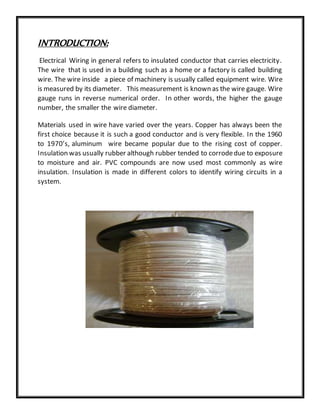
Electrical Wiring in general refers to insulated conductor that carries electricity.
The wire that is used in a building such as a home or a factory is called building
wire. The wire inside a piece of machinery is usually called equipment wire. Wire
is measured by its diameter. This measurement is known as the wire gauge. Wire
gauge runs in reverse numerical order. In other words, the higher the gauge
number, the smaller the wire diameter.
Materials used in wire have varied over the years. Copper has always been the
first choice because it is such a good conductor and is very flexible. In the 1960
to 1970’s, aluminum wire became popular due to the rising cost of copper.
Insulation was usually rubber although rubber tended to corrodedue to exposure
to moisture and air. PVC compounds are now used most commonly as wire
insulation. Insulation is made in different colors to identify wiring circuits in a
system.
WIRING SAFETY CODES:
Wiring safety codes are inteded to protect people and property from the
electrical shock and fire hazards. Regulations may be established by city, country
provincial state or national legislation usually by adopting a model code ( with or
without local amendments) produced by technical standards - setting
organisations or by a national standard electrical codes.Electrical codes arose in
1880’s with the commercial introduction of electrical power. Many conflicting
standards existed for the selection of wire sizes and other design rules of
electrical installation.
COLOR CODES:
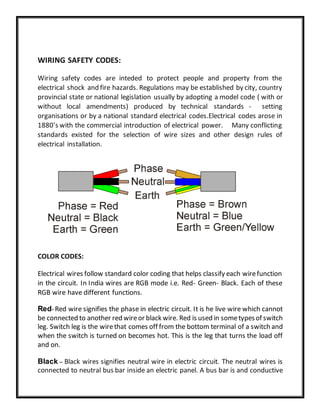
Electrical wires follow standard color coding that helps classify each wirefunction
in the circuit. In India wires are RGB mode i.e. Red- Green- Black. Each of these
RGB wire have different functions.
Red- Red wire signifies the phase in electric circuit. It is he live wire which cannot
be connected to another red wireor black wire. Red is used in sometypesof switch
leg. Switch leg is the wirethat comes off from the bottom terminal of a switch and
when the switch is turned on becomes hot. This is the leg that turns the load off
and on.
Black – Black wires signifies neutral wire in electric circuit. The neutral wires is
connected to neutral bus bar inside an electric panel. A bus bar is and conductive
metal bar that attracts the electric currentfor distribution purpose.) Black wirecan
be connected to black wireonly and no other color wire. Black wire being neural, it
does carry charge/current.
Green – Green wire stands for grounding/earthing in electric circuit. A green wire
should beon can be connected to green wire only (no other wire).Grounding wires
are usually not meant for lights and fan purposes. Green wires are chiefly used for
socket purpose. Socket could be for AC, geyser, TV, microwave, etc. Normally,
switches have only 2 wires i.e. neutral and phase.
In a room/ apartment there could be several sockets for use. The grounding wire
from all these sockets get connected at one single point/grounding terminal in
an apartment. This grounding terminal is a copper rod/screw that is connected
to the DB (distribution box) on one of the sides. From the DB, the wire runs to
the society meter box which then runs to the ground bus bar. The ground bus bar
is the copper plate inserted deep down inside the ground. This is called as
earthing in common language. The function of green wire is to provide a path to
ground for circuit’s electric current. Especially times when a live wire inside the
circuit happens to touch metal or other conductive metal. Incase of this
occurrence, green wire could be carrying major current and therefore it should
also be handled with care.
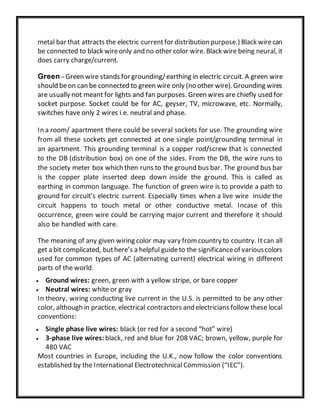
The meaning of any given wiring color may vary fromcountry to country. Itcan all
get a bit complicated, buthere’s a helpful guideto the significanceof variouscolors
used for common types of AC (alternating current) electrical wiring in different
parts of the world.
 Ground wires: green, green with a yellow stripe, or bare copper
 Neutral wires: white or gray
In theory, wiring conducting live current in the U.S. is permitted to be any other
color, although in practice, electrical contractors and electricians follow these local
conventions:
 Single phase live wires: black (or red for a second “hot” wire)
 3-phase live wires: black, red and blue for 208 VAC; brown, yellow, purple for
480 VAC
Most countries in Europe, including the U.K., now follow the color conventions
established by the International Electrotechnical Commission (“IEC”).
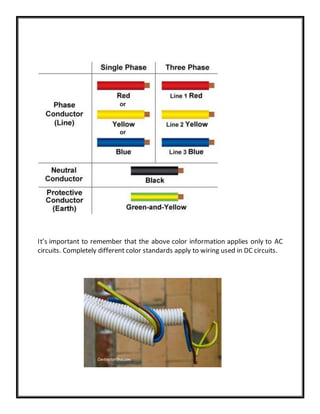
It’s important to remember that the above color information applies only to AC
circuits. Completely different color standards apply to wiring used in DC circuits.
WIRING METHODS:
Wiring Methods generally refers to installing electrical wiring by cutting into the
bricks of building material for wiring interior. Electrical systems in the building vary
depend on:
 Intended use and amount of power demand on the circuit.
 Types of occupancy and size of the building.
 National and local regulations
 Environment in which wiring must operate.
Wires and cables are rated by the circuit voltage, temperature rating and
environmental conditions (moisture, sunlight, oil, chemicals) in which they can be
used. A wire or cable has a voltage (to neutral) rating and a maximum conductor
surfacetemperature rating. The amount of currenta cable or wire can safely carry
depends on the installation conditions.
Methods of Electrical Wiring Systems w.r.t Taking Connection
Wiring (a process of connecting various accessories for distribution of electrical
energy from supplier’s meter board to home appliances such as lamps, fans and
other domestic appliances is known as electrical wiring) can be done using two
methods which are
 Joint box system or Tee system
 Loop – in system
They are discussed as follows:
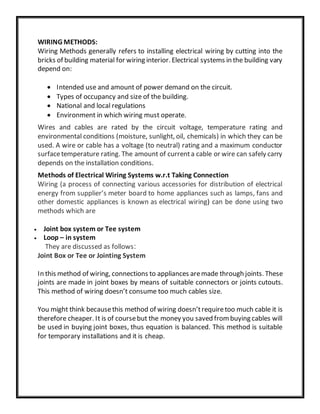
Joint Box or Tee or Jointing System
In this method of wiring, connections to appliances aremade through joints. These
joints are made in joint boxes by means of suitable connectors or joints cutouts.
This method of wiring doesn’t consume too much cables size.
You might think becausethis method of wiring doesn’trequiretoo much cable it is
therefore cheaper. It is of coursebut the money you saved frombuying cables will
be used in buying joint boxes, thus equation is balanced. This method is suitable
for temporary installations and it is cheap.
.
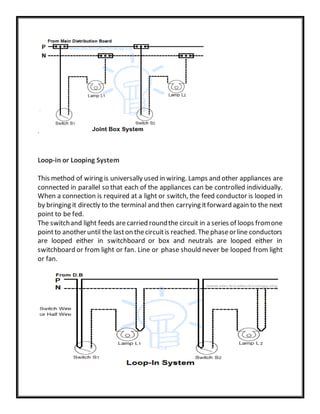
Loop-in or Looping System
This method of wiring is universally used in wiring. Lamps and other appliances are
connected in parallel so that each of the appliances can be controlled individually.
When a connection is required at a light or switch, the feed conductor is looped in
by bringing it directly to the terminal and then carrying itforward again to the next
point to be fed.
The switchand light feeds arecarried roundthe circuit in a series of loops fromone
pointto anotheruntil the laston thecircuitis reached. Thephaseorline conductors
are looped either in switchboard or box and neutrals are looped either in
switchboard or from light or fan. Line or phase should never be looped from light
or fan.
Advantages of Loop-In Method of Wiring
 It doesn’t require joint boxes and so money is saved
 In loop – in systems, no joint is concealed beneath floors or in roof spaces.
 Fault location is made easy as the points are made only at outlets so that they
are accessible.
Disadvantages of Loop-In Method of Wiring
 Length of wireor cables required is moreand voltage drop and copper losses are
therefore more
 Looping – in switches and lamp holders is usually difficult.
Different Types of Electrical Wiring Systems
The types of internal wiring usually used are
 Cleat wiring
 Wooden casing and capping wiring
 CTS or TRS or PVC sheath wiring
 Lead sheathed or metal sheathed wiring
 Conduit wiring
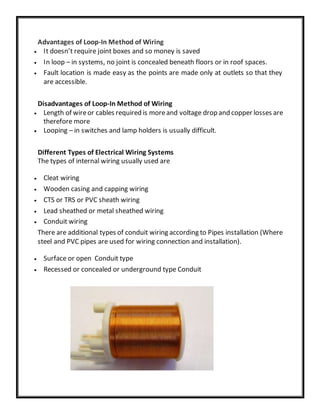
There are additional types of conduit wiring according to Pipes installation (Where
steel and PVC pipes are used for wiring connection and installation).
 Surface or open Conduit type
 Recessed or concealed or underground type Conduit
ELECTRICAL CABLES:
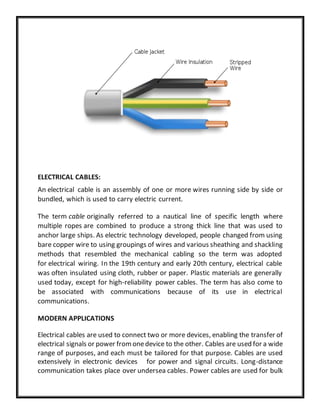
An electrical cable is an assembly of one or more wires running side by side or
bundled, which is used to carry electric current.
The term cable originally referred to a nautical line of specific length where
multiple ropes are combined to produce a strong thick line that was used to
anchor large ships. As electric technology developed, people changed from using
bare copper wire to using groupings of wires and various sheathing and shackling
methods that resembled the mechanical cabling so the term was adopted
for electrical wiring. In the 19th century and early 20th century, electrical cable
was often insulated using cloth, rubber or paper. Plastic materials are generally
used today, except for high-reliability power cables. The term has also come to
be associated with communications because of its use in electrical
communications.
MODERN APPLICATIONS
Electrical cables are used to connect two or more devices, enabling the transfer of
electrical signals or power fromonedevice to the other. Cables are used for a wide
range of purposes, and each must be tailored for that purpose. Cables are used
extensively in electronic devices for power and signal circuits. Long-distance
communication takes place over undersea cables. Power cables are used for bulk
transmission of alternating and direct current power, especially using high-voltage
cable. Electrical cables are extensively used in building wiring for lighting, power
and control circuits permanently installed in buildings. Since all the circuit
conductors required can be installed in a cable at one time, installation labor is
saved compared to certain other wiring methods.
Physically, an electrical cable is an assembly consisting of one or more conductors
with their own insulations and optional screens, individual covering(s),
assembly protection and protective covering(s). Electrical cables may be made
more flexible by stranding the wires. In this process, smaller individual wires are
twisted or braided together to produce larger wires that are more flexible than
solid wires of similar size. Bunching small wires before concentric stranding adds
the most flexibility. Copper wires in a cable may be bare, or they may be plated
with a thin layer of another metal, most often tin but sometimes gold, silver or
some other material. Tin, gold, and silver are much less prone to oxidation than
copper, which may lengthen wire life, and makes soldering easier. Tinning is also
used to providelubrication between strands. Tinning was used to help removal of
rubber insulation. Tight lays during stranding makes the cable extensible (CBA – as
in telephone handset cords).
Cables can be securely fastened and organized, such as by using trunking, cable
trays, cable ties or cable lacing. Continuous-flex or flexible cables used in moving
applications within cable carriers can be securedusing strainrelief devices or cable
ties.
At high frequencies, current tends to run along the surface of the conductor. This
is known as the skin effect.
Any current -carrying conductor, including a cable, radiates an electromagnetic
field. Likewise, any conductor or cable will pick up energy from any existing
electromagnetic field aroundit. Theseeffects areoften undesirable,in the firstcase
amounting to unwanted transmission of energy which may adversely affectnearby
equipment or other parts of the same piece of equipment; and in the second case,
unwanted pickup of noise which may mask the desired signal being carried by the
cable, or, if the cable is carrying power supply or control voltages, pollute them to
such an extent as to cause equipment malfunction.
The firstsolution to theseproblems is to keep cablelengths in buildings short,since
pick up and transmission are essentially proportional to the length of the cable.
The second solution is to route cables away fromtrouble. Beyond this, there are
particular cable designs that minimize electromagnetic pickup and transmission.
Three of the principal design techniques are shielding, coaxial geometry,
and twisted pairgeometry Shielding makes use of the electrical principle of the
Faraday cage . The cable is encased for its entire length in foil or wire mesh. All
wires running inside this shielding layer will be to a large extent decoupled from
external electricalfields, particularlyif the shield is connected to a pointof constant
voltage, such as earth or ground. Simple shielding of this type is not greatly
effective again low-frequency magnetic fields, however - such as magnetic
"hum" froma nearby power transformer. A grounded shield on cables operating at
2.5 kV or more gathers leakage current and capacitive current, protecting people
from electric shock and equalizing stress on the cable insulation.
Coaxial design helps to further reduce low-frequency magnetic transmission and
pickup. In this design the foil or mesh shield has a circular cross section and the
inner conductor is exactly at its center. This causes the voltages induced by a
magnetic field between the shield and the core conductor to consistof two nearly
equal magnitudes which cancel each other.
A twisted pair has two wires of a cable twisted around each other. This can be
demonstrated by putting one end of a pair of wiresin a hand drilland turningwhile
maintaining moderate tension on the line. Where the interfering signal has a
wavelength that is long compared to the pitch of the twisted pair, alternate lengths
of wires develop opposing voltages, tending to cancel the effect of the
interference.
Fire protection
In building construction electrical cable jacket material is a potential sourceof fuel
for fires.To limit the spread of firealong cablejacketing, one may usecablecoating
materials or onemay usecables with jacketing that is inherently fireretardant. The
plastic covering on some metal clad cables may be stripped off at installation to
reduce the fuel source for fires. Inorganic coatings and boxes around cables
safeguard the adjacent areas from the fire threat associated with unprotected
cable jacketing. However, this fire protection also traps heat generated from
conductor losses, so the protection must be thin.
To provide fire protection to a cable, the insulation is treated with fire retardant
materials, or non-combustible mineral insulation is used MICC cables.
COPPER WIRES AND CABLES:
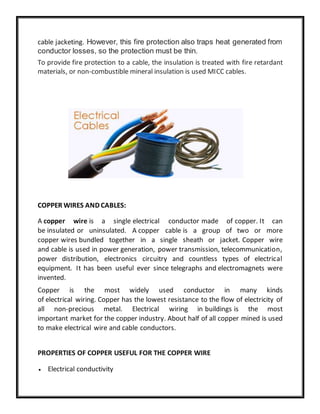
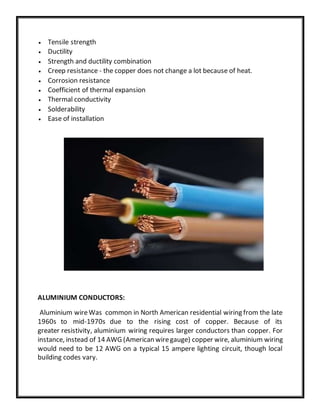
A copper wire is a single electrical conductor made of copper. It can
be insulated or uninsulated. A copper cable is a group of two or more
copper wires bundled together in a single sheath or jacket. Copper wire
and cable is used in power generation, power transmission, telecommunication,
power distribution, electronics circuitry and countless types of electrical
equipment. It has been useful ever since telegraphs and electromagnets were
invented.
Copper is the most widely used conductor in many kinds
of electrical wiring. Copper has the lowest resistance to the flow of electricity of
all non-precious metal. Electrical wiring in buildings is the most
important market for the copper industry. About half of all copper mined is used
to make electrical wire and cable conductors.
PROPERTIES OF COPPER USEFUL FOR THE COPPER WIRE
 Electrical conductivity
 Tensile strength
 Ductility
 Strength and ductility combination
 Creep resistance - the copper does not change a lot because of heat.
 Corrosion resistance
 Coefficient of thermal expansion
 Thermal conductivity
 Solderability
 Ease of installation
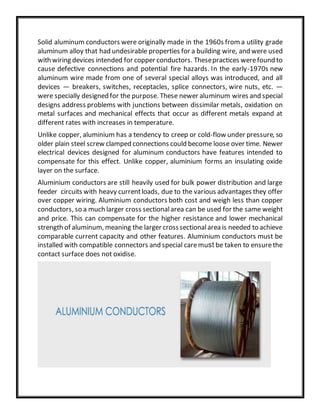
ALUMINIUM CONDUCTORS:
Aluminium wireWas common in North American residential wiring from the late
1960s to mid-1970s due to the rising cost of copper. Because of its
greater resistivity, aluminium wiring requires larger conductors than copper. For
instance, instead of 14 AWG (American wiregauge) copper wire, aluminium wiring
would need to be 12 AWG on a typical 15 ampere lighting circuit, though local
building codes vary.
Solid aluminum conductors were originally made in the 1960s froma utility grade
aluminum alloy that had undesirable properties for a building wire, and were used
with wiring devices intended for copper conductors. Thesepractices werefound to
cause defective connections and potential fire hazards. In the early-1970s new
aluminum wire made from one of several special alloys was introduced, and all
devices — breakers, switches, receptacles, splice connectors, wire nuts, etc. —
were specially designed for the purpose. These newer aluminum wires and special
designs address problems with junctions between dissimilar metals, oxidation on
metal surfaces and mechanical effects that occur as different metals expand at
different rates with increases in temperature.
Unlike copper, aluminium has a tendency to creep or cold-flow under pressure, so
older plain steel screw clamped connections could become loose over time. Newer
electrical devices designed for aluminum conductors have features intended to
compensate for this effect. Unlike copper, aluminium forms an insulating oxide
layer on the surface.
Aluminium conductors are still heavily used for bulk power distribution and large
feeder circuits with heavy currentloads, due to the various advantages they offer
over copper wiring. Aluminium conductors both cost and weigh less than copper
conductors, so a much larger cross sectionalarea can be used for the same weight
and price. This can compensate for the higher resistance and lower mechanical
strength of aluminum, meaning the larger crosssectionalarea is needed to achieve
comparable current capacity and other features. Aluminium conductors must be
installed with compatible connectors and special caremust be taken to ensurethe
contact surface does not oxidise.
Modern wiring materials
Modern non-metallic sheathed cables, such as (US and Canadian) Types NMB and
NMC, consist of two to four wires covered with thermoplastic insulation, plus a
bare wire for grounding (bonding), surrounded by a flexible plastic jacket. Some
versions wrap the individual conductors in paper before the plastic jacket is
applied.
Special versions of non-metallic sheathed cables, such as US Type UF, are designed
for direct underground burial (often with separate mechanical protection) or
exterior use where exposure to ultraviolet radiation (UV) is a possibility. These
cables differ in having a moisture-resistant construction, lacking paper or other
absorbent fillers, and being formulated for UV resistance.
Rubber-like synthetic polymer insulation is used in industrial cables and power
cables installed underground because of its superior moisture resistance.
Insulated cables are rated by their allowable operating voltage and their
maximum operating temperature at the conductor surface. A cable may carry
multiple usageratings for applications, for example, one rating for dry installations
and another when exposed to moisture or oil.
Generally, singleconductorbuilding wirein smallsizes is solid wire,sincethe wiring
is not required to be very flexible. Building wireconductors larger than 10 AWG (or
about 6 mm²) are stranded for flexibility during installation, but arenot sufficiently
pliable to use as appliance cord.
Cables for industrial, commercial and apartment buildings may contain many
insulated conductors in an overall jacket, with helical tape steel or aluminium
armour, or steel wire armour, and perhaps as well an overall PVCor lead jacketfor
protection from moisture and physical damage. Cables intended for very flexible
serviceor in marine applications may be protected by woven bronzewires. Power
or communications cables (e.g., computer networking) that are routed in or
through air-handling spaces (plenums) of office buildings are required under the
model building code to be either encased in metal conduit, or rated for low flame
and smoke production.
The environment of the installed wires determine how much current a cable is
permitted to carry. Because multiple conductors bundled in a cable cannot
dissipate heat as easily as single insulated conductors, those circuits are always
rated at a lower "ampacity". Tables in electrical safety codes give the maximum
allowablecurrentbased on sizeof conductor, voltagepotential, insulation type and
thickness, and the temperature rating of the cable itself. The allowable currentwill
also be different for wet or dry locations, for hot (attic) or cool (underground)
locations. In a run of cable through several areas, the part with the lowest rating
becomes the rating of the overall run.
Cables usually are secured with special fittings where they enter electrical
apparatus; this may be a simple screw clamp for jacketed cables in a dry location,
or a polymer-gasketed cable connector that mechanically engages the armour of
an armouredcable and providesa water-resistantconnection. Specialcable fittings
may be applied to prevent explosive gases fromflowing in the interior of jacketed
cables, wherethe cable passes through areas where flammable gases are present.
To preventloosening of the connections of individual conductors of a cable, cables
must be supported near their entrance to devices and at regular intervals along
their runs. In tall buildings, special designs are required to support the conductors
of vertical runs of cable. Generally, only one cable per fitting is permitted, unless
the fitting is rated or listed for multiple cables.
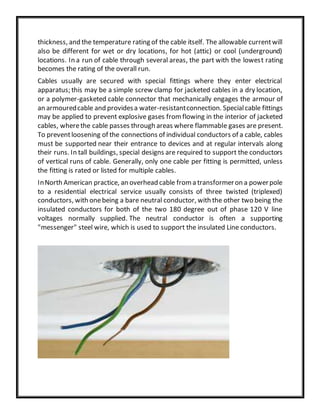
InNorth American practice, an overhead cable froma transformeron a powerpole
to a residential electrical service usually consists of three twisted (triplexed)
conductors, with onebeing a bare neutral conductor, with the other two being the
insulated conductors for both of the two 180 degree out of phase 120 V line
voltages normally supplied. The neutral conductor is often a supporting
"messenger" steel wire, which is used to support the insulated Line conductors.
JOB 1
AIM: To make a lamp work on a single way switch connection.
REQUIREMENTS:Onewayswitch,connecting wires,bulb[lamp],two phasesupply.
PROCEDURE:
1. Take a connecting wire/ cable.
2. Remove insulation from both ends of wire.
3. Connect one end to the one way switch ( lower end )
4. Now connect one end of wire to copper end of the switch and other end of the
wire to the one terminal of bulb.
5. Connect other terminal of bulb to a wire.
6. Insert two open ends in two phase supply.
PRECAUTIONS:
1. Join the ends very carefully.
2. Donot touch any joints and equipment when supply is switched on.
JOB 2
AIM: To make the connections of a two way switch.
REQUIREMENTS: Two way switch, lamp and holder ,two phase supply and
connecting wire.
PROCEDURE:
1. Take one core wire and remove the insulation from both the ends of wire.
2. Connect one end of the wire to a two way switches.
3. Now perform cross connection between 2 switches.
4. Connect one end of the wire to the switch and other end to the bulb/ lamp.
5. Connect free end of a bulb to one end of wire.
6. Check for two way switch by inserting the wires in 2 phase supply.
PRECAUTIONS:
1. Joints must be tight and insulated.
2. Do not touch any equipment when working.
JOB 3
AIM: To make connections of an extension board.
REQUIREMENTS: Two switches, Two sockets, a wooden box, mica sheet, screws,
one core wire, two core wire.[3m]
PROCEDURE:
1. Join the switches and sockets on mica sheet by screws.
2. Make the connections of wire inside the mica sheet.
3. Connect two core wire to phase and neutral .
4. Now attach mica sheet on the wooden box with the help of screws.
5. Check for the connections by inserting test pen into the socket and
simuntaneously test pen into extension board.
PRECAUTIONS:
1. Joints made must be tight.
2. Do not touch any equipment or joint while testing extension board.
JOB 4
AIM: To make the connections of a fan regulator.
REQUIREMENTS: One way switch, fan regulator, lamp or bulb, two phase supply,
connecting wires.
PROCEDURE:
1. Connect one end of wire after removing insulation to one way switch.
2. Connect upper terminal of one way switch to fan regular.
3. Join the regulator to the lamp with help of connecting wires.
4. Then connect remaining end of lamp/ bulb to a connecting wire.
5. Plug the wire into 2 phase supply and make switch on.
6. Rotate the regulator to see the changes in the voltage.
PRECAUTIONS:
1. Make the joints insulated and tight.
2. Donot touch any instrument bare when connected to supply.

Electrical wiring

  • 1.
    INTRODUCTION: Electrical Wiring ingeneral refers to insulated conductor that carries electricity. The wire that is used in a building such as a home or a factory is called building wire. The wire inside a piece of machinery is usually called equipment wire. Wire is measured by its diameter. This measurement is known as the wire gauge. Wire gauge runs in reverse numerical order. In other words, the higher the gauge number, the smaller the wire diameter. Materials used in wire have varied over the years. Copper has always been the first choice because it is such a good conductor and is very flexible. In the 1960 to 1970’s, aluminum wire became popular due to the rising cost of copper. Insulation was usually rubber although rubber tended to corrodedue to exposure to moisture and air. PVC compounds are now used most commonly as wire insulation. Insulation is made in different colors to identify wiring circuits in a system.
  • 2.
    WIRING SAFETY CODES: Wiringsafety codes are inteded to protect people and property from the electrical shock and fire hazards. Regulations may be established by city, country provincial state or national legislation usually by adopting a model code ( with or without local amendments) produced by technical standards - setting organisations or by a national standard electrical codes.Electrical codes arose in 1880’s with the commercial introduction of electrical power. Many conflicting standards existed for the selection of wire sizes and other design rules of electrical installation. COLOR CODES: Electrical wires follow standard color coding that helps classify each wirefunction in the circuit. In India wires are RGB mode i.e. Red- Green- Black. Each of these RGB wire have different functions. Red- Red wire signifies the phase in electric circuit. It is he live wire which cannot be connected to another red wireor black wire. Red is used in sometypesof switch leg. Switch leg is the wirethat comes off from the bottom terminal of a switch and when the switch is turned on becomes hot. This is the leg that turns the load off and on. Black – Black wires signifies neutral wire in electric circuit. The neutral wires is connected to neutral bus bar inside an electric panel. A bus bar is and conductive
  • 3.
    metal bar thatattracts the electric currentfor distribution purpose.) Black wirecan be connected to black wireonly and no other color wire. Black wire being neural, it does carry charge/current. Green – Green wire stands for grounding/earthing in electric circuit. A green wire should beon can be connected to green wire only (no other wire).Grounding wires are usually not meant for lights and fan purposes. Green wires are chiefly used for socket purpose. Socket could be for AC, geyser, TV, microwave, etc. Normally, switches have only 2 wires i.e. neutral and phase. In a room/ apartment there could be several sockets for use. The grounding wire from all these sockets get connected at one single point/grounding terminal in an apartment. This grounding terminal is a copper rod/screw that is connected to the DB (distribution box) on one of the sides. From the DB, the wire runs to the society meter box which then runs to the ground bus bar. The ground bus bar is the copper plate inserted deep down inside the ground. This is called as earthing in common language. The function of green wire is to provide a path to ground for circuit’s electric current. Especially times when a live wire inside the circuit happens to touch metal or other conductive metal. Incase of this occurrence, green wire could be carrying major current and therefore it should also be handled with care. The meaning of any given wiring color may vary fromcountry to country. Itcan all get a bit complicated, buthere’s a helpful guideto the significanceof variouscolors used for common types of AC (alternating current) electrical wiring in different parts of the world.  Ground wires: green, green with a yellow stripe, or bare copper  Neutral wires: white or gray In theory, wiring conducting live current in the U.S. is permitted to be any other color, although in practice, electrical contractors and electricians follow these local conventions:  Single phase live wires: black (or red for a second “hot” wire)  3-phase live wires: black, red and blue for 208 VAC; brown, yellow, purple for 480 VAC Most countries in Europe, including the U.K., now follow the color conventions established by the International Electrotechnical Commission (“IEC”).
  • 4.
    It’s important toremember that the above color information applies only to AC circuits. Completely different color standards apply to wiring used in DC circuits.
  • 5.
    WIRING METHODS: Wiring Methodsgenerally refers to installing electrical wiring by cutting into the bricks of building material for wiring interior. Electrical systems in the building vary depend on:  Intended use and amount of power demand on the circuit.  Types of occupancy and size of the building.  National and local regulations  Environment in which wiring must operate. Wires and cables are rated by the circuit voltage, temperature rating and environmental conditions (moisture, sunlight, oil, chemicals) in which they can be used. A wire or cable has a voltage (to neutral) rating and a maximum conductor surfacetemperature rating. The amount of currenta cable or wire can safely carry depends on the installation conditions. Methods of Electrical Wiring Systems w.r.t Taking Connection Wiring (a process of connecting various accessories for distribution of electrical energy from supplier’s meter board to home appliances such as lamps, fans and other domestic appliances is known as electrical wiring) can be done using two methods which are  Joint box system or Tee system  Loop – in system They are discussed as follows: Joint Box or Tee or Jointing System In this method of wiring, connections to appliances aremade through joints. These joints are made in joint boxes by means of suitable connectors or joints cutouts. This method of wiring doesn’t consume too much cables size. You might think becausethis method of wiring doesn’trequiretoo much cable it is therefore cheaper. It is of coursebut the money you saved frombuying cables will be used in buying joint boxes, thus equation is balanced. This method is suitable for temporary installations and it is cheap.
  • 6.
    . Loop-in or LoopingSystem This method of wiring is universally used in wiring. Lamps and other appliances are connected in parallel so that each of the appliances can be controlled individually. When a connection is required at a light or switch, the feed conductor is looped in by bringing it directly to the terminal and then carrying itforward again to the next point to be fed. The switchand light feeds arecarried roundthe circuit in a series of loops fromone pointto anotheruntil the laston thecircuitis reached. Thephaseorline conductors are looped either in switchboard or box and neutrals are looped either in switchboard or from light or fan. Line or phase should never be looped from light or fan.
  • 7.
    Advantages of Loop-InMethod of Wiring  It doesn’t require joint boxes and so money is saved  In loop – in systems, no joint is concealed beneath floors or in roof spaces.  Fault location is made easy as the points are made only at outlets so that they are accessible. Disadvantages of Loop-In Method of Wiring  Length of wireor cables required is moreand voltage drop and copper losses are therefore more  Looping – in switches and lamp holders is usually difficult. Different Types of Electrical Wiring Systems The types of internal wiring usually used are  Cleat wiring  Wooden casing and capping wiring  CTS or TRS or PVC sheath wiring  Lead sheathed or metal sheathed wiring  Conduit wiring There are additional types of conduit wiring according to Pipes installation (Where steel and PVC pipes are used for wiring connection and installation).  Surface or open Conduit type  Recessed or concealed or underground type Conduit
  • 8.
    ELECTRICAL CABLES: An electricalcable is an assembly of one or more wires running side by side or bundled, which is used to carry electric current. The term cable originally referred to a nautical line of specific length where multiple ropes are combined to produce a strong thick line that was used to anchor large ships. As electric technology developed, people changed from using bare copper wire to using groupings of wires and various sheathing and shackling methods that resembled the mechanical cabling so the term was adopted for electrical wiring. In the 19th century and early 20th century, electrical cable was often insulated using cloth, rubber or paper. Plastic materials are generally used today, except for high-reliability power cables. The term has also come to be associated with communications because of its use in electrical communications. MODERN APPLICATIONS Electrical cables are used to connect two or more devices, enabling the transfer of electrical signals or power fromonedevice to the other. Cables are used for a wide range of purposes, and each must be tailored for that purpose. Cables are used extensively in electronic devices for power and signal circuits. Long-distance communication takes place over undersea cables. Power cables are used for bulk
  • 9.
    transmission of alternatingand direct current power, especially using high-voltage cable. Electrical cables are extensively used in building wiring for lighting, power and control circuits permanently installed in buildings. Since all the circuit conductors required can be installed in a cable at one time, installation labor is saved compared to certain other wiring methods. Physically, an electrical cable is an assembly consisting of one or more conductors with their own insulations and optional screens, individual covering(s), assembly protection and protective covering(s). Electrical cables may be made more flexible by stranding the wires. In this process, smaller individual wires are twisted or braided together to produce larger wires that are more flexible than solid wires of similar size. Bunching small wires before concentric stranding adds the most flexibility. Copper wires in a cable may be bare, or they may be plated with a thin layer of another metal, most often tin but sometimes gold, silver or some other material. Tin, gold, and silver are much less prone to oxidation than copper, which may lengthen wire life, and makes soldering easier. Tinning is also used to providelubrication between strands. Tinning was used to help removal of rubber insulation. Tight lays during stranding makes the cable extensible (CBA – as in telephone handset cords). Cables can be securely fastened and organized, such as by using trunking, cable trays, cable ties or cable lacing. Continuous-flex or flexible cables used in moving applications within cable carriers can be securedusing strainrelief devices or cable ties. At high frequencies, current tends to run along the surface of the conductor. This is known as the skin effect. Any current -carrying conductor, including a cable, radiates an electromagnetic field. Likewise, any conductor or cable will pick up energy from any existing electromagnetic field aroundit. Theseeffects areoften undesirable,in the firstcase amounting to unwanted transmission of energy which may adversely affectnearby equipment or other parts of the same piece of equipment; and in the second case, unwanted pickup of noise which may mask the desired signal being carried by the cable, or, if the cable is carrying power supply or control voltages, pollute them to such an extent as to cause equipment malfunction. The firstsolution to theseproblems is to keep cablelengths in buildings short,since pick up and transmission are essentially proportional to the length of the cable.
  • 10.
    The second solutionis to route cables away fromtrouble. Beyond this, there are particular cable designs that minimize electromagnetic pickup and transmission. Three of the principal design techniques are shielding, coaxial geometry, and twisted pairgeometry Shielding makes use of the electrical principle of the Faraday cage . The cable is encased for its entire length in foil or wire mesh. All wires running inside this shielding layer will be to a large extent decoupled from external electricalfields, particularlyif the shield is connected to a pointof constant voltage, such as earth or ground. Simple shielding of this type is not greatly effective again low-frequency magnetic fields, however - such as magnetic "hum" froma nearby power transformer. A grounded shield on cables operating at 2.5 kV or more gathers leakage current and capacitive current, protecting people from electric shock and equalizing stress on the cable insulation. Coaxial design helps to further reduce low-frequency magnetic transmission and pickup. In this design the foil or mesh shield has a circular cross section and the inner conductor is exactly at its center. This causes the voltages induced by a magnetic field between the shield and the core conductor to consistof two nearly equal magnitudes which cancel each other. A twisted pair has two wires of a cable twisted around each other. This can be demonstrated by putting one end of a pair of wiresin a hand drilland turningwhile maintaining moderate tension on the line. Where the interfering signal has a wavelength that is long compared to the pitch of the twisted pair, alternate lengths of wires develop opposing voltages, tending to cancel the effect of the interference. Fire protection In building construction electrical cable jacket material is a potential sourceof fuel for fires.To limit the spread of firealong cablejacketing, one may usecablecoating materials or onemay usecables with jacketing that is inherently fireretardant. The plastic covering on some metal clad cables may be stripped off at installation to reduce the fuel source for fires. Inorganic coatings and boxes around cables safeguard the adjacent areas from the fire threat associated with unprotected
  • 11.
    cable jacketing. However,this fire protection also traps heat generated from conductor losses, so the protection must be thin. To provide fire protection to a cable, the insulation is treated with fire retardant materials, or non-combustible mineral insulation is used MICC cables. COPPER WIRES AND CABLES: A copper wire is a single electrical conductor made of copper. It can be insulated or uninsulated. A copper cable is a group of two or more copper wires bundled together in a single sheath or jacket. Copper wire and cable is used in power generation, power transmission, telecommunication, power distribution, electronics circuitry and countless types of electrical equipment. It has been useful ever since telegraphs and electromagnets were invented. Copper is the most widely used conductor in many kinds of electrical wiring. Copper has the lowest resistance to the flow of electricity of all non-precious metal. Electrical wiring in buildings is the most important market for the copper industry. About half of all copper mined is used to make electrical wire and cable conductors. PROPERTIES OF COPPER USEFUL FOR THE COPPER WIRE  Electrical conductivity
  • 12.
     Tensile strength Ductility  Strength and ductility combination  Creep resistance - the copper does not change a lot because of heat.  Corrosion resistance  Coefficient of thermal expansion  Thermal conductivity  Solderability  Ease of installation ALUMINIUM CONDUCTORS: Aluminium wireWas common in North American residential wiring from the late 1960s to mid-1970s due to the rising cost of copper. Because of its greater resistivity, aluminium wiring requires larger conductors than copper. For instance, instead of 14 AWG (American wiregauge) copper wire, aluminium wiring would need to be 12 AWG on a typical 15 ampere lighting circuit, though local building codes vary.
  • 13.
    Solid aluminum conductorswere originally made in the 1960s froma utility grade aluminum alloy that had undesirable properties for a building wire, and were used with wiring devices intended for copper conductors. Thesepractices werefound to cause defective connections and potential fire hazards. In the early-1970s new aluminum wire made from one of several special alloys was introduced, and all devices — breakers, switches, receptacles, splice connectors, wire nuts, etc. — were specially designed for the purpose. These newer aluminum wires and special designs address problems with junctions between dissimilar metals, oxidation on metal surfaces and mechanical effects that occur as different metals expand at different rates with increases in temperature. Unlike copper, aluminium has a tendency to creep or cold-flow under pressure, so older plain steel screw clamped connections could become loose over time. Newer electrical devices designed for aluminum conductors have features intended to compensate for this effect. Unlike copper, aluminium forms an insulating oxide layer on the surface. Aluminium conductors are still heavily used for bulk power distribution and large feeder circuits with heavy currentloads, due to the various advantages they offer over copper wiring. Aluminium conductors both cost and weigh less than copper conductors, so a much larger cross sectionalarea can be used for the same weight and price. This can compensate for the higher resistance and lower mechanical strength of aluminum, meaning the larger crosssectionalarea is needed to achieve comparable current capacity and other features. Aluminium conductors must be installed with compatible connectors and special caremust be taken to ensurethe contact surface does not oxidise.
  • 14.
    Modern wiring materials Modernnon-metallic sheathed cables, such as (US and Canadian) Types NMB and NMC, consist of two to four wires covered with thermoplastic insulation, plus a bare wire for grounding (bonding), surrounded by a flexible plastic jacket. Some versions wrap the individual conductors in paper before the plastic jacket is applied. Special versions of non-metallic sheathed cables, such as US Type UF, are designed for direct underground burial (often with separate mechanical protection) or exterior use where exposure to ultraviolet radiation (UV) is a possibility. These cables differ in having a moisture-resistant construction, lacking paper or other absorbent fillers, and being formulated for UV resistance. Rubber-like synthetic polymer insulation is used in industrial cables and power cables installed underground because of its superior moisture resistance. Insulated cables are rated by their allowable operating voltage and their maximum operating temperature at the conductor surface. A cable may carry multiple usageratings for applications, for example, one rating for dry installations and another when exposed to moisture or oil. Generally, singleconductorbuilding wirein smallsizes is solid wire,sincethe wiring is not required to be very flexible. Building wireconductors larger than 10 AWG (or about 6 mm²) are stranded for flexibility during installation, but arenot sufficiently pliable to use as appliance cord. Cables for industrial, commercial and apartment buildings may contain many insulated conductors in an overall jacket, with helical tape steel or aluminium armour, or steel wire armour, and perhaps as well an overall PVCor lead jacketfor protection from moisture and physical damage. Cables intended for very flexible serviceor in marine applications may be protected by woven bronzewires. Power or communications cables (e.g., computer networking) that are routed in or through air-handling spaces (plenums) of office buildings are required under the model building code to be either encased in metal conduit, or rated for low flame and smoke production. The environment of the installed wires determine how much current a cable is permitted to carry. Because multiple conductors bundled in a cable cannot dissipate heat as easily as single insulated conductors, those circuits are always rated at a lower "ampacity". Tables in electrical safety codes give the maximum allowablecurrentbased on sizeof conductor, voltagepotential, insulation type and
  • 15.
    thickness, and thetemperature rating of the cable itself. The allowable currentwill also be different for wet or dry locations, for hot (attic) or cool (underground) locations. In a run of cable through several areas, the part with the lowest rating becomes the rating of the overall run. Cables usually are secured with special fittings where they enter electrical apparatus; this may be a simple screw clamp for jacketed cables in a dry location, or a polymer-gasketed cable connector that mechanically engages the armour of an armouredcable and providesa water-resistantconnection. Specialcable fittings may be applied to prevent explosive gases fromflowing in the interior of jacketed cables, wherethe cable passes through areas where flammable gases are present. To preventloosening of the connections of individual conductors of a cable, cables must be supported near their entrance to devices and at regular intervals along their runs. In tall buildings, special designs are required to support the conductors of vertical runs of cable. Generally, only one cable per fitting is permitted, unless the fitting is rated or listed for multiple cables. InNorth American practice, an overhead cable froma transformeron a powerpole to a residential electrical service usually consists of three twisted (triplexed) conductors, with onebeing a bare neutral conductor, with the other two being the insulated conductors for both of the two 180 degree out of phase 120 V line voltages normally supplied. The neutral conductor is often a supporting "messenger" steel wire, which is used to support the insulated Line conductors.
  • 16.
    JOB 1 AIM: Tomake a lamp work on a single way switch connection. REQUIREMENTS:Onewayswitch,connecting wires,bulb[lamp],two phasesupply. PROCEDURE: 1. Take a connecting wire/ cable. 2. Remove insulation from both ends of wire. 3. Connect one end to the one way switch ( lower end ) 4. Now connect one end of wire to copper end of the switch and other end of the wire to the one terminal of bulb. 5. Connect other terminal of bulb to a wire. 6. Insert two open ends in two phase supply. PRECAUTIONS: 1. Join the ends very carefully. 2. Donot touch any joints and equipment when supply is switched on. JOB 2
  • 17.
    AIM: To makethe connections of a two way switch. REQUIREMENTS: Two way switch, lamp and holder ,two phase supply and connecting wire. PROCEDURE: 1. Take one core wire and remove the insulation from both the ends of wire. 2. Connect one end of the wire to a two way switches. 3. Now perform cross connection between 2 switches. 4. Connect one end of the wire to the switch and other end to the bulb/ lamp. 5. Connect free end of a bulb to one end of wire. 6. Check for two way switch by inserting the wires in 2 phase supply. PRECAUTIONS: 1. Joints must be tight and insulated. 2. Do not touch any equipment when working. JOB 3
  • 18.
    AIM: To makeconnections of an extension board. REQUIREMENTS: Two switches, Two sockets, a wooden box, mica sheet, screws, one core wire, two core wire.[3m] PROCEDURE: 1. Join the switches and sockets on mica sheet by screws. 2. Make the connections of wire inside the mica sheet. 3. Connect two core wire to phase and neutral . 4. Now attach mica sheet on the wooden box with the help of screws. 5. Check for the connections by inserting test pen into the socket and simuntaneously test pen into extension board. PRECAUTIONS: 1. Joints made must be tight. 2. Do not touch any equipment or joint while testing extension board. JOB 4
  • 19.
    AIM: To makethe connections of a fan regulator. REQUIREMENTS: One way switch, fan regulator, lamp or bulb, two phase supply, connecting wires. PROCEDURE: 1. Connect one end of wire after removing insulation to one way switch. 2. Connect upper terminal of one way switch to fan regular. 3. Join the regulator to the lamp with help of connecting wires. 4. Then connect remaining end of lamp/ bulb to a connecting wire. 5. Plug the wire into 2 phase supply and make switch on. 6. Rotate the regulator to see the changes in the voltage. PRECAUTIONS: 1. Make the joints insulated and tight. 2. Donot touch any instrument bare when connected to supply.