May, 2025
Practical Training for the Military Professionals
Title :-Basic Components of Electrical Installations and
Electric wiring
Prepared by:- ABDURO G.
May,2025
TRAINING OUT LINE
 Introduction to Electrical Installations
 Conductors and Cables
 Basic components Electrical Circuits
 Electrical Symbols and Wiring Diagrams
 Wiring Systems
 Wiring Accessories
 Distribution Boards and Switchboards
 Electrical Safety
 Electrical Protection Devices
 Lighting and Fixtures
 Earthings System
 Electrical Installation and Testing
ELECTRICAL INSTALLATION
 is the process of installing and maintaining electrical
systems and equipment. I
 t may include tasks such as installing wiring, repairing or
replacing damaged equipment, and inspecting
electrical systems for safety.
Resistance
 The higher the resistance, the lower the current flow. If
abnormally high, one possible cause (among many) could
be damaged conductors due to burning or corrosion. All
conductors give off some degree of heat, so overheating is
an issue often associated with resistance.
 The lower the resistance, the higher the current flow.
Possible causes: insulators damaged by moisture or
overheating.
Volt
Electrical Pressure that
causes the electron to
move through a
conductor
Electromotive Force
(EMF)
Presented by letter V or E
Ampere
 Base unit of electric current in
the International System of
Units (SI). It is named after André-
Marie Ampère (1775–1836),
 An ampere is the unit used to
measure electric current. Current
is a count of the number of
electrons flowing through a circuit.
 How fast an electric current flows
is an example of an ampere.
Watt
The basic unit of
electric, Unit of power
(W)
The watt is a measure of
how much power is
released
Power consumed
Classification of Electric Current
Direct Current ( DC )
Alternating Current ( AC )
Wires and Cables
Conductors & Insulators
Wire
Stranded
Wire
(mm2)
Solid Wire
(mm)
Solid Wire
 A single conductor
that is either bare
or insulated by a
protective colored
sheath. It offers
low resistance and
are perfect for use
in higher
frequencies
Stranded Wire
 Stranded wires are used where flexibility is important
because which the wire can be used for a longer period.
This type of wire have larger cross-sectional area than solid
wires for the same current carrying capacity.
Stranded Wire
Stranded Wire
 Size of Wires - Each
application requires
a certain wire size
for installation, and
the right size for a
specific application
is determined by
the wire gauge
Stranded Wire
 Wire Lettering – The letters THHN, THWN, THW and XHHN
represent the main insulation types of individual wires. These
letters depict the following NEC requirements:.
 T – Thermoplastic insulation
 H – Heat resistance
 HH – High heat resistance (up to 194°F)
 W – Suitable for wet locations
 N – Nylon coating, resistant to damage by oil or gas
 X – Synthetic polymer that is flame-resistant
Main Feeder Wires
Main Feeder Wires : Main power feeder
wires are the wires that connect the
service weather head to the house.
They’re made with stranded or solid THHN
wire and the cable installed is 25% more
than the load required.
Main Feeder Wires
Panel Feed Wires
Panel Feed Wires : Panel feed cables are
generally black insulated wire. These are used
to power the main junction box and the circuit
breaker panels. Just like main power feeder
wires, the cables should be rated for 25% more
than the actual load.
Panel Feed Wires
Single Strand Wires
Service Drop Wire (DUPLEX)
Wires
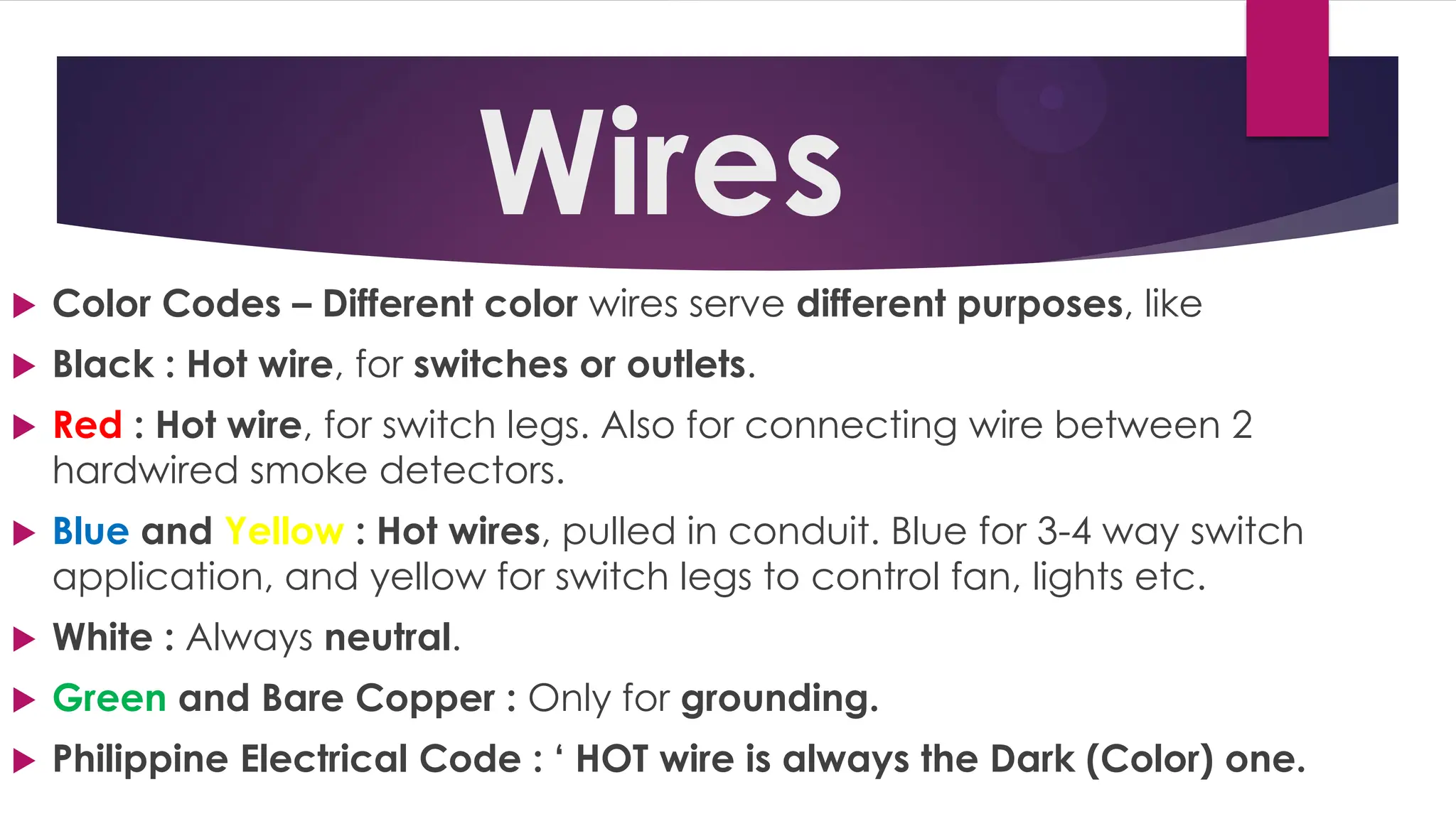
 Color Codes – Different color wires serve different purposes, like
 Black : Hot wire, for switches or outlets.
 Red : Hot wire, for switch legs. Also for connecting wire between 2
hardwired smoke detectors.
 Blue and Yellow : Hot wires, pulled in conduit. Blue for 3-4 way switch
application, and yellow for switch legs to control fan, lights etc.
 White : Always neutral.
 Green and Bare Copper : Only for grounding.
 Philippine Electrical Code : ‘ HOT wire is always the Dark (Color) one.
Cable
Wire is a single
electrical
conductor,
whereas a
cable is a group
of wires swathed
in sheathing.
Multi-conductor cable
Fiber optics cable
Electrical Symbols and Wiring
Diagrams
Accessories of Electrical Installation
 All the wiring systems and electrical installations needs the
following accessories:
1. Cables 2. Flexible wires
3. Switches 4. Fuses
5. Ceiling rose 6. Lamp holders
7. Plugs 8. Socket outlets
9. Junction boxes
Wiring Diagrams
 A wiring diagram is a simple visual representation of the physical
connections and physical layout of an electrical system or circuit.
 It shows how the electrical wires are interconnected and can also
show where fixtures and components may be connected to the
system.
Wiring Diagrams
Splices & Joints
Splices & Joints
The connections must be well made and the wires
tightly joined to prevent a loss of voltage to the
device powered. In high current situations a poor
connection causes heat at the connection and
oxidiation of the wires and no more or intermittent
connections.
Most problems in electrical is not a short but: an
open connection.
Kinds of Splices
Western Union Splice
Tap joint
Fixture splices, or fixture joints
Rat-tail splice, Twist splice, Pig-tail splice
Britannia Splice
A Through Fixture joint
Wrapped Tap
Western Union Splice
 This is the most widely used
splice or joint in interior
wiring installation to
extend the length of wire
from one point to another.
 Used extensively for
outside wiring to extend
the length of wire from one
end to another.
Tap splice or Tap joint
This is used
where the
tap wire is
under
considerable
tensile stress
circuit
Fixture splices, or fixture joints
Rat-tail splice/Twist splice/Pig-tail splice
 commonly used to join two
or more • conductors inside
the junction box. It is •
suitable for service where
there is no • mechanical
stress when wires are to be
• connected in an outlet
box, switch, or • conduit
fitting
Wrapped Tap/ Tee Joint
Through Fixture Joint
Circuit
Path in which electrons from
a voltage or current source
flow
Types Of Electrical Circuit
Series Circuit
Parallel Circuit
Series Circuit
Parallel Circuit
Series-Parallel Circuit
Difference between Parallel
and Series Circuit
Raceway
Types of Raceway
Metal Raceway
Non-Metal Raceway
Metal Raceways
Cable Trays
Conduit
Non-Metal Raceway
Cable Trays
Conduit
Non-Metal Raceway
Classification of Conduit Pipes
 Intermediate Metal Conduit (IMC)
 Rigid Metal Conduit (RMC)
 Rigid Steel Conduit (RSC)
 Flexible Metal Conduit (FMC)
 Liquidtight Flexible Metal Conduit (LFMC)
 Polyvinyl Chloride Conduit (PVC)
 Electrical Metallic Tubing (EMT)
 Galvanized Rigid Conduit (GRC)
 PVC conduit
Polyvinyl Chloride Conduit (PVC)
Purpose of Electrical Conduit
To provide
means for
the runners
or wires from
one point to
another
Purpose of Electrical Conduit
To
physicall
y protect
the wires
Purpose of Electrical Conduit
To protect
surrounding
against the
effect of
fault in the
wiring
Purpose of Electrical Conduit
To protect the
wiring system
from damage
by the
building and
the building
occupants
Outlets
Outlets
 A socket that connects an electrical
device to an electricity supply. In
Kinds of Outlets
 Ligthing Outlet (L.O)
 Convenience Outlet (C.O)
 Special Purpose Outlet (S.P.O)
 Floor Outlet (F.O)
Lighting Outlet
An outlet
intended
for the
connection
of a fixture
or lamp
holder
Special Purpose Outlet
Floor Outlet
Switches
A switch is an electrical device,
usually electromechanical, used
to control continuity between
two points.
Types of Switches
Electrical installation and wiring for house wirings

Electrical installation and wiring for house wirings

  • 1.
    May, 2025 Practical Trainingfor the Military Professionals Title :-Basic Components of Electrical Installations and Electric wiring Prepared by:- ABDURO G. May,2025
  • 3.
    TRAINING OUT LINE Introduction to Electrical Installations  Conductors and Cables  Basic components Electrical Circuits  Electrical Symbols and Wiring Diagrams  Wiring Systems  Wiring Accessories  Distribution Boards and Switchboards  Electrical Safety  Electrical Protection Devices  Lighting and Fixtures  Earthings System  Electrical Installation and Testing
  • 4.
    ELECTRICAL INSTALLATION  isthe process of installing and maintaining electrical systems and equipment. I  t may include tasks such as installing wiring, repairing or replacing damaged equipment, and inspecting electrical systems for safety.
  • 6.
    Resistance  The higherthe resistance, the lower the current flow. If abnormally high, one possible cause (among many) could be damaged conductors due to burning or corrosion. All conductors give off some degree of heat, so overheating is an issue often associated with resistance.  The lower the resistance, the higher the current flow. Possible causes: insulators damaged by moisture or overheating.
  • 7.
    Volt Electrical Pressure that causesthe electron to move through a conductor Electromotive Force (EMF) Presented by letter V or E
  • 8.
    Ampere  Base unitof electric current in the International System of Units (SI). It is named after André- Marie Ampère (1775–1836),  An ampere is the unit used to measure electric current. Current is a count of the number of electrons flowing through a circuit.  How fast an electric current flows is an example of an ampere.
  • 9.
    Watt The basic unitof electric, Unit of power (W) The watt is a measure of how much power is released Power consumed
  • 10.
    Classification of ElectricCurrent Direct Current ( DC ) Alternating Current ( AC )
  • 11.
  • 12.
  • 13.
  • 14.
  • 15.
    Solid Wire  Asingle conductor that is either bare or insulated by a protective colored sheath. It offers low resistance and are perfect for use in higher frequencies
  • 16.
    Stranded Wire  Strandedwires are used where flexibility is important because which the wire can be used for a longer period. This type of wire have larger cross-sectional area than solid wires for the same current carrying capacity.
  • 17.
  • 18.
    Stranded Wire  Sizeof Wires - Each application requires a certain wire size for installation, and the right size for a specific application is determined by the wire gauge
  • 19.
    Stranded Wire  WireLettering – The letters THHN, THWN, THW and XHHN represent the main insulation types of individual wires. These letters depict the following NEC requirements:.  T – Thermoplastic insulation  H – Heat resistance  HH – High heat resistance (up to 194°F)  W – Suitable for wet locations  N – Nylon coating, resistant to damage by oil or gas  X – Synthetic polymer that is flame-resistant
  • 20.
    Main Feeder Wires MainFeeder Wires : Main power feeder wires are the wires that connect the service weather head to the house. They’re made with stranded or solid THHN wire and the cable installed is 25% more than the load required.
  • 21.
  • 22.
    Panel Feed Wires PanelFeed Wires : Panel feed cables are generally black insulated wire. These are used to power the main junction box and the circuit breaker panels. Just like main power feeder wires, the cables should be rated for 25% more than the actual load.
  • 23.
  • 24.
  • 25.
  • 26.
    Wires  Color Codes– Different color wires serve different purposes, like  Black : Hot wire, for switches or outlets.  Red : Hot wire, for switch legs. Also for connecting wire between 2 hardwired smoke detectors.  Blue and Yellow : Hot wires, pulled in conduit. Blue for 3-4 way switch application, and yellow for switch legs to control fan, lights etc.  White : Always neutral.  Green and Bare Copper : Only for grounding.  Philippine Electrical Code : ‘ HOT wire is always the Dark (Color) one.
  • 27.
    Cable Wire is asingle electrical conductor, whereas a cable is a group of wires swathed in sheathing.
  • 28.
  • 29.
  • 30.
    Electrical Symbols andWiring Diagrams
  • 32.
    Accessories of ElectricalInstallation  All the wiring systems and electrical installations needs the following accessories: 1. Cables 2. Flexible wires 3. Switches 4. Fuses 5. Ceiling rose 6. Lamp holders 7. Plugs 8. Socket outlets 9. Junction boxes
  • 33.
    Wiring Diagrams  Awiring diagram is a simple visual representation of the physical connections and physical layout of an electrical system or circuit.  It shows how the electrical wires are interconnected and can also show where fixtures and components may be connected to the system.
  • 34.
  • 35.
  • 36.
    Splices & Joints Theconnections must be well made and the wires tightly joined to prevent a loss of voltage to the device powered. In high current situations a poor connection causes heat at the connection and oxidiation of the wires and no more or intermittent connections. Most problems in electrical is not a short but: an open connection.
  • 37.
    Kinds of Splices WesternUnion Splice Tap joint Fixture splices, or fixture joints Rat-tail splice, Twist splice, Pig-tail splice Britannia Splice A Through Fixture joint Wrapped Tap
  • 38.
    Western Union Splice This is the most widely used splice or joint in interior wiring installation to extend the length of wire from one point to another.  Used extensively for outside wiring to extend the length of wire from one end to another.
  • 39.
    Tap splice orTap joint This is used where the tap wire is under considerable tensile stress circuit
  • 40.
    Fixture splices, orfixture joints
  • 41.
    Rat-tail splice/Twist splice/Pig-tailsplice  commonly used to join two or more • conductors inside the junction box. It is • suitable for service where there is no • mechanical stress when wires are to be • connected in an outlet box, switch, or • conduit fitting
  • 42.
  • 43.
  • 44.
    Circuit Path in whichelectrons from a voltage or current source flow
  • 45.
    Types Of ElectricalCircuit Series Circuit Parallel Circuit
  • 46.
  • 47.
  • 48.
  • 49.
  • 50.
  • 51.
    Types of Raceway MetalRaceway Non-Metal Raceway
  • 52.
  • 53.
  • 54.
  • 55.
    Classification of ConduitPipes  Intermediate Metal Conduit (IMC)  Rigid Metal Conduit (RMC)  Rigid Steel Conduit (RSC)  Flexible Metal Conduit (FMC)  Liquidtight Flexible Metal Conduit (LFMC)  Polyvinyl Chloride Conduit (PVC)  Electrical Metallic Tubing (EMT)  Galvanized Rigid Conduit (GRC)  PVC conduit
  • 56.
  • 57.
    Purpose of ElectricalConduit To provide means for the runners or wires from one point to another
  • 58.
    Purpose of ElectricalConduit To physicall y protect the wires
  • 59.
    Purpose of ElectricalConduit To protect surrounding against the effect of fault in the wiring
  • 60.
    Purpose of ElectricalConduit To protect the wiring system from damage by the building and the building occupants
  • 61.
  • 62.
    Outlets  A socketthat connects an electrical device to an electricity supply. In
  • 63.
    Kinds of Outlets Ligthing Outlet (L.O)  Convenience Outlet (C.O)  Special Purpose Outlet (S.P.O)  Floor Outlet (F.O)
  • 64.
    Lighting Outlet An outlet intended forthe connection of a fixture or lamp holder
  • 65.
  • 66.
  • 67.
    Switches A switch isan electrical device, usually electromechanical, used to control continuity between two points.
  • 68.