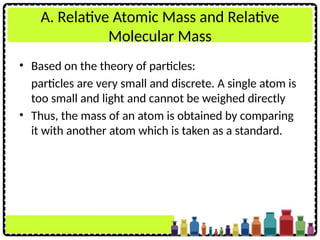
A. Relative AtomicMass and Relative
Molecular Mass
• Based on the theory of particles:
particles are very small and discrete. A single atom is
too small and light and cannot be weighed directly
• Thus, the mass of an atom is obtained by comparing
it with another atom which is taken as a standard.
3.
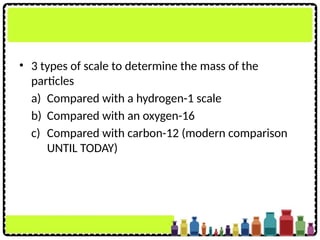
• 3 typesof scale to determine the mass of the
particles
a) Compared with a hydrogen-1 scale
b) Compared with an oxygen-16
c) Compared with carbon-12 (modern comparison
UNTIL TODAY)
4.
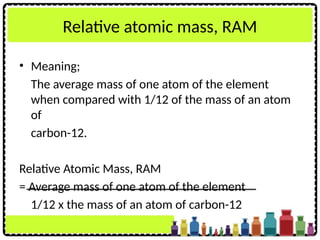
Relative atomic mass,RAM
• Meaning;
The average mass of one atom of the element
when compared with 1/12 of the mass of an atom
of
carbon-12.
Relative Atomic Mass, RAM
= Average mass of one atom of the element
1/12 x the mass of an atom of carbon-12
5.
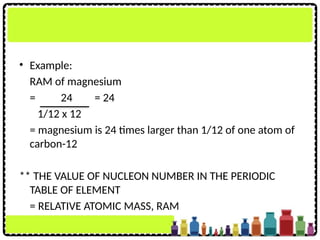
• Example:
RAM ofmagnesium
= 24 = 24
1/12 x 12
= magnesium is 24 times larger than 1/12 of one atom of
carbon-12
** THE VALUE OF NUCLEON NUMBER IN THE PERIODIC
TABLE OF ELEMENT
= RELATIVE ATOMIC MASS, RAM
6.
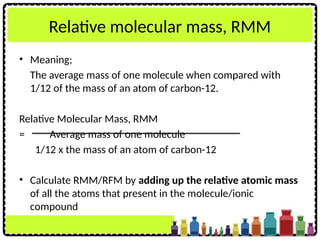
Relative molecular mass,RMM
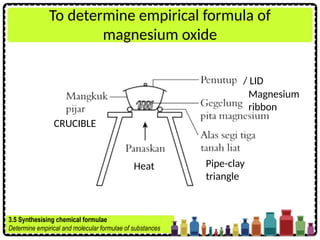
• Meaning;
The average mass of one molecule when compared with
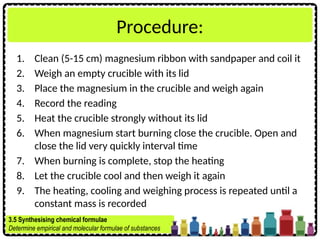
1/12 of the mass of an atom of carbon-12.
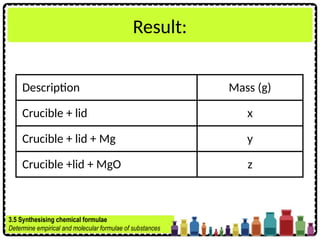
Relative Molecular Mass, RMM
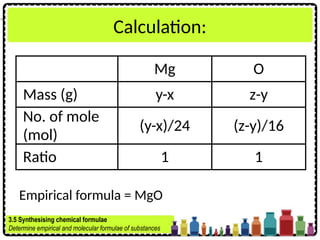
= Average mass of one molecule
1/12 x the mass of an atom of carbon-12
• Calculate RMM/RFM by adding up the relative atomic mass
of all the atoms that present in the molecule/ionic
compound
7.
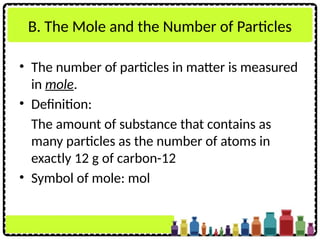
B. The Moleand the Number of Particles
• The number of particles in matter is measured
in mole.
• Definition:
The amount of substance that contains as
many particles as the number of atoms in
exactly 12 g of carbon-12
• Symbol of mole: mol
8.
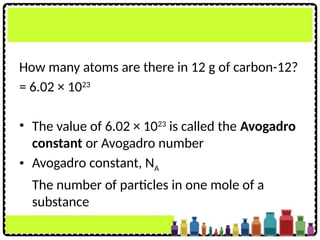
How many atomsare there in 12 g of carbon-12?
= 6.02 × 10²³
• The value of 6.02 × 10²³
is called the Avogadro
constant or Avogadro number
• Avogadro constant, NA
The number of particles in one mole of a
substance
9.
Point to note:
Onemole of any substance contains 6.02 × 10²³
particles
1 mol of atomic substance contains 6.02 × 10²³
atoms
1 mol of molecular substance contains 6.02 × 10²³
molecules
1 mol of ionic substance contains 6.02 × 10²³
ions
10.
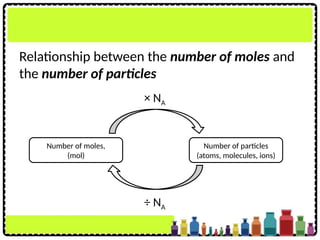
Relationship between thenumber of moles and
the number of particles
Number of moles,
(mol)
Number of particles
(atoms, molecules, ions)
× NA
÷ NA
Example 1:
A closedglass bottle contains 0.5 mol of oxygen
gas, O2
(a) How many oxygen molecules, O2 are there in
the bottle?
(b)How many oxygen atoms are there in the
bottle?
[Avogadro constant: 6.02 × 10²³
mol-1
]
13.
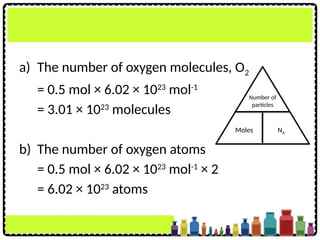
a) The numberof oxygen molecules, O2
= 0.5 mol × 6.02 × 1023
mol-1
= 3.01 × 10²³
molecules
b) The number of oxygen atoms
= 0.5 mol × 6.02 × 1023
mol-1
× 2
= 6.02 × 10²³
atoms
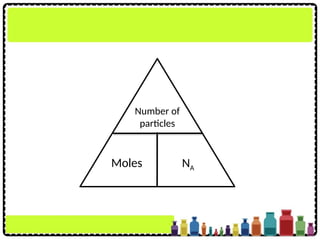
Number of
particles
Moles NA
14.
Example 2:
Find thenumber of moles of 9.03 × 10²³
molecules in a
sample containing molecules of carbon dioxide, CO2
[Avogadro constant: 6.02 × 10²³
mol-1
]
The number of moles carbon dioxide
= 9.03 × 10²³
6.02 × 10²³
mol-1
= 1.5 mol
Number of
particles
Moles NA
15.
C. The Moleand the Mass of Substances
• The mass of one mole of any substance is
called molar mass
• Units: g mol-1
• The molar mass of substances are numerically
equal to relative mass
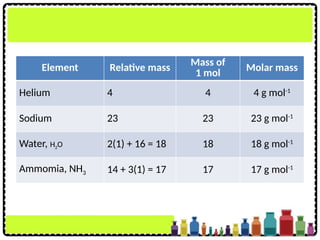
16.
Element Relative massMass of
1 mol
Molar mass
Helium 4 4 4 g mol-1
Sodium 23 23 23 g mol-1
Water, H2O 2(1) + 16 = 18 18 18 g mol-1
Ammomia, NH3 14 + 3(1) = 17 17 17 g mol-1
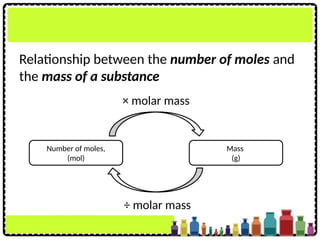
17.
Relationship between thenumber of moles and
the mass of a substance
Number of moles,
(mol)
Mass
(g)
× molar mass
÷ molar mass
Example 1:
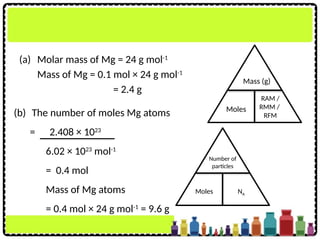
What isthe mass of
(a) 0.1 mol of magnesium?
(b)2.408 × 10²³
atoms of magnesium?
[Relative atomic mass: Mg=24; Avogadro
constant: 6.02 × 10²³
mol-1
]
20.
(b) The numberof moles Mg atoms
= 2.408 × 10²³
6.02 × 10²³
mol-1
= 0.4 mol
Mass of Mg atoms
= 0.4 mol × 24 g mol-1
= 9.6 g
(a) Molar mass of Mg = 24 g mol-1
Mass of Mg = 0.1 mol × 24 g mol-1
= 2.4 g
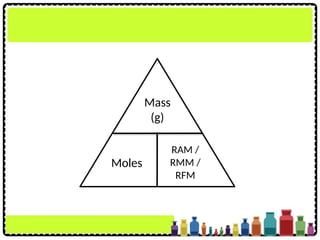
Mass (g)
Moles
RAM /
RMM /
RFM
Number of
particles
Moles NA
21.
Example 2:
RMM ofSO2
= 32 + 2(16) = 64
Molar mass of SO2 = 64 g mol-1
The number of moles
= 16 g
64 g mol-1
= 0.25 mol
Mass (g)
Moles
RAM /
RMM /
RFM
How many moles of molecules are there in 16 g of sulphur
dioxide gas, SO2?
[Relative atomic mass: O=16, S=32]
22.
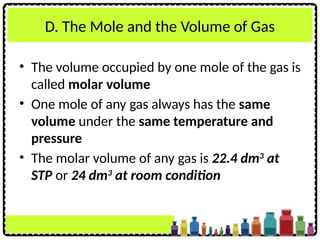
D. The Moleand the Volume of Gas
• The volume occupied by one mole of the gas is
called molar volume
• One mole of any gas always has the same
volume under the same temperature and
pressure
• The molar volume of any gas is 22.4 dm3
at
STP or 24 dm3
at room condition
23.
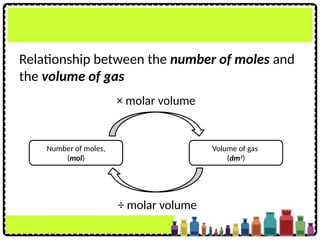
Relationship between thenumber of moles and
the volume of gas
Number of moles,
(mol)
Volume of gas
(dm3
)
× molar volume
÷ molar volume
What is thevolume of 1.2 mol of ammonia gas,
NH3 at STP?
[Molar volume: 22.4 dm3
mol-1
at STP]
Example 1:
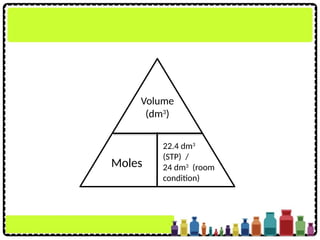
Volume
(dm3
)
Moles
22.4 dm3
(STP) /
24 dm3
(RC)
The volume of ammonia gas, NH3
= 1.2 mol × 22.4 dm3
mol-1
= 26.88 dm3
26.
How many molesof ammonia gas, NH3 are present in
600 cm3
of the gas measured at room conditions?
[Molar volume: 24 dm3
mol-1
at room condition]
Example 2:
Volume
(dm3
)
Moles
22.4 dm3
(STP) /
24 dm3
(RC)
The number of moles of ammonia gas, NH3
= 600 cm3
1000
= 0.6 dm3
= 0.6 dm3
24 dm3
mol-1
= 0.025 mol
27.
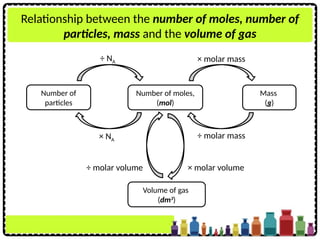
Relationship between thenumber of moles, number of
particles, mass and the volume of gas
Number of moles,
(mol)
Mass
(g)
× molar volume
÷ molar volume
Number of
particles
Volume of gas
(dm3
)
× NA
÷ NA × molar mass
÷ molar mass
28.
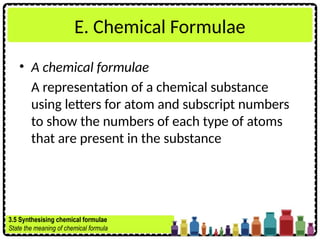
E. Chemical Formulae
•A chemical formulae
A representation of a chemical substance
using letters for atom and subscript numbers
to show the numbers of each type of atoms
that are present in the substance
3.5 Synthesising chemical formulae
State the meaning of chemical formula
29.
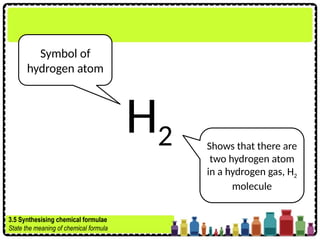
H2
Symbol of
hydrogen atom
Showsthat there are
two hydrogen atom
in a hydrogen gas, H2
molecule
3.5 Synthesising chemical formulae
State the meaning of chemical formula
30.
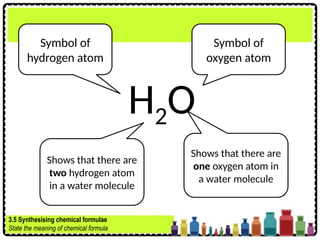
H2O
Symbol of
hydrogen atom
Showsthat there are
two hydrogen atom
in a water molecule
Symbol of
oxygen atom
Shows that there are
one oxygen atom in
a water molecule
3.5 Synthesising chemical formulae
State the meaning of chemical formula
31.
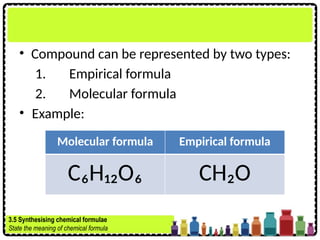
• Compound canbe represented by two types:
1. Empirical formula
2. Molecular formula
• Example:
Molecular formula Empirical formula
C₆H₁₂O₆ CH₂O
3.5 Synthesising chemical formulae
State the meaning of chemical formula
32.
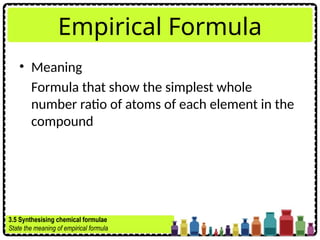
Empirical Formula
• Meaning
Formulathat show the simplest whole
number ratio of atoms of each element in the
compound
3.5 Synthesising chemical formulae
State the meaning of empirical formula
33.
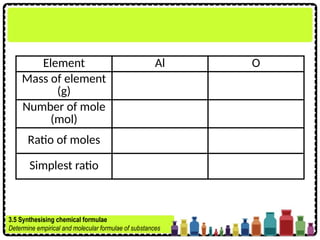
Example
A sample ofaluminium oxide contains 1.08 g of
aluminium and 0.96 g of oxygen. What is the
empirical formula of this compound?
[Relative atomic mass: O = 16; Al = 27]
3.5 Synthesising chemical formulae
Determine empirical and molecular formulae of substances
34.
Element Al O
Massof element
(g)
Number of mole
(mol)
Ratio of moles
Simplest ratio
3.5 Synthesising chemical formulae
Determine empirical and molecular formulae of substances
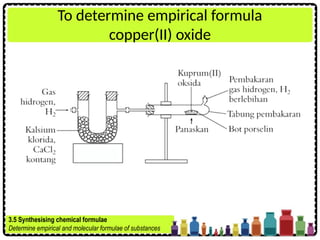
35.
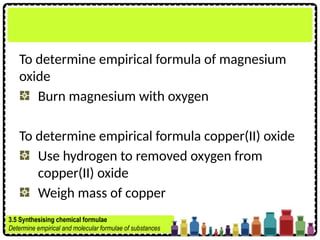
To determine empiricalformula of magnesium
oxide
Burn magnesium with oxygen
To determine empirical formula copper(II) oxide
Use hydrogen to removed oxygen from
copper(II) oxide
Weigh mass of copper
3.5 Synthesising chemical formulae
Determine empirical and molecular formulae of substances
36.
To determine empiricalformula of
magnesium oxide
CRUCIBLE
/ LID
Magnesium
ribbon
Pipe-clay
triangle
Heat
3.5 Synthesising chemical formulae
Determine empirical and molecular formulae of substances
37.
Experiment question:
Describe howyou can carry out an experiment
to determine the empirical formula of
magnesium oxide. Your description should
include
• Procedure of experiment
• Tabulation of result
• Calculation of the results obtained
[Relative atomic mass: O = 16; Mg = 24]
3.5 Synthesising chemical formulae
Determine empirical and molecular formulae of substances
38.
Procedure:
1. Clean (5-15cm) magnesium ribbon with sandpaper and coil it
2. Weigh an empty crucible with its lid
3. Place the magnesium in the crucible and weigh again
4. Record the reading
5. Heat the crucible strongly without its lid
6. When magnesium start burning close the crucible. Open and
close the lid very quickly interval time
7. When burning is complete, stop the heating
8. Let the crucible cool and then weigh it again
9. The heating, cooling and weighing process is repeated until a
constant mass is recorded
3.5 Synthesising chemical formulae
Determine empirical and molecular formulae of substances
39.
Result:
Description Mass (g)
Crucible+ lid x
Crucible + lid + Mg y
Crucible +lid + MgO z
3.5 Synthesising chemical formulae
Determine empirical and molecular formulae of substances
40.
Calculation:
Mg O
Mass (g)y-x z-y
No. of mole
(mol)
(y-x)/24 (z-y)/16
Ratio 1 1
Empirical formula = MgO
3.5 Synthesising chemical formulae
Determine empirical and molecular formulae of substances
41.
To determine empiricalformula
copper(II) oxide
3.5 Synthesising chemical formulae
Determine empirical and molecular formulae of substances
42.
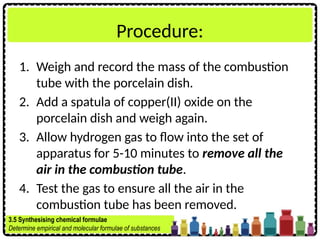
Procedure:
1. Weigh andrecord the mass of the combustion
tube with the porcelain dish.
2. Add a spatula of copper(II) oxide on the
porcelain dish and weigh again.
3. Allow hydrogen gas to flow into the set of
apparatus for 5-10 minutes to remove all the
air in the combustion tube.
4. Test the gas to ensure all the air in the
combustion tube has been removed.
3.5 Synthesising chemical formulae
Determine empirical and molecular formulae of substances
43.
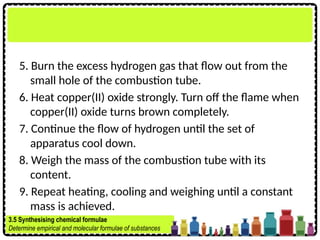
5. Burn theexcess hydrogen gas that flow out from the
small hole of the combustion tube.
6. Heat copper(II) oxide strongly. Turn off the flame when
copper(II) oxide turns brown completely.
7. Continue the flow of hydrogen until the set of
apparatus cool down.
8. Weigh the mass of the combustion tube with its
content.
9. Repeat heating, cooling and weighing until a constant
mass is achieved.
3.5 Synthesising chemical formulae
Determine empirical and molecular formulae of substances
44.
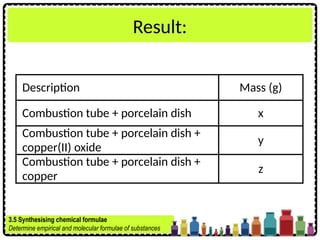
Result:
Description Mass (g)
Combustiontube + porcelain dish x
Combustion tube + porcelain dish +
copper(II) oxide
y
Combustion tube + porcelain dish +
copper
z
3.5 Synthesising chemical formulae
Determine empirical and molecular formulae of substances
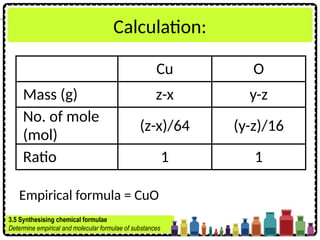
45.
Calculation:
Cu O
Mass (g)z-x y-z
No. of mole
(mol)
(z-x)/64 (y-z)/16
Ratio 1 1
Empirical formula = CuO
3.5 Synthesising chemical formulae
Determine empirical and molecular formulae of substances
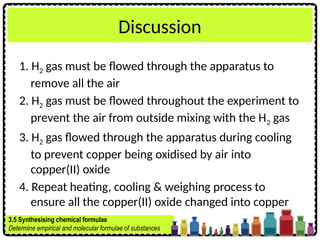
46.
Discussion
1. H2 gasmust be flowed through the apparatus to
remove all the air
2. H2 gas must be flowed throughout the experiment to
prevent the air from outside mixing with the H2 gas
3. H2 gas flowed through the apparatus during cooling
to prevent copper being oxidised by air into
copper(II) oxide
4. Repeat heating, cooling & weighing process to
ensure all the copper(II) oxide changed into copper
3.5 Synthesising chemical formulae
Determine empirical and molecular formulae of substances
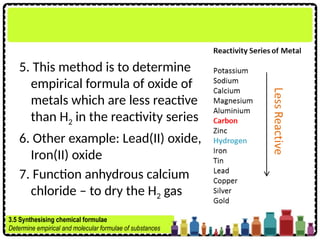
47.
5. This methodis to determine
empirical formula of oxide of
metals which are less reactive
than H2 in the reactivity series
6. Other example: Lead(II) oxide,
Iron(II) oxide
7. Function anhydrous calcium
chloride – to dry the H2 gas
3.5 Synthesising chemical formulae
Determine empirical and molecular formulae of substances
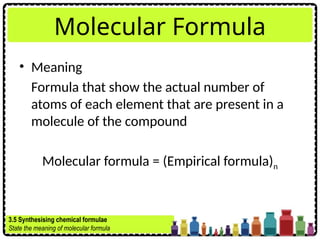
48.
Molecular Formula
• Meaning
Formulathat show the actual number of
atoms of each element that are present in a
molecule of the compound
Molecular formula = (Empirical formula)n
3.5 Synthesising chemical formulae
State the meaning of molecular formula
49.
• The empiricalformula of a compound is CH2.
its relative molecular mass is 42. find its
molecular formula.
[RAM: H=1, C=12]
3.5 Synthesising chemical formulae
Determine empirical and molecular formulae of substances
50.
Example:
(CH2)n = 42
n[12 + 2(1) ] = 42
14n = 42
n = 42/14
= 3
Molecular formula= (CH2) 3
= C3H6
3.5 Synthesising chemical formulae
Determine empirical and molecular formulae of substances
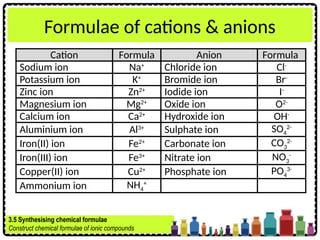
Formulae of cations& anions
Cation Formula Anion Formula
Sodium ion Na+
Chloride ion Cl-
Potassium ion K+
Bromide ion Br-
Zinc ion Zn2+
Iodide ion I-
Magnesium ion Mg2+
Oxide ion O2-
Calcium ion Ca2+
Hydroxide ion OH-
Aluminium ion Al3+
Sulphate ion SO4
2-
Iron(II) ion Fe2+
Carbonate ion CO3
2-
Iron(III) ion Fe3+
Nitrate ion NO3
-
Copper(II) ion Cu2+
Phosphate ion PO4
3-
Ammonium ion NH4
+
3.5 Synthesising chemical formulae
Construct chemical formulae of ionic compounds
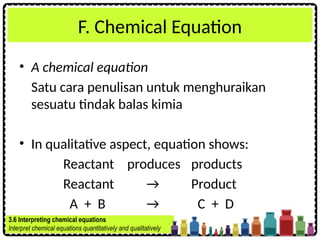
F. Chemical Equation
•A chemical equation
Satu cara penulisan untuk menghuraikan
sesuatu tindak balas kimia
• In qualitative aspect, equation shows:
Reactant produces products
Reactant → Product
A + B → C + D
3.6 Interpreting chemical equations
Interpret chemical equations quantitatively and qualitatively
55.
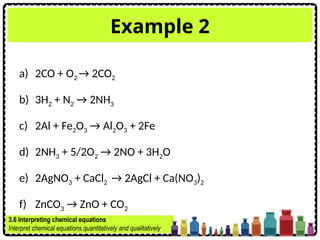
Example 2
a) 2CO+ O2 → 2CO2
b) 3H2 + N2 → 2NH3
c) 2Al + Fe2O3 → Al2O3 + 2Fe
d) 2NH3 + 5/2O2 → 2NO + 3H2O
e) 2AgNO3 + CaCl2 → 2AgCl + Ca(NO3)2
f) ZnCO3 → ZnO + CO2
3.6 Interpreting chemical equations
Interpret chemical equations quantitatively and qualitatively
56.
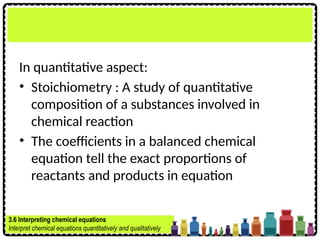
In quantitative aspect:
•Stoichiometry : A study of quantitative
composition of a substances involved in
chemical reaction
• The coefficients in a balanced chemical
equation tell the exact proportions of
reactants and products in equation
3.6 Interpreting chemical equations
Interpret chemical equations quantitatively and qualitatively
57.
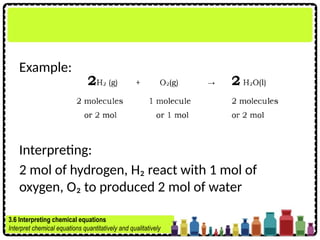
Example:
Interpreting:
2 mol ofhydrogen, H₂ react with 1 mol of
oxygen, O₂ to produced 2 mol of water
3.6 Interpreting chemical equations
Interpret chemical equations quantitatively and qualitatively
58.
Numerical Problems Involving
ChemicalEquations
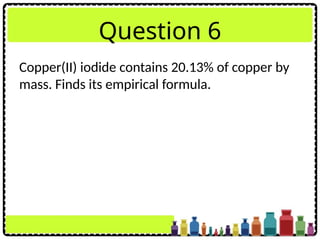
Copper(II) oxide, CuO reacts with aluminium
according to the following equations.
3CuO + 2Al → Al2O3 + 3Cu
Calculate the mass of aluminium required to react
completely with 12 g of copper(II) oxide, CuO
[Relative atomic mass: O, 16; Al, 27; Cu, 64]
3.6 Interpreting chemical equations
Solve numerical problems using chemical equations
59.
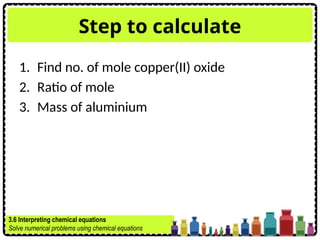
Step to calculate
1.Find no. of mole copper(II) oxide
2. Ratio of mole
3. Mass of aluminium
3.6 Interpreting chemical equations
Solve numerical problems using chemical equations
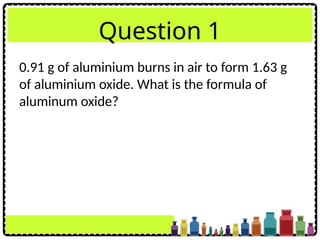
Question 1
0.91 gof aluminium burns in air to form 1.63 g
of aluminium oxide. What is the formula of
aluminum oxide?
62.
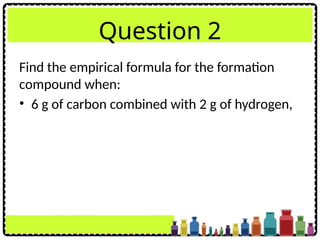
Question 2
Find theempirical formula for the formation
compound when:
• 6 g of carbon combined with 2 g of hydrogen,
63.
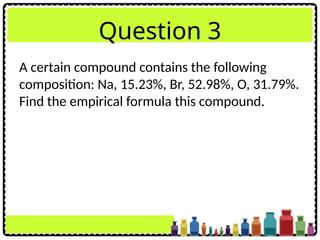
Question 3
A certaincompound contains the following
composition: Na, 15.23%, Br, 52.98%, O, 31.79%.
Find the empirical formula this compound.
64.
Question 4
A metalof M combine with fluorine to form a
MFx of compound. Determine the value of X if
2.28 g of fluorine combine with 3.80 g of M.
[RAM: M, 190; F, 19]
65.
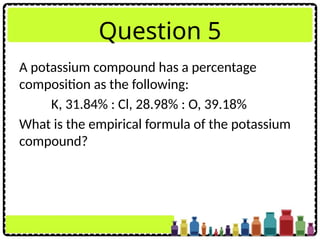
Question 5
A potassiumcompound has a percentage
composition as the following:
K, 31.84% : Cl, 28.98% : O, 39.18%
What is the empirical formula of the potassium
compound?
Question 7
It isfound that x g of metal M combines with 9.6
g of oxygen to form a compound with the
empirical formula M2O3.
Determine the value of x.
[RAM: M, 52; O, 16]
68.
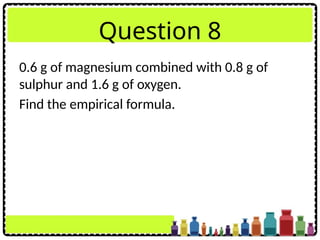
Question 8
0.6 gof magnesium combined with 0.8 g of
sulphur and 1.6 g of oxygen.
Find the empirical formula.

![Example 1:
A closed glass bottle contains 0.5 mol of oxygen
gas, O2
(a) How many oxygen molecules, O2 are there in
the bottle?
(b)How many oxygen atoms are there in the
bottle?
[Avogadro constant: 6.02 × 10²³
mol-1
]](https://image.slidesharecdn.com/chapter3chemicalformulaeandequations-250717001007-8515e634/85/CHAPTER-3-CHEMICAL-FORMULAE-AND-EQUATIONS-pptx-12-320.jpg)
![Example 2:
Find the number of moles of 9.03 × 10²³
molecules in a
sample containing molecules of carbon dioxide, CO2
[Avogadro constant: 6.02 × 10²³
mol-1
]
The number of moles carbon dioxide
= 9.03 × 10²³
6.02 × 10²³
mol-1
= 1.5 mol
Number of
particles
Moles NA](https://image.slidesharecdn.com/chapter3chemicalformulaeandequations-250717001007-8515e634/85/CHAPTER-3-CHEMICAL-FORMULAE-AND-EQUATIONS-pptx-14-320.jpg)
![Example 1:
What is the mass of
(a) 0.1 mol of magnesium?
(b)2.408 × 10²³
atoms of magnesium?
[Relative atomic mass: Mg=24; Avogadro
constant: 6.02 × 10²³
mol-1
]](https://image.slidesharecdn.com/chapter3chemicalformulaeandequations-250717001007-8515e634/85/CHAPTER-3-CHEMICAL-FORMULAE-AND-EQUATIONS-pptx-19-320.jpg)
![Example 2:
RMM of SO2
= 32 + 2(16) = 64
Molar mass of SO2 = 64 g mol-1
The number of moles
= 16 g
64 g mol-1
= 0.25 mol
Mass (g)
Moles
RAM /
RMM /
RFM
How many moles of molecules are there in 16 g of sulphur
dioxide gas, SO2?
[Relative atomic mass: O=16, S=32]](https://image.slidesharecdn.com/chapter3chemicalformulaeandequations-250717001007-8515e634/85/CHAPTER-3-CHEMICAL-FORMULAE-AND-EQUATIONS-pptx-21-320.jpg)
![What is the volume of 1.2 mol of ammonia gas,
NH3 at STP?
[Molar volume: 22.4 dm3
mol-1
at STP]
Example 1:
Volume
(dm3
)
Moles
22.4 dm3
(STP) /
24 dm3
(RC)
The volume of ammonia gas, NH3
= 1.2 mol × 22.4 dm3
mol-1
= 26.88 dm3](https://image.slidesharecdn.com/chapter3chemicalformulaeandequations-250717001007-8515e634/85/CHAPTER-3-CHEMICAL-FORMULAE-AND-EQUATIONS-pptx-25-320.jpg)
![How many moles of ammonia gas, NH3 are present in
600 cm3
of the gas measured at room conditions?
[Molar volume: 24 dm3
mol-1
at room condition]
Example 2:
Volume
(dm3
)
Moles
22.4 dm3
(STP) /
24 dm3
(RC)
The number of moles of ammonia gas, NH3
= 600 cm3
1000
= 0.6 dm3
= 0.6 dm3
24 dm3
mol-1
= 0.025 mol](https://image.slidesharecdn.com/chapter3chemicalformulaeandequations-250717001007-8515e634/85/CHAPTER-3-CHEMICAL-FORMULAE-AND-EQUATIONS-pptx-26-320.jpg)
![Example
A sample of aluminium oxide contains 1.08 g of
aluminium and 0.96 g of oxygen. What is the
empirical formula of this compound?
[Relative atomic mass: O = 16; Al = 27]
3.5 Synthesising chemical formulae
Determine empirical and molecular formulae of substances](https://image.slidesharecdn.com/chapter3chemicalformulaeandequations-250717001007-8515e634/85/CHAPTER-3-CHEMICAL-FORMULAE-AND-EQUATIONS-pptx-33-320.jpg)
![Experiment question:
Describe how you can carry out an experiment
to determine the empirical formula of
magnesium oxide. Your description should
include
• Procedure of experiment
• Tabulation of result
• Calculation of the results obtained
[Relative atomic mass: O = 16; Mg = 24]
3.5 Synthesising chemical formulae
Determine empirical and molecular formulae of substances](https://image.slidesharecdn.com/chapter3chemicalformulaeandequations-250717001007-8515e634/85/CHAPTER-3-CHEMICAL-FORMULAE-AND-EQUATIONS-pptx-37-320.jpg)
![• The empirical formula of a compound is CH2.
its relative molecular mass is 42. find its
molecular formula.
[RAM: H=1, C=12]
3.5 Synthesising chemical formulae
Determine empirical and molecular formulae of substances](https://image.slidesharecdn.com/chapter3chemicalformulaeandequations-250717001007-8515e634/85/CHAPTER-3-CHEMICAL-FORMULAE-AND-EQUATIONS-pptx-49-320.jpg)
![Example:
(CH2)n = 42
n [12 + 2(1) ] = 42
14n = 42
n = 42/14
= 3
Molecular formula= (CH2) 3
= C3H6
3.5 Synthesising chemical formulae
Determine empirical and molecular formulae of substances](https://image.slidesharecdn.com/chapter3chemicalformulaeandequations-250717001007-8515e634/85/CHAPTER-3-CHEMICAL-FORMULAE-AND-EQUATIONS-pptx-50-320.jpg)
![Numerical Problems Involving
Chemical Equations
Copper(II) oxide, CuO reacts with aluminium
according to the following equations.
3CuO + 2Al → Al2O3 + 3Cu
Calculate the mass of aluminium required to react
completely with 12 g of copper(II) oxide, CuO
[Relative atomic mass: O, 16; Al, 27; Cu, 64]
3.6 Interpreting chemical equations
Solve numerical problems using chemical equations](https://image.slidesharecdn.com/chapter3chemicalformulaeandequations-250717001007-8515e634/85/CHAPTER-3-CHEMICAL-FORMULAE-AND-EQUATIONS-pptx-58-320.jpg)
![Question 4
A metal of M combine with fluorine to form a
MFx of compound. Determine the value of X if
2.28 g of fluorine combine with 3.80 g of M.
[RAM: M, 190; F, 19]](https://image.slidesharecdn.com/chapter3chemicalformulaeandequations-250717001007-8515e634/85/CHAPTER-3-CHEMICAL-FORMULAE-AND-EQUATIONS-pptx-64-320.jpg)
![Question 7
It is found that x g of metal M combines with 9.6
g of oxygen to form a compound with the
empirical formula M2O3.
Determine the value of x.
[RAM: M, 52; O, 16]](https://image.slidesharecdn.com/chapter3chemicalformulaeandequations-250717001007-8515e634/85/CHAPTER-3-CHEMICAL-FORMULAE-AND-EQUATIONS-pptx-67-320.jpg)


![Ppt 2 S1.4Counting particles by mass The mole [Autosaved].pptx](https://cdn.slidesharecdn.com/ss_thumbnails/ppt2s1-240830135241-76f72799-thumbnail.jpg?width=640&height=640&fit=bounds)


