3-1
Adjusting The Accounts
3
Learning Objectives
Explain the accrual basis of accounting and the
reasons for adjusting entries.
Prepare adjusting entries for deferrals.
Prepare adjusting entries for accruals.
3
2
1
3-2
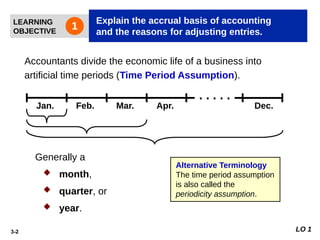
Generally a
 month,
 quarter, or
 year.
Accountants divide the economic life of a business into
artificial time periods (Time Period Assumption).
Jan. Feb. Mar. Apr. Dec.
. . . . .
Alternative Terminology
The time period assumption
is also called the
periodicity assumption.
LEARNING
OBJECTIVE
Explain the accrual basis of accounting
and the reasons for adjusting entries.
1
LO 1
3-3
 Monthly and quarterly time periods are called interim
periods.
 Most large companies must prepare both quarterly and
annual financial statements.
 Fiscal Year = Accounting time period that is one year
in length.
 Calendar Year = January 1 to December 31.
Fiscal and Calendar Years
LO 1
3-4
Accrual-Basis Accounting
 Transactions recorded in the periods in which the
events occur.
 Companies recognize revenues when they perform
services (rather than when they receive cash).
 Expenses are recognized when incurred (rather than
when paid).
 In accordance with generally accepted accounting
principles (GAAP).
Accrual- versus Cash-Basis Accounting
LO 1
3-5
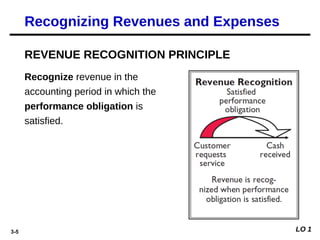
REVENUE RECOGNITION PRINCIPLE
Recognize revenue in the
accounting period in which the
performance obligation is
satisfied.
Recognizing Revenues and Expenses
LO 1
3-6
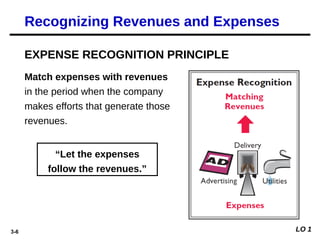
EXPENSE RECOGNITION PRINCIPLE
Match expenses with revenues
in the period when the company
makes efforts that generate those
revenues.
Recognizing Revenues and Expenses
LO 1
“Let the expenses
follow the revenues.”
3-7
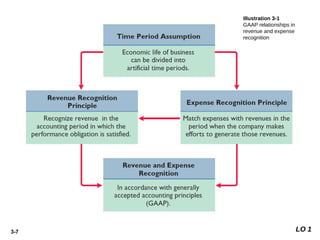
Illustration 3-1
GAAP relationships in
revenue and expense
recognition
LO 1
3-8
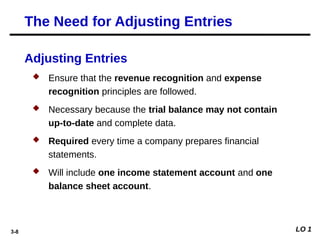
Adjusting Entries
 Ensure that the revenue recognition and expense
recognition principles are followed.
 Necessary because the trial balance may not contain
up-to-date and complete data.
 Required every time a company prepares financial
statements.
 Will include one income statement account and one
balance sheet account.
The Need for Adjusting Entries
LO 1
3-9
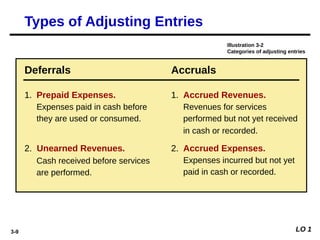
Illustration 3-2
Categories of adjusting entries
1. Prepaid Expenses.
Expenses paid in cash before
they are used or consumed.
Deferrals
1. Accrued Revenues.
Revenues for services
performed but not yet received
in cash or recorded.
2. Accrued Expenses.
Expenses incurred but not yet
paid in cash or recorded.
2. Unearned Revenues.
Cash received before services
are performed.
Accruals
Types of Adjusting Entries
LO 1
3-10
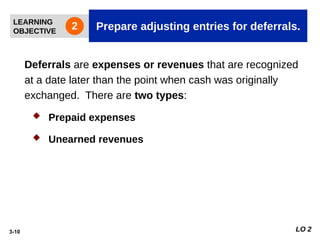
Deferrals are expenses or revenues that are recognized
at a date later than the point when cash was originally
exchanged. There are two types:
 Prepaid expenses
 Unearned revenues
LEARNING
OBJECTIVE Prepare adjusting entries for deferrals.
2
LO 2
3-11
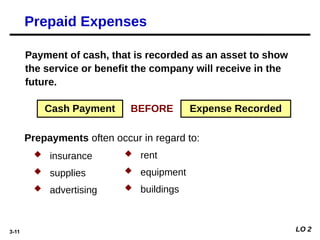
Payment of cash, that is recorded as an asset to show
the service or benefit the company will receive in the
future.
 insurance
 supplies
 advertising
Cash Payment Expense Recorded
BEFORE
 rent
 equipment
 buildings
Prepayments often occur in regard to:
Prepaid Expenses
LO 2
3-12
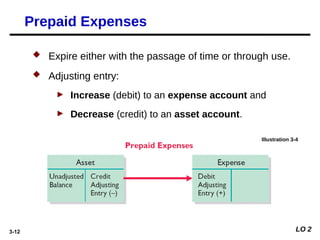
 Expire either with the passage of time or through use.
 Adjusting entry:
► Increase (debit) to an expense account and
► Decrease (credit) to an asset account.
Illustration 3-4
Prepaid Expenses
LO 2
3-13
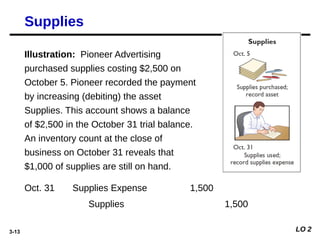
Illustration: Pioneer Advertising
purchased supplies costing $2,500 on
October 5. Pioneer recorded the payment
by increasing (debiting) the asset
Supplies. This account shows a balance
of $2,500 in the October 31 trial balance.
An inventory count at the close of
business on October 31 reveals that
$1,000 of supplies are still on hand.
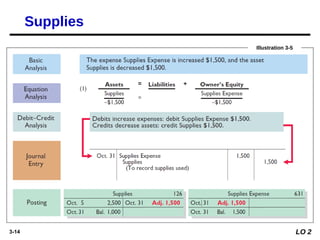
Supplies 1,500
Supplies Expense 1,500
Oct. 31
Supplies
LO 2
3-14
Illustration 3-5
Supplies
LO 2
3-15
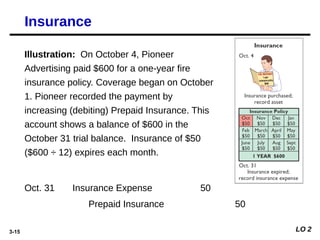
Illustration: On October 4, Pioneer
Advertising paid $600 for a one-year fire
insurance policy. Coverage began on October
1. Pioneer recorded the payment by
increasing (debiting) Prepaid Insurance. This
account shows a balance of $600 in the
October 31 trial balance. Insurance of $50
($600 ÷ 12) expires each month.
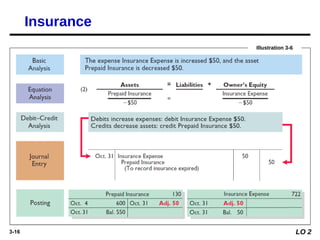
Prepaid Insurance 50
Insurance Expense 50
Oct. 31
Insurance
LO 2
3-16 LO 2
Illustration 3-6
Insurance
3-17
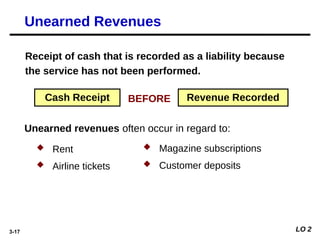
Receipt of cash that is recorded as a liability because
the service has not been performed.
 Rent
 Airline tickets
Cash Receipt Revenue Recorded
BEFORE
 Magazine subscriptions
 Customer deposits
Unearned revenues often occur in regard to:
Unearned Revenues
LO 2
3-18
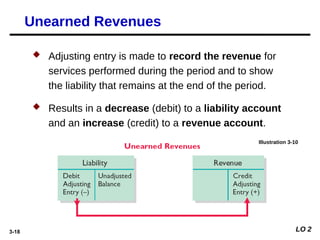
Illustration 3-10
 Adjusting entry is made to record the revenue for
services performed during the period and to show
the liability that remains at the end of the period.
 Results in a decrease (debit) to a liability account
and an increase (credit) to a revenue account.
Unearned Revenues
LO 2
3-19
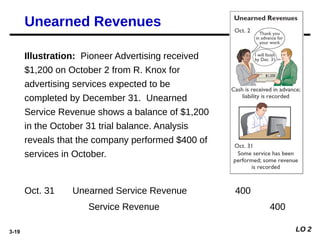
Illustration: Pioneer Advertising received
$1,200 on October 2 from R. Knox for
advertising services expected to be
completed by December 31. Unearned
Service Revenue shows a balance of $1,200
in the October 31 trial balance. Analysis
reveals that the company performed $400 of
services in October.
Service Revenue 400
Unearned Service Revenue 400
Oct. 31
Unearned Revenues
LO 2
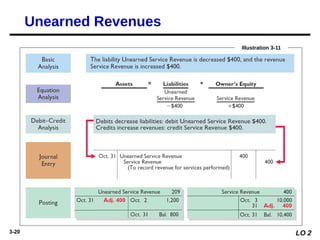
3-20 LO 2
Illustration 3-11
Unearned Revenues
3-21
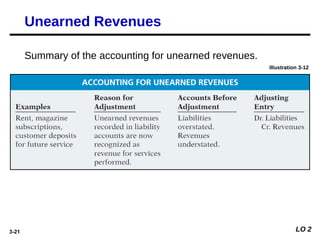
Illustration 3-12
Unearned Revenues
Summary of the accounting for unearned revenues.
LO 2
3-22
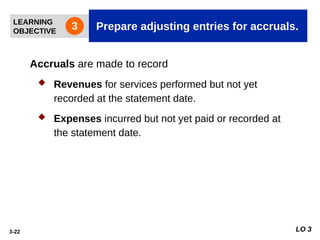
Accruals are made to record
 Revenues for services performed but not yet
recorded at the statement date.
 Expenses incurred but not yet paid or recorded at
the statement date.
LEARNING
OBJECTIVE Prepare adjusting entries for accruals.
3
LO 3
3-23
Revenues for services performed but not yet received
in cash or recorded.
 Rent
 Interest
 Services
Accrued revenues often occur in regard to:
BEFORE Cash Receipt
Revenue Recorded
Accrued Revenues
LO 3
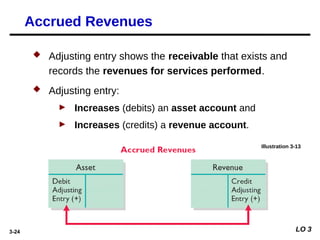
3-24
 Adjusting entry shows the receivable that exists and
records the revenues for services performed.
 Adjusting entry:
► Increases (debits) an asset account and
► Increases (credits) a revenue account.
Accrued Revenues
Illustration 3-13
LO 3
3-25
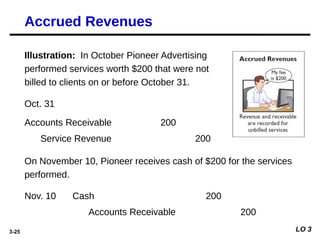
Illustration: In October Pioneer Advertising
performed services worth $200 that were not
billed to clients on or before October 31.
Accounts Receivable 200
Cash 200
Nov. 10
200
Service Revenue 200
Accounts Receivable
Oct. 31
On November 10, Pioneer receives cash of $200 for the services
performed.
Accrued Revenues
LO 3
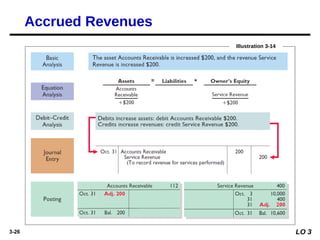
3-26 LO 3
Illustration 3-14
Accrued Revenues
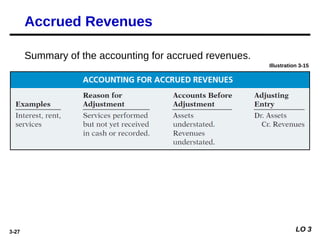
3-27
Illustration 3-15
Accrued Revenues
Summary of the accounting for accrued revenues.
LO 3
3-28
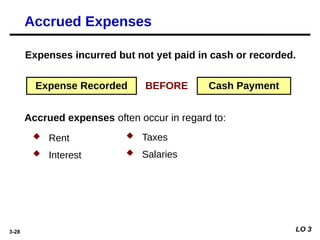
Expenses incurred but not yet paid in cash or recorded.
 Rent
 Interest
 Taxes
 Salaries
Accrued expenses often occur in regard to:
BEFORE Cash Payment
Expense Recorded
Accrued Expenses
LO 3
3-29
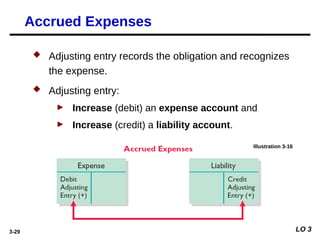
 Adjusting entry records the obligation and recognizes
the expense.
 Adjusting entry:
► Increase (debit) an expense account and
► Increase (credit) a liability account.
Accrued Expenses
Illustration 3-16
LO 3
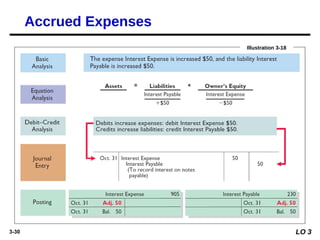
3-30 LO 3
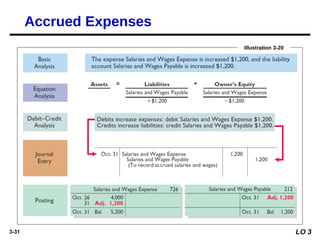
Illustration 3-18
Accrued Expenses
3-31 LO 3
Illustration 3-20
Accrued Expenses
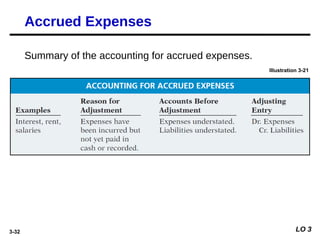
3-32
Illustration 3-21
Accrued Expenses
Summary of the accounting for accrued expenses.
LO 3

chapter 3 fundamental accounting .pptx

  • 1.
    3-1 Adjusting The Accounts 3 LearningObjectives Explain the accrual basis of accounting and the reasons for adjusting entries. Prepare adjusting entries for deferrals. Prepare adjusting entries for accruals. 3 2 1
  • 2.
    3-2 Generally a  month, quarter, or  year. Accountants divide the economic life of a business into artificial time periods (Time Period Assumption). Jan. Feb. Mar. Apr. Dec. . . . . . Alternative Terminology The time period assumption is also called the periodicity assumption. LEARNING OBJECTIVE Explain the accrual basis of accounting and the reasons for adjusting entries. 1 LO 1
  • 3.
    3-3  Monthly andquarterly time periods are called interim periods.  Most large companies must prepare both quarterly and annual financial statements.  Fiscal Year = Accounting time period that is one year in length.  Calendar Year = January 1 to December 31. Fiscal and Calendar Years LO 1
  • 4.
    3-4 Accrual-Basis Accounting  Transactionsrecorded in the periods in which the events occur.  Companies recognize revenues when they perform services (rather than when they receive cash).  Expenses are recognized when incurred (rather than when paid).  In accordance with generally accepted accounting principles (GAAP). Accrual- versus Cash-Basis Accounting LO 1
  • 5.
    3-5 REVENUE RECOGNITION PRINCIPLE Recognizerevenue in the accounting period in which the performance obligation is satisfied. Recognizing Revenues and Expenses LO 1
  • 6.
    3-6 EXPENSE RECOGNITION PRINCIPLE Matchexpenses with revenues in the period when the company makes efforts that generate those revenues. Recognizing Revenues and Expenses LO 1 “Let the expenses follow the revenues.”
  • 7.
    3-7 Illustration 3-1 GAAP relationshipsin revenue and expense recognition LO 1
  • 8.
    3-8 Adjusting Entries  Ensurethat the revenue recognition and expense recognition principles are followed.  Necessary because the trial balance may not contain up-to-date and complete data.  Required every time a company prepares financial statements.  Will include one income statement account and one balance sheet account. The Need for Adjusting Entries LO 1
  • 9.
    3-9 Illustration 3-2 Categories ofadjusting entries 1. Prepaid Expenses. Expenses paid in cash before they are used or consumed. Deferrals 1. Accrued Revenues. Revenues for services performed but not yet received in cash or recorded. 2. Accrued Expenses. Expenses incurred but not yet paid in cash or recorded. 2. Unearned Revenues. Cash received before services are performed. Accruals Types of Adjusting Entries LO 1
  • 10.
    3-10 Deferrals are expensesor revenues that are recognized at a date later than the point when cash was originally exchanged. There are two types:  Prepaid expenses  Unearned revenues LEARNING OBJECTIVE Prepare adjusting entries for deferrals. 2 LO 2
  • 11.
    3-11 Payment of cash,that is recorded as an asset to show the service or benefit the company will receive in the future.  insurance  supplies  advertising Cash Payment Expense Recorded BEFORE  rent  equipment  buildings Prepayments often occur in regard to: Prepaid Expenses LO 2
  • 12.
    3-12  Expire eitherwith the passage of time or through use.  Adjusting entry: ► Increase (debit) to an expense account and ► Decrease (credit) to an asset account. Illustration 3-4 Prepaid Expenses LO 2
  • 13.
    3-13 Illustration: Pioneer Advertising purchasedsupplies costing $2,500 on October 5. Pioneer recorded the payment by increasing (debiting) the asset Supplies. This account shows a balance of $2,500 in the October 31 trial balance. An inventory count at the close of business on October 31 reveals that $1,000 of supplies are still on hand. Supplies 1,500 Supplies Expense 1,500 Oct. 31 Supplies LO 2
  • 14.
  • 15.
    3-15 Illustration: On October4, Pioneer Advertising paid $600 for a one-year fire insurance policy. Coverage began on October 1. Pioneer recorded the payment by increasing (debiting) Prepaid Insurance. This account shows a balance of $600 in the October 31 trial balance. Insurance of $50 ($600 ÷ 12) expires each month. Prepaid Insurance 50 Insurance Expense 50 Oct. 31 Insurance LO 2
  • 16.
  • 17.
    3-17 Receipt of cashthat is recorded as a liability because the service has not been performed.  Rent  Airline tickets Cash Receipt Revenue Recorded BEFORE  Magazine subscriptions  Customer deposits Unearned revenues often occur in regard to: Unearned Revenues LO 2
  • 18.
    3-18 Illustration 3-10  Adjustingentry is made to record the revenue for services performed during the period and to show the liability that remains at the end of the period.  Results in a decrease (debit) to a liability account and an increase (credit) to a revenue account. Unearned Revenues LO 2
  • 19.
    3-19 Illustration: Pioneer Advertisingreceived $1,200 on October 2 from R. Knox for advertising services expected to be completed by December 31. Unearned Service Revenue shows a balance of $1,200 in the October 31 trial balance. Analysis reveals that the company performed $400 of services in October. Service Revenue 400 Unearned Service Revenue 400 Oct. 31 Unearned Revenues LO 2
  • 20.
    3-20 LO 2 Illustration3-11 Unearned Revenues
  • 21.
    3-21 Illustration 3-12 Unearned Revenues Summaryof the accounting for unearned revenues. LO 2
  • 22.
    3-22 Accruals are madeto record  Revenues for services performed but not yet recorded at the statement date.  Expenses incurred but not yet paid or recorded at the statement date. LEARNING OBJECTIVE Prepare adjusting entries for accruals. 3 LO 3
  • 23.
    3-23 Revenues for servicesperformed but not yet received in cash or recorded.  Rent  Interest  Services Accrued revenues often occur in regard to: BEFORE Cash Receipt Revenue Recorded Accrued Revenues LO 3
  • 24.
    3-24  Adjusting entryshows the receivable that exists and records the revenues for services performed.  Adjusting entry: ► Increases (debits) an asset account and ► Increases (credits) a revenue account. Accrued Revenues Illustration 3-13 LO 3
  • 25.
    3-25 Illustration: In OctoberPioneer Advertising performed services worth $200 that were not billed to clients on or before October 31. Accounts Receivable 200 Cash 200 Nov. 10 200 Service Revenue 200 Accounts Receivable Oct. 31 On November 10, Pioneer receives cash of $200 for the services performed. Accrued Revenues LO 3
  • 26.
    3-26 LO 3 Illustration3-14 Accrued Revenues
  • 27.
    3-27 Illustration 3-15 Accrued Revenues Summaryof the accounting for accrued revenues. LO 3
  • 28.
    3-28 Expenses incurred butnot yet paid in cash or recorded.  Rent  Interest  Taxes  Salaries Accrued expenses often occur in regard to: BEFORE Cash Payment Expense Recorded Accrued Expenses LO 3
  • 29.
    3-29  Adjusting entryrecords the obligation and recognizes the expense.  Adjusting entry: ► Increase (debit) an expense account and ► Increase (credit) a liability account. Accrued Expenses Illustration 3-16 LO 3
  • 30.
    3-30 LO 3 Illustration3-18 Accrued Expenses
  • 31.
    3-31 LO 3 Illustration3-20 Accrued Expenses
  • 32.
    3-32 Illustration 3-21 Accrued Expenses Summaryof the accounting for accrued expenses. LO 3