BUSINESS
MATHEMATICS
Lecture Week 1 and 2
An Overview of Business Math and
Some Preliminaries
Ayesha Ashraf
Lecturer Department of Business Administration
University of Sahiwal
Learning Objectives
• To describe what business math is.
• To list usages/applications of math in day-to-day life and business.
• To explain math’s problem-solving model of PUPP by J. Olivier.
• To revise basic mathematical concepts
• To learn solving first degree equation in one variable
• To learn solving second degree equation in one variable
Business Mathematics
• The study of Math required by the business.
• Business Math used by commercial enterprises to record and
manage business operations.
• Every business field deals with Mathematics because of the
involvement of “money” in business.
• It is the specialized field of Math that deals with money.
• It explains monetary concepts and helps to make smart
decisions with money.
Application of Math in day-to-day life
• We are surrounded by numbers.
• People use basic arithmetic operations of addition, subtraction,
multiplication and division in their daily life to solve different
problems.
• Everything requiring any kind of calculation involves
mathematics.
Application of Math in Business
• There are different departments in business such as Accounting,
Marketing, Finance, Human Resources, etc and each department
deals with money and therefore has application of Math.
• Purpose of each department is to contribute to earning the money
for business.
• Knowing the rules of Business Math, enterprises can make smart
decisions in order to maximize revenue and minimize the costs.
• Business Math helps to optimize the business operations by
enabling businessmen to act smartly.
How to solve a Math problem?
• A systematic approach of solving a Math problem is to follow
“PUPP model” designed by J.Olivier
• This model involves four steps:
P: PLAN
U: UNDERSTAND
P: PERFORM
P: PRESENT
4-Steps of PUPP Model
Plan
• Find out the variable that you need to solve a problem for.
• Determine the end goal of the problem i.e; the result that is being asked
about in the question.
Understand
• Assess what information is already provided.
• Assign values to the variables.
• Design a roadmap to reach from point A to point B.
4-Steps of PUPP Model (Cont’d)
Perform
• Execute the plan.
• This step involves all the calculations that have been designed in step II.
Present
• Explain the solution in context of the question asked.
• Explaining helps to easily detect the errors in the solution.
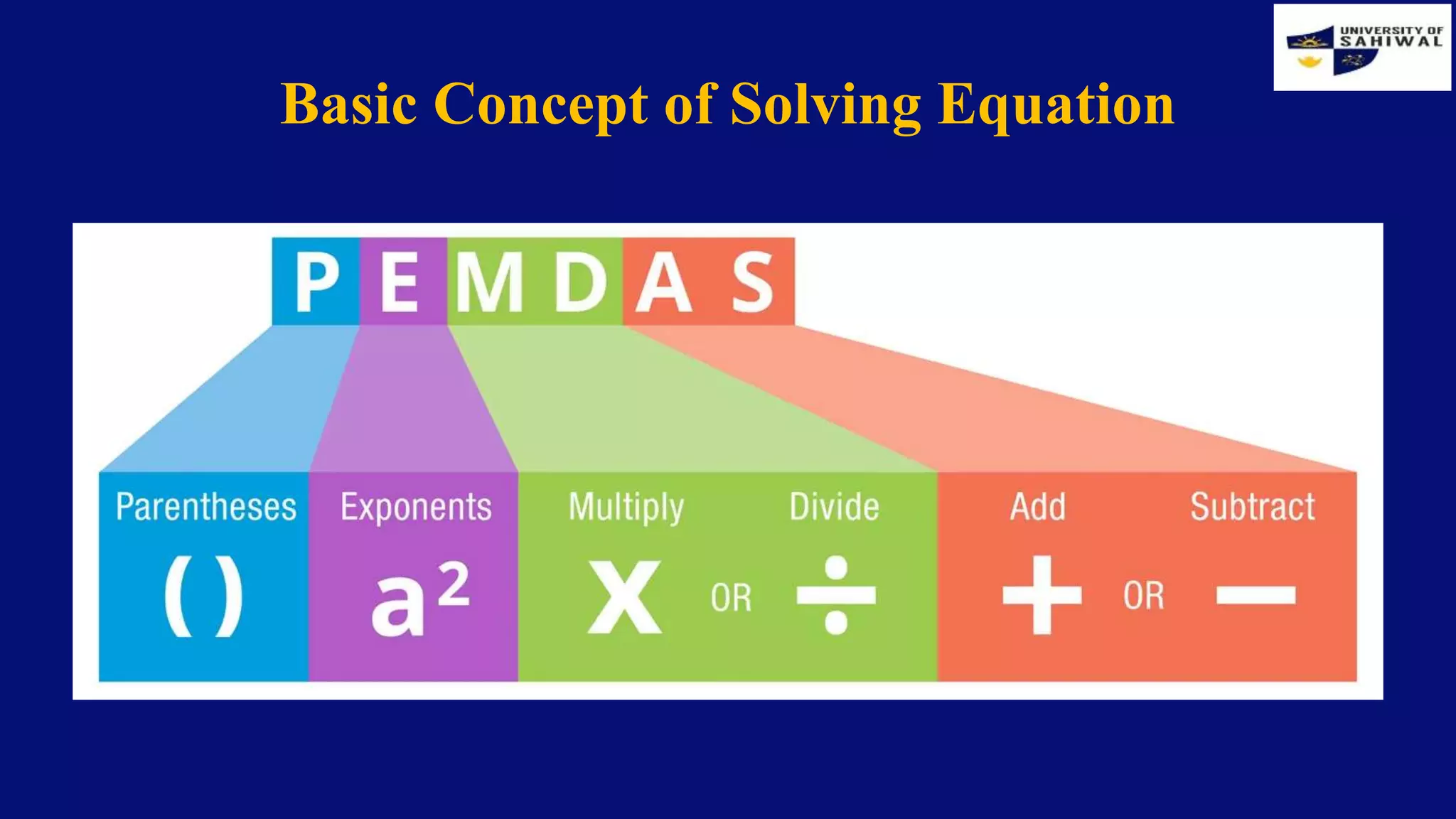
Basic Concept of Solving Equation
Class Activity
• List down 10 activities involving Mathematics that you perform
in your daily life.
• Choose any occupation/job and list down as many activities as
you may find, that involve Mathematics.
Some Preliminaries
Solving First Degree Equation in One Variable
Equation
• An equation sates the equality of two algebraic expression. The
algebraic expression may be stated in term of one or more
variables.
• Following are the examples of equations.
3x-10= 22-5x
16x − 54 = 15x − 32
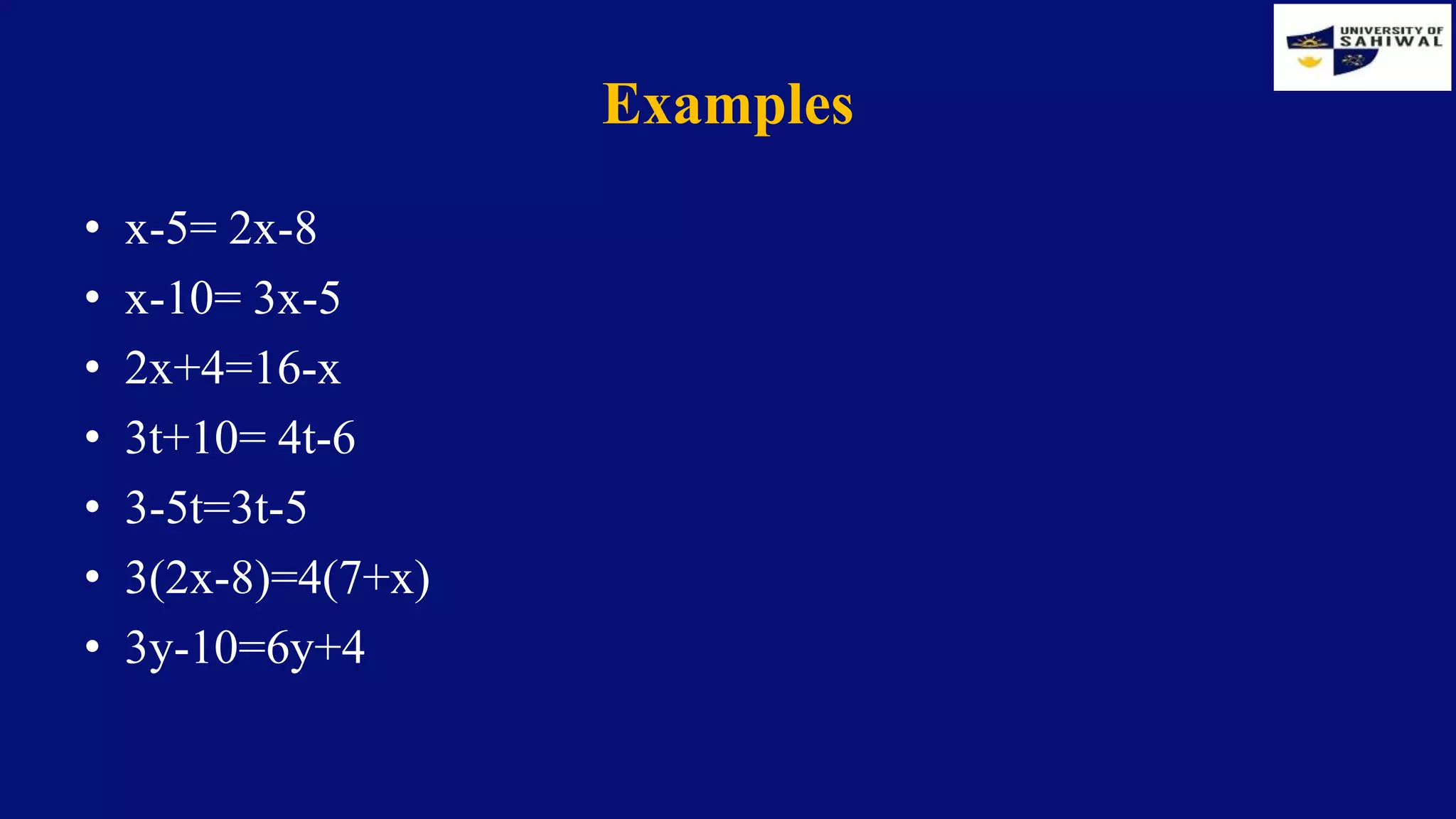
Examples
• x-5= 2x-8
• x-10= 3x-5
• 2x+4=16-x
• 3t+10= 4t-6
• 3-5t=3t-5
• 3(2x-8)=4(7+x)
• 3y-10=6y+4
Practice Questions
Practice Questions (Cont’d)
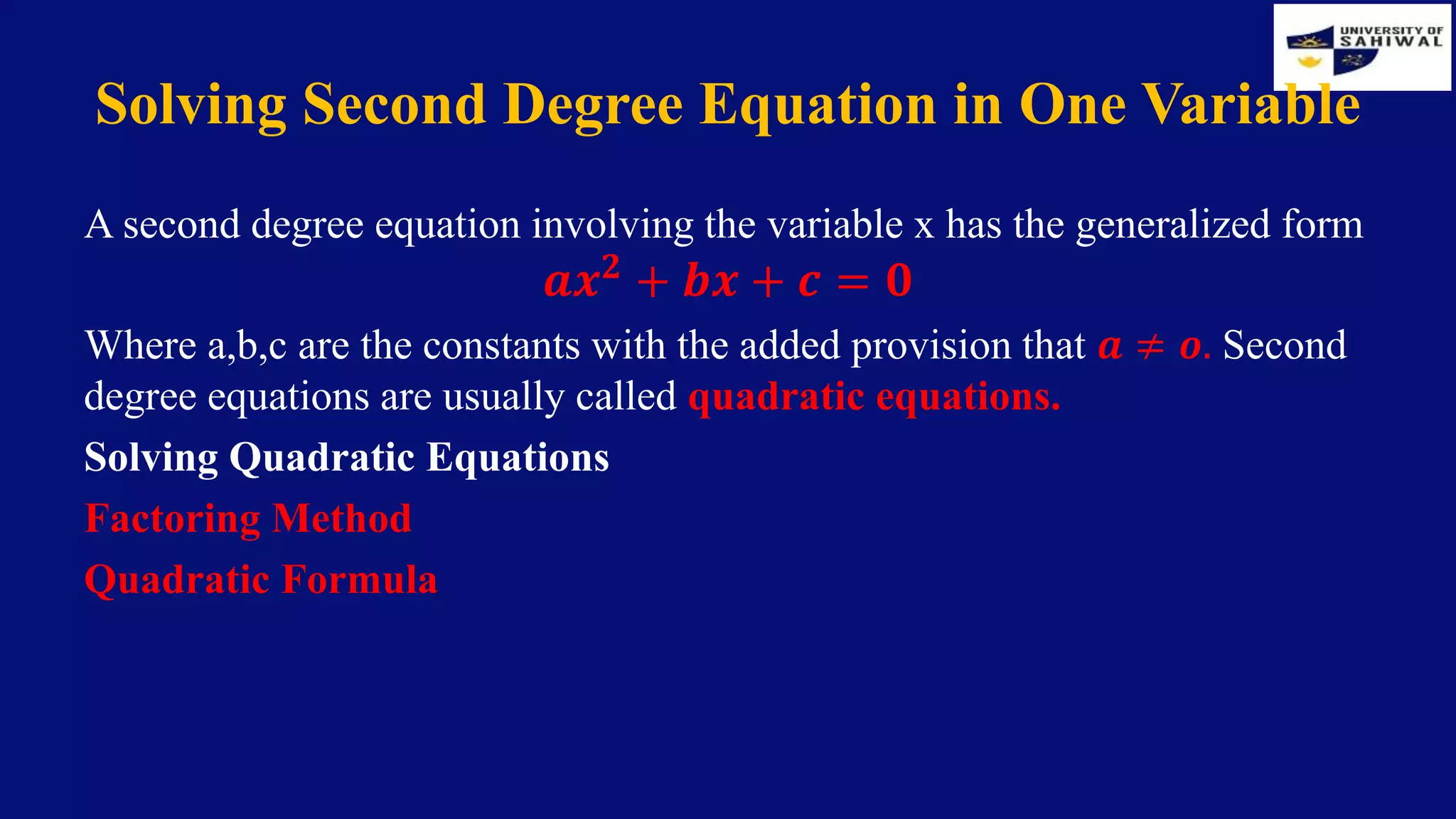
Solving Second Degree Equation in One Variable
A second degree equation involving the variable x has the generalized form
𝒂𝒙𝟐
+ 𝒃𝒙 + 𝒄 = 𝟎
Where a,b,c are the constants with the added provision that 𝒂 ≠ 𝒐. Second
degree equations are usually called quadratic equations.
Solving Quadratic Equations
Factoring Method
Quadratic Formula
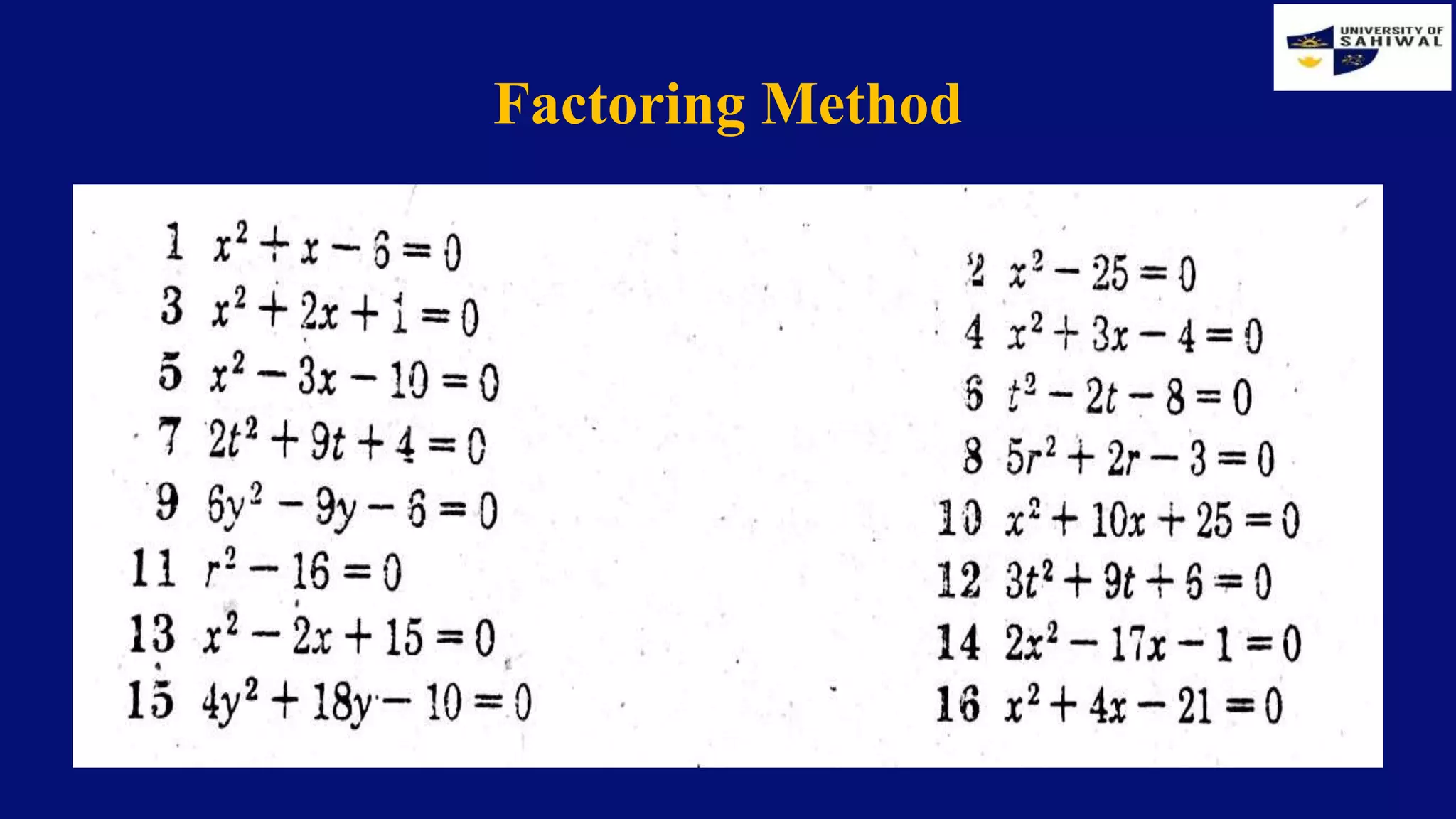
Factoring Method
Quadratic Formula
Reference
• For further reading see the books:
• Applied mathematics for business, economics, and the social
sciences by Frank S. Budnick 4th edition
• Business Math by J. Olivier
• College Mathematics for Business, Economics, Life Sciences,
and Social Sciences by Raymond A. Barnett 13th edition
Query
• In case of any query contact me at: ayesha@uosahiwal.edu.pk
• You can also ask questions via Google Classroom
Thank you

Overview of Business Math

  • 1.
    BUSINESS MATHEMATICS Lecture Week 1and 2 An Overview of Business Math and Some Preliminaries Ayesha Ashraf Lecturer Department of Business Administration University of Sahiwal
  • 2.
    Learning Objectives • Todescribe what business math is. • To list usages/applications of math in day-to-day life and business. • To explain math’s problem-solving model of PUPP by J. Olivier. • To revise basic mathematical concepts • To learn solving first degree equation in one variable • To learn solving second degree equation in one variable
  • 3.
    Business Mathematics • Thestudy of Math required by the business. • Business Math used by commercial enterprises to record and manage business operations. • Every business field deals with Mathematics because of the involvement of “money” in business. • It is the specialized field of Math that deals with money. • It explains monetary concepts and helps to make smart decisions with money.
  • 4.
    Application of Mathin day-to-day life • We are surrounded by numbers. • People use basic arithmetic operations of addition, subtraction, multiplication and division in their daily life to solve different problems. • Everything requiring any kind of calculation involves mathematics.
  • 5.
    Application of Mathin Business • There are different departments in business such as Accounting, Marketing, Finance, Human Resources, etc and each department deals with money and therefore has application of Math. • Purpose of each department is to contribute to earning the money for business. • Knowing the rules of Business Math, enterprises can make smart decisions in order to maximize revenue and minimize the costs. • Business Math helps to optimize the business operations by enabling businessmen to act smartly.
  • 6.
    How to solvea Math problem? • A systematic approach of solving a Math problem is to follow “PUPP model” designed by J.Olivier • This model involves four steps: P: PLAN U: UNDERSTAND P: PERFORM P: PRESENT
  • 7.
    4-Steps of PUPPModel Plan • Find out the variable that you need to solve a problem for. • Determine the end goal of the problem i.e; the result that is being asked about in the question. Understand • Assess what information is already provided. • Assign values to the variables. • Design a roadmap to reach from point A to point B.
  • 8.
    4-Steps of PUPPModel (Cont’d) Perform • Execute the plan. • This step involves all the calculations that have been designed in step II. Present • Explain the solution in context of the question asked. • Explaining helps to easily detect the errors in the solution.
  • 9.
    Basic Concept ofSolving Equation
  • 10.
    Class Activity • Listdown 10 activities involving Mathematics that you perform in your daily life. • Choose any occupation/job and list down as many activities as you may find, that involve Mathematics.
  • 11.
  • 12.
    Solving First DegreeEquation in One Variable Equation • An equation sates the equality of two algebraic expression. The algebraic expression may be stated in term of one or more variables. • Following are the examples of equations. 3x-10= 22-5x 16x − 54 = 15x − 32
  • 13.
    Examples • x-5= 2x-8 •x-10= 3x-5 • 2x+4=16-x • 3t+10= 4t-6 • 3-5t=3t-5 • 3(2x-8)=4(7+x) • 3y-10=6y+4
  • 14.
  • 15.
  • 16.
    Solving Second DegreeEquation in One Variable A second degree equation involving the variable x has the generalized form 𝒂𝒙𝟐 + 𝒃𝒙 + 𝒄 = 𝟎 Where a,b,c are the constants with the added provision that 𝒂 ≠ 𝒐. Second degree equations are usually called quadratic equations. Solving Quadratic Equations Factoring Method Quadratic Formula
  • 17.
  • 18.
  • 19.
    Reference • For furtherreading see the books: • Applied mathematics for business, economics, and the social sciences by Frank S. Budnick 4th edition • Business Math by J. Olivier • College Mathematics for Business, Economics, Life Sciences, and Social Sciences by Raymond A. Barnett 13th edition
  • 20.
    Query • In caseof any query contact me at: ayesha@uosahiwal.edu.pk • You can also ask questions via Google Classroom
  • 21.