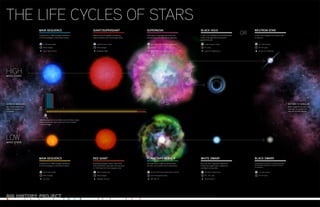
High-mass stars live for one million to tens of millions of years
while low-mass stars, like our Sun, live for tens of millions
to trillions of years.
MASS
TIME
Composition is > 98% hydrogen and helium.
1/3 of the hydrogen is converted to helium.
MAIN SEQUENCE
Massive stars are capable of producing
heavier elements, like iron, through fusion.
GIANT/SUPERGIANT
Outer layers of hydrogen and helium are
ejected along with some heavier elements.
SUPERNOVA
A star's core collapses into extremely dense
matter. Even light cannot escape the
gravitational pull.
BLACK HOLE
A star's core collapses into a dense mass
of neutrons.
NEUTRON STAR
Composition is > 98% hydrogen and helium.
1/3 of the hydrogen is converted to helium.
MAIN SEQUENCE
Expending hydrogen in their cores, these
stars extend their outer layers and can grow
to > 100 times their main sequence size.
RED GIANT
The outer layers of gas are ejected while
the star's core contracts into a white dwarf.
PLANETARY NEBULA
This star core is typically composed of
carbon and oxygen. Neon, magnesium,
and helium are possible.
WHITE DWARF
A hypothetical remnant of a cooled white dwarf,
the Universe's existence is too short to prove
its existence.
BLACK DWARF
10–150 solar masses
90% of lifespan
Spica, Theta Orionis C
significant loss of mass
10% of lifespan
Betelgeuse, Rigel
All but 10% of the original mass is ejected
seconds
Cassiopeia A, Kepler's Supernova
3 solar masses or larger
1070
years
Cygnus X-1, Sagittarius A
1.4–3 solar masses
1033
–1045
years
Circinus X-1, The Mouse
.08–10 solar masses
90% of lifespan
Sun, Altair
99% of original mass
10% of lifespan
Aldebaran, Arcturus
All but 5-15 % of the original mass is ejected
tens of thousands of years
M27, NGC 40
5%–15% of original mass
1015
- 1025
years
Mira B, Sirius B
< 1.4 solar masses
1033
–1045
years
HIGHMASS STARS
OR
LOWMASS STARS
BORN IN NEBULAE
Gas clouds collapse and
matter accumulates on
a protostar.
RETURN TO NEBULAE
Matter expelled from stars can
eventually accumulate into
new star-forming nebulae.
THE LIFE CYCLES OF STARS

Star lifecycles poster

  • 1.
    High-mass stars livefor one million to tens of millions of years while low-mass stars, like our Sun, live for tens of millions to trillions of years. MASS TIME Composition is > 98% hydrogen and helium. 1/3 of the hydrogen is converted to helium. MAIN SEQUENCE Massive stars are capable of producing heavier elements, like iron, through fusion. GIANT/SUPERGIANT Outer layers of hydrogen and helium are ejected along with some heavier elements. SUPERNOVA A star's core collapses into extremely dense matter. Even light cannot escape the gravitational pull. BLACK HOLE A star's core collapses into a dense mass of neutrons. NEUTRON STAR Composition is > 98% hydrogen and helium. 1/3 of the hydrogen is converted to helium. MAIN SEQUENCE Expending hydrogen in their cores, these stars extend their outer layers and can grow to > 100 times their main sequence size. RED GIANT The outer layers of gas are ejected while the star's core contracts into a white dwarf. PLANETARY NEBULA This star core is typically composed of carbon and oxygen. Neon, magnesium, and helium are possible. WHITE DWARF A hypothetical remnant of a cooled white dwarf, the Universe's existence is too short to prove its existence. BLACK DWARF 10–150 solar masses 90% of lifespan Spica, Theta Orionis C significant loss of mass 10% of lifespan Betelgeuse, Rigel All but 10% of the original mass is ejected seconds Cassiopeia A, Kepler's Supernova 3 solar masses or larger 1070 years Cygnus X-1, Sagittarius A 1.4–3 solar masses 1033 –1045 years Circinus X-1, The Mouse .08–10 solar masses 90% of lifespan Sun, Altair 99% of original mass 10% of lifespan Aldebaran, Arcturus All but 5-15 % of the original mass is ejected tens of thousands of years M27, NGC 40 5%–15% of original mass 1015 - 1025 years Mira B, Sirius B < 1.4 solar masses 1033 –1045 years HIGHMASS STARS OR LOWMASS STARS BORN IN NEBULAE Gas clouds collapse and matter accumulates on a protostar. RETURN TO NEBULAE Matter expelled from stars can eventually accumulate into new star-forming nebulae. THE LIFE CYCLES OF STARS