From Appeasement to War
Section 1
• Analyze the threat to world peace posed by
dictators in the 1930s and how the Western
democracies responded.
• Describe how the Spanish Civil War was a “dress
rehearsal” for World War II.
• Summarize the ways in which continuing Nazi
aggression led Europe to war.
Objectives
From Appeasement to War
Section 1
Terms and People
• appeasement – giving in to the demands of an
aggressor to keep peace
• pacifism – opposition to all war
• Neutrality Acts – a group of laws enacted by
the United States to avoid involvement in a
European conflict
• Axis powers – Germany, Italy, and Japan
From Appeasement to War
Section 1
Terms and People (continued)
• Francisco Franco – a conservative Spanish
general supported by Fascists and Nationalists in
the Spanish Civil War; later became dictator
• Anschluss – union of Austria and Germany
• Sudetenland – a region of Czechoslovakia
• Nazi-Soviet Pact – a nonaggression pact uniting
Germany and the Soviet Union
From Appeasement to War
Section 1
After the horrors of World War I, Western
democracies tried to preserve peace.
However, Germany, Italy, and Japan were
preparing to build new empires, and the world
was headed to war again.
What events unfolded between
Chamberlain’s declaration of “peace for our
time” and the outbreak of a world war?
From Appeasement to War
Section 1
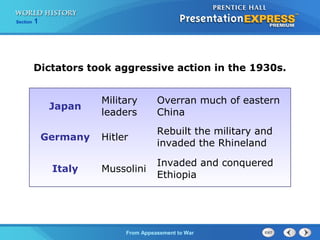
Dictators took aggressive action in the 1930s.
Japan
Military
leaders
Overran much of eastern
China
Germany Hitler
Rebuilt the military and
invaded the Rhineland
Italy Mussolini
Invaded and conquered
Ethiopia
From Appeasement to War
Section 1
Western democracies denounced these
invasions but chose a policy of
appeasement, for several reasons:
• France could not take on Hitler without British
support, and Britain did not want to confront him.
• Both countries viewed Hitler’s fascism as a defense
against the spread of Soviet communism.
• The Great Depression led to widespread pacifism.
From Appeasement to War
Section 1
• Italy, Germany, and
Japan became the
Axis powers.
• The Axis agreed to
fight Soviet communism
and not to interfere
with each other’s
territorial expansion.
By the mid-1930s,
the antidemocratic
aggressive powers
formed an alliance.
From Appeasement to War
Section 1
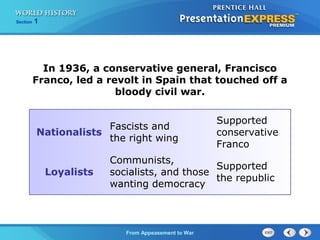
In 1936, a conservative general, Francisco
Franco, led a revolt in Spain that touched off a
bloody civil war.
Nationalists
Fascists and
the right wing
Supported
conservative
Franco
Loyalists
Communists,
socialists, and those
wanting democracy
Supported
the republic
From Appeasement to War
Section 1
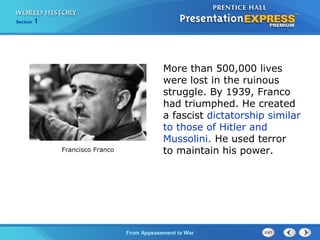
More than 500,000 lives
were lost in the ruinous
struggle. By 1939, Franco
had triumphed. He created
a fascist dictatorship similar
to those of Hitler and
Mussolini. He used terror
to maintain his power.Francisco Franco
From Appeasement to War
Section 1
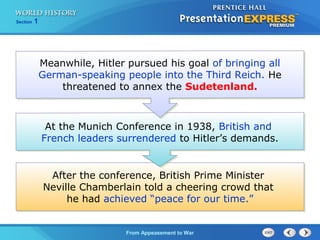
After the conference, British Prime Minister
Neville Chamberlain told a cheering crowd that
he had achieved “peace for our time.”
At the Munich Conference in 1938, British and
French leaders surrendered to Hitler’s demands.
Meanwhile, Hitler pursued his goal of bringing all
German-speaking people into the Third Reich. He
threatened to annex the Sudetenland.
From Appeasement to War
Section 1
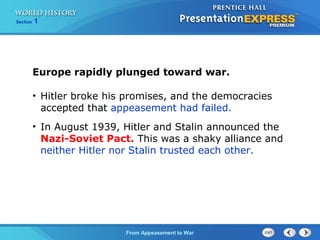
• Hitler broke his promises, and the democracies
accepted that appeasement had failed.
• In August 1939, Hitler and Stalin announced the
Nazi-Soviet Pact. This was a shaky alliance and
neither Hitler nor Stalin trusted each other.
Europe rapidly plunged toward war.
From Appeasement to War
Section 1
World War II
had begun.
Two days later, Britain
and France declared
war on Germany.
On September 1, 1939, a week after the
Nazi-Soviet Pact, German forces invaded Poland.
From Appeasement to War
Section 1
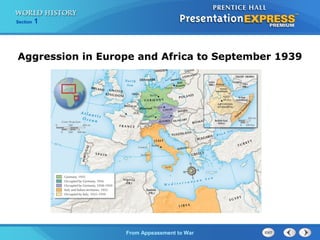
Aggression in Europe and Africa to September 1939
From Appeasement to War
Section 1
Section Review
Know It, Show It QuizQuickTake Quiz

Wwii appeasement

  • 1.
    From Appeasement toWar Section 1 • Analyze the threat to world peace posed by dictators in the 1930s and how the Western democracies responded. • Describe how the Spanish Civil War was a “dress rehearsal” for World War II. • Summarize the ways in which continuing Nazi aggression led Europe to war. Objectives
  • 2.
    From Appeasement toWar Section 1 Terms and People • appeasement – giving in to the demands of an aggressor to keep peace • pacifism – opposition to all war • Neutrality Acts – a group of laws enacted by the United States to avoid involvement in a European conflict • Axis powers – Germany, Italy, and Japan
  • 3.
    From Appeasement toWar Section 1 Terms and People (continued) • Francisco Franco – a conservative Spanish general supported by Fascists and Nationalists in the Spanish Civil War; later became dictator • Anschluss – union of Austria and Germany • Sudetenland – a region of Czechoslovakia • Nazi-Soviet Pact – a nonaggression pact uniting Germany and the Soviet Union
  • 4.
    From Appeasement toWar Section 1 After the horrors of World War I, Western democracies tried to preserve peace. However, Germany, Italy, and Japan were preparing to build new empires, and the world was headed to war again. What events unfolded between Chamberlain’s declaration of “peace for our time” and the outbreak of a world war?
  • 5.
    From Appeasement toWar Section 1 Dictators took aggressive action in the 1930s. Japan Military leaders Overran much of eastern China Germany Hitler Rebuilt the military and invaded the Rhineland Italy Mussolini Invaded and conquered Ethiopia
  • 6.
    From Appeasement toWar Section 1 Western democracies denounced these invasions but chose a policy of appeasement, for several reasons: • France could not take on Hitler without British support, and Britain did not want to confront him. • Both countries viewed Hitler’s fascism as a defense against the spread of Soviet communism. • The Great Depression led to widespread pacifism.
  • 7.
    From Appeasement toWar Section 1 • Italy, Germany, and Japan became the Axis powers. • The Axis agreed to fight Soviet communism and not to interfere with each other’s territorial expansion. By the mid-1930s, the antidemocratic aggressive powers formed an alliance.
  • 8.
    From Appeasement toWar Section 1 In 1936, a conservative general, Francisco Franco, led a revolt in Spain that touched off a bloody civil war. Nationalists Fascists and the right wing Supported conservative Franco Loyalists Communists, socialists, and those wanting democracy Supported the republic
  • 9.
    From Appeasement toWar Section 1 More than 500,000 lives were lost in the ruinous struggle. By 1939, Franco had triumphed. He created a fascist dictatorship similar to those of Hitler and Mussolini. He used terror to maintain his power.Francisco Franco
  • 10.
    From Appeasement toWar Section 1 After the conference, British Prime Minister Neville Chamberlain told a cheering crowd that he had achieved “peace for our time.” At the Munich Conference in 1938, British and French leaders surrendered to Hitler’s demands. Meanwhile, Hitler pursued his goal of bringing all German-speaking people into the Third Reich. He threatened to annex the Sudetenland.
  • 11.
    From Appeasement toWar Section 1 • Hitler broke his promises, and the democracies accepted that appeasement had failed. • In August 1939, Hitler and Stalin announced the Nazi-Soviet Pact. This was a shaky alliance and neither Hitler nor Stalin trusted each other. Europe rapidly plunged toward war.
  • 12.
    From Appeasement toWar Section 1 World War II had begun. Two days later, Britain and France declared war on Germany. On September 1, 1939, a week after the Nazi-Soviet Pact, German forces invaded Poland.
  • 13.
    From Appeasement toWar Section 1 Aggression in Europe and Africa to September 1939
  • 14.
    From Appeasement toWar Section 1 Section Review Know It, Show It QuizQuickTake Quiz