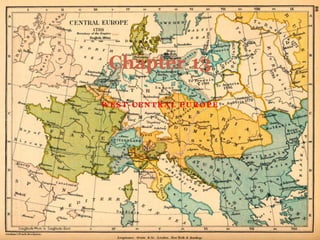
West-Central EuropeChapter 13
Physical GeographySection 1
Physical FeaturesCountriesFrance, Germany, Belgium, the Netherlands, Luxembourg, Switzerland, & AustriaBenelux countries (Low Countries)Belgium, the Netherlands, & LuxembourgAlpine countries (lie in the Alps mt. range)Switzerland & Austria
Lowlands, Uplands, & MountainsLandforms arranged like a fanNorthern European Plain: forms outer edge of fan; falls below sea level in some areasUplands: form middle of fan; begin at the Pyrenees Mts.; Massif Central in France & the Schwarzwald (black forest) in Germany are also important upland landformsMountains: center of fan; the Alps are highest range in EuropeLarge glaciers are present & avalanches occur often
Climate & WaterwaysMarine west coast climateMild winters, mild summers; Low annual temperature range; Heavy cloud cover & high humidity; Frequent cyclonic storms, with prolonged rain, drizzle and fog. areas farther from North Atlantic are colder (Germany)The Alps feed west-central Europe’s navigable riversDeep enough & wide enough to used by shipsFrance: the Seine, the Loire, the Garonne, & the Rhone RiversGermany: the Rhine, the Danube, the Elbe, the Oder, & the Weser RiversImportant for trade & travel
ResourcesForestsMost cut down centuries agoFields that remain are very productiveGermany’s plains: rich in loess (fine, wind blown soil deposits)Germany & France produce grapes for winesSwitzerland: pastures support dairy cattleMineral resourcesIron ore, oil, coal, & natural gasNuclear power & hydroelectric power supply region w/ energy needsResources are unevenly distributed throughout region
Section 2France
HistoryBeen occupied by many European countriesAncient timesPart of GaulEarly History600 B.C.Greeks set up coloniesGaul conquered by the Romans; est. Latin-based lang. that developed into French; rule lasted until A.D. 400Franks (Germanic people) conquered GaulCharlemagne was ruler of Franks
Dreamed of building Christian empire as great as old Roman EmpireA.D. 800 crowned Emperor of RomansStrengthened gov’t & improved education & arts in EuropeEmpire divided after his deathNorsemenInvaded from northern Europe; settled in western France (Normandy)
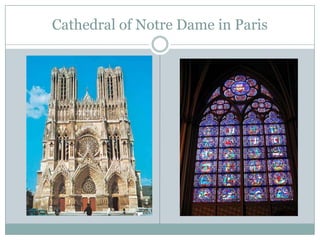
Middle AgesPeriod from collapse of Roman Empire to 1500Kings were not very powerfulDepended on nobles cooperation1066Duke of Normandy conquered EnglandKings of England also ruled part of France1300sKing of England tried to claim throne of Francelead to Hundred Years’ War (1337 to 1453)French armies drove English out of France & French kings slowly increased their power over noblesRoman Catholic church united Europe during this periodCathedrals were built
Cathedral of Notre Dame in Paris
Revolution and Napoleon’s Empire1500s to 1700sFrance built global empireEst. colonies in America, Asia, & AfricaPeople of France lived in poverty & 	had few rights1789French Revolution beganKing was overthrown & elected gov’t	est.1799Napoleon Bonaparte took powerGreat military leader & later took title as emperorConquered most of EuropeBuilt new roads in France, reformed education, 	est. metric system
1815Alliance of Austria, U.K., Prussia, & Russia defeated NapoleonFrench king regained throne
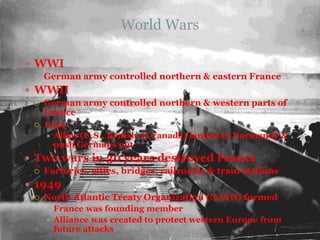
World WarsWWIGerman army controlled northern & eastern FranceWWIIGerman army controlled northern & western parts of France1944Allies (U.S., British, & Canada) landed in Normandy & push Germans outTwo wars in 30 years destroyed FranceFactories, cities, bridges, railroads, & train stations1949North Atlantic Treaty Organization (NATO) formedFrance was founding memberAlliance was created to protect western Europe from future attacks
Government1950s & 1960sFrench colonies in Asia & Africa became independentOther smaller territories around the world remainedFrance TodayRepublic with parliament & elected presidentFounding member of European Union (EU)Trying to replace currencyThe franc & EU currency the euro
Culture85% are Roman Catholic5%-10% are MuslimSpeak French mostlyImmigrants from Africa, Caribbean, & Southeast Asia influence French food, clothing, music, & art
CustomsMediterranean foodsWheat, olives, cheeses, & garlicWine is produced in many regionsMany festivals celebratedBastille Day (July 14)1789 a mob stormed the Bastille, a royal prison in Paris; recognized as start of French Revolution
The Arts & LiteratureGreat tradition of poetry, philosophy, music, & visual artsLate 1800s & early 1900sCenter of impressionism (capture the rippling of light rather than an exact, realistic image
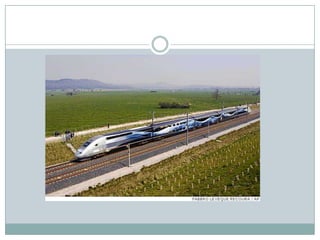
France TodayMajor agricultural & industrial countryResources, labor force, & location help spur economic growthExportsWheat, olives, wine, & cheesesFactories: cars, airplanes, shoes, clothing, machinery, & chemicalsMajor cities linked by high-speed trains & excellent highways
Section 3Germany
HistoryGermansDescendants of tribe from northern EuropeConquered by RomansLand named Germania
Growth of a NationSmall cities states developed regionRuled by princes& with help of Roman Catholic Church became part of Holy Roman EmpirePrussia1871- United German city states into one nationDeveloped into industrial and military world power
War and Division1914-1918Fought and lost WWIWar damages and depression hurt economy1920sAdolf Hitler led Nazis in Germany1933 Nazis took power & invaded Austria, Czechoslovakia, & Poland and started WWII1942 Germany & Italy had conquered most of Europe
Concentration campsWere people were forced to from occupied countriesWere enslaved or killed6 million Jews & millions of other people were murdered in a mass killing called the Holocaust
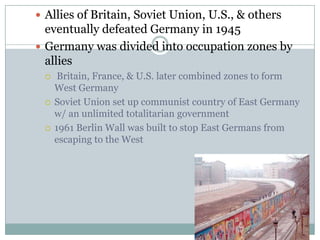
Allies of Britain, Soviet Union, U.S., & others eventually defeated Germany in 1945Germany was divided into occupation zones by allies Britain, France, & U.S. later combined zones to form West Germany Soviet Union set up communist country of East Germany w/ an unlimited totalitarian government1961 Berlin Wall was built to stop East Germans from escaping to the West
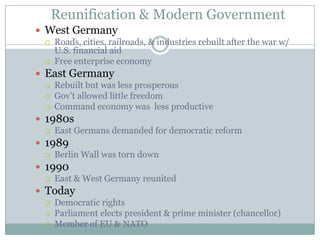
Reunification & Modern GovernmentWest GermanyRoads, cities, railroads, & industries rebuilt after the war w/ U.S. financial aidFree enterprise economyEast GermanyRebuilt but was less prosperousGov’t allowed little freedomCommand economy was  less productive1980sEast Germans demanded for democratic reform1989Berlin Wall was torn down1990East & West Germany reunitedTodayDemocratic rightsParliament elects president & prime minister (chancellor)Member of EU & NATO
Culture34% are Roman Catholic38% ProtestantDiversity90% are ethnic GermansTurks, Poles, & Italians live & work in Germany“guest workers” do not have citizenshipThousands of refugees from Easter Europe in last 50 years
CustomsFood emphasizes products of the forests, farms, & seasonsSausage, cheese, wine, & beerCelebrationsOktoberfest, Sangerfast, & FastnachtChristmas is  major festival
The Arts & LiteratureJohannes Gutenberg1st European to print books using movable metal type1700s & 1800sGermany led Europe in development of classical musicLudwig van BeethovenRichard Wager operas of folktales of ancient Germany
Germany TodayFederal RepublicParliament chooses chancellor (prime minister)Also elects president (ceremonial duties)Belongs to EU and NATOEurope’s largest economy1/5 of all good and services in EUBased on industry (chemicals, engineering, and steel)Major cropsGrain, potatoes, and grapes
The Alpine Countries
Names after AlpsDraw touristsBoth landlockedInfluenced by German cultureGeneral Background Info.
AustriaHome to Habsburgs (powerful family of German nobles)At their height of power they ruled Spain, Netherlands, areas of Germany, eastern Europe, & ItalyOn losing side of WWIBecame republic after warToday modern industrialized nationMember of EUSpeak GermanProsperous economyLittle unemployment
SwitzerlandIndependent since 1600sSwiss Cantons (26 districts)each controls own affairs; national gov’t handles defense & international relationsLocation in high Alps has allowed it to remain neutral in European warsNot a member of EU or NATO2002 joined UN (United Nations)LanguageGerman, French, Italian, and RomanshWorld’s highest standards of livingFamous for banks, watches, chocolate and cheese
CultureSwitzerland46% is Roman Catholic40% ProtestantAustriaMainly Roman Catholic5% Protestant17% follow Islam
Languages & DiversitySwitzerland64% speak German18% speak French10% speak ItalianSoutheast speak RomanshOther European languagesAustriaGerman speakingSmall minorities of Slovenes & Croatians
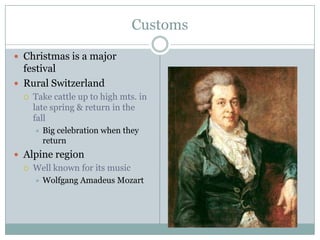
CustomsChristmas is a major festivalRural SwitzerlandTake cattle up to high mts. in late spring & return in the fallBig celebration when they returnAlpine regionWell known for its musicWolfgang Amadeus Mozart
The Alpine Countries TodayBoth produce dairy productsSwitzerlandManufactures watches, optical instruments, & other machineryChemists discovered how to make chocolate barsMajor producer, but has to import cocoa beansAlpine countries linked by highways, trains, & airportsTourists are attracted by mountain scenery, lakes, & ski slopes
Section 4The Benelux Countries
Once inhabited by Celtic & Germanic tribesWere conquered by the RomansCharlemagne ruled area after fall of Roman EmpireRegion was ruled by various French rulers & by the Holy Roman emperor after Charlemagne1555King Philip II of Spain was given Low Countries1570s Protestants in the Netherlands won freedom from Spanish ruleNetherlands became a great naval & colonial power1830Belgium became an independent kingdomHistory
Scarred regionMany WWI battles took place in BelgiumWWIIGermany occupied Low Countries1949Belgium, Netherlands, & Luxembourg were founding members of NATOLater joined EUTodayRuled by parliament & monarchMonarch duties are mostly ceremonialNetherlands controls several Caribbean islandsWorld Wars
ReligionRoman Catholic, Protestant, & those w/ no religious tiesLanguageDutch is spoken in the NetherlandsFlemish is spoken in Flanders, the northern part of BelgiumFrench is spoken in other parts of BelgiumBenelux countries are also home to immigrants from Asia & AfricaCulture
Diary products, fish, & sausageSpices from Southeast Asia are used in many Dutch  dishesBelgians claim to have invented French fries, which they eat w/ mayonnaiseFood
Netherlands & Belgium are world leaders in fine artsVincent van Gogh, Rembrandt & Jan VermeerArts
NetherlandsFamous for flowersExport: cheeses, Chocolate, & cocoaimports/refines: oilBelgiumKnown for diamond-cutting centersBrussels is headquarters of EU & NatoLuxembourgImportant banking servicesProduces: steel, chemicals, and machinesInternational businesses & governmentsThe Benelux Countries Today
Section 5The Alpine Countries
HistoryAustria & SwitzerlandCeltic OccupationRoman & Germanic invasionRuled by Holy Roman Empire
SwitzerlandSwiss Cantons (districts)Broke away from Holy Roman Empire1600s became IndependentToday26 cantons; each controls own affairs; national gov’t handles defense & international relationsLocation in high Alps has allowed it to remain neutral in European warsNot a member of EU or NATO2002 joined UN (United Nations)
AustriaHome to Habsburgs (powerful family of German nobles)1400s on Holy Roman emperor was always a HabsburgAt their height of power they ruled Spain, Netherlands, areas of Germany, eastern Europe, & ItalyEmpire was ethnically diverse & united only by allegiance to emperor & Roman Catholic religionAustria Empire replaced Holy Roman Empire, also under Habsburg controlNationalism (demand for self-rule)developed within empire1867Austrians & Hungarians agreed to share political powerBecame Austro-Hungarian Empire, but dissolved after WWIGermany occupied Austria during WWIIAllies occupied Austria after WWIITodayIndependent member of EU
CultureSwitzerland46% is Roman Catholic40% ProtestantAustriaMainly Roman Catholic5% Protestant17% follow Islam
Languages & DiversitySwitzerland64% speak German18% speak French10% speak ItalianSoutheast speak RomanshOther European languagesAustriaGerman speakingSmall minorities of Slovenes & Croatians
CustomsChristmas is a major festivalRural SwitzerlandTake cattle up to high mts. in late spring & return in the fallBig celebration when they returnAlpine regionWell known for its musicWolfgang Amadeus Mozart
The Alpine Countries TodayBoth produce dairy productsSwitzerlandManufactures watches, optical instruments, & other machineryChemists discovered how to make chocolate barsMajor producer, but has to import cocoa beansAlpine countries linked by highways, trains, & airportsTourists are attracted by mountain scenery, lakes, & ski slopes

Blog notes

  • 1.
  • 2.
  • 3.
    Physical FeaturesCountriesFrance, Germany,Belgium, the Netherlands, Luxembourg, Switzerland, & AustriaBenelux countries (Low Countries)Belgium, the Netherlands, & LuxembourgAlpine countries (lie in the Alps mt. range)Switzerland & Austria
  • 4.
    Lowlands, Uplands, &MountainsLandforms arranged like a fanNorthern European Plain: forms outer edge of fan; falls below sea level in some areasUplands: form middle of fan; begin at the Pyrenees Mts.; Massif Central in France & the Schwarzwald (black forest) in Germany are also important upland landformsMountains: center of fan; the Alps are highest range in EuropeLarge glaciers are present & avalanches occur often
  • 5.
    Climate & WaterwaysMarinewest coast climateMild winters, mild summers; Low annual temperature range; Heavy cloud cover & high humidity; Frequent cyclonic storms, with prolonged rain, drizzle and fog. areas farther from North Atlantic are colder (Germany)The Alps feed west-central Europe’s navigable riversDeep enough & wide enough to used by shipsFrance: the Seine, the Loire, the Garonne, & the Rhone RiversGermany: the Rhine, the Danube, the Elbe, the Oder, & the Weser RiversImportant for trade & travel
  • 6.
    ResourcesForestsMost cut downcenturies agoFields that remain are very productiveGermany’s plains: rich in loess (fine, wind blown soil deposits)Germany & France produce grapes for winesSwitzerland: pastures support dairy cattleMineral resourcesIron ore, oil, coal, & natural gasNuclear power & hydroelectric power supply region w/ energy needsResources are unevenly distributed throughout region
  • 7.
  • 8.
    HistoryBeen occupied bymany European countriesAncient timesPart of GaulEarly History600 B.C.Greeks set up coloniesGaul conquered by the Romans; est. Latin-based lang. that developed into French; rule lasted until A.D. 400Franks (Germanic people) conquered GaulCharlemagne was ruler of Franks
  • 9.
    Dreamed of buildingChristian empire as great as old Roman EmpireA.D. 800 crowned Emperor of RomansStrengthened gov’t & improved education & arts in EuropeEmpire divided after his deathNorsemenInvaded from northern Europe; settled in western France (Normandy)
  • 10.
    Middle AgesPeriod fromcollapse of Roman Empire to 1500Kings were not very powerfulDepended on nobles cooperation1066Duke of Normandy conquered EnglandKings of England also ruled part of France1300sKing of England tried to claim throne of Francelead to Hundred Years’ War (1337 to 1453)French armies drove English out of France & French kings slowly increased their power over noblesRoman Catholic church united Europe during this periodCathedrals were built
  • 11.
    Cathedral of NotreDame in Paris
  • 12.
    Revolution and Napoleon’sEmpire1500s to 1700sFrance built global empireEst. colonies in America, Asia, & AfricaPeople of France lived in poverty & had few rights1789French Revolution beganKing was overthrown & elected gov’t est.1799Napoleon Bonaparte took powerGreat military leader & later took title as emperorConquered most of EuropeBuilt new roads in France, reformed education, est. metric system
  • 13.
    1815Alliance of Austria,U.K., Prussia, & Russia defeated NapoleonFrench king regained throne
  • 14.
    World WarsWWIGerman armycontrolled northern & eastern FranceWWIIGerman army controlled northern & western parts of France1944Allies (U.S., British, & Canada) landed in Normandy & push Germans outTwo wars in 30 years destroyed FranceFactories, cities, bridges, railroads, & train stations1949North Atlantic Treaty Organization (NATO) formedFrance was founding memberAlliance was created to protect western Europe from future attacks
  • 15.
    Government1950s & 1960sFrenchcolonies in Asia & Africa became independentOther smaller territories around the world remainedFrance TodayRepublic with parliament & elected presidentFounding member of European Union (EU)Trying to replace currencyThe franc & EU currency the euro
  • 16.
    Culture85% are RomanCatholic5%-10% are MuslimSpeak French mostlyImmigrants from Africa, Caribbean, & Southeast Asia influence French food, clothing, music, & art
  • 17.
    CustomsMediterranean foodsWheat, olives,cheeses, & garlicWine is produced in many regionsMany festivals celebratedBastille Day (July 14)1789 a mob stormed the Bastille, a royal prison in Paris; recognized as start of French Revolution
  • 18.
    The Arts &LiteratureGreat tradition of poetry, philosophy, music, & visual artsLate 1800s & early 1900sCenter of impressionism (capture the rippling of light rather than an exact, realistic image
  • 19.
    France TodayMajor agricultural& industrial countryResources, labor force, & location help spur economic growthExportsWheat, olives, wine, & cheesesFactories: cars, airplanes, shoes, clothing, machinery, & chemicalsMajor cities linked by high-speed trains & excellent highways
  • 21.
  • 22.
    HistoryGermansDescendants of tribefrom northern EuropeConquered by RomansLand named Germania
  • 23.
    Growth of aNationSmall cities states developed regionRuled by princes& with help of Roman Catholic Church became part of Holy Roman EmpirePrussia1871- United German city states into one nationDeveloped into industrial and military world power
  • 24.
    War and Division1914-1918Foughtand lost WWIWar damages and depression hurt economy1920sAdolf Hitler led Nazis in Germany1933 Nazis took power & invaded Austria, Czechoslovakia, & Poland and started WWII1942 Germany & Italy had conquered most of Europe
  • 25.
    Concentration campsWere peoplewere forced to from occupied countriesWere enslaved or killed6 million Jews & millions of other people were murdered in a mass killing called the Holocaust
  • 27.
    Allies of Britain,Soviet Union, U.S., & others eventually defeated Germany in 1945Germany was divided into occupation zones by allies Britain, France, & U.S. later combined zones to form West Germany Soviet Union set up communist country of East Germany w/ an unlimited totalitarian government1961 Berlin Wall was built to stop East Germans from escaping to the West
  • 28.
    Reunification & ModernGovernmentWest GermanyRoads, cities, railroads, & industries rebuilt after the war w/ U.S. financial aidFree enterprise economyEast GermanyRebuilt but was less prosperousGov’t allowed little freedomCommand economy was less productive1980sEast Germans demanded for democratic reform1989Berlin Wall was torn down1990East & West Germany reunitedTodayDemocratic rightsParliament elects president & prime minister (chancellor)Member of EU & NATO
  • 29.
    Culture34% are RomanCatholic38% ProtestantDiversity90% are ethnic GermansTurks, Poles, & Italians live & work in Germany“guest workers” do not have citizenshipThousands of refugees from Easter Europe in last 50 years
  • 30.
    CustomsFood emphasizes productsof the forests, farms, & seasonsSausage, cheese, wine, & beerCelebrationsOktoberfest, Sangerfast, & FastnachtChristmas is major festival
  • 31.
    The Arts &LiteratureJohannes Gutenberg1st European to print books using movable metal type1700s & 1800sGermany led Europe in development of classical musicLudwig van BeethovenRichard Wager operas of folktales of ancient Germany
  • 32.
    Germany TodayFederal RepublicParliamentchooses chancellor (prime minister)Also elects president (ceremonial duties)Belongs to EU and NATOEurope’s largest economy1/5 of all good and services in EUBased on industry (chemicals, engineering, and steel)Major cropsGrain, potatoes, and grapes
  • 33.
  • 34.
    Names after AlpsDrawtouristsBoth landlockedInfluenced by German cultureGeneral Background Info.
  • 35.
    AustriaHome to Habsburgs(powerful family of German nobles)At their height of power they ruled Spain, Netherlands, areas of Germany, eastern Europe, & ItalyOn losing side of WWIBecame republic after warToday modern industrialized nationMember of EUSpeak GermanProsperous economyLittle unemployment
  • 36.
    SwitzerlandIndependent since 1600sSwissCantons (26 districts)each controls own affairs; national gov’t handles defense & international relationsLocation in high Alps has allowed it to remain neutral in European warsNot a member of EU or NATO2002 joined UN (United Nations)LanguageGerman, French, Italian, and RomanshWorld’s highest standards of livingFamous for banks, watches, chocolate and cheese
  • 37.
    CultureSwitzerland46% is RomanCatholic40% ProtestantAustriaMainly Roman Catholic5% Protestant17% follow Islam
  • 38.
    Languages & DiversitySwitzerland64%speak German18% speak French10% speak ItalianSoutheast speak RomanshOther European languagesAustriaGerman speakingSmall minorities of Slovenes & Croatians
  • 39.
    CustomsChristmas is amajor festivalRural SwitzerlandTake cattle up to high mts. in late spring & return in the fallBig celebration when they returnAlpine regionWell known for its musicWolfgang Amadeus Mozart
  • 40.
    The Alpine CountriesTodayBoth produce dairy productsSwitzerlandManufactures watches, optical instruments, & other machineryChemists discovered how to make chocolate barsMajor producer, but has to import cocoa beansAlpine countries linked by highways, trains, & airportsTourists are attracted by mountain scenery, lakes, & ski slopes
  • 41.
  • 42.
    Once inhabited byCeltic & Germanic tribesWere conquered by the RomansCharlemagne ruled area after fall of Roman EmpireRegion was ruled by various French rulers & by the Holy Roman emperor after Charlemagne1555King Philip II of Spain was given Low Countries1570s Protestants in the Netherlands won freedom from Spanish ruleNetherlands became a great naval & colonial power1830Belgium became an independent kingdomHistory
  • 43.
    Scarred regionMany WWIbattles took place in BelgiumWWIIGermany occupied Low Countries1949Belgium, Netherlands, & Luxembourg were founding members of NATOLater joined EUTodayRuled by parliament & monarchMonarch duties are mostly ceremonialNetherlands controls several Caribbean islandsWorld Wars
  • 44.
    ReligionRoman Catholic, Protestant,& those w/ no religious tiesLanguageDutch is spoken in the NetherlandsFlemish is spoken in Flanders, the northern part of BelgiumFrench is spoken in other parts of BelgiumBenelux countries are also home to immigrants from Asia & AfricaCulture
  • 45.
    Diary products, fish,& sausageSpices from Southeast Asia are used in many Dutch dishesBelgians claim to have invented French fries, which they eat w/ mayonnaiseFood
  • 46.
    Netherlands & Belgiumare world leaders in fine artsVincent van Gogh, Rembrandt & Jan VermeerArts
  • 48.
    NetherlandsFamous for flowersExport:cheeses, Chocolate, & cocoaimports/refines: oilBelgiumKnown for diamond-cutting centersBrussels is headquarters of EU & NatoLuxembourgImportant banking servicesProduces: steel, chemicals, and machinesInternational businesses & governmentsThe Benelux Countries Today
  • 50.
  • 51.
    HistoryAustria & SwitzerlandCelticOccupationRoman & Germanic invasionRuled by Holy Roman Empire
  • 52.
    SwitzerlandSwiss Cantons (districts)Brokeaway from Holy Roman Empire1600s became IndependentToday26 cantons; each controls own affairs; national gov’t handles defense & international relationsLocation in high Alps has allowed it to remain neutral in European warsNot a member of EU or NATO2002 joined UN (United Nations)
  • 53.
    AustriaHome to Habsburgs(powerful family of German nobles)1400s on Holy Roman emperor was always a HabsburgAt their height of power they ruled Spain, Netherlands, areas of Germany, eastern Europe, & ItalyEmpire was ethnically diverse & united only by allegiance to emperor & Roman Catholic religionAustria Empire replaced Holy Roman Empire, also under Habsburg controlNationalism (demand for self-rule)developed within empire1867Austrians & Hungarians agreed to share political powerBecame Austro-Hungarian Empire, but dissolved after WWIGermany occupied Austria during WWIIAllies occupied Austria after WWIITodayIndependent member of EU
  • 54.
    CultureSwitzerland46% is RomanCatholic40% ProtestantAustriaMainly Roman Catholic5% Protestant17% follow Islam
  • 55.
    Languages & DiversitySwitzerland64%speak German18% speak French10% speak ItalianSoutheast speak RomanshOther European languagesAustriaGerman speakingSmall minorities of Slovenes & Croatians
  • 56.
    CustomsChristmas is amajor festivalRural SwitzerlandTake cattle up to high mts. in late spring & return in the fallBig celebration when they returnAlpine regionWell known for its musicWolfgang Amadeus Mozart
  • 57.
    The Alpine CountriesTodayBoth produce dairy productsSwitzerlandManufactures watches, optical instruments, & other machineryChemists discovered how to make chocolate barsMajor producer, but has to import cocoa beansAlpine countries linked by highways, trains, & airportsTourists are attracted by mountain scenery, lakes, & ski slopes