PERSIA
Government, Culture, and Religion
CNN STUDENT NEWS
Ancient Persia
GEOGRAPHY
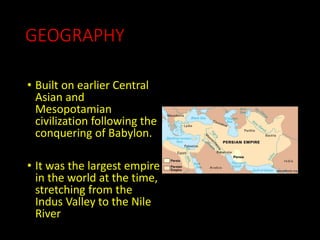
• Built on earlier Central
Asian and
Mesopotamian
civilization following the
conquering of Babylon.
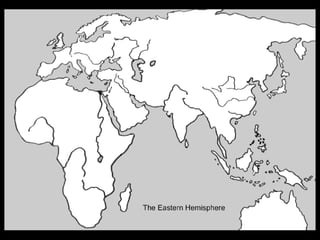
• It was the largest empire
in the world at the time,
stretching from the
Indus Valley to the Nile
River
IMPERIAL BUREAUCRACY
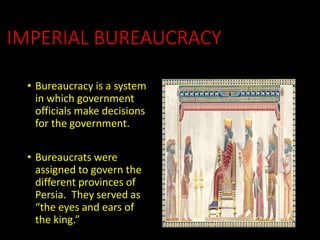
• Bureaucracy is a system
in which government
officials make decisions
for the government.
• Bureaucrats were
assigned to govern the
different provinces of
Persia. They served as
“the eyes and ears of
the king.”
BUREAUCRACY
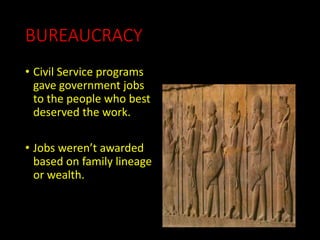
• Civil Service programs
gave government jobs
to the people who best
deserved the work.
• Jobs weren’t awarded
based on family lineage
or wealth.
ROYAL ROAD
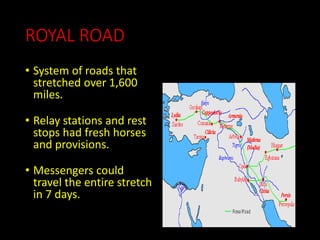
• System of roads that
stretched over 1,600
miles.
• Relay stations and rest
stops had fresh horses
and provisions.
• Messengers could
travel the entire stretch
in 7 days.
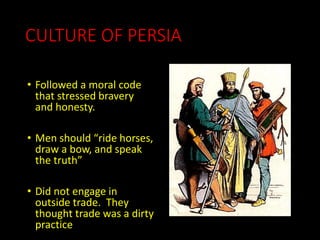
CULTURE OF PERSIA
• Followed a moral code
that stressed bravery
and honesty.
• Men should “ride horses,
draw a bow, and speak
the truth”
• Did not engage in
outside trade. They
thought trade was a dirty
practice
BUILDING AN EMPIRE
• The Persian government
tolerated the people that
they conquered.
• They tolerated their religion,
language, laws and way of
life.
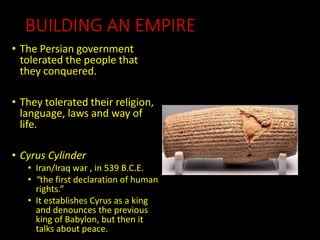
• Cyrus Cylinder
• Iran/Iraq war , in 539 B.C.E.
• “the first declaration of human
rights.”
• It establishes Cyrus as a king
and denounces the previous
king of Babylon, but then it
talks about peace.
ZOROASTRIANISM
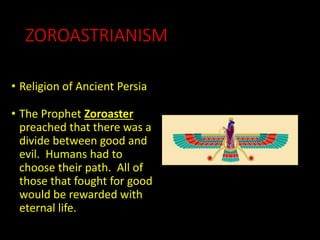
• Religion of Ancient Persia
• The Prophet Zoroaster
preached that there was a
divide between good and
evil. Humans had to
choose their path. All of
those that fought for good
would be rewarded with
eternal life.

Sub 4a persia notes

  • 1.
  • 2.
  • 4.
  • 5.
    GEOGRAPHY • Built onearlier Central Asian and Mesopotamian civilization following the conquering of Babylon. • It was the largest empire in the world at the time, stretching from the Indus Valley to the Nile River
  • 6.
    IMPERIAL BUREAUCRACY • Bureaucracyis a system in which government officials make decisions for the government. • Bureaucrats were assigned to govern the different provinces of Persia. They served as “the eyes and ears of the king.”
  • 7.
    BUREAUCRACY • Civil Serviceprograms gave government jobs to the people who best deserved the work. • Jobs weren’t awarded based on family lineage or wealth.
  • 8.
    ROYAL ROAD • Systemof roads that stretched over 1,600 miles. • Relay stations and rest stops had fresh horses and provisions. • Messengers could travel the entire stretch in 7 days.
  • 9.
    CULTURE OF PERSIA •Followed a moral code that stressed bravery and honesty. • Men should “ride horses, draw a bow, and speak the truth” • Did not engage in outside trade. They thought trade was a dirty practice
  • 10.
    BUILDING AN EMPIRE •The Persian government tolerated the people that they conquered. • They tolerated their religion, language, laws and way of life. • Cyrus Cylinder • Iran/Iraq war , in 539 B.C.E. • “the first declaration of human rights.” • It establishes Cyrus as a king and denounces the previous king of Babylon, but then it talks about peace.
  • 11.
    ZOROASTRIANISM • Religion ofAncient Persia • The Prophet Zoroaster preached that there was a divide between good and evil. Humans had to choose their path. All of those that fought for good would be rewarded with eternal life.