V BBMV BBM ‘‘BB’’ BUSINESS LAW CLASSBUSINESS LAW CLASS
CONTENTSCONTENTS
1. Introduction to Business Laws1. Introduction to Business Laws
2. Indian Contract Act, 18722. Indian Contract Act, 1872
3.3. Patent Act, 1970Patent Act, 1970
4. Trade & Merchandise Marks Act, 19584. Trade & Merchandise Marks Act, 1958
5. Copyright Act, 19575. Copyright Act, 1957
6. Consumer (Protection) Act, 19866. Consumer (Protection) Act, 1986
7. Foreign Exchange Management Act, 19997. Foreign Exchange Management Act, 1999
8. Information Technology Act, 20008. Information Technology Act, 2000
9. Environment Protection Act9. Environment Protection Act
10.Competition Act, 200210.Competition Act, 2002
Module I.Module I.
BUSINESS LAWSBUSINESS LAWS
What is law ?What is law ?
1. A1. A citizencitizen may think ofmay think of ‘‘lawlaw’’
as a set of rules which he must obey.as a set of rules which he must obey.
2. A2. A lawyerlawyer who practiceswho practices ‘‘ lawlaw’’ may think of lawmay think of law
as aas a vocationvocation..
3. A3. A legislatorlegislator may look atmay look at ‘‘lawlaw’’
as a something created by him.as a something created by him.
4. A4. A judgejudge may think ofmay think of ‘‘lawlaw’’
as a guiding principles to be applied in makingas a guiding principles to be applied in making
decisions.decisions.
LawLaw
►LawLaw includes all thoseincludes all those rulesrules
and regulationsand regulations whichwhich
►regulate our relations with otherregulate our relations with other
individuals and with the state.individuals and with the state.
Meaning of lawMeaning of law
►Law means aLaw means a set of rulesset of rules..
►It may be defined as the rules of conductIt may be defined as the rules of conduct
recognized and enforced by the state torecognized and enforced by the state to
control and regulatecontrol and regulate
the conduct of people,the conduct of people,
to protect their property andto protect their property and
contractual rights with a view tocontractual rights with a view to
securing justice, peaceful living andsecuring justice, peaceful living and
social security.social security.
Continue……..Continue……..
► The law is not rigid, it is flexible.The law is not rigid, it is flexible.
► Since the value system of society keeps onSince the value system of society keeps on
changing , the law also keeps changingchanging , the law also keeps changing
according to the changing requirements of theaccording to the changing requirements of the
society.society.
► There are several branches of law such asThere are several branches of law such as
International law, constitutional law, criminal law,International law, constitutional law, criminal law,
civil law etc..civil law etc..
► Every branch of law regulates and controls aEvery branch of law regulates and controls a
particular field of activity.particular field of activity.
Why should one know lawWhy should one know law
► BecauseBecause ignorance of law is no excuse.ignorance of law is no excuse.
► Ex : 1Ex : 1
If X is caught traveling in a train without ticket,If X is caught traveling in a train without ticket,
cannot plead that he was not aware of the rulecannot plead that he was not aware of the rule
regarding the purchase of ticket and therefore, heregarding the purchase of ticket and therefore, he
may be excused.may be excused.
► Ex : 2Ex : 2
If Y is caught driving scooter without drivingIf Y is caught driving scooter without driving
license, he cannot plead that he was not aware oflicense, he cannot plead that he was not aware of
the traffic rule regarding the obtaining of a drivingthe traffic rule regarding the obtaining of a driving
license and therefore, he may be excused.license and therefore, he may be excused.
Definition ofDefinition of LawLaw by Salmondby Salmond
►““ LawLaw is ………………is ………………
……the body of principles recognized andthe body of principles recognized and
applied by the State in theapplied by the State in the
administration of the justiceadministration of the justice ””..
Object of lawObject of law
►The object of law isThe object of law is orderorder, and the, and the
result of orderresult of order is thatis that men aremen are
enabled to look ahead withenabled to look ahead with
some sort of security as tosome sort of security as to
the futurethe future..
Need for the knowledge of lawNeed for the knowledge of law
► ‘‘Ignorantia juris non excusatIgnorantia juris non excusat ’’
is a familiar maxim.is a familiar maxim. This meansThis means
ignorance of law is not excusableignorance of law is not excusable ..
The law now a days is a matter of great intricacy.The law now a days is a matter of great intricacy.
As suchAs such nono sound business mansound business man wouldwould
attempt to solve important legal questionsattempt to solve important legal questions
affecting his business interest withoutaffecting his business interest without
expert legal adviceexpert legal advice ..
BUSINESS LAWSBUSINESS LAWS
►Business lawsBusiness laws
are those laws whichare those laws which regulateregulate thethe
conduct of the business.conduct of the business.
Sources of Business LawSources of Business Law
► 1.English Mercantile Law1.English Mercantile Law
► 2.The Statute Law2.The Statute Law
► 3.The Common Law (sometimes called as case3.The Common Law (sometimes called as case
law)law)
► 4.Customs and Usages4.Customs and Usages
Continue………..Continue………..
► English MercantileEnglish Mercantile LawLaw: English laws are the: English laws are the
primary sources of Indian Mercantile Law. Englishprimary sources of Indian Mercantile Law. English
laws are based on customs and usages oflaws are based on customs and usages of
merchants in England.merchants in England.
► The StatuteThe Statute LawLaw: The various Acts passed by: The various Acts passed by
the Indian Legislature are the main sources ofthe Indian Legislature are the main sources of
mercantile law in India, e.g. Indian Contract Act,mercantile law in India, e.g. Indian Contract Act,
1872, The Sale of Goods Acts,1930, The1872, The Sale of Goods Acts,1930, The
Partnership Act, 1932, The Negotiable InstrumentsPartnership Act, 1932, The Negotiable Instruments
Act 1881, The Companies Act, 1956.Act 1881, The Companies Act, 1956.
Continue………….Continue………….
►The Common LawThe Common Law : This source consists: This source consists
of all those unwritten legal doctrinesof all those unwritten legal doctrines
embodying customs and traditionsembodying customs and traditions
developed over centuries by the Englishdeveloped over centuries by the English
courts. Thus, the common law is found incourts. Thus, the common law is found in
the collected cases of the various courts ofthe collected cases of the various courts of
law and is sometimes known as ‘case law’.law and is sometimes known as ‘case law’.
►The common law emphasizes precedents.The common law emphasizes precedents.
Continue………Continue………
►Customs and usagesCustoms and usages : The customs and: The customs and
usages of a trade are also one of theusages of a trade are also one of the
sources of mercantile law in India. Thesesources of mercantile law in India. These
customs and usages govern the merchantscustoms and usages govern the merchants
of a trade in their dealings both each other.of a trade in their dealings both each other.
Some Acts passed by the Indian LegislatureSome Acts passed by the Indian Legislature
recognizes the importance of such customsrecognizes the importance of such customs
and usages.and usages.
Module: IIModule: II
Law of ContractLaw of Contract
► The law of contract is regulated by Indian Contract Act, 1872The law of contract is regulated by Indian Contract Act, 1872
OBJECT OF THE LAW OF CONTRACTOBJECT OF THE LAW OF CONTRACT
The law of contract is that branch of law whichThe law of contract is that branch of law which
determines the circumstances in whichdetermines the circumstances in which promisespromises
made by the parties to a contract shall bemade by the parties to a contract shall be
legally binding on them.legally binding on them.
In simple words, the purpose of law of contract isIn simple words, the purpose of law of contract is toto
ensure the realization of reasonable expectation ofensure the realization of reasonable expectation of
the parties who enter in to contract.the parties who enter in to contract.
OBJECT OF LAW OF CONTRACTOBJECT OF LAW OF CONTRACT
►
According toAccording to Sir William AnsonSir William Anson,,
The law of contract is intended to ensureThe law of contract is intended to ensure
that,that, ‘‘what a man has been led towhat a man has been led to
expect shall come to pass, and thatexpect shall come to pass, and that
what has been promised to himwhat has been promised to him
shall be performed.shall be performed.
‘‘JUS IN REMJUS IN REM’’ &&
‘‘JUS IN PERSONAMJUS IN PERSONAM’’
Law of contractLaw of contract creates,creates,
‘‘jus in remjus in rem’’ andand ‘‘jus in personamjus in personam’’..
►‘‘Jus in remJus in rem’’ means,means,
right against the world at large.right against the world at large.
‘‘jus in personamjus in personam’’ means,means,
the right against particular persons.the right against particular persons.
Definition of ContractDefinition of Contract
► SectionSection 2(h)2(h) ofof Indian Contract Act, 1872Indian Contract Act, 1872
defines a contract asdefines a contract as …………....
““An agreement enforceable by lawAn agreement enforceable by law ””..
So, a contract is an agreement madeSo, a contract is an agreement made
between two or more parties which thebetween two or more parties which the
law will enforce.law will enforce.
CONTRACTCONTRACT
► An agreement enforceable by law is aAn agreement enforceable by law is a
contract.contract.
Contract = Agreement + EnforceabilityContract = Agreement + Enforceability
Agreement = Offer + AcceptanceAgreement = Offer + Acceptance
An agreementAn agreement is defined as,is defined as,
““every promise and set of promises, formingevery promise and set of promises, forming
consideration for each otherconsideration for each other ”” [Sec2(e)].[Sec2(e)].
Definition ofDefinition of PromisePromise
► A promiseA promise isis defined thus:defined thus:
““When the person to whom the proposal isWhen the person to whom the proposal is
made signifies his assent there to, themade signifies his assent there to, the
proposal is said to be accepted.proposal is said to be accepted.
A proposal, when accepted, becomes aA proposal, when accepted, becomes a
promisepromise..”” [Section 2(b)].[Section 2(b)].
An agreement is an accepted proposal.An agreement is an accepted proposal.
Consensus ad idemConsensus ad idem
► The essence of an agreement isThe essence of an agreement is meeting of themeeting of the
minds of the partiesminds of the parties.There must in fact, be.There must in fact, be
consensus ad idemconsensus ad idem ..
► Eg.,Eg., AA, (owns two horses named Rajhans &, (owns two horses named Rajhans &
Hansraj), is selling horse Rajhans toHansraj), is selling horse Rajhans to BB..
BB thinks he is purchasing Hansraj.thinks he is purchasing Hansraj.
There is noThere is no consensus ad idemconsensus ad idem consequently noconsequently no
contract.contract.
Agreement and its typesAgreement and its types
►Legal AgreementLegal Agreement
►Social AgreementSocial Agreement
►Domestic AgreementDomestic Agreement
ObligationObligation
► An agreement, to become a contract,An agreement, to become a contract, must give rise to amust give rise to a
legal obligation or dutylegal obligation or duty..
► An obligation is a legal tie which imposes upon a definiteAn obligation is a legal tie which imposes upon a definite
person or persons the necessity of doing or abstainingperson or persons the necessity of doing or abstaining
from doing a definite act or acts.from doing a definite act or acts.
Ex. A agrees to sell his car to B for Rs.1,00,000/-.TheEx. A agrees to sell his car to B for Rs.1,00,000/-.The
agreement gives rise to an obligation on the part of A toagreement gives rise to an obligation on the part of A to
deliver the car to B on the part of B to pay Rs.1,00,000/- todeliver the car to B on the part of B to pay Rs.1,00,000/- to
A. This is aA. This is a legal agreementlegal agreement . This agreement is a. This agreement is a
contract.contract.
ObligationObligation
► An agreement which gives rise to socialAn agreement which gives rise to social
obligation is not a contractobligation is not a contract ..
► An agreement is a wider term.An agreement is a wider term.
► An agreement may be a social agreement or aAn agreement may be a social agreement or a
legal agreement.legal agreement.
► If A invites B to a dinner and B accepts theIf A invites B to a dinner and B accepts the
invitation, it is ainvitation, it is a social agreementsocial agreement ..
ObligationObligation
► A social agreement does not give rise to contractualA social agreement does not give rise to contractual
obligations and is not enforceable in a Court of law.obligations and is not enforceable in a Court of law.
► It is only those agreements which are enforceable in aIt is only those agreements which are enforceable in a
court of law which are contracts.court of law which are contracts.
► A father promises to pay his son Rs.100/- every month asA father promises to pay his son Rs.100/- every month as
pocket allowance. Later he refuses to pay.pocket allowance. Later he refuses to pay.
The son cannot recover as it is aThe son cannot recover as it is a domesticdomestic
agreementagreement and there is no intention on the part of theand there is no intention on the part of the
parties to create legal relations.parties to create legal relations.
All contracts are agreements, but all agreements areAll contracts are agreements, but all agreements are
not necessarily contractsnot necessarily contracts
► ESSENTIALS OF A VALID CONTRACTESSENTIALS OF A VALID CONTRACT : Sec 2(h) &: Sec 2(h) &
sec(10)sec(10)
1.1. Offer and AcceptanceOffer and Acceptance
2.2. Intention to create legal relationshipIntention to create legal relationship
3.3. Lawful considerationLawful consideration
4.4. Capacity of parties-CompetencyCapacity of parties-Competency
5.5. Free and genuine consentFree and genuine consent
6.6. Lawful objectLawful object
7.7. Agreement not declared voidAgreement not declared void
8.8. Certainty and possibility of performanceCertainty and possibility of performance
9.9. Legal formalitiesLegal formalities
ESSENTIALS OF A VALID CONTRACTESSENTIALS OF A VALID CONTRACT ::
1.Offer and Acceptance1.Offer and Acceptance ::
There must be two partiesThere must be two parties to anto an
agreement, i.e., one party making the offeragreement, i.e., one party making the offer
and the other accepting itand the other accepting it
The terms of the offer must be definite andThe terms of the offer must be definite and
the acceptance of the offer must bethe acceptance of the offer must be
absolute and unconditional.absolute and unconditional.
The acceptance must also be according to theThe acceptance must also be according to the
mode prescribedmode prescribed..
ESSENTIALS OF A VALID CONTRACTESSENTIALS OF A VALID CONTRACT ::
2.Intention to create legal relationship2.Intention to create legal relationship ::
When two parties enter into an agreement, theirWhen two parties enter into an agreement, their
intention must be to create legal relationshipintention must be to create legal relationship
between them .If there is no intention on the partbetween them .If there is no intention on the part
of the parties, there is no contract between them.of the parties, there is no contract between them.
E gE g., A husband promised to pay his wife a house hold., A husband promised to pay his wife a house hold
allowance of 30 pounds every month .Later the partiesallowance of 30 pounds every month .Later the parties
separated and the husband failed to pay the amount. Theseparated and the husband failed to pay the amount. The
wife sued for the allowance .wife sued for the allowance .
Held, the agreement such as these were outside the realm ofHeld, the agreement such as these were outside the realm of
contract altogethercontract altogether (Balfour vs.Balfour,1919 & s Carbolic(Balfour vs.Balfour,1919 & s Carbolic
smoke ball Co.vsmoke ball Co.v
s Carlill)s Carlill)
ESSENTIALS OF A VALID CONTRACTESSENTIALS OF A VALID CONTRACT ::
► 3.3. Lawful considerationLawful consideration ::
An agreement to be enforceable by law must beAn agreement to be enforceable by law must be
supported by considerationsupported by consideration ..
‘‘ConsiderationConsideration’’ means advantage or benefit moving frommeans advantage or benefit moving from
one party to the other. It is the essence of a bargain.one party to the other. It is the essence of a bargain.
In simple words, it meansIn simple words, it means ‘‘something in returnsomething in return’’..
A promise to do something and, getting nothingA promise to do something and, getting nothing
in return is usually not enforceable by law.in return is usually not enforceable by law.
Consideration need not be in cash or kindConsideration need not be in cash or kind ..
It may be an act or abstinence.It may be an act or abstinence.
It may be past,present or future.But it must beIt may be past,present or future.But it must be
real and lawfulreal and lawful
ESSENTIALS OF A VALID CONTRACTESSENTIALS OF A VALID CONTRACT ::
► 4.Capacity of parties-Competency4.Capacity of parties-Competency ::
The parties to the agreement must beThe parties to the agreement must be
capable of entering in to a valid contractcapable of entering in to a valid contract ..
Every person is competent to contract if he,Every person is competent to contract if he,
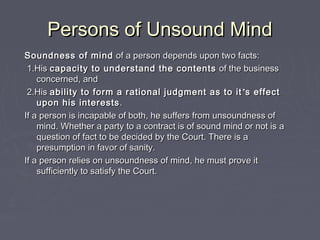
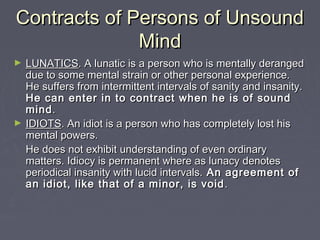
(a) is of the age of majority,(a) is of the age of majority,
(b) is of sound mind, and(b) is of sound mind, and
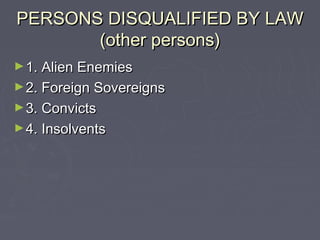
(c) is not disqualified from contracting by any law(c) is not disqualified from contracting by any law
to which he is subject.to which he is subject.
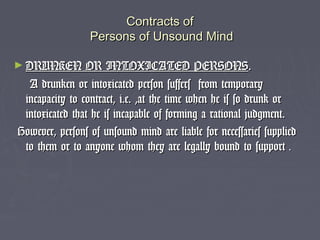
The flaw in capacity to contract may arise fromThe flaw in capacity to contract may arise from
minority, lunacy, idiocy, drunkenness, etc.minority, lunacy, idiocy, drunkenness, etc.
ESSENTIALS OF A VALID CONTRACTESSENTIALS OF A VALID CONTRACT ::
► 5.Free and genuine consent5.Free and genuine consent ::
It is essential to the creation of every contract thatIt is essential to the creation of every contract that
there must be free and genuine consent of thethere must be free and genuine consent of the
parties to the agreement.parties to the agreement.
The parties are said to be of the same mind whenThe parties are said to be of the same mind when
they agree about the subject matter of thethey agree about the subject matter of the
contract in the same sense and at the samecontract in the same sense and at the same
time(Sec.13).time(Sec.13).
There is absence of free consent if theThere is absence of free consent if the
agreement is induced by coercion, undueagreement is induced by coercion, undue
influence, fraud, misrepresentation andinfluence, fraud, misrepresentation and
mistake(Sec.14).mistake(Sec.14).
ESSENTIALS OF A VALID CONTRACTESSENTIALS OF A VALID CONTRACT ::
► 66.Lawful object.Lawful object::
The object of the agreement must be lawfulThe object of the agreement must be lawful ..
In other wordsIn other words, it means that the object must, it means that the object must
not be (a) illegal, (b) immoral, or (c)not be (a) illegal, (b) immoral, or (c)
opposed to public policy(Sec.23)opposed to public policy(Sec.23)
If an agreement suffers from any legal flaw,If an agreement suffers from any legal flaw,
it would not be enforceable by law.it would not be enforceable by law.
ESSENTIALS OF A VALID CONTRACTESSENTIALS OF A VALID CONTRACT ::
7.7. Agreement not declared voidAgreement not declared void ::
The agreement must not have been expresslyThe agreement must not have been expressly
declared void by law in force in the country underdeclared void by law in force in the country under
the provisions of sections 24 to 30 of thethe provisions of sections 24 to 30 of the
Indian Contract Act,1872Indian Contract Act,1872
Under these provisions, agreement in restraint ofUnder these provisions, agreement in restraint of
marriage, agreement in restraint of legalmarriage, agreement in restraint of legal
proceedings, agreement by way of wager haveproceedings, agreement by way of wager have
been expressly declared as voidbeen expressly declared as void
A void agreement is one which is notA void agreement is one which is not
enforceable by lawenforceable by law ..
ESSENTIALS OF A VALID CONTRACTESSENTIALS OF A VALID CONTRACT ::
8.8. Certainty and possibility of performanceCertainty and possibility of performance ::
The agreement must be certain and not vague orThe agreement must be certain and not vague or
indefinite (Sec.29).indefinite (Sec.29).
If it is vague and if it is not possible to ascertain itIf it is vague and if it is not possible to ascertain it ’’ss
meaning, it cannot be enforced.meaning, it cannot be enforced.
Ex.Ex. ‘‘AA’’ agrees to sell toagrees to sell to ‘‘BB’’ ““a hundred tonsa hundred tons
of oilof oil””..
There is nothing whatever to show what kind of oilThere is nothing whatever to show what kind of oil
was intended. The agreement is void.was intended. The agreement is void.
ESSENTIALS OF A VALID CONTRACTESSENTIALS OF A VALID CONTRACT ::
► 9.Legal formalities9.Legal formalities ::
A contract may be made by words spoken orA contract may be made by words spoken or
writtenwritten..
As regards the legal effects, there is no differenceAs regards the legal effects, there is no difference
between a contract in writing and a contract madebetween a contract in writing and a contract made
by word of mouth.by word of mouth.
It is however in the interest of the partiesIt is however in the interest of the parties
that the contract should be in writing.that the contract should be in writing.
In some other cases, a contract, besides being aIn some other cases, a contract, besides being a
written one, has to be registered.written one, has to be registered.
ClassificationClassification
of Contractsof Contracts
Contracts may be classified according to,Contracts may be classified according to,
1.Validity 2.Formation, and 3.Performance1.Validity 2.Formation, and 3.Performance
VALIDITY FORMATION PERFORMANCEVALIDITY FORMATION PERFORMANCE
11.Voidable Contract [2(i)].Voidable Contract [2(i)] 11.Express Contract [9].Express Contract [9] 11.Executed Contract.Executed Contract
22.Void Agreement [2(g)].Void Agreement [2(g)] 22.Implied Contract [9].Implied Contract [9] 22.Executory Contract.Executory Contract
33.Void Contract [2(j)].Void Contract [2(j)] 33.Quasi Contract.Quasi Contract 33.Unilateral Contract.Unilateral Contract
44.Illegal Agreement.Illegal Agreement 44.Bilateral Contract.Bilateral Contract
55.Unenforceable Contract.Unenforceable Contract
1.Classification according to1.Classification according to ‘‘ValidityValidity’’
► i]i] Voidable contractVoidable contract: An agreement which is: An agreement which is
enforceable by law at the option of one party butenforceable by law at the option of one party but
not at the option of the other or others is a voidablenot at the option of the other or others is a voidable
contract [Sec.2(i)].contract [Sec.2(i)].
The party whose consent is not free mayThe party whose consent is not free may
either rescind (avoid or repudiate) theeither rescind (avoid or repudiate) the
contract, if he so desires, or elect to be boundcontract, if he so desires, or elect to be bound
by it.by it.
A voidable contract continues to be valid till it isA voidable contract continues to be valid till it is
avoided by the party entitled to do so.avoided by the party entitled to do so.
Classification of ContractClassification of Contract………………
►Example of Voidable ContractExample of Voidable Contract:: AA promisespromises
to sell his car toto sell his car to BB for rs. 2000. His consentfor rs. 2000. His consent
is obtained by use of force. The contract isis obtained by use of force. The contract is
voidable at the option ofvoidable at the option of AA ..
► He may avoid the contract or elect to be bound byHe may avoid the contract or elect to be bound by
it.it.
Continue………..Continue………..
► Example 2: X threatens to kill Y if he does not sell hisExample 2: X threatens to kill Y if he does not sell his
house for rs. 1,00,000 to X. Y sells his house to X andhouse for rs. 1,00,000 to X. Y sells his house to X and
receives payment.receives payment.
► Here, Y’s consent has been obtained by coercion andHere, Y’s consent has been obtained by coercion and
hence this contract is voidable at the option of Y, thehence this contract is voidable at the option of Y, the
aggrieved party.aggrieved party.
► If Y decides to avoid the contract, he will have to returnIf Y decides to avoid the contract, he will have to return
rs.1,00,000 which he had received from X.rs.1,00,000 which he had received from X.
► If Y does not exercise his option to repudiate the contractIf Y does not exercise his option to repudiate the contract
within a reasonable timewithin a reasonable time andand in the mean time, Zin the mean time, Z
purchases that house from X for rs. 1,00,000 in good faith,purchases that house from X for rs. 1,00,000 in good faith,
Y cannot repudiate the contract.Y cannot repudiate the contract.
Classification of ContractClassification of Contract………………
►ii] Void Agreement:ii] Void Agreement: An agreement notAn agreement not
enforceable by law is said to be voidenforceable by law is said to be void
[Sec.2(g)].Such agreements are[Sec.2(g)].Such agreements are
void-ab-initio which means that they arevoid-ab-initio which means that they are
unenforceable right from the time they areunenforceable right from the time they are
mademade
► E.g., An agreement with a minor or a person ofE.g., An agreement with a minor or a person of
unsound mind is void-ab-initio because a minor orunsound mind is void-ab-initio because a minor or
a person of unsound mind is incompetent toa person of unsound mind is incompetent to
contractcontract
ContCont’’dd……....
► iii] Void Contract: Aiii] Void Contract: A contract which ceasescontract which ceases
to be enforceable by law is a void contract.to be enforceable by law is a void contract.
[2 (j)].[2 (j)].
► A void contract is a contract which was valid when enteredA void contract is a contract which was valid when entered
into but which subsequently became void due tointo but which subsequently became void due to
impossibility of performance, change of law or some otherimpossibility of performance, change of law or some other
reason.reason.
► E.g., A contract to import goods becomes void,E.g., A contract to import goods becomes void,
when war breaks out between the countries.when war breaks out between the countries.
ContCont’’dd……....
► iv] Illegal Agreementiv] Illegal Agreement :: An illegal agreementAn illegal agreement
is one which is unlawful. Such anis one which is unlawful. Such an
agreement cannot be enforced by law.agreement cannot be enforced by law.
Thus, illegal agreements are always void-Thus, illegal agreements are always void-
ab-initio( i.e., void from the very beginning)ab-initio( i.e., void from the very beginning)
► E gE g :An agreement to import prohibited goods.:An agreement to import prohibited goods.
Continue………..Continue………..
► Example: X agrees to pay Y rs.1,00,000 if Y kills Z andExample: X agrees to pay Y rs.1,00,000 if Y kills Z and
claims rs.1,00,000. Y cannot recover from X because theclaims rs.1,00,000. Y cannot recover from X because the
agreement between X and Y is illegal as its object isagreement between X and Y is illegal as its object is
unlawfulunlawful
Effect on collateral agreementsEffect on collateral agreements : In case of illegal: In case of illegal
agreements, even the collateral agreements become voidagreements, even the collateral agreements become void
Example: If in the above example, x borrows rs,1,00,000Example: If in the above example, x borrows rs,1,00,000
from W who is aware of the purpose of the loan, the mainfrom W who is aware of the purpose of the loan, the main
agreement between X and Y is illegal and the agreementagreement between X and Y is illegal and the agreement
between X and W which is collateral to the main agreementbetween X and W which is collateral to the main agreement
is also void. Hence, W cannot recover the money from X.is also void. Hence, W cannot recover the money from X.
ContCont’’dd……
► …………………….Illegal Agreement.Illegal Agreement ::
► An illegal agreement is not only void as betweenAn illegal agreement is not only void as between
the parties but has this further effect that even thethe parties but has this further effect that even the
collateral transactions to it become tainted withcollateral transactions to it become tainted with
illegality.illegality.
A collateral transaction is one which isA collateral transaction is one which is
subsidiary, incidental or auxiliary to the principal orsubsidiary, incidental or auxiliary to the principal or
original contract.original contract.
ContCont’’dd…………....
► v] Unenforceable Contractv] Unenforceable Contract ::
► An unenforceable Contract is one which cannotAn unenforceable Contract is one which cannot
be enforced in a Court of law because of somebe enforced in a Court of law because of some
technical defect such as absence of writing ortechnical defect such as absence of writing or
where the remedy has been barred by lapse ofwhere the remedy has been barred by lapse of
time.time.
The contract may be carried out by the partiesThe contract may be carried out by the parties
concerned; but in the event of breach or repudiation ofconcerned; but in the event of breach or repudiation of
such a contract, the aggrieved party will not be entitled tosuch a contract, the aggrieved party will not be entitled to
the legal remedies.the legal remedies.
2.Classification according to2.Classification according to ‘‘FormationFormation’’
► A contract may be (a) made in writing or by word of mouth,A contract may be (a) made in writing or by word of mouth,
or (b) inferred from the conduct of the parties oror (b) inferred from the conduct of the parties or
circumstances of the cases. These are the modes ofcircumstances of the cases. These are the modes of
formation of contractformation of contract..
► On the basis ofOn the basis of ‘‘ FormationFormation’’ Contract can beContract can be
classified as,classified as,
(i) Express Contract, (ii) Implied Contract, &(i) Express Contract, (ii) Implied Contract, &
(iii) Quasi Contract.(iii) Quasi Contract.
ContCont’’dd…………..
(i)(i) EXPRESS CONTRACTEXPRESS CONTRACT : If the terms and: If the terms and
conditions of contracts are expressly agreedconditions of contracts are expressly agreed
upon (whether words spoken or written) at theupon (whether words spoken or written) at the
time of formation of contract, the contract is saidtime of formation of contract, the contract is said
to beto be ‘‘Express ContractExpress Contract ’’..
Ex: X says to Y “will you buy my car for rs.Ex: X says to Y “will you buy my car for rs.
1,00,000?” Y says to X “ I am ready to buy your1,00,000?” Y says to X “ I am ready to buy your
car for rs. 1,00,000”.car for rs. 1,00,000”.
(ii)(ii) IMPLIED CONTRACTIMPLIED CONTRACT : One which is inferred: One which is inferred
from the acts or conduct of the parties or coursefrom the acts or conduct of the parties or course
of dealings between them.of dealings between them.
An implied contract is one which is not an expressAn implied contract is one which is not an express
contract.contract.
Continue……Continue……
► Ex: A transport company runs buses on differentEx: A transport company runs buses on different
routes to carry passengers. This is an impliedroutes to carry passengers. This is an implied
acceptance by X. Now, there is an implied contractacceptance by X. Now, there is an implied contract
and X is bound to pay the prescribed fare.and X is bound to pay the prescribed fare.
► Ex: X, a coolie in uniform picks up the baggage ofEx: X, a coolie in uniform picks up the baggage of
Y to do so and Y allows it from platform to the taxiY to do so and Y allows it from platform to the taxi
without being asked by to do so and Y allows it.without being asked by to do so and Y allows it.
In this case there is ay the coolie and an impliedIn this case there is ay the coolie and an implied
acceptance by the passenger. Now, there is anacceptance by the passenger. Now, there is an
implied contract between the coolie and theimplied contract between the coolie and the
passenger and the passenger is bound to pay forpassenger and the passenger is bound to pay for
the services of the cooliethe services of the coolie
ContractsContracts ………………classified.classified.
(iii)(iii)QUASI CONTRACTQUASI CONTRACT : Strictly speaking Quasi: Strictly speaking Quasi
Contract is not a contract at all.Contract is not a contract at all.
A contract is intentionally entered in to by theA contract is intentionally entered in to by the
parties.parties.
A quasi contract, on the other hand is createdA quasi contract, on the other hand is created
by law. It rests on the ground of equity that,by law. It rests on the ground of equity that, ““
a person shall not be allowed to enricha person shall not be allowed to enrich
himself unjustly at the expense of anotherhimself unjustly at the expense of another ””..
Continue…….Continue…….
►Ex: A finds some goods belonging to B, it isEx: A finds some goods belonging to B, it is
his duty to restore them to the rightfulhis duty to restore them to the rightful
owner. These contracts are based on theowner. These contracts are based on the
principle of equity, justice and goodprinciple of equity, justice and good
conscience.conscience.
►The Indian Contract Act 1872, hasThe Indian Contract Act 1872, has
described the obligations arising underdescribed the obligations arising under
these contracts as ‘certain relations thosethese contracts as ‘certain relations those
created by contracts’created by contracts’
III. Classification according toIII. Classification according to ‘‘PerformancePerformance’’
►(i) Executed Contract(i) Executed Contract
(ii) Executory Contract(ii) Executory Contract
-Unilateral or One-sided Contract-Unilateral or One-sided Contract
-Bilateral Contract-Bilateral Contract
…….. Classification according to.. Classification according to ‘‘PerformancePerformance’’
(I)(I) EXECUTED CONTRACTEXECUTED CONTRACT ::
‘‘ExecutedExecuted’’ means that which is done.means that which is done.
An executed contract is one in which both the parties haveAn executed contract is one in which both the parties have
performed their respective obligations.performed their respective obligations.
Ex: X offers to sell his car to Y for rs. 1,00,000. Y accepts x’s offer. XEx: X offers to sell his car to Y for rs. 1,00,000. Y accepts x’s offer. X
delivers the car to Y and Y pays rs. 1,00,000 to x. It is an executeddelivers the car to Y and Y pays rs. 1,00,000 to x. It is an executed
contractcontract
(ii)(ii) EXECUTORY CONTRACTEXECUTORY CONTRACT ::
‘‘ExecutoryExecutory’’ means that which remains to be carried in to effect.means that which remains to be carried in to effect.
It is a contract where both the parties to the contract have still toIt is a contract where both the parties to the contract have still to
perform their respective obligations.perform their respective obligations.
Ex: X offers to sell his car to Y for rs.1,00,000. Y accepts X’s offer. If theEx: X offers to sell his car to Y for rs.1,00,000. Y accepts X’s offer. If the
car has not yet been delivered by X and the price has not yet beencar has not yet been delivered by X and the price has not yet been
paid by Y, it is an executory contract.paid by Y, it is an executory contract.
Continue…….Continue…….
© Partly Executed and partly Executory Contract: It© Partly Executed and partly Executory Contract: It
is a contract where one of the parties to theis a contract where one of the parties to the
contract has fulfilled his obligation and the othercontract has fulfilled his obligation and the other
party has still to perform his obligation.party has still to perform his obligation.
Ex. X offers to sell his car to Y for rs. 1,00,000 on aEx. X offers to sell his car to Y for rs. 1,00,000 on a
credit of one month. Y accepts X’s offer. X deliverscredit of one month. Y accepts X’s offer. X delivers
the car to Y. Here, the contract is executed as to Xthe car to Y. Here, the contract is executed as to X
and executory as to Y.and executory as to Y.
► ONE-SIDED OR UNILATERAL CONTRACTONE-SIDED OR UNILATERAL CONTRACT
Performance of only one party is outstanding.Performance of only one party is outstanding.
► BILATERAL CONTRACT.BILATERAL CONTRACT.
Performance of both the parties remains outstanding.Performance of both the parties remains outstanding.
CASE 1.CASE 1.
►Over a cup of tea in a restaurant,Over a cup of tea in a restaurant, AA invitesinvites
BB for a dinner at his house on a Sunday.for a dinner at his house on a Sunday. BB
hires a taxi and reacheshires a taxi and reaches AA’’s house at thes house at the
appointed time, butappointed time, but AA fails to perform hisfails to perform his
promise.promise.
CanCan BB recover any damagerecover any damage ……??????
VERDICT OF CASE 1.VERDICT OF CASE 1.
► No. [No. [Balfour V. Balfour,1919Balfour V. Balfour,1919 ]]
► A husband promised o pay his wife a householdA husband promised o pay his wife a household
allowance of 30 sterling pounds every month.allowance of 30 sterling pounds every month.
► Later the parties separated and the husband failedLater the parties separated and the husband failed
to pay the amount. The wife sued for theto pay the amount. The wife sued for the
allowance.allowance.
HeldHeld, agreement such as these were outside the, agreement such as these were outside the
realm of contract altogether.realm of contract altogether.
CASE 2.CASE 2.
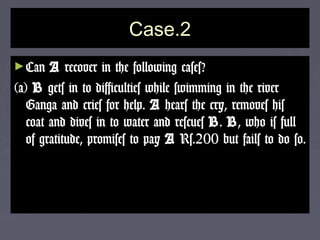
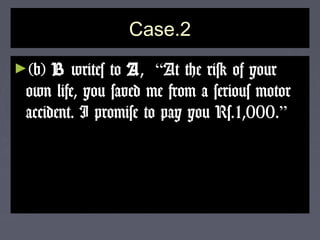
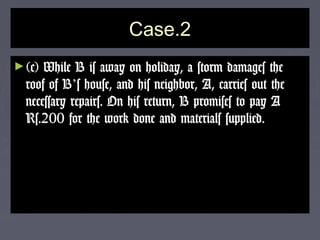
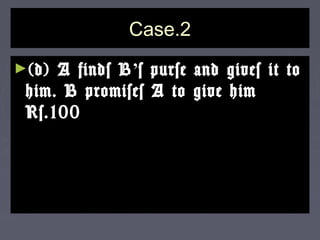
►(a)(a) AA engagesengages BB for a certain work andfor a certain work and
promises to pay such remunerationpromises to pay such remuneration asas
shall be fixed byshall be fixed by CC..
BB does the work.does the work.
►(b)(b) AA andand BB promise to marry eachpromise to marry each
other.other.
►(c)(c) AA takes a seat in public vehicle.takes a seat in public vehicle.
►(d)(d) AA invitesinvites BB for a card partyfor a card party
VERDICT OF CASE 2.VERDICT OF CASE 2.
► (a) There is a contract between A and B(a) There is a contract between A and B
andand AA is bound to pay the remuneration as shallis bound to pay the remuneration as shall
be fixed bybe fixed by CC..
IfIf CC does not fix , or refuses to fix the remuneration,does not fix , or refuses to fix the remuneration,
AA is bound to pay a reasonable remuneration.is bound to pay a reasonable remuneration.
► (b) There(b) There is a contractis a contract betweenbetween AA andand BB
► (c) There(c) There is a contractis a contract betweenbetween AA andand BB
► (D) There is(D) There is nono contractcontract
CASE 3.CASE 3.
►AA forcedforced BB to enter in to a contract atto enter in to a contract at
the point of pistol.the point of pistol.
What remedy is available toWhat remedy is available to BB..
If he (If he (BB) does not want to be bound by) does not want to be bound by
the contract ..??the contract ..??
VERDICT OF CASE 3.VERDICT OF CASE 3.
►He (B) can repudiate the contract as hisHe (B) can repudiate the contract as his
consent is not free.consent is not free.
CASE 4.CASE 4.
►MM mowsmows LL’’s lawn without being asked bys lawn without being asked by LL
to do so.to do so. LL watcheswatches MM do the work but doesdo the work but does
not attempt to stop him.not attempt to stop him.
IsIs ‘‘LL’’ bound to pay any charges tobound to pay any charges to ‘‘MM’’ ??
VERDICT OF CASE 4.VERDICT OF CASE 4.
►Yes,Yes, LL is bound to payis bound to pay MM a reasonablea reasonable
remuneration.remuneration.
CASE 5.CASE 5.
► CC orally offered to payorally offered to pay AA, an auto mechanic, Rs, an auto mechanic, Rs
50 for testing a used car which50 for testing a used car which CC was about towas about to
purchase frompurchase from DD..
► AA agreed and tested the car.agreed and tested the car. CC paidpaid AA Rs 50 inRs 50 in
cash for his services.cash for his services.
IsIs the agreement betweenthe agreement between ‘‘CC’’ andand ‘‘AA’’,,
(a) express or implied,(a) express or implied,……..???..???
(b) executed or executory,(b) executed or executory, ……??????
(c) Valid,void, voidable or unenforceable(c) Valid,void, voidable or unenforceable……??????
VERDICT OF CASE 5.VERDICT OF CASE 5.
The agreement is,The agreement is,
► (a) express,(a) express,
► (b)executed, and(b)executed, and
► (c) valid.(c) valid.
CASE 6.CASE 6.
►AA promises to paypromises to pay BB Rs.500,Rs.500,
if he(if he(BB) beats) beats CC..
BB beatsbeats CC, but, but AA refuses to pay.refuses to pay.
CanCan BB recover the amount.. ???recover the amount.. ???
VERDICT OF CASE 6.VERDICT OF CASE 6.
► NoNo as the agreement is illegal.as the agreement is illegal.
CASE 7.CASE 7.
► DD lived as alived as a paying boarderpaying boarder with awith a
familyfamily. He agreed with the members of the. He agreed with the members of the
family to share prize money of afamily to share prize money of a
newspaper competition.newspaper competition.
► The entry sent byThe entry sent by DD won a prize 750won a prize 750
sterling pounds. He refused to share thesterling pounds. He refused to share the
amount won.amount won.
► Can the members of the familyCan the members of the family
recover their sharerecover their share ………….???.???
VERDICT OF CASE 7.VERDICT OF CASE 7.
►Yes,Yes, ‘‘as there was mutuality in theas there was mutuality in the
agreement between the partiesagreement between the parties’’ and theand the
parties had intended to be bound.parties had intended to be bound.
OFFER & ACCEPTANCEOFFER & ACCEPTANCE
►AnAn offeroffer is ais a proposalproposal by oneby one
party to another to enter in to aparty to another to enter in to a
legally binding agreement withlegally binding agreement with
him.him.
OfferOffer [[ProposalProposal]]
A person is said to have made a proposal, whenA person is said to have made a proposal, when, he,, he,
…………..
““signifies tosignifies to anotheranother his willingnesshis willingness toto
do or to abstain from doing anythingdo or to abstain from doing anything
with a view to obtaining the assent ofwith a view to obtaining the assent of
that other, to such act or abstinencethat other, to such act or abstinence””
[Sec.2(a)][Sec.2(a)]
ELEMENTS REQUIRED FOR AELEMENTS REQUIRED FOR A
VALID OFFERVALID OFFER
►11.. It must be made by one person toIt must be made by one person to
another personanother person . In other words, there. In other words, there
can be no proposal by a person to himselfcan be no proposal by a person to himself
ex: X says to Y that he wants to sell his carex: X says to Y that he wants to sell his car
to himself for rs. 1 lakh.to himself for rs. 1 lakh.
There is no proposal because there can beThere is no proposal because there can be
no proposal by a person to himself.no proposal by a person to himself.
Continued………Continued………
► 2.2. It must be an expression of readinessIt must be an expression of readiness
or willingness to do (i.e., a positive act)or willingness to do (i.e., a positive act)
or to abstain from doing something (i.e., aor to abstain from doing something (i.e., a
negative act)negative act)
ex: X offers to sell his car to Y for rs. 1 lakh. It is aex: X offers to sell his car to Y for rs. 1 lakh. It is a
positive act on the part of Xpositive act on the part of X
ex: X offers not to file a suit against Y if Y pays Xex: X offers not to file a suit against Y if Y pays X
the outstanding amount of rs. 1,00,000 . It is athe outstanding amount of rs. 1,00,000 . It is a
negative act on the part of Xnegative act on the part of X
Continued…….Continued…….
► 33.. It must be made with a view to obtainIt must be made with a view to obtain
the consent of that other person tothe consent of that other person to
proposed act or abstinence.proposed act or abstinence.
ex: X just for fun says to Y “I am ready to sell myex: X just for fun says to Y “I am ready to sell my
car for rs.1000”. Y, knowingly that X is not seriouscar for rs.1000”. Y, knowingly that X is not serious
in making the offer, says “ I accept your offer”.in making the offer, says “ I accept your offer”.
In this case, X’s offer was not the real offer as he didIn this case, X’s offer was not the real offer as he did
not make it with a view to obtain the consent of Y.not make it with a view to obtain the consent of Y.
PROMISOR-PROMISEEPROMISOR-PROMISEE
► The personThe person making the offermaking the offer is known asis known as
thethe, offeror,, offeror,
proposer orproposer or
promisor, andpromisor, and
the personthe person to whom it is madeto whom it is made is calledis called
the,the,
offeree orofferee or
proposee.proposee.
When the offeree accepts the offer, heWhen the offeree accepts the offer, he
is called the acceptor or promiseeis called the acceptor or promisee
[Sec.2(c)].[Sec.2(c)].
How an offer is madeHow an offer is made
►E.g., An offer may be made by expressE.g., An offer may be made by express
words, spoken or written. This is knownwords, spoken or written. This is known
asas Express offerExpress offer..
WhenWhen AA says tosays to BB,, ““will you purchase mywill you purchase my
house at Meerut for Rs.5,00,000house at Meerut for Rs.5,00,000”” ??
…………How an offer is madeHow an offer is made
► An offer may be inferred from the conduct of theAn offer may be inferred from the conduct of the
parties or the circumstances.parties or the circumstances.
This is known asThis is known as Implied OfferImplied Offer..
E.gE.g.,.,When a transport company runs a bus on aWhen a transport company runs a bus on a
particular route, there is anparticular route, there is an implied offerimplied offer by theby the
transport company to carry passengers for atransport company to carry passengers for a
certain fare.certain fare.
‘‘SpecificSpecific’’ andand ‘‘GeneralGeneral’’ OfferOffer……....
When an offer is made to a particular person, it isWhen an offer is made to a particular person, it is
calledcalled specific offer.specific offer.
E.g. A offers to sell car to BE.g. A offers to sell car to B [only][only] forfor
Rs.1,00,000.Rs.1,00,000.
When an offer is made to the world at large, it isWhen an offer is made to the world at large, it is
calledcalled general offer.general offer. A general offer can beA general offer can be
accepted by any person by fulfilling the terms ofaccepted by any person by fulfilling the terms of
offer.offer.
E.g., Mrs Carlill v. Carbolic Smoke Ball Co.[1893].E.g., Mrs Carlill v. Carbolic Smoke Ball Co.[1893].
MRS. CARLIL V.CARBOLICMRS. CARLIL V.CARBOLIC
SMOKE BALL CO.SMOKE BALL CO.
► Carbolic Smoke Ball Co. advertised in theCarbolic Smoke Ball Co. advertised in the
newspaper that it would pay rs.1000 to anyonenewspaper that it would pay rs.1000 to anyone
who contracts influenza after using the smoke ballwho contracts influenza after using the smoke ball
of the company according to the printedof the company according to the printed
instructions.instructions.
► Mrs.Carlil uses the smoke ball according to theMrs.Carlil uses the smoke ball according to the
printed directions but subsequently she contractedprinted directions but subsequently she contracted
influenza.influenza.
► She filed a suit for the reward.She filed a suit for the reward.
► It was held that she was entitled to recover theIt was held that she was entitled to recover the
reward because she had accepted the offer byreward because she had accepted the offer by
fulfilling the terms of the offer.fulfilling the terms of the offer.
What constitutes an offerWhat constitutes an offer ……..……
► 1.The offer must show an obvious1.The offer must show an obvious
intention on the part of the offeror to beintention on the part of the offeror to be
bound by it.bound by it.
Thus, ifThus, if AA jokingly offersjokingly offers BB Rs 10 for hisRs 10 for his
typewriter andtypewriter and BB knowing thatknowing that AA is not serious,is not serious,
sayssays ““I acceptI accept””,, AA’’s proposal does nots proposal does not
constitute an offer.constitute an offer.
……What constitutes an offerWhat constitutes an offer
►2.The offeror must make the offer2.The offeror must make the offer
with a view to obtaining the assent ofwith a view to obtaining the assent of
the offeree to such act or abstinence.the offeree to such act or abstinence.
►3.The offer must be definite.3.The offer must be definite.
►4.It must be communicated to the4.It must be communicated to the
offeree.offeree.
LEGAL RULES FOR A VALIDLEGAL RULES FOR A VALID
OFFEROFFER
► 1.Intention to create legal relationship1.Intention to create legal relationship
► 2.Certain and unambiguous terms2.Certain and unambiguous terms
► 3.Different from a mere declaration of intention3.Different from a mere declaration of intention
► 4.Different from an invitation to offer4.Different from an invitation to offer
► 5.Communication5.Communication
► 6.A statement of price is not an offer6.A statement of price is not an offer
► 7.No term the Non-compliance of which amounts7.No term the Non-compliance of which amounts
to Acceptanceto Acceptance
LEGAL RULES AS TO OFFERLEGAL RULES AS TO OFFER
►1.Offer must be such in law is capable1.Offer must be such in law is capable
of being accepted and giving rise toof being accepted and giving rise to
legal relationship.legal relationship.
► ex:ex:
Rose & Frank Company v. CromptonRose & Frank Company v. Crompton
BrothersBrothers
► Ex: Rose & Frank Company was appointed asEx: Rose & Frank Company was appointed as
selling agents in North America by Cromptonselling agents in North America by Crompton
Brothers by an agreement. One of the clauses inBrothers by an agreement. One of the clauses in
the agreement provided” this agreement is notthe agreement provided” this agreement is not
entered into formal or legal agreement and shallentered into formal or legal agreement and shall
not be subject to legal jurisdiction in the lawnot be subject to legal jurisdiction in the law
courts”.courts”.
► It was held that this agreement was not a legallyIt was held that this agreement was not a legally
binding contract because there was no intention tobinding contract because there was no intention to
create legal relations.create legal relations.
2.Certain and Unambiguous Terms2.Certain and Unambiguous Terms
►The terms of the offer must be certain andThe terms of the offer must be certain and
unambiguous and not vague.unambiguous and not vague.
► If the terms of the offer are vague, noIf the terms of the offer are vague, no
contract can be entered into because it iscontract can be entered into because it is
not clear as to what exactly the partiesnot clear as to what exactly the parties
intended to do.intended to do.
Continued…….Continued…….
►Ex 1: X offers to sell to Y “ a 100 tons of oil”.Ex 1: X offers to sell to Y “ a 100 tons of oil”.
►If X is a dealer in coconut oil or mustard oil,If X is a dealer in coconut oil or mustard oil,
hishis offer is not certainoffer is not certain because it is notbecause it is not
clear that he wants to sell coconut oil orclear that he wants to sell coconut oil or
mustard oil.mustard oil.
►But if X is a dealer in coconut oil only, it isBut if X is a dealer in coconut oil only, it is
clear that he wants to sell coconut oil.clear that he wants to sell coconut oil.
Hence, theHence, the offer is certainoffer is certain ..
…………LEGAL RULES AS TOLEGAL RULES AS TO OFFEROFFER
► 3.An offer must be3.An offer must be distinguished fromdistinguished from;;
(i)(i) A declarationA declaration of intention and anof intention and an
announcement.:announcement.:
The offer must be distinguished from a mereThe offer must be distinguished from a mere
declaration of intention . Such statement ordeclaration of intention . Such statement or
declaration merely indicates that an offer will bedeclaration merely indicates that an offer will be
made or invited in future,made or invited in future,
(ii)(ii) An invitationAn invitation to make an offerto make an offer oror
to do business.to do business.
A mere declaration of intentionA mere declaration of intention
►Ex 1: A father wrote to his would be son-in-Ex 1: A father wrote to his would be son-in-
law that his daughter would have a share oflaw that his daughter would have a share of
what he left after the death of his wife.what he left after the death of his wife.
►It was held, that the letter was a mereIt was held, that the letter was a mere
statement of intention and not an offer.statement of intention and not an offer.
(Farine v. Fickar)(Farine v. Fickar)
Continued………Continued………
► Ex 2: X, a broker of Bombay wrote to Y aEx 2: X, a broker of Bombay wrote to Y a
merchant of Ghaziabad stating the terms on whichmerchant of Ghaziabad stating the terms on which
he is willing to do business.he is willing to do business.
It was held that the letter was a mere statement ofIt was held that the letter was a mere statement of
intention and not an offer.intention and not an offer.
(Devidatt v. Shriram)(Devidatt v. Shriram)
Ex 3: A notice that theEx 3: A notice that the
goods stated in the notice will be sold by tendergoods stated in the notice will be sold by tender
does not amount to an offer to sell.( Spencer v.does not amount to an offer to sell.( Spencer v.
Harding)Harding)
Continued……..Continued……..
► Ex 4: An auctioneer advertised in a newspaperEx 4: An auctioneer advertised in a newspaper
that a sale of office furniture will be held on athat a sale of office furniture will be held on a
particular day.particular day.
► Mr. X with the intention on buy to furniture cameMr. X with the intention on buy to furniture came
from a distant place for the auction but the auctionfrom a distant place for the auction but the auction
was cancelled.was cancelled.
► It was held that Mr X cannot file a suit against theIt was held that Mr X cannot file a suit against the
auctioneer for his loss of time and expensesauctioneer for his loss of time and expenses
because the advertisement was merely abecause the advertisement was merely a
declaration of intention to hold auction and not andeclaration of intention to hold auction and not an
offer to sell. (Harris v. N.Nickerson)offer to sell. (Harris v. N.Nickerson)
Invitation to offerInvitation to offer
►An offer must be distinguished from anAn offer must be distinguished from an
invitation to offer. In case of an invitation toinvitation to offer. In case of an invitation to
offer, the person making an invitation invitesoffer, the person making an invitation invites
others to make an offer to him.others to make an offer to him.
Continued…………Continued…………
► Ex 1: Goods were displayed in the shop for saleEx 1: Goods were displayed in the shop for sale
with price tags attached on each article and selfwith price tags attached on each article and self
service system was there. One customer selectedservice system was there. One customer selected
the goods.the goods.
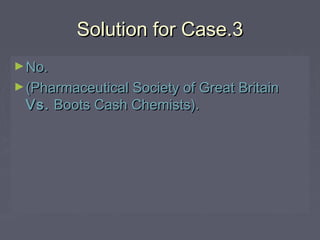
► It was held that the display of goods was only anIt was held that the display of goods was only an
intention to offer and the selection of the goodsintention to offer and the selection of the goods
was an offer by the customer to buy and thewas an offer by the customer to buy and the
contract was made when the cashier accepted thecontract was made when the cashier accepted the
offer to buy and received the price.offer to buy and received the price.
(Pharmaceutical Society of Great Britain v. Boots(Pharmaceutical Society of Great Britain v. Boots
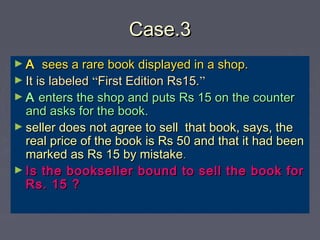
Cash Chemists Ltd.)Cash Chemists Ltd.)
Continued……….Continued……….
►Ex 2: A prospectus issued by a company forEx 2: A prospectus issued by a company for
subscription to its shares and debentures issubscription to its shares and debentures is
only an invitation to general public to makeonly an invitation to general public to make
an offer to buy the shares/debentures whichan offer to buy the shares/debentures which
may or may not be accepted by themay or may not be accepted by the
company.company.
…………LEGAL RULES AS TOLEGAL RULES AS TO OFFEROFFER
►4.Offer must be communicated:4.Offer must be communicated:
An offer must be communicated to theAn offer must be communicated to the
person to whom it is made. An offer isperson to whom it is made. An offer is
complete only when it is communicatedcomplete only when it is communicated
to the offeree. One can accept the offerto the offeree. One can accept the offer
only when he knows about itonly when he knows about it
Continued……Continued……
► Thus , an offer accepted without its knowledgeThus , an offer accepted without its knowledge
does not confer any legal rights on the acceptor.does not confer any legal rights on the acceptor.
► Ex 1: ‘S’ offered a reward to anyone who tracesEx 1: ‘S’ offered a reward to anyone who traces
his lost dog. ‘F’ brought the dog withouthis lost dog. ‘F’ brought the dog without anyany
knowledgeknowledge of the offer of reward. It was held ‘F’of the offer of reward. It was held ‘F’
was not entitled to the reward because F cannotwas not entitled to the reward because F cannot
be said to have accepted the offer which he didbe said to have accepted the offer which he did
not know.( Fitch v.Snedaker,1868)not know.( Fitch v.Snedaker,1868)
Lalman Shukla v.Gauri DuttLalman Shukla v.Gauri Dutt
► ‘‘G’ sent his servant ‘L’ to trace his lost nephew.G’ sent his servant ‘L’ to trace his lost nephew.
When the servant had left, G announced a rewardWhen the servant had left, G announced a reward
of Rs.500 to anyone who traces the missing boy.of Rs.500 to anyone who traces the missing boy.
‘L’ found the boy and brought him home. When ‘L’‘L’ found the boy and brought him home. When ‘L’
came to know about the reward, he filed a suitcame to know about the reward, he filed a suit
against ‘G’ to recover the reward.against ‘G’ to recover the reward.
► It was held that ‘L’ was not entitled to rewardIt was held that ‘L’ was not entitled to reward
because he did not know about the rewardbecause he did not know about the reward
when he found the missing boy.when he found the missing boy.
Legal rules as to offerLegal rules as to offer…………....
► 6.A6.A statement of price is not an offerstatement of price is not an offer ..
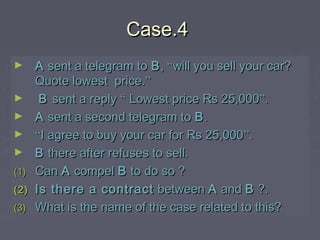
► HARVEY Vs. FACEY,[1893]HARVEY Vs. FACEY,[1893]
E.g., Three telegrams were exchanged betweenE.g., Three telegrams were exchanged between
HarveyHarvey andand FaceyFacey..
1.1. ““Will you sell your Bumper Hall Pen ?Will you sell your Bumper Hall Pen ?
Telegraph lowest cash price-answer paid.Telegraph lowest cash price-answer paid. ””
[Harvey to Facey][Harvey to Facey]
2.2. ““Lowest price for Bumper Hall Pen 900 pounds.Lowest price for Bumper Hall Pen 900 pounds. ””
[Facey to Harvey][Facey to Harvey]
……………………..6.A..6.A statement of price is not an offerstatement of price is not an offer ..
HARVEY Vs. FACEY,[1893]HARVEY Vs. FACEY,[1893]
3.3. ““We agree to buy Bumper Hall Pen for the sumWe agree to buy Bumper Hall Pen for the sum
of 900 pounds asked by youof 900 pounds asked by you”” [[HarveyHarvey toto FaceyFacey]]
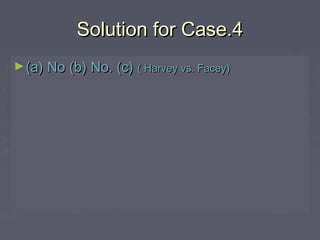
Held,Held, there was no concluded contract betweenthere was no concluded contract between HarveyHarvey
andand FaceyFacey
The first telegram askedThe first telegram asked twotwo questions;questions;
(i) the willingness of(i) the willingness of FaceyFacey to sell, andto sell, and
(ii) the lowest price.(ii) the lowest price. FaceyFacey replied only to the secondreplied only to the second
question and gave his lowest price, i.e., he supplied merequestion and gave his lowest price, i.e., he supplied mere
information and no offer had been made by him to sell.information and no offer had been made by him to sell.
There could be contract only if he had acceptedThere could be contract only if he had accepted
HarveyHarvey’’s last telegram.s last telegram.
Special TermsSpecial Terms of Contractof Contract
► The special terms of the offer mustThe special terms of the offer must
also be communicated along with thealso be communicated along with the
offer.offer.
► If the special terms of the offer are notIf the special terms of the offer are not
communicated, the offeree will not becommunicated, the offeree will not be
bound by those terms.bound by those terms.
Continued……..Continued……..
►The question of special terms arisesThe question of special terms arises
generally in case of standard form ofgenerally in case of standard form of
contracts.contracts.
►Standard contracts are made with bigStandard contracts are made with big
companies such as insurancecompanies such as insurance
companies, railways, shippingcompanies, railways, shipping
companies, banking companies,companies, banking companies,
hotels, dry cleaning companieshotels, dry cleaning companies..
Continued…Continued…
►Since such companies are in position toSince such companies are in position to
exploit the weakness of general public byexploit the weakness of general public by
including certain terms in the contract whichincluding certain terms in the contract which
may limit their liabilities, it is provided thatmay limit their liabilities, it is provided that
the special terms of the offer must bethe special terms of the offer must be
brought to the notice of general public.brought to the notice of general public.
Continued……Continued……
► Ex 1: X purchased a ticket Dablin to White Haven and onEx 1: X purchased a ticket Dablin to White Haven and on
the back of the ticket, certain conditions were printedthe back of the ticket, certain conditions were printed
one of which excluded the liability of the company for loss,one of which excluded the liability of the company for loss,
injury or delay to the passengers or his luggage.injury or delay to the passengers or his luggage.
X never looked at the back of the ticket and there wasX never looked at the back of the ticket and there was
nothing to draw his attention to the conditions printed onnothing to draw his attention to the conditions printed on
the back side. His luggage was lost due to the negligencethe back side. His luggage was lost due to the negligence
of the servants of the shipping company, it was held that Xof the servants of the shipping company, it was held that X
was entitled to claim compensation for the loss of hiswas entitled to claim compensation for the loss of his
luggage in spite of the exemption clause because thereluggage in spite of the exemption clause because there
was no indication on the face of the ticket to draw hiswas no indication on the face of the ticket to draw his
attention to the special terms printed on the back of theattention to the special terms printed on the back of the
ticket.ticket.
…………Special Terms of ContractSpecial Terms of Contract
E.g.,E.g., A hotel put up a notice in a bedA hotel put up a notice in a bed
roomroom,, exempting the proprietor fromexempting the proprietor from
liability for loss of clientliability for loss of client’’s goodss goods..
Held,Held, the notice was not effective as it came tothe notice was not effective as it came to
the knowledge of the client only when thethe knowledge of the client only when the
contract to take a room had already beencontract to take a room had already been
entered in toentered in to..
Olley v. Marlborough Court LtdOlley v. Marlborough Court Ltd ., [1949].., [1949].
Example ofExample of Special Terms of ContractSpecial Terms of Contract
► AA deposited a bag in the cloak room of a railwaydeposited a bag in the cloak room of a railway
station. On the face of the ticket, issued to him,station. On the face of the ticket, issued to him,
was writtenwas written ““see backsee back””. One of the printed. One of the printed
conditions, limited the liability of the company forconditions, limited the liability of the company for
loss of a package to 10 pounds.The bag was lostloss of a package to 10 pounds.The bag was lost
andand PP claimed 24.50 pounds, as itclaimed 24.50 pounds, as it’’s value.s value.
► Held,Held, ‘‘PP’’ was bound by the conditions on thewas bound by the conditions on the
back of the ticket even if he had not read themback of the ticket even if he had not read them
[Parker Vs. S E Rail Co.(1877) ][Parker Vs. S E Rail Co.(1877) ]
Example ofExample of Special Terms of ContractSpecial Terms of Contract
► If conditions are printed on the back of a ticket, butIf conditions are printed on the back of a ticket, but
there are no words at all on the face of it to draw thethere are no words at all on the face of it to draw the
attention of the person concerned to thoseattention of the person concerned to those
conditions, he is not bound by them;conditions, he is not bound by them;
► Example: C hired a deck chair from MunicipalExample: C hired a deck chair from Municipal
Council. He paid a hire of 2 $ for two sessions of 3Council. He paid a hire of 2 $ for two sessions of 3
hours .He sat on the chair, it broke and injured him.hours .He sat on the chair, it broke and injured him.
Held ,Council was liableHeld ,Council was liable
► [Chapleton[Chapleton Vs.Vs. Barry Urban District Council,1940Barry Urban District Council,1940 ].].
AGREEMENT TO AGREE IN FUTURE IS NOT AAGREEMENT TO AGREE IN FUTURE IS NOT A
CONTRACTCONTRACT
► If theIf the parties have not agreed upon the terms of theparties have not agreed upon the terms of the
contract, but have made an agreement to agree incontract, but have made an agreement to agree in
future,future, there is no contractthere is no contract..
An agreement to be finally settled must comprise allAn agreement to be finally settled must comprise all
the terms which the parties intend to introduce inthe terms which the parties intend to introduce in
to the agreement.to the agreement.
E.gE.g., An actress was engaged in a theatrical., An actress was engaged in a theatrical
company for a certain period .One of the terms ofcompany for a certain period .One of the terms of
the agreement was that if the play was shown inthe agreement was that if the play was shown in
London, she would be engaged at a salary to beLondon, she would be engaged at a salary to be
mutually agreed upon.mutually agreed upon. HeldHeld ,, there was nothere was no
contract.contract.
AcceptanceAcceptance
► Acceptance means giving consent to the offer.Acceptance means giving consent to the offer.
► It is an expression by the offeree of his willingnessIt is an expression by the offeree of his willingness
to be bound by the terms of the offer.to be bound by the terms of the offer.
► According to sec 2(b) of the Indian ContractAccording to sec 2(b) of the Indian Contract
Act,1872,” A proposal is said to have acceptedAct,1872,” A proposal is said to have accepted
when the person to whom the proposal is madewhen the person to whom the proposal is made
signifies his assent thereto. A proposal whensignifies his assent thereto. A proposal when
accepted becomes a promise”.accepted becomes a promise”.
AcceptanceAcceptance
► An acceptance may be express or implied.An acceptance may be express or implied.
► It isIt is expressexpress when it is communicatedwhen it is communicated
by words, spoken or written or by doingby words, spoken or written or by doing
some required act.some required act.
►It isIt is impliedimplied when it is to be gatheredwhen it is to be gathered
from the surrounding circumstances of thefrom the surrounding circumstances of the
cases or the conduct of the parties.cases or the conduct of the parties.
AcceptanceAcceptance
►Who can accept offer ?Who can accept offer ?
Acceptance of a particular offerAcceptance of a particular offer: Specific Offer: Specific Offer
When an offer is made to a particular person, it canWhen an offer is made to a particular person, it can
only be accepted by him alone. If it is accepted byonly be accepted by him alone. If it is accepted by
any other person, there is no valid acceptance.any other person, there is no valid acceptance.
The rule of law is clearThe rule of law is clear that if you propose tothat if you propose to
make a contract with ‘A’, ‘B’ cannotmake a contract with ‘A’, ‘B’ cannot
substitute himself for without yoursubstitute himself for without your
consent.consent.
Acceptance of a general offerAcceptance of a general offer
►When an offer is made to worldWhen an offer is made to world
at large, any persons to whomat large, any persons to whom
the offer is made can accept itthe offer is made can accept it
[Mrs.Carlill Vs.Carbolic Smokeball Co.(1893)][Mrs.Carlill Vs.Carbolic Smokeball Co.(1893)]
Legal Rules as to AcceptanceLegal Rules as to Acceptance
► The acceptance of an offer is the very essence of aThe acceptance of an offer is the very essence of a
contract. To be legally effective, it must satisfy the followingcontract. To be legally effective, it must satisfy the following
conditions:conditions:
► 1.It must be absolute and unconditional i.e., it1.It must be absolute and unconditional i.e., it
must conform with the offer.must conform with the offer.
► 2.It must be communicated to the offeror2.It must be communicated to the offeror
► 3.It must be according to the mode prescribed or3.It must be according to the mode prescribed or
usual and reasonable mode.usual and reasonable mode.
► 4.It must be given within a reasonable time4.It must be given within a reasonable time
……..Legal Rules as to Acceptance..Legal Rules as to Acceptance
►5.It cannot precede an offer.5.It cannot precede an offer.
►6.It must show an intention on the part of6.It must show an intention on the part of
the acceptor to fulfill terms of the promise.the acceptor to fulfill terms of the promise.
►7.It must be given by the party or parties to7.It must be given by the party or parties to
whom the offer is made.whom the offer is made.
►8.It must be given before the offer lapses or8.It must be given before the offer lapses or
before the offer is withdrawn.before the offer is withdrawn.
►9.It cannot be implied from silence.9.It cannot be implied from silence.
1. It must be absolute and unconditional1. It must be absolute and unconditional
i.e., it must conform with the offer.i.e., it must conform with the offer.
► An acceptance, in order to be binding, must beAn acceptance, in order to be binding, must be
absolute and unqualified [Sec.7(1)] in respect ofabsolute and unqualified [Sec.7(1)] in respect of
all terms of the offer, whether material orall terms of the offer, whether material or
immaterial, major or minor.immaterial, major or minor.
► If the parties are not ad idem on all mattersIf the parties are not ad idem on all matters
concerning the offer and acceptance, there is noconcerning the offer and acceptance, there is no
contract.contract.
► Examples: a) ‘Examples: a) ‘A’A’ made an offer to ‘made an offer to ‘B’B’ to purchase ato purchase a
house with possession from 25 th July. The offer washouse with possession from 25 th July. The offer was
followed by an acceptance suggesting possession from 1followed by an acceptance suggesting possession from 1stst
August. Held, there was no contract.August. Held, there was no contract.
[ Rutledge Vs .Grant (1828[ Rutledge Vs .Grant (1828)])]
……………….1.It must be absolute and unconditional.1.It must be absolute and unconditional
i.e., it must conform with the offer.i.e., it must conform with the offer.
►ExamplesExamples::
►b) Mb) M offered to sell a piece of land tooffered to sell a piece of land to NN atat
280 sterling pounds.280 sterling pounds. NN accepted andaccepted and
enclosed 80 sterling pounds with a promiseenclosed 80 sterling pounds with a promise
to pay the balance by monthly installmentsto pay the balance by monthly installments
of 50 sterling pounds each.of 50 sterling pounds each. HeldHeld, there was, there was
no contract betweenno contract between MM andand NN, as the, as the
acceptance was on condition.acceptance was on condition. [Neale Vs.[Neale Vs.
Merret (1930)].Merret (1930)].
……………….1.It must be absolute and unconditional.1.It must be absolute and unconditional
i.e.,i.e., it must conform with the offerit must conform with the offer ..
►c)c) NN offered to buyoffered to buy JJ’s horse if warranted’s horse if warranted
quiet in harness.quiet in harness. JJ agreed to the price andagreed to the price and
warranted the horse inwarranted the horse in quiet doublequiet double
harness.harness. Held, there was no acceptanceHeld, there was no acceptance
[Jordon Vs.Norton,1838][Jordon Vs.Norton,1838]
d)d) AA says tosays to BB,, II offer to sell my car foroffer to sell my car for
Rs.50,000”.Rs.50,000”.BB replies, I will purchase it forreplies, I will purchase it for
Rs.45,000”. This is no acceptance and amounts toRs.45,000”. This is no acceptance and amounts to
counter offer.counter offer.
2.It must be communicated to the offeror2.It must be communicated to the offeror
►To conclude a contract between theTo conclude a contract between the
partiesparties,, the acceptance must bethe acceptance must be
communicatedcommunicated in some perceptible form.in some perceptible form.
► A mere resolve or mental determination onA mere resolve or mental determination on
the part of the offeree to accept an offer,the part of the offeree to accept an offer,
when there is no external manifestation ofwhen there is no external manifestation of
the intention of the intention to do so, is notthe intention of the intention to do so, is not
sufficient.sufficient. [ Bhagwandas Kedia Vs. Giridharilal[ Bhagwandas Kedia Vs. Giridharilal
(1966)](1966)]
2.It must be communicated to the2.It must be communicated to the
offerorofferor
► Examples:Examples:
► a) ‘a) ‘A’A’ tells ‘tells ‘B’B’ that, he intends to marry ‘that, he intends to marry ‘C’C’. But. But
tells ‘tells ‘CC’ ‘nothing of his intention. There is no’ ‘nothing of his intention. There is no
contract even if ‘contract even if ‘C’C’ is willing to marry ‘is willing to marry ‘A’A’..
► b)b) AA draft agreement relating to supply of coaldraft agreement relating to supply of coal
was sent to the manager of a railway company forwas sent to the manager of a railway company for
his acceptance. The manager wrote the wordhis acceptance. The manager wrote the word
“approved” and put the draft in the drawer .“approved” and put the draft in the drawer .
HeldHeld, there was no contract, there was no contract..
[Brogden Vs. Metropolitan Rail Co.[Brogden Vs. Metropolitan Rail Co.
(1877)].(1877)].
2.It must be communicated to the2.It must be communicated to the
offerorofferor
► FF offered to buy his nephew’s horse for 30 sterlingoffered to buy his nephew’s horse for 30 sterling
pounds saying:pounds saying: “If I hear no more about it I“If I hear no more about it I
shall consider the horse is mine at 30shall consider the horse is mine at 30
sterling pounds”.sterling pounds”. The nephew did not write toThe nephew did not write to FF
at all, but he told his auctioneer who was sellingat all, but he told his auctioneer who was selling
his horses not to sell that particular horsehis horses not to sell that particular horse
because it had been sold to his uncle. Thebecause it had been sold to his uncle. The
auctioneer inadvertently sold the horse.auctioneer inadvertently sold the horse. Held,Held, FF
had no right of action against the auctioneer as thehad no right of action against the auctioneer as the
horse had not been sold tohorse had not been sold to FF, his offer of 30, his offer of 30
pounds not having been acceptedpounds not having been accepted [[Felthouse Vs. BrindleyFelthouse Vs. Brindley
(1862)].(1862)].
3.It must be according to the mode prescribed or3.It must be according to the mode prescribed or
usual and reasonable modeusual and reasonable mode..
►The communication must be according toThe communication must be according to
the mode prescribed [ Sec.7(2)]the mode prescribed [ Sec.7(2)]
►Eg. If the Offeror has sought theEg. If the Offeror has sought the
communication of acceptance from offereecommunication of acceptance from offeree
by telephone it cannot be given by post.by telephone it cannot be given by post.
► In case, the acceptance is made in a manner other thanIn case, the acceptance is made in a manner other than
the mode prescribed but the offeror does not raise anythe mode prescribed but the offeror does not raise any
objection within a reasonable time, the acceptance will beobjection within a reasonable time, the acceptance will be
binding.binding.
4. It must be given within a reasonable time4. It must be given within a reasonable time
► If any time limit is specified ,the acceptance to an offerIf any time limit is specified ,the acceptance to an offer
must be given within a reasonable time. If it is not givenmust be given within a reasonable time. If it is not given
within the reasonable time, the offer lapses.within the reasonable time, the offer lapses.
► In Ramsgate Victoria Hotel Ltd. Vs.In Ramsgate Victoria Hotel Ltd. Vs.
Montefiore(1886)Montefiore(1886)
MM applied for the shares ofapplied for the shares of R & Co.R & Co. on 8 th June.on 8 th June.
But the Company did not intimate about allotmentBut the Company did not intimate about allotment
until November.until November. MM refused to take shares.refused to take shares. HeldHeld,,
the offer was lapsed by unreasonable delay.the offer was lapsed by unreasonable delay.
5.It cannot precede an offer.5.It cannot precede an offer.
► In a company shares were allotted to aIn a company shares were allotted to a
person who had not applied for them.person who had not applied for them.
Subsequently when he applied for shares ,Subsequently when he applied for shares ,
he was unaware of the previous allotment.he was unaware of the previous allotment.
The allotment of shares previous toThe allotment of shares previous to
application is invalid.application is invalid.
6.It must show an intention on the part of the acceptor to fulfill6.It must show an intention on the part of the acceptor to fulfill
terms of the promise.terms of the promise.
►If no such intention is present, the acceptanceIf no such intention is present, the acceptance
is invalid.is invalid.
7. It must be given by the party or parties to whom the offer is7. It must be given by the party or parties to whom the offer is
made.made.
► Acceptance must be communicated by the offeree himself or byAcceptance must be communicated by the offeree himself or by
a person who has the authority to accept.a person who has the authority to accept.
► If acceptance is communicated by an unauthorized person, itIf acceptance is communicated by an unauthorized person, it
will not give rise to legal relations.will not give rise to legal relations.
Continued...Continued...
► Ex: ‘P’ applied for the post of a headmaster in a school. TheEx: ‘P’ applied for the post of a headmaster in a school. The
managing committee passed a resolution approving P to themanaging committee passed a resolution approving P to the
post but this decision was not communicated to P.post but this decision was not communicated to P.
But one member of the managing committee in hisBut one member of the managing committee in his
individual capacity and without any authority informed Pindividual capacity and without any authority informed P
about the decision.about the decision.
Subsequently, the managing committee cancelled itsSubsequently, the managing committee cancelled its
resolution and appointed someone else. ‘P’ filed a suit forresolution and appointed someone else. ‘P’ filed a suit for
breach of contract.breach of contract.
It was held that P’s suit was not maintainable because thereIt was held that P’s suit was not maintainable because there
was no communication of acceptance as he was not informedwas no communication of acceptance as he was not informed
about his appointment by some authorized person. (Powell v.about his appointment by some authorized person. (Powell v.
Lee)Lee)
8.It must be given before the offer lapses or before8.It must be given before the offer lapses or before
the offer is withdrawn.the offer is withdrawn.
► The acceptance must be given before the offerThe acceptance must be given before the offer
lapses or is withdrawn. In other words, if anlapses or is withdrawn. In other words, if an
acceptance is made after the lapse or withdrawalacceptance is made after the lapse or withdrawal
of the offer, it will not give rise to legal relations.of the offer, it will not give rise to legal relations.
► Ex: X offered by a letter to sell his car forEx: X offered by a letter to sell his car for
Rs.1,00,000. Subsequently, x withdrew his offer byRs.1,00,000. Subsequently, x withdrew his offer by
a telegram which was duly received by Y. After thea telegram which was duly received by Y. After the
receipt of telegram, Y sent his acceptance to X. Inreceipt of telegram, Y sent his acceptance to X. In
this case, the acceptance is invalid because it wasthis case, the acceptance is invalid because it was
made after the effective withdrawal of the offer.made after the effective withdrawal of the offer.
9.It cannot be implied from silence.9.It cannot be implied from silence.
►The acceptance of an offer cannot be impliedThe acceptance of an offer cannot be implied
from the silence of the offeree or his failure tofrom the silence of the offeree or his failure to
answer, unless the offeree has by his previousanswer, unless the offeree has by his previous
conduct indicated that his silence means thatconduct indicated that his silence means that
he acceptshe accepts. A wrote to B., I offer you my car for. A wrote to B., I offer you my car for
Rs.10,000. If I don’t hear from you in seven days , IRs.10,000. If I don’t hear from you in seven days , I
shall assume that you accept”. B did not reply at all.shall assume that you accept”. B did not reply at all.
There is no contract.There is no contract.
CommunicationCommunication ofof OfferOffer,, AcceptanceAcceptance andand
RevocationRevocation
► An offer, itAn offer, it’’s acceptance and their revocations acceptance and their revocation
(withdrawal) to be completed must be(withdrawal) to be completed must be
communicated.communicated.
► When the parties are at distance and the offerWhen the parties are at distance and the offer
and acceptance and their revocation are madeand acceptance and their revocation are made
through post, i.e., by letter or telegram, the rulesthrough post, i.e., by letter or telegram, the rules
contained in Secs.3 to 5 apply.contained in Secs.3 to 5 apply.
Mode of communication (Sec.3)Mode of communication (Sec.3)
► The communication of offer, its acceptance and theirThe communication of offer, its acceptance and their
revocation respectively are deemed to be made by anyrevocation respectively are deemed to be made by any
► (a) act, or(a) act, or
► (b) omission, of the party offering, accepting or revoking.(b) omission, of the party offering, accepting or revoking.
► In other words, offer, acceptance or revocation may beIn other words, offer, acceptance or revocation may be
communicated by words spoken or written, or bycommunicated by words spoken or written, or by
conducted.conducted.
► Thus installation of a weighing machine at aThus installation of a weighing machine at a
public place ispublic place is an offeran offer,, putting of a coin in theputting of a coin in the
slot of the machine isslot of the machine is the acceptancethe acceptance of the offer,of the offer,
andand the switching off the machine amounts tothe switching off the machine amounts to
revocation of the offer.revocation of the offer.
When is communication completeWhen is communication complete
[Sec.4][Sec.4]
► Communication of offerCommunication of offer : The communication: The communication
of offer is complete when it comes to theof offer is complete when it comes to the
knowledge of the person to whom it is made.knowledge of the person to whom it is made.
E.g.,E.g., A proposes by a letter, to sell aA proposes by a letter, to sell a
house to B at a certain price. Thehouse to B at a certain price. The
letter is posted on 10letter is posted on 10thth
July.July.
It reaches B on the 12It reaches B on the 12thth
July.July.
The communication of offer is completeThe communication of offer is complete
when B receives the letter i.e., 12when B receives the letter i.e., 12th July.th July.
When is communication complete[S.4]When is communication complete[S.4]
► Communication of AcceptanceCommunication of Acceptance: Communication of acceptance is: Communication of acceptance is
complete-complete-
* as against the* as against the proposerproposer, when it is put in the course of, when it is put in the course of
transmission to him, so as to be out of power of the acceptor ;transmission to him, so as to be out of power of the acceptor ;
* as against the acceptor, when it comes to the knowledge of the* as against the acceptor, when it comes to the knowledge of the
proposer.proposer.
E.g., ‘B’ accepts ‘A’ s proposal, in the above case, by a letter sent by postE.g., ‘B’ accepts ‘A’ s proposal, in the above case, by a letter sent by post
on 13on 13thth
instant. The letter reaches ‘A’ on 15instant. The letter reaches ‘A’ on 15thth
instant. The communicationinstant. The communication
of Acceptance is complete, as against the ‘A’, when the letter is posted,of Acceptance is complete, as against the ‘A’, when the letter is posted,
i.e., on 13i.e., on 13th,th,
as againstas against ‘B’, when the letter is received by ‘A’, i.e., on 15‘B’, when the letter is received by ‘A’, i.e., on 15th.th.
When is communication completeWhen is communication complete……....
► TheThe communication ofcommunication of revocationrevocation is complete:is complete:
► Revocation means “taking back” “recalling” orRevocation means “taking back” “recalling” or
“withdrawal”. It may be revocation of offer or“withdrawal”. It may be revocation of offer or
acceptance. The communication of a revocation isacceptance. The communication of a revocation is
complete--complete--
-as against the person who makes it, when it is-as against the person who makes it, when it is
put in to the course of transmission to the personput in to the course of transmission to the person
to whom it is made so as to be out of the power ofto whom it is made so as to be out of the power of
the person who makes it ;the person who makes it ;
-as against the person to whom it is made,-as against the person to whom it is made,
when it comes to his knowledge(Sec.4)when it comes to his knowledge(Sec.4)
When is communication completeWhen is communication complete…………
Ex. A proposes, by a letter, to sell his house to B at aEx. A proposes, by a letter, to sell his house to B at a
certain price .The letter is posted on 15certain price .The letter is posted on 15thth
May. It reaches BMay. It reaches B
on 19on 19thth
May.May.
A revokes his offer by telegram on 18A revokes his offer by telegram on 18thth
May. The telegramMay. The telegram
reaches B on 20reaches B on 20thth
May. The revocation is complete asMay. The revocation is complete as
against A when the telegram is dispatched i.e., on 18against A when the telegram is dispatched i.e., on 18thth
May.May.
It is complete as against B when he receives it. i.e., on 20It is complete as against B when he receives it. i.e., on 20thth
May.May.
Time for Revocation of Offer and AcceptanceTime for Revocation of Offer and Acceptance
(Sec.5)(Sec.5)
► Time for Revocation of ProposalTime for Revocation of Proposal(Sec.5,para 1)(Sec.5,para 1)
A proposal may be revoked at any time before theA proposal may be revoked at any time before the
communication of itcommunication of it’’s acceptance is complete ass acceptance is complete as
against the proposer, but not afterwards.against the proposer, but not afterwards.
Ex. A proposes by a letter sent by post to sell his houseEx. A proposes by a letter sent by post to sell his house
to B. The letter is posted on the 1to B. The letter is posted on the 1stst
of the month. Bof the month. B
accepts the proposal by a letter sent by post on theaccepts the proposal by a letter sent by post on the
44thth
.The letter reaches A on the 6.The letter reaches A on the 6thth
..
AA may revoke hismay revoke his offeroffer at any time beforeat any time before BB posts his letter ofposts his letter of
acceptance, i.e., on 4acceptance, i.e., on 4thth
but not afterwards.but not afterwards.
BB may revoke hismay revoke his acceptanceacceptance at any time before the letter ofat any time before the letter of
acceptance reachesacceptance reaches AA, i.e., on 6, i.e., on 6thth
but not afterwards.but not afterwards.
CONTRACTS OVER TELEPHONECONTRACTS OVER TELEPHONE
OR TELEX OR ORALOR TELEX OR ORAL
COMMUNICATIONCOMMUNICATION
►A contract by telephone or telex has theA contract by telephone or telex has the
same effect as an oral agreement enteredsame effect as an oral agreement entered
into between the parties when they are faceinto between the parties when they are face
to face.to face.
►But the offeree must make sure that hisBut the offeree must make sure that his
acceptance is properly received, i.e.,heardacceptance is properly received, i.e.,heard
and understood by the offeror (Kanhaiyalaland understood by the offeror (Kanhaiyalal
v. Dineshwara Chandra)v. Dineshwara Chandra)
ExampleExample
►A makes an offer to B across a river or aA makes an offer to B across a river or a
courtyard. B shouts back accepting A’scourtyard. B shouts back accepting A’s
offer, but A does not hear B’s reply as it wasoffer, but A does not hear B’s reply as it was
drowned by an aircraft flying overhead.drowned by an aircraft flying overhead.
There is no contract at that moment. If BThere is no contract at that moment. If B
wishes to make a contract, he must wait tillwishes to make a contract, he must wait till
the aircraft is gone and then shout back histhe aircraft is gone and then shout back his
acceptance so that A can hear what B says.acceptance so that A can hear what B says.
Until A hears B’s reply, there is no contract.Until A hears B’s reply, there is no contract.
WHEN DOES AN OFFER COME TOWHEN DOES AN OFFER COME TO
AN END?AN END?
►1.1. By communication of notice of revocationBy communication of notice of revocation
by the offeror at any time before itsby the offeror at any time before its
acceptance is complete as against himacceptance is complete as against him
Ex: At an auction sale, A makes theEx: At an auction sale, A makes the
highest bid for B’s goods. He withdraws thehighest bid for B’s goods. He withdraws the
bid before the fall of the hammer. The offerbid before the fall of the hammer. The offer
has been revoked before its acceptance.has been revoked before its acceptance.
Continued………..Continued………..
► 2.2. By lapse of timeBy lapse of time::
► If it is not accepted within the prescribed time,If it is not accepted within the prescribed time,
then it ends in revocation of offer.then it ends in revocation of offer.
► If no time is prescribed, it lapses by the expiry ofIf no time is prescribed, it lapses by the expiry of
a reasonable time.a reasonable time.
► Ex: On June 8 M offered to take shares in REx: On June 8 M offered to take shares in R
company. He received a letter of acceptance oncompany. He received a letter of acceptance on
November 23. He refused to take the shares.November 23. He refused to take the shares.
Held, M was entitled to refuse as his offer hadHeld, M was entitled to refuse as his offer had
lapsed as the reasonable period during which itlapsed as the reasonable period during which it
could be accepted had elapsed (Ramsgatecould be accepted had elapsed (Ramsgate
Victoria Hotel Co. v. Montefiore)Victoria Hotel Co. v. Montefiore)
Continued…….Continued…….
►3. By non-fulfilment by the offeree of a3. By non-fulfilment by the offeree of a
condition precedent to acceptance:condition precedent to acceptance:
Ex: S, a seller, agrees to sell certain goodsEx: S, a seller, agrees to sell certain goods
subject to the condition that B, the buyer,subject to the condition that B, the buyer,
pays the agreed price before a certain date.pays the agreed price before a certain date.
If B fails to pay the price by that date, theIf B fails to pay the price by that date, the
offer stands revoked.offer stands revoked.
Continued……….Continued……….
►4. By death or insanity of the offeror4. By death or insanity of the offeror
provided the offeree comes to know of itprovided the offeree comes to know of it
before acceptance.before acceptance.
►5. If a counter-offer is made to it:5. If a counter-offer is made to it:
►6. If an offer is not accepted according to6. If an offer is not accepted according to
the prescribed or usual mode:the prescribed or usual mode:
OFFER AND ACCEPTANCE:PRACTICAL PROBLEMSOFFER AND ACCEPTANCE:PRACTICAL PROBLEMS
1.Are the following1.Are the following offersoffers validvalid ??
(a) A garment store gave the following advertisement in a(a) A garment store gave the following advertisement in a
newspaper:newspaper: ““Special sale for tomorrow only. MenSpecial sale for tomorrow only. Men ’’s nights night
suits reduced from Rs200 to Rs100.suits reduced from Rs200 to Rs100. ””
(b) P says to Q(b) P says to Q ““I will sell you a camera.I will sell you a camera. ”” P owns threeP owns three
different types of cameras of different prices.different types of cameras of different prices.
(c) An auctioneer displays a refrigerator before a(c) An auctioneer displays a refrigerator before a
gathering in an auction sale.gathering in an auction sale.
(d) A advertises in The Statesman that he would pay(d) A advertises in The Statesman that he would pay
Rs 200 to anyone who finds and returns his lost dog.Rs 200 to anyone who finds and returns his lost dog.
Solution for Case.1Solution for Case.1
►1.(a),(b) and (c) there is no offer.1.(a),(b) and (c) there is no offer.
►In case of (d) there is a valid offer. AnyIn case of (d) there is a valid offer. Any
person can accept it by performing theperson can accept it by performing the
act with knowledge of the reward.act with knowledge of the reward.
[Fitch vs.Snedaker][Fitch vs.Snedaker]
Case 2.Case 2.
►AA tellstells BB in the course of ain the course of a
conversation with him that he will giveconversation with him that he will give
Rs10,000 to anyone who marries hisRs10,000 to anyone who marries his
daughter with his consent.daughter with his consent. BB marriesmarries
AA’’s daughter withs daughter with AA’’s consent .s consent .
►Is he entitled to recover the amount ?Is he entitled to recover the amount ?
Solution for Case.2Solution for Case.2
► No, as whatNo, as what AA tellstells BB is a statement of intention.is a statement of intention.
Case.3Case.3
► AA sees a rare book displayed in a shop.sees a rare book displayed in a shop.
► It is labeledIt is labeled ““First Edition Rs15.First Edition Rs15.””
► AA enters the shop and puts Rs 15 on the counterenters the shop and puts Rs 15 on the counter
and asks for the book.and asks for the book.
► seller does not agree to sell that book, says, theseller does not agree to sell that book, says, the
real price of the book is Rs 50 and that it had beenreal price of the book is Rs 50 and that it had been
marked as Rs 15 by mistakemarked as Rs 15 by mistake..
► Is the bookseller bound to sell the book forIs the bookseller bound to sell the book for
Rs. 15 ?Rs. 15 ?
Solution for Case.3Solution for Case.3
►No.No.
►(Pharmaceutical Society of Great Britain(Pharmaceutical Society of Great Britain
Vs.Vs. Boots Cash Chemists).Boots Cash Chemists).
Case.4Case.4
► AA sent a telegram tosent a telegram to BB,, ““will you sell your car?will you sell your car?
Quote lowest price.Quote lowest price.””
► BB sent a replysent a reply ““ Lowest price Rs 25,000Lowest price Rs 25,000””..
► AA sent a second telegram tosent a second telegram to BB..
► ““I agree to buy your car for Rs 25,000I agree to buy your car for Rs 25,000””..
► BB there after refuses to sell.there after refuses to sell.
(1)(1) CanCan AA compelcompel BB to do so ?to do so ?
(2)(2) Is there a contractIs there a contract betweenbetween AA andand BB ?.?.
(3)(3) What is the name of the case related to this?What is the name of the case related to this?
Solution for Case.4Solution for Case.4
►(a) No (b) No. (c)(a) No (b) No. (c) ( Harvey vs. Facey)( Harvey vs. Facey)
Case.5Case.5
► AA sent a letter tosent a letter to BB offering to sell his house tooffering to sell his house to BB. The. The
next day,next day, AA wrote another letter revoking his offer.wrote another letter revoking his offer.
Meanwhile,Meanwhile, BB had acceptedhad accepted AA’’s offer by return of post.s offer by return of post.
► What isWhat is BB’’s remedy, if any, againsts remedy, if any, against AA::
► (a) If(a) If AA’’s letter of revocation reachess letter of revocation reaches BB beforebefore BB’’s letters letter
of acceptance reachesof acceptance reaches AA;;
► (b) If(b) If BB’’s letter of acceptance is lost in the post;s letter of acceptance is lost in the post;
► ©© If BIf B’’s letter of acceptance is posted an hours letter of acceptance is posted an hour
after posting of Aafter posting of A’’s letter of revocation ?s letter of revocation ?
Solution for Case.5Solution for Case.5
►In all three cases there is a concludedIn all three cases there is a concluded
contract betweencontract between AA andand BB..
I.e., as soon as the letter of acceptance is posted by B.I.e., as soon as the letter of acceptance is posted by B.
Case.6Case.6
► BB offered to sell his house tooffered to sell his house to AA for Rs.50,000.for Rs.50,000.AA
accepted the offer by post.accepted the offer by post.
On the next day,On the next day, AA sent a telegram withdrawingsent a telegram withdrawing
the acceptance which reachedthe acceptance which reached BB before thebefore the
letter.letter.
(a)(a) Is the revocation of acceptance valid ?Is the revocation of acceptance valid ?
(b)(b) Would it make any difference if both the letter ofWould it make any difference if both the letter of
communicating acceptance and the telegramcommunicating acceptance and the telegram
communicating revocation of acceptance, reachcommunicating revocation of acceptance, reach
BB at the same time?at the same time?
Solution for Case. 6Solution for Case. 6
► (a) Yes.(a) Yes.
► (b) If A opens the telegram first (and this would be(b) If A opens the telegram first (and this would be
normally so in case of rational person) and readsnormally so in case of rational person) and reads
it, the acceptance stands revoked.it, the acceptance stands revoked.
► If he reopens the letter first and reads it,If he reopens the letter first and reads it,
revocation of acceptance is not possible as therevocation of acceptance is not possible as the
contract has already been concluded.contract has already been concluded.
CONSIDERATIONCONSIDERATION
► Consideration is one of the essential elements toConsideration is one of the essential elements to
support a contract. Subject to certain exceptions,support a contract. Subject to certain exceptions,
an agreement made without consideration isan agreement made without consideration is
““nudum pactumnudum pactum”” (a nude contract) and is void.(a nude contract) and is void.
► Justice Patterson definesJustice Patterson defines considerationconsideration in thein the
following words:following words: ““Consideration means somethingConsideration means something
which is of some value in the eye of lawwhich is of some value in the eye of law……It mayIt may
be some benefit to the plaintiff or somebe some benefit to the plaintiff or some
detriment to the defendant.detriment to the defendant. ”” [Thomas vs.[Thomas vs.
Thomas(1842)].There are two leading cases whichThomas(1842)].There are two leading cases which
explain this point.explain this point.
Abdul Aziz vs. Masum Ali (1914)Abdul Aziz vs. Masum Ali (1914)
► The secretary of a Mosque, Committee filed a suit toThe secretary of a Mosque, Committee filed a suit to
enforce a promise which the promisor had made toenforce a promise which the promisor had made to
subscribe Rs.500 to the rebuilding of a mosque.subscribe Rs.500 to the rebuilding of a mosque.
► Held,Held, ““the promise was not enforceablethe promise was not enforceable
because there was no consideration in thebecause there was no consideration in the
sense of benefitsense of benefit”” , as, as ““the person who made thethe person who made the
promise gained nothing in return for the promisepromise gained nothing in return for the promise
mademade””, and the secretary of the Committee to whom, and the secretary of the Committee to whom
the promise was made, suffered no detriment asthe promise was made, suffered no detriment as
nothing had been done to carry out the repairs.nothing had been done to carry out the repairs.
Hence the suit was dismissed.Hence the suit was dismissed.
Kedarnath vs. Gauri MohammadKedarnath vs. Gauri Mohammad
Calcutta [1886]Calcutta [1886]
► The facts of this case were almost similar to those of theThe facts of this case were almost similar to those of the
previous case, but the secretary in this case incurred aprevious case, but the secretary in this case incurred a
liability on the strength of the promise. Held,liability on the strength of the promise. Held, the amountthe amount
could be recovered, as the promise resulted in acould be recovered, as the promise resulted in a
sufficient detriment to the secretarysufficient detriment to the secretary . The promise. The promise
could, however, be enforced only to the extent of thecould, however, be enforced only to the extent of the
liability (detriment-loss) incurred by the secretary.liability (detriment-loss) incurred by the secretary.
► In this case, the promise, even though it was gratuitous,In this case, the promise, even though it was gratuitous,
became enforceable because on the faith of the promisebecame enforceable because on the faith of the promise
the secretary had incurred a detriment (loss).the secretary had incurred a detriment (loss).
Definition of ConsiderationDefinition of Consideration
[Section 2(d) of Indian Contract Act,1872][Section 2(d) of Indian Contract Act,1872]
► ““When at the desire of the promisor, promiseeWhen at the desire of the promisor, promisee
oror
► any other person has done orany other person has done or
► abstained from doing orabstained from doing or
► does ordoes or
► abstains from doing, orabstains from doing, or
► promises to do orpromises to do or
► to abstain from doing, something, such act orto abstain from doing, something, such act or
abstinence or promise is called aabstinence or promise is called a considerationconsideration
for the promise.”for the promise.”
Analysis ofAnalysis of
Definition of ConsiderationDefinition of Consideration
► ((1)1) AnAn actact,, i.e., doing of something. In this sense consideration is in ani.e., doing of something. In this sense consideration is in an
affirmative formaffirmative form..
Example:Example: AA promisespromises BB to guarantee payment of price of theto guarantee payment of price of the
goods which B sells on credit togoods which B sells on credit to CC. Here selling of goods by. Here selling of goods by BB toto CC isis
consideration forconsideration for AA’’s promise.s promise.
(2)(2) AnAn abstinenceabstinence or forbearanceor forbearance, i.e., abstaining or refraining from, i.e., abstaining or refraining from
doing something. In this sense consideration is in a negative formdoing something. In this sense consideration is in a negative form..
Example :Example :AA promisespromises BB not to file a suit against him if he paysnot to file a suit against him if he pays
him Rs.500.The abstinence ofhim Rs.500.The abstinence of AA is the consideration foris the consideration for BB’’s payment.s payment.
(3)(3) AA return promisereturn promise ..
Example:Example: AA agrees to sell his horse toagrees to sell his horse to BB for Rs 10,000. Herefor Rs 10,000. Here BB’’ss
promise to pay the sum of Rs.10,000 is the consideration forpromise to pay the sum of Rs.10,000 is the consideration for AA ’’ss
promise to sell the horse, andpromise to sell the horse, and AA’’s promise to sell the horse is thes promise to sell the horse is the
consideration forconsideration for BB’’s promise to pay the sum of Rs.10,000.s promise to pay the sum of Rs.10,000.
Legal RulesLegal Rules as toas to ConsiderationConsideration
► 1.It must move at the desire of the promisor.1.It must move at the desire of the promisor.
► 2.It may move from the promisee or any other2.It may move from the promisee or any other
person.person.
► 3.It may be an act, abstinence or a return3.It may be an act, abstinence or a return
promise.promise.
► 4.It may be past, present or future.4.It may be past, present or future.
► 5.It need not be adequate.5.It need not be adequate.
► 6.It must be real and not illusory6.It must be real and not illusory
► 7.It must be something which the promisor is7.It must be something which the promisor is
not already bound to do.not already bound to do.
► 8.It must not be illegal, immoral or opposed to8.It must not be illegal, immoral or opposed to
public policypublic policy (Sec.23).(Sec.23).
Legal Rules as to ConsiderationLegal Rules as to Consideration………………..
► 1.1.It must move at the desire of theIt must move at the desire of the
promisorpromisor::
An act constituting consideration must haveAn act constituting consideration must have
been done at the desire or request of thebeen done at the desire or request of the
promisor. If it is done at the instance of apromisor. If it is done at the instance of a
third party or without the desire of thethird party or without the desire of the
promisor, it will not be a goodpromisor, it will not be a good
consideration.consideration.
Example:A saves BExample:A saves B’’s goods from fire withouts goods from fire without
being asked to do so. A cannot demand paymentbeing asked to do so. A cannot demand payment
for his services.for his services.
Legal Rules as to ConsiderationLegal Rules as to Consideration………………..
►22.It may move from the promisee or any.It may move from the promisee or any
other personother person..
Consideration may move from promisee orConsideration may move from promisee or
any other person, i.e., even a stranger.any other person, i.e., even a stranger.
This means that as long as there isThis means that as long as there is
consideration for a promise it is immaterialconsideration for a promise it is immaterial
who has furnished it.who has furnished it.
But the stranger to consideration will beBut the stranger to consideration will be
able to sue only if he is a party to theable to sue only if he is a party to the
contract.contract.
Legal Rules as to ConsiderationLegal Rules as to Consideration………………..
► 22.It may move from the promisee or any other person.It may move from the promisee or any other person
Example: An old lady, by a deed of gift, madeExample: An old lady, by a deed of gift, made
over certain property to her daughterover certain property to her daughter DD, under the, under the
direction that she should pay her aunt,direction that she should pay her aunt, PP (sister of(sister of
the old lady), a certain sum of money annually.the old lady), a certain sum of money annually.
The same day D entered in an agreement withThe same day D entered in an agreement with PP
to pay her the agreed amount. Later,to pay her the agreed amount. Later, DD refused torefused to
pay the amount on the plea that no considerationpay the amount on the plea that no consideration
had moved fromhad moved from PP toto DD. Held,. Held, PP was entitled towas entitled to
maintain suit as consideration had moved from themaintain suit as consideration had moved from the
old lady, sister ofold lady, sister of PP, to the daughter., to the daughter.
[Chinnayya vs.Ramayya(1882)][Chinnayya vs.Ramayya(1882)]
Legal Rules as to ConsiderationLegal Rules as to Consideration………………..
► 3.3.It may be an act, abstinence or a a return promiseIt may be an act, abstinence or a a return promise .( The.( The
following are good consideration for a contract)following are good consideration for a contract)
(1)(1)Forbearance to sueForbearance to sue : If a person who could sue: If a person who could sue
another for the enforcement of a right agrees notanother for the enforcement of a right agrees not
to pursue his claim, this constitutes a goodto pursue his claim, this constitutes a good
consideration for the promise by the otherconsideration for the promise by the other
person. This results in a benefit to the person notperson. This results in a benefit to the person not
sued and a detriment to the person who couldsued and a detriment to the person who could
sue.sue.
ExampleExample: A borrows from B Rs.100 at 20 percent: A borrows from B Rs.100 at 20 percent
p.a., and fails to pay the amount. When B is about to file ap.a., and fails to pay the amount. When B is about to file a
suit, A agrees to pay a higher rate of interest. B, as asuit, A agrees to pay a higher rate of interest. B, as a
result, does not file the suit. This forbearance on the part ofresult, does not file the suit. This forbearance on the part of
B to file a suit is a sufficient consideration and B canB to file a suit is a sufficient consideration and B can
enforce the promise by A to pay the higher rate of interest.enforce the promise by A to pay the higher rate of interest.
Legal Rules as to ConsiderationLegal Rules as to Consideration………………..
3.3.It may be an act, abstinence or a return promiseIt may be an act, abstinence or a return promise ..
(2)(2)Compromise of a disputed claimCompromise of a disputed claim ::
Compromise is a kind of forbearance. Originally ,Compromise is a kind of forbearance. Originally ,
the claim should be reasonable and the personthe claim should be reasonable and the person
claiming should honestly believe that it is a validclaiming should honestly believe that it is a valid
claim. He should also actclaim. He should also act bona fide (in goodbona fide (in good
faith)faith)..
(3)(3) Composition with creditorsComposition with creditors : A debtor who is: A debtor who is
financially embarrassed may call a meeting of hisfinancially embarrassed may call a meeting of his
creditors and request them to accept a lessercreditors and request them to accept a lesser
amount in satisfaction of their debt. If theamount in satisfaction of their debt. If the
creditors agree to it, the agreement is bindingcreditors agree to it, the agreement is binding
both upon the debtor and the creditors and thisboth upon the debtor and the creditors and this
amounts to a compromise of the claims of theamounts to a compromise of the claims of the
creditors.creditors.
Legal Rules as to ConsiderationLegal Rules as to Consideration………………..
► 4.4.It may be past, present or f utureIt may be past, present or f uture ..
(1)(1)Past ConsiderationPast Consideration ::
When consideration by a party for a presentWhen consideration by a party for a present
promise was given in the past, i.e., beforepromise was given in the past, i.e., before
the date of the promise, it is said to bethe date of the promise, it is said to be
past considerationpast consideration ..
ExampleExample: A renders some service to B at: A renders some service to B at
latterlatter’’s desire. After a month B promises tos desire. After a month B promises to
compensate A for services rendered to him. It iscompensate A for services rendered to him. It is
past consideration. A can recover promisedpast consideration. A can recover promised
amount.amount.
Legal Rules as to ConsiderationLegal Rules as to Consideration………………..
► 4.4.It may be past, present or future.It may be past, present or future.
(2)(2) Present or Executed ConsiderationPresent or Executed Consideration ::
When consideration is given simultaneously withWhen consideration is given simultaneously with
promise, i.e., at the time of promise, it is said topromise, i.e., at the time of promise, it is said to
be present consideration. In case sale, forbe present consideration. In case sale, for
example, consideration is present or executedexample, consideration is present or executed ..
Example: A receives Rs. 50 in return for which heExample: A receives Rs. 50 in return for which he
promises to deliver certain goods to B. The money Apromises to deliver certain goods to B. The money A
receives which he promises to deliver certain goods to B.receives which he promises to deliver certain goods to B.
The money A receives is the present consideration for theThe money A receives is the present consideration for the
promise he makes to deliver the goods.promise he makes to deliver the goods.
Legal Rules as to ConsiderationLegal Rules as to Consideration………………..
► 4.4.It may be past, present or future.It may be past, present or future.
(3)(3) Future or executory considerationFuture or executory consideration ::
When consideration from one party to theWhen consideration from one party to the
other is to pass subsequently to the making of theother is to pass subsequently to the making of the
contract, it is future or executory consideration.contract, it is future or executory consideration.
ExampleExample::
D promises to deliver certain goods to P after aD promises to deliver certain goods to P after a
week; P promises to pay the price after a fortnight.week; P promises to pay the price after a fortnight.
The promise of D is supported by the promise ofThe promise of D is supported by the promise of
P. Consideration in this case is future orP. Consideration in this case is future or
executory.executory.
Legal Rules as to ConsiderationLegal Rules as to Consideration………………..
► 5.5.It need not be adequateIt need not be adequate ..
Consideration, as already explained, meansConsideration, as already explained, means ““somethingsomething
in returnin return””..
This something in return need not necessarily be equalThis something in return need not necessarily be equal
toto ““something givensomething given””..
The law simply provides that a contract should beThe law simply provides that a contract should be
supported by consideration.supported by consideration.
So long as consideration exists, the Courts are notSo long as consideration exists, the Courts are not
concerned as to itconcerned as to it’’s adequacy, provided it is of somes adequacy, provided it is of some
value.value.
Continued………Continued………
►Ex:Ex:
►A agrees to sell a horse worth rs.1,000 forA agrees to sell a horse worth rs.1,000 for
rs.10.rs.10.
►A denies that his consent to the agreementA denies that his consent to the agreement
was freely given.was freely given.
►The inadequacy of the consideration is aThe inadequacy of the consideration is a
fact which the Court should take intofact which the Court should take into
account in considering whether or not A’saccount in considering whether or not A’s
consent was freely given.consent was freely given.
Legal Rules as to ConsiderationLegal Rules as to Consideration………………..
► 6.It must be real, and not illusory6.It must be real, and not illusory..
Although consideration need not be adequate, it must be real,Although consideration need not be adequate, it must be real,
competent and of some value in the eyes of the law.competent and of some value in the eyes of the law.
There is no real consideration in the following cases:There is no real consideration in the following cases:
(1)(1) Physical ImpossibilityPhysical Impossibility: A promises to put life in to B’s dead: A promises to put life in to B’s dead
wife and B should pay him Rs.500.A’s promise is physicallywife and B should pay him Rs.500.A’s promise is physically
impossible of performance.impossible of performance.
(2)(2) Legal ImpossibilityLegal Impossibility: A owes Rs 100 to B. He promises to pay: A owes Rs 100 to B. He promises to pay
Rs.20 to C, the servant of B, who in return promises toRs.20 to C, the servant of B, who in return promises to
discharge A from the debt. This is legally impossibledischarge A from the debt. This is legally impossible
because C cannot give discharge for a debt due to B, hisbecause C cannot give discharge for a debt due to B, his
master [Harvey vs. Gibbons, (1675)].master [Harvey vs. Gibbons, (1675)].
Legal Rules as to ConsiderationLegal Rules as to Consideration………………..
► …………………….6.It must be real, and not illusory.6.It must be real, and not illusory
(3)(3) Uncertain considerationUncertain consideration::
A engages B for doing a certain work and promises to pay aA engages B for doing a certain work and promises to pay a
“reasonable” sum. There is no recognized method of“reasonable” sum. There is no recognized method of
ascertaining the “reasonable” remuneration. The promise isascertaining the “reasonable” remuneration. The promise is
unenforceable as consideration is uncertain.unenforceable as consideration is uncertain.
(4)(4) Illusory consideration:Illusory consideration:
Two of the crew of a ship deserted it half way through a voyage.Two of the crew of a ship deserted it half way through a voyage.
The captain thereby promised to divide the salary of theThe captain thereby promised to divide the salary of the
deserters among the rest of the crew if they worked thedeserters among the rest of the crew if they worked the
vessel home. Held, they could not recover the amount as thevessel home. Held, they could not recover the amount as the
consideration was illusory. They were already under anconsideration was illusory. They were already under an
obligation to bring the vessel home.obligation to bring the vessel home.
Legal Rules as to ConsiderationLegal Rules as to Consideration………………..
► 7.It must be something which the promisor is not7.It must be something which the promisor is not
already bound to do.already bound to do.
A promise to do what is already bound to do, either byA promise to do what is already bound to do, either by
general law or under an existing contract, is not ageneral law or under an existing contract, is not a
good consideration for a new promise, since it addsgood consideration for a new promise, since it adds
nothing to the pre-existing legal or contractualnothing to the pre-existing legal or contractual
obligation.obligation.
Likewise a promise to perform a public duty by aLikewise a promise to perform a public duty by a
public servant is not a consideration.public servant is not a consideration.
Continued……….Continued……….
► Ex:Ex:
► (1) A promised to pay B, who had received(1) A promised to pay B, who had received
summons to appear at a trial in a civil suit, asummons to appear at a trial in a civil suit, a
certain sum being a compensation for the loss ofcertain sum being a compensation for the loss of
time during his attendance.time during his attendance.
► Held, the promise was without consideration, for BHeld, the promise was without consideration, for B
was under a duty imposed by law to appear andwas under a duty imposed by law to appear and
give evidence.give evidence.
► (Collins v. Godefroy,(1831))(Collins v. Godefroy,(1831))
Continued……….Continued……….
► Ex:Ex:
► (2) There was a promise to pay to a lawyer an(2) There was a promise to pay to a lawyer an
additional sum if the suit was successful. Held,additional sum if the suit was successful. Held,
the promise was void for want of consideration.the promise was void for want of consideration.
► The lawyer was under a pre-existing contractualThe lawyer was under a pre-existing contractual
obligation to render the best of his servicesobligation to render the best of his services
under the original contract.under the original contract.
► But where a person being already under a legalBut where a person being already under a legal
or contractual duty to do something undertakesor contractual duty to do something undertakes
to do something than he is bound to do underto do something than he is bound to do under
the original contract, this will be a goodthe original contract, this will be a good
consideration for the promise.consideration for the promise.
Legal Rules as to ConsiderationLegal Rules as to Consideration………………..
► 8.8.It must not be illegal, immoral orIt must not be illegal, immoral or
opposed to public policyopposed to public policy ..
The consideration given for an agreement mustThe consideration given for an agreement must
not be unlawful.not be unlawful.
Where it is unlawful, the Court do not allow anWhere it is unlawful, the Court do not allow an
action on the agreement.action on the agreement.
STRANGER TO CONTRACTSTRANGER TO CONTRACT
It is a general rule of law thatIt is a general rule of law that only parties to aonly parties to a
contract may sue and be sued on that contract.contract may sue and be sued on that contract. ThisThis
rule is known as therule is known as the ““Doctrine of privity of contractDoctrine of privity of contract .. ””
► Privity of contract means relationship subsistingPrivity of contract means relationship subsisting
between the parties who have entered in to contractualbetween the parties who have entered in to contractual
obligations.obligations.
► It implies a mutuality of will and creates a legal bond or tieIt implies a mutuality of will and creates a legal bond or tie
between the parties to contract.between the parties to contract.
Two Consequences of theTwo Consequences of the
““Doctrine of Privity of ContractDoctrine of Privity of Contract ””
►(1) A person who is not a party to a(1) A person who is not a party to a
contract cannotcontract cannot sue uponsue upon it evenit even
though the contract is for his benefitthough the contract is for his benefit
and he provided consideration.and he provided consideration.
►(2) A contract cannot confer(2) A contract cannot confer rightsrights
or impose obligationor impose obligation arising under itarising under it
on any person other than the partieson any person other than the parties
to it.to it.
Thus, if there is a contract between A and B, CThus, if there is a contract between A and B, C
cannot enforcecannot enforce..
[Dunlop Pneumatic Tyre Co.Ltd. Vs. Selfridge & Co.Ltd.,( 1915)][Dunlop Pneumatic Tyre Co.Ltd. Vs. Selfridge & Co.Ltd.,( 1915)]
Dunlop Pneumatic Tyre Co.Ltd.Dunlop Pneumatic Tyre Co.Ltd.
Vs.Vs.
Selfridge & Co.Ltd.,(1915)Selfridge & Co.Ltd.,(1915)
► SS bought tyres from thebought tyres from the Dunlop Rubber CoDunlop Rubber Co. and sold. and sold
them tothem to PP, a sub-dealer, who agreed with, a sub-dealer, who agreed with SS not to sellnot to sell
below Dunlopbelow Dunlop’’s list price and to pay thes list price and to pay the Dunlop CoDunlop Co., 5., 5
pounds as damages on every tyrepounds as damages on every tyre PP undersold.undersold.
► PP sold two tyres at less than the list price and thereuponsold two tyres at less than the list price and thereupon
thethe Dunlop CoDunlop Co. sued him for the breach.. sued him for the breach.
► Held, theHeld, the Dunlop CoDunlop Co. could not maintain the suit as it. could not maintain the suit as it
was a stranger to the contractwas a stranger to the contract..
ExceptionsExceptions to the ruleto the rule ““Stranger to a contractStranger to a contract
cannot sue.cannot sue.””
► 1.1.A trust or chargeA trust or charge: A person (called beneficiary) in: A person (called beneficiary) in
whose favor a trust or other interest is created canwhose favor a trust or other interest is created can
enforce it even though he is not a party to theenforce it even though he is not a party to the
contractcontract..
Example:Example: A agrees to transfer certain properties toA agrees to transfer certain properties to
be held by T in trust for the benefit of B. B canbe held by T in trust for the benefit of B. B can
enforce the agreementenforce the agreement
(i.e., the trust) even though he is not a party to the(i.e., the trust) even though he is not a party to the
agreementagreement
[M.K. Rapai vs. John(1965)][M.K. Rapai vs. John(1965)]
ExceptionsExceptions to the ruleto the rule
““stranger to a contract cannot sue.stranger to a contract cannot sue. ””
► 2.Marriage settlement, partition or other family2.Marriage settlement, partition or other family
arrangementsarrangements..
Example:Example: Two brothers, on a partition of joint properties,Two brothers, on a partition of joint properties,
agreed to invest in equal shares a certain sum ofagreed to invest in equal shares a certain sum of
money for the maintenance of their mother.money for the maintenance of their mother.
HeldHeld, she was entitled to require her sons to make the, she was entitled to require her sons to make the
investmentinvestment..
[Shuppu Ammal vs. Subramaniam (1910) Madras High Court.][Shuppu Ammal vs. Subramaniam (1910) Madras High Court.]
ExceptionsExceptions to the ruleto the rule ““stranger to a contract cannotstranger to a contract cannot
sue.sue.””
► 3.3.Acknowledgement or estoppelAcknowledgement or estoppel ::
Where the promisor by his conduct,Where the promisor by his conduct,
acknowledges or otherwise constitutesacknowledges or otherwise constitutes
himself as an agent of a third party, ahimself as an agent of a third party, a
binding obligation is thereby incurred bybinding obligation is thereby incurred by
him towards the third party.him towards the third party.
Example:Example: ‘‘AA’’ receives some money fromreceives some money from ‘‘TT’’ to beto be
paid over topaid over to ‘‘PP’’. A admits of this receipt to. A admits of this receipt to ‘‘PP’’..
‘‘PP’’ can recover the amount fromcan recover the amount from ‘‘AA’’ who shall bewho shall be
regarded as the agent ofregarded as the agent of ‘‘PP’’..
ExceptionsExceptions to the ruleto the rule ““stranger to a contract cannotstranger to a contract cannot
sue.sue.””
► 4.4.Assignment of contractAssignment of contract : Where a benefit: Where a benefit
under a contract has been assigned, the assigneeunder a contract has been assigned, the assignee
can enforce the contract subject to all equitiescan enforce the contract subject to all equities
between the original parties to the contractbetween the original parties to the contract
► e.g. the assignee of an insurance policy.e.g. the assignee of an insurance policy.
► 5.5.Contracts enteredContracts entered in to throughin to through an agentan agent::
TheThe principal can enforce the contractsprincipal can enforce the contracts
entered in to by his agententered in to by his agent providedprovided the agentthe agent
acts within the scope of his authority and in theacts within the scope of his authority and in the
name of the principal.name of the principal.
““A contract without consideration is voidA contract without consideration is void ””
-Exceptions-Exceptions
►The general rule isThe general rule is ex nudo pacto non oriturex nudo pacto non oritur
actioactio,,
i.e., an agreement made withouti.e., an agreement made without
consideration is void.consideration is void.
Sec.25 and 185 dealt with the exceptions toSec.25 and 185 dealt with the exceptions to
this rule.this rule.
In such cases agreements are enforceableIn such cases agreements are enforceable
even though they are made withouteven though they are made without
consideration. These cases are---consideration. These cases are---
““A contract without consideration is voidA contract without consideration is void ””
-Exceptions-Exceptions………………..
1.1.Love and AffectionLove and Affection [Sec.25(1)]:[Sec.25(1)]:
Such agreement made without consideration is valid if:Such agreement made without consideration is valid if:
(i) It is expressed in writing(i) It is expressed in writing
(ii) It is registered under the law(ii) It is registered under the law
(iii) It is made on account of love and affection, and(iii) It is made on account of love and affection, and
(iv) It is between parties standing in a near relation to each(iv) It is between parties standing in a near relation to each
other.other.
Examples:Examples:
(a)(a) FF ,for natural love and affection, promises to,for natural love and affection, promises to
give his son,give his son, SS, Rs.1,000., Rs.1,000.FF puts his promise toputs his promise to
SS in writing and registers it . There is a contract.in writing and registers it . There is a contract.
(b)(b) By a registered agreement,By a registered agreement, VV on account ofon account of
natural love and affection for his brother,natural love and affection for his brother, RR,,
promises to discharge his debt topromises to discharge his debt to BB. If. If VV doesdoes
not discharge the debt,not discharge the debt, RR may discharge it andmay discharge it and
then suethen sue VV to recover the amount.to recover the amount.
[[Venkataswamy vs. Ramaswamy, (1903)Venkataswamy vs. Ramaswamy, (1903)
A contract without consideration is voidA contract without consideration is void
-Exceptions-Exceptions
► 2.Compensation for voluntary services.[2.Compensation for voluntary services.[ Sec.25(2)]Sec.25(2)]
A promise to compensate, wholly or in part, a person whoA promise to compensate, wholly or in part, a person who
has already voluntarily done something for the promisor, ishas already voluntarily done something for the promisor, is
enforceable, even though without consideration. In simpleenforceable, even though without consideration. In simple
words, a promise to pay for a past voluntary service iswords, a promise to pay for a past voluntary service is
bindingbinding..
ExamplesExamples: (a): (a) AA findsfinds BB’’s purse and gives it to him.s purse and gives it to him. BB
promises to give rs. 50 .There is a contract.promises to give rs. 50 .There is a contract.
(b)(b) AA says tosays to BB,, ““ At the risk of your life you saved meAt the risk of your life you saved me
from a serious accident. I promise to pay youfrom a serious accident. I promise to pay you
Rs.1,000.Rs.1,000.””There is a contract betweenThere is a contract between AA andand BB..
Continued………Continued………
►(c) X, a neighbor helped putting down the(c) X, a neighbor helped putting down the
fire in Y’s house. Afterwards , Y promised Xfire in Y’s house. Afterwards , Y promised X
to give Rs.1000. This is a valid contractto give Rs.1000. This is a valid contract
even though the consideration did not moveeven though the consideration did not move
at the desire of the promisor.at the desire of the promisor.
►(d) X, supported Y’s infant son. Y promised(d) X, supported Y’s infant son. Y promised
to pay X’s expenses in so doing. This is ato pay X’s expenses in so doing. This is a
valid contract. Here, X has done that actvalid contract. Here, X has done that act
which Y was legally bound to do.which Y was legally bound to do.
A contract without consideration is voidA contract without consideration is void
-Exceptions-Exceptions
► 3.Promise to pay a time barred debt3.Promise to pay a time barred debt ::
► Such promise with out consideration is valid if:Such promise with out consideration is valid if:
► (1) It is made in writing(1) It is made in writing
► (2) It is signed by the debtor or his agent, and(2) It is signed by the debtor or his agent, and
► (3) It relates to a debt which could not be enforced by a(3) It relates to a debt which could not be enforced by a
creditor because of limitation.creditor because of limitation.
Note: According to the Law of limitation, a debt whichNote: According to the Law of limitation, a debt which
remains unpaid or unclaimed for a period of 3 yearsremains unpaid or unclaimed for a period of 3 years
becomes a time barred debt which is legally notbecomes a time barred debt which is legally not
recoverable.recoverable.
A contract without consideration is voidA contract without consideration is void
-Exceptions-Exceptions
ExampleExample: D owes C Rs.1,000 but the debt is barred by: D owes C Rs.1,000 but the debt is barred by
the Limitation Act. D signs a written promise o pay Cthe Limitation Act. D signs a written promise o pay C
Rs.500 on account of the debt. This is a contract.Rs.500 on account of the debt. This is a contract.
A contract without consideration is voidA contract without consideration is void
-Exceptions-Exceptions
4.4.Completed GiftCompleted Gift::
The ruleThe rule ““ No consideration, noNo consideration, no
contractcontract”” does not apply todoes not apply to
completed gifts..completed gifts..
e.g., X transferred some property to Ye.g., X transferred some property to Y
by a duly written and registeredby a duly written and registered
deed as a gift. This is a validdeed as a gift. This is a valid
contract even though nocontract even though no
consideration.consideration.
5.5.AgencyAgency [Sec.185][Sec.185]
A contract without consideration is voidA contract without consideration is void
-Exceptions-Exceptions
►6.6.Charitable SubscriptionCharitable Subscription ::
Where the promisee on the strength of theWhere the promisee on the strength of the
promise makes commitments, i.e., changes hispromise makes commitments, i.e., changes his
position to his detrimentposition to his detriment [Refer. Kedarnath Vs. Gauri[Refer. Kedarnath Vs. Gauri
Mohammad]Mohammad]..
Important CasesImportant Cases
► Abdul Aziz, V. Masum Ali:Abdul Aziz, V. Masum Ali:
► The secretary of a Mosque, Committee filed aThe secretary of a Mosque, Committee filed a
suit to enforce a promise which the promisor hadsuit to enforce a promise which the promisor had
made to subscribe rs.500 to the re-building of amade to subscribe rs.500 to the re-building of a
mosque.mosque.
► Held, “the promise was not enforceable becauseHeld, “the promise was not enforceable because
there was no consideration in the sense of benefitthere was no consideration in the sense of benefit
”, and the secretary of the Committee to whom”, and the secretary of the Committee to whom
the promise was made, suffered no detriment asthe promise was made, suffered no detriment as
nothing had been done to carry out the repairs.nothing had been done to carry out the repairs.
Hence the suit was dismissed.Hence the suit was dismissed.
Continued…………Continued…………
► Kedar Nath v. Gauri Mohamed:Kedar Nath v. Gauri Mohamed:
► The facts of this case were almost similar toThe facts of this case were almost similar to
those of the previous case, but the secretary inthose of the previous case, but the secretary in
this case incurred a liability on the strength of thethis case incurred a liability on the strength of the
promise.promise.
► Held, the amount could be recovered, as theHeld, the amount could be recovered, as the
promise resulted in a sufficient detriment to thepromise resulted in a sufficient detriment to the
secretary.secretary.
► In this case, the promise, even though it wasIn this case, the promise, even though it was
gratuitous, became enforceable because on thegratuitous, became enforceable because on the
faith of the promise the secretary had incurred afaith of the promise the secretary had incurred a
detriment.detriment.
Consideration: Practical ProblemsConsideration: Practical Problems
►1.1. A promises a subscription of Rs.10,000 toA promises a subscription of Rs.10,000 to
the National Defense Fund. He does not pay.the National Defense Fund. He does not pay.
Is there any legal remedy against him?Is there any legal remedy against him?
Answer: Case.1Answer: Case.1
►No. (Abdul Aziz vs. Masum Ali)No. (Abdul Aziz vs. Masum Ali)
Case.2Case.2
►CanCan AA recover in the following cases?recover in the following cases?
(a)(a) BB gets in to difficulties while swimming in the rivergets in to difficulties while swimming in the river
Ganga and cries for help.Ganga and cries for help. AA hears the cry, removes hishears the cry, removes his
coat and dives in to water and rescuescoat and dives in to water and rescues BB.. BB, who is full, who is full
of gratitude, promises to payof gratitude, promises to pay AA Rs.200 but fails to do so.Rs.200 but fails to do so.
Case.2Case.2
►(b)(b) BB writes towrites to AA,, ““At the risk of yourAt the risk of your
own life, you saved me from a serious motorown life, you saved me from a serious motor
accident. I promise to pay you Rs.1,000.accident. I promise to pay you Rs.1,000.””
Case.2Case.2
►(c) While B is away on holiday, a storm damages the(c) While B is away on holiday, a storm damages the
roof of Broof of B’’s house, and his neighbor, A, carries out thes house, and his neighbor, A, carries out the
necessary repairs. On his return, B promises to pay Anecessary repairs. On his return, B promises to pay A
Rs.200 for the work done and materials supplied.Rs.200 for the work done and materials supplied.
Case.2Case.2
►(d) A finds B(d) A finds B’’s purse and gives it tos purse and gives it to
him. B promises A to give himhim. B promises A to give him
Rs.100Rs.100
Case.2Case.2
►(e) A, who is B(e) A, who is B’’s friend, seeks the help of as friend, seeks the help of a
few persons in putting down a fire in Bfew persons in putting down a fire in B ’’ss
house. B promises to give A Rs. 100 for hishouse. B promises to give A Rs. 100 for his
timely help.timely help.
Answers to case.2Answers to case.2
►Yes.Yes. AA can recover the amountcan recover the amount
fromfrom BB in all the cases.in all the cases. [Sec.25(2)][Sec.25(2)]
Case.3Case.3
►A owes B Rs.1,000 but the debt isA owes B Rs.1,000 but the debt is
barred by limitation. A gives a letterbarred by limitation. A gives a letter
to B agreeing to pay him Rs 500 onto B agreeing to pay him Rs 500 on
account of the debt.Is this a validaccount of the debt.Is this a valid
agreement?agreement?
Answer to Case.3Answer to Case.3
►Yes.Yes. [Sec.25(3)][Sec.25(3)]
Case.4Case.4
►A, being a dire need of money, sells his newA, being a dire need of money, sells his new
car purchased two months ago at a cost ofcar purchased two months ago at a cost of
Rs.1,72,000 for Rs.11,000. Afterwards ARs.1,72,000 for Rs.11,000. Afterwards A
seeks to set aside the contract on theseeks to set aside the contract on the
ground of inadequacy of consideration.ground of inadequacy of consideration.
Will he succeed?Will he succeed?
Answer to Case.4Answer to Case.4
►No.No.
Case.5Case.5
►AA,,BB, and, and CC enter in to a contract underenter in to a contract under
which A promises bothwhich A promises both BB andand CC that ifthat if BB willwill
digdig AA’’s garden, he (s garden, he (AA) will give Rs.50 to) will give Rs.50 to CC..
CanCan CC compelcompel AA to pay the money onto pay the money on BB’’ss
diggingdigging AA’’s garden according to the termss garden according to the terms
of the contract?of the contract?
Give reasons.Give reasons.
Answer to Case.5Answer to Case.5
►Yes.Yes.
Case.6Case.6
►AA’’s Uncle in a sudden display of generositys Uncle in a sudden display of generosity
promises him a watch as a gift on his nextpromises him a watch as a gift on his next
birthday.birthday.
If the uncle fails to give the watch, canIf the uncle fails to give the watch, can ‘‘AA’’
do anything about it legally?do anything about it legally?
Answer to Case.6Answer to Case.6
►No.No.
Case.7Case.7
► H who was badly in need of money offered to sellH who was badly in need of money offered to sell
his piano worth rs.5,000 to C for rs.4,000. Chis piano worth rs.5,000 to C for rs.4,000. C
refused to buy . H gradually lowered his price untilrefused to buy . H gradually lowered his price until
rs.1000 was reached, which C accepted. Beforers.1000 was reached, which C accepted. Before
the piano was delivered, H received an offer of athe piano was delivered, H received an offer of a
larger sum from T, and he refused to carry out thelarger sum from T, and he refused to carry out the
contract with C, claiming that the considerationcontract with C, claiming that the consideration
was inadequate. Is H liable to pay damages to Cwas inadequate. Is H liable to pay damages to C
for failure to carry out his part of the contract?for failure to carry out his part of the contract?
CAPACITY TO CONTRACTCAPACITY TO CONTRACT
[COMPETENCY OF THE PARTIES][COMPETENCY OF THE PARTIES]
► The parties who enter in to contract must have capacity to do so.The parties who enter in to contract must have capacity to do so.
Capacity here meansCapacity here means competencycompetency of the parties to enter in to contract.of the parties to enter in to contract.
According to Sec.10 an agreement becomes a contract if it is enteredAccording to Sec.10 an agreement becomes a contract if it is entered
in to between the parties who are competent to contractin to between the parties who are competent to contract
► According to Sec.11 every person is competent to enter in to contractAccording to Sec.11 every person is competent to enter in to contract
who (a) is of the age of majority.who (a) is of the age of majority.
(b) is of sound mind, and(b) is of sound mind, and
(c) is not disqualified from contracting by any law to which he is(c) is not disqualified from contracting by any law to which he is
subject.subject.
► Thus Section 11 declares the following persons to be incompetent toThus Section 11 declares the following persons to be incompetent to
contract;contract; 1.Minor1.Minor
2.Persons of unsound mind2.Persons of unsound mind
3.Persons disqualified by any law to which they3.Persons disqualified by any law to which they
are subject.are subject.
1.Minors1.Minors
► According to Indian Majority Act,1875, a minor is a personAccording to Indian Majority Act,1875, a minor is a person
who has not completed 18 years of age. In the followingwho has not completed 18 years of age. In the following
two cases , he attains majority after 21 years of age.two cases , he attains majority after 21 years of age.
(1) Where a guardian of a minor(1) Where a guardian of a minor’’s person or property hass person or property has
been appointed under the Guardians and Wards Act,1890been appointed under the Guardians and Wards Act,1890
oror
(2) Where the superintendence of a minor(2) Where the superintendence of a minor’’s property iss property is
assumed by a Court of Wards.assumed by a Court of Wards.
MinorMinor’’s Agreementss Agreements
► 1.1. An agreement with or by a minor is void and inoperativeAn agreement with or by a minor is void and inoperative
ab initioab initio. [Mohiribibi vs. Dharmodas. [Mohiribibi vs. Dharmodas
Ghose,(1903) Calcutta High Court]Ghose,(1903) Calcutta High Court]
► In this case a minor mortgage his house in favor of a money lender toIn this case a minor mortgage his house in favor of a money lender to
secure a loan of Rs.20,000 out of which the mortgagee (the moneysecure a loan of Rs.20,000 out of which the mortgagee (the money
lender) paid the minor a sum of Rs.8000. Subsequently the minorlender) paid the minor a sum of Rs.8000. Subsequently the minor
sued for setting aside the mortgage, stating that he wassued for setting aside the mortgage, stating that he was underageunderage
when he executed the mortgage.when he executed the mortgage.
► Held, the mortgage was void and, therefore, it was cancelled. FurtherHeld, the mortgage was void and, therefore, it was cancelled. Further
the money lenderthe money lender’’s request for the repayment of the amounts request for the repayment of the amount
advanced to the minor as part of the consideration for the mortgageadvanced to the minor as part of the consideration for the mortgage
was also not accepted.was also not accepted.
MinorMinor’’s Agreementss Agreements
► 22..He can be a promisee or a beneficiaryHe can be a promisee or a beneficiary::
Incapacity of a minor to enter in to a contract meansIncapacity of a minor to enter in to a contract means
incapacity to bind himself by a contract. There is nothingincapacity to bind himself by a contract. There is nothing
which debars from becoming a beneficiary. Such contractswhich debars from becoming a beneficiary. Such contracts
may be enforced at his option, but not at the option of themay be enforced at his option, but not at the option of the
other party. [Sharafat Ali Vs. Noor Mohammed(1924)].other party. [Sharafat Ali Vs. Noor Mohammed(1924)].
Example: (a)Example: (a) MM, aged 17, agreed to purchase a second-hand, aged 17, agreed to purchase a second-hand
scooter for Rs.5,000 fromscooter for Rs.5,000 from SS. He paid Rs.200 as advance. He paid Rs.200 as advance
and agreed to pay the balance the next day and collect theand agreed to pay the balance the next day and collect the
scooter. When he came with the money the next day,scooter. When he came with the money the next day, SS
told him that he had changed his mind and offered to returntold him that he had changed his mind and offered to return
the advance.the advance. SS cannot avoid the contract, thoughcannot avoid the contract, though MM may,may,
if he likes.if he likes.
MinorMinor’’s Agreementss Agreements
► 33.His agreement cannot be ratified by him on attaining the.His agreement cannot be ratified by him on attaining the
age of majorityage of majority..
► ““Consideration which passed under the earlier contractConsideration which passed under the earlier contract
cannot be implied in to the contract which the minor enterscannot be implied in to the contract which the minor enters
on attaining majority.on attaining majority.””
[Nazir Ahmed Vs. Jiwan Dass[Nazir Ahmed Vs. Jiwan Dass
► Thus consideration given during minority is noThus consideration given during minority is no
consideration.consideration.
► If it is necessary a fresh contract may be entered in to byIf it is necessary a fresh contract may be entered in to by
the minor on attaining majority provided it is supported bythe minor on attaining majority provided it is supported by
fresh consideration.fresh consideration.
[S.Shanmugam Pillai vs.K.S.Pillai (1973)SC].[S.Shanmugam Pillai vs.K.S.Pillai (1973)SC].
MinorMinor’’s Agreementss Agreements
► 44..If he has received any benefit under a voidIf he has received any benefit under a void
agreement , he cannot be asked to compensateagreement , he cannot be asked to compensate
or pay for itor pay for it..
► Sec.65 provides for restitution in case ofSec.65 provides for restitution in case of
agreements discovered to be void does not applyagreements discovered to be void does not apply
to a minor.to a minor.
Example: M, a minor, obtains a loan by mortgagingExample: M, a minor, obtains a loan by mortgaging
his property. He is not liable to refund the loan.his property. He is not liable to refund the loan.
Not only this, even his mortgaged propertyNot only this, even his mortgaged property
cannot be made liable to pay the debt.cannot be made liable to pay the debt.
MinorMinor’’s Agreementss Agreements
► 55.He can always plead minority.He can always plead minority::
Even ,if he has , by misrepresenting his age,Even ,if he has , by misrepresenting his age,
induced the other party to contract with him,induced the other party to contract with him,
he cannot be sued in contract for fraudhe cannot be sued in contract for fraud
because if the injured party were allowed tobecause if the injured party were allowed to
sue for fraud, it would be giving him ansue for fraud, it would be giving him an
indirect means of enforcing the voidindirect means of enforcing the void
agreement.agreement.
MinorMinor’’s Agreementss Agreements
55.He can always plead minority.He can always plead minority::
ExampleExample: S, minor, by fraudulently representing himself to be: S, minor, by fraudulently representing himself to be
of full age, induced L to lend him 400 POUNDS. Heof full age, induced L to lend him 400 POUNDS. He
refused to repay it and L sued him for the money .refused to repay it and L sued him for the money .
HeldHeld, the contract was void and S was not liable to repay the, the contract was void and S was not liable to repay the
amount [Leslie vs. Shiell,1914] Lawrence J observed thatamount [Leslie vs. Shiell,1914] Lawrence J observed that
in this casein this case ““ Wherever an infant is still in possession ofWherever an infant is still in possession of
any property in specie which he has obtained by his fraud,any property in specie which he has obtained by his fraud,
he will be made to restore to ithe will be made to restore to it’’s former owner. But I thinks former owner. But I think
it is incorrect to say that he can be made to repay moneyit is incorrect to say that he can be made to repay money
which he has spent , merely because he received it underwhich he has spent , merely because he received it under
a contract induced by frauda contract induced by fraud””..
MinorMinor’’s Agreementss Agreements
5.He can always plead minority5.He can always plead minority::
►The CourtThe Court maymay, where some loan or, where some loan or
property is obtained by the minor by someproperty is obtained by the minor by some
fraudulent representation and thefraudulent representation and the
agreement is set aside , direct him, onagreement is set aside , direct him, on
equitable considerations, to restore theequitable considerations, to restore the
money or property to the other party.money or property to the other party.
Where as the law gives protection to theWhere as the law gives protection to the
minors , it does not give them libertyminors , it does not give them liberty ““toto
cheat men.cheat men.””
MinorMinor’’s Agreementss Agreements
► 66..He cannot enter in to a contract of partnershipHe cannot enter in to a contract of partnership..
But he may be admitted to the benefits of an alreadyBut he may be admitted to the benefits of an already
existing partnership with the consent of the otherexisting partnership with the consent of the other
partners.partners.
► 77..He cannot be adjudged insolventHe cannot be adjudged insolvent..
This is because he is incapable of contracting debts.This is because he is incapable of contracting debts.
MinorMinor’’s Agreementss Agreements
► 88..He is liable for theHe is liable for the ‘‘necessariesnecessaries’’ supplied orsupplied or
necessary services rendered to him or anyonenecessary services rendered to him or anyone
whom he is legally bound to supportwhom he is legally bound to support..
► 99..He can be an agentHe can be an agent. An agent is merely a. An agent is merely a
connecting link between his principal and thirdconnecting link between his principal and third
party. As soon as the principal and the third partyparty. As soon as the principal and the third party
are brought together, the agent drops out. A minorare brought together, the agent drops out. A minor
binds the principal by his acts without incurringbinds the principal by his acts without incurring
any personal liability.any personal liability.
MinorMinor’’s Agreementss Agreements
►1010..A minor is liable in tortA minor is liable in tort (A civil wrong).(A civil wrong).
But where a tort arises out of contract aBut where a tort arises out of contract a
minor is not liable in tort as an indirect wayminor is not liable in tort as an indirect way
of enforcing a invalid contract.of enforcing a invalid contract.
MinorMinor’’s Liability for Necessariess Liability for Necessaries
of Life.of Life.
► A minor is liable to pay out of his property forA minor is liable to pay out of his property for
‘‘necessariesnecessaries’’ supplied to him or to anyone whom he issupplied to him or to anyone whom he is
legally bound to support.(Sec.68). The claim arises not outlegally bound to support.(Sec.68). The claim arises not out
of contract but out of what is known asof contract but out of what is known as ‘‘quasi contractsquasi contracts’’..
► Again it is only the property of the minor that is liable forAgain it is only the property of the minor that is liable for
meeting the liability arising out of such contracts. He is notmeeting the liability arising out of such contracts. He is not
personally liable.personally liable.
► The law has provided this exception intentionally because ifThe law has provided this exception intentionally because if
it were not so, it would be impossible for minors even toit were not so, it would be impossible for minors even to
live.live.
What areWhat are necessariesnecessaries of life ?of life ?
► The term necessaries isThe term necessaries is not definednot defined in, ICA,1872.in, ICA,1872.
The English Sale of Goods Act 1893, defines it in Sec.2 asThe English Sale of Goods Act 1893, defines it in Sec.2 as
““ goods suitable to the condition in life of such infant orgoods suitable to the condition in life of such infant or
other person, and to his actual requirement at the time ofother person, and to his actual requirement at the time of
sale and deliverysale and delivery””..
► Such goods need not necessarily belong to a class ofSuch goods need not necessarily belong to a class of
goods, but they must be (I) suitable to the position andgoods, but they must be (I) suitable to the position and
financial status of the minor, and (ii) necessaries both atfinancial status of the minor, and (ii) necessaries both at
the time of sale and at the time of deliverythe time of sale and at the time of delivery
2.Persons of Unsound Mind.2.Persons of Unsound Mind.
► One of the essential conditions of competency of parties to a contractOne of the essential conditions of competency of parties to a contract
is that they should be of sound mind.Sec.12 lays down a test ofis that they should be of sound mind.Sec.12 lays down a test of
soundness of mind. It reads as follows:soundness of mind. It reads as follows:
““ A person is said to be of sound mind, for the purpose ofA person is said to be of sound mind, for the purpose of
making a contract if, at the time when he makes it, he ismaking a contract if, at the time when he makes it, he is
capable of understanding it and of forming a rationalcapable of understanding it and of forming a rational
judgment as to its effect upon his interests.judgment as to its effect upon his interests.
A person who is usually of unsound mind butA person who is usually of unsound mind but
occasionally of sound mindoccasionally of sound mind , may make a contract when he, may make a contract when he
is of sound mind.is of sound mind.
A person who isA person who is usually of sound mindusually of sound mind , but, but
occasionally of unsound mind, may not make a contractoccasionally of unsound mind, may not make a contract
when he is ofwhen he is of
unsound mind.unsound mind.”” EXAMPLESEXAMPLES………………....
Persons of Unsound Mind.Persons of Unsound Mind.
► Examples:Examples:
(a)(a) A patient in a lunatic asylum, who is at intervals of soundA patient in a lunatic asylum, who is at intervals of sound
mind, may contract during those intervals.mind, may contract during those intervals.
(b)(b) A sane man who is delirious from fever, or who is soA sane man who is delirious from fever, or who is so
drunk that he cannot understand the terms of a contract,drunk that he cannot understand the terms of a contract,
or form a rational judgment as to itor form a rational judgment as to it’’s effect on hiss effect on his
interests, cannot contract while such delirium orinterests, cannot contract while such delirium or
drunkenness lasts.drunkenness lasts.
Persons of Unsound MindPersons of Unsound Mind
Soundness of mindSoundness of mind of a person depends upon two facts:of a person depends upon two facts:
1.His1.His capacity to understand the contentscapacity to understand the contents of the businessof the business
concerned, andconcerned, and
2.His2.His ability to form a rational judgment as to itability to form a rational judgment as to it ’’s effects effect
upon his interestsupon his interests ..
If a person is incapable of both, he suffers from unsoundness ofIf a person is incapable of both, he suffers from unsoundness of
mind. Whether a party to a contract is of sound mind or not is amind. Whether a party to a contract is of sound mind or not is a
question of fact to be decided by the Court. There is aquestion of fact to be decided by the Court. There is a
presumption in favor of sanity.presumption in favor of sanity.
If a person relies on unsoundness of mind, he must prove itIf a person relies on unsoundness of mind, he must prove it
sufficiently to satisfy the Court.sufficiently to satisfy the Court.
Contracts of Persons of UnsoundContracts of Persons of Unsound
MindMind
► LUNATICSLUNATICS. A lunatic is a person who is mentally deranged. A lunatic is a person who is mentally deranged
due to some mental strain or other personal experience.due to some mental strain or other personal experience.
He suffers from intermittent intervals of sanity and insanity.He suffers from intermittent intervals of sanity and insanity.
He can enter in to contract when he is of soundHe can enter in to contract when he is of sound
mindmind..
► IDIOTSIDIOTS. An idiot is a person who has completely lost his. An idiot is a person who has completely lost his
mental powers.mental powers.
He does not exhibit understanding of even ordinaryHe does not exhibit understanding of even ordinary
matters. Idiocy is permanent where as lunacy denotesmatters. Idiocy is permanent where as lunacy denotes
periodical insanity with lucid intervals.periodical insanity with lucid intervals. An agreement ofAn agreement of
an idiot, like that of a minor, is voidan idiot, like that of a minor, is void ..
Contracts ofContracts of
Persons of Unsound MindPersons of Unsound Mind
► DRUNKEN OR INTOXICATED PERSONSDRUNKEN OR INTOXICATED PERSONS..
A drunken or intoxicated person suffers from temporaryA drunken or intoxicated person suffers from temporary
incapacity to contract, i.e. ,at the time when he is so drunk orincapacity to contract, i.e. ,at the time when he is so drunk or
intoxicated that he is incapable of forming a rational judgment.intoxicated that he is incapable of forming a rational judgment.
However, persons of unsound mind are liable for necessaries suppliedHowever, persons of unsound mind are liable for necessaries supplied
to them or to anyone whom they are legally bound to supportto them or to anyone whom they are legally bound to support ..
PERSONS DISQUALIFIED BY LAWPERSONS DISQUALIFIED BY LAW
(other persons)(other persons)
►1. Alien Enemies1. Alien Enemies
►2. Foreign Sovereigns2. Foreign Sovereigns
►3. Convicts3. Convicts
►4. Insolvents4. Insolvents
3. Other persons3. Other persons
► ALIEN ENEMIES. Contracts with alien enemy [an alienALIEN ENEMIES. Contracts with alien enemy [an alien
whose State is at war with the Republic of India] may bewhose State is at war with the Republic of India] may be
studied under two heads, namely-studied under two heads, namely-
(a) contracts during the war, and(a) contracts during the war, and
(b) contracts made before the war(b) contracts made before the war
(a) During the continuance of the war, an alien enemy can(a) During the continuance of the war, an alien enemy can
neither contract with an Indian subject nor can he sue in anneither contract with an Indian subject nor can he sue in an
Indian Court. He can do so only after he receives a licenseIndian Court. He can do so only after he receives a license
from the Central Government.from the Central Government.
3. Other persons3. Other persons
► ALIEN ENEMIES.ALIEN ENEMIES.
(b) Contracts made before the war may either be suspended(b) Contracts made before the war may either be suspended
or dissolved. They will be dissolved if they are against theor dissolved. They will be dissolved if they are against the
public policy or if their performance would benefit thepublic policy or if their performance would benefit the
enemy. For this purpose even an Indian who residesenemy. For this purpose even an Indian who resides
voluntarily in a hostile country, or who is carrying onvoluntarily in a hostile country, or who is carrying on
business there would be treated as an alien enemy.business there would be treated as an alien enemy.
Foreign sovereigns, their diplomatic staff andForeign sovereigns, their diplomatic staff and
accredited representatives of foreign statesaccredited representatives of foreign states
►They have some special privileges andThey have some special privileges and
generally cannot be sued unless they ofgenerally cannot be sued unless they of
their own submit to the jurisdiction of our lawtheir own submit to the jurisdiction of our law
Courts. But an Indian has to obtain priorCourts. But an Indian has to obtain prior
sanction of the Central government in ordersanction of the Central government in order
to sue them in our law Courts.to sue them in our law Courts.
CORPORATIONS & COMPANYCORPORATIONS & COMPANY
► A corporation is an artificial person created by law, havingA corporation is an artificial person created by law, having
a legal existence apart from ita legal existence apart from it’’s members. It may come ins members. It may come in
to existence by a special Act of Legislature registrationto existence by a special Act of Legislature registration
under Companies Act, 1956.under Companies Act, 1956.
► A contractual capacity of a company [corporation] isA contractual capacity of a company [corporation] is
regulated by the terms of Memorandum of Association andregulated by the terms of Memorandum of Association and
the provisions of Companies Act,1956. If it exceeds itthe provisions of Companies Act,1956. If it exceeds it’’ss
powers, whether expressly conferred on it or derived bypowers, whether expressly conferred on it or derived by
reasonable implication from itreasonable implication from it’’s objects clause in thes objects clause in the
Memorandum, the contract ultra vires and is void.Memorandum, the contract ultra vires and is void.
INSOLVENTS & CONVICTSINSOLVENTS & CONVICTS
► INSOLVENTS:INSOLVENTS:
When a debtor is adjudged insolvent is deprived of hisWhen a debtor is adjudged insolvent is deprived of his
power to deal in that property. It is only the official Receiverpower to deal in that property. It is only the official Receiver
or Official Assignee who can enter in to contracts relatingor Official Assignee who can enter in to contracts relating
to his property, and sue and be sued on his behalf.to his property, and sue and be sued on his behalf.
► CONVICTS:CONVICTS:
A convict when undergoing imprisonment is incapable ofA convict when undergoing imprisonment is incapable of
entering in to contract.entering in to contract.
PRACTICAL PROBLEMSPRACTICAL PROBLEMS
►1.A minor fraudulently represented to a money lender that1.A minor fraudulently represented to a money lender that
he was of full age and executed a mortgage deed forhe was of full age and executed a mortgage deed for
Rs.10.000. Has the money lender any right of actionRs.10.000. Has the money lender any right of action
against the minor for the money lent or for damages foragainst the minor for the money lent or for damages for
fraudulent misrepresentation ?fraudulent misrepresentation ?
Answer to Case.1Answer to Case.1
►No. (Mohiri bibi v. Dharmodas Ghose)No. (Mohiri bibi v. Dharmodas Ghose)
(Leslie vs. Shiell)(Leslie vs. Shiell)
Case 2.Case 2.
►2.A minor is supplied with necessaries of life by a grocer.2.A minor is supplied with necessaries of life by a grocer.
He makes out a promissory note in favor of the grocer. IsHe makes out a promissory note in favor of the grocer. Is
the grocer entitled to claim payment under the promissorythe grocer entitled to claim payment under the promissory
note (a) from minor personally, (b) against his estate.note (a) from minor personally, (b) against his estate.
Answer to Case.2Answer to Case.2
►(a) No(a) No
►(b) Yes(Sec.68)(b) Yes(Sec.68)
Case .3Case .3
►3. M, a minor aged 17, broke his right arm in3. M, a minor aged 17, broke his right arm in
a hockey game. He engaged a physician toa hockey game. He engaged a physician to
set it. Does the physician have a valid claimset it. Does the physician have a valid claim
for his services ?for his services ?
Answer to Case.3Answer to Case.3
►Yes, but it is only MYes, but it is only M’’s estate which will bes estate which will be
liable(sec.68).liable(sec.68).
Case.4Case.4
►A, an adult, said to M, a minor:A, an adult, said to M, a minor: ““I will notI will not
pay the commission I promised you forpay the commission I promised you for
selling my magazines. You are a minor andselling my magazines. You are a minor and
cannot force me to pay.cannot force me to pay.”” Is A right?Is A right?
Answer to Case.4Answer to Case.4
►No. A minor can be a beneficiary or aNo. A minor can be a beneficiary or a
promisee.promisee.
Free ConsentFree Consent
► Meaning ofMeaning of ““ConsentConsent”” [Sec.13][Sec.13]
ConsentConsent means acquiescence or an act ofmeans acquiescence or an act of
assenting to an offerassenting to an offer..
““Two or more persons are said toTwo or more persons are said to
consentconsent when they agree uponwhen they agree upon
the same thing in the same sensethe same thing in the same sense””..
What is Free Consent ?What is Free Consent ?
► Meaning ofMeaning of ““Free ConsentFree Consent””[[Sec.14]Sec.14]
► A consent is said to beA consent is said to be free when it is notfree when it is not
caused bycaused by--
11..CoercionCoercion as defined in Sec15, oras defined in Sec15, or
22..Undue InfluenceUndue Influence in Sec.16 orin Sec.16 or
33..FraudFraud as defined in Sec.17,oras defined in Sec.17,or
44..MisrepresentationMisrepresentation as defined n Sec.18 oras defined n Sec.18 or
55..MistakeMistake, subject to the provisions of, subject to the provisions of
Sec.20,21 or Sec.22].Sec.20,21 or Sec.22].
Coercion [Sec.15]Coercion [Sec.15]
► When a person is compelled to enter in to aWhen a person is compelled to enter in to a
contract by the use of force by the other party orcontract by the use of force by the other party or
under a threat,under a threat, ““coercioncoercion”” is said to be employed.is said to be employed.
► Coercion is the committing or threatening toCoercion is the committing or threatening to
commit, any act forbidden by the Indian Penalcommit, any act forbidden by the Indian Penal
Code,1860 or unlawful detaining, or threatening toCode,1860 or unlawful detaining, or threatening to
detain, any property, to the prejudice of anydetain, any property, to the prejudice of any
person whatever, with the intention of any personperson whatever, with the intention of any person
to enter in to an agreement.(Sec.15).Examplesto enter in to an agreement.(Sec.15).Examples
areare…………..
Examples ofExamples of CoercionCoercion
a.a. AA threatens to shootthreatens to shoot BB if he (if he (BB) does not release him () does not release him (AA))
from a debt whichfrom a debt which AA owes toowes to BB.. BB releasesreleases AA under theunder the
threat. The release has been brought about bythreat. The release has been brought about by CoercionCoercion..
b .b .AA threatens to killthreatens to kill BB if he does not lend Rs.1,000 toif he does not lend Rs.1,000 to C. BC. B
agrees to lend the amount toagrees to lend the amount to C.C. The agreement enteredThe agreement entered
in to under coercion.in to under coercion.
Consent is said to be caused by coercion when it is obtainedConsent is said to be caused by coercion when it is obtained
by:by:
(1)(1) Committing or threatening to commit any act forbidden byCommitting or threatening to commit any act forbidden by
the Indian Penal Code,1860the Indian Penal Code,1860. Example. Example……
AA threatens to shootthreatens to shoot BB if he (if he (BB) does not lend) does not lend
Rs 500.B lends the amount. The threat amounts to coercion.Rs 500.B lends the amount. The threat amounts to coercion.
Examples ofExamples of CoercionCoercion
► 2.2. Unlawful detaining or threatening to detain anyUnlawful detaining or threatening to detain any
propertyproperty..
► An agent refused to hand over the accountAn agent refused to hand over the account
books of a business to the new agentbooks of a business to the new agent
unless the principal released him from allunless the principal released him from all
liabilities. The principal had to give aliabilities. The principal had to give a
release deed as demanded. Held, therelease deed as demanded. Held, the
release deed was voidable at the optionrelease deed was voidable at the option
of the principal.of the principal.
[Muthia vs.Muthu Karuppa,(1927)Madras High Court[Muthia vs.Muthu Karuppa,(1927)Madras High Court ]]
Effect of CoercionEffect of Coercion
► When consent to an agreement is caused byWhen consent to an agreement is caused by
coercion, fraud or misrepresentation, thecoercion, fraud or misrepresentation, the
agreement is aagreement is a contract voidablecontract voidable at the optionat the option
of the party whose consent was soof the party whose consent was so
caused(Sec.19).caused(Sec.19).
► According to Sec.72, a person to whom moneyAccording to Sec.72, a person to whom money
has been paid, or anything delivered by mistake orhas been paid, or anything delivered by mistake or
under coercion, must repay or return it.under coercion, must repay or return it.
Threat to commit suicide-Does it amount toThreat to commit suicide-Does it amount to
coercion?coercion?
Chikham Amiraju vs.Seshamma(1917)Madras HC.Chikham Amiraju vs.Seshamma(1917)Madras HC.
► In this case, a person held out a threat ofIn this case, a person held out a threat of
committing suicide to his wife and son if they didcommitting suicide to his wife and son if they did
not execute a release in favor of his brother innot execute a release in favor of his brother in
respect of certain properties. The wife and sonrespect of certain properties. The wife and son
executed the release deed under the threat.executed the release deed under the threat.
► Held,Held, ““ the threat of suicide amounted to coercionthe threat of suicide amounted to coercion
within Sec 15 and the release deed was,within Sec 15 and the release deed was,
therefore, voidabletherefore, voidable””..
Threat to commit suicide-Does it amount toThreat to commit suicide-Does it amount to
coercion?coercion?
[Purabi Mukherjee vs. Basudev[Purabi Mukherjee vs. Basudev
Mukherjee(1969)Calcutta]Mukherjee(1969)Calcutta]
► It was observed that,It was observed that, ““one committing suicide placesone committing suicide places
himself or herself beyond the reach of the law, andhimself or herself beyond the reach of the law, and
necessarily beyond the reach of any punishment too.necessarily beyond the reach of any punishment too.
► But it does not follow that suicide is not forbidden by theBut it does not follow that suicide is not forbidden by the
Penal Code. Sec.306 of the Penal Code punishesPenal Code. Sec.306 of the Penal Code punishes
abetment of suicide. Sec.309 punishes an attempt toabetment of suicide. Sec.309 punishes an attempt to
commit suicide.commit suicide.
► Thus suicide as such isThus suicide as such is no crimeno crime, as indeed, it cannot be., as indeed, it cannot be.
But its attempt is: its abetment too is. So, it mayBut its attempt is: its abetment too is. So, it may
very well be said that the Penal Code does forbidvery well be said that the Penal Code does forbid
suicide.suicide.”” As such a threat to commit to suicide amountsAs such a threat to commit to suicide amounts
to coercion.to coercion.
DuressDuress
► In the English Law, the near equivalent ofIn the English Law, the near equivalent of
the termthe term ““coercioncoercion”” isis ““duressduress””.. DuressDuress
involves actual or threatened violence overinvolves actual or threatened violence over
the personthe person of another (or his wife, parent,of another (or his wife, parent,
or child) with a view to obtaining hisor child) with a view to obtaining his
consent to the agreementconsent to the agreement ..
► If the threat is with regard to the goods orIf the threat is with regard to the goods or
property of the other party, it is notproperty of the other party, it is not
duress.duress.””
UNDUE INFLUENCEUNDUE INFLUENCE
Section 16(1)Section 16(1)
►DefinitionDefinition::
““A contract is said to be induced byA contract is said to be induced by ‘‘undueundue
influenceinfluence’’
(a) where the relations subsisting between(a) where the relations subsisting between
the parties are such that one of the partiesthe parties are such that one of the parties
is in a position to dominate the will of otheris in a position to dominate the will of other
(b) and uses that position to obtain an unfair(b) and uses that position to obtain an unfair
advantage over the other.advantage over the other.””
A person is deemed to be in aA person is deemed to be in a position to dominateposition to dominate
the willthe will of anotherof another ..
Sec 16(2)Sec 16(2)
(a)(a) Where he holds real or apparent authority over theWhere he holds real or apparent authority over the
otherother.E.g.,the relationship between master and servant,.E.g.,the relationship between master and servant,
doctor and patient.doctor and patient.
(b)(b) Where he stands in a fiduciary relationWhere he stands in a fiduciary relation.[Relation of trust.[Relation of trust
and confidence]and confidence] to the other.to the other. E.gE.g.,., father and son, solicitorfather and son, solicitor
and client, trustee and beneficiary, and promoter andand client, trustee and beneficiary, and promoter and
company.company.
(c)(c) Where he makes a contract with person whose mentalWhere he makes a contract with person whose mental
capacity is temporarily or permanently affected by reasoncapacity is temporarily or permanently affected by reason
of age, illness or bodily distressof age, illness or bodily distress. E.g., Between a medical. E.g., Between a medical
attendant and his patient.attendant and his patient.
Difference BetweenDifference Between
CoercionCoercion andand Undue InfluenceUndue Influence
► 1.The consent is given under1.The consent is given under
thethe threat of an offencethreat of an offence
(Forbidden by Indian Penal(Forbidden by Indian Penal
Code)Code)
► 2.Coercion is mainly of2.Coercion is mainly of physicalphysical
charactercharacter. (Violent force). (Violent force)
► 3.It involves3.It involves criminal actcriminal act..
4.There must be an intention of4.There must be an intention of
causing any person to enter incausing any person to enter in
to contractto contract..
► 1.The consent is given by a1.The consent is given by a
person who is so situated inperson who is so situated in
relation to another that therelation to another that the otherother
person is in a position toperson is in a position to
dominate the will of the otherdominate the will of the other..
► 2.Undue influence is of2.Undue influence is of moralmoral
charactercharacter. (Mental pressure). (Mental pressure)
► 33.No criminal act.No criminal act is involved.is involved.
► 4.Uses4.Uses to obtain an unfairto obtain an unfair
advantage over the otheradvantage over the other..
ExamplesExamples ofof UNDUE INFLUENCEUNDUE INFLUENCE
►1.1. A spiritual guru induced his devoteeA spiritual guru induced his devotee
to gift him the whole of his property into gift him the whole of his property in
return of a promise of salvation of thereturn of a promise of salvation of the
devotee.devotee.
Held, the consent of the devotee wasHeld, the consent of the devotee was
given under undue influencegiven under undue influence
[Mannu Singh vs.Umadat Pandey (1890)][Mannu Singh vs.Umadat Pandey (1890)]
ExamplesExamples ofof UNDUE INFLUENCEUNDUE INFLUENCE
►2.An illiterate elderly woman made a2.An illiterate elderly woman made a
deed of gift of practically the whole ofdeed of gift of practically the whole of
her property to her nephew whoher property to her nephew who
managed her affairs. Held, the giftmanaged her affairs. Held, the gift
should be set aside on the ground ofshould be set aside on the ground of
undue influenceundue influence.. [Inche Noriah vs.Shaikh Allie[Inche Noriah vs.Shaikh Allie
Bin Omar(1929)]Bin Omar(1929)]
EFFECTOFUNDUEINFLUENCEEFFECTOFUNDUEINFLUENCE
When a consent to an agreement is caused byWhen a consent to an agreement is caused by
undue influence, the agreement is a contractundue influence, the agreement is a contract
voidable at the option of the party whose consentvoidable at the option of the party whose consent
was so caused.was so caused.
Discretion of CourtDiscretion of Court : Any such contract may be: Any such contract may be
set aside either absolutely or if the party who wasset aside either absolutely or if the party who was
entitled to avoid it has received any benefitentitled to avoid it has received any benefit
thereunder, upon such terms and conditions asthereunder, upon such terms and conditions as
the court may seem just and equitable.the court may seem just and equitable.
Continued……..Continued……..
► Ex 1: A’s son forged B’s name to a promissoryEx 1: A’s son forged B’s name to a promissory
note. B under threat of prosecuting A’s son obtainsnote. B under threat of prosecuting A’s son obtains
a bond from A, for the amount of the forged note.a bond from A, for the amount of the forged note.
If B sues on this bond, the Court may set the bondIf B sues on this bond, the Court may set the bond
aside.aside.
► Ex 2: A, a money-lender, advances Rs.100 to B,Ex 2: A, a money-lender, advances Rs.100 to B,
an agriculturist, and by undue influence induces Ban agriculturist, and by undue influence induces B
to execute a bond for Rs.200 with interest at 6 perto execute a bond for Rs.200 with interest at 6 per
cent per month. The Court may set aside,cent per month. The Court may set aside,
ordering B to repay Rs.100 with such interest asordering B to repay Rs.100 with such interest as
may seem to it just.may seem to it just.
RELATIONSHIP WHICH RAISERELATIONSHIP WHICH RAISE
PRESUMPTION OF UNDUEPRESUMPTION OF UNDUE
INFLUENCEINFLUENCE
► Parent and childParent and child
► Guardian and wardGuardian and ward
► Trustee and beneficiaryTrustee and beneficiary
► Religious adviser and discipleReligious adviser and disciple
► Doctor and patientDoctor and patient
► Solicitor and clientSolicitor and client
The presumption of undue influence appliesThe presumption of undue influence applies
whenever the relationship between the parties iswhenever the relationship between the parties is
such that one of them is , by reason of confidencesuch that one of them is , by reason of confidence
reposed in him by the other, able to take unfairreposed in him by the other, able to take unfair
advantage over the other.advantage over the other.
NO PRESUMPTION OF UNDUENO PRESUMPTION OF UNDUE
INFLUENCE IN THEINFLUENCE IN THE
RELATIONSHIPRELATIONSHIP
►Landlord and tenantLandlord and tenant
►Creditor and debtorCreditor and debtor
►Husband and wife. (The wife should not beHusband and wife. (The wife should not be
pardanashin otherwise the presumption willpardanashin otherwise the presumption will
arise.)arise.)
In the above cases undue influence willIn the above cases undue influence will
have to be proved if any.have to be proved if any.
BURDEN OF PROOFBURDEN OF PROOF
► When a contract is avoided on the ground ofWhen a contract is avoided on the ground of
undue influence, the liabilities of dominant partyundue influence, the liabilities of dominant party
and weaker party has to be proved.and weaker party has to be proved.
The weaker party has to proveThe weaker party has to prove
(a)(a) That the other party was in a position toThat the other party was in a position to
dominate the willdominate the will
(b)(b) That the other party actually used his influenceThat the other party actually used his influence
to obtain an unfair advantageto obtain an unfair advantage
(c)(c) That the transaction is unconscionableThat the transaction is unconscionable
(unreasonable)(unreasonable)
Continued……Continued……
►In case of unconscionable transaction, theIn case of unconscionable transaction, the
dominant party has to prove that suchdominant party has to prove that such
contract was not induced by unduecontract was not induced by undue
influence.influence.
►Note: A transaction is said to beNote: A transaction is said to be
unconscionable if the dominant party makesunconscionable if the dominant party makes
an exorbitant profit of the other’ s distress.an exorbitant profit of the other’ s distress.
Example of unconscionableExample of unconscionable
transactiontransaction
X was in great need of money. The market rate ofX was in great need of money. The market rate of
interest prevailing at that time was 15% to 24%. Ainterest prevailing at that time was 15% to 24%. A
lender agreed to grant the loan at 30% because oflender agreed to grant the loan at 30% because of
stringency in the money market. This cannot bestringency in the money market. This cannot be
called as unconscionable transaction because ofcalled as unconscionable transaction because of
an unusual high rate of interest.an unusual high rate of interest.
However, if the lender agreed to grant the loan at aHowever, if the lender agreed to grant the loan at a
rate which is so high (say 75% or 100%) then therate which is so high (say 75% or 100%) then the
Court considers it unconscionable, and theCourt considers it unconscionable, and the
transaction will be called unconscionabletransaction will be called unconscionable
CONTRACTS WITHCONTRACTS WITH
PARDANASHIN WOMANPARDANASHIN WOMAN
► A woman who observes complete seclusion ( i.e., whoA woman who observes complete seclusion ( i.e., who
does not come in contact with people other than her familydoes not come in contact with people other than her family
members) is called pardanashin woman.members) is called pardanashin woman.
► Legal Presumption: A contract with a pardanashin womanLegal Presumption: A contract with a pardanashin woman
is presumed to have been induced by undue influence.is presumed to have been induced by undue influence.
► Burden of Proof: The other party who enters into a contractBurden of Proof: The other party who enters into a contract
with a pardanashin woman must prove —(a) that he madewith a pardanashin woman must prove —(a) that he made
full disclosure of all the facts to her.full disclosure of all the facts to her.
► (b) that she understood the contracts and the implications(b) that she understood the contracts and the implications
of the contract.of the contract.
► (c) that she was in receipt of competent independent(c) that she was in receipt of competent independent
advice before entering into the contract.advice before entering into the contract.
MisrepresentationMisrepresentation
► A statement of factA statement of fact which one party makes in thewhich one party makes in the
course of negotiations with a view to inducing thecourse of negotiations with a view to inducing the
other party to enter in to a contract is known as aother party to enter in to a contract is known as a
representation.representation.
► It may be expressed by words spoken or written orIt may be expressed by words spoken or written or
implied from the acts and conduct of the parties.implied from the acts and conduct of the parties.
► A representation when wrongly made, eitherA representation when wrongly made, either
innocently or intentionally, is ainnocently or intentionally, is a
misrepresentationmisrepresentation ..
MISREPRESENTATIONMISREPRESENTATION && FRAUDFRAUD
► Misrepresentation may be-Misrepresentation may be-
(I)(I) An innocent or unintentionalAn innocent or unintentional
misrepresentation, ormisrepresentation, or
(II)(II) An intentional, deliberate or willfulAn intentional, deliberate or willful
misrepresentation with an intent tomisrepresentation with an intent to
deceive or defraud the other partydeceive or defraud the other party..
The former is calledThe former is called ““MISREPRESENTATIONMISREPRESENTATION”” andand
the latterthe latter ““FRAUDFRAUD””
MISREPRESENTATIONMISREPRESENTATION
►““MisrepresentationMisrepresentation”” is ais a
misstatementmisstatement of aof a material factmaterial fact
made innocentlymade innocently with an honestwith an honest
belief as to itbelief as to it’’s truths truth oror non-non-
disclosure of a material factdisclosure of a material fact,,
without any intent to deceivewithout any intent to deceive
the other partythe other party..
Examples ofExamples of MisrepresentationMisrepresentation
►1.1. AA while selling his mare towhile selling his mare to BB, tells him, tells him
that the mare is thoroughly sound.that the mare is thoroughly sound. AA
genuinely believes the mare to be soundgenuinely believes the mare to be sound
although he has no sufficient ground for thealthough he has no sufficient ground for the
belief. Later onbelief. Later on BB finds the mare to befinds the mare to be
unsound. The representation made byunsound. The representation made by AA isis
a misrepresentation.a misrepresentation.
Examples ofExamples of MisrepresentationMisrepresentation
► 2.A company2.A company’’s prospectus contained as prospectus contained a
representation that it hadrepresentation that it had statutory powers to runstatutory powers to run
itit’’s tramways by steams tramways by steam provided the consent of aprovided the consent of a
Government authority was obtainedGovernment authority was obtained. The directors. The directors
issued a prospectus stating there in that theissued a prospectus stating there in that the
permission for the use of steam power would bepermission for the use of steam power would be
granted. The permission was refused .Thegranted. The permission was refused .The
company was then wound up. Held, the directorscompany was then wound up. Held, the directors
were guilty of misrepresentation and not of fraud.were guilty of misrepresentation and not of fraud.
[Derry vs.Peek(1889)][Derry vs.Peek(1889)]
RequirementsRequirements ofof
MISREPRESENTATIONMISREPRESENTATION► 1.It must be a representation of material fact.1.It must be a representation of material fact. MereMere
expression of opinion does not amount toexpression of opinion does not amount to
misrepresentation even if it turns out to be wrong.misrepresentation even if it turns out to be wrong.
► 2.It must2.It must be made before the conclusion of thebe made before the conclusion of the
contractcontract with a view to inducing the other party to enter inwith a view to inducing the other party to enter in
to contract.to contract.
► 3.It must be3.It must be made with the intention that it shouldmade with the intention that it should
be acted upon by the personbe acted upon by the person to whom it is addressed.to whom it is addressed.
► 4.4.It must actually have been acted uponIt must actually have been acted upon and mustand must
have induced the contract.have induced the contract.
► 5.5.It must be wrong but the person who made itIt must be wrong but the person who made it
honestly believed it to be truehonestly believed it to be true ..
RequirementsRequirements ofof
MISREPRESENTATIONMISREPRESENTATION
► 6.It must be6.It must be made without any intention to deceivemade without any intention to deceive
the other party.the other party.
► 7.It need not be made directly to the plaintiff.7.It need not be made directly to the plaintiff. A wrongA wrong
statement of facts made to a third party with thestatement of facts made to a third party with the
intention of communicating it to the plaintiff, alsointention of communicating it to the plaintiff, also
amounts toamounts to misrepresentationmisrepresentation ..
E.g., A told his wife within the hearing of their daughter thatE.g., A told his wife within the hearing of their daughter that
the bridegroom proposed for her was a young man. Thethe bridegroom proposed for her was a young man. The
bridegroom, however, was a over sixty years. Thebridegroom, however, was a over sixty years. The
daughter gave her consent to marry him believing thedaughter gave her consent to marry him believing the
statement by her father. Held, the consent was vitiated bystatement by her father. Held, the consent was vitiated by
misrepresentation and fraud.misrepresentation and fraud.
[Babul vs.Singh(1968)Patiala High Court][Babul vs.Singh(1968)Patiala High Court]
FRAUDFRAUD
► ““FraudFraud”” exists when it is shown that,exists when it is shown that,
(1) a false representation has been made(1) a false representation has been made
(i)(i) knowinglyknowingly, or, or
(ii)(ii) with out belief in itwith out belief in it’’s truths truth, or, or
(iii)(iii) recklessly, not caring whether it is truerecklessly, not caring whether it is true
or falseor false, and, and
(iv)(iv) the maker intended the other party tothe maker intended the other party to
act upon itact upon it..
(2) there is a(2) there is a concealmentconcealment of material fact.of material fact.
………………....FRAUDFRAUD
►The intention of the party makingThe intention of the party making
fraudulent misrepresentationfraudulent misrepresentation
must be to deceive the other partymust be to deceive the other party
to the contract or to induce him toto the contract or to induce him to
enter in to a contractenter in to a contract..
………………....FRAUDFRAUD
► According toAccording to Sec.17.Sec.17. ““fraudfraud”” means and includesmeans and includes anyany
of the following actsof the following acts committed by a party to acommitted by a party to a
contract:contract:
1.1.The suggestion that a fact is true when it is not trueThe suggestion that a fact is true when it is not true and theand the
person making the suggestion does not believe it to beperson making the suggestion does not believe it to be
true;true;
2.The2.The active concealment of a factactive concealment of a fact by a personby a person
having knowledge or belief of the fact;having knowledge or belief of the fact;
3.A promise made3.A promise made without any intention of performing itwithout any intention of performing it;;
4.Any other4.Any other act fitted to deceiveact fitted to deceive;;
5.5.Any such act or omissionAny such act or omission as the law specially declares toas the law specially declares to
be fraudulent.be fraudulent.
ESSENTIALESSENTIAL ELEMENTSELEMENTS OF FRAUDOF FRAUD
► 1.1.There must be a representation and it must beThere must be a representation and it must be
falsefalse::
E.g., The prospectus of a companyE.g., The prospectus of a company did not refer to thedid not refer to the
existence of a document disclosing liabilitiesexistence of a document disclosing liabilities . This. This
gave the impression that the company was prosperous. Ifgave the impression that the company was prosperous. If
the existence of the document had been disclosed thethe existence of the document had been disclosed the
impression would have been different. Held, non disclosureimpression would have been different. Held, non disclosure
of information amounted to fraud and any one whoof information amounted to fraud and any one who
purchased shares on the faith of this prospectus couldpurchased shares on the faith of this prospectus could
avoid the contract.[Peek vs.Gurney(1873)]avoid the contract.[Peek vs.Gurney(1873)]
……………………ESSENTIALESSENTIAL ELEMENTSELEMENTS OF FRAUDOF FRAUD
► 2.2.The representation must relate to a materialThe representation must relate to a material
fact which exists now or existed in the past.fact which exists now or existed in the past.
(i) A sells some spoons to B and makes the following(i) A sells some spoons to B and makes the following
statements. The spoons are as good as that of X.statements. The spoons are as good as that of X.
[This is a statement of opinion].[This is a statement of opinion].
(ii) The spoons have as much silver in them as that of X(ii) The spoons have as much silver in them as that of X
[This is a statement of fact][This is a statement of fact]
(iii) The spoons are the best available in the market for the(iii) The spoons are the best available in the market for the
price. [This is a puffing statement].price. [This is a puffing statement].
……………………ESSENTIALESSENTIAL ELEMENTSELEMENTS OF FRAUDOF FRAUD
►3.3.The representationThe representation must have beenmust have been
made before the conclusion of the contractmade before the conclusion of the contract
with the intention of inducing the otherwith the intention of inducing the other
party to act upon it.party to act upon it.
►4.4.The representation must have beenThe representation must have been
mademade with a knowledge of itwith a knowledge of it’’s falsity ors falsity or
without belief in itwithout belief in it’’s truths truth or recklessly, notor recklessly, not
caring whether it is truecaring whether it is true oror false.false.
……………………ESSENTIALESSENTIAL ELEMENTSELEMENTS OF FRAUDOF FRAUD
► 5.5.The other party must have been induced to actThe other party must have been induced to act
upon the representation or assertionupon the representation or assertion .A mere.A mere
falsehood is not enough to give a right of actionfalsehood is not enough to give a right of action ..
Eg.,Eg., A bought shares in a company on the faith of aA bought shares in a company on the faith of a
prospectus which contained an untrue statement that oneprospectus which contained an untrue statement that one
B was a director of the company. A had never heard of BB was a director of the company. A had never heard of B
and, therefore, the statement was immaterial from his pointand, therefore, the statement was immaterial from his point
of view .Aof view .A’’s claim for damages in this was dismisseds claim for damages in this was dismissed
because the untrue statement had not induced A to buy thebecause the untrue statement had not induced A to buy the
shares.shares.
[Smith vs.Chadwick(1884)][Smith vs.Chadwick(1884)]
……………………ESSENTIALESSENTIAL ELEMENTSELEMENTS OF FRAUDOF FRAUD
► 6.The6.The other party must have relied upon theother party must have relied upon the
representationrepresentation andand must have been deceivedmust have been deceived.If.If
representation does not come to the notice of arepresentation does not come to the notice of a
party, it cannot be said to have misled that partyparty, it cannot be said to have misled that party
because it does not lead that party at all.because it does not lead that party at all.
► 7.The other party, acting on the representation or7.The other party, acting on the representation or
assertion,assertion, must have subsequently suffered somemust have subsequently suffered some
lossloss..
Contracts not necessarily voidableContracts not necessarily voidable
-Exceptions.-Exceptions.
► When consent to an agreement is caused by coercion,When consent to an agreement is caused by coercion,
fraud or misrepresentation, the agreement is a contractfraud or misrepresentation, the agreement is a contract
voidable at the option of the party whose consent was sovoidable at the option of the party whose consent was so
caused. But in the following cases, the contract is notcaused. But in the following cases, the contract is not
voidable:voidable:
► 1.Where the consent of a party to a contract was caused1.Where the consent of a party to a contract was caused
by misrepresentation or fraud and that party couldby misrepresentation or fraud and that party could
discover the truth by ordinary diligence.discover the truth by ordinary diligence.
E.g., A by misrepresentation, leads B erroneously to believeE.g., A by misrepresentation, leads B erroneously to believe
that five hundred tonnes of indigo are made annually at histhat five hundred tonnes of indigo are made annually at his
factory. B examines the accounts of the factory,whichfactory. B examines the accounts of the factory,which
show that only four hundred tonnes of indigo have beenshow that only four hundred tonnes of indigo have been
made. After this B buys the factory. The contract is notmade. After this B buys the factory. The contract is not
voidable on account of Avoidable on account of A’’s misrepresentation.s misrepresentation.
MISTAKEMISTAKE
► MistakeMistake isis erroneous belief about somethingerroneous belief about something ..
It may be a (1) Mistake of law, or (2) Mistake of fact.It may be a (1) Mistake of law, or (2) Mistake of fact.
► (1)(1)Mistake of lawMistake of law: It may be: It may be……..
(a) Mistake of law of the(a) Mistake of law of the countrycountry
(b) Mistake of law of(b) Mistake of law of foreign countryforeign country
► (2)(2) Mistake of factMistake of fact: Mistake of fact may be,: Mistake of fact may be,
(a) Bilateral Mistake, or(a) Bilateral Mistake, or
(b) Unilateral Mistake.(b) Unilateral Mistake.
MISTAKE OF LAWMISTAKE OF LAW
Example of (1)Example of (1) Mistake of law of the countryMistake of law of the country
► A party cannot be allowed to get any relief on the groundA party cannot be allowed to get any relief on the ground
that it had done a particular act in ignorance of law.Athat it had done a particular act in ignorance of law.A
mistake of law is, therefore, no excuse, and the contractmistake of law is, therefore, no excuse, and the contract
cannot be avoided.cannot be avoided.
► E.gE.g., A and B enter in to contract on the erroneous belief., A and B enter in to contract on the erroneous belief
that a particular debt is barred by Indian Law of Limitation.that a particular debt is barred by Indian Law of Limitation.
This contract is not voidable.This contract is not voidable.
► But, if a person enters in to a contract by making a mistakeBut, if a person enters in to a contract by making a mistake
of law through the inducement of another, whetherof law through the inducement of another, whether
innocent or otherwise ,the contract may be avoided.innocent or otherwise ,the contract may be avoided.
MISTAKE OF LAWMISTAKE OF LAW
(2)(2) Mistake of law of a foreign countryMistake of law of a foreign country
►Such a mistake is treated asSuch a mistake is treated as
mistake of fact and themistake of fact and the
agreement in such a case isagreement in such a case is
void (Sec.21).void (Sec.21).
…………………………..MMIISSTTAAKKEE
► Bilateral MistakeBilateral Mistake : Where: Where both the partiesboth the parties to anto an
agreementagreement are under a mistake as to a matter of factare under a mistake as to a matter of fact
essential to the agreementessential to the agreement, the agreement is void, the agreement is void
[Sec.20].It may be[Sec.20].It may be BilateralBilateral oror Unilateral MistakeUnilateral Mistake
► Bilateral MistakeBilateral Mistake : It may relate to: It may relate to …………
(a)Subject mater,or (b) Possibility of performance(a)Subject mater,or (b) Possibility of performance
(a)(a) Subject matterSubject matter may relate tomay relate to ………………………………....
(i)(i)ExistenceExistence (ii)(ii)PricePrice (iii)(iii)QuantityQuantity (iv)(iv) QualityQuality
(v)(v) IdentityIdentity or (vi)or (vi) TitleTitle..
(b)(b) Possibility of performancePossibility of performance :It may relate to,:It may relate to,
(i)(i) PhysicalPhysical, or, or Legal impossibilityLegal impossibility ..
Bilateral MistakeBilateral Mistake
► The followingThe following twotwo conditionsconditions have to be fulfilledhave to be fulfilled ..
1.The mistake must be mutual1.The mistake must be mutual ::
E.g.,E.g., A agreed to purchase BA agreed to purchase B’’s motor car which was lying down in Bs motor car which was lying down in B’’ss
garage.Unknown to either party, the car and garage were completelygarage.Unknown to either party, the car and garage were completely
destroyed by fire a day earlier.The agreement is void.destroyed by fire a day earlier.The agreement is void.
2.The mistake must relate to a matter of fact essential to the2.The mistake must relate to a matter of fact essential to the
agreementagreement::
E.g.,E.g.,A man and woman entered in to a separation agreement underA man and woman entered in to a separation agreement under
which a man agreed to pay a weekly allowance to the woman,which a man agreed to pay a weekly allowance to the woman,
mistakenly believing themselves lawfually married.Held, the agreementmistakenly believing themselves lawfually married.Held, the agreement
was void as there was mutual mistake on a point of fact which waswas void as there was mutual mistake on a point of fact which was
material to the existence of the agreement.material to the existence of the agreement.
[Galloway vs.Galloway(19141)].[Galloway vs.Galloway(19141)].
Bilateral MistakeBilateral Mistake
► ::
The various cases whish fall under Bilateral mistake are as follows.The various cases whish fall under Bilateral mistake are as follows.
1.Mistake1.Mistake as to the Subject matteras to the Subject matter ::
(a)MISTAKE AS TO THE(a)MISTAKE AS TO THE EXISTENCEEXISTENCE OF THEOF THE SUBJECT MATTERSUBJECT MATTER..
E.g., A agrees to buy a horse from B a certain horse. It turns out that the horseE.g., A agrees to buy a horse from B a certain horse. It turns out that the horse
was dead at the time of the bargain, though the neither party was aware of thewas dead at the time of the bargain, though the neither party was aware of the
fact. The agreement is void.fact. The agreement is void.
(b) MISTAKE AS TO THE(b) MISTAKE AS TO THE IDENTITYIDENTITY OF THEOF THE SUBJECT MATTERSUBJECT MATTER::
E.g., W agreed to buy from R a cargo of cottonE.g., W agreed to buy from R a cargo of cotton ““to arrive ex-peerless fromto arrive ex-peerless from
BombayBombay””.There were two ships of that name sailing from Bombay.One sailing.There were two ships of that name sailing from Bombay.One sailing
in October and the other in December.W meant the former ship and R, thein October and the other in December.W meant the former ship and R, the
latter.Held, there was a mutual or bilateral mistake and there was no contract.latter.Held, there was a mutual or bilateral mistake and there was no contract.
[Rafles vs.Wichelhaus(1864)][Rafles vs.Wichelhaus(1864)]
……..Bilateral MistakeBilateral Mistake
► ……………………………………………………………………………………………………1.BILATERAL MISTAKE:1.BILATERAL MISTAKE:
(c) MISTAKE AS TO THE(c) MISTAKE AS TO THE QUALITYQUALITY OF THEOF THE SUBJECT MATER:SUBJECT MATER:
E.g., Table Napkins were sold at an auction by y descriptionE.g., Table Napkins were sold at an auction by y description ““with thewith the
crest of Charles 1 and the authentic property of that monarchcrest of Charles 1 and the authentic property of that monarch””. In fact. In fact
the napkins were Georgian. Held the agreement was void as there wasthe napkins were Georgian. Held the agreement was void as there was
a mistake as to the quality of the subject matter.a mistake as to the quality of the subject matter.
[Nicholson &Venn vs.Smith Mariott(1947)][Nicholson &Venn vs.Smith Mariott(1947)]
(d) MISTAKE AS TO THE(d) MISTAKE AS TO THE QUANTITYQUANTITY OF THEOF THE SUBJECT MATTERSUBJECT MATTER::
E.g., A silver bar was sold under a mistake as to itE.g., A silver bar was sold under a mistake as to it’’s weight. There was as weight. There was a
difference in value between the weight as it was and as it wasdifference in value between the weight as it was and as it was
supposed to be. Held, the agreement was void. [Coxsupposed to be. Held, the agreement was void. [Cox
vs.Prentice(1815)]vs.Prentice(1815)]
……..Bilateral MistakeBilateral Mistake
► ……………………………………………………………………………………………………1. BILATERAL MISTAKE:1. BILATERAL MISTAKE:
(e) MISTAKE AS TO THE(e) MISTAKE AS TO THE TITLETITLE OF THEOF THE SUBJECT MATTERSUBJECT MATTER::
E.g., A person took a lease of a fishery which, unknown to either party, alreadyE.g., A person took a lease of a fishery which, unknown to either party, already
belonged to him. Held, the lease was void.belonged to him. Held, the lease was void.
[Cooper vs.Phibbs (1815)][Cooper vs.Phibbs (1815)]
(f)MISTAKE AS TO THE(f)MISTAKE AS TO THE PRICEPRICE OF THEOF THE SUBJECT MATTERSUBJECT MATTER..
E.g., C wrote to W offering to sell certain property for 1,250 pounds. He hadE.g., C wrote to W offering to sell certain property for 1,250 pounds. He had
earlier declined an offer from W to buy the same property for 2000 pounds. Wearlier declined an offer from W to buy the same property for 2000 pounds. W
Who knew that this offer of 1,250 pounds was a mistake for 2,250 pounds,Who knew that this offer of 1,250 pounds was a mistake for 2,250 pounds,
immediately accepted the offer. Held, W knew perfectly well that that the offerimmediately accepted the offer. Held, W knew perfectly well that that the offer
was made by mistake and hence the contract could not be enforced. [Websterwas made by mistake and hence the contract could not be enforced. [Webster
vs.Cecil(1861)]vs.Cecil(1861)]
…………………………..MMIISSTTAAKKEE
► Unilateral MistakeUnilateral Mistake :: Where only one of the parties isWhere only one of the parties is
under a mistake as to a matter of fact, the contract is notunder a mistake as to a matter of fact, the contract is not
voidablevoidable(Sec.22).(Sec.22).
► E.g., A offers to sell his house for Rs.44,000.By mistake heE.g., A offers to sell his house for Rs.44,000.By mistake he
makes an offer in writing for Rs..40,000.He cannot pleadmakes an offer in writing for Rs..40,000.He cannot plead
mistake as a defense.mistake as a defense.
► There are however,There are however, twotwo exceptionsexceptions..
Regarding the (i) identity of the person contracted with. (ii)Regarding the (i) identity of the person contracted with. (ii)
Nature of contract.Nature of contract.
…………………………..MMIISSTTAAKKEE
► (I )Mistake at to the identity of the person contracted with(I )Mistake at to the identity of the person contracted with ::
E.g. ,IfE.g. ,If AA intends to enter in to a contract withintends to enter in to a contract with BB,, CC cannot give himselfcannot give himself
any right in respect of the contract by accepting the offer.any right in respect of the contract by accepting the offer.
In such a case the contract isIn such a case the contract is voidvoid..
► (ii)(ii) Mistake as to the nature of the contractMistake as to the nature of the contract ::
Where a person is made to enter in to a contract through theWhere a person is made to enter in to a contract through the
inducement of another but through no fault.inducement of another but through no fault.
E.g., M, an old man of poor sight, endorsed a bill of exchange thinkingE.g., M, an old man of poor sight, endorsed a bill of exchange thinking
that it was a guarantee. Held, there was no contract on the ground thatthat it was a guarantee. Held, there was no contract on the ground that
the mind of the signer did not accompany the signature [Foster vs.the mind of the signer did not accompany the signature [Foster vs.
Mackinson (1869)]Mackinson (1869)]
Legality of ObjectLegality of Object
►An agreement is a contract if it is madeAn agreement is a contract if it is made
for a lawful consideration and with afor a lawful consideration and with a
lawful object (Sec.10)lawful object (Sec.10)
►Every agreement of which the object orEvery agreement of which the object or
consideration is unlawful is void.consideration is unlawful is void.
Continued……..Continued……..
► The consideration or object of an agreement isThe consideration or object of an agreement is
unlawful if-unlawful if-
(a) It is forbidden by law; or(a) It is forbidden by law; or
(b) If it is of such a nature that, if permitted it(b) If it is of such a nature that, if permitted it
would defeat the provisions of any law.would defeat the provisions of any law.
Ex: X borrowed Rs.1,00,000 from Y and agreedEx: X borrowed Rs.1,00,000 from Y and agreed
not to raise any objection as to the limitation andnot to raise any objection as to the limitation and
that Y may recover the amount even after thethat Y may recover the amount even after the
expiry of limitation period. This agreement is voidexpiry of limitation period. This agreement is void
as it defeats the provisions of the Law of Limitationas it defeats the provisions of the Law of Limitation
Act; orAct; or
Continued….Continued….
(c) It is fraudulent; or(c) It is fraudulent; or
(d) It involves or implies injury to the person or(d) It involves or implies injury to the person or
property of another; orproperty of another; or
(e)The Court regards it as immoral, or opposed to(e)The Court regards it as immoral, or opposed to
public policy.public policy.
► No action is allowed on an illegal agreement.No action is allowed on an illegal agreement.
Void AgreementsVoid Agreements
► A void agreement is one which isA void agreement is one which is not enforceable by lawnot enforceable by law ..
[Sec.2(g)][Sec.2(g)]
► The following agreements are declared to be void.The following agreements are declared to be void.
1.An agreement made by incompetent persons( Sec.11).1.An agreement made by incompetent persons( Sec.11).
2.Agreement made under mutual mistake of fact (Sec.20)2.Agreement made under mutual mistake of fact (Sec.20)
3.Agreements the consideration or object is unlawful (Sec.23)3.Agreements the consideration or object is unlawful (Sec.23)
4.Agreements the consideration or object is unlawful in part.4.Agreements the consideration or object is unlawful in part.
(Sec.24)(Sec.24)
5.Agreement made without consideration is void ( Sec.25)5.Agreement made without consideration is void ( Sec.25)
6.Agreement in restraint of marriage (Sec.26)6.Agreement in restraint of marriage (Sec.26)
7.Agreement in restraint of trade (Sec.27)7.Agreement in restraint of trade (Sec.27)
8.Agreement in restraint of legal proceedings (Sec.28)8.Agreement in restraint of legal proceedings (Sec.28)
9.Agreement the meaning of which is uncertain ( Sec.29)9.Agreement the meaning of which is uncertain ( Sec.29)
10.Agreement by way of wager (Sec.30)10.Agreement by way of wager (Sec.30)
11.Agreement contingent on impossible events(Sec.36)11.Agreement contingent on impossible events(Sec.36)
12.Agreement to do impossible acts.(Sec.56)12.Agreement to do impossible acts.(Sec.56)
Wager or Wagering AgreementWager or Wagering Agreement
[Sec.30][Sec.30]
►A wager agreement is an agreementA wager agreement is an agreement
between two persons under which money orbetween two persons under which money or
money’s worth is payable, by one person tomoney’s worth is payable, by one person to
another on the happening or non-happeninganother on the happening or non-happening
of a future uncertain event. Ex. X promisesof a future uncertain event. Ex. X promises
to pay rs.1,000 to Y if it rains on a particularto pay rs.1,000 to Y if it rains on a particular
day, and Y promises to pay rs.1,000 to X if itday, and Y promises to pay rs.1,000 to X if it
did not. Such agreement is a wageringdid not. Such agreement is a wagering
agreement.agreement.
……Wager or Wagering AgreementWager or Wagering Agreement
[Sec.30][Sec.30]
►““The essence of gambling andThe essence of gambling and
wagering is that one party is to win andwagering is that one party is to win and
the other to lose upon a future event,the other to lose upon a future event,
which at the time of the contract is ofwhich at the time of the contract is of
an uncertain nature, that is to say, if thean uncertain nature, that is to say, if the
event turns out one way,event turns out one way, AA will losewill lose
but if it turns out the other way he willbut if it turns out the other way he will
winwin”.”. [Thacker Vs.[Thacker Vs.
Hardy(1878)]Hardy(1878)]
Essentials of a wagering AgreementEssentials of a wagering Agreement
►1.Promise to pay money or money’s worth1.Promise to pay money or money’s worth
►2.Uncertain event2.Uncertain event
►3.Each party must stand to win or lose.3.Each party must stand to win or lose.
►4.No control over the event4.No control over the event
►5.No other interest in the event5.No other interest in the event
The followingThe following transactions however aretransactions however are,, notnot
wagerswagers
► 1. A crossword competition involving a good measure of1. A crossword competition involving a good measure of
skill for it’s successful solutionskill for it’s successful solution
► 2.Games of skill, e.g., picture puzzles or athletic2.Games of skill, e.g., picture puzzles or athletic
competitionscompetitions
► 3.A subscription or contribution or an agreement to3.A subscription or contribution or an agreement to
subscribe or contribute toward any event (a cup or othersubscribe or contribute toward any event (a cup or other
prize for a race or other contest), prize or sum of money ofprize for a race or other contest), prize or sum of money of
the value of Rs.500 or above to be awarded to the winnerthe value of Rs.500 or above to be awarded to the winner
or winners of a horse race (Exception to Sec.30)or winners of a horse race (Exception to Sec.30)
► 4.Share market transactions in which delivery of stocks and4.Share market transactions in which delivery of stocks and
shares is intended to be given and taken.shares is intended to be given and taken.
► 5.A contract of insurance.5.A contract of insurance.
AGREEMENTS CONTINGENT ONAGREEMENTS CONTINGENT ON
IMPOSSIBLE EVENTSIMPOSSIBLE EVENTS
►According to Section 36 of the IndianAccording to Section 36 of the Indian
Contract Act,1872 contingent agreements toContract Act,1872 contingent agreements to
do or not to do anything, if an impossibledo or not to do anything, if an impossible
event happens are void whether theevent happens are void whether the
impossibility of the event is known or not toimpossibility of the event is known or not to
the parties to the agreement at the timethe parties to the agreement at the time
when it is made. Ex: A agrees to paywhen it is made. Ex: A agrees to pay
Rs.1,000 if B marries C (a Hindu) who isRs.1,000 if B marries C (a Hindu) who is
already married to D . This is a voidalready married to D . This is a void
agreement.agreement.
AGREEMENTS TO DOAGREEMENTS TO DO
IMPOSSIBLE ACTSIMPOSSIBLE ACTS
►According to Section 56 of the ICA 1872,According to Section 56 of the ICA 1872,
‘An agreement to do an impossible act is‘An agreement to do an impossible act is
void’.void’.
Ex: A undertakes to put life to the dead wifeEx: A undertakes to put life to the dead wife
of B. This agreement is voidof B. This agreement is void
RESTITUTIONRESTITUTION
►Restitution means “ return or restoration ofRestitution means “ return or restoration of
benefit”.benefit”.
►Ex 1: A , a singer contracts with B theEx 1: A , a singer contracts with B the
manager of a theatre to sing at his theatremanager of a theatre to sing at his theatre
for two nights every week during the nextfor two nights every week during the next
two months and B agrees to pay her rs.100two months and B agrees to pay her rs.100
for each night’s performance. On the sixthfor each night’s performance. On the sixth
night, A willfully absents herself from thenight, A willfully absents herself from the
theatre and B in consequence rescinds thetheatre and B in consequence rescinds the
contract, B must pay A for the five nights oncontract, B must pay A for the five nights on
which she had sung.which she had sung.
Continued…….Continued…….
►Ex 2: A contracts to sing for B on a specifiedEx 2: A contracts to sing for B on a specified
day and receives an advance of Rs.1000day and receives an advance of Rs.1000
but is unable to sing due to serious illnessbut is unable to sing due to serious illness
on that day. Since the contract has becomeon that day. Since the contract has become
void. A must return Rs.1,000 to B.void. A must return Rs.1,000 to B.
Contingent ContractsContingent Contracts
► Contingent contract is a contract to doContingent contract is a contract to do
something, if some event, collateral tosomething, if some event, collateral to
such contract, does or does not happen.such contract, does or does not happen.
► Characteristics of a contingent contract.Characteristics of a contingent contract.
1.It1.It’’s performance depends upon the happening ors performance depends upon the happening or
non happening in future of some event.non happening in future of some event.
2.The event must be uncertain.2.The event must be uncertain.
3.The uncertain future event must be collateral to the3.The uncertain future event must be collateral to the
contract.contract.
THREE ESSENTIAL ELEMENTSTHREE ESSENTIAL ELEMENTS
OF CONTIGENT CONTRACTOF CONTIGENT CONTRACT
►1.Its performance depends upon the1.Its performance depends upon the
happening or non-happening in future ofhappening or non-happening in future of
some eventsome event
►2.The event must be uncertain2.The event must be uncertain
►3.The event must be collateral. (incidental to3.The event must be collateral. (incidental to
the contract)the contract)
Example of the event must be collateralExample of the event must be collateral
► There was a contract for the sale of AmericanThere was a contract for the sale of American
parachute cloth by A to B . The goods were to beparachute cloth by A to B . The goods were to be
delivered when they arrived. A failed to givedelivered when they arrived. A failed to give
delivery and B sued for damages for breach. Adelivery and B sued for damages for breach. A
pleaded that the contract was a conditional onepleaded that the contract was a conditional one
and as the goods had not arrived he had noand as the goods had not arrived he had no
obligation to give delivery.obligation to give delivery. HeldHeld, the contract was, the contract was
an absolute one and the obligation of A was notan absolute one and the obligation of A was not
contingent upon the arrival of the goodscontingent upon the arrival of the goods
► Contracts of insurance, indemnity and guaranteeContracts of insurance, indemnity and guarantee
WAGERING AND CONTINGENT CONTRACTWAGERING AND CONTINGENT CONTRACT
► 1.A wagering agreement consists of1.A wagering agreement consists of reciprocal promisesreciprocal promises
whereas a contingent contract may not be of a wageringwhereas a contingent contract may not be of a wagering
naturenature
► 2.A wagering agreement is essentially of a2.A wagering agreement is essentially of a contingentcontingent
naturenature whereas a contingent contract may not be of awhereas a contingent contract may not be of a
wagering naturewagering nature
► 3.A wagering agreement is3.A wagering agreement is void wvoid where as a contingenthere as a contingent
contract is validcontract is valid
► 4.In a wagering agreement, the4.In a wagering agreement, the parties have no otherparties have no other
interestinterest in the subject-matter of the agreement except thein the subject-matter of the agreement except the
winning or losing of the amount of the wagerwinning or losing of the amount of the wager
► 5.In a wagering agreement5.In a wagering agreement the future event is the solethe future event is the sole
determining factordetermining factor while in a contingent contract the futurewhile in a contingent contract the future
event is only collateralevent is only collateral
PerformancePerformance of Contractof Contract
• The parties to a contract either perform or offer toThe parties to a contract either perform or offer to
perform theirperform their respective promises.respective promises.
• By whom the contract must be performed ?By whom the contract must be performed ?
(a) By promisor himself(a) By promisor himself
(b) By agent(b) By agent
(c)(c) By legal representativeBy legal representative
(d) By Joint promisors(d) By Joint promisors
(e) By Third Party(e) By Third Party
Who can demand performance ?Who can demand performance ?
(a)(a) Promisee:Promisee: It is only the promisee himself. In case of hisIt is only the promisee himself. In case of his
death, the legaldeath, the legal representative, who can demandrepresentative, who can demand
performance.performance.
Ex: X promises Y to pay Rs.1000 to Z. It is only Y who canEx: X promises Y to pay Rs.1000 to Z. It is only Y who can
demand performance and not Z.demand performance and not Z.
(b)(b) Joint PromiseesJoint Promisees: In case of joint promisees, any of the: In case of joint promisees, any of the
joint promisees can demandjoint promisees can demand performance.performance.
When all promisees die ,the legal representatives of all theWhen all promisees die ,the legal representatives of all the
deceased persons can demand performance.deceased persons can demand performance.
Ex: X promises Y and Z jointly to repay loan of Rs.1,000 on aEx: X promises Y and Z jointly to repay loan of Rs.1,000 on a
specified day. Y’s representative jointly with Z can demand thespecified day. Y’s representative jointly with Z can demand the
Continued…Continued…
• Performance from X on specified day. If Y andPerformance from X on specified day. If Y and
Z die before that specified day, theZ die before that specified day, the
representatives of Y and Z jointly can demandrepresentatives of Y and Z jointly can demand
the performance from X on specified day.the performance from X on specified day.
• (c) Third Party(c) Third Party: A third party can also demand: A third party can also demand
the performance of the contract in somethe performance of the contract in some
exceptional cases like beneficiary in case ofexceptional cases like beneficiary in case of
trust, the person for whose benefit the provisiontrust, the person for whose benefit the provision
is made in family arrangements.is made in family arrangements.
Continued…….Continued…….
• (d)(d) Legal representativeLegal representative: In case of death of the: In case of death of the
promisee, his legal representative can demandpromisee, his legal representative can demand
performance unless a contrary intention appears fromperformance unless a contrary intention appears from
the contract or the contract is of a personal nature.the contract or the contract is of a personal nature.
Ex: X promises to marry Y on the specified day. Y diesEx: X promises to marry Y on the specified day. Y dies
before the specified day. The legal representatives of Ybefore the specified day. The legal representatives of Y
cannot demand performance of the promise from Xcannot demand performance of the promise from X
because the contract is of personal nature.because the contract is of personal nature.
Who must PerformWho must Perform
• (a)(a) PromisorPromisor: If it appears from the nature of the case: If it appears from the nature of the case
that it was the intention of the parties to any contractthat it was the intention of the parties to any contract
that any promise contained in it should be performedthat any promise contained in it should be performed
by the promisor himself, such promise must beby the promisor himself, such promise must be
performed by the promisor.performed by the promisor.
• Ex: X promises to marry Y. X must perform thisEx: X promises to marry Y. X must perform this
promise personally.promise personally.
• Ex: X promises to paint a picture for Y. X mustEx: X promises to paint a picture for Y. X must
perform the promise personally,perform the promise personally,
Continued………Continued………
• (b)(b) Promisor’s AgentPromisor’s Agent: If it was not the intention of: If it was not the intention of
the parties that the promise should be performed bythe parties that the promise should be performed by
the promisor himself, such contracts can be performedthe promisor himself, such contracts can be performed
by the promisor himself or any competent personby the promisor himself or any competent person
employed by him.employed by him.
Ex: A promises to pay B a sum of money. A mayEx: A promises to pay B a sum of money. A may
perform this either by personally paying the money toperform this either by personally paying the money to
B, or by causing it to be paid to B by another, and if AB, or by causing it to be paid to B by another, and if A
dies before the time appointed for payment, hisdies before the time appointed for payment, his
representatives must perform the promise, or employrepresentatives must perform the promise, or employ
some proper person to do so.some proper person to do so.
Continued……Continued……
• (c) Legal Representatives: In case of death of(c) Legal Representatives: In case of death of
promisor, his legal representative can performpromisor, his legal representative can perform
the contract unless a contrary intention appearsthe contract unless a contrary intention appears
or the contract is of personal nature.or the contract is of personal nature.
Ex: X promises to marry Y. X dies. X’s legalEx: X promises to marry Y. X dies. X’s legal
representatives cannot perfom this promise.representatives cannot perfom this promise.
(d) Third Party(d) Third Party
(e) Joint Promisors(e) Joint Promisors
D i s c h a r g e …D i s c h a r g e … of Contractof Contract
► A contract is said to be discharged when theA contract is said to be discharged when the
obligations created by it come to an endobligations created by it come to an end ..
The various modes of discharge of contract are asThe various modes of discharge of contract are as
follows:follows:
1.Discharge by performance1.Discharge by performance
2.Discharge by agreement or consent2.Discharge by agreement or consent
3.Discharge by impossibility3.Discharge by impossibility
4.Discharge by lapse of time4.Discharge by lapse of time
5.Discharge by operation of law5.Discharge by operation of law
6.Discharge by breach of contract.6.Discharge by breach of contract.
DISCHARGE…DISCHARGE… OF CONTRACTOF CONTRACT
► 1.1. Discharge by performanceDischarge by performance ::
It takes place when the parties to a contract fulfillIt takes place when the parties to a contract fulfill
their obligations arising under the contract withintheir obligations arising under the contract within
the time and the manner prescribed.the time and the manner prescribed.
► 2.2. Discharge by agreement or consentDischarge by agreement or consent ::
The contract rests on the agreement of the parties.The contract rests on the agreement of the parties.
The parties may get discharged from theThe parties may get discharged from the
obligations of performance of contract byobligations of performance of contract by
agreement or mutual consent.agreement or mutual consent.
Discharge..Discharge.. of Contractof Contract
2.2.Discharge by agreement or consentDischarge by agreement or consent :: The discharge by consent mayThe discharge by consent may
bebe express or impliedexpress or implied. Discharge by consent. Discharge by consent ––
► (a)(a) NovationNovation :: When a new contract is substituted for an existingWhen a new contract is substituted for an existing oneone,,
either between the same parties or between the one of the parties andeither between the same parties or between the one of the parties and
the third party.the third party.
► (b)(b) Rescission:Rescission: When all or some of the terms of contract areWhen all or some of the terms of contract are cancelled.cancelled.
► (c)(c) Alteration :Alteration : When one or more terms of the contract is/are alteredWhen one or more terms of the contract is/are altered
by the mutual consent of the parties to a contract.by the mutual consent of the parties to a contract.
► (d)(d) Remission:Remission: Acceptance of a lesser fulfillment of the promiseAcceptance of a lesser fulfillment of the promise
mademade
► (e)(e) Waiver:Waiver: Intentional relinquishment or giving up of a right by aIntentional relinquishment or giving up of a right by a
party entitled thereto under a contract.party entitled thereto under a contract.
► (f)(f) Merger:Merger: When an inferior right accruing to a party under aWhen an inferior right accruing to a party under a
contract merges in to a superior right accruing to thecontract merges in to a superior right accruing to the samesame
party under a new contract.party under a new contract.
Discharge …Discharge …of Contractof Contract
► 3.3. Discharge by impossibilityDischarge by impossibility ::
Impossibility of performance may be-Impossibility of performance may be-
(1)Initial impossibility or (2) Supervening impossibility(1)Initial impossibility or (2) Supervening impossibility..
(1)(1)Initial impossibilityInitial impossibility : An agreement to do an impossible act: An agreement to do an impossible act
in itself is void.in itself is void.
(2)(2)Supervening impossibilitySupervening impossibility : Impossibility which arises: Impossibility which arises
subsequent to the formation of contract (which could besubsequent to the formation of contract (which could be
performed at the time when the contract was entered in to) is calledperformed at the time when the contract was entered in to) is called
supervening impossibility. The cases covered by of supervening impossibilitysupervening impossibility. The cases covered by of supervening impossibility
include: (a) Destruction of the subject materinclude: (a) Destruction of the subject mater
(b) Non-Existence or non-occurrence of a(b) Non-Existence or non-occurrence of a
particular state of thingsparticular state of things
(c) Death or incapacity for personal service(c) Death or incapacity for personal service
(d) Change of law, & (e) Outbreak of war(d) Change of law, & (e) Outbreak of war
TheThe contract is dischargedcontract is discharged in these cases.in these cases.
Discharge of ContractDischarge of Contract
► The following casesThe following cases are not covered by superveningare not covered by supervening
impossibilityimpossibility ::
(a) Difficulty of performance(a) Difficulty of performance
(b) Commercial impossibility(b) Commercial impossibility
(c) Failure of a third person on whose work the(c) Failure of a third person on whose work the
promisor reliedpromisor relied
(d) Strikes, lock outs and civil disturbances(d) Strikes, lock outs and civil disturbances
(e) Failure of one of the objects(e) Failure of one of the objects
The contract isThe contract is not- dischargednot- discharged in these cases.in these cases.
Discharge of ContractDischarge of Contract
► 4.Discharge by lapse of time4.Discharge by lapse of time ::
If the contract is not performed within the period ofIf the contract is not performed within the period of limitationlimitation
and if no action is taken by the promisee in aand if no action is taken by the promisee in a law court, thelaw court, the
contract is discharged.contract is discharged.
► 55..Discharge by operation of lawDischarge by operation of law ::
This includes discharge by,This includes discharge by,
(a) death(a) death
(b) merger(b) merger
(c) insolvency(c) insolvency
(d) unauthorized alteration of the terms of a written(d) unauthorized alteration of the terms of a written
agreement, andagreement, and
(e) rights and liabilities becoming vested in the same person.(e) rights and liabilities becoming vested in the same person.
DischargeDischarge of Contractof Contract
► 6.Discharge by breach of contract:6.Discharge by breach of contract:
If a party breaks his obligation which the contract imposes,If a party breaks his obligation which the contract imposes,
there takes place breach of contract.there takes place breach of contract.
Breach of contract may be,(a) Actual or(b) AnticipatoryBreach of contract may be,(a) Actual or(b) Anticipatory
breach.breach.
(1)(1)Actual breach of contract may occurActual breach of contract may occur,,
(a) at the time when the performance is due, or(a) at the time when the performance is due, or
(b) during the performance of the contract.(b) during the performance of the contract.
(2)(2)Anticipatory breach of contract occursAnticipatory breach of contract occurs when a partywhen a party
repudiates his liability or obligation under the contractrepudiates his liability or obligation under the contract
before the time for performance arrives.before the time for performance arrives.
Remedies forRemedies for
BreachBreach of Contractof Contract
► In case of breach of contract, the injured party has one orIn case of breach of contract, the injured party has one or
more of the following remedies:more of the following remedies:
1.1.RESCISSIONRESCISSION:When there is breach of a contract by a:When there is breach of a contract by a
party , the injured partyparty , the injured party may sue to treat the contract asmay sue to treat the contract as
rescindedrescinded. He is also absolved of all the obligations under. He is also absolved of all the obligations under
the contract.the contract.
2.2.DAMAGESDAMAGES::Damages are monetary compensationDamages are monetary compensation
awarded to the injured party by Court for the loss or injuryawarded to the injured party by Court for the loss or injury
suffered by himsuffered by him..
The foundation for modern law of damages, both in India andThe foundation for modern law of damages, both in India and
England, is to be found in the case ofEngland, is to be found in the case of Hadley vs.Hadley vs.
BaxandileBaxandile..
2.Hadley vs.Baxandile(18542.Hadley vs.Baxandile(1854))
► XX’’s mill was stopped by the breakdown of a shaft. Hes mill was stopped by the breakdown of a shaft. He
delivered the shaft todelivered the shaft to YY, a common carrier, to be taken to a, a common carrier, to be taken to a
manufacturer to copy it and make a new one.manufacturer to copy it and make a new one. XX did notdid not
make known tomake known to YY that delay would result in loss of profits.that delay would result in loss of profits.
By some neglect on the part ofBy some neglect on the part of YY the delivery of the shaftthe delivery of the shaft
was delayed in transit beyond a reasonable time (so thatwas delayed in transit beyond a reasonable time (so that
the mill was idle for a longer period than otherwise wouldthe mill was idle for a longer period than otherwise would
have been the case had there been no breach of thehave been the case had there been no breach of the
contract of carriage).contract of carriage).
► HeldHeld,, YY was not liable for loss of profits during the periodwas not liable for loss of profits during the period
of delay as the circumstances communicated toof delay as the circumstances communicated to YY did notdid not
show that a delay in the delivery of the shaft would entailshow that a delay in the delivery of the shaft would entail
loss of profits to the mill.loss of profits to the mill.
2.Damages may be of four types:2.Damages may be of four types:
► (1)(1) Ordinary DamagesOrdinary Damages : These are damages which: These are damages which
actually arise in the usual course of things from the breachactually arise in the usual course of things from the breach
of a contract.of a contract.
► (2)(2) Special DamagesSpecial Damages : Damages which may reasonably: Damages which may reasonably
be supposed to have been in the contemplation of both thebe supposed to have been in the contemplation of both the
parties at the time when they made the contract as theparties at the time when they made the contract as the
probable result of the breach of it, are known as specialprobable result of the breach of it, are known as special
damages and may be recovered.damages and may be recovered.
……..Damages may be of four types:..Damages may be of four types:
► 3.3.Vindictive or Exemplary DamagesVindictive or Exemplary Damages :These:These
damages are allowed in case of the breach of adamages are allowed in case of the breach of a
contract to marry or dishonor of a cheque by acontract to marry or dishonor of a cheque by a
banker wrongfully.banker wrongfully.
► 4.4.Nominal DamagesNominal Damages : Where the injured party has: Where the injured party has
not suffered any loss by reason of the breach of anot suffered any loss by reason of the breach of a
contract, the Court may award a very nominal sumcontract, the Court may award a very nominal sum
as damagesas damages..
3.3. QUANTUM MERUITQUANTUM MERUIT ::
[As much as earned][As much as earned]
A right to sue on a quantum meruit (as much asA right to sue on a quantum meruit (as much as
earned) arises where a contract, partly performedearned) arises where a contract, partly performed
by one party, has become discharged by theby one party, has become discharged by the
breach of the contract by the other party.breach of the contract by the other party.
This right is founded on the implied promise by theThis right is founded on the implied promise by the
other party arising from the acceptance of aother party arising from the acceptance of a
benefit by that party.benefit by that party.
Liquidated Damages and penalty.Liquidated Damages and penalty.
► ‘‘Liquidated damagesLiquidated damages’’ represent a sum, fixed orrepresent a sum, fixed or
ascertained by the parties in the contract, which isascertained by the parties in the contract, which is
a fair and genuine pre estimate of the probablea fair and genuine pre estimate of the probable
loss that might ensue as a result of breach.Aloss that might ensue as a result of breach.A
‘‘penaltypenalty’’ is a sum named in the contract at theis a sum named in the contract at the
time of ittime of it’’s formation, which is disproportionate tos formation, which is disproportionate to
the damage likely to accrue as a result of breachthe damage likely to accrue as a result of breach
the Courts in India allow onlythe Courts in India allow only ‘‘reasonablereasonable
compensationcompensation’’..
4.Specific Performance4.Specific Performance
►4.4.Specific PerformanceSpecific Performance :In certain:In certain
cases the Court may direct the party incases the Court may direct the party in
terms of the contract to actually carryterms of the contract to actually carry
out the promise, exactly according toout the promise, exactly according to
the terms of the contract.This is calledthe terms of the contract.This is called
““specific performance of the contractspecific performance of the contract””..
5.Injunction5.Injunction
►5.5.InjunctionInjunction: It is a mode of securing: It is a mode of securing
the specific performance of thethe specific performance of the
negative terms of a contract.negative terms of a contract.
Module.IIIModule.III
INTELLECTUALINTELLECTUAL PROPERTYPROPERTY LAWSLAWS::
PatentsPatents Act,1970Act,1970
► Intellectual property lawIntellectual property law awardsawards to inventors, artists and institutionsto inventors, artists and institutions
certaincertain exclusive rightsexclusive rights to produce, copy, distribute and license goodsto produce, copy, distribute and license goods
and technologies.and technologies.
► IPR s provideIPR s provide incentives to inventorsincentives to inventors to develop new knowledge and toto develop new knowledge and to
authors and artists to create forms of artistic expression. Thus, overauthors and artists to create forms of artistic expression. Thus, over
time there are dynamic gains from the introduction of new products,time there are dynamic gains from the introduction of new products,
information and creative activities.information and creative activities.
► But from the perspective of efficiency, they are only a second means ofBut from the perspective of efficiency, they are only a second means of
encouraging invention, because the market exclusively conferred byencouraging invention, because the market exclusively conferred by
IPR s reduce current competitionIPR s reduce current competition and may therefore lead to a staticand may therefore lead to a static
distortion in the allocation of resources. Patents and copyrights havedistortion in the allocation of resources. Patents and copyrights have
limited term, which minimizes the costs of market exclusivity.limited term, which minimizes the costs of market exclusivity.
Source: Intellectual Property and Development: Pp.3 TheSource: Intellectual Property and Development: Pp.3 The
World Bank,2005World Bank,2005
Module.IIIModule.III
INTELLECTUALINTELLECTUAL PROPERTYPROPERTY LAWSLAWS::PatentsPatents Act,1970Act,1970
► BACKGROUND:BACKGROUND:
The termThe term ‘‘propertyproperty’’ posesposes differentdifferent
meaning to different peoplemeaning to different people..
To aTo a scientistscientist ‘‘propertyproperty’’ meansmeans
““identifiable characteristics or elementsidentifiable characteristics or elements
of matterof matter””, to an, to an economisteconomist it mayit may
meanmean ““any means of productionany means of production””, but, but
to ato a lawyerlawyer it is equivalent to ait is equivalent to a
““bundle of rightsbundle of rights””..
Understanding of the importance ofUnderstanding of the importance of
STONESTONE
►Perhaps as soon as the earliest humanPerhaps as soon as the earliest human
being just used abeing just used a big stonebig stone to kill theto kill the
enemy, human being understood theenemy, human being understood the
importance ofimportance of ‘‘stonestone’’ in the early monolithicin the early monolithic
age itself and started collectingage itself and started collecting stonesstones toto
protect himself. Perhaps with this ‘urge forprotect himself. Perhaps with this ‘urge for
belonging’ heralded thebelonging’ heralded the birth of the concept ofbirth of the concept of
propertyproperty..
Attributes ofAttributes of ‘‘PropertyProperty’’
► 1.It is scarce [limited]1.It is scarce [limited]
► 2.It possesses value2.It possesses value
► 3.Availability through acquisition3.Availability through acquisition oror possessionpossession
► 4.Inherent quality of satisfying possessiveness4.Inherent quality of satisfying possessiveness
► 5.Uniqueness of uses5.Uniqueness of uses
SOURCE: Intellectual Property/MBL/NL SIU,BangaloreSOURCE: Intellectual Property/MBL/NL SIU,Bangalore
Introduction to Intellectual PropertyIntroduction to Intellectual Property
►The immaterial product of a manThe immaterial product of a man’’s brainss brains
may be valuable as his land or his goods.may be valuable as his land or his goods.
►The law, therefore, gives him aThe law, therefore, gives him a proprietaryproprietary
rightright in it, and thein it, and the unauthorized use of it byunauthorized use of it by
other persons is violation of hisother persons is violation of his
ownership ,and considered not less thanownership ,and considered not less than
theft.theft.
IIntellectualntellectual PPropertyroperty [I.P.][I.P.] LLawsaws
NEED FOR IP PROTECTIONNEED FOR IP PROTECTION:: No one can deny the importanceNo one can deny the importance
of individualof individual’’ss intellectual ability to positively contribute tointellectual ability to positively contribute to
the wealth and human happinessthe wealth and human happiness ..
SOURCES OF I.P. LAWSSOURCES OF I.P. LAWS: I.P. laws are comparatively: I.P. laws are comparatively new innew in
originorigin.. Britain obviously was the first country to search for aBritain obviously was the first country to search for a
legal regime to protect intellectual propertylegal regime to protect intellectual property . Patent system. Patent system
had ithad it’’s origin in the royal grants under its origin in the royal grants under it’’s prerogative.s prerogative.
It finally came within the domain of legislation in 1624.It finally came within the domain of legislation in 1624.
[a] Attempts to globalize the I.P. l regime: Paris Convention,1883[a] Attempts to globalize the I.P. l regime: Paris Convention,1883
[b] National Statutes[b] National Statutes
[c] Judicial Decisions[c] Judicial Decisions
ECONOMIC CONSIDERATIONECONOMIC CONSIDERATION
SOURCE: Intellectual Property/MBL/NLSIU, BangaloreSOURCE: Intellectual Property/MBL/NLSIU, Bangalore
► 1.NATURE OF INTELLECTUAL PROPERTY RIGHT1.NATURE OF INTELLECTUAL PROPERTY RIGHT ::
Intellectual property right is aIntellectual property right is a right exclusively designed in law to own, possess,right exclusively designed in law to own, possess,
produce, reproduce, sale, give license or otherwise dispose of.produce, reproduce, sale, give license or otherwise dispose of.
2.ECONOMICS OF IPR2.ECONOMICS OF IPR :: All IPR s create monopoly and the result would be;All IPR s create monopoly and the result would be;
(a) the(a) the inventor can use the economies of scaleinventor can use the economies of scale to maximize his returnto maximize his return
so that he gets back the amount invested in R&D by way ofso that he gets back the amount invested in R&D by way of
maximum returnmaximum return ;;
(b) the inventor,(b) the inventor, as a monopolist can determine the quantityas a monopolist can determine the quantity he has tohe has to
produce in orderproduce in order to maximize his profitto maximize his profit ;;
©© the inventor having the monopoly power, can himselfthe inventor having the monopoly power, can himself regulate the market inregulate the market in
different ways like reducing production to chargedifferent ways like reducing production to charge moremore, creating shortage in, creating shortage in
supply or take a long term policy decision in favor of expanding investment onsupply or take a long term policy decision in favor of expanding investment on
regional consideration to create an artificial scarcity in certain regions to exploitregional consideration to create an artificial scarcity in certain regions to exploit
the market conditions.the market conditions.
Statutory FrameworkStatutory Framework
► 1.Indian Patents Act.1970 regulating patents;1.Indian Patents Act.1970 regulating patents;
[[Process, Products, Apparatus ,Capable of Industrial applicationProcess, Products, Apparatus ,Capable of Industrial application ]]..
► 2.The Copy Right Act.1957;2.The Copy Right Act.1957;
[[Musical work, Artistic work, Literary work, e.g., books, periodicalsMusical work, Artistic work, Literary work, e.g., books, periodicals ].].
► 3.The Designs Act.1911;3.The Designs Act.1911; [[Shapes and OrnamentationShapes and Ornamentation ]]
► 4. The Trade and Trade Marks Act,1958;4. The Trade and Trade Marks Act,1958;
[[Marks used to distinguish goods-words, signs or combinationsMarks used to distinguish goods-words, signs or combinations
, formulae, patterns, methods, programs, techniques, or, formulae, patterns, methods, programs, techniques, or
compilations of information that provide onecompilations of information that provide one ’’s business with as business with a
competitive advantage].competitive advantage].
Global InfluenceGlobal Influence
► The I.P. statutes reflect the legal philosophy of IPR protection.The I.P. statutes reflect the legal philosophy of IPR protection.
However, this legal philosophy has become largely globalize with theHowever, this legal philosophy has become largely globalize with the
GATTGATT Agreement inAgreement in 19941994 containing thecontaining the TRIPSTRIPS (Trade Related(Trade Related
Intellectual Property Rights) Agreement.Intellectual Property Rights) Agreement.
► Besides, there exist several other conventions on various areas like:Besides, there exist several other conventions on various areas like:
(i)(i) Patent and Trade MarkPatent and Trade Mark: Paris Convention,1883 for: Paris Convention,1883 for
Protection of Industrial Property.Protection of Industrial Property.
(ii)(ii) CopyrightCopyright: The Berne Convention,1971,: The Berne Convention,1971,
The Universal Copy-Right ConventionThe Universal Copy-Right Convention
(iii) Washington Treaty on Intellectual Property in respect(iii) Washington Treaty on Intellectual Property in respect ofof
Integrated CircuitsIntegrated Circuits .1989 and also there is WIPO..1989 and also there is WIPO.
IMPORTANCEIMPORTANCE OFOF
I N T E L L E C T U A L P R O P E R T YI N T E L L E C T U A L P R O P E R T Y
► A]A] Social BenefitsSocial Benefits ::
Recognition of intellectual property is important becauseRecognition of intellectual property is important because anan
inventor or a creator of an idea may keep itinventor or a creator of an idea may keep it
secret either consciously or unconsciously.secret either consciously or unconsciously.
Consciously because he wants to exploit his ideaConsciously because he wants to exploit his idea
fully through keeping the matter a trade secret. Iffully through keeping the matter a trade secret. If
he consciously wants to maximize his advantagehe consciously wants to maximize his advantage
by keeping the trade secret, he also runs theby keeping the trade secret, he also runs the
danger ofdanger of ‘‘reverse engineeringreverse engineering’’ andand
consequential non-protectionconsequential non-protection..
………….IMPORTANCE.IMPORTANCE OFOF
I N T E L L E C T U A L P R O P E R T YI N T E L L E C T U A L P R O P E R T Y
B]B] New Ideas and New MarketsNew Ideas and New Markets : New: New
dimension and new ideas have as a rule openeddimension and new ideas have as a rule opened
up new markets for consumer and industrialup new markets for consumer and industrial
goods.goods.
C]C] Role of Intellectual Property inRole of Intellectual Property in
DevelopmentDevelopment: The rewards granted to the: The rewards granted to the
innovator/ creator of ideas are reflected by theinnovator/ creator of ideas are reflected by the
benefits which the innovation/ creation confers onbenefits which the innovation/ creation confers on
the consumerthe consumer
HISTORY AND PHILOSOPHY OFHISTORY AND PHILOSOPHY OF
PATENT PROTECTIONPATENT PROTECTION
► The word patent originated from the Latin wordThe word patent originated from the Latin word ‘‘patenepatene’’
which meanswhich means ‘‘to opento open’’ .The English Crown had the.The English Crown had the
practice of addressing open letters to all itpractice of addressing open letters to all it’’s subjectss subjects
notifying them of the grant of monopoly rights or privilegesnotifying them of the grant of monopoly rights or privileges
to individuals in respect of inventions.to individuals in respect of inventions.
► The rights and privileges by means ofThe rights and privileges by means of ‘‘open lettersopen letters’’, i.e.,, i.e.,
documents on which the royal seal were intended fordocuments on which the royal seal were intended for
public view. Open letters were intended for display andpublic view. Open letters were intended for display and
inspection by any interested party. The language ofinspection by any interested party. The language of
government in medieval England was Latin and Latin forgovernment in medieval England was Latin and Latin for
open letter isopen letter is litterate patentelitterate patente..
As English slowly took over from Latin as official language,As English slowly took over from Latin as official language,
the documents became known asthe documents became known as ‘‘letters patentletters patent’’ and laterand later
justjust ‘‘patentspatents’’..
HISTORY AND PHILOSOPHY OFHISTORY AND PHILOSOPHY OF
PATENT PROTECTIONPATENT PROTECTION
► Justification for the Patent System:Justification for the Patent System:
(i)(i) Patents as an instrument of justice to the inventorPatents as an instrument of justice to the inventor
(ii)(ii) Patents as aiding industrial growthPatents as aiding industrial growth
► Aiding Industrial GrowthAiding Industrial Growth:: Swan CommitteeSwan Committee(England,1946)(England,1946) identifiedidentified
four benefits from exclusive rights in an invention.four benefits from exclusive rights in an invention.
(i) It encourages research(i) It encourages research
(ii) It induces an investor to disclose his or her discoveries(ii) It induces an investor to disclose his or her discoveries
(iii) It rewards investment for inventions up to the stage at(iii) It rewards investment for inventions up to the stage at
which they are commercially practicablewhich they are commercially practicable
(iv) It provides an inducement to invest capital in new lines(iv) It provides an inducement to invest capital in new lines
of productionof production
Patent as anPatent as an assetasset
►Patent = PropertyPatent = Property E.g., House Property)E.g., House Property)
►Use = LiveUse = Live
►Sell = SellSell = Sell
►License = RentLicense = Rent
►Mortgage = MortgageMortgage = Mortgage
►Abandon = AbandonAbandon = Abandon
InventorInventor
► In all countries except U.S.A the first to file isIn all countries except U.S.A the first to file is
entitled to a patent; who first invented is not theentitled to a patent; who first invented is not the
criteria.criteria.
► A consideration in U.S.A-first to invent is entitled toA consideration in U.S.A-first to invent is entitled to
a patent, who first filed is not a criteria.a patent, who first filed is not a criteria.
► Proper maintenance of records in chronologicalProper maintenance of records in chronological
order in an accepted format is essential toorder in an accepted format is essential to
establish patent-ship.establish patent-ship.
Who can apply for patents ?Who can apply for patents ?
►First and true inventor of the invention.First and true inventor of the invention.
►An assignee of the first and true inventorAn assignee of the first and true inventor
►Legal representative of any deceasedLegal representative of any deceased
person who was entitled to make such anperson who was entitled to make such an
application before his death.application before his death.
►The true and first inventor can have othersThe true and first inventor can have others
as joint applicants.as joint applicants.
PatentsPatents
► PatentsPatents are granted to individuals andare granted to individuals and
organizations who can lay claim to a new productorganizations who can lay claim to a new product
or manufacturing process , or to an existingor manufacturing process , or to an existing
product or process which was not previouslyproduct or process which was not previously
known.known.
► The granting of patentThe granting of patent gives thegives the ‘‘patenteepatentee’’ aa
monopoly to make , use, or sell themonopoly to make , use, or sell the
invention for a fixed period of timeinvention for a fixed period of time ..
PATENTPATENT …………
► In technical language, it is anIn technical language, it is an official documentofficial document
conferring an exclusive right or privilege on theconferring an exclusive right or privilege on the
inventor of a new thing or process of manufactureinventor of a new thing or process of manufacture
for a term of years to use or sell his inventionfor a term of years to use or sell his invention ..
After the expiry of the term of the patent, it becomesAfter the expiry of the term of the patent, it becomes publicpublic
jurisjuris (of public right) i.e., any member of the public can(of public right) i.e., any member of the public can
manufacture that thing or article. The law relating tomanufacture that thing or article. The law relating to
patents in India is contained in thepatents in India is contained in the Patents Act,1970Patents Act,1970
which is based on the English Patents Act of 1949which is based on the English Patents Act of 1949..
► The ActThe Act extends to the whole of Indiaextends to the whole of India (Sec.1)(Sec.1)
What is patent ?What is patent ?
►““A patent is anA patent is an exclusive right grantedexclusive right granted forfor
an inventionan invention, which is a product or a, which is a product or a
processprocess that providesthat provides, in general,, in general, a newa new
way of doing somethingway of doing something ,, or offers a newor offers a new
technical solution to a problemtechnical solution to a problem..
In order to be paten-table, the inventionIn order to be paten-table, the invention
must fulfill certain conditionsmust fulfill certain conditions””..
-World Intellectual Property Organization-World Intellectual Property Organization
(WIPO)(WIPO)
What does a patent do ?What does a patent do ?
►A patent providesA patent provides protection for theprotection for the
inventioninvention to the ownerto the owner of theof the
patent.patent.
The protection isThe protection is granted for agranted for a
limited periodlimited period, generally 14 years., generally 14 years.
How to keep patents alive ?How to keep patents alive ?
► To keep patents in force, aTo keep patents in force, a yearly fee has to be paidyearly fee has to be paid ..
► TheThe fee goes up with the agefee goes up with the age of the patentof the patent
► Failure to pay feesFailure to pay fees within the prescribed timewithin the prescribed time leads toleads to
lapse of the patentlapse of the patent ..
► PatentsPatents cannot be renewed at the end of theircannot be renewed at the end of their
lifetimelifetime when they lapse.when they lapse.
► TheThe patent then becomes open to all and be usedpatent then becomes open to all and be used
by anyone without the fear of infringementby anyone without the fear of infringement ..
Advantages of obtaining aAdvantages of obtaining a patentpatent
► 1.The patentee1.The patentee gets exclusive right to usegets exclusive right to use hishis
invention.invention.
► 2.The patentee2.The patentee can bring a suit for infringementcan bring a suit for infringement
of his patentof his patent ..
► 3.If the patentee does not have the means or is not3.If the patentee does not have the means or is not
himself in a position to work the inventionhimself in a position to work the invention patentedpatented
commercially,commercially, he can sell his patenthe can sell his patent and grantand grant
licenses to others to exploit, andlicenses to others to exploit, and therebythereby
earn moneyearn money..
► 4.The holder of an exclusive license would have the4.The holder of an exclusive license would have the
rights of the patentee. He would also be able torights of the patentee. He would also be able to
enforce such rights.enforce such rights.
……Advantages of Obtaining aAdvantages of Obtaining a PatentPatent
► 5.The patentee can make improvements in or modification5.The patentee can make improvements in or modification
in an invention described or disclosed in the completein an invention described or disclosed in the complete
specification of the main invention andspecification of the main invention and obtain the grantobtain the grant
of a patent for the improvement or modification asof a patent for the improvement or modification as
aa ““patent of additionpatent of addition””.. A patent of addition remains inA patent of addition remains in
force as long as the patent for the invention remains inforce as long as the patent for the invention remains in
force.force.
► 6.The grant of a patent enables the inventor to6.The grant of a patent enables the inventor to obtain anobtain an
official record of his inventor-ship from theofficial record of his inventor-ship from the
Government.Government.
ImportantImportant DefinitionsDefinitions
► CONTROLLERCONTROLLER[Sec.2(1) (b)].[Sec.2(1) (b)]. ““ControllerController”” meansmeans
Controller-General of Patents, Designs and Trade MarksController-General of Patents, Designs and Trade Marks..
► EXCLUSIVE LICENSEEXCLUSIVE LICENSE [Sec.2(1)(f)]. It means a license[Sec.2(1)(f)]. It means a license
from a patentee (grantee or proprietor of patent) whichfrom a patentee (grantee or proprietor of patent) which
confers on the license and persons authorized by him, anyconfers on the license and persons authorized by him, any
right in respect of the patented invention.right in respect of the patented invention. The right ofThe right of
the licensee must be to the exclusion of all othersthe licensee must be to the exclusion of all others
(including the patentee himself) .(including the patentee himself) .““ Executive licenseExecutive license”” shallshall
be construed accordingly.be construed accordingly.
………….Important.Important DefinitionsDefinitions
► INVENTIONINVENTION [Sec.2(1)(f). It means a new product or[Sec.2(1)(f). It means a new product or
process involving an inventive step and capable ofprocess involving an inventive step and capable of
industrial application. The three basic requirements of anindustrial application. The three basic requirements of an
invention are: manner of manufacture, novelty and utility.invention are: manner of manufacture, novelty and utility.
Manufacturing primarily denotes the making of somethingManufacturing primarily denotes the making of something
out of some material, by application of power inout of some material, by application of power in
transformation of the material and art and skill in thetransformation of the material and art and skill in the
process of that improves, restores or preserves a saleableprocess of that improves, restores or preserves a saleable
product.product.
If the starting material remains unaltered by the process and the productIf the starting material remains unaltered by the process and the product
also remains the same as the starting material, the process cannot bealso remains the same as the starting material, the process cannot be
called a manufacture for the purpose of patent-ability.called a manufacture for the purpose of patent-ability.
………….Important.Important DefinitionsDefinitions
► PATENTPATENT [Sec(1) (m)]:[Sec(1) (m)]: It means a patent under theIt means a patent under the
Patents Act, 1970.Patents Act, 1970.
► PATENTED ARTICLE AND PATENTEDPATENTED ARTICLE AND PATENTED
PROCESSPROCESS [Sec.2(1) (o)]:[Sec.2(1) (o)]:They mean respectively anThey mean respectively an
article or process in respect of which a patent is inarticle or process in respect of which a patent is in
force.force.
► PATENTEEPATENTEE[Sec.2 (1)(p)]:[Sec.2 (1)(p)]: ““PatenteePatentee”” means themeans the
person for the time being entered on the Registerperson for the time being entered on the Register
as the grantee or proprietor of the patent.as the grantee or proprietor of the patent.
………….Important.Important DefinitionsDefinitions
► Medicine or drugMedicine or drug [Sec.2(1)(l)] includes-[Sec.2(1)(l)] includes-
(1)All medicines for internal or external use of human beings(1)All medicines for internal or external use of human beings
or animals;or animals;
(2)All substances intended to be used for or in the diagnosis,(2)All substances intended to be used for or in the diagnosis,
treatment, mitigation or prevention of diseases in humantreatment, mitigation or prevention of diseases in human
beings or animals;beings or animals;
(3) All substances intended to be used for in the maintenance(3) All substances intended to be used for in the maintenance
of public health, or the prevention or control of anyof public health, or the prevention or control of any
epidemic disease among human beings or animals;epidemic disease among human beings or animals;
………….Important.Important DefinitionsDefinitions
ContCont’’dd…………………….[.[Medicine or drugMedicine or drug [Sec.2(1)(l)] includes-][Sec.2(1)(l)] includes-]
(4) Insecticides, germicides, fungicides, and all other(4) Insecticides, germicides, fungicides, and all other
substances intended to be used for the protectionsubstances intended to be used for the protection
or preservation of plants;or preservation of plants;
(5)All chemical substances which are ordinarily used(5)All chemical substances which are ordinarily used
as intermediates in the preparation or manufactureas intermediates in the preparation or manufacture
of any of the medicines or substances referred toof any of the medicines or substances referred to
above.above.
………….Important.Important DefinitionsDefinitions
► PERSONPERSON[Sec.2(1) (s)]:[Sec.2(1) (s)]: ““PersonPerson”” includes theincludes the
Government.Government.
► PERSON INTERESTEDPERSON INTERESTED [Sec.2(1)(t)]:[Sec.2(1)(t)]: ““PersonPerson
interestedinterested”” includes a person engaged in, orincludes a person engaged in, or
in promoting, research in the same field asin promoting, research in the same field as
that to which the invention relates.that to which the invention relates.
………….Important.Important DefinitionsDefinitions
► TRUE AND FIRST INVENTORTRUE AND FIRST INVENTOR [Sec. 4(1)(y)]:[Sec. 4(1)(y)]: ““TrueTrue
and first inventorand first inventor”” is ais a person who firstperson who first
made the invention and applied formade the invention and applied for
the patentthe patent. It does not include either the. It does not include either the
first importer of an invention in to India, or afirst importer of an invention in to India, or a
person to whom an invention is firstperson to whom an invention is first
communicated from outside India.communicated from outside India.
……………………TRUE AND FIRST INVENTORTRUE AND FIRST INVENTOR
[Sec. 4(1)(y)]:[Sec. 4(1)(y)]:
► ContCont’’dd…………………….[TRUE AND FIRST INVENTOR [Sec. 4(1)(y)]].[TRUE AND FIRST INVENTOR [Sec. 4(1)(y)]]
If two persons have independentlyIf two persons have independently
made the same inventionmade the same invention and neitherand neither
has used it or disclosed it to the world, thehas used it or disclosed it to the world, the
one who applies first for the patent isone who applies first for the patent is
considered in law theconsidered in law the true and firsttrue and first
inventorinventor, although the other might have, although the other might have
made it earlier in time.made it earlier in time.
INVENTIONS NOT PATENTABLEINVENTIONS NOT PATENTABLE
[Sec.3 to 5 of Indian Patent Act,1970][Sec.3 to 5 of Indian Patent Act,1970]
► WHAT ARE NOT INVENTIONSWHAT ARE NOT INVENTIONS (SEC.3) It is(SEC.3) It is
not in public interest to grant rights innot in public interest to grant rights in
respect of certain items, e.g., discovery of arespect of certain items, e.g., discovery of a
scientific principle, or an invention injuriousscientific principle, or an invention injurious
to public health, or a process for theto public health, or a process for the
treatment of human beings, animals ortreatment of human beings, animals or
plants, or a method of agriculture orplants, or a method of agriculture or
horticulture.horticulture.
ContCont’’dd …….[What is not PATENTABLE in India ?.[What is not PATENTABLE in India ? ]]
[Sec.3 to 5 of Indian Patent Act,1970][Sec.3 to 5 of Indian Patent Act,1970]
The following are therefore not inventions within the meaningThe following are therefore not inventions within the meaning
of his Act and hence non patent-able:-of his Act and hence non patent-able:-
(a)(a) Trifling inventionTrifling invention : i.e., an invention which is frivolous: i.e., an invention which is frivolous
or which claims anything obviously contrary to well-or which claims anything obviously contrary to well-
established natural laws.established natural laws.
(b)(b) Invention prejudicial to public order orInvention prejudicial to public order or
environmentenvironment , i.e., an invention, the primary or intended, i.e., an invention, the primary or intended
use or commercial exploitation of which, could beuse or commercial exploitation of which, could be
contrary to public order or morality or which causescontrary to public order or morality or which causes
serious to human, animal or plant life or health or to theserious to human, animal or plant life or health or to the
environment.environment.
ContCont’’dd …….[What is not PATENTABLE in India ?.[What is not PATENTABLE in India ? ]]
[Sec.3 to 5 of Indian Patent Act,1970][Sec.3 to 5 of Indian Patent Act,1970]
(c)(c) Scientific principle or abstract theoryScientific principle or abstract theory
i.e., the mere discovery of a scientific principle or thei.e., the mere discovery of a scientific principle or the
formulation of an abstract theory, or discovery of any livingformulation of an abstract theory, or discovery of any living
thing or non-living substance occurring in nature.thing or non-living substance occurring in nature.
(d)(d) Discovery of new property or use of a knownDiscovery of new property or use of a known
substancesubstance, i.e., the discovery of any new property or new, i.e., the discovery of any new property or new
use for a known substance or of the mere use of a knownuse for a known substance or of the mere use of a known
process, machine or apparatus. If the known processprocess, machine or apparatus. If the known process
results in a new product or employs at least one newresults in a new product or employs at least one new
reactant( a chemically reacting substance), it will be anreactant( a chemically reacting substance), it will be an
invention.invention.
ContCont’’dd …….[What is not PATENTABLE in India ?.[What is not PATENTABLE in India ? ]]
[Sec.3 to 5 of Indian Patent Act,1970][Sec.3 to 5 of Indian Patent Act,1970]
e)e) AdmixtureAdmixture , i.e., a substance obtained by a mere, i.e., a substance obtained by a mere
admixture( mixing with something) resulting only inadmixture( mixing with something) resulting only in
the aggregation of the properties of thethe aggregation of the properties of the
components thereof or a process for producingcomponents thereof or a process for producing
such substance.such substance.
(f)(f) Arrangement , re-arrangement or duplicationArrangement , re-arrangement or duplication ,,
i.e., the mere arrangement omitted by Amendmenti.e., the mere arrangement omitted by Amendment
Act,2002 or re-arrangement or duplication ofAct,2002 or re-arrangement or duplication of
known devices, each functioning independently ofknown devices, each functioning independently of
one another in a known way.one another in a known way.
ContCont’’dd …….[What is not PATENTABLE in India ?.[What is not PATENTABLE in India ? ]]
[Sec.3 to 5 of Indian Patent Act,1970][Sec.3 to 5 of Indian Patent Act,1970]
► (g)(g) Omitted by Amendment ActOmitted by Amendment Act ,2002,2002
► (h)(h) A method of agriculture or horticultureA method of agriculture or horticulture
► (i)(i) A process of treating human beings orA process of treating human beings or
animalsanimals , i.e., any process for the medicinal,, i.e., any process for the medicinal,
surgical, curative prophylactic (preventing ofsurgical, curative prophylactic (preventing of
disease diagnostic, therapeutic, or other treatmentdisease diagnostic, therapeutic, or other treatment
of human beings or any process for a similarof human beings or any process for a similar
treatment of animals to render them free oftreatment of animals to render them free of
disease or to increase their economic value or thatdisease or to increase their economic value or that
of their products.of their products.
ContCont’’dd …….[What is not PATENTABLE in India ?.[What is not PATENTABLE in India ? ]]
[Sec.3 to 5 of Indian Patent Act,1970][Sec.3 to 5 of Indian Patent Act,1970]
► (j)(j) Plants and animalsPlants and animals , i.e., plants and animals, i.e., plants and animals
in whole or any part thereof other than micro-in whole or any part thereof other than micro-
organisms but, including seeds varieties andorganisms but, including seeds varieties and
species and essentially biological process forspecies and essentially biological process for
production or propagation of plants and animals.production or propagation of plants and animals.
► (k)(k) Mathematical programMathematical program i.e., a mathematicali.e., a mathematical
or business method or a computer program per seor business method or a computer program per se
or algorithmsor algorithms
ContCont’’dd …….[What is not PATENTABLE in India ?.[What is not PATENTABLE in India ? ]]
[Sec.3 to 5 of Indian Patent Act,1970][Sec.3 to 5 of Indian Patent Act,1970]
► (l)(l) Literary programLiterary program i.e., a literary, dramatic,i.e., a literary, dramatic,
musical or artistic work or any other aestheticmusical or artistic work or any other aesthetic
creation whatsoever including cinematographiccreation whatsoever including cinematographic
works and television productions.works and television productions.
► (m)(m) Mental act or method of playing gameMental act or method of playing game
i.e., a mere scheme or rule or method ofi.e., a mere scheme or rule or method of
performing mental act or method of playing game.performing mental act or method of playing game.
ContCont’’dd …….[What is not PATENTABLE in India ?.[What is not PATENTABLE in India ? ]]
[Sec.3 to 5 of Indian Patent Act,1970][Sec.3 to 5 of Indian Patent Act,1970]
►(n)(n) A presentation of informationA presentation of information ..
►(o)(o) Topography of integrated circuitsTopography of integrated circuits
►(p)(p) Traditional knowledgeTraditional knowledge , i.e., an invention, i.e., an invention
which in effect or traditional knowledge orwhich in effect or traditional knowledge or
which is an aggregation or duplication ofwhich is an aggregation or duplication of
known properties of traditionally knownknown properties of traditionally known
component or components.component or components.
ContCont’’dd …….[What is not PATENTABLE in India ?.[What is not PATENTABLE in India ? ]]
[Sec.3 to 5 of Indian Patent Act,1970][Sec.3 to 5 of Indian Patent Act,1970]
► Inventions relating to atomic energy notInventions relating to atomic energy not
patent-able(Sec.4)patent-able(Sec.4)
No patent shall be granted in respect of an inventionNo patent shall be granted in respect of an invention
relating to atomic energy.relating to atomic energy.
ProcessProcess andand ProductProduct PatentPatent
► (1)(1) Meaning ofMeaning of Process PatentProcess Patent:: Process patentProcess patent
means that when a substance is invented or produced ameans that when a substance is invented or produced a
patent is not granted to the substance itself but it is onlypatent is not granted to the substance itself but it is only
the method or the process of manufacture of a substancethe method or the process of manufacture of a substance
that is granted a patent.that is granted a patent.
► (2) Cases where only Process patent is available(2) Cases where only Process patent is available
:It must be remembered that under the scheme of the:It must be remembered that under the scheme of the
Indian Patent Act,1970, Patent is granted not for theIndian Patent Act,1970, Patent is granted not for the
benefit of the Patentee but for the benefit of the public atbenefit of the Patentee but for the benefit of the public at
large .large .Therefore Indian Patent Act,1970 provides only a process patent inTherefore Indian Patent Act,1970 provides only a process patent in
particular cases.particular cases.
…….Process and Product Patent.Process and Product Patent
► (3)Product Patent and Mandate under the G.A.T.T(3)Product Patent and Mandate under the G.A.T.T ::
In product patents, patent is granted not to the method orIn product patents, patent is granted not to the method or
process of manufacture of a substance but to theprocess of manufacture of a substance but to the
substance itself.substance itself.
Therefore, it is theTherefore, it is the ““productproduct”” that is covered by the patent.that is covered by the patent.
Under the Patents Act, 1970 both product and processUnder the Patents Act, 1970 both product and process
patents are available in India. Now India is a signatory topatents are available in India. Now India is a signatory to
the Agreement on Trade Related Intellectual Propertythe Agreement on Trade Related Intellectual Property
RightsRights (TRIPS),(TRIPS), India is under obligation to provide ProductIndia is under obligation to provide Product
patents to all inventionspatents to all inventions
APPLICATION FOR PATENTSAPPLICATION FOR PATENTS
[Sec.6 to 11][Sec.6 to 11]
► Application entitled to apply for patentsApplication entitled to apply for patents (Sec.6):(Sec.6):
An application for a patent for invention may be made by anyAn application for a patent for invention may be made by any
of the following persons, singly or jointly, that is to say-of the following persons, singly or jointly, that is to say-
1.By any person claiming to be the1.By any person claiming to be the first and true inventorfirst and true inventor ofof
the invention;the invention;
2.By the person being the assignee of the person claiming to2.By the person being the assignee of the person claiming to
be thebe the true and first inventortrue and first inventor in respect of the right to makein respect of the right to make
such application;such application;
3.By the3.By the legal representativelegal representative of any diseased person whoof any diseased person who
immediately before his death was entitled to make such animmediately before his death was entitled to make such an
applicationapplication..
APPLICATION FOR PATENTSAPPLICATION FOR PATENTS
[Sec.6 to 11][Sec.6 to 11]
Form of ApplicationForm of Application (Sec.7)(Sec.7)
►Application for one invention only.Application for one invention only.
►Application by assignee to be accompaniedApplication by assignee to be accompanied
by proof of right to apply.by proof of right to apply.
►Applicant to be in possession of inventionApplicant to be in possession of invention
►SpecificationsSpecifications
APPLICATION FOR PATENTSAPPLICATION FOR PATENTS
[Sec.6 to 11][Sec.6 to 11]
Information and undertaking regarding foreign applications(Sec.8)Information and undertaking regarding foreign applications(Sec.8)
Where an applicant for a patent under this Act is prosecuting an application for aWhere an applicant for a patent under this Act is prosecuting an application for a
patent in a foreign country in respect of the same or substantially the samepatent in a foreign country in respect of the same or substantially the same
invention,invention, he shall file along with his applicationhe shall file along with his application--
► (1) A statement setting out detailed particulars(1) A statement setting out detailed particulars
► (2)An undertaking that, up to the date of the acceptance of his(2)An undertaking that, up to the date of the acceptance of his
complete specification filed in Indiacomplete specification filed in India
The Controller may also require the applicant to furnish details relating to theThe Controller may also require the applicant to furnish details relating to the
objections, if any, taken to the application filed in a foreign country on theobjections, if any, taken to the application filed in a foreign country on the
ground that the invention is lacking in novelty or patent-ability, the amendmentsground that the invention is lacking in novelty or patent-ability, the amendments
effected in the specifications, the claims allowed in respect thereof and sucheffected in the specifications, the claims allowed in respect thereof and such
other particulars as he may require.other particulars as he may require.
APPLICATION FOR PATENTSAPPLICATION FOR PATENTS
[Sec.6 to 11][Sec.6 to 11]
► Provisional and complete specificationsProvisional and complete specifications(Sec.9)(Sec.9)
Time for filing specifications: Where an applicationTime for filing specifications: Where an application
for a patent is accompanied by a provisionalfor a patent is accompanied by a provisional
specification, a complete specifications within 12specification, a complete specifications within 12
months from the date of filing application. If themonths from the date of filing application. If the
complete application is not so filed, the applicationcomplete application is not so filed, the application
shall be deemed to be abandoned.shall be deemed to be abandoned.
APPLICATION FOR PATENTSAPPLICATION FOR PATENTS
[Sec.6 to 11][Sec.6 to 11]
►Contents of specifications(Sec.10)Contents of specifications(Sec.10)
Every specification whether provisionalEvery specification whether provisional or completeor complete
Shall begin with a title sufficiently indicating the subjectShall begin with a title sufficiently indicating the subject
mattermatter to which the invention relates. Every completeto which the invention relates. Every complete
specification shall-specification shall-
(1)fully describe the invention and it(1)fully describe the invention and it’’s operation or uses operation or use
(2)disclose the best method of performing the invention(2)disclose the best method of performing the invention
which is known to the applicantwhich is known to the applicant
(3)end with a claim or claims defining the scope of the(3)end with a claim or claims defining the scope of the
invention for which protection is claimed.invention for which protection is claimed.
APPLICATION FOR PATENTSAPPLICATION FOR PATENTS
[Sec.6 to 11][Sec.6 to 11]
►Section 11 deals with priority dates for eachSection 11 deals with priority dates for each
claim of complete specification.claim of complete specification.
Examination of ApplicationExamination of Application
[Sec.12 to 24][Sec.12 to 24]
► Examination of application(Sec.12)Examination of application(Sec.12)
When the complete specification has been filed in respect ofWhen the complete specification has been filed in respect of
an application for a patent, the application and thean application for a patent, the application and the
specification relating there to shall be referred by thespecification relating there to shall be referred by the
Controller to an examiner for making a report to him inController to an examiner for making a report to him in
respect of the following matters, namely-respect of the following matters, namely-
(1) whether the application and the specification relating(1) whether the application and the specification relating
there to are in accordance with the requirements of this Actthere to are in accordance with the requirements of this Act
and of any rules made there under:and of any rules made there under:
…………..Examination of Application..Examination of Application
[Sec.12 to 24][Sec.12 to 24]
► (2) whether there is any lawful ground of objection to the(2) whether there is any lawful ground of objection to the
grant of the patent under this Act in pursuance of thegrant of the patent under this Act in pursuance of the
application. This will include an examination as to formalapplication. This will include an examination as to formal
matters (like the prescribed form, fees to be paid) andmatters (like the prescribed form, fees to be paid) and
substantive maters (patent-ability of invention andsubstantive maters (patent-ability of invention and
specifications);specifications);
► (3)The result of investigations made for prior claim(3)The result of investigations made for prior claim
► (4)any other matters which may be prescribed(4)any other matters which may be prescribed
The examiner shall ordinarily make report to the ControllerThe examiner shall ordinarily make report to the Controller
within a period of 18 monthswithin a period of 18 months of suchof such reference.reference.
Refusal of application (Sec.15)Refusal of application (Sec.15)
► Where the Controller is satisfied that the application orWhere the Controller is satisfied that the application or
any specification filed in pursuance thereof does notany specification filed in pursuance thereof does not
comply with the requirements of this Act or any rulescomply with the requirements of this Act or any rules
made there under, the Controller may either,made there under, the Controller may either,
(a)(a) Refuse to proceed with the application; orRefuse to proceed with the application; or
(b)(b) Refuse the application, specification or drawings to beRefuse the application, specification or drawings to be
amended to his satisfaction before he proceeds with theamended to his satisfaction before he proceeds with the
application.application.
If it appears to the Controller is not an invention, orIf it appears to the Controller is not an invention, or
non-patent-ablenon-patent-able then he shallthen he shall refuserefuse the application.the application.
Infringement of Patents [Sec.104-117]Infringement of Patents [Sec.104-117]
► This Act grants statutory right to patentee, his agents andThis Act grants statutory right to patentee, his agents and
licensees to work or exploit the invention. If some otherlicensees to work or exploit the invention. If some other
person violates these and encroaches upon their rights, itperson violates these and encroaches upon their rights, it
amounts to infringement.amounts to infringement.
► Burden of ProofBurden of Proof..
In any suit for infringement of a patent, where the subjectIn any suit for infringement of a patent, where the subject
mater of a patent is a process for obtaining a product, themater of a patent is a process for obtaining a product, the
Court may direct the defendant to prove that the processCourt may direct the defendant to prove that the process
used by him to obtain the product, identical to the productused by him to obtain the product, identical to the product
of the patented process, is different from the patentedof the patented process, is different from the patented
process.process.
Penalties [Sec.118-124]Penalties [Sec.118-124]
►For unauthorized claim of patent rights-fineFor unauthorized claim of patent rights-fine
up to Rs.10,000up to Rs.10,000
►Falsification of entries in Registry etc-Falsification of entries in Registry etc-
Imprisonment up to 2 years or fine ofImprisonment up to 2 years or fine of
Rs.10,000 or both.Rs.10,000 or both.
The IPR tools can help to preserve the rights of theThe IPR tools can help to preserve the rights of the
innovator against wrongful use by others.innovator against wrongful use by others.
► Various features of theVarious features of the GilletteGillette’’ss non-electric razor arenon-electric razor are
protected by 17 patents, which are displayed on the pack.protected by 17 patents, which are displayed on the pack.
GilletteGillette, as a name, is a registered, as a name, is a registered trademarktrademark in severalin several
countries. Similarly, the U.S-based Golden Valleycountries. Similarly, the U.S-based Golden Valley
Microwave Food Inc.Microwave Food Inc.’’s Micro-wave Popcorn is protected bys Micro-wave Popcorn is protected by
number of U.S patents.number of U.S patents.
► Globally, patent related disputes and their settlement is onGlobally, patent related disputes and their settlement is on
the rise.the rise.
► A sum of $800 million was exchanged in 1994 by way ofA sum of $800 million was exchanged in 1994 by way of
licensing fees compared to $300 million in 1991.licensing fees compared to $300 million in 1991.TexasTexas
InstrumentsInstruments earned $1.2 billion for licensing IPRs.earned $1.2 billion for licensing IPRs.
LAW OFLAW OF TRADEMARKSTRADEMARKS
[[Trade & Merchandise Marks Act,1958]Trade & Merchandise Marks Act,1958]
► IntroductionIntroduction::
When a person sells his goods under a particularWhen a person sells his goods under a particular
trade mark he acquires a kind of limited exclusive right to usetrade mark he acquires a kind of limited exclusive right to use
the mark in relation to those goods.the mark in relation to those goods.
► Trade Mark as Intellectual PropertyTrade Mark as Intellectual Property ::
Trade Mark for long has been identified and grouped alongTrade Mark for long has been identified and grouped along
with patent, design and copy right as a form of intellectualwith patent, design and copy right as a form of intellectual
property.property.
Trade Marks have gained recognition as signifying propertyTrade Marks have gained recognition as signifying property
rights on the basis of that the owner of the trade markrights on the basis of that the owner of the trade mark
acquired value in the mark by itacquired value in the mark by it ’’s constant use.s constant use.
FUNCTIONS OFFUNCTIONS OF TRADE MARKTRADE MARK
►It gives an indication to the purchaser aboutIt gives an indication to the purchaser about
the identity of the manufacturer or thethe identity of the manufacturer or the
quality of the goods.quality of the goods.
►It gives the purchases a satisfactoryIt gives the purchases a satisfactory
assurance of the quality.assurance of the quality.
The purchaser simply wouldThe purchaser simply would make his purchase onmake his purchase on
the implicit faith of the mark being genuinethe implicit faith of the mark being genuine andand
that it possesses a quality equal that previously found withthat it possesses a quality equal that previously found with
same trade mark.same trade mark.
Where does the statute step in ?Where does the statute step in ?
► The statute, i.e.,The statute, i.e., Trade and Merchandise MarksTrade and Merchandise Marks
Act,1958Act,1958(herein after TMM) codifies the law and provides(herein after TMM) codifies the law and provides
forfor registration of trade marksregistration of trade marks already in use and evenalready in use and even
those proposed to be used.Hence the statute recognizesthose proposed to be used.Hence the statute recognizes
ownership of trade marks,and provides various rights thereownership of trade marks,and provides various rights there
in.in.
► In broad terms, the TMM provides for the following:In broad terms, the TMM provides for the following:
1.Nature of rights a person can acquire in respect of TM1.Nature of rights a person can acquire in respect of TM
2.Mode of acquisition and method of transfer of rights2.Mode of acquisition and method of transfer of rights
3.Nature of infringements and remedies.3.Nature of infringements and remedies.
Statutory DefinitionsStatutory Definitions
► 1.Trade Mark:Trade Mark in India is governed by the Trade and Merchandise1.Trade Mark:Trade Mark in India is governed by the Trade and Merchandise
Marks Act,1958.A trade mark is defined under section 2(1)(v) as follows..Marks Act,1958.A trade mark is defined under section 2(1)(v) as follows..
““Trade MarkTrade Mark”” means a registered trade markmeans a registered trade mark or aor a
mark used to in relation to goods for the purpose ofmark used to in relation to goods for the purpose of
indicating or so as to indicate a connection in the course ofindicating or so as to indicate a connection in the course of
trade between the goods and some person having a righttrade between the goods and some person having a right
as proprietor to use the markas proprietor to use the mark..
► 2.Under Section 2(1)(j)2.Under Section 2(1)(j) ““markmark”” includes a device, aincludes a device, a
brand, heading, label, ticket, name, signature,brand, heading, label, ticket, name, signature,
word, letter or numeral or any other combinationword, letter or numeral or any other combination
thereofthereof..
……Statutory DefinitionsStatutory Definitions
►3.3. ““GoodsGoods”” Goods are simply definedGoods are simply defined
under TMM Actunder TMM Act
asas ““Anything which is the subject of trade orAnything which is the subject of trade or
manufacturemanufacture””..
►4.4. ““NameName”” A name includes anyA name includes any
abbreviation of a name according to toabbreviation of a name according to to
Section 2(1)(b) of the TMM Act.Section 2(1)(b) of the TMM Act.
……Statutory DefinitionsStatutory Definitions
► 4.34.3 Different Types of Trade MarksDifferent Types of Trade Marks ::
1.1.Letter MarkLetter Mark:Mark includes letter mark:Mark includes letter mark
under Section2(1)(j) of the Act.The identityunder Section2(1)(j) of the Act.The identity
created out of letter forms have been verycreated out of letter forms have been very
useful elements for designers to work withuseful elements for designers to work with
and develop successful mark.Some popularand develop successful mark.Some popular
examples of letter marks as trade marks areexamples of letter marks as trade marks are
IBMIBM,, GMGM,, 3M3M,, ELBEEELBEE etc.etc.
……Statutory DefinitionsStatutory Definitions
► 4.34.3 Different Types of Trade MarksDifferent Types of Trade Marks
2.Symbol:2.Symbol:Symbols may take the shapeSymbols may take the shape of brandsof brands
or logos.A logo is a visual depiction of aor logos.A logo is a visual depiction of a
manufacturer or a company and gives an identitymanufacturer or a company and gives an identity
to it.Today logos are identified by consensus asto it.Today logos are identified by consensus as
symbols that belong to a particular company andsymbols that belong to a particular company and
as representing quality,elegance etc.The bestas representing quality,elegance etc.The best
example of popular logo as a trade mark areexample of popular logo as a trade mark are
those ofthose of Daimler BenzDaimler Benz,, BMWBMW etc.etc.
……Statutory DefinitionsStatutory Definitions
► 4.34.3 Different Types of Trade MarksDifferent Types of Trade Marks
3.Brand:3.Brand:Brands refer to those kinds ofBrands refer to those kinds of
marks which are branded on goodsmarks which are branded on goods
themselves constituting the tradethemselves constituting the trade
mark.For example, Cycle brand ofmark.For example, Cycle brand of
Agarbathis or Camel Brand SafetyAgarbathis or Camel Brand Safety
Matches.Matches.
……Statutory DefinitionsStatutory Definitions
► 4.34.3 Different Types of Trade MarksDifferent Types of Trade Marks
4. Label and Ticket:Label means a composite mark4. Label and Ticket:Label means a composite mark
containing various features including devices,containing various features including devices,
words, usually painted on paper and attached towords, usually painted on paper and attached to
the goods themselves.The label may containthe goods themselves.The label may contain
,apart from the trademark even matter which does,apart from the trademark even matter which does
not have the trade mark value. A ticket may benot have the trade mark value. A ticket may be
said to be a label attached to goods by a stringsaid to be a label attached to goods by a string
etc.The exact distinction between label and ticketetc.The exact distinction between label and ticket
is not very clear.is not very clear.
……Statutory DefinitionsStatutory Definitions
► 4.34.3 Different Types of Trade MarksDifferent Types of Trade Marks
5.5.Color CombinationsColor Combinations: Color schemes can also: Color schemes can also
constitute marks within the definition of the Act.constitute marks within the definition of the Act.
6.6.ContainersContainers: In one of the cases, it was pointed out that,: In one of the cases, it was pointed out that,
a container would not fall within the definition of thea container would not fall within the definition of the
mark.Therefore for registration of trade mark ,it ismark.Therefore for registration of trade mark ,it is
necessary for an applicant to show the mark in twonecessary for an applicant to show the mark in two
dimensions, so that others may more readily know whatdimensions, so that others may more readily know what
they must not use in two dimensions.they must not use in two dimensions.
……Statutory DefinitionsStatutory Definitions
► Certified Trade MarkCertified Trade Mark Sec.2(1)(c)Sec.2(1)(c)::CertifiedCertified
Trade Mark means a mark adopted toTrade Mark means a mark adopted to
distinguish in the course of trade, goodsdistinguish in the course of trade, goods
certified by any person in respect of origin,certified by any person in respect of origin,
material, mode of manufacture, quality,material, mode of manufacture, quality,
accuracy, or other characteristics, fromaccuracy, or other characteristics, from
goods not so certified and registrable.goods not so certified and registrable.
Rights conferred upon registrationRights conferred upon registration ::
►Rights include;Rights include;
*Right to use*Right to use
*Right to license*Right to license
*Right to sell*Right to sell
*Right to sue (upon infringement).*Right to sue (upon infringement).
Unregistered Trade MarkUnregistered Trade Mark
►The 1958 Act does not make marksThe 1958 Act does not make marks
compulsorily registrable.Therefore, there iscompulsorily registrable.Therefore, there is
no ban on a person using the mark withoutno ban on a person using the mark without
being registered.being registered.
Remedies for Infringement of UnregisteredRemedies for Infringement of Unregistered
MarkMark
► If a MARK is unregistered under the 1958 Act thenIf a MARK is unregistered under the 1958 Act then
the civil remedies provided by the Act forthe civil remedies provided by the Act for
infringement of trade marks cannot be availed byinfringement of trade marks cannot be availed by
the person who has been using such unregisteredthe person who has been using such unregistered
mark.Section.27(1) provides that,mark.Section.27(1) provides that, ““no personno person
shall be entitled to institute anyshall be entitled to institute any
proceedings to prevent or recover damageproceedings to prevent or recover damage
for infringement of an unregistered tradefor infringement of an unregistered trade
markmark””..
Unregistered Trade Mark andUnregistered Trade Mark and
GoodwillGoodwill
► Trade mark is always considered as anTrade mark is always considered as an
inseparable part of goodwill of business, as a partinseparable part of goodwill of business, as a part
of which it is used.of which it is used.
► The 1958 Act has also incorporated the commonThe 1958 Act has also incorporated the common
law principle in Section38(1) which reads aslaw principle in Section38(1) which reads as
follows,follows, ““An unregistered trade mark shall not beAn unregistered trade mark shall not be
assignable or transmissible except along with theassignable or transmissible except along with the
goodwill of the business concernedgoodwill of the business concerned””..
Table of Prohibited MarksTable of Prohibited Marks
Section.11(aSection.11(a
))
A mark, use of which is likely toA mark, use of which is likely to
deceive or cause confusiondeceive or cause confusion
11(b)11(b) A mark use of which would beA mark use of which would be
contrary to any law for the timecontrary to any law for the time
being in force.being in force.
11(c)11(c) A mark comprising or containingA mark comprising or containing
scandalous or obscene matter.scandalous or obscene matter.
11(d)11(d) A mark comprising or containing anyA mark comprising or containing any
matter likely to hurt the religiousmatter likely to hurt the religious
sentiments of any class or section of thesentiments of any class or section of the
citizens of India
Table of Prohibited TrademarkTable of Prohibited Trademark
SectionSection
11(e)11(e)
A mark disentitled toA mark disentitled to
protection on a court of lawprotection on a court of law
12(1)12(1) A mark identical orA mark identical or
deceptively similar to adeceptively similar to a
trade mark actuallytrade mark actually
registered in respect of theregistered in respect of the
same descriptionsame description
1313 A word which is unacceptedA word which is unaccepted
name.name.
Ownership of Trademark andOwnership of Trademark and
Rights of OwnersRights of Owners
►Registration is not a pre-condition toRegistration is not a pre-condition to
assume ownership of trade mark.Theassume ownership of trade mark.The
ownership in a mark can be acquired by itownership in a mark can be acquired by it’’ss
use on specified goods or on registrationuse on specified goods or on registration
under the Act in respect of particular goodsunder the Act in respect of particular goods
or particular class of goods.or particular class of goods.
IPR Laws:IPR Laws: CopyrightsCopyrights
► IntroductionIntroduction:: General MeaningGeneral Meaning..
Copyright means an exclusive right givenCopyright means an exclusive right given
by law for certain period, to an authorby law for certain period, to an author
or composer of work conferring him theor composer of work conferring him the
right to produce copies of work.right to produce copies of work.
IPR Laws:IPR Laws: CopyrightsCopyrights
►Object of CopyrightObject of Copyright::
Copyright deals with the protection of rightsCopyright deals with the protection of rights
of various types of works, yielding from theof various types of works, yielding from the
intellectual labor of human being.Thereforeintellectual labor of human being.Therefore
it can be considered as a reward of labor.it can be considered as a reward of labor.
IPR Laws:IPR Laws: CopyrightsCopyrights
TheThe object of copyright is toobject of copyright is to
encourageencourage authors, artists andauthors, artists and
composers to produce original workscomposers to produce original works
by rewarding them with exclusive rightsby rewarding them with exclusive rights
for a limited period.for a limited period.
IPR Laws:IPR Laws: CopyrightsCopyrights
►Relevance of Copyright LawRelevance of Copyright Law ::
Copyright protection is essential toCopyright protection is essential to
encourage exploitation of copyrightedencourage exploitation of copyrighted
work for the benefit of the public bywork for the benefit of the public by
entrepreneurs, like publishers, filmentrepreneurs, like publishers, film
producers, or sound recorders.producers, or sound recorders.
IPR Laws:IPR Laws: CopyrightsCopyrights
►International Implications ofInternational Implications of
Copyright LawCopyright Law: Copyright has gained: Copyright has gained
international dimension because being aninternational dimension because being an
intellectual property it is transferred moreintellectual property it is transferred more
easily and quickly across nationaleasily and quickly across national
boundaries.The speed with whichboundaries.The speed with which
intellectual property can be copied todayintellectual property can be copied today
has led to large scale infringement ofhas led to large scale infringement of
copyrightscopyrights
IPR Laws:IPR Laws: CopyrightsCopyrights
► Nature of Copyright:Nature of Copyright:Copyright-purely a statutory rightCopyright-purely a statutory right..
Negative and multiple nature of CopyrightNegative and multiple nature of Copyright::
The copyright law essentially concerns itselfThe copyright law essentially concerns itself
with the negative right of preventing copyingwith the negative right of preventing copying
or multiplication of material covered underor multiplication of material covered under
the copyright, so as to protect the writer,the copyright, so as to protect the writer,
composer or artist from unlawfulcomposer or artist from unlawful
reproduction and exploitation.reproduction and exploitation.
IPR Laws:IPR Laws: CopyrightsCopyrights
►What to be protect by CopyrightWhat to be protect by Copyright::
For a work to be protected under theFor a work to be protected under the
copyright there must be sufficientcopyright there must be sufficient ““skill,skill,
labor and judgmentlabor and judgment”” oror ““selection,selection,
Judgment and ExperienceJudgment and Experience””..
Copy protects the skill and labor employed byCopy protects the skill and labor employed by
the author.the author.
Lord Atkinson inLord Atkinson in
Macmillan vs.Cooper(1924)Macmillan vs.Cooper(1924) pointed out that,pointed out that,
► ““it is the product of labor,skill and capital of oneit is the product of labor,skill and capital of one
man which must not be appropriated by another,man which must not be appropriated by another,
not elements, the raw materials, if one may usenot elements, the raw materials, if one may use
the expression, upon which the labor,skill andthe expression, upon which the labor,skill and
capital of the first have been expended to securecapital of the first have been expended to secure
copyright for his product. It is necessary that thecopyright for his product. It is necessary that the
labor, skill and capital expended should belabor, skill and capital expended should be
sufficient to import to the product some quality orsufficient to import to the product some quality or
character which the raw material did not possesscharacter which the raw material did not possess
and which differentiate the raw material fromand which differentiate the raw material from
productproduct””..
CopyrightsCopyrights
►Copyright protects form and notCopyright protects form and not
idea.idea.
►Work must be in a permanentWork must be in a permanent
form.form.
►Copyright must be distinguishedCopyright must be distinguished
from monopoly right.from monopoly right.
FERA, 1973FERA, 1973
The FERA came in to force on 1The FERA came in to force on 1stst
January,1974January,1974
It extends to the whole of India and to the branches and agencies ofIt extends to the whole of India and to the branches and agencies of
overseas Indian companies including Indian citizens.It seeks tooverseas Indian companies including Indian citizens.It seeks to
regulate in particular;regulate in particular;
► 1.The assets held in India by non-residents1.The assets held in India by non-residents
► 2.Holding immovable property outside India by Indians2.Holding immovable property outside India by Indians
► 3.Employment of foreign nationals, and repatriation of foreign currency,3.Employment of foreign nationals, and repatriation of foreign currency,
► Establishment or place of business in India, andEstablishment or place of business in India, and
► 5.Acquisition, holding, etc of business interest and immovable property5.Acquisition, holding, etc of business interest and immovable property
in Indiain India
FERA, 1973FERA, 1973
► Objectives of FERA:Objectives of FERA:
1.To regulate dealings in foreign exchange and securities, as well as1.To regulate dealings in foreign exchange and securities, as well as
transactions indirectly affecting foreign exchange;transactions indirectly affecting foreign exchange;
2.To regulate imports and exports of currency and bullion;2.To regulate imports and exports of currency and bullion;
3.To conserve foreign exchange resources of the country3.To conserve foreign exchange resources of the country
4.To regulate holding of immovable property of Indians outside India4.To regulate holding of immovable property of Indians outside India
5.To regulate acquisition, holding,etc, of immovable property by non-5.To regulate acquisition, holding,etc, of immovable property by non-
residents in India;residents in India;
6.To regulate employment of foreign national in India6.To regulate employment of foreign national in India
The Foreign Exchange Management Act, 1999The Foreign Exchange Management Act, 1999
► IntroductionIntroduction: FEMA, 1999 replaces the FERA,1973.: FEMA, 1999 replaces the FERA,1973.
► FERA aimed at having stringent controls to conserveFERA aimed at having stringent controls to conserve
IndiaIndia’’s foreign exchange.s foreign exchange.
► FERA amended in 1993 to bring about certain changes, asFERA amended in 1993 to bring about certain changes, as
a result of introduction of economic reforms anda result of introduction of economic reforms and
liberalization of the Indian economy.liberalization of the Indian economy.
► But it was soon realized that FERA had by and largeBut it was soon realized that FERA had by and large
outlived itoutlived it’’s utility in the changed economic scenario ands utility in the changed economic scenario and
there fore was replaced by FEMA in 1999.there fore was replaced by FEMA in 1999.
FERAFERA(1973) VS(1973) VS FEMAFEMA(1999)(1999)
► 1.To consolidate and1.To consolidate and
amend the lawamend the law
regulating the(thenregulating the(then
existing) law relatingexisting) law relating
foreign exchange andforeign exchange and
for the conservation offor the conservation of
the FX resources ofthe FX resources of
the countrythe country
► 1.To consolidate and1.To consolidate and
amend the law relatingamend the law relating
to foreign exchangeto foreign exchange
with the objective ofwith the objective of
facilitating externalfacilitating external
trade and paymentstrade and payments
and development &and development &
maintenance of FXmaintenance of FX
market in Indiamarket in India
FERAFERA(1973) VS(1973) VS FEMAFEMA(1999)(1999)
► 2.FERA focused on2.FERA focused on
controlcontrol of foreignof foreign
exchangeexchange
► 3. FERA almost3. FERA almost
prohibited almost allprohibited almost all
foreign exchangeforeign exchange
transactions unlesstransactions unless
there was generalthere was general
specific permissionspecific permission
► 2.Whereas, FEMA2.Whereas, FEMA
focused onfocused on
managementmanagement of foreignof foreign
exchangeexchange
► 3.All current account3.All current account
transactions aretransactions are
permissible by the lawpermissible by the law
itself.itself.
FERAFERA(1973) VS(1973) VS FEMAFEMA(1999)(1999)
► 4.Under FERA,4.Under FERA,
however, the offencehowever, the offence
was of criminal nature.was of criminal nature.
► 4.FEMA is a civil law4.FEMA is a civil law
unlike FERA.Theunlike FERA.The
contravention ofcontravention of
provision under FEMAprovision under FEMA
will be dealt withwill be dealt with
through civilthrough civil
procedure.procedure.
FERAFERA(1973) VS(1973) VS FEMAFEMA(1999)(1999)
► 5. Under FERA there5. Under FERA there
was a presumption ofwas a presumption of
existence of a guiltyexistence of a guilty
mind, unless themind, unless the
accused provedaccused proved
otherwise.otherwise.
► 5.The burden of proof5.The burden of proof
under FEMA will be onunder FEMA will be on
the enforcementthe enforcement
agency and not on theagency and not on the
person implicated.person implicated.
FERAFERA(1973) VS(1973) VS FEMAFEMA(1999)(1999)
► 6.Offences under6.Offences under
FERA, were subjectedFERA, were subjected
to penalty as well asto penalty as well as
severe imprisonment.severe imprisonment.
► 6.Offences under6.Offences under
FEMA areFEMA are
compoundable bycompoundable by
paying penalty.paying penalty.
FEMA prescribes anFEMA prescribes an
elaborate redressalelaborate redressal
machinery for totalmachinery for total
justice and fairness tojustice and fairness to
the person implicated.the person implicated.
DefinitionsDefinitions [Section.2][Section.2]
►AUTHORIZED PERSONAUTHORIZED PERSON::
It means an authorized dealer, moneyIt means an authorized dealer, money
changer, off-shore banking unit or anychanger, off-shore banking unit or any
other person for the time beingother person for the time being
authorized under the law to deal inauthorized under the law to deal in
foreign exchange or foreign securities.foreign exchange or foreign securities.
ExportExport
Export means,Export means,
►(I)(I) ‘‘taking out of India to a placetaking out of India to a place
outside India any goodsoutside India any goods’’,,
►(ii)(ii) ‘‘Provision of services from India toProvision of services from India to
any persons outside Indiaany persons outside India’’..
ImportImport
►Import means bringing in to India any goodsImport means bringing in to India any goods
or services.or services.
CURRENCYCURRENCY
► This expression includes all currency notes, postalThis expression includes all currency notes, postal
notes, postal orders, money orders, checksnotes, postal orders, money orders, checks
(cheques), drafts, traveler (checks) cheques,(cheques), drafts, traveler (checks) cheques,
letters of credit, bill of exchange and promissoryletters of credit, bill of exchange and promissory
notes, credit cards or such other similar instrumentnotes, credit cards or such other similar instrument
may be notified by the Reserve Bank.RBI hasmay be notified by the Reserve Bank.RBI has
notifiednotified ‘‘debit cardsdebit cards’’ ‘‘ATMATM’’ cards or any othercards or any other
instrument by whatever, name called that can beinstrument by whatever, name called that can be
used to create a financial liability, asused to create a financial liability, as ‘‘currencycurrency’’..
CURRENCY NOTESCURRENCY NOTES
►It means and includes cash in the form ofIt means and includes cash in the form of
coins and bank notes.coins and bank notes.
Foreign ExchangeForeign Exchange
► It means foreign currency and include:It means foreign currency and include:
(i)deposits credits and balances payable in any foreign(i)deposits credits and balances payable in any foreign
currency;currency;
(ii)drafts, travelers(ii)drafts, travelers’’ cheques, letters of credit or bills ofcheques, letters of credit or bills of
exchange expressed or drawn in Indian currency butexchange expressed or drawn in Indian currency but
payable in any foreign currency;payable in any foreign currency;
(iii)drafts, travelers(iii)drafts, travelers’’ cheques, letters of credit or bills ofcheques, letters of credit or bills of
exchange drawn by banks, institutions or persons outsideexchange drawn by banks, institutions or persons outside
India, but payable in Indian currency.India, but payable in Indian currency.
PersonPerson
► AA ‘‘personperson’’ includes: (i) an individual,(ii) a Hinduincludes: (i) an individual,(ii) a Hindu
Undivided family, (iii) companyUndivided family, (iii) company
(iv) a firm,(v) an association of persons or body of(iv) a firm,(v) an association of persons or body of
individuals, whether incorporated or not (vi) everyindividuals, whether incorporated or not (vi) every
artificial judicial person, not falling within any of theartificial judicial person, not falling within any of the
preceding sub clauses, (vii) any agency, office, orpreceding sub clauses, (vii) any agency, office, or
branch owned or controlled by such persons.branch owned or controlled by such persons.
Person Resident Outside IndiaPerson Resident Outside India
►It means a person who is not resident inIt means a person who is not resident in
India.India.
Foreign SecurityForeign Security
►Any security in the form of shares, bonds,Any security in the form of shares, bonds,
debentures, or any other instrumentdebentures, or any other instrument
denominated or expressed in foreigndenominated or expressed in foreign
currency and includes securities expressedcurrency and includes securities expressed
in foreign currency.in foreign currency.
Duties of authorized personDuties of authorized person
►1.To comply with RBI directions1.To comply with RBI directions
►2.Not to engage in unauthorized2.Not to engage in unauthorized
transactionstransactions
►3.To ensure compliance of FEMA provisions3.To ensure compliance of FEMA provisions
►4.Duty to produce books accounts etc.4.Duty to produce books accounts etc.
Powers of RBIPowers of RBI
►Sec.12(1) empowers RBI to cause anSec.12(1) empowers RBI to cause an
inspection to be made, by an officer of theinspection to be made, by an officer of the
RBI specially authorized in writing by RBI ofRBI specially authorized in writing by RBI of
the business of any authorized person asthe business of any authorized person as
may appear it ti be necessary.may appear it ti be necessary.
Powers of the Authorized PersonPowers of the Authorized Person
► 1.To deal in or transfer any foreign exchange or1.To deal in or transfer any foreign exchange or
foreign securityforeign security
► 2. Receive any payment by order or on behalf of2. Receive any payment by order or on behalf of
any person resident outside India in any name.any person resident outside India in any name.
► 3.To open NRO,NRE,NRNR, NRSR and FCNR3.To open NRO,NRE,NRNR, NRSR and FCNR
accounts.accounts.
► 4.To sell or purchase foreign exchange for current4.To sell or purchase foreign exchange for current
account transactionsaccount transactions
Regulation and Management ofRegulation and Management of
Foreign ExchangeForeign Exchange
It prohibits any person other than an authorizedIt prohibits any person other than an authorized
person fromperson from
► (a) dealing in or transferring any foreign exchange(a) dealing in or transferring any foreign exchange
or foreign security to any person oror foreign security to any person or
► (b) by making any payment to or to the credit of(b) by making any payment to or to the credit of
any person resident outside India in any manner;any person resident outside India in any manner;
oror
►
……..Regulation and Management of..Regulation and Management of
Foreign ExchangeForeign Exchange
► ©© receive otherwise than through an authorizedreceive otherwise than through an authorized
person any payment by order or on behalf of anyperson any payment by order or on behalf of any
person resident outside India in any manner,person resident outside India in any manner,
► (d) entering in to any financial transactions in India(d) entering in to any financial transactions in India
as consideration for or in association withas consideration for or in association with
acquisition or creation or transfer of a right toacquisition or creation or transfer of a right to
acquire, any asset outside India by any person.acquire, any asset outside India by any person.
Holding of Foreign ExchangeHolding of Foreign Exchange
►Section.4 provides that except as otherwiseSection.4 provides that except as otherwise
provided in the Act; no person resident inprovided in the Act; no person resident in
India shall acquire, hold, own possess orIndia shall acquire, hold, own possess or
transfer any foreign exchange, foreigntransfer any foreign exchange, foreign
security or any immovable property situatedsecurity or any immovable property situated
outside India.outside India.
ModuleModule..IXIX
Competition Act,2002Competition Act,2002
[Competition Law][Competition Law]
► In pursuit of globalization, India has responded byIn pursuit of globalization, India has responded by
opening of itopening of it’’s economy, by removing controls ands economy, by removing controls and
resorting to liberalization.resorting to liberalization.
► The natural corollary of this is that the IndianThe natural corollary of this is that the Indian
market should be geared to face competition frommarket should be geared to face competition from
within the country and from outside.within the country and from outside.
► MRTP Act,1969 had become obsolete and henceMRTP Act,1969 had become obsolete and hence
replaced by Competition Act 2002.replaced by Competition Act 2002.
The objectives ofThe objectives of
Competition Act,2002Competition Act,2002
►1.1.To prevent practices having adverseTo prevent practices having adverse effecteffect
on competition;on competition;
►2.To promote and sustain competition in2.To promote and sustain competition in
market;market;
►3.To protect the interest of consumers;3.To protect the interest of consumers;
►4.To ensure freedom of trade carried4.To ensure freedom of trade carried on byon by
other participants in marketsother participants in markets in India.in India.
Important DefinitionsImportant Definitions
Under Competition Act, 2002Under Competition Act, 2002
►AcquisitionAcquisition[Sec.2(a)].It means, directly or[Sec.2(a)].It means, directly or
indirectly, acquiring or agreeing to acquire-indirectly, acquiring or agreeing to acquire-
(i) shares, voting rights or assets of(i) shares, voting rights or assets of
any enterpriseany enterprise
(ii) control over management or(ii) control over management or
control over assets of any enterprise.control over assets of any enterprise.
DefinitionsDefinitions
► AgreementAgreement[Sec.2(b)].It includes any[Sec.2(b)].It includes any
arrangement or understanding or action inarrangement or understanding or action in
concert-concert-
(i)(i) Whether or not, such arrangement,Whether or not, such arrangement,
understanding or action is formal or in writing; orunderstanding or action is formal or in writing; or
(ii)(ii) Whether or not such arrangement,Whether or not such arrangement,
understanding or action is intended to beunderstanding or action is intended to be
enforceable by legal proceedings.enforceable by legal proceedings.
DefinitionsDefinitions
► ConsumerConsumer[Sec.2(f)].[Sec.2(f)]. ““ConsumerConsumer”” means any person who-means any person who-
(i) Buys any goods for a consideration.The consideration may have(i) Buys any goods for a consideration.The consideration may have
been paid or promised or partly paid and partly promised, or underbeen paid or promised or partly paid and partly promised, or under
any system of deferred payment.any system of deferred payment.
““ConsumerConsumer”” includes any user of the goods other than the personincludes any user of the goods other than the person
who buys them for consideration paid or promised to be paid in thewho buys them for consideration paid or promised to be paid in the
above manner.When such use is made with the approval of theabove manner.When such use is made with the approval of the
owner, it makes no difference whether the purchase of goods is forowner, it makes no difference whether the purchase of goods is for
resale or for any commercial purpose or for personal use;resale or for any commercial purpose or for personal use;
(ii)(ii) Hires or avails of any services for a consideration.Hires or avails of any services for a consideration.
(iii)(iii) Consumer includes any beneficiary of services.Consumer includes any beneficiary of services.
DefinitionsDefinitions
► EnterpriseEnterprise[2(h)].It means a person or a department of the[2(h)].It means a person or a department of the
Government, who or which is, or has been or is proposedGovernment, who or which is, or has been or is proposed
to be, engaged in any activity, relating to the-to be, engaged in any activity, relating to the-
(i)production,storage,supply,distribution, acquisition, or(i)production,storage,supply,distribution, acquisition, or
control of articles or goods, orcontrol of articles or goods, or
(ii)provision of services of any kind, or(ii)provision of services of any kind, or
(iii)investment, or in the business of acquiring, holding,(iii)investment, or in the business of acquiring, holding,
underwriting or dealing with shares, debentures or otherunderwriting or dealing with shares, debentures or other
securities of any other body corporate, either directly orsecurities of any other body corporate, either directly or
through one or more of itthrough one or more of it’’s units or divisions ors units or divisions or
subsidiaries.subsidiaries.
DefinitionsDefinitions
► GoodsGoods[2(i)].[2(i)]. ““GoodsGoods”” means goods as definedmeans goods as defined
in the Sale of Goods Act,1930 and includes-in the Sale of Goods Act,1930 and includes-
(A)(A) Products manufactured, processed or mined.Products manufactured, processed or mined.
(B)(B) Debentures, stocks and shares after allotment;Debentures, stocks and shares after allotment;
(C)(C) In relation to goods supplied, distributed orIn relation to goods supplied, distributed or
controlled in India, goods imported in India.controlled in India, goods imported in India.
DefinitionsDefinitions
►PersonPerson[Sec.2(l)].[Sec.2(l)]. ““PersonPerson”” includes-includes-
(i) an individual;(i) an individual;
(ii) a Hindu undivided family;(ii) a Hindu undivided family;
(iii) a company(iii) a company
(iv) a firm;(iv) a firm;
(v) an association of persons or a body of(v) an association of persons or a body of
individuals, whether incorporated or not, inindividuals, whether incorporated or not, in
India or outside India;India or outside India; [cont[cont’’d..]d..]
DefinitionsDefinitions
[ being cont[ being cont’’d..]d..]
► (vi) any corporation established by or under any(vi) any corporation established by or under any
Central, State or Provincial Act or a GovernmentCentral, State or Provincial Act or a Government
Company as defined in the Sec.617 of theCompany as defined in the Sec.617 of the CompaniesCompanies
Act, 1956;Act, 1956;
► (vii) any body corporate incorporated by or under the(vii) any body corporate incorporated by or under the
laws of a country outside of India;laws of a country outside of India;
► (viii) a co-operative society registered under any law(viii) a co-operative society registered under any law
relating to co-operative societies;relating to co-operative societies;
► (ix) local authority; and(ix) local authority; and
► (x) every artificial judicial person, not falling within(x) every artificial judicial person, not falling within any ofany of
the preceding sub-clauses.the preceding sub-clauses.
DefinitionsDefinitions
► PricePrice[Sec.2(o)][Sec.2(o)]””PricePrice”” in relation to the sale ofin relation to the sale of
any goods or to the performance of any services,any goods or to the performance of any services,
includes every valuable consideration, whetherincludes every valuable consideration, whether
direct or indirect, or deferred.It also includes anydirect or indirect, or deferred.It also includes any
consideration which in effect relates to the sale ofconsideration which in effect relates to the sale of
any goods or to the performance of any servicesany goods or to the performance of any services
although ostensibly relating to any other matter oralthough ostensibly relating to any other matter or
things.things.
DefinitionsDefinitions
►Relevant MarketRelevant Market [2(r)]:It means a[2(r)]:It means a
market which may be determined bymarket which may be determined by
thethe Competition CommissionCompetition Commission withwith
reference to the relevant productreference to the relevant product
market or the relevant geographicmarket or the relevant geographic
market or with reference to both themarket or with reference to both the
markets.markets.
DefinitionsDefinitions
► Relevant Geographic MarketRelevant Geographic Market [Sec.2(s):It[Sec.2(s):It
means a marketmeans a market comprising the areacomprising the area inin
which the conditions of competition forwhich the conditions of competition for
supply of goods or provision of services orsupply of goods or provision of services or
demand of goods or services are distinctlydemand of goods or services are distinctly
homogeneous and can be distinguishedhomogeneous and can be distinguished
from the conditions prevailing in thefrom the conditions prevailing in the
neighboring areas .neighboring areas .
DefinitionsDefinitions
► Relevant Product MarketRelevant Product Market [Sec.2(t)]:[Sec.2(t)]: ItIt
means a marketmeans a market comprising all thosecomprising all those
products or servicesproducts or services which are regarded aswhich are regarded as
interchangeable or substitutable by theinterchangeable or substitutable by the
consumer, by reason of characteristics ofconsumer, by reason of characteristics of
the products or services, their prices andthe products or services, their prices and
intended use.intended use.
DefinitionsDefinitions
► ServicesServices[Section2(u)].It means service of any description[Section2(u)].It means service of any description
which is made available to potential users. It includes thewhich is made available to potential users. It includes the
provision of services in connection with business of anyprovision of services in connection with business of any
industrial or commercial matters such as accounting,industrial or commercial matters such as accounting,
banking, communication, education, financing, insurance,banking, communication, education, financing, insurance,
chit funds, real estate, transport, storage,material treatmentchit funds, real estate, transport, storage,material treatment
, processing, supply of electrical or other energy, boarding,, processing, supply of electrical or other energy, boarding,
lodging, entertainment, amusement, construction, repair,lodging, entertainment, amusement, construction, repair,
conveying of news or information and advertising.conveying of news or information and advertising.
DefinitionsDefinitions
► SharesShares[Sec.2(v)]. It means shares in the capital of a[Sec.2(v)]. It means shares in the capital of a
company carrying voting rights and includes-company carrying voting rights and includes-
(i) any security which entitles the holder to receive shares(i) any security which entitles the holder to receive shares
with voting rights;with voting rights;
(ii) stock except where a distinction between stock and(ii) stock except where a distinction between stock and
share is expressed or implied.share is expressed or implied.
TradeTrade[Sec.2(x)].It means any trade, business industry,[Sec.2(x)].It means any trade, business industry,
profession or occupation relating to theprofession or occupation relating to the
production,supply,distribution,storage or control of goodsproduction,supply,distribution,storage or control of goods
and includes the provision of any services.and includes the provision of any services.
DefinitionsDefinitions
►TurnoverTurnover [Sec.2(y)].[Sec.2(y)].
It includes value of sale of goods orIt includes value of sale of goods or
services.Words and expressions used butservices.Words and expressions used but
defined in this Act and defined in thedefined in this Act and defined in the
Companies Act, 1956 shall have the sameCompanies Act, 1956 shall have the same
meanings respectively assigned to them inmeanings respectively assigned to them in
that Act [Sec.2(z)].that Act [Sec.2(z)].
Prohibition of certain agreements, abuse of dominant positionProhibition of certain agreements, abuse of dominant position
and regulation of combinationsand regulation of combinations
[Chapter II-Sec. 3 to 6][Chapter II-Sec. 3 to 6]
► SECTION.SECTION.3 provides for3 provides for prohibition of entering in to anti-prohibition of entering in to anti-
competitive agreementscompetitive agreements ..
► SECTION.SECTION.44 prohibits abuse of dominant positionprohibits abuse of dominant position by anyby any
enterprise.enterprise.
► SECTION.SECTION.55 deals with combination of enterprises anddeals with combination of enterprises and
personspersons: Acquisition of one or more enterprises by one or more: Acquisition of one or more enterprises by one or more
persons or acquiring of control or merger or amalgamation ofpersons or acquiring of control or merger or amalgamation of
enterprises under certain circumstances specified, shall be construedenterprises under certain circumstances specified, shall be construed
as combination.as combination.
► SECTION.SECTION.6 provides that6 provides that no person or enterprise shall enterno person or enterprise shall enter
in to combination which is likely to cause or causes anin to combination which is likely to cause or causes an
appreciable adverse effect on competition within theappreciable adverse effect on competition within the
relevant market in India.relevant market in India.
Anti-Competitive Agreements (Sec.3)Anti-Competitive Agreements (Sec.3)
► Sec.3 provides thatSec.3 provides that no enterprise or person shallno enterprise or person shall
enter in to any agreement in respect ofenter in to any agreement in respect of
production, supply, distribution, storageproduction, supply, distribution, storage
acquisition or control of goods or provision ofacquisition or control of goods or provision of
services, which causes or likely to cause anservices, which causes or likely to cause an
appreciable adverse effect on competition withinappreciable adverse effect on competition within
IndiaIndia. This rule applies to association of enterprises and. This rule applies to association of enterprises and
association of persons while entering in to any suchassociation of persons while entering in to any such
agreement[Sec.3(1)]agreement[Sec.3(1)]
► Any agreement entered in to contravention of theAny agreement entered in to contravention of the
provisions contained in Sec.3(1) shall beprovisions contained in Sec.3(1) shall be voidvoid[Sec.3(2)][Sec.3(2)]
Anti-Competitive Agreements (Sec.3)Anti-Competitive Agreements (Sec.3)
► Adverse effect on competitionAdverse effect on competition :Any agreement:Any agreement
entered in to between enterprises or associations ofentered in to between enterprises or associations of
enterprises or persons or association of persons orenterprises or persons or association of persons or
between any person and enterprise or practice carried on,between any person and enterprise or practice carried on,
or decision taken by, any association of enterprises oror decision taken by, any association of enterprises or
association of persons, includingassociation of persons, including cartelscartels, engaged in, engaged in
identical or similar trade of goods or provision of services,identical or similar trade of goods or provision of services,
which-which-
► (a) directly or indirectly determines purchase or sale prices;(a) directly or indirectly determines purchase or sale prices;
……………….Anti-Competitive Agreements.Anti-Competitive Agreements
► (b) limits or controls production, supply, markets, technical(b) limits or controls production, supply, markets, technical
development, investment or provision of services;development, investment or provision of services;
► ©© shares the market or source of production or provision ofshares the market or source of production or provision of
services by way of allocation of geographical area ofservices by way of allocation of geographical area of
market, or type of goods or services or number ofmarket, or type of goods or services or number of
customers in the market or any other similar way;customers in the market or any other similar way;
► (d) directly or indirectly results in(d) directly or indirectly results in bid riggingbid rigging or collusiveor collusive
bidding.bidding.
Shall be presumed to have an appreciable adverse effect onShall be presumed to have an appreciable adverse effect on
competition.competition.
Anti-Competitive Agreements (Sec.3)Anti-Competitive Agreements (Sec.3)
► ““Bid riggingBid rigging”” means any agreement, between enterprisesmeans any agreement, between enterprises
or persons referred to above engaged in identical or similaror persons referred to above engaged in identical or similar
production or trading of goods or provision of services,production or trading of goods or provision of services,
which has the effect of eliminating or reducing competitionwhich has the effect of eliminating or reducing competition
forbids or adversely affecting or manipulating the processforbids or adversely affecting or manipulating the process
for forbidding.for forbidding.
► ““CartelCartel”” includes an association or producers, sellers,includes an association or producers, sellers,
distributors, traders or service providers who, bydistributors, traders or service providers who, by
agreement amongst themselves, limit, control or attempt toagreement amongst themselves, limit, control or attempt to
control the production, distribution, sale or price of, or tradecontrol the production, distribution, sale or price of, or trade
in goods or provision of services[Sec.3(3)].in goods or provision of services[Sec.3(3)].
Anti-Competitive Agreements (Sec.3)Anti-Competitive Agreements (Sec.3)
► An agreement which causes or is likely to cause anAn agreement which causes or is likely to cause an
appreciable adverse effect on competition, includes theappreciable adverse effect on competition, includes the
following agreements also:following agreements also:
(a)(a) tie- in arrangementtie- in arrangement ; requiring a purchaser of goods,; requiring a purchaser of goods,
as a condition of such purchase, to purchase some otheras a condition of such purchase, to purchase some other
goodsgoods
(b)(b) Exclusive supply agreementExclusive supply agreement ; restricting in any; restricting in any
manner the purchaser in the course of his trade frommanner the purchaser in the course of his trade from
acquiring or otherwise dealing in any goods other thanacquiring or otherwise dealing in any goods other than
those of the seller.those of the seller.
[cont[cont’’d]d]……………….An agreement which causes or is likely to.An agreement which causes or is likely to
cause an appreciable adverse effect on competition, includescause an appreciable adverse effect on competition, includes
the following agreements also;the following agreements also;
©© Exclusive supply agreementExclusive supply agreement ; to limit,restrict or; to limit,restrict or
withhold the output or supply of any goods or allocatewithhold the output or supply of any goods or allocate
any area or market for the disposal or sale of the goods.any area or market for the disposal or sale of the goods.
(d)(d) Refusal to dealRefusal to deal; restricts by any method the persons; restricts by any method the persons
or classes of any persons to whom goods are sold oror classes of any persons to whom goods are sold or
from whom goods are bought.from whom goods are bought.
(e)(e) Resale price maintenanceResale price maintenance : Any agreement to sell goods: Any agreement to sell goods
on condition that the prices to be charged on the resale by theon condition that the prices to be charged on the resale by the
purchaser shall be thepurchaser shall be the prices stipulated by the sellerprices stipulated by the seller unless itunless it
is clearly stated that prices lower than those prices may be chargedis clearly stated that prices lower than those prices may be charged
[Sec.3(4)].[Sec.3(4)].
Horizontal PracticesHorizontal Practices
► Horizontal merger: Two firms in the same industryHorizontal merger: Two firms in the same industry
mergemerge
► Horizontal Price Fixing(Collusion):Explicit orHorizontal Price Fixing(Collusion):Explicit or
implicit agreements in an industry to control prices.implicit agreements in an industry to control prices.
► Price Discrimination:Charging customers differentPrice Discrimination:Charging customers different
prices that are not justified by cost differences ofprices that are not justified by cost differences of
serving these customers.serving these customers.
► Predatory pricing: Selling at price below cost toPredatory pricing: Selling at price below cost to
drive out arch rival firms.drive out arch rival firms.
Vertical PracticesVertical Practices
► Refusal to dealRefusal to deal: A manufacturer refuses to sell to: A manufacturer refuses to sell to
distributor or retailer.distributor or retailer.
► Exclusive dealingExclusive dealing :A manufacturer grants another firm:A manufacturer grants another firm
an exclusive right to distribute a product.an exclusive right to distribute a product.
► Exclusive TerritoryExclusive Territory :A manufacturer grants an exclusive:A manufacturer grants an exclusive
territory to a seller and no other is permitted to sell in thatterritory to a seller and no other is permitted to sell in that
territory.territory.
► Retail Price MaintenanceRetail Price Maintenance : A manufacturer sets a: A manufacturer sets a
minimum price below which a retailer cannot sell.minimum price below which a retailer cannot sell.
[Non-application of Section.3][Non-application of Section.3]
Section.3 does not apply to-Section.3 does not apply to-
► 1.The right of any person to restrain any infringement of, or1.The right of any person to restrain any infringement of, or
to impose reasonable conditions, as may be necessary forto impose reasonable conditions, as may be necessary for
protecting any of his rights which have been conferredprotecting any of his rights which have been conferred
under the Copy rights Act,1957,Patents Act,1970, theunder the Copy rights Act,1957,Patents Act,1970, the
Trade and Merchandise Marks Act, 1958, the Trade MarksTrade and Merchandise Marks Act, 1958, the Trade Marks
Act, 1999, the Geographical indications ofAct, 1999, the Geographical indications of
Goods(Regulation and Protection) Act,1999, the DesignsGoods(Regulation and Protection) Act,1999, the Designs
Act, 2000 and Semi Conductor Integrated Circuits LayoutAct, 2000 and Semi Conductor Integrated Circuits Layout
Designs Act,2000.Designs Act,2000.
Competition Commission of IndiaCompetition Commission of India
[CCI][CCI]
Establishment of commissionEstablishment of commission(Sec.7): With effect(Sec.7): With effect
from such date as the Central Govt. may appoint,from such date as the Central Govt. may appoint,
there shall be established, for the purposes of thisthere shall be established, for the purposes of this
Act, a Commission to be called theAct, a Commission to be called the ““CompetitionCompetition
Commission of IndiaCommission of India””..
Corporate bodyCorporate body:It shall be a body corporate.:It shall be a body corporate.
OfficesOffices: The head office shall be at a place as the: The head office shall be at a place as the
Central Govt. may decide from time to time.Central Govt. may decide from time to time.
Composition of Commission(Sec.8)Composition of Commission(Sec.8)
► A chairperson and not less than two and not more than ten members to beA chairperson and not less than two and not more than ten members to be
appointed by the Central Govt.appointed by the Central Govt.
► The Central Govt. shall appoint the Chairperson and the members during theThe Central Govt. shall appoint the Chairperson and the members during the
first year of operation.(Sec.8(1))first year of operation.(Sec.8(1))
► Qualifications:The Chairperson and every member shall be he persons ofQualifications:The Chairperson and every member shall be he persons of
ability,integrity and standing, who-ability,integrity and standing, who-
(a)(a) are, or have been, or qualified to be , a Judge of a High Court;are, or have been, or qualified to be , a Judge of a High Court;
(b)(b) Have special knowledge of, and professional experience in, not less than 15Have special knowledge of, and professional experience in, not less than 15
years, international trade, economics, business, commerce, law, finance,years, international trade, economics, business, commerce, law, finance,
accountancy, management, industry, public affairs, administration or in anyaccountancy, management, industry, public affairs, administration or in any
other matter which, in the opinion of the Central Government, be useful toother matter which, in the opinion of the Central Government, be useful to
the Commission(Sec.8(2))the Commission(Sec.8(2))
(c)(c) The chairperson and other members shall be whole time members.The chairperson and other members shall be whole time members.
(Sec.8(3)).(Sec.8(3)).
CCICCI
► Selection of Chairperson and other Members(Sec.9)Selection of Chairperson and other Members(Sec.9)
► Term of office of Chairperson and other Members(Sec.10)Term of office of Chairperson and other Members(Sec.10)
Vacancy and Oath of OfficeVacancy and Oath of Office
► Resignation, Removal and Suspension of Chairperson and otherResignation, Removal and Suspension of Chairperson and other
members(Sec.11)members(Sec.11)
► Restriction on employment in certain cases (Sec.12)Restriction on employment in certain cases (Sec.12)
► Salary and Allowances(Sec.14)Salary and Allowances(Sec.14)
► Vacancy not to invalidate the proceedings of the Commission(Sec.15)Vacancy not to invalidate the proceedings of the Commission(Sec.15)
► Appointment of Director General, etc.(Sec.16)Appointment of Director General, etc.(Sec.16)
salary and appointmentsalary and appointment
► Registrar and officers and other employees of he Commission(Sec17).Registrar and officers and other employees of he Commission(Sec17).
Duties, Powers and Functions ofDuties, Powers and Functions of
CommissionCommission
► DutiesDuties(Sec.18)(Sec.18)
1.1. To eliminate practices having adverse effect onTo eliminate practices having adverse effect on
competitioncompetition
2.2. To promote and sustain competitionTo promote and sustain competition
3.3. To protect the interest of the consumersTo protect the interest of the consumers
4.4. Ensure of freedom of trade carried by otherEnsure of freedom of trade carried by other
participants, in markets in India.participants, in markets in India.
Consumer (Protection) Act,1986Consumer (Protection) Act,1986
► Law relating to consumer protection is contained in the ConsumerLaw relating to consumer protection is contained in the Consumer
Protection Act,1986. Act applies to all the goods and services.Protection Act,1986. Act applies to all the goods and services.
► TheThe objectsobjects of the Act are as follows:of the Act are as follows:
1.BETTER PROTECTION OF INTERESTS OF CONSUMERS.1.BETTER PROTECTION OF INTERESTS OF CONSUMERS.
2.PROTECTION OF RIGHTS OF CONSUMERS:2.PROTECTION OF RIGHTS OF CONSUMERS:
IT SEEKS TO PROMOTE AND PROTECT THE RIGHTS OFIT SEEKS TO PROMOTE AND PROTECT THE RIGHTS OF
CONSUMERS SUCH ASCONSUMERS SUCH AS--
a) Right to protection against marketing of goods ora) Right to protection against marketing of goods or
services which are hazardous to life and property;services which are hazardous to life and property;
TheThe objectsobjects of the Act are as follows:of the Act are as follows:
2.PROTECTION OF RIGHTS OF CONSUMERS.IT SEEKS TO PROMOTE AND PROTECT2.PROTECTION OF RIGHTS OF CONSUMERS.IT SEEKS TO PROMOTE AND PROTECT
THE RIGHTS OF CONSUMERS SUCH ASTHE RIGHTS OF CONSUMERS SUCH AS--
[being Cont[being Cont’’dd…………]]
b)Right to be informed about the quality, quantity, potency,b)Right to be informed about the quality, quantity, potency,
purity, standard and price of goods or services so as topurity, standard and price of goods or services so as to
protect the consumers against unfair trade practices;protect the consumers against unfair trade practices;
c)Right to be assured, wherever possible, access to goodsc)Right to be assured, wherever possible, access to goods
and services at competitive prices;and services at competitive prices;
d) Right to be heard and to be assured that consumersd) Right to be heard and to be assured that consumers’’
interest will receive due consideration at appropriateinterest will receive due consideration at appropriate
forums;forums;
TheThe objectsobjects of the Act are as follows:of the Act are as follows:
e) Right to seek redressal against unfair trade practices ore) Right to seek redressal against unfair trade practices or
restrictive trade practices or unscrupulousrestrictive trade practices or unscrupulous exploitation ofexploitation of
consumers; andconsumers; and
f) Right to consumer education.f) Right to consumer education.
► 3.Consumer Protection Councils.3.Consumer Protection Councils.
► 4.Quasi-judiciary machinery for speedy redressal of4.Quasi-judiciary machinery for speedy redressal of
consumer disputes.consumer disputes.
a) to give relief of a specific nature, anda) to give relief of a specific nature, and
b) to award, wherever appropriate,b) to award, wherever appropriate, compensationcompensation
to consumer.to consumer.
COPRA TERMS: DefinitionsCOPRA TERMS: Definitions
► 1.Appropriate laboratory[Sec.2(1)]1.Appropriate laboratory[Sec.2(1)]
► 2.Complainant[Sec.2(1) (b)]2.Complainant[Sec.2(1) (b)]
► 3.Complaint[Sec.2(1)3.Complaint[Sec.2(1) ©©]]
► 4.Consumer[Sec.2(1)(d)]4.Consumer[Sec.2(1)(d)]
► 5.Consumer Dispute[Sec.2(1)(e)]5.Consumer Dispute[Sec.2(1)(e)]
► 6.Defect [Sec2(1) (f)]6.Defect [Sec2(1) (f)]
► 7.Deficiency[Sec.2(1)(g)]7.Deficiency[Sec.2(1)(g)]
► 8.District Forum[Sec.2(1)(h)]8.District Forum[Sec.2(1)(h)]
► 9.Goods[Sec.2(1) (i)]9.Goods[Sec.2(1) (i)]
► 10.Manufacturer[Sec(1)(j)]10.Manufacturer[Sec(1)(j)]
COPRA TERMS: DefinitionsCOPRA TERMS: Definitions
► 11.National Commission[Sec.2(1) (k)]11.National Commission[Sec.2(1) (k)]
► 12. Person[Sec.2(1)(m) ]12. Person[Sec.2(1)(m) ]
► 13.Restrictive trade practice[Sec.2(1)(n)]13.Restrictive trade practice[Sec.2(1)(n)]
► 14.Service[Sec2(1)(o)].14.Service[Sec2(1)(o)].
► 15.State Commission[Sec.2(1)(p)]15.State Commission[Sec.2(1)(p)]
► 16.Trader [Sec.2(1) (q)]16.Trader [Sec.2(1) (q)]
► 17.Unfair trade practice[Sec.2(1)17.Unfair trade practice[Sec.2(1) ®®]]
Consumer Protection CouncilConsumer Protection Council
[Sec.4 to 6][Sec.4 to 6]
► The Central Consumer Protection CouncilThe Central Consumer Protection Council
Establishment [Sec.4]Establishment [Sec.4]
MembershipMembership
Procedure for meeting of the Central Council [Sec.5]Procedure for meeting of the Central Council [Sec.5]
Objects of the Central Council(Sec.6)Objects of the Central Council(Sec.6)
► The State Consumer Protection CouncilThe State Consumer Protection Council [Sec.7 & 8][Sec.7 & 8]
Establishment (Sec.7)Establishment (Sec.7)
MembershipMembership
MeetingsMeetings
Time and place of meetings and procedure.Time and place of meetings and procedure.
Consumer Disputes Redressal AgenciesConsumer Disputes Redressal Agencies
►(a) a Consumer Disputes Redressal(a) a Consumer Disputes Redressal
Forum (District)Forum (District)
►(b) a Consumer Disputes Redressal(b) a Consumer Disputes Redressal
Commission(State)Commission(State)
►©© a National Consumer Disputesa National Consumer Disputes
Redressal Commission (National).Redressal Commission (National).
The Information Technology Act,2000The Information Technology Act,2000
► The modern age is the age of computers, newThe modern age is the age of computers, new
communication systems and digital technology.communication systems and digital technology.
► International trade through the medium ofInternational trade through the medium of
e-commercee-commerce has been growing rapidly in the fast fewhas been growing rapidly in the fast few
years and many countries have switched over fromyears and many countries have switched over from
traditional paper based commerce to e-commercetraditional paper based commerce to e-commerce..
► The United Nations Commission on International TradeThe United Nations Commission on International Trade
Law(UNICITRAL) adopted theLaw(UNICITRAL) adopted the Model Law onModel Law on
Electronic CommerceElectronic Commerce in 1996.The Model provides forin 1996.The Model provides for
equal legal treatment of users of electronic communicationequal legal treatment of users of electronic communication
and paper based communication.and paper based communication.
The Information Technology Act,2000The Information Technology Act,2000
►The IT Act,2000 was by both theThe IT Act,2000 was by both the
houses of parliament, and ithouses of parliament, and it
received the assent of thereceived the assent of the
president on the 9president on the 9thth
June,2000.ItJune,2000.It
came in to force on 17 th October,came in to force on 17 th October,
2000.The Act extends to the whole2000.The Act extends to the whole
of Indiaof India..
OffencesOffences
[Sec65-78][Sec65-78]
► Tampering with computer source documentsTampering with computer source documents :(Sec.65):(Sec.65)
If any person knowingly or intentionally conceals, destroys orIf any person knowingly or intentionally conceals, destroys or
alters or intentionally or knowingly causes another toalters or intentionally or knowingly causes another to
conceal, destroy or alter any computer source code usedconceal, destroy or alter any computer source code used
for a computer, computer program. Computer system orfor a computer, computer program. Computer system or
computer network, when the computer source code iscomputer network, when the computer source code is
required to be kept or maintained by law for the time beingrequired to be kept or maintained by law for the time being
in force, he shall be punishable with imprisonment up to 3in force, he shall be punishable with imprisonment up to 3
years, or with fine which may extend to Rs.2,00,000 or withyears, or with fine which may extend to Rs.2,00,000 or with
both.both.
OffencesOffences
► Hacking with computer systemHacking with computer system(Sec.66).(Sec.66).
Who ever intent to cause or knowing that he is likely to causeWho ever intent to cause or knowing that he is likely to cause
wrongful loss or damage to public or any person destroyswrongful loss or damage to public or any person destroys
or deletes or alters any information residing in a computeror deletes or alters any information residing in a computer
resource or diminishes itresource or diminishes it’’s value or utility or affects its value or utility or affects it
injuriously by any means, commits hacking.Whoeverinjuriously by any means, commits hacking.Whoever
commits hacking shall be punished with imprisonment upcommits hacking shall be punished with imprisonment up
to 3 years, or with fine which shall be punished withto 3 years, or with fine which shall be punished with
imprisonment up to 3 years, or with fine which may extendimprisonment up to 3 years, or with fine which may extend
up to Rs.2,00,000 or with both.up to Rs.2,00,000 or with both.
Publishing of information which is obscene inPublishing of information which is obscene in
electronic form(Sec.67).electronic form(Sec.67).
► Who ever publishes or transmits or causes to be published in theWho ever publishes or transmits or causes to be published in the
electronic form, any material which is luscious(lustful,lewd) or appealselectronic form, any material which is luscious(lustful,lewd) or appeals
to the prurient(exciting to lasciviousness) interest or if itto the prurient(exciting to lasciviousness) interest or if it’’s effect is suchs effect is such
as to tend to deprave and corrupt persons who are likely, havingas to tend to deprave and corrupt persons who are likely, having
regard to all relevant circumstances, to read, see or hear the matterregard to all relevant circumstances, to read, see or hear the matter
contained or embodied in it, shall be punished.On first conviction hecontained or embodied in it, shall be punished.On first conviction he
shall be punishable with imprisonment of either c and with fine,whichshall be punishable with imprisonment of either c and with fine,which
may extent to Rs.1,00,000.In the event of a second or subsequentmay extent to Rs.1,00,000.In the event of a second or subsequent
conviction he shall be convicted with imprisonment of either descriptionconviction he shall be convicted with imprisonment of either description
for a term which may extend to 10 years and also with fine which mayfor a term which may extend to 10 years and also with fine which may
extend Rs.2,00,000.extend Rs.2,00,000.
Power of Controller to give directionsPower of Controller to give directions
(Sec.68)(Sec.68)
► Power of Controller to give directionsPower of Controller to give directions(Sec.68).(Sec.68).
The controller may, by order, direct a certifying Authority orThe controller may, by order, direct a certifying Authority or
any employee of such authority to take such measures orany employee of such authority to take such measures or
cease carrying on such activities as specified in the order ifcease carrying on such activities as specified in the order if
those are necessary to ensure compliance with thethose are necessary to ensure compliance with the
provisions of this Act, rules or any regulations made there-provisions of this Act, rules or any regulations made there-
under.Any person who fails to comply with any such orderunder.Any person who fails to comply with any such order
shall be guilty of an offence and shall be liable onshall be guilty of an offence and shall be liable on
conviction to imprisonment for a term not exceeding 3conviction to imprisonment for a term not exceeding 3
years or to a fine not exceeding Rs.2,00,000 or to both.years or to a fine not exceeding Rs.2,00,000 or to both.

Business law slides

  • 1.
    V BBMV BBM‘‘BB’’ BUSINESS LAW CLASSBUSINESS LAW CLASS CONTENTSCONTENTS 1. Introduction to Business Laws1. Introduction to Business Laws 2. Indian Contract Act, 18722. Indian Contract Act, 1872 3.3. Patent Act, 1970Patent Act, 1970 4. Trade & Merchandise Marks Act, 19584. Trade & Merchandise Marks Act, 1958 5. Copyright Act, 19575. Copyright Act, 1957 6. Consumer (Protection) Act, 19866. Consumer (Protection) Act, 1986 7. Foreign Exchange Management Act, 19997. Foreign Exchange Management Act, 1999 8. Information Technology Act, 20008. Information Technology Act, 2000 9. Environment Protection Act9. Environment Protection Act 10.Competition Act, 200210.Competition Act, 2002
  • 2.
    Module I.Module I. BUSINESSLAWSBUSINESS LAWS What is law ?What is law ? 1. A1. A citizencitizen may think ofmay think of ‘‘lawlaw’’ as a set of rules which he must obey.as a set of rules which he must obey. 2. A2. A lawyerlawyer who practiceswho practices ‘‘ lawlaw’’ may think of lawmay think of law as aas a vocationvocation.. 3. A3. A legislatorlegislator may look atmay look at ‘‘lawlaw’’ as a something created by him.as a something created by him. 4. A4. A judgejudge may think ofmay think of ‘‘lawlaw’’ as a guiding principles to be applied in makingas a guiding principles to be applied in making decisions.decisions.
  • 3.
    LawLaw ►LawLaw includes allthoseincludes all those rulesrules and regulationsand regulations whichwhich ►regulate our relations with otherregulate our relations with other individuals and with the state.individuals and with the state.
  • 4.
    Meaning of lawMeaningof law ►Law means aLaw means a set of rulesset of rules.. ►It may be defined as the rules of conductIt may be defined as the rules of conduct recognized and enforced by the state torecognized and enforced by the state to control and regulatecontrol and regulate the conduct of people,the conduct of people, to protect their property andto protect their property and contractual rights with a view tocontractual rights with a view to securing justice, peaceful living andsecuring justice, peaceful living and social security.social security.
  • 5.
    Continue……..Continue…….. ► The lawis not rigid, it is flexible.The law is not rigid, it is flexible. ► Since the value system of society keeps onSince the value system of society keeps on changing , the law also keeps changingchanging , the law also keeps changing according to the changing requirements of theaccording to the changing requirements of the society.society. ► There are several branches of law such asThere are several branches of law such as International law, constitutional law, criminal law,International law, constitutional law, criminal law, civil law etc..civil law etc.. ► Every branch of law regulates and controls aEvery branch of law regulates and controls a particular field of activity.particular field of activity.
  • 6.
    Why should oneknow lawWhy should one know law ► BecauseBecause ignorance of law is no excuse.ignorance of law is no excuse. ► Ex : 1Ex : 1 If X is caught traveling in a train without ticket,If X is caught traveling in a train without ticket, cannot plead that he was not aware of the rulecannot plead that he was not aware of the rule regarding the purchase of ticket and therefore, heregarding the purchase of ticket and therefore, he may be excused.may be excused. ► Ex : 2Ex : 2 If Y is caught driving scooter without drivingIf Y is caught driving scooter without driving license, he cannot plead that he was not aware oflicense, he cannot plead that he was not aware of the traffic rule regarding the obtaining of a drivingthe traffic rule regarding the obtaining of a driving license and therefore, he may be excused.license and therefore, he may be excused.
  • 7.
    Definition ofDefinition ofLawLaw by Salmondby Salmond ►““ LawLaw is ………………is ……………… ……the body of principles recognized andthe body of principles recognized and applied by the State in theapplied by the State in the administration of the justiceadministration of the justice ””..
  • 8.
    Object of lawObjectof law ►The object of law isThe object of law is orderorder, and the, and the result of orderresult of order is thatis that men aremen are enabled to look ahead withenabled to look ahead with some sort of security as tosome sort of security as to the futurethe future..
  • 9.
    Need for theknowledge of lawNeed for the knowledge of law ► ‘‘Ignorantia juris non excusatIgnorantia juris non excusat ’’ is a familiar maxim.is a familiar maxim. This meansThis means ignorance of law is not excusableignorance of law is not excusable .. The law now a days is a matter of great intricacy.The law now a days is a matter of great intricacy. As suchAs such nono sound business mansound business man wouldwould attempt to solve important legal questionsattempt to solve important legal questions affecting his business interest withoutaffecting his business interest without expert legal adviceexpert legal advice ..
  • 10.
    BUSINESS LAWSBUSINESS LAWS ►BusinesslawsBusiness laws are those laws whichare those laws which regulateregulate thethe conduct of the business.conduct of the business.
  • 11.
    Sources of BusinessLawSources of Business Law ► 1.English Mercantile Law1.English Mercantile Law ► 2.The Statute Law2.The Statute Law ► 3.The Common Law (sometimes called as case3.The Common Law (sometimes called as case law)law) ► 4.Customs and Usages4.Customs and Usages
  • 12.
    Continue………..Continue……….. ► English MercantileEnglishMercantile LawLaw: English laws are the: English laws are the primary sources of Indian Mercantile Law. Englishprimary sources of Indian Mercantile Law. English laws are based on customs and usages oflaws are based on customs and usages of merchants in England.merchants in England. ► The StatuteThe Statute LawLaw: The various Acts passed by: The various Acts passed by the Indian Legislature are the main sources ofthe Indian Legislature are the main sources of mercantile law in India, e.g. Indian Contract Act,mercantile law in India, e.g. Indian Contract Act, 1872, The Sale of Goods Acts,1930, The1872, The Sale of Goods Acts,1930, The Partnership Act, 1932, The Negotiable InstrumentsPartnership Act, 1932, The Negotiable Instruments Act 1881, The Companies Act, 1956.Act 1881, The Companies Act, 1956.
  • 13.
    Continue………….Continue…………. ►The Common LawTheCommon Law : This source consists: This source consists of all those unwritten legal doctrinesof all those unwritten legal doctrines embodying customs and traditionsembodying customs and traditions developed over centuries by the Englishdeveloped over centuries by the English courts. Thus, the common law is found incourts. Thus, the common law is found in the collected cases of the various courts ofthe collected cases of the various courts of law and is sometimes known as ‘case law’.law and is sometimes known as ‘case law’. ►The common law emphasizes precedents.The common law emphasizes precedents.
  • 14.
    Continue………Continue……… ►Customs and usagesCustomsand usages : The customs and: The customs and usages of a trade are also one of theusages of a trade are also one of the sources of mercantile law in India. Thesesources of mercantile law in India. These customs and usages govern the merchantscustoms and usages govern the merchants of a trade in their dealings both each other.of a trade in their dealings both each other. Some Acts passed by the Indian LegislatureSome Acts passed by the Indian Legislature recognizes the importance of such customsrecognizes the importance of such customs and usages.and usages.
  • 15.
    Module: IIModule: II Lawof ContractLaw of Contract ► The law of contract is regulated by Indian Contract Act, 1872The law of contract is regulated by Indian Contract Act, 1872 OBJECT OF THE LAW OF CONTRACTOBJECT OF THE LAW OF CONTRACT The law of contract is that branch of law whichThe law of contract is that branch of law which determines the circumstances in whichdetermines the circumstances in which promisespromises made by the parties to a contract shall bemade by the parties to a contract shall be legally binding on them.legally binding on them. In simple words, the purpose of law of contract isIn simple words, the purpose of law of contract is toto ensure the realization of reasonable expectation ofensure the realization of reasonable expectation of the parties who enter in to contract.the parties who enter in to contract.
  • 16.
    OBJECT OF LAWOF CONTRACTOBJECT OF LAW OF CONTRACT ► According toAccording to Sir William AnsonSir William Anson,, The law of contract is intended to ensureThe law of contract is intended to ensure that,that, ‘‘what a man has been led towhat a man has been led to expect shall come to pass, and thatexpect shall come to pass, and that what has been promised to himwhat has been promised to him shall be performed.shall be performed.
  • 17.
    ‘‘JUS IN REMJUSIN REM’’ && ‘‘JUS IN PERSONAMJUS IN PERSONAM’’ Law of contractLaw of contract creates,creates, ‘‘jus in remjus in rem’’ andand ‘‘jus in personamjus in personam’’.. ►‘‘Jus in remJus in rem’’ means,means, right against the world at large.right against the world at large. ‘‘jus in personamjus in personam’’ means,means, the right against particular persons.the right against particular persons.
  • 18.
    Definition of ContractDefinitionof Contract ► SectionSection 2(h)2(h) ofof Indian Contract Act, 1872Indian Contract Act, 1872 defines a contract asdefines a contract as ………….... ““An agreement enforceable by lawAn agreement enforceable by law ””.. So, a contract is an agreement madeSo, a contract is an agreement made between two or more parties which thebetween two or more parties which the law will enforce.law will enforce.
  • 19.
    CONTRACTCONTRACT ► An agreementenforceable by law is aAn agreement enforceable by law is a contract.contract. Contract = Agreement + EnforceabilityContract = Agreement + Enforceability Agreement = Offer + AcceptanceAgreement = Offer + Acceptance An agreementAn agreement is defined as,is defined as, ““every promise and set of promises, formingevery promise and set of promises, forming consideration for each otherconsideration for each other ”” [Sec2(e)].[Sec2(e)].
  • 20.
    Definition ofDefinition ofPromisePromise ► A promiseA promise isis defined thus:defined thus: ““When the person to whom the proposal isWhen the person to whom the proposal is made signifies his assent there to, themade signifies his assent there to, the proposal is said to be accepted.proposal is said to be accepted. A proposal, when accepted, becomes aA proposal, when accepted, becomes a promisepromise..”” [Section 2(b)].[Section 2(b)]. An agreement is an accepted proposal.An agreement is an accepted proposal.
  • 21.
    Consensus ad idemConsensusad idem ► The essence of an agreement isThe essence of an agreement is meeting of themeeting of the minds of the partiesminds of the parties.There must in fact, be.There must in fact, be consensus ad idemconsensus ad idem .. ► Eg.,Eg., AA, (owns two horses named Rajhans &, (owns two horses named Rajhans & Hansraj), is selling horse Rajhans toHansraj), is selling horse Rajhans to BB.. BB thinks he is purchasing Hansraj.thinks he is purchasing Hansraj. There is noThere is no consensus ad idemconsensus ad idem consequently noconsequently no contract.contract.
  • 22.
    Agreement and itstypesAgreement and its types ►Legal AgreementLegal Agreement ►Social AgreementSocial Agreement ►Domestic AgreementDomestic Agreement
  • 23.
    ObligationObligation ► An agreement,to become a contract,An agreement, to become a contract, must give rise to amust give rise to a legal obligation or dutylegal obligation or duty.. ► An obligation is a legal tie which imposes upon a definiteAn obligation is a legal tie which imposes upon a definite person or persons the necessity of doing or abstainingperson or persons the necessity of doing or abstaining from doing a definite act or acts.from doing a definite act or acts. Ex. A agrees to sell his car to B for Rs.1,00,000/-.TheEx. A agrees to sell his car to B for Rs.1,00,000/-.The agreement gives rise to an obligation on the part of A toagreement gives rise to an obligation on the part of A to deliver the car to B on the part of B to pay Rs.1,00,000/- todeliver the car to B on the part of B to pay Rs.1,00,000/- to A. This is aA. This is a legal agreementlegal agreement . This agreement is a. This agreement is a contract.contract.
  • 24.
    ObligationObligation ► An agreementwhich gives rise to socialAn agreement which gives rise to social obligation is not a contractobligation is not a contract .. ► An agreement is a wider term.An agreement is a wider term. ► An agreement may be a social agreement or aAn agreement may be a social agreement or a legal agreement.legal agreement. ► If A invites B to a dinner and B accepts theIf A invites B to a dinner and B accepts the invitation, it is ainvitation, it is a social agreementsocial agreement ..
  • 25.
    ObligationObligation ► A socialagreement does not give rise to contractualA social agreement does not give rise to contractual obligations and is not enforceable in a Court of law.obligations and is not enforceable in a Court of law. ► It is only those agreements which are enforceable in aIt is only those agreements which are enforceable in a court of law which are contracts.court of law which are contracts. ► A father promises to pay his son Rs.100/- every month asA father promises to pay his son Rs.100/- every month as pocket allowance. Later he refuses to pay.pocket allowance. Later he refuses to pay. The son cannot recover as it is aThe son cannot recover as it is a domesticdomestic agreementagreement and there is no intention on the part of theand there is no intention on the part of the parties to create legal relations.parties to create legal relations.
  • 26.
    All contracts areagreements, but all agreements areAll contracts are agreements, but all agreements are not necessarily contractsnot necessarily contracts ► ESSENTIALS OF A VALID CONTRACTESSENTIALS OF A VALID CONTRACT : Sec 2(h) &: Sec 2(h) & sec(10)sec(10) 1.1. Offer and AcceptanceOffer and Acceptance 2.2. Intention to create legal relationshipIntention to create legal relationship 3.3. Lawful considerationLawful consideration 4.4. Capacity of parties-CompetencyCapacity of parties-Competency 5.5. Free and genuine consentFree and genuine consent 6.6. Lawful objectLawful object 7.7. Agreement not declared voidAgreement not declared void 8.8. Certainty and possibility of performanceCertainty and possibility of performance 9.9. Legal formalitiesLegal formalities
  • 27.
    ESSENTIALS OF AVALID CONTRACTESSENTIALS OF A VALID CONTRACT :: 1.Offer and Acceptance1.Offer and Acceptance :: There must be two partiesThere must be two parties to anto an agreement, i.e., one party making the offeragreement, i.e., one party making the offer and the other accepting itand the other accepting it The terms of the offer must be definite andThe terms of the offer must be definite and the acceptance of the offer must bethe acceptance of the offer must be absolute and unconditional.absolute and unconditional. The acceptance must also be according to theThe acceptance must also be according to the mode prescribedmode prescribed..
  • 28.
    ESSENTIALS OF AVALID CONTRACTESSENTIALS OF A VALID CONTRACT :: 2.Intention to create legal relationship2.Intention to create legal relationship :: When two parties enter into an agreement, theirWhen two parties enter into an agreement, their intention must be to create legal relationshipintention must be to create legal relationship between them .If there is no intention on the partbetween them .If there is no intention on the part of the parties, there is no contract between them.of the parties, there is no contract between them. E gE g., A husband promised to pay his wife a house hold., A husband promised to pay his wife a house hold allowance of 30 pounds every month .Later the partiesallowance of 30 pounds every month .Later the parties separated and the husband failed to pay the amount. Theseparated and the husband failed to pay the amount. The wife sued for the allowance .wife sued for the allowance . Held, the agreement such as these were outside the realm ofHeld, the agreement such as these were outside the realm of contract altogethercontract altogether (Balfour vs.Balfour,1919 & s Carbolic(Balfour vs.Balfour,1919 & s Carbolic smoke ball Co.vsmoke ball Co.v s Carlill)s Carlill)
  • 29.
    ESSENTIALS OF AVALID CONTRACTESSENTIALS OF A VALID CONTRACT :: ► 3.3. Lawful considerationLawful consideration :: An agreement to be enforceable by law must beAn agreement to be enforceable by law must be supported by considerationsupported by consideration .. ‘‘ConsiderationConsideration’’ means advantage or benefit moving frommeans advantage or benefit moving from one party to the other. It is the essence of a bargain.one party to the other. It is the essence of a bargain. In simple words, it meansIn simple words, it means ‘‘something in returnsomething in return’’.. A promise to do something and, getting nothingA promise to do something and, getting nothing in return is usually not enforceable by law.in return is usually not enforceable by law. Consideration need not be in cash or kindConsideration need not be in cash or kind .. It may be an act or abstinence.It may be an act or abstinence. It may be past,present or future.But it must beIt may be past,present or future.But it must be real and lawfulreal and lawful
  • 30.
    ESSENTIALS OF AVALID CONTRACTESSENTIALS OF A VALID CONTRACT :: ► 4.Capacity of parties-Competency4.Capacity of parties-Competency :: The parties to the agreement must beThe parties to the agreement must be capable of entering in to a valid contractcapable of entering in to a valid contract .. Every person is competent to contract if he,Every person is competent to contract if he, (a) is of the age of majority,(a) is of the age of majority, (b) is of sound mind, and(b) is of sound mind, and (c) is not disqualified from contracting by any law(c) is not disqualified from contracting by any law to which he is subject.to which he is subject. The flaw in capacity to contract may arise fromThe flaw in capacity to contract may arise from minority, lunacy, idiocy, drunkenness, etc.minority, lunacy, idiocy, drunkenness, etc.
  • 31.
    ESSENTIALS OF AVALID CONTRACTESSENTIALS OF A VALID CONTRACT :: ► 5.Free and genuine consent5.Free and genuine consent :: It is essential to the creation of every contract thatIt is essential to the creation of every contract that there must be free and genuine consent of thethere must be free and genuine consent of the parties to the agreement.parties to the agreement. The parties are said to be of the same mind whenThe parties are said to be of the same mind when they agree about the subject matter of thethey agree about the subject matter of the contract in the same sense and at the samecontract in the same sense and at the same time(Sec.13).time(Sec.13). There is absence of free consent if theThere is absence of free consent if the agreement is induced by coercion, undueagreement is induced by coercion, undue influence, fraud, misrepresentation andinfluence, fraud, misrepresentation and mistake(Sec.14).mistake(Sec.14).
  • 32.
    ESSENTIALS OF AVALID CONTRACTESSENTIALS OF A VALID CONTRACT :: ► 66.Lawful object.Lawful object:: The object of the agreement must be lawfulThe object of the agreement must be lawful .. In other wordsIn other words, it means that the object must, it means that the object must not be (a) illegal, (b) immoral, or (c)not be (a) illegal, (b) immoral, or (c) opposed to public policy(Sec.23)opposed to public policy(Sec.23) If an agreement suffers from any legal flaw,If an agreement suffers from any legal flaw, it would not be enforceable by law.it would not be enforceable by law.
  • 33.
    ESSENTIALS OF AVALID CONTRACTESSENTIALS OF A VALID CONTRACT :: 7.7. Agreement not declared voidAgreement not declared void :: The agreement must not have been expresslyThe agreement must not have been expressly declared void by law in force in the country underdeclared void by law in force in the country under the provisions of sections 24 to 30 of thethe provisions of sections 24 to 30 of the Indian Contract Act,1872Indian Contract Act,1872 Under these provisions, agreement in restraint ofUnder these provisions, agreement in restraint of marriage, agreement in restraint of legalmarriage, agreement in restraint of legal proceedings, agreement by way of wager haveproceedings, agreement by way of wager have been expressly declared as voidbeen expressly declared as void A void agreement is one which is notA void agreement is one which is not enforceable by lawenforceable by law ..
  • 34.
    ESSENTIALS OF AVALID CONTRACTESSENTIALS OF A VALID CONTRACT :: 8.8. Certainty and possibility of performanceCertainty and possibility of performance :: The agreement must be certain and not vague orThe agreement must be certain and not vague or indefinite (Sec.29).indefinite (Sec.29). If it is vague and if it is not possible to ascertain itIf it is vague and if it is not possible to ascertain it ’’ss meaning, it cannot be enforced.meaning, it cannot be enforced. Ex.Ex. ‘‘AA’’ agrees to sell toagrees to sell to ‘‘BB’’ ““a hundred tonsa hundred tons of oilof oil””.. There is nothing whatever to show what kind of oilThere is nothing whatever to show what kind of oil was intended. The agreement is void.was intended. The agreement is void.
  • 35.
    ESSENTIALS OF AVALID CONTRACTESSENTIALS OF A VALID CONTRACT :: ► 9.Legal formalities9.Legal formalities :: A contract may be made by words spoken orA contract may be made by words spoken or writtenwritten.. As regards the legal effects, there is no differenceAs regards the legal effects, there is no difference between a contract in writing and a contract madebetween a contract in writing and a contract made by word of mouth.by word of mouth. It is however in the interest of the partiesIt is however in the interest of the parties that the contract should be in writing.that the contract should be in writing. In some other cases, a contract, besides being aIn some other cases, a contract, besides being a written one, has to be registered.written one, has to be registered.
  • 36.
    ClassificationClassification of Contractsof Contracts Contractsmay be classified according to,Contracts may be classified according to, 1.Validity 2.Formation, and 3.Performance1.Validity 2.Formation, and 3.Performance VALIDITY FORMATION PERFORMANCEVALIDITY FORMATION PERFORMANCE 11.Voidable Contract [2(i)].Voidable Contract [2(i)] 11.Express Contract [9].Express Contract [9] 11.Executed Contract.Executed Contract 22.Void Agreement [2(g)].Void Agreement [2(g)] 22.Implied Contract [9].Implied Contract [9] 22.Executory Contract.Executory Contract 33.Void Contract [2(j)].Void Contract [2(j)] 33.Quasi Contract.Quasi Contract 33.Unilateral Contract.Unilateral Contract 44.Illegal Agreement.Illegal Agreement 44.Bilateral Contract.Bilateral Contract 55.Unenforceable Contract.Unenforceable Contract
  • 37.
    1.Classification according to1.Classificationaccording to ‘‘ValidityValidity’’ ► i]i] Voidable contractVoidable contract: An agreement which is: An agreement which is enforceable by law at the option of one party butenforceable by law at the option of one party but not at the option of the other or others is a voidablenot at the option of the other or others is a voidable contract [Sec.2(i)].contract [Sec.2(i)]. The party whose consent is not free mayThe party whose consent is not free may either rescind (avoid or repudiate) theeither rescind (avoid or repudiate) the contract, if he so desires, or elect to be boundcontract, if he so desires, or elect to be bound by it.by it. A voidable contract continues to be valid till it isA voidable contract continues to be valid till it is avoided by the party entitled to do so.avoided by the party entitled to do so.
  • 38.
    Classification of ContractClassificationof Contract……………… ►Example of Voidable ContractExample of Voidable Contract:: AA promisespromises to sell his car toto sell his car to BB for rs. 2000. His consentfor rs. 2000. His consent is obtained by use of force. The contract isis obtained by use of force. The contract is voidable at the option ofvoidable at the option of AA .. ► He may avoid the contract or elect to be bound byHe may avoid the contract or elect to be bound by it.it.
  • 39.
    Continue………..Continue……….. ► Example 2:X threatens to kill Y if he does not sell hisExample 2: X threatens to kill Y if he does not sell his house for rs. 1,00,000 to X. Y sells his house to X andhouse for rs. 1,00,000 to X. Y sells his house to X and receives payment.receives payment. ► Here, Y’s consent has been obtained by coercion andHere, Y’s consent has been obtained by coercion and hence this contract is voidable at the option of Y, thehence this contract is voidable at the option of Y, the aggrieved party.aggrieved party. ► If Y decides to avoid the contract, he will have to returnIf Y decides to avoid the contract, he will have to return rs.1,00,000 which he had received from X.rs.1,00,000 which he had received from X. ► If Y does not exercise his option to repudiate the contractIf Y does not exercise his option to repudiate the contract within a reasonable timewithin a reasonable time andand in the mean time, Zin the mean time, Z purchases that house from X for rs. 1,00,000 in good faith,purchases that house from X for rs. 1,00,000 in good faith, Y cannot repudiate the contract.Y cannot repudiate the contract.
  • 40.
    Classification of ContractClassificationof Contract……………… ►ii] Void Agreement:ii] Void Agreement: An agreement notAn agreement not enforceable by law is said to be voidenforceable by law is said to be void [Sec.2(g)].Such agreements are[Sec.2(g)].Such agreements are void-ab-initio which means that they arevoid-ab-initio which means that they are unenforceable right from the time they areunenforceable right from the time they are mademade ► E.g., An agreement with a minor or a person ofE.g., An agreement with a minor or a person of unsound mind is void-ab-initio because a minor orunsound mind is void-ab-initio because a minor or a person of unsound mind is incompetent toa person of unsound mind is incompetent to contractcontract
  • 41.
    ContCont’’dd…….... ► iii] VoidContract: Aiii] Void Contract: A contract which ceasescontract which ceases to be enforceable by law is a void contract.to be enforceable by law is a void contract. [2 (j)].[2 (j)]. ► A void contract is a contract which was valid when enteredA void contract is a contract which was valid when entered into but which subsequently became void due tointo but which subsequently became void due to impossibility of performance, change of law or some otherimpossibility of performance, change of law or some other reason.reason. ► E.g., A contract to import goods becomes void,E.g., A contract to import goods becomes void, when war breaks out between the countries.when war breaks out between the countries.
  • 42.
    ContCont’’dd…….... ► iv] IllegalAgreementiv] Illegal Agreement :: An illegal agreementAn illegal agreement is one which is unlawful. Such anis one which is unlawful. Such an agreement cannot be enforced by law.agreement cannot be enforced by law. Thus, illegal agreements are always void-Thus, illegal agreements are always void- ab-initio( i.e., void from the very beginning)ab-initio( i.e., void from the very beginning) ► E gE g :An agreement to import prohibited goods.:An agreement to import prohibited goods.
  • 43.
    Continue………..Continue……….. ► Example: Xagrees to pay Y rs.1,00,000 if Y kills Z andExample: X agrees to pay Y rs.1,00,000 if Y kills Z and claims rs.1,00,000. Y cannot recover from X because theclaims rs.1,00,000. Y cannot recover from X because the agreement between X and Y is illegal as its object isagreement between X and Y is illegal as its object is unlawfulunlawful Effect on collateral agreementsEffect on collateral agreements : In case of illegal: In case of illegal agreements, even the collateral agreements become voidagreements, even the collateral agreements become void Example: If in the above example, x borrows rs,1,00,000Example: If in the above example, x borrows rs,1,00,000 from W who is aware of the purpose of the loan, the mainfrom W who is aware of the purpose of the loan, the main agreement between X and Y is illegal and the agreementagreement between X and Y is illegal and the agreement between X and W which is collateral to the main agreementbetween X and W which is collateral to the main agreement is also void. Hence, W cannot recover the money from X.is also void. Hence, W cannot recover the money from X.
  • 44.
    ContCont’’dd…… ► …………………….Illegal Agreement.IllegalAgreement :: ► An illegal agreement is not only void as betweenAn illegal agreement is not only void as between the parties but has this further effect that even thethe parties but has this further effect that even the collateral transactions to it become tainted withcollateral transactions to it become tainted with illegality.illegality. A collateral transaction is one which isA collateral transaction is one which is subsidiary, incidental or auxiliary to the principal orsubsidiary, incidental or auxiliary to the principal or original contract.original contract.
  • 45.
    ContCont’’dd………….... ► v] UnenforceableContractv] Unenforceable Contract :: ► An unenforceable Contract is one which cannotAn unenforceable Contract is one which cannot be enforced in a Court of law because of somebe enforced in a Court of law because of some technical defect such as absence of writing ortechnical defect such as absence of writing or where the remedy has been barred by lapse ofwhere the remedy has been barred by lapse of time.time. The contract may be carried out by the partiesThe contract may be carried out by the parties concerned; but in the event of breach or repudiation ofconcerned; but in the event of breach or repudiation of such a contract, the aggrieved party will not be entitled tosuch a contract, the aggrieved party will not be entitled to the legal remedies.the legal remedies.
  • 46.
    2.Classification according to2.Classificationaccording to ‘‘FormationFormation’’ ► A contract may be (a) made in writing or by word of mouth,A contract may be (a) made in writing or by word of mouth, or (b) inferred from the conduct of the parties oror (b) inferred from the conduct of the parties or circumstances of the cases. These are the modes ofcircumstances of the cases. These are the modes of formation of contractformation of contract.. ► On the basis ofOn the basis of ‘‘ FormationFormation’’ Contract can beContract can be classified as,classified as, (i) Express Contract, (ii) Implied Contract, &(i) Express Contract, (ii) Implied Contract, & (iii) Quasi Contract.(iii) Quasi Contract.
  • 47.
    ContCont’’dd………….. (i)(i) EXPRESS CONTRACTEXPRESSCONTRACT : If the terms and: If the terms and conditions of contracts are expressly agreedconditions of contracts are expressly agreed upon (whether words spoken or written) at theupon (whether words spoken or written) at the time of formation of contract, the contract is saidtime of formation of contract, the contract is said to beto be ‘‘Express ContractExpress Contract ’’.. Ex: X says to Y “will you buy my car for rs.Ex: X says to Y “will you buy my car for rs. 1,00,000?” Y says to X “ I am ready to buy your1,00,000?” Y says to X “ I am ready to buy your car for rs. 1,00,000”.car for rs. 1,00,000”. (ii)(ii) IMPLIED CONTRACTIMPLIED CONTRACT : One which is inferred: One which is inferred from the acts or conduct of the parties or coursefrom the acts or conduct of the parties or course of dealings between them.of dealings between them. An implied contract is one which is not an expressAn implied contract is one which is not an express contract.contract.
  • 48.
    Continue……Continue…… ► Ex: Atransport company runs buses on differentEx: A transport company runs buses on different routes to carry passengers. This is an impliedroutes to carry passengers. This is an implied acceptance by X. Now, there is an implied contractacceptance by X. Now, there is an implied contract and X is bound to pay the prescribed fare.and X is bound to pay the prescribed fare. ► Ex: X, a coolie in uniform picks up the baggage ofEx: X, a coolie in uniform picks up the baggage of Y to do so and Y allows it from platform to the taxiY to do so and Y allows it from platform to the taxi without being asked by to do so and Y allows it.without being asked by to do so and Y allows it. In this case there is ay the coolie and an impliedIn this case there is ay the coolie and an implied acceptance by the passenger. Now, there is anacceptance by the passenger. Now, there is an implied contract between the coolie and theimplied contract between the coolie and the passenger and the passenger is bound to pay forpassenger and the passenger is bound to pay for the services of the cooliethe services of the coolie
  • 49.
    ContractsContracts ………………classified.classified. (iii)(iii)QUASI CONTRACTQUASICONTRACT : Strictly speaking Quasi: Strictly speaking Quasi Contract is not a contract at all.Contract is not a contract at all. A contract is intentionally entered in to by theA contract is intentionally entered in to by the parties.parties. A quasi contract, on the other hand is createdA quasi contract, on the other hand is created by law. It rests on the ground of equity that,by law. It rests on the ground of equity that, ““ a person shall not be allowed to enricha person shall not be allowed to enrich himself unjustly at the expense of anotherhimself unjustly at the expense of another ””..
  • 50.
    Continue…….Continue……. ►Ex: A findssome goods belonging to B, it isEx: A finds some goods belonging to B, it is his duty to restore them to the rightfulhis duty to restore them to the rightful owner. These contracts are based on theowner. These contracts are based on the principle of equity, justice and goodprinciple of equity, justice and good conscience.conscience. ►The Indian Contract Act 1872, hasThe Indian Contract Act 1872, has described the obligations arising underdescribed the obligations arising under these contracts as ‘certain relations thosethese contracts as ‘certain relations those created by contracts’created by contracts’
  • 51.
    III. Classification accordingtoIII. Classification according to ‘‘PerformancePerformance’’ ►(i) Executed Contract(i) Executed Contract (ii) Executory Contract(ii) Executory Contract -Unilateral or One-sided Contract-Unilateral or One-sided Contract -Bilateral Contract-Bilateral Contract
  • 52.
    …….. Classification accordingto.. Classification according to ‘‘PerformancePerformance’’ (I)(I) EXECUTED CONTRACTEXECUTED CONTRACT :: ‘‘ExecutedExecuted’’ means that which is done.means that which is done. An executed contract is one in which both the parties haveAn executed contract is one in which both the parties have performed their respective obligations.performed their respective obligations. Ex: X offers to sell his car to Y for rs. 1,00,000. Y accepts x’s offer. XEx: X offers to sell his car to Y for rs. 1,00,000. Y accepts x’s offer. X delivers the car to Y and Y pays rs. 1,00,000 to x. It is an executeddelivers the car to Y and Y pays rs. 1,00,000 to x. It is an executed contractcontract (ii)(ii) EXECUTORY CONTRACTEXECUTORY CONTRACT :: ‘‘ExecutoryExecutory’’ means that which remains to be carried in to effect.means that which remains to be carried in to effect. It is a contract where both the parties to the contract have still toIt is a contract where both the parties to the contract have still to perform their respective obligations.perform their respective obligations. Ex: X offers to sell his car to Y for rs.1,00,000. Y accepts X’s offer. If theEx: X offers to sell his car to Y for rs.1,00,000. Y accepts X’s offer. If the car has not yet been delivered by X and the price has not yet beencar has not yet been delivered by X and the price has not yet been paid by Y, it is an executory contract.paid by Y, it is an executory contract.
  • 53.
    Continue…….Continue……. © Partly Executedand partly Executory Contract: It© Partly Executed and partly Executory Contract: It is a contract where one of the parties to theis a contract where one of the parties to the contract has fulfilled his obligation and the othercontract has fulfilled his obligation and the other party has still to perform his obligation.party has still to perform his obligation. Ex. X offers to sell his car to Y for rs. 1,00,000 on aEx. X offers to sell his car to Y for rs. 1,00,000 on a credit of one month. Y accepts X’s offer. X deliverscredit of one month. Y accepts X’s offer. X delivers the car to Y. Here, the contract is executed as to Xthe car to Y. Here, the contract is executed as to X and executory as to Y.and executory as to Y.
  • 54.
    ► ONE-SIDED ORUNILATERAL CONTRACTONE-SIDED OR UNILATERAL CONTRACT Performance of only one party is outstanding.Performance of only one party is outstanding. ► BILATERAL CONTRACT.BILATERAL CONTRACT. Performance of both the parties remains outstanding.Performance of both the parties remains outstanding.
  • 55.
    CASE 1.CASE 1. ►Overa cup of tea in a restaurant,Over a cup of tea in a restaurant, AA invitesinvites BB for a dinner at his house on a Sunday.for a dinner at his house on a Sunday. BB hires a taxi and reacheshires a taxi and reaches AA’’s house at thes house at the appointed time, butappointed time, but AA fails to perform hisfails to perform his promise.promise. CanCan BB recover any damagerecover any damage ……??????
  • 56.
    VERDICT OF CASE1.VERDICT OF CASE 1. ► No. [No. [Balfour V. Balfour,1919Balfour V. Balfour,1919 ]] ► A husband promised o pay his wife a householdA husband promised o pay his wife a household allowance of 30 sterling pounds every month.allowance of 30 sterling pounds every month. ► Later the parties separated and the husband failedLater the parties separated and the husband failed to pay the amount. The wife sued for theto pay the amount. The wife sued for the allowance.allowance. HeldHeld, agreement such as these were outside the, agreement such as these were outside the realm of contract altogether.realm of contract altogether.
  • 57.
    CASE 2.CASE 2. ►(a)(a)AA engagesengages BB for a certain work andfor a certain work and promises to pay such remunerationpromises to pay such remuneration asas shall be fixed byshall be fixed by CC.. BB does the work.does the work. ►(b)(b) AA andand BB promise to marry eachpromise to marry each other.other. ►(c)(c) AA takes a seat in public vehicle.takes a seat in public vehicle. ►(d)(d) AA invitesinvites BB for a card partyfor a card party
  • 58.
    VERDICT OF CASE2.VERDICT OF CASE 2. ► (a) There is a contract between A and B(a) There is a contract between A and B andand AA is bound to pay the remuneration as shallis bound to pay the remuneration as shall be fixed bybe fixed by CC.. IfIf CC does not fix , or refuses to fix the remuneration,does not fix , or refuses to fix the remuneration, AA is bound to pay a reasonable remuneration.is bound to pay a reasonable remuneration. ► (b) There(b) There is a contractis a contract betweenbetween AA andand BB ► (c) There(c) There is a contractis a contract betweenbetween AA andand BB ► (D) There is(D) There is nono contractcontract
  • 59.
    CASE 3.CASE 3. ►AAforcedforced BB to enter in to a contract atto enter in to a contract at the point of pistol.the point of pistol. What remedy is available toWhat remedy is available to BB.. If he (If he (BB) does not want to be bound by) does not want to be bound by the contract ..??the contract ..??
  • 60.
    VERDICT OF CASE3.VERDICT OF CASE 3. ►He (B) can repudiate the contract as hisHe (B) can repudiate the contract as his consent is not free.consent is not free.
  • 61.
    CASE 4.CASE 4. ►MMmowsmows LL’’s lawn without being asked bys lawn without being asked by LL to do so.to do so. LL watcheswatches MM do the work but doesdo the work but does not attempt to stop him.not attempt to stop him. IsIs ‘‘LL’’ bound to pay any charges tobound to pay any charges to ‘‘MM’’ ??
  • 62.
    VERDICT OF CASE4.VERDICT OF CASE 4. ►Yes,Yes, LL is bound to payis bound to pay MM a reasonablea reasonable remuneration.remuneration.
  • 63.
    CASE 5.CASE 5. ►CC orally offered to payorally offered to pay AA, an auto mechanic, Rs, an auto mechanic, Rs 50 for testing a used car which50 for testing a used car which CC was about towas about to purchase frompurchase from DD.. ► AA agreed and tested the car.agreed and tested the car. CC paidpaid AA Rs 50 inRs 50 in cash for his services.cash for his services. IsIs the agreement betweenthe agreement between ‘‘CC’’ andand ‘‘AA’’,, (a) express or implied,(a) express or implied,……..???..??? (b) executed or executory,(b) executed or executory, ……?????? (c) Valid,void, voidable or unenforceable(c) Valid,void, voidable or unenforceable……??????
  • 64.
    VERDICT OF CASE5.VERDICT OF CASE 5. The agreement is,The agreement is, ► (a) express,(a) express, ► (b)executed, and(b)executed, and ► (c) valid.(c) valid.
  • 65.
    CASE 6.CASE 6. ►AApromises to paypromises to pay BB Rs.500,Rs.500, if he(if he(BB) beats) beats CC.. BB beatsbeats CC, but, but AA refuses to pay.refuses to pay. CanCan BB recover the amount.. ???recover the amount.. ???
  • 66.
    VERDICT OF CASE6.VERDICT OF CASE 6. ► NoNo as the agreement is illegal.as the agreement is illegal.
  • 67.
    CASE 7.CASE 7. ►DD lived as alived as a paying boarderpaying boarder with awith a familyfamily. He agreed with the members of the. He agreed with the members of the family to share prize money of afamily to share prize money of a newspaper competition.newspaper competition. ► The entry sent byThe entry sent by DD won a prize 750won a prize 750 sterling pounds. He refused to share thesterling pounds. He refused to share the amount won.amount won. ► Can the members of the familyCan the members of the family recover their sharerecover their share ………….???.???
  • 68.
    VERDICT OF CASE7.VERDICT OF CASE 7. ►Yes,Yes, ‘‘as there was mutuality in theas there was mutuality in the agreement between the partiesagreement between the parties’’ and theand the parties had intended to be bound.parties had intended to be bound.
  • 69.
    OFFER & ACCEPTANCEOFFER& ACCEPTANCE ►AnAn offeroffer is ais a proposalproposal by oneby one party to another to enter in to aparty to another to enter in to a legally binding agreement withlegally binding agreement with him.him.
  • 70.
    OfferOffer [[ProposalProposal]] A personis said to have made a proposal, whenA person is said to have made a proposal, when, he,, he, ………….. ““signifies tosignifies to anotheranother his willingnesshis willingness toto do or to abstain from doing anythingdo or to abstain from doing anything with a view to obtaining the assent ofwith a view to obtaining the assent of that other, to such act or abstinencethat other, to such act or abstinence”” [Sec.2(a)][Sec.2(a)]
  • 71.
    ELEMENTS REQUIRED FORAELEMENTS REQUIRED FOR A VALID OFFERVALID OFFER ►11.. It must be made by one person toIt must be made by one person to another personanother person . In other words, there. In other words, there can be no proposal by a person to himselfcan be no proposal by a person to himself ex: X says to Y that he wants to sell his carex: X says to Y that he wants to sell his car to himself for rs. 1 lakh.to himself for rs. 1 lakh. There is no proposal because there can beThere is no proposal because there can be no proposal by a person to himself.no proposal by a person to himself.
  • 72.
    Continued………Continued……… ► 2.2. Itmust be an expression of readinessIt must be an expression of readiness or willingness to do (i.e., a positive act)or willingness to do (i.e., a positive act) or to abstain from doing something (i.e., aor to abstain from doing something (i.e., a negative act)negative act) ex: X offers to sell his car to Y for rs. 1 lakh. It is aex: X offers to sell his car to Y for rs. 1 lakh. It is a positive act on the part of Xpositive act on the part of X ex: X offers not to file a suit against Y if Y pays Xex: X offers not to file a suit against Y if Y pays X the outstanding amount of rs. 1,00,000 . It is athe outstanding amount of rs. 1,00,000 . It is a negative act on the part of Xnegative act on the part of X
  • 73.
    Continued…….Continued……. ► 33.. Itmust be made with a view to obtainIt must be made with a view to obtain the consent of that other person tothe consent of that other person to proposed act or abstinence.proposed act or abstinence. ex: X just for fun says to Y “I am ready to sell myex: X just for fun says to Y “I am ready to sell my car for rs.1000”. Y, knowingly that X is not seriouscar for rs.1000”. Y, knowingly that X is not serious in making the offer, says “ I accept your offer”.in making the offer, says “ I accept your offer”. In this case, X’s offer was not the real offer as he didIn this case, X’s offer was not the real offer as he did not make it with a view to obtain the consent of Y.not make it with a view to obtain the consent of Y.
  • 74.
    PROMISOR-PROMISEEPROMISOR-PROMISEE ► The personTheperson making the offermaking the offer is known asis known as thethe, offeror,, offeror, proposer orproposer or promisor, andpromisor, and the personthe person to whom it is madeto whom it is made is calledis called the,the, offeree orofferee or proposee.proposee. When the offeree accepts the offer, heWhen the offeree accepts the offer, he is called the acceptor or promiseeis called the acceptor or promisee [Sec.2(c)].[Sec.2(c)].
  • 75.
    How an offeris madeHow an offer is made ►E.g., An offer may be made by expressE.g., An offer may be made by express words, spoken or written. This is knownwords, spoken or written. This is known asas Express offerExpress offer.. WhenWhen AA says tosays to BB,, ““will you purchase mywill you purchase my house at Meerut for Rs.5,00,000house at Meerut for Rs.5,00,000”” ??
  • 76.
    …………How an offeris madeHow an offer is made ► An offer may be inferred from the conduct of theAn offer may be inferred from the conduct of the parties or the circumstances.parties or the circumstances. This is known asThis is known as Implied OfferImplied Offer.. E.gE.g.,.,When a transport company runs a bus on aWhen a transport company runs a bus on a particular route, there is anparticular route, there is an implied offerimplied offer by theby the transport company to carry passengers for atransport company to carry passengers for a certain fare.certain fare.
  • 77.
    ‘‘SpecificSpecific’’ andand ‘‘GeneralGeneral’’OfferOffer…….... When an offer is made to a particular person, it isWhen an offer is made to a particular person, it is calledcalled specific offer.specific offer. E.g. A offers to sell car to BE.g. A offers to sell car to B [only][only] forfor Rs.1,00,000.Rs.1,00,000. When an offer is made to the world at large, it isWhen an offer is made to the world at large, it is calledcalled general offer.general offer. A general offer can beA general offer can be accepted by any person by fulfilling the terms ofaccepted by any person by fulfilling the terms of offer.offer. E.g., Mrs Carlill v. Carbolic Smoke Ball Co.[1893].E.g., Mrs Carlill v. Carbolic Smoke Ball Co.[1893].
  • 78.
    MRS. CARLIL V.CARBOLICMRS.CARLIL V.CARBOLIC SMOKE BALL CO.SMOKE BALL CO. ► Carbolic Smoke Ball Co. advertised in theCarbolic Smoke Ball Co. advertised in the newspaper that it would pay rs.1000 to anyonenewspaper that it would pay rs.1000 to anyone who contracts influenza after using the smoke ballwho contracts influenza after using the smoke ball of the company according to the printedof the company according to the printed instructions.instructions. ► Mrs.Carlil uses the smoke ball according to theMrs.Carlil uses the smoke ball according to the printed directions but subsequently she contractedprinted directions but subsequently she contracted influenza.influenza. ► She filed a suit for the reward.She filed a suit for the reward. ► It was held that she was entitled to recover theIt was held that she was entitled to recover the reward because she had accepted the offer byreward because she had accepted the offer by fulfilling the terms of the offer.fulfilling the terms of the offer.
  • 79.
    What constitutes anofferWhat constitutes an offer ……..…… ► 1.The offer must show an obvious1.The offer must show an obvious intention on the part of the offeror to beintention on the part of the offeror to be bound by it.bound by it. Thus, ifThus, if AA jokingly offersjokingly offers BB Rs 10 for hisRs 10 for his typewriter andtypewriter and BB knowing thatknowing that AA is not serious,is not serious, sayssays ““I acceptI accept””,, AA’’s proposal does nots proposal does not constitute an offer.constitute an offer.
  • 80.
    ……What constitutes anofferWhat constitutes an offer ►2.The offeror must make the offer2.The offeror must make the offer with a view to obtaining the assent ofwith a view to obtaining the assent of the offeree to such act or abstinence.the offeree to such act or abstinence. ►3.The offer must be definite.3.The offer must be definite. ►4.It must be communicated to the4.It must be communicated to the offeree.offeree.
  • 81.
    LEGAL RULES FORA VALIDLEGAL RULES FOR A VALID OFFEROFFER ► 1.Intention to create legal relationship1.Intention to create legal relationship ► 2.Certain and unambiguous terms2.Certain and unambiguous terms ► 3.Different from a mere declaration of intention3.Different from a mere declaration of intention ► 4.Different from an invitation to offer4.Different from an invitation to offer ► 5.Communication5.Communication ► 6.A statement of price is not an offer6.A statement of price is not an offer ► 7.No term the Non-compliance of which amounts7.No term the Non-compliance of which amounts to Acceptanceto Acceptance
  • 82.
    LEGAL RULES ASTO OFFERLEGAL RULES AS TO OFFER ►1.Offer must be such in law is capable1.Offer must be such in law is capable of being accepted and giving rise toof being accepted and giving rise to legal relationship.legal relationship. ► ex:ex:
  • 83.
    Rose & FrankCompany v. CromptonRose & Frank Company v. Crompton BrothersBrothers ► Ex: Rose & Frank Company was appointed asEx: Rose & Frank Company was appointed as selling agents in North America by Cromptonselling agents in North America by Crompton Brothers by an agreement. One of the clauses inBrothers by an agreement. One of the clauses in the agreement provided” this agreement is notthe agreement provided” this agreement is not entered into formal or legal agreement and shallentered into formal or legal agreement and shall not be subject to legal jurisdiction in the lawnot be subject to legal jurisdiction in the law courts”.courts”. ► It was held that this agreement was not a legallyIt was held that this agreement was not a legally binding contract because there was no intention tobinding contract because there was no intention to create legal relations.create legal relations.
  • 84.
    2.Certain and UnambiguousTerms2.Certain and Unambiguous Terms ►The terms of the offer must be certain andThe terms of the offer must be certain and unambiguous and not vague.unambiguous and not vague. ► If the terms of the offer are vague, noIf the terms of the offer are vague, no contract can be entered into because it iscontract can be entered into because it is not clear as to what exactly the partiesnot clear as to what exactly the parties intended to do.intended to do.
  • 85.
    Continued…….Continued……. ►Ex 1: Xoffers to sell to Y “ a 100 tons of oil”.Ex 1: X offers to sell to Y “ a 100 tons of oil”. ►If X is a dealer in coconut oil or mustard oil,If X is a dealer in coconut oil or mustard oil, hishis offer is not certainoffer is not certain because it is notbecause it is not clear that he wants to sell coconut oil orclear that he wants to sell coconut oil or mustard oil.mustard oil. ►But if X is a dealer in coconut oil only, it isBut if X is a dealer in coconut oil only, it is clear that he wants to sell coconut oil.clear that he wants to sell coconut oil. Hence, theHence, the offer is certainoffer is certain ..
  • 86.
    …………LEGAL RULES ASTOLEGAL RULES AS TO OFFEROFFER ► 3.An offer must be3.An offer must be distinguished fromdistinguished from;; (i)(i) A declarationA declaration of intention and anof intention and an announcement.:announcement.: The offer must be distinguished from a mereThe offer must be distinguished from a mere declaration of intention . Such statement ordeclaration of intention . Such statement or declaration merely indicates that an offer will bedeclaration merely indicates that an offer will be made or invited in future,made or invited in future, (ii)(ii) An invitationAn invitation to make an offerto make an offer oror to do business.to do business.
  • 87.
    A mere declarationof intentionA mere declaration of intention ►Ex 1: A father wrote to his would be son-in-Ex 1: A father wrote to his would be son-in- law that his daughter would have a share oflaw that his daughter would have a share of what he left after the death of his wife.what he left after the death of his wife. ►It was held, that the letter was a mereIt was held, that the letter was a mere statement of intention and not an offer.statement of intention and not an offer. (Farine v. Fickar)(Farine v. Fickar)
  • 88.
    Continued………Continued……… ► Ex 2:X, a broker of Bombay wrote to Y aEx 2: X, a broker of Bombay wrote to Y a merchant of Ghaziabad stating the terms on whichmerchant of Ghaziabad stating the terms on which he is willing to do business.he is willing to do business. It was held that the letter was a mere statement ofIt was held that the letter was a mere statement of intention and not an offer.intention and not an offer. (Devidatt v. Shriram)(Devidatt v. Shriram) Ex 3: A notice that theEx 3: A notice that the goods stated in the notice will be sold by tendergoods stated in the notice will be sold by tender does not amount to an offer to sell.( Spencer v.does not amount to an offer to sell.( Spencer v. Harding)Harding)
  • 89.
    Continued……..Continued…….. ► Ex 4:An auctioneer advertised in a newspaperEx 4: An auctioneer advertised in a newspaper that a sale of office furniture will be held on athat a sale of office furniture will be held on a particular day.particular day. ► Mr. X with the intention on buy to furniture cameMr. X with the intention on buy to furniture came from a distant place for the auction but the auctionfrom a distant place for the auction but the auction was cancelled.was cancelled. ► It was held that Mr X cannot file a suit against theIt was held that Mr X cannot file a suit against the auctioneer for his loss of time and expensesauctioneer for his loss of time and expenses because the advertisement was merely abecause the advertisement was merely a declaration of intention to hold auction and not andeclaration of intention to hold auction and not an offer to sell. (Harris v. N.Nickerson)offer to sell. (Harris v. N.Nickerson)
  • 90.
    Invitation to offerInvitationto offer ►An offer must be distinguished from anAn offer must be distinguished from an invitation to offer. In case of an invitation toinvitation to offer. In case of an invitation to offer, the person making an invitation invitesoffer, the person making an invitation invites others to make an offer to him.others to make an offer to him.
  • 91.
    Continued…………Continued………… ► Ex 1:Goods were displayed in the shop for saleEx 1: Goods were displayed in the shop for sale with price tags attached on each article and selfwith price tags attached on each article and self service system was there. One customer selectedservice system was there. One customer selected the goods.the goods. ► It was held that the display of goods was only anIt was held that the display of goods was only an intention to offer and the selection of the goodsintention to offer and the selection of the goods was an offer by the customer to buy and thewas an offer by the customer to buy and the contract was made when the cashier accepted thecontract was made when the cashier accepted the offer to buy and received the price.offer to buy and received the price. (Pharmaceutical Society of Great Britain v. Boots(Pharmaceutical Society of Great Britain v. Boots Cash Chemists Ltd.)Cash Chemists Ltd.)
  • 92.
    Continued……….Continued………. ►Ex 2: Aprospectus issued by a company forEx 2: A prospectus issued by a company for subscription to its shares and debentures issubscription to its shares and debentures is only an invitation to general public to makeonly an invitation to general public to make an offer to buy the shares/debentures whichan offer to buy the shares/debentures which may or may not be accepted by themay or may not be accepted by the company.company.
  • 93.
    …………LEGAL RULES ASTOLEGAL RULES AS TO OFFEROFFER ►4.Offer must be communicated:4.Offer must be communicated: An offer must be communicated to theAn offer must be communicated to the person to whom it is made. An offer isperson to whom it is made. An offer is complete only when it is communicatedcomplete only when it is communicated to the offeree. One can accept the offerto the offeree. One can accept the offer only when he knows about itonly when he knows about it
  • 94.
    Continued……Continued…… ► Thus ,an offer accepted without its knowledgeThus , an offer accepted without its knowledge does not confer any legal rights on the acceptor.does not confer any legal rights on the acceptor. ► Ex 1: ‘S’ offered a reward to anyone who tracesEx 1: ‘S’ offered a reward to anyone who traces his lost dog. ‘F’ brought the dog withouthis lost dog. ‘F’ brought the dog without anyany knowledgeknowledge of the offer of reward. It was held ‘F’of the offer of reward. It was held ‘F’ was not entitled to the reward because F cannotwas not entitled to the reward because F cannot be said to have accepted the offer which he didbe said to have accepted the offer which he did not know.( Fitch v.Snedaker,1868)not know.( Fitch v.Snedaker,1868)
  • 95.
    Lalman Shukla v.GauriDuttLalman Shukla v.Gauri Dutt ► ‘‘G’ sent his servant ‘L’ to trace his lost nephew.G’ sent his servant ‘L’ to trace his lost nephew. When the servant had left, G announced a rewardWhen the servant had left, G announced a reward of Rs.500 to anyone who traces the missing boy.of Rs.500 to anyone who traces the missing boy. ‘L’ found the boy and brought him home. When ‘L’‘L’ found the boy and brought him home. When ‘L’ came to know about the reward, he filed a suitcame to know about the reward, he filed a suit against ‘G’ to recover the reward.against ‘G’ to recover the reward. ► It was held that ‘L’ was not entitled to rewardIt was held that ‘L’ was not entitled to reward because he did not know about the rewardbecause he did not know about the reward when he found the missing boy.when he found the missing boy.
  • 96.
    Legal rules asto offerLegal rules as to offer………….... ► 6.A6.A statement of price is not an offerstatement of price is not an offer .. ► HARVEY Vs. FACEY,[1893]HARVEY Vs. FACEY,[1893] E.g., Three telegrams were exchanged betweenE.g., Three telegrams were exchanged between HarveyHarvey andand FaceyFacey.. 1.1. ““Will you sell your Bumper Hall Pen ?Will you sell your Bumper Hall Pen ? Telegraph lowest cash price-answer paid.Telegraph lowest cash price-answer paid. ”” [Harvey to Facey][Harvey to Facey] 2.2. ““Lowest price for Bumper Hall Pen 900 pounds.Lowest price for Bumper Hall Pen 900 pounds. ”” [Facey to Harvey][Facey to Harvey]
  • 97.
    ……………………..6.A..6.A statement ofprice is not an offerstatement of price is not an offer .. HARVEY Vs. FACEY,[1893]HARVEY Vs. FACEY,[1893] 3.3. ““We agree to buy Bumper Hall Pen for the sumWe agree to buy Bumper Hall Pen for the sum of 900 pounds asked by youof 900 pounds asked by you”” [[HarveyHarvey toto FaceyFacey]] Held,Held, there was no concluded contract betweenthere was no concluded contract between HarveyHarvey andand FaceyFacey The first telegram askedThe first telegram asked twotwo questions;questions; (i) the willingness of(i) the willingness of FaceyFacey to sell, andto sell, and (ii) the lowest price.(ii) the lowest price. FaceyFacey replied only to the secondreplied only to the second question and gave his lowest price, i.e., he supplied merequestion and gave his lowest price, i.e., he supplied mere information and no offer had been made by him to sell.information and no offer had been made by him to sell. There could be contract only if he had acceptedThere could be contract only if he had accepted HarveyHarvey’’s last telegram.s last telegram.
  • 98.
    Special TermsSpecial Termsof Contractof Contract ► The special terms of the offer mustThe special terms of the offer must also be communicated along with thealso be communicated along with the offer.offer. ► If the special terms of the offer are notIf the special terms of the offer are not communicated, the offeree will not becommunicated, the offeree will not be bound by those terms.bound by those terms.
  • 99.
    Continued……..Continued…….. ►The question ofspecial terms arisesThe question of special terms arises generally in case of standard form ofgenerally in case of standard form of contracts.contracts. ►Standard contracts are made with bigStandard contracts are made with big companies such as insurancecompanies such as insurance companies, railways, shippingcompanies, railways, shipping companies, banking companies,companies, banking companies, hotels, dry cleaning companieshotels, dry cleaning companies..
  • 100.
    Continued…Continued… ►Since such companiesare in position toSince such companies are in position to exploit the weakness of general public byexploit the weakness of general public by including certain terms in the contract whichincluding certain terms in the contract which may limit their liabilities, it is provided thatmay limit their liabilities, it is provided that the special terms of the offer must bethe special terms of the offer must be brought to the notice of general public.brought to the notice of general public.
  • 101.
    Continued……Continued…… ► Ex 1:X purchased a ticket Dablin to White Haven and onEx 1: X purchased a ticket Dablin to White Haven and on the back of the ticket, certain conditions were printedthe back of the ticket, certain conditions were printed one of which excluded the liability of the company for loss,one of which excluded the liability of the company for loss, injury or delay to the passengers or his luggage.injury or delay to the passengers or his luggage. X never looked at the back of the ticket and there wasX never looked at the back of the ticket and there was nothing to draw his attention to the conditions printed onnothing to draw his attention to the conditions printed on the back side. His luggage was lost due to the negligencethe back side. His luggage was lost due to the negligence of the servants of the shipping company, it was held that Xof the servants of the shipping company, it was held that X was entitled to claim compensation for the loss of hiswas entitled to claim compensation for the loss of his luggage in spite of the exemption clause because thereluggage in spite of the exemption clause because there was no indication on the face of the ticket to draw hiswas no indication on the face of the ticket to draw his attention to the special terms printed on the back of theattention to the special terms printed on the back of the ticket.ticket.
  • 102.
    …………Special Terms ofContractSpecial Terms of Contract E.g.,E.g., A hotel put up a notice in a bedA hotel put up a notice in a bed roomroom,, exempting the proprietor fromexempting the proprietor from liability for loss of clientliability for loss of client’’s goodss goods.. Held,Held, the notice was not effective as it came tothe notice was not effective as it came to the knowledge of the client only when thethe knowledge of the client only when the contract to take a room had already beencontract to take a room had already been entered in toentered in to.. Olley v. Marlborough Court LtdOlley v. Marlborough Court Ltd ., [1949].., [1949].
  • 103.
    Example ofExample ofSpecial Terms of ContractSpecial Terms of Contract ► AA deposited a bag in the cloak room of a railwaydeposited a bag in the cloak room of a railway station. On the face of the ticket, issued to him,station. On the face of the ticket, issued to him, was writtenwas written ““see backsee back””. One of the printed. One of the printed conditions, limited the liability of the company forconditions, limited the liability of the company for loss of a package to 10 pounds.The bag was lostloss of a package to 10 pounds.The bag was lost andand PP claimed 24.50 pounds, as itclaimed 24.50 pounds, as it’’s value.s value. ► Held,Held, ‘‘PP’’ was bound by the conditions on thewas bound by the conditions on the back of the ticket even if he had not read themback of the ticket even if he had not read them [Parker Vs. S E Rail Co.(1877) ][Parker Vs. S E Rail Co.(1877) ]
  • 104.
    Example ofExample ofSpecial Terms of ContractSpecial Terms of Contract ► If conditions are printed on the back of a ticket, butIf conditions are printed on the back of a ticket, but there are no words at all on the face of it to draw thethere are no words at all on the face of it to draw the attention of the person concerned to thoseattention of the person concerned to those conditions, he is not bound by them;conditions, he is not bound by them; ► Example: C hired a deck chair from MunicipalExample: C hired a deck chair from Municipal Council. He paid a hire of 2 $ for two sessions of 3Council. He paid a hire of 2 $ for two sessions of 3 hours .He sat on the chair, it broke and injured him.hours .He sat on the chair, it broke and injured him. Held ,Council was liableHeld ,Council was liable ► [Chapleton[Chapleton Vs.Vs. Barry Urban District Council,1940Barry Urban District Council,1940 ].].
  • 105.
    AGREEMENT TO AGREEIN FUTURE IS NOT AAGREEMENT TO AGREE IN FUTURE IS NOT A CONTRACTCONTRACT ► If theIf the parties have not agreed upon the terms of theparties have not agreed upon the terms of the contract, but have made an agreement to agree incontract, but have made an agreement to agree in future,future, there is no contractthere is no contract.. An agreement to be finally settled must comprise allAn agreement to be finally settled must comprise all the terms which the parties intend to introduce inthe terms which the parties intend to introduce in to the agreement.to the agreement. E.gE.g., An actress was engaged in a theatrical., An actress was engaged in a theatrical company for a certain period .One of the terms ofcompany for a certain period .One of the terms of the agreement was that if the play was shown inthe agreement was that if the play was shown in London, she would be engaged at a salary to beLondon, she would be engaged at a salary to be mutually agreed upon.mutually agreed upon. HeldHeld ,, there was nothere was no contract.contract.
  • 106.
    AcceptanceAcceptance ► Acceptance meansgiving consent to the offer.Acceptance means giving consent to the offer. ► It is an expression by the offeree of his willingnessIt is an expression by the offeree of his willingness to be bound by the terms of the offer.to be bound by the terms of the offer. ► According to sec 2(b) of the Indian ContractAccording to sec 2(b) of the Indian Contract Act,1872,” A proposal is said to have acceptedAct,1872,” A proposal is said to have accepted when the person to whom the proposal is madewhen the person to whom the proposal is made signifies his assent thereto. A proposal whensignifies his assent thereto. A proposal when accepted becomes a promise”.accepted becomes a promise”.
  • 107.
    AcceptanceAcceptance ► An acceptancemay be express or implied.An acceptance may be express or implied. ► It isIt is expressexpress when it is communicatedwhen it is communicated by words, spoken or written or by doingby words, spoken or written or by doing some required act.some required act. ►It isIt is impliedimplied when it is to be gatheredwhen it is to be gathered from the surrounding circumstances of thefrom the surrounding circumstances of the cases or the conduct of the parties.cases or the conduct of the parties.
  • 108.
    AcceptanceAcceptance ►Who can acceptoffer ?Who can accept offer ? Acceptance of a particular offerAcceptance of a particular offer: Specific Offer: Specific Offer When an offer is made to a particular person, it canWhen an offer is made to a particular person, it can only be accepted by him alone. If it is accepted byonly be accepted by him alone. If it is accepted by any other person, there is no valid acceptance.any other person, there is no valid acceptance. The rule of law is clearThe rule of law is clear that if you propose tothat if you propose to make a contract with ‘A’, ‘B’ cannotmake a contract with ‘A’, ‘B’ cannot substitute himself for without yoursubstitute himself for without your consent.consent.
  • 110.
    Acceptance of ageneral offerAcceptance of a general offer ►When an offer is made to worldWhen an offer is made to world at large, any persons to whomat large, any persons to whom the offer is made can accept itthe offer is made can accept it [Mrs.Carlill Vs.Carbolic Smokeball Co.(1893)][Mrs.Carlill Vs.Carbolic Smokeball Co.(1893)]
  • 111.
    Legal Rules asto AcceptanceLegal Rules as to Acceptance ► The acceptance of an offer is the very essence of aThe acceptance of an offer is the very essence of a contract. To be legally effective, it must satisfy the followingcontract. To be legally effective, it must satisfy the following conditions:conditions: ► 1.It must be absolute and unconditional i.e., it1.It must be absolute and unconditional i.e., it must conform with the offer.must conform with the offer. ► 2.It must be communicated to the offeror2.It must be communicated to the offeror ► 3.It must be according to the mode prescribed or3.It must be according to the mode prescribed or usual and reasonable mode.usual and reasonable mode. ► 4.It must be given within a reasonable time4.It must be given within a reasonable time
  • 112.
    ……..Legal Rules asto Acceptance..Legal Rules as to Acceptance ►5.It cannot precede an offer.5.It cannot precede an offer. ►6.It must show an intention on the part of6.It must show an intention on the part of the acceptor to fulfill terms of the promise.the acceptor to fulfill terms of the promise. ►7.It must be given by the party or parties to7.It must be given by the party or parties to whom the offer is made.whom the offer is made. ►8.It must be given before the offer lapses or8.It must be given before the offer lapses or before the offer is withdrawn.before the offer is withdrawn. ►9.It cannot be implied from silence.9.It cannot be implied from silence.
  • 113.
    1. It mustbe absolute and unconditional1. It must be absolute and unconditional i.e., it must conform with the offer.i.e., it must conform with the offer. ► An acceptance, in order to be binding, must beAn acceptance, in order to be binding, must be absolute and unqualified [Sec.7(1)] in respect ofabsolute and unqualified [Sec.7(1)] in respect of all terms of the offer, whether material orall terms of the offer, whether material or immaterial, major or minor.immaterial, major or minor. ► If the parties are not ad idem on all mattersIf the parties are not ad idem on all matters concerning the offer and acceptance, there is noconcerning the offer and acceptance, there is no contract.contract. ► Examples: a) ‘Examples: a) ‘A’A’ made an offer to ‘made an offer to ‘B’B’ to purchase ato purchase a house with possession from 25 th July. The offer washouse with possession from 25 th July. The offer was followed by an acceptance suggesting possession from 1followed by an acceptance suggesting possession from 1stst August. Held, there was no contract.August. Held, there was no contract. [ Rutledge Vs .Grant (1828[ Rutledge Vs .Grant (1828)])]
  • 114.
    ……………….1.It must beabsolute and unconditional.1.It must be absolute and unconditional i.e., it must conform with the offer.i.e., it must conform with the offer. ►ExamplesExamples:: ►b) Mb) M offered to sell a piece of land tooffered to sell a piece of land to NN atat 280 sterling pounds.280 sterling pounds. NN accepted andaccepted and enclosed 80 sterling pounds with a promiseenclosed 80 sterling pounds with a promise to pay the balance by monthly installmentsto pay the balance by monthly installments of 50 sterling pounds each.of 50 sterling pounds each. HeldHeld, there was, there was no contract betweenno contract between MM andand NN, as the, as the acceptance was on condition.acceptance was on condition. [Neale Vs.[Neale Vs. Merret (1930)].Merret (1930)].
  • 115.
    ……………….1.It must beabsolute and unconditional.1.It must be absolute and unconditional i.e.,i.e., it must conform with the offerit must conform with the offer .. ►c)c) NN offered to buyoffered to buy JJ’s horse if warranted’s horse if warranted quiet in harness.quiet in harness. JJ agreed to the price andagreed to the price and warranted the horse inwarranted the horse in quiet doublequiet double harness.harness. Held, there was no acceptanceHeld, there was no acceptance [Jordon Vs.Norton,1838][Jordon Vs.Norton,1838] d)d) AA says tosays to BB,, II offer to sell my car foroffer to sell my car for Rs.50,000”.Rs.50,000”.BB replies, I will purchase it forreplies, I will purchase it for Rs.45,000”. This is no acceptance and amounts toRs.45,000”. This is no acceptance and amounts to counter offer.counter offer.
  • 116.
    2.It must becommunicated to the offeror2.It must be communicated to the offeror ►To conclude a contract between theTo conclude a contract between the partiesparties,, the acceptance must bethe acceptance must be communicatedcommunicated in some perceptible form.in some perceptible form. ► A mere resolve or mental determination onA mere resolve or mental determination on the part of the offeree to accept an offer,the part of the offeree to accept an offer, when there is no external manifestation ofwhen there is no external manifestation of the intention of the intention to do so, is notthe intention of the intention to do so, is not sufficient.sufficient. [ Bhagwandas Kedia Vs. Giridharilal[ Bhagwandas Kedia Vs. Giridharilal (1966)](1966)]
  • 117.
    2.It must becommunicated to the2.It must be communicated to the offerorofferor ► Examples:Examples: ► a) ‘a) ‘A’A’ tells ‘tells ‘B’B’ that, he intends to marry ‘that, he intends to marry ‘C’C’. But. But tells ‘tells ‘CC’ ‘nothing of his intention. There is no’ ‘nothing of his intention. There is no contract even if ‘contract even if ‘C’C’ is willing to marry ‘is willing to marry ‘A’A’.. ► b)b) AA draft agreement relating to supply of coaldraft agreement relating to supply of coal was sent to the manager of a railway company forwas sent to the manager of a railway company for his acceptance. The manager wrote the wordhis acceptance. The manager wrote the word “approved” and put the draft in the drawer .“approved” and put the draft in the drawer . HeldHeld, there was no contract, there was no contract.. [Brogden Vs. Metropolitan Rail Co.[Brogden Vs. Metropolitan Rail Co. (1877)].(1877)].
  • 118.
    2.It must becommunicated to the2.It must be communicated to the offerorofferor ► FF offered to buy his nephew’s horse for 30 sterlingoffered to buy his nephew’s horse for 30 sterling pounds saying:pounds saying: “If I hear no more about it I“If I hear no more about it I shall consider the horse is mine at 30shall consider the horse is mine at 30 sterling pounds”.sterling pounds”. The nephew did not write toThe nephew did not write to FF at all, but he told his auctioneer who was sellingat all, but he told his auctioneer who was selling his horses not to sell that particular horsehis horses not to sell that particular horse because it had been sold to his uncle. Thebecause it had been sold to his uncle. The auctioneer inadvertently sold the horse.auctioneer inadvertently sold the horse. Held,Held, FF had no right of action against the auctioneer as thehad no right of action against the auctioneer as the horse had not been sold tohorse had not been sold to FF, his offer of 30, his offer of 30 pounds not having been acceptedpounds not having been accepted [[Felthouse Vs. BrindleyFelthouse Vs. Brindley (1862)].(1862)].
  • 119.
    3.It must beaccording to the mode prescribed or3.It must be according to the mode prescribed or usual and reasonable modeusual and reasonable mode.. ►The communication must be according toThe communication must be according to the mode prescribed [ Sec.7(2)]the mode prescribed [ Sec.7(2)] ►Eg. If the Offeror has sought theEg. If the Offeror has sought the communication of acceptance from offereecommunication of acceptance from offeree by telephone it cannot be given by post.by telephone it cannot be given by post. ► In case, the acceptance is made in a manner other thanIn case, the acceptance is made in a manner other than the mode prescribed but the offeror does not raise anythe mode prescribed but the offeror does not raise any objection within a reasonable time, the acceptance will beobjection within a reasonable time, the acceptance will be binding.binding.
  • 120.
    4. It mustbe given within a reasonable time4. It must be given within a reasonable time ► If any time limit is specified ,the acceptance to an offerIf any time limit is specified ,the acceptance to an offer must be given within a reasonable time. If it is not givenmust be given within a reasonable time. If it is not given within the reasonable time, the offer lapses.within the reasonable time, the offer lapses. ► In Ramsgate Victoria Hotel Ltd. Vs.In Ramsgate Victoria Hotel Ltd. Vs. Montefiore(1886)Montefiore(1886) MM applied for the shares ofapplied for the shares of R & Co.R & Co. on 8 th June.on 8 th June. But the Company did not intimate about allotmentBut the Company did not intimate about allotment until November.until November. MM refused to take shares.refused to take shares. HeldHeld,, the offer was lapsed by unreasonable delay.the offer was lapsed by unreasonable delay.
  • 121.
    5.It cannot precedean offer.5.It cannot precede an offer. ► In a company shares were allotted to aIn a company shares were allotted to a person who had not applied for them.person who had not applied for them. Subsequently when he applied for shares ,Subsequently when he applied for shares , he was unaware of the previous allotment.he was unaware of the previous allotment. The allotment of shares previous toThe allotment of shares previous to application is invalid.application is invalid.
  • 122.
    6.It must showan intention on the part of the acceptor to fulfill6.It must show an intention on the part of the acceptor to fulfill terms of the promise.terms of the promise. ►If no such intention is present, the acceptanceIf no such intention is present, the acceptance is invalid.is invalid.
  • 123.
    7. It mustbe given by the party or parties to whom the offer is7. It must be given by the party or parties to whom the offer is made.made. ► Acceptance must be communicated by the offeree himself or byAcceptance must be communicated by the offeree himself or by a person who has the authority to accept.a person who has the authority to accept. ► If acceptance is communicated by an unauthorized person, itIf acceptance is communicated by an unauthorized person, it will not give rise to legal relations.will not give rise to legal relations.
  • 124.
    Continued...Continued... ► Ex: ‘P’applied for the post of a headmaster in a school. TheEx: ‘P’ applied for the post of a headmaster in a school. The managing committee passed a resolution approving P to themanaging committee passed a resolution approving P to the post but this decision was not communicated to P.post but this decision was not communicated to P. But one member of the managing committee in hisBut one member of the managing committee in his individual capacity and without any authority informed Pindividual capacity and without any authority informed P about the decision.about the decision. Subsequently, the managing committee cancelled itsSubsequently, the managing committee cancelled its resolution and appointed someone else. ‘P’ filed a suit forresolution and appointed someone else. ‘P’ filed a suit for breach of contract.breach of contract. It was held that P’s suit was not maintainable because thereIt was held that P’s suit was not maintainable because there was no communication of acceptance as he was not informedwas no communication of acceptance as he was not informed about his appointment by some authorized person. (Powell v.about his appointment by some authorized person. (Powell v. Lee)Lee)
  • 126.
    8.It must begiven before the offer lapses or before8.It must be given before the offer lapses or before the offer is withdrawn.the offer is withdrawn. ► The acceptance must be given before the offerThe acceptance must be given before the offer lapses or is withdrawn. In other words, if anlapses or is withdrawn. In other words, if an acceptance is made after the lapse or withdrawalacceptance is made after the lapse or withdrawal of the offer, it will not give rise to legal relations.of the offer, it will not give rise to legal relations. ► Ex: X offered by a letter to sell his car forEx: X offered by a letter to sell his car for Rs.1,00,000. Subsequently, x withdrew his offer byRs.1,00,000. Subsequently, x withdrew his offer by a telegram which was duly received by Y. After thea telegram which was duly received by Y. After the receipt of telegram, Y sent his acceptance to X. Inreceipt of telegram, Y sent his acceptance to X. In this case, the acceptance is invalid because it wasthis case, the acceptance is invalid because it was made after the effective withdrawal of the offer.made after the effective withdrawal of the offer.
  • 127.
    9.It cannot beimplied from silence.9.It cannot be implied from silence. ►The acceptance of an offer cannot be impliedThe acceptance of an offer cannot be implied from the silence of the offeree or his failure tofrom the silence of the offeree or his failure to answer, unless the offeree has by his previousanswer, unless the offeree has by his previous conduct indicated that his silence means thatconduct indicated that his silence means that he acceptshe accepts. A wrote to B., I offer you my car for. A wrote to B., I offer you my car for Rs.10,000. If I don’t hear from you in seven days , IRs.10,000. If I don’t hear from you in seven days , I shall assume that you accept”. B did not reply at all.shall assume that you accept”. B did not reply at all. There is no contract.There is no contract.
  • 128.
    CommunicationCommunication ofof OfferOffer,,AcceptanceAcceptance andand RevocationRevocation ► An offer, itAn offer, it’’s acceptance and their revocations acceptance and their revocation (withdrawal) to be completed must be(withdrawal) to be completed must be communicated.communicated. ► When the parties are at distance and the offerWhen the parties are at distance and the offer and acceptance and their revocation are madeand acceptance and their revocation are made through post, i.e., by letter or telegram, the rulesthrough post, i.e., by letter or telegram, the rules contained in Secs.3 to 5 apply.contained in Secs.3 to 5 apply.
  • 129.
    Mode of communication(Sec.3)Mode of communication (Sec.3) ► The communication of offer, its acceptance and theirThe communication of offer, its acceptance and their revocation respectively are deemed to be made by anyrevocation respectively are deemed to be made by any ► (a) act, or(a) act, or ► (b) omission, of the party offering, accepting or revoking.(b) omission, of the party offering, accepting or revoking. ► In other words, offer, acceptance or revocation may beIn other words, offer, acceptance or revocation may be communicated by words spoken or written, or bycommunicated by words spoken or written, or by conducted.conducted. ► Thus installation of a weighing machine at aThus installation of a weighing machine at a public place ispublic place is an offeran offer,, putting of a coin in theputting of a coin in the slot of the machine isslot of the machine is the acceptancethe acceptance of the offer,of the offer, andand the switching off the machine amounts tothe switching off the machine amounts to revocation of the offer.revocation of the offer.
  • 130.
    When is communicationcompleteWhen is communication complete [Sec.4][Sec.4] ► Communication of offerCommunication of offer : The communication: The communication of offer is complete when it comes to theof offer is complete when it comes to the knowledge of the person to whom it is made.knowledge of the person to whom it is made. E.g.,E.g., A proposes by a letter, to sell aA proposes by a letter, to sell a house to B at a certain price. Thehouse to B at a certain price. The letter is posted on 10letter is posted on 10thth July.July. It reaches B on the 12It reaches B on the 12thth July.July. The communication of offer is completeThe communication of offer is complete when B receives the letter i.e., 12when B receives the letter i.e., 12th July.th July.
  • 131.
    When is communicationcomplete[S.4]When is communication complete[S.4] ► Communication of AcceptanceCommunication of Acceptance: Communication of acceptance is: Communication of acceptance is complete-complete- * as against the* as against the proposerproposer, when it is put in the course of, when it is put in the course of transmission to him, so as to be out of power of the acceptor ;transmission to him, so as to be out of power of the acceptor ; * as against the acceptor, when it comes to the knowledge of the* as against the acceptor, when it comes to the knowledge of the proposer.proposer. E.g., ‘B’ accepts ‘A’ s proposal, in the above case, by a letter sent by postE.g., ‘B’ accepts ‘A’ s proposal, in the above case, by a letter sent by post on 13on 13thth instant. The letter reaches ‘A’ on 15instant. The letter reaches ‘A’ on 15thth instant. The communicationinstant. The communication of Acceptance is complete, as against the ‘A’, when the letter is posted,of Acceptance is complete, as against the ‘A’, when the letter is posted, i.e., on 13i.e., on 13th,th, as againstas against ‘B’, when the letter is received by ‘A’, i.e., on 15‘B’, when the letter is received by ‘A’, i.e., on 15th.th.
  • 132.
    When is communicationcompleteWhen is communication complete…….... ► TheThe communication ofcommunication of revocationrevocation is complete:is complete: ► Revocation means “taking back” “recalling” orRevocation means “taking back” “recalling” or “withdrawal”. It may be revocation of offer or“withdrawal”. It may be revocation of offer or acceptance. The communication of a revocation isacceptance. The communication of a revocation is complete--complete-- -as against the person who makes it, when it is-as against the person who makes it, when it is put in to the course of transmission to the personput in to the course of transmission to the person to whom it is made so as to be out of the power ofto whom it is made so as to be out of the power of the person who makes it ;the person who makes it ; -as against the person to whom it is made,-as against the person to whom it is made, when it comes to his knowledge(Sec.4)when it comes to his knowledge(Sec.4)
  • 133.
    When is communicationcompleteWhen is communication complete………… Ex. A proposes, by a letter, to sell his house to B at aEx. A proposes, by a letter, to sell his house to B at a certain price .The letter is posted on 15certain price .The letter is posted on 15thth May. It reaches BMay. It reaches B on 19on 19thth May.May. A revokes his offer by telegram on 18A revokes his offer by telegram on 18thth May. The telegramMay. The telegram reaches B on 20reaches B on 20thth May. The revocation is complete asMay. The revocation is complete as against A when the telegram is dispatched i.e., on 18against A when the telegram is dispatched i.e., on 18thth May.May. It is complete as against B when he receives it. i.e., on 20It is complete as against B when he receives it. i.e., on 20thth May.May.
  • 134.
    Time for Revocationof Offer and AcceptanceTime for Revocation of Offer and Acceptance (Sec.5)(Sec.5) ► Time for Revocation of ProposalTime for Revocation of Proposal(Sec.5,para 1)(Sec.5,para 1) A proposal may be revoked at any time before theA proposal may be revoked at any time before the communication of itcommunication of it’’s acceptance is complete ass acceptance is complete as against the proposer, but not afterwards.against the proposer, but not afterwards. Ex. A proposes by a letter sent by post to sell his houseEx. A proposes by a letter sent by post to sell his house to B. The letter is posted on the 1to B. The letter is posted on the 1stst of the month. Bof the month. B accepts the proposal by a letter sent by post on theaccepts the proposal by a letter sent by post on the 44thth .The letter reaches A on the 6.The letter reaches A on the 6thth .. AA may revoke hismay revoke his offeroffer at any time beforeat any time before BB posts his letter ofposts his letter of acceptance, i.e., on 4acceptance, i.e., on 4thth but not afterwards.but not afterwards. BB may revoke hismay revoke his acceptanceacceptance at any time before the letter ofat any time before the letter of acceptance reachesacceptance reaches AA, i.e., on 6, i.e., on 6thth but not afterwards.but not afterwards.
  • 135.
    CONTRACTS OVER TELEPHONECONTRACTSOVER TELEPHONE OR TELEX OR ORALOR TELEX OR ORAL COMMUNICATIONCOMMUNICATION ►A contract by telephone or telex has theA contract by telephone or telex has the same effect as an oral agreement enteredsame effect as an oral agreement entered into between the parties when they are faceinto between the parties when they are face to face.to face. ►But the offeree must make sure that hisBut the offeree must make sure that his acceptance is properly received, i.e.,heardacceptance is properly received, i.e.,heard and understood by the offeror (Kanhaiyalaland understood by the offeror (Kanhaiyalal v. Dineshwara Chandra)v. Dineshwara Chandra)
  • 136.
    ExampleExample ►A makes anoffer to B across a river or aA makes an offer to B across a river or a courtyard. B shouts back accepting A’scourtyard. B shouts back accepting A’s offer, but A does not hear B’s reply as it wasoffer, but A does not hear B’s reply as it was drowned by an aircraft flying overhead.drowned by an aircraft flying overhead. There is no contract at that moment. If BThere is no contract at that moment. If B wishes to make a contract, he must wait tillwishes to make a contract, he must wait till the aircraft is gone and then shout back histhe aircraft is gone and then shout back his acceptance so that A can hear what B says.acceptance so that A can hear what B says. Until A hears B’s reply, there is no contract.Until A hears B’s reply, there is no contract.
  • 137.
    WHEN DOES ANOFFER COME TOWHEN DOES AN OFFER COME TO AN END?AN END? ►1.1. By communication of notice of revocationBy communication of notice of revocation by the offeror at any time before itsby the offeror at any time before its acceptance is complete as against himacceptance is complete as against him Ex: At an auction sale, A makes theEx: At an auction sale, A makes the highest bid for B’s goods. He withdraws thehighest bid for B’s goods. He withdraws the bid before the fall of the hammer. The offerbid before the fall of the hammer. The offer has been revoked before its acceptance.has been revoked before its acceptance.
  • 138.
    Continued………..Continued……….. ► 2.2. Bylapse of timeBy lapse of time:: ► If it is not accepted within the prescribed time,If it is not accepted within the prescribed time, then it ends in revocation of offer.then it ends in revocation of offer. ► If no time is prescribed, it lapses by the expiry ofIf no time is prescribed, it lapses by the expiry of a reasonable time.a reasonable time. ► Ex: On June 8 M offered to take shares in REx: On June 8 M offered to take shares in R company. He received a letter of acceptance oncompany. He received a letter of acceptance on November 23. He refused to take the shares.November 23. He refused to take the shares. Held, M was entitled to refuse as his offer hadHeld, M was entitled to refuse as his offer had lapsed as the reasonable period during which itlapsed as the reasonable period during which it could be accepted had elapsed (Ramsgatecould be accepted had elapsed (Ramsgate Victoria Hotel Co. v. Montefiore)Victoria Hotel Co. v. Montefiore)
  • 139.
    Continued…….Continued……. ►3. By non-fulfilmentby the offeree of a3. By non-fulfilment by the offeree of a condition precedent to acceptance:condition precedent to acceptance: Ex: S, a seller, agrees to sell certain goodsEx: S, a seller, agrees to sell certain goods subject to the condition that B, the buyer,subject to the condition that B, the buyer, pays the agreed price before a certain date.pays the agreed price before a certain date. If B fails to pay the price by that date, theIf B fails to pay the price by that date, the offer stands revoked.offer stands revoked.
  • 140.
    Continued……….Continued………. ►4. By deathor insanity of the offeror4. By death or insanity of the offeror provided the offeree comes to know of itprovided the offeree comes to know of it before acceptance.before acceptance. ►5. If a counter-offer is made to it:5. If a counter-offer is made to it: ►6. If an offer is not accepted according to6. If an offer is not accepted according to the prescribed or usual mode:the prescribed or usual mode:
  • 141.
    OFFER AND ACCEPTANCE:PRACTICALPROBLEMSOFFER AND ACCEPTANCE:PRACTICAL PROBLEMS 1.Are the following1.Are the following offersoffers validvalid ?? (a) A garment store gave the following advertisement in a(a) A garment store gave the following advertisement in a newspaper:newspaper: ““Special sale for tomorrow only. MenSpecial sale for tomorrow only. Men ’’s nights night suits reduced from Rs200 to Rs100.suits reduced from Rs200 to Rs100. ”” (b) P says to Q(b) P says to Q ““I will sell you a camera.I will sell you a camera. ”” P owns threeP owns three different types of cameras of different prices.different types of cameras of different prices. (c) An auctioneer displays a refrigerator before a(c) An auctioneer displays a refrigerator before a gathering in an auction sale.gathering in an auction sale. (d) A advertises in The Statesman that he would pay(d) A advertises in The Statesman that he would pay Rs 200 to anyone who finds and returns his lost dog.Rs 200 to anyone who finds and returns his lost dog.
  • 142.
    Solution for Case.1Solutionfor Case.1 ►1.(a),(b) and (c) there is no offer.1.(a),(b) and (c) there is no offer. ►In case of (d) there is a valid offer. AnyIn case of (d) there is a valid offer. Any person can accept it by performing theperson can accept it by performing the act with knowledge of the reward.act with knowledge of the reward. [Fitch vs.Snedaker][Fitch vs.Snedaker]
  • 143.
    Case 2.Case 2. ►AAtellstells BB in the course of ain the course of a conversation with him that he will giveconversation with him that he will give Rs10,000 to anyone who marries hisRs10,000 to anyone who marries his daughter with his consent.daughter with his consent. BB marriesmarries AA’’s daughter withs daughter with AA’’s consent .s consent . ►Is he entitled to recover the amount ?Is he entitled to recover the amount ?
  • 144.
    Solution for Case.2Solutionfor Case.2 ► No, as whatNo, as what AA tellstells BB is a statement of intention.is a statement of intention.
  • 145.
    Case.3Case.3 ► AA seesa rare book displayed in a shop.sees a rare book displayed in a shop. ► It is labeledIt is labeled ““First Edition Rs15.First Edition Rs15.”” ► AA enters the shop and puts Rs 15 on the counterenters the shop and puts Rs 15 on the counter and asks for the book.and asks for the book. ► seller does not agree to sell that book, says, theseller does not agree to sell that book, says, the real price of the book is Rs 50 and that it had beenreal price of the book is Rs 50 and that it had been marked as Rs 15 by mistakemarked as Rs 15 by mistake.. ► Is the bookseller bound to sell the book forIs the bookseller bound to sell the book for Rs. 15 ?Rs. 15 ?
  • 146.
    Solution for Case.3Solutionfor Case.3 ►No.No. ►(Pharmaceutical Society of Great Britain(Pharmaceutical Society of Great Britain Vs.Vs. Boots Cash Chemists).Boots Cash Chemists).
  • 147.
    Case.4Case.4 ► AA senta telegram tosent a telegram to BB,, ““will you sell your car?will you sell your car? Quote lowest price.Quote lowest price.”” ► BB sent a replysent a reply ““ Lowest price Rs 25,000Lowest price Rs 25,000””.. ► AA sent a second telegram tosent a second telegram to BB.. ► ““I agree to buy your car for Rs 25,000I agree to buy your car for Rs 25,000””.. ► BB there after refuses to sell.there after refuses to sell. (1)(1) CanCan AA compelcompel BB to do so ?to do so ? (2)(2) Is there a contractIs there a contract betweenbetween AA andand BB ?.?. (3)(3) What is the name of the case related to this?What is the name of the case related to this?
  • 148.
    Solution for Case.4Solutionfor Case.4 ►(a) No (b) No. (c)(a) No (b) No. (c) ( Harvey vs. Facey)( Harvey vs. Facey)
  • 149.
    Case.5Case.5 ► AA senta letter tosent a letter to BB offering to sell his house tooffering to sell his house to BB. The. The next day,next day, AA wrote another letter revoking his offer.wrote another letter revoking his offer. Meanwhile,Meanwhile, BB had acceptedhad accepted AA’’s offer by return of post.s offer by return of post. ► What isWhat is BB’’s remedy, if any, againsts remedy, if any, against AA:: ► (a) If(a) If AA’’s letter of revocation reachess letter of revocation reaches BB beforebefore BB’’s letters letter of acceptance reachesof acceptance reaches AA;; ► (b) If(b) If BB’’s letter of acceptance is lost in the post;s letter of acceptance is lost in the post; ► ©© If BIf B’’s letter of acceptance is posted an hours letter of acceptance is posted an hour after posting of Aafter posting of A’’s letter of revocation ?s letter of revocation ?
  • 150.
    Solution for Case.5Solutionfor Case.5 ►In all three cases there is a concludedIn all three cases there is a concluded contract betweencontract between AA andand BB.. I.e., as soon as the letter of acceptance is posted by B.I.e., as soon as the letter of acceptance is posted by B.
  • 151.
    Case.6Case.6 ► BB offeredto sell his house tooffered to sell his house to AA for Rs.50,000.for Rs.50,000.AA accepted the offer by post.accepted the offer by post. On the next day,On the next day, AA sent a telegram withdrawingsent a telegram withdrawing the acceptance which reachedthe acceptance which reached BB before thebefore the letter.letter. (a)(a) Is the revocation of acceptance valid ?Is the revocation of acceptance valid ? (b)(b) Would it make any difference if both the letter ofWould it make any difference if both the letter of communicating acceptance and the telegramcommunicating acceptance and the telegram communicating revocation of acceptance, reachcommunicating revocation of acceptance, reach BB at the same time?at the same time?
  • 152.
    Solution for Case.6Solution for Case. 6 ► (a) Yes.(a) Yes. ► (b) If A opens the telegram first (and this would be(b) If A opens the telegram first (and this would be normally so in case of rational person) and readsnormally so in case of rational person) and reads it, the acceptance stands revoked.it, the acceptance stands revoked. ► If he reopens the letter first and reads it,If he reopens the letter first and reads it, revocation of acceptance is not possible as therevocation of acceptance is not possible as the contract has already been concluded.contract has already been concluded.
  • 153.
    CONSIDERATIONCONSIDERATION ► Consideration isone of the essential elements toConsideration is one of the essential elements to support a contract. Subject to certain exceptions,support a contract. Subject to certain exceptions, an agreement made without consideration isan agreement made without consideration is ““nudum pactumnudum pactum”” (a nude contract) and is void.(a nude contract) and is void. ► Justice Patterson definesJustice Patterson defines considerationconsideration in thein the following words:following words: ““Consideration means somethingConsideration means something which is of some value in the eye of lawwhich is of some value in the eye of law……It mayIt may be some benefit to the plaintiff or somebe some benefit to the plaintiff or some detriment to the defendant.detriment to the defendant. ”” [Thomas vs.[Thomas vs. Thomas(1842)].There are two leading cases whichThomas(1842)].There are two leading cases which explain this point.explain this point.
  • 154.
    Abdul Aziz vs.Masum Ali (1914)Abdul Aziz vs. Masum Ali (1914) ► The secretary of a Mosque, Committee filed a suit toThe secretary of a Mosque, Committee filed a suit to enforce a promise which the promisor had made toenforce a promise which the promisor had made to subscribe Rs.500 to the rebuilding of a mosque.subscribe Rs.500 to the rebuilding of a mosque. ► Held,Held, ““the promise was not enforceablethe promise was not enforceable because there was no consideration in thebecause there was no consideration in the sense of benefitsense of benefit”” , as, as ““the person who made thethe person who made the promise gained nothing in return for the promisepromise gained nothing in return for the promise mademade””, and the secretary of the Committee to whom, and the secretary of the Committee to whom the promise was made, suffered no detriment asthe promise was made, suffered no detriment as nothing had been done to carry out the repairs.nothing had been done to carry out the repairs. Hence the suit was dismissed.Hence the suit was dismissed.
  • 155.
    Kedarnath vs. GauriMohammadKedarnath vs. Gauri Mohammad Calcutta [1886]Calcutta [1886] ► The facts of this case were almost similar to those of theThe facts of this case were almost similar to those of the previous case, but the secretary in this case incurred aprevious case, but the secretary in this case incurred a liability on the strength of the promise. Held,liability on the strength of the promise. Held, the amountthe amount could be recovered, as the promise resulted in acould be recovered, as the promise resulted in a sufficient detriment to the secretarysufficient detriment to the secretary . The promise. The promise could, however, be enforced only to the extent of thecould, however, be enforced only to the extent of the liability (detriment-loss) incurred by the secretary.liability (detriment-loss) incurred by the secretary. ► In this case, the promise, even though it was gratuitous,In this case, the promise, even though it was gratuitous, became enforceable because on the faith of the promisebecame enforceable because on the faith of the promise the secretary had incurred a detriment (loss).the secretary had incurred a detriment (loss).
  • 156.
    Definition of ConsiderationDefinitionof Consideration [Section 2(d) of Indian Contract Act,1872][Section 2(d) of Indian Contract Act,1872] ► ““When at the desire of the promisor, promiseeWhen at the desire of the promisor, promisee oror ► any other person has done orany other person has done or ► abstained from doing orabstained from doing or ► does ordoes or ► abstains from doing, orabstains from doing, or ► promises to do orpromises to do or ► to abstain from doing, something, such act orto abstain from doing, something, such act or abstinence or promise is called aabstinence or promise is called a considerationconsideration for the promise.”for the promise.”
  • 157.
    Analysis ofAnalysis of Definitionof ConsiderationDefinition of Consideration ► ((1)1) AnAn actact,, i.e., doing of something. In this sense consideration is in ani.e., doing of something. In this sense consideration is in an affirmative formaffirmative form.. Example:Example: AA promisespromises BB to guarantee payment of price of theto guarantee payment of price of the goods which B sells on credit togoods which B sells on credit to CC. Here selling of goods by. Here selling of goods by BB toto CC isis consideration forconsideration for AA’’s promise.s promise. (2)(2) AnAn abstinenceabstinence or forbearanceor forbearance, i.e., abstaining or refraining from, i.e., abstaining or refraining from doing something. In this sense consideration is in a negative formdoing something. In this sense consideration is in a negative form.. Example :Example :AA promisespromises BB not to file a suit against him if he paysnot to file a suit against him if he pays him Rs.500.The abstinence ofhim Rs.500.The abstinence of AA is the consideration foris the consideration for BB’’s payment.s payment. (3)(3) AA return promisereturn promise .. Example:Example: AA agrees to sell his horse toagrees to sell his horse to BB for Rs 10,000. Herefor Rs 10,000. Here BB’’ss promise to pay the sum of Rs.10,000 is the consideration forpromise to pay the sum of Rs.10,000 is the consideration for AA ’’ss promise to sell the horse, andpromise to sell the horse, and AA’’s promise to sell the horse is thes promise to sell the horse is the consideration forconsideration for BB’’s promise to pay the sum of Rs.10,000.s promise to pay the sum of Rs.10,000.
  • 158.
    Legal RulesLegal Rulesas toas to ConsiderationConsideration ► 1.It must move at the desire of the promisor.1.It must move at the desire of the promisor. ► 2.It may move from the promisee or any other2.It may move from the promisee or any other person.person. ► 3.It may be an act, abstinence or a return3.It may be an act, abstinence or a return promise.promise. ► 4.It may be past, present or future.4.It may be past, present or future. ► 5.It need not be adequate.5.It need not be adequate. ► 6.It must be real and not illusory6.It must be real and not illusory ► 7.It must be something which the promisor is7.It must be something which the promisor is not already bound to do.not already bound to do. ► 8.It must not be illegal, immoral or opposed to8.It must not be illegal, immoral or opposed to public policypublic policy (Sec.23).(Sec.23).
  • 159.
    Legal Rules asto ConsiderationLegal Rules as to Consideration……………….. ► 1.1.It must move at the desire of theIt must move at the desire of the promisorpromisor:: An act constituting consideration must haveAn act constituting consideration must have been done at the desire or request of thebeen done at the desire or request of the promisor. If it is done at the instance of apromisor. If it is done at the instance of a third party or without the desire of thethird party or without the desire of the promisor, it will not be a goodpromisor, it will not be a good consideration.consideration. Example:A saves BExample:A saves B’’s goods from fire withouts goods from fire without being asked to do so. A cannot demand paymentbeing asked to do so. A cannot demand payment for his services.for his services.
  • 160.
    Legal Rules asto ConsiderationLegal Rules as to Consideration……………….. ►22.It may move from the promisee or any.It may move from the promisee or any other personother person.. Consideration may move from promisee orConsideration may move from promisee or any other person, i.e., even a stranger.any other person, i.e., even a stranger. This means that as long as there isThis means that as long as there is consideration for a promise it is immaterialconsideration for a promise it is immaterial who has furnished it.who has furnished it. But the stranger to consideration will beBut the stranger to consideration will be able to sue only if he is a party to theable to sue only if he is a party to the contract.contract.
  • 161.
    Legal Rules asto ConsiderationLegal Rules as to Consideration……………….. ► 22.It may move from the promisee or any other person.It may move from the promisee or any other person Example: An old lady, by a deed of gift, madeExample: An old lady, by a deed of gift, made over certain property to her daughterover certain property to her daughter DD, under the, under the direction that she should pay her aunt,direction that she should pay her aunt, PP (sister of(sister of the old lady), a certain sum of money annually.the old lady), a certain sum of money annually. The same day D entered in an agreement withThe same day D entered in an agreement with PP to pay her the agreed amount. Later,to pay her the agreed amount. Later, DD refused torefused to pay the amount on the plea that no considerationpay the amount on the plea that no consideration had moved fromhad moved from PP toto DD. Held,. Held, PP was entitled towas entitled to maintain suit as consideration had moved from themaintain suit as consideration had moved from the old lady, sister ofold lady, sister of PP, to the daughter., to the daughter. [Chinnayya vs.Ramayya(1882)][Chinnayya vs.Ramayya(1882)]
  • 162.
    Legal Rules asto ConsiderationLegal Rules as to Consideration……………….. ► 3.3.It may be an act, abstinence or a a return promiseIt may be an act, abstinence or a a return promise .( The.( The following are good consideration for a contract)following are good consideration for a contract) (1)(1)Forbearance to sueForbearance to sue : If a person who could sue: If a person who could sue another for the enforcement of a right agrees notanother for the enforcement of a right agrees not to pursue his claim, this constitutes a goodto pursue his claim, this constitutes a good consideration for the promise by the otherconsideration for the promise by the other person. This results in a benefit to the person notperson. This results in a benefit to the person not sued and a detriment to the person who couldsued and a detriment to the person who could sue.sue. ExampleExample: A borrows from B Rs.100 at 20 percent: A borrows from B Rs.100 at 20 percent p.a., and fails to pay the amount. When B is about to file ap.a., and fails to pay the amount. When B is about to file a suit, A agrees to pay a higher rate of interest. B, as asuit, A agrees to pay a higher rate of interest. B, as a result, does not file the suit. This forbearance on the part ofresult, does not file the suit. This forbearance on the part of B to file a suit is a sufficient consideration and B canB to file a suit is a sufficient consideration and B can enforce the promise by A to pay the higher rate of interest.enforce the promise by A to pay the higher rate of interest.
  • 163.
    Legal Rules asto ConsiderationLegal Rules as to Consideration……………….. 3.3.It may be an act, abstinence or a return promiseIt may be an act, abstinence or a return promise .. (2)(2)Compromise of a disputed claimCompromise of a disputed claim :: Compromise is a kind of forbearance. Originally ,Compromise is a kind of forbearance. Originally , the claim should be reasonable and the personthe claim should be reasonable and the person claiming should honestly believe that it is a validclaiming should honestly believe that it is a valid claim. He should also actclaim. He should also act bona fide (in goodbona fide (in good faith)faith).. (3)(3) Composition with creditorsComposition with creditors : A debtor who is: A debtor who is financially embarrassed may call a meeting of hisfinancially embarrassed may call a meeting of his creditors and request them to accept a lessercreditors and request them to accept a lesser amount in satisfaction of their debt. If theamount in satisfaction of their debt. If the creditors agree to it, the agreement is bindingcreditors agree to it, the agreement is binding both upon the debtor and the creditors and thisboth upon the debtor and the creditors and this amounts to a compromise of the claims of theamounts to a compromise of the claims of the creditors.creditors.
  • 164.
    Legal Rules asto ConsiderationLegal Rules as to Consideration……………….. ► 4.4.It may be past, present or f utureIt may be past, present or f uture .. (1)(1)Past ConsiderationPast Consideration :: When consideration by a party for a presentWhen consideration by a party for a present promise was given in the past, i.e., beforepromise was given in the past, i.e., before the date of the promise, it is said to bethe date of the promise, it is said to be past considerationpast consideration .. ExampleExample: A renders some service to B at: A renders some service to B at latterlatter’’s desire. After a month B promises tos desire. After a month B promises to compensate A for services rendered to him. It iscompensate A for services rendered to him. It is past consideration. A can recover promisedpast consideration. A can recover promised amount.amount.
  • 165.
    Legal Rules asto ConsiderationLegal Rules as to Consideration……………….. ► 4.4.It may be past, present or future.It may be past, present or future. (2)(2) Present or Executed ConsiderationPresent or Executed Consideration :: When consideration is given simultaneously withWhen consideration is given simultaneously with promise, i.e., at the time of promise, it is said topromise, i.e., at the time of promise, it is said to be present consideration. In case sale, forbe present consideration. In case sale, for example, consideration is present or executedexample, consideration is present or executed .. Example: A receives Rs. 50 in return for which heExample: A receives Rs. 50 in return for which he promises to deliver certain goods to B. The money Apromises to deliver certain goods to B. The money A receives which he promises to deliver certain goods to B.receives which he promises to deliver certain goods to B. The money A receives is the present consideration for theThe money A receives is the present consideration for the promise he makes to deliver the goods.promise he makes to deliver the goods.
  • 166.
    Legal Rules asto ConsiderationLegal Rules as to Consideration……………….. ► 4.4.It may be past, present or future.It may be past, present or future. (3)(3) Future or executory considerationFuture or executory consideration :: When consideration from one party to theWhen consideration from one party to the other is to pass subsequently to the making of theother is to pass subsequently to the making of the contract, it is future or executory consideration.contract, it is future or executory consideration. ExampleExample:: D promises to deliver certain goods to P after aD promises to deliver certain goods to P after a week; P promises to pay the price after a fortnight.week; P promises to pay the price after a fortnight. The promise of D is supported by the promise ofThe promise of D is supported by the promise of P. Consideration in this case is future orP. Consideration in this case is future or executory.executory.
  • 167.
    Legal Rules asto ConsiderationLegal Rules as to Consideration……………….. ► 5.5.It need not be adequateIt need not be adequate .. Consideration, as already explained, meansConsideration, as already explained, means ““somethingsomething in returnin return””.. This something in return need not necessarily be equalThis something in return need not necessarily be equal toto ““something givensomething given””.. The law simply provides that a contract should beThe law simply provides that a contract should be supported by consideration.supported by consideration. So long as consideration exists, the Courts are notSo long as consideration exists, the Courts are not concerned as to itconcerned as to it’’s adequacy, provided it is of somes adequacy, provided it is of some value.value.
  • 168.
    Continued………Continued……… ►Ex:Ex: ►A agrees tosell a horse worth rs.1,000 forA agrees to sell a horse worth rs.1,000 for rs.10.rs.10. ►A denies that his consent to the agreementA denies that his consent to the agreement was freely given.was freely given. ►The inadequacy of the consideration is aThe inadequacy of the consideration is a fact which the Court should take intofact which the Court should take into account in considering whether or not A’saccount in considering whether or not A’s consent was freely given.consent was freely given.
  • 169.
    Legal Rules asto ConsiderationLegal Rules as to Consideration……………….. ► 6.It must be real, and not illusory6.It must be real, and not illusory.. Although consideration need not be adequate, it must be real,Although consideration need not be adequate, it must be real, competent and of some value in the eyes of the law.competent and of some value in the eyes of the law. There is no real consideration in the following cases:There is no real consideration in the following cases: (1)(1) Physical ImpossibilityPhysical Impossibility: A promises to put life in to B’s dead: A promises to put life in to B’s dead wife and B should pay him Rs.500.A’s promise is physicallywife and B should pay him Rs.500.A’s promise is physically impossible of performance.impossible of performance. (2)(2) Legal ImpossibilityLegal Impossibility: A owes Rs 100 to B. He promises to pay: A owes Rs 100 to B. He promises to pay Rs.20 to C, the servant of B, who in return promises toRs.20 to C, the servant of B, who in return promises to discharge A from the debt. This is legally impossibledischarge A from the debt. This is legally impossible because C cannot give discharge for a debt due to B, hisbecause C cannot give discharge for a debt due to B, his master [Harvey vs. Gibbons, (1675)].master [Harvey vs. Gibbons, (1675)].
  • 170.
    Legal Rules asto ConsiderationLegal Rules as to Consideration……………….. ► …………………….6.It must be real, and not illusory.6.It must be real, and not illusory (3)(3) Uncertain considerationUncertain consideration:: A engages B for doing a certain work and promises to pay aA engages B for doing a certain work and promises to pay a “reasonable” sum. There is no recognized method of“reasonable” sum. There is no recognized method of ascertaining the “reasonable” remuneration. The promise isascertaining the “reasonable” remuneration. The promise is unenforceable as consideration is uncertain.unenforceable as consideration is uncertain. (4)(4) Illusory consideration:Illusory consideration: Two of the crew of a ship deserted it half way through a voyage.Two of the crew of a ship deserted it half way through a voyage. The captain thereby promised to divide the salary of theThe captain thereby promised to divide the salary of the deserters among the rest of the crew if they worked thedeserters among the rest of the crew if they worked the vessel home. Held, they could not recover the amount as thevessel home. Held, they could not recover the amount as the consideration was illusory. They were already under anconsideration was illusory. They were already under an obligation to bring the vessel home.obligation to bring the vessel home.
  • 171.
    Legal Rules asto ConsiderationLegal Rules as to Consideration……………….. ► 7.It must be something which the promisor is not7.It must be something which the promisor is not already bound to do.already bound to do. A promise to do what is already bound to do, either byA promise to do what is already bound to do, either by general law or under an existing contract, is not ageneral law or under an existing contract, is not a good consideration for a new promise, since it addsgood consideration for a new promise, since it adds nothing to the pre-existing legal or contractualnothing to the pre-existing legal or contractual obligation.obligation. Likewise a promise to perform a public duty by aLikewise a promise to perform a public duty by a public servant is not a consideration.public servant is not a consideration.
  • 172.
    Continued……….Continued………. ► Ex:Ex: ► (1)A promised to pay B, who had received(1) A promised to pay B, who had received summons to appear at a trial in a civil suit, asummons to appear at a trial in a civil suit, a certain sum being a compensation for the loss ofcertain sum being a compensation for the loss of time during his attendance.time during his attendance. ► Held, the promise was without consideration, for BHeld, the promise was without consideration, for B was under a duty imposed by law to appear andwas under a duty imposed by law to appear and give evidence.give evidence. ► (Collins v. Godefroy,(1831))(Collins v. Godefroy,(1831))
  • 173.
    Continued……….Continued………. ► Ex:Ex: ► (2)There was a promise to pay to a lawyer an(2) There was a promise to pay to a lawyer an additional sum if the suit was successful. Held,additional sum if the suit was successful. Held, the promise was void for want of consideration.the promise was void for want of consideration. ► The lawyer was under a pre-existing contractualThe lawyer was under a pre-existing contractual obligation to render the best of his servicesobligation to render the best of his services under the original contract.under the original contract. ► But where a person being already under a legalBut where a person being already under a legal or contractual duty to do something undertakesor contractual duty to do something undertakes to do something than he is bound to do underto do something than he is bound to do under the original contract, this will be a goodthe original contract, this will be a good consideration for the promise.consideration for the promise.
  • 174.
    Legal Rules asto ConsiderationLegal Rules as to Consideration……………….. ► 8.8.It must not be illegal, immoral orIt must not be illegal, immoral or opposed to public policyopposed to public policy .. The consideration given for an agreement mustThe consideration given for an agreement must not be unlawful.not be unlawful. Where it is unlawful, the Court do not allow anWhere it is unlawful, the Court do not allow an action on the agreement.action on the agreement.
  • 175.
    STRANGER TO CONTRACTSTRANGERTO CONTRACT It is a general rule of law thatIt is a general rule of law that only parties to aonly parties to a contract may sue and be sued on that contract.contract may sue and be sued on that contract. ThisThis rule is known as therule is known as the ““Doctrine of privity of contractDoctrine of privity of contract .. ”” ► Privity of contract means relationship subsistingPrivity of contract means relationship subsisting between the parties who have entered in to contractualbetween the parties who have entered in to contractual obligations.obligations. ► It implies a mutuality of will and creates a legal bond or tieIt implies a mutuality of will and creates a legal bond or tie between the parties to contract.between the parties to contract.
  • 176.
    Two Consequences oftheTwo Consequences of the ““Doctrine of Privity of ContractDoctrine of Privity of Contract ”” ►(1) A person who is not a party to a(1) A person who is not a party to a contract cannotcontract cannot sue uponsue upon it evenit even though the contract is for his benefitthough the contract is for his benefit and he provided consideration.and he provided consideration. ►(2) A contract cannot confer(2) A contract cannot confer rightsrights or impose obligationor impose obligation arising under itarising under it on any person other than the partieson any person other than the parties to it.to it. Thus, if there is a contract between A and B, CThus, if there is a contract between A and B, C cannot enforcecannot enforce.. [Dunlop Pneumatic Tyre Co.Ltd. Vs. Selfridge & Co.Ltd.,( 1915)][Dunlop Pneumatic Tyre Co.Ltd. Vs. Selfridge & Co.Ltd.,( 1915)]
  • 177.
    Dunlop Pneumatic TyreCo.Ltd.Dunlop Pneumatic Tyre Co.Ltd. Vs.Vs. Selfridge & Co.Ltd.,(1915)Selfridge & Co.Ltd.,(1915) ► SS bought tyres from thebought tyres from the Dunlop Rubber CoDunlop Rubber Co. and sold. and sold them tothem to PP, a sub-dealer, who agreed with, a sub-dealer, who agreed with SS not to sellnot to sell below Dunlopbelow Dunlop’’s list price and to pay thes list price and to pay the Dunlop CoDunlop Co., 5., 5 pounds as damages on every tyrepounds as damages on every tyre PP undersold.undersold. ► PP sold two tyres at less than the list price and thereuponsold two tyres at less than the list price and thereupon thethe Dunlop CoDunlop Co. sued him for the breach.. sued him for the breach. ► Held, theHeld, the Dunlop CoDunlop Co. could not maintain the suit as it. could not maintain the suit as it was a stranger to the contractwas a stranger to the contract..
  • 178.
    ExceptionsExceptions to theruleto the rule ““Stranger to a contractStranger to a contract cannot sue.cannot sue.”” ► 1.1.A trust or chargeA trust or charge: A person (called beneficiary) in: A person (called beneficiary) in whose favor a trust or other interest is created canwhose favor a trust or other interest is created can enforce it even though he is not a party to theenforce it even though he is not a party to the contractcontract.. Example:Example: A agrees to transfer certain properties toA agrees to transfer certain properties to be held by T in trust for the benefit of B. B canbe held by T in trust for the benefit of B. B can enforce the agreementenforce the agreement (i.e., the trust) even though he is not a party to the(i.e., the trust) even though he is not a party to the agreementagreement [M.K. Rapai vs. John(1965)][M.K. Rapai vs. John(1965)]
  • 179.
    ExceptionsExceptions to theruleto the rule ““stranger to a contract cannot sue.stranger to a contract cannot sue. ”” ► 2.Marriage settlement, partition or other family2.Marriage settlement, partition or other family arrangementsarrangements.. Example:Example: Two brothers, on a partition of joint properties,Two brothers, on a partition of joint properties, agreed to invest in equal shares a certain sum ofagreed to invest in equal shares a certain sum of money for the maintenance of their mother.money for the maintenance of their mother. HeldHeld, she was entitled to require her sons to make the, she was entitled to require her sons to make the investmentinvestment.. [Shuppu Ammal vs. Subramaniam (1910) Madras High Court.][Shuppu Ammal vs. Subramaniam (1910) Madras High Court.]
  • 180.
    ExceptionsExceptions to theruleto the rule ““stranger to a contract cannotstranger to a contract cannot sue.sue.”” ► 3.3.Acknowledgement or estoppelAcknowledgement or estoppel :: Where the promisor by his conduct,Where the promisor by his conduct, acknowledges or otherwise constitutesacknowledges or otherwise constitutes himself as an agent of a third party, ahimself as an agent of a third party, a binding obligation is thereby incurred bybinding obligation is thereby incurred by him towards the third party.him towards the third party. Example:Example: ‘‘AA’’ receives some money fromreceives some money from ‘‘TT’’ to beto be paid over topaid over to ‘‘PP’’. A admits of this receipt to. A admits of this receipt to ‘‘PP’’.. ‘‘PP’’ can recover the amount fromcan recover the amount from ‘‘AA’’ who shall bewho shall be regarded as the agent ofregarded as the agent of ‘‘PP’’..
  • 181.
    ExceptionsExceptions to theruleto the rule ““stranger to a contract cannotstranger to a contract cannot sue.sue.”” ► 4.4.Assignment of contractAssignment of contract : Where a benefit: Where a benefit under a contract has been assigned, the assigneeunder a contract has been assigned, the assignee can enforce the contract subject to all equitiescan enforce the contract subject to all equities between the original parties to the contractbetween the original parties to the contract ► e.g. the assignee of an insurance policy.e.g. the assignee of an insurance policy. ► 5.5.Contracts enteredContracts entered in to throughin to through an agentan agent:: TheThe principal can enforce the contractsprincipal can enforce the contracts entered in to by his agententered in to by his agent providedprovided the agentthe agent acts within the scope of his authority and in theacts within the scope of his authority and in the name of the principal.name of the principal.
  • 182.
    ““A contract withoutconsideration is voidA contract without consideration is void ”” -Exceptions-Exceptions ►The general rule isThe general rule is ex nudo pacto non oriturex nudo pacto non oritur actioactio,, i.e., an agreement made withouti.e., an agreement made without consideration is void.consideration is void. Sec.25 and 185 dealt with the exceptions toSec.25 and 185 dealt with the exceptions to this rule.this rule. In such cases agreements are enforceableIn such cases agreements are enforceable even though they are made withouteven though they are made without consideration. These cases are---consideration. These cases are---
  • 183.
    ““A contract withoutconsideration is voidA contract without consideration is void ”” -Exceptions-Exceptions……………….. 1.1.Love and AffectionLove and Affection [Sec.25(1)]:[Sec.25(1)]: Such agreement made without consideration is valid if:Such agreement made without consideration is valid if: (i) It is expressed in writing(i) It is expressed in writing (ii) It is registered under the law(ii) It is registered under the law (iii) It is made on account of love and affection, and(iii) It is made on account of love and affection, and (iv) It is between parties standing in a near relation to each(iv) It is between parties standing in a near relation to each other.other.
  • 184.
    Examples:Examples: (a)(a) FF ,fornatural love and affection, promises to,for natural love and affection, promises to give his son,give his son, SS, Rs.1,000., Rs.1,000.FF puts his promise toputs his promise to SS in writing and registers it . There is a contract.in writing and registers it . There is a contract. (b)(b) By a registered agreement,By a registered agreement, VV on account ofon account of natural love and affection for his brother,natural love and affection for his brother, RR,, promises to discharge his debt topromises to discharge his debt to BB. If. If VV doesdoes not discharge the debt,not discharge the debt, RR may discharge it andmay discharge it and then suethen sue VV to recover the amount.to recover the amount. [[Venkataswamy vs. Ramaswamy, (1903)Venkataswamy vs. Ramaswamy, (1903)
  • 186.
    A contract withoutconsideration is voidA contract without consideration is void -Exceptions-Exceptions ► 2.Compensation for voluntary services.[2.Compensation for voluntary services.[ Sec.25(2)]Sec.25(2)] A promise to compensate, wholly or in part, a person whoA promise to compensate, wholly or in part, a person who has already voluntarily done something for the promisor, ishas already voluntarily done something for the promisor, is enforceable, even though without consideration. In simpleenforceable, even though without consideration. In simple words, a promise to pay for a past voluntary service iswords, a promise to pay for a past voluntary service is bindingbinding.. ExamplesExamples: (a): (a) AA findsfinds BB’’s purse and gives it to him.s purse and gives it to him. BB promises to give rs. 50 .There is a contract.promises to give rs. 50 .There is a contract. (b)(b) AA says tosays to BB,, ““ At the risk of your life you saved meAt the risk of your life you saved me from a serious accident. I promise to pay youfrom a serious accident. I promise to pay you Rs.1,000.Rs.1,000.””There is a contract betweenThere is a contract between AA andand BB..
  • 187.
    Continued………Continued……… ►(c) X, aneighbor helped putting down the(c) X, a neighbor helped putting down the fire in Y’s house. Afterwards , Y promised Xfire in Y’s house. Afterwards , Y promised X to give Rs.1000. This is a valid contractto give Rs.1000. This is a valid contract even though the consideration did not moveeven though the consideration did not move at the desire of the promisor.at the desire of the promisor. ►(d) X, supported Y’s infant son. Y promised(d) X, supported Y’s infant son. Y promised to pay X’s expenses in so doing. This is ato pay X’s expenses in so doing. This is a valid contract. Here, X has done that actvalid contract. Here, X has done that act which Y was legally bound to do.which Y was legally bound to do.
  • 188.
    A contract withoutconsideration is voidA contract without consideration is void -Exceptions-Exceptions ► 3.Promise to pay a time barred debt3.Promise to pay a time barred debt :: ► Such promise with out consideration is valid if:Such promise with out consideration is valid if: ► (1) It is made in writing(1) It is made in writing ► (2) It is signed by the debtor or his agent, and(2) It is signed by the debtor or his agent, and ► (3) It relates to a debt which could not be enforced by a(3) It relates to a debt which could not be enforced by a creditor because of limitation.creditor because of limitation. Note: According to the Law of limitation, a debt whichNote: According to the Law of limitation, a debt which remains unpaid or unclaimed for a period of 3 yearsremains unpaid or unclaimed for a period of 3 years becomes a time barred debt which is legally notbecomes a time barred debt which is legally not recoverable.recoverable.
  • 189.
    A contract withoutconsideration is voidA contract without consideration is void -Exceptions-Exceptions ExampleExample: D owes C Rs.1,000 but the debt is barred by: D owes C Rs.1,000 but the debt is barred by the Limitation Act. D signs a written promise o pay Cthe Limitation Act. D signs a written promise o pay C Rs.500 on account of the debt. This is a contract.Rs.500 on account of the debt. This is a contract.
  • 190.
    A contract withoutconsideration is voidA contract without consideration is void -Exceptions-Exceptions 4.4.Completed GiftCompleted Gift:: The ruleThe rule ““ No consideration, noNo consideration, no contractcontract”” does not apply todoes not apply to completed gifts..completed gifts.. e.g., X transferred some property to Ye.g., X transferred some property to Y by a duly written and registeredby a duly written and registered deed as a gift. This is a validdeed as a gift. This is a valid contract even though nocontract even though no consideration.consideration. 5.5.AgencyAgency [Sec.185][Sec.185]
  • 191.
    A contract withoutconsideration is voidA contract without consideration is void -Exceptions-Exceptions ►6.6.Charitable SubscriptionCharitable Subscription :: Where the promisee on the strength of theWhere the promisee on the strength of the promise makes commitments, i.e., changes hispromise makes commitments, i.e., changes his position to his detrimentposition to his detriment [Refer. Kedarnath Vs. Gauri[Refer. Kedarnath Vs. Gauri Mohammad]Mohammad]..
  • 192.
    Important CasesImportant Cases ►Abdul Aziz, V. Masum Ali:Abdul Aziz, V. Masum Ali: ► The secretary of a Mosque, Committee filed aThe secretary of a Mosque, Committee filed a suit to enforce a promise which the promisor hadsuit to enforce a promise which the promisor had made to subscribe rs.500 to the re-building of amade to subscribe rs.500 to the re-building of a mosque.mosque. ► Held, “the promise was not enforceable becauseHeld, “the promise was not enforceable because there was no consideration in the sense of benefitthere was no consideration in the sense of benefit ”, and the secretary of the Committee to whom”, and the secretary of the Committee to whom the promise was made, suffered no detriment asthe promise was made, suffered no detriment as nothing had been done to carry out the repairs.nothing had been done to carry out the repairs. Hence the suit was dismissed.Hence the suit was dismissed.
  • 193.
    Continued…………Continued………… ► Kedar Nathv. Gauri Mohamed:Kedar Nath v. Gauri Mohamed: ► The facts of this case were almost similar toThe facts of this case were almost similar to those of the previous case, but the secretary inthose of the previous case, but the secretary in this case incurred a liability on the strength of thethis case incurred a liability on the strength of the promise.promise. ► Held, the amount could be recovered, as theHeld, the amount could be recovered, as the promise resulted in a sufficient detriment to thepromise resulted in a sufficient detriment to the secretary.secretary. ► In this case, the promise, even though it wasIn this case, the promise, even though it was gratuitous, became enforceable because on thegratuitous, became enforceable because on the faith of the promise the secretary had incurred afaith of the promise the secretary had incurred a detriment.detriment.
  • 194.
    Consideration: Practical ProblemsConsideration:Practical Problems ►1.1. A promises a subscription of Rs.10,000 toA promises a subscription of Rs.10,000 to the National Defense Fund. He does not pay.the National Defense Fund. He does not pay. Is there any legal remedy against him?Is there any legal remedy against him?
  • 195.
    Answer: Case.1Answer: Case.1 ►No.(Abdul Aziz vs. Masum Ali)No. (Abdul Aziz vs. Masum Ali)
  • 196.
    Case.2Case.2 ►CanCan AA recoverin the following cases?recover in the following cases? (a)(a) BB gets in to difficulties while swimming in the rivergets in to difficulties while swimming in the river Ganga and cries for help.Ganga and cries for help. AA hears the cry, removes hishears the cry, removes his coat and dives in to water and rescuescoat and dives in to water and rescues BB.. BB, who is full, who is full of gratitude, promises to payof gratitude, promises to pay AA Rs.200 but fails to do so.Rs.200 but fails to do so.
  • 197.
    Case.2Case.2 ►(b)(b) BB writestowrites to AA,, ““At the risk of yourAt the risk of your own life, you saved me from a serious motorown life, you saved me from a serious motor accident. I promise to pay you Rs.1,000.accident. I promise to pay you Rs.1,000.””
  • 198.
    Case.2Case.2 ►(c) While Bis away on holiday, a storm damages the(c) While B is away on holiday, a storm damages the roof of Broof of B’’s house, and his neighbor, A, carries out thes house, and his neighbor, A, carries out the necessary repairs. On his return, B promises to pay Anecessary repairs. On his return, B promises to pay A Rs.200 for the work done and materials supplied.Rs.200 for the work done and materials supplied.
  • 199.
    Case.2Case.2 ►(d) A findsB(d) A finds B’’s purse and gives it tos purse and gives it to him. B promises A to give himhim. B promises A to give him Rs.100Rs.100
  • 200.
    Case.2Case.2 ►(e) A, whois B(e) A, who is B’’s friend, seeks the help of as friend, seeks the help of a few persons in putting down a fire in Bfew persons in putting down a fire in B ’’ss house. B promises to give A Rs. 100 for hishouse. B promises to give A Rs. 100 for his timely help.timely help.
  • 201.
    Answers to case.2Answersto case.2 ►Yes.Yes. AA can recover the amountcan recover the amount fromfrom BB in all the cases.in all the cases. [Sec.25(2)][Sec.25(2)]
  • 202.
    Case.3Case.3 ►A owes BRs.1,000 but the debt isA owes B Rs.1,000 but the debt is barred by limitation. A gives a letterbarred by limitation. A gives a letter to B agreeing to pay him Rs 500 onto B agreeing to pay him Rs 500 on account of the debt.Is this a validaccount of the debt.Is this a valid agreement?agreement?
  • 203.
    Answer to Case.3Answerto Case.3 ►Yes.Yes. [Sec.25(3)][Sec.25(3)]
  • 204.
    Case.4Case.4 ►A, being adire need of money, sells his newA, being a dire need of money, sells his new car purchased two months ago at a cost ofcar purchased two months ago at a cost of Rs.1,72,000 for Rs.11,000. Afterwards ARs.1,72,000 for Rs.11,000. Afterwards A seeks to set aside the contract on theseeks to set aside the contract on the ground of inadequacy of consideration.ground of inadequacy of consideration. Will he succeed?Will he succeed?
  • 205.
    Answer to Case.4Answerto Case.4 ►No.No.
  • 206.
    Case.5Case.5 ►AA,,BB, and, andCC enter in to a contract underenter in to a contract under which A promises bothwhich A promises both BB andand CC that ifthat if BB willwill digdig AA’’s garden, he (s garden, he (AA) will give Rs.50 to) will give Rs.50 to CC.. CanCan CC compelcompel AA to pay the money onto pay the money on BB’’ss diggingdigging AA’’s garden according to the termss garden according to the terms of the contract?of the contract? Give reasons.Give reasons.
  • 207.
    Answer to Case.5Answerto Case.5 ►Yes.Yes.
  • 208.
    Case.6Case.6 ►AA’’s Uncle ina sudden display of generositys Uncle in a sudden display of generosity promises him a watch as a gift on his nextpromises him a watch as a gift on his next birthday.birthday. If the uncle fails to give the watch, canIf the uncle fails to give the watch, can ‘‘AA’’ do anything about it legally?do anything about it legally?
  • 209.
    Answer to Case.6Answerto Case.6 ►No.No.
  • 210.
    Case.7Case.7 ► H whowas badly in need of money offered to sellH who was badly in need of money offered to sell his piano worth rs.5,000 to C for rs.4,000. Chis piano worth rs.5,000 to C for rs.4,000. C refused to buy . H gradually lowered his price untilrefused to buy . H gradually lowered his price until rs.1000 was reached, which C accepted. Beforers.1000 was reached, which C accepted. Before the piano was delivered, H received an offer of athe piano was delivered, H received an offer of a larger sum from T, and he refused to carry out thelarger sum from T, and he refused to carry out the contract with C, claiming that the considerationcontract with C, claiming that the consideration was inadequate. Is H liable to pay damages to Cwas inadequate. Is H liable to pay damages to C for failure to carry out his part of the contract?for failure to carry out his part of the contract?
  • 212.
    CAPACITY TO CONTRACTCAPACITYTO CONTRACT [COMPETENCY OF THE PARTIES][COMPETENCY OF THE PARTIES] ► The parties who enter in to contract must have capacity to do so.The parties who enter in to contract must have capacity to do so. Capacity here meansCapacity here means competencycompetency of the parties to enter in to contract.of the parties to enter in to contract. According to Sec.10 an agreement becomes a contract if it is enteredAccording to Sec.10 an agreement becomes a contract if it is entered in to between the parties who are competent to contractin to between the parties who are competent to contract ► According to Sec.11 every person is competent to enter in to contractAccording to Sec.11 every person is competent to enter in to contract who (a) is of the age of majority.who (a) is of the age of majority. (b) is of sound mind, and(b) is of sound mind, and (c) is not disqualified from contracting by any law to which he is(c) is not disqualified from contracting by any law to which he is subject.subject. ► Thus Section 11 declares the following persons to be incompetent toThus Section 11 declares the following persons to be incompetent to contract;contract; 1.Minor1.Minor 2.Persons of unsound mind2.Persons of unsound mind 3.Persons disqualified by any law to which they3.Persons disqualified by any law to which they are subject.are subject.
  • 213.
    1.Minors1.Minors ► According toIndian Majority Act,1875, a minor is a personAccording to Indian Majority Act,1875, a minor is a person who has not completed 18 years of age. In the followingwho has not completed 18 years of age. In the following two cases , he attains majority after 21 years of age.two cases , he attains majority after 21 years of age. (1) Where a guardian of a minor(1) Where a guardian of a minor’’s person or property hass person or property has been appointed under the Guardians and Wards Act,1890been appointed under the Guardians and Wards Act,1890 oror (2) Where the superintendence of a minor(2) Where the superintendence of a minor’’s property iss property is assumed by a Court of Wards.assumed by a Court of Wards.
  • 214.
    MinorMinor’’s Agreementss Agreements ►1.1. An agreement with or by a minor is void and inoperativeAn agreement with or by a minor is void and inoperative ab initioab initio. [Mohiribibi vs. Dharmodas. [Mohiribibi vs. Dharmodas Ghose,(1903) Calcutta High Court]Ghose,(1903) Calcutta High Court] ► In this case a minor mortgage his house in favor of a money lender toIn this case a minor mortgage his house in favor of a money lender to secure a loan of Rs.20,000 out of which the mortgagee (the moneysecure a loan of Rs.20,000 out of which the mortgagee (the money lender) paid the minor a sum of Rs.8000. Subsequently the minorlender) paid the minor a sum of Rs.8000. Subsequently the minor sued for setting aside the mortgage, stating that he wassued for setting aside the mortgage, stating that he was underageunderage when he executed the mortgage.when he executed the mortgage. ► Held, the mortgage was void and, therefore, it was cancelled. FurtherHeld, the mortgage was void and, therefore, it was cancelled. Further the money lenderthe money lender’’s request for the repayment of the amounts request for the repayment of the amount advanced to the minor as part of the consideration for the mortgageadvanced to the minor as part of the consideration for the mortgage was also not accepted.was also not accepted.
  • 215.
    MinorMinor’’s Agreementss Agreements ►22..He can be a promisee or a beneficiaryHe can be a promisee or a beneficiary:: Incapacity of a minor to enter in to a contract meansIncapacity of a minor to enter in to a contract means incapacity to bind himself by a contract. There is nothingincapacity to bind himself by a contract. There is nothing which debars from becoming a beneficiary. Such contractswhich debars from becoming a beneficiary. Such contracts may be enforced at his option, but not at the option of themay be enforced at his option, but not at the option of the other party. [Sharafat Ali Vs. Noor Mohammed(1924)].other party. [Sharafat Ali Vs. Noor Mohammed(1924)]. Example: (a)Example: (a) MM, aged 17, agreed to purchase a second-hand, aged 17, agreed to purchase a second-hand scooter for Rs.5,000 fromscooter for Rs.5,000 from SS. He paid Rs.200 as advance. He paid Rs.200 as advance and agreed to pay the balance the next day and collect theand agreed to pay the balance the next day and collect the scooter. When he came with the money the next day,scooter. When he came with the money the next day, SS told him that he had changed his mind and offered to returntold him that he had changed his mind and offered to return the advance.the advance. SS cannot avoid the contract, thoughcannot avoid the contract, though MM may,may, if he likes.if he likes.
  • 216.
    MinorMinor’’s Agreementss Agreements ►33.His agreement cannot be ratified by him on attaining the.His agreement cannot be ratified by him on attaining the age of majorityage of majority.. ► ““Consideration which passed under the earlier contractConsideration which passed under the earlier contract cannot be implied in to the contract which the minor enterscannot be implied in to the contract which the minor enters on attaining majority.on attaining majority.”” [Nazir Ahmed Vs. Jiwan Dass[Nazir Ahmed Vs. Jiwan Dass ► Thus consideration given during minority is noThus consideration given during minority is no consideration.consideration. ► If it is necessary a fresh contract may be entered in to byIf it is necessary a fresh contract may be entered in to by the minor on attaining majority provided it is supported bythe minor on attaining majority provided it is supported by fresh consideration.fresh consideration. [S.Shanmugam Pillai vs.K.S.Pillai (1973)SC].[S.Shanmugam Pillai vs.K.S.Pillai (1973)SC].
  • 217.
    MinorMinor’’s Agreementss Agreements ►44..If he has received any benefit under a voidIf he has received any benefit under a void agreement , he cannot be asked to compensateagreement , he cannot be asked to compensate or pay for itor pay for it.. ► Sec.65 provides for restitution in case ofSec.65 provides for restitution in case of agreements discovered to be void does not applyagreements discovered to be void does not apply to a minor.to a minor. Example: M, a minor, obtains a loan by mortgagingExample: M, a minor, obtains a loan by mortgaging his property. He is not liable to refund the loan.his property. He is not liable to refund the loan. Not only this, even his mortgaged propertyNot only this, even his mortgaged property cannot be made liable to pay the debt.cannot be made liable to pay the debt.
  • 218.
    MinorMinor’’s Agreementss Agreements ►55.He can always plead minority.He can always plead minority:: Even ,if he has , by misrepresenting his age,Even ,if he has , by misrepresenting his age, induced the other party to contract with him,induced the other party to contract with him, he cannot be sued in contract for fraudhe cannot be sued in contract for fraud because if the injured party were allowed tobecause if the injured party were allowed to sue for fraud, it would be giving him ansue for fraud, it would be giving him an indirect means of enforcing the voidindirect means of enforcing the void agreement.agreement.
  • 219.
    MinorMinor’’s Agreementss Agreements 55.Hecan always plead minority.He can always plead minority:: ExampleExample: S, minor, by fraudulently representing himself to be: S, minor, by fraudulently representing himself to be of full age, induced L to lend him 400 POUNDS. Heof full age, induced L to lend him 400 POUNDS. He refused to repay it and L sued him for the money .refused to repay it and L sued him for the money . HeldHeld, the contract was void and S was not liable to repay the, the contract was void and S was not liable to repay the amount [Leslie vs. Shiell,1914] Lawrence J observed thatamount [Leslie vs. Shiell,1914] Lawrence J observed that in this casein this case ““ Wherever an infant is still in possession ofWherever an infant is still in possession of any property in specie which he has obtained by his fraud,any property in specie which he has obtained by his fraud, he will be made to restore to ithe will be made to restore to it’’s former owner. But I thinks former owner. But I think it is incorrect to say that he can be made to repay moneyit is incorrect to say that he can be made to repay money which he has spent , merely because he received it underwhich he has spent , merely because he received it under a contract induced by frauda contract induced by fraud””..
  • 220.
    MinorMinor’’s Agreementss Agreements 5.Hecan always plead minority5.He can always plead minority:: ►The CourtThe Court maymay, where some loan or, where some loan or property is obtained by the minor by someproperty is obtained by the minor by some fraudulent representation and thefraudulent representation and the agreement is set aside , direct him, onagreement is set aside , direct him, on equitable considerations, to restore theequitable considerations, to restore the money or property to the other party.money or property to the other party. Where as the law gives protection to theWhere as the law gives protection to the minors , it does not give them libertyminors , it does not give them liberty ““toto cheat men.cheat men.””
  • 221.
    MinorMinor’’s Agreementss Agreements ►66..He cannot enter in to a contract of partnershipHe cannot enter in to a contract of partnership.. But he may be admitted to the benefits of an alreadyBut he may be admitted to the benefits of an already existing partnership with the consent of the otherexisting partnership with the consent of the other partners.partners. ► 77..He cannot be adjudged insolventHe cannot be adjudged insolvent.. This is because he is incapable of contracting debts.This is because he is incapable of contracting debts.
  • 222.
    MinorMinor’’s Agreementss Agreements ►88..He is liable for theHe is liable for the ‘‘necessariesnecessaries’’ supplied orsupplied or necessary services rendered to him or anyonenecessary services rendered to him or anyone whom he is legally bound to supportwhom he is legally bound to support.. ► 99..He can be an agentHe can be an agent. An agent is merely a. An agent is merely a connecting link between his principal and thirdconnecting link between his principal and third party. As soon as the principal and the third partyparty. As soon as the principal and the third party are brought together, the agent drops out. A minorare brought together, the agent drops out. A minor binds the principal by his acts without incurringbinds the principal by his acts without incurring any personal liability.any personal liability.
  • 223.
    MinorMinor’’s Agreementss Agreements ►1010..Aminor is liable in tortA minor is liable in tort (A civil wrong).(A civil wrong). But where a tort arises out of contract aBut where a tort arises out of contract a minor is not liable in tort as an indirect wayminor is not liable in tort as an indirect way of enforcing a invalid contract.of enforcing a invalid contract.
  • 224.
    MinorMinor’’s Liability forNecessariess Liability for Necessaries of Life.of Life. ► A minor is liable to pay out of his property forA minor is liable to pay out of his property for ‘‘necessariesnecessaries’’ supplied to him or to anyone whom he issupplied to him or to anyone whom he is legally bound to support.(Sec.68). The claim arises not outlegally bound to support.(Sec.68). The claim arises not out of contract but out of what is known asof contract but out of what is known as ‘‘quasi contractsquasi contracts’’.. ► Again it is only the property of the minor that is liable forAgain it is only the property of the minor that is liable for meeting the liability arising out of such contracts. He is notmeeting the liability arising out of such contracts. He is not personally liable.personally liable. ► The law has provided this exception intentionally because ifThe law has provided this exception intentionally because if it were not so, it would be impossible for minors even toit were not so, it would be impossible for minors even to live.live.
  • 225.
    What areWhat arenecessariesnecessaries of life ?of life ? ► The term necessaries isThe term necessaries is not definednot defined in, ICA,1872.in, ICA,1872. The English Sale of Goods Act 1893, defines it in Sec.2 asThe English Sale of Goods Act 1893, defines it in Sec.2 as ““ goods suitable to the condition in life of such infant orgoods suitable to the condition in life of such infant or other person, and to his actual requirement at the time ofother person, and to his actual requirement at the time of sale and deliverysale and delivery””.. ► Such goods need not necessarily belong to a class ofSuch goods need not necessarily belong to a class of goods, but they must be (I) suitable to the position andgoods, but they must be (I) suitable to the position and financial status of the minor, and (ii) necessaries both atfinancial status of the minor, and (ii) necessaries both at the time of sale and at the time of deliverythe time of sale and at the time of delivery
  • 226.
    2.Persons of UnsoundMind.2.Persons of Unsound Mind. ► One of the essential conditions of competency of parties to a contractOne of the essential conditions of competency of parties to a contract is that they should be of sound mind.Sec.12 lays down a test ofis that they should be of sound mind.Sec.12 lays down a test of soundness of mind. It reads as follows:soundness of mind. It reads as follows: ““ A person is said to be of sound mind, for the purpose ofA person is said to be of sound mind, for the purpose of making a contract if, at the time when he makes it, he ismaking a contract if, at the time when he makes it, he is capable of understanding it and of forming a rationalcapable of understanding it and of forming a rational judgment as to its effect upon his interests.judgment as to its effect upon his interests. A person who is usually of unsound mind butA person who is usually of unsound mind but occasionally of sound mindoccasionally of sound mind , may make a contract when he, may make a contract when he is of sound mind.is of sound mind. A person who isA person who is usually of sound mindusually of sound mind , but, but occasionally of unsound mind, may not make a contractoccasionally of unsound mind, may not make a contract when he is ofwhen he is of unsound mind.unsound mind.”” EXAMPLESEXAMPLES………………....
  • 227.
    Persons of UnsoundMind.Persons of Unsound Mind. ► Examples:Examples: (a)(a) A patient in a lunatic asylum, who is at intervals of soundA patient in a lunatic asylum, who is at intervals of sound mind, may contract during those intervals.mind, may contract during those intervals. (b)(b) A sane man who is delirious from fever, or who is soA sane man who is delirious from fever, or who is so drunk that he cannot understand the terms of a contract,drunk that he cannot understand the terms of a contract, or form a rational judgment as to itor form a rational judgment as to it’’s effect on hiss effect on his interests, cannot contract while such delirium orinterests, cannot contract while such delirium or drunkenness lasts.drunkenness lasts.
  • 228.
    Persons of UnsoundMindPersons of Unsound Mind Soundness of mindSoundness of mind of a person depends upon two facts:of a person depends upon two facts: 1.His1.His capacity to understand the contentscapacity to understand the contents of the businessof the business concerned, andconcerned, and 2.His2.His ability to form a rational judgment as to itability to form a rational judgment as to it ’’s effects effect upon his interestsupon his interests .. If a person is incapable of both, he suffers from unsoundness ofIf a person is incapable of both, he suffers from unsoundness of mind. Whether a party to a contract is of sound mind or not is amind. Whether a party to a contract is of sound mind or not is a question of fact to be decided by the Court. There is aquestion of fact to be decided by the Court. There is a presumption in favor of sanity.presumption in favor of sanity. If a person relies on unsoundness of mind, he must prove itIf a person relies on unsoundness of mind, he must prove it sufficiently to satisfy the Court.sufficiently to satisfy the Court.
  • 229.
    Contracts of Personsof UnsoundContracts of Persons of Unsound MindMind ► LUNATICSLUNATICS. A lunatic is a person who is mentally deranged. A lunatic is a person who is mentally deranged due to some mental strain or other personal experience.due to some mental strain or other personal experience. He suffers from intermittent intervals of sanity and insanity.He suffers from intermittent intervals of sanity and insanity. He can enter in to contract when he is of soundHe can enter in to contract when he is of sound mindmind.. ► IDIOTSIDIOTS. An idiot is a person who has completely lost his. An idiot is a person who has completely lost his mental powers.mental powers. He does not exhibit understanding of even ordinaryHe does not exhibit understanding of even ordinary matters. Idiocy is permanent where as lunacy denotesmatters. Idiocy is permanent where as lunacy denotes periodical insanity with lucid intervals.periodical insanity with lucid intervals. An agreement ofAn agreement of an idiot, like that of a minor, is voidan idiot, like that of a minor, is void ..
  • 230.
    Contracts ofContracts of Personsof Unsound MindPersons of Unsound Mind ► DRUNKEN OR INTOXICATED PERSONSDRUNKEN OR INTOXICATED PERSONS.. A drunken or intoxicated person suffers from temporaryA drunken or intoxicated person suffers from temporary incapacity to contract, i.e. ,at the time when he is so drunk orincapacity to contract, i.e. ,at the time when he is so drunk or intoxicated that he is incapable of forming a rational judgment.intoxicated that he is incapable of forming a rational judgment. However, persons of unsound mind are liable for necessaries suppliedHowever, persons of unsound mind are liable for necessaries supplied to them or to anyone whom they are legally bound to supportto them or to anyone whom they are legally bound to support ..
  • 231.
    PERSONS DISQUALIFIED BYLAWPERSONS DISQUALIFIED BY LAW (other persons)(other persons) ►1. Alien Enemies1. Alien Enemies ►2. Foreign Sovereigns2. Foreign Sovereigns ►3. Convicts3. Convicts ►4. Insolvents4. Insolvents
  • 232.
    3. Other persons3.Other persons ► ALIEN ENEMIES. Contracts with alien enemy [an alienALIEN ENEMIES. Contracts with alien enemy [an alien whose State is at war with the Republic of India] may bewhose State is at war with the Republic of India] may be studied under two heads, namely-studied under two heads, namely- (a) contracts during the war, and(a) contracts during the war, and (b) contracts made before the war(b) contracts made before the war (a) During the continuance of the war, an alien enemy can(a) During the continuance of the war, an alien enemy can neither contract with an Indian subject nor can he sue in anneither contract with an Indian subject nor can he sue in an Indian Court. He can do so only after he receives a licenseIndian Court. He can do so only after he receives a license from the Central Government.from the Central Government.
  • 233.
    3. Other persons3.Other persons ► ALIEN ENEMIES.ALIEN ENEMIES. (b) Contracts made before the war may either be suspended(b) Contracts made before the war may either be suspended or dissolved. They will be dissolved if they are against theor dissolved. They will be dissolved if they are against the public policy or if their performance would benefit thepublic policy or if their performance would benefit the enemy. For this purpose even an Indian who residesenemy. For this purpose even an Indian who resides voluntarily in a hostile country, or who is carrying onvoluntarily in a hostile country, or who is carrying on business there would be treated as an alien enemy.business there would be treated as an alien enemy.
  • 234.
    Foreign sovereigns, theirdiplomatic staff andForeign sovereigns, their diplomatic staff and accredited representatives of foreign statesaccredited representatives of foreign states ►They have some special privileges andThey have some special privileges and generally cannot be sued unless they ofgenerally cannot be sued unless they of their own submit to the jurisdiction of our lawtheir own submit to the jurisdiction of our law Courts. But an Indian has to obtain priorCourts. But an Indian has to obtain prior sanction of the Central government in ordersanction of the Central government in order to sue them in our law Courts.to sue them in our law Courts.
  • 235.
    CORPORATIONS & COMPANYCORPORATIONS& COMPANY ► A corporation is an artificial person created by law, havingA corporation is an artificial person created by law, having a legal existence apart from ita legal existence apart from it’’s members. It may come ins members. It may come in to existence by a special Act of Legislature registrationto existence by a special Act of Legislature registration under Companies Act, 1956.under Companies Act, 1956. ► A contractual capacity of a company [corporation] isA contractual capacity of a company [corporation] is regulated by the terms of Memorandum of Association andregulated by the terms of Memorandum of Association and the provisions of Companies Act,1956. If it exceeds itthe provisions of Companies Act,1956. If it exceeds it’’ss powers, whether expressly conferred on it or derived bypowers, whether expressly conferred on it or derived by reasonable implication from itreasonable implication from it’’s objects clause in thes objects clause in the Memorandum, the contract ultra vires and is void.Memorandum, the contract ultra vires and is void.
  • 236.
    INSOLVENTS & CONVICTSINSOLVENTS& CONVICTS ► INSOLVENTS:INSOLVENTS: When a debtor is adjudged insolvent is deprived of hisWhen a debtor is adjudged insolvent is deprived of his power to deal in that property. It is only the official Receiverpower to deal in that property. It is only the official Receiver or Official Assignee who can enter in to contracts relatingor Official Assignee who can enter in to contracts relating to his property, and sue and be sued on his behalf.to his property, and sue and be sued on his behalf. ► CONVICTS:CONVICTS: A convict when undergoing imprisonment is incapable ofA convict when undergoing imprisonment is incapable of entering in to contract.entering in to contract.
  • 237.
    PRACTICAL PROBLEMSPRACTICAL PROBLEMS ►1.Aminor fraudulently represented to a money lender that1.A minor fraudulently represented to a money lender that he was of full age and executed a mortgage deed forhe was of full age and executed a mortgage deed for Rs.10.000. Has the money lender any right of actionRs.10.000. Has the money lender any right of action against the minor for the money lent or for damages foragainst the minor for the money lent or for damages for fraudulent misrepresentation ?fraudulent misrepresentation ?
  • 238.
    Answer to Case.1Answerto Case.1 ►No. (Mohiri bibi v. Dharmodas Ghose)No. (Mohiri bibi v. Dharmodas Ghose) (Leslie vs. Shiell)(Leslie vs. Shiell)
  • 239.
    Case 2.Case 2. ►2.Aminor is supplied with necessaries of life by a grocer.2.A minor is supplied with necessaries of life by a grocer. He makes out a promissory note in favor of the grocer. IsHe makes out a promissory note in favor of the grocer. Is the grocer entitled to claim payment under the promissorythe grocer entitled to claim payment under the promissory note (a) from minor personally, (b) against his estate.note (a) from minor personally, (b) against his estate.
  • 240.
    Answer to Case.2Answerto Case.2 ►(a) No(a) No ►(b) Yes(Sec.68)(b) Yes(Sec.68)
  • 241.
    Case .3Case .3 ►3.M, a minor aged 17, broke his right arm in3. M, a minor aged 17, broke his right arm in a hockey game. He engaged a physician toa hockey game. He engaged a physician to set it. Does the physician have a valid claimset it. Does the physician have a valid claim for his services ?for his services ?
  • 242.
    Answer to Case.3Answerto Case.3 ►Yes, but it is only MYes, but it is only M’’s estate which will bes estate which will be liable(sec.68).liable(sec.68).
  • 243.
    Case.4Case.4 ►A, an adult,said to M, a minor:A, an adult, said to M, a minor: ““I will notI will not pay the commission I promised you forpay the commission I promised you for selling my magazines. You are a minor andselling my magazines. You are a minor and cannot force me to pay.cannot force me to pay.”” Is A right?Is A right?
  • 244.
    Answer to Case.4Answerto Case.4 ►No. A minor can be a beneficiary or aNo. A minor can be a beneficiary or a promisee.promisee.
  • 245.
    Free ConsentFree Consent ►Meaning ofMeaning of ““ConsentConsent”” [Sec.13][Sec.13] ConsentConsent means acquiescence or an act ofmeans acquiescence or an act of assenting to an offerassenting to an offer.. ““Two or more persons are said toTwo or more persons are said to consentconsent when they agree uponwhen they agree upon the same thing in the same sensethe same thing in the same sense””..
  • 246.
    What is FreeConsent ?What is Free Consent ? ► Meaning ofMeaning of ““Free ConsentFree Consent””[[Sec.14]Sec.14] ► A consent is said to beA consent is said to be free when it is notfree when it is not caused bycaused by-- 11..CoercionCoercion as defined in Sec15, oras defined in Sec15, or 22..Undue InfluenceUndue Influence in Sec.16 orin Sec.16 or 33..FraudFraud as defined in Sec.17,oras defined in Sec.17,or 44..MisrepresentationMisrepresentation as defined n Sec.18 oras defined n Sec.18 or 55..MistakeMistake, subject to the provisions of, subject to the provisions of Sec.20,21 or Sec.22].Sec.20,21 or Sec.22].
  • 247.
    Coercion [Sec.15]Coercion [Sec.15] ►When a person is compelled to enter in to aWhen a person is compelled to enter in to a contract by the use of force by the other party orcontract by the use of force by the other party or under a threat,under a threat, ““coercioncoercion”” is said to be employed.is said to be employed. ► Coercion is the committing or threatening toCoercion is the committing or threatening to commit, any act forbidden by the Indian Penalcommit, any act forbidden by the Indian Penal Code,1860 or unlawful detaining, or threatening toCode,1860 or unlawful detaining, or threatening to detain, any property, to the prejudice of anydetain, any property, to the prejudice of any person whatever, with the intention of any personperson whatever, with the intention of any person to enter in to an agreement.(Sec.15).Examplesto enter in to an agreement.(Sec.15).Examples areare…………..
  • 248.
    Examples ofExamples ofCoercionCoercion a.a. AA threatens to shootthreatens to shoot BB if he (if he (BB) does not release him () does not release him (AA)) from a debt whichfrom a debt which AA owes toowes to BB.. BB releasesreleases AA under theunder the threat. The release has been brought about bythreat. The release has been brought about by CoercionCoercion.. b .b .AA threatens to killthreatens to kill BB if he does not lend Rs.1,000 toif he does not lend Rs.1,000 to C. BC. B agrees to lend the amount toagrees to lend the amount to C.C. The agreement enteredThe agreement entered in to under coercion.in to under coercion. Consent is said to be caused by coercion when it is obtainedConsent is said to be caused by coercion when it is obtained by:by: (1)(1) Committing or threatening to commit any act forbidden byCommitting or threatening to commit any act forbidden by the Indian Penal Code,1860the Indian Penal Code,1860. Example. Example…… AA threatens to shootthreatens to shoot BB if he (if he (BB) does not lend) does not lend Rs 500.B lends the amount. The threat amounts to coercion.Rs 500.B lends the amount. The threat amounts to coercion.
  • 249.
    Examples ofExamples ofCoercionCoercion ► 2.2. Unlawful detaining or threatening to detain anyUnlawful detaining or threatening to detain any propertyproperty.. ► An agent refused to hand over the accountAn agent refused to hand over the account books of a business to the new agentbooks of a business to the new agent unless the principal released him from allunless the principal released him from all liabilities. The principal had to give aliabilities. The principal had to give a release deed as demanded. Held, therelease deed as demanded. Held, the release deed was voidable at the optionrelease deed was voidable at the option of the principal.of the principal. [Muthia vs.Muthu Karuppa,(1927)Madras High Court[Muthia vs.Muthu Karuppa,(1927)Madras High Court ]]
  • 250.
    Effect of CoercionEffectof Coercion ► When consent to an agreement is caused byWhen consent to an agreement is caused by coercion, fraud or misrepresentation, thecoercion, fraud or misrepresentation, the agreement is aagreement is a contract voidablecontract voidable at the optionat the option of the party whose consent was soof the party whose consent was so caused(Sec.19).caused(Sec.19). ► According to Sec.72, a person to whom moneyAccording to Sec.72, a person to whom money has been paid, or anything delivered by mistake orhas been paid, or anything delivered by mistake or under coercion, must repay or return it.under coercion, must repay or return it.
  • 251.
    Threat to commitsuicide-Does it amount toThreat to commit suicide-Does it amount to coercion?coercion? Chikham Amiraju vs.Seshamma(1917)Madras HC.Chikham Amiraju vs.Seshamma(1917)Madras HC. ► In this case, a person held out a threat ofIn this case, a person held out a threat of committing suicide to his wife and son if they didcommitting suicide to his wife and son if they did not execute a release in favor of his brother innot execute a release in favor of his brother in respect of certain properties. The wife and sonrespect of certain properties. The wife and son executed the release deed under the threat.executed the release deed under the threat. ► Held,Held, ““ the threat of suicide amounted to coercionthe threat of suicide amounted to coercion within Sec 15 and the release deed was,within Sec 15 and the release deed was, therefore, voidabletherefore, voidable””..
  • 252.
    Threat to commitsuicide-Does it amount toThreat to commit suicide-Does it amount to coercion?coercion? [Purabi Mukherjee vs. Basudev[Purabi Mukherjee vs. Basudev Mukherjee(1969)Calcutta]Mukherjee(1969)Calcutta] ► It was observed that,It was observed that, ““one committing suicide placesone committing suicide places himself or herself beyond the reach of the law, andhimself or herself beyond the reach of the law, and necessarily beyond the reach of any punishment too.necessarily beyond the reach of any punishment too. ► But it does not follow that suicide is not forbidden by theBut it does not follow that suicide is not forbidden by the Penal Code. Sec.306 of the Penal Code punishesPenal Code. Sec.306 of the Penal Code punishes abetment of suicide. Sec.309 punishes an attempt toabetment of suicide. Sec.309 punishes an attempt to commit suicide.commit suicide. ► Thus suicide as such isThus suicide as such is no crimeno crime, as indeed, it cannot be., as indeed, it cannot be. But its attempt is: its abetment too is. So, it mayBut its attempt is: its abetment too is. So, it may very well be said that the Penal Code does forbidvery well be said that the Penal Code does forbid suicide.suicide.”” As such a threat to commit to suicide amountsAs such a threat to commit to suicide amounts to coercion.to coercion.
  • 253.
    DuressDuress ► In theEnglish Law, the near equivalent ofIn the English Law, the near equivalent of the termthe term ““coercioncoercion”” isis ““duressduress””.. DuressDuress involves actual or threatened violence overinvolves actual or threatened violence over the personthe person of another (or his wife, parent,of another (or his wife, parent, or child) with a view to obtaining hisor child) with a view to obtaining his consent to the agreementconsent to the agreement .. ► If the threat is with regard to the goods orIf the threat is with regard to the goods or property of the other party, it is notproperty of the other party, it is not duress.duress.””
  • 254.
    UNDUE INFLUENCEUNDUE INFLUENCE Section16(1)Section 16(1) ►DefinitionDefinition:: ““A contract is said to be induced byA contract is said to be induced by ‘‘undueundue influenceinfluence’’ (a) where the relations subsisting between(a) where the relations subsisting between the parties are such that one of the partiesthe parties are such that one of the parties is in a position to dominate the will of otheris in a position to dominate the will of other (b) and uses that position to obtain an unfair(b) and uses that position to obtain an unfair advantage over the other.advantage over the other.””
  • 255.
    A person isdeemed to be in aA person is deemed to be in a position to dominateposition to dominate the willthe will of anotherof another .. Sec 16(2)Sec 16(2) (a)(a) Where he holds real or apparent authority over theWhere he holds real or apparent authority over the otherother.E.g.,the relationship between master and servant,.E.g.,the relationship between master and servant, doctor and patient.doctor and patient. (b)(b) Where he stands in a fiduciary relationWhere he stands in a fiduciary relation.[Relation of trust.[Relation of trust and confidence]and confidence] to the other.to the other. E.gE.g.,., father and son, solicitorfather and son, solicitor and client, trustee and beneficiary, and promoter andand client, trustee and beneficiary, and promoter and company.company. (c)(c) Where he makes a contract with person whose mentalWhere he makes a contract with person whose mental capacity is temporarily or permanently affected by reasoncapacity is temporarily or permanently affected by reason of age, illness or bodily distressof age, illness or bodily distress. E.g., Between a medical. E.g., Between a medical attendant and his patient.attendant and his patient.
  • 256.
    Difference BetweenDifference Between CoercionCoercionandand Undue InfluenceUndue Influence ► 1.The consent is given under1.The consent is given under thethe threat of an offencethreat of an offence (Forbidden by Indian Penal(Forbidden by Indian Penal Code)Code) ► 2.Coercion is mainly of2.Coercion is mainly of physicalphysical charactercharacter. (Violent force). (Violent force) ► 3.It involves3.It involves criminal actcriminal act.. 4.There must be an intention of4.There must be an intention of causing any person to enter incausing any person to enter in to contractto contract.. ► 1.The consent is given by a1.The consent is given by a person who is so situated inperson who is so situated in relation to another that therelation to another that the otherother person is in a position toperson is in a position to dominate the will of the otherdominate the will of the other.. ► 2.Undue influence is of2.Undue influence is of moralmoral charactercharacter. (Mental pressure). (Mental pressure) ► 33.No criminal act.No criminal act is involved.is involved. ► 4.Uses4.Uses to obtain an unfairto obtain an unfair advantage over the otheradvantage over the other..
  • 257.
    ExamplesExamples ofof UNDUEINFLUENCEUNDUE INFLUENCE ►1.1. A spiritual guru induced his devoteeA spiritual guru induced his devotee to gift him the whole of his property into gift him the whole of his property in return of a promise of salvation of thereturn of a promise of salvation of the devotee.devotee. Held, the consent of the devotee wasHeld, the consent of the devotee was given under undue influencegiven under undue influence [Mannu Singh vs.Umadat Pandey (1890)][Mannu Singh vs.Umadat Pandey (1890)]
  • 258.
    ExamplesExamples ofof UNDUEINFLUENCEUNDUE INFLUENCE ►2.An illiterate elderly woman made a2.An illiterate elderly woman made a deed of gift of practically the whole ofdeed of gift of practically the whole of her property to her nephew whoher property to her nephew who managed her affairs. Held, the giftmanaged her affairs. Held, the gift should be set aside on the ground ofshould be set aside on the ground of undue influenceundue influence.. [Inche Noriah vs.Shaikh Allie[Inche Noriah vs.Shaikh Allie Bin Omar(1929)]Bin Omar(1929)]
  • 259.
    EFFECTOFUNDUEINFLUENCEEFFECTOFUNDUEINFLUENCE When a consentto an agreement is caused byWhen a consent to an agreement is caused by undue influence, the agreement is a contractundue influence, the agreement is a contract voidable at the option of the party whose consentvoidable at the option of the party whose consent was so caused.was so caused. Discretion of CourtDiscretion of Court : Any such contract may be: Any such contract may be set aside either absolutely or if the party who wasset aside either absolutely or if the party who was entitled to avoid it has received any benefitentitled to avoid it has received any benefit thereunder, upon such terms and conditions asthereunder, upon such terms and conditions as the court may seem just and equitable.the court may seem just and equitable.
  • 260.
    Continued……..Continued…….. ► Ex 1:A’s son forged B’s name to a promissoryEx 1: A’s son forged B’s name to a promissory note. B under threat of prosecuting A’s son obtainsnote. B under threat of prosecuting A’s son obtains a bond from A, for the amount of the forged note.a bond from A, for the amount of the forged note. If B sues on this bond, the Court may set the bondIf B sues on this bond, the Court may set the bond aside.aside. ► Ex 2: A, a money-lender, advances Rs.100 to B,Ex 2: A, a money-lender, advances Rs.100 to B, an agriculturist, and by undue influence induces Ban agriculturist, and by undue influence induces B to execute a bond for Rs.200 with interest at 6 perto execute a bond for Rs.200 with interest at 6 per cent per month. The Court may set aside,cent per month. The Court may set aside, ordering B to repay Rs.100 with such interest asordering B to repay Rs.100 with such interest as may seem to it just.may seem to it just.
  • 261.
    RELATIONSHIP WHICH RAISERELATIONSHIPWHICH RAISE PRESUMPTION OF UNDUEPRESUMPTION OF UNDUE INFLUENCEINFLUENCE ► Parent and childParent and child ► Guardian and wardGuardian and ward ► Trustee and beneficiaryTrustee and beneficiary ► Religious adviser and discipleReligious adviser and disciple ► Doctor and patientDoctor and patient ► Solicitor and clientSolicitor and client The presumption of undue influence appliesThe presumption of undue influence applies whenever the relationship between the parties iswhenever the relationship between the parties is such that one of them is , by reason of confidencesuch that one of them is , by reason of confidence reposed in him by the other, able to take unfairreposed in him by the other, able to take unfair advantage over the other.advantage over the other.
  • 262.
    NO PRESUMPTION OFUNDUENO PRESUMPTION OF UNDUE INFLUENCE IN THEINFLUENCE IN THE RELATIONSHIPRELATIONSHIP ►Landlord and tenantLandlord and tenant ►Creditor and debtorCreditor and debtor ►Husband and wife. (The wife should not beHusband and wife. (The wife should not be pardanashin otherwise the presumption willpardanashin otherwise the presumption will arise.)arise.) In the above cases undue influence willIn the above cases undue influence will have to be proved if any.have to be proved if any.
  • 263.
    BURDEN OF PROOFBURDENOF PROOF ► When a contract is avoided on the ground ofWhen a contract is avoided on the ground of undue influence, the liabilities of dominant partyundue influence, the liabilities of dominant party and weaker party has to be proved.and weaker party has to be proved. The weaker party has to proveThe weaker party has to prove (a)(a) That the other party was in a position toThat the other party was in a position to dominate the willdominate the will (b)(b) That the other party actually used his influenceThat the other party actually used his influence to obtain an unfair advantageto obtain an unfair advantage (c)(c) That the transaction is unconscionableThat the transaction is unconscionable (unreasonable)(unreasonable)
  • 264.
    Continued……Continued…… ►In case ofunconscionable transaction, theIn case of unconscionable transaction, the dominant party has to prove that suchdominant party has to prove that such contract was not induced by unduecontract was not induced by undue influence.influence. ►Note: A transaction is said to beNote: A transaction is said to be unconscionable if the dominant party makesunconscionable if the dominant party makes an exorbitant profit of the other’ s distress.an exorbitant profit of the other’ s distress.
  • 265.
    Example of unconscionableExampleof unconscionable transactiontransaction X was in great need of money. The market rate ofX was in great need of money. The market rate of interest prevailing at that time was 15% to 24%. Ainterest prevailing at that time was 15% to 24%. A lender agreed to grant the loan at 30% because oflender agreed to grant the loan at 30% because of stringency in the money market. This cannot bestringency in the money market. This cannot be called as unconscionable transaction because ofcalled as unconscionable transaction because of an unusual high rate of interest.an unusual high rate of interest. However, if the lender agreed to grant the loan at aHowever, if the lender agreed to grant the loan at a rate which is so high (say 75% or 100%) then therate which is so high (say 75% or 100%) then the Court considers it unconscionable, and theCourt considers it unconscionable, and the transaction will be called unconscionabletransaction will be called unconscionable
  • 266.
    CONTRACTS WITHCONTRACTS WITH PARDANASHINWOMANPARDANASHIN WOMAN ► A woman who observes complete seclusion ( i.e., whoA woman who observes complete seclusion ( i.e., who does not come in contact with people other than her familydoes not come in contact with people other than her family members) is called pardanashin woman.members) is called pardanashin woman. ► Legal Presumption: A contract with a pardanashin womanLegal Presumption: A contract with a pardanashin woman is presumed to have been induced by undue influence.is presumed to have been induced by undue influence. ► Burden of Proof: The other party who enters into a contractBurden of Proof: The other party who enters into a contract with a pardanashin woman must prove —(a) that he madewith a pardanashin woman must prove —(a) that he made full disclosure of all the facts to her.full disclosure of all the facts to her. ► (b) that she understood the contracts and the implications(b) that she understood the contracts and the implications of the contract.of the contract. ► (c) that she was in receipt of competent independent(c) that she was in receipt of competent independent advice before entering into the contract.advice before entering into the contract.
  • 267.
    MisrepresentationMisrepresentation ► A statementof factA statement of fact which one party makes in thewhich one party makes in the course of negotiations with a view to inducing thecourse of negotiations with a view to inducing the other party to enter in to a contract is known as aother party to enter in to a contract is known as a representation.representation. ► It may be expressed by words spoken or written orIt may be expressed by words spoken or written or implied from the acts and conduct of the parties.implied from the acts and conduct of the parties. ► A representation when wrongly made, eitherA representation when wrongly made, either innocently or intentionally, is ainnocently or intentionally, is a misrepresentationmisrepresentation ..
  • 268.
    MISREPRESENTATIONMISREPRESENTATION && FRAUDFRAUD ►Misrepresentation may be-Misrepresentation may be- (I)(I) An innocent or unintentionalAn innocent or unintentional misrepresentation, ormisrepresentation, or (II)(II) An intentional, deliberate or willfulAn intentional, deliberate or willful misrepresentation with an intent tomisrepresentation with an intent to deceive or defraud the other partydeceive or defraud the other party.. The former is calledThe former is called ““MISREPRESENTATIONMISREPRESENTATION”” andand the latterthe latter ““FRAUDFRAUD””
  • 269.
    MISREPRESENTATIONMISREPRESENTATION ►““MisrepresentationMisrepresentation”” is aisa misstatementmisstatement of aof a material factmaterial fact made innocentlymade innocently with an honestwith an honest belief as to itbelief as to it’’s truths truth oror non-non- disclosure of a material factdisclosure of a material fact,, without any intent to deceivewithout any intent to deceive the other partythe other party..
  • 270.
    Examples ofExamples ofMisrepresentationMisrepresentation ►1.1. AA while selling his mare towhile selling his mare to BB, tells him, tells him that the mare is thoroughly sound.that the mare is thoroughly sound. AA genuinely believes the mare to be soundgenuinely believes the mare to be sound although he has no sufficient ground for thealthough he has no sufficient ground for the belief. Later onbelief. Later on BB finds the mare to befinds the mare to be unsound. The representation made byunsound. The representation made by AA isis a misrepresentation.a misrepresentation.
  • 271.
    Examples ofExamples ofMisrepresentationMisrepresentation ► 2.A company2.A company’’s prospectus contained as prospectus contained a representation that it hadrepresentation that it had statutory powers to runstatutory powers to run itit’’s tramways by steams tramways by steam provided the consent of aprovided the consent of a Government authority was obtainedGovernment authority was obtained. The directors. The directors issued a prospectus stating there in that theissued a prospectus stating there in that the permission for the use of steam power would bepermission for the use of steam power would be granted. The permission was refused .Thegranted. The permission was refused .The company was then wound up. Held, the directorscompany was then wound up. Held, the directors were guilty of misrepresentation and not of fraud.were guilty of misrepresentation and not of fraud. [Derry vs.Peek(1889)][Derry vs.Peek(1889)]
  • 272.
    RequirementsRequirements ofof MISREPRESENTATIONMISREPRESENTATION► 1.Itmust be a representation of material fact.1.It must be a representation of material fact. MereMere expression of opinion does not amount toexpression of opinion does not amount to misrepresentation even if it turns out to be wrong.misrepresentation even if it turns out to be wrong. ► 2.It must2.It must be made before the conclusion of thebe made before the conclusion of the contractcontract with a view to inducing the other party to enter inwith a view to inducing the other party to enter in to contract.to contract. ► 3.It must be3.It must be made with the intention that it shouldmade with the intention that it should be acted upon by the personbe acted upon by the person to whom it is addressed.to whom it is addressed. ► 4.4.It must actually have been acted uponIt must actually have been acted upon and mustand must have induced the contract.have induced the contract. ► 5.5.It must be wrong but the person who made itIt must be wrong but the person who made it honestly believed it to be truehonestly believed it to be true ..
  • 273.
    RequirementsRequirements ofof MISREPRESENTATIONMISREPRESENTATION ► 6.Itmust be6.It must be made without any intention to deceivemade without any intention to deceive the other party.the other party. ► 7.It need not be made directly to the plaintiff.7.It need not be made directly to the plaintiff. A wrongA wrong statement of facts made to a third party with thestatement of facts made to a third party with the intention of communicating it to the plaintiff, alsointention of communicating it to the plaintiff, also amounts toamounts to misrepresentationmisrepresentation .. E.g., A told his wife within the hearing of their daughter thatE.g., A told his wife within the hearing of their daughter that the bridegroom proposed for her was a young man. Thethe bridegroom proposed for her was a young man. The bridegroom, however, was a over sixty years. Thebridegroom, however, was a over sixty years. The daughter gave her consent to marry him believing thedaughter gave her consent to marry him believing the statement by her father. Held, the consent was vitiated bystatement by her father. Held, the consent was vitiated by misrepresentation and fraud.misrepresentation and fraud. [Babul vs.Singh(1968)Patiala High Court][Babul vs.Singh(1968)Patiala High Court]
  • 274.
    FRAUDFRAUD ► ““FraudFraud”” existswhen it is shown that,exists when it is shown that, (1) a false representation has been made(1) a false representation has been made (i)(i) knowinglyknowingly, or, or (ii)(ii) with out belief in itwith out belief in it’’s truths truth, or, or (iii)(iii) recklessly, not caring whether it is truerecklessly, not caring whether it is true or falseor false, and, and (iv)(iv) the maker intended the other party tothe maker intended the other party to act upon itact upon it.. (2) there is a(2) there is a concealmentconcealment of material fact.of material fact.
  • 275.
    ………………....FRAUDFRAUD ►The intention ofthe party makingThe intention of the party making fraudulent misrepresentationfraudulent misrepresentation must be to deceive the other partymust be to deceive the other party to the contract or to induce him toto the contract or to induce him to enter in to a contractenter in to a contract..
  • 276.
    ………………....FRAUDFRAUD ► According toAccordingto Sec.17.Sec.17. ““fraudfraud”” means and includesmeans and includes anyany of the following actsof the following acts committed by a party to acommitted by a party to a contract:contract: 1.1.The suggestion that a fact is true when it is not trueThe suggestion that a fact is true when it is not true and theand the person making the suggestion does not believe it to beperson making the suggestion does not believe it to be true;true; 2.The2.The active concealment of a factactive concealment of a fact by a personby a person having knowledge or belief of the fact;having knowledge or belief of the fact; 3.A promise made3.A promise made without any intention of performing itwithout any intention of performing it;; 4.Any other4.Any other act fitted to deceiveact fitted to deceive;; 5.5.Any such act or omissionAny such act or omission as the law specially declares toas the law specially declares to be fraudulent.be fraudulent.
  • 277.
    ESSENTIALESSENTIAL ELEMENTSELEMENTS OFFRAUDOF FRAUD ► 1.1.There must be a representation and it must beThere must be a representation and it must be falsefalse:: E.g., The prospectus of a companyE.g., The prospectus of a company did not refer to thedid not refer to the existence of a document disclosing liabilitiesexistence of a document disclosing liabilities . This. This gave the impression that the company was prosperous. Ifgave the impression that the company was prosperous. If the existence of the document had been disclosed thethe existence of the document had been disclosed the impression would have been different. Held, non disclosureimpression would have been different. Held, non disclosure of information amounted to fraud and any one whoof information amounted to fraud and any one who purchased shares on the faith of this prospectus couldpurchased shares on the faith of this prospectus could avoid the contract.[Peek vs.Gurney(1873)]avoid the contract.[Peek vs.Gurney(1873)]
  • 278.
    ……………………ESSENTIALESSENTIAL ELEMENTSELEMENTS OFFRAUDOF FRAUD ► 2.2.The representation must relate to a materialThe representation must relate to a material fact which exists now or existed in the past.fact which exists now or existed in the past. (i) A sells some spoons to B and makes the following(i) A sells some spoons to B and makes the following statements. The spoons are as good as that of X.statements. The spoons are as good as that of X. [This is a statement of opinion].[This is a statement of opinion]. (ii) The spoons have as much silver in them as that of X(ii) The spoons have as much silver in them as that of X [This is a statement of fact][This is a statement of fact] (iii) The spoons are the best available in the market for the(iii) The spoons are the best available in the market for the price. [This is a puffing statement].price. [This is a puffing statement].
  • 279.
    ……………………ESSENTIALESSENTIAL ELEMENTSELEMENTS OFFRAUDOF FRAUD ►3.3.The representationThe representation must have beenmust have been made before the conclusion of the contractmade before the conclusion of the contract with the intention of inducing the otherwith the intention of inducing the other party to act upon it.party to act upon it. ►4.4.The representation must have beenThe representation must have been mademade with a knowledge of itwith a knowledge of it’’s falsity ors falsity or without belief in itwithout belief in it’’s truths truth or recklessly, notor recklessly, not caring whether it is truecaring whether it is true oror false.false.
  • 280.
    ……………………ESSENTIALESSENTIAL ELEMENTSELEMENTS OFFRAUDOF FRAUD ► 5.5.The other party must have been induced to actThe other party must have been induced to act upon the representation or assertionupon the representation or assertion .A mere.A mere falsehood is not enough to give a right of actionfalsehood is not enough to give a right of action .. Eg.,Eg., A bought shares in a company on the faith of aA bought shares in a company on the faith of a prospectus which contained an untrue statement that oneprospectus which contained an untrue statement that one B was a director of the company. A had never heard of BB was a director of the company. A had never heard of B and, therefore, the statement was immaterial from his pointand, therefore, the statement was immaterial from his point of view .Aof view .A’’s claim for damages in this was dismisseds claim for damages in this was dismissed because the untrue statement had not induced A to buy thebecause the untrue statement had not induced A to buy the shares.shares. [Smith vs.Chadwick(1884)][Smith vs.Chadwick(1884)]
  • 281.
    ……………………ESSENTIALESSENTIAL ELEMENTSELEMENTS OFFRAUDOF FRAUD ► 6.The6.The other party must have relied upon theother party must have relied upon the representationrepresentation andand must have been deceivedmust have been deceived.If.If representation does not come to the notice of arepresentation does not come to the notice of a party, it cannot be said to have misled that partyparty, it cannot be said to have misled that party because it does not lead that party at all.because it does not lead that party at all. ► 7.The other party, acting on the representation or7.The other party, acting on the representation or assertion,assertion, must have subsequently suffered somemust have subsequently suffered some lossloss..
  • 282.
    Contracts not necessarilyvoidableContracts not necessarily voidable -Exceptions.-Exceptions. ► When consent to an agreement is caused by coercion,When consent to an agreement is caused by coercion, fraud or misrepresentation, the agreement is a contractfraud or misrepresentation, the agreement is a contract voidable at the option of the party whose consent was sovoidable at the option of the party whose consent was so caused. But in the following cases, the contract is notcaused. But in the following cases, the contract is not voidable:voidable: ► 1.Where the consent of a party to a contract was caused1.Where the consent of a party to a contract was caused by misrepresentation or fraud and that party couldby misrepresentation or fraud and that party could discover the truth by ordinary diligence.discover the truth by ordinary diligence. E.g., A by misrepresentation, leads B erroneously to believeE.g., A by misrepresentation, leads B erroneously to believe that five hundred tonnes of indigo are made annually at histhat five hundred tonnes of indigo are made annually at his factory. B examines the accounts of the factory,whichfactory. B examines the accounts of the factory,which show that only four hundred tonnes of indigo have beenshow that only four hundred tonnes of indigo have been made. After this B buys the factory. The contract is notmade. After this B buys the factory. The contract is not voidable on account of Avoidable on account of A’’s misrepresentation.s misrepresentation.
  • 283.
    MISTAKEMISTAKE ► MistakeMistake isiserroneous belief about somethingerroneous belief about something .. It may be a (1) Mistake of law, or (2) Mistake of fact.It may be a (1) Mistake of law, or (2) Mistake of fact. ► (1)(1)Mistake of lawMistake of law: It may be: It may be…….. (a) Mistake of law of the(a) Mistake of law of the countrycountry (b) Mistake of law of(b) Mistake of law of foreign countryforeign country ► (2)(2) Mistake of factMistake of fact: Mistake of fact may be,: Mistake of fact may be, (a) Bilateral Mistake, or(a) Bilateral Mistake, or (b) Unilateral Mistake.(b) Unilateral Mistake.
  • 284.
    MISTAKE OF LAWMISTAKEOF LAW Example of (1)Example of (1) Mistake of law of the countryMistake of law of the country ► A party cannot be allowed to get any relief on the groundA party cannot be allowed to get any relief on the ground that it had done a particular act in ignorance of law.Athat it had done a particular act in ignorance of law.A mistake of law is, therefore, no excuse, and the contractmistake of law is, therefore, no excuse, and the contract cannot be avoided.cannot be avoided. ► E.gE.g., A and B enter in to contract on the erroneous belief., A and B enter in to contract on the erroneous belief that a particular debt is barred by Indian Law of Limitation.that a particular debt is barred by Indian Law of Limitation. This contract is not voidable.This contract is not voidable. ► But, if a person enters in to a contract by making a mistakeBut, if a person enters in to a contract by making a mistake of law through the inducement of another, whetherof law through the inducement of another, whether innocent or otherwise ,the contract may be avoided.innocent or otherwise ,the contract may be avoided.
  • 285.
    MISTAKE OF LAWMISTAKEOF LAW (2)(2) Mistake of law of a foreign countryMistake of law of a foreign country ►Such a mistake is treated asSuch a mistake is treated as mistake of fact and themistake of fact and the agreement in such a case isagreement in such a case is void (Sec.21).void (Sec.21).
  • 286.
    …………………………..MMIISSTTAAKKEE ► Bilateral MistakeBilateralMistake : Where: Where both the partiesboth the parties to anto an agreementagreement are under a mistake as to a matter of factare under a mistake as to a matter of fact essential to the agreementessential to the agreement, the agreement is void, the agreement is void [Sec.20].It may be[Sec.20].It may be BilateralBilateral oror Unilateral MistakeUnilateral Mistake ► Bilateral MistakeBilateral Mistake : It may relate to: It may relate to ………… (a)Subject mater,or (b) Possibility of performance(a)Subject mater,or (b) Possibility of performance (a)(a) Subject matterSubject matter may relate tomay relate to ……………………………….... (i)(i)ExistenceExistence (ii)(ii)PricePrice (iii)(iii)QuantityQuantity (iv)(iv) QualityQuality (v)(v) IdentityIdentity or (vi)or (vi) TitleTitle.. (b)(b) Possibility of performancePossibility of performance :It may relate to,:It may relate to, (i)(i) PhysicalPhysical, or, or Legal impossibilityLegal impossibility ..
  • 287.
    Bilateral MistakeBilateral Mistake ►The followingThe following twotwo conditionsconditions have to be fulfilledhave to be fulfilled .. 1.The mistake must be mutual1.The mistake must be mutual :: E.g.,E.g., A agreed to purchase BA agreed to purchase B’’s motor car which was lying down in Bs motor car which was lying down in B’’ss garage.Unknown to either party, the car and garage were completelygarage.Unknown to either party, the car and garage were completely destroyed by fire a day earlier.The agreement is void.destroyed by fire a day earlier.The agreement is void. 2.The mistake must relate to a matter of fact essential to the2.The mistake must relate to a matter of fact essential to the agreementagreement:: E.g.,E.g.,A man and woman entered in to a separation agreement underA man and woman entered in to a separation agreement under which a man agreed to pay a weekly allowance to the woman,which a man agreed to pay a weekly allowance to the woman, mistakenly believing themselves lawfually married.Held, the agreementmistakenly believing themselves lawfually married.Held, the agreement was void as there was mutual mistake on a point of fact which waswas void as there was mutual mistake on a point of fact which was material to the existence of the agreement.material to the existence of the agreement. [Galloway vs.Galloway(19141)].[Galloway vs.Galloway(19141)].
  • 288.
    Bilateral MistakeBilateral Mistake ►:: The various cases whish fall under Bilateral mistake are as follows.The various cases whish fall under Bilateral mistake are as follows. 1.Mistake1.Mistake as to the Subject matteras to the Subject matter :: (a)MISTAKE AS TO THE(a)MISTAKE AS TO THE EXISTENCEEXISTENCE OF THEOF THE SUBJECT MATTERSUBJECT MATTER.. E.g., A agrees to buy a horse from B a certain horse. It turns out that the horseE.g., A agrees to buy a horse from B a certain horse. It turns out that the horse was dead at the time of the bargain, though the neither party was aware of thewas dead at the time of the bargain, though the neither party was aware of the fact. The agreement is void.fact. The agreement is void. (b) MISTAKE AS TO THE(b) MISTAKE AS TO THE IDENTITYIDENTITY OF THEOF THE SUBJECT MATTERSUBJECT MATTER:: E.g., W agreed to buy from R a cargo of cottonE.g., W agreed to buy from R a cargo of cotton ““to arrive ex-peerless fromto arrive ex-peerless from BombayBombay””.There were two ships of that name sailing from Bombay.One sailing.There were two ships of that name sailing from Bombay.One sailing in October and the other in December.W meant the former ship and R, thein October and the other in December.W meant the former ship and R, the latter.Held, there was a mutual or bilateral mistake and there was no contract.latter.Held, there was a mutual or bilateral mistake and there was no contract. [Rafles vs.Wichelhaus(1864)][Rafles vs.Wichelhaus(1864)]
  • 289.
    ……..Bilateral MistakeBilateral Mistake ►……………………………………………………………………………………………………1.BILATERAL MISTAKE:1.BILATERAL MISTAKE: (c) MISTAKE AS TO THE(c) MISTAKE AS TO THE QUALITYQUALITY OF THEOF THE SUBJECT MATER:SUBJECT MATER: E.g., Table Napkins were sold at an auction by y descriptionE.g., Table Napkins were sold at an auction by y description ““with thewith the crest of Charles 1 and the authentic property of that monarchcrest of Charles 1 and the authentic property of that monarch””. In fact. In fact the napkins were Georgian. Held the agreement was void as there wasthe napkins were Georgian. Held the agreement was void as there was a mistake as to the quality of the subject matter.a mistake as to the quality of the subject matter. [Nicholson &Venn vs.Smith Mariott(1947)][Nicholson &Venn vs.Smith Mariott(1947)] (d) MISTAKE AS TO THE(d) MISTAKE AS TO THE QUANTITYQUANTITY OF THEOF THE SUBJECT MATTERSUBJECT MATTER:: E.g., A silver bar was sold under a mistake as to itE.g., A silver bar was sold under a mistake as to it’’s weight. There was as weight. There was a difference in value between the weight as it was and as it wasdifference in value between the weight as it was and as it was supposed to be. Held, the agreement was void. [Coxsupposed to be. Held, the agreement was void. [Cox vs.Prentice(1815)]vs.Prentice(1815)]
  • 290.
    ……..Bilateral MistakeBilateral Mistake ►……………………………………………………………………………………………………1. BILATERAL MISTAKE:1. BILATERAL MISTAKE: (e) MISTAKE AS TO THE(e) MISTAKE AS TO THE TITLETITLE OF THEOF THE SUBJECT MATTERSUBJECT MATTER:: E.g., A person took a lease of a fishery which, unknown to either party, alreadyE.g., A person took a lease of a fishery which, unknown to either party, already belonged to him. Held, the lease was void.belonged to him. Held, the lease was void. [Cooper vs.Phibbs (1815)][Cooper vs.Phibbs (1815)] (f)MISTAKE AS TO THE(f)MISTAKE AS TO THE PRICEPRICE OF THEOF THE SUBJECT MATTERSUBJECT MATTER.. E.g., C wrote to W offering to sell certain property for 1,250 pounds. He hadE.g., C wrote to W offering to sell certain property for 1,250 pounds. He had earlier declined an offer from W to buy the same property for 2000 pounds. Wearlier declined an offer from W to buy the same property for 2000 pounds. W Who knew that this offer of 1,250 pounds was a mistake for 2,250 pounds,Who knew that this offer of 1,250 pounds was a mistake for 2,250 pounds, immediately accepted the offer. Held, W knew perfectly well that that the offerimmediately accepted the offer. Held, W knew perfectly well that that the offer was made by mistake and hence the contract could not be enforced. [Websterwas made by mistake and hence the contract could not be enforced. [Webster vs.Cecil(1861)]vs.Cecil(1861)]
  • 291.
    …………………………..MMIISSTTAAKKEE ► Unilateral MistakeUnilateralMistake :: Where only one of the parties isWhere only one of the parties is under a mistake as to a matter of fact, the contract is notunder a mistake as to a matter of fact, the contract is not voidablevoidable(Sec.22).(Sec.22). ► E.g., A offers to sell his house for Rs.44,000.By mistake heE.g., A offers to sell his house for Rs.44,000.By mistake he makes an offer in writing for Rs..40,000.He cannot pleadmakes an offer in writing for Rs..40,000.He cannot plead mistake as a defense.mistake as a defense. ► There are however,There are however, twotwo exceptionsexceptions.. Regarding the (i) identity of the person contracted with. (ii)Regarding the (i) identity of the person contracted with. (ii) Nature of contract.Nature of contract.
  • 292.
    …………………………..MMIISSTTAAKKEE ► (I )Mistakeat to the identity of the person contracted with(I )Mistake at to the identity of the person contracted with :: E.g. ,IfE.g. ,If AA intends to enter in to a contract withintends to enter in to a contract with BB,, CC cannot give himselfcannot give himself any right in respect of the contract by accepting the offer.any right in respect of the contract by accepting the offer. In such a case the contract isIn such a case the contract is voidvoid.. ► (ii)(ii) Mistake as to the nature of the contractMistake as to the nature of the contract :: Where a person is made to enter in to a contract through theWhere a person is made to enter in to a contract through the inducement of another but through no fault.inducement of another but through no fault. E.g., M, an old man of poor sight, endorsed a bill of exchange thinkingE.g., M, an old man of poor sight, endorsed a bill of exchange thinking that it was a guarantee. Held, there was no contract on the ground thatthat it was a guarantee. Held, there was no contract on the ground that the mind of the signer did not accompany the signature [Foster vs.the mind of the signer did not accompany the signature [Foster vs. Mackinson (1869)]Mackinson (1869)]
  • 293.
    Legality of ObjectLegalityof Object ►An agreement is a contract if it is madeAn agreement is a contract if it is made for a lawful consideration and with afor a lawful consideration and with a lawful object (Sec.10)lawful object (Sec.10) ►Every agreement of which the object orEvery agreement of which the object or consideration is unlawful is void.consideration is unlawful is void.
  • 294.
    Continued……..Continued…….. ► The considerationor object of an agreement isThe consideration or object of an agreement is unlawful if-unlawful if- (a) It is forbidden by law; or(a) It is forbidden by law; or (b) If it is of such a nature that, if permitted it(b) If it is of such a nature that, if permitted it would defeat the provisions of any law.would defeat the provisions of any law. Ex: X borrowed Rs.1,00,000 from Y and agreedEx: X borrowed Rs.1,00,000 from Y and agreed not to raise any objection as to the limitation andnot to raise any objection as to the limitation and that Y may recover the amount even after thethat Y may recover the amount even after the expiry of limitation period. This agreement is voidexpiry of limitation period. This agreement is void as it defeats the provisions of the Law of Limitationas it defeats the provisions of the Law of Limitation Act; orAct; or
  • 295.
    Continued….Continued…. (c) It isfraudulent; or(c) It is fraudulent; or (d) It involves or implies injury to the person or(d) It involves or implies injury to the person or property of another; orproperty of another; or (e)The Court regards it as immoral, or opposed to(e)The Court regards it as immoral, or opposed to public policy.public policy. ► No action is allowed on an illegal agreement.No action is allowed on an illegal agreement.
  • 296.
    Void AgreementsVoid Agreements ►A void agreement is one which isA void agreement is one which is not enforceable by lawnot enforceable by law .. [Sec.2(g)][Sec.2(g)] ► The following agreements are declared to be void.The following agreements are declared to be void. 1.An agreement made by incompetent persons( Sec.11).1.An agreement made by incompetent persons( Sec.11). 2.Agreement made under mutual mistake of fact (Sec.20)2.Agreement made under mutual mistake of fact (Sec.20) 3.Agreements the consideration or object is unlawful (Sec.23)3.Agreements the consideration or object is unlawful (Sec.23) 4.Agreements the consideration or object is unlawful in part.4.Agreements the consideration or object is unlawful in part. (Sec.24)(Sec.24) 5.Agreement made without consideration is void ( Sec.25)5.Agreement made without consideration is void ( Sec.25) 6.Agreement in restraint of marriage (Sec.26)6.Agreement in restraint of marriage (Sec.26) 7.Agreement in restraint of trade (Sec.27)7.Agreement in restraint of trade (Sec.27) 8.Agreement in restraint of legal proceedings (Sec.28)8.Agreement in restraint of legal proceedings (Sec.28) 9.Agreement the meaning of which is uncertain ( Sec.29)9.Agreement the meaning of which is uncertain ( Sec.29) 10.Agreement by way of wager (Sec.30)10.Agreement by way of wager (Sec.30) 11.Agreement contingent on impossible events(Sec.36)11.Agreement contingent on impossible events(Sec.36) 12.Agreement to do impossible acts.(Sec.56)12.Agreement to do impossible acts.(Sec.56)
  • 297.
    Wager or WageringAgreementWager or Wagering Agreement [Sec.30][Sec.30] ►A wager agreement is an agreementA wager agreement is an agreement between two persons under which money orbetween two persons under which money or money’s worth is payable, by one person tomoney’s worth is payable, by one person to another on the happening or non-happeninganother on the happening or non-happening of a future uncertain event. Ex. X promisesof a future uncertain event. Ex. X promises to pay rs.1,000 to Y if it rains on a particularto pay rs.1,000 to Y if it rains on a particular day, and Y promises to pay rs.1,000 to X if itday, and Y promises to pay rs.1,000 to X if it did not. Such agreement is a wageringdid not. Such agreement is a wagering agreement.agreement.
  • 298.
    ……Wager or WageringAgreementWager or Wagering Agreement [Sec.30][Sec.30] ►““The essence of gambling andThe essence of gambling and wagering is that one party is to win andwagering is that one party is to win and the other to lose upon a future event,the other to lose upon a future event, which at the time of the contract is ofwhich at the time of the contract is of an uncertain nature, that is to say, if thean uncertain nature, that is to say, if the event turns out one way,event turns out one way, AA will losewill lose but if it turns out the other way he willbut if it turns out the other way he will winwin”.”. [Thacker Vs.[Thacker Vs. Hardy(1878)]Hardy(1878)]
  • 299.
    Essentials of awagering AgreementEssentials of a wagering Agreement ►1.Promise to pay money or money’s worth1.Promise to pay money or money’s worth ►2.Uncertain event2.Uncertain event ►3.Each party must stand to win or lose.3.Each party must stand to win or lose. ►4.No control over the event4.No control over the event ►5.No other interest in the event5.No other interest in the event
  • 300.
    The followingThe followingtransactions however aretransactions however are,, notnot wagerswagers ► 1. A crossword competition involving a good measure of1. A crossword competition involving a good measure of skill for it’s successful solutionskill for it’s successful solution ► 2.Games of skill, e.g., picture puzzles or athletic2.Games of skill, e.g., picture puzzles or athletic competitionscompetitions ► 3.A subscription or contribution or an agreement to3.A subscription or contribution or an agreement to subscribe or contribute toward any event (a cup or othersubscribe or contribute toward any event (a cup or other prize for a race or other contest), prize or sum of money ofprize for a race or other contest), prize or sum of money of the value of Rs.500 or above to be awarded to the winnerthe value of Rs.500 or above to be awarded to the winner or winners of a horse race (Exception to Sec.30)or winners of a horse race (Exception to Sec.30) ► 4.Share market transactions in which delivery of stocks and4.Share market transactions in which delivery of stocks and shares is intended to be given and taken.shares is intended to be given and taken. ► 5.A contract of insurance.5.A contract of insurance.
  • 301.
    AGREEMENTS CONTINGENT ONAGREEMENTSCONTINGENT ON IMPOSSIBLE EVENTSIMPOSSIBLE EVENTS ►According to Section 36 of the IndianAccording to Section 36 of the Indian Contract Act,1872 contingent agreements toContract Act,1872 contingent agreements to do or not to do anything, if an impossibledo or not to do anything, if an impossible event happens are void whether theevent happens are void whether the impossibility of the event is known or not toimpossibility of the event is known or not to the parties to the agreement at the timethe parties to the agreement at the time when it is made. Ex: A agrees to paywhen it is made. Ex: A agrees to pay Rs.1,000 if B marries C (a Hindu) who isRs.1,000 if B marries C (a Hindu) who is already married to D . This is a voidalready married to D . This is a void agreement.agreement.
  • 302.
    AGREEMENTS TO DOAGREEMENTSTO DO IMPOSSIBLE ACTSIMPOSSIBLE ACTS ►According to Section 56 of the ICA 1872,According to Section 56 of the ICA 1872, ‘An agreement to do an impossible act is‘An agreement to do an impossible act is void’.void’. Ex: A undertakes to put life to the dead wifeEx: A undertakes to put life to the dead wife of B. This agreement is voidof B. This agreement is void
  • 303.
    RESTITUTIONRESTITUTION ►Restitution means “return or restoration ofRestitution means “ return or restoration of benefit”.benefit”. ►Ex 1: A , a singer contracts with B theEx 1: A , a singer contracts with B the manager of a theatre to sing at his theatremanager of a theatre to sing at his theatre for two nights every week during the nextfor two nights every week during the next two months and B agrees to pay her rs.100two months and B agrees to pay her rs.100 for each night’s performance. On the sixthfor each night’s performance. On the sixth night, A willfully absents herself from thenight, A willfully absents herself from the theatre and B in consequence rescinds thetheatre and B in consequence rescinds the contract, B must pay A for the five nights oncontract, B must pay A for the five nights on which she had sung.which she had sung.
  • 304.
    Continued…….Continued……. ►Ex 2: Acontracts to sing for B on a specifiedEx 2: A contracts to sing for B on a specified day and receives an advance of Rs.1000day and receives an advance of Rs.1000 but is unable to sing due to serious illnessbut is unable to sing due to serious illness on that day. Since the contract has becomeon that day. Since the contract has become void. A must return Rs.1,000 to B.void. A must return Rs.1,000 to B.
  • 305.
    Contingent ContractsContingent Contracts ►Contingent contract is a contract to doContingent contract is a contract to do something, if some event, collateral tosomething, if some event, collateral to such contract, does or does not happen.such contract, does or does not happen. ► Characteristics of a contingent contract.Characteristics of a contingent contract. 1.It1.It’’s performance depends upon the happening ors performance depends upon the happening or non happening in future of some event.non happening in future of some event. 2.The event must be uncertain.2.The event must be uncertain. 3.The uncertain future event must be collateral to the3.The uncertain future event must be collateral to the contract.contract.
  • 306.
    THREE ESSENTIAL ELEMENTSTHREEESSENTIAL ELEMENTS OF CONTIGENT CONTRACTOF CONTIGENT CONTRACT ►1.Its performance depends upon the1.Its performance depends upon the happening or non-happening in future ofhappening or non-happening in future of some eventsome event ►2.The event must be uncertain2.The event must be uncertain ►3.The event must be collateral. (incidental to3.The event must be collateral. (incidental to the contract)the contract)
  • 307.
    Example of theevent must be collateralExample of the event must be collateral ► There was a contract for the sale of AmericanThere was a contract for the sale of American parachute cloth by A to B . The goods were to beparachute cloth by A to B . The goods were to be delivered when they arrived. A failed to givedelivered when they arrived. A failed to give delivery and B sued for damages for breach. Adelivery and B sued for damages for breach. A pleaded that the contract was a conditional onepleaded that the contract was a conditional one and as the goods had not arrived he had noand as the goods had not arrived he had no obligation to give delivery.obligation to give delivery. HeldHeld, the contract was, the contract was an absolute one and the obligation of A was notan absolute one and the obligation of A was not contingent upon the arrival of the goodscontingent upon the arrival of the goods ► Contracts of insurance, indemnity and guaranteeContracts of insurance, indemnity and guarantee
  • 308.
    WAGERING AND CONTINGENTCONTRACTWAGERING AND CONTINGENT CONTRACT ► 1.A wagering agreement consists of1.A wagering agreement consists of reciprocal promisesreciprocal promises whereas a contingent contract may not be of a wageringwhereas a contingent contract may not be of a wagering naturenature ► 2.A wagering agreement is essentially of a2.A wagering agreement is essentially of a contingentcontingent naturenature whereas a contingent contract may not be of awhereas a contingent contract may not be of a wagering naturewagering nature ► 3.A wagering agreement is3.A wagering agreement is void wvoid where as a contingenthere as a contingent contract is validcontract is valid ► 4.In a wagering agreement, the4.In a wagering agreement, the parties have no otherparties have no other interestinterest in the subject-matter of the agreement except thein the subject-matter of the agreement except the winning or losing of the amount of the wagerwinning or losing of the amount of the wager ► 5.In a wagering agreement5.In a wagering agreement the future event is the solethe future event is the sole determining factordetermining factor while in a contingent contract the futurewhile in a contingent contract the future event is only collateralevent is only collateral
  • 309.
    PerformancePerformance of ContractofContract • The parties to a contract either perform or offer toThe parties to a contract either perform or offer to perform theirperform their respective promises.respective promises. • By whom the contract must be performed ?By whom the contract must be performed ? (a) By promisor himself(a) By promisor himself (b) By agent(b) By agent (c)(c) By legal representativeBy legal representative (d) By Joint promisors(d) By Joint promisors (e) By Third Party(e) By Third Party
  • 310.
    Who can demandperformance ?Who can demand performance ? (a)(a) Promisee:Promisee: It is only the promisee himself. In case of hisIt is only the promisee himself. In case of his death, the legaldeath, the legal representative, who can demandrepresentative, who can demand performance.performance. Ex: X promises Y to pay Rs.1000 to Z. It is only Y who canEx: X promises Y to pay Rs.1000 to Z. It is only Y who can demand performance and not Z.demand performance and not Z. (b)(b) Joint PromiseesJoint Promisees: In case of joint promisees, any of the: In case of joint promisees, any of the joint promisees can demandjoint promisees can demand performance.performance. When all promisees die ,the legal representatives of all theWhen all promisees die ,the legal representatives of all the deceased persons can demand performance.deceased persons can demand performance. Ex: X promises Y and Z jointly to repay loan of Rs.1,000 on aEx: X promises Y and Z jointly to repay loan of Rs.1,000 on a specified day. Y’s representative jointly with Z can demand thespecified day. Y’s representative jointly with Z can demand the
  • 312.
    Continued…Continued… • Performance fromX on specified day. If Y andPerformance from X on specified day. If Y and Z die before that specified day, theZ die before that specified day, the representatives of Y and Z jointly can demandrepresentatives of Y and Z jointly can demand the performance from X on specified day.the performance from X on specified day. • (c) Third Party(c) Third Party: A third party can also demand: A third party can also demand the performance of the contract in somethe performance of the contract in some exceptional cases like beneficiary in case ofexceptional cases like beneficiary in case of trust, the person for whose benefit the provisiontrust, the person for whose benefit the provision is made in family arrangements.is made in family arrangements.
  • 313.
    Continued…….Continued……. • (d)(d) LegalrepresentativeLegal representative: In case of death of the: In case of death of the promisee, his legal representative can demandpromisee, his legal representative can demand performance unless a contrary intention appears fromperformance unless a contrary intention appears from the contract or the contract is of a personal nature.the contract or the contract is of a personal nature. Ex: X promises to marry Y on the specified day. Y diesEx: X promises to marry Y on the specified day. Y dies before the specified day. The legal representatives of Ybefore the specified day. The legal representatives of Y cannot demand performance of the promise from Xcannot demand performance of the promise from X because the contract is of personal nature.because the contract is of personal nature.
  • 314.
    Who must PerformWhomust Perform • (a)(a) PromisorPromisor: If it appears from the nature of the case: If it appears from the nature of the case that it was the intention of the parties to any contractthat it was the intention of the parties to any contract that any promise contained in it should be performedthat any promise contained in it should be performed by the promisor himself, such promise must beby the promisor himself, such promise must be performed by the promisor.performed by the promisor. • Ex: X promises to marry Y. X must perform thisEx: X promises to marry Y. X must perform this promise personally.promise personally. • Ex: X promises to paint a picture for Y. X mustEx: X promises to paint a picture for Y. X must perform the promise personally,perform the promise personally,
  • 315.
    Continued………Continued……… • (b)(b) Promisor’sAgentPromisor’s Agent: If it was not the intention of: If it was not the intention of the parties that the promise should be performed bythe parties that the promise should be performed by the promisor himself, such contracts can be performedthe promisor himself, such contracts can be performed by the promisor himself or any competent personby the promisor himself or any competent person employed by him.employed by him. Ex: A promises to pay B a sum of money. A mayEx: A promises to pay B a sum of money. A may perform this either by personally paying the money toperform this either by personally paying the money to B, or by causing it to be paid to B by another, and if AB, or by causing it to be paid to B by another, and if A dies before the time appointed for payment, hisdies before the time appointed for payment, his representatives must perform the promise, or employrepresentatives must perform the promise, or employ some proper person to do so.some proper person to do so.
  • 316.
    Continued……Continued…… • (c) LegalRepresentatives: In case of death of(c) Legal Representatives: In case of death of promisor, his legal representative can performpromisor, his legal representative can perform the contract unless a contrary intention appearsthe contract unless a contrary intention appears or the contract is of personal nature.or the contract is of personal nature. Ex: X promises to marry Y. X dies. X’s legalEx: X promises to marry Y. X dies. X’s legal representatives cannot perfom this promise.representatives cannot perfom this promise. (d) Third Party(d) Third Party (e) Joint Promisors(e) Joint Promisors
  • 317.
    D i sc h a r g e …D i s c h a r g e … of Contractof Contract ► A contract is said to be discharged when theA contract is said to be discharged when the obligations created by it come to an endobligations created by it come to an end .. The various modes of discharge of contract are asThe various modes of discharge of contract are as follows:follows: 1.Discharge by performance1.Discharge by performance 2.Discharge by agreement or consent2.Discharge by agreement or consent 3.Discharge by impossibility3.Discharge by impossibility 4.Discharge by lapse of time4.Discharge by lapse of time 5.Discharge by operation of law5.Discharge by operation of law 6.Discharge by breach of contract.6.Discharge by breach of contract.
  • 318.
    DISCHARGE…DISCHARGE… OF CONTRACTOFCONTRACT ► 1.1. Discharge by performanceDischarge by performance :: It takes place when the parties to a contract fulfillIt takes place when the parties to a contract fulfill their obligations arising under the contract withintheir obligations arising under the contract within the time and the manner prescribed.the time and the manner prescribed. ► 2.2. Discharge by agreement or consentDischarge by agreement or consent :: The contract rests on the agreement of the parties.The contract rests on the agreement of the parties. The parties may get discharged from theThe parties may get discharged from the obligations of performance of contract byobligations of performance of contract by agreement or mutual consent.agreement or mutual consent.
  • 319.
    Discharge..Discharge.. of ContractofContract 2.2.Discharge by agreement or consentDischarge by agreement or consent :: The discharge by consent mayThe discharge by consent may bebe express or impliedexpress or implied. Discharge by consent. Discharge by consent –– ► (a)(a) NovationNovation :: When a new contract is substituted for an existingWhen a new contract is substituted for an existing oneone,, either between the same parties or between the one of the parties andeither between the same parties or between the one of the parties and the third party.the third party. ► (b)(b) Rescission:Rescission: When all or some of the terms of contract areWhen all or some of the terms of contract are cancelled.cancelled. ► (c)(c) Alteration :Alteration : When one or more terms of the contract is/are alteredWhen one or more terms of the contract is/are altered by the mutual consent of the parties to a contract.by the mutual consent of the parties to a contract. ► (d)(d) Remission:Remission: Acceptance of a lesser fulfillment of the promiseAcceptance of a lesser fulfillment of the promise mademade ► (e)(e) Waiver:Waiver: Intentional relinquishment or giving up of a right by aIntentional relinquishment or giving up of a right by a party entitled thereto under a contract.party entitled thereto under a contract. ► (f)(f) Merger:Merger: When an inferior right accruing to a party under aWhen an inferior right accruing to a party under a contract merges in to a superior right accruing to thecontract merges in to a superior right accruing to the samesame party under a new contract.party under a new contract.
  • 320.
    Discharge …Discharge …ofContractof Contract ► 3.3. Discharge by impossibilityDischarge by impossibility :: Impossibility of performance may be-Impossibility of performance may be- (1)Initial impossibility or (2) Supervening impossibility(1)Initial impossibility or (2) Supervening impossibility.. (1)(1)Initial impossibilityInitial impossibility : An agreement to do an impossible act: An agreement to do an impossible act in itself is void.in itself is void. (2)(2)Supervening impossibilitySupervening impossibility : Impossibility which arises: Impossibility which arises subsequent to the formation of contract (which could besubsequent to the formation of contract (which could be performed at the time when the contract was entered in to) is calledperformed at the time when the contract was entered in to) is called supervening impossibility. The cases covered by of supervening impossibilitysupervening impossibility. The cases covered by of supervening impossibility include: (a) Destruction of the subject materinclude: (a) Destruction of the subject mater (b) Non-Existence or non-occurrence of a(b) Non-Existence or non-occurrence of a particular state of thingsparticular state of things (c) Death or incapacity for personal service(c) Death or incapacity for personal service (d) Change of law, & (e) Outbreak of war(d) Change of law, & (e) Outbreak of war TheThe contract is dischargedcontract is discharged in these cases.in these cases.
  • 321.
    Discharge of ContractDischargeof Contract ► The following casesThe following cases are not covered by superveningare not covered by supervening impossibilityimpossibility :: (a) Difficulty of performance(a) Difficulty of performance (b) Commercial impossibility(b) Commercial impossibility (c) Failure of a third person on whose work the(c) Failure of a third person on whose work the promisor reliedpromisor relied (d) Strikes, lock outs and civil disturbances(d) Strikes, lock outs and civil disturbances (e) Failure of one of the objects(e) Failure of one of the objects The contract isThe contract is not- dischargednot- discharged in these cases.in these cases.
  • 322.
    Discharge of ContractDischargeof Contract ► 4.Discharge by lapse of time4.Discharge by lapse of time :: If the contract is not performed within the period ofIf the contract is not performed within the period of limitationlimitation and if no action is taken by the promisee in aand if no action is taken by the promisee in a law court, thelaw court, the contract is discharged.contract is discharged. ► 55..Discharge by operation of lawDischarge by operation of law :: This includes discharge by,This includes discharge by, (a) death(a) death (b) merger(b) merger (c) insolvency(c) insolvency (d) unauthorized alteration of the terms of a written(d) unauthorized alteration of the terms of a written agreement, andagreement, and (e) rights and liabilities becoming vested in the same person.(e) rights and liabilities becoming vested in the same person.
  • 323.
    DischargeDischarge of ContractofContract ► 6.Discharge by breach of contract:6.Discharge by breach of contract: If a party breaks his obligation which the contract imposes,If a party breaks his obligation which the contract imposes, there takes place breach of contract.there takes place breach of contract. Breach of contract may be,(a) Actual or(b) AnticipatoryBreach of contract may be,(a) Actual or(b) Anticipatory breach.breach. (1)(1)Actual breach of contract may occurActual breach of contract may occur,, (a) at the time when the performance is due, or(a) at the time when the performance is due, or (b) during the performance of the contract.(b) during the performance of the contract. (2)(2)Anticipatory breach of contract occursAnticipatory breach of contract occurs when a partywhen a party repudiates his liability or obligation under the contractrepudiates his liability or obligation under the contract before the time for performance arrives.before the time for performance arrives.
  • 324.
    Remedies forRemedies for BreachBreachof Contractof Contract ► In case of breach of contract, the injured party has one orIn case of breach of contract, the injured party has one or more of the following remedies:more of the following remedies: 1.1.RESCISSIONRESCISSION:When there is breach of a contract by a:When there is breach of a contract by a party , the injured partyparty , the injured party may sue to treat the contract asmay sue to treat the contract as rescindedrescinded. He is also absolved of all the obligations under. He is also absolved of all the obligations under the contract.the contract. 2.2.DAMAGESDAMAGES::Damages are monetary compensationDamages are monetary compensation awarded to the injured party by Court for the loss or injuryawarded to the injured party by Court for the loss or injury suffered by himsuffered by him.. The foundation for modern law of damages, both in India andThe foundation for modern law of damages, both in India and England, is to be found in the case ofEngland, is to be found in the case of Hadley vs.Hadley vs. BaxandileBaxandile..
  • 325.
    2.Hadley vs.Baxandile(18542.Hadley vs.Baxandile(1854)) ►XX’’s mill was stopped by the breakdown of a shaft. Hes mill was stopped by the breakdown of a shaft. He delivered the shaft todelivered the shaft to YY, a common carrier, to be taken to a, a common carrier, to be taken to a manufacturer to copy it and make a new one.manufacturer to copy it and make a new one. XX did notdid not make known tomake known to YY that delay would result in loss of profits.that delay would result in loss of profits. By some neglect on the part ofBy some neglect on the part of YY the delivery of the shaftthe delivery of the shaft was delayed in transit beyond a reasonable time (so thatwas delayed in transit beyond a reasonable time (so that the mill was idle for a longer period than otherwise wouldthe mill was idle for a longer period than otherwise would have been the case had there been no breach of thehave been the case had there been no breach of the contract of carriage).contract of carriage). ► HeldHeld,, YY was not liable for loss of profits during the periodwas not liable for loss of profits during the period of delay as the circumstances communicated toof delay as the circumstances communicated to YY did notdid not show that a delay in the delivery of the shaft would entailshow that a delay in the delivery of the shaft would entail loss of profits to the mill.loss of profits to the mill.
  • 326.
    2.Damages may beof four types:2.Damages may be of four types: ► (1)(1) Ordinary DamagesOrdinary Damages : These are damages which: These are damages which actually arise in the usual course of things from the breachactually arise in the usual course of things from the breach of a contract.of a contract. ► (2)(2) Special DamagesSpecial Damages : Damages which may reasonably: Damages which may reasonably be supposed to have been in the contemplation of both thebe supposed to have been in the contemplation of both the parties at the time when they made the contract as theparties at the time when they made the contract as the probable result of the breach of it, are known as specialprobable result of the breach of it, are known as special damages and may be recovered.damages and may be recovered.
  • 327.
    ……..Damages may beof four types:..Damages may be of four types: ► 3.3.Vindictive or Exemplary DamagesVindictive or Exemplary Damages :These:These damages are allowed in case of the breach of adamages are allowed in case of the breach of a contract to marry or dishonor of a cheque by acontract to marry or dishonor of a cheque by a banker wrongfully.banker wrongfully. ► 4.4.Nominal DamagesNominal Damages : Where the injured party has: Where the injured party has not suffered any loss by reason of the breach of anot suffered any loss by reason of the breach of a contract, the Court may award a very nominal sumcontract, the Court may award a very nominal sum as damagesas damages..
  • 328.
    3.3. QUANTUM MERUITQUANTUMMERUIT :: [As much as earned][As much as earned] A right to sue on a quantum meruit (as much asA right to sue on a quantum meruit (as much as earned) arises where a contract, partly performedearned) arises where a contract, partly performed by one party, has become discharged by theby one party, has become discharged by the breach of the contract by the other party.breach of the contract by the other party. This right is founded on the implied promise by theThis right is founded on the implied promise by the other party arising from the acceptance of aother party arising from the acceptance of a benefit by that party.benefit by that party.
  • 329.
    Liquidated Damages andpenalty.Liquidated Damages and penalty. ► ‘‘Liquidated damagesLiquidated damages’’ represent a sum, fixed orrepresent a sum, fixed or ascertained by the parties in the contract, which isascertained by the parties in the contract, which is a fair and genuine pre estimate of the probablea fair and genuine pre estimate of the probable loss that might ensue as a result of breach.Aloss that might ensue as a result of breach.A ‘‘penaltypenalty’’ is a sum named in the contract at theis a sum named in the contract at the time of ittime of it’’s formation, which is disproportionate tos formation, which is disproportionate to the damage likely to accrue as a result of breachthe damage likely to accrue as a result of breach the Courts in India allow onlythe Courts in India allow only ‘‘reasonablereasonable compensationcompensation’’..
  • 330.
    4.Specific Performance4.Specific Performance ►4.4.SpecificPerformanceSpecific Performance :In certain:In certain cases the Court may direct the party incases the Court may direct the party in terms of the contract to actually carryterms of the contract to actually carry out the promise, exactly according toout the promise, exactly according to the terms of the contract.This is calledthe terms of the contract.This is called ““specific performance of the contractspecific performance of the contract””..
  • 331.
    5.Injunction5.Injunction ►5.5.InjunctionInjunction: It isa mode of securing: It is a mode of securing the specific performance of thethe specific performance of the negative terms of a contract.negative terms of a contract.
  • 332.
    Module.IIIModule.III INTELLECTUALINTELLECTUAL PROPERTYPROPERTY LAWSLAWS:: PatentsPatentsAct,1970Act,1970 ► Intellectual property lawIntellectual property law awardsawards to inventors, artists and institutionsto inventors, artists and institutions certaincertain exclusive rightsexclusive rights to produce, copy, distribute and license goodsto produce, copy, distribute and license goods and technologies.and technologies. ► IPR s provideIPR s provide incentives to inventorsincentives to inventors to develop new knowledge and toto develop new knowledge and to authors and artists to create forms of artistic expression. Thus, overauthors and artists to create forms of artistic expression. Thus, over time there are dynamic gains from the introduction of new products,time there are dynamic gains from the introduction of new products, information and creative activities.information and creative activities. ► But from the perspective of efficiency, they are only a second means ofBut from the perspective of efficiency, they are only a second means of encouraging invention, because the market exclusively conferred byencouraging invention, because the market exclusively conferred by IPR s reduce current competitionIPR s reduce current competition and may therefore lead to a staticand may therefore lead to a static distortion in the allocation of resources. Patents and copyrights havedistortion in the allocation of resources. Patents and copyrights have limited term, which minimizes the costs of market exclusivity.limited term, which minimizes the costs of market exclusivity. Source: Intellectual Property and Development: Pp.3 TheSource: Intellectual Property and Development: Pp.3 The World Bank,2005World Bank,2005
  • 333.
    Module.IIIModule.III INTELLECTUALINTELLECTUAL PROPERTYPROPERTY LAWSLAWS::PatentsPatentsAct,1970Act,1970 ► BACKGROUND:BACKGROUND: The termThe term ‘‘propertyproperty’’ posesposes differentdifferent meaning to different peoplemeaning to different people.. To aTo a scientistscientist ‘‘propertyproperty’’ meansmeans ““identifiable characteristics or elementsidentifiable characteristics or elements of matterof matter””, to an, to an economisteconomist it mayit may meanmean ““any means of productionany means of production””, but, but to ato a lawyerlawyer it is equivalent to ait is equivalent to a ““bundle of rightsbundle of rights””..
  • 334.
    Understanding of theimportance ofUnderstanding of the importance of STONESTONE ►Perhaps as soon as the earliest humanPerhaps as soon as the earliest human being just used abeing just used a big stonebig stone to kill theto kill the enemy, human being understood theenemy, human being understood the importance ofimportance of ‘‘stonestone’’ in the early monolithicin the early monolithic age itself and started collectingage itself and started collecting stonesstones toto protect himself. Perhaps with this ‘urge forprotect himself. Perhaps with this ‘urge for belonging’ heralded thebelonging’ heralded the birth of the concept ofbirth of the concept of propertyproperty..
  • 335.
    Attributes ofAttributes of‘‘PropertyProperty’’ ► 1.It is scarce [limited]1.It is scarce [limited] ► 2.It possesses value2.It possesses value ► 3.Availability through acquisition3.Availability through acquisition oror possessionpossession ► 4.Inherent quality of satisfying possessiveness4.Inherent quality of satisfying possessiveness ► 5.Uniqueness of uses5.Uniqueness of uses SOURCE: Intellectual Property/MBL/NL SIU,BangaloreSOURCE: Intellectual Property/MBL/NL SIU,Bangalore
  • 336.
    Introduction to IntellectualPropertyIntroduction to Intellectual Property ►The immaterial product of a manThe immaterial product of a man’’s brainss brains may be valuable as his land or his goods.may be valuable as his land or his goods. ►The law, therefore, gives him aThe law, therefore, gives him a proprietaryproprietary rightright in it, and thein it, and the unauthorized use of it byunauthorized use of it by other persons is violation of hisother persons is violation of his ownership ,and considered not less thanownership ,and considered not less than theft.theft.
  • 337.
    IIntellectualntellectual PPropertyroperty [I.P.][I.P.]LLawsaws NEED FOR IP PROTECTIONNEED FOR IP PROTECTION:: No one can deny the importanceNo one can deny the importance of individualof individual’’ss intellectual ability to positively contribute tointellectual ability to positively contribute to the wealth and human happinessthe wealth and human happiness .. SOURCES OF I.P. LAWSSOURCES OF I.P. LAWS: I.P. laws are comparatively: I.P. laws are comparatively new innew in originorigin.. Britain obviously was the first country to search for aBritain obviously was the first country to search for a legal regime to protect intellectual propertylegal regime to protect intellectual property . Patent system. Patent system had ithad it’’s origin in the royal grants under its origin in the royal grants under it’’s prerogative.s prerogative. It finally came within the domain of legislation in 1624.It finally came within the domain of legislation in 1624. [a] Attempts to globalize the I.P. l regime: Paris Convention,1883[a] Attempts to globalize the I.P. l regime: Paris Convention,1883 [b] National Statutes[b] National Statutes [c] Judicial Decisions[c] Judicial Decisions
  • 338.
    ECONOMIC CONSIDERATIONECONOMIC CONSIDERATION SOURCE:Intellectual Property/MBL/NLSIU, BangaloreSOURCE: Intellectual Property/MBL/NLSIU, Bangalore ► 1.NATURE OF INTELLECTUAL PROPERTY RIGHT1.NATURE OF INTELLECTUAL PROPERTY RIGHT :: Intellectual property right is aIntellectual property right is a right exclusively designed in law to own, possess,right exclusively designed in law to own, possess, produce, reproduce, sale, give license or otherwise dispose of.produce, reproduce, sale, give license or otherwise dispose of. 2.ECONOMICS OF IPR2.ECONOMICS OF IPR :: All IPR s create monopoly and the result would be;All IPR s create monopoly and the result would be; (a) the(a) the inventor can use the economies of scaleinventor can use the economies of scale to maximize his returnto maximize his return so that he gets back the amount invested in R&D by way ofso that he gets back the amount invested in R&D by way of maximum returnmaximum return ;; (b) the inventor,(b) the inventor, as a monopolist can determine the quantityas a monopolist can determine the quantity he has tohe has to produce in orderproduce in order to maximize his profitto maximize his profit ;; ©© the inventor having the monopoly power, can himselfthe inventor having the monopoly power, can himself regulate the market inregulate the market in different ways like reducing production to chargedifferent ways like reducing production to charge moremore, creating shortage in, creating shortage in supply or take a long term policy decision in favor of expanding investment onsupply or take a long term policy decision in favor of expanding investment on regional consideration to create an artificial scarcity in certain regions to exploitregional consideration to create an artificial scarcity in certain regions to exploit the market conditions.the market conditions.
  • 339.
    Statutory FrameworkStatutory Framework ►1.Indian Patents Act.1970 regulating patents;1.Indian Patents Act.1970 regulating patents; [[Process, Products, Apparatus ,Capable of Industrial applicationProcess, Products, Apparatus ,Capable of Industrial application ]].. ► 2.The Copy Right Act.1957;2.The Copy Right Act.1957; [[Musical work, Artistic work, Literary work, e.g., books, periodicalsMusical work, Artistic work, Literary work, e.g., books, periodicals ].]. ► 3.The Designs Act.1911;3.The Designs Act.1911; [[Shapes and OrnamentationShapes and Ornamentation ]] ► 4. The Trade and Trade Marks Act,1958;4. The Trade and Trade Marks Act,1958; [[Marks used to distinguish goods-words, signs or combinationsMarks used to distinguish goods-words, signs or combinations , formulae, patterns, methods, programs, techniques, or, formulae, patterns, methods, programs, techniques, or compilations of information that provide onecompilations of information that provide one ’’s business with as business with a competitive advantage].competitive advantage].
  • 340.
    Global InfluenceGlobal Influence ►The I.P. statutes reflect the legal philosophy of IPR protection.The I.P. statutes reflect the legal philosophy of IPR protection. However, this legal philosophy has become largely globalize with theHowever, this legal philosophy has become largely globalize with the GATTGATT Agreement inAgreement in 19941994 containing thecontaining the TRIPSTRIPS (Trade Related(Trade Related Intellectual Property Rights) Agreement.Intellectual Property Rights) Agreement. ► Besides, there exist several other conventions on various areas like:Besides, there exist several other conventions on various areas like: (i)(i) Patent and Trade MarkPatent and Trade Mark: Paris Convention,1883 for: Paris Convention,1883 for Protection of Industrial Property.Protection of Industrial Property. (ii)(ii) CopyrightCopyright: The Berne Convention,1971,: The Berne Convention,1971, The Universal Copy-Right ConventionThe Universal Copy-Right Convention (iii) Washington Treaty on Intellectual Property in respect(iii) Washington Treaty on Intellectual Property in respect ofof Integrated CircuitsIntegrated Circuits .1989 and also there is WIPO..1989 and also there is WIPO.
  • 341.
    IMPORTANCEIMPORTANCE OFOF I NT E L L E C T U A L P R O P E R T YI N T E L L E C T U A L P R O P E R T Y ► A]A] Social BenefitsSocial Benefits :: Recognition of intellectual property is important becauseRecognition of intellectual property is important because anan inventor or a creator of an idea may keep itinventor or a creator of an idea may keep it secret either consciously or unconsciously.secret either consciously or unconsciously. Consciously because he wants to exploit his ideaConsciously because he wants to exploit his idea fully through keeping the matter a trade secret. Iffully through keeping the matter a trade secret. If he consciously wants to maximize his advantagehe consciously wants to maximize his advantage by keeping the trade secret, he also runs theby keeping the trade secret, he also runs the danger ofdanger of ‘‘reverse engineeringreverse engineering’’ andand consequential non-protectionconsequential non-protection..
  • 342.
    ………….IMPORTANCE.IMPORTANCE OFOF I NT E L L E C T U A L P R O P E R T YI N T E L L E C T U A L P R O P E R T Y B]B] New Ideas and New MarketsNew Ideas and New Markets : New: New dimension and new ideas have as a rule openeddimension and new ideas have as a rule opened up new markets for consumer and industrialup new markets for consumer and industrial goods.goods. C]C] Role of Intellectual Property inRole of Intellectual Property in DevelopmentDevelopment: The rewards granted to the: The rewards granted to the innovator/ creator of ideas are reflected by theinnovator/ creator of ideas are reflected by the benefits which the innovation/ creation confers onbenefits which the innovation/ creation confers on the consumerthe consumer
  • 343.
    HISTORY AND PHILOSOPHYOFHISTORY AND PHILOSOPHY OF PATENT PROTECTIONPATENT PROTECTION ► The word patent originated from the Latin wordThe word patent originated from the Latin word ‘‘patenepatene’’ which meanswhich means ‘‘to opento open’’ .The English Crown had the.The English Crown had the practice of addressing open letters to all itpractice of addressing open letters to all it’’s subjectss subjects notifying them of the grant of monopoly rights or privilegesnotifying them of the grant of monopoly rights or privileges to individuals in respect of inventions.to individuals in respect of inventions. ► The rights and privileges by means ofThe rights and privileges by means of ‘‘open lettersopen letters’’, i.e.,, i.e., documents on which the royal seal were intended fordocuments on which the royal seal were intended for public view. Open letters were intended for display andpublic view. Open letters were intended for display and inspection by any interested party. The language ofinspection by any interested party. The language of government in medieval England was Latin and Latin forgovernment in medieval England was Latin and Latin for open letter isopen letter is litterate patentelitterate patente.. As English slowly took over from Latin as official language,As English slowly took over from Latin as official language, the documents became known asthe documents became known as ‘‘letters patentletters patent’’ and laterand later justjust ‘‘patentspatents’’..
  • 344.
    HISTORY AND PHILOSOPHYOFHISTORY AND PHILOSOPHY OF PATENT PROTECTIONPATENT PROTECTION ► Justification for the Patent System:Justification for the Patent System: (i)(i) Patents as an instrument of justice to the inventorPatents as an instrument of justice to the inventor (ii)(ii) Patents as aiding industrial growthPatents as aiding industrial growth ► Aiding Industrial GrowthAiding Industrial Growth:: Swan CommitteeSwan Committee(England,1946)(England,1946) identifiedidentified four benefits from exclusive rights in an invention.four benefits from exclusive rights in an invention. (i) It encourages research(i) It encourages research (ii) It induces an investor to disclose his or her discoveries(ii) It induces an investor to disclose his or her discoveries (iii) It rewards investment for inventions up to the stage at(iii) It rewards investment for inventions up to the stage at which they are commercially practicablewhich they are commercially practicable (iv) It provides an inducement to invest capital in new lines(iv) It provides an inducement to invest capital in new lines of productionof production
  • 345.
    Patent as anPatentas an assetasset ►Patent = PropertyPatent = Property E.g., House Property)E.g., House Property) ►Use = LiveUse = Live ►Sell = SellSell = Sell ►License = RentLicense = Rent ►Mortgage = MortgageMortgage = Mortgage ►Abandon = AbandonAbandon = Abandon
  • 346.
    InventorInventor ► In allcountries except U.S.A the first to file isIn all countries except U.S.A the first to file is entitled to a patent; who first invented is not theentitled to a patent; who first invented is not the criteria.criteria. ► A consideration in U.S.A-first to invent is entitled toA consideration in U.S.A-first to invent is entitled to a patent, who first filed is not a criteria.a patent, who first filed is not a criteria. ► Proper maintenance of records in chronologicalProper maintenance of records in chronological order in an accepted format is essential toorder in an accepted format is essential to establish patent-ship.establish patent-ship.
  • 347.
    Who can applyfor patents ?Who can apply for patents ? ►First and true inventor of the invention.First and true inventor of the invention. ►An assignee of the first and true inventorAn assignee of the first and true inventor ►Legal representative of any deceasedLegal representative of any deceased person who was entitled to make such anperson who was entitled to make such an application before his death.application before his death. ►The true and first inventor can have othersThe true and first inventor can have others as joint applicants.as joint applicants.
  • 348.
    PatentsPatents ► PatentsPatents aregranted to individuals andare granted to individuals and organizations who can lay claim to a new productorganizations who can lay claim to a new product or manufacturing process , or to an existingor manufacturing process , or to an existing product or process which was not previouslyproduct or process which was not previously known.known. ► The granting of patentThe granting of patent gives thegives the ‘‘patenteepatentee’’ aa monopoly to make , use, or sell themonopoly to make , use, or sell the invention for a fixed period of timeinvention for a fixed period of time ..
  • 349.
    PATENTPATENT ………… ► Intechnical language, it is anIn technical language, it is an official documentofficial document conferring an exclusive right or privilege on theconferring an exclusive right or privilege on the inventor of a new thing or process of manufactureinventor of a new thing or process of manufacture for a term of years to use or sell his inventionfor a term of years to use or sell his invention .. After the expiry of the term of the patent, it becomesAfter the expiry of the term of the patent, it becomes publicpublic jurisjuris (of public right) i.e., any member of the public can(of public right) i.e., any member of the public can manufacture that thing or article. The law relating tomanufacture that thing or article. The law relating to patents in India is contained in thepatents in India is contained in the Patents Act,1970Patents Act,1970 which is based on the English Patents Act of 1949which is based on the English Patents Act of 1949.. ► The ActThe Act extends to the whole of Indiaextends to the whole of India (Sec.1)(Sec.1)
  • 350.
    What is patent?What is patent ? ►““A patent is anA patent is an exclusive right grantedexclusive right granted forfor an inventionan invention, which is a product or a, which is a product or a processprocess that providesthat provides, in general,, in general, a newa new way of doing somethingway of doing something ,, or offers a newor offers a new technical solution to a problemtechnical solution to a problem.. In order to be paten-table, the inventionIn order to be paten-table, the invention must fulfill certain conditionsmust fulfill certain conditions””.. -World Intellectual Property Organization-World Intellectual Property Organization (WIPO)(WIPO)
  • 351.
    What does apatent do ?What does a patent do ? ►A patent providesA patent provides protection for theprotection for the inventioninvention to the ownerto the owner of theof the patent.patent. The protection isThe protection is granted for agranted for a limited periodlimited period, generally 14 years., generally 14 years.
  • 352.
    How to keeppatents alive ?How to keep patents alive ? ► To keep patents in force, aTo keep patents in force, a yearly fee has to be paidyearly fee has to be paid .. ► TheThe fee goes up with the agefee goes up with the age of the patentof the patent ► Failure to pay feesFailure to pay fees within the prescribed timewithin the prescribed time leads toleads to lapse of the patentlapse of the patent .. ► PatentsPatents cannot be renewed at the end of theircannot be renewed at the end of their lifetimelifetime when they lapse.when they lapse. ► TheThe patent then becomes open to all and be usedpatent then becomes open to all and be used by anyone without the fear of infringementby anyone without the fear of infringement ..
  • 353.
    Advantages of obtainingaAdvantages of obtaining a patentpatent ► 1.The patentee1.The patentee gets exclusive right to usegets exclusive right to use hishis invention.invention. ► 2.The patentee2.The patentee can bring a suit for infringementcan bring a suit for infringement of his patentof his patent .. ► 3.If the patentee does not have the means or is not3.If the patentee does not have the means or is not himself in a position to work the inventionhimself in a position to work the invention patentedpatented commercially,commercially, he can sell his patenthe can sell his patent and grantand grant licenses to others to exploit, andlicenses to others to exploit, and therebythereby earn moneyearn money.. ► 4.The holder of an exclusive license would have the4.The holder of an exclusive license would have the rights of the patentee. He would also be able torights of the patentee. He would also be able to enforce such rights.enforce such rights.
  • 354.
    ……Advantages of ObtainingaAdvantages of Obtaining a PatentPatent ► 5.The patentee can make improvements in or modification5.The patentee can make improvements in or modification in an invention described or disclosed in the completein an invention described or disclosed in the complete specification of the main invention andspecification of the main invention and obtain the grantobtain the grant of a patent for the improvement or modification asof a patent for the improvement or modification as aa ““patent of additionpatent of addition””.. A patent of addition remains inA patent of addition remains in force as long as the patent for the invention remains inforce as long as the patent for the invention remains in force.force. ► 6.The grant of a patent enables the inventor to6.The grant of a patent enables the inventor to obtain anobtain an official record of his inventor-ship from theofficial record of his inventor-ship from the Government.Government.
  • 355.
    ImportantImportant DefinitionsDefinitions ► CONTROLLERCONTROLLER[Sec.2(1)(b)].[Sec.2(1) (b)]. ““ControllerController”” meansmeans Controller-General of Patents, Designs and Trade MarksController-General of Patents, Designs and Trade Marks.. ► EXCLUSIVE LICENSEEXCLUSIVE LICENSE [Sec.2(1)(f)]. It means a license[Sec.2(1)(f)]. It means a license from a patentee (grantee or proprietor of patent) whichfrom a patentee (grantee or proprietor of patent) which confers on the license and persons authorized by him, anyconfers on the license and persons authorized by him, any right in respect of the patented invention.right in respect of the patented invention. The right ofThe right of the licensee must be to the exclusion of all othersthe licensee must be to the exclusion of all others (including the patentee himself) .(including the patentee himself) .““ Executive licenseExecutive license”” shallshall be construed accordingly.be construed accordingly.
  • 356.
    ………….Important.Important DefinitionsDefinitions ► INVENTIONINVENTION[Sec.2(1)(f). It means a new product or[Sec.2(1)(f). It means a new product or process involving an inventive step and capable ofprocess involving an inventive step and capable of industrial application. The three basic requirements of anindustrial application. The three basic requirements of an invention are: manner of manufacture, novelty and utility.invention are: manner of manufacture, novelty and utility. Manufacturing primarily denotes the making of somethingManufacturing primarily denotes the making of something out of some material, by application of power inout of some material, by application of power in transformation of the material and art and skill in thetransformation of the material and art and skill in the process of that improves, restores or preserves a saleableprocess of that improves, restores or preserves a saleable product.product. If the starting material remains unaltered by the process and the productIf the starting material remains unaltered by the process and the product also remains the same as the starting material, the process cannot bealso remains the same as the starting material, the process cannot be called a manufacture for the purpose of patent-ability.called a manufacture for the purpose of patent-ability.
  • 357.
    ………….Important.Important DefinitionsDefinitions ► PATENTPATENT[Sec(1) (m)]:[Sec(1) (m)]: It means a patent under theIt means a patent under the Patents Act, 1970.Patents Act, 1970. ► PATENTED ARTICLE AND PATENTEDPATENTED ARTICLE AND PATENTED PROCESSPROCESS [Sec.2(1) (o)]:[Sec.2(1) (o)]:They mean respectively anThey mean respectively an article or process in respect of which a patent is inarticle or process in respect of which a patent is in force.force. ► PATENTEEPATENTEE[Sec.2 (1)(p)]:[Sec.2 (1)(p)]: ““PatenteePatentee”” means themeans the person for the time being entered on the Registerperson for the time being entered on the Register as the grantee or proprietor of the patent.as the grantee or proprietor of the patent.
  • 358.
    ………….Important.Important DefinitionsDefinitions ► Medicineor drugMedicine or drug [Sec.2(1)(l)] includes-[Sec.2(1)(l)] includes- (1)All medicines for internal or external use of human beings(1)All medicines for internal or external use of human beings or animals;or animals; (2)All substances intended to be used for or in the diagnosis,(2)All substances intended to be used for or in the diagnosis, treatment, mitigation or prevention of diseases in humantreatment, mitigation or prevention of diseases in human beings or animals;beings or animals; (3) All substances intended to be used for in the maintenance(3) All substances intended to be used for in the maintenance of public health, or the prevention or control of anyof public health, or the prevention or control of any epidemic disease among human beings or animals;epidemic disease among human beings or animals;
  • 359.
    ………….Important.Important DefinitionsDefinitions ContCont’’dd…………………….[.[Medicine ordrugMedicine or drug [Sec.2(1)(l)] includes-][Sec.2(1)(l)] includes-] (4) Insecticides, germicides, fungicides, and all other(4) Insecticides, germicides, fungicides, and all other substances intended to be used for the protectionsubstances intended to be used for the protection or preservation of plants;or preservation of plants; (5)All chemical substances which are ordinarily used(5)All chemical substances which are ordinarily used as intermediates in the preparation or manufactureas intermediates in the preparation or manufacture of any of the medicines or substances referred toof any of the medicines or substances referred to above.above.
  • 360.
    ………….Important.Important DefinitionsDefinitions ► PERSONPERSON[Sec.2(1)(s)]:[Sec.2(1) (s)]: ““PersonPerson”” includes theincludes the Government.Government. ► PERSON INTERESTEDPERSON INTERESTED [Sec.2(1)(t)]:[Sec.2(1)(t)]: ““PersonPerson interestedinterested”” includes a person engaged in, orincludes a person engaged in, or in promoting, research in the same field asin promoting, research in the same field as that to which the invention relates.that to which the invention relates.
  • 361.
    ………….Important.Important DefinitionsDefinitions ► TRUEAND FIRST INVENTORTRUE AND FIRST INVENTOR [Sec. 4(1)(y)]:[Sec. 4(1)(y)]: ““TrueTrue and first inventorand first inventor”” is ais a person who firstperson who first made the invention and applied formade the invention and applied for the patentthe patent. It does not include either the. It does not include either the first importer of an invention in to India, or afirst importer of an invention in to India, or a person to whom an invention is firstperson to whom an invention is first communicated from outside India.communicated from outside India.
  • 362.
    ……………………TRUE AND FIRSTINVENTORTRUE AND FIRST INVENTOR [Sec. 4(1)(y)]:[Sec. 4(1)(y)]: ► ContCont’’dd…………………….[TRUE AND FIRST INVENTOR [Sec. 4(1)(y)]].[TRUE AND FIRST INVENTOR [Sec. 4(1)(y)]] If two persons have independentlyIf two persons have independently made the same inventionmade the same invention and neitherand neither has used it or disclosed it to the world, thehas used it or disclosed it to the world, the one who applies first for the patent isone who applies first for the patent is considered in law theconsidered in law the true and firsttrue and first inventorinventor, although the other might have, although the other might have made it earlier in time.made it earlier in time.
  • 363.
    INVENTIONS NOT PATENTABLEINVENTIONSNOT PATENTABLE [Sec.3 to 5 of Indian Patent Act,1970][Sec.3 to 5 of Indian Patent Act,1970] ► WHAT ARE NOT INVENTIONSWHAT ARE NOT INVENTIONS (SEC.3) It is(SEC.3) It is not in public interest to grant rights innot in public interest to grant rights in respect of certain items, e.g., discovery of arespect of certain items, e.g., discovery of a scientific principle, or an invention injuriousscientific principle, or an invention injurious to public health, or a process for theto public health, or a process for the treatment of human beings, animals ortreatment of human beings, animals or plants, or a method of agriculture orplants, or a method of agriculture or horticulture.horticulture.
  • 364.
    ContCont’’dd …….[What isnot PATENTABLE in India ?.[What is not PATENTABLE in India ? ]] [Sec.3 to 5 of Indian Patent Act,1970][Sec.3 to 5 of Indian Patent Act,1970] The following are therefore not inventions within the meaningThe following are therefore not inventions within the meaning of his Act and hence non patent-able:-of his Act and hence non patent-able:- (a)(a) Trifling inventionTrifling invention : i.e., an invention which is frivolous: i.e., an invention which is frivolous or which claims anything obviously contrary to well-or which claims anything obviously contrary to well- established natural laws.established natural laws. (b)(b) Invention prejudicial to public order orInvention prejudicial to public order or environmentenvironment , i.e., an invention, the primary or intended, i.e., an invention, the primary or intended use or commercial exploitation of which, could beuse or commercial exploitation of which, could be contrary to public order or morality or which causescontrary to public order or morality or which causes serious to human, animal or plant life or health or to theserious to human, animal or plant life or health or to the environment.environment.
  • 365.
    ContCont’’dd …….[What isnot PATENTABLE in India ?.[What is not PATENTABLE in India ? ]] [Sec.3 to 5 of Indian Patent Act,1970][Sec.3 to 5 of Indian Patent Act,1970] (c)(c) Scientific principle or abstract theoryScientific principle or abstract theory i.e., the mere discovery of a scientific principle or thei.e., the mere discovery of a scientific principle or the formulation of an abstract theory, or discovery of any livingformulation of an abstract theory, or discovery of any living thing or non-living substance occurring in nature.thing or non-living substance occurring in nature. (d)(d) Discovery of new property or use of a knownDiscovery of new property or use of a known substancesubstance, i.e., the discovery of any new property or new, i.e., the discovery of any new property or new use for a known substance or of the mere use of a knownuse for a known substance or of the mere use of a known process, machine or apparatus. If the known processprocess, machine or apparatus. If the known process results in a new product or employs at least one newresults in a new product or employs at least one new reactant( a chemically reacting substance), it will be anreactant( a chemically reacting substance), it will be an invention.invention.
  • 366.
    ContCont’’dd …….[What isnot PATENTABLE in India ?.[What is not PATENTABLE in India ? ]] [Sec.3 to 5 of Indian Patent Act,1970][Sec.3 to 5 of Indian Patent Act,1970] e)e) AdmixtureAdmixture , i.e., a substance obtained by a mere, i.e., a substance obtained by a mere admixture( mixing with something) resulting only inadmixture( mixing with something) resulting only in the aggregation of the properties of thethe aggregation of the properties of the components thereof or a process for producingcomponents thereof or a process for producing such substance.such substance. (f)(f) Arrangement , re-arrangement or duplicationArrangement , re-arrangement or duplication ,, i.e., the mere arrangement omitted by Amendmenti.e., the mere arrangement omitted by Amendment Act,2002 or re-arrangement or duplication ofAct,2002 or re-arrangement or duplication of known devices, each functioning independently ofknown devices, each functioning independently of one another in a known way.one another in a known way.
  • 367.
    ContCont’’dd …….[What isnot PATENTABLE in India ?.[What is not PATENTABLE in India ? ]] [Sec.3 to 5 of Indian Patent Act,1970][Sec.3 to 5 of Indian Patent Act,1970] ► (g)(g) Omitted by Amendment ActOmitted by Amendment Act ,2002,2002 ► (h)(h) A method of agriculture or horticultureA method of agriculture or horticulture ► (i)(i) A process of treating human beings orA process of treating human beings or animalsanimals , i.e., any process for the medicinal,, i.e., any process for the medicinal, surgical, curative prophylactic (preventing ofsurgical, curative prophylactic (preventing of disease diagnostic, therapeutic, or other treatmentdisease diagnostic, therapeutic, or other treatment of human beings or any process for a similarof human beings or any process for a similar treatment of animals to render them free oftreatment of animals to render them free of disease or to increase their economic value or thatdisease or to increase their economic value or that of their products.of their products.
  • 368.
    ContCont’’dd …….[What isnot PATENTABLE in India ?.[What is not PATENTABLE in India ? ]] [Sec.3 to 5 of Indian Patent Act,1970][Sec.3 to 5 of Indian Patent Act,1970] ► (j)(j) Plants and animalsPlants and animals , i.e., plants and animals, i.e., plants and animals in whole or any part thereof other than micro-in whole or any part thereof other than micro- organisms but, including seeds varieties andorganisms but, including seeds varieties and species and essentially biological process forspecies and essentially biological process for production or propagation of plants and animals.production or propagation of plants and animals. ► (k)(k) Mathematical programMathematical program i.e., a mathematicali.e., a mathematical or business method or a computer program per seor business method or a computer program per se or algorithmsor algorithms
  • 369.
    ContCont’’dd …….[What isnot PATENTABLE in India ?.[What is not PATENTABLE in India ? ]] [Sec.3 to 5 of Indian Patent Act,1970][Sec.3 to 5 of Indian Patent Act,1970] ► (l)(l) Literary programLiterary program i.e., a literary, dramatic,i.e., a literary, dramatic, musical or artistic work or any other aestheticmusical or artistic work or any other aesthetic creation whatsoever including cinematographiccreation whatsoever including cinematographic works and television productions.works and television productions. ► (m)(m) Mental act or method of playing gameMental act or method of playing game i.e., a mere scheme or rule or method ofi.e., a mere scheme or rule or method of performing mental act or method of playing game.performing mental act or method of playing game.
  • 370.
    ContCont’’dd …….[What isnot PATENTABLE in India ?.[What is not PATENTABLE in India ? ]] [Sec.3 to 5 of Indian Patent Act,1970][Sec.3 to 5 of Indian Patent Act,1970] ►(n)(n) A presentation of informationA presentation of information .. ►(o)(o) Topography of integrated circuitsTopography of integrated circuits ►(p)(p) Traditional knowledgeTraditional knowledge , i.e., an invention, i.e., an invention which in effect or traditional knowledge orwhich in effect or traditional knowledge or which is an aggregation or duplication ofwhich is an aggregation or duplication of known properties of traditionally knownknown properties of traditionally known component or components.component or components.
  • 371.
    ContCont’’dd …….[What isnot PATENTABLE in India ?.[What is not PATENTABLE in India ? ]] [Sec.3 to 5 of Indian Patent Act,1970][Sec.3 to 5 of Indian Patent Act,1970] ► Inventions relating to atomic energy notInventions relating to atomic energy not patent-able(Sec.4)patent-able(Sec.4) No patent shall be granted in respect of an inventionNo patent shall be granted in respect of an invention relating to atomic energy.relating to atomic energy.
  • 372.
    ProcessProcess andand ProductProductPatentPatent ► (1)(1) Meaning ofMeaning of Process PatentProcess Patent:: Process patentProcess patent means that when a substance is invented or produced ameans that when a substance is invented or produced a patent is not granted to the substance itself but it is onlypatent is not granted to the substance itself but it is only the method or the process of manufacture of a substancethe method or the process of manufacture of a substance that is granted a patent.that is granted a patent. ► (2) Cases where only Process patent is available(2) Cases where only Process patent is available :It must be remembered that under the scheme of the:It must be remembered that under the scheme of the Indian Patent Act,1970, Patent is granted not for theIndian Patent Act,1970, Patent is granted not for the benefit of the Patentee but for the benefit of the public atbenefit of the Patentee but for the benefit of the public at large .large .Therefore Indian Patent Act,1970 provides only a process patent inTherefore Indian Patent Act,1970 provides only a process patent in particular cases.particular cases.
  • 373.
    …….Process and ProductPatent.Process and Product Patent ► (3)Product Patent and Mandate under the G.A.T.T(3)Product Patent and Mandate under the G.A.T.T :: In product patents, patent is granted not to the method orIn product patents, patent is granted not to the method or process of manufacture of a substance but to theprocess of manufacture of a substance but to the substance itself.substance itself. Therefore, it is theTherefore, it is the ““productproduct”” that is covered by the patent.that is covered by the patent. Under the Patents Act, 1970 both product and processUnder the Patents Act, 1970 both product and process patents are available in India. Now India is a signatory topatents are available in India. Now India is a signatory to the Agreement on Trade Related Intellectual Propertythe Agreement on Trade Related Intellectual Property RightsRights (TRIPS),(TRIPS), India is under obligation to provide ProductIndia is under obligation to provide Product patents to all inventionspatents to all inventions
  • 374.
    APPLICATION FOR PATENTSAPPLICATIONFOR PATENTS [Sec.6 to 11][Sec.6 to 11] ► Application entitled to apply for patentsApplication entitled to apply for patents (Sec.6):(Sec.6): An application for a patent for invention may be made by anyAn application for a patent for invention may be made by any of the following persons, singly or jointly, that is to say-of the following persons, singly or jointly, that is to say- 1.By any person claiming to be the1.By any person claiming to be the first and true inventorfirst and true inventor ofof the invention;the invention; 2.By the person being the assignee of the person claiming to2.By the person being the assignee of the person claiming to be thebe the true and first inventortrue and first inventor in respect of the right to makein respect of the right to make such application;such application; 3.By the3.By the legal representativelegal representative of any diseased person whoof any diseased person who immediately before his death was entitled to make such animmediately before his death was entitled to make such an applicationapplication..
  • 375.
    APPLICATION FOR PATENTSAPPLICATIONFOR PATENTS [Sec.6 to 11][Sec.6 to 11] Form of ApplicationForm of Application (Sec.7)(Sec.7) ►Application for one invention only.Application for one invention only. ►Application by assignee to be accompaniedApplication by assignee to be accompanied by proof of right to apply.by proof of right to apply. ►Applicant to be in possession of inventionApplicant to be in possession of invention ►SpecificationsSpecifications
  • 376.
    APPLICATION FOR PATENTSAPPLICATIONFOR PATENTS [Sec.6 to 11][Sec.6 to 11] Information and undertaking regarding foreign applications(Sec.8)Information and undertaking regarding foreign applications(Sec.8) Where an applicant for a patent under this Act is prosecuting an application for aWhere an applicant for a patent under this Act is prosecuting an application for a patent in a foreign country in respect of the same or substantially the samepatent in a foreign country in respect of the same or substantially the same invention,invention, he shall file along with his applicationhe shall file along with his application-- ► (1) A statement setting out detailed particulars(1) A statement setting out detailed particulars ► (2)An undertaking that, up to the date of the acceptance of his(2)An undertaking that, up to the date of the acceptance of his complete specification filed in Indiacomplete specification filed in India The Controller may also require the applicant to furnish details relating to theThe Controller may also require the applicant to furnish details relating to the objections, if any, taken to the application filed in a foreign country on theobjections, if any, taken to the application filed in a foreign country on the ground that the invention is lacking in novelty or patent-ability, the amendmentsground that the invention is lacking in novelty or patent-ability, the amendments effected in the specifications, the claims allowed in respect thereof and sucheffected in the specifications, the claims allowed in respect thereof and such other particulars as he may require.other particulars as he may require.
  • 377.
    APPLICATION FOR PATENTSAPPLICATIONFOR PATENTS [Sec.6 to 11][Sec.6 to 11] ► Provisional and complete specificationsProvisional and complete specifications(Sec.9)(Sec.9) Time for filing specifications: Where an applicationTime for filing specifications: Where an application for a patent is accompanied by a provisionalfor a patent is accompanied by a provisional specification, a complete specifications within 12specification, a complete specifications within 12 months from the date of filing application. If themonths from the date of filing application. If the complete application is not so filed, the applicationcomplete application is not so filed, the application shall be deemed to be abandoned.shall be deemed to be abandoned.
  • 378.
    APPLICATION FOR PATENTSAPPLICATIONFOR PATENTS [Sec.6 to 11][Sec.6 to 11] ►Contents of specifications(Sec.10)Contents of specifications(Sec.10) Every specification whether provisionalEvery specification whether provisional or completeor complete Shall begin with a title sufficiently indicating the subjectShall begin with a title sufficiently indicating the subject mattermatter to which the invention relates. Every completeto which the invention relates. Every complete specification shall-specification shall- (1)fully describe the invention and it(1)fully describe the invention and it’’s operation or uses operation or use (2)disclose the best method of performing the invention(2)disclose the best method of performing the invention which is known to the applicantwhich is known to the applicant (3)end with a claim or claims defining the scope of the(3)end with a claim or claims defining the scope of the invention for which protection is claimed.invention for which protection is claimed.
  • 379.
    APPLICATION FOR PATENTSAPPLICATIONFOR PATENTS [Sec.6 to 11][Sec.6 to 11] ►Section 11 deals with priority dates for eachSection 11 deals with priority dates for each claim of complete specification.claim of complete specification.
  • 380.
    Examination of ApplicationExaminationof Application [Sec.12 to 24][Sec.12 to 24] ► Examination of application(Sec.12)Examination of application(Sec.12) When the complete specification has been filed in respect ofWhen the complete specification has been filed in respect of an application for a patent, the application and thean application for a patent, the application and the specification relating there to shall be referred by thespecification relating there to shall be referred by the Controller to an examiner for making a report to him inController to an examiner for making a report to him in respect of the following matters, namely-respect of the following matters, namely- (1) whether the application and the specification relating(1) whether the application and the specification relating there to are in accordance with the requirements of this Actthere to are in accordance with the requirements of this Act and of any rules made there under:and of any rules made there under:
  • 381.
    …………..Examination of Application..Examinationof Application [Sec.12 to 24][Sec.12 to 24] ► (2) whether there is any lawful ground of objection to the(2) whether there is any lawful ground of objection to the grant of the patent under this Act in pursuance of thegrant of the patent under this Act in pursuance of the application. This will include an examination as to formalapplication. This will include an examination as to formal matters (like the prescribed form, fees to be paid) andmatters (like the prescribed form, fees to be paid) and substantive maters (patent-ability of invention andsubstantive maters (patent-ability of invention and specifications);specifications); ► (3)The result of investigations made for prior claim(3)The result of investigations made for prior claim ► (4)any other matters which may be prescribed(4)any other matters which may be prescribed The examiner shall ordinarily make report to the ControllerThe examiner shall ordinarily make report to the Controller within a period of 18 monthswithin a period of 18 months of suchof such reference.reference.
  • 382.
    Refusal of application(Sec.15)Refusal of application (Sec.15) ► Where the Controller is satisfied that the application orWhere the Controller is satisfied that the application or any specification filed in pursuance thereof does notany specification filed in pursuance thereof does not comply with the requirements of this Act or any rulescomply with the requirements of this Act or any rules made there under, the Controller may either,made there under, the Controller may either, (a)(a) Refuse to proceed with the application; orRefuse to proceed with the application; or (b)(b) Refuse the application, specification or drawings to beRefuse the application, specification or drawings to be amended to his satisfaction before he proceeds with theamended to his satisfaction before he proceeds with the application.application. If it appears to the Controller is not an invention, orIf it appears to the Controller is not an invention, or non-patent-ablenon-patent-able then he shallthen he shall refuserefuse the application.the application.
  • 383.
    Infringement of Patents[Sec.104-117]Infringement of Patents [Sec.104-117] ► This Act grants statutory right to patentee, his agents andThis Act grants statutory right to patentee, his agents and licensees to work or exploit the invention. If some otherlicensees to work or exploit the invention. If some other person violates these and encroaches upon their rights, itperson violates these and encroaches upon their rights, it amounts to infringement.amounts to infringement. ► Burden of ProofBurden of Proof.. In any suit for infringement of a patent, where the subjectIn any suit for infringement of a patent, where the subject mater of a patent is a process for obtaining a product, themater of a patent is a process for obtaining a product, the Court may direct the defendant to prove that the processCourt may direct the defendant to prove that the process used by him to obtain the product, identical to the productused by him to obtain the product, identical to the product of the patented process, is different from the patentedof the patented process, is different from the patented process.process.
  • 384.
    Penalties [Sec.118-124]Penalties [Sec.118-124] ►Forunauthorized claim of patent rights-fineFor unauthorized claim of patent rights-fine up to Rs.10,000up to Rs.10,000 ►Falsification of entries in Registry etc-Falsification of entries in Registry etc- Imprisonment up to 2 years or fine ofImprisonment up to 2 years or fine of Rs.10,000 or both.Rs.10,000 or both.
  • 385.
    The IPR toolscan help to preserve the rights of theThe IPR tools can help to preserve the rights of the innovator against wrongful use by others.innovator against wrongful use by others. ► Various features of theVarious features of the GilletteGillette’’ss non-electric razor arenon-electric razor are protected by 17 patents, which are displayed on the pack.protected by 17 patents, which are displayed on the pack. GilletteGillette, as a name, is a registered, as a name, is a registered trademarktrademark in severalin several countries. Similarly, the U.S-based Golden Valleycountries. Similarly, the U.S-based Golden Valley Microwave Food Inc.Microwave Food Inc.’’s Micro-wave Popcorn is protected bys Micro-wave Popcorn is protected by number of U.S patents.number of U.S patents. ► Globally, patent related disputes and their settlement is onGlobally, patent related disputes and their settlement is on the rise.the rise. ► A sum of $800 million was exchanged in 1994 by way ofA sum of $800 million was exchanged in 1994 by way of licensing fees compared to $300 million in 1991.licensing fees compared to $300 million in 1991.TexasTexas InstrumentsInstruments earned $1.2 billion for licensing IPRs.earned $1.2 billion for licensing IPRs.
  • 386.
    LAW OFLAW OFTRADEMARKSTRADEMARKS [[Trade & Merchandise Marks Act,1958]Trade & Merchandise Marks Act,1958] ► IntroductionIntroduction:: When a person sells his goods under a particularWhen a person sells his goods under a particular trade mark he acquires a kind of limited exclusive right to usetrade mark he acquires a kind of limited exclusive right to use the mark in relation to those goods.the mark in relation to those goods. ► Trade Mark as Intellectual PropertyTrade Mark as Intellectual Property :: Trade Mark for long has been identified and grouped alongTrade Mark for long has been identified and grouped along with patent, design and copy right as a form of intellectualwith patent, design and copy right as a form of intellectual property.property. Trade Marks have gained recognition as signifying propertyTrade Marks have gained recognition as signifying property rights on the basis of that the owner of the trade markrights on the basis of that the owner of the trade mark acquired value in the mark by itacquired value in the mark by it ’’s constant use.s constant use.
  • 387.
    FUNCTIONS OFFUNCTIONS OFTRADE MARKTRADE MARK ►It gives an indication to the purchaser aboutIt gives an indication to the purchaser about the identity of the manufacturer or thethe identity of the manufacturer or the quality of the goods.quality of the goods. ►It gives the purchases a satisfactoryIt gives the purchases a satisfactory assurance of the quality.assurance of the quality. The purchaser simply wouldThe purchaser simply would make his purchase onmake his purchase on the implicit faith of the mark being genuinethe implicit faith of the mark being genuine andand that it possesses a quality equal that previously found withthat it possesses a quality equal that previously found with same trade mark.same trade mark.
  • 388.
    Where does thestatute step in ?Where does the statute step in ? ► The statute, i.e.,The statute, i.e., Trade and Merchandise MarksTrade and Merchandise Marks Act,1958Act,1958(herein after TMM) codifies the law and provides(herein after TMM) codifies the law and provides forfor registration of trade marksregistration of trade marks already in use and evenalready in use and even those proposed to be used.Hence the statute recognizesthose proposed to be used.Hence the statute recognizes ownership of trade marks,and provides various rights thereownership of trade marks,and provides various rights there in.in. ► In broad terms, the TMM provides for the following:In broad terms, the TMM provides for the following: 1.Nature of rights a person can acquire in respect of TM1.Nature of rights a person can acquire in respect of TM 2.Mode of acquisition and method of transfer of rights2.Mode of acquisition and method of transfer of rights 3.Nature of infringements and remedies.3.Nature of infringements and remedies.
  • 389.
    Statutory DefinitionsStatutory Definitions ►1.Trade Mark:Trade Mark in India is governed by the Trade and Merchandise1.Trade Mark:Trade Mark in India is governed by the Trade and Merchandise Marks Act,1958.A trade mark is defined under section 2(1)(v) as follows..Marks Act,1958.A trade mark is defined under section 2(1)(v) as follows.. ““Trade MarkTrade Mark”” means a registered trade markmeans a registered trade mark or aor a mark used to in relation to goods for the purpose ofmark used to in relation to goods for the purpose of indicating or so as to indicate a connection in the course ofindicating or so as to indicate a connection in the course of trade between the goods and some person having a righttrade between the goods and some person having a right as proprietor to use the markas proprietor to use the mark.. ► 2.Under Section 2(1)(j)2.Under Section 2(1)(j) ““markmark”” includes a device, aincludes a device, a brand, heading, label, ticket, name, signature,brand, heading, label, ticket, name, signature, word, letter or numeral or any other combinationword, letter or numeral or any other combination thereofthereof..
  • 390.
    ……Statutory DefinitionsStatutory Definitions ►3.3.““GoodsGoods”” Goods are simply definedGoods are simply defined under TMM Actunder TMM Act asas ““Anything which is the subject of trade orAnything which is the subject of trade or manufacturemanufacture””.. ►4.4. ““NameName”” A name includes anyA name includes any abbreviation of a name according to toabbreviation of a name according to to Section 2(1)(b) of the TMM Act.Section 2(1)(b) of the TMM Act.
  • 391.
    ……Statutory DefinitionsStatutory Definitions ►4.34.3 Different Types of Trade MarksDifferent Types of Trade Marks :: 1.1.Letter MarkLetter Mark:Mark includes letter mark:Mark includes letter mark under Section2(1)(j) of the Act.The identityunder Section2(1)(j) of the Act.The identity created out of letter forms have been verycreated out of letter forms have been very useful elements for designers to work withuseful elements for designers to work with and develop successful mark.Some popularand develop successful mark.Some popular examples of letter marks as trade marks areexamples of letter marks as trade marks are IBMIBM,, GMGM,, 3M3M,, ELBEEELBEE etc.etc.
  • 392.
    ……Statutory DefinitionsStatutory Definitions ►4.34.3 Different Types of Trade MarksDifferent Types of Trade Marks 2.Symbol:2.Symbol:Symbols may take the shapeSymbols may take the shape of brandsof brands or logos.A logo is a visual depiction of aor logos.A logo is a visual depiction of a manufacturer or a company and gives an identitymanufacturer or a company and gives an identity to it.Today logos are identified by consensus asto it.Today logos are identified by consensus as symbols that belong to a particular company andsymbols that belong to a particular company and as representing quality,elegance etc.The bestas representing quality,elegance etc.The best example of popular logo as a trade mark areexample of popular logo as a trade mark are those ofthose of Daimler BenzDaimler Benz,, BMWBMW etc.etc.
  • 393.
    ……Statutory DefinitionsStatutory Definitions ►4.34.3 Different Types of Trade MarksDifferent Types of Trade Marks 3.Brand:3.Brand:Brands refer to those kinds ofBrands refer to those kinds of marks which are branded on goodsmarks which are branded on goods themselves constituting the tradethemselves constituting the trade mark.For example, Cycle brand ofmark.For example, Cycle brand of Agarbathis or Camel Brand SafetyAgarbathis or Camel Brand Safety Matches.Matches.
  • 394.
    ……Statutory DefinitionsStatutory Definitions ►4.34.3 Different Types of Trade MarksDifferent Types of Trade Marks 4. Label and Ticket:Label means a composite mark4. Label and Ticket:Label means a composite mark containing various features including devices,containing various features including devices, words, usually painted on paper and attached towords, usually painted on paper and attached to the goods themselves.The label may containthe goods themselves.The label may contain ,apart from the trademark even matter which does,apart from the trademark even matter which does not have the trade mark value. A ticket may benot have the trade mark value. A ticket may be said to be a label attached to goods by a stringsaid to be a label attached to goods by a string etc.The exact distinction between label and ticketetc.The exact distinction between label and ticket is not very clear.is not very clear.
  • 395.
    ……Statutory DefinitionsStatutory Definitions ►4.34.3 Different Types of Trade MarksDifferent Types of Trade Marks 5.5.Color CombinationsColor Combinations: Color schemes can also: Color schemes can also constitute marks within the definition of the Act.constitute marks within the definition of the Act. 6.6.ContainersContainers: In one of the cases, it was pointed out that,: In one of the cases, it was pointed out that, a container would not fall within the definition of thea container would not fall within the definition of the mark.Therefore for registration of trade mark ,it ismark.Therefore for registration of trade mark ,it is necessary for an applicant to show the mark in twonecessary for an applicant to show the mark in two dimensions, so that others may more readily know whatdimensions, so that others may more readily know what they must not use in two dimensions.they must not use in two dimensions.
  • 396.
    ……Statutory DefinitionsStatutory Definitions ►Certified Trade MarkCertified Trade Mark Sec.2(1)(c)Sec.2(1)(c)::CertifiedCertified Trade Mark means a mark adopted toTrade Mark means a mark adopted to distinguish in the course of trade, goodsdistinguish in the course of trade, goods certified by any person in respect of origin,certified by any person in respect of origin, material, mode of manufacture, quality,material, mode of manufacture, quality, accuracy, or other characteristics, fromaccuracy, or other characteristics, from goods not so certified and registrable.goods not so certified and registrable.
  • 397.
    Rights conferred uponregistrationRights conferred upon registration :: ►Rights include;Rights include; *Right to use*Right to use *Right to license*Right to license *Right to sell*Right to sell *Right to sue (upon infringement).*Right to sue (upon infringement).
  • 398.
    Unregistered Trade MarkUnregisteredTrade Mark ►The 1958 Act does not make marksThe 1958 Act does not make marks compulsorily registrable.Therefore, there iscompulsorily registrable.Therefore, there is no ban on a person using the mark withoutno ban on a person using the mark without being registered.being registered.
  • 399.
    Remedies for Infringementof UnregisteredRemedies for Infringement of Unregistered MarkMark ► If a MARK is unregistered under the 1958 Act thenIf a MARK is unregistered under the 1958 Act then the civil remedies provided by the Act forthe civil remedies provided by the Act for infringement of trade marks cannot be availed byinfringement of trade marks cannot be availed by the person who has been using such unregisteredthe person who has been using such unregistered mark.Section.27(1) provides that,mark.Section.27(1) provides that, ““no personno person shall be entitled to institute anyshall be entitled to institute any proceedings to prevent or recover damageproceedings to prevent or recover damage for infringement of an unregistered tradefor infringement of an unregistered trade markmark””..
  • 400.
    Unregistered Trade MarkandUnregistered Trade Mark and GoodwillGoodwill ► Trade mark is always considered as anTrade mark is always considered as an inseparable part of goodwill of business, as a partinseparable part of goodwill of business, as a part of which it is used.of which it is used. ► The 1958 Act has also incorporated the commonThe 1958 Act has also incorporated the common law principle in Section38(1) which reads aslaw principle in Section38(1) which reads as follows,follows, ““An unregistered trade mark shall not beAn unregistered trade mark shall not be assignable or transmissible except along with theassignable or transmissible except along with the goodwill of the business concernedgoodwill of the business concerned””..
  • 401.
    Table of ProhibitedMarksTable of Prohibited Marks Section.11(aSection.11(a )) A mark, use of which is likely toA mark, use of which is likely to deceive or cause confusiondeceive or cause confusion 11(b)11(b) A mark use of which would beA mark use of which would be contrary to any law for the timecontrary to any law for the time being in force.being in force. 11(c)11(c) A mark comprising or containingA mark comprising or containing scandalous or obscene matter.scandalous or obscene matter. 11(d)11(d) A mark comprising or containing anyA mark comprising or containing any matter likely to hurt the religiousmatter likely to hurt the religious sentiments of any class or section of thesentiments of any class or section of the citizens of India
  • 402.
    Table of ProhibitedTrademarkTable of Prohibited Trademark SectionSection 11(e)11(e) A mark disentitled toA mark disentitled to protection on a court of lawprotection on a court of law 12(1)12(1) A mark identical orA mark identical or deceptively similar to adeceptively similar to a trade mark actuallytrade mark actually registered in respect of theregistered in respect of the same descriptionsame description 1313 A word which is unacceptedA word which is unaccepted name.name.
  • 403.
    Ownership of TrademarkandOwnership of Trademark and Rights of OwnersRights of Owners ►Registration is not a pre-condition toRegistration is not a pre-condition to assume ownership of trade mark.Theassume ownership of trade mark.The ownership in a mark can be acquired by itownership in a mark can be acquired by it’’ss use on specified goods or on registrationuse on specified goods or on registration under the Act in respect of particular goodsunder the Act in respect of particular goods or particular class of goods.or particular class of goods.
  • 404.
    IPR Laws:IPR Laws:CopyrightsCopyrights ► IntroductionIntroduction:: General MeaningGeneral Meaning.. Copyright means an exclusive right givenCopyright means an exclusive right given by law for certain period, to an authorby law for certain period, to an author or composer of work conferring him theor composer of work conferring him the right to produce copies of work.right to produce copies of work.
  • 405.
    IPR Laws:IPR Laws:CopyrightsCopyrights ►Object of CopyrightObject of Copyright:: Copyright deals with the protection of rightsCopyright deals with the protection of rights of various types of works, yielding from theof various types of works, yielding from the intellectual labor of human being.Thereforeintellectual labor of human being.Therefore it can be considered as a reward of labor.it can be considered as a reward of labor.
  • 406.
    IPR Laws:IPR Laws:CopyrightsCopyrights TheThe object of copyright is toobject of copyright is to encourageencourage authors, artists andauthors, artists and composers to produce original workscomposers to produce original works by rewarding them with exclusive rightsby rewarding them with exclusive rights for a limited period.for a limited period.
  • 407.
    IPR Laws:IPR Laws:CopyrightsCopyrights ►Relevance of Copyright LawRelevance of Copyright Law :: Copyright protection is essential toCopyright protection is essential to encourage exploitation of copyrightedencourage exploitation of copyrighted work for the benefit of the public bywork for the benefit of the public by entrepreneurs, like publishers, filmentrepreneurs, like publishers, film producers, or sound recorders.producers, or sound recorders.
  • 408.
    IPR Laws:IPR Laws:CopyrightsCopyrights ►International Implications ofInternational Implications of Copyright LawCopyright Law: Copyright has gained: Copyright has gained international dimension because being aninternational dimension because being an intellectual property it is transferred moreintellectual property it is transferred more easily and quickly across nationaleasily and quickly across national boundaries.The speed with whichboundaries.The speed with which intellectual property can be copied todayintellectual property can be copied today has led to large scale infringement ofhas led to large scale infringement of copyrightscopyrights
  • 409.
    IPR Laws:IPR Laws:CopyrightsCopyrights ► Nature of Copyright:Nature of Copyright:Copyright-purely a statutory rightCopyright-purely a statutory right.. Negative and multiple nature of CopyrightNegative and multiple nature of Copyright:: The copyright law essentially concerns itselfThe copyright law essentially concerns itself with the negative right of preventing copyingwith the negative right of preventing copying or multiplication of material covered underor multiplication of material covered under the copyright, so as to protect the writer,the copyright, so as to protect the writer, composer or artist from unlawfulcomposer or artist from unlawful reproduction and exploitation.reproduction and exploitation.
  • 410.
    IPR Laws:IPR Laws:CopyrightsCopyrights ►What to be protect by CopyrightWhat to be protect by Copyright:: For a work to be protected under theFor a work to be protected under the copyright there must be sufficientcopyright there must be sufficient ““skill,skill, labor and judgmentlabor and judgment”” oror ““selection,selection, Judgment and ExperienceJudgment and Experience””.. Copy protects the skill and labor employed byCopy protects the skill and labor employed by the author.the author.
  • 411.
    Lord Atkinson inLordAtkinson in Macmillan vs.Cooper(1924)Macmillan vs.Cooper(1924) pointed out that,pointed out that, ► ““it is the product of labor,skill and capital of oneit is the product of labor,skill and capital of one man which must not be appropriated by another,man which must not be appropriated by another, not elements, the raw materials, if one may usenot elements, the raw materials, if one may use the expression, upon which the labor,skill andthe expression, upon which the labor,skill and capital of the first have been expended to securecapital of the first have been expended to secure copyright for his product. It is necessary that thecopyright for his product. It is necessary that the labor, skill and capital expended should belabor, skill and capital expended should be sufficient to import to the product some quality orsufficient to import to the product some quality or character which the raw material did not possesscharacter which the raw material did not possess and which differentiate the raw material fromand which differentiate the raw material from productproduct””..
  • 412.
    CopyrightsCopyrights ►Copyright protects formand notCopyright protects form and not idea.idea. ►Work must be in a permanentWork must be in a permanent form.form. ►Copyright must be distinguishedCopyright must be distinguished from monopoly right.from monopoly right.
  • 413.
    FERA, 1973FERA, 1973 TheFERA came in to force on 1The FERA came in to force on 1stst January,1974January,1974 It extends to the whole of India and to the branches and agencies ofIt extends to the whole of India and to the branches and agencies of overseas Indian companies including Indian citizens.It seeks tooverseas Indian companies including Indian citizens.It seeks to regulate in particular;regulate in particular; ► 1.The assets held in India by non-residents1.The assets held in India by non-residents ► 2.Holding immovable property outside India by Indians2.Holding immovable property outside India by Indians ► 3.Employment of foreign nationals, and repatriation of foreign currency,3.Employment of foreign nationals, and repatriation of foreign currency, ► Establishment or place of business in India, andEstablishment or place of business in India, and ► 5.Acquisition, holding, etc of business interest and immovable property5.Acquisition, holding, etc of business interest and immovable property in Indiain India
  • 414.
    FERA, 1973FERA, 1973 ►Objectives of FERA:Objectives of FERA: 1.To regulate dealings in foreign exchange and securities, as well as1.To regulate dealings in foreign exchange and securities, as well as transactions indirectly affecting foreign exchange;transactions indirectly affecting foreign exchange; 2.To regulate imports and exports of currency and bullion;2.To regulate imports and exports of currency and bullion; 3.To conserve foreign exchange resources of the country3.To conserve foreign exchange resources of the country 4.To regulate holding of immovable property of Indians outside India4.To regulate holding of immovable property of Indians outside India 5.To regulate acquisition, holding,etc, of immovable property by non-5.To regulate acquisition, holding,etc, of immovable property by non- residents in India;residents in India; 6.To regulate employment of foreign national in India6.To regulate employment of foreign national in India
  • 415.
    The Foreign ExchangeManagement Act, 1999The Foreign Exchange Management Act, 1999 ► IntroductionIntroduction: FEMA, 1999 replaces the FERA,1973.: FEMA, 1999 replaces the FERA,1973. ► FERA aimed at having stringent controls to conserveFERA aimed at having stringent controls to conserve IndiaIndia’’s foreign exchange.s foreign exchange. ► FERA amended in 1993 to bring about certain changes, asFERA amended in 1993 to bring about certain changes, as a result of introduction of economic reforms anda result of introduction of economic reforms and liberalization of the Indian economy.liberalization of the Indian economy. ► But it was soon realized that FERA had by and largeBut it was soon realized that FERA had by and large outlived itoutlived it’’s utility in the changed economic scenario ands utility in the changed economic scenario and there fore was replaced by FEMA in 1999.there fore was replaced by FEMA in 1999.
  • 416.
    FERAFERA(1973) VS(1973) VSFEMAFEMA(1999)(1999) ► 1.To consolidate and1.To consolidate and amend the lawamend the law regulating the(thenregulating the(then existing) law relatingexisting) law relating foreign exchange andforeign exchange and for the conservation offor the conservation of the FX resources ofthe FX resources of the countrythe country ► 1.To consolidate and1.To consolidate and amend the law relatingamend the law relating to foreign exchangeto foreign exchange with the objective ofwith the objective of facilitating externalfacilitating external trade and paymentstrade and payments and development &and development & maintenance of FXmaintenance of FX market in Indiamarket in India
  • 417.
    FERAFERA(1973) VS(1973) VSFEMAFEMA(1999)(1999) ► 2.FERA focused on2.FERA focused on controlcontrol of foreignof foreign exchangeexchange ► 3. FERA almost3. FERA almost prohibited almost allprohibited almost all foreign exchangeforeign exchange transactions unlesstransactions unless there was generalthere was general specific permissionspecific permission ► 2.Whereas, FEMA2.Whereas, FEMA focused onfocused on managementmanagement of foreignof foreign exchangeexchange ► 3.All current account3.All current account transactions aretransactions are permissible by the lawpermissible by the law itself.itself.
  • 418.
    FERAFERA(1973) VS(1973) VSFEMAFEMA(1999)(1999) ► 4.Under FERA,4.Under FERA, however, the offencehowever, the offence was of criminal nature.was of criminal nature. ► 4.FEMA is a civil law4.FEMA is a civil law unlike FERA.Theunlike FERA.The contravention ofcontravention of provision under FEMAprovision under FEMA will be dealt withwill be dealt with through civilthrough civil procedure.procedure.
  • 419.
    FERAFERA(1973) VS(1973) VSFEMAFEMA(1999)(1999) ► 5. Under FERA there5. Under FERA there was a presumption ofwas a presumption of existence of a guiltyexistence of a guilty mind, unless themind, unless the accused provedaccused proved otherwise.otherwise. ► 5.The burden of proof5.The burden of proof under FEMA will be onunder FEMA will be on the enforcementthe enforcement agency and not on theagency and not on the person implicated.person implicated.
  • 420.
    FERAFERA(1973) VS(1973) VSFEMAFEMA(1999)(1999) ► 6.Offences under6.Offences under FERA, were subjectedFERA, were subjected to penalty as well asto penalty as well as severe imprisonment.severe imprisonment. ► 6.Offences under6.Offences under FEMA areFEMA are compoundable bycompoundable by paying penalty.paying penalty. FEMA prescribes anFEMA prescribes an elaborate redressalelaborate redressal machinery for totalmachinery for total justice and fairness tojustice and fairness to the person implicated.the person implicated.
  • 421.
    DefinitionsDefinitions [Section.2][Section.2] ►AUTHORIZED PERSONAUTHORIZEDPERSON:: It means an authorized dealer, moneyIt means an authorized dealer, money changer, off-shore banking unit or anychanger, off-shore banking unit or any other person for the time beingother person for the time being authorized under the law to deal inauthorized under the law to deal in foreign exchange or foreign securities.foreign exchange or foreign securities.
  • 422.
    ExportExport Export means,Export means, ►(I)(I)‘‘taking out of India to a placetaking out of India to a place outside India any goodsoutside India any goods’’,, ►(ii)(ii) ‘‘Provision of services from India toProvision of services from India to any persons outside Indiaany persons outside India’’..
  • 423.
    ImportImport ►Import means bringingin to India any goodsImport means bringing in to India any goods or services.or services.
  • 424.
    CURRENCYCURRENCY ► This expressionincludes all currency notes, postalThis expression includes all currency notes, postal notes, postal orders, money orders, checksnotes, postal orders, money orders, checks (cheques), drafts, traveler (checks) cheques,(cheques), drafts, traveler (checks) cheques, letters of credit, bill of exchange and promissoryletters of credit, bill of exchange and promissory notes, credit cards or such other similar instrumentnotes, credit cards or such other similar instrument may be notified by the Reserve Bank.RBI hasmay be notified by the Reserve Bank.RBI has notifiednotified ‘‘debit cardsdebit cards’’ ‘‘ATMATM’’ cards or any othercards or any other instrument by whatever, name called that can beinstrument by whatever, name called that can be used to create a financial liability, asused to create a financial liability, as ‘‘currencycurrency’’..
  • 425.
    CURRENCY NOTESCURRENCY NOTES ►Itmeans and includes cash in the form ofIt means and includes cash in the form of coins and bank notes.coins and bank notes.
  • 426.
    Foreign ExchangeForeign Exchange ►It means foreign currency and include:It means foreign currency and include: (i)deposits credits and balances payable in any foreign(i)deposits credits and balances payable in any foreign currency;currency; (ii)drafts, travelers(ii)drafts, travelers’’ cheques, letters of credit or bills ofcheques, letters of credit or bills of exchange expressed or drawn in Indian currency butexchange expressed or drawn in Indian currency but payable in any foreign currency;payable in any foreign currency; (iii)drafts, travelers(iii)drafts, travelers’’ cheques, letters of credit or bills ofcheques, letters of credit or bills of exchange drawn by banks, institutions or persons outsideexchange drawn by banks, institutions or persons outside India, but payable in Indian currency.India, but payable in Indian currency.
  • 427.
    PersonPerson ► AA ‘‘personperson’’includes: (i) an individual,(ii) a Hinduincludes: (i) an individual,(ii) a Hindu Undivided family, (iii) companyUndivided family, (iii) company (iv) a firm,(v) an association of persons or body of(iv) a firm,(v) an association of persons or body of individuals, whether incorporated or not (vi) everyindividuals, whether incorporated or not (vi) every artificial judicial person, not falling within any of theartificial judicial person, not falling within any of the preceding sub clauses, (vii) any agency, office, orpreceding sub clauses, (vii) any agency, office, or branch owned or controlled by such persons.branch owned or controlled by such persons.
  • 428.
    Person Resident OutsideIndiaPerson Resident Outside India ►It means a person who is not resident inIt means a person who is not resident in India.India.
  • 429.
    Foreign SecurityForeign Security ►Anysecurity in the form of shares, bonds,Any security in the form of shares, bonds, debentures, or any other instrumentdebentures, or any other instrument denominated or expressed in foreigndenominated or expressed in foreign currency and includes securities expressedcurrency and includes securities expressed in foreign currency.in foreign currency.
  • 430.
    Duties of authorizedpersonDuties of authorized person ►1.To comply with RBI directions1.To comply with RBI directions ►2.Not to engage in unauthorized2.Not to engage in unauthorized transactionstransactions ►3.To ensure compliance of FEMA provisions3.To ensure compliance of FEMA provisions ►4.Duty to produce books accounts etc.4.Duty to produce books accounts etc.
  • 431.
    Powers of RBIPowersof RBI ►Sec.12(1) empowers RBI to cause anSec.12(1) empowers RBI to cause an inspection to be made, by an officer of theinspection to be made, by an officer of the RBI specially authorized in writing by RBI ofRBI specially authorized in writing by RBI of the business of any authorized person asthe business of any authorized person as may appear it ti be necessary.may appear it ti be necessary.
  • 432.
    Powers of theAuthorized PersonPowers of the Authorized Person ► 1.To deal in or transfer any foreign exchange or1.To deal in or transfer any foreign exchange or foreign securityforeign security ► 2. Receive any payment by order or on behalf of2. Receive any payment by order or on behalf of any person resident outside India in any name.any person resident outside India in any name. ► 3.To open NRO,NRE,NRNR, NRSR and FCNR3.To open NRO,NRE,NRNR, NRSR and FCNR accounts.accounts. ► 4.To sell or purchase foreign exchange for current4.To sell or purchase foreign exchange for current account transactionsaccount transactions
  • 433.
    Regulation and ManagementofRegulation and Management of Foreign ExchangeForeign Exchange It prohibits any person other than an authorizedIt prohibits any person other than an authorized person fromperson from ► (a) dealing in or transferring any foreign exchange(a) dealing in or transferring any foreign exchange or foreign security to any person oror foreign security to any person or ► (b) by making any payment to or to the credit of(b) by making any payment to or to the credit of any person resident outside India in any manner;any person resident outside India in any manner; oror ►
  • 434.
    ……..Regulation and Managementof..Regulation and Management of Foreign ExchangeForeign Exchange ► ©© receive otherwise than through an authorizedreceive otherwise than through an authorized person any payment by order or on behalf of anyperson any payment by order or on behalf of any person resident outside India in any manner,person resident outside India in any manner, ► (d) entering in to any financial transactions in India(d) entering in to any financial transactions in India as consideration for or in association withas consideration for or in association with acquisition or creation or transfer of a right toacquisition or creation or transfer of a right to acquire, any asset outside India by any person.acquire, any asset outside India by any person.
  • 435.
    Holding of ForeignExchangeHolding of Foreign Exchange ►Section.4 provides that except as otherwiseSection.4 provides that except as otherwise provided in the Act; no person resident inprovided in the Act; no person resident in India shall acquire, hold, own possess orIndia shall acquire, hold, own possess or transfer any foreign exchange, foreigntransfer any foreign exchange, foreign security or any immovable property situatedsecurity or any immovable property situated outside India.outside India.
  • 436.
    ModuleModule..IXIX Competition Act,2002Competition Act,2002 [CompetitionLaw][Competition Law] ► In pursuit of globalization, India has responded byIn pursuit of globalization, India has responded by opening of itopening of it’’s economy, by removing controls ands economy, by removing controls and resorting to liberalization.resorting to liberalization. ► The natural corollary of this is that the IndianThe natural corollary of this is that the Indian market should be geared to face competition frommarket should be geared to face competition from within the country and from outside.within the country and from outside. ► MRTP Act,1969 had become obsolete and henceMRTP Act,1969 had become obsolete and hence replaced by Competition Act 2002.replaced by Competition Act 2002.
  • 437.
    The objectives ofTheobjectives of Competition Act,2002Competition Act,2002 ►1.1.To prevent practices having adverseTo prevent practices having adverse effecteffect on competition;on competition; ►2.To promote and sustain competition in2.To promote and sustain competition in market;market; ►3.To protect the interest of consumers;3.To protect the interest of consumers; ►4.To ensure freedom of trade carried4.To ensure freedom of trade carried on byon by other participants in marketsother participants in markets in India.in India.
  • 438.
    Important DefinitionsImportant Definitions UnderCompetition Act, 2002Under Competition Act, 2002 ►AcquisitionAcquisition[Sec.2(a)].It means, directly or[Sec.2(a)].It means, directly or indirectly, acquiring or agreeing to acquire-indirectly, acquiring or agreeing to acquire- (i) shares, voting rights or assets of(i) shares, voting rights or assets of any enterpriseany enterprise (ii) control over management or(ii) control over management or control over assets of any enterprise.control over assets of any enterprise.
  • 439.
    DefinitionsDefinitions ► AgreementAgreement[Sec.2(b)].It includesany[Sec.2(b)].It includes any arrangement or understanding or action inarrangement or understanding or action in concert-concert- (i)(i) Whether or not, such arrangement,Whether or not, such arrangement, understanding or action is formal or in writing; orunderstanding or action is formal or in writing; or (ii)(ii) Whether or not such arrangement,Whether or not such arrangement, understanding or action is intended to beunderstanding or action is intended to be enforceable by legal proceedings.enforceable by legal proceedings.
  • 440.
    DefinitionsDefinitions ► ConsumerConsumer[Sec.2(f)].[Sec.2(f)]. ““ConsumerConsumer””means any person who-means any person who- (i) Buys any goods for a consideration.The consideration may have(i) Buys any goods for a consideration.The consideration may have been paid or promised or partly paid and partly promised, or underbeen paid or promised or partly paid and partly promised, or under any system of deferred payment.any system of deferred payment. ““ConsumerConsumer”” includes any user of the goods other than the personincludes any user of the goods other than the person who buys them for consideration paid or promised to be paid in thewho buys them for consideration paid or promised to be paid in the above manner.When such use is made with the approval of theabove manner.When such use is made with the approval of the owner, it makes no difference whether the purchase of goods is forowner, it makes no difference whether the purchase of goods is for resale or for any commercial purpose or for personal use;resale or for any commercial purpose or for personal use; (ii)(ii) Hires or avails of any services for a consideration.Hires or avails of any services for a consideration. (iii)(iii) Consumer includes any beneficiary of services.Consumer includes any beneficiary of services.
  • 441.
    DefinitionsDefinitions ► EnterpriseEnterprise[2(h)].It meansa person or a department of the[2(h)].It means a person or a department of the Government, who or which is, or has been or is proposedGovernment, who or which is, or has been or is proposed to be, engaged in any activity, relating to the-to be, engaged in any activity, relating to the- (i)production,storage,supply,distribution, acquisition, or(i)production,storage,supply,distribution, acquisition, or control of articles or goods, orcontrol of articles or goods, or (ii)provision of services of any kind, or(ii)provision of services of any kind, or (iii)investment, or in the business of acquiring, holding,(iii)investment, or in the business of acquiring, holding, underwriting or dealing with shares, debentures or otherunderwriting or dealing with shares, debentures or other securities of any other body corporate, either directly orsecurities of any other body corporate, either directly or through one or more of itthrough one or more of it’’s units or divisions ors units or divisions or subsidiaries.subsidiaries.
  • 442.
    DefinitionsDefinitions ► GoodsGoods[2(i)].[2(i)]. ““GoodsGoods””means goods as definedmeans goods as defined in the Sale of Goods Act,1930 and includes-in the Sale of Goods Act,1930 and includes- (A)(A) Products manufactured, processed or mined.Products manufactured, processed or mined. (B)(B) Debentures, stocks and shares after allotment;Debentures, stocks and shares after allotment; (C)(C) In relation to goods supplied, distributed orIn relation to goods supplied, distributed or controlled in India, goods imported in India.controlled in India, goods imported in India.
  • 443.
    DefinitionsDefinitions ►PersonPerson[Sec.2(l)].[Sec.2(l)]. ““PersonPerson”” includes-includes- (i)an individual;(i) an individual; (ii) a Hindu undivided family;(ii) a Hindu undivided family; (iii) a company(iii) a company (iv) a firm;(iv) a firm; (v) an association of persons or a body of(v) an association of persons or a body of individuals, whether incorporated or not, inindividuals, whether incorporated or not, in India or outside India;India or outside India; [cont[cont’’d..]d..]
  • 444.
    DefinitionsDefinitions [ being cont[being cont’’d..]d..] ► (vi) any corporation established by or under any(vi) any corporation established by or under any Central, State or Provincial Act or a GovernmentCentral, State or Provincial Act or a Government Company as defined in the Sec.617 of theCompany as defined in the Sec.617 of the CompaniesCompanies Act, 1956;Act, 1956; ► (vii) any body corporate incorporated by or under the(vii) any body corporate incorporated by or under the laws of a country outside of India;laws of a country outside of India; ► (viii) a co-operative society registered under any law(viii) a co-operative society registered under any law relating to co-operative societies;relating to co-operative societies; ► (ix) local authority; and(ix) local authority; and ► (x) every artificial judicial person, not falling within(x) every artificial judicial person, not falling within any ofany of the preceding sub-clauses.the preceding sub-clauses.
  • 445.
    DefinitionsDefinitions ► PricePrice[Sec.2(o)][Sec.2(o)]””PricePrice”” inrelation to the sale ofin relation to the sale of any goods or to the performance of any services,any goods or to the performance of any services, includes every valuable consideration, whetherincludes every valuable consideration, whether direct or indirect, or deferred.It also includes anydirect or indirect, or deferred.It also includes any consideration which in effect relates to the sale ofconsideration which in effect relates to the sale of any goods or to the performance of any servicesany goods or to the performance of any services although ostensibly relating to any other matter oralthough ostensibly relating to any other matter or things.things.
  • 446.
    DefinitionsDefinitions ►Relevant MarketRelevant Market[2(r)]:It means a[2(r)]:It means a market which may be determined bymarket which may be determined by thethe Competition CommissionCompetition Commission withwith reference to the relevant productreference to the relevant product market or the relevant geographicmarket or the relevant geographic market or with reference to both themarket or with reference to both the markets.markets.
  • 447.
    DefinitionsDefinitions ► Relevant GeographicMarketRelevant Geographic Market [Sec.2(s):It[Sec.2(s):It means a marketmeans a market comprising the areacomprising the area inin which the conditions of competition forwhich the conditions of competition for supply of goods or provision of services orsupply of goods or provision of services or demand of goods or services are distinctlydemand of goods or services are distinctly homogeneous and can be distinguishedhomogeneous and can be distinguished from the conditions prevailing in thefrom the conditions prevailing in the neighboring areas .neighboring areas .
  • 448.
    DefinitionsDefinitions ► Relevant ProductMarketRelevant Product Market [Sec.2(t)]:[Sec.2(t)]: ItIt means a marketmeans a market comprising all thosecomprising all those products or servicesproducts or services which are regarded aswhich are regarded as interchangeable or substitutable by theinterchangeable or substitutable by the consumer, by reason of characteristics ofconsumer, by reason of characteristics of the products or services, their prices andthe products or services, their prices and intended use.intended use.
  • 449.
    DefinitionsDefinitions ► ServicesServices[Section2(u)].It meansservice of any description[Section2(u)].It means service of any description which is made available to potential users. It includes thewhich is made available to potential users. It includes the provision of services in connection with business of anyprovision of services in connection with business of any industrial or commercial matters such as accounting,industrial or commercial matters such as accounting, banking, communication, education, financing, insurance,banking, communication, education, financing, insurance, chit funds, real estate, transport, storage,material treatmentchit funds, real estate, transport, storage,material treatment , processing, supply of electrical or other energy, boarding,, processing, supply of electrical or other energy, boarding, lodging, entertainment, amusement, construction, repair,lodging, entertainment, amusement, construction, repair, conveying of news or information and advertising.conveying of news or information and advertising.
  • 450.
    DefinitionsDefinitions ► SharesShares[Sec.2(v)]. Itmeans shares in the capital of a[Sec.2(v)]. It means shares in the capital of a company carrying voting rights and includes-company carrying voting rights and includes- (i) any security which entitles the holder to receive shares(i) any security which entitles the holder to receive shares with voting rights;with voting rights; (ii) stock except where a distinction between stock and(ii) stock except where a distinction between stock and share is expressed or implied.share is expressed or implied. TradeTrade[Sec.2(x)].It means any trade, business industry,[Sec.2(x)].It means any trade, business industry, profession or occupation relating to theprofession or occupation relating to the production,supply,distribution,storage or control of goodsproduction,supply,distribution,storage or control of goods and includes the provision of any services.and includes the provision of any services.
  • 451.
    DefinitionsDefinitions ►TurnoverTurnover [Sec.2(y)].[Sec.2(y)]. It includesvalue of sale of goods orIt includes value of sale of goods or services.Words and expressions used butservices.Words and expressions used but defined in this Act and defined in thedefined in this Act and defined in the Companies Act, 1956 shall have the sameCompanies Act, 1956 shall have the same meanings respectively assigned to them inmeanings respectively assigned to them in that Act [Sec.2(z)].that Act [Sec.2(z)].
  • 452.
    Prohibition of certainagreements, abuse of dominant positionProhibition of certain agreements, abuse of dominant position and regulation of combinationsand regulation of combinations [Chapter II-Sec. 3 to 6][Chapter II-Sec. 3 to 6] ► SECTION.SECTION.3 provides for3 provides for prohibition of entering in to anti-prohibition of entering in to anti- competitive agreementscompetitive agreements .. ► SECTION.SECTION.44 prohibits abuse of dominant positionprohibits abuse of dominant position by anyby any enterprise.enterprise. ► SECTION.SECTION.55 deals with combination of enterprises anddeals with combination of enterprises and personspersons: Acquisition of one or more enterprises by one or more: Acquisition of one or more enterprises by one or more persons or acquiring of control or merger or amalgamation ofpersons or acquiring of control or merger or amalgamation of enterprises under certain circumstances specified, shall be construedenterprises under certain circumstances specified, shall be construed as combination.as combination. ► SECTION.SECTION.6 provides that6 provides that no person or enterprise shall enterno person or enterprise shall enter in to combination which is likely to cause or causes anin to combination which is likely to cause or causes an appreciable adverse effect on competition within theappreciable adverse effect on competition within the relevant market in India.relevant market in India.
  • 453.
    Anti-Competitive Agreements (Sec.3)Anti-CompetitiveAgreements (Sec.3) ► Sec.3 provides thatSec.3 provides that no enterprise or person shallno enterprise or person shall enter in to any agreement in respect ofenter in to any agreement in respect of production, supply, distribution, storageproduction, supply, distribution, storage acquisition or control of goods or provision ofacquisition or control of goods or provision of services, which causes or likely to cause anservices, which causes or likely to cause an appreciable adverse effect on competition withinappreciable adverse effect on competition within IndiaIndia. This rule applies to association of enterprises and. This rule applies to association of enterprises and association of persons while entering in to any suchassociation of persons while entering in to any such agreement[Sec.3(1)]agreement[Sec.3(1)] ► Any agreement entered in to contravention of theAny agreement entered in to contravention of the provisions contained in Sec.3(1) shall beprovisions contained in Sec.3(1) shall be voidvoid[Sec.3(2)][Sec.3(2)]
  • 454.
    Anti-Competitive Agreements (Sec.3)Anti-CompetitiveAgreements (Sec.3) ► Adverse effect on competitionAdverse effect on competition :Any agreement:Any agreement entered in to between enterprises or associations ofentered in to between enterprises or associations of enterprises or persons or association of persons orenterprises or persons or association of persons or between any person and enterprise or practice carried on,between any person and enterprise or practice carried on, or decision taken by, any association of enterprises oror decision taken by, any association of enterprises or association of persons, includingassociation of persons, including cartelscartels, engaged in, engaged in identical or similar trade of goods or provision of services,identical or similar trade of goods or provision of services, which-which- ► (a) directly or indirectly determines purchase or sale prices;(a) directly or indirectly determines purchase or sale prices;
  • 455.
    ……………….Anti-Competitive Agreements.Anti-Competitive Agreements ►(b) limits or controls production, supply, markets, technical(b) limits or controls production, supply, markets, technical development, investment or provision of services;development, investment or provision of services; ► ©© shares the market or source of production or provision ofshares the market or source of production or provision of services by way of allocation of geographical area ofservices by way of allocation of geographical area of market, or type of goods or services or number ofmarket, or type of goods or services or number of customers in the market or any other similar way;customers in the market or any other similar way; ► (d) directly or indirectly results in(d) directly or indirectly results in bid riggingbid rigging or collusiveor collusive bidding.bidding. Shall be presumed to have an appreciable adverse effect onShall be presumed to have an appreciable adverse effect on competition.competition.
  • 456.
    Anti-Competitive Agreements (Sec.3)Anti-CompetitiveAgreements (Sec.3) ► ““Bid riggingBid rigging”” means any agreement, between enterprisesmeans any agreement, between enterprises or persons referred to above engaged in identical or similaror persons referred to above engaged in identical or similar production or trading of goods or provision of services,production or trading of goods or provision of services, which has the effect of eliminating or reducing competitionwhich has the effect of eliminating or reducing competition forbids or adversely affecting or manipulating the processforbids or adversely affecting or manipulating the process for forbidding.for forbidding. ► ““CartelCartel”” includes an association or producers, sellers,includes an association or producers, sellers, distributors, traders or service providers who, bydistributors, traders or service providers who, by agreement amongst themselves, limit, control or attempt toagreement amongst themselves, limit, control or attempt to control the production, distribution, sale or price of, or tradecontrol the production, distribution, sale or price of, or trade in goods or provision of services[Sec.3(3)].in goods or provision of services[Sec.3(3)].
  • 457.
    Anti-Competitive Agreements (Sec.3)Anti-CompetitiveAgreements (Sec.3) ► An agreement which causes or is likely to cause anAn agreement which causes or is likely to cause an appreciable adverse effect on competition, includes theappreciable adverse effect on competition, includes the following agreements also:following agreements also: (a)(a) tie- in arrangementtie- in arrangement ; requiring a purchaser of goods,; requiring a purchaser of goods, as a condition of such purchase, to purchase some otheras a condition of such purchase, to purchase some other goodsgoods (b)(b) Exclusive supply agreementExclusive supply agreement ; restricting in any; restricting in any manner the purchaser in the course of his trade frommanner the purchaser in the course of his trade from acquiring or otherwise dealing in any goods other thanacquiring or otherwise dealing in any goods other than those of the seller.those of the seller.
  • 458.
    [cont[cont’’d]d]……………….An agreement whichcauses or is likely to.An agreement which causes or is likely to cause an appreciable adverse effect on competition, includescause an appreciable adverse effect on competition, includes the following agreements also;the following agreements also; ©© Exclusive supply agreementExclusive supply agreement ; to limit,restrict or; to limit,restrict or withhold the output or supply of any goods or allocatewithhold the output or supply of any goods or allocate any area or market for the disposal or sale of the goods.any area or market for the disposal or sale of the goods. (d)(d) Refusal to dealRefusal to deal; restricts by any method the persons; restricts by any method the persons or classes of any persons to whom goods are sold oror classes of any persons to whom goods are sold or from whom goods are bought.from whom goods are bought. (e)(e) Resale price maintenanceResale price maintenance : Any agreement to sell goods: Any agreement to sell goods on condition that the prices to be charged on the resale by theon condition that the prices to be charged on the resale by the purchaser shall be thepurchaser shall be the prices stipulated by the sellerprices stipulated by the seller unless itunless it is clearly stated that prices lower than those prices may be chargedis clearly stated that prices lower than those prices may be charged [Sec.3(4)].[Sec.3(4)].
  • 459.
    Horizontal PracticesHorizontal Practices ►Horizontal merger: Two firms in the same industryHorizontal merger: Two firms in the same industry mergemerge ► Horizontal Price Fixing(Collusion):Explicit orHorizontal Price Fixing(Collusion):Explicit or implicit agreements in an industry to control prices.implicit agreements in an industry to control prices. ► Price Discrimination:Charging customers differentPrice Discrimination:Charging customers different prices that are not justified by cost differences ofprices that are not justified by cost differences of serving these customers.serving these customers. ► Predatory pricing: Selling at price below cost toPredatory pricing: Selling at price below cost to drive out arch rival firms.drive out arch rival firms.
  • 460.
    Vertical PracticesVertical Practices ►Refusal to dealRefusal to deal: A manufacturer refuses to sell to: A manufacturer refuses to sell to distributor or retailer.distributor or retailer. ► Exclusive dealingExclusive dealing :A manufacturer grants another firm:A manufacturer grants another firm an exclusive right to distribute a product.an exclusive right to distribute a product. ► Exclusive TerritoryExclusive Territory :A manufacturer grants an exclusive:A manufacturer grants an exclusive territory to a seller and no other is permitted to sell in thatterritory to a seller and no other is permitted to sell in that territory.territory. ► Retail Price MaintenanceRetail Price Maintenance : A manufacturer sets a: A manufacturer sets a minimum price below which a retailer cannot sell.minimum price below which a retailer cannot sell.
  • 461.
    [Non-application of Section.3][Non-applicationof Section.3] Section.3 does not apply to-Section.3 does not apply to- ► 1.The right of any person to restrain any infringement of, or1.The right of any person to restrain any infringement of, or to impose reasonable conditions, as may be necessary forto impose reasonable conditions, as may be necessary for protecting any of his rights which have been conferredprotecting any of his rights which have been conferred under the Copy rights Act,1957,Patents Act,1970, theunder the Copy rights Act,1957,Patents Act,1970, the Trade and Merchandise Marks Act, 1958, the Trade MarksTrade and Merchandise Marks Act, 1958, the Trade Marks Act, 1999, the Geographical indications ofAct, 1999, the Geographical indications of Goods(Regulation and Protection) Act,1999, the DesignsGoods(Regulation and Protection) Act,1999, the Designs Act, 2000 and Semi Conductor Integrated Circuits LayoutAct, 2000 and Semi Conductor Integrated Circuits Layout Designs Act,2000.Designs Act,2000.
  • 462.
    Competition Commission ofIndiaCompetition Commission of India [CCI][CCI] Establishment of commissionEstablishment of commission(Sec.7): With effect(Sec.7): With effect from such date as the Central Govt. may appoint,from such date as the Central Govt. may appoint, there shall be established, for the purposes of thisthere shall be established, for the purposes of this Act, a Commission to be called theAct, a Commission to be called the ““CompetitionCompetition Commission of IndiaCommission of India””.. Corporate bodyCorporate body:It shall be a body corporate.:It shall be a body corporate. OfficesOffices: The head office shall be at a place as the: The head office shall be at a place as the Central Govt. may decide from time to time.Central Govt. may decide from time to time.
  • 463.
    Composition of Commission(Sec.8)Compositionof Commission(Sec.8) ► A chairperson and not less than two and not more than ten members to beA chairperson and not less than two and not more than ten members to be appointed by the Central Govt.appointed by the Central Govt. ► The Central Govt. shall appoint the Chairperson and the members during theThe Central Govt. shall appoint the Chairperson and the members during the first year of operation.(Sec.8(1))first year of operation.(Sec.8(1)) ► Qualifications:The Chairperson and every member shall be he persons ofQualifications:The Chairperson and every member shall be he persons of ability,integrity and standing, who-ability,integrity and standing, who- (a)(a) are, or have been, or qualified to be , a Judge of a High Court;are, or have been, or qualified to be , a Judge of a High Court; (b)(b) Have special knowledge of, and professional experience in, not less than 15Have special knowledge of, and professional experience in, not less than 15 years, international trade, economics, business, commerce, law, finance,years, international trade, economics, business, commerce, law, finance, accountancy, management, industry, public affairs, administration or in anyaccountancy, management, industry, public affairs, administration or in any other matter which, in the opinion of the Central Government, be useful toother matter which, in the opinion of the Central Government, be useful to the Commission(Sec.8(2))the Commission(Sec.8(2)) (c)(c) The chairperson and other members shall be whole time members.The chairperson and other members shall be whole time members. (Sec.8(3)).(Sec.8(3)).
  • 464.
    CCICCI ► Selection ofChairperson and other Members(Sec.9)Selection of Chairperson and other Members(Sec.9) ► Term of office of Chairperson and other Members(Sec.10)Term of office of Chairperson and other Members(Sec.10) Vacancy and Oath of OfficeVacancy and Oath of Office ► Resignation, Removal and Suspension of Chairperson and otherResignation, Removal and Suspension of Chairperson and other members(Sec.11)members(Sec.11) ► Restriction on employment in certain cases (Sec.12)Restriction on employment in certain cases (Sec.12) ► Salary and Allowances(Sec.14)Salary and Allowances(Sec.14) ► Vacancy not to invalidate the proceedings of the Commission(Sec.15)Vacancy not to invalidate the proceedings of the Commission(Sec.15) ► Appointment of Director General, etc.(Sec.16)Appointment of Director General, etc.(Sec.16) salary and appointmentsalary and appointment ► Registrar and officers and other employees of he Commission(Sec17).Registrar and officers and other employees of he Commission(Sec17).
  • 465.
    Duties, Powers andFunctions ofDuties, Powers and Functions of CommissionCommission ► DutiesDuties(Sec.18)(Sec.18) 1.1. To eliminate practices having adverse effect onTo eliminate practices having adverse effect on competitioncompetition 2.2. To promote and sustain competitionTo promote and sustain competition 3.3. To protect the interest of the consumersTo protect the interest of the consumers 4.4. Ensure of freedom of trade carried by otherEnsure of freedom of trade carried by other participants, in markets in India.participants, in markets in India.
  • 466.
    Consumer (Protection) Act,1986Consumer(Protection) Act,1986 ► Law relating to consumer protection is contained in the ConsumerLaw relating to consumer protection is contained in the Consumer Protection Act,1986. Act applies to all the goods and services.Protection Act,1986. Act applies to all the goods and services. ► TheThe objectsobjects of the Act are as follows:of the Act are as follows: 1.BETTER PROTECTION OF INTERESTS OF CONSUMERS.1.BETTER PROTECTION OF INTERESTS OF CONSUMERS. 2.PROTECTION OF RIGHTS OF CONSUMERS:2.PROTECTION OF RIGHTS OF CONSUMERS: IT SEEKS TO PROMOTE AND PROTECT THE RIGHTS OFIT SEEKS TO PROMOTE AND PROTECT THE RIGHTS OF CONSUMERS SUCH ASCONSUMERS SUCH AS-- a) Right to protection against marketing of goods ora) Right to protection against marketing of goods or services which are hazardous to life and property;services which are hazardous to life and property;
  • 467.
    TheThe objectsobjects ofthe Act are as follows:of the Act are as follows: 2.PROTECTION OF RIGHTS OF CONSUMERS.IT SEEKS TO PROMOTE AND PROTECT2.PROTECTION OF RIGHTS OF CONSUMERS.IT SEEKS TO PROMOTE AND PROTECT THE RIGHTS OF CONSUMERS SUCH ASTHE RIGHTS OF CONSUMERS SUCH AS-- [being Cont[being Cont’’dd…………]] b)Right to be informed about the quality, quantity, potency,b)Right to be informed about the quality, quantity, potency, purity, standard and price of goods or services so as topurity, standard and price of goods or services so as to protect the consumers against unfair trade practices;protect the consumers against unfair trade practices; c)Right to be assured, wherever possible, access to goodsc)Right to be assured, wherever possible, access to goods and services at competitive prices;and services at competitive prices; d) Right to be heard and to be assured that consumersd) Right to be heard and to be assured that consumers’’ interest will receive due consideration at appropriateinterest will receive due consideration at appropriate forums;forums;
  • 468.
    TheThe objectsobjects ofthe Act are as follows:of the Act are as follows: e) Right to seek redressal against unfair trade practices ore) Right to seek redressal against unfair trade practices or restrictive trade practices or unscrupulousrestrictive trade practices or unscrupulous exploitation ofexploitation of consumers; andconsumers; and f) Right to consumer education.f) Right to consumer education. ► 3.Consumer Protection Councils.3.Consumer Protection Councils. ► 4.Quasi-judiciary machinery for speedy redressal of4.Quasi-judiciary machinery for speedy redressal of consumer disputes.consumer disputes. a) to give relief of a specific nature, anda) to give relief of a specific nature, and b) to award, wherever appropriate,b) to award, wherever appropriate, compensationcompensation to consumer.to consumer.
  • 469.
    COPRA TERMS: DefinitionsCOPRATERMS: Definitions ► 1.Appropriate laboratory[Sec.2(1)]1.Appropriate laboratory[Sec.2(1)] ► 2.Complainant[Sec.2(1) (b)]2.Complainant[Sec.2(1) (b)] ► 3.Complaint[Sec.2(1)3.Complaint[Sec.2(1) ©©]] ► 4.Consumer[Sec.2(1)(d)]4.Consumer[Sec.2(1)(d)] ► 5.Consumer Dispute[Sec.2(1)(e)]5.Consumer Dispute[Sec.2(1)(e)] ► 6.Defect [Sec2(1) (f)]6.Defect [Sec2(1) (f)] ► 7.Deficiency[Sec.2(1)(g)]7.Deficiency[Sec.2(1)(g)] ► 8.District Forum[Sec.2(1)(h)]8.District Forum[Sec.2(1)(h)] ► 9.Goods[Sec.2(1) (i)]9.Goods[Sec.2(1) (i)] ► 10.Manufacturer[Sec(1)(j)]10.Manufacturer[Sec(1)(j)]
  • 470.
    COPRA TERMS: DefinitionsCOPRATERMS: Definitions ► 11.National Commission[Sec.2(1) (k)]11.National Commission[Sec.2(1) (k)] ► 12. Person[Sec.2(1)(m) ]12. Person[Sec.2(1)(m) ] ► 13.Restrictive trade practice[Sec.2(1)(n)]13.Restrictive trade practice[Sec.2(1)(n)] ► 14.Service[Sec2(1)(o)].14.Service[Sec2(1)(o)]. ► 15.State Commission[Sec.2(1)(p)]15.State Commission[Sec.2(1)(p)] ► 16.Trader [Sec.2(1) (q)]16.Trader [Sec.2(1) (q)] ► 17.Unfair trade practice[Sec.2(1)17.Unfair trade practice[Sec.2(1) ®®]]
  • 471.
    Consumer Protection CouncilConsumerProtection Council [Sec.4 to 6][Sec.4 to 6] ► The Central Consumer Protection CouncilThe Central Consumer Protection Council Establishment [Sec.4]Establishment [Sec.4] MembershipMembership Procedure for meeting of the Central Council [Sec.5]Procedure for meeting of the Central Council [Sec.5] Objects of the Central Council(Sec.6)Objects of the Central Council(Sec.6) ► The State Consumer Protection CouncilThe State Consumer Protection Council [Sec.7 & 8][Sec.7 & 8] Establishment (Sec.7)Establishment (Sec.7) MembershipMembership MeetingsMeetings Time and place of meetings and procedure.Time and place of meetings and procedure.
  • 472.
    Consumer Disputes RedressalAgenciesConsumer Disputes Redressal Agencies ►(a) a Consumer Disputes Redressal(a) a Consumer Disputes Redressal Forum (District)Forum (District) ►(b) a Consumer Disputes Redressal(b) a Consumer Disputes Redressal Commission(State)Commission(State) ►©© a National Consumer Disputesa National Consumer Disputes Redressal Commission (National).Redressal Commission (National).
  • 473.
    The Information TechnologyAct,2000The Information Technology Act,2000 ► The modern age is the age of computers, newThe modern age is the age of computers, new communication systems and digital technology.communication systems and digital technology. ► International trade through the medium ofInternational trade through the medium of e-commercee-commerce has been growing rapidly in the fast fewhas been growing rapidly in the fast few years and many countries have switched over fromyears and many countries have switched over from traditional paper based commerce to e-commercetraditional paper based commerce to e-commerce.. ► The United Nations Commission on International TradeThe United Nations Commission on International Trade Law(UNICITRAL) adopted theLaw(UNICITRAL) adopted the Model Law onModel Law on Electronic CommerceElectronic Commerce in 1996.The Model provides forin 1996.The Model provides for equal legal treatment of users of electronic communicationequal legal treatment of users of electronic communication and paper based communication.and paper based communication.
  • 474.
    The Information TechnologyAct,2000The Information Technology Act,2000 ►The IT Act,2000 was by both theThe IT Act,2000 was by both the houses of parliament, and ithouses of parliament, and it received the assent of thereceived the assent of the president on the 9president on the 9thth June,2000.ItJune,2000.It came in to force on 17 th October,came in to force on 17 th October, 2000.The Act extends to the whole2000.The Act extends to the whole of Indiaof India..
  • 475.
    OffencesOffences [Sec65-78][Sec65-78] ► Tampering withcomputer source documentsTampering with computer source documents :(Sec.65):(Sec.65) If any person knowingly or intentionally conceals, destroys orIf any person knowingly or intentionally conceals, destroys or alters or intentionally or knowingly causes another toalters or intentionally or knowingly causes another to conceal, destroy or alter any computer source code usedconceal, destroy or alter any computer source code used for a computer, computer program. Computer system orfor a computer, computer program. Computer system or computer network, when the computer source code iscomputer network, when the computer source code is required to be kept or maintained by law for the time beingrequired to be kept or maintained by law for the time being in force, he shall be punishable with imprisonment up to 3in force, he shall be punishable with imprisonment up to 3 years, or with fine which may extend to Rs.2,00,000 or withyears, or with fine which may extend to Rs.2,00,000 or with both.both.
  • 476.
    OffencesOffences ► Hacking withcomputer systemHacking with computer system(Sec.66).(Sec.66). Who ever intent to cause or knowing that he is likely to causeWho ever intent to cause or knowing that he is likely to cause wrongful loss or damage to public or any person destroyswrongful loss or damage to public or any person destroys or deletes or alters any information residing in a computeror deletes or alters any information residing in a computer resource or diminishes itresource or diminishes it’’s value or utility or affects its value or utility or affects it injuriously by any means, commits hacking.Whoeverinjuriously by any means, commits hacking.Whoever commits hacking shall be punished with imprisonment upcommits hacking shall be punished with imprisonment up to 3 years, or with fine which shall be punished withto 3 years, or with fine which shall be punished with imprisonment up to 3 years, or with fine which may extendimprisonment up to 3 years, or with fine which may extend up to Rs.2,00,000 or with both.up to Rs.2,00,000 or with both.
  • 477.
    Publishing of informationwhich is obscene inPublishing of information which is obscene in electronic form(Sec.67).electronic form(Sec.67). ► Who ever publishes or transmits or causes to be published in theWho ever publishes or transmits or causes to be published in the electronic form, any material which is luscious(lustful,lewd) or appealselectronic form, any material which is luscious(lustful,lewd) or appeals to the prurient(exciting to lasciviousness) interest or if itto the prurient(exciting to lasciviousness) interest or if it’’s effect is suchs effect is such as to tend to deprave and corrupt persons who are likely, havingas to tend to deprave and corrupt persons who are likely, having regard to all relevant circumstances, to read, see or hear the matterregard to all relevant circumstances, to read, see or hear the matter contained or embodied in it, shall be punished.On first conviction hecontained or embodied in it, shall be punished.On first conviction he shall be punishable with imprisonment of either c and with fine,whichshall be punishable with imprisonment of either c and with fine,which may extent to Rs.1,00,000.In the event of a second or subsequentmay extent to Rs.1,00,000.In the event of a second or subsequent conviction he shall be convicted with imprisonment of either descriptionconviction he shall be convicted with imprisonment of either description for a term which may extend to 10 years and also with fine which mayfor a term which may extend to 10 years and also with fine which may extend Rs.2,00,000.extend Rs.2,00,000.
  • 478.
    Power of Controllerto give directionsPower of Controller to give directions (Sec.68)(Sec.68) ► Power of Controller to give directionsPower of Controller to give directions(Sec.68).(Sec.68). The controller may, by order, direct a certifying Authority orThe controller may, by order, direct a certifying Authority or any employee of such authority to take such measures orany employee of such authority to take such measures or cease carrying on such activities as specified in the order ifcease carrying on such activities as specified in the order if those are necessary to ensure compliance with thethose are necessary to ensure compliance with the provisions of this Act, rules or any regulations made there-provisions of this Act, rules or any regulations made there- under.Any person who fails to comply with any such orderunder.Any person who fails to comply with any such order shall be guilty of an offence and shall be liable onshall be guilty of an offence and shall be liable on conviction to imprisonment for a term not exceeding 3conviction to imprisonment for a term not exceeding 3 years or to a fine not exceeding Rs.2,00,000 or to both.years or to a fine not exceeding Rs.2,00,000 or to both.

Editor's Notes