Corrections to the text
   Table 1.1 Mg2+ = 1280 mg/L
   Table 1.1 electroneutrality is usually ±15%,
    which indicates analytical errors and/or missing
    solute. The Mississippi River sample has an
    error of about 50%; those data will be replaced.
   Table 1.3a Davies equation
     The final term has a coefficient of 0.3
     The example has a coefficient of 0.2

     Davies suggested a value from 0.2 to 0.3


                                                       1
Chemical Kinetics

Material from the handout
Two views of equilibrium
   Based on the minimum energy
     Thermodynamic perspective
     Approach used after tonight


   Based on kinetics
     Forward reaction rate
     Reverse reaction rate

     Equilibrium occurs when the net rate = 0
An overview
   Expressions/analysis of irreversible reactions
       0, 1st, and 2nd order
   Elementary and non-elementary reactions
   Series and parallel reactions
   Reversible reactions
   Effect of temperature on kinetics
Kinetic expressions for…
   Basic irreversible reactions:

       Zero order:   A→P

       1st order :   A→P

       2nd order:    A+A→P

       2nd order :   A+B→P
An example: Given these batch
  experimental data, estimate
       the rate constant


Time (d)   0   5    10   15   20   25   30
C (mg/L) 25    15   9    6    3    2    1
Maybe it’s a 1 order reaction
             st
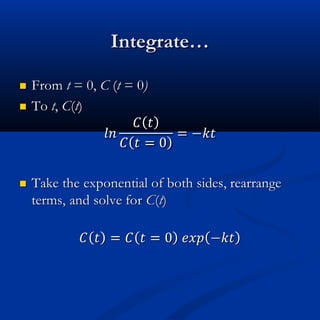
Integrate…
Convenient linear form
Is a 1 order model appropriate?
            st


   Plot ln(C) = f(t)
   Look for straight line
   Slope = k


    t (d)        0    5      10   15     20     25     30

C (mg/L)         25   15     9     6      3      2     1

    ln C     3.22 2.71 2.20       1.79   1.10   0.69   0
1 order assessment: k ≈ -0.11 d
        st                                                    -1


       3.5

        3                 ln C = -0.1057 t + 3.26
                               R2 = 0.9961
       2.5

        2
Ln C


       1.5

        1

       0.5

        0
             0   5   10        15         20        25   30        35
                                 Time (d)
Kinetic expressions for
 elementary reactions
Kinetic expressions for
elementary reactions - II
Differential rate analysis
Example


      Apply differential approach

           t (min)       [A] (mg/L)

                     0          10
                     2          5.8
                     4          3.7
                     6          2.6
                     8          1.9
                 10             1.5
Example


              Data manipulation

t (min) [A] (mg/L) ∆[A]/∆t [A]avg               Ln(-∆[A]/∆t)

          0         10            -         -

          2        5.8       -2.1 7.9           0.74

          4        3.7      -1.05 4.75          0.049

          6        2.6      -0.55 3.15          -0.598

          8        1.9      -0.35 2.25          -1.05

      10           1.5      -0.02 1.7           -1.61

 [A]avg = average concentration during the period ∆t.
Example


                              Integral analysis

                           n = 1.51
                           kn = exp(-2.34) = 0.096
                  1


                0.5
                                     y = 1.5102x - 2.3399
                                          R2 = 0.9964
                  0
   ln(-∆A/∆t)


                -0.5


                 -1


                -1.5


                 -2
                       0       0.5              1              1.5   2   2.5
                                                    ln(Aavg)
Example


                                                    2.5


                                                        2


What about 1st and                                  1.5
                                                                                    y = -0.1884x + 2.1705
                                                                                         R2 = 0.9794
2nd order kinetics?

                                           ln (A)
                                                        1


                                                    0.5


                                                        0
                                                            0       2        4                6             8   10
                                                                                 Time (min)


       0.7

       0.6
                     y = 0.0573x + 0.067
       0.5                 2
                         R = 0.9861

       0.4
 1/A


       0.3

       0.2

       0.1

        0
             0   2            4                     6           8       10
                                  Time (min)
Which model is correct?


n = 1.51 provides the best fit;
n = 1 or 2 is not too bad
Elementary and
non-elementary reactions
Elementary reactions
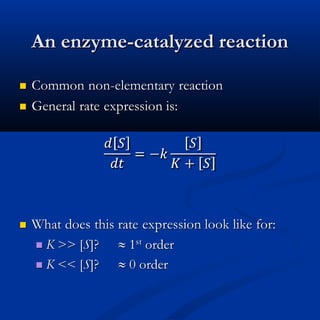
An enzyme-catalyzed reaction
Pseudo 1 order reactions
        st
Experimental design
Multiple step reactions
              are common
   For example, reactions in series:

                     A→B→C

   Reactions in parallel:

                        A→B

                        A→C
Reactions in series example
   Reaction A → B is a 0 order reaction
                k0 = 10-5 mg.L-1.min-1
   Reaction B → C is a 1st order reaction
                  k1 = 0.01 min-1
   Assume all concentrations can be expressed as
    mg of carbon per L
   Initial concentrations
          A0 = 10-3 mg/L B0 = C0 = 0 mg/L

   Determine A, B, and C = f(t)
Rate expressions


                   27
Integrate for B


                  28
Rearrange to solve for B


                           29
1.E-03
                                            A
                                            B
                          1.E-03            C
Conentration (mg C / L)


                          8.E-04


                          6.E-04


                          4.E-04


                          2.E-04


                          0.E+00
                                   0   50       100      150       200   250   300
                                                      Time (min)
Parallel reactions example
Quiz 1
   Imagine you can follow a molecule of copper
    from the source to the mouth of the Mississippi
    River. Assume that the average concentration of
    dissolved copper remains constant at 5 µg/L.
    The total dissolved solids, however, increases
    significantly from source to mouth.
   Would you expect the activity to increase,
    decrease, or remain the same? Why?
   From the perspective of a fish, what is more
    important, the activity or the concentration of
    copper? Briefly explain your answer.

                                                 32
Reversible reactions
Relating A and B
Substitute to simplify
Integrate for A
Rearrange to solve for A
Some special conditions
Similar analysis for B
Irreversible reactions?
   If the reverse reaction is very slow relative to
    the forward reaction…

   Examples of irreversible reactions:
     Precipitation
     Life
Temperature effects
Assessing experimental data
   Plot ln(k) versus 1/T

       Intercept = ln(kAr)

       Slope = - EAr/R
Example for the Q-10 rule
   Suppose a biochemical rate doubles…

   For a system increase from T = 10°C to 20°C.

   Estimate the activation energy for the reaction
Arrhenius equation at any T
Solve for EAr
Summary of key points
   Models for simple kinetics
     Basic elementary reactions
     0, 1st, or 2nd order models

     Evaluation of experimental data


   Complex reaction mechanisms are likely
       Parallel or series combinations

   Temperature effects
How does water temperature
             affect pH?

   Equilibrium expression:
            {H+} {OH-} = Kw = 10-14.0 (T = 25 C)


   Charge balance in pure water:
                       [H+] = [OH-]

    What is the pH at T = 1 °C?
van’t Hoff equation
Substitute


             49
Neutral pH at T = 1° C

Chapter 2 – kinetics

  • 1.
    Corrections to thetext  Table 1.1 Mg2+ = 1280 mg/L  Table 1.1 electroneutrality is usually ±15%, which indicates analytical errors and/or missing solute. The Mississippi River sample has an error of about 50%; those data will be replaced.  Table 1.3a Davies equation  The final term has a coefficient of 0.3  The example has a coefficient of 0.2  Davies suggested a value from 0.2 to 0.3 1
  • 2.
  • 3.
    Two views ofequilibrium  Based on the minimum energy  Thermodynamic perspective  Approach used after tonight  Based on kinetics  Forward reaction rate  Reverse reaction rate  Equilibrium occurs when the net rate = 0
  • 4.
    An overview  Expressions/analysis of irreversible reactions  0, 1st, and 2nd order  Elementary and non-elementary reactions  Series and parallel reactions  Reversible reactions  Effect of temperature on kinetics
  • 5.
    Kinetic expressions for…  Basic irreversible reactions:  Zero order: A→P  1st order : A→P  2nd order: A+A→P  2nd order : A+B→P
  • 6.
    An example: Giventhese batch experimental data, estimate the rate constant Time (d) 0 5 10 15 20 25 30 C (mg/L) 25 15 9 6 3 2 1
  • 7.
    Maybe it’s a1 order reaction st
  • 8.
  • 9.
  • 10.
    Is a 1order model appropriate? st  Plot ln(C) = f(t)  Look for straight line  Slope = k t (d) 0 5 10 15 20 25 30 C (mg/L) 25 15 9 6 3 2 1 ln C 3.22 2.71 2.20 1.79 1.10 0.69 0
  • 11.
    1 order assessment:k ≈ -0.11 d st -1 3.5 3 ln C = -0.1057 t + 3.26 R2 = 0.9961 2.5 2 Ln C 1.5 1 0.5 0 0 5 10 15 20 25 30 35 Time (d)
  • 12.
    Kinetic expressions for elementary reactions
  • 13.
  • 14.
  • 15.
    Example Apply differential approach t (min) [A] (mg/L) 0 10 2 5.8 4 3.7 6 2.6 8 1.9 10 1.5
  • 16.
    Example Data manipulation t (min) [A] (mg/L) ∆[A]/∆t [A]avg Ln(-∆[A]/∆t) 0 10 - - 2 5.8 -2.1 7.9 0.74 4 3.7 -1.05 4.75 0.049 6 2.6 -0.55 3.15 -0.598 8 1.9 -0.35 2.25 -1.05 10 1.5 -0.02 1.7 -1.61 [A]avg = average concentration during the period ∆t.
  • 17.
    Example Integral analysis n = 1.51 kn = exp(-2.34) = 0.096 1 0.5 y = 1.5102x - 2.3399 R2 = 0.9964 0 ln(-∆A/∆t) -0.5 -1 -1.5 -2 0 0.5 1 1.5 2 2.5 ln(Aavg)
  • 18.
    Example 2.5 2 What about 1st and 1.5 y = -0.1884x + 2.1705 R2 = 0.9794 2nd order kinetics? ln (A) 1 0.5 0 0 2 4 6 8 10 Time (min) 0.7 0.6 y = 0.0573x + 0.067 0.5 2 R = 0.9861 0.4 1/A 0.3 0.2 0.1 0 0 2 4 6 8 10 Time (min)
  • 19.
    Which model iscorrect? n = 1.51 provides the best fit; n = 1 or 2 is not too bad
  • 20.
  • 21.
  • 22.
  • 23.
    Pseudo 1 orderreactions st
  • 24.
  • 25.
    Multiple step reactions are common  For example, reactions in series: A→B→C  Reactions in parallel: A→B A→C
  • 26.
    Reactions in seriesexample  Reaction A → B is a 0 order reaction k0 = 10-5 mg.L-1.min-1  Reaction B → C is a 1st order reaction k1 = 0.01 min-1  Assume all concentrations can be expressed as mg of carbon per L  Initial concentrations A0 = 10-3 mg/L B0 = C0 = 0 mg/L  Determine A, B, and C = f(t)
  • 27.
  • 28.
  • 29.
  • 30.
    1.E-03 A B 1.E-03 C Conentration (mg C / L) 8.E-04 6.E-04 4.E-04 2.E-04 0.E+00 0 50 100 150 200 250 300 Time (min)
  • 31.
  • 32.
    Quiz 1  Imagine you can follow a molecule of copper from the source to the mouth of the Mississippi River. Assume that the average concentration of dissolved copper remains constant at 5 µg/L. The total dissolved solids, however, increases significantly from source to mouth.  Would you expect the activity to increase, decrease, or remain the same? Why?  From the perspective of a fish, what is more important, the activity or the concentration of copper? Briefly explain your answer. 32
  • 33.
  • 34.
  • 35.
  • 36.
  • 37.
  • 38.
  • 39.
  • 40.
    Irreversible reactions?  If the reverse reaction is very slow relative to the forward reaction…  Examples of irreversible reactions:  Precipitation  Life
  • 41.
  • 42.
    Assessing experimental data  Plot ln(k) versus 1/T  Intercept = ln(kAr)  Slope = - EAr/R
  • 43.
    Example for theQ-10 rule  Suppose a biochemical rate doubles…  For a system increase from T = 10°C to 20°C.  Estimate the activation energy for the reaction
  • 44.
  • 45.
  • 46.
    Summary of keypoints  Models for simple kinetics  Basic elementary reactions  0, 1st, or 2nd order models  Evaluation of experimental data  Complex reaction mechanisms are likely  Parallel or series combinations  Temperature effects
  • 47.
    How does watertemperature affect pH?  Equilibrium expression: {H+} {OH-} = Kw = 10-14.0 (T = 25 C)  Charge balance in pure water: [H+] = [OH-] What is the pH at T = 1 °C?
  • 48.
  • 49.
  • 50.
    Neutral pH atT = 1° C