Automatic Reaction
Mechanism Generation with
Group Additive Kinetics
Richard H. West
Joshua W. Allen
William H. Green


       Massachusetts Institute of Technology
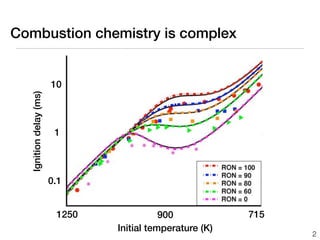
Combustion chemistry is complex


                        10
  Ignition delay (ms)


                         1


                        0.1


                         1250              900            715
                                Initial temperature (K)
                                                                2
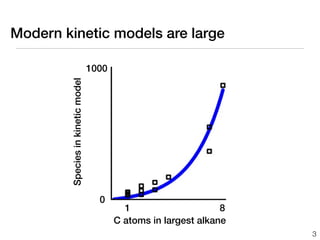
Modern kinetic models are large

                                   1000
        Species in kinetic model


                                     0
                                            1                     8
                                          C atoms in largest alkane
                                                                      3
Detailed kinetic modeling is complex
 For each chemical reaction

                 A + B  C + D we need:
 •forward rate coefficient
                    r = k f [A][B]
                                      
                                  − Ea
                  k f = A exp
 •equilibrium constant             RT
                                         
                 kf                   −∆G
                      = Keq = exp
                 kr                    RT
                 ∆G = ∆H − T∆S                4
Detailed kinetic modeling is complex

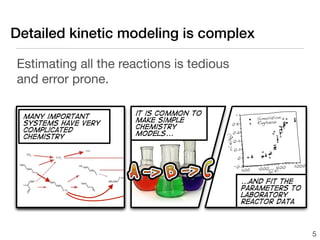
Estimating all the reactions is tedious
and error prone.


 What do we do?


                                          5
Detailed kinetic modeling is complex

Estimating all the reactions is tedious
and error prone.
_rp_svg2.html                                            12/03/2009 12:17PM


     many important                    it is common to                           1
                                                                                            Simulation
     systems have very                 make simple                         0.8              Raghavan
     complicated                       chemistry
                                       models...                            0.6
     chemistry


                                                                      1!(N/ 0)
                                                                              0.4


                                                                           N
                                                                              0.2
                                                                                     0
                                                                              !0.2                   1500   2000
                                                                                 500         1000
                                                                                                 T (K)
                                                                                                  p

                                                                                         ...and fit the
                                                                                         parameters to
                                                                                         laboratory
                         Scale = 0.1
                              -
                                                                                         reactor data


                                                                                                                   5
complicated                          chemistry
                                     models...               0.6
chemistry


                                                       1!(N/ 0)
                                                             0.4


                                                            N
                                                              0.2


  Detailed kinetic modeling is complex                        !0.2
                                                                  0

                                                                 500      1000    1500   2000
                                                                              T (K)
                                                                               p

                                                                      ...and fit the
   Estimating all the reactions is tedious                            parameters to
                                                                      laboratory
                                                                      reactor data
   and error prone.
                       Scale = 0.1
                            -


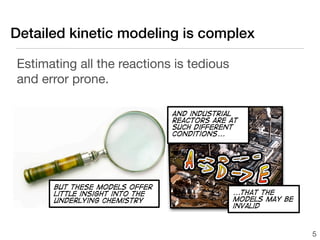
                                                 and industrial
                                                 reactors are at
                                                 such different
                                                 conditions...


              but these models offer
              little insight into the                                    ...that the
              underlying chemistry                                       models may be
                                                                         invalid


                                                                                                5
Detailed kinetic modeling is complex

Estimating all the reactions is tedious
and error prone.

      Teach the chemistry to a computer!
                          Reaction Mechanism Generator
                          •free and open source software


   rmg.sourceforge.net
   facebook.com/rmg.mit

                                                           5
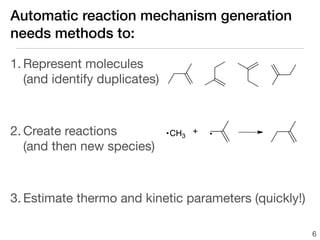
Automatic reaction mechanism generation
needs methods to:

1. Represent molecules
   (and identify duplicates)


2. Create reactions            CH3 +
   (and then new species)


3. Estimate thermo and kinetic parameters (quickly!)

                                                       6
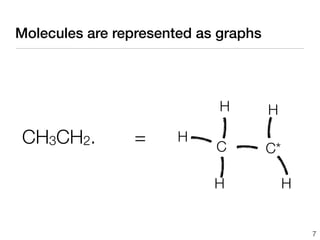
Molecules are represented as graphs


                             H        H

CH3CH2.         =      H
                            C         C*

                            H              H


                                               7
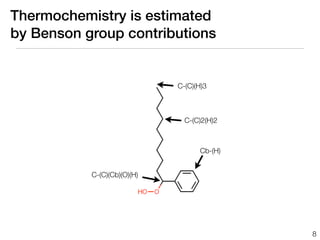
Thermochemistry is estimated
by Benson group contributions


                             C-(C)(H)3


                               C-(C)2(H)2


                                   Cb-(H)


           C-(C)(Cb)(O)(H)


                                            8
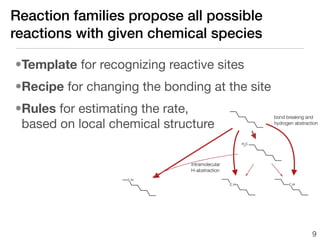
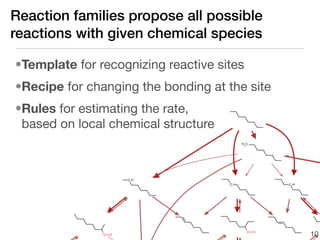
Reaction families propose all possible
reactions with given chemical species

•Template for recognizing reactive sites
•Recipe for changing the bonding at the site
•Rules for estimating the rate,                bond breaking and
 based on local chemical structure             hydrogen abstraction


                              intramolecular
                              H-abstraction


                                                                9
Reaction families propose all possible
reactions with given chemical species

•Template for recognizing reactive sites
•Recipe for changing the bonding at the site
•Rules for estimating the rate,
 based on local chemical structure


                                               10
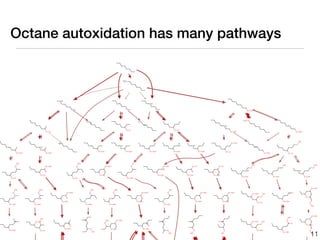
Octane autoxidation has many pathways


                                        11
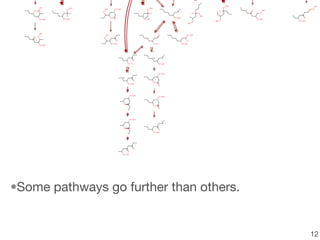
•Some pathways go further than others.


                                         12
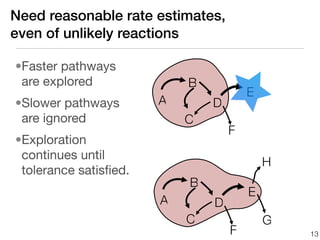
Need reasonable rate estimates,
even of unlikely reactions

•Faster pathways
 are explored              B
                                       E
•Slower pathways       A       D
 are ignored               C
                                   F
•Exploration
 continues until
                                           H
 tolerance satisfied.
                           B
                                       E
                       A       D
                           C               G
                                   F           13
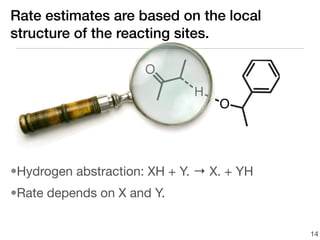
Rate estimates are based on the local
structure of the reacting sites.

                      O
                              H
                                  O


•Hydrogen abstraction: XH + Y. → X. + YH
•Rate depends on X and Y.


                                           14
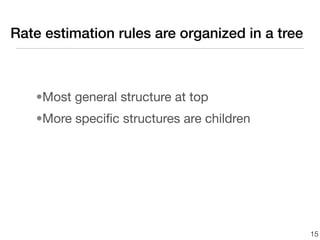
Rate estimation rules are organized in a tree


   •Most general structure at top
   •More specific structures are children


                                                15
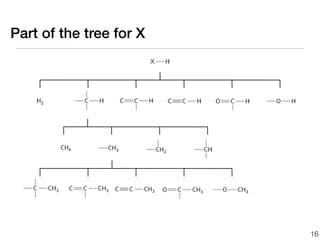
Part of the tree for X


                         16
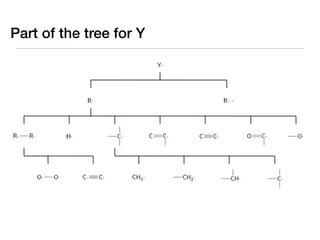
Part of the tree for Y
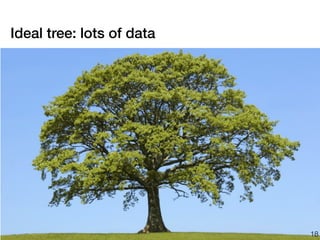
Ideal tree: lots of data


                           18
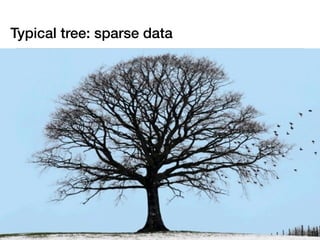
Typical tree: sparse data


                            19
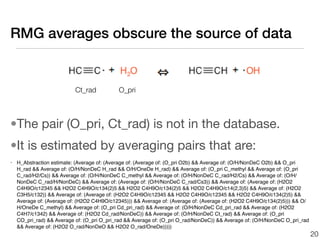
RMG averages obscure the source of data


                         Ct_rad            O_pri


•The pair (O_pri, Ct_rad) is not in the database.
•It is estimated by averaging pairs that are:
• H_Abstraction estimate: (Average of: (Average of: (Average of: (O_pri O2b)  Average of: (O/H/NonDeC O2b)  O_pri
  H_rad  Average of: (O/H/NonDeC H_rad  O/H/OneDe H_rad)  Average of: (O_pri C_methyl  Average of: (O_pri
  C_rad/H2/Cs))  Average of: (O/H/NonDeC C_methyl  Average of: (O/H/NonDeC C_rad/H2/Cs)  Average of: (O/H/
  NonDeC C_rad/H/NonDeC)  Average of: (Average of: (O/H/NonDeC C_rad/Cs3))  Average of: (Average of: (H2O2
  C4H9O/c12345  H2O2 C4H9O/c134(2)5  H2O2 C4H9O/c134(2)5  H2O2 C4H9O/c14(2,3)5)  Average of: (H2O2
  C3H5/c132))  Average of: (Average of: (H2O2 C4H9O/c12345  H2O2 C4H9O/c12345  H2O2 C4H9O/c134(2)5) 
  Average of: (Average of: (H2O2 C4H9O/c12345)))  Average of: (Average of: (Average of: (H2O2 C4H9O/c134(2)5)))  O/
  H/OneDe C_methyl)  Average of: (O_pri Cd_pri_rad)  Average of: (O/H/NonDeC Cd_pri_rad  Average of: (H2O2
  C4H7/c1342)  Average of: (H2O2 Cd_rad/NonDeC))  Average of: (O/H/NonDeC Ct_rad)  Average of: (O_pri
  CO_pri_rad)  Average of: (O_pri O_pri_rad  Average of: (O_pri O_rad/NonDeC))  Average of: (O/H/NonDeC O_pri_rad
   Average of: (H2O2 O_rad/NonDeO  H2O2 O_rad/OneDe)))))
                                                                                                                          20
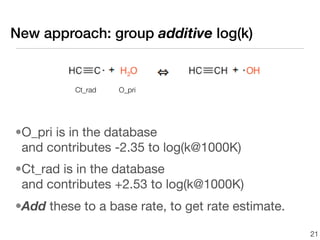
New approach: group additive log(k)


          Ct_rad   O_pri


•O_pri is in the database
 and contributes -2.35 to log(k@1000K)
•Ct_rad is in the database
 and contributes +2.53 to log(k@1000K)
•Add these to a base rate, to get rate estimate.

                                                   21
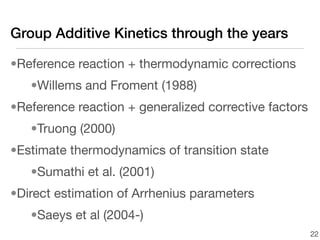
Group Additive Kinetics through the years

•Reference reaction + thermodynamic corrections
   •Willems and Froment (1988)
•Reference reaction + generalized corrective factors
   •Truong (2000)
•Estimate thermodynamics of transition state
   •Sumathi et al. (2001)
•Direct estimation of Arrhenius parameters
   •Saeys et al (2004-)
                                                       22
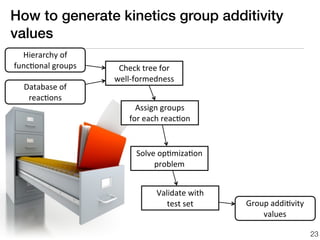
How to generate kinetics group additivity
values
  Hierarchy	
  of
func.onal	
  groups      Check	
  tree	
  for
                        well-­‐formedness
   Database	
  of	
  
    reac.ons
                               Assign	
  groups	
  
                             for	
  each	
  reac.on


                               Solve	
  op.miza.on
                                    problem


                                      Validate	
  with
                                         test	
  set     Group	
  addi.vity
                                                             values

                                                                              23
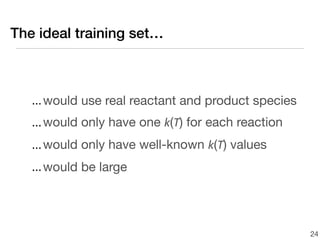
The ideal training set…


   ... would use real reactant and product species
   ... would only have one k(T) for each reaction
   ... would only have well-known k(T) values
   ... would be large


                                                     24
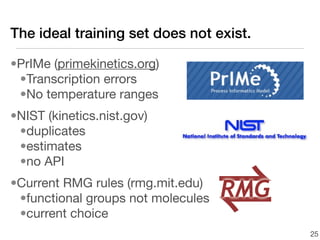
The ideal training set does not exist.

•PrIMe (primekinetics.org)
 •Transcription errors
 •No temperature ranges
•NIST (kinetics.nist.gov)
 •duplicates
 •estimates
 •no API
•Current RMG rules (rmg.mit.edu)
 •functional groups not molecules
 •current choice
                                         25
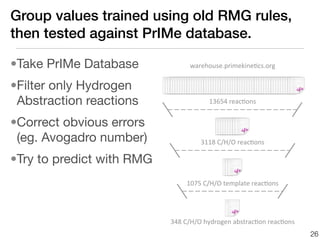
Group values trained using old RMG rules,
then tested against PrIMe database.

•Take PrIMe Database              warehouse.primekine.cs.org


•Filter only Hydrogen
 Abstraction reactions                    13654	
  reac.ons


•Correct obvious errors
 (eg. Avogadro number)                 3118	
  C/H/O	
  reac.ons

•Try to predict with RMG
                                 1075	
  C/H/O	
  template	
  reac.ons


                           348	
  C/H/O	
  hydrogen	
  abstrac.on	
  reac.ons
                                                                                26
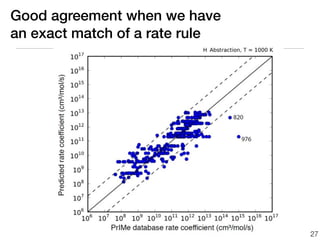
Good agreement when we have
an exact match of a rate rule


                                27
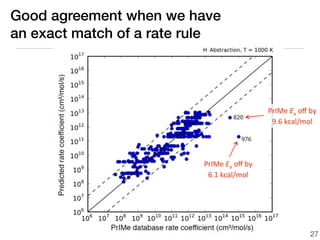
Good agreement when we have
an exact match of a rate rule


                                                    PrIMe	
  Ea	
  off	
  by
                                                     9.6	
  kcal/mol


                          PrIMe	
  Ea	
  off	
  by
                           6.1	
  kcal/mol


                                                                        27
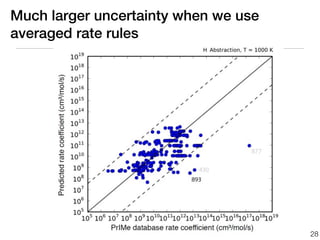
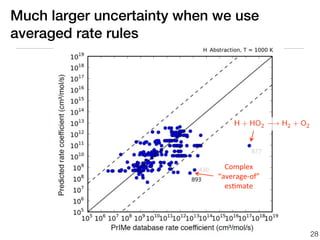
Much larger uncertainty when we use
averaged rate rules


                                      28
Much larger uncertainty when we use
averaged rate rules


                               Complex	
  
                             “average-­‐of”	
  
                               es.mate


                                                  28
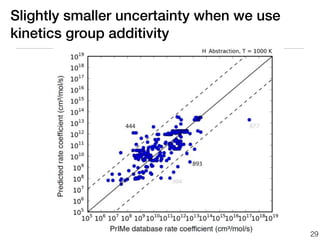
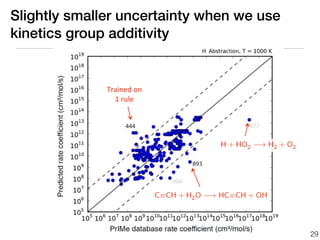
Slightly smaller uncertainty when we use
kinetics group additivity


                                           29
Slightly smaller uncertainty when we use
kinetics group additivity


              Trained	
  on
                1	
  rule


                                           29
We can use the group values
to design a better tree
   log	
  kXH(1000	
  K)	
  [cm3/mol*s]   ±0.0	
  (233)   Number	
  of	
  entries	
  trained	
  against


                                                                                                          30
We can use the group values
to design a better tree
      log	
  kXH(1000	
  K)	
  [cm3/mol*s]           ±0.0	
  (233)         Number	
  of	
  entries	
  trained	
  against


  -­‐0.59	
  (19)      +0.18	
  (120)     -­‐0.55	
  (25)      -­‐2.31	
  (5)      +0.79	
  (22)       -­‐0.05	
  (34)


             -­‐0.45	
  (16)     +0.16	
  (47)       +0.18	
  (28)       +0.56	
  (29)


  -­‐0.12	
  (17)       +0.05	
  (23)      +1.83	
  (2)        +2.09	
  (1)         +1.42	
  (3)
                                                                                                                           30
We can use the group values
to design a better tree
   log	
  kY.(1000	
  K)	
  [cm3/mol*s]   ±0.0	
  (233)   Number	
  of	
  entries	
  trained	
  against


                                                                                                          31
We can use the group values
to design a better tree
             log	
  kY.(1000	
  K)	
  [cm3/mol*s]          ±0.0	
  (233)        Number	
  of	
  entries	
  trained	
  against


                             -­‐0.09	
  (218)                                         +1.68	
  (13)


-­‐7.01	
  (13)     +2.21	
  (23)       -­‐0.56	
  (97)    +1.02	
  (26)      +2.62	
  (7)       -­‐1.13	
  (12)     +0.77	
  (37)


           -­‐7.82	
  (12)     +3.52	
  (1)        +0.54	
  (23)    -­‐0.69	
  (34)    -­‐0.96	
  (23)      -­‐1.11	
  (17)
                                                                                                                                 31
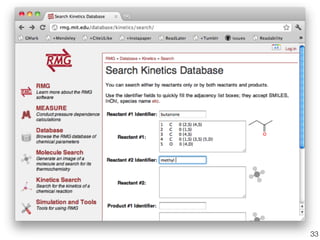
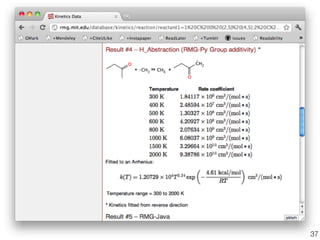
32
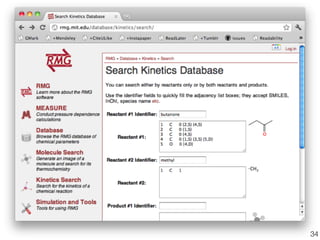
33
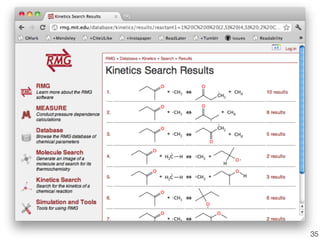
34
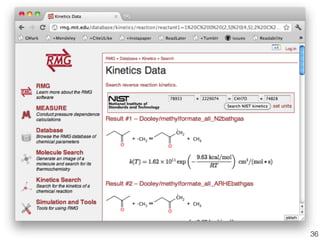
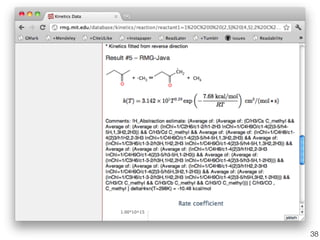
35
36
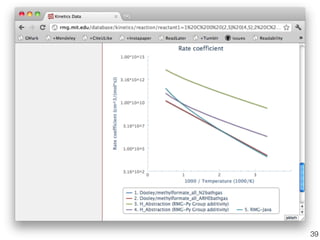
37
38
39
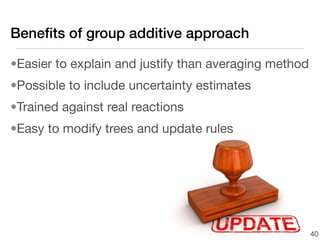
Benefits of group additive approach

•Easier to explain and justify than averaging method
•Possible to include uncertainty estimates
•Trained against real reactions
•Easy to modify trees and update rules


                                                       40
Next steps

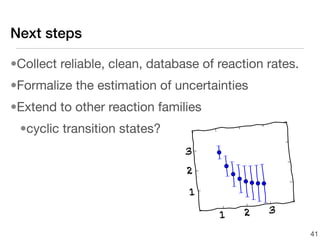
•Collect reliable, clean, database of reaction rates.
•Formalize the estimation of uncertainties
•Extend to other reaction families
 •cyclic transition states?
                                
                                !

                                #

                                      #    !   

                                                        41
Acknowledgements

Prof William H. Green
Joshua W. Allen
Connie Gao
Dr. Michael Harper
Amrit Jalan             rmg.mit.edu
                         rmg.sf.net
Gregory Magoon
Shamel Merchant


                                      42
Contributions

Developed framework for fitting kinetics group
additivity parameters


Group additivity kinetics estimation shows promise
for hydrogen abstraction reactions


Key challenge: Getting lots of data


                                                     43

AIChE 2011 - Automatic Reaction Mechanism Generation with Group Additive Kinetics

  • 1.
    Automatic Reaction Mechanism Generationwith Group Additive Kinetics Richard H. West Joshua W. Allen William H. Green Massachusetts Institute of Technology
  • 2.
    Combustion chemistry iscomplex 10 Ignition delay (ms) 1 0.1 1250 900 715 Initial temperature (K) 2
  • 3.
    Modern kinetic modelsare large 1000 Species in kinetic model 0 1 8 C atoms in largest alkane 3
  • 4.
    Detailed kinetic modelingis complex For each chemical reaction A + B C + D we need: •forward rate coefficient r = k f [A][B] − Ea k f = A exp •equilibrium constant RT kf −∆G = Keq = exp kr RT ∆G = ∆H − T∆S 4
  • 5.
    Detailed kinetic modelingis complex Estimating all the reactions is tedious and error prone. What do we do? 5
  • 6.
    Detailed kinetic modelingis complex Estimating all the reactions is tedious and error prone. _rp_svg2.html 12/03/2009 12:17PM many important it is common to 1 Simulation systems have very make simple 0.8 Raghavan complicated chemistry models... 0.6 chemistry 1!(N/ 0) 0.4 N 0.2 0 !0.2 1500 2000 500 1000 T (K) p ...and fit the parameters to laboratory Scale = 0.1 - reactor data 5
  • 7.
    complicated chemistry models... 0.6 chemistry 1!(N/ 0) 0.4 N 0.2 Detailed kinetic modeling is complex !0.2 0 500 1000 1500 2000 T (K) p ...and fit the Estimating all the reactions is tedious parameters to laboratory reactor data and error prone. Scale = 0.1 - and industrial reactors are at such different conditions... but these models offer little insight into the ...that the underlying chemistry models may be invalid 5
  • 8.
    Detailed kinetic modelingis complex Estimating all the reactions is tedious and error prone. Teach the chemistry to a computer! Reaction Mechanism Generator •free and open source software rmg.sourceforge.net facebook.com/rmg.mit 5
  • 9.
    Automatic reaction mechanismgeneration needs methods to: 1. Represent molecules (and identify duplicates) 2. Create reactions CH3 + (and then new species) 3. Estimate thermo and kinetic parameters (quickly!) 6
  • 10.
    Molecules are representedas graphs H H CH3CH2. = H C C* H H 7
  • 11.
    Thermochemistry is estimated byBenson group contributions C-(C)(H)3 C-(C)2(H)2 Cb-(H) C-(C)(Cb)(O)(H) 8
  • 12.
    Reaction families proposeall possible reactions with given chemical species •Template for recognizing reactive sites •Recipe for changing the bonding at the site •Rules for estimating the rate, bond breaking and based on local chemical structure hydrogen abstraction intramolecular H-abstraction 9
  • 13.
    Reaction families proposeall possible reactions with given chemical species •Template for recognizing reactive sites •Recipe for changing the bonding at the site •Rules for estimating the rate, based on local chemical structure 10
  • 14.
    Octane autoxidation hasmany pathways 11
  • 15.
    •Some pathways gofurther than others. 12
  • 16.
    Need reasonable rateestimates, even of unlikely reactions •Faster pathways are explored B E •Slower pathways A D are ignored C F •Exploration continues until H tolerance satisfied. B E A D C G F 13
  • 17.
    Rate estimates arebased on the local structure of the reacting sites. O H O •Hydrogen abstraction: XH + Y. → X. + YH •Rate depends on X and Y. 14
  • 18.
    Rate estimation rulesare organized in a tree •Most general structure at top •More specific structures are children 15
  • 19.
    Part of thetree for X 16
  • 20.
    Part of thetree for Y
  • 21.
    Ideal tree: lotsof data 18
  • 22.
  • 23.
    RMG averages obscurethe source of data Ct_rad O_pri •The pair (O_pri, Ct_rad) is not in the database. •It is estimated by averaging pairs that are: • H_Abstraction estimate: (Average of: (Average of: (Average of: (O_pri O2b) Average of: (O/H/NonDeC O2b) O_pri H_rad Average of: (O/H/NonDeC H_rad O/H/OneDe H_rad) Average of: (O_pri C_methyl Average of: (O_pri C_rad/H2/Cs)) Average of: (O/H/NonDeC C_methyl Average of: (O/H/NonDeC C_rad/H2/Cs) Average of: (O/H/ NonDeC C_rad/H/NonDeC) Average of: (Average of: (O/H/NonDeC C_rad/Cs3)) Average of: (Average of: (H2O2 C4H9O/c12345 H2O2 C4H9O/c134(2)5 H2O2 C4H9O/c134(2)5 H2O2 C4H9O/c14(2,3)5) Average of: (H2O2 C3H5/c132)) Average of: (Average of: (H2O2 C4H9O/c12345 H2O2 C4H9O/c12345 H2O2 C4H9O/c134(2)5) Average of: (Average of: (H2O2 C4H9O/c12345))) Average of: (Average of: (Average of: (H2O2 C4H9O/c134(2)5))) O/ H/OneDe C_methyl) Average of: (O_pri Cd_pri_rad) Average of: (O/H/NonDeC Cd_pri_rad Average of: (H2O2 C4H7/c1342) Average of: (H2O2 Cd_rad/NonDeC)) Average of: (O/H/NonDeC Ct_rad) Average of: (O_pri CO_pri_rad) Average of: (O_pri O_pri_rad Average of: (O_pri O_rad/NonDeC)) Average of: (O/H/NonDeC O_pri_rad Average of: (H2O2 O_rad/NonDeO H2O2 O_rad/OneDe))))) 20
  • 24.
    New approach: groupadditive log(k) Ct_rad O_pri •O_pri is in the database and contributes -2.35 to log(k@1000K) •Ct_rad is in the database and contributes +2.53 to log(k@1000K) •Add these to a base rate, to get rate estimate. 21
  • 25.
    Group Additive Kineticsthrough the years •Reference reaction + thermodynamic corrections •Willems and Froment (1988) •Reference reaction + generalized corrective factors •Truong (2000) •Estimate thermodynamics of transition state •Sumathi et al. (2001) •Direct estimation of Arrhenius parameters •Saeys et al (2004-) 22
  • 26.
    How to generatekinetics group additivity values Hierarchy  of func.onal  groups Check  tree  for well-­‐formedness Database  of   reac.ons Assign  groups   for  each  reac.on Solve  op.miza.on problem Validate  with test  set Group  addi.vity values 23
  • 27.
    The ideal trainingset… ... would use real reactant and product species ... would only have one k(T) for each reaction ... would only have well-known k(T) values ... would be large 24
  • 28.
    The ideal trainingset does not exist. •PrIMe (primekinetics.org) •Transcription errors •No temperature ranges •NIST (kinetics.nist.gov) •duplicates •estimates •no API •Current RMG rules (rmg.mit.edu) •functional groups not molecules •current choice 25
  • 29.
    Group values trainedusing old RMG rules, then tested against PrIMe database. •Take PrIMe Database warehouse.primekine.cs.org •Filter only Hydrogen Abstraction reactions 13654  reac.ons •Correct obvious errors (eg. Avogadro number) 3118  C/H/O  reac.ons •Try to predict with RMG 1075  C/H/O  template  reac.ons 348  C/H/O  hydrogen  abstrac.on  reac.ons 26
  • 30.
    Good agreement whenwe have an exact match of a rate rule 27
  • 31.
    Good agreement whenwe have an exact match of a rate rule PrIMe  Ea  off  by 9.6  kcal/mol PrIMe  Ea  off  by 6.1  kcal/mol 27
  • 32.
    Much larger uncertaintywhen we use averaged rate rules 28
  • 33.
    Much larger uncertaintywhen we use averaged rate rules Complex   “average-­‐of”   es.mate 28
  • 34.
    Slightly smaller uncertaintywhen we use kinetics group additivity 29
  • 35.
    Slightly smaller uncertaintywhen we use kinetics group additivity Trained  on 1  rule 29
  • 36.
    We can usethe group values to design a better tree log  kXH(1000  K)  [cm3/mol*s] ±0.0  (233) Number  of  entries  trained  against 30
  • 37.
    We can usethe group values to design a better tree log  kXH(1000  K)  [cm3/mol*s] ±0.0  (233) Number  of  entries  trained  against -­‐0.59  (19) +0.18  (120) -­‐0.55  (25) -­‐2.31  (5) +0.79  (22) -­‐0.05  (34) -­‐0.45  (16) +0.16  (47) +0.18  (28) +0.56  (29) -­‐0.12  (17) +0.05  (23) +1.83  (2) +2.09  (1) +1.42  (3) 30
  • 38.
    We can usethe group values to design a better tree log  kY.(1000  K)  [cm3/mol*s] ±0.0  (233) Number  of  entries  trained  against 31
  • 39.
    We can usethe group values to design a better tree log  kY.(1000  K)  [cm3/mol*s] ±0.0  (233) Number  of  entries  trained  against -­‐0.09  (218) +1.68  (13) -­‐7.01  (13) +2.21  (23) -­‐0.56  (97) +1.02  (26) +2.62  (7) -­‐1.13  (12) +0.77  (37) -­‐7.82  (12) +3.52  (1) +0.54  (23) -­‐0.69  (34) -­‐0.96  (23) -­‐1.11  (17) 31
  • 40.
  • 41.
  • 42.
  • 43.
  • 44.
  • 45.
  • 46.
  • 47.
  • 48.
    Benefits of groupadditive approach •Easier to explain and justify than averaging method •Possible to include uncertainty estimates •Trained against real reactions •Easy to modify trees and update rules 40
  • 49.
    Next steps •Collect reliable,clean, database of reaction rates. •Formalize the estimation of uncertainties •Extend to other reaction families •cyclic transition states? ! # # ! 41
  • 50.
    Acknowledgements Prof William H.Green Joshua W. Allen Connie Gao Dr. Michael Harper Amrit Jalan rmg.mit.edu rmg.sf.net Gregory Magoon Shamel Merchant 42
  • 51.
    Contributions Developed framework forfitting kinetics group additivity parameters Group additivity kinetics estimation shows promise for hydrogen abstraction reactions Key challenge: Getting lots of data 43