AE 2031 APPLIED THERMODYNAMICS S. Y. B. Tech.
ENTROPY
Prof. Aniket Suryawanshi
Asst. Prof. Automobile Engg. Dept.
R. I. T. Rajaramnagar
AE 2031 APPLIED THERMODYNAMICS S. Y. B. Tech.
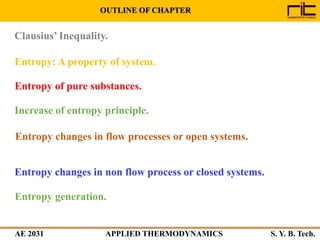
OUTLINE OF CHAPTER
Clausius’ Inequality.
Entropy: A property of system.
Entropy of pure substances.
Increase of entropy principle.
Entropy changes in flow processes or open systems.
Entropy changes in non flow process or closed systems.
Entropy generation.
AE 2031 APPLIED THERMODYNAMICS S. Y. B. Tech.
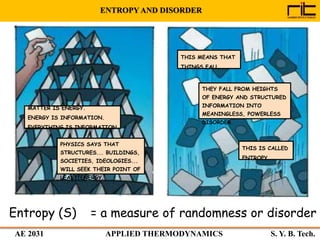
Entropy (S) = a measure of randomness or disorder
MATTER IS ENERGY.
ENERGY IS INFORMATION.
EVERYTHING IS INFORMATION.
PHYSICS SAYS THAT
STRUCTURES... BUILDINGS,
SOCIETIES, IDEOLOGIES...
WILL SEEK THEIR POINT OF
LEAST ENERGY.
THIS MEANS THAT
THINGS FALL.
THEY FALL FROM HEIGHTS
OF ENERGY AND STRUCTURED
INFORMATION INTO
MEANINGLESS, POWERLESS
DISORDER.
THIS IS CALLED
ENTROPY.
ENTROPY AND DISORDER
AE 2031 APPLIED THERMODYNAMICS S. Y. B. Tech.
In any spontaneous process, the entropy of the
universe increases.
ΔSuniverse > 0
Another version of the 2nd Law:
Energy spontaneously spreads out if it has no outside
resistance
Entropy measures the spontaneous dispersal of energy as a
function of temperature
How much energy is spread out
How widely spread out it becomes
Entropy change = “energy dispersed”/T
SECOND LAW OF THERMODYNAMICS
occurs without outside intervention

AE 2031 APPLIED THERMODYNAMICS S. Y. B. Tech.
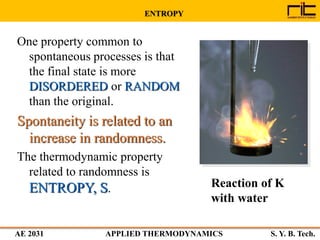
One property common to
spontaneous processes is that
the final state is more
DISORDERED or RANDOM
than the original.
Spontaneity is related to an
increase in randomness.
The thermodynamic property
related to randomness is
ENTROPY, S. Reaction of K
with water
ENTROPY
AE 2031 APPLIED THERMODYNAMICS S. Y. B. Tech.
How probable is it that reactant
molecules will react?
PROBABILITY suggests that a
spontaneous reaction will result in
the dispersal
* of energy
* or of matter
* or of energy & matter.
Directionality of Reactions
AE 2031 APPLIED THERMODYNAMICS S. Y. B. Tech.
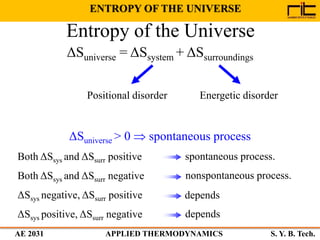
Entropy of the Universe
ΔSuniverse = ΔSsystem + ΔSsurroundings
Positional disorder Energetic disorder
ΔSuniverse > 0  spontaneous process
Both ΔSsys and ΔSsurr positive
Both ΔSsys and ΔSsurr negative
ΔSsys negative, ΔSsurr positive
ΔSsys positive, ΔSsurr negative
spontaneous process.
nonspontaneous process.
depends
depends
ENTROPY OF THE UNIVERSE
AE 2031 APPLIED THERMODYNAMICS S. Y. B. Tech.
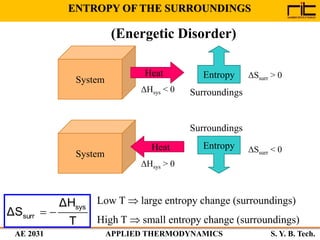
ENTROPY OF THE SURROUNDINGS
System
Heat Entropy
Surroundings
System
Heat Entropy
Surroundings
T
ΔH
ΔS
sys
surr 
Low T  large entropy change (surroundings)
High T  small entropy change (surroundings)
ΔHsys < 0
ΔHsys > 0
ΔSsurr > 0
ΔSsurr < 0
(Energetic Disorder)
AE 2031 APPLIED THERMODYNAMICS S. Y. B. Tech.
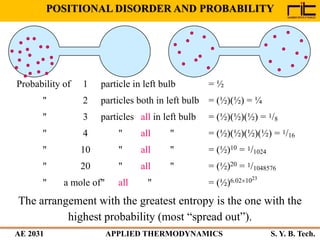
POSITIONAL DISORDER AND PROBABILITY
Probability of 1 particle in left bulb = ½
" 2 particles both in left bulb = (½)(½) = ¼
" 3 particles all in left bulb = (½)(½)(½) = 1/8
" 4 " all " = (½)(½)(½)(½) = 1/16
" 10 " all " = (½)10 = 1/1024
" 20 " all " = (½)20 = 1/1048576
" a mole of" all " = (½)6.021023
The arrangement with the greatest entropy is the one with the
highest probability (most “spread out”).
AE 2031 APPLIED THERMODYNAMICS S. Y. B. Tech.
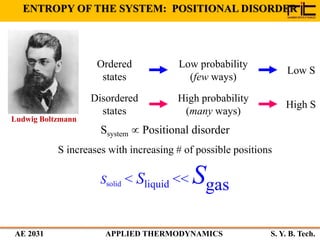
Ssolid < Sliquid << Sgas
ENTROPY OF THE SYSTEM: POSITIONAL DISORDER
Ludwig Boltzmann
Ordered
states
Disordered
states
Low probability
(few ways)
High probability
(many ways)
Low S
High S
Ssystem  Positional disorder
S increases with increasing # of possible positions
AE 2031 APPLIED THERMODYNAMICS S. Y. B. Tech.
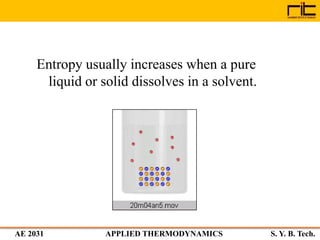
Entropy usually increases when a pure
liquid or solid dissolves in a solvent.
AE 2031 APPLIED THERMODYNAMICS S. Y. B. Tech.
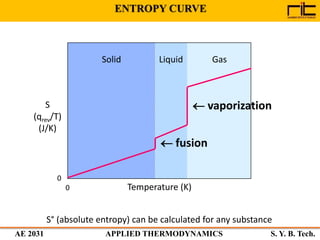
ENTROPY CURVE
Solid GasLiquid
S
(qrev/T)
(J/K)
Temperature (K)
0
0
 fusion
 vaporization
S° (absolute entropy) can be calculated for any substance
AE 2031 APPLIED THERMODYNAMICS S. Y. B. Tech.
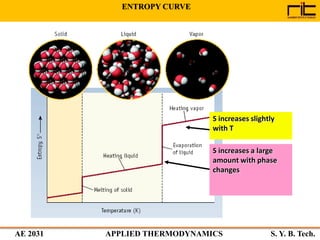
S increases slightly
with T
S increases a large
amount with phase
changes
ENTROPY CURVE
AE 2031 APPLIED THERMODYNAMICS S. Y. B. Tech.
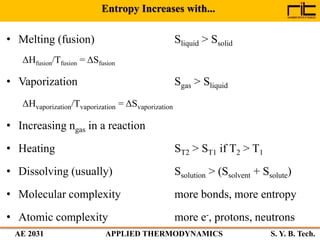
Entropy Increases with...
• Melting (fusion) Sliquid > Ssolid
ΔHfusion/Tfusion = ΔSfusion
• Vaporization Sgas > Sliquid
ΔHvaporization/Tvaporization = ΔSvaporization
• Increasing ngas in a reaction
• Heating ST2 > ST1 if T2 > T1
• Dissolving (usually) Ssolution > (Ssolvent + Ssolute)
• Molecular complexity more bonds, more entropy
• Atomic complexity more e-, protons, neutrons
AE 2031 APPLIED THERMODYNAMICS S. Y. B. Tech.
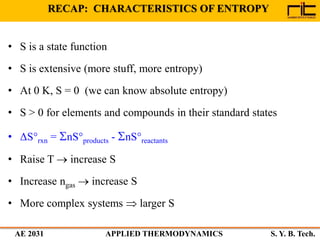
RECAP: CHARACTERISTICS OF ENTROPY
• S is a state function
• S is extensive (more stuff, more entropy)
• At 0 K, S = 0 (we can know absolute entropy)
• S > 0 for elements and compounds in their standard states
• ΔS°rxn = nS°products - nS°reactants
• Raise T  increase S
• Increase ngas  increase S
• More complex systems  larger S
AE 2031 APPLIED THERMODYNAMICS S. Y. B. Tech.
Volume
Pressure
•
•
a
b
•
d
T1
Q1
Q2
V
nRT
P 1
=

V
const
P
.
=
T2
•
c
Q=
0
Q=
0
V
nRT
P 2
=
CLAUSIUS THEOREM
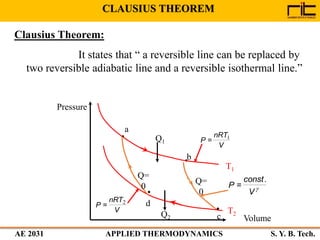
Clausius Theorem:
It states that “ a reversible line can be replaced by
two reversible adiabatic line and a reversible isothermal line.”
AE 2031 APPLIED THERMODYNAMICS S. Y. B. Tech.
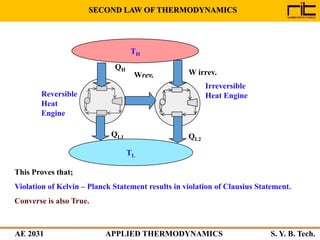
This Proves that;
Violation of Kelvin – Planck Statement results in violation of Clausius Statement.
Converse is also True.
SECOND LAW OF THERMODYNAMICS
TH
Wrev.
QH
QL1
Reversible
Heat
Engine
Irreversible
Heat Engine
TL
QL2
W irrev.
AE 2031 APPLIED THERMODYNAMICS S. Y. B. Tech.
AVAILABILITY
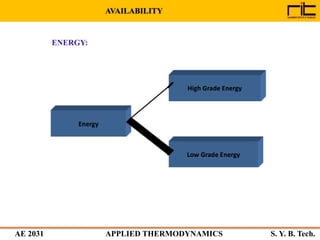
ENERGY:
AE 2031 APPLIED THERMODYNAMICS S. Y. B. Tech.
AVAILABILITY
HIGH GRADE ENERGY:
Energy that can be completely transformed into work without any loss.
i.e. fully utilizable.
Examples of High Grade Energy:
1. Mechanical work
2. Electrical work
3. Water power
4. Wind power
5. Tidal power
AE 2031 APPLIED THERMODYNAMICS S. Y. B. Tech.
AVAILABILITY
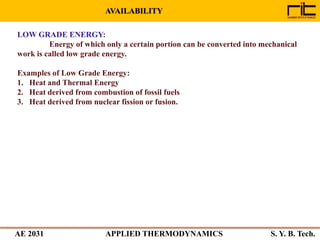
LOW GRADE ENERGY:
Energy of which only a certain portion can be converted into mechanical
work is called low grade energy.
Examples of Low Grade Energy:
1. Heat and Thermal Energy
2. Heat derived from combustion of fossil fuels
3. Heat derived from nuclear fission or fusion.
AE 2031 APPLIED THERMODYNAMICS S. Y. B. Tech.
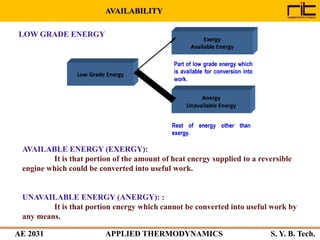
LOW GRADE ENERGY
AVAILABILITY
AVAILABLE ENERGY (EXERGY):
It is that portion of the amount of heat energy supplied to a reversible
engine which could be converted into useful work.
UNAVAILABLE ENERGY (ANERGY): :
It is that portion energy which cannot be converted into useful work by
any means.
AE 2031 APPLIED THERMODYNAMICS S. Y. B. Tech.
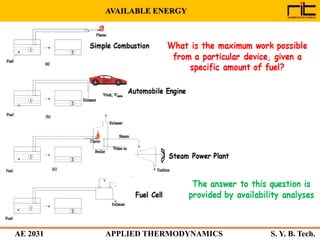
AVAILABLE ENERGY
AE 2031 APPLIED THERMODYNAMICS S. Y. B. Tech.
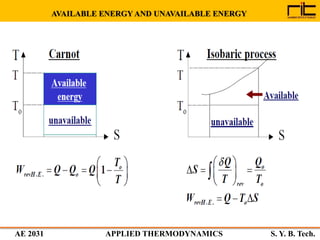
AVAILABLE ENERGY AND UNAVAILABLE ENERGY
AE 2031 APPLIED THERMODYNAMICS S. Y. B. Tech.
Thank You !

Chapter 2 Entropy & Availability

  • 1.
    AE 2031 APPLIEDTHERMODYNAMICS S. Y. B. Tech. ENTROPY Prof. Aniket Suryawanshi Asst. Prof. Automobile Engg. Dept. R. I. T. Rajaramnagar
  • 2.
    AE 2031 APPLIEDTHERMODYNAMICS S. Y. B. Tech. OUTLINE OF CHAPTER Clausius’ Inequality. Entropy: A property of system. Entropy of pure substances. Increase of entropy principle. Entropy changes in flow processes or open systems. Entropy changes in non flow process or closed systems. Entropy generation.
  • 3.
    AE 2031 APPLIEDTHERMODYNAMICS S. Y. B. Tech. Entropy (S) = a measure of randomness or disorder MATTER IS ENERGY. ENERGY IS INFORMATION. EVERYTHING IS INFORMATION. PHYSICS SAYS THAT STRUCTURES... BUILDINGS, SOCIETIES, IDEOLOGIES... WILL SEEK THEIR POINT OF LEAST ENERGY. THIS MEANS THAT THINGS FALL. THEY FALL FROM HEIGHTS OF ENERGY AND STRUCTURED INFORMATION INTO MEANINGLESS, POWERLESS DISORDER. THIS IS CALLED ENTROPY. ENTROPY AND DISORDER
  • 4.
    AE 2031 APPLIEDTHERMODYNAMICS S. Y. B. Tech. In any spontaneous process, the entropy of the universe increases. ΔSuniverse > 0 Another version of the 2nd Law: Energy spontaneously spreads out if it has no outside resistance Entropy measures the spontaneous dispersal of energy as a function of temperature How much energy is spread out How widely spread out it becomes Entropy change = “energy dispersed”/T SECOND LAW OF THERMODYNAMICS occurs without outside intervention 
  • 5.
    AE 2031 APPLIEDTHERMODYNAMICS S. Y. B. Tech. One property common to spontaneous processes is that the final state is more DISORDERED or RANDOM than the original. Spontaneity is related to an increase in randomness. The thermodynamic property related to randomness is ENTROPY, S. Reaction of K with water ENTROPY
  • 6.
    AE 2031 APPLIEDTHERMODYNAMICS S. Y. B. Tech. How probable is it that reactant molecules will react? PROBABILITY suggests that a spontaneous reaction will result in the dispersal * of energy * or of matter * or of energy & matter. Directionality of Reactions
  • 7.
    AE 2031 APPLIEDTHERMODYNAMICS S. Y. B. Tech. Entropy of the Universe ΔSuniverse = ΔSsystem + ΔSsurroundings Positional disorder Energetic disorder ΔSuniverse > 0  spontaneous process Both ΔSsys and ΔSsurr positive Both ΔSsys and ΔSsurr negative ΔSsys negative, ΔSsurr positive ΔSsys positive, ΔSsurr negative spontaneous process. nonspontaneous process. depends depends ENTROPY OF THE UNIVERSE
  • 8.
    AE 2031 APPLIEDTHERMODYNAMICS S. Y. B. Tech. ENTROPY OF THE SURROUNDINGS System Heat Entropy Surroundings System Heat Entropy Surroundings T ΔH ΔS sys surr  Low T  large entropy change (surroundings) High T  small entropy change (surroundings) ΔHsys < 0 ΔHsys > 0 ΔSsurr > 0 ΔSsurr < 0 (Energetic Disorder)
  • 9.
    AE 2031 APPLIEDTHERMODYNAMICS S. Y. B. Tech. POSITIONAL DISORDER AND PROBABILITY Probability of 1 particle in left bulb = ½ " 2 particles both in left bulb = (½)(½) = ¼ " 3 particles all in left bulb = (½)(½)(½) = 1/8 " 4 " all " = (½)(½)(½)(½) = 1/16 " 10 " all " = (½)10 = 1/1024 " 20 " all " = (½)20 = 1/1048576 " a mole of" all " = (½)6.021023 The arrangement with the greatest entropy is the one with the highest probability (most “spread out”).
  • 10.
    AE 2031 APPLIEDTHERMODYNAMICS S. Y. B. Tech. Ssolid < Sliquid << Sgas ENTROPY OF THE SYSTEM: POSITIONAL DISORDER Ludwig Boltzmann Ordered states Disordered states Low probability (few ways) High probability (many ways) Low S High S Ssystem  Positional disorder S increases with increasing # of possible positions
  • 11.
    AE 2031 APPLIEDTHERMODYNAMICS S. Y. B. Tech. Entropy usually increases when a pure liquid or solid dissolves in a solvent.
  • 12.
    AE 2031 APPLIEDTHERMODYNAMICS S. Y. B. Tech. ENTROPY CURVE Solid GasLiquid S (qrev/T) (J/K) Temperature (K) 0 0  fusion  vaporization S° (absolute entropy) can be calculated for any substance
  • 13.
    AE 2031 APPLIEDTHERMODYNAMICS S. Y. B. Tech. S increases slightly with T S increases a large amount with phase changes ENTROPY CURVE
  • 14.
    AE 2031 APPLIEDTHERMODYNAMICS S. Y. B. Tech. Entropy Increases with... • Melting (fusion) Sliquid > Ssolid ΔHfusion/Tfusion = ΔSfusion • Vaporization Sgas > Sliquid ΔHvaporization/Tvaporization = ΔSvaporization • Increasing ngas in a reaction • Heating ST2 > ST1 if T2 > T1 • Dissolving (usually) Ssolution > (Ssolvent + Ssolute) • Molecular complexity more bonds, more entropy • Atomic complexity more e-, protons, neutrons
  • 15.
    AE 2031 APPLIEDTHERMODYNAMICS S. Y. B. Tech. RECAP: CHARACTERISTICS OF ENTROPY • S is a state function • S is extensive (more stuff, more entropy) • At 0 K, S = 0 (we can know absolute entropy) • S > 0 for elements and compounds in their standard states • ΔS°rxn = nS°products - nS°reactants • Raise T  increase S • Increase ngas  increase S • More complex systems  larger S
  • 16.
    AE 2031 APPLIEDTHERMODYNAMICS S. Y. B. Tech. Volume Pressure • • a b • d T1 Q1 Q2 V nRT P 1 =  V const P . = T2 • c Q= 0 Q= 0 V nRT P 2 = CLAUSIUS THEOREM Clausius Theorem: It states that “ a reversible line can be replaced by two reversible adiabatic line and a reversible isothermal line.”
  • 17.
    AE 2031 APPLIEDTHERMODYNAMICS S. Y. B. Tech. This Proves that; Violation of Kelvin – Planck Statement results in violation of Clausius Statement. Converse is also True. SECOND LAW OF THERMODYNAMICS TH Wrev. QH QL1 Reversible Heat Engine Irreversible Heat Engine TL QL2 W irrev.
  • 18.
    AE 2031 APPLIEDTHERMODYNAMICS S. Y. B. Tech. AVAILABILITY ENERGY:
  • 19.
    AE 2031 APPLIEDTHERMODYNAMICS S. Y. B. Tech. AVAILABILITY HIGH GRADE ENERGY: Energy that can be completely transformed into work without any loss. i.e. fully utilizable. Examples of High Grade Energy: 1. Mechanical work 2. Electrical work 3. Water power 4. Wind power 5. Tidal power
  • 20.
    AE 2031 APPLIEDTHERMODYNAMICS S. Y. B. Tech. AVAILABILITY LOW GRADE ENERGY: Energy of which only a certain portion can be converted into mechanical work is called low grade energy. Examples of Low Grade Energy: 1. Heat and Thermal Energy 2. Heat derived from combustion of fossil fuels 3. Heat derived from nuclear fission or fusion.
  • 21.
    AE 2031 APPLIEDTHERMODYNAMICS S. Y. B. Tech. LOW GRADE ENERGY AVAILABILITY AVAILABLE ENERGY (EXERGY): It is that portion of the amount of heat energy supplied to a reversible engine which could be converted into useful work. UNAVAILABLE ENERGY (ANERGY): : It is that portion energy which cannot be converted into useful work by any means.
  • 22.
    AE 2031 APPLIEDTHERMODYNAMICS S. Y. B. Tech. AVAILABLE ENERGY
  • 23.
    AE 2031 APPLIEDTHERMODYNAMICS S. Y. B. Tech. AVAILABLE ENERGY AND UNAVAILABLE ENERGY
  • 24.
    AE 2031 APPLIEDTHERMODYNAMICS S. Y. B. Tech. Thank You !