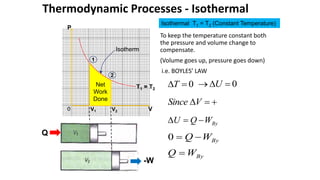
Thermodynamic Processes - Isothermal
To keep the temperature constant both
the pressure and volume change to
compensate.
(Volume goes up, pressure goes down)
i.e. BOYLES’ LAW
P
V
0
2
1
Isotherm
Isothermal T1 = T2 (Constant Temperature)
V1 V2
T1 = T2
Q
-W
0

T 0


 U


V
Since
By
W
Q
U 


By
W
Q 

0
By
W
Q 
Net
Work
Done
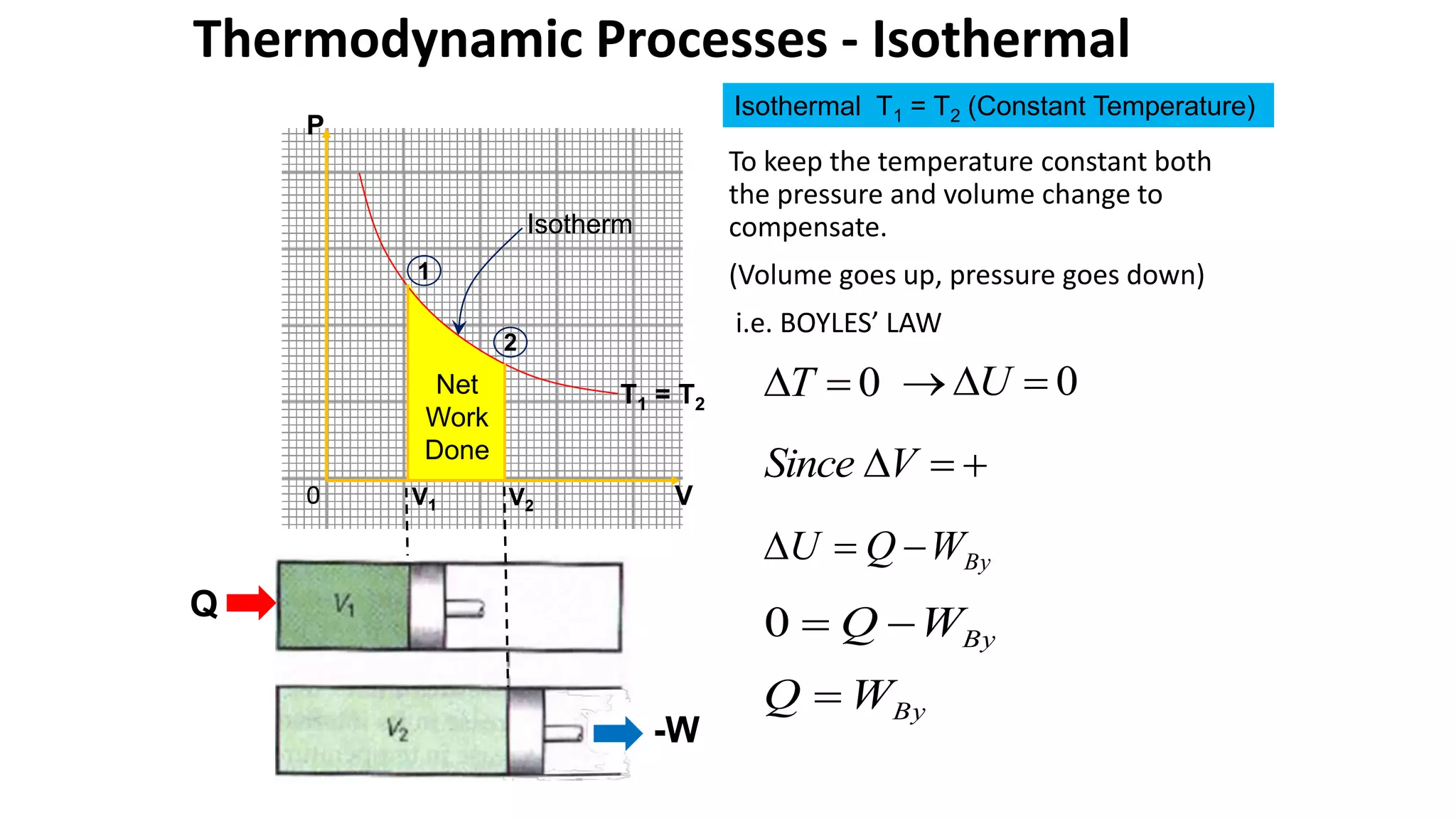
Thermodynamic Processes - Isobaric
Heat is added to the gas which
increases the Internal Energy (U).
Work is done by the gas as it changes
in volume.
The path of an isobaric process is a
horizontal line called an isobar.
0
2
1
V1 V2
Isobar
T1
T2
T2>T1
Q
-W
Isobaric P1 = P2 (Constant Pressure)
By
W
Q
U 


P
V
Net Work
Done
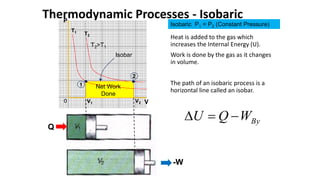
Thermodynamic Processes – Isovolumetric
(Isochoric)
0
2
1
V1= V2
Isomet
T1
T2
T2>T1
P
V
Isovolumetric V1 = V2 (Constant Volume)
Q W = 0
0

V
Since
By
W
Q
U 


0


 Q
U
Q
U 

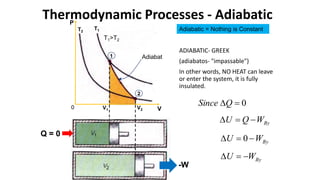
Thermodynamic Processes - Adiabatic
ADIABATIC- GREEK
(adiabatos- "impassable")
In other words, NO HEAT can leave
or enter the system, it is fully
insulated.
0 V1 V2
P
V
Adiabatic = Nothing is Constant
T1
T2
T1>T2
2
1 Adiabat
Q = 0
-W
0

Q
Since
By
W
Q
U 


By
W
U 

 0
By
W
U 


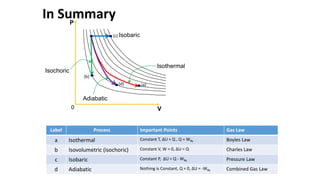
In Summary
0
P
V
(b)
(a)
(c)
(d)
Label Process Important Points Gas Law
a Isothermal Constant T, ΔU = Q , Q = WBy Boyles Law
b Isovolumetric (isochoric) Constant V, W = 0, ΔU = Q Charles Law
c Isobaric Constant P, ΔU = Q - WBy Pressure Law
d Adiabatic Nothing is Constant, Q = 0, ΔU = -WBy Combined Gas Law
Isobaric
Isothermal
Isochoric
Adiabatic

Isothermal Isobaric Isochoric Adiabatic Processes.pptx

  • 1.
    Thermodynamic Processes -Isothermal To keep the temperature constant both the pressure and volume change to compensate. (Volume goes up, pressure goes down) i.e. BOYLES’ LAW P V 0 2 1 Isotherm Isothermal T1 = T2 (Constant Temperature) V1 V2 T1 = T2 Q -W 0  T 0    U   V Since By W Q U    By W Q   0 By W Q  Net Work Done
  • 2.
    Thermodynamic Processes -Isobaric Heat is added to the gas which increases the Internal Energy (U). Work is done by the gas as it changes in volume. The path of an isobaric process is a horizontal line called an isobar. 0 2 1 V1 V2 Isobar T1 T2 T2>T1 Q -W Isobaric P1 = P2 (Constant Pressure) By W Q U    P V Net Work Done
  • 3.
    Thermodynamic Processes –Isovolumetric (Isochoric) 0 2 1 V1= V2 Isomet T1 T2 T2>T1 P V Isovolumetric V1 = V2 (Constant Volume) Q W = 0 0  V Since By W Q U    0    Q U Q U  
  • 4.
    Thermodynamic Processes -Adiabatic ADIABATIC- GREEK (adiabatos- "impassable") In other words, NO HEAT can leave or enter the system, it is fully insulated. 0 V1 V2 P V Adiabatic = Nothing is Constant T1 T2 T1>T2 2 1 Adiabat Q = 0 -W 0  Q Since By W Q U    By W U    0 By W U   
  • 5.
    In Summary 0 P V (b) (a) (c) (d) Label ProcessImportant Points Gas Law a Isothermal Constant T, ΔU = Q , Q = WBy Boyles Law b Isovolumetric (isochoric) Constant V, W = 0, ΔU = Q Charles Law c Isobaric Constant P, ΔU = Q - WBy Pressure Law d Adiabatic Nothing is Constant, Q = 0, ΔU = -WBy Combined Gas Law Isobaric Isothermal Isochoric Adiabatic