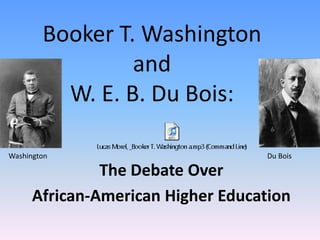
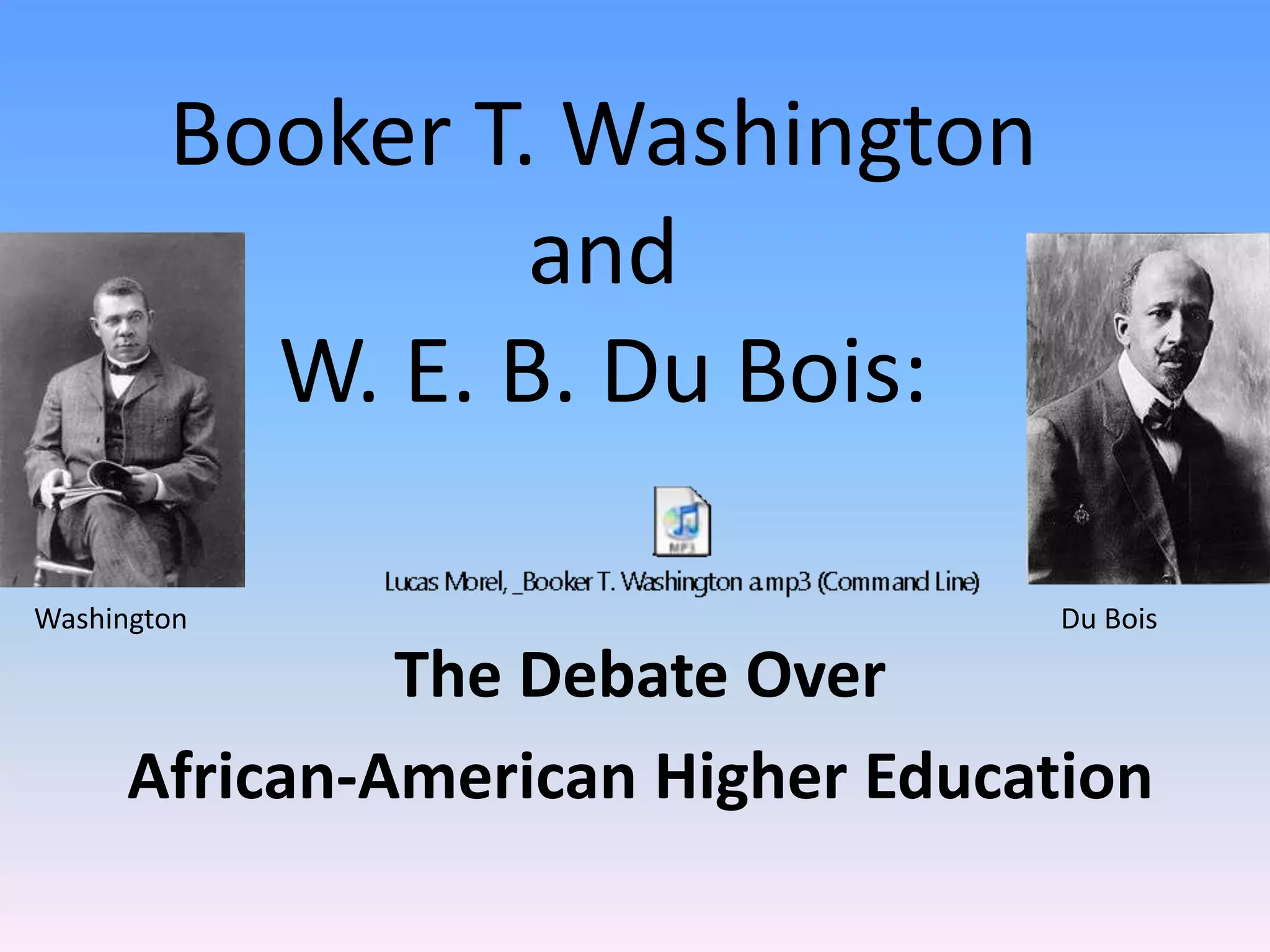
Booker T. Washington and W. E. B. Du Bois:WashingtonDu BoisThe Debate OverAfrican-American Higher Education
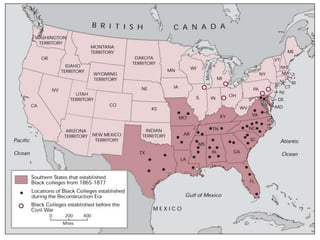
The Development of Black CollegesI. Three types of Black CollegeS:   A. Church related   B. Privately Endowed   C. Public    D. 1854 - 1 Black College  (Lincoln Univ. PA)   E. 1865 - 1895 – More than 30 black colleges        established in the south   D. 1900 - New Growth for Black Colleges –        Southern States and cities established            or took over black colleges after 1900
Black College FundingII.  Funding Sources:	A. State funding	B. Church funding	C. Tuition	D. Northern Business	E. Schools and colleges	    -school choirs Fisk Jubilee Singers, The Moorehouse College Glee Club, later the NCCU 	    Concert and Touring Choirs	F. White phlanthropists		1. Ford		2. Rosenwald		3. Rockerfeller		4. Carnegie
Booker Taliaferro Washington:Early YearsChildhood	A.  Born April 5, 1856 to a slave woman named Jane 		 in Hale’s Ford, Virginia	B.  White father, name unknown	C.  Middle name Taliaferro was his master’s name 		 (TAH-li-ver)	D.  Took the last name of Washington after his step-		 father, Washington Ferguson. 	E.  Classified as a slave despite his heritage  	F.  Worked in salt furnaces and coal mines in 	 	West Virginia after Emancipation
Booker Taliaferro Washington:Education and early Adult LifeHampton Normal and Agricultural Institute	A.  Washington enrolled in 1872	B.  Learned the importance of self-reliance	C.  Became an apprentice teacher in 1876	D.  Left for Wayland Seminary (Washington,	     D.C.) in 1878  	F.  Returned to Hampton to teach in 1879
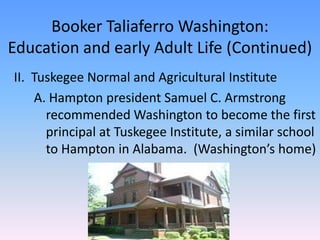
Booker Taliaferro Washington:Education and early Adult Life (Continued)II.  Tuskegee Normal and Agricultural Institute	A. Hampton president Samuel C. Armstrong 	recommended Washington to become the first 	principal at Tuskegee Institute, a similar school 	to Hampton in Alabama.  (Washington’s home)
Washington as a Leader:President/Principal of Tuskegee Institute	A.  Tuskegee opened July 4, 1881	B.  Washington was one of the first black 		  leaders of such an institution	C.  Bought a plantation in 1882 that became the permanent 	site  of the campus	C.  Students literally built their school from 		 the ground up, and raised their own food	D.  Both men and women learned a trade along with 		 their coursework	E.  Tuskegee embodied Washington’s belief that African-		Americans could become self-reliant with a little help and 		guidance
Washington’s Rise to Prominence:II.  Political/Industrial Connections       A.  Washington worked and socialized with 		  many white politicians and industry leaders.Andrew CarnegieWilliam Howard Taft John D. Rockefeller Henry Huttleston Rogers III.  The 1895 Atlanta Compromise Address	A. Given at the Cotton States and 		International Exposition in Atlanta, Georgia	B. Stated that he valued "industrial“ education 		oriented toward the jobs then available to the 		majority of African Americans.
William Edward Burghardt Du Bois: “W.E.B. Du Bois”  Early Life:	A.  Born Feb. 23, 1868 in Great Barrington,    	  MA	B.  Father deserted the family in 1870	C.  Du Bois’s mother suffered a stroke when 		  he was young, which prevented her from 	  working, family gave them money to		  survive on	D.  Du Bois decided that he could improve 		  their lives best if he got an education
W. E. B. Du BoisEducation and Travels:        A.  Regarded as very bright and intellectual at a young age, 	 encouraged by his teachers to further his education        B.  His success led him to believe that he could use his    	 	knowledge to empower  African-Americans and 	encourage them to become educated          C.  Attended Fisk University, graduated in 1888        D.  Earned a second bachelor’s degree from Harvard 	 	  University in 1890        E.  Received a stipend to attend the University of Berlin in 	 1892, traveled extensively throughout Europe and 	 	 became a Marxist        F.  Became the first African-American to receive a Ph. D. 	 	 from Harvard in 1895
W. E. B. Du BoisAcademic Career and Public Service	  A. Taught at Wilberforce University and the 	University of Pennsylvania 	  B. Later established the Sociology Department at          	Atlanta University 	  C.  Became a prolific author:  The Philadelphia Negro, The Souls of Black Folk D. Along with Booker T. Washington he helped  	organize the "Negro exhibition" at the 1900 	Exposition Universelle in Paris.  The exhibition 	aimed at showing African-Americans’ positive 	contributions to American society.  F.  Founded the National Association for the 	 	 Advancement of Colored People (NAACP) in   	 1909
Du Bois’s African-American Criminology Theory Three Part Theory:	A.  Negro crime is caused by the strain of the 			  “social revolution” experienced by black Americans 	   as they began to adapt to their newfound 		   freedom and position in the nation	B.  Black crime declined as the African-		 American population moved towards a 		 more equal status.	C.  The “Talented Tenth” or the "exceptional men" of 		 the black race would be the ones to lead the race 		 and save it from its criminal problems
Washington and Du BoisFirst Encounter	A.  Du Bois present at the Atlanta 	 	 	  Compromise speech, and gave it its name	B.  Opposed the speech on the grounds that 	  it was insufficiently committed to the 	  pursuit of social and political equality for 	  Blacks.	C. Both sought to define the best means to 	 improve the conditions of the post-Civil 	 War African- American community.
Washington and Du Bois (continued)II.  Beliefs and Differences:	A.  Washington: 		  1. Believed the two races should remain 	        	             segregated		  2. Believed assimilating and fitting into the "American" 		       culture was the best way for blacks to move up in society		  3.  Saw the importance of higher education, but felt blacks		       should become teachers (their duty) and/or work in trades 		       instead of confronting whites in their own world.	B.  Du Bois:		 1. Thought blacks should seek higher education, preferably 	  		      liberal arts.	       2. Believed blacks should challenge and question		      whites on all grounds 		 3.  Saw teaching as a calling, not a duty, the “Talented Tenth”		      should be the primary advocates for black rights
Washington and Du BoisFinal Contributions	A.  Both men worked tirelessly towards the  	  advancement of African-Americans	B.  Washington privately supported legal 	 	  action against segregation	C.  Became first African- American leader to visit 	 the White House in 1901, but died in 1915from hypertension at age 59	D.  Dubois lived to be 96 years old, wrote 22 	 books (five novels) and helped establish four 	 journals
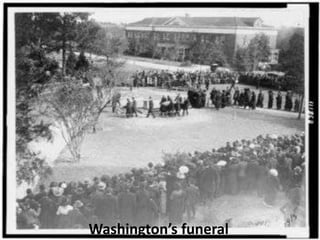
Washington’s funeral
<script type="text/javascript" src="http://soundlearning.publicradio.org/www_publicradio/tools/media_player/js/swfobject.js"></script><div id="sound_learning_2009_02_13_booker_20090213_64s_player"></div><script type="text/javascript">/*<![CDATA[*/var so = new SWFObject("http://soundlearning.publicradio.org/www_publicradio/tools/media_player/s_player.swf", "sound_learning_2009_02_13_booker_20090213_64s_player", "319", "83", "8", "#ffffff");so.addParam("quality", "high");so.addParam("menu", "false");so.addParam("wmode", "transparent");so.addVariable("name", "sound_learning/2009/02/13/booker_20090213_64");so.write("sound_learning_2009_02_13_booker_20090213_64s_player");/*]]>*/</script>

Washington And Du Bois

  • 1.
    Booker T. Washingtonand W. E. B. Du Bois:WashingtonDu BoisThe Debate OverAfrican-American Higher Education
  • 2.
    The Development ofBlack CollegesI. Three types of Black CollegeS: A. Church related B. Privately Endowed C. Public D. 1854 - 1 Black College (Lincoln Univ. PA) E. 1865 - 1895 – More than 30 black colleges established in the south D. 1900 - New Growth for Black Colleges – Southern States and cities established or took over black colleges after 1900
  • 4.
    Black College FundingII. Funding Sources: A. State funding B. Church funding C. Tuition D. Northern Business E. Schools and colleges -school choirs Fisk Jubilee Singers, The Moorehouse College Glee Club, later the NCCU Concert and Touring Choirs F. White phlanthropists 1. Ford 2. Rosenwald 3. Rockerfeller 4. Carnegie
  • 5.
    Booker Taliaferro Washington:EarlyYearsChildhood A. Born April 5, 1856 to a slave woman named Jane in Hale’s Ford, Virginia B. White father, name unknown C. Middle name Taliaferro was his master’s name (TAH-li-ver) D. Took the last name of Washington after his step- father, Washington Ferguson. E. Classified as a slave despite his heritage F. Worked in salt furnaces and coal mines in West Virginia after Emancipation
  • 6.
    Booker Taliaferro Washington:Educationand early Adult LifeHampton Normal and Agricultural Institute A. Washington enrolled in 1872 B. Learned the importance of self-reliance C. Became an apprentice teacher in 1876 D. Left for Wayland Seminary (Washington, D.C.) in 1878 F. Returned to Hampton to teach in 1879
  • 7.
    Booker Taliaferro Washington:Educationand early Adult Life (Continued)II. Tuskegee Normal and Agricultural Institute A. Hampton president Samuel C. Armstrong recommended Washington to become the first principal at Tuskegee Institute, a similar school to Hampton in Alabama. (Washington’s home)
  • 8.
    Washington as aLeader:President/Principal of Tuskegee Institute A. Tuskegee opened July 4, 1881 B. Washington was one of the first black leaders of such an institution C. Bought a plantation in 1882 that became the permanent site of the campus C. Students literally built their school from the ground up, and raised their own food D. Both men and women learned a trade along with their coursework E. Tuskegee embodied Washington’s belief that African- Americans could become self-reliant with a little help and guidance
  • 9.
    Washington’s Rise toProminence:II. Political/Industrial Connections A. Washington worked and socialized with many white politicians and industry leaders.Andrew CarnegieWilliam Howard Taft John D. Rockefeller Henry Huttleston Rogers III. The 1895 Atlanta Compromise Address A. Given at the Cotton States and International Exposition in Atlanta, Georgia B. Stated that he valued "industrial“ education oriented toward the jobs then available to the majority of African Americans.
  • 10.
    William Edward BurghardtDu Bois: “W.E.B. Du Bois” Early Life: A. Born Feb. 23, 1868 in Great Barrington, MA B. Father deserted the family in 1870 C. Du Bois’s mother suffered a stroke when he was young, which prevented her from working, family gave them money to survive on D. Du Bois decided that he could improve their lives best if he got an education
  • 11.
    W. E. B.Du BoisEducation and Travels: A. Regarded as very bright and intellectual at a young age, encouraged by his teachers to further his education B. His success led him to believe that he could use his knowledge to empower African-Americans and encourage them to become educated C. Attended Fisk University, graduated in 1888 D. Earned a second bachelor’s degree from Harvard University in 1890 E. Received a stipend to attend the University of Berlin in 1892, traveled extensively throughout Europe and became a Marxist F. Became the first African-American to receive a Ph. D. from Harvard in 1895
  • 12.
    W. E. B.Du BoisAcademic Career and Public Service A. Taught at Wilberforce University and the University of Pennsylvania B. Later established the Sociology Department at Atlanta University C. Became a prolific author: The Philadelphia Negro, The Souls of Black Folk D. Along with Booker T. Washington he helped organize the "Negro exhibition" at the 1900 Exposition Universelle in Paris. The exhibition aimed at showing African-Americans’ positive contributions to American society. F. Founded the National Association for the Advancement of Colored People (NAACP) in 1909
  • 13.
    Du Bois’s African-AmericanCriminology Theory Three Part Theory: A. Negro crime is caused by the strain of the “social revolution” experienced by black Americans as they began to adapt to their newfound freedom and position in the nation B. Black crime declined as the African- American population moved towards a more equal status. C. The “Talented Tenth” or the "exceptional men" of the black race would be the ones to lead the race and save it from its criminal problems
  • 14.
    Washington and DuBoisFirst Encounter A. Du Bois present at the Atlanta Compromise speech, and gave it its name B. Opposed the speech on the grounds that it was insufficiently committed to the pursuit of social and political equality for Blacks. C. Both sought to define the best means to improve the conditions of the post-Civil War African- American community.
  • 15.
    Washington and DuBois (continued)II. Beliefs and Differences: A. Washington: 1. Believed the two races should remain segregated 2. Believed assimilating and fitting into the "American" culture was the best way for blacks to move up in society 3. Saw the importance of higher education, but felt blacks should become teachers (their duty) and/or work in trades instead of confronting whites in their own world. B. Du Bois: 1. Thought blacks should seek higher education, preferably liberal arts. 2. Believed blacks should challenge and question whites on all grounds 3. Saw teaching as a calling, not a duty, the “Talented Tenth” should be the primary advocates for black rights
  • 16.
    Washington and DuBoisFinal Contributions A. Both men worked tirelessly towards the advancement of African-Americans B. Washington privately supported legal action against segregation C. Became first African- American leader to visit the White House in 1901, but died in 1915from hypertension at age 59 D. Dubois lived to be 96 years old, wrote 22 books (five novels) and helped establish four journals
  • 17.
  • 18.
    <script type="text/javascript" src="http://soundlearning.publicradio.org/www_publicradio/tools/media_player/js/swfobject.js"></script><divid="sound_learning_2009_02_13_booker_20090213_64s_player"></div><script type="text/javascript">/*<![CDATA[*/var so = new SWFObject("http://soundlearning.publicradio.org/www_publicradio/tools/media_player/s_player.swf", "sound_learning_2009_02_13_booker_20090213_64s_player", "319", "83", "8", "#ffffff");so.addParam("quality", "high");so.addParam("menu", "false");so.addParam("wmode", "transparent");so.addVariable("name", "sound_learning/2009/02/13/booker_20090213_64");so.write("sound_learning_2009_02_13_booker_20090213_64s_player");/*]]>*/</script>