Nutritional Needs
CHAPTER 15
LEARNING
OBJECTIVES
 Understand the importance
of nutrition.
 Explain the factors that
affect the nutritional status
of a person.
 Learn how to assess the
nutritional status of an
individual.
 Perform care of patients
with different conditions.
 Know how to meet
nutritional requirements.
CHAPTER OUTLINE
 Nutrition-its importance
and factors affecting the
nutritional needs
 Diet- special and
therapeutic
 Care of patient with
various conditions
 Diet- oral, enteral,
parenteral
 Treatment related to GI
system- nasogastric
suction, gastric irrigation,
gastric analysis.
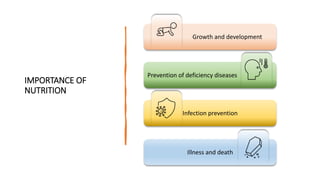
IMPORTANCE OF
NUTRITION
Growth and development
Prevention of deficiency diseases
Illness and death
Infection prevention
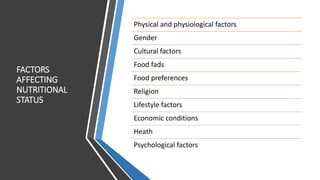
FACTORS
AFFECTING
NUTRITIONAL
STATUS
Physical and physiological factors
Gender
Cultural factors
Food fads
Food preferences
Religion
Lifestyle factors
Economic conditions
Heath
Psychological factors
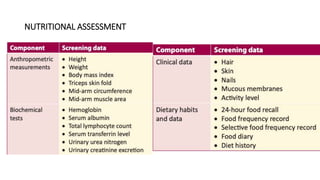
NUTRITIONAL ASSESSMENT
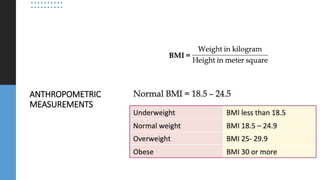
ANTHROPOMETRIC
MEASUREMENTS
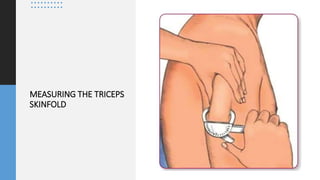
MEASURING THE TRICEPS
SKINFOLD
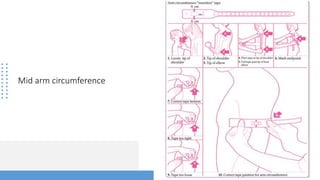
Mid arm circumference
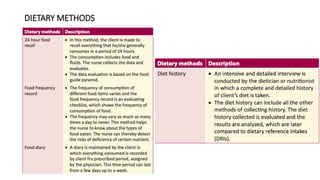
DIETARY METHODS
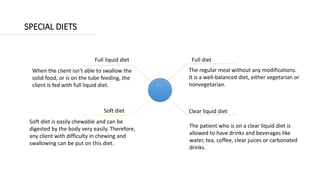
SPECIAL DIETS
Full diet
The regular meal without any modifications.
It is a well-balanced diet, either vegetarian or
nonvegetarian.
Clear liquid diet
The patient who is on a clear liquid diet is
allowed to have drinks and beverages like
water, tea, coffee, clear juices or carbonated
drinks.
Full liquid diet
When the client isn’t able to swallow the
solid food, or is on the tube feeding, the
client is fed with full liquid diet.
Soft diet
Soft diet is easily chewable and can be
digested by the body very easily. Therefore,
any client with difficulty in chewing and
swallowing can be put on this diet.
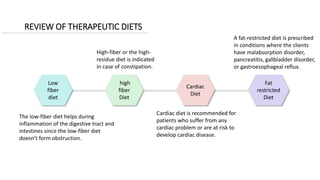
REVIEW OF THERAPEUTIC DIETS
Low
fiber
diet
The low-fiber diet helps during
inflammation of the digestive tract and
intestines since the low-fiber diet
doesn’t form obstruction.
high
fiber
Diet
High-fiber or the high-
residue diet is indicated
in case of constipation.
Cardiac
Diet
Cardiac diet is recommended for
patients who suffer from any
cardiac problem or are at risk to
develop cardiac disease.
Fat
restricted
Diet
A fat-restricted diet is prescribed
in conditions where the clients
have malabsorption disorder,
pancreatitis, gallbladder disorder,
or gastroesophageal reflux.
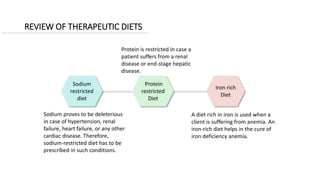
REVIEW OF THERAPEUTIC DIETS
Sodium
restricted
diet
Sodium proves to be deleterious
in case of hypertension, renal
failure, heart failure, or any other
cardiac disease. Therefore,
sodium-restricted diet has to be
prescribed in such conditions.
Protein
restricted
Diet
Protein is restricted in case a
patient suffers from a renal
disease or end-stage hepatic
disease.
Iron rich
Diet
A diet rich in iron is used when a
client is suffering from anemia. An
iron-rich diet helps in the cure of
iron deficiency anemia.
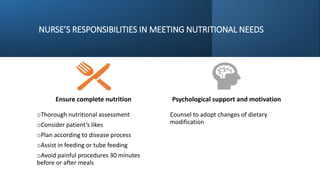
NURSE’S RESPONSIBILITIES IN MEETING NUTRITIONAL NEEDS
Ensure complete nutrition
oThorough nutritional assessment
oConsider patient’s likes
oPlan according to disease process
oAssist in feeding or tube feeding
oAvoid painful procedures 30 minutes
before or after meals
Psychological support and motivation
Counsel to adopt changes of dietary
modification
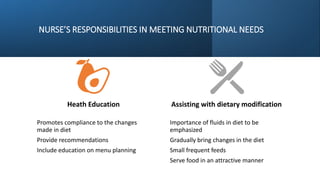
NURSE’S RESPONSIBILITIES IN MEETING NUTRITIONAL NEEDS
Heath Education
Promotes compliance to the changes
made in diet
Provide recommendations
Include education on menu planning
Assisting with dietary modification
Importance of fluids in diet to be
emphasized
Gradually bring changes in the diet
Small frequent feeds
Serve food in an attractive manner
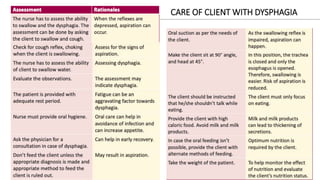
CARE OF CLIENT WITH DYSPHAGIA
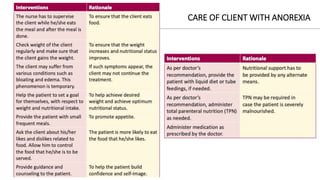
CARE OF CLIENT WITH ANOREXIA
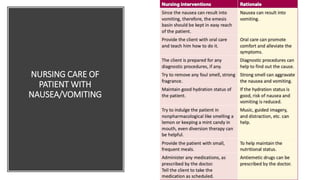
NURSING CARE OF
PATIENT WITH
NAUSEA/VOMITING
MEETING NUTRITIONAL
NEEDS
Oral Nutrition
Oral feeding is the process of
obtaining the oral nutrition in
order to meet the nutritional
needs of the patient through oral
nutrition
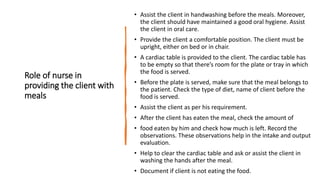
Role of nurse in
providing the client with
meals
• Assist the client in handwashing before the meals. Moreover,
the client should have maintained a good oral hygiene. Assist
the client in oral care.
• Provide the client a comfortable position. The client must be
upright, either on bed or in chair.
• A cardiac table is provided to the client. The cardiac table has
to be empty so that there’s room for the plate or tray in which
the food is served.
• Before the plate is served, make sure that the meal belongs to
the patient. Check the type of diet, name of client before the
food is served.
• Assist the client as per his requirement.
• After the client has eaten the meal, check the amount of
• food eaten by him and check how much is left. Record the
observations. These observations help in the intake and output
evaluation.
• Help to clear the cardiac table and ask or assist the client in
washing the hands after the meal.
• Document if client is not eating the food.
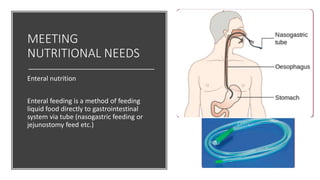
MEETING
NUTRITIONAL NEEDS
Enteral nutrition
Enteral feeding is a method of feeding
liquid food directly to gastrointestinal
system via tube (nasogastric feeding or
jejunostomy feed etc.)
Procedure of nasogastric tube insertion
Procedure of feeding through nasogastric tube
Refer: Textbook of Foundation of Nursing" by Jyoti Kathwal
Jejunostomy
Jejunostomy, also called a ‘J tube’,
is defined an alternate method of
enteral feeding, which is
performed surgically. An opening is
created in the jejunum, surgically.
The opening is used for
administration of food, water, and
medications.
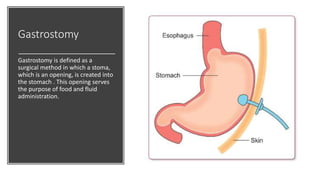
Gastrostomy
Gastrostomy is defined as a
surgical method in which a stoma,
which is an opening, is created into
the stomach . This opening serves
the purpose of food and fluid
administration.
Nursing
management of
a client with
Jejunostomy and
Gastrostomy
• Maintain optimum nutrition status
• Infection control
• Skin care
• Body image
• Monitoring and evaluating the
client
PARENTERAL
NUTRITION
Parenteral nutrition (PN) is the method of
supplying the adequate nutrition through the
IV route. In other words, the nutrition is
supplied through the veins.
The parenteral nutrition can either be partial
parenteral nutrition (PPN) or the total
parenteral nutrition (TPN).
THE TPN BAG
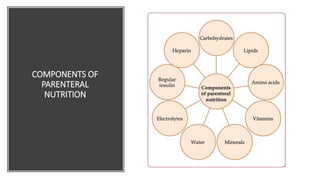
The TPN bag consists of a mixture of
proteins, carbohydrates, fats, electrolytes,
vitamins, minerals and sterile water.
TPN is a hypertonic solution, which helps
in maintaining the positive nitrogen
balance for those who are unable to
maintain nitrogen balance, muscle mass,
and weight.
INDICATIONS OF TPN
• Severe malnourishment
• Burns
• Ulcerative colitis
• Renal/hepatic failure
• Cancer
• Major surgeries
• Hypermetabolic disease
• Conditions due to which there is inability to ingest food
orally, and the client hasn’t eaten in 7–10 days.
• Patient unwilling to eat food orally.
COMPONENTS OF
PARENTERAL
NUTRITION
ADMINISTRATION OF PARENTERAL NUTRITION
• Continuous PN
The parenteral nutrition bag is administered over
24 hours without any intermission.
• Intermittent or cyclic PN
PN is administered in cycles, and most often, it is
administered overnight.
COMPLICATIONS
OF TPN
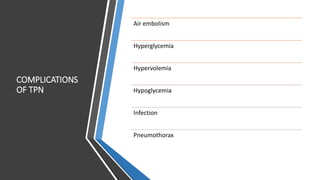
Air embolism
Hyperglycemia
Hypervolemia
Hypoglycemia
Infection
Pneumothorax
TREATMENT RELATED TO GASTROINTESTINAL SYSTEM
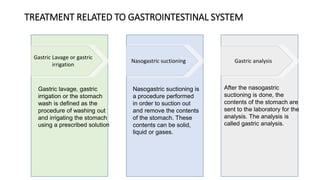
Gastric Lavage or gastric
irrigation
Nasogastric suctioning Gastric analysis
Gastric lavage, gastric
irrigation or the stomach
wash is defined as the
procedure of washing out
and irrigating the stomach
using a prescribed solution
Nasogastric suctioning is
a procedure performed
in order to suction out
and remove the contents
of the stomach. These
contents can be solid,
liquid or gases.
After the nasogastric
suctioning is done, the
contents of the stomach are
sent to the laboratory for the
analysis. The analysis is
called gastric analysis.
CHAPTER FOCUS POINTS
• Nutrition plays an important role in one’s life. Nutrition helps in growth and development of the body, as well as helps to
fight infection.
• Certain factors such as gender, age, culture, and religion, etc affect the nutritional status of an individual.
• The nutritional status of an individual can be assessed in terms of anthropometry, biochemical test, clinical data, and dietary
habits.
• There are a number of diets that can be used to recommend to the client in case of any disease condition, such as solid diet,
liquid diet, semi-solid diet, etc.
• Therapeutic diets such as low fiber, sodium restricted, cardiac diet can also be prescribed under the situations of a disease.
• Nursing care is highly involved in the care of patient with conditions like dysphagia, anorexia, nausea and vomiting.
• The nutritional needs of the client can be fulfilled using the oral, enteral and parenteral feeding.
• Nursing care is involved in treating the gastric conditions. These modalities include gastric lavage, nasogastric suctioning,
and gastric analysis.
“Textbook of Foundation of
Nursing" by Jyoti Kathwal