Nursing foundation
unit – 3
Nutritional needs of patients
Objectives
Objectives
Introduction
Importance
Factors effecting nutritional needs.
Review : special diets
Review : therapeutic diets
 Care of patient –
dysphagia ,anorexia ,
nausea , vomiting .
 Procedure –insertion of ng
tube and feeding
 oral, enteral: nasogastric,
orogastric .
 Feeds
 TPN.
ØIntroduction …
It’s a critical part of health and
development.
It’s a process by which the body Uses food .
Nutrients from foods and fluids are
used by the body for growth and
all body functions .
Definition of nutrition ….
 Nutrition is the study of nutrients
In food , how the body uses them, and the
Relationship between diet , health , and
disease.
• Nutrition is a method in which the food
is consumed by the organism into the body
and utilizing the nutrients from the food
Importance of nutrition ….
 Good nutrition aids the immune system .
 Proper nutrition provides with energy .
 Good nutrition- good mood
Good health .
 Proper metabolism and
Nourishment .
 A longer life – healthy life .
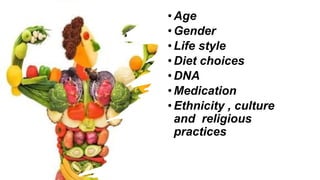
Factors effecting nutritional needs....
•Age
•Gender
•Life style
•Diet choices
•DNA
•Medication
•Ethnicity , culture
and religious
practices
Assessment of nutritional status ….
Nutritional status ….
• It’s the current body status of a person
• It expresses a degree to which the
physiological needs and the nutrients are
met .
 Optimal.
 Malnutrition.
 Deficiency vs overload.
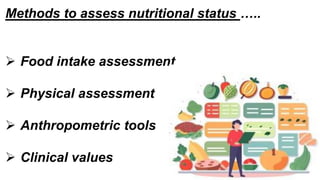
Methods to assess nutritional status …..
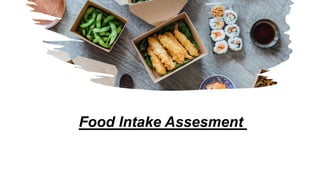
 Food intake assessment
 Physical assessment
 Anthropometric tools
 Clinical values
Food Intake Assesment
Physical assessment …..
 Pale palm & conjunctiva or gets tired easily, loss of appetite
indicates - anemia, deficiency of iron, folic etc.
 Bitot spot ( whitish patchy triangular lesions on the side of the
eyes) indicates - vitamin A deficiency.
 Goitre ( swelling on the front of the neck) indicates - iodine
deficiency disorder.
 PEM (PROTEIN ENERGY MALNUTRITION) indicate protein
deficiency.
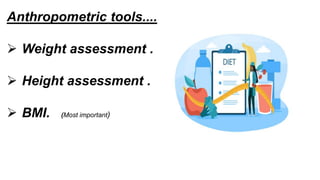
Anthropometric tools....
 Weight assessment .
 Height assessment .
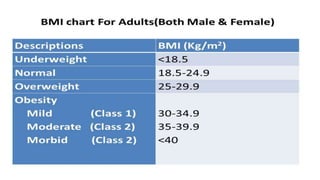
 BMI. (Most important)
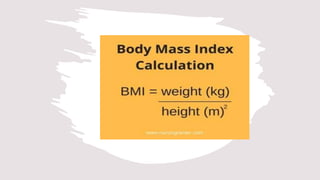
BMI
CALCULATIONS
Review of special diets....​?
 Solid diet
 Liquid diet
 Soft diet
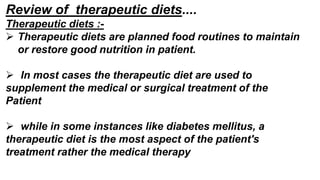
Review of therapeutic diets....
Therapeutic diets :-
 Therapeutic diets are planned food routines to maintain
or restore good nutrition in patient.
 In most cases the therapeutic diet are used to
supplement the medical or surgical treatment of the
Patient
 while in some instances like diabetes mellitus, a
therapeutic diet is the most aspect of the patient's
treatment rather the medical therapy
Review of therapeutic diets....
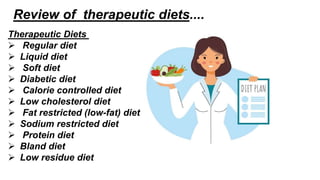
Therapeutic Diets
 Regular diet
 Liquid diet
 Soft diet
 Diabetic diet
 Calorie controlled diet
 Low cholesterol diet
 Fat restricted (low-fat) diet
 Sodium restricted diet
 Protein diet
 Bland diet
 Low residue diet
• Regular diet – i.e balanced diet
• Liquid diet – consists of liquid contents , mainly given to the
patient who is diagnosed with severe gastro conditions , first
step -post operative patient to relive from NBM status.
• Soft diet - consists of soft foods like mashed potato mainly
given to the patient who is diagnosed with severe gastro
conditions ,second step -post operative patient to relive from
NBM status.
• Diabetic diet - low sugar / high protein and / fibre content .etc
Written assignment on
therapeutic diet
specific conditions n
diet recall.....
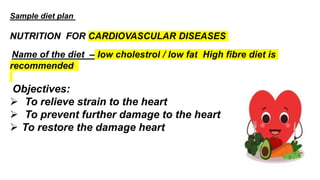
Sample diet plan
NUTRITION FOR CARDIOVASCULAR DISEASES
Name of the diet – low cholestrol / low fat High fibre diet is
recommended
Objectives:
 To relieve strain to the heart
 To prevent further damage to the heart
 To restore the damage heart
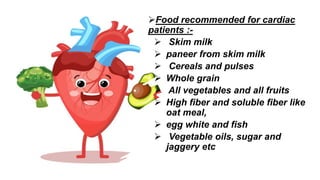
Food recommended for cardiac
patients :-
 Skim milk
 paneer from skim milk
 Cereals and pulses
 Whole grain
 All vegetables and all fruits
 High fiber and soluble fiber like
oat meal,
 egg white and fish
 Vegetable oils, sugar and
jaggery etc
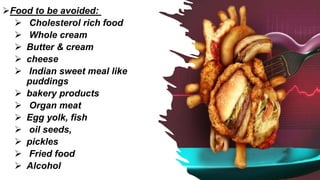
Food to be avoided:
 Cholesterol rich food
 Whole cream
 Butter & cream
 cheese
 Indian sweet meal like
puddings
 bakery products
 Organ meat
 Egg yolk, fish
 oil seeds,
 pickles
 Fried food
 Alcohol
Regular low cholesterol and low fat and high fiber diet:-
 Energy- 1600 k cal
 Fat- 40 g
 Protein- 65 g
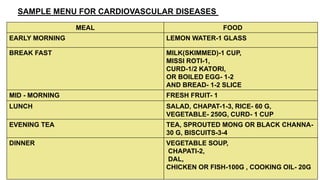
SAMPLE MENU FOR CARDIOVASCULAR DISEASES
MEAL FOOD
EARLY MORNING LEMON WATER-1 GLASS
BREAK FAST MILK(SKIMMED)-1 CUP,
MISSI ROTI-1,
CURD-1/2 KATORI,
OR BOILED EGG- 1-2
AND BREAD- 1-2 SLICE
MID - MORNING FRESH FRUIT- 1
LUNCH SALAD, CHAPAT-1-3, RICE- 60 G,
VEGETABLE- 250G, CURD- 1 CUP
EVENING TEA TEA, SPROUTED MONG OR BLACK CHANNA-
30 G, BISCUITS-3-4
DINNER VEGETABLE SOUP,
CHAPATI-2,
DAL,
CHICKEN OR FISH-100G , COOKING OIL- 20G
Roll number 1- 5 diet plan for diabetic patient .
Roll number 6-10 diet plan for renal patient .
Roll number 11- 15 diet plan for hypertension.
Roll number 16 - 20 diet plan for constipation .
Roll number 21- 25 diet plan for post operative patient.
Roll number 26-30 diet plan for the patient diagnosed with
severe diarrhea .
Roll number 31- 34 diet plan for the patient who underwent
abdominal surgery .
Individual files should be submitted
Care of patients
with specific
conditions
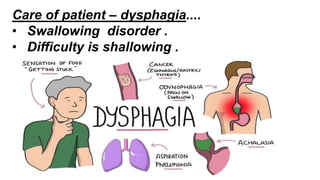
Care of patient – dysphagia....
• Swallowing disorder .
• Difficulty is shallowing .
Care of patient with dysphagia …..
 Maintain the patient in high-Fowler's position with the
head flexed slightly forward during meals.
 Instruct the patient not to talk while eating.
 Provide verbal cueing as needed.
 Avoid milk and milk products
 If the patient had a stroke, place food in the back of the
mouth, on the unaffected side, and gently massage the
unaffected side of the throat.
 Observe for uncoordinated chewing or
swallowing; coughing shortly after eating or
delayed coughing. which may mean
silent aspiration; pocketing of food; wet-
sounding voice; sneezing when eating; delay of
more than 1 second in swallowing; or a
variation in respiratory patterns.
 If any of these signs are present, put on gloves,
eliminate all food from oral cavity, end feedings, and
consult with a speech and language pathologist and a
dysphagia team.
 Encourage high-calorie diet that involves all food
groups, as appropriate.
 Discuss the importance of exercise to enhance
the muscular strength of the face and tongue to
enhance swallowing
 Educate patient, family, and all caregivers about
rationales for food consistency and choices.
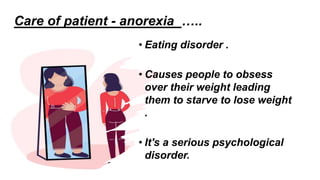
• Eating disorder .
• Causes people to obsess
over their weight leading
them to starve to lose weight
.
• It's a serious psychological
disorder.
Care of patient - anorexia …..
Care of patient with anorexia …..
NURSING MANAGEMENT:
 Monitor the weight of client.
 Correction of nutritional deficiency
by providing nutritious diet.
 Eating must be supervised by the nurse and
provide balanced diet of at least 3000 calories
should be provided in 24 hrs.
 The goal should to be achieving weight gain of
0.5 to 1 Kg. per week.
 Monitor the serum electrolysis levels.
 Control vomiting by making bathroom
inaccessible for at least 2 hrs. After food.
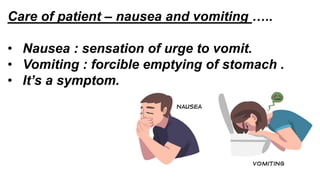
Care of patient – nausea and vomiting …..
• Nausea : sensation of urge to vomit.
• Vomiting : forcible emptying of stomach .
• It’s a symptom.
• Drink clear or ice-cold drinks. Eat
light, bland foods (such as
saltine crackers or plain bread)​.
• Avoid fried, greasy, or sweet
foods​.
Care of patient with anorexia …...
• Do not mix hot and
cold foods.​
• Drink beverages slowly.​
• Eat slowly and
eat smaller, more frequent
• Avoid activity after eating​
• Avoid brushing your teeth
after eating
• Choose foods from all the
food groups as you can
tolerate them to get adequate
nutrition​
MEETING NUTRITIONAL
NEEDS: PRINCIPLES
&
EQUIPMENTS, PROCEDURE
INDICATIONS......
Oral nutrition
Enteral nutrition
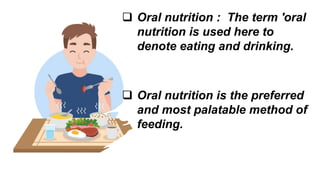
 Oral nutrition ​: The term 'oral
nutrition is used here to
denote eating and drinking.
 Oral nutrition is the preferred
and most palatable method of
feeding.
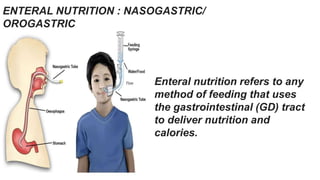
ENTERAL NUTRITION : NASOGASTRIC/
OROGASTRIC
Enteral nutrition refers to any
method of feeding that uses
the gastrointestinal (GD) tract
to deliver nutrition and
calories.
The term enteral feeding is most often used to mean tube
feeding.
Enteral nutrition is indicated for patients who have a
functioning GI tract but cannot ingest enough nutrients
orally because they are unable or unwilling to take oral
feedings.
Nutrition is delivered using a flexible tube inserted through
nose, or directly into stomach or small intestine.
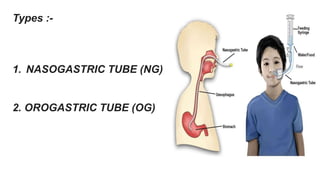
Types :-
1. NASOGASTRIC TUBE (NG)
2. OROGASTRIC TUBE (OG)
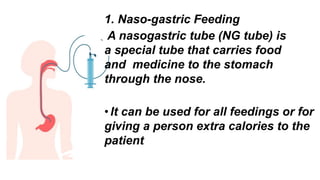
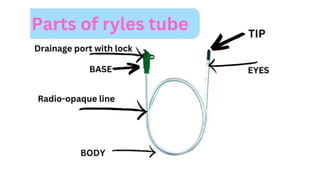
1. Naso-gastric Feeding
A nasogastric tube (NG tube) is
a special tube that carries food
and medicine to the stomach
through the nose.
•It can be used for all feedings or for
giving a person extra calories to the
patient
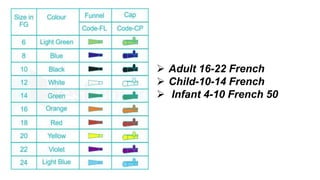
 Adult 16-22 French
 Child-10-14 French
 Infant 4-10 French 50
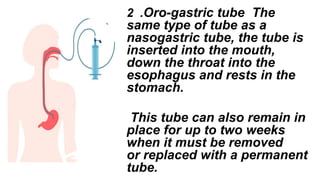
2 .Oro-gastric tube The
same type of tube as a
nasogastric tube, the tube is
inserted into the mouth,
down the throat into the
esophagus and rests in the
stomach.
This tube can also remain in
place for up to two weeks
when it must be removed
or replaced with a permanent
tube.​​
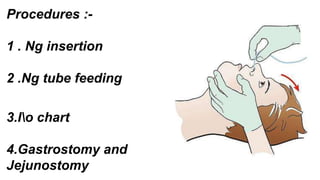
Procedures :-
1 . Ng insertion
2 .Ng tube feeding
3.Io chart
4.Gastrostomy and
Jejunostomy
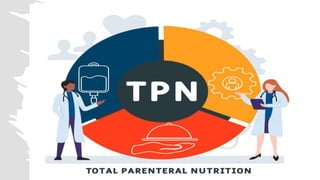
Total parenteral nutrition (TPN) is a way of supplying all
the nutritional needs of the body by bypassing the
digestive system and dripping nutrient solution/s directly
into a vein.
The administration of a nutritionally adequate hypertonic
solution (consisting of glucose, protein hydrolysates,
minerals, and vitamins) through an indwelling catheter
into the superior vena cava or other main vein.
Normally TPN is administered in a hospital, but
under certain conditions and with proper patient and
caregiver education, it may also be used at home for long-
term therapy (HPA).
Ideally, TPN provides all the nutrients in the correct
quantities to ensure the body functions normally.​
nutritional needs of patient updated (1).pptx