DEFINITION
It is defined as a
comprehensive analysis of a
person’s nutritional status that
uses historical information,
food intake data ,
anthropometric measurement,
physical examination and
biochemical data.
PURPOSES
• Identify individuals who are
malnourished or are at risk for
developing malnutrition.
• Provide data for designing a
nutrition plan of care to prevent
or minimize development
malnutrition.
• Establish baseline data for
evaluating the efficacy of
nutritional care.
OBJECTIVES OF NUTRITIONAL ASSESSMENT
• To obtain precise information on the
Prevalence and Geographical distribution of
nutritional problems of a given community.
• To identify the population group ‘at risk’ or in
greatest need of assistance.
• To develop a health care programme that
meets the needs defined by the assessment.
OBJECTIVES OF NUTRITIONAL ASSESSMENT
• To evaluate the failure or success of
health Programmes and health
services.
• To assess the degree of malnutrition
(PEM) of pre-school and school going
children.
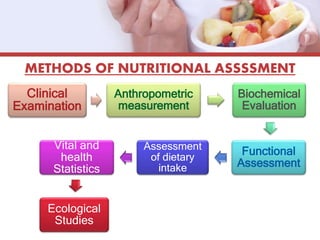
METHODS OF NUTRITIONAL ASSSSMENT
Clinical
Examination
Anthropometric
measurement
Biochemical
Evaluation
Functional
Assessment
Assessment
of dietary
intake
Vital and
health
Statistics
Ecological
Studies
Clinical Examination
• It is the simplest and the most practical method

for assessment of nutritional status of
individuals.
• It is used to detect the level of health status of
the individual in relation to the food
consumption.
• Head to toe examination should be performed
to detect the signs of nutritional deficiency
states such as hair changes, anemia , edema ,
xerosis , etc…,
Clinical Examination
ADVANTAGES :-
Fast and Easy to perform
Inexpensive
Non-Invasive
LIMITATIONS :-
 Did not detect early cases
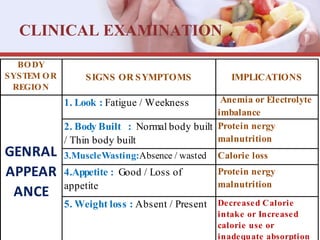
CLINICAL EXAMINATION
BODY
SYSTEM OR
REGION
SIGNS OR SYMPTOMS IMPLICATIONS
1. Look : Fatigue / Weekness Anemia or Electrolyte
imbalance
2. Body Built : Normal body built
/ Thin body built
Protein nergy
malnutrition
GENRAL
APPEAR
ANCE
3.MuscleWasting:Absence / wasted Calorie loss
4.Appetite : Good / Loss of
appetite
Protein nergy
malnutrition
5. Weight loss : Absent / Present Decreased Calorie
intake or Increased
calorie use or
inadequate absorption
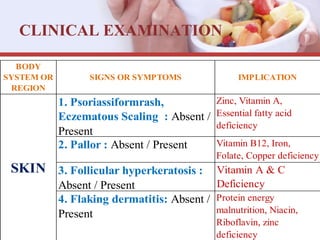
SKIN
BODY
SYSTEM OR
REGION
SIGNS OR SYMPTOMS IMPLICATION
1. Psoriassiformrash,
Eczematous Scaling : Absent /
Present
2. Pallor : Absent / Present
3. Follicular hyperkeratosis :
Absent / Present
Zinc, Vitamin A,
Essential fatty acid
deficiency
Vitamin B12, Iron,
Folate, Copper deficiency
Vitamin A & C
Deficiency
4. Flaking dermatitis: Absent /
Present
Protein energy
malnutrition, Niacin,
Riboflavin, zinc
deficiency
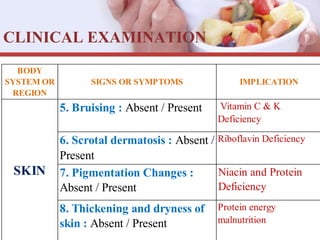
CLINICAL EXAMINATION
SKIN
BODY
SYSTEM OR
REGION
SIGNS OR SYMPTOMS IMPLICATION
5. Bruising : Absent / Present
6. Scrotal dermatosis : Absent /
Present
7. Pigmentation Changes :
Absent / Present
Vitamin C & K
Deficiency
Riboflavin Deficiency
Niacin and Protein
Deficiency
8. Thickening and dryness of
skin : Absent / Present
Protein energy
malnutrition
1. Temporal muscle wasting :
Absent / Present
Protein energy
malnutrition
BODY
SYSTEM OR
REGION
SIGNS OR SYMPTOMS IMPLICATION
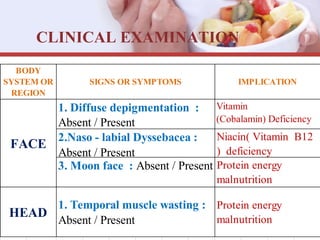
1. Diffuse depigmentation :
Absent / Present
2.Naso - labial Dyssebacea :
Absent / Present
3. Moon face : Absent / Present
Vitamin
(Cobalamin) Deficiency
Niacin( Vitamin B12
) deficiency
Protein energy
malnutrition
FACE
HEAD
CLINICAL EXAMINATION
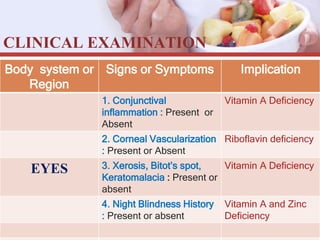
Body system or
Region
Signs or Symptoms Implication
1. Conjunctival
inflammation : Present or
Absent
Vitamin A Deficiency
2. Corneal Vascularization
: Present or Absent
Riboflavin deficiency
EYES 3. Xerosis, Bitot’s spot,
Keratomalacia : Present or
absent
Vitamin A Deficiency
4. Night Blindness History
: Present or absent
Vitamin A and Zinc
Deficiency
CLINICAL EXAMINATION
Body system
or Region
Signs or symptoms Implication
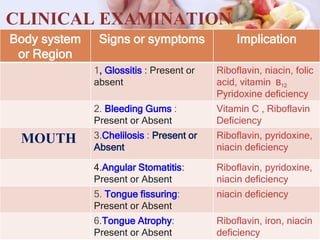
1, Glossitis : Present or
absent
Riboflavin, niacin, folic
acid, vitamin B12
Pyridoxine deficiency
2. Bleeding Gums :
Present or Absent
Vitamin C , Riboflavin
Deficiency
MOUTH 3.Chelilosis : Present or
Absent
Riboflavin, pyridoxine,
niacin deficiency
4.Angular Stomatitis:
Present or Absent
Riboflavin, pyridoxine,
niacin deficiency
5. Tongue fissuring:
Present or Absent
niacin deficiency
6.Tongue Atrophy:
Present or Absent
Riboflavin, iron, niacin
deficiency
CLINICAL EXAMINATION
Body system
or Region
Signs or symptoms Implication
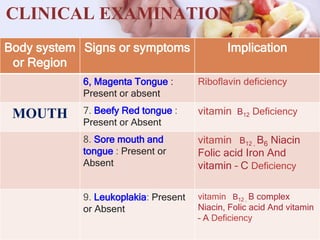
6, Magenta Tongue :
Present or absent
Riboflavin deficiency
MOUTH 7. Beefy Red tongue :
Present or Absent
vitamin B12 Deficiency
8. Sore mouth and
tongue : Present or
Absent
vitamin B12 , B6 Niacin
Folic acid Iron And
vitamin – C Deficiency
9. Leukoplakia: Present
or Absent
vitamin B12 , B complex
Niacin, Folic acid And vitamin
– A Deficiency
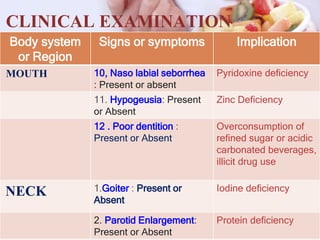
CLINICAL EXAMINATION
Body system
or Region
Signs or symptoms Implication
MOUTH 10, Naso labial seborrhea
: Present or absent
Pyridoxine deficiency
11. Hypogeusia: Present
or Absent
Zinc Deficiency
12 . Poor dentition :
Present or Absent
Overconsumption of
refined sugar or acidic
carbonated beverages,
illicit drug use
NECK 1.Goiter : Present or
Absent
Iodine deficiency
2. Parotid Enlargement:
Present or Absent
Protein deficiency
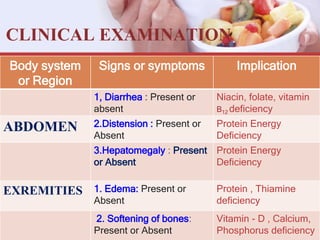
CLINICAL EXAMINATION
Body system
or Region
Signs or symptoms Implication
1, Diarrhea : Present or
absent
Niacin, folate, vitamin
B12 deficiency
ABDOMEN 2.Distension : Present or
Absent
Protein Energy
Deficiency
3.Hepatomegaly : Present
or Absent
Protein Energy
Deficiency
EXREMITIES 1. Edema: Present or
Absent
Protein , Thiamine
deficiency
2. Softening of bones:
Present or Absent
Vitamin - D , Calcium,
Phosphorus deficiency
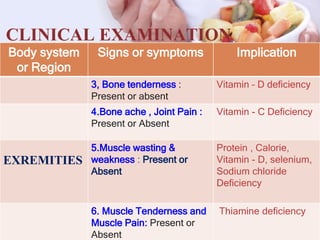
CLINICAL EXAMINATION
Body system
or Region
Signs or symptoms Implication
3, Bone tenderness :
Present or absent
Vitamin – D deficiency
4.Bone ache , Joint Pain :
Present or Absent
Vitamin - C Deficiency
EXREMITIES
5.Muscle wasting &
weakness : Present or
Absent
Protein , Calorie,
Vitamin - D, selenium,
Sodium chloride
Deficiency
6. Muscle Tenderness and
Muscle Pain: Present or
Absent
Thiamine deficiency
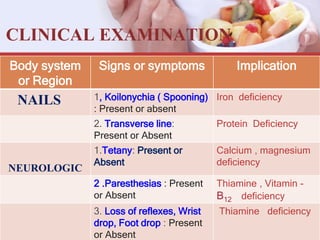
CLINICAL EXAMINATION
Body system
or Region
Signs or symptoms Implication
NAILS 1, Koilonychia ( Spooning)
: Present or absent
Iron deficiency
2. Transverse line:
Present or Absent
Protein Deficiency
NEUROLOGIC
1.Tetany: Present or
Absent
Calcium , magnesium
deficiency
2 .Paresthesias : Present
or Absent
Thiamine , Vitamin -
B12 deficiency
3. Loss of reflexes, Wrist
drop, Foot drop : Present
or Absent
Thiamine deficiency
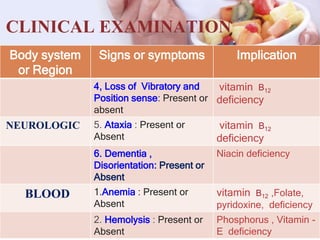
CLINICAL EXAMINATION
Body system
or Region
Signs or symptoms Implication
4, Loss of Vibratory and
Position sense: Present or
absent
vitamin B12
deficiency
NEUROLOGIC 5. Ataxia : Present or
Absent
vitamin B12
deficiency
6. Dementia ,
Disorientation: Present or
Absent
Niacin deficiency
BLOOD 1.Anemia : Present or
Absent
vitamin B12 ,Folate,
pyridoxine, deficiency
2. Hemolysis : Present or
Absent
Phosphorus , Vitamin -
E deficiency
ANTHROPOMETRIC MEASUREMENT
Anthropometry is a very valuable index for
evaluation of nutritional status. It include
measurement of height, weight, skin fold
thickness, arm circumference , head and
chest circumference, Body mass index,
elbow breadth and waist circumference.
It is used to evaluate both under and over
nutrition
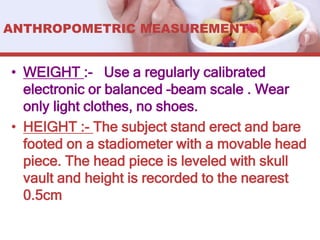
ANTHROPOMETRIC MEASUREMENT
• WEIGHT :- Use a regularly calibrated
electronic or balanced –beam scale . Wear
only light clothes, no shoes.
• HEIGHT :- The subject stand erect and bare
footed on a stadiometer with a movable head
piece. The head piece is leveled with skull
vault and height is recorded to the nearest
0.5cm
ANTHROPOMETRIC MEASUREMENT
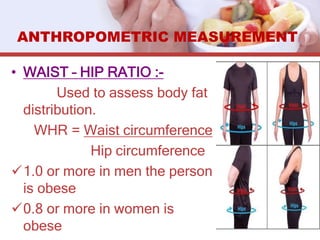
• WAIST – HIP RATIO :-
Used to assess body fat
distribution.
WHR = Waist circumference
Hip circumference
1.0 or more in men the person
is obese
0.8 or more in women is
obese
ANTHROPOMETRIC MEASUREMENT
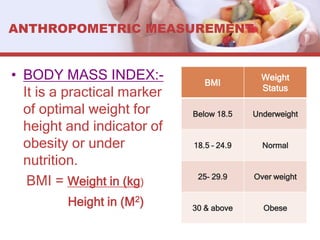
• BODY MASS INDEX:-
It is a practical marker
of optimal weight for
height and indicator of
obesity or under
nutrition.
BMI = Weight in (kg)
Height in (M2)
BMI
Weight
Status
Below 18.5 Underweight
18.5 – 24.9 Normal
25- 29.9 Over weight
30 & above Obese
ANTHROPOMETRIC MEASUREMENT
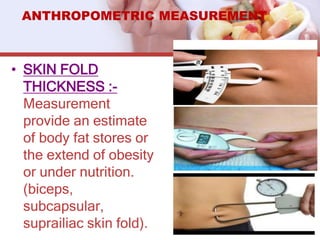
• SKIN FOLD
THICKNESS :-
Measurement
provide an estimate
of body fat stores or
the extend of obesity
or under nutrition.
(biceps,
subcapsular,
suprailiac skin fold).
ANTHROPOMETRIC MEASUREMENT
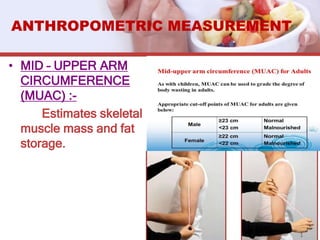
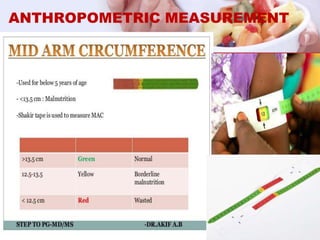
• MID – UPPER ARM
CIRCUMFERENCE
(MUAC) :-
Estimates skeletal
muscle mass and fat
storage.
ANTHROPOMETRIC MEASUREMENT
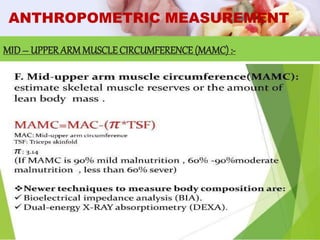
MID– UPPER ARM MUSCLECIRCUMFERENCE (MAMC):-
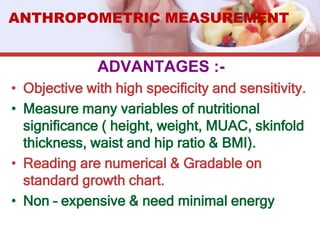
ADVANTAGES :-
• Objective with high specificity and sensitivity.
• Measure many variables of nutritional
significance ( height, weight, MUAC, skinfold
thickness, waist and hip ratio & BMI).
• Reading are numerical & Gradable on
standard growth chart.
• Non – expensive & need minimal energy
ANTHROPOMETRIC MEASUREMENT
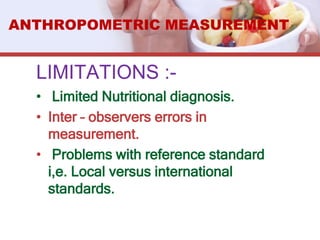
LIMITATIONS :-
• Limited Nutritional diagnosis.
• Inter – observers errors in
measurement.
• Problems with reference standard
i,e. Local versus international
standards.
ANTHROPOMETRIC MEASUREMENT
ADVANTAGES :-
• It is important because it can detect
preclinical nutritional deficiencies and can
be used to confirm subjective findings.
DISADVANTAGES :-
 Time consuming and Expensive
 It can’t be applied on a large scal
BIOCHEMICAL ASSESSMENT
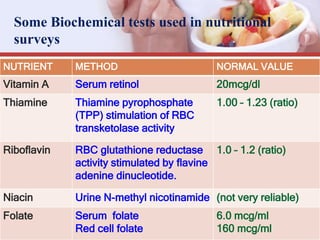
Some Biochemical tests used in nutritional
surveys
NUTRIENT METHOD NORMAL VALUE
Vitamin A Serum retinol 20mcg/dl
Thiamine Thiamine pyrophosphate
(TPP) stimulation of RBC
transketolase activity
1.00 – 1.23 (ratio)
Riboflavin RBC glutathione reductase
activity stimulated by flavine
adenine dinucleotide.
1.0 – 1.2 (ratio)
Niacin Urine N-methyl nicotinamide (not very reliable)
Folate Serum folate
Red cell folate
6.0 mcg/ml
160 mcg/ml
Some Biochemical tests used in nutritional
surveys
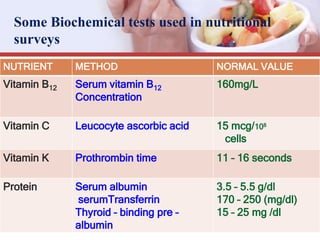
NUTRIENT METHOD NORMAL VALUE
Vitamin B12 Serum vitamin B12
Concentration
160mg/L
Vitamin C Leucocyte ascorbic acid 15 mcg/108
cells
Vitamin K Prothrombin time 11 – 16 seconds
Protein Serum albumin
serumTransferrin
Thyroid – binding pre –
albumin
3.5 – 5.5 g/dl
170 – 250 (mg/dl)
15 – 25 mg /dl
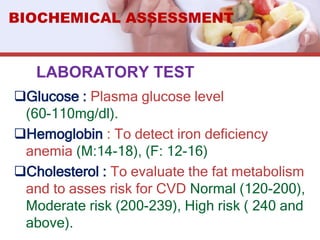
LABORATORY TEST
Glucose : Plasma glucose level
(60-110mg/dl).
Hemoglobin : To detect iron deficiency
anemia (M:14-18), (F: 12-16)
Cholesterol : To evaluate the fat metabolism
and to asses risk for CVD Normal (120-200),
Moderate risk (200-239), High risk ( 240 and
above).
BIOCHEMICAL ASSESSMENT
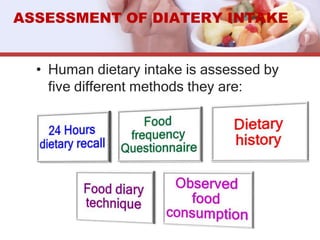
• Human dietary intake is assessed by
five different methods they are:
ASSESSMENT OF DIATERY INTAKE
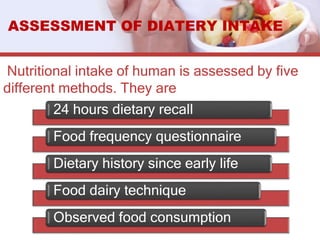
Nutritional intake of human is assessed by five
different methods. They are
ASSESSMENT OF DIATERY INTAKE
24 hours dietary recall
Food frequency questionnaire
Dietary history since early life
Food dairy technique
Observed food consumption
24 Hours Dietary Recall
• A trained interviewer asks
the subject to recall all food &
drinks taken in the previous
24 hours.
• It is quick, easy and depends
on short – term memory , but
may not be truly
representative of person’s
usual intake.
ASSESSMENT OF DIATERY INTAKE
24 Hours Dietary Recall
ADVANTAGES:-
 Easy to administer
 Easy for the client to Participate
DISADVANTAGES :-
 Only assess one day intake
 Doesn’t reflect different season or
holidays
 Relies on Memory
ASSESSMENT OF DIATERY INTAKE
Food Frequency Questionnaire
• In this method the
subject is given a list
of around 100 food
items to indicate his
or her intake
(frequency &Quality)
per day , per week
or per month.
ASSESSMENT OF DIATERY INTAKE
Food Frequency Questionnaire
ADVANTAGES :-
 Inexpensive
 Easy to use
LIMITATION :-
 Long Questionnaire
 Errors with estimating serving
size.
 Needs updating with new
commercial food product to keep
pace with changing dietary
habits.
ASSESSMENT OF DIATERY INTAKE
Dietary History
• It is an interview method
composed of two parts
• FIRST PART :- It establishes
the overall eating pattern and
include a 24 hr recall. The
subjects are asked to estimate
portion size in household
measures with the aid of
standard spoons and cups, food
photographs or food models
ASSESSMENT OF DIATERY INTAKE
SECOND PART :- The second part is Cross –
check This is the detailed list of food that are
checked with the subject.
ADVANTAGES :- Estimates nutrient intake
over a long period of time.
DISADVANTAGE :- Interviewer must be a
nutritionist or dietitian experienced in
obtaining diet histories.
ASSESSMENT OF DIATERY INTAKE
Dietary History
FOOD DIARY
• Food intake (type &
amount) should be
recorded by the subject
at the time of
consumption
• The length of the
collection period range
between 1-7 days
• Reliable but different to
ASSESSMENT OF DIATERY INTAKE
Observed Food Consumption
• The most unused method in clinical
practice, but it is recommended for
research purpose.
• The meal eaten by the individual is
weighted and contents are exactly
calculated.
• This method is having a high
degree of accuracy but expansive
& need time and efforts.
ASSESSMENT OF DIATERY INTAKE
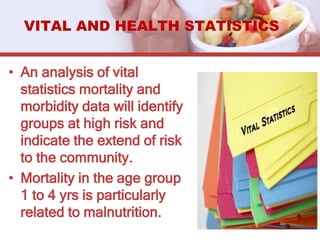
• An analysis of vital
statistics mortality and
morbidity data will identify
groups at high risk and
indicate the extend of risk
to the community.
• Mortality in the age group
1 to 4 yrs is particularly
related to malnutrition.
VITAL AND HEALTH STATISTICS
• The commonly used rates are
1, Infant mortality rate
2, Second year mortality rate
3, Low birth weight babies
Data on morbidity (e.g., hospital
data or data from community
health and morbidity surveys)
particularly in relation to PEM,
Anaemia, xerophthalmia , other
vitamin deficiencies, goitre ,
diarrhoea etc...
VITAL AND HEALTH STATISTICS
• Malnutrition is the end result of many interacting
ecological factors. A study of the ecological factors
comprise the following
ECOLOGICAL FACTORS
Food Balance Sheet (People Food
consumption in terms of per capita supply
availability availability)
Socio-economic factor
Health and Educational services
Conditioning Influences ( These include parasitic,
bacterial and viral infection which precipitate
malnutrition.)
THANK YOU

Nutritional assessment

  • 2.
    DEFINITION It is definedas a comprehensive analysis of a person’s nutritional status that uses historical information, food intake data , anthropometric measurement, physical examination and biochemical data.
  • 3.
    PURPOSES • Identify individualswho are malnourished or are at risk for developing malnutrition. • Provide data for designing a nutrition plan of care to prevent or minimize development malnutrition. • Establish baseline data for evaluating the efficacy of nutritional care.
  • 4.
    OBJECTIVES OF NUTRITIONALASSESSMENT • To obtain precise information on the Prevalence and Geographical distribution of nutritional problems of a given community. • To identify the population group ‘at risk’ or in greatest need of assistance. • To develop a health care programme that meets the needs defined by the assessment.
  • 5.
    OBJECTIVES OF NUTRITIONALASSESSMENT • To evaluate the failure or success of health Programmes and health services. • To assess the degree of malnutrition (PEM) of pre-school and school going children.
  • 6.
    METHODS OF NUTRITIONALASSSSMENT Clinical Examination Anthropometric measurement Biochemical Evaluation Functional Assessment Assessment of dietary intake Vital and health Statistics Ecological Studies
  • 8.
    Clinical Examination • Itis the simplest and the most practical method for assessment of nutritional status of individuals. • It is used to detect the level of health status of the individual in relation to the food consumption. • Head to toe examination should be performed to detect the signs of nutritional deficiency states such as hair changes, anemia , edema , xerosis , etc…,
  • 9.
    Clinical Examination ADVANTAGES :- Fastand Easy to perform Inexpensive Non-Invasive LIMITATIONS :-  Did not detect early cases
  • 10.
    CLINICAL EXAMINATION BODY SYSTEM OR REGION SIGNSOR SYMPTOMS IMPLICATIONS 1. Look : Fatigue / Weekness Anemia or Electrolyte imbalance 2. Body Built : Normal body built / Thin body built Protein nergy malnutrition GENRAL APPEAR ANCE 3.MuscleWasting:Absence / wasted Calorie loss 4.Appetite : Good / Loss of appetite Protein nergy malnutrition 5. Weight loss : Absent / Present Decreased Calorie intake or Increased calorie use or inadequate absorption
  • 11.
    SKIN BODY SYSTEM OR REGION SIGNS ORSYMPTOMS IMPLICATION 1. Psoriassiformrash, Eczematous Scaling : Absent / Present 2. Pallor : Absent / Present 3. Follicular hyperkeratosis : Absent / Present Zinc, Vitamin A, Essential fatty acid deficiency Vitamin B12, Iron, Folate, Copper deficiency Vitamin A & C Deficiency 4. Flaking dermatitis: Absent / Present Protein energy malnutrition, Niacin, Riboflavin, zinc deficiency CLINICAL EXAMINATION
  • 12.
    CLINICAL EXAMINATION SKIN BODY SYSTEM OR REGION SIGNSOR SYMPTOMS IMPLICATION 5. Bruising : Absent / Present 6. Scrotal dermatosis : Absent / Present 7. Pigmentation Changes : Absent / Present Vitamin C & K Deficiency Riboflavin Deficiency Niacin and Protein Deficiency 8. Thickening and dryness of skin : Absent / Present Protein energy malnutrition
  • 13.
    1. Temporal musclewasting : Absent / Present Protein energy malnutrition BODY SYSTEM OR REGION SIGNS OR SYMPTOMS IMPLICATION 1. Diffuse depigmentation : Absent / Present 2.Naso - labial Dyssebacea : Absent / Present 3. Moon face : Absent / Present Vitamin (Cobalamin) Deficiency Niacin( Vitamin B12 ) deficiency Protein energy malnutrition FACE HEAD CLINICAL EXAMINATION
  • 14.
    CLINICAL EXAMINATION Body systemor Region Signs or Symptoms Implication 1. Conjunctival inflammation : Present or Absent Vitamin A Deficiency 2. Corneal Vascularization : Present or Absent Riboflavin deficiency EYES 3. Xerosis, Bitot’s spot, Keratomalacia : Present or absent Vitamin A Deficiency 4. Night Blindness History : Present or absent Vitamin A and Zinc Deficiency
  • 15.
    CLINICAL EXAMINATION Body system orRegion Signs or symptoms Implication 1, Glossitis : Present or absent Riboflavin, niacin, folic acid, vitamin B12 Pyridoxine deficiency 2. Bleeding Gums : Present or Absent Vitamin C , Riboflavin Deficiency MOUTH 3.Chelilosis : Present or Absent Riboflavin, pyridoxine, niacin deficiency 4.Angular Stomatitis: Present or Absent Riboflavin, pyridoxine, niacin deficiency 5. Tongue fissuring: Present or Absent niacin deficiency 6.Tongue Atrophy: Present or Absent Riboflavin, iron, niacin deficiency
  • 16.
    CLINICAL EXAMINATION Body system orRegion Signs or symptoms Implication 6, Magenta Tongue : Present or absent Riboflavin deficiency MOUTH 7. Beefy Red tongue : Present or Absent vitamin B12 Deficiency 8. Sore mouth and tongue : Present or Absent vitamin B12 , B6 Niacin Folic acid Iron And vitamin – C Deficiency 9. Leukoplakia: Present or Absent vitamin B12 , B complex Niacin, Folic acid And vitamin – A Deficiency
  • 17.
    CLINICAL EXAMINATION Body system orRegion Signs or symptoms Implication MOUTH 10, Naso labial seborrhea : Present or absent Pyridoxine deficiency 11. Hypogeusia: Present or Absent Zinc Deficiency 12 . Poor dentition : Present or Absent Overconsumption of refined sugar or acidic carbonated beverages, illicit drug use NECK 1.Goiter : Present or Absent Iodine deficiency 2. Parotid Enlargement: Present or Absent Protein deficiency
  • 18.
    CLINICAL EXAMINATION Body system orRegion Signs or symptoms Implication 1, Diarrhea : Present or absent Niacin, folate, vitamin B12 deficiency ABDOMEN 2.Distension : Present or Absent Protein Energy Deficiency 3.Hepatomegaly : Present or Absent Protein Energy Deficiency EXREMITIES 1. Edema: Present or Absent Protein , Thiamine deficiency 2. Softening of bones: Present or Absent Vitamin - D , Calcium, Phosphorus deficiency
  • 19.
    CLINICAL EXAMINATION Body system orRegion Signs or symptoms Implication 3, Bone tenderness : Present or absent Vitamin – D deficiency 4.Bone ache , Joint Pain : Present or Absent Vitamin - C Deficiency EXREMITIES 5.Muscle wasting & weakness : Present or Absent Protein , Calorie, Vitamin - D, selenium, Sodium chloride Deficiency 6. Muscle Tenderness and Muscle Pain: Present or Absent Thiamine deficiency
  • 20.
    CLINICAL EXAMINATION Body system orRegion Signs or symptoms Implication NAILS 1, Koilonychia ( Spooning) : Present or absent Iron deficiency 2. Transverse line: Present or Absent Protein Deficiency NEUROLOGIC 1.Tetany: Present or Absent Calcium , magnesium deficiency 2 .Paresthesias : Present or Absent Thiamine , Vitamin - B12 deficiency 3. Loss of reflexes, Wrist drop, Foot drop : Present or Absent Thiamine deficiency
  • 21.
    CLINICAL EXAMINATION Body system orRegion Signs or symptoms Implication 4, Loss of Vibratory and Position sense: Present or absent vitamin B12 deficiency NEUROLOGIC 5. Ataxia : Present or Absent vitamin B12 deficiency 6. Dementia , Disorientation: Present or Absent Niacin deficiency BLOOD 1.Anemia : Present or Absent vitamin B12 ,Folate, pyridoxine, deficiency 2. Hemolysis : Present or Absent Phosphorus , Vitamin - E deficiency
  • 23.
    ANTHROPOMETRIC MEASUREMENT Anthropometry isa very valuable index for evaluation of nutritional status. It include measurement of height, weight, skin fold thickness, arm circumference , head and chest circumference, Body mass index, elbow breadth and waist circumference. It is used to evaluate both under and over nutrition
  • 24.
    ANTHROPOMETRIC MEASUREMENT • WEIGHT:- Use a regularly calibrated electronic or balanced –beam scale . Wear only light clothes, no shoes. • HEIGHT :- The subject stand erect and bare footed on a stadiometer with a movable head piece. The head piece is leveled with skull vault and height is recorded to the nearest 0.5cm
  • 25.
  • 26.
    • WAIST –HIP RATIO :- Used to assess body fat distribution. WHR = Waist circumference Hip circumference 1.0 or more in men the person is obese 0.8 or more in women is obese ANTHROPOMETRIC MEASUREMENT
  • 27.
    ANTHROPOMETRIC MEASUREMENT • BODYMASS INDEX:- It is a practical marker of optimal weight for height and indicator of obesity or under nutrition. BMI = Weight in (kg) Height in (M2) BMI Weight Status Below 18.5 Underweight 18.5 – 24.9 Normal 25- 29.9 Over weight 30 & above Obese
  • 28.
    ANTHROPOMETRIC MEASUREMENT • SKINFOLD THICKNESS :- Measurement provide an estimate of body fat stores or the extend of obesity or under nutrition. (biceps, subcapsular, suprailiac skin fold).
  • 29.
    ANTHROPOMETRIC MEASUREMENT • MID– UPPER ARM CIRCUMFERENCE (MUAC) :- Estimates skeletal muscle mass and fat storage.
  • 30.
  • 31.
    ANTHROPOMETRIC MEASUREMENT MID– UPPERARM MUSCLECIRCUMFERENCE (MAMC):-
  • 32.
    ADVANTAGES :- • Objectivewith high specificity and sensitivity. • Measure many variables of nutritional significance ( height, weight, MUAC, skinfold thickness, waist and hip ratio & BMI). • Reading are numerical & Gradable on standard growth chart. • Non – expensive & need minimal energy ANTHROPOMETRIC MEASUREMENT
  • 33.
    LIMITATIONS :- • LimitedNutritional diagnosis. • Inter – observers errors in measurement. • Problems with reference standard i,e. Local versus international standards. ANTHROPOMETRIC MEASUREMENT
  • 35.
    ADVANTAGES :- • Itis important because it can detect preclinical nutritional deficiencies and can be used to confirm subjective findings. DISADVANTAGES :-  Time consuming and Expensive  It can’t be applied on a large scal BIOCHEMICAL ASSESSMENT
  • 36.
    Some Biochemical testsused in nutritional surveys NUTRIENT METHOD NORMAL VALUE Vitamin A Serum retinol 20mcg/dl Thiamine Thiamine pyrophosphate (TPP) stimulation of RBC transketolase activity 1.00 – 1.23 (ratio) Riboflavin RBC glutathione reductase activity stimulated by flavine adenine dinucleotide. 1.0 – 1.2 (ratio) Niacin Urine N-methyl nicotinamide (not very reliable) Folate Serum folate Red cell folate 6.0 mcg/ml 160 mcg/ml
  • 37.
    Some Biochemical testsused in nutritional surveys NUTRIENT METHOD NORMAL VALUE Vitamin B12 Serum vitamin B12 Concentration 160mg/L Vitamin C Leucocyte ascorbic acid 15 mcg/108 cells Vitamin K Prothrombin time 11 – 16 seconds Protein Serum albumin serumTransferrin Thyroid – binding pre – albumin 3.5 – 5.5 g/dl 170 – 250 (mg/dl) 15 – 25 mg /dl
  • 38.
    LABORATORY TEST Glucose :Plasma glucose level (60-110mg/dl). Hemoglobin : To detect iron deficiency anemia (M:14-18), (F: 12-16) Cholesterol : To evaluate the fat metabolism and to asses risk for CVD Normal (120-200), Moderate risk (200-239), High risk ( 240 and above). BIOCHEMICAL ASSESSMENT
  • 40.
    • Human dietaryintake is assessed by five different methods they are: ASSESSMENT OF DIATERY INTAKE
  • 41.
    Nutritional intake ofhuman is assessed by five different methods. They are ASSESSMENT OF DIATERY INTAKE 24 hours dietary recall Food frequency questionnaire Dietary history since early life Food dairy technique Observed food consumption
  • 42.
    24 Hours DietaryRecall • A trained interviewer asks the subject to recall all food & drinks taken in the previous 24 hours. • It is quick, easy and depends on short – term memory , but may not be truly representative of person’s usual intake. ASSESSMENT OF DIATERY INTAKE
  • 43.
    24 Hours DietaryRecall ADVANTAGES:-  Easy to administer  Easy for the client to Participate DISADVANTAGES :-  Only assess one day intake  Doesn’t reflect different season or holidays  Relies on Memory ASSESSMENT OF DIATERY INTAKE
  • 44.
    Food Frequency Questionnaire •In this method the subject is given a list of around 100 food items to indicate his or her intake (frequency &Quality) per day , per week or per month. ASSESSMENT OF DIATERY INTAKE
  • 45.
    Food Frequency Questionnaire ADVANTAGES:-  Inexpensive  Easy to use LIMITATION :-  Long Questionnaire  Errors with estimating serving size.  Needs updating with new commercial food product to keep pace with changing dietary habits. ASSESSMENT OF DIATERY INTAKE
  • 46.
    Dietary History • Itis an interview method composed of two parts • FIRST PART :- It establishes the overall eating pattern and include a 24 hr recall. The subjects are asked to estimate portion size in household measures with the aid of standard spoons and cups, food photographs or food models ASSESSMENT OF DIATERY INTAKE
  • 47.
    SECOND PART :-The second part is Cross – check This is the detailed list of food that are checked with the subject. ADVANTAGES :- Estimates nutrient intake over a long period of time. DISADVANTAGE :- Interviewer must be a nutritionist or dietitian experienced in obtaining diet histories. ASSESSMENT OF DIATERY INTAKE Dietary History
  • 48.
    FOOD DIARY • Foodintake (type & amount) should be recorded by the subject at the time of consumption • The length of the collection period range between 1-7 days • Reliable but different to ASSESSMENT OF DIATERY INTAKE
  • 49.
    Observed Food Consumption •The most unused method in clinical practice, but it is recommended for research purpose. • The meal eaten by the individual is weighted and contents are exactly calculated. • This method is having a high degree of accuracy but expansive & need time and efforts. ASSESSMENT OF DIATERY INTAKE
  • 50.
    • An analysisof vital statistics mortality and morbidity data will identify groups at high risk and indicate the extend of risk to the community. • Mortality in the age group 1 to 4 yrs is particularly related to malnutrition. VITAL AND HEALTH STATISTICS
  • 51.
    • The commonlyused rates are 1, Infant mortality rate 2, Second year mortality rate 3, Low birth weight babies Data on morbidity (e.g., hospital data or data from community health and morbidity surveys) particularly in relation to PEM, Anaemia, xerophthalmia , other vitamin deficiencies, goitre , diarrhoea etc... VITAL AND HEALTH STATISTICS
  • 52.
    • Malnutrition isthe end result of many interacting ecological factors. A study of the ecological factors comprise the following ECOLOGICAL FACTORS Food Balance Sheet (People Food consumption in terms of per capita supply availability availability) Socio-economic factor Health and Educational services Conditioning Influences ( These include parasitic, bacterial and viral infection which precipitate malnutrition.)
  • 53.